ManualGo.com
JED4430WB - Cooker JennAir - Free user manual and instructions
Find the device manual for free JED4430WB JennAir in PDF.

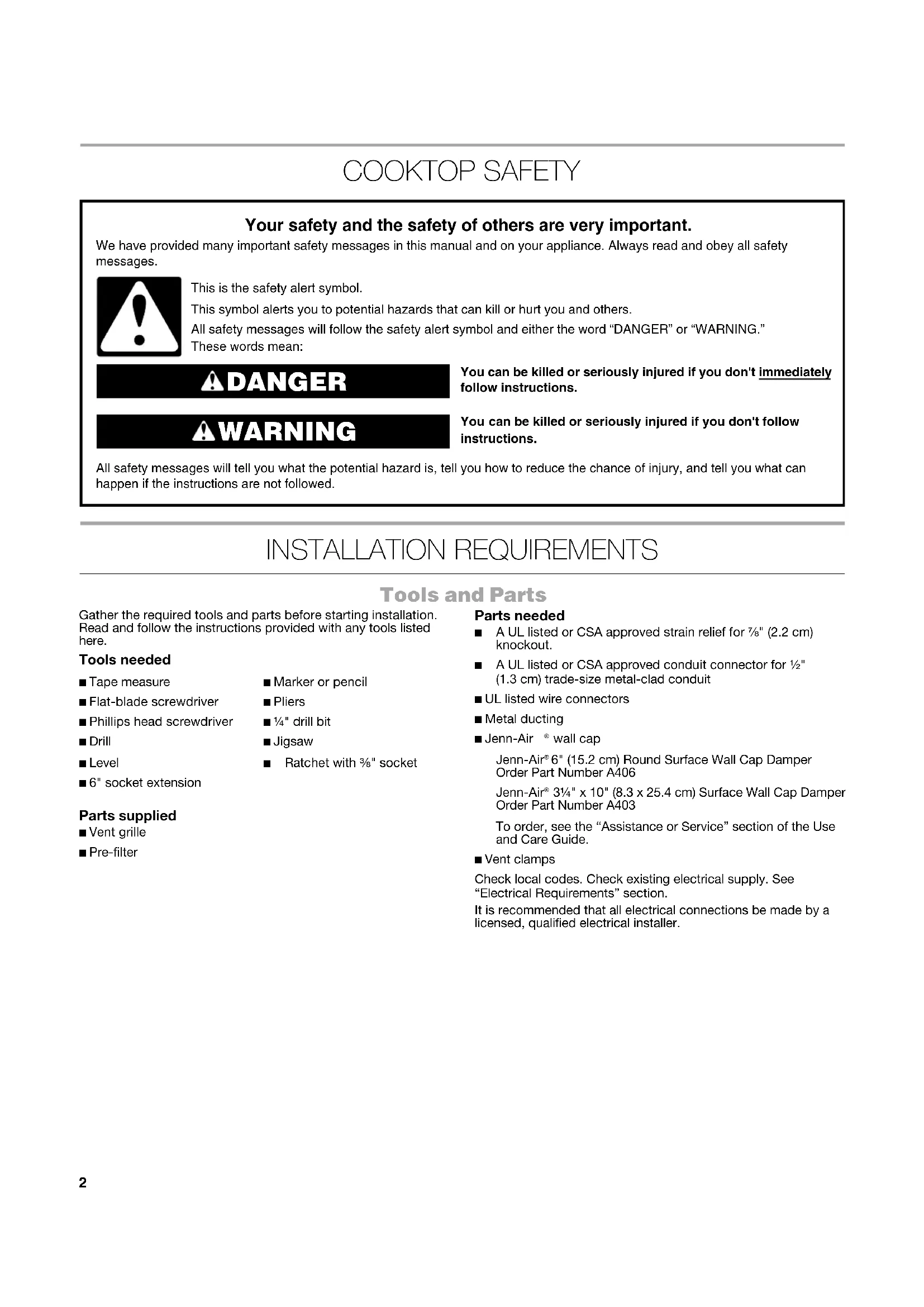

Download the instructions for your Cooker in PDF format for free! Find your manual JED4430WB - JennAir and take your electronic device back in hand. On this page are published all the documents necessary for the use of your device. JED4430WB by JennAir.
USER MANUAL JED4430WB JennAir
A. Model/serial rating plate locationB. 20 " (52.3 cm)C. 22" (55.9 cm)A. 35 " (89.8 cm)B. 16 " (41.2 cm) centerline of product to edge of burner boxC. 12 " (32.8 cm)D. 34 " (86.7 cm)E. 12½" (31.8 cm) F. 8
" (20.9 cm) recommended minimum cabinet to motor clearanceG. 18" (45.7 cm) H. 4
Cabinet Dimensions NOTES: After making the countertop cutout, some installations may require notching down the base cabinet side walls to clear the cooktop base. To avoid this modification, use a base cabinet with sidewalls wider than the cutout. ■ A minimum side clearance of 6" (15.2 cm) is recommended between side of cooktop and side wall for maximum ventilation performance. ■ A minimum clearance of 2" (5.1 cm) is recommended between the motor/blower and cabinet for proper cooling. A 6" (15.2 cm) clearance is recommended for servicing access. Cutout Dimensions Venting Requirements IMPORTANT: This cooktop must be exhausted outdoors unless using the Jenn-Air
Duct Free Filter Accessory Kit. See “Venting Methods” section. ■ Do not terminate the vent system in an attic or other enclosed area. ■ Use a Jenn-Air
vent cap. ■ Vent system must terminate to the outside.■ Use only a 6" (15.2 cm) round metal vent. Rigid metal vent is recommended. For best performance, do not use plastic or metal foil vent. ■ Before making cutouts, make sure there is proper clearance within the wall or floor for the exhaust vent. ■ Do not cut a joist or stud unless absolutely necessary. If a joist or stud must be cut, then a supporting frame must be constructed. ■ The size of the vent should be uniform.■ The vent system must have a damper. If roof or wall cap has a damper, do not use damper supplied with the range hood. ■ Use vent clamps to seal all joints in the vent system. ■ Use caulking to seal exterior wall or roof opening around the cap. ■ Determine which venting method is best for your application.A. 30" (76.2 cm) on 30" (76.2 cm) models36" (91.4 cm) on 36" (91.4 cm) modelsB. Combustible area above countertop (shown by dashed box above)C. 30" (76.2 cm) minimum clearance between top of cooktop platform and bottom of uncovered wood or metal cabinet (24" [61 cm] minimum clearance if bottom of wood or metal cabinet is covered by not less than " [0.6 cm] flame retardant millboard covered with not less than No. 28 MSG sheet steel, 0.015" [0.04 cm] stainless steel, or 0.024" [0.06 cm] aluminum or 0.020" [0.05 cm] copper)D. 13" (33 cm) recommended upper cabinet depthE. 2" (5.1 cm)F. 2 1 " (53.7 cm)G. 18" (45.7 cm) minimum clearance from upper cabinet to countertop within minimum horizontal clearances to cooktopH. Junction box or outlet; 12" (30.5 cm) minimum from bottom of countertopI. Junction box or outlet; 10" (25.4 cm) from right-hand side of cabinetJ. 28 " (73.4 cm) on 30" (76.2 cm) models34½" (87.6 cm) on 36" (91.4 cm) modelsK. 2½" (6.4 cm) minimum distance to nearest left and right side combustible surface above cooktopL. 1½" (3.8 cm) minimum clearance between back wall and countertop
A. 28 " (73.4 cm) maximum on 30" (76.2 cm) models34½" (87.6 cm) maximum on 36" (91.4 cm) modelsB. 21 " (53.7 cm) maximum on both 30" (76.2 cm) and 36" (91.4 cm) models C. 8
" (21.9 cm) on 30" (76.2 cm) models
" (39.2 cm) on 36" (91.4 cm) models D. 6
" (16.0 cm) on both 30" (76.2 cm) and 36" (91.4 cm) modelsE. 2" (5.1 cm) minimum space to front edge of cooktopF. Floor exhaust option G. 6
" (15.6 cm) for 6" (15.2 cm) vent system H. 8
" (21.9 cm) on 30" (76.2 cm) models
" (39.2 cm) on 36" (91.4 cm) modelsI. 16" (40.6 cm) on both 30" (76.2 cm) and 36" (91.4 cm) modelsJ. Wall exhaust option
For Best Performance: ■ Use 26-gauge minimum galvanized or 25-gauge minimum aluminum metal vent. Poor quality pipe fittings can reduce airflow. Flexible metal vent is not recommended. NOTE: Local codes may require a heavier gauge material. ■ Metal duct may be reduced to 30-gauge galvanized steel or 26-gauge aluminized steel if allowed by local codes. This reduction is based on information in the International Residential Codes Section M1601.1 (2006 edition). ■ Do not install 2 elbows together.■ Use no more than three 90° elbows.■ If an elbow is used, install it as far away as possible from the hood’s vent motor exhaust opening. ■ Make sure there is a minimum of 18" (45.7 cm) of straight vent between the elbows if more than one elbow is used. ■ Elbows too close together can cause excess turbulence that reduces airflow. ■ Do not use a 5" (12.7 cm) elbow in a 6" (15.2 cm) or 3¹⁄₄" x 10" (8.3 x 25.4 cm) system. ■ Do not reduce to a 5" (12.7 cm) system after using 6" (15.2 cm) or 3¹⁄₄" x 10" (8.3 x 25.4 cm) fittings. ■ Avoid forming handmade crimps. Handmade crimps may restrict airflow. ■ Use a Jenn-Air
vent cap for proper performance. If an alternate wall or roof cap is used, be certain the cap size is not reduced and that it has a backdraft damper. ■ Use vent clamps to seal all joints in the vent system.■ Use caulking to seal exterior wall or roof opening around the cap. The length of vent system and number of elbows should be kept to a minimum to provide efficient performance. The maximum equivalent length of the vent system is 60 ft (18.3 m). For altitudes above 4,500 ft (1272 m), reduce recommended vent run by 20% for best performance. Cold Weather Installations An additional backdraft damper should be installed to minimize backward cold air flow and a thermal break installed to minimize conduction of outside temperatures as part of the vent system. The damper should be on the cold air side of the thermal break. Makeup Air Local building codes may require the use of makeup air systems when using ventilation systems greater than specified CFM of air movement. The specified CFM varies from locale to locale. Consult your HVAC professional for specific requirements in your area. Venting Methods Common venting methods are shown for a counter-mounted downdraft cooktop. The cooktop may be vented through the wall or floor. Option 1 - Roof Venting Option 2 - Wall Venting A. Roof cap B. 6" (15.2 cm) round roof venting A. 6" (15.2 cm) round wall venting B. Wall cap Option 3 - Venting Between Floor Joist Option 4 - Venting behind Cabinet Kick Plate A. Wall cap B. 6" (15.2 cm) round wall venting A. Wall cap B. 6" (15.2 cm) round wall venting
Duct Free Filter Accessory Kit (For model numbers JED3430, JED3536, JED4430, JED4536, JGD3430 and JGD3536) On select downdraft models, the Jenn-Air
Duct Free Filter Accessory Kit Part Number JDA7000WX is now available. The Jenn-Air
Duct Free Filter Accessory Kit is ideal for both new construction and kitchen renovation projects because it provides an easy alternative to the installation of metal ducting and venting in the downdraft system outside the home. The kit includes all required hardware, one filter and complete installation instructions. For more information on the Jenn-Air
Duct Free Filter Accessory Kit, contact your Jenn-Air dealer or call 1-800-JENNAIR (1-800-536-6247). Calculating Vent System Length To calculate the length of the system you need, add the equivalent feet (meters) for each vent piece used in the system. Example vent system NOTE: Flexible vent is not recommended. Flexible vent creates back pressure and air turbulence that greatly reduce performance. A. Wall cap B. 6" (15.2 cm) round metal vent C. 16" (40.6 cm) maximum D. 6" (15.2 cm) round PVC sewer pipe E. 6" (15.2 cm) round metal vent F. 6" (15.2 cm) round PVC coupling G. Concrete slab H. 6" (15.2 cm) round PVC sewer pipe
1 - wall cap = 0 ft (0 m)
System length = 13 ft (3.9 m) 90˚ elbow2 ft (0.6 m)6 ft (1.8 m) wall cap7 Electrical Requirements If codes permit and a separate ground wire is used, it is recommended that a qualified electrical installer determine that the ground path and wire gauge are in accordance with local codes.Check with a qualified electrical installer if you are not sure the cooktop is properly grounded.Make sure that the electrical connection and wire size are adequate and in conformance with the National Electrical Code, ANSI/NFPA 70-latest edition or CSA Standards C22.1-94, Canadian Electrical Code, Part 1 and C22.2 No. O-M91-latest edition, and all local codes and ordinances.A copy of the above code standards can be obtained from:National Fire Protection Association1 Batterymarch ParkQuincy, MA 02169-7471CSA International8501 East Pleasant Valley RoadCleveland, OH 44131-5575 Before You Make the Electrical Connection: To properly install your cooktop, you must determine the type of electrical connection you will be using and follow the instructions provided for it here.■ A 4-wire or 3-wire, single phase, 120/240 volt, 60 Hz., AC only electrical supply on a separate, 40-amp circuit breaker is required for both 30" (76.2 cm) and 36" (91.4 cm) models. If a fused system is used, fuse both sides of the line. ■ The cooktop should be connected directly to the junction box through the flexible metal conduit. The flexible, armored cable extending from the fuse box or circuit breaker box should be connected directly to the junction box.■ Locate the junction box to allow as much slack as possible between the junction box and the cooktop so that the cooktop can be moved if servicing becomes necessary in the future.■ A UL listed or CSA approved conduit connector must be provided at each end of the power supply cable (at the cooktop and at the junction box). ■ If the house has aluminum wiring, follow the procedure below:
1. Connect a section of solid copper wire to the pigtail
leads.2. Connect the aluminum wiring to the added section of copper wire using special connectors and/or tools designed and UL listed for joining copper to aluminum.Follow the electrical connector manufacturer's recommended procedure. Aluminum/copper connection must conform with local codes and industry accepted wiring practices. INSTALLATION INSTRUCTIONS Prepare Cooktop Decide on the final location for the cooktop.1. Open product as instructed on product packaging.2. Remove shipping materials and tape from cooktop.3. Remove vent grille. WARNING Electrical Shock HazardDisconnect power before servicing.Use 8 gauge copper wire.Electrically ground cooktop.Failure to follow these instructions can result in death, fire, or electrical shock. WARNING Excessive Weight HazardUse two or more people to move and install cooktop.Failure to do so can result in back or other injury. A. Vent grilleB. Filter support tray (non-removable)C. Removable grease filterD. Ceramic glass top
4. Remove the removable grease filter by lifting the filter out.
5. Using 2 or more people, remove the cooktop from the carton.
6. Use foam end caps from the packaging as a work surface for
the floor or countertop.
7. Using 2 or more people, place the cooktop upside down on
8. Make sure knobs are positioned in the open areas of the end
9. Avoid placing the cooktop facedown on the control knobs.
1. Remove foam strip from the package containing literature.
2. Remove backing from foam strip.
3. Apply foam strip adhesive-side down around bottom of
cooktop, flush with edge. NOTE: The foam strip keeps the underside of the cooktop glass free from debris and helps the cooktop sit flat on uneven counters. Rotate Blower - Optional IMPORTANT: The following additional steps must be performed if the product is being installed in peninsula or island cabinetry. The blower exhaust scroll is shipped from the factory set to exhaust straight out the back of the cabinet through an exterior wall. To rotate blower:
1. Locate the four plastic plugs in the plenum bypass.
2. Use the pliers to remove the plastic plugs.
IMPORTANT: Do not throw away the plastic plugs. The plastic plugs must be reinstalled after the blower exhaust scroll has been rotated.
3. Insert the ³⁄₈" socket and extension into the hole and use the
ratchet handle to loosen the nut half of a rotation. Repeat this process for each of the four nuts.
4. With the nuts loosened, the blower exhaust scroll can be
easily rotated downward.
5. Retighten each nut with the ³⁄₈" socket, extension and ratchet.
6. Reinstall the four plastic plugs.
1. Using 2 or more people, place cooktop right side up into the
cutout. NOTE: Make sure that the front edge of the cooktop is parallel to the front edge of the countertop. If repositioning is needed, lift entire cooktop up from the cutout to avoid scratching the countertop.
2. For island or peninsula installations, go to “Rotate Blower -
3. Connect blower exhaust scroll to ducting.
4. Use vent clamps to secure the ducting to the blower exhaust
5. Reinstall removable grease filter.
Make Electrical Connection This cooktop is manufactured with the frame connected to the bare ground wire. Connect the cooktop cable to the junction box through the UL listed or CSA approved conduit connector.1. Disconnect power.2. Remove junction box cover, if present.3. Connect the flexible cable conduit from the cooktop to the junction box using a UL listed or CSA approved conduit connector.4. Tighten screws on conduit connector if present.5. See the “Electrical Connection Options” chart to complete installation for your type of electrical connection. Electrical Connection Options 4-Wire Cable from Home Power Supply to 4-Wire Cable from Cooktop IMPORTANT: Use the 4-wire cable from home power supply in the U.S. where local codes do not allow grounding through neutral, new branch circuit installations (1996 NEC), mobile homes and recreational vehicles, new construction, and in Canada.1. Connect the 2 black wires together using the UL listed wire connectors.2. Connect the 2 red wires together using the UL listed wire connectors.3. Connect the 2 white wires together using the UL listed wire connectors.4. Connect the green (or bare) ground wire from the cooktop cable to the green (or bare) ground wire (in the junction box) using the UL listed wire connectors.5. Install junction box cover.If your home has: And you will be connecting to:Go to Section:4-wire A fused disconnect or circuit breaker box 4-Wire Cable from Power Supply 3-wire A fused disconnect or circuit breaker box 3-Wire Cable from Power Supply WARNING Electrical Shock Hazard Disconnect power before servicing. Use 8 gauge copper wire. Electrically ground cooktop. Failure to follow these instructions can result in death, fire, or electrical shock. ½"(1.3 cm) ½"(1.3 cm) A. Cable from home power supplyB. Black wiresC. Bare ground wiresD. 4-wire cable from cooktopE. Junction boxF. Whit e w ire sG. UL listed wire connectorH. Red wiresI. UL listed or CSA approved conduit connector
I10 3-Wire Cable from Home Power Supply to 4-Wire Cable from Cooktop - U.S. only IMPORTANT: Use the 3-wire cable from power supply where local codes permit connecting the frame-ground conductor to the neutral (white) junction box wire.
2. Connect the 2 red wires together using the UL listed wire
3. Connect the green or bare and white cooktop cable wires to
the white (neutral) wire in the junction box using the UL listed wire connectors.
4. Install junction box cover.
Complete Installation
1. Check that all parts are now installed. If there is an extra part,
go back through the steps to see which step was skipped.
2. Check that you have all your tools.
3. Dispose of/recycle all packaging materials.
4. Use a mild solution of liquid household cleaner and warm
water to clean cooktop before use. Dry thoroughly with a soft cloth. For more information, see the “Cooktop Care” section of the Use and Care Guide.
5. Read “Cooktop Use” in the cooktop Use and Care Guide.
7. Use the Flow Tester Card provided with your cooktop to
check the airflow (see card for step-by-step instructions). NOTE: If the cooktop does not work after turning on the power, check that a circuit breaker has not tripped or a household fuse has not blown. See “Troubleshooting” section in the Use and Care Guide for further information. If you need Assistance or Service: Please reference the “Assistance or Service” section of the Use and Care Guide or contact the dealer from whom you purchased your cooktop. A. Cable from home power supply B. Red wires C. White wire and green (or bare) wire (from cooktop) D. 4-wire cable from cooktop E. Junction box F. White w ire G. UL listed wire connector H. Black wires