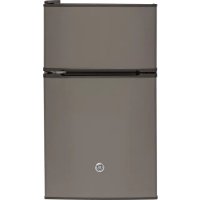
GDE03GMKED - Fridge GE - Free user manual and instructions
Find the device manual for free GDE03GMKED GE in PDF.



User questions about GDE03GMKED GE
0 question about this device. Answer the ones you know or ask your own.
Ask a new question about this device
Download the instructions for your Fridge in PDF format for free! Find your manual GDE03GMKED - GE and take your electronic device back in hand. On this page are published all the documents necessary for the use of your device. GDE03GMKED by GE.
USER MANUAL GDE03GMKED GE
SAFETY INFORMATION. 2
OPERATING INSTRUCTIONS
Control Settings 4
Refrigerator Features 4
Care and Cleaning 5-6
Replacing the Light Bulb 5
INSTALLATION INSTRUCTIONS...7
TROUBLESHOOTING TIPS 10
WARRANTY 11
CONSUMER SUPPORT 12
ATTENTION:
Defrosting-Do not use sharp, pointed objects to remove frost or ice from surfaces of the freezer compartment. Doing so could puncture the cooling coil, causing the unit to lose its ability to maintain cold temperatures and voiding the warranty. See the Care and Cleaning section for instructions on defrosting the freezer compartment.
Write the model and serial numbers here:
Model #
Serial #
Find these numbers on a label inside the refrigerator compartment at the top on the right side.
OWNER'S MANUAL & INSTALLATION INSTRUCTIONS
3 Cubic Foot Models
4 Cubic Foot Models
ENGLISH/FRANÇAIS/ ESPÁNOL
IMPORTANT SAFETY INFORMATION. READ ALL INSTRUCTIONS BEFORE USING.
SAFETY
IMPORTANT SAFETY INFORMATION READ ALL INSTRUCTIONS BEFORE USING
GE Appliances website
For more information on your refrigerator's operation, visit www.GEApliances.com or call 800.GECARES (800.432.2737). In Canada visit GEAppliances.ca or call 800.561.3344.

This is the safety alert symbol. This symbol alerts you to potential hazards that can kill or hurt you and others. All safety messages will follow the safety alert symbol and the word "DANGER", "WARNING", or "CAUTION". These words are defined as:

DANGER

WARNING

CAUTION
Indicates a hazardous situation which, if not avoided, will result in death or serious injury.
Indicates a hazardous situation which, if not avoided, could result in death or serious injury.
Indicates a hazardous situation which, if not avoided, could result in minor or moderate injury.
IMPORTANT SAFETY INSTRUCTIONS

WARNING
To reduce the risk of fire, explosion, electric shock, or injury when using your refrigerator follow these basic safety precautions:
This refrigerator must be properly installed and located in accordance with the Installation Instructions before it is used.
Unplug the refrigerator before making repairs, replacing a light bulb, or cleaning.
Note: Power to the refrigerator cannot be disconnected by any setting on the control panel.
Note: Repairs must be performed by a qualified service professional.
Replace all parts and panels before operating.
- Do not store or use gasoline or other flammable vapors and liquids in the vicinity of this or any other appliance.
Because of potential safety hazards under certain conditions, we strongly recommend against the use of an extension cord. However, if you must use an extension cord, it is absolutely necessary that it be a UL-listed (in the United States) or a CSA certified (in Canada), 3-wire grounding type appliance extension cord having a grounding type plug and outlet and that the electrical rating of the cord be 15 amperes (minimum) and 120 volts.
To prevent suffocation and entrapment hazards to children, remove the fresh food and freezer doors from any refrigerator before disposing of it or discontinuing its use.
Do not allow children to climb, stand or hang on the door handles or the shelves in the refrigerator. They could seriously injure themselves.

CAUTION
To reduce the risk of injury when using your refrigerator, follow these basic safety precautions.
- Do not clean glass shelves or covers with warm water when they are cold. Glass shelves and covers may break if exposed to sudden temperature changes or impact, such as bumping or dropping. Tempered glass is designed to shatter into many small pieces if it breaks.
- Keep fingers out of the "pinch point" areas; clearances between the doors and between the doors and cabinet are necessarily small. Be careful closing doors when children are in the area.
Do not refreeze frozen foods which have thawed completely.
In refrigerators with automatic icemakers, avoid contact with the moving parts of the ejector mechanism, or with the heating element that releases the cubes. Do not place fingers or hands on the automatic ice making mechanism while the refrigerator is plugged in.
SAFETY (CONT.)
INSTALLATION
WARNING
Explosion Hazard.
Keep flammable materials and vapors, such as gasoline, away from refrigerator. Failure to do so can result in fire, explosion, or death.
CONNECTING ELECTRICITY
AWARNING

Electrical Shock Hazard.
Plug into a grounded 3-prong outlet
Do not remove the ground prong
Do not use an adapter
Failure to follow these instructions can result in death, fire, or electrical shock.
Do not, under any circumstances, cut or remove the third (ground) prong from the power cord. For personal safety, this appliance must be properly grounded.
The power cord of this appliance is equipped with a 3-prong (grounding) plug which mates with a standard 3-prong (grounding) wall outlet to minimize the possibility of electric shock hazard from this appliance.
Have the wall outlet and circuit checked by a qualified electrician to make sure the outlet is properly grounded.
Where a standard 2-prong wall outlet is encountered, it is your personal responsibility and obligation to have it replaced with a properly grounded 3-prong wall outlet. Do not use an adapter.
The refrigerator should always be plugged into its own individual electrical outlet which has a voltage rating that matches the rating plate.
A 115 Volt AC, 60Hz 15- or 20-amp fused, grounded electrical supply is required. This provides the best performance and also prevents overloading house wiring circuits which could cause a fire hazard from overheated wires.
Never unplug your refrigerator by pulling on the power cord. Always grip plug firmly and pull straight out from the outlet.
Repair or replace immediately all power cords that have become frayed or otherwise damaged. Do not use a cord that shows cracks or abrasion damage along its length or at either end.
When moving the refrigerator away from the wall, be careful not to roll over or damage the power cord.
PROPER DISPOSAL OF YOUR OLD REFRIGERATOR
WARNING
Suffocation and child entrapment hazard.
Remove fresh-food and freezer doors from the refrigerator, prior to disposal. Failure to do so can result in child entrapment which can lead to death or brain damage.
IMPORTANT:
Child entrapment and suffocation are not problems of the past. Junked or abandoned refrigerators are still dangerous even if they will sit for "just a few days." If you are getting rid of your old refrigerator, please follow the instructions below to help prevent accidents.
Before You Throw Away Your Old Refrigerator or Freezer:
Take off the fresh food and freezer doors.
Leave the shelves in place so that children may not easily climb inside.
Refrigerants
All refrigeration products contain refrigerants, which under federal law must be removed prior to product disposal. If you are getting rid of an old refrigeration product, check with the company handling the disposal about what to do.
WARNING
R600a Refrigerant
This appliance contains isobutane refrigerant, R600a, a natural gas with high environmental compatibility. However it is also combustible. Please adhere to the warnings below:
1) When handling, installing and operating the appliance, care should be taken to avoid damage to the refrigerant tubing.
2) Servicing shall be performed by factory-authorized service personnel and component parts shall be replaced with manufacturer-authorized replacement components.
3) Refrigeration products contain refrigerants, which under federal law must be removed prior to product disposal.
4) Keep ventilation openings in the appliance enclosures or in the built-in structure clear of obstruction.
5) Do not use mechanical devices or other means to accelerate the defrosting process.
6) Do not damage refrigerant circuit.
7) Do not use electrical appliances inside the food storage compartment of the appliance.

READ AND FOLLOW THIS SAFETY INFORMATION CAREFULLY.
SAVE THESE INSTRUCTIONS
About the refrigerator controls and features.
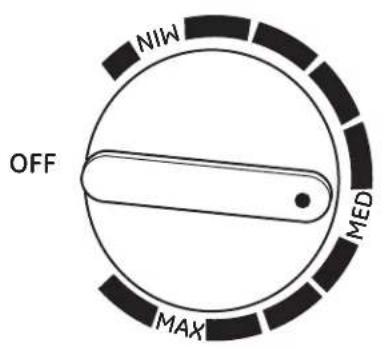
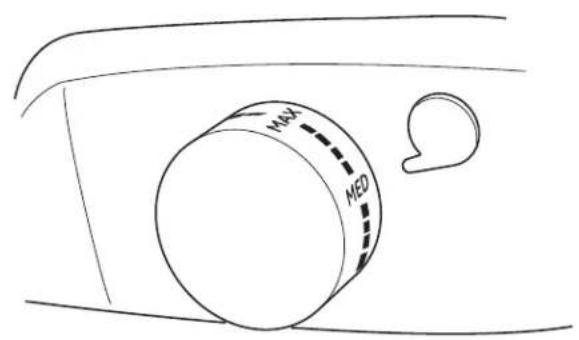
The control will look like one of the above.
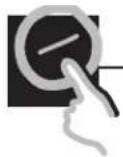
Control Settings
The temperature control maintains the temperature in the refrigerator. Setting the control to MIN is the warmest setting. Setting the control to MAX is the coldest setting. Set the control to MED.
Allow 24 hours for the refrigerator to reach the MED temperature. If you want a colder or warmer temperature, move the dial one setting at a time. Moving the control to OFF stops cooling but does not turn off the power to the refrigerator. Setting the control too high may cause freezing in the refrigerator depending on the room temperature.
Features
Shelves
To remove a shelf, lift up the back slightly and pull forward. Some models have multi-position shelves that can be moved to different levels.
Ice Tray Compartment
This compartment is designed for production of ice cubes and short-term storage (a few days at most) of some commercially-frozen foods when in contact with the evaporator (cold surface in compartment.)
Door Shelves
Shelves on the door provide convenient storage for frequently used items. Some models have doors that are deep enough to store large bottles.
Cleaning the Outside
Keep the outside clean. Wipe with a clean cloth lightly dampened with kitchen appliance wax or mild liquid dish detergent. Dry and polish with a clean, soft cloth.
Do not wipe the refrigerator with a soiled dish cloth or wet towel. These may leave a residue that can erode the paint. Do not use scouring pads, powdered cleaners, bleach or cleaners containing bleach because these products can scratch and weaken the paint finish.
Protect the paint finish. The finish on the outside of the refrigerator is a high quality, baked-on paint finish. With proper care, it will stay new-looking and rust-free for years. Apply a coat of kitchen/ appliance wax when the refrigerator is new, and then at least twice a year.
Cleaning the Inside
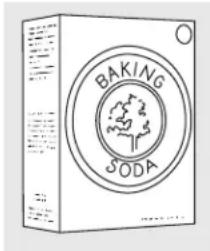
To help prevent odors, leave an open box of baking soda in the refrigerator.
Unplug the refrigerator before cleaning. If this is not practical, wring excess moisture out of sponge or cloth when cleaning around the control.
Use warm water and baking soda solution - about a tablespoon (15 ml) of baking soda to a quart (1 liter) of water. This both cleans and neutralizes odors. Rinse and wipe dry.
Other parts of the refrigerator—including door gaskets, fruit and vegetable drawers, and all plastic parts—can be cleaned the same way.
Do not wash any plastic refrigerator parts in the dishwasher.
Replacing the Light Bulb (on some models)
Unplug the refrigerator before replacing a burned-out bulb. Setting the controls to OFF does not remove power to the light circuit.
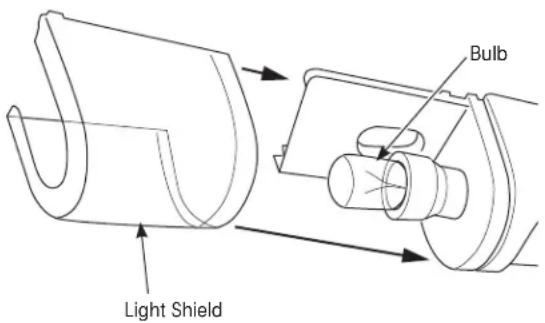
The light bulb is located behind the temperature control housing and is visible through the light shield.
Remove the light shield by snapping it from the bottom of the housing. Gently unscrew the light bulb. Replace with a bulb of the same or lower wattage.
Defrosting (on manual defrost models only)
Defrost whenever frost on the wall of the ice tray compartment becomes 1/4 thick. Never use a sharp or metallic instrument to remove frost as it may damage the cooling coils. (A punctured cooling coil will cause serious problems and void the warranty.) We recommend using a plastic scraper. Do not use any electrical device in defrosting your refrigerator.
To defrost:
Remove foods and ice trays from the ice tray compartment.
Set the temperature control dial at OFF position.
On models without a drip tray, place a pan beneath the ice tray compartment to collect water.
Defrosting usually takes a few hours. To defrost faster, keep the door open. Also, pouring warm (not hot) water on the frosted part may speed defrosting. Do not use boiling water—it may damage plastic parts.
After defrosting:
- Empty water from the drip tray or from the pan placed beneath the ice tray compartment. Wash the tray or pan with warm water.
Wipe the ice tray compartment with a damp cloth.
Turn the temperature control to the desired setting and return food and ice trays to the refrigerator.
NOTE: If ice buildup is very thick, it may keep the ice tray compartment door from opening or closing completely. Don't try to force it open; after defrosting, the door will open and close easily.
Preparing for Vacation
For long vacations or absences, remove food and unplug the refrigerator. Move the control to the OFF position, and clean the interior with a baking soda solution of one tablespoon (15 ml) of baking soda to one quart (1 liter) of water. Leave the door open.
Preparing to Move
Secure all loose items such as shelves and ice trays by taping them securely in place to prevent damage.
Be sure the refrigerator stays in an upright position during moving.
Installation Instructions
Refrigerator
3 Cubic Foot Models
4 Cubic Foot Models
If you have questions, call GE Appliances at 1.800.GE.CARES or visit our Website at: GEAppliances.com.
In Canada, call 1.800.561.3344 or Visit our Website at: www.geappliances.ca
BEFORE YOU BEGIN
Read these instructions completely and carefully.
- IMPORTANT - Save these instructions for local inspector's use.
- IMPORTANT - Observe all governing codes and ordinances.
- Note to Installer - Be sure to leave these instructions with the Consumer.
- Note to Consumer - Keep these instructions for future reference.
UNPACKING YOUR REFRIGERATOR
- Remove tape and any labels (except for the rating label) from your refrigerator. Tape or glue residue can also be removed by rubbing a small amount of liquid dish soap over the adhesive with your fingers. Wipe with warm water and dry.
- Do not use sharp instruments, rubbing alcohol, flammable fluids, or abrasive cleaners to remove tape or glue. These products can damage the surface of your refrigerator.
- When moving the refrigerator, do not tilt the refrigerator beyond 45^ from upright position.
LOCATION REQUIREMENTS
- Do not install the refrigerator where the temperature will go below 50^ ( 10^ ) because it will not run often enough to maintain proper temperatures.
- Install it on a floor strong enough to support it fully loaded.
- Do not install it in a recessed area.
- Do not build in the refrigerator.
LEVELING LEGS
Adjustable legs at the front corners of the refrigerator should be set so the refrigerator is firmly positioned on the floor, and the front is raised just enough that the door closes easily when opened about halfway.
To adjust the leveling legs, turn the legs counterclockwise to raise the refrigerator, clockwise to lower it.
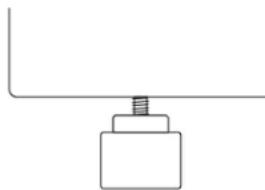
Turn counterclockwise to raise, clockwise to lower.
CLEARANCES
Allow the following clearances for ease of installation and proper air circulation.
3 and 4
Cubic Foot Models
Sides 1/2" (13 mm)
Top 2" (51 mm)
Back 2^ (51 mm)**
**From the rear cabinet surface to the wall
WARNING Explosion Hazard.
Keep flammable materials and vapors, such as gasoline, away from refrigerator. Failure to do so can result in fire, explosion, or death.
CONNECTING ELECTRICITY
WARNING Electrical Shock Hazard.
Plug into a grounded 3-prong outlet
Do not remove the ground prong.
Do not use an adapter
Failure to follow these instructions can result in death, fire, or electrical shock.
POWER CORD
- Plug the refrigerator power cord into its own properly grounded wall outlet with a voltage rating matching that on the refrigerator rating plate.
- Do not use an extension cord.
- Read all safety precautions on pages 2 and 3.
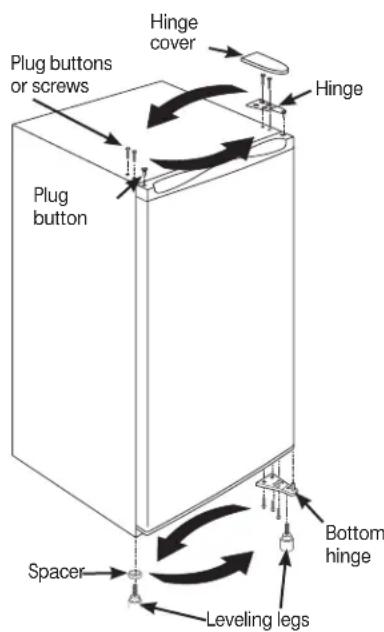
Door Reversal (on some models)
- Remove the small plug button on the left side of the door top cap.
- Remove the 2 plug buttons or screws on the left side on top of the cabinet.
- Remove the plastic hinge cover by lifting it up by the front edge.
- Remove the 2 screws from the top hinge.
- Lift the door up and off the bottom hinge (right side).
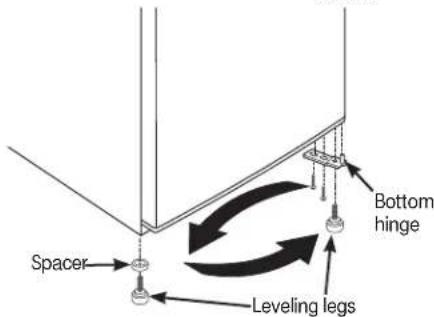
- Tilt the refrigerator cabinet back to remove the left leveling leg.
- Remove the screws on the bottom hinge (right side) and remove the leveling leg. Move the bottom hinge to the left side and secure it with screws. Re-install the leveling legs.
IMPORTANT: The left leg has a spacer or spacer feature that must be moved to the right side leveling leg when the door swing is reversed.
-
Screw the right leveling leg, with the spacer, back in place on the right side.
-
Position the door on the left bottom hinge. With the magnetic gasket holding the door in place, secure the top hinge with screws.
- Make sure the door is aligned with the refrigerator cabinet before continuing.
- Replace the hinge cover on top of the hinge.
- Put the plug button in the hole on the right side of the door cap.
- Put the 2 plug buttons on the right side on top of the cabinet
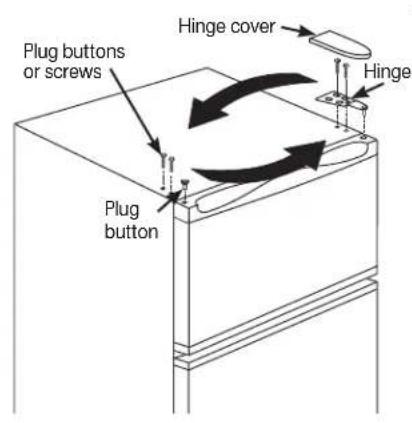
2-Door Reversal (on some models)
- Remove the small plug button on the left side of the door top cap.
- Remove the 2 plug buttons or screws on the left side on top of the cabinet.
- Remove the plastic hinge cover by lifting it up by the front edge.
- Remove the 2 screws from the top hinge.
- Lift the freezer door up and off the middle hinge (right side). Set the door on a nonscratching surface with the outside up.
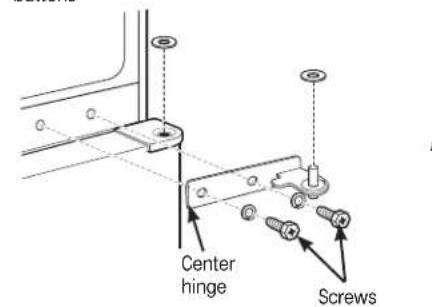
- Remove the center hinge by removing the 2 screws. Lift the hinge to remove.
- Lift the fresh food door off of the bottom hinge. Set the door on a non-scratching surface with the outside up.
- Tilt the refrigerator cabinet back to remove the left leveling leg.
- Remove the screws on the bottom hinge (right side) and remove the leveling leg. Move the bottom hinge to the left side and secure it with screws. Re-install the leveling legs.
IMPORTANT: The left leg has a spacer or spacer feature that must be moved to the right side leveling leg when the door swing is reversed.
- Screw the right leveling leg, with the spacer, back in place on the right side.
- Remove the two plug buttons on the left side at the center and install them on the right.
- Position the door on the left bottom hinge. With the magnetic gasket holding the door in place, make sure the door is aligned with the refrigerator, and secure the center hinge on the left with screws.
- Place the freezer door on the center hinge over the pin. Assure the door is aligned horizontally and vertically, and that the gasket seals on all sides.
- Replace the top hinge on the left side with screws.
- Replace the hinge cover on top of the hinge.
- Put the plug button in the hole on the right side of the door cap.
- Put the 2 plug buttons on the right side on top of the cabinet
Before you call for service...

Troubleshooting Tips
Save time and money! Review the chart below first and you may not need to call for service.
| Problem Possible Causes What To Do | ||
| Refrigerator does not operate | Control in OFF position. | Move the control to a temperature setting. |
| Refrigerator is unplugged. Push the plug completely into the outlet. | ||
| The fuse is blown/circuit breaker is tripped. | Replace fuse or reset the breaker. | |
| Vibration or rattling (slight vibration is normal) | Front leveling legs need adjusting. See Refrigerator is on an uneven surface. | Leveling Legs.Use shims to level the refrigerator. |
| Motor operates for long periods or cycles No | mal when refrigerator is first plugged in. | Wait 24 hours for the refrigerator to completely cool down. |
| Often occurs when large amounts of food are placed in refrigerator. | This is normal. | |
| Door left open. Check to see if package is holding door open. | is holding door open. | |
| Hot weather or frequent door openings. | This is normal. | |
| Temperature control set at the coldest setting. | See About the control. | |
| Not enough clearance from the wall. | See Clearances in Preparing to install the refrigerator. | |
| Refrigerator too warm Temperature control | not set cold enough. | See About the control. |
| Warm weather or frequent door openings. | Set the temperature control one step colder. See About the control. | |
| Door left open. Check to see if package is holding door open. | is holding door open. | |
| Cabinet sides are warm This is normal | for a hot wall type condenser. | |
| Refrigerator has odor Foods transmitting odor to refrigerator. | Foods with strong odors should be tightly wrapped. | |
| Keep an open box of baking soda in the refrigerator; replace every three months. | ||
| Moisture forms on outside of refrigerator | Not unusual during periods of high humidity. | Wipe surface dry. |
| Moisture collects inside (in humid weather, air carries moisture into refrigerator when door is opened) | Too frequent or too long door openings. | |
| Refrigerator too cold | Temperature control set too cold. | See About the control. |
Refrigerator Warranty.
For US Customers, all warranty service provided by our Factory Service Centers, or an authorized Customer Care technician. To schedule service, on-line, 24 hours a day, visit us at GEAppliances.com, or call GE Appliances at 800.GE.CARES (800.432.2737). Please have serial number and model number available when calling for service.
In Canada, call 800.561.3344.
Staple your receipt here. Proof of the original purchase date is needed to obtain service under the warranty.
For the Period of: GE Appliances Will Replace
One Year
From the date of the original purchase
Any part of the refrigerator which fails due to a defect in materials or workmanship.
During this period of One Year from the date of original purchase, GE Appliances will choose, at its option, to replace or service the defective unit. During this limited one-year warranty, should GE Appliances choose to service the unit, GE Appliances will provide any part of the freezer which fails due to a defect in materials or workmanship and free of charge, all labor and related service costs to replace the defective part. During this limited one-year warranty, should GE Appliances choose to replace the unit, it may do so by providing you with a certificate redeemable at a retailer for a replacement product.
What is Not Covered:
Service trips to your home to teach you how to use the product.
Improper installation, delivery or maintenance.
Failure of the product if it is abused, misused, or used for other than the intended purpose or used commercially.
Loss of food due to spoilage.
Damage caused after delivery.
Replacement of house fuses or resetting of circuit breakers.
Replacement of the light bulbs.
Damage to the product caused by accident, fire, floods or acts of God.
- Incidental or consequential damage caused by possible defects with this appliance.
Product not accessible to provide required service.
Associated costs when GE Appliances chooses to issue the consumer a certificate as a form of product replacement.
EXCLUSION OF IMPLIED WARRANTY--Your sole and exclusive remedy is product repair as provided in this Limited Warranty. Any implied warranties, including the implied warranties of merchantability or fitness for a particular purpose, are limited to one year or the shortest period allowed by law.
For US Customers: This warranty is extended to the original purchaser and any succeeding owner for products purchased for home use within the USA. If the product is located in an area where service by a GE Appliances Authorized Servicer is not available, you may be responsible for a trip charge or you may be required to bring the product to an Authorized GE Appliances Service location for service. In Alaska, the warranty excludes the cost of shipping or service calls to your home. Some states do not allow the exclusion or limitation of incidental or consequential damages. This warranty gives you specific legal rights, and you may also have other rights which vary from state to state. To know what your legal rights are, consult your local or state consumer affairs office or your state's Attorney General.
Warrantor US: GE Appliances
For Customers in Canada: This warranty is extended to the original purchaser and any succeeding owner for products purchased in Canada for home use within Canada. In-home warrant service will be provided in areas where it is available and deemed reasonable by Mabe to provide.
Warrantor Canada: MC Commercial, Burlington, Ontario, L7R 5B6
Consumer Support
GE Appliances Website
Have a question or need assistance with your appliance? Try the GE Appliances Website 24 hours a day, any day of the year! You can also shop for more great GE Appliances products and take advantage of all our on-line support services designed for your convenience. In the US: GEAppliances.com In Canada: GEAppliances.ca
Register Your Appliance
Register your new appliance on-line at your convenience! Timely product registration will allow for enhanced communication and prompt service under the terms of your warranty, should the need arise. You may also mail in the pre-printed registration card included in the packing material.
In the US: GEAppliances.com/register
In Canada: Prodsupport.mabe.ca/crm/Products/ProductRegistration.aspx
Schedule Service
Expert GE Appliances repair service is only one step away from your door. Get on-line and schedule your service at your convenience any day of the year. In the US: GEAppliances.com/ge/service-and-support/service.htm
or call 800.432.2737 during normal business hours.
In Canada: GEAppliances.ca/en/support/service-request or call 800.561.3344
Extended Warranties
Purchase a GE Appliances extended warranty and learn about special discounts that are available while your warranty is still in effect. You can purchase it on-line anytime. GE Appliances Services will still be there after your warranty expires. In the US:
GEAppliances.com/ge/service-and-support/shop-for-extended-service-plans.htm
or call 800.626.2224 during normal business hours.
In Canada: GEAppliances.ca/en/support/purchase-extended-warranty or call 800.290.9029
Remote Connectivity
For assistance with wireless network connectivity (for models with remote enable),
visit our website at GEAppliances.com/ge/connected-appliances/ or call 800.220.6899 in the US only.
Parts and Accessories
Individuals qualified to service their own appliances can have parts or accessories sent directly to their homes (VISA, MasterCard and Discover cards are accepted). Order on-line today 24 hours every day.
In the US: GEApplianceparts.com or by phone at 877.959.8688 during normal business hours.
Instructions contained in this manual cover procedures to be performed by any user. Other servicing generally should be referred to qualified service personnel. Caution must be exercised, since improper servicing may cause unsafe operation.
Customers in Canada should consult the yellow pages for the nearest Mabe service center, visit our website at GEAppliances. ca/en/products/parts-filters-accessories or call 800.661.1616.
Contact Us
If you are not satisfied with the service you receive from GE Appliances, contact us on our Website with all the details including your phone number, or write to:
In the US: General Manager, Customer Relations | GE Appliances, Appliance Park | Louisville, KY 40225
GEAppliances.com/ge/service-and-support/contact.htm
In Canada: Director, Consumer Relations, Mabe Canada Inc. | Suite 310, 1 Factory Lane | Moncton, N.B. E1C 9M3
GEAppliances.ca/en/contact-us
RéFRIGÉRATÉURS
MESURES DE SECURITE 2
FONCTIONNEMENT
Au Canada: Prodsupport.mabe.ca/crm/Products/ProductRegistration.aspx
Au Canada: GEAppliances.ca/en/support/service-request ou composez le 800.561.3344
Prolongation de garantie
Au Canada : GEAppliances.ca/en/support/purchase-extended-warranty ou composez le 800.290.9029
GEAppliances.com/ge/service-and-support/contact.htm
Au Canada : Director, Consumer Relations, Mabe Canada Inc. | Suite 310, 1 Factory Lane | Moncton, N.B. E1C 9M3
GEAppliances.ca/en/contact-us
REFRIGERADORE
Garante: General Electric Company. Louisville, KY 40225
Mabe Canada Inc., Burlington, ON, L7R 5B6
GEAppliances.com/ge/service-and-support/contact.htm