BDEQS15C - Sander BLACK & DECKER - Free user manual and instructions
Find the device manual for free BDEQS15C BLACK & DECKER in PDF.


| Product Type | 1/4 Sheet Sander |
| Brand | Black & Decker |
| Model | BDEQS15C |
| Power Supply | 120 V, AC only |
| Frequency | 60 Hz |
| Motion Type | Orbital |
| Switch | Push Button On/Off |
| Dust Collection System | Removable dust bag with bayonet lock |
| Sandpaper Attachment | Front and rear lever clamps |
| Sandpaper Punch | Integrated punch for 8 holes |
| Required Personal Protective Equipment | Safety goggles, dust mask, hearing protection |
| Warranty | 2 years (domestic use) |
| Cleaning | Mild soap and damp cloth, do not immerse |
| Certifications | ANSI Z87.1 (eye protection), NIOSH/OSHA/MSHA (respiratory) |
| Catalog Number | BDEQS15C |
Frequently Asked Questions - BDEQS15C BLACK & DECKER
User questions about BDEQS15C BLACK & DECKER
0 question about this device. Answer the ones you know or ask your own.
Ask a new question about this device
Download the instructions for your Sander in PDF format for free! Find your manual BDEQS15C - BLACK & DECKER and take your electronic device back in hand. On this page are published all the documents necessary for the use of your device. BDEQS15C by BLACK & DECKER.
USER MANUAL BDEQS15C BLACK & DECKER
If you have a question or experience a problem with your BLACK+DECKER purchase, go to http://www.blackanddecker.com/instantanswers If you can't find the answer or do not have access to the Internet, call 1-800-544-6986 from 8 a.m. to 5 p.m. EST Mon. - Fri. to speak with an agent. Please have the catalog number available when you call. SAVE THIS MANUAL FOR FUTURE REFERENCE.
VEA EL ESPANOL EN LA CONTRAPORTADA. INSTRUCTIVO DE OPERATION, CENTROS DE SERVICIO Y POLIZA DE GARANTIA. ADVERTENCIA: LÉASE ESTE INSTRUCTIVO ANTES DE USAR EL PRODUCTO.
SAFETY GUIDELINES - DEFINITIONS
It is important for you to read and understand this manual. The information it contains relates to protecting YOUR SAFETY and PREVENTING PROBLEMS. The symbols below are used to help you recognize this information.
DANGER: Indicates an imminently hazardous situation which, if not avoided, will result in death or serious injury.
WARNING: Indicates a potentially hazardous situation which, if not avoided, could result in death or serious injury.
CAUTION: Indicates a potentially haz ard ous situation which, if not avoided, may result in minor or mod er ate injury.
NOTICE: Used without the safety alert symbol indicates potentially hazardous situation which, if not avoided, may result in property damage.
GENERAL POWER TOOL SAFETY WARNINGS
WARNING: Read all safety warnings and all instructions. Failure to follow the warnings and instructions may result in electric shock, fire and/or serious injury.
SAVE ALL WARNING AND INSTRUCTIONS FOR FUTURE REFERENCE
The term "power tool" in the warnings refers to your mains-operated (corded) power tool or battery-operated (cordless) power tool.
1) WORK AREA SAFETY
a) Keep work area clean and well lit. Cluttered or dark areas invite accidents.
b) Do not operate power tools in explosive atmospheres, such as in the presence of flammable liquids, gases or dust. Power tools create sparks which may ignite the dust or fumes.
c) Keep children and bystanders away while operating a power tool. Distractions can cause you to lose control.
2) ELECTRICAL SAFETY
a) Power tool plugs must match the outlet. Never modify the plug in any way. Do not use any adapter plugs with earthed (grounded) power tools. Unmodified plugs and matching outlets will reduce risk of electric shock.
b) Avoid body contact with earthed or grounded surfaces such as pipes, radiators, ranges and refrigerators. There is an increased risk of electric shock if your body is earthed or grounded.
c) Do not expose power tools to rain or wet conditions. Water entering a power tool will increase the risk of electric shock.
d) Do not abuse the cord. Never use the cord for carrying, pulling or unplugging the power tool. Keep cord away from heat, oil, sharp edges or moving parts. Damaged or entangled cords increase the risk of electric shock.
e) When operating a power tool outdoors, use an extension cord suitable for outdoor use. Use of a cord suitable for outdoor use reduces the risk of electric shock.
f) If operating a power tool in a damp location is unavoidable, use a ground fault circuit interrupter (GFCI) protected supply. Use of a GFCI reduces the risk of electric shock.
3) PERSONAL SAFETY
a) Stay alert, watch what you are doing and use common sense when operating a power tool. Do not use a power tool while you are tired or under the influence of drugs, alcohol or medication. A moment of inattention while operating power tools may result in serious personal injury.
b) Use personal protective equipment. Always wear eye protection. Protective equipment such as dust mask, nonskid safety shoes, hard hat, or hearing protection used for appropriate conditions will reduce personal injuries.
c) Prevent unintentional starting. Ensure the switch is in the off position before connecting to power source and/ or battery pack, picking up or carrying the tool. Carrying power tools with your finger on the switch or energizing power tools that have the switch on invites accidents.
d) Remove any adjusting key or wrench before turning the power tool on. A wrench or a key left attached to a rotating part of the power tool may result in personal injury.
e) Do not overreach. Keep proper footing and balance at all times. This enables better control of the power tool in unexpected situations.
f) Dress properly. Do not wear loose clothing or jewelry. Keep your hair, clothing and gloves away from moving parts. Loose clothes, jewelry or long hair can be caught in moving parts.
g) If devices are provided for the connection of dust extraction and collection facilities, ensure these are connected and properly used. Use of dust collection can reduce dust-related hazards.
4) POWER TOOL USE AND CARE
a) Do not force the power tool. Use the correct power tool for your application. The correct power tool will do the job better and safer at the rate for which it was designed.
b) Do not use the power tool if the switch does not turn it on and off. Any power tool that cannot be controlled with the switch is dangerous and must be repaired.
c) Disconnect the plug from the power source and/or the battery pack from the power tool before making any adjustments, changing accessories, or storing power tools.
Such preventive safety measures reduce the risk of starting the power tool accidentally.
d) Store idle power tools out of the reach of children and do not allow persons unfamiliar with the power tool or these instructions to operate the power tool.
Power tools are dangerous in the hands of untrained users.
e) Maintain power tools. Check for misalignment or binding of moving parts, breakage of parts and any other condition that may affect the power tool's operation. If damaged, have the power tool repaired before use. Many accidents are caused by poorly maintained power tools.
f) Keep cutting tools sharp and clean. Properly maintained cutting tools with sharp cutting edges are less likely to bind and are easier to control.
g) Use the power tool, accessories and tool bits, etc. in accordance with these instructions, taking into account the working conditions and the work to be performed. Use of the power tool for operations different from those intended could result in a hazardous situation.
5) SERVICE
a) Have your power tool serviced by a qualified repair person using only identical replacement parts. This will ensure that the safety of the power tool is maintained.
SPECIFIC SAFETY RULES
WARNING: ALWAYS use safety glasses. Everyday eye glasses are NOT safety glasses. Also use face or dust mask if operation is dusty. ALWAYS WEAR CERTIFIED SAFETY EQUIPMENT:
ANSI Z87.1 eye protection (CAN/CSA Z94.3)
ANSI S12.6 (S3.19) hearing protection
- NIOSH/OSHA/MSHA respiratory protection
-
Sanding of lead-based paint is not recommended. See Sanding Lead Based Paint for additional information before sanding paint.
-
Clean your tool out periodically.
WARNING: Some dust created by power sanding, sawing, grinding, drilling, and other construction activities contains chemicals known to the State of California to cause cancer, birth defects or other reproductive harm. Some examples of these chemicals are:
-
lead from lead-based paints,
crystalline silica from bricks and cement and other masonry products, and -
arsenic and chromium from chemically-treated lumber.
Your risk from these exposures varies, depending on how often you do this type of work.
To reduce your exposure to these chemicals: work in a well ventilated area, and work with approved safety equipment, such as those dust masks that are specially designed to filter out microscopic particles.
- Avoid prolonged contact with dust from power sanding, sawing, grinding, drilling, and other construction activities. Wear protective clothing and wash exposed areas with soap and water. Allowing dust to get into your mouth, eyes, or lay on the skin may promote absorption of harmful chemicals.
SYMBOLS
The label on your tool may include the following symbols. The symbols and their definitions are as follows:
V..... volts
A. amperes
Hz......hertz
W.....watts
min.........minutes
or AC......alternating current
---or DC...direct current
no............no load speed
Class I Construction
.earthing terminal
(grounded)
..safety alert symbol
Class II Construction
.../min or rpm...revolutions or
(double insulated)
reciprocation per minute
Read instruction manual before use
Use proper respiratory protection
.Use proper eye protection
O .Use proper hearing protection
- When using an extension cord, be sure to use one heavy enough to carry the current your product will draw. An undersized cord will cause a drop in line voltage resulting in loss of power and overheating. The following table shows the correct size to use depending on cord length and nameplate
| Minimum Gage for Cord Sets Volts Total Length of Cord in Feet | |||||
| 120V | 0-25 | 26-50 | 51-100 | 101-150 | |
| (0-7,6m) | (7,6-15,2m) | (15,2-30,4m) | (30,4-45,7m) | ||
| Ampere Rating | |||||
| More | Not more | American Wire Gage | |||
| Than | Than | ||||
| 0 | - | 6 | 18 | 16 | 14 |
ampere rating. If in doubt, use the next heavier gage. The smaller the gage number, the heavier the cord.
Functional Description
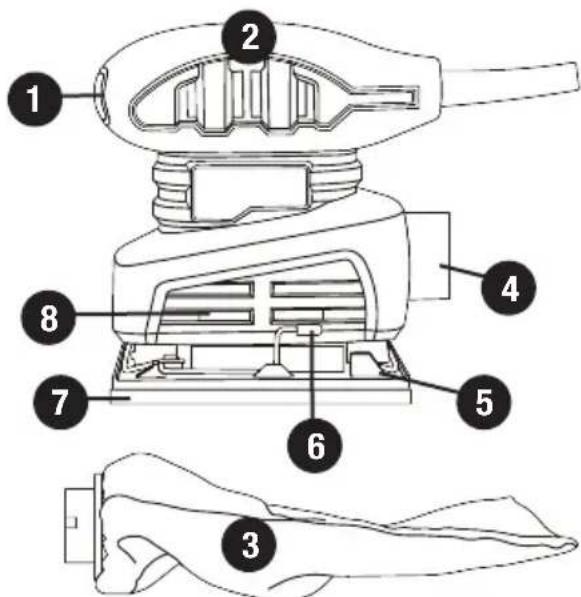
- On/off switch
- Palm grip
- Dust bag assembly
- Dust chute
- Sandpaper clamp
- Sandpaper clamping lever
- Backing pad
- Cooling vents
- Sandpaper hole punch
- Sandpaper
SAFETYWARNINGSANDINSTRUCTIONS:SANDERS
- ALWAYS USE PROPER EYE AND RESPIRATORY PROTECTION.
Clean your tool out periodically. - Do not operate the unit without the dust collection bag assembled to the unit.
- Empty dust bag frequently, especially when sanding resin coated surfaces such as polyurethane, varnish, shellac, etc. Dispos of coated dust particles according to the finish manufacturer's guidelines, or place in a metal can with a tight-fitting metal lid. Remove coated dust particles from the premises daily. The accumulation of fine sanding dust particles may self ignite and cause fire.
OTHER IMPORTANT SAFETY WARNINGS AND INSTRUCTIONS
SANDING
SANDING LEAD BASED PAINT
Sanding of lead based paint is NOT RECOMMENDED due to the difficulty of controlling the contaminated dust. The greatest danger of lead poisoning is to children and pregnant women. Since it is difficult to identify whether or not a paint contains lead without a chemical analysis, we recommend the following precautions when sanding any paint:
PERSONAL SAFETY
- No children or pregnant women should enter the work area where the paint sanding is being done until all clean up is completed.
- A dust mask or respirator should be worn by all persons entering the work area. The filter should be replaced daily or whenever the wearer has difficulty breathing.
- NOTE: Only those dust masks suitable for working with lead paint dust and fumes should be used. Ordinary painting masks do not offer this protection. See your local hardware dealer for the proper (NIOSH approved) mask.
- NO EATING, DRINKING or SMOKING should be done in the work area to prevent ingesting contaminated paint particles. Workers should wash and clean up BEFORE eating, drinking or smoking. Articles of food, drink, or smoking should not be left in the work area where dust would settle on them.
ENVIRONMENTAL SAFETY
- Paint should be removed in such a manner as to minimize the amount of dust generated.
- Areas where paint removal is occurring should be sealed with plastic sheeting of 4 mils thickness.
- Sanding should be done in a manner to reduce tracking of paint dust outside the work area.
CLEANING AND DISPOSAL
- All surfaces in the work area should be vacuumed and thoroughly cleaned daily for the duration of the sanding project. Vacuum filter bags should be changed frequently.
- Plastic drop cloths should be gathered up and disposed of along with any dust chips or other removal debris. They should be placed in sealed refuse receptacles and disposed of through regular trash pick-up procedures. During clean up, children and pregnant women should be kept away from the immediate work area.
- All toys, washable furniture and utensils used by children should be washed thoroughly before being used again.
MOTOR
Be sure your power supply agrees with nameplate marking. 120 Volts AC only means your tool will operate on standard 60Hz household power. Do not operate AC tools on DC. A rating of 120 volts AC/DC means that you tool will operate on standard 60Hz AC or DC power. This information is printed on the nameplate. Lower voltage will cause loss of power and can result in over-heating. All BLACK+DECKER tools are factory-tested; if this tool does not operate, check the power supply.
ASSEMBLY
CAUTION:To reduce the risk of injury, turn off and unplug the tool before making any adjustments or removing or installing attachments or accessories.
INSTALLING THE DUST BAG ASSEMBLY
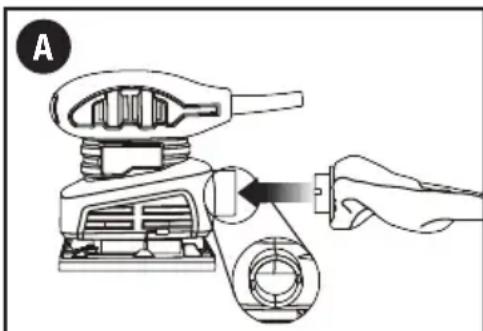
- Insert the dust bag assembly (3) into the dust chute (4) (Fig. A).
NOTE: Make sure the assembly tabs insert into the matching slots in the dust chute.
- Rotate the dust bag assembly CLOCKWISE approximately 15^ to lock it into place.
NOTE: Remove and clean the dust bag assembly periodically to remove accumulated dust from the dust bag.
REMOVING & CLEANING THE DUST BAG
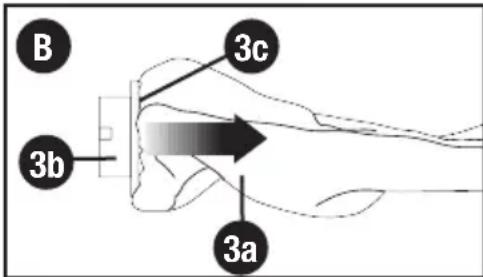
- Remove dust bag assembly (3) by rotating the dust bag assembly approximately 15^ counter-clockwise and pulling it out of the dust chute.
- Remove the dust bag (3a) from the dust bag support (3b) by opening the elasticized end of the dust bag (3c) and sliding it off the dust bag support (Fig. B).
- Carefully shake the dust bag with the elasticized opening pointing downward to remove the sanding dust.
NOTE: It is best to perform this function outdoors over a trash can to prevent sanding dust from escaping into the work area.
- Once the sanding dust is removed from the dust bag, reinstall the dust bag onto the dust bag support.
- Reinstall the dust bag assembly into the dust chute as noted above.
INSTALLING SANDPAPER
WARNING: Unplug the sander from the power source before installing or changing the sandpaper.
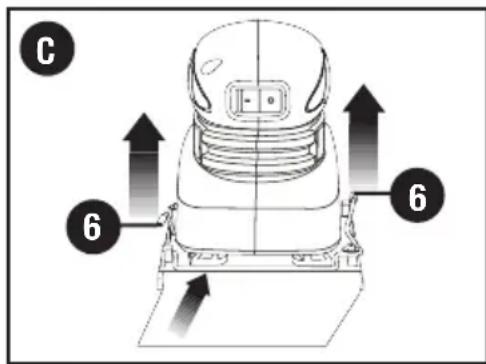
1. Lift up and outward on the front and rear sandpaper clamp levers (6) at the front and rear of the backing pad (7) (Fig. C).
2. Insert one end of the 14 sheet sandpaper (10) with grit side up into the open front sandpaper clamp (5), making sure it is aligned with the backing pad. Lift the sandpaper clamp lever up and inward to lock the sandpaper into the clamp.
3. Wrap the sandpaper sheet around the backing pad and insert it into the open rear sandpaper clamp (Fig. 4).
NOTE: Make sure the sandpaper is pulled tight over the backing pad for proper sanding operation.
4. Lift the sandpaper clamp lever up and inward to lock the sandpaper into the clamp.
PUNCHING HOLES IN SANDPAPER
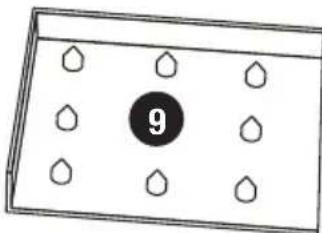
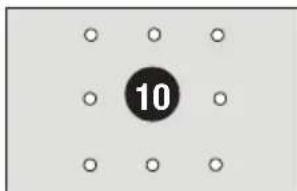
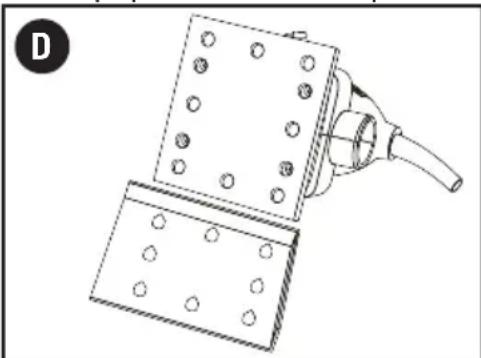
The sandpaper must have 8 holes punched in it to allow the sanding dust to escape from the working surface. The pattern of these holes must match the hole pattern on the sanding pad. If the sandpaper you are using does not have the holes punched, use the hole punch supplied with the tool to pierce the sandpaper in the correct locations.
- Install the sandpaper as shown in Fig. C.
- Place the hole punch (9) on a sturdy flat surface (Fig. D).
- Align the corner of the sanding pad (10) with the corner of the hole punch. This will ensure the holes are punche
- When the sanding pad is correctly aligned on the hole punch, press the sanding pad firmly onto the hole punch.
NOTE: The sharp pegs in the hole punch will pierce the sandpaper in the correct location.
OPERATING INSTRUCTIONS
WARNING: To reduce the risk of injury, let the tool work at its own pace. Do not overload.
WARNING: Shock hazard. Under no circumstances should this product be used near water.
WARNING: Always wear safety goggles or safety glasses with side shields when operating your sander. Failure to do so could result in foreign objects being thrown into your eyes resulting in possible serious eye damage.
Always wear an appropriate dust mask and hearing protection when using your sander.
ON/OFF SWITCH
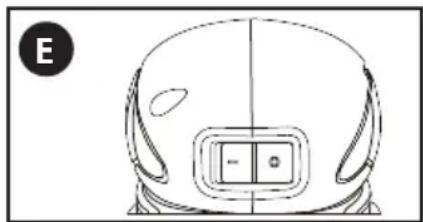
To turn the switch ON, press the button marked on the ON/OFF switch (1) (Fig. E).
To turn the switch OFF, press the button marked on the ON/OFF switch (2).
SANDING
Clamp or otherwise secure your workpiece to prevent it from moving under the sander while being sanded.
WARNING: An unsecured workpiece could be thrown toward the operator causing injury. Place the sander on the workpiece so that the complete sandpaper surface is in contact with the workpiece. Turn the sander ON as described above. Move the sander slowly over workpiece making successive passes in parallel lines, circles, or crosswise movements. Because the orbital motion of the sanding pad moves in tiny circles, it is not necessary to move the sander with the grain or in the same direction for successive passes. Upon completion of the sanding operation, turn the sander OFF by pressing on the opposite side of the ON/OFF switch. Wait until the sanding pad comes to a complete stop before removing it from the workpiece.
WARNING: Your sander should only be turned ON when the entire surface of the sanding pad is in contact with the workpiece. Failure to follow this sanding procedure could result in loose sandpaper which could result in possible injury.
NOTE: Hold the sander using the grip on top of the sander. Be careful NOT to cover the motor cooling vents with your hand. Motor damage may occur from over heating if the cooling vents are covered.
DO NOT FORCE THE SANDER. The weight of the sander usually provides adequate pressure. Let the sander and the sandpaper do the work. Applying added pressure will slow the motor, increase the wear on the sandpaper and greatly reduce the sander speed. Motor damage may occur if excessive downward pressure is applied. It will also create an inferior finish on sanded work. Any finish or resin on wood will soften from the frictional heat, causing the sandpaper to become clogged very quickly. Do not sand in one spot too long as the sander's rapid action may remove too much material, making the surface uneven. Extended periods of sanding may tend to overheat the motor. If this occurs, turn sander OFF, wait until the sanding pad comes to a complete stop and remove it from the workpiece. Check to make sure your hand has not been covering the cooling vents. Let the motor cool before continuing the sanding operation.
For assistance with your product, visit our website www.blackanddecker.com for the location of the service center nearest you or call the BLACK+DECKER help line at 1-800 544-6986
MAINTENANCE
Use only mild soap and damp cloth to clean the tool. Never let any liquid get inside the tool; never immerse any part of the tool into a liquid.
IMPORTANT: To assure product SAFETY and RELIABILITY, repairs, maintenance and adjustment (other than those listed in this manual) should be performed by authorized service centers or other qualified service personnel, always using identical replacement parts.
ACCESSORIES
WARNING: Since accessories, other than those offered by BLACK+DECKER, have not been tested with this product, use of such accessories with this tool could be hazardous. To reduce the risk of injury, only BLACK+DECKER recommended accessories should be used with this product. A complete line of accessories is available from your BLACK+DECKER Factory Service Center or a BLACK+DECKER Authorized Warranty Service Center. Please visit our Web Site www.blackanddecker.com for a catalog or for the name of your nearest supplier.
SERVICE INFORMATION
All BLACK+DECKER Service Centers are staffed with trained personnel to provide customers with efficient and reliable power tool service. Whether you need technical advice, repair, or genuine factory replacement parts, contact the BLACK+DECKER location nearest you. To find your local service location call: 1-800 544-6986
LIMITED ONE-YEAR HOME USE WARRANTY
Black & Decker (U.S.) Inc. warrants this product for two years against any defects in material or workmanship. The defective product will be replaced or repaired at no charge in either of two ways.
The first, which will result in exchanges only, is to return the product to the retailer from whom it was purchased (provided that the store is a participating retailer). Returns should be made within the time period of the retailer's policy for exchanges (usually 30 to 90 days after the sale). Proof of purchase may be required. Please check with the retailer for their specific return policy regarding returns that are beyond the time set for exchanges.
The second option is to take or send the product (prepaid) to a BLACK+DECKER owned or authorized Service Center for repair or replacement at our option. Proof of purchase may be required.
This warranty does not apply to accessories. This warranty gives you specific legal rights and you may have other rights which vary from state to state or province to province. Should you have any questions, contact the manager of your nearest BLACK+DECKER Service Center. This product is not intended for commercial use.
LATIN AMERICA: This warranty does not apply to products sold in Latin America. For products sold in Latin America, check country specific warranty information contained in the packaging, call the local company or see the website for such information.
FREE WARNING LABEL REPLACEMENT: If your warning labels become illegible or are missing, call 1-800-544-6986 for a free replacement.
Imported by
Black & Decker (U.S.) Inc.,
701 E. Joppa Rd.
Towson, MD 21286 U.S.A.
BLACK+ DECKER
Functional Description
visit http://www.blackanddecker.com/instantanswers
Functional Description

- SAFETY GUIDELINES - DEFINITIONS
- GENERAL POWER TOOL SAFETY WARNINGS
- SAVE ALL WARNING AND INSTRUCTIONS FOR FUTURE REFERENCE
- 4) POWER TOOL USE AND CARE
- 5) SERVICE
- SPECIFIC SAFETY RULES
- WARNING: ALWAYS use safety glasses. Everyday eye glasses are NOT safety glasses. Also use face or dust mask if operation is dusty. ALWAYS WEAR CERTIFIED SAFETY EQUIPMENT:
- WARNING: Some dust created by power sanding, sawing, grinding, drilling, and other construction activities contains chemicals known to the State of California to cause cancer, birth defects or other reproductive harm. Some examples of these chemicals are:
- SYMBOLS
- Functional Description
- SAFETYWARNINGSANDINSTRUCTIONS:SANDERS
- OTHER IMPORTANT SAFETY WARNINGS AND INSTRUCTIONS
- SANDING
- SANDING LEAD BASED PAINT
- PERSONAL SAFETY
- ENVIRONMENTAL SAFETY
- CLEANING AND DISPOSAL
- MOTOR
- ASSEMBLY
- INSTALLING THE DUST BAG ASSEMBLY
- REMOVING & CLEANING THE DUST BAG
- INSTALLING SANDPAPER
- PUNCHING HOLES IN SANDPAPER
- OPERATING INSTRUCTIONS
- ON/OFF SWITCH
- MAINTENANCE
- ACCESSORIES
- SERVICE INFORMATION
- LIMITED ONE-YEAR HOME USE WARRANTY
- BLACK+ DECKER
Brand : BLACK & DECKER
Model : BDEQS15C
Category : Sander