USER MANUAL HIC 3C26 CW HOTPOINT
THANK YOU FOR BUYING A HOTPOINT ARISTON PRODUCT.
In order to receive a more complete assistance, please register your appliance on: www.hotpoint.eu/register

You can download the Safety Instructions and the User Manual, by visiting our website docs.hotpoint.eu and following the Instructions on the back of this booklet.
Before using the appliance carefully read the Safety Instruction.
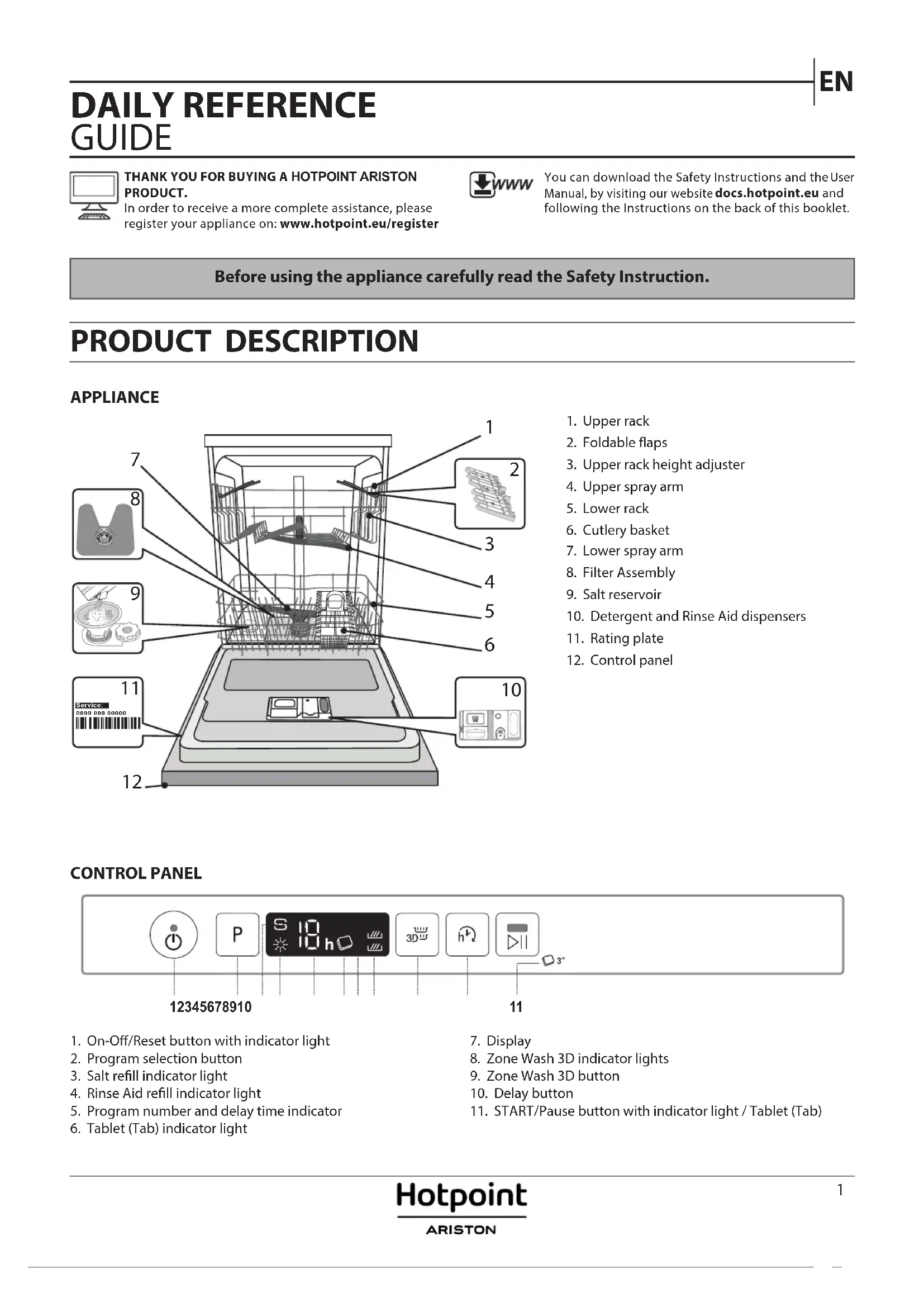
PRODUCT DESCRIPTION
APPLIANCE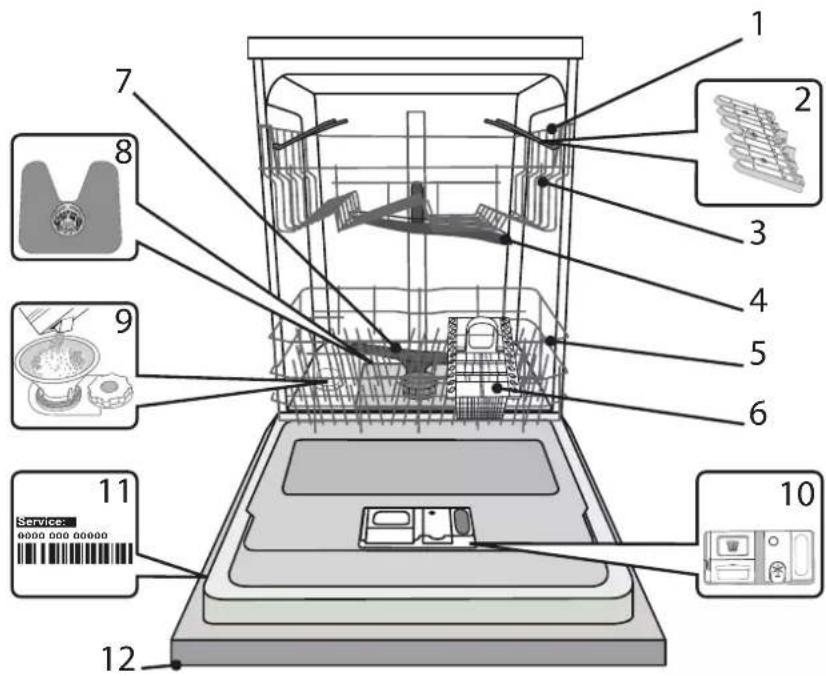
- Upper rack
- Foldable flaps
- Upper rack height adjuster
- Upper spray arm
- Lower rack
- Cutlery basket
- Lower spray arm
- Filter Assembly
- Salt reservoir
- Detergent and Rinse Aid dispensers
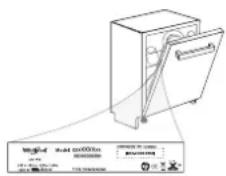
- Rating plate
- Control panel
CONTROL PANEL
- On-Off/Reset button with indicator light
- Program selection button
- Salt refill indicator light
- Rinse Aid refill indicator light
- Program number and delay time indicator
- Tablet (Tab) indicator light
- Display
- Zone Wash 3D indicator lights
- Zone Wash 3D button
- Delay button
- START/Pause button with indicator light / Tablet (Tab)
FIRST TIME USE
SALT, RINSE AID AND DETERGENT
ADVICE REGARDING THE FIRST TIME USE
After installation, remove the stoppers from the racks and the retaining elastic elements from the upper rack.
FILLING THE SALT RESERVOIR
The use of salt prevents the formation of LIMESCALE on the dishes and on the machine's functional components.
- It is mandatory that THE SALT RESERVOIR NEVER BE EMPTY.
- It is important to set the water hardness.
The salt reservoir is located in the lower part of the dishwasher (see PRODUCT DESCRIPTION) and must be filled when the SALT REFILL indicator light in the control panel is lit.

- Remove the lower rack and unscrew the reservoir cap (anticlockwise).
- Only the first time you do this: fill the salt reservoir with water.
- Position the funnel (see figure) and fill the salt reservoir right up to its edge (approximately 1 kg); it is not unusual for a little water to leak out.
- Remove the funnel and wipe any salt residue away from the opening.
Make sure the cap is screwed on tightly, so that no detergent can get into the container during the wash program (this could damage the water softener beyond repair).
Whenever you need to add salt, it is mandatory to complete the procedure before the beginning of the washing cycle to avoid corrosion.
SETTING THE WATER HARDNESS
To allow the water softener to work in a perfect way, it is essential that the water hardness setting is based on the actual water hardness in your house. This information can be obtained from your local water supplier.
The factory sets the default value for the water hardness.
- Switch on the appliance by pressing the ON/OFF button.
- Switch off the appliance by pressing the ON/OFF button.
- Hold down button P for 5 seconds, until you hear a beep.
- Switch on the appliance by pressing the ON/OFF button. • The current selection level number and the salt indicator light both flash.
- Press button P to select the desired hardness level (see WATER HARDNESS TABLE).
| Water Hardness Table |
| Level | °dHGerman degrees | °fHFrench degrees | °ClarkEnglish degrees |
| 1 | Soft | 0 - 6 | 0 - 10 | 0 - 7 |
| 2 | Medium | 7 - 11 | 11 - 20 | 8 - 14 |
| 3 | Average | 12 - 16 | 21 - 29 | 15 - 20 |
| 4 | Hard | 17 - 34 | 30 - 60 | 21 - 42 |
| 5 | Very hard | 35 - 50 | 61 - 90 | 43 - 62 |
Switch off the appliance by pressing the ON/OFF button.
Setting is complete!
As soon as this procedure is complete, run a program without loading.
Only use salt that has been specifically designed for dishwashers.
After the salt has been poured into the machine, the SALT REFILL indicator light switches off.
If the salt container is not filled, the water softener and the heating element may be damaged as a result of limescale accumulation.
Using salt is recommended with any type of dishwasher detergent.
FILLING THE RINSE AID DISPENSER
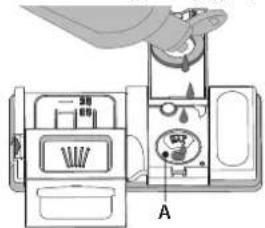
Rinse aid makes dish DRYING easier. The rinse aid dispenser A should be filled when the RINSE AID REFILL indicator light ✦ in the control panel is lit.
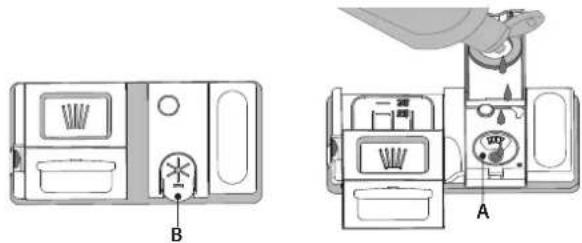
- Open the dispenser B by pressing and pulling up the tab on the lid.
- Pour in the rinse aid (max. 110 ml), making sure it does not overflow from the dispenser. If this happens, clean the spill immediately with a dry cloth.
- Press the lid down until you hear a click to close it.
NEVER pour the rinse aid directly into the appliance tub.
ADJUSTING THE DOSAGE OF RINSE AID
If you are not completely satisfied with the drying results, you can adjust the quantity of rinse aid used.
- Switch the dishwasher on using the ON/OFF button.
- Switch it off using the ON/OFF button.
- Press button P three times - a beep will be heard.
- Switch it on using the ON/OFF button. • The current selection level number and rinse aid indicator light flash.
- Press button P to select the level of rinse aid quantity to be supplied.
- Switch it off using the ON/OFF button.
Setting is complete!
If the rinse aid level is set to ZERO (ECO), no rinse aid will be supplied. The LOW RINSE AID indicator light will not be lit if you run out of rinse aid. A maximum of 5 levels can be set according to the dishwasher model. The factory setting is specific to the model, please follow instruction above to check this for your machine. - If you see bluish streaks on the dishes, set a low number (1-2). - If there are drops of water or limescale marks on the dishes, set a mid-range number (3-4).
FILLING THE DETERGENT DISPENSER
To open the detergent dispenser use the opening device C.
Introduce the detergent into the dry dispenser D only. Place the amount of detergent for pre-washing directly inside the tub.
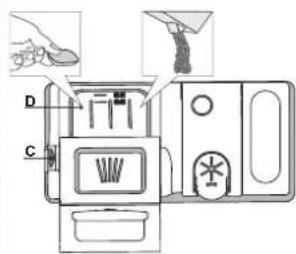
- When measuring out the detergent refer to the mentioned earlier information to add the proper quantity. Inside the dispenser D there are indications to help the detergent dosing.
- Remove detergent residues from the edges of the dispenser and close the cover until it clicks.
- Close the lid of the detergent dispenser by pulling it up until the closing device is secured in place.
The detergent dispenser automatically opens up at the right time according to the program.
If all-in-one detergents are used, we recommend using the TABLET button, because it adjusts the program so that the best washing and drying results are always achieved.
Usage of detergent not designed for dishwashers may cause malfunction or damage to the appliance.
PROGRAMS TABLE
| Program | Drying phase | ActiveDry | Available options*) | Duration of wash program (h:min)** | Water consumption (litres/cycle) | Energy consumption (kWh/cycle) |
| 1 Eco 50° |  | √ | √ |  | 3:10 9.5 0.95 | | |
| 2 Auto Intensive 65° |  | √ | √ |    | 2:00 - 3:10 14.0 | - 17.0 1.50 - 1.85 | |
| 3 Auto Mixed 55° |  | √ | √ |    | 1:30 - 2:30 14.5 | - 16.0 1.15 - 1.30 | |
| 4 Auto Fast Wash |  50° 50° | - | - |   | 0:55 - 1:20 13.0 | - 14.5 1.15 - 1.25 | |
| 5 Rapid 30' 50° |  | - | - |    | 0:30 9.0 0.50 | | |
| 6 Good Night 50° |  | √ | √ |   | 3:30 | 15.0 | 1.15 |
| 7 Sanitizing |  65° 65° | √ | - |   | 1:40 | 10.0 | 1.30 |
| 8 Soak |  - - | - | - |    | 0:12 4.5 0.01 | | |
| 9 Self-Clean |  65° 65° | - | - |  | 0:50 8.0 0.85 | | |
ECO program data is measured under laboratory conditions according to European Standard EN 60436:2020.
Note for Test Laboratories:
For information on comparative EN testing conditions, please send an email to the following address: dw_test_support@whirlpool.com
Pre-treatment of the dishes is not needed before any of the programs.
*) Not all options can be used simultaneously.
**) Values given for programs other than the program Eco are indicative only. The actual time may vary depending on many factors such as temperature and pressure of the incoming water, room temperature, amount of detergent, quantity and type of load, load balancing, additional selected options and sensor calibration. The sensor calibration can increase program duration up to 20 min.
PROGRAMS DESCRIPTION
Instructions on wash cycle selection.
1 ECO
Eco programme is suitable to clean normally soiled tableware, that for this use, it is the most efficient programme in terms of its combined energy and water consumption, and that it is used to assess compliance with the EU Ecodesign legislation.
2 AUTO INTENSIVE
Automatic program for heavily soiled dishes and pans (not to be used for delicate items).
3 AUTO MIXED
Automatic program for normally soiled pans and dishes.
4 AUTO FAST WASH
Automatic program for limited quantity of normally soiled crockery. Ensures optimal cleaning performance in shorter time.
5 RAPID 30'
Program to be used for half load of lightly-soiled dishes with no dried food residues. Does not include drying phase.
6 GOOD NIGHT
Suitable for night-time operation of the appliance. Ensures optimal cleaning and drying performance with the lowest noise emission.
7 SANITIZING
Normally or heavily soiled crockery, with additional antibacterial wash. Can be used to perform maintenance of the dishwasher.
8 SOAK
Use to refresh crockery planned to be washed later. No detergent to be used with this program.
9 SELF-CLEAN
Program to be used to perform maintenance of the dishwasher, to be carried out only when the dishwasher is EMPTY using specific detergents designed for dishwasher maintenance.
Notes:
Please note that cycle Rapid 30' is dedicated for lightly soiled dishes.
OPTIONS AND FUNCTIONS
OPTIONS can be selected directly by pressing the corresponding button (see CONTROL PANEL).
If an option is not compatible with the selected program see PROGRAMS TABLE, the corresponding LED flashes rapidly 3 times and beeps will sound. The option will not be enabled.
ZONE WASH 3D
3D
Option works with one rack at once. In particular, we recommend to use it with Mixed and Intensive cycles - thanks to the additional 3D water jets placed on the bottom of the cavity, ZONE WASH 3D option allows to save energy or to increase the washing performance of the dishwasher:
- ZONE WASH 3D + MIXED CYCLE: it allows to reduce energy consumption up to 40%.
- ZONE WASH 3D + INTENSIVE CYCLE: it increases the washing performances up to 40%. Ideal for very soiled mixed loads, e.g. pans and saucepans, dishes with heavy encrustation or difficult-to-clean crockery (grater, vegetable mill, dirty cutlery).
How to activate the option:
- Select a compatible cycle
- By default the appliance washes dishes in all racks. To wash only the specific rack, press this button repeatedly:
shown on the display (only lower rack)

shown on the display (only upper rack)
shown on the display (option is OFF and the appliance will wash dishes in all racks).
Remember to load the upper or lower rack only, and to reduce the amount of detergent accordingly.
If the upper rack is removed, apply detergent directly to the tub instead of the detergent dispenser.

DELAY
The start time of the program may be delayed for a period of time between 1 and 12 hours.
- Press the DELAY button: the corresponding «h» symbol appears on the display; each time you press the button, the time (1h, 2h, etc. up to max. 12h) from the start of the selected wash cycle will be increased.
- Select the wash program, press the START/Pause button and within 4 seconds close the door: the timer will begin counting down.
- Once this time has elapsed, the indicator light «h» switches off and the wash cycle begins.
To adjust the delay time and select a shorter period of time, press the DELAY button. To cancel it, press the button repeatedly until the selected delayed start indicator light «h» switches off.
The DELAY function cannot be set once a wash cycle has been started.

TABLET (Tab)
This setting allows you to optimize the performance of the program according to the type of detergent used. Press the START/Pause button for 3 seconds (the corresponding symbol will light up) if you use combined detergents in tablet form (rinse aid, salt and detergent in 1 dose).
If you use powder or liquid detergent, this option should be off.
ActiveDry
ActiveDry is a convection drying system which automatically opens the door during/after drying phase to ensure exceptional drying performance every day. The door opens at a temperature that is safe for your kitchen furniture.
As additional steam protection, a specially designed protection foil is added together with the dishwasher. To see how to mount the protection foil, please refer to the (INSTALLATION GUIDE).
ActiveDry functionality could be disabled by the user as follows:
- Go to the Dishwasher software menu by pressing and holding the P button (6 sec).
- You have switched to the ActiveDry Control Menu; you can change the status of the ActiveDry functionality by pressing the P button:
E - enabled, d - disabled
To confirm the change and exit the Control Menu, press and hold the P button (3 sec).
DAILY USE GUIDE
DAILY USE
THANK YOU FOR CHOOSING A HOTPOINT PRODUCT
www.hotpoint.eu/register

www
OPTIONS AND FUNCTIONS
www.hotpoint.eu/register

www
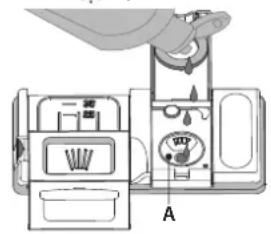
- Open the dispenser B by pressing and pulling the tab on the lid.
- Carefully introduce the rinse aid up to the reference mark of maximum capacity (110 ml) of the filling space, being careful not to spill. If this happens, immediately clean the spill with a dry cloth.
- Press the lid until it clicks shut. NEVER pour rinse aid directly into the tub.
ADJUSTING THE RINSE AID DOSAGE
If you are not completely satisfied with the drying results, you can adjust the amount of rinse aid used.
- When dosing detergent, refer to the information provided earlier to add the appropriate amount. Inside dispenser D, there are markings to help you with dosing.
- Remove any detergent residue from the edges of the container before closing the lid so that it fits properly.
- Close the detergent container lid by pulling it until the closing mechanism engages.
www.hotpoint.eu/register

www
www.hotpoint.eu/register

- Remove the lower basket and unscrew the reservoir cap (counterclockwise).
- Only the first time you do this: fill the salt reservoir with water.
- Place the funnel (see picture) and fill the salt reservoir to the edge (about 1 kg); it is not unusual for a little water to leak out.
- Remove the funnel and wipe away any salt residue from the opening.
Make sure the cap is screwed on tightly, so that detergent cannot enter the container during the wash cycle (this could damage the water softener irreparably).
Whenever you need to add salt, be sure to perform the procedure before starting the wash cycle to avoid corrosion.
WATER HARDNESS SETTING
- Open compartment B by pressing and pulling up the tab on the lid.
- Carefully pour rinse aid up to the maximum mark (110 ml) in the filling area - avoid spilling. If it happens, wipe up the spill immediately with a dry cloth.
- Press the lid until it clicks. NEVER pour rinse aid directly into the tub.
RINSE AID DOSAGE SETTING
If you are not fully satisfied with the drying results, you can adjust the amount of rinse aid used.
- For detergent dosing, refer to the previously mentioned information to pour the appropriate amount. Compartment D has markings that can help you with detergent dosing.
- Remove detergent residue from the edges of the compartments before closing the lid until it clicks.
- Close the detergent compartment lid by pulling it up until the locking device is firmly in place.

Care and maintenance
Cleaning the spray arms

Cutlery basket
3D ZONE WASH
Confidence Retrospective function and Confidence function
www.hotpoint.eu/register


Control panel

(example of loading the upper rack)
FOLDING FLAPS WITH ADJUSTABLE POSITION
SLIDING DRAWER
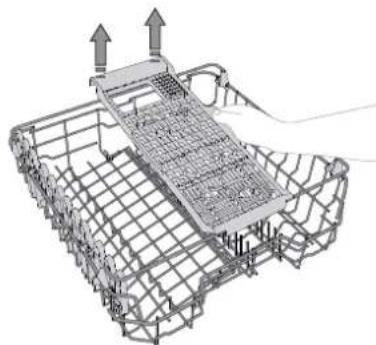
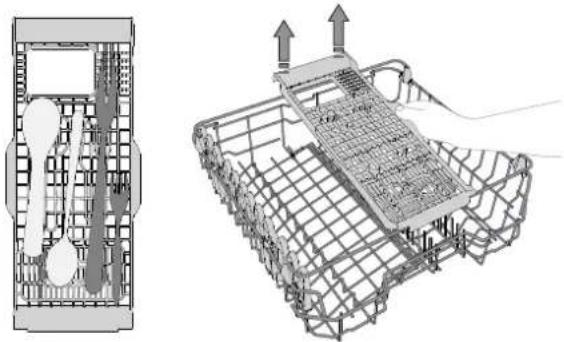
The upper rack has a sliding drawer that can be used for small dishes and cutlery. For optimal washing performance, avoid placing large dishes directly under the drawer. The drawer can be removed.
LOWER RACK
(example of loading the lower rack)
CUTLERY BASKET
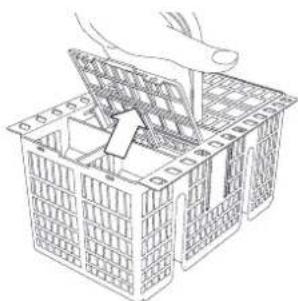
It has grids at the top for better placement of cutlery. It must be placed only in the front part of the lower rack.
Knives and other cutlery with sharp edges must be placed in the cutlery basket with the tips pointing downwards or placed horizontally in the movable compartment in the upper rack.
ZONE WASH 3D
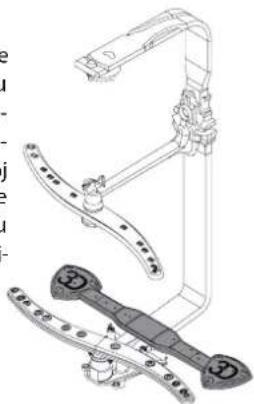
Zone Wash 3D uses additional water jets located both in the upper and lower part of the dishwasher (marked in orange); these jets wash heavily soiled dishes with more intensity thanks to a greater amount of water. Example: Place pots and baking dishes so that they face the lower part of the Zone Wash 3D components and activate the Zone Wash 3D option on the panel.
DAILY USE
1. CHECK THE WATER SUPPLY CONNECTION
Check that the dishwasher is connected to the water supply and that the tap is open.
2. TURN ON THE DISHWASHER
Open the door and press the ON/OFF button.
3. LOAD THE RACKS (see LOADING THE RACKS)
4. FILL THE DETERGENT DISPENSER
5. SELECT THE PROGRAM AND ADJUST THE CYCLE
Select the most suitable program according to the type of dishes and level of soiling (see PROGRAM DESCRIPTION) by pressing the P button. Select the desired options (see OPTIONS AND FUNCTIONS).
6. START
UNSUITABLE DISHES
- Wooden dishes and cutlery.
- Sensitive decorated glasses, artistic handicrafts and antique dishes. The decoration on them is not resistant.
- Parts made of synthetic material cannot withstand high temperatures.
- Copper and tin dishes.
- Dishes soiled with ash, wax, lubricating grease or ink.
To remove the upper spray arm, turn the plastic locking ring clockwise. The upper spray arm is reinstalled with the side with more holes facing up.

LOADING THE BASKETS
UPPER BASKET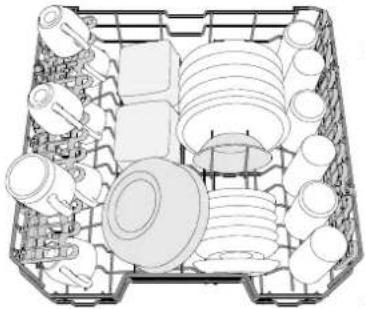
LOWER BASKET
DAILY USE

LOADING THE BASKETS
UPPER BASKET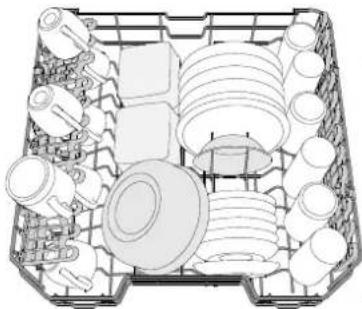
Load fragile and light items in this basket: glasses, cups, saucers, bowls.
(example of loading the upper basket)
ADJUSTING THE HEIGHT OF THE UPPER BASKET
SLIDING TRAY
LOWER BASKET
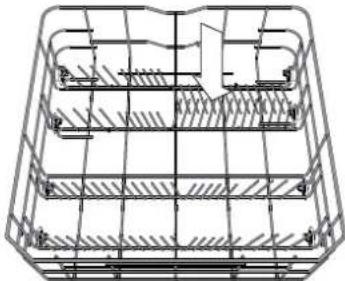
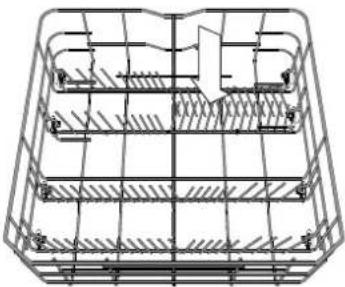
(example of loading for the lower basket)
CUTLERY BASKET
ZONE WASH 3D
DAILY USE
400011673855
04/2023 as - Xerox Fabriano

LOADING THE BASKETS
UPPER BASKET
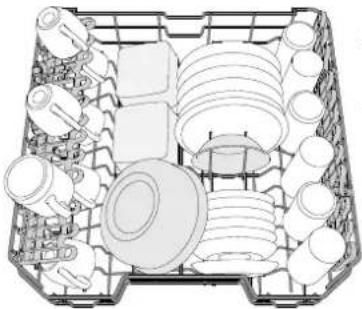
CUTLERY DRAWER
LOWER BASKET
ZONE WASH 3D COMPONENTS
04/2023 as - Xerox Fabriano

FOLDING SPIKES WITH ADJUSTABLE POSITION
LOWER BASKET
ZONE WASH 3D
3D ZONE WASH
DAILY USE
1. CHECK THE WATER SUPPLY CONNECTION

LOADING THE BASKETS
UPPER BASKET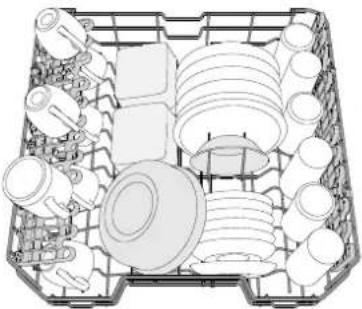
Never lift or lower the basket by one side only.
ADJUSTABLE FOLDING FLAPS
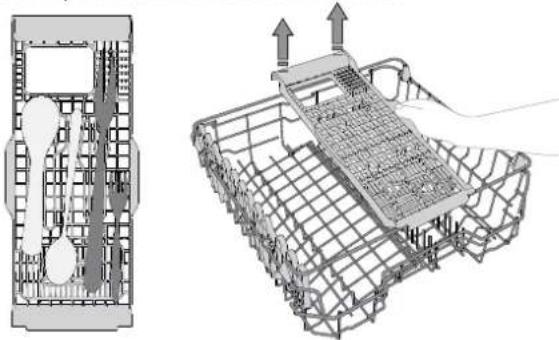
CUTLERY DRAWER
The upper basket also has a sliding drawer for placing small dishes and cutlery. For best washing performance, avoid placing bulky dishes directly under the drawer. The drawer can be removed.
LOWER BASKET
ZONE WASH 3D
DAILY USE
1. CHECK THE WATER SUPPLY CONNECTION
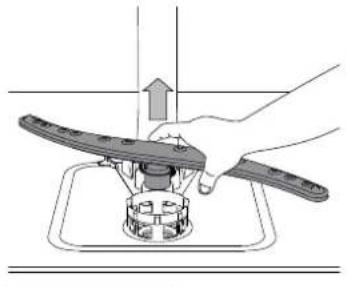
The lower spray arm can be removed by pulling it upwards.
WATER SOFTENING SYSTEM

LOADING THE BASKETS
UPPER BASKET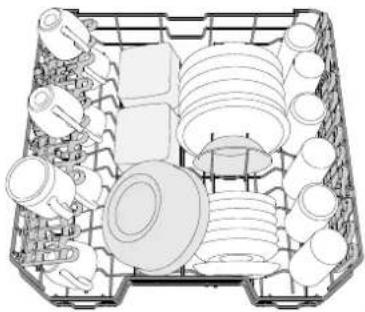
FOLDABLE FLAPS WITH ADJUSTABLE POSITIONS
SLIDING TRAY
3D WASH ZONE
DAILY USE
1. CHECK THE WATER CONNECTION
UNEXPECTED INTERRUPTIONS
Load delicate and light dishes: glasses, cups, saucers, low salad bowls.
ADJUSTING THE HEIGHT OF THE UPPER RACK
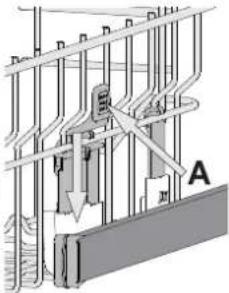
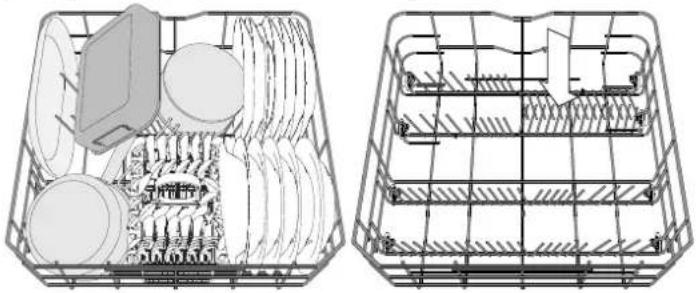
The height of the upper rack can be adjusted: high position to place bulky crockery in the lower basket and low position to make the most of the tip-up supports by creating more space upwards and avoid collision with the items loaded into lower rack.
The upper rack is equipped with a height adjuster (see figure). Without pressing the levers, lift it up by simply holding the rack sides, as soon as the rack is stable in its upper position. To restore to the lower position, press the levers A at the sides of the rack and move the basket downwards.
We strongly recommend that you do not adjust the height of the rack when it is loaded. NEVER raise or lower the basket on one side only.
FOLDABLE FLAPS WITH ADJUSTABLE POSITION
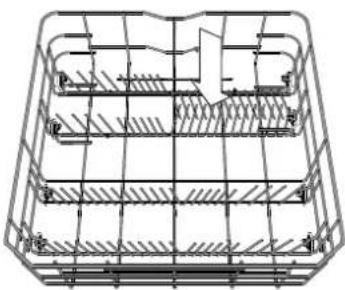
The side foldable flaps can be folded or unfolded to optimize the arrangement of crockery inside the rack. Wine glasses can be placed safely in the foldable flaps by inserting the stem of each glass into the corresponding slots.
Depending on the model:
- to unfold the flaps, slide them up and rotate or release them from the snaps and pull them down.
• to fold the flaps, rotate them and slide them down, or pull them up and attach them to the snaps.
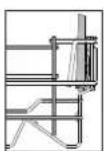
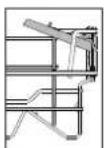
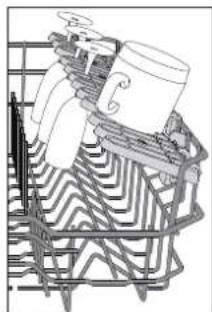
Rotate it and slide the flaps down, or pull it up and attach the flaps to the snaps.
The upper rack is fitted with a sliding tray which can be used to hold small crockery and cutlery. For optimum washing performance, avoid positioning bulky crockery directly below the tray. The tray is removable.
The upper rack is fitted with a sliding tray which can be used to hold small crockery and cutlery. For optimum washing performance, avoid positioning bulky crockery directly below the tray. The tray is removable.
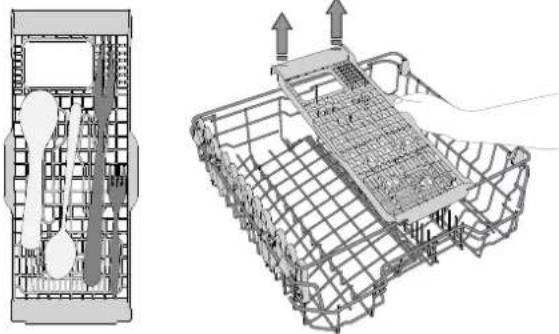
For pots, lids, plates, salad bowls, cutlery, etc. Large plates and lids should ideally be placed at the sides to avoid interference with the spray arm. The lower rack has tip-up supports which can be used in a vertical position when arranging plates or in a horizontal position (lower) to load pans and salad bowls easily.
For pots, lids, plates, salad bowls, cutlery, etc. Large plates and lids should ideally be placed at the sides to avoid interference with the spray arm. The lower rack has tip-up supports which can be used in a vertical position when arranging plates or in a horizontal position (lower) to load pans and salad bowls easily.
CUTLERY BASKET
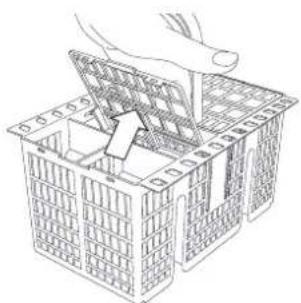
The basket is equipped with top grilles for improved cutlery arrangement. The cutlery basket should be positioned only at the front of the lower rack. Knives and other utensils with sharp edges must be placed in the cutlery basket with the points facing downwards or they must be positioned horizontally in the tip-up compartments on the upper rack.
The basket is equipped with top grilles for improved cutlery arrangement. The cutlery basket should be positioned only at the front of the lower rack.
Knives and other utensils with sharp edges must be placed in the cutlery basket with the points facing downwards or they must be positioned horizontally in the tip-up compartments on the upper rack.
ZONE WASH 3D
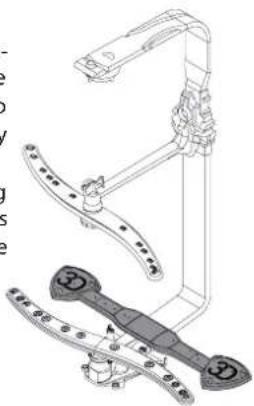
Zone Wash 3D uses additional water jets located both in the lower and upper part of the dishwasher (marked with orange color) to wash more intensively heavily soiled items by increasing water coverage on dishes.
Example: Load pots and casseroles facing the lower part of Zone Wash 3D components and activate the Zone Wash 3D option on the panel.
DAILY USE
1. CHECK WATER CONNECTION
Check that the dishwasher is connected to the water supply and that the tap is open.
2. SWITCH ON THE DISHWASHER
Open the door and press the ON/OFF button.
3. LOAD THE RACKS (see LOADING THE RACKS).
4. FILLING THE DETERGENT DISPENSER
5. CHOOSE THE PROGRAM AND CUSTOMISE THE CYCLE
Select the most appropriate program in accordance with the type of crockery and its soiling level (see PROGRAMS DESCRIPTION) by pressing the P button.
Select the desired options (see OPTIONS AND FUNCTIONS).
6. START
Start the wash cycle by pressing the START/Pause button (led is lit) and closing the door within 4 sec. When the program starts you hear a single beep. If the door was not closed within 4 sec., the alarm sound will be played. In this case, open the door, press the START/Pause button and close the door again within 4 sec.
7. END OF WASH CYCLE
The end of the wash cycle is indicated by beeps and by the flashing of the wash cycle number on the display. Open the door and switch off the appliance by pressing the ON/OFF button.
Wait for a few minutes before removing the crockery - to avoid burns. Unload the racks, beginning with the lower one.
The machine will switch off automatically during certain extended periods of inactivity, in order to minimise electricity consumption. If the crockery is only lightly soiled or if it has been rinsed with water before being placed in the dishwasher, reduce the amount of detergent used accordingly.
MODIFYING A RUNNING PROGRAM
If a wrong program was selected, it is possible to change it, provided that it has only just begun: open the door, press and hold the ON/OFF button, the machine will switch off.
Switch the machine back on using the ON/OFF button and select the new wash cycle and any desired options; Start the wash cycle by pressing START/Pause button (led is lit) and closing the door within 4 sec.
Without switching off the machine, open the door (START/Pause led starts blinking) (be ware of HOT steam!) and place the crockery inside the dishwasher. Press the START/Pause button and close the door within 4 sec., the cycle will resume from the point at which it was interrupted.
ACCIDENTAL INTERRUPTIONS
If the door is opened during the wash cycle, or if there is a power cut, the cycle stops. Press the START/Pause button and close the door within 4 sec., the cycle will resume from the point at which it was interrupted.
ADVICE AND TIPS
TIPS
Before loading the baskets, remove all food residues from the crockery and empty the glasses. You do not need to rinse beforehand under running water.
Arrange the crockery so that it is held in place firmly and does not tip over; and arrange the containers with the openings facing downwards and the concave/convex parts placed obliquely, thus allowing the water to reach every surface and flow freely.
Warning: lids, handles, trays and frying pans do not prevent the sprayer arms from rotating.
Place any small items in the cutlery basket.
Very soiled dishes and pans should be placed in the lower basket because in this sector the water sprays are stronger and allow a higher washing performance.
After loading the appliance, make sure that the sprayer arms can rotate freely.
UNSUITABLE CROCKERY
- Wooden crockery and cutlery.
- Delicate decorated glasses, artistic handicraft and antique crockery. Their decorations are not resistant.
- Parts in synthetic material which do not withstand high temperatures. • Copper and tin crockery.
- Crockery soiled with ash, wax, lubricating grease or ink. The colours of glass decorations and aluminium/silver pieces can change and fade during the washing process. Some types of glass (e.g. crystal objects) can become opaque after a number of wash cycles too.
DAMAGE TO GLASS AND CROCKERY
- Only use glasses and porcelain guaranteed by the manufacturer as dishwasher safe.
- Use a delicate detergent suitable for crockery
- Collect glasses and cutlery from the dishwasher as soon as the wash cycle is over.
TIPS ON ENERGY SAVING
- When the household dishwasher is used according to the manufacturer's instructions, washing tableware in a dishwasher usually consumes less energy and water than hand dishwashing.
- To maximize dishwasher efficiency, it is recommended to start the wash cycle once the dishwasher is fully loaded. Loading the household dishwasher up to the capacity indicated by the manufacturer will contribute to energy and water savings. Information on correct loading of tableware can be found in the Loading chapter. In case of partial loading, it is recommended to use dedicated wash options if available (Half load/Zone Wash, Multizone), filling up only selected racks. Incorrect loading or overloading the dishwasher may increase resource usage (such as water, energy, and time, as well as increase noise level), reducing cleaning and drying performance.
- Manual pre-rinsing of tableware items leads to increased water and energy consumption and is not recommended.
HYGIENE
To avoid odour and sediment that can accumulate in the dishwasher, run a high-temperature program at least once a month. Use a teaspoon of detergent and run it without loading to clean your appliance.
CARE AND MAINTENANCE
CLEANING THE FILTER ASSEMBLY
Regularly clean the filter assembly so that the filters do not clog and that the waste water flows away correctly.
Using the dishwasher with clogged filters or foreign objects inside the filtration system or spray arms may cause unit malfunction, resulting in loss of performance, noisy operation, or higher resource usage.
The filter assembly consists of three filters that remove food residues from the washing water and then recirculate the water.
The dishwasher must not be used without filters or if the filter is loose.
At least once per month or after each 30 cycles, check the filter assembly and, if necessary, clean it thoroughly under running water, using a non-metallic brush and following the instructions below:
- Turn the cylindrical filter A in an anti-clockwise direction and pull it out (Fig 1).
- Remove the cup filter B by exerting a slight pressure on the side flaps (Fig 2).
- Slide out the stainless-steel plate filter C (Fig 3).
- If you find foreign objects (such as broken glass, porcelain, bones, fruit seeds, etc.), please remove them carefully.
- Inspect the trap and remove any food residues. NEVER REMOVE the wash-cycle pump protection (black detail) (Fig 4).
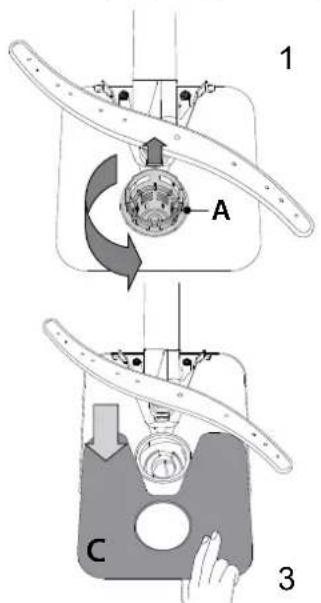
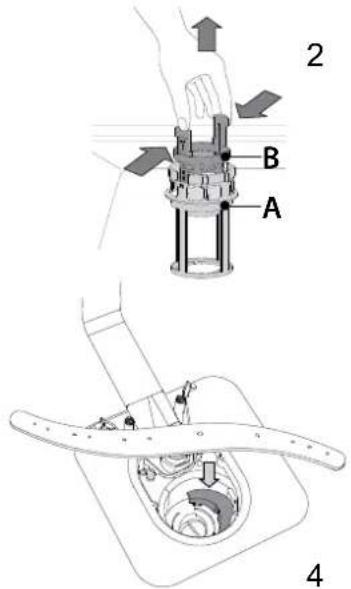
After cleaning the filters, re-place the filter assembly and fix it in position correctly; this is essential for maintaining the efficient operation of the dishwasher.
CLEANING THE WATER INLET HOSE
If the water hoses are new or have not been used for an extended period of time, let the water run to make sure it is clear and free of impurities before performing the necessary connections. If this precaution is not taken, the water inlet could become blocked and damage the dishwasher.
CLEANING THE SPRAY ARMS
On occasions, food residue may become encrusted onto the spray arms and block the holes used to spray the water. It is therefore recommended that you check the arms from time to time and clean them with a small non-metallic brush.
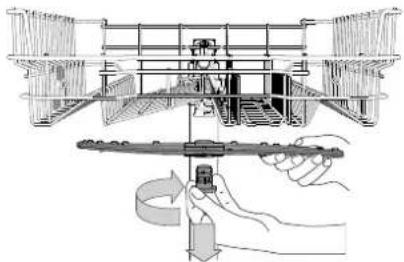
To remove the upper spray arm, turn the plastic locking ring in a clockwise direction. The upper spray arm should be replaced so that the side with the greater number of holes is facing upwards.
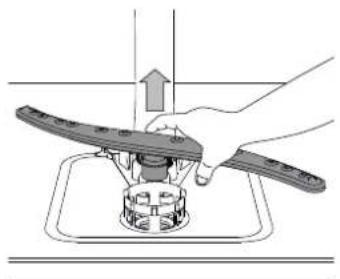
The lower spray arm may be removed by pulling it upwards.
WATER SOFTENING SYSTEM
Water softener automatically reduces water hardness, consequently preventing scale buildup on heater, contributing also to better cleaning efficiency.
This system regenerates itself with salt, therefore it is required to refill salt container when empty.
Frequency of regeneration depends on water hardness level setting - regeneration takes place once per 6 Eco cycles with water hardness level set to 3.
Regeneration process starts in final rinse and finishes in drying phase, before cycle ends.
- Single regeneration consumes: ~3.5 L of water; • Takes up to 5 additional minutes for the cycle;
- Consumes below 0.005 kWh of energy.
TROUBLESHOOTING
In case your dishwasher doesn't work properly, check if the problem can be solved by going through the following list.
For other errors or issues please contact authorized After-sales Service which contact details can be found in the warranty booklet.
Spare parts will be available for a period of either up to 7 or up to 10 years, according to the specific Regulation requirements.
| PROBLEMS POSSIBLE CAUSES SOLUTIONS | |
| Salt indicator is lit | Salt reservoir is empty. (After refill the salt indicator may remain lit for several wash cycles). | Refill reservoir with salt (for more information - see page 2).Adjust water hardness - see table, page 2. |
| Rinse aid indicator is lit | Rinse aid dispenser is empty. (After refill the rinse aid indicator may remain lit for several wash cycles). | Refill dispenser with rinse aid (for more information - see page 2). |
| The dishwasher won't start or does not respond to commands. | The appliance has not been plugged in properly. | Insert the plug into the socket. |
| Power outage. | For safety reasons, dishwasher will not re-start automatically when power returns.Open dishwasher door, press START/Pause button and close the door within 4 seconds. |
| The dishwasher door is not closed.ActiveDry pin is not pulled in. | Vigorously push the door until you hear the "click". |
| Cycle is interrupted by door opening for more than 4 seconds. | Press START/Pause and close the door within 4 seconds. |
| It does not respond to commands.Display shows:9 or 12 and On/Off LED is blinking rapidly | Switch off the appliance by pressing the ON/OFF button, switch it back on after approximately one minute and restart the program. If problem persists, unplug the appliance for 1 minute, then plug it back in. |
| The dishwasher won't drain.Display shows:3 and On/Off LED is blinking rapidly | The wash cycle has not finished yet. Wait until the | wash cycle finishes. |
| The drain hose is bent. Check that the drain hose is | not bent (see INSTALLATION INSTRUCTION). |
| The sink drain pipe is blocked. Clean the sink drain pipe. | pipe. |
| The filter is clogged up with food residues. Clean the filter (see CLEANING THE FILTER ASSEMBLY). | The filter (see CLEANING THE FILTER ASSEMBLY). |
| The dishwasher makes excessive noise. | The dishes are rattling against each Position the crockery correctly (see LOADING THE RACKS). |
| An excessive amount of foam has been produced. | The detergent has not been measured out correctly or it is not suitable for use in dish-washers (see FILLING THE DETERGENT DISPENSER). Restart the current cycle by switching OFF the dishwasher, then switch it on again, select a new program, press START/Pause and close the door within 4 seconds. Please do not add any detergent. |
| The dishes are not clean. | The crockery has not been arranged properly. | Arrange the crockery correctly (see LOADING THE RACKS). |
| The spray arms cannot rotate freely, being hindered by the dishes. | Arrange the crockery correctly (see LOADING THE RACKS). |
| The wash cycle is too gentle. Select an appropriate wash cycle (see PROGRAMS TABLE). | wash cycle (see PROGRAMS TABLE). |
| An excessive amount of foam has been produced. | The detergent has not been measured out correctly or it is not suitable for use in dishwa-shers (see FILLING THE DETERGENT DISPENSER). |
| The cap on the rinse aid compartment has not been shut correctly. | Make sure the cap of the rinse aid dispenser is closed. |
| The filter is soiled or clogged. Clean the filter assem bly (see CARE AND MAINTENANCE). | Useable (see CARE AND MAINTENANCE). |
| There is no salt. Fill the salt reservoir (see FILLING THE SALT RESERVOIR). | Useable (see CARE AND MAINTENANCE). |
| The dishwasher does not fill the water. Display shows:H,6 and On/Off LED is blinking rapidly | No water in the water supply or the tap is closed. | Make sure there is water in the water supply or the tap running. |
| The inlet hose is bent. | Make sure the inlet hose is not bent (see INSTALLATION) reprogram the dishwasher and reboot. |
| The sieve in the water inlet hose is clogged; it is necessary to clean it | After having carried out the verification and cleaning, turn off and turn on the dishwasher and restart a new program. |
| Dishwasher finishes the cycle prematurely. Display shows:15 and On/Off LED is blinking rapidly | Drain hose positioned too low or siphoning into home sewage system. | Check if end of drain hose is placed at correct height (see INSTALLATION).Check for siphoning into home sewage system, install air admittance valve if necessary. |
| Air in water supply. | Check water supply for leaks or other issues letting air inside. |

- Visiting our website: docs.hotpoint.eu and parts-selfservice.whirlpool.com • Using QR Code
- Alternatively, contact our After-sales Service (See phone number in the warranty booklet). When contacting our After-sales Service, please state the codes provided on your product's identification plate.
The model information can be retrieved using the QR-Code reported in the energy label. The label also includes the model identifier that can be used to consult the portal of the registry at https://eprel.ec.europa.eu.