ManualGo.com
DWF83PL - Stapler DEWALT - Free user manual and instructions
Find the device manual for free DWF83PL DEWALT in PDF.



Download the instructions for your Stapler in PDF format for free! Find your manual DWF83PL - DEWALT and take your electronic device back in hand. On this page are published all the documents necessary for the use of your device. DWF83PL by DEWALT.
USER MANUAL DWF83PL DEWALT
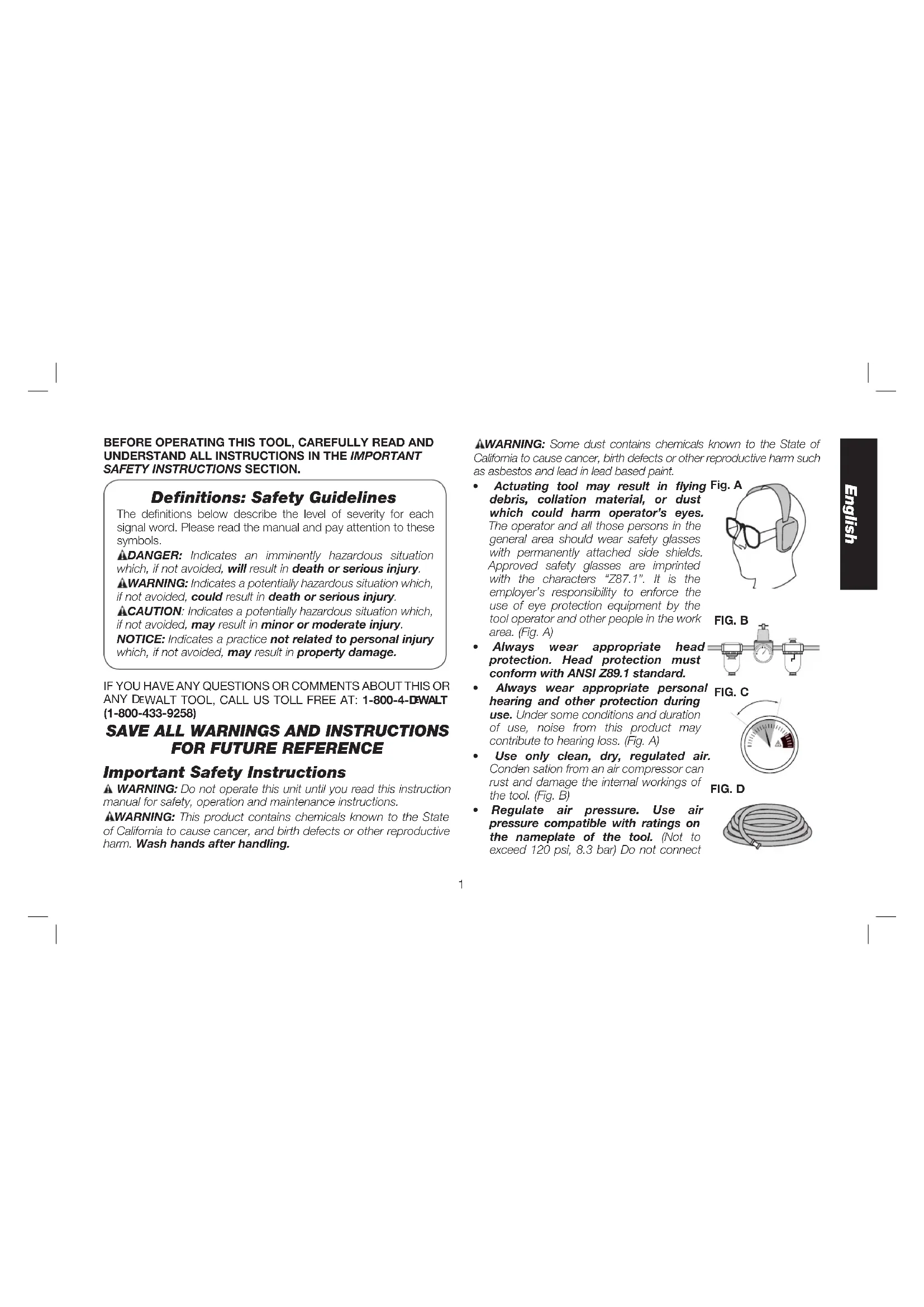
SAFETY INSTRUCTIONS SECTION. Definitions: Safety Guidelines The definitions below describe the level of severity for each signal word. Please read the manual and pay attention to these symbols.
DANGER: Indicates an imminently hazardous situation
which, if not avoided, will result in death or serious injury.
WARNING: Indicates a potentially hazardous situation which,
if not avoided, could result in death or serious injury. CAUTION: Indicates a potentially hazardous situation which, if not avoided, may result in minor or moderate injury. NOTICE: Indicates a practice not related to personal injury which, if not avoided, may result in property damage. IF YOU HAVE ANY QUESTIONS OR COMMENTS ABOUT THIS OR ANY D
Important Safety Instructions
WARNING: Do not operate this unit until you read this instruction
manual for safety, operation and maintenance instructions.
WARNING: This product contains chemicals known to the State
of California to cause cancer, and birth defects or other reproductive harm. Wash hands after handling.
WARNING: Some dust contains chemicals known to the State of
California to cause cancer, birth defects or other reproductive harm such as asbestos and lead in lead based paint.
- Actuating tool may result in flying Fig. A FIG. B FIG. C FIG. D debris, collation material, or dust which could harm operator’s eyes. The operator and all those persons in the general area should wear safety glasses with permanently attached side shields. Approved safety glasses are imprinted with the characters “Z87.1”. It is the employer’s responsibility to enforce the use of eye protection equipment by the tool operator and other people in the work area. (Fig. A)
- Always wear appropriate head protection. Head protection must conform with ANSI Z89.1 standard.
- Always wear appropriate personal hearing and other protection during use. Under some conditions and duration of use, noise from this product may contribute to hearing loss. (Fig. A)
- Use only clean, dry, regulated air. Conden sation from an air compressor can rust and damage the internal workings of the tool. (Fig. B)
- Regulate air pressure. Use air pressure compatible with ratings on the nameplate of the tool. (Not to exceed 120 psi, 8.3 bar) Do not connect English 1the tool to a compressor rated at over 200 psi. The tool operating pressure must never exceed 200 psi even in the event of regulator failure. (Fig. C)
- Only use air hose that is rated for a maximum working pressure of at least 150 PSI (10.3 BAR) or 150% of the maximum system pressure, which ever is greater. (Fig. D)
- Do not use bottled gases to power this FIG. E FIG. F FIG. G tool. Bottled compressed gases such as oxygen, carbon dioxide, nitrogen, hydrogen, propane, acetylene or air are not for use with pneumatic tools. Never use combustible gases or any other reactive gas as a power source for this tool. Danger of explosion and/or serious personal injury may result. (Fig. E)
- Use couplings that relieve all pressure from the tool when it is disconnected from the power supply. Use hose connectors that shut off air supply from compressor when the tool is disconnected. (Fig. F)
- Disconnect tool from air supply when not in use. Always disconnect tool from air supply and remove fasteners from magazine before leaving the area or passing the tool to another operator. Do not carry tool to another work area in which changing location involves the use of scaffoldings, stairs, ladders, and the like, with air supply connected. Do not make adjustments, remove magazine, perform maintenance or clear jammed fasteners while connected to the air supply. If the contact trip is adjusted when the tool is connected to the air supply and nails are loaded, accidental discharge may occur. (Fig. G)
- Connect tool to air supply before loading fasteners, to prevent a fastener from being fired during connection. The tool driving mechanism may cycle when tool is connected to the air supply. Do not load fasteners with trigger or contact trip depressed, to prevent unintentional firing of a fastener.
- Do not remove, tamper with, or otherwise cause the tool, trigger, or contact trip to become inoperable. Do not tape or tie trigger or contact trip in the on position. Do not remove spring from contact trip. Make daily inspections for free movement of trigger and contact trip. Uncontrolled discharge could result.
- Inspect tool before use. Do not operate a tool if any portion of the tool, trigger, or contact trip is inoperable, disconnected, altered, or not working properly. Leaking air, damaged parts or missing parts should be repaired or replaced before use. (Fig.H) A tool that is not in proper working order must not be used. Tags and physical segregation shall be used for control.
- Do not alter or modify the tool in any way. (Fig. I) FIG. H FIG. I FIG. J English 2• Always keep fingers clear of contact trip to prevent injury from inadvertent release of nails. (Fig. M)
- Refer to the Maintenance and Repairs sections for detailed information on the proper maintenance of the tool
- Always operate the tool in a clean, lighted area. Be sure the work surface is clear of any debris and be careful not to lose footing when working in elevated environments such as rooftops.
- Do not actuate tool unless tool is placed firmly against the workpiece.
- Do not drive fasteners near edge of material. The workpiece may split causing the fastener to ricochet, injuring you or a co-worker. Be aware that the nail may follow the grain of the wood (shiner), causing it to protrude unexpectedly from the side of the work material. Drive the nail perpendicular to the grain to reduce risk of injury. (Fig. N)
- Do not drive nails onto the heads of other fasteners or with the tool at too steep an angle. Personal injury from strong recoil, jammed fasteners, or ricocheted nails may result. (Fig. O)
- Be aware of material thickness when using the nailer. A protruding nail may cause injury.
- Always assume that the tool contains fasteners.
- Do not point the tool at co-workers or yourself at any time. No horseplay! Work safe! Respect the tool as a working implement. (Fig. J)
- Keep bystanders, children, and visitors away while operating a power tool. Distractions can cause you to lose control. When tool is not in use, it should be locked in a safe place, out of the reach of children.
- Remove finger from trigger when not driving fasteners. Never carry tool with finger on trigger. Accidental discharge could result.
- Do not overreach. Maintain proper footing and balance at all times. Loss of balance may cause cause personal injury. (Fig. K)
- Make sure hose is free of obstructions or snags. Entangled or snarled hoses can cause loss of balance or footing. Do not lift, pull or lower tool by the hose.
- Use the tool only for its intended use. Do not discharge fasteners into open air, concrete, stone, extremely hard woods, knots or any material too hard for the fastener to penetrate. Do not use the body of the tool or top cap as a hammer. Discharged fasteners may follow unexpected path and cause injury. (Fig. L) FIG. P FIG. N FIG. O FIG. K FIG. L FIG. M English 3• Be aware that when the tool is being utilized at pressures on the high end of its operating range, nails can be driven completely through thin or very soft work material. Make sure the pressure in the compressor is set so that nails are set into the material and not pushed completely through. (Fig. P)
- Keep hands and body parts clear of immediate work area. Hold workpiece with clamps when necessary to keep hands and body out of potential harm. Be sure the workpiece is properly secured before pressing the nailer against the material. The contact trip may cause the work material to shift unexpectedly. (Fig.Q)
- Do not use tool in the presence of flammable dust, gases or fumes. The tool may produce a spark that could ignite gases causing a fire. Driving a nail into another nail may also cause a spark. (Fig.R)
- Keep face and body parts away from back of the tool cap when working in restricted areas. Sudden recoil can result in impact to the body, especially when nailing into hard or dense material. (Fig. S)
- Grip tool firmly to maintain control while allowing tool to recoil away from work surface as fastener is driven. In “Contact Actuation Mode” if contact trip is allowed to recontact work surface before trigger is released an unwanted fastener will be fired.
- Choice of triggering method is important. Check the manual for triggering options. Always select the trigger method that is appropriate to the fastener application and the training of the operator.
CONTACT ACTION TRIGGER
- When using the contact action trigger, be careful of unin tentional double fires resulting from tool recoil. Unwanted fasteners may be driven if the contact trip is allowed to accidentally re-contact the work surface. (Fig. T) TO AVOID DOUBLE FIRES:
- Do not engage the tool against the work surface with a strong force.
- Allow the tool to recoil fully after each actuation.
- Use sequential action trigger.
- When “contact” actuating the framing nailer, always keep tool under control. Inaccurate placement of tool can result in misdirected discharge of a fastener.
SEQUENTIAL ACTION TRIGGER
- When using the sequential action FIG. U trigger, do not actuate the tool unless the tool is placed firmly against the workpiece.
- Do not drive nails blindly into walls, floors or other work areas. Fasteners FIG. T FIG. Q Fig. R FIG. S English 4driven into live electrical wires, plumbing, or other types of obstructions can result in injury. (Fig.U)
- Stay alert, watch what you are doing and use common sense when operating a power tool. Do not use tool while tired or under the influence of drugs, alcohol, or medication. A moment of inattention while operating power tools may result in serious personal injury.
WARNING: Some dust created by power sanding, sawing,
grinding, drilling, and other construction activities contains chemicals known to the State of California to cause cancer, birth defects or other reproductive harm. Some examples of these chemicals are:
- lead from lead-based paints,
- crystalline silica from bricks and cement and other masonry products, and
- arsenic and chromium from chemically-treated lumber. Your risk from these exposures varies, depending on how often you do this type of work. To reduce your exposure to these chemicals: work in a well ventilated area, and work with approved safety equipment, such as those dust masks that are specially designed to filter out microscopic particles.
WARNING: ALWAYS USE SAFETY GLASSES. Everyday
eyeglasses are NOT safety glasses. Also use face or dust mask if operation is dusty. ALWAYS WEAR CERTIFIED SAFETY EQUIPMENT:
@ 80 psi LOADING CAPACITY 2 sticks (25 nails/stick) of 12D148 ring 2 sticks (37 nails/stick) of 12D131 ring 4 sticks (25 nails/stick) of 12D131 ring Nail Specifications NOTE: Use only D
WALT approved fasteners. MODEL DWF83PL DWF83PT DWF83WW
NAIL LENGTHS 2" - 3-1/4"
.113" - .131" (2.8 mm -
.113" - .131" (2.8 mm -
FASTENER COLLATION 21° Plastic collated 30° - 34° Paper tape 28° wire collated NAIL TYPE 21° round head 30° clipped head/ 30° full head 28° notched head/28° full head OPERATION Preparing the Tool (Fig. 2, 3)
WARNING: Read the section titled Important Safety Instructions
at the beginning of this manual. Always wear eye and ear protection when operating this tool. Keep the nailer pointed away from yourself and others. For safe operation, complete the following procedures and checks before each use of the nailer.
1. Before you use the nailer, be sure that the compressor tanks
have been properly drained.
2. Lubricate the tool following these directions:
WALT pneumatic tool oil or a non-detergent S.A.E. 20 weight oil. DO NOT use detergent oil or additives as they will damage o-rings and rubber parts. b. Use a filter-regulator-lubricator in the air line between the compressor and the tool when possible. English 6c. If a lubricator is not available, add 5 to 10 drops of oil in the air fitting a least twice a day or every 4 hours of use. FIG. 2 FIG. 3
3. Wear proper eye, hearing and respiratory protection.
4. Remove all fasteners from the magazine.
5. Check for smooth and proper operation of contact trip and
pusher assemblies. Do not use tool if either assembly is not functioning properly. NEVER use a tool that has the contact trip restrained in the up position.
6. Check air supply. Ensure that air pressure does not exceed
recommended operating limits, refer to Tool Specifications.
7. Connect air hose.
8. Check for audible leaks around valves and gaskets. Never use a
tool that leaks or has damaged parts.
WARNING: To reduce the risk of personal injury, disconnect tool
from air supply before performing maintenance, clearing a jammed fastener, leaving work area, moving tool to another location or handing the tool to another person. Mode Selection
WARNING: Always wear proper eye [ANSI Z87.1 (CAN/CSA
Z94.3)] and hearing protection [ANSI S12.6 (S3.19)] when operating this tool.
WARNING: Keep fingers AWAY from trigger when not driving
fasteners to avoid accidental firing. NEVER carry tool with finger on trigger. In contact mode tool will fire a fastener if safety is bumped while trigger is depressed. Sequential Trip: Sequential trip requires the operator to hold the contact tip against the work surface before pulling the trigger. This makes accurate fastener placement easier. The sequential trip allows exact fastener placement without the possibility of driving a second fastener on recoil, as described under Contact Trip. The sequential trip tool has a positive safety advantage because it will not accidentally drive a second fastener if the tool is contacted against the work or anything else while the operator is holding the trigger pulled. Contract Trip: The common operating procedure on contact trip tools is for the operator to contact the work surface to actuate the trip mechanism while keeping the trigger pulled, thus driving a fastener each time the work is contacted. This will allow rapid fastener placement on many jobs, such as sheathing, decking and pallet assembly. All pneumatic tools are subject to recoil when driving fasteners. The tool may bounce, releasing the trip, and if unintentionally allowed to recontact the work surface with the trigger still actuated (finger still holding the trigger pulled) an unwanted second fastener will be driven. TO CHANGE OPERATING MODES (FIG. 1, 4, 5)
WARNING: Disconnect air line from tool and remove fasteners
from magazine before making adjustments or personal injury may result. English 7WARNING: Always know the tool operating mode before connecting to an air supply and/or using the tool. SEQUENTIAL TRIP-
1. Push and hold in pivot pin (I) opposite
the selector, while rotating the selector (J) 180° counterclockwise to the sequential trip position .
2. Ensure the selector is fully seated in the
new position. To operate the nailer in sequential trip mode:
1. Depress the contact trip firmly against the
2. Depress the trigger.
WARNING: A nail will fire each time the
trigger is depressed as long as the contact trip remains depressed. CONTACT TRIP -
1. Push and hold in pivot pin (I) while rotating
the selector (J) 180° clockwise to the contact trip position .
2. Ensure the selector is fully seated in the
new position. To operate the nailer in contact trip mode:
1. Depress the trigger.
2. Push the contact trip against the
work surface. As long as the trigger is depressed, the tool will fire a nail every time the contact trip is depressed. This allows the user to drive multiple nails in sequence. FIG. 4
WARNING: Do not keep trigger depressed when tool is not in use.
Loading the Tool (Fig. 1, 6)
WARNING: Connect tool to air supply before loading
fasteners, to prevent a fastener from being fired during connection. The tool driving mechanism may cycle when tool is connected to the air supply. Do not load fasteners with trigger or contact trip depressed, to prevent unintentional firing of a fastener.
WARNING: Keep tool pointed in a safe direction when loading
WARNING: Never load nails with the contact trip or trigger
1. Slide the pusher (E) to the base of the magazine to lock it in place.
2. Hold the nailer with the magazine facing downward and insert
the appropiate collated nail sticks in tho the back of the magzine NOTE: See Tool Specifications to determine appropriate nail sizes and angles.
3. Pull pusher (E) back again to release and carefully allow pusher to
slide forward until it makes contact with the nails.
WARNING: Disconnect air line from tool and remove fasteners
from magazine before making adjustments or personal injury may result. The fastener depth control adjustment feature provides control of the nail drive depth from flush with or just above the work surface to shallow or deep countersink. Rotate depth control adjustment wheel (G) to give the desired depth of drive. FIG. 7
Rafter Hook (Fig. 1) The integrated rafter hook (C) can be rotated to either side of the tool to accommodate left- or right-handed users. NOTE: The rafter hook can not be removed. Cold Weather Operation
WARNING: Read the section titled Important Safety Instructions
at the beginning of this manual. Always wear eye and ear protection when operating this tool. Keep the nailer pointed away from yourself and others. For safe operation, complete the following procedures and checks before each use of the nailer. When operating tools at temperatures below freezing, complete preparation procedures outlined above and follow the directionsbelow.
1. Make sure compressor tanks have been properly drained prior
to use. Always drain the compressor tanks at least once daily while using the nailer. This is especially important in cold weather because any moisture in the air in the tanks will condense in the cold temperature.
2. Keep the tool as warm as possible prior to use.
3. Put 5 to 10 drops of D
WALT Pneumatic Tool Oil or winter weight pneumatic oil containing ethylene glycol in the end cap.
4. Lower air pressure to 80 psi or less.
5. Actuate the tool 5 or 6 times into scrap lumber to lubricate o-rings.
6. Turn pressure up to operating level (not to exceed 120 psi) and
7. Re-lubricate with D
WALT Pneumatic Tool Oil or winter weight pneumatic oil containing ethylene glycol in the end cap at least twice a day or after 4 hours of use. Hot Weather Operation Tool should operate normally. However, keep tool out of direct sunlight as excessive heat can damage bumpers, o-rings and other rubberparts. MAINTENANCE
WARNING: Disconnect air line from tool and remove fasteners
from magazine before making adjustments or personal injury mayresult. Clearing a Jammed Fastener (Fig. 8)
WARNING: Disconnect air line from tool, engage trigger lock
and remove fasteners from magazine before making adjustments or personal injury may result. If a nail becomes jammed in the nosepiece, keep the tool pointed away from you and follow these instructions to clear:
1. Disconnect the air supply from the tool.
92. Pull pusher (E) back and lock a the base of the magazine.
3. Slide fasteners out of the magazine.
4. If nail is jammed between the driver and nose casting force driver
blade back to the top using a 1/4" (6.4 mm) punch and hammer. When the nail is released it will fall free or can be removed usingpliers.
5. If nail still can not be removed, remove the magazine:
a. Remove screw (K). b. Remove magazine. c. Remove bent nail. d. Reassemble in reverse order. NOTE: Should nails continue to jam frequently in nosepiece, have tool serviced by an authorized DeWALT service center. Daily Maintenance Chart ACTION Lubricate tool with 5-10 drops of D
WALT Pneumatic Tool Oil WHY Prevents failure of o-rings HOW Insert drops into air fitting on end cap of tool ACTION Drain compressor tanks and hoses daily WHY Prevents accumulation of moisture in compressor and nailer HOW Open petcocks or other drain valves on compressor tanks. Allow any accumulated water to drain from hoses ACTION Clean magazine, pusher, and contact trip mechanism WHY Permits smooth operation, reduces wear, and prevents jams HOW Blow clean with compressed air. The use of oils or solvents is not recommended as they tend to attract debris ACTION Before each use, check to ensure all screws, nuts and fasteners are tight and undamaged WHY Prevents jams, leaks and premature failure of tool parts HOW Tighten loose screws or other fasteners using the appropriate hex wrench or screwdriver Cleaning
WARNING: Blow dirt and dust out of all air vents with clean, dry air
at least once a week. To minimize the risk of eye injury, always wear ANSI Z87.1 approved eye protection when performing this.
WARNING: Never use solvents or other harsh chemicals for
cleaning the non-metallic parts of the tool. These chemicals may weaken the plastic materials used in these parts. Use a cloth dampened only with water and mild soap. Never let any liquid get inside the tool; never immerse any part of the tool into a liquid. Repairs
WARNING: To reduce the risk of serious personal injury, remove
nails from magazine before making any adjustments or servicing this tool. English 10Refer to the Troubleshooting Guide at the end of this section. To assure product SAFETY and RELIABILITY, repairs, maintenance and adjustment should be performed by a D
WALT factory service center, a D
WALT authorized service center or other qualified service personnel. Always use identical replacement parts. Accessories
WARNING: Since accessories, other than those offered by
DEWALT, have not been tested with this product, use of such accessories with this tool could be hazardous. To reduce the risk of injury, only DEWALT, recommended accessories should be used with this product. Recommended accessories for use with your tool are available at extra cost from your local dealer or authorized service center. If you need assistance in locating any accessory, please contact DEWALT Industrial Tool Co., 701 East Joppa Road, Towson, MD 21286, call 1-800-4-DEWALT (1-800-433-9258) or visit our website www.dewalt.com. Register Online Thank you for your purchase. Register your product now for:
- WARRANTY SERVICE: Registering your product will help you obtain more efficient warranty service in case there is a problem with your product.
- CONFIRMATION OF OWNERSHIP: In case of an insurance loss, such as fire, flood or theft, your registration of ownership will serve as your proof of purchase.
- FOR YOUR SAFETY: Registering your product will allow us to contact you in the unlikely event a safety notification is required under the Consumer Product Safety Act. Register online at www.dewalt.com/register. Seven Year Limited Warranty
WALT will repair, without charge, any defects due to faulty materials or workmanship for seven years from the date of purchase. This warranty does not cover part failure due to normal wear or tool abuse. For further detail of warranty coverage and warranty repair information, visit www.dewalt.com or call 1-800-4-D
WALT (1-800- 433-9258). This warranty does not apply to accessories or damage caused where repairs have been made or attempted by others. This warranty gives you specific legal rights and you may have other rights which vary in certain states or provinces. In addition to the warranty, D
WALT tools are covered by our:
WALT will maintain the tool and replace worn parts caused by normal use, for free, any time during the first year after purchase. Nailer wear items, such as o-rings and driver blades, are not covered.
90 DAY MONEY BACK GUARANTEE
If you are not completely satisfied with the performance of your
WALT Power Tool, Laser, or Nailer for any reason, you can return it within 90 days from the date of purchase with a receipt for a full refund – no questions asked. LATIN AMERICA: This warranty does not apply to products sold in Latin America. For products sold in Latin America, see country specific warranty information contained in the packaging, call the local company or see website for warranty information. English 11DO NOT use a tool with missing or damaged safety warning label(s). FREE WARNING LABEL REPLACEMENT: If your warning labels become illegible or are missing, call 1-800-4-D
WALT SERVICE CENTER OR CALL 1-(800)-4-D
WARNING: To reduce the risk of serious personal injury, remove
fasteners from magazine before making any adjustments or servicing this tool.
Trigger valve housing leaks O-ring or valve stem failure Replace valve using Trigger Valve Kit Top cap leaks air Loose cap screws Tighten cap screws using appropriate hex wrench Damaged or worn gasket or o-ring Replace gasket/o-rings using Nailer O-Ring Repair Kit Exhaust leaks Main seal or o-ring damaged, debris in tool. Replace gasket/o-rings using Framing Nailer O-Ring Repair Kit Engine in actuated position. With air connected and fasteners removed, turn tool upside down and tap cap of tool onto a hard surface to reset the engine. Air leaks around nose when tool is at rest. (Driver blade in up position.) Damaged or worn o-rings Replace gasket/o-rings using Framing Nailer O-Ring Repair Kit Air leaks around nose when tool is in actuated position. (Driver blade in down position.) Damaged or worn bumper Replace bumper using: Frame Nailer Bumper Kit Tool does not cycle in cold weather Tool not receiving air Check air supply Valve may be frozen Warm up tool. Lubricate with D
WALT Pneumatic Tool Oil or winter weight pneumatic oil containing ethylene glycol Damaged or worn o-rings Replace gasket/o-rings using Framing Nailer O-Ring Repair Kit Broken or damaged driver blade Replace driver blade Lack of power; sluggish Low air pressure Check air supply Lack of lubrication Lubricate tool using D
WALT pneumatic tool oil Damaged or worn o-rings Replace gasket/o-rings using framing nailer o-ring repair kit Exhaust port blocked or clogged Disconnect air, remove exhaust plate from top of tool, clean port Depth adjustment set too shallowly Reset depth adjustment Driver damaged or worn Replace driver blade English 13TROUBLESHOOTING GUIDE MANY COMMON PROBLEMS CAN BE SOLVED EASILY BY UTILIZING THE CHART BELOW. FOR MORE SERIOUS OR PERSISTENT PROBLEMS, CONTACT A D
WALT SERVICE CENTER OR CALL 1-(800)-4-D
WARNING: To reduce the risk of serious personal injury, remove
fasteners from magazine before making any adjustments or servicing this tool.
Skipping nails; intermittent feed Air restricted Check air supply and couplers Lack of lubrication Lubricate tool using D
WALT pneumatic tool oil Nosepiece screws loose Tighten nosepiece screws using appropriate hex wrench Wrong size/angle fasteners Use only recommended fasteners Dirty magazine Clean magazine track and nosepiece Damaged/Worn magazine Replace magazine Broken or damaged driver blade Replace driver blade Trigger valve o-ring worn or damaged Replace valve using Trigger Valve Kit Worn piston o-ring Replace O-ring using Framing Nailer O-Ring Repair Kit Worn or damaged pusher spring Replace spring using Magazine Pusher Spring Kit Fasteners jam in tool Driver channel in nosepiece worn Replace nosepiece Wrong size/ angle fasteners Use only recommended fasteners Worn driver blade Replace driver blade Nosepiece screws loose Tighten nosepiece screws using appropriate hex wrench Nails not feeding properly Ensure nails are feeding properly through the magazine and into the nose English 14AVANT DE FAIRE FONCTIONNER CET OUTIL, LIRE
Français 20MODÈLE DWF83PT DWF83PL DWF83WW POIDS 3,67kg (8,1lb) 3,63kg (8lb) 3,72kg (8,2lb)
WALT OU COMPOSER LE 1 800 4-D
WALT OU COMPOSER LE 1 800 4-D
WALT OU COMPOSER LE 1 800 4-D
.113” - .131” (2.8 mm -
.113” - .131” (2.8 mm -
WALT O LLAME AL 1-(800)-4-D
WALT O LLAME AL 1-(800)-4-D
WALT O LLAME AL 1-(800)-4-D
WALT Industrial Tool Co., 701 East Joppa Road, Towson, MD 21286 (OCT16) Part No. 9R198257 DWF83PL, DWF83PT, DWF83WW Copyright © 2016 D
WALT The following are trademarks for one or more D