 EasyManual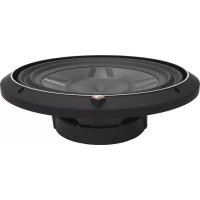
Punch P3SD212 - Subwoofer Rockford Fosgate - Free user manual and instructions
Find the device manual for free Punch P3SD212 Rockford Fosgate in PDF.


User questions about Punch P3SD212 Rockford Fosgate
0 question about this device. Answer the ones you know or ask your own.
Ask a new question about this device
Download the instructions for your Subwoofer in PDF format for free! Find your manual Punch P3SD212 - Rockford Fosgate and take your electronic device back in hand. On this page are published all the documents necessary for the use of your device. Punch P3SD212 by Rockford Fosgate.
USER MANUAL Punch P3SD212 Rockford Fosgate
text_image
P | 3 SHALLOWPUNCH™
P3 SHALLOW - DVC - DUAL VOICE COIL SUBWOOFERS
| 8" | 10" | 12" | |
| Dual 2-Ohm | P3SD2-8 | P3SD2-10 | P3SD2-12 |
| Dual 4-Ohm | P3SD4-8 | P3SD4-10 | P3SD4-12 |
Installation & Operation
|230-57070-01
©2011 Rockford Corporation. All rights reserved. Rockford Fosgate, the Rockford Fosgate logo, and the PUNCH logo are either registered trademarks or trademarks of Rockford Corporation.
Check our website for additional information and updates on these products.
www.RockfordFosgate.com

text_image
Loudspeaker Standard CEA- CEA-2031 CompliantHow to Obtain Service Contact the Authorized Rockford Fosgate Dealer you purchased this product from. If you need further assistance, call 1-800-669-9899 for Rockford Customer Service. You must obtain an RA# (Return Authorization number) to return any product to Rockford Fosgate. You are responsible for shipment of product to Rockford.
Any implied warranties including warranties of fitness for use and merchantability are limited in duration to the period of the express warranty set forth above. Some states do not allow limitations on the length of an implied warranty, so this limitation may not apply. No person is authorized to assume for Rockford Fosgate any other liability in connection with the sale of the product.
7.Any product not purchased from an Authorized Rockford Fosgate Dealer
- Subsequent damage to other components
-
Any product purchased outside the U.S.
-
Service performed by anyone other than Rockford or an Authorized Rockford Fosgate Service Center
-
Any product which has had the serial number defaced, altered, or removed
-
Any cost or expense related to the removal or reinstallation of product
I. Damage caused by accident, abuse, improper operations, water, theft, shipping
What is Not Covered
This warranty covers only the original purchaser of Rockford product purchased from an Authorized Rockford Fosgate Dealer in the United States. In order to receive service, the purchaser must provide Rockford with a copy of the receipt stating the customer name, dealer name, product purchased and date of purchase. Products found to be defective during the warranty period will be repaired or replaced (with a product deemed to be equivalent) at Rockford's discretion.
Who is Covered
What is Covered
Speakers – 1 Year. Any Factory Refurbished Product – 90 days (receipt required)
Length of Warranty
Rockford Corporation offers a limited warranty on Rockford Fosgate products on the following terms:
LIMITED WARRANTY STATEMENT
Serial Number: Date of Purchase:
Printed in China
SAFETY

CAUTION: Before installation, disconnect the battery negative (-) terminal to prevent damage to the unit, fire and/or possible injury.
PRACTICE SAFE SOUND™
Continuous exposure to sound pressure levels over 100dB may cause permanent hearing loss. High powered auto sound systems may produce sound pressure levels well over 130dB. Use common sense and practice safe sound.
RECOMMENDED ENCLOSURES
This manual outlines two specific types of enclosures that provide distinctly different performance. This section is to help you decide which type is best for your application.
SEALED ENCLOSURES
Sealed enclosures are the simplest to build. The most important part of building a sealed enclosure is to make sure that the enclosure is airtight. Using glue and some type of sealant on all seams will ensure solid construction and prevent air leaks. The box volume will directly impact the performance of the speaker. Larger enclosures will provide flatter response and deeper bass where smaller boxes will provide a bump in the response curve and generally higher output for greater SPL.
Advantages of sealed enclosures:
- Small enclosures
• Linear (Flat) response - No port noise
• High power handling at all frequencies
• Excellent for sound quality - Extended low frequency output when compared to vented enclosures
VENTED ENCLOSURES
Vented enclosures vary only from the sealed enclosure in that a vent or port is added to "tune" the enclosure. The enclosures recommended are designed for great overall performance. Larger boxes tend to be easy to tune to lower frequencies while medium and small boxes are easier to tune to higher frequencies. The vented design is less linear in response than the sealed box but with noticeably more output at the tuning frequency.
Advantages of vented enclosures:
• Higher average output than sealed
• Tuning frequency can be easily adjusted by changing port length
- Deep bass response with lower power requirements
• Great for high output with limited power
The graph shown here is a sample of how the F3 drop-off point differs between sealed and vented enclosures.
CARTON CONTENTS
• (I) Punch P3 Shallow Series Subwoofer
• (I) Painted aluminum decorative trim ring
• (8) Socket head wood screws
• (I) Socket head driver bit
BUILDING AN ENCLOSURE
To work properly, the walls of the enclosure must be rigid and not flex when subjected to the high pressures generated by the speaker's operation. For optimum performance, we recommend using 3/4" MDF (Medium Density Fiberboard) and internal bracing. The enclosure should be glued together and secured with nails or screws.
CALCULATING VOLUME
Calculating volume is merely a matter of measuring the dimensions in inches and using the formula: H x W x D divided by 1728 (cubic feet). See block below.
| Box Volume | Height" x Width" x Depth" |
| Divided by (cubic feet) | 1728 |
If two facing sides are of uneven length, add them together and divide by two to take the average. Using this number will give you the volume without the necessity of calculating the box in sections and adding the sections together. The thickness of the baffle material reduces the internal volume so this must be subtracted from the outside dimensions to determine the internal volume. The speaker itself also reduces the internal volume. The amount of air displaced by each model is listed on the specification sheet and should also be subtracted from the gross volume calculation.
VENTED VS SEALED
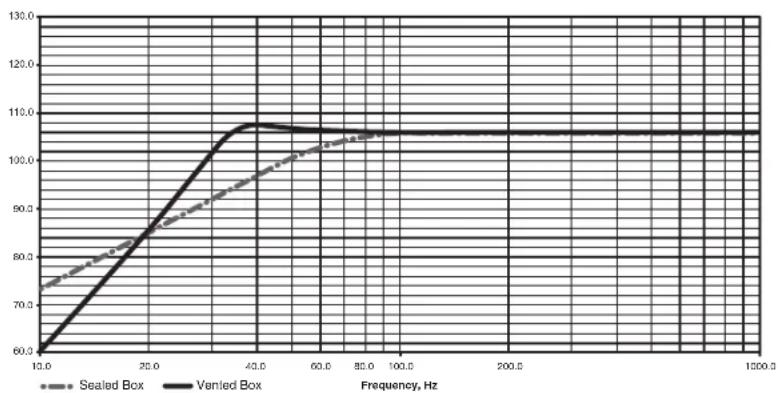
line
| Frequency, Hz | Sealed Box | Venled Box | | ------------- | ---------- | ---------- | | 10 | 70.3 | 60.3 | | 20 | 80.3 | 80.3 | | 40 | 90.3 | 108.5 | | 60 | 100.3 | 108.5 | | 80 | 105.3 | 108.5 | | 100 | 105.3 | 108.5 | | 200 | 105.3 | 108.5 | | 1000 | 105.3 | 108.5 |NOTE: Vb is the gross volume, which is the TOTAL internal volume, before any speaker and/or port displacement. All external dimensions were based on the use of 3/4" (1.90cm) materials.
NOTE: When using enclosures other than recommended, call Technical Support for correct application.
text_image
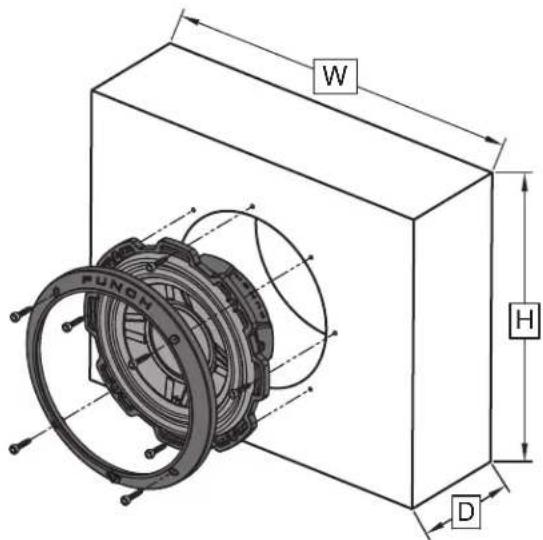
W H D FUNCHSealed Enclosure Recommendation
| SEALED ENCLOSURES | 8" P3SD2-8 / P3SD4-8 | 10" P3SD2-10 / P3SD4-10 | 12" P3SD2-12 / P3SD4-12 |
| V_D -Internal Area cu. ft. | 0.25 | 0.50 | 1.00 |
| )retiL( | (7.10) | (14.16) | (28.32) |
| F_3 -3dB Point (Hz) | 49.3 | 46.9 | 40.0 |
| Qtc- Enclosure Damping | 1.29 | 0.90 | 1.01 |
| H - Height-inch | 10 | 13.5 | 16.0 |
| c(n) | (25.4) | (34.29) | (40.64) |
| W - Width-inch | 16.5 | 20.0 | 20.0 |
| c(n) | (41.91) | (50.80) | (50.80) |
| D - Depth-inch | 5.0 | 5.50 | 8.0 |
| c(n) | (12.70) | (13.97) | (20.32) |
Recommended Sealed Enclosure Volume Range
| SEALED ENCLOSURES | 8" P3SD2-8 / P3SD4-8 | 10" P3SD2-10 / P3SD4-10 | 12" P3SD2-12 / P3SD4-12 |
| V_b -Volume Range cu. ft. (Liter) | 0.20 to 0.70(5.66 to 19.82) | 0.40 to 1.00(11.33 to 28.32) | 0.60 to 1.20(16.99 to 33.98) |
Specifications subject to change without notice
VENTED ENCLOSURES
NOTE: Vb is the gross volume, which is the TOTAL internal volume, before any speaker and/or port displacement. All external dimensions were based on the use of 3/4" (1.90cm) materials.
NOTE: When using enclosures other than recommended, call Technical Support for correct application.
text_image
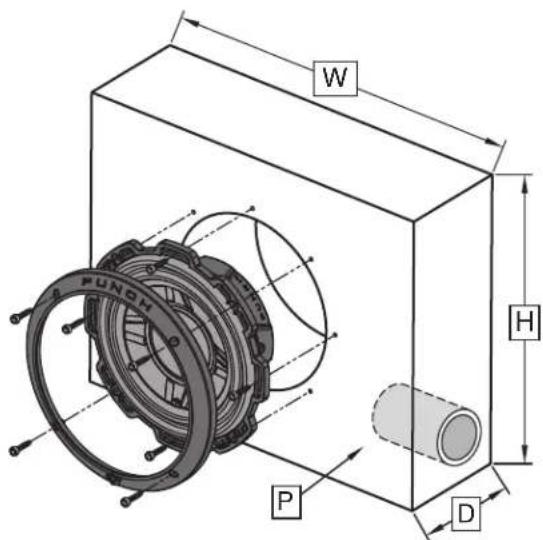
W H P DVented (Ported) Enclosure Sizes
| VENTED ENCLOSURES | 8" P3SD2-8 / P3SD4-8 | 10" P3SD2-10 / P3SD4-10 | 12" P3SD2-12 / P3SD4-12 |
| V_b -Internal Area cu. ft. (Liter) | 0.75(21.24) | 1.00(28.32) | 1.25(35.40) |
| F_b -Tuning Frequency (Hz) | 47.5 | 47.5 | 42.5 |
| F_3 -3dB Point (Hz) | 37.0 | 36.0 | 34.0 |
| H - Height-inch (cm) | 14.0(35.56) | 15.5(39.37) | 16.0(40.64) |
| W - Width-inch (cm) | 24.0(60.96) | 24.0(60.96) | 24.0(60.96) |
| D - Depth-inch (cm) | 6.0(15.24) | 7.0(17.78) | 8.0(20.32) |
| P - Port Diameter and Length-inch (cm) | (1) 3 x 9(1) (7.62 x 22.86) | (1) 4 x 12(1) (10.16 x 30.48) | (1) 4 x 12(1) (10.16 x 30.48) |
Number of ports noted in ( )
Specifications subject to change without notice
NOTE: The port shown can be placed on any face of the enclosure as long as the port ends are not obstructed.
NOTE: When using vented enclosures, for maximum reliability and power handling ensure that a subsonic or "infrasonic" filter is used so that only usable low frequency signal is sent to the subwoofer.
| CVD-wollahS 3P HCNUP 8" P3SD2-8 / P3SD4-8 | 10" P3SD2-10 / P3SD4-10 | 12" P3SD2-12 / P3SD4-12 | |
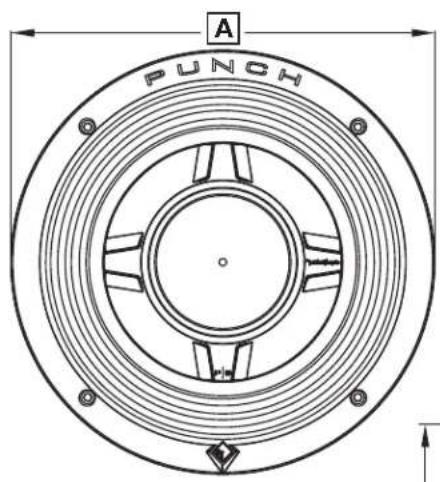
| A - Trim Ring Diameter-inch (cm) | 8.9522.75 | 11.25(28.60) | 13.3(33.80) |
| B - Trim Ring Height-inch (cm) | 0.90(2.26) | 0.93(2.36) | 0.95(2.40) |
| C - Mounting Diameter-inch (cm) | 7.13(18.10) | 9.06(23.00) | 11.22(28.50) |
| D - Mounting Depth-inch (cm) | 2.66(6.75) | 3.50(8.90) | 3.65(9.25) |
| E - Overall Diameter-inch (cm) | 8.72(22.15) | 11.02(28.00) | 13.07(33.20) |
| F - Screw Hole Diameter-inch (cm) | 8.03(20.4) | 10.16(25.8) | 12.28(31.2) |
| G - Speaker Displacement - cu. ft. (Liter) | 0.04(1.13) | 0.074(2.10) | 0.086(2.45) |
Specifications subject to change without notice
text_image
A PUNCH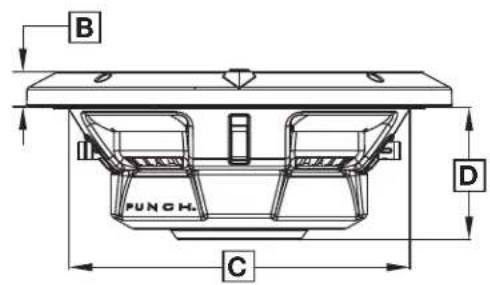
text_image
B PUNCH C D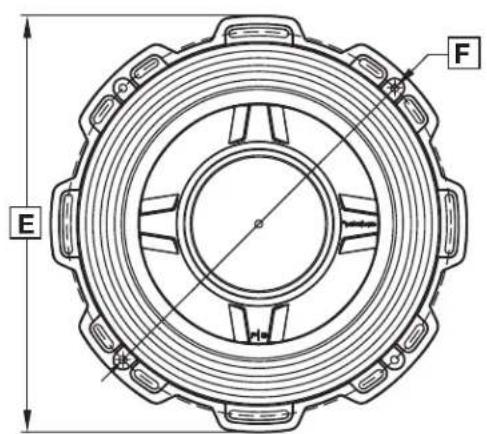
text_image
E F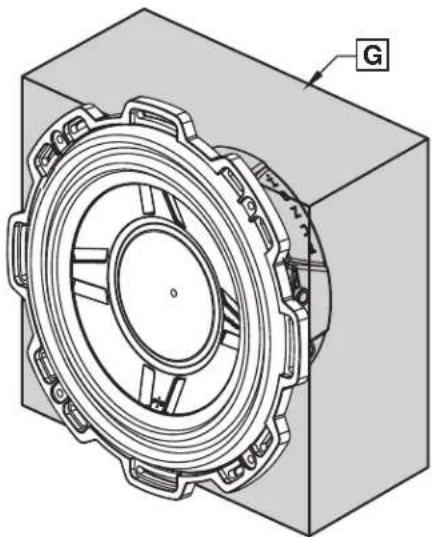
natural_image
Technical illustration of a mechanical component with concentric rings and mounting holes (no text or symbols)| CVD-wollahS 3P HCNUP 8" P3SD2-8 / P3SD4-8 | 10" P3SD2-10 / P3SD4-10 | 12" P3SD2-12 / P3SD4-12 | |
| )smho( ecnade pion Bn2 x 4 | 2 x 2 / 2 x 4 | 2 x 2 / 2 x 4 | |
| Frequency Response (Hz) | 38-250 | 40-250 | 34-250 |
| Voice Coil Diameter - inch (cm) | 2.0 (2-Layer) (5.16) | 2.5 (4-Layer) (6.35) | 2.5 (4-Layer) (6.35) |
| Displacement - cu. ft. | 0.04 | 0.074 | 0.086 |
| t ( | (1.13) | (2.10) | (2.45) |
| Fs - Free Air Resonance (Hz) | 38 | 40 | 34 |
| Qts | 0.72 / 0.87 | 0.64 / 0.78 | 0.67 / 0.72 |
| Vas - cu. ft. | 0.56 | 0.50 | 1.25 |
| t ( | (15.8) | (14.3) | (35.3) |
| hcni x m (cm) | 0.33 | 0.33 | 0.33 |
| (0.84) | (0.84) | (0.84) | |
| SPL (dB @ 1w/1m) | 82 | 83 | 85 |
| Power Handling-Watts (RMS) | 150 | 300 | 400 |
| akP | 300 | 600 | 800 |
Specifications subject to change without notice
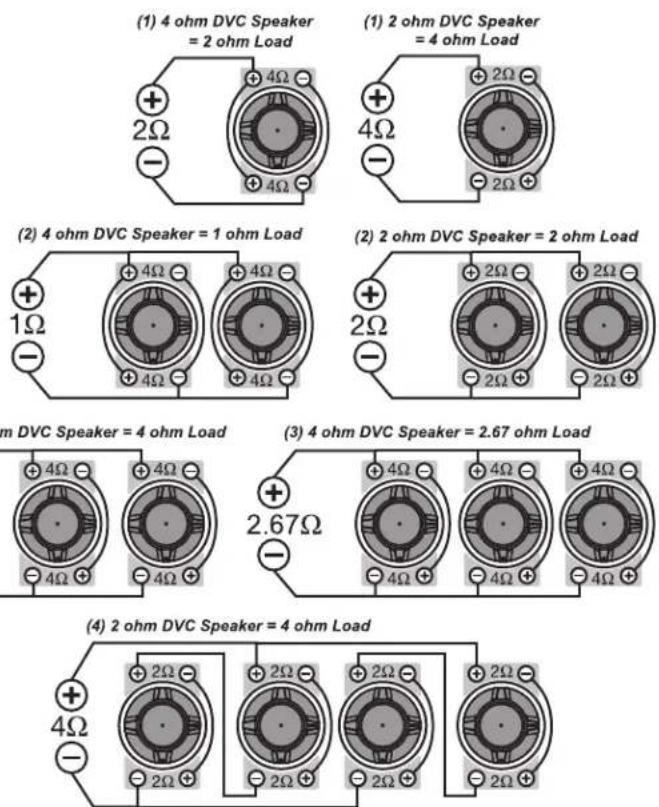
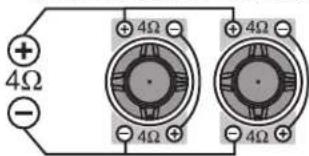
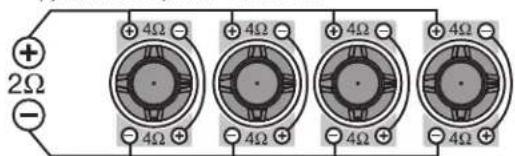
WIRING CONFIGURATIONS
By varying the wiring configuration of your speakers you can create an impedance load to match your system. Altering the wiring configurations gives a range of options for impedance loads. Series, Parallel, or Series-Parallel wiring configurations are different techniques for wiring speakers that provide different loads. Series configuration is a string method where speakers are wired end to end. Parallel configuration uses two or more speakers wired across common terminals. Series-Parallel configuration combines both techniques. Choose the wiring diagram that corresponds to the number of woofers and the impedance of your amplifier.
SUBWOOFER CROSSOVERS
There are two operational types of crossovers, passive and active. Passive crossovers (coils or inductors) are placed on the speaker leads between the amplifier and speaker. An active crossover is an electronic filter that separates the audio signal fed to different amplifiers. For optimum subwoofer performance, we recommend using an active 80-100Hz low-pass crossover at 12dB/octave.
(2) 4 ohm DVC Speaker = 4 ohm Load
text_image
+ 4Ω - 4Ω + 4Ω - 4Ω + 4Ω - 4Ω(4) 4 ohm DVC Speaker = 2 ohm Load
text_image
+ 2Ω - + 4Ω - + 4Ω - + 4Ω - + 4Ω - + 4Ω + - + 4Ω + - + 4Ω + - + 4ΩFrançais
