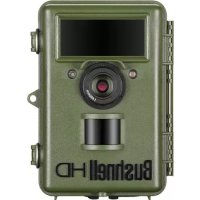
NatureView HD Cam - Camera BUSHNELL - Free user manual and instructions
Find the device manual for free NatureView HD Cam BUSHNELL in PDF.



| Product Type | Trail Camera / Surveillance Camera |
| Brand and Model | Bushnell NatureView HD Cam |
| Image Sensor | 5 megapixel color CMOS |
| Maximum Photo Resolution | 14 MP (4416x3312, software interpolation) |
| Video Resolution | Up to 1920x1080 (Full HD 1080p) in 16:9 |
| Lens | Focal length 3.1 mm, field of view 50° |
| Infrared Flash Range | Up to 19 m (adjustable High/Med/Low) |
| Built-in LCD Screen | 1.5 inch black and white |
| Color Remote Viewer | 2.4 inch included |
| Storage | SD/SDHC card up to 32 GB (Class 6+ recommended for HD) |
| Internal Memory | 32 MB |
| Shooting Modes | Photo, Video, Hybrid (simultaneous photo+video) |
| PIR Sensor Sensitivity | 4 levels: Low, Normal, High, Auto |
| Trigger Time | 0.7 second |
| Trigger Interval | Adjustable from 1 second to 60 minutes |
| Number of Burst Photos | 1, 2, or 3 photos |
| Video Length | Adjustable from 5 to 60 seconds |
| Power Supply | 12 AA batteries (lithium recommended) or minimum of 4; optional external 6V power supply |
| Standby Current | Less than 0.2 mA |
| Operating Temperature | -20°C to +60°C |
| Operating Humidity | 5% to 90% |
| Special Features | Field Scan, GPS geotagging, LED control (Multi Flash), adjustable night shutter, data imprint (temperature, moon phase, pressure) |
| Security | Mounting strap, 1/4-20 tripod thread, cover lock |
| Care and Cleaning | Clean the lens with a soft dry cloth; keep the housing clean and dry; check the seals |
| Warranty | 1 year limited |
| General Information | Outdoor use, water and snow resistant |
Frequently Asked Questions - NatureView HD Cam BUSHNELL
User questions about NatureView HD Cam BUSHNELL
0 question about this device. Answer the ones you know or ask your own.
Ask a new question about this device
Download the instructions for your Camera in PDF format for free! Find your manual NatureView HD Cam - BUSHNELL and take your electronic device back in hand. On this page are published all the documents necessary for the use of your device. NatureView HD Cam by BUSHNELL.
USER MANUAL NatureView HD Cam BUSHNELL
Visit the NatureView HD Cam community website for your country today, where you can:
- see more information about the capabilities and applications of the Bushnell NatureView HD Cams
- discuss your NatureView HD Cam experiences with other users, share tips, belong to this new worldwide community
- discover animals from all over the world
- access a free service to manage your NatureView HD Cam photos/videos online and host your photos (videos are hosted on YouTube)
www.natureviewcam.com www.natureviewcam.co.uk
IMPORTANT NOTE
Congratulations on your purchase of one of the best wildlife cameras on the market! Bushnell is very proud of this camera and we are sure you will be pleased with it as well. We appreciate your business and want to earn your trust. Please refer to the notes below and the instructions in this manual to ensure that you are completely satisfied with this product.
If your Bushnell NatureView HD Cam does not seem to be functioning properly or if you are having photo/video quality issues, please check the Troubleshooting/FAQ section on pages 35-39.
Problems are often due to something simple that was overlooked, or require only changing one setting to solve.
If your problem continues after trying the solutions in the Troubleshooting/FAQ section, please call Bushnell Customer Service at (800) 423-3537. In Canada, call (800) 361-5702.
Bushnell recommends using a full set of 12 Energizer® Lithium AA batteries in this NatureView HD Cam model to obtain maximum battery life
Do not mix old and new batteries Do not mix battery types-use ALL lithium or ALL alkaline
Bushnell recommends using SanDisk® SD and SDHC Cards (up to 32GB capacity, Ultra® or Extreme® series for HD video) in this NatureView HD Cam
INTRODUCTION
About the NatureView HD Cam
The Bushnell NatureView HD Cam is a digital wildlife observation camera. It can be triggered by any movement of wildlife in a location, detected by a highly sensitive Passive Infra-Red (PIR) motion sensor, and then take high quality pictures (up to 14MP still photos), or HD (1080p) video clips.
The NatureView HD Cam consumes very little power (less than 0.2mA ) in a stand-by (surveillance) state. This means it can deliver up to six months stand-by operation time when the device is powered by the full capacity of AA alkaline batteries, and up to twelve months utilizing lithium AA batteries. Once motion in the monitored area is detected, the digital camera unit will be triggered at once (typically within one second) and then automatically take photos or videos according to previously programmed settings. The NatureView HD Cam is equipped with 40 built-in infrared LEDs (No-Glow "black" IR LEDs) that function as a flash, so that it delivers clear photos or videos (in black & white) even in the dark, and it can take color photos or videos under sufficient daylight. The NatureView HD Cam is designed for outdoor use and is resistant against water and snow.
Your wildlife camera is one of the latest generation of Bushnell NatureView HD Cams, and includes many new or improved features, including:
- Auto PIR Sensitivity-the camera monitors ambient temperature conditions and automatically adjusts the sensor/trigger signal to be more sensitive to slight variations in temperature on hot days, less sensitive on cold days.
- Hyper NightVision-The IR LED Flash array now has increased range, brighter output and better coverage for improved nighttime images.
- Field Scan 2x with Live Trigger-The "time lapse" feature added in previous models has been enhanced with the addition of the option for a second block of recording with its own start/stop times. Trigger signals generated by nearby wildlife activity will still generate additional photos/videos as they normally would, independently of the Field Scan operation.
- GPS Geotag Capability-alows the user to input the longitude and latitude of the camera's position, which will be embedded in each photo file. This enables Google Earth, Picassa and other geotag
enabled software to automatically show a map pinpointing each camera's location when a group of photos are reviewed on a computer. Especially useful for those who setup multiple NatureView HD Cams to monitor large or widely separated areas.
- Multi Flash Mode (LED Control)- prevents overexposed flash photos in close range applications
- Hybrid Capture Mode-alows both still photos and videos to be captured at each trigger, up to highest resolution settings for each.
- NV Shutter-user can select shutter speed for images captured at night allowing control over brightness vs. ability to stop motion
- Camera Operating Mode can be limited to Day only, Night only, or 24 HRs
- Close Focus capability with included close-up lenses (46 and 60 cm)
And many more features such as Super HD Video (1080p) with Audio, widescreen or fullscreen format still photos, imprintable camera name (user set) along with current data including temperature, moon phase and barometric pressure.
Applications
The NatureView HD Cam can be used as a wildlife camera for research or wildlife observation. It is also suitable for security/surveillance usage.
PARTS AND CONTROLS
The NatureView HD Cam provides the following connections for external devices: USB port, SD card slot, A/V Out, and external DC power in (pg 7, Fig. 1).
A 3-way power switch is used to select the main operating modes: OFF, SETUP, and ON (pg 7, Fig. 2).
A control key interface with six keys is primarily used in SETUP mode to select operational functions and parameters. As shown on the next page, these keys are: UP, DOWN, LEFT, RIGHT, OK and MENU. Four of the keys can also perform a second function (shortcut operations in SETUP mode) in addition to their main function: The DOWN key can be used to set the camera to Photo mode (still camera icon), and the UP key can set the camera to Video mode (movie camera icon). The RIGHT key also serves as the manual
shutter ("SHOT") button of the camera and the OK key switches the camera to the Playback ("REPLAY") mode. These secondary functions are indicated by icons or text above the key as shown below.
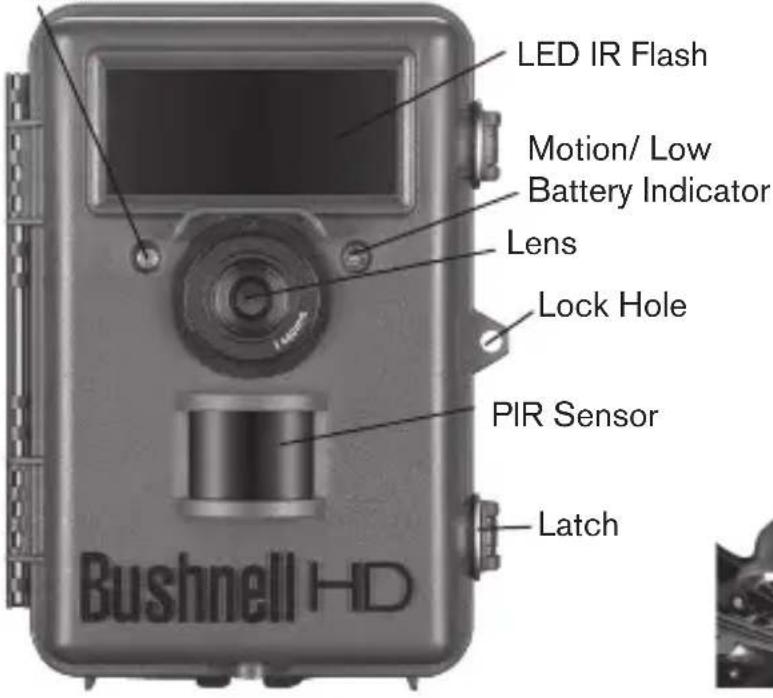
Light
Sensor
FRONT VIEW
INSIDE VIEW
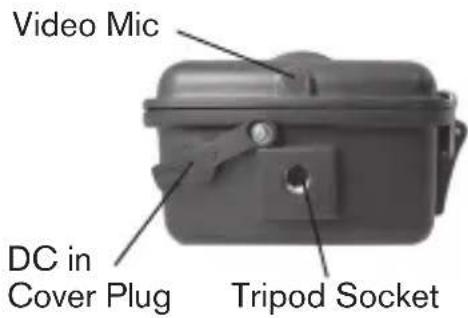
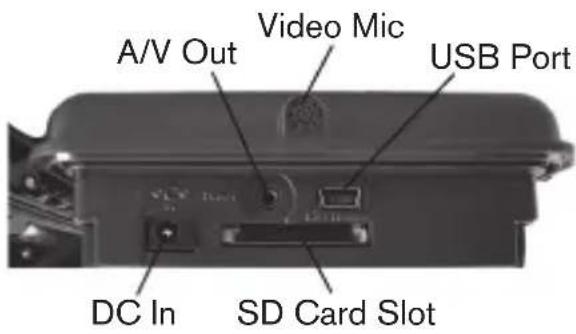
Fig. 1: Connections
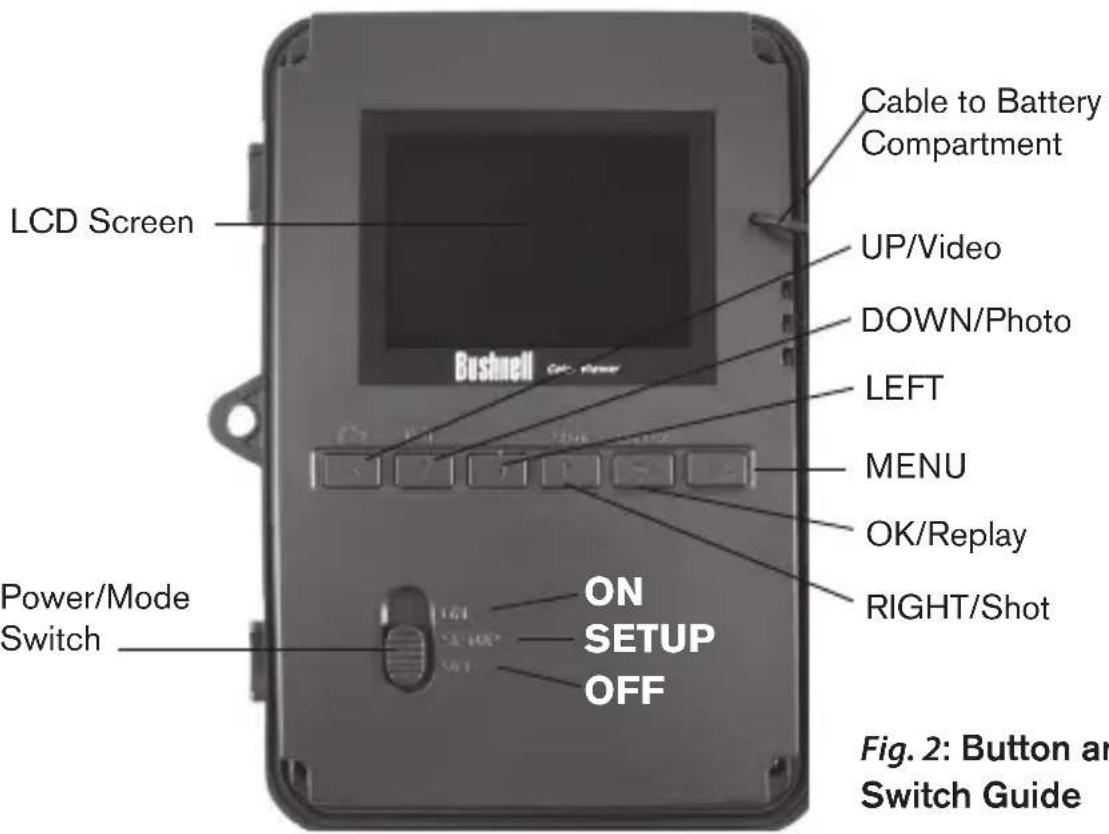
Fig.2:Button and Switch Guide
INSTALLING THE BATTERIES AND SD CARD
Before you begin learning how to use your NatureView HD Cam, you will first need to install a set of batteries and insert an SD card. Although that may only take you a minute, there are some important notes about both batteries and SD cards you should be aware of, so please take the time to read the
following directions and cautions:
Loading Batteries
WARNING: Be sure the camera's power is switched OFF before inserting or removing SD cards or batteries.
After opening the two latches on the right side of the NatureView HD Cam, you will see that the NatureView HD Cam has twelve battery slots. For maximum battery life, you should install a full set of batteries. The NatureView HD Cam may also be operated by just four batteries installed in the first slots only (starting on the left-see photos). Battery life will be shorter with 4 batteries, but the camera will operate normally. If the low battery indicator blinks, remove and reinsert the 4 batteries to resume operation, or install a full set. Whether you use 4 or
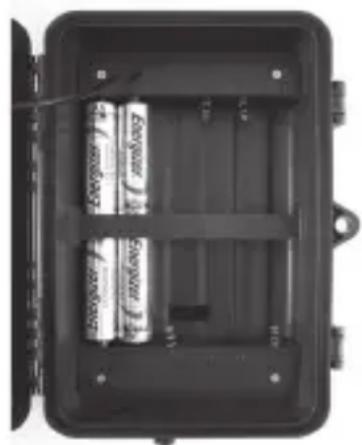
a full set, be sure to insert each battery with correct polarity (negative or "flat" end against the long spring of each battery slot).
Bushnell recommends using a full set of new lithium AA (Energizer® brand) or alkaline AA batteries. NiMh Rechargeable batteries are not recommended, as the lower voltage they produce can cause operational issues. It is also possible to use a lead-acid external battery cell with 6V output or suitable AC adapter-see below for more details.
Using an External Power Source (optional, user provided)
Optionally, you can connect an external 6V DC power source to the "DC In" jack at the bottom of the NatureView HD Cam. It is recommended to use a power source with a current output greater than 1800mA . However, during bright daytime operation when no flash is required, the NatureView HD Cam can function with much less current ( >400mA ). Please use a compatible power source cable (not provided) to connect the external DC power source with the power input jack of the NatureView HD Cam, making sure that the polarity is correct. Note: The power connector is a 4.0×1.7mm coaxial DC power plug with positive "tip" (inside pin) polarity (Radio Shack P/N 274-1532 or equivalent).
If both an external power source is connected and batteries are installed, the NatureView HD Cam will be powered by the external power source.
When the batteries become weak, the low-battery indicator LED will glow blue, indicating the batteries should be changed (pg 7, Front View). The LED may also flash when only 4 batteries are installed, due to the lower current capacity-if so, switch to a full set of 12.
Inserting the SD Card
The NatureView HD Cam has 32MB of internal memory, which can hold only about 18 photos (@ 8MP resolution). This is handy for testing and getting familiar with the camera, but you will no doubt want to leave the camera unattended for longer than a day, so using an SD card is recommended for all models. Insert the SD card (with the camera's power switch in the OFF position) before beginning to operate the camera. Don't insert or remove the SD card when the power switch is in the ON position.
The NatureView HD Cam uses a standard SD (Secure Digital) memory card to save photos (in .jpg format) and/or videos (in .avi format). SD and SDHC (High Capacity) cards up to a maximum 32GB capacity are supported. High speed (class 6 or higher) SD cards are recommended if you will use the 1920x1080 or 1280x720 video resolution settings (HD). Before inserting the SD card into the card slot after opening the camera's front cover, please make sure that the write-protect switch on the side of the card is "off" (NOT in the "Lock" position). The following describes how to insert and remove the SD card:
- Insert the SD card into the card slot with its label side upwards (see below). A "click" sound indicates that the card is installed successfully. If the wrong side of the card is facing up, you will not be able to insert it without force-there is only one correct way to insert cards. If the SD card is not installed correctly, the device will not display an SD card icon on the LCD in SETUP mode (the SD card icon displayed after switching to SETUP mode will have a "lock" symbol inside it in it if the card is locked). Formatting the SD card by using the NatureView HD Cam's
"Format" parameter before using it for the first time is recommended, especially when a card has been used in other devices (see pg. 22, "Format" for details).
- To take out the SD card, just gently push in the card (do not try to pull it out without pushing in
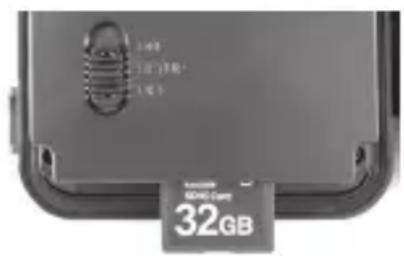
first). The card is released from the slot and ready to be removed when you hear the click.
USING THE NatureView HD Cam
Once you've prepared your NatureView HD Cam by installing batteries and an SD card, you could simply take it outside, strap it to a tree, switch it on and leave-and you might get some great photos that are exactly what you wanted. However, we highly recommend that you first spend some additional time indoors with this manual and your camera until you know a bit more about what the 3-way switch and those control keys do. If nothing else, you'll probably want to at least set the date and time so the camera will imprint them (or not-it's your option) on your photos as they are taken, learn how to set the camera to shoot video clips instead of still photos if you like, and read some tips about mounting it on a tree.
THE OFF, ON, AND SETUP MODES
The NatureView HD Cam has three basic operational modes:
- OFF mode: Power switch in the OFF position.
- ON mode: Power switch in the ON position (LCD screen is off.)
- SETUP mode: Power switch at SETUP position (LCD screen is on).
OFF MODE
The OFF mode is the "safe" mode when any actions must be taken, e.g., replacing the SD card or batteries, or transporting the device. You will also use OFF mode if you connect the camera to a computer's USB port later to download your photos/videos. And of course, when you are storing or not using the camera, you will switch it to OFF. Please note that even in the OFF mode the NatureView HD Cam still consumes power at a very low level. Therefore, it's a good idea to take the batteries out of the battery compartment if the camera will not be used for a long time.
ON MODE
Anytime after the batteries and SD card have been inserted, you can switch on the camera. When the power switch is moved to the top position, the camera will enter into the ON (Live) mode. The motion indicator LED (pg. 7, "Front View") will blink red for about 10 seconds. This interval allows time
for you to close the NatureView HD Cam's front cover, lock it, and leave the monitored area. Once in the ON mode, no manual controls are needed or possible (the control keys have no effect). The NatureView HD Cam will take photos or videos automatically (according to its current parameter settings) when it is triggered by the PIR sensor's detection of activity in the area it covers. You can either move the power switch directly from OFF to ON mode, or stop at the SETUP position first to change one or more settings, then move the switch to ON after you have finished doing so.
SETUP MODE
In the SETUP mode you can check and change the settings of the NatureView HD Cam with the help of its built-in LCD (or the remote color viewer-see pg. 30). These settings, found in the SETUP Menu, let you change the photo or video resolution, interval between photos, switch the time imprint on, etc. Moving the power switch to the SETUP position will turn on the LCD display, and you will see an information screen that shows how many images have been taken, the battery level, camera or video mode, etc (Fig. 3, next page).
NOTE: Always move the power switch from OFF to SETUP mode. It is possible that the camera could lockup if it is switched from ON to SETUP mode. If this occurs, simply move the switch to OFF and then push it up to SETUP again.
SETUP Mode Shortcut Keys/Functions
As mentioned earlier in "Parts & Controls", four of the keys below the LCD have secondary, "shortcut" functions when the camera is switched to SETUP mode (but the MENU key has not been pressed):
- Press the UP key to quickly set the camera to shoot video clips.
- Press the DOWN key to quickly set the camera to take still photos.
- Press the RIGHT key to manually trigger the shutter. This is useful for testing the camera-making sure you are in SETUP mode, press the RIGHT key, and a few seconds later a photo or video (depending on how the camera was set) will be saved to the SD card (or internal memory if no card is inserted). The "number of images taken" counter on the bottom left of the LCD will increase by one. If the display indicates "SD PROTECTED" when you press the SHOT key, switch the camera OFF, remove the SD card and slide its protect switch off.
- Press the OK key to replay (review or playback) photos/videos on the remote color viewer. See pg. 29-30 for more details.
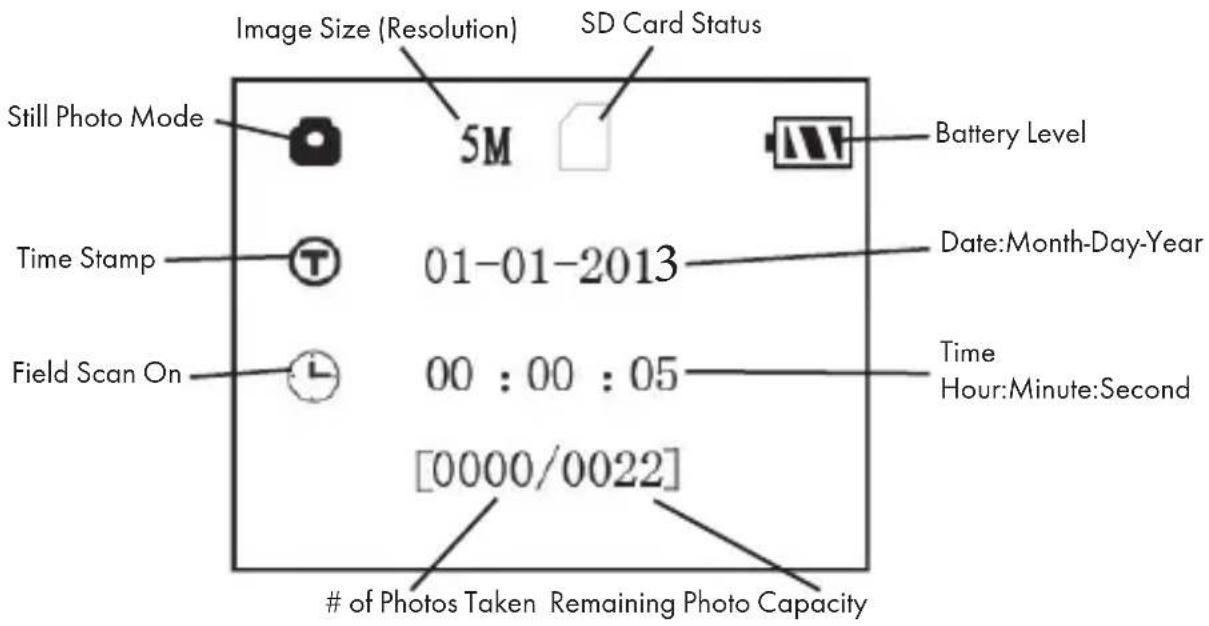
Fig. 3: SETUP Information Screen
Camera (Still Photo) Mode
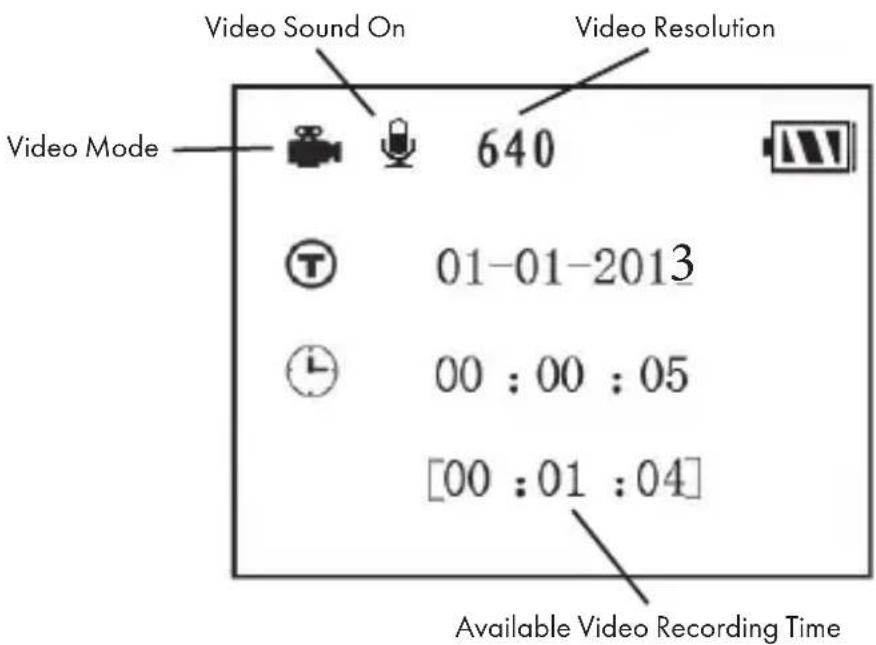
Video Mode
USING THE SETUP MENU TO CHANGE SETTINGS
The main purpose of the SETUP mode is to allow you to change the settings of the camera's parameters (20 different ones are available!) so your NatureView HD Cam operates exactly the way you want it to. You will do this by entering the SETUP Menu and pressing the keys below the LCD display, which will show you each parameter and its setting.
Changing Parameter Settings in SETUP Mode
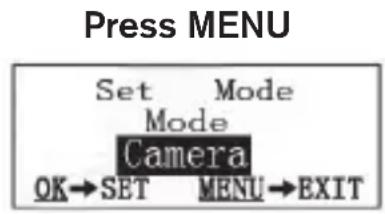
A wide range of options or "parameters" are provided to allow you to set the NatureView HD Cam to your operational preferences. To change the setting of any parameter you must first switch to the SETUP mode. Once in SETUP mode, pressing the MENU button will allow you to select any parameter and change its setting. The name of the parameter and its current setting will be shown on the LCD. Pressing the RIGHT or LEFT key scrolls to the next or previous parameter (RIGHT key to move on to the next parameter and LEFT key to go back to the previous parameter),
Press DOWN
Press OK
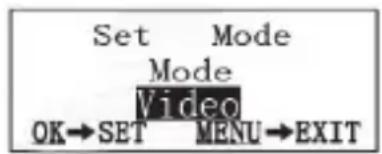
and pressing the UP or DOWN key lets you select a different setting for the currently displayed parameter. Once you have selected your preferred new setting for a parameter, press the OK button to save the new setting (actually change it). When you are finished changing the settings of one or more parameters, press MENU again to exit the SETUP menu. MENU can also be pressed anytime you want to cancel changing a parameter's setting after a new setting has been selected (but OK has not been pressed yet). After setting the parameters to your preferences, be sure to move the switch to ON to begin actually taking photos or videos. No images will be captured if the switch is left in the SETUP position (unless you press the RIGHT/Shot key after exiting the menu)-in fact, the camera will power off automatically after a few seconds with no key pressed.
EXAMPLES-Changing the Settings of Some Common Parameters
Following this page, you will find tables listing all of the parameters found in the Setup Menu, along with their possible settings (or range of settings), and a detailed description of what the parameter controls and what the settings do. If you read the previous section detailing how to select parameters and change their settings, you should be able to dive right in, find the parameter(s) you want, and setup the camera to suit your preferences. But maybe you'd rather walk through an example or two first:
To change any parameter's setting, always start with the power switch in the SETUP position. After the LCD comes on, press the MENU key.
The first parameter you will see when you first enter the SETUP Menu is "Mode". To change it from its default setting of "Camera" (still photos) to "Video" (shoot video clips), press the DOWN key to highlight "Video". Press the OK key to "Execute" (Set) the new setting you've selected for this parameter.
Now press the RIGHT key to move to another parameter in the Menu. Pressing it three times will take you to "Capture Number". Try using the UP and DOWN keys to scroll through the range of settings, then press OK to lock in your setting for the number of photos the camera takes each time it's triggered.
Pressing the RIGHT key until you reach the last menu item, you'll see the "Default Set" parameter. Highlight or select "Execute" (using UP or DOWN) and press OK to restore all parameters (including the Mode and Video Length parameters you changed a minute ago) back to their original factory default settings. The default settings for each parameter are indicated in bold type in the SETUP Menu tables on the next several pages.
Be sure to set the current date and time, using the "Set Clock" parameter, if you choose to change the "Time Stamp" parameter setting to "On" since that will tell the camera to imprint the date and time on each of the images it captures.
Field Scan 2x with Live Trigger Feature
Field Scan is a revolutionary new feature for the Bushnell NatureView HD Cam, which allows you to monitor a large area with time lapse images or video. When set to "On", the NatureView HD Cam will take a photo (or record a video clip) automatically at your choice of intervals (for example, once every five minutes) during one or two blocks of time you set up for each day, without requiring a trigger from an active animal. This has the advantage of giving you the ability to monitor the edge of a field that might be 50 or 150 yards away from the camera out of the PIR sensor's range. The result is an effective range much greater than it would normally be, with the camera dependant on triggers generated by nearby animals. This is a great tool for covering a larger area with only one camera.
If an animal does enter the area covered by the PIR sensor and generates a trigger event during a time in between the Field Scan intervals you set, the camera will capture an image or video just as it normally would, based on your other menu settings. Here's how to setup and use Field Scan (be sure you've set the current time in "Set Clock" first, so your Field Scan recording will stop and start at the correct times of day):
- Move the main switch to SETUP, then press MENU.
- Keep pressing the RIGHT key, stepping through the Setup Menu until you reach Field Scan.
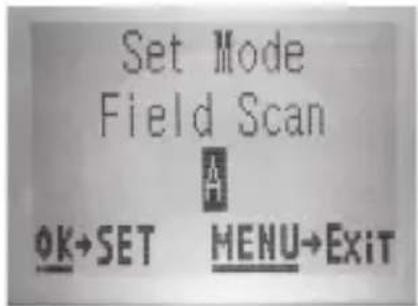
- Press the UP key to select On, and press OK [Step 1, pg.17]. You will see "A", representing the first block of time you can define (a second block of time later in the day, "B" can also be setup if you wish). Press OK [Step 2]. This takes you to the screen to set Start and Stop times, which determines the clock times when the first block of Field Scan recording will begin and end for each day. You can set these times to the exact hour and minute you want, for a recording "window" that lasts anywhere from just a minute to a full 24 hours.
-
Set the Start and Stop times, beginning with the Start hour, using the UP/DOWN keys to change the setting (Step 3). The hour setting is based on a 24-hour clock, with "00" hours = midnight, "12" hours = noon, "23" hrs = 11PM, etc. To move to the next setting, press the RIGHT key, change the minute for the Start time with UP/DOWN, then on to the hour and minute settings for the Stop time.
-
After you finish setting the Stop minutes, press OK to confirm your settings for the first block of Field Scan recording. If desired, you can create a second block of time by pressing the DOWN key to select "B" (Step 4), then press OK and follow the same process to set Start and Stop times for Field Scan block "B" (Step 5). As an example of how you might use these two available time blocks, you could setup Field Scan time block "A" for the dawn hours from 6 AM to 8 AM, and block "B" to capture images between 5:30 and 7 PM. No Field Scan recording would occur from 8AM to 5:30PM, or from 7PM to 6AM.
- After setting Start/Stop times to define Field Scan block "A" and/or "B", press OK, then press the UP or DOWN key to select "Interval" and press OK (Step 6). The Field Scan "Interval" setting lets you control how often a photo or video clip is recorded during the block(s) of time you defined with the Start and Stop settings. Your options are 60 minutes, 30 minutes, 15 minutes, 5 minutes (this is the default), or 1 minute (still photo mode only). Use the UP/DOWN keys to select your preference, then press OK to save it (Step 7). Note that for videos, "Interval" is independent of the Length of each video recording-it's how often videos are recorded, not how long each one lasts.
- Here's an example of how the camera would operate, based on the following Field Scan settings:
Field Scan: On
Field Scan A:
Field Scan B:
Interval: 15M
Note: avoid any "overlap" of Field Scan A & B recording blocks when setting their start and stop times, to assure correct operation. Also-if the "Camera Mode" menu parameter is set to "Day" or "Night" operation only, that will take priority over your Field Scan settings. Set the Camera Model to "24 HR" if you are setting both day and night start and/or stop times in Field Scan.
These settings would cause the camera to capture a photo (or video, if the camera is set to that mode) once every 15 minutes, beginning at 6 AM, until the Field Scan "A" recording block stops at 8:00 AM. Later that day, the camera would again take a photo or video every 15 minutes between 5:30 PM and 7:00 PM (during Field Scan time block "B"). The next day, the camera would again record an image or video once every 15 minutes between 6:00 and 8:00 AM, and between 5:30 and
7:00 PM. No Field Scan recording would occur from 8AM to 5:30PM, or from 7PM to 6AM. Remember, Field Scan recording is independent of normal triggers due to animal activity—even if no animals enter the IR sensor coverage zone, an image or video will still be captured every 15 minutes during the block(s) of time. If an animal triggers the camera "in between" the 15 minute intervals, it will be recorded, same as it would if you had setup the camera with Field Scan turned Off. Note: Field Scan settings of frequent intervals and/or long periods between start and stop time can reduce battery life.
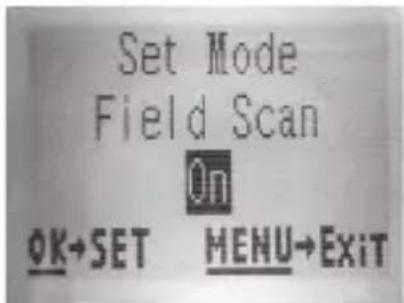
(Step 1)-set Field Scan Mode to "On"
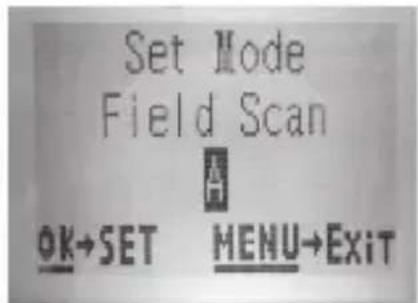
[Step 2]-select Field Scan "A" (press OK)
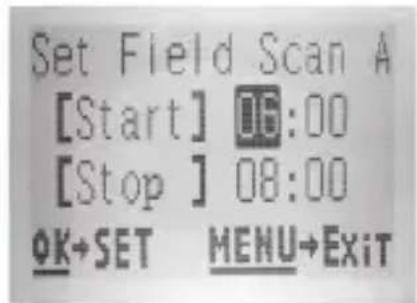
(Step 3)-set Field Scan "A" Stop & Start
Steps 4 & 5 are optional (only required if you want to set up a second block of Field Scan recording with different stop and start times)
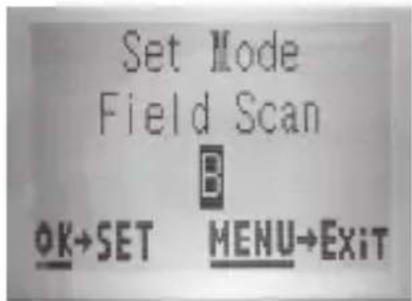
[Step 4] (opt)-select Field Scan "B" (press OK)
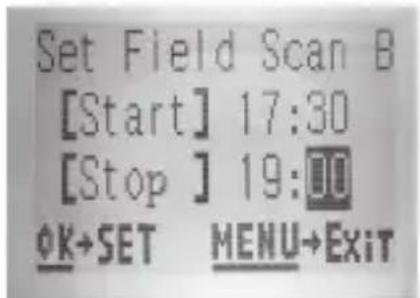
[Step 5] (opt)-set Field Scan "B" Stop & Start
Note: the Interval Setting sets the timing between each image for both Field Scan "A" and "B" recording blocks.
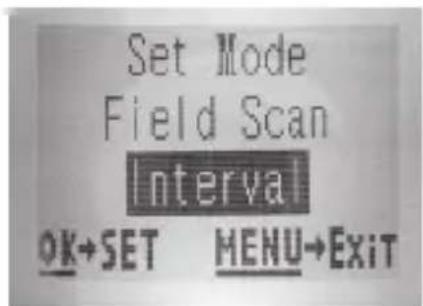
(Step 6)-select Field Scan "Interval"
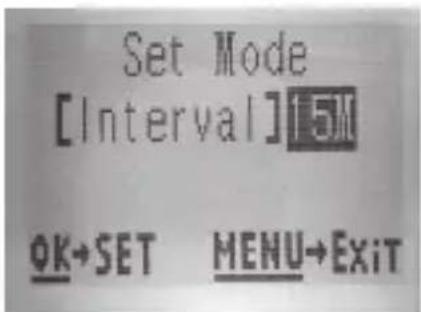
(Step 7)-set Field Scan Interval
The SETUP Menu - Parameters and Settings List w/Descriptions
| Parameter | Settings (Bold=default) | Description |
| Mode Camera, Video, Hybrid | Video, Hybrid | Selects whether still photos or video clips are captured when the camera is triggered. Hybrid mode combines both Camera and Video, so a still photo and a video clip are both captured for each trigger. |
| Image Size (only affects still photos in Camera or Hybrid modes) | 3M Pixel, 8M Pixel, 14M Pixel, | Selects resolution for still photos from 3 to 14 megapixels. Higher resolution produces better quality photos, but creates larger files that take up more of the SD card capacity (fills up faster). 8M is a good compromise between quality and file size. |
| Image Format (only affects still photos-format for video is widescreen only) | Full Screen, Wide Screen | Selects 4:3 (Fullscreen, like old TV sets) or 16:9 (Widescreen, like new flat TVs) “aspect ratio” for still photos. If you like to view your photos on a TV set or computer monitor, you can set the format to match it. |
| Capture Number (only affects still photos in Camera or Hybrid modes) | 1 Photo, 2 Photo, 3 Photo | Selects how many photos are taken in sequence per trigger in Camera mode. This setting affects photos taken in Field Scan mode as well (to snap two photos every 10 minutes, for example). Please also refer to the Interval parameter. |
| LED Control (Multi-Flash feature) | High, Medium, Low Always set to "Low" when using the close-up lenses-only 8 LEDs will fire. You may also need to "block off" some of those 8 LEDs (see pg.20) with black tape to prevent overexposure at very close range. | Controls how many LED lamps fire when images are taken in low light. "High"—all 40 LEDs fire, which is the default setting. Set to Medium or Low if you are getting overexposed flash photos or will place the camera at very close range to the subject you want to photograph. In general, select High if most of your intended subjects will be over 30 ft. from the camera, Medium for the 15 to 30 ft. range, and Low for subjects under 15 ft. away. Set to Low if videos are overexposed. |
| Camera Name ( | Input) See "Using the Setup Menu Input Screens" | Allows the user to set a custom name for the camera. Useful for ID purposes when multiple cameras are setup, since each camera will imprint its name on all photos (but not videos) it captures. |
| Video Size (only affects video clips in Video or Hybrid modes) | 1920x1080, 1280x720, 640x360 | Selects video resolution (in pixels per frame). Higher resolution produces better quality videos, but creates larger files that take up more of the SD card capacity (fills up faster). The default 1920x1080 is 1080p HD video in "widescreen" 16:9 format. The 1280x720 setting captures 720p widescreen HD video. Using high speed SD cards (SanDisk® Ultra® or Extreme® series or similar) is recommended if you will use the HD video settings. |
| Video Length (only affects video clips in Video or Hybrid modes) | 10S (second) default, with 60S to 5S possible range | Sets length per captured video clip. Settings begin with 10 second default when parameter is first selected. After stepping down to 5S, video length settings start over at 60S. |
| Interval | 10S (second) default, with a 60M (minute) to1S (second) range of settings available. (60M-1M are set in one minute increments, 59S-1S are set in one second increments) | Selects the length of time that the camera will “wait” until it responds to any additional triggers from the PIR after an animal is first detected and remains within the sensor’s range. During this user set “ignore triggers” interval, the camera will not capture photos/videos. This prevents the card from filling up with too many redundant images. Settings begin with 10 second default when parameter is first selected. Note: after setting down past “1S”, settings start over at “60M”. |
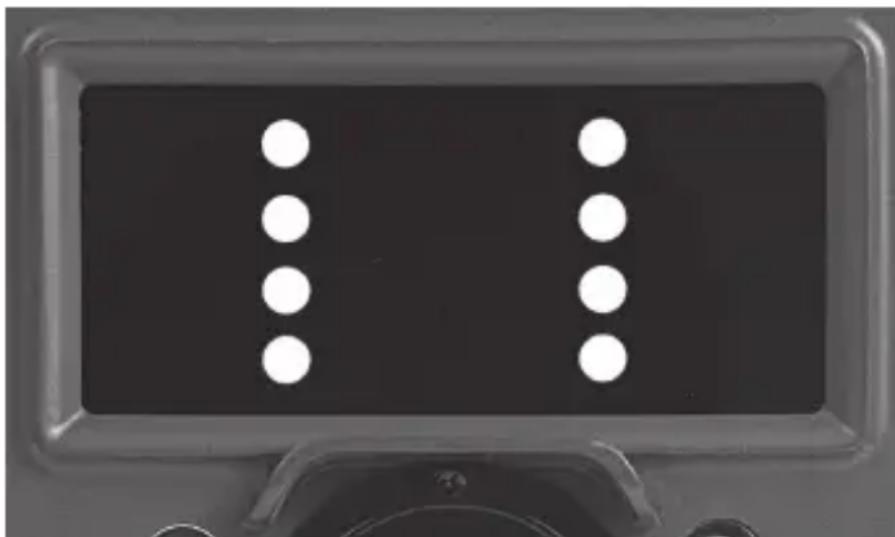
Location of the 8 LEDs that fire when LED Control parameter is set to "Low"
| Parameter | Settings (Bold=default) | Description |
| Sensor Level Low | , Normal, High, Auto | Selects the sensitivity of the PIR sensor. The “High” setting will make the camera more sensitive to infrared (heat) and more easily triggered by motion, and the “Low” setting makes it less sensitive to heat and motion. The High setting can be useful when the ambient temperature is warm (making it more difficult for the sensor to detect animals), and the Low setting may help in cold weather if the camera is being triggered too often by anything warmer than the surroundings. “Normal” is for average or moderate conditions. The default “Auto” setting will allow the camera to determine the best setting based on its current operating temperature. This is an ideal setting if the weather is expected to change significantly during the period the camera will be used. |
| NV (Night Vision) Shutter | High, Medium, Low | Affects the shutter speed during Night Vision operation. High will freeze motion better, but photos may be darker. A Low shutter speed setting will produce brighter photos, but rapid motion may be blurred. Medium is a good compromise. |
| Camera Mode 24 | Hrs, Day, Night | Allows user to limit operation to only day or night period if desired. An ambient light level sensor determines “Day” vs “Night” automatically. This setting takes priority over any Field Scan settings. |
| Format Execute | Deletes (erases) all files | stored on a card to prepare it for reuse. Always format a card that has been previously used in other devices. Caution! Make sure you have downloaded and backed up any files you want to preserve first! Press OK to execute, press MENU to exit without formatting. |
| TV Out | NTSC, PAL | Selects video standard /format for the “A/V Out” output jack. The video standard is NTSC for the United States, Canada, Mexico, Asia and South America. PAL is used primarily in Europe. |
| Time Stamp | Off, On | Select “On” if you want the date & time (that the image was captured) imprinted on every photo/video, select “Off” for no imprint. Note: the current temperature, moon phase, and (user set) camera name will also be imprinted on your still photos. |
| Set Clock (Set) | Press OK and use the UP/DOWN keys (to change the setting) and LEFT/RIGHT keys (to move to the next field) to set the hour (24-hr format only, “00”=midnight, “12”=noon) and minute, and then (on the lower row), the year, month and date. | |
| Field Scan On, Off | (After On is selected): "A" Start/Stop, "B" Start/Stop, Interval | Turns Field Scan (Time Lapse) recording mode on/off. When activated, Field Scan forces the camera to take photos or videos even when it is not triggered by a nearby live animal, useful for constant monitoring of an area that might be far away from the camera. The user can set the start and stop times for up to two independent "blocks" of Field Scan recording, as well as the interval time between each photo/video. To ensure correct operation, avoid setting overlapping start/stop times for Field Scan A and B. Please read the "Field Scan 2x..." section of this manual for details on using this feature. NOTE: If the "Camera Mode" parameter is set to "Day" or "Night" operation only, that will take priority over your Field Scan settings. Set Camera Mode to "24HR" if you are setting day and night Field Scan start and/or stop times. |
| Coordinate Input | Off, OnSee "Using the Setup Menu Input Screens" | Allows the user to input latitude and longitude coordinates for the camera's location. This data will be embedded in the files saved on the camera's SD card (if "On" is selected). This makes it possible to see each camera's location as a "pushpin" on Google Earth maps when reviewing a folder full of photos from multiple cameras, or use other "geotag" capable software (Picassa, etc). |
| Video Sound (only affects video clips in Video or Hybrid modes) | On, Off Select “On” to record audio along with the video when the camera is set to video mode (saved file sizes will be slightly larger). | |
| Default Set | Cancel, Execute | Select “Execute” and press OK to restore all parameters to the original factory default settings. If the camera is behaving oddly and you think you may have changed the setting for something badly (but aren’t sure which one), this will reset all parameters to their most commonly used or “generic” settings. |
USING THE SETUP MENU INPUT SCREENS
Camera Name Input
After selecting the Camera Name parameter (the only setting is "Input"), press OK. If necessary, delete the previous or default name by pressing the RIGHT key until the backspace symbol () (located between letters "A" & "B", also between "j" & "k") is highlighted, then keep pressing OK. Select (highlight) each alphanumeric character you want, using the LEFT/RIGHT keys, and pressing OK after each one to set it. When finished naming the camera, press MENU to save the name to memory.
Coordinate Input
After selecting the Coordinate Input parameter, press UP or DOWN to select the On setting and press OK. The latitude and longitude for any location where you plan to place the camera can be obtained at many websites, for example: http://itouchmap.com/latlong.html. You can enter a nearby street address, just zip code, or use the various types of maps to locate the approximate position. The format you will need to use to enter the coordinates in the NatureView HD Cam menu screen is shown below:
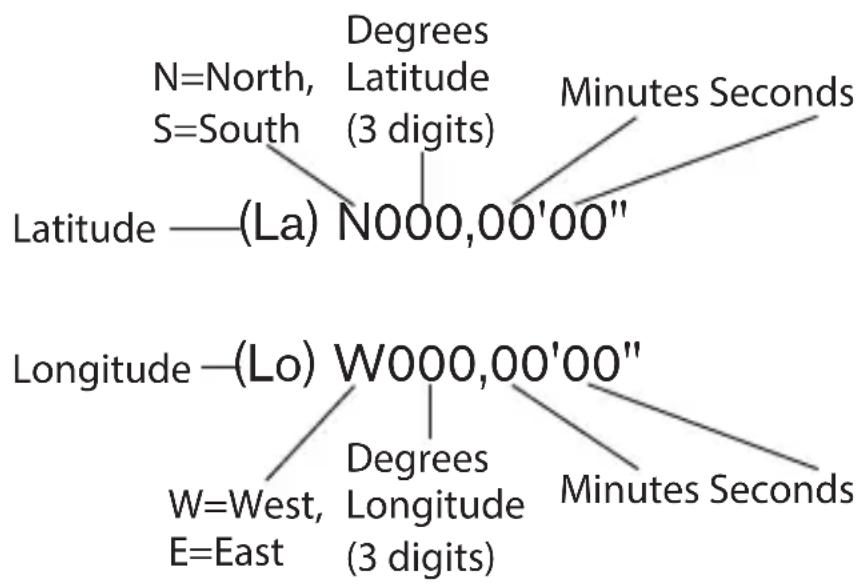
Note: You may see "negative" latitude or longitude coordinates online. These designate South latitudes and West longitudes. US/Canada locations will have North (+) latitude coordinates and West (-) longitude coordinates.
MOUNTING AND POSITIONING THE NatureView HD Cam
Mounting
After you've set up the camera's parameters to your personal preferences at home or in your truck, you're ready to take it outside and slide the power switch to "ON". When setting up the NatureView HD Cam for scouting wildlife or other outdoor applications, you must be sure to mount it in place correctly and securely. We recommend mounting the NatureView HD Cam on a sturdy tree with a diameter of about 6 in. (15cm). To get the optimal picture quality, the tree should be about 16-17 ft. (5 meters) away from the place to be monitored, with the camera placed at a height of 5-6.5 ft. (1.5~2 m). Also, keep in mind that you will get the best results at night when the subject is within the ideal flash range, no farther than 60' (19m) and no closer than 10' (3m) from the camera.
To capture close-up images at much shorter ranges, one of the included close-up lenses may be attached to the primary lens (see below). To avoid the potential for moisture condensation inside the primary lens, drop one of the provided "O-ring" rubber seals inside the lens shade before installing the close-up lens. Then screw the close-up lens in place over the primary lens (only one at a time may be installed). The close-up lenses change the minimum focus distance to either 60cm (23.5") or 46cm (18").
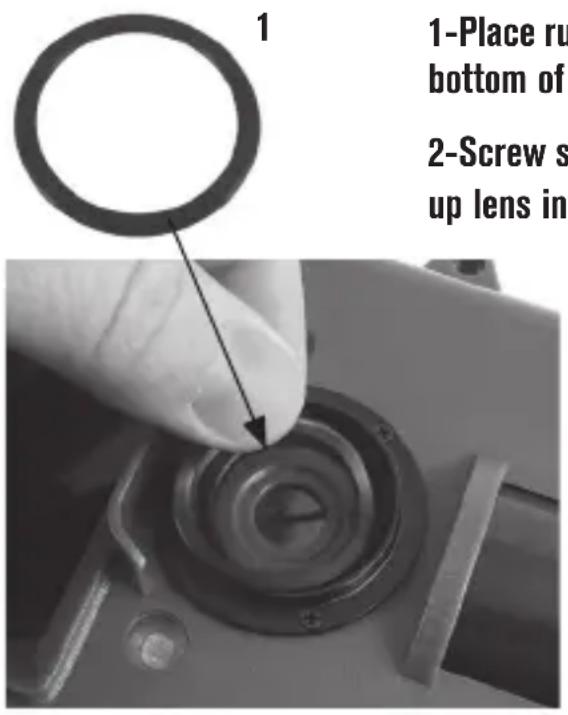
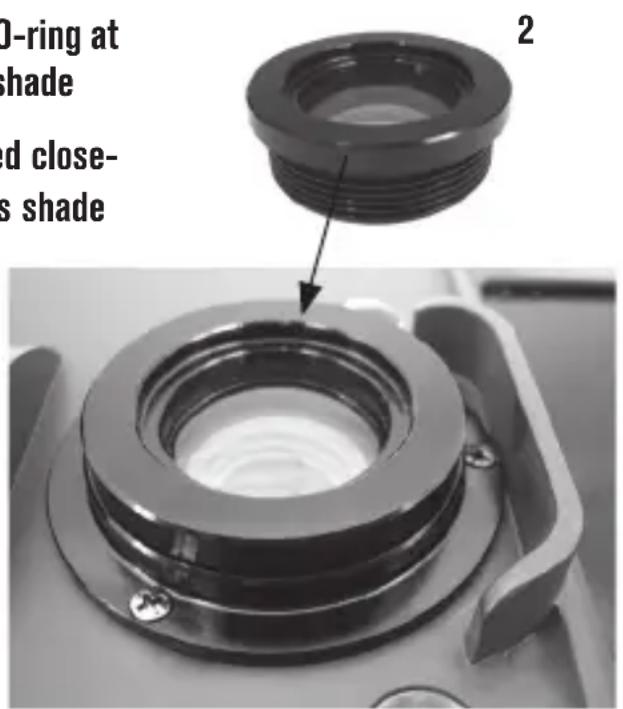
It is not possible for the camera to focus on subjects at normal long ranges when a close-up lens is in place-be sure to remove the close-up lens when you again use the camera at normal ranges. Experimentation is recommended to determine the best location of the camera for optimum results when using the accessory close-up lenses. Set the "LED Control" parameter in the menu to "Low" when using either close-up lens.
There are two ways to mount the NatureView HD Cam: using the provided adjustable web belt, or the tripod socket.
-
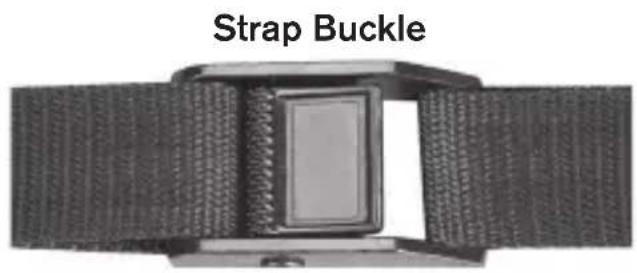
Using the adjustable web belt: Fig. 5 illustrates using the web belt on the NatureView HD Cam. Push one end of the belt through the two brackets on the back of the NatureView HD Cam. Thread the end of the strap through the buckle. Fasten the belt securely around the tree trunk by pulling the end of the strap firmly so there is no slack left. Note: it is not possible to use a cable lock (in the upper part of the bracket) and the web belt at the same time.
-
Using the tripod socket: The camera is equipped with a socket at the bottom end to enable mounting on a tripod or other mounting accessories with a standard 1/4-20 thread.

Fig. 5: Attaching the Belt
Two optional mounting accessories, a "Bear Safe" metal camera box (Model# 119654C) and Deluxe Tree Bracket (Model# 119652C) are also available—please see your Bushnell dealer or website for more details.
Sensing Angle and Distance Test
To test whether the NatureView HD Cam can effectively monitor the area you choose, this test is recommended to check the sensing angle and monitoring distance of the NatureView HD Cam. To perform the test:
- Switch the NatureView HD Cam to the SETUP mode.
- Make movements in front of the camera at several positions within the area where you expect the wildlife or subjects to be. Try different distances and angles from the camera.
- If the motion indicator LED light blinks, it indicates that position can be sensed. If it does not blink, that position is outside of the sensing area.
The remote color viewer may also be used to accurately aim and position the camera. See pg. 29 for details.
The results of your testing will help you find the best placement when mounting and aiming the NatureView HD Cam. The height away from the ground for placing the device should vary with the animal size appropriately. In general, 3 to 6 feet is preferred.
You can avoid potential false triggers due to temperature and motion disturbances in front of the camera by not aiming it at a heat source or nearby tree branches or brush (especially on windy days).
Switching ON the Camera
Once you switch to the ON mode, the motion indicator LED (red) will blink for about 10 seconds. This gives you time to close and lock the front cover of the NatureView HD Cam and then walk away. During this time, the motion indicator LED will blink red continuously. After it stops blinking, the PIR is active, and any motion that is detected by it will trigger the capture of photos or videos as programmed in the SETUP Menu. Be sure you have read the descriptions of the Capture Number, Video Length, Interval and Sensor Level parameters. Please note, the PIR is strongly sensitive to ambient temperature. The greater the temperature difference between the environment and your subject, the farther the possible sensing distance. The average sensing distance is about 45 ft.
Before leaving the camera unattended, please check for the following:
- Are the batteries or DC power supply inserted/connected with correct polarity and is the power level is sufficient?
- Does the SD card have sufficient available space and is its write-protection (lock) switch off?
- Is the Power switch in the ON position? (do not leave it in SETUP).
USING THE REMOTE COLOR VIEWER
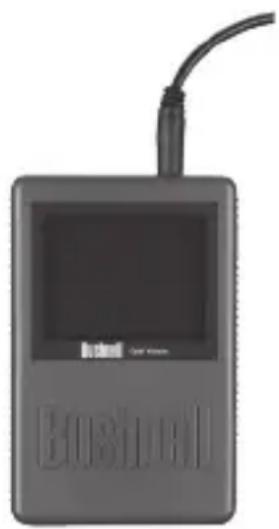
Your NatureView HD Cam includes a handheld remote Color Viewer, which can be used to view the live image from the lens, ensuring that the camera has been positioned and aimed correctly so that your intended subject will be captured.
The Viewer will also display the menu settings during the setup process, and can be used in the field to review photos/videos that have been stored on the SD card.
Before using the Viewer:
- Slide open the battery compartment on the back of the Viewer and install 2 × AA batteries (alkaline or lithium-do not mix types), with the flat (-) end of each battery in contact with the springs. Slide the battery compartment cover back into place.
- Connect the provided cable between the jack on top of the Viewer and the "Viewer" jack on the camera (next to the SD card slot. Switch the camera to "SETUP".
- If the Viewer display does not activate, press the power button on the top right side of the Viewer. To turn off the Viewer, press the power button again.
To check final camera aim/position with the Viewer:
To view the live image after the camera has been set to "ON", and mounted in place with the control panel closed and latched, simply plug the cable from the top of the Viewer into the exposed "Viewer" jack on the bottom of the camera. If the Viewer is powered on, it should display the image from the lens. Aim the camera while monitoring the Viewer so that it is in position to capture the desired subject or area. When finished, disconnect the Viewer by pulling the cable out of the "Viewer" jack, and the camera will begin to capture images.
Using the Viewer in Camera Setup Mode:
For convenience, the Viewer may be attached to the inside of the camera's battery compartment for hands free operation. Line up the round peg on the back of the Viewer with the large hole in the slot at the bottom of the battery compartment, then slide the Viewer to the left to secure it in place. To remove
the Viewer, slide it all the way back to the right and lift it up and out away from the camera.
The Viewer will normally display the live image from the lens when the camera is in SETUP mode. If you press the MENU key on the control panel, the Viewer will switch to displaying the settings/options for the Setup Menu (in fact, you can see all possible settings for each parameter).
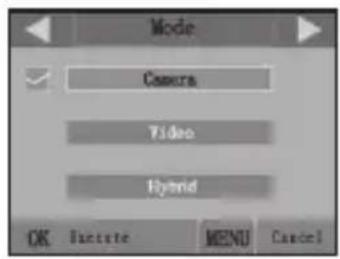
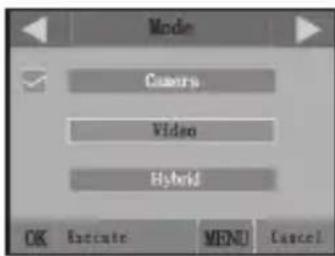
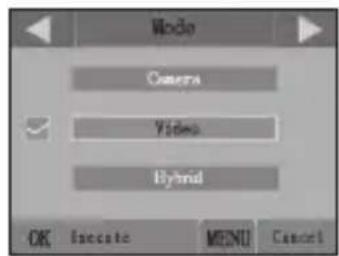
On the remote color viewer, all the available settings for the currently displayed parameter are shown on one screen, with a checkmark next to the current setting (a) . To change the setting, first use the UP/DOWN keys to highlight (select) the new setting you want (b) , then press OK to "Execute" the actual change to the selected setting. The checkmark will appear next to your new setting to confirm this (c) .
(a) (b) (c)
To use the connected Viewer to review photos/videos on the SD card:
Press the Replay (OK) key.
-
Press the UP/DOWN arrow keys to select the previous or next image. Photos are indicated on the display by "JPG".
-
Press the Left arrow key to zoom in on an image (then use UP/DOWN to zoom in/out).
-
Press OK to move around the image with the UP/DOWN and LEFT/RIGHT keys. Press OK again to exit and return to the normal image review.
-
Press the Menu key to Delete the current image (or all images if you select that option). Press Menu again to cancel without deleting.
-
To replay a video, after pressing the Replay (OK) key, press the RIGHT arrow key.
PLAYING BACK/DELETING THE PHOTOS/VIDEOS
After you have setup, mounted and activated your NatureView HD Cam, you will of course be eager to return later and review the images it has captured for you. There are several different ways this can be done.
Reviewing Images Directly From the SD Card
This is the most popular method of viewing images. Since unmounting the camera and taking it to your computer isn't very convenient, you may find it easier to just take the card out. By removing the SD card (swapping it for a new empty card if you like) and taking it to your home or campsite to view the images by using an SD card "reader" (user supplied) connected to your computer (some computers and TVs have a built in SD card slot), you can leave the camera in place ready to capture more images. Once connected, the card reader works the same way as described below-please read that section if you have any problem finding your files.
Reviewing Images Using the Color Viewer:
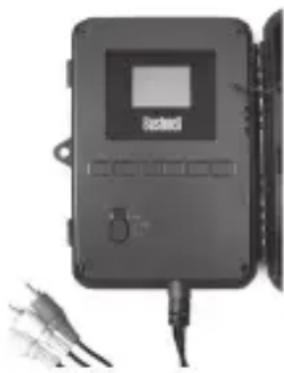
First, set up and connect the included handheld Color Viewer as described on pg. 29. A TV monitor or other viewing device with a standard composite video input (RCA jack) can also be used by connecting it to the A/V Out jack. Switch the camera to OFF, then to SETUP.
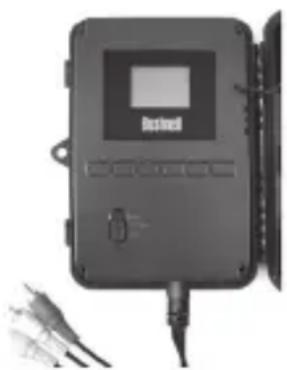
Cable from "A/V Out"
Next:
- Press the Replay (OK) key.
- Press the UP/DOWN arrow keys to select the previous or next image. Photos are indicated on the display by "JPG".
- Press the Left arrow key to zoom in on an image (then use UP/DOWN to zoom in/out).
- Press OK to move around the image with the UP/DOWN and LEFT/RIGHT keys. Press OK again to exit and return to the normal image review.
- Press the MENU key to Delete the current image (or all images if you select that option). Press MENU again to cancel without deleting.
- To replay a video, after pressing the Replay (OK) key, press the RIGHT arrow key.
Reviewing Images by Connecting the Camera to a Computer
You can always unmount the entire camera from the tree and connect its USB port to a computer-it will be recognized as a "removable disk", without the need to install any drivers or software. When using a PC (or Mac*) to view photos (or video clips*), first connect the device to the computer with the supplied USB cable. Then use commercial software with an image browser feature, or an image browser included with the PC's operating system to view images saved on the SD card in the folder \DCIM\100EK113. Each new image or video will be numbered incrementally in order of the time it was captured. For example, you will see file names such as "EK0001.JPG" or "EK0001.AVI", etc. Through the file format suffix you can distinguish whether the file is a still photo (with suffix.JPG) or a video (with suffix.AVI).
*video files may require additional software for viewing on a Mac.
The NatureView HD Cam supports 3 kinds of file system formats, FAT12, FAT16, and FAT32. The default value is FAT16 to save photos and videos. Here are some related notes:
-
You don't need to be concerned about the file system format of the NatureView HD Cam unless your equipment has problems reading the SD card. If this happens, please format the SD card with the NatureView HD Cam or in your computer first and then insert the card into your NatureView HD Cam and try again.
-
The default file system format of the NatureView HD Cam is FAT16, which most computers can read. If you format an SD card for the NatureView HD Cam in your computer, you should choose the file system format FAT16. Normally FAT16 is recommended unless you have another image viewer that uses FAT12 or FAT32 format.
Deleting Photos or Videos
If you see a photo or video during playback on the Color Viewer or video monitor that you want to delete, it can be done easily without leaving SETUP mode:
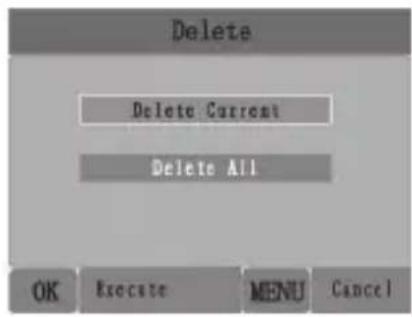
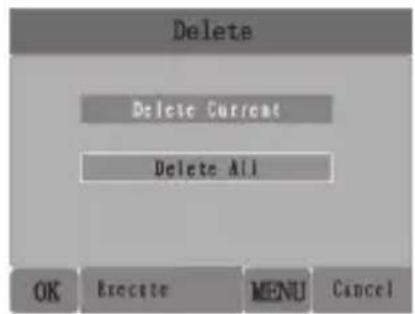
- Press the MENU key. You will see the first "Delete" screen, which lets you select the option to delete only the currently displayed photo/video, or all photos/videos (see below).
- Highlight the "Delete Current" or "Delete All" option, then press OK.
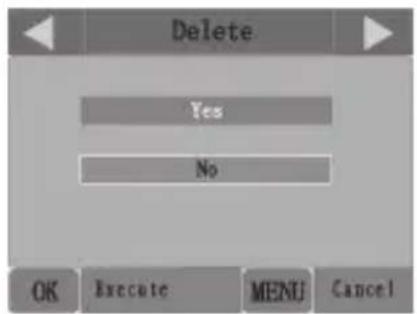
- Next, select "Yes" and press OK to erase only the last displayed photo.
or video (if you selected "Delete Current"), or every photo and video file on the card (if you selected "Delete All")-or select "No" and press OK to cancel the operation without deleting any files.
NOTE: after deleting a picture or a video file, the deleted files can't be restored! It is also possible to delete all files from the card by using the Format parameter (see pg. 22).
To download your photos/videos to a PC or Mac*, first make sure the NatureView HD Cam power switch is in the OFF position. Connect the supplied cable to the camera's USB port, then directly to a main USB port on your computer-do not use front panel/keyboard USB ports or unpowered "hubs".
The NatureView HD Cam will be recognized as a standard "USB Mass Storage" device (this may take several seconds the first time you connect it). If you would rather leave your camera in the woods and just pull its SD card out, an SD card reader works the same way as described in this section once the card is inserted and the reader is connected to your computer.
With Windows XP or later, you can then simply use the options in the pop-up window to copy, view, or print your photos (right).
On all Windows OS, the NatureView HD Cam will also be listed as a "Removable Disk" if you open the "My Computer" window (on Macs, an icon will appear on your desktop). The NatureView HD Cam's photo files are named "EK0001.JPG" etc, and are located in
the "DCIM\100EK113" folder on this "Removable Disk". Video file names will end with ".AVI". You may copy the photos/videos to your hard drive as you would any file-just copy/paste or drag the file names or icons to your drive or desktop.
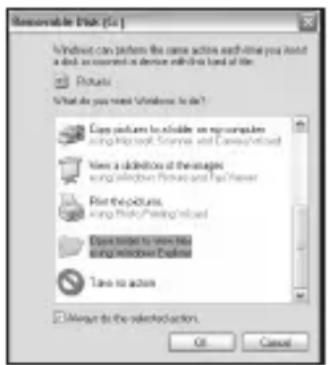
After the photos are copied to your hard drive, you can disconnect the NatureView HD Cam. (On Mac computers, drag the "disk" that appeared on your desktop when the camera was connected into your Trash to "eject" it before disconnecting.) The.JPG format photo files from the NatureView HD Cam may be viewed and edited with any photo software you choose to use. The.AVI video files may be viewed with the Windows Media Player on PCs with Windows 7. If your computer is running an older version of Windows, or you are on a Mac, and you don't already have a compatible video player, you can download a free version of the DivX player from http:// www.divx.com/.
TROUBLESHOOTING / FAQ
Camera takes continuous images of no subject
A camera has what is known as a "false trigger" if the PIR sensor thinks that there is motion and heat in front of the camera lens when there is no subject in the image. These "False Triggers" are the result of placing the camera in an environment where there is motion associated with tree branches creating motion in front of the camera or an area where there is high heat in the foreground and any motion from wind could set off the camera. Setting a camera up over water is also a potential cause for this issue. To remedy this situation:
- Try moving the camera to an area that does not have any of these issues or try changing the sensor level on the menu settings.
- If the camera continues to take images when there is no subject in them, try placing the camera in an inside environment and aiming at a location where there is no motion.
- If the camera continues to show issues, then there is probably an electronic component issue. If this is the case, please contact our customer service to send the camera back for repair.
Battery life is shorter than expected
- Battery life will vary with operating temperature and the number of images taken over time. Typically, the NatureView HD Cam will be able to capture several thousand images before the batteries die.
- Check to make sure you have used new alkaline or lithium batteries. Bushnell recommends using a full set of Energizer® Lithium AA batteries in your NatureView HD Cam model to obtain maximum battery life.
- Make sure that the power switch was turned to the "On" position and that the camera was not left in "Setup" mode while in the field.
- Make sure that you are using a good quality name brand SD card in your camera. Bushnell recommends SanDisk® brand SD Cards up to 32GB (Ultra® or Extreme® series for HD video). Our experience indicates that poor quality SD cards can sometimes reduce your NatureView HD Cam battery life.
Camera stops taking images or won't take images
-
Please make sure that the SD card is not full. If the card is full, the camera will stop taking images.
-
Check the batteries to make sure that they are new alkaline or lithium AA batteries. See note above about short battery life.
- Make sure that the camera power switch is in the "On" position and not in the "Off" or "Setup" modes.
- Make sure that you are using a good quality SD card in your camera. Bushnell recommends SanDisk® SD Cards up to 32GB (Ultra® or Extreme® series for HD video).
- If the SD card has its write protect switch in the lock position, the camera will not take images.
- If you have used an SD card in another device before inserting it in your NatureView HD Cam, you might want to try formatting the card using the "Format" parameter in Setup mode (make sure you have backed up any important files first, as formatting will erase all previous files). In some cases, other devices may change the formatting of the SD card so that it will not work properly with the NatureView HD Cam.
Camera won't power up
- Make sure that you have installed at least 4 batteries (the required minimum #) in the battery compartment, starting at the top, filling battery spaces 1-4 with no "gaps".
Bushnell recommends using a full set of 12 Energizer® Lithium AA batteries in your NatureView HD Cam.
- Make sure that the batteries are installed correctly, observing proper polarity. Always place the negative (flat) end of each battery in contact with the spring side of its slot inside the camera.
- After moving the switch from "Off" to "Setup" or "On", make sure that the switch is correctly in position to ensure the proper mode (avoid positions "between" two modes).
- Do not move the switch directly from "On" to "Setup"-always move the switch all the way down to "Off" first, then back up to "Setup".
Still Photo and/or Video Quality Problems
- Night photos or videos appear too dark
a. Check the battery indicator icon to see if battery power is full. The flash will stop operating near the end of the battery life.
b. You will get the best results when the subject is within the ideal flash range, no farther than 60^ (19m). Subjects may appear too dark at greater distances.
c. Please note that when the Capture Number parameter is set higher
than "1 Photo", or with very short Interval settings, some images may appear darker than others due to the quick response and rapid retriggering of the camera, allowing less time for the flash to fully recharge before firing again.
d. Make sure "LED Control" in the setup menu is set to "High" to ensure maximum output. You can also try setting "NV Shutter" in the menu to "Low" (slower shutter speed=brighter images, with tradeoff of increased blur if subject moves rapidly).
- Daytime photos or videos appear too dark
a. Make sure that the camera is not aimed at the sun or other light sources during the day, as this may cause the auto exposure to produce darker results.
- Night photos or videos appear too bright
a. If the subject is close to the camera (less than 10ft / 3m ), change the LED Control parameter in the Setup Menu to "Medium" or "Low".
- Daytime photos or videos appear too bright
a. Make sure that the camera is not aimed at the sun or other light sources during the day.
- Photos with streaked subject
a. In some cases with low lighting conditions and fast moving subjects, the 8MP or 14MP resolution settings may not perform as well as the 3MP setting.
b. If you have multiple images where fast moving subjects produce streaks on the photo, try the 3MP setting instead.
c. Set "NV Shutter" to "High" to minimize motion blur.
- Red, green or blue color cast
a. Under certain lighting conditions, the sensor can become confused resulting in poor color images.
b. If this is seen on a consistent basis, then the sensor may need servicing. Please contact Bushnell customer service.
- Short video clips—not recording to the length set
a. Check to make sure that the SD card is not full.
b. Make sure that the camera has good batteries in it. Near the end of the battery life, the camera may choose to record shorter video clips to conserve power.
c. When LED Control is set to "High" and camera is in Video mode, the maximum available video length is 15 seconds to avoid potential overheating of batteries and/or electronic components.
Date/Time Stamp not appearing on images
- Make sure that the "Time Stamp" parameter is set to "On".
Photos Do Not Capture Subject of Interest
- Check the "Sensor Level" (PIR sensitivity) parameter setting. For warm temperature conditions, set the Sensor Level to "High" and for cold weather use, set the sensor for "Low". For variable weather, use "Auto".
- Try to set your camera up in an area where there is not a heat source in the camera's line of sight.
- In some cases, setting the camera near water will make the camera take images with no subject in them. Try aiming the camera over ground.
- Try to avoid setting the camera up on small trees that are prone to being moved by strong winds.
- Remove any limbs which are right in front of the camera lens.
PIR Sensor LED Flashes/Doesn't Flash
- When the camera is in the "Setup" mode, a special LED on the front of the camera will flash when it senses motion. This is for setup purposes only and will help the user aim the camera.
- During use, the LED will not flash when the camera takes an image. This is to help keep the camera hidden from wildlife.
LCD Screen Issues
- LCD screen powers on but no text is present.
a. After moving the switch from "Off" to "Setup" or "On", make sure that the switch is correctly in position to ensure the proper mode (avoid positions "between" two modes).
b. Do not move the switch directly from "On" to "Setup"-always move the switch all the way down to "Off" first, then back up to "Setup".
- LCD screen shows a faint black line after turning from "Setup" to "On". a. The LCD will turn off when you slide the switch to the "On" position. In some cases, this black line will appear and then fade in about 1 second. This is normal and the camera will function properly.
- Screen comes on but then powers off
a. Make sure that you have installed the SD card correctly.
Camera won't retain settings
- Make sure that you have been saving the changes to any parameter
settings that you made while in Setup mode, by pressing "OK" after changing the setting. If you don't save your new setting after changing it, the camera will continue to use the original default setting for that parameter.
Moisture or Ants Inside Camera
- To ensure humidity or rain is kept out of the camera, secure the DC In plug firmly in place.
- Ants can be attracted by low level electronic vibrations, and enter through any gaps between the exterior and interior of the camera. Make sure the DC In plug is securely attached.
Field Scan (Time Lapse) not working properly
- Make sure that the stop and start times of Field Scan "A" and "B" do not overlap (for example, do not set the start time of "B" to 8AM if the stop time of "A" is 10AM).
- When using Field Scan in video mode, the smallest interval time available is 5 min, to avoid potential overheating of the batteries and electronic components, which could cause operational failure or damage to the camera. In still photo mode, a 1 min. Interval can be set.
Difficulty removing the batteries
- Before removing the batteries from the NatureView HD Cam you can simply remove the battery compartment insert bar by grasping it in the middle and lifting out. This will give you easier access to the batteries. After removing them, you can replace the battery compartment insert bar by inserting one side into the battery compartment wall and flexing the insert until you can place the second side of the bar into the opposite wall of the battery compartment. Make sure that the bar is seated securely. The bar should be inserted with the text/numbers printed on the insert facing correctly up so that you can read them. Make sure that the insert bar is inserted correctly inside the battery compartment before replacing batteries.
Photos/Videos are out of focus
Make sure a close-up lens has been attached (for close range operation) or removed (for normal range operation).
Do not mix old and new batteries. Do not mix battery types-use ALL lithium or ALL alkaline. Rechargeable batteries are not recommended.
TECHNICAL SPECIFICATIONS
| Image Sensor | 5 Megapixel Color CMOS |
| Maximum Pixel Size | 4416 x 3312 (14 MP) |
| Lens | F = 3.1; FOV=50°; Auto IR-Cut-Remove (at night) |
| IR-Flash Range | Selectable (Low/Med/High), up to 60'(19m) on High |
| Display Screen | Std B&W Display: 24x32mm(1.5") ; Color Viewer Display: 32x42mm (2.4") |
| Memory Card | SD or SDHC Card, Maximum capacity 32GB (Class 6 or higher for 1280x720 or 1920x1080 HD video) |
| Internal RAM | 32MB |
| Picture Size | 14MP = 4416x3312*; 8MP = 3264x2448*; 3MP = 2048x1536 (*14MP/8MP via software interpolation) |
| Video Size | 1920x1080 (widescreen),1280x720 (widescreen), or 640x360 (widescreen) pixels per frame at 20-30 fps (Day) / 15-20 fps (Night) |
| PIR sensitivity | Hyper PIR with 4 sensitivity settings: Low/Normal/ High/Auto |
| Operation | User selectable: 24 Hour, Day only, or Night only (based on ambient light level) |
| Response Time | 0.2 second |
| Triggering Interval | 1 sec. - 60 min. programmable |
| Shooting Numbers | 1-3 programmable |
| Video Length | 5-60sec. programmable |
| Power Supply | 12x AA batteries recommended, 4xAA as emergency power |
| Stand-by Current | < 0.2mA (<7mAh/day) |
| Power Consumption | 250mA (+1300mA when all LEDs fire) |
| Night Vision Shutter Speed | User selectable (High/Med/Low)-affects night (NV) photos/videos only |
| Interface | A/V out (NTSC/PAL); USB; SD card holder; 6V DC external |
| Security | Strap; 1/4-20 attachment |
| Operating Temperature | -20 - 60°C (Storage temperature: -30 - 70°C) |
| Operating Humidity | 5% - 90% |
ONE YEAR LIMITED WARRANTY
Your Bushnell product is warranted to be free of defects in materials and workmanship for one year after the date of purchase. In the event of a defect under this warranty, we will, at our option, repair or replace the product, provided that you return the product postage prepaid. This warranty does not cover damages caused by misuse, improper handling, installation, or maintenance provided by someone other than a Bushnell Authorized Service Department.
Any return made under this warranty must be accompanied by the items listed below:
- A check/money order in the amount of (10.00 to cover the cost of postage and handling
- Name and address for product return
- An explanation of the defect
- Proof of Date Purchased
- Product should be well packed in a sturdy outside shipping carton, to prevent damage in transit, with return postage prepaid to the address listed below:
IN U.S.A. Send To:
IN CANADA Send To:
Bushnell Outdoor Products Bushnell Outdoor Products
Attn.: Repairs Attn.: Repairs
9200 Cody 140 Great Gulf Drive, Unit # B
Overland Park, Kansas 66214 Vaughan, Ontario L4K 5W5
For products purchased outside the United States or Canada please contact your local dealer for applicable warranty information. In Europe you may also contact Bushnell at:
Bushnell Germany GmbH
European Service Centre
Mathias-Bruggen-Str. 80
D-50827 Köln
GERMANY
This warranty gives you specific legal rights.
You may have other rights which vary from country to country.
©2015 Bushnell Outdoor Products
Specifications and designs are subject to change without any notice or obligation on the part of the manufacturer.
FCC COMPLIANCE STATEMENT:
This equipment has been tested and found to comply with the limits for a Class B digital device, pursuant to part 15 of the FCC Rules. These limits are designed to provide reasonable protection against harmful interference in a residential installation.
Operation is subject to the following two conditions: (1) This device may not cause harmful interference, and (2) this device must accept any interference received, including interference that may cause undesired operation.
This equipment generates, uses and can radiate radio frequency energy and, if not installed and used in accordance with the instructions, may cause harmful interference to radio communications. However, there is no guarantee that interference will not occur in a particular installation. If this equipment does cause harmful interference to radio or television reception, which can be determined by turning the equipment off and on, the user is encouraged to try to correct the interference by one or more of the following measures:
- Reorient or relocate the receiving antenna.
- Increase the separation between the equipment and receiver.
- Connect the equipment into an outlet on a circuit different from that to which the receiver is connected.
- Consult the dealer or an experienced radio/TV technician for help.
The device does not contain any user-serviceable parts. Repairs should only be made by an Authorized Bushnell repair center. Unauthorized repairs or modifications could result in permanent damage to the equipment, and will void your warranty and your authority to operate this device under Part 15 regulations.
The shielded interface cable which is provided must be used with the equipment in order to comply with the limits for a digital device pursuant to Subpart B of Part 15 of FCC Rules.


Disposal of Electric and Electronic Equipment
(Applicable in the EU and other European countries with separate collection systems)
This equipment contains electric and/or electronic parts and must therefore not be disposed of as normal household waste. Instead, it should be disposed at the respective collection points for recycling provided by the communities. For you, this is free of charge.
If the equipment contains exchangeable (rechargeable) batteries, these too must be removed before and, if necessary, in turn be disposed of according to the relevant regulations (see also the respective comments in this unit's instructions).
Further information about the subject is available at your community administration, your local waste collection company, or in the store where you purchased this equipment.
Bushnell
NATUREVIEW® HD CAM
NOTICE D'UTILISATION
rEMArQUES IMPOrTANTES
DIAGNOSTIC/QUESTIONS FREQUEMMENT POSÉES
Bushnell Outdoor Products Bushnell Outdoor Products
Attn.: Repairs Attn.: Repairs
9200 Cody 140 Great Gulf Drive, Unit # B
Overland Park, Kansas 66214 Vaughan, Ontario L4K 5W5
European Service Centre
Mathias-Bruggen-Str. 80
D-50827 Köln
GERMANY
Tel:+49221995568-0
Fax:+49221995568-20
©2015 Bushnell Outdoor Products
Bushnell Outdoor Products Bushnell Outdoor Products
Atn.: Repairs Atn.: Repairs
9200 Cody 140 Great Gulf Drive, Unit # B
Overland Park, Kansas 66214 Vaughan, Ontario L4K 5W5
United States Canada
European Service Centre
Mathias-Bruggen-Str. 80
D-50827 Köln
GERMANY
©2015 Bushnell Outdoor Products
Bushnell Outdoor Products Bushnell Outdoor Products
Attn.: Reparaturen Attn.: Reparaturen
9200 Cody 140 Great Gulf Drive, Unit # B
Overland Park, Kansas 66214 Vaughan, Ontario L4K 5W5
European Service Centre
Mathias-Bruggen-Str. 80
D-50827 Köln
GERMANY
©2015 Bushnell Outdoor Products
MODALITA OFF, ON E SETUP
(Fase 2)-seLECTIONare Field Scan "A" (premere OK)
Cable from "A/V Out"
Bushnell Outdoor Products Bushnell Outdoor Products
Attn.: Repairs Attn.: Repairs
9200 Cody 140 Great Gulf Drive, Unit # B
Overland Park, Kansas 66214 Vaughan, Ontario L4K 5W5
European Service Centre
Mathias-Bruggen-Str. 80
D-50827 Köln
GERMANY
©2015 Bushnell Outdoor Products
For further questions or additional information please contact:
Bushnell Outdoor Products 9200 Cody, Overland Park, Kansas 66214 (800) 423-3537 · www.bushnell.com
©2015 Bushnell Outdoor Products

- Visit the NatureView HD Cam community website for your country today, where you can:
- IMPORTANT NOTE
- INTRODUCTION
- About the NatureView HD Cam
- Applications
- PARTS AND CONTROLS
- INSTALLING THE BATTERIES AND SD CARD
- Loading Batteries
- Using an External Power Source (optional, user provided)
- Inserting the SD Card
- USING THE NatureView HD Cam
- THE OFF, ON, AND SETUP MODES
- OFF MODE
- ON MODE
- SETUP MODE
- SETUP Mode Shortcut Keys/Functions
- USING THE SETUP MENU TO CHANGE SETTINGS
- Changing Parameter Settings in SETUP Mode
- EXAMPLES-Changing the Settings of Some Common Parameters
- Field Scan 2x with Live Trigger Feature
- The SETUP Menu - Parameters and Settings List w/Descriptions
- USING THE SETUP MENU INPUT SCREENS
- Camera Name Input
- Coordinate Input
- MOUNTING AND POSITIONING THE NatureView HD Cam
- Mounting
- Sensing Angle and Distance Test
- Switching ON the Camera
- USING THE REMOTE COLOR VIEWER
- Before using the Viewer:
- To check final camera aim/position with the Viewer:
- Using the Viewer in Camera Setup Mode:
- To use the connected Viewer to review photos/videos on the SD card:
- PLAYING BACK/DELETING THE PHOTOS/VIDEOS
- Reviewing Images Directly From the SD Card
- Reviewing Images Using the Color Viewer:
- Next:
- Reviewing Images by Connecting the Camera to a Computer
- Deleting Photos or Videos
- TROUBLESHOOTING / FAQ
- Camera takes continuous images of no subject
- Battery life is shorter than expected
- Camera stops taking images or won't take images
- Camera won't power up
- Still Photo and/or Video Quality Problems
- Date/Time Stamp not appearing on images
- Photos Do Not Capture Subject of Interest
- PIR Sensor LED Flashes/Doesn't Flash
- LCD Screen Issues
- Camera won't retain settings
- Moisture or Ants Inside Camera
- Field Scan (Time Lapse) not working properly
- Difficulty removing the batteries
- Photos/Videos are out of focus
- TECHNICAL SPECIFICATIONS
- ONE YEAR LIMITED WARRANTY
- FCC COMPLIANCE STATEMENT:
- Disposal of Electric and Electronic Equipment
- Bushnell
- NATUREVIEW® HD CAM
- rEMArQUES IMPOrTANTES
- DIAGNOSTIC/QUESTIONS FREQUEMMENT POSÉES
- MODALITA OFF, ON E SETUP
Brand : BUSHNELL
Model : NatureView HD Cam
Category : Camera