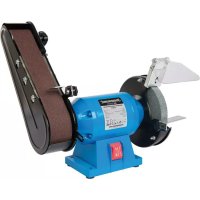
612519 - Grinding wheel SILVERLINE - Free user manual and instructions
Find the device manual for free 612519 SILVERLINE in PDF.


| Product type | Bench grinder with belt sander |
| Brand | Silverline |
| Model | 612519 |
| Belt speed | 15 m/s |
| Protection class | Class I (grounded) |
| Protection rating | IP20 |
| Dimensions (L x W x H) | 320 x 200 x 295 mm |
| Weight | 7.1 kg |
| Sound pressure level | 89 dB(A) |
| Sound power level | 102 dB(A) |
| Acoustic uncertainty | 3 dB |
| Vibrations | < 2.5 m/s² |
| Duty cycle | 30 minutes per hour maximum |
| Functions | Grinding and sanding |
| Included safety equipment | Spark guard, chip guard, tool rest |
| Maintenance | Regular cleaning, checking fasteners, replacement of wheels and belts |
| Warranty | 3 years (upon registration within 30 days) |
| Usage | Indoor use only, do not use in rain |
| Power supply | Mains with grounding |
| Optional accessories | Abrasive belts grit 80 (ref. 463484), coarse grit wheel (380652), fine grit wheel (819719), diamond wheel dresser (262315) |
Frequently Asked Questions - 612519 SILVERLINE
User questions about 612519 SILVERLINE
0 question about this device. Answer the ones you know or ask your own.
Ask a new question about this device
Download the instructions for your Grinding wheel in PDF format for free! Find your manual 612519 - SILVERLINE and take your electronic device back in hand. On this page are published all the documents necessary for the use of your device. 612519 by SILVERLINE.
USER MANUAL 612519 SILVERLINE
DIY 240W Bench Grinding & Belt Sander 150mm
FR Touret à meuler et ponceuse à bande 2-en-1, 240 W
DE Schleifstein und Bandschleifer, 240 W
ES Amoladora y lijadora de banda 240 W
IT Smerigliatrice a banco e levigatrice a nastro 240 W
NL 240 W workbank slijp- en bandschuurmachine
PL Szilifierka stołowa tarczowo-tasmowa 240 W
UK-612519/EU-974612

Register online: silverlinetools.com
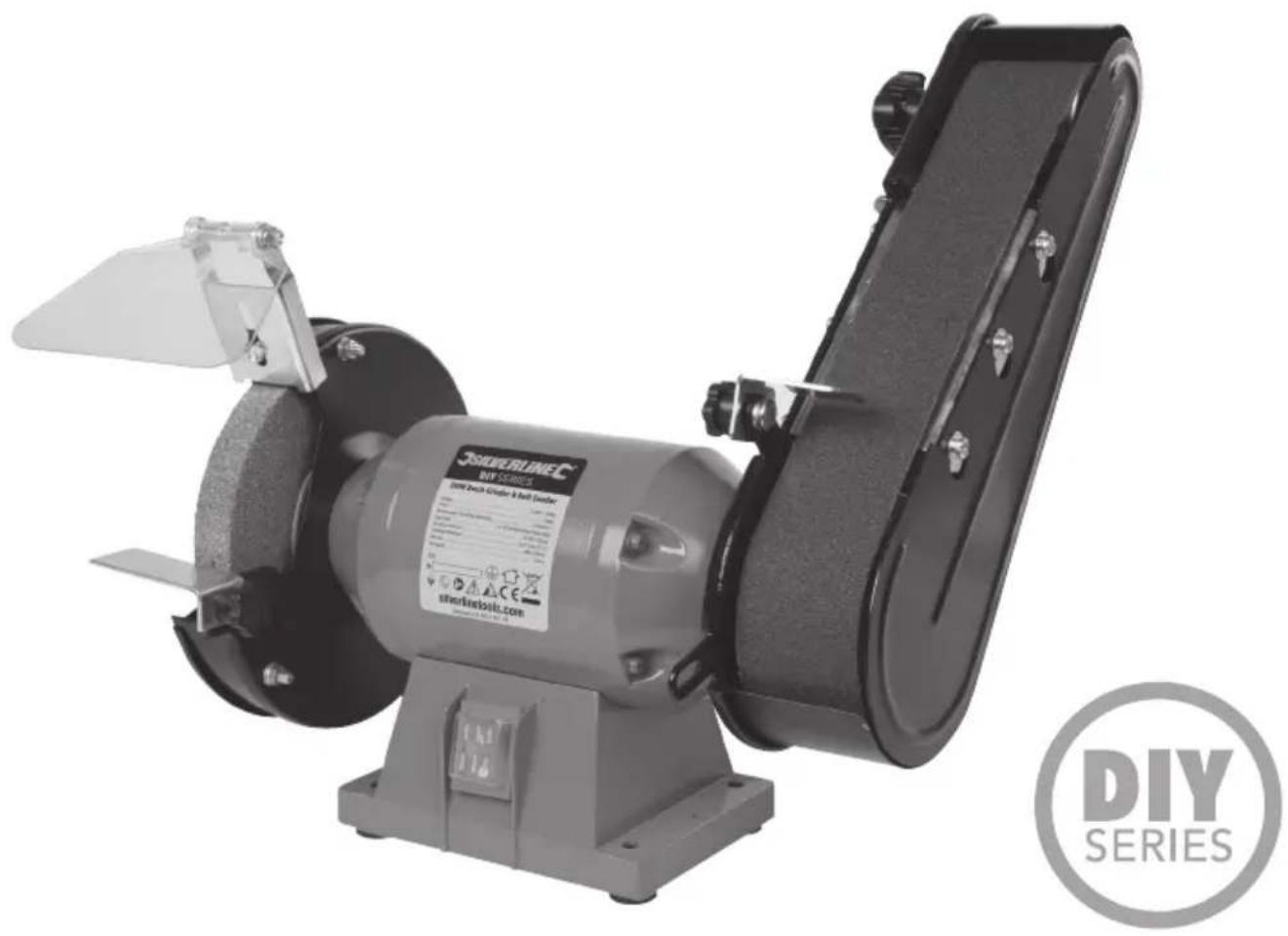


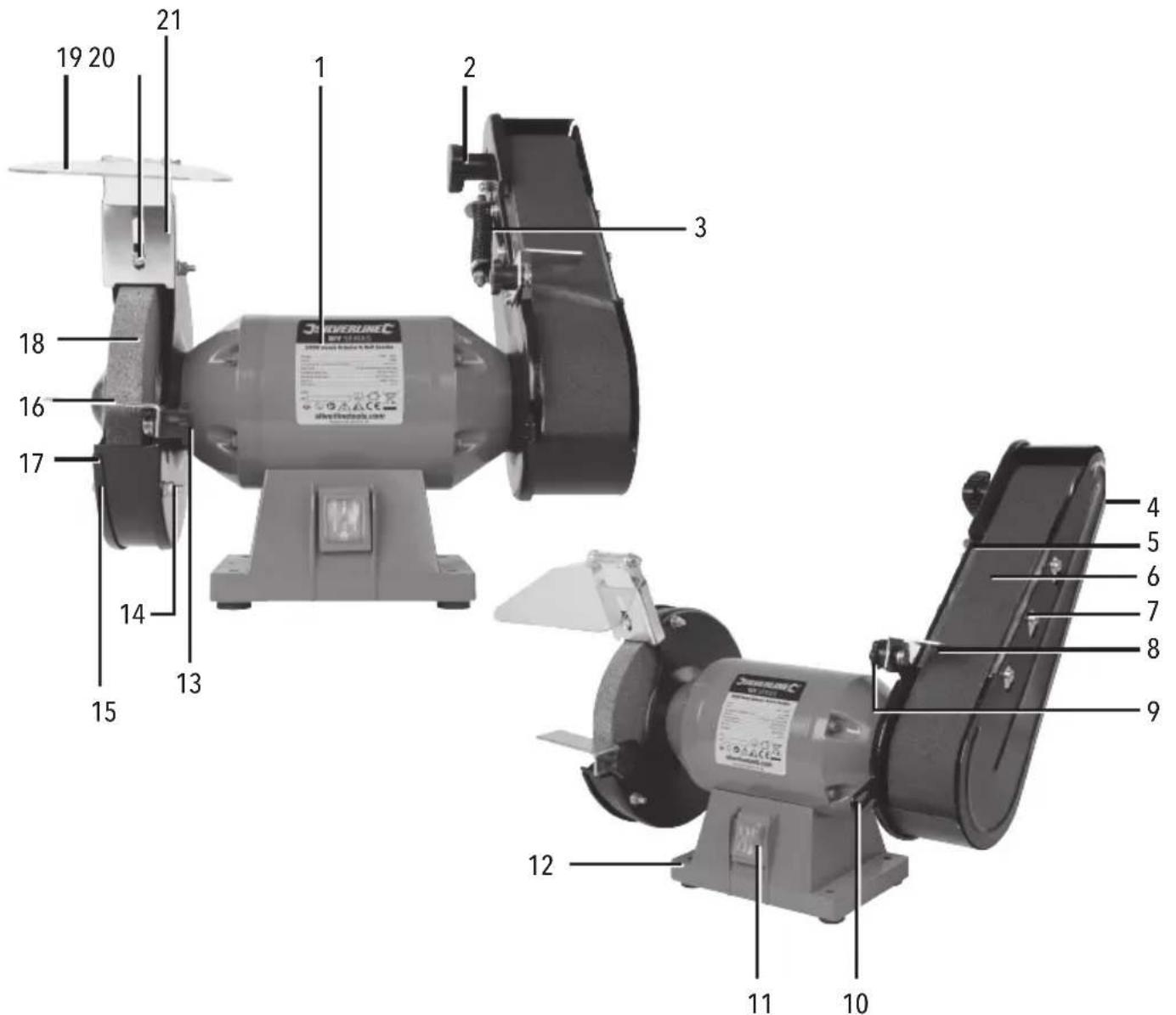
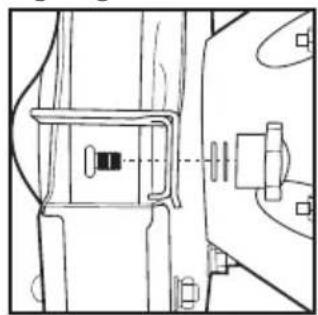
Fig.I Fig. II
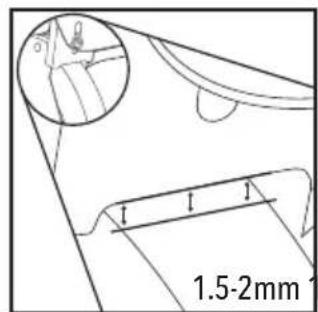
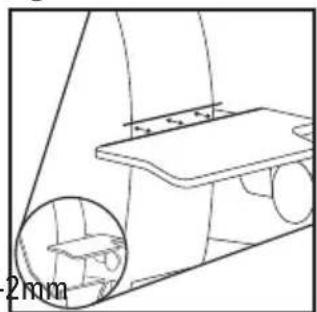
Fig. III
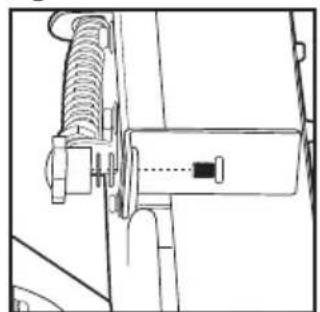
Fig. IV
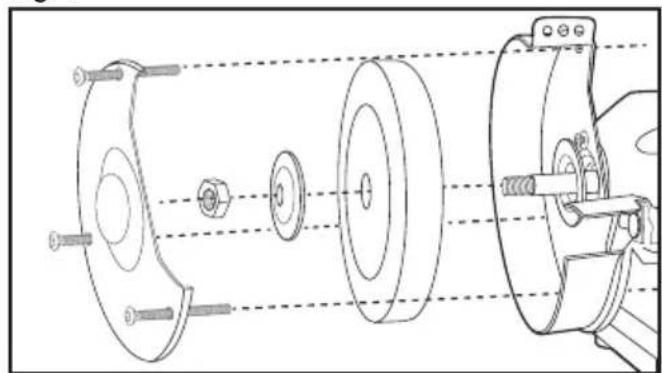
Fig. V
A
English 4
Français 10
Deutsch............16
Espanol. 22
Italiano............28
Nederlands .34
Polski 40
Introduction
Thank you for purchasing this Silverline tool. This manual contains information necessary for safe and effective operation of this product. This product has unique features and, even if you are familiar with similar products, it is necessary to read this manual carefully to ensure you fully understand the instructions. Ensure all users of the tool read and fully understand this manual.
Description of Symbols
The rating plate on your tool may show symbols. These represent important information about the product or instructions on its use.

Wear hearing protection.
Wear eye protection.
Wear breathing protection.
Wear head protection.

Wear hand protection.

Read instruction manual.

Caution!

DO NOT use in rain or damp environments!

For indoors use only!

Be aware of kickback!

Class I construction (double insulated for additional protection)

Dust extraction required or recommended

Always disconnect from the power supply when adjusting, changing accessories, cleaning, carrying out maintenance and when not in use!

Important safety devices! Ensure correct function, maintain in accordance with instructions and DO NOT disable!

Environmental Protection
Waste electrical products should not be disposed of with household waste. Please recycle where facilities exist. Check with your local authority or retailer for recycling advice.

Conforms to relevant legislation and safety standards.
Technical Abbreviations Key
| V Volts | |
| Hz Hertz | |
| A, mA Ampere, milli-Amp | |
| W, kW Watt, kilowatt | |
| nb | No load speed |
| /min or min-1 | Operations per minute |
| °Degrees | |
| dB(A) Decibel sound level (A weight) | |
| Ø Diameter | |
| m/s2 | Metres per second squared (vibration magnitude) |
Specification
Voltage: 230V~, 50Hz
Power. 240W
Duty Cycle: S2 30 minutes (short time duty)
No load speed - Grinding wheel (n 2950min
Grinding wheel size: 0150 x 20mm
Grinding wheel bore: 012.7mm (1/2")
Belt size: 686 x 50mm
Belt speed: 15m/s
Protection class:
Ingress protection: .IP20
Power cord length 1.5m
Dimensions (× × ) .. 320x200x295mm
Weight: 7.1kg
As part of our ongoing product development, specifications of Silverline products may alter without notice.
Sound and vibration information:
Sound pressure L . 89dB(A)
Sound power L 102dB(A)
Uncertainty K: 3dB
Vibration: < 2.5 m/s
The sound intensity level for the operator may exceed B5dB(A) and sound protection measures are necessary.
WARNING: Always wear ear protection where the sound level exceeds 85dB(A) and limit the time of exposure if necessary. If sound levels are uncomfortable, even with ear protection, stop using the tool immediately and check the ear protection is correctly fitted and provides the correct level of sound attenuation for the level of sound produced by your tool.
WARNING: User exposure to tool vibration can result in loss of sense of touch, numbness, tingling and reduced ability to grip. Long term exposure can lead to a chronic condition.
If necessary, limit the length of time exposed to vibration and use anti-vibration gloves. Do not operate the tool with hands below a normal comfortable temperature, as vibration will have a greater effect. Use the figures provided in the specification relating to vibration to calculate the duration and frequency of operating the tool.
Sound and vibration levels in the specification are determined according to EN60745 or similar international standards. The figures represent normal use for the tool in normal working conditions. A poorly maintained, incorrectly assembled, or misused tool, may produce increased levels of noise and vibration. www.osha.europa.eu provides information on sound and vibration levels in the workplace that may be useful to domestic users who use tools for long periods of time.
General Power Tool SafetyWarnings
WARNING! When using electric power tools, basic safety precautions should always be followed to reduce the risk of fire, electric shock and personal injury including the following safety information. Read all these instructions before attempting to operate this product and save these instructions for future use.
WARNING: This appliance is not intended for use by persons (including children) with reduced, physical or mental capabilities or lack of experience or knowledge unless they have been given supervision or instruction concerning use of the appliance by a person responsible for their safety. Children must be supervised to ensure that they do not play with the appliance.
CAUTION: Use the power tool, accessories and tool bits etc. in accordance with these instructions, taking into account the working conditions and the work to be performed. Use of the power tool for operations different from those intended could result in a hazardous situation.
The term "power tool" in the warnings refers to your mains-operated (corded) power tool or battery-operated (cordless) power tool.
1- Keep work area clear - Cluttered areas and benches invite injuries
2- Consider work area environment
- Do not expose tools to rain
-
Do not use tools in damp or wet locations
-
Keep work area well lit
-
Do not use tools in the presence of flammable liquids or gases
3 - Guard against electric shock - Avoid body contact with earthed or grounded surfaces (e.g. pipes, radiators, ranges, refrigerators)
4- Keep other persons away - Do not let persons, especially children, not involved in the work touch the tool or the extension cord and keep them away from the work area
5-Store idle tools-When not in use,tools should be stored in a dry locked-up place,out of reach of children
6-Do not force the tool -It will perform the job better and safer at the rate for which it was intended
7 - Use the right tool - Do not force small tools to do the job of a heavy duty tool
Do not use tools for purposes not intended; for example do not use circular saws to cut tree limbs or logs
8 - Dress appropriately
-
Do not wear loose clothing or jewellery, which can be caught in moving parts
-
Suitable safety footwear is recommended when working outdoors.
Wear protective covering to contain long hair
9 Use protective equipment
-Use safety glasses
Use face or dust mask if working operations create dust
WARNING: Not using protective equipment or appropriate clothing can cause personal injury or increase the severity of an injury.
10 Connect dust extraction equipment If the tool is provided for the connection of dust extraction and collecting equipment, ensure these are connected and properly used
11 - Do not abuse the power cable. Never yank the power cable to disconnect it from the socket. Keep the power cable away from heat, oil and sharp edges. Damaged or entangled power cables increase the risk of electric shock
12 - Secure work - Where possible use clamps or a vice to hold the work. It is safer than using your hand
13. Do not overreach - Keep proper footing and balance at all times
14 - Maintain tools with care
- Keep cutting tools sharp and clean makes the tool easier to control and less likely to bind or lock in the workpiece
-
Follow instruction for lubricating and changing accessories
-
Inspect tool power cables periodically and if damaged have them repaired by an authorized service facility
- Inspect extension cables periodically and replace if damaged
- Keep handles dry, clean and free from oil and grease
WARNING: Many accidents are caused by poorly maintained power tools.
15 - Disconnect tools - When not in use, before servicing and when changing accessories such as blades, bits and cutters, disconnect tools from the power supply
WARNING: The use of accessories or attachments not recommended by the manufacturer may result in a risk of injury to persons.
16 - Remove adjusting keys and wrenches - Form the habit of checking to see that keys and adjusting wrenches are removed from the tool before switching it on
17 - Avoid unintentional starting - Ensure switch is in "off" position when connecting to a mains socket or inserting a battery pack, or when picking up or carrying the tool
WARNING: Unintended starting of a tool can cause major injuries. - Use outdoor extension leads - When the tool is used outdoors, use only extension cords intended for outdoor use and so marked. Use of an extension cable suitable for outdoor use reduces the risk of electric shock
19-Stay alert - Watch what you are doing, use common sense and do not operate the tool when you are tired
- Do not use a power tool while you are under the influence of drugs, alcohol or medication
WARNING: A moment of inattention while operating power tools may result in serious personal injury.
20 Check damaged parts
- Before further use of tool, it should be carefully checked to determine that it will operate properly and perform its intended function
- Check for alignment of moving parts, binding of moving parts, breakage of parts, mounting and any other conditions that may affect its operation
- A guard or other part that is damaged should be properly repaired or replaced by an authorized service centre unless otherwise indicated in this instruction manual
- Have defective switches replaced by an authorized service centre
WARNING: Do not use the tool if the on/off switch does not turn it on and off. The switch must be repaired before the tool is used.
21 - Have your tool repaired by a qualified person. This electric tool complies with the relevant safety rules. Repairs should only be carried out by qualified persons, otherwise this may result in considerable danger to the user
WARNING: When servicing use only identical replacement parts
WARNING: If the power cable is damaged it must be replaced by the manufacturer or an authorised service centre.
22 - Power tool mains plugs must match the mains socket - Never modify the plug in any way. Do not use any adapter plugs with earthed (grounded) power tools. Unmodified plugs and matching sockets will reduce risk of electric shock
23 - If operating a power tool outside use a residual current device (RCD) Use of an RCD reduces the risk of electric shock
NOTE: The term "residual current device (RCD)" may be replaced by the term "ground fault circuit interrupter (GFCI)" or "earth leakage circuit breaker (ELCB)".
WARNING: Before connecting a tool to a power source (mains switch power point receptacle, outlet, etc.) be sure that the voltage supply is the same as that specified on the nameplate of the tool. A power source with a voltage greater than that specified for the tool can result in serious injury to the user, and damage to the tool. If in doubt, do not plug in the tool. Using a power source with a voltage less than the nameplate rating is harmful to the motor.
Bench Grinding Safety
- Prior to use, check grinding or wire brush wheels. Do not use mis-shaped, cracked, heavily worn or damaged wheels. Such wheels are unsafe and cause operator injury
Always wear appropriate personal protective equipment. When using a grinder, safety goggles, ear defenders and dust masks should be worn - Always use grinding or wire brush wheels specifically designed or the correct specification for the grinder. Ensure the maximum diameter is not exceeded, the bore fitting is the correct exact size and the thickness of the wheel is compatible
- Spark arrestors must be frequently adjusted. As the wheel wears keep the distance between the wheel and arrester as close as possible, no greater than 2mm
- Do not attempt to use a bench grinder that isn't securely fastened. The grinder should be bolted to a work surface or securely clamped if it cannot be permanently attached
- Combined or dual bench grinders should be fully assembled with both sides fitted with wheels. Do not attempt to use such a grinder with only one wheel installed
- Do not exceed the duty cycle of the grinder. Only use the grinder for the maximum stated time and always allow the required switched-off cooling period
- Do not exceed the maximum wear of the wheel stated by the wheel manufacturer. This may be physical size reduction or, in some instances, a maximum number of hours of use
- Ensure wheels are stored according to the wheel manufacturer's instructions. If you suspect that a wheel has degraded in storage DO NOT USE
- Ensure that grinding wheels are fitted correctly and securely prior to use. Tighten grinding wheel lock nuts, secure bolts and check all clamps and guards
- After fitting a new grinding wheel, stand to one side of the grinder and switch 'ON'. Let the grinder operate at full speed for approximately one minute to allow undetected flaws or cracks to become apparent especially if the first use of a wheel
- Keep fingers clear of the grinding wheels at all times. Do not work with very small workpieces that could cause your fingers to contact the grinder or wire brush wheel
DO NOT attempt to use a grinding wheel for a cut off operation
Sanding Tool Safety
WARNING!
- Hold the power tool by insulated handles or gripping surfaces only, because the sanding belt/sheet may contact its own cord. Cutting a "live" wire may make exposed metal parts of the power tool 'live' and could give the operator an electric shock.
- Recommendation that the tool always be supplied via a residual current device with a rated residual current of 30mA or less.
If the replacement of the supply cord is necessary, this has to be done by the manufacturer or his agent in order to avoid a safety hazard.
a. ALWAYS wear appropriate protective equipment, including a dust mask with a minimum FFP2 rating, eye protection and ear defenders
b. Ensure all people in the vicinity of the work area are also equipped with suitable personal protective equipment
c. Take special care when sanding some woods (such as beech, oak, mahogany and teak), as the dust produced is toxic and can cause extreme reactions
d. NEVER use to process any materials containing asbestos. Consult a qualified professional, if you are uncertain whether an object contains asbestos
e. DO NOT sand magnesium or alloys containing a high percentage of magnesium
f. Be aware of paint finishes or treatments that may have been applied to the material that is being sanded. Many treatments can create dust that is toxic, or otherwise harmful. If working on a building constructed prior to 1960, there is an increased chance of encountering lead-based paints
g. The dust produced when sanding lead-based paints is particularly hazardous to children, pregnant women, and people with high blood pressure. DO NOT allow these people near to the work area, even if wearing appropriate personal protective equipment
h. Whenever possible, use a vacuum dust extraction system to control dust and waste
i. Be especially careful when using a machine for both wood and metal sanding. Sparks from metal can easily ignite wood dust. ALWAYS clean your machine thoroughly to reduce the risk of fire
j. Empty the dust bag or container (where applicable) frequently during use, before taking breaks and after completion of sanding. Dust may be an explosion hazard. DO NOT throw sanding dust into an open fire. Spontaneous combustion may occur when oil or water particles come into contact with dust particles. Dispose of waste materials carefully and in accordance with local laws and regulations.
k. Work surfaces and sandpaper can become very hot during use. If there is evidence of burning (smoke or ash), from the work surface, stop and allow the material to cool. DO NOT touch work surface or sandpaper until they have had time to cool
I. DO NOT touch the moving sandpaper
m. ALWAYS switch off before you put the sander down
n. DO NOT use for wet sanding. Liquids entering the motor housing can cause severe electric shocks
o. ALWAYS unplug the sander from the mains power supply before changing or replacing sandpaper
p. Even when this tool is used as prescribed it is not possible to eliminate all residual risk factors. If you are in any doubt as to safe use of this tool, do not use it
Product Familiarisation
| 1 | Motor Housing |
| 2 | Upper Roller Tensioner |
| 3 | Belt Tensioner |
| 4 | Belt Access Cover |
| 5 | Belt Plate |
| 6 | Belt |
| 7 | Belt Plate Screws (x 6) |
| 8 | Belt Tool Rest |
| 9 | Belt Plate Tool Rest Mounting |
| 10 | Belt Roller Tool Rest Mounting |
| 11 | On/Off Switch |
| 12 | Bench Fixing Holes (x 4) |
| 13 | Tool Rest Adjusting Knob |
| 14 | Wheel Guard Nuts (x 3) |
| 15 | Wheel Guard Bolts (x 3) |
| 16 | Tool Rest |
| 17 | Wheel Guard |
| 18 | Grinding Wheel |
| 19 | Eye Shield |
| 20 | Spark Arrestor Height Adjuster |
| 21 | Spark Arrestor |
Intended Use
- Bench-mounted combined grinder and belt sander. Grinding is suitable for general grinding of various metals. Sander suitable for a wide range of materials including metal, wood and plastic. Sanding applications depend on fitted belt type and grit level. Not suitable for grinding materials that may produce toxic particles or that may be highly flammable or have other dangerous material properties. Not suitable for sanding with liquids including water and oil. Not intended for commercial or industrial use.
Unpacking Your Tool
- Carefully unpack and inspect your new tool. Familiarise yourself with all its features and functions
- Ensure that all parts of the tool are present and in good condition. If any parts are missing or damaged, have such parts replaced before attempting to use this tool.
Before Use
WARNING: Ensure the tool is disconnected from the power supply before attaching or changing any accessories, or making any adjustments.
Note: It is highly recommended it is only connected to a circuit protected by a RCD or used with a plug-in RCD.
Note: This tool is earthed and must only be connected to mains with a earth connection. Do not attempt to use it without an earth connection.
Assembling
Note: This machine must be securely mounted to a strong, stable workbench (fittings not supplied)
- Ensure all bolts are a good match for the bench fitting holes of the tool. For metal workbenches it is recommended a small piece of wood or other suitable vibration isolator is fitted between the tool and the workbench to minimise vibration if the rubber feel become damaged or lost
Attaching the spark arrestor with eye shield
- The grinder should never be used without the supplied Spark Arrestor (21) and Eye Shield (19). Attempting to use the grinder without these correctly fitted is highly dangerous and could result in severe injury to yourself or others around you
- Ensure the Spark Arrestor is installed with the bottom edge about 1.5mm from the wheel surface; never let it exceed 2mm (Fig. II). Ensure the supplied spring washer is assembled with the Spark Arrestor so vibration will not cause the fitting to loosen and allow the Spark Arrestor to contact the wheel
- Angle the Eye Shield (19) at the correct angle to maximise protection to your eyes in use. Safety glasses must always be worn in addition to the protection offered by the Eye Shield
Attaching the tool rest
- The grinder should never be used without the supplied Tool Rest (16). Attempting to use the grinder without the Tool Rest, or with the Tool Rest incorrectly fitted, is highly dangerous and could result in severe injury to yourself or others around you
- Attach the Tool Rest with the Tool Rest Adjustment Knob and position the edge of the Tool Rest that is closest to the wheel at a distance of approximately 1.5mm (Fig. 1 & III)
Note: The Tool Rest can be adjusted to best suit the work to be performed. Always ensure that the Tool Rest is securely tightened before use.
Note: As the Grinding Wheel (18) wears, it will be necessary to adjust the Tool Rest and Spark Arrestor. The gap between the Grinding Wheel and the Tool Rest should be no more than 2mm at all times.
Fitting the belt tool rest
- The Belt Tool Rest (8) can be fitted to two positions on the tool. The Belt Plate Tool Rest Mounting (9) is for sanding/grinding against a flat surface. The Belt Roller Tool Rest Mounting (10) is for when sanding against the larger lower belt roller of the belt sander
- The order of the fittings is shown in Fig. IV
Changing the belt
Note: This should be read as part of the pre-operation check even if the belt is already fitted.
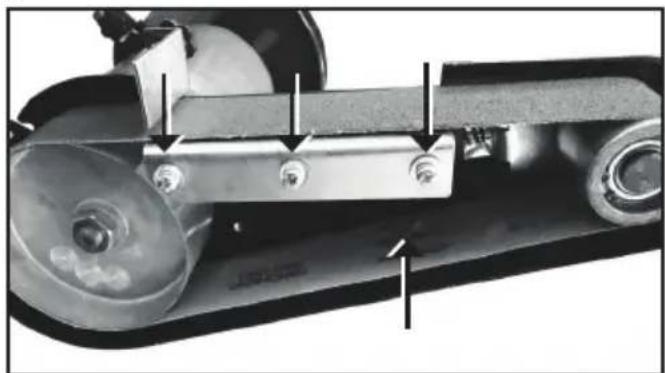
- Remove the Belt Access Cover (4) by loosening the three Belt Plate Screws (7) on the right side and sliding the Belt Access Cover up and then off the tool. The three screws are arrowed in image A
- Remove the existing belt by turning the Upper Roller Tensioner (2) anti-clockwise so the angle of the upper belt roller drops on the right and there is sufficient play to remove the belt
- Fit the new belt ensuring the direction of the belt is correct as indicated in image A by the lower arrow
-
Re-tighten the Upper Roller Tensioner and ensure all nuts and screws are secure and tightened
-
Check the belt runs evenly without moving to the left or right as it runs. Make adjustments to the Upper Roller Tensioner if necessary. A small limiter screw just above the Belt Tensioner (3) controls how much the roller drops on the right side
Note: Overall belt tension is controlled by the Belt Tensioner. Adjustment can be made by applying more or less tension to the spring by adjusting the height of the large nut. This should not be necessary in normal use but may be necessary if the belt is slipping or the belt is excessively tensioned.
Pre-operational checks
Always check that all parts or attachments are secure, and that rotating parts will not contact guards or machine case
Operation
WARNING: Always wear suitable personal protective equipment, including eye, hearing and respiratory protection, when operating this machine.
WARNING: Be aware that the cast metal motor housing may get hot during use.
WARNING: This tool is only suitable for one operator at a time and is designed so that a load is applied to one side only at a time.
Duty cycle: Do not exceed a maximum operating time of 30 minutes in every hour. It is recommended to keep to an operating time of no more than 10 minutes to reduce risk of damage to the tool from over-heating.
IMPORTANT: Fine particles of dust are created when grinding and sanding, some particles should not be inhaled or contact skin plus there is also the risk of fine metal particles damaging electrical tools if they enter vents. It is recommended dust extraction is used in the workshop where this tool is fitted. If this is not possible, regularly clean and vacuum the work area around the tool.
Switching on and off
Note: Do not switch the machine on or off when under load. Always allow the motor to reach its full speed before applying a load, and to stop completely before leaving unattended.
To switch the machine on, press the 'I' on the On/Off Switch (11)
To switch the machine off, press the 'O' on the On/Off Switch
Note: The higher the number on the dial the faster the spindle rotates.
Grinding
- DO NOT push the workpiece into the grinding wheel as you grind causing the grinding wheel to slow. Instead allow the grinding wheel to maintain full speed and apply very minimal pressure
- DO NOT use grinding wheels that are damaged or have worn down more than 25% from their original size
- Always hold work against the Tool Rest (16) and grip with both hands. Position yourself so you have a comfortable grip on the workpiece without being excessively close to the grinder. It is critical your clothes have no loose strands of material especially on your arms and close to your hands that could be caught by the grinding wheel forcing your hand into the grinding mechanism
DO NOT attempt to work on material that is too small to grip securely
Always refer to wheel manufacturer's literature before use. Check that the wheel is suitable for the material that you intend to work - Metal grinding may produce sparks especially if the Spark Arrestor (21) or Tool Rest is incorrectly fitted. Ensure that you are properly protected, and that any flammable materials are removed from the work area
- When grinding, the workpiece will quickly become hot. It may be necessary to quench the work in water to prevent heat damage. The fine-grade grinding wheel will produce less heat and may be safer to use for some materials that are easily heat damaged
- Some materials may contain trace amount of toxic materials. If you are unsure of the composition of the workpiece, it is recommended to remove grinding dust frequently and always wear suitable respiratory protection
Metallic dust can damage other tools if allowed to accumulate by vents and be drawn in when the tool is operated - When grinding, always keep the workpiece moving across the wheel surface to prevent uneven wear of the grinding wheel
- Use the correct the type of grinding wheel. A coarse grit can be used to take off a lot of material more quickly, a fine grit removes material more slowly and gives a finer finish
- When grinding has finished for the session, remove dust and vacuum the work area, and the tool
Sanding
IMPORTANT: The belt sander has two sanding positions: one is against the flat Belt Plate (5) and the other is against the larger lower belt roller. Do not sand above the Belt Plate or just above the roller where there is no backing surface. This may cause the belt to break.
Accessories
- A range of accessories and consumables including an 80 grit sanding belt, coarse grit grinding wheel and fine grit grinding wheel is available from your Silverline stockist. Spare parts can be obtained from toolsparesonline.com
Maintenance
WARNING: ALWAYS disconnect from the power supply before carrying out any inspection, maintenance or cleaning.
Removing and fitting a grinding wheel
Removing
- Re-position or remove the Spark Arrester (21) and Tool Rest (16) if necessary
- Remove the Wheel Guard (17) by removing the three Wheel Guard Nuts (14) and Wheel Guard Bolts (15)
- Remove the Belt Access Cover (4) by loosening the three Belt Plate Screws (7) on the right side and sliding the Belt Access Cover up and then off the tool
- Use a spanner on the nut of the main belt roller shown on the left (Image A) to prevent the motor spindle from turning
- Unscrew the Grinding Wheel (18) nut (Fig. V) by turning CLOCKWISE with a spanner
- Remove the Grinding Wheel flange ensuring that any additional washers are retained for the new Grinding Wheel
- Remove the old Grinding Wheel and clean the spindle and parts ready for the new Grinding Wheel
Fitting
- Check the condition of the new Grinding Wheel (18), making sure it is not damaged or cracked. Also ensure it is of the correct required grit before fitting
- Fit the new Grinding Wheel on the spindle ensuring any required washers are refitted
- Refit the Grinding Wheel flange and Grinding Wheel nut and tighten ANTI-CLOCKWISE while preventing the motor spindle from turning with a spanner attached to the main belt roller nut
- Re-assemble the Wheel Guard (17), Spark Arrestor (21) and Tool Rest (16) and refit the Belt Access Cover (4)
- Before use, run the Grinding Wheel for a minimum of 1 minute to ensure it operates normally
Note: During re-assembly, do not over-tighten the Grinding Wheel nut. Doing so will make it difficult to remove when disassembled at a later date.
Dressing a wheel
Over time the Grinding Wheel (18) surface may become uneven, pitted and unbalanced and will not work satisfactorily. A dressing tool should be used to restore the wheel surface to good working condition. A suitable tool is Silverline Diamond Wheel Dresser. Use the diamond grit head to clean the surface of the wheel. Do not over-use a wheel dresser. Only use when necessary as it accelerates wear of the wheel.
General inspection
Regularly check that all the fixing screws are tight
- Inspect the supply cord of the tool, prior to each use, for damage or wear. Repairs should be carried out by an authorised Silverine service centre. This advice also applies to extension cords used with this tool
Cleaning
- Keep your tool clean at all times. Dirt and dust will cause internal parts to wear quickly, and shorten the machine's service life. Clean the body of your machine with a soft brush, or dry cloth. If available, use clean, dry, compressed air to blow through the ventilation holes
Clean the tool casing with a soft damp cloth using a mild detergent. Do not use alcohol, petrol or strong cleaning agents - Never use caustic agents to clean plastic parts
Storage
- Store this tool carefully in a secure, dry place out of the reach of children
Disposal
Always adhere to national regulations when disposing of power tools that are no longer functional and are not viable for repair.
- Do not dispose of power tools, or other waste electrical and electronic equipment (WEEE), with household waste
- Contact your local waste disposal authority for information on the correct way to dispose of power tools
Troubleshooting
| Problem Possible cause Solution | ||
| Machine will not start | Plug fuse blown Replace fuse | |
| Circuit breaker tripped Reset circuit breaker | ||
| Tool fault Have the tool serviced by an authorised Silverline service centre | ||
| Excessive vibration when in use | Wheel out of balance Dress wheel | |
| Wheel loose Turn off immediately and tighten wheel fittings | ||
| Wheel damaged Turn off immediately and replace the wheel | ||
| Tool not fully secured to workbench Check and tighten bolts and fittings | ||
| Tool has been directly bolted to metal workbench or rubber feet missing or damaged | Fit a vibration-reducing material between the tool and the workbench surface.A small piece of wood would be satisfactory | |
| Sanding belt does not run evenly it goes left or right | Tool incorrectly set See 'Changing the belt' section | |
| Worn or incorrectly made belt Replace belt | ||
| 'Squealing' sound whilst sanding Belt slipping See 'Changing the belt' for tension adjustment | ||
| Motor housing getting excessively hot | Duty cycle not being followed | Ensure the duty cycle is followed with a maximum of 30 minutes use per hour. If the tool still gets excessively hot allow further cooling time as other factors including ambient temperature may increase the required cooling time. Running the tool well within the duty cycle may increase the working life of the tool |
| Unexpected noise from the tool | This is a high vibration tool and fittings can work loose over time | Check all fittings are correctly tightened. If any fittings are repeatedly becoming loose check the fittings order is correct and add spring washers or lock nuts if necessary |
| Worn internal parts or other fault Contact an authorised service centre | ||
Silverline Tools Guarantee
This Silverline product comes with a 3 year guarantee
Register this product at www.silverinetools.com within 30 days of purchase in order to qualify for the 3 year guarantee. Guarantee period begins according to the date of purchase on your sales receipt.
Registering your purchase
Registration is made at silverlinetools.com by selecting the Guarantee Registration button. You will need to enter:
- Your personal details
Details of the product and purchase information
Once this information is entered your guarantee certificate will be created in PDF format for you to print out and keep with your purchase.
Terms & Conditions
Guarantee period becomes effective from the date of retail purchase as detailed on your sales receipt.
PLEASE KEEP YOUR SALES RECEIPT
If this product develops a fault within 30 days of purchase, return it to the stockist where it was purchased, with your receipt, stating details of the fault. You will receive a replacement or refund.
If this product develops a fault after the 30 day period, return it to:
Silverline Tools Service Centre
PO Box 2988
Yeovil
BA21 1WU,UK
The guarantee claim must be submitted during the guarantee period.
You must provide the original sales receipt indicating the purchase date, your name, address and place of purchase before any work can be carried out.
You must provide precise details of the fault requiring correction.
Claims made within the guarantee period will be verified by Silverline Tools to establish if the deficiencies are related to material or manufacturing of the product.
Carriage will not be refunded. Items for return must be in a suitably clean and safe state for repair, and should be packaged carefully to prevent damage or injury during transportation. We may reject unsuitable or unsafe deliveries.
All work will be carried out by Silverline Tools or its authorized repair agents.
The repair or replacement of the product will not extend the period of guarantee
Defects recognised by us as being covered by the guarantee shall be corrected by means of repair of the tool, free of charge (excluding carriage charges) or by replacement with a tool in perfect working order.
Retained tools, or parts, for which a replacement has been issued, will become the property of Silverline Tools.
The repair or replacement of your product under guarantee provides benefits which are additional to and do not affect your statutory rights as a consumer.
What is covered:
The repair of the product, if it can be verified to the satisfaction of Silverline Tools that the deficiencies were due to faulty materials or workmanship within the guarantee period.
If any part is no longer available or out of manufacture, Silverline Tools will replace it with a functional replacement part.
Use of this product in the EU.
What is not covered:
Silverline Tools does not guarantee repairs required as a result of:
Normal wear and tear caused by use in accordance with the operating instructions eg blades, brushes, belts, bulbs, batteries etc.
The replacement of any provided accessories drill bits, blades, sanding sheets, cutting discs and other related items.
Accidental damage, faults caused by negligent use or care, misuse, neglect, careless operation or handling of the product.
Use of the product for anything other than normal domestic purposes.
Change or modification of the product in any way.
Use of parts and accessories which are not genuine Silverline Tools components.
Faulty installation (except installed by Silverline Tools).
Repairs or alterations carried out by parties other than Silverline Tools or its authorized repair agents.
Claims other than the right to correction of faults on the tool named in these guarantee conditions are not covered by the guarantee.
Introduction
Tension: 230V\~,50Hz
Puisance 240W
Cycle de service: S2 30 min (cycle court)
Vitesse a vide - meule (n0) 2950 tr/min
Dimensions de la meule 150x20 mm
Alésage de la meule 12.7 mm (%)
DimensiOns de la bande 686 x 50 mm
Silverline Tools Service Centre
PO Box 2988
Yeovil
BA21 1WU, GroBbritannien
Silverline Tools Service Centre
PO Box 2988
Yeovil
BA21 1WU,GB
Silverline Tools Service Centre
PO Box 2988
Yeovil
BA21 1WU,GB
Silverline Tools Service Centre
PO Box 2988
Yeovil
BA21 1WU, UK
GB 3 Year Guarantee. Register online within 30 days. Terms and Conditions apply.
- DIY 240W Bench Grinding & Belt Sander 150mm
- Introduction
- Description of Symbols
- Specification
- Sound and vibration information:
- General Power Tool SafetyWarnings
- 2- Consider work area environment
- Bench Grinding Safety
- Sanding Tool Safety
- Product Familiarisation
- Intended Use
- Unpacking Your Tool
- Before Use
- Assembling
- Attaching the spark arrestor with eye shield
- Attaching the tool rest
- Fitting the belt tool rest
- Changing the belt
- Pre-operational checks
- Operation
- Switching on and off
- Grinding
- Sanding
- Accessories
- Maintenance
- Removing and fitting a grinding wheel
- Removing
- Fitting
- Dressing a wheel
- General inspection
- Cleaning
- Storage
- Disposal
- Silverline Tools Guarantee
- This Silverline product comes with a 3 year guarantee
- Registering your purchase
- Terms & Conditions
- PLEASE KEEP YOUR SALES RECEIPT
- Silverline Tools Service Centre
- PO Box 2988
- Yeovil
- BA21 1WU,UK
- What is covered:
- What is not covered:
- BA21 1WU,GB
- BA21 1WU, UK
Brand : SILVERLINE
Model : 612519
Category : Grinding wheel