DCR-TRV7 - Camcorder SONY - Free user manual and instructions
Find the device manual for free DCR-TRV7 SONY in PDF.


User questions about DCR-TRV7 SONY
0 question about this device. Answer the ones you know or ask your own.
Ask a new question about this device
Download the instructions for your Camcorder in PDF format for free! Find your manual DCR-TRV7 - SONY and take your electronic device back in hand. On this page are published all the documents necessary for the use of your device. DCR-TRV7 by SONY.
USER MANUAL DCR-TRV7 SONY
Digital Video Camera Recorder
Operating Instructions
Before operating the unit, please read this manual thoroughly, and retain it for future reference.
The model and serial numbers are located on the bottom. Record the serial number in the space provided below. Refer to these numbers whenever you call upon your Sony dealer regarding this product.
Model No. DCR-TRV7 Model No. AC-V316
Serial No. Serial No.
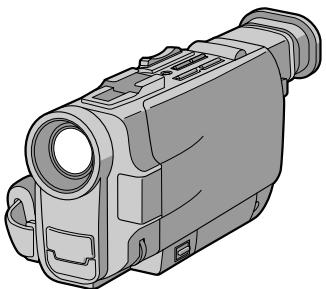
DCR-TRV7
Mini Digital Video Cassette
Handycam Vision
Cassette Memory
WARNING
To prevent fire or shock hazard, do not expose the unit to rain or moisture.
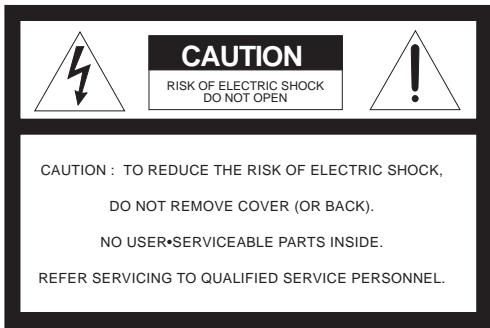
This symbol is intended to alert the user to the presence of uninsulated "dangerous voltage" within the product's enclosure that may be of sufficient magnitude to constitute a risk of electric shock to persons.

This symbol is intended to alert the user to the presence of important operating and maintenance (servicing) instructions in the literature accompanying the appliance.
For the Customers in the U.S.A. and CANADA
DISPOSAL OF LITHIUM ION BATTERY. LITHIUM ION BATTERY.
DISPOSE OF PROPERLY.
You can return your unwanted lithium ion batteries to your nearest Sony Service Center or Factory Service Center.
Note: In some areas the disposal of lithium ion batteries in household or business trash may be prohibited.
For the Sony Service Center nearest you call 1-800-222-SONY (United States only).
For the SONY Factory Service Center nearest you call 416-499-SONY (Canada only).
Caution: Do not handle damaged or leaking lithium ion batteries.
For the Customers in the U.S.A. CAUTION
You are cautioned that any changes or modifications not expressly approved in this manual could void your authority to operate this equipment.
Note:
This equipment has been tested and found to comply with the limits for a Class B digital device, pursuant to Part 15 of the FCC Rules. These limits are designed to provide reasonable protection against harmful interference in a residential installation. This equipment generates, uses, and can radiate radio frequency energy and, if not installed and used in accordance with the instructions, may cause harmful interference to radio communications. However, there is no guarantee that interference will not occur in a particular installation. If this equipment does cause harmful interference to radio or television reception, which can be determined by turning the equipment off and on, the user is encouraged to try to correct the interference by one or more of the following measures:
Reorient or relocate the receiving antenna.
- Increase the separation between the equipment and receiver.
- Connect the equipment into an outlet on a circuit different from that to which the receiver is connected.
- Consult the dealer or an experienced radio/TV technician for help.
For the Customers in CANADA CAUTION
TO PREVENT ELECTRIC SHOCK, DO NOT USE THIS POLARIZED AC PLUG WITH AN EXTENSION CORD, RECEPTACLE OR OTHER OUTLET UNLESS THE BLADES CAN BE FULLY INSERTED TO PREVENT BLADE EXPOSURE.
Espanol
Checking supplied accessories 6
Getting started
Charging and installing the battery pack 7
Inserting a cassette 11
Basic operations
Camera recording 12
Using the zoom feature 15
Selecting the start/stop mode 16
Shooting with the LCD screen 17
Letting the subject monitor the shot 18
Hints for better shooting 20
Checking the recorded picture 22
Playing back a tape 23
Searching for the end of the picture 26
Advanced operations
Using alternative power sources 27
Using the house current 27
Using a car battery 28
Changing the mode settings 29
-for camera recording
Fade-in and fade-out 34
Shooting with backlighting 36
Photo recording 37
Enjoying picture effect 39
Using the wide mode function 41
Using the PROGRAM AE function 42
Focusing manually 44
Adjusting the exposure 46
Releasing the STEADYSHOT function 48
—for playing back/editing—
Watching on a TV screen 50
Searching the boundaries of recorded tape with date 52
Searching the boundaries of recorded tape with title 56
Searching for a photo - photo search/photo scan 58
Returning to a pre-registered position 62
Displaying recording data - data code function 63
Editing onto another tape 64
Replacing recording on a tape - insert editing 67
Audio dubbing 68
Superimposing a title 70
Making a custom title 74
Labeling a cassette 76
Additional information
Usable cassettes and playback modes 78
Charging the vanadium-lithium battery in the camcorder 80
Resetting the date and time 81
Tips for using the battery pack 83
Maintenance information and precautions 89
Using your camcorder abroad 94
Trouble check 95
Specifications 107
Identifying the parts 109
Warning indicators 118
Index Back cover
Pasos previos
Congratulations on your purchase of this Sony Handycam Vision™ camcorder. With your Handycam Vision, you can capture life's precious moments with superior picture and sound quality. Your Handycam Vision is loaded with advanced features, but at the same time it is very easy to use. You will soon be producing home video that you can enjoy for years to come.
As you read through this manual, buttons and settings on the camcorder are shown in capital letters.
e.g., Set the POWER switch to CAMERA.
As indicated with in the illustrations, you can hear the beep sound to confirm your operation.
Note on Cassette Memory
This camcorder is based on the DV format. You can only use mini DV cassettes with this camcorder. We recommend you to use a tape with cassette memory [III].
The functions which depend on whether the tape has the cassette memory or not are:
End Search (p. 22)
- Date Search (p. 52)
- Photo Search (p. 58).
The functions you can operate only with the cassette memory are:
- Title Search (p. 56)
Superimposing a title(p. 70) - Making a custom title (p. 74)
- Labeling a cassette (p. 76)
For details, see page 78.
Note on TV color systems
TV color systems differ from country to country. To view your recordings on a TV, you need an NTSC system-based TV.
Bienvenido!
Precaution on copyright
Television programs, films, video tapes, and other materials may be copyrighted. Unauthorized recording of such materials may be contrary to the provision of the copyright laws.
Precautions on camcorder care
- The LCD screen and/or the color viewfinder are manufactured using high-precision technology. However, there may be some tiny black points and/or bright points (red, blue or green in color) that constantly appear on the LCD screen and/or in the viewfinder. These points are normal in the manufacturing process and do not affect the recorded picture in any way. Over 99.99% are operational for effective use.
- Do not let the camcorder get wet. Keep the camcorder away from rain and sea water. Letting the camcorder get wet may cause the unit to malfunction, and sometimes this malfunction cannot be repaired [a].
- Never leave the camcorder exposed to temperatures above 140^ (60^) , such as in a car parked in the sun or under direct sunlight [b].
Checking supplied accessories
Check that the following accessories are supplied with your camcorder.
1 Wireless Remote Commander (1) (p. 113)
NP-F530 battery pack (1) (p. 7)
AC-V316 AC power adaptor (1) (p. 7, 27) The shape of the plug varies from region to region.
4 Size AA(R6) battery for Remote Commander (2) (p. 114)
5 A/V connecting cable (1) (p. 50, 65)
6 Shoulder strap (1) (p. 115)
Lens cap (1) (p. 12)
Contents of the recording cannot be compensated if recording or playback is not made due to a malfunction of the camcorder, video tape, etc.
Charging and installing the battery pack
Before using your camcorder, you first need to charge and install the battery pack. To charge the battery pack, use the supplied AC power adaptor.
This camcorder operates with the
"InfoLITHIUM" battery. If you use any other battery to operate your camcorder, the camcorder may not operate or the battery life may be shorten.
"InfoLITHIUM" is a trademark of Sony Corporation.
Charging the battery pack
Charge the battery pack on a flat surface without vibration.
(1) Connect the power cord to a wall outlet.
(2) Align the surface of the battery pack indicated by the mark with the edge of the terminal shutter of the AC power adaptor. Then fit and slide the battery pack in the direction of the arrow. The CHARGE lamp (orange) lights up. Charging begins.
When the CHARGE lamp goes out, normal charge is completed. For full charge, which allows you to use the battery longer than usual, leave the battery pack in place for approximately one hour. Unplug the unit from the wall outlet, then remove the battery pack and install it into the camcorder. You can also use the battery pack before it is completely charged.
The time required for a normal charge is indicated in parentheses.
- Approximate minutes to charge an empty battery pack using the supplied AC power adaptor. (Lower temperatures require a longer charging time.)
Battery life
While using with viewfinder
| Battery pack | Continuous recording time ** | Typical recording time *** |
| NP-F530 (supplied) | 110 (100) | 80 (70) |
| NP-F730 | 255 (230) | 190 (170) |
| NP-F930 | 400(360) | 220(195) |
While using with LCD
| Battery pack | Continuous recording time ** | Typical recording time *** | Playing time with LCD |
| NP-F530 (supplied) | 80 (70) | 40 (35) | 85 (75) |
| NP-F730 | 190 (170) | 100 (90) | 195 (175) |
| NP-F930 | 295(265) | 160(145) | 300 (270) |
Numbers in parentheses indicate the time when you use a normally charged battery. Battery life will be shorter if you use the camcorder in a cold environment.
** Approximate continuous recording time indoors.
*** Approximate minutes when recording while you repeat recording start/stop, zooming and turning the power on/off. The actual battery life may be shorter.
Tiempo de energia
| Paquete de bateria | Tiempo de energia |
| NP-F530 (suministrado) | 170 (110) |
| NP-F730 | 250 (190) |
| NP-F930 | 330(270) |
Notes on remaining battery time indication during recording
- Remaining battery time is displayed in the viewfinder or on the LCD screen. However, the indication may not be displayed properly, depending on using conditions and circumstances.
- When you close the LCD panel and open it again, it takes about 1 minute for the correct remaining time to be displayed.
To remove the battery pack
Slide the battery pack in the direction of the arrow.
Notes on charging the battery pack
- The CHARGE lamp will remain lit for a while even if the battery pack is removed and the power cord is unplugged after charging the battery pack. This is normal.
- If the CHARGE lamp does not light, disconnect the power cord. After about one minute, reconnect the power cord again.
- You cannot charge the battery pack while you operate the camcorder using the AC power adaptor.
- When a fully charged battery pack is installed, the CHARGE lamp will light once, then go out.
Installing the battery pack
(1) Lift up the viewfinder.
(2) Insert the battery pack in the direction of the mark on the battery pack. Slide the battery pack down until it fits in.
Attach the battery pack to the camcorder securely.
Notes on installing the NP-F730/F930 battery pack
- Use the camcorder while lifting up the viewfinder slightly.
- Do not forcibly put down the viewfinder. It may damage the camcorder.
Note on the battery pack
Do not carry the camcorder by grasping the battery pack.
To remove the battery pack
While pressing BATT RELEASE, slide the battery pack in the direction of the arrow.
You can look at the demonstration of the functions available with this camcorder (p. 117).
Make sure that the power source is installed.
(1) Slide OPEN/EJECT near the grep strap in the direction of the arrow and open the lid. The cassette compartment automatically lifts up and opens.
(2) Insert a cassette with the window facing out.
(3) Close the cassette compartment by pressing the mark on the cassette compartment. The cassette compartment automatically goes down.
(4) Close the lid until it clicks.
- Mini D is a trademark.
- Before you close the lid of the cassette compartment, make sure the cassette compartment is completely pulled down.
- When you open the lid immediately after you install the battery, the cassette compartment may not lift up. Close the lid and open it again.
To eject the cassette
Follow the procedure above and in step 2, take out the cassette.
To Prevent Accidental Erasure
Slide and open the tab on the cassette to expose the red mark. If you try to record with the red mark exposed, the and indicators flash on the LCD screen or in the viewfinder, and you cannot record on the tape. To re-record on this tape, slide and close the tab to cover the red mark.
Notas
Make sure that the power source is installed and a cassette is inserted and that the START/STOP MODE switch inside the LCD panel is set to . Before you record one-time events, you may want to make a trial recording to make sure that the camcorder is working correctly.
When you use the camcorder for the first time, power on it and reset the date and time to your time before you start recording (p. 81).
To save battery power, the picture in the viewfinder appears only when you bring your face close to the viewfinder (Finder power save).
(1) Remove the lens cap and hook it onto the grip strap.
(2) While pressing the small green button on the POWER switch, set it to CAMERA. The camcorder is set to Standby mode.
(3) Press START/STOP.
The camcorder starts recording. "REC" appears in the viewfinder. The camera recording lamp on the front of the camcorder also lights up.
You can also select Recording mode, SP (standard play) mode or LP (long play) mode.
Set REC MODE in the menu system according to the length of your planned recording before you start.
To stop recording momentarily [a]
Press START/STOP. The "STBY" indicator appears in the viewfinder (Standby mode).
To finish recording [b]
Press START/STOP again to stop recording. Set the POWER switch to OFF. Then, eject the cassette and remove the battery pack.
![SONY DCR-TRV7 - To finish recording [b] - 1](/content/2024/11/48823/images/7ada2792b2c86f01ce4e1c5b22e3d281007828fbe3bbc6fa31edfc83f4a6d22e.jpg)
To focus the viewfinder lens
If you cannot see the indicators in the viewfinder clearly, or after someone else has used the camcorder, focus the viewfinder lens. Move the viewfinder lens adjustment lever so that the indicators in the viewfinder come into sharp focus.
If you leave the camcorder in Standby mode for 5 minutes while the cassette is inserted, the camcorder turns off automatically. This prevents wearing down the battery and wearing out the tape. To resume Standby mode, while pressing the small green button on the POWER switch, set it to OFF once, and then to CAMERA. To start recording, press START/STOP.
Note on recording mode
This camcorder records and plays back in SP (standard play) mode and in LP (long play) mode. Select SP or LP in the menu system. In LP mode, you can record 1.5 times as long as in SP mode.
Notasobreelmododeespera
- We recommend to use this camcorder to play back a tape recorded on this camcorder. If a tape recorded on other camcorder is played back on this camcorder, or vice versa, mosaic-pattern noise may appear.
- When you record in SP and LP modes on one tape or you record some scenes in LP mode, the playback picture may be distorted or the time code may not be written properly between scenes.
- When you record in LP mode, we recommend you to use a Sony Excellence/Master mini DV cassette so that you can get the most out of your camcorder.
- You cannot make audio dubbing on a tape recorded in LP mode. Use the SP mode for the tape to be audio dubbed.
Notes on the time code
- The time code indicates the recording or playback time, "0:00:00" (hours : minutes : seconds) in CAMERA and PHOTO mode and "0:00:00:00" (hours : minutes : seconds : frames) in VTR mode.
- Be sure not to make a blank portion when recording, because the time code will start from "0:00:00:00" again.
- This camcorder uses the drop frame mode.
Note on the beep sound
As indicated with in the illustrations, a beep sounds when you turn the power on or when you start recording, and two beeps sound when you stop recording, confirming the operation. Several beeps also sound as a warning of any unusual condition of the camcorder.
Note that the beep sound is not recorded on the tape. If you do not want to hear the beep sound, select "OFF" in the menu system.
Notes on finder power save
- The recording continues even when the picture in the viewfinder disappears during recording.
- If you set VF PW-SAVE to OFF in the menu system, the picture in the viewfinder does not disappear even when you turn your face away from the viewfinder.
Note on remaining tape indicator
The indicator may not be displayed accurately depending on the tape. Though the indicator does not appear at the time of recording, it will appear in a few seconds.
Using the zoom feature
Zooming is a recording technique that lets you change the size of the subject in the scene.
For more professional-looking recordings, use the zoom function sparingly.
"T" side: for telephoto (subject appears closer)
"W" side: for wide-angle (subject appears farther away)
Zooming speed (Variable speed zooming)
Press the power zoom switch a little for a relatively slow zoom; press it still more for a high-speed zoom.
When you shoot a subject using a telephoto zoom
If you cannot get a sharp focus while in extreme telephoto zoom, press the "W" side of the power zoom switch until the focus is sharp. You can shoot a subject that is at least about 2 5/8 feet (about 80~cm ) away from the lens surface in the telephoto position, or about 1/2 inch (about 1cm ) away in the wide-angle position.
Notes on digital zoom
- More than 10x zoom is performed digitally, and the picture quality deteriorates as you go toward the "T" side. If you do not want to use the digital zoom, set the D ZOOM function to OFF in the menu system.
- The right side [a] of the power zoom indicator shows the digital zooming zone, and the left side [b] shows the optical zooming zone. If you set the D ZOOM function to OFF, the [a] zone disappears.
Selecting the start/stop mode
Your camcorder has two modes besides normal start/stop mode. These modes enable you to take a series of quick shots resulting in a lively video.
(1) While pressing PUSH OPEN, open the LCD panel.
(2) Set START/STOP MODE to the desired mode.
:Recording starts when you press START/ STOP, and stops when you press it again (normal mode).
ANTI GROUND SHOOTING: The camcorder records only while you press down START/STOP so that you can avoid recording unnecessary scenes.
5SEC : When you press START/STOP, the camcorder records for 5 seconds and then stops automatically.
(3) Press START/STOP. Recording starts.
If you selected 5SEC, five dots appear in the viewfinder or on the LCD screen. The dots disappear at a rate of one per second as illustrated below. When five seconds elapse and all the dots disappear, the camcorder switches to Standby mode automatically.
To extend the recording time in 5SEC mode
Press START/STOP again before all the dots disappear. Recording continues for about 5 seconds from the moment you press START/ STOP.
Note on 5SEC recording
If you have turned off the indicators on the LCD screen, the dots do not appear.
Shooting with the LCD screen
You can also record the picture while looking at the LCD screen.
When using the LCD screen, the viewfinder turns off automatically except in mirror mode. You cannot monitor the sound from the speaker during recording.
(1) When pressing PUSH OPEN, open the LCD panel.
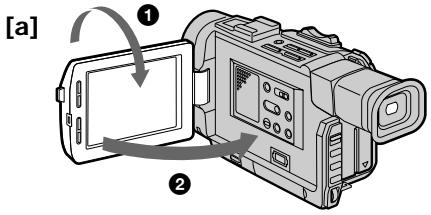
(2) Adjust angle of the LCD panel The LCD panel moves about 90 degrees to this side and about 210 degrees to the other side. To adjust the brightness of the LCD screen, press LCD BRIGHT ^+ or -
The battery life is longer when the LCD panel is closed. Use the viewfinder instead of the LCD screen to save the battery power.
Notes on the LCD panel
- When closing the LCD panel, turn it vertically until it clicks [a].
- When turning the LCD panel, turn it always vertically; otherwise, the camcorder body may be damaged or the LCD panel may not close properly [b].
- Close the LCD panel completely when not in use.
- Do not push nor touch the LCD when moving the LCD panel.
- You may find it difficult to view the LCD screen due to glare when using the camcorder outdoors.
Letting the subject monitor the shot
You can turn the LCD panel over so that it faces the other way and you can let the subject monitor the shot while shooting with the viewfinder.
Turn the LCD panel up vertically. When you turn the LCD panel 180 degrees, the indicator appears on the LCD screen (mirror mode) and the time code and remaining tape indicators disappear.
You can also use the Remote Commander.
Turn the LCD panel down toward the camcorder body.
Notes on mirror mode
- When you turn the LCD panel about 90 degrees to 210 degrees, the camcorder enters mirror mode.
- Using the mirror mode, you can record yourself while watching yourself on the LCD [a].
- The picture on the LCD looks like a mirror-image while recording in mirror mode. The STBY indicator appears as 11 and REC as . Other indicators appear as mirror-image. Some indicators may not appear in mirror mode.
- While recording in mirror mode, you cannot operate the following functions: MENU, TITLE, DATA CODE and ZERO SET MEMORY on the Remote Commander.
For hand-held shots, you will get better results by holding the camcorder according to the following suggestions:
- Hold the camcorder firmly and secure it with the grip strap so that you can easily manipulate the controls with your thumb. [a]
Place the camcorder on a flat surface or use a tripod
Try placing the camcorder on a table top or any other flat surface of suitable height. If you have a tripod for a still camera, you can also use it with the camcorder. When attaching a non-Sony tripod, make sure that the length of the tripod screw is less than 9/32 inch (6.5mm) . Otherwise, you cannot attach the tripod securely and the screw may damage the camcorder.
If you wear glasses
You can bend back the eyecup to get a better view of viewfinder [d].
Cautions on the LCD panel and on the viewfinder
- Do not pick up the camcorder by the viewfinder or the LCD panel [e].
- Do not place the camcorder so as to point the viewfinder or the LCD panel toward the sun. The inside of the viewfinder or the LCD panel may be damaged. Be careful when placing the camcorder under sunlight or by a window [f].
Using the EDITSEARCH, you can review the last recorded scene or check the recorded picture in the viewfinder.
(1) While pressing the small green button on the POWER switch, set it to CAMERA.
(2) Press the - side of EDITSEARCH momentarily; the last few seconds of the recorded portion plays back (Rec Review). Hold down the - side of EDITSEARCH until the camcorder goes back to the scene you want. The last recorded portion is played back. To go forward, hold down the + side (Edit Search).
To stop playback Release EDITSEARCH
To go back to the last recorded point (END SEARCH)
Press END SEARCH. The last recorded point is played back for about 5 seconds and stops. Note that when you use a tape without cassette memory, this function does not work once you eject the cassette after recording.
To begin re-recording
Press START/STOP. Re-recording begins from the point you released EDITSEARCH. Provided you do not eject the tape, the transition between the last scene you recorded and the next scene you record will be smooth.
Para detener la reproduccion Suelte EDITSEARCH.
You can monitor the playback picture on the LCD screen or in the viewfinder.
(1) Insert the recorded tape with the window facing out.
(2) While pressing PUSH OPEN, open the LCD panel.
(3) While pressing the small green button on the POWER switch, set it to VTR.
(4) Slide OPEN and pull the video control compartment until it clicks.
(5) Press to rewind the tape.
(6) Press to start playback.
(7) Adjust the volume using VOLUME + / - and the brightness of the LCD screen using LCD BRIGHT + / -
You can also monitor the picture on a TV screen, after connecting the camcorder to a TV or VCR.
Using the Remote Commander
You can control playback using the supplied Remote Commander. Before using the Remote Commander, insert the size AA (R6) batteries.
Para detener la reproduccion, pulse.
Para rebobinar la cinta, pulse
To display the LCD screen/viewfinder screen indicators
Press DISPLAY.
To erase the indicators, press again.
Notes on screen indicators
- The screen indicator disappears when the title is displayed.
- When you play back a tape using a "InfoLITHIUM" battery, indicates the remaining battery capacity. The remaining battery time in minutes is not displayed.
Using headphones
Connect headphones (not supplied) to the jack. You can adjust the volume of the headphones using VOLUME + / -
To view the playback picture in the viewfinder Close the LCD panel. The viewfinder turns on automatically.
When using the viewfinder, you can monitor the sound only by using headphones.
To view on the LCD screen again, open the LCD panel. The viewfinder turns off automatically.
Various playback modes
To view a still picture (playback pause)
Press I during playback. To resume playback, press I or
To locate a scene (picture search)
Keep pressing or during playback. To resume normal playback, release the button.
To monitor the high-speed picture while advancing the tape or rewinding (skip scan)
Keep pressing while rewinding or while advancing the tape. To resume normal rewinding or fast-forward, release the button.
To view the picture at 1/3 speed (slow playback)
Press on the Remote Commander during playback. For slow playback in reverse direction, press < , then press. To resume normal playback, press
Para visualizar losindicadores de pantalla del panelLCD o del visor electrico Pulse DISPLAY.
To view the picture at double speed
For double speed playback in the reverse direction, press < , then press × 2 on the Remote Commander during playback. For double speed playback in the forward direction, press > , then press × 2 during playback. To resume normal playback, press .
To view the picture frame-by-frame
Press or on the Remote Commander in playback pause mode. If you keep pressing the button, you can view the picture at 1/30 speed. To resume normal playback, press .
To change the playback direction
Press < on the Remote Commander for reverse direction or > on the Remote Commander for forward direction during playback. To resume normal playback, press .
Notes on playback
- The sound is muted in the various playback modes.
- During playback other than normal playback, the previous recording may appear in mosaic image. This is not malfunction.
- When playback pause mode lasts for 5 minutes, the camcorder automatically enters stop mode. To resume playback, press .
Note on slow playback
The slow playback can be performed smoothly on this camcorder; however, this function does not work for an output signal from the DV IN OUT jack.
Searching for the end of the picture
You can go to the end of the recorded portion after you record and play back the tape. The tape starts rewinding or fast-forwarding and the last about 5 seconds of the recorded portion plays back. Then the tape stops at the end of the recorded picture (End Search).
Open the LCD panel and press END SEARCH during recording standby. This function works when the POWER switch is set to CAMERA, VTR or PHOTO.
When you use a tape without cassette memory, the End Search function does not work once you eject the cassette after recording.
Using alternative power sources
You can choose any of the following power sources for your camcorder: battery pack, house current, and 12/24V car battery. Choose the appropriate power source depending on where you want to use your camcorder.
| Place | Power source | Accessory to be used |
| Indoors | House current | Supplied AC power adaptor |
| Outdoors | Battery pack | Battery pack NP-F530 (supplied), NP-F730, NP-F930 |
| In the car | 12 V or 24 V car battery | Sony car battery charger DC-V515A |
Note on power sources
Disconnecting the power source or removing the battery pack during recording or playback may damage the inserted tape. If this happens, restore the power supply again immediately.
Using the house current
To use the supplied AC power adaptor:
(1) Connect the power cord to a wall outlet.
(2) Lift up the viewfinder.
(3) Slide the connecting plate down into the guides at the rear of the camcorder until it clicks.
Uso de corrente domestica
Paraemployereladaptadordealimentacionde CA suministrado:
To remove the connecsting plate
The connecting plate is removed in the same way as the battery pack.
Para extraer la plac de connexion
The power cord must only be changed at a qualified service shop.
PRECAUTION
The set is not disconnected from the AC power source (mains) as long as it is connected to the power cord, even if the set itself has been turned off.
Using a car battery
Use a car battery charger such as Sony DC-V515A (not supplied). Connect the car battery cord to the cigarette lighter socket of a car (12 V or 24 V). Connect the car battery charger and the camcorder using the DK-315 (supplied with DC-V515A) connecting cord.

This mark indicates that this product is a genuine accessory for Sony video product.
When purchasing Sony video products, Sony recommends that you purchase accessories with this "GENUINE VIDEO ACCESSORIES" mark.
ADVERTENCIA
El cable de alimentacion debe ser sustituido unicamente en un centro de service Tecnico especializzato.
PRECAUCION
Changing the mode settings
You can change the mode settings in the menu system to further enjoy the features and functions of the camcorder.
(1) Press MENU to display the menu on the LCD screen.
(2) Turn the CONTROL dial to select the desired item, then press the CONTROL dial. Only the selected item is displayed.
(3) Turn the CONTROL dial to select the desired mode, then press the CONTROL dial. If you want to change the other modes, repeat steps 2 and 3.
(4) Press MENU to erase the menu display.
While recording in mirror mode, you cannot operate the menu system.
Note on changing the mode settings
Menu items differ depending on the setting of the POWER switch to VTR or CAMERA/ PHOTO.
Selecting the mode setting of each item
Items for both CAMERA/PHOTO and VTR modes
COMMANDER*
- Select ON when using the supplied Remote Commander for the camcorder.
- Select OFF when not using the Remote Commander.
REC MODE
- Select SP when recording in SP (standard play) mode.
- Select LP when recording in LP (long play) mode.
BEEP
- Select ON so that beeps sound when you start/stop recording, etc.
- Select OFF when you do not want to hear the beep sound.
TITLE ERASE
Erase the title you have superimposed.
LCD B.L.
- Normally select BRT NORMAL.
- Select BRIGHT when the LCD panel is dark. Even if you adjust the LCD B.L., the recorded picture is not affected.
LCD COLOR
Select this item and change the level of the indicator by turning CONTROL dial up (+) or down (-) to adjust the color intensity of the picture.
Close the LCD panel.
Select this item to adjust the brightness of the viewfinder. The viewfinder becomes brighter when you turn the CONTROL dial up (+) , and darker when you turn it down (-) .
VF PW-SAVE
- Select ON to activate "finder power save" (page 14).
- Select OFF to inactivate "finder power save".
DISPLAY
- Normally select LCD.
- Select V-OUT/LCD to display indicator both on the LCD panel and TV screen.
Items for CAMERA/PHOTO mode only
D ZOOM
- Select ON to activate digital zooming.
- Select OFF not to use the digital zoom. The camcorder goes back to 10x optical zoom.
STEADYSHOT
- Normally select ON.
- Select OFF when you do not have to worry about camera-shake.
REC LAMP
- Normally select ON.
- Select OFF when you do not want the camera recording/battery lamp at the front of the unit to light up.
CLOCK SET
Select this item to reset the date or time.
VF BRIGHT
- Select STBY to glance over the function of camcorder.
- Select OFF not to display demonstration.
Notes on DEMO MODE
- DEMO MODE is set to STBY(Standby) at the factory and the demonstration starts about 10 minutes after you set the POWER switch to CAMERA without inserting a cassette. Note that you cannot select STBY of DEMO MODE in the menu system.
- You cannot select DEMO MODE when a cassette is inserted in the camcorder.
- If you insert a cassette during the demonstration, the demonstration stops. You can start recording as usual. DEMO MODE automatically returns to STBY.
To look at the demonstration at once
Eject the cassette, if inserted. Select STBY of DEMO MODE and erase the menu display. The demonstration will begin.
When you turn off the camcorder once, DEMO MODE automatically returns to STBY.
AUDIO MODE <12BIT/16BIT>
- Normally select 12BIT to record two stereo sound.
- Select 16BIT to record the one stereo sound with high quality.
Items for VTR mode only
TITLE DSPL
- Select ON to display the title you have superimposed.
- Select OFF not to display the title.
TAPE TITLE
Select this item to label the cassette tape.
AUDIO MIX*
Select this item and adjust the balance between the stereo 1 and stereo 2 by turning the CONTROL dial.
DEMO MODE
- Select ON to search using cassette memory.
- Select OFF to search without using cassette memory.
DATA CODE
- Select DATE/CAM to display date and recording data during playback.
-
Select DATE to display date during playback.
-
These settings are retained even when the battery is removed, as long as the vanadium-lithium battery is charged. As far as the items without an asterisk are concerned, their settings return to the default 5 minutes or more after the battery is removed.
When recording a close subject
When REC LAMP is set to ON, the red camera recording lamp on the front of the camcorder may reflect on the subject if it is close. In this case, we recommend you set REC LAMP to OFF.
Note
- When playing back a tape recorded in the 16-bit mode, you cannot adjust the balance in AUDIO MIX.
- If you select 16BIT in AUDIO MODE menu, you cannot add an audio sound.
- If you select BRIGHT in LCD B.L. menu, the battery life while recording becomes 10 to 20% shorter. When you use the power sources except for a battery, the menu item LCD B.L. is set to BRIGHT automatically and the item does not appear in the screen.
CM SEARCH
You can fade in or out to give your recording a professional appearance.
When fading in, the picture gradually fades in from black while the sound increases. When fading out, the picture gradually fades to black while the sound decreases.
When fading in [a]
(1) While the camcorder is in Standby mode, press FADER until the desired indicator flashes.
(2) Press START/STOP to start recording. The fade indicator stops flashing.
When fading out [b]
(1) During recording, press FADER until the desired indicator flashes.
(2) Press START/STOP to stop recording. The fade indicator stops flashing, and then recording stops.
Before pressing START/STOP, press FADER until the fade indicator disappears.
When the POWER switch is set to PHOTO, or the START/STOP MODE control is set to ANTI GROUND SHOOTING or 5SEC
You cannot use the fade-in/fade-out function.
Note on the fader function
You cannot use the following function while using the fader function. Also, while using the following functions you cannot use the fader function.
-Title
Shooting with backlighting
When you shoot a subject with the light source behind the subject or a subject with a light background, use the BACK LIGHT function.
Press BACK LIGHT. The indicator appears on the LCD or in the viewfinder.
[a] Subject is too dark because of backlight.
[b] Subject becomes bright with backlight compensation.
After shooting
Be sure to release this adjustment condition by pressing BACK LIGHT again. The indicator disappears. Otherwise, the picture will be too bright under normal lighting condition.
This function is also effective under the following conditions:
- A subject with a light source nearby or a mirror reflecting light
- A white subject against a white background. Especially when you shoot a person wearing shiny clothes made of silk or synthetic fibre, his or her face tends to become dark if you do not use this function.
Note on the BACK LIGHT function
When you press EXPOSURE, the BACK LIGHT function is cancelled.
You can record a still picture like a photograph for about seven seconds. This mode is useful when you want to enjoy a picture such as a photograph or when you print a picture using a video printer (not supplied). You can record about 510 pictures on a 60-minute tape in SP mode.
Shutter speed is automatically adjusted up to 1/1000 depending on the exposure.
(1) While pressing the small green button on the POWER switch, set it to PHOTO. Two beeps sound.
(2) Keep pressing START/STOP lightly until a still picture and "PHOTO CAPTURE" appear on the LCD screen or in the viewfinder.
Recording does not start yet. To change the still picture, release START/STOP, select still picture again, and keep pressing START/ STOP lightly again.
If you press the PHOTO button on the Remote Commander when a still picture appears on the LCD screen or in the viewfinder, the camcorder will record that still picture.
However, you cannot select other still pictures by using this button.
(3) Press START/STOP deeper.
"PHOTO REC" flashes and the still picture on the LCD screen or in the viewfinder is recorded for about seven seconds. The sound during those seven seconds is also recorded and the pictures appear like an animation on the LCD screen or in the viewfinder. You cannot change the POWER switch or press START/STOP during recording.
Note on the still picture
When the still picture recorded on this camcorder is played back on another VCR, the picture may be blurred. This is not a malfunction.
Note on the video flash light
We recommend you to use the HVL-FDH video flash light (not supplied) when shooting in the dark. When you use the video flash light, set AUTO LOCK to ON.
When 3 appears, the video flash light is ready for flashing.
When 2 flashes, you cannot use the video flash light. Check AUTO LOCK again.
Printing the still picture
You can print a still picture by using the video printer (not supplied). Connect the video printer using the S video connecting cable (not supplied). Refer to the instruction manual of the video printer as well.
If the video printer is not equipped with SVIDEO input
Use the supplied A/V connecting cable. Connect it to the AUDIO/VIDEO OUT jack and connect the yellow plug of the cable to the VIDEO input of the video printer.
Selecting picture effect
You can make pictures like those of television with the Picture Effect function.
The picture is in pastel tones.
NEG. ART [b]
The color of the picture is reversed.
SEPIA
The picture is sepia.
B&W
The picture is monochrome (black and white).
SOLARIZE [c]
The light intensity is clearer, and the picture looks like an illustration.
MOSAIC [d]
The picture is mosaic.
SLIM [e]
The picture expands vertically.
STRETCH [f]
The picture expands horizontally.
![SONY DCR-TRV7 - STRETCH [f] - 1](/content/2024/11/48823/images/b174f018393e18eb2e58d43cf563e0af7cf3879ae16200ac2bffd64856bdb716.jpg)
[d]
![SONY DCR-TRV7 - STRETCH [f] - 2](/content/2024/11/48823/images/b6f695ecbecaae93d40129aa1e2bee45dd359269658d3beb0aba52bed87f4f3d.jpg)
[e]
![SONY DCR-TRV7 - STRETCH [f] - 3](/content/2024/11/48823/images/2f67d194bcfb4bd90f07d4ca4b9ffd61689d519a1fad235c72f1bef05fe2d685.jpg)
[f]
PASTEL [a]
LaImagenaparececontonospastel.
NEG. ART [b]
El color de laImagen se invierte.
SEPIA
LaImagenesepia.
B&W
Using picture effect function
(1) While in Standby mode, press PICTURE EFFECT.
(2) Turn the CONTROL dial to select the desired Picture Effect mode.
Returning to normal mode
Press PICTURE EFFECT repeatedly until the Picture Effect indicator disappears.
Note on the picture effect
When you turn the power off, the camcorder returns automatically to normal mode.
You can record a 16:9 wide picture to watch on the 16:9 wide-screen TV (16:9WIDE).
The picture with black bands at the top and the bottom on the LCD screen or in the viewfinder [a] is normal. The picture on a normal TV [b] is horizontally compressed. You can watch the picture of normal images on a wide-screen TV [c].
While in Standby mode, press 16:9 WIDE. 16:9 WIDE appears on the LCD screen.
Press 16:9 WIDE again.
To watch the tape recorded in wide mode
To watch the tape recorded in 16:9WIDE mode, set it to full mode. For details, refer to the instruction manual of your TV.
Note that the picture recorded in 16:9WIDE mode looks compressed on a normal TV.
Note on wide mode
You cannot select or cancel the wide mode during recording.
You can select from six PROGRAM AE (Auto Exposure) modes to suit your shooting situation. When you use PROGRAM AE, you can get a Portrait effect (the subject is in focus and the background is out of focus), capture high-speed action, record night views, etc.
Selecting the best mode
Select a proper PROGRAM AE mode referring to the following discription.


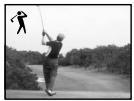
: Spotlight mode
Recording a subject spotlighted on a stage or at a wedding ceremony, etc.
- A still subject such as a person or flower
A softened picture
A person in clearer flesh tones
: Sports lesson mode
Capturing high-speed action in sports such as golf or tennis
:Beach&Skimode
Recording a person in a place such as on the beach or in the ski slopes where there is a lot of reflection
e^c : Sunset & Moon mode
Recording sunset, night views, fireworks or neon signs
A: Landscape mode
Recording a landscape through a window or wire net
Notes on focus setting
- In the Spotlight, Sports lesson and Beach & Ski modes, you cannot take close-ups because the camcorder is set to focus only on subjects in the middle to far distance.
- In the Sunset & Moon and Landscape modes, the camcorder is set to focus only on distant subjects.
Using the PROGRAM AE function
(1) While the camcorder is in recording or Standby mode, slide AUTO LOCK down.
(2) Press PROGRAM AE.
(3) Turn the CONTROL dial so that the symbol of the desired PROGRAM AE mode matches the indicator on the LCD screen or in the viewfinder.
To return to automatic adjustment mode
Press PROGRAM AE so that the indicator disappers, or slide AUTO LOCK up.
Note on shutter speed
The shutter speed in each PROGRAM AE mode is as follows:
Soft Portrait mode - from 1/60 to 1/500
Sports lesson mode - from 1/250 to 1/4000
Beach & Ski mode - from 1/60 to 1/250
When to use manual focus
In the following cases you should obtain better results by adjusting the focus manually.
Insufficient light [a]
- Subjects with little contrast — walls, sky, etc. [b]
- Too much brightness behind the subject [c]
Horizontal stripes [d]
- Subjects through frosted glass
- Subjects beyond nets, etc.
- Bright subject or subject reflecting light
- Shooting a stationary subject when using a tripod
When focusing manually, first focus in telephoto before recording, and then reset the shot length.
(1) Slide FOCUS down to MANUAL. The indicator appears on the LCD secreen or in the viewfinder.
(2) Turn the focus dial to focus on the subject.
Enfoque manual
To focus in infinity
Slide FOCUS to INFINITY. indicator appears on the LCD secreen or in the viewfinder. This function is useful when the nearer subject is focused automatically, and you want to focus the subject faraway.
To return to the autofocus mode
Slide FOCUS up to AUTO to turn off or indicator.
Shooting in relatively dark places or shooting the subject moving quickly outside
Shoot at wide-angle after focusing in the telephoto position.
If lights up
Subject is too close.
When to adjust the exposure
Adjust the exposure manually under the following cases.

[a]
- The background is too bright (back lighting)
Insufficient light: most of the picture is dark
[b]
- Bright subject and dark background
To record the darkness faithfully
[a]
Adjusting the exposure
(1) Slide AUTO LOCK down.
(2)Press EXPOSURE. The exposure indicator appears on the LCD screen or in the viewfinder.
(3)Turn the CONTROL dial to adjust the exposure. The exposure is locked at the adjusted brightness.
To return to automatic exposure mode
Press EXPOSURE to turn off the exposure indicator. Or, slide AUTO LOCK up.
Notes
- The CONTROL dial does not have a stop position.
- If you press PROGRAM AE, the exposure comes back to automatic adjustment again.
- When you adjust the exposure manually, you cannot use the BACK LIGHT function.
When you shoot, the indicator appears in the viewfinder. This indicates that the SteadyShot function is working and the camcorder compensates for camera-shake.
You can release the SteadyShot function when you do not need to use the SteadyShot function. Do not use the SteadyShot function when shooting a stationary object with a tripod.
(1) Press MENU to display the menu on the LCD screen.
(2) Turn the CONTROL dial to select STEADYSHOT, then press the CONTROL dial.
(3) Turn the CONTROL dial to select OFF, then press the CONTROL dial.
(4) Press MENU to erase the menu display.
- The SteadyShot function will not correct excessive camera-shake.
- When you switch the SteadyShot function on or off, the exposure may fluctuate.
- When the SteadyShot function is released, the indicator does not appear.
- If you use a tele conversion lens (not supplied) or a wide conversion lens (not supplied), the Steady shot function may not work.
Connect the camcorder to your VCR or TV to watch the playback picture on the TV screen. When monitoring the playback picture by connecting the camcorder to your TV, we recommend you to use house current for the power source.
Connecting directly to a VCR/TV with Audio/Video input jacks
Open the jack cover and connect the camcorder to the inputs on the TV by using the supplied A/V connecting cable. Set the TV/VCR selector on the TV to VCR.
Turn down the volume of the camcorder. To get higher quality pictures in DV format, connect the camcorder to your TV using the S video connecting cable (not supplied). If you are going to connect the camcorder using the S video connecting cable (not supplied) [a], you do not need to connect the yellow (video) plug of the A/V connecting cable [b].
If your VCR or TV is a monaural type Connect only the white plug for audio on both the camcorder and the VCR or the TV. If you connect the white plug, the sound is L (left) signal. If you connect the red plug, the sound is R (right) signal.
Using the AV cordless IR receiver—LASER LINK
Once you connect the AV cordless IR receiver (not supplied) having the LASER LINK mark to your TV or VCR, you can easily view the picture on your TV. For details, refer to the instruction manual of the AV cordless IR receiver.
LASER LINK is a system which transmits and receives a picture and sound between video equipment having the mark by using infrared rays. LASER LINK is a trademark of Sony Corporation.
To play back on a TV
(1) Set the POWER switch on the camcorder to VTR.
(2) After connecting your TV and AV cordless IR receiver, set the POWER switch on the AV cordless IR receiver to ON.
(3) Turn the TV on and set the TV/VCR selector on the TV/VCR selector on the TV to VCR.
(4) Press LASER LINK. The lamp of LASER LINK button is flashing.
(5) Press on the camcorder to start playback.
(6) Adjust the angle and direction of both the camcorder and AV cordless IR receiver.
To cancel the LASER LINK function Press LASER LINK.
Searching the boundaries of recorded tape with date
You can search for the boundaries of recorded tape with date-Date Search function. To search the beginning of the specific date and play back from the point, there are two ways:
- Using cassette memory, you can select the date displayed on the LCD screen or in the viewfinder.
- Without using cassette memory.
You can only operate with the Remote Commander.
Searching for the date by using cassette memory
You can use this function only when playing back a tape with cassette memory.
(1) Set the POWER switch to VTR.
(2) Press MENU to display the menu on the LCD screen.
(3) Turn the CONTROL dial to select the CM SEARCH, then press the CONTROL dial.
(4) Turn the CONTROL dial to select ON, then press the CONTROL dial.
(5) Press SEARCH MODE on the Remote Commander repeatedly, until the date search indicator appears.
(6) Press or to select the date for playback.
Playback starts from the beginning of the selected date automatically.
- The interval of the boundaries between the dates needs more than two minutes. The camcorder may not search if the beginning of the recorded date is too close to the next one.
- The short cursor on the screen suggests the date selected in the previous time.
Searching for the date without using cassette memory
You can use this function whether the tape has cassette memory or not.
(1) Set the POWER switch to VTR.
(2) Press MENU to display the menu on the LCD screen.
(3) Turn the CONTROL dial to select the CM SEARCH, then press the CONTROL dial.
(4) Turn the CONTROL dial to select OFF, then press the CONTROL dial.
(5) Press SEARCH MODE on the Remote Commander repeatedly, until the date search indicator appears.
(6) When the current position is [b], press to search towards [a] or press or to search towards [c]. Each time you press or the camcorder searches for the previous or next date.
Playback starts automatically when date changed.
Searching the boundaries of recorded tape with title
You can search for the boundaries of recorded tape with title-Title Search function. If you use a tape with cassette memory, you can select the title displayed on the LCD screen or in the viewfinder.
You can only operate with the Remote Commander.
Es possibleocularloslimitesdeclintagrabademedianteletitulo(funciondebusesuedadetitulos).Siemployauna cintaconmemoriaencassette,podra seleccionarletitulmostradoenla pantallaLCDo enel visorelectrondo.
Searching for the title by using cassette memory
You can use this function only when playing back a tape with cassette memory.
(1) Set the POWER switch to VTR.
(2) Press MENU to display the menu on the LCD screen.
(3) Turn the CONTROL dial to select the CM SEARCH, then press the CONTROL dial.
(4) Turn the CONTROL dial to select ON, then press the CONTROL dial.
(5) Press SEARCH MODE on the Remote Commander repeatedly, until the title search indicator appears.
(6) Press or to select the title for playback.
Playback starts from the scene of the selected title automatically.
- You cannot superimpose or search a title, if you use a cassette tape without cassette memory.
- The camcorder may not search, if there is a blank portion between the recorded portions in the tape.
Para detener la búsueda
Pulse.
Notas
Searching for a photophoto search/photo scan
You can search for the recorded still picture - Photo Search function. There are two modes in Photo Search:
- Using cassette memory, you can select the recorded date which is displayed on the LCD screen or in the viewfinder.
- Without using cassette memory.
You can also search for still pictures one after another and display each picture for five seconds automatically - Photo Scan function. Even if your tape has no cassette memory, you can use the Photo Scan function.
You can only operate with the Remote Commander.
Searching for a photo by using cassette memory
You can use this function only when playing back a tape with cassette memory.
(1) Set the POWER switch to VTR.
(2) Press MENU to display the menu.
(3) Turn the CONTROL dial to select the CM SEARCH, then press the CONTROL dial.
(4) Turn the CONTROL dial to select ON, then press the CONTROL dial.
(5) Press SEARCH MODE on the Remote Commander repeatedly, until the photo search indicator appears.
(6) Press or to select the date for playback.
Playback starts from the photo of the selected date automatically.
When you play back a tape which has a blank portion between recorded portions, the Photo Search function will not work correctly.
Para detener la búsueda
Pulse.
Nota
Searching for a photo without using cassette memory
You can use this function whether the tape has cassette memory or not.
(1) Set the POWER switch to VTR.
(2) Press MENU to display the menu on the LCD screen.
(3) Turn the CONTROL dial to select the CM SEARCH, then press the CONTROL dial.
(4) Turn the CONTROL dial to select OFF, then press the CONTROL dial.
(5) Press SEARCH MODE on the Remote Commander repeatedly, until the photo search indicator appears.
(6) Press or to select the photo for playback. Each time you press or the camcorder searches for the previous or next scene.
Playback starts from the photo automatically.
You can use this function whether the tape has cassette memory or not.
(1) Set the POWER switch to VTR.
(2) Press SEARCH MODE on the Remote Commander repeatedly until the photo scan indicator displayed on the LCD screen.
(3) Press or
Each photos are displayed for about 5 seconds automatically.
To stop searching Press
Returning to a preregistered position
Using the Remote Commander, you can easily go back to the desired point on a tape after playback.
(1) During playback, press ZERO SET MEMORY at the point you later want to locate. The counter shows "0:00:00" and "ZERO SET MEMORY" appears on the LCD screen or in the viewfinder.
(2) Press when you want to stop playback.
(3) Press to rewind or press to fast-forward the tape to the counter's zero point. The tape stops automatically when the counter reaches approximately zero. "ZERO SET MEMORY" disappears and the time code appears.
(4) Press ▷.
Note on the tape counter
There may be a discrepancy of several seconds from the time code.
Notes on ZERO SET MEMORY
- When you press ZERO SET MEMORY, the counter's zero point is memorized. Press ZERO SET MEMORY again before step 3 to cancel the memory.
Zero set memory may not function when there is a blank portion between pictures on a tape.
Zero set memory functions in recording standby mode.
Notasobreelcontadorde cinta
Displaying recording data - data code function
You can display recording data (date/time or various settings when recorded) on the LCD screen or in the viewfinder during playback (Data Code). The Data Code is also displayed on the TV.
Press DATA CODE during playback.
Set DATA CODE in the menu system, and select the following items:
When DATE/CAM is selected: date various settings (steady shot, AE mode, shutter speed, white balance, aperture value, gain) no indicator.
When DATE is selected: date no indicator.
When bars (-· -· -· -· ) appear
- A blank portion of the tape is being played back.
- The tape was recorded by a camcorder without having date and time set.
- The tape is unreadable due to tape damage or noise.
You can create your own video program by editing with any other DV, mini DV, 8 mm, Hi8 Hi8, VHS VHS, VHS S-VHS, VHS VHSC, VHS S-VHSC or Betamax VCR that has audio/video inputs. You can edit with little deterioration of picture and sound quality when using the DV connecting cable.
Before editing
Connect the camcorder to the VCR using the VMC-2DV DV connecting cable (not supplied) or the supplied A/V connecting cable.
Using the DV connecting cable
Simply connect the VMC-2DV DV connecting cable (not supplied) to DV IN OUT and to DV IN/OUT of the DV products. With digital-to-digital connection, video and audio signals are transmitted in digital form for high-quality editing.
Notes on editing when using the DV connecting cable
- You can connect one VCR only.
- You can record picture, sound and system data at the same time on the DV products by using the DV connecting cable only.
- You cannot edit the titles, display indicator, or the contents of cassette memory.
- If you record playback pause picture via the DV jack, the recorded picture becomes rough. And when you playback the picture using the other video equipment, the picture may jitter.
- When you record a playback pause picture via the DV jack, you cannot add audio to that portion of the tape.
- You can also use the camcorder as a recorder with this connection. In this case "DV IN" indicator appears on the screen.
- When you use the camcorder as a recorder, the color balance may be incorrect on the monitor screen. But this is not recorded on the tape.
Using the A/V connecting cable [a] or S video connecting cable (not supplied) [b]
Set the input selector on the VCR to LINE.
Editing onto another tape
Notes on editing when using the A/V connecting cable
- Press DATA CODE, SEARCH MODE, or DISPLAY to turn off the display indicators. Otherwise, the indicators will be recorded on the tape.
- If your TV or VCR is a monaural type, connect the yellow plug of the A/V connecting cable for video to the TV or VCR. Connect only the white or red plug for audio to the TV or VCR. If you connect the white plug, the sound is L (left) signal. If you connect the red plug, the sound is R (right) signal.
- You can edit precisely by connecting a LANC cable to this camcorder and other video equipment having fine synchro-editing function, using this camcorder as a player.
Starting editing
(1) Insert a blank tape (or a tape you want to record over) into the VCR, and insert your recorded tape into the camcorder.
(2) Play back the recorded tape on the camcorder until you locate the point where you want to start editing, then press to set the camcorder in playback pause mode.
(3) On the VCR, locate the recording start point and set the VCR in recording pause mode.
(4) Press on the camcorder and VCR simultaneously to start editing.
To edit more scenes
Repeat steps 2 to 4.
To stop editing
Press on both the camcorder and the VCR.
You can insert a new scene from a VCR onto your originally recorded tape by specifying starting and ending points.
Connection is the same as in "Using the DV connecting cable" on page 64. In recording and recording pause mode, DV IN OUT jack automatically works as input jack.
(1) While pressing the small green button on the POWER switch, set it to VTR.
(2) On the VCR, locate the start point to be inserted and set it to playback pause mode.
(3) On the camcorder, press to set it to playback mode, and then locate the point where the insert should end by pressing or . Then press to set it to playback pause mode.
(4) Press ZERO SET MEMORY on the Remote Commander. The ZERO SET MEMORY indicator flashes and the end point of the insert is stored in memory.
(5) On the camcorder, locate the point where the insert should begin by pressing , then press REC to set it to recording pause mode.
(6) Press on the camcorder and the VCR simultaneously to start insert editing. The insert editing stops automatically near the counter's zero point. Press to set the camcorder to stop mode.
To change the end point
Press ZERO SET MEMORY on the Remote Commander so that the ZERO SET MEMORY indicator disappears and begin from step 3.
Note on the inserted picture
The picture may be distorted at the end of the inserted portion when it is played back.
You can record an audio sound to add to the original sound on a tape by connecting audio equipment or a microphone. If you connect the audio equipment, you can add a sound on your recorded tape by specifying starting and ending points. The original sound will not be erased.
Notes on audio dubbing
- A new sound cannot be recorded on a tape already recorded in the 16-bit mode (32 kHz, 44.1 kHz or 48 kHz).
- When an external microphone is not connected, the recording will be made through the built-in microphone of the camcorder.
- A new sound cannot be recorded on a tape already recorded in the LP mode.
- If you add a new sound on a tape recorded with another camcorder (including DCR-TRV7), the sound quality may become worse.
- If you connect the TV to the camcorder when you are recording audio, it may cause noise on the TV sound. But the noise is not recorded on the tape.
Adding an audio sound on a recorded tape
(1) Insert your recorded tape into the camcorder.
(2) While pressing the small green button on the POWER switch, set it to VTR.
(3) On the camcorder, locate the point where the recording should begin by pressing or . Then press to set it to playback pause mode.
(4) Press AUDIO DUB on the video control compartment or the Remote Commander.
(5) Press on the camcorder and at the same time start playing back the audio you want to record. The new sound will be recorded in stereo 2. The recorded sound in stereo 1 is not heard.
(6) Press at the point where you want to stop recording.
To play back the new recorded sound
Adjust the balance between the original sound (stereo 1) and the new sound (stereo 2) by selecting AUDIO MIX in menu system.
Five minutes after when you turn the power off, the settings of AUDIO MIX return to the original sound (stereo 1) only. The factory setting is original sound only.
To end audio more precisely
First, press ZERO SET MEMORY on the Remote Commander at the point where you want to stop recording. Then start recording from step 2, and the recording stops automatically near the counter's zero point.
If you use a tape with cassette memory, you can superimpose the titles while recording or after recording. When you play back the tape, the title is displayed for 5 seconds from the point where you superimposed it.
You can select from eight preset titles and one original (CUSTOM TITLE) to superimpose over the picture.
Superimposing titles
(1) Press TITLE to display the titles on the LCD screen or in the viewfinder.
(2) Turn the CONTROL dial to select the title, then press the CONTROL dial.
(3) Turn the CONTROL dial to select the color, size, or position, then press the CONTROL dial.
(4) Turn the CONTROL dial to select the desired item, then press the CONTROL dial.
(5) Repeat steps 3 and 4 until the title is arranged as desired.
(6)Press CONTROL dial again to complete the setting.
While you are playing back, pausing, or recording
After step 6, the "SAVE" appears on the screen for 5 seconds and the title is set.
While in Standby mode
After step 6, the "TITLE" indicator appears. And when you press START/STOP to start recording, "SAVE" appears on the screen for 5 seconds and the title is set.
Titles placed from the top of the screen as follows:
HELLO HAPPY BIRTHDAY HAPPY HOLIDAYS CONGRATULATIONS! OUR SWEET BABY WEDDING VACATION THE END CUSTOM TITLE.
When you have stored an original title The title appears above "CUSTOM TITLE".
Title colors("COL") changes as follows:
WHT(White) YEL(Yellow) CYAN(Cyan) GRN(Green) VIO(Violet) RED(Red) BLUE(Blue).
Title size("SIZE") changes as follows: LG(Large) SM(Small).
Title position("POS") changes as follows: If you select the title size "LG", you can choose 8 positions. When you select the title size "SM", you can choose 9 positions at all.
To display no title
Select OFF in the TITLE DSPL menu. But the title is displayed in case of Edit Search or Rec Review regardless of the menu settings.
Notes on titles
While fading in or out, you cannot superimpose a title.
- You cannot superimpose a title to a blank portion of the tape.
- The titles you superimposed are displayed by only using the DV format video equipment with index ttitle function.
- When you are searching the tape using the other video equipment, the portion of the tape you superimpose the title may be detected as an index signal.
Notes on the cassettes
- If you use a cassette tape set to prevent accidental erasure, you cannot superimpose the title. Slide the protect tab so that the red portion is not visible.
- You can superimpose about 11 to 20 titles in one cassette, if one title consists of about 5 characters.
- If the tape has too many index signals and photo data, you may not be able to superimpose a title because the memory is full.
Los titulos dispuestos a partir de la parte superior de la pantalla son los siguientes: HELLO HAPPY BIRTHDAY HAPPY HOLIDAYS CONGRATULATIONS! OUR SWEET BABY WEDDING VACATION THE END CUSTOM TITLE.
(1) Press MENU to display the menu.
(2)Turn the CONTROL dial to select TITLE ERASE, then press the CONTROL dial.
(3) Turn the CONTROL dial to select the title you want to erase, then press the CONTROL dial.
(4) Make sure the title is the one you want to erase, then press CONTROL dial again.
(5) Press MENU to erase the menu display.
Note
If you use a cassette tape set to prevent accidental erasure, you cannot erase the title. Slide the protect tab so that the red portion is not visible.
If you use a tape with cassette memory, you can make one title of up to 20 characters and store it in memory.
(1) Press TITLE to display the titles on the LCD screen or in the viewfinder.
(2)Turn the CONTROL dial to select CUSTOM TITLE, then press the CONTROL dial.
(3) Turn the CONTROL dial to select the column of the desired character, then press the CONTROL dial.
(4) Turn the CONTROL dial to select the desired character, then press the CONTROL dial.
(5) Repeat steps 3 and 4 until you finish the title.
(6) Turn the CONTROL dial to select [] , then press the CONTROL dial.
To erase a character
In step 3, turn the CONTROL dial to select [] then press CONTROL dial. The last character is erased.
To change the title you have made
In step 2, turn the CONTROL dial to select the CUSTOM TITLE, then press the CONTROL dial. Erase characters one after another, then make the new title again.
If it takes more than 5 minutes to make a title If the Standby mode lasts for more than 5 minutes with a cassette inserted, the power will be turned off automatically. If the power is turned off while you are making a title, set the POWER switch to OFF once, then to CAMERA. The title you have made remains stored in memory.
m = 311
CONTROL

3~
CONTROL

CUSTOM TITLE
ABCDE
FGHIJ
KLMNO
PORST
UvwXY
Z& ?!

CUSTOM TITLE
ABCDE
FGHIJ 12345
KLMNO 67890
PQRST[←]
UvwXY[←]
Z& ?!
ABCDE
FGHIJ
KLMNO
PQRST
UVWXY
- 21

CUSTOM TITLE

CUSTOM TITLE
M-
ABCDE
FGHIJ 12345
KLIMNO 67890
PQRT
UVWXY [ ]
78 ?!
--
If you use a tape with cassette memory, you can label a cassette. The label can consist of up to 10 characters and is stored in cassette memory. When you insert the labeled cassette and turn the power on, the label is displayed on the LCD screen, in the viewfinder, or on the TV screen.
(1) Insert the cassette you want to label.
(2) Set the POWER switch to VTR.
(3) Press MENU to display the menu.
(4) Turn the CONTROL dial to select TAPE TITLE, then press the CONTROL dial.
(5) Turn the CONTROL dial to select the column of the desired character, then press the CONTROL dial.
(6) Turn the CONTROL dial to select the desired character, then press the CONTROL dial.
(7) Repeat steps 5 and 6 until you finish the label.
(8) Turn the CONTROL dial to select [] , then press the CONTROL dial.
To erase a character
In step 5 turn the CONTROL dial to select [ ] , then press CONTROL dial. The last character is erased.
To change the label you have made
Insert the cassette to change the label, and operate in the same way to make a new label.
If the mark appears in step 4
The cassette memory is full. If you erase the title in the cassette, you can label it.
If you have superimposed titles in the cassette When the label is displayed, up to 4 titles also appear.
Note on "-----" indicator displayed on the LCD screen or in the viewfinder
The "-----" indicates the number of characters you can select for the label. When the "-----" indicator has fewer than 10 spaces, the cassette memory is full.
Note on the cassettes
If you use a cassette tape set to prevent accidental erasure, you cannot label it. Slide the protect tab so that the red portion is not visible.
Usable cassettes and playback modes
Selecting cassette types
You can use the mini DV Mini DV cassette only.
You cannot use any other DV, 8 mm, Hi
Hi8, VHS VHS, SWS S-VHS, VHSQ VHSC, SWH
S-VHSC or Betamax cassette.
We recommend mini DV cassette with cassette memory.
There are two types of mini DV cassettes: with cassette memory and without cassette memory.
We recommend you to use the tape with cassette memory. The IC memory is mounted on this type of mini DV cassette. This camcorder can read and write data such as dates of recording or titles, etc. to this memory. Tapes with cassette memory have CIII (Cassette Memory) mark.
Sony recommends that you use a tape having Cll mark to enjoy this camcorder fully.
When you play back
Copyright signal
Using this camcorder, you cannot play back a tape that has recorded a copyright control signals for copyright protection of software. "COPY INHIBIT" appears on the LCD screen, in the viewfinder or on the TV screen if you try to play back such a tape. This camcorder does not record copyright control signals on the tape when it records.
Audio mode
12-bit mode: The original sound can be recorded in stereo 1, and the new sound in stereo 2 in 32 kHz. The balance between stereo 1 and stereo 2 can be adjusted by selecting AUDIO MIX in the menu system during playback. Both sounds can be played back.
16-bit mode: A new sound cannot be recorded but the original sound can be recorded in high quality. Moreover, it can also play back sound recorded in 32kHz , 44.1kHz or 48kHz . When playing back a tape recorded in the 16-bit mode, 16BIT indicator appears on the LCD screen or in the viewfinder.
Slide out the protect tab on the cassette so that the red portion is visible. [a]
When affixing a label on the mini DV cassette
Be sure to affix a label on only the location as illustrated below so as not to cause malfunction of the camcorder. [b]
Rewind the tape to the beginning, put the cassette in its case, and store it in an upright position.
Note on gold-plated connector
If the gold-plated connector of mini DV cassettes is dirty or dusty, you may not operate the function using cassette memory. Clean up the gold-plated connector with cotton-wool swab, about every 10 times ejection of a cassettes. [C]
Notasobreelconectorchapadoenoro
Charging the vanadium-lithium battery in the camcorder
Carga de la pila de vanadio-litio de la videocamara
Your camcorder is supplied with a vanadium-lithium battery installed so as to retain the date and time, etc., regardless of the setting of the POWER switch. The vanadium-lithium battery is always charged as long as you are using the camcorder. The battery, however, will get discharged gradually if you do not use the camcorder. It will be completely discharged in about a year if you do not use the camcorder at all. Even if the vanadium-lithium battery is not charged, it will not affect the camcorder operation. To retain the date and time, etc., charge the battery if the battery is discharged. The following are charging methods:
- Connect the camcorder to house current using the supplied AC power adaptor, and leave the camcorder with the POWER switch turned off for more than 24 hours.
- Or, install the fully charged battery pack in the camcorder, and leave the camcorder with the POWER switch turned off for more than 24 hours.
Resetting the date and time
The date and time are set at the factory. Set the time according to the local time in your country. If you do not use the camcorder for about a year, the date and time settings may be released (bars may appear) because the vanadium-lithium battery installed in the camcorder will have been discharged. In this case, first charge the vanadium-lithium battery, then reset the date and time.
(1) While pressing the small green button on the POWER switch, set it to CAMERA.
(2) Press MENU to display the menu on the LCD screen or in the viewfinder.
(3) Select CLOCK SET, then press the CONTROL dial.
(4) Turn the CONTROL dial to adjust the year, and then press the CONTROL dial.
(5) Set the month, day, hour and minutes by turning and pressing the CONTROL dial.
(6) Press MENU to erase the menu display.
To correct the date and time setting
Repeat steps 2 to 5.
The year indicators changes as follows:

Note on the time indicator
The internal clock of this camcorder operates on a 12-hour cycle.
12:00 AM stands for midnight.
12:00 PM stands for noon.
Tips for using the battery pack
This section shows you how you can get the most out of your battery pack.
Preparing the battery pack
Always carry additional batteries
Have sufficient battery pack power to do 2 to 3 times as much recording as you have planned.
Battery life is shorter in a cold environment
Battery efficiency is decreased, and the battery will be used up more quickly, if you are recording in a cold environment.
To save battery power
Do not leave the camcorder in Standby mode when not recording to save the battery power. A smooth transition between scenes can be made even if recording is stopped and started again. While you are positioning the subject, selecting an angle, or looking at the LCD screen or through the viewfinder, the lens moves automatically and the battery is used. The battery is also used when a tape is inserted or removed.
When to replace the battery pack
While you are using your camcorder, the remaining battery indicator on the LCD screen or in the viewfinder decreases gradually as battery power is used up [a].
The remaining time in minutes also appears.
When the remaining battery indicator reaches the lowest point, the indicator appears and starts flashing on the LCD screen or in the viewfinder. When the indicator on the LCD screen or in the viewfinder changes from slow flashing to rapid flashing while you are recording, set the POWER switch to OFF on the camcorder and replace the battery pack. Leave the tape in the camcorder to obtain a smooth transition between scenes after the battery pack has been replaced.
Notes on the rechargeable battery pack
Caution
Never leave the battery pack in temperatures above 140^ (60^) , such as in a car parked in the sun or under direct sunlight.
The battery pack heats up
During charging or recording, the battery pack heats up. This is caused by energy that has been generated and a chemical change that has occurred inside the battery pack. This is not cause for concern, and is normal.
Battery pack care
- Remove the battery pack from the camcorder after using it, and keep it in a cool place. When the battery pack is installed to the camcorder, a small amount of current flows to the camcorder even if the POWER switch is set to OFF. This shortens battery life.
- The battery pack is always discharging even when it is not in use after charging. Therefore, you should charge the battery pack right before using the camcorder.
The switch on the battery pack
This switch is provided so that you can identify a charged battery pack. Set the switch to the "green mark" position when charging is completed. [a] (When the battery pack is removed from the AC power adaptor after charging, the switch automatically moves to the "green mark" position.)
The life of the battery pack
If the battery indicator flashes rapidly just after turning on the camcorder with a fully charged battery pack, the battery pack should be replaced with a new fully charged one.
Charging temperature
You should charge batteries at temperatures from 50^ to 86^ (from 10^ to 30^ ). Lower temperatures require a longer charging time.
Notes on the "InfoLITHIUM" Battery Pack
What is the "InfoLITHIUM" battery pack
The "InfoLITHIUM" battery pack is a lithium battery pack which can exchange data with compatible video equipment about its battery consumption.
Sony recommends that you use the InfoLITHIUM battery pack with video equipment having the InfoLITHIUM mark. When you use this battery pack with video equipment having the InfoLITHIUM mark, the video equipment will indicate the remaining battery time in minutes.*
- The indication may not be accurate depending on the condition and environment which the equipment is used under.
How the battery consumption is displayed
The power consumption of the camcorder changes depending on its use, such as whether the LCD is used or not, how the autofocusing is working on or not.
While checking the condition of the camcorder, the "InfoLITHIUM" battery pack measures the battery consumption and calculates the remaining battery power. If the condition changes drastically, the remaining battery indication may suddenly decrease or increase by more than 2 minutes.
Even if 5 to 10 minutes is indicated as the battery remaining time on the LCD or viewfinder, the indicator may also flash under some conditions.
Aragon, Spain.
Aragon, Spain.
Aragon, Spain.
Aragon, Spain.
Aragon, Spain.
Aragon, Spain.
Aragon, Spain.
Aragon, Spain.
Aragon, Spain.
Aragon, Spain.
Aragon, Spain.
Aragon, Spain.
Aragon, Spain.
Aragon, Spain.
Aragon, Spain.
Aragon, Spain.
Aragon, Spain.
Aragon,Spain.
To obtain more accurate remaining battery indication
Set the camcorder to recording standby mode and point towards a stationary object. Do not move the camcorder for 30 seconds or more.
- If the indication seems incorrect, use up the battery and then recharge it fully (Full charge ^1) ). Note that if you have used the battery in a hot or cold environment for long time, or you have repeated charging many times, the battery may not be able to show the correct time even after being fully charged.
After you have used the InfoLITHIUM battery pack with an equipment not having the
InfoLITHIUM mark, make sure that you use up the battery on the equipment having the
InfoLITHIUM mark and then recharge fully.
Why the remaining battery indication does not match the continuous recording time in the operation manual
The recording time is affected by the environmental temperature and conditions. The recording time becomes very short in a cold environment. The continuous recording time in the operation manual is measured under the condition of using a fully charged (or normal charged) battery pack in 77^ (25^) . As the environmental temperature and condition are different when you actually use the camcorder, the remaining battery time is not same as the continuous recording time in the operation manual.
1) Full charge: Charging for about 1 hour after the charge lamp of the AC power adaptor goes off.
2) Normal charge: Charging just until the charge lamp of the AC power adaptor goes off.
A brand-new battery pack
A brand-new battery pack is not charged. Before using the battery pack, charge it completely.
Recharge the battery pack whenever you like
You do not have to discharge it before recharging. If you charged the battery pack fully but you did not use it for a long time, it becomes discharged. Then recharge the battery pack before use.
Notes on the terminals
If the terminals (metal parts on the back) are not clean, the battery charge duration will be shortened.
When the terminals are not clean or when the battery pack has not been used for a long time, repeatedly install and remove the battery pack a few times. This improves the contact condition. Also, wipe the +,- and C terminals with a soft cloth or paper.
Be sure to observe the following
- Keep the battery pack away from fire.
- Keep the battery pack dry.
- Do not open nor try to disassemble the battery pack.
- Do not expose the battery pack to any mechanical shock.
Maintenance information and precautions
Moisture condensation
If the camcorder is brought directly from a cold place to a warm place, moisture may condense inside the camcorder, on the surface of the tape, or on the lens. In this condition, the tape may stick to the head drum and be damaged or the camcorder may not operate correctly. To prevent possible damage under these circumstances, the camcorder is furnished with moisture sensors. Take the following precautions.
Inside the camcorder
If there is moisture inside the camcorder, the beep sounds and the indicator flashes. If this happens, none of the function except cassette ejection will work. Open the cassette compartment, turn off the camcorder, and leave it about 1 hour. When indicator flashes at the same time, the cassette is inserted in the camcorder. Eject the cassette, turn off the camcorder, and leave also the cassette about 1 hour.
On the lens
If moisture condenses on the lens, no indicator appears, but the picture becomes dim. Turn off the power and do not use the camcorder for about 1 hour.
How to prevent moisture condensation
When bringing the camcorder from a cold place to a warm place, put the camcorder in a plastic bag and allow it to adapt to room conditions over a period of time.
(1) Be sure to tightly seal the plastic bag containing the camcorder.
(2) Remove the bag when the air temperature inside it has reached the temperature surrounding it (after about 1 hour).
To ensure normal recording and clear pictures, clean the video heads.
The video heads may be dirty when:
- mosaic-pattern noise appears on the playback picture
- playback pictures do not move
- playback pictures are hardly visible
- playback pictures do not appear
- the × indicator and " CLEANING CASSETTE" message appear one after another or the × indicator flashes on the LCD screen or in the viewfinder
If [a] or [b] happens, clean the video heads with the Sony DVM12CL cleaning cassette (not supplied). Check the picture and if the above problem persists, repeat the cleaning. (Do not repeat cleaning more than 5 times in one session.)
Note
If the DVM12CL cleaning cassette (not supplied) is not available in your area, consult your nearest Sony dealer.
- Operate the camcorder on 7.2V (battery pack) or 8.4V (AC power adaptor).
- Should any solid object or liquid get inside the casing, unplug the camcorder and have it checked by Sony dealer before operating it any further.
- Avoid rough handling or mechanical shock. Be particularly careful of the lens.
- Keep the POWER switch set to OFF when not using the camcorder.
- Do not wrap up the camcorder and operate it since heat may build up internally.
- Keep the camcorder away from strong magnetic fields or mechanical vibration.
On handling tapes
- Do not insert anything in the small holes on the cassette.
- Do not open the tape protect cover or touch the tape.
- Avoid touching or damaging the terminals. To remove dust, clean the terminals with a soft cloth.
Camcorder care
- When the camcorder is not to be used for a long time, disconnect the power source and remove the tape. Periodically turn on the power, operate the camera and player sections and play back a tape for about 3 minutes.
- Clean the lens with a soft brush to remove dust. If there are fingerprints on the lens, remove them with a soft cloth.
- Clean the camcorder body with a dry soft cloth, or a soft cloth lightly moistened with a mild detergent solution. Do not use any type of solvent which may damage the finish.
- Do not let sand get into the camcorder. When you use the camcorder on a sandy beach or in a dusty place, protect it from the sand or dust. Sand or dust may cause the unit to malfunction, and sometimes this malfunction cannot be repaired.
Precauciones
Funcionamento de la videocamara
- Use only an InfoLITHIUM type battery pack.
- Place the battery pack on a flat surface without vibration during charging.
- The battery pack will get hot during charging. This is normal.
Others
- Unplug the unit from the wall outlet when not in use for a long time. To disconnect the power cord, pull it out by the plug. Never pull the cord itself.
- Do not operate the unit with a damaged cord or if the unit has been dropped or damaged.
- Do not bend the AC power cord forcibly, or put a heavy object on it. This will damage the cord and may cause a fire or an electrical shock.
- Be sure that nothing metallic comes into contact with the metal parts of the connecting plate. If this happens, a short may occur and the unit may be damaged.
- Always keep the metal contacts clean.
- Do not disassemble the unit.
- Do not apply mechanical shock or drop the unit.
- While the unit is in use, particularly during charging, keep it away from AM receivers and video equipment because it will disturb AM reception and video operation.
The unit becomes warm while in use. This is normal. - Do not place the unit in locations that are: Extremely hot or cold, Dusty or dirty, Very humid, Vibrating
Note on dry batteries
To avoid possible damage from battery leakage or corrosion, observe the following.
- Be sure to insert the batteries in the correct direction.
- Dry batteries are not rechargeable.
- Do not use a combination of new and old batteries.
- Do not use different types of batteries.
- The batteries slowly discharge while not in use.
- Do not use a battery that is leaking.
If battery leakage occurred
- Wipe off the liquid in the battery case carefully before replacing the batteries.
- If you touch the liquid, wash it off with water.
- If the liquid get into your eyes, wash your eyes with a lot of water and then consult a doctor.
If any difficulty should arise, unplug the unit and contact your nearest Sony dealer.
Notasobrelas pilassecas
Using your camcorder abroad
Each country or area has its own electric and TV color systems. Before using your camcorder abroad, check the following points.
Power sources
You can use your camcorder in any country or area with the supplied AC-V316 AC power adaptor within 110V to 240VAC 50 / 60Hz Use a commercially available AC plug adaptor [a], if necessary, depending on the design of the wall outlet [b].
Difference in color systems
This camcorder is a NTSC system-based camcorder. If you want to view the playback picture on a TV, it must be a NTSC system-based TV.
Check the following list.
NTSC system
Bahama Islands, Bolivia, Canada, Central America, Chile, Colombia, Ecuador, Jamaica, Japan, Korea, Mexico, Peru, Surinam, Taiwan, the Philippines, the U.S.A., Venezuela, etc.
PAL system
Australia, Austria, Belgium, Czech Republic, China, Denmark, Finland, Germany, Great Britain, Holland, Hong Kong, Italy, Kuwait, Malaysia, New Zealand, Norway, Portugal, Singapore, Slovak Republic, Spain, Sweden, Switzerland, Thailand, etc.
PAL-M system
Brazil
PAL-N system
Argentina, Paraguay, Uruguay
SECAM system
Bulgaria, France, Guiana, Hungary, Iran, Iraq, Monaco, Poland, Russia, Ukraine, etc.
If you run into any problem using the camcorder, use the following table to troubleshoot the problem. Should the difficulty persist, disconnect the power source and contact your Sony dealer or local authorized Sony service facility.
Camcorder
Power
| Symptom | Cause and/or corrective actions |
| The power is not on. | ·The battery pack is not installed. → Install the battery pack. (p. 7) ·The battery is dead. → Use a charged battery pack. (p. 7) ·The AC power adaptor is not connected to a wall outlet. → Connect the AC power adaptor to a wall outlet. (p. 27) |
| The power goes off. | ·While being operated in CAMERA mode, the camcorder has been in Standby mode for more than 5 minutes. → Set the POWER switch to OFF, then to CAMERA. (p. 13) ·The battery is dead. → Use a charged battery pack. (p. 7) |
| The battery pack is quickly discharged. | ·The ambient temperature is too low. (p. 83) ·The battery pack has not been charged fully. → Charge the battery pack again. (p. 7) ·The battery pack is completely dead, and cannot be recharged. → Use another battery pack. (p. 27) |
Operation
| Symptom | Cause and/or corrective actions |
| START/STOP does not operate. | The tape is stuck to the drum. → Eject the tape. (p. 11) The tape has run out. → Rewind the tape or use a new one. (p. 23) The POWER switch is set to VTR. → Set it to CAMERA. (p. 12) The tab on the cassette is out (red). → Use a new tape or slide the tab. (p. 11) |
| The cassette cannot be removed from the holder. | The battery is dead. → Use a charged battery pack or the AC power adaptor. (p. 7, 27) |
| □ and △ indicators flash and no function except for cassette ejection works. | Moisture condensation has occurred. → Remove the cassette and leave the camcorder for at least 1 hour. (p. 89) |
| “CLOCK SET” appears when the camcorder is turned on. | Reset the date and time. (p. 81) |
| The End Search function does not activate. | The cassette was ejected after you recorded on it. → The End Search function will not activate until you make a new recording after reinserting the cassette. The tape without cassette memory ejected after recording. |
Continued to the next page
Operation
| Symptom | Cause and/or corrective actions |
| The tape does not move when a tape transport button is pressed. | · The POWER switch is set to CAMERA or OFF. → Set it to VTR. (p. 23) · The tape has run out. → Rewind the tape or use a new one. (p. 23) |
| No sound or only a low sound is heard when playing back a tape. | · The volume is turned to the minimum. → Open the LCD panel and press VOLUME +. (p. 23) · AUDIO MIX is set to ST2 side in the menu system. → Adjust AUDIO MIX in the menu system (p. 69). |
| The new sound added to the recorded tape is not heard. | · AUDIO MIX is set to ST1 side in the menu system. → Adjust AUDIO MIX in the menu system (p. 69). |
| The SteadyShot function does not activate. | · STEADYSHOT is set to OFF in the menu system. → Set it to ON. (p. 29) |
| Recording stops at once. | · The POWER switch is set to PHOTO. → Set it to CAMERA. (p. 12) |
| Recording stops in a few seconds. | · The START/STOP MODE switch is set to 5SEC or ↓ ANTI GROUND SHOOTING. → Set it to ↓. (p. 16) |
| The autofocus function does not activate. | · Focus is set to the manual mode. → Set it to autofocus. (p. 44) · Shooting conditions are not suitable for autofocus. → Set focus to manual mode to focus manually. (p. 44) |
| The fader function does not work. | · The START/STOP MODE switch is set to 5SEC or ↓ ANTI GROUND SHOOTING. → Set it to ↓. (p. 16) |
| The title is not displayed. | · TITLE DSPL is set to OFF in the menu system. → Set it to ON in the menu system. (p. 29) |
| The title is not recorded. | · The tape has no cassette memory. → Use a tape with cassette memory. (p. 70) · The cassette memory is full. → Erase another title. (p. 73) · The tape is set to prevent accidental erasure. → Slide the protect tab so that red portion is not visible. (p. 72) · The fader function is working. → Wait until the fader function is finished. (p. 35) · Nothing is recorded in that position on the tape. → Superimpose the title to the recorded position. (p. 72) |
| The cassette label is not recorded. | · The tape has no cassette memory. → Use a tape with cassette memory. (p. 76) · The cassette memory is full. → Erase some titles. (p. 76) · The tape is set to prevent accidental erasure. → Slide the protect tab so that red portion is not visible. (p. 76) |
| Displaying the recorded date, date search function does not work. | · The tape has no cassette memory. → Use a tape with cassette memory. (p. 52) · CM SEARCH is set to OFF in the menu system. → Set it to ON. (p. 52) |
Operation
| Symptom | Cause and/or corrective actions |
| The title search function does not work. | ·The tape has no cassette memory. →Use a tape with cassette memory. (p. 56) ·CM SEARCH is set to OFF in the menu system. →Set it to ON. (p. 56) ·There is no title in the tape. →Superimpose the titles. (p. 70) |
| CIII indicator does not appear when using a tape with cassette memory. | ·The gold-plated connector of the tape is dirty or dusty. →Clean the gold-plated connector. (p. 79) |
Picture
| Symptom | Cause and/or corrective actions |
| The image on the viewfinder screen is not clear. | ·The viewfinder lens is not adjusted. →Adjust the viewfinder lens. (p. 13) |
| A vertical band appears when a subject such as lights or a candle flame is shot against a dark background. | ·The contrast between the subject and background is too high. The camcorder is not malfunctioning. →Change locations. |
| The picture is "noisy" or does not appear. | ·The video heads may be dirty. →Clean the heads using the Sony DVM12CL (not supplied) cleaning cassette. (p. 90) |
| indicator flashes on the LCD screen or in the viewfinder. | ·The video heads may be dirty. →Clean the heads using the Sony DVM12CL (not supplied) cleaning cassette. (p. 90) |
| The picture is too bright or too dark. | ·LCD BRIGHT is not adjusted properly. →Press + or - to obtain the brightness you want. (p. 17, 23) |
| A vertical band appears when shooting a very bright subject. | ·The camcorder is not malfunctioning. |
| The picture does not appear on the LCD screen or in the viewfinder. | ·Incorporated fluorescent tube is worn out. →Please contact your nearest Sony dealer. |
| The picture does not appear in the viewfinder. | ·If VF PW-SAVE is set to ON in the menu system, the picture disappears automatically when you turn your face away from the viewfinder. →Bring your face close to the viewfinder within 1 cm (1/2 inch). Or, set VF PW-SAVE to OFF. (p. 31) ·The LCD panel is open. →Close the LCD panel. |
| The picture in the viewfinder does not disappear even VF PW-SAVE is set to OFF in the menu system. | ·Sunlight or the incandescent lamp may prevent the viewfinder sensor from working correctly. This is not a malfunction. |
| An unknown picture is displayed in the viewfinder or on the LCD screen. | ·If 10 minutes elapse after you set the POWER switch to CAMERA without inserting a cassette, the camcorder automatically starts the demonstration or DEMO is set to ON in the menu system. →Insert the cassette and the demonstration stops. You can deactivate the demonstration. (p. 117) |
Others
| Symptom | Cause and/or corrective actions |
| While editing using the DV connecting cable, recording picture cannot be monitored. | • Remove the DV connecting cable, and connect it again. |
| The camcorder becomes warm. | • If the power of the cammcorder is on for a long time, it becomes warm, which is not malfunction. |
| The supplied Remote Commander does not work. | • Something is blocking the infrared rays. → Remove the obstacle. • The battery is not inserted with the correct polarity. → Insert the battery with the correct polarity. (p. 114) • The batteries are dead. → Insert new ones. (p. 114) |
| No function works though the power is on. | • Disconnect the connection plug on the battery pack or on the AC power adaptor, then reconnect it in about 1 minute. Turn the power on. If the functions still do not work, open the LCD screen and press the RESET button above the FOCUS switch using a sharp-pointed object. (If you press the RESET button, all the settings including the date and time return to the default.) (p. 81) |
| The numbers or letters of 5 characters is displayed as a counter. | • Self-diagnosis function was activated. → See the table in page 100 and treat the camcorder appropriately. |
AC power adaptor
| Symptom | Corrective actions |
| The VTR/CAMERA or CHARGE lamp does not light. | • Disconnect the power cord. After about 1 minute, reconnect the power cord. (p. 7) |
| The CHARGE lamp flashes. | • See the chart on the next page. |
When the CHARGE lamp flashes
Check through the following chart.
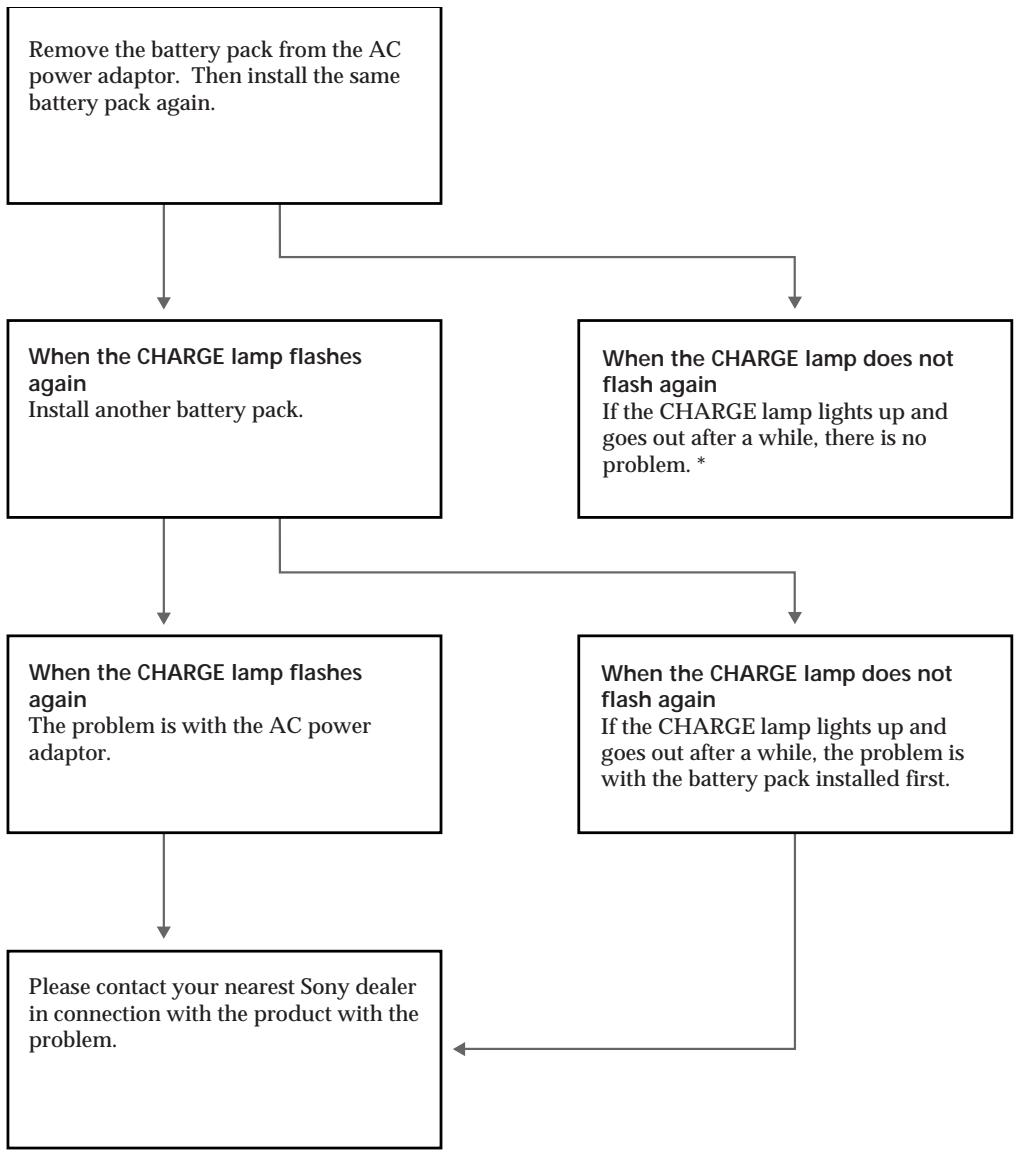
* If you use a battery pack which you have just bought or which has been left unused for a long time, the CHARGE lamp may flash at the first charging. This does not indicate a problem. Repeat again to charge with same battery pack.
Self-diagnosis function
In the self-diagnosis function works to prevent the camcorder from malfunctioning, a five-digit service number (combination of a letter and figures) flashes in the viewfinder or on the LCD screen. In this case, check the following table.
SESTBY
-C:21:00
40min.1
53 min.
| First three digits | Cause and/or Corrective Action |
| C21 | ·Moisture condensation has occurred. →Remove the cassette and leave the camcorder for at least 1 hour. (p. 89) |
| C22 | ·The video heads are dirty. →Clean the heads using the Sony DVM12CL cleaning cassette (not supplied). (p. 90) |
| C23 | ·The camcorder does not operate when using a battery pack that is not an “InfoLITHIUM” battery pack. →Use an “InfoLITHIUM” battery pack. (p. 7) |
| C31 | ·To prevent the camcorder from malfunctioning, the self-diagnosis function has worked. →Remove the cassette and insert it again, then operate the camcorder. (p. 11) |
| C32 | ·To prevent the camcorder from operating malfunctioning, the self-diagnosis function has worked. →Disconnect the power cord of the AC power adaptor or remove the battery pack. After reinstalling the power source, operate the camcorder. |
| E61 | ·To prevent the camcorder from malfunctioning, the self-diagnosis function has worked. →When you contact your Sony dealer or local authorized Sony service facility, inform the service number with five digits. (example: E:61:10) |
| E62 |
If a difficulty persists after checking the problem a few times, contact your Sony dealer or local authorized Sony service facility.
Video camera recorder
System
Video recording system
Two rotary heads, Helical scanning system
Audio recording system
Rotary heads, PCM system
Quantization: 12bits (Fs 32kHz
stereo 1, stereo 2), 16bits (Fs 48kHz stereo)
Video signal
NTSC color, EIA standards
Usable cassette
Mini DV cassette with logo printed
Tape speed
SP: Approx. 18.83mm / s
LP: Approx. 12.57mm / s
Recording/playback time
SP mode: 1 hour (DVM60)
LP mode: 1.5 hours (DVM60)
Fastforward/rewind time
Approx. 2 min. 30 s (DVM60) (using with battery pack)
Approx. 1 min. 45 s (DVM60) (using with AC power adaptor)
Image device
CCD (Charge Coupled Device 1/3'' )
Viewfinder
Electric viewfinder (color)
Lens
Combined power zoom lens, 120x
(Digital), 10x (Optical)
Focal distance
f = 3 / 16 to 1^5 / 8 in. (4.0 to 40~mm
(1^1 / 2 to 15 in.38 to 380~mm) when
converted into a 35mm still camera)
F 1.8-2.6
TTL autofocus system inner focus wide macro system
Color temperature
Auto
Minimum illumination
3 lux at F 1.8
Illumination range
3 to 100,000 lux
Recommended illumination
More than 100 lux
LCD screen
Picture
4 inches measured diagonally
3^1/4 to 2^3/8 in. (80.7 × 58.9 ~mm)
On-screen display
TN LCD/TFT active matrix method
Total dot number
112,086 (479 x 234)
Input and output connectors
S video output
4-pin mini DIN
Luminance signal: 1 Vp-p, 75 ohms, unbalanced, sync negative
Chrominance signal: 0.286 Vp-p,
75 ohms, unbalanced
Audio/Video output
Special minijack, 1 Vp-p, 75 ohms, unbalanced, sync negative
327 mV, (at output impedance more than 47 kilohms)
Output impedance with less than
2.2 kilohms/Stereo minijack (0 3.5 mm)
DV input/output
4-pin special connector
Headphones jack
IR space transmission system according to EIAJ (Electric
Industries Association of Japan) standards
Audio carrier wave
Lch:4.3MHz
Rch:4.8MHz
General
Power requirements
7.2 V (battery insertion input)
Average power consumption
4.4 W during camera recording using viewfinder
5.8 W during camera recording using LCD screen
Operating temperature
32^ to 104^ (0^ to 40^)
Storage temperature
-4^ to 140^ (-20^ to 60^)
Dimensions
Approx. 3^7 / 8× 4^3 / 8× 7^1 / 4 in. (w /
Approx.1 lb 13 oz (840g) excluding the battery pack and the cassette
Approx. 2 lb 1 oz (960g) including the battery pack NP-F530, lithium battery and cassette DVM60
Approx. 2 lb 6 oz (1.1kg) including the battery pack NP-F730, lithium battery and cassette DVM60
Approx. 2 lb 10 oz (1.2kg) including the battery pack NP-F930, lithium battery and cassette DVM60
Microphone
Electret condenser microphone, Stereo type
Supplied accessories
See page 6.
AC power adaptor
Power requirements
110 to 240VAC 50 / 60Hz
Power consumption
25W
Output voltage
DC OUT: 8.4V 1.8 A in operating mode
Battery charge terminal: 8.4V 1.4 A in charge mode
Application
Sony battery pack NP-F530, NP
F730, NP-F930 lithium ion type
Operating temperature
32^ to 104^ (0^ to 40^)
Storage temperature
-4^ to 140^ (-20^ to 60^)
Dimensions (Approx.)
2^1 / 4× 1^3 / 4× 4^1 / 4 in. (w / h / d) (57
x 44 x 107 mm)
Mass (Approx.)
7 oz (190 g)
Design and specifications are
subject to change without notice.
Videocármara
Sistema
CCD (Charge Coupled Device 1/3")
Visor electrónico
Visor electrolyico (color)
Objetivo
12 Tape transport buttons (p. 23)
STOP (stop)
REW (rewind)
PLAY (playback)
FF (fastforward)
II PAUSE (pause)
REC (record)
AUDIO DUB
13 Intelligent Accesory shoe
14 Recording lamp
15 Microphone
Remote sensor(p. 23) / IR emitter (p. 51)
17 Focus dial (p. 45)
FOCUS switch (p. 45)
19 AUDIO/VIDEO OUT jack (p. 50, 65)
20 DV IN OUT jack (p. 64)
21 SVIDEO OUT jack (p. 38, 50, 65)
22 LASER LINK button (p. 51)
23 FADER button (p. 34)
[24] Viewfinder (p. 13)
25 BACKLIGHT button (p. 36)
26 EDITSEARCH button (p. 22)
39 OPEN/EJECT lever (p. 11)
40 Tripod receptacle (p. 21) Make sure that the length of the tripod screw is less than 9 / 32 inch (6.5mm) . Otherwise, you cannot attach the tripod securely and the screw may damage the camcorder.
41 Zoom lever (p. 15)
42 BATT(battery) RELEASE button (p. 10)
43 LANC control jack stands for Local Application Control Bus System. The control jack is used for controlling the tape transport of video equipment and peripherals connected to it. This jack has the same function as the jack indicated as CONTROL L or REMOTE.
44 headphones jack (p. 24)
45 Grip strap (p. 20)
46 Cassette compartment (p. 11)
47 MIC jack (PLUG IN POWER) (p. 68) Connect an external microphone (not supplied). This jack also accepts a "plug-in-power" microphone.
Video control compartment OPEN switch(p.23)
The buttons that have the same name on the Remote Commander as on the camcorder function identically.
Mando a distancia
Point toward the remote sensor to control the camcorder after turning on the camcorder.
ZERO SET MEMORY button (p. 62)
To prepare the Remote Commander
To use the Remote Commander, you must insert two size AA (R6) batteries. Use the supplied size AA (R6) batteries.
(1) Remove the battery cover from the Remote Commander.
(2) Insert both of the size AA (R6) batteries with correct polarity.
(3)Put the battery cover back onto the Remote Commander.
Note on battery life
The batteries for the Remote Commander last about 6 months under normal operation. When the batteries become weak or dead, the Remote Commander does not work.
To avoid damage from possible battery leakage
Remove the batteries when you will not use the Remote Commander for a long time.
Remote control direction
Aim the Remote Commander to the remote sensor.
The operative range of the Remote Commander is about 16.4 feet (5m) indoors. Depending on the angle, Remote Commander may not activate the camcorder.
Notes on the Remote Commander
- Keep the remote sensor away from strong light sources such as direct sunlight or illumination. Otherwise, the remote control may not be effective.
- Be sure that there is no obstacle between the remote sensor on the camcorder and the Remote Commander.
- This camcorder works in commander mode VTR 2. The commander modes (1,2 and 3) are used to distinguish this camcorder from other Sony VCRs to avoid remote control misoperation. If you use another Sony VCR in commander mode VTR 2, we recommend you change the commander mode or cover the remote sensor of the VCR with black paper.
Attaching the shoulder strap
Attach the supplied shoulder strap to the hooks for the shoulder strap.
Operation indicators
1 Warning indicator (p. 118)
2 Zoom indicator (p. 15)
3 Manual focus/Infinity indicator (p. 45)
4 PROGRAM AE indicator (p. 43)
5 SteadyShot indicator (p. 48)
6 BACK LIGHT indicator (p. 36)
7 FADER indicator (p. 34)
16:9 WIDE indicator (p. 41)
9 PICTURE EFFECT indicator (p. 39)
10 BRT (bright) indicator (p. 17, 23)/VOL (volume) indicator (p. 23)
11 Photo recording indicator (p. 37)
12 Mirror mode indicator (p. 18)
Cassette Memory indicator (p. 4)
14 Recording mode indicator (p. 13)
15 Recording standby mode indicator (p. 13)/ Tape transport mode indicator
Time code indicator (p. 14) / Self diagnosis function (p. 100)
17 Remaining tape indicator (p. 14)
ZERO SET MEMORY indicator(p. 62)/Photo capture indicator (p. 37)
19 Search mode indicator (p. 52, 56, 58)
20 DV IN indicator (p. 64)
21 Audio mode indicator (p. 78)
22 Remaining battery indicator (p. 84)/ Remaining time in minutes indicator

To watch the demonstration
You can watch a brief demonstration of pictures with special effects. If the demonstration appears when you turn on the camcorder for the first time, exit the Demo mode to use your camcorder.
To enter demo mode
(1)Eject the cassette and set the POWER switch to OFF.
(2) While holding down , set the POWER switch to CAMERA. The demonstration starts. The demonstration stops when you insert the cassette.
Note that once you enter Demo mode, this mode is retained as long as the vanadium rechargeable battery is in place. Therefore, demonstration starts automatically 10 minutes later every time you set the POWER switch to CAMERA, and after you eject the cassette.
To exit demo mode
(1) Set the POWER switch to OFF.
(2) While holding down , set the POWER switch to CAMERA.
If indicators flash on the LCD screen or in the viewfinder or warning messages appear on the display window, check the following:
: you can hear the beep sound when BEEP is set to ON in the menu system.
1 The battery is weak or dead. Slow flashing: The battery is weak. Fast flashing: The battery is dead. Depending on conditions, the indicator may flash, even if there are 5 to 10 minutes remaining.
The tape is near the end. The flashing is slow.
The tape has run out. The flashing becomes rapid.
4 No tape has been inserted.
The tab on the tape is out (red).
6 Moisture condensation has occurred. (p. 89)
1 El paquete de bateria Tiene poca energia o está agotado.
Parpadeo lento: El paquete Tiene poca energia.
Parpadea rápido: El paquete está agotado.
Dependiendo de las conditiones, el indicatorSEOSEOSEOSEOSEOSEOSEOSEOSEOSEOSEOSEOSEOSEOSEOSEOSEOSEOSEOSEOSEOSEOSEOSEOSEOSEOSEOSEOSEOSEOSEOSEOSEOSEOSEOSEOSEOSEOSEOSEOSEOSEOSEOSEOSEOSEOSEOSEOSEOSEOSEOSEOSEOSEOSEOSEOSEOSEOSEOSEOSEOSEOSEOSEOSEOSEOSEOSEOSEOSEOSEOSEOSEOSEOSEOSEOSEOSEOSEOSEOSEOSEOSEOSEOSEOSEOSEOSEOSEOSEOSEOSEOSEOSEOSEOSEOSEOSEOSEOSEO SEOEO SEOEO SEOEO SEOEO SEOEO SEOEO SEOEO SEOEO SEOEO SEOEO SEOEO SEOEO SEOEO SEOEO SEOEO SEOEO SEOEO SEOEO SEOEO SEOEO SEOEO SEOEO SEOEO SEOEO SEOEO SEOEO SEOEO SEOEO SEOEO SEOEO SEOEO SEOEO SEOEO SEOEO SEOEO SEOEO SEOEO SEOEO SEOEO SEOEO SEOEO SEOEO SEOEO SEOEO SEOEO SEOEO SEOEO SEOEO SEOEO SEOEO SEOEQ
2 La cinta se encuentra cerca del final. El parpadeo es lento.
3 La cinta ha llegado al final. El parpadeo es=rápido.
4 No ha insertadoaculara.
The video heads may be contaminated. (p. 90)
The clock is not set.
When this message appears though you set the date and time, the vanadium-lithium battery is discharged. Charge the vanadium-lithium battery. (p. 81)
9 Some other trouble has occurred.
Disconnect the power source and contact your Sony dealer or local authorized facility.
The battery is not the "InfoLITHIUM" type.
The tape has no cassette memory. (p. 4)
Charging battery pack 7
Charging vanadium-lithium battery 80
Cleaning video heads 90
Clock set 81
Color TV system 4, 94
Connection 50,64
COPY INHIBIT 78
D, E
Data Code 63
Date search 52
Demo 117
DISPLAY 24
Digital zoom 15
DV connecting cable 64
DV format 50
DV IN OUT. 64
Editing 64
EJECT 11
END SEARCH 22
Exposure 46
Indice alfabético
A,B
Ajustedelreloi 81
Remaining battery indicator ... 84
Remaining tape indicator 14
Remote Commander 113
S
Self-diagnosis function 100
SP mode 14
Standby mode 13
START/STOP MODE switch...17
SteadyShot 48
T, U, V
Time code 14
Title (making) 74
Title (superimposition) 70
Title search. 56
Tripod mounting 21
Trouble check 95
VOLUME 23
W,X,Y,Z
Warning indicators 118
Wide TV mode 41
ZERO SET MEMORY 62
Zoom 15