USER MANUAL DCR-TRV22E SONY
Digital Video Camera Recorder Mini DV Digital Video Cassette
Operating Instructions
Before operating the unit, please read this manual thoroughly, and retain it for future reference.
Mode d'emploi
Congratulations on your purchase of this Sony Handycam. With your Handycam you can capture life's precious moments with superior picture and sound quality.
Your Handycam is loaded with advanced features, but at the same time it is very easy to use. You will soon be producing home video that you can enjoy for years to come.
WARNING
To prevent fire or shock hazard, do not expose the unit to rain or moisture.
To avoid electrical shock, do not open the cabinet. Refer servicing to qualified personnel only.
"Memory Stick"

N50
NOTICE ON THE SUPPLIED AC POWER ADAPTOR FOR CUSTOMERS IN THE UNITED KINGDOM
A moulded plug complying with BS1363 is fitted to this equipment for your safety and convenience.
Should the fuse in the plug supplied need to be replaced, a fuse of the same rating as the supplied one and approved by ASTA or BSI to BS1362 (i.e., marked with 串 or mark) must be used.
If the plug supplied with this equipment has a detachable fuse cover, be sure to attach the fuse cover after you change the fuse. Never use the plug without the fuse cover. If you should lose the fuse cover, please contact your nearest Sony service station.
For the customers in Europe ATTENTION
The electromagnetic fields at the specific frequencies may influence the picture and sound of this camcorder.
This product has been tested and found compliant with the limits set out in the EMC Directive for using connection cables shorter than 3 meters. (9.8 feet)
Notice
If static electricity or electromagnetism causes data transfer to discontinue midway (fail), restart the application or disconnect and connect the USB cable again.
Français
Bienvenue!
Checking supplied accessories
Make sure that the following accessories are supplied with your camcorder.
1 AC-L15A/L15B AC Adaptor (1), Mains lead (1) (p. 25)
2 NP-FM30 rechargeable battery pack (1) (p. 24)
3 A/V connecting cable (1) (p. 60)
4 Wireless Remote Commander (1) (Except for DCR-TRV12E, p. 96)
5 R6 (size AA) battery for Remote Commander (2) (Except for DCR-TRV12E, p. 315)
6 Shoulder strap (1)
Lens cap (1) (p. 36)
8 Shoe cover (1) (p. 128)
9 "Memory Stick" (1) (DCR-TRV22E/ TRV33E only, p. 141)
10 USB cable (1) (p. 199)
11 CD-ROM (SPVD-010 USB Driver) (1) (p. 206, 234)
12 Cleaning cloth (1) (p. 298)
13 21-pin adaptor* (1) (p. 61)
- The models with C E mark printed on their bottom surfaces only.
Contents of the recording cannot be compensated if recording or playback is not made due to a malfunction of the camcorder, storage media, etc.
- Recording moving pictures on the tape (p. 36)
-Playing back the tape (p. 52)
- Recording still images on the "Memory Stick" (DCR-TRV22E/ TRV33E only) (p. 62, 152)
- Recording moving pictures on the "Memory Stick" (DCR-TRV22E/ TRV33E only) (p. 166)
Viewing still images recorded on the "Memory Stick" (DCRTRV22E/TRV33E only) (p.179)
Viewing moving pictures recorded on the "Memory Stick" (DCRTRV22E/TRV33E only) (p. 182)
Viewing moving pictures recorded on the tape using the USB cable (p. 199)
- Viewing images recorded on the "Memory Stick" using the USB cable (DCR-TRV22E/TRV33E only) (p. 201)
- Capturing images on the computer from your camcorder using the USB cable (p. 217)
- Converting an analog signal into digital to capture images onto the computer (DCR-TRV22E/TRV33E only) (p. 238)
Other uses
Functions for adjusting exposure during recording
Back light (p. 46)
NightShot/Super NightShot*/Colour Slow Shutter* (p. 47)
PROGRAM AE (p. 80)
- Manual exposure (p. 82)
- Flexible Spot Meter (p. 83)
Functions for giving images more impact
Digital zoom (p. 44)
The default setting is OFF. (To zoom greater than 10 × , select the digital zoom power in D ZOOM in the menu settings.)
Fader (p. 73)
- Picture effect (p. 76, 92)
Digital effect* (p. 77, 93)
- Title (p. 133)
- MEMORY MIX* (p. 158)
Functions for giving a natural appearance to your recordings
PROGRAM AE (p. 80)
- SPORTS
- LANDSCAPE
- Manual focus (p. 84)
- Spot Focus (p. 86)
Functions for using after recording
End search/Edit search/Rec Review (p. 50)
Data code (p. 54)
- Tape PB ZOOM (p. 94)/Memory PB ZOOM (p. 186)
Zero set memory** (p. 96)
- Title search* (p. 98)
Digital program editing (p. 109, 173)
**Except for DCR-TRV12E
Before you start reading this manual and operating your camcorder, check the model number by looking at the bottom of your camcorder. The DCR-TRV33E is the model used for illustration purposes. Otherwise, the model name is indicated in the illustrations. Any differences in operation are clearly indicated in the text, for example, "DCR-TRV33E only."
Checking supplied accessories. 3
Main Features 4
Quick Start Guide
Recording on tape 12
Recording on "Memory Stick" (DCR-TRV22E/TRV33E only) .... 14
Getting Started
Using this manual 20
Step 1 Preparing the power source....24
Installing the battery pack. 24
Charging the battery pack. 25
Checking status of battery pack Battery Info 29
Connecting to a wall socket 30
Step 2 Setting the date and time ......... 31
Step 3 Using the touch panel 33
Recording - Basics
Recording a picture 36
Shooting backlit subjects
- Back light function 46
Shooting in the dark
- NightShot/Super NightShot/
Colour Slow Shutter 47
Checking recordings
- End search/Edit search/Rec Review 50
Playback - Basics
Playing back tape 52
To display the screen indicators -Display function 54
Viewing a recording on TV 60
Advanced Recording Operations
Recording still images on "Memory Stick" during tape recording standby or tape recording (DCR-TRV22E/TRV33E only) 62
Recording a still image on a tape
- Tape Photo recording (DCR-TRV12E/TRV14E/TRV19E only) 65
Self-timer recording 67
Adjusting the white balance manually 69
Using the wide mode 71
Using the fader function 73
Using special effects - Picture effect .. 76
Using special effects - Digital effect (DCR-TRV22E/TRV33E only) .... 77
Using PROGRAM AE 80
Adjusting the exposure manually .... 82
Using spot light-metering function - Flexible Spot Meter 83
Focusing manually. 84
Using spot focus function -Spot Focus 86
Interval Recording 87
Frame by frame recording
- Frame recording 89
Using the viewfinder 90
AdvancedPlaybackOperations
Playing back tape with picture effect. 92
Playing back tape with digital effect (DCR-TRV22E/TRV33E only) .... 93
Enlarging images recorded on tape
- Tape PB ZOOM (DCR-TRV22E/ TRV33E only) 94
Quickly locating a scene - Zero set memory (DCR-TRV14E/TRV19E/ TRV22E/TRV33E only) 96
Searching the boundaries of recorded tape by title - Title search (DCR-TRV14E/TRV19E/TRV22E/ TRV33E only) 98
Searching a recording by date - Date search (DCR-TRV14E/TRV19E/ TRV22E/TRV33E only) 100
Searching for a photo - Photo search/ Photo scan (DCR-TRV14E/ TRV19E only) 103
Editing
Dubbing tape 106
Dubbing only desired scenes
- Digital program editing
(on tape) 109
Recording video or TV programmes (DCR-TRV19E/TRV22E/TRV33E only) 122
Inserting a scene from a VCR-Insert editing (DCR-TRV19E/TRV22E/ TRV33E only) 125
Audio dubbing 127
Superimposing a title on a cassette with Cassette Memory 133
Making your own titles 136
Labelling a cassette on a cassette with Cassette Memory 138
Erasing all the data in Cassette Memory 140
"Memory Stick" Operations (DCR-TRV22E/TRV33E only)
Using "Memory Stick" 141
Inserting/Ejecting the "Memory Stick" 146
Selecting image quality and size.....147
Recording still images on "Memory Stick" - Memory Photo recording 152
Recording an image from tape as a still image 156
Superimposing a still image in "Memory Stick" on an image - MEMORY MIX 158
Interval Photo Recording 164
Recording moving pictures on "Memory Stick" - MPEG MOVIE recording 166
Self-timer recording 168
Recording a picture from tape as a moving picture 170
Recording edited pictures from tape as a moving picture - Digital program editing (on "Memory Stick") 173
Changing the recording folder 177
Viewing a still image
- Memory Photo playback 179
Viewing a moving picture
- MPEG MOVIE playback 182
Choosing a playback folder 185
Enlarging still images recorded on "Memory Stick" - Memory PB ZOOM 186
Playing back images continuously - Slide show 188
Preventing accidental erasure - Image protection. 190
Deleting images - DELETE 192
Changing image size - Resize (DCR-TRV33E only) 196
Writing a print mark - Print mark ... 197
Viewing images with your computer
Viewing images with a computer - Introduction 199
Connecting your camcorder to a computer using the USB cable (For Windows users) 203
Viewing pictures recorded on tape on a computer - USB Streaming (For Windows users) 217
Viewing images recorded on "Memory Stick" on a computer (For Windows users) (DCR-TRV22E/TRV33E only) 227
Connecting your camcorder to a computer using the USB cable (For Macintosh users) (DCR-TRV22E/TRV33E only) 233
Viewing images recorded on "Memory Stick" on a computer (For Macintosh users) (DCR-TRV22E/TRV33E only) 236
Capturing images from an analog video unit on a computer - Signal convert function (DCR-TRV22E/ TRV33E only) 238
Customizing Your Camcorder
Changing the menu settings 240
Troubleshooting
Types of trouble and how to correct trouble 262
Self-diagnosis display 270
Warning indicators 271
Warning messages 272
Usable cassettes 284
About the "InfoLITHIUM" battery pack 288
About i.LINK 292
Using your camcorder abroad 295
Maintenance information and precautions 296
Specifications 305
Quick Reference
Identifying parts and controls. 309
Index 318
Table des matieres
Vérification des accessoires fournis .... 3
Quick Start Guide – Recording on tape
1
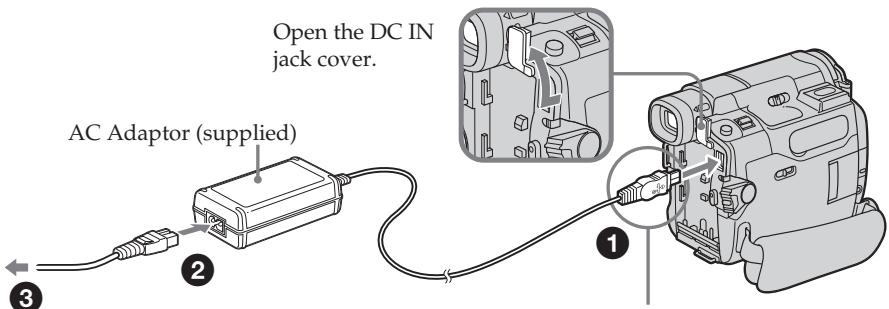
Connecting the mains lead (p. 25)
Use the battery pack when using your camcorder outdoors (p. 24).
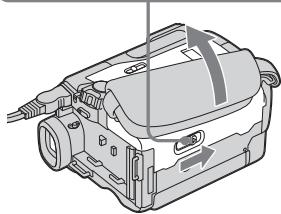
Connect the plug with its mark facing the battery.
2
Inserting the cassette
1
Slide OPEN/△EJECT in the direction of the arrow and open the lid.

Push the centre of the cassette back to insert the cassette. Insert the cassette straight as far as possible into the cassette compartment with the window facing up.
3
Close the cassette compartment by pressing PUSH on the cassette compartment. After the cassette compartment goes down completely, close the lid until it clicks.
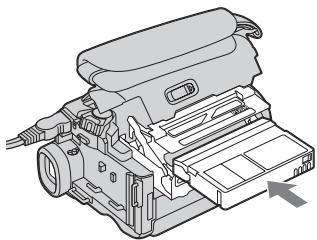
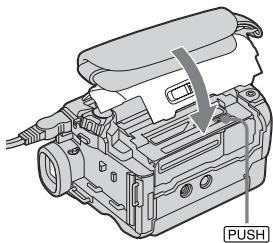
To eject the cassette
Follow the procedures above, and take out the cassette after the cassette compartment opens completely in step ②.
Note
Do not press the cassette compartment down forcibly. Doing so may cause a malfunction.
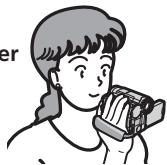
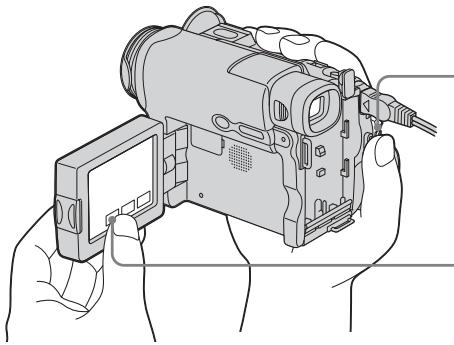
How to hold your camcorder
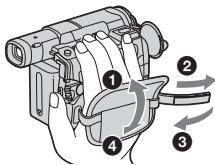
Fastening the grip belt
Fasten the grip belt firmly.
3
Recording a picture on the tape (p. 36)
Open the lens cap (p. 36).
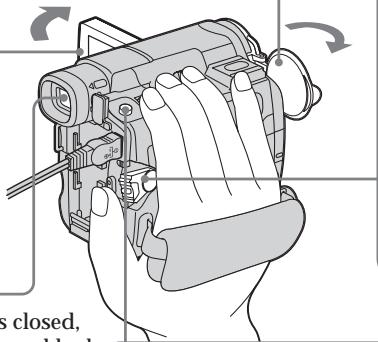
3 Press OPEN to open the LCD panel. The picture appears on the screen.
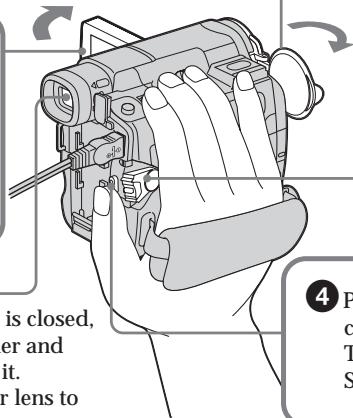
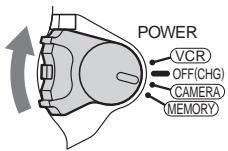
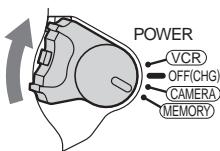
Set the POWER switch to CAMERA while pressing the small green button.
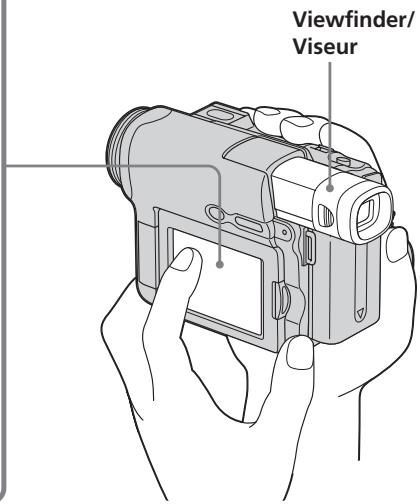
Viewfinder When the LCD panel is closed, pull out the viewfinder and look at the picture in it. Adjust the viewfinder lens to your eyesight (p. 43).
4 Press START/STOP. Your camcorder starts recording. To stop recording, press START/STOP again.

When you purchase your camcorder, the clock setting is set to off. If you want to record the date and time for a picture, set the clock setting before recording (p. 31).
4
Monitoring the playback picture on the LCD screen (p. 52)
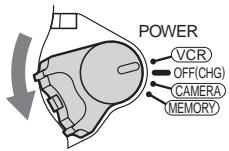
1 Set the POWER switch to PLAYER^1) / VCR^2) while pressing the small green button.
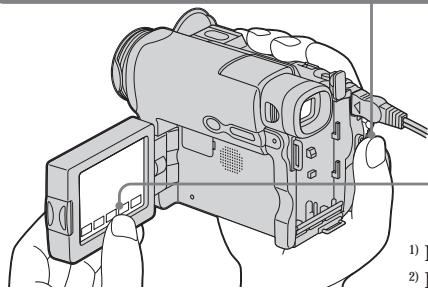
Press 4 of the touch panel to rewind the tape.

Press 11 of the touch panel to start playback.

Note When using the touch panel, press operation buttons lightly with your finger supporting the LCD panel from the back side of it. Do not press the LCD screen with sharp objects.
1) DCR-TRV12E/TRV14E
2) DCR-TRV19E/TRV22E/TRV33E
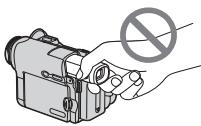
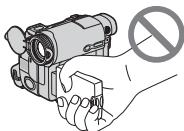
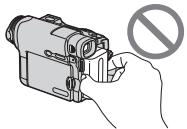
Do not pick up your camcorder by holding parts as illustrated.
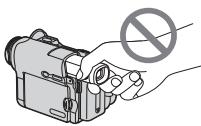
Viewfinder
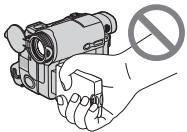
LCD panel
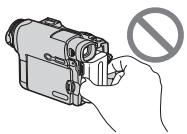
Battery pack
Quick Start Guide – Recording on "Memory Stick" (DCR-TRV22E/TRV33E only)
1
Connecting the mains lead (p. 25)
Use the battery pack when using your camcorder outdoors (p. 24).
Connect the plug with its mark facing the battery.
2
Inserting the "Memory Stick" (p. 146)
Open the lid of the "Memory Stick" slot. Insert the "Memory Stick" in the "Memory Stick" slot as far as it can go with the mark facing down as illustrated, then close the lid.
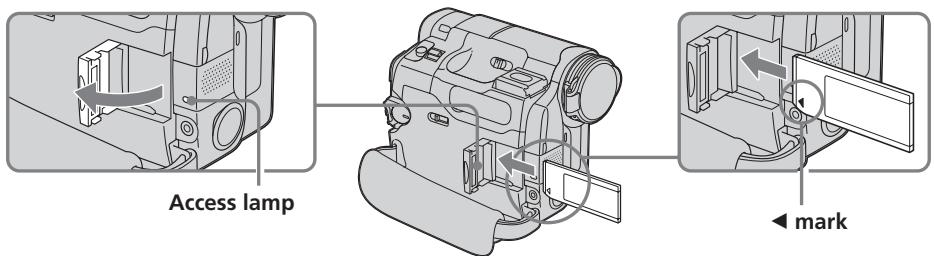
To eject the "Memory Stick," open the lid of the "Memory Stick" slot, slide MEMORY EJECT in the direction of the arrow.
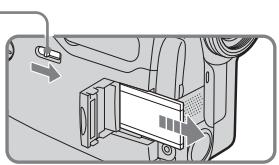
While the access lamp is lit or flashing
Do not shake or strike your camcorder because your camcorder is reading the data from the "Memory Stick" or recording the data on the "Memory Stick." Do not turn the power off, eject the "Memory Stick" or remove the battery pack. Otherwise, image data breakdown may occur.
How to hold your camcorder
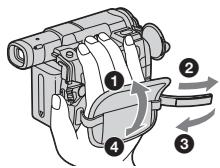
Fastening the grip belt Fasten the grip belt firmly.
Open the lens cap (p. 36).
Press OPEN to open the LCD panel. The picture appears on the screen.
Viewfinder
When the LCD panel is closed, pull out the viewfinder and look at the picture in it.
Adjust the viewfinder lens to your eyesight (p. 43).
When you purchase your camcorder, the clock setting is set to off. If you want to record the date and time for a picture, set the clock setting before recording (p. 31).
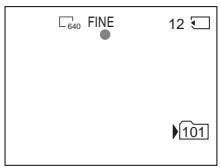
Press PHOTO lightly. You can record when the green ● stops flashing and remains lit.
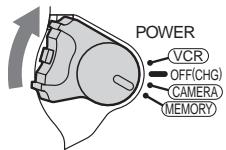
Set the POWER switch to MEMORY while pressing the small green button. Make sure that the LOCK switch is set to the left (unlock) position.
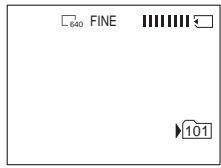
Press PHOTO deeply. The image when you press PHOTO deeply is recorded on the "Memory Stick."
4
Monitoring the playback still image on the LCD screen (p. 179)
1 Set the POWER switch to MEMORY while pressing the small green button.
Press PLAY. The last recorded image is displayed.
PLAY
Do not pick up your camcorder by holding parts as illustrated.
Viewfinder
LCD panel
Battery pack
The instructions in this manual are for the 5 models listed in the table on the next page. Before you start reading this manual and operating your camcorder, check the model number by looking at the bottom of your camcorder. The DCR-TRV33E is the model used for illustration purposes. Otherwise, the model name is indicated in the illustrations. Any differences in operation are clearly indicated in the text, for example, "DCR-TRV33E only."
As you read through this manual, buttons and settings on your camcorder are shown in capital letters.
After "Advanced Recording Operations" section of this manual, position of the POWER switch is shown by the icons below.
When you carry out an operation, you can hear a beep to indicate that the operation is being carried out.
- The models with MEMORY marked on the POWER switch is provided with memory functions. See page 141 for details.
** The models with VCR marked on the POWER switch can record pictures from other equipment such as VCR. The other models have PLAYER mark on the POWER switch.
- Provided
Not provided
^* Output only
Note on Cassette Memory
Your camcorder is based on the DV format. You can use only mini DV cassettes with your camcorder. We recommend that you use a cassette with Cassette Memory CIII.
Cassettes with Cassette Memory have the C (Cassette Memory) mark.
Note on TV colour systems
TV colour systems differ depending on the country or region. To view your recordings on a TV, you need a PAL system-based TV.
Copyright precautions
Television programmes, films, video tapes, and other materials may be copyrighted.
Unauthorised recording of such materials may be contrary to the copyright laws.
Note on connecting other equipment
When you connect your camcorder to other video equipment or a computer using the USB cable or i.LINK cable, observe the shape of the jack.
If you forcibly insert the plug, the jack may be damaged and they may result in a malfunction of your camcorder.
Precautions on camcorder care
Lens and LCD screen/finder (on mounted models only)
- The LCD screen and the finder are manufactured using extremely high-precision technology, so over 99.99% of the pixels are operational for effective use. However, there may be some tiny black points and/or bright points (white, red, blue or green in colour) that constantly appear on the LCD screen and the finder. These points are normal in the manufacturing process and do not affect the recording in any way.
- Do not let your camcorder get wet. Keep your camcorder away from rain and sea water. Letting your camcorder get wet may cause your camcorder to malfunction. Sometimes this malfunction cannot be repaired [a].
- Never leave your camcorder exposed to temperatures above 60^ (140^) , such as in a car parked in the sun or under direct sunlight [b].
- Be careful when placing the camera near a window or outdoors. Exposing the LCD screen, the finder or the lens to direct sunlight for long periods may cause malfunctions [c].
- Do not directly shoot the sun. Doing so might cause your camcorder to malfunction. Take pictures of the sun in low light conditions such as dusk [d].
Step 1 Preparing the power source
Installing the battery pack
(1) Lift up the viewfinder.
(2) Slide the battery pack down until it clicks.
To remove the battery pack
(1) Lift up the viewfinder.
(2) Slide the battery pack out in the direction of the arrow while pressing BATT down.
If you use the viewfinder when a large capacity battery pack is installed
If you install the NP-FM70/QM71/QM71D/ FM91/QM91/QM91D battery pack on your camcorder, extend the viewfinder, and lift up the viewfinder to a comfortable angle.
Charging the battery pack
Use the battery pack after charging it for your camcorder.
Your camcorder operates only with the "InfoLITHIUM" battery pack (M series).
See page 288 for details of "InfoLITHIUM" battery pack.
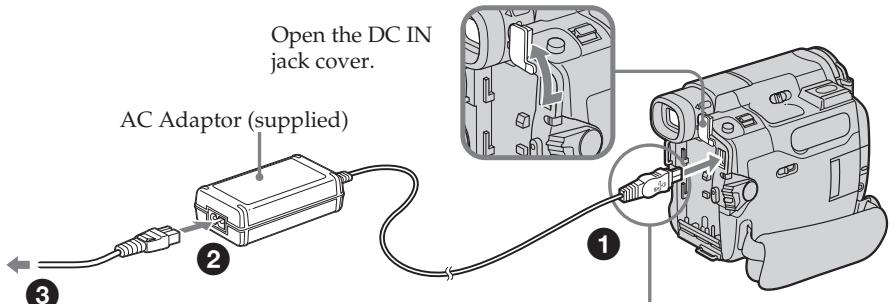
(1) Install the battery pack on your camcorder.
(2) Connect the AC Adaptor supplied with your camcorder to the DC IN jack with the mark on the DC plug facing the battery.
(3) Connect the mains lead to the AC Adaptor.
(4) Connect the mains lead to a wall socket.
(5) Set the POWER switch to OFF (CHG). The CHG lamp lights up when charging begins. After charging is completed, the CHG lamp goes out (full charge).
After charging the battery pack
Disconnect the AC Adaptor from the DC IN jack on your camcorder.
Step 1 Preparing the power source
Note
Prevent metallic objects from coming into contact with the metal parts of the DC plug of the AC Adaptor. This may cause a short-circuit, damaging the AC Adaptor.
When you use the AC Adaptor
Place the AC Adaptor near a wall socket. While using the AC Adaptor, if any trouble occurs with this unit, disconnect the plug from a wall socket as soon as possible to cut off the power.
Note on the CHG lamp
The CHG lamp flashes in the following cases:
- The battery pack is not properly installed.
- Something is wrong with the battery pack.
Charging time/Temps de charge
| Battery pack/Batterie | Full charge/Pleine charge |
| NP-FM30 (supplied/fournie) | 145 |
| NP-FM50 | 150 |
| NP-FM70 | 240 |
| NP-QM71/QM71D | 260 |
| NP-FM91/QM91/QM91D | 360 |
Approximate minutes at 25^ (77^) to charge an empty battery pack.
The charging time may increase if the battery's temperature is extremely high or low because of the ambient temperature.
Approximate minutes when you use a fully charged battery pack
- Approximate number of minutes when recording while you repeat recording start/stop, zooming and turning the power on/off. The actual battery life may be shorter.
Approximate minutes when you use a fully charged battery pack
Note
Approximate recording time and continuous playing time at 25^ (77^) . The battery life will be shorter if you use your camcorder in a cold environment.
Checking status of battery pack - Battery Info
(1) Set the POWER switch to OFF (CHG).
(2) Press OPEN to open the LCD panel.
(3) Press DSPL/BATT INFO.
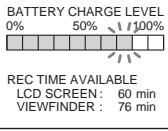
The battery charge level (the percentage of remaining battery time) and remaining battery time when using the LCD screen or viewfinder are displayed for about 7 seconds. If you keep pressing DSPL/BATT INFO, the indicators will be displayed for about 20 seconds.
[a] During charging
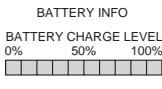
[b] Fully charged
Notes
Battery Info
The number displayed as Battery Info is the approximate recording time.
[a]
BATTERY INFO

[b]
[a] Pendant la charge
[b] Pleine charge
Remarques
Step 1 Preparing the power source
While the remaining battery time is being calculated
"CALCULATING BATTERY INFO ..." is displayed.
If you press DSPL/BATT INFO with the LCD panel closed
The battery information appears on the viewfinder for about 7 seconds.
Connecting to a wall socket
You can use your camcorder without worrying about the power shortage.
Connect the AC Adaptor in the same way as you would when charging the battery pack.
PRECAUTION
The set is not disconnected from the AC power source (mains) as long as it is connected to the wall socket, even if the set itself has been turned off.
Notes
- The AC Adaptor can supply power from a wall socket even if the battery pack is attached to your camcorder.
- The DC IN jack has "source priority." This means that the battery pack cannot supply any power if the mains lead is connected to the DC IN jack, even when the mains lead is not plugged into a wall socket.
Step 2 Setting the date and time
Set the date and time when you use your camcorder for the first time. The "CLOCK SET" indicator will appear each time you set the POWER switch to CAMERA or MEMORY (DCR-TRV22E/TRV33E only) unless you set the date and time settings.
If you do not set the date and time, "------" and "------" are recorded on the tape or the "Memory Stick" (DCR-TRV22E/TRV33E only) as the data code.
If you do not use your camcorder for about 4 months, the date and time settings may be released (bars may appear) because the built-in rechargeable battery installed in your camcorder will have been discharged (p. 299). In this case, charge the built-in rechargeable battery, then set the year, the month, the day, the hour and the minute.
(1) Set the POWER switch to CAMERA or MEMORY (DCR-TRV22E/TRV33E only).
(2) Press OPEN to open the LCD panel.
(3) Press FN (Function) to display PAGE1 (p. 33).
(4) Press MENU to display the menu.
(5) Press / to select, then press EXEC.
(6) Press / to select CLOCK SET, then press EXEC.
(7) Press / to select a desired year, then press EXEC.
(8) Set the month, day and hour with the same procedure as step 7.
(9) Press / to set the minute, then press EXEC by the time signal. The clock starts to move.
To return to FN (Function)
Press EXIT.
Note on the time indicator
The internal clock of your camcorder uses a 24-hour cycle.
Step 3 Using the touch panel
Your camcorder has operation buttons on the LCD screen. Touch the LCD screen directly with your finger to operate each function.
(1) Set the POWER switch to CAMERA to record, PLAYER^1) / VCR^2) to play back, or MEMORY^3) to use the "Memory Stick."
(2) Press OPEN to open the LCD panel.
(3) Press FN. Operation buttons on PAGE1 are displayed on the LCD screen.
(4) Press PAGE2/PAGE3 to display PAGE2/PAGE3. Operation buttons on PAGE2/PAGE3 are displayed on the LCD screen.
(5) Press a desired operation item. See relevant pages of this manual for each function.
1) DCR-TRV12E/TRV14E
2) DCR-TRV19E/TRV22E/TRV33E
3) DCR-TRV22E/TRV33E
[a] When the POWER switch is set to CAMERA
To return to FN
Press EXIT.
To execute settings
Press OK. The display returns to PAGE1/ PAGE2/PAGE3.
Pour revenir à FN
Appuyez sur EXIT.
Step 3 Using the touch panel
To make screen indicators disappear
Press DSPL/BATT INFO.
When the POWER switch is set to CAMERA
When the POWER switch is set to PLAYER1)/ VCR2)
- DCR-TRV22E/TRV33E uniqueness
When the POWER switch is set to MEMORY (DCR-TRV22E/TRV33E only)
During memory camera
| PAGE1 | SPOT FOCUS, MENU, FOCUS, PLAY, PB FOLDER, SPOT METER, EXPOSURE |
| PAGE2 | SELFTIMER, PLAY, MEM MIX |
| PAGE3 | LCD BRT, PLAY, VOL |
During memory playback
Step 3 Using the touch panel
Notes
- When using the touch panel, press operation buttons lightly with your finger supporting the LCD panel from the back side of it.
- Do not press the LCD screen with sharp objects such as a pen.
- Do not press the LCD screen too hard.
- Do not touch the LCD screen with wet hands.
- If FN is not on the LCD screen, touch the LCD screen lightly to make it appear. You can control the display with DSPL/BATT INFO on your camcorder.
When executing each item
The green bar appears above the item.
If the items are not available
The colour of the items changes to grey.
When using the viewfinder
You can also operate with the touch panel (p. 90).
Perform Step 1 (p. 24) and Step 2 (p. 31) in advance.
(1) Open the lens cap.
(2) Prepare the power source (p. 24) and insert the cassette (p. 12).
(3) Set the POWER switch to CAMERA while pressing the small green button. This sets your camcorder to standby.
(4) Press OPEN to open the LCD panel. The picture appears on the screen.
(5) Press START/STOP. Your camcorder starts recording. The REC indicator appears. The camera recording lamp located on the front of your camcorder lights up. To stop recording, press START/STOP again.
- Position the lens cap so as not to cover the microphone and the infrared emitter.
- Avoid touching the microphone when you are recording.
Remarques
Your camcorder records and plays back in the SP (standard play) mode and in the LP (long play) mode. Select SP or LP in in the menu settings (p. 248). In the LP mode, you can record 1.5 times as long as in the SP mode. When you record the tape in the LP mode on your camcorder, we recommend playing back the tape on your camcorder.
To enable smooth transition
Transition between the last scene you recorded and the next scene is smooth as long as you do not eject the cassette even if you turn off your camcorder.
However, check the following:
- Do not mix recordings in the SP and LP modes on one tape.
- When you change the battery pack, set the POWER switch to OFF (CHG).
If you leave your camcorder during standby for 5 minutes while the cassette is inserted
Your camcorder automatically turns off. This is to save battery power and to prevent battery pack and tape wear. To return to standby, set the POWER switch to OFF (CHG) and then back to CAMERA. However, your camcorder does not turn off automatically while the cassette is not inserted.
When you record in the SP and LP modes on one tape or you record in the LP mode
- The transition between scenes may not be smooth.
- The playback picture may be distorted or the time code may not be written properly between scenes.
Note on the LOCK switch (DCR-TRV22E/ TRV33E only)
When you slide the LOCK switch to the right, the POWER switch can no longer be set to MEMORY accidentally. The LOCK switch is set to the left as the default setting.
Self-timer recording
You can record images on the tape with the self-timer. See page 67 for details.
Indicators displayed during recording
Indicators are not recorded on the tape.
1 Remaining battery time
Cassette Memory
3 Recording mode
4STBY/REC
Time code/Tape counter
6 Remaining tape
This appears when using the cassette with Cassette Memory.
This appears after you insert and run the cassette for a while (p. 248).
7 FN button
Press this button to display operation buttons on the LCD screen.
Time
The time appears about 5 seconds after the power is turned on.
9 Date
The date appears about 5 seconds after the power is turned on.
Remaining battery time indicator during recording
The remaining battery time indicator roughly indicates the continuous recording time. The indicator may not be correct, depending on the conditions in which you are recording. When you close the LCD panel and open it again, it takes about one minute for the correct remaining battery time in minutes to be displayed.
Time code
The time code indicates the recording or playback time, "0:00:00" (hours : minutes : seconds) in CAMERA and "0:00:00:00" (hours : minutes : seconds : frames) in PLAYER ^1) / VCR ^2) . You cannot rewrite only the time code later.
Recording data
The recording data (date/time or various settings when recorded) are not displayed during recording. However, they are recorded automatically on the tape. To display the recording data, press DATA CODE during playback. You can also use the Remote Commander for this operation3) (p. 56).
1) DCR-TRV12E/TRV14E
2) DCR-TRV19E/TRV22E/TRV33E
3) Except for DCR-TRV12E
After recording
(1) Close the lens cap.
(2) Set the POWER switch to OFF (CHG).
(3) Close the LCD panel.
(4) Eject the cassette.
(5) Remove the power source.
Adjusting the LCD screen
When you adjust the LCD panel, make sure that the LCD panel is opened up to 90 degrees.
When monitoring on the LCD screen
You can turn the LCD panel over and move it back to your camcorder body with the LCD screen facing out.
- When using the LCD screen except in the mirror mode, the viewfinder automatically turns off.
- If you turn the LCD panel over and move it back to your camcorder body when recording or recording standby, LCD B.L. (panel brightness) is fixed to "BRT NORMAL."
Remarques
Shooting with the mirror mode
This feature allows the camera subject to view him- or herself on the LCD screen.
The subject uses this feature to check his or her own image on the LCD screen while you look at the subject in the viewfinder.
(1) Extend the viewfinder.
(2) Rotate the LCD panel 180 degrees.
Picture in the mirror mode
The picture on the LCD screen is a mirror-image. However, the picture will be normal when recorded.
Image en mode Miroir
Adjusting the brightness of the LCD screen
(1) When the POWER switch is set to CAMERA, press FN and select PAGE2. When the POWER switch is set to PLAYER^1) / VCR^2) , press FN to display PAGE1. When the POWER switch is set to MEMORY^3) , press FN and select PAGE3.
(2) Press LCD BRT. The screen to adjust the brightness of the LCD screen appears.
(3) Adjust the brightness of the LCD screen using -(to)/+ (to brighten).
(4) Press OK to return to PAGE1/PAGE2/PAGE3 in Step 1.
1) DCR-TRV12E/TRV14E
2) DCR-TRV19E/TRV22E/TRV33E
3) DCR-TRV22E/TRV33E
LCD screen backlight
You can change the brightness of the backlight when using the battery pack. Select LCD B.L. in in the menu settings (p. 244).
2,3
Even if you adjust LCD BRT or LCD B.L. The recorded picture will not be affected.
Shooting using the viewfinder is recommended when:
- You cannot see the picture clearly on the LCD screen.
- You want the battery pack to last longer.
Adjusting the viewfinder
If you record pictures with the LCD panel closed, check the picture with the viewfinder. Adjust the viewfinder lens to your eyesight so that the images in the viewfinder come into sharp focus.
Extend the viewfinder and move the viewfinder lens adjustment lever.
Viewfinder backlight
You can change the brightness of the backlight when using the battery pack. Select VF B.L. in in the menu settings (p. 244).
Even if you adjust VF B.L.
The recorded picture will not be affected.
The camera recording lamp (DCR-TRV12E/ TRV14E/TRV19E only)
The camera recording lamp lights up in the viewfinder during recording.
Using the zoom feature
Move the power zoom lever a little for a slower zoom. Move it further for a faster zoom.
Using the zoom sparingly results in better-looking recordings.
W: Wide-angle (subject appears farther away)
T: Telephoto (subject appears closer)
To use zoom greater than 10×
Zoom greater than 10× is performed digitally. Digital zoom can be set to 20× or 100× (DCR-TRV12E)/ 120× (DCR-TRV14E/TRV19E/TRV22E/TRV33E).
To activate digital zoom, select the digital zoom power in D ZOOM in in the menu settings (p. 243). The digital zoom is set to OFF as the default setting. Because the picture is processed digitally, the picture quality deteriorates.
[a] The right side of the bar shows the digital zooming zone.
The digital zooming zone appears when you select the digital zoom power in the menu settings.
When you shoot close to a subject
If you cannot get a sharp focus, move the power zoom lever to the "W" side until the focus is sharp. You can shoot a subject that is at least about 80cm (about 2 5/8 feet) away from the lens surface in the telephoto position, or about 1cm (about 1/2 inch) away in the wide-angle position.
When the POWER switch is set to MEMORY (DCR-TRV22E/TRV33E only)
You cannot use the digital zoom.
When you shoot a subject with the light source behind the subject or a subject with a light background, use the back light function.
(1) Set the POWER switch to CAMERA or MEMORY1).
(2) Press BACK LIGHT. The indicator appears on the screen.
1) DCR-TRV22E/TRV33E only
Press BACK LIGHT again.
When shooting backlit subjects
If you press MANUAL of EXPOSURE (p. 82) or SPOT METER (p. 83), the back light function will be cancelled.
Shooting in the dark - NightShot/Super NightShot/ Colour Slow Shutter
Using NightShot
The NightShot enables you to shoot a subject in the night or in a dark place.
When recording with the NightShot, the picture may be recorded in incorrect or unnatural colours.
(1) Set the POWER switch to CAMERA or MEMORY1).
(2) Slide NIGHTSHOT to ON. The 忍 and "NIGHTSHOT" indicators flash on the screen.
1) DCR-TRV22E/TRV33E only
Slide NIGHTSHOT to OFF.
Using Super NightShot (DCRTRV22E/TRV33E only)
Super NightShot makes subjects more than 16 times brighter than those recorded in NightShot.
(1) Set the POWER switch to CAMERA.
(2) Slide NIGHTSHOT to ON. The and "NIGHTSHOT" indicators flash on the screen.
(3) Press FN and select PAGE2.
(4) Press SUPER NS. The S indicator lights up on the screen.
(5) Press EXIT to return to FN.
Press SUPER NS again. To cancel NightShot, slide NIGHTSHOT to OFF.
Using NightShot Light
The picture will be clearer with the NightShot Light on. To enable the NightShot Light, set N.S. LIGHT in to ON in the menu settings. (The default setting is ON.)
Using Colour Slow Shutter (DCRTRV22E/TRV33E only)
Colour Slow Shutter enables you to record colour images in a dim place.
(1) Set the POWER switch to CAMERA.
(2) Slide NIGHTSHOT to OFF.
(3) Press FN and select PAGE2.
(4) Press COLR SLW S.
The indicator lights up on the screen.
(5) Press EXIT to return to FN.
To cancel Colour Slow Shutter
Press COLR SLW S again to make the indicator disappear.
Notes
- Do not use NightShot in bright places (e.g. the outdoors in the daytime). This may cause a malfunction.
- If focusing is difficult during recording with NightShot, focus manually.
- Do not cover the infrared rays emitter during recording with NightShot.
While using NightShot, you cannot use the following functions:
-White balance
- PROGRAM AE (The indicator flashes.)
- Manual exposure
- Flexible Spot Meter
While using Super NightShot or Colour Slow Shutter (DCR-TRV22E/TRV33E only)
The shutter speed is automatically adjusted depending on the brightness. At this time, the motion of the picture may slow down.
While using Super NightShot, you cannot use the following functions (DCR-TRV22E/ TRV33E only):
-White balance
-Fader
- Digital effect
- PROGRAM AE
- Manual exposure
- Flexible Spot Meter
When the POWER switch is set to MEMORY (DCR-TRV22E/TRV33E only)
You cannot use the following functions:
Super NightShot
-Colour Slow Shutter
NightShot Light
NightShot Light rays are infrared and so are invisible. The maximum shooting distance using the NightShot Light is about 3m (10 feet).
While using Colour Slow Shutter, you cannot use the following functions (DCRTRV22E/TRV33E only):
-Fader
-Digital effect
- PROGRAM AE
- Manual exposure
- Flexible Spot Meter
In total darkness (DCR-TRV22E/TRV33E only)
Colour Slow Shutter may not work normally.
Super NightShot
-Colour Slow Shutter
NightShot Light
Checking recordings - End search/Edit search/Rec Review
You can use these buttons to check the recorded picture or shoot so that the transition between the last recorded scene and the next scene you record is smooth.
You can go to the end of the recorded section after you record.
(1) Set the POWER switch to CAMERA.
(2) Press FN to display PAGE1.
(3) Press END SCH.
The last 5 seconds of the recorded section are played back and your camcorder returns to standby.
To return to FN
Press EXIT.
To cancel end search
Press END SCH again.
End search
When you use the cassette without Cassette Memory, end search does not work once you eject the cassette after you have recorded on the tape. If you use a cassette with Cassette Memory, end search works even once you eject the cassette.
End search (recherche de fin)
If the tape has a blank portion between recorded portions
End search may not work correctly.
Edit search
You can search for the next recording start point. You cannot monitor the sound.
(1) Set the POWER switch to CAMERA.
(2) Press FN to display PAGE1.
(3) Press MENU to display the menu.
(4) Select EDITSEARCH in , then press EXEC (p. 243).
(5) Select ON, then press EXIT.
(6) Hold down 忍 /or ^+ .The recorded portion is played back. Release 忍 - or ^+ to stop playback.If you press START/STOP, recording begins from the point you released 忍 /or ^+ 忍 /:-To go backward +:To go forward
Rec Review
You can check the last recorded section.
(1) Set the POWER switch to CAMERA.
(2) Press FN to display PAGE1.
(3) Press MENU to display the menu.
(4) Select EDITSEARCH in , then press EXEC (p. 243).
(5) Select ON, then press EXIT.
(6) Press 5 /- momentarily. The section you have stopped most recently will be played back for a few seconds, and then your camcorder will return to standby.
You can monitor the recorded tape on the LCD screen. If you close the LCD panel, you can monitor the playback picture in the viewfinder. You can also control playback using the Remote Commander supplied with your camcorder (except for DCR-TRV12E).
(1) Set the POWER switch to PLAYER^1)/ VCR^2) while pressing the small green button.
(2) Press OPEN to open the LCD panel.
(3) Press to rewind the tape.
(4) Press to start playback.
(5) Adjust the volume following the steps below.
① Press FN to display PAGE1.
② Press VOL. The screen to adjust volume appears.
③ Press-(to turn down the volume)/+ (to turn up the volume).
④ Press OK to return to PAGE1.
1) DCR-TRV12E/TRV14E
2) DCR-TRV19E/TRV22E/TRV33E
Press during playback stop.
To fastforward the tape
Press during playback stop.
To view a still image (playback pause)
Press during playback. To resume playback, press again. If the playback pause lasts more than 5 minutes, the camcorder automatically switches to the stop mode.
If you leave the power on for a long time
Your camcorder gets warm. This is not a malfunction.
Pour revenir à FN
Appuyez sur EXIT.
Press DSPL/BATT INFO on your camcorder, or DISPLAY on the Remote Commander supplied with your camcorder (except for DCR-TRV12E).
The indicators disappear from the screen. To make the indicators appear, press DSPL/ BATT INFO or DISPLAY on the Remote Commander (except for DCR-TRV12E) again.
About date/time and various settings
Your camcorder automatically records not only images on the tape but also the recording data (date/time or various settings when recorded) (Data code).
Follow the steps below to display the data code using the touch panel or the Remote Commander (except for DCR-TRV12E).
Using the touch panel
(1) Set the POWER switch to PLAYER^1)/ VCR2), then play back the tape.
(2) During playback, press FN and select PAGE2.
(3) Press DATA CODE.
(4) Select CAM DATA or DATE DATA, then press OK.
(5) Press EXIT.
1) DCR-TRV12E/TRV14E
2) DCR-TRV19E/TRV22E/TRV33E
[a] Tape counter or time code
[b] SteadyShot off
[c] Exposure
[d] White balance
[e] Gain
[f] Shutter speed
[g] Aperture value
Using the Remote Commander (except for DCR-TRV12E)
Press DATA CODE on the Remote Commander during playback.
The display changes as follows:
date/time various settings (SteadyShot off, exposure, white balance, gain, shutter speed, aperture value) (no indicator) date/time
To prevent the various data from being displayed
Select DATE in DATA CODE in ETC in the menu setting (p. 250).
Each time you press DATA CODE on the Remote Commander, the display changes as follows:
data/time (no indicator)
Note
If you press DATA CODE on the Remote Commander when the POWER switch is set to OFF (CHG), no indicator appears (except for DCR-TRV12E).
Various settings
Various settings show your camcorder's recording information at the time of recording. During tape recording standby, the various settings will not be displayed.
When you use data code, bars (--- --) appear if:
- A blank portion of the tape is being played back.
- The tape is unreadable due to tape damage or noise.
- The tape was recorded by a camcorder without the date and time set.
Data code
When you connect your camcorder to a TV, the data code also appears on the TV screen.
Various playback modes
To operate video control buttons, set the POWER switch to PLAYER^1) / VCR^2)
1) DCR-TRV12E/TRV14E
2) DCR-TRV19E/TRV22E/TRV33E
Using the touch panel
(1) Press FN and select PAGE3.
(2) Press V SPD PLAY to display video control buttons.
To change the playback direction
Press l during playback to reverse the playback direction.*
To locate a scene while monitoring the picture (picture search)
Keep pressing or during playback.
To resume normal playback, release the button.
To monitor the high-speed picture while fastforwarding or rewinding the tape (skip scan)
Keep pressing while fastforwarding or while rewinding the tape. To resume fastforwarding or rewinding, release the button.
To view the picture at slow speed (slow playback)
Press during playback.
For slow playback in the reverse direction, press || , then press .*
To view the picture at double speed
Press × 2 during playback.*
For double speed playback in the reverse direction, press 441 , then press 2 .
Divers modes de lecture
To view the picture frame-by-frame
Press >111 during playback pause.* For frame-by-frame playback in the reverse direction, press < .**
To search the last scene recorded (END SEARCH)
Press END SCH on PAGE1 during stop. The last 5 seconds of the recorded section are played back then your camcorder stops.
- Press to pause playback. Press to resume normal playback.
**Press to resume normal playback.
Marks on your camcorder are different from those on the Remote Commander supplied with your camcorder (except for DCR-TRV12E).
On your camcorder:
To play back or pause the tape
To stop the tape
To rewind the tape
To fastforward the tape
To play back the tape slowly
To forward one frame at a time
To rewind one frame at a time
To play back the tape at double speed
On the Remote Commander (except for DCR-TRV12E):
To play back the tape
To pause the tape
To stop the tape
To rewind the tape
To fastforward the tape
To play back the tape slowly
To forward one frame at a time
To rewind one frame at a time
To play back the tape at double speed
In the various playback modes
Sound is muted.
- The previous picture may remain as a mosaic image during playback.
When you play back the tape in reverse
Horizontal noise may appear at the centre, or the top and bottom of the screen. This is not a malfunction.
Slow playback
Slow playback can be performed smoothly on your camcorder. However, this function does not work for an output signal from the DV Interface.
Viewing a recording on TV
Connect your camcorder to a TV with the A/V connecting cable supplied with your camcorder to watch the playback pictures on the TV screen. You can operate the playback control buttons in the same way as when you view playback pictures on the LCD screen. When viewing the playback picture on the TV screen, we recommend that you power your camcorder from a wall socket using the AC Adaptor. Refer to the operating instructions of your TV.
Open the jack cover. Connect your camcorder to the TV with the A/V connecting cable. Then set the TV/VCR selector on the TV to VCR to be able to view images from your camcorder.
If your TV is already connected to the VCR
Connect your camcorder to the LINE IN input on the VCR with the A/V connecting cable supplied with your camcorder. Set the input selector on the VCR to LINE.
If your TV or VCR is a monaural type
Connect the yellow plug of the A/V connecting cable to the video input jack and the white or the red plug to the audio input jack on the VCR or the TV.
If you connect the white plug, the sound is L (left) signal. If you connect the red plug, the sound is R (right) signal.
If your TV/VCR has a 21-pin connector (EUROCONNECTOR)
Use the 21-pin adaptor supplied with your camcorder.
This adaptor is exclusive to an output.
The models with mark printed on their bottom surfaces only.
If the equipment to be connected has an S video jack
- Pictures can be reproduced more faithfully by using an S video cable (optional). With this connection, you do not need to connect the yellow (video) plug of the A/V connecting cable. However, you need to connect the red and white (audio) plugs. Connect the S video cable (optional) to the S video jacks on both your camcorder and the TV or the VCR.
This connection produces higher quality DV format pictures.
- There is no sound output when connecting only with an S video cable (optional).
To display the screen indicators on TV
Set DISPLAY in to V-OUT/LCD in the menu settings (p. 250). To make the screen indicators disappear, press DSPL/BATT INFO on your camcorder.
Recording still images on "Memory Stick" during tape recording standby or tape recording (DCRTRV22E/TRV33E only)
Insert a "Memory Stick" before the following operation.
During tape recording standby
The POWER switch should be set to
(CAMERA).
(1) Keep pressing PHOTO lightly until a still image appears. The CAPTURE indicator appears. Recording does not start yet. To change the still image, release PHOTO, select a still image again, and then press and hold PHOTO lightly.
(2) Press PHOTO deeply. Recording is complete when the bar scroll indicator at the upper right on the screen disappears.
The image displayed on the screen when you pressed PHOTO deeply will be recorded on the "Memory Stick."
Recording still images on "Memory Stick" during tape recording standby or tape recording (DCR-TRV22E/TRV33E only)
During tape recording
The POWER switch should be set to
(CAMERA).
Press PHOTO deeply.
The image displayed on the screen when you pressed PHOTO deeply will be recorded on the "Memory Stick."
Recording on the "Memory Stick" is complete when the bar scroll indicator disappears.
Note
You cannot record still images in the "Memory Stick" during the following operations
(The indicator flashes):
-End search
- Wide mode
- During BOUNCE is on
-MEMORYMIX
"Memory Stick"
See page 141 for details.
Still images
The image size will be 640 × 480 .
- If the POWER switch is set to CAMERA, image quality cannot be changed. Images will be recorded with image quality as set when the POWER switch is set to MEMORY.
- When recording with higher image quality, use of Memory Photo recording is recommended.
Recording still images on "Memory Stick" during tape recording standby or tape recording (DCR-TRV22E/TRV33E only)
During and after recording still images on the "Memory Stick"
Your camcorder continues recording on the tape.
When you press PHOTO on the Remote Commander
Your camcorder immediately records the image that is on the screen when you press the button.
To record still images on the "Memory Stick" during tape recording
You cannot check an image on the screen by pressing PHOTO lightly. The image when you press PHOTO deeply will be recorded on the "Memory Stick."
Title
You cannot record the titles.
Self-timer recording
During recording standby, you can record still images on the "Memory Stick" with the self-timer. See page 67 for details.
Recording a still image on a tape - Tape Photo recording (DCR- TRV12E/TRV14E/ TRV19E only)
You can record still images such as photographs. You can record about 510 images in the SP mode and about 765 images in the LP mode on a 60-minute tape.
The POWER switch should be set to
CAMERA
(1) Keep pressing PHOTO lightly until a still image appears. The CAPTURE indicator appears. Recording does not start yet.
To change the still image, release PHOTO, select a still image again, and then press and hold PHOTO lightly.
(2) Press PHOTO deeply.
The still image displayed on the screen when you pressed PHOTO deeply is recorded for about 7 seconds. The sound during those 7 seconds is also recorded. The still image is displayed on the screen until the recording is completed.
- During Tape Photo recording, you cannot change the mode or setting.
- When recording a still image, do not shake your camcorder. The image may fluctuate.
- The Tape Photo recording function does not work when the fader function is on.
If you record a moving subject with the Tape Photo recording function When you play back the still image on other equipment, the image may fluctuate.
When you press PHOTO on the Remote Commander (DCR-TRV14E/TRV19E only)
Your camcorder immediately records the image that is on the screen when you press the button.
To record still images on a tape during tape recording
You cannot check an image on the screen by pressing PHOTO lightly.
Press PHOTO deeply. The still image is recorded for about 7 seconds and your camcorder returns to tape recording standby.
Remarques
Self-timer recording
You can record still images and moving pictures using the self-timer recording feature. You can also use the Remote Commander for this operation (except for DCR-TRV12E).
Recording on the tape
The POWER switch should be set to
(CAMERA).
Operate by touching the panel.
(1) During standby, press FN and select PAGE2.
(2) Press SELFTIMER.
The (self-timer) indicator appears on the screen.
(3) Press EXIT to return to FN.
(4) Press START/STOP.
The self-timer starts counting down from about 10 while beeping. In the last 2 seconds of the countdown, the beep gets faster, then recording starts automatically.
To stop the countdown for recording on the tape
Press START/STOP. To restart the countdown, press START/STOP again.
Recording still images on the "Memory Stick" during recording standby (DCR-TRV22E/TRV33E only)
The POWER switch should be set to
(CAMERA).
Operate by touching the panel.
(1) Follow steps 1 to 3 in "Recording on the tape."
(2) Press PHOTO deeply.
The self-timer starts counting down from about 10 while beeping. In the last 2 seconds of the countdown, the beep gets faster, then the recording starts automatically.
Recording images (DCRTRV12E/TRV14E/TRV19E only)
The POWER switch should be set to
(CAMERA).
Operate by touching the panel.
(1) Follow steps 1 to 3 in "Recording on the tape."
(2) Press PHOTO deeply.
To cancel the self-timer
During standby, press SELFTIMER and the (self-timer) indicator disappears from the screen. You cannot cancel the self-timer using the Remote Commander.
Note
You cannot stop the countdown for self-timer recording of still images.
When self-timer recording is finished
The self-timer recording is automatically cancelled.
When the POWER switch is set to MEMORY (DCR-TRV22E/TRV33E only)
You can also record still images onto the "Memory Stick" with the self-timer (p. 168).
Setting up a recording using the self-timer
You can set up a recording using the self-timer only in recording standby mode.
Adjusting the white balance manually
Normally white balance is automatically adjusted.
The POWER switch should be set to
CAMERA or (MEMORY)
Operate by touching the panel.
(1) Press FN to display PAGE1.
(2) Press MENU to display the menu.
(3) Select WHT BAL in , then press EXEC (p. 242).
When recording a single-coloured subject or background
OUTDOOR:
- When recording a sunset/sunrise, just after sunset, just before sunrise, neon signs, or fireworks
- Under a colour matching fluorescent lamp
INDOOR:
- When lighting conditions change quickly
- In too bright places such as photography studios
- Under sodium lamps or mercury lamps
To return to FN
Press EXIT.
Adjusting the white balance manually
To return to the automatic white balance
Set WHT BAL to AUTO in the menu settings.
If the picture is being taken in a studio lit by TV lighting
We recommend that you record in the INDOOR mode.
When you record under fluorescent lighting Select AUTO or HOLD.
Your camcorder may not adjust the white balance correctly in the INDOOR mode.
If you did the followings in the AUTO mode
- You remove the battery pack for replacement.
- You bring your camcorder from indoors to outdoors holding the exposure, or vice versa.
Point your camcorder at the white subject for about 10 seconds after setting the POWER switch to CAMERA to get better adjustment.
If you did the followings in the HOLD mode
- You change the mode of PROGRAM AE.
- You bring your camcorder from indoors to outdoors, or vice versa.
Set WHT BAL to AUTO and reset to HOLD after few seconds.
You can record a 16:9 wide picture to watch on the 16:9 wide-screen TV (16:9WIDE).
Black bands appear on the screen during recording in the 16:9WIDE mode [a]. The picture during playing back in the 4:3 mode on a wide-screen TV [b] or a normal TV [c]* are compressed in the widthwise direction. If you set the screen mode of the wide-screen TV to the full mode, you can watch pictures of normal images [d].
DCR-TRV33E only - If the zoom lever is set to the W (wide) side, the recording angle will become wider than that of the usual tape recording. The recording angle will not become wider with the zoom lever on the T (telephoto) side.
- The picture played back in the wide mode on a normal TV appears the same as the picture played back in the wide mode on your camcorder [a].
The POWER switch should be set to (CAMERA).
Operate by touching the panel.
(1) During recording standby, press FN to display PAGE1.
(2) Press MENU to display the menu.
(3) Select 16:9WIDE in , then press EXEC (p. 243).
(4) Select ON, then press EXEC.
To cancel the wide mode
Set 16:9WIDE to OFF in the menu settings.
Notes
-
In the wide mode, you cannot operate the following functions:
-
Recording still images on the "Memory Stick" during tape recording or tape recording standby (DCR-TRV22E/TRV33E only)
- BOUNCE
-
OLD MOVIE (DCR-TRV22E/TRV33E only)
-
Pictures recorded on the tape in wide mode cannot be returned to normal size.
You can fade in or out to give your recording a professional appearance.
When fading in, the picture gradually changes from black-and-white to colour.
When fading out, the picture gradually changes from colour to black-and-white.
1) You can use BOUNCE when D ZOOM in is set to OFF in the menu settings.
2) You can fade in only.
3) DCR-TRV22E/TRV33E only
MONOTONE
The POWER switch should be set to
CAMERA
Operate by touching the panel.
(1) When fading in [a]
Press FN to display PAGE1 during recording standby.
When fading out [b]
Press FN to display PAGE1 during recording.
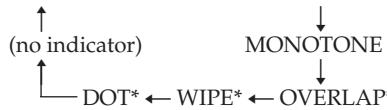
(2) Press FADER. The screen to select the fader mode appears.
(3) Press a desired mode.
(4) Press OK to return to PAGE1.
(5) Press EXIT to return to FN.
The fader indicator you selected flashes.
(6) Press START/STOP.
After the fade in/out is carried out, your camcorder automatically returns to the normal mode.
To cancel the fade in/out
Before pressing START/STOP, press OFF on the FADER screen to return to PAGE1.
Press EXIT to return to FN.
You cannot use the following functions while using fader. Also, you cannot use fader while using following functions:
-Super NightShot (DCR-TRV22E/TRV33E only)
-Colour Slow Shutter (DCR-TRV22E/TRV33E only)
- Digital effect (DCR-TRV22E/TRV33E only)
-Interval Recording
- Frame recording
When you select OVERLAP, WIPE or DOT (DCR-TRV22E/TRV33E only)
Your camcorder automatically stores the image recorded on the tape. When the image is being stored, the playback picture disappears.
During BOUNCE is on, you cannot use the following functions:
-Zoom
- Picture effect
- Manual exposure
-Flexible Spot Meter
- Manual focus
- Wide mode
-PROGRAM AE
- Photo recording in "Memory Stick" (DCRTRV22E/TRV33E only)
Note on the BOUNCE mode
You cannot select BOUNCE in the followings:
-D ZOOM is activated in the menu settings
- Wide mode
- Picture effect
- PROGRAM AE
Using special effects - Picture effect
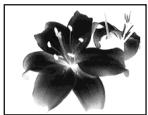
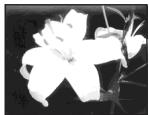
NEG. ART [a]: The colour and brightness of the picture are reversed.
SEPIA: The picture is sepia.
B&W: The picture is monochrome (black-and-white).
SOLARIZE [b]: The picture looks like an illustration with strong contrast.
PASTEL [c]: The picture looks like a pale pastel drawing.
MOSAIC [d]: The picture is mosaic.
[a]
[b]
The POWER switch should be set to
(CAMERA).
Operate by touching the panel.
To cancel picture effect
Set P EFFECT to OFF in the menu settings.
Note
While using picture effect, you cannot use following functions:
- BOUNCE
-OLD MOVIE (DCR-TRV22E/TRV33E only)
- BOUNCE
-OLD MOVIE (DCR-TRV22E/TRV33E uniqueness)
Using special effects - Digital effect (DCRTRV22E/TRV33E only)
You can record a still image so that it is superimposed on a moving picture.
FLASH (flash motion)
You can record still images successively at regular intervals.
You can swap the brighter area in a still image with a moving picture.
TRAIL
You can record a picture so that an incidental image like a trail is left.
SLOW SHTR (slow shutter)
You can slow down the shutter speed. The SLOW SHTR mode is good for recording dark pictures more brightly.
OLD MOVIE
You can add an old movie type atmosphere to pictures. Your camcorder automatically sets the 16:9WIDE mode, picture effect to SEPIA, and the appropriate shutter speed.
STILL
SLOW SHTR (Slow shutter)
Using special effects - Digital effect (DCR-TRV22E/TRV33E only)
The POWER switch should be set to
(CAMERA).
Operate by touching the panel.
(1) Press FN and select PAGE2.
(2) Press DIG EFFT. The screen to select a digital effect is displayed.
(3) Press a desired mode. When you select STILL or LUMI, the still image is stored in memory.
(4) Press - (to decrease the effect)/+ (to increase the effect) to adjust the effect.
Items to adjust
| STILL | The rate of the still image you want to superimpose on the moving picture |
| FLASH | The interval of flash motion |
| LUMI. | The colour scheme of the area in the still image which is to be swapped with a moving picture |
| TRAIL | The vanishing time of the incidental image |
| SLOW SHTR | Shutter speed. The larger the shutter speed number, the slower the shutter speed. |
| OLD MOVIE | No adjustment is necessary. |
(5) Press OK to return to PAGE2.
[a] The bar appears when setting following digital effect modes: STILL, FLASH, LUMI., TRAIL.
Using special effects - Digital effect (DCR-TRV22E/TRV33E only)
To return to FN
Press EXIT.
To cancel digital effect
Press OFF on the DIG EFFT screen to return to PAGE2.
Shutter speed
| Shutter speed number | Shutter speed |
| SLOW SHTR 1 | 1/25 |
| SLOW SHTR 2 | 1/12 |
| SLOW SHTR 3 | 1/6 |
| SLOW SHTR 4 | 1/3 |
Notes
While using digital effect, you cannot use the following functions:
Super NightShot
-Colour Slow Shutter
-Fader
- PROGRAM AE does not work in the SLOW SHTR mode.
- The following functions do not work in the OLD MOVIE mode:
- Wide mode
- Picture effect
-PROGRAM AE
When recording in the SLOW SHTR mode
Auto focus may not be effective. Focus manually using a tripod.
This mode prevents people's faces, for example, from appearing excessively white when shooting subjects lit by strong light in the theatre.
PORTRAIT (soft portrait)
This mode brings out the subject while creating a soft background for subjects such as people or flowers.
SPORTS (sports lesson)*
This mode minimises shake on fast-moving subjects such as in tennis or golf.
BEACH&SKI*
This mode prevents people's faces from appearing dark in strong light or reflected light, such as at a beach in midsummer or on a ski slope.
C SUNSETMOON (sunset & moon)**
This mode allows you to maintain atmosphere when you are recording sunsets, general night views, fireworks displays and neon signs.
LANDSCAPE**
This mode is for when you record distant subjects such as mountains. Also it prevents your camcorder from focusing on glass or metal mesh in windows when you record a subject behind glass or a screen.
The POWER switch should be set to
CAMERA or (MEMORY)
Operate by touching the panel.
(1) Press FN to display PAGE1.
(2) Press MENU to display the menu.
(3) Select PROGRAM AE in , then press EXEC (p. 242).
1) DCR-TRV22E/TRV33E only
Set PROGRAM AE to AUTO in the menu settings.
Notes
The following functions do not work in PROGRAM AE:
-Colour Slow Shutter (DCR-TRV22E/ TRV33E only)
- BOUNCE
SLOW SHTR (DCR-TRV22E/TRV33E only)
- OLD MOVIE (DCR-TRV22E/TRV33E only)
- Spot Focus
- PROGRAM AE does not work in the following cases (The indicator flashes.):
-NIGHTSHOT is set to ON.
- To record images on the "Memory Stick" using the MEMORY MIX (DCR-TRV22E/ TRV33E only)
- When you set the POWER switch to MEMORY, the SPORTS mode does not work. (The indicator flashes.) (DCR-TRV22E/ TRV33E only)
Adjusting the exposure manually
We recommend that you adjust the exposure manually in the following cases:
- When the subject is backlit
- When the subject is too bright against the background
- When recording dark pictures (e.g. night scenes) faithfully
The POWER switch should be set to
CAMERA or (MEMORY)
Operate by touching the panel.
(1) Press FN to display PAGE1.
(2) Press EXPOSURE. The screen to adjust the exposure appears.
(3) Press MANUAL.
(4) Adjust the exposure using - (to dim) / + (to brighten).
(5) Press OK to return to PAGE1.
1) DCR-TRV22E/TRV33E only
To return to the automatic exposure
Press AUTO on the EXPOSURE screen to return to PAGE1.
Note
When you adjust the exposure manually, the following functions do not work:
-Back light
-Colour Slow Shutter (DCR-TRV22E/TRV33E only)
Pour revenir à FN
Appuyez sur EXIT.
You can take a picture with the appropriate exposure automatically for just the point you want to focus on and with its exposure fixed. Use Flexible Spot Meter in the following cases:
- The subject is backlit.
- When there is strong contrast between the subject and background such as with a subject that is on stage and lit by a spotlight.
The POWER switch should be set to
CAMERA or (MEMORY)
Operate by touching the panel.
(1) Press FN to display PAGE1.
(2) Press SPOT METER. The SPOT METER screen appears.
(3) Press the desired area in the frame. The SPOT METER indicator flashes on the screen. The exposure of the point you selected is adjusted.
(4) Press OK to return to PAGE1.
1) DCR-TRV22E/TRV33E only
To return to the automatic exposure
Press AUTO on the SPOT METER screen to return to PAGE1.
Note
The following functions do not work during Flexible Spot Meter:
-Back light
-Colour Slow Shutter (DCR-TRV22E/TRV33E only)
-Spot Focus
Pour revenir à FN
Appuyez sur EXIT.
You can gain better results by manually adjusting the focus in the following cases. Normally, focus is automatically adjusted.
- The autofocus mode is not effective when shooting:
- Subjects through glass coated with water droplets
- Horizontal stripes
- Subjects with little contrast with backgrounds such as walls or the sky
- Shooting a stationary subject when using a tripod
- When you want to change the focus from a subject in the foreground to a subject in the background
The POWER switch should be set to
CAMERA or (MEMORY)
Operate by touching the panel.
(1) Press FN to display PAGE1.
(2) Press FOCUS.
(3) Press MANUAL. The screen to adjust the focus appears.
(4) Press or to sharpen focus.
(5) Press OK to return to PAGE1.
1) DCR-TRV22E/TRV33E only
To return to the autofocus
On the FOCUS screen, press AUTO to return to PAGE1.
To focus precisely
It is easier to focus on the subject if you adjust the zoom to shoot at the "W" (wide-angle) position after focusing at the "T" (telephoto) position.
When you shoot close to the subject
Focus at the end of the "W" (wide-angle) position.
changes as follows:
when recording a distant subject
when the subject is too close to focus on
Using spot focus function - Spot Focus
You can take a picture with the appropriate focus automatically for just the point you want to focus on and with its focus fixed.
The POWER switch should be set to
CAMERA or (MEMORY)
Operate by touching the panel.
(1) Press FN to display PAGE1.
(2) Press SPOT FOCUS. The SPOT FOCUS screen appears.
(3) Press the desired area in the frame. The SPOT FOCUS indicator flashes on the screen. The focus of the point you selected is adjusted.
(4) Press OK to return to PAGE1.
1) DCR-TRV22E/TRV33E only
To return to the autofocus
On the SPOT FOCUS screen, press AUTO to return to PAGE1.
Notes
- Spot Focus does not work while PROGRAM AE is on.
- The back light function does not work during Spot Focus.
Pour revenir à FN
Appuyez sur EXIT.
You can make time-lapse recordings by setting your camcorder to automatically record and standby sequentially. You can achieve excellent recordings of flowers blooming, insects hatching, etc. with this function.
Example
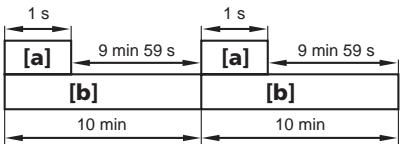
[a]RECTIME
[b]INTERVAL
There may be a discrepancy in recording time of up to + / - 6 frames from the selected time.
The POWER switch should be set to
CAMERA
Operate by touching the panel.
(1) Press FN to display PAGE1.
(2) Press MENU to display the menu.
(3) Select INT. REC in 10 , then press EXEC (p. 248).
(4) Select SET, then press EXEC.
(5) Select INTERVAL, then press EXEC.
(6) Select a desired interval time, then press EXEC. The time: 30SEC 1MIN 5MIN 10MIN
(7) Select REC TIME, then press EXEC.
(8) Select a desired recording time, then press EXEC. The time: 0.5SEC 1SEC 1.5SEC 2SEC
(9) Press RET.
(10) Select INT. REC to ON, then press EXEC.
(11) Press EXIT to return to FN. The INTERVAL TAPE indicator flashes on the screen.
(12) Press START/STOP to start Interval Recording. The INTERVAL TAPE indicator lights up during Interval Recording.
To cancel Interval Recording
Set INT. REC to OFF in the menu settings.
Frame by frame recording - Frame recording
You can make a recording with a stop-motion animated effect using frame recording. To create this effect, alternately move the subject a little and make frame recording. We recommend that you use a tripod, and operate your camcorder using the Remote Commander (except for DCR-TRV12E) to avoid camera-shake.
The POWER switch should be set to
CAMERA
Operate by touching the panel.
(1) Press FN to display PAGE1.
(2) Press MENU to display the menu.
(3) Select FRAME REC in 00 , then press EXEC (p. 248).
(4) Select ON, then press EXEC.
(5) Press EXIT to return to FN. The FRAME REC indicator lights up.
(6) Press START/STOP to start frame recording. Your camcorder makes a recording for about 6 frames, and returns to recording standby.
(7) Move the subject, and repeat step 6.
To cancel frame recording
Set FRAME REC to OFF in the menu settings.
Note
The proper remaining tape time is not indicated if you use frame recording continuously.
When using frame recording
The last recorded frame is longer than other frames.
Using the viewfinder
You can operate camera brightness and fader on the touch panel when looking at the viewfinder. Turn the LCD panel over and move it back to your camcorder body with the LCD screen facing out to do this operation.
The POWER switch should be set to
CAMERA or (MEMORY)
Operate by touching the panel.
(1) Turn the LCD panel over and move it back to your camcorder body with the LCD screen facing out, then extend the viewfinder.
(2) Press OFF. The PANEL OFF indicator appears on the screen.
(3) Press OK. The LCD screen is turned off.
(4) Using the viewfinder, press the LCD screen. EXPOSURE, OK, ON and FADER (only when the POWER switch is set to CAMERA) appear.
(5) Press the LCD screen and select a desired item, then press OK.
EXPOSURE:
Adjust the exposure by pressing - / +
FADER:
Press FADER until a desired fader mode appears.
The indicator changes as follows:
FADER M. FADER BOUNCE
ON:
The LCD screen lights up.
1) DCR-TRV22E/TRV33E only
[a] When the POWER switch is set to CAMERA
[b] When the POWER switch is set to MEMORY (DCR-TRV22E/TRV33E only)
Press OK.
Note
When the POWER switch is set to PLAYER^1)/ VCR2), or during memory playback (DCRTRV22E/TRV33E only), you cannot operate with the touch panel using the viewfinder.
1) DCR-TRV12E/TRV14E
2) DCR-TRV19E/TRV22E/TRV33E
To operate the items that do not appear
Set the LCD panel and the viewfinder back to the previous position. Operate the items using the LCD screen.
Available recording time
This is the time when you record pictures using the viewfinder (p. 27).
Playing back tape with picture effect
The POWER switch should be set to
^1) / ^2)
Operate by touching the panel.
(1) During playback or playback pause, press FN to display PAGE1.
(2) Press MENU to display the menu.
(3) Select P EFFECT in , then press EXEC (p. 242).
(4) Select a desired mode, then press EXEC. You can use NEG. ART, SEPIA, B&W and SOLARIZE.
See page 76 for details of each mode.
1) DCR-TRV12E/TRV14E
2) DCR-TRV19E/TRV22E/TRV33E
To return to FN
Press EXIT.
To cancel picture effect
Set P EFFECT to OFF in the menu settings.
Notes
- You cannot process externally input scenes using picture effect.
- You cannot record images on the tape on your camcorder while you are processing the image using picture effect. Record images on the "Memory Stick" (DCR-TRV22E/TRV33E only) (p. 156, 170), or on a VCR using your camcorder as a player.
Pictures processed by picture effect
These pictures are not output through the DV Interface.
Playing back tape with digital effect (DCR-TRV22E/TRV33E only)
The POWER switch should be set to VCR.
Operate by touching the panel.
(1) During playback or playback pause, press FN and select PAGE2.
(2) Press DIG EFFT. The screen to select a digital effect is displayed.
(3) Select a desired mode. You can use STILL, FLASH, LUMI. and TRAIL. See page 77 for details of the each effect. When you select STILL or LUMI., the picture that you select the mode to is stored in memory as a still image.
(4) Press - / + to adjust the effect.
(5) Press OK to return to PAGE2.
To return to FN
Press EXIT.
To cancel digital effect
Press OFF to return to PAGE2.
Notes
- You cannot process externally input scenes using digital effect.
- You cannot record images on the tape on your camcorder while you are processing the image using digital effect. Record images on the "Memory Stick" (p. 156, 170), or on a VCR using your camcorder as a player.
Pictures processed by digital effect
These pictures are not output through the DV Interface.
Enlarging images recorded on tape - Tape PB ZOOM (DCRTRV22E/TRV33E only)
Besides the operation described here, your camcorder can enlarge still images recorded on the "Memory Stick" (p. 186).
The POWER switch should be set to VCR.
Operate by touching the panel.
(1) During playback or playback pause, press FN and select PAGE2.
(2) Press PB ZOOM. The PB ZOOM screen appears.
(3) Press the area you want to enlarge in the frame.
The area you pressed moves to the centre of the screen, and the playback image is enlarged to about twice the size. If you press another area again, the area moves to the centre of the screen.
(4) Adjust the zoom ratio by the power zoom lever.
You can select the zoom ratio from approximately 1.1 times up to 5 times its size.
W: Decrease the zoom ratio.
T: Increase the zoom ratio.
Enlarging images recorded on tape - Tape PB ZOOM (DCR-TRV22E/TRV33E only)
To cancel tape PB ZOOM
Press END.
Notes
- You cannot process externally input scenes using tape PB ZOOM with your camcorder.
- You cannot record images on the tape on your camcorder while you are processing the image using tape PB ZOOM. However, you can record images on the "Memory Stick" (DCR-TRV33E only, p. 156, 170), or on a VCR using your camcorder as a player.
- You cannot record moving pictures on the "Memory Stick" on your camcorder when you have processed the picture using tape PB ZOOM.
Images in tape PB ZOOM
Images in tape PB ZOOM are not output through the DV Interface.
During tape PB ZOOM
If you press DSPL/BATT INFO, the frame on the PB ZOOM screen disappears. You cannot move the part you pressed to the centre of the screen.
Edge of the enlarged image
The edge of the enlarged image cannot be displayed at the centre of the screen.
Your camcorder automatically searches for a desired scene having the tape counter value of "0:00:00." Use the Remote Commander for this operation.
The POWER switch should be set to
^1) / ^2)
(1) During playback, press ZERO SET MEMORY on the Remote Commander at the point you want to locate later. The tape counter shows "0:00:00," then starts counting. The ZERO SET MEMORY indicator flashes. If the indicators do not appear, press DISPLAY.
(2) Press when you want to stop playback.
(3) Press to rewind the tape to the tape counter's zero point. The tape stops automatically when the tape counter reaches approximately zero.
(4) Press . Playback starts from the counter's zero point.
1) DCR-TRV14E
2) DCR-TRV19E/TRV22E/TRV33E
Quickly locating a scene - Zero set memory (DCR-TRV14E/TRV19E/TRV22E/TRV33E only)
Notes
- When you press ZERO SET MEMORY before rewinding the tape, the zero set memory function will be cancelled.
- There may be a discrepancy of several seconds between the time code and the tape counter.
- The ZERO SET MEMORY indicator disappears when you press FN.
If the tape has a blank portion in the recorded sections
The zero set memory function may not work correctly.
Searching the boundaries of recorded tape by title - Title search (DCR-TRV14E/TRV19E/ TRV22E/TRV33E only)
Use the cassette with Cassette Memory for this operation.
Use the Remote Commander for this operation.
Before operation
Set CM SEARCH in to ON in the menu settings. (The default setting is ON.)
The POWER switch should be set to
^1) / ^2)
(1) Press SEARCH MODE on the Remote Commander repeatedly, until the TITLE SEARCH indicator appears.
The title search screen appears.
The indicator changes as follows:
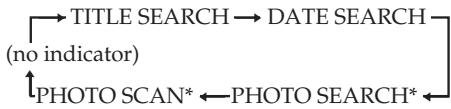
(2) Press or on the Remote Commander to select the title for playback.
Your camcorder automatically starts playback of the scene having the title that you selected.
1) DCR-TRV14E
2) DCR-TRV19E/TRV22E/TRV33E
[a] Actual point you are trying to search for
[b] Present point on the tape
To cancel searching
Press on the Remote Commander.
If the tape has a blank portion between recorded portions
Title search may not work correctly.
To superimpose a title
See page 133.

2

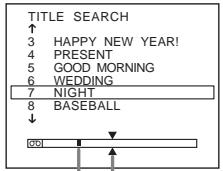
[b] [a]
Searching a recording by date - Date search (DCR-TRV14E/TRV19E/ TRV22E/TRV33E only)
- DATE SEARCH using Cassette Memory
Select the date from the list of recording dates displayed on the screen
DATE SEARCH without using Cassette Memory
Search for the point where the recording date changed
Use the Remote Commander for this operation.
Searching for the date by using Cassette Memory
Before operation
- You can use this function only when playing back the cassette with Cassette Memory.
- Set CM SEARCH in [CH] to ON in the menu settings. (The default setting is ON.)
The POWER switch should be set to ^1) / ^2)
(1) Press SEARCH MODE on the Remote Commander repeatedly, until the DATE SEARCH indicator appears. The date search screen appears. The indicator changes as follows:
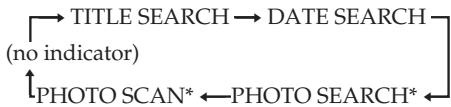
(2) Press or on the Remote Commander to select the date for playback. Your camcorder automatically starts playback at the beginning of the selected date.
1) DCR-TRV14E
2) DCR-TRV19E/TRV22E/TRV33E
[a] Actual point you are trying to search for
[b] Present point on the tape
To cancel searching
Press on the Remote Commander.
Searching for the date without using Cassette Memory
The POWER switch should be set to
^(1) / ^(2)
Operate by touching the panel.
(1) Press FN to display PAGE1.
(2) Press MENU to display the menu.
(3) Select CM SEARCH in , then press EXEC (p. 247).
(4) Select OFF, then press EXEC.
(5) Press SEARCH MODE on the Remote Commander repeatedly, until the DATE SEARCH indicator appears.
Searching a recording by date - Date search (DCR-TRV14E/ TRV19E/TRV22E/TRV33E only)
(6) Press on the Remote Commander to search for the previous date or press on the Remote Commander to search for the next date. Your camcorder automatically starts playback at the point where the date changes. Each time you press or your camcorder searches for the previous or next date.
1) DCR-TRV14E
2) DCR-TRV19E/TRV22E/TRV33E
To cancel searching
Press on the Remote Commander or on your camcorder.
Note
If one day's recording is less than 2 minutes, your camcorder may not accurately find the point where the recording date changes.
If the tape has a blank portion between recorded portions
Date search may not work correctly.
Cassette Memory
The cassette with Cassette Memory can hold 6 recording date data. If you search the date among 7 or more data, see "Searching for the date without using Cassette Memory."
Searching for a photo - Photo search/Photoscan (DCR-TRV14E/TRV19E only)
You can search for a still image you have recorded on a tape (PHOTO SEARCH). You can also search for still images one after another and display each image for five seconds automatically regardless of the cassette memory (PHOTO SCAN). Use the Remote Commander for these operations. Use this function to check or edit still images.
Searching for a photo by using cassette memory
Before operation
- You can use this function only when playing back a tape with cassette memory.
- Set CM SEARCH in [CH] to ON in the menu settings. (The default setting is ON.)
The POWER switch should be set to ^1) / ^2)
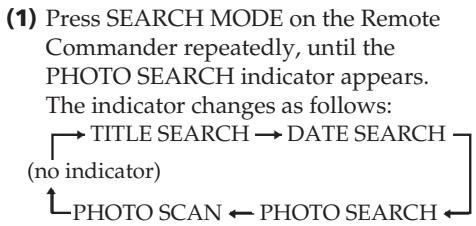
(2) Press or on the Remote Commander to select the date for playback. Your camcorder automatically starts playback of the photo having the date that you selected.
1) DCR-TRV14E
2) DCR-TRV19E
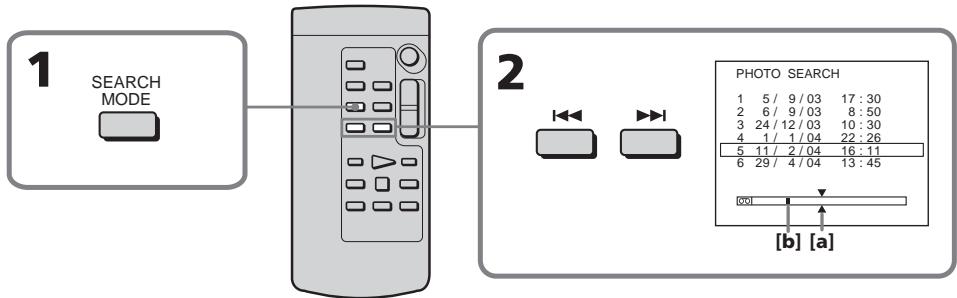
[a] Actual point you are trying to search for
[b] Present point on the tape
To stop searching
Press on the Remote Commander.
Searching for a photo without using cassette memory
The POWER switch should be set to
^1) / ^2)
Operate by touching the panel.
(1) Press FN to display PAGE1.
(2) Press MENU to display the menu.
(3) Select CM SEARCH in , then press EXEC (p. 247).
(4) Select OFF, then press EXEC.
(5) Press SEARCH MODE on the Remote Commander repeatedly, until the PHOTO SEARCH indicator appears.
The indicator changes as follows:
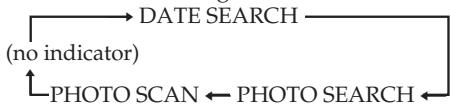
(6) Press or on the Remote Commander to select the photo for playback. Each time you press or your camcorder searches for the previous or next photo.
Your camcorder automatically starts playback of the photo.
1) DCR-TRV14E
2) DCR-TRV19E
To stop searching
Press on the Remote Commander or on your camcorder.
(1) Press SEARCH MODE on the Remote Commander repeatedly, until the PHOTO SCAN indicator appears. The indicator changes as follows: TITLE SEARCH* DATE SEARCH (no indicator) PHOTO SCAN PHOTO SEARCH* TITLE SEARCH appears only when CM SEARCH is set to ON in the menu settings.
(2) Press or on the Remote Commander. Each photo is played back for about 5 seconds automatically.
1) DCR-TRV14E
2) DCR-TRV19E
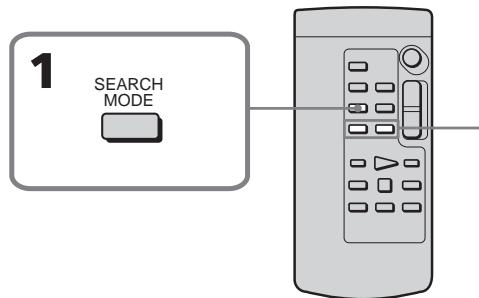
To stop scanning
Press on the Remote Commander or on your camcorder.
If a tape has a blank section between recorded sections
PHOTO SEARCH and PHOTO SCAN may not work correctly.
The available number of photos that can be searched using the cassette memory
The available number is up to 12 photos.
However, you can search 13 photos or more using the photo scan function.
Balayage de photos
You can dub or edit on the VCR connected to your camcorder using your camcorder as a player.
You can connect either the A/V connecting cable (supplied) or i.LINK cable (optional). If you connect with the i.LINK cable (optional), video and audio signals are transmitted in digital form for high-quality editing.
Connecting
With the A/V connecting cable

: Signal flow/Sens du signal
Dubbing
If you are connecting the VCR with the A/V connecting cable
- Set DISPLAY in ETC to LCD in the menu settings. (The default setting is LCD.)
- If a search indicator is displayed, press SEARCH MODE on the Remote Commander to turn it off (except for DCR-TRV12E).
- If you want to dub the data code, display it on the screen.
- If you want to dub the title, set TITLE DSPL in [CH] to ON in the menu settings. (The default setting is ON.)
If you are connecting the VCR with the i.LINK cable
- Recording of only the picture or sound cannot be done.
- Titles, screen indicators, Cassette Memory contents, and "Memory Stick" index screen lettering cannot be recorded.
The POWER switch should be set to
^(1) / ^(2)
(1) Insert a blank tape (or the tape you want to record over) into the VCR, and insert the recorded tape into your camcorder.
(2) Prepare the VCR for recording. If the VCR has an input selector, set it to input. Refer to the operating instructions of the VCR.
(3) Play back the recorded tape on your camcorder.
(4) Start recording on the VCR. Refer to the operating instructions of your VCR.
1) DCR-TRV12E/TRV14E
2) DCR-TRV19E/TRV22E/TRV33E
When you have finished dubbing the tape
Press on both your camcorder and the VCR.
Copiedune cassette
Copie
You can edit on VCRs that support the following systems:
8 mm 3, Hi8 Hi8, Digital8 H), VHS VHS, S-VHS, VHSC VHS, S-VHS
Betamax B, mini DV Mini DV and MICROMV MECROMV
If your VCR is a monaural type
Connect the yellow plug of the A/V connecting cable to the video input jack and the white or the red plug to the audio input jack on the VCR or the TV. When the white plug is connected, the left channel audio is output, and when the red plug is connected, the right channel audio is output.
If your VCR has an S video jack
See page 61 for details.
About i.LINK
See page 292 for details.
Pictures processed by picture effect, digital effect* or PB ZOOM*
These are not output through the DV Interface.
If you record a paused playback picture
- The recorded picture becomes rough with the DV Interface.
- The picture may jitter when you play back the picture using other video equipment.
Dubbing only desired scenes - Digital program editing (on tape)
You can duplicate selected scenes (programmes) for editing onto the tape without operating the VCR. Scenes can be selected by frame. You can set up to 20 programmes. Your camcorder can dub on the "Memory Stick" (DCR-TRV22E/TRV33E only). See page 173 for details.
Before operating Digital program editing on the tape recorded on other equipment
Step 1 Connecting to the VCR (p. 110)
Step 2 Setting the VCR to operate (p. 110)
Step 3 Adjusting the synchronisation of the VCR (p. 115)
When you dub using the same VCR again, you can skip steps 2 and 3.
Dubbing only desired scenes - Digital program editing (on tape)
Using Digital program editing on the tape recorded on other equipment
Operation 1 Making a programme (p. 117)
Operation 2 Performing Digital program editing (Dubbing the tape) (p. 120)
Note
When editing digital video, the operation signals to the VCR cannot be sent with LANC jack.
Step 1: Connecting to the VCR
You can connect either the A/V connecting cable or the i.LINK cable.
Connect the devices as illustrated on page 106.
Step 2: Setting the VCR to operate
When you are connecting the camcorder and VCR using the A/V connecting cable, the signal is emitted from the infrared rays emitter of your camcorder to the remote sensor on the VCR to control the VCR.
The POWER switch should be set to
^(1) / ^(2)
Operate by touching the panel.
1) DCR-TRV12E/TRV14E
2) DCR-TRV19E/TRV22E/TRV33E
(1) Turn the power of the connected VCR on. If the VCR has an input selector, set it to input.
When you connect a video camera recorder, set its power switch to VCR/VTR.
(2) Press FN to display PAGE1.
Dubbing only desired scenes - Digital program editing (on tape)
(3) Press MENU to display the menu.
(4) SelectVIDEOEDIT in ETC, then press EXEC (p. 251).
(5) Select TAPE, then press EXEC (DCRTRV22E/TRV33E only).
(6) Press EDIT SET.
(7) Select CONTROL, then press EXEC.
(8) When connecting with the A/V connecting cable, select IR, then press EXEC. When connecting with the i.LINK cable, select i.LINK, press EXEC, then go to "Step 3: Adjusting the synchronisation of the VCR" on page 115.
(9) Select IR SETUP, then press EXEC.
(10) Select the IR SETUP code of your VCR, then press EXEC. Check the code in "About the IR SETUP code" (p. 114).
Dubbing only desired scenes - Digital program editing (on tape)
(11) Select PAUSEMODE, then press EXEC.
(12) Select the mode to cancel recording pause on the VCR, then press EXEC. The correct button depends on your VCR.
Refer to the operating instructions of your VCR.
(13) Locate the infrared rays emitter of your camcorder and face it towards the remote sensor of the VCR about 30 cm (12 in.) apart.
Dubbing only desired scenes - Digital program editing (on tape)
(14) Insert a recordable tape into the VCR, then set the VCR to recording pause.
(15) Select IR TEST, then press EXEC.
(16) Select EXECUTE, then press EXEC. If the VCR starts recording, the setting is correct.
The indicator you selected to cancel recording pause on the VCR flashes on the screen. When finished, the indicator changes to COMPLETE.
When you connect with the i.LINK cable, you may not be able to operate the dubbing function correctly, depending on the VCR. Set CONTROL to IR in the menu settings of your camcorder.
Remarque
Dubbing only desired scenes - Digital program editing (on tape)
About the IR SETUP code
The IR SETUP code is stored in the memory of your camcorder. Be sure to set the correct code, depending on your VCR. Default setting is code number 3.
| Brand/Marque | IR SETUP code/ code IR SETUP |
| Sony | 1,2,3,4,5,6 |
| Aiwa | 47,53,54 |
| Akai | 50,62,74 |
| Alba | 73 |
| Amstrad | 73 |
| Baird | 30,36 |
| Blaupunkt | 11,83 |
| Bush | 74 |
| CGM | 36,47,83 |
| Clatronic | 73 |
| Daewoo | 26 |
| Ferguson | 76,83 |
| Fisher | 73 |
| Funai | 80 |
| Goldstar | 47 |
| Goodmans | 26,84 |
| Grundig | 9,83 |
| Hitachi | 42,56 |
| ITT/Nokia Instant | 36 |
| JVC | 11,12,15,21 |
| Kendo | 47 |
| Loewe | 16,47,84 |
| Luxor | 89 |
| Mark | 26* |
| Matsui | 47,58*,60 |
| Mitsubishi | 28,29 |
Note on the IR SETUP code
Digital program editing is not possible if the VCR does not support IR SETUP codes.
Dubbing only desired scenes - Digital program editing (on tape)
When the VCR does not operate correctly
- After checking the code in "About the IR SETUP code" (p. 114), set the IR SETUP or the PAUSEMODE again.
- Place your camcorder at least 30~cm (12 in.) away from the VCR.
Refer to the operating instructions of your VCR.
Step 3: Adjusting the synchronisation of the VCR
You can adjust the synchronisation of your camcorder and the VCR.
Prepare a pen and paper for notes.
Before operation, eject the cassette from your camcorder (if inserted).
The POWER switch should be set to
^(1) / ^(2)
Operate by touching the panel.
1) DCR-TRV12E/TRV14E
2) DCR-TRV19E/TRV22E/TRV33E
(1) Insert the recordable cassette into the VCR, then set the VCR to recording pause.
When you select i.LINK in CONTROL, the recording pause is not necessary.
(2) Select ADJ TEST, then press EXEC.
(3) Select EXECUTE, then press EXEC. IN and OUT are recorded on an image for 5 times each to calculate the number values for adjusting the synchronisation.
The EXECUTING indicator flashes on the screen. When finished, the indicator changes to COMPLETE.
(4) Rewind the tape in the VCR, then start slow playback.
5 IN numbers and corresponding OUT numbers are displayed.
Take a note of the opening number value of each IN and the closing number value of each OUT.
Dubbing only desired scenes - Digital program editing (on tape)
(5) Calculate the average of 5 opening number values of 5 IN, and the average of all the closing number values of each OUT.
(6) Select "CUT-IN," then press EXEC.
(7) Select the average number value of IN, then press EXEC. The calculated start position for recording is set.
(8) Select "CUT-OUT," then press EXEC.
(9) Select the average number value of OUT, then press EXEC. The calculated stop position for recording is set.
(10) Press RET. to execute.
Dubbing only desired scenes - Digital program editing (on tape)
Notes
- When you complete "Step 3: Adjusting the synchronisation of the VCR," the image to adjust the synchronisation is recorded for about 50 seconds.
- If you start recording from the very beginning of the tape, the first few seconds of the tape may not be recorded properly. Be sure to allow about 10 seconds' lead before starting the recording.
- When the recording unit cannot be operated properly by the i.LINK cable, leave the connection as it is, and make the A/V connecting cable settings (p. 110). Video and audio are sent by digital signals.
Operation 1: Making a Programme
The POWER switch should be set to
^(1) / ^(2)
Operate by touching the panel.
1) DCR-TRV12E/TRV14E
2) DCR-TRV19E/TRV22E/TRV33E
(1) Insert the cassette for playback into your camcorder, and insert the tape for recording into the VCR.
(2) Press FN to display PAGE1.
(3) Press MENU to display the menu.
(4) SelectVIDEOEDIT in ETC, then press EXEC (p.251).
(5) Select TAPE, then press EXEC (DCRTRV22E/TRV33E only).
(6) Search for the beginning of the first scene you want to insert using the video control buttons on the screen, then pause playback. You can fine-adjust one frame at a time with 111 .
(7) Press MARK IN on the screen. The IN point of the first programme is set, and the upper part of the programme mark changes to light blue.
Dubbing only desired scenes - Digital program editing (on tape)
(8) Search for the end of the first scene you want to insert using the video control buttons on the screen, then pause playback. You can fine-adjust one frame at a time with ||| / ||| .
(9) Press MARK OUT on the screen. The OUT point of the first programme is set, then the lower part of the programme mark changes to light blue.
(10) Repeat steps 6 to 9. When one programme is set, the programme mark changes to light blue. You can set 20 programmes in maximum.
To finish making programmes
Press END.
The programme is stored in memory until the tape is ejected.
Note
You cannot operate recording during Digital program editing.
Dubbing only desired scenes - Digital program editing (on tape)
On a blank portion of the tape
You cannot set IN or OUT.
If there is a blank portion between the IN point and the OUT point on the tape
The total time may not be displayed correctly.
Erasing the programme you have set
Erase OUT mark first, and then IN mark of the last set programme.
(1) Follow steps 2 to 5 on page 117.
(2) Press UNDO.
(3) Press ERASE 1 MARK. The last set programme mark flashes, then the DELETE? indicator appears.
(4) Press EXEC. The last set programme is deleted.
To cancel erasing
Press CANCEL in step 4.
Erasing all programmes
(1) Follow steps 2 to 5 on page 117.
(2) Press UNDO.
(3) Press ERASE ALL. All the set programme marks flash, then the DELETE ? indicator appears.
(4) Press EXEC. All the set programmes are deleted.
To cancel erasing all programmes
Press CANCEL in step 4.
The POWER switch should be set to
^(1) / ^(2)
Operate by touching the panel.
1) DCR-TRV12E/TRV14E
2) DCR-TRV19E/TRV22E/TRV33E
(1) When you use a digital video camera recorder, set the power switch of VCR to VCR/VTR.
(2) Make sure your camcorder and the VCR are connected, and that the VCR is set to recording pause. When you use the i.LINK cable, this step is not necessary.
(3) Press FN to display PAGE1.
(4) Press MENU to display the menu.
(5) Select VIDEO EDIT in ETC, then press EXEC (p. 251).
(6) Select TAPE, then press EXEC (DCRTRV22E/TRV33E only).
(7) Press START.
(8) Press EXEC. Search for the beginning of the first programme, then start dubbing. The programme mark flashes. The SEARCH indicator appears during searching, and the EDITING indicator appears during editing on the screen. When the dubbing ends, your camcorder and the VCR automatically stop.
To cancel dubbing during editing
Press CANCEL.
Dubbing only desired scenes - Digital program editing (on tape)
To end Digital program editing
Your camcorder stops when the dubbing is complete. Then the display returns to VIDEO EDIT in the menu settings.
Press END to end the video edit function.
When the programme has not been set
You cannot press START.
You cannot record on the VCR in the following:
| Indicator | Cause |
| No indicator | ·The write-protect tab on the cassette is set to lock.
·The IR SETUP code is not correct. (When IR is selected.)
·The button to cancel recording pause is not correct. (When IR is selected.) |
| CHECK "i.LINK" & REC STATUS | ·i.LINK is selected but the i.LINK cable is not connected.
·The power of the connected VCR is not turned on. (When i.LINK is selected.) |
Recording video or TV programmes (DCR-TRV19E/TRV22E/ TRV33E only)
You can record the tape from another VCR or a TV programme from a TV that has video/ audio outputs. Use your camcorder as a recorder. You can connect either the A/V connecting cable (supplied) (DCR-TRV22E/ TRV33E only) or i.LINK cable (optional). If you connect with the i.LINK cable (optional), video and audio signals are transmitted in digital form for high-quality editing.
Connecting a VCR or TV
With the A/V connecting cable (DCR-TRV22E/TRV33E only)
: Signal flow/Sens du signal
If your VCR is a monaural type (DCRTRV22E/TRV33E only)
Connect the yellow plug of the A/V connecting cable to the video output jack and the white or red plug to the audio output jack on the VCR or the TV. When the white plug is connected, the left channel audio is output, and when the red plug is connected, the right channel audio is output.
If your VCR has an S video jack (DCRTRV22E/TRV33E only)
See page 61 for details.
Note
Your camcorder only records pictures for viewing on a PAL system based TV and VCR. See "Using your camcorder abroad" on page 295 for the TV colour systems used in each country and area.
When using the i.LINK cable
- Before recording, make sure if the DV IN indicator appears on the screen. The DV IN indicator may appear on both equipment.
- Recording of only the picture or sound cannot be done.
Set DISPLAY in to LCD in the menu settings when using the A/V connecting cable. (The default setting is LCD.)
The POWER switch should be set to VCR.
Operate by touching the panel.
(1) Insert the blank tape (or the tape you want to record over) into your camcorder. If you are recording the tape from the VCR, insert the recorded tape into the VCR.
(2) Press FN and select PAGE3.
(3) Press REC CTRL.
(4) Press REC PAUSE.
(5) Press on the VCR to start playback if you record the tape from a VCR. Select a TV programme if you record from a TV. The picture from playback side appears on the screen.
(6) Press REC START at the scene where you want to start recording from.
When you have finished dubbing the tape
Press on your camcorder, and then press the stop button on the VCR.
Inserting a scene from a VCR - Insert editing (DCRTRV19E/TRV22E/TRV33E only)
You can insert a new scene with sound from a VCR onto your originally recorded tape by specifying the insert start and end points. Use the Remote Commander for this operation. Connections are the same as on page 122. Insert a cassette containing the desired scene to insert into the VCR.
[A] The tape that contains the scene to be superimposed
[B] The tape before editing
[C] The tape after editing
The POWER switch should be set to VCR.
Operate by touching the panel.
(1) On the VCR, locate just before the insert start point [a], then set the VCR to playback pause.
(2) On your camcorder, locate the insert end point [c], then set it to playback pause.
(3) Press ZERO SET MEMORY on the Remote Commander. The ZERO SET MEMORY indicator flashes and the end point of the insert is stored in memory. The tape counter shows "0:00:00."
Inserting a scene from a VCR - Insert editing (DCR-TRV19E/ TRV22E/TRV33E only)
(4) On your camcorder, locate the insert start point [b].
(5) Press FN and select PAGE3.
(6) Press REC CTRL.
(7) Press REC PAUSE.
(8) First press on the VCR, and after a few seconds press REC START on your camcorder to start inserting the new scene with sound. Inserting automatically stops near the zero point on the tape counter. Your camcorder automatically stops recording and the point you set in step 3 is cleared from memory.
Press ZERO SET MEMORY on the Remote Commander again after step 4 to erase the ZERO SET MEMORY indicator and begin from step 2.
To insert a scene without setting the insert end point
Skip steps 2 and 3. Press on the Remote Commander or on your camcorder when you want to stop inserting.
You can record additional audio to the original sound on the tape by connecting audio equipment or a microphone. If you connect the audio equipment, you can add sound to your tape already recorded in the 12-bit mode by specifying starting and ending points. The original sound will not be erased.
Preparing for audio dubbing
You can record additional audio in the following:
- Dubbing with the built-in microphone
- Connecting the microphone (optional) to the MIC jack
- Connecting the microphone (optional) to the intelligent accessory shoe
- Connecting the A/V connecting cable to the AUDIO/VIDEO jack (DCR-TRV22E/TRV33E only)
The audio input to be recorded will take precedence over others in the following order:
- MIC jack
- Intelligent accessory shoe
- AUDIO/VIDEO jack (DCR-TRV22E/TRV33E only)
Built-in microphone
Dubbing with the built-in microphone
No connection is necessary. (If no external microphone is connected, audio recording will be performed automatically by the built-in microphone.)
Doublage audio
Connecting the microphone (optional) to the MIC jack
: Signal flow/Sens du signal
You can check the recorded picture and sound by connecting the AUDIO/VIDEO jack to a TV.
The recorded sound is not output from the speaker. Check the sound by using the headphones or TV.
Connecting the microphone (optional) to the intelligent accessory shoe
Remove the shoe cover, then connect the microphone.
Connecting the A/V connecting cable to the AUDIO/VIDEO jack (DCR-TRV22E/TRV33E only)
When dubbing with the AUDIO/VIDEO jack (DCR-TRV22E/TRV33E only) or the built-in microphone, pictures are not output through the SVIDEO jack or AUDIO/VIDEO jack. Check the recorded picture on the screen. You can check the recorded sound by using headphones.
Remarque
Adding an audio sound on the recorded tape
Choose a connection mentioned on page 127, and connect audio equipment or microphone to your camcorder. Then follow the procedure below.
The POWER switch should be set to
^(1) / ^(2)
Operate by touching the panel.
(1) Insert the recorded tape into your camcorder.
(2)Locate the recording start point. Press to start playing back.To pause playing back,press at the recording start point.You can fine adjust the recording start point by pressing / >11
(3) Press FN and select PAGE3.
(4) Press A DUB CTRL. The A DUB CTRL screen appears.
Doublage audio
(5) Press AUDIO DUB. The green indicator appears on the screen.
(6) Press on your camcorder and at the same time start playing back the audio you want to record. The new sound is recorded in stereo 2 (ST2) during playback. While recording new sound, the red indicator appears on the screen.
(7) Press on your camcorder at the point where you want to stop recording.
1) DCR-TRV12E/TRV14E
2) DCR-TRV19E/TRV22E/TRV33E
- On the tape recorded in the 16-bit mode
- On the tape recorded in the LP mode
- When the DV Interface is connected
- On blank portions of a tape
- When the write-protect tab of the cassette is set to lock
To add new sound to previously recorded sections more precisely (except for DCR-TRV12E)
During playback, press ZERO SET MEMORY at the point where you want to stop recording new sound.
Follow the procedure on page 96. Recording automatically stops at the point where ZERO SET MEMORY was pressed.
We recommend that you add new sound on the tape recorded with your camcorder
If you add new sound on the tape recorded with another camcorder (including other DCR-TRV12E/TRV14E/TRV19E/TRV22E/TRV33E), the sound quality may become deteriorated.
Doublage audio
Monitoring the new recorded sound
The POWER switch should be set to
^(1) / ^(2)
Operate by touching the panel.
(1) Play back the tape on which you added audio.
(2) Press FN to display PAGE1.
(3) Press MENU to display the menu.
(4) Select AUDIO MIX in ^1 / ^2 , then press EXEC (p. 244).
Doublage audio
(5) Press / to adjust the balance between the original sound (ST1) and the new sound (ST2), then press EXEC. About 5 minutes after you disconnect the power source or remove the battery pack, the setting of AUDIO MIX returns to the original sound (ST1) only. The default setting is original sound only.
1) DCR-TRV12E/TRV14E
2) DCR-TRV19E/TRV22E/TRV33E
Superimposing a title on a cassette with Cassette Memory
A cassette can have up to about 20 titles, if a title consists of 5 characters.
However, if the Cassette Memory is full with date, photo data (DCR-TRV12E/TRV14E/ TRV19E only) and cassette label data, the cassette can have only up to about 11 titles with 5 characters each.
Cassette Memory capacity is as follows:
-6 date data (maximum)
- 1 cassette label (maximum)
- 12 photo data (maximum) (DCR-TRV12E/TRV14E/TRV19E only)
The POWER switch should be set to
CAMERA or ^(1) / ^(2)
Operate by touching the panel.
1) DCR-TRV12E/TRV14E
2) DCR-TRV19E/TRV22E/TRV33E
(1) Insert the cassette with Cassette Memory.
(2) During standby, recording, playback or playback pause, press FN to display PAGE1.
(3) Press MENU to display the menu.
(4) Select TITLE in , then press EXEC (p. 247).
(5) Select , then press EXEC.
(6) Select a desired title, then press EXEC. The title appears on the screen.
(7) If necessary, change the colour, size, or position by pressing COLOUR, SIZE, POS or POS .
(8) Press TITLE OK.
(9) Press SAVE TITLE. During playback, playback pause or recording: The TITLE SAVE indicator appears on the screen for about 5 seconds and the title is set.
During recording standby:
The TITLE indicator appears. And when you press START/STOP to start recording, the TITLE SAVE indicator appears on the screen for about 5 seconds and the title is set.
To use the custom title
If you want to use the custom title, select in step 5.
The titles superimposed with your camcorder
- They appear only by DVMin format video equipment with index titer function.
- The point you superimposed the title may be detected as an index signal when searching a recording with other video equipment.
To not display title
Set TITLE DSPL in to OFF in the menu settings (p. 247).
Title setting
The title colour changes as follows:

- The title size changes as follows:
SMALL LARGE
You cannot input 13 characters or more in LARGE size.
The title position:
If you select the title size SMALL, you have 9 choices for the title position.
If you select the title size LARGE, you have 8 choices for the title position.
The POWER switch should be set to
CAMERA or PLAYER ^1) / VCR ^2)
Operate by touching the panel.
(1) Press FN to display PAGE1.
(2) Press MENU to display the menu.
(3) Select TITLEERASE in , then press EXEC (p. 247). The TITLE ERASE screen appears.
(4) Select the title you want to erase, then press EXEC.
The ERASE OK? indicator appears.
(5) Make sure the title is the one you want to erase, then press OK.
The ERASING indicator flashes on the screen.
When the title is erased, the COMPLETE indicator appears.
1) DCR-TRV12E/TRV14E
2) DCR-TRV19E/TRV22E/TRV33E
Making your own titles
You can make up to 2 titles and store them in the memory of your camcorder. Each title can have up to 20 characters.
The POWER switch should be set to
CAMERA or PLAYER ^1) / VCR^2)
Operate by touching the panel.
(1) Press FN to display PAGE1.
(2) Press MENU to display the menu.
(3) Select TITLE in , then press EXEC (p. 247).
(4) Select l , then press EXEC.
(5) Select CUSTOM1 SET or CUSTOM2 SET, then press EXEC.
(6) Select a desired character. Repeat pressing a key to select a desired character on the key.
(7) Press to move the cursor to select the next character. Repeat the same procedure as steps 6 and 7 to complete your title.
(8) Press SET. The title is stored in memory.
1) DCR-TRV12E/TRV14E
2) DCR-TRV19E/TRV22E/TRV33E
To change a title you have stored
In step 5, select CUSTOM1 SET or CUSTOM2 SET, depending on which title you want to change, then press EXEC and enter the new title.
If you take 5 minutes or longer to enter characters during tape recording standby with the cassette inserted in your camcorder
The power automatically goes off. The characters you have entered remain stored in memory. Set the POWER switch to OFF (CHG) once and then to CAMERA again, then start again from step 1.
We recommend setting the POWER switch to PLAYER^1) / VCR^2) or removing the cassette so that your camcorder does not automatically turn off while you are entering title characters.
1) DCR-TRV12E/TRV14E
2) DCR-TRV19E/TRV22E/TRV33E
To erase the character
Press . The last character is erased.
To enter a space
Press
Pour revenir à FN
Appuyez sur EXIT.
Labelling a cassette on a cassette with Cassette Memory
The label can consist of up to 10 characters and is stored in Cassette Memory. When you insert the labelled cassette and set the POWER switch to CAMERA or PLAYER/VCR, the label is displayed for about 5 seconds.
The POWER switch should be set to
or ^1) / ^2)
Operate by touching the panel.
(1) Insert the cassette with Cassette Memory you want to label.
(2) Press FN to display PAGE1.
(3) Press MENU to display the menu.
(4) Select TAPE TITLE in , then press EXEC (p. 247).
(5) Select a desired character. Repeat pressing a key to select a desired character on the key.
(6) Press to move the cursor to select the next character. Repeat the same procedure as steps 5 and 6 to complete the label.
(7) Press SET. The label is stored in memory.
1) DCR-TRV12E/TRV14E
2) DCR-TRV19E/TRV22E/TRV33E
Labelling a cassette on a cassette with Cassette Memory
To return to FN
Press EXIT.
To erase the label you have made
Erase the label by selecting in step 5, then press SET.
To change the label you have made
Insert the cassette to change the label, and operate in the same way to make a new label.
If you have superimposed titles in the cassette
When the label appears, up to 4 titles also appear.
To erase the character
Press . The last character is erased.
To enter a space
Press
Erasing all the data in Cassette Memory
The following data saved in Cassette Memory can be completely erased at once:
-Date data
-Title data
Cassette label
- Photo data (DCR-TRV12E/TRV14E/TRV19E only)
The POWER switch should be set to
Operate by touching the panel.
(1) Press FN to display PAGE1.
(2) Press MENU to display the menu.
(3) Select ERASE ALL in , then press EXEC (p. 247).
(4) Select OK, then press EXEC. The OK indicator changes to EXECUTE.
(5) Select EXECUTE, then press EXEC. The ERASING indicator flashes on the screen. Once erasing is complete, the COMPLETE indicator appears.
1) DCR-TRV12E/TRV14E
2) DCR-TRV19E/TRV22E/TRV33E
"Memory Stick" Operations (DCRTRV22E/TRV33E only)
Using "Memory Stick"
The "Memory Stick" is a new light and small recording media which, despite of the size, can store greater data than a floppy disk. In addition to exchanging data between "Memory Stick" compatible equipment, you can also use a "Memory Stick" to store data as a type of detachable external recording media.
There are 2 types of "Memory Stick": an ordinary "Memory Stick" and a "MagicGate Memory Stick" that is equipped with the MagicGate ^[1] copyright protection technology. You can use both types of "Memory Stick" with your camcorder. However, because your camcorder does not support the MagicGate standards, data recorded with your camcorder is not subject to MagicGate copyright protection.
In addition, you can also use "Memory Stick Duo" or "Memory Stick PRO" with your camcorder.
All "Memory Stick" media operations are not necessarily guaranteed.
*1) MagicGate is copyright protection technology that uses encryption technology.
Still image (JPEG)
Your camcorder compresses and records image data in JPEG (Joint Photographic Experts Group) format. The file extension is .jpg.
Exif * Ver.2.2 JPEG compliant, DPOF compatible
- Exif: Exif is a file format for still images, established by the Japan Electronics and Information Technology Industries Association (JEITA). Files in this format can have additional information such as your camcorder's setting information at the time of recording.
Moving picture (MPEG)
Your camcorder compresses and records picture data in MPEG (Moving Picture Experts Group) format. The file extension is .mpg.
Typical image data file name
Still image
101-0001: This file name appears on the screen of your camcorder.
DSC00001.JPG: This file name appears on the display of a computer.
Moving picture
MOV00001: This file name appears on the screen of your camcorder.
MOV00001.MPG: This file name appears on the display of a computer.
To prevent from erasing images accidentally
Rear part of the "Memory Stick"
Slide the write-protect tab on the "Memory Stick" to LOCK.
The position and shape of the write-protect tab may be different depending on the model.
Notes on the "Memory Stick"
Labelling position
Stick its label on the labelling position.
Image data may be damaged in the following cases. (Damaged image data will not be compensated.)
- You eject the "Memory Stick" or turn the power off when the data is being recorded or the image file is being read in the "Memory Stick" (the access lamp is flashing or lights up).
- You use the "Memory Stick" near magnets or magnetic fields such as those of speakers and TV.
We recommend backing up important data on the hard disk of a computer.
On handling
- When you carry or store the "Memory Stick," put it in its case.
- Prevent metallic objects or your finger from coming into contact with the metal parts of the connecting section.
- Do not bend, drop or apply strong shock to the "Memory Stick."
- Do not disassemble or modify the "Memory Stick."
- Do not let the "Memory Stick" get wet.
On location for use
Do not use or keep the "Memory Stick" in locations that are:
- Extremely hot such as in a car parked in the sun or under the scorching sun
-Under direct sunlight
- Very humid or subject to corrosive gases
- Make sure to insert the "Memory Stick Duo" into the "Memory Stick Duo" Adaptor when using the "Memory Stick Duo" with your camcorder.
- Insert the "Memory Stick Duo" in the correct direction. Inserting it in the wrong direction may cause a malfunction of your camcorder.
- Do not insert the "Memory Stick Duo" into a "Memory Stick" compatible unit without inserting it into the "Memory Stick Duo" Adaptor first. Doing so may cause a malfunction of the unit.
Note on using the "Memory Stick PRO" (optional)
The "Memory Stick PRO" with a capacity up to 1 GB can be used with this camcorder.
The "Memory Stick" formatted by Windows OS or Macintosh computers does not have a guaranteed compatibility with your camcorder.
Notes on image data compatibility
- Image data files recorded on the "Memory Stick" by your camcorder conform with the Design Rules for Camera File Systems universal standard established by the JEITA (Japan Electronics and Information Technology Industries Association). On your camcorder, you cannot play back still images recorded on other equipment (DCR-TRV890E/TRV900/TRV900E or DSC-D700/D770) that does not conform to this universal standard. (These models are not sold in some areas.)
- If you cannot use the "Memory Stick" that is used with other equipment, format it with your camcorder (p. 246). Note that formatting erases all information on the "Memory Stick."
- You may not be able to play back the images recorded using your camcorder, on other playback equipment.
- You may not be able to play back following images with your camcorder:
image data modified on a computer
image data shot with other equipment
The "Memory Stick," and "MagicGate Memory Stick" are trademarks of Sony Corporation.
- "Memory Stick Duo" and MEMORY STICK DUO are trademarks of Sony Corporation.
"Memory Stick PRO" and "Memory STICK PRO" are trademarks of Sony Corporation.
"MagicGate" and MAGICGATE are trademarks of Sony Corporation.
- All other product names mentioned herein may be the trademarks or registered trademarks of their respective companies. Furthermore, "TM" and "®" are not mentioned in each case in this manual.
Inserting/Ejecting the "Memory Stick"
Inserting the "Memory Stick"
Open the lid of the "Memory Stick" slot. Insert the "Memory Stick" in the "Memory Stick" slot as far as it can go with the mark as illustrated, then close the lid.
Ejecting the "Memory Stick"
Open the lid of the "Memory Stick" slot. Slide MEMORY EJECT in the direction of the arrow.
- If you insert the "Memory Stick" forcibly in the opposite direction, the "Memory Stick" slot may be damaged.
- Do not insert anything other than the "Memory Stick" into the "Memory Stick" slot. This may cause a malfunction.
While the access lamp is lit or flashing
Do not shake or strike your camcorder because your camcorder is reading the data from the "Memory Stick" or recording the data on the "Memory Stick." Do not turn the power off, eject the "Memory Stick" or remove the battery pack. Otherwise, image data breakdown may occur.
If "MEMORY STICK ERROR" appears
Reinsert the "Memory Stick" a few times. The "Memory Stick" may be damaged if the indicator still appears. If this occurs, use another "Memory Stick."
Remarques
Selecting image quality and size
Selecting still image quality
The default setting is FINE.
The POWER switch should be set to
MEMORY or VCR.
Operate by touching the panel.
(1) Press FN to display PAGE1.
(2) Press MENU to display the menu.
(3) Select STILL SET in 3 , then press EXEC (p. 245).
(4) Select QUALITY, then press EXEC.
(5) Select a desired image quality, then press EXEC.
Image quality settings
| Setting | Meaning |
| FINE (FINE) | Use this mode when you want to record high quality images. Fine images are compressed to about 1/4. |
| STANDARD (STD) | This is the standard image quality. Standard images are compressed to about 1/10. |
To return to FN
Press EXIT.
Selecting the still image size (DCR-TRV33E only)
You can select image size 1152 × 864 or 640 × 480 (When the POWER switch is set to CAMERA or VCR, the image size is automatically set to 640 × 480 .) The default setting is 1152 × 864 .
The POWER switch should be set to (MEMORY).
Operate by touching the panel.
(1) Press FN to display PAGE1.
(2) Press MENU to display the menu.
(3) Select STILL SET in 3 , then press EXEC (p. 245).
(4) Select IMAGESIZE, then press EXEC.
(5) Select a desired image size, then press EXEC.
The indicator changes as follows:

Selecting image quality and size
Memory capacity of still images
Recorded images are compressed in JPEG format before being stored in memory. The memory capacity of still images varies depending on the selected image quality mode and image size. Details are shown in the table below.
1152 × 864 image size (DCR-TRV33E only)
| Image quality | Memory capacity |
| FINE | About 500 KB |
| STANDARD | About 200 KB |
640 × 480 image size
| Image quality | Memory capacity |
| FINE | About 150 KB |
| STANDARD | About 60 KB |
Selecting the moving picture size
You can select picture size 320 × 240 or 160 × 112 .
The default setting is 320 × 240 .
The POWER switch should be set to
(MEMORY) or (VCR).
Operate by touching the panel.
(1) Press FN to display PAGE1.
(2) Press MENU to display the menu.
(3) Select MOVIE SET in , then press EXEC (p. 245).
(4) Select IMAGESIZE, then press EXEC.
(5) Select a desired image size, then press EXEC.
The indicator changes as follows:


Approximate number of still images and time of moving pictures that can be recorded on one "Memory Stick"
The number of still images and the time of moving pictures you can record vary depending on which image quality mode you select and the complexity of the subject.
The table shows approximate number of still images and time of moving pictures that can be recorded on the "Memory Stick" formatted with your camcorder.
Recording still images on "Memory Stick" – Memory Photo recording
The POWER switch should be set to
MEMORY.
(1) Keep pressing PHOTO lightly and check the image. The green indicator stops flashing, then lights up. The brightness of the image and the focus are adjusted and fixed while your camcorder targets at the centre of the image. Recording does not start yet.
(2) Press PHOTO deeply. Recording is complete when the bar scroll indicator disappears. The image displayed on the screen when you pressed PHOTO deeply will be recorded on the "Memory Stick."
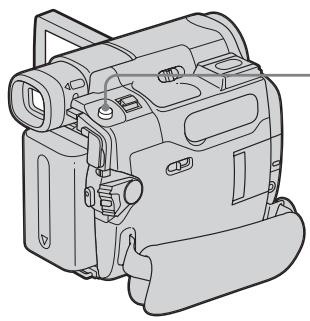
[a] Approximate number of images that can be recorded on the "Memory Stick"*
[b] Folder name to be recorded in
Note
The recordable number of the images indicated on the screen depends on the setting of the image quality and the condition of the subject being recorded. Therefore, the recordable number may not change even after recording has been done.
Recording still images on "Memory Stick" - Memory Photo recording
You can record still images on the "Memory Stick" during tape recording or tape recording standby
See page 62 for details.
* The indication of the number of recordable still images
Depending on the image quality setting and the complexity of the subject, the indication of the remaining number of recordable still images may not change even after you record an image. When the remaining number is greater than 9999, the >9999 indication appears on the screen.
When the POWER switch is set to MEMORY
The following functions do not work:
-Digital zoom
Super NightShot
-Colour Slow Shutter
- Wide mode
-Fader
- Picture effect
-Digital effect
- SPORTS of PROGRAM AE (The indicator flashes.)
-Title
- SteadyShot
While you are recording a still image. You cannot turn off the power or press PHOTO.
When you press PHOTO on the Remote Commander
Your camcorder immediately records the image that is on the screen when you press the button.
When you press PHOTO lightly in step 1
The image momentarily flickers. This is not a malfunction.
Recording data
The recording data (date/time or various settings when recorded) do not appear during recording. However, they are recorded automatically onto the "Memory Stick." To display the recording data, press DATA CODE during playback. You can also use the Remote Commander for this operation (p. 56).
Recording still images on "Memory Stick" - Memory Photo recording
If you record still images when the POWER switch is set to MEMORY (DCR-TRV33E only) The angle of view is slightly larger compared with the angle of view when the POWER switch is set to CAMERA.
Recording images continuously (DCR-TRV33E only)
You can record still images continuously. Before recording, select a desired mode described below in the menu settings.
NORMAL [a] (□)
Your camcorder shoots up to 4 still images in 1152 × 864 size or 13 still images in 640 × 480 size at about 0.5 sec intervals.
EXP BRKTG [b] (BRK)
Your camcorder automatically shoots 3 images at about 0.5 sec intervals at different exposures.
![SONY DCR-TRV22E - EXP BRKTG [b] (BRK) - 1](/content/2019/11/48752/images/21cae250757ba471235ea9493c747a5e18d4224e8c890ac4066e526c527d3ec9.jpg)
The POWER switch should be set to (MEMORY).
Operate by touching the panel.
(1) Press FN to display PAGE1.
(2) Press MENU to display the menu.
(3) Select STILL SET in l , then press EXEC (p. 245).
(5) Select a desired mode, then press EXEC.
(6) Press EXIT to make the menu display disappear.
(7) Press PHOTO deeply.
The number of still images in continuous shooting
The number of still images you can shoot continuously varies depending on the image size and the capacity of the "Memory Stick."
During continuous recording of images
The flash (optional) does not work.
When shooting with the self-timer or the Remote Commander
Your camcorder automatically records up to the maximum number of still images.
If remaining capacity on the "Memory Stick" is less than for 3 images
EXP BRKTG does not work. "FULL" appears when you press PHOTO.
The effect of EXP BRKTG
The effect of EXP BRKTG may not be noticeable on the screen.
We recommend viewing images on TV or the computer to recognise the effect.
When selecting NORMAL
Recording continues up to the maximum number of still images during pressing PHOTO deeply.
Recording an image from tape as a still image
Image size is automatically set to 640 × 480 .
Before operation
Insert the "Memory Stick" and the recorded tape into your camcorder.
The POWER switch should be set to VCR.
Operate by touching the panel.
(1) Press >11 . The picture recorded on the tape is played back.
(2) Keep pressing PHOTO lightly and check the image. The picture from the tape freezes and the CAPTURE indicator appears on the screen. Recording does not start yet. To change the still image, release PHOTO, select a still image again, and then press and hold PHOTO lightly.
(3) Press PHOTO deeply. Recording is complete when the bar scroll indicator disappears. The image displayed on the screen when you pressed PHOTO deeply will be recorded on the "Memory Stick."
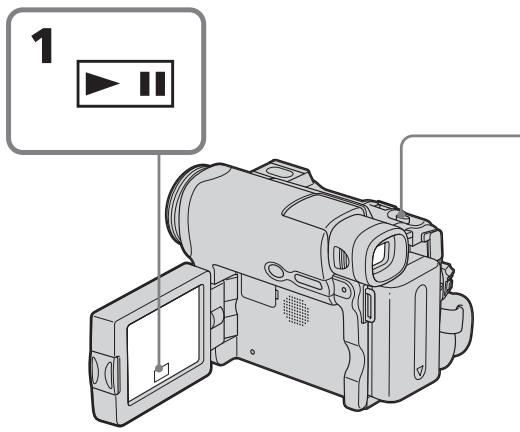
Sound recorded on the tape
You cannot record audio from the tape.
Recording an image from tape as a still image
Title
You cannot record the titles.
Recording date/time
The date/time when it is recorded on the "Memory Stick" is recorded. Various settings are not recorded.
When you press PHOTO on the Remote Commander
Your camcorder immediately records the image that is on the screen when you press the button.
Recording a still image from other equipment
You can use either A/V connecting cable or i.LINK cable. See page 122 for the connection. When connecting with the A/V connecting cable, set DISPLAY in ETC to LCD in the menu settings. (The default setting is LCD.)
The POWER switch should be set to VCR. Operate by touching the panel.
(1) Play back the recorded tape on the VCR, or turn the TV on to see a desired programme.
(2) At the point where you want to record, follow steps 2 and 3 on page 156.
Note
If the tape is in poor condition due to being used repeatedly for dubbing and so on, your camcorder may not be able to record the image, or the recorded image may appear jagged.
Superimposing a still image in "Memory Stick" on an image - MEMORY MIX
You can superimpose a still image you have recorded on the "Memory Stick" on top of the moving picture you are recording. (You cannot superimpose a still image on an image which has already been recorded.)
You can record superimposed images on the tape or the "Memory Stick." (However, you can record only superimposed still images on the "Memory Stick.")
M. CHROM (Memory Chromakey)
You can swap only the blue area of a still image such as an illustration or a frame with a moving picture.
M. LUMI (Memory Luminancekey)
You can swap the brighter area of a still image (such as a handwritten illustration or a title) with a moving picture. To use this function, we recommend recording a title on the "Memory Stick" before a trip or event.
C. CHROM (Camera Chromakey)
You can superimpose a moving picture on top of a still image such as an image which can be used as background. Shoot the subject against a blue background. Only the blue area of the moving picture will be swapped with a still image.
M. OVERLAP (Memory Overlap)
You can make a moving picture you are recording with your camcorder fade in on top of a still image recorded on the "Memory Stick." You can use Memory Overlap only when the POWER switch is set to CAMERA.
Superimposing a still image in "Memory Stick" on an image - MEMORY MIX
Moving picture/ Image animée


M. LUMI
M-CAM LUMI
Still image/ Image fixe


Moving picture/ Image animée



C.CHROM
CAM-M CHROM
Still image/ Image fixe
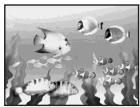

Moving picture/ Image animée
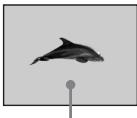

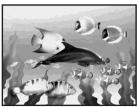
Blue/Bleu
M. OVERLAP
OVER-LAP
Still image/ Image fixe
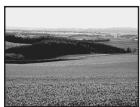


Moving picture/ Image animée
The "Memory Stick" supplied with your camcorder stores 20 images:
-For M.CHROM:18 images (such as a frame) 101-0001\~101-0018
- For C. CHROM: 2 images (such as a background) 101-0019~101-0020
Sample images
Sample images stored in the "Memory Stick" supplied with your camcorder are protected (p. 190).
Superimposing a still image in "Memory Stick" on an image - MEMORY MIX
Notes
- You cannot use MEMORY MIX for moving pictures recorded on the "Memory Stick."
- When the overlapping still image has a large amount of white, the thumbnail image of the picture may not be clear.
- When recording in the mirror mode (p. 41), the image on the LCD screen does not appear as a mirror-image.
Image data modified on a computer
You may not be able to play back modified images with your camcorder.
Recording a superimposed image to the tape
Before operation
- Insert the "Memory Stick" containing the still images into your camcorder.
- Insert the tape for recording into your camcorder.
The POWER switch should be set to
(CAMERA).
Operate by touching the panel.
(1) Press FN and select PAGE2.
(2) Press MEM MIX. The image recorded on the "Memory Stick" appears in the lower right corner of the screen.
(3) Press - (to see the previous image)/+ (to see the next image) in the lower right corner of the screen to select the still image that you want to superimpose.
(4) Press a desired mode. The still image is superimposed on the moving picture during recording standby.
(5) Press - / + in the lower left corner of the screen to adjust the effect, then press OK to return to PAGE2.
M. CHROM
The colour (blue) scheme of the area in the still image which is to be swapped with a moving picture
M. LUMI
The colour (bright) scheme of the area in the still image which is to be swapped with a moving picture
C. CHROM
The colour (blue) scheme of the area in the moving picture which is to be swapped with a still image
M. OVERLAP
No adjustment necessary (You can select M. OVERLAP only when the POWER switch is set to CAMERA.)
(6) Press EXIT to return to FN.
(7) Press START/STOP to start recording.
Superimposing a still image in "Memory Stick" on an image - MEMORY MIX
To change the still image to be superimposed
Press - / + in the lower right corner before step 5.
To cancel MEMORY MIX
Press OFF to return to PAGE2.
Note
During recording you cannot reselect the mode.
To record still image as they appear on the tape
Select M. LUMI, then press - / + in the lower left corner of the screen so that the right end of the bar is visible.
When you select M. OVERLAP
You cannot change the still image. First press
OFF to cancel M. OVERLAP and then select the image again.
Superimposing a still image in "Memory Stick" on an image - MEMORY MIX
Recording a superimposed image to the "Memory Stick" as a still image
Before operation
Insert the "Memory Stick" containing the still images into your camcorder.
The POWER switch should be set to
(MEMORY).
Operate by touching the panel.
(1) Follow the step 1 to 6 on pages 160 and 161.
(2) Press PHOTO deeply to start recording. Recording is complete when the bar scroll indicator disappears. The image displayed on the screen when you pressed PHOTO deeply will be recorded on the "Memory Stick."
To cancel MEMORY MIX
Press OFF to return to PAGE2.
Image size of still images
Image size is automatically set to 640 × 480 .
To record still image as they appear on the tape
Select M. LUMI, then press - / + in the lower left corner of the screen so that the right end of the bar is visible.
Interval Photo Recording
You can carry out a time-lapse recording by setting the camcorder to automatically record still images.
Example
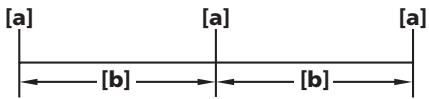
[a] Memory Photo recording
[b]INTERVAL
The POWER switch should be set to
MEMORY.
Operate by touching the panel.
(1) Press FN to display PAGE1.
(2) Press MENU to display the menu.
(3) Select INT. R -STL in 2 , then press EXEC (p. 246).
(4) Select SET, then press EXEC.
(5) Select INTERVAL, then press EXEC.
(6) Select a desired interval time, then press EXEC.
(7) Press RET.
(8) Set INT. R -STL to ON, then press EXEC.
(9) Press EXIT to return to FN. The INTERVAL MEM STILL indicator flashes on the screen.
(10) Press PHOTO deeply. Interval Photo Recording starts. The INTERVAL MEM STILL indicator lights up on the screen during Interval Photo Recording.
To cancel Interval Photo Recording
Set INT. R -STL to OFF in the menu settings.
Recording moving pictures on "Memory Stick" – MPEG MOVIE recording
The picture and sound are recorded up to the full capacity of the "Memory Stick" (MPEG MOVIE EX).
The POWER switch should be set to
(MEMORY).
Press START/STOP.
Your camcorder starts recording. The camera recording lamp located on the front of your camcorder lights up.
The picture and sound are recorded up to the capacity of the "Memory Stick." See page 151 for details of recording time.
[a] Available recording time on the "Memory Stick"
[b] This indicator appears for 5 seconds after pressing START/STOP. This indicator is not recorded.
[c] Folder name to be recorded in
To stop recording
Press START/STOP.
Note
Sound is recorded in monaural.

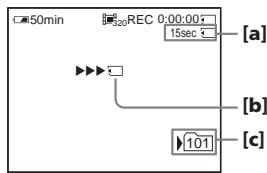
When the POWER switch is set to MEMORY
The following functions do not work:
-Digital zoom
Super NightShot
-Colour Slow Shutter
- Wide mode
-Fader
- Picture effect
- Digital effect
- SPORTS of PROGRAM AE (The indicator flashes.)
-Title
- SteadyShot
When using an external flash (optional)
Turn the power of the external flash off when recording moving pictures on the "Memory Stick." Otherwise, the charging sound of the flash may be recorded.
Recording date/time
The date/time do not appear during recording. However, they are automatically recorded onto the "Memory Stick." To display the recording date/time, press DATA CODE during playback. Various settings cannot be recorded (p. 54).
Self-timer recording
You can record moving pictures on the "Memory Stick" with the self-timer. See page 168 for details.
Self-timer recording
You can record still images and moving pictures on the "Memory Stick" with the self-timer. You can also use the Remote Commander for this operation.
Recording a still image
The POWER switch should be set to
(MEMORY).
Operate by touching the panel.
(1) Press FN and select PAGE2.
(2) Press SELFTIMER.
The (self-timer) indicator appears on the screen.
(3) Press EXIT to return to FN.
(4) Press PHOTO deeply.
The self-timer starts counting down from about 10 with a beep. In the last 2 seconds of the countdown, the beep gets faster, then recording starts automatically.
Recording a moving picture
The POWER switch should be set to
(MEMORY).
Operate by touching the panel.
(1) Follow steps 1 to 3 in "Recording a still image."
(2) Press START/STOP.
The self-timer starts counting down from about 10 with a beep. In the last 2 seconds of the countdown, the beep gets faster, then recording starts automatically.
To stop the countdown for recording moving picture
Press START/STOP. To restart the countdown, press START/STOP again.
To cancel the self-timer
During standby, press SELFTIMER and the (self-timer) indicator disappears from the screen. You cannot cancel the self-timer using the Remote Commander.
Notes
- The self-timer recording is automatically cancelled when self-timer recording is finished.
- You cannot stop the countdown for self-timer recording of the still images.
When the POWER switch is set to CAMERA
You can also perform self-timer recording (p. 67).
Recording a picture from tape as a moving picture
Before operation
Insert the recorded cassette and "Memory Stick" into your camcorder.
The POWER switch should be set to VCR.
Operate by touching the panel.
(1) Press >11 . The picture recorded on the tape is played back.
(2) Press again to pause playback at the scene where you want to start recording from.
(3) Press START/STOP. Images and sound are recorded up to the remaining capacity of the "Memory Stick." See page 151 for details on recording time.
[a] Available recording time on the "Memory Stick"
[b] This indicator appears for 5 seconds after pressing START/STOP. This indicator is not recorded.
[c] Folder name to be recorded in
Recording a picture from tape as a moving picture
To stop recording
Press START/STOP.
Notes
Sound recorded in 48kHz is converted to one in 32kHz when recording images from the tape to the "Memory Stick."
- Sound recorded in stereo is converted to monaural sound when recording from the tape.
Titles
You cannot record the titles.
If the "AUDIO ERROR" indicator appears
Sound that cannot be recorded by your camcorder has been recorded. Connect the A/V connecting cable to input images played back on an external device (p. 122).
Data code recorded on the tape
Instead of the date/time when the picture was recorded on the tape, the date/time when the picture is recorded on the "Memory Stick" (transferred from the tape) is recorded on the "Memory Stick." The various settings that may be saved on the tape are not recorded.
Recording a moving picture from other equipment
You can use either A/V connecting cable or i.LINK cable. See pages 122 and 123 for the connection.
When connecting with the A/V connecting cable, set DISPLAY in ETC to LCD in the menu settings. (The default setting is LCD.)
The POWER switch should be set to
(1) Play back the recorded tape on the VCR, or turn the TV on to see a desired programme.
The image of the other equipment is displayed on the LCD screen or in the viewfinder.
(2) At the starting point of the picture you want to record, press START/STOP.
Note
Recording may stop or the recorded picture may distorted when:
- There are blank portions on the tape.
- The tape on which the image you want to use was recorded, is in poor condition. For example, if the tape has been repeatedly used for dubbing.
- The input signal is cut off during recording.
Recording edited pictures from tape as a moving picture - Digital program editing (on "Memory Stick")
You can duplicate selected scenes (programmes) for editing onto the "Memory Stick."
Making the programme
The POWER switch should be set to VCR.
Operate by touching the panel.
(1) Insert the tape for playback, and the "Memory Stick" for recording into your camcorder.
(2) Press FN to display PAGE1.
(3) Press MENU to display the menu.
(4) Select VIDEO EDIT in ETC, then press EXEC (p. 251).
(5) Select MEMORY, then press EXEC.
(6) Repeat pressing IMAGESIZE to select a desired size. The image size changes when you press IMAGESIZE.
(7) Follow steps 6 to 10 on pages 117 and 118.
To finish making programmes
Press END.
The programme is stored in memory until the tape is ejected.
Recording edited pictures from tape as a moving picture - Digital program editing (on "Memory Stick")
Notes
- You cannot dub the titles, display indicators, or the contents of Cassette Memory.
- You cannot operate recording during the Digital program editing on the "Memory Stick."
On a blank portion of the tape
You cannot set IN or OUT on a blank portion of the tape.
If there is a blank portion between IN and OUT on the tape
The total time may not appear correctly.
During making a programme
If you eject the cassette, the NOT READY indicator appears on the screen. The programme will be erased.
Erasing the programme you have set
(1) Perform steps 2 to 6 on page 173.
(2) Perform steps 2 to 4 on page 119.
Erasing all programmes
(1) Perform steps 2 to 6 on page 173.
(2) Perform steps 2 to 4 on page 119.
Recording edited pictures from tape as a moving picture - Digital program editing (on "Memory Stick")
(1) Press FN to display PAGE1.
(2) Press MENU to display the menu.
(3) Select VIDEO EDIT in ETC, then press EXEC (p. 251).
(4) Select MEMORY, then press EXEC.
(5) Press START.
(6) Press EXEC.
Your camcorder searches for the beginning of the first programme, then starts dubbing. The programme mark flashes. The SEARCH indicator appears during searching, the EDITING indicator appears during writing of data on your camcorder, and the REC indicator appears during dubbing on the screen. When the dubbing ends, your camcorder automatically stops.
To stop dubbing
Press CANCEL.
The programme you made is recorded on the "Memory Stick" up to the place where you pressed CANCEL.
Recording edited pictures from tape as a moving picture - Digital program editing (on "Memory Stick")
To end Digital program editing
Your camcorder stops when the dubbing ends. Then the display returns to VIDEO EDIT in the menu settings.
Press END to end Digital program editing.
Note
Your camcorder may stop recording the image, or the recorded image may appear jagged:
- If the tape has the blank portion.
- If the tape is in poor condition due to being used repeatedly for dubbing.
The NOT READY indicator appears on the screen when:
- The programme to operate Digital program editing has not been made.
- The "Memory Stick" is not inserted.
- The write-protect tab on the "Memory Stick" is set to LOCK.
When the available recording time of the "Memory Stick" is not enough
The LOW MEMORY indicator appears on the screen. However, you can record pictures up to the time indicated.
When the programme has not been set
You cannot press START.
Changing the recording folder
You can create plural folders in a "Memory Stick." This feature is convenient for sorting out the images when you record. The default recording folder is "101MSDCF." You can create folders up to "999MSDCF" in the "Memory Stick."
Creating a new folder
The POWER switch should be set to .
Operate by touching the panel.
(1) Press FN to display PAGE1.
(2) Press MENU to display the menu.
(3) Select NEW FOLDER in 3 , then press EXEC (p. 245).
(4) Select ADD, then press EXEC. A folder with the maximum number +1 will be created. A created folder is automatically set to the folder to record in.
To return to FN
Press EXIT.
To cancel creating a new folder
Select RETURN in step 4, then press EXEC.
Selecting the recording folder
The POWER switch should be set to (MEMORY).
Operate by touching the panel.
(1) Press FN to display PAGE1.
(2) Press MENU to display the menu.
(3) Select REC FOLDER in , then press EXEC (p. 245).
(4) Press / to select a folder you want to record in, then press EXEC.
To return to FN
Press EXIT.
Notes
- Up to 9999 image files can be recorded in each folder. When a folder is full, a new folder is automatically created.
- Once a folder is created, it cannot be deleted with your camcorder.
- As the number of folders increases, the number of recordable images in the "Memory Stick" decreases.
Viewing a still image - Memory Photo playback
You can view the still images recorded in the "Memory Stick." Further, you can view 6 images including moving pictures at a time arranged in the same order of recording in the "Memory Stick" by selecting the index screen.
The POWER switch should be set to
(MEMORY).
Operate by touching the panel.
(1) Press PLAY. The last recorded image is displayed.
(2) Press - (to see the previous image)/+ (to see the next image) on your camcorder to select a desired still image.
To cancel Memory Photo playback
Press CAM.
When no file is in the folder
The "NO FILE AVAILABLE" indicator appears.
Screen indicators during still image playback
To make screen indicators disappear, press DSPL/BATT INFO.
1 Image size
2 Image number/Total number of recorded images in the current playback folder
3 Folder name
4 Print mark
5 Protect
6 Recording date/time/Various settings
7 Data file name
Recording data
To display the recording data (date/time or various settings when recorded), press DATA CODE during playback. You can also use the Remote Commander for this operation (p. 56).
Notes on the file name
- The folder number may not appear and only the file name may appear if the folder structure does not conform to the DCF standard.
- The file name flashes on the screen if the file is corrupted or the file is unreadable.
Viewing a still image - Memory Photo playback
When the "Memory Stick" contains multiple folders
The following icons appear on the screen on the first or last images in a folder.
: You can move to the previous folder.
: You can move to the next folder.
: You can move to both the previous and the next folders.
Playing back 6 recorded images at a time (index screen)
This function is especially useful when searching for a particular image.
Press INDEX to display the index screen.
A red mark appears above the image that was being displayed before the change to the index screen mode.
: To display the previous 6 images
: To display the next 6 images
1 mark
This number indicates the recorded order of the image in the folder.
To return to FN
Press EXIT.
To return to the normal playback screen (single screen)
Press the image you want to display.
Viewing a moving picture - MPEG MOVIE playback
You can view the moving pictures recorded in the "Memory Stick."
The POWER switch should be set to
(MEMORY).
Operate by touching the panel.
(1) Press PLAY. The last recorded image appears.
(2) Press - (to see the previous picture)/+ (to see the next picture) to select a desired moving pictures.
(3) Press MPEG to start playback.
(4) Adjust the volume following the steps below.
① Press FN and select PAGE3.
② Press VOL. The screen to adjust volume appears.
③ Press-(to turn down the volume)/ ^+ (to turn up the volume) to adjust the volume.
④ Press OK to return to PAGE3.
⑤ Press EXIT to return to FN.
When no file is in the folder
The "NO FILE AVAILABLE" indicator appears.
Playing back a picture from a particular segment
Moving pictures recorded on a "Memory Stick" can be divided into a maximum of 60 parts.
You can select a part and begin playback from that point.
The POWER switch should be set to
(MEMORY).
Operate by touching the panel.
(1) Follow steps 1 and 2 on page 182.
(2) Press (to see previous part)/ (to see next part) to select the point where you want to play back.
(3) Follow steps 3 and 4 on page 182.
To cancel MPEG MOVIE playback
Press MPEG II.
When recording time is too short
The moving picture may not be divided into parts.
Screen indicators during moving picture playback
To make screen indicators appear or disappear, press DSPL/BATT INFO.
1 Image size
Picture number/Total number of recorded pictures in the current playback folder
3 Folder name
Memory playback time
Protect
6 Recording date/time (Various settings appear as"--".)
7 Data file name
Recording date/time
To display the recording date/time, press DATA CODE during playback. You can also use the Remote Commander for this operation (p. 56).
Choosing a playback folder
Select the folder to be played back. The currently selected folder name appears at the top right of the screen.
The POWER switch should be set to
(MEMORY).
Operate by touching the panel.
(1) Press FN to display to PAGE1.
(2) Press PB FOLDR.
(3) Press - / + to select the folder number you want to play back, then press
END to return to PAGE1.
- : To select the previous folder
- : To select the next folder
To return to FN
Press EXIT.
Note
Your camcorder does not recognise folder names created or changed using the computer.
Current playback folder
The current playback folder is valid until the next recording is made. Once you record an image, the current recording folder becomes the current playback folder.
Enlarging still images recorded on "Memory Stick" – Memory PB ZOOM
You can enlarge the still images to be played back, and record the enlarged images on the "Memory Stick" (DCR-TRV33E only). Image size is automatically set to 640 × 480 .
The POWER switch should be set to
(MEMORY).
Operate by touching the panel.
(1) Play back the image to enlarge.
(2) Press FN and select PAGE2.
(3) Press PB ZOOM. The PB ZOOM screen appears.
(4) Press the area you want to enlarge in the frame. The area you pressed moves to the centre of the screen, and the playback image is enlarged to about twice the size. If you press the other area again, the area moves to the centre of the screen.
(5) Adjust the zoom ratio by the zoom lever.
You can select the image from approximately 1.1 times up to 5 times its size.
W: Decrease the zoom ratio.
T: Increase the zoom ratio.
Enlarging still images recorded on "Memory Stick" – Memory PB ZOOM
To cancel memory PB ZOOM
Press END.
In memory PB ZOOM
If you press DSPL/BATT INFO, the frame on the memory PB ZOOM screen disappears. You cannot move the part you pressed to the centre of the screen.
Edge of an enlarged image
The edge of an enlarged image cannot be displayed at the centre of the screen.
Moving pictures recorded on the "Memory Stick"
Memory PB ZOOM does not work.
To record the images processed by Memory PB ZOOM on the "Memory Stick" (DCR-TRV33E only)
Press PHOTO when the image is being displayed. The image size automatically becomes 640 × 480 .
Playing back images continuously - Slide show
You can display all images on the "Memory Stick" or in the selected folder in sequence (slide show).
The POWER switch should be set to
(MEMORY).
Operate by touching the panel.
(1) Press FN to display PAGE1.
(2) Press MENU to display the menu.
(3) Select SLIDE SHOW in 2 , then press EXEC (p. 246).
ALL FILES: To play back all of the images in the "Memory Stick"
FOLDER□□□:To play back the images in the folder selected with PB FOLDR
- The folder name appears in .
(5) Press START. Your camcorder plays back the images recorded on the "Memory Stick" in sequence. When all images are played back, slide show automatically stops.
To cancel slide show
Press END.
To start slide show from a particular image
Select a desired image using - / + buttons before step 5.
To prevent accidental erasure of important images, you can protect selected images.
The POWER switch should be set to
(MEMORY).
Operate by touching the panel.
(1) Press INDEX to display the index screen.
(2) Press o-MARK. The screen to protect the image appears.
(3) Press the image you want to protect. The indicator appears above the protected image.
To cancel image protection
Press the image you want to cancel image protection in step 3 again.
The = indicator disappears from the image.
Note
Formatting erases all information on the "Memory Stick," including the protected image data. Check the contents of the "Memory Stick" before formatting.
If the write-protect tab on the "Memory Stick" is set to LOCK
You cannot turn on or off the o-n indicator.
Deleting images - DELETE
You can delete all images or selected images.
Deleting selected images
The POWER switch should be set to
(MEMORY).
Operate by touching the panel.
(1) Play back the image you want to delete.
(2) Press FN to display PAGE1.
(3) Press DEL. The DELETE? indicator appears on the screen.
(4) Press OK. The selected image is deleted.
To cancel deleting an image
Press CANCEL in step 4.
Notes
- To delete a protected image, first cancel image protection.
- Once you delete an image, you cannot restore it. Check the images to delete carefully before deleting them.
If the write-protect tab on the "Memory Stick" is set to LOCK
You cannot delete images.
Pour revenir à FN
Appuyez sur EXIT.
Deleting selected images on the index screen
The POWER switch should be set to
(MEMORY).
Operate by touching the panel.
(1) Press INDEX to display the index screen.
(2) Press DEL. Then press the image you want to delete. The number of the selected image is highlighted.
(3) Press EXEC. The DELETE? indicator appears on the screen.
(4) Press OK. The selected images are deleted.
To cancel deleting an image
Press CANCEL in step 4.
The maximum number of images you can select in one session
You can select up to 100 images to be deleted.
Pour revenir à FN
Appuyez sur EXIT.
Deleting all the images
You can delete all the unprotected images in the "Memory Stick."
The POWER switch should be set to
MEMORY).
Operate by touching the panel.
(1) Press FN to display PAGE1.
(2) Press MENU to display the menu.
(3) Select DELETE ALL in 2 , then press EXEC (p. 246).
ALL FILES: To delete all of the images in the "Memory Stick"
FOLDER□□□: To delete the images in the folder selected with PB FOLDR
- The folder name appears in .
(5) Select OK, then press EXEC. OK changes to EXECUTE.
(6) Select EXECUTE, then press EXEC. The DELETING indicator appears, then flashes on the screen.
When all the unprotected images are deleted, the COMPLETE indicator appears.
To cancel deleting all the images in the "Memory Stick"
Select RETURN in step 5 or 6, then press EXEC.
While the DELETING indicator is displayed Do not turn the POWER switch or press any buttons.
Even if all images are deleted
The folders are not deleted.
Changing image size - Resize (DCR-TRV33E only)
After recording, you can change the image size of recorded still images to 640 × 480 or 320 × 240 . Resizing is useful when you want the image to be saved in a smaller size such as when you want to attach it to an e-mail message. The original image is retained even after resizing.
The POWER switch should be set to (MEMORY). Operate by touching the panel.
(1) During memory playback, press FN and select PAGE2.
(2) Press RESIZE. The RESIZE screen appears.
(3) Press 640 × 480 or 320 × 240 . The resized image is recorded as the newest file in the selected folder.
To change still images
Press - / + before step 3.
To return to FN
Press END to return to PAGE2, then press EXIT.
Notes
- You cannot resize the picture recorded with MPEG MOVIE recording.
- You may not be able to resize the picture recorded on other camcorder.
- You cannot select an image quality level (FINE or STANDARD) for resized pictures.
Size of a resized image
| Image size | Memory capacity |
| 640 × 480 | About 150 KB |
| 320 × 240 | About 16 KB |
Writing a print mark - Print mark
The print mark function is useful for printing out still images later. However you cannot set the number of printing.
Your camcorder conforms with the DPOF
(Digital Print Order Format) standard for specifying the still images to print out.
The POWER switch should be set to (MEMORY).
Operate by touching the panel.
(1) Press INDEX to display the index screen.
(2) Press MARK. The screen to write a print mark appears.
(3) Press the image you want to write a print mark. The appears on the selected image.
Writing a print mark - Print mark
To return to FN
Press EXIT.
To erase the print marks
Press the image you want to erase the print mark in step 3 again. The disappears from the image.
If the write-protect tab on the "Memory Stick" is set to LOCK
You cannot write or erase print marks on still images.
Moving pictures
You cannot write print marks on moving pictures.
Viewing images with a computer - Introduction
There are following ways of connecting your camcorder to a computer in order to view images saved on the "Memory Stick" (DCRTRV22E/TRV33E only) or recorded on the tape on a computer.
To view images on a computer which has a "Memory Stick" slot, first eject the "Memory Stick" from your camcorder and then insert it into your computer's "Memory Stick" slot (DCR-TRV22E/TRV33E only).
| Camcorder connection jack | Connection cable | Computer environment requirements | Reference pages |
| For Windows Users | For Macintosh Users |
| Tape image/live from your camcorder | USB jack | USB cable (supplied) | USB port, editing software | 203 – 216217 – 226 | - |
| DV Interface | i.LINK cable (optional) | DV port, editing software | 238 | - |
| "Memory Stick"image (DCR-TRV22E/TRV33E only) | USB jack | USB cable (supplied) | USB port, editing software | 227 – 232 | 233 |
Français
When connecting to a computer with the USB port, complete installation of the USB driver before connecting your camcorder to the computer. If you connect your camcorder to the computer first, you will not be able to install the USB driver correctly.
For details about the computer's ports and editing software, contact the computer manufacturer.
Viewing pictures recorded on the tape
When connecting to a computer with the USB port
See page 203 for details.
When connecting to a computer with the DV port
The computer must have a DV port and editing software installed that can read video signals.
Viewing images recorded on the "Memory Stick" (DCR-TRV22E/TRV33E only)
When connecting to a computer with the USB port
See page 203 when using Windows and page 233 when using Macintosh.
You can also use a "Memory Stick" Reader/ Writer (optional).
When connecting to a computer without the USB port
Use an optional floppy disk adaptor for "Memory Stick" or a PC card adaptor for "Memory Stick."
When purchasing an accessory, check its catalogue beforehand for the recommended operating environment.
Notes on using your computer
"Memory Stick" (DCR-TRV22E/ TRV33E only)
- "Memory Stick" operations on your camcorder cannot be assured if a "Memory Stick" formatted on your computer is used on your camcorder, or if the "Memory Stick" in your camcorder was formatted from your computer when the USB cable was connected.
- Do not compress the data on the "Memory Stick." Compressed files cannot be played back on your camcorder.
Software
- Depending on your application software, the file size may increase when you open a still image file.
- When you load an image modified using retouching software from your computer to your camcorder or when you directly modify the image on your camcorder, the image format will differ so a file error indicator may appear and you may be unable to open the file.
Communications with your computer
Communications between your camcorder and your computer may not recover after recovering from Suspend, Resume, or Sleep.
Connecting your camcorder to a computer using the USB cable (For Windows users)
Complete installation of the USB driver before connecting your camcorder to a computer. If you connect your camcorder to a computer first, you will not be able to install the USB driver correctly.
When connecting to a computer with the USB port
You must install a USB driver onto the computer in order to connect your camcorder to the computer's USB port. The USB driver can be found on the CD-ROM supplied, along with the application software required for viewing images.
If you connect your camcorder and a computer using the USB cable, you can view pictures live from your camcorder and pictures recorded on the tape on a computer (USB Streaming function).
Furthermore, if you download pictures from your camcorder to a computer, you can process or edit them in image processing software and attach them to e-mail.
You can view images recorded on the "Memory Stick" on a computer (DCRTRV22E/TRV33E only).
Connecting your camcorder to a computer using the USB cable (For Windows users)
Recommended computer usage environment when connecting with the USB cable and viewing tape pictures on a computer
OS:
Microsoft Windows 98SE, Windows
Millennium Edition, Windows 2000
Professional, Windows XP Home Edition or
Windows XP Professional
Standard installation is required.
However, operation is not assured if the above environment is an upgraded OS.
You cannot hear sound if your computer is running Windows 98, but you can read still images.
CPU:
Minimum 500 MHz Intel Pentium III or faster (800 MHz or faster recommended)
Application:
DirectX 8.0a or later
Sound system:
16 bit stereo sound card and stereo speakers
Memory:
64 MB or more
Hard disk:
Available memory required for installation: at least 250 MB
Available hard disk memory recommended: at least 1 GB (depending on the size of the image files edited)
Display:
4 MB VRAM video card, Minimum 800 × 600 dot High-colour (16 bit colour, 65 000 colours), Direct Draw display driver capability (At 800 × 600 dot or less, 256 colours and less, this product will not operate correctly.)
Others:
This product is based on DirectX technology, so it is necessary to install DirectX.
To create a Video CD, a CD-R drive is needed.
The USB port must be provided as standard.
You cannot use this function in the Macintosh environment.
Connecting your camcorder to a computer using the USB cable (For Windows users)
Recommended computer usage environment when connecting with USB cable and viewing the "Memory Stick" images on a computer (DCR-TRV22E/TRV33E only)
Recommended Windows environment OS:
Microsoft Windows 98, Windows 98SE, Windows Millennium Edition, Window
Professional, Windows XP Home Edition or Windows XP Professional
Standard installation is required.
However, operation is not assured if the above environment is an upgraded OS.
CPU:
MMX Pentium 200 MHz or faster
Display:
Minimum 800 × 600 dot High-colour (16 bit colour, 65 000 colours) (At 800 × 600 dot or less, 256 colours and less, the screen for installing USB driver is not displayed.)
Others:
The USB port must be provided as standard. Windows Media Player must be installed (to play back moving pictures).
Notes
- Operations are not guaranteed for the Windows environment if you connect two or more USB equipment to a single computer at the same time, or when using a hub.
- Some equipment may not operate depending on the type of USB equipment that is used simultaneously.
- Operations are not guaranteed for all the recommended computer environments mentioned above.
- Windows and Windows Media are registered trademarks of Microsoft Corporation in the United States and/or other countries.
- Pentium is a trademark or registered trademark of Intel Corporation.
- All other product names mentioned herein may be the trademarks or registered trademarks of their respective companies. Furthermore, "TM" and "®" are not mentioned in each case in this manual.
Connecting your camcorder to a computer using the USB cable (For Windows users)
Installing the USB driver
Start the following operation without connecting the USB cable to the computer.
Connect the USB cable according to "Making the computer recognise your camcorder" on page 211.
If you are using Windows 2000, log in with permission of administrators.
If you are using Windows XP, log in with permission of computer administrators.
(1) Turn on a computer and allow Windows to load. If you have been using the computer, close all softwares.
(2) Insert the supplied CD-ROM in the CD-ROM drive of the computer. The application software starts up. If the screen does not appear, double-click "My Computer" and then "ImageMixer" (CD-ROM Drive).
(3) Select "Handycam" on the screen.
The title screen appears.
Connecting your camcorder to a computer using the USB cable (For Windows users)
(4) Move the cursor to "USB Driver" and click. This starts USB driver installation.
(5) Follow the on-screen messages to install the USB driver.
(6) Remove the CD-ROM, then restart the computer and follow the on-screen messages.
Notes
- If you connect the USB cable before USB driver installation is complete, the USB driver will not be properly registered. Carry out installation again following the on-screen messages.
- The title screen is not displayed if the screen size of the computer is set to less than 800 × 600 dots and 256 colours or less. See pages 204, 205 about the recommended computer environment.
Installing Image Transfer (DCR-TRV22E/TRV33E only)
Make sure USB driver installation is complete. This function enables image data recorded on the "Memory Stick" to be automatically transferred (copied) to your computer.
If you are using Windows 2000, log in with permission of administrators.
If you are using Windows XP, log in with permission of computer administrators.
(1) Turn on your computer and allow Windows to load. If you have been using the computer, close all softwares.
(2) Insert the supplied CD-ROM in the CD-ROM drive of the computer. The application software starts up.
(3) Select "Handycam" on the screen. The title screen appears.
(4) Move the cursor to "Image Transfer" and click.
Installation d'Image Transfer (DCR-TRV22E/TRV33E uniquement)
The Install Wizard programme starts up and the "Choose Setup Language" screen appears.
(5) Select the Language for installation.
(6) Follow the on-screen messages. The installation screen disappears when installation is complete.
Connecting your camcorder to a computer using the USB cable (For Windows users)
Make sure USB driver installation is complete.
"ImageMixer Ver. 1.5 for Sony" is an application that can capture or edit images, or create video CDs.
To install and use this software in Windows 2000, you must be authorised as administrators. For Windows XP, you must be authorised as computer administrators.
(1) Turn on a computer and allow Windows to load. If you have been using the computer, close all softwares.
(2) Insert the supplied CD-ROM into the CD-ROM drive of the computer. The application software starts up.
(3) Select "Handycam" on the screen. The title screen appears.
(4) Move the cursor to "ImageMixer" and click.
Installation de ImageMixer
The Install Wizard programme starts up and the "Choose Setup Language" screen appears.
Connecting your camcorder to a computer using the USB cable (For Windows users)
(5) Select the language for installation.
(6) Follow the on-screen messages. The installation screen disappears when installation is complete.
(7) Install the WinASPI following the onscreen message (Windows 2000 and Windows XP users only).
(8) If DirectX 8.0a or later is not installed on the computer, continue installation after installing ImageMixer.
Follow the on-screen messages to install DirectX 8.0a. After installation is complete, restart the computer.
MEMORY MIX Album (DCR-TRV22E/TRV33E only)
Once "ImageMixer" is installed, the MEMORY MIX album is created in "Album" of "ImageMixer" and sample images are stored in there.
Those sample images can be transferred from the MEMORY MIX album to a "Memory Stick" so that they can be used in MEMORY MIX (p. 158).
For details on the operation procedure, refer to the on-line help.
Replacing WinASPI
To use the ImageMixer CD writing function, you need to install WinASPI. If a different writing application has been already installed, its writing function may not work correctly. If that happens, reinstall the original application and replace WinASPI. Note that the ImageMixer CD writing function may not work properly.
Connecting your camcorder to a computer using the USB cable (For Windows users)
Making the computer recognise your camcorder
If you are using Windows 2000, log in with permission of administrators.
If you are using Windows XP, log in with permission of computer administrators.
Viewing pictures recorded on the tape
(1) Connect the AC Adaptor to your camcorder.
(2) Set the POWER switch to ^1)/ ^2)
(3) Press FN to display PAGE1.
(4) Press MENU to display the menu.
(5) Select USB STREAM in 1 , then press EXEC (p. 249).
(6) Select ON, then press EXEC.
(7) Connect the (USB) jack on your camcorder to the USB port on the computer using the supplied USB cable. The computer recognises your camcorder, and the Windows Add Hardware Wizard starts.
Connecting your camcorder to a computer using the USB cable (For Windows users)
(8) Follow the on-screen messages so that the Add Hardware Wizard recognises that the USB drivers have been installed. Be sure to allow the installation to complete without interrupting it.
For Windows 2000 and Windows XP users
If you are prompted to confirm the digital signature, select "Yes" (Windows 2000) or "Continue Anyway" (Windows XP).
Viewing images recorded on the "Memory Stick" (DCR-TRV22E/ TRV33E only)
(1) Insert the "Memory Stick" into your camcorder.
(2) Connect the AC Adaptor, then set the POWER switch to (MEMORY).
(3) Connect the (USB) jack on your camcorder to the USB port on the computer using the supplied USB cable. The USB MODE indicator appears on the LCD screen of your camcorder. The computer recognises your camcorder, and the Add Hardware Wizard starts.
Connecting your camcorder to a computer using the USB cable (For Windows users)
(4) Follow the on-screen messages so that the Add Hardware Wizard recognises that the USB drivers have been installed. The Add Hardware Wizard starts twice because 2 different USB drivers are installed. Be sure to allow the installation to complete without interrupting it.
You cannot install the USB driver if the "Memory Stick" is not in your camcorder. Be sure to insert the "Memory Stick" into your camcorder before installing the USB driver.
If you cannot install the USB driver
The USB driver has been registered incorrectly as the computer was connected to your camcorder before installation of the USB driver was complete. Follow the procedure below to correctly install the USB driver.
Viewing pictures recorded on the tape
Step 1: Uninstall the incorrect USB driver
① Turn on the computer and allow Windows to load.
② Connect the AC Adaptor and set the POWER switch to ^1) / ^2)
③ Connect the USB port on the computer to the (USB) jack on your camcorder using the USB cable supplied.
1) DCR-TRV12E/TRV14E
2) DCR-TRV19E/TRV22E/TRV33E
Connecting your camcorder to a computer using the USB cable (For Windows users)
④ Open the computer's "Device Manager."
Windows XP:
Select "Start" "Control Panel" "System" "Hardware", and click the "Device Manager" button.
If there is no "System" inside "Pick a category" after clicking "Control Panel," click "Switch to classic view" instead.
Windows 2000:
Select "My Computer" "Control Panel" "System" "Hardware" tab, and click the "Device Manager" button.
Windows 98SE/Windows Me:
Select "My Computer" "Control Panel" "System," and click "Device Manager."
(5) Select and delete the underlined devices below.
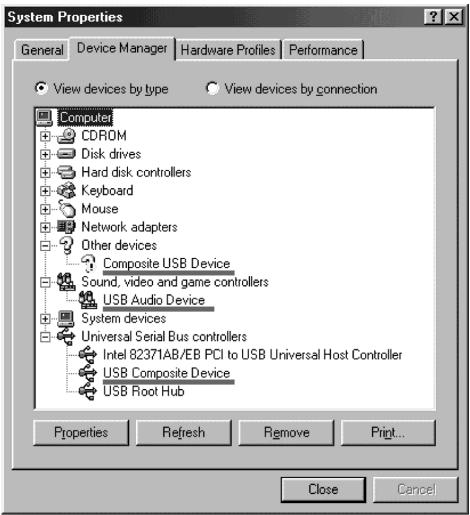
Windows 98SE
Connecting your camcorder to a computer using the USB cable (For Windows users)
⑥ Set the POWER switch to OFF (CHG) on your camcorder, then disconnect the USB cable.
⑦ Restart the computer.
Step 2: Install the USB driver on the supplied CD-ROM
Follow the entire procedure in "Installing the USB driver" on page 206.
Connecting your camcorder to a computer using the USB cable (For Windows users)
Viewing images recorded on the "Memory Stick" (DCR-TRV22E/ TRV33E only)
Step1: Uninstall the incorrect USB driver
① Turn on the computer and allow Windows to load.
② Insert the "Memory Stick" into your camcorder.
③ Connect the AC Adaptor and set the POWER switch to (MEMORY).
④ Connect the USB port on the computer to the (USB) jack on your camcorder using the USB cable supplied.
⑤ Open the computer's "Device Manager."
Windows XP:
Select "Start" "Control Panel" "System" "Hardware" tab and click the "Device Manager" button.
If there is no "System" inside "Pick a category" after clicking "Control Panel," click "Switch to classic view" instead.
Windows 2000:
Select "My Computer" "Control Panel" "System" "Hardware," and click the "Device Manager" button.
Other OS:
Select "My Computer" "Control Panel" "System," and click "Device Manager."
(6) Select "Other devices."
Select the device prefixed with the "?" mark and delete.
Ex: (?)Sony Handycam
⑦ Set the POWER switch to OFF (CHG) on your camcorder, then disconnect the USB cable.
⑧ Restart the computer.
Step2: Install the USB driver on the supplied CD-ROM
Follow the entire procedure in "Installing the USB driver" on page 206.
Viewing pictures recorded on tape on a computer – USB Streaming (For Windows users)
Capturing images with "ImageMixer Ver.1.5 for Sony"
You need to install the USB driver and ImageMixer to view pictures recorded on the tape on a computer (p. 206, 209).
Viewing pictures recorded on the tape
(1) Turn on the computer and allow Windows to load.
(2) Connect the AC Adaptor, then insert the cassette into your camcorder.
(3) Set the POWER switch to ()^1) / ()^2 .
(4) Press FN to display PAGE1.
(5) Press MENU to display the menu.
(6) Select USB STREAM in 品 , then press EXEC (p. 249).
(7) Select ON, then press EXEC.
(8) Select "Start" "Programs" "PIXELA" "ImageMixer" "ImageMixer Ver.1.5 for Sony." The "ImageMixer Ver.1.5 for Sony" startup screen appears on the computer. The title screen appears.
(9) Click on the screen.
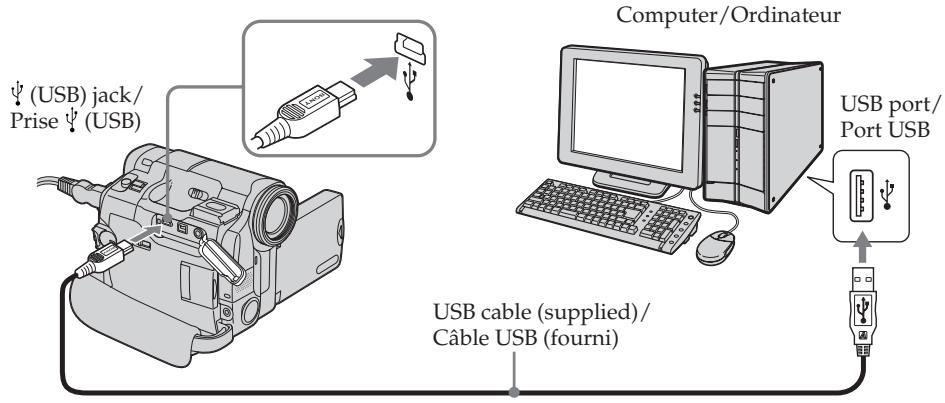
(11) Connect the (USB) jack on your camcorder to the USB port on the computer using the supplied USB cable.
Viewing pictures recorded on tape on a computer - USB Streaming (For Windows users)
(12) Click to start playback.
You can control video operations with the buttons on the screen.
The picture from the tape appears on the monitor window on the computer.
Viewing pictures live from your camcorder
(1) Follow the steps 1 and 2 on page 217.
(2) Set the POWER switch to (CAMERA).
(3) Follow the steps 4 to 11 on pages 217, 218.
The picture from your camcorder appears on the monitor window on the computer.
Capturing still images
Monitor window/ Fenetre d'aperçu
Capture d/images fixes
(1) Click
(2) Looking at the monitor window, move the cursor to and click it at the point you want to capture. The still image on the screen is captured. Captured images appear in the thumbnail list window.
(1) Click
(2) Click the album you want to capture.
(3) Click to start playback.
Viewing pictures recorded on tape on a computer - USB Streaming (For Windows users)
(4) Looking at the monitor window, click at the first scene of the movie you want to capture. changes to .
(5) Looking at the monitor window, click at the last scene you want to capture. The moving picture is captured. The captured images appear in the thumbnail list window.
To close "ImageMixer"
Click at the top right of the screen.
Notes
- When the USB cable is used for connecting the computer, the images displayed on the computer monitor may appear jagged.
-
When you view images on a computer with the USB connection, the following may occur. This is not a malfunction.
-
The image shakes up and down.
- Some images are not displayed correctly due to noise, etc.
- Some images are displayed with the cracking noise.
Images of different colour systems to that of your camcorder are not displayed correctly.
- When your camcorder is during standby with a cassette inserted, it turns off automatically after five minutes.
- We recommend setting DEMO MODE to OFF in the menu settings when your camcorder is during standby, and no cassette is inserted.
- Indicators on the screen of your camcorder do not appear on images that are captured into the computer.
- If you capture a fast moving picture, the preview window may not move smoothly. You can make the picture move more smoothly by shifting the upper right slider on the bottom of the monitor window to the left, although this reduces the picture quality.
- You cannot carry out any "Memory Stick" operations during the USB Streaming.
Viewing pictures recorded on tape on a computer - USB Streaming (For Windows users)
If image data cannot be transferred by the USB connection
The USB driver has been registered incorrectly as the computer was connected to your camcorder before installation of the USB driver was complete. Reinstall the USB driver following the procedure on page 213.
If any trouble occurs
Close all running applications, then restart the computer.
Carry out the following operations after quitting the application:
- Disconnect the USB cable.
- Turn the POWER switch to the other position on your camcorder.
Viewing pictures recorded on tape on a computer - USB Streaming (For Windows users)
This function makes it simple to create a video CD by capturing images recorded on a tape or images live from your camcorder.
Capturing images recorded on a tape onto a CD-R
(1) Follow steps 1 to 8 on page 217.
(2) Press l after choosing the point on the tape from which you want to capture images onto the CD-R.
(3) Click
(4) Connect the (USB) jack on your camcorder to the USB port on the computer using the supplied USB cable.
(5) Select the CD-R drive and writing speed on the ImageMixer Easy Video CD screen.
(6) Insert a new CD-R in the CD-R drive of the computer.
(7) Click "Start."
Viewing pictures recorded on tape on a computer - USB Streaming (For Windows users)
The tape is automatically played back. Easy Video CD automatically begins to capture images onto the CD-R to create a Video CD.
(8) After the "Video CD successfully created." message appears, click "Quit."
Capturing images live from your camcorder onto a CD-R
Remove the cassette before the following operation. If a cassette is inserted, the power automatically goes out after about 5 minutes.
(1) Follow steps 1 and 2 on page 219.
(2) Set the POWER switch to (CAMERA) on your camcorder.
(3) Follow steps 4 to 8 on page 217.
(4) Follow steps 3 to 7 in "Capturing images recorded on a tape onto a CD-R."
Notes
- A computer equipped with a CD-R drive is required.
- Do not press the button on your camcorder while creating a Video CD. If you press , only images up to that point are captured onto the Video CD and Easy Vide CD is closed.
- Once a disc has been created, you cannot add images to the disc.
- Select a hard disc with sufficient memory (at least 6 GB) from the "Option" screen as location for the "Location of work folder."
Viewing pictures recorded on tape on a computer - USB Streaming (For Windows users)
Playing back the Video CDs
You can use a DVD player or a computer with a DVD drive to play back the Video CDs you created. To play back the Video CDs on a computer, you need to have Video CD software installed.
You can play back the Video CDs with Windows Media Player. However, you cannot use menu functions such as capturing function. You also may not be able to play back the Video CDs in certain computer environment such as OS or hardware.
(1) Start up Windows Media Player.
Windows XP:
Select "Start" "All Programs" "Accessory" "Entertainment," and click "Windows Media Player."
Other OS:
Select "Start" "Programs"
"Accessory" "Entertainment," and click "Windows Media Player."
(2) Select "My Computer" "CD-R," and click "MPEGAV" folder, then drag and drop the "□□□*.DAT" moving picture file onto the Media Player screen.
The moving picture will be played back.
- The file name is displayed in .
Created Video CDs
The maximum recording time is about 1 hour. Capturing is divided into segments of about 10 minutes (approximately 4 GB) due to the specifications of the AVI capturing format. As a result, recording includes segment links about every 10 minutes, at which point images are skipped for several seconds.
Viewing pictures recorded on tape on a computer - USB Streaming (For Windows users)
Seeing the on-line help (operating instructions) of ImageMixer
An "ImageMixer Ver.1.5 for Sony" on-line help site is available where you can find the detailed operating method of "ImageMixer Ver.1.5 for Sony."
(1) Click ② located in the upper-right corner of the screen. The ImageMixer's Manual screen appears.
(2) You can find the information you need from the list of contents.
To close on-line help
Click at the top right of the screen.
If you have any questions about ImageMixer
"ImageMixer Ver.1.5 for Sony" is the product of PILXELA corporation. For details, refer to the operating instructions of the CD-ROM supplied with your camcorder.
Viewing images recorded on "Memory Stick" on a computer (For Windows users) (DCR-TRV22E/TRV33E only)
The image data recorded on the "Memory Stick" is automatically transferred (copied) to a computer with Image Transfer. You can view images with ImageMixer.
Before operation
You need to install the USB driver, Image Transfer and ImageMixer to view the "Memory Stick" images on a computer (p. 206, 208, 209).
(1) Turn on your computer and allow Windows to load.
(2) Insert the "Memory Stick" into your camcorder, then connect the AC Adaptor to your camcorder.
(3) Set the POWER switch to (MEMORY).
(4) Connect the (USB) jack on your camcorder to the USB port on the computer using the supplied USB cable.
(5) Image Transfer automatically starts up and the transfer of image data begins.
Viewing images recorded on "Memory Stick" on a computer (For Windows users) (DCRTRV22E/TRV33E only)
(6) ImageMixer automatically starts up, enabling you to view the copied image.
(7) Select an album and the image, then press the import button. The image is added in your album, and you can edit the image.
Viewing images recorded on "Memory Stick" on a computer (For Windows users) (DCRTRV22E/TRV33E only)
Viewing images without Image Transfer
Before operation
- You need to install the USB driver to view the "Memory Stick" images on a computer (p. 206).
- An application such as Windows Media Player must be installed to play back moving pictures in Windows environment.
(1) Turn on the computer and allow Windows to load.
(2) Insert the "Memory Stick" into your camcorder, then connect the AC Adaptor to your camcorder.
(3) Set the POWER switch to (MEMORY).
(4) Connect the (USB) jack on your camcorder to the USB port on the computer using the supplied USB cable. The USB MODE indicator appears on the screen of your camcorder.
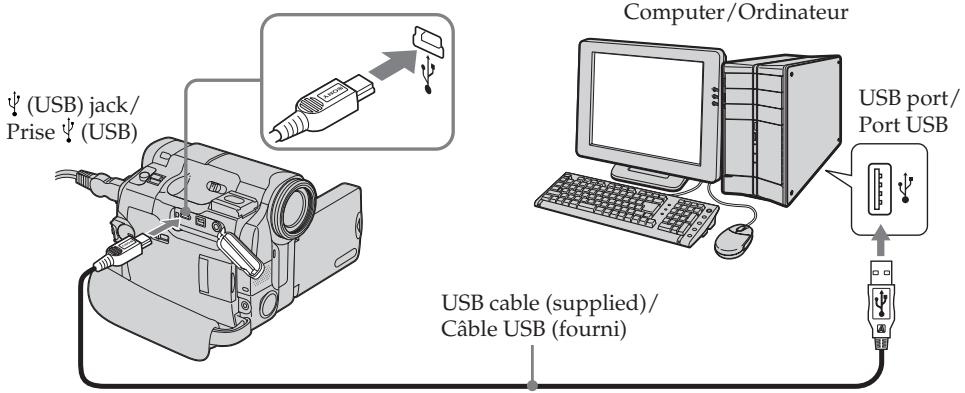
(5) Open "My Computer" on Windows and double-click the newly recognised drive (Example: "Removable Disk (F):"). The folders inside the "Memory Stick" appear.
Viewing images recorded on "Memory Stick" on a computer (For Windows users) (DCR-TRV22E/TRV33E only)
(6) Double-click a desired image file from the folder in this order.
"DCIM" folder "□□□MSDCF"
folder1) Image file2
See "Image file storage destinations and image files" (p. 231), for the detailed folder and file name.
1) stands for any number (within the range) from 101 to 999.
2) Copying a file to the hard disk of the computer before viewing it is recommended. If you play back the file directly from the "Memory Stick," the image and sound may break off.
Viewing images recorded on "Memory Stick" on a computer (For Windows users) (DCR-TRV22E/TRV33E only)
Image file storage destinations and image files
Image files recorded with your camcorder are grouped according to the folders in the "Memory Stick." The meanings of the file names are as follows. stands for any number within the range from 0001 to 9999.
Example: For Windows Me users (The drive recognising your camcorder is [F].)
1 Folder containing image files recorded using other camcorders (for playback only)
2 Folder containing image files recorded with your camcorder. When no new folders have been created, this is only "101MSDCF."
3 Folder containing moving picture data recorded using other camcorders (for playback only)
When finished, disconnect the USB cable and remove the "Memory Stick" or set the POWER switch to OFF (CHG)
For Windows 2000, Windows Me, Windows XP users
(1) Move the cursor to the "Unplug or Eject Hardware" on the Task Tray and click to cancel the applicable drive.
(2) After the "Safe to remove" message appears, disconnect the USB cable and eject the "Memory Stick" or set the POWER switch to OFF (CHG).
Connecting your camcorder to a computer using the USB cable (For Macintosh users) (DCR-TRV22E/TRV33E only)
When connecting to a computer with the USB cable
You must install a USB driver onto a computer in order to connect your camcorder to the computer's USB port. The USB driver can be found on the CD-ROM supplied, along with the application software required for viewing images.
Recommended Macintosh environment
Mac OS 8.5.1/8.6/9.0/9.1/9.2 or Mac OS X (v10.0/v10.1/v10.2) standard installation is required.
However, note that the update to Mac OS 9.0/ 9.1 should be used for the following models.
- iMac with the Mac OS 8.6 standard installation and a slot loading type CD-ROM drive
- iBook or Power Mac G4 with the Mac OS 8.6 standard installation
The USB port must be provided as standard.
QuickTime 3.0 or later must be installed to play back moving pictures.
Connecting your camcorder to a computer using the USB cable (For Macintosh users) (DCR-TRV22E/TRV33E only)
- Operations are not guaranteed for the Macintosh environment if you connect two or more USB equipment to a single computer at the same time, or when using a hub.
- Some equipment may not operate depending on the type of USB equipment that is used simultaneously.
- Operations are not guaranteed for all the recommended computer environments mentioned above.
- Macintosh, iMac, iBook, Power Mac and Mac OS, QuickTime are trademarks of Apple Computer Inc.
- All other product names mentioned herein may be the trademarks or registered trademarks of their respective companies. Furthermore, "TM" and "®" are not mentioned in each case in this manual.
Installing the USB driver
Do not connect the USB cable to a computer before installation of the USB driver is complete.
For Mac OS 8.5.1/8.6/9.0 users
(1) Turn on the computer and allow the Mac OS to load. If you have been using the computer, close all softwares.
(2) Insert the supplied CD-ROM in the CD-ROM drive of the computer. The application software screen appears.
(3) Select "Handycam" on the screen. The title screen appears.
Remarques
Connecting your camcorder to a computer using the USB cable (For Macintosh users) (DCR-TRV22E/TRV33E only)
(4) Click the "USB Driver" to open the folder containing the six files related to "Driver."
(5) Select the following two files, and drag and drop them into the System Folder.
- Sony Camcorder USB Driver
- Sony Camcorder USB Shim
- Sony Camcorder USB Driver
- Sony Camcorder USB Shim
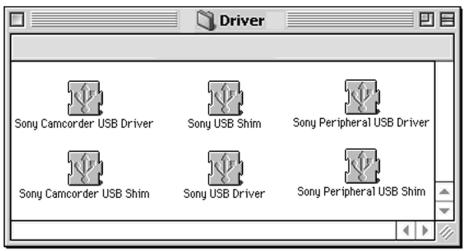
(6) When the message appears, click "OK." The USB driver is installed on the computer.
(7) Remove the CD-ROM from the computer.
(8) Restart the computer.
The USB driver need not be installed. Your camcorder is automatically recognised as a drive just by connecting your Mac using the USB cable.
Viewing images recorded on "Memory Stick" on a computer (For Macintosh users) (DCR-TRV22E/TRV33E only)
Viewing images
Before operation
- You need to install the USB driver to view the "Memory Stick" images on a computer (p. 234).
- QuickTime 3.0 or later must be installed to play back moving pictures.
(1) Turn on the computer and allow Mac OS to load.
(2) Insert the "Memory Stick" into your camcorder, then connect the AC Adaptor to your camcorder.
(3) Set the POWER switch to (MEMORY).
(4) Connect the (USB) jack on your camcorder to the USB port on the computer using the supplied USB cable. The USB MODE indicator appears on the screen of your camcorder.
(5) Double-click the "Memory Stick" icon on the desktop. The folders inside the "Memory Stick" are displayed.
(6) Double-click a desired image file from the folder in this order. "DCIM" folder "□□□MSDCF" folder ^1) Image file ^2)
1) stands for any number (within the range) from 101 to 999.
2) Copying a file to the hard disk of the computer before viewing it is recommended. If you play back the file directly from the "Memory Stick," the image and sound may break off.
Viewing images recorded on "Memory Stick" on a computer (For Macintosh users) (DCRTRV22E/TRV33E only)
When finished, disconnect the USB cable and remove the "Memory Stick" or set the POWER switch to OFF (CHG)
(1) Close all running applications. Make sure that the "Memory Stick" access lamp of your camcorder is not lit.
(2) Drag the "Memory Stick" icon into the "Trash." Alternatively, select the "Memory Stick" icon by clicking on it, then select "Eject disk" from the "Special" menu at the top left of the screen.
(3) Disconnect the USB cable and remove the "Memory Stick" or set the POWER switch to OFF (CHG).
For Mac OS X (v10.0) users
Shut down the computer, then disconnect the USB cable and remove the "Memory Stick" or set the POWER switch to OFF (CHG).
Capturing images from an analog video unit on a computer - Signal convert function (DCRTRV22E/TRV33E only)
You can capture images and sound from an analog video unit connected to a computer which has the DV port via your camcorder.
Before operation
Set DISPLAY in ETC to LCD in the menu settings. (The default setting is LCD.)
The POWER switch should be set to VCR. Operate by touching the panel.
(1) Press FN to display PAGE1.
(2) Press MENU to display the menu.
(3) Select A / V DV OUT in , then press EXEC (p. 244).
(4) Select ON, then press EXEC.
(5) Start playback on the analog video unit.
(6) Start capturing procedures on the computer. The operation procedures depend on the computer and the software which you use. For details of how to capture images, refer to the operating instructions of the computer and software.
Capturing images from an analog video unit on a computer - Signal convert function (DCRTRV22E/TRV33E only)
After capturing images and sound
Stop capturing procedures on the computer, and stop playback on the analog video unit.
Notes
- You need the software and computer that support the exchange of digital video signals.
- Depending on the condition of the analog video signals, the computer may not be able to output the images correctly when you convert video signals into digital video signals via your camcorder. Depending on the analog video unit, the image may contain noise or incorrect colours.
If the computer has a USB port
You can connect using a USB cable, but images may not be transferred smoothly.
If your VCR has an S video jack
See page 61 for details.
- Customizing Your Camcorder —
To change the mode settings in the menu settings, select the menu items with / . The default settings can be partially changed. First, select the icon, then the menu item and the mode.
The POWER switch should be set to
CAMERA, (PLAYER)1)/(VCR)2) or (MEMORY)3).
Operate by touching the panel.
(1) Press FN to display PAGE1.
(2) Press MENU to display the menu.
(3) Press / to select a desired icon, then press EXEC.
(4) Press / to select a desired item, then press EXEC.
(5) Press / to select a desired setting, then press EXEC.
(6) Repeat steps 3 to 5 if you want to change other items. Press RET. to return to step 3.
1) DCR-TRV12E/TRV14E
2) DCR-TRV19E/TRV22E/TRV33E
3) DCR-TRV22E/TRV33E
For details, see "Selecting the mode setting of each item" (p. 242).
Menu items are displayed as the following icons:
M MANUAL SET
CAMERA SET
PLAYER SET (DCR-TRV12E/TRV14E)
VCR SET (DCR-TRV19E/TRV22E/ TRV33E)
LCD/VF SET
MEM SET 1 (DCR-TRV22E/TRV33E only)
MEM SET 2 (DCR-TRV22E/TRV33E only)
CMSET
TAPE SET
SETUP MENU
ETC OTHERS
Pour revenir à FN
Appuyez sur EXIT.
MANUAL SET
CAMERA SET
PLAYER SET (DCR-TRV12E/TRV14E)
VCR SET (DCR-TRV19E/TRV22E/ TRV33E)
LCD/VF SET
MEM SET 1 (DCR-TRV22E/TRV33E uniqueness)
MEM SET 2 (DCR-TRV22E/TRV33E)
uniquement)
CMSET
TAPE SET
SETUP MENU
ETC OTHERS
Selecting the mode setting of each item is the default setting.
Menu items differ depending on the position of the POWER switch. The screen shows only the items you can operate at the moment.
| Icon/item | Mode | Meaning | POWER switch |
| MANUAL SET |
| PROGRAM AE | — | To suit your specific shooting requirement (p. 80) | CAMERA
MEMORY1) |
| P EFFECT | — | To add special effects like those in movies or on the TV to images (p. 76, 92) | PLAYER2)/
VCR3)/
CAMERA |
| FLASH MODE | ●ON | To trigger the flash (optional) regardless of the brightness of the surroundings | CAMERA
MEMORY1) |
| ON | To trigger the flash (optional) regardless of the brightness of the surroundings. The flash goes off prematurely to reduce the red-eye phenomenon. |
| AUTO | To trigger the flash (optional) automatically |
| AUTO | To trigger the flash (optional) automatically. The flash goes off prematurely to reduce the red-eye phenomenon. |
| FLASH LVL | HIGH | To make the flash (optional) level higher than normal | CAMERA
MEMORY1) |
| ●NORMAL | To use the normal setting |
| LOW | To make the flash (optional) level lower than normal |
| WHT BAL | — | To adjust the white balance (p. 69) | CAMERA
MEMORY1) |
| AUTO SHTR | ●ON | To automatically activate the electronic shutter when shooting in bright conditions | CAMERA |
| OFF | Not to activate the electronic shutter even when shooting in bright conditions |
1) DCR-TRV22E/TRV33E
2) DCR-TRV12E/TRV14E
3) DCR-TRV19E/TRV22E/TRV33E
Note on FLASH MODE and FLASH LVL
You cannot adjust FLASH MODE and FLASH LVL if the external flash (optional) is not compatible.
Note on FLASH MODE
If the flash is not capable of preventing the redeye phenomenon, you can select only ON or AUTO.
Note on the electronic shutter
The electronic shutter function electronically adjusts the shutter speed.
| Icon/item | Mode | Meaning | POWER switch |
| CAMERA SET |
| D ZOOM | ● OFF | To deactivate the digital zoom. Up to 10× zoom is carried out. | CAMERA |
| 20× | To activate the digital zoom. More than 10× to 20× zoom is performed digitally (p. 44). |
| 120×1) | To activate the digital zoom. More than 10× to 120× zoom is performed digitally. |
| 100×2) | To activate the digital zoom. More than 10× to 100× zoom is performed digitally. |
| 16:9WIDE | ● OFF | To not record a 16:9 wide picture | CAMERA |
| ON | To record a 16:9 wide picture (p. 71) |
| STEADYSHOT | ● ON | To compensate for camera-shake | CAMERA |
| OFF | To cancel SteadyShot. Natural pictures are produced when shooting a stationary subject with a tripod. |
| EDITSEARCH | ● OFF | Not to display /- · + on the LCD screen | CAMERA |
| ON | To display /- · + on the LCD screen (p. 51) |
| N.S. LIGHT | ● ON | To use the NightShot Light (p. 48) | CAMERA |
| OFF | To cancel the NightShot Light | MEMORY3) |
1) DCR-TRV14E/TRV19E/TRV22E/TRV33E
2) DCR-TRV12E
3) DCR-TRV22E/TRV33E
Notes on SteadyShot
SteadyShot will not correct excessive camerashake.
- Attachment of a conversion lens (optional) may influence SteadyShot.
If you cancel SteadyShot
The _off^e (SteadyShot off) indicator appears. Your camcorder prevents excessive compensation for camera-shake.
(continued on the following page)
| Icon/item | Mode | Meaning | POWER switch |
| PLAYER SET1/
VCR SET2) | | | |
| HiFi SOUND | STEREO | To play back the stereo tape or dual sound track tape with main and sub sound (p. 286) | (PLAYER)1/
(VCR)2) |
| 1 | To play back the stereo tape with the left sound or the dual sound track tape with main sound |
| 2 | To play back the stereo tape with the right sound or the dual sound track tape with sub sound |
| AUDIO MIX | — | To adjust the balance between stereo 1 and stereo 2 (p. 132) | (PLAYER)1/
(VCR)2) |
| ST1 ▲ ST2 | |
| A/V → DV OUT3)●OFF | ON | To output digital images and sound in analog format using your camcorder | (VCR) |
| To output analog images and sound in digital format using your camcorder (p. 238) | |
| NTSC PB | ●ON PAL TV | To play back a tape recorded in the NTSC colour system on a PAL system TV | (PLAYER)1/
(VCR)2) |
| NTSC 4.43 | To play back a tape recorder in the NTSC colour system on a TV with the NTSC 4.43 mode | |
| LCD/VF SET | | | |
| LCD B.L. | ●BRT NORMAL | To set the brightness on the LCD screen normal | (PLAYER)1/
(VCR)2) |
| BRIGHT | To brighten the LCD screen | CAMERA
MEMORY3) |
| LCD COLOUR | — | To adjust the colour on the LCD screen with ↓/↑ | (PLAYER)1/
(VCR)2) |
| Low intensity ← High intensity | CAMERA
MEMORY3) |
| VF B.L. | ●BRT NORMAL | To set the brightness on the viewfinder screen to normal | (PLAYER)1/
(VCR)2) |
| BRIGHT | To brighten the viewfinder screen | CAMERA
MEMORY3) |
1) DCR-TRV12E/TRV14E
2) DCR-TRV19E/TRV22E/TRV33E
3) DCR-TRV22E/TRV33E
Note on NTSC PB
When you play back a tape on a Multi System TV, select the best mode while viewing the picture on the TV.
Notes on LCD B.L. and VF B.L.
- When you select BRIGHT, battery life is reduced by about 10 percent during recording.
- When you use power sources other than the battery pack, BRIGHT is automatically selected.
Even if you adjust LCD B.L., LCD COLOUR and VF B.L.
The recorded picture will not be affected.
| Icon/item | Mode | Meaning | POWER switch |
| MEM SET 1) |
| STILL SET |
| BURST2) | ●OFF | Not to record continuously | MEMORY |
| NORMAL | To record from 4 to 13 images continuously (p. 154) |
| EXP BRKTG | To record 3 images continuously with different exposure |
| QUALITY | ●FINE | To record still images in the fine image quality mode (p. 147) | VCR
MEMORY |
| STANDARD | To record still images in the standard image quality mode |
| IMAGESIZE2) | ●1152×864 | To record still images in 1152×864 size (p. 148) | MEMORY |
| 640×480 | To record still images in 640×480 size |
| MOVIE SET |
| IMAGESIZE | ●320×240 | To record moving pictures in 320×240 size (p. 150) | VCR
MEMORY |
| 160×112 | To record moving pictures in 160×112 size |
| □REMAIN | ●AUTO | To display the remaining capacity of the "Memory Stick" in the following cases:
•For 5 seconds after setting the POWER switch to MEMORY or VCR
•For 5 seconds after setting the POWER switch to MEMORY or VCR and inserting the "Memory Stick"
•When the remaining capacity of the "Memory Stick" is less than 2 minutes after setting the POWER switch to MEMORY
•For 5 seconds from the start of moving picture recording
•For 5 seconds after completing moving picture recording |
| ON | To always display the remaining capacity of the "Memory Stick" |
| NEW FOLDER | ●ADD | To create a new folder | MEMORY |
| RETURN | To cancel creating a new folder |
| REC FOLDER | — | To change image file storage destinations | MEMORY |
| FILE NO. | ●SERIES | To assign numbers to files in sequence even if the "Memory Stick" is changed. However, the file numbering sequence is reset when a new folder is made or the recording folder is changed. | VCR
MEMORY |
| RESET | To reset the file numbering sequence each time the "Memory Stick" is changed |
1) DCR-TRV22E/TRV33E only
2) DCR-TRV33E only
When you select image quality
The number of images you can shoot in the currently selected image quality appears on the screen.
(continued on the following page)
| Icon/item | Mode | Meaning | POWER switch |
| MEM SET 21) |
| SLIDE SHOW | RETURN | To cancel slide show | (MEMORY) |
| ●ALL FILES | To play back all the images on the "Memory Stick" executing slide show |
| FOLDER□□□2) | To play back all the images in the playback folder you are selecting executing slide show |
| INT. R -STL | ON | To activate Interval Photo Recording (p. 164) | (MEMORY) |
| ●OFF | To deactivate Interval Photo Recording |
| SET | To set INTERVAL for Interval Photo Recording |
| DELETE ALL | ●RETURN | To cancel deleting all the image | (MEMORY) |
| ALL FILES | To delete all the unprotected images (p. 194) |
| FOLDER□□□2) | To delete all the images in the playback folder you are selecting |
| FORMAT | ●RETURN | To cancel formatting | (MEMORY) |
| OK | To format the inserted "Memory Stick" Formatting erases all information on the "Memory Stick." Check the contents of the "Memory Stick" before formatting. 1. Select FORMAT, then press EXEC. 2. Select OK, then press EXEC. 3. After the EXECUTE indicator appears, press EXEC. The FORMATTING indicator flashes during formatting. The COMPLETE indicator appears when formatting is complete. |
1) DCR-TRV22E/TRV33E only
2) The folder name is displayed in
-
Do not do any of the following while the FORMATTING indicator appears:
-
Turn the POWER switch to the other position
-
Operatetobuttons
-Eject the "Memory Stick"
-
The "Memory Stick" supplied with your camcorder has been formatted at factory. Formatting with your camcorder is not required.
-
You cannot format the "Memory Stick" if the write-protect tab on the "Memory Stick" is set to LOCK.
- Format the "Memory Stick" if the "35 FORMAT ERROR" indicator appears.
- Formatting erases sample images on the "Memory Stick."
- Formatting erases protected image data on the "Memory Stick."
- Formatting erases newly created folders.
Changing the menu settings
| Icon/item | Mode | Meaning | POWER switch |
| CM SET |
| TITLE | — | To superimpose a title or make your own title (p. 133, 136) | (PLAYER)1/
(VCR)2/
CAMERA |
| TITLEERASE | — | To erase the title you have superimposed (p. 135) | (PLAYER)1/
(VCR)2/
CAMERA |
| TITLE DSPL | ●ON | To display the title you have superimposed | (PLAYER)1/
(VCR)2 |
| OFF | To not display the title (p. 134) |
| CM SEARCH3) | ●ON | To search using Cassette Memory (p. 98, 100, 103) | (PLAYER)1/
(VCR)2 |
| OFF | To search without using Cassette Memory (p. 101, 104) |
| TAPE TITLE | — | To label the cassette (p. 138) | (PLAYER)1/
(VCR)2/
CAMERA |
| ERASE ALL | ●RETURN | To cancel erasing all the data | (PLAYER)1/
(VCR)2/
CAMERA |
| OK | To erase all the data in Cassette Memory (p. 140) |
1) DCR-TRV12E/TRV14E
2) DCR-TRV19E/TRV22E/TRV33E
3) DCR-TRV14E/TRV19E/TRV22E/TRV33E
(continued on the following page)
| Icon/item | Mode | Meaning | POWER switch |
| TAPE SET |
| REC MODE | ●SP | To record in the SP (Standard Play) mode | (PLAYER)1/ (VCR)2/ (CAMERA) |
| LP | To increase the recording time to 1.5 times the SP mode |
| AUDIO MODE | ●12BIT | To record in the 12-bit mode (2 stereo sounds) | (VCR)3/ (CAMERA) |
| 16BIT | To record in the 16-bit mode (1 stereo sound with high quality) |
| ○REMAIN | ●AUTO | To display the remaining tape:
• For about 8 seconds after setting the POWER switch to PLAYER1/VCR2 or CAMERA and inserting a cassette, then your camcorder calculates the remaining amount of tape
• For about 8 seconds after DSPL/BATT INFO is pressed twice
• For about 8 seconds after setting the POWER switch to PLAYER1/VCR2 and is pressed | (PLAYER)1/ (VCR)2/ (CAMERA) |
| ON | To always display the remaining tape indicator |
| FRAME REC | ●OFF | To deactivate frame recording | (CAMERA) |
| ON | To activate frame recording (p. 89) |
| INT. REC | ON | To activate Interval Recording (p. 87) | (CAMERA) |
| ●OFF | To deactivate Interval Recording |
| SET | To set INTERVAL and REC TIME for Interval Recording |
1) DCR-TRV12E/TRV14E
2) DCR-TRV19E/TRV22E/TRV33E
3) DCR-TRV22E/TRV33E
Notes on the LP mode
- When you record the tape in the LP mode on your camcorder, we recommend playing back the tape on your camcorder. When you play back the tape on other camcorders or VCRs, noise may occur in pictures or sound.
- When you record in the LP mode, we recommend using a Sony Excellence/Master mini DV cassette so that you can get the most out of your camcorder.
-
You cannot make audio dubbing on the tape recorded in the LP mode. Use the SP mode for the tape to be audio dubbed.
-
When you record in the SP and LP modes on one tape or you record some scenes in the LP mode, the playback picture may be distorted or the time code may not be written properly between scenes.
Notes on AUDIO MODE
- You cannot dub audio sound on the tape recorded in the 16-bit mode.
- When playing back the tape recorded in the 16-bit mode, you cannot adjust the balance in AUDIO MIX.
| Icon/item | Mode | Meaning | POWER switch |
| SETUP MENU |
| CLOCK SET | — | To set the date or time (p. 31) | CAMERA
(MEMORY)1 |
| USB STREAM | ● OFF | To deactivate the USB Streaming function | PLAYER2/VCR3 |
| ON | To activate the USB Streaming function | CAMERA |
| LANGUAGE | ● ENGLISH | To display the information indicators in English | PLAYER2/VCR3 |
| FRANÇAIS4) | To display the information indicators in French | CAMERA
(MEMORY)1 |
| ESPÁÑOL4) | To display the information indicators in Spanish |
| PORTUGUES4) | To display the information indicators in Portuguese |
| DEUTSCH4) | To display the information indicators in German |
| ITALIANO4) | To display the information indicators in Italian |
| EÀAHNIKA4) | To display the information indicators in Greek |
| 中文[COMP]5) | To display the information indicators in Chinese (traditional) |
| 中文[SIMP]5) | To display the information indicators in Chinese (simplified) |
| DEMO MODE | ● ON | To make the demonstration appear | CAMERA |
| OFF | To cancel the demonstration mode |
1) DCR-TRV22E/TRV33E
2) DCR-TRV12E/TRV14E
3) DCR-TRV19E/TRV22E/TRV33E
4) European models only
5) Models for other countries/regions only
Notes on DEMO MODE
- You cannot select DEMO MODE when the cassette or the "Memory Stick" (DCR-TRV22E/TRV33E only) is inserted in your camcorder.
- When NIGHTSHOT is slid to ON, the "NIGHTSHOT" indicator appears on the screen and you cannot select DEMO MODE in the menu settings.
-
If you press the touch panel during the demonstration, the demonstration stops for a while, then it starts again after about 10 minutes.
-
DEMO MODE is set to STBY (Standby) at the default setting and the demonstration starts about 10 minutes after you have set the POWER switch to CAMERA without the cassette and the "Memory Stick" (DCR-TRV22E/TRV33E only) inserted. To cancel the demonstration, insert the cassette, set the POWER switch to other than CAMERA, or set DEMO MODE to OFF. To set to STBY (Standby) again, leave the DEMO MODE at ON in the menu settings, set the POWER switch OFF (CHG), then back to CAMERA.
(continued on the following page)
| Icon/item | Mode | Meaning | POWER switch |
| ETC OTHERS |
| DATA CODE1) (On the Remote Commander) | ● DATE/CAM | To display date, time and various settings during playback when you press DATA CODE on the Remote Commander (p. 56) | (PLAYER)2) / (VCR)3) (MEMORY)4) |
| DATE | To display date and time during playback when you press DATA CODE on the Remote Commander |
| WORLD TIME | — | To set the clock to the local time. Press ↓/↑ to set a time difference. The clock changes by the time difference you set here. If you set the time difference to 0, the clock returns to the originally set time. | (CAMERA) (MEMORY)4) |
| BEEP | ● MELODY | To output the melody when you start/stop recording or when an unusual condition occurs on your camcorder | (PLAYER)2) / (VCR)3) (CAMERA) (MEMORY)4) |
| NORMAL | To output the beep instead of the melody |
| OFF | To cancel melody, the beep sound and shutter sound |
| COMMANDER1) | ● ON | To activate the Remote Commander supplied with your camcorder | (PLAYER)2) / (VCR)3) (CAMERA) (MEMORY)4) |
| OFF | To deactivate the Remote Commander to avoid remote control misoperation caused by other VCR's remote control |
| DISPLAY | ● LCD | To show the display on the LCD screen and viewfinder | (PLAYER)2) / (VCR)3) (CAMERA) (MEMORY)4) |
| V-OUT/LCD | To show the display on the TV screen, LCD screen and viewfinder |
1) DCR-TRV14E/TRV19E/TRV22E/TRV33E
2) DCR-TRV12E/TRV14E
3) DCR-TRV19E/TRV22E/TRV33E
4) DCR-TRV22E/TRV33E
Note
If you press DSPL/BATT INFO with DISPLAY set to V-OUT/LCD in the menu settings, the picture from a TV or VCR will not appear on the LCD screen even when your camcorder is connected to the output jacks on the TV or VCR.
| Icon/item | Mode | Meaning | POWER switch |
| ETC OTHERS |
| REC LAMP | ●ON | To light up the camera recording lamp at the front of your camcorder | CAMERA
MEMORY1) |
| OFF | To turn the camera recording lamp off so that the person is not aware of the recording |
| VIDEO EDIT | ●RETURN1) | To cancel Digital program editing | (PLAYER)2)/
VCR3) |
| TAPE1) | To make programmes and perform Digital program editing on the tape (p. 111) |
| MEMORY1) | To make programmes and perform Digital program editing on the “Memory Stick” (p. 175) |
1) DCR-TRV22E/TRV33E
2) DCR-TRV12E/TRV14E
3) DCR-TRV19E/TRV22E/TRV33E
When recording a close subject
When REC LAMP is set to ON, the red camera recording lamp on the front of your camcorder may reflect on the subject if it is close. In this case, we recommend you set REC LAMP to OFF.
In more than 5 minutes after removing the power source
The PROGRAM AE, FLASH LVL, AUDIO MIX, WHT BAL, HiFi SOUND and COMMANDER (except for DCR-TRV12E) items are returned to their default settings. Other menu items are held in memory every when the power source is removed.
Types of trouble and how to correct trouble
If you run into any problem using your camcorder, use the following table to troubleshoot the problem. If the problem persists, disconnect the power source and contact your Sony dealer. If "C:□□:□□" appears on the screen, the self-diagnosis display function has activated. See page 270.
During recording
| Symptom | Cause and/or Corrective Actions |
| START/STOP does not operate. | ·The POWER switch is not set to CAMERA.
→Set it to CAMERA (p. 13, 36).
·Your camcorder automatically turns off to prevent the battery pack from running out and to protect the tape when your camcorder has been during recording standby for more than 5 minutes.
→Set the POWER switch to OFF (CHG) and then to CAMERA.
·The tape has run out.
→Rewind the tape or insert a new one (p. 12, 53).
·The write-protect tab is set to SAVE.
→Use a new cassette or slide the tab (p. 287).
·The tape is stuck to the drum (moisture condensation).
→Remove the cassette and leave your camcorder for at least 1 hour to acclimatise (p. 296). |
| The power goes off. | ·Your camcorder automatically turns off to prevent the battery pack from running out and to protect the tape when your camcorder has been during recording standby for more than 5 minutes.
→Set the POWER switch to OFF (CHG) and then to CAMERA.
·The battery pack is dead or nearly dead.
→Install a fully charged battery pack. |
| The picture in the viewfinder is not clear. | ·The viewfinder is not extended.
→Extend the viewfinder (p. 43).
·The viewfinder lens is not adjusted.
→Adjust the viewfinder lens (p. 43). |
| SteadyShot does not work. | ·STEADYSHOT is set to OFF in the menu settings.
→Set it to ON (p. 243). |
| The autofocusing function does not work. | ·The setting is the manual focus.
→Press FOCUS to set to the autofocus (p. 84).
·Shooting conditions are not suitable for autofocus.
→Adjust to focus manually (p. 84). |
| The picture does not appear in the viewfinder. | ·The LCD panel is open.
→Close the LCD panel. |
| A vertical band appears when you shoot a subject such as lights or a candle flame against a dark background. | ·The contrast between the subject and background is too high. This is not a malfunction. |
| A vertical band appears when you shoot a very bright subject. | ·This is not a malfunction. |
| Some tiny spots in white, red, blue or green appear on the screen. | ·SLOW SHTR, Super NightShot* or Colour Slow Shutter* is activated. This is not a malfunction. |
| An unknown picture appears on the screen. | ·If 10 minutes elapse after you set the POWER switch to CAMERA or DEMO MODE is set to ON in the menu settings without a cassette and the "Memory Stick"* inserted, your camcorder automatically starts the demonstration.
→Insert a cassette/a "Memory Stick"* or press the LCD screen. The demonstration stops. You can also set DEMO MODE to OFF in the menu settings (p. 249). |
| The picture is recorded in incorrect or unnatural colours. | ·NIGHTSHOT is slid to ON.
→Slide it to OFF (p. 47). |
| Picture appears too bright, and the subject does not appear on the screen. | ·NIGHTSHOT is slid to ON in a bright place.
→Slide it to OFF (p. 47).
·The back light function is active.
→Deactivate it (p. 46). |
| The click of the shutter does not sound. | ·BEEP is set to OFF in the menu settings.
→Set it to MELODY or NORMAL (p. 250). |
| Black bands appear when you record a TV screen or computer screen. | →Set STEADYSHOT to OFF in the menu settings (p. 243). |
| An external flash (optional) does not work. | ·The power of the external flash (optional) is off or the power source is not installed.
→Turn on the external flash (optional) or install the power source.
·2 or more external flashes (optional) are attached.
→Only 1 external flash (optional) can be attached. |
| Flickering or changes in colour occurs. | ·PORTRAIT or SPORTS of PROGRAM AE is on when recording in light from a discharge tube such as a fluorescent lamp, sodium lamp or mercury lamp.
→Set PROGRAM AE to AUTO in the menu settings. |
- DCR-TRV22E/TRV33E only
(continued on the following page)
During playback
| Symptom | Cause and/or Corrective Actions |
| Playback is not possible. | ·The tape has run out.
→Rewind the tape (p. 53). |
| There are horizontal lines on the picture or the playback picture is not clear or does not appear. | ·The video head may be dirty.
→Clean the head using the cleaning cassette (optional)
(p. 297). |
| No sound or only a low sound is heard when playing back the tape. | ·The stereo tape is played back with HiFi SOUND set to 2 in the menu settings.
→Set HiFi SOUND to STEREO (p. 244).
·Volume is turned to minimum.
→Turn up the volume (p. 52).
·AUDIO MIX is set to the ST2 side in the menu settings.
→Adjust AUDIO MIX (p. 244). |
| The sound breaks off. | ·The video head may be dirty.
→Clean the head using the cleaning cassette (optional)
(p. 297). |
| Displaying the record date, date search does not work.* | ·The cassette has no Cassette Memory.
→Use a cassette with Cassette Memory (p. 100).
·CM SEARCH is set to OFF in the menu settings.
→Set it to ON (p. 247).
·The tape has a blank portion in the recorded portion (p. 102). |
| Title search does not work.* | ·The cassette has no Cassette Memory.
→Use a cassette with Cassette Memory (p. 98).
·CM SEARCH is set to OFF in the menu settings.
→Set it to ON (p. 247).
·There is no title in the tape.
→Superimpose the titles (p. 133).
·The tape has a blank portion in the recorded portion (p. 99). |
| New sound added to the recorded tape is not heard. | ·AUDIO MIX is set to the ST1 side in the menu settings.
→Adjust AUDIO MIX (p. 244). |
| The title is not displayed. | ·TITLE DSPL is set to OFF in the menu settings.
→Set it to ON (p. 247). |
During recording and playback
| Symptom | Cause and/or Corrective Actions |
| The power does not turn on. | ·The battery pack is not installed, or is dead or nearly dead.
→Install a charged battery pack (p. 24, 25).
·The AC Adaptor is not connected to a wall socket.
→Connect the AC Adaptor to a wall socket (p. 12). |
| End search does not work. | ·The cassette was ejected after recording when using a cassette without Cassette Memory (p. 50).
·You have not recorded on the new cassette yet (p. 50). |
| End search does not work correctly. | ·The tape has a blank portion in the beginning or middle (p. 51). |
| The battery pack is quickly discharged. | ·The temperature of the environment is too low.
·The battery pack is not fully charged.
→Charge the battery pack fully again (p. 25).
·The battery pack is completely dead, and cannot be recharged.
→Replace with a new battery pack (p. 291). |
| The remaining battery time indicator does not indicate the correct time. | ·You have used the battery pack in an extremely hot or cold environment for a long time.
·The battery pack is completely dead, and cannot be recharged.
→Replace with a new battery pack (p. 291).
·The battery pack is not fully charged.
→Install a fully charged battery pack (p. 24, 25).
·A deviation has occurred in the remaining battery time.
→Charge the battery pack fully again so that the indication on the remaining battery time indicator is correct (p. 290). |
| The power goes off although the remaining battery time indicator indicates that the battery pack has enough power to operate. | ·A deviation has occurred in the remaining battery time.
→Charge the battery pack fully again so that the indication on the remaining battery time indicator is correct (p. 290). |
| The cassette cannot be ejected from the compartment. | ·The power source is disconnected.
→Connect it firmly (p. 12, 25).
·The battery pack is dead.
→Use a charged battery pack (p. 24, 25). |
| The □ and ▲ indicators flash and no functions except for cassette ejection work. | ·Moisture condensation has occurred.
→Remove the cassette and leave your camcorder for at least 1 hour to acclimatise (p. 296). |
| The ▪/□ indicator does not appear when using the cassette with Cassette Memory. | ·The gold-plated connector of the tape is dirty or dusty.
→Clean the gold-plated connector (p. 287). |
| The remaining tape indicator is not displayed. | ·□ REMAIN is set to AUTO in the menu settings.
→Set it to ON to always display the remaining tape indicator (p. 248). |
(continued on the following page)
When operating using the "Memory Stick" (DCR-TRV22E/TRV33E only)
| Symptom | Cause and/or Corrective Actions |
| The "Memory Stick" does not function. | · The POWER switch is not set to MEMORY.
→ Set it to MEMORY (p. 15).
· The "Memory Stick" is not inserted.
→ Insert the "Memory Stick" (p. 14, 146). |
| Recording does not function. | · The "Memory Stick" has already been recorded to its full capacity.
→ Delete unnecessary images and record again (p. 192).
· The "Memory Stick" formatted incorrectly is inserted.
→ Format the "Memory Stick" using your camcorder or use another "Memory Stick" (p. 141, 246).
· The write-protect tab on the "Memory Stick" is set to LOCK.
→ Release the lock (p. 142).
· You cannot record data in the 100MSDCF folder. It is only for playing back data. |
| The image cannot be deleted. | · The image is protected.
→ Cancel image protection (p. 190).
· The write-protect tab on the "Memory Stick" is set to LOCK.
→ Release the lock (p. 142).
· You tried to delete more than 100 images in one session.
→ You can select up to 100 images on the INDEX screen in one session (p. 193). |
| You cannot format the "Memory Stick." | · The write-protect tab on the "Memory Stick" is set to LOCK.
→ Release the lock (p. 142). |
| Deleting all the images cannot be carried out. | · The write-protect tab on the "Memory Stick" is set to LOCK.
→ Release the lock (p. 142). |
| You cannot protect the image. | · The write-protect tab on the "Memory Stick" is set to LOCK.
→ Release the lock (p. 142).
· The index screen does not appear.
→ Press INDEX to display the index screen, then protect the image (p. 190). |
| You cannot write a print mark on the still image. | ·The write-protect tab on the “Memory Stick” is set to LOCK.
→Release the lock (p. 142).
·The index screen does not appear.
→Press INDEX to display the index screen, then write a print mark (p. 197).
·You are trying to write a print mark on a moving picture.
→Print marks cannot be written to a moving picture.
·A print mark is written on 999 files.
→A print mark can only be written on up to 999 files. |
| You cannot resize the image. (DCR-TRV33E only) | ·Images recorded using other camcorders may not be resized. |
| You cannot play back images in actual size. | ·You may not be able to play back images in actual size when you try to play back images recorded by other equipment. This is not a malfunction. |
| You cannot play back image data. | ·Your camcorder may not be able to play back some images processed with the computer or whose folder or file names have been changed with the computer.
·If you record images with any other equipment, the images may not be played back normally on your camcorder. |
(continued on the following page)
Others
| Symptom | Cause and/or Corrective Actions |
| A title is not recorded. | ·The cassette has no Cassette Memory.
→Use the cassette with Cassette Memory (p. 133).
·The Cassette Memory is full.
→Erase unnecessary title (p. 135).
·The cassette is set to prevent accidental erasure.
→Slide the write-protect tab to REC (p. 287).
·The tape has a blank portion in the recorded portion.
→Superimpose the title to the recorded portion (p. 133). |
| A cassette label is not recorded. | ·The cassette has no Cassette Memory.
→Use the cassette with Cassette Memory (p. 138).
·The Cassette Memory is full.
→Erase unwanted data (p. 139).
·The tape is set to prevent accidental erasure.
→Slide the write-protect tab to REC (p. 287). |
| Digital program editing to the tape does not function. | ·The input selector on the VCR is not set correctly.
→Set the selector correctly, then check the connection between the VCR and your camcorder (p. 106, 120).
·Your camcorder is connected to DV equipment of other than Sony using the iLINK cable.
→Set it to IR (p. 111).
·Setting programme on a blank portion of the tape is attempted.
→Set the programme again on a recorded portion (p. 117).
·The synchronisation of your camcorder and the VCR is not adjusted.
→Adjust the synchronisation of the VCR (p. 115).
·The IR SETUP code is not correct.
→Set the correct code (p. 114). |
| Digital program editing to the "Memory Stick" does not function. (DCR-TRV22E/TRV33E only) | ·Setting programme on a blank portion of the tape is attempted.
→Set the programme again on a recorded portion (p. 173). |
| The Remote Commander supplied with your camcorder does not work (except for DCR-TRV12E). | ·COMMANDER is set to OFF in the menu settings.
→Set it to ON (p. 250).
·Something is blocking the infrared rays.
→Remove the obstacle.
·The batteries are inserted in the battery holder with the + - polarities not matching the + - marks.
→Insert the batteries with the correct polarity (p. 315).
·The batteries are dead.
→Insert new ones (p. 315). |
| The picture from a TV or VCR does not appear even when your camcorder is connected to the outputs on the TV or VCR. (DCR-TRV19E/TRV22E/TRV33E only) | ·DISPLAY is set to V-OUT/LCD in the menu settings.
→Set it to LCD (p. 250). |
| The melody or beep sounds for 5 seconds. | • Moisture condensation has occurred.
→ Remove the cassette and leave your camcorder for at least 1 hour to acclimatise (p. 296).
• Some troubles have occurred in your camcorder.
→ Remove the cassette and insert it again, then operate your camcorder. |
| No function works though the power is on. | • Disconnect the AC Adaptor from a wall socket or remove the battery pack, then reconnect it in about 1 minute. Turn the power on. If the functions still do not work, press the RESET button using a sharp-pointed object. (If you press the RESET, all the settings including the date and time return to the default.) (p. 309) |
| When you set the POWER switch to VCR or OFF (CHG), if you move your camcorder, you may hear a clattering sound from inside your camcorder. (DCR-TRV33E only) | • This is because some functions use a linear mechanism. This is not a malfunction. |
| While charging the battery pack, no indicator appears. | • The battery pack is not properly installed.
→ Install it properly (p. 24). |
| You cannot charge the battery pack. | • The POWER switch is not set to OFF (CHG).
→ Set it to OFF (CHG) (p. 25). |
| The power runs out quickly, even though the remaining battery time indicator is full. | • Charge the battery pack fully again (p. 25). |
| While charging the battery pack, the CHG (charge) lamp flashes. | • The battery pack is not properly installed.
→ Install it properly (p. 24).
• Something is wrong with the battery pack.
→ Please contact your Sony dealer or local authorised Sony service facility. |
| The buttons do not appear on the touch panel. | • DSPL/BATT INFO is pressed.
→ Press the LCD screen lightly.
→ Press DSPL/BATT INFO on your camcorder or DISPLAY on the Remote Commander (except for DCR-TRV12E, p. 54). |
| The buttons on the LCD screen do not work. | • Adjust the screen (CALIBRATION) (p. 300). |
| Image data cannot be transferred to your computer by the USB connection. | • The USB cable was connected before installation of the USB driver was complete.
→ Uninstall the incorrect USB driver and reinstall the USB driver (p. 206, 213).
• USB STREAM is set to OFF in the menu settings.
→ Set it to ON (p. 249). |
| The cassette cannot be ejected even if the cassette lid is open. | • Moisture has started to condense in your camcorder (p. 296). |
| The cassette cannot be ejected. | • Remove the battery pack, then install it again (p. 24). |
Your camcorder has a self-diagnosis display function. This function displays the current condition of your camcorder as a 5-digit code (a combination of a letter and figures) on the LCD screen or viewfinder. If a 5-digit code appears, check the following code chart. The last 2 digits (indicated by ) will differ depending on the state of your camcorder.
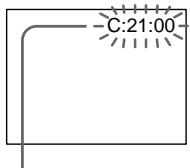
LCD screen or Viewfinder
Self-diagnosis display
C:□□:□□
You can service your camcorder yourself.
E:□□:□□
Contact your Sony dealer or local authorised Sony service facility.
| 5-digit display | Cause and/or Corrective Actions |
| C:04:□□ | • You are using a battery pack that is not an “InfoLITHIUM” battery pack.
→ Use an “InfoLITHIUM” battery pack (p. 25, 288). |
| C:21:□□ | • Moisture condensation has occurred.
→ Eject the cassette and leave your camcorder for at least 1 hour to acclimatise (p. 296). |
| C:22:□□ | • The video heads are dirty.
→ Clean the heads using the cleaning cassette (optional) (p. 297). |
| C:31:□□ | • A malfunction other than the above that you can service has occurred.
→ Eject the cassette and insert it again, then operate your camcorder. Do not perform this operation if moisture starts to condense (p. 296). |
| C:32:□□ | • Disconnect the power cord of the AC Adaptor or remove the battery pack. After reconnecting the power source, operate your camcorder.
→ Replace the cassette. |
| E:20:□□ | • A malfunction that you cannot service has occurred. |
| E:61:□□ | • Contact your Sony dealer or local authorised Sony service facility and inform them of the 5-digit code. (e.g. E:61:10) |
| E:62:□□ | |
If you are unable to rectify the problem even if you try corrective actions a few times, contact your Sony dealer or local authorised Sony service facility.
If indicators appear on the screen, check the following:
See the page in parentheses "() for details.
101-0001 Warning indicator as to file2)
Slow flashing:
The file is corrupted.
- The file is unreadable.
- You are trying to carry out MEMORY MIX on moving pictures (p. 160).
C:21:00 Self-diagnosis display (p. 270)
The battery pack is dead or nearly dead
Slow flashing:
- The battery pack is nearly dead. Depending on operational, environmental or battery conditions the indicator may flash, even if there are approximately 5 to 10 minutes remaining.
4 Moisture condensation has occurred1)
Fast flashing:
- Eject the cassette, set the POWER switch to OFF (CHG), and leave it for about 1 hour with the cassette lid open (p. 296).
Warning indicator as to Cassette Memory
Slow flashing:
- No cassette with Cassette Memory is inserted (p. 284).
Warning indicator as to the "Memory Stick"2)
Slow flashing:
- No "Memory Stick" is inserted.
Fast flashing:
- The image cannot be recorded on the "Memory Stick."1)
Fast flashing:
? Warning indicator as to incompatible
"Memory Stick"(1)2)
Slow flashing:
- An incompatible "Memory Stick" is inserted.
Warning indicator as to the tape
Slow flashing:
- The tape is near the end.
- No cassette is inserted.1)
- The write-protect tab of the cassette is set to SAVE (p. 287).1)
Fast flashing:
The tape has run out.1)
You need to eject the cassette1)
Slow flashing:
- The write-protect tab on the cassette is set to SAVE (p. 287).
Fast flashing:
- Moisture condensation has occurred (p. 296).
- The tape has run out.
- The self-diagnosis display function is activated (p. 270).
The image is protected ^1)2)
Slow flashing:
The image is protected (p. 190).
Warning indicator as to the flash (optional)
Slow flashing:
During charging
Fast flashing:
- The self-diagnosis display function is activated (p. 270).1)
- There is something wrong with the external flash (optional).
Warning indicator as to still image recording
Slow flashing:
- The still image cannot be recorded on the "Memory Stick" (p. 63).2
- The still image cannot be recorded on the tape (p. 65).3)
1) You hear the melody or beep sound.
2) DCR-TRV22E/TRV33E only
3) DCR-TRV12E/TRV14E/TRV19E only
If messages appear on the screen, check the following. See the page in parentheses "() for details.
CLOCK SET
Set the date and time (p. 31).
FOR "InfoLITHIUM" BATTERY ONLY
Use an "InfoLITHIUM" battery pack (p. 25).
The video heads are dirty (p. 297).
The indicator and "CLEANING CASSETTE" message appear one after another on the screen.
You tried to record a picture that has a copyright control signal (p. 285).1
FULL
The Cassette Memory is full (p. 135, 139, 140).1)
16BIT
AUDIO MODE is set to 16BIT. ^1) You cannot dub new sound (p. 131, 248).
REC MODE
REC MODE is set to LP.1) The tape was recorded in different colour system. You cannot dub new sound (p. 131, 248).
TAPE
There is no recorded portion on the tape.1) You cannot dub new sound.
i.LINK cable is connected.1) You cannot dub new sound (p. 131).
FULL3)
The "Memory Stick" is full (p. 155).
·O-3)
The write-protect tab on the "Memory Stick" is set to LOCK (p. 142).
NOFILE3)
No image is recorded or recognised on the "Memory Stick".1)
NO MEMORY STICK3
No "Memory Stick" is inserted.1)
AUDIO ERROR3
You are trying to record an image with sound that cannot be recorded by your camcorder on the "Memory Stick" (p. 171).1)
The "Memory Stick" data is corrupted (p. 146).
The "Memory Stick" is not recognised (p. 246).1) Check the format.
The image is distorted and cannot be played back. ^1) 2)
RECERROR3
Turn the power off once, then on again.1)
?] INCOMPATIBLE MEMORY STICK3)
The "Memory Stick" inserted is not compatible with your camcorder.
A read-only "Memory Stick" is inserted.1)
TAPE END
The tape has reached the end of the tape.1)
Insert a cassette.1)
You press PHOTO on your camcorder while deleting data in the "Memory Stick."
You press PHOTO on your camcorder while formatting the "Memory Stick."
Charging an external flash (optional) does not work correctly. ^1)
FOLDER NO. FULL
You have reached the maximum number of folders that can be created. ^1)
USB streaming is being performed.
1) You hear the melody or beep sound.
2) Reinsert the "Memory Stick" and play back.
3)DCR-TRV22E/TRV33E only
4) DCR-TRV19E/TRV22E/TRV33E only
USB streaming en cours.
Selecting cassette types
You can use the mini DV Mini cassette only.
You cannot use any other 8 mm B, Hi8 H1B, Digital8 B, VHS WHS, VHSC WHSE, S-VHS SWHS, S-VHSC SWHSE, Betamax B, DV or MICROMV MICROMV cassette.
- There are 2 types of mini DV cassettes: with Cassette Memory and without Cassette Memory. Cassettes with Cassette Memory have CIII (Cassette Memory) mark. We recommend that you use cassettes with Cassette Memory.
IC memory is mounted on this type of cassette. Your camcorder can read and write data such as dates of recording or titles, etc. to this memory.
The functions using the Cassette Memory require successive signals recorded on the tape. If the tape has a blank portion at the beginning or between recorded portions, titles may not be displayed properly or the search functions may not work properly (except for DCR-TRV12E). Perform the following to prevent a blank portion from being made on the tape.
Press END SCH to go to the end of the recorded portion before you begin the next recording if you operate the following:
- You have ejected the cassette during recording.
- You have played back the tape.
- You have used edit search.
If there is a blank portion or discontinuous signal on the tape, re-record from the beginning to the end of the tape as described above.
The same result may occur when you record using a digital video camera recorder without Cassette Memory on the tape recorded by one with the Cassette Memory.
CIII 4K mark on the cassette
The memory capacity of the tape marked with CIII4K is 4K bits. Your camcorder can accommodate up to 16K bits. 16K bits tape is marked with CIII16K.
Mini DV Digital Video Video
Cissette This is the Cassette Memory mark.
These are trademarks.
When you play back
Playing back an NTSC-recorded tape
You can play back tapes recorded in the NTSC video system on the LCD screen, if the tape is recorded in the SP mode.
Copyright signal
When you play back
If the tape you play back on your camcorder contains copyright signals, you cannot copy it with another video camera connected to your camcorder.
When you record (DCR-TRV19E/ TRV22E/TRV33E only)
You cannot record software on your camcorder that contains copyright control signals for copyright protection of software. The COPY INHIBIT indicator appears on the screen, or on the TV screen if you try to record such software. Your camcorder does not record copyright control signals on the tape when it records.
12-bit mode: The original sound can be recorded in stereo 1, and the new sound in stereo 2 in 32kHz . The balance between stereo 1 and stereo 2 can be adjusted by selecting AUDIO MIX in the menu settings during playback. Both sounds can be played back.
16-bit mode: A new sound cannot be recorded but the original sound can be recorded in high quality. Moreover, it can also play back sound recorded in 32kHz 44.1kHz or 48kHz . When playing back the tape recorded in the 16-bit mode, the 16BIT indicator appears on the screen.
When you play back a dual sound track tape
When you play back a dual sound track tape recorded in a stereo system, set HiFi SOUND in / to a desired mode in the menu settings (p. 244).
Sound from speaker
| HiFi Sound Mode | Playing back the stereo tape | Playing back the dual sound track tape |
| STEREO | Stereo | Main sound and sub sound |
| 1 | L channel | Main sound |
| 2 | R channel | Sub sound |
You cannot record dual sound programmes on your camcorder.
Notes on the cassette
To prevent accidental erasure Slide the write-protect tab on the cassette to SAVE.
When affixing a label on the cassette
Be sure to affix a label only on the locations as illustrated below [a] so as not to cause malfunction of your camcorder.
After using the cassette
Rewind the tape to the beginning, put the cassette in its case, and store it in an upright position.
When the Cassette Memory function does not work
Reinsert a cassette. The gold-plated connector of mini DV cassettes may be dirty or dusty.
Cleaning gold-plated connector
If the gold-plated connector on the cassette is dirty or dusty, the remaining tape indicator sometimes does not appear correctly, and you may not be able to operate functions using Cassette Memory.
Clean up the gold-plated connector with a cotton-wool swab, about every 10 times ejection of a cassette. [b]
This unit is compatible with the InfoLITHIUM" battery pack (M series). Your camcorder operates only with the InfoLITHIUM" battery pack. "InfoLITHIUM" M series battery packs have the InfoLITHIUM" m series mark.
What is the "InfoLITHIUM" battery pack?
The "InfoLITHIUM" battery pack is a lithium-ion battery pack that has functions for communicating information related to operating conditions between your camcorder and an optional AC adaptor/charger. The "InfoLITHIUM" battery pack calculates the power consumption according to the operating conditions of your camcorder, and displays the remaining battery time in minutes. With an AC adaptor/charger (optional), the remaining battery time and charging time appear.
Charging the battery pack
- Be sure to charge the battery pack before you start using your camcorder.
- We recommend charging the battery pack in an ambient temperature of between 10^ to 30^ (50°F to 86°F) until the CHG lamp goes out. If you charge the battery outside of this temperature range, you may not be able to efficiently charge the battery pack.
After charging is complete, either disconnect the cable from the DC IN jack on your camcorder or remove the battery pack.
Effective use of the battery pack
- Battery pack performance decreases in 10^ (50^) or below surroundings. So, the time that the battery pack can be used becomes shorter. We recommend the following to use the battery pack longer:
- Put the battery pack in a pocket to warm it up, and insert it in your camcorder immediately before you start taking shots.
- Use the large capacity battery pack (NP-FM50/FM70/QM71/QM71D/FM91/QM91/QM91D, optional).
- Frequently using the LCD screen or frequently operating playback, fast forward or rewind wears out the battery pack faster. We recommend using the large capacity battery pack (NP-FM50/FM70/QM71/QM71D/FM91/QM91/QM91D, optional).
- Be certain to set the POWER switch to OFF (CHG) when not taking shots or playing back on your camcorder. The battery pack is also consumed when your camcorder is during tape recording standby or playback pause.
- Have spare battery packs handy for 2 or 3 times the expected recording time, and make trial recordings before taking the actual recording.
- Do not expose the battery pack to water. The battery pack is not water resistant.
Remaining battery time indicator
- If the power goes off although the remaining battery time indicator indicates that the battery pack has enough power to operate, charge the battery pack fully again so that the indication on the remaining battery time indicator is correct. Note, however, that the correct battery indication sometimes will not be restored if it is used in high temperatures for a long time or left in a fully charged state, or the battery pack is frequently used. Regard the remaining battery time indication as the approximate shooting time.
- The mark indicating little remaining battery time sometimes flashes depending on the operating conditions or ambient temperature and environment even if the remaining battery time is about 5 to 10 minutes.
How to store the battery pack
-
If the battery pack is not used for a long time, do the following procedure once per year to maintain proper function.
-
Fully charge the battery pack.
- Discharge on your electronic equipment.
- Remove the battery pack from the equipment and store it in a dry, cool place.
- To use the battery pack up on your camcorder, leave your camcorder during tape recording standby until the power goes off without a cassette inserted.
Battery life
- The battery life is limited. Battery capacity drops little by little as you use it more and more, and as time passes. When the available battery time is shortened considerably, a probable cause is that the battery pack has reached the end of its life. Please buy a new battery pack.
- The battery life varies depending on how it is stored and operating conditions and environment for each battery pack.
"InfoLITHIUM" is a trademark of Sony Corporation.
The DV Interface on this unit is an i.LINK-compliant DV Interface. This section describes the i.LINK standard and its features.
What is i.LINK?
i.LINK is a digital serial interface for handling digital video, digital audio and other data in 2 directions between equipment having the i.LINK, and for controlling other equipment. i.LINK-compatible equipment can be connected by a single i.LINK cable. Possible applications are operations and data transactions with various digital AV equipment. When 2 or more i.LINK-compatible equipment are connected to this unit in a daisy chain, operations and data transactions are possible with not only the equipment that this unit is connected to but also with other devices via the directly connected equipment.
Note, however, that the method of operation sometimes varies according to the characteristics and specifications of the equipment to be connected, and that operations and data transactions are sometimes not possible on some connected equipment.
Note
Normally, only 1 piece of equipment can be connected to this unit by the i.LINK cable. When connecting this unit to i.LINK-compatible equipment having 2 or more DV Interfaces, refer to the operating instructions of the equipment to be connected.
About the name "i.LINK"
i.LINK is a more familiar term for IEEE 1394 data transport bus proposed by Sony, and is a trademark approved by many corporations. IEEE 1394 is an international standard standardized by the Institute of Electrical and Electronics Engineers.
A propos de i.LINK
i.LINK's maximum baud rate varies according to the equipment. Three maximum baud rates are defined:
S100 (approx. 100Mbps*)
S200 (approx. 200Mbps)
S400 (approx. 400Mbps)
The baud rate is listed under "Specifications" in the operating instructions of each equipment. It is also indicated near the i.LINK on some equipment.
The maximum baud rate of equipment on which it is not indicated such as this unit is "S100."
When units are connected to equipment having a different maximum baud rate, the baud rate sometimes differs from the indicated baud rate.
*What is Mbps?
Mbps stands for megabits per second, or the amount of data that can be sent or received in 1 second. For example, a baud rate of 100Mbps means that 100 megabits of data can be sent in 1 second.
A propos de i.LINK
Débit en bauds i.LINK
For details on how to dub when this unit is connected to other video equipment having DV Interface, see page 106 and 122.
This unit can also be connected to other i.LINK (DV Interface) compatible equipment made by Sony (e.g. VAIO series personal computer) other than video equipment.
Before connecting this unit to your computer, make sure that application software supported by this unit is already installed on your computer.
Some video equipment such as digital TV, DVD, MICRO MV may not be compatible with the DV Interface even if they have an i.LINK jack. Make sure that the equipment is compatible with the DV Interface before connecting.
For details on precautions when connecting this unit, also refer to the operating instructions for the equipment to be connected.
Required i.LINK cable
Use the Sony i.LINK 4-pin-to-4-pin cable (during DV dubbing).
i.LINK and are trademarks.
Using your camcorder abroad
Using your camcorder abroad
You can use your camcorder in any country or region with the AC Adaptor supplied with your camcorder within 100V to 240V AC, 50/60 Hz.
Your camcorder is a PAL system based camcorder. If you want to view the playback picture on a TV, it must be a PAL system based TV with the AUDIO/VIDEO input jack. The following shows TV colour systems used overseas.
PAL system
Australia, Austria, Belgium, China, Czech Republic, Denmark, Finland, Germany, Holland, Hong Kong, Hungary, Italy, Kuwait, Malaysia, New Zealand, Norway, Poland, Portugal, Singapore, Slovak Republic, Spain, Sweden, Switzerland, Thailand, United Kingdom etc.
PAL-M system
Brazil
PAL-N system
Argentina, Paraguay, Uruguay
SECAM system
Bulgaria, France, Guiana, Iran, Iraq, Monaco, Russia, Ukraine, etc.
NTSC system
Bahama Islands, Bolivia, Canada, Central America, Chile, Colombia, Ecuador, Guyana, Jamaica, Japan, Korea, Mexico, Peru, Surinam, Taiwan, the Philippines, the U.S.A., Venezuela, etc.
Simple setting of clock by time difference
You can easily set the clock to the local time by setting a time difference. Select WORLD TIME in the menu settings. See page 250 for more information.
Maintenance information and precautions
Moisture condensation
If your camcorder is brought directly from a cold place to a warm place, moisture may condense inside your camcorder, on the surface of the tape, or on the lens. In this condition, the tape may stick to the head drum and be damaged or your camcorder may not operate correctly. If there is moisture inside your camcorder, the beep sounds and the indicator flashes. When the indicator flashes at the same time, the cassette is inserted in your camcorder. If moisture condenses on the lens, the indicator will not appear.
If moisture condensation has occurred
None of the functions except cassette ejection will work. Eject the cassette, turn off your camcorder, and leave it for about 1 hour with the cassette lid open. Your camcorder can be used again if the or indicator does not appear when the power is turned on again. If moisture starts to condense, your camcorder sometimes cannot detect condensation. If this happens, the cassette is sometimes not ejected for 10 seconds after the cassette lid is opened. This is not a malfunction. Do not close the cassette lid until the cassette is ejected.
Note on moisture condensation
Moisture may condense when you bring your camcorder from a cold place into a warm place (or vice versa) or when you use your camcorder in a hot place as follows:
- You bring your camcorder from a ski slope into a place warmed up by a heating device.
- You bring your camcorder from an air-conditioned car or room into a hot place outside.
- You use your camcorder after a squall or a shower.
- You use your camcorder in a high temperature and humidity place.
Maintenance information and precautions
How to prevent moisture condensation
When you bring your camcorder from a cold place into a warm place, put your camcorder in a plastic bag and tightly seal it. Remove the bag when the air temperature inside the plastic bag has reached the surrounding temperature (after about 1 hour).
Maintenance information
Cleaning the video head
To ensure normal recording, clear pictures and sound, clean the video head. The video head may be dirty when:
- Mosaic-pattern noise appears on the playback picture.
-Playback pictures do not move.
- Playback pictures do not appear or the sound breaks off.
- The x indicator and "CLEANING CASSETTE" message appear one after another or the x indicator flashes on the screen during recording.
If the above problem, [a], [b] or [c] occurs, clean the video heads for 10 seconds with the Sony DVM-12CLD cleaning cassette (optional). Check the picture and if the above problem persists, repeat cleaning.
[a]
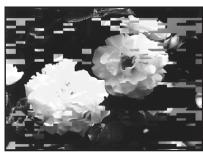
If the video heads get dirtier, the entire screen becomes blue [c].
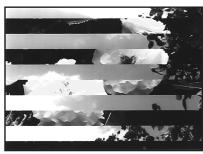
[b]
Note on the video head
The video head suffers from wear after long use. If you cannot obtain a clear image even after using a cleaning cassette, it might be because the video head is worn. Please contact your Sony dealer or local authorized Sony service facility to have the video head replaced.
Maintenance information and precautions
Cleaning the LCD screen
If fingerprints or dust make the LCD screen dirty, we recommend using a cleaning cloth (supplied) to clean the LCD screen. When you use the LCD Cleaning Kit (optional), do not apply the cleaning liquid directly to the LCD screen. Clean the LCD screen with cleaning paper moistened with the liquid.
Removing dust from inside the viewfinder
(1) Pull out the viewfinder in the direction of the arrow ①.
Remove the 2 screws in the direction of the arrow with a screwdriver (optional).
Remove the eyecup in the direction of the arrow ③.
(2) Remove dust from inside the eyecup and viewfinder with a commercially available blower.
(3) In the reverse way of (1), attach the eyecup.
Caution
Do not remove any other screws. You may remove only the screw to remove the eyecup.
Notes
- Do not drop or bend the eyecup shaft.
- Be careful when handling the eyecup.
Maintenance information and precautions
Charging the built-in rechargeable battery
Your camcorder has a built-in rechargeable battery so that the date, time and other settings are retained even when the POWER switch is set to OFF (CHG). The built-in rechargeable battery is always charged as long as you are using your camcorder. The battery, however, will get discharged gradually if you do not use your camcorder. It will be completely discharged in about 4 months if you do not use your camcorder at all. Even if the built-in rechargeable battery is not charged, it will not affect your camcorder operation. To retain the date and time, etc., charge the battery if the battery is discharged.
Charging the built-in rechargeable battery
- Connect your camcorder to the mains using the AC Adaptor supplied with your camcorder, and leave your camcorder with the POWER switch set to OFF (CHG) for more than 24 hours.
- Or install the fully charged rechargeable battery pack on your camcorder, and leave your camcorder with the POWER switch set to OFF (CHG) for more than 24 hours.
Maintenance information and precautions
Adjusting the LCD screen (CALIBRATION)
The buttons on the touch panel may not work correctly. If this happens, follow the procedure below.
(1) Set the POWER switch to OFF (CHG).
(2) Eject the tape from your camcorder, then disconnect any connecting cable from your camcorder.
(3) Set the POWER switch to PLAYER^1)/ VCR2) while pressing DSPL/BATT INFO on your camcorder, then keep pressing DSPL/BATT INFO for about 5 seconds.
(4) Touch × displayed on the screen using an object such as the corner of a "Memory Stick." The position of × changes.
- If you do not press the right spot, start from step 4 again.
- You cannot calibrate the LCD screen when the LCD screen is facing out.
Remarques
- Operate your camcorder on 7.2V (battery pack) or 8.4V (AC Adaptor).
- For DC or AC operation, use the accessories recommended in this operating instructions.
- If any solid object or liquid get inside the casing, unplug your camcorder and have it checked by a Sony dealer before operating it any further.
- Avoid rough handling or mechanical shock. Be particularly careful of the lens.
- Keep the POWER switch setting to OFF (CHG) when you are not using your camcorder.
- Do not wrap your camcorder with a towel, for example, and operate it. Doing so might cause heat to build up inside.
- Keep your camcorder away from strong magnetic fields or mechanical vibration.
- Do not press the LCD screen with a sharp objects.
- If your camcorder is used in a cold place, a residual image may appear on the LCD screen. This is not a malfunction.
- While using your camcorder, the back of the LCD screen may heat up. This is not a malfunction.
On handling the tape
- Do not insert anything into the small holes on the rear of the cassette. These holes are used to sense the type and thickness of the tape and if the recording tab is in or out.
- Do not open the tape protect cover or touch the tape.
- Avoid touching or damaging the terminals. To remove dust, clean the terminals with a soft cloth.
Precautions
- Eject the tape, and periodically turn on the power, operate the CAMERA and PLAYER^1) / VCR^2) sections and play back the tape for about 3 minutes when your camcorder is not to be used for a long time.
- Clean the lens with a soft brush to remove dust. If there are fingerprints on the lens, remove them with a soft cloth.
- Clean your camcorder body with a dry soft cloth, or a soft cloth lightly moistened with a mild detergent solution. Do not use any type of solvent which may damage the finish.
- Do not let sand get into your camcorder. When you use your camcorder on a sandy beach or in a dusty place, protect it from the sand or dust. Sand or dust may cause your camcorder to malfunction, and sometimes this malfunction cannot be repaired.
1) DCR-TRV12E/TRV14E
2) DCR-TRV19E/TRV22E/TRV33E
AC Adaptor
- Unplug the unit from a wall socket when you are not using the unit for a long time. To disconnect the power cord, pull it out by the plug. Never pull the power cord itself.
- Do not operate the unit with a damaged cord or if the unit has been dropped or damaged.
- Do not bend the power cord forcibly, or place a heavy object on it. This will damage the cord and may cause fire or electrical shock.
- Prevent metallic objects from coming into contact with the metal parts of the connecting section. If this happens, a short may occur and the unit may be damaged.
Always keep metal contacts clean.
- Do not disassemble the unit.
- Do not apply mechanical shock or drop the unit.
- While the unit is in use, particularly during charging, keep it away from AM receivers and video equipment. AM receivers and video equipment disturb AM reception and video operation.
Maintenance information and precautions
- The unit becomes warm during use. This is not a malfunction.
- Do not place the unit in locations that are: -Extremely hot or cold
-Dusty or dirty
- Very humid
Vibrating
About care and storage of the lens
- Wipe the surface of the lens clean with a soft cloth in the following instance:
- When there are fingerprints on the lens surface
-In hot or humid locations
- When the lens is used in environments such as the seaside
- Store the lens in a well-ventilated location subject to little dirt or dust.
To prevent mould from occurring, periodically perform the above.
We recommend turning on and operating your camcorder about once per month to keep your camcorder in an optimum state for a long time.
Rechargeable battery pack
- Use only the specified charger or video equipment with the charging function.
- To prevent an accident from a short circuit, do not allow metal objects to come into contact with the battery terminals.
- Keep the rechargeable battery pack away from fire.
- Never expose the rechargeable battery pack to temperatures above 60^ (140^) , such as in a car parked in the sun or under direct sunlight.
- Store the rechargeable battery pack in a cool, dry place.
- Do not expose the rechargeable battery pack to any mechanical shock.
- Do not disassemble nor modify the rechargeable battery pack.
- Install the rechargeable battery pack to the video equipment securely.
- Charging while some capacity remains does not affect the original battery capacity.
Batterie rechargeable
Note on dry batteries (except for DCR-TRV12E)
To avoid possible damage from battery leakage or corrosion, observe the following:
- Be sure to insert the batteries with the + - polarities matched to the + - marks.
- Dry batteries are not rechargeable.
- Do not use a combination of new and old batteries.
- Do not use different types of batteries.
- Current flows from batteries when you are not using them for a long time.
- Do not use leaking batteries.
If batteries are leaking
- Wipe off the liquid in the battery compartment carefully before replacing the batteries.
- If you touch the liquid, wash it off with water.
- If the liquid get into your eyes, wash your eyes with a lot of water and then consult a doctor.
If any problem occurs, unplug your camcorder and contact your nearest Sony dealer.
Video camera recorder
System
Video recording system
2 rotary heads
Helical scanning system
Audio recording system
Rotary heads, PCM system
Quantization: 12 bits (Fs 32kHz stereo 1, stereo 2), 16 bits (Fs 48kHz , stereo)
Video signal
PAL colour, CCIR standards
Usable cassette
Mini DV cassette with the Mini DV mark printed
Tape speed
SP: Approx. 18.81mm / s
LP: Approx. 12.56mm / s
Recording/playback time (using cassette DVM60)
SP: 1 hour
LP: 1.5 hours
Fastforward/rewind time
(using cassette DVM60)
Approx. 2 min. and 40 seconds
Viewfinder
Electric viewfinder
DCR-TRV12E/TRV14E/TRV19E:
black and white
DCR-TRV22E/TRV33E: colour
Image device
DCR-TRV12E/TRV14E/TRV19E:
4.5mm (1/4 type)
CCD (Charge Coupled Device)
Gross: Approx. 800 000 pixels
Effective (moving):
Approx. 400 000 pixels
DCR-TRV22E: 4.5mm (1/4 type)
CCD (Charge Coupled Device)
Gross: Approx. 800 000 pixels
Effective (still):
Approx. 400 000 pixels
Effective (moving):
Approx. 400 000 pixels
DCR-TRV33E: 3.8mm (1/4.7 type)
CCD (Charge Coupled Device)
Gross: Approx. 1070000 pixels
Effective (still):
Approx. 1000000 pixels
Effective (moving):
Approx. 690 000 pixels
Lens
Carl Zeiss Vario-Sonnar
Combined power zoom lens
Filter diameter: 30mm
(13/16 in)
10× (Optical), 120× (Digital, DCR
TRV14E/TRV19E/TRV22E/
TRV33E), 100× Digital, DCRTRV12E)
DCR-TRV12E/TRV14E/TRV19E/
TRV22E:
F = 1.7 - 2.2
DCR-TRV33E:
F = 1.8 - 2.0
Focal length
DCR-TRV12E/TRV14E/TRV19E:
3.3 - 33mm (5/32-15/16 in.)
42 - 420 mm (1 11/16 - 16 5/8 in.) ^2)
DCR-TRV22E:
3.3 - 33mm (5/32-15/16 in.)
42 - 420 mm (1 11/16 - 16 5/8 in.) ^2)
42-420 mm (1 11/16-16 5/8 in.)3)
DCR-TRV33E:
3.7 - 37mm (5 / 32 - 11 / 2 in.)
50 - 500mm (2 - 193 / 4 in.)2
42 - 420 mm (1 11/16 - 16 5/8 in.)3)
1) When converted to a 35mm still camera
2) In CAMERA mode
3) In MEMORY mode
Colour temperature
Auto, HOLD, INDOOR (3 200 K), OUTDOOR (5 800 K)
Minimum illumination
DCR-TRV12E/TRV14E/TRV19E/
TRV22E:
5 lx (lux) (F1.7)
0 lx (lux) (in the NightShot mode)*
DCR-TRV33E:
7 lx (lux) (F 1.8)
0 lx (lux) (in the NightShot mode)*
- Objects unable to be seen due to the dark can be shot with infrared lighting.
S video input (DCR-TRV22E/
TRV33E only)/output
4-pin mini DIN
Luminance signal: 1 Vp-p,
75 Ω (ohms), unbalanced
Chrominance signal: 0.3Vp - p
75 Ω (ohms), unbalanced
Audio/Video input (DCR
TRV22E/TRV33E only)/output
AV MINI JACK, 1 Vp-p,
75 Ω (ohms), unbalanced
327mV (at output impedance more than 47k (kilohms))
Output impedance with less than
2.2 kΩ (kilohms)/Stereo minijack ( 3.5 ~mm )
Input impedance more than
47 kΩ (kilohms)
DV input (DCR-TRV19E/
TRV22E/TRV33E only)/output
4-pin connector
Headphone jack
Stereo minijack ( 3.5mm)
LANC jack
Stereo mini-minijack ( 2.5mm)
USB jack
mini-B
MIC jack
Minijack, 0.388mV low impedance with 2.5 to 3.0VDC , output impedance 6.8k (kilohms)
(0.35 mm)
Stereo type
LCD screen
Picture
6.2 cm (2.5 type)
Total dot number
123 200 (560× 220)
General
Power requirements
7.2 V (battery pack)
8.4 V (AC Adaptor)
Average power consumption (when using the battery pack)
DCR-TRV12E/TRV14E/TRV19E/
TRV22E:
3.3 W1)
2.5 W2)
DCR-TRV33E:
4.0W^1)
3.2 W2)
1) During camera recording using LCD
2) Viewfinder
Operating temperature
0^ to 40^ (32^ to 104^)
Storage temperature
-20^ to +60^
(-4^ to +140^)
Dimensions (approx.)
71× 90× 112mm
(27 / 8× 35 / 8× 41 / 2 in. (w / h / d)
Mass (approx.)
Main unit only
DCR-TRV12E/TRV14E/TRV19E:
520 g (1 lb 2 oz)
DCR-TRV22E:
530 g (1 lb 2 oz)
DCR-TRV33E:
540 g (1 lb 2 oz)
Including the rechargeable battery
pack NP-FM30, cassette DVM60
and lens cap
DCR-TRV12E/TRV14E/TRV19E:
610 g (1 lb 5 oz)
DCR-TRV22E:
620 g (1 lb 5 oz)
DCR-TRV33E:
630g (1 lb 5 oz)
Supplied accessories
See page 3.
AC Adaptor AC-L15A/L15B
Power requirements
100 - 240VAC,50 / 60Hz
Current consumption
0.35-0.18A
Power consumption
18W
Output voltage
DC OUT: 8.4V 1.5 A
Operating temperature
0^ to 40^ (32^ to 104^)
Storage temperature
-20^ to +60^
(-4^ to +140^)
Dimensions (approx.)
56× 31× 100mm
(21 / 4× 11 / 4× 4 in. (w / h / d)
excluding projecting parts
Mass (approx.)
190 g (6.7 oz)
excluding power cord
Rechargeable battery pack NP-FM30
Maximum output voltage
DC 8.4 V
Output voltage
DC 7.2 V
Capacity
5.0 Wh (700 mAh)
Dimensions (approx.)
38.2× 20.5× 55.6mm
(19 / 16 × 13 / 16 × 21 / 4 in.)
(w/h/d)
Mass (approx.)
65 g (2.3 oz)
Operating temperature
0^ to 40^ (32^ to 104^)
Type
Lithium ion
"Memory Stick" (DCR-TRV22E/ TRV33E only)
Memory
Flash memory
8MB: MSA-8A
Operating voltage
2.7-3.6V
Power consumption
Approx. 45mA during operation mode
Approx. 130~ A during tape recording standby
Dimensions (approx.)
50× 2.8× 21.5mm
(2× 1 / 8× 7 / 8 in.) (w / h / d)
Mass (approx.)
4g(0.14oz)
Design and specifications are subject to change without notice.
Caméscope
Système
Signal de luminance: 1 Vc-c,
MINI-PRISE AV, 1 Vc-c,
Entree (DCR-TRV19E/TRV22E/
TRV33E uniqueness)/sortie DV
Dimensions approximatives
71× 90× 112mm (l / h / p)
Poids approximatif
Appareil principal quinquement
Dimensions approximatives
56 × 31 × 100 ~mm(l/h/p) parties
saillantes exclues
Poids approximatif
Batterie rechargeable NP-FM30
Dimensions approximatives
38,2× 20,5× 55,6mm (1 / h / p)
Poids approximatif
65g
Dimensions approximatives
50 × 2,8 × 21,5 ~mm (1 / h / p)
Poids approximatif
4g
Identifying parts and controls
Lens cap (p. 36)
LCD/Touch panel screen (p. 33, 40, 41)
3 RESET button (p. 269)
If you press RESET, all the settings including the date and time return to the default.
4 BACK LIGHT button (p. 46)
5 Speaker
DSPL/BATT INFO button (p. 29, 54)
CHG (charge) lamp (p. 25)
8 Eyecup (p. 298)
Viewfinder (p. 43)
10 START/STOP button (p. 13, 36, 166)
11 Battery pack mounting surface (p. 24)
12 Hooks for shoulder strap
Attaching the supplied lens cap
Align the lens cap to the groove.
Push the lens cap against the lens until it snaps.
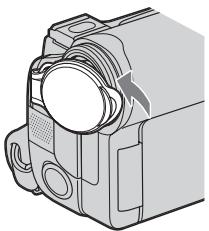
1
When recording, open the lens cap as shown.
Position the lens cap so as not to cover the microphone and the remote sensor.
Note on the Carl Zeiss lens
Your camcorder is equipped with a Carl Zeiss lens which can reproduce fine images. The lens for your camcorder was developed jointly by Carl Zeiss, in Germany, and Sony Corporation. It adopts the MTF* measurement system for video camera and offers a quality as the Carl Zeiss lens.
- MTF stands for Modulation Transfer Function.
The value number indicates the amount of light of a subject coming into the lens.
Remarque
13 POWER switch (p. 13, 15, 25)
14 LOCK switch (DCR-TRV22E/TRV33E only, p. 15)
DCIN jack (p. 12, 14)
16 BATT release button (p. 24)
Viewfinder lens adjustment lever (p. 43)
18 MEMORY EJECT knob (DCR-TRV22E/ TRV33E only, p. 14, 146)
"Memory Stick" slot (DCR-TRV22E/TRV33E only, p. 14, 146)
Cassette lid (p. 12)
21 OPEN/△EJECT lever (p. 12)
22 Tripod receptacle Make sure that the length of the tripod screw is less than 5.5mm (7/32 inch). Otherwise, you cannot attach the tripod securely, and the screw may damage your camcorder.
Intelligent accessory shoe/shoe cover (p. 128)
24 Lens
25 Camera recording lamp (p. 36)
26 Microphone (p. 36)
27 Remote sensor (except for DCR-TRV12E)
28 Infrared rays emitter (p. 47, 112)
29 OPEN button (p. 33)

Intelligent Accessory Shoe
Notes on the intelligent accessory shoe
- The intelligent accessory shoe supplies power to optional accessories such as a video light or microphone.
- The intelligent accessory shoe is linked to the POWER switch, allowing you to turn the power supplied by the shoe on and off. Refer to the operating instructions of the accessory for details.
- The intelligent accessory shoe has a safety device for fixing the installed accessory securely. To connect an accessory, press down and push it to the end, and then tighten the screw.
- To remove an accessory, loosen the screw, and then press down and pull out the accessory.
Intelligent Accessory Shoe
30 PHOTO button (p. 15, 62, 152)
31 Power zoom lever (p. 44, 94, 186)
32 (USB) jack (p. 200)
33 DV Interface (DCR-TRV19E/ TRV22E/TRV33E only, p. 106, 123, 201) DV OUT Interface (DCR-TRV12E/ TRV14E only, p. 106) The DV Interface is i.LINK compatible.
34 AUDIO/VIDEO jack (yellow) (DCR- TRV22E/TRV33E only, p. 60, 106, 123, 238) AUDIO/VIDEO OUT jack (yellow) (DCR-TRV12E/TRV14E/TRV19E only, p. 60)
35 Grip belt (p. 12)
36 NIGHTSHOT switch (p. 47)
37 (headphones) jack (green) When you use headphones, the speaker on your camcorder is silent.
38 MIC jack (PLUG IN POWER) (red) Connect an external microphone (optional). This jack also accepts a "plug-in-power" microphone.
39 Access lamp (DCR-TRV22E/TRV33E only, p. 14, 146)
40 SVIDEO jack (DCR-TRV22E/TRV33E only, p. 61)
SVIDEO OUT jack (DCR-TRV12E/TRV14E/TRV19E only, p. 61)
41 (LANC) jack (blue)
Remote Commander (DCRTRV14E/TRV19E/TRV22E/TRV33E only)
The buttons that have the same name on the Remote Commander as on your camcorder function identically to the buttons on your camcorder.
Télécommande (DCR-TRV14E/ TRV19E/TRV22E/TRV33E uniquely)
Point toward the remote sensor to control your camcorder after turning on your camcorder.
ZERO SET MEMORY button (p. 96)
8 START/STOP button (p. 13, 36)
9 DATA CODE button (p. 56)
10 Power zoom button (p. 44)
1 Touche PHOTO (pp. 19, 62 et 152)
2 Touche DISPLAY (p. 54)
3 Touche SEARCH MODE (pp. 98, 100, 103, 104 et 105)
4 Touches I / ▪ (pp. 98, 100, 103, 104 et 105)
5 Touches de commande video (pp. 52 et 57)
6 Transmetteur
To prepare the Remote Commander
Insert 2 R6 (size AA) batteries by matching the + and - on the batteries to the + and - in the battery compartment.
Notes on the Remote Commander
- Point the remote sensor away from strong light sources such as direct sunlight or overhead lighting. Otherwise, the Remote Commander may not function properly.
- Your camcorder works in the Commander mode VTR 2. Commander modes 1, 2 and 3 are used to distinguish your camcorder from other Sony VCRs to avoid erroneous remote control operation. If you use another Sony VCR in the Commander mode VTR 2, we recommend changing the Commander mode or covering the sensor of the VCR with black paper.
Operation indicators
LCD screen and Viewfinder
1 Cassette Memory (p. 38)
Remaining battery time (p. 38)
3 Zoom (p. 44)/Exposure (p. 82)/ Data file name*1 (p. 180)
4 Digital effect*1 (p. 77, 93)/MEMORY MIX*1 (p. 158)/Fader (p. 73)
5 16:9WIDE (p.71)
6 Picture effect (p. 76, 92)
7 Data code (p. 54)
Volume (p. 52)/Date (p. 31)
9 PROGRAM AE (p. 80)
10 Back light (p. 46)
11 SteadyShot off (p. 243)
12 Manual focus (p. 84)
13 Self-timer (p. 67, 168)
14 Recording mode (p. 248)
15 Camera recording lamp*3 (p. 43)
STBY/REC (p. 36)/Video control mode (p. 52)/Image size2 (p. 148)/Image quality1 (p. 147)
17 NIGHTSHOT (p. 47)/SUPER NIGHTSHOT*1 (p. 47)/COLOUR SLOW SHUTTER*1 (p. 48)
Warning (p. 271)
Time code (p. 38)/Tape counter (p. 38)/ Self-diagnosis (p. 270)/Photo recording (p. 152)/Image number*1 (p. 180)/Playback folder*1 (p. 180)/Tape photo*3 (p. 65)
20 Remaining tape (p. 38)/Memory playback*1 (p. 180)
21 ZERO SET MEMORY (p. 96)/Interval Recording (p. 87)/Interval Photo Recording (p. 164)/Frame recording (p. 89)
22 END SEARCH (p. 50)
23 A/V DV*1 (p. 238)/DV IN*4 (p. 123)
24 Audio mode (p. 248)/Recording folder*1 (p. 177)
25 Time (p. 31)
26 Flash (p. 242) This indicator appears only when the flash (optional) is in use.
27 Continuous photo recording*2 (p. 154)
1 DCR-TRV22E/TRV33E only
2 DCR-TRV33E only
3 DCR-TRV12E/TRV14E/TRV19E only
4 DCR-TRV19E/TRV22E/TRV33E only
C.CHROM 158
CALIBRATION 300
Cassette Memory 21, 284
Charging battery pack 25
Charging built-in rechargeable battery 299
CLEANING CASSETTE 297
Clock set 31
Colour Slow Shutter 48
Continuous photo recording..154
Data code 54
Date search 100
DEMO MODE 249
Digital effect 77, 93
Digital program editing..109,173
DISPLAY 250
DOT 73
Dual sound track tape 286
E
Edit search 51
End search 50
EXP BRKTG 154
Exposure 82
F, G, H
Fader 73
FLASH MOTION 77
Flexible Spot Meter 83
Format 141,246
Frame recording 89
Full charge 26
Grip belt 12
(headphones) jack. 313
Heads 297
HiFi SOUND 244
I, J, K, L
i.LINK 292
i.LINK cable 106, 123
Image protection 190
Image quality 147
Image size 148, 150
Index screen 181
"InfoLITHIUM" battery pack. 25, 288
Infrared rays emitter 47, 112
Insert editing 125
Intelligent accessory shoe 128,312
Interval Recording 87
Interval Photo Recording .... 164
JPEG 141
Labelling a cassette 138
LANC jack 313
LUMINANCE KEY 77
M, N
M.CHROM 158
M.LUMI 158
M. OVERLAP 158
Main sound 286
Manual focus 84
MEMORY MIX 158
Memory PB ZOOM 186
Memory photo recording ... 152
"Memory Stick" 141
"Memory Stick" capacity.... 151
Menu settings 240
Mirror mode 41
Moisture condensation 296
MONOTONE 73
MOSC.FADER. 73
MPEG 141
NIGHTSHOT 47
NORM.FADER 73
NTSC system 244
O, P, Q
OLD MOVIE 77
Operation indicators 34
OVERLAP 73
PB FOLDR. 185
Picture effect 76,92
Picture search 57
Playback time 28
Printmark. 197
PROGRAM AE. 80
R
REC FOLDER 178
Rec Review 51
Recording time 27
Remaining battery time indicator 38
Remaining tape indicator .... 38
Remote Commander 314
Remote sensor 312
RESET 269,309
Resize 196
s
SVIDEO jack 61
Self-diagnosis display 270
Self-timer recording 67, 168
Signal convert function 238
Skip scan 57
Slide show 188
SLOW SHTR 77
SPOT FOCUS 86
STEADYSHOT 243
Stereo tape 286
STILL 77
Sub sound 286
Super NightShot 47
T, U, V
Tape counter 38
Tape PB ZOOM 94
Telephoto 44
Time code 38
Title 133
Title search 98
Touch panel 33
TRAIL 77
Transition 37
TV colour systems 295
USB jack 199
USB Streaming 217
W, X, Y, Z
Warning indicators 271
Warning messages 272
White balance 69
Wide-angle 44
Wide mode 71
WIPE 73
Write-protect tab 287
Zero set memory 96
Zoom 44
A,B
Colour Slow Shutter 48
recharge complete 26
Printed on 100% recycled paper using VOC (Volatile Organic Compound)-free vegetable oil based ink.