
CCD-TRV15E - Camcorder SONY - Free user manual and instructions
Find the device manual for free CCD-TRV15E SONY in PDF.


| Product type | 8 mm analog camcorder |
| Brand | Sony |
| Model | CCD-TRV15E |
| Recording system | Video 8 (standard 8 mm) |
| Sensor | CCD (estimated 0.33 inch) |
| Optical zoom | 16x |
| Digital zoom | 32x (160x depending on area) |
| LCD screen | 2.5 inch color swivel |
| Viewfinder | Color electronic |
| Audio | Mono |
| Power | InfoLITHIUM NP-F330 battery, AC-L10A power adapter |
| Battery life | Approx. 130 min with viewfinder, 100 min with LCD (NP-F330) |
| Dimensions (approx) | 10 × 12 × 20 cm |
| Weight (approx) | 600 g |
| Connectivity | AV output, microphone input (PLUG IN POWER), LANC, DC IN |
| Main functions | Recording, playback, zoom, wind noise reduction, 5-second mode, end search, titling, automatic date |
| Maintenance and cleaning | Clean with a soft dry cloth. Use a video head cleaning cassette. |
| Safety | Do not expose to moisture. Use a 5 A fuse for the power adapter. |
| Spare parts and repairability | Battery, charger, remote control, cables available from Sony. Repair by authorized service. |
| General information | 116-page manual. PAL system. Made in Japan. |
Frequently Asked Questions - CCD-TRV15E SONY
User questions about CCD-TRV15E SONY
0 question about this device. Answer the ones you know or ask your own.
Ask a new question about this device
Download the instructions for your Camcorder in PDF format for free! Find your manual CCD-TRV15E - SONY and take your electronic device back in hand. On this page are published all the documents necessary for the use of your device. CCD-TRV15E by SONY.
USER MANUAL CCD-TRV15E SONY
Video Camera Recorder
Operating Instructions
Before operating the unit, please read this manual thoroughly, and retain it for future reference.
natural_image
Illustration of a Handucam video camera with no visible text or symbols on the device itselfHandycam Vision™
CCD-TRV69E
video Hi8 XR
CCD-TRV65E/TRV69E Hli8
Video 8 XR
CCD-TRV13E/TRV15E/TRV35E 8
English
Welcome!
Congratulations on your purchase of this Sony Handycam Vision™ camcorder. With your Handycam Vision you can capture life's precious moments with superior picture and sound quality.
Your Handycam Vision is loaded with advanced features, but at the same time it is very easy to use. You will soon be producing home video that you can enjoy for years to come.
WARNING
To prevent fire or shock hazard, do not expose the unit to rain or moisture.
To avoid electrical shock, do not open the cabinet.
Refer servicing to qualified personnel only.
NOTICE ON THE SUPPLIED AC POWER ADAPTOR FOR CUSTOMERS IN THE UNITED KINGDOM
A moulded plug complying with BS1363 is fitted to this equipment for your safety and convenience.
Should the fuse in the plug supplied need to be replaced, a 5 AMP fuse approved by ASTA or BSI to BS1362 (i.e., marked with ◆ or ⚙ mark) must be used.
If the plug supplied with this equipment has a detachable fuse cover, be sure to attach the fuse cover after you change the fuse. Never use the plug without the fuse cover. If you should lose the fuse cover, please contact your nearest Sony service station.
Русский
Добро пожаловать!
Checking supplied accessories 7
Getting started
Installing and charging the battery pack .... 8
Inserting a cassette.... 14
Basic operations
Camera recording 15
Using the zoom feature 18
Selecting the START/STOP mode 19
Shooting with the LCD screen 20
Letting the subject monitor the shot (Mirror mode) 21
Hints for better shooting 22
Checking the recorded picture 24
Playing back a tape 26
Searching for the end of the picture 31
Advanced operations
Using alternative power sources 32
Using the mains 32
Changing the mode settings 34
- for camera recording -
Shooting with backlighting 40
Using the FADER function (CCD-TRV35E/TRV65E/TRV69E only) 41
Shooting in the dark (NightShot) (CCD-TRV35E/TRV65E/TRV69E only) ..... 44
Using the wide mode function 45
Using the PROGRAM AE function 47
Focusing manually (CCD-TRV35E/TRV65E/TRV69E only) 49
Enjoying picture effect 51
Adjusting the exposure (CCD-TRV35E/TRV65E/TRV69E only) 53
Superimposing a title 55
Making your own titles 57
Re-recording a picture in the middle of a recorded tape (CCD-TRV69E only) 58
Recording with the date/time 60
Optimizing the recording condition 61
Releasing the STEADY SHOT function (CCD-TRV35E/TRV65E/TRV69E only) ...... 62
- for playback/editing -
Watching on a TV screen 63
Searching the boundaries of recorded date (CCD-TRV69E only) 65
Returning to a pre-registered position (CCD-TRV69E only) 67
Locating the marking position (CCD-TRV69E only) 68
Writing the RC Time code on a recorded tape (CCD-TRV69E only) 73
Editing onto another tape 75
Additional information
Changing the lithium battery in the camcorder 76
Resetting the date and time 78
Simple setting of clock by time difference ..... 79
Usable cassettes and playback modes 80
Tips for using the battery pack 82
Maintenance information and precautions...... 86
Using your camcorder abroad 92
Trouble check 93
Self-diagnosis display 99
Specifications 101
Identifying the parts 105
Warning indicators 115
Index ...... Back cover
The instructions in this manual are for the five models listed below. Before you start reading this manual and operating the unit, check your model number by looking at the bottom of your camcorder. The CCD-TRV69E is the model used for illustration purposes. Otherwise, the model name is indicated in the illustrations. Any differences in operation are clearly indicated in the text, for example, “CCD-TRV69E only.” As you read through this manual, buttons and settings on the camcorder are shown in capital letters.
e.g. Set the POWER switch to CAMERA.
You can hear the beep sound to confirm your operation.
Types of differences
^1) 160x in some areas
^2) 200x in some areas
3) 220x in some areas
Note on TV colour systems
TV colour systems differ from country to country. To view your recordings on a TV, you need a PAL system-based TV.
Precaution on copyright
Television programmes, films, video tapes, and other materials may be copyrighted.
Unauthorized recording of such materials may be contrary to the provision of the copyright laws.
Precautions on camcorder care
- The LCD screen and/or the colour viewfinder are manufactured using high-precision technology. However, there may be some tiny black points and/or bright points (red, blue or green in colour) that constantly appear on the LCD screen and/or in the viewfinder. These points are normal in the manufacturing process and do not affect the recorded picture in any way. Over 99.99% are operational for effective use.
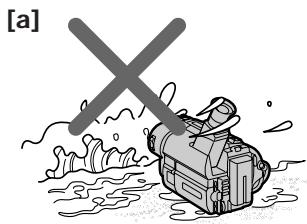
- Do not let the camcorder get wet. Keep the camcorder away from rain and sea water. Letting the camcorder get wet may cause the unit to malfunction, and sometimes this malfunction cannot be repaired [a].
- Never leave the camcorder exposed to temperatures above 60^ (140°F), such as in a car parked in the sun or under direct sunlight [b].
natural_image
Illustration of a person operating a large vehicle with a cross symbol above, surrounded by waves and splashes (no text or symbols present)natural_image
Illustration of a sun and a cross symbol above a tent, no text or symbols presentChecking supplied accessories
Check that the following accessories are supplied with your camcorder.
① Wireless Remote Commander (1) (p. 110)
RMT-708: CCD-TRV15E/TRV35E/TRV65E
RMT-717: CCD-TRV69E
② AC-L10A/L10B/L10C AC power adaptor (1), Mains lead (1) (p. 9, 32)
③ NP-F330 Battery pack (1) (p. 8, 32)
4 CR2025 Lithium Battery (1) (p. 76)
The lithium battery is already installed in your camcorder.
5 R6 (size AA) battery for Remote Commander (2) (p. 111)
CCD-TRV15E/TRV35E/TRV65E/TRV69E only
⑥ A/V connecting cable (1) (p. 63)
*for stereo model
7 Shoulder strap (1) (p. 112)
8 21 pin adaptor (1) (p. 64)
Contents of the recording cannot be compensated if recording or playback is not made due to a malfunction of the camcorder, video tape, etc.
Installing and charging the battery pack
Before using your camcorder, you first need to install and charge the battery pack.
This camcorder operates only with the “InfoLITHIUM” battery pack.
“InfoLITHIUM” is a trademark of Sony Corporation.
Installing the battery pack
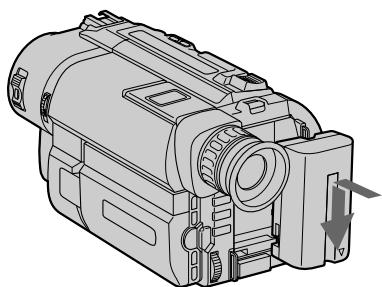
(1) While pressing BATT RELEASE, slide the battery terminal cover in the direction of the arrow.
(2) Install the battery pack in the direction of the ▼ mark on the battery pack. Slide the battery pack down until it catches on the battery release lever and clicks.
Attach the battery pack to the camcorder securely.
text_image
BATT RELEASE2
natural_image
Line drawing of a video camera with no visible text or symbolsNote on the battery pack
Do not carry the camcorder by grasping the battery pack.
Charging the battery pack
Charge the battery pack on a flat surface without vibration. The battery pack is charged a little in the factory.
(1) Open the DC IN jack cover and connect the supplied AC power adaptor to the DC IN jack with the plug's ▲ mark up.
(2) Connect the mains lead to the AC power adaptor.
(3) Connect the mains lead to the mains.
(4) Slide the POWER switch to OFF. Remaining battery time is indicated by the minutes on the display window. Charging begins.
When the remaining battery indicator becomes normal charge is completed. For full charge, which allows you to use the battery longer than usual, leave the battery pack attached for about 1 hour after normal charge is completed until FULL appears in the display window.
Before using the camcorder with the battery pack, unplug the AC power adaptor from the DC IN jack of the camcorder. You can also use the battery pack before it is completely charged.
- “--- min” appears in the display window until the camcorder calculates remaining battery time.
- Remaining battery time indication in the display window roughly indicates the recording time with the viewfinder. Use it as a guide. It may differ from the actual recording time.
- If there is a slight difference in shape between the plug of mains lead and the terminal of AC power adaptor, it is ignorable for their mutual connection and power supply.
- Be sure to plug the mains lead deeply into the terminal of AC power adaptor so that it is firmly locked. If there is a gap between the plug of mains lead and the terminal of AC power adaptor, it does not affect the efficiency of the AC power adaptor.
Charging time
| Battery pack | Charging time* (min.) |
| NP-F330 (supplied) | 150 (90) |
| NP-F530/F550 | 210 (150) |
| NP-F730/F750 | 300 (240) |
| NP-F930/F950 | 390 (330) |
The time required for a normal charge is indicated in parentheses.
* Approximate minutes to charge an empty battery pack using the supplied AC power adaptor. (Lower temperatures require a longer charging time.)
Примечания
Upper numbers are the time when recording with the viewfinder. Lower numbers are the time when recording with the LCD screen. Using both will further reduce recording time.
CCD-TRV13E/TRV15E
| Battery pack | Continuous recording time* | Typical recording time** | Playing time on LCD |
| NP-F330 (supplied) | 130 (115) | 65 (60) | 100 (90) |
| 100 (90) | 55 (45) | ||
| NP-F530 | 225 (200) | 115 (105) | 165 (150) |
| 170 (155) | 90 (85) | ||
| NP-F550 | 260 (230) | 135 (120) | 200 (180) |
| 205 (185) | 110 (100) | ||
| NP-F730 | 450 (405) | 235 (210) | 335 (300) |
| 350 (310) | 190 (170) | ||
| NP-F750 | 530 (480) | 280 (250) | 410 (365) |
| 425 (380) | 230 (205) | ||
| NP-F930 | 710 (640) | 375 (335) | 535 (480) |
| 555 (500) | 305 (275) | ||
| NP-F950 | 815 (730) | 430 (385) | 630 (570) |
| 650 (590) | 355 (320) |
CCD-TRV35E
| Battery pack | Continuous recording time* | Typical recording time** | Playing time on LCD |
| NP-F330 (supplied) | 125 (110) | 65 (55) | 100 (90) |
| 100 (90) | 55 (45) | ||
| NP-F530 | 215 (190) | 110 (100) | 165 (150) |
| 165 (150) | 90 (80) | ||
| NP-F550 | 250 (220) | 135 (115) | 200 (180) |
| 200 (180) | 110 (95) | ||
| NP-F730 | 430 (385) | 225 (200) | 335 (300) |
| 335 (300) | 180 (165) | ||
| NP-F750 | 510 (460) | 270 (240) | 410 (365) |
| 410 (365) | 225 (200) | ||
| NP-F930 | 680 (610) | 360 (320) | 535 (480) |
| 535 (480) | 290 (260) | ||
| NP-F950 | 780 (700) | 410 (370) | 630 (570) |
| 630 (570) | 345 (310) |
Numbers in parentheses indicate the time when you use a normally charged battery.
Battery life will be shorter if you use the camcorder in a cold environment.
* Approximate continuous recording time at 25°C (77°F).
** Approximate minutes when recording while you repeat recording start/stop, zooming and turning the power on/off. The actual battery life may be shorter.
Notes on remaining battery time indication during recording
- Remaining battery time is displayed in the viewfinder or on the LCD screen. However, the indication may not be displayed properly, depending on using conditions and circumstances.
- When you close the LCD panel and open it again, it takes about 1 minute for the correct remaining time to be displayed.
CCD-TRV65E/TRV69E
| Батарейный блок | Время непрерывной записи* | Время типичной записи** | Время воспроизведения на ЖКД |
| NP-F330 (прилагается) | 120 (105)95 (85) | 60 (55)50 (45) | 95 (85) |
| NP-F530 | 205 (180)160 (145) | 105 (95)85 (75) | 155 (140) |
| NP-F550 | 240 (210)195 (175) | 125 (110)105 (95) | 190 (170) |
| NP-F730 | 410 (370)325 (290) | 215 (195)175 (155) | 315 (285) |
| NP-F750 | 490 (440)395 (355) | 255 (230)215 (195) | 385 (345) |
| NP-F930 | 650 (585)515 (465) | 340 (310)280 (255) | 495 (450) |
| NP-F950 | 750 (675)610 (550) | 395 (355)335 (300) | 590 (530) |
To remove the battery pack
While pressing BATT RELEASE, slide the battery pack in the direction of the arrow.
text_image
BATT RELEASEYou can look at the demonstration of the functions available with this camcorder (p. 38).
Make sure that the power source is installed.
When you want to record in the Hi8 system, use Hi8 video cassette Hi8. (CCD-TRV65E/TRV69E only)
(1) While pressing the small blue button on the EJECT switch, slide it in the direction of the arrow. The cassette compartment automatically lifts up and opens.
(2) Insert a cassette with the window facing out.
(3) Close the cassette compartment by pressing the "PUSH" mark on the cassette compartment. The cassette compartment automatically goes down.
natural_image
Illustration of a video camera with an arrow indicating motion (no text or symbols present)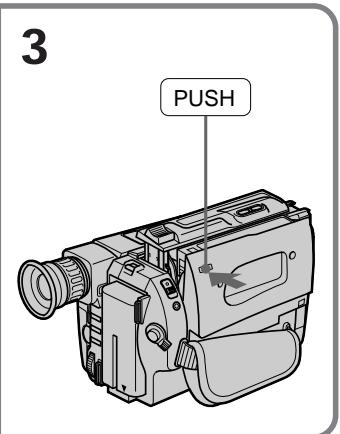
text_image
3 PUSHTo eject the cassette
While pressing the small blue button on the EJECT switch, slide it in the direction of the arrow.
To prevent accidental erasure
Slide the tab on the cassette to expose the red mark. If you insert the cassette with the red mark exposed and close the cassette compartment, the beeps sound for a while. If you try to record with the red mark exposed, the ☐ and ▲ indicators flash, and you cannot record.
To re-record on this tape, slide the tab back out covering the red mark.
natural_image
Diagram of a CD-ROM drive showing two wheels and a close-up of the internal component (no text or symbols)Make sure that the power source is installed and a cassette is inserted and that the START/STOP MODE switch inside the LCD panel is set to ☐. Before you record one-time events, you may want to make a trial recording to make sure that the camcorder is working correctly.
When you use the camcorder for the first time, power on it and reset the date and time to your time before you start recording (p. 78). The date is automatically recorded for 10 seconds after you start recording (AUTO DATE feature). This feature works only once a day. (CCD-TRV13E/TRV15E/TRV35E/TRV65E only)
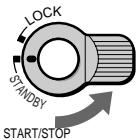
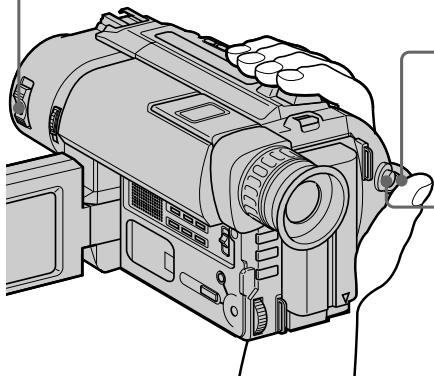
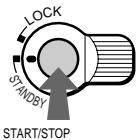
(1) While pressing the small green button on the POWER switch, set it to CAMERA.
(2) Turn STANDBY up to STANDBY.
(3) Press START/STOP. The camcorder starts recording. The “REC” indicator appears. The red lamp lights up in the viewfinder. The camera recording/battery lamp located on the front of the camcorder also lights up.
2
40min Hi8 SP STBY 0:00:00
natural_image
Line drawing of a handheld video camera with hand operating controls (no text or symbols)3
40min Hi8 REC 0:00:01
To stop recording momentarily [a]
Press START/STOP again. The “STBY” indicator appears in the viewfinder (Standby mode).
To finish recording [b]
Press START/STOP again. Turn STANDBY down to LOCK and set the POWER switch to OFF. Then, eject the cassette.
[a]
![SONY CCD-TRV15E - To finish recording [b] - 1](/content/2019/11/48478/images/d572c4f315c3dd430c9571894d92b44f2a087894a694e56cf6fefdc0ac2381c6.jpg)
text_image
LOCK STANDBY START/STOP![SONY CCD-TRV15E - To finish recording [b] - 2](/content/2019/11/48478/images/7198ac3a897eadeafda471136a9ffa4e610ed836e6ac5ad849cea26661f2606a.jpg)
text_image
STBY 0:35:20Note
There is a little wear on the battery pack which is installed with the camcorder. However, for getting remaining battery time indicated correctly, leave the battery pack installed after use.
To focus the viewfinder lens
If you cannot see the indicators in the viewfinder clearly, or after someone else has used the camcorder, focus the viewfinder lens. Turn the viewfinder lens adjustment ring so that the indicators in the viewfinder come into sharp focus.
natural_image
Technical line drawing of a camera module with no visible text or symbolsNote on Standby mode
If you leave the camcorder in Standby mode for 5 minutes while the cassette is inserted, the camcorder turns off automatically for saving battery power as well as for preventing the battery and tape from wearing down. To resume Standby mode, turn STANDBY down and up again. To start recording, press START/STOP.
When you record from the beginning of a tape, run the tape for about 15 seconds before starting the actual recording. This will ensure that you won't miss any start-up scenes when you play back the tape.
Notes on the tape counter
- The tape counter indicates the recording or playback time. Use it as a guide. There will be a time lag of several seconds from the actual time. To set the counter to zero, press COUNTER RESET.
- If the tape is recorded in SP and LP modes mixed, the tape counter shows incorrect recording time. When you intend to edit the tape using the tape counter as a guide, record in same (SP or LP) mode.
Note on the beep sound
The beep sounds when you operate the camcorder. Several beeps also sound as a warning of any unusual condition of the camcorder.
Note that the beep sound is not recorded on the tape. If you do not want to hear the beep sound, select “OFF” in the menu system.
Note on the AUTO DATE feature
- CCD-TRV13E/TRV15E/TRV35E/TRV65E only The clock is set at the factory to London time for United Kingdom and to Paris time for the other European countries. You can reset the clock in the menu system. You can change the AUTO DATE settings by selecting ON or OFF in the menu system. The AUTO DATE feature shows the date automatically once a day.
However, the date may automatically appear more than once a day when:
- you reset the date and time.
- you eject and insert the tape again.
- you stop recording within 10 seconds.
- you set AUTO DATE to OFF once and set it to ON again in the menu system.
Примечание к записи
Using the zoom feature
Zooming is a recording technique that lets you change the size of the subject in the scene.
For more professional-looking recordings, use the zoom function sparingly.
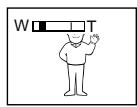
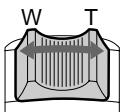
“T” side: for telephoto (subject appears closer)
“W” side: for wide-angle (subject appears farther away)
natural_image
Line drawing of a handheld video camera with hand adjusting handle (no text or symbols)Zooming speed (Variable speed zooming)
Move the power zoom lever a little for a slower zoom, move it further for a faster zoom.
When you shoot a subject using a telephoto zoom
If you cannot get a sharp focus while in extreme telephoto zoom, move the power zoom lever to the "W" side until the focus is sharp. You can shoot a subject that is at least about 80 cm (about 2 5/8 feet) away from the lens surface in the telephoto position, or about 1 cm (about 1/2 inch) away in the wide-angle position.
Notes on digital zoom
- More than 16x (CCD-TRV13E/TRV15E) or 18x (CCD-TRV35E/TRV65E/TRV69E) zoom is performed digitally, and the picture quality deteriorates as you go toward the "T" side. If you do not want to use the digital zoom, set the D ZOOM function to OFF in the menu system.
- The right side [a] of the power zoom indicator shows the digital zooming zone, and the left side [b] shows the optical zooming zone. If you set the D ZOOM function to OFF, the [a] zone disappears.
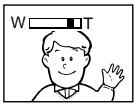
text_image
W I T [b] [a] W I TSelecting the START/STOP mode
Your camcorder has three modes. These modes enable you to take a series of quick shots resulting in a lively video.
(1) While pressing OPEN, open the LCD panel.
(2) Set START/STOP MODE to the desired mode.
☐ : Recording starts when you press START/STOP, and stops when you press it again (normal mode).
ANTI GROUND SHOOTING ↓ : The camcorder records only while you press down START/STOP so that you can avoid recording unnecessary scenes.
5SEC: When you press START/STOP, the camcorder records for 5 seconds and then stops automatically.
(3) Turn STANDBY up to STANDBY and press START/STOP. Recording starts.
If you selected 5SEC, the tape counter disappears and five dots appear. The dots disappear at a rate of one per second as illustrated below.
To extend the recording time in 5SEC mode
Press START/STOP again before all the dots disappear. Recording continues for about 5 seconds from the moment you press START/STOP.
Notes on START/STOP mode
- If you have turned off the indicators on the LCD screen, the dots do not appear.
- You cannot use FADER in 5SEC or ↓ mode.
Shooting with the LCD screen
You can also record the picture while looking at the LCD screen.
When using the LCD screen, the viewfinder turns off automatically. You cannot monitor the sound from the speaker during recording.
(1) While pressing OPEN, open the LCD panel.
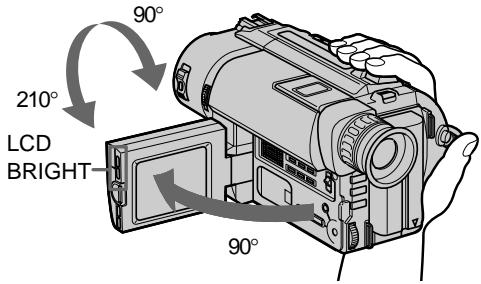
(2) Adjust the angle of the LCD panel.
The LCD panel moves about 90 degrees to this side and about 210 degrees to the other side.
To adjust the brightness of the LCD screen, press LCD BRIGHT.
- side: to brighten the LCD screen
- side: to dim the LCD screen
The battery life is longer when the LCD panel is closed. Use the viewfinder instead of the LCD screen to save the battery power.
natural_image
Illustration of a digital camera with labeled parts and directional arrows (no text or symbols)2
text_image
90° 210° LCD BRIGHT 90°Backlighting the LCD screen
If the LCD screen is insufficiently illuminated even after adjusting LCD BRIGHT, select LCD B. L. in the menu system and set to BRIGHT. You can select LCD B. L. only while using the battery pack as a power source.
Notes on the LCD panel
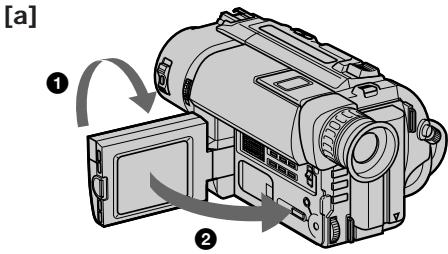
- When closing the LCD panel, turn it vertically until it clicks [a].
- When turning the LCD panel, turn it always vertically; otherwise, the camcorder body may be damaged or the LCD panel may not close properly [b].
- Close the LCD panel completely when not in use.
text_image
[a] ① ②Letting the subject monitor the shot (Mirror mode)
You can turn the LCD panel over so that it faces the other way and you can let the subject monitor the shot while shooting with the viewfinder.
Turn the LCD panel vertically first until it clicks, then turn it over. The ⚙️ indicator appears on the LCD screen (Mirror mode) and the date and remaining tape indicators disappear.
To cancel mirror mode
Turn the LCD panel back toward the viewfinder.
Notes on mirror mode
- The picture on the LCD looks as a mirror-image while recording in mirror mode. The STBY indicator appears as II and REC as . The other indicators may not appear in mirror mode.
- While recording in mirror mode, you cannot operate the following buttons: TITLE, DATE, TIME, MENU, and ZERO MEM (CCD-TRV69E only) on the Remote Commander.
- The date appears in reverse when the AUTO DATE feature is turned on (CCD-TRV13E/TRV15E/TRV35E/TRV65E only). When recorded, it will be normal.
natural_image
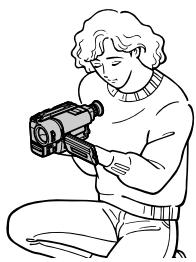
Illustration of a digital camera with an open lid and starburst symbols indicating action or notification (no text or labels present)For hand-held shots, you'll get better results by holding the camcorder according to the following suggestions:
- Hold the camcorder firmly and secure it with the grip strap so that you can easily manipulate the controls with your thumb.
text_image
Illustration showing a video camera being scanned into a person's photo frame, with numbered instructions for each component.natural_image
Illustration of a person using a vintage camera (no text or symbols present)[b]
natural_image
Line drawing of a person holding a vintage camera (no text or symbols)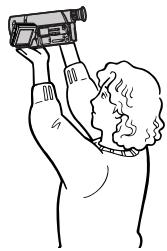
natural_image
Line drawing of a person using a handheld device (no text or symbols)Place the camcorder on a flat surface or use a tripod
Try placing the camcorder on a table top or any other flat surface of suitable height. If you have a tripod for a still camera, you can also use it with the camcorder.
When attaching a non-Sony tripod, make sure that the length of the tripod screw is less than 6.5 mm (9/32 inch). Otherwise, you cannot attach the tripod securely and the screw may damage the camcorder.
Cautions on the viewfinder and the LCD
- Do not pick up the camcorder by the viewfinder or by the LCD panel [c].
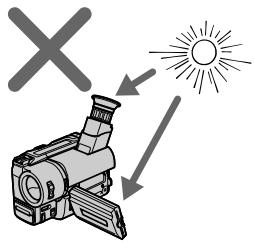
- Do not place the camcorder so as to point the viewfinder or the LCD screen toward the sun. The inside of the viewfinder may be damaged. Be careful when placing the camcorder under sunlight or by a window [d].
natural_image
Illustration of a handheld video camera with a hand adjusting its lens (no text or symbols present)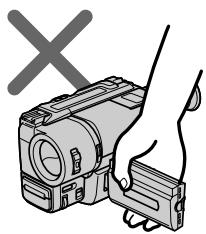
natural_image
Illustration of a hand holding a camera with a switch, no text or symbols present[d]
natural_image
Illustration of a vintage camera with a sun symbol and an X mark, no text or symbols presentUsing EDITSEARCH, you can review the last recorded scene or check the recorded picture in the viewfinder or on the LCD screen.
(1) While pressing the small green button on the POWER switch, set it to CAMERA.
(2) Turn STANDBY up to STANDBY.
(3) Press the – (☐) side of EDITSEARCH momentarily; the last few seconds of the recorded portion play back (Rec Review). You can monitor the sound from the speaker, headphones (CCD-TRV65E/TRV69E only) or an earphone (CCD-TRV13E/TRV15E/TRV35E only).
Hold down the - side of EDITSEARCH until the camcorder goes back to the scene you want. The last recorded portion is played back. To go forward, hold down the + side (Edit Search).
flowchart
graph TD
    A["Search + EDITSEARCH"] --> B["Game 1: Snowboard on a hill"]
    B --> C["Game 2: Snowboard on a beach"]
    C --> D["Game 3: Snowboard on a river"]
    D --> E["Game 4: Snowboard on a trail"]
    E --> F["Game 5: Switch with icons"]
    F --> G["Game 6: Switch with icons"]
    G --> H["Game 7: Switch with icons"]
    H --> I["Game 8: Switch with icons"]
    I --> J["Game 9: Switch with icons"]
    J --> K["Game 10: Switch with icons"]
    K --> L["Game 11: Switch with icons"]
    L --> M["Game 12: Switch with icons"]
To stop playback
Release EDITSEARCH.
To go back to the last recorded point after edit search
Press END SEARCH. The last recorded point is played back for about 5 seconds (10 seconds in LP mode) and stops. Note that this function does not work once you eject the cassette after you recorded on the tape.
To begin re-recording
Press START/STOP. Re-recording begins from the point you released EDITSEARCH. Provided you do not eject the cassette, the transition between the last scene you recorded and the next scene you record will be smooth.
You can monitor the playback picture on the LCD screen.
(1) While pressing the small green button on the POWER switch, set it to PLAYER. The video control buttons light up (CCD-TRV35E/TRV65E/TRV69E only).
(2) Insert the recorded tape with the window facing out.
(3) While pressing OPEN, open the LCD panel. Adjust the angle of the LCD panel or the brightness of the LCD screen if necessary.
(4) Press ◀◀ to rewind the tape.
(5) Press ▶ to start playback.
(6) Adjust the volume using VOLUME and adjust the brightness of the LCD screen using LCD BRIGHT.
You can also monitor the picture on a TV screen, after connecting the camcorder to a TV or VCR.
To fast-forward the tape rapidly, press ▶▶.
When monitoring on the LCD screen
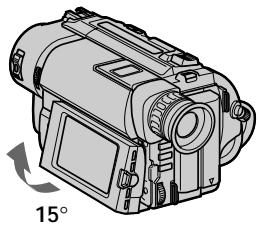
You can turn the LCD panel over and move back to the camcorder with the LCD screen facing out [a]. You can adjust the angle of the LCD screen by turning the LCD screen up to 15 degrees [b].
natural_image
Illustration of a digital video camera with scroll wheel and screen, showing rotational motion (no text or symbols)
natural_image
Line drawing of a handheld electronic device with camera and display (no text or symbols)[b]
natural_image
Illustration of a camera module with 15° rotation indicator (no text or symbols on device)Using the remote commander
- CCD-TRV15E/TRV35E/TRV65E/TRV69E only You can control playback using the supplied Remote Commander. Before using the Remote Commander, insert the R6 (size AA) batteries.
Note on DISPLAY button
Press DISPLAY to display the screen indicators on the LCD screen. To erase the indicators, press DISPLAY again. If the POWER switch is set to CAMERA, you can erase the indicator by pressing DISPLAY.
Using headphones or an earphone
Connect headphones (not supplied) to the ⏻ jack (CCD-TRV65E/TRV69E only) or an earphone (not supplied) to the Ⓞ jack (CCD-TRV13E/TRV15E/TRV35E only). You can adjust the volume using VOLUME. When you use headphones or an earphone, the speaker on the camcorder is silent.
To view the playback picture in the viewfinder Close the LCD panel. The viewfinder turns on automatically. When using the viewfinder, you can monitor sound only by using headphones or an earphone.
To view on the LCD screen again, open the LCD panel. The viewfinder turns off automatically.
Note on the lens cover
The lens cover does not open when the POWER switch is set to PLAYER. Do not open the lens cover manually. It may cause malfunction.
Various playback modes
You can enjoy clear pictures on the LCD screen during still, slow and picture search.
(Crystal-clear still/slow/picture search)
To view a still picture (playback pause)
Press || during playback. To resume playback, press || or ▶.
To locate a scene (picture search)
Keep pressing ◀◀ or ▶▶ during playback. To resume normal playback, release the button.
To monitor the high-speed picture while advancing the tape or rewinding (skip scan)
Keep pressing ◀◀ while rewinding or ▶▶ while advancing the tape. To resume normal playback, press ▶.
To view the picture at 1/5 speed (slow playback)
- CCD-TRV15E/TRV35E/TRV65E/TRV69E only
Press ▶ on the Remote Commander during playback. To resume normal playback, press ▶. If slow playback lasts for about 1 minute, it shifts to normal speed automatically.
To view the picture at double speed - CCD-TRV69E only
For double speed playback in the reverse direction, press ◀//<, then press x2 on the Remote Commander during playback. For double speed playback in the forward direction, press >/||►, then press x2 during playback. To resume normal playback, press ►.
To view the picture frame-by-frame
- CCD-TRV69E only
Press ◀/< or >/Ⅲ▶ on the Remote Commander in playback pause mode. If you keep pressing the button, you can view the picture at 1/25 speed. To resume normal playback, press ▶.
To change the playback direction
- CCD-TRV69E only
Press ◀/< on the Remote Commander for reverse direction or >/||> on the Remote Commander for forward direction during playback. To resume normal playback, press ▶.
To select the playback sound
- CCD-TRV65E/TRV69E only
Change the “HiFi SOUND” mode setting in the menu system.
Notes on playback
- Noise may appear when you use the crystal-clear still/slow/picture search function to play back the tape recorded in LP mode.
- Streaks appear and the sound is muted in the various playback modes.
- When playback pause mode lasts for 5 minutes, the camcorder automatically enters stop mode.
- Horizontal noise appears at the centre or top and bottom of the screen when you play back a tape in reverse. This is normal.
- You can play back the tapes recorded in the Hi8 video system on the standard 8 mm camcorder (CCD-TRV13E/TRV15E/TRV35E only).
Displaying the date or time when you recorded - Data Code function
- CCD-TRV69E only
Even if you did not record the date or time when you were recording, you can display the date or time when you recorded (Data Code) on the TV during playback or editing. The Data Code is also displayed in the viewfinder and on the LCD screen.
To display the date or time when you recorded
Press DATE or TIME on the camcorder. To make the date or time disappear, press it again. To display the date and time when you recorded, press TIME (or DATE) after pressing DATE (or TIME). To make the date and time disappear, press DATE and TIME again.
To display simultaneously the date and time when you recorded
Press DATA CODE on the Remote Commander. To make the date and time disappear, press it again.
- A blank portion of the tape is being played back.
- The tape was recorded by a camcorder without the Data Code function.
- The tape was recorded by a camcorder without having date and time set.
- The tape is unreadable due to tape damage or noise.
- The tape is being played back in variable speed (Slow Playback, etc.).
- An index signal is marked, the RC time code is written, or PCM after recording is made on the tape.
Searching for the end of the picture
You can go to the end of the recorded portion after you record and play back the tape to make the transition between the last scene you recorded and the next scene smooth. The tape starts rewinding or fast-forwarding and the last 5 seconds (10 seconds in LP mode) of the recorded portion play back. Then the tape stops at the end of the recorded picture (End Search).
Note that the End Search function does not work once you eject the cassette after you have recorded on the tape.
(1) While pressing OPEN, open the LCD panel.
(2) Press END SEARCH.
This function works when the POWER switch is set to either CAMERA or PLAYER.
If you start recording after using END SEARCH Occasionally, the transition between the last scene you recorded and the next scene may not be smooth.
Using alternative power sources
You can choose any of the following power sources for your camcorder: battery pack, the mains, alkaline batteries and 12/24 V car battery. Choose the appropriate power source depending on where you want to use your camcorder.
| Place | Power source | Accessory to be used |
| Indoors | Mains | Supplied AC power adaptor |
| Outdoors| | Battery pack | Battery pack NP-F330 (supplied), NP-F530, NP-F550, NP-F730, NP-F750, NP-F930, NP-F950 |
| LR6 (sizeAA) Alkaline battery | Battery case EBP-L7 | |
| In the car | 12 V or 24 V car battery | Sony car battery charger DC-V515A |
Notes on power sources
- Disconnecting the power source or removing the battery pack during recording or playback may damage the inserted tape.
- The DC IN jack has source priority. This means that the battery pack cannot supply any power if the mains lead is connected to the DC IN jack, even when the mains lead is not plugged into the mains.
Using the mains
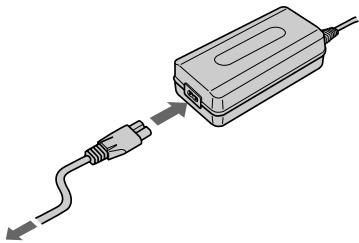
(1) Open the DC IN jack cover, and connect the AC power adaptor to the DC IN jack on the camcorder.
(2) Connect the mains lead to the AC power adaptor.
(3) Connect the mains lead to the mains.
natural_image
Illustration of a video camera with attached cable and connector, showing internal wiring and a close-up view of the device's cable being inserted (no text or symbols present)2, 3
natural_image
Diagram of a USB cable being inserted into a device (no text or symbols present)WARNING
The mains lead must only be changed at a qualified service shop.
PRECAUTION
The set is not disconnected from the AC power source (mains) as long as it is connected to the mains, even if the set itself has been turned off.
Note
Keep the AC power adaptor away from the camcorder if the picture is disturbed.
Using a car battery
Use Sony DC-V515A car battery charger (not supplied). Connect the car battery cord to the cigarette lighter socket of a car (12 V or 24 V). Refer to the operating instructions of your car battery charger.
To remove the car battery charger
The car battery charger is removed in the same way as the battery pack.

This mark indicates that this product is a genuine accessory for Sony video products.
When purchasing Sony video products, Sony recommends that you purchase accessories with this “GENUINE VIDEO ACCESSORIES” mark.
ПРЕДУПРЕЖДЕНИЕ
Changing the mode settings
You can change the mode settings in the menu system to further enjoy the features and functions of the camcorder.
(1) Press MENU to display the menu.
(2) Turn the control dial to select the desired icon in the left side of the menu, then press the dial.
(3) Turn the control dial to select the desired item, then press the dial.
(4) Turn the control dial to select the desired mode, and press the dial. If you want to change the other modes, repeat steps 3 and 4. If you want to change the other items, select ➔ RETURN and press the dial, then repeat steps from 2 to 4.
(5) Press MENU or select ↩ icon to erase the menu display.
Depending on the model of your camcorder, the menu display may be different from that in this illustration.
Notes on changing the mode setting
- Menu items differ depending on the setting of the POWER switch to PLAYER or CAMERA.
- When you let the subject monitor the shot (mirror mode), the menu display does not appear.
Selecting the mode setting of each item
Items for both CAMERA and PLAYER modes
LCD B. L.\*
• Normally select BRT NORMAL.
- Select BRIGHT when the LCD screen is dark.
When you select BRIGHT, battery life is about 10 percent shorter during recording.
When you use the power sources other than the battery pack, BRIGHT is automatically selected, and LCD B.L. is not displayed in the menu.
LCD COLOUR\*
Select this item to adjust the colour on the LCD screen.
REMAIN\*
- Select AUTO when you want to display the remaining tape bar
- for about 8 seconds after the camcorder is turned on and calculates the remainder of the tape.
- for about 8 seconds after a cassette is inserted and the camcorder calculates the remainder of the tape.
- for about 8 seconds after ▶ is pressed in PLAYER mode.
- for about 8 seconds after DISPLAY is pressed to display the screen indicators.
- for the period of tape rewinding, forwarding or picture search in PLAYER mode.
- Select ON to always display the remaining tape indicator.
• Normally select NORMAL.
- In PLAYER mode, select TIME CODE to display the RC time code in order to edit more precisely or to check the total time of the recorded part from the beginning of the tape. The RC time code indicates “hours, minutes, seconds, frames” in the form of “0:00:00:00”. However, “frames” is not indicated in CAMERA mode.
LTR SIZE\*
• Normally select NORMAL.
- Select 2x to display selected menu item by twice size of normal.
ETC BEEP\*
- Select ON so that beeps sound when you start/stop recording, etc.
- Select OFF when you do not want to hear the beep sound.
ETC COMMANDER (CCD-TRV15E/TRV35E/TRV65E/TRV69E only)
- Select ON when using the supplied Remote Commander for the camcorder.
- Select OFF when not using the Remote Commander.
ETC DISPLAY\*
- Normally select LCD. The display appears on the LCD screen.
- Select V-OUT/LCD to show the display both on the TV screen and LCD screen.
ETC INDICATOR\* (CCD-TRV65E/TRV69E only)
- Select BL ON to light up the display window.
- Select BL OFF to turn off the back light of display window.
When you use the AC power adaptor as a power source, this item is not displayed in the menu.
Items for CAMERA mode only
D ZOOM\*
- Select ON to activate digital zooming.
- Select OFF to not use the digital zoom. The camcorder goes back to 16x (CCD-TRV13E/TRV15E) or 18x (CCD-TRV35E/TRV65E/TRV69E) zoom.
16:9WIDE\*
- Normally select OFF.
- Select CINEMA to record in CINEMA mode.
- Select 16:9FULL to record in 16:9FULL mode.
C STEADYSHOT\* (CCD-TRV35E/TRV65E/TRV69E only)
- Normally select ON.
- Select OFF to release the Steady Shot function.
N.S.LIGHT\* (CCD-TRV35E/TRV65E/TRV69E only)
- Normally select ON.
- Select OFF to not use the NightShot Light function.
C WIND (CCD-TRV65E/TRV69E only)
- Select ON to reduce wind noise when recording in strong wind.
- Normally select OFF.
REC MODE\*
- Select SP when recording in SP (standard play) mode.
- Select LP when recording in LP (long play) mode.
When a tape recorded on this camcorder in LP mode is played back on other types of 8mm camcorders or VCRs, the playback quality may not be as good as that on this camcorder.
Select this item to automatically adjust the recording condition to get the best possible recording.
If you have already performed this function, "ORC ON" is displayed.
CLOCK SET\*
Reset the date or time.
AUTO DATE\* (CCD-TRV13E/TRV15E/TRV35E/TRV65E only)
- Select ON to record the date for 10 seconds after recording has started.
- Select OFF to not record the date.
DEMO MODE\*
- Select ON to make the demonstration appear.
- Select OFF to deactivate the demonstration mode.
Notes on DEMO MODE
- DEMO MODE is set to STBY (Standby) at the factory and the demonstration starts about 10 minutes after you set the POWER switch to CAMERA without inserting a cassette.
Note that you cannot select STBY of DEMO MODE in the menu system. - You cannot select DEMO MODE when a cassette is inserted in the camcorder.
- If you insert a cassette during the demonstration, the demonstration stops. You can start recording as usual. DEMO MODE automatically returns to STBY.
- When NIGHTSHOT is set to ON, "NIGHTSHOT" appears in the viewfinder or on the LCD screen and you cannot select DEMO MODE. (CCD-TRV35E/TRV65E/TRV69E only)
To look at the demonstration at once
Eject the cassette, if inserted. Select ON of DEMO MODE and erase the menu display.
The demonstration will begin.
When you turn off the camcorder once, DEMO MODE automatically returns to STBY.
ETC WORLD TIME\*
Select this item to set the clock by a time difference.
ETC REC LAMP\*
- Select OFF when you do not want the camera recording/battery lamp at the front of the unit to light up.
- Normally select ON.
ORC TO SET\*
• Normally select STEREO.
- Select 1 or 2 to play back a dual sound track tape.
EDIT
- Select ON to minimize picture deterioration when editing.
- Normally select OFF.
TBC*
- Normally select ON to correct for jitter.
- Select OFF to not correct for jitter. The picture may not be steady when played back.
Note on TBC setting
Set TBC to OFF when:
- Playing back a tape you have dubbed over.
- Playing back a tape on which you recorded the signal of a TV game or similar machine.
• The playback picture fluctuates.
P DNR*
- Normally select ON to reduce picture noise.
- Select OFF if the picture has a lot of movement, causing a conspicuous afterimage.
NTSC PB*
• Normally select ON PAL TV.
- Select NTSC 4.43 if your TV has the NTSC 4.43 mode when playing back a tape recorded in the NTSC colour system.
When you play back on a Multi System TV, select the best mode while watching the picture on the TV.
The following settings work only during playback
EDIT, HiFi SOUND, TBC, and DNR.
* These settings are retained even when the battery is removed, as long as the lithium battery is in place.
EDIT, HiFi SOUND, TBC и DNR.
When you shoot a subject with the light source behind the subject or a subject with a light background, use the BACK LIGHT function.
Press BACK LIGHT. The 📋 indicator appears in the viewfinder or on the LCD screen.
natural_image
Technical line drawing of a mechanical device with no visible text or symbols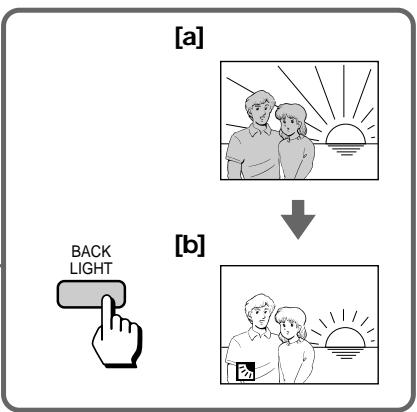
flowchart
graph TD
    A["Back Light"] --> B["Day 1: Sun"]
    B --> C["Family Photo: Two people on day"]
    C --> D["Day 2: Sun"]
    D --> E["Family Photo: Two people on day"]
[a]Subject is too dark because of backlight. [b]Subject becomes bright with backlight compensation.
After shooting
Be sure to release this adjustment condition by pressing BACK LIGHT again. The 📋 indicator disappears. Otherwise, the picture will be too bright under normal lighting condition.
This function is also effective under the following conditions:
- A subject with a light source nearby or a mirror reflecting light
- A white subject against a white background. Especially when you shoot a person wearing shiny clothes made of silk or synthetic fiber, his or her face tends to become dark if you do not use this function.
To make a fine adjustment
You can adjust the exposure manually. However, when you adjust the exposure manually, BACK LIGHT does not operate.
Selecting the fader function
You can fade in or out to give your recording a professional appearance.
When the picture fades in, the sound gradually increases. When the picture fades out, the sound gradually decreases.
– Только CCD-TRV35E/TRV65E/TRV69E
When fading in, the picture gradually changes from black and white to colour.
When fading out, the picture gradually changes from colour to black and white.
* CCD-TRV65E/TRV69E only
** When D ZOOM in the menu system is set to ON, you cannot use this function.
MONOTONE
(1) While the camcorder is in Standby mode, press FADER until the desired fade indicator flashes.
(2) Press START/STOP to start recording. The fade indicator stops flashing.
When fading out [b]
(1) During recording, press FADER until the desired fade indicator flashes.
(2) Press START/STOP to stop recording. The fade indicator stops flashing, and then recording stops.
The fading mode selected last is indicated first of all.
Set D ZOOM to OFF in the menu system.
When you use the following functions or D ZOOM is set to ON in the menu system, "BOUNCE" indicator does not appear.
- Wide mode
- Functions using the PICTURE EFFECT button
- Functions using the PROGRAM AE button
To cancel the fader function
Before pressing START/STOP, press FADER until the indicator disappears.
When the date, time or title is displayed
The date, time and title do not fade in or fade out.
When the START/STOP MODE switch is set to 5SEC or ↓
You cannot use the fader function.
Note on the fader function
While using the bounce function, you cannot use the following functions.
- Exposure
- Focus
- Zoom
Shooting in the dark (NightShot)
The NightShot function enables you to shoot a subject in a dark place. You can achieve a satisfactory recording of the ecology of nocturnal animals for observation with this function. This function may record picture nearly in monochrome.
– Только CCD-TRV35E/TRV65E/TRV69E
natural_image
Two black-and-white images showing a owl from different angles, one with an arrow pointing to the right image (no text or symbols present)(1) While the camcorder is in Standby mode, slide NIGHTSHOT to ON.
(2) Press START/STOP to start recording.
⊕ and “NIGHTSHOT” indicators flash.
text_image
Diagram showing a video camera with an ON/OFF button and a vertical arrow indicating actionTo cancel the NightShot function
Slide NIGHTSHOT to OFF.
Using the NightShot Light
When you set N.S.LIGHT to ON in the menu system, the picture will be more clear. NightShot Light rays are infrared and are therefore invisible. The maximum limit of NightShot Light is about 3 meters (about 10 feet).
Notes on the NightShot
- When you keep setting NIGHTSHOT to ON in normal recording, picture may be recorded in incorrect/unnatural colour.
- If focusing is difficult with the autofocus mode when using the NightShot function, focus manually.
Selecting the desired mode
You can record a cinemalike picture (CINEMA) or a 16:9 wide picture to watch on the 16:9 wide-screen TV (16:9 FULL).
Black bands appear at the top and the bottom of the screen, and the viewfinder or LCD screen [a] and a normal TV screen [b] look wide. You can also watch the picture without black bands on a wide-screen TV [c].
16:9 FULL
The picture in the viewfinder or LCD screen [d] or on a normal TV [e] is horizontally compressed. You can watch the picture of normal images on a wide-screen TV [f].
CINEMA
You can select the wide mode (OFF, CINEMA, 16:9FULL) in the menu system (p. 34).
To cancel wide mode
Select OFF in the menu system.
To watch the tape recorded in wide mode
To watch the tape recorded in CINEMA mode, set the screen mode of the wide-screen TV to zoom mode. To watch the tape recorded in 16:9 FULL mode, set it to full mode. For details, refer to the operating instructions of your TV. Note that the picture recorded in 16:9 FULL mode looks compressed on a normal TV.
Notes on wide mode
- If wide mode is set to 16:9FULL, the Steady Shot function does not work and the "💡" indicator flashes (CCD-TRV35E/TRV65E/TRV69E only).
- In wide mode, you cannot select the bounce function with FADER (CCD-TRV35E/TRV65E/TRV69E only).
- When you record in 16:9 FULL mode, the date or time indicator will be widened on the wide-screen TV.
- If you dub a tape, the tape is copied in the same mode as the original recording.
- When recording, you cannot change the mode.
Selecting the best mode
You can select one of six PROGRAM AE (Auto Exposure) modes to suit your shooting situation, referring to the following.
natural_image
Black-and-white photo of a person standing with a human icon in the corner (no text or symbols on the person or background)
natural_image
Portrait of a smiling person with a small icon in the corner (no text or symbols)
natural_image
Black-and-white photo of a golfer mid-jump with a stick figure nearby (no text or symbols visible)
natural_image
Black and white photo of a palm tree in the foreground with blurred background (no text or symbols)
natural_image
Black-and-white photo of palm trees with a crescent moon symbol in the corner (no text or symbols on the main scene)
natural_image
Black-and-white photo of a bridge over a river with trees and hills in the background (no visible text or symbols)Spotlight mode
For subjects in spotlight, such as at the theatre or a formal event.
Soft Portrait mode
For zooming in on a still subject in telephoto mode, or for a subject behind an obstacle such as a screen. Creates a soft background for subjects such as people or flowers, and faithfully reproduces skin colour.
Sports Lesson mode
For recording fast-moving subjects such as in tennis or golf games.
Beach & Ski mode
For people or faces in strong light or reflected light, such as at a beach in midsummer or on a ski slope.
Sunset & Moon mode
For recording subjects in dark environments such as sunsets, fireworks, neon signs, or general night views.
Landscape mode
For distant subjects such as mountains or when recording a subject behind an obstacle such as a window or screen.
(1) Press PROGRAM AE.
(2) Turn the control dial to select the desired PROGRAM AE mode.
flowchart
graph TD
    A["1 PROGRAM"] --> B["2"]
    B --> C["Step 1: Person with icons, Step 2: Walk down stairs, Step 3: Walk up stairs, Step 4: Walk down mountain"]
To turn off program AE
Press PROGRAM AE.
Notes on focus setting
- In the Spotlight, Sports lesson and Beach & Ski modes, you cannot take close-ups because the camcorder is set to focus only on subjects in the middle to far distance.
- In the Sunset & Moon and Landscape modes, the camcorder is set to focus only on distant subjects.
- Flickering or changes in colour may occur in the following modes if recording is carried out under a discharge tube such as fluorescent lamp, sodium lamp or mercury lamp. If this happens, turn off program AE.
- Soft Portrait mode
- Sports Lesson mode
When to use manual focus
In the following cases you should obtain better results by adjusting the focus manually.
– Только CCD-TRV35E/TRV65E/TRV69E
natural_image
Illustration of an adult and a child standing together under a crescent moon in the sky (no text or symbols)[b]
natural_image
Simple line drawing of a room with a door and framed picture on the wall (no text or symbols)[c]
natural_image
Illustration of a person sitting at a desk near a window (no text or symbols)[d]
When focusing manually, first focus in telephoto before recording, and then reset the shot length.
(1) Set FOCUS to MANUAL. The F-indicator appears in the viewfinder or on the LCD screen.
(2) Move the power zoom lever to the end of the "T" side in the optical zoom zone.
(3) Turn the NEAR/FAR dial to achieve a sharp focus.
(4) Set the desired shot length using the power zoom lever.
Ручная фокусировка
text_image
1 AUTO MANUAL INFINITY 2 W T W T F3 3 FAR NEAR 4 W T W T F3To return to autofocus mode
Set FOCUS to AUTO. The F indicator in the viewfinder or on the LCD screen disappears.
Shooting in relatively dark places
Shoot at wide-angle after focusing in the telephoto position.
To record a very distant subject
Push FOCUS down to INFINITY. The lens focuses on the most distant subject while FOCUS is held down. When it is released, manual focus mode is resumed.
Use this function when shooting through a window or a screen, to focus on a most distant subject.
Note on manual focusing
The following indicators may appear:
▲ when recording a very distant subj
when the subject is too close to focus on.
Selecting picture effect
You can make pictures like those of television with the Picture Effect function.
The contrast of the picture is emphasized, and the picture looks like an animated cartoon.
NEG. ART [b]
The colour and brightness of the picture is reversed.
SEPIA
The picture is sepia.
B&W
The picture is monochrome (black and white).
SOLARIZE [c]
The light intensity is more clear, and the picture looks like an illustration.
MOSAIC [d]
The picture is mosaic.
SLIM [e]
The picture expands vertically.
STRETCH [f]
The picture expands horizontally.
PASTEL [a]
Using picture effect function
(1) Press PICTURE EFFECT.
(2) Turn the control dial to select the desired picture effect mode.
To turn off picture effect
Press PICTURE EFFECT. The indicator in the viewfinder or on the LCD screen goes out.
Note on the picture effect
When you turn the power off, the camcorder returns automatically to normal mode.
When to adjust the exposure
Adjust the exposure manually under the following cases.
[a]
natural_image
Portrait of a smiling person (no text or symbols visible)[a]
- The background is too bright (back lighting)
- Insufficient light: most of the picture is dark
[b]
• Bright subject and dark background
• To record the darkness faithfully
Adjusting the exposure
(1) Press EXPOSURE.
(2) Turn the control dial to adjust the brightness.
– Только CCD-TRV35E/TRV65E/TRV69E
natural_image
Black and white photo of a city skyline with illuminated buildings and a bridge (no visible text or symbols)[a]
natural_image
Technical line drawing of a mechanical device with no visible text or symbolsTo return to automatic exposure mode
Press EXPOSURE again.
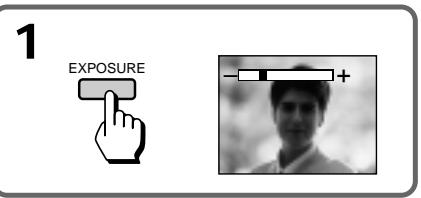
text_image
1 EXPOSURE2

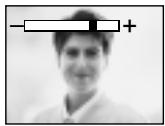
natural_image
Black-and-white photo of a person smiling, with a horizontal bar and plus sign above (no text or symbols on the person or background)Shooting with the sun behind you
If the light source is behind your subject, or in the following situations, the subject will be recorded too dark.
- The subject is indoors and there is a window behind the subject.
- Bright light sources are included in the scene.
- When shooting a person wearing white or shiny clothes in front of a white background, the face will be recorded too dark.
Shooting in the dark
We recommend you to use a video light (not supplied). To get the best colour, you must maintain a sufficient light level.
When you adjust the exposure manually
- BACK LIGHT does not work.
- If you change the PROGRAM AE mode, the camcorder automatically returns to automatic exposure mode.
Superimposing a title
Наложение надписи
You can select one of eight preset titles and two custom titles. You can also select the language, colour, size and position of titles.
Superimposing titles
(1) Press TITLE to display the title menu.
(2) Turn the control dial to select ☐, then press the dial.
(3) Turn the control dial to select the desired title, then press the dial. The titles are displayed in the language you selected.
(4) Turn the control dial to select the colour, size, or position, then press the dial.
(5) Turn the control dial to select the desired item, then press the dial.
(6) Repeat step 4 and 5 until the title is arranged as desired.
(7) Press control dial again to complete the setting.
(8) When you want to stop recording the title, press TITLE.
To superimpose the title from beginning
After step 7, press START/STOP to start recording.
To superimpose the title while you are recording
After pressing START/STOP to start recording, start from step 1. In this case, beep is not heard.
To select the language of preset title
When you want to select the language, select ☑ before step 2. Then select language and return to step 2.
To use the custom title
When you want to use the custom title, select ☐ in step 2.
Notes on superimposing a title
- If you have not given any custom title, “----” appears on the display.
- The FADER function works while the title is displayed, however, the title does not fade (CCD-TRV35E/TRV65E/TRV69E only).
- If you display the menu or title menu while superimposing a title, the title is not recorded while the menu or title menu is being displayed.
Title colour changes as follows :
$$ \text { WHITE } \leftrightarrow \text { YELLOW } \leftrightarrow \text { VIOLET } \leftrightarrow \text { RED } \leftrightarrow $$
$$ \mathrm{CYAN} \leftrightarrow \mathrm{GREEN} \leftrightarrow \mathrm{BLUE} $$
Title size changes as follows :
$$ \text { SMALL } \leftrightarrow \text { LARGE } $$
Title position changes as follows :
When you select the title size “SMALL”, you can choose 9 positions. When you select the title size “LARGE” you can choose 8 positions.
Notes on the title
- Depending on size or position of the title, both of date and time or either of them is not displayed.
- If you input 13 characters or more for a LARGE title, the title is automatically reduced into a proper size after the position is set.
- When the title is displayed, LCD BRIGHT and VOLUME indicators do not appear.
Making your own titles
You can make up to two titles and store them in the camcorder. We recommend to set the POWER switch to PLAYER or eject the cassette before you begin.
Your title can have up to 20 characters.
(1) Press TITLE to display the title menu.
(2) Turn the control dial to select , then press the dial.
(3) Turn the control dial to select the first line (CUSTOM1) or second line (CUSTOM2), then press the dial.
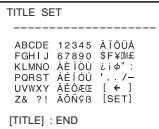
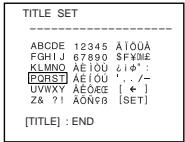
(4) Turn the control dial to select the column of the desired character, then press the dial.
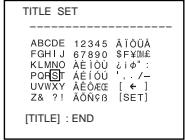
(5) Turn the control dial to select the desired character, then press the dial.
(6) Repeat step 4 and 5 until you finish the title.
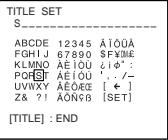
(7) For finishing the titling work, turn the control dial to select SET, then press the dial.
text_image
TITLE SET [TITLE] : END3

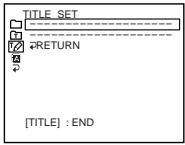
text_image
TITLE_SET RETURN [TITLE] : END
text_image
TITLE SET ---- ABCD E 12345 ÄÏÖÜÄ FGHI J 67890 $F¥NDE KLMNO ÄËIÖÜ ¿iφ" : PQRST ÄÉIÖÜ ', . /- UVWXY ÄÉÖRÉE [ ← ] Z& ?! ÄÖNÇB [SET] [TITLE] : END4 1
26

text_image
TITLE SET ---- ABCDE 12345 ÄIÖÜÄ FGHIJ 67890 SF¥M€ KLMNO AÉIÖÜ Lφ°: [PORST] AÉIÖÜ ', ./- UVWXY AÉÖE€ [ ← ] Z& ?! AÖNÇB [SET] [TITLE]: END2

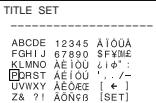
3

text_image
TITLE SET ---- ABCD E 12345 AÏOUÄ FGHI J 67890 $F¥M£ KLMNO AÉIOU £iφ': PQRS T AÉIÓU ', . /- UVWXY AÉÖE£ [ ← ] Z& ?! AÖNGß [SET] [TITLE] : END4

text_image
TITLE SET S---- ABCD 12345 ĀIÕÚA FGHI J 67890 $F¥M£E KLMNO AÉIOU ¿iφ" : PORST AÉIÓU ', . /- UVWXY AÉÓÆG [ ← ] Z& ?! AÓNGß [SET] [TITLE] : ENDTo edit a title you have stored
In step 3, select CUSTOM1 or CUSTOM2, depending on which title you want to edit, then change the title.
Note
You can not enter over 20 characters title.
If you take 5 minutes or longer to enter characters while a cassette is in the camcorder. The power goes off automatically. Characters you have entered remain. Turn STANDBY down once and then up again, then proceed from step 1.
To delete a title
In step 4, turn the control dial to select [←] then press the dial. The last character is erased. Repeat this step until all characters are deleted.
Re-recording a picture in the middle of a recorded tape
You can insert a scene in the middle of a recorded tape by setting the starting and ending points. The previous recorded portion will be erased. When the RC time code appears, set COUNTER to NORMAL in the menu system to display the tape counter.
- Только CCD-TRV69E
(1) While the camcorder is in Standby mode, keep pressing the + (forward playback) or - (reverse playback) side of EDITSEARCH, and release the button where you want to end the insertion [b]. The camcorder enters Standby mode again.
(2) Press COUNTER RESET. The counter resets to zero.
(3) Keep pressing the - side of EDITSEARCH and release the button at the point where you want to start the insertion [a].
(4) Press ZERO MEM on the Remote Commander. The ZERO MEM indicator flashes.
(5) Press START/STOP to start recording. The recording stops automatically at the counter zero point.
To change the end point
Press ZERO MEM to erase the ZERO MEM indicator, then repeat steps 2 to 5.
Re-recording a picture in the middle of a recorded tape
Notes on re-recording
- The picture and the sound may be distorted at the end of the inserted portion when it is played back.
- If you re-record on the portion which contains non-recorded section, the zero memory function may not work correctly.
- When the START/STOP MODE switch is set to 5SEC or , you cannot use the zero memory function.
Recording with the date/time
Before you start recording or during recording, press DATE or TIME. You can record the date or time displayed in the viewfinder or on the LCD screen with the picture. Press DATE (or TIME), then press TIME (or DATE) to display the date and time together.
The clock is set at the factory to London time for United Kingdom and to Paris time for the other European countries. You can reset the clock in the menu system.
To stop recording with the date and/or time
Press DATE and/or TIME again. The date and/or time indicator disappears. The recording continues.
Optimizing the recording condition
Use this feature to check the tape condition before recording, so that you can get the best possible picture (ORC).
(1) While the camcorder is in Standby mode, press MENU to display the menu.
(2) Turn the control dial to select ☐, then press the dial.
(3) Turn the control dial to select ORC TO SET, then press the dial.
"START/STOP KEY" flashes.
(4) Press START/STOP.
The camcorder takes about 5 seconds to check the tape condition and then returns to Standby mode.
flowchart
graph TD
    A["1 MENU"] --> B["2 TAPE SET REC MODE ORC TO SET REMAIN COUNTER"]
    B --> C["3 TAPE SET REC MODE ORC TO SET REMAIN COUNTER RETURN"]
    C --> D["4 START/STOP KEY LOCK START/STOP ORC"]
    D --> E["STBY 0:00:00"]
Each time you insert the cassette
Perform the above procedures.
Notes on the ORC function
- When you set ORC TO SET, the recording on the tape is erased for about 0.1 second so that the camcorder can check the tape condition. Be careful when you use a recorded tape. The 0.1 second blank is erased if you record from the point where you set ORC TO SET for more than 2 seconds, or if you record over the blank.
- You cannot use this function on a tape with the red mark on the cassette exposed.
When the Steady Shot function is working, the camcorder compensates for camera-shake.
You can release the Steady Shot function when you do not need to use the Steady Shot function. The “” indicator appear in the viewfinder or on the LCD screen. Do not use the Steady Shot function when shooting a stationary object with a tripod.
You can select ON or OFF in the menu system (p. 34).
To activate the Steady Shot function again
Set STEADYSHOT to ON in the menu system.
Notes on the Steady Shot function
- The Steady Shot function will not correct excessive camera-shake.
- When you set STEADYSHOT to ON or OFF in the menu system, the exposure may fluctuate.
- Steady Shot does not operate in 16:9 FULL mode. If you set STEADYSHOT to ON in the menu system, the "💡" indicator flashes.
– Только CCD-TRV35E/TRV65E/TRV69E
Watching on a TV screen
Connect the camcorder to your TV or VCR to watch the playback picture on the TV screen. When monitoring the playback picture by connecting the camcorder to your TV, we recommend you to use the mains for the power source.
While playing back on a TV screen, close the LCD panel. Otherwise, picture distortion may occur.
Connecting directly to a TV/VCR with Video/Audio input jacks
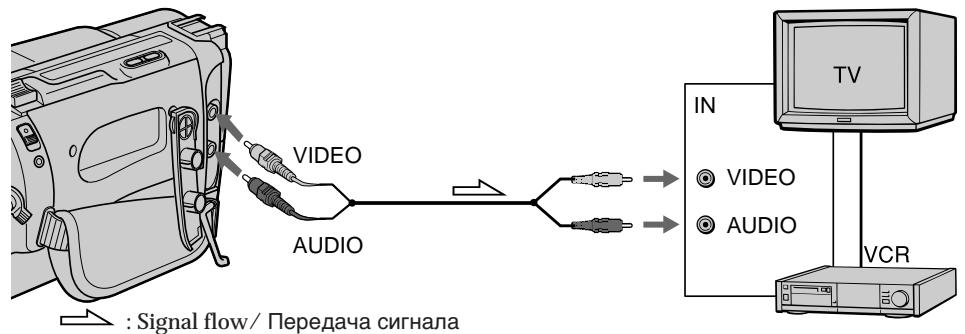
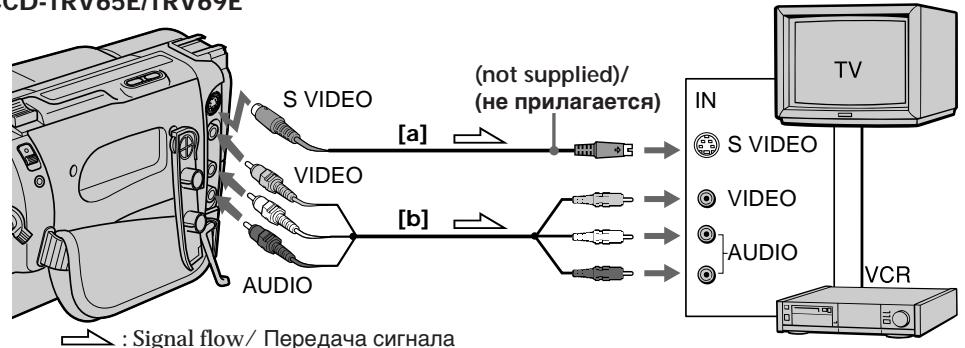
When connecting the A/V connecting cable, make sure you connect the plug to jacks of the same colour.
Open the jack cover. With using the supplied A/V connecting cable, connect the camcorder to the LINE IN inputs on the TV or VCR connected to the TV. Set the TV/VCR selector on the TV to VCR. When connecting to the VCR, set the input selector on the VCR to LINE.
CCD-TRV13E/TRV15E/TRV35E
text_image
VIDEO AUDIO : Signal flow/ Передача сигнала IN VIDEO AUDIO TV VCRCCD-TRV65E/TRV69E
flowchart
graph LR
    A["CD-TRV63E/TRV69E Camera"] -->|S_VIDEO["a"]| B["Video"]
    A -->|AUDIO["b"]| C["Audio"]
    B --> D["(not supplied)/ (не прилагается)"]
    C --> E["IN: S VIDEO, VIDEO, AUDIO"]
    E --> F["TV"]
    F --> G["VCR"]
    style A fill:#f9f,stroke:#333
    style B fill:#ccf,stroke:#333
    style C fill:#cfc,stroke:#333
    style D fill:#fcc,stroke:#333
    style E fill:#cff,stroke:#333
    style F fill:#ffc,stroke:#333
    style G fill:#fcc,stroke:#333
If your TV or VCR has an S video jack, connect using the S video cable (not supplied) [a] to obtain a high quality picture. If you are going to connect the camcorder using the S video cable (not supplied) [a], you do not need to connect the yellow (video) plug of the A/V connecting cable [b].
If your TV or VCR is a monaural type – CCD-TRV65E/TRV69E only
Connect only the white plug for audio on both the camcorder and the TV or the VCR. With this connection, the sound is monaural even in stereo model.
If your TV/VCR has a 21-pin connector (EUROCONNECTOR)
Use the supplied 21-pin adaptor.
To connect to a TV or VCR without Video/Audio input jacks
Use an RFU adaptor (not supplied).
Monitoring the picture from a TV or VCR - CCD-TRV65E/TRV69E only
You can monitor the picture on the LCD screen or in the viewfinder. Connect the camcorder to the outputs on the TV or VCR.
Searching the boundaries of recorded date
You can search for the boundary between recording dates using the Data Code automatically recorded on the tape.
There are two modes:
- Searching for the beginning of a specific date, and playing back from there (Date Search)
- Searching for the beginning of all days, one after another, playing back about 10 seconds of each (Date Scan)
- Только CCD-TRV69E
Each time you press DATE, the mode changes as follows:

flowchart
graph TD
    A["Date Search"] --> B["Date Scan"]
    B --> C["nothing"]
To search for the beginning of a specific date
(1) Set the POWER switch to PLAYER. The video control buttons light up.
(2) Press DATE on the Remote Commander.
(3) When the current position is [b], press ◀◀ to search towards [a] or press ▶▶ to search towards [c].
To scan the beginning of all days
(1) Set the POWER switch to PLAYER.
(2) Press DATE on the Remote Commander twice.
(3) Press ◀◀ or ▶▶. Date Scan starts.
[Non-Text]
To stop searching or scanning
Press one of the following buttons: DATE, ▶,
■, ◀◀ or ▶▶.
To view pictures during searching or scanning Press ▶ and then press ◀◀ or ▶▶.
If you do Date Search or Date Scan during playback
While the camcorder is looking for the date, a fast forward or rewind picture is displayed. Some noise is inevitable.
If you have erased or rewritten the index signal
The point at which the date changes may be out of position by about 10 seconds of playback.
Notes on Date Search and Date Scan mode
- If a day's recording is not longer than 2 minutes, the camcorder may not accurately find its boundaries.
- Date Search and Date Scan do not function on a tape recorded by a camcorder without the Data Code function.
Using the Remote Commander, you can easily go back to the desired point on a tape after playback. Use the tape counter. If the RC time code appears, set COUNTER to NORMAL in the menu system to display the tape counter.
(1) During playback, press COUNTER RESET at the point you later want to locate. The counter shows "0:00:00".
(2) Press ■ when you want to stop playback.
(3) Press ZERO MEM on the Remote Commander. The ZERO MEM indicator flashes.
(4) Press ◀◀ to rewind or press ▶▶ to fast-forward the tape to the counter's zero point. The tape stops automatically when the counter reaches approximately zero.
- Только CCD-TRV69E
Notes on the tape counter
- Something must be recorded on the tape in order for the tape counter to function. Tape counter does not work on a blank tape.
- There may be a discrepancy of several seconds from the actual time.
Returning to a pre-registered position
- When you press ZERO MEM, the counter's zero point is memorized. Press ZERO MEM again before rewinding to cancel the memory.
- This function is cancelled automatically once the tape is rewound or advanced to the point you pre-registered.
- ZERO MEM does not function during recording or playing back.
Locating the marking position
You can locate the beginning of a desired programme easily by marking an index signal during recording or playback and searching for it later.
Marking an index signal
You can mark an index signal during recording or playback.
When marking at the beginning of recording or playback
Press INDEX MARK on the Remote Commander in recording standby or playback pause mode. The INDEX MARK indicator appears in the viewfinder or the LCD screen with the MARK indicator flashing. When recording or playback starts, the MARK indicator stops flashing. This shows that the index signal is being marked. Then the INDEX MARK indicator will disappear.
- Только CCD-TRV69E
When marking during recording or playback
Press INDEX MARK on the Remote Commander at the point you want to locate later.
text_image
Diagram showing a remote control with sound waves interacting with a video camera and a labeled 'INDEX MARK' button.Notes on marking
- Make sure you mark index signals at more than two-minute intervals. Otherwise, you may not be able to search for them correctly.
- If you stop recording while the index signal is being marked (the INDEX MARK indicator lights in the viewfinder), the search may not be completed correctly.
- If you mark an index signal on the tape with the Data Code recorded, the Data Code will be erased at the point on which the index signal is marked. When playing back this tape, the camcorder keeps displaying the Data Code immediately before the erased one.
- A black band appears when you mark index signal during playback, and the sound cannot be heard. This does not affect the picture and sound that are already recorded.
- You cannot mark an index signal on a tape with the red mark on the cassette exposed.
- You cannot mark an index signal on an NTSC-recorded tape.
- You cannot mark the index signal during 5-second recording, recording only while pressing the START/STOP button, or during fade-out.
Scanning the beginning of each marking position - index scan
(1) Press INDEX on the Remote Commander during normal playback.
(2) Press ◀◀ or ▶▶. The tape rewinds or advances rapidly and plays back for approximately 10 seconds from the point on which the index signal was marked. If you want to continue playback, press ▶▶. When you do not press any button, the tape is automatically scanned to the next programme.
Press ▶. Normal playback resumes.
Locating the desired marking position - index search
(1) Press INDEX on the Remote Commander during stop or playback mode.
(2) Press INDEX repeatedly until the index number of the desired programme is displayed in the viewfinder or on the LCD screen.
(3) Press ◀◀ or ▶▶. Playback starts from the beginning of the desired programme.
[a] the current position
[b] the INDEX number
Press ▶. Normal playback resumes.
Note on the index number
The index number (1, 2, etc.) indicates the distance from the point you are now viewing [a], regardless of the direction.
Erasing an index signal
(1) Locate the index signal to be erased using the index scan or index search function.
(2) Press ERASE on the Remote Commander within 2 to 10 seconds while the desired programme plays back. After the index signal is erased, the camcorder returns to index scan when you used index scan in step 1. When you used index search, normal playback resumes.
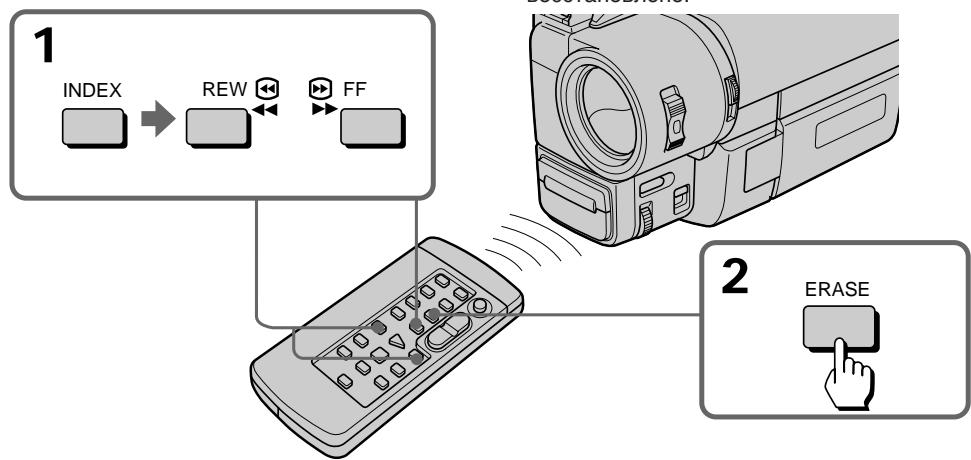
flowchart
graph TD
    A["INDEX"] --> B["REW"]
    B --> C["FF"]
    D["ERASE"] --> E["Signal Transmission"]
Notes on erasing
- Press ERASE more than 2 seconds after the playback of the desired programme begins.
- You cannot erase the index signal on a tape with the red mark on the cassette exposed.
- While the index signal is being erased, the sound cannot be heard and a black band appears at the bottom of the picture. This will not affect the recorded sound or picture.
- The camcorder can detect index signals marked with VCRs, but may not erase them. VCRs with an index function can detect index signals marked with this camcorder but may not erase them.
- An index signal may be erased when making PCM after recording on another VCR in the portion where the index signal is marked.
Note on Data Code
When an index signal is erased, the Data Code on the same portion of the tape is also erased.
natural_image
Line drawing of a digital camera module with lens and buttons (no text or symbols)
Writing the RC Time code on a recorded tape
You can write the RC time code on a recorded tape. Use the Remote Commander.
Before you begin, we recommend to set COUNTER to TIME CODE in the menu system so that you can view the RC time code.
(1) While pressing the small green button on the POWER switch, set it to PLAYER.
(2) Rewind the tape to the beginning and set the camcorder to playback pause mode.
(3) Press TIME CODE WRITE on the Remote Commander. The TIME CODE WRITE indicator appears in the viewfinder or on the LCD screen with the WRITE indicator flashing.
(4) Press ▶ or ▶ to start playback. The WRITE indicator stops flashing and the RC time code writing starts from 0:00:00:00.
- Только CCD-TRV69E
To stop writing the RC time code
Press ■ (or any video control button).
To write the RC time code from the end of the RC time code recorded portion
Rewind the tape to the portion on which the RC time code has been written and set the camcorder to playback pause mode. Then follow steps 3 and 4 above. The RC time code is written continuously.
Notes on writing the RC time code
- The RC time code writing stops when:
- you press TIME CODE WRITE again before starting playback.
- you press INDEX or DATE SEARCH before starting playback.
- you change from playback mode to another mode.
- When you are writing the RC time code from the middle of a tape without the time code written, writing starts several frames before the current picture.
- If you write the RC time code on a recorded tape, the Data Code is erased.
- You can mark the RC time code on a tape recorded both in LP mode and SP mode, the RC time code written in LP mode, however, may not be read correctly.
- You cannot mark the RC time code on an NTSC-recorded tape.
- You cannot mark the RC time code on a tape with the red mark on the cassette exposed.
- A black band appears when you mark the RC time code during playback, and the sound cannot be heard. This does not affect the picture and sound that are already recorded.
The --:--:--:-- indicator appears during playback if:
- nothing is recorded.
- the RC time code is unreadable because of the damage of the tape or because of the noise.
- you recorded using another VCR without RC time code function.
The --:--:--:-- indicator may also appear on the LCD screen during variable speed playback.
Editing onto another tape
You can create your own video programme by editing with any other 8 mm, Hi8 Hi8, VHS VHS, SVHS S-VHS, WISC VHSC, SVISC S-VHSC or 8 Betamax VCR that has video/audio inputs.
Before editing
Connect the camcorder to the VCR using the supplied A/V connecting cable.
Set the input selector on the VCR to LINE, if available.
Set EDIT to ON in the menu system (p. 34).
Starting editing
Turn down the volume of the camcorder while editing. Otherwise, picture distortion may occur.
(1) Insert a blank tape (or a tape you want to record over) into the VCR, and insert your recorded tape into the camcorder.
(2)Play back the recorded tape on the camcorder until you locate the point just before where you want to start editing, then press Ⅲ to set the camcorder in playback pause mode.
(3) On the VCR, locate the recording start point and set the VCR in recording pause mode.
(4)First press ■ on the camcorder, and after a few seconds press ■ on the VCR to start editing.
To edit more scenes
Repeat steps 2 to 4.
To superimpose the title while you are editing
You can superimpose the title while you are editing. Refer to “Superimposing a title” (p. 55).
To stop editing
Press ■ on both the camcorder and the VCR.
Note on Fine Synchro Edit
If you connect a video deck that has the Fine Synchro Edit feature to the LANC ♪ jack of the camcorder, using a LANC cable (not supplied), the edit will be even more precise.
Changing the lithium battery in the camcorder
Your camcorder is supplied with a lithium battery installed. When the battery becomes weak or dead, the indicator flashes in the viewfinder for about 5 seconds when you set the POWER switch to CAMERA. In this case, replace the battery with a Sony CR2025 lithium battery. Use of any other battery may present a risk of fire or explosion. Discard used batteries according to the manufacturer's instructions.
The lithium battery for the camcorder lasts for about 1 year under normal operation. (The lithium battery that comes installed at the factory may not last 1 year.)
natural_image
Technical line drawing of a camera with no visible text or symbolsNotes on lithium battery
- Keep the lithium battery out of the reach of children.
Should the battery be swallowed, immediately consult a doctor. - Wipe the battery with a dry cloth to assure a good contact.
- Do not hold the battery with metallic tweezers, otherwise a short-circuit may occur.
- Note that the lithium battery has a positive (+) and a negative (−) terminals as illustrated. Be sure to install the lithium battery so that terminals on the battery match the terminals on the camcorder.
chemical
Chemical reaction diagram showing conversion of SONY to CR2O25 with charge state (+) and charge state (-)WARNING
The battery may explode if mistreated. Do not recharge, disassemble, or dispose of in fire.
Changing the lithium battery
When replacing the lithium battery, keep the battery pack or other power source attached.
Otherwise, you will need to reset the date, time and other items in the menu system retained by the lithium battery.
(1) Open the LCD panel and open the lid of the lithium battery compartment.
(2) Push the lithium battery down once and pull it out from the holder.
(3) Install the lithium battery with the positive (+) side facing out. Close the lid.
ПРЕДУПРЕЖДЕНИЕ
natural_image
Illustration of a digital camera with a door and screen, showing no text or symbols1
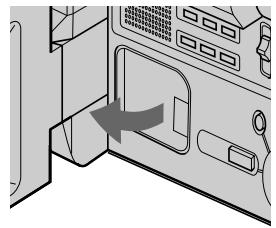
natural_image
Diagram of a microwave oven with a door and ventilation slots, showing airflow direction (no text or symbols)2
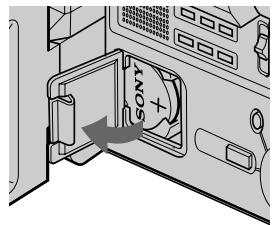
text_image
SONY +3
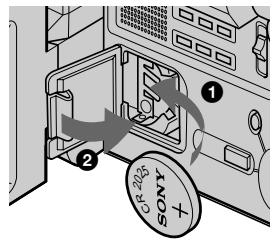
text_image
① ② OR-425 SONYResetting the date and time
You can reset the date and time in the menu system.
(1) While the camcorder is in Standby mode, press MENU to display the menu.
(2) Turn the control dial to select ☐, then press the dial.
(3) Turn the control dial to select CLOCK SET, then press the dial.
(4) Turn the control dial to adjust the desired year, then press the dial.
(5) Set the month, day, hour and minute by turning the control dial and pressing the dial.
(6) Press MENU to erase the menu display.
To correct the date and time setting
Repeat the above procedure.
To check the preset date and time
Press DATE to display the date indicator.
Press TIME to display the time indicator.
When you press the same button again, the indicator goes off.
The year changes as follows:

flowchart
graph LR
    A["1997"] <--> B["1998"]
    B <--> C["..."]
    C --> D["2029"]
    D --> E["↑"]
    E --> F["↑"]
Note on the time indicator
The internal clock of this camcorder operates on a 24-hour cycle.
Simple setting of clock by time difference
You can easily set the clock for a local time by a time difference in the menu system.
(1) While the camcorder is the standby mode, press MENU to display the menu.
(2) Turn the control dial to select ETC, then press the dial.
(3) Turn the control dial to select WORLD TIME, then press the dial.
(4) Turn the control dial to set a time difference, and press the dial. The hour of clock changes in relation to a time difference which you set.
(5) Press MENU to erase the menu display.
If the time is not set, WORLD TIME does not work.
Selecting cassette types
- CCD-TRV65E/TRV69E only
This Hi8 system is an extension of the standard 8 mm system, and was developed to realize higher picture quality.
You can use either Hi8 or standard 8 mm video cassette for this camera. When you use a Hi8 video cassette, the recording is made in the Hi8 system. When you use a standard 8 mm video cassette, the recording is made in the standard 8 mm system. Standard 8 mm video cassette is incapable of recording in the Hi8 system.
If you intend to use a standard 8 mm video recorder/player to play back a video tape, you are required to use a standard 8 mm video cassette for recording.
What is video 8 XR/video Hi8 XR ?
“XR” is an abbreviation of “Extended Resolution”. The video Hi8 XR or video 8 XR camcorder is new type of 8mm camcorder with a picture quality superior to the conventional video Hi8 or video 8 camcorder respectively. You can record and play back pictures more clearly with the “XR” camcorder.
A video tape recorded by the “XR” camcorder gives excellent picture quality at maximum when it is played back on the “XR” camcorder.
When a video tape recorded by this “XR” camcorder is played back on a conventional 8/Hi8 camcorder or when a video tape recorded on a conventional 8/Hi8 camcorder is played back on this “XR” camcorder, the playback picture has the normal quality of a 8/Hi8 camcorder.
Выбор типа кассеты
The playback mode (SP/LP) and system (Hi8/standard 8 mm) are selected automatically according to the format in which the tape has been recorded. The quality of the recorded picture in LP mode, however, will not be as good as that in SP mode.
Note on AFM HiFi stereo
- CCD-TRV65E/TRV69E only
When you play back a tape, the sound will be in monaural if:
- You record the tape using this camcorder, then play it back on an AFM HiFi monaural video recorder/player.
- You record the tape on an AFM HiFi monaural video recorder, then play it back on this camcorder.
Foreign 8 mm video
Because the TV colour systems differ from country to country, you may not be able to play back foreign pre-recorded tapes. Refer to the list of “Using your camcorder abroad” to check the TV colour system of foreign countries.
Playing back an NTSC-recorded tape
You can play back tapes recorded in the NTSC video system using the SP mode. If the tape is recorded in the AFM HiFi system, the AFM HiFi sound is reproduced (CCD-TRV65E/TRV69E only). However, note that the following will occur during playback of an NTSC-recorded tape.
- When playing back a tape on a TV screen, you may not get the original colour depending on the TV. When you play back on a Multi System TV, set NTSC PB to the desired mode in the menu system.
- During playback, a black band appears on the lower part of the viewfinder.
- You cannot play back a tape recorded in NTSC video system with LP mode neither on the LCD nor on a TV screen.
- If a tape has portions recorded in PAL and NTSC video systems, the tape counter reading is not correct. This discrepancy is due to the difference between the counting cycle of the two video systems.
- You cannot edit the NTSC-recorded tape onto another VCR.
Tips for using the battery pack
This section shows you how you can get the most out of your battery pack.
Preparing the battery pack
Always carry additional batteries
Have sufficient battery pack power to do 2 to 3 times as much recording as you have planned.
Battery life is shorter in a cold environment
Battery efficiency is decreased, and the battery will be used up more quickly, if you are recording in a cold environment.
To save battery power
Turn STANDBY down when not recording to save battery power.
A smooth transition between scenes can be made even if recording is stopped and started again. While you are positioning the subject, selecting an angle, or looking through the viewfinder lens or on the LCD screen, the lens moves automatically and the battery is used. The battery is also used when a tape is inserted or removed.
When to replace the battery pack
While you are using your camcorder, the remaining battery indicator decreases gradually as battery power is used up. Remaining time in minutes appears.
flowchart
graph LR
    A["Black Battery"] --> B["White Battery"]
    B --> C["Black Triangle"]
    C --> D["White Triangle"]
    D --> E["Battery"]
When the remaining battery indicator reaches the lowest point, the ⏻ indicator may appear and start flashing in the viewfinder or on the LCD screen.
When the ◇ indicator changes from slow flashing to rapid flashing while you are recording, set the POWER switch to OFF on the camcorder and replace the battery pack. Leave the tape in the camcorder to obtain a smooth transition between scenes after the battery pack has been replaced.
Notes on the rechargeable battery pack
Caution
Never leave the battery pack in temperatures above 60^ C ( 140^ F), such as in a car parked in the sun or under direct sunlight.
The battery pack heats up
During charging or recording, the battery pack heats up. This is caused by energy that has been generated and a chemical change that has occurred inside the battery pack. This is not cause for concern and is normal.
Be sure to observe the following
- Keep the battery pack away from fire.
- Keep the battery pack dry.
- Do not open nor try to disassemble the battery pack.
- Do not expose the battery pack to any mechanical shock.
The life of the battery pack
If the battery indicator flashes rapidly just after turning on the camcorder with a fully charged battery pack, the battery pack should be replaced with a new fully charged one.
Charging temperature
You should charge batteries at temperatures from 10^ C to 30^ C (from 50^ F to 86^ F). Lower temperatures require a longer charging time.
Notes on the "InfoLITHIUM" battery pack
What is "InfoLITHIUM"
The “InfoLITHIUM” is a lithium ion battery pack which can exchange data with compatible video equipment about its battery consumption.
When you use this battery pack with video equipment having the 📄InfoLITHIUM mark, the video equipment will indicate the remaining battery time in minutes*. However, if you use it with video equipment not having this mark, the remaining battery capacity will not be indicated in minutes.
“InfoLITHIUM” is a trademark of Sony Corporation.
* The indication may not be accurate depending on the condition and environment which the equipment is used under.
How the battery consumption is displayed The power consumption of the camcorder changes depending on its use, such as how the autofocusing is working.
While checking the condition of the camcorder, the “InfoLITHIUM” battery pack measures the battery consumption and calculates the remaining battery power. If the condition changed drastically, the remaining battery indication may suddenly decrease or increase by more than 2 minutes.
Even if 5 to 10 minutes is indicated as the battery remaining time on the LCD screen or in the viewfinder, the ◇ indicator may also flash under some condition.
To obtain more accurate remaining battery indication
Set the camcorder to recording standby mode and point towards a stationary object. Do not move the camcorder for 30 seconds or more.
- If the indication seems incorrect, recharge the battery pack fully (Full charge ^1) ). Note that if you have used the battery in a hot or cold environment for long time, or you have repeated charging many times, the battery pack may not be able to show the correct time even after being fully charged.
- After you have used the “InfoLITHIUM” battery pack with an equipment not having the InfoLITHIUM mark, make sure that you use up the battery pack on the equipment having the InfoLITHIUM mark and then recharge fully.
Why the remaining battery indication does not match the continuous recording time in the operating instructions
The recording time is affected by the environmental temperature and conditions. The recording time becomes very short in a cold environment. The continuous recording time in the operating instructions is measured under the condition of using a fully charged (or normal charged) battery pack in 25^ C ( 77^ F). As the environmental temperature and condition are different when you actually use the camcorder, the remaining battery time is not same as the continuous recording time in the operating instructions.
^1) Full charge: Charging until FULL appears in the display window.
Moisture condensation
If the camcorder is brought directly from a cold place to a warm place, moisture may condense inside the camcorder, on the surface of the tape, or on the lens. In this condition, the tape may stick to the head drum and be damaged or the unit may not operate correctly. To prevent possible damage under these circumstances, the camcorder is furnished with moisture sensors. Please, take the following precautions.
Inside the camcorder
If there is moisture inside the camcorder, the beep sounds and the indicator flashes. If this happens, none of the functions except cassette ejection will work. Open the cassette compartment, turn off the camcorder, and leave it about 1 hour. When indicator flashes at the same time, the cassette is inserted in the camcorder. Eject the cassette, turn off the camcorder, and leave also the cassette about 1 hour. The camcorder can be used again if the indicator does not appear when the power is turned on again.
On the lens
If moisture condenses on the lens, no indicator appears, but the picture becomes dim. Turn off the power and do not use the camcorder for about 1 hour.
How to prevent moisture condensation
When bringing the camcorder from a cold place to a warm place, put the camcorder in a plastic bag and allow it to adapt to room conditions over a period of time.
(1) Be sure to tightly seal the plastic bag containing the camcorder.
(2) Remove the bag when the air temperature inside it has reached the temperature surrounding it (after about 1 hour).
Конденсация влаги
To ensure normal recording and clear pictures, clean the video heads. When the ✗ indicator and “CLEANING CASSETTE” message appear one after another or playback pictures are “noisy” or hardly visible, the video heads may be dirty.
[a] Slightly dirty
[b] Very dirty
If this happens, clean the video heads with the Sony V8-25CLH/V8-25CLD cleaning cassette (not supplied). After checking the picture, if it is still “noisy,” repeat the cleaning. (Do not repeat cleaning more than 5 times in one session.)
Caution
Do not use a commercially available wet-type cleaning cassette. It may damage the video heads.
Note
If the Sony V8-25CLH/V8-25CLD cleaning cassette is not available in your area, consult your nearest Sony dealer.
Removing dust from inside the viewfinder
(1) Remove the screw with a screwdriver (not supplied). Then, while sliding the RELEASE knob, turn the eyecup in the direction of the arrow and pull it out.
(2) Clean the surface with a commercially available blower.
natural_image
Diagram of a microscope with directional arrows indicating light path (no text or symbols)2

natural_image
Diagram of a mechanical device with a magnifying glass inspecting a circular component (no text or symbols)To reattach the eyecup
(1) Align the groove on the eyecup with the • mark on the barrel.
(2) Turn the eyecup in the direction of the arrow. Then replace the screw.
natural_image
Illustration of a camera lens assembly with a downward arrow indicating compression (no text or symbols)2
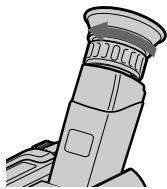
natural_image
Illustration of a mechanical device with a cylindrical component and base mount (no text or symbols)Caution
Do not remove any other screws. You may remove only the screw to remove the eyecup.
Предостережение
- Operate the camcorder on 7.2 V (battery pack) or 8.4 V (AC power adaptor).
- For DC or AC operation, use the accessories recommended in this manual.
- Should any solid object or liquid get inside the casing, unplug the camcorder and have it checked by a Sony dealer before operating it any further.
- Avoid rough handling or mechanical shock. Be particularly careful of the lens.
- Keep the POWER switch setting to OFF when not using the camcorder.
- Do not wrap up the camcorder and operate it since heat may build up internally.
- Keep the camcorder away from strong magnetic fields or mechanical vibration.
- Do not push the LCD screen.
- If the camcorder is used in a cold place, a residual image may appear on the LCD screen. This is not a malfunction.
- While using the camcorder, the back of the LCD screen may heat up. This is not a malfunction.
On handling tapes
Do not insert anything in the small holes on the rear of the cassette. These holes are used to sense the type of tape, thickness of tape and if the recording tab is in or out.
Предосторожности
- When the camcorder is not to be used for a long time, remove the tape. Periodically turn on the power, operate the camera and player sections and play back a tape for about 3 minutes.
- If fingerprints or debris make the LCD screen dirty, we recommend using a LCD Cleaning Kit (not supplied) to clean the LCD screen.
- Clean the lens with a soft brush to remove dust. If there are fingerprints on it, remove them with a soft cloth.
- Clean the camcorder body with a dry soft cloth, or a soft cloth lightly moistened with a mild detergent solution. Do not use any type of solvent which may damage the finish.
- Do not let sand get into the camcorder. When you use the camcorder on a sandy beach or in a dusty place, protect it from the sand or dust. Sand or dust may cause the unit to malfunction, and sometimes this malfunction cannot be repaired.
AC power adaptor
- Unplug the unit from the mains when not in use for a long time. To disconnect the mains lead, pull it out by the plug. Never pull the mains lead itself.
- Do not operate the unit with a damaged cord or if the unit has been dropped or damaged.
- Do not bend the mains lead forcibly, or put a heavy object on it. This will damage the cord and may cause a fire or electrical shock.
- Be sure that nothing metallic comes into contact with the metal parts of the connecting plate. If this happens, a short may occur and the unit may be damaged.
• Always keep the metal contacts clean. - Do not disassemble the unit.
Maintenance information and precautions
- Do not apply mechanical shock or drop the unit.
- While the unit is in use, particularly during charging, keep it away from AM receivers and video equipment because it will disturb AM reception and video operation.
- The unit becomes warm while in use. This is normal.
- Do not place the unit in locations that are:
-Extremely hot or cold - Dusty or dirty
- Very humid
- Vibrating
Notes on dry batteries
To avoid possible damage from battery leakage or corrosion, observe the following.
- Be sure to insert the batteries in the correct direction.
- Dry batteries are not rechargeable.
- Do not use a combination of new and old batteries.
- Do not use different types of batteries.
- The batteries slowly discharge while not in use.
- Do not use a battery that is leaking.
If battery leakage occurred
- Wipe off the liquid in the battery case carefully before replacing the batteries.
- If you touch the liquid, wash it off with water.
- If the liquid get into your eyes, wash your eyes with a lot of water and then consult a doctor.
If any difficulty should arise, unplug the unit and contact your nearest Sony dealer.
Using your camcorder abroad
Each country or area has its own electric and TV colour systems. Before using your camcorder abroad, check the following points.
Power sources
You can use your camcorder in any country or area with the supplied AC power adaptor within 100 V to 240 V AC, 50/60 Hz.
Difference in colour systems
This camcorder is a PAL system based camcorder. If you want to view the playback picture on a TV, it must be a PAL system based TV.
Check the following list.
PAL system
Australia, Austria, Belgium, China, Czech Republic, Denmark, Finland, Germany, Great Britain, Holland, Hong Kong, Italy, Kuwait, Malaysia, New Zealand, Norway, Portugal, Singapore, Slovak Republic, Spain, Sweden, Switzerland, Thailand, etc.
PAL-M system
Brazil
PAL-N system
Argentina, Paraguay, Uruguay
NTSC system
Bahama Islands, Bolivia, Canada, Central America, Chile, Colombia, Ecuador, Jamaica, Japan, Korea, Mexico, Peru, Surinam, Taiwan, the Philippines, the U.S.A., Venezuela, etc.
SECAM system
Bulgaria, France, Guyana, Hungary, Iran, Iraq, Monaco, Poland, Russia, Ukraine, etc.
If you run into any problem using the camcorder, use the following table to troubleshoot the problem. Should the difficulty persist, disconnect the power source and contact your Sony dealer or local authorized Sony service facility.
Camcorder
Power
| Symptom | Cause and/or Corrective Actions |
| The power is not on. | · The battery pack is not installed.→ Install the battery pack. (p. 8)· The battery is dead.→ Use a charged battery pack. (p. 9)· The AC power adaptor is not connected to the mains.→ Connect the AC power adaptor to the mains. (p. 32) |
| The power goes off. | · While being operated in CAMERA mode, the camcorder has been in Standby mode for more than 5 minutes.→ Turn STANDBY down once and then up again. (p. 15)· The battery is dead.→ Use a charged battery pack. (p. 9) |
| The battery pack is quickly discharged. | · The camcorder does not operate when using a battery pack that is not an “InfoLITHIUM” battery pack.→ Use an “InfoLITHIUM” battery pack. (p. 84)· The ambient temperature is too low. (p. 82)· The battery pack has not been charged fully.→ Charge the battery pack again. (p. 9)· The battery pack is completely dead, and cannot be recharged.→ Use another battery pack. (p. 83) |
| While charging the battery pack, no indicator appears or the indicator flashes in the display window. | · The AC power adaptor is disconnected.→ Connect it firmly.· Something is wrong with the battery pack.→ Contact your Sony dealer or local authorized Sony service facility. |
| The camcorder turns on/off when using the accessory which is attached to the intelligent accessory shoe.(CCD-TRV65E/TRV69E only) | · The camcorder is working with the AC power adaptor.→ Use the battery pack. |
Operation
| Symptom | Cause and/or Corrective Actions |
| START/STOP does not operate. | The tape is stuck to the drum. Eject the tape. (p. 14)The tape has run out. Rewind the tape or use a new one. (p. 26)The POWER switch is set to PLAYER. Set it to CAMERA. (p. 15)The tab on the cassette is out (red). Use a new tape or slide the tab. (p. 14) |
(to be continued)
| Symptom | Cause and/or Corrective Actions |
| Recording stops in a few seconds. | The START/STOP MODE switch is set to 5SEC or ↓.→ Set it to ↓. (p. 19) |
| The cassette cannot be removed from the holder. | The battery is dead.→ Use a charged battery pack or the AC power adaptor. (p. 9, 32) |
| ☐ and ▲ indicators flash and no function except for cassette ejection works. | Moisture condensation has occurred.→ Remove the cassette and leave the camcorder for at least 1 hour. (p. 86) |
| The date or time indicator is flashing. | You pressed DATE and TIME together for more than 2 seconds.→ The camcorder is not malfunctioning. You may start recording. Flashing will stop soon.The lithium battery is weak or dead.→ Replace the lithium battery with a new one. (p. 76) |
| The tape does not move when a video control button is pressed. | The POWER switch is set to CAMERA or OFF.→ Set it to PLAYER.The tape has run out.→ Rewind the tape or use a new one. (p. 26) |
| The Steady Shot function does not activate. (CCD-TRV35E/TRV65E/TRV69E only) | STEADYSHOT is set to OFF.→ Set it to ON. (p. 62)The Steady Shot function does not work when the wide mode is set to 16:9 FULL. |
| The autofocusing function does not work. (CCD-TRV35E/TRV65E/TRV69E only) | FOCUS is set to MANUAL.→ Set it to AUTO. (p. 50)Shooting conditions are not suitable for autofocus.→ Set FOCUS to MANUAL to focus manually. (p. 50) |
| The fader function does not work. (CCD-TRV35E/TRV65E/TRV69E only) | The START/STOP MODE switch is set to 5SEC or ↓.→ Set it to ↓. (p. 19) |
| No sound or only a low sound is heard when playing back a tape. (CCD-TRV65E/TRV69E only) | The stereo tape is played back with HiFi SOUND set to 1 or 2 in the menu system.→ Set to STEREO in the menu system. (p. 39) |
| Excessive high-pitched sound is heard. (CCD-TRV65E/TRV69E only) | The picture has been recorded with WIND set to ON in the menu system.→ When there is no wind, set it to OFF. (p. 37) |
| Data code becomes “--:-:-:-”. (CCD-TRV69E only) | You are playing back a portion of tape on which you wrote or erased the index signal. This is not a malfunction. (p. 30) |
| The date or time indicator disappears. | Reset the date and time. (p. 78) |
Picture
| Symptom | Cause and/or Corrective Actions |
| The image on the viewfinder screen is not clear. | The viewfinder lens is not adjusted. Adjust the viewfinder lens. (p. 16) |
| A vertical band appears when a subject such as lights or a candle flame is shot against a dark background. | The contrast between the subject and background is too high.The camcorder is not malfunctioning.→ Change locations. |
| A vertical band appears when shooting a very bright subject. | The camcorder is not malfunctioning. |
| The playback picture is not clear. | EDIT is set to ON in the menu system.→ Set it to OFF. (p. 39) |
| The picture is “noisy”. | The video heads may be dirty.→ Clean the heads using the Sony V8-25CLH/V8-25CLD cleaning cassette (not supplied). (p. 87) |
| The picture does not appear in the viewfinder. | The LCD panel is open.→ Close the LCD panel. (p. 20) |
| An unknown picture is displayed in the viewfinder or on the LCD screen. | If 10 minutes elapse after you set the POWER switch to CAMERA without inserting a cassette, the camcorder automatically starts the demonstration or DEMO is set ON in the menu system.→ Insert the cassette and the demonstration stops.You can deactivate the demonstration. (p. 38) |
| The picture does not appear on the LCD screen. | Incorporated fluorescent tube is worn out.→ Please contact your nearest Sony dealer. |
| The five digit code appears. | The self-diagnosis function is activated.→ Check the code and solve the problem. (p. 99) |
| Picture is recorded in incorrect/unnatural colour. (CCD-TRV35E/TRV65E/TRV69E only) | NIGHTSHOT is set to ON.→ Set it to OFF. (p. 44) |
Others
| Symptom | Cause and/or Corrective Actions |
| The supplied Remote Commander does not work. (CCD-TRV15E/TRV35E/TRV65E/TRV69E only) | COMMANDER is set to OFF in the menu system.→ Set it to ON. (p. 36)Something is blocking the infrared rays.→ Remove the obstacle.The batteries are not inserted with the correct polarity.→ Insert the batteries with the correct polarity. (p. 111)The batteries are dead.→ Insert new ones. (p. 111) |
| The picture from a TV or VCR does not appear even when the camcorder is connected to outputs on the TV or VCR. (CCD-TRV65E/TRV69E only) | DISPLAY is set to V-OUT/LCD in the menu system.→ Set it to LCD. (p. 36) |
| The beep sounds for 5 seconds. | Moisture condensation has occurred.Remove the cassette and leave the camcorder for at least 1 hour. (p. 86)Some troubles occur in your camcorder.Remove the cassette and insert it again, then operate the camcorder. |
The camcorder has a self-diagnosis display.
This function displays the camcorder's condition with five digits (a combination of a letter and figures) in the viewfinder, on the LCD screen or in the display window.
If this occurs, check the following code chart. The five-digit display informs you of the camcorder's current condition. The last two digits (indicated by ) will differ depending on the state of the camcorder.
LCD screen
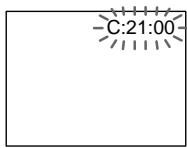
text_image
-C:21:00Self-diagnosis display
• C:□□:□□
You can service the camcorder yourself.
• E:□□:□□
Contact your Sony dealer or local authorized Sony facility.
| Five-digit display | Cause and/or Corrective Actions |
| C:21:□□ | Moisture condensation has occurred.Remove the cassette and leave the camcorder for at least 1 hour. (p. 86) |
| C:22:□□ | The video heads are dirty.Clean the heads using the Sony V8-25CLH/V8-25CLD cleaning cassette (not supplied). (p. 87) |
| C:23:□□ | You are using a battery pack that is not an “InfoLITHIUM” battery pack.Use an “InfoLITHIUM” battery pack. (p. 84) |
| C:31:□□C:32:□□ | A servicable situation not malfunctioned above has occurred.Remove the cassette and insert it again, then operate the camcorder.Disconnect the mains lead of the AC power adaptor or remove the battery pack. After reconnecting the power source, operate the camcorder. |
| E:61:□□E:62:□□ | A camcorder malfunction which you cannot service has occurred.Contact your Sony dealer or local authorized Sony service facility and inform them of the five digits. (example: E:61:10) |
If you are unable to resolve the problem, contact your Sony dealer or local authorized Sony service facility.
Video camera recorder
System
Video recording system
2 rotary heads
Helical scanning FM system
Audio recording system
Rotary heads, FM system
Video signal
PAL colour, CCIR standards
Usable cassette
8mm video format cassette
CCD-TRV13E/TRV15E/TRV35E:
Standard 8
CCD-TRV65E/TRV69E:
Hi8 or standard 8
Recording / Playback time (using
90 min. cassette)
SP mode: 1 hour and 30 minutes
LP mode: 3 hours
Fastforward/rewind time (using
90 min. cassette)
Approx. 5 min.
Image device
CCD (Charge Coupled Device)
Viewfinder
Electronic viewfinder
Monochrome
Lens
Combined power zoom lens
Filter diameter 37 mm (1 7/16 in.)
CCD-TRV13E: 16 x (Optical), 32 x ^1)
(Digital)
CCD-TRV15E: 16 x (Optical), 64 x ^2) (Digital)
CCD-TRV35E/TRV65E: 18 x
(Optical), 72x^3) (Digital)
CCD-TRV69E: 18 x (Optical), 72 x (Digital)
^1) 160 x in some areas
^2) 200 x in some areas
^3) 220 x in some areas
Focal distance
CCD-TRV13E/TRV15E:
4.1 - 65.6 mm (3/16 - 2 5/8 in.)
CCD-TRV35E/TRV65E/TRV69E:
4.1 - 73.8 mm (3/16 - 8 in.)
When converted to a 35 mm still camera
CCD-TRV13E/TRV15E:
39.4 - 630 mm (1 9/16 - 24 7/8 in.)
CCD-TRV35E/TRV65E/TRV69E:
47.2 - 850 mm (1 7/8 - 33 1/2 in.)
Colour temperature
Auto
Minimum illumination *
CCD-TRV13E/TRV15E:
0.4 lux (F 1.4) (Visible minimum low light 0.2 lux)
CCD-TRV35E/TRV65E/TRV69E:
0.7 lux (F 1.4)
0 lux (in NightShot mode)**
** Object invisible for the dark can be shot with infrared lighting.
Illumination range
CCD-TRV13E/TRV15E:
0.4 lux to 100,000 lux
CCD-TRV35E/TRV65E/TRV69E:
0.7 lux to 100,000 lux
Recommended illumination
More than 100 lux
* Minimum illumination expresses the light level a camcorder requires to produce a picture.
Visible minimum low light expresses the light level to produce a visible signal.
LCD screen
Picture
2.5 inches measured diagonally
50.3 x 37.4 mm (2 x 1 1/2 in.)
On-screen display
TN LCD/TFT active matrix method
Total dot number
CCD-TRV13E/TRV15E/TRV35E:
61,380 (279 x 220)
CCD-TRV65E/TRV69E:
84,260 (383 x 220)
Input and output connectors
S video output (CCD-TRV65E/
TRV69E only)
4-pin mini DIN
Luminance signal: 1 Vp-p, 75 ohms, unbalanced
Chrominance signal: 0.3 Vp-p, 75 ohms, unbalanced
Video output
Phono jack, 1 Vp-p, 75 ohms, unbalanced
Audio output
CCD-TRV13E/TRV15E/TRV35E:
Monaural, Phone jack, 327 mV
CCD-TRV65E/TRV69E: Phono jacks (2: stereo L and R)
327 mV, (at output impedance
47 kilohms) impedance less than 2.2
kilohms
RFU DC OUT
Special minijack, DC 5V
Headphone jack (CCD-TRV65E/TRV69E only)
Stereo minijack (ø 3.5 mm)
Earphone jack (CCD-TRV13E/
TRV15E/TRV35E only)
Monaural minijack (ø 3.5 mm)
LANC control jack
Stereo mini-minijack (ø 2.5 mm)
MIC jack
Minijack, 0.388 mV low impedance
with 2.5 to 3.0 V DC, output
impedance 6.8 kilohms (ø 3.5 mm)
CCD-TRV13E/TRV15E/TRV35E:
Monaural type
CCD-TRV65E/TRV69E:
Stereo type
Speaker
Dynamic speaker
Intelligent accessory shoe (CCD-
TRV65E/TRV69E only)
8-pin connector
General
Power requirements
7.2 V (battery pack)
8.4 V (AC power adaptor)
Average power consumption
(when using the battery pack)
During camera recording using LCD
CCD-TRV13E/TRV15E: 3.1 W
CCD-TRV35E: 3.2 W
CCD-TRV65E/TRV69E: 3.3 W
Viewfinder
CCD-TRV13E/TRV15E: 2.5 W
CCD-TRV35E: 2.6 W
CCD-TRV65E/TRV69E: 2.7 W
Operating temperature
0^ to 40^ (32°F to 104°F)
Storage temperature
-20^ to +60^ (-4^ to +140^)
Dimensions (Approx.)
107 x 107 x 209 mm
(4 1/4 x 4 1/4 x 8 1/4 in.) (w/h/d)
Mass (Approx.)
CCD-TRV13E/TRV15E:
890 g (1 lb 15 oz)
CCD-TRV35E/TRV65E/TRV69E:
900 g (1 lb 15 oz)
excluding the battery pack, lithium battery, cassette and shoulder strap 1 kg (2 lb 3 oz)
including the battery pack NP-F330,
lithium battery CR2025, cassette and shoulder strap
Microphone
CCD-TRV13E/TRV15E/TRV35E:
Monaural type
CCD-TRV65E/TRV69E: Stereo type
Supplied accessories
See page 7.
AC power adaptor
Power requirements
100 - 240 V AC, 50/60 Hz
Power consumption
23 W
Output voltage
DC OUT: 8.4 V, 1.5 A in operating mode
Operating temperature
0^ C to 40^ C ( 32^ F to 104^ F)
Storage temperature
-20^ to +60^ (-4^ to +140^)
Dimensions (Approx.)
125 x 39 x 62 mm (5 x 1 9/16 x
2 1/2 in.) (w/h/d) excluding
projecting parts
Mass (Approx.)
280 g (9.8 oz)
excluding mains lead
Design and specifications are
subject to change without notice.
Видеокамера
Система
Система видеозаписи
■ STOP (stop)
◀ REW (rewind)
▶ PLAY ( playback)
▶▶ FF (fastforward)
■ PAUSE (pause)
8 Power zoom lever (p. 18)
⑨ NIGHTSHOT switch (CCD-TRV35E/TRV65E/TRV69E only) (p. 44)
10 Display window (p. 113)
11 FADER button (CCD-TRV35E/TRV65E/TRV69E only) (p. 42)
12 Tripod receptacle (p. 23)
Make sure that the length of the tripod screw is less than 6.5 mm (9/32 inch) otherwise, you cannot attach the tripod securely and the screw may damage the camcorder.
13 Viewfinder (p. 16)
14 Speaker (p. 27)
15 LCD screen (p. 20)
16 LCD BRIGHT buttons (p. 20)
17 OPEN button (p. 19)
18 VOLUME buttons (p. 26)
19 Lithium battery compartment (p. 77)
20 Hook for shoulder strap (p. 112)
21 Eyecup
22 BATT RELEASE lever (p. 8, 13)
23 Hook for shoulder strap (p. 112)
24 STANDBY switch (p. 15)
25 START/STOP button (p. 15)
26 Battery mounting surface
27 DC IN jack (p. 9, 32)
41 Eyecup RELEASE knob (p. 88)
42 EJECT switch (p. 14)
43 LANC control jack
stands for Local Application Control Bus System. The control jack is used for controlling the tape transport of video equipment and peripherals connected to it. This jack has the same function as the jack indicated as CONTROL L or REMOTE.
44 Cassette compartment (p. 14)
45 Grip strap (p. 22)
46 RFU DC OUT (RFU adaptor DC output) jack (p. 64)
47 Viewfinder lens adjustment ring (p. 16)
48 S VIDEO jack (CCD-TRV65E/TRV69E only) (p. 64)
49 VIDEO/AUDIO jacks (p. 63)
50 Ⓤ (headphones) jack (CCD-TRV65E/TRV69E only) (p. 27) /② (earphone) jack (CCD-TRV13E/TRV15E/TRV35E only) (p. 27)
51 MIC jack (PLUG IN POWER)
Connect an external microphone (not supplied). This jack also accepts a “plug-in-power” microphone.
52 Camera recording/battery lamp (p. 15)
53 NightShot Light emitter (CCD-TRV35E/TRV65E/TRV69E only) (p. 44)
54 Remote sensor (CCD-TRV15E/TRV35E/TRV65E/TRV69E only) (p. 110)
Aim the Remote Commander here for remote control.
55 Microphone
Note on the intelligent accessory shoe - CCD-TRV65E/TRV69E only
Supplies power to optional accessories such as a video light or microphone. The intelligent accessory shoe is linked to the STANDBY switch, allowing you to turn on and off the power supplied by the shoe. Refer to the instruction manual of the accessory for further information. To connect an accessory, press down and push it to the end, and then tighten the screw. To remove an accessory, loosen the screw, and then press down and pull out the accessory.
If the camcorder does not work correctly with using the AC power adaptor, use the battery pack.
The buttons that have the same name on the Remote Commander as on the camcorder function identically.
RMT-717
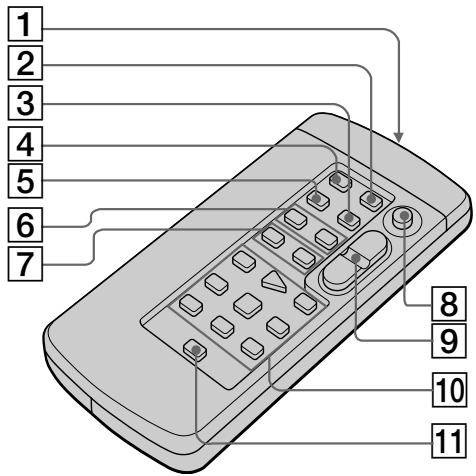
text_image
1 2 3 4 5 6 7 8 9 10 11① Transmitter Point toward the remote sensor to control the camcorder after turning on the camcorder.
② ZERO MEM button (p. 59, 67)
③ DATA CODE button (p. 30)
4 COUNTER RESET button (p. 17)
5 TIME CODE WRITE button (p. 73)
6 INDEX buttons MARK button (p. 68) ERASE button (p. 72)
7 SEARCH buttons DATE button (p. 65) INDEX button (p. 70)
8 START/STOP button (p. 15)
9 Power zoom button (p. 18)
10 Video control buttons (p. 26)
11 DISPLAY button (p. 27)
Notes on the Remote Commander
- Keep the remote sensor away from strong light sources such as direct sunlight or illumination. Otherwise, the remote control may not be effective.
- Be sure that there is no obstacle between the remote sensor on the camcorder and the Remote Commander.
- This camcorder works in commander mode VTR 2. The commander modes (1, 2 and 3) are used to distinguish this camcorder from other Sony VCRs to avoid remote control misoperation. If you use another Sony VCR in commander mode VTR 2, we recommend you change the commander mode or cover the remote sensor of the VCR with black paper.
To prepare the Remote Commander
Insert two R6 (size AA) batteries by matching the + and - on the batteries to the diagram inside the battery compartment.
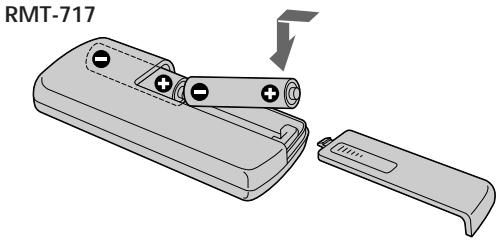
text_image
RMT-717Note on battery life
The batteries for the Remote Commander last about 6 months under normal operation. When the batteries become weak or dead, the Remote Commander does not work.
To avoid damage from possible battery leakage
Remove the batteries when you will not use the Remote Commander for a long time.
natural_image
Diagram of a battery pack with two batteries and an open lid, showing internal components and a downward arrow indicating rotation (no text or symbols)Attaching the shoulder strap
Attach the supplied shoulder strap to the hooks for the shoulder strap.
natural_image
Diagram of a mechanical clamp or hook assembly (no text or symbols)2
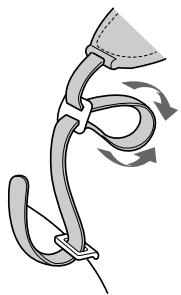
natural_image
Diagram of a rope knot with curved and straight bands, showing rotational motion (no text or symbols)3
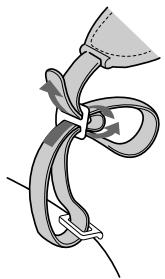
natural_image
Diagram of a rope knot with a loop and guide rope (no text or symbols)To watch the demonstration
You can start the demonstration by setting DEMO MODE in the menu system.
You can also start the demonstration by the following operation.
When NIGHTSHOT is set to ON, you cannot watch the demonstration (CCD-TRV35E/TRV65E/TRV69E only).
To enter demo mode
(1) Eject the cassette and set the POWER switch to PLAYER.
(2) Turn STANDBY up to STANDBY.
(3) While holding down ▶ set the POWER switch to CAMERA.
To exit demo mode
(1) Set the POWER switch to PLAYER.
(2) Turn STANDBY up to STANDBY.
(3) While holding down ■ set the POWER switch to CAMERA.
Operation indicators
1 Recording mode indicator (p. 37)/Mirror mode indicator (p. 21)
② Playing back or recording in Hi8 format (CCD-TRV65E/TRV69E only) (p. 81)
③ Remaining battery time indicator

4 Exposure indicator (CCD-TRV35E/TRV65E/TRV69E only) (p. 53)/Zoom indicator (p. 18)
⑤ FADER indicator (CCD-TRV35E/TRV65E/TRV69E only) (p. 42)
6 Wide mode indicator (p. 46)
7 PICTURE EFFECT indicator (p. 52)
⑧ LCD BRIGHT indicator (p. 20)/VOLUME indicator (p. 26)/Data Code indicator (CCD-TRV69E only) (p. 30)
9 PROGRAM AE indicator (p. 47)
10 Backlight indicator (p. 40)
(to be continued)
Рабочие индикаторы
text_image
22 2 1 24 25 15 26 3 SP LP 8:88:88min DC TC FULL11 WIND indicator (CCD-TRV65E/TRV69E only) (p. 37)
12 Steady Shot off indicator (CCD-TRV35E/TRV65E/TRV69E only) (p. 62)
13 Manual focusing (CCD-TRV35E/TRV65E/TRV69E only) (p. 50)
14 Video control mode (p. 15)
15 Time code indicator (CCD-TRV69E only) (p. 73)
16 Tape counter (p. 17)/RC time code indicator (CCD-TRV69E only) (p. 73)/Self-diagnosis functions indicator (p. 99)/5SEC mode indicator (p. 19)
17 Remaining tape indicator
5min 0min
18 Index indicator/Date search/Date scan indicator/TIME CODE WRITE indicator/ZERO MEM indicator (CCD-TRV69E only) (p. 65, 68, 73)/END SEARCH indicator (p. 25)
19 NIGHTSHOT indicator (CCD-TRV35E/TRV65E/TRV69E only) (p. 44)
20 AUTO DATE indicator (CCD-TRV13E/TRV15E/TRV35E/TRV65E only) (p. 15)/Date indicator (p. 60)
21 Time indicator (p. 60)
22 Warning indicators (p. 115)
23 Recording lamp (p. 15)
24 Date or time indicator (p. 60)/
Tape counter indicator (p. 17)/
RC time code indicator (CCD-TRV69E only)
(p. 73)/Self-diagnosis functions indicator
(p. 99)/Remaining battery time indicator
25 Data Code indicator (CCD-TRV69E only) (p. 30)
26 FULL charge indicator (p. 9)
If indicators flash in the viewfinder or in the display window, check the following:
♪♪... : you can hear the beep sound when the BEEP is set to ON.
① The battery is weak or dead.
Slow flashing: The battery is weak.
Fast flashing: The battery is dead.
② The tape is near the end. The flashing is slow.
③ The tape has run out.
The flashing becomes rapid.
4 No tape has been inserted.
5 The tab on the tape is out (red).
6 Moisture condensation has occurred.
7 The video heads may be contaminated.
8 Some other trouble has occurred.
Use the self-diagnosis function (p. 99).
If the display does not disappear contact your Sony dealer or local authorized Sony service facility.
⑨ The lithium battery is weak or is not installed.
Adjusting viewfinder 16
AFM HiFi Sound 39, 81
ANTI GROUND SHOOTING 19
Auto focus 50
Backlight 40
Beep 17
C, D
Camera recording 15
Car battery 33
Charging battery 9
Cleaning video heads 87
Clock set 78
Connection 63
COUNTER RESET 17
Data code 30
DATE/TIME 30
Date scan 65
Date search 65
DEMO 38,112
Digital zoom 18
DISPLAY 27
DNR 39
E
EDIT 39
Editing 75
EDITSEARCH 24
END SEARCH 31
Exposure 53
F, G, H, I, J, K, L
Index 68
LANC 108
Lithium battery 76
M, N
Mains 32
Manual focus 49
Menu system 34
MIC (microphone) jack ..... 109
NIGHTSHOT 44
O, P
ORC 61
PICTURE EFFECT 51
Playback pause 28
Power sources 32
Power zoom 18
PROGRAM AE 47
Q, R
RC time code 73
Rec review 24
Recording mode 37
Remote control jack (LANC) .. 108
Reverse 28
Rewind 26
S
Self-diagnosis display 99
Shoulder strap 112
Skip scan 28
Standby mode 15
STEADY SHOT 62
T, U, V
Tape counter 17,36
TBC 39
Time code 36, 74
Title 55
Tripod mounting 23
Trouble check 93
W, X, Y, Z
Watching on a TV 63
WIDE mode 45
WIND 37
WORLD TIME 79
Zero memory 59, 67
Zoom 18