
MZ-R900 - MiniDisc Player SONY - Free user manual and instructions
Find the device manual for free MZ-R900 SONY in PDF.


| Product Type | Portable MiniDisc player/recorder |
| Brand and model | Sony MZ-R900 |
| Dimensions (W × H × D) | 78.9 × 17.1 × 72.0 mm (without accessories) |
| Weight | 110 g (without accessories) |
| Power supply | AC adapter (DC IN 3V), rechargeable Ni-MH NH-14WM battery, LR6 (SG) alkaline battery in external case |
| Battery life (stereo recording) | Approx. 8 h (rechargeable battery), 7 h (alkaline battery) |
| Battery life (stereo playback) | Approx. 21 h (rechargeable battery), 30 h (alkaline battery) |
| Recording formats | Standard stereo, LP2 (2×), LP4 (4×), monaural |
| Maximum recording time (MD 80 min) | 160 min in LP2, 320 min in LP4 |
| Inputs | Digital optical input (LINE IN OPT), microphone input (MIC PLUG IN POWER), analog line input (LINE IN via adapter) |
| Output | Headphone / LINE OUT jack (analog, switchable) |
| Playback functions | Normal play, repeat, shuffle, programmed, speed control (80‑110%) |
| Equalizer | Digital Sound Preset (SOUND1 and SOUND2 adjustable in bass/treble) |
| Recording functions | Synchro recording, automatic track marking (Auto Time Stamp), manual level adjustment |
| Editing | Name tracks/discs, move, erase, divide/combine tracks, phrase bank |
| Display | LCD display with level, time, mode, battery, etc. indicators |
| Personal disc memory | Remembers settings (volume, order, equalizer, speed) for 20 discs |
| Anti-shock | Electronic Shock Protection (ESP): 40 s (stereo), 80 s (LP2/MONO), 160 s (LP4) |
| Supplied accessories | Remote control with display, headphones, AC adapter, rechargeable battery, battery case, optical cable (?), instruction manual |
| Maintenance | Clean the casing with a dry cloth. Avoid humidity and shocks. Use recommended batteries. |
Frequently Asked Questions - MZ-R900 SONY
User questions about MZ-R900 SONY
0 question about this device. Answer the ones you know or ask your own.
Ask a new question about this device
Download the instructions for your MiniDisc Player in PDF format for free! Find your manual MZ-R900 - SONY and take your electronic device back in hand. On this page are published all the documents necessary for the use of your device. MZ-R900 by SONY.
USER MANUAL MZ-R900 SONY
Operating Instructions


MDLP

WALKMAN
MZ-R900

6 9
1 1 AC
AC
Warning
Caution
Fire
Electric shock
Prohibited
No contact
No wet hands
Mandatory





Operating Instructions
39 40 LINE OUT ...... 42 43 43 ...... 44 45 46 47 ..... 50 ...... 54 — AVLS 56 56 57 58 59 ? 61 64 65 67 68 70 Operating Instructions 72
| • |  | |
| • |  | |
| AC | 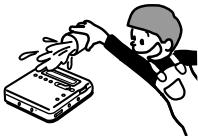 |  |
| 100V | AC | 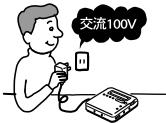  |
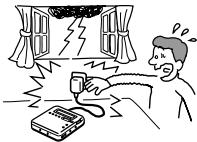 |  | |
| AC |  |
Note
| (Ni-Cd) |
| (Ni-MH) |
| (Li-ion) |
Danger
• • •
.
Warning

Warning
AC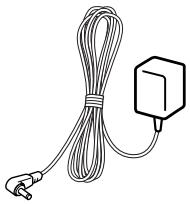
NH-14WM
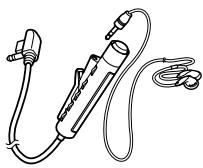
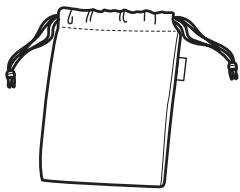
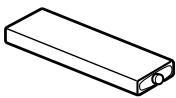
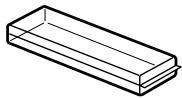
Danger
1 END SEARCH 20 47
2 16
3 14 26 35
43 54
4 VOL / 21 47
5 REC MODE
25
6 REC 30
7 17
8 SYNCHRO REC ON/OFF
25
9 DC IN 3V 16 19
10 HOLD 17 56
11 REC 19 24
12 OPEN 17
13 20 21
29 32 45 47
14 25 35 54
15
▶▶15 21 45 47
16 ■ /CHARGE 16
19 21 26 43
17 LINE IN (OPT) 19
24
18 MIC (PLUG IN POWER)
27
19 T MARK 44
20 ☉/LINE OUT 33 42
1
54
8
LP2/LP4
25
2
30 41
9
25
10
19
3
32
11
REC DATE
41
4
30 41
12
REMAIN
30 41
5
16
13
35
6
37
14
25 35
7
29
1 DISPLAY 31 39 46
49 54
8 VOL /
15 21 49
2 PLAY MODE 36 49
3 RPT/ENT repeat/enter
37 38
4 SOUND 37
9 31 37 55
10 HOLD 17 56
5
11 ■ 21 39 46
6 21 49
52
55
7 ◀◀/▶▶▶ 15
21 37 46 49 52 55


1 31 37 55
5 37
2 31 37 55
6 31 37 55
3 31 37 55
7 31
4 55
8 37
2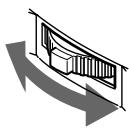
MENU/ENTER
| EDIT | 51 | 43 | 44 | 46 | 48 | |||||
| DISPLAY | 30 | 40 | ||||||||
| PLAY MODE | 35 | |||||||||
| RecVolume | 29 | |||||||||
| M-TIMER | 54 | |||||||||
| AUDIO OUT | Ω/LINE OUT | 42 | ||||||||
| SOUND | 37 | |||||||||
| PERSONAL | 40 | |||||||||
| TIME MARK | 28 | |||||||||
| MIC SENS | 27 | |||||||||
| AVLS | AVLS ON/OFF | 56 | ||||||||
| BEEP | 57 | |||||||||
| REC-Posi | 26 | |||||||||
| CLOCK SET | 32 |
AC
1
2 AC
DC IN 3V
① AC ② ■/CHARGE
Charging
3
30
■/CHARGE
![graph TD A[" "] --> B[" "] B --> C[" "] C --> D[" "] D --> E[" "] E --> F[" "]](/content/2019/09/47002/images/c06d8271d8f17c35f05828948dbac818422e5ae4d8829e08ada2d9b212c995d2.jpg)
③ AC
3 1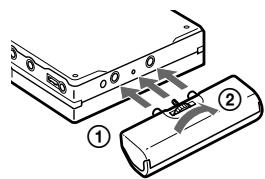
LOCK RELEASE
3
4
① OPEN

■/CHARGE
■/CHARGE
•
•
•
•
AC
DAT
BS
71
24
1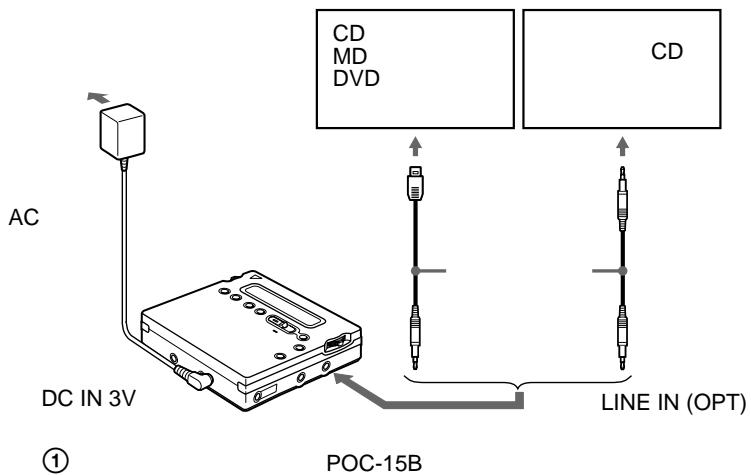
2
① REC REC ② CD AC
10
5
1
①
② VOL /
VOL /

AC
10
5
3)
| 40 | ||
| LP2 | LP2 | 80 |
| LP4 | LP4 | 160 |
| MONO | 80 |
56
VOL +/−
1
AUDIO OUT
LINE OUT
2
HeadPhone
3

LP2
LP4

AC
2
CD
LINE IN
2
19
LINE IN
24
| LINE IN | ||
| LINE OUT | ||
| 19 | 24 | |
| CD | ||
| CD MD | 2 | |
| CD MD | 28 | |
| 3 | ( ) 45 | |
| ( ) 45 | ||
| REC | 29 | 29 |
CD
- CD MD
- BS CS
) (

1
REC
REC
REC
2
CD
19

LINE IN (OPT)
LINE IN

1
CD
RK-G136
2 (LP2) 4 (LP4)
2
1 REC MODE
| 1) | 2) | |
| 80 | ||
| LP2 | LP2 | 160 |
| LP4 | LP4 | 320 |
| MONO | 160 | |
1) LP2
2) 80
2 REC
3

MDLP
LP2
MDLP
LP4

• AC DC IN 3V
- LP2 LP2 LP4 LP4
LP:
Ω/LINE OUT
- LP4 4
LP2
CD
![graph TD A["CD"] --> B["REC"] B --> C["SYNCHRO REC"] B --> D["OFF_ON"]](/content/2019/09/47002/images/88793876e2962e6835a5c40a73ae48d91a584865497d066834fccf8f2073135c.jpg)
1 SYNCHRO REC ON
2 REC
3

• 3
5
25 1
1
2
REC-Posi
3
From End
4
3 From Here
• SYNCHRO REC
- CD MD
2
1
- MIC PLUG IN POWER
ECM-717
ECM-MS907 ECM-MS957
1
REC
19
1
2
MIC
SENS
3
SENS
HIGH SENS LOW SENS HIGH
SENS LOW
4
•
LINE IN (OPT)
2 OFF
1
2
TIME MARK
OFF
3
| OFF | — |
| 5min. ON | 5 |
| 10min. ON | 10 |
| 15min. ON | 15 |
4
5
8 5
5 5

T
T

• T MARK II
4
8
5
5
||
5 5 9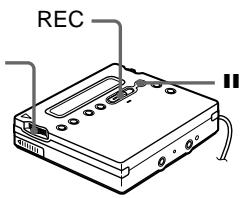
11 REC
611 5
2 RecVolume 3 ManualREC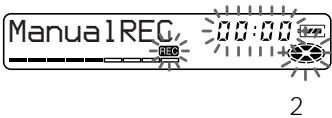
Auto REC


5 6 4
1 DISPLAY
2![graph TD A["LapTime"] --> B["RecRemain"] B --> C["AllRemain"] C --> D["Clock"]](/content/2019/09/47002/images/0bf0b67691619bff42f616588e0e657c6019c07a9d50f895bb89159d05524cc4.jpg)
1)
3 2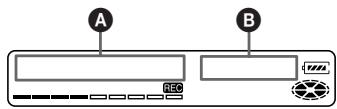
A B
1)
2)
3)
3)
1)
RecRemain
2)

AllRemain
3)
Clock

31
REC
3
( )

41
30
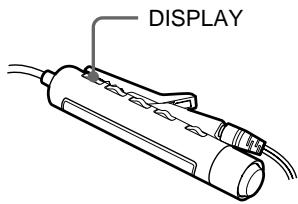
1 DISPLAY
DISPLAY
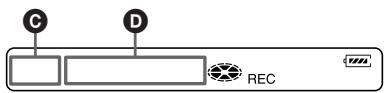
C/D
![graph TD A["/"] --> B["/"] B --> C["—/"] C --> D[1)](/content/2019/09/47002/images/a368b4b9af36f120a974e35a02f8396166ab5794220a7af825d56812ce211e20.jpg)

1)![graph TD A["/"] --> B["↓"] B --> C["/"] C --> D["1)"] D --> E["↓"] E --> F["/"] F --> G["1)"] G --> H["↓"] H --> I["—/"] I --> J["2)"]](/content/2019/09/47002/images/b6a5b154eda1660b585154c0fce717dbe5382b73200ee11fe5110b64b817656e.jpg)
1) 2)
2
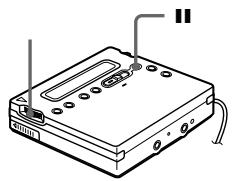
DISPLAY
CLOCK
24
12
1
CLOCK SET
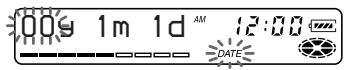
3
3
3
4
3
0
CD
CD
CD
CD CD
CD
D-E990
CD
CD
CD
CD
RK-TXT1
MD
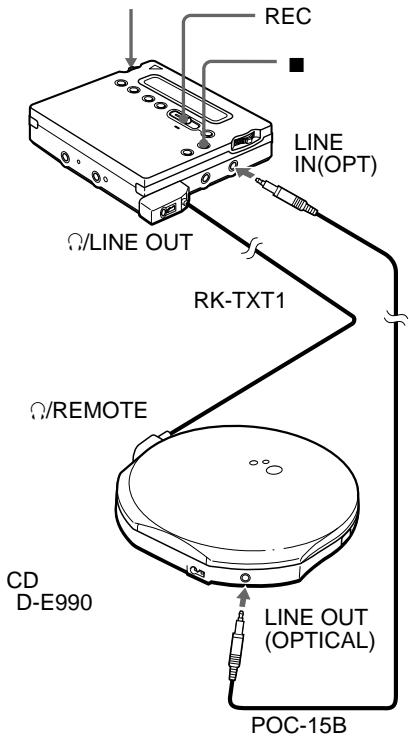
1 REC
CD
SYNC
REC

CD TEXT
001
TEXT?
Push ENTER
NO TEXT
2
Push ENTER
3
MD
4
2 3
5


000 TEXT?
Push ENTER

NO
TEXT
6
Press ENTER
7
TOC Edit

CD
1
CD
TOC Edit

•
CD
•

CD
RK-TXT1 MD
VOL +/−
JOINT TEXT
CD→MD
D-E01 D-E990 D-E880
D-E770 D-F700 2000 9
• CD
CD
TEXT

• CD
RK-TXT1
CD
RK-TXT1
CD
CD
MD
1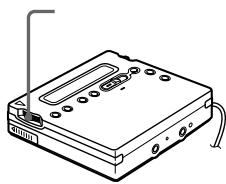
1 MODE PLAY 2
A B C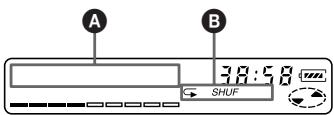
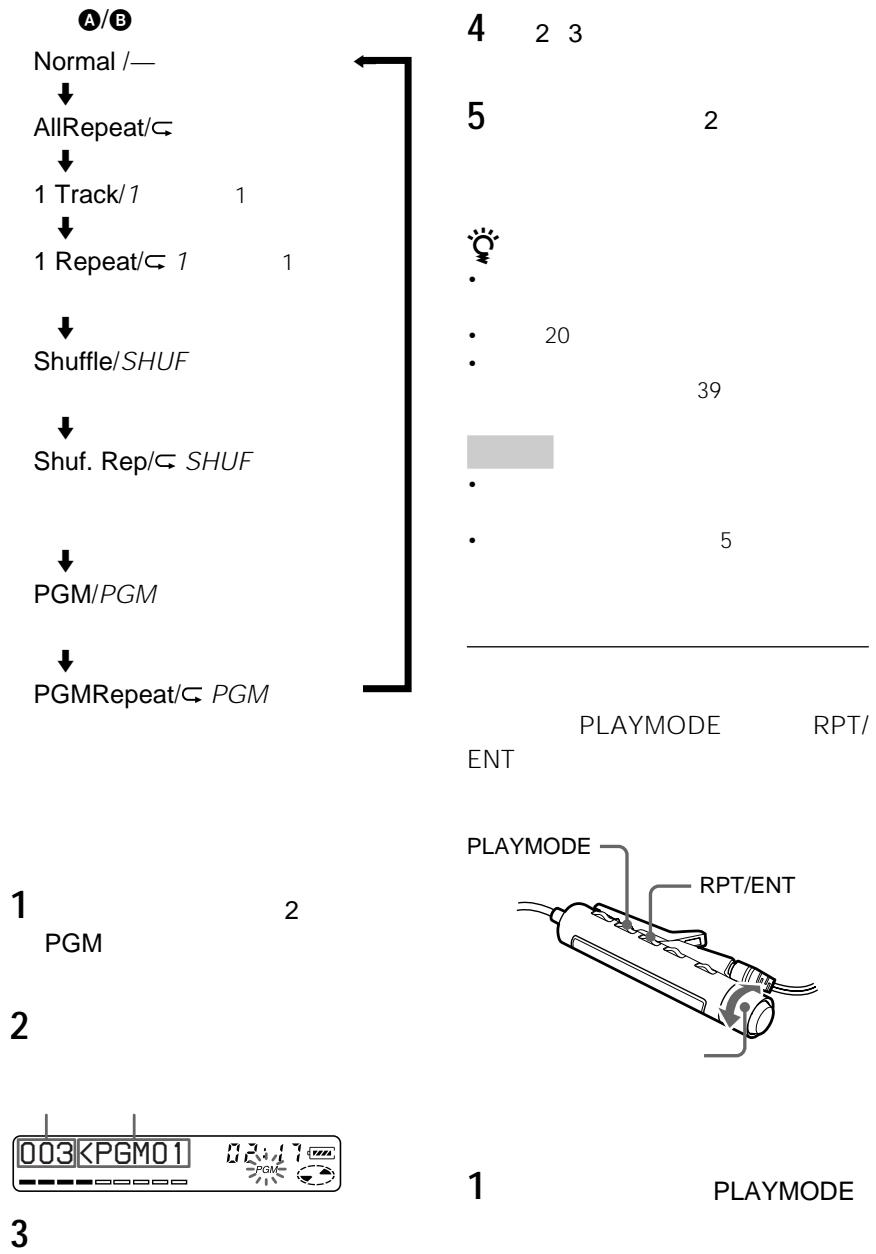

![graph TD A["—"] --> B["↓"] B --> C["1"] C --> D["↓"] D --> E["SHUF"] F["↓"] --> G["PGM"] style A fill:#fff,stroke:#000 style F fill:#fff,stroke:#000](/content/2019/09/47002/images/748f0faa146aa04b8941574461861f39059a7e65d4a545f35be30dff16bf46e6.jpg)

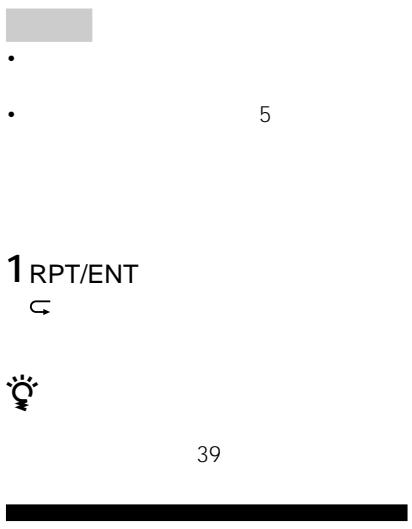
1
PGM
PLAYMODE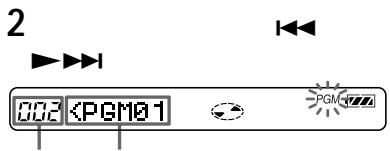
2 SOUND 2
BASS SOUND 2 TREBLE   TREBLE BASS  BASS TREBLE SOUND 2 BASS TREBLE SOUND SOUND1 SOUND2 SOUND SOUND1 SOUND2 BASS TREBLE4 RPT/ENT
SOUND SOUND1 SOUND2 SOUND1 SOUND2 SOUND OFF \- SOUND1 BASS 1 TREBLE ± 0 \- SOUND2 BASS 3 TREBLE ± 0  • • O/LINE OUT AUDIO OUT LINE OUT LINE OUT HeadPhone 22 Ω/ •  1 DISPLAY 2 2 SPEED ▶▶▶▶ 3 100% 95%  4■    100% • • • • •  1 2 PERSONAL Entry?  3 Entry OK  No Entry! 2  1 DISPLAY 2 2 PERSONAL Entry?  3 Entry OK    1 DISPLAY 2    1 DISPLAY DISPLAY 3        40LINE OUT
RK-G129 RK-G136 Ω/LINE OUT  Ω/LINE OUT AUDIO OUT 1 AUDIO OUT 2 LINE OUT • Ⓞ/LINE OUT AUDIO OUT LINE OUT • OUT Ω/LINE OUT AUDIO LINE OUT • LINE OUT HeadPhone • AUDIO OUT HeadPhone Ω/LINE OUT 1 EDIT  Name 1 2  Erase Erase OK? PushENTER \- TOC Edit 71 TOC Edit TOC Edit 3 1 44 1   1 2 EDIT  Name 3  Erase AllErase? PushENTER 4 TOC Edit BLANKDISC   1 T MARK MARK ON ) T MARK 28 LINE IN LP2 LP4 SORRY SORRY 1   1  2   3 MARK T MARK MARK OFF  2 1 :C 2   1 EDIT  Name 1 2  Move MV003 003 3 MV003 002 4  DISPLAY 1   Name 1 2    Move 3■ 003 003 4   003 002 2 DISPLAY 5    3 4  END SEARCH/ VOL END SEARCH/ VOL -  5 4  1 2 EDIT  Name 3 4 47 4 6 1 EDIT  Name 2. •  Name 3 47 4 6 \- LP2 LP4 LP:  1 2 DISPLAY  EDIT  2    Name 3 4     1) VOL /-  DISPLAY 2 2 PLAYMODE 1) 52 5 4 2 6. 2 DISPLAY 1 2 DISPLAY   Name 3■ 4 48 4 6 1 DISPLAY 2   EDIT  Name 2.  •   Name 3 48 4 6 • LP2 LP4 LP: DISPLAY 2 1 3 2  200  EDIT 2 10 40 600  1 47 2 " 2 Entry!  50 VOL +/−  2 3 1  4EDIT
1 EDIT 2 Name Bank 3 2 Entry! 1 VOL +/- 1 211  3 1 1   Name Name 1 EDIT 2 BankErase 3 Erase! 211 EMPTY  1 48 2 2 Entry! ||  50 11 2EDIT
      1 211 3 VOL+/- 1   1 DISPLAY EDIT 2  2   BankErase  3    Erase! EMPTY DISPLAY 2 1 99  1 2 TIMER M- 3 ON ((●)) 4  TIME:01 99 TIME:99 1 1 5 6  3 MELODY : 1 MELODY : 2 MELODY : 3 7 3   1 DISPLAY 2    3 OFF    MELODY : 1 MELODY:2 MELODY : 3 4 — AVLS  1 AVLS 2 AVLS ON AVLS 2 AVLS OFF  HOLD HOLD HOLD  1 2 BEEP 3 BEEP OFF 3 BEEP ON| ... | |||
| NH-14WM | |||
| 3 | ... | ||
| 1) | |||
| 3) | (JEITA2) | ||
| LP2 | LP4 | ||
| 8 | 10.5 | 13 | |
| NH-14WM4) | |||
| 5) | 7 | 10 | 14 |
| 19 | 26 | 30 | |
| 4) | |||
| 5) | |||
| LP2 | LP4 | ||
| 21 | 23 | 26 | |
| NH-14WM 4) | |||
| 5) | 30 | 35 | 38 |
| 53 | 60 | 66 | |
| 4) | |||
| 5) | |||
AC
AC JEITA AC   Ni-MH
TEL: 03-3434-0261 : http://www.baj.or.jp ?| HOLD | 17 | |
| HOLD | 56 |
| AC | DC IN 3V |
| 1 | — | ||
| AC | 16 | ||
| 19 24 | |||
| CD | CD ESP | ||
| PROTECTED | |||
| 29 | |||
| P/B ONLY | |||
| 48 DISC FULL | 12 24 64 | ||
| ▲▲ | ■ | ||
| Ω/LINE OUT | |||
| VOL / | |||
| OFF 56 AVLS | |||
| Ω/LINE OUT OUT | AUDIO LINE OUT | Ω/LINE OUT HeadPhone AUDIO OUT | |
| 3 | AC | ||
| 2 32 | |||
| --y--m--d | 32 | ||||
| CD | 19 | ||||
| CDD-E990 | CD | CDD-E990 | CD | 33 | |
| CD | CD | CD | CD | ||
| Ω/LINE OUTOUT | AUDIOLINE OUT | Ω/LINE OUTHeadPhone | AUDIO OUT22 | ||
| LP4 | LP2 | ||||
| (60) | 74 | 254 | ||||||
| 80 )TR FULL | ||||||||
| TR FULL | 1 | |||||||
| 1 | ||||||||
| 254 | ||||||||
| ( ) | 12 | |||||||
| 24 | LP2 | 12 | ||||||
| 48 | LP4 | |||||||
| (60) | 74 | 80 ) | 4 | LP4 | 2 | LP2 | ||
| 2 | 4 | 2 | 4 | |||||
| 2 | 4 | 8 | 8 | |||||
| 2 | 4 | 8 | ||||||
| 24 | 6 12 |
| BLANK DISC | |||
| DISC ERR | |||
| DISC FULL | 4864 | 12 | 24 |
| Data Save | |||
| TOC Edit | 70 | ||
| BUSY | 1 | ||
| NAME FULL | 1700 | 200 | |
| Hi DC in | AC | AC | |
| HOLD | HOLD56 | ||
| LOW BATT | 16 17 | ||
| MEM OVER | |||
| NO COPY | SCMS | LINE IN24 | |
| NO DISC | |||
| NO SIGNAL | LINE IN | ||
| P/B ONLY | |||||
| PROTECTED | 71 | ||||
| SORRY | Ω/LINE OUTOUT | AUDIOLINE OUT | OUT | AUDIO OUTHeadPhone | Ω/LINE22 |
| 1 | — | ||||
| CD | |||||
| T | |||||
| MARK | |||||
| TEMP OVER | |||||
| TR FULL | 254 | 254 | |||
| TrPROTECT | |||||
| MENU | — | ||||
| LINE OUT | Ω/LINE OUTOUT | AUDIOLINE OUTVOL +/- | LINE OUT22 | AUDIO OUTHeadPhone | Ω/AUDIO OUT |
| NO TEXT | CD | — | |||
| EMPTY | — | ||||
| BANK FULL | 600 | ||||
0.25mV
49mV
1)
Ω/LINE OUT²)
(    5mW+5mW
)    16
LINE OUT    194mV
GaAlAsMQW =790nm    10k
MDW-80    NH-14WM ( )
160    3 1
320    58
350rpm 2800rpm(CLV)    78.9 × 17.1 × 72.0 mm
ACIRC    / /
80.0 × 20.5 × 75.5 mm
44.1kHz    / /
JEITA³)
32kHz/44.1kHz/48kHz    110g
ATRAC    JEITA³)
ATRAC3 — LP2    1)
ATRAC3 — LP4    2)
EFM    LINE OUT
2
1
20 20,000Hz±3dB
TOC EDIT
TOC Table Of ContentsMD
CD 2 TOC TOC Edit CD -0:03 0:00 MD SCMS MD CD LINE IN   Operating Instructions
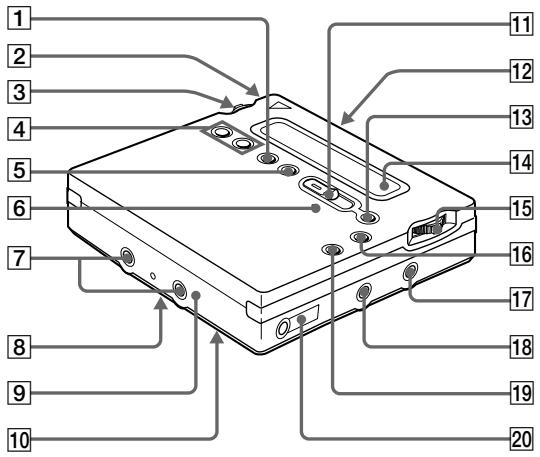
Looking at the controls
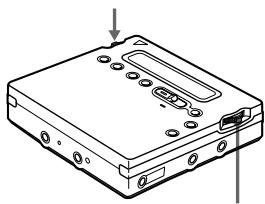
The numbers are keyed to the illustrations in the Japanese text (pages 11 to 13). The recorder| 1 | END SEARCH button |
| 2 | Battery compartment |
| 3 | Jog lever (L) (MENU/ENTER) |
| 4 | VOL (volume) +/- buttons |
| 5 | REC MODE button |
| 6 | REC indicator |
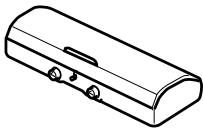
| 7 | Terminals for attaching dry battery case. |
| 8 | SYNCHRO REC (synchro-recording) ON/OFF switch |
| 9 | DC IN 3V jack |
| 10 | HOLD switch (at the rear) |
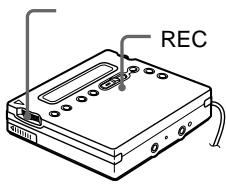
| 11 | REC (record) switch |
| 12 | OPEN switch |
| 13 | ■ (pause) button |
| 14 | Display window |
| 15 | Jog lever (R) (▶, ◀◀/▶▶) |
| 16 | ■ (stop)/CHARGE button |
| 17 | LINE IN (OPT) jack |
| 18 | MIC (PLUG IN POWER) jack |
| 19 | T MARK button |
| 20 | ○/LINE OUT jack |
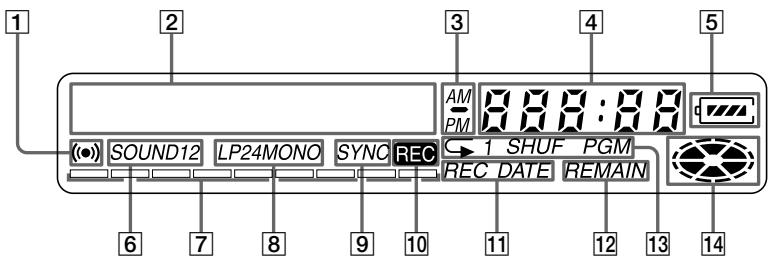
The display window of the recorder
1 Alarm indication ② Character information display Displays the disc and track name * , date, error messages, track numbers, etc. * Disc and track names appear only with MDs that have been electronically labeled. 3 AM/PM indication Lights up along with the time indication in the 12-hour system. 4 Time display Shows the elapsed time of the track being recorded or played. 5 Battery indication Shows approximate battery condition. While charging the rechargeable battery, this indication shows the charging condition. 6 Sound indication Lights up when Digital Sound Preset is on. 7 Level meter Shows the level of the MD being played or recorded. 8 LP2, LP4, MONO (monaural) indication ⑨ SYNC (synchro-recording) indication Lights up while synchro-recording. 10 REC indication Lights up while recording. Flashes when standing by for recording. 11 REC DATE (recorded/current date) indication Lights up along with the date and time the MD was recorded. When only “DATE” lights up, the current date and time are displayed. 12 REMAIN (remaining time/tracks) indication Lights up along with the remaining time of the track, remaining time of the MD, or remaining number of tracks. 13 Play mode indication Shows the play mode of the MD. 14 Disc indication Shows that the disc is rotating for recording, playing or editing an MD.The headphones/earphones with a remote control
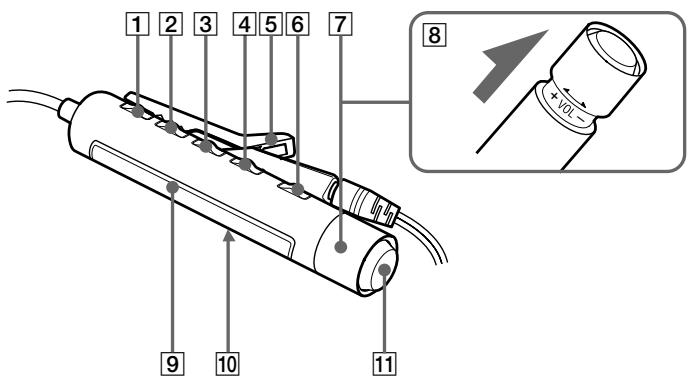
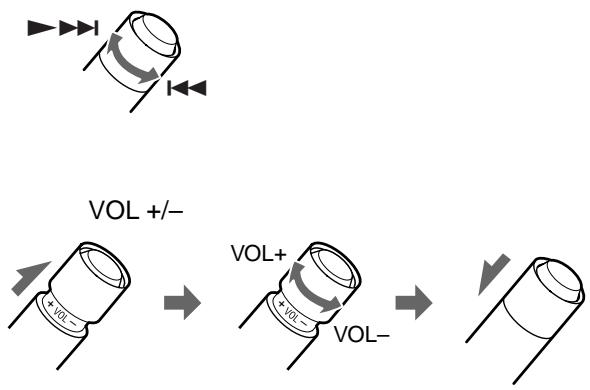
1 DISPLAY button 2 PLAY MODE button 3 RPT/ENT(repeat/enter) button 4 SOUND button 5 Clip 6 II (pause) button 7 Control (◄◄◄/►►►►) ►►►►: play, AMS, FF ◄◄◄: REW 8 Control (VOL +/-) Pull and turn to adjust the volume. 9 Display window 10 HOLD switch 11 ■ (stop) buttonThe display window of the remote control
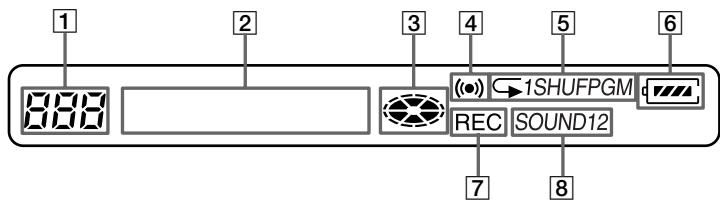
1 Track number display 2 Character information display 3 Disc indication 4 Alarm indication 5 Play mode indication 6 Battery indication 7 REC indication 8 SOUND indicationHow to use the jog lever
See the illustrations in the Japanese text (page 14). The two jog levers on the recorder can be used to perform various operations during playback, recording, editing, and when the recorder is stopped.Jog lever functions
Jog lever (L) (MENU/ENTER)
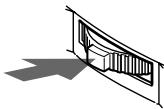
\- Selecting/entering the menu items. To use menu items, press the jog lever (L) to enter the menu, flip the lever to select the item, and then press the lever again to confirm the menu.| menu | functions |
| EDIT | Selecting editing operations (labeling tracks or discs, erasing tracks or discs, etc.) (pages 86 to 88 and 90). |
| DISPLAY | Displaying elapsed playing time, remaining playing time, etc.. |
| PLAYMODE | Selecting the play mode (repeat play, shuffle play, etc.) (page 83). |
| RecVolume | Selecting the automatic or manual recording level adjustment (page 81). |
| M-TIMER | Setting the alarm (Melody timer)(page 92). |
| AUDIO OUT | Selecting ⏻/LINE OUT jack output (page 85). |
| menu | functions |
| SOUND | Selecting “SOUND1”, “SOUND2,” or “SOUND OFF” (Digital Sound Preset) (page 84). |
| PERSONAL | Entering or erasing the disc information in the Personal Disc Memory (page 85). |
| TIME MARK | Selecting the Auto Time Stamp setting (page 80). |
| MIC SENS | Selecting the microphone sensitivity (page 80). |
| AVLS | Selecting “AVLS ON” or “AVLS OFF” (AVLS (Automatic Volume Limiter System)). |
| BEEP | Selecting “BEEP ON” or “BEEP OFF” (headphones/earphones beep). |
| REC-Posi | Selecting the start point when recording (page 79). |
| CLOCK SET | Setting the clock (page 81). |
How to use the control on the remote control
See the illustrations in the Japanese text (page 15). Play/AMS/FF/REW: Turn or turn and hold the control towards ◀◀◀ or ▶▶▶▶ Volume adjustment: Pull and turn the control towards VOL + or -.▶Preparing
Getting started!
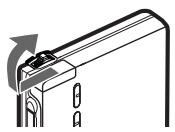
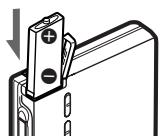
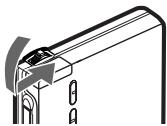
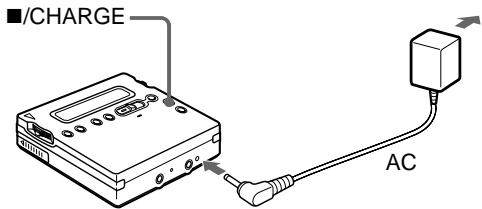
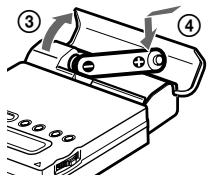
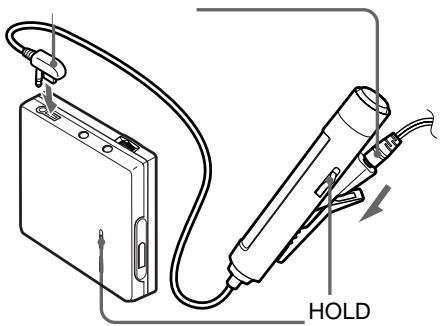
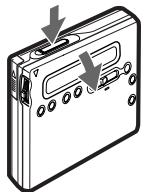
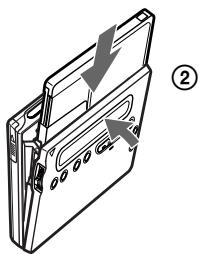
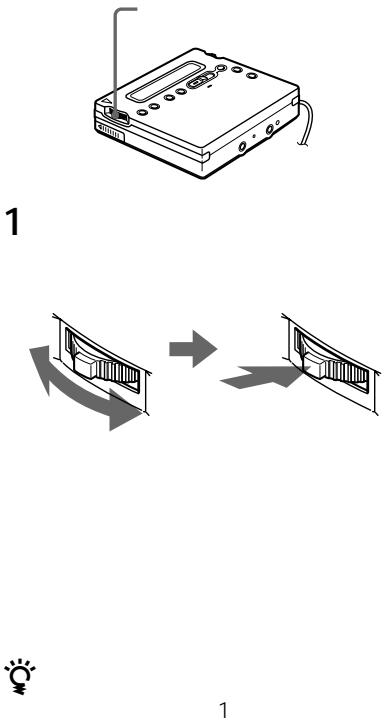
See the illustration in the Japanese text (pages 16 and 17). Charge the rechargeable battery before using. Even if the rechargeable battery is not charged, you can use the recorder as long as the AC power adaptor is connected. 1 Insert the supplied nickel metal hydride rechargeable battery into the recorder with the minus end first. 2 Connect the AC power adaptor and press ■/CHARGE to start charging. “Charging” flashes, ☐ appears in the display, and charging starts. When charging is completed, battery indication disappears. A completely discharged battery takes about 3.5 hours. To use the recorder with an alkaline dry battery, insert the dry battery into the supplied dry battery case and attach it to the recorder. 3 Connect the supplied headphones/earphones with the remote control to the recorder and slide HOLD to unlock the control. 4 Insert an MD. ① Slide OPEN to open the lid. ② Insert an MD with the label side facing front, and press the lid to close. Insert an recordable MD when recording.Notes on rechargeable battery
\- If you press ■/CHARGE immediately after charging has completed, charging will begin again. In this case, press ■/CHARGE to stop the recorder because the battery is already fully charged. \- Charging stops when you try to operate the recorder during charging. \- Be sure to use the supplied AC power adaptor. \- Charging time may vary depending on the battery condition. \- When a rechargeable battery is charged for the first time or charged after a long period of disuse, battery life may be shorter than usual. Repeat discharging and recharging a few times. The battery life should return to normal. \- When the battery life of a fully charged rechargeable battery becomes about half the normal life, replace it. \- When carrying the rechargeable battery, keep it in the supplied carrying case. It is dangerous to carry the battery out of its case in your pocket or a bag together with metallic objects such as key rings, as this may cause a short circuit. \- Remove the rechargeable battery from the recorder when it is not to be used for a long time.Notes on dry battery
Incorrect battery usage may lead to leakage of battery fluid or bursting batteries. To prevent such accidents, observe the following precautions: \- Insert the + and - poles of the battery correctly. \- Do not try to recharge the battery. \- When the recorder is not be used for a long time, be sure to remove the battery. \- If a battery leak should develop, carefully and thoroughly wipe away battery fluid from the battery compartment before inserting new ones.▶MD recording
Recording an MD right away!
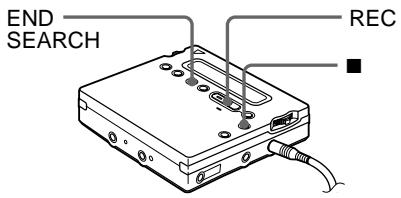
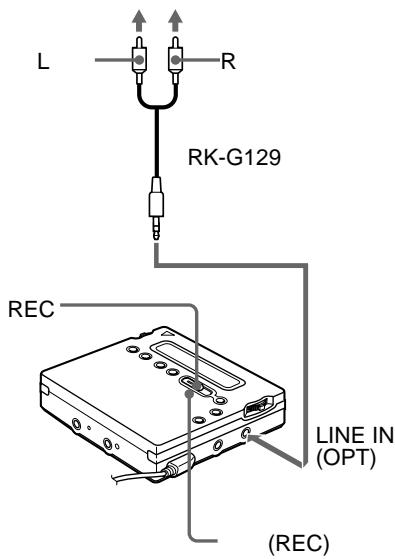
See the illustrations in the Japanese text (page 19). Connect to a digital source using an optical cable to make digital recordings. Digital recording is possible even from digital equipment with different sampling rates, such as a DAT deck or a BS turner, using the built-in sampling rates converter. To record from an analog source, see “Recording with analog input (line cable required).” It is recommended to use the supplied the AC power adaptor when recording. 1 Make connections. (Insert the cables firmly and completely into the appropriate jacks.) ① Connect the LINE IN (OPT) jack of recorder to the DIGITAL OUT jacks of the source with a optical cable. The recorder switches to analog input automatically. ② Connect the DC IN 3V jack of the recorder to a wall outlet with the supplied AC power adaptor. When the recorder has different sound sources connected at the same time, the recorder switches to the digital, microphone, or analog input in this order of priority. 2 Select recording start point. If you want to add a recording to the end of the previous recording, press END SEARCH. (By setting “REC-Posi” to “From End,” recording operations will always start from the end of the previously recorded material.) If you want to start recording from the beginning, skip this step. 3 Start recording. ① Press and slide REC to the right. "REC" lights up and recording starts. ② Play the sound source. The level of the recorded sound is adjusted automatically.To stop recording, press ■.
After you press ■, the recorder will automatically turn off in about 10 seconds (when using batteries) or about 5 minutes (when using AC power adaptor).Notes
- “Data Save” or “TOC Edit” flashes while data of the recording (the track’s start and end points, etc.) is being recorded. Do not move or jog the recorder or disconnect the power source while the indication is flashing in the display. - The lid does not open until “TOC Edit” disappears in the display.| To | Do this |
| Record partway through the previous recording | Press the jog lever (R)(▶), or flip the jog lever (R) towards ▶▶▶▶▶▶▶▶▶▶▶▶▶▶▶▶▶▶▶▶▶▶▶▶▶▶▶▶▶▶▶▶▶▶▶▶▶▶▶▶▶▶▶▶▶▶▶▶▶▶▶▶▶▶▶▶▶▶▶▶▶▶▶▶▶▶▶▶▶▶▶▶▶▶▶▶▶▶▶▶▶▶▶▶▶▶▶▶▶▶▶▶▶▶▶▶▶▶▶▶▶> |
| Pause | ■.1)Press ■ again to resume recording. |
| Remove the MD | ■, then slide OPEN to open the lid.2) |
If the recording does not start
- Make sure the recorder is not locked. - Make sure the MD is not record-protected. - Premastered MDs cannot be recorded over.Notes
- If the power supply is disrupted (i.e. the battery is removed or becomes exhausted or the AC power adaptor is disconnected) during a recording or editing operation, or while “TOC Edit” appears in the display, then it will not be possible to open the lid until power is restored. - You can make a digital recording only from an optical type output. - When recording from a portable CD player, play it on AC power and disable the anti-skip function (such as ESP*). - When recording from a portable CD player, set the CD player to pause, and then do the recording procedure on the recorder. - Digital output may be disabled on some portable CD players when the player is not run on AC power. * Electronic Shock ProtectionPlaying an MD right away!
See the illustrations in the Japanese text (page 21). If you want to use the rechargeable battery, be sure to recharge them before playing (page 74).1 Start playing.
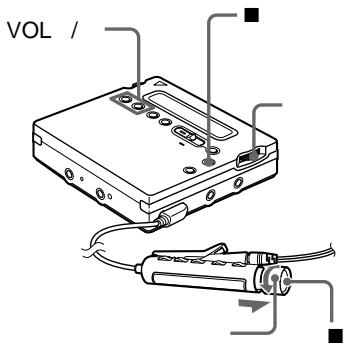
① Press the jog lever (R)(▶). Turn the control towards ▶▶▶▶ on the remote control. A short beep sounds in the headphones/earphones. ② Press VOL +/- on the recorder to adjust the volume. Pull and turn the control towards VOL + or towards VOL - on the remote control. To stop play, press ■.| To | Do this (Beeps in the headphones/earphones1) |
| Find the beginning of the current track | Flip the jog lever (R) towards ◀◀◀. Turn the control towards ◀◀◀ on the remote control. (Three short beeps) |
| Find the beginning of the next track | Flip the jog lever (R) towards ▶▶◀. Turn the control towards ▶▶▶◀ on the remote control. (Two short beeps) |
| Go backwards while playing2) | Flip and hold the jog lever (R) towards ◀◀◀. Flip and hold the control towards ◀◀◀ on the remote control. |
| Go forward while playing1) | Flip and hold the jog lever (R) towards ▶▶◀. Flip and hold the control towards ▶▶▶◀ on the remote control. |
| Pause | Press ▪. (Continuous short beeps) Press ▪ again to resume play. |
| Remove the MD | Press ■, then slide OPEN to open the lid.3) |
About the anti-skip function
The anti-skip function provides resistance to vibrations for varying length of time depending on the playback mode of the track.| Mode | Display | Vibration resistance time |
| Stereo | (none) | Approx. 40 sec. |
| LP2 Stereo | LP2 | Approx. 80 sec. |
| LP4 Stereo | LP4 | Approx. 160 sec. |
| Monaural | MONO | Approx. 80 sec. |
If the playback does not start
Make sure the recorder is not locked. If it is locked, slide the HOLD switch in the opposite direction of the arrow.When using the headphones/earphones, connect them directly to the recorder
The VOL +/- buttons and the Digital Sound Preset function may become inoperative. In this case, do the procedure below. 1 Press the jog lever (L), flip the lever until “AUDIO OUT” flashes in the display, and then press the lever again. 2 Flip the jog lever (L) until "HeadPhone" appears in the display. 3 Press the jog lever (L) again.Notes
- The sound may skip during playback when the recorder is exposed to continuous vibration, such as while jogging. - If the power supply is disrupted (i.e. the battery is removed or becomes exhausted or the AC power adaptor is disconnected) when the recorder is operating, the lid will not open until the power is restored.▶ Various ways of recording
Connecting digital (optical) and analog (line) inputs
The recorder selects digital or analog input according to how the sound source is hooked up.| Difference\Input | Digital (optical) input | Analog (line) input |
| Connectable source | Equipment with an digital (optical) output jack | Equipment with an analog (line) output jack |
| Usable cord | Optical cable (with an optical or an optical-mini plug) | Line cable (with 2 phono plugs or a stereo-mini plug) |
| Signal from the source | Digital | Analog Even when a digital source (such as a CD) is connected, the signal sent to the recorder is analog. |
| Recorded track numbers | Marked (copied) automatically • at the same positions as the source1). • after more than 2 seconds of blank or low-level segment2). • when recording is paused while synchro-recording3). | Marked • after more than 2 seconds of blank or low level segment. • while the recorder is paused while recording. • automatically at specified intervals when the Auto time stamp is on. You can erase unnecessary marks after recording. |
| Recordedsound level | Same as the source. You can also adjust it manually (Digital REC level control). | Adjusted automatically. You can also adjust it manually. |
Notes
Track marks may be copied incorrectly: - when you record from some CD players or multi disc players using digital (optical) input. - when the source is in shuffle or program play mode while recording using digital (optical) input. In this case, play the source in normal play mode. - when recording BS or CS programs through digital (optical) input.Recording with analog input (line cable required)
See the illustration in Japanese text (page 24). The sound will sent from the connected equipment as analog signal but will be recorded digitally on the disc. 1 Connect the LINE IN (OPT) jack of the recorder to the line output jack of the source with an line cable (not supplied). The recorder switches to analog input automatically. 2 Connect the power source. To use on AC power, see “Recording an MD right away!.” To use on other power sources, see page 75. 3 Press and slide REC to the right. "REC" and the REC indicator lights up and recording starts. 4 Play the sound source.Note
If you temporarily stop a recording operation by pressing , a new track mark will be added at that point where you pressed again to resume recording. The recording continues from a new track.Recording for long times
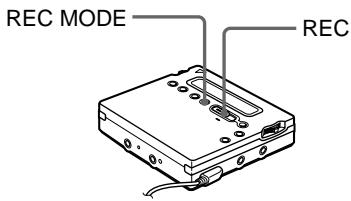
See the illustration in Japanese text (page 25). Select each recording mode according to the recording time that you want. Stereo recording is possible at 2 times (LP2) or 4 times (LP4) the normal recording time. 1 Press REC MODE repeatedly to select the desired recording mode. The recording mode can be selected from “(none)” (standard stereo mode), “LP2” (2 × normal recording mode), “LP4” (4 × normal recording mode), and “MONO” (monaural). 2 Press and slide REC to the right. Recording starts. 3 Start the sound source.Notes
- To obtain better sound quality, select stereo or LP2. - It is recommended that you use the supplied AC power adaptor for long recordings. - If you try to play an MD recorded in LP2 or LP4 on MD players or recorders that is not support these modes, playback will not start and “LP:” will appear on the display. - Sound recorded through digital (optical) input can be monitored in stereo through headphones/earphones, etc. - When you record in LP4 mode, momentary noise may be produced on very rare occasions with certain sound sources. This is because of the special digital audio compression technology that enables a recording time 4 times longer than normal. If noise is produced, it is recommended that you record in normal stereo or LP2 mode to obtain better sound quality.Synchro-recording from a digital source
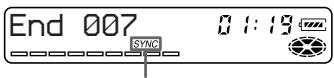
See the illustration in Japanese text (page 25). You can easily make a digital recording of a digital source on an MD by using the SYNCHRO REC switch. Before synchro-recording, be sure to make digital connection and insert a recordable MD. Note that track marks are automatically marked at the same positions as the source. 1 Slide the SYNCHRO REC switch to ON. "SYNC" lights up in the display. 2 Press and slide REC to the right. "REC" lights up in the display. The recorder starts recording when you start playing the source player. 3 Start the sound source.Notes
- Do not switch SYNCHRO REC while recording. Recording may not be done properly. - Even when there is no recorded sound on the sound source, there may be cases when recording does not pause automatically during synchro-recording due to the noise level emitted from the sound source. - If a silent portion is encountered for about 2 seconds during synchro-recording from a sound source other than a CD or an MD, a new track mark is automatically added at the point where the silent portion ends. - Synchro-recording cannot be done if the connecting cord is not an optical cable, or if the cable is connected to the MIC (PLUG IN POWER) jack. - You cannot manually change the recording mode or the recording level during synchro-recording.Recording without overwriting existing material
See the illustration in the Japanese text (page 26). If you wish to avoid overwriting the current contents of an MD, do the following procedure. All new material will then be recorded from the end of the current contents. 1 While the recorder is stopped, press the jog lever (L), flip the lever repeatedly until “Rec-Posi” flashes in the display, and then press the lever again. 2 Flip the jog lever (L) repeatedly until "From End" flashes in the display, and then press the lever.To start recording from the current point.
Select "From Here" in step 2.Notes
- If you start recording while the recorder is in play-pause mode, the recording will begin from the point at which it is paused. - The setting will remain even after the power is turned off.Recording from a microphone
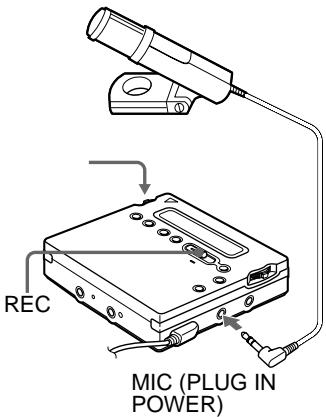
See the illustration in the Japanese text (page 27). Connect a stereo microphone (ECM-717, ECM-MS907, ECM-MS957, etc., not supplied) to the MIC (PLUG IN POWER) jack. 1 Press and slide REC to the right.To select microphone sensitivity
1 Press the jog lever (L) while the recorder is stopped, flip the lever repeatedly until "MIC SENS" flashes in the display, and then press the lever again. 2 Flip the jog lever (L) repeatedly to select "SENS HIGH" or "SENS LOW", and then press the lever.Notes
- You cannot record through the microphone while an optical cable is connected to the LINE IN (OPT) jack. The recorder automatically switches input in the following order; optical input, microphone input, and analog input. - The microphone may pick up the operating sound of the recorder itself. Use the microphone away from the recorder in such cases.Adding track marks automatically at specified intervals (Auto Time Stamp)
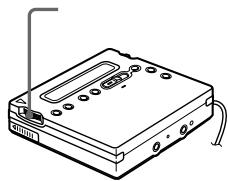
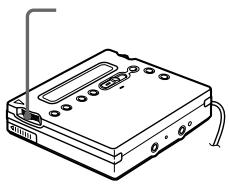
See the illustration in the Japanese text (page 28). Use this feature to add track marks automatically at specified intervals when recording through the analog input connector or a microphone. 1 While the recorder is recording or in recording pause, press the jog lever (L). 2 Flip the jog lever (L) repeatedly until "TIME MARK" flashes in the display, and then press the lever again. 3 Flip the jog lever (L) repeatedly until the desired time interval flashes in the display. Select one of the following intervals: "OFF" “5 min. ON” (track marks are added in every 5 minutes.) “10 min. ON” (track marks are added in every 10 minutes) “15 min. ON” (track marks are added in every 15 minutes) To cancel the setting, select "OFF" in this step. 4 Press the jog lever (L).Notes
- Automatic track marking by Auto Time Stamp starts when you add a normal track mark to the disc (i.e., by pressing T MARK or III, etc.). - The setting will be lost when the recording stopped.Adjusting the recording level manually (Manual recording)
See the illustration in the Japanese text (page 29). When you record, the sound level is adjusted automatically. If necessary, you can set the level manually.Note
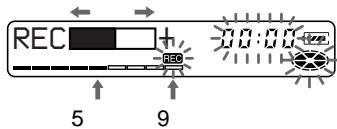
Adjust the recording level while the recorder is in standby mode. You cannot adjust it while recording. 1 While holding down Ⅲ, press and slide REC to the right. The recorder stands by for recording. 2 Press the jog lever (L), flip the lever until “RecVolume” flashes in the display, and then press the lever again. 3 Flip the jog lever (L) until "ManualREC" flashes in the display, and then press the lever. To switch back to the automatic level adjustment, repeat the procedure from step 2 and press the lever (L) while "Auto REC" flashes in the display. 4 Play the program source. 5 While observing the level meter in the display, adjust the recording level by flipping the lever (L). Set the level so that the input lights up around the fifth segment on the level meter. If the maximum input lights up the ninth segment, lower the level. Recording does not start in this step. If your source is an externally connected component, be sure to cue the source to the beginning of the material to be recorded before you start playback. 6 Press Ⅱ again to start recording.Notes
- The recording level cannot be adjusted while recording is in progress. If you want to adjust the recording level after you have started the recording, press III to pause the recorder. Then do the procedure from step 5. - You cannot adjust the recording level manually during synchro-recording.Setting the clock to stamp the recorded time
See the illustrations in the Japanese text (page 32). To stamp the date and time on the MD when you record, you first need to set the clock. 1 Press the jog lever (L) while no disc is inserted or the recorder is stopped. 2 Flip the jog lever (L) until “CLOCK SET” flashes in the display, and then press the lever. The digits of the year flash. 3 Change the current year by flipping the jog lever (L) and press to enter. The digit of the month flashes. 4 Repeat steps 3 to enter the current month, date, hour, and minute. When you press the jog lever (L) to enter the minute, the clock starts operating.If you make a mistake while setting the clock
Press ■, and set the clock again from step 2. You can skip a step by pressing the jog lever (L).To display the time in the 24-hour system
Press ■ while setting the clock. To change the clock to the 12-hour system, press ■ again.To maintain the correct time
Once you set the clock, it will keep correct time as long as the recorder is connected to a power source, such as the rechargeable battery, alkaline dry battery, or AC power adaptor. However, if no power source is connected, the clock setting will change back to the factory setting after about 3 minutes. When changing the rechargeable battery or alkaline dry battery, make sure to do it within 3 minutes.Note
Make sure the time is correctly set if you want the time stamp to be accurately recorded for an important recording.Copying CD text information while recording (Joint Text)
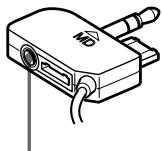
CD text connecting cable, CD that support CD-TEXT, and CD player that support Joint Text required. See the illustration in the Japanese text (pages 33 and 34) By connecting the recorder to a Sony portable CD player that supports Joint Text (the CD text copying function) (D-E990, etc.), you can copy track and disc names automatically during recording. In addition to the CD text connecting cable (RK-TXT1), make sure to connect the recorder to the portable CD player with an optical cable. 1 Press and slide REC to the right to start recording on the recorder, and start playing the CD in the portable CD player. “SYNC”, “REC” and “♪” lights up in the display. “CD TEXT” appears for a few seconds, then “001 TEXT?” and “PushENTER” alternate in the display. “NO TEXT” appears at this time if no track name information exists in the CD. In this case, the track name will not be copied. 2 Press the jog lever (L). Track name scrolls, and then the track name and “PushENTER” alternate in the display. 3 Press the jog lever (L). Track name scrolls in the display while the name is copied. 4 Follow steps 2 and 3 to copy each new track name that appears. 5 Press ■ on the recorder at the point you want to stop recording. “💡” lights up, and then “000 TEXT” and “PushENTER” alternate in the display. If you don't want to copy the disc name information, press ■ again. The disc name is not copied and the operation ends. “NO TEXT” appears at this time if no disc name information exists in the CD. In this case, the operation ends without copying the disc name. 6 Press the jog lever (L). Disc name scrolls, and then disc name and “PushENTER” alternate in the display. 7 Press the jog lever (L). "TOC Edit" flashes. Afterwards, the disc name scrolls in the display.Notes
\- If you copy disc name information to a disc with a previously recorded disc name, the old disc name will be overwritten with the new one. \- When the CD text copying function is on, various settings and editing functions cannot be accessed with the jog lever. \- The CD text copying function (joint text) can only be used with component (D-E990, D-E880, D-E770, D-F700, D-E01) with the joint text logo. \- The CD text copying function can only be used with CDs and component (D-E990, etc.) that support CD-TEXT. \- The RK-TXT1 CD text connecting cable is designed for exclusive use with this recorder and Sony portable CD player (D-E990, etc.). Do not use a connecting cable of another make to copy CD text information. \- The remote becomes inoperative when the CD text connecting cable (RK-TXT1) is connected to the recorder. \- Stopping or pausing playback on the CD player automatically causes recording on the recorder to pause. A new track mark is automatically added when you resume recording. \- The track name of the track currently played will not be recorded if you stop or pause CD playback in the middle of the copying process on the recorder.Various ways of playback
Changing the playback order
See the illustrations in the Japanese text (pages 35 to 37). Steeings can be stored to the Personal Disc Memory.On the recorder
Selecting a play mode
1 While the recorder is playing an MD or stopped, press the jog lever (L), flip until "PLAY MODE" flashes in the display, and then press the lever again. 2 Flip the jog lever (L) to select the play mode, and then press the lever. Each time you flip the lever (L), the play mode changes and when you press the lever to select, indication appears in the display as follows. play mode/indication "Normal" / "(none)" (All the tracks are played once) "AllRepeat" / "⊂" (All the tracks are played repeatedly) “1 Track”/“1” (A single track is played) “1 Repeat”/“⊂ 1 ” (A single track is played repeatedly) “Shuffle”/“SHUF” (After currently selected track finishes playing, the remaining tracks are played in random order) “Shuf. Rep”/“ SHUF”(After currently selected track finishes playing, the remaining tracks are played repeatedly in random order) “PGM”/“PGM” (Tracks are played in the order that you specified) “PGMRepeat”/“⊆ PGM” (tracks are played repeatedly in the order that you specified).Creating a Program (Program play)
1 Press the jog lever (L) while “PGM” flashes in the display at step 2 of “Selecting a play mode.” 2 Flip the jog lever (L) to select a track. 3 Press the jog lever (L) to enter a track number. 4 Repeat Step 2 and 3 to program more tracks. 5 Press the jog lever (L) for 2 seconds or more.On the remote control
You can select variouse play mode using the PLAYMODE and RPT/ENT buttons on the remote control.Selecting a play mode
Press PLAYMODE during playback. Each time you press this button, the play mode changes as follows. “(none)” (All the tracks are played once) “1” (A single track is played) “SHUF”(After currently selected track finishes playing, the remaining tracks are played in random order) “PGM” (Tracks are played in the order that you specified).Creating a Program (Program play)
1 While the recorder is stopped, playing or play-paused, press PLAYMODE repeatedly until “PGM” flashes in the display. 2 Turn the control towards ◀◀◀ or towards ▶▶▶◀ to select a track. 3 Press RPT/ENT to enter a track number. 4 Repeat Step 2 and 3 to program more tracks. 5 Press RPT/ENT for 2 seconds or more.Repeat play
Press RPT/ENT on the remote control during playback. “⊆” appears in the display.Notes on program setting.
- All program settings are lost when the disc is removed from the recorder. - If the recorder is stopped and left inactive for 5 minutes in the middle of a programming operation, the tracks selected up to that point are entered as the program.To adjust the sound quality (Digital Sound Preset)
See the illustrations in the Japanese text (pages 37 and 38). You can make adjustments to the sound quality to suit your taste, and then store two sets of these adjustments. Settings can be stored to the Personal Disc Memory. 1 Press SOUND on the remote control repeatedly to select "SOUND1" or "SOUND2". 2 During playback, press SOUND for 2 seconds or more. The recorder changes to bass-setting mode. Pressing the SOUND button for 2 seconds again changes the recorder back to treble-setting mode. 3 Turn the control on the remote control towards ◀◀◀ or towards ▶▶▶▶I repeatedly to adjust the bass or the treble. Pressing the SOUND button for less than 2 seconds toggles the display between “SOUND1” and “SOUND2”. When you press SOUND for a short time while adjusting bass or treble, the setting for that sound is entered and the display switches to the other sound setting. The sound can be adjusted in 8 steps (-4, -3, ...±0, ...+2, +3). 4 Press RPT/ENT. The sound settings are saved and the playback display appears again.To select a preset sound
Press the jog lever (L), flip the lever until “SOUND1” or “SOUND2” flashes or nothing appears in the display, and then press the lever again.Factory settings of the Digital Sound Preset
Factory settings of the Digital Sound Preset are the followings: - "SOUND1": bass +1, treble ±0 - "SOUND2": bass +3, treble ±0Notes
- You cannot set the Digital Sound Preset with the recorder. - Digital Sound Preset becomes inoperative when the “AUDIO OUT” parameter for the Ω/ LINE OUT jack is set to “LINE OUT”. In this case, set the “AUDIO OUT” to “HeadPhone” (page 77). - Sound distortion may occur when you use Digital Sound Preset. In this case, lower the volume or change the settings. - Changing to another Digital Sound Preset during a recording operation will not affect the quality of recorded sound.To change playback speed (Speed Control)
See the illustrations in the Japanese text (page 39). The playback speed can be adjusted in 7 steps (80%, 85%, ...100%, 105%, 110%). Setting can be stroed to the Personal Disc Memory. 1 Press DISPLAY on the remote control for 2 seconds or more during playback. 2 Turn the control on the remote control towards ◀◀ or towards ▶▶▶1 until "SPEED" flashes in the display, and then press ■ on the remote control. The recorder changes to speed-setting mode. 3 Turn the control towards ◀◀◀ or towards ▶▶▶▶I to select the playback speed. “+” shows the normal speed and the cursor shows the playback speed you are selecting. 4 Press ■ to set the playback speed. "S" appears in the display when the speed is changed.Notes
- You cannot change playback speed with the recorder. - The playback sound will be affected by the playback speed. - All settings will be lost when you remove the disc from the recorder.Storing the settings for individual discs (Personal Disc Memory)
See the illustrations in the Japanese text (pages 39 and 40). The recorder can store the various settings for each disc, and then retrieve them automatically whenever the disc is inserted. Do the following procedure to store the volume, the order of program play, sound quality (Digital Sound Preset), and playback speed (Speed control) settings for a disc.On the recorder
1 While the recorder is stopped, playing, or play-paused, press the jog lever (L). 2 Flip the jog lever (L) until "PERSONAL" flashes in the display, and then press the lever. "Entry?" flashes in the display. 3 Press the jog lever (L). “Entry OK” appears in the display and the disc settings are stored in the recorder.On the remote control
1 While the recorder is stopped, playing, or play-paused, press DISPLAY on the remote control for 2 seconds or more. 2 Turn the control on the remote control towards ◀◀ or towards ▶▶▶1 until "PERSONAL" flashes in the display, and then press ■ on the remote control. "Entry?" flashes in the display. 3 Press ■. "Entry OK" appears in the display and the disc settings are stored in the recorder.Erasing the disc information
Insert the disc whose information is to be erased and verify its contents. Do steps 1 and 2, then flip the jog lever (L) on the recorder or turn the control towards ◀◀ or towards ▶▶▶▶ on the remote control until “Erase?” flashes in the display, and then press the jog lever (L) on the recorder or ■ on the remote control. “Erase OK” appears in the display and the disc information is erased. If you try to erase the disc information of a disc that have never been stored, “No Entry!” appears in the display for 2 seconds.Notes
- The settings for up to 20 discs can be stored. Any settings stored afterwards will replace the settings for the least used disc among the 20. - If you use another minidisc recorder to edit or add tracks to a disc whose settings have been stored on the recorder, the disc will no longer be recognizable by the recorder and the stored information will become useless.Connecting to a stereo system (LINE OUT)
See the illustration in Japanese text (page 42). Connect the Ω/ LINE OUT jack of the recorder to the LINE IN jacks of an amplifier or a tape recorder with a line cable (RK-G129 or RK-G136, not supplied). The output is analog. The recorder plays the MD digitally and sends analog signals to the connected equipment.When connecting a line cable to the Ⓞ/LINE OUT jack
When connecting a line cable (not supplied), be sure to set the “AUDIO OUT” parameter for the ☐/LINE OUT jack. 1 Press the jog lever (L), flip the lever until “AUDIO OUT” flashes in the display, and then press the lever again. 2 Flip the lever (L) until “LINE OUT” flashes in the display, and then press the lever.Notes
- If the “AUDIO OUT” parameter for the Ω /LINE OUT jack is set to “LINE OUT”, VOL +/- or Digital Sound Preset will not function. - The “AUDIO OUT” parameter for the Ω/ LINE OUT jack cannot be set to “LINE OUT” when the supplied remote control is connected. - When you connect the headphones/earphones directly to the recorder, set the "AUDIO OUT" parameter for the Ω /LINE OUT jack to "HeadPhone". - When you turn off the power, the “AUDIO OUT” parameter for the / LINE OUT jack automatically switches to “HeadPhone”.▶Editing recorded tracks
You can edit your recordings by adding/ erasing track marks or labeling tracks and discs. Premastered MDs cannot be edited.Notes on editing
- Do not move or jog the recorder while “TOC Edit”* is flashing in the display. - You cannot edit tracks on an MD that is record -protected. Before editing tracks, close the tab on the side of the MD. - If you perform an editing operation while playing, be sure not to turn the power off until “TOC Edit” disappears in the display. - The lid does not open until “TOC Edit” disappears in the display after editing. * TOC = Table of ContentsErasing a track
See the illustration in the Japanese text (page 43). You can quickly erase a recorded track. Note that once a recording has been erased, you cannot retrieve it. Make sure of the track you are erasing. 1 While playing the track you want to erase, press the jog lever (L), flip the lever repeatedly until “EDIT” flashes in the display, and then press the lever again. “♪: Name” flashes in the display, and the recorder plays the selected track repeatedly. 2 Flip the jog lever (L) until “♪: Erase” flashes in the display, and then press the lever. “Erase OK?” and “PushENTER” appear alternately in the display. To cancel erasing, press ■. 3 Press the jog lever (L) again. The track is erased and the next track starts to play. All the tracks after the one erased are automatically renumbered.To erase a part of a track
Add track marks at the beginning and the end of the part you want to erase, then erase the part.Erasing a whole disc
See the illustration in the Japanese text (page 44). You can quickly erase all the tracks and data of the MD at the same time. Note that once a recording has been erased, you cannot retrieve it. Be sure to check the contents of the disc you want to erase. 1 While the recorder is stopped, press the jog lever (L), flip the lever until "EDIT" flashes in the display, and then press the lever again. "○ : Name" flashes in the display. 2 Flip the jog lever (L) until “Erase” flashes in the display, and then press the lever. “AllErase?” and “PushENTER” appear alternately in the display. To cancel erasing, press ■. 3 Press the jog lever (L) again. “TOC Edit” flashes in the display, and all the tracks will be erased. When erasing is complete, “BLANKDISC” appears in the display.Adding a track mark
See the illustration in the Japanese text (page 44). You can insert a track mark into a track. 1 While playing or pausing an MD, press T MARK on the recorder at the point you want to mark. “MARK ON” appears in the display, and the track mark is added.To add track marks while recording (except while synchro-recording)
Press T MARK at the point you want to add a track mark. You can use Auto Time Stamp to add track marks automatically at specified intervals.Erasing a track mark
See the illustrations in the Japanese text (page 45). When you record with analog (line) input, unnecessary track marks may be recorded where recording level is low. You can erase a track mark to combine the tracks before and after the track mark. 1 While playing the track with the track mark you want to erase, press Ⅱ to pause. 2 Find the track mark by flipping the jog lever (R) towards ◀◀◀ slightly. "00:00" flashes in the display. 3 Press T MARK to erase the mark. "MARK OFF" appears in the display. The track mark is erased and the two tracks are combined. The number of the newly combined track will be that of the first track and the succeeding tracks will be renumbered.Notes
- You cannot erase a track mark that has been written between track marks recorded in different recording mode (such as a track mark between a track recorded in LP2 and a track recorded in LP4). If you try to erase such a track mark, “SORRY” appears in the display. - You cannot erase a track mark that has been written between a track recorded through a digital connection and a track recorded through an analog connection. If you try to erase such a track mark, "SORRY" appears in the display.Moving recorded tracks
See the illustrations in the Japanese text (page 46). You can change the order of the recorded tracks.On the recorder
1 While playing the track you want to move, press the jog lever (L), flip the lever until “EDIT” flashes in the display, and then press the lever again. “♪: Name” flashes in the display and the recorder plays the selected track repeatedly. 2 Flip the jog lever (L) until “♪: Move” flashes in the display, and then press the lever. 3 Flip the jog lever (L) to select the destination track number. To cancel moving, press ■. 4 Press the jog lever (L) again. The track moves to the selected destination track.On the remote control
1 Press DISPLAY for 2 seconds or more, turn the control towards ◀◀◀ or towards ▶▶▶▶ until “EDIT” flashes in the display, and then press ■. “♪: Name” flashes in the display and the recorder plays the selected track repeatedly. 2 Turn the control towards ◀◀◀ or towards ▶▶▶▶▶ until “♪♪ : Move” appears in the display, and then press ■. 3 Turn the control towards ◀◀◀ or towards ▶▶▶▶▶ to select the destination track number. 4 Press ■. The selected track moves just before the destination track.Labeling recordings
See the illustration in the Japanese text (pages 47 and 48). You can name tracks during playback, discs during stop, and both during recording. Each name can be as long as 200 letters. Each disc can hold up to 1700 alphanumeric letters or 800 katakana characters during playback or stop.Available characters
• Capital and small letters of the English alphabet. - Numbers 0 to 9 • ! " # \$ % & ( ) * . ; < = > ? @ _ ^ + - ^ , /: _ (space)Labeling on the recorder
Labeling a disc during stop
1 Insert a disc. 2 Press the jog lever (L), flip the lever until “EDIT” flashes in the display, and then press the lever again. “ :Name”flashesin the display. 3 Press the jog lever (L) again. 4 Flip the jog lever (L) to select a letter and press the lever to enter. The selected letter stops flashing and the cursor moves to the next input position. Press Ⅱ to switch between katakana, the alphabet, symbols/numbers, and phrases (if phrases are stored in the phrase bank). Press VOL +/- to move the cursor to left or right. Flip the jog lever (R) towards ▶▶I when inputting alphabet, symbol or numbers to change the letter to the one before/next one. Flip the jog lever (R) towards ◀◀◀ to go back. Press END SEARCH together with VOL + to insert a blank space to type in a new letter. Press END SEARCH together with VOL – to delete a letter and move back all following letters to the left. Press ■ to cancel labeling. 5 Repeat step 4 and enter all characters of the label name. 6 Press down the jog lever (L) for 2 seconds or more. The track or disc is labeled.Labeling a track during playback
1 Insert a disc and play the track you want to label. 2 Press the jog lever (L), flip the lever until “EDIT” flashes in the display, and then press the lever again. " ♩ : Name " flashes in the display. 3 Press the jog lever (L) again. 4 Follow steps 4 to 6 of "Labeling a disc during stop" above.Labeling a track or a disc during recording
" ♩ : Name " flashes in the display. 1 While recording, press the jog lever (L), flip the lever until “EDIT” flashes in the display, and then press the lever again. 2 To label a track, press the jog lever (L) again. To label a disc, flip the lever (L) until “☐ : Name” flashes in the display, and then press the lever. 3 Follow steps 4 to 6 of "Labeling a disc during stop" above. To cancel labeling, press ■.Labeling on the remote control Labeling a disc during stop
1 Insert a disc. To label a disc that is already in the recorder, press ■ to stop. 2 Press DISPLAY for 2 seconds or more, turn the control towards ◀◀◀ or towards ▶▶▶◀ until “EDIT” flashes in the display, and then press ■. “ : Name ” flashes in the display. 3 Press ■. The disc is ready to be labeled. 4 Turn the control towards ◀◀◀ or towards ▶▶▶▶▶ to select a letter and press ■ to enter. The selected letter stops flashing and the cursor moves to the next input position. Press Ⅱ to switch between katakana, the alphabet, symbols/numbers, and phrases (if phrases are stored in the phrase bank). Pull and turn the control towards VOL + or towards - to move the cursor to left or right. Turn the control towards ▶▶▶ when inputting alphabet, symbol or numbers to change the letter to the one before/ next one. Turn towards ◀◀◀ to go back. Press DISPLAY to insert a blank space to type in a new letter. Press DISPLAY for 2 seconds or more to cancel labeling. Press PLAYMODE to delete a letter and move back all following letters to the left. 5 Repeat step 4 and enter all characters of the label name. 6 Keep pressing ■ for 2 seconds or longer. The track or disc is labeled.Labeling a track during playback
1 Insert a disc and play the track you want to label. 2 Press DISPLAY for 2 seconds or more, turn the control towards ◀◀◀ or towards ▶▶▶▶ until “EDIT” flashes in the display, and then press ■. “♪: Name” flashes in the display. 3 Press ■. The disc is ready to be labeled. 4 Follow steps 4 to 6 of "Labeling a disc during stop" above.Labeling a track or a disc during recording
1 Press DISPLAY for 2 seconds or longer during recording, turn the control towards ◀◀◀ or towards ▶▶▶▶ until “EDIT” flashes in the display, and then press ■. “♪: Name” flashes in the display. 2 To label a track, press ■. To label a disc, turn the control towards ◀◀◀ or towards ▶▶▶▶ until “◀: Name” flashes in the display, then press ■. 3 Follow steps 4 to 6 of "Labeling a disc during stop" above.To cancel labeling, press DISPLAY for 2 seconds or more.
Notes
\- When the recording is stopped while labeling a track or a disc during recording, or when the playback moves on to the next track while labeling a track during playback, the input at that point is entered automatically. \- “LP:” has automatically been added at the beginning of the track names for tracks recorded in LP2 or LP4 mode.Relabeling recordings
Follow the steps corresponding to the labeling method until the disc or track is ready to be labeled. Enter a new character over the one you want to change, then press the jog lever (keep pressing ■ for 2 seconds or more on the remote control).Notes
\- Track and disc titles that were entered in Japanese katakana characters will appear in Roman letters on minidisc players that do not support the display of katakana characters. Such titles will be marked with a “^” at the beginning and the end. \- You cannot relabel premastered MDs or label MDs that have not been recorded. \- The recorder cannot rewrite a disc or track name of more than 200 letters that was created by another device.Storing phrases frequently used in labeling (Phrase Bank)
See the illustration in the Japanese text (pages 50 and 51) Phrases that you often use in track or disc labeling can be stored in the recorder's memory. Approximately 40 phrases of about 10 characters each (with a total character count of about 600) can be stored in the phrase bank. The actual number will depend on the length of each phrases.On the recorder
Storing phrases while labeling a track or disc 1 Do the procedure “Labeling on the recorder” in “Labeling recordings” (page 88) to enter a phrase. 2 After entering the phrase, press ■ for 2 seconds or more. “Entry!” appears in the display and the cursor flashes after the phrase you just stored. You can then continue with labeling operation. Storing phrases using the EDIT menu 1 Press the jog lever (L), flip the lever until “EDIT” flashes in the display, and then press the lever again. 2 Flip the jog lever (L) until “Name Bank” flashes in the display, and then press the lever. 3 Enter the phrase you want to store, and then press the jog lever (L) for 2 seconds or more. “Entry!” appears in the display and the phrase is stored.Retrieving phrases stored in the phrase bank
You can retrieve a phrase stored in the phrase bank anytime you want to use it in a track or disc name.Searching for a phrase by displaying the stored phrase one by one
1 Do the procedure “Labeling on the recorder” in “Labeling recordings” (page 88) until “☐:Name” or “♪:Name” flashes in the display. Then press the jog lever (L). 2 Press III repeatedly until the first phrase stored in the phrase bank appears in the display. 3 Flip the jog lever (L) repeatedly. Flipping the jog lever (L) causes the phrases stored in the phrase bank to appear one by one in sequential order. If you press Ⅲ at this time, the first phrase stored in the phrase bank retrieved. 4 Press the jog lever (L) while the phrase you want is shown in the display. The cursor flashes after the phrase you just retrieved. You can then continue with labeling operation.Searching for a phrase by its first letter
1 When labeling a track or disc, use VOL + / - to move the cursor to the letter which the desired phrase begins with. 2 Press Ⅱ to search. The phrase for that letter appears in the display. If there are two or more phrases that start with that letter, press ■ to see the next phrase. 3 Press the jog lever (L) while the phrase you want is shown in the display. The cursor flashes after the phrase you just retrieved. You can then continue with labeling operation.Erasing phrases
You can erase phrases from the phrase bank while the recorder is stopped. You can also erase phrases when the recorder is empty. 1 Press the jog lever (L), flip the lever until “EDIT” appears, and then press the lever again. 2 Flip the jog lever (L) until “BankErase” appears, and then press the lever. 3 Flip the jog lever (L) until the phrase you want to erase appears, and then press the lever. “Erase!” appears and the phrase is erased. If no phrase is stored in the phrase bank, “EMPTY” appears in the display.To cancel the operation, press ■.
On the remote control
Storing phrases while labeling
1 Do the procedure “Labeling on the remote control” in “Labeling recordings” (page 88) to enter a phrase. 2 After entering the phrase, press ■ for 2 seconds or more. “Entry!” appears in the display and the cursor flashes after the phrase you just stored. You can then continue with labeling operation.Storing phrases using the EDIT menu
1 Press DISPLAY for 2 seconds or more, turn the control towards ◀◀◀ or towards ▶▶▶▶ until “EDIT” flashes in the display, and then press ■. 2 Turn the control towards ◀◀◀ or towards ▶▶▶▶ until “Name Bank” flashes in the display, and then press ■. 3 Enter the phrase you want to store, then press ■ for 2 seconds or more. "Entry!" appears in the display and the phrase is stored.Retrieving phrases stored in the phrase bank
Searching for a phrase by displaying the stored phrases one by one
1 Do the procedure “Labeling on the remote control” in “Labeling recordings” (page 88) until “☐:Name” or “☐:Name” appears in the display. Then press ■. 2 Press Ⅱ repeatedly until the first phrase stored in the phrase bank appears in the display. 3 Turn the control towards ◀◀◀ or towards ▶▶▶▶I repeatedly. Turning the control towards ◀◀◀ or towards ▶▶▶▶I causes the phrases stored in the phrase bank to appear one by one. If you press ▪ at this time, the first phrase stored in the phrase bank retrieved. 4 Press ■ while the phrase you want is shown in the display. The cursor flashes after the phrase you just retrieved. You can then continue with labeling operation.Searching by the first letter of a phrase
1 When labeling a track or disc, pull and turn the control towards VOL + or towards - to move the cursor to the letter which the desired phrase begins with. 2 Press Ⅱ to search. The phrase for that letter appears in the display. If there are two or more phrases that start with that letter, press Ⅱ to see the next phrase. 3 Press ■ while the phrase you want is shown in the display. The cursor flashes after the phrase you just retrieved. You can then continue with labeling operation.Erasing phrases
1 Press DISPLAY for 2 seconds or more, turn the control towards ◀◀◀ or towards ▶▶▶▶ until “EDIT” flashes in the display, and then press ■. 2 Turn the control towards ◀◀◀ or towards ▶▶▶▶I repeatedly until “BankErase” appears in the display, and then press ■. 3 Turn the control towards ◀◀◀ or towards ▶▶▶▶I repeatedly until the phrase you want to erase appears, and then press ■. “Erase!” appears in the display and the phrase is erased. If there is no phrase stored in the phrase bank, “EMPTY” appears in the display. To cancel the operation, press DISPLAY for 2 seconds or more.Setting the alarm (Melody Timer)
See the illustrations in the Japanese text (pages 54 and 55). You can set the alarm to go off in 1 to 99 minutes.On the recorder
1 While the recorder is stopped, playing, or play-paused, press the jog lever (L). 2 Flip the jog lever (L) until "M-TIMER" flashes in the display, and press the lever. 3 Flip the jog lever (L) until “ON” flashes in the display, and then press the lever. (●) lights up in the display. 4 Flip the jog lever (L) repeatedly to select the elapsed time. One rotation of the control changes the elapsed time setting (TIME :) by 1 minute, within a range of 1 to 99 minutes. To change the time quickly, flip and hold the jog lever (L). 5 Press the jog lever (L). The time is set. 6 Flip the jog lever (L) repeatedly to select the alarm sound. The following sounds can be selected: "MELODY : 1" Melody (Orpheus in the Underworld) "MELODY : 2" Melody (The Four Seasons) "MELODY : 3" Beeps 7 Press the jog lever (L). Melody timer is set. The time remaining until the alarm is shown in the display while the recorder is stopped or play-paused. To show the remaining time during play, do steps 1 to 3.On the remote control
1 While the recorder is stopped, playing, or play-paused, press DISPLAY on the remote control for 2 seconds or more, and then press ■. 2 Turn the control towards ◀◀◀ or towards ▶▶▶▶ until “M-TIMER” flashes in the display, and then press ■. 3 Turn the control towards ◀◀◀ or towards ▶▶▶▶ until “ON” flashes in the display, and then press ■. (●) lights up in the display. 4 Turn the control towards ◀◀◀ or towards ▶▶▶◀ to select the elapsed time. One rotation of the control changes the elapsed time setting (TIME :) by 1 minute, within a range of 1 to 99 minutes. To change the time quickly, turn and hold the control towards ◀◀◀ or towards ▶▶▶◀. 5 Press ■. The time is set. 6 Turn the control towards ◀◀◀ or towards ▶▶▶◀ to select the alarm sound. The following sounds can be selected: "MELODY : 1" Melody (Orpheus in the Underworld) "MELODY : 2" Melody (The Four Seasons) "MELODY : 3" Beeps 7 Press ■. The alarm is set. The time remaining until the alarm is shown in the display while the recorder is stopped or play-paused. To show the remaining time during play, do steps 1 to 3.To cancel setting the alarm.
Press ■ on the recorder, or press DISPLAY for 2 seconds or more on the remote control.To cancel Melody Timer.
Select “OFF” in step 2, and then press the jog lever (L) on the recorder or ■ on the remote control.To stop the alarm.
Press any button.Notes
- The settings will be lost when you start recording. - The timer will begin counting down (using the factory setting) from the moment you select “ON” in step 3. The recorder will begin counting down again from the moment you change the elapsed time in step 4.Power sources
You can use the recorder on ... - house current. - a nickel metal hydride rechargeable battery (supplied). - dry battery (not supplied). It is preferable to use the recorder on house current when recording for a long time. Battery life 1) When recording 2) (JEITA 3) ) (Unit: approx. hours)| Batteries | Stereo | LP2 | LP4 |
| NH-14WM nickel metal hydride rechatgeable battery4) | 8 | 10.5 | 13 |
| LR6(SG) alkaline dry battery5) | 7 | 10 | 14 |
| NH-14WM nickel metal hydride rechargeable battery4) + one LR6 (SG)5) | 19 | 26 | 30 |
| Batteries | Stereo | LP2 | LP4 |
| NH-14WM nickel metal hydride rechatgeable battery4) | 21 | 23 | 26 |
| LR6(SG) alkaline dry battery5) | 30 | 35 | 38 |
| NH-14WM nickel metal hydride rechargeable battery4) + one LR6 (SG)5) | 53 | 60 | 66 |
When to replace the batteries
When the dry battery or rechargeable battery are weak, flashing ☐ or “LOW BATT” appears in the display. Replace the dry battery or charge the rechargeable battery. The battery level indicator is approximate.Note
Stop the recorder before replacing battery.Additional information
Messages
If the recorder cannot carry out an operation, error messages may flash in the display window as follows.BLANK DISC :
You tried to play an MD with no recording on it.DISC ERR :
The recorder cannot read the MD (it is scratched or dirty). Reinsert the MD. If the same message still appears, replace the MD.DISC FULL :
There is no more space to record on the MD.Data Save:
The MD recorder is recording information (sounds) from the memory to the disc. Wait until this process is completed. Do not expose the recorder to any physical shock, nor disrupt power supply.TOC Edit :
The MD recorder is recording information (track start and end position) from the memory to the disc. Wait until this process is completed. Do not expose the recorder to physical shock, nor disrupt power supply.BUSY :
You tried to operate the recorder while it was accessing the recorded data. Wait until the message goes out (in rare cases, it may take a few minutes).NAME FULL :
You tried to enter more than 200 letters to label a single track or disc. You tried to enter a total of more than 1700 letters for track or disc names.Hi DC in :
The power supply is higher than required. Use the recommended power sources.HOLD :
You tried to operate the recorder with the HOLD switch slid in the direction of the arrow. Slide back the switch.LOW BATT :
The rechargeable battery or dry battery is weak. Charge the rechargeable battery or replace the dry battery.MEM OVER :
You started recording with the recorder receiving continuous vibration. Put the recorder on the stable place and start recording again.NO COPY :
You tried to make a copy from a disc that is protected by the Serial Copy Management System. You cannot make copies from a digitally connected source which was itself recorded using the digital connection. Use the analog connection instead.NO DISC :
You tried to play or record with no disc in the recorder.NO SIGNAL :
The recorder could not detect digital input signals. Make sure that the source is connected firmly. If the message appears while recording, press ■ to end recording.P/B ONLY :
You tried to record or edit on a premastered MD (P/B stands for playback).PROTECTED :
You tried to record or edit on an MD with its tab in the record-protect position.SORRY :
You tired to set Digital Sound Preset while the “AUDIO OUT” parameter is set to “LINE OUT.” Use the jog lever (L) to set the “AUDIO OUT” parameter to “HeadPhone.” You tried to erase a track mark while playing the MD or at the beginning of the first track. You tried to erase a track mark to combine tracks the recorder cannot combine (a track recorded in different recording mode such as in LP2 and LP4, or a track recorded through analog connection and digital connection)*. You tried to overwrite a track marrk. You tried to press Ⅲ, T MARK or REC MODE while synchro-recording or the joint text function is active. * If you have recorded or erased many times on the same MD, the data of a single track may be scattered throughout the MD. When the data is scattered in groups of less than 12 seconds long, the recorder will not be able to combine the tracks.TEMP OVER :
Heat has built up in the recorder. Wait until the recorder cools down.TR FULL:
You tried to record more than 254 tracks.TrPROTECT :
You tried to record over or edit a track which has been protected from being recorded over*. * Track-protected MiniDiscs — Some MD recorders will let you protect individual tracks from being recorded over. This recorder, however, does not offer this feature.EDITING
You pressed a key on the recorder while editing on the remote control, or vice versa.LINE OUT
You pressed VOL +/- while the “AUDIO OUT” parameter is set to “LINE OUT.” Use the jog lever (L) to set the “AUDIO OUT” parameter to “HeadPhone.”NO TEXT
You tried to use the CD text copying function to copy a track or disc name from a CD that has no text data.EMPTY
You tried to erase data in the phrase bank but no data have been recorded.BANK FULL
The phrase bank is almost full and cannot store the phrase you tried to enter. Delete some phrases from the phrase bank, and then reenter the new phrase. 048 794 5194 9 6 http://www.sony.co.jp/ VOC (1%)Sony Corporation, 6-7-35 Kitashinagawa, Shinagawa-ku, Tokyo 141-0001, Japan
お問い合わせはお客様ご相談センターへ ● ナビダイヤル…… 0570-00-3311 (全国どこからでも市内通話料金でご利用いただけます) ● 携帯電話・PHSでのご利用は… 03-5448-3311 ● Fax 0466-31-2595 受付時間: 月~金 9:00\~ 20:00、 土·日·祝日 9:00\~ 17:00
- OPERATING INSTRUCTIONS
- NOTE
- DANGER
- WARNING
- AC
- REC
- OFF
- DISPLAY
- CD
- CD CD
- JOINT TEXT
- SOUND
- RPT/ENT
- LINE OUT
- EDIT
- NI-MH
- TOC EDIT
- MD
- LOOKING AT THE CONTROLS
- THE DISPLAY WINDOW OF THE RECORDER
- THE HEADPHONES/EARPHONES WITH A REMOTE CONTROL
- THE DISPLAY WINDOW OF THE REMOTE CONTROL
- HOW TO USE THE JOG LEVER
- JOG LEVER FUNCTIONS
- JOG LEVER (L) (MENU/ENTER)
- HOW TO USE THE CONTROL ON THE REMOTE CONTROL
- PREPARING
- GETTING STARTED
- NOTES ON RECHARGEABLE BATTERY
- NOTES ON DRY BATTERY
- MD RECORDING
- RECORDING AN MD RIGHT AWAY
- TO STOP RECORDING, PRESS
- NOTES
- IF THE RECORDING DOES NOT START
- PLAYING AN MD RIGHT AWAY
- START PLAYING
- ABOUT THE ANTI-SKIP FUNCTION
- IF THE PLAYBACK DOES NOT START
- WHEN USING THE HEADPHONES/EARPHONES, CONNECT THEM DIRECTLY TO THE RECORDER
- VARIOUS WAYS OF RECORDING
- CONNECTING DIGITAL (OPTICAL) AND ANALOG (LINE) INPUTS
- RECORDING WITH ANALOG INPUT (LINE CABLE REQUIRED)
- RECORDING FOR LONG TIMES
- SYNCHRO-RECORDING FROM A DIGITAL SOURCE
- RECORDING WITHOUT OVERWRITING EXISTING MATERIAL
- TO START RECORDING FROM THE CURRENT POINT
- RECORDING FROM A MICROPHONE
- TO SELECT MICROPHONE SENSITIVITY
- ADDING TRACK MARKS AUTOMATICALLY AT SPECIFIED INTERVALS (AUTO TIME STAMP)
- ADJUSTING THE RECORDING LEVEL MANUALLY (MANUAL RECORDING)
- SETTING THE CLOCK TO STAMP THE RECORDED TIME
- IF YOU MAKE A MISTAKE WHILE SETTING THE CLOCK
- TO DISPLAY THE TIME IN THE 24-HOUR SYSTEM
- TO MAINTAIN THE CORRECT TIME
- COPYING CD TEXT INFORMATION WHILE RECORDING (JOINT TEXT)
- VARIOUS WAYS OF PLAYBACK
- CHANGING THE PLAYBACK ORDER
- ON THE RECORDER
- SELECTING A PLAY MODE
- CREATING A PROGRAM (PROGRAM PLAY)
- ON THE REMOTE CONTROL
- REPEAT PLAY
- NOTES ON PROGRAM SETTING
- TO ADJUST THE SOUND QUALITY (DIGITAL SOUND PRESET)
- TO SELECT A PRESET SOUND
- FACTORY SETTINGS OF THE DIGITAL SOUND PRESET
- TO CHANGE PLAYBACK SPEED (SPEED CONTROL)
- STORING THE SETTINGS FOR INDIVIDUAL DISCS (PERSONAL DISC MEMORY)
- ERASING THE DISC INFORMATION
- CONNECTING TO A STEREO SYSTEM (LINE OUT)
- WHEN CONNECTING A LINE CABLE TO THE Ⓞ/LINE OUT JACK
- EDITING RECORDED TRACKS
- NOTES ON EDITING
- ERASING A TRACK
- TO ERASE A PART OF A TRACK
- ERASING A WHOLE DISC
- ADDING A TRACK MARK
- TO ADD TRACK MARKS WHILE RECORDING (EXCEPT WHILE SYNCHRO-RECORDING)
- ERASING A TRACK MARK
- MOVING RECORDED TRACKS
- LABELING RECORDINGS
- AVAILABLE CHARACTERS
- LABELING ON THE RECORDER
- LABELING A DISC DURING STOP
- LABELING A TRACK DURING PLAYBACK
- LABELING A TRACK OR A DISC DURING RECORDING
- LABELING ON THE REMOTE CONTROL LABELING A DISC DURING STOP
- TO CANCEL LABELING, PRESS DISPLAY FOR 2 SECONDS OR MORE
- RELABELING RECORDINGS
- STORING PHRASES FREQUENTLY USED IN LABELING (PHRASE BANK)
- RETRIEVING PHRASES STORED IN THE PHRASE BANK
- SEARCHING FOR A PHRASE BY DISPLAYING THE STORED PHRASE ONE BY ONE
- SEARCHING FOR A PHRASE BY ITS FIRST LETTER
- ERASING PHRASES
- TO CANCEL THE OPERATION, PRESS
- STORING PHRASES WHILE LABELING
- STORING PHRASES USING THE EDIT MENU
- SEARCHING FOR A PHRASE BY DISPLAYING THE STORED PHRASES ONE BY ONE
- SEARCHING BY THE FIRST LETTER OF A PHRASE
- SETTING THE ALARM (MELODY TIMER)
- TO CANCEL SETTING THE ALARM
- TO CANCEL MELODY TIMER
- TO STOP THE ALARM
- POWER SOURCES
- WHEN TO REPLACE THE BATTERIES
- ADDITIONAL INFORMATION
- MESSAGES
- BLANK DISC
- DISC ERR
- DISC FULL
- DATA SAVE
- BUSY
- NAME FULL
- HI DC IN
- HOLD
- LOW BATT
- MEM OVER
- NO COPY
- NO DISC
- NO SIGNAL
- P/B ONLY
- PROTECTED
- SORRY
- TEMP OVER
- TR FULL
- TRPROTECT
- EDITING
- NO TEXT
- EMPTY
- BANK FULL
- SONY CORPORATION, 6-7-35 KITASHINAGAWA, SHINAGAWA-KU, TOKYO 141-0001, JAPAN
Brand : SONY
Model : MZ-R900
Category : MiniDisc Player