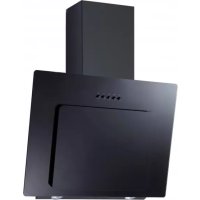
9039X - Range hood PKM - Free user manual and instructions
Find the device manual for free 9039X PKM in PDF.



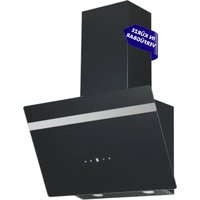
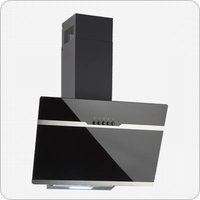
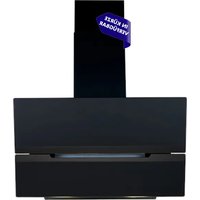
| Brand | PKM |
| Model | 9039X |
| Product type | Extractor hood |
| Installation width | 60 cm |
| Control type | 5 push buttons |
| Operating modes | Extraction / Recirculation |
| Energy efficiency class | A |
| Annual energy consumption | 18.6 kWh |
| Airflow (min/max) | 188 / 322 m³/h |
| Noise level (min/max) | 57 / 66 dB |
| Connected power | 47 W |
| Voltage / Frequency | 220-240 V ~ 50 Hz |
| Lighting | 2 x 1 W LED |
| Grease filter | Aluminum, dishwasher safe |
| Charcoal filter (optional) | Code CO4, replacement 3-6 months |
| Minimum distance (electric cooking) | 65 cm |
| Minimum distance (gas cooking) | 75 cm |
| Minimum distance (charcoal/wood) | 85 cm |
| Connection diameter | 120 / 150 mm |
| Telescopic chimney | Yes, from 40 to 73 cm |
| Net weight | Approximately 8.5 kg (estimated) |
Frequently Asked Questions - 9039X PKM
User questions about 9039X PKM
0 question about this device. Answer the ones you know or ask your own.
Ask a new question about this device
Download the instructions for your Range hood in PDF format for free! Find your manual 9039X - PKM and take your electronic device back in hand. On this page are published all the documents necessary for the use of your device. 9039X by PKM.
USER MANUAL 9039X PKM
natural_image
Exterior view of a black industrial kitchen air conditioner unit (no text or symbols visible)| Deutsch | Seite | 2 |
| English | Page | 36 |
| Français | Page | 68 |
| Nederlands | Pagina | 94 |
natural_image
Technical line drawing of a mechanical assembly with a magnified inset showing a component detail (no text or symbols)6.
natural_image
Technical line drawing of a mechanical assembly with a cylindrical component mounted on a base plate (no text or symbols)natural_image
Cross-sectional diagram of a pipe system with brick walls and water flow indicators (no text or labels)natural_image
Diagram of a brick chimney with ventilation ducts and a magnified inset showing internal structure (no text or labels)10.
natural_image
Technical illustration of a mechanical device with a cylindrical component and curved arrow indicating motion (no text or symbols)11.
natural_image
Diagram of a mechanical or fluidic device with directional arrows indicating flow or movement (no text or symbols)3.2.1 Kohlefilter
Produktkode: CO4
natural_image
Simple line drawing of a hand holding a small object over a flat surface, with an arrow indicating direction (no text or symbols)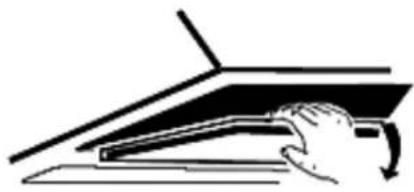
natural_image
Simple line drawing of a hand pressing down on a flat surface with a curved arrow indicating rotation (no text or symbols)natural_image
Collection of simple line drawings representing sun, wind turbine, fan, and circle symbols (no text or labels)natural_image
Diagram showing a hand holding a tablet with an arrow pointing to a screen, no text or symbols present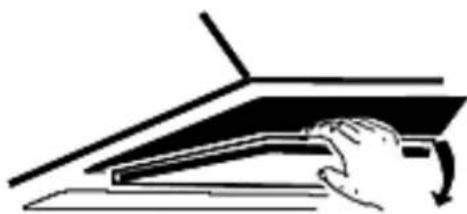
natural_image
Simple line drawing of a hand pressing down on a flat surface with a curved arrow indicating motion (no text or symbols)natural_image
Close-up of hands holding a small electronic device with a circular lens and screen (no visible text or symbols)natural_image
Close-up of a hand holding a transparent glass eyewear with a small white object, no visible text or symbols.Dear customer! We would like to thank you for purchasing a product from our wide range of domestic appliances. Read the complete instruction manual before you operate the appliance for the first time. Retain this instruction manual in a safe place for future reference. If you transfer the appliance to a third party, also hand over this instruction manual.
Index
- Safety instructions ....38
1.1 Signal words ....39
1.2 Safety instructions....39
- Installation 42
2.1 Important installation instructions: extraction mode....42
2.2 Minimum distances....43
2.3 Components of the appliance ....44
2.4 Installation steps....45
2.5 Electrical connection....52
- Extraction mode / Recirculation mode ....52
3.1 Extraction mode....52
3.2 Recirculation mode 53
3.2.1 Carbon filters ....53
3.3 Grease filter....55
- Control panel and operation ....55
4.1 Control panel 55
4.2 Operation....56
- Environmental protection ....57
5.1 Environmental protection: disposal....57
5.2 Environmental protection: energy saving....58
- Cleaning and maintenance....58
6.1 Grease filters 59
6.2 Carbon filters 60
6.3 Replacing of the illuminant....61
- Troubleshooting....63
-
Technical data....65
-
Waste management....66
- Guarantee conditions ....67
X. Technical drawing 122

Do not dispose of this appliance together with your domestic waste. The appliance must be disposed of at a collecting centre for recyclable electric and electronic appliances. Do not remove the symbol from the appliance.
The figures in this instruction manual may differ in some details from the current design of your appliance. Nevertheless, follow the instructions in such a case.
i Any modifications, which do not influence the functions of the appliance. shall remain reserved by the manufacturer.
i Please dispose of the packing with respect to your current local and municipal regulations.
The appliance you have purchased may be an enhanced version of the unit this manual was printed for. Nevertheless, the functions and operating conditions are identical. This manual is therefore still valid.
i Technical modifications as well as misprints shall remain reserved.
EU - DECLARATION OF CONFORMITY
★ The products, which are described in this instruction manual, comply with the harmonised regulations.
★ The relevant documents can be requested from the final retailer by the competent authorities.
MAKE SURE THAT THIS MANUAL IS AVAILABLE TO ANYONE USING THE APPLIANCE AND MAKE SURE THAT IT HAS BEEN READ AND UNDERSTOOD PRIOR TO USING THE DEVICE.
| IMPORTANT NOTICE! |
| UNPACK THE PARTS OF THE CHIMNEY VERY CAREFULLY. OTHERWISE, YOU WILL DAMAGE THE CHIMNEY! |
| Both parts are fitted into each other.Pull the inner part carefully inwards and lift it carefully.Keep lifting it carefully to take out the "small" chimney. |
READ THE SAFETY INFORMATION AND THE SAFETY INSTRUCTIONS CAREFULLY BEFORE YOU OPERATE THE APPLIANCE FOR THE FIRST TIME.
All information included in those pages serve for the protection of the operator. If you ignore the safety instructions, you will endanger your health and life.
Store this manual in a safe place so you can use it whenever it is needed. Strictly observe the instructions to avoid damage to persons and property.
Check the technical periphery of the appliance! Do all wires and connections to the appliance work properly? Or are they time-worn and do not match the technical requirements of the appliance? A check-up of existing and newly made connections must be done by an authorised professional. All connections and energy-leading components (incl. wires inside a wall) must be checked by a qualified professional. All modifications to the electrical mains to enable the installation of the appliance must be performed by a qualified professional.
i The appliance is intended for private use only.
The appliance is intended for extracting/recirculating cooking vapours in private household only.
i The appliance is intended for indoor-use only.
The appliance is not intended to be operated for commercial purposes, during camping and in public transport.
i Operate the appliance in accordance with its intended use only.
Do not allow anybody who is not familiar with this instruction manual to operate the appliance.
This appliance may be operated by children aged from 8 years and above as well as by persons with reduced physical, sensory and mental capabilities or lack of experience and knowledge if they are supervised or have been instructed concerning the safe use of the appliance and do comprehend the hazards involved. Children must not play with the appliance. Cleaning and user-maintenance must not be carried out by children unless they are supervised.
1.1 Signal words
⚠️ DANGER! indicates a hazardous situation which, if ignored, will result in death or serious injury.
⚠ WARNING! indicates a hazardous situation which, if ignored, could result in death or serious injury.
CAUTION! indicates a hazardous situation which, if not avoided, may result in minor or moderate injury.
NOTICE! indicates possible damage to the appliance.
1.2 Safety instructions
DANGER!
To reduce the risk of electrocution.
- Non-compliance of the orders of this instruction manual will endanger the life and health of the operator and/or can result in damages to the appliance.
- Do not operate the appliance when it does not work properly, is visibly damaged, has dropped down or the power cord/plug are damaged.
- The power cord must be replaced by a qualified professional only.
- Never try to repair the appliance yourself. If the appliance does not operate properly, please contact the aftersales service or the shop you purchased the appliance at 8 . Original spare parts should be used only.
-
Do not operate any room-air dependent fireplaces while operating the appliance; otherwise, harmful gases will get from the fireplace into your home. Whenever the hood is operated together with chimney-vented fireplaces (e.g., coal furnace), ensure there is sufficient air supply in the room where the appliance is installed in. Always consult your local chimney-sweep master. When you operate the appliance in recirculating mode, you can simultaneously run room-air dependent fireplaces.
-
If gas is set free in your home:
a) open all windows.
b) do not unplug the appliance and do not use the control panel.
c) do not touch the appliance until the gas has gone.
d) otherwise, sparks can be generated which will ignite the gas.
- Never pull the power supply cable to unplug the appliance. Always use the power plug itself to unplug the appliance. RISK OF ELECTRIC SHOCK!
- Never touch the power plug, the power switch or other electrical components with wet or damp hands. RISK OF ELECTRIC SHOCK!
WARNING!
To reduce the risk of burns, electrocution, fire or injury to persons.
- Whenever you use extractor hoods in combination with non-electrically operated appliances (gas and oil-fired appliances), the negative pressure of the corresponding room must not be more than 4 Pa ( 4 × 10⁻⁵ bar).
- An electrical supply of 220-240V AC / 50 Hz is required. Do not use a socket board or a multi socket or an extension cord when operating the appliance with 220–240 V/50 Hz (AC). All electrical connections which may be damaged must be repaired by a qualified professional.
- Only connect the appliance to a properly grounded and dedicated socket.
- The appliance must be grounded. Only use a proper safety socket to minimise risk of electric shock.
- The technical data of your energy supply must meet the data on the rating plate.
- Your domestic circuit must be equipped with an automatic circuit breaker.
- Strictly observe the minimum distance between hood and hob. It is also absolutely necessary to observe the individual minimum distances to extractor hoods which are specified in the instruction manual of your hob / oven / etc.
MINIMUM DISTANCE HOOD TO
| ceramic-glass rings / hotplates | min. 65 cm |
| gas cookers | min. 75 cm |
| coal / oil / stove wood firing | min. 85 cm |
-
Never install the appliance below the required minimum distance. If you ignore the required minimum distance, the accumulated fat in the filters can catch fire due to the heat emission of the hob. RISK OF FIRE!
-
The load-bearing capacity of the wall/ceiling 9 of the installation room must be checked before you install the appliance. The appliance must be installed at a suitable position only.
- Before you install the appliance, check that there are not any electrical or other cables in the installation area; this prevents these cables from being drilled unintentionally. RISK OF ELECTIC SHOCK!
- Do not cook a la flambé dishes below the extractor hood. The flames may damage your appliance and / or cause fire.
- Do not operate the gas jets of a gas hob without cookware. The flames may damage your appliance and / or cause fire.
- If you fry, permanently keep an eye on the oil as it can catch fire. The risk of auto-ignition rises when using the oil many times.
- Do not carry out any procedures on the hob using naked light or fire. The flames may damage your appliance and / or cause fire.
- The exhaust hose must not be made of flammable materials or contain any flammable materials.
- Operate the appliance with inserted grease filters only. Otherwise, recirculating-transported fat will deposit in the appliance and the exhaust system. RISK OF FIRE! Clean or replace the filters regularly.
- Disconnect the appliance from the mains before cleaning and maintenance.
- Failure to follow the cleaning instructions will increase the RISK OF FIRE due to fat deposits.
- While unpacking, the packaging materials (polythene bags, polystyrene pieces, etc.) should be kept away from children. CHOKING HAZARD!
- Always supervise children when they are near the appliance.
- Children must not play with the appliance.
- Only allow children to use the appliance without supervision when adequate instructions have been given before so that the child is able to use the appliance in a safe way and understands the risks of improper use.
CAUTION!
- Accessible parts of the hood may become hot while cooking.
- Any potential user must be careful not to hit their head on the corners and edges of the appliance. RISK OF BRUISES! RISK OF INJURIES IN THE OCULAR AREA!
- Carry out the installation of the appliance with at least two persons. Risk of damage. RISK OF INJURY!
NOTICE!
- The appliance must be transported and installed by at least two persons.
- Unpack the parts of the chimney very carefully; otherwise, you will damage the chimney.
- Remove the complete packaging materials before initial operation. The appliance may be equipped with a transportation lock. Remove the transportation lock completely. When removing be very careful. Do not use any aggressive detergents to remove residues of the transportation lock.
- Clean and maintain the appliance regularly to enable its proper operation and optimal performance.
- Take the enclosed parts from the packaging and its polystyrene-components.
- Check that the power cord and the appliance are not damaged before electrical connection.
- The rating plate must not be removed or made illegible, otherwise all terms of the warranty become invalid!
SAVE THESE INSTRUCTIONS.
★ The manufacturer and distributor are not responsible for any damage or injury in the event of failure to comply with these instructions.
2. Installation
2.1 Important installation instructions: extraction mode
⚠ WARNING! Do not lead the exhaust air into a chimney which is used for extracting exhaust air of appliances operated by gas or other combustibles.
- For extracting the exhaust air always observe the current legal regulations.
- The diameter of the exhaust hose must meet the diameter of the connecting ring.
- If your appliance is equipped with a carbon filter, remove the carbon filter before you operate the appliance in the extraction mode. The carbon filter should be used in the recirculating mode only.
- The exhaust duct should be as short and straight as possible. The diameter of the exhaust hose should be at least 120/150 mm (look at chapter TECHNICAL DATA).
Otherwise, you have to expect increased noise and decreased performance of your appliance.
- The proper maximum bending angle outwards is 120irc .
- Use smooth tubes or flexible, non-inflammable exhaust hoses only.
- When the exhaust duct is connected horizontally, a minimum falling gradient of 1 cm/m or an inclination of 2irc is required. Otherwise, condensate will get into the motor of the hood.
- When an exhaust duct is used, the ending of the exhaust hose must be adjusted into the direction of flow.
- If the exhaust duct passes through cool areas (e.g., an attic), a temperature gradient may occur in the different parts of the exhaust duct so condensate will be generated. Proper insulation of the corresponding parts of the exhaust duct will then be needed. Equip such an exhaust duct with a condensate trap if need be.
- Depending on the model the hood is equipped with one (top) or two (top, back) outlets. The idle outlet 10 is covered by a plastic cap. You can remove this cap by turning it anticlockwise. Use the cap to cover the idle outlet.
2.2 Minimum distances
i Strictly observe the minimum distance between hood and hob.
i It is also absolutely necessary to observe the individual minimum distances to extractor hoods which are specified in the instruction manual of your hob / oven / etc.
| REQUIRED MINIMUM DISTANCE HOOD TO | |
| ceramic-glass rings / hotplates | min. 65 cm |
| gas cookers | min. 75 cm |
| coal / oil / stove wood firing | min. 85 cm |
The minimum distances do not represent the required total height, but a minimum value generated by adding the height of the hob (floor ↔ hob) and the required minimum distance of the hob to the extractor hood (hob ↔ extractor hood)
(floor ↔ hob) + (hob ↔ extractor hood) = MINIMUM INSTALLATION HEIGHT
i Adapt the total installation height to the height of the user. Please note that the extraction capacity of the appliance can decrease if installed at a large distance to the hob.
WARNING! Never install the appliance below the required minimum distance. If you ignore the required minimum distance, the accumulated fat in the filters can catch fire due to the heat emission of the hob. RISK OF FIRE!
⚠️ CAUTION! Any potential user must be careful not to hit their head on the corners and edges of the appliance. RISK OF BRUISES! RISK OF INJURIES IN THE OCULAR AREA!
2.3 Components of the appliance
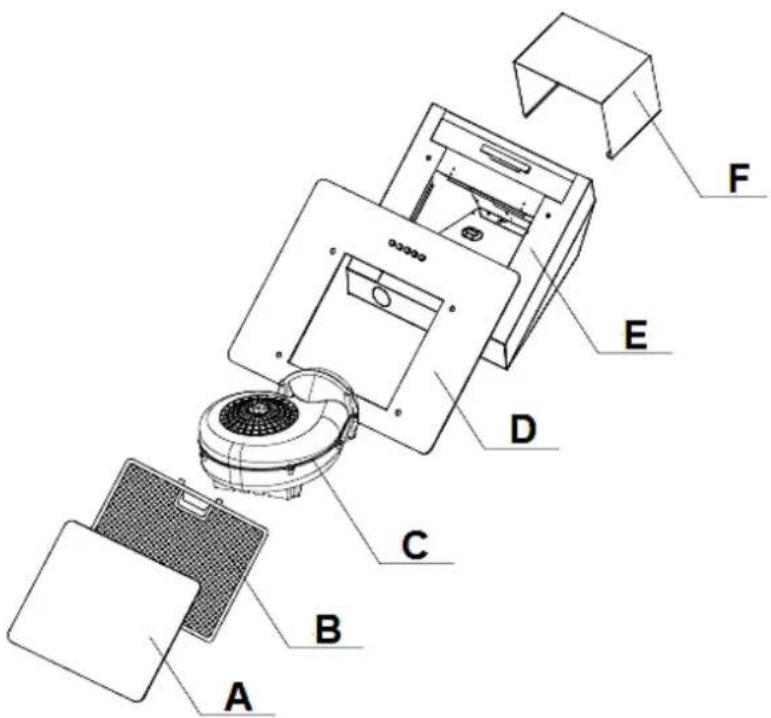
Fig. similar: modifications are possible.
| A | COVER OF THE GREASE FILTER |
| B | GREASE FILTER |
| C | MOTOR |
| D | COVER PANEL (HOUSING) |
| E | HOUSING |
| G | OUTER CHIMNEY |
Also included in delivery: chimney fixing clamp, drill-hole stencil, instruction manual.
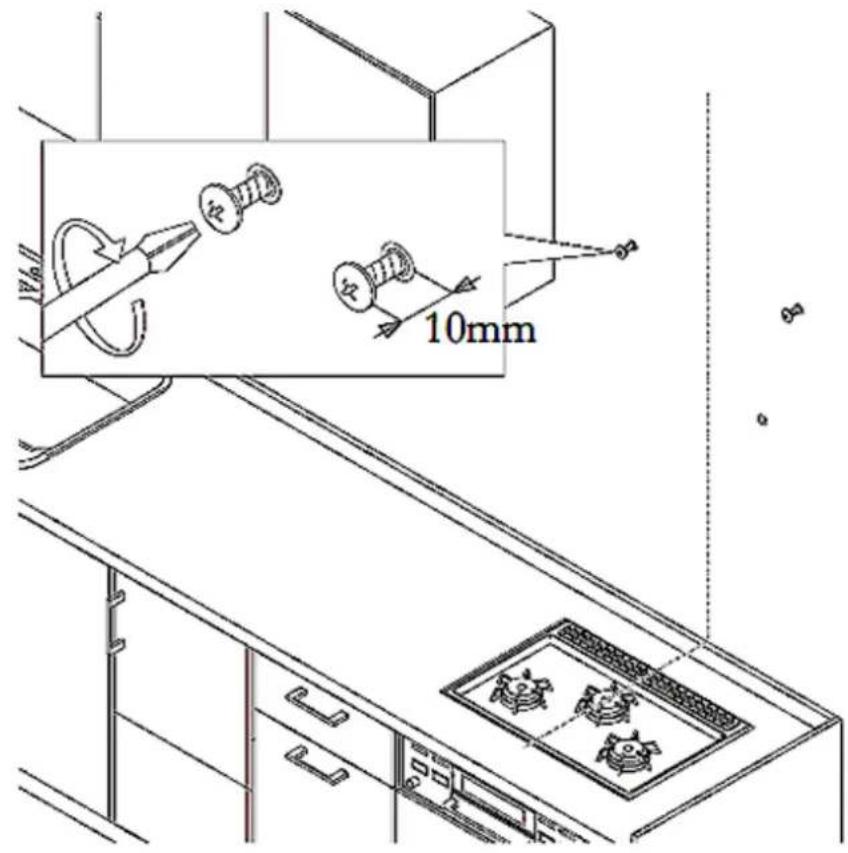
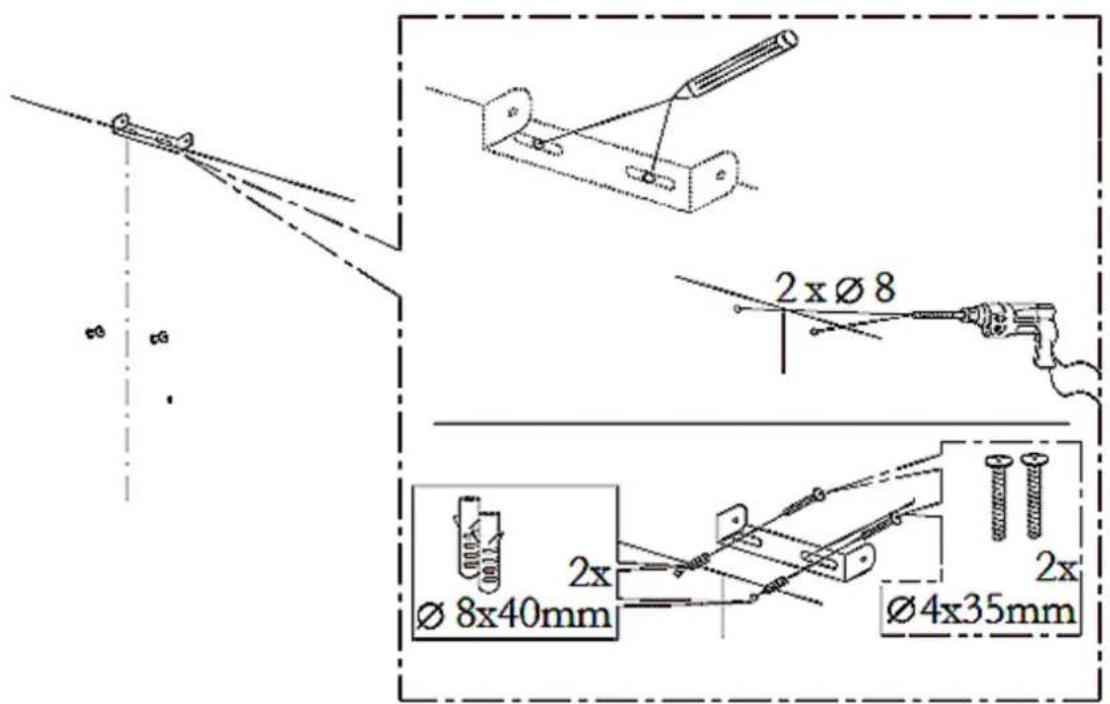
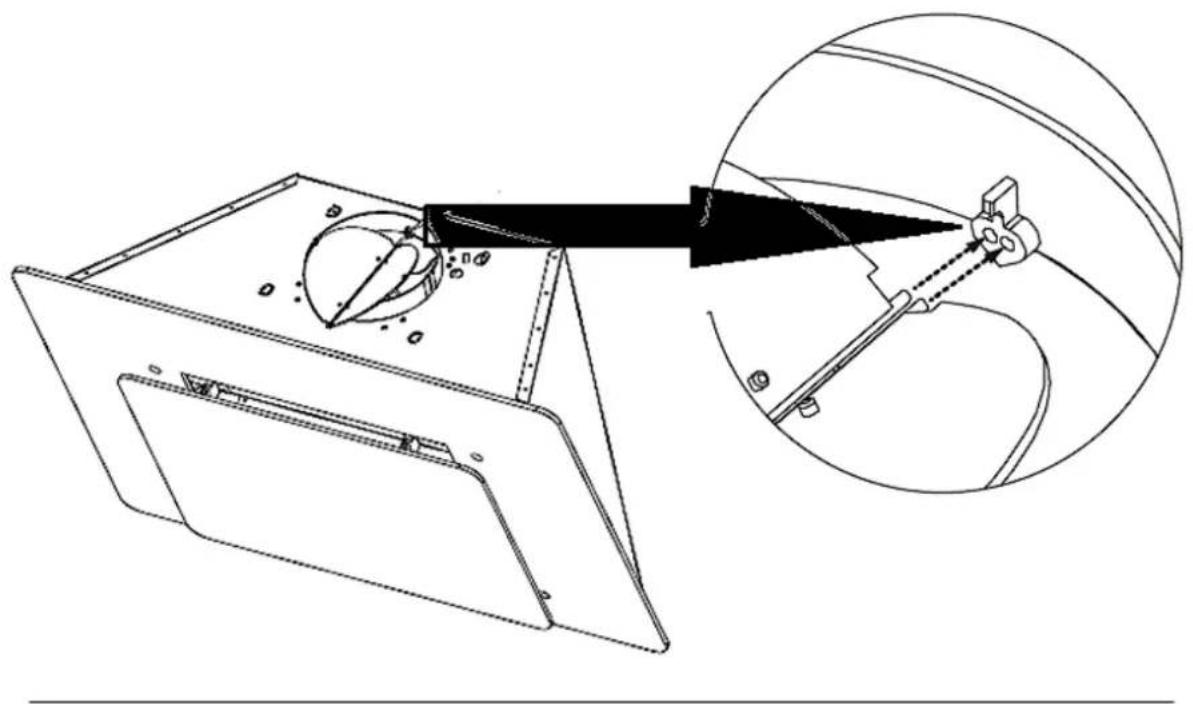
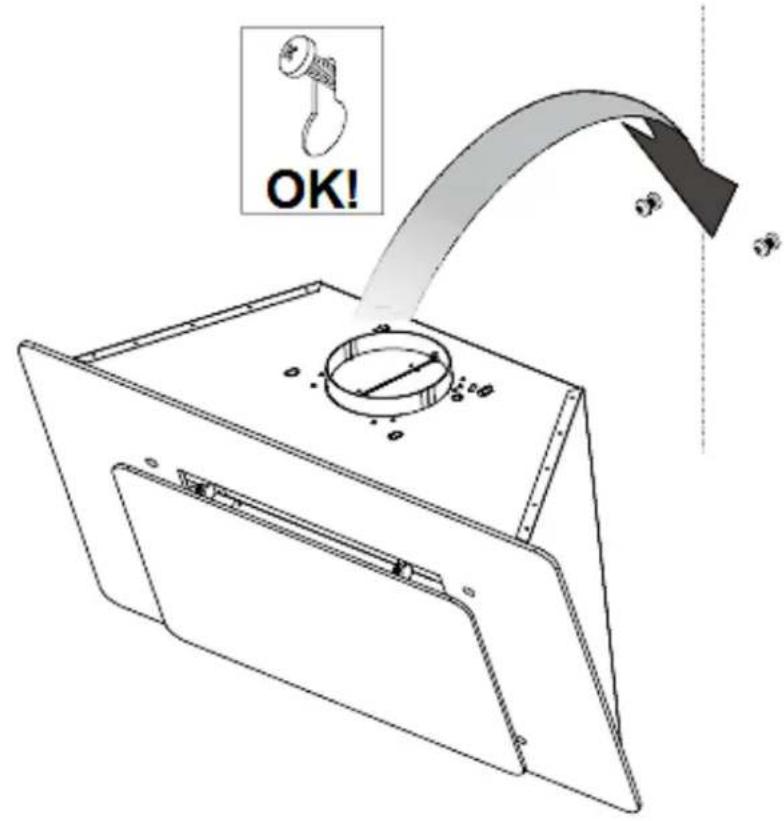
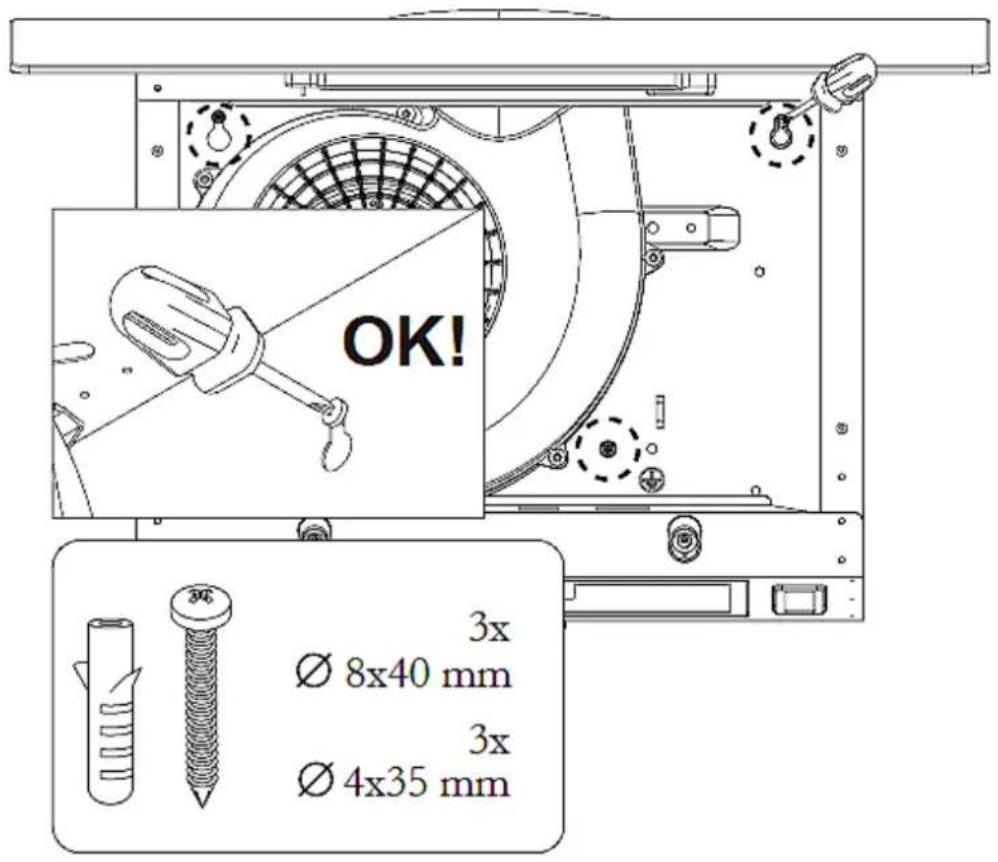
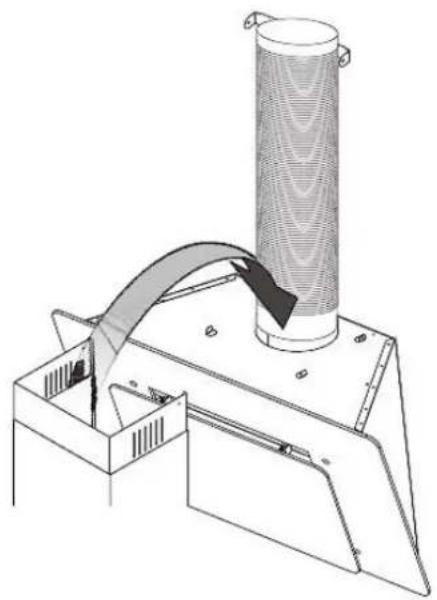
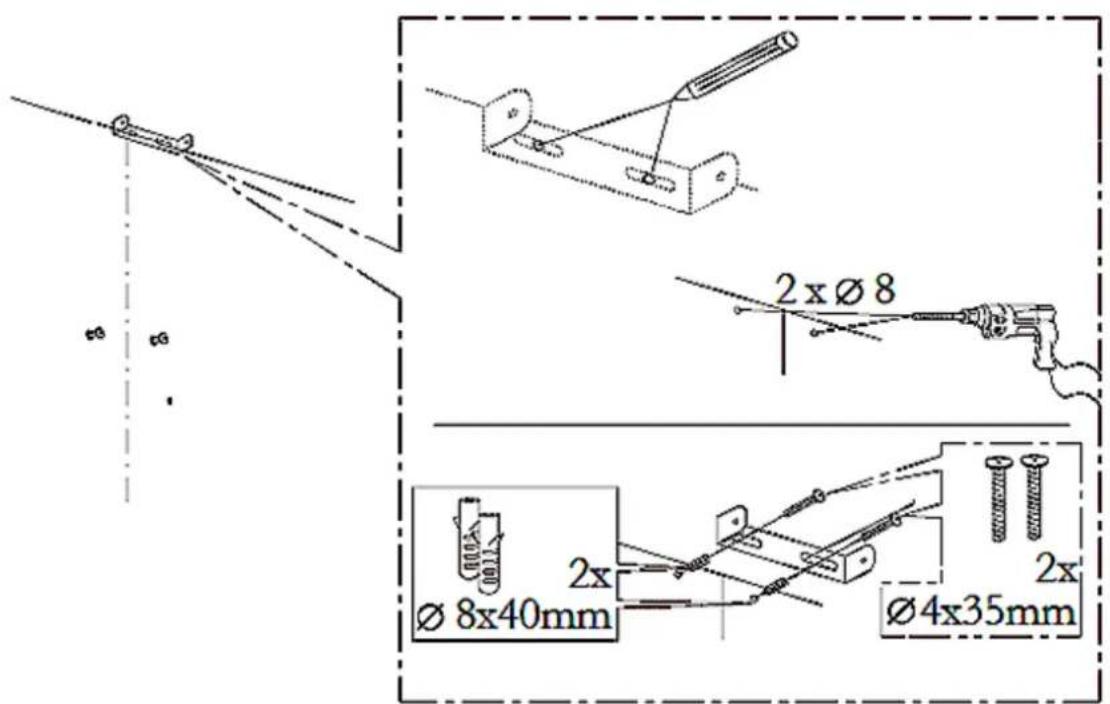
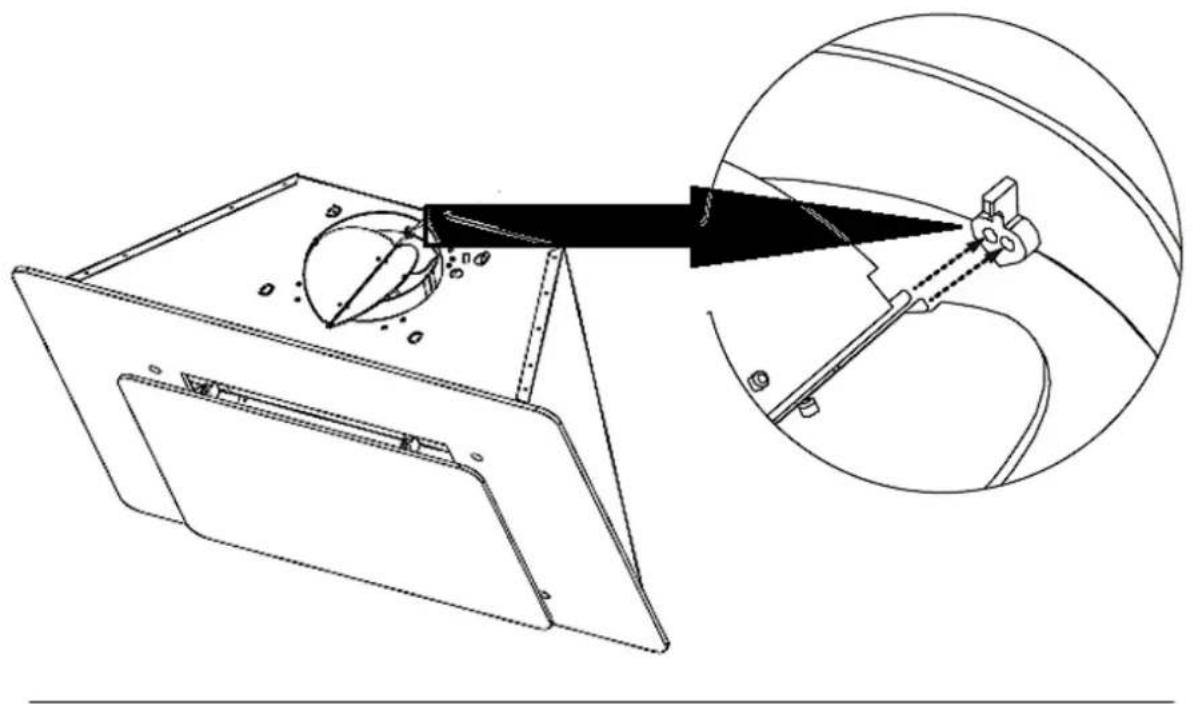
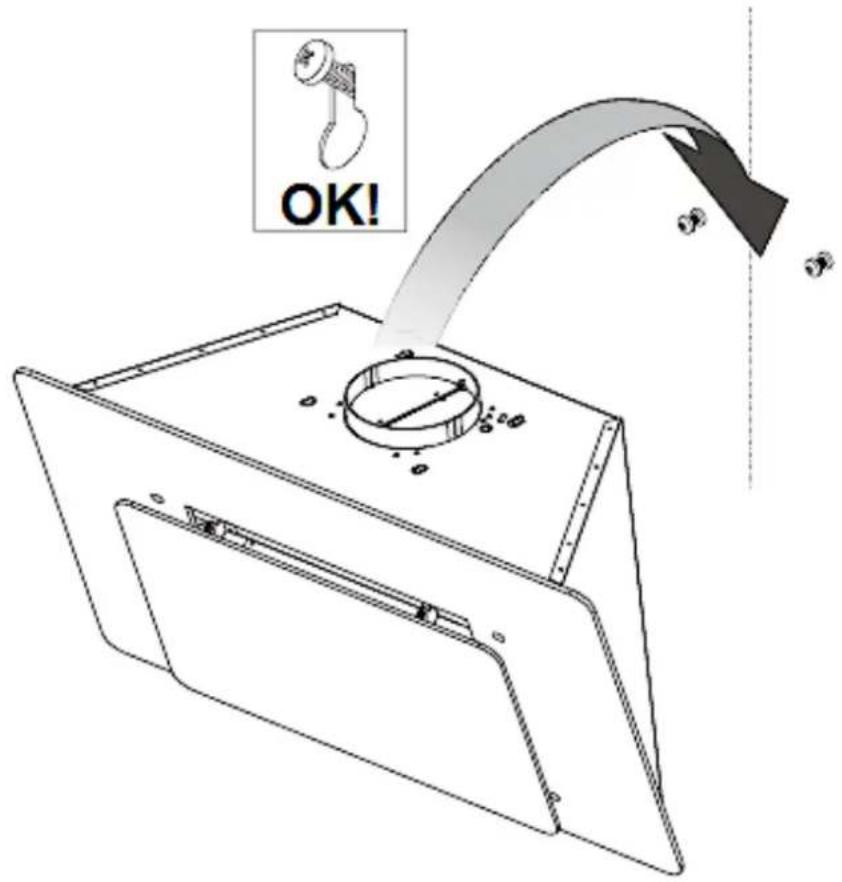
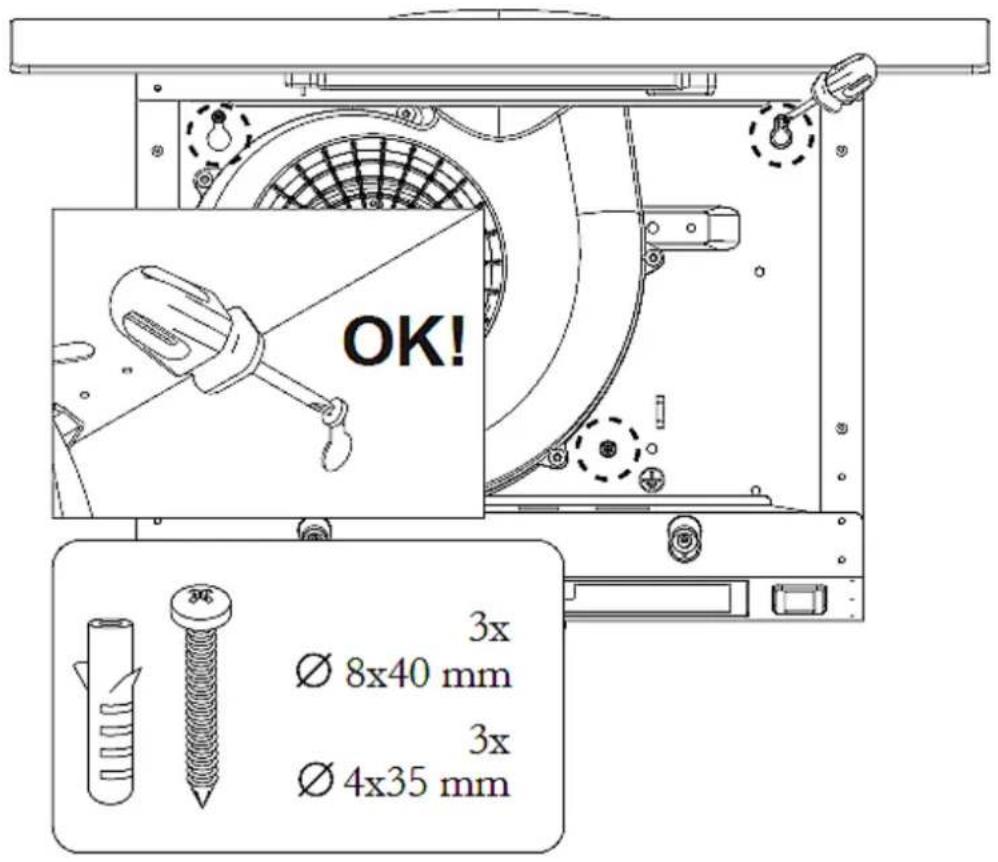
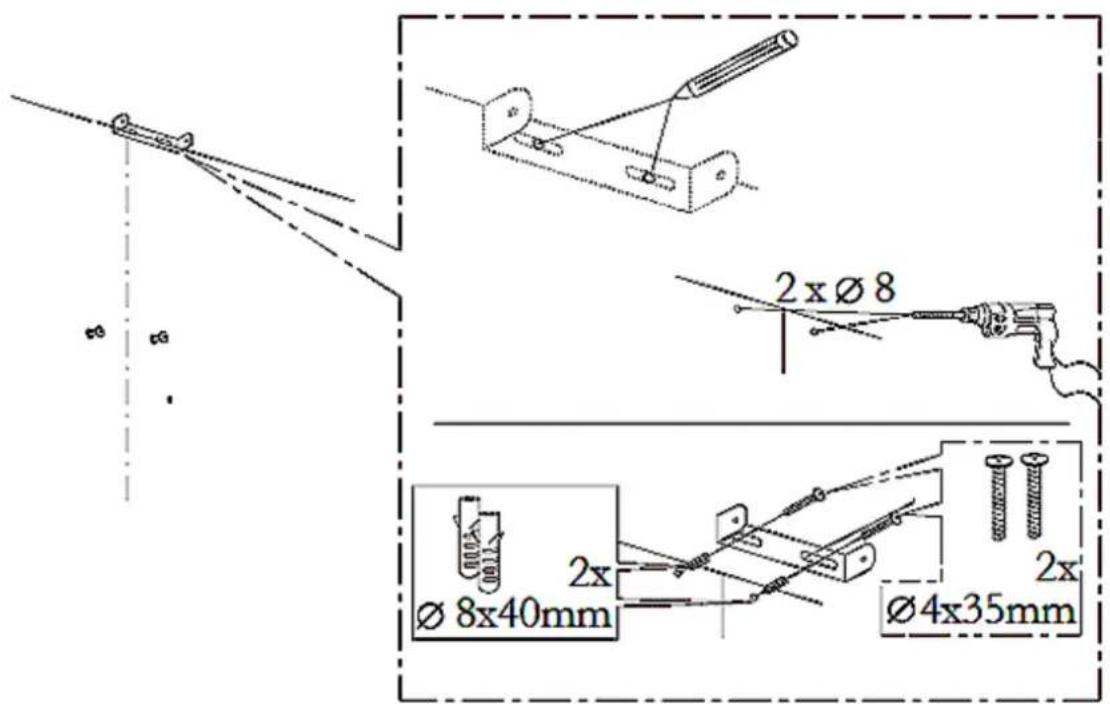
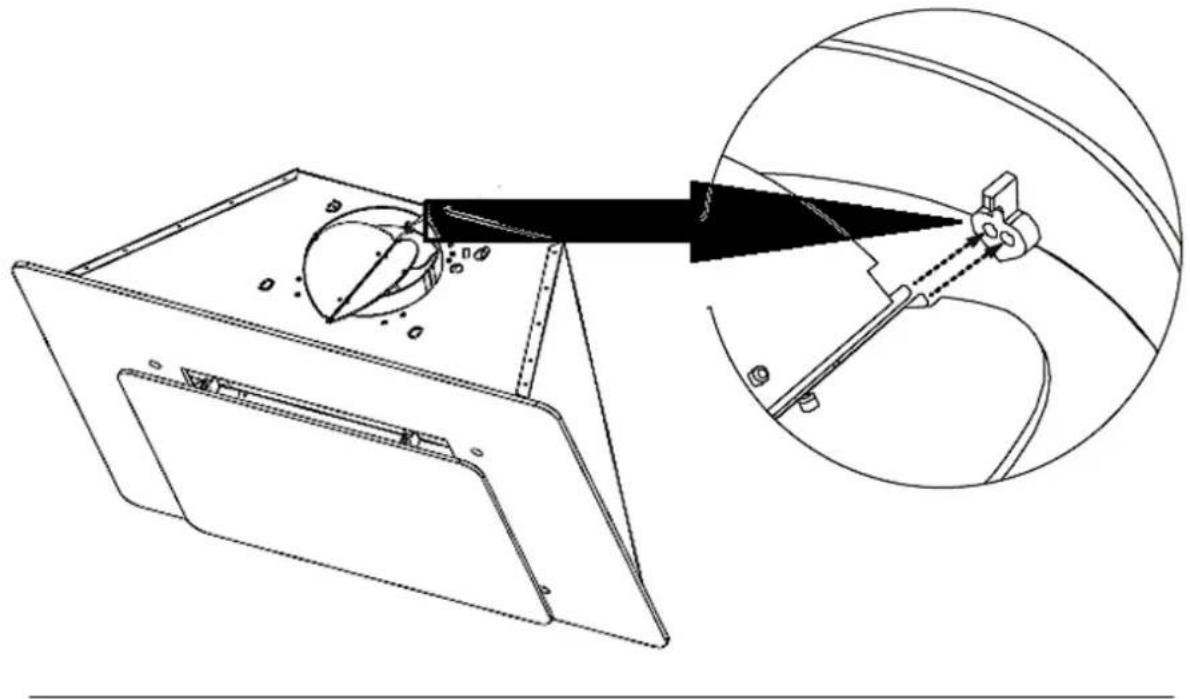
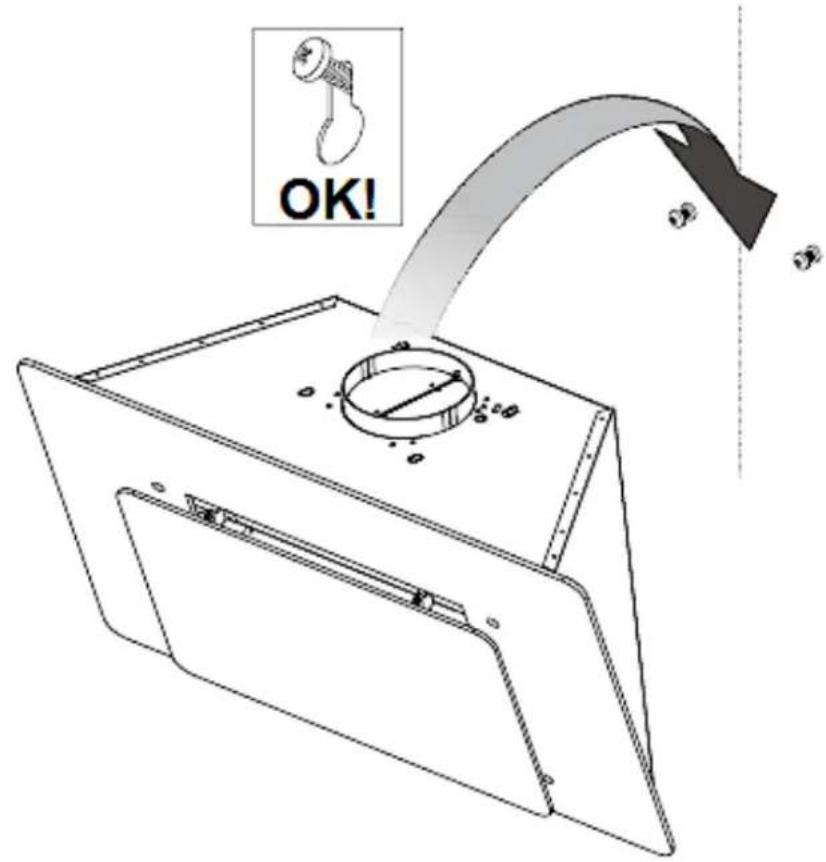
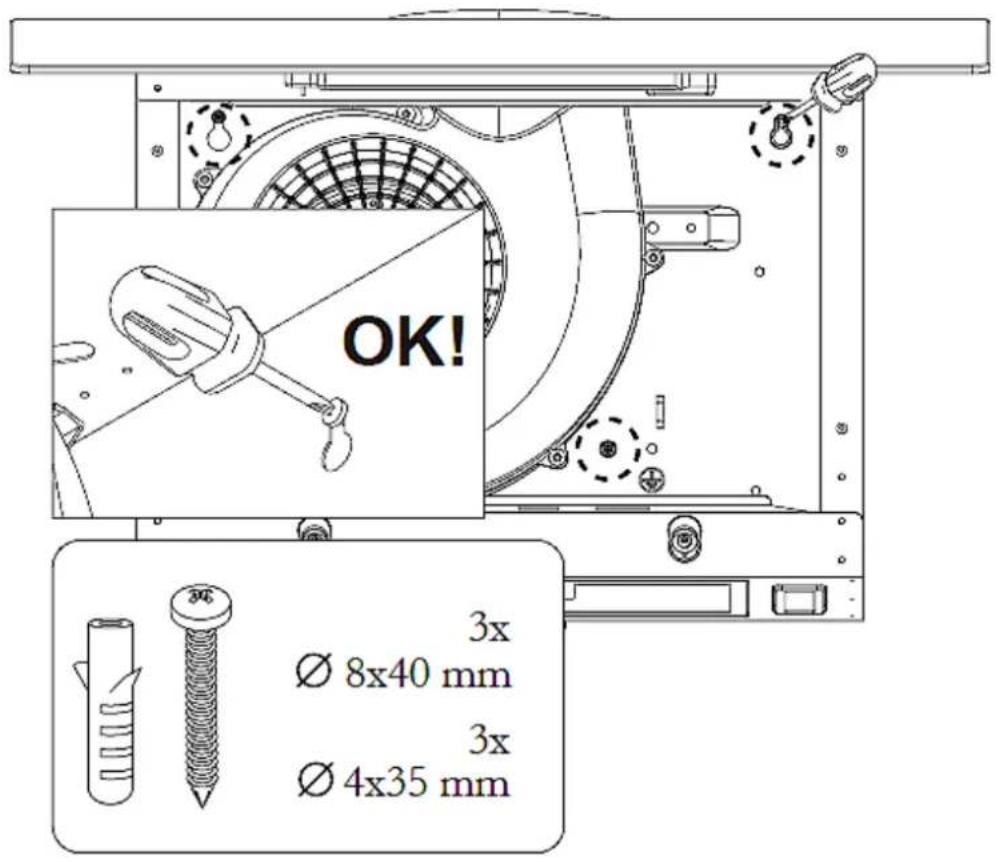
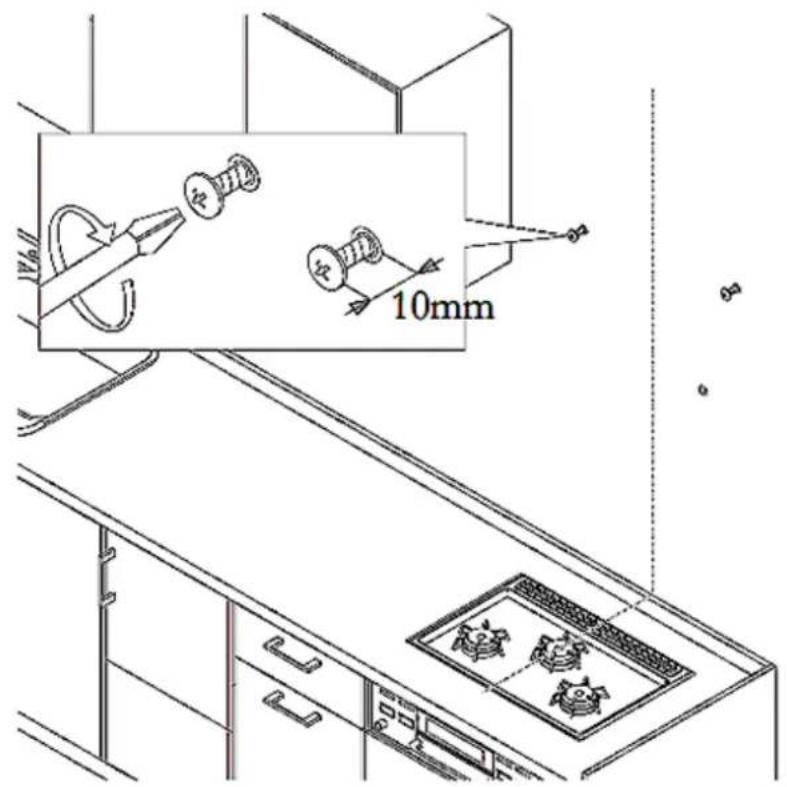
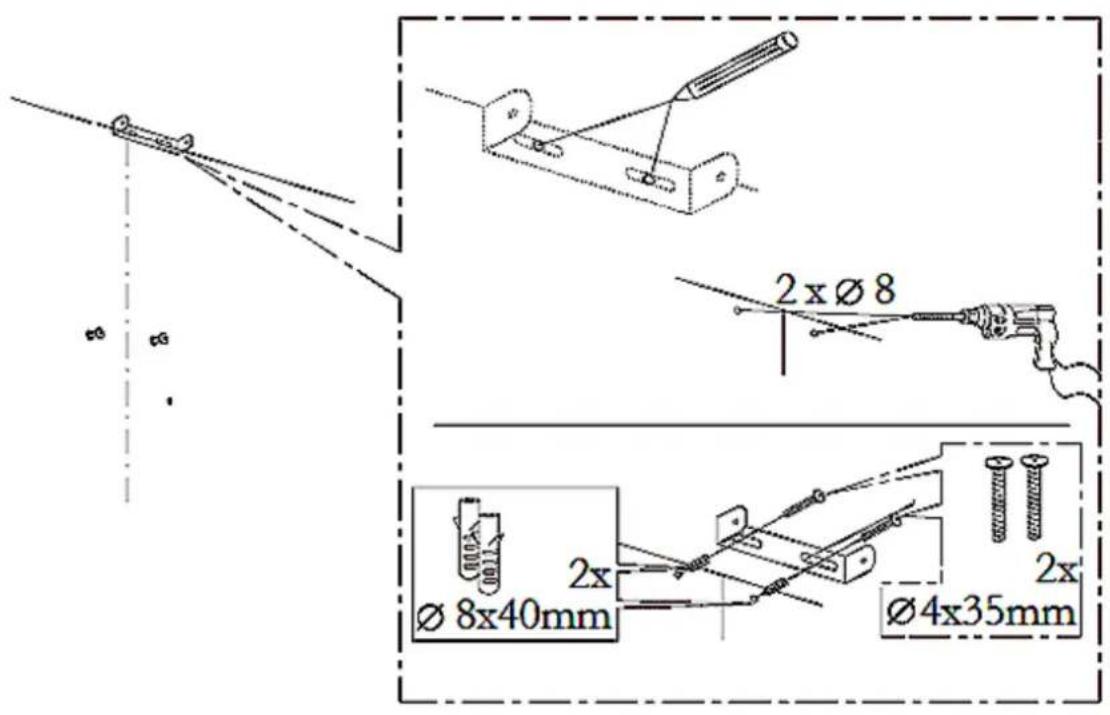
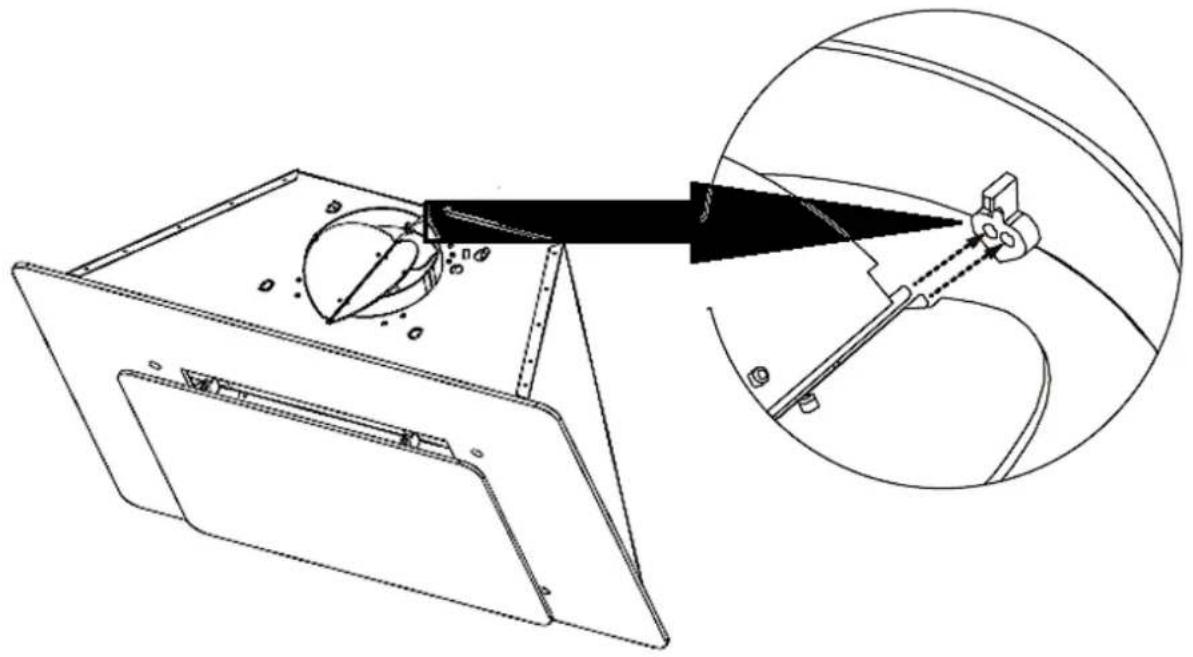
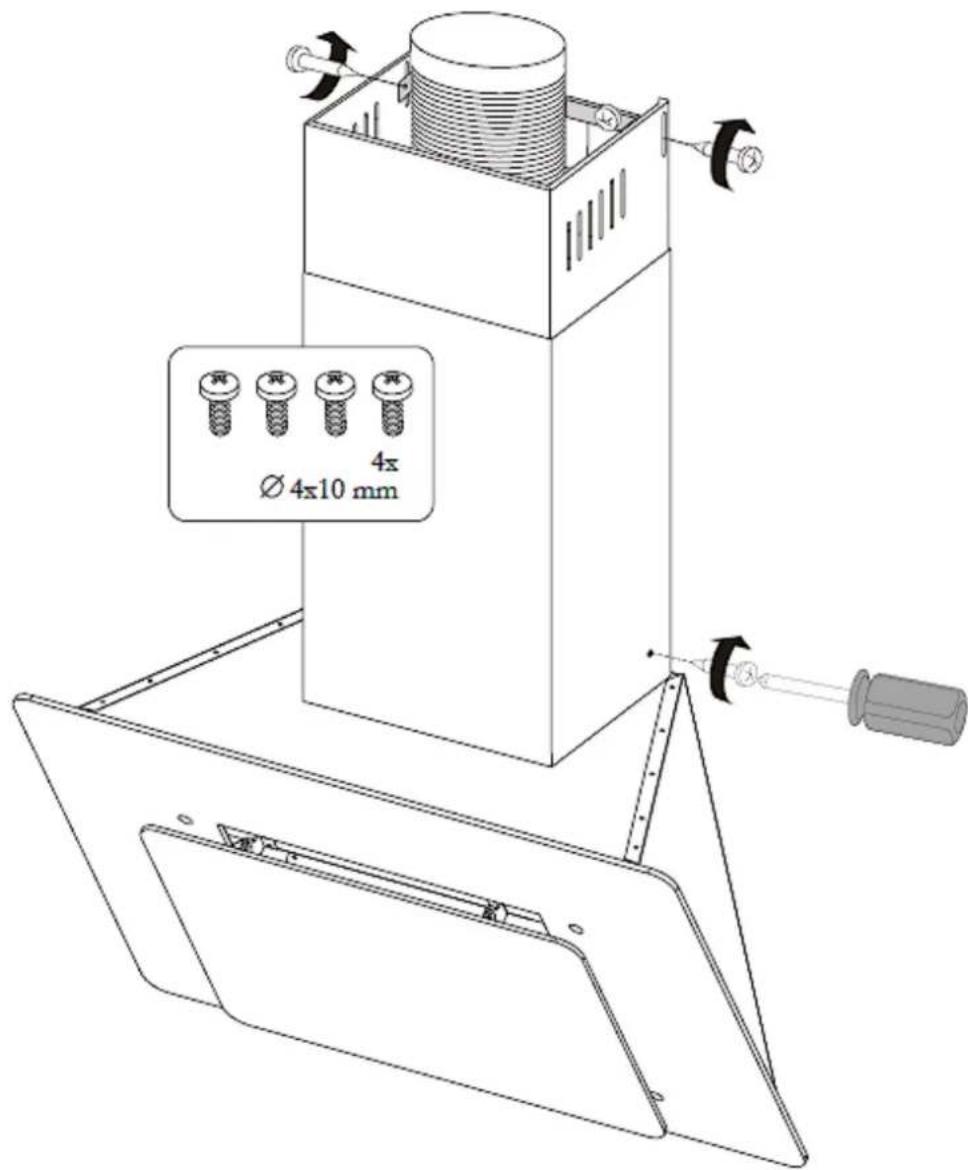
2.4 Installation steps
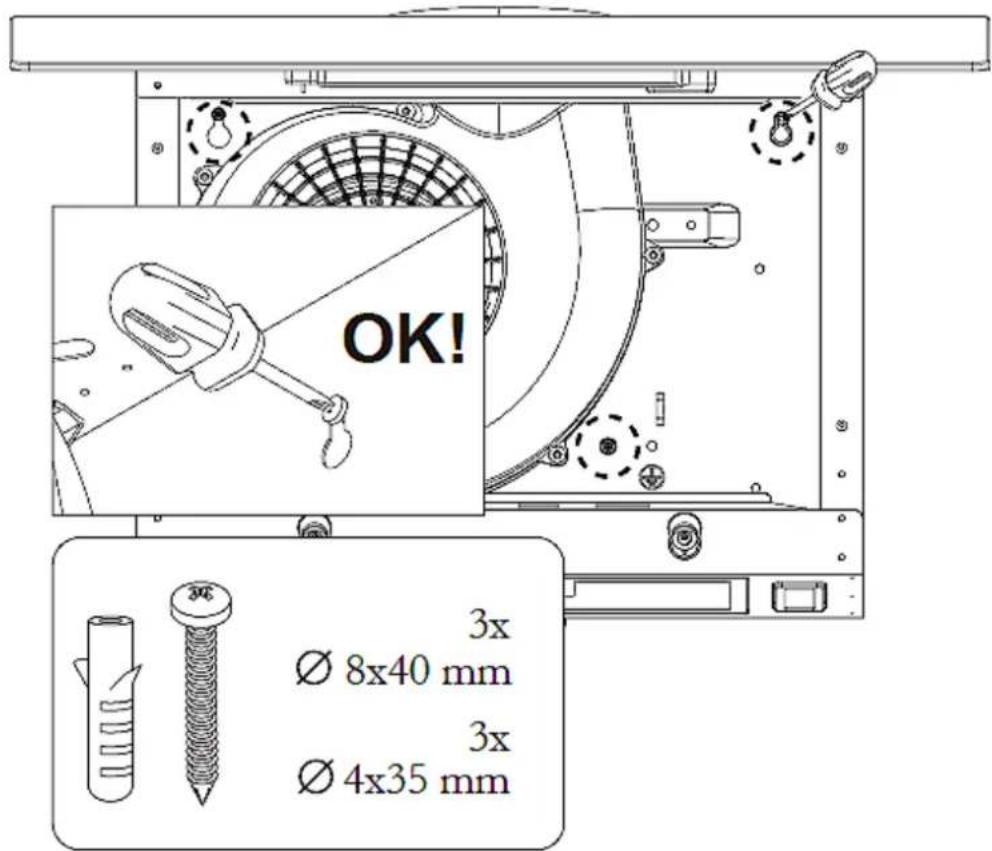
⚠ WARNING! Failure to install the screws or fixing the appliance in accordance with these instructions may result in electrical hazards.
WARNING! Do not damage the wiring in the wall while drilling.
NOTICE! Two assistants are required for installation.
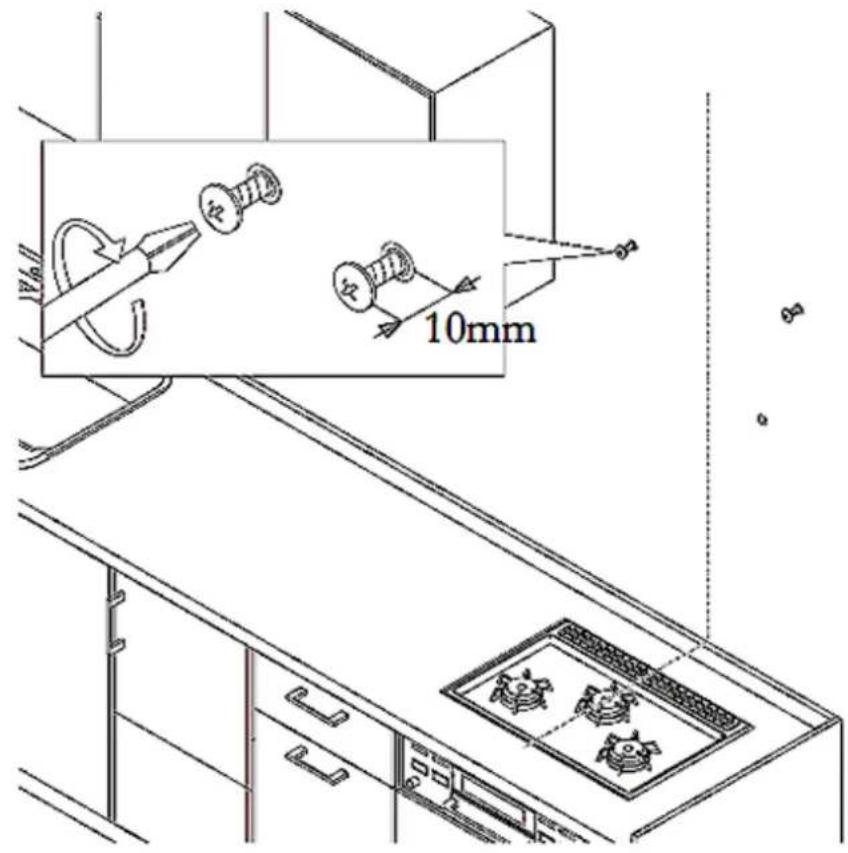
INSTALLATION DRAWING
i All dimensions are given in millimetres.
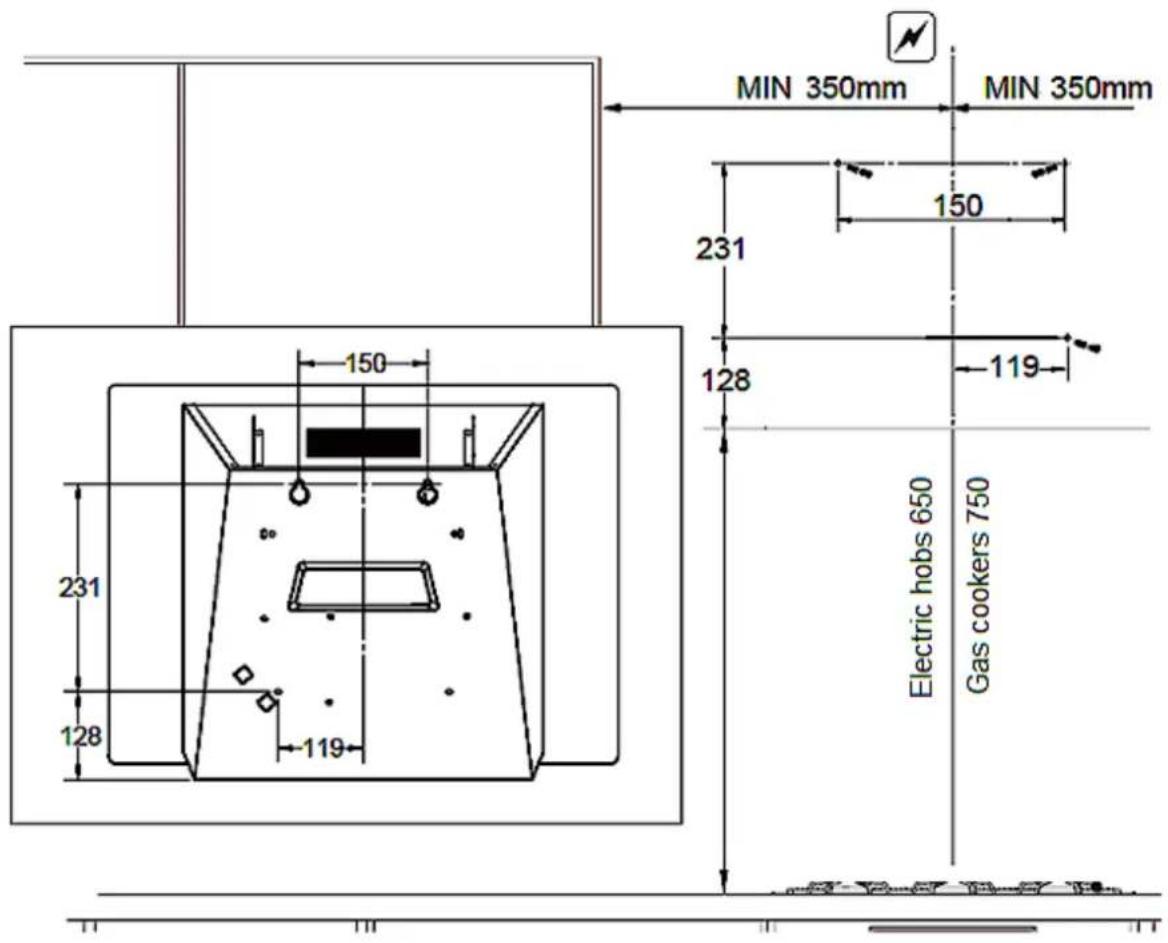
1.
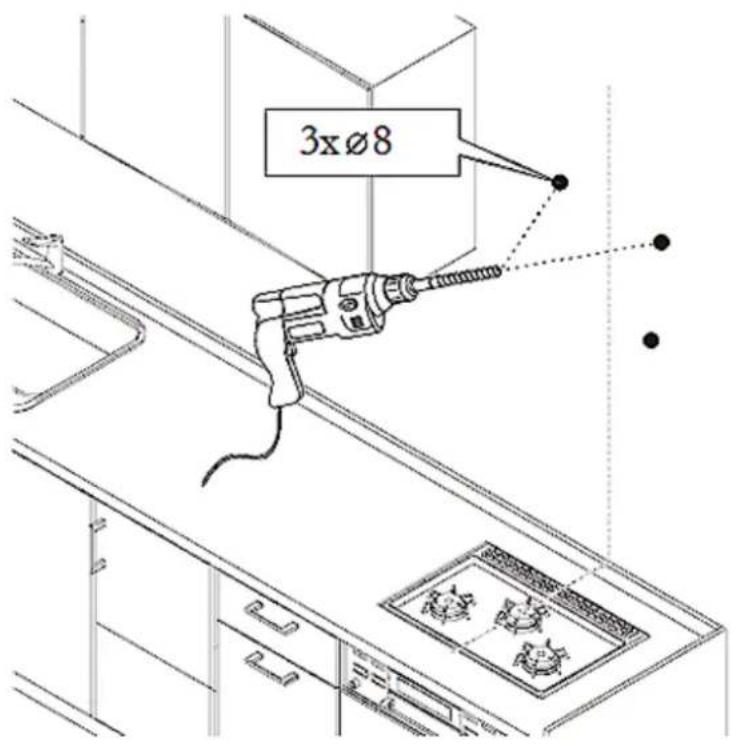
2.
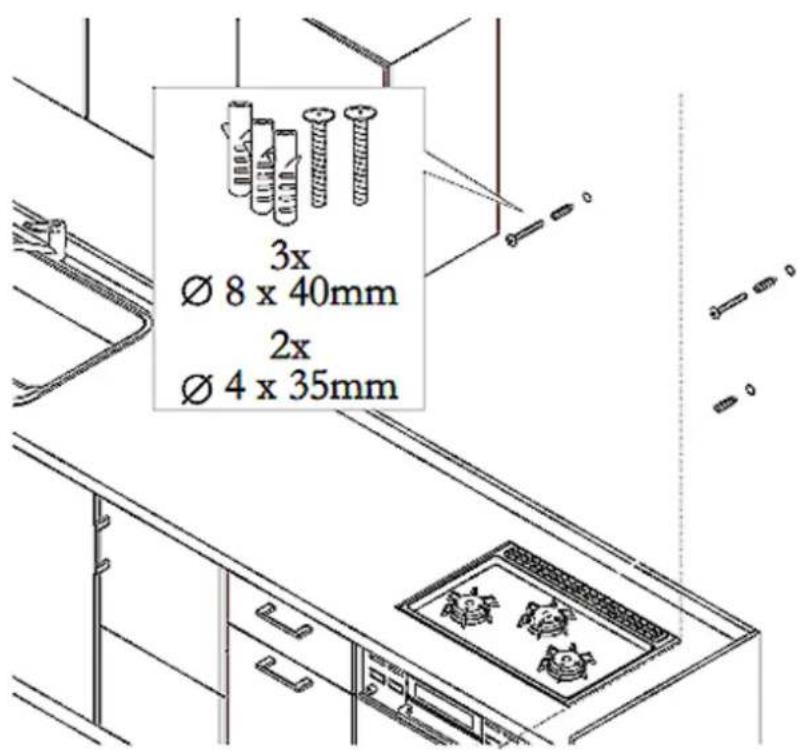
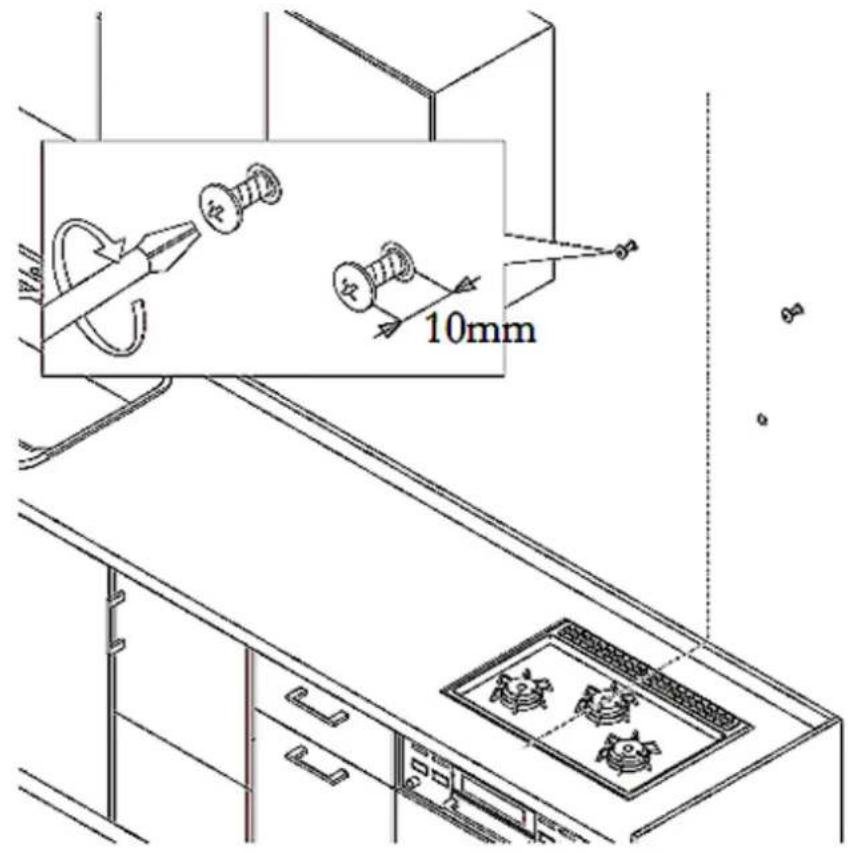
natural_image
Technical line drawing of a mechanical assembly with a magnified inset showing a component detail (no text or symbols)6.
natural_image
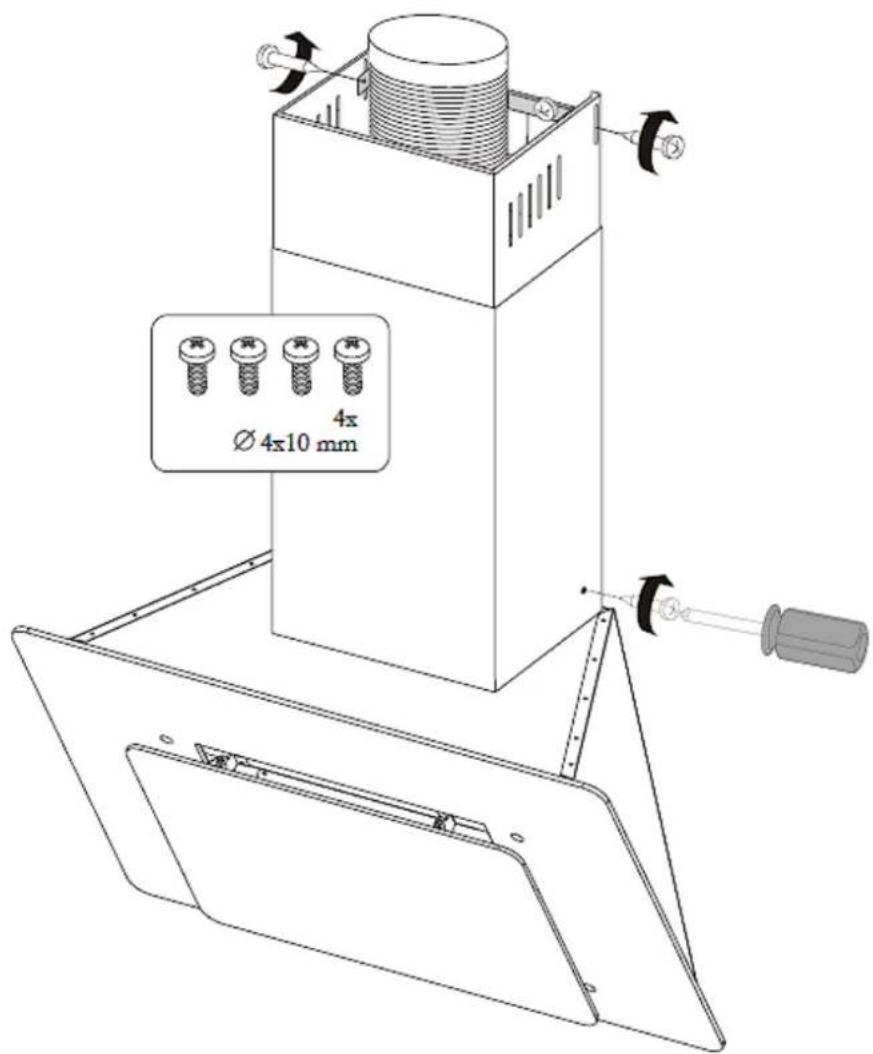
Technical line drawing of a mechanical assembly with a cylindrical component mounted on a base plate (no text or symbols)YOU CAN LAY THE EXHAUST HOSE AS FOLLOWS (EXTRACTION MODE ONLY)
| VERTICALLY: lay the exhaust hose to a roof cap*. | 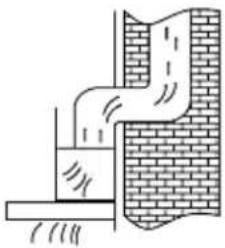 |
| HORIZONTALLY: lay the exhaust hose to an exhaust outlet equipped with an air grille*. | 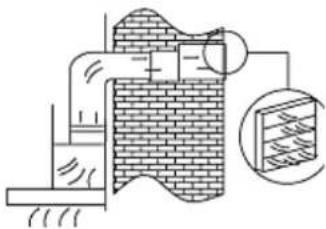 |
* = not included in delivery.
i RECIRCULATION MODE: please ignore step 8.; observe the instructions given in chapter 3.2 RECIRCULATION MODE.
9. (depending on model)
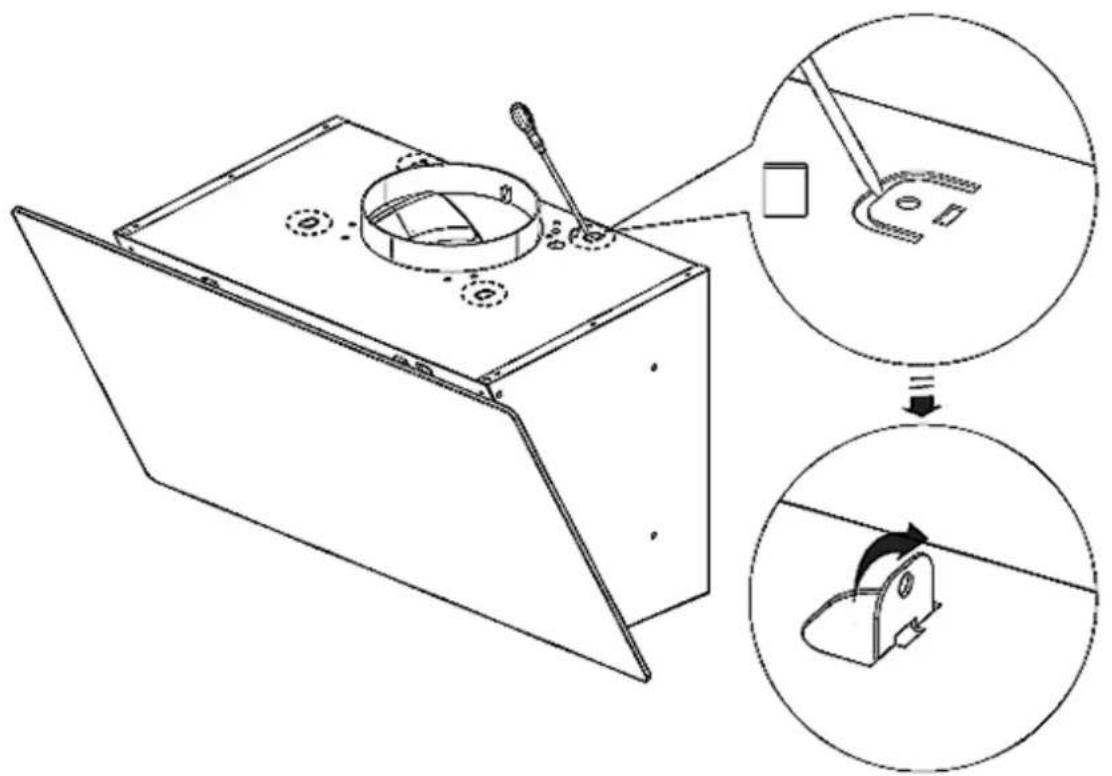
10.
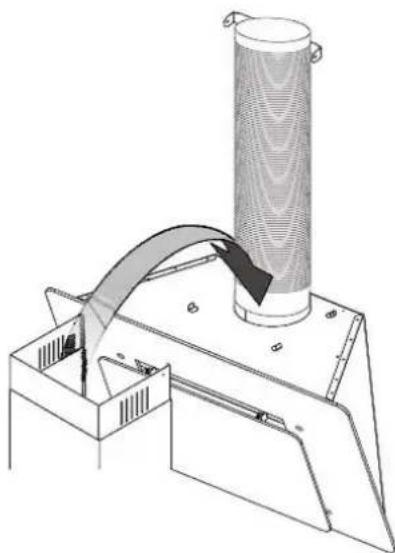
natural_image
Technical diagram of a mechanical device with a cylindrical component and directional arrow, no visible text or symbols11.
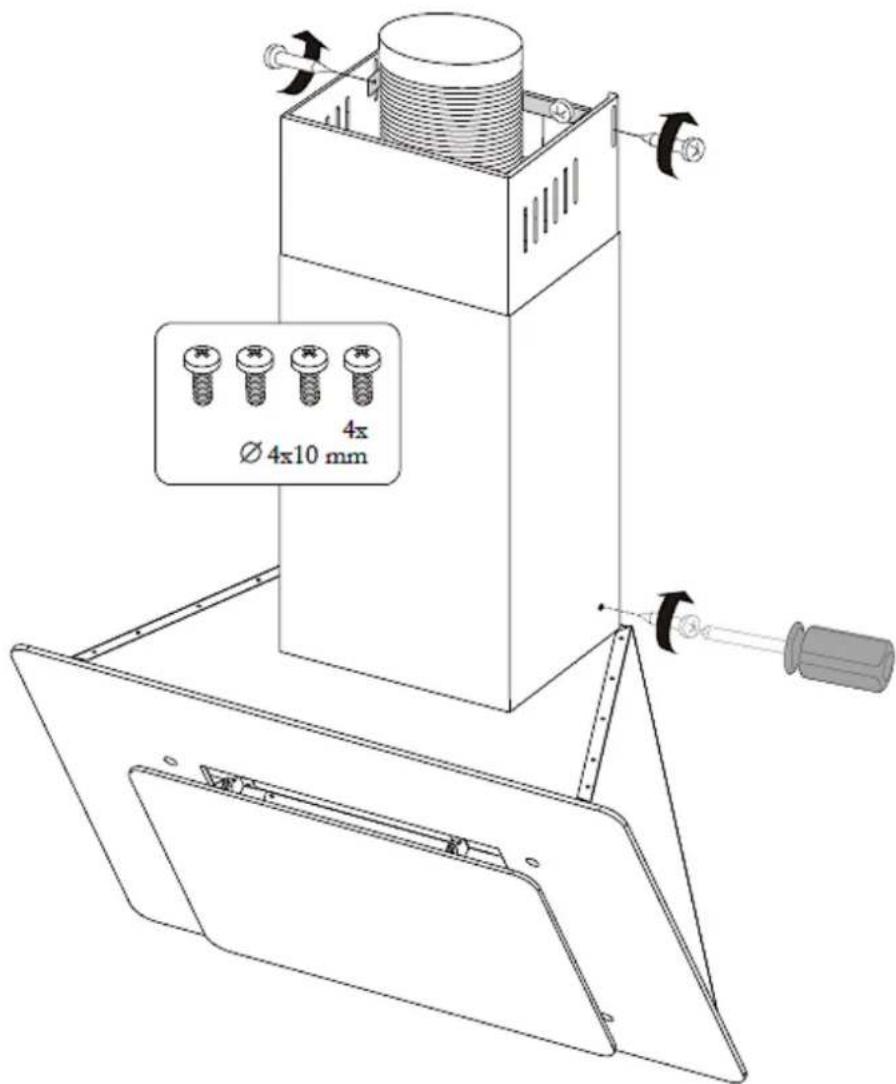
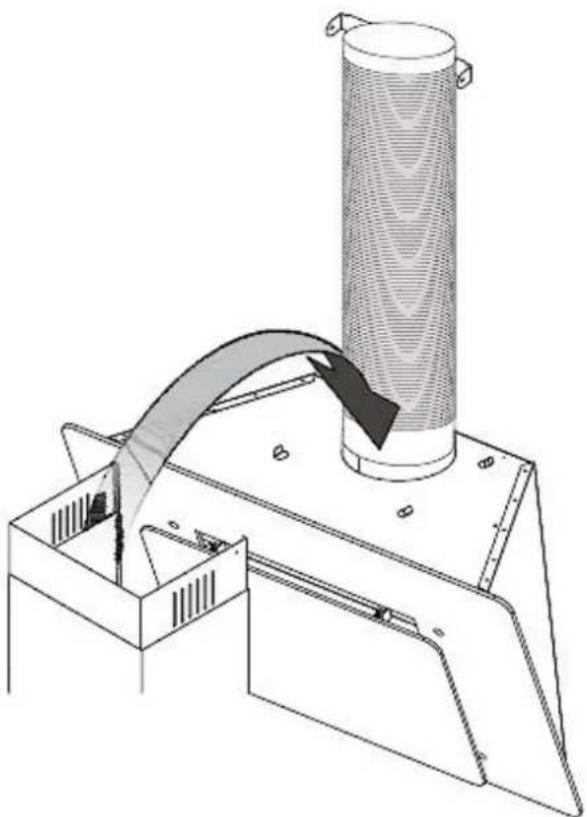
➢ Insert the grease filters and connect the appliance to the mains 11 .
Check the correct position of the hood from front and side perspective. Otherwise, the appliance will not work properly.
2.5 Electrical connection
Check that the voltage indicated on the rating plate matches the mains voltage of your home before connecting the extractor hood to the mains.
Check that the extractor hood is installed properly before you connect the appliance to the mains.
3. Extraction mode / Recirculation mode
3.1 Extraction mode
⚠ WARNING! Do not lead the exhaust air into a chimney which is used for extracting exhaust air of appliances operated by gas or other combustibles.
The extractor hood is usually ready for the use in extraction mode. 12
In extraction mode, the intake air is led through an exhaust hose to the outside. For this purpose, an exhaust shaft or an outwardly leading exhaust pipe must be available in your house / flat.
If your appliance is equipped with a carbon filter, you must remove the carbon filter before you operate the appliance in extraction mode!
If you want to use the extractor hood in extraction mode, please always observe the instructions given in chapter 2. INSTALLATION et seq. and in chapter 2.4 INSTALLATION STEPS, step 8.
3.2 Recirculation mode
You can also use the appliance in recirculation mode.
If you do not use an exhaust air pipe to the outside for the installation of the extractor hood, the exhaust hose is not required.
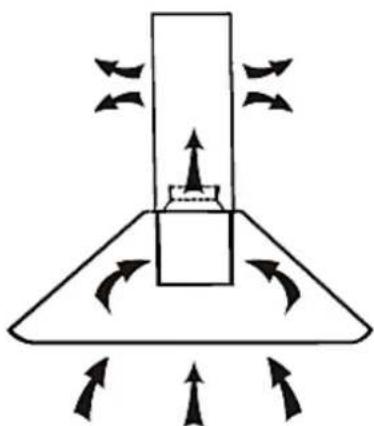
❖ In recirculation mode, the exhaust air is led back into the kitchen (s. fig. below).
If you want to use the extractor hood in recirculation mode, you can install carbon filters; s. chapter 3.2.1 CARBON FILTERS.
The installation of the extractor hood is the same as described in chapter 2.4 INSTALLATION STEPS (please ignore step 8.).
i You can use CARBON FILTERS to eliminate cooking vapours and odours in RECIRCULATION MODE only.
natural_image
Diagram of a mechanical or fluid system with directional arrows indicating flow or movement (no text or symbols)3.2.1 Carbon filters
Product code: CO4
WARNING! Carbon filters must be used in recirculation mode only!
NOTICE! Carbon filters are not included in the scope of delivery 13 .
i Replace the CARBON FILTER regularly (see also chapter CLEANING AND MAINTENANCE).
i CARBON FILTERS for your extractor hood are optional available.
You can order the CARBON FILTERS at
www.pkm-online.de
➢ Type name of the CARBON FILTERS: See chapter TECHNICAL DATA
⚠ WARNING! Switch off the appliance and disconnect it from the mains before you install any carbon filters (use the relevant fuse in your household fuse box).
HOW TO INSTALL THE CARBON FILTER
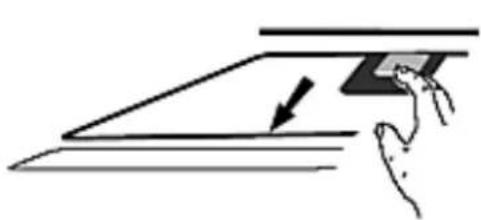
- If you want to replace the CARBON FILTER, you must remove the ALUMINIUM GREASE FILTER first. Press the lock and pull the ALUMINIUM GREASE FILTER downwards (s. fig. below).
natural_image
Simple line drawing of a hand pressing down on a flat surface with an arrow indicating direction (no text or symbols)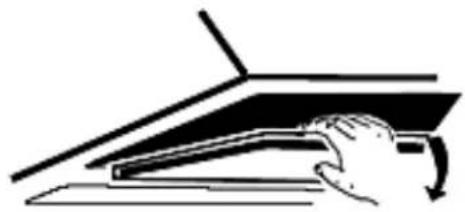
natural_image
Simple line drawing of a hand pressing down on a laptop keyboard (no text or symbols)-
The CARBON FILTER is installed on the motor.
-
Place the CARBON FILTER on the motor and turn it clockwise until it is firmly tightened (s. fig. below).
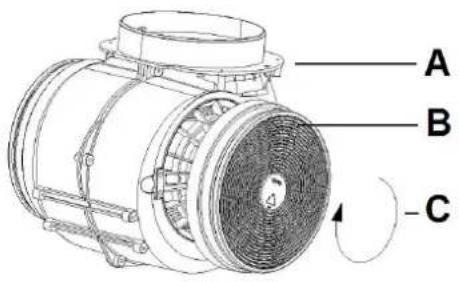
Fig. similar: modifications are possible.
| A | MOTOR |
| B | CARBON FILTER |
| C | CLOCKWISE ROTATION = Place the CARBON FILTER on the motor and turn the filter clockwise until it is installed properly. |
-
Reinstall the ALUMINIUM GREASE FILTER PROPERLY.
-
If you want to uninstall the CARBON FILTER, turn the filter anti-clockwise and remove it.
⚠ WARNING! Install the carbon filter safely and properly; otherwise, the carbon filter can loosen and cause hazardous situations.
NOTICE! The suction capacity is decreased by installed carbon filter.
NOTICE! Depending on frequency of use, replace the carbon filter every three to six months. Clean the grease filter regularly for proper operation of the motor (s. chapter CLEANING AND MAINTENANCE).
3.3 Grease filter
i Always ensure that the ALUMINIUM GREASE FILTER is inserted properly.
i Clean the ALUMINIUM GREASE FILTER regularly (s. chapter CLEANING AND MAINTENANCE).
⚠ WARNING! Operate the appliance with inserted aluminium grease filter only. Otherwise, recirculating-transported fat will deposit in the appliance and the exhaust system. RISK OF FIRE!
4. Control panel and operation
4.1 Control panel
⚠ WARNING! The illuminant must not be covered by thermal insulation or other materials. RISK OF FIRE!
⚠️ CAUTION! Do not touch the illuminant within 30 minutes after using the appliance. RISK OF BURNS!
NOTICE! Only switch on the illuminant while the appliance is operating. Do not switch on the illuminant to illuminate the room.
NOTICE! Never press two buttons simultaneously.
NOTICE! To change the power level (motor speed), always press the button « ➕ first; then you can set the desired new power level (motor speed) using the buttons « ➕, « ➕ or « ». ➕
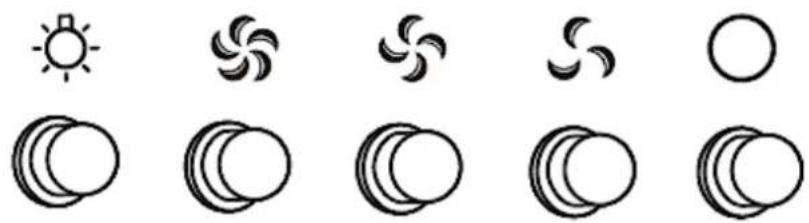
natural_image
Collection of simple line drawings representing sun, wind turbine, fan, and circle symbols (no text or labels) | BUTTON: « OFF » |
 | LOW POWER LEVEL (motor speed) |
 | MEDIUM POWER LEVEL (motor speed) |
 | HIGH POWER LEVEL (motor speed) |
 | ILLUMINANT ON / OFF |
4.2 Operation

BUTTON: « OFF »
◆ Use this button to switch off the extractor hood.

POWER LEVEL 1 = LOW POWER LEVEL
❖ Press this button to set the lowest power level (motor speed) of the extractor hood.
This power level is suitable for slow cooking / simmering and roasting with the lid of the cookware closed.
Use this power level when low steam generation occurs (low concentration of cooking fumes).

❖ Press this button to set the medium power level (motor speed) of the extractor hood.
❖ This power level is suitable for standard cooking.
Use this power level for an ideal air circulation in the kitchen when medium steam generation occurs (medium concentration of cooking fumes).

❖ Press this button to set the highest / maximum power level (motor speed) of the extractor hood.
Use this power level when lots of steam occurs (strong concentration of cooking fumes).

5. Environmental protection
5.1 Environmental protection: disposal
Appliances bearing this symbol « ➕ ➕ must not be disposed of together with household waste throughout the EU. To prevent potential damage to the environment or human health from uncontrolled waste disposal and to promote the sustainable reuse of material resources, responsibly supply the appliance to a recycling centre.
5.2 Environmental protection: energy saving
❖ Cover your cookware (cooking pot / pan) with lids during cooking.
The diameter of the cooking pot / pan should meet the diameter of the cooking zone or the size of the flame of the burner (gas appliances).
- Switch off the extractor hood after cooking or use the delayed switch-off function (equipment depends on model).
Only switch on the illuminant while the appliance is in operation. Do not switch on the illuminant to illuminate the room.
❖ Switch off the illuminant(s) of the appliance after cooking.
The power level should always meet the intensity of the generated cooking fumes. Use the highest motor speed of the appliance (highest power level) to extract strong concentration of cooking fumes only. A lower power level always means a lower energy consumption.
Make sure there is sufficient supply air to allow the extractor hood to operate efficiently and with low operating noise.
In the case of a strong concentration of cooking fumes select a higher power level early. Cooking fumes which are already distributed in the kitchen may require a longer operation of the extractor hood.
- Clean the grease filter(s) regularly as clean filters will increase the efficiency of the appliance.
❖ Replace the carbon filters (for recirculation mode only) regularly. Observe the information given on the packaging of the carbon filters.
6. Cleaning and maintenance
⚠ WARNING! Disconnect the appliance from the mains before you clean or maintain it.
⚠ WARNING! Ignoring the cleaning and maintenance instructions will cause an increased RISK OF FIRE.
NOTICE! Take off all rings and bracelets before cleaning or maintaining the appliance; otherwise, you will damage the surface of the appliance.
- Clean the housing of the appliance with a suitable detergent. Use such a product carefully and economically.
- Do not clean the control panel with a detergent. Use a damp cloth. Otherwise, you may damage the electronic components of the controls.
-
Never use any alcohol-containing detergents to clean matt black painted appliances as these detergents cause colour-changes.
-
Clean the glass panels 14 with a suitable detergent only.
- When you clean or replace the grease filters or the carbon filters, also clean all visible components on the bottom of the appliance with a mild, non-acrid and fat-dissolving detergent.
- Do not damage the grid of metal-made grease filters. The colour of the metal surface may change due to frequent cleaning as well as the use of aggressive detergents. Such changes do not influence the capacity of the appliance and are no reason for complaint.
- Do not use any abrasive detergents or vinegar cleaners.
- Do not use a steam cleaner. RISK OF ELECTRIC SHOCK!
SPECIAL INSTRUCTIONS FOR APPLIANCES WITH A STAINLESS-STEEL CASING 15
To clean stainless-steel surfaces, use a non-abrasive stainless-steel cleaning agent only.
NOTICE! Never use stainless steel cleaner for the direct environment of the control panel or the control panel itself.
NOTICE! Aggressive detergents such as abrasive detergents, vinegar cleaners, etc. damage the surface of the extractor hood.
6.1 Grease filters
⚠ WARNING! Failure to follow the cleaning instructions will increase the RISK OF FIRE due to fat deposits.
NOTICE! The colour of the metal surface may change due to frequent cleaning as well as the use of aggressive detergents. Such changes do not influence the capacity of the appliance and are no reason for complaint.
NOTICE! Do not damage the grid of metal-made (aluminium) grease filters.
i You do not need to replace grease filters / aluminium grease filters.
❖ Clean the filters by hand or in a dishwasher regularly (up to 30 °C).
Do not use any acrid or corrosive detergents.
Do not use any abrasive detergents!
Do not use any alkaline dishwasher-detergents! (pH more than 7).
CLEANING INTERVAL FOR ALUMINIUM GREASE FILTERS
➢ Every 2 - 3 weeks according to the frequency of use of the extractor hood.
MANUAL CLEANING OF THE ALUMINIUM GREASE FILTERS
- Soak the aluminium grease filters in warm rinse water (up to 30\ °C )
- Then clean the grease filters with a soft brush. Be careful not to damage the grid of the grease filters.
- After cleaning: Rinse the grease filters thoroughly using hot water.
- Repeat this process in case of stubborn soiling or deposits.
- Dry the filters properly before you reinstall them.
CLEANING OF THE ALUMINIUM GREASE FILTERS IN THE DISHWASHER
The grease filters can also be cleaned in the dishwasher: Normal programme (up to 30 °C)
Do not put the filters in the dishwasher together with tableware. Dry the filters properly before you reinstall them.
NOTICE! Filters which are blocked with food leftovers are not covered by the guarantee.
6.2 Carbon filters
⚠ WARNING! Switch off the appliance and disconnect it from the mains before you install any carbon filters (use the relevant fuse in your household fuse box).
i CARBON FILTERS for your extractor hood are optional available.
◆ Conventional carbon filters cannot be cleaned.
The capacity of these filters is limited. You can use such filters for about 3 - 6 months approx.
❖ Replace used filters immediately. Find further information on the filter packaging.
REPLACEMENT INTERVAL FOR CARBON FILTERS
At least every 3 - 6 months according to the frequency of use of the extractor hood.
You can order the CARBON FILTERS at
www.pkm-online.de
➢ Type name of the CARBON FILTERS: See chapter TECHNICAL DATA
6.3 Replacing of the illuminant
⚠ WARNING! The LED-illuminant must be replaced by a competent person only. Do not carry out the replacement of the illuminant yourself. If the LED-illuminant is damaged, please contact a qualified professional (electrical engineer): not covered by the guarantee.
WARNING! Switch off the appliance and disconnect it from the mains before you replace the illuminant (use the relevant fuse in your household fuse box).
NOTICE! Do not touch the illuminant with your hands. The sweat on your fingers will reduce the operating time of your new illuminant. Use a thin cloth or a thin glove.
INSTRUCTIONS FOR THE QUALIFIED PROFESSIONAL (ELECTRICAL ENGINEER)
- The LED - illuminant should have cooled down before you remove it.
- If you want to replace the LED - illuminant, you must remove the aluminium grease filter first. Press the lock and pull the aluminium grease filter downwards (s. fig. below).
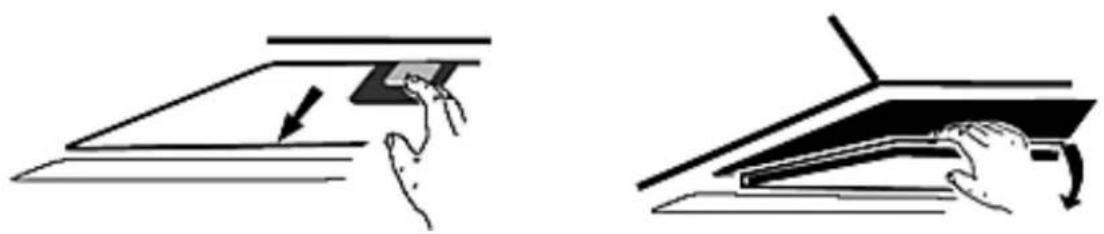
-
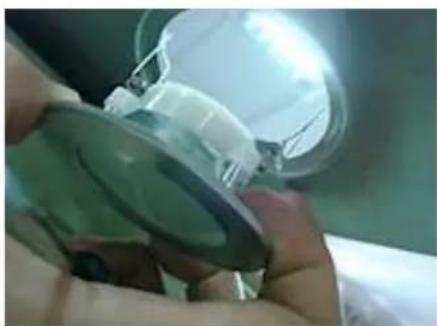
Push out the used LED - illuminant carefully.
-
Pull the used LED - illuminant carefully out of the LED installation opening and disconnect the energy supply wire (s. fig. below).
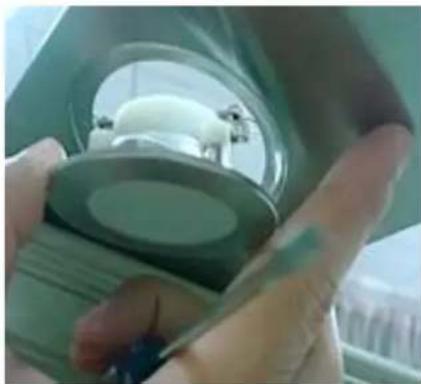
natural_image
Close-up of hands holding a small object with a circular lens or component, no visible text or symbols-
Now connect the new LED - illuminant to the energy supply wire.
-
Push the wire back into the LED installation opening and fix the new LED - illuminant (s. fig. below).
natural_image
Close-up of hands holding a transparent glass with a circular lens, no visible text or symbols-
Reinstall the aluminium grease filter properly!
-
Close the extractor hood.
| Required minimum distance to surfaces such as pot lids, oven cloths etc. to avoid any hot parts and risk of fire. | |
| --- m = 0.45 m | |
 | Only use self-shielded illuminants to avoid hot parts, risk of fire and exposure to UV-radiation. |
⚠ WARNING! Operate the appliance with inserted aluminium grease filter only. Otherwise, recirculating-transported fat will deposit in the appliance and the exhaust system. RISK OF FIRE!
⚠ WARNING! Any damage to the appliance caused by improper replacement of the illuminant is not subject to the guarantee!
7. Troubleshooting
| MALFUNCTION | |
| POSSIBLE CAUSE | MEASURE |
| THE APPLIANCE DOES NOT WORK AT ALL. | |
| 1. The plug of the appliance is not connected to the socket.2. The plug has become loose.3. The socket is not supplied with energy.4. The fuse is switched off.5. The voltage is too low. | 1. Connect the appliance to the mains properly.2. Check the plug.3. Check the corresponding socket by connecting it with another appliance.4. Check the fuse box.5. Compare the data on the model plate with the data of your energy supplier. |
| LIGHT IS ON BUT MOTOR DOES NOT WORK. | |
| 1. Ventilation damper blocked.2. Motor mounting defective. | 1. Remove blockage.2. Replace motor. |
| ABNORMAL MOTOR-SMELLS. | |
| 1. Motor defective. | 1. Replace motor. |
| SMEAR OF OIL. | |
| 1. One-way valve is leaky. | 1. Seal the valve. |
| APPLIANCE VIBRATES. | |
| 1. Motor not properly fixed.2. Hood not properly fixed. | 1. Fix motor properly.2. Fix hood properly. |
| INSUFFICIENT EXTRACTING CAPACITY. | |
| 1. Too much distance hood-hob.2. Too much draught because of open doors and/or windows. | 1. Lower position of hood.2. Close the doors/windows. |
| APPLIANCE IS UNSTABLE. | |
| 1. Screws are not firmly tightened.2. The mounting bracket / mounting plate is not fixed firmly. | 1. Tighten the screws.2. Fix the mounting bracket / mounting plate properly. |
If the appliance has a malfunction not noted on the schedule or if you have checked all items on the schedule but the problem still exists, please contact the shop you purchased the appliance at.
IF THE HOOD DOES NOT WORK PROPERLY AND / OR YOU CAN HEAR INCREASED OPERATING NOISE, CHECK THE SCHEDULE BELOW.
IN EXTRACTION MODE
▶ Incorrect dimension of the air duct.
Obstruction in the air duct.
The diameter of the air duct from hood to wall-box inclusive should be 120 mm; otherwise, the capacity of the motor may be decreased.
If you have installed a fly screen on the wall-box, the air vent may be obstructed. Check by removing the fly screen.
If the cover panel of the wall box is equipped with firm and slanted slats, the air vent may be obstructed. Check by removing the cover panel.
➢ Install a cover panel with moveable slats, which do not obstruct the air vent.
➢ Check condition and cleanliness of the filters.
➢ Check if the air which is extracted by the hood is replaced to avoid negative pressure.
IN RECIRCULATION MODE
▶ Check condition and cleanliness of the filters.
When you run your appliance in recirculation mode, check if the carbon filter has been replaced on time (min. every 3-6 months).
If the appliance has a malfunction not noted on the schedule or if you have checked all items on the schedule but the problem still exists, please contact the shop you purchased the appliance at.
TECHNICAL DATA*
| Type | Extractor hood | |
| Installation-width in cm | 60.00 | |
| Push buttons | 5 | |
| Recirculation / extraction mode** | yes | yes |
| Annual energy consumption (AEC hood ) | 18.60 kW/h | |
| Energy efficiency category*** | A | |
| Fluid dynamical efficiency (FDE hood ) | 15.60 | |
| Fluid dynamical efficiency category | D | |
| Lighting efficiency (LE hood ) | 85.00 lux/W | |
| Lighting efficiency category | A | |
| Grease separation | 45.60 % | |
| Grease separation category | F | |
| Air flow **** | 188.00 m 3 /h | 322.00 m 3 /h |
| Air flow during operation at intensive | - | |
| A-rated noise emission **** | 57 dB | 66 dB |
| A-rated noise emission during operation at intensive or rapid operation setting | - | |
| Power consumption off (Po) | 0.00 W | |
| Power consumption standby (Ps) | - | |
| Power consumption lighting system (Wl) | 2.00 W | |
| Connected load | 47.00 W | |
| Lighting system | LED | |
| Power consumption per illuminant | 2*1.00 W | |
| Voltage / frequency | AC 220 – 240 V / 50 Hz | |
| Grease filter / material / dishwasher-proof | 1 aluminium yes | |
| Carbon filter **** | 1*CO4 | |
| Exhaust hose | yes | |
| One way valve | yes | |
| Installation material | yes | |
| Instruction manual | yes | |
| Recirculation kit (recirculating air turnout) | AT 150-4 UNI / optionally available | |
| Telescopic chimney extractable from-to | 40.00 - 73.00 cm | |
| Total height incl. telescopic chimney | 108.00 cm | |
| Dimensions: appliance H*W*D in cm | 38.00 - 108.00*59.60*31.30 | |
| Weight net / gross in kg | 11.50 / 13.50 | |
◆ Technical modifications reserved.
| * | According to Regulation (EU) No. 65/2014 |
| ** | Extraction mode: installation with ventilation stack or air duct outwards only, wall penetration = ∅ 150 mm, drilling about ∅ ca. 160 mm. |
| *** | On a scale from A+++ (highest) to D (lowest). |
| **** | Measured values at minimum / maximum motor speed. |
| ***** | Optional equipment. |
9. Waste management
- While unpacking, the packaging materials (polythene bags, polystyrene pieces, etc.) should be kept away from children and pets. CHOKING HAZARD!
- Old and unused appliances must be sent for disposal to the responsible recycling centre. Never expose to open flames.
- Before you dispose of an old appliance, render it inoperative. Unplug the appliance and cut off the entire power cord. Dispose of the power cord and the plug immediately.
- Dispose of any paper and cardboard into the corresponding containers.
- Dispose of any plastics into the corresponding containers.
- If suitable containers are not available at your residential area, dispose of these materials at a suitable municipal collection point for waste-recycling.
- Receive more detailed information from your retailer or your municipal facilities.
Materials marked with this symbol are recyclable.
Please contact your local authorities to receive further information.
for large electric appliances; PKM GmbH & Co. KG, Neuer Wall 2, 47441 Moers
This appliance includes a 24-month guarantee for the consumer given by the manufacturer, dated from the day of purchase, referring to its flawless material-components and its faultless fabrication. The consumer is accredited with both the dues of the guarantee given by the manufacturer and the vendor's guarantees. These are not restricted to the manufacturer's guarantee.
Any guarantee claim has to be made immediately after the detection and within 24 months after the delivery to the first ultimate vendee. The guarantee claim has to be verified by the vendee by submitting a proof of purchase including the date of purchase and/or the date of delivery.
The guarantee does not establish any entitlement to withdraw from the purchase contract or for a price reduction. Replaced components or exchanged appliances demise to us as our property.
The guarantee claim does not cover:
- fragile components as plastic, glass or bulbs;
- minor modifications of the PKM-products concerning their authorised condition if they do not influence the utility value of the product;
- damage caused by handling errors or false operation;
- damage caused by aggressive environmental conditions, chemicals, detergents;
- damage caused by non-professional installation and haulage;
- damage caused by non common household use;
- damages which have been caused outside the appliance by a PKM-product unless a liability is forced by legal regulations.
The validity of the guarantee will be terminated if:
- the prescriptions of the installation and operation of the appliance are not observed.
- the appliance is repaired by a non-professional.
- the appliance is damaged by the vendor, the installer or a third party.
- the installation or the start-up is performed inappropriately.
- the maintenance is inadequately or incorrectly performed.
- the appliance is not used for its intended purpose.
- the appliance is damaged by force majeure or natural disasters, including, but with not being limited to fires or explosions.
The guarantee claims neither extend the guarantee period nor initiate a new guarantee period. The geographical scope of the guarantee is limited with respect to appliances, which are purchased and used in Germany, Austria, Belgium, Luxembourg and the Netherlands.
natural_image
Technical line drawing of a mechanical assembly with a magnified inset showing a component detail (no text or symbols)6.
natural_image
Technical line drawing of a mechanical assembly with a cylindrical component mounted on a base plate (no text or symbols)VOUS POUVEZ ACHEMINER LE CONDUIT D'ÉVACUATION D'AIR DE LA MANIÈRE SUIVANTE
| VERTICAL | 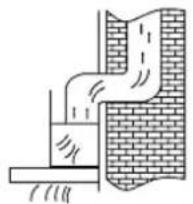 |
| HORIZONTAL | 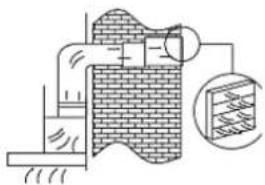 |
10.
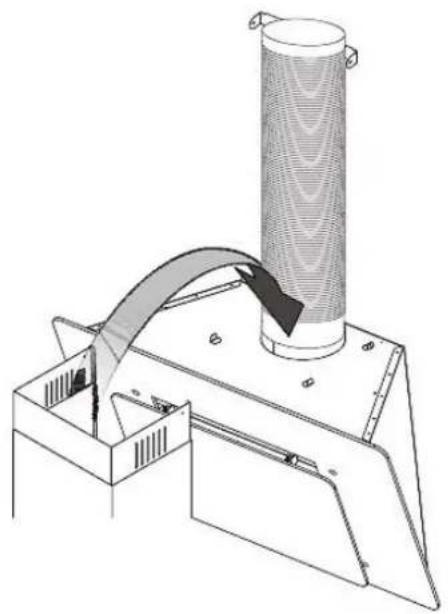
natural_image
Technical line drawing of a mechanical device with a cylindrical component and curved arrow (no text or symbols)11.
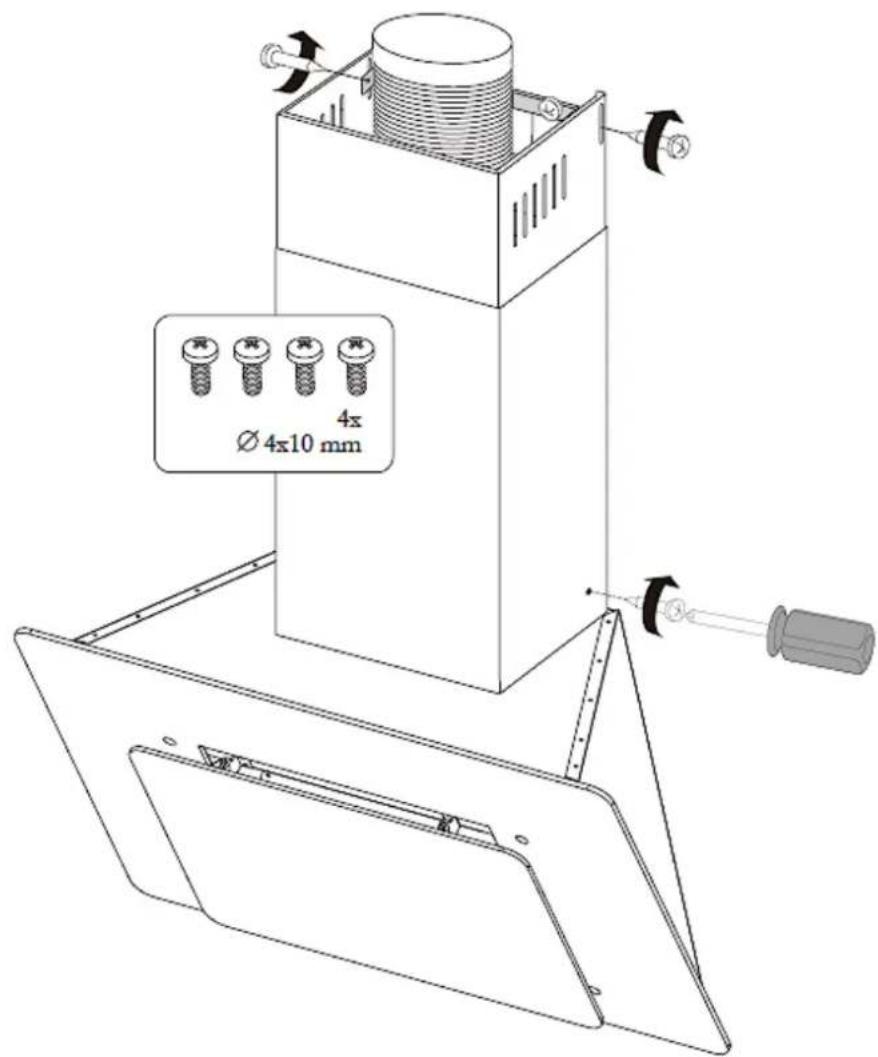
natural_image
Diagram of a mechanical or fluid system with directional arrows and a central component (no text or symbols)natural_image
Collection of simple line drawings including sun, wind turbine, fan, and circle (no text or symbols)natural_image
Close-up of hands holding a small object with a circular opening, possibly a device or component (no visible text or symbols)natural_image
Close-up of a hand holding a transparent circular object with green liquid, next to a glowing light fixture (no visible text or symbols)3.
natural_image
Technical line drawing of a mechanical assembly with a magnified inset showing a component detail (no text or symbols)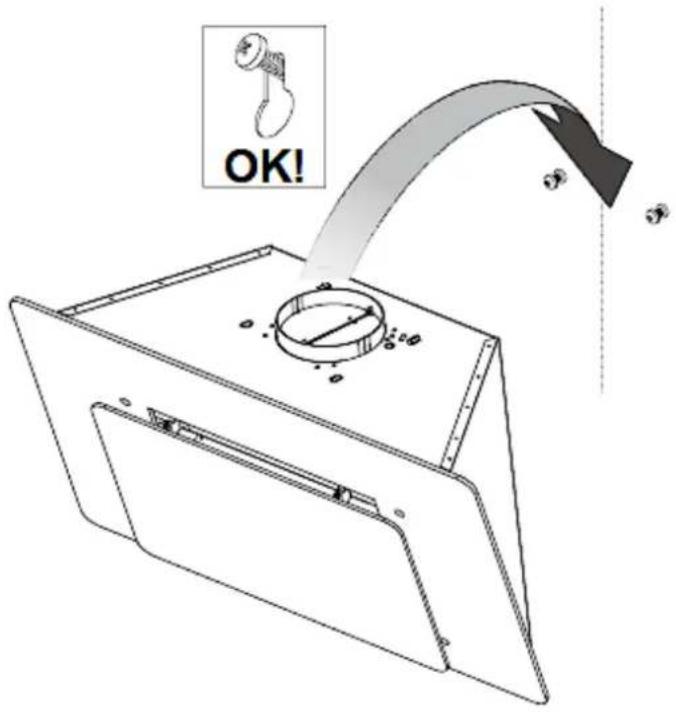
natural_image
Technical line drawing of a mechanical component with a cylindrical top and mounting base (no text or symbols)U KUNT HET LUCHTAFVOERKANAAL ALS VOLGT LEIDEN (ALLEEN EXTRACTIE MODUS)
| VERTICAAL | 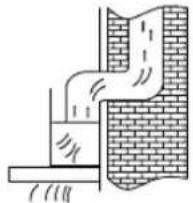 |
| HORIZONTAAL | 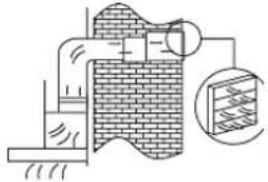 |
10.
natural_image
Technical line drawing of a mechanical device with a cylindrical component and an arrow indicating motion (no text or symbols)11.
natural_image
Diagram of a mechanical or fluid system with directional arrows and a central block, no text or symbols present.2.5.1 Koolstofffilter
Productcode: CO4
⚠ WAARSCHUWING! recirculatiestand.
natural_image
Simple line drawing of a hand holding a rectangular object over a flat surface, with an arrow indicating direction (no text or symbols)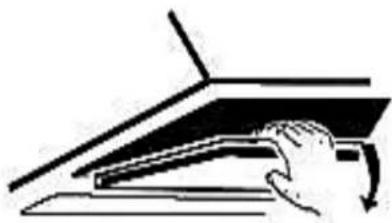
natural_image
Simple line drawing of a hand pressing down on a laptop (no text or symbols)natural_image
Collection of simple line drawings representing sun, wind turbine, fan, and circle (no text or symbols)natural_image
Simple line drawing of a hand holding a rectangular object over a flat surface, with an arrow indicating direction (no text or symbols)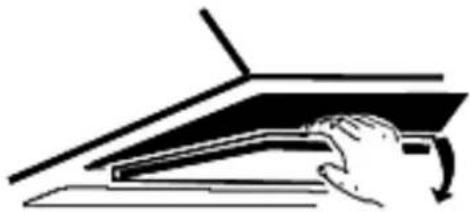
natural_image
Simple line drawing of a hand pressing down on a flat surface with a curved arrow indicating motion (no text or symbols)natural_image
Close-up of a hand holding a small metallic object with a transparent lens (no visible text or symbols)natural_image
Close-up of a hand holding a transparent magnifying glass over a green circular object, with no visible text or symbols.Please contact the shop you purchased the appliance at.

- Kohlefilter
- Index
- EU - DECLARATION OF CONFORMITY
- READ THE SAFETY INFORMATION AND THE SAFETY INSTRUCTIONS CAREFULLY BEFORE YOU OPERATE THE APPLIANCE FOR THE FIRST TIME.
- Signal words
- Safety instructions
- DANGER!
- To reduce the risk of electrocution.
- WARNING!
- To reduce the risk of burns, electrocution, fire or injury to persons.
- CAUTION!
- NOTICE!
- SAVE THESE INSTRUCTIONS.
- Installation
- Important installation instructions: extraction mode
- Minimum distances
- Components of the appliance
- Installation steps
- INSTALLATION DRAWING
- Electrical connection
- Extraction mode / Recirculation mode
- Extraction mode
- Recirculation mode
- Carbon filters
- HOW TO INSTALL THE CARBON FILTER
- Grease filter
- Control panel and operation
- Control panel
- Operation
- Environmental protection
- Environmental protection: disposal
- Environmental protection: energy saving
- Cleaning and maintenance
- Grease filters
- CLEANING INTERVAL FOR ALUMINIUM GREASE FILTERS
- MANUAL CLEANING OF THE ALUMINIUM GREASE FILTERS
- CLEANING OF THE ALUMINIUM GREASE FILTERS IN THE DISHWASHER
- NOTICE! Filters which are blocked with food leftovers are not covered by the guarantee.
- Carbon filters
- REPLACEMENT INTERVAL FOR CARBON FILTERS
- Replacing of the illuminant
- INSTRUCTIONS FOR THE QUALIFIED PROFESSIONAL (ELECTRICAL ENGINEER)
- Troubleshooting
- IF THE HOOD DOES NOT WORK PROPERLY AND / OR YOU CAN HEAR INCREASED OPERATING NOISE, CHECK THE SCHEDULE BELOW.
- IN EXTRACTION MODE
- IN RECIRCULATION MODE
- Waste management
- The guarantee claim does not cover:
- The validity of the guarantee will be terminated if:
- 10.
- Koolstofffilter
Brand : PKM
Model : 9039X
Category : Range hood