
K3300 ES(W)EX - Cooker INDESIT - Free user manual and instructions
Find the device manual for free K3300 ES(W)EX INDESIT in PDF.



| Product type | Mixed cooker (gas and electric) |
| Brand | Indesit |
| Model | K3300 ES(W)EX |
| Category | Cooker |
| Number of gas burners | 3 |
| Gas burner types | Rapid (R), Semi-rapid (S), Auxiliary (A) |
| Burner diameters | Rapid 100 mm, Semi-rapid 75 mm, Auxiliary 55 mm |
| Electric hob | 1 normal plate 180 mm, 1500 W |
| Oven | Electric, multifunction |
| Oven volume | 58 litres |
| Oven dimensions (W x D x H) | 39 x 44 x 34 cm |
| Maximum oven power | 2100 W |
| Oven functions | Static, Baking, Grill, Double grill, Rotisserie |
| Oven lighting | Yes (bulb 230V, 25W, E14 base) |
| Timer | Yes, mechanical (bell) |
| Warming drawer | Yes, dimensions 42 x 44 x 23 cm |
| Gas supply | Liquid gas (butane/propane), nominal pressure 30 kPa |
| Electrical supply | 230 V (see rating plate for frequency) |
| Safety device | Flame thermocouple on gas burners |
| Adjustable feet | Yes (for leveling) |
| Cleaning and maintenance | Enamel and stainless steel, electric hob cleaned with a damp cloth, burners washable with detergent |
| Removable lid | Yes (for cleaning) |
| Repairability | Replaceable oven lamp, gas taps by approved technician |
Frequently Asked Questions - K3300 ES(W)EX INDESIT
User questions about K3300 ES(W)EX INDESIT
0 question about this device. Answer the ones you know or ask your own.
Ask a new question about this device
Download the instructions for your Cooker in PDF format for free! Find your manual K3300 ES(W)EX - INDESIT and take your electronic device back in hand. On this page are published all the documents necessary for the use of your device. K3300 ES(W)EX by INDESIT.
USER MANUAL K3300 ES(W)EX INDESIT
Cooker Installation and Use
To maintain the EFFICIENCY and SAFETY of this appliance, we recommend:
- Call only the Service Centers authorized by the manufacturer.
- Always use original Spare Parts.
1. This appliance is intended for non-professional use within the home. 2. These instructions are only for those countries whose symbols appear in the booklet and on the serial number plate of the appliance. 3. Before using your appliance, read the instructions in this owner's manual carefully since it provides all the information you need to ensure safe installation, use, and maintenance. Always keep this owner's manual close at hand since you may need to refer to it in the future. 4. When you have removed the packing, check that the appliance is not damaged. If you have any doubts, do not use the appliance and contact your nearest Ariston Service Centre. Never leave the packing components (plastic bags, polystyrene foam, nails, etc.) within the reach of children since they are a source of potential danger. 5. The appliance must be installed only by a qualified technician in compliance with the instructions provided. The manufacturer declines all liability for improper installation, which may result in personal injury and damage to property. 6. The electrical safety of this appliance can only be guaranteed if it is correctly and efficiently earthed, in compliance with regulations on electrical safety. Always ensure that the earthing is efficient. If you have any doubts, contact a qualified technician to check the system. The manufacturer declines all liability for damage resulting from a system which has not been earthed. 7. Before plugging the appliance into the mains, check that the specifications indicated on the data plate (on the appliance and/or packaging) correspond with those of the electrical and gas systems in your home. 8. Check that the electrical capacity of the system and sockets will support the maximum power of the appliance, as indicated on the data plate. If you have any doubts, contact a qualified technician. 9. An omnipolar switch with a contact opening of at least 3 mm or more is required for installation. 10. If the socket and appliance plug are not compatible, have the socket replaced with a suitable model by a qualified technician, who should also check that the cross-section of the socket cable is sufficient for the power absorbed by the appliance. The use of adaptors, multiple sockets, and/or extensions is not recommended. If their use cannot be avoided, remember to use only single or multiple adapters and extensions which comply with current safety regulations. In these cases, never exceed the maximum current capacity indicated on the individual adaptor or extension and the maximum power indicated on the multiple adapter. 11. Do not leave the appliance plugged in if it is not in use. Switch off the main switch and gas supply when you are not using the appliance. 12. The openings and slots used for ventilation and heat
dispersion must never be covered.
13 The user must not replace the supply cable of this appliance. Always contact an after-sales service centre which has been authorised by the manufacturer if the cable has been damaged or needs replacement. 14 This appliance must be used for the purpose for which it was expressly designed. Any other use (e.g. heating rooms) is considered to be improper and consequently dangerous. The manufacturer declines all liability for damage resulting from improper and irresponsible use. 15 A number of fundamental rules must be followed when using electrical appliances. The following are of particular importance:
- Do not touch the appliance when your hands or feet are wet.
- Do not use the appliance barefooted.
- Do not use extensions, but if they are necessary, caution must be exercised.
- Never pull the power supply cable or the appliance to unplug the appliance plug from the mains.
- Never leave the appliance exposed to atmospheric agents (rain, sun etc.)
- Do not allow children or persons who are not familiar with the appliance to use it, without supervision.
16 Always unplug the appliance from the mains or switch off the main switch before cleaning or carrying out maintenance.
17 If you are no longer using an appliance of this type, remember to make it unserviceable by unplugging the appliance from the mains and cutting the supply cable. Also make all potentially dangerous parts of the appliance safe, above all for children who could play with the appliance. 18 To avoid accidental spillage do not use cookware with uneven or deformed bottoms on the electric plates or the burners. Turn the handles of pots and pans inwards to avoid knocking them over accidentally. 19 Never use flammable liquids such as alcohol or gasoline, etc. near the appliance when it is in use. 20 When using small electric appliances near the hob, keep the supply cord away from the hot parts. 21 Make sure the knobs are in the off position when the appliance is not in use. 22 When the appliance is in use, the heating elements and some parts of the oven door become extremely hot. Make sure you don't touch them and keep children well away. 23 If the cooker is placed on a pedestal, take the necessary precautions to prevent the same from sliding off the pedestal itself. 24 Gas appliances require regular air exchange to ensure trouble-free performance. When installing the cooker, follow the instructions provided in the paragraph on "Positioning" the appliance. 25 Warning: never place hot containers or items and flammable materials inside the dishwarmer drawer.
Installation
All instructions on the following pages must be carried out by a competent person (CORGI registered) in compliance with gas safety (installation and use) regulations 1984. Important: disconnect the cooker from the electricity and gas supply when any adjustment, etc.
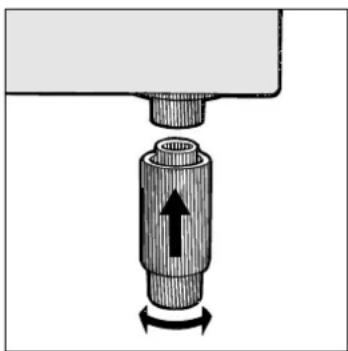
Levelling your appliance (only on a few models)
Your cooker is supplied with feet for levelling the appliance. If necessary, these feet can be screwed into the housings in the corners of the cooker base.
Mounting the legs (only on a few models)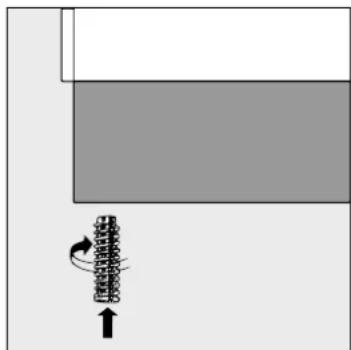
Press-fit legs are supplied which fit under the base of your cooker.
Installation of the cooker
The appliance can be installed next to furniture units which are no taller than the top of the cooker hob. The wall in direct contact with the back panel of the cooker must be made of non-flammable material. During operation the back panel of the cooker could reach a temperature of 50°C above room temperature. For proper installation of the cooker, the following precautions must be taken:
- The appliance can be placed in a kitchen, dining room or bedsit, but not in a bathroom.
- All furniture around the appliance must be placed at least 200 mm from the top of the cooker, should the surface of the appliance be higher than the worktop of this furniture. Curtains should not be placed behind the cooker or less than 200 mm away from the sides of the appliance.
Connecting the gas
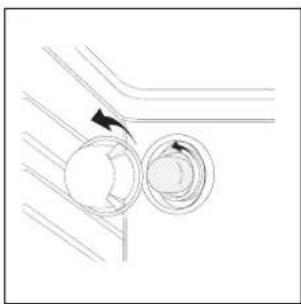
The appliance should be connected to a gas cylinder in compliance with current directives. On some models the gas supply can be connected on the left or on the right, as necessary; to change the connection, reverse the position of the hose holder with that of the cap and replace the gasket (supplied with the appliance). Remember to install a pressure regulator on the LPG cylinder, which complies with current directive.
Important: check that the supply pressure complies with the values indicated in table 1 "Characteristics of the burners and nozzles" since this will ensure safe operation, correct consumption and ensure a longer life to your appliance.
Connection with hose
Make the connection using a gas hose complying with the characteristics provided in current directive. The internal diameter of the pipe used is as follows:
- 8 mm for liquid gas;
When installing the hose, remember to take the following precautions:
Check that the hose fits firmly into place at the two ends and fix it with clamps complying to current directive. If any of the above recommendations cannot be adopted, flexible metal pipes should be used.
Tight control
Important: when installation has been completed, check the pipe fitting for leaks with a soapy solution. Never use a flame. Once the connection has been made, ensure that the flexible metal tube does not touch any moving parts and is not crushed.
Connecting the supply cable to the mains
Install a normalised plug corresponding to the load indicated on the data plate. When connecting the cable directly to the mains, install an omnipolar circuit-breaker with a minimum contact opening of 3 mm between the appliance and the mains. The omnipolar circuit breaker should be sized according to the load and should comply with current regulations (the earth wire should not be interrupted by the circuit breaker).
The supply cable should be positioned so that it does not reach a temperature of more than 50°C with respect to the room temperature, along its length. Before making the connection, check that:
- the limiter valve and the home system can support the appliance load (see data plate);
- the mains is properly earthed in compliance with current directives and regulations;
- there is easy access to the socket and omnipolar circuit breaker, once the cooker has been installed.
N.B: never use reducers, adaptors or shunts since they can cause heating or burning.
Burner and nozzle characteristics
| Table 1 Liquid Gas | |||||
| Burner Diameter | (mm) | By-Pass 1/100 (mm) (mm) no | Nozzle 1/100 minal minim | Flow g/h | |
| Fast (Large)(R) | 100 41 86 | 220 50 | |||
| Semi Fast (Medium)(S) | 75 30 70 | 140 25 | |||
| Auxiliary (Small)(A) | 55 30 60 | 100 25 | |||
| Supply Pressures | Nominal (kPa) | 30 | |||
| Minimum (kPa) | 25 | ||||
| Maximum (kPa) | 35 | ||||
K 3300 ES/EX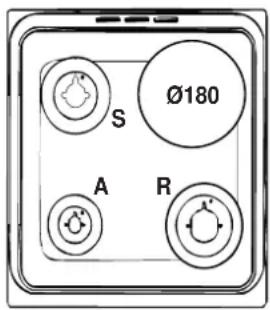
Technical Specifications
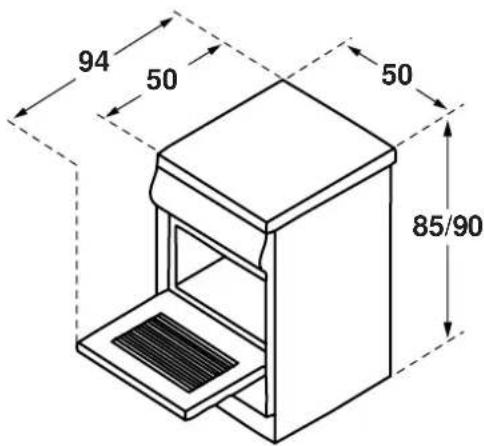
| Inner dimensions of the oven: | |
| Width: 39 cm | |
| Depth: 44 cm | |
| Height: 34 cm | |
| Inner Volume of the Oven: | 58 lt |
| Maximum absorber power: |
| 2100 W |
Inner Dimensions of the Food Warmer:
Width: 42 cm
Depth: 44 cm
Height: 23 cm
| Voltage and Frequency of Power Supply: |
| see data plate |
| Electric Plate |
| Standard Ø 180 mm: 1500 W |
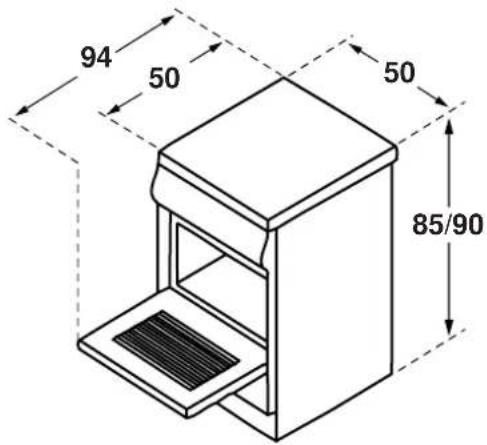
The cooker with electric oven
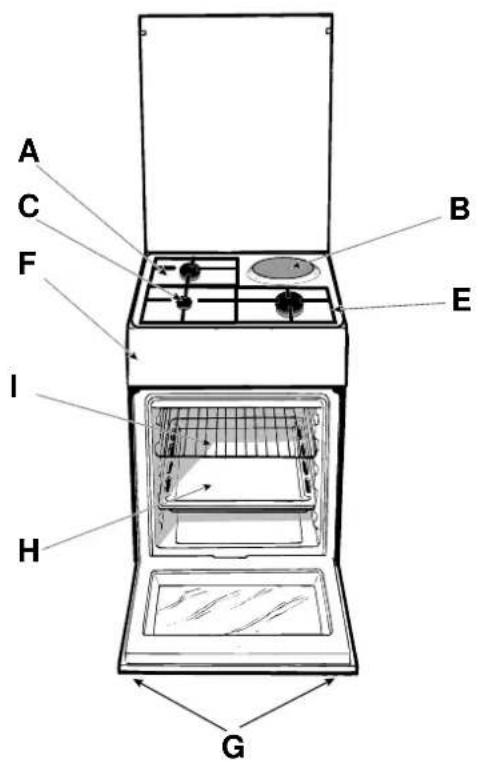
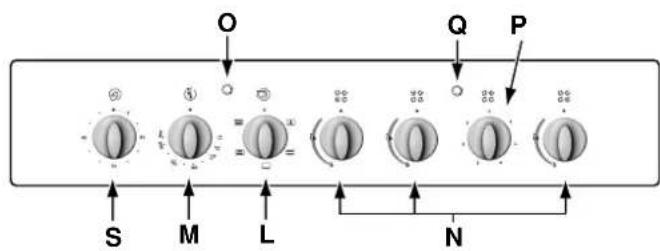
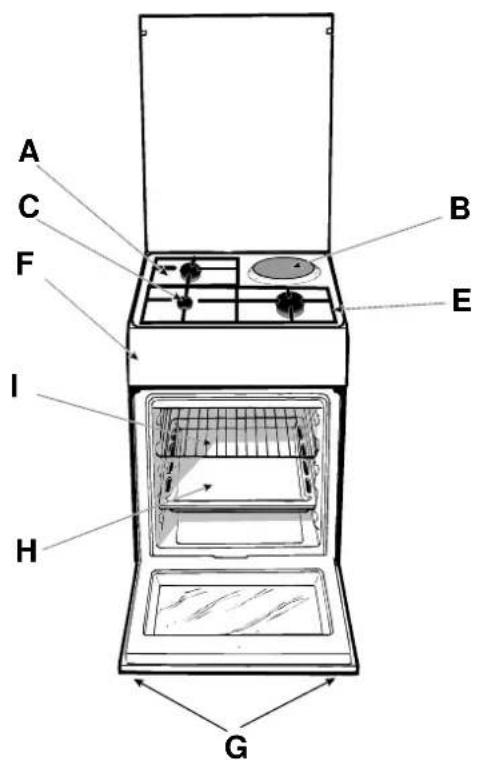
A. Tray for Catching Overflows B. Electric Plate C. Gas Burner E. Top Grade F. Control Panel G. Adjustable Feet or Legs H. Dripping Pan or Baking Sheet I. Oven Rack
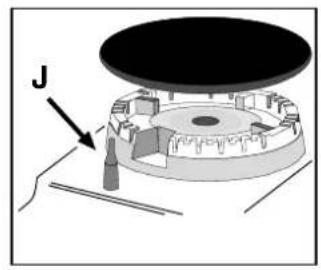
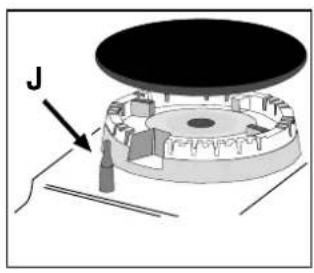
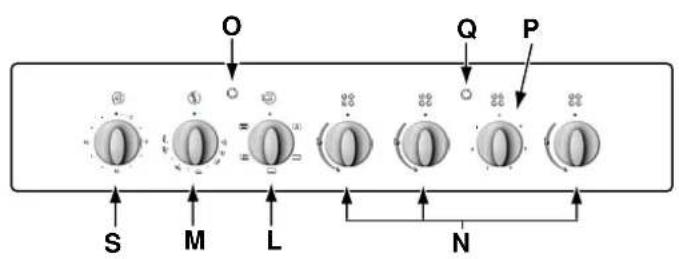
J. Flame Failure Device for Cooktop Burners L. Selection knob M. Thermostat knob N. Control Knobs for Gas Burners on Hob O. Thermostat light P. The control knobs for the electric plates Q. The green pilot lamp S. Timer Knob
The different functions and uses of the oven
The various functions included in the cooker are selected by operating the control devices located on the cooker control panel.
Control Knobs for the Gas Burners on the Hob (N)
The position of the gas burner controlled by each one of the knobs is shown by a symbol of a solid ring: To light one of the burners, hold a lighted match or lighter near the burner. Press down and turn the corresponding knob in the counterclockwise direction to the maximum setting. Each burner can be operated at its maximum, minimum or intermediate power. Shown on the knob are the different symbols for off (the knob is on this setting when the symbol lines up with the reference mark on the control panel), for maximum and minimum
To obtain these settings, turn the knob counter-clockwise with respect to the off position. To turn off the burner, turn the knob clockwise until it stops (corresponding again with the symbol).
Models with Hob Gas Burner Safety Devices to
Prevent Leaks (see detail J).
Important: Since the hob burners are equipped with a safety device, you must hold the control knob in for about 6 seconds after the burner has been lighted to allow the gas to pass until the safety thermocouple has heated.
Notice: The first time you use your appliance, we recommend that you set the thermostat to the highest setting and leave the oven on for about half an hour with nothing in it, with the oven door shut. Then, open the oven door and let the room air. The odour that is often detected during this initial use is due to the evaporation of substances used to protect the oven during storage and until it is installed.
Attention: Only use the bottom shelf of the oven when using the rotisserie to cook (where present). For all other types of cooking, never use the bottom shelf and never place anything on the bottom of the oven when it is in operation because this could damage the enamel. Always place your cookware (dishes, aluminium foil, etc. etc.) on the grate provided with the appliance inserted especially along the oven guides.
The oven knobs
With these two controls you can select the different functions of the oven and choose the cooking temperature suitable for the food you are preparing. The different cooking functions are set up by operating the two knobs:
L - the selection knob (identified by the symbol
M - the thermostat knob (identified by the symbol) on the oven panel.
For any selection-knob setting different from idle, identified by the "0", the oven light turns on; the knob setting marked
permits turning on the oven light without any heating element being switched on. When the oven light is on, it means that the oven is in use, and it will remain on for the entire time the oven is being used.
1. Static oven
- Knob "L" setting:
- Knob "M" setting: anywhere between 50°C and Max
The oven light turns on and the top and bottom heating elements (resistors) switch on. The temperature, fixed by the thermostat knob, is reached automatically and kept constant by the thermostat control. This function permits cooking and type of food thanks to excellent temperature distribution.
2. The bottom heating element
- Knob "L" setting:
- Knob "M" setting: anywhere between 50°C and Max
The oven light turns on and so does the bottom heating element. The temperature, fixed by the thermostat knob, is reached automatically and kept constant. This setting is recommended for finishing the cooking of foods (placed in pans) that are well done on the outside but still not done inside or for desserts covered with fruit or jam which require a light browning on top. Note that this function does not permit reaching the maximum (250°C) temperature inside for cooking foods always on this oven setting unless the foods are cakes which only require temperatures below or equal to 180°C.
3. The grill
- Knob "L" setting: - Knob "M" setting: Max
The oven light turns on, as does the infra-red ray grill, and the motor starts turning the spit. The rather high and direct temperature of the grill permits browning the outside of meats immediately, thus keeping in the juices and assuring tenderness.
4. The double grill
- Knob "L" setting: -Knob "M" setting Max
The oven light turns on, as does the double heating element of the grill, and the motor starts turning the spit. This grill is larger than the average and has a completely new design: cooking performance is increased by 50%. The double grill makes sure that even the corners are touched by heat.
Important: when using the grill, keep the oven door closed to obtain the best results and save energy (about 10%). When utilizing the grill, place the rack at the lower levels (see cooking table). To catch grease or fat and prevent smoke, place a dripping pan at the bottom rack level.
The rotisserie (only on a few models)
To operate the rotisserie, proceed as follows:
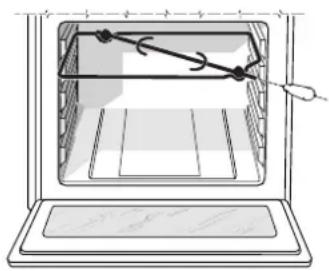
a) Place the dripping-pan on the 1st rack; b) Insert the special rotisserie support on the 4th rack and position the spit by inserting it through the special hole into the rotisserie at the back of the oven; c) To start the spit, set the oven selection knob (L) on setting (which delivers 50% of the total grill power)
for small quantities of food, or on setting (which delivers total grill power).
The oven-operating pilot lamp (O)
Signals when the oven is heating. It switches off when the temperature inside the oven reaches the temperature selected by the knob. At this point, the alternate turning on and turning off of this light indicates that the thermostat is operating correctly to keep the oven temperature constant.
The cook-top electric plate control knobs (P)
The cookers may be equipped with standard, fast, and automatic electric plates in various combinations (the fast plates distinguished from the others by a red dot in the centre, the automatic ones by a round aluminium disk at the centre).
To avoid heat dispersion and damage to the plates, we recommend using cooking vessels with flat bottoms whose diameters are not smaller than the plate diameter. The table shows the correspondence between the position indicated on the knobs and the use for which the plates are advised.
Before using the hot plates for the first time, you should heat them at maximum temperature for approximately 4 minutes, without any pans. During this initial stage, their protective coating hardens and reaches its maximum resistance.
| Setting | Normal or Fast Plate |
| 0 Off | |
| 1 Cooking vegetables, fish | |
| 2 | Cooking potatoes (using steam) soups, chickpeas, beans. |
| 3 | Continuing the cooking of large quantities of food, minestrone |
| 4 | For roasting (average) |
| 5 | For roasting (above average) |
| 6 | For browning and reaching a boil in a short time. |
The green pilot lamp (Q)
This lights up when an electric plate is turned on.
Timer Knob
To use the timer, the ringer "S" must be wound up by turning the knob one full turn clockwise; then turn it back to the desired time so that the number of minutes on the knob matches the reference mark on the panel.
Attention
Avoid children touching the oven door because it is very hot during cooking.
Practical advice for burner use
In order to get the maximum yield it is important to remember the following:
- Use appropriate cookware for each burner (see table) so as to avoid flames overshooting the edges. At boiling point turn the knob to minimum. Use cookware with lids. Always use cookware with flat bottoms.
| Burner ø Cook | ware diameter (mm) |
| Fast (R) 240 - 300 | |
| Semi Fast (S) 160 - 240 | |
| Auxiliary (A) 60 - 180 |
Storage recess below the oven
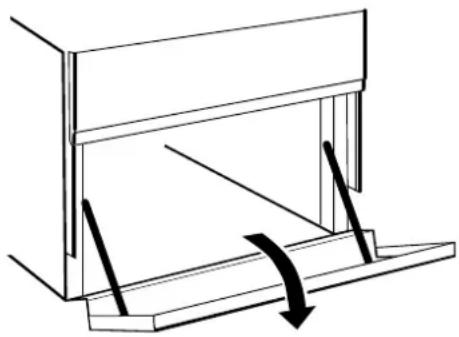
Below the oven a recess can be used to contain cooking pans and cooker accessories. Moreover, during oven operation, it may be used to keep food warm. To open the storage, turn it downwards.
Caution: this storage recess must not be used to store inflammable materials.
Cooking advice
The oven offers a wide range of alternatives which allow you to cook any type of food in the best possible way. With time you will learn to make the best use of this versatile cooking appliance and the following directions are only a guideline which may be varied according to your own personal experience.
Baking cakes
The oven should always be warm before putting in cakes; wait until the end of preheating (about 10-15 min.). Cake-baking temperatures are normally around 160°C / 200°C. Do not open the oven door during the baking process as this could cause the cake to sink. In general:
Pastry is too dry
Increase the temperature by 10°C and reduce the cooking time.
Pastry dropped
Use less liquid or lower the temperature by 10°C
Pastry is too dark on top
Place it on a lower rack, lower the temperature, and increase the cooking time.
Cooked well on the inside but sticky on the outside
Use less liquid, lower the temperature, and increase the cooking time.
The pastry sticks to the pan.
Grease the pan well and sprinkle it with a dusting of flour.
Cooking fish and meat
When cooking white meat, fowl and fish use low temperatures (150°C - 175°C). When red meat must be superficially well-cooked but succulent inside, it is advisable to start with a high temperature (200 - 220°C) for a short time, and then to reduce it at a later point. Generally speaking, the more meat there is, the lower the temperature and the longer the cooking time should be. Place the meat in the centre of the grid and put a spill-tray underneath to catch grease drips. Insert the grid so that it is in the middle of the oven. If more heat from below is required, use the 1st bottom shelf.
To grill
When using any of the grilling modes, it is recommended that the thermostat knob be turned to the highest setting, as it is the most efficient way to use the grill (which utilizes infrared rays). If necessary, however, the thermostat can be set to lower temperatures for grilling. When using the grill functions, place the grid on the lower racks (see cooking table) then, to prevent fat and grease from dripping onto the bottom of the oven and smoke from forming, place a dripping-pan on the 1st oven rack from the bottom.
Important: always use the grill with the oven door closed. This will allow you both to obtain excellent results and to save on energy (approximately 10%). Table 1 includes the recommended temperatures, cooking times and positions for you to obtain the best results when cooking.
Cooker routine maintenance and cleaning
Before each operation, disconnect the cooker from the electricity. To assure the long life of the cooker, it must be thoroughly cleaned frequently, keeping in mind that:
Do not use steam equipment to clean the appliance. - the enamelled parts and the self-cleaning panels are washed with warm water without using any abrasive powders or corrosive substances which could ruin them; the inside of the oven should be cleaned fairly often while it is still warm using warm water and detergent, followed by careful rinsing and drying; - the flame spreaders should be washed frequently with hot water and detergent taking care to eliminate any scale; in cookers equipped with automatic lighting, the terminal part of the electronic instant lighting devices should be cleaned frequently and the gas outlet holes of the flame spreaders should be checked to make sure they are free of any obstructions; the electric plates are cleaned with a damp cloth and they should be lubricated with a little oil while they still warm; - Stainless steel may become marked if it comes into contact with very hard water or harsh detergents (containing phosphorous) for long periods of time. After cleaning, it is advisable to rinse thoroughly and dry. It is also recommended to dry any water drops;
N.B: avoid closing the cover while the gas burners are still warm. Remove any liquid from the lid before opening it.
Important: periodically check the wear of the gas hose and substitute it if there are any defects; we recommended changing it every year.
Replacing the oven lamp
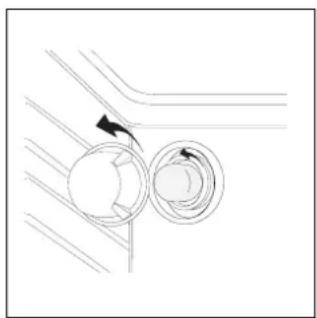
Unplug the oven from the mains; Remove the glass cover of the lamp-holder; - Remove the lamp and replace with a lamp resistant to high temperatures (300°C) with the following characteristics:
-Voltage 230V -Wattage 25W - Type E14
Replace the glass cover and reconnect the oven to the mains.
Gas tap maintenance
The taps may jam in time or they may become difficult to turn. If so, the tap itself must be replaced.
N.B.: This operation must be performed by a technician authorised by the manufacturer.
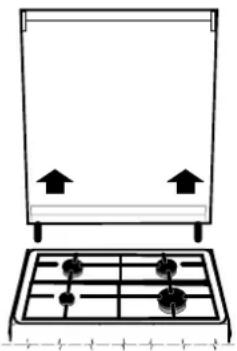
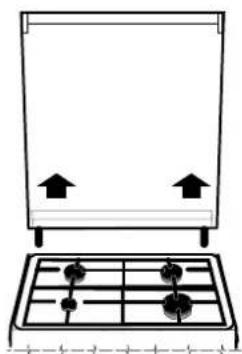
Removing the lid
The cooker lid can be removed to facilitate cleaning. To remove the lid, first open it completely and pull it upwards (see figure)
Cooking advice
| Selection knob setting | Foods Wt. | (Kg) | Cooking position from bottom | Heating time (minutes) | Thermostat knob | Cooking time (minutes) |
| 1 Static | Lasagne | 2,5 | 2 | 5 | 200 | 45-50 |
| Cannelloni | 2,5 | 3 | 5 | 200 | 30-35 | |
| Pasta bakes au gratin | 2,0 | 3 | 5 | 200 | 30-35 | |
| Veal | 1,7 | 2 | 10 | 180 | 60-70 | |
| Chicken | 1,5 | 3 | 10 | 200 | 80-90 | |
| Duck | 1,8 | 3 | 10 | 180 | 90-100 | |
| Rabbit | 2 | 3 | 10 | 180 | 70-80 | |
| Pork | 2,1 | 3 | 10 | 180 | 70-80 | |
| Lamb | 1,8 | 3 | 10 | 180 | 70-80 | |
| Mackerel | 1,1 | 2 | 5 | 180 | 30-40 | |
| Red porgy | 1,5 | 2 | 5 | 180 | 30-35 | |
| Trout baked in paper | 1 | 2 | 5 | 180 | 25-30 | |
| Napolitan pizza | 1 | 2 | 15 | 220 | 15-20 | |
| Biscuits or cookies | 0,5 | 3 | 10 | 180 | 10-15 | |
| Flan or tart | 1,1 | 3 | 10 | 180 | 25-30 | |
| Savoury pie | 1 | 3 | 10 | 180 | 30-35 | |
| Yeast cake | 0,5 | 3 | 10 | 160 | 25-30 | |
| Fruit cake | 1 | 3 | 10 | 170 | 25-30 | |
| 2 Oven bottom | Finishing touches | |||||
| 3 Grill | Sole and cuttlefish | 1 | 4 | 5 | Max | 8 |
| Squid and shrimp on spits | 1 | 4 | 5 | Max | 4 | |
| Cod fillets | 1 | 4 | 5 | Max | 10 | |
| Grilled vegetables | 1 | 3/4 | 5 | Max | 8-10 | |
| 4 Double Grill | Veal steaks | 1 | 4 | 5 | Max | 15-20 |
| Cutlets | 1,5 | 4 | 5 | Max | 20 | |
| Hamburgers | 1 | 3 | 5 | Max | 7 | |
| Mackerels | 1 | 4 | 5 | Max | 15-20 | |
| Toast sandwiches | n.° 4 | 4 | 5 | Max | 5 | |
| With rotisserie | ||||||
| Veal on the spit | 1,0 | - | 5 | Max | 70-80 | |
| Chicken on the spit | 2,0 | - | 5 | Max | 70-80 |
NB: cooking times are approximate and may vary according to personal taste. When cooking using the grill or double grill, the dripping-pan must always be placed on the 1st oven rack from the bottom.
Advice
Therefore m = 3/11
50 150 50
3.3
4
| 39 | :العاء | -15 |
| 44 | :العربية | - |
| 34 | :العس | -125 |
| 851 | ||
| 0012 | ||
| 42 | :العاء | -15 |
| 44 | :العربية | - |
| 23 | :العس | -125 |
| 42 | :العاء | -15 |
| 34 | :العربية | -125 |
| 851 |
- INSTALLATION
- INSTALLATION OF THE COOKER
- CONNECTING THE GAS
- CONNECTION WITH HOSE
- TIGHT CONTROL
- CONNECTING THE SUPPLY CABLE TO THE MAINS
- BURNER AND NOZZLE CHARACTERISTICS
- TECHNICAL SPECIFICATIONS
- THE COOKER WITH ELECTRIC OVEN
- THE DIFFERENT FUNCTIONS AND USES OF THE OVEN
- CONTROL KNOBS FOR THE GAS BURNERS ON THE HOB (N)
- MODELS WITH HOB GAS BURNER SAFETY DEVICES TO
- PREVENT LEAKS (SEE DETAIL J)
- THE OVEN KNOBS
- STATIC OVEN
- THE BOTTOM HEATING ELEMENT
- THE GRILL
- THE DOUBLE GRILL
- THE ROTISSERIE (ONLY ON A FEW MODELS)
- THE OVEN-OPERATING PILOT LAMP (O)
- THE COOK-TOP ELECTRIC PLATE CONTROL KNOBS (P)
- THE GREEN PILOT LAMP (Q)
- TIMER KNOB
- ATTENTION
- PRACTICAL ADVICE FOR BURNER USE
- STORAGE RECESS BELOW THE OVEN
- COOKING ADVICE
- BAKING CAKES
- PASTRY IS TOO DRY
- PASTRY DROPPED
- PASTRY IS TOO DARK ON TOP
- COOKED WELL ON THE INSIDE BUT STICKY ON THE OUTSIDE
- THE PASTRY STICKS TO THE PAN
- COOKING FISH AND MEAT
- TO GRILL
- COOKER ROUTINE MAINTENANCE AND CLEANING
- N.B: AVOID CLOSING THE COVER WHILE THE GAS BURNERS ARE STILL WARM. REMOVE ANY LIQUID FROM THE LID BEFORE OPENING IT
- REPLACING THE OVEN LAMP
- GAS TAP MAINTENANCE
- N.B.: THIS OPERATION MUST BE PERFORMED BY A TECHNICIAN AUTHORISED BY THE MANUFACTURER
- REMOVING THE LID
- ADVICE
Brand : INDESIT
Model : K3300 ES(W)EX
Category : Cooker