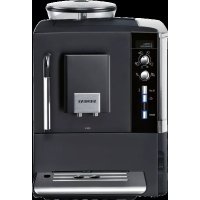
EQ.5 TE502506DE - Coffee maker SIEMENS - Free user manual and instructions
Find the device manual for free EQ.5 TE502506DE SIEMENS in PDF.


| Brand | Siemens |
| Model | EQ.5 TE502506DE |
| Product type | Automatic espresso machine |
| Dimensions (H x W x D) | 385 x 280 x 479 mm |
| Empty weight | 9.3 kg |
| Power supply | 220-240 V, 50/60 Hz, 1600 W |
| Maximum pump pressure | 15 bars |
| Water tank capacity | 1.7 L |
| Bean hopper capacity | 300 g |
| Grinder type | Ceramic grinder |
| Main functions | Whole bean or ground coffee, hot water, milk frother, 2 cups simultaneously |
| Custom settings | Coffee strength, grind fineness, brewing temperature, auto-off |
| Water filter | Yes, removable (ref. TZ70003) |
| Cleaning and descaling program | Integrated service program with dedicated tablets |
| Daily maintenance | Cleaning the frother and brewing unit, emptying the drip tray and coffee grounds container |
| Included accessories | Measuring spoon, water hardness test strip |
| Optional accessories | Cleaning tablets TZ60001, descaling tablets TZ80002, maintenance kit TZ80 |
| Power cord length | 100 cm (adjustable) |
| Safety | Auto-off, frost protection, child safety (monitoring) |
| Repairability | Siemens after-sales service, spare parts available |
Frequently Asked Questions - EQ.5 TE502506DE SIEMENS
User questions about EQ.5 TE502506DE SIEMENS
0 question about this device. Answer the ones you know or ask your own.
Ask a new question about this device
Download the instructions for your Coffee maker in PDF format for free! Find your manual EQ.5 TE502506DE - SIEMENS and take your electronic device back in hand. On this page are published all the documents necessary for the use of your device. EQ.5 TE502506DE by SIEMENS.
USER MANUAL EQ.5 TE502506DE SIEMENS
TE 501..
siemens-home.com/welcome
en Instruction manual
fr Mode d'emploi
Register your product online
en 2
fr 20
pl 39
nl 58
cs 77
ru 95
Included in delivery (see page 2)
Included in delivery....2
Overview....2
Safety instructions ....3
Controls ....5
Before using for the first time....6
Water filter 7
Settings....8
Preparation using coffee beans....10
Preparation using ground coffee 11
Dispensing hot water....11
Preparing milk froth 11
Maintenance and daily cleaning .....12
Tips on saving energy 14
Service programme ....15
Frost protection 16
Accessories 16
Disposal 17
Guarantee....17
Technical specifications....17
Simple troubleshooting....18
Congratulations on purchasing this fully automatic espresso machine from Siemens.
Included in delivery
(see overview image at the start of the instructions)
a TE501 fully automatic espresso machine
b Operating instructions
© Water hardness testing strips
d Measuring spoon
Overview
(see Figs. A, B, C, D and E at the start of the instructions)
1 Bean container
2 Aroma cover
3 Selector for grind setting
4 Drawer (ground coffee / cleaning tablet)
5 Brewing unit (Figure E)
a) Brewing unit
b) Door
c) Eject lever for brewing unit
d) Lock
e) Cover
6 Milk frother (Figure C) removable
a) Steam valve
b) Metal sleeve
c) Frothing tube
d) Steam nozzle
e) Air hole
7 Height-adjustable coffee outlet
8 Drip tray (Figure D)
a) Panel
b) Coffee grounds container
c) Drip tray for coffee outlet
d) Grate for coffee outlet
e) Float
9 Power on/off switch O/I
10 Start button start
11 Steam button
12 Service button ☐ off
13 "Coffee strength" rotary knob
14 "Drink selection" rotary knob
15 LED display
16 Removable water tank
17 Water tank lid
18 Measuring spoon
(insertion aid for water filter)
19 Storage compartment for measuring spoon
20 Power cable with storage compartment
Safety instructions
Please read and follow the operating instructions carefully and keep them for later reference. Enclose these instructions when you give this appliance to someone else. This appliance is designed for the preparation of normal household quantities in the home, or in household-like, non-commercial environments. Household-like environments include staff kitchens in shops, offi ces, agricultural and other small businesses or for use by guests at bed-and-breakfast establishments, small hotels and similar residential facilities.
⚠Danger of electric shock!
Connect and operate the appliance only according to the type plate specifications. To avoid potential hazards, repairs such as replacing a damaged cable must only be carried out by our customer service personnel.
This appliance may be used by children aged 8 years and older and by persons with reduced physical, sensory or mental capabilities or who lack experience and/or knowledge if they are supervised or have been given instruction in the safe use of the appliance and have understood the dangers involved. Keep children under 8 years of age away from the appliance and connecting cable and do not allow them to use the appliance. Children shall not play with the appliance. Cleaning and user maintenance shall not be made by children unless they are older than 8 years and supervised.
Never immerse the appliance or mains cable in water. Use only if power cord and appliance show no signs of damage. Should a fault occur, pull the plug or disconnect from the mains immediately.
⚠Risk of suffocation!
Do not allow children to play with packaging material.
⚠Risk of scalding!
The milk frother outlet (6) gets very hot. After use, allow to cool down first before touching. Use this appliance only after the milk frother (6) has been fully assembled and installed.
⚠Risk of injury!
Do not reach into the grinding unit.
Controls
Power on/off switch O / I
The power on/off switch O/I (9) is used to switch the appliance on or to switch it off completely (power supply off).
Important: To switch off, use the service button (12).
Service button ☐ off
When the service button (12) is pressed briefly, the appliance rinses and switches off. If the service button (12) flashes, the service programme needs to be run. Press and hold the service button (12) to start the service programme. The service button (12) flashes while the service programme is running and turns off when the programme has ended.
Steam button
Press the steam button (11) to generate steam for frothing milk.
Start button start
Press the start button (10) to start preparing a drink. Press again during drink preparation to stop the dispensing process early.
LED display
The various LEDs light up and flash to indicate the following:
lights up The water tank is empty and needs to be refilled.
flashes The water filter is exhausted and needs to be replaced. Important: When you first take the appliance into operation this flashing light does not signify “Change filter” (see “Setting up the appliance”)
© lights up The bean container is empty and needs to be refilled.
lights up The steam valve needs to be opened or closed.
flashes Depending on the setting, steam or hot water is coming out of the milk frother.
lights up When is selected using the "coffee strength" rotary knob, the symbol lights up while ground coffee is being dispensed.
lights up The drip tray is missing or has not been inserted correctly. Insert the drip dray.
flashes The trays are full. Empty the trays and reinsert them.
lights up The brewing unit door is open. Close the door.
flashes Remove and clean the brewing unit.
"Coffee strength" rotary knob
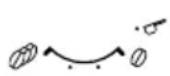
This rotary knob (13) is used to adjust the coffee strength or select the setting for pre-ground coffee.


Very mild
Mild
Medium
Strong
Ground coffee
"Drink selection" rotary knob
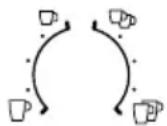
This rotary knob (14) is used to select the required beverage and quantity. It is also used to change user settings.

Small espresso
Espresso

Small café crème
Café crème

Large café crème

2 small espresso
2 espresso

2 small café crèmes
2 café crèmes

2 large café crèmes
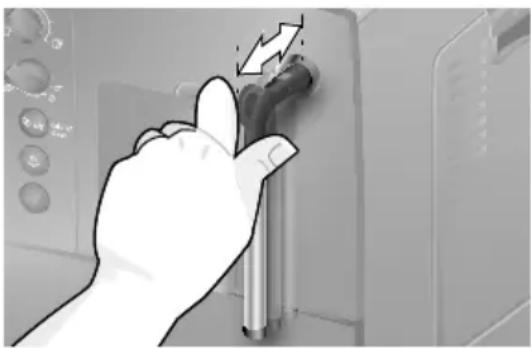
Milk frother
Pull the milk frother (6) out to open it and push it back in to close it.
natural_image
Hand pressing down on a kitchen appliance with a pipe, no visible text or symbolsBefore using for the first time
General
Fill the appropriate container using only pure, cold, uncarbonated water and only roasted beans (preferably espresso or coffee bean blends for fully automatic coffee machines). Do not use coffee beans that have been glazed, caramelised or treated with other additives containing sugar, since they will block the brewing unit.
The water hardness setting can be adjusted on this appliance. The factory setting for the water hardness is 4. Check the hardness of the water you use with the enclosed test strip. If the test reveals a value other than 4, change the setting on the appliance accordingly after switching on (see “Settings”, “Water hardness”).
Setting up the appliance
- Remove the protective film.
- Place the fully automatic espresso machine on a flat, water-resistant surface that can take its weight. The ventilation slots on the appliance must not be covered.
Important: Only use the appliance in frost-free rooms. If the appliance has been transported or stored at temperatures below 0^ C, wait at least 3 hours before operation.
-
Pull out the mains plug from the cable compartment (20) and plug it in. Adjust the length of the cable by pushing it back in and pulling it out. To do this, place the appliance with its back flush with the edge of the work surface and either pull the cable downwards or push it upwards.
-
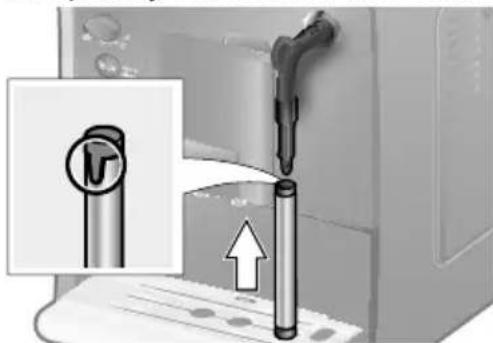
Assemble the milk frother. Only use the appliance when the milk frother (6) is completely assembled and fitted.
natural_image
Diagram showing a kitchen appliance with a tool inserted into a door, highlighting a component (no text or symbols present)- Lift the water tank lid (17).
- Remove and rinse the water tank (16) and fill it with fresh cold water. Do not fill above the max mark.
- Replace the water tank (16) and push it firmly downwards into place.
- Close the water tank lid (17).
- Fill the bean container (1) with coffee beans (for preparation using ground coffee see "Preparation using ground coffee").
- Press the power on/off switch O/I (9) to switch on the appliance. LED ⇌ flashes and LED ⇌ lights up.
- Place a container under the milk frother outlet (6).
- Carefully pull out the milk frother (6) to open it. The appliance rinses out the milk frother (6) with water. LED flashes.
- When LED lights up constantly, press in the milk frother (6) to close it.
The appliance heats up and rinses. Some water will run out of the coffee outlet. When buttons ☉ off (12), ⏻ (11) and ⓣ (10) light up, the appliance is ready for use.
Switching off the appliance
The factory settings of the fully automatic espresso machine are programmed for optimal performance. The appliance switches off automatically after a specific time (the length of time can be adjusted, see "Settings – Automatic switch-off").
Exception: The appliance switches off without rinsing if only hot water or steam was dispensed.
To switch the appliance off manually before this, press the service button Ⓞ off (12). The appliance rinses and switches off.
Note: If the appliance is being used for the first time, the service programme has been run, or the appliance has not been operated for a long period, the first beverage will not have the full aroma and should not be consumed.
When the fully automatic espresso machine is first used, you will achieve a suitably thick and stable “crema” only after the first few cups have been dispensed.
If the appliance is in use for a long period of time, water droplets will form on the ventilation slits. This is normal.
Water filter
Using a water filter can prevent a build-up of limescale deposits.
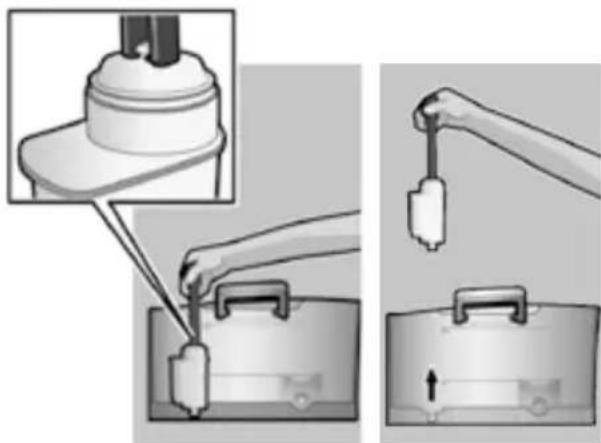
A new water filter must be rinsed before it can be used. To do this, proceed as follows:
- Press the water filter firmly into the empty water tank with the aid of the measuring spoon (18).
natural_image
Illustration of a hand using a tool to lift a small object into a briefcase, showing the process (no text or symbols present)- Fill the water tank (16) with water up to the max mark.
en
- Turn the rotary
knob (13) to position -
Press and hold buttons ⏻ (11) and ⏻ off (12) simultaneously for at least 5 seconds. Either “off” or “on” lights up.
-
Press the start button (10) to select "on".
-
Press and hold the start button (10) for at least 5 seconds to confirm. All of the LEDs light up briefly.
-
LED 📋 flashes and LED 🔊 lights up.
-
Place a container with a capacity of 0.5 litres under the milk frother outlet (6).
-
Pull out the milk frother (6) to open it. LED 🔊 flashes.
-
Water will now flow through the filter and rinse it.
-
When LED lights up constantly, press in the milk frother (6) to close it.
-
Empty the container.
The appliance is ready to use again.
Information: Rinsing the filter simultaneously activates the setting for the change filter display (= LED 📋 flashes).
The filter is no longer effective when the change filter display appears, or at the latest after two months. It needs to be replaced for reasons of hygiene and so that there is no build-up of limescale (this could damage the appliance). Replacement filters can be obtained from retailers or from customer service (see “Accessories”). If no new filter is inserted, change the setting for the filter (see “Water hardness”).
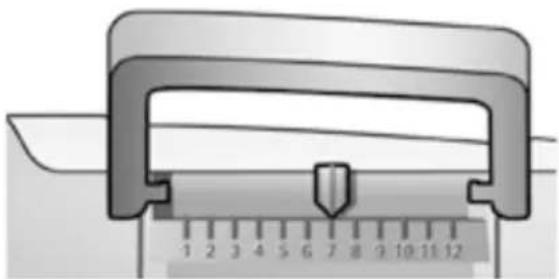
Information: You can use the filter indicator to mark the month in which you inserted the filter. You can also mark the month in which you will need to replace the filter next (at the latest after two months).
natural_image
Close-up of a mechanical caliper with a ruler, showing measurement markings (no text or symbols on the caliper itself)Information: If the appliance has not been used for a prolonged period (for example, when you are on vacation), the existing filter should be rinsed before the appliance is used again. To do so, dispense a cup of hot water and pour it away.
Settings
You can customize the settings on the appliance.
You can make the following adjustments:
Water hardness
The water hardness setting can be adjusted on this appliance. It is important to set the water hardness correctly so that the appliance can accurately indicate when it is time to run the descale process. The factory setting for the water hardness is 4. You can establish the water hardness either by using the test strip provided or by asking your local water provider.
Dip the test strip in the water briefly, shake it gently and check the result after one minute.
Level Water hardness
| German (°dH) | French (°fH) | |
| 1 | 1-7 | 1-13 |
| 2 | 8-14 | 14-25 |
| 3 | 15-21 | 26-38 |
| 4 | 22-30 | 39-54 |
If you wish to change the default degree of water hardness, or if you have inserted a water filter, proceed as follows:
- Turn the rotary
knob (13) to position - Press and hold buttons ⏻ (11) and ⏱ (12) simultaneously for at least 5 seconds. The set water hardness is indicated by the number of LEDs that now light up.
- Now press the start button (10) repeatedly until the required water hardness is indicated, e.g., for water hardness 3, LEDs 🔊, 🔒 and 🔔 will light up.
- Press and hold the start button (10) for at least 5 seconds. The set number of LEDs will light up to indicate that the selected water hardness has been saved successfully.
Important: If a water filter is used (see "Accessories"), proceed as follows, see "Water filter".
Note: If no button is pressed within 90 seconds, the appliance switches to stand-by mode without saving the new settings. In this case, the previously saved water hardness setting is retained.
Automatic switch-off
Here you can set the period of time after which the appliance should switch off automatically following the last drink preparation. A time between 15 minutes and 4 hours can be set. To save power you can specify a shorter period.
- Turn the rotary
knob (13) to position -
Press and hold buttons ⏻ (11) and ⓞ off (12) simultaneously for at least 5 seconds. The time after which the appliance should switch off is indicated by the number of LEDs that now light up.
-
Now press the start button (10) repeatedly until the required number of LEDs light up to indicate the switch-off time:
图标 = 15 minutes
and = 30 minutes
∅ , ∅ and ∅ = 45 minutes
∅, ∅, ∅ and ∅ = 1 hour
∅, ∅, ∅, ∅ and ∅ = 2 hours
∅, ∅, ∅, ∅, ∅ and ∅ = 4 hours -
Press and hold the start button (10) for at least 5 seconds. The set number of LEDs will light up to indicate that the selected switch-off time has been saved successfully.
Note: If no button is pressed within 90 seconds, the appliance switches to stand-by mode without saving the new settings. In this case, the previously saved switch-off time is retained.
Setting the brewing temperature
The brewing temperature can also be set.
- Turn the rotary
knob (13) to position - Press and hold buttons ⏻ (11) and
(5) (12) for at least 5 seconds. The set brewing temperature is indicated by the number of LEDs that now light up. - Now press the start button (10) repeatedly until the required number of LEDs light up to indicate the temperature:
LED 📋 = low
LED 📋 and 🔒 = medium
LED 📊, 🔒, and 🔔 = high - Press and hold the start button (10) for at least 5 seconds. The set number of LEDs will light up to indicate that the selected temperature has been saved successfully.

Note: If no button is pressed within 90 seconds, the appliance switches to stand-by mode without saving the new settings. In this case, the previously saved brewing temperature setting is retained.
Adjusting the grind settings
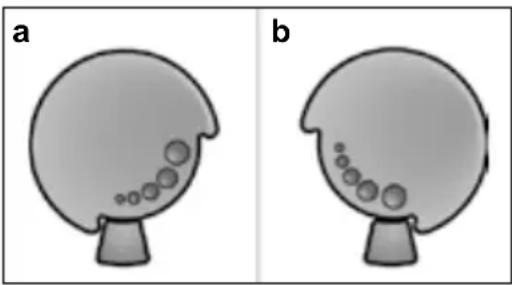
The selector (3) for grind setting adjusts the grind settings from coarse to fine.

Warning!
Adjust the grinding unit only while it is running! Otherwise the appliance may be damaged. Do not reach into the grinding unit.
- With the grinding unit running, adjust the selector (3) from fine (a: turn anticlockwise) to coarse (b: turn clockwise).
natural_image
Two identical illustrations of a mushroom-shaped object with internal particles, labeled 'a' and 'b', no text or symbols present.Information: The effects of the new grind setting will not become apparent until after the second cup of coffee.
Tip: Choose a finer grind for dark roasted beans and a coarser grind for lighter beans.
Preparation using coffee beans
This fully automatic espresso machine grinds beans freshly for each brew.
Tip: If possible, use only beans for fully automatic coffee and espresso machines. For optimal quality, deep-freeze the beans or store in a cool place in sealed containers. Coffee beans can be ground while frozen.
Important: Fill the water tank (16) with fresh water every day. The water tank (16) should always contain sufficient water for operating the appliance.
Different coffee drinks can be prepared quite simply at the press of a button.
Preparation
The appliance must be ready for use.
- Place the pre-warmed cup(s) under the coffee outlet (7).
Tip: For a small espresso, always preheat the cup, e.g. using hot water. - Select the required coffee and the required quantity by turning the upper rotary knob (14).
- Select the required coffee strength by turning the lower rotary knob (13).
- Press the start button (10).
Coffee is brewed and then poured into the cup(s).
Press the start button (10) again to stop the brewing process early.
Preparation using ground coffee
This fully automatic espresso machine can also be operated using ground coffee (not instant coffee powder).
Important: Fill the water tank (16) with fresh water every day. The water tank (16) should always contain sufficient water for operating the appliance.
Preparation
- Open the drawer (4).
- Put ground coffee into the drawer (maximum two level measuring spoons).
Caution: Do not use whole beans or instant coffee. - Close the drawer (4).
- Turn the bottom rotary knob (13) to the symbol ☐.
- Press the start button (10).
Coffee is brewed and then poured into the cup.
Dispensing hot water
Risk of burns!
The milk frother (6) gets very hot. Hold the milk frother (6) by the plastic part only.
The milk frother must be cleaned before drawing hot water.
The appliance must be ready for use.
- Place a pre-heated cup or glass under the milk frother outlet (6).
- Pull out the milk frother (6) to open it. The appliance heats up. Hot water runs out of the milk frother outlet (6) for about 40 seconds.
- Stop the process by pushing in the milk frother (6).
Preparing milk froth
Risk of burns!
The milk frother (6) gets very hot. Hold the milk frother (6) by the plastic part only.
Tip: You can froth the milk first and then dispense coffee, or froth the milk separately and pour it onto the coffee.
The appliance must be ready for use.
- Press button ⏻ (11).
Button ⏻ flashes and the appliance now heats up for approximately 20 seconds. - As soon as button and LED lights up, immerse the milk frother so that it reaches the bottom of a cup or glass that is one-third filled with milk.
- Pull out the milk frother (6) to open it.
Risk of burns!
Escaping steam is very hot and may cause liquids to sputter. Do not touch the metal sleeve or aim it at anyone.
-
Froth the milk.
-
Push the milk frother (6) in to close it.
Tip: For optimal milk froth, if possible use cold milk with a fat content of at least 1.5 %.
Important: Dried milk residue is difficult to remove, so the milk frother (6) must be cleaned with lukewarm water immediately after use.
Maintenance and daily cleaning

Risk of electric shock
Unplug the appliance before cleaning it. Never immerse the appliance in water. Do not use a steam cleaner.
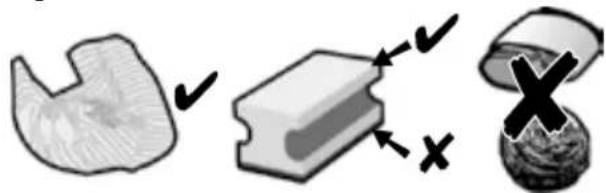
- Wipe the housing with a soft, damp cloth.
- Do not use abrasive cloths or cleaning agents.
natural_image
Three abstract 3D shapes with checkmarks and X marks, no text or symbols present- Always remove any traces of limescale, coffee, milk and descaler immediately. Such residue can cause corrosion.
- New sponge cloths may contain salts. Salts can cause rust film on stainless steel and must therefore be washed out thoroughly before use.
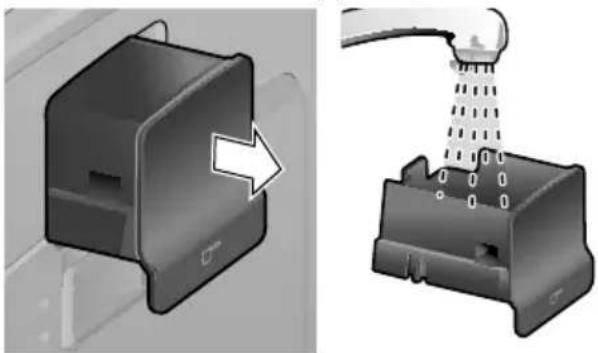
- Pull the drip tray (8c) with the coffee grounds container (8b) forwards and out. Remove the panel (8a) and grate (8d). Empty and clean the drip tray and coffee grounds container.
- Remove the drawer (4) and clean.
natural_image
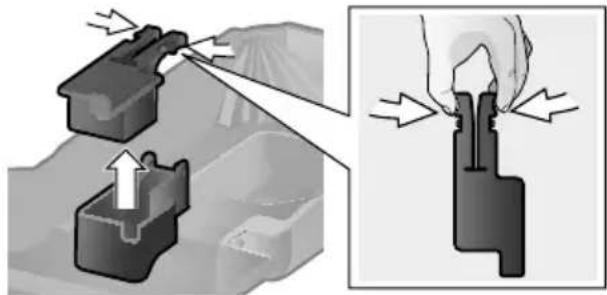
Diagram showing a device component being inserted into a rack, with no visible text or symbols.- Remove float (8e) and clean with a damp cloth.
natural_image
Diagram showing a mechanical component being inserted into a housing, with an inset close-up illustrating the process (no text or symbols present)
Do not put the following items in the dishwasher: panel (8a), float (8e), drawer (4), brewing unit (5a).

The following items are dishwasher-safe: drip tray (8c), coffee grounds container (8b), grate (8d), aroma cover (2) and measuring spoon (18).
- Wipe out the inside of the appliance (tray holders and drawer).
Important: The drip tray (8c) and coffee grounds container (8b) should be emptied and cleaned daily to prevent mould developing.
Note: If the appliance is cold when switched on with the power on/off switch O/I (9) or if it switches off automatically after coffee has been dispensed, the appliance performs an automatic rinse.
Important: If the appliance is not used for a prolonged period (for example, when you are on vacation), clean the entire appliance thoroughly, including the milk system and brewing unit.
Cleaning the milk frother
The milk frother (6) must be cleaned after each use in order to remove residues.
Important: Let the milk frother cool down before you remove it.
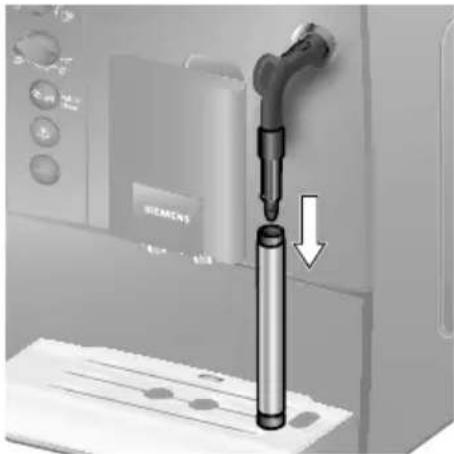
Dismantle the milk frother for cleaning:
- To remove, take hold of the metal sleeve and pull it downwards and off.
natural_image
Close-up of a Siemens industrial machine tool with a cylindrical component inserted, showing a downward arrow (no text or symbols on the device itself)- Twist the steam nozzle (6d) anticlockwise and remove it.
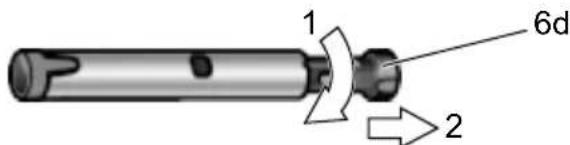
- Remove the frothing tube (6c).

- Clean the individual parts with a detergent solution and a soft brush. If necessary, soak in a warm detergent solution. Clean the air hole (6e) thoroughly.
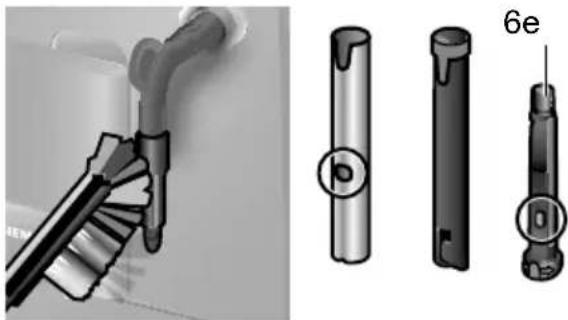
natural_image
Technical illustration of a mechanical component with three views (top, front, side) showing internal parts and a 6e label, no readable text or symbols present.-
Rinse all parts with clean water and dry.
-
Fit the steam nozzle (6d) and frothing tube (6c) back into the metal sleeve.
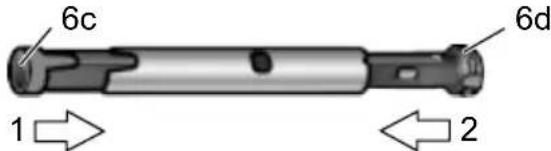
- Twist the steam nozzle clockwise until the marks are aligned.
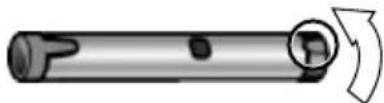
natural_image
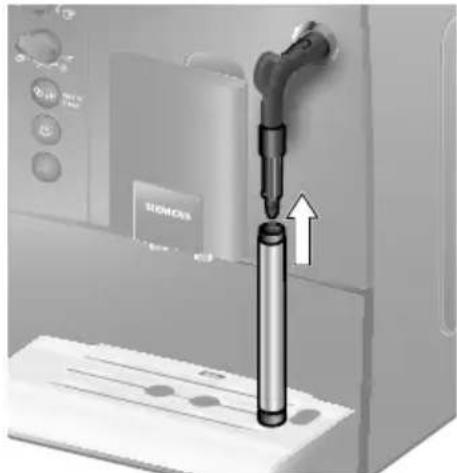
Simple line drawing of a cylindrical object with internal features and an arrow indicating rotation (no text or symbols)- Attach the milk frother to the steam valve. Check that the red mark on the steam valve is covered.
natural_image
Close-up of a kitchen appliance with a pipette inserted into a cylindrical tube, showing a white arrow indicating motion (no text or symbols visible)Risk of scalding!
Only use the appliance when the milk frother (6) is completely assembled and fitted.
Cleaning the brewing unit
Clean the brewing unit regularly.
To pre-clean the brewing unit automatically: Press the service button (12) briefly. The appliance will rinse if coffee was dispensed previously. It then switches off.
In addition to the automatic cleaning programme, the brewing unit (5a) should be removed regularly for cleaning (Figure E at the beginning of the instructions).
- Press the power on/off switch O/I (9) to switch off the appliance. All lights go off.
- Open the door (5b) to the brewing unit.
- Slide the red lock (5d) on the brewing unit (5a) completely to the left.
- Press the eject lever (5c) down fully. The brewing unit is released.
- Grasp the brewing unit (5a) by the recessed grips and remove carefully.
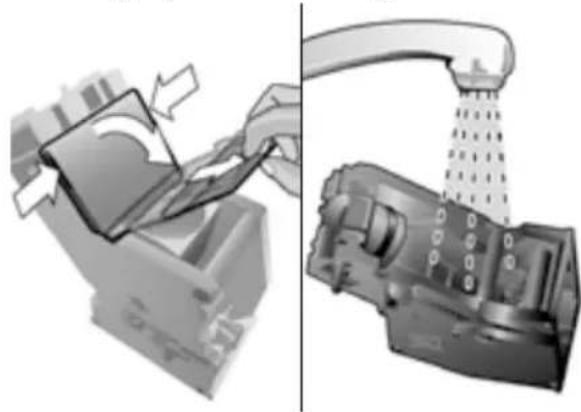
- Remove the cover (5e) of the brewing unit and rinse the brewing unit (5a) thoroughly under running water.
natural_image
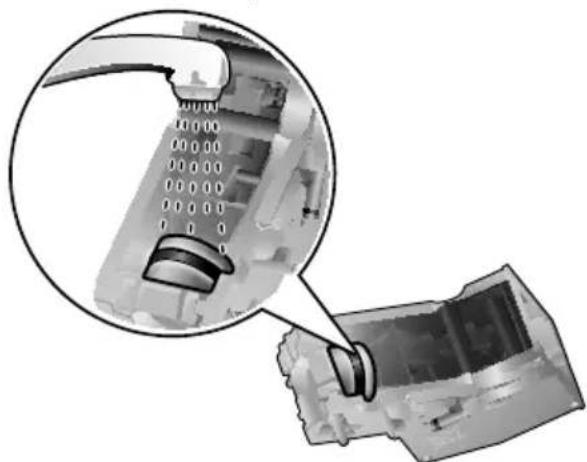
Diagram showing a hand operating a device while another shows the same mechanical component (no text or symbols present)- Thoroughly clean the brewing unit sieve under the running water.
natural_image
Close-up of a mechanical component with a magnified inset showing internal structure (no visible text or symbols)Important: Do not clean with detergent or other cleaning agents and do not put it in the dishwasher.
- Wipe out the inside of the appliance thoroughly with a damp cloth and remove any coffee residues.
- Allow the brewing unit (5a) and the interior of the appliance to dry.
- Replace the cover (5e) on the brewing unit and reinsert the brewing unit (5a) fully into the appliance.
- Press the eject lever (5c) up fully.
- Slide the red lock (5d) fully to the right and close the door (5b).
Tips on saving energy
- Switch off the fully automatic espresso machine when not in use. To do this, press the service button (12). The appliance rinses and switches off.
- If possible, do not interrupt coffee or milk froth dispensing. Stopping a process prematurely results in higher energy consumption and the drip tray fills up more quickly.
- Descale the appliance regularly to avoid a build-up of limescale. Limescale residue results in higher energy consumption.
Service programme
Duration: approx. 35 minutes
Depending on use, the service button (12) flashes at certain intervals.
The appliance should be cleaned and descaled immediately using the service programme. If the service programme is not run as instructed, the appliance may be damaged.

Caution!
Follow the instructions for using the descaling and cleaning agents for each service programme. Please observe the safety instructions on the packaging of the cleaning agent.
Never interrupt the service programme.
Do not drink the liquids.
Never use vinegar, vinegar-based products, citric acid or citric acid-based products.
Never put descaling tablets or other descaling agents in the drawer (4).
Specially developed and suitable descaling and cleaning tablets are available from retailers or customer service (see “Accessories”).
Important: If there is a water filter in the water tank (16), it must be removed before starting the service programme. Clean the brewing unit before starting the service programme, see chapter “Cleaning the brewing unit”.
To start the service programme, press and hold the service button (12) for at least 5 seconds.
Information: The service button (12) flashes while the programme is running.
LED lights up.
- Empty the drip tray (8) and reinsert it.
The appliance rinses twice.
LED lights up.
- Open the drawer (4).
- Drop a Siemens cleaning tablet into the drawer (4) and close it.
- Press the start button (10).
LED lights up.
- Pour lukewarm water into the empty water tank (16) up to the 0.5l mark and then dissolve 1 Siemens descaling tablet TZ80002 in it. When using TZ60002, 2 tablets must be dissolved.
- Press the start button (10).
The service programme will now run for approximately 10 minutes.
LED lights up.
- Place a container with a capacity of at least 0.5 litres under the milk frother outlet(6).
- Pull out the milk frother (6) to open it.
The service programme will now run for approximately 12 minutes.
LED lights up.
- Rinse the water tank (16) and refill it with fresh water up to the max mark.
- Press the start button (10).
The service programme will now run for approximately 30 seconds and rinse the appliance.
LED lights up.
- Push the milk frother (6) in to close it.
The service programme will now run for approximately 8 minutes.
LED lights up.
- Empty the drip tray (8) and reinsert it.
If you are using a filter, reinsert it now.
The appliance has been cleaned, descaled and is ready for use again.
Important: Wipe down the appliance using a soft, damp cloth to immediately remove any descaler residue. Such residue can cause corrosion. New sponge cloths may contain salts. Salts can cause rust film on stainless steel and must therefore be washed out thoroughly before use.
Frost protection
⚠️ To avoid damage caused by frost during transport and storage, the appliance must be completely emptied first.
Information: The appliance must be ready for use and the water tank (16) filled.
- Place a large container under the milk frother outlet (6).
- Press the steam button (11). LED ⚙ flashes and the appliance now heats up for approximately 20 seconds.
- If LED lights up, open the milk frother (6) by pulling it out and release steam for about 15 seconds.
- Press the power on/off switch O/I (9) to switch off the appliance.
- Empty the water tank (16) and the drip tray (8).
Accessories
The following accessories are available from retailers or from customer service:
Accessories Ordering number
| Retail / Customer service | |
| Cleaning tablets TZ6 | 0001 / 00310575 |
| Descaling tablets TZ | 80002 / 00576693 |
| Water filter TZ70003 | / 00575491 |
| Care set TZ80004 | / 00576330 |
Disposal

Dispose of packaging in an environmentally-friendly manner. This appliance is labelled in accordance with European Directive 2012/19/EG concerning used electrical and electronic appliances (waste electrical and electronic equipment – WEEE). The guideline determines the framework for the return and recycling of used appliances as applicable throughout the EU. Please ask your specialist retailer about current disposal facilities.
Guarantee
The guarantee conditions for this appliance are as defined by our representative in the country in which it is sold. Details regarding these conditions can be obtained from the dealer from whom the appliance was purchased. The bill of sale or receipt must be produced when making any claim under the terms of this guarantee.
Changes reserved.
Technical specifications
| Electrical connection (voltage – frequency) 220-240 V – 50/60 Hz | |
| Heating output 1600 W | |
| Maximum pump pressure, static 15 bar | |
| Maximum water tank capacity (without filter) 1.7 l | |
| Maximum bean container capacity 300 g | |
| Cable length 100 cm | |
| Dimensions (H x B x D) 385 x 280 x 479 mm | |
| Weight, unfilled 9.3 kg | |
| Type of grinding unit Ceramic | |
Simple troubleshooting
| Problem Cause Remedy | ||
| Grinding unit does not grind the beans. | Beans are not falling into the grinding unit (beans too oily). | Gently tap the bean container (1). Change the type of coffee if necessary.When the bean container (1) is empty, wipe it with a dry cloth. |
| No hot water dispensed. | The milk frother (6) is soiled. | Clean the milk frother (6), see “Maintenance and daily cleaning”. |
| Too little or no milk froth. | The milk frother (6) is soiled. | Clean the milk frother (6), see “Maintenance and daily cleaning”. |
| Milk unsuitable for frothing. | Use milk with a fat content of at least 1.5%. | |
| The milk frother (6) is not assembledcorrectly. | Wet the milk frother parts and press together firmly. | |
| Build-up of limescale in the appliance. | Descale the appliance as described in the instructions. | |
| Coffee dispensing slows to a trickle or stops completely. | The grind setting is too fine or the pre-ground coffee is too fine. | Adjust the grinding unit to a coarser setting or use coarser pre-groundcoffee. |
| Build-up of limescale in the appliance. | Descale the appliance as described in the instructions. | |
| Coffee has no “crema”. Unsuitable type of coffee. Use a type of coffee with a higher proportion of robusta beans. | ||
| Coffee is too “acidic”. The grind setting is too coarse or the pre-ground coffee is too coarse. | Adjust the grinding unit to a finer setting or use finer pre-ground coffee. | |
| Coffee is too “bitter”. The grind setting is too fine or the pre-ground coffee is too fine. | Adjust the grinding unit to a coarser setting or use coarser pre-ground coffee. | |
| The water filter does not stay in position in the water tank (16). | The water filter is not fitted correctly. | Firmly press the water filter straight down into the tank connection. |
| If you are unable to solve the problem, please call the hotline.You will find the telephone numbers at the back of these instructions. | ||
| LEDflashes. | The water tank is not correctly installed or the filter is worn. | Correctly install the water tank. If the LED continues to flash, install a new filter and rinse, see chapter “Filter”. |
| Carbonated water in the water tank. | Fill the water tank with fresh tap water. | |
| The coffee grounds are not compact and are too wet. | The grind setting is too fine or too coarse, or not enough ground coffee has been used. | Adjust the grinding unit to a coarser or finer setting, or use 2 level measuring spoons of ground coffee. |
| LEDflashes. | Brewing unit (5) is soiled. | Clean the brewing unit (5). |
| Too much pre-ground coffee in the brewing unit (5). | Clean the brewing unit (5) Put in no more than 2 level measuring spoons of ground coffee. | |
| The brewing unit mechanism is stiff. | Remove and clean the brewing unit, see “Maintenance and daily cleaning”. | |
| Brewing unit (5) is missing or has not been detected. | Switch off the appliance with the brewing unit (5) in place, wait three seconds and switch on the appliance again. | |
| Coffee or milk froth quality varies widely. | Build-up of limescale in the appliance. | Descale the appliance as described in the instructions. |
| Water dripped onto the inner floor of the appli-ance when the drip tray (8) was removed. | Drip tray (8) removed too soon. | Wait a few seconds after the last drink was dispensed before removing the drip tray (8). |
| The default settings have been changed and need to be reset. | Some settings have been made that are no longer required. | Press the power on/off button O/I (9) to switch off the appliance. Press and hold the service button (12) and the steam button (11) and press the power on/off button O/I (9) to switch on the appliance. Then press the start button (10) to confirm. The default settings are reset. |
| LEDsflash. | The appliance has a fault. | Please contact the hotline. |
| LEDsflash. | Incorrect voltage. Operate the appliance at 220V-240V only. | |
| LEDsflash. | The ambient temperature is too cold. | Operate the appliance at temperatures >5°C. |
| If you are unable to solve the problem, please call the hotline.You will find the telephone numbers at the back of these instructions. | ||
Table des matières
natural_image
Illustration of a hand pressing down on a kitchen appliance with a tool (no text or symbols visible)natural_image
Diagram showing a device being inserted into a microwave oven, with an inset highlighting the component (no text or symbols present)natural_image
Illustration of a medical or laboratory procedure showing a hand inserting a device into a briefcase, with no visible text or symbols.natural_image
Close-up of a mechanical caliper with a ruler and adjustment knob (no text or symbols visible)natural_image
Simple illustration of a mushroom-shaped object with internal circles (no text or symbols)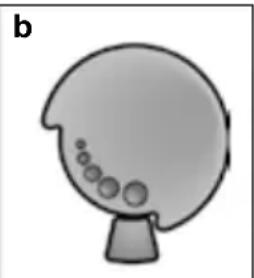
natural_image
Simple illustration of a mushroom-shaped object with internal dots (no text or symbols)natural_image
Three abstract 3D shapes with checkmark and cross symbols, no text or labels presentnatural_image
Diagram showing a device component being inserted into a housing, with no visible text or symbols.natural_image
Mechanical assembly diagram showing a component being welded with arrows, alongside its magnified view of the internal structure (no text or symbols present)
natural_image
Close-up of a Siemens industrial machine tool with a cylindrical component inserted, showing a downward arrow (no text or symbols on the device itself)- Retirer le tube (6c).

fr
natural_image
Technical illustration of a mechanical component with three views: top view, side view, and close-up (no text or symbols)natural_image
Diagram of a cylindrical object with internal features and an arrow indicating rotation (no text or symbols)natural_image
Close-up of a Siemens washing machine with a cylindrical tool inserted, showing the needle and handle (no text or symbols visible)Risque de brûlure!
natural_image
Diagram showing a hand inserting a device into a machine, with no visible text or symbols.natural_image
Close-up of a mechanical component with a magnified inset showing internal structure (no visible text or symbols)natural_image
Hand pressing down on a kitchen appliance with a pipe, no visible text or symbolsnatural_image
Diagram showing a kitchen utensil being inserted into a microwave oven, with an inset highlighting the device (no text or symbols present)natural_image
Illustration of a hand using a tool to lift a component into a briefcase, showing two different states (no text or symbols present)natural_image
Close-up of a mechanical caliper with a ruler, showing measurement markings (no text or symbols on the caliper itself)natural_image
Simple illustration of a mushroom-shaped object with internal circles (no text or symbols)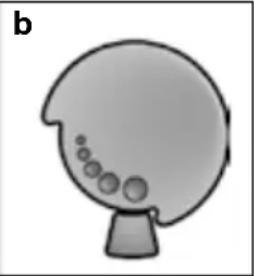
natural_image
Simple illustration of a mushroom-shaped object with a stem and circular indentations (no text or symbols)natural_image
Three abstract shapes with arrows indicating transformation or modification: a curved form, a rectangular block, and a broken cylindrical object (no text or symbols)natural_image
Diagram showing a device component being inserted into a housing, with no visible text or symbols.natural_image
Diagram showing mechanical assembly with arrows indicating force or direction, no text or symbols present
natural_image
Close-up of a Siemens industrial machine tool with a cylindrical component inserted, showing a downward arrow indicating motion (no text or symbols on the device itself)natural_image
Technical illustration of a mechanical component with three views (top, middle, bottom) showing internal parts and a 6e label, no readable text or symbols present.natural_image
Simple line drawing of a cylindrical object with internal features and an arrow indicating rotation (no text or symbols)natural_image
Diagram of a Siemens industrial device being inserted into a cylindrical component, with an arrow indicating the insertion direction (no text or symbols present)natural_image
Two-panel illustration showing a hand inserting a card into a device and another emitting a showerhead (no text or symbols)natural_image
Close-up of a mechanical component with a magnified inset showing internal structure (no visible text or symbols)natural_image
Hand pressing down on a kitchen appliance panel with a hand gesture (no text or symbols visible)natural_image
Diagram showing a device with a magnified inset of its tip, highlighting a mechanical component (no text or symbols present)natural_image
Illustration of a hand using a tool to lift a small component into a briefcase, showing two different states (no text or symbols present)natural_image
Close-up of a mechanical caliper with a ruler, showing measurement markings (no text or symbols on the caliper itself)natural_image
Two identical grayscale diagrams labeled 'a' and 'b', each showing a mushroom-shaped object with internal circles (no text or symbols)natural_image
Three abstract 3D shapes with checkmarks and X marks, no text or symbols presentnatural_image
3D illustration of a mechanical component with an arrow indicating transformation (no text or symbols)natural_image
Diagram showing a mechanical component being inserted into a housing, with an inset close-up illustrating the process (no text or symbols present)
natural_image
Close-up of a Siemens washing machine with a cylindrical tool inserted, showing a downward arrow (no text or symbols on the device itself)natural_image
Technical illustration of a mechanical component with three views (top, middle, bottom) showing different parts and features (no text or symbols)natural_image
Diagram of a cylindrical mechanical component with internal features and an arrow indicating rotation (no text or symbols)natural_image
Close-up of a medical device with a needle inserted into a cylindrical tube, showing mechanical components and a white arrow indicating upward motion (no text or symbols visible)nl

natural_image
Two-panel illustration showing a hand inserting a component into a device and another with a showerhead pouring liquid (no text or symbols)natural_image
Close-up of a mechanical component with a magnified inset showing internal structure (no visible text or symbols)natural_image
Hand inserting a plug into a kitchen appliance (no text or symbols visible)natural_image
Close-up of a kitchen appliance with a tool inserted, showing a magnified view of the handle (no text or symbols visible)natural_image
Illustration of a hand holding a tool in a briefcase, showing the process with no text or symbolsnatural_image
Close-up of a mechanical caliper with a ruler, showing measurement markings (no text or symbols on the caliper itself)natural_image
Simple grayscale illustration of a mushroom-shaped object with circular indentations (no text or symbols)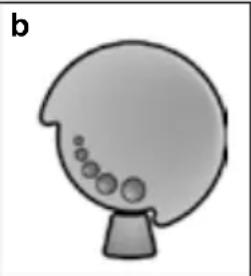
natural_image
Simple grayscale illustration of a mushroom-shaped object with internal bubbles (no text or symbols)natural_image
Three abstract 3D shapes with checkmark indicators: a curved object, a rectangular block, and a broken cylindrical object (no text or symbols)natural_image
Diagram showing a device component being inserted into a port, with no visible text or symbols.natural_image
Diagram showing a mechanical component being inserted into a housing, with an inset close-up illustrating the process (no text or symbols present)
natural_image
Close-up of a Siemens industrial machine tool with a cylindrical component inserted, showing a downward arrow (no text or symbols on the device itself)natural_image
Technical illustration of a mechanical component with three views (top, middle, bottom) showing internal parts and a tool interacting with a shaft (no text or symbols present)natural_image
Pure diagram of a cylindrical object with internal features and an arrow indicating rotation (no text or symbols)natural_image
Illustration of a sewing machine needle insertion into a cylindrical component, with no visible text or symbols on the device itself.
Nebezpečí opaření!
natural_image
Two-panel illustration showing a hand inserting a card into a device and a mechanical component with a handle (no text or symbols)natural_image
Close-up of a hand holding a device with a magnified inset showing internal components (no visible text or symbols)natural_image
Illustration of a hand pressing down on a mechanical component with a directional arrow (no text or symbols)natural_image
Diagram showing a device with a labeled component and an arrow indicating direction (no text or symbols present)natural_image
Illustration showing a hand using a tool to lift a small component into a briefcase, with no visible text or symbols.natural_image
Close-up of a mechanical caliper with a ruler, showing measurement markings (no text or symbols on the caliper itself)natural_image
Simple illustration of a mushroom-shaped object with internal circles (no text or symbols)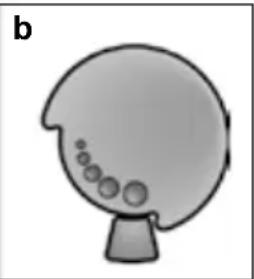
natural_image
Simple illustration of a mushroom-shaped object with internal dots (no text or symbols)natural_image
Three abstract 3D shapes with checkmarks and X marks, no text or symbols presentnatural_image
Diagram showing a device component being removed from a drain, with no visible text or symbols.natural_image
Diagram showing a mechanical component being inserted into a housing, with an inset close-up illustrating the process (no text or symbols present)
natural_image
Close-up of a mechanical device with a cylindrical component inserted, showing a downward arrow (no text or symbols visible)natural_image
Technical illustration of a mechanical component with three views (top, front, side) showing internal parts and mounting holes (no text or symbols)natural_image
Simple line drawing of a cylindrical object with internal features and an arrow indicating rotation (no text or symbols)natural_image
Close-up of a Siemens washing machine tool interacting with a cylindrical component (no visible text or symbols)ru

natural_image
Two-panel illustration showing a hand inserting a card into a device and a mechanical component with a showerhead (no text or symbols)natural_image
Close-up of a mechanical component with a magnified inset showing internal structure (no visible text or symbols)www.siemens-home.com/ae
AL Republika e Shqiperise, Albania
AERTECH SH.P.K.
Rruga Qemal Stafa
Pallati i ri perball Prokuroris se
Pergjithshme
Hyrja C Kati 10
Tirana
Tel.: 066 206 47 94
mailto:g.volina@aertech.al
HEATHERTON, Victoria 3202
Tel.: 1300 368 339
mailto:bshau-as@bshg.com
www.siemens-home.com.au
BA Bosnia-Herzegovina, Bosna i Hercegovina
"HIGH" d.o.o.
Gradačačka 29b
71000 Sarajevo
Info-Line: 061 10 09 05
Fax: 033 21 35 13
mailto:delicnanda@hotmail.com
European Trade Center Building,
5th floor
1784 Sofia
Tel.: 02 892 90 47
Fax: 02 878 79 72
mailto:informacia.servis-bg@
bshg.com
www.siemens-home.bg
+ 7 snt/min (alv 23%)
+ 17 snt/min (alv 23%)
FR France
BSH Electroménager S.A.S.
To arrange an engineer visit,
to order spare parts or
accessories or for product
advice please visit
www.siemens-home.co.uk
or call
Tel.: 0844 892 8999*
*Calls from a BT landline will be charged at up to 3 pence per minute. A call set-up fee of up to 6 pence may apply.
GR Greece, Ελλάς
BSH Ikiakes Siskeves A.B.E.
Central Branch Service
17 km E.O. Athinon-Lamias &
Potamou 20
14564 Kifisia
Unit 1 & 2, 3rd Floor
North Block, Skyway House
3 Sham Mong Road
Tai Kok Tsui, Kowloon
Hong Kong
Tel.:2565 6151
Fax: 2565 6681
mailto:siemens.hk.service@
bshg.com
www.siemens-home.com.hk
HR Hrvatska, Croatia
BSH kućni uređaji d.o.o.
Kneza Branimira 22
10000 Zagreb
Tel:. 01 640 36 09
Fax: 01 640 36 03
mailto:informacije.servis-hr@
bshg.com
www.siemens-home.com/hr
www.siemens-home.com/hu
IE Republic of Ireland
BSH Home Appliances Ltd.
Unit F4, Ballymount Drive
Ballymount Industrial Estate
Walkinstown
Dublin 12
Service Requests, Spares and
Accessories
Tel.:01450 2655
Fax: 01450 2520
www.siemens-home.com/ie
IL Israel,
C/S/B Home Appliance Ltd.
Uliel Building
2, Hamelacha St.
Industrial Park North
71293 Lod
Tel.: 08 9777 222
Fax: 08 9777 245
mailto:csb-serv@zahav.net.il
www.siemens-home.co.il
IN India, Bhārat, भारत
BSH Customer Service
Front Office
Shop No.4, Everest Grande,
Opp. Shanti Nagar Bus Stop,
Mahakali Caves Road,
Andheri East
Mumbai 400 093
IS Iceland
Smith & Norland hf.
Noatuni 4
105 Reykjavik
Tel.:0520 3000
Fax: 0520 3011
www.sminor.is
IT Italia, Italy
www.siemens-home.com/it
IP Turebekov Yerzhan
Nurmanovich
Jangeldina str. 15
Shimkent 160018
Tel.: 0252 31 00 06
mailto:evrika_kz@mail.ru
LB Lebanon, لبنان
Tehaco s.a.r.l
Boulevard Dora 4043 Beyrouth
P.O. Box 90449
Jdeideh 1202 2040
Tel.: 01 255 211
mailto:Info@Teheni-Hana.com
LT Lietuva, Lithuania
Baltic Continent Ltd.
Lukšio g. 23
09132 Vilnius
Tel.: 05 274 1788
Fax: 05 274 1765
mailto:info@balticcontinent.lt
www.balticcontinent.lt
LU Luxembourg
www.siemens-home.com/lu
LV Latvija, Latvia
General Serviss Limited
Bullu street 70c
1067 Riga
Tel.: 07 42 41 37
mailto:bt@olimpeks.lv
MD Moldova
S.R.L. "Rialto-Studio"
ул. Щусева 98
2012 Кишинев
тел./факс: 022 23 81 80
Unit F 2, 4 Orbit Drive
Mairangi Bay
Auckland 0632
Tel.:09 477 0492
Fax: 09 477 2647
mailto:bshnz-cs@bshg.com
PL Polska, Poland
www.siemens-home.com/pt
*(PT 0,10 €/min., Mobile 0,25 €/min)
RO România, Romania
BSH Electrocasnice srl.
Sos. Bucuresti-Ploiesti, nr. 19-21, sect.1
13682 Bucuresti
Tel.:021 203 9748
Fax: 021 203 9733
mailto:service.romania@
bshg.com
www.siemens-home.com/ro
RU Russia, Россия
www.siemens-home.com/sk
TR Türkiye, Turke y
BSH Ev Aletleri Sanayi
ve Ticaret A.S.
Fatih Sultan Mehmet Mahallesi
Balkan Caddesi No: 51
34771 Ümraniye, Istanbul
Tel.: 0 216 444 6688*
Fax: 0 216 528 9188
mailto:careline.turkey@bshg.com
www.siemens-home.com/tr
gama-electronics.com
XS Srbija, Serbia
BSH Kućni aparati d.o.o.
Milutina Milankovića 11 ^4
11070 Novi Beograd
Tel.: 011 205 23 97
Fax: 011 205 23 89
mailto:informacije.servis-sr@
bshg.com
www.siemens-home.rs
ZA South Africa
BSH Home Appliances (Pty) Ltd.
15th Road Randjespark
Private Bag X36, Randjespark
1685 Midrand – Johannesburg
Tel.: 086 002 6724
Fax: 086 617 1780
mailto:applianceserviceza@
bshg.com
www.siemens-home.com
UK Calls provided by a UK BT Landline will be charged at up to 3 pence per minute.
A Call Set-Up Fee of up to 6 pence per call applies to calls from residential lines.
Mobile and other providers' costs may vary. See www.bt.com/pricing for details.
HR 01 64 03 609
HU 014 895 461
IE 01450 2655
IS 0520 3000
LT 052 74 17 88
LU 26 349 300
LV 067 42 52 32
ME 020 662 444
MK 02 2454 600
PL 801 191 534
RO 021 203 97 48
RU 495 737 2962
SI 041 991 100
SK 02 44 452 041
XS 011 6147 110
AU 1300 368 339