480.118 - Fridge CaterCool - Free user manual and instructions
Find the device manual for free 480.118 CaterCool in PDF.


User questions about 480.118 CaterCool
0 question about this device. Answer the ones you know or ask your own.
Ask a new question about this device
Download the instructions for your Fridge in PDF format for free! Find your manual 480.118 - CaterCool and take your electronic device back in hand. On this page are published all the documents necessary for the use of your device. 480.118 by CaterCool.
USER MANUAL 480.118 CaterCool
natural_image
Exterior view of a modern stainless steel refrigerator with closed glass doors and wavy internal shelves (no visible text or symbols)Gebruiksaanwijzing
Inhoudsopgave
text_image
Technical diagram of a refrigerator internal structure with numbered components for identification- Temperatuurregelaar 2. Lichtschakelaar
- Licht 4. Ventilatorrooster
- Flessenrek 6. Voetje
- Riemafdekkap 8. Handgreep
- Glazen deur
natural_image
Exterior view of a modern stainless steel refrigerator with glass doors and wavy internal shelves (no visible text or symbols)Operation Manual
Index
I. General Safety Precautions....11
II. Technical Data 12
III. Illustrated Structure....13
IV. Electric Principle Diagram....13
V. Operation 14
VI. Particular Precautions ...... 15
VII. Maintenance....15
VIII. Troubleshooting....16
I. GENERAL SAFETY PRECAUTIONS
● After removing the refrigerator from the package, make sure it is in good condition. In case of doubt, do not use it and contact an authorized service center.
● Plastic bags, nails, etc. Should be kept out of the reach the operation manual carefully and check that the rating data on the rating nameplate corresponds to your power supply.
- This refrigerator can only be used in the use of which it was designed. The manufacturer will not respond for any damage due to improper use or repairs made by unqualified personnel.
● Before cleaning the refrigerator, make sure it is unplugged. Never clean the unit with an acid preparation, medical, dilution, gasoline, oil or any other kind of chemical substance that could damage the refrigerator.
● Repair should only be made by authorized service centers.
- Caution
-
To reduce the risk of fire, replace only with same type fuse.
-
Free standing installation only
-
Do not use extension cords.
-
Danger: Risk of child entrapment. Before throwing away your old wine cooler, take off the door and leave the shelves in place, so that children may not climb inside easily.
-
The wine cooler is fit for the environment temperature below 25^ C with its active efficiency
II. TECHNICAL DATA
| Type | CW-52AB | |
| Volume (liter) | 52L | |
| Material | Case Iron | |
| Door Glass | ||
| Unit Dimension(W×H×D)(mm) | 345x660x480 | |
| Packaging Dimension(W×H×D)(mm) | 385x685x525 | |
| Net Weight (Kg) | 16 | |
| Gross Weight (Kg) | 17.8 | |
| Power Consumption(KW·h/24h) | 1 | |
| Fitting ambient temperature range of working | <25°C | |
| Temperature Range | 11°C—18°C | |
| Rated Voltage | 220-240V AC | |
| Rated Frequency | 50HZ | |
| Input power | 70w | |
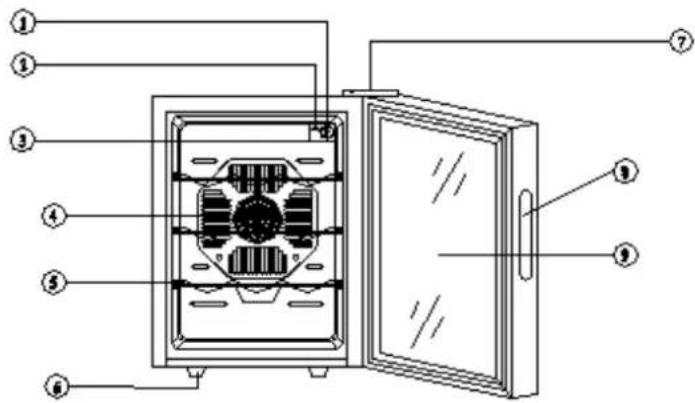
III. ILLUSTRATED STRUCTURE
text_image
Technical diagram of a refrigerator internal structure with numbered components for identification- Temp Adjustor 2. Light switch
- light 4. fan mask
- shelf 6. foot
- ream cover 8. handle
- glass door
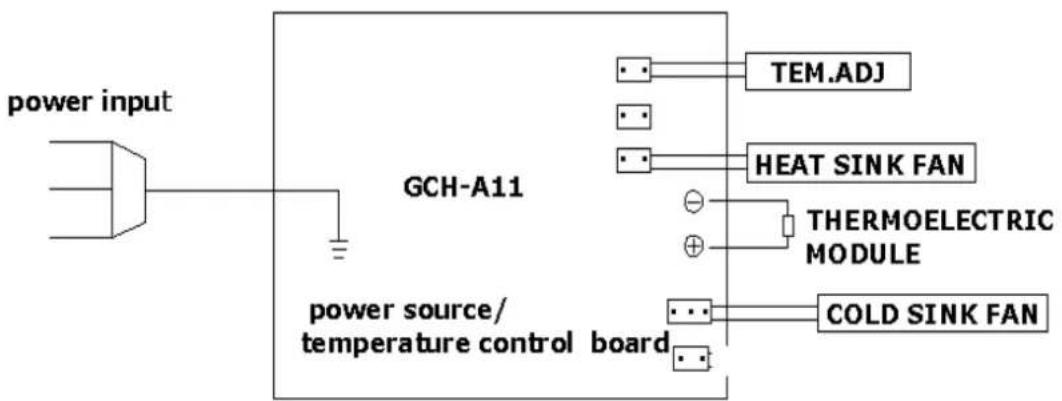
IV. ELECTRIC PRINCIPLE DIAGRAM
flowchart
graph LR
    A["Power Input"] --> B["GCH-A11"]
    B --> C["Power source/temperature control board"]
    C --> D["TEM.ADJ"]
    C --> E["HEAT SINK FAN"]
    C --> F["+"]
    C --> G["+"]
    C --> H["COLD SINK FAN"]
Put the plug into suitable outlet, the outlet and voltage should be the same as what shows on the mark of the unit.
2) Temperature Adjusting
Temperature inside the refrigerator can be adjusted by the temperature adjustor on the upper side of the refrigerator case. The temperature range for refrigerator is 2—18°C, and for full glass door refrigerator, it is 11—18°C. When the temperature in set on one certain point and the temperature inside reach this point, the automatic temperature control system begin to work and the cooling system go into linear temperature keeping status. At this status, the input power will change with the change of temperature inside the refrigerator case.
VI. PARTICULAR PRECAUTIONS
- In order to function at its potential, this wine cooler need to be placed on flat floor, with 2cm spaces at each side and 10cm at the backside.
- Use the adjustable (iron case) to place the cellar fully horizontal.
● Avoid direct sunshine and carry high temperature. - Do not place heavy articles on the top of the cellar.
VII. MAINTENANCE
● Shut off power supply before cleaning cabinet.
● Take out food and shelves, and then clean the cabinet with soda water first and with clean water last.
- Do not use soap or detergent for the cabinet.
● Clean the cellar regularly.
VIII. TROUBLESHOOTING
| Symptoms Possible cause Solutions | ||
| No cooling | Plug not put inLow voltageFuse broken | Put in the plugEnsure normal voltageChange fuse |
| Not cold enough temperature inside | The refrigerator is placed too near heat source;Bad ventilation;Fans don’t work;The door is not closed tightly or opened too frequently or for too long time; | Keep the refrigerator away from sunshine or other heat source;Place the refrigerator in the area with good ventilation and keep things away from the fans;Check whether the plug is connected or change the fan;Close the door tightly and don’t open the door too frequently or for too long time. |
| Peculiar smell inside refrigerator | Check whether there is any sour inside | Wrap the source or take it out |
| Inside light flash | Set temperature higher than inner temperature;The automatic defrost function start to work | Adjust the adjustorNormal function. No repair needed |
| Frost on the cold sink。 | Too much humidity or too low temperature inside the case | Output the plug, stop the power, and defrost by hand, Connect power again when the ice thaws |
Pls. Keep this manual for future reference.
natural_image
Exterior view of a modern stainless steel refrigerator with closed doors and wavy internal shelves (no visible text or symbols)Mode d'emploi