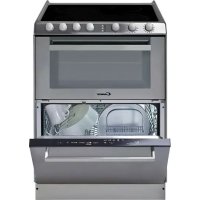
TRIO 95031 X - Other kitchen appliances CANDY - Free user manual and instructions
Find the device manual for free TRIO 95031 X CANDY in PDF.


| Product type | Combined cooking appliance (hob, oven, dishwasher) |
| Brand | Candy |
| Model | TRIO 95031 X |
| Dimensions (H x W x D) | 86,5-87,5 cm (without lid) / 142-143 cm (with lid) x 60 cm x 59,6 cm |
| Power supply | 220-240 V ~ 50/60 Hz |
| Total power (TRIO 9503) | 8570 W |
| Hob | 4 gas burners (auxiliary, semi-rapid, rapid, ultra-rapid) or 4 electric hilight burners depending on version |
| Oven - cooking types | Natural convection, Grill, Rotisserie, Rotisserie + Natural convection, Turbogrill, Forced air |
| Oven - temperature | 65°C to 230°C (depending on function) |
| Dishwasher - capacity | 6 place settings (according to EN 50242 standard) |
| Dishwasher - programs | Universal, Hygiene+, Eco, Quick 32', Soak |
| Dishwasher - water consumption (Eco) | 8 liters |
| Safety - gas burners | Thermocouple (automatic shut-off in case of flame failure) |
| Safety - dishwasher | Overflow protection device, door safety |
| Cleaning | Non-abrasive products; soapy or ammonia water; scraper for ceramic glass |
| Spare parts and repairability | Oven bulb (15 W, E14 base, 300°C); gas injectors (conversion kit included); door seals |
| Installation | Gas connection (rigid or flexible hose); water supply (pressure 0.08-0.8 MPa); electrical connection with ground plug |
| General information | Compliant with directives 2006/95/EC, 2004/108/EC, 2002/96/EC (WEEE); manufacturer's warranty according to legal conditions |
Frequently Asked Questions - TRIO 95031 X CANDY
User questions about TRIO 95031 X CANDY
0 question about this device. Answer the ones you know or ask your own.
Ask a new question about this device
Download the instructions for your Other kitchen appliances in PDF format for free! Find your manual TRIO 95031 X - CANDY and take your electronic device back in hand. On this page are published all the documents necessary for the use of your device. TRIO 95031 X by CANDY.
USER MANUAL TRIO 95031 X CANDY
INSTRUCTIONS FOR USE AND INSTALLATION GB
natural_image
Exterior view of a modern stainless steel double oven with open doors and internal compartments (no visible text or symbols)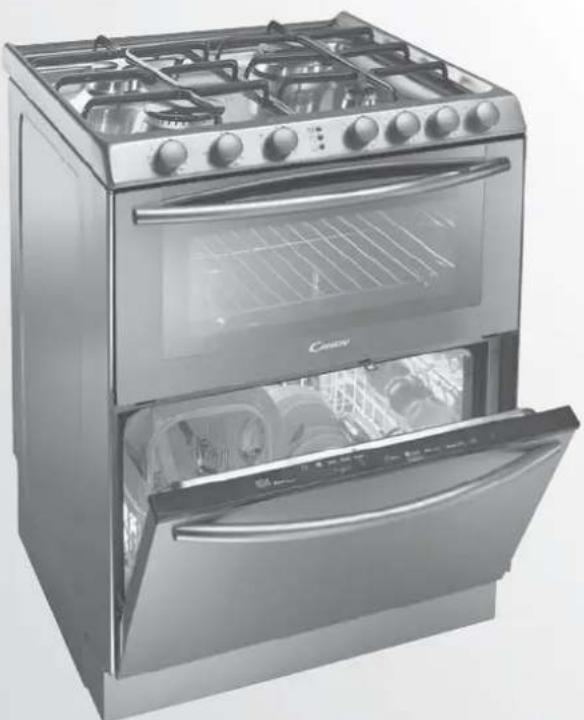
natural_image
Exterior view of a stainless steel double boiler with open doors and gas stove (no visible text or symbols)SAFETY INSTRUCTIONS
• Children under 8 Year of age must be kept away from the appliance unless they are continuously supervised.
- This appliance can be used by children aged from 8 years and above and persons with reduced physical, sensory or mental capabilities or lack of experience and knowledge if they have been given supervision or instruction concerning use of the appliance in a safe way and understand the hazards involved.
• Children must not play with the appliance.
- This appliances is intended to be used in household and similar applications such as:
- staff kitchen areas in shops, offices and other working environments;
- farm houses;
- by clients in hotels, motels and other residential type environments;
- bed and breakfast type environments.
A different use of this appliance from household environment or from typical housekeeping functions, as commercial use by expert or trained users, is excluded even in the above applications.
If the appliance is used in a manner inconsistent with this it may reduce the life of the appliance and may void the manufacturer's warranty.
Any damage to the appliance or other damage or loss arising through use that is not consistent with domestic or household use (even if located in a domestic or household environment) shall not be accepted by the manufacturer to the fullest extent permitted by law.
- The door should not be left in the open position since this could present a potential hazard (es. tripping).
- WARNING!
Knives and other utensils with sharp points must be loaded in the basket with their points down or placed in a horizontal position.
- When the appliance is located on a carpet floor, attention must be paid to ensure that there is no obstruction to the bottom vents.
Make sure that the plug on the appliance remains accessible after installation.
- The appliance must be connected to the water mains using new hose-sets.
The old hose-sets should not be reused.
- Water pressure must be between 0,08 MPa and 0,8 MPa. If the pressure is below the minimum consult our service department for advice.
- Before connecting the appliance to the mains supply it is important to ensure:
- that the supply socket is properly earthed;
- that your electricity supply is capable of meeting the consumption requirements listed on the rating plate of your appliance.
- WARNING!
Ensure that your product is properly earthed.
In the absence of adequate earthing you will notice that when touching the metal parts of your appliance an electrical dispersion can be felt, due to the presence of a radio interference suppressor.
- Manufacturer declines all responsibility for any damage due to non-earthing of the machine.
- Ensure that the dishwasher does not crush power cables.
- Do not remove the plug from the mains supply socket by pulling the mains cable or the machine itself.
- In general it is not advisable to use adaptors, multiple plugs and/or extension cables.
- Never touch the appliance when your hands or feet are wet or damp.
- Do not use when your feet are bare.
- Do not leave the appliance exposed to the elements (rain, sun etc).
- Leaning or sitting on the open door of the dishwasher could cause it to tip over.
- If the appliance breaks down or stops working properly, switch it off, turn off the water supply and do not tamper with it.
Repair work should only be carried out by an approved service agent and only genuine spare parts should be fitted. Any failure to follow the above advice may have serious consequences for the safety of the appliance.
• Water left in the machine or on the dishes at the end of the wash programme should not be swallowed.
- The dishwasher is designed for normal kitchen utensils.
SAFETY INSTRUCTIONS
Objects that have been contaminated by petrol, paint, traces of steel or iron, corrosive chemicals, acids or alkalis must not be washed in the dishwasher.
- WARNING: The appliance and its accessible parts become hot during use. Care should be taken to avoid touching heating elements.
- Cleaning and user maintenance shall not be made by children without supervision
- WARNING: Unattended cooking on a hob with fat or oil can be dangerous and may result in fire.
- NEVER try to extinguish a fire with water, but switch off the appliance and then cover flame e.g. with a lid or a fire blanket.
- WARNING: Danger of fire: do not store items on the cooking surfaces.
- WARNING: If the surface is cracked, switch off the appliance to avoid the possibility of electric shock.
- During use the appliance becomes hot. Care should be taken to avoid touching h eating elements inside the oven.
- WARNING: Accessible parts may become hot during use. Young children must be kept away.
- Do not use harsh abrasive cleaners or sharp metal scrapers to clean the oven door glass since they can scratch the surface, which may result in shattering of the glass.
- The oven must be switched off before removing the guard, after cleaning, the guard must be replaced in accordance with the instructions.
- Only use the temperature probe recommended for this oven.
- Do not use a steam cleaner for cleaning operations.
- Any spillage should be removed from the lid before opening.
- The hob surface must be allowed to cool down before closing the lid.
- If present, do not to stare into halogen lamp hob elements.
- WARNING: Avoid possibility of electric shock - ensure the appliance is switched off before replacing the lamp.
- If the range is placed on a base, measures must to be taken to prevent the appliance slipping off the base.
- The means for disconnection must be incorporated in the fixed wiring in accordance with the wiring rules.
- If the supply cord is damaged, it must be replaced by the manufacturer, its service agent or similarly qualified persons in order to avoid a hazard.
- CAUTION: In order to avoid a hazard due to inadvertent resetting of the thermal cutout, this appliance must not be supplied through an external switching device, such as a timer, or connected to a circuit that is regularly switched on and off by the utility.
- The new hose-sets supplied with the appliance must to be used and the old hose-sets to be discarded.
- This appliance must be installed in accordance with the regulations in force and only used in a well ventilated space. Read the instructions before installing or using this appliance.
- "These instructions are only valid if the country symbol appears on the appliance. If the symbol does not appear on the appliance, it is necessary to refer to the technical instructions which will provide the necessary instructions concerning modification of the appliance to the conditions of use of the country".
- "prior to installation, ensure that the local distribution conditions (nature of the gas and gas pressure) and the adjustment of the appliance are compatible";
- "the adjustment conditions for this appliance are stated on the label (or data plate)";
- "this appliance is not connected to a combustion products evacuation device. It shall be installed and connected in accordance with current installation regulations. Particular attention shall be given to the relevant requirements regarding ventilation".
- The use of a gas cooking appliance results in the production of heat and moisture in the room in which it is installed. Ensure that the kitchen is well ventilated: keep natural ventilation holes open or install a mechanical ventilation device (mechanical extractor hood). Prolonged intensive use of the appliance may call for additional ventilation, for example opening of a window, or more effective ventilation, for example increasing the level of mechanical ventilation where present.
- "CAUTION: Accessible parts may be hot when the grill is in use. Young children must be kept away".
- “An additional protective means to avoid contact with the oven door is available. This part should be fitted when young children are likely to be present.”
UNPACKING THE APPLIANCE
Inside the appliance, you will find the booklet and, for gas model, a bag containing :
- if you have to change the type of gas: new jets for the gas modifications, Butane Gas G30 28-30 mbar or Propane Gas G31-37 mbar,
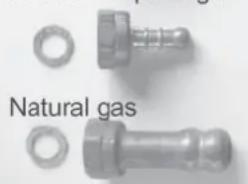
- for connection by soft rubber tube, an end piece for Natural Gas and an end piece for Butane or Propane gas with seal.
RECOMMENDATIONS
READ THE INSTRUCTIONS CAREFULLY TO MAKE THE MOST OF YOUR APPLIANCE.
We recommend you keep the instructions for installation and use for later reference, and before installing the appliance, note its serial number below in case you need to get help from the after sales service.
Identification plate is located at the back of the Trio.
THE COMPANY SHALL NOT BE LIABLE IF THE INSTRUCTIONS PROVIDED IN THIS DOCUMENT ARE NOT COMPLIED WITH.
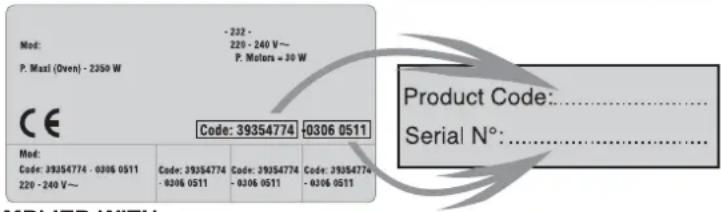
text_image
Mod: - 232 - 220 - 240 V~ P. Maxi (Oven) - 2350 W P. Motors = 30 W CE Code: 39354774 0306 0511 Mod: Code: 39354774 - 0306 0511 220 - 240 V~ Code: 39354774 - 0306 0511 Code: 39354774 - 0306 0511 Codr: 39354774 - 0306 0511 Product Code: ...... Serial N°: ...... IMPLIED WITHIMPORTANT NOTES
- You should entrust the gas installation of your appliance and its electrical connection to an approved installer or technician with similar qualifications.
- The Trio consists of three elements, a hob, an oven and a diswasher. For safety reasons under no circumstances should any modifications be carried out to this appliance.
- This appliance is designed for domestic use only.
- If the Trio shows even the smallest defect, do not connect it. Disconnect from the power supply and immediately contact an approved service agent.
- If the surface is cracked, switch off the appliance to avoid the possibility of electric shock
- Do not lean on the doors or not allow children to do so.
• After each use we recommend that some cleaning of the Trio is undertaken. This prevents the accumulation of dirt or grease which gets re-cooked and burns, generating unpleasant smells and smoke.
- Do not store flammable products in the Trio as they can catch fire if the appliance is inadvertently switched on.
- In case of Hobs incorporating Halogen lamps, do not stare the plates during use.
- Use oven gloves when placing or removing a dish from the oven. - Do not line the oven walls with aluminium foil or single-use oven protectors available from some stores. Aluminium or any other protection, in direct contact with the hot enamel, risks melting the enamel or causing deterioration to the inside.
- When cooking with fats or oils, always take care to watch the cooking process as heated fats and oils can catch fire rapidly. - The hob lid (for gas model):
- While the cooker is in use, keep the lid in the upright position.
- before opening the lid, remove any items from it, to avoid any spillage.
- before closing the lid, let all the hot parts of the cooker cool down. - do not store heavy or metallic objects on the lid.
- If you wish to dispose of an old dishwasher be careful to remove the door to eliminate the risk of children becoming trapped inside it.
- The dishwasher has been made from materials which can be recycled so that it can be disposed of in an environmentally friendly way.
- Ensure that the dishwasher does not crush power cables.
It is not advisable to use adaptors, multiple plugs and/or extension cables.
Any queries regarding the power supply cord should be referred to After Sales Service or a qualified technician.
When the appliance is located on a carpet floor, attention must be paid to ensure that there is no obstructions to the bottom vents.
Any failure to follow the above advice may have serious consequences for the safety of the appliance.
In order to improve the quality of the products, CANDY may carry out modifications linked to technical improvements.
Appliance complies with European Directives 73/23/EEC and 89/336/EEC, replaced by 2006/95/EC and 2004/108/EC, and subsequent amendments.
TECHNICAL DATA
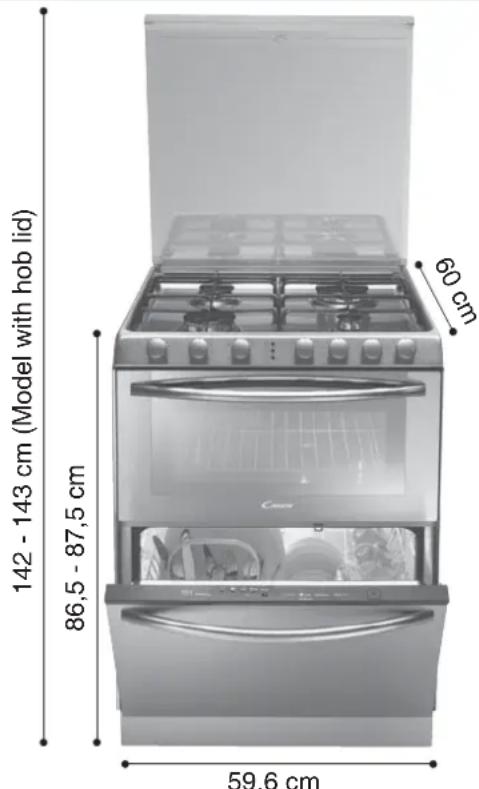
text_image
142 - 143 cm (Model with hob lid) 86.5 - 87.5 cm 59.6 cm 60 cm| TRIO 9501 TRIO | 9503 | |
| Power | 2100 W | 8570 W |
| Front Right | Auxiliary mijorose 1 kW | hilight ∅ 165/1200 W |
| Rear Right | Ultra-rapid 3,5 kW | hilight ∅ 220/2300 W |
| Front Left | Rapid 2,50 kW | hilight ∅ 200/1800 W |
| Rear Left | Semi-rapid 1,75 kW | hilight ∅ 140/1200 W |
| Place settings EN50242 | 6 | 6 |
| Water consumption | 8 lt | 8 lt |
| Water pressure mini 0,08 - max 0,8 MPa | ||
INSTALLATION
Installing a domestic appliance can be a complicated operation which if not carried out correctly, can seriously affect consumer safety.
It is for this reason that a professionally qualified person should undertake the task who will carry it out in accordance with the technical regulations in force.
In the event that this advice is ignored and the installation is carried out by an unqualified person, the manufacturer declines all responsibility for any technical failure of the product whether or not it results in damage to goods or injury to individuals. In case of installation of the cooker on a base, measures have to be taken to prevent the appliance slipping from the base itself
GAS MODEL
- Before installing the appliance, the technician must :
- Check the compatibility between the Trio and the gas installation.
The Trio is factory set for use with the gas type as stated on the packaging and repeated on the rating plate affixed to the cooker. Natural gas G 20-20 mbar / G 25-25 mbar : main gas
- If necessary, change the gas.
To adapt the gas burners cooker fit suitable jets that provide the nominal flow rate go to page 3.
- For installation the technician must :
The Trio is Class2 - Sub class 1 ; furniture adjacent to the unit must not be higher than the top of the appliance.
- The cooker has adjustable feet for perfect levelling on the floor.
- Make the gas connection to the installation according to the gas supply.
- Connect the cooker electrically in compliance with the information given on page 4.
- If the gas type has been changed, adjust the minimum flow of each gas burner on page 3.
- Connect the Trio to the water supply and the water drainage (page 5).
ANY MODIFICATION MADE TO THE GAS SETTING SHOULD BE NOTED ON THE RATING PLATE AFFIXED TO THE COOKER.
• GAS CONNECTION
This must be done in compliance with the regulations in force in the installation country. In all cases, on the gas feed pipe provide a stopcock, a regulator or regulator release device for propane gas. Only use valves, regulators ends and flexible tubes, regulators with the official mark of the installation country.
Gas connection according to installation :
Natural Rigid, Flexible hose with mechanical fittings (1) - Soft rubber tube (2)
Butane Rigid, Flexible hose with mechanical fittings (1) - Soft rubber tube (2)
Propane Rigid, Flexible hose with mechanical fittings (1) - Soft rubber tube (2)
1 - provided the flexible hose can be inspected for its entire length.
2 - provided the soft rubber tube can be inspected for its entire length, its length does not exceed 1.5 metres and it is fitted with suitable clamps at the ends.
1, 2 - soft tubes and flexible hoses with mechanical fittings must be arrange to be away from any flames, and not deteriorated by the combustion gases, hot cooker parts or by any spills of hot food.
• THREE CONNECTION OPTIONS :
• RIGID PIPE CONNECTION
Connect directly to the manifold fittings.
• CONNECTION BY FLEXIBLE HOSE WITH MECHANICAL FITTINGS
We recommend this type of connection.
Screw the hose nuts directly onto the manifold fitting on the one hand and onto the stop cock of the piping on the other hand.
• CONNECTION BY SOFT RUBBER
We do not recommend this type of connection.
To be reserved solely for old installations not enabling any other option.
Screw the compliant end piece (2)
Fit the soft tube to the end piece on the one hand and to the regulator or to the valve outlet on the other hand.
Butane/Propane gas
natural_image
Close-up of mechanical components including bolts, flutes, and a washer, labeled 'Natural gas' (no other text or symbols visible)(2) In all cases, make sure the seal is fitted. Following the connection operations, test the leak tightness using soapy water, testing by flame is strictly prohibited.
CHANGING THE GAS TYPE :
the calorific capacity and pressure of the gas vary according to the type of gas.
When changing the gas, the technician should successively: change the jets, make the gas connection to the installation and set the minimum flow of all the gas burner tap.
| 1 | • CHANGING THE GAS TYPE | ||||||||||
| • Factory setting: Natural gas = G20-20 mbar/G25-25 mbar XGas setting possible according to installation Butane gas G30-29 mbar or Propane gas G 31-37 mbar | GAS/GAZ/Pression (mbar) | ||||||||||
| CAT. | G20/20 | G20/25 | G25/25 | G30/29 | G30/36 | G31/30 | |||||
| II 2E+3+ | BE-FR | ● | ● | X | |||||||
| II 2H3+ | CH-ES-GB T-PT | ● | X | ||||||||
| II 2H3B/P | CZ-DK-FI NO-SE | ● | X | X | |||||||
| II 2H3B/P | HU | ● | |||||||||
| I 2E | DE | ● | |||||||||
| II 2L3B/P | NL | ● | X | X | |||||||
| II 2ELs3B/P | PL | ● | X | ||||||||
| 2 | • CHANGING THE JETS OF THE GAS BURNERS | ||||||||||
| Hob burner jets To gain access to the jets:- lift the hob lid,- remove the top, grills, caps and heads of all burners,- use a tube spanner (7) inside the burner,- according to the information given in the table, install jets suitable for the burner type and gas type supplied.For reinstallation, fit the heads, burner and top grills. | JET 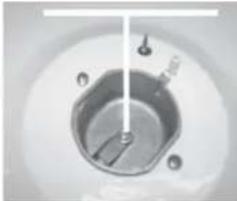 | Each jet is identified with a mark. | |||||||||
| BURNER | AUXILIARY | SEMI-RAPIDRAF | IDULTRA-RAPID | ||||||||
| Front right | Rear left Front | left Resr right | |||||||||
| Jet | kW | Jet | kW | Jet | kW | ||||||
| G20 | 20 mbar | 76 | 1,00 | 101 | 1,75 | 118 | 2,50 | ||||
| G20 | 25 mbar | 1,20 | 2,00 | 2,80 | |||||||
| G25 | 25 mbar | 0,90 | 1,60 | 2,30 | |||||||
| G30 | 29 mbar | 50 | 1,00 | 66 | 1,75 | 80 | 2,50 | ||||
| G31 | 30 mbar | 0,90 | 1,60 | 2,25 | |||||||
| G31 | 37 mbar | 1,00 | 1,75 | 2,50 | |||||||
| 3 | • SETTING THE IDLE FLAME | ||||||||||
| If the gas type has been altered, the stability of the flame in the minimum flow must be checked and set by adjusting the by-pass screw.To access the top burner by-pass screw, remove the control panel knobs.a) Butane-propane gas :the setting is done by screwing right in (without forcing) the by-pass screw whose calibrated hole provides the minimum flow.b) Natural gas :- unscrew the by-pass screw one turn,- replace the knob, light the burner and set to low flame,- remove the knob again, screw the by-pass screw until a reduced flame is obtained, staying stable when going from high to low position.- replace the knob.Warning: Never loosen the others screws! | |||||||||||
ELECTRICAL CONNECTION
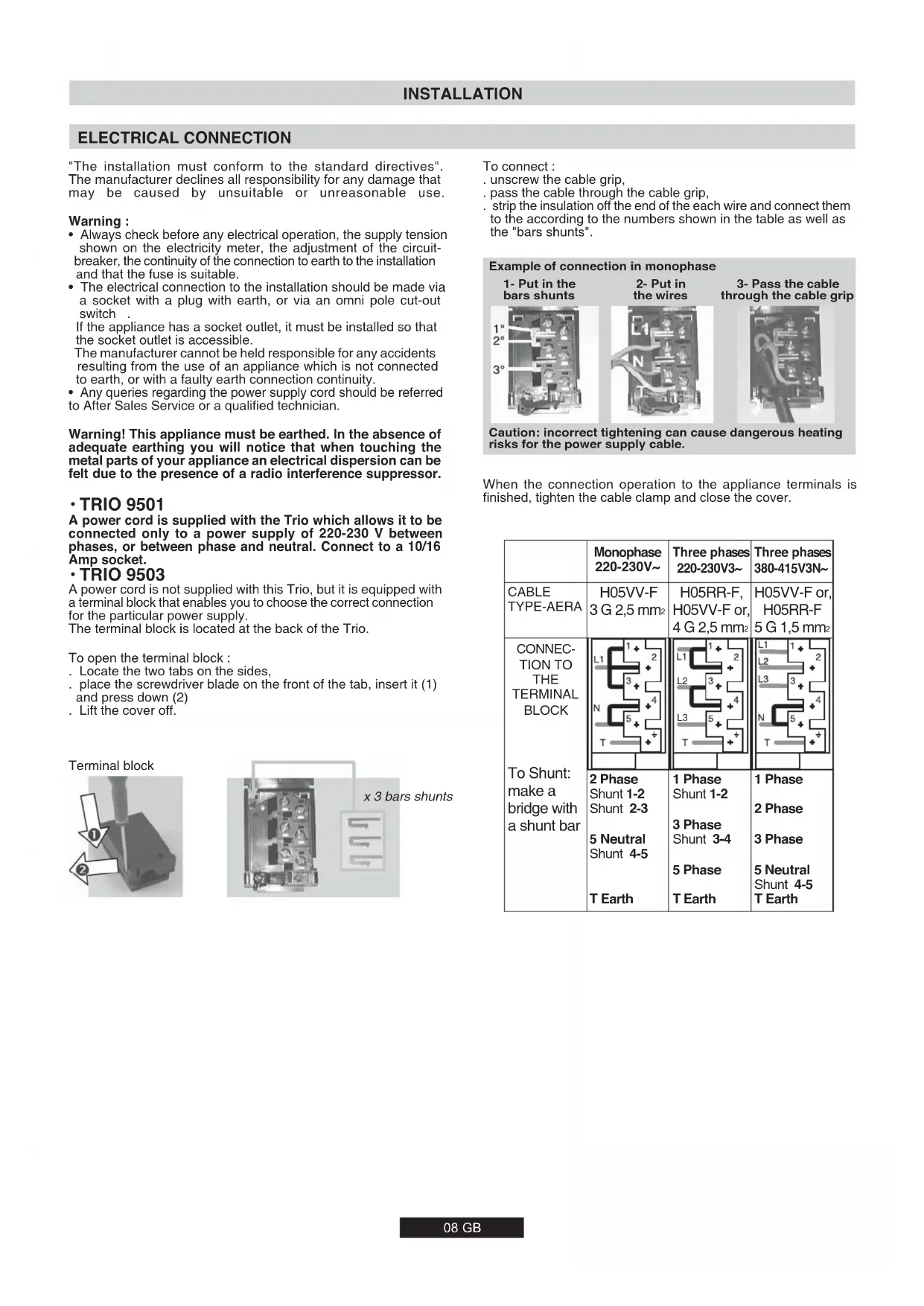
"The installation must conform to the standard directives". The manufacturer declines all responsibility for any damage that may be caused by unsuitable or unreasonable use.
Warning :
- Always check before any electrical operation, the supply tension shown on the electricity meter, the adjustment of the circuit-breaker, the continuity of the connection to earth to the installation and that the fuse is suitable.
- The electrical connection to the installation should be made via a socket with a plug with earth, or via an omni pole cut-out switch.
If the appliance has a socket outlet, it must be installed so that the socket outlet is accessible.
The manufacturer cannot be held responsible for any accidents resulting from the use of an appliance which is not connected to earth, or with a faulty earth connection continuity.
- Any queries regarding the power supply cord should be referred to After Sales Service or a qualified technician.
Warning! This appliance must be earthed. In the absence of adequate earthing you will notice that when touching the metal parts of your appliance an electrical dispersion can be felt due to the presence of a radio interference suppressor.
• TRIO 9501
A power cord is supplied with the Trio which allows it to be connected only to a power supply of 220-230 V between phases, or between phase and neutral. Connect to a 10/16 Amp socket.
• TRIO 9503
A power cord is not supplied with this Trio, but it is equipped with a terminal block that enables you to choose the correct connection for the particular power supply.
The terminal block is located at the back of the Trio.
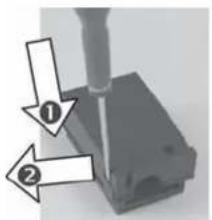
To open the terminal block :
. Locate the two tabs on the sides,
. place the screwdriver blade on the front of the tab, insert it (1) and press down (2)
. Lift the cover off.
Terminal block
text_image
Diagram showing two labeled arrows pointing to a mechanical component, with numbered annotations ① and ②.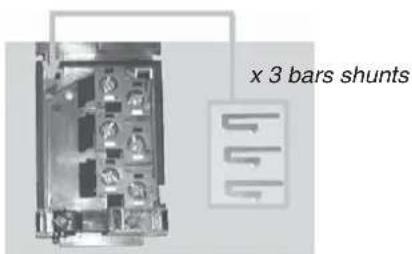
text_image
x 3 bars shuntsTo connect :
. unscrew the cable grip,
. pass the cable through the cable grip,
. strip the insulation off the end of the each wire and connect them to the according to the numbers shown in the table as well as the "bars shunts".
Example of connection in monophase
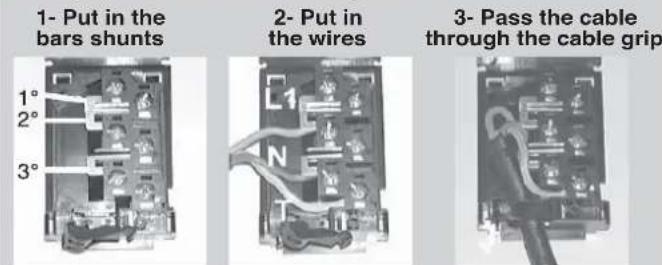
text_image
1- Put in the bars shunts 2- Put in the wires 3- Pass the cable through the cable gripCaution: incorrect tightening can cause dangerous heating risks for the power supply cable.
When the connection operation to the appliance terminals is finished, tighten the cable clamp and close the cover.
| Monophase 220-230V~ | Three phases 220-230V3~ | Three phases 380-415V3N~ | |
| CABLE TYPE-AERA | H05VV-F 3 G 2,5 mm2 | H05RR-F, H05VV-F or, 4 G 2,5 mm2 | H05VV-F or, H05RR-F 5 G 1,5 mm2 |
| CONNEC-TION TO THE TERMINAL BLOCK | 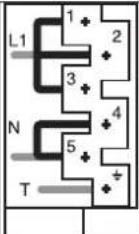 | 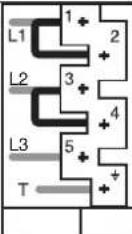 | 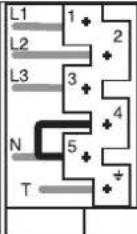 |
| To Shunt: make a bridge with a shunt bar | 2 Phase Shunt 1-2 Shunt 2-3 5 Neutral Shunt 4-5 T Earth | 1 Phase Shunt 1-2 3 Phase Shunt 3-4 5 Phase T Earth | 1 Phase 2 Phase 3 Phase 5 Neutral Shunt 4-5 T Earth |
INSTALLATION
WATER CONNECTION - WATER DRAINAGE
WATER CONNECTION :
The inlet and drain hoses can be directed to left or right. The dishwasher can be connected to either cold or hot water, as long as it is no hotter than 60^ C.
Water pressure must be between 0,08 MPa and 0,8 MPa. If the pressure is below the minimum consult the service department for advice.
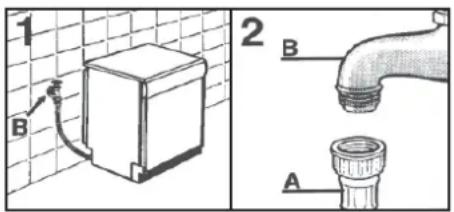
The inlet hose must be connected to a tap so that the water supply can be cut off when the machine is not in use (fig.1). The dishwasher inlet hose is fitted with a 3/4" threaded connector (fig.2). The inlet hose "A" should be tightly connected to a 3/4" tap "B".
The water connection of the dishwasher must be done exclusively with the pipe supplied. Do not use an old pipe.
If the machine is connected to new pipes or to pipes which have not been in use for long time, run water through for a few minutes before connecting the inlet hose. In this way no deposits of sand or rust will clog up the water inflow filter.
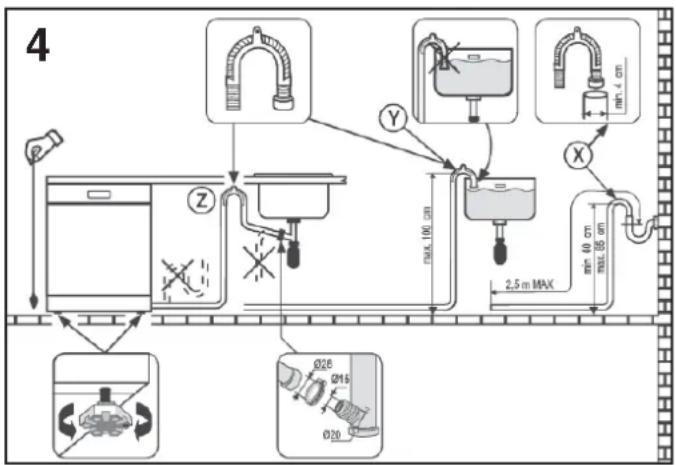
Take care not to bend or kink the drain hose when connecting it to the machine so that the water can drain freely from it (fig.4y). The drain hose must be at least 40 cm above floor level and it must have an internal diameter af at least 4 cm. It is advisable to fit an anti-odour air trap (fig.4x).
If necessary, the outlet hose can be extended up to 2,6 m, provided that it is kept at a maximum height of 85 cm above floor level. For this, contact Customer Service.
flowchart
graph TD
    A["Water Tank"] --> B["Refrigerator"]
    B --> C["Refrigerator with 100 cm height"]
    C --> D["Refrigerator with 2.5 m height"]
    D --> E["Refrigerator with 40 cm height"]
    E --> F["Refrigerator with 65 cm height"]
    F --> G["Refrigerator with 1 cm height"]
    G --> H["Refrigerator with 15 cm height"]
    H --> I["Refrigerator with 28 cm height"]
    I --> J["Refrigerator with 40 cm height"]
The hose can be hooked over the side of the sink (it must not be immersed in water, in order to prevent water from being siphoned back to the machine when this is in operation) Check that there are no kinks in the inlet and outlet hoses. To extend, if necessary the inlet hose, contact the Customer Service.
USE
GAS BURNERS
Each burner is controlled by a tap with progressive settings allowing: * a wider choice of settings from the maximum position to the lowest and most precise one,
* easier flame regulation according to the pan diameter,
* no risk of cutting off the flame or switching off when the flame is turned down quickly.
IGNITION
RECOMMENDATIONS: when the burners are not in service, the general gas supply tap should always be turned off.
- Turn on the gas tap,
- A symbol next to each control knob indicates which burner is lit.
- Turn and press in the relevant burner control knob to the symbol, keeping it pressed in until the flame ignites. On models fitted with electronic ignition the flame is ignited by an electric spark. This is operated by the button or by pressing the knob (for models with ignition under the knob). For models not fitted with electronic ignition, or if there is no electric power, light the flame with a match.
NB: for models fitted with the SAFETY thermocouple, keep the knob pressed in for a few seconds in order to activate the safety system. If the knob is released straightaway there is not time for the safety system to be activated and the flame goes out. If this happens, repeat the ignition procedure from the beginning waiting longer after the flame is lit.
The rapid thermocouple safety device automatically cuts off the gas supply if the flame is accidentally extinguished.
If there are particular local gas supply conditions which make ignition difficult, you are advised to repeat the ignition procedure, turning the knob to "minimum" (💡).
- Set the flame according to your cooking requirements. Intermediate positions are available between the (💧) and (💧) settings on the control knob.
- To turn the flame out, turn the control knob back to stop position.
- If the burner is accidentally extinguished, turn the knob to "0", wait one minute and then try to ignite again.
PANS
For a proper use of the burners, choose pans which match the dimensions given below :
* Very fast ∅ 18 cm and more
* Fast ∅ from 16 to 18 cm
* Semi-fast ∅ 12 cm
* Auxiliary ∅ 10 cm
- Pans with curved, ridged or warped bottoms are not recommended.
- Aluminium pans may leave marks on the enamelled pan support. These marks can easily be removed with a damp cloth and a light abrasive product.
SOME TIPS ....
- Avoid boiling food too intensely. Food is not cooked any more quickly this way. In fact, it is subjected to severe agitation, which may cause the food to lose some of its flavour.
- To save gas, make sure that the flames do not overlap the bottom of the pan.
- Do not use the gas burner with an empty pan.
The use of high quality utensils is important to obtain good cooking results :
- Always use good quality cookware with perfectly flat and thick bases.
- Ensure that the base of the pot or pan is dry.
- Use pans whose diameter is wide enough to completely cover the surface unit.
CHOOSING UTENSILS
The following information will help you to choose cookware which will give good performance.


On the label, check the mark that shows if the pan is compatible with the vitroceramic.
Stainless Steel : highly recommended. Especially good with a sandwich clad base. The sandwich base combines the benefits of stainless steel (appearance, durability and stability) with the advantages of aluminium or copper (heat conduction, even heat distribution).
Aluminium : heavy weight recommended. Good conductivity. Aluminium residues sometimes appear as scratches on the hob, but can be removed if cleaned immediately.
Because of its low melting point, thin aluminium should not be used.
Cast Iron : usable, but not recommended. Poor performance. May scratch the surface.
Copper Bottom / stoneware: heavy weight recommended. Good performance, but copper may leave residues which can appear as scratches. The residues can be removed, as long as the hob is cleaned immediately. However, do not let these pots boil dry. Overheated metal can bond to glass hobs. An overheated copper pot will leave a residue that will permanently stain the hob.
Porcelain/enamel : Good performance only with a thinly smooth, flat base.
THE ZONES
- highlight zone: it is operational within 3 seconds and is suitable for steady, homogeneous and sustained cooking.
- Sprinter: with the sprinter facility, reduced cooking times of up to 15% can be achieved.
USE
- Locate the sign corresponding to the cooking zone that you need.
- It is recommended that heat setting is at its highest until it has properly warmed up and then lower to the desired cooking setting.


- The power-on indicator light comes on to show that the heat zone is operating.
- Each zone is linked to a residual heat indicator located on the hob. It lights up when the heat zone temperature reaches 60°C and above. It will stay on, even if the unit is switched off, until the surface has cooled down.
- To switch off a heat zone, turn the corresponding control knob until the position "0".
- Positions: the examples below are intended as a guide. When you become familiar with using your hob you will be able to work out the settings that suit you best.
| Positions Some Tips | |||
| 1 | 1-2 | Very Low | To keep a dish hot, melt butter and chocolate... |
| 2 | 3-4 | Low | Slow cooking, sauces, stews, rice pudding poached eggs... |
| 3 | 5-6 | Moderate | Beans, frozen foods, fruit, boiling water... |
| 4 | 7-8 | Medium | Steamed apples, fresh vegetables, pasta, crepes, fish... |
| 5 | 9-10 | High | More intense cooking, omelettes, steaks... |
| 6 | 11-12 | Very High | Steaks, chops, frying... |
Recommendations :
- Never cook food directly on the glass ceramic hob. Always use the appropriate cookware.
• Always place the pan in the centre of the unit that you are cooking on. - Do not use the surface as a cutting board.
- Do not slide cookware across the hob.
- Do not store heavy items above the hob. If they drop onto the hob, they may cause damage.
- Do not store heavy items above the hob. If they drop onto the hob, they may cause damage.
- Do not use the hob as a working surface.
- Aluminium foil and plastic pans must not be placed on heating zones.
It is strongly recommended to keep children away from the cooking zones while they are in operation or when they are switched off, so long as the residual heat indicator is on, in order to prevent the risks of serious burns.
OVEN EQUIPMENT (According to the model)
It is necessary to do an initial cleaning of the equipment before the first use of each of them. Wash them with a sponge. Rinse and dry off.
- THE SHELF: it is for holding dishes, plates, and meat joints when cooking with the grill. It is fitted with rails which enables the drip tray to be slid into.
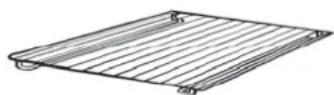
Thanks to its special shape, the shelf always remains horizontal, even when pulled to its fullest extent towards the front of the oven, thus avoiding the risk of dishes sliding off or tipping over.
• THE DRIP TRAY : collects meat and grilling juices during grilling. It can be put on the shelf, or slid under it. Unless used with the grill, the drip tray must not be stored in the oven while in use
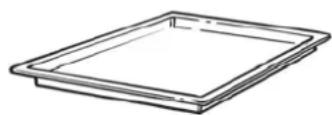
Never use the drip tray as a roasting tray. This would cause smoke to be produced, fat to be splashed and the oven would become rapidly stained.
- THE PASTRY TRAY must be placed on the shelf. It is for cooking small pastries like choux, biscuits, meringues, etc...
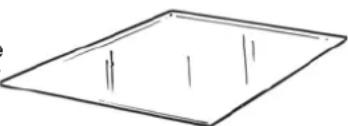
natural_image
Simple line drawing of a tilted rectangular plate with three vertical lines and two horizontal lines inside (no text or symbols)Never place the pastry tray directly on the oven bottom.
- THE ROTISSERIE is equipped with a skewer and an handle, two forks and a skewer support.
When the oven is in use, any unused accessories should be removed.
- It takes in charge the functioning of the oven, for between 1 and 120 minutes, with immediate
start and automatic stop. When the time is up, the timer automatically cuts off the power supply to the oven.
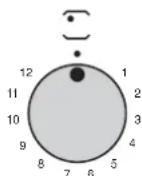
- However, the oven could be used without programming. In this case, turn the control knob to the Hand position 🔊.
Nota : to set a time, turn the control knob clockwise up to the 120 minutes mark and then turn it back to the required time.
THE OVEN USE
VERY IMPORTANT : the oven and the dishwaher cannot be used at the same time.
To use the oven, you have to close the dishwasher.
IMPORTANT : always keep small children away from the Trio while it is in use. If the Trio is fitted with a lid, lift it up before use.
THE COOKING METHODS (According to the model)
- Conventional cooking ⊖: the top and bottom heating elements are used together.
This method is ideal for all traditional roasting and baking, for sealing red meats, roast beef, leg of lamb, bread, flaky pastry. Preheat the oven for about ten minutes and place the cooking meat in the mid shelf position.
- Grill : using the top-heating element. Success is guaranteed for mixed grills, kebabs and "gratin dishes". Five minutes preheating is required to get the element hot.
- Rotisserie : using the top-heating element in conjunction with the rotisserie providing the real flavour of a traditional roast.
. Remove all accessories from the oven.
. Place the drip tray on the oven bottom.
. Skewer the food to be cooked and centre it between the two forks.
. Fit the skewer into the bracket and slide the bracket and skewer on to the second level. The end of the skewer will then be facing the slot in the drive mechanism.
. Fit the skewer into the drive mechanism.
- Rotisserie and conventional cooking: using in the same time the rotisserie and the conventional cooking. It allows to save time when cooking. However, you have to take care of placing the shelf with rails up side down, with rails towards the top and place the drip tray on it.
- Fan assisted grill ✪: using the top heating element with the fan circulating the air inside the oven. Ideal for cooking thick food items, whole pieces such as roast pork, poultry etc.. Preheating is necessary for red meats but not for white meats. Slide the drip tray under the shelf to collect juices. Make sure that the food is not too close to the grill. Turn the food over halfway through cooking.
- Fan cooking : both top and bottom heating elements are used with the fan circulating the air inside the oven. We recommend you use this method for poultry, pastries, fish and vegetables.. heat penetrates into the food better and both the cooking and preheating times are reduced.
USE
- Turn the control knob on the requesting cooking method and set a temperature :
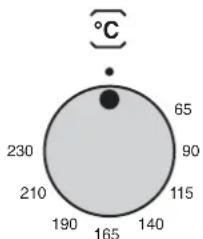
radar
| Angle (°C) | Value | |---|---| | 0 | 65 | | 15 | 90 | | 30 | 115 | | 45 | 140 | | 60 | 165 | | 75 | 190 | | 90 | 210 | | 105 | 230 |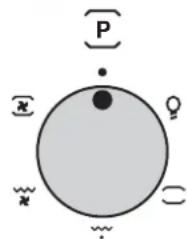
chemical
Simple molecular structure diagram showing a central atom bonded to four surrounding atoms with labeled positions P, Q, and w.☐ Conventional cooking Temperature from 65^ C to 230^ C
Grill Temperature 230°C
Rotisserie Temperature 230°C
Rotisserie + Conventional Temperature 230°C cooking
Fan assisted grill Temperature 230°C
✗ Fan cooking Temperature from 65°C to 230°C
- Turn the control knob of the circuit-breaker timer to the Hand position or on a programming duration.
- The regulator indicator light indicates that the thermostat is working. It goes on and off regularly during the cooking time.
COOKING ADVICES
MEAT :
It is better not to salt meats until after cooking as salt encourages the meat to splatter fat.
This will dirty the oven and make a lot of smoke. Joints of white meat, pork, veal, lamb and fish can be put into the oven cold. The cooking time is longer than in a preheated oven, but it cooks through to the centre better as the heat has more time to penetrate the joint.
CORRECT PRE-HEATING IS THE BASIS OF SUCCESSFUL RED MEAT COOKERY.
CAKE - PASTRIES AND BISCUITS :
Avoid using shiny moulds because they reflect heat and can spoil your cakes. If your cakes brown too quickly, cover them with greaseproof paper or aluminium foil.
Caution : the correct way to use foil is with the shiny side inwards. If not the heat is reflected by the shiny surface and does not penetrate the cake.
Avoid opening the door during the first 20 to 25 minutes of cooking: sponge cake, soufflés, brioche, etc., will tend to fall. You can check if cakes are done, by pricking the centre with a knife blade or metal knitting needle. If the blade comes out nice and dry, your cake is ready, and you can stop the cooking. If the blade comes out moist or with bits of cake attached, continue baking but slightly lower the thermostat so that it finished off without burning.
The following instructions are for guidance only. You may wish to alter them according to your own experience or your personal taste.
Pre-heating times :
. 20 minutes between 210 and 230°C
. 15 minutes between 140 and 190°C
. 10 minutes between 65 and 115°C
| QUANTITY | FOOD | Oven Temperature in °C | Shelf position from the bottom | Cooking time in minutes |
FISH
| Trout | 200 | 1 | 15 / 25 | |
| 1 kg | Whiting | 190 | 1 | 50 |
MEAT
| 1 - 1,5 kg | Roast-beef | 190 | 1 | 90 |
| 1 kg | Roast veal | 150 / 160 | 1 | 120 / 150 |
| 2 kg | Blanquette of veal | 170 / 190 | 1 | 60 / 90 |
| 1 - 1,5 kg | Leg of lamp | 150 / 160 | 1 | 60 / 75 |
| 1 - 1,5 kg | Leg of mutton | 150 / 160 | 1 | 50 / 60 |
POULTRY
| 2 kg | Pigeons | 150 / 160 | 1 | 45 |
| 4 kg | Goose | 160 | 1 | 240 / 270 |
| 2 - 2,5 kg | Duck | 175 | 1 | 90 / 150 |
| 1 - 1,5 kg | Chicken | 170 | 1 | 60 / 80 |
VARIOUS
| Lasagne | 200 | 1 | 40 | |
| Soufflès | 200 | 1 | 20 | |
| Fritter | 200 | 1 | 20 | |
| Pizza | 200 | 1 | 20 |
PASTRY
| Buckwheat cake | 175 | 1 | 40 / 50 | |
| Tart with fruits | 180 / 190 | 1 | 20 / 30 | |
| Biscuit (leaven dough) | 160 | 1 | 40 / 45 | |
| Meringue | 100 | 1 | 90 | |
| Puff pastry | 200 | 1 | 20 |
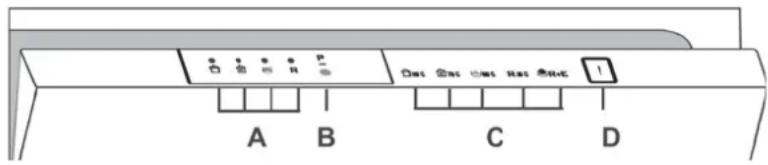
DISHWASHER CONTROLS
A Programme selection indicator lights
B Programme selection button
C Programme description
D On/off button
text_image
A B C DSELECTING THE PROGRAMMES AND SPECIAL FUNCTIONS
The dishwasher and the oven cannot be used simultaneously.
Setting a programme
Open the door and press the On/off button ; the 4 Program selection LEDs start flashing.
- Set the required programme by pressing Programme selection button, LED of the chosen programme will turn on (2 LEDs for COLD RINSE programme).
- Close the door (after audible signal), the chosen programme will start automatically.
USE THE DISHWASHER
Opening the door
Grip the handle in the front panel and pull forward. If the machine comes open while it is working, an electrical safety device automatically switches everything off. For the machine to work properly, the door should not be opened while it is in operation.
Closing the door
Place the basket in the dishwasher. Make sure that the spray arm is free to rotate and is not obstructed by cutlery, crockery or pans. Close the door, pressing on it to make sure it is firmly shut.
Interrupting a programme
It is not recommended that the door be opened while a programme is running, and especially not during the main wash phase and final drying.
However, the appliance stops automatically when the door is opened.
When the door is closed again, the programme continues automatically.
If you wish to change or cancel a programme that is running, carry out the following procedure:
- Hold the "PROGRAMME SELECTION" button down for at least 5 seconds. The programme indicator lights will turn on and off individually and sequentially and some audible signals will sound.
- The running programme will be cancelled and all the programme indicator lights will flash.
Before starting a new programme, you should check that there is still detergent in the dispenser. If necessary, top up the dispenser.
WARNING: if the door is opened during the drying phase, an intermittent audible signal is activated to advise that the cycle is not yet completed.
A 5 seconds alarm will sound (if not muted) 3 times at 30 seconds intervals to signal that the programme has ended. The selected programme indicator light (2 indicator lights for the "COLD RINSE" programme) will start to flash. Dishes can now be removed and the dishwasher turned off by pressing the "ON/OFF" button or dishes can be loaded for new cycle.
The alarm for the programme end may be muted as follows:
IMPORTANT
The dishwasher must ALWAYS be offbefore start of this procedure.
- Hold down the "PROGRAMMESELECTION" button and at the same time switch on the dishwasher by pressing the "ON/OFF" button (a brief audible signal will sound).
- Keep the "PROGRAMME SELECTION" button pressed for at least 15 seconds (during this time, 2 audible signals will sound).
- Release the button when the second audible signal sounds (3 "PROGRAMME SELECTION" indicator lights will come on).
- Press the same button again: the 3 indicator lights (which indicate that the alarm is activated) will start flashing (to indicate that the alarm is off).
- Turn off the dishwasher by pressing the "ON/OFF" button to confirm the new setting.
To turn the alarm on again, follow the same procedure.

WARNING!
If any problem occurs, turn the dishwasher off by pressing the "ON/OFF" button and start the procedure again from the beginning.
Memorization of the last programme used
The last programme used can be memorized by following the below:
IMPORTANT
The dishwasher must ALWAYS be off before start of this procedure.
- Hold down the "PROGRAMME SELECTION" button and at the same time switch on the dishwasher by pressing the "ON/OFF" button (a brief audible signal will sound).
- Keep the "PROGRAMME SELECTION" button pressed for at least 30 seconds (during this time, 3 audible signals will sound).
- Release the button when the THIRD audible signal sounds (all the indicator lights will flash).
- Press the same button again: the flashing indicator light (memorization off) will stop flashing and remain on (memorization on).
- Turn off the dishwasher by pressing the "ON/OFF" button to confirm the new setting.
To disable the memorization, follow the same procedure.

WARNING!
If any problem occurs, turn the dishwasher off by pressing the "ON/OFF" button and start the procedure again from the beginning.
If there is any break in the power supply while the dishwasher is operating, a special memory stores the selected programme and, when the power is restored, it continues where it left off.
Attention - The dishwasher is equipped with an anti-overflow safety device which in the event of anomaly intervenes by evacuating water in excess.
Fault Signals
If malfunctions or faults occur when a program is running, the LED that corresponds to the selected cycle (2 LEDS for COLD RINSE programme) will blink rapidly and an audible signal will be activated. In this case, turn the dishwasher off by pressing the On/Off button. After checking to make sure the water inlet hose tap is open, that the drain hose is not bent and that the siphon or filters are not clogged, re-start the selected program. If the anomaly persists, contact Customer Service.
Important!
To ensure the correct operation of the anti-overflow safety device, it is recommended not to move or to tilt the dishwasher during operation.
If it is necessary to move or to tilt the dishwaher, first make sure the washing cycle is finished and that no water is left in the tank.
PRELIMINARY OPERATIONS AND CLEANING THE FILTER UNIT
The filtering system is composed of
- a central filter cup which traps the largest food particles.
- a flat filter which continuously filters the washing water.
- the micro filter, situated under the flat filter, which traps the smallest food particles ensuring a perfect rinse.
For best results, the filter unit should be checked and cleaned after each wash.
To remove the filter unit, simply grip the handle and lift the whole unit out.
The central cup is just resting on top for easy cleaning. The dishwasher is fitted with a self cleaning micro filter, which only requires checking about once every 15 days.
However, it is advisable to check after every wash, that the central cup and the flat filter are not clogged.
NB : After cleaning the filters, make sure that they are correctly reassembled, one inside the other, and that the flat filter is properly positioned at the bottom of the dishwasher.
A poor seating of the filter unit could have an adverse effect on the efficiency of the appliance.
Important : Never use the dishwasher without filter.
LOADING DISHES
The basket has been carefully designed to make loading easy. For good wash performance, remove any debris from the dishes (bones, tooth picks, the remains of meat and vegetables) to avoid blocking the filters, water outlet and washing arm nozzle and, as a result, reducing washing efficiency.
Warning ! to avoid any injury from cutlery with blades or sharp points, they can be placed with the handles upwards.
text_image
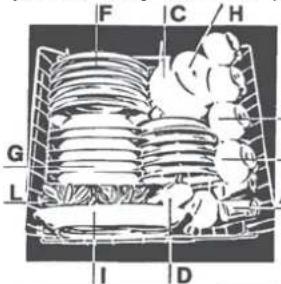
F C H G L I DLOADING A 6 PLACES SETTING (EN 50242)
A-6 glasses
E B-6 dessert plates
C-6 saucers
D- Small bowl
E-6 tea or coffee cups
F - 6 flat plates
G-6 deep plates
H- Medium bowl
I - Serving dish
L - Cutlery
natural_image
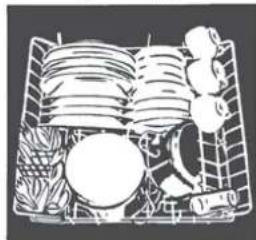
Illustration of a basket containing various items including books, pens, and utensils (no text or symbols)LOADING 4 PLACE SETTINGS PLUS CASSEROLES
Casseroles, salad bowls, soup pans, lids etc., can be loaded on the basket. It is advisable to arrange the cutlery in the basket provided for that purpose. If there is any cutlery with narrow handles, it should be placed with handles upwards, to avoid falling
through the bottom of the basket and blocking the washing arm. Do not put wooden handled lids in the basket, or any whose lids are bonded with resin.
LOADING THE DETERGENT
It is essential to use a detergent that is specifically designed for dishwashers either in powder, liquid or tablet form. Unsuitable detergents, (like those for washing up by hand) do not contain the proper ingredients for use in a dishwasher and impede the efficient functioning.
Normal wash
The detergent dispenser is inside the door. The dispenser lid should be closed before every wash. To open it, simply press the catch. At the end of each wash cycle the lid is always open and ready for the next time, the dishwasher is used.
The amount of detergent to be used varies according to how dirty the dishes are and the type of wash. A 15g dose is normally recommended. If the water is hard or the
dishes are exceptionally dirty, 25g of detergent should be loaded. After pooring the detergent into the dispenser, close the lid, since not all detergents are the same and the instructions on the boxes of detergent can vary.
We should just like to remind users that too little detergent does not clean the dishes properly whilst too much detergent not only does not produce better results but is also a waste. Do not use an excessive amount of detergent and help limit damage to the environment at the same time.
Intensive washing
natural_image
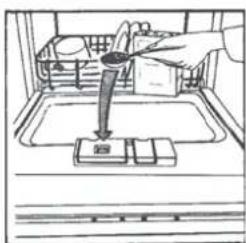
Line drawing of a hand using a tool to lift a component into a sink (no text or symbols)When using the intensive wash programme, add a second dose of detergent of about 15g (1 soup spoonful).
This extra dose should be put in the small tank (see immage)
FILLING THE RINSE AID DISPENSER
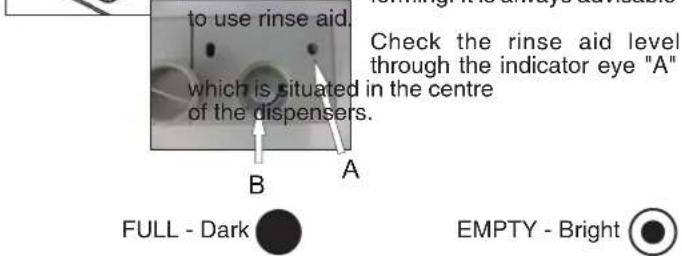
The rinse aid dispenser "B" is to the right of the detergent dispenser and has a capacity of about 130 ml. Open the lid and pour in enough liquid, which will last several washes. Try to avoid overloading. Close the lid. This additive, which is automatically released during the last rinse cycle, helps the dishes to dry quickly and prevents spots and stains forming. It is always advisable
text_image
to use rinse aid. B A FULL - Dark EMPTY - Bright Check the rinse aid level through the indicator eye "A" which is situated in the centre of the dispensers.REGULATING THE RINSE AID (from 1 to 4).
The regulator control "B" is below the indicator and can be turned with the finger, the recommended position is "3". The hardness of the water can be judged by incrustation or by the level of dryness.
It is therefore important that the correct dosage of Rinse Aid is regulated to give the best results.
After the wash,
. if streaks occur on the dishes, decrease the amount by one position.
. if whitish spots occur, increase the amount by one position.
LOADING THE SALT
The dishwasher is fitted with a softener that clears the water of lime which could cause scale and damage the dishwasher. On the bottom of the diswasher there is a salt dispenser for regenerating the softener.
The filter element of the softener unit should be recharged with a salt specially produced for dishwashers. This salt can be bought either as tablets or as granules.
To add salt, unscrew the cap of the salt dispenser on the bottom and refill the dispenser. During this operation a little water will overflow but keep adding salt until the dispenser is fill clean the thread of salt residue and retighten
If the dishwasher is not required straightaway, set the programme Cold rinse ("Eco+Rapid, 2 Leds") so that the salt solution which has overflowed is discharged from the washing tank.
The salt dispenser has a capacity of between 1.5 kg for efficient use of the appliance, it should be refilled from time to time according to the regulation of the water softener unit.
NB: it is necessary to add water until the dispenser overflows. Only install the dishwasher completely filling the salt dispenser.
Regulating the water softener with electronic programmer
The water softener can treat water with a hardness level of up to 60^ Fh (French grading) or 33^ Dh (German grading) through 5 settings. The settings are listed in the panel below:
| Level | Water hardness | Water hardness | Use of regenerating salt | Water softener setting |
| °fH (French) | °dH (German) | |||
| 0 | 0-8 | 4 | no | |
| 1 | 9-20 | 5-11 | yes | Indicator light 1 |
| 2 | 21-30 | 12-17 | yes | Indicator light 1+2 |
| 3 | 31-40 | 18-22 | yes | Indicator light 1+2+3 |
| 4 | 41-60 | 23-33 | yes | Indicator light 1+2+3+4 |
IMPORTANT
The dishwasher must ALWAYS be off before start of this procedure.
- Hold down the "PROGRAMME SELECTION" button and at the same time switch on the dishwasher by pressing the "ON/OFF" button (a brief audible signal will sound).
- Keep the "PROGRAMME SELECTION" button pressed for at least 5 seconds, UNTIL an audible signal sounds. Some "PROGRAMME SELECTION" indicator lights will come on to indicate the current water softener setting level.
- Press the same button again to select the required water softener level: each time the button is pressed, one indicator light will come on (the water softener level is indicated by the number of lights on). For level 5, 4 lights will flash, for level 0 all lights will be off.
- Turn off the dishwasher by pressing the "ON/OFF" button to confirm the new setting.

WARNING!
If any problem occurs, turn thedishwasher off by pressing the "ON/OFF" button and start the procedure again from the beginning (STEP 1).

text_image
AAAClass ECO R32' Progr. 65°C 75°C ECO 45°C R32' 50°C Hygiene+ LEDs PROGRAMME SELECTION BUTTONWASHING PROGRAMME
Information for the test laboratories General programme comparison
Ref. EN 50242 standards:
1) Normal load
2) Shine setting: "4"
3) Amount of detergent: 18gr. for wash
| CONSUMPTION (main programmes)* | ||
| Programme | Energy (kWh) Water (L) | |
| Universal | 1,25 | 15 |
| Hygiene+ | 0.93 | 12 |
| Eco | 0.67 | 8 |
| Rapid 32' | 0,60 | 8 |
| Power consumption of the off-mode and of the left-on mode: 0,1 W / 0,8 W | ||
| * Values are measured in a laboratory according to European Standard EN 50242 (consumption may vary according to conditions of usage). | ||
| Check list | Programme contents | Duration | |||||||||
| Detergent for soaking | Detergent for washing | Clean filter | Check rinse aid dispenser | Check salt dispenser | Hot pre-wash | Cold Pre-wash | Main wash | First rinse | Second rinse cold | Rinse with rinse aid | With cold water |
| 65°C | 80 | ||||||||||
| 75°C | 90 | ||||||||||
| 46°C | 153 | 120 | |||||||||
| 50°C | 32 | ||||||||||
| 6 | |||||||||||
| Check list | Programme contents | Duration | |||||||||
| Detergent for soaking | Detergent for washing | Clean filter | Check rinse aid dispenser | Check salt dispenser | Hot pre-wash | Cold Pre-wash | Main wash | First rinse | Second rinse cold | Rinse with rinse aid | With cold water |
| 65°C | 80 | ||||||||||
| 75°C | 90 | ||||||||||
| 46°C | 153 | 120 | |||||||||
| 50°C | 32 | ||||||||||
| 6 | |||||||||||
USE
SOME PRACTICAL HINTS ....
- To carry out a wash programme with a full load of dishes load the machine correctly after each meal and do a cold pre-wash between each load to get rid of stains and remove the larger residues of food.
HOW TO GET GOOD WASH RESULTS
1) Place the dishes face downwards.
2) Try to place the dishes in such a way that they are not touching one another. If they are loaded properly you will get better results.
3) Before placing the dishes in the dishwasher remove any remaining food (bones, shells, pieces of meat or vegetables, coffee grounds, skin of fruit, cigarette ash etc. that could clog up the outflow and the washing arm jets.
4) After loading the dishes, check that the washing arm can rotate freely.
5) Pans and other dishes that have particularly stubborn food particles or remnants of burnt food should be left to soak in water with dishwasher detergent.
6) To wash silver properly:
a) - rinse the silver immediately after use especially if it has been used for mayonnaise, eggs, fish etc.
b) - do not sprinkle detergent onto it.
c) - keep it separate from other metals.
WHAT TO DO IF ...
You want to stop the dishwasher to put in more dishes whilst it is in the middle of a wash. Open the door, put in the dishes, and close the door, the machine will start up again automatically.
WHAT NOT TO WASH ...
It should also be remembered that not all dishes are suitable for washing in a dishwasher. We advise again using the dishwasher to wash items in thermoplastic, cutlery with wooden or plastic handles, saucepans with wooden handles, items in aluminium, crystal, leaded glass unless otherwise stated.
Certain decorations may fade. It is therefore a good idea before loading the whole batch to wash just one of the items first so as to be sure that others like it will not fade.
It is also a good idea not to put silver cultery with non-stainless steel handles into the dishwasher as there could be a chemical reaction between them.
NB: when buying new crockery or cutlery always make sure that they are suitable for washing in a dishwasher.
AFTER USE - After each wash, close the tap which supplies the water to the dishwasher and press the On/Off button to the Off position. If the dishwasher is not going to be used for some time, the following precautions are advisable:
1 - carry out a wash programme, but with no dishes, to degrease the machine,
2 - pull the plug out,
3 - turn off the water supply tap,
4 - fill the rinse aid dispenser,
5 - leave the door slightly ajar
6 - leave the inside of the machine clean,
7 - if the machine is to be left in a place where the
temperature is below 0^ C, the water left in the dispenser could freeze.
Therefore, it is advisable to raise the temperature above 0^ C, approximately 24 hours before using the machine again.
CLEANING
• Before carrying out any cleaning, you must :
- Disconnect the appliance from the electrical supply and wait for all the hot parts to cool.
- Never use abrasive cleaners, wire wool or sharp objects to clean the appliance.
THE ENAMELLED PARTS :
never use abrasives, scouring pads or sharp objects, as this will cause irreparable damage to the enamel. Once the appliance has cooled down, simply clean with soapy water and dry with a clean cloth.
THE VITROCERAMIC HOB
Do not use a sponge that is too wet.
It is advisable to keep away from the hob all substances which are liable to melt, such as plastic items, sugar, or sugar-based products.
Maintenance :
- place a few drops of a specialist cleaning product on the hob surface.
- rub any stubborn stains with a soft cloth or with slightly damp kitchen paper.
- wipe with a soft cloth or dry kitchen paper until the surface is clean.
- Never use abrasive cleaners, wire wool or sharp objects to clean the glass oven door, as this may result in shattering of the glass
Stubborn stains :
- place a few drops of a specialist cleaning product on the hob surface.
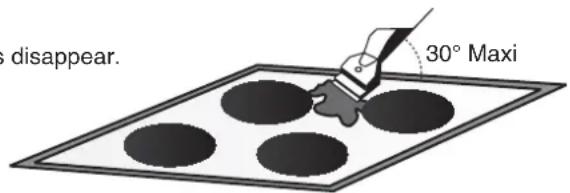
- scrape with a scraper, holding it at an angle of 30^ to the hob, until the stains disappear.
- wipe with a soft cloth or dry kitchen paper until the surface is clean.
- repeat the operation if necessary.
A scraper with a razor blade will not damage the surface, as long as it is kept at an angle of 30^ . Never leave a scraper with a razor blade within reach of children.
A few hints :
Frequent cleaning leaves a protective layer which is essential for preventing scratches and wear.
Make sure that the surface is clean before using the hob again.
To remove marks left by water, use a few drops of white vinegar or lemon juice. Then wipe with absorbent paper and a few drops of specialist cleaning fluid.
The glass ceramic surface will withstand scraping from flat-bottomed cooking vessels, however, it is always better to lift them when moving.
text_image
disappear. 30° MaxiCLEANING
• OVEN LIGHTING
The bulb and its cover are made of material resistant to high temperatures: 230 V\~ - E 14 base - 15 W - Temperature 300°C mini. Replacing the bulb : disconnect the power supply from the oven before attempting to replace the lamp. Wait for the oven to cool down before doing any operation.
To change a defective bulb, just unscrew the glass cover, unscrew the bulb, replace it with the same type, after replacing the defective bulb, screw back the protective glass cover.
• THE ACCESSORIES
The oven shelf - the pastry tray : do not clean the oven shelf with harsh abrasives, scouring pads or sharp objects. Simply use a cloth wrung out in hot soapy water. Rinse with clean water and then dry.
The drip tray : after grilling, remove the drip tray from the oven and pour the grease into a container. Wash and rinse the drip tray in very hot water, using a sponge and washing powder. If still stained withs sticky food, immerse in soapy water. The drip tray can be clean
in the dishwasher. Never put the drip tray back in the oven if still dirty.
• THE OVEN DOOR GLASS
It is recommended to wipe the oven door glass with absorbent paper after each cooking cycle. If there is heavy staining, the glass can be cleaned with a sponge cleaning agent.
• OVEN DOOR :
it is possible to clean the oven door while in position or after removal.
To remove the door, carry out the following:
. open the door fully,
. release the hooks,
. pull the door upwards, closing it partially, until it is free.
To refit it, make sure you reposition the hinges carefully; a notch located below them lets you fit he hinges correctly.
After the door is put back on its supports, fit the hinges in their initial position.
• GAS BURNERS : for cleaning, it is recommended to remove all greasy or burnt deposits with ammonia based products or usual cleaning products. Do not immerse the burner caps in cold water immediately after use, to avoid cracking the enamel from the thermal shock. If the holes become clogged, brush them with soapy water and dry with a cloth.
When re-assembling the burners, make sure that the burner caps and the burners themselves are dry and after, seat them correctly.
- Caution: Be careful not to let any water get into the burners.
- LID : once the Trio has cooled down, simply clean with soapy water and dry with a clean cloth. Before lifting the lid, make sure that anything that might spill over has been removed.
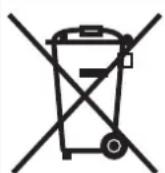

This appliance is marked according to the European directive 2002/96/EC on Waste Electrical and Electronic Equipment (WEEE). By ensuring this product is disposed of correctly, you will help prevent potential negative consequences for the environment and human health, which could otherwise be caused by inappropriate waste handling of this product.
The symbol on the product indicates that this product may not be treated as household waste. Instead it shall be handed over to the applicable collection point for the recycling of electrical and electronic equipment Disposal must be carried out in accordance with local environmental regulations for waste disposal.
For more detailed information about treatment, recovery and recycling of this product, please contact your local city office, your household waste disposal service or the shop where you purchased the product.
REMEMBER! the oven and the dishwasher cannot be used in the same time.
Should the dishwasher fail to operate, before contacting the Service Centre, make the following checks:
| FAULT | CAUSE REMEDY | |
| 1 - Machine completely dead | Plug is not connected correctly | Connect electric plug |
| O/I button has not been pressed | Press button | |
| No electricity | Check the electricity supply | |
| Door is open | Close door | |
| 2 - Machine does not drawwater | See causes for No 1 | Check |
| Water tap is turned off | Turn water tap on | |
| Programme selector is not at correct position | Turn programme selector to correct position | |
| The inlet hose is bent | Eliminate the bends in the hose | |
| The inlet hose filter is blocked | Clean the filter at the end of the hose | |
| 3 - Machine does not discharge water | Filter is dirty | Clean filter |
| Outlet hose is kinked | Straighten outlet hose | |
| The outlet hose extension is not correctly connected | Follow the instructions forconnecting the outlet hose carefully | |
| The outlet connection on the wall is pointing downwards not upwards | Call a qualified technician | |
| 4 - Machine discharges water continuously | Position of outlet hose is too low | Lift outlet hose to at least 40 cm above floor level |
| 5 - Spray arm is not heard to rotate | Excessive amount of detergent | Reduce amount of detergent |
| Item prevents arm from rotating | Check | |
| Plate and cup filter very dirty | Clean plate and cup filter | |
| 6 - On electronic appliance without a display: "Eco" indicator light and indicator light "No 1", with audible signal | Water inlet tap turned off | Switch off the appliance - Turn on the tap - Re-set the cycle |
| 7 - Load of dishes is only partially washed | See causes for No 5 | Check |
| Bottom of saucepans have not been washed well | Burnt on food remains must be soaked before putting pans indishwasher | |
| Edge of saucepans have not been washed well | Reposition saucepans | |
| Spray arm is blocked | Remove spray arm by unscrewing ring nut clockwise and wash under running water | |
| The dishes have not been properly loaded | Do not place the dishes too closely together | |
| The end of the outlet hose is in thewater | The end of the outlet hose must not come into contact with the outflow water | |
| The incorrect amount of detergent has been measured out; the detergent is old and hard | Increase the measure according to how dirty the dishes are and change detergent | |
| The tap of the salt dispenser is not closed very well | Tighten it fully. | |
| The wash programme is not thorough enough | Choose a more vigorous programme | |
| 8 - Presence of white spots on dishes | Water is too hard | Check salt and rinse aid level and regulate amount. Should the fault persist, contact Service Centre |
| 9 - Noise during wash | The dishes knock against one another | Load dishes better onto the basket |
| The revolving arm knock against the dishes | Load dishes better | |
| 10 - The dishes are not completely dry | Inadequate air flow | Leave the dishwasher door ajar at the end of wash program to allow dishes to dry naturally |
text_image
Diagram showing two labeled arrows pointing to a mechanical component, with numbered annotations ① and ②.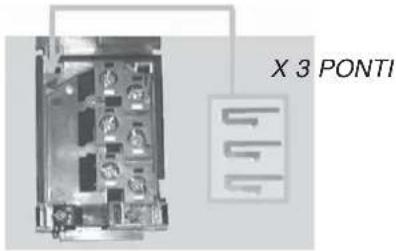
text_image
X 3 PONTIATTENZIONE!
natural_image
Close-up of an electrical circuit board with wires and components (no visible text or symbols)flowchart
graph TD
    A["Water Tank"] --> B["Receiving Pump"]
    B --> C["Receiving Tank with Upper Cover"]
    C --> D["Receiving Tank with Upper Cover"]
    D --> E["Receiving Tank with Upper Cover"]
    E --> F["Receiving Tank with Upper Cover"]
    F --> G["Receiving Tank with Upper Cover"]
    G --> H["Receiving Tank with Upper Cover"]
    H --> I["Receiving Tank with Upper Cover"]
    I --> J["Receiving Tank with Upper Cover"]
    J --> K["Receiving Tank with Upper Cover"]
    K --> L["Receiving Tank with Upper Cover"]
    L --> M["Receiving Tank with Upper Cover"]
    M --> N["Receiving Tank with Upper Cover"]
    N --> O["Receiving Tank with Upper Cover"]
    O --> P["Receiving Tank with Upper Cover"]
    P --> Q["Receiving Tank with Upper Cover"]
    Q --> R["Receiving Tank with Upper Cover"]
    R --> S["Receiving Tank with Upper Cover"]
    S --> T["Receiving Tank with Upper Cover"]
    T --> U["Receiving Tank with Upper Cover"]
    U --> V["Receiving Tank with Upper Cover"]
    V --> W["Receiving Tank with Upper Cover"]
    W --> X["Receiving Tank with Upper Cover"]
    X --> Y["Receiving Tank with Upper Cover"]
    Y --> Z["Receiving Tank with Upper Cover"]
natural_image
Simple line drawing of a tilted rectangular shape with three vertical lines inside (no text or symbols)chemical
Simple molecular structure diagram with labeled atoms and bondsConvezione naturale
Temperature tra 65°C e 230°C
Grill
Temperatura 230°C
Girarrosto
Temperatura 230°C
text_image
F C H E G B L A I Dnatural_image
Illustration of a hand inserting a component into a device with an open lid (no text or symbols visible)natural_image
Line drawing of a hand using a tool to press down a tray with a small object inside (no text or symbols)natural_image
Symbol of a trash bin crossed with no text or numbers, representing waste sorting or disposal (no text present)natural_image
Line drawing of a room interior with brick wall and window, no text or symbols present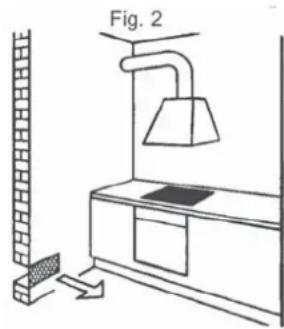
text_image
Fig. 2• RACCORDEMENT GAZ
| GAS/GAZ/Pression (mbar) | |||||||||
| CAT. | G20/20 | G20/25 | G25/25 | G30/29 | G30/36 | G31/30 | G31/37 | G350/13 | |
| II 2E+3+ | BE-FR | ● | ● | X | X | ||||
| II 2H3+ | CH-ES-GB T-PT | ● | X | X | |||||
| II 2H3B/P | CZ-DK-FI NO-SE | ● | X | X | |||||
| II 2H3B/P | HU | ● | |||||||
| I 2E | DE | ● | |||||||
| II 2L3B/P | NL | ● | X | X | |||||
| II 2ELs3B/P | PL | ● | X | X | |||||
text_image
Diagram showing a mechanical component with two labeled arrows pointing to specific parts, likely indicating assembly or inspection steps.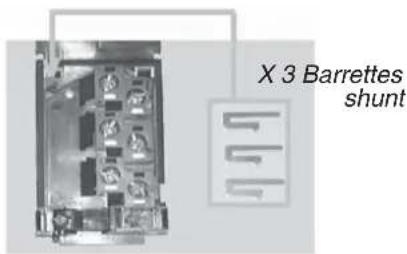
text_image
X 3 Barrettes shuntflowchart
graph TD
    A["Water Supply"] --> B["Refrigerator"]
    B --> C["Refrigerator with 100 cm height"]
    C --> D["Refrigerator with 2.5 m height"]
    D --> E["Refrigerator with 40 cm height"]
    E --> F["Refrigerator with 65 cm height"]
    F --> G["Refrigerator with 1 cm height"]
    G --> H["Refrigerator with 15 cm height"]
    H --> I["Refrigerator with 25 cm height"]
    I --> J["Refrigerator with 30 cm height"]
    J --> K["Refrigerator with 40 cm height"]
    K --> L["Refrigerator with 50 cm height"]
    L --> M["Refrigerator with 60 cm height"]
    M --> N["Refrigerator with 70 cm height"]
    N --> O["Refrigerator with 80 cm height"]
    O --> P["Refrigerator with 90 cm height"]
    P --> Q["Refrigerator with 100 cm height"]
    Q --> R["Refrigerator with 110 cm height"]
    R --> S["Refrigerator with 120 cm height"]
    S --> T["Refrigerator with 130 cm height"]
    T --> U["Refrigerator with 140 cm height"]
    U --> V["Refrigerator with 150 cm height"]
    V --> W["Refrigerator with 160 cm height"]
    W --> X["Refrigerator with 170 cm height"]
    X --> Y["Refrigerator with 180 cm height"]
    Y --> Z["Refrigerator with 190 cm height"]
    Z --> AA["Refrigerator with 200 cm height"]
Convection naturelle
natural_image
Illustration of a basket containing various items including books, plants, and food items (no text or symbols present)CHARGEMENT DE 4 COUVERTS PLUS CASSEROLES
natural_image
Illustration of a hand inserting into a device into a stack of electronic components (no text or symbols visible)natural_image
Line drawing of a hand using a tool to press down a small component on an appliance (no text or symbols visible)In case of installation of the cooker on a base, measures have to be taken to prevent the appliance slipping from the base itself
MODELO DE GAS
natural_image
Two metallic mechanical components with circular flanges, labeled 'Natural gas' (no other text or symbols)natural_image
Pure electrical circuit lines without any symbolstext_image
Diagram showing two labeled arrows pointing to a mechanical component, with numbers ① and ② indicating directional movement.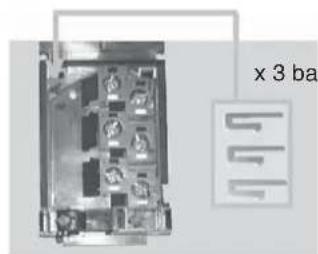
natural_image
Close-up of a mechanical component with internal parts and a 3-bay connector (no text or symbols visible)Atención
natural_image
Simple line drawing of a rectangular plate with three vertical lines and two horizontal lines inside (no text or symbols)chemical
Simple molecular structure diagram showing a central atom bonded to P, Q, and C atoms with electron density notationCocina convencional
Temperature entre 65°C y 230°C
Grill
Temperature 230°C
Rotisserie
Temperature 230°C
Rotisserie + Cocina convencional
Temperature 230°C
text_image
A B C D One One One has One Itext_image
F C H G E L B A I Dnatural_image
Illustration of a shopping basket filled with various items (no text or symbols visible)CARGA DE 4 SERVICIOS Y CACEROLAS
natural_image
Illustration of a hand inserting a component into a device with an open lid (no text or symbols visible)natural_image
Line drawing of a hand using a tool to lift a component into a sink (no text or symbols)natural_image
Two-panel image showing a sewing machine and a close-up of a circular component with arrows, labeled A and B (no text or symbols on the main objects)text_image
Prohibition sign with crossed-out trash bin and no text, likely indicating no waste or non-protectionnatural_image
Two mechanical components with circular flanges, labeled 'Erdgas' (no other text or symbols visible)text_image
Diagram showing a mechanical component with two labeled arrows pointing to features, likely illustrating a process or assembly.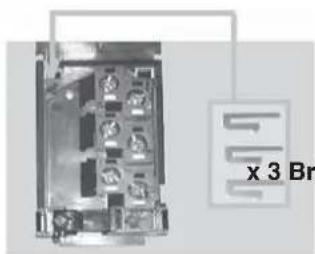
natural_image
Close-up of a mechanical component with internal wiring and mounting holes, labeled 'x 3 Br' (no readable text or symbols beyond label)natural_image
Simple line drawing of a rectangular frame with three vertical lines inside, no text or symbols present.natural_image
Illustration of a hand inserting a component into a device with a grid base (no text or symbols visible)natural_image
Line drawing of a hand using a tool to clean or store items on a sink (no text or symbols)natural_image
Simple line drawing of a bathroom sink with toilet and bathtub (no text or symbols)natural_image
Close-up of two metallic mechanical components with flanged ends and circular washers, labeled 'Aardgas' (no other text or symbols visible)natural_image
Pure electrical circuit lines without any symbolsWATERAANSLUITING - WATERAFVOER
WATERAANSLUITING :
natural_image
Simple line drawing of a tilted rectangular plate with three vertical lines inside (no text or symbols)text_image
F C H G E L A I Dnatural_image
Illustration of a basket containing various items including lungs, heart, and rib cage (no text or symbols)BELADING MET 4 STANDAARD COUVERTS+PANNEN OF SCHALEN
natural_image
Illustration of a hand inserting electronic components into a device (no text or symbols visible)natural_image
Line drawing of a hand using a tool to press down a component on an appliance (no text or symbols visible)VOOR HET BESTE WASRESULTAAT
text_image
Is. ddelen, 30° MaxiREINIGUNG
• OVENVERLICHTING
GAS LABEL (only for Gas products)
GB
The manufacturer will not be responsible for any inaccuracy resulting from printing or transcript errors contained in this brochure. We reserve the right to carry out modifications to products as required, including the interests of consumption, without prejudice to the characteristics relating to safety or function.