C7501M - Compressor BLACK & DECKER - Free user manual and instructions
Find the device manual for free C7501M BLACK & DECKER in PDF.



| Product Type | Stationary Air Compressor |
| Brand | Black & Decker |
| Model | C7501M |
| Power Supply Voltage | 240 V, 60 Hz, single phase |
| Minimum Circuit Current | 15 A |
| Recommended Fuse Type | Time-Delay Fuse |
| Air Tank Capacity | 60 US Gallons (227.1 liters) |
| Cut-out Pressure (max) | Approximately 110 PSIG |
| Air Flow at 40 PSIG | 12.2 SCFM |
| Air Flow at 90 PSIG | 10.1 SCFM |
| Service Horsepower | 3.0 (HP) |
| Recommended Oil | Compressor Oil 30W, SAE 30W non-detergent or equivalent |
| Oil Crankcase Capacity | 16 fluid ounces (0.47 L) |
| Recommended Duty Cycle | 50% to 75% (30 to 45 minutes operation per hour) |
| Warranty | 1 Year Full Warranty |
| Regular Maintenance | Drain tank daily, check oil before each use, change oil every 160 hours, clean air filter regularly |
| Safety Devices | Safety valve, motor thermal protection, grounding mandatory |
| Replacement Parts | Available at www.deltaportercableservicenet.com or 1-888-848-5175 |
Frequently Asked Questions - C7501M BLACK & DECKER
User questions about C7501M BLACK & DECKER
0 question about this device. Answer the ones you know or ask your own.
Ask a new question about this device
Download the instructions for your Compressor in PDF format for free! Find your manual C7501M - BLACK & DECKER and take your electronic device back in hand. On this page are published all the documents necessary for the use of your device. C7501M by BLACK & DECKER.
USER MANUAL C7501M BLACK & DECKER
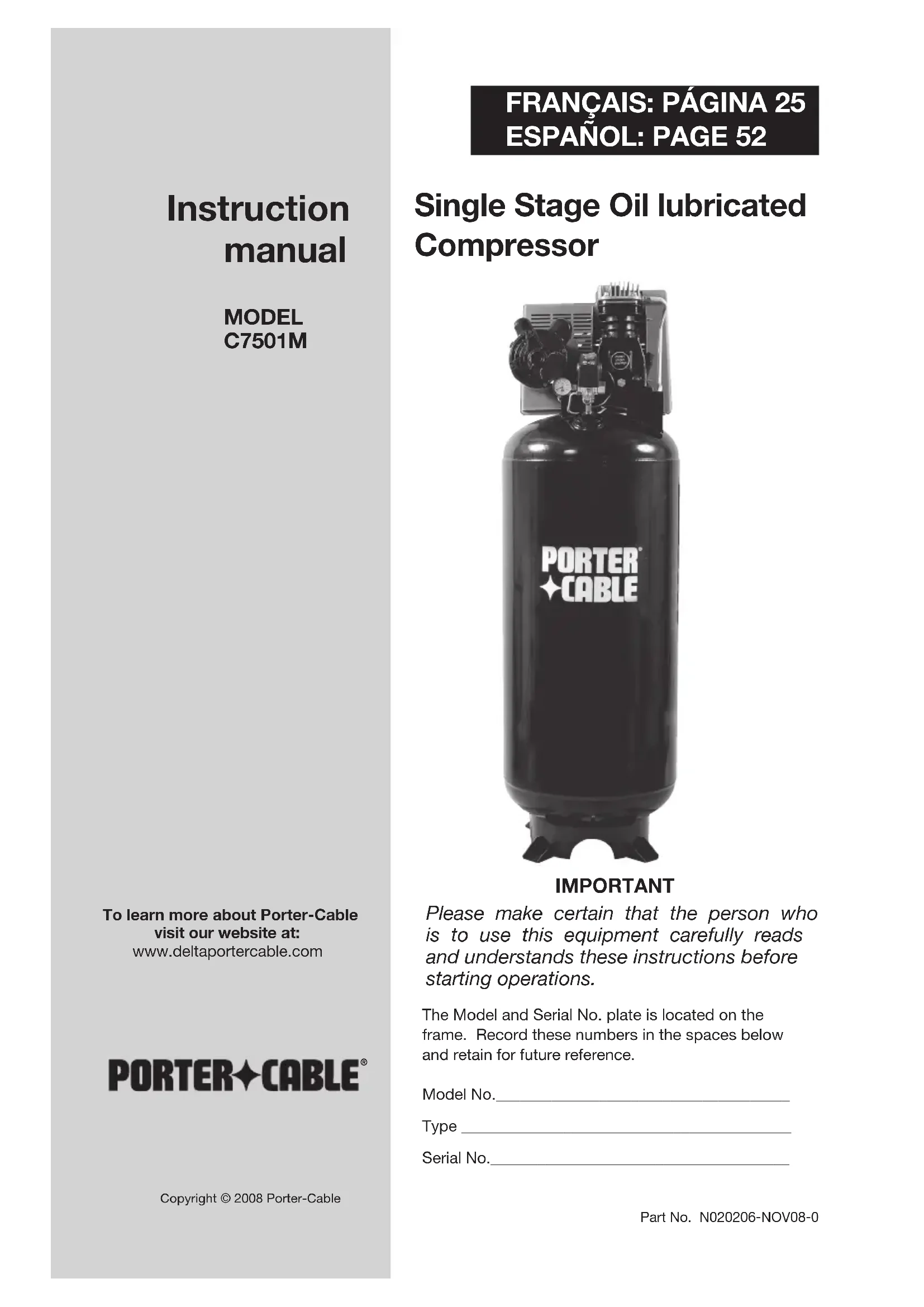
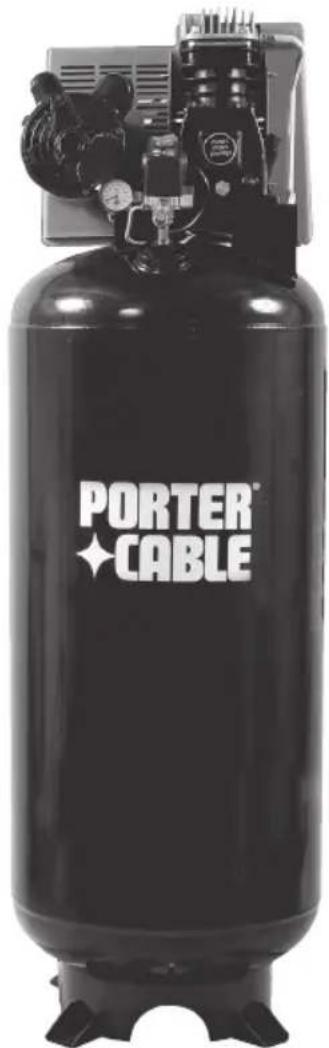
Single Stage Oil lubricated Compressor
natural_image
Black industrial air compressor with 'PORTER CABLE' branding and visible internal components (no other text or symbols)To learn more about Porter-Cable visit our website at:
www.deltaportercable.com
PORTER♦CABLE®
Copyright © 2008 Porter-Cable
IMPORTANT
Please make certain that the person who is to use this equipment carefully reads and understands these instructions before starting operations.
The Model and Serial No. plate is located on the frame. Record these numbers in the spaces below and retain for future reference.
Model No.
Type
Serial No.
SAFETY GUIDELINES - DEFINITIONS
This manual contains information that is important for you to know and understand. This information relates to protecting YOUR SAFETY and PREVENTING EQUIPMENT PROBLEMS. To help you recognize this information, we use the symbols below. Please read the manual and pay attention to these symbols.
| ⚠️DANGER: Indicates an imminently hazardous situation which, if not avoided, will result in death or serious injury. | ⚠️CAUTION: Indicates a potentially hazardous situation which, if not avoided, may result in minor or moderate injury. |
| ⚠️WARNING: Indicates a potentially hazardous situation which, if not avoided, could result in death or serious injury. | CAUTION: Used without the safety alert symbol indicates a potentially hazardous situation which, if not avoided, may result in property damage. |
IMPORTANT SAFETY INSTRUCTIONS
WARNING: This product contains chemicals known to the State of California to cause cancer, and birth defects or other reproductive harm. Wash hands after handling.
WARNING: Some dust contains chemicals known to the State of California to cause cancer, birth defects or other reproductive harm such as asbestos and lead in lead based paint.
⚠ WARNING: To reduce the risk of injury, read the instruction manual.
SAVE THESE INSTRUCTIONS
HAZARD


A DANGER ON OR FIRE
WHAT CAN HAPPEN HOW TO PREVENT IT
| It is normal for electrical contacts within the motor and pressure switch to spark. | Always operate the compressor in a well ventilated area free of combustible materials, gasoline, or solvent vapors. |
| If electrical sparks from compressor come into contact with flammable vapors, they may ignite, causing fire or explosion. | If spraying flammable materials, locate compressor at least 20' (6.1 m) away from spray area. An additional length of air hose may be required.Store flammable materials in a secure location away from compressor. |
| Restricting any of the compressor ventilation openings will cause serious overheating and could cause fire. | Never place objects against or on top of compressor.Operate compressor in an open area at least 12" (30.5 cm) away from any wall or obstruction that would restrict the flow of fresh air to the ventilation openings.Operate compressor in a clean, dry well ventilated area. Do not operate unit in any confined area. Store indoors. |
| Unattended operation of this product could result in personal injury or property damage. To reduce the risk of fire, do not allow the compressor to operate unattended. | Always remain in attendance with the product when it is operating.Always turn off and disconnect electrical supply from unit when not in use. |
HAZARD

A DANGER
ATHING (ASPHYxIATION)
WHAT CAN HAPPEN HOW TO PREVENT IT
- The compressed air directly from your compressor is not safe for breathing. The air stream may contain carbon monoxide, toxic vapors, or solid particles from the air tank. Breathing these contaminants can cause serious injury or death.
- Exposure to chemicals in dust created by power sanding, sawing, grinding, drilling, and other construction activities may be harmful.
-
Sprayed materials such as paint, paint solvents, paint remover, insecticides, weed killers, may contain harmful vapors and poisons.
-
Never use air obtained directly from the compressor to supply air for human consumption. The compressor is not equipped with suitable filters and in-line safety equipment for human consumption.
- Work in an area with good cross ventilation. Read and follow the safety instructions provided on the label or safety data sheets for the materials you are spraying. Always use certified safety equipment: NIOSH/OSHA respiratory protection or properly fitting face mask designed for use with your specific application.
HAZARD

RISK OF SE ▲ DANGER:
IOUS INJURY OR PROPERTY DAMAGE WHEN TRANSPORTING COMPRESSOR
WHAT CAN HAPPEN HOW TO PREVENT IT
- Oil can leak or spill and could result in fire or breathing hazard; serious injury or death can result. Oil leaks will damage carpet, paint or other surfaces in vehicles or trailers.
- Always place compressor on a protective mat when transporting to protect against damage to vehicle from leaks. Remove compressor from vehicle immediately upon arrival at your destination. - Always transport and store unit in an upright position.
HAZARD

A.WARNING:
STING
Air Tank: The air tank on your compressor is designed and may be UM coded [for units with air tanks greater than 6" (152.4 mm) diameter] according to ASME Section VIII, Div. 1 rules. All pressure vessels should be inspected once every two years. To find your state pressure vessels inspector, look under the Division of Labor and Industries in the government section of a phone book.
The following conditions could lead to a weakening of the air tank, and result in a violent air tank explosion:
WHAT CAN HAPPEN HOW TO PREVENT IT
| Failure to properly drain condensed water from air tank, causing rust and thinning of the steel air tank. | Drain air tank daily or after each use. If air tank develops a leak, replace it immediately with a new air tank or replace the entire compressor. |
| Modifications or attempted repairs to the air tank. | Never drill into, weld, or make any modifications to the air tank or its attachments. Never attempt to repair a damaged or leaking air tank. Replace with a new air tank. |
| Unauthorized modifications to the safety valve or any other components which control air tank pressure. | The air tank is designed to withstand specific operating pressures. Never make adjustments or parts substitutions to alter the factory set operating pressures. |
| Excessive vibration can weaken the air tank of a stationary compressor and cause an explosion. | The compressor must be properly mounted, see Anchoring under Installation. |
Attachments & accessories:
| Exceeding the pressure rating of air tools, spray guns, air operated accessories, tires, and other inflatables can cause them to explode or fly apart, and could result in serious injury. | Follow the equipment manufacturers recommendation and never exceed the maximum allowable pressure rating of attachments. Never use compressor to inflate small low pressure objects such as children's toys, footballs, basketballs, etc. |
Tires:
| Over inflation of tires could result in serious injury and property damage. | Use a tire pressure gauge to check the tires pressure before each use and while inflating tires; see the tire sidewall for the correct tire pressure.NOTE: Air tanks, compressors and similar equipment used to inflate tires can fill small tires similar to these very rapidly. Adjust pressure regulator on air supply to no more than the rating of the tire pressure. Add air in small increments and frequently use the tire gauge to prevent over inflation. |
HAZARD

A.WARNING:
CTRICAL SHOCK
WHAT CAN HAPPEN HOW TO PREVENT IT
| ·Your compressor is powered by electricity. Like any other electrically powered device, if it is not used properly it may cause electric shock. | ·Never operate the compressor outdoors when it is raining or in wet conditions.·Never operate compressor with protective covers removed or damaged. |
| ·Repairs attempted by unqualified personnel can result in serious injury or death by electrocution. | ·Any electrical wiring or repairs required on this product should be performed by authorized service center personnel in accordance with national and local electrical codes. |
| ·Electrical Grounding:Failure to provide adequate grounding to this product could result in serious injury or death from electrocution. Refer to Grounding Instructions paragraph in the Installation section. | ·Make certain that the electrical circuit to which the compressor is connected provides proper electrical grounding, correct voltage and adequate fuse protection. |
HAZARD

A/WARNING
LYING OBJECTS
WHAT CAN HAPPEN HOW TO PREVENT IT
| The compressed air stream can cause soft tissue damage to exposed skin and can propel dirt, chips, loose particles, and small objects at high speed, resulting in property damage or personal injury. | Always wear certified safety equipment: ANSI Z87.1 eye protection (CAN/CSA Z94.3) with side shields when using the compressor.Never point any nozzle or sprayer toward any part of the body or at other people or animals.Always turn the compressor off and bleed pressure from the air hose and air tank before attempting maintenance, attaching tools or accessories. |
HAZARD

AWARNING:
SURFACES
WHAT CAN HAPPEN HOW TO PREVENT IT
| Touching exposed metal such as the compressor head, engine head, engine exhaust or outlet tubes, can result in serious burns. | Never touch any exposed metal parts on compressor during or immediately after operation.Compressor will remain hot for several minutes after operation.Do not reach around protective shrouds or attempt maintenance until unit has been allowed to cool. |
HAZARD


AWARNING:
IG PARTS
WHAT CAN HAPPEN HOW TO PREVENT IT
-
Moving parts such as the pulley, flywheel, and belt can cause serious injury if they come into contact with you or your clothing.
-
Never operate the compressor with guards or covers which are damaged or removed.
- Keep your hair, clothing, and gloves away from moving parts. Loose clothes, jewelry, or long hair can be caught in moving parts.
• Air vents may cover moving parts and should be avoided as well. - Any repairs required on this product should be performed by authorized service center personnel.
HAZARD
AWARNING: AFE OPERATION
WHAT CAN HAPPEN HOW TO PREVENT IT
- Unsafe op er a tion of your compressor could lead to se ri ous in ju ry or death to you or others.
- Review and understand all instructions and warnings in this manual.
- Be come fa mil iar with the op eration and con trols of the air compressor.
- Keep operating area clear of all persons, pets, and obstacles.
- Keep chil dren away from the air compressor at all times.
- Do not operate the product when fatigued or under the influence of alcohol or drugs. Stay alert at all times.
- Never defeat the safety features of this product.
• Equip area of operation with a fire extinguisher. - Do not operate machine with missing, broken, or un au tho rized parts.
HAZARD

WARNING: FROM LIFTING
WHAT CAN HAPPEN HOW TO PREVENT IT
- Serious injury can result from attempting to lift too heavy an object.
- The compressor is too heavy to be lifted by one person. Obtain assistance from others before lifting.
HAZARD

A CAUTION: OISE
WHAT CAN HAPPEN HOW TO PREVENT IT
- Under some conditions and duration of use, noise from this product may contribute to hearing loss.
• Always wear certified safety equipment: ANSI S12.6 (S3.19) hearing protection.
SAVE THESE INSTRUCTIONS FOR FUTURE USE
SPECIFICATIONS
Model No. C7501M
Running Horsepower *3.0
Voltage/Hertz/Phase 240V/60/1
Minimum Branch Circuit Requirement 15 Amp
Fuse Type Time Delay
Air Tank Capacity (Gallon) 60 ASME, Vertical (227.1 liters)
Approximate Cut-in Pressure 110 PSIG
Approximate Cut-out Pressure 135 PSIG
SCFM @ 40 PSIG *12.2
SCFM @ 90 PSIG *10.1
*Tested per ISO 1217
Refer to Glossary for abbreviations.
GLOSSARY
Become familiar with these terms before operating the unit.
CFM: Cubic feet per minute.
SCFM: Standard cubic feet per minute; a unit of measure of air delivery.
PSIG: Pounds per square inch gauge; a unit of measure of pressure.
Code Certification: Products that bear one or more of the following marks: UL, CUL, ETL, CETL, have been evaluated by OSHA certified independent safety laboratories and meet the applicable Standards for Safety.
Cut-In Pressure: While the motor is off, air tank pressure drops as you continue to use your accessory. When the tank pressure drops to a certain low level the motor will restart automatically. The low pressure at which the motor automatically restarts is called "cut-in" pressure.
Cut-Out Pressure: When an air compressor is turned on and begins to run, air pressure in the air tank begins to build. It builds to a certain high pressure before the motor automatically shuts off - protecting your air tank from pressure higher than its capacity. The high pressure at which the motor shuts off is called "cut-out" pressure.
Branch Circuit: Circuit carrying electricity from electrical panel to outlet.
To Lock Out Power: Place a lock on the line power switch so no one else can turn on the power.
DUTY CYCLE
This air compressor pump is capable of running continuously. However, to prolong the life of your air compressor, it is recommended that a 50%-75% average duty cycle be maintained; that is, the air compressor pump should not run more than 30-45 minutes in any given hour.
ACCESSORIES
Accessories for this unit are available at the store the unit was purchased.
⚠️ CAUTION: The use of any other accessory not recommended for use with this tool could be hazardous. Use only accessories rated equal to or higher than the rating of the air compressor.
ASSEMBLY
TOOLS REQUIRED FOR ASSEMBLY
1 - 9/16" socket or open end wrench
1 - Electric Drill
UNPACKING
- Remove all packaging.
⚠️ CAUTION: It may be necessary to brace or support one side of the outfit when removing the pallet because the air compressor will have a tendency to tip.
- Remove and discard the (4) screws and washers holding the compressor to the pallet.
- With the help of another person carefully remove air compressor from pallet and place on a level surface.
⚠️ CAUTION: This compressor was shipped with oil in the pump crankcase.
Check oil before operating air compressor, see Check Oil under Maintenance.
INSTALLATION
LOCATION OF THE AIR COMPRESSOR
- Locate the air compressor in a clean, dry, and well ventilated area.
- Located the air compressor at least 12" (30.5 cm) away from the other obstructions that will interfere with the flow of air.
- Locate the air compressor as close to the main power supply as possible to avoid using long lengths of electrical wiring. NOTE: Long lengths of electrical wiring could cause power loss to the motor.
- The air filter must be kept clear of obstructions which could reduce air flow to the air compressor.
ANCHORING OF THE AIR COMPRESSOR
⚠ WARNING: Risk of bursting. Excessive vibration can weaken the air tank and cause an explosion. The compressor must be properly mounted.
The air compressor MUST be bolted to a solid, level surface.
Hardware needed:
4 - Concrete anchors (not supplied)
4 - 3/8" Lag screw to fit concrete anchors (not supplied)
4 - Washers
(found in parts bag)
- shims (if needed)
- Place the air compressor on on a solid, level surface.
- Mark the surface using the holes in the air compressor feet as a template.
- Drill holes in the surface for the concrete anchors. Install concrete anchors.
- Line-up holes in surface with holes in air compressor feet.
-
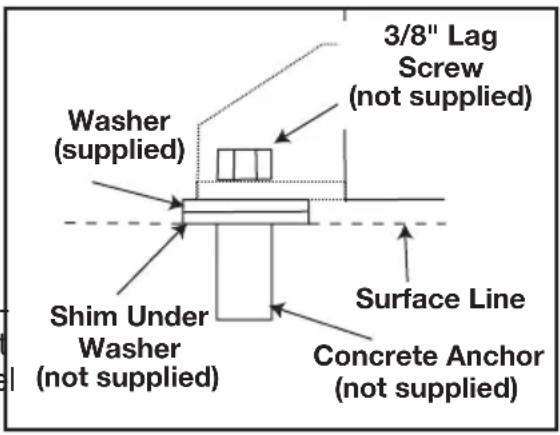
Place the (4) washers (supplied) between the floor and air compressor feet. If needed, solid shims may be placed between the washers and floor to evenly distribute weight on all four feet. See next figure.
-
Place the (4) 3/8" lag screws through the air compressor feet, washers, shims, and into the anchors.
- Torque 3/8" lag screws to 7-10 ft.-lbs (9.5-13.5 Nm).
WIRING INSTRUCTIONS
⚠️ CAUTION: Improper electrical installation of this product may void its warranty and your fire insurance. Have circuit wiring performed by qualified personnel such as a licensed electrician who is familiar with the current national electrical code and any prevailing local electrical cod
⚠ WARNING: Risk of electrical shock. Improper electrical grounding can result in electrical shock. The wiring should be done by a qualified electrician
A qualified electrician needs to knows the following before wiring:
- The amperage rating of the electrical box should be adequate. Refer to the Specification Chart, in the parts manual, for this information.
- The supply line should have the same electrical characteristics (voltage, cycle, phase) as the motor. Refer to the motor nameplate, on side of motor, for this information.
NOTE: The wiring must be the same as the motor nameplate voltage plus or minus 10%. Refer to local codes for recommended wire sizes, correct wire size, and maximum wire run; undersize wire causes high amp draw and overheating to the motor.
⚠ WARNING: Risk of electrical shock. Electrical wiring must be located away from hot surfaces such as manifold assembly, compressor outlet tubes, heads, or cylinders.
GROUNDING INSTRUCTIONS
This product should be connected to a metallic, permanent wiring system, of an equipment-grounding terminal or lead on the product.
VOLTAGE AND CIRCUIT PROTECTION
Refer to the specification chart for the voltage and minimum branch circuit requirements.
⚠️CAUTION: Certain air compressors can be operated on a 15 amp circuit if the following conditions are met.
- Voltage supply to circuit must comply with the National Electrical Code.
- Circuit is not used to supply any other electrical needs.
- Extension cords comply with specifications.
- Circuit is equipped with a 15 amp circuit breaker or 15 amp time delay fuse. NOTE: If compressor is connected to a circuit protected by fuses, use only time delay fuses. Time delay fuses should be marked "D" in Canada and "T" in the US.
If any of the above conditions cannot be met, or if operation of the compressor repeatedly causes interruption of the power, it may be necessary to operate it from a 20 amp circuit. It is not necessary to change the cord set.
AIR DISTRIBUTION SYSTEM
⚠ WARNING: Plastic or PVC pipe is not designed for use with compressed air. Regardless of its indicated pressure rating, plastic pipe can burst from air pressure. Use only metal pipe for air distribution lines.
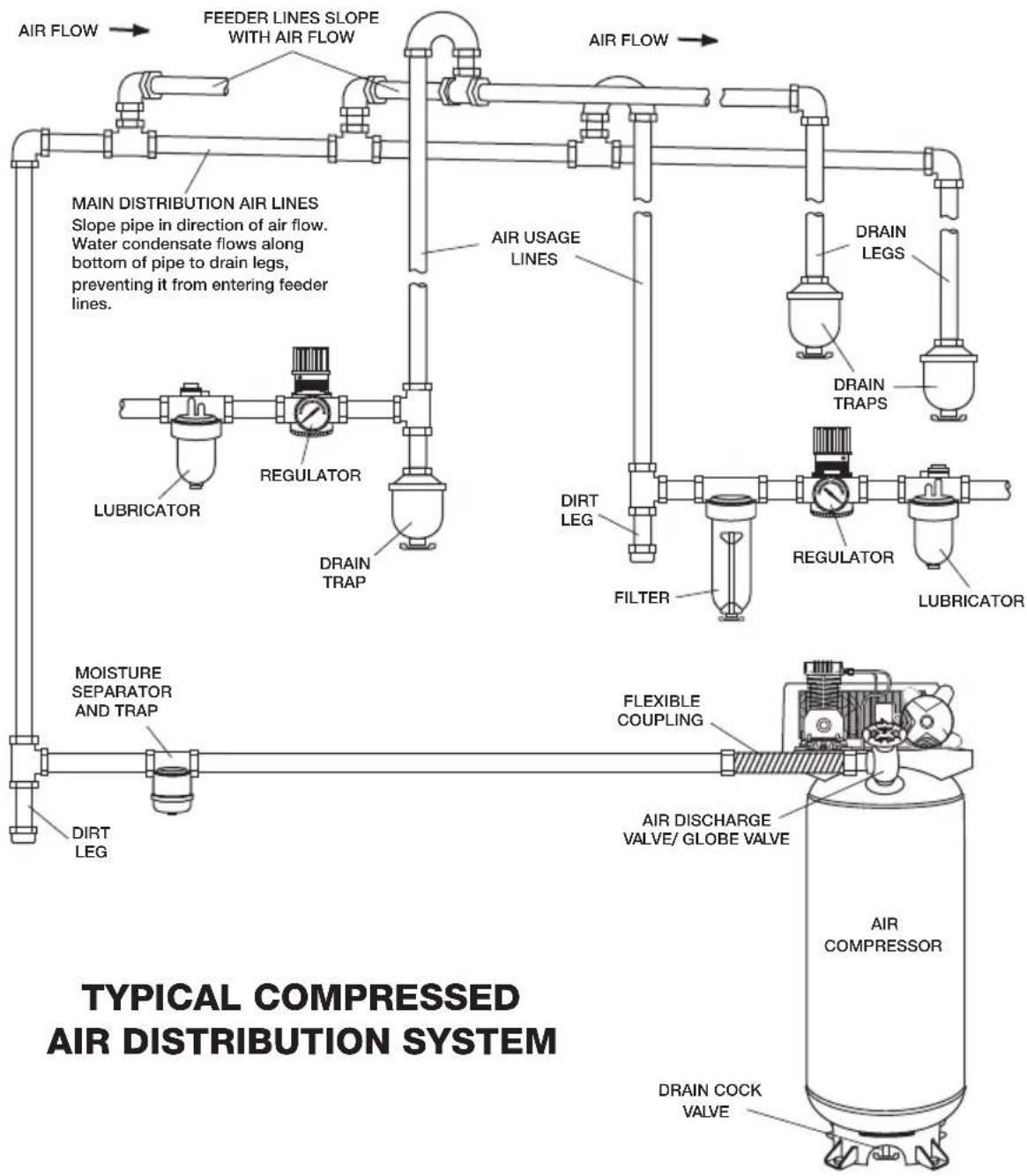
The next figure represents a typical air distribution system. The following are tips to remember when setting up the air compressor's air distribution system.
- Use pipe that is the same size as the air tank outlet. Piping that is too small will restrict the flow of air.
• If piping is over 100' (30.5 m) long, use the next larger size. - Bury underground lines below the frost line and avoid pockets where condensation can gather and freeze. Apply pressure before underground lines are covered to make sure all pipe joints are free of leaks.
- A flexible coupling is recommended to be installed between the air discharge outlet and main air distribution line to allow for vibration.
- A separate regulator is recommended to control the air pressure. Air pressure from the tank is usually to high for individual air driven tools.
OPERATION
KNOW YOUR AIR COMPRESSOR
READ THIS OWNER'S MANUAL AND SAFETY RULES BEFORE OPERATI
YOUR UNIT. Compare the illustrations with your unit to familiarize yourself with the location of various controls and adjustments. Save this manual for future reference.
DESCRIPTION OF OPERATION
Become familiar with these controls before operating the unit.
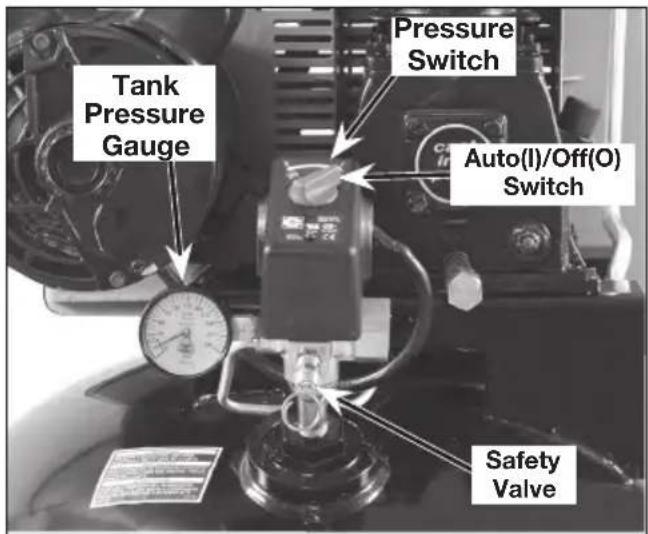
Auto(I)/Off(0) Switch: Turn this switch "Auto (I)" to provide automatic power to the pressure switch and "Off (O)" to remove power at the end of each use.
Pressure Switch: The pressure switch automatically starts the motor when the air tank pressure drops below the factory set "cut-in" pressure. It stops the motor when the air tank pressure reaches the factory set "cut-out" pressure.
Safety Valve: If the pressure switch does not shut off the air compressor at its "cut-out" pressure setting, the safety valve will protect against high pressure by "popping out" at its factory set pressure (slightly higher than the pressure switch "cut-out" setting).
Tank Pressure Gauge: The tank pressure gauge indicates the reserve air pressure in the tank.
Globe Valve: (sold separately, not shown) Opens and closes air discharge valve. Turn knob counter-clockwise to open and clockwise to close.
Regulator (sold separately, not shown): An air pressure regulator or a separate air transformer which combines the functions of air regulation and/or moisture and dirt removal is recommended for most applications.
Cooling System (not shown): This compressor contains an advanced design cooling system. At the heart of this cooling system is an engineered fan. It is perfectly normal for this fan to blow air through the vent holes in large amounts. You know that the cooling system is working when air is being expelled.
Air Compressor Pump (not shown): Compresses air into the air tank. Working air is not available until the compressor has raised the air tank pressure above that required at the air outlet.
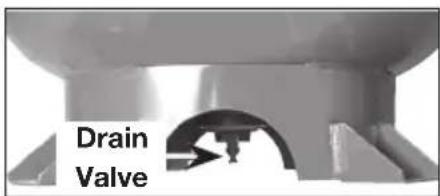
Drain Valve: The drain valve is located at the base of the air tank and is used to drain condensation at the end of each use.
Check Valve: When the air compressor is operating, the check valve is "open", allowing compressed air to enter the air tank. When the air compressor reaches "cut-out" pressure, the check valve "closes", allowing air pressure to remain inside the air tank.
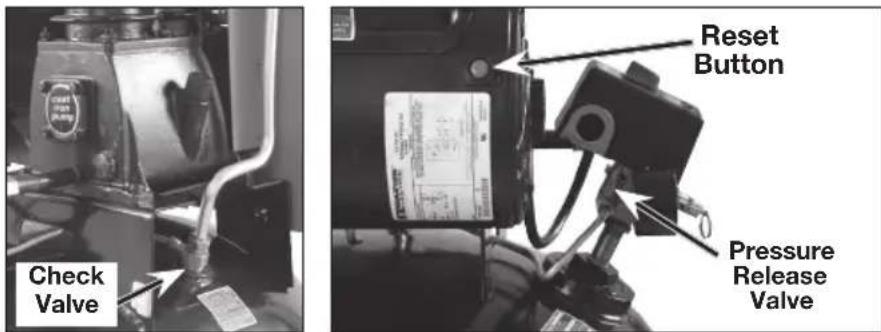
Pressure Release Valve: The pressure release valve located on the side of the pressure switch, is designed to automatically release compressed air from the compressor head and the outlet tube when the air compressor reaches "cut-out" pressure or is shut off. The pressure release valve allows the motor to restart freely. When the motor stops running, air will be heard escaping from this valve for a few seconds. No air should be heard leaking when the motor is running or after the unit reaches "cut-out" pressure.
Motor Overload Protector: This motor has a manual thermal overload protector. If the motor overheats for any reason, the overload protector will shut off the motor. The motor must be allowed to cool down before restarting. To restart:
- Place the Auto/Off lever in the "Off" position.
- Allow the motor to cool.
- Depress the red reset button on the motor.
- Place the Auto/Off lever in the "Auto" position to restart the motor.
Air Intake Filter (not shown): This filter is designed to clean air coming into the pump. This filter must always be clean and ventilation openings free from obstructions. See "Maintenance".
HOW TO USE YOUR UNIT
How to Stop:
- Set the Auto/Off lever to "Off".
Before Starting
⚠ WARNING: Do not operate this unit until you read and understand this instruction manual for safety, operation and maintenance instructions.
Break-in Procedure
⚠️CAUTION: Risk of Unsafe Operation. Serious damage may result if the following break-in instructions are not closely followed.
This procedure is required before the air compressor is put into service and when the check valve or a complete compressor pump has been replaced.
- Make sure the Auto/Off lever is in the "Off" position.
- Check oil level in pump. See Oil paragraph in the Maintenance section for instructions.
- Recheck all wiring. Make sure wires are secure at all terminals connections. Make sure all contacts move freely and are not obstructed.
- Open the globe valve fully to permit air to escape and prevent air pressure build up in the air tank during the break-in period.
- Move the Auto/Off lever to "Auto" position. The compressor will start.
-
Run the compressor for 20 minutes. Make sure the globe valve is open and there is minimal air pressure build-up in tank.
-
Check all air line fittings and connections/piping for air leaks by applying a soap solution. Correct if necessary. NOTE: Minor leaks can cause the air compressor to overwork, resulting in premature breakdown or inadequate performance.
- Check for excessive vibration. Readjust or shim air compressor feet, if necessary.
- After 20 minutes, close the globe valve. The air receiver will fill to "cut-out" pressure and the motor will stop.
The compressor is now ready for use.
Before Each Start-Up
- Place Auto/Off lever to "Off".
- Close the globe valve.
- Visually inspect air hose, replace if needed.
- Attach hose and accessories.
⚠ WARNING: Risk of unsafe operation. Firmly grasp air hose in hand when installing or disconnecting to prevent hose whip.
⚠ WARNING: Risk of unsafe operation. Do not use damaged or worn accessories.
NOTE: A regulator MUST be installed when using accessories rated at less than 110 psi.
NOTE: The hose or accessory will require a quick connect plug if the air outlet is equipped with a quick connect socket.
⚠ WARNING: Risk of bursting. Too much air pressure causes a hazardous risk of bursting. Check the manufacturer's maximum pressure rating for air tools and accessories. The regulator outlet pressure must never exceed the maximum pressure rating.
⚠️CAUTION: Risk of unsafe operation. Compressed air from the unit may contain water condensation and oil mist. Do not spray un filtered air at an item that could be damaged by moisture. Some air tools and accessories may require filtered air. Read the in struc tions for the air tools and accessories.
How to Start
- Turn the Auto/Off lever to "Auto" and allow tank pressure to build. Motor will stop when tank pressure reaches "cut-out" pressure.
- When the tank pressure reaches "cut-out" pressure open the globe valve.
IMPORTANT: When using regulator and other accessories refer to the manufacturers instructions.
⚠ WARNING: Risk of bursting. If any unusual noise or vibration is noticed, stop the compressor immediately and have it checked by a trained service technician.
The compressor is ready for use.
MAINTENANCE
CUSTOMER RESPONSIBILITIES
| Before each use | Daily or after each use | Every 8 hours | Every 40 hours | Every 100 hours | Every 160 hours | Yearly | |
| Check Safety Valve | ● | ||||||
| Drain Tank | ● | ||||||
| Oil Leaks | ● | ||||||
| Check Pump Oil | ● | ||||||
| Change Pump Oil | ● | ||||||
| Unusual Noise and/or Vibration | ● | ||||||
| Air Filter ● (1) | |||||||
| Drive Belt-Condition | ● | ||||||
| Motor Pulley/Flywheel alignment | ● | ||||||
| Air compressor pump intake and exhaust valves | ● | ||||||
| Inspect air lines and fittings for leaks | ● | ||||||
| Head Bolts - Check the torques of the head bolts after the first five hours of op | |||||||
| 1- more frequent in dusty or humid conditions | |||||||
⚠ WARNING: Risk of unsafe operation. Unit cycles automatically when power is on. When performing maintenance, you may be exposed to voltage sources, compressed air, or moving parts. Personal injuries can occur. Before performing any maintenance or repair, disconnect power source from the compressor and bleed off all air pressure.
To ensure efficient operation and longer life of the air compressor outfit, a routine maintenance schedule should be prepared and followed. The following routine maintenance schedule is geared to an outfit in a normal working environment operating on a daily basis. If necessary, the schedule should be modified to suit the conditions under which your compressor is used. The modifications will depend upon the hours of operation and the working environment. Compressor outfits in an extremely dirty and/or hostile environment will require a greater frequency of all maintenance checks.
NOTE: See Operation section for the location of controls.
TO CHECK SAFETY VALVE
⚠ WARNING: Risk of bursting. If the safety valve does not work properly, over-pressurization may occur, causing air tank rupture or an explosion.
⚠ WARNING: Risk from flying objects. Always wear certified safety equipment: ANSI Z87.1 eye protection (CAN/CSA Z94.3) with side shields.
- Before starting compressor, pull the ring on the safety valve to make sure that the safety valve operates freely. If the valve is stuck or does not operate smoothly, it must be replaced with the same type of valve.
TO DRAIN TANK
⚠ WARNING: Risk of unsafe operation. Air tanks contain high pressure air. Keep face and other body parts away from outlet of drain. Use eye protection [ANSI Z87.1 (CAN/CSA Z94.3)] when draining as debris can be kicked up into face.
⚠ WARNING: Risk from noise. Use ear protection (ANSI S12.6 (S3.19) as air flow noise is loud when draining.
NOTE: All compressed air systems generate condensate that accumulates in any drain point (e.g., tanks, filter, aftercoolers, dryers). This condensate contains lubricating oil and/or substances which may be regulated and must be disposed of in accordance with local, state, and federal laws and regulations.
- Set the Auto/Off lever to "Off".
- Close the globe valve.
- Remove the air tool or accessory.
- Open the globe valve and allow the air to slowly bleed from the air tank until tank pressure is approximately 20 psi.
- Close the globe valve.
- Drain water from air tank by opening drain valve on bottom of tank.
⚠ WARNING: Risk of bursting. Water will condense in the air tank. If not drained, water will corrode and weaken the air tank causing a risk of air tank rupture.
CAUTION: Risk of property damage. Drain water from air tank may contain oil and rust which can cause stains.
- After the water has been drained, close the drain valve. The air compressor can now be stored.
NOTE: If drain valve is plugged, release all air pressure. The valve can then be removed, cleaned, then reinstalled.
OIL
⚠️ CAUTION: Use air compressor oil only. Multi-weight automotive engine oils like 10W30 should not be use in air compressors. They leave carbon deposits on critical components, thus reducing performance and compressor life.
NOTE: Use 30W compressor oil or a heavy duty SAE 30W, non-deterg grade or better oil. DO NOT use multi-weight automotive engine oils, they will reduce compressor life. Under extreme winter condition use SAE-10 weight oil.
NOTE: Crankcase oil capacity is approximately 16 fluid ounces (0.47 L).
Checking
- The oil level should be to the middle of the sight glass (C).
- If needed remove oil fill plug (A) and slowly add oil until it reaches the middle of the sight glass.
Changing
- Remove the oil fill plug (A).
- Remove the oil drain plug (B) and drain oil into a suitable container.
- Replace the oil drain plug (B) and tighten securely.
- Slowly add compressor oil until the oil level is in the middle of the sightglass
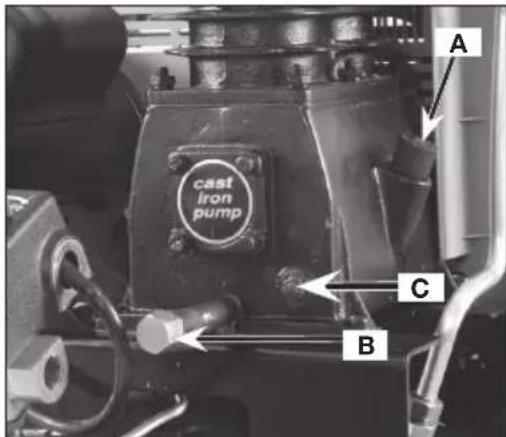
(C). NOTE: When filling the crankcase, the oil flows very slowly into the pump. If the oil is added too quickly, it will overflow and appear to be full.
⚠️ CAUTION: Risk of Unsafe Operation. Overfilling with oil will cause premature compressor failure. Do not overfill.
- Replace oil fill plug (A) and tighten securely.
AIR FILTER - INSPECTION AND REPLACEMENT
WARNING: Hot surfaces. Risk of burn. Compressor heads are exposed when filter cover is removed. Allow compressor to cool prior to servicing.
⚠️CAUTION: Keep the air filter clean at all times. Do not operate the air compressor with the air filter removed.
A dirty air filter will not allow the compressor pump to operate at full capacity. Before using the compressor pump, check the air filter to make sure it is clean and in place.
If it is dirty, replace it with a new filter.
-
Using a pair of needle nose pliers or a screwdriver pull or pry out the old filter and carefully clean the filter area.
-
Push the new air filter in place.
IMPORTANT: Do not operate the compressor with the air filter removed.
BELT - REPLACEMENT
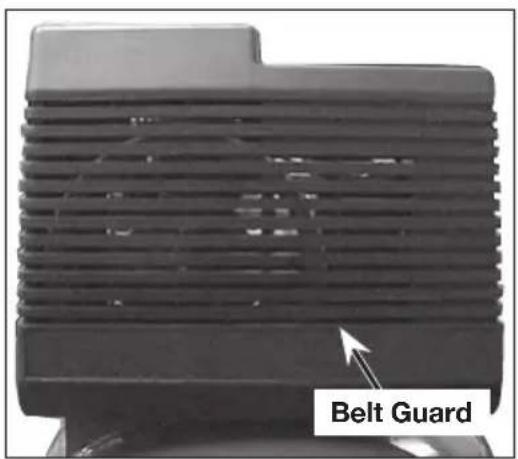
⚠ WARNING: Risk of personal injury. Serious injury or damage may occur if parts of the body or loose items get caught in moving parts. Never operate the outfit with the belt guard removed. The belt guard should be removed only when the air compressor power is disconnected.
-
Turn air compressor off, lock out the power supply, and relieve all air pressure from the air tank.
-
Remove the front of the belt guard by disengaging the snaps. Insert a flat bladed screwdriver at each snap location and pry the beltguard apart.
-
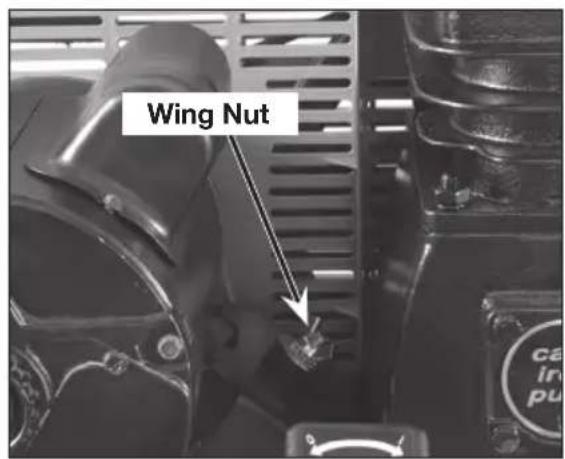
Loosen the wing nut on hold down plate and tilt motor to allow for easy removal or installation of the belt.
-
Remove belt.
⚠ WARNING: Risk of moving parts. Use caution when rolling belt onto flywheel, fingers can get caught between the belt and flywheel.
-
Replace belt. NOTE: The belt must be centered over the grooves on the flywheel and motor pulley.
-
Turn the wing nut on the hold down plate until it makes contact with the washer, plus one additional turn.
-
Replace the belt guard .
MOTOR PULLEY/FLYWHEEL ALIGNMENT
NOTE: Once the motor pulley has been moved from its factory set location, the grooves of the flywheel and pulley must be aligned to within 1/16" (1.6 mm) to prevent excessive belt wear.
The air compressor flywheel and motor pulley must be in-line (in the same plane) within 1/16" (1.6 mm) to assure belt retention within flywheel belt grooves. To check alignment, perform the following steps:
-
Turn air compressor off, lock out the power supply, and relieve all air pressure from the air tank.
-
Remove belt guard.
-
Place a straightedge against the outside of the flywheel and the motor drive pulley.
-
Measure the distance between the edge of the belt and the straightedge at points A1 and A2 in figure. The difference between measurements should be no more than 1/16" (1.6 mm).
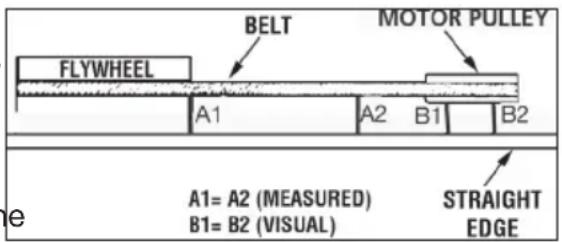
- If the difference is greater than 1/16" (1.6 mm) loosen the set screw holding the motor drive pulley to the shaft and adjust the pulley's position on the shaft until the A1 and A2 measurements are within 1/16" (1.6 mm) of each other.
- Tighten the motor drive pulley set screw.
- Visually inspect the motor drive pulley to verify that it is perpendicular to the drive motor shaft. Points B1 and B2 of Figure should appear to be equal. If they are not, loosen the setscrew of the motor drive pulley and equalize B1 and B2, using care not to disturb the belt alignment performed in step 2.
- Retighten the motor drive pulley setscrew. Torque to 70-100 in-lbs (7.9-11.3 Nm).
- Reinstall belt guard.
AIR COMPRESSOR PUMP INTAKE AND ExHAUST VALVES
Once a year have a Trained Service Technician check the air compressor pump intake and exhaust valves.
INSPECT AIR LINES AND FITTINGS FOR LEAKS
- Turn air compressor off, lock out the power supply, and relieve all air pressure from the air tank.
- Apply a soap solution to all air line fittings and connections/piping.
- Correct any leaks found.
IMPORTANT: Even minor leaks can cause the air compressor to overwork, resulting in premature breakdown or inadequate performance.
AIR COMPRESSOR HEAD BOLTS - TORQUING
The air compressor pump head bolts should be kept properly torqued. Check the torques of the head bolts after the first five hours of operation. Torque to 28–39 ft.-lbs (38.0-52.9 Nm).
SERVICE AND ADJUSTMENTS
ALL MAINTENANCE AND REPAIR OPERATIONS NOT LISTED MUST BE PERFORMED BY TRAINED SERVICE TECHNICIAN.
WARNING:
Risk of unsafe operation. Unit cycles automatically when power is on. When servicing, you may be exposed to voltage sources, compressed air, or moving parts. Before servicing unit unplug or disconnect electrical supply to the air compressor, bleed tank of pressure, and allow the air compressor to cool.
TO REPLACE OR CLEAN CHECK VALVE
- Release all air pressure from air tank. See To Drain Tank in the Maintenance section.
- Turn air compressor off, lock out the power supply, and relieve all air pressure from the air tank.
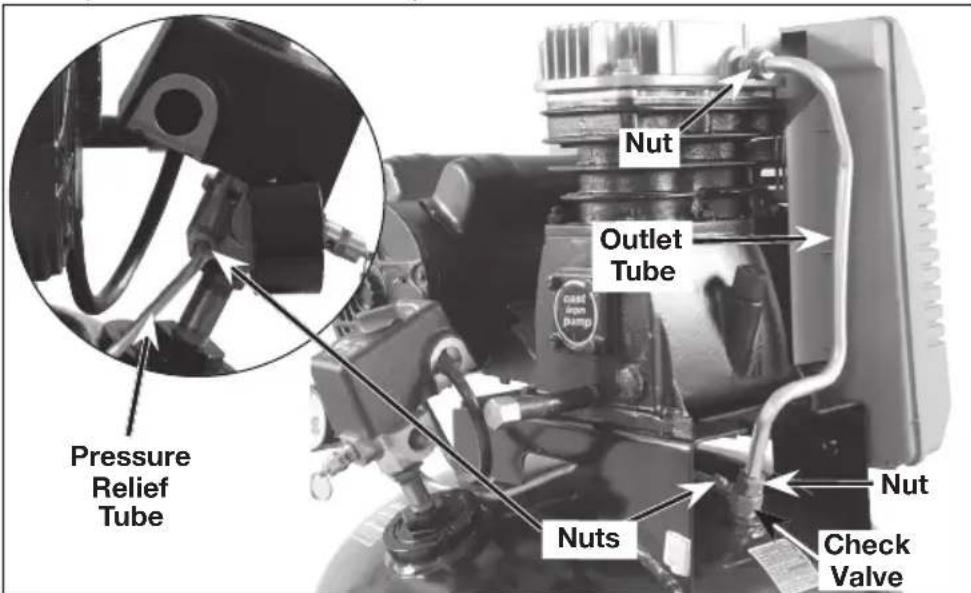
- Using an adjustable wrench loosen outlet tube nut at air tank and pump. Carefully move outlet tube away from check valve.
-
Using an adjustable wrench loosen pressure relief tube nut at air tank and pressure switch. Carefully move pressure relief tube away from check valve.
-
Unscrew the check valve (turn counterclockwise) using a 7/8" open end wrench. NOTE the orientation for reassembly.
-
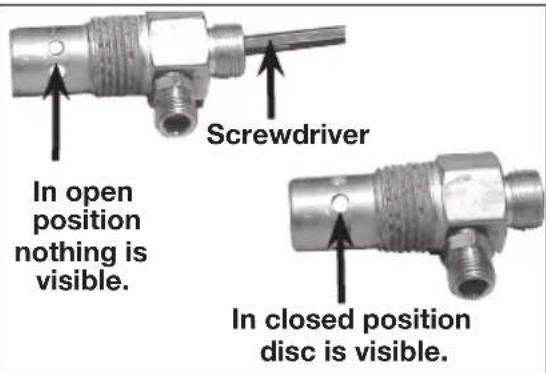
Using a screwdriver, carefully push the valve disc up and down. NOTE: The valve disc should move freely up and down on a spring which holds the valve disc in the closed position, if not the check valve needs to be cleaned or replaced.
-
Clean or replace the check valve. A solvent, such as paint or varnish remover can be used to clean the check valve.
-
Apply sealant to the check valve threads. Reinstall the check valve (turn clockwise).
-
Replace the pressure release tube. Tighten nuts.
-
Replace the outlet tube and tighten nuts.
-
Perform the Break-in Procedure. See Break-in Procedure in the Operation section.
ADDITIONAL SERVICE
Disassembly or service of the air compressor beyond what is covered in this manual is not recommended. If additional service is required, contact your nearest Authorized Warranty Service Center.
STORAGE
Before you store the air compressor, make sure you do the following:
- Review the Maintenance section on the preceding pages and perform scheduled maintenance as necessary.
- Set the Auto/Off lever to "Off".
- Close the globe valve.
- Remove the air tool or accessory.
- Open the globe valve and allow the air to slowly bleed from the air tank until tank pressure is approximately 20 psi.
- Drain water from air tank by opening drain valve on bottom of tank.
⚠ WARNING: Water will condense in the air tank. If not drained, water will corrode and weaken the air tank causing a risk of air tank rupture.
- After the water has been drained, close the drain or drain valve.
NOTE: If drain valve is plugged, release all air pressure. The valve can then be removed, cleaned, then reinstalled.
- Protect the air hose from damage (such as being stepped on or run over).
SERVICE
Use only identical replacement parts. For a parts list or to order parts, visit our service website at www.deltaportercableservicenet.com. You can also order parts from your nearest PORTER-CABLE Factory Service Center or PORTER-CABLE Authorized Warranty Service Center. Or, you can call our Customer Care Center at (888) 848-5175.
SERVICE AND REPAIRS
All quality tools will eventually require servicing and/or replacement of parts. For information about PORTER-CABLE, its factory service centers or authorized warranty service centers, visit our website at www.deltaportercable.com or call our Customer Care Center at (888) 848-5175. All repairs made by our service centers are fully guaranteed against defective material and workmanship. We cannot guarantee repairs made or attempted by others.
You can also write to us for information at PORTER-CABLE, 4825 Highway 45 North, Jackson, Tennessee 38305 - Attention: Product Service. Be sure to include all of the information shown on the nameplate of your tool (model number, type, serial number, etc.).
ACCESSORIES
⚠ WARNING: Since accessories, other than those offered by PORTER-CABLE, have not been tested with this product, use of such accessories with this tool could be hazardous. To reduce the risk of injury, only PORTER-CABLE recommended accessories should be used with this product.
A complete line of accessories is available from your PORTER-CABLE Factory Service Center or a PORTER-CABLE Authorized Warranty Service Center. Please visit our Web Site www.deltaportercable.com for a catalog or for the name of your nearest supplier.
TROUBLESHOOTING
WARNING:
Risk of Unsafe Operation. Unit cycles automatically when power is on. When servicing, you may be exposed to voltage sources, compressed air, or moving parts. Before servicing unit unplug or disconnect electrical supply to the air compressor, bleed tank of pressure, and allow the air compressor to cool.
| PROBLEM CAUSE CORRECTION | ||
| Excessive tank pressure - safety valve pops off | Pressure switch does not shut off motor when compressor reaches "cut-out" pressure. | Move Auto/Off lever to the "Off" position, if the unit does not shut off contact a Trained Service Technician. |
| Pressure switch "cut-out" too high. | Contact a Trained Service Technician. | |
| Air leaks at fittings | Tube fittings are not tight enough. | Tighten fittings where air can be heard escaping. Check fittings with soapy water solution.DO NOT OVER TIGHTEN. |
| Air leaks at or inside check valve | Check valve seat damaged. | A defective check valve results in a constant air leak at the pressure release valve when there is pressure in the tank and the compressor is shut off. Replace check valve.Refer the To Replace or Clean Check Valve in the Service and Adjustments section. |
| Air leaks at pressure switch release valve | Defective pressure switch release valve. | Contact a Trained Service Technician. |
| Air leaks in air tank or at air tank welds | Defective air tank. Air tank must be replaced.Do not repair the leak.⚠ WARNING: Risk of bursting.Do not drill into, weld or otherwise modify air tank or it will weaken.The tank can rupture or explode. | |
| Air leaks between head and valve plate | Leaking seal. Contact a Trained Service Technician. | |
| Pressure reading on the regulated pressure gauge (if equipped) drops when an accessory is used | It is normal for "some" pressure drop to occur. | If there is an excessive amount of pressure drop when the accessory is used, adjust the regulator as instructed in the Operation section.NOTE: Adjust the regulated pressure under flow conditions (while accessory is being used). |
| Air leak from safety valve | Possible defect in safety valve. | Operate safety valve manually by pulling on ring. If valve still leaks, it should be replaced. |
| Compressor is not supplying enough air to operate accessories | Prolonged excessive use of air. | Decrease amount of air usage. |
| Compressor is not large enough for air requirement. | Check the accessory air requirement. If it is higher than the SCFM or pressure supplied by your air compressor, you need a larger compressor. | |
| Hole in hose. Check and replace if required. | ||
| Check valve restricted. Remove and clean, or replace. | ||
| Air leaks. Tighten fittings. | ||
| Restricted air intake filter. Clean or replace air intake filter. Do not operate the air compressor with the filter removed. Refer to the Air Filter paragraph in the Maintenance section. | ||
| Loose belt. Loosen wingnut and then tighten wingnut until it contacts the washer, plus one turn. | ||
| Restricted air intake | Dirty air filter. Clean or replace. See Air Filter paragraph in the Maintenance section. | |
| Motor will not run | Motor overload protection switch has tripped. | Refer to Motor Overload Protection under Operation. If motor overload protection trips frequently, contact a Trained Service Technician |
| Tank pressure exceeds pressure switch "cut-in" pressure. | Motor will start automatically when tank pressure drops below "cut-in" pressure of pressure switch. | |
| Check valve stuck open. Remove and clean, or replace. | ||
| Loose electrical connections. | Check wiring connection inside pressure switch and terminal box area. | |
| Possible defective motor or starting capacitor. | Have checked by a Trained Service Technician. | |
| Paint spray on internal motor parts. | Have checked by a Trained Service Technician. Do not operate the compressor in the paint spray area. See flammable vapor warning. | |
| Pressure release valve on pressure switch has not unloaded head pressure. | Bleed the line by pushing the lever on the pressure switch to the "Off" position; if the valve does not open, replace switch. | |
| Motor will not run (continued) | Fuse blown, circuit breaker tripped. | 1. Check fuse box for blown fuse and replace as necessary. Reset circuit breaker. Do not use a fuse or circuit breaker with higher rating than that specified for your particular branch circuit.2. Check for proper fuse. You should use a time delay fuse.3. Check for low voltage conditions and/or proper extension cord.4. Disconnect the other electrical appliances from circuit or operate the compressor on its own branch circuit. |
| Safety Valve on pump "pops" out | Pressure switch, check valve, or pump could be in need of servicing. | Have checked by a Trained Service Technician. |
| Knocking Noise | Possible defect in safety valve. | Operate safety valve manually by pulling on ring. If valve still leaks, it should be replaced. |
| Defective check valve. Remove and clean, or replace. | ||
| Loose pulley. Tighten pulley set screw. | ||
| Loose flywheel. Tighten flywheel screw. | ||
| Compressor mounting screws loose. | Tighten mounting screws. | |
| Loose belt. Loosen wingnut and then tighten wingnut until it contacts the washer, plus one turn. | ||
| Carbon build-up in pump. Have checked by a Trained Service Technician. | ||
| Belt too tight. Loosen wingnut and then tighten wingnut until it contacts the washer, plus one turn. | ||
| Excessive belt wear | Loose belt. Loosen wingnut and then tighten wingnut until it contacts the washer, plus one turn. | |
| Tight belt. Loosen wingnut and then tighten wingnut until it contacts the washer, plus one turn. | ||
| Loose pulley. Have checked by a Trained Service Technician. | ||
| Pulley misalignment. See Motor Pulley/Flywheel Alignment paragraph in the Maintenance section. | ||
| Squealing sound | Compressor pump has no oil. | See Oil-Checking paragraph in the Maintenance section. |
| Loose belt. Loosen wingnut and then tighten wingnut until it contacts the washer, plus one turn. | ||
FULL ONE YEAR WARRANTY
PORTER-CABLE industrial tools are warranted for one year from date of purchase. We will repair, without charge, any defects due to faulty materials or workmanship. For warranty repair information, call (888)-848-5175. This warranty does not apply to accessories or damage caused where repairs have been made or attempted by others. This warranty gives you specific legal rights and you may have other rights which vary in certain states or provinces.
LATIN AMERICA: This warranty does not apply to products sold in Latin America. For products sold in Latin America, see country specific warranty information contained either in the packaging, call the local company or see website for warranty information.
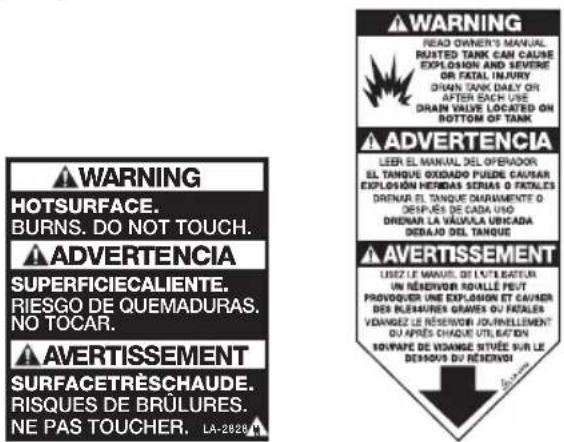
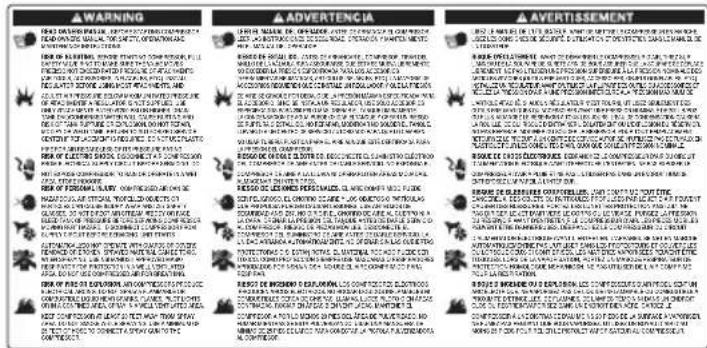
FREE WARNING LABEL REPLACEMENT: If your warning labels become illegible or are missing, call (888)-848-5175 for a free replacement.
Copyright © 2008 Porter-Cable
ENGLISH: PAGE 1
ESPAÑOL: PÁGINA 52
natural_image
Black industrial air compressor with visible branding and mounting base (no readable text beyond branding)IMPORTANT
Approximate Cut-out Pressure 135 PSIG
Changement
Copyright © 2008 Porter-Cable
ENGLISH: PÁGE 1 FRANÇAIS: PAGE 25
natural_image
Black industrial air compressor with 'PORTER CABLE' branding and mounting base (no other text or symbols visible)IMPORTANTE
SCFM @ 90 PSIG *10,1
Local D, Col. Obrera....(55) 5588 9377
MERIDA, YUC
Calle 63 #459-A - Col. Centro .....(999) 928 5038
MONTERREY, N.L.
Av. Francisco I. Madero 831 Poniente - Col. Centro .....(818) 375 23 13
PUEBLA, PUE
17 Norte #205 - Col. Centro .....(222) 246 3714
QUERETARO, QRO
Av. San Roque 274 - Col. San Gregorio .....(442) 2 17 63 14
SAN LUIS POTOSI, SLP
4825 Highway 45 North
Jackson, TN 38305
(888) 848-5175
www.deltaportercable.com

- Single Stage Oil lubricated Compressor
- IMPORTANT
- SAFETY GUIDELINES - DEFINITIONS
- IMPORTANT SAFETY INSTRUCTIONS
- SAVE THESE INSTRUCTIONS
- HAZARD
- A DANGER ON OR FIRE
- A DANGER
- ATHING (ASPHYxIATION)
- WHAT CAN HAPPEN HOW TO PREVENT IT
- RISK OF SE ▲ DANGER:
- IOUS INJURY OR PROPERTY DAMAGE WHEN TRANSPORTING COMPRESSOR
- A.WARNING:
- STING
- CTRICAL SHOCK
- A/WARNING
- LYING OBJECTS
- AWARNING:
- SURFACES
- AWARNING: AFE OPERATION
- WARNING: FROM LIFTING
- A CAUTION: OISE
- SAVE THESE INSTRUCTIONS FOR FUTURE USE
- SPECIFICATIONS
- Model No. C7501M
- GLOSSARY
- DUTY CYCLE
- ACCESSORIES
- ASSEMBLY
- TOOLS REQUIRED FOR ASSEMBLY
- UNPACKING
- INSTALLATION
- LOCATION OF THE AIR COMPRESSOR
- ANCHORING OF THE AIR COMPRESSOR
- Hardware needed:
- WIRING INSTRUCTIONS
- GROUNDING INSTRUCTIONS
- VOLTAGE AND CIRCUIT PROTECTION
- AIR DISTRIBUTION SYSTEM
- OPERATION
- KNOW YOUR AIR COMPRESSOR
- DESCRIPTION OF OPERATION
- HOW TO USE YOUR UNIT
- How to Stop:
- Before Starting
- Break-in Procedure
- Before Each Start-Up
- How to Start
- MAINTENANCE
- TO CHECK SAFETY VALVE
- TO DRAIN TANK
- OIL
- Checking
- Changing
- AIR FILTER - INSPECTION AND REPLACEMENT
- BELT - REPLACEMENT
- MOTOR PULLEY/FLYWHEEL ALIGNMENT
- AIR COMPRESSOR PUMP INTAKE AND ExHAUST VALVES
- INSPECT AIR LINES AND FITTINGS FOR LEAKS
- AIR COMPRESSOR HEAD BOLTS - TORQUING
- SERVICE AND ADJUSTMENTS
- WARNING:
- TO REPLACE OR CLEAN CHECK VALVE
- ADDITIONAL SERVICE
- STORAGE
- SERVICE
- SERVICE AND REPAIRS
- TROUBLESHOOTING
- FULL ONE YEAR WARRANTY
- Changement
- IMPORTANTE
Brand : BLACK & DECKER
Model : C7501M
Category : Compressor