XR52C - Sewing machine BROTHER - Free user manual and instructions
Find the device manual for free XR52C BROTHER in PDF.


User questions about XR52C BROTHER
0 question about this device. Answer the ones you know or ask your own.
Ask a new question about this device
Download the instructions for your Sewing machine in PDF format for free! Find your manual XR52C - BROTHER and take your electronic device back in hand. On this page are published all the documents necessary for the use of your device. XR52C by BROTHER.
USER MANUAL XR52C BROTHER
"IMPORTANT SAFETY INSTRUCTIONS"
When using this machine, basic safety precautions should always be taken, including the following:
"Read all instructions before using."
DANGER - To reduce the risk of electric shock:
- The machine should never be left unattended when plugged in. Always unplug this machine from the electrical outlet immediately after using and before cleaning.
- Always unplug before changing the light bulb. Replace bulb with same type rated 15 watts.
WARNING - To reduce the risk of burns, fire, electric shock, or injury to persons:
- Do not allow this machine to be used as a toy. Close attention is necessary when the machine is used by or near children.
- Use this machine only for its intended use as described in this manual. Use only accessories recommended by the manufacturer as contained in this manual.
- Never operate this machine if it has a damaged cord or plug, if it is not working properly, if it has been dropped or damaged, or dropped into water. Return the machine to the nearest authorized dealer or service center for examination, repair, electrical or mechanical adjustment.
- Never operate the machine with any air openings blocked. Keep ventilation openings of the machine and foot control free from the accumulation of lint, dust, and loose cloth.
- Never drop or insert any object into any opening.
- Do not use outdoors.
- Do not operate where aerosol (spray) products are being used or where oxygen is being administered.
- To disconnect, turn the main switch to the symbol "O" position which represents off, then remove plug from outlet.
- Do not unplug by pulling on cord. To unplug, grasp the plug, not the cord.
- Keep fingers away from all moving parts. Special care is required around the machine needle.
- Always use the proper needle plate. The wrong plate can cause the needle to break.
- Do not use bent needles.
- Do not pull or push fabric while stitching. It may deflect the needle causing it to break.
- Switch the machine to the symbol "O" position when making any adjustments in the needle area, such as threading needle, changing needle, threading bobbin, or changing the presser foot, and the like.
- Always unplug the machine from the electrical outlet when removing covers, lubricating, or when making any of the user service adjustments mentioned in the instruction manual.
- The machine is not intended for use by young children or infirm persons without supervision.
- Young children should be supervised to ensure that do not play with this machine.
"SAVE THESE INSTRUCTIONS" "This machine is intended for household use."
"IMPORTANT CONSIGNES DE SECURITE"
If this machine is fitted with a 3 pin non-rewireable BS plug then please read the following.
IMPORTANT (in the United Kingdom)
Main supply (AC 230/240V\~, 50Hz)
DO NOT cut off the main plug from equipment. If the plug fitted is not suitable for the power point in your home or the cable is too short to reach a power point, then obtain an appropriate safety approved extension lead or consult your dealer.
BE SURE to replace the fuse only with an identical approved type, as originally fitted and to replace the fuse cover.
If none the less the main plug is cut off be sure to remove the fuse and dispose of the plug immediately, to avoid a possible shock hazard by inadvertent connection to the main supply.
IMPORTANT (in the other countries)
If the available socket outlet is not suitable for the plug supplied with this equipment, it should be cut off and an appropriate three pin plug fitted. With alternative plugs an approved fuse must be fitted in the plug.
NOTE: The plug severed from the main leads must be destroyed as a plug with bared flexible cords is hazardous if engaged in a live socket outlet. In the event of replacing the plug fuse, use a fuse approved by ASTA to BS 1362, i.e. carrying the mark, rating as marked on plug.
Always replace the fuse cover. Never use plugs with the fuse cover omitted.
WARNING:DO NOT CONNECTEITHERWIRETO THE EARTH TERMINAL WHICH IS MARKED WITH THE LETTER 'E',BY THE EARTH SYMBOL 1一 OR COLOURED GREEN OR YELLOW.
The wires in this main lead are coloured in accordance with the following code:
Blue Neutral
Brown Live
As the colours of the wiring in the main lead of this appliance may not correspond with the coloured markings identifying the terminals in your plug, proceed as follows:
The wire which is coloured blue must be connected to the terminal which is marked with the letter 'N' or coloured black or blue.
The wire which is coloured brown must be connected to the terminal which is marked with the letter 'L' or coloured red or brown.
Connecting Plugs and Main Power / Sewing Light Switch
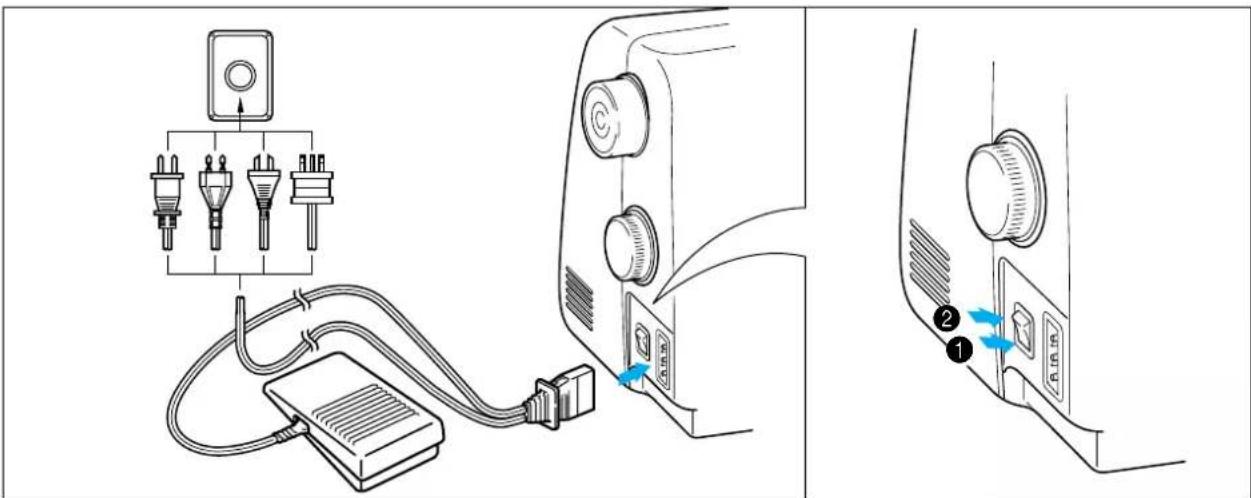
- Connect the three-prong plug into the machine.
-
Connect the electrical supply plug into a wall outlet.
-
When leaving the machine unattended, the main switch of the machine should be switched off or the plug must be removed from the socket outlet.
Turn on or off the switch for the main power and sew-light.
1 Turn on 2 Turn off
- When servicing the machine, or when removing covers or changing bulbs, the machine or the electrical set must unplugged.
PLEASE READ BEFORE USING THIS MACHINE
For safe operation
-
Be sure to keep your eye on the needle while sewing. Do not touch the balance wheel, thread take-up, needle, or other moving parts.
-
Remember to turn off the power switch and unplug the cord when:
Operation is completed
- Replacing or removing the needle or any other parts
A power failure occurs during use
- Maintaining the machine
Leaving the machine unattended.
- Do not store anything on the foot controller.
- Plug the machine directly into the wall. Do not use extension cords.
For a longer service life
- When storing this machine, avoid direct sunlight and high humidity locations. Do not use or store the machine near a space heater, iron, halogen lamp, or other hot objects.
- Use only neutral soaps or detergents to clean the case. Benzene, thinner, and scouring powders can damage the case and machine, and should never be used.
- Do not drop or hit the machine.
- Always consult the operation manual when replacing or installing any assemblies, the presser feet, needle, or other parts to assure correct installation.
For repair or adjustment
In the event a malfunction occurs or adjustment is required, first follow the troubleshooting table in the back of the operation manual to inspect and adjust the machine yourself. If the problem persists, please consult your local authorized dealer.
VEUILLEZ LIRE CES INFORMATIONS AVANT D'UTILISER CETTE MACHINE
KNOWING YOUR SEWING MACHINE
PRINCIPAL PARTS 1
ACCESSIONS 3
Optional Accessories 3
OPERATING YOUR SEWING MACHINE 5
Connecting Plugs 5
Main Power/Sewing Light Switch 7
Foot Controller. 8
Checking the Needle 9
Replacing the Needle 9
Changing the Presser Foot 11
Flat Bed Attachment 12
VARIOUS CONTROLS 13
Pattern Selection Dial 13
Recommended Widths and Lengths for Stitches . 15
Stitch Length Dial 21
Stitch Width Dial 23
Reverse Sewing Lever 24
Converting to Free-arm Style 25
THREADING THE MACHINE 26
Winding the Bobbin 26
Lower Threading. 29
Upper Threading 31
Using Needle Threader 33
Drawing Up Lower Thread. 35
Twin Needle Sewing 36
Thread Tension 38
FABRIC/THREAD/NEEDLE COMBINATIONS 39
STRAIGHT AND ZIGZAG STITCHING
PLEASE READ BEFORE SEWING 41
Straight Stitching 42
Zigzag Stitching 45
BUILT-IN STITCHES
Blind Hem Stitching 46
Shell Tuck Stitching 47
Elastic Stitching 48
Double Action Stitching 49
Scallop Stitching 50
Decorative Stitching 51
Patchwork 52
Overedge Stitching 53
FeatherStitching 54
Triple Zigzag Stretch Stitching. 54
BUTTONHOLE AND BUTTON SEWING
Making a Buttonhole (For 1-step BH Type) 55
Odd-shaped buttons that
do not fit into the button holder plate 57
Buttonhole Fine Adjustment 59
Button Sewing 62
USING ATTACHMENTS AND APPLICATIONS
Zipper Insertion. 63
Gathering 63
Darning 65
Appliques. 66
Monogramming and Embroidering 67
OPTIONAL ACCESSORIES
Using the Walking Foot 69
Using the Spring-action Quilting Foot. 71
Using the 1/4-Inch Quilting Foot 73
MAINTENANCE
Changing the Light Bulb 75
Cleaning 77
Performance Check List 79
Repacking the Machine 85
INDEX
TABLE DES MATIÈRES
CONNAITRE SA MACHINE A COUDRE
PIECES PRINCIPALES 2
ACCESSIONES 4
Accessoires en option 4
FONCTIONNEMENT DE LA MACHINE A COUDRE....6
Raccordement 6
Patchwork (Assemblage) 52
Winds the thread onto the bobbin to be used for the lower thread.
STITCH LENGTH DIAL (Page 13, 21)
Controls the length of the stitches.
③ SPOOL PIN AND SPOOL CAP (Page 26, 31)
④ STITCH WIDTH DIAL (Page 23)
Controls the stitch width.
UPPER TENSION CONTROL DIAL (Page 38)
Controls the tension of the upper thread.
⑥ BUTTONHOLE LEVER (Page 55)
NEEDLE THREADER (Page 33)
⑥ FLAT BED ATTACHMENT WITH ACCESSORY COMPARTMENT (Page 12, 25)
ZIGZAG PRESSER FOOT (Page 3,11)
REVERSE SEWING LEVER (Page 24)
Push for stitching in the reverse direction.
⑩ PATTERN INDICATION WINDOW (Page 13)
Shows the stitch number to be performed.
HOLE FOR VERTICAL SPOOL PIN (Page 37)
Used to hold a second spool of thread for twin needle sewing.
13 BALANCE WHEEL
PATTERN SELECTION DIAL (Page 13)
Turn in either direction to select the desired stitch.
15 MAIN POWER/SEWING LIGHT SWITCH (Page 7)
Turn on/off the main power/sewing light switch.
Insert the foot controller plug for operation and connect the
machine to the power supply.
BUTTONHOLE FINE ADJUSTMENT SCREW (Page 59)
18 PRESSER FOOT LEVER (Page 31)
19 FOOT CONTROLLER (Page 8)
Used to control sewing speed/start and stop.
PIÉCES PRINCIPALES
① DEVIDOIR (Page 26)
⑧ PLATEAU ET COMPARTMENT D'ACCESSOIRES (Page 12, 25)
PIED-DE-BICHEPOUR POINTS ZIGZAGS (Page 4,11)
LEVIER DE COUTURE EN MARCHE ARRIERE (Page 24)
③ EJE DEL CARRETE Y PORTA CARRETES (Pagina 26, 32)
④ SELECTOR DE ANCHO DE PUNTADA (Pagina 23)
13 RUEDA MANUAL/POLEA
4 SELECTOR DE PUNTADAS (Pagina 14)
Parts Code: J00360-051 (110/120V Area)
XA6400-051 (220/240V Area)
XA6402-051 (U.K.)
XA6404-051 (Australia, New Zealand)
XA6434-051 (110/220V Dual Ara)
NOTE (For U.S.A. only):
Foot Controller: Model N
Parts Code: J00360-051 (110/120V Area)
This foot controller can be used for Model XL-6562, XL-6452, XR
46, XR-52, XR-65.
The above accessories are stored in the flat bed attachment. These accessories have been designed to help complete most sewing tasks.
ACCESSIONS
XA6400-051(220/240 V Area)
XA6402-051(RU)
- Connect the power cord plug into the machine.
- Connect the power supply plug into a wall outlet.
CAUTION
- When leaving the machine unattended, the main switch of the machine should be switched off or the plug must be removed from the socket-outlet.
- When servicing the machine, or when removing covers or changing bulbs, the machine or the electrical set must be unplugged.
- For U.S.A. only
This appliance has a polarized plug (one blade wider than the other). To reduce the risk of electric shock, this plug is intended to fit in a polarized outlet only one way. If the plug does not fit fully in the outlet, reverse the plug.
If it still does not fit, contact a qualified electrician to install the proper outlet. Do not modify the plug in any way.
WARNING
- Use only regular household electricity for the power source. Using other power sources may result in fire, electric shock, or damage to the machine.
-
Turn off the main power and remove the plug in the following circumstances:
-
When you are away from the machine
- After using the machine
- When the power fails during use
- When the machine does not operate correctly due to a bad connection or a disconnection
- During electrical storms
CAUTION
- Do not use extension cords or multi-plug adapters with many other appliances plugged in to them. Fire or electric shock may result.
- Do not touch the plug with wet hands. Electric shock may result.
- When unplugging the machine, always turn off the main power first. Always grasp the plug to remove it from the outlet. Pulling on the cord may damage the cord, or lead to fire or electric shock.
- Do not allow the power cord to be cut, damaged, modified, forcefully bent, pulled, twisted, or bundled. Do not place heavy objects on the cord. Do not subject the cord to heat. These things may damage the cord and cause fire or electric shock. If the cord or plug is damaged, take the machine to your authorized dealer for repairs before continuing use.
- Unplug the power cord if the machine is not to be used for a long period of time. Otherwise a fire may result.
FONCTIONNEMENT DE LA MACHINE A COUDRE
Raccordement
Main Power/Sewing Light Switch
This switch turns the main power/sewing light on or off.
Turn on (toward the "I" mark)
Turn off (toward the "O" mark)
Interruptor principal/luz de cosido
When the foot controller is depressed lightly, the machine will run at a low speed. When the pressure on the foot controller is increased, the machine's speed will increase. When pressure on the foot controller is released, the machine will stop. Care should be taken that nothing is placed on the foot controller when the machine is not in use.
① Foot controller
CAUTION
Do not allow fabric pieces and dust to collect in the foot controller. Doing so could cause a fire or an electric shock.
NOTE (For U.S.A. only):
Foot Controller: Model N
This foot controller can be used for Model XL-6562, XL-6452, XR-46, XR-52, XR-65.
Pedal
The sewing needle must always be straight and sharp for smooth sewing.
To Check the Needle Correctly:
To check the needle, place the flat side of the needle on a flat surface. Check the needle from the top and the sides. Throw away any bent needles.
① Parallel space
Level surface (bobbin cover, glass, etc.)
- Place a level surface under the needle.
Replacing the Needle
CAUTION
- Turn the main power switch to OFF before changing the needle. If the main power is left on and foot controller is stepped on, the machine will start and injury may result.
- Use only sewing machine needles for home use. Other needles may bend or break and cause injury.
-
Never sew with a bent needle. A bent needle will easily break and cause injury.
-
Remove the power supply plug from the outlet.
- Raise the needle bar to its highest position.
- Lower the presser foot.
- Remove the needle by loosening the needle clamp screw.
① Presser foot lever
CAUTION
Do not loosen or tighten the needle clamp screw with a strong force, otherwise it may be damaged.
- With the flat side of the needle facing the back, insert the new needle all the way to the top of the needle stopper (viewing window) in the needle clamp. Use a screwdriver to securely tighten the needle clamp screw.
② Needle stopper
③ Hole for setting needle
④ Flat side of needle
CAUTION
Be sure to push in the needle until it touches the stopper, and securely tighten the needle clamp screw with a screwdriver. If the needle is not completely inserted or the needle clamp screw is loose, the needle may break or the machine may be damaged.
Changing the Presser Foot
CAUTION
- Always turn off the power before changing the presser foot. If the power is on and controller is stepped on, the machine will start and may cause injury.
Always use the correct presser foot for the selected stitch pattern. If the wrong presser foot is used, the needle may strike the presser foot and bend or break, and may cause injury. - Only use presser feet for this machine. Using other presser feet may lead to accident or injury.
It may be necessary to change the presser foot according to your sewing needs.
SNAP-ON TYPE
- Raise the needle to its highest position by turning the balance wheel toward you (counter clockwise) and raise the presser foot lever.
- Release the foot by raising the lever located at the back of the holder.
- Place a different presser foot on the needle plate so that the bar on the presser foot is in line with the slot on the shank.
- Lower the presser foot lever and fix the presser foot onto the shank. If the presser foot is in the correct location, the bar should snap in.
Changement de pied-de-biche
ATTENTION
The accessories are stored in a compartment under the flat bed attachment cover, which can be opened by flipping it toward you.
Plataforma
Pattern Selection Dial
CAUTION
When you use the Pattern Selection Dial to select a pattern, turn the balance wheel to the front (counter-clockwise) by hand to set the needle in the highest position before selecting the pattern. If the needle is in the down position when the Pattern Selection Dial is turned, the needle, presser foot, or fabric may be damaged.
To select a stitch, simply turn the Pattern Selection Dial, located on the right side of the machine. The Pattern Selection Dial may be turned in either direction. The following page shows the recommended range of stitch lengths and widths.
① Pattern selection dial
② Pattern number
The stitches that are available depend on the Stitch Length Dial setting. If the Stitch Length Dial is set between 0 and 4, any of the stitches in the top row can be selected. If the Stitch Length Dial is set to SS, any of the stitches in the bottom row can be selected.
③ ③Stitch length dial
NOTE:
Since the Pattern Selection Dial is not a continuous dial, it cannot be turned directly from the last stitch to the first one or from the first stitch to the last one. To select the first stitch when the last one is displayed or to select the last stitch when the first one is displayed, turn the Pattern Selection Dial in the opposite direction until the desired stitch is displayed.
DESCRIPTIF DES DIFFERENTES COMMANDES
RECOMMENDED WIDTHS AND LENGTHS FOR STITCHES
(Model XL-6562)
| PATTERN | STITCH NAME | RECOMMENDED WIDTH[mm(inch)] | RECOMMENDED INSTRUMENT LENGTH [mm(inch)] | TRUCTIONMANUAL PAGE |
| II | 1-STEP AUTOMATIC 3-5 F-1.5BUTTONHOLE (1/8-3/16) (1/64-1/16) | 55 | ||
| I | STRAIGHT STITCH | 5 1-4(3/16) (1/16-3/16) | 42, 63, 65 | |
| S | ZIGZAG STITCH | 0-5 F-4(0-3/16) (1/64-3/16) | 45, 62, 66, 67 | |
| V | BLIND HEM STITCH | 3-5 F-2(1/8-3/16) (1/64-1/16) | 46 | |
| V | SHELL TUCK STITCH | 3-5 F-3(1/8-3/16) (1/64-1/8) | 47 | |
| E | ELASTIC STITCH | 3-5 F-2.5(1/8-3/16) (1/64-3/32) | 48 | |
| M | STRETCH BLIND HEM STITCH | 3-5 F-1.5(1/8-3/16) (1/64-1/16) | 46 | |
| J | SCALLOP STITCH | 3-5 F-1.5(1/8-3/16) (1/64-1/16) | 50 | |
| A | DOUBLE ACTION STITCHBRIDGING STITCH 49RAMPART STITCH | 3-5 F-3(1/8-3/16) (1/64-1/8) | ||
| A | ELASTIC SHELL TUCK STITCH | 3-5 F-3(1/8-3/16) (1/64-1/8) | 53 | |
| B | BEAD STITCHARROWHEAD STITCH 3-5PARALLELOGRAM STITCH (1/8-3/16) (1/64-1/16) | 51 | ||
| > | LIGHTNING STITCHSQUARE STITCH 51DECORATIVE STITCH | 5 F-1(3/16) (1/64-1/16) | ||
| = | TRIPLE STRETCH STITCH | 5(3/16) 2.5 (3/32) | SS Fixed | 42 |
| $ | TRIPLE ZIGZAG STRETCH 3-5STITCH | (1/8-3/16) 2.5 (3/32) | SS Fixed | 54 |
| M | ELASTIC OVERLOCK STITCH | 3-5(1/8-3/16) 2.5 (3/32) | SS Fixed | 53 |
| W | ELASTIC OVERLOCK STITCH | 3-5(1/8-3/16) 2.5 (3/32) | SS Fixed | 53 |
| X | FEATHER STITCH | 3-5(1/8-3/16) 2.5 (3/32) | SS Fixed | 54 |
| M | COMB STITCH | 3-5(1/8-3/16) 2.5 (3/32) | SS Fixed | 53 |
| X | DECORATIVE STITCH | 5(3/16) 2.5 (3/32) | SS Fixed | 51 |
| XX | FAGOTING STITCH | 3-5(1/8-3/16) 2.5 (3/32) | SS Fixed | 52 |
| X | DECORATIVE STITCH | 3-5(1/8-3/16) 2.5 (3/32) | SS Fixed | 51 |
| X | DECORATIVE HEM STITCH | 3-5(1/8-3/16) 2.5 (3/32) | SS Fixed | 49 |
| XXX | DECORATIVE STITCH | 5(3/16) 2.5 (3/32) | SS Fixed | 51 |
| XX | LINK STITCH | 3-5(1/8-13/64) 2.5 (3/32) | SS Fixed | 52 |
RECOMMENDED WIDTHS AND LENGTHS FOR STITCHES
(Model XL-6452, XR-46, XR-52, XR-65)
| PATTERN | STITCH NAME | RECOMMENDED WIDTH [mm(inch)] | RECOMMENDED INSTRUCTION LENGTH [mm(inch)] | MANUAL PAGE |
| 1-STEP AUTOMATIC 3-5 F-1.5 BUTTONHOLE (1/8-3/16) (1/64-1/16) | 55 | |||
| STRAIGHT STITCH | 5 1-4 (3/16) (1/16-3/16) | 42, 63, 65 | ||
| ZIGZAG STITCH | 0-5 F-4 (0-3/16) (1/64-3/16) | 45, 62, 66, 67 | ||
| BLIND HEM STITCH | 3-5 F-2 (1/8-3/16) (1/64-1/16) | 46 | ||
| SHELL TUCK STITCH | 3-5 F-3 (1/8-3/16) (1/64-1/8) | 47 | ||
| ELASTIC STITCH | 3-5 F-2.5 (1/8-3/16) (1/64-3/32) | 48 | ||
| STRETCH BLIND HEM STITCH | 3-5 F-1.5 (1/8-3/16) (1/64-1/16) | 46 | ||
| SCALLOP STITCH | 3-5 F-1.5 (1/8-3/16) (1/64-1/16) | 50 | ||
| DOUBLE ACTION STITCH BRIDING STITCH 49 RAMPART STITCH | 3-5 F-3 (1/8-3/16) (1/64-1/8) | |||
| ELASTIC SHELL TUCK STITCH | 3-5 F-3 (1/8-3/16) (1/64-1/8) | 53 | ||
| BEADSTITCH 3-5 F-1 ARROWHEAD STITCH (1/8-3/16) | 3/16) (1/64-1/16) | 51 | ||
| TRIPLE STRETCH STITCH | 5 (3/16) 2.5 (3/32) | SS Fixed | 42 | |
| TRIPLE ZIGZAG STRETCH 3-5 STITCH (1/8-3/16) 2.5 (3/32) | SS Fixed | 54 | ||
| ELASTIC OVERLOCK STITCH | 3-5 (1/8-3/16) 2.5 (3/32) | SS Fixed | 53 | |
| ELASTIC OVERLOCK STITCH | 3-5 (1/8-3/16) | 53 | ||
| FEATHER STITCH | 3-5 (1/8-3/16) | SS Fixed 2.5 (3/32) | 54 | |
| COMB STITCH | 3-5 (1/8-3/16) | SS Fixed 2.5 (3/32) | 53 | |
| DECORATIVE STITCH | 5 (3/16) 2.5 (3/32) | SS Fixed | 51 | |
| FAGOTING STITCH | 3-5 (1/8-3/16) 2.5 (3/32) | SS Fixed | 52 | |
| DECORATIVE STITCH | 3-5 (1/8-3/16) 2.5 (3/32) | SS Fixed | 51 | |
| DECORATIVE HEM STITCH | 3-5 (1/8-3/16) 2.5 (3/32) | SS Fixed | 49 | |
| DECORATIVE STITCH | 5 (3/16) 2.5 (3/32) | SS Fixed | 51 |
LONGUEURS ET LARGEURS RECOMMANDEES POUR CHAQUE POINT
(Model XL-6562)
| MODELE | NOM DU POINT | LARGEUR RECOMMANDÉE(EN MM) (EN MM) | LONGUEUR RECOMMANDÉE | PAGE DU MANUEL |
| BOUTONNIÈRE AUTOMATIQUE EN I PHASE (1/8-3/16) | 3-5 F-1,5(1/64-1/16) | 56 | ||
| POINT DROIT | 5 1-4(3/16) (1/16-3/16) | 42, 64, 65 | ||
| POINT ZIGZAG | 0-5 F-4(0-3/16) (1/64-3/16) | 45, 62, 66, 68 | ||
| POINT OURLET INVISIBLE | 3-5 F-2(1/8-3/16) (1/64-1/16) | 46 | ||
| POINT PICOT | 3-5 F-3(1/8-3/16) (1/64-1/8) | 47 | ||
| POINT ELASTIQUE | 3-5 F-2,5(1/8-3/16) (1/64-3/32) | 48 | ||
| POINT ÉLASTIQUE INVISIBLE | 3-5 F-1,5(1/8-3/16) (1/64-1/16) | 46 | ||
| FESTON | 3-5 F-1,5(1/8-3/16) (1/64-1/16) | 50 | ||
| POINT RENFORCEDPPOINT PONT 49POINT EN REMPARTS | 3-5 F-3(1/8-3/16) (1/64-1/8) | |||
| PLISSE ELASTIQUE | 3-5 F-3(1/8-3/16) (1/64-1/8) | 53 | ||
| FESTON DOUBLEPOINT FLECHE 3-5 F-1POINT EN PARALLELOGRAMMEPOINT TRIANGULaire | (1/8-3/16) (1/64-1/16) | 51 | ||
| POINT ECLAIRPOINT CARRE 51POINT DECORATIF | 5 F-1(3/16) (1/64-1/16) | |||
| POINT TRIPRE | 5(3/16) 2,5 (3/32) | SS Fixe | 42 | |
| TRIPLE POINT ZIGZAG | 3-5(1/8-3/16) 2,5 (3/32) | SS Fixe | 54 | |
| OVERLOCK ÉLASRIQUE | 3-5(1/8-3/16) 2,5 (3/32) | SS Fixe | 53 | |
| OVERLOCK ÉLASRIQUE | 3-5(1/8-3/16) 2,5 (3/32) | SS Fixe | 53 | |
| POINT PLUME | 3-5(1/8-3/16) 2,5 (3/32) | SS Fixe | 54 | |
| POINT PEIGNE | 3-5(1/8-3/16) 2,5 (3/32) | SS Fixe | 53 | |
| POINT DECORATIF | 5(3/16) 2,5 (3/32) | SS Fixe | 51 | |
| POINT FAGOT | 3-5(1/8-3/16) 2,5 (3/32) | SS Fixe | 52 | |
| POINT DECORATIF | 3-5(1/8-3/16) 2,5 (3/32) | SS Fixe | 51 | |
| OURLET INVISIBLEDÉCORATIF | 3-5(1/8-3/16) 2,5 (3/32) | SS Fixe | 49 | |
| POINT DECORATIF | 5(3/16) 2,5 (3/32) | SS Fixe | 51 | |
| POINT D'ASSEMBLAGE | 3-5(1/8-13/64) 2,5 (3/32) | SS Fixe | 52 |
LONGUEURS ET LARGEURS RECOMMANDEES POUR CHAQUE POINT
(Modelé XL-6452, XR-46, XR-52, XR-65)
| MODELE | NOM DU POINT | LARGEUR RECOMMANDÉE(EN MM) (EN MM) | LONGUEUR RECOMMANDÉE | PAGE DU MANUEL |
| BOUTONNIÈRE AUTOMATIQUE EN 1 PHASE (1/8-3/16) | 3-5 F-1,5(1/64-1/16) | 56 | ||
| POINT DROIT | 5 1-4(3/16) (1/16-3/16) | 42, 64, 65 | ||
| POINT ZIGZAG | 0-5 F-4(0-3/16) (1/64-3/16) | 45, 62, 66, 68 | ||
| POINT OURLET INVISIBLE | 3-5 F-2(1/8-3/16) (1/64-1/16) | 46 | ||
| POINT PICOT | 3-5 F-3(1/8-3/16) (1/64-1/8) | 47 | ||
| POINT ELASTIQUE | 3-5 F-2,5(1/8-3/16) (1/64-3/32) | 48 | ||
| POINT ÉLASTIQUE INVISIBLE | 3-5 F-1,5(1/8-3/16) (1/64-1/16) | 46 | ||
| FESTON | 3-5 F-1,5(1/8-3/16) (1/64-1/16) | 50 | ||
| POINT RENFORCEDPPOINT PONT 49POINT EN REMPARTS | 3-5 F-3(1/8-3/16) (1/64-1/8) | |||
| PLISSE ELASTIQUE | 3-5 F-3(1/8-3/16) (1/64-1/8) | 53 | ||
| FESTON DOUBLE 3-5 F-1POINT FLECHE (1/8-3/16) | (1/64-1/16) | 51 | ||
| POINT TRIPRE | 5(3/16) 2,5 (3/32) | SS Fixe | 42 | |
| TRIPLE POINT ZIGZAG | 3-5(1/8-3/16) 2,5 (3/32) | SS Fixe | 54 | |
| OVERLOCK ÉLASRIQUE | 3-5(1/8-3/16) 2,5 (3/32) | SS Fixe | 53 | |
| OVERLOCK ÉLASRIQUE | 3-5(1/8-3/16) | SS Fixe2,5 (3/32) | 53 | |
| POINT PLUME | 3-5(1/8-3/16) | SS Fixe2,5 (3/32) | 54 | |
| POINT PEIGNE | 3-5(1/8-3/16) | SS Fixe2,5 (3/32) | 53 | |
| POINT DECORATIF | 5(3/16) 2,5 (3/32) | SS Fixe | 51 | |
| POINT FAGOT | 3-5(1/8-3/16) 2,5 (3/32) | SS Fixe | 52 | |
| POINT DECORATIF | 3-5(1/8-3/16) 2,5 (3/32) | SS Fixe | 51 | |
| OURLET INVISIBLEDÉCORATIF | 3-5(1/8-3/16) 2,5 (3/32) | SS Fixe | 49 | |
| POINT DECORATIF | 5(3/16) 2,5 (3/32) | SS Fixe | 51 |
ANCHOS Y LARGOS RECOMENDADOS PARA CADA PUNTADA
(Modelo XL-6562)
| PUNTADA | NOMBRE | ANCHO ECOMENDADO EN mm (pulgadas) | LARGO RECOMENDADO EN mm (pulgadas) | PÁGINA DEL MANUAL |
| OJAL AUTOMÁTICO 3-5 F-1,5 DE 1 PASO (1/8-3/16) | 5 1-4 (3/16) (1/16-3/16) | 56 | ||
| PUNTADA RECTA | 5 1-4 (3/16) (1/16-3/16) | 42, 64, 65 | ||
| PUNTADA ZIGZAG | 0-5 F-4 (0-3/16) (1/64-3/16) | 45, 62, 66, 68 | ||
| PUNTADA INVISIBLE | 3-5 F-2 (1/8-3/16) (1/64-1/16) | 46 | ||
| PUNTADA ONDAS | 3-5 F-3 (1/8-3/16) (1/64-1/8) | 47 | ||
| PUNTADA ELÁSTICA | 3-5 F-2,5 (1/8-3/16) (1/64-3/32) | 48 | ||
| PUNTADA INVISIBLE 3-5 F-1,5 ELÁSTICA (1/8-3/16) | (1/64-1/16) | 46 | ||
| PUNTADA FESTÓN | 3-5 F-1,5 (1/8-3/16) (1/64-1/16) | 50 | ||
| PUNTADA DE ACCIÑON DOBLE PUNTADA PUENTE 49 PUNTADA ONDAS ABIERTAS | 3-5 F-3 (1/8-3/16) (1/64-1/8) | |||
| PUNTADA ONDAS 3-5 F-3 ELÁSTICAS (1/8-3/16) | (1/64-1/8) | 53 | ||
| PUNTADA FESTÓN DOBLE PUNTADA FLECHA 3-5 F-1 PUNTADA PARALELOGRAMO PUNTADA TRIÁNGULO | (1/8-3/16) (1/64-1/16) | 51 | ||
| PUNTADA ESCALERA PUNTADA FESTÓN DOBLE 51 PUNTADA DECORATIVA | 5 F-1 (3/16) (1/64-1/16) | |||
| TRIPLE PUNTADA PESPUNTO | 5 (3/16) 2,5 (3/32) | SS Fija | 42 | |
| TRIPLE PUNTADA ZIGZAG ELÁSTICA | 3-5 (1/8-3/16) 2,5 (3/32) | SS Fija | 54 | |
| PUNTADA OVERLOCK ELÁSTICA | 3-5 (1/8-3/16) 2,5 (3/32) | SS Fija | 53 | |
| PUNTADA OVERLOCK ELÁSTICA | 3-5 (1/8-3/16) 2,5 (3/32) | SS Fija | 53 | |
| PUNTADA PLUMA | 3-5 (1/8-3/16) 2,5 (3/32) | SS Fija | 54 | |
| PUNTADA PEINE | 3-5 (1/8-3/16) 2,5 (3/32) | SS Fija | 53 | |
| PUNTADA DECORATIVA | 5 (3/16) 2,5 (3/32) | SS Fija | 51 | |
| PUNTADA FAGOTING | 3-5 (1/8-3/16) 2,5 (3/32) | SS Fija | 52 | |
| PUNTADA DECORATIVA | 3-5 (1/8-3/16) 2,5 (3/32) | SS Fija | 51 | |
| PUNTADA DECORATIVA INVISIBLE | 3-5 (1/8-3/16) 2,5 (3/32) | SS Fija | 49 | |
| PUNTADA DECORATIVA | 5 (3/16) 2,5 (3/32) | SS Fija | 51 | |
| PUNTADA DE UNión | 3-5 (1/8-13/64) 2,5 (3/32) | SS Fija | 52 |
ANCHOS Y LARGOS RECOMENDADOS PARA CADA PUNTADA
(Modelo XL-6452, XR-46)
| PUNTADA | NOMBRE | ANCHO ECOMENDADO EN mm (pulgadas) | LARGO RECOMENDADO EN mm (pulgadas) | PÁGINA DEL MANUAL |
| OJAL AUTOMÁTICO 3-5 F-1DE 1 PASO (1/8-3/16) | 1,5(1/64-1/16) | 56 | ||
| PUNTADA RECTA | 5 1-4(3/16) (1/16-3/16) | 6 | 42, 64, 65 | |
| PUNTADA ZIGZAG | 0-5 F-4(0-3/16) (1/64-3/16) | 16 | 45, 62, 66, 68 | |
| PUNTADA INVISIBLE | 3-5 F-2(1/8-3/16) (1/64-1/16) | /16 | 46 | |
| PUNTADA ONDAS | 3-5 F-3(1/8-3/16) (1/64-1/8) | /8 | 47 | |
| PUNTADA ELÁSTICA | 3-5 F-2,5(1/8-3/16) (1/64-3/32) | /32 | 48 | |
| PUNTADA INVISIBLE 3-5 F-1,5ELÁSTICA (1/8-3/16) (1/64-1/16) | /8 | 46 | ||
| PUNTADA FESTON | 3-5 F-1,5(1/8-3/16) (1/64-1/16) | /16 | 50 | |
| PUNTADA DE ACCIÑON DOBLE PUNTADA PUENTE 49 PUNTADA ONDAS ABIERTAS | 3-5 F-3(1/8-3/16) (1/64-1/8) | |||
| PUNTADA ONDAS 3-5 F-3ELÁSTICAS (1/8-3/16) (1/64-1/8) | 53 | |||
| PUNTADA FESTON DOBLE 3-5 F-1PUNTADA FLECHA (1/8-3/16) (1/64-1/16) | 51 | |||
| TRIPLE PUNTADA PESPUNTO | 5(3/16) 2,5 (3/32) | SS Fija | 42 | |
| TRIPLE PUNTADA ZIGZAG ELÁSTICA | 3-5(1/8-3/16) 2,5 (3/32) | SS Fija | 54 | |
| PUNTADA OVERLOCK ELÁSTICA | 3-5(1/8-3/16) 2,5 (3/32) | SS Fija | 53 | |
| PUNTADA OVERLOCK ELÁSTICA | 3-5(1/8-3/16) 2,5 (3/32) | SS Fija | 53 | |
| PUNTADA PLUMA | 3-5(1/8-3/16) 2,5 (3/32) | SS Fija | 54 | |
| PUNTADA PEINE | 3-5(1/8-3/16) 2,5 (3/32) | SS Fija | 53 | |
| PUNTADA DECORATIVA | 5(3/16) 2,5 (3/32) | SS Fija | 51 | |
| PUNTADA FAGOTING | 3-5(1/8-3/16) 2,5 (3/32) | SS Fija | 52 | |
| PUNTADA DECORATIVA | 3-5(1/8-3/16) 2,5 (3/32) | SS Fija | 51 | |
| PUNTADA DECORATIVA INVISIBLE | 3-5(1/8-3/16) 2,5 (3/32) | SS Fija | 49 | |
| PUNTADA DECORATIVA | 5(3/16) 2,5 (3/32) | SS Fija | 51 |
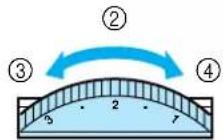
Stitch Length Dial
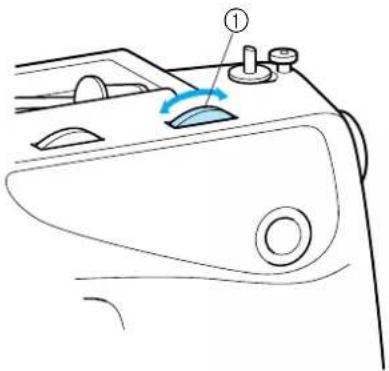
Depending on your selected stitch, you may need to adjust the stitch length for best results.
The numbers marked on the Stitch Length Dial represent the length of the stitch in millimeters (mm).
THE HIGHER THE NUMBER, THE LONGER THE STITCH.
The "O" setting does not feed the material. This is used for sewing on a button.
The "F" area is used for making a Satin Stitch (a dense zigzag stitch) which can be used in making buttonholes and decorative stitches. The position needed for making the Satin Stitch varies according to the material and thread being used. To determine the exact dial position, you should first test the stitch and length settings on a scrap of fabric to observe the feeding of the material.
① Stitch length dial
Length
③ Fine SS
④ Coarse
CAUTION
Do not set the Stitch Length Dial in the range shown by 已 If the machine is started while the dial is set in the range shown by 已 , the fabric will not feed correctly and the fabric or machine may be damaged.
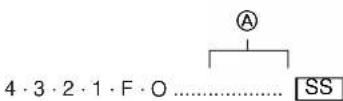
Turn the dial to the left past "O" for the SS position.
[SS] (Fixed 2.5)
CAUTION
If the stitches get bunched together, lengthen the stitch length and continue sewing. Do not continue sewing without lengthening the stitch length, otherwise the needle may break and cause injury.
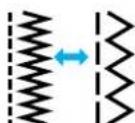
Depending on the stitch selected, you may need to adjust the stitch width.
The numbers marked on the dial represent the stitch width. THE HIGHER THE NUMBER, THE WIDER THE STITCH.
① Stitch width dial
CAUTION
Do not adjust the stitch width while the needle is in the fabric. Otherwise, the needle or fabric may be damaged.
NOTE:
When you choose the Straight Stitch or the Triple Stretch Stitch you can change the needle position from left to right.
Reverse sewing is used for back tacking and reinforcing seams.
To sew in reverse, push the Reverse Sewing Lever in as far as possible and hold in that position while pressing lightly on the foot pedal. To sew forward, release the Reverse Sewing Lever. The machine will then sew forward.
① Reverse sewing lever
Converting to Free-arm Style
Free-arm sewing is convenient for sewing tubular and hard-to-reach areas on a garment. To change your machine to the free-arm style, simply lift out the flat bed attachment.
Slide the flat bed attachment to the left.
① Flat bed attachment
Conversion en modelebras libre
THREADING THE MACHINE
Winding the Bobbin
CAUTION
- If the thread spool and/or spool cap are set incorrectly, the thread may tangle on the spool pin.
-
Use the spool cap (large, medium, or small) that is closest in size to the thread spool. If a spool cap smaller than the thread spool is used, the thread may become caught in the slit on the end of the spool.
-
Place the spool of thread on the horizontal spool pin and firmly hold it with a spool cap so that the spool of thread will not turn. Pass the thread through the thread guide as shown following the dotted line on the machine.
CAUTION
Use only bobbins recommended by the manufacturer of this machine (see page 3). Using other bobbins may result in damage or injury.
ENHEBRADO DE LA MAQUINA
- Pass the end of the thread through the hole on the bobbin from the inside.
Place the bobbin onto the bobbin winder shaft and slide the bobbin winder shaft to the right. Turn the bobbin clockwise, by hand, until the spring on the shaft slides into the groove of the bobbin.
① Spring on the shaft
Groove of the bobbin
③ Bobbinwinderseat
- While holding the end of the thread, gently depress the foot controller to wind the thread around the bobbin a few times. Then stop the machine.
Trim the excess thread above the bobbin.
- Step down on the foot controller to start.
- After the machine stops automatically when the bobbin is full, take your foot off of the foot controller.
CAUTION
When removing the bobbin, do not pull on the bobbin winder seat. Doing so could loosen or remove the bobbin winder seat, resulting in damage to the machine.
6. Cut the thread, slide the bobbin winder shaft to the left and remove the bobbin.
NOTE:
The needle bar does not move when the bobbin winding shaft is slid to the right.
Immediately after winding the bobbin, it is normal to hear the sound of the clutch engaging when beginning to sew or manually turning the balance wheel.

CAUTION
Be sure to follow the process described. If the thread is not cut completely, and the bobbin is wound, when the thread runs low it may tangle around the bobbin and cause the needle to break.

CAUTION
Setting the bobbin improperly may cause the thread tension to loosen, breaking the needle and resulting in injury.
① Wound evenly
② Wound poorly
Setting the bobbin improperly may cause the thread tension to loosen, breaking the needle and resulting in injury.
① Wound evenly
Wound poorly
CAUTION
Be sure to turn off the power. If you accidentally step on the foot controller and the machine begins to operate, injury could result.
- Raise the needle to its highest position by turning the balance wheel toward you (counterclockwise) and raise the presser foot lever.
- Slide the button and open the cover.
① Slide button
② Cover
- Insert the bobbin so the thread comes out in the direction shown by the arrow.
- Use bobbins intended for use with this machine.
CAUTION
Be sure the bobbin is set so the thread unrolls in the correct direction. If the thread unrolls in the wrong direction, it may cause the thread tension to be incorrect or the needle to break.
Hold the thread end, push the bobbin down with your finger, and pass the thread securely through the thread cutting groove.
- Replace the bobbin cover. Place the left tab in place (see arrow 1 at left), then press lightly on the right side (see arrow 2 at left) until the cover clicks into place.
- Insert the cover so that the end of the thread comes out from the back of the cover (as shown by the slanted line in the illustration at the left).
Enfilage inférieur
ATTENTION
- Raise the presser foot using the Presser Foot Lever.
- Raise the needle to its highest position by turning the balance wheel toward you (counterclockwise).
① Presser foot lever
- Place a spool of thread on the horizontal spool pin and press a spool cap onto the spool pin to hold the thread spool firmly in place.
The thread end should come from the bottom front of the spool.
CAUTION
- If the thread spool and/or spool cap are set incorrectly, the thread may tangle on the spool pin and cause the needle to break.
- Use the spool cap (large, medium, or small) that is closest in size to the thread spool. If a spool cap smaller than the thread spool is used, the thread may become caught in the slit on the end of the spool and cause the needle to break.
CAUTION
Be sure to thread the machine properly. Improper threading can cause the thread to tangle and break the needle, leading to injury.
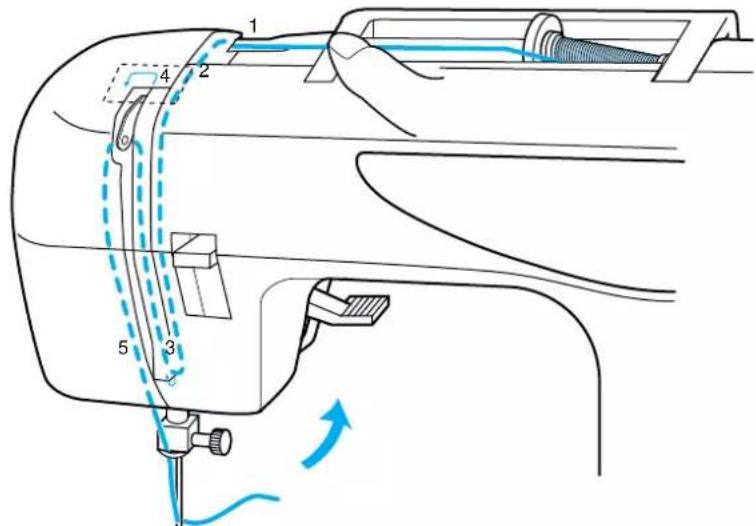
- Deliver the upper thread as shown in this diagram.
- Make sure to guide the thread through the thread take-up lever from the right to the left.
② Thread take-up lever
- Place thread behind the guide above the needle.
NOTE:
If the thread take-up lever is lowered, the upper thread can not be wrapped around the thread take-up lever. Be sure to raise the Presser Foot Lever and the thread take-up before feeding the upper thread.
Incorrectly feeding the thread may cause sewing problems.
Turn power switch to "O".
- Lower the presser foot lever.
- Turn the balance wheel toward you (counter-clockwise) to raise the needle holder to the highest position.
① Needle holder
② Needle threads lever
CAUTION
When using the needle threader, be sure the needle holder is in the highest position. Otherwise, the hook may be damaged.
- While lowering the needle thread lever, hook the thread onto the guide.
-
Pull down the needle threader lever as much as possible, then rotate the lever toward the back of the machine (away from you). Make sure that the hook passes through the eye of the needle and grabs the thread.
-
Hold the thread in front of the needle in order to make sure that the hook grabs it.
① Needle holder
② Needle threads lever
③ Guide
④ Hook holder
- While lightly holding the thread, rotate the needle threads lever toward the front of the machine (toward you). The hook will pull the thread through the needle.
⑤ Hook
⑥ Thread
- Raise the needle threader lever and pull out about 5cm (2^ ) of thread through the needle toward the back of the sewing machine.

CAUTION
The needle threads can only be used with home sewing machine needles size 75/11-100/16. Check the table on page 39 for appropriate needle and thread combinations. Note that, if you are using transparent nylon mono-filament thread, only needles in the range of 90/14-100/16 can be used.

CAUTION
The needle threads can not be used to thread the needle when you are using decorative threads or specialty needles like the twin needle and wing needle. When using those types of threads or needles, thread the eye of the needle manually. Make sure the main power switch is OFF when threading the needle manually.
Drawing Up Lower Thread
- While lightly holding the end of the upper thread, slowly turn the balance wheel to the front (counter-clockwise) once by hand to lower and then raise the needle.
- Pull on the upper thread to draw up the lower thread.
- Pull out about 10cm (4") of both threads and place them toward the back of the machine under the presser foot.
① Upper thread
Lower thread
Your machine is designed for twin needle sewing, which allows you to sew with two top threads. You can use the same color or two different colors of thread for making decorative stitches. Any of the patterns, except the buttonhole pattern, can be sewn with the twin needle. When using the Straight Stitch, the Stitch Width Dial should be set so that the needle is in the center position (between 1 and 2). However, when other patterns are used, set the Stitch Width Dial between 0 and 3. See page 23 for details on adjusting the Stitch Width Dial.
CAUTION
- Use only twin needles made for this machine (part code X57521-001). Other needles could break, resulting in damage.
- When sewing with the twin needle, be sure the Stitch Width Dial is not set above 3 since this may cause the needle to hit the needle plate and break.
- Do not sew with bent needles. The needle could break and cause injury.
- When using the twin needle, be sure to use zigzag presser foot only.
Insert in the same way a single needle is inserted (refer to page 9). The flat side of the needle should face toward the back and the rounded side should face toward you.
PLACING THE EXTRA SPOOL PIN
Place the vertical spool pin in the hole found on top of the machine near the horizontal spool pin. Place the second spool of thread onto the vertical spool pin as shown in fig. A.
TWIN NEEDLE THREADING
Each needle should be threaded separately.
- Threading the Right Needle
Follow the same instructions for single needle threading using the thread from the spool on the extra spool pin. See page 31 for more details.
- Threading the Left Needle
Thread the left needle in the same manner that the right needle was threaded, but do not pass the thread through the thread guide above the needle before passing it through the eye of the left needle as shown below in fig. B.
① Right needle thread passes through this guide.
Left needle thread passes in front of this guide.
CAUTION
The needle threads can not be used. Thread the twin needle by hand, from front to back. Using the needle threads may result in damage to the machine.
PARA INTRODUICIR LA AGUJA DOBLE
TENSION CORRECTE (Fig. C)
Thread tension will affect the quality of your stitches. It may need to be adjusted when you change fabric or thread type.
NOTE:
It is recommended that a test sample be made on a fabric scrap before sewing on your project.
Possible misadjustments and their results. Upper tension is too tight.(Fig.A)
Locks appear on the surface of the fabric.
Decrease the tension by turning the Upper Tension Control Dial to a lower number.
Upper tension is too loose. (Fig.B)
Locks appear on the reverse side of the fabric.
Increase the tension by turning the Upper Tension Control Dial to a higher number.
CORRECT TENSION (Fig.C)
Correct tension is important since too much or too little tension will weaken your seams or cause puckers on your fabric.
① Surface
② Reverse side
③ Upper thread
Lower thread
⑤ Locks appear on surface of fabric
⑥ Locks appear on reverse side of fabric
TENSION CORRECTA (Fig. C)
| Fabric | Thread | Size of needle | ||
| Type | Size | |||
| Medium weight fabric | Broadcloth | Cotton, Polyester | 60 - 80 | 75/11 - 90/14 |
| Taffeta | Synthetic mercerized | 60 - 80 | ||
| Flannel, Gabardine | Polyester | 50 - 80 | ||
| Lightweight fabric | Lawn, Batiste | Cotton, Polyester | 60 - 80 | 65/9 - 75/11 |
| Georgette | Synthetic mercerized | 60 - 80 | ||
| Challis, Satin | Polyester | 50 - 80 | ||
| Heavyweight fabric | Denim | Cotton, Polyester | 30 - 50 | 90/14 - 100/16 |
| Corduroy | Synthetic mercerized | 50 | ||
| Tweed | Polyester | 50 | ||
| Stretch fabric | Jersey | Polyester | 50 - 60 | Ball point needle (golden colored)75/11 - 90/14 |
| Tricot | ||||
| For top stitchingButtonhole twist | Synthetic mercerized | 30 | 90/14 - 100/16 | |
| Cordonnet | 30 | |||
NOTE:
- For transparent nylon thread, always use needle 90/14 - 100/16.
- The same thread is usually used for the bobbin thread and upper threading.
CAUTION
Be sure to follow the needle, thread, and fabric combinations listed in the table. Using an improper combination, especially a heavyweight fabric (i.e., denim) with a small needle (i.e., 65/9 - 75/11), may cause the needle to bend or break, and lead to injury. Also, the seam may be uneven, the fabric may pucker, or the machine may skip stitches.
COMBINAISONS TISSU/FIL/AIGUILLE
- To avoid injury, pay special attention to the needle while the machine is in operation. Keep your hands away from moving parts while the machine is in operation.
- Do not stretch or pull the fabric during sewing. Doing so may lead to injury.
- Do not use bent or broken needles. Doing so may lead to injury.
Take care that the needle does not strike basting pins or other objects during sewing. Otherwise, the needle may break and cause injury. - If stitches become bunched, lengthen the stitch length setting before continuing sewing. Otherwise, the needle may break and cause injury.
Always use the correct pressor foot. If the wrong pressor foot is used, the needle may strike the pressor foot and bend or break, resulting in injury. - When you turn the balance wheel by hand, always turn it to the front (counter-clockwise). Turning it the other way may cause the thread to tangle, and result in damage to the needle or fabric or injury.
A LIRE AVANT DE COMMENCER À COUDRE
ATTENTION
| Pattern Stitch Length | Stitch Width | |
| (Straight Stitch) 1-4 | 5 | |
| (Triple Stretch Stitch) | SS |
STARTING SEWING
- Turn the Pattern Selection Dial to show your desired stitch in the Pattern Indication Window. Setting the Pattern Selection Dial to Straight Stitch or Triple Stretch Stitch is required.
- Raise the needle to its highest position and lift the presser foot lever.
- Pull the upper thread toward the back of the presser foot.
- Place the fabric under the presser foot and position the needle 1cm (3 / 8^ ) from the edge of the fabric.
- Lower the presser foot.
- To backtrack, push down the Reverse Sewing Lever as far as possible, then step down on the foot controller to start reverse sewing.
-
Release the Reverse Sewing Lever and start sewing in the forward direction by applying pressure to the foot controller.
-
Reverse sewing is used for locking the end of seams and where reinforcement is needed.
CAUTION
Be sure the needle does not strike a basting pin, or any other objects, during sewing. The thread could tangle or the needle could break, causing injury.
Point droit
- Stop the machine at the point where you wish to change direction with the needle still in the fabric.
- Raise the presser foot and turn the fabric to line up its new direction using the needle as a turning point.
- Lower the presser foot and start sewing in the new direction.
FINISHING SEWING
Reverse stitching is used to lock the threads at the end of the seam or wherever reinforcement is needed.
- Stitch to the end of the seam and stop.
- Push the Reverse Sewing Lever and stitch backwards for 1 cm (3/8") from the end of the fabric.
CAMBIO DE SENTIDO DE COSTURA
REMOVING THE MATERIAL FROM THE MACHINE
- Stop the machine.
Raise the needle to its highest position and make sure that the thread take-up lever is also in its highest position.
-
Lift the presser foot and pull the fabric out gently to the left side.
-
Cut both threads with the thread cutter located on the left side of the machine.
① Thread cutter
- To prepare the machine for the next seam, pull about 10cm (4") of thread through the toes of the presser foot toward the back of the machine.
TOP STITCHING AND STRETCH MATERIALS
Straight Stitch is used for top stitching and sewing lightweight fabrics.
Triple Stretch Stitch is used for stretch fabrics.
PARA RETIRAR EL TEJIDO DE LA MAQUINA
- Pare laquina.
| Pattern Stitch Length | Stitch Width | |
| (Zigzag Stitch) F-4 0-5 |
ZIGZAG STITCH
Select the Zigzag Stitch using the Pattern Selection Dial. Then, select the Stitch Length and the Stitch Width.
It is recommended to sew using the Straight Stitch at the beginning and end of the Zigzag Stitches.
(This acts as a reinforcement stitch.)
SATIN STITCH
When the Zigzag Stitch length is set in the "F" range, it produces a Satin Stitch (a dense Zigzag Stitch). The Satin Stitch can be used for making decorative stitches. Select the Zigzag Stitch, then set the stitch length in the "F" range and set the desired stitch width.
When sewing a satin stitch, use a slightly loose upper thread tension to produce more beautiful stitches.
- If you use the Cler-view Foot, it is easy to see the fabric and to produce more beautiful stitches.
Puntadas zigzag
| Pattern Stitch Length | Stitch Width | |
| (Blind Hem Stitch) F-2 | 3-5 | |
| (Stretch Blind Hem Stitch) | F-1.5 |
The Blind Hem Stitch is used to finish the edge of a project like the hem of a pair of pants without the stitch showing. Use the Blind Hem Stitch for any non-stretch fabrics and the Stretch Blind Hem Stitch for stretch fabrics.
- Both the threads should be the same color as the fabric.
- Fold back the fabric to the desired location of the hem as shown in fig. A. Then, fold the edge of the fabric as in fig. B. Leave a 6 mm (15/64") overlap at the edge.
- Set the Pattern Selection Dial to Blind Hem Stitch or Stretch Blind Hem Stitch and set the stitch length and width.
- Sew on the fold as in fig. C.
- When the fabric is unfolded you will have a Blind Stitch hem as shown in fig. D.
① Right side of fabric
② Wrong side of fabric
NOTE:
The Stretch Blind Hem Stitch is useful for stretch fabrics.
Surjer
Shell Tuck Stitching
| Pattern Stitch Length Stitch Width | |
| (Shell Tuck Stitch) F-3 3-5 |
The Shell Tuck Stitch can be used to sew a picot (lace like) edge on a lightweight fabric.
- Set the Pattern Selection Dial to Shell Tuck Stitch.
- Sew the fabric on the bias, placing it under the presser foot so that the straight stitches are sewn on the seamline and the zigzag stitches are sewn slightly over the folded edge.
- This stitch requires a tighter thread tension than normal.
- Sew at a slow speed.
Plissé
| Pattern Stitch Length | Stitch Width | |
| (Elastic Stitch) F-2.5 3-5 |
The Elastic Stitch can be used for 3 functions: mending, sewing elastic or joining fabric. Each is explained below. Set the Pattern Selection Dial to Elastic Stitch.
MENDING
- Place the reinforcement fabric under area to be mended.
- Following the line of the tear, sew using the Elastic Stitch as illustrated in fig. A.
SEWING ELASTIC
- Place the elastic on the fabric.
- As you sew, stretch the elastic both in the front and behind the presser foot as shown in fig.B.
JOINING FABRIC
The Elastic Stitch can be used to join two pieces of fabric together and is very effective when sewing knitted fabrics. When nylon thread is used, the stitch will not be visible.
- Place the edge of the two pieces of fabric together and center them under the presser foot.
- Sew them together using the Elastic Stitch taking care to keep the two fabric edges close together as shown in fig. C.
Puntada elastica
Double Action Stitching
| Pattern Stitch Length | Stitch Width | |
| (S (Double Action Stitch) | ||
| (S (Bridging Stitch) F-3 3-5 | ||
| (S (Rampart Stitch) | ||
| (S (Decorative hem Stitch) | SS | 3-5 |
These stitches are used for joining two pieces of fabric, for example, when making patchwork.
Set the Pattern Selection Dial to Double Action Stitch, Bridging Stitch, etc.
| Pattern Stitch Length | Stitch Width | |
| (Scallop Stitch) F-1.5 3-5 |
This machine automatically produces a Scallop Stitch which may be used as a decorative edging.
- Set the Pattern Selection Dial to Scallop Stitch.
- Sew the Scallop Stitch along the edge of the material
- If desired, trim around the scallop with scissors to create a scalloped edge. Be careful not to cut the thread.
- If you use the Clear-view Foot, it is easy to see the fabric and to produce more beautiful stitches.
Feston
Decorative Stitching
| Pattern Stitch Length | Stitch Width | |
| (Bead Stitch)* | 3-5 | |
| (Arrowhead Stitch)* | ||
| (Parallelogram Stitch)* | ||
| (Triangle Stitch)* F-1 | ||
| (Lighting Stitch) | ||
| (Square stitch) 5 | ||
| (Decorative Stitch) | ||
| (Decorative Stitch) 3-5 | SS | |
| (Decorative Stitch) | 5 |
These stitches can be used for making decorative top stitching and for smocking.
Set the Pattern Selection Dial to Triangle Stitch, Bead Stitch, etc.
- If you use the Satin Stitch Foot, it is easy to see the fabric and to produce more beautiful stitches.
Points décorats
| Pattern Stitch Length | Stitch Width | |
| (Fagoting Stitch) | [SS] | 3-5 |
| (Link stitch) |
These stitches are used to join two pieces of fabric while leaving a space between their edges.
- Fold over the edges of the two pieces of fabric for the hem and baste the edges to a thin piece of paper leaving a small space between them.
- Set the Pattern Selection Dial to Fagoting Stitch or Link stitch.
- Stitch along the edge, pulling both threads slightly when beginning to sew.
- Use thicker than normal threads for sewing.
- After sewing, remove the basting and the paper. Finish by tying knots on the reverse side at the beginning and the end of the seams.
① First needle drop
Patchwork (Assemblage)
| Pattern Stitch Length | th Stitch Width | |
| (Elastic Shell Tuck Stitch) | F-3 | 3-5 |
| (Elastic Overlock Stitch)* | SS | |
| (Elastic Overlock Stitch) | ||
| (Comb Stitch) |
These stitches are used to join together seams and finish them in one operation. The Elastic Overlock Stitches are useful when sewing stretch materials.
- Set the Pattern Selection Dial to Comb Stitch, either Elastic Overlock Stitch, or Elastic Shell Tuck Stitch.
- Position the fabric under the presser foot so that the seamline (or arrowhead point) is approximately 3mm (1 / 8^ ) to the left of the center of the presser foot. This stitch works best with a seam allowance of approximately 5mm (3 / 16^ ) as this allows the right (zigzag) side of the stitch to overlock the cut edge of the fabric as shown in fig. A.
- If the seam allowance is wider than the stitch pattern, trim away any excess fabric after stitching.
A finished Elastic Overlock Stitch is shown in fig. B.
- When sewing the Elastic Overlock Stitch, position the fabric so that its edge is on the left of the needle. (See fig.C)
| Pattern Stitch Length | Stitch Width | |
| (Feather Stitch) | SS | 3-5 |
Use the Feather Stitch as a decorative top stitch or when hemming blankets, tablecloths or draperies or when embroidering.
- Set the Pattern Selection Dial to Feather Stitch.
- Place the fabric right side up and sew 1 cm (3/8") from the edge of the fabric.
- Trim close to the stitching.
This stitch will prevent the fabric from unravelling.
Triple Zigzag Stretch Stitching
| Pattern Stitch Length | Stitch Width | |
| ( Triple Zigzag Stretch Stitch) | [SS] | 3-5 |
This stitch can be used to sew heavyweight stretch fabrics wherever a Zigzag Stitch could be used. The Triple Zigzag Stretch Stitch can also be used as a decorative top stitch.
Set the Pattern Selection Dial to Triple Zigzag Stretch Stitch.
Punta pluma
Making a Buttonhole (For 1-step BH Type)
| Pattern Stitch Length Stitch Width Foot | ||
| F-1.5 3-5 Buttonhole Foot | ||
NOTE:
- It is recommended to practice making a buttonhole on a scrap piece of fabric before attempting it on the actual garment.
- When making buttonholes on soft fabrics, place a stabilizer material on the underside of the fabric.
One-step buttonhole-making is a simple process that provides reliable results.
MAKING A BUTTONHOLE
- Using tailor's chalk, mark the position of the buttonhole on the fabric.
- Set the Pattern Selection Dial to Buttonhole.
- Attach the buttonhole foot, pull open the button holder and insert a button. (See fig. B)
- The size of the buttonhole is determined by the button inserted into the button holder.
- Align the red line on the presser foot with the mark on the fabric, then lower the Presser Foot Lever. Be sure to pass the thread under the presser foot and pull it toward you. (See fig. C)
NOTE:
Do not lower the Presser Foot Lever while pushing in the area of the presser foot marked ④ in fig.C. Otherwise the buttonhole will not be sewn with the correct size.
① Do not close this gap.(Fig.A)
Align the lines on the presser foot.
- Pull down the buttonhole lever to its lowest position, then lightly push it toward the back of the machine. (See fig. D)
③ Button holder
④ Mark on fabric
⑤ Line on presser foot
- Hold the upper thread and step down on the foot controller to begin sewing.
CAUTION
Pulling the thread too strongly may bend or break the needle, and lead to injury.
- Stitches 1, 2, 3 and 4 are sewn, then stop the machine.
Odd-shaped buttons that do not fit into the button holder plate
Add the button diameter to its thickness, then set the buttonhole presser foot scale to this measurement. The distance in the scale between two lines of the same length is 0.5cm (3 / 16^ )
Example:
For a button with a diameter of 1.5cm (9 / 16^ ) and a thickness of 1cm(3 / 8^ ) the scale should be set at 2.5cm(1^ )
① Thickness [1 cm (3/8")]
② Diameter[1.5cm(9/16')]
③ Button holder plate
④ Scale
⑤ Diameter ^+ thickness [2.5 cm (1")]
⑥ 0.5cm(3/16")
- To secure the stitching, turn the material 90 degrees counterclockwise and sew Straight Stitches to the end of the front bar tack of the buttonhole.
- Remove the material from the machine. It is recommended that pins be placed across both ends of the buttonhole as protection against cutting the stitches.
- Cut an opening in the middle of the buttonhole with a seam ripper tool. Be careful not to cut through any stitches.
CAUTION
When using the seam ripper to open the buttonhole, do not put your hand or finger in the path of the ripper. The ripper may slip and cause injury.
PARACOMPLETARLASPUNTADASYCORTAREOLJAL
Buttonhole Fine Adjustment
If the stitching on the two sides of the buttonhole do not appear uniform, the following adjustments can be made.
- Set the Stitch Length Dial at "F-1.5" and stitch the right side of the buttonhole on a scrap of fabric while observing how the material is fed.
- If the right side of the buttonhole is too coarse or fine, adjust the feeding of the material with the Stitch Length Dial.
① Right row
② 1
③ Shorter
④ Longer
⑤ Adjusted stitch
- After obtaining a satisfactory feeding on the right side, stitch the left side of the buttonhole and observe the feeding.
- If the left side is too coarse or fine compared to the right side, adjust the buttonhole fine adjustment screw as described below.
If the left side is too coarse, turn the screw with the enclosed large screwdriver in the - direction. If the left side is too fine, turn the screw with the enclosed large screwdriver in the + direction.
This adjustment allows both sides of the buttonhole to appear uniform.
⑥ ① Stitch length dial
⑦ Buttonhole fine adjusting screw
⑥ Right row
Adjusted stitch
Equilibrage des boutonnieres
When the buttonhole is not sewn correctly:
There are two different procedures for correcting buttonhole sewing, depending on which part of the buttonhole is not sewn correctly.
Correction Procedure 1 (See fig. A)
- Raise the Presser Foot Lever, then remove the fabric, upper thread and lower thread.
- Pull the buttonhole lever slightly toward you.
- Sew about 10 stitches with no fabric, upper thread, or lower thread in the machine.
- Place the fabric under the presser foot, and set the upper and lower thread again, then lightly push the buttonhole lever toward the back of the machine and sew the buttonhole from the beginning.
Correction Procedure 2 (See fig. B)
- Raise the Presser Foot Lever, then remove the fabric and all of the sewn thread.
- Place the fabric under the presser foot again, then lightly push the buttonhole lever toward the back of the machine and sew the buttonhole from the beginning.
NOTE:
When you are finished sewing all buttonholes be sure to raise the buttonhole lever.
If the buttonhole lever is pushed toward the back of the machine while sewing any stitch other than a buttonhole, the buttonhole feed will be used and the stitch will not be sewn correctly.
If the buttonhole lever is accidentally pushed when you are sewing a stitch other than a buttonhole, remove the fabric and thread from the machine, raise the buttonhole lever, and sew about 20 stitches. Then sew the intended stitch.
Ojales mal cosidos:
| Pattern Stitch Length Stitch Width Foot | ||
| $ | 0 Less than 5 | Zigzag Presser Foot |
- Measure the distance between the holes and set the appropriate stitch width using the Stitch Width Dial. For example, if the distance between the holes is 1.5mm set the stitch width to 1.5.
- Change the foot to the Zigzag presser foot.
- Remove the power supply plug from the outlet. And place the darning plate on the needle plate. Connect the power supply plug into a wall outlet.
- Place a button between the foot and the fabric and make sure that the needle enters the holes without hitting the button. If it hits see Step 1.
- At a slow speed, sew approximately 10 stitches.
- Remove the material from the machine. Cut the upper and lower threads and tie both threads at the back of the material.
CAUTION
Make sure the needle does not strike the button during sewing. The needle may break, leading to injury.
Costura de botones
| Modelo de Larga rogo de Ancho de楞 dentada楞 dentada | Prensatelas | |
| § | 0 Menos | de 5 |
| Pattern Stitch Length Stitch Width Foot | ||
| 2-3 2.5 (center) Zipper Foot | ||
The zipper foot is used to sew various types of zippers and can easily be positioned to the right or left side of the needle. When sewing the right side of the zipper, attach the shank to the left pin of the zipper foot. When sewing the left side of the zipper, attach the shank to the right pin of the zipper foot. (See fig. A)
- Set the Pattern Selection Dial to Straight Stitch. Set the Stitch Length between 2 and 3. Set the Stitch Width 2.5 (center).
- Lower the presser foot lever and fix either the left or right pin of the zipper foot onto the shank.
- Fold the edge of the material 2 cm (3/4") and place the zipper under the folded portion.
- Lower the needle into the notch located either on the left or right side of the zipper foot.

CAUTION
Turn the balance wheel to make sure the needle does not strike the presser foot. If another stitch is selected, the needle will strike the presser foot, causing the needle to break, possibly leading to injury.
- Sew from the bottom of the zipper toward the top on both sides. The needle should be positioned on the zipper side of the foot for best results. (See fig. B)
- To sew the opposite side of the zipper, release the foot by pressing the button located at the back of the presser foot, install the zipper foot on the other side of the zipper and continue sewing using the other side notch.
① Zipper foot
Right pin for sewing the left side of the zipper
Left pin for sewing the right side of the zipper

CAUTION
Make sure the needle does not strike the zipper during sewing. If the needle strikes the zipper, the needle may break, leading to injury.
Gathering
| Pattern Stitch Length | |
| 4 | |
- Set the Pattern Selection Dial to Straight Stitch.
- Loosen the tension of the upper thread so that the lower thread lies on the underside of the material.
- Sew a single row or multiple rows of Straight Stitch(es).
- Pull the lower thread(s) to gather the material.
Insertion de fermetre a glissiere
- Remove the power supply plug from the outlet. And place the darning plate on the needle plate as shown in fig.A. Connect the power supply plug into a wall outlet.
- Set the Pattern Selection Dial to Straight Stitch.
- Place the portion to be darned under the presser foot together with a fabric for reinforcement.
- Lower the presser foot.
- Begin sewing alternating between gently drawing the work away from you and pulling it toward you.
- Repeat this motion until the portion to be darned is filled with parallel lines of stitching.(See fig.B.)
Reprisage
| Pattern Stitch Length | |
| ∅ | F-2 |
An applique is created by cutting a contrasting piece of fabric into a shape to be used as a decoration on a garment or project.
- Baste the cut design to the fabric in the location where desired.
- Carefully sew around the edge of the cutout design with a Zigzag Stitch in the fine stitch length.
- Cut away the surplus fabric outside of the stitching.
-
Remove the basting, if necessary.
-
If you use the Clear-view Foot, it is easy to see the fabric and to produce more beautiful stitches.
NOTE:
Make reinforcing Straight Stitches at the beginning and the end of the stitching to secure.
CAUTION
Be careful that the needle does not strike a basting pin during sewing. Striking a pin can cause the needle to break, resulting in injury.
Aplicaciones
| Monogramming and Embroidering |
| Pattern Stitch Length Stitch Width Foot | ||
| § | Any Any None | |
PREPARING FOR MONOGRAMMING AND EMBROIDERING
- Remove the power supply plug from the outlet. And place the darning plate on the needle plate as shown in fig. A. Connect the power supply plug into a wall outlet.
- Set the Pattern Selection Dial to the appropriate Zigzag Stitch setting.
- Draw the lettering (for monogramming) or design (for embro- dering) on the surface of the fabric.
- Stretch the fabric between embroidery hoops as firmly as possible with the underside of the fabric on the bottom of the inside hoop.
- Place the work under the needle and lower the presser bar with the foot removed.
- Pull the lower thread up through the work at the starting position by turning the balance wheel and make a few holding stitches.
- Grip the hoop with the thumb and forefingers of both hands while pressing the fabric with the middle and third fingers and supporting the outside of the hoop with your smaller fingers.
MONOGRAMMING
- Sew, moving the hoop slowly along the lettering at a constant speed.
- Secure with a few straight stitches at the end of the last letter.
EMBROIDERING
- Stitch the outline of the design by moving the embroidery hoop.
- Fill in the design alternating from the outline of the design to the inside and from the inside to the edge of the outline until the design is completely filled in. Keep the stitching close together.
NOTE:
A long stitch is made by moving the embroidery hoop rapidly and a short stitch is made by moving it slowly.
3. Secure with a few Straight Stitches at the end of the design.
| Pattern Stitch Length | Stitch Width | |
| (Straight Stitch) | 1-4 | 2-3 |
| (Zigzag Stitch) 0-5 |
This foot is very useful for sewing materials such as vinyl cloth, synthetic leather, thin leather, etc. These materials are difficult to feed when sewing. The walking foot prevents such materials from crumpling, slipping or sticking between presser foot and material due to even feeding of upper and lower materials.
NOTE:
Use foot only for straight sewing and zigzag stitching. Do not use other patterns.
- Remove the power supply plug from the outlet.
- Raise the needle and the presser foot.
- Loosen the presser foot screw to remove the presser foot holder. (See fig. A)
- Attach the forked section of the connecting lever to the needle clamp, install the walking foot to the presser bar. (See fig B)
- Lower the presser foot lever and then tighten the accessory presser bar holder fixing screw. (See fig.C)
① Forked part of operation lever
② Pressbar holder
Use a screwdriver

CAUTION
- Use the screwdriver to tighten the screw securely. If the screw is loose, the needle may strike the presser foot and cause injury.
- Be sure to turn the balance wheel toward the front of the machine to check that the needle does not strike the presser foot. If the needle strikes the presser foot, injury may result.
- Be careful not to touch the needle during this time, otherwise injury may result.
CAUTION
When sewing with the walking foot, sew at medium to low speeds.
ACCESSIONS EN OPTION
Using the Spring-action Quilting Foot
| Pattern Stitch Length | Stitch Width | |
| Any 2.5 (center) |
The Spring-action Quilting Foot is useful for darning and freemotion machine quilting.
- Remove the power supply plug from the outlet.
- Raise the needle and the presser foot.
- Loosen the presser foot screw to remove the presser foot holder. (See fig.A)
- Attach the quilting foot, making sure that part indicated by in the illustration is above the needle clamp screw, then lower the Presser Foot Lever and tighten the presser foot screw.
- Be sure that the needle clamp screw is firmly tightened. (See fig.B)
① Use a screwdriver.
② Presser Foot Screw
③ Needle Clamp Screw

CAUTION
- Be careful not to touch the needle during this time, otherwise injury may result.
- Use the screwdriver to tighten the presser foot holder screw securely. If the screw is loose, the needle may strike the presser foot and cause injury.
-
Be sure to turn the balance wheel toward the front of the machine to check that the needle does not strike the presser foot. If the needle strikes the presser foot, injury may result.
-
Place the darning plate on the needle plate as shown in fig. C. Connect the power supply plug into a wall outlet.
- Set the Pattern Selection Dial to Straight Stitch.
-
Before starting to sew, draw the quilting design on the fabric.
-
Use both hands to keep the fabric firmly stretched and move the fabric to sew over the drawn design. (See fig. D)
Quilting design (Line)
- The stitch length depends on how quickly the fabric is moved and on the machine's sewing speed. Sew while moving the fabric slowly.
ACCESSIONS EN OPTION
Using the 1/4-Inch Quilting Foot
| Pattern Stitch Length | th Stitch Width | |
| (Straight Stitch) 2-2.5 2.5 | (center) |
The 1/4-Inch Quilting Foot is used to sew fixed seam allowance 6.5 mm (1/4") when piecing together a quilt. (See fig.A)
-
Set the Pattern Selection Dial to Straight Stitch. Set the Stitch Length between 2 and 2.5. Set the Stitch Width 2.5 (center).
-
Change the foot to the 1/4-Inch Quilting Foot.
① Seam allowance (1/4", 6.5mm)
-
Position the presser foot over the fabric and sew as shown in fig. B and C.
-
Achieve leaving an accurate seam allowance. (See fig.B)
② Beginning of stitching.
③ Align this mark with edge of fabric.
④ End of stitching
Align this mark with edge of fabric.
- Quickly stitch together a quilt. (See fig.C)
Top of fabric.
⑦ Seam (1/8", 3.2mm)
ACCESSIONS EN OPTION
Changing the Light Bulb

CAUTION
- Turn off the main power switch and unplug the machine before changing the light bulb. If the main power switch is on when the light bulb is changed, an electric shock may result. If the machine is on and foot controller is stepped on, injuries may result.
-
To avoid burns, give the light bulb time to cool before changing it.
-
Remove the power supply plug from the outlet.
- Loosen the screw on the reverse side of sewing head as shown in fig.A.
-
Remove the light cover from the machine as illustrated in fig. A
-
Replace the sewing light bulb. (See fig. B)
① Bulb
1 Loosen
2 Tighten
- Reattach the light cover and fasten the screw as shown in fig. C.
Be sure to unplug the machine before cleaning it. Otherwise, electric shock or injury may result.
- Remove the power supply plug from the outlet.
- Raise the needle and the presser foot.
- Loosen the presser foot screw and the needle clamp screw to remove the presser foot holder and the needle. (See fig. A)
- Usibg a coin, remove the screws.
The tab at the front of the needle plate is hooked into the machine.
Slightly raise the back of the needle plate 1, and slide it back to remove the tab 2.
Then lift the plate to remove it 3.
① Use a coin or screwdriver.
② Tab
- Turn the balance wheel toward you until the notch of shuttle aligns with the shelf of race as shown in the illustration.
③ Notch of shuttle race
④ Shelf of race

CAUTION
Be sure to turn the balance wheel towards the front of the machine. Turning the balance wheel in the other direction may damage the machine.
- Remove the race. (See fig. C)
- Clean out lint and dust.
- Use soft fabric to clean the race. DONOT OIL the race or shuttle. (See fig. D)
⑤ Race
⑥ Shuttle
- DO NOT OIL.

CAUTION
- Do not use a damaged race or shuttle. Otherwise, the thread may tangle and cause a poor finish, or the needle may break. You can get the proper parts from your authorized dealer.
-
Be sure to insert the race in the correct position. Otherwise, the needle may break.
-
Assemble the race first then the needle plate.
When installing the race, be sure that the notch of shuttle is in the same position that it was when the shuttle hook was removed and that the shelf on the race aligns with the spring. Install the needle plate by sliding it to the left (the reverse of its removal procedure).
Notch of shuttle
⑧ Shelf
Spring
Nettoyage
ATTENTION
Whenever sewing difficulties are encountered, review the section in this instruction manual that details the operation you are performing to make sure you are correctly using the machine. If the problem continues, the following check list may help you to improve the operation. If you still have difficulties, contact your nearest authorized service center.
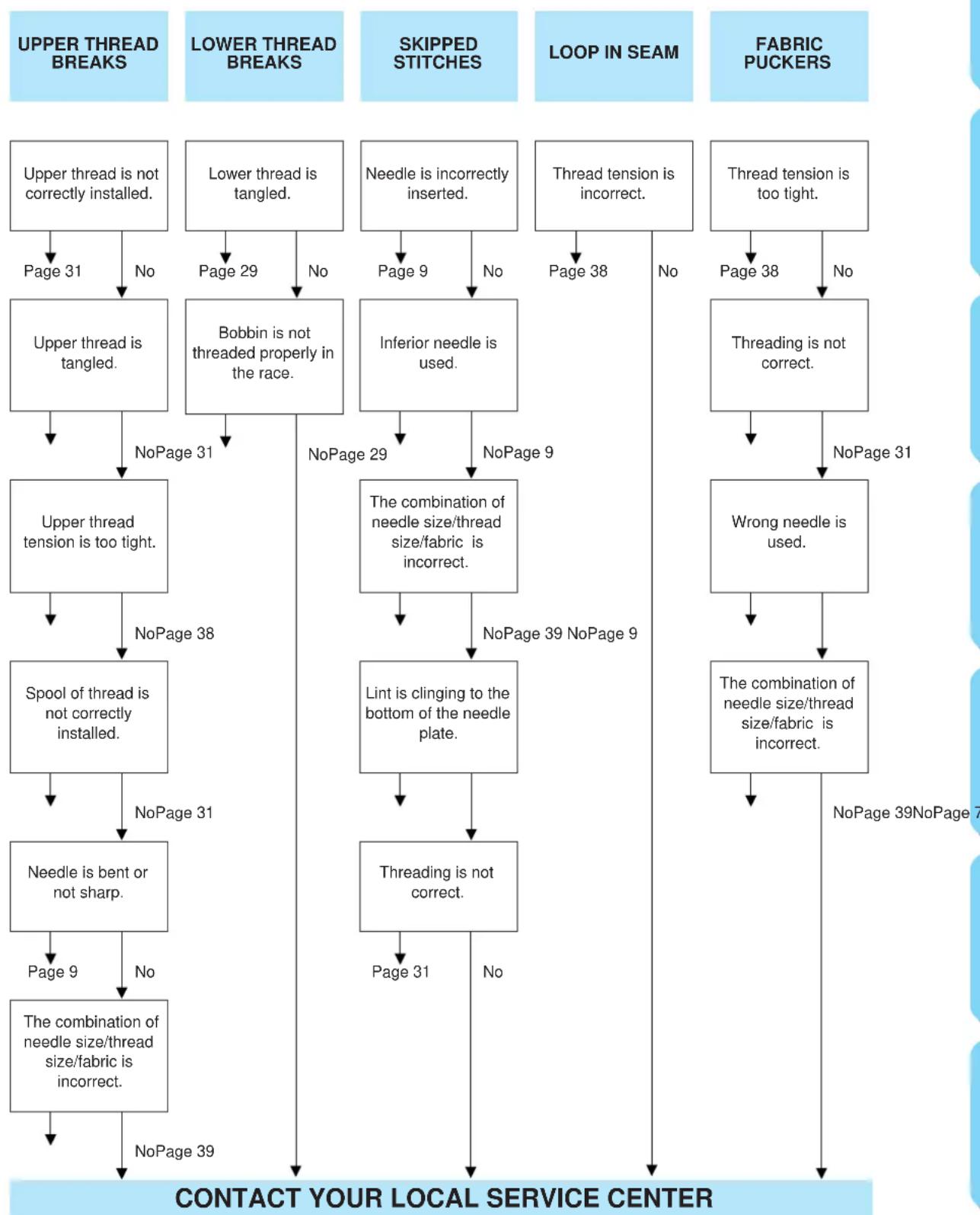
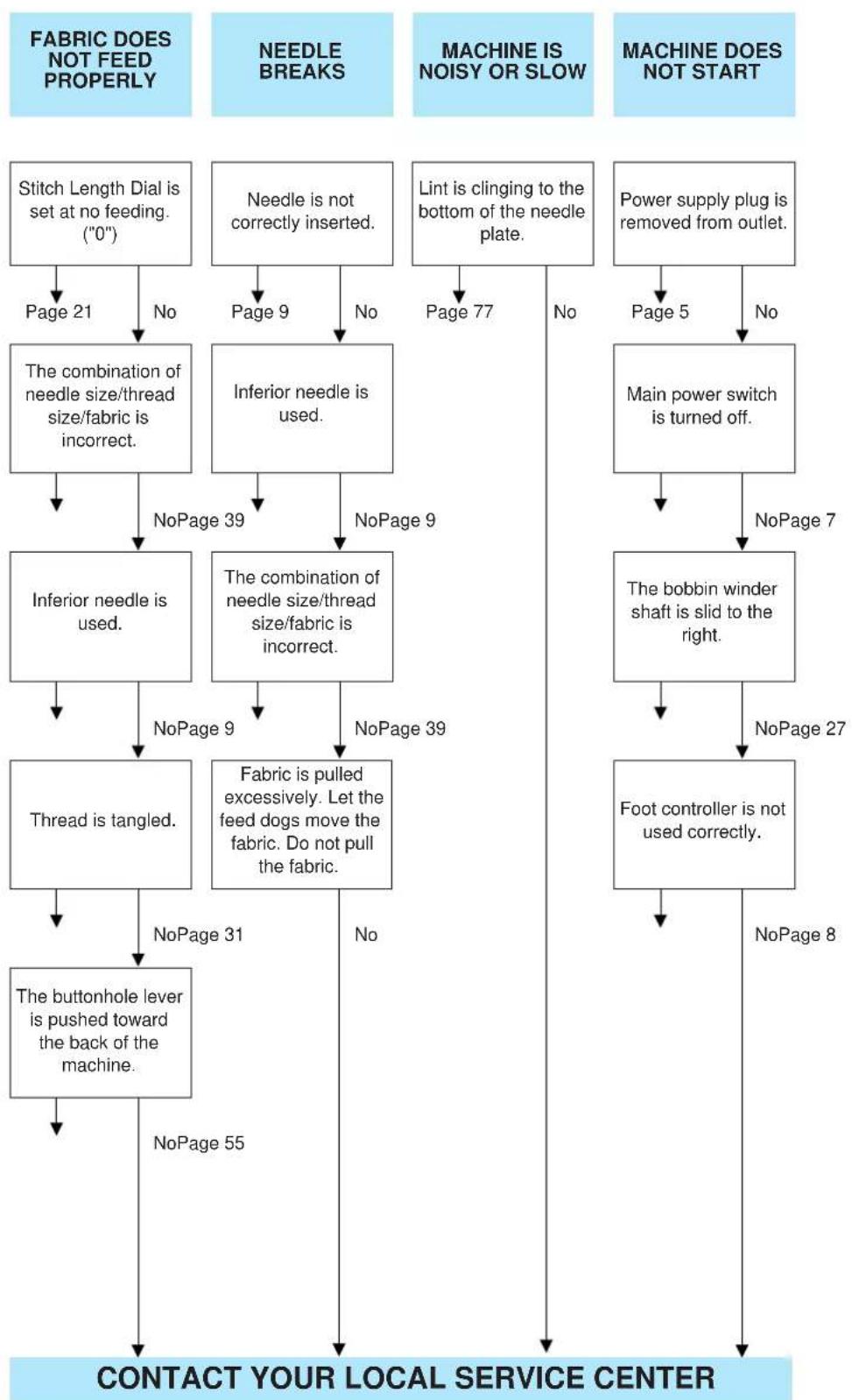
LISTE DE VERIFICATION EN CAS DE DÉFAILLANCES
Model XL-6452, XL-6562, XR-65
Model XR-46,XR-52
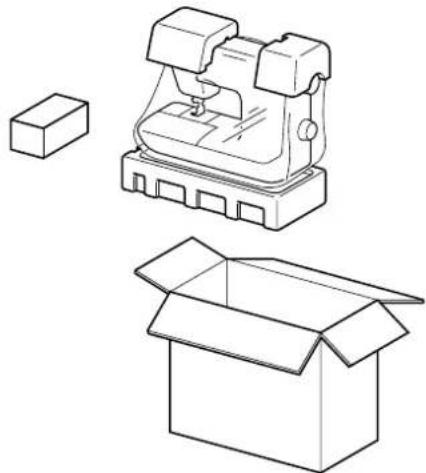
Emballage de la machine
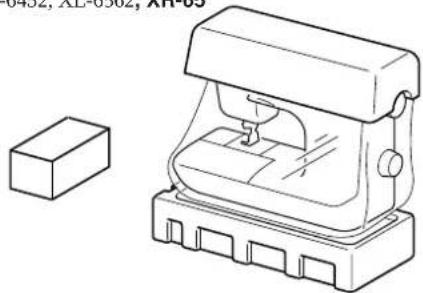
Repacking the Machine
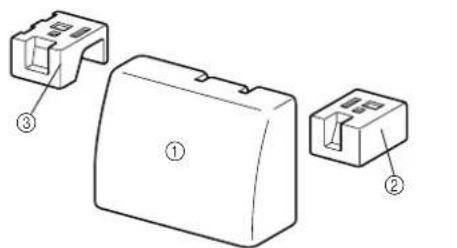
Keep the carton and packing materials for future use. It may become necessary to reship the machine. Improper packing or improper packing material could result in damage during shipping. Instructions for repacking the machine are illustrated.
- Hard case (①, ②, ③) is included only with Model XR-46.
IMPORTANT
This packing material is designed to prevent damage in transit. Save this packing material in the event it is needed to transport this machine.
Embalaje de laquina
A
Accessories. 3
Appliques 66
Arrowhead Stitch. 51
B
Bead Stitch. 51
Blind Hem Stitch. 46
Bobbin Winder. 26
Bridging Stitch. 49
Buttonhole 55
Buttonhole Fine Adjustment Screw 59
Buttonhole Lever 55
Button Sewing . 62
C Changing the Light Bulb. 75 Changing the Presser Foot 11 Checking the Needle.. 9 Cleaning . 77 Clear-view Foot 3,45,50,51,66 Comb Stitch. 53 Connecting Plugs 5
D
Darning. .65
Decorative Hem Stitch 49
Decorative Stitch 51
Double Action Stitch 49
Drawing Up Lower Thread 35
E
Elastic Overlock Stitch 53
Elastic Shell Tuck Stitch 53
Elastic Stitch. 48
Embroidering. 67
Fabric/Thread/Needle Combinations 39
Fagoting Stitch .52
Feather Stitch. 54
Flat bed attachment with accessory compartment..12,25
Foot Controller .8
Foot Controller Jack .5
Free-arm Style 25
G
Gathering 63
H
Help for Vertical Cone Drill 97
LightningStitch. 51
LinkStitch. .52
Lower Threading 29
M
Main Power/Sewing Light Switch 7
Monogramming 67
Page
N
Needle
Inspection 9
Replacement 9
Needle Threader 33
Overedge Stitching 53
P
Parallelogram Stitch 51
Patchwork 52
Pattern Indication Window 13
Pattern Selection Dial. 13
Performance Check List. 79
Presser Foot Lever.. 31
Principal parts 1
Race 77
Rampart Stitch 49
Repacking the Machine. 85
Reverse Sewing Lever 24
Scallop Stitch 50
Sewing Ligh Light Bulb Replacement .75 Switch. 7
Shell Tuck Stitch 47
Shuttle .77
Spool Pin and Spool Cap 26,31
Springaction Quilting Foot.. 3,71
Square Stitch. 51
Stitch Length Dial 13,21
Stitch Width Dial 23
Straight Stitch 42,63,65
Stretch Blind Hem Stitch 46
T
Thread Tension 38
Triangle Stitch .51
Triple Stretch Stitch. 42
Triple Zigzag Stretch Stitch 54
Troubleshooting 79
Twin Needle Sewing 36
U Upper Tension Control Dial. 38
Upper Threading 31
Using Needle Threader 33
W
Walking Foot 3,69
Winding the Bobbin 26
Z
Zigzag Presser Foot 3,11
Zigzag Stitch 45,62,66,67
Zipper Foot 3,63
Zipper Insertion 63
Page
A
Accessoires 4
Aiguille
Patchwork (Assemblage) 52
Pedale dur rheostat 8
Pedale 8
Pied quilting 1/4" 4,74
Pied transparent 4,45,50,51,66