ManualGo.com
8365W - Garage door LiftMaster - Free user manual and instructions
Find the device manual for free 8365W LiftMaster in PDF.



| Technical Features | Chain drive, 1/2 HP power, compatible with garage door safety systems. |
|---|---|
| Usage | Designed for residential garage doors, easy to install and use with remote control. |
| Maintenance and Repair | Regular inspection of cables and chains, lubrication recommended every 6 months. |
| Safety | Safety system with automatic reversal in case of obstacle, integrated LED lighting. |
| General Information | 5-year warranty, compatible with mobile apps for remote control. |
Frequently Asked Questions - 8365W LiftMaster
Download the instructions for your Garage door in PDF format for free! Find your manual 8365W - LiftMaster and take your electronic device back in hand. On this page are published all the documents necessary for the use of your device. 8365W by LiftMaster.
USER MANUAL 8365W LiftMaster
Please read this manual and the safety materials carefully!
connected and properly aligned.
Periodic checks of the garage door opener are required to ensure safe operation.
This garage door opener is ONLY compatible with myQ
DO NOT install on a one-piece door if using devices or features providing unattended close. Unattended devices and features are to be used ONLY with sectional doors.
Serial Number Write down the following information for future reference: myQ
Serial Number:Serial Number myQ
Serial NumberProduct Serial Number:Date of Purchase:
Safety Symbol and Signal Word Review This garage door opener has been designed and tested to offer safe service provided it is installed, operated, maintained and tested in strict accordance with the instructions and warnings contained in this manual. When you see these Safety Symbols and Signal Words on the following pages, they will alert you to the possibility of serious injury or death if you do not comply with the warnings that accompany them. The hazard may come from something mechanical or from electric shock. Read the warnings carefully. Mechanical Electrical When you see this Signal Word on the following pages, it will alert you to the possibility of damage to your garage door and/or the garage door opener if you do not comply with the cautionary statements that accompany it. Read them carefully.
WARNING: This product can expose you to chemicals including lead, which are known to
the State of California to cause cancer or birth defects or other reproductive harm. For more information go to www.P65Warnings.ca.gov Unattended Operation The Timer-to-Close (TTC) feature, the myQ® App, and myQ® Garage Door and Gate Monitor are examples of unattended close and are to be used ONLY with sectional doors. Any device or feature that allows the door to close without being in the line of sight of the door is considered unattended close. The Timer-to-Close (TTC) feature, the myQ® App, and any other myQ® devices are to be used ONLY with sectional doors.4 Preparation Before You Connect with Your Smartphone Monitor and control your garage door from anywhere using the myQ® App. You will need:
Wi-Fi® signal in the garage (2.4 GHz, 802.11b/g/n required)
Password for your home network (router's main account, not guest network)
TEST THE WI-FI® SIGNAL STRENGTH
Make sure your mobile device is connected to your Wi-Fi® network. Hold your mobile device in the place where your garage door opener will be installed and check the Wi-Fi® signal strength. Check Signal Strength. If you see: Wi-Fi signal is strong.The garage door opener will connect to your Wi-Fi network.Wi-Fi signal is weak.The garage door opener may connect to your Wi-Fi network. If not, try one of the options below to improve the Wi-Fi signal:No Wi-Fi signal.The garage door opener will not be able to connect to your Wi-Fi network. Try one of the options below to improve the Wi-Fi signal:• Move your router closer to the garage door opener to minimize interference from walls and other objects• Buy a Wi-Fi range extender Visit support.chamberlaingroup.com for more details. For compatible router specifications and help, visit WiFiHelp.LiftMaster.com. See page 36 to connect the garage door opener to a mobile device. Check the Door To prevent possible SERIOUSINJURYor DEATH:
ALWAYS call a trained door systems technician if garage door binds, sticks, or is out of balance. An unbalanced garage door may NOT reverse when required.
NEVER try to loosen, move or adjust garage door, door springs, cables, pulleys, brackets or their hardware, ALLof which are under EXTREME tension.
Disable ALLlocks and remove ALLropes connected to garage door BEFORE installation and operating garage door opener to avoid entanglement.
DO NOT install on a one-piece door if using devices or features providing unattended close. Unattended devices and features are to be used ONLY with sectional doors. To prevent damage to garage door and opener:
ALWAYS disable locks BEFORE installing and operating the opener.
ONLY operate garage door opener at 120V, 60Hz to avoid malfunction and damage. Before you begin:
1. Disable locks and remove any ropes connected to the garage door.
2. Lift the door halfway up. Release the door. If balanced, it should stay in
place, supported entirely by its springs.
3. Raise and lower the door to check for binding or sticking. If your door
binds, sticks, or is out of balance, call a trained door systems technician.
4. Check the seal on the bottom of the door. Any gap between the floor and
the bottom of the door must not exceed 1/4" (6 mm). Otherwise, the safety reversal system may not work properly.
5. The opener should be installed above the center of the door. If there is a
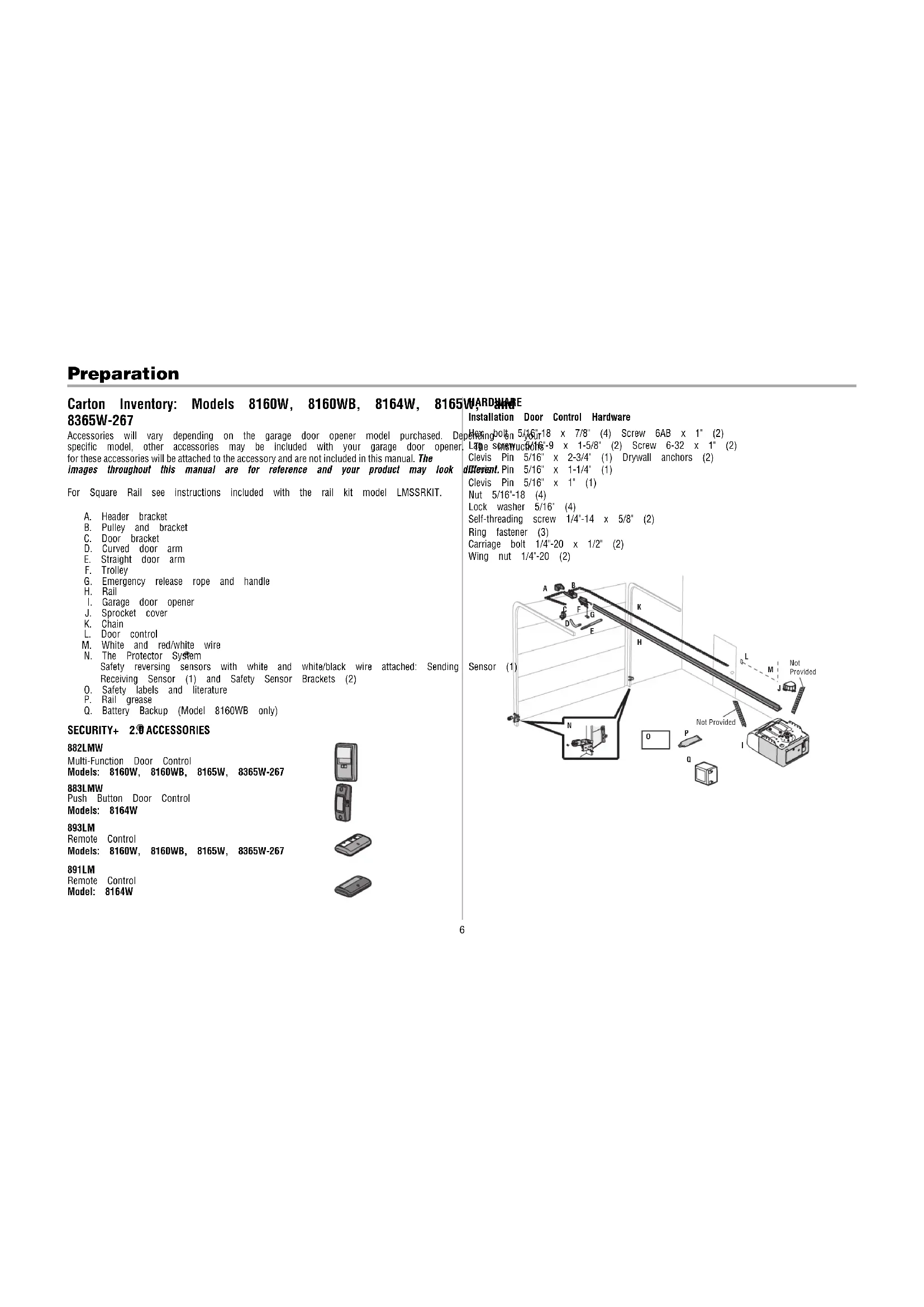
torsion spring or center bearing plate in the way of the header bracket, it may be installed within 4feet (1.2 m) to the left or right of the door center. See page 11. Torsion SpringExtensionSpring OR5 Preparation Tools Needed 3/16 5/32 5/16 7/16 1/2 5/8 9/16 1/4 7/166 Preparation Carton Inventory: Models 8160W, 8160WB, 8164W, 8165W, and 8365W-267 Accessories will vary depending on the garage door opener model purchased. Depending on your specific model, other accessories may be included with your garage door opener. The instructions for these accessories will be attached to the accessory and are not included in this manual. The images throughout this manual are for reference and your product may look different. For Square Rail see instructions included with the rail kit model LMSSRKIT. A. Header bracket B. Pulley and bracket C. Door bracket D. Curved door arm E. Straight door arm F. Trolley G. Emergency release rope and handle H. Rail
I. Garage door opener
J. Sprocket cover K. Chain L. Door control M. White and red/white wire N. The Protector System
Safety reversing sensors with white and white/black wire attached: Sending Sensor (1) Receiving Sensor (1) and Safety Sensor Brackets (2) O. Safety labels and literature P. Rail grease Q. Battery Backup (Model 8160WB only) SECURITY+ 2.0
Not Provided Not Provided
Preparation Carton Inventory: Model 8155W Accessories will vary depending on the garage door opener model purchased. Depending on your specific model, other accessories may be included with your garage door opener. The instructions for these accessories will be attached to the accessory and are not included in this manual. The images throughout this manual are for reference and your product may look different. A. Header bracket B. Pulley and bracket C. Door bracket D. Curved door arm E. Straight door arm F. Trolley G. Emergency release rope and handle H. Rail
I. Garage door opener
J. Sprocket cover with hex screws K. Belt L. Door control M. White and red/white wire N. The Protector System
Safety reversing sensors with white and white/black wire attached: Sending Sensor (1) Receiving Sensor (1) and Safety Sensor Brackets (2) O. Safety labels and literature P. Rail grease SECURITY+ 2.0
Not Provided Not Provided8 Assembly 1 Attach the Rail to the Garage Door Opener MODELS 8160W, 8160WB, 8164W*, 8165W, AND 8365W-267
- Can be installed with a T-Rail or a Square Rail. For Square Rail assembly steps, see instructions provided with the rail kit model LMSSRKIT. Once completed, return to this manual for the installation instructions. To avoid possible SERIOUS INJURY to finger from moving garage door opener:
ALWAYS keep hand clear of sprocket while operating opener.
Securely attach sprocket cover BEFORE operating. To avoid SERIOUS damage to garage door opener, use ONLY those bolts/fasteners mounted in the top of the opener. NOTE: ONLY use the bolts removed from the garage door opener. Place the garage door opener on the packing material to prevent scratching.
1. Remove the two bolts from the top of the garage door opener.
2. Align the rail and the styrofoam over the sprocket. Cut the tape from the rail, chain, and
3. Fasten the rail with the previously removed bolts.
4. Position the chain around the garage door opener sprocket.
Models 8160WMX and 8160WBMX: Attach the sprocket cover over the garage door opener sprocket and attach with hex screws. Models 8164WMX and 8165WMX: Install the sprocket cover by squeezing the sides and inserting the tabs into the slots on the garage door opener. Washered Bolt 5/16"-18x1/2" Hex Screw #8x3/8" Washered Bolt 5/16"-18 x 1/2"(Mounted in the garage door opener) Models 8160W and 8160WB Models 8164W, 8165W, and 8365W-267 2 Tighten the Chain
1. Loosen the inner nut and lock washer on the trolley threaded shaft.
2. Tighten the outer nut until the chain is a 1/2" above the base of the rail at the midpoint
Slack in the chain is normal when the door is closed. No readjustment is necessary. Sprocket noise can result if the chain is too loose. During future maintenance, ALWAYS pull the emergency release handle to disconnect the trolley before adjusting the chain. 1/2" (13 mm)9 Assembly 1 Attach the Rail to the Garage Door Opener MODEL 8155W To avoid possible SERIOUS INJURY to finger from moving garage door opener:
ALWAYS keep hand clear of sprocket while operating opener.
Securely attach sprocket cover BEFORE operating. To avoid SERIOUS damage to garage door opener, use ONLY those bolts/fasteners mounted in the top of the opener. NOTE: ONLY use the bolts removed from the garage door opener. Place the garage door opener on the packing material to prevent scratching.
1. Remove the two bolts from the top of the garage door opener.
2. Align the rail and the styrofoam over the sprocket. Cut the tape from the rail, belt, and
3. Fasten the rail with the previously removed bolts.
4. Position the belt around the garage door opener sprocket.
5. Attach the sprocket cover over the garage door opener sprocket and attach with hex screws.
Washered Bolts 5/16"-18 x 1/2"(Mounted in the garage door opener)Hex Screws 8 x 3/8"SprocketCover 2 Tighten the Belt
1. By hand, thread the spring trolley nut on the threaded shaft until it is finger tight against the
trolley. Do not use any tools.
2. Insert a flathead screwdriver tip into one of the nut ring slots and brace it firmly against the
3. Tighten the spring trolley nut with an adjustable wrench or a 7/16" open end wrench about a
quarter turn until the spring releases and snaps the nut ring against the trolley. This sets the spring to optimum belt tension. Spring Trolley Nut(To motor unit)Nut ring slot Nut RingNut RingAFTER RELEASE1-1/4"(3.18 cm)BEFORE1"(2.5 cm)
To reduce the risk of SEVERE INJURY or DEATH:
1. READ AND FOLLOW ALL INSTALLATION WARNINGS AND INSTRUCTIONS.
2. Install garage door opener ONLY on properly balanced and lubricated garage door. An
improperly balanced door may NOT reverse when required and could result in SEVERE INJURY or DEATH.
3. ALL repairs to cables, spring assemblies and other hardware MUST be made by a trained
door systems technician BEFORE installing opener.
5. Where possible, install the door opener 7 feet (2.13 m) or more above the floor.
6. Mount the emergency release within reach, but at least 6 feet (1.83 m) above the floor
and avoiding contact with vehicles to avoid accidental release.
7. NEVER connect garage door opener to power source until instructed to do so.
8. NEVER wear watches, rings or loose clothing while installing or servicing opener. They
could be caught in garage door or opener mechanisms.
9. Install wall-mounted garage door control:
within sight of the garage door.
out of reach of small children at a minimum height of 5feet (1.5m) above floors, landings, steps or any other adjacent walking surface.
away from ALL moving parts of the door.
10. Place entrapment warning label on wall next to garage door control in a
11. Place emergency release/safety reverse test label in plain view on inside of
12. Upon completion of installation, test safety reversal system. Door MUST
reverse on contact with a 1-1/2" (3.8cm) high object (or a 2x4 laid flat) on the floor.
13. To avoid SERIOUS PERSONAL INJURY or DEATH from electrocution,
disconnect ALL electric power BEFORE performing ANY service or maintenance.
14. DO NOT install on a one-piece door if using devices or features providing
unattended close. Unattended devices and features are to be used ONLY with sectional doors.
Concrete anchors MUST be used if mounting header bracket or 2x4 into masonry.
NEVER try to loosen, move or adjust garage door, springs, cables, pulleys, brackets, or their hardware, ALL of which are under EXTREME tension.
ALWAYS call a trained door systems technician if garage door binds, sticks, or is out of balance. An unbalanced garage door might NOT reverse when required.
DO NOT enable the Timer-to-Close functionality if operating either one-piece or swinging garage doors. To be enabled ONLY when operating a sectional door. Close the door and mark the inside vertical centerline of the garage door. Extend the line onto the header wall above the door. You can fasten the header bracket within 4 feet (1.22 m) of the left or right of the door center only if a torsion spring or center bearing plate is in the way; or you can attach it to the ceiling when clearance is minimal. (It may be mounted on the wall upside down if necessary, to gain approximately 1/2" (1 cm). If you need to install the header bracket on a 2x4 (on wall or ceiling), use lag screws (not provided) to securely fasten the 2x4 to structural supports. Open your door to the highest point of travel as shown. Draw an intersecting horizontal line on the header wall 2" (5 cm) above the high point. This height will provide travel clearance for the top edge of the door. NOTE: If the total number of inches exceeds the height available in your garage, use the maximum height possible, or refer to page 11 for ceiling installation. Header Wall Unfinished Ceiling Vertical Centerline of Garage Door 2x4 2x4 Structural Supports Level (Optional) OPTIONAL CEILING MOUNT FOR HEADER BRACKET Sectional door with curved track Header Wall Track 2" (5 cm) Highest Point of Travel Door12 Installation 2 Install the Header Bracket You can attach the header bracket either to the wall above the garage door, or to the ceiling. Follow the instructions which will work best for your particular requirements. Do not install the header bracket over drywall. If installing into masonry, use concrete anchors (not provided). HARDWARELag Screw 5/16"-9x1-5/8"
OPTION A - WALL INSTALLATION
1. Center the bracket on the vertical centerline with the bottom edge of the bracket on the
horizontal line as shown (with the arrow pointing toward the ceiling).
2. Mark the vertical set of bracket holes (do not use the holes designated for ceiling mount).
Drill 3/16" pilot holes and fasten the bracket securely to a structural support with lag screws. Wall MountOptional Mounting Holes Vertical Centerline of Garage Door(Header Wall)Header Bracket2x4 Structural SupportDoor Spring(Garage Door)Highest Point of Garage Door Travel Horizontal Line Lag Screw5/16"-9 x 1-5/8"Lag Screw5/16"-9 x 1-5/8"
1. Extend the vertical centerline onto the ceiling as shown.
2. Center the bracket on the vertical mark, no more than 6" (15cm) from the wall. Make sure
the arrow is pointing toward the wall. The bracket can be mounted flush against the ceiling when clearance is minimal.
3. Mark the side holes. Drill 3/16" pilot holes and fasten bracket securely to a structural support
1. Align the rail with the header bracket. Insert the clevis pin through the holes in the header
bracket and rail. Secure with the ring fastener. NOTE: Use the packing material as a protective base for the garage door opener. FOR T-RAIL HARDWARE Clevis Pin 5/16" x 2-3/4" Ring Fastener Ring FastenerClevis Pin5/16" X 2-3/4"
Clevis Pin5/16"x1-1/2" Ring Fastener Clevis Pin Ring Fastener HARDWARE14 Installation 4 Position the Garage Door Opener To prevent damage to garage door, rest garage door opener rail on 2x4 placed on top section of door.
1. Remove the packing material and lift the garage door opener onto a ladder.
2. Fully open the door and place a 2x4 (laid flat) under the rail.
A 2x4 is ideal for setting the distance between the rail and the door. If the ladder is not tall enough you will need help at this point. If the door hits the trolley when it is raised, pull the trolley release arm down to disconnect the inner and outer trolley. Slide the outer trolley toward the garage door opener. The trolley can remain disconnected until instructed. FOR T-RAIL Connected Disconnected
Connected Disconnected One-piece door without tracks 2x4 2x4 All other door types15 Installation 5 Hang the Garage Door Opener To avoid possible SERIOUS INJURY from a falling garage door opener, fasten it SECURELY to structural supports of the garage. Concrete anchors MUST be used if installing ANY brackets into masonry. Hanging your garage door opener will vary depending on your garage. Two representative installations are shown. Yours may be different. Hanging brackets should be angled (Figure 1) to provide rigid support. On finished ceilings (Figure 2), attach a sturdy metal bracket to structural supports before installing the opener. This bracket and fastening hardware are not provided.
1. Measure the distance from each side of the motor unit to the structural support.
2. Cut both pieces of the hanging bracket to required lengths.
3. Drill 3/16" pilot holes in the structural supports.
4. Attach one end of each bracket to a support with 5/16"-18 x 1-7/8" lag screws (not
5. Fasten the opener to the hanging brackets with 5/16"-18 x 7/8" hex bolts, lock washers and
6. Check to make sure the rail is centered over the door (or in line with the header bracket if the
bracket is not centered above the door).
7. Remove the 2x4. Operate the door manually. If the door hits the rail, raise the header
bracket. NOTE: DO NOT connect power to opener at this time. FIGURE 1 FIGURE 2 (Not Provided) Lag Screws 5/16"- 18x1-7/8" Measure Distance Hex Bolt 5/16"- 18x7/8", Lock Washer 5/16", Nut 5/16"-18 FIGURE 3 Not Provided Finished Ceiling Unfinished Ceiling Hex Bolt 5/16"- 18x7/8" Nut 5/16"-18 Lock Washer 5/16" HARDWARE16 Installation 6 Install the Light Bulbs To prevent possible OVERHEATING of the end panel or light socket:
DO NOT use incandescent bulbs larger than 100W.
DO NOT use compact fluorescent light bulbs larger than 26W (100W equivalent).
DO NOT use short neck or specialty light bulbs. LED bulbs may cause remote control radio interference. Use ONLY LED bulbs recommended here: chamberlain.com/bulb.
1. Pull light lens down.
If possible, use emergency release handle to disengage trolley ONLY when garage door is CLOSED. Weak or broken springs or unbalanced door could result in an open door falling rapidly and/or unexpectedly.
NEVER use emergency release handle unless garage doorway is clear of persons and obstructions.
NEVER use handle to pull door open or closed. If rope knot becomes untied, you could fall.
1. Insert one end of the emergency release rope through the handle. Make sure that “NOTICE”
is right side up. Secure with an overhand knot at least 1" (2.5 cm) from the end of the rope to prevent slipping.
2. Insert the other end of the emergency release rope through the hole in the trolley release
arm. Mount the emergency release within reach, but at least 6 feet (1.83m) above floor, avoiding contact with vehicles to prevent accidental release and secure with an overhand knot. NOTE: If it is necessary to cut the emergency release rope, seal the cut end with a match or lighter to prevent unraveling. Ensure the emergency release rope and handle are above the top of all vehicles to avoid entanglement. TrolleyRelease Arm FOR T-RAIL17 Installation Install the Door Bracket Fiberglass, aluminum or lightweight steel garage doors WILL REQUIRE reinforcement BEFORE installation of door bracket. Contact the garage door manufacturer or installing dealer for opener reinforcement instructions or reinforcement kit. Failure to reinforce the top section as required according to the door manufacturer may void the door warranty. A horizontal and vertical reinforcement is needed for lightweight garage doors (fiberglass, aluminum, steel, doors with glass panel, etc.) (not provided). A horizontal reinforcement brace should be long enough to be secured to two or three vertical supports. A vertical reinforcement brace should cover the height of the top panel. Contact the garage door manufacturer or installing dealer for opener reinforcement instructions or reinforcement kit. NOTE: Many door reinforcement kits provide for direct attachment of the clevis pin and door arm. In this case you will not need the door bracket; proceed to the next step. SECTIONALDOORS
1. Center the door bracket on the previously marked vertical centerline used for the header
bracket installation. Note correct UP placement, as stamped inside the bracket.
2. Position the top edge of the bracket 2"-4" (5-10 cm) below the top edge of the door, OR
directly below any structural support across the top of the door.
3. Mark, drill holes and install as follows, depending on your door’s construction:
Metal or light weight doors using a vertical angle iron brace between the door panel support and the door bracket:
Drill 3/16" fastening holes. Secure the door bracket using the two self threading screws. (Figure1)
Alternately, use two 5/16"-18x2" bolts, lock washers and nuts (not provided). (Figure2) Metal, insulated or light weight factory reinforced doors:
Drill 3/16" fastening holes. Secure the door bracket using the self-threading screws. (Figure3) Wood Doors:
Use top and bottom or side to side door bracket holes. Drill 5/16” holes through the door and secure bracket with 5/16"-18 x 2" carriage bolts, lock washers and nuts (not provided). (Figure4) NOTE: The 1/4"-14 x 5/8" self-threading screws are not intended for use on wood doors. FIGURE 1FIGURE 3Vertical ReinforcementVertical Centerlineof Garage Door Door BracketSelf-Threading Screw1/4"-14 x 5/8"Self-Threading Screw1/4"-14 x 5/8"Vertical Centerlineof Garage Door FIGURE 4Vertical Centerline ofGarage Door Bolt 5/16"-18 x 2"(Not provided) Inside Edge of Door orReinforcement Board FIGURE 2Vertical ReinforcementBolt 5/16"-18 x 2"(Not provided) Lock Washer 5/16"Nut 5/16"-18Door Bracket Vertical Centerlineof Garage Door Self-Threading Screw 1/4"-14 x 5/8" HARDWARE18 Installation 9 Connect the Door Arm to the Trolley IMPORTANT: The groove on the straight door arm MUST face away from the curved door arm.
T-Rail: Close the door. Disconnect the trolley by pulling the emergency release handle. Slide the outer trolley back (away from the door) about 2" (5 cm). Square Rail: Close the door. Disconnect the trolley by pulling the emergency release handle.
2. Attach the straight door arm to the outer trolley using the clevis pin. Attach with the ring
3. Attach the curved door arm to the door bracket using the clevis pin. Attach with the ring
4. Align the straight door arm with the curved door arm. Select two aligned holes (as far apart
as possible) and attach using the bolts, nuts and lock washers. NOTE: If the holes do not line up, reverse the straight door arm. Select two aligned holes (as far apart as possible) and attach using the bolts, nuts and lock washers.
5. Pull the emergency release handle toward the garage door opener until the trolley release
arm is horizontal. The trolley will re-engage automatically when the garage door opener is activated. (Groove facing out) CORRECTStraight Door Arm Straight Door Arm Curved Door Arm Curved Door Arm INCORRECT HARDWARE Hex Bolt 5/16"-18 x 7/8" Nut 5/16"-18 Lock Washer 5/16"Clevis Pin 5/16" x 1" Clevis Pin 5/16" x 1-1/4" Ring Fastener FOR T-RAIL
Be sure power is NOT connected BEFORE installing door control.
Install door control within sight of garage door, out of reach of small children at a minimum height of 5feet (1.5m) above floors, landings, steps or any other adjacent walking surface, and away from ALL moving parts of door.
NEVER permit children to operate or play with door control push buttons or remote control transmitters.
Activate door ONLY when it can be seen clearly, is properly adjusted, and there are no obstructions to door travel.
ALWAYS keep garage door in sight until completely closed. NEVER permit anyone to cross path of closing garage door. INTRODUCTION Compatible with myQ
and Security+ 2.0 accessories, see page 45. Your garage door opener is compatible with up to 2 Smart Control Panels or 4 of any other Security+ 2.0 door controls. NOTE:Older LiftMaster door controls and third party products are not compatible. Install door control within sight of garage door, out of reach of small children at a minimum height of 5feet (1.5m) above floors, landings, steps or any other adjacent walking surface, and away from ALL moving parts of door. For gang box installations it is not necessary to drill holes or install the drywall anchors. Use the existing holes in the gang box. NOTE: Your product may look different than the illustrations. HARDWARE Screw6AB x 1" (2)Drywall Anchors (2) Screw6-32 x 1" (2)
1. Strip 7/16" (11 mm) of insulation from one end of the wire and separate the wires.
2. Connect one wire to each of the two screws on the back of the door control. The wires can
be connected to either screw. PRE-WIREDINSTALLATIONS:Choose any two wires to connect, note which wires are used so the correct wires are connected at the garage door opener in a later step.
3. Mark the location of the bottom mounting hole and drill a 5/32" hole.
4. Install the bottom screw, allowing 1/8" (3 mm) to protrude from the wall.
5. Position the bottom hole of the door control over the screw and slide down into place.
6. Lift the push bar up and mark the top hole.
7. Remove the door control from the wall and drill a 5/32" hole for the top screw.
8. Position the bottom hole of the door control over the screw and slide down into place.
Be sure power is NOT connected BEFORE installing door control.
Install door control within sight of garage door, out of reach of small children at a minimum height of 5feet (1.5m) above floors, landings, steps or any other adjacent walking surface, and away from ALL moving parts of door.
NEVER permit children to operate or play with door control push buttons or remote control transmitters.
Activate door ONLY when it can be seen clearly, is properly adjusted, and there are no obstructions to door travel.
ALWAYS keep garage door in sight until completely closed. NEVER permit anyone to cross path of closing garage door. INTRODUCTION Compatible with myQ
and Security+ 2.0 accessories, see page 45. Your garage door opener is compatible with up to 2 Smart Control Panels or 4 of any other Security+ 2.0 door controls. NOTE:Older LiftMaster door controls and third party products are not compatible. Install door control within sight of garage door, out of reach of small children at a minimum height of 5feet (1.5m) above floors, landings, steps or any other adjacent walking surface, and away from ALL moving parts of door. For gang box installations it is not necessary to drill holes or install the drywall anchors. Use the existing holes in the gang box. NOTE: Your product may look different than the illustrations. HARDWARE Screw 6ABx1" (2)
1. Strip 1/4" (6 mm) of insulation from one end of the wire and separate the wires.
2. Connect one wire to each of the two screws on the back of the door control. The wires can
be connected to either screw.
3. Mount the door control with the hardware provided.
Install the Door Control 2 Wire the Door Control to the Garage Door Opener PRE-WIRED INSTALLATIONS: When wiring the door control to the garage door opener make sure you use the same wires that are connected to the door control.
1. Run the white and red/white wire from the door control to the garage door opener. Attach
the wire to the wall and ceiling with staples (not applicable for gang box or pre-wired installations). Do not pierce the wire with the staple as this may cause a short or an open circuit.
2. Strip 7/16" (11 mm) of insulation from the end of the wire near the garage door opener.
3. Connect the wire to the red and white terminals on the garage door opener. To insert or
release wires from the terminal, push in the tab with screwdriver tip. 7/16" (11 mm)
1. Attach the entrapment warning label on the wall near the door control with tacks or staples.
2. Attach the manual release/safety reverse test label in a visible location on the inside of the
Introduction Be sure power is NOT connected to the garage door opener BEFORE installing the safety reversing sensor. To prevent SERIOUS INJURY or DEATH from closing garage door:
Correctly connect and align the safety reversing sensor. This required safety device MUST NOT be disabled.
Install the safety reversing sensor so beam is NO HIGHER than 6" (15 cm) above garage floor. IMPORTANT: The safety reversing sensors MUST be connected and aligned correctly before the garage door opener will move in the down direction. The Protector System® includes two safety reversing sensors which use a light beam to prevent the garage door from closing. The sending sensor (amber LED) transmits the beam to the receiving sensor (green LED) when both are powered and aligned. If an obstruction breaks the light beam while the door is closing, the door will stop, and reverse to the full open position. When installing the safety reversing sensors, check:
Sensors are installed INSIDE the garage.
Sensor lenses are facing each other. IMPORTANT: Do not allow direct sunlight to the receiving sensor (green LED).
Sensor beam is NO HIGHER than 6" (15 cm) above the floor and the light beam is unobstructed. Invisible Light Beam Protection Area Safety Reversing Sensor 6" (15 cm) max. above floor Safety Reversing Sensor 6" (15 cm) max. above floor23 Install the Protector System
1 Install the Safety Reversing Sensors HARDWAREWing Nut (2)Hex Screw 10-24 (2) The safety reversing sensors are designed to clip onto the door track with the provided sensor brackets. If the door track will not support the sensor bracket a wall installation is recommended. The sensor beam should be NO HIGHER than 6" (15 cm) above the floor.
DOOR TRACK INSTALLATION
1. Slide the curved arms of the sensor bracket around the edge of the door track. Snap into
place so that the sensor bracket is flush against the track.
2. Slide the hex screw through the sensor.
3. Attach the sensor to the bracket with the wing nut. Make sure the lens is not obstructed by
the bracket. Repeat the steps with the other sensor on the opposite door track. Both lenses must face each other. 6" (15 cm) max.Door track
Garage door Wing nut WALLINSTALLATION Make sure the brackets on each side are clear of the door track and have the same amount of clearance so the sensors will align correctly. If additional clearance is needed, use extension brackets 041A5281-1 (not provided) or wood blocks.
1. Attach the sensor bracket against the wall with two lag screws (not provided).
2. Slide the hex screw through the sensor.
3. Attach the sensor to the bracket with the wing nut. Make sure the lens is not obstructed by
the bracket. Repeat the steps with the other sensor on the opposite side of the garage door. Both lenses must face each other.
1. Measure the position of both sensor brackets so they will be the same distance from the wall
2. Attach the bracket to the floor with concrete anchors (not provided).
3. Slide the hex screw through the sensor.
4. Attach the sensor to the bracket with the wing nut. Make sure the lens is not obstructed by
the bracket. Repeat the steps with the other sensor on the opposite side of the garage door. Both lenses must face each other.
Inside garage wall Not providedDoor track6" (15 cm) max.Wingnut 2 Wire the Safety Reversing Sensors PRE-WIRED INSTALLATIONS: If your garage already has wires installed for the safety reversing sensors, see page 25.
OPTION A - INSTALLATION WITHOUT PRE-WIRING
1. Run the wire from both sensors to the garage door opener. Attach with staples, but DO NOT
2. Separate the sensor wires and strip insulation from each end. Twist the two white wires
together. Then twist the two white/black wires together.
3. Using a screwdriver, push in the terminal tabs, and insert the white wires into the white
1. Cut the sensor wires, making sure there is enough wire to reach the pre-installed wires from
2. Separate the sensor wires and strip insulation from each end. Choose two of the pre-
installed wires and strip insulation from each end. Choose the same color pre-installed wires for each sensor.
3. Connect the pre-installed wires to the sensor wires with wire nuts making sure the colors
correspond for each sensor.
4. At the garage door opener, strip the end of the wires previously connected to the sensors.
Twist the like-colored wires together.
5. Using a screwdriver, push in the terminal tabs, and insert the wire color connected to the
sensor's white wire into the white terminal. Insert the other wire color connected to the sensor's white/black wire into the grey terminal. Safety reversing sensor wires Pre-installed wires White White/Black Yellow (for example) Purple (for example) Not Provided Pre-installed wires Safety reversing sensor wires 7/16" (11 mm) Yellow Purple
Yellow (for example) Purple (for example) To insert or remove the wires from the terminal, push in the tab with a screwdriver tip.
Be sure power is NOT connected to the opener, and disconnect power to circuit BEFORE removing cover to establish permanent wiring connection.
Garage door installation and wiring MUST be in compliance with ALL local electrical and building codes.
NEVER use an extension cord, 2-wire adapter, or change plug in ANY way to make it fit outlet. Be sure the opener is grounded. To avoid installation difficulties, do not activate the garage door opener at this time. To reduce the risk of electric shock, your garage door opener has a grounding type plug with a third grounding pin. This plug will only fit into a grounding type outlet. If the plug doesn’t fit into your outlet, contact a qualified electrician to install the proper outlet. THERE ARE TWO OPTIONS FOR CONNECTINGPOWER:
OPTION A - TYPICAL WIRING
1. Plug in the garage door opener into a grounded outlet.
2. DO NOT run garage door opener at this time.
If permanent wiring is required by your local code, refer to the following procedure. To make a permanent connection through the 7/8" hole in the top of the motor unit (according to local code):
1. Remove the motor unit cover screws and set the cover aside.
2. Remove the attached 3-prong cord.
3. Connect the black (line) wire to the screw on the brass terminal; the white (neutral) wire to
the screw on the silver terminal; and the ground wire to the green ground screw. The opener must be grounded.
4. Reinstall the cover.
Ground TabGreen GroundScrew Ground Wire White WirePERMANENT WIRING Black Wire Black Wire27 Power 2 Align the Safety Reversing Sensors IMPORTANT: The safety reversing sensors MUST be connected and aligned correctly before the garage door opener will move in the down direction. When the garage door opener has power, check the safety reversing sensors. If the sensors are aligned and wired correctly, both LEDs will glow steadily. Light Beam Protection Area Receiving sensor - green LEDThe receiving sensor has a sticker on the back.Sending sensor - amber LED To align the safety reversing sensors:
1. Loosen the wing nuts.
2. Adjust the sensors up or down until both LEDs glow steady indicating alignment.
3. Tighten the wing nut to secure the sensor.
SAFETY SENSOR TROUBLESHOOTING
If either of the sensor LEDs are off, there is no power to the sensor:
1. Check that you have power to the garage door opener.
2. Check the sensor wire is not shorted or broken.
If the green receiving sensor LED is blinking, the sensors are obstructed or misaligned:
1. Check for obstructions in the sensor light beam.
2. Align the sensors.
3. If the receiving sensor (green LED) faces direct sunlight, switch the receiving sensor with
the sending sensor and repeat 1 Install the Safety Reversing Sensors page 23 to assure proper operation.28 Power 3 Ensure the Door Control is Wired Correctly Models: 8155W, 8160W, 8160WB, 8165W, 8365W-267 If the door control has been installed and wired correctly, the command LED behind the push bar will blink. COMMAND LEDPush bar RED WHITE WHITE GREY Models: 8164W If the door control has been installed and wired correctly, the LED behind the push button will blink (883LMW). 883LMW RED WHITE WHITE GREY Push Button29 Adjustments Introduction Without a properly installed safety reversal system, persons (particularly small children) could be SERIOUSLY INJURED or KILLED by a closing garage door.
Incorrect adjustment of garage door travel limits will interfere with proper operation of safety reversal system.
After ANY adjustments are made, the safety reversal system MUST be tested. Door MUST reverse on contact with 1-1/2" (3.8 cm) high object (or 2x4 laid flat) on floor. To prevent damage to vehicles, be sure fully open door provides adequate clearance. Your garage door opener is designed with electronic controls to make setup and adjustments easy. While programming the travel, the UP and DOWN buttons can be used to move the door as needed. During the Automatic Force Setup, the door will automatically open and close. UP (Open)DOWN (Close) PROGRAMMING BUTTONS The programming buttons are located on the left or back side panel of the garage door opener and are used to program the travel. While programming, the UP and DOWN buttons can be used to move the door as needed. UP Button Adjustment Button DOWN Button PROGRAMMING BUTTONS30 Adjustments
1 - Program the Travel
Without a properly installed safety reversal system, persons (particularly small children) could be SERIOUSLY INJURED or KILLED by a closing garage door.
Incorrect adjustment of garage door travel limits will interfere with proper operation of safety reversal system.
After ANY adjustments are made, the safety reversal system MUST be tested. Door MUST reverse on contact with 1-1/2" (3.8 cm) high object (or 2x4 laid flat) on floor. Note: While programming the travel, the UP and DOWN buttons can be used to move the door as needed. During the Automatic Force Setup, the door will automatically open and close. 1 Press and hold the Adjustment Button until the UP Button begins to flash and/or a beep is heard. The Safety Reversing Sensors will be disconnected during the Program the Travel process. 2 Press and hold the UP Button until the door is in the desired UP position. 3 Once the door is in the desired UP position press and release the Adjustment Button. The garage door opener lights will flash twice and the DOWN Button will begin to flash. 4 Press and hold the DOWN button until the door is in the desired DOWN position. 5 Once the door is in the desired DOWN position press and release the Adjustment Button. The garage door opener lights will flash twice. Program the Travel is now complete. If the garage door opener lights flash 5 times, then programming has timed out and the Travel Limits have not been set. Please restart the Program the Travel process.
2 - Automatic Force Set Up
Once both the up and down positions have been manually set, the Safety Reversing Sensors will reconnect and become operational. Then, the opener will enter a force-sensing operation by automatically moving the door open and close. The garage door opener will sound an audible and visual alert before automatically opening and closing the door. The garage door opener will beep three times, confirming that the Automatic Force Setup completed successfully. Adjustment is complete. If you hear one long beep after the door attempts to move, then the Automatic Force Set Up has not completed successfully. Please start over at step 1 of Program the Travel.31 Adjustments
3 - Test the Safety Reversal System
Without a properly installed safety reversal system, persons (particularly small children) could be SERIOUSLY INJURED or KILLED by a closing garage door.
Safety reversal system MUST be tested every month.
After ANY adjustments are made, the safety reversal system MUST be tested. Door MUST reverse on contact with 1-1/2" (3.8 cm) high object (or 2x4 laid flat) on the floor. 1 With the door fully open, place a 1-1/2 inch (3.8 cm) board (or a 2x4 laid flat) on the floor, centered under thegarage door. 2 Press the remote control push button to close the door. The door MUST reverse when it makes contact with the board. If the door stops but does not reverse:
1. Repeat Program the Travel (seeAdjustment Step 1);
2. Repeat the Safety Reversal test.
If the test continues to fail, call a trained door systems technician.
Without a properly installed safety reversing sensor, persons (particularly small children) could be SERIOUSLY INJURED or KILLED by a closing garage door. 1 Open the door. Place an obstruction in the path of thedoor. 2 Press the remote control push button to close the door. The door will not move more than an inch (2.5 cm). The garage door opener will not close from a remote control if the LED in either safety reversing sensor is off (alerting you to the fact that the sensor is misaligned or obstructed). If the garage door opener closes the door when the safety reversing sensor is obstructed (and the sensors are no more than 6 inches [15 cm] above the floor), call for a trained door systems technician.32 Battery Backup 1 Install the Battery* To reduce the risk of FIRE or INJURY to persons:
Disconnect ALL electric and battery power BEFORE performing ANY service or maintenance.
Use ONLY LiftMaster part # 485LM for replacement battery.
DO NOT dispose of battery in fire. Battery may explode. Check with local codes for disposal instructions. ALWAYS wear protective gloves and eye protection when changing the battery or working around the battery compartment.
1. Unplug the garage door opener.
2. Open the light lens of the garage door opener. Use a Phillips head screwdriver to remove the
battery cover on the garage door opener.
3. Partially insert the battery into the battery compartment with the terminals facing out.
4. Connect red (+) and black (-) wires from the garage door opener to the corresponding
terminals on the battery.
5. Replace the battery cover.
6. Plug in the garage door opener.
7. Wait for the green Battery Status LED to start flashing before proceeding to test the battery.
1. Unplug the garage door opener. The battery status LED will either glow solid orange
indicating opener is operating on battery power or will flash indicating low battery power. NOTE:Make sure the garage door opener is unplugged.
Open and close the door using the remote control or door control. NOTE: The garage door opener may run slower if the battery is not fully charged. The battery will take 24 hours to fully charge.
3. Plug in the garage door opener. Verify the battery status LED is flashing green, indicating the
battery is charging.
Battery Backup 3 Charge the Battery The battery charges when the garage door opener is plugged into a 120Vac electrical outlet that has power and requires 24 hours to fully charge. A fully charged battery supplies 12Vdc to the garage door opener for up to 24 hours of normal operation during an electrical power outage. After the electrical power has been restored, the battery will recharge within 24 hours. The battery will last approximately 1 to 2 years with normal usage. To obtain maximum battery life and prevent damage, disconnect the battery when the garage door opener is unplugged for an extended period of time, such as a summer or winter home. 4 Battery Status LED GREEN LED: All systems are normal.
A solid green LED light indicates the battery is fully charged.
A flashing green LED indicates the battery is being charged. ORANGE LED: The garage door opener has lost power and is in battery backup mode.
A solid orange LED with beep, sounding approximately every 2 seconds, indicates the garage door opener is operating on battery power.
A flashing orange LED with beep, sounding every 30 seconds, indicates the battery is low. RED LED: The battery needs to be replaced.
A solid red LED with beep, sounding every 30 seconds, indicates the battery will no longer hold a charge. Go to LiftMaster.com to purchase a replacement battery to allow your system to operate during a power outage. NOTE: The Battery Status LED is most visible with the garage door opener light off. Battery does not have to be fully charged to operate the garage door opener. Battery Status LED34 Operation IMPORTANT SAFETYINSTRUCTIONS To reduce the risk of SEVERE INJURY or DEATH: 1. READ AND FOLLOW ALL WARNINGS AND INSTRUCTIONS.2. ALWAYS keep remote controls out of reach of children. NEVER permit children to operateor play with garage door control push buttons or remote controls.3. ONLY activate garage door when it can be seen clearly, it is properly adjusted, and thereare no obstructions to door travel.4. ALWAYS keep garage door in sight and away from people and objects until completelyclosed. NO ONE SHOULD CROSS THE PATH OF THE MOVING DOOR.5. NO ONE SHOULD GO UNDER A STOPPED, PARTIALLY OPENED DOOR.6. If possible, use emergency release handle to disengage trolley ONLY when garage door isCLOSED. Use caution when using this release with the door open. Weak or brokensprings or unbalanced door could result in an open door falling rapidly and/orunexpectedly and increasing the risk of SEVERE INJURY or DEATH.7. NEVER use emergency release handle unless garage doorway is clear of persons andobstructions.8. NEVER use handle to pull garage door open or closed. If rope knot becomes untied, youcould fall.9. After ANY adjustments are made, the safety reversal system MUST be tested.10. Safety reversal system MUST be tested every month. Garage door MUST reverse oncontact with 1-1/2"(3.8cm) high object (or a 2x4 laid flat) on the floor. Failure to adjustthe garage door opener properly increases the risk of SEVERE INJURY or DEATH.11. ALWAYS KEEP GARAGE DOOR PROPERLY BALANCED (see page 4). An improperlybalanced door may NOT reverse when required and could result in SEVERE INJURY orDEATH.12. ALL repairs to cables, spring assemblies and other hardware, ALL of which are underEXTREME tension, MUST be made by a trained door systems technician.13. To avoid interference with the proper operation of the garage door opener when using awelder in the garage, unplug garage door opener before operating welder.14. To avoid SERIOUS PERSONAL INJURY or DEATH from electrocution, disconnect ALLelectric and battery power BEFORE performing ANY service or maintenance.15. This operator system is equipped with an unattended operation feature. The door couldmove unexpectedly. NO ONE SHOULD CROSS THE PATH OF THE MOVING DOOR.16. DO NOT install on a one-piece door if using devices or features providing unattendedclose. Unattended devices and features are to be used ONLY with sectional doors.
Operation Features Your garage door opener is equipped with features to provide you with greater control over your garage door operation. ALERT2CLOSE The Alert2Close feature provides a visual and an audible alert that an unattended door is closing. TIMER-TO-CLOSE (TTC) The TTC feature automatically closes the door after a specified time period that can be adjusted using a TTC enabled door control (Models 881LMW or 880LMW). Prior to and during the door closing the garage door opener lights will flash and the garage door opener will beep. MYQ myQ
technology uses a 900MHz signal to provide two-way communication between the garage door opener and myQ
enabled accessories. Your garage door opener is compatible with up to 16 myQ
Your garage door opener has already been programmed at the factory to operate with your remote control, which changes with each use, randomly accessing over 100 billion new codes. Compatible with myQ
and Security+ 2.0 accessories, see page 45 NOTE: Older LiftMaster remote controls, door controls, and third party products are not compatible. Security+2.0 Accessories MEMORY CAPACITY Remote Controls Up to 12 Door Controls Up to 2 Smart Control Panels or 4 of any other Security+2.0 door controls Keyless Entries Up to 1
(SAFETY REVERSING SENSORS) When properly connected and aligned, the safety reversing sensors will detect an obstruction in the path of the infrared beam. If an obstruction breaks the infrared beam while the door is closing, the door will stop and reverse to full open position. If the door is fully open, and the safety reversing sensors are not installed, or are misaligned, the door will not close from a remote control. However, you can close the door if you hold the button on the door control or keyless entry until the door is fully closed. The safety reversing sensors do not effect the opening cycle. LIGHTS The garage door opener light bulbs will turn on when the opener is initially plugged in; power is restored after interruption, or when the garage door opener is activated. The lights will turn off automatically after 4-1/2 minutes. Use an incandescent A19 light bulb (100 watt maximum).
USING YOUR GARAGE DOOR OPENER
The garage door opener can be activated through a wall-mounted door control, remote control, wireless keyless entry or myQ® App. When the door is closed and the garage door opener is activated the door will open. If the door makes contact with an obstruction while opening, the door will stop, opener beeps and lights flash 5 times. When the door is in any position other than closed and the garage door opener is activated, the door will close. If the garage door makes contact with an obstruction while closing, the door will reverse, opener beeps and lights flash 5 times. However, you can close the door if you hold the button on the door control or keyless entry until the door is fully closed. The safety reversing sensors do not affect the opening cycle. The safety reversing sensor must be connected and aligned correctly before the garage door opener will move in the down direction. BATTERY BACKUP* The battery backup system allows access in and out of your garage, even when the power is out. When the garage door opener is operating on battery power, the garage door opener will run slower, the light will not function, the Battery Status LED will glow solid orange, and a beep will sound approximately every 2 seconds. *if applicable36 Operation Connect With Your Smartphone The Wi-Fi Garage Door Opener is compatible with up to 16 myQ
enabled accessories. Up to 10 devices can be paired to the Wi-Fi garage door opener’s internal gateway. These devices can be controlled with the myQ
App. These devices include any combination of myQ
garage door openers, Wi-Fi garage door openers, myQ
gate operators or myQ
commercial door operators. A LiftMaster Internet Gateway (828LM) can be added if you need to control more than 10 devices using the myQ
App. Up to 6 devices can be paired to garage door opener itself (controlled by garage door opener through 900MHz). These devices include any combination of myQ
light controls or a garage door and gate monitor. YOU WILL NEED:
Wi-Fi signal in the garage (2.4 GHz, 802.11b/g/n required), see page 4
Password for your home network (router's main account, not guest network)
serial number located on the garage door opener DOWNLOAD THE myQ® APP TO SET UP AN ACCOUNT AND CONNECT Open and close your door, get alerts and set schedules from anywhere. Connected smart garage door openers also receive software updates to ensure the opener has the latest operational features. The garage door opener must run through a complete cycle before it will activate Wi-Fi® programming.
1. Download the myQ® App.
2. Set up an account and connect.
LED LearnButtonAn LED on the garage door opener will indicate Wi-Fi status. See table below.Learn ButtonCommand LED WI-FI STATUS LED Definition Blue Off - Wi-Fi is not turned on. Blinking - Garage door opener is in Wi-Fi learn mode. Solid - Mobile device connected to the garage door opener. Blue and Green Blinking - Attempting to connect to router. Green Blinking - Attempting to connect to the Internet server. Solid - Wi-Fi has been set up and garage door opener is connected to the internet. NOTES: myQ
App control WILL NOT work if the garage door opener is operating on battery power. To erase the Wi-Fi settings, see page 41.37 Operation Using the Multi-Function Door Control 882LMW
SYNCHRONIZE THE DOOR CONTROL
To synchronize the door control to the garage door opener, press the push bar until the garage door opener activates (it may take up to 3 presses). Test the door control by pressing the push bar, each press of the push bar will activate the garage door opener. Push BarLIGHT ButtonSERVICE LEDLOCK ButtonCOMMAND LEDLEARN Button PUSH BAR Press the push bar to open or close the door. LIGHT BUTTON Press the LIGHT button to turn the garage door opener lights on or off. When the lights are turned on they will stay on until the LIGHT button is pressed again, or until the garage door opener is activated. Once the garage door opener is activated the lights will turn off after the specified period of time (the factory setting is 4-1/2 minutes). The LIGHT button will not control the lights when the door is in motion. The following features are accessible by lifting up the push bar:
Any compatible remote controls, wireless keyless entry, or myQ
accessories can be programmed to the garage door opener by pressing the LEARN button of the door control, see page 40. LOCK The LOCK feature is designed to prevent activation of the garage door opener from remote controls while still allowing activation from the door control and keyless entry. This feature is useful for added peace of mind when the home is empty (i.e. vacation). MAINTENANCE ALERT (MAS) This feature assists the homeowner in ensuring the garage door opener system stays in good working condition. When the garage door opener needs to be serviced (approximately 4500 garage door opener cycles) the command (yellow) and service (red) LEDs will begin to alternately flash back and forth. The factory setting for the MAS feature is off and can be activated at time of installation. Contact your installing dealer for service.38 Operation Using the Push Button Door Control 883LMW
SYNCHRONIZE THE DOOR CONTROL
To synchronize the door control to the garage door opener, press the push button until the garage door opener activates (it may take up to 3 presses). Test the door control by pressing the push button, each press of the push button will activate the garage door opener. Push Button LIGHT/LEARN Button PUSH BUTTON Press the push button to open or close the door.
Press the LIGHT button to turn the garage door opener lights on or off. When the lights are turned on they will stay on until the LIGHT button is pressed again, or until the garage door opener is activated. Once the garage door opener is activated the lights will turn off after the specified period of time (the factory setting is 4-1/2 minutes). The LIGHT button will not control the lights when the door is in motion.39 Operation Using the Door Control LOCK Your remote controls will NOT work when LOCK mode is active however your keyless entry will still allow access to your garage. Activate: Press and hold the LOCK button for 2 seconds. The command LED will flash as long as the lock feature is activated and your handheld remote control will not operate your door at this time. Deactivate: Press and hold the LOCK button again for 2 seconds. The command LED will stop flashing and normal operation will resume. LOCK ButtonCommand LED MAINTENANCE ALERT SYSTEM (MAS): Activate/Deactivate: Press and hold the LEARN button. Then press the LIGHT button. The service LED will flash the status; Active is 2 flashes and deactivated is 3 flashes. LEARN Button LIGHT Button Service LED40 Operation Remote Control Your remote control has been programmed at the factory to operate with your garage door opener. Older LiftMaster remote controls are NOTcompatible, see page 45 for compatible accessories. Programming can be done through the door control or the learn button the garage door opener. To program additional accessories refer to the instructions provided with the accessory or visit LiftMaster.com. If your vehicle is equipped with a Homelink
, you may require an external adapter depending on the make, model, and year of your vehicle. Visit www.homelink.com for additional information. TO ADD, REPROGRAM, OR CHANGE A REMOTE CONTROL/KEYLESS ENTRY PIN USING THE PUSH BUTTON DOOR CONTROL - MODEL 882LMW
Press the LEARN button on the door control twice. The Command LED will blink.
Remote Control: Press the button on the remote control that you wish to operate your garage door. Keyless Entry: Enter a 4-digit personal identification number (PIN) of your choice on the keyless entry keypad. Then press the ENTER button. The garage door opener lights will flash (or two clicks will be heard) and the Command LED will stop blinking when the code has been programmed. Repeat the steps above for programming additional remote controls or keyless entry devices. If programming is unsuccessful, program the remote using the learn button. LEARN buttonCommand LED
1. Press and hold the LIGHT button and the push button until the push button LED begins to
Remote Control: Press the button on the remote control that you wish to operate your garage door. Keyless Entry: Enter a 4-digit personal identification number (PIN) of your choice on the keyless entry keypad. Then press the ENTER button. The garage door opener lights will flash (or two clicks will be heard) when the code has been programmed. Repeat the steps above for programming additional remote controls or keyless entry devices. If programming is unsuccessful, program the remote using the learn button.
1. Press and release the LEARN Button on the garage door opener.
2. Press and hold the button on the remote control that you wish to use. Release the button
when the garage door opener lights blink or two clicks are heard. LEARN LED LEARN Button “click” “click”
1. Press and hold the LEARN button on garage door opener until the learn LED goes out
(approximately 6 seconds). All remote control and keyless entry codes are now erased. Reprogram any accessory you wish to use. ERASE ALL DEVICES INCLUDING myQ
1. Press and hold the LEARN button on garage door opener until the learn LED goes out
(approximately 6 seconds).
2. Immediately press and hold the LEARN button again until the learn LED goes out. All codes
are now erased. Reprogram any accessory you wish to use. ERASE THE Wi-Fi® NETWORK FROM THE GARAGE DOOR OPENER
1. Press and hold the black adjustment button on the garage door opener until 3 beeps are
heard (Approximately 6 seconds). LEARN ButtonBlack Adjustment Button To Open the Door Manually To prevent possible SERIOUS INJURY or DEATH from a falling garage door:
If possible, use emergency release handle to disengage trolley ONLY when garage door is CLOSED. Weak or broken springs or unbalanced door could result in an open door falling rapidly and/or unexpectedly.
NEVER use emergency release handle unless garage doorway is clear of persons and obstructions.
NEVER use handle to pull door open or closed. If rope knot becomes untied, you could fall. FOR T-RAIL Disconnect the trolley
1. The door should be fully closed if possible.
2. Pull down on the emergency release handle.
Reconnect the trolley The lockout feature prevents the trolley from reconnecting automatically.
1. Pull the emergency release handle down and back (toward the opener).
The door can then be raised and lowered manually as often as necessary.
2. To disengage the lockout feature, pull the handle straight down. The
trolley will reconnect on the next UP or DOWN operation, either manually or by using the door control or remote control.42 Maintenance Maintenance Schedule EVERY MONTH
Manually operate door. If it is unbalanced or binding, call a trained door systems technician.
Check to be sure door opens and closes fully. Adjust if necessary, see page 30.
Oil door rollers, bearings and hinges. The garage door opener does not require additional lubrication. Do not grease the door tracks.
Test the battery and consider replacing the battery to ensure the garage door opener will operate during an electrical power outage, see page 32 to test the battery backup. EVERY TWO TO THREE YEARS - T-RAIL ONLY
Use a rag to wipe away the existing grease from the garage door opener rail. Reapply a small layer of white lithium grease to the top and underside of the rail surface where the trolley slides. NOTICE: This device complies with part 15 of the FCC rules and Innovation, Science and Economic Development Canada license-exempt RSSs. Operation is subject to the following two conditions: (1) this device may not cause harmful interference, and (2) this device must accept any interference received, including interference that may cause undesired operation. Any changes or modifications not expressly approved by the party responsible for compliance could void the user’s authority to operate the equipment. This device must be installed to ensure a minimum 20 cm (8 in.) distance is maintained between users/bystanders and device. This device has been tested and found to comply with the limits for a Class B digital device, pursuant to part 15 of the FCC rules and Industry Canada ICES standard. These limits are designed to provide reasonable protection against harmful interference in a residential installation. This equipment generates, uses and can radiate radio frequency energy and, if not installed and used in accordance with the instructions, may cause harmful interference to radio communications. However, there is no guarantee that interference will not occur in a particular installation. If this equipment does cause harmful interference to radio or television reception, which can be determined by turning the equipment off and on, the user is encouraged to try to correct the interference by one or more of the following measures: Reorient or relocate the receiving antenna. Increase the separation between the equipment and receiver. Connect the equipment into an outlet on a circuit different from that to which the receiver is connected. Consult the dealer or an experienced radio/TV technician for help. The Remote Control Battery To prevent possible SERIOUS INJURY or DEATH:
NEVER allow small children near batteries.
If battery is swallowed, immediately notify doctor. To reduce risk of fire, explosion or chemical burn:
DO NOT recharge, disassemble, heat above 212°F (100°C) or incinerate. To replace the battery, pry open the case in the middle, then at each side with the visor clip. Insert replacement battery positive side up (+). Replace the batteries with only 3V CR2032 coin cell batteries. Dispose of old batteries properly. 891LM 893LM43 Troubleshooting Diagnostic Chart Your garage door opener is programmed with self-diagnostic capabilities. The UP and DOWN arrows on the garage door opener flash the diagnostic codes.
DIAGNOSTIC CODE SYMPTOM SOLUTION
Up Arrow Flash(es) Down Arrow Flash(es) 1 1 The garage door opener will not close. Safety reversing sensors are not installed, connected, or wires may be cut. Inspect sensor wires for a disconnected or cut wire. 1 2 The garage door opener will not close. There is a short or reversed wire for the safety reversing sensors. Inspect safety sensor wire at all staple and connection points, replace wire or correct as needed. 1 3 The door control will not function. The wires for the door control are shorted or the door control is faulty. Inspect door control wires at all staple and connection points, replace wire or correct as needed. 1 4 The garage door opener will not close. Safety reversing sensors are misaligned or were momentarily obstructed. Realign both sensors until both LEDs are glowing steady. Make sure nothing is hanging or mounted on the door that would interrupt the sensor’s path while closing. 1 5 Door moves 6-8" (15-20 cm) stops or reverses. Manually open and close the door. Check for binding or obstructions, such as a broken spring or door lock, correct as needed. Check wiring connections at travel module and at the logic board. Replace travel module if necessary. No movement, only a single click. Manually open and close the door. Check for binding or obstructions, such as a broken spring or door lock, correct as needed. Replace logic board if necessary. Opener hums for 1-2 seconds no movement. Manually open and close the door. Check for binding or obstructions, such as a broken spring or door lock, correct as needed. Replace motor if necessary. 1 6 Door coasts after it has come to a complete stop. Program travel to coasting position or have door balanced by a trained door systems technician. 2 1-5 No movement, or sound. Replace logic board. 3 2 Unable to set the travel or retain position. Check travel module for proper assembly, replace if necessary. 3 3 The battery status LED is constantly flashing green.* Battery backup charging circuit error, replace the logic board. *(if applicable)44 Troubleshooting
DIAGNOSTIC CODE SYMPTOM SOLUTION
Up Arrow Flash(es) Down Arrow Flash(es) 4 1-4 Door is moving, stops or reverses. Opener beeps and lights flash. Manually open and close the door. Check for binding or obstructions, such as a broken spring or door lock, correct as needed. If the door is binding or sticking, contact a trained door systems technician. If door is not binding or sticking attempt to reprogram travel (refer to page 30). 4 5 Opener runs approximately 6-8" (15-20 cm), stops and reverses. Communication error to travel module. Check travel module connections, replace travel module if necessary. 4 6 The garage door opener will not close. Safety reversing sensors are misaligned or were momentarily obstructed. Realign both sensors to ensure both LEDs are steady and not flickering. Make sure nothing is hanging or mounted on the door that would interrupt the sensor’s path while closing. The garage door opener will NOT enter Wi-Fi
After the initial installation of the garage door opener, the garage door opener must complete a full cycle (open and closed) before the Wi-Fi LEARN mode can be activated.
If there has been a recent power outage, the garage door opener must complete a full cycle before the Wi-Fi LEARN mode can be activated. See page 36 to activate Wi-Fi LEARN mode. Cannot connect garage door opener to home Wi-Fi network:
Serial number was entered correctly and try again. The myQ
characters are between A-F and 0-9 only.
Weak Wi-Fi signal in the garage. Ensure the Wi-Fi signal is reaching the garage, see page 4 or visit LiftMaster.com/Customer-Support for more information. My door will not close: The safety reversing sensor must be connected and aligned correctly before the garage door opener will move in the down direction.
Check for binding or obstructions anywhere along the track to garage floor.
The safety reversing sensor must be connected and aligned correctly before the garage door opener will move in the down direction.
Verify the safety reversing sensors are properly installed, aligned and free of any obstructions. My neighbor’s remote control opens my garage door: Erase the memory from your garage door opener and reprogram the remote control(s). My vehicle's Homelink
is not programming to my garage door opener: Depending on the make, model, and year of your vehicle an external adapter may be required. Visit www.homelink.com for additional information.45 Accessories 878MAX MAX Wireless Keyless Entry: For use outside of the home to enable access to the garage using a 4-digit PIN. Works with ALL LiftMaster openers from 1993-present. 893MAX 3-Button MAX Remote Control: Compatible with LiftMaster garage door openers manufactured since 1993. Includes visor clip. 880LMW Smart Control Panel: Displays temperature, time and system diagnostics; includes a push bar to open and close the door and a lock feature for extra security. Security+2.0 and Wi-Fi compatible. 819LMB myQ
HomeKit™ compatibility to your myQ
to open, close and check the status of your door. Apple is a trademark of Apple Inc., registered in the U.S. and other countries. HomeKit is a trademark of Apple Inc. 891LM Single Button Remote Control: Compatible with LiftMaster garage door openers manufactured since 1993. Includes visor clip. 882LMW Multi-Function Control Panel: Security+ 2.0 and Wi-Fi compatible. 485LM 12V Battery for Backup System: Provides backup power to the garage door opener. 374UT Mini Universal Remote Control: The Mini Universal Remote Control can be programmed to activate up to two products, such as a garage door opener, myQ
light controls, gate operator, or commercial door operator. 380UT Universal Remote Control: The Universal Remote Control can be programmed to activate up to two products, such as a garage door opener, gate operator, or commercial door operator. 881LMW Motion Detecting Control Panel with Timer-to- Close Control: Multi-function door control with motion sensor that automatically turns opener lights on when it detects a person entering the garage. Security+2.0 and Wi-Fi compatible. 886LMW Motion Detecting Control Panel: Multi-function door control with motion sensor that automatically turns opener lights on when it detects a person entering the garage. Security+
2.0 and Wi-Fi compatible.46
Warranty WARRANTY PERIOD Models Parts Motor Accessories Belt Battery Backup* 8160W 8165W 8164W 1 year 4 years 1 year N/A N/A 8160WB 1 year 4 years 1 year N/A 1 year 8155W 1 year 4 years 1 year 10 years N/A 8365W-267 1 year Lifetime 1 year N/A N/A The proper operation of this product is dependent on your compliance with the instructions regarding installation, operation, and maintenance and testing. Failure to comply strictly with those instructions will void this limited warranty in its entirety. If, during the limited warranty period, this product appears to contain a defect covered by this limited warranty, call 1-800-528-9131, toll free, before dismantling this product. You will be advised of disassembly and shipping instructions when you call. Then send the product or component, pre-paid and insured, as directed to our service center for warranty repair. Please include a brief description of the problem and a dated proof-of-purchase receipt with any product returned for warranty repair. Products returned to Seller for warranty repair, which upon receipt by Seller are confirmed to be defective and covered by this limited warranty, will be repaired or replaced (at Seller’s sole option) at no cost to you and returned pre-paid. Defective parts will be repaired or replaced with new or factory-rebuilt parts at Seller’s sole option. [You are responsible for any costs incurred in removing and/or reinstalling the product or any component]. ALL IMPLIED WARRANTIES FOR THE PRODUCT, INCLUDING BUT NOT LIMITED TO ANY IMPLIED WARRANTIES OF MERCHANTABILITY AND FITNESS FOR A PARTICULAR PURPOSE, ARE LIMITED IN DURATION TO THE APPLICABLE LIMITED WARRANTY PERIOD SET FORTH ABOVE FOR THE RELATED COMPONENT(S), AND NO IMPLIED WARRANTIES WILL EXIST OR APPLY AFTER SUCH PERIOD. Some States and Provinces do not allow limitations on how long an implied warranty lasts, so the above limitation may not apply to you. THIS LIMITED WARRANTY DOES NOT COVER NON-DEFECT DAMAGE, DAMAGE CAUSED BY IMPROPER INSTALLATION, OPERATION OR CARE (INCLUDING, BUT NOT LIMITED TO ABUSE, MISUSE, FAILURE TO PROVIDE REASONABLE AND NECESSARY MAINTENANCE, UNAUTHORIZED REPAIRS OR ANY ALTERATIONS TO THIS PRODUCT), LABOR CHARGES FOR REINSTALLING A REPAIRED OR REPLACED UNIT, REPLACEMENT OF CONSUMABLE ITEMS (E.G., BATTERIES IN REMOTE CONTROL TRANSMITTERS AND LIGHT BULBS), OR UNITS INSTALLED FOR NON-RESIDENTIAL USE. THIS LIMITED WARRANTY DOES NOT COVER ANY PROBLEMS WITH, OR RELATING TO, THE GARAGE DOOR OR GARAGE DOOR HARDWARE, INCLUDING BUT NOT LIMITED TO THE DOOR SPRINGS, DOOR ROLLERS, DOOR ALIGNMENT OR HINGES. THIS LIMITED WARRANTY ALSO DOES NOT COVER ANY PROBLEMS CAUSED BY INTERFERENCE. UNDER NO CIRCUMSTANCES SHALL SELLER BE LIABLE FOR CONSEQUENTIAL, INCIDENTAL OR SPECIAL DAMAGES ARISING IN CONNECTION WITH USE, OR INABILITY TO USE, THIS PRODUCT. IN NO EVENT SHALL SELLER’S LIABILITY FOR BREACH OF WARRANTY, BREACH OF CONTRACT, NEGLIGENCE OR STRICT LIABILITY EXCEED THE COST OF THE PRODUCT COVERED HEREBY. NO PERSON IS AUTHORIZED TO ASSUME FOR US ANY OTHER LIABILITY IN CONNECTION WITH THE SALE OF THIS PRODUCT. Some states and provinces do not allow the exclusion or limitation of consequential, incidental or special damages, so the above limitation or exclusion may not apply to you. This limited warranty gives you specific legal rights, and you may also have other rights, which vary from state to state and province to province. *If applicable47 Automatic Garage Door Opener Safety & Maintenance Guide Garage Door Opener Safety – An Automatic Decision A garage door is the largest moving object in the home. An improperly adjusted garage door and opener can exert deadly force when the door closes – which could lead to entrapment of children or adults and subsequent injury or death. Proper installation, operation, maintenance, and testing of the garage door and automatic opener are necessary to provide a safe, trouble-free system. Careless operation or allowing children to play with or use garage door opener controls are also dangerous situations that can lead to tragic results. A few simple precautions can protect your family and friends from potential harm. Please review the safety and maintenance tips in this guide carefully and keep it for reference. Check the operation of your garage door and opener to ensure they function in a safe and trouble-free manner. Be sure to read all Important Safety Information found in your garage door opener’s manual as it provides more details and safety considerations than can be supplied with this guide. Garage Door Openers are Not Toys Discuss garage door and opener safety with your children. Explain the danger of being trapped under the door. Stay away from a moving door. The wall-mounted push button should be out of reach of children, at least 5feet from the nearest standing surface and away from all moving parts. Mount and use the button where you can clearly see the closing garage door. Keep transmitters and remote controls out of reach of children. Do not let children play with or use transmitters or other remote control devices. Keep the door in sight until it completely closes when using the wall-mounted push button or transmitter.48 Routine Maintenance Can Prevent Tragedies Make monthly inspection and testing of your garage door and opener system a part of your regular routine. Review your owner’s manual for both the door and door opener. If you don’t have the owner’s manuals, contact the manufacturer(s) and request a copy for your specific model(s). Look for the opener model number on the back of the power unit. WARNING – SPRINGS ARE UNDER HIGH TENSION. ONLY QUALIFIED INDIVIDUALS SHOULD ADJUST THEM. Visually check the door and installation:
Starting with the door in the closed position, use the manual disconnect on the opener to disconnect the door.
Look for signs of wear or damage on hinges, rollers, springs, and door panels.
These parts may require periodic lubrication. Check the owner’s manual for suggested maintenance.
If any signs of damage are evident, contact a trained door systems technician for assistance.
Verify the photoeye height is no higher than 6" from the garage floor. Test the door for proper operation:
Open and close the door manually using handles or suitable gripping points.
The door should move freely and without difficulty.
The door should balance and stay partially open 3–4 feet above the floor.
If you detect any signs of improper operation, contact a trained door systems technician for assistance.
Test the opener safety features:
Reconnect the opener to the door using the manual disconnect and open the door.
Place a 2x4 board flat in the path of the door (1) and try to close it (2). The door should stop when it comes in contact with the 2x4 and then reverse direction.
Block the photoelectric sensor by waving an object in front of the sensor and attempt to close the door. The door should not close unless the wall-mounted push button is manually held during operation.
If the opener does not perform as described, contact a trained door systems technician for assistance.49 Repair Parts Models 8160W, 8160WB, 8164W, 8165W, and 8365W-267 For Square Rail see instructions included with the LMSSRKIT.
Door bracket with clevis pin and fastener 041A5047
Emergency release rope and handle 041A2828
Header bracket with clevis pin and fastener 041A4353
Safety sensor kit with receiving and sending sensors with 3 feet (.9 m) 2- conductor wire 041-0136
White and red/white wire 041B4494-1
Repair Parts Models 8160W and 8160WB
Logic board 050DCTBMC
Sprocket cover 031D0380M
Front end panel with all labels 041A8393
Logic board end panel 041D0239-1 Not Shown Line cord 041B4245-1 Terminal block 041A3150 Wire Harness 041A794652 Repair Parts Model 8365W-267 For Square Rail see instructions included with the rail kit model LMSSRKIT.
Sprocket cover with screws 031D0380M
Front end panel with all labels 041A8393
Multi-function control panel 882LMW
Door bracket with clevis pin and fastener 041A5047-1
Emergency release rope and handle 041A2828
Header bracket with clevis pin and fastener 041A4353-1
Safety sensor kit with receiving and sending sensors with 3 feet (.9 m) 2- conductor wire 041-0136
White and red/white wire 041B4494-1
Front end panel with all labels 041A8393
Line cord 041B4245-1 Not Shown Wire Harness 041A7946 Terminal block 041A3150 CONTACT INFORMATION: Use your part number, part name or model number to find the information you need. For parts, go to: LiftMaster.com/parts For help and troubleshooting, go to: support.chamberlaingroup.comOuvre-portes de garage Wi-Fi