
28PT5107 - TV PHILIPS - Free user manual and instructions
Find the device manual for free 28PT5107 PHILIPS in PDF.



| Product type | Television |
| Brand | PHILIPS |
| Model | 28PT5107 |
| Screen diagonal | 28 inches |
| Supported TV standards | PAL / SECAM |
| Teletext | Yes, with favorite page memory |
| Radio function | Available on some versions (FM) |
| Surround sound | Yes (Virtual Dolby Surround on some versions) |
| Child lock | Yes, key and program lock |
| Sleep timer | Yes, from 0 to 240 minutes |
| Alarm function | Yes, available on some versions |
| Scart sockets | 1 or 2 depending on version (EXT1 with RGB, EXT2 with S-VHS) |
| Power supply | 220-240 V, 50 Hz |
| Power consumption in standby | Less than 5 W |
| Included accessories | Remote control, R6 batteries, radio antenna adapter (depending on version) |
| Safety | Unplug during thunderstorms; do not repair yourself |
Frequently Asked Questions - 28PT5107 PHILIPS
User questions about 28PT5107 PHILIPS
0 question about this device. Answer the ones you know or ask your own.
Ask a new question about this device
Download the instructions for your TV in PDF format for free! Find your manual 28PT5107 - PHILIPS and take your electronic device back in hand. On this page are published all the documents necessary for the use of your device. 28PT5107 by PHILIPS.
USER MANUAL 28PT5107 PHILIPS
29PT5306/5506, 29PT5507/5606
MODEL:
PROD.NO :
GB Please note the reference numbers for your TV set located on the packaging or on the back of the set.
FR Veuillez noter les refrences de votre téléviseur situées sur l'emballage ou au dos de I'appareil.
NL Let op de referenties van uw tevisietoestel die op de verpakking of op de awhilekant van het toestel staan.
DE Notieren Sie Referenznummern Ihres Fernsehgeräts, die sich auf der Verpackung bzw. auf der Rückseite des Geräts befinden.
IT Notare i riferimenti del vostro tevisore situati sull'imballaggio o sul retro dell'apparecchio.
DK Bemark de opliesninger om dit TV, der findes pa kassen eller bagsiden af TV-apparatet.
NO Noter deg referansen for TV-apparatet, som du finner på emballasjen eller på baksiden av apparatet.
SU Notera de uppgifter om er TV som Återfinns på kartongen eller baksidan av TV-apparaten.
SF Lue myös television myyntipakkaufsessa tai television takana olevat merkinnät.
ES Anote las referencias de su teovisor que se
encuentran en el embalaje o en la parte
trasera del aparato.
PT Anote as referencia do seu tevisorTRS localizadas na embalagem ou na parte de do aparelho.
GR Σημειωτε TIG ΕODγΙΕς χρήσις ΣΤΟ Σλεόραοπς ΣΑς Σου βρίακονται ΣΤΟ Σιακε μασία ἡ ΣΤΟ πίω μέρος ΣΤΟ συακεύης
TR Ambalajin uzerinde ya da aletin arkasinda bulunan referanslar i baska bir yere not edin.
HU Kérjuk vegye figyembe az On televiziójának a hátoldalan és a csomagoláson felTÜntetét katalógguszámokat.
RU 3aIIuIte Homep MoJeIN BaUero TeJIeBn3Opa, KOTOpbI yKa3aH Ha yPaKoBOuHOJ KOp6Ke IIn Ha 3aJHe CTOpOHe aannapata.
PL Prosimy o zanotowanie oznaczenia televizora umieszczonych na opakowaniu lub tylnej czeci urzadzenia.
CZ Poznamenejte si typové udaje Vaseho televizoru umisténé na obalu nebo na zadni straně prístroje.
SK Poznačte si typové udaje Vášho televízora nachadžajúce sa na obale alebo na zadnej strane prístroja.
Remote control keys
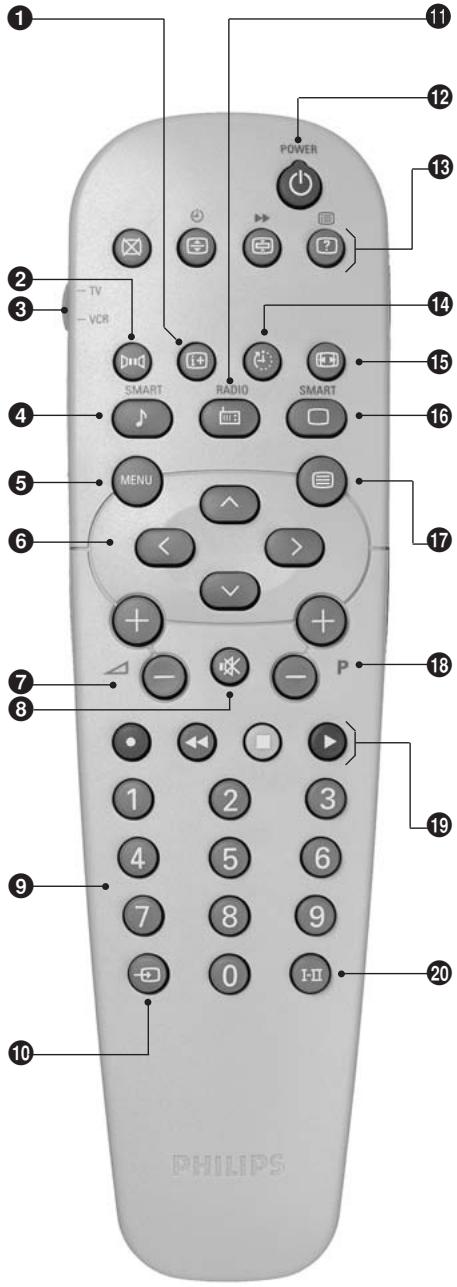
GB For detail explanation of the remote control's function and safety page, please refer to page 3.
FR Pour les instructions détaillées sur la fonction de télécommande et les pages d'informations relatives à la sécurité, veuillez vous reporter à la page 3.
NL Zie pagina 3 voor meer informatie over de functies van de afstandsbediening en de veiligheidsinformatie.
DE Eine detailierte Beschreibung der Funktionen der Fernbedienung sowie Sicherheitshinweise finden Sie auf Seite 3.
IT Per istruzioni dettagiate sulle funzioni del telecomando e la sicurezza andare a pagina 3.
DK Yderligere ophysninger om fjernbetjeningens Funktion og sikkerhed finder du pa side 3.
NO For detailjert forklaring av fjernkontrollens funksjoner og sikkerhetsside, se side 3.
SU Mer information om fjarrkontrollens Funktion och sakerhetssidan finns på sedan 3.
SF Lisatietoja kaukosaatimen toiminnasta ja turvallisuusasioista saat sivulta 3.
ES Para explicaciones más detalladas de la función de control remoto y la párgina de seguridad, dirijase a la párgina 3.
PT Para obter explicacoes detallhadas sobre as funcoes do controlo remoto e da网页 de seguranca, consulte a pagina 3.
GR Tia aenittopeic e nteynnoeis Tns aeitoupyiac Tou nIaeXepiOtnpiou kai tn oeiia etpaoaaleiac ovatpexiTe otn eia 3.
TR Uzaktan kumandanin islevi ve givenvlik sayfasile ilgili ayrintili aciklama icin 3. sayfaya bakin.
HU A távkapcsoló funkcióival és aBiztonsági oldallakapcsolatos részletes tudnivalókat a 3. oldalon olvashatja.
RU Iopnp6Hoe OONcaHHe Ha3HaueHnI PylbTa INCTaHcIOHNOY npaBNeHn INHOpMaIIO NTO TexHnke 6e3ONaCHOCTN CMOTpnte Ha cTpaHnCe 3.
PL Szczegółowy opis faktcji pilota i informacja o bezpieczestewie znajduja sie na stronie 3.
CZ Podrobné používání funkce dálkového ovladače a bezpečnostné poukny najdete na strě 3.
SK Detailné vysvetlenie funkcii dial'kového ovládača a o informácie bezpečnosti najdete na strane 3.
Introduction
Thank you for purchasing this television set.
This handbook has been designed to help you install and operate your TV set.
We would strongly recommend that you read it thoroughly.
We hope our technology meets entirely with your satisfaction.
Note: Specification and information subject to change without notice.
Table of Contents
Installation
Installing your television set 2
The keys on the TV set 2
Remote control keys 3
Safety information 3
Quick installation 4
Program sort 4
Program name 4
Manual store 5
Other settings in the Install menu 5
Operation
Using the radio (only available on certain versions) 5
Picture settings 6
Sound adjustments 6
Feature settings 6
Timer function 7
TV lock 7
Teletext 8
Peripherals
Video recorder 9
Other equipment 9
Amplifier 9
Side connections 9
To select connected equipment 9
Practical information
Tips 10
Safety Information: Electric, Magnetic and Electromagnetic Fields 10
Glossary 11


m = 311 ;
Recycling
This packaging of this set can be recovered or recycled. Apply to the local authorities in order to minimise environmental waste.
Disposal of your old product.
Your product is designed and manufactured with high quality materials and components, which can be recycled and reused.
When this crossed-out wheeled bin symbol is attached to a product it means the product is covered by the European Directive 2002/96/EC. Please inform yourself about the local separate collection system for electrical and electronic products.
Please act according to your local rules and do not dispose of your old products with your normal household waste. The correct disposal of your old product will help prevent potential negative consequences for the environment and human health.
Installing your television set
Positioning the television set
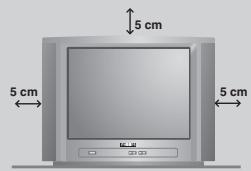
Place your TV on a solid, stable surface, leaving a space of at least 5cm around the appliance. To avoid accidents, do not put anything on the set such as a cloth or cover, a container full of liquid (vase) or a heat source (lamp). The set must not be exposed to water.
Connections
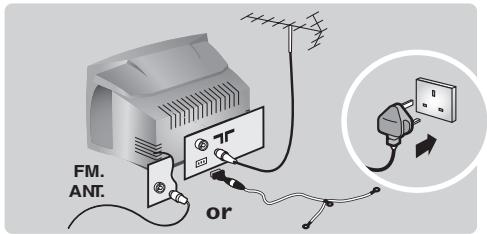
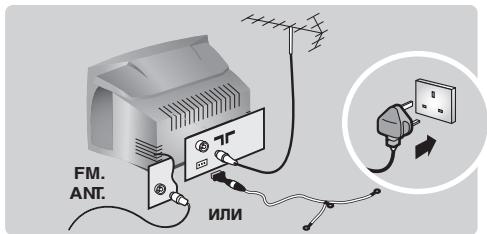
- Insert the aerial plug into the socket at the rear of the set.
- For the versions equipped with a radio: insert the radio aerial socket into the FM ANT socket using the adapter supplied. If you are using an indoor aerial, reception may be difficult in certain conditions. You can improve reception by rotating the aerial. If the reception remains poor, you will need to use an external aerial.
- Insert the mains plug into a wall socket (220-240V / 50 Hz).
The keys on the TV set
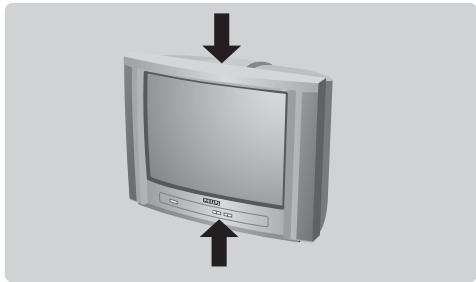
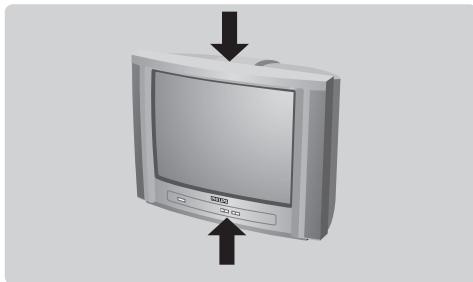
The television set has 4 keys which are located on the front or the top of the set depending on the model.
Remote control
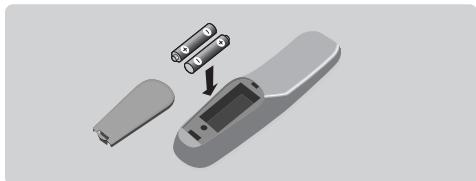
Insert the two R6-type batteries (supplied) making sure that they are the right way round. Check that the mode selector is set to TV. The batteries supplied with this appliance do not contain mercury or nickel cadmium. If you have access to a recycling facility, please do not discard your used batteries (if in doubt, consult your dealer). When the batteries are replaced, use the same type.
Switching on
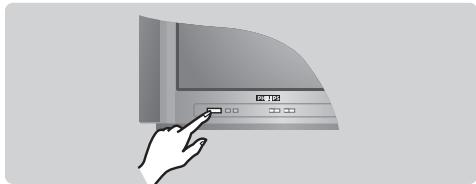
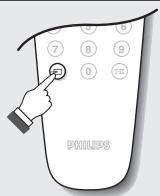
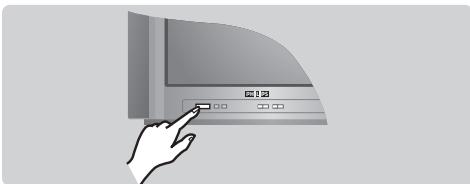
To switch on the set, press the on/off key. A red indicator comes on and the screen lights up. Go straight to the chapter Quick installation on page 4.
If the television remains in standby mode, press P^ on the remote control.
The indicator will flash when you use the remote control.
The VOLUME - + (- +) keys are used to adjust sound levels. The PROGRAM - + (- P + or - +) keys are used to select the required programmes. To access the menus, simultaneously hold down the and + keys. The PROGRAM - + keys may then be used to select an adjustment and the - + keys to make that adjustment.
To exit from the menus, hold down the 2 - and + keys.
Note: when the Child Lock function is activated, these keys are unavailable (refer to Features menu on page 7).
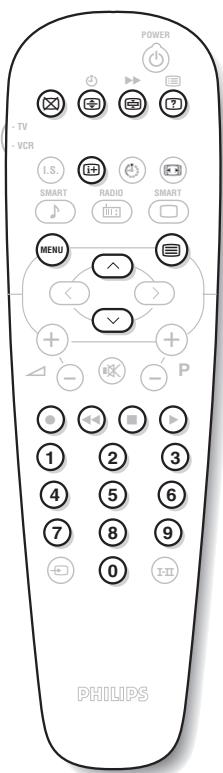
Remote control keys
1 Screen information / permanent no.
To display / clear the program number, name (if it exists), time, audio mode and time remaining for the sleep feature. Press the key for 5 seconds to activate permanent display of the number. This key is also used to exit from the menu.
2 Surround Sound (only available on certain versions) To activate / deactivate the surround sound effect. In stereo, this gives the impression that the speakers are further apart. For models equipped with Virtual Dolby Surround*, you can experience Dolby Surround Pro Logic sound effects. In mono, a stereo spatial effect is simulated.
VCR key**
4 Pre-set sound
Used to access a series of stored settings: Speech, Music, Theatre and return to Personal.
5 Menu
To call up or exit the menus.
6 Cursor/Format
These 4 keys are used to navigate through the menus. The keys are used to enlarge or compress the picture vertically.
Volume
To adjust the sound level
Mute
To mute or restore the sound.
9 Number keys
Direct access to the programmes. For a 2 digit program, enter the 2nd digit before the dash disappears.
Selection of EXT socket
Press several times to select EXT1,EXT2,S-VHS and AV.
Radio /TV mode
To switch the TV set to radio or TV mode (for versions equipped with radio).
12 Standby
Lets you place the TV set on standby. To turn on the TV, press P , , to (or ).
Teletext keys (p. 8), VCR keys (p.11) and list of radio stations (p.5)
Sleep
To select an automatic standby after a preset time (from 0 to 240 minutes).
16:9 modes (p. 9)
16 Pre-set image
Used to access a series of stored settings: Rich, Natural, Soft, Multimedia and return to Personal.
Teletext keys (p.8)
18 Program selection
To access the next or previous programme. The number, (name) and sound mode are displayed for a few moments.
For some programs, the title of the program will be displayed at the bottom of the screen.
Teletext keys (p.8)
or VCR keys ** (p.11)
Sound mode
Used to force programmes in Stereo to Mono or, for bilingual programs, to choose between Dual I or Dual II. For TV sets equipped for Nicam reception, depending on the programmes, you can force the Stereo Nicam sound to Mono or select between Nicam Dual I, Nicam Dual II and Mono.
The Mono indication is red when in forced position.
- "Dolby" and the double-D symbols DQ are trademarks of the Dolby Laboratories Licensing Corporation.
Manufactured under license of Dolby Laboratories Licensing Corporation.
** VCR key
The remote control lets you control the main functions of the VCR.
Press and hold down the VCR key located on the side of the remote control, then press one of the keys to access
theVCR functions: (MEN) P +
The remote control is compatible with all VCRs using the RC5 standard.
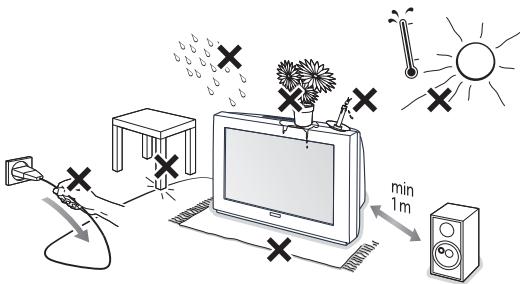
Safety Information
Plug the TV into a 220V - 240V AC, 50 Hz supply.
- Disconnect mains plug when :
- the red light below the TV screen is flashing continuously.
- a bright white line is displayed across the screen.
there is a lightning storm.
the set is left unattended for a prolonged period of time.
- Cleaning the TV screen. Never use abrasive cleaning agents. Use a slight damp chamois leather or soft cloth.
No naked flame sources, such as lighted candles, should be placed on top of the TV or in the vicinity.
- Do not place your TV set under direct sunlight or heat.
- Do not cover or block the TV as it could lead to overheating.
- Leave at least 5cm around each side of TV set to allow for proper ventilation.
- Avoid placing your set (e.g. near the window) where it is likely to be exposed to rain or water.
- Battery Usage CAUTION - To prevent battery leakage that may result in bodily injury, property damage, or damage to the unit:
- Install all batteries correctly, with + and - aligned as marked on the unit.
- Do not mix batteries (old and new or carbon and alkaline, etc.).
- Remove batteries when the unit is not used for a long time.
Useful Tips
- Do not leave your set on standby mode for a prolonged period of time. Switch off set to allow it to be demagnetised. A demagnetised set supports good picture quality.
- Do not shift or move the set around when it is switched on. Unevenness in colour in some parts of the screen may occur.
- Never attempt to repair a defective TV yourself. Always consult a skilled service personnel.
Quick installation
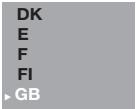
When you turn on the TV set for the first time, a menu is displayed on screen. This menu prompts you to select the country and language for the menus:
Select Country
Country
Language
Espanol
Syenska
English
Dansk
Nederlandss
If the menu is not displayed, press and hold down the and + keys on the TV set for 5 seconds to display the menu.
Use the keys on the remote control to select your country and validate with. If your country does not appear in the list, select choice"..."
Next select your language using the keys and validate with > .
The search starts automatically. All the available TV programmes and radio stations * will be stored. This operation takes a few minutes. The display shows the progress of the search and the number of programs found. At the end of the search, the menu disappears.
To exit or interrupt the search, press (MEN) If no programme is found, consult the possible solutions p. 10.
If the transmitter or cable network sends the automatic sort signal, the programs will be numbered correctly. In this case, the installation is complete.
If this is not the case, you need to use the Sort menu to number the programs correctly. Some transmitters or cable networks broadcast their own sort parameters (region, language, etc.). In this case, indicate your choice using the keys and validate with .
- Only on versions equipped with a radio.
Program sort
Press key (MEN). The Main menu is displayed on the screen.
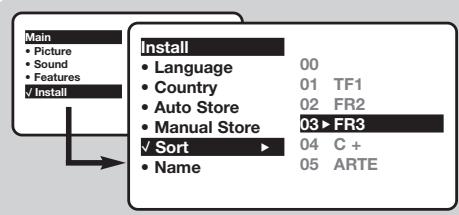
With the cursor, select the Install menu followed by the Sort menu.
3 Select the programme you want to move using the keys and press >
4 Then use the keys to select the new number and validate with .
Repeat steps 3 and 4 for each program you wish to renumber.
6 To quit the menus, press
Program name
If required, you can give a name to the programmes and external connectors. Note: on installation, the programs are named automatically when an identification signal is sent.
1 Press the (Menu) key.
With the cursor, select the Install menu, then Name
Use the keys to select the programme to name or rename.
Use the keys to move around the name display area (5 characters) and the keys to select the characters.
When the name has been entered, use the key to exit. The name is stored.
6 Repeat steps 3 to 5 for each programme you wish to name.
To quit the menus, press
Manual store
This menu is used to store the programmes one at a time.
1 Press the (MEN) key.
With the cursor, select the Install menu then Manual store:

System: select Europe (automatic detection*) or Western Europe (BG standard), Eastern Europe (DK standard), United Kingdom (I standard) or France (LL' standard).
- Except for France (LL' standard), you must select choice France.
4 Search: press × . The search starts. Once a programme is found, the scanning stops and its name is displayed (when available). Go to the next step. If you know the frequency of the required programme, this can be entered directly using the 0 to 9 keys. If no picture is found, consult the possible solutions (p. 10).
Program No.: enter the required number with the or 0 to 9 keys.
6 Fine Tune: if the reception is not satisfactory, adjust using the keys.
7 Store: press 2 . The program is stored.
Repeat steps 4 to 8 for each programme to store.
9 To quit the menus, press +
Other settings in the Install menu
Press the (MEN) key and select the Install menu:
2 Language: to change the display language for the menus.
3 Country: to select your country (GB for Great Britain).
This setting is used for the search, automatic programme sort and teletext display. If your country does not appear in the list, select "...
4 Auto Store: to start automatic search for all programmes available in your region. If the transmitter or cable network sends the
automatic sort signal, the programmes will be numbered correctly. If this is not the case, you need to use the Sort menu to renumber the programmes (see p. 4).
Some transmitters or cable networks broadcast their own sort parameters (region, language, etc.). In this case, indicate your choice using the keys and validate with . To quit or interrupt the search, press . If no picture is found, consult the possible solutions (p. 10).
To quit the menus, press
Using the radio (only available on certain versions)
Choice of TV or radio mode
Press the key on the remote control to switch the TV set to either TV or radio mode. In radio mode, the number, station name (if available), frequency and sound mode are displayed on the screen. To enter the station names, use the Name menu (p. 4)
Program selection
Use the ① 9 or -P + keys to select the FM stations (from 1 to 40).
List of radio stations
Press the 三 key to display the list of radio stations radio. Use the keys to change station and the key to exit.
Using the radio menus
Use the (MENU) key to access the specific radio setting.
Search for radio stations
If you used the quick installation, all available FM stations have already been stored. To start a new search, use the Install :Auto Store menu (for a complete search) or Manual Store (for a station by station search). The Sort and Name menus let you sort or name the radio stations. Operation of these menus is the same as for the TV menus.
Screensaver
Use the 值 key to activate/deactivate the radio screenshotaver.
Picture settings
Press (MEN) then .The Picture menu is displayed:
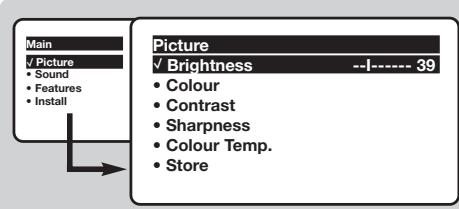
Use the keys to select a setting and the keys to adjust.
Note: during the picture adjustment, only the selected line remains displayed. Press to display the menu again.
3 Once the adjustments have been made, select Store and press > to store them. Press 加 to exit.
Description of the adjustments:
- Brightness: this changes picture brilliance.
Colour: this changes the intensity of the colour. - Contrast: this changes the difference between the light and dark tones.
- Sharpness: this changes the picture definition.
- Colour Temp.: this changes the colour rendering: Cold (bluer), Normal (balanced) or Warm (redder).
- Store: to store the picture adjustments and settings (as well as the settings for Contrast + and NR in the Features menu).
Sound adjustments
Press (MEN), select Sound () and press. The Sound menu is displayed:
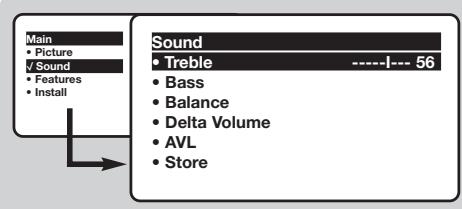
Use the keys to select a setting and the keys to adjust.
3 Once the adjustments have been made, select Store and press to store these changes.
4 To quit the menus, press
Description of the settings:
- Treble: this alters the high frequency sounds.
- Bass: this alters the low frequency sounds.
Balance: this balances the sound on the left and right speakers. - DeltaVolume*: this is used to compensate any volume discrepancies between the different programs or EXT sockets. This setting is available for programs 0 to 40 and the EXT sockets.
- AVL* (Automatic Volume Leveller): this is used to limit increases in sound, especially on program change or advertising slots.
- Store: this is used to store the sound settings.
- Only available on certain versions.
Feature settings
Press (MEND), select Features () and press. > You can adjust:
Timer, Child Lock and Parental Cont.: see next page
Contrast+: automatic adjustment of the picture contrast which permanently sets the darkest part of the picture to black.
4 NR: attenuates picture noise (snow) in difficult reception conditions.
Caution: to store the Contrast + and NR settings, use the Store choice in the Picture menu.
5 To quit the menus, press + .
Timer function (only available on certain versions)
This menu lets you use the TV set as an alarm.
1 Press the (MEN) key.
With the cursor, select the Options menu then Timer :
3 Sleep: to select an automatic standby period.
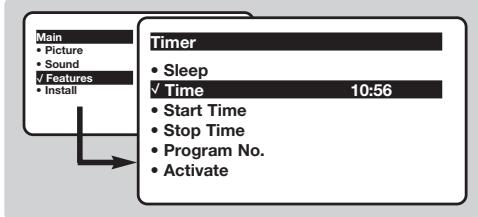
This setting is also available via the key on the remote control.
Time: enter the current time.
Note: the time is updated automatically each time the TV set is switched on via the teletext information on programme 1. If this programme does not have teletext, the update will not take place.
3 Start Time: enter the start time.
Stop Time: enter the standby time.
Program No.: enter the number of the programme for the wake-up alarm. For models equipped with a radio, you can select an FM station by using the keys (the 09 keys are only used to select TV programs).
Activate: the settings include:
- Once for a single alarm,
- Daily for each day,
- Stop to cancel.
Press to put the TV set in standby. It will automatically come on at the time programmed. If you leave the TV set on, it will just change programmes at the time entered (and will go to standby mode at the Stop Time).
By combining the TV lock and Timer functions, you can restrict the period during which the TV set is used, for example by your children.
TV lock (only available on certain versions)
You can block certain programs or inhibit use of the TV set completely by locking the keys.
Child lock
1 Press (MEN).
With the cursor, select the Options menu and position Child Lock to On.
3 Turn off the TV set and hide the remote control. The TV set cannot be used (except via the remote control).
4 To cancel: position Child Lock to Off.
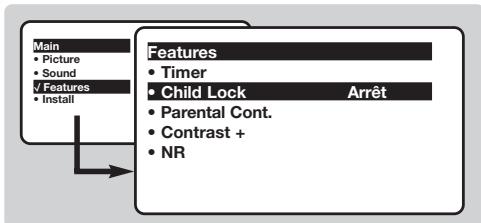
Parental control
1 Press the (MEN) key, select the Features menu then Parental Cont.:
You must enter your secret access code.
The first time you enter this, enter code 0711 twice and then enter your new code choice. The menu is displayed.
3 Parental Cont.: Use the keys to select the TV programme required and validate with . The symbol will be displayed opposite the programmes or sockets that are locked. From now on, to view a locked programme, you must enter your secret code, otherwise the screen will stay blank.
The access to the Install menu is also locked. Caution, for encrypted programs using an external decoder, you must lock the corresponding EXT socket.
4 Change code: this allows you to enter a new 4 digit code. Confirm your new code by entering it a second time.
If you have forgotten your secret code, enter the universal code 0711 twice.
Unlock all: this is used to unlock all locked programmes.
Lock All: this is used to lock all the TV programmes and EXT connectors.
Press the key to quit.
Teletext
Teletext is an information system broadcast by certain channels which can be consulted like a newspaper. It also offers access to subtitles for viewers with hearing problems or who are not familiar with the transmission language (cable networks, satellite channels, etc.).
| Press: | You will obtain: | |
| Teletext call | This is used to call teletext, change to transparent mode and then exit. The summary appears with a list of items that can be accessed. Each item has a corresponding 3 digit page number. If the channel selected does not broadcast teletext, the indication 100 will be displayed and the screen will remain blank (in this case, exit teletext and select another channel). | |
| Selecting a page | Enter the number of the page required using the ① to ⑨ or ⓷ P + keys, ⓽√. Example: page 120, enter ① ② ⑩. The number is displayed top left, the counter turns and then the page is displayed. Repeat this operation to view another page. If the counter continues to search, this means that the page is not transmitted. Select another number. | |
| Direct access to the items | Coloured areas are displayed at the bottom of the screen. The 4 coloured keys are used to access the items or corresponding pages. The coloured areas flash when the item or the page is not yet available. | |
| Contents | This returns you to the contents page (usually page 100). | |
| Temporary stop | This is used to temporarily disable or activate the teletext display. | |
| Enlarge a page | This allows you to display the top or bottom part of the page and then return to normal size. | |
| Stop sub-page acquisition | Certain pages contain sub-pages which are automatically displayed successively. This key is used to stop or resume sub-page acquisition. The indication ⓹ appears top left. | |
| Hidden information | To display or hide the concealed information (games solutions). | |
| Favourite pages | For teletext programs 0 to 40, you can store 4 favourite pages which can then be accessed directly using the coloured keys (red, green, yellow, blue). 1 Press the ⓺ key to change to favourite pages mode. 2 Display the teletext page that you want to store. 3 Press the coloured key of your choice for 3 seconds. The page is now stored. 4 Repeat the operation with the other coloured keys. 5 You can now consult teletext and your favourite pages will appear in colour at the bottom of the screen. To retrieve the standard items, press ⓹. To clear everything, press ⓹ for 5 seconds. | |
Connecting peripheral equipment
Depending on the versions, the TV set will be equipped with 1 or 2 SCART connectors EXT1 and EXT2 located on the rear. The EXT1 socket has audio, CVBS/RGB inputs and audio, CVBS outputs. The EXT2 socket (if available) has audio, CVBS/S-VHS inputs and audio, CVBS outputs.
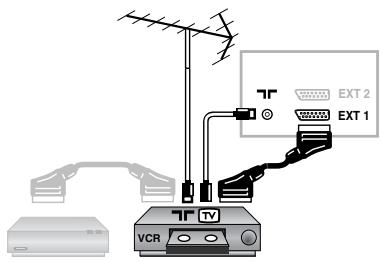
Video recorder
Carry out the connections shown opposite, using a good quality euroconnector cable.
If your video recorder does not have a euroconnector socket, the only connection possible is via the aerial cable. You will therefore need to tune in your video recorder's test signal and assign it programme number 0 (refer to manual store, p_6).
To reproduce the video recorder picture, press (0).
Video recorder with decoder
Connect the decoder to the second euroconnector socket of the video recorder. You will then be able to record scrambled transmissions.
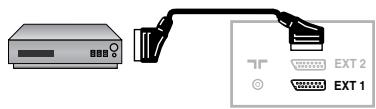
Other equipment
Satellite receiver, decoder, CDV, games, etc.
For TV sets with 2 SCART connectors, preferably connect the equipment delivering RGB signals (digital decoders, DVD players, games consoles, etc.) to EXT1 and the equipment delivering S-VHS signals (S-VHS and Hi-8VCRs) to EXT2.
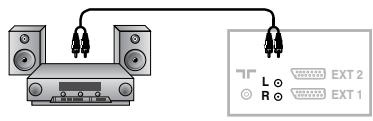
Amplifier (only available on certain versions)
To connect to a hi-fi system, use an audio connection cable and connect the "L" and "R" outputs on the TV set to the "AUDIO IN" "L" and "R" input on your hi-fi amplifier.
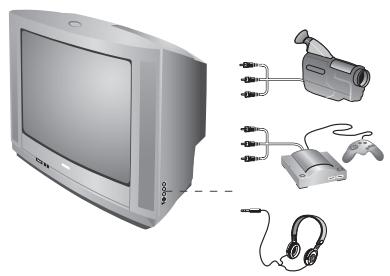
Front panel connectors (only available on certain versions)
Depending on the versions, the connectors are located on the front (sometimes under a flap) or on the right-hand side of the TV set. Make the connections as shown opposite.With the key, select AV.
For a monophonic device, connect the audio signal to the AUDIO L input. Use the key to reproduce the sound on the left and right speakers of the TV set.
Headphones
When headphones are connected, the sound on the TV set will be cut. The P keys are used to adjust the volume level.
The headache impedance must be between 32 and 600 Ohms.
To select connected equipment
Press the key to select EXT1 and on the versions with 2 scarts, EXT2, S-VHS2 (S-VHS signals from the EXT2 socket) and AV for the side connections (if available).
Most equipment (decoder, video recorder) carnes out the switching itself.
Tips
Poor reception
The proximity of mountains or high buildings may be responsible for ghost pictures, echoing or shadows. In this case, try manually adjusting your picture: see Fine Tuning (p.5) or modify the orientation of the outside aerial.
Does your antenna enable you to receive broadcasts in this frequency range (UHF or VHF band)?
In the event of difficult reception (snowy picture) switch the NR on the Options menu to ON. (p.6).
No picture
If the television does not switch on, please press the standby key (located on the remote control) twice.
Have you connected the aerial socket properly? Have you chosen the right system? (p. 5).
Poorly connected euroconnector cables or aerial sockets are often the cause of picture or sound problems (sometimes the connectors can become half disconnected if the TV set is moved or turned). Check all connections.
Peripheral equipment gives a black and white picture
You have not selected the right socket with the key: S-VHS2 instead of EXT2.
To play a video cassette, check that it has been recorded under the same standard (PAL, SECAM, NTSC) which can be replayed by the video recorder.
The remote control no longer works.
Check that the mode selector on the side of the remote control is set to TV.
No sound
If on certain channels you receive a picture but no sound, this means that you do not have the correct TV system. Modify the System setting (p. 5).
Teletext
Are certain characters not displayed correctly? Check that the Country setting has been positioned correctly (p.5).
Remote control
The TV set does not react to the remote control; the indicator on the set no longer flashes when you use the remote control?
Replace the batteries.
Standby
When you switch the TV set on it remains in standby mode and the indication Locked is displayed when you use the keys on the TV set? The Child Lock function is switched On (p. 7). If the set receives no signal for 15 mins, it automatically goes into standby mode. In standby mode, your TV consumes less than 5W depending on model. In order to be more environmentally friendly, please use the on/off (power) switch to turn the set off completely.
Still no results?
If your TV set breaks down, never attempt to repair it yourself: contact your dealer's after-sales service.
Cleaning the set
Only use a clean, soft and lint-free cloth to clean the screen and the casing of your set. Do not use alcohol-based or solvent-based products.
Safety Information: Electric, Magnetic and Electromagnetic Fields ("EMF")
- Philips Royal Electronics manufactures and sells many products targeted at consumers, which, like any electronic apparatus, in general have the ability to emit and receive electro magnetic signals.
- One of Philips' leading Business Principles is to take all necessary health and safety measures for our products, to comply with all applicable legal requirements and to stay well within the EMF standards applicable at the time of producing the products.
- Philips is committed to develop, produce and market products that cause no adverse health effects.
- Philips confirms that if its products are handled properly for their intended use, they are safe to use according to scientific evidence available today.
- Philips plays an active role in the development of international EMF and safety standards, enabling Philips to anticipate further developments in standardization for early integration in its products.
Glossary
RGB Signals: These are 3 Red, Green and Blue video signals which directly drive the red, green and blue emitters in the cathode ray tube. Using these signals provides better picture quality.
S-VHS Signals: These are 2 separate Y/C video signals from the S-VHS and Hi-8 recording standards. The luminance signals Y (black and white) and chrominance signals C (colour) are recorded separately on the tape. This provides better picture quality than with standard video (VHS and 8 mm) where the Y/C signals are combined to provide only one video signal.
NICAM sound: Process by which digital sound can be transmitted.
System: Television pictures are not broadcast in the same way in all countries. There are different standards: BG, DK, I, and L L'. The SYSTEM setting (p. 6) is used to select these different standards. This is not to be confused with PAL or SECAM colour coding. Pal is used in most countries in Europe, Secam in France, Russia and most African countries. The United States and Japan use a different system called NTSC. The inputs EXT1 and EXT2 are used to read NTSC coded recordings.
16:9: Refers to the ration between the length and height of the screen. Wide screen televisions have a ration of 16/9, conventional screen TV sets have a ration of 4/3.
Introduction

m = 311
Used to access a series of stored settings: Rich, Natural, Soft, Multimedia and return to Personal.

m = 311
MbHaJeemcR, yTo HaaTaTexHONOrnI POJIHOCTbU yOBoNtBOpNT BaC.
PIMMEAHHE. CneuΦkaunn u HΦopMaun Moryt U3MeHbTaBc6e3
YBEdOMnHnIa.
OrnaBleHne
YCTAHOBKa
YctaHObKa TeJIeBn3Opa 2
KnaBnTeneBn3opa 2
KhoIKNyIbTaDnCTaHcUHOHHoYnpaBHeHn 3
CbeHnnoTexnke6e3oNaChocTu 3
Быстаянстюка 4
Coptipobka KaHaIOB 4
IMRAKANA 4
3anomnltb PyuH. 5
ПочиNYнктбНасторКМeHIO YcTaHOBnTB 5
Пользоване
IcnoJIb3OBAHnue paIIOnpnemHnka 5
HacrpoKa n3o6paXeHHa 6
HacrpoiKa 3Byka .6
HacrpoKa xapaKTepeNtIK 6
ΦyHKU86yDnIbHnKa 7
Бл_OKировka TeileBn3opa 7
TeTetekct .8
Pepnpepnnaannapatya
IopKnloueHne nepuΦepnHOaannapatypbI 9
BndeomarHHToΦOH 9
Дугай симпатура 9
IopknioeHn c6oky 9
YcnilnteIb 9
IpaKTHueckaMHOpMaun
Cobetbl 10
CbeHnno TeXnKe 6e3oNaChocTn: ΘeKtpnueckne, MaHHTbIe n 3JeKtpomarHHTbIe noJ (EMF) 10
CnoBapb 11


Yka3aHnI IO yTmIINaUIn
Ynakobka 3TOrO n3dJIeIIN ppeHa3NaueHa IJI NOBtOpHoi nepepa60Kn.
ObaNTecb B MeCTHbI yIPOJIHOMOeHHbI opraHbI IJIa IIOJUeHn INΦOpMauN O KoppeKTHOM yHNUTOXeHN.
YCTaHOBnTB TeneBn3Op Ha npOCHyIO n
YCTOuHbByIO NOBepxHocTb, ppeDyCMOTpeB
CBo6OJHOe IPOcTpaHCTBO He MeHee 5 CM BOKpyr
TeneBn3Opa. He HakpbBaTb erO (caPcTeKoI,
CKaTePbTO u T. n.), He CTaBtB Ha Hero
IpeMeTb, HAnONHeHHbIe JIKKOCTbIO (Ba3b) NII
BVdJIeNIOUne TeTIO (JaMnI), UTo6b I36EkaTb
OnaChOCTeIN NII NOBpeXKeHEn. He DOnyckTaB
IOnaDaHn8 Ib3ROB BObI Ha TeneBn3Op.
② Повлоченье
BCTaBnTbФnIky aHTeHHb IB pa3bEm TpacnoIOXKeHHb C 3aJHeN CTOpOHb TeNEBu3opa.
Длma moDEnei,обopydOBaHHbIX paIIOIpnEMHnKAMN:BCTaBbTe 5TbIpb aHTeHHbI paIIOIpnEMHnKa B rHe3do FM ANT, nCnoJIb3yI pyI 3TOrO npINaRaembI nepeXoHNK.Пи IcNoIb3OBAHmB BVHTpeHNe aHTeHHbI pIneM, B HeKOToPbIX cIpyaX, MoKeT b6tB 3atpydHeN. Bbl MoKeTe yIyUuNTb erO, BpaUaJ aHTeHHy.EcII KaueCTBO pInema He yIyUuNTcR, Heo6xOIMO nepeITNa HApYxHyo aHTeHHy.
- Bключte shHyр пntaHnB ceTb (220-240 B /50Γu).
BatapeKn, noCTaBHeHbIe BMeCTe c aIInapaTOM, He coDEpKaT HN pTuN, HN KaMnH, HN HKeJI B 3aOte o6 oxpAne OKpyKaIoUe Cpebl. IPoCb6a He bblpaBtB OTPa6oTbAWe batapeKn, anCIOJb3OBaTb IMEIOUneCBAWEM pacOpRJaKeHN CpeDCTBa INx C6opAp dIy yTuINI3aUIn (ObpatNTbcr K BAWeMy IpOdaBuY).
BkJIIOUeHne
HaKaTb Ha KnaBnUy BkN./BbIK.ДЯ
BKnIOueHnI TeJeBn3Opa.3aRopaETc
KpaChbI CBtOBo INHdNKATOp,ИЗКран
3aKnIraETc.Obpatntecb HENOCpeDCTBeHNHO
K rJaBe 6bICTpo yCTaHOBKn HA cIeNyIOSei
CTpaHnIe.Ecnn TEJbN3Op HaxOINTcB
IdeKypHOM COCToHnH,HaKaTb Ha KNaBnUy
P nylbTa IncTaHcNoHOrO ynpabJIeHnI.
Ipiu NcNoJIb3OBAHH nylbTa IncTaHcNoHOrO
ynpabJIeHnIBCtOBo INHdNKATOp MInaET.
KnaBnIu TeneBu3Opa
TeJIeBn3Op IMeet 4 KnaBnIu, KOtOpbIe HaxoJATcH JIo6 Ho NapepeHne CTeHKe, JIo6 Ho
BepxHe napanen, B 3aBncmocn OT moJeIe. KnaBnuVOLUME-+(-+)no3BOJIoT peyunipobat ypoBeHb 3Byka.KnaBnuIN PROGRAM-+(-P+nIn-n+)no3BOJIoT BBiupapb nporpamMbI.DJIaIOCTynKaMeHIO dePkaTb HaxKaTbIMN KnaBnuIN -n +3aTeM KnaBnuIN PROGRAM-+no3BOJIoT BBiopaTb HacTPOkUy,a KnaBnuIN -+ npoIN3BecTN HAcTPOkUy.DJIa BixOJa n3 MeHIO dePkaTb HaxKaTbIMN KnaBnuIN -n +PnpimeuHaHne:ecnI cyHKuIN BLOKIPOBKA aKTNUBPOBaHa,3Tu KnaBnuIN He JeicCTBYIOT (cm.CTp.7).
KhoPkn nyIbTa nIcTaHnOHHoro ynpaBneHna
1 NΦopmauHa BbOdIma Ha 3KpaH /noctoHHn ne: Cnyknt dna HnDkaum /c6poca HnDkaumn Homepa KaHana, ero IMeHN (ecns OHO IMeETCA), BPMeHN, pekMHa 3ByKa n octatKa BpeMeHN ITOAmepy. Haxmnte u ydepXNBaiTe Haxatoi KNOKY B TeueHne 5 ckyHd IINBKnUeHn NOCTOHNN HnDkaumn Homepa.
0kpykaonoi oBemhbl 3ByK (ImeETCA TOnbKO Ha HEKOTOpbX MoEJIAX
DIA KNIUOeHn / OTKNIUeHn 3ofoKeTA OKpykaOIOero
OBEMHO 3ByaHN. B cTepeoOHHueCKOM pexmIE
Co3aDTc BnueATNeHne, YTO rpoMkoBOropENTNI
pacnoJooKeHb Ipyr OT dpyra HA bONbIXPacCToRHNx
Yem Ha cAMOM DBe. B MOJeHX, IMeOUXs FyHKNUO
Virtual Dolby Surround*, co3aDTc 3ofoFkT TBNOBX
rpoMkoBOropNTeN nCtEmbl Dolby Surroul Pro Logic. B cTepeoOHNoeCKom pexmIE co3aTaTC
ncBEOO3oFFKT O6bEMHO cTepeoOHNoeCKOrO 3ByaHN.
3 KhoNka BndeomarHHTOFOHa
4 PnPepBaPHTBbHnA HAcTPOKn3BykA PIO3BOJIET NOnyUHbTODcTyN KPEKIMy PnpEpaBpTeBHOH HAcTPOKnHECKOJIbXn NapaMeTpOB 3BykA:Pey,My3bYka,TeATn U BepHYbcnB PEKIM IpecoHbHnA HAcTPOKn.
MeHIO
Cnyknt nIyBb3Oba MeHIO nn BbIXoJa N3 MeHIO.
Kypcop /Opomat 3TN4 KHOKNI NO3BNOHOT OCUUCTBnARTb NEPEXOD MEJky pa3NNUHBM ONUARM MEHIO. KHOKN (C) NO3BNOHOT PaSCHNPTb IIN CyKATb NIO6PakHeMe NO BEPTNKAI.
7 POMKOCTb
Cnyknt nnaHactpoynypoBn3Byka.
8 OTKIOUeHne 3Byka
Cnyknt dIy OTKIOUeHn IIN BKNIOUeHn 3Byka.
1 CnykataHnOepeCTBeHHoR BGIOUeHHaKaHaOB. 1IyBKnOeHHaKaHa, HOMep KOTOPORo COCTOITN3 DByx UcFp, Heo6OJIMMO Oobabntb BTOpYu UcFpy Do NcUe3HOBBHae YcETbI.
10 BbIobop BHEMHNX yCTPOOBCTB EXT (BHELIH.): HaxIMMaTe MHOROKpaTHo HA 3Ty KHOINky dRy BbIobopa EXT,EXT2,S-VHS n AV.
1 Pekim paioo / TB
Позаняп.TepeKIOUaTte TepeBIOZmМeJy peKIMAMn paIdoN u TB (mnoMgO, O6OpyoBaHbIx paIOnIOpneMhIM yCTPOIcTBOM).
12 PeknOxuaHna
ПОЗБЛЕТ ПЕВОДТБЕLEЗИВР БЕЖМ
ОЖДАн.HДЯВКLOЧЕНTELEЗИВОП.a3peЖМа
ОЖДАн.HAKMITEHAPC(+)④,⑥,①-⑨(mn)
13 KhoNk TeneTeKCTa (cTp.8), KHONK BnDEOMarHnTOΦoHa (cTp.11) n Cnncok padnoctAchun (cTp.5)
Cnab CnyKtI DnA BvBOpa nepNoA BpEmeH (OT 0 do 240 MNYT), NO IcTeHmN KOToPOrTO TEeBn3Op ABOMTUNECKN PEPXOJNTB DPEKM OZkDANH.
15 PeXKIMbl 16:9 (CTp. 9)
16 PnpBapntbHnA HcTpoKa n3o6paKHeHn Po3BOJnE TOnyUHTbOCTUY K HECKoBkMn PnpBAPNTbHO YctaHOBNeHbIMn NapamETpAM n3o6paKHeHn: HacblIeHHeO, EctcTeBHeHoe, MArKHe, MyIbTmEtnaN IN BepHyTcB R peXKM NpecohAhlbHn HAcTpoKa.
17 Khonkn Teletekcta (ctp.8)
18 BbI6Op kaHaNoB
CnykHTIINPEXODA K PpeBdyUeMey INN CnEDyUoEmy KaHany. Ipn 3TOM HA 3KpaHe HA HECKOBKO MRHOBEHN NOBRAETC NINDAKUHNOHEMA (mEH) KAHANA IN PEKIMAA. Ina HeKOTOpbIX KAHANOB HaaBaHne PepeDaUNIPOBBLAETCR B HNNKHe YacTN KPAHA.
19 Khonkn Teletekcta (ctp.8)
NIN KHOKN BUNDeOMaHnToΦoHa ** (CTp.11)
20 PeXm3Byka
I03BONJET YCINNTB CTEPEONEpeaH B pexkme Mono ININ, INP INPEME DByRbHbX INPEeauy, Bb6pATB pEXKIM Dual I INN Dual II.ДЯn TEJEBN3OPOB, O6OpYIOBaHNbIX INPEEMbIM yCTPOIcTBOM NcAM, BYMOKeTe, B 3ABcIMMoCTN OT INPHIMAEMOI INepeaH, YCINNTB 3BYK Nicam Stereo B pEXKIME MoHO ININ cDenaTb Bb6Op MekJy pEXKIMAMi NcAM Dual I, NcAm Dual II n Mono. HApInCb Mono (MOHO) MeHReT UBeT HaKpaCHB B peKIMe YCINNEHHORO 3ByKa.
*DolbyN CmBONI BoHoro-D D-3TO TOBAPHbE 3nAkn KOMTaNi Dolby Laboratories Licensing Corporation. N3rOToBNeHO nIO mUeH3NI KOMTaNi Dolby Laboratories Licensing Corporation.
** KhoNka BIndeomarHHTOPOHa
IyIbT IcStaHIOHOY npabHeHnO N3OBnER TynpaBnBT OCHOBHm MyeOMHa HToEOMHa HApJxBaB nHaKATOM POnIOKeHH KHOKNY VCR, KOtOpA paCIOKeHn Ha BOKoBoi CTOpOE pNtJa DcTaNIOHOro YnpaBJeHn, HAKMTE OJHOBpEMHo HA OJHy N3 KHOIOK, yKa3aHHbIX HnHex, dJIy BKNIOUeHn OyHKLm BInDeOMHa HToTOFOHa: 0 1 09
IyIbT dNCTaHcUHOHO ynpabHeHr COBmctn CO BcEMn BVneOmaHHTofoHAMn, nCIOJIb3yIOuIMM CTaHapr RC5.
CbeDEnHnI NO TexHnKe 6e3ONaCHoCTn
BkIIOHTeTeJIeBn3Op Bpo3eTky 220-240 B nepemehHoro ToKa,50 T.
OTKJIIOUaIte BUNKy OT CETN, KOrDa :
KpaHbI INdIKaTOP HNKe 3KpaHa TeLEBn3Opa TOpNT NOCToHHO;
- nonepek 3kpaHa OTO6paxKaetc Apka Bea JINHn;
HaunHaeTcIp03a;
TeIeBn3Op He 6ydt NcIOnb3OBAtBCA B TeueHne IpoDoJXKITeJIbHO RBeMeHN.
UcKtka 3kpaHaTeNBeO30a.3anepeaetcr nCnIb3oBAt abpa3nHbIe cHCTBa. Pbnb3yIteC bcnrKa yBNAxHHH 3AMSeu NIN MFRKOn TKAhblO.
Ha TeJIeBn3Op IINI pAIOm C HIM HeJIb3r CTaBtB NCTOCHNk OTKpbITOrO ORH, HApPImep 3aXKHeHHbIe CBeuH.
TepeBnOHe DpJHKeNpDBePrtBaCBO3eCTBIO pPrMbX CONHeHbIX LyneI IIN TcNEIOEORo OTOnITeBHO O6OpDyDobHAn.
- He NaKpbIbAaTe TE TaeBb3Op Ie 3aKpbIbAaTe Ero BEHTnIaLIOHbIe OTEbPCTN, TAK KAK 3TO MOKET PInBECTN K neperpey yctpOCTBa.
-Дян haJIeXkaIeBHeTNJIaCmH HeO6xOIMo OCTaBJIaTb 3a3OpbI KaK MInHMym5 cM cKaJdoN CTopoHbI TeJIeBn30pa.
He yctahabnBaiTBe TE NEXB3Op T E MecTe (HAnPIMeP y OKHa), rge OH MOxET PNOACTb IOD DOXKDb IINI CyueCTBEYET BONLUA BepoTHCtB PNOADAHN B HrO EBAIg.
- PIPDYNPPEKHEHIE NO cckyataaunb 6 batapen - INR pnpoTBAUPeHHI yteuHn 36 batapen, B pe3ybltate KOTOPO B0MOXPEKHTeNEChBle NPOBPEKHEHIE, MATEpmaJIbHbN YUcEPbN bHybOX TcPOITCTBaN 13 CTOPO
BCTaBnIte BCE 6aTapei npabInbHO, co6liOJa IOnpHocb, yKa3aHHyIO 3HaKaMn+I - B yCTPOINCTBE;
He IcnoIb3yIte COBmecTHO CTapbIe HOBblE 6aTape Nll yroIbHble I LJIeIOUHbIe;
- 13BNEKIne 6aTapei,ecn yCTpoIcTBo He 6yDen TNCIOb3OBAtbcra B TeueHne IINITeJIbHOBO BpeMeHn.
CBeHnI NO TexHnke 6e3onachOCTn
He octabJIyIe yCTpoIcTBo B pEXnIMe OXuIaHINB TEHHE NITNEbHO BPEMeHN. OTKIOUaIte yCTPOIcTBO nIOHOCbIO, UTObI OHO pa3MaHHTUNIOb. Pa3MaHHTueHHoe yCTpoIcTB0 oBeCeHbAeT XOpOee KaecTeBO n3O6paJExHN.
He nepeBvIaIe n He nepeHocite paBotaOue yCTPOCTBO. 3TO MOKET PnIBECTN K HepABHOMEPHOCTU BETOB HekOTOpbX obSfACTx 3kpaHa.
3aIepueaTcAcmOCTeRbHPOHeMeHnPHTOBaBHeMeNpTaBbHTeNBeBnOp Heo6xoDIMO BcEJa oBaPaTaBcK KaBNiHINpOBAHbHM CIEUAAJNTCTAM cepBCHbX LcETHpO.
БыICTранасторикa
Припегвом ВКlioочenv TeileBn3opa Ha 3kpaH e nOBnTcMeIO. Bam 6ydt ppeIOnxoKeHO Bb6paTb CTpaHy, a TAKKe Ra3bIK MeIO.
Select Country
Country
Language
DK
anol
E
nska
F
lish
F
SK
Nederlandss
TMEHIOHE NOABUNOCb,HAXMNTe KHONK
A- n +Ha TeNeBn3OpE uYepKuBaIte INX B HaxaTOM NIOJKeHIn B TeueHne 5 CekyHd IJIY Bb3OBA MeHIO.
1 IcnoIb3yIte KHOJKNI nyIbTa DnCTaHcUHOHHOrO ynpabHeHnI dJIe BbIbOpBaWei CtpaHbI, a 3aTEM NOITBepDInTe CdeHaHHbI BbIbOp C NOMOuBIO KHOJKNI . Ecn Ha3BaHne BaWei CtpaHbI OTCYTCTByET B IpeJaRaemom IpeueHne, BbIbepNTE NyHKT "...
3aTeM Bb6epnTe Ra3bIK MeHIO C NOMOuBIO KHOPOK 1V IN NOITBepnTe CdEJaHHbI Bb6Op KHOIPKOJ
3 Pocne 3TOro HauHETcra ABTomatnueckn
nouck kaHaoB. Bce doctynthe TelekaHaIbI n paNocTaHcunn * 3aINcBiBaOTcB nAmrTb. Bc rOepaun 3aHmMaet HeCKoNbKO MHyT. Ha 3KpaH e6yTe T OTObpaKaTbc XoJ nOuCKa n KOnUeCTBO HauDeHHbIX KaHaoB. IIO 3aBepweHn HAcToPoiKm MeHIO uCHe3Het. JnB bixOJa n3 peXmu NaONcKa nn erO OCTaHOBKn HaxMITE KhoNkY (MEN). Ecnn Hn OOnn KaHAn He 6yTe O6hApYKeH, Obpatntecb K rnaBe «COBtB» Ha cTp.10.
4 EcnI nepedaiooaa cTAnuNn KabeNbHaCeTb nepeaOT CnHaN ABTomatUeCKOcOpTnpOBKn, KaHaNb6yUT npOHmepoBaHbI npabInbHo. Ha 3tOM hAcTpoKa 3aBepaAetc.
B npOTnBHOM cnyae Bbl DOJIKNbI NCNoJIb3OBAbMb MeHIO CoptIpOBka IJIa NcnpaBHeHnry HymepaCmN KaHaJOB. HeKOTOpBie BeuataeHbIe CTaHcMn nn KAbEhBHe cETn nepeJaOt CBOn CO6CTBeHHbIe npaMeTpBi IIN CoptIpOBKn (no perNoHy, Ra3bIKy n np.). B 3TOM clyae Bbl DoJIKNbIbBiJeNTb BB6paHHbIe OPlMN C pOMoUbIO KHONOK a 3aTEM IOJTBePdNTb Bb6op KHOKNO
* Tônbó KIDI MÖdènei, OöbopyoBaHbIX paɪnOπpɪeMhBIM yCTPOICTBOM.
CoptypobkKaHaJIOB
HaxMMTe KHOINy (MEN).Ha 3KpaHe NOBITcN HNDNKaUNOCHOBHOe MeHIO.
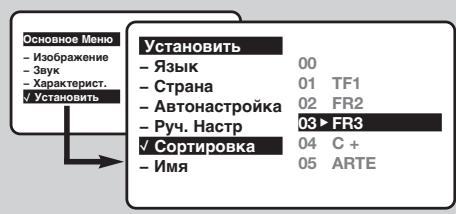
2 BbIeJInte C nOMoIbIO Kypcopa MeHIO YctAHOBITb, a 3aTEM MEHIO CopTnOpBka.
3 BbIbepuTe KaHaJI, HOMep KOtOporo Bbl XeJlaeTe N3MeHHTb, KHONKaMn O HAKMlTe KHOJKy >
4 IcnoIb3yIte 3aTeM KHOIIK INI pyncBOeHn KaHaNy HOBOrO HOMepa INoITBepINTe Bbl6Op KHOIIKOJ
5 Повторе заюblи 4 CTOLьк ра3, КОЛьк Имeelтca KaHANO, HOMepa KOTOpbIX BAM HeO6XODIMO ИЗМEHNTb.
6ДЯ BbyXoJa n3 MeHIO HaXmTe KhoNky
IMRAKaHaja
Bb moKeTe, ecn npoKeJaeTe, npncBoNTb
IMKaKdOMy KaHaany N BHeUHemy
yCTpOInCTBy.
ПриMuMeuaHHe:прУcTaHOBKe KaHaNoB И m aВTomatUcheKnI pncBaHbAIOrTa IMeHa, eCJI CTaHcIg Ipepaet NdeHTnФkaUOHHbI CngHAn.
1 HaKMnTe KHOKNy (MEN).
2 BbIeJInte C nOMoUbIO KypcOpa MeHIO YcTaHOBnTb, a 3aTeM MeHIO mMa KaHaJa.
3 IcnoIb3yIte KHOJIKNI DnIe BbIbopa KaHaJa, KOtOpOMy Bbl JKeJlaTe PnCBOITb
NMRJIN N3MeHHTb eO.
4 IcnoIb3yIte KHOJKN DnIe IepemeueHn BHyTpN OBJaCTn INHdNkaCnIN MeHn (5 CmBBOJOB) n KHOJKN DnJI Bbl6opa CmMBOJOB.
5 Pocne BbOa Ha3BaHnI NCNoB3yIte KHOKNy DnBbXoA n3 MeHIO. IMa KaHana CoxpaHnEcB nAMrTn.
6 Повторе запь ③ и ⑤ дя писбоевсян Имени Кадому KaHaJy.
7ДлЯ Bыхола ИЗ МЕИ HOHAЖМITE KHOПКУ (H).
3aONOMHnTb PyuH.
3TO MEHIO I03BOJAE T BBOIDNTB I NAMRTb KaKdbI KAHANOTJeJIbHO.
1 HaKmTe KHOkY (MEN).
2 BbIeJInte c IIMOouIy Kypcopa MeHIO YcTaHOBnTb, a 3aTeM MeHIO 3aIOMHnTb PyH.:
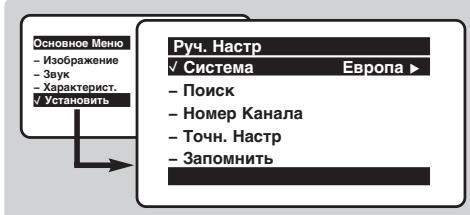
3 CnCTema: BbIbepnte EBypona (aBTOMaTHueCKOe ObHApUKeHne*) NII 3aAnadHaEBypona (cTaHdapt BG), BoCTouHaN EBypona (cTaHdapt DK), CoeINHeHoe KoponeBCTBO (cTaHdapt I) NII ΦpaHua (cTaHdapt LL').
*Kpome OpaHcIMn (ctaHapr LL), rJe HEO6XoDMMo BbIbpaTb ONUIO OpaHcIMn.
4 POnCK: HAnKMITE KHOJky BKIOUHTCpEKIM PONCKa. IocIe ObHApXKeHn KaKOro-JIn60 KaHana PONCK IpeKpaUaTeCn INoRbIaTeCn INdNkAUu NMeHn (ecn TaKOBoe IMeTc) KaHana. IpeXoJNTe K cIeNyUOeMy 3TaNY. Ecn Bbl 3HaTe YAcTOTy KeJaEMrO KaHana, HabePnte ee HeNoCeIcTBHeHNo C NOMouBIO KHOJOK (已) - 已 .Ecn HnKaKO rN3oBpaKeHn He bYet ObHApXKeHo, ObpaNTeCb K rnaBe «CoBETb» (CTp. 10).
5 Homic Kahan: BBeINTE HOMep, KOtOpBb Bbl KeJlaeTe INPCBOINTb KaHany, C NOMOuKHOKNOK 0-9.
6 ToH. Hactp.: ecJI NaueCTBO npHeMa HeyIOBJeTBoOpTeJIbHO, HAcTePoIte eRO C I NOMOuBIO KHONOK
7 3anomHnTb: HaxMNTe KHONKy : KaHaB BBedeH B nAMrTb.
8 Повториные заимь 4 - 7 стolyбк ра3, соклько KaHaJIOB BAM HeO6XODIMO BVECTN B pAmrTb.
Дя Вьхдаизpeхиманстори:НжмITEKHONIKY (13).
(cnyTHNKOBbI pIneMHNk,JeKOepe,BuDeoDnCK, 3JIeKTPoHHbI eIrpbI...)
B TeIeBn3opax,ObOpyIOBaHHbIX 2 pa3bEmAmN IJI BHeUHINx yCTpOInCTB,pa3bEMEXT1 npEHa3NaueH,KaK npaBnIO,IJI pOKnIOUeHINyUCTpOInCTB,BbIpa6aTbBAIOuXs CnRHaNBI RVB (UnfpoBoI JeKOJeP,IIeepbI DVD,IrpoBbIe PnCtABKN n np.),ap3bEmblEXT2IJIPOKnIOUeHINyUCTpOInCTB, BbIpa6aTbBAIOuXs CnRHaNBI S-VHS(BnuDeOMaHHToΦoHbI φopMaTOB S-VHS n Hi-8 n np.).
YcHnntb (ToJIbKO Ha HeKOTOpbIX MoJeIax)
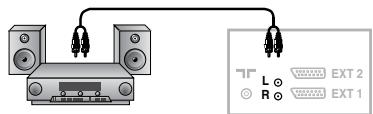
Длп подкюецни систем HiFi, Incрлььзовать coeINHITelbHyншур aydnoи coeINHITb pa3beMbI "L"и "R" TeleBn3opa co BxOdAmn "AUDIO IN" "L"и "R" услntелЯ.
Be responsible Respect copyrights
Specifications are subject to change without notice.
Trademarks are the property of Koninklijke Philips Electronics N.V. or their respective owners.
2005 © Koninklijke Philips Electronics N.V. All rights reserved.