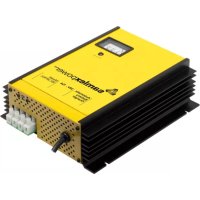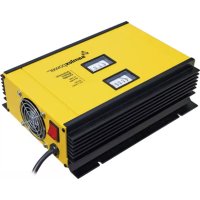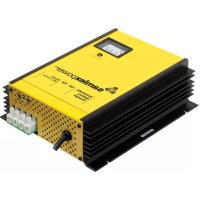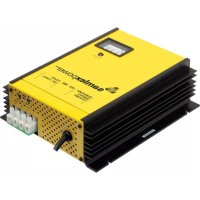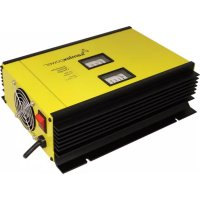
SEC2425UL - Battery charger Samlex - Free user manual and instructions
Find the device manual for free SEC2425UL Samlex in PDF.


| Product Type | Automatic Battery Charger |
| Brand | Samlex |
| Model | SEC2425UL |
| Dimensions (L×W×H) | 331 × 244 × 97 mm |
| Weight | 4.1 kg |
| Input Voltage | 120 VAC or 230 VAC (selectable), 50/60 Hz |
| Output Voltage | Bulk: 27.0 V; Absorption: 28.0 / 28.8 V; Float: 27.0 V |
| Max Charge Current | 25 A (normal), 12.5 A (half-power mode) |
| Compatible Battery Type | Lead-acid (flooded, AGM, gel) |
| Number of Banks | 2 isolated positive outputs |
| Charge Phases | 3 phases (bulk I, absorption Uo, float U) or 2 phases |
| Protections | Short circuit, overcurrent, reverse polarity, overheat |
| Cooling | Current-controlled fan (on at 6A, off at 3A) |
| Temperature Compensation | Yes, with included TF-500 probe |
| Optional Remote Control | Model 900-RC (10 m cable) |
| Display | Built-in voltmeter and ammeter |
| Internal Fuses | AC: 12A / 250V time-delay; DC: 2 × 20A blade (32V) |
| Operating Temperature | -20 to 40 °C |
| Safety Standards | UL 1564, CSA C22.2 No. 107.2 |
| EMC Standards | FCC Part 15(B) Class B |
| Warranty | 2 years (USA/Canada), 6 months elsewhere |
| Included Accessories | TF-500 temperature probe, ring terminals |
Frequently Asked Questions - SEC2425UL Samlex
User questions about SEC2425UL Samlex
0 question about this device. Answer the ones you know or ask your own.
Ask a new question about this device
Download the instructions for your Battery charger in PDF format for free! Find your manual SEC2425UL - Samlex and take your electronic device back in hand. On this page are published all the documents necessary for the use of your device. SEC2425UL by Samlex.
USER MANUAL SEC2425UL Samlex
Please read this manual BEFORE operating your battery charger
Switch Mode, Automatic, Lead Acid Battery Charger
MODELS:
SEC-1250UL
SEC-2425UL
OWNER'S MANUAL: Battery Chargers | Index
SECTION 1: Important Safety Precautions 3
SECTION 2: Description & Features 5
SECTION 3: Layout
SECTION 4: Principle of Operation 7
SECTION 5: Protections 14
SECTION 6: Installation 16
SECTION 7: Preparing the Charger for Operation 18
SECTION 8: Operation 25
SECTION 9: Troubleshooting 26
SECTION 10: Internal Fuse Ratings 28
SECTION 12: Specifications 28
SECTION 13: Warranty 30
Disclaimer of Liability
UNLESS SPECIFICALLY AGREED TO IN WRITING, SAMLEX AMERICA INC.:
- MAKES NO WARRANTY AS TO THE ACCURACY, SUFFICIENCY OR SUITABILITY OF ANY TECHNICAL OR OTHER INFORMATION PROVED IN ITS MANUALS OR OTHER DOCUMENTATION.
- ASSUMES NO RESPONSIBILITY OR LIABILITY FOR LOSSES, DAMAGES, COSTS OR EXPENSES, WHETHER SPECIAL, DIRECT, INDIRECT, CONSEQUENTIAL OR INCIDENTAL, WHICH MIGHT ARISE OUT OF THE USE OF SUCH INFORMATION. THE USE OF ANY SUCH INFORMATION WILL BE ENTIRELY AT THE USERS RISK.
Samlex America reserves the right to revise this document and to periodically make changes to the content hereof without obligation or organization of such revisions or changes.
Copyright Notice/Notice of Copyright
Copyright © 2016 by Samlex America Inc. All rights reserved. Permission to copy, distribute and/or modify this document is prohibited without express written permission by Samlex America Inc.
SECTION 1 | Important Safety Precautions
The following safety symbols will be used in this manual to highlight safety and information:
WARNING!
Indicates possibility of physical harm to the user in case of non-compliance.

CAUTION!
Indicates possibility of damage to the equipment in case of non-compliance.

INFO
Indicates useful supplemental information.
Hazardous conditions may result if the charger is not installed or operated correctly. Please read the following instructions to prevent personal injury or damage to the charger.
BATTERY RELATED
-
To reduce the risk of battery explosion, follow these instructions and those marked on the battery.
-
Never smoke or allow an open spark or flame in the vicinity of the battery or the engine.
-
Charge only Lead Acid type of batteries (Flooded / Absorbed Glass Mat (AGM) / Gel Cell). Do not charge other type of batteries like Nickel Cadmium (NiCad), Nickel-Metal Hydride (Ni-MH), Dry-Cell etc. Other types of batteries might burst causing personal injury.
-
Never charge a frozen battery.
-
Working in the vicinity of Lead Acid batteries is dangerous. Batteries generate explosive Hydrogen and Oxygen gases during normal operation. Take necessary safety precautions when installing the charger near a battery or in a battery compartment (Follow safety instructions given by the battery manufacturer).
-
Never place the charger directly above or below the battery being charged; gases or fluids from the battery will corrode and damage the charger. Locate the charger as far away from the battery as DC cables permit. Do not install in the same compartment as batteries.
-
Use caution to reduce the risk of dropping a metal tool on the battery. It could spark or short circuit the battery or other electrical parts and could cause an explosion.
SECTION 1 | Important Safety Precautions
- Remove metal items like rings, bracelets and watches when working with batteries. The batteries can produce a short circuit current high enough to weld a ring or the like to metal and thus cause a severe burn.
- If you need to remove a battery, always remove the ground terminal from the battery first. Make sure that all the accessories are off so that you do not cause a spark.
CHARGER RELATED
- The maximum Ah capacities of the batteries must be limited as follows:
-SEC-1250UL:500Ah
-SEC-2425UL:300Ah
- Do not operate the charger in a closed-in area or restrict ventilation in any way. Install in a well ventilated, cool, dry place.
- The charger must not be operated in a damp or wet environment. When mounting in a boat, make sure it is not subjected to bilge water splash.
- Do not block the ventilation openings / openings for the cooling fan. There should be at least 6 inches clearance all around the unit.
- Installation and wiring must comply with the local and the National Electrical Codes. It is recommended that installation may be carried out by a certified electrician.
- Wrong installation on a boat may lead to corrosion of the boat. It is recommended that installation on the boat must be carried out by a boat electrician.
- Disconnect the AC input power to the charger before connecting / disconnecting the batteries or other DC loads or when working on the charger.
- Disconnect the AC input power before changing the setting of the Dip Switches.
- The chassis of the charger is connected to the earth ground pin of the power cord plug. Ensure that the earth ground pin of AC receptacle feeding the charger is connected to earth ground.
- Do not use an adapter. If a grounding type of receptacle is not available, do not use this charger until proper outlet is installed by a qualified electrician.
- Do not operate the charger if the power cord is damaged.
SECTION 2 | Description & Features
SEC-1250UL (for 12V batteries) and SEC-2425UL (for 24V batteries) are high current, 3 Stage Chargers (also called I UoU) that deliver 50A and 25A respectively for almost 75% to 80% of the charging cycle ensuring a very fast, safe and complete charging of Lead Acid batteries. The nomenclature "I Uo U" is a DIN nomenclature and signifies the 3 charging stages - "I" for Bulk Charge Stage, "Uo" Absorption / Over-charge Stage and "U" for Float / Maintenance Stage (under DIN specification, voltage is designated "U" and current is designated "I". The subscript "o" in "Uo" signifies over-charge).
FEATURES
- State-of-the-art Switch Mode Technology for high efficiency, light-weight and quiet operation.
- User configurable AC input voltage - 120 VAC or 230 VAC, 50 / 60 Hz
- Automatic operation for all types of Lead Acid Batteries - Flooded, AGM or Gel Cell
- User selectable 2 or 3-Stage automatic charging algorithm with timed Absorption Stage and temperature compensation ensures rapid, safe and full return of capacity for stand-alone and loaded batteries.
- Ability to reduce maximum charging current to approximately 1/2 of the rated capacity during "Half Power Mode". This allows safe charging of lower capacity batteries.
- Includes a Battery Temperature Sensor allowing temperature compensated charging, if required.
- 2 banks of batteries can be charged simultaneously without the use of an external battery isolator. The charging current will be shared between the two banks depending upon the depth of discharge of the connected batteries.
Voltmeter and Ammeter for monitoring
Fan cooled - fan ON/OFF based on output current. - Protections against short circuit, over current, reverse battery connection and over-temperature.
- Can be used as a power supply or as a DC UPS (Uninterruptible Power Supply) when used in conjunction with a battery.
- Optional Remote LED Panel Model 900-RC with 10 Meters of wire for remote ON/OFF control and indication of charging status.
- Safety certified and listed to UL Standard UL-1564
- EMI compliant to FCC Part 15(B), Class B
MAXIMUM AH CAPACITY OF BATTERY TO BE CHARGED
If the chargers are used to charge very high capacity batteries, they will be forced to supply their maximum rated charging current for longer time than the designed limit and hence, the components will be overstressed and are likely to fail prematurely. To prevent premature failure, the maximum Ah capacities of the batteries must be limited as follows:
-SEC-1250UL:500Ah
-SEC-2425UL:300Ah
SECTION 3 | Layout
NOTE: Both SEC-1250UL and SEC-2425UL have the same layout and dimensions
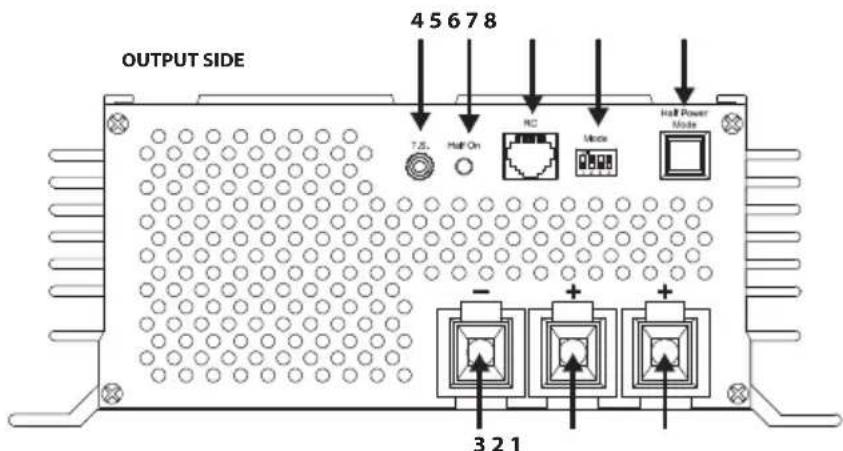
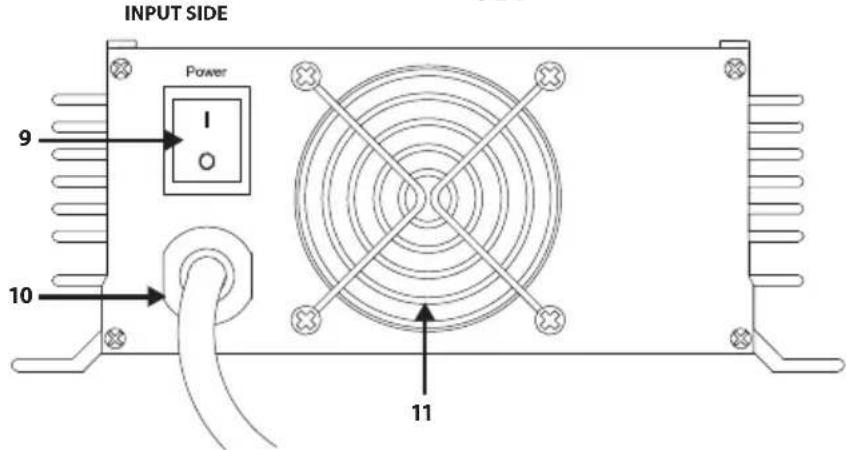
LEGEND
- Output connector: +, Bank 1
- Output connector: +, Bank 2
- Output connector: -, Common
- Jack for Temperature Sensor
- Green LED: Indicates "Half Power Mode" is ON
- Jack for optional Remote LED Panel Model No, 900-RC
- DIP switches for mode selection
- Push Switch for Half Power Mode: Pressed ON; Released OFF
- Power ON/OFF switch
- AC power cord inlet
- Grille protected opening for cooling fan
- Voltmeter
- Ammeter
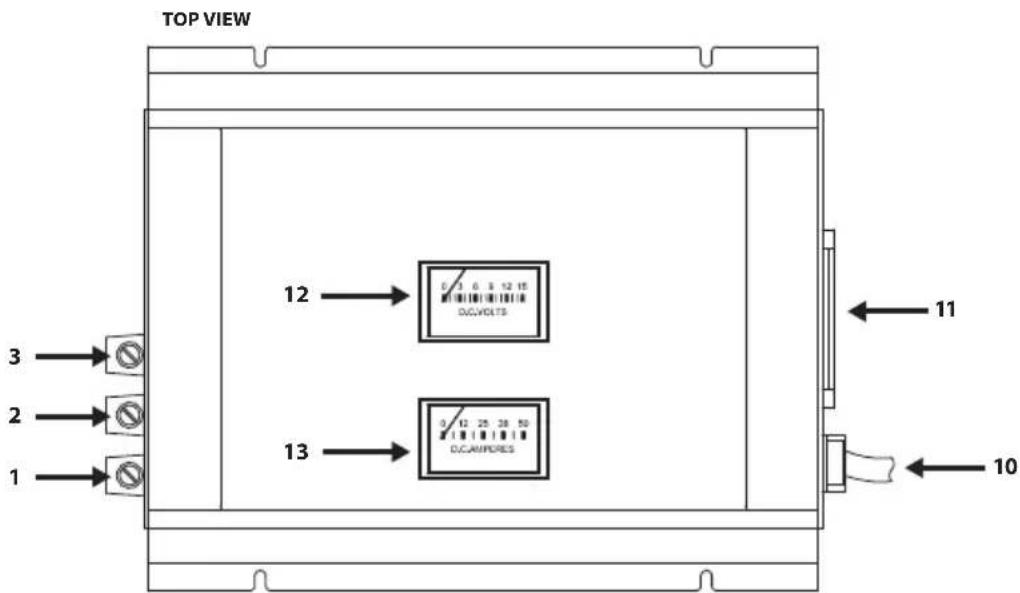
Fig. 3.1 Layout of SEC-1250UL and SEC-2425UL
SECTION 4 | Principle of Operation

INFO
For complete understanding of working of battery chargers, understanding of operation of Lead Acid batteries is desirable.
For detailed information on construction, working and application of batteries, please refer to White Papers on www.samlexamerica.com.
BATTERY CHARGER IS A CURRENT LIMITED DC POWER SUPPLY
The charger is a current limited DC power supply that converts 120/230 VAC, 50/60 Hz to regulated DC voltages and limits the maximum output current as follows:
| Model No. Current Limit | Constant Voltage at Bulk Stage "I" | Constant Voltage at Absorption Stage "U0" | Constant Voltage at Float Stage "U" | |
| SEC-1250UL 50A | 13.5 VDC | 14.0 VDC or 14.4 VDC | 13.5 VDC | |
| SEC-2425UL 25A | 27 VDC | 28.0 VDC or 28.8 VDC | 27 VDC | |
The specified output voltage of the charger during particular charging stage is held constant till the current limit value is reached. When the battery or DC load tries to draw current > the current limit value, the charger limits the current to the current limit value and the output voltage of the charger drops and is no longer constant. When the charger is connected to a battery and is in current limit condition, the terminal voltage of the charger will be clamped to the actual lower intrinsic terminal voltage of the battery (assuming the charger is very close to the battery and there is no voltage drop in the wires connection the charger to the batteries).
BATTERY IMPEDANCE AND CHARGING CURRENT
The internal impedance of a healthy battery is very low - in tens of milli Ohms (The impedance is higher in discharged condition due to Lead Sulfate formation and reduces when the battery is fully charged - Lead Sulfate gets fully converted to Lead and Lead Dioxide). Average impedance may be assumed as 20 milli Ohm or 0.02 Ohm
When the charger is delivering a constant voltage (is not in current limit condition), the charging current drawn by the battery can be roughly calculated as follows:
Charging current = (Charger Voltage - Intrinsic battery voltage) ÷ Internal resistance (0.02 Ohm)
SECTION 4 | Principle of Operation
For example, when SEC-1250UL is in the Bulk Charge Stage 1, its output voltage is set at 13.5 VDC. When a battery discharged to say 10.5V is charged, it will try to draw very large current = (13.5V - 10.5V) ÷ Internal resistance (0.02) = 150A . SEC-1250UL will, however, limit this current to 50A.
CHARGING STAGES
The battery is charged in 3 stages:
STAGE 1-BULK STAGE ("I" Phase),
STAGE 2 - ABSORPTION STAGE ("Uo" Phase) and
STAGE 3 - FLOAT STAGE ("U" Phase)
The 3 charging stages and associated Charging Curves for SEC-1250UL are given at Figure 4.1 and for SEC-2425UL at Fig. 4.2
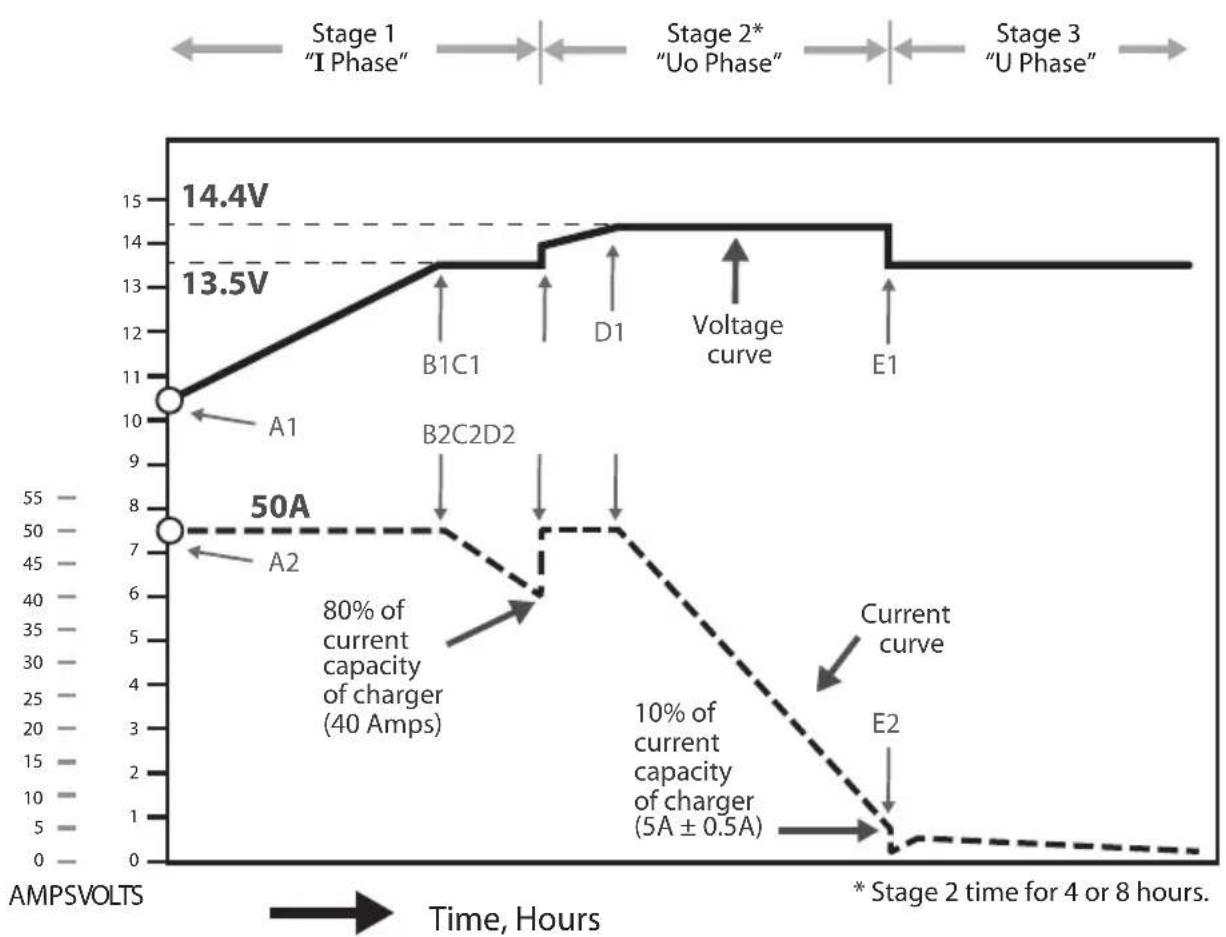
Figure 4.1 Charging Curve -SEC-1250UL
SECTION 4 | Principle of Operation
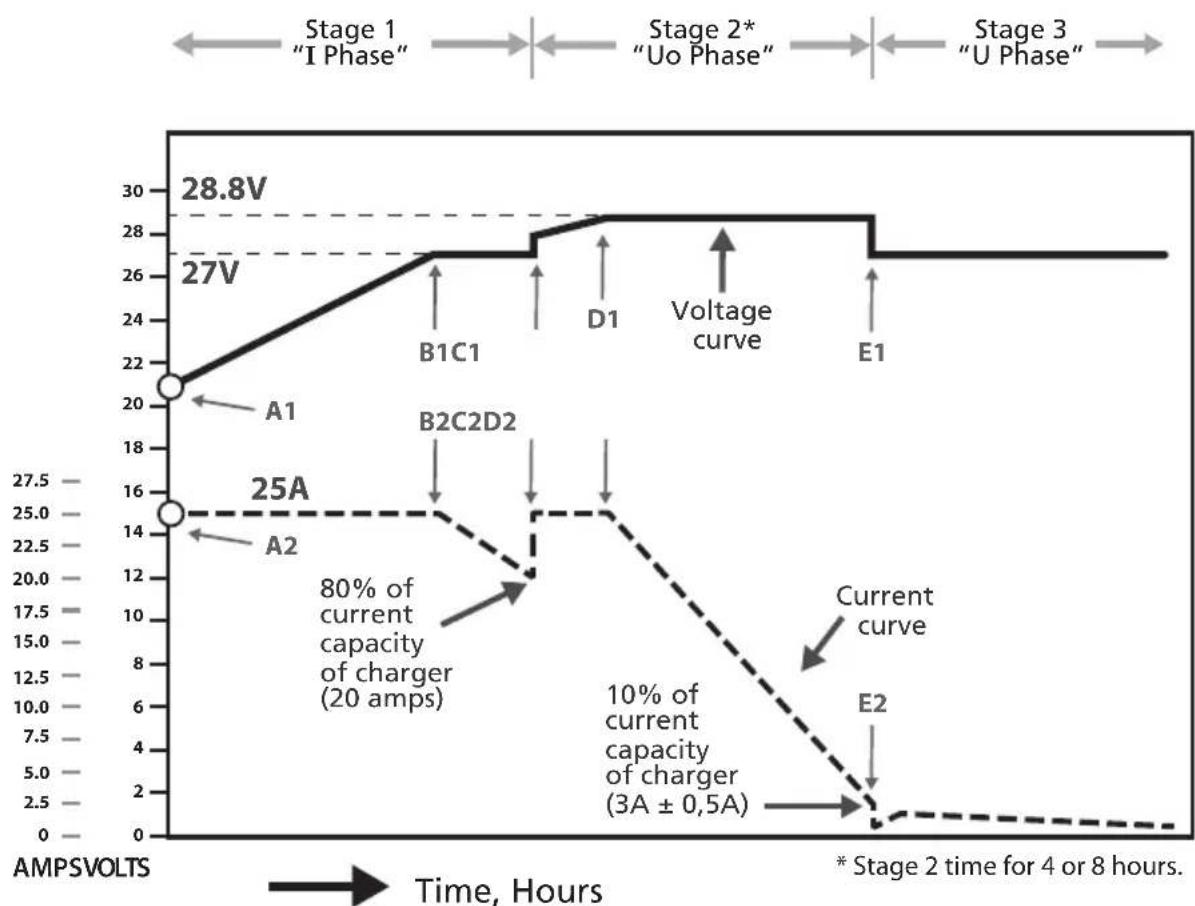
Fig. 4.2 Charging Curve for SEC-2425UL

INFO
Please note the following important information related to the Charging Curves shown in Figs 4.1 and 4.2 above:
1.1 Terminal Voltage reading on no load and on load: The output terminals of the charger consist of one common Negative terminal (3) and two Red Positive terminals (1, 2) for charging two banks of batteries. Each of the two Positive terminals of the two banks has Schottky Diode in series for isolation. These isolating diodes have a current dependent forward voltage drop Vf ranging from 0.2 to 0.3V (at 0.1A) to 0.6V (at 50A). In addition, there will be additional forward drop Vb across the bulk resistance of the diode and this drop will also increase with increase in charging current. Please note that the forward voltage drops Vf and Vb occur only when current flows through the diode.
1.2 The Float and Absorption voltages are tightly regulated before the isolating diodes. However, the voltages available at the terminals of the two banks will vary with the value of the charging current because of the current dependent forward voltage drop Vf and bulk resistance drop Vb. The Float Voltage before the diodes is,
SECTION 4 | Principle of Operation
therefore, set 0.2 to 0.3V higher to compensate for the forward drops during float condition when the charging current would have dropped to less than 1A. Hence, the output voltage at the terminals of the two banks at no load (nothing connected to the terminals of the banks) will read 0.2 to 0.3V higher because there is no forward voltage drop as there is no current flow through the diodes. The voltages are specified with respect to charging / load current as follows:
Absorption Stage ("Uo" Phase) of 14.4 / 14V for SEC-1250UL At 5A +/- 0.5A
Absorption Stage ("U0" Phase) of 28.8/28V for SEC-2425UL At 3A +/- 0.5A
Float Stage ("U" Phase) of 13.5V for SEC-1250UL At 0.1A
Float Stage ("U" Phase) of 13.5V for SEC-2425UL At 0.1A
1.3 Please also note that the output voltage at the two banks may differ between 0.2 to 0.6V depending upon the different values of the charging current being delivered through each as a result of different values of voltage drops Vf and Vb.
2.1 Standard Temperature Conditions: The charging voltages shown pertain to battery electrolyte temperature of 77^ (25^)
3.1 Charger / Battery Voltage / Current Values: When the battery is connected to the charger and the charger is in ON condition, the voltage at the common charger / battery terminals will be the actual battery terminal voltage corresponding to its state of charge ONLY when the charger is in "current limit condition" and is supplying 50A for SEC-1250UL and 25A for SEC-2425UL. When the charger is NOT in "current limit" condition and is supplying < 50A for SEC-1250UL or < 25A for SEC-2425A, its terminal voltage will be nearly regulated and will be nearly equal to the set Bulk / Float Voltage of 13.5V for SEC-1250UL (27V for SEC-2425UL) or nearly equal to the Absorption Voltage of 14.4 / 14V for SEC-1250UL (28.8V / 28V for SEC-2425UL). Under these conditions, the battery terminal voltage will also be at 13.5 (27V) or 14.4 / 14V (28.8V / 28V) although the actual intrinsic terminal voltage of the battery corresponding to its State of Charge at that point of time will be lower.
3.2 The voltage curve shows the voltage at the charger output terminals, which will be the same as the voltage at the battery terminals (assuming that there is no voltage drop along the wires connecting the charger to the batteries)
3.3. The Current Curve shows the current being drawn by the battery
SECTION 4 | Principle of Operation
STAGE 1-BULK CHARGE STAGE ("I"PHASE)
In this stage SEC-1250UL outputs voltage of 13.5 VDC and SEC-2425A outputs 27V.
The following explanation is for SEC-1250UL. Explanation for SEC-2415UL will be same but the voltage values will be 2 times and current values will be half as compared to SEC-1250UL.
NOTE: For explanation purpose, it is assumed that the battery is deeply discharged to around 10.5 / 21V when charging is initiated.
When the charger is switched on, the battery will try to draw very large current = (13.5V - 10.5V) ÷ Internal resistance (0.02) = 150A which will be much higher than the current limit value of 50A. The charger will enter current limit condition (point A2), its internal voltage will try to drop but will be clamped to the terminal voltage of the battery i.e. 10.5V (point A1). The battery starts charging at constant current of 50A (Section A2-B2) and its intrinsic voltage starts rising almost linearly (Section A1-B1). When its intrinsic voltage approaches 13.5V, the current drawn by the battery will reduce to < 50A . At this point (B2), the charger will exit current limit and will output a constant voltage of 13.5V (point B1). As the battery charges further under constant voltage of 13.5V (Section B1-C1), its intrinsic voltage rises further and its current starts to taper down (Section B2-C2). The current tapers down because the intrinsic battery voltage is rising and the differential voltage between 13.5V of the charger and intrinsic voltage of the battery is reducing thereby, lesser current is driven into the battery. Tapering charge is provided at this transition to reduce surface charge effect to ensure that the charge slowly diffuses to the internal thickness of the plates and prevents overcharging. When the charging current tapers down to 80% of the rated capacity of the charger (40A for SEC-1250UL and 20A for SEC-2425UL) at point "B2", the charger transitions to the next Stage 2 - Absorption Boost Stage ("Uo" Phase)
Charging Characteristics During This Stage Are As Follows:
- Battery voltage rises slowly and almost linearly (it will start rising sharply at the beginning of the next Absorption Stage 2).
- The entire charging current is used to convert Lead Sulfate to Sponge Lead at the Negative plates and to Lead Dioxide at the Positive plates.
- There is no gassing and the charging efficiency is high - around 91% .
- The restored capacity in this stage is inversely proportional to the charging rate (due to Peukert Effect). This means that as the charging rate is increased, the capacity restored reduces. This stage restores 60% of capacity at charging rate of C/5, 70% to 75% capacity at charging rate of C/10 and 85% to 90% of capacity at charging rate of C/20
- Red LED marked "I Phase" will be lit on the optional Remote Control Model 900-RC
SECTION 4 | Principle of Operation
STAGE 2 - ABSORPTION STAGE ("U0" PHASE)
During this stage, the charger outputs constant voltage of 14V / 14.4V for SEC-1250UL and 28V / 28.8V for SEC-2440UL. As charging proceeds, there is a fairly sharp rise in the battery voltage as gassing starts. Gassing and fast rise of battery voltage continues to restore the balance of the capacity till charging is completed.
The Charger Transitions To Absorption Stage ("U0" Phase) At Point "C".
As soon as the charger transitions to this stage, a user selectable 4Hr / 8Hr Timer is started with the help of DIP Switches (7) (See page 22 under "Selecting time for stage 2 - Absorption Stage"). This Timer decides the maximum duration of operation in this stage and subsequent transition to the final constant voltage Float Stage 3 at point "E". The duration of operation in this stage is also determined by another condition where the transition to the next Float Stage at point "E" occurs when the charging current reduces to 10% or the rated capacity i.e. 5A + / - 0.5A for SEC-1250UL and 3A + / - 0.5A for SEC-1225UL. The condition, which occurs earlier, controls the transition
At the transition point "C", the charger will output a higher constant voltage, which is above the Gassing Voltage to ensure that the battery is further, charged to full capacity without overcharging. The value of this voltage will depend upon the type of battery or charging stages selected (The type of battery and charging stages are selected with the help of DIP Switches (7) - See Section 7 under "DIP Switch Setting" on page 21):
14.4V (SEC-1250UL) or 28.8V (SEC-2425UL) when Flooded / AGM battery is selected
- 14V (SEC-1250UL) or 28V (SEC-2425UL) when Gel Cell battery is selected
- 13.5V (SEC-1250UL) or 27V (SEC-2425UL) when loaded battery is selected (2 stage charging)
However, this constant voltage is not seen immediately because the charger enters current limit as soon as it enters point (C2). As the charger voltage has been increased, the battery will try to draw higher value of current which will be equal to the difference between this higher voltage and the actual intrinsic voltage of the battery divided by the internal resistance of the battery (.02 Ohm). The value of this current at the transition point (C2) will be higher than the current limit value forcing the charger to enter current limit condition once again. As the charger is in current limit condition, it does not regulate its output voltage. The voltage at the charger terminals is the actual internal battery voltage at that point (C1). Once again, the battery starts charging further at the maximum rated constant current of 50A for SEC-1250UL / 25A for SEC-2425UL (C2 to D2). The battery voltage also starts rising further (C1 to D1).
At point (D2), the charging current reduces to less than the current limit value of 50A for SEC-1250UL / 25A for SEC-2425UL and the charger now exits current limited constant current mode and enters constant voltage mode of 14V / 14.4V for SEC-1250UL and 28V / 28.8V for SEC-2440UL (point D1). (Please note that the voltage of 14V / 14.4V or
SECTION 4 | Principle of Operation
28V / 28.8V at both the charger and battery terminals is the constant Absorption Voltage being put out by the charger. The intrinsic voltage of the battery is still lower than this voltage as the battery is still not fully charged at this transition). As the intrinsic voltage of the battery rises further, the charging current starts tapering down (section D2 to E2). Tapering charge is provided at this transition to reduce surface charge effect to ensure that the charge slowly diffuses to the internal thickness of the plates and prevents overcharging.
When the 4 Hr / 8 Hr Timer runs out or when the charging current tapers down to 10% of the rated capacity of the charger (5A +/- 0.5A for SEC-1250UL and 3A +/- 0.5A for SEC-2425UL) at point "E2" (whichever is earlier), the charger transitions to the next Stage 3 - Constant Voltage, Float or Maintenance Charge Stage ("U" Phase)
NOTE: The threshold of current for change-over between the Constant Overcharge Voltage, Timed Voltage Absorption / Boost Stage ("U0" Phase) & the Float / Maintenance Charge Mode ("U" Phase) are different as follows:
SEC-1250UL SEC-2425UL
From "Uo" Phase to "U" Phase 5A +/- 0.5A 3A +/- 0.5A
From "U" Phase to "Uo" Phase 10A +/- 1A 6A +/- 1A
Charging Characteristics During This Stage Are As Follows:
- The Absorption Stage ("Uo" Phase) feeds additional 35% to 55% of the capacity that adds up to a total charged capacity of around 115% to take care of around 15% loss of charging efficiency.
- Orange LED marked “Uo” Phase on the optional Remote Control 900-RC will be lit
STAGE 3 - CONSTANT VOLTAGE, FLOAT OR MAINTENANCE CHARGE STAGE (U PHASE)
During this mode, the charger outputs a constant voltage "U" = 13.5V (SEC-1250UL) or 27V (SEC-2425UL). This helps in maintaining full capacity of the battery and also provides replacement charge to overcome self discharge of the battery. The battery can remain connected in this stage indefinitely without the risk of discharging.
Charging characteristics during this stage are as follows:
Green LED marked Float Stage ("U" Phase) on the optional Remote Control 900-RC will be lit.
SECTION 4 | Principle of Operation

CAUTION!
3 stage charging is recommended for charging stand-alone, unloaded batteries (there is no load connected to the battery when it is being charged). If a load is also connected simultaneously, a part of the charger's output current will be diverted to this load. Thus, the charger may remain locked in Stage 2 if the current drawn by the load is more than the preset value of threshold current determining change over from Stage 2 to Stage 3. This will lead to over-charging and loss of electrolyte.
For charging a battery when a load is also connected simultaneously, Stage 2 voltage should be same as Stage 3. Select "Loaded Battery" with the help of DIP Switches marked "Mode" (7) - See Section 7 under "DIP Switch Setting" on page 21.
SECTION 5 | Protections
The charger has the following protections:
SHORT CIRCUIT SHUT DOWN
In case of a short circuit on the output side, the output of the charger will be shut down. Another symptom of short circuit shut down is that the fan will be ON till the unit is reset or switched OFF. On the optional Remote Control 900-RC, Green LED marked "Power" and Red LED "I Phase" will be lit. The charger will be latched in this shut down condition and will NOT recover automatically even after the short circuit condition is removed. To reset, the AC input power ON/ OFF switch at the back of the unit has to be switched OFF and ON again.
OVER LOAD CURRENT LIMITING
The current drawn by the load is automatically limited to a maximum of 50A for SEC-1250UL (25A +/- 1A in "Half Power Mode") and 2A for SEC-2425UL (12.5A +/- 1A when in "Half Power Mode"). If the load tries to draw a higher current than these limits, the output voltage of the unit will start to drop. The unit will automatically recover when the overload condition is removed.
REVERSE BATTERY CONNECTION - DC SIDE FUSES WILL BLOW
The output is internally fused on the DC side - 2 × 30A fuses for SEC-1250UL and 2 × 20A fuses for SEC-2425UL. In case, the polarity of the battery connection is reversed, the fuse(s) will blow. Another symptom of blown fuse on DC side is that the fan will be ON till the unit is switched OFF. On the optional Remote Control 900-RC, Green LED marked "Power" and Red LED marked "I Phase" will be lit.
COOLING
The charger is cooled by convection and in addition, has a fan for forced air-cooling. The operation of the fan is controlled by the current supplied by the charger and will be switched ON and OFF automatically as follows:
SEC-1250UL SEC-2425UL
| Switch ON current 10A +/- 1A 6A +/- 1A |
| Switch OFF current 5A +/- 0.5A 3A +/- 0.5A |
NOTE: Once the fan switches on at the specified current threshold, it will switch off at a lower threshold. For example, the fan in SEC-1250UL switches ON at 10A but switches OFF at 5A. This is to prevent the fan from oscillating between ON and OFF conditions due to minor fluctuations in load current
OVER TEMPERATURE SHUTDOWN

CAUTION!
Keep the charger in a well ventilated, cool and open area. DO NOT BLOCK THE VENT HOLES on the sides or the discharge openings of the cooling fan. Keep at least 6'' clearance on all sides
In case the fan fails or if the cooling is not adequate due to higher ambient temperature, inadequate air circulation or blockage of air ventilation openings, the temperature inside the unit will rise. A temperature sensor is mounted on in the windings of the power transformer. At 105^ + / - 5^ the thermal sensor will activate and shut down the output voltage of the charger. The fan will be ON. On the optional Remote Control 900-RC, Green LED marked "Power" and Red LED marked "I Phase" will be lit. The charger will be latched in this shut down condition and will NOT reset automatically even after the unit has cooled down. To reset, the AC input power ON/OFF switch at the back of the unit has to be switched OFF and ON again.
PROTECTION AGAINST TRANSIENTS / SURGES IN THE AC INPUT
In a number of locations, the AC line input is not clean and may contain high voltage transients / surges. To prevent damage to the internal components against these unwanted high voltages, the charger uses a MOV (Metal Oxide Varistor) for protection. If surge / transient voltage higher than approximately 170 VAC in 120V Mode / 340 VAC in 230 VAC Mode appear in the AC input, the MOV will conduct and will blow the AC side fuse.
SECTION 6 | Installation
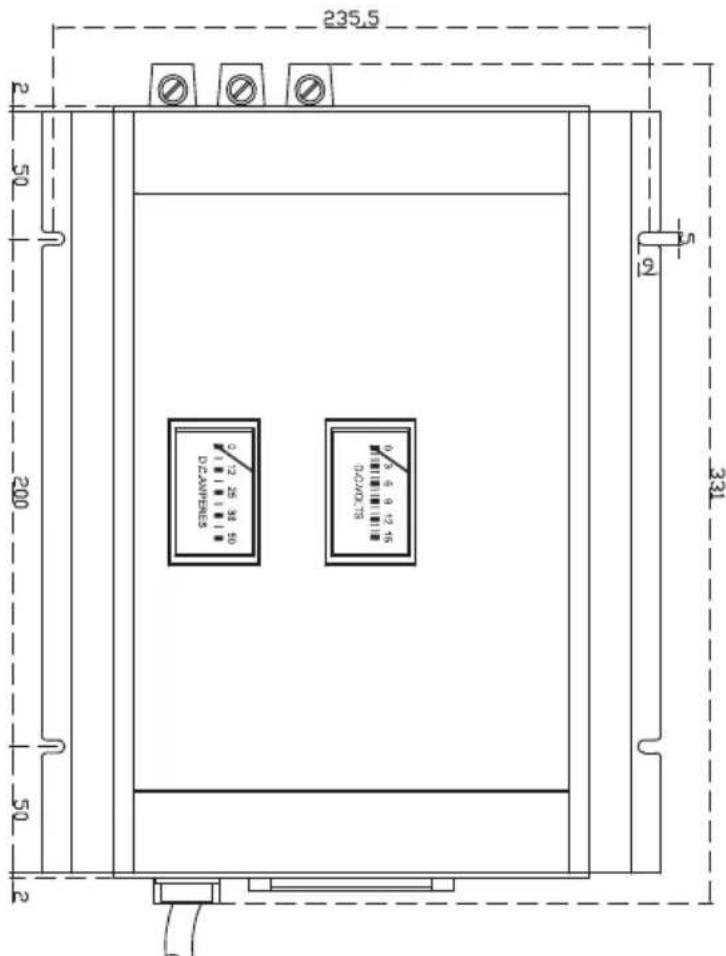
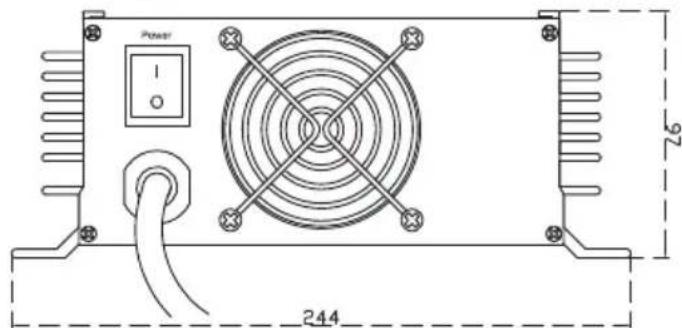
INSTALLATION DIMENSIONS
Installation dimensions are given below. Dimensions are same for SEC-1250UL and SEC-2425UL.
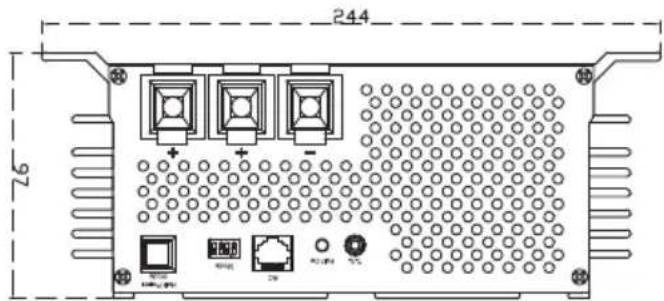
SECTION 6 | Installation
LOCATION, MOUNTING AND SAFETY
The charger is required to be installed in a safe, well ventilated and dry location.
Please see the details given under "Important Safety Precautions". The charger can be mounted horizontally or vertically. When mounting vertically on a wall or a bulkhead, please ensure that the axis of the fan rotor is horizontal i.e. the fan exhaust opening should face left or right but NOT face up or down.
WARNING!
Mounting the unit vertically on a vertical surface with the fan opening facing up or down is NOT allowed for safety. This is to prevent falling of objects into the unit through the fan grille when the fan opening faces up. If fan opening faces down, hot damaged components may fall out.
OUTPUT CONNECTORS
Connectors with tubular, screw down type of terminals are used for output connection. The diameter of the tubular hole of the connector is 8mm (0.31 inches). Two positive output connectors (1, 2) are provided for connecting to the Positive terminals of the 2 banks of batteries. One common connector (3) is provided for the Negative connection.
TERMINAL LUGS FOR CONNECTION TO THE CHARGER
For firm connection when using stranded wire, crimp / solder "pin" style terminal lugs on the charger end of the DC wires used for connecting to the battery / other DC loads. 3 pieces of "pin" style terminal lugs have been provided as follows:
- For SEC-1250UL Will accommodate up to AWG #4 wire
- For SEC-2425UL Will accommodate up to AWG #8 wire
WIRES
To avoid polarity errors and possible damage, never use wires of only one color. Use Red insulated wire(s) for Positive connection(s) and Black for Negative connection(s).
Recommended DC wire sizes are given below (Based on a voltage drop of 2% ). The length in feet is the length of the pair of the positive and negative DC wires from the charger to the battery / other DC loads.
| Distance From Battery SEC-1 | 250UL SEC-2425UL | |
| Up to 6 ft. AWG #6 AWG #10 | ||
| 6 to 10 ft AWG #4 AWG #8 | ||
| 10 to 20 ft. AWG #1/0 AWG #6 | ||
TERMINATION OF WIRE ENDS
For firm connection when using stranded wire, wire ends for the connection to the charger should be terminated with pin types of lugs that have been provided.
SECTION 7 | Preparing the Charger for Operation
SELECTING AC INPUT VOLTAGE
The charger is pre-set to operate from input AC voltage of 120 VAC, 60Hz . To operate the charger from AC input voltage of 230 VAC, 50Hz , change the internal setting as follows:
- Remove the side plate that has the power cord entry by unscrewing 4 screws
- Remove the Voltmeter and the Ammeter on the top central plate by prying up the bottom edges of the meters with a broad, flat screw driver and by pushing the meters up from the bottom of the plate (these are snap fitted). Remove the connecting wires and mark them. Note the polarity for connecting back in proper polarity. The meter terminals are marked Positive (+) and Negative (-). Thicker wires are for the Ammeter and thinner are for the Voltmeter
- Gently slide the center top cover plate out. Note and mark its orientation for correct re-fitting
- Locate Yellow loop of jumper wire with quick female disconnect. In the pre-set 120 VAC condition, this jumper wire is shorting the male vertical pins marked "C" and "D" and "115V". Pull any one end of this female disconnect upwards to disconnect shorting between "C" and "D". Insulate this end with insulating tape. The unit is now set for "230 VAC"
- The 120 VAC version has a soldered 12A fuse on the AC side. When converting 120 VAC version unit for 230 VAC operation, there is no need to replace the 12A fuse
- Replace the AC plug of the power cord with a suitable 3 pin grounded plug to mate with the 230 VAC outlet.

CAUTION!
The new plug should have 3 poles i.e. Line (L), Neutral (N) and Earth ground. Color code for the power cord conductors is:
- Line (L) - Black
- Neutral (N)-White
- Earth ground - Green
CONNECTING THE BATTERIES OR OTHER DC LOADS
As shown in Fig. 7.1 and 7.2 (page 19), the output of the charger has a common Negative (-) connector and 2 Positive connectors for connection of 2 banks of batteries. Each Positive connector has its own internal isolating diode, which works as a battery isolator. If more than one bank of batteries is connected, these will be charged at the same time as long as the AC power is available to the charger (the maximum charging current of 50A of SEC-1250UL and 25A of SEC-2425UL will be shared among the connected banks of the batteries depending upon their discharged states). In case the AC power fails or if there is no output from the charger, the isolating diodes will prevent charging / discharging among the batteries connected to the banks.
SECTION 7 | Preparing the Charger for Operation
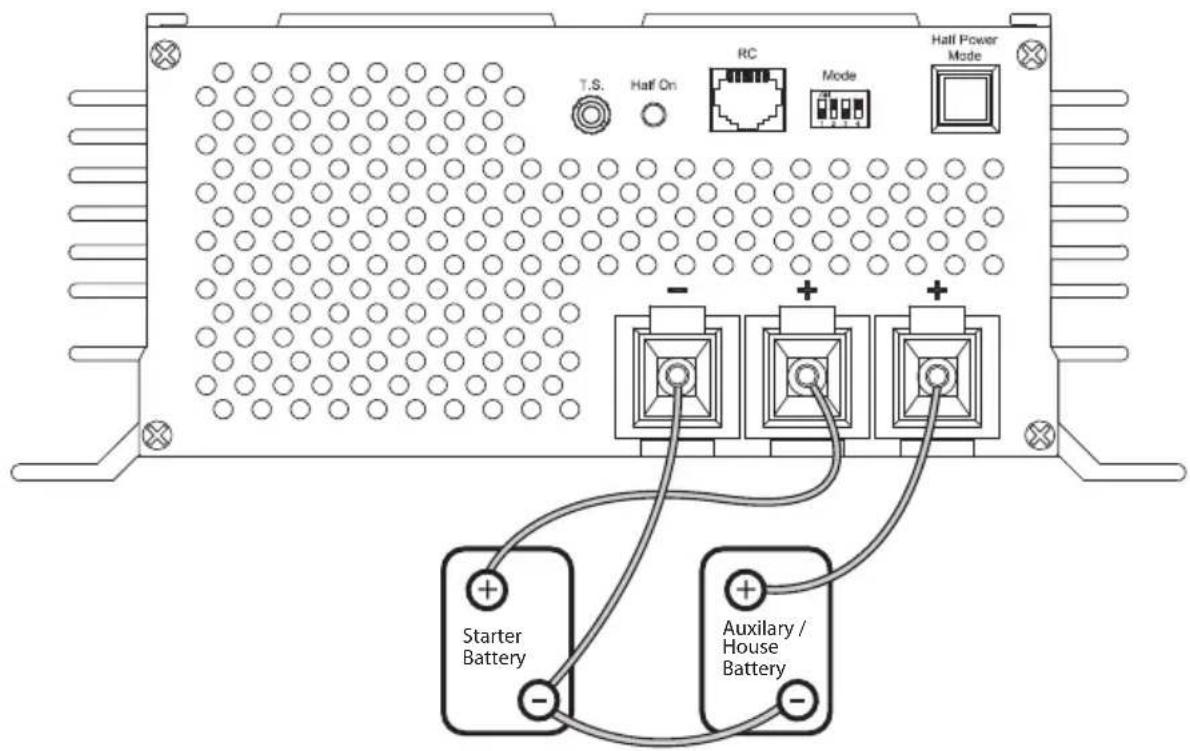
Fig 7.1 Connecting 2 separate battery systems to 2 separate banks
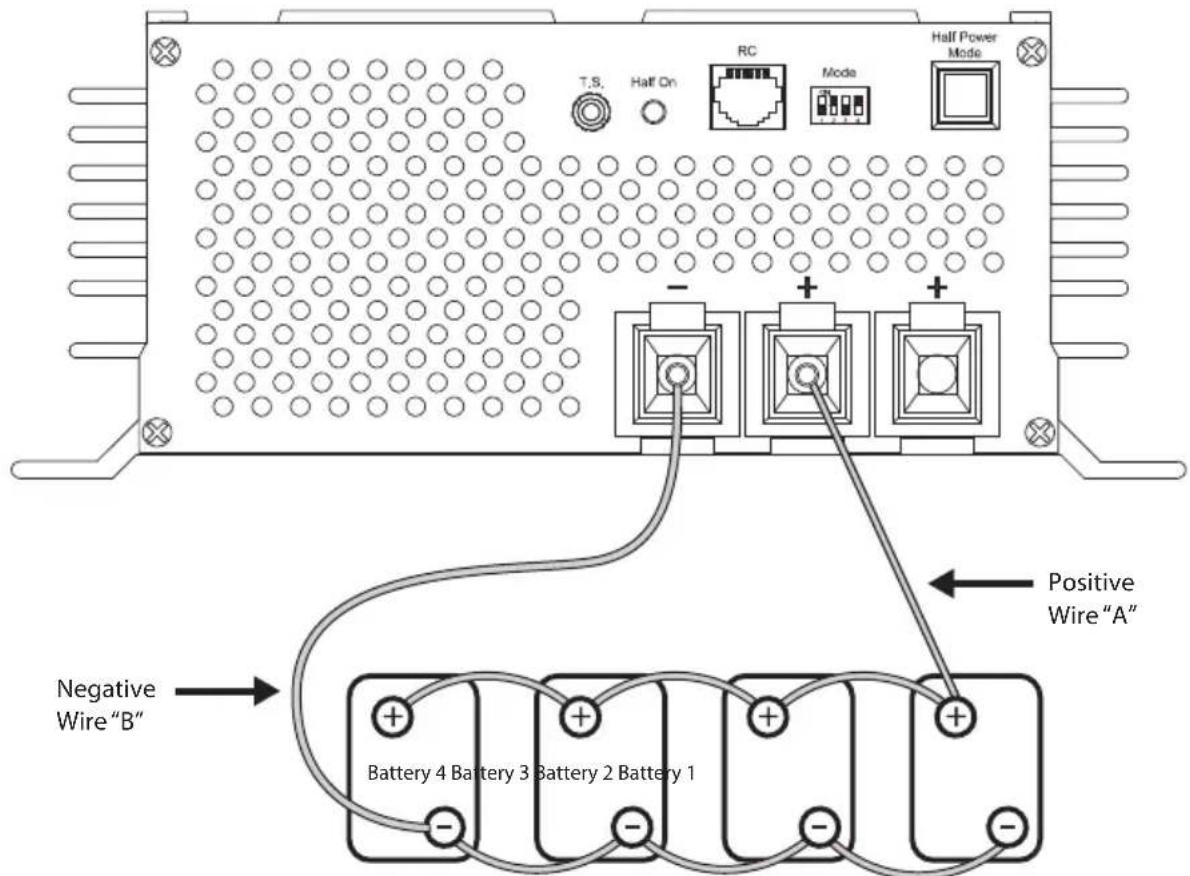
Fig. 7.2 Connecting bank of paralleled batteries to single bank
SECTION 7 | Preparing the Charger for Operation
In a single battery bank, two or more batteries may be connected in parallel to increase their AH capacity. These will be discharged and charged as a single battery bank. In this case, the paralleled bank of multiple batteries is to be considered as a single bank and connected to any one of the 2 banks of the charger as shown in Fig. 7.2 for bank of 4 batteries. For proper charging of all the batteries, please ensure that the Positive wire "A" from the charger is connected to the Positive terminal of the first battery (Battery 1) and the Negative wire "B" is connected to the Negative terminal of the last battery (Battery 4). This will ensure the following:
- Resistance of the interconnecting cables will be balanced and the individual batteries will see the same series resistance
- All the individual batteries will be charged at the same charging current and thus will be charged to the same state of charge
- None of the batteries will see an over-charge condition
When connecting a single battery or other single DC load, it can be connected to the common Negative and any one of the 2 Positive terminals as in Fig. 7.1.
CHARGING MORE THAN ONE BANK OF BATTERIES

CAUTION!
When charging more than one bank of batteries at the same time using 3 Stage Charging, ensure that the batteries in the banks are in a similar discharged condition. If one bank is completely discharged and another is almost fully charged, the bank that is fully charged will be subjected to over charge condition during the time when the charger remains in Stage 2 ("Uo" Phase) for charging the completely discharged bank.
If 2 banks of batteries are required to be charged and they are at different discharged conditions, select "Loaded Battery" (2 Stage Charging) with the help of switches S1 and S2 of the set of 4 DIP Switches (both S1 & S2 in off condition) - See under heading "Dip Switch Setting" on page 21.
SELECTING TYPE OF BATTERY AND CHARGING STAGES
Stage 3 Float Stage ("U" Phase) voltage and Stage 2 Absorption Stage ("Uo" Phase) voltage are different for different types of Lead Acid Batteries.
3 Stage charging (Stages 1, 2 and 3) is recommended when charging stand alone, unloaded battery (The battery has no load connected to it when it is being charged).
When the charger is used to charge a battery and simultaneously supply an external load, the voltage level of Stage 2 is required to be set to the same level as the voltage of Stage 3 to prevent over-charging. Effectively, the battery will be charged in 2 stages only
SECTION 7 | Preparing the Charger for Operation
- Stage 1 and Stage 3. This also applies when two banks of batteries are being charged simultaneously and the batteries in the two banks are in a dissimilar state of discharge. A pair of switches S1 & S2 out of a set of 4 DIP Switches has been provided for selecting the battery type and for modifying the Stage 2 Absorption Stage when charging loaded batteries / two banks of batteries with different discharged states. The following selections can be made with the help of the DIP Switches S1 and S2:

CAUTION!
Do not change the DIP Switch setting when the charger is operating. Always change the DIP Switch setting when the charger is OFF, i.e. after disconnecting the charger from the AC input power).
NOTE: The voltages are for battery temperature of 77^ / 25^ .
DIP SWITCH SETTING FOR SEC-1250UL
| S1 S2 Float Absorption | Battery Type | Charging Stages | |||
| OFF* ON* 13.5V* 14.4V* | Flooded / AGM* | 3 Stages (Stages 1, 2, 3) | |||
| ON OFF 13.5V 14.0V Gel Cell | 3 Stages (Stages 1, 2, 3) | ||||
| OFF OFF 13.5V Disabled | Battery with Load | 2 Stages (Stages 1, 3) | |||
| ON ON Caution! Do NOT use this setting | |||||
- Factory pre-set in this position
DIP SWITCH SETTINGS - SEC-2425UL
| S1 S2 Float Absorption Battery Type | Charging Stages | ||||
| OFF* ON* 27V* 28.8V* | Flooded / AGM* | 3 Stages (Stages 1, 2, 3) | |||
| ON OFF | 27V | 28.0V Gel Cell | 3 Stages (Stages 1, 2, 3) | ||
| OFF OFF | 27V | Disabled | Battery with load | 2 Stages (Stages 1, 3) | |
| ON ON | Caution! Do not use this setting | ||||
- Factory pre-set in this position
SECTION 7 | Preparing the Charger for Operation

CAUTION!
PLEASE ENSURE THAT POSITION S1- ON AND S2 - ON IS NEVER SELECTED
SELECTING THE TIME FOR STAGE 2 - ABSORPTION STAGE ("U0" Phase)
Stage 2 - Absorption Stage ("Uo" Phase) is controlled by an internal timer circuit. Time of 4 hours or 8 hours can be selected with the help of a pair of switches S3 & S4 of the set of 4 DIP Switches (5). Check with the battery manufacturer for the optimum setting. The preset value is 4 Hrs. Select the times as follows:
| Time DIP Switch S3 DIP Switch S4 | Type of Battery | ||
| 4 hours* | OFF* | ON* | Flooded / Wet Cell |
| 8 hours ON OFF Gel Cell & AGM | |||
| Disable OFF OFF - | |||
- Factory preset in this position

CAUTION!
PLEASE ENSURE THAT POSITION S3- ON AND S4 - ON IS NEVER SELECTED
REDUCTION OF MAXIMUM CHARGING CAPACITY TO HALF FOR SAFE CHARGING OF LOWER CAPACITY BATTERIES - HALF POWER MODE
Batteries should not be charged at very high currents to ensure long life. Unless approved by the manufacturer, the maximum charging current should be limited to approximately C/10 (where C is the Ah capacity of the battery at 20 Hour Rate). Thus, at the rated current capacities (50A for SEC-1250UL and 25A for SEC-2425UL), the Ah capacity of the battery that should be charged with the charger will be:
- 50A × 10 = 500Ah for SEC-1250UL
- 25A x 10 = 250 Ah for SEC-2425UL
If battery with lower Ah capacity is charged at the full charging rate, the battery life is likely to be reduced.
A provision has been made to reduce the maximum charging current to approximately half: 25A +/- 1A for SEC-1250UL & 12.5A +/- 1A for SEC-2425UL. This mode is termed as "Half Power Mode". This mode can be selected by pressing push switch marked "Half Power Mode" (8). When selected, a Green LED marked "Half On" (5) will be lighted. When "Half Power Mode" is selected, batteries with the following lower capacities can be safely charged at C/10 charging rate:
SEC-1250UL - 250 AH
SEC-2425UL - 125 AH
SECTION 7 | Preparing the Charger for Operation
TEMPERATURE COMPENSATION
The cell voltages of a battery depend upon the temperature of the cells inside the battery. The cells have a Negative Temperature Coefficient - their voltage levels increase at lower temperature and decrease at higher temperature. The Negative Temperature Coefficient is - 2.5 mV / °F / cell or - 15.0 mV / °F/ 6 cells for a 12V battery or - 30.0 mV / °F / 12 cells for a 24V battery.
The battery and battery charger voltages are normally specified at a temperature of 77^ (25^) . Thus, if the battery temperature is considerably lower than or higher than 77^ , it will be under-charged or over-charged unless the battery charger has temperature compensation.
TEMPERATURE SENSOR PROBE TF-500
This charger has a provision for temperature compensation. A temperature sensor unit - Model No. TF-500 (Fig. 7.3) is provided for this purpose.
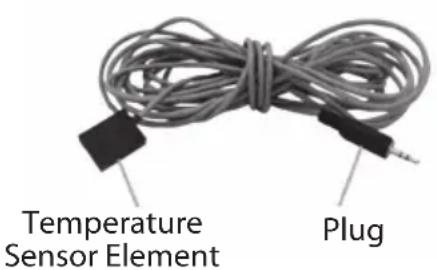
Fig. 7.3. Temperature Sensor Model No. TF-500

CAUTION!
This temperature sensor is matched and calibrated for each battery charger and should not be interchanged with the sensor from another battery charger.
The temperature sensor comes with 5 Meter cable. It has a plug on one end. Connect this plug into the jack marked TS (4) on the rear panel of the charger. The other end has the temperature sensor element. Mount this temperature sensor element flush with the side surface of the battery for proper heat transfer.
When the temperature sensor is connected, the voltages during Stages 2 and 3 are automatically adjusted as per the temperature of the battery and the above temperature coefficient.
SECTION 7 | Preparing the Charger for Operation
REMOTE CONTROL PANEL MODEL NO. 900-RC
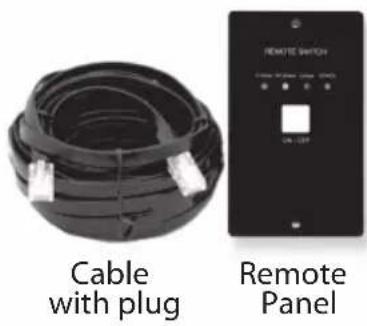
Fig 7.4 Remote Control Panel Model No. 900-RC
An optional wired Remote Control Panel Model No. 900-RC (Fig 7.4 above) can be ordered. It comes with 10 meters of RJ-45, 8P8C Modular, Straight cable. It is plugged into the Remote Control Jack (6). The Remote Control Panel can be used to switch ON / switch OFF the charger and also monitor the charging status of the charger from a remote location. Please read the manual for the optional Remote Control Panel 900-RC for related indications.
SECTION 8 | Operation

CAUTION!
Negative Temperature Coefficient (NTC) thermistors are used in series with the AC input circuit to limit very large spike of inrush current drawn by input side capacitors, which act almost like a short circuit during the first half cycle after the charger is switched ON. When charger is switched ON, NTC is in cold state, its resistance is high and hence, the inrush current spike is suppressed to safe level. It heats up very fast and its resistance drops to almost zero. It remains in heated condition as long as the charger remains switched ON. When the charger is switched OFF, the NTC requires around 2 to 3 min to cool down and reset its resistance to high cold state value for spike suppression the next time it is needed. The following precautions are to be taken to prevent damage to the NTC and to the input circuit:
- Do not switch ON, switch OFF and Switch ON the charger in quick succession. After switching OFF the charger, wait for at least 5 minutes before switching ON again to allow cooling down of the NTC
- When powering the charger from a generator, allow the generator to warm up and stabilize in voltage before switching ON the charger. If the charger is in ON condition and the generator is started, high voltage transients produced by the generator during startup may damage the NTC
SWITCHING ON / OFF
The charger is switched ON / OFF with the illuminated AC input power ON / OFF switch (9) located on the rear panel of the unit. The switch is illuminated Red when switched ON.
INDICATION OF NORMAL OPERATION AND CHARGING STATUS
When the charger is switched ON without any load, the fan will come on momentarily and switch OFF. Voltmeter (12) will indicate the voltage at the terminals of the charger. Ammeter (13) will indicate the current being drawn from the charger. When a standalone battery is being charged and has charged fully, the current will be almost 0A. When the charger is in current limit condition during the Stage 1-Bulk Charge Stage ("I" Phase) or Stage 2 - Absorption Stage ("Uo" Phase), the current shown will be full 50A for SEC-1250UI and 25A for SEC-2425A.
POWERING OTHER DC LOADS
The charger can be used as a power supply or as a DC UPS (DC Uninterruptible Power Supply. For both these applications, first set switches S1 and S2 of DIP Switch to OFF position to set the charger to work in 2 stage mode (See under "DIP Switch Setting" on page 21).
USING THE CHARGER AS A POWER SUPPLY
To use as a power supply, first switch off the DC load. Connect the DC load between the common Negative terminal and one of the 2 Positive terminals. Ensure that the maximum current drawn by the DC load is below the maximum current rating of the charger. Switch on the charger and then the DC load.
USING THE CHARGER AS A DC UPS
In a DC UPS (Uninterruptible Power Supply), the charger simultaneously powers the DC load as well as the battery. As long as the AC power to the charger is available and the charger is working normally, the charger will supply the DC load as well as charge / float the battery. In case the AC power fails or if the charger stops working, the battery will automatically power the DC load. As soon as the AC power to the charger is restored, the DC load will once again be fed by the charger and at the same time the battery will be recharged.

CAUTION!
Please ensure that the sum of the current drawn by the DC load and the current desired for charging the battery is less than the maximum current capacity of the charger.
To use as a DC UPS, first switch OFF the DC load and connect it to the battery. Now connect the battery to the charger as explained above under. Switch on the charger and then switch on the DC load. For operation in this mode, set switches S1 & S2 of DIP switches marked Mode (7) to OFF for "Battery with Load" application (See under "DIP Switch Setting" on page 21).
SECTION 9 | Troubleshooting
The symptoms of abnormal operation and the possible cause(s) and remedies are given in the succeeding paragraphs.
THERE IS NO OUTPUT. THE AC POWER ON/OFF SWITCH DOES NOT ILLUMINATE WHEN SWITCHED ON. THE VOLTAGE METER DOESN'T MOVE (ON THE REMOTE PANEL, THE GREEN LED UNDER "POWER" IS OFF).
-
There is no AC input voltage in the outlet: Check that AC power is available in the AC outlet receptacle and that it is switched ON.
The AC input side fuse is blown due to: -
High input voltage: Check that the input voltage is 120 VAC nominal (normal range is 108 to 132 VAC).
- High voltage transients / surges in the AC input line: Ensure that the AC input voltage is clean and does not have high voltage transients / surges. Input voltage surges / transients >170 VAC will blow the AC side fuse. Use a suitable AC line conditioner / surge suppressor, if necessary.
- The unit has become defective: If fuse is not blowing due to the above two causes, the unit has become defective. Call Technical Support of assistance.
THERE IS NO OUTPUT VOLTAGE. THE VOLTAGE METER DOESN'T MOVE AND THE AC POWER ON/OFF SWITCH IS ILLUMINATED RED (ON THE OPTIONAL REMOTE CONTROL 900-RC, THE RED LED UNDER "I PHASE" IS LIGHTED, THE GREEN LED UNDER "POWER" IS LIGHTED). THE FAN IS ON CONTINUOUSLY.
- The DC side output fuse is blown: The DC side fuse will blow if the battery is connected in wrong polarity. Ensure that the Positive battery post is connected to the Positive connector of the charger (either Bank 1 or Bank 2) and the Negative battery post is connected to the Negative connector (common) of the charger. Replace the fuse with a fuse of the specified rating.
- The battery / DC load is shorted: Check and remove the short circuit. The charger will latch in the off condition if it was shut down due to short circuit and will NOT reset automatically. To re-set, switch off the AC power input ON / OFF switch and switch on again.
- Shut down due to high temperature: Check that the cooling fan is working, the air vents are not clogged and the ambient temperature is not very high. The charger will be latched in this shut down condition and will NOT reset automatically even after the unit has cooled down. To reset, the AC input power ON / OFF switch has to be switched off and on again.
- AC input has been set to 230 VAC and is being operated at 120 VAC: Check the position of the internal jumper for setting 120 VAC / 230 VAC operation. For 120 VAC operation, the jumper should be connected and should be shorting points "C" and "D" on the PCB
WHEN THE CHARGER IS POWERED AND IS BEING USED AS A DC POWER SUPPLY / UPS, THE OUTPUT VOLTAGE DROPS WHEN THE DC LOAD IS SWITCHED ON OR INCREASED.
The charger is being forced into current limit condition. The load is trying to draw current more than the current limit value of the charger - 50A for Normal operation & 25A +/- 1A for "Half Power Mode" for SEC-1250UL and 25A for Normal operation & 12.5A +/- 1A for "Half Power Mode" for SEC-2425UL (the current limit value is the maximum specified charging Amps). Once the load current reaches the current limit value, the current limit circuit is activated and the output voltage drops.
SECTION 9 | Troubleshooting
Some loads like motors, compressors, incandescent lamps, halogen lamps, heating elements, relays, coils, capacitors etc. draw very large inrush / starting currents which may reach up to 10 times their normal operating currents. Ensure that the starting / inrush current or the maximum operating current of the load is lower than the current limit value of the charger. Do not use a load that draws more than 50A (25A +/- 1A for "Half Power Mode") for SEC-1250UL or more than 25A (12.5A +/- 1A for "Half Power Mode") for SEC-2425UL. Once the load current is reduced below the above limiting values, the charger will recover automatically.
THE BATTERY IS GETTING OVER CHARGED / OVERHEATED / LOSES WATER OR BOILS.
- There is an external load connected to the battery when it is being charged: 3-stage charging is recommended for charging stand-alone or unloaded batteries (there is no load connected to the battery when it is being charged). If a load is also connected simultaneously, a part of the charger's output current will be diverted to this load. Thus, the charger may remain locked in Stage 2 if the current drawn by the load is more than the preset value of threshold current determining transition from Stage 2 to Stage 3. This will lead to overcharging, overheating and loss of electrolyte. For charging a battery when a load is also connected simultaneously, Stage 2 voltage should be the same as Stage 3 voltage (Stage 2 is disabled). Select "Loaded Battery" with the help of DIP Switches S1 and S2 of the set of 4 DIP Switches - See under "DIP Switch Setting" on page 21.
- Two banks of batteries are being charged and the batteries in the two banks are in dissimilar state of discharge: When charging more than one bank of batteries at the same time using 3 Stage Charging, ensure that the batteries in the banks are in a similar discharged condition. If one bank is completely discharged and another is almost fully charged, the bank that is fully charged will be subjected to over charge condition during the time when the charger remains in Stage 2 for charging the completely discharged bank.
If 2 banks of batteries are required to be charged and they are at different discharged conditions, select "2 Stage Charging" with the help of switches S1 and S2 of the set of 4 Dip Switches (both S1 & S2 in off condition) - See under "DIP Switch Setting" on page 21.
- Very high charging current for low Ah capacity battery: Charging rate should normally be limited to C / 10 unless specified otherwise by the battery manufacturer. Very high charging rate may lead to reduction in the cell voltage when gassing starts and can result in higher temperatures, loss of water and boiling of the battery.
THE BATTERY IS TAKING EXCESSIVELY LONG TIME TO FULLY RECHARGE OR WHEN THE CHARGER IS POWERED AND IS BEING USED AS A DC POWER SUPPLY / UPS, THE OUT-PUT VOLTAGE DROPS AT LOWER DC LOAD CURRENTS.
- The unit is in "Half Power Mode": (Green LED (8) located on the bottom left corner of the front panel of the unit is lighted). When this mode is selected, the maximum charging current will be automatically reduced to 25A + / - 1A for SEC-1250UL and 12.5A + / - 1A for SEC-2425UL. Hence, the charging time will increase. Switch off the "Half Power Mode" if the full rated charging capacity is required.
SECTION 10 | Internal Fuse Ratings
Both the AC input side and DC output side have fuses.
The AC input side fuse is located on the PCB F1 inside the unit. It is rated at 250V, 12A, Time Delay (Size 6.3 mm x 32 mm, pig-tail).
The DC side fuses are located inside the unit. To access these fuses, remove the top cover. These are automotive blade fuses (for example, "Littelfuse" Type ATO) rated as follows:
SEC-1250UL 2 pieces, each rated at 32V, 30A
SEC-2425UL 2 pieces, each rated at 32V, 20A
SECTION 11 | Specifications
| PARAMETER SEC-1250UL SEC-2425UL | ||
| NOMINAL INPUT VOLTAGEFactory Preset | 120 VAC, 50 /60 Hz(108 to 132 VAC) | |
| By changing internal jumper | 230 VAC, 50 / 60 Hz(207 to 253 VAC) | |
| INPUT CURRENT | ||
| At 120 VAC input | 10.4A | 10.1A |
| At 230 VAC input | 5.6A | 5.5A |
| OUTPUT VOLTAGE | ||
| Bulk "I Phase"Absorption "Uo Phase"*Float "U Phase"* | 13.5V +/-0.05V14V / 14.4V +/-0.05V13.5V +/- 0.05V | 27.0V +/- 0.05V28V / 28.8V +/- 0.05V27.0V +/- 0.05V |
| MAXIMUM BULKCHARGING CURRENT, I | ||
| Normal OperationHalf Power Mode | 50A25A +/-1A | 25A12.5A +/- 1A |
| THRESHOLD OF CURRENT FORCHANGE OVER ABSORPTION | ||
| From Float "U" to Absorption "U" | 10A +/-1A | 6A +/-1A |
| From Absorption "U" to Float "U" | 5A +/-0.5A | 3A +/-0.5A |
| DURATION OF ABSORPTION/BOOST STAGE | 4 Hrs or 8 Hrs(Switch selectable) | |
| MAXIMUM BATTERY CAPACITY | 500 Ah 300 Ah | |
| TEMPERATURE COMPENSATION | YES, with Temperature Sensor TF-500 | |
SECTION 11 | Specifications
| PARAMETER SEC-1250UL SEC-2425UL | ||
| Wired Remote Panel (OPTIONAL) | YES (Model 900-RC) | |
| COOLING | Load Controlled Fan - ON at 10A; OFF at 5A | |
| PROTECTIONS | ||
| Overload | YES | |
| Short Circuit | YES | |
| Reverse Polarity | YES | |
| Over Temperature | YES | |
| OUTPUT BANKS | 2 | |
| OUTPUT CONNECTORS | Terminals with tubular holes (8 mm Dia) and set screw | |
| OPERATING TEMPERATURE RANGE | -20 to 40°C / -4 to 104°F | |
| FUSES - AC INPUT SIDE (6.3 mm x 32 mm); Slow Blow / Time Delay: 120 VAC Input 12A / 250V | ||
| FUSES, DC OUTPUT SIDE Automotive Blade Type e.g. Littelfuse "ATO" Series | 32V, 60A (2 pieces of 30A in parallel) | 32V, 40A (2 pieces of 20A in parallel) |
| DIMENSIONS: (L X W X H), mm | 331 X 244 X 97 | |
| WEIGHT, KG. | 4.1 | |
| SAFETY COMPLIANCE | Intertek - ETL Listed Conforms to ANSI / UL STD 1564 Certified to CAN / CSA STD C22.2 No. 107.2 | |
| EMI COMPLIANCE | FCC Part 15(B), Class B | |
*Notes: The charging voltages shown are applicable at battery temperature of 77^ F( 25^ C)
Specifications are subject to change without notice.
2 YEAR LIMITED WARRANTY
SEC-1250UL / SEC-2425UL manufactured by Samlex America, Inc. (the "Warrantor") is warranted to be free from defects in workmanship and materials under normal use and service. The warranty period is 2 years for the United States and Canada, and is in effect from the date of purchase by the user (the "Purchaser").
- Warranty outside of the United States and Canada is limited to 6 months. For a warranty claim, the Purchaser should contact the place of purchase to obtain a Return Authorization Number.
- The defective part or unit should be returned at the Purchaser's expense to the authorized location. A written statement describing the nature of the defect, the date of purchase, the place of purchase, and the Purchaser's name, address and telephone number should also be included.
- If upon the Warrantor's examination, the defect proves to be the result of defective material or workmanship, the equipment will be repaired or replaced at the Warrantor's option without charge, and returned to the Purchaser at the Warrantor's expense. (Contiguous US and Canada only)
- No refund of the purchase price will be granted to the Purchaser, unless the Warrantor is unable to remedy the defect after having a reasonable number of opportunities to do so. Warranty service shall be performed only by the Warrantor. Any attempt to remedy the defect by anyone other than the Warrantor shall render this warranty void. There shall be no warranty for defects or damages caused by faulty installation or hook-up, abuse or misuse of the equipment including exposure to excessive heat, salt or fresh water spray, or water immersion.
- No other express warranty is hereby given and there are no warranties which extend beyond those described herein. This warranty is expressly in lieu of any other expressed or implied warranties, including any implied warranty of merchantability, fitness for the ordinary purposes for which such goods are used, or fitness for a particular purpose, or any other obligations on the part of the Warrantor or its employees and representatives.
SECTION 12 | Warranty
- There shall be no responsibility or liability whatsoever on the part of the Warrantor or its employees and representatives for injury to any persons, or damage to person or persons, or damage to property, or loss of income or profit, or any other consequential or resulting damage which may be claimed to have been incurred through the use or sale of the equipment, including any possible failure of malfunction of the equipment, or part thereof. The Warrantor assumes no liability for incidental or consequential damages of any kind.
Samlex America Inc. (the "Warrantor") www.samlexamerica.com
Contact Information
Toll Free Numbers
Ph: 18005615885
Fax: 18888145210
Local Numbers
Ph: 604 525 3836
Fax: 604 525 5221
Website
www.samlexamerica.com
USA Shipping Warehouses
Kent, WA
Plymouth, MI
Canadian Shipping Warehouse
Delta, BC
Email purchase orders to
orders@samlexamerica.com

samlexamerica

samlexpower®
GUIDE
D'UTILISATION
INFORMATIONS RELATIVES AU CHARGEUR
-SEC-1250UL:500Ah
SEC-2425UL:300Ah
SECTION 6 | Installation
DIMENSIONS D'INSTALLATION
SECTION 6 | Installation
EMPLACEMENT, MONTAGE ET SECURITE
SEC-1250UL - 250 AH
SEC-2425UL - 125 AH