Samowar Rebecca - Electric tea maker BEEM - Free user manual and instructions
Find the device manual for free Samowar Rebecca BEEM in PDF.



| Product Type | Electric Samovar |
| Brand | BEEM |
| Model | Rebecca |
| Dimensions (L x W x H) | 365 x 267 x 580 mm |
| Net Weight | 4.73 kg |
| Power Supply | 230 V ~, 50-60 Hz |
| Power Consumption | 1800 W (1300 W + 500 W) |
| Water Tank Capacity | 5.0 L |
| Teapot Capacity | 1.3 L |
| Protection Class | I |
| Type of Protection | IPX0 |
| Material | Stainless Steel |
| Temperature Control | 3 positions: approx. 70°C (W), 90°C (H), 100°C (boil) |
| Keep Warm Function | Yes, via thermostat (alternating heating) |
| Service Tap | Pulse and continuous operation |
| Safety | Dry run protection (red indicator), lid lock |
| Maintenance | Descaling recommended every 1 to 2 weeks |
| Cleaning | Removable parts dishwasher safe |
| Delivery Contents | Samovar, teapot, tea filter, instruction manual |
| Warranty | Extended manufacturer warranty (according to conditions at www.beem.de) |
| Optional Accessories | INOX-METAL-POLISH care product |
Frequently Asked Questions - Samowar Rebecca BEEM
User questions about Samowar Rebecca BEEM
0 question about this device. Answer the ones you know or ask your own.
Ask a new question about this device
Download the instructions for your Electric tea maker in PDF format for free! Find your manual Samowar Rebecca - BEEM and take your electronic device back in hand. On this page are published all the documents necessary for the use of your device. Samowar Rebecca by BEEM.
USER MANUAL Samowar Rebecca BEEM
Elements of Lifestyle
Bedienungsanleitung
User Manual
Mode d'emploi
Open the fold-out page at the beginning of the user manual in order to view the illustration during reading.
Romanov
Inhalt
natural_image
Line drawings of a mechanical device with a handle and base, showing a step-by-step assembly (no text or symbols)Tipp-Betrieb
natural_image
Line drawing of a traditional steam ewer with directional arrows indicating motion (no text or symbols)
natural_image
Line drawing of a vintage steam locomotive with rotating components and directional arrows (no text or symbols)Wasser erhitzen
ACHTUNG
General instructions ..... 17
Safety instructions ..... 19
Startup 21
Appliance description 22
Operation and use 22
After using 27
Cleaning and maintenance ..... 2 7
Storage 28
Spare parts and accessories ..... 29
Technical data 29
Dear Customer,
Before using the appliance, please read the instructions contained in this user manual on startup, safety, intended use as well as cleaning and care.
Open the fold-out page at the beginning and end of the user manual in order to view the illustrations during reading.
Keep this user manual in a safe place and give it to any future owners together with the appliance.
General instructions
Copyright
This document is copyrighted. Any duplication or reprinting, in whole or in part, and the reproduction of the illustrations, even in modified form, is only permitted with the written approval of the manufacturer.
Notes on environmental protection

The packaging materials used can be recycled. When no longer re-d, dispose of the packaging materials rding to local environmental regula-

This product may not be disposed of in the domestic refuse within the European Union. Dispose of the appli-via communal collection points.
Warranty / Guarantee
In addition to the statutory warranty obligation, BEEM also grants an extended manufacturer's guarantee for some products.
Provided this is granted, the corresponding details for each product can be found either on the product-specific packaging, advertising material or on the BEEM website.
Please visit our website to obtain more information on comprehensive guarantee conditions, available accessories and spare parts as well as user manuals in various languages
Symbols used
DANGER
This indicates an imminent hazardous situation, which could lead to severe physical injury or death.
Follow these instructions to avoid danger.
WARNING
This indicates a possible hazardous situation, which could lead to severe physical injury or death.
Follow these instructions to avoid ▶ danger.
ATTENTION
This indicates a potentially hazardous situation, which could lead to minor injuries or material damage.
Follow these instructions to avoid danger.
NOTE
A note contains additional information to simplify the use of the appliance.
Intended use
This appliance is intended primarily for non-commercial use in closed rooms for brewing tea and other hot drinks.
Any use other than previously stated is considered as improper use.
WARNING
If not used for its intended purpose and/or used in any other way, the appliance may be or become a source of danger.
Use the appliance only for its intended purpose.
Observe the procedures described in this user manual.
No claims of any kind will be accepted for damage resulting from use of the appliance for other than its intended purpose.
The risk must be borne solely by the user.
Limitation of liability
We assume no liability for damage or follow-up damage in the case of:
failure to observe the instructions in ■ the user manual,
use for other than the intended pur- pose,
improper or unsuitable handling, ■
incorrectly performed repairs, ■
unauthorised modifications, ■
use of non-approved parts or spare ■ parts,
use of unsuitable supplementary or accessory parts.
Declaration of Conformity
BEEM hereby declares that this appliance complies with the fundamental requirements and other relevant provisions of 2006/95/EC and 2004/108/EC and und 2009/125/EC directives.
Safety instructions
Inspect the appliance for visible signs of damage before use. Do not use a damaged appliance.
This appliance is not intended for use by persons (including children) with restricted physical, sensory or mental capabilities or with insufficient experience and/or knowledge unless they are supervised by a person responsible for their safety or have received instructions on the use of the appliance from such a person.
Children must be supervised to ensure that they do not play with the appli- ance.
Store the appliance and accessory ■ parts out of the reach of children.
Do not leave the appliance unattended during operation.
Only allow repairs to the appliance ■ to be carried out by an authorised specialist or by the works customer service; this particularly applies to replacing a damaged connecting cable. Unqualified repairs can lead to considerable danger for the user. This will also invalidate the warranty or guarantee.
Repairs to the appliance during the guarantee period may only be carried out by service centres authorised by the manufacturer, otherwise no guarantee or warranty claim can be made in the case of damage and follow-up faults.
Only replace defective components with original spare parts. Only original spare parts guarantee that the safety requirements are met.
Only use spare parts from the manufacturer or spare parts that are specifically recommended by the manufacturer. Otherwise, this will invalidate the warranty or guarantee.
Do not use this appliance together with an external timer or a separate remote control system.
DANGER
Danger of electric current!
Do not use the appliance if the mains cable or mains plug is damaged.
Do not open the housing of the appliance. Danger from electric current if live connections are touched and/or the electrical and mechanical configuration is changed.
Never immerse the appliance or the mains plug in water or other liquids.
Pull the plug out of the mains socket, if you are not using the appliance;
- if a malfunction occurs during operation,
– before you clean the appliance.
Risk of suffocation!
Never play with packaging material. Risk of suffocation.

WARNING
Never heat any other liquids in the appliance other than water.
Danger from hot steam and hot water!
Never fill the appliance above the maximum mark.
Do not open the lid of the water tank while water is boiling; spurting hot water and escaping steam can lead to scalding.
Danger to health from germs!
The water tank of the appliance must be completely emptied, cleaned and disinfected at regular intervals to avoid the risk of cultivation of dangerous germs.
ATTENTION
Do not use sharp objects or abrasive cleaning agents to clean the surfaces.
Never lift or move the appliance with the mains cable.
Do not pull the connecting cable ▶ to remove the plug from the mains socket.
Never operate the appliance when the jug is empty.
Requirements for the place of use
For safe and trouble-free operation of the appliance, the installation location must satisfy the following requirements:
Place the appliance on a firm, dry, flat, waterproof and heat-resistant surface.
Do not install the appliance in a hot, ■ wet or very humid environment.
The mains socket must be easily accessible and allow fast disconnection in the event of an emergency.
The surface finishes on furniture may contain substances which can be detrimental to the feet of the appliance. If necessary, place a mat under the feet of the appliance.
Electrical connection
For safe and trouble-free operation of the appliance, the following instructions on the electrical connection must be observed:
Before connecting the appliance, ■ compare the connection data (voltage and frequency) on the rating plate with those of your mains power supply. This data must correspond in order to avoid damage to the appliance. If in doubt, ask your electrical appliance retailer.
The mains socket must be protected by at least a 10 A automatic circuit breaker.
Ensure that the mains cable is undamaged and is not laid over sharp edges.
The mains cable must not be pulled ■ tightly, bent or come into contact with hot surfaces.
Route the mains cable to prevent risk ■ of tripping.
The electrical safety of the appliance is only assured when it is connected to a properly installed protective earth (PE) conductor system. Connection to a mains socket without PE conductor is forbidden. If in doubt, the electrical system must be checked by a qualified electrician. The manufacturer assumes no liability for injury or damage caused by a missing or interrupted protective earth conductor.
Startup
Unpacking
Remove the appliance, all accessory parts and the user manual from the box.
Remove all packaging materials and protective foils from the product and the accessories before using it for the first time.
NOTE
Do not remove the rating plate or any warning signs on the appliance. Keep the original packaging during the warranty or guarantee period in order to return the appliance in the packaging in the event of a guarantee claim. Transport damage will invalidate the warranty or guarantee.
Checking the delivery contents
Check for visible signs of damage or missing items.
Report incomplete or damaged con- tents to your supplier immediately.
Before using for the first time
Familiarise yourself with the appliance and the accessories using this user manual before using the appliance for the first time.
Before using fir the first time, clean ■ the appliance and accessories as described in the section Cleaning and care (page 27).
Appliance description
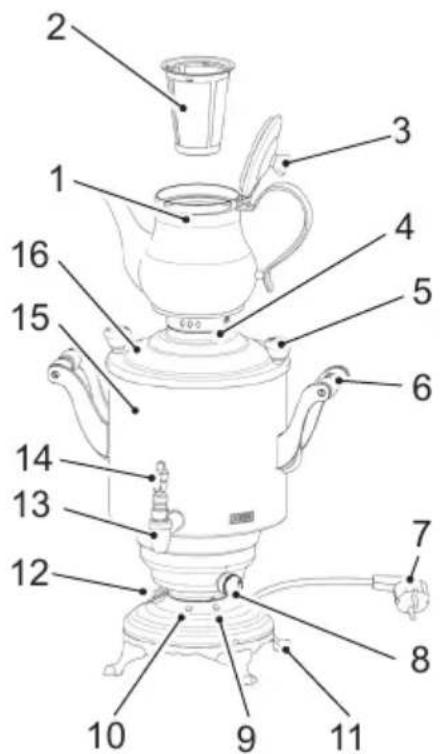
(See illustration on the left fold-out page)
Teapot1
Tea strainer for teapot2
Teapot lid knob3
Lid attachment4
Lid knob5
Porcelain side handle6
Mains cable7
Rotary knob8
Indicator light, normal operation blue9
Indicator light, red fault indicator10
Base11
ON/OFF switch12
Dispensing tap13
14 Dispensing tap lever
15 Water tank
16 Water tank cover
17 User manual (not illustrated)
Operation and use
Indicator lights (9/10)
The appliance is equipped with two indicator lights.
The blue indicator light (9) lights up when the thermostat switches itself on, i. e. the appliance heats up.
If a fault occurs during operation (no water), the red indicator lamp (10) lights up.
Switching the appliance on/off
The appliance is switched on and off with the on/off switch (12). The on/off switch (12) lights up when the appliance is switched on.
Rotary knob (8)
The rotary knob is operated as follows:

■ Use the on/off switch (12) to switch the appliance on.
■ Turn the rotary knob (8) clockwise. The appliance switches itself on with an audible click. The indicator lamp (9) lights up.
■ Setting the water temperature:
- Warm water: turn the rotary knob (8) to "W". The water is kept at a constant temperature of approx. 60^ - 70^ .
- Hot water: turn the rotary knob to "H". The water is kept at a constant temperature of approx. 85^-95^ .
- Boiling water: turn the rotary knob (8) clockwise towards 🌐 the symbol until it stops. The water boils constantly until it has completely evaporated.
- Intermittent boiling: after the water has boiled, turn the rotary knob (8) a maximum of 1/4 turn back. The water is kept at a constant temperature of approx. 95^ - 100^ .
Symbol Meaning
| W | Water temperature approx. 60 °C – 70 °C |
| H | Water temperature approx. 85 °C – 95 °C |
| II | Water temperature approx. 100°C |
Operating the dispensing tap (13)

natural_image
Line drawings of two mechanical components with a handle, showing different assembly states (no text or symbols)Touch mode
Press the lever downwards. The dispensing tap opens. To close the dispensing tap again, release the lever.
Continuous operation
Push the lever fully downwards. It ◆ locks in this position. The dispensing tap opens. To close the dispensing tap again, push the lever upwards.
Filling with water
The lid (16) of the water tank (15) lies on top of the water tank. To remove the lid, proceed as follows:
Switch off the appliance and allow it to cool.
Take off the teapot (1).
Hold the lid with both lid knobs (5) and lift it off.
Fill the tank with fresh water from the tap.
WARNING
When removing the lid, steam can escape and cause scalding!
Before removing the lid, allow the appliance to cool down.
Use pot holders to remove the lid.
Do not fill the tank over the maximum mark.
The Samoware Rebecca and Romanov have a locking lid, the Odessa does not.
Turn the lid anticlockwise to unlock and remove it (image A).
◆o lock the lid, align the recess on the edge of the lid with the locking pin on the upper edge of the water tank. Put on the lid and turn it clockwise until it stops (image B).

natural_image
Line drawing of a traditional steam ewer with rotating parts and base, no text or symbols present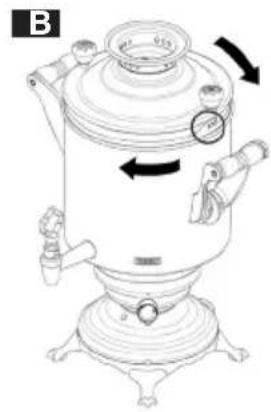
natural_image
Line drawing of a vintage steam ewer with directional arrows indicating motion (no text or symbols)Heating water
ATTENTION
Make sure that the rotary knob (8) is turned anticlockwise until it stops.
Switch on the appliance as de-▶ described in the section Switching the appliance on/off (page 22).
To heat up water, proceed as follows:
Fill the water tank (15) with the desired quantity of fresh water as described in the section Filling with water (page 23). Pay attention the maximum filling level.
Close the lid (16) on the water ◆ tank (15). The lids on the Samoware Rebecca and Romanov must be locked as described in the section Filling with water (page 23). Subsequently put the teapot (1) on top.
Turn the rotary knob clockwise to the maximum setting ( ).
The thermostat allows individual setting of the water temperature. The temperature setting is continuously variable.
After the water has boiled, turn back the rotary knob until the indicator blue lamp extinguishes. The temperature of the water will now be kept constant.
Boiling
If you turn the rotary knob (8) clockwise until it stops, the water is boiled quickly. If you leave the switch in this position, the water will continue boiling until it has completely evaporated.
Intermittent boiling
To boil intermittently after the water has boiled, turn back the rotary knob (8) until the blue indicator lamp (9) goes out (approx. a quarter turn in anticlockwise direction). When the temperature of the water drops, the thermostat switches on automatically and reheats the water. The blue indicator light (9) switches on and off according to the thermostat cycle.
Refilling with water
WARNING
Filling up a hot tank can cause steam to escape and lead to scalding!
Turn the rotary knob (8) anticlockwise until it stops.
Switch off the appliance.
Allow the appliance to cool down for a few minutes before refilling with water.
Fill the tank as described in the section Filling with water (page 23).
NOTE
If you forget to fill with water, the ▶ boil-dry protection will switch off the heating and the red indicator lamp lights up.
Serving suggestions
Brewing tea according to the oriental "Samovar principle"
Tea is not just tea. Strictly speaking, tea is only a water infusion of the tea plant ca-mellia sinensis. This infusion can be black or green tea. A distinction must be made between this and tea-like products such as the so-called herbal and fruit teas.
Therefore, brewing tea is not always just brewing tea. In order to preserve valuable ingredients and the taste, teas are brewed with water at different temperatures and allowed to steep for different lengths of time. For example, green tea is preferably brewed with water heated to 65^ C. In every case, the brewing instructions on the packaging should be observed.
Black tea
To brew black tea, proceed as follows:
Fill the water tank (15) with water.
Fill the tea strainer (2) in the teapot ◆ (1) with tea leaves (approx. one tea-spoonful per cup) or tea bags (approx. 1 tea bag for approx. 1 – 2 cups).
Close the lid (16) of the water tank and subsequently put the teapot on top of it. The teapot is then warmed up at the same time.
Boil the water in the water tank (see section Heating water, page 24).
Take the teapot off the water tank.
NOTE
Condensation may drip off the bot- tom of the teapot.
Pour boiling water from the water tank ◆ over the tea.
NOTE
The more tea leaves or tea bags and the less water you fill into the teapot, the stronger the tea concentrate will be (professionals enjoy an infusion with approx. 3 g for 200 ml of water). It is preferable to use slightly more tea so that a real concentrate is produced in the teapot.
Place the teapot with the tea concentrate on the water tank again.
The steam rising from the water tank keeps the tea in the teapot at exactly the temperature it needs to "steep".
After the required brewing time, take the tea strainer (2) with the tea leaves out of the teapot.
Pour the tea concentrate from the teapot into your glass and top up with water from the water tank. This allows you to adjust the strength and taste of your tea.
You can leave the teapot standing on the water tank while the appliance is in operation so that you can add hot tea and hot water at any time.
◆urn the rotary knob to intermittent boiling (see section Intermittent boiling, page 24) so that the water remains hot but does not boil constantly. The thermostat cycle switches the blue indicator light on and off.
Green tea
Green tea can also be brewed in the Samovar. It should not normally be infused with boiling water since it may then taste slightly bitter. Depending on the type, the ideal water temperature is between 50 °C – 70 °C. Most green teas develop their optimum taste at around 65°C. The higher the quality of the green tea, the lower the optimum water temperature. The highest quality teas are brewed with hot water at a temperature of 65°C.
Normal green teas need to steep for approximately 1 - 3 minutes, whereas high-quality green teas only need to steep for approximately 1 - 1½ minutes.
NOTE
If you use tea bags, add the number as specified by the manufacturer.
The amount of green tea is always less than black tea. Use roughly 1 g per 100 ml or 1 level teaspoon for 200 ml water. You can specify the strength of the concentration yourself.
To brew green tea, proceed as follows:
Boil the water in the water tank (see section Heating water, page 24).
Warm up the cups by filling them with a little hot water (the teapot was already warmed up by placing it on the water tank during the boiling process).
Turn the rotary knob (8) to the "W" position (according to the type of tea) and allow the water to cool down slightly (roughly 5 – 6 minutes).
Now pour hot water from the water ◆ tank over the tea.
Place the teapot onto the water tank as previously described so that the tea remains hot and continue according to the instructions for brewing black tea (see section Black tea, page 25).
Herbal tea
ATTENTION
Germs in herbal tea mixtures can represent a health risk if the tea is not brewed properly.
Always pour boiling water over ▶ herbal, fruit, rooibos and spice teas (loose and in tea bags) and allow to steep for at least 5 - 10 minutes! This is the only method for ensuring that the tea is safe to drink!
Do not allow freshly brewed herbal tea to stand for several hours.
In rare cases, herbal tea mixtures may contain germs such as salmonella that are normally killed off when heated over a prolonged period. If not properly brewed, they can become a health risk, particularly for children.
Do not allow freshly brewed herbal tea to stand for several hours. Although the germs are killed off by the boiling water, the spores in the tea can survive. These can germinate in the warm water. Herbal teas are brewed in the same way as black tea (see section Black tea, page 25).
Hot instant drinks
To prepare hot instant drinks such as in-stant coffee, add the appropriate amount to the cup. Subsequently pour hot from the Samovar into the cup.
After using
Switch off the appliance and pull the plug out of the mains socket. Rinse the jug and the accessories used with water.
Clean the appliance and the accessories used as described in the section Cleaning and care.
Cleaning and maintenance
Before beginning any cleaning work, pay attention to the safety instructions in the section Safety instructions (page 19).
Cleaning
Empty the appliance after every use. ■
Clean the appliance with a damp cloth and with a little washing-up liquid if necessary.
Rinse the appliance well with clear water and dry it.
The removable parts can be cleaned in a dishwasher.
We recommend using INOX-METAL-POLISH from Beem for regular maintenance and the removal of difficult stains from stainless steel surfaces. The polish restores appliances to their original shine. INOX-METAL-POLISH is available in tubes and is suitable for pots as well as for other objects made of stainless steel, chromium, brass, copper, aluminium, silver and also hard plastics. INOX-METAL-POLISH is used in factories for polishing stainless steel. You can obtain INOX-METAL-POLISH from your retailer or by phoning us or visiting our website at www.beem.de.
Descaling
Depending on the frequency of use and the water quality, the water tank must be descaled roughly every 1 - 2 weeks.
ATTENTION
When the bottom of the water tank is scaled, the resulting heat accumulation can cause damage.
To descale the water tank, proceed as follows:
Fill the water tank (15) with a mixture of water and a little descaling agent or vinegar essence and allow the mixture to boil briefly.
Allow the descaling mixture to work ◆ for some time.
Shake the tank a few times and then pour out the descaling mixture together with the dissolved scale residues.
Allow some of the descaling solution to run through the dispensing tap in order to descale this also.
Rinse out with clear water and allow this also to run through the dispensing tap.
Repeat the process, if necessary.
Storage
If you do not intend to use the appliance for a longer period of time, clean it as described in the section Cleaning and care (page 27) to prevent mould from building up. Mould can damage the appliance and cause stains that cannot be removed.
Spare parts and accessories
Replacement parts and accessories as well as product information can be obtained from your retailer or from the customer service address prescribed.
Technical data
| Model Odessa Rebecca Romanov | |||
| Type number S 1.3.0/S 1.3.1 | S 1.5.0/S 1.5.1 S | 1.5.2/S 1.5.3 | |
| Dimensions (mm) | 340 x 250 x 530(L x W x H) | 365 x 267 x 580(L x W x H) | 340 x 270 x 590(L x W x H) |
| Main set approx. net weight | 4.33 kg 4.73 kg 4.70 kg | ||
| Operating voltage 230 V~ | |||
| Mains frequency 50-60 Hz | |||
| Power consumption 1300 W + 500 W | |||
| Teapot capacity 1.0 | 1.3 | 1.3 | | |||
| Water tank capacity 3.0 | 5.0 | 5.0 | | |||
| Protection class I | |||
| Degree of protection | IPX0 | ||
Sommaire
natural_image
Two line drawings of a mechanical device with a handle and base, showing a transformation or assembly process (no text or symbols)natural_image
Line drawing of a traditional steam ewer with directional arrows indicating motion (no text or symbols)
natural_image
Line drawing of a traditional steam locomotive with rotating components and directional arrows (no text or symbols)Pour chauffer l'eau
ATTENTION
Suggestions de service
natural_image
Two line drawings of a mechanical device with no text or symbolsModo intermitente
natural_image
Line drawing of a traditional steam ewer with rotating components and directional arrows indicating motion (no text or symbols)
natural_image
Line drawing of a traditional steam locomotive with rotating components and directional arrows (no text or symbols)Calentar agua
ATENCIÓN
natural_image
Line drawings of two mechanical components with a handle, showing different assembly or movement directions (no text or symbols)Aanraakwerking
natural_image
Line drawing of a traditional steam ewer with rotating buttons and side handles (no text or symbols)B

natural_image
Line drawing of a traditional steam locomotive with rotating components and directional arrows (no text or symbols)Water verwarmen
LET OP
natural_image
Line drawings of a mechanical device with a handle and base, showing two different states of assembly (no text or symbols)natural_image
Line drawing of a traditional steam ewer with directional arrows indicating motion (no text or symbols)
natural_image
Line drawing of a traditional steam ewer with rotating components and directional arrows indicating motion (no text or symbols)Su isitma
DİKKAT
natural_image
Line drawings of two mechanical components with arrows indicating motion (no text or symbols)Толчковый режим
natural_image
Line drawing of a traditional steam ewer with rotating buttons and base, no text or symbols present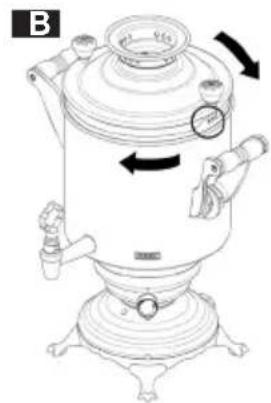
natural_image
Line drawing of a vintage steamheater with rotating buttons and side-mounted legs (no text or symbols)Нагрев воды
ВНИМАНИЕ
Elements of Lifestyle
Beem
Subject to printing error.
For service in other countries contact your local dealer.



- Bedienungsanleitung
- Inhalt
- Tipp-Betrieb
- Wasser erhitzen
- ACHTUNG
- General instructions
- Copyright
- Notes on environmental protection
- Warranty / Guarantee
- Symbols used
- DANGER
- WARNING
- ATTENTION
- NOTE
- Intended use
- Limitation of liability
- Declaration of Conformity
- Safety instructions
- Requirements for the place of use
- Electrical connection
- Startup
- Unpacking
- Checking the delivery contents
- Before using for the first time
- Appliance description
- Operation and use
- Indicator lights (9/10)
- Switching the appliance on/off
- Rotary knob (8)
- Touch mode
- Continuous operation
- Filling with water
- Heating water
- Boiling
- Intermittent boiling
- Refilling with water
- Serving suggestions
- Black tea
- Green tea
- Herbal tea
- Hot instant drinks
- After using
- Cleaning and maintenance
- Cleaning
- Descaling
- Storage
- Spare parts and accessories
- Sommaire
- Pour chauffer l'eau
- Suggestions de service
- Modo intermitente
- Calentar agua
- ATENCIÓN
- Aanraakwerking
- Water verwarmen
- LET OP
- Su isitma
- DİKKAT
- Нагрев воды
- ВНИМАНИЕ
- Beem
Brand : BEEM
Model : Samowar Rebecca
Category : Electric tea maker