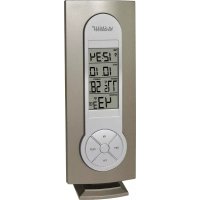
WS7215U - Weather Station LA CROSSE TECHNOLOGY - Free user manual and instructions
Find the device manual for free WS7215U LA CROSSE TECHNOLOGY in PDF.



| Product type | Wireless weather station |
| Brand | La Crosse Technology |
| Model | WS7215U |
| Indoor station dimensions | 75 x 30 x 190 mm (without base) |
| Outdoor transmitter dimensions | 40 x 23 x 128 mm |
| Indoor station power supply | 2 AA batteries (alkaline recommended) |
| Outdoor transmitter power supply | 2 AA batteries (alkaline recommended) |
| Indoor temperature range | -9.9°C to 59.9°C |
| Outdoor temperature range | -29.9°C to 69.9°C |
| Indoor humidity range | 1 % to 99 % |
| Radio range | 25 meters in open field |
| Time reception frequency | WWVB 60 kHz |
| Display | LCD with adjustable contrast |
| Main functions | Indoor temperature and humidity, outdoor temperature (up to 3 sensors), min/max readings with timestamp, automatic time reception, time zone, daylight saving time, 12/24-hour format |
| Indoor reading interval | Temperature: 10 s, humidity: 1 min |
| Outdoor reading interval | Transmitter: 1 min, station: 5 min |
| Warranty | 1 year limited |
| Care and cleaning | Clean with a soft damp cloth; do not use solvents; do not immerse |
| Safety | Keep out of reach of children; do not open the housing |
Frequently Asked Questions - WS7215U LA CROSSE TECHNOLOGY
User questions about WS7215U LA CROSSE TECHNOLOGY
0 question about this device. Answer the ones you know or ask your own.
Ask a new question about this device
Download the instructions for your Weather Station in PDF format for free! Find your manual WS7215U - LA CROSSE TECHNOLOGY and take your electronic device back in hand. On this page are published all the documents necessary for the use of your device. WS7215U by LA CROSSE TECHNOLOGY.
USER MANUAL WS7215U LA CROSSE TECHNOLOGY
This device complies with part 15 of the FCC rules. Operation is subject to the following two conditions:
(1) This device may not cause harmful interference.
(2)This device must accept any interference received, including interference that may cause undesired operation.
LA CROSSE TECHNOLOGY
technology tools for home & office
Contents
Language Page
English 2
Francais 28
Spanish 55
TABLE OF CONTENTS
| Topic | Page |
| Inventory of Contents/Additional Equipment | 3 |
| About WWVB 4 | |
| Quick Set-Up Guide 4 | |
| Detailed Set-Up Guide | |
| Battery installation 6 | |
| Program Mode | |
| Program Sequence and Default Settings | 8 |
| Function Keys 8 | |
| Setting the LCD Contrast 8 | |
| Setting the Time Zone 9 | |
| Daylight Saving Time Setting 10 | |
| Radio-controlled Time Setting 11 | |
| 12/24-hour Time Setting 11 | |
| Setting the Time | 12 |
| Setting the Year, Day and Month | 13 |
| Setting the Snooze | 14 |
| Setting the Temperature Format | 14 |
| Setting the forecast sensitivity | |
| Features | |
| Indoor Temperature and Humidity | 15 |
| Outdoor Temperatures | 15 |
| Minimum & Maximum Records (Indoor, Outdoor, & Resetting) | 16 |
| Additional Remote Control Sending Units (Set-Up, Viewing, & Operation) | 17 |
| Mounting | 19 |
| Troubleshooting 21 | |
| Maintenance & Care | 23 |
| Specifications | 23 |
| Warranty Information | 24 |
GB
P.2
INVENTORY OF CONTENTS
- The indoor temperature station (Figure 1).
- One remote temperature sensor with mounting bracket (Figure 2).
- Three each, 1/2" Philips screws.
- One strip double-sided adhesive tape.
- Instruction manual and warranty card.
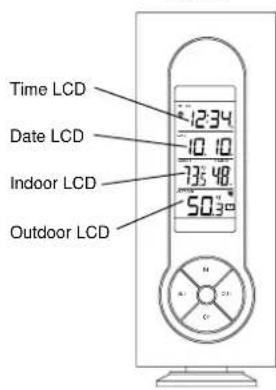
Figure 1
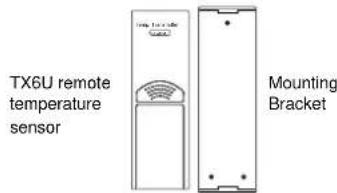
Figure 2
P.3
GB
ADDITIONAL EQUIPMENT (not included)
- Two fresh AA 1.5V batteries for the indoor temperature station.
- Two fresh AA 1.5V batteries for the remote temperature sensor.
- One, Philips screwdriver for mounting.
ABOUT WWVB (Radio Controlled Time)
The NIST (National Institute of Standards and Technology-Time and Frequency Division) WWVB radio station is located in Ft. Collins, Colorado, and transmits the exact time and date signal continuously throughout the United States at 60kHz . The signal can be received up to 2,000 miles away through the internal antenna in the Temperature station. However, due to the nature of the Earth's Ionosphere, reception is very limited during daylight hours. The temperature station will search for a signal every night when reception is best. The WWVB radio station derives its signal from the NIST Atomic clock in Boulder, Colorado. A team of atomic physicists is continually measuring every second, of every day, to an accuracy of ten billiards of a second per day. These physicists have created an international standard, measuring a second as 9, 192,631,770 vibrations of a Cesium-133 atom in a vacuum. For more information on the atomic clock and WWVB please see the NIST website at http://www.boulder.nist.gov/timefreq/stations/wwwb.htm.
QUICK SET-UP GUIDE
Hint: Use good quality Alkaline Batteries and avoid rechargeable batteries.
- Have the indoor temperature station and remote temperature sensor 3 to 5 feet apart.
-
Batteries should be out of both units for 10 minutes.
-
Place the batteries into the remote temperature sensor first then into the indoor temperature station.
(All outdoor remotes must be started before the indoor station) - DO NOT PRESS ANY BUTTONS FOR 15 MINUTES.
In this time the indoor temperature station and remote temperature sensor will start to talk to each other and the display will show the indoor temperature, humidity and an outdoor temperature. If the indoor temperature station does not display all information after the 15 minutes please retry the set up as stated above. After all information has been displayed for 15 minutes you can place your sensor outdoors and set your time.
The remote temperature sensor should be placed in a dry, shaded area. The remote temperature sensor has a range of 80 feet. Any walls that the signal will have to pass through will reduce distance. An outdoor wall or window can have up to 30 feet of resistance and an interior wall can have up to 20 feet of resistance. Your distance plus resistance should not exceed 80 ft. in a straight line.
Note: Fog and mist will not harm your remote temperature sensor but direct rain must be avoided.
Note: The remote temperature sensor transmits a signal every minute. After the batteries have been installed, the indoor temperature station will search for the signal for a duration of 15 minutes. If there is no temperature reading in the OUTDOOR LCD after 15 minutes, make sure the units are within range of each other, or repeat the battery installation procedure. If a button is pressed before the indoor
GB
P.4
P.5
GB
temperature station receives the temperature signal, you will need to follow the battery installation procedure again.
To complete the set up of your wireless temperature station after the 15 minutes have passed please follow the steps that follow in the Detailed Set-Up Guide.
DETAILED SET-UP GUIDE
I. BATTERY INSTALLATION
A. REMOTE TEMPERATURE SENSOR
- Remove the mounting bracket. The bracket snaps on and off easily.
- Remove the battery cover, by sliding the cover down.
- Observing the correct polarity install 2 AA batteries. The batteries will fit tightly (to avoid start-up problems make sure they do not spring free).
- Replace the battery cover by sliding upwards. Be sure battery cover is on securely.
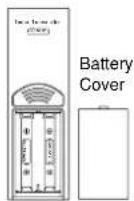
B. INDOOR TEMPERATURE STATION
- Remove the battery cover. To do this, insert a solid object in the space provided at the lower-central position of the battery cover, then push up and pull out on the battery cover.
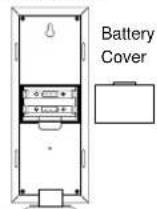
GB P.6
- Observe the correct polarity, and install 2 AA batteries.
- Replace the battery cover.
Note: Immediately after the batteries have been installed, the LCD (Liquid Crystal Display) will flash, and a tone will sound. Within a few seconds the indoor temperature and indoor relative humidity will be displayed. If not, remove batteries for 10 seconds and reinstall. If the outdoor temperature is not displayed within four minutes, remove batteries from both units, wait 10 seconds, and reinstall making sure to install batteries into the remote temperature sensor first. The time will show :- and start searching for the signal. If it successfully receives the time signal (usually at night), it will display the correct time (default time-zone is Eastern). You will need to adjust the time zone to match your local time.
PROGRAM MODE
Programming Note: If 30 seconds is allowed to pass, or the CH button is pressed during the programming mode, the unit will confirm/set the last information entered-the display will stop flashing and return to normal time-date readings. If you don't leave the program mode during the programming of sections III through XII, you can advance to step 4 of the next program setting. If you do leave the program setting (or want to program a specific setting) follow each instructional step to program that setting.
P.7
GB
I. PROGRAMMING SEQUENCE AND DEFAULT SETTINGS
The programming sequence and default (factory) settings are as follows:
LCD Contrast 5
Time Zone -5 (Eastern)
Daylight Saving Time 1 (on)
Radio-controlled time reception ON
12/24-hour time 12
Time 12:00
Year 2003
Day and Month 1.1.
Snoopze (this function not used) 10
Temperature Format F
Setting the forecast sensitivity
(this function not used) 2
Please note that while there is a snooze adjustment in the programming this is an unused function as there is no alarm on the indoor temperature station.
II. FUNCTION KEYS
The function keys are located on the front of the unit directly below the LCD.
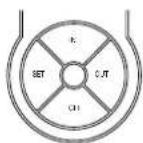
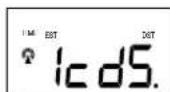
Note: There are 8 LCD contrast levels to choose from."LCD 0" is the lightest, and "Lcd 7" is the darkest.
- Press and release the IN button to select the level you desire.
- Press and release the SET button to confirm and advance to the Time Zone setting.
IV. TIME ZONE SETTING
- Press and hold the SET button for 5 seconds.
- "LCD" will show in the time LCD and the number setting will flash.
- Press and release the SET button again.
- The time zone will flash in the date LCD.
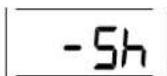
- Press and release the IN button to select your time zone.
Note: When a time zone for the U.S. is selected the corresponding abbreviation will appear above the time (please see the table on the next page). It is possible to select any time zone from -12 GMT to +12 GMT (for example to see the time in another country)
III. SETTING THE LCD CONTRAST
- Press and hold the SET button for 5 seconds.
- "LCD" will show in the time LCD and the number setting will flash.
TIME ZONES
GMT0
Atlantic-4
EST: Eastern -5
CST: Central -6
MST; Mountain -7
PST; Pacific -8
ALA;Alaska-9
HAW; Hawaii -10
- Press and release the SET button to confirm and advance to the Daylight Saving Time setting.
V. DAYLIGHT SAVING TIME (DST) SETTING
- Press and hold the SET button for 5 seconds.
- "LCD" will show in the time LCD and the number setting will flash.
- Press and release the SET button twice.
- "DST" will appear in the date LCD and either "1" or "0" will flash.
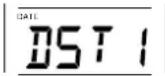
- Press and release the IN button to select DST on or off.
"DST 0" indicates that the feature is off and the WWVB will not change times automatically. "DST 1" indicates that the feature is on and the WWVB will change times automatically.
Note: Some locations (Arizona and parts of Indiana) do not follow Daylight Saving Time, and should select "DST 0."
- Press and release the SET button to confirm and advance to the radio-controlled time on/off setting.
VI. RADIO-CONTROLLED TIME ON/OFF SETTING
- Press and hold the SET button for 5 seconds.
- "LCD" will show in the time LCD and the number setting will flash.
- Press and release the SET button three times.
- "RCC" will appear in the date LCD and "ON" on "OFF" will flash in the time LCD.
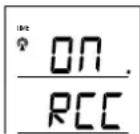
- Press and release the IN button to select radio-controlled time on or off.
- Press and release the SET button to confirm and advance to the 12/24-hour time setting.
VII. 12 OR 24 HOUR TIME SETTING
- Press and hold the SET button for 5 seconds.
- "LCD" will show in the time LCD and the number setting will flash.
- Press and release the SET button four times.
- "12h" or "24h" will flash in the time LCD
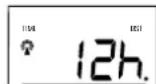
- Press and release the IN button to select 12 or 24-hour time format.
GB
P.10
P.11
GB
Note: When in the 12-hour format "P.M." will appear to the left of the hour in the time LCD between the hours of noon and midnight.
6. Press and release the SET button to confirm and advance to the time setting.
VIII. TIME SETTING
There are two methods by which the time and date can be set:
A) Automatically via WWVB reception, or
B)Manually.
A. WWVB (Remote Control Time)
This method requires you to do nothing, except wait for the signal to be received, and to select a time zone. Reception usually takes approximately 10 minutes during optimal conditions. The best condition for reception is at night, between midnight and 6:00 am when there is less atmospheric interference. To keep your time as accurate as possible, the indoor temperature station conducts a WWVB search every night between these hours, and overrides any manually set time. The WWVB tower icon (appearing in the TIME LCD) will flash when a signal-search is in progress and a signal is being received, and will remain steady when the signal has been received. If the WWVB time has not been received after 10 minutes of battery installation, you may manually set the time or leave the time function alone (reception will occur regardless).
B. MANUAL TIME SETTING
Note: When in the 12-hour format "P.M." will appear to the left of the hour in the time LCD between the hours of noon and midnight.
- Press and hold the SET button for 5 seconds.
- "LCD" will show in the time LCD and the number setting will flash.
- Press and release the SET button five times.
- The time will flash in the time LCD.
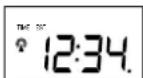
- Press and release the IN button to advance the hours.
- Press and release the OUT button to advance the minutes.
- Press and release the SET button to confirm and advance to the year setting.
IX. SETTING THE YEAR, DAY AND MONTH
Note: Reception of the WWVB signal will also set the date and day. The reception of the signal will override any programmed date and day.
- Press and hold the SET button for 5 seconds.
- "LCD" will show in the time LCD and the number setting will flash.
- Press and release the SET button six times.
- The year will flash in the date LCD.
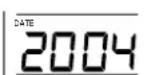
- Press and release the IN button to advance the year.
- Press and release the SET button to confirm and advance to the day/month setting.
- The day and month will flash in the date LCD.
GB
P.12
P.13
GB
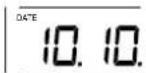
- Press and release the IN button to advance the month (12 hour setting).
- Press and release the OUT button to advance the day (12 hour setting).
- Press and release the SET button to confirm and advance to the snooze setting.
X. SETTING THE SNOOZE
Note: This is an unused function of the indoor temperature station and should be disregarded. The setting has no bearing on the operation. Please press and release the SET button to advance to select the temperature format.
XI. SELECTING F OR C
- Press and hold the SET button for 5 seconds.
- "LCD" will show in the time LCD and the number setting will flash.
- Press and release the SET button nine times.
- Either "F" or "C" will flash in the time LCD.
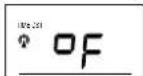
- Press and release the IN button to select the temperature format.
- Press and release the SET button to confirm and complete the setup.
XII. SETTING THE FORECAST SENSITIVITY
Note: This is an unused function of the indoor temperature station and should be disregarded. The setting has no bearing on the operation. Please press and release the SET button to exit the manual setting.
GB P.14
III. MINIMUM AND MAXIMUM TEMPERATURE RECORDS
The WS-7215U keeps a record of the MINIMUM and MAXIMUM temperature, and the time and date of their occurrence-for both the indoor and outdoor modes.
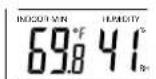
- Press the IN button once. "MIN" appears above the indoor temperature and the LCD will flash, indicating that the minimum temperature (along with the humidity measured at that time) and the time and date of occurrence are displayed. The minimum records will display for 30 seconds before returning to the normal display mode.
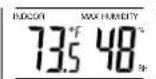
- Press the IN button again (once while "MIN" is still displayed, twice otherwise). "MAX" appears above the indoor temperature and the LCD will flash, indicating that the maximum temperature (along with the humidity measured at that time) and the time and date of occurrence are displayed.
- While "MAX" is still displayed press the IN button again to return to the current data display. Or you can wait 30 seconds, during either the minimum or the maximum readings, and the unit will automatically return to current data readings.
- Press the OUT button once. "MIN" appears above the outdoor temperature and the LCD will flash, indicating that the minimum temperature,
FEATURES OF THE WS-7215U
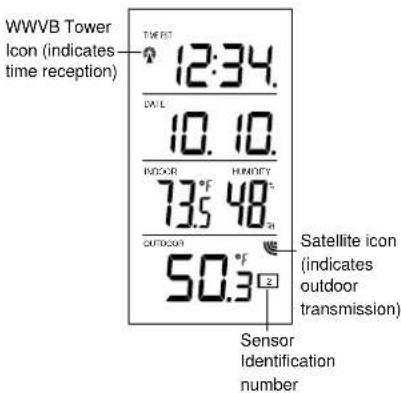
I. INDOOR TEMPERATURE AND HUMIDITY
The current indoor temperature (viewed on the left) and relative humidity (viewed on the right) are displayed in the INDOOR LCD.
II. OUTDOOR TEMPERATURE
The temperature received from the remote temperature sensor is viewed in the OUTDOOR LCD. When there is more than one remote temperature sensor unit in operation, a "boxed" number will appear to the right of the temperature. This indicates which remote temperature sensor unit (1, 2, or 3) is currently displaying its data in the OUTDOOR LCD. (This feature is explained in further detail in section IV-Adding Remote Temperature Sensors).
P.15
GB
and the time and date of occurrence are displayed. The minimum records will display for 30 seconds before returning to the normal display mode.
- Press the OUT button again (once while "MIN" is still displayed, twice otherwise). "MAX" appears above the outdoor temperature and the LCD will flash, indicating that the maximum temperature and the time and date of occurrence are displayed.
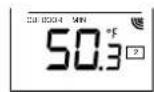
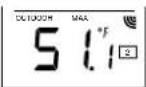
- While "MAX" is still displayed press the OUT button again to return to the current data display. Or you can wait 30 seconds, during either the minimum or the maximum readings, and the unit will automatically return to current data readings.
- All the Indoor records (minimum and maximum) will be reset after the IN button is pressed and held for 5 seconds.
- All the Outdoor records (minimum and maximum) will be reset after the OUT button is pressed and held for 5 seconds.
IV. ADDING REMOTE TEMPERATURE SENSORS (OPTIONAL)
The WS-7215U is able to receive signals from 3 different remote temperature sensors. The remote temperature sensor model(s) that you choose will come with their own set of instructions-follow these instructions for a complete guide to setting up. Following are some brief instructions for the basic
GB P.1
P.17
GB
set-up of remote temperature sensor units with the WS-7215U. These extra sensors can be purchased through the same dealer as this unit, or by contacting La Crosse Technology directly. A TX6U will monitor temperature only, a TX3U will monitor temperature and display the temperature on its LCD, and the TX3UP will monitor the temperature via a probe for use in pools, spas, etc.
Note: When setting up multiple units it is important to remove the batteries from all existing units in operation, then to insert batteries first into all the remote temperature sensor units, and in numeric sequence. Second install batteries into the indoor temperature station. Transmission problems will arise if this is not done correctly and if the total time for set-up exceeds 6 minutes.
A. SET-UP OF MULTIPLE UNITS
- It is necessary to remove the batteries from all units currently in operation.
- Remove the battery covers to all remote temperature sensor units.
- Place all remote temperature sensor units in a numeric sequential order.
- In sequential order, install batteries (follow the same battery installation procedures seen in section I. A) of the Detailed Set-Up Guide).
- Install batteries into the indoor temperature station.
- Follow the Detailed Set-Up Guide for programming and operating instructions.
B. VIEWING AND OPERATING WITH MULTIPLE REMOTE TEMPERATURE SENSOR UNITS
- To view the temperature of a different remote temperature sensor unit, press and release the
GB
P.18
The indoor temperature station should display a temperature in the OUTDOOR LCD within 4 minutes of setting up.
I. THE REMOTE TEMPERATURE SENSOR
The remote temperature sensor can be mounted in two ways:
with the use of screws, or
using the adhesive tape.
A. MOUNTING WITH SCREWS
1) Remove the mounting bracket from the remote temperature sensor.
2) Place the mounting bracket over the desired location.
3) Through the three screw holes of the bracket, mark the mounting surface with a pencil.
4) Screw mounting bracket onto the mounting surface. Ensure that the screws are flush with the bracket.
5) Insert the remote temperature sensor into the bracket.
B. MOUNTING WITH ADHESIVE TAPE
1) With a nonabrasive solution, clean and dry the back of the mounting bracket and the mounting surface to ensure a secure hold. The mounting surface should be smooth and flat.
2) Remove the protective strip from one side of the tape.
3) Adhere the tape to the designated area on the back of the mounting bracket.
4) Remove the protective strip from the other side of the tape.
5) Position the remote temperature sensor in the desired location, ensuring that the indoor temperature station can receive the signal.
CH button. A shift from one "boxed" number to the next should be observed in the OUTDOOR LCD.
- To view the Minimum/Maximum temperature: first select which remote temperature sensor to read data from (indicated by the "boxed" number), then press the OUT button. Pressing this button once will display the minimum temperature, and the date and time the data was recorded. Pressing this button a second time (while "MIN" is still displayed, otherwise press the button twice) will display the same data for the maximum recordings.
- To reset the Minimum/Maximum readings, it is necessary to select which remote temperature sensor you wish to reset. Press and hold the OUT button for 5 seconds, the records for the selected remote temperature sensor unit will be reset.
MOUNTING
Note: Before permanently mounting ensure that the indoor temperature station is able to receive WWVB signals from the desired location. Also, extreme and sudden changes in temperature will decrease the accuracy of the indoor temperature station. To achieve a true temperature reading, avoid mounting where direct sunlight can reach the remote temperature sensor or indoor temperature station. While the remote temperature sensor is weather proof, avoid submersion in water or snow. We recommend that you mount the remote temperature sensor on an outside North-facing wall. The sending range is 80ft-obstacles such as walls, concrete, and large metal objects can reduce the range. Place both units in their desired location, and wait approximately 15 minutes before permanently mounting to ensure that there is proper reception.
P.19
GB
II. THE INDOOR TEMPERATURE STATION
The indoor temperature station can be mounted in two ways:
with the table stand or,
on the wall with the use of a wall hanging screw (not included).
A. USING THE TABLE STAND
The indoor temperature station comes with the table stand already mounted. If you wish to use the tablestand all that is required is to place the indoor temperature station in an appropriate location.
B.WALL MOUNTING
1) Remove the table-stand. To do this, pull down on the stand from the rear and rotate forward.
2) Fix a screw (not included) into the desired wall, leaving approximately 3/16 of an inch (5mm) extended from the wall.
3) Place the indoor temperature station onto the screw using the hanging hole on the backside.
4) Gently pull the indoor temperature station down to lock the screw into place.
TROUBLESHOOTING
NOTE: For problems not solved, please contact La Crosse Technology.
Problem: No reception of WWVB time signal. Solution:
1) Wait overnight for signal.
2) Be sure the Temperature station is at least 6 feet from any electrical devices, such as televisions, computers, or other radio-controlled clocks.
3) Remove batteries for five minutes, reinsert and leave the unit alone overnight without pressing buttons.
4) If there are still problems, contact La Crosse Technology
GB
P.20
P.21
GB
Problem: Hour is incorrect (minute and date are correct)
Solution:
Be sure correct time zone and daylight saving time settings are selected.
Problem: The LCD is faint
Solution:
1) Set the LCD contrast to a higher number
2) Replace batteries
Problem: No outdoor temperature is displayed. Solution:
1) Remove all batteries, reinsert into remote temperature sensor first, then display.
2) Place remote sender closer to display.
3) Be sure all batteries are fresh.
4) Place Remote Control Sender and Temperature station in position so the straight-line signal is not passing through more than two or three walls.
Problem: Temperatures do not match if units are placed next to each other.
Solution:
Each temperature sensor is manufactured to be accurate to within 1 degree plus or minus and under normal conditions, so two sensors could be as much as 2 degrees different. However, the difference can be exaggerated further because the sensors are designed for different working environments. The indoor sensor is less responsive to ambient air currents because of the shielding effect of the display's case. In addition, the case can act as a heat sink to absorb and store heat from external sources (i.e. handling of the case or radiant heat). Also, the much greater range of the outdoor temperature sensor requires a different calibration
curve than the indoor range. Error is usually greater at the extreme ends of a range, making it harder to compare different ranges with different curves. Under non-laboratory conditions, it is difficult to compensate for the above factors and obtain an accurate comparison.
MAINTENANCE AND CARE INSTRUCTIONS
- Extreme temperatures, vibration, and shock should be avoided to prevent damage to the units.
- Clean displays and units with a soft, damp cloth. Do not use solvents or scouring agents; they may mark the displays and casings.
- Do not submerge in water
- Immediately remove all low powered batteries to avoid leakage and damage.
- Opening the casings invalidates the warranty. Do not try to repair the unit. Contact La Crosse Technology for repairs.
SPECIFICATIONS
Temperature Measuring Range:
Indoor: 14.2^ to 139.8^ with 0.2^ resolution (-9.9^ to 59.9^ with 0.1^ resolution) "OFL" displayed if outside this range.
Outdoor: -21.8°F to 157.8°F with 0.2°F resolution.
(-29.9°C to 69.9°C with 0.1°C resolution).
"QFL" displayed if outside this range.
Humidity Measuring Range
Indoor relative humidity measuring range:
1% to 99% with 1% resolution. (^* - - ) displayed if outside this range.
Indoor Temperature checking interval:
Every 10 seconds.
Indoor Humidity checking interval:
Every 1 minute.
Outdoor Temperature checking interval (Remote Temperature Sensor):Every 1 minute.
GB
P.22
P.23
GB
Outdoor Temperature reception (Temperature station): Every 5 minutes.
Transmission Range: 80 feet (in open space). Power Supply:
Temperature station: 2× AA IEC LR6,1.5V. Remote Temperature Sensor: 2× AA IEC LR6,1.5V Battery life cycle: Approximately 12 months. Recommended battery type: Alkaline.
Dimensions (H x W x D)
Temperature station 7.48" x 2.95" x 1.18"
Remote Temperature Sensor 5.04" x 1.57 x 0.9"
WARRANTY INFORMATION
La Crosse Technology, Ltd provides a 1-year limited warranty on this product against manufacturing defects in materials and workmanship.
This limited warranty begins on the original date of purchase, is valid only on products purchased and used in North America and only to the original purchaser of this product. To receive warranty service, the purchaser must contact La Crosse Technology, Ltd for problem determination and service procedures. Warranty service can only be performed by a La Crosse Technology, Ltd authorized service center. The original dated bill of sale must be presented upon request as proof of purchase to La Crosse Technology, Ltd or La Crosse Technology, Ltd's authorized service center.
La Crosse Technology, Ltd will repair or replace this product, at our option and at no charge as stipulated herein, with new or reconditioned parts or products if found to be defective during the limited warranty period specified above. All replaced parts and products become the property of La Crosse Technology, Ltd and must be returned to La Crosse Technology, Ltd. Replacement parts and products
assume the remaining original warranty, or ninety (90) days, whichever is longer. La Crosse Technology, Ltd will pay all expenses for labor and materials for all repairs covered by this warranty. If necessary repairs are not covered by this warranty, or if a product is examined which is not in need or repair, you will be charged for the repairs or examination. The owner must pay any shipping charges incurred in getting your La Crosse Technology, Ltd product to a La Crosse Technology, Ltd authorized service center. La Crosse Technology, Ltd will pay reasonable return shipping charges to the owner of the product.
Your La Crosse Technology, Ltd warranty covers all defects in material and workmanship with the following specified exceptions: (1) damage caused by accident, unreasonable use or neglect (including the lack of reasonable and necessary maintenance); (2) damage occurring during shipment (claims must be presented to the carrier); (3) damage to, or deterioration of, any accessory or decorative surface; (4) damage resulting from failure to follow instructions contained in your owner's manual; (5) damage resulting from the performance of repairs or alterations by someone other than an authorized La Crosse Technology, Ltd authorized service center; (6) units used for other than home use (7) applications and uses that this product was not intended or (8) the products inability to receive a signal due to any source of interference... This warranty covers only actual defects within the product itself, and does not cover the cost of installation or removal from a fixed installation, normal set-up or adjustments, claims based on misrepresentation by the seller or performance variations resulting from installation-related circumstances.
LA CROSSE TECHNOLOGY, LTD WILL NOT ASSUME LIABILITY FOR INCIDENTAL, CONSEQUENTIAL, PUNITIVE, OR OTHER SIMILAR DAMAGES ASSOCIATED WITH THE OPERATION OR MALFUNCTION OF THIS PRODUCT. THIS PRODUCT IS NOT TO BE USED FOR MEDICAL PURPOSES OR FOR PUBLIC INFORMATION. THIS PRODUCT IS NOT A TOY. KEEP OUT OF CHILDREN'S REACH.
This warranty gives you specific legal rights. You may also have other rights specific to your State. Some States do no allow the exclusion of consequential or incidental damages therefore the above exclusion of limitation may not apply to you.
For warranty work, technical support, or information contact:
La Crosse Technology, Ltd
190 Main Street
La Crescent, MN 55947
Phone: 507.895.7095
Fax:507.895.2820
e-mail:
support@lacrossetechnology.com
(warranty work)
sales@lacrossetechnology.com
(information on other products)
web:
www.lacrossetechnology.com
Questions? Please see instruction video at
www.lacrossetechnology.info/7215
GB
P.26
TABLE DES MATIÈRES
All rights reserved. This handbook must not be reproduced in any form, even in excerpts, or duplicated or processed using electronic, mechanical or chemical procedures without written permission of the publisher.
This handbook may contain mistakes and printing errors. The information in this handbook is regularly checked and corrections made in the next issue. We accept no liability for technical mistakes or printing errors, or their consequences.
All trademarks and patents are acknowledged.
P.27
GB
INVENTAIRE
INFORMATIONS SUR LA GARANTIE
La Crosse Technology, Ltd
190 Main Street
La Crescent, MN 55947
TEL:507.895.7095
Fax:507.895.2820
e-mail:
support@lacrossetechnology.com
2× AA IEC LR6,1.5V.
La Crosse Technology, Ltd
190 Main Street
La Crescent, MN 55947
- INVENTORY OF CONTENTS
- ADDITIONAL EQUIPMENT (not included)
- ABOUT WWVB (Radio Controlled Time)
- QUICK SET-UP GUIDE
- Hint: Use good quality Alkaline Batteries and avoid rechargeable batteries.
- DETAILED SET-UP GUIDE
- BATTERY INSTALLATION
- REMOTE TEMPERATURE SENSOR
- INDOOR TEMPERATURE STATION
- PROGRAM MODE
- PROGRAMMING SEQUENCE AND DEFAULT SETTINGS
- FUNCTION KEYS
- TIME ZONE SETTING
- SETTING THE LCD CONTRAST
- TIME ZONES
- GMT0
- DAYLIGHT SAVING TIME (DST) SETTING
- RADIO-CONTROLLED TIME ON/OFF SETTING
- 12 OR 24 HOUR TIME SETTING
- TIME SETTING
- WWVB (Remote Control Time)
- MANUAL TIME SETTING
- SETTING THE YEAR, DAY AND MONTH
- SETTING THE SNOOZE
- SELECTING F OR C
- SETTING THE FORECAST SENSITIVITY
- MINIMUM AND MAXIMUM TEMPERATURE RECORDS
- FEATURES OF THE WS-7215U
- INDOOR TEMPERATURE AND HUMIDITY
- OUTDOOR TEMPERATURE
- ADDING REMOTE TEMPERATURE SENSORS (OPTIONAL)
- SET-UP OF MULTIPLE UNITS
- VIEWING AND OPERATING WITH MULTIPLE REMOTE TEMPERATURE SENSOR UNITS
- THE REMOTE TEMPERATURE SENSOR
- MOUNTING WITH SCREWS
- MOUNTING WITH ADHESIVE TAPE
- MOUNTING
- THE INDOOR TEMPERATURE STATION
- USING THE TABLE STAND
- B.WALL MOUNTING
- TROUBLESHOOTING
- Solution:
- Problem: The LCD is faint
- Problem: No outdoor temperature is displayed. Solution:
- Problem: Temperatures do not match if units are placed next to each other.
- MAINTENANCE AND CARE INSTRUCTIONS
- SPECIFICATIONS
- Temperature Measuring Range:
- Humidity Measuring Range
- Dimensions (H x W x D)
- WARRANTY INFORMATION
- INVENTAIRE
- INFORMATIONS SUR LA GARANTIE
Brand : LA CROSSE TECHNOLOGY
Model : WS7215U
Category : Weather Station