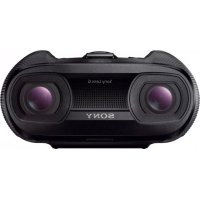
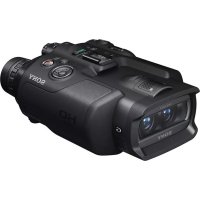
DEV30 - Binoculars SONY - Free user manual and instructions
Find the device manual for free DEV30 SONY in PDF.



| Product type | Digital recording binoculars |
| Brand | Sony |
| Model | DEV30 |
| Dimensions (approx.) | 148.5 mm × 72.5 mm × 157.5 mm (w/h/d) including protruding parts |
| Weight (approx.) | 765 g (main unit), 860 g (with NP-FV70 battery and memory card) |
| Power supply | Rechargeable InfoLITHIUM battery pack series V (NP-FV70/FV100), AC adapter 8.4 V DC |
| Viewfinder | Electronic viewfinder ×2, color, 0.5 type, 2,359,296 pixels |
| Lens | G Lens, F1.8 - F3.4 |
| Zoom | 13× (2D, digital zoom off), 20× (2D, digital zoom on), 12× (3D), 33× (photo) |
| Video recording | 2D: MPEG-4 AVC/H.264, 3D: MPEG-4 MVC/H.264, Dolby Digital 2-channel audio |
| Photo recording | Up to 20.4 megapixels (6,016 × 3,384), JPEG format |
| Storage media | Memory Stick PRO Duo, Memory Stick XC-HG Duo, SD/SDHC/SDXC card (Class 4 or faster) |
| Sealing | IP54 (dust and rain resistant) |
| Operating temperature | 0 °C to 40 °C |
| Supplied accessories | AC adapter, power cord, HDMI cable, micro USB cable, lens cap, strap, instruction manual, CD-ROM |
| Main functions | Binoculars with motorized zoom, SteadyShot stabilization, auto/manual focus, 2D/3D recording, face detection, low-light hyper gain |
Frequently Asked Questions - DEV30 SONY
User questions about DEV30 SONY
0 question about this device. Answer the ones you know or ask your own.
Ask a new question about this device
Download the instructions for your Binoculars in PDF format for free! Find your manual DEV30 - SONY and take your electronic device back in hand. On this page are published all the documents necessary for the use of your device. DEV30 by SONY.
USER MANUAL DEV30 SONY
Before operating the unit, please read this manual thoroughly, and retain it for future reference.
Owner's Record
The model and serial numbers are located on the bottom. Record the serial number in the space provided below. Refer to these numbers whenever you call your Sony dealer regarding this product.
Model No. DEV-
Serial No.
Model No. AC-
Serial No.
WARNING
To reduce the risk of fire or electric shock,
1) do not expose the unit to rain or moisture.
2) do not place objects filled with liquids, such as vases, on the apparatus.
Do not expose the batteries to excessive heat such as sunshine, fire or the like.
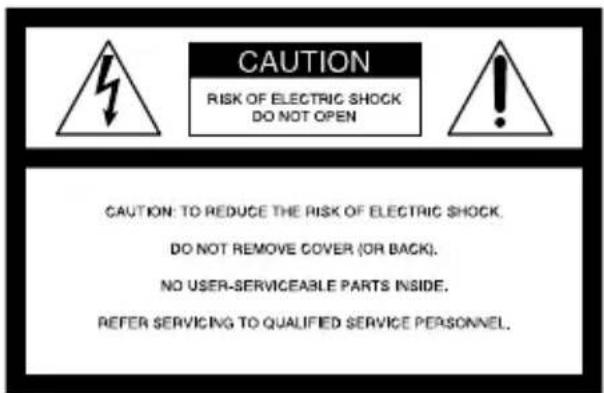
For customers in the USA
This symbol is intended to alert the user to the presence of uninsulated “dangerous voltage” within the product’s enclosure that may be of sufficient magnitude to constitute a risk of electric shock to persons.

This symbol is intended to alert the user to the presence of important operating and maintenance (servicing) instructions in the literature accompanying the appliance.
IMPORTANT SAFETY INSTRUCTIONS
SAVE THESE INSTRUCTIONS.
DANGER - TO REDUCE THE RISK OF FIRE OR ELECTRIC SHOCK,
CAREFULLY FOLLOW THESE INSTRUCTIONS.
- Read these instructions.
- Keep these instructions.
- Heed all warnings.
- Follow all instructions.
- Do not use this apparatus near water.
- Clean only with dry cloth.
- Do not block any ventilation openings. Install in accordance with the manufacturer's instructions.
- Do not install near any heat sources such as radiators, heat registers, stoves, or other apparatus (including amplifiers) that produce heat.
- Do not defeat the safety purpose of the polarized or grounding-type plug. A polarized plug has two blades with one wider than the other. A grounding type plug has two blades and a third grounding prong. The wide blade or the third prong are provided for your safety. If the provided plug does not fit into your outlet, consult an electrician for replacement of the obsolete outlet.
- Protect the power cord from being walked on or pinched particularly at plugs, convenience receptacles, and the point where they exit from the apparatus.
- Only use attachments/accessories specified by the manufacturer.
- Use only with the cart, stand, tripod, bracket, or table specified by the manufacturer, or sold with the apparatus. When a cart is used, use caution when moving the cart/apparatus combination to avoid injury from tip-over.

- Unplug this apparatus during lightning storms or when unused for long periods of time.
- Refer all servicing to qualified service personnel. Servicing is required when the apparatus has been damaged in any way, such as power-supply cord or plug is damaged, liquid has been spilled or objects have fallen into the apparatus, the apparatus has been exposed to rain or moisture, does not operate normally, or has been dropped.
- If the shape of the plug does not fit the power outlet, use an attachment plug adaptor of the proper configuration for the power outlet.
Representative plug of power supply cord of countries/regions around the world.


A Type (American Type)

B Type (British Type)

BF Type (British Type)

B3 Type (British Type)

C Type (CEE Type)

SE Type (CEE Type)

O Type (Ocean Type)
The representative supply voltage and plug type are described in this chart.
Depend on an area, Different type of plug and supply voltage are used.
Attention: Power cord meeting demands from each country shall be used.
- For only the United States
Use a supplied power cord
Europe
| Countries/regions Voltage Frequency (Hz) Plug type | ||
| Austria 230 50 C | ||
| Belgium 230 50 C | ||
| Czech 220 50 C | ||
| Denmark 230 50 C | ||
| Finland 230 50 C | ||
| France 230 50 C | ||
| Germany | 230 50 C | |
| Greece | 220 50 C | |
| Hungary | 220 50 C | |
| Iceland 230 50 C | ||
| Ireland | 230 50 | C/BF |
| Italy | 220 50 C | |
| Luxemburg | 230 50 C | |
| Netherlands | 230 50 C | |
| Norway | 230 50 C | |
| Poland | 220 50 C | |
| Portugal | 230 50 C | |
| Romania | 220 50 C | |
| Russia | 220 50 C | |
| Slovak | 220 50 C | |
| Spain 127/230 | 50 C | |
| Sweden 230 50 C | ||
| Switzerland | 230 50 C | |
| UK | 240 50 | BF |
Asia
| Countries/regions Voltage Frequency (Hz) Plug type | |||
| China 220 50 A | |||
| Hong Kong | 200/220 | 50 | BF |
| India | 230/240 | 50 C | |
| Indonesia | 127/230 | 50 C | |
| Japan | 100 | 50/60 | A |
| Korea (rep) | 220 60 C | ||
| Malaysia | 240 50 | BF | |
| Philippines | 220/230 | 60 | A/C |
| Singapore | 230 50 | BF | |
| Taiwan 110 60 A | |||
| Thailand | 220 50 | C/BF | |
| Vietnam | 220 50 | A/C | |
Oceania
| Countries/regions Voltage Frequency (Hz) Plug type |
| Australia 240 50 O |
| New Zealand 230/240 50 O |
North America
| Countries/regions Voltage Frequency (Hz) Plug type |
| Canada 120 60 A |
| USA 120 60 A |
Central America
| Countries/regions Voltage Frequency (Hz) Plug type | |
| Bahamas 120/240 60 A | |
| Costa Rica 110 60 A | |
| Cuba 110/220 60 A/C | |
| Dominican (rep) 110 60 A | |
| El Salvador 110 60 A | |
| Guatemala 120 60 A | |
| Honduras 110 60 A | |
| Jamaica | 110 50 A |
| Mexico | 120/127 60 A |
| Nicaragua | 120/240 60 A |
| Panama | 110/220 60 A |
South America
| Countries/regions Voltage Frequency (Hz) Plug type | ||
| Argentina | 220 50 C/BF/O | |
| Brazil | 127/220 60 A/C | |
| Chile | 220 50 | C |
| Colombia | 120 60 A | |
| Peru 220 60 A/C | ||
| Venezuela | 120 60 | A |
Middle East
| Countries/regions Voltage Frequency (Hz) Plug type | ||
| Iran | 220 50 | C/BF |
| Iraq | 220 50 | C/BF |
| Israel | 230 50 | C |
| Saudi Arabia 127/220 50 A/C/BF | ||
| Turkey | 220 50 | C |
| UAE 240 50 | C/BF | |
Africa
| Countries/regions Voltage Frequency (Hz) Plug type | ||
| Algeria | 127/220 50 C | |
| Congo (dem) | 220 50 | C |
| Egypt | 220 50 | C |
| Ethiopia | 220 50 | C |
| Kenya | 240 50 | C/BF |
| Nigeria | 230 50 | C/BF |
| South Africa | 220/230 50 | C/BF |
| Tanzania 230 50 | C/BF | |
| Tunisia | 220 50 | C |
CAUTION
Battery pack
If the battery pack is mishandled, the battery pack can burst, cause a fire or even chemical burns. Observe the following cautions.
- Do not disassemble.
- Do not crush and do not expose the battery pack to any shock or force such as hammering, dropping or stepping on it.
- Do not short circuit and do not allow metal objects to come into contact with the battery terminals.
- Do not expose to high temperature above 60^ (140°F) such as in direct sunlight or in a car parked in the sun.
- Do not incinerate or dispose of in fire.
- Do not handle damaged or leaking lithium ion batteries.
- Be sure to charge the battery pack using a genuine Sony battery charger or a device that can charge the battery pack.
- Keep the battery pack out of the reach of small children.
- Keep the battery pack dry.
- Replace only with the same or equivalent type recommended by Sony.
- Dispose of used battery packs promptly as described in the instructions.
Replace the battery with the specified type only. Otherwise, fire or injury may result.
AC Adaptor
Do not use the AC Adaptor placed in a narrow space, such as between a wall and furniture.
Use the nearby wall outlet (wall socket) when using the AC Adaptor. Disconnect the AC Adaptor from the wall outlet (wall socket) immediately if any malfunction occurs while using apparatus.
Even if this product is turned off, AC power source (mains) is still supplied to it while connected to the wall outlet (wall socket) via the AC Adaptor.
Note on the power cord (mains lead)
The power cord (mains lead) is designed specifically for use with this product only, and should not be used with other electrical equipment.
Excessive sound pressure from earphones and headphones can cause hearing loss.
For customers in the U.S.A. and CANADA
RECYCLING LITHIUM-ION BATTERIES
Lithium-Ion batteries are recyclable. You can help preserve our environment by returning your used rechargeable batteries to the collection and recycling location nearest you.
For more information regarding recycling of rechargeable batteries, call toll free 1-800-822-8837, or visit http://www.rbrc.org/
Caution: Do not handle damaged or leaking Lithium-Ion batteries.
Battery pack
This device complies with Part 15 of the FCC Rules. Operation is subject to the following two conditions: (1) This device may not cause harmful interference, and (2) this device must accept any interference received, including interference that may cause undesired operation.
For the customers in the U.S.A.
If you have any questions about this product, you may call:
Sony Customer Information Center 1-800-222-SONY (7669).
The number below is for the FCC related matters only.
Regulatory Information
Declaration of Conformity
Trade Name: SONY
Model No.: DEV-50V
Responsible Party: Sony Electronics Inc.
Address: 16530 Via Esprillo, San Diego, CA 92127 U.S.A.
Telephone No.: 858-942-2230
This device complies with Part 15 of the FCC Rules. Operation is subject to the following two conditions: (1) This device may not cause harmful interference, and (2) this device must accept any interference received, including interference that may cause undesired operation.
CAUTION
You are cautioned that any changes or modifications not expressly approved in this manual could void your authority to operate this equipment.
Note
This equipment has been tested and found to comply with the limits for a Class B digital device, pursuant to Part 15 of the FCC Rules.
These limits are designed to provide reasonable protection against harmful interference in a residential installation. This equipment generates, uses, and can radiate radio frequency energy and, if not installed and used in accordance with the instructions, may cause harmful interference to radio communications. However, there is no guarantee that
interference will not occur in a particular installation. If this equipment does cause harmful interference to radio or television reception, which can be determined by turning the equipment off and on, the user is encouraged to try to correct the interference by one or more of the following measures:
– Reorient or relocate the receiving antenna.
- Increase the separation between the equipment and receiver.
- Connect the equipment into an outlet on a circuit different from that to which the receiver is connected.
- Consult the dealer or an experienced radio/TV technician for help.
The supplied interface cable must be used with the equipment in order to comply with the limits for a digital device pursuant to Subpart B of Part 15 of FCC Rules.
FOR CUSTOMERS IN EUROPE
CE
Hereby, Sony Corporation, declares that this DEV-50V Digital Recording Binoculars is in compliance with the essential requirements and other relevant provisions of the Directive 1999/5/EC. For details, please access the following
URL: http://www.compliance.sony.de/
Notice for the customers in the countries applying EU Directives
This product has been manufactured by or on behalf of Sony Corporation, 1-7-1 Konan Minato-ku Tokyo, 108-0075 Japan. Inquiries related to product compliance based on European Union legislation shall be addressed to the authorized representative, Sony Deutschland GmbH, Hedelfinger Strasse 61, 70327 Stuttgart, Germany. For any service or guarantee matters, please refer to the addresses provided in the separate service or guarantee documents.
ATTENTION
The electromagnetic fields at the specific frequencies may influence the picture and sound of this unit.
This product has been tested and found compliant with the limits set out in the EMC regulation for using connection cables shorter than 3 meters (9.8 feet).
Notice
If static electricity or electromagnetism causes data transfer to discontinue midway (fail), restart the application or disconnect and connect the communication cable (USB, etc.) again.
Disposal of Old Electrical & Electronic Equipment (Applicable in the European Union and other European countries with separate collection systems)
This symbol on the product or on its packaging indicates that this product shall not be treated as household waste. Instead it shall be handed over to the applicable collection point for the recycling of electrical and electronic equipment. By ensuring this product is disposed of correctly, you will help prevent potential negative consequences for the environment and human health, which could otherwise be caused by inappropriate waste handling of this product. The recycling of materials will help to conserve natural resources. For more detailed information about recycling of this product, please contact your local Civic Office, your household waste disposal service or the shop where you purchased the product.
Disposal of waste batteries (applicable in the European Union and other European countries with separate collection systems)
This symbol on the battery or on the packaging indicates that the battery provided with this product shall not be treated as household waste.
On certain batteries this symbol might be used in combination with a chemical symbol. The chemical symbols for mercury (Hg) or lead (Pb) are added if the battery contains more than 0.0005% mercury or 0.004% lead.
By ensuring these batteries are disposed of correctly, you will help prevent potentially negative consequences for the environment and human health which could otherwise be caused by inappropriate waste handling of the battery. The recycling of the materials will help to conserve natural resources.
In case of products that for safety, performance or data integrity reasons require a permanent connection with an incorporated battery, this battery should be replaced by qualified service staff only. To ensure that the battery will be treated properly, hand over the product at end-of-life to the applicable collection point for the recycling of electrical and electronic equipment.
For all other batteries, please view the section on how to remove the battery from the product safely. Hand the battery over to the applicable collection point for the recycling of waste batteries.
For more detailed information about recycling of this product or battery, please contact your local Civic Office, your household waste disposal service or the shop where you purchased the product.
Notice for customers in the United Kingdom
A moulded plug complying with BS 1363 is fitted to this equipment for your safety and convenience.
Should the fuse in the plug supplied need to be replaced, a fuse of the same rating as the supplied one and approved by ASTA or BSI to BS 1362, (i.e., marked with an 📋 or 🌐 mark) must be used. If the plug supplied with this equipment has a detachable fuse cover, be sure to attach the fuse cover after you change the fuse. Never use the plug without the fuse cover. If you should lose the fuse cover, please contact your nearest Sony service station.
Using this product
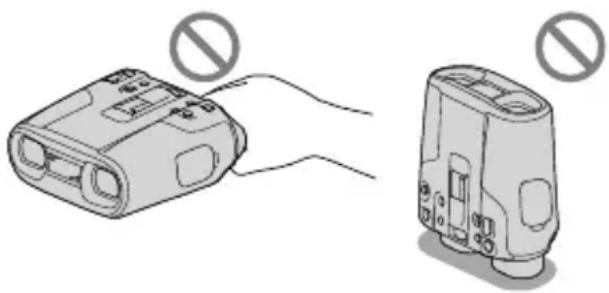
- Do not hold this product by the viewfinder or covers. Also, do not place this product with the viewfinder facing down.
natural_image
Illustration of two electronic devices with no visible text or symbols, connected by wires (no text or symbols present)- This product is dustproof and rainproof. See “About dust & rain proof performance of this product” (p 10).
Menu items, viewfinder, and lens
- The viewfinder is manufactured using extremely high precision technology, so over 99.99% of the pixels are operational for effective use. However, there may be some tiny black points and/or bright points (white, red, blue, or green in color) that appear constantly in the viewfinder. These points are normal results of the manufacturing process and do not affect the recording in any way.
- Exposing the viewfinder or the lens to direct sunlight for long periods of time may cause malfunctions.
- Do not aim at the sun. Doing so might cause this product to malfunction. Take images of the sun only in low light conditions, such as at dusk.
About language setting
- The on-screen displays in each local language are used for illustrating the operating procedures. To change the screen language, select MENU (MENU) → [Setup] → [General Settings] → [Language Setting] → a desired language → OK
On recording
- Before starting to record, test the recording function to make sure the image and sound are recorded without any problems.
- Compensation for the contents of recordings cannot be provided, even if recording or playback is not possible due to a malfunction of this product, memory card, etc.
- TV color systems differ depending on the country/region. To view your recordings on a TV, set [60i/50i Sel] to the setting required in your country/region before recording (p. 15).
- Television programs, films, video tapes, and other materials may be copyrighted. Unauthorized recording of such materials may be contrary to the copyright laws.
- Use this product in accordance with local regulations.
About this manual, illustrations and on-screen displays
- The example images used in this manual for illustration purposes are captured using a digital still camera, and therefore may appear different from images and screen indicators that actually appear on this product. And, the illustrations of this product and its screen indication are exaggerated or simplified for understandability.
- Design and specifications of this product and accessories are subject to change without notice.
Viewing 3D video images
- Some people may experience discomfort (such as eye strain, fatigue, or nausea) while watching 3D video images. Sony recommends that all viewers take regular breaks while watching 3D video images. The length and frequency of necessary breaks will vary from person to person. You must decide what works best. If you experience any discomfort, you should stop watching the 3D video images until the discomfort ends; consult a doctor if necessary. You should also review the instruction manual of any other device or media used with this product. The vision of young children (especially those under six years old) is still under development. Consult your doctor (such as a pediatrician or eye doctor) before allowing young children to watch 3D video images. Adults should supervise young children to ensure they follow the recommendations listed above.
Notes on use
- Be careful of your surroundings when using this product. Especially, do not use this product while walking. Doing so may cause accidents or injury.
- Do not do any of the following. Otherwise, the memory card may be damaged, recorded images may be impossible to play back or may be lost, or other malfunctions could occur.
- ejecting the memory card when the access lamp (p. 17) is lit or flashing
– removing the battery pack or AC Adaptor from this product, or applying mechanical shock or vibration to this product when the
(Movie)/(Photo) lamps (p. 19) or the access lamp (p. 17) are lit or flashing
About dust & rain proof performance of this product
The main unit of this product has been proven (by our performance test) to reach dust & rain proof performance requirements equivalent to IEC60529 IP54.
Sudden rain or fugitive dust will not affect operation of this product.
- Dustproof performance (IP5x): enclosure does not allow such ingress of dust as to cause harmful effects. The enclosure is not completely dust-tight, however, and is not guaranteed to protect against extreme dust exposure.
- Rainproof performance (IPx4): enclosure that does not allow splashing of water from any directions to cause harmful effects. This product is not protected against pressurized water, such as from a shower or tap, etc.
- When an accessory is attached or the AC adaptor or cables are connected, the dust & rain proof performance of this product may be compromised. Be careful not to allow dust or water to enter this product.
- Do not let the product come in contact with hot water or that with high mineral content.
- Strong shocks such as from dropping of this product may compromise the rain proof performance of this product. We recommended that you contact your Sony dealer or local authorized Sony service facility (charge applies) regarding repairs.
- Make sure to use this product properly, observing the following points, as damage caused by misuse, abuse or failure to properly maintain this product is not covered by warranty.
- Do not use this product underwater. This product is not waterproof, and should not be used underwater. Never immerse this product in water.
- Securely close the battery/memory card cover or jack covers.
Water is more likely to enter this product if the cover is open. When using this product in the rain or with wet or sandy hands, do not open the battery/memory card cover or jack covers. Doing so may cause a malfunction.
On use and care
- Sand, hair, dirt, etc., trapped in the sealing gasket of the battery/memory card cover or jack covers may lead to water entering this product. Wipe the area clean with a soft cloth that does not leave fibers.
Table of contents
- Scratches on and deformation or deterioration of the sealing gasket may lead to water entering this product. If the sealing gasket becomes scratched, deformed or deteriorated, consult your Sony dealer or local authorized Sony service facility.
- The drains on the bottom of this product are designed to allow any water or sand entering via the clearance of the IPD ADJ dial or the viewfinder to escape from the bottom (p. 36).
- If sand caught in the parts of this product impairs their movement, remove the sand with a blower, etc., and then operate them repeatedly.
About manuals for this product
Two manuals have been prepared for this product, the “Operating Guide” and the “Digital Recording Binoculars Handbook (PDF).” The “Operating Guide” introduces basic operations and the “Digital Recording Binoculars Handbook (PDF)” explains details of functions.
How to read Digital Recording Binoculars Handbook (PDF)
Install the “Digital Recording Binoculars Handbook” on your computer from the supplied CD-ROM.
① Place the supplied CD-ROM in the optical disc drive of your computer. The top page should appear. If the top page does not appear, double-click the [index.html] file in the CD-ROM.
② Click the CD-ROM manual you want to read. The PDF file on the CD-ROM manual will open.
- You need Adobe Reader to read the “Digital Recording Binoculars Handbook.” If it is not installed on your computer, you can download it from the Adobe Systems web page. http://www.adobe.com/
Read this first 2
IMPORTANT SAFETY INSTRUCTIONS ..... 3
Getting started
Step 1: Checking the supplied items ..... 12
Step 2: Charging the battery pack ..... 13
Step 3: Turning the power on, and setting up this product....14
Step 4: Inserting a memory card ..... 17
Binoculars/Recording/Playback
Using this product as binoculars ..... 18
Recording 19
Playback on this product 21
Saving movies and photos with a computer
Playing images on a computer ..... 22
Preparing a computer (Windows) ..... 23
Customizing this product
Using menus....24
Menu lists....25
Additional information
? Troubleshooting 28
Precautions 29
Specifications....31
Quick reference
Screen indicators 34
Parts and controls....35
Getting started
Step 1: Checking the supplied items
The numbers in ( ) are the supplied quantity.
Digital Recording Binoculars (1)
AC Adaptor (1)
Power cord (Mains lead) (1)
HDMI cable (1)
Micro USB cable (1)
Rechargeable battery pack NP-FV70 (1)
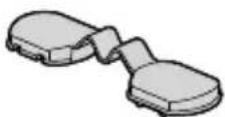
Lens cap (1) A
Neck strap (1)
"Operating Guide" (1)
CD-ROM "Manuals for Digital Recording Binoculars" (1)
- “Digital Recording Binoculars Handbook (PDF)”
Notes
- The “PlayMemories Home” software and “PlayMemories Home Help Guide” can be downloaded from the Sony website (p. 23).
Only for DEV-50/50V
Carrying case (1)
Finder cap (1) B
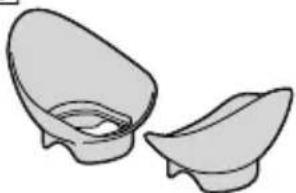
Large eyecup (2) C
A
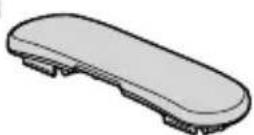
B
C
natural_image
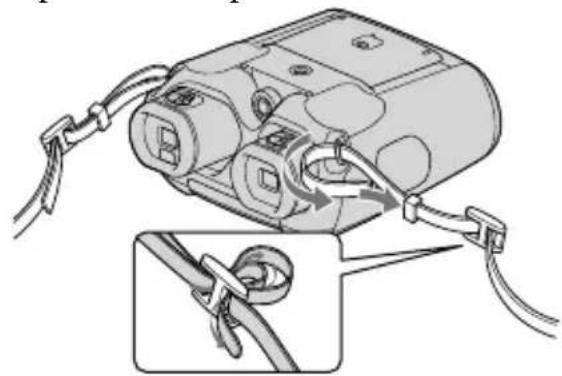
Illustration of two baby feet in different angles (no text or symbols)Attaching the neck strap
To avoid dropping this product, attach the neck strap to the binoculars following the steps below.
Insert one end of the neck strap into the strap mount on the binoculars. Then, fasten the neck strap, placing the end of the neck strap into the clasp.
natural_image
Diagram of a mechanical device with attached cables and a close-up inset showing a cable being inserted (no text or symbols present)Attaching the large eyecup (DEV-50/50V)
If you cannot see the picture in the viewfinder clearly under bright light, use the large eyecup.
Step 2: Charging the battery pack
You can charge the "InfoLITHIUM" battery pack (V series).
Notes
- You cannot use any "InfoLITHIUM" battery pack other than NP-FV70/FV100 with this product.
• To charge the battery, turn off this product by pressing the POWER button.
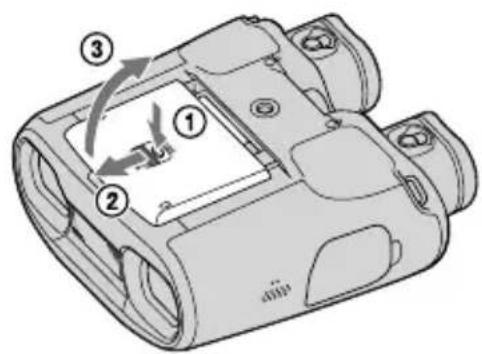
1
Press the battery/memory card cover button (①) and slide the cover in the direction of the arrow (②), then open the cover (③).
2
Align the battery with the grooves in the battery compartment while pressing the battery release lever (①), then slide the battery until it clicks (②).
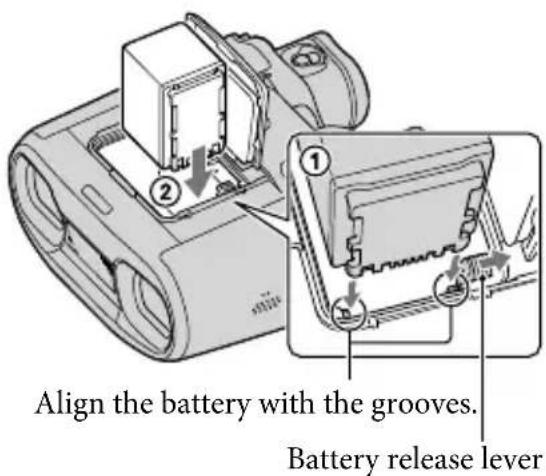
3
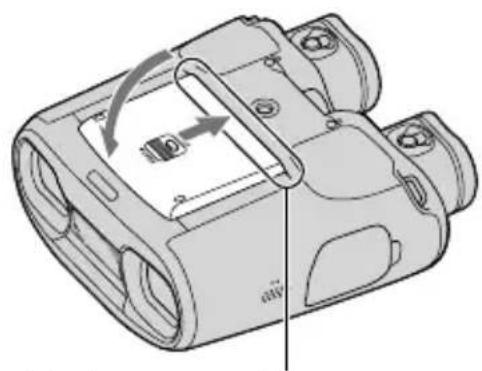
Close the battery/memory card cover.
natural_image
Technical line drawing of a mechanical device with a handle and internal components (no text or symbols)Slide the cover until there is no gap.
4
Connect the AC Adaptor and the power cord (mains lead) to this product and the wall outlet (wall socket).
CHG (charge) lamp
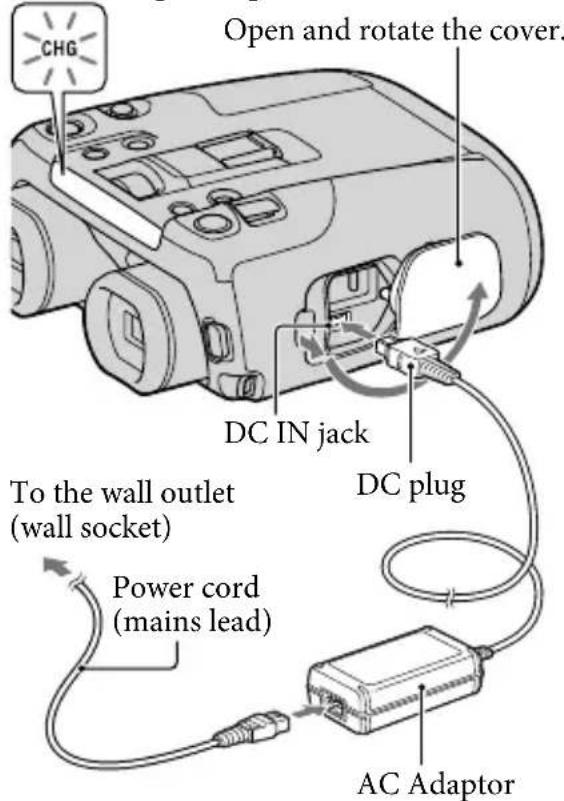
The CHG (charge) lamp lights up and charging starts. The CHG (charge) lamp turns off when the battery pack is fully charged.
5 When the battery is charged, disconnect the AC Adaptor from the DC IN jack of this product.

Tips
- When this product is on, you can check the approximate amount of remaining battery power (expected recording and playing time) with the remaining battery indicator at the upper right on the screen.
To remove the battery pack
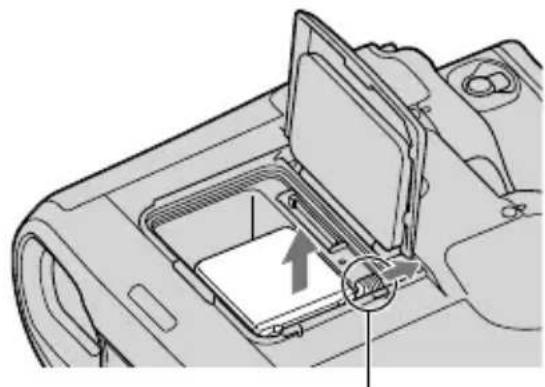
① Turn off this product by pressing the POWER button (p. 14), then open the battery/memory card cover (p. 13).
② Slide the battery release lever and remove the battery.
natural_image
Diagram of a car interior showing a door panel and internal components with an arrow indicating direction (no text or symbols)Battery release lever
Step 3: Turning the power on, and setting up this product

Notes
- If this product is used by more than one person, adjust the diopter and the width whenever a different person uses it.
1
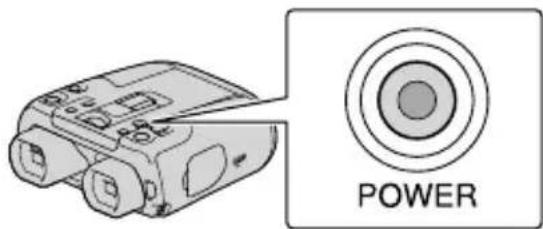
Press the POWER button.
This product is turned on.
• To turn off the power, press the POWER button again.
2
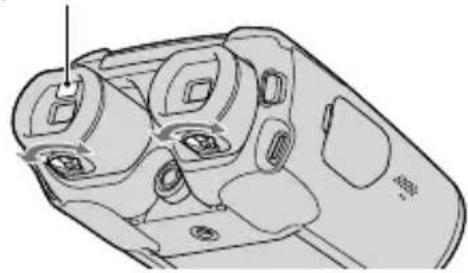
Adjust the diopter until you can see a clear image with each eye by turning the diopter adjustment knob.
Eye sensor
natural_image
Technical line drawing of a mechanical component with multiple ports and mounting holes (no text or symbols)- Adjust the diopter for each eye separately.
- If you bring your eyes close to the viewfinder, the eye sensor reacts to display the viewfinder screen.
3
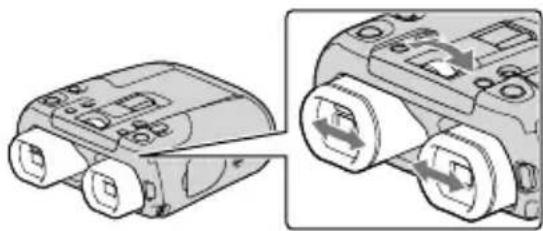
Adjust the width between the left and right viewfinder to fit your eyes using the IPD ADJ dial.
natural_image
Technical illustration of a mechanical device with two views showing internal components (no text or symbols)- Adjust the width so that left and right images overlap.
• Make sure that the image in the viewfinder does not appear as a double image. - When the viewfinder exceeds the limit of the adjustable range, you will hear a click. The viewfinder will not move any further.
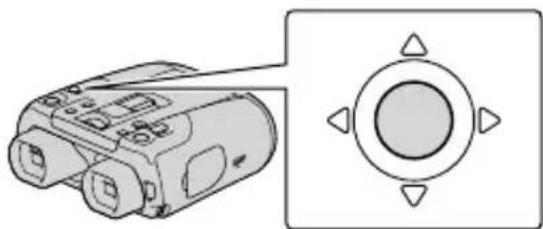
4 Set the language, area, summer time, date & time format, and date & time using the multi-selector, then confirm each setting.
Using the multi-selector
- Move the multi-selector towards /// to select the desired item, and then press the center of the selector to complete the selection.
natural_image
Illustration of a handheld electronic device with a circular button and directional arrows (no text or symbols)When each setting have been completed, select [Next].
5 Select [60i (NTSC)] or [50i (PAL)] to suit the TV color system used in your country/region, then select OK
When the 60i/50i selection is made, this product restarts to update the system.
• See page 16 for details on the TV color system in your country/region.
6 Adjust the relative vertical position of the right and left viewfinder.
Make sure that the horizontal line overlaps the vertical lines.
Image in the left viewfinder
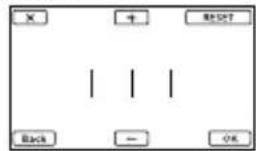
Image in the right viewfinder
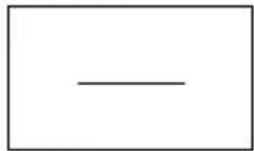
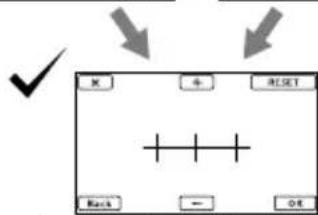
Image viewed by both eyes
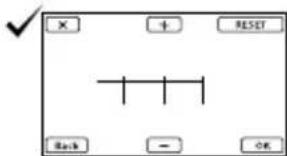
If the horizontal line and the vertical lines do not overlap, adjust the position of the image in the right viewfinder by selecting + / until the lines overlap, then select OK.
- If you see the image below, the device works correctly.
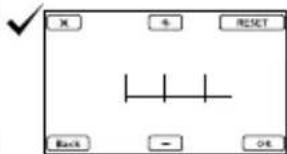
- If you see the image below even after adjusting the viewfinder, cease using this product.
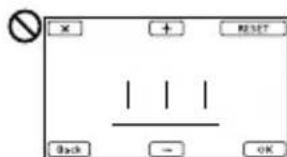
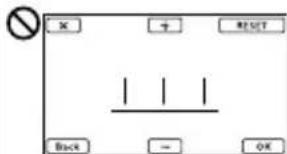
The horizontal line and the vertical lines do not overlap.
If you cannot see images correctly, this product may be damaged. Contact your Sony dealer or local authorized Sony service facility.
7 Select [Run].
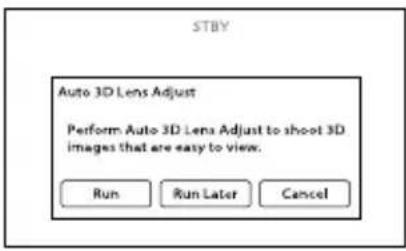
- If you select [Run Later], the recording mode screen appears. When you turn on this product next time, the [Auto 3D Lens Adjust] screen will appear.
8 Adjust the 3D lens.
Aim this product at a subject to display it on the screen.
• View a subject for which the scale of the indicator exceeds the ▲ mark, and then select OK.
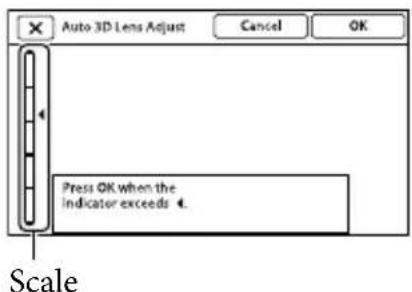
- Do not change the subject until the adjustment is completed.
Notes
- If this product fails to perform [Auto 3D Lens Adjust], select [Run Again].
Type of subjects that should be displayed on the screen for [Auto 3D Lens Adjust]
The scale indicated varies depending on the subject displayed on the screen.
Subjects that indicate a higher scale:
- Distant subjects in bright places such as outdoors
- Subjects farther away than 20 ~m (65 ft.) from this product - Subjects with various colors and shapes
![SONY DEV30 - Type of subjects that should be displayed on the screen for [Auto 3D Lens Adjust] - 1](/content/2026/02/416241/images/2e365c42083a153cb5defeac6dcb70ce049dbe61db5becbe2ab98417d50539d5.jpg)
natural_image
Black-and-white photo of a forest with tall trees and a tree trunk, no visible text or symbols![SONY DEV30 - Type of subjects that should be displayed on the screen for [Auto 3D Lens Adjust] - 2](/content/2026/02/416241/images/097cbbbf11e75b28dcf542c19e5c3ac5ba62f0c4d7b3b42d1076e82a8f448e0d.jpg)
natural_image
Aerial black-and-white photo of a densely built village surrounded by hills and trees (no visible text or symbols)Watching the recorded movies on a TV
To watch recorded movies on a TV, record movies after selecting the appropriate [60i/50i Sel] setting for the TV color system of the country/region where you are using this product.
Countries/regions where you need to set [60i/50i Sel] to [60i (NTSC)]
Bahama Islands, Bolivia, Canada, Central America, Chile, Colombia, Ecuador, Guyana, Jamaica, Japan, Korea, Mexico, Peru, Surinam, Taiwan, the Philippines, the USA, Venezuela, etc.
Countries/regions where you need to set [60i/50i Sel] to [50i (PAL)]
Argentina, Australia, Austria, Belgium, Bulgaria, Brazil, China, Czech Republic, Denmark, Finland, France, Germany, Guiana, Holland, Hong Kong, Hungary, Iran, Iraq, Italy, Kuwait, Malaysia, Monaco, New Zealand, Norway, Paraguay, Poland, Portugal, Russia, Singapore, Slovak Republic, Spain, Sweden, Switzerland, Thailand, Ukraine, United Kingdom, Uruguay, etc.
Step 4: Inserting a memory card
Types of memory card you can use with this product
| -“Memory Stick PRO Duo” media (Mark2)-“Memory Stick PRO-HG Duo” media | Described in this manual, “Memory Stick PRO Duo” media |
| -“Descible Stick this XC-HG Duo” media | manual, “Memory Stick XC-HG Duo” media |
| -SD memory card-SDHC memory card-SDXC memory card | Described in this manual, SD card SD Speed Class 4 or faster is required. |
• Operation with all memory cards is not assured.
- “Memory Stick PRO Duo” media of up to 32 GB, “Memory Stick XC-HG Duo” media of up to 64 GB and SD cards of up to 64 GB have been verified to operate with this product.
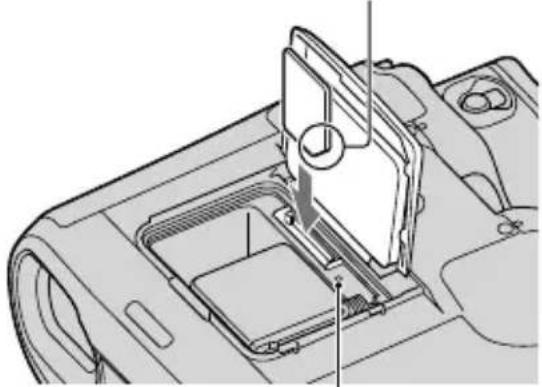
Open the battery/memory card cover (p. 13), and insert the memory card with the nothched edge in the direction as illustrated until it clicks.
Note the direction of notched corner.
natural_image
Technical line drawing of a mechanical component with internal parts and an arrow indicating direction (no text or symbols)Access lamp
- Close the battery/memory card cover after installing the memory card.
- If the [Preparing image database file. Please wait.] screen is displayed, wait until the screen disappears.
Notes
- If [Failed to create a new Image Database File. It may be possible that there is not enough free space.] is displayed, format the memory card.
- Confirm the direction of the memory card. If you forcibly insert the memory card in the wrong direction, the memory card, memory card slot, and/or image data may be damaged.
- Do not eject the memory card while the access lamp is lit. Doing so may cause movies and/or photos to not be saved on the memory card properly.
To eject the memory card
Open the battery/memory card cover and lightly push the memory card in once.
Notes
- Movies recorded on “Memory Stick XC-HG Duo” media and SDXC memory cards cannot be imported to or played back on computers or AV devices not supporting the exFAT file system by connecting this product to these devices with the USB cable. Confirm in advance that the connecting equipment is supporting the exFAT system. If you connect an equipment not supporting the exFAT system and the format screen appears, do not perform the format. All the data recorded will be lost.
* The exFAT is a file system that is used for the "Memory Stick XC-HG Duo" media and SDXC memory cards.
Binoculars/Recording/Playback
Using this product as binoculars
1 Press the POWER button.
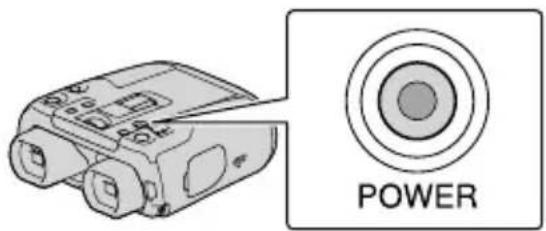
This product is turned on.
Some settings screen may appear depending on the status of this product when it is turned on. Use this product after completing any necessary adjustments.
2 Make sure that the diopter, the width, and the relative vertical position of the right and left viewfinder fit you (p. 14).
3 Hold this product with both hands and aim it at the subject.
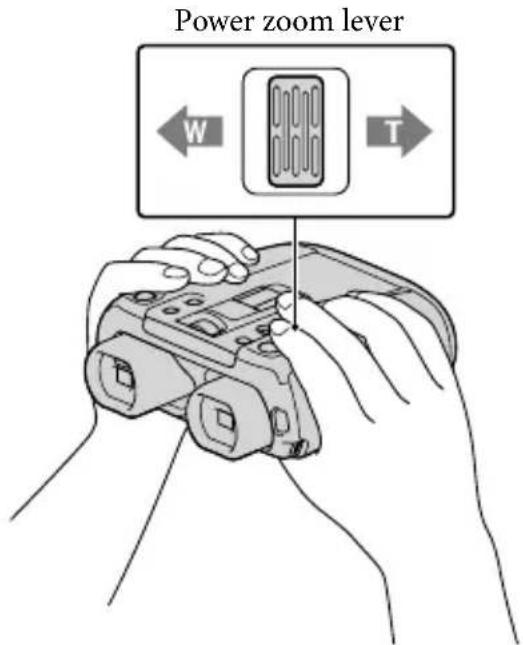
You can magnify images with the power zoom lever.
• This product adjusts the focus automatically with the auto-focus function (default setting).
Notes
- Be sure to keep your finger on the power zoom lever. If you move your finger off the power zoom lever, the operation sound of the power zoom lever may also be recorded.
Tips
- [SteadyShot] is set to [Active] in the default setting.
About zooming
The default setting for binoculars magnification is as noted below.
DEV-30: 0.8 × to 15 × (approx.) DEV-50/50V: 0.8 × to 25 × (approx.)
Binoculars magnification is available if the following conditions are met.
• 2D recording mode is activated.
- [SteadyShot] is set to something other than [Active] and [Digital Zoom] is set to [On].
Tips
- The binoculars magnification indicates how big the subject looks with the binoculars compared with your naked eye.
To adjust the focus manually
① Select MENU (MENU) → [Camera/Mic] → [Manual Settings] → [Focus] using the multi-selector.
② Select [Manual], then select (nearby subject) / → (distant subject) several times to adjust the focus.
Tips
• To adjust the focus automatically, select [Auto].
Recording
To switch the viewfinder display between 2D and 3D
Press FINDER 2D/3D to switch the viewfinder display between 2D and 3D. At the default setting, images in the viewfinder are displayed in 3D.
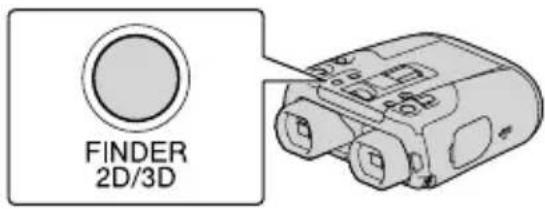
Notes
- The recorded image does not change even if you press the FINDER 2D/3D.
To use this product in dark places (Hyper Gain)
You can view a subject brightly even in dark places by increasing the gain.
Select MENU (MENU) → [Camera/Mic] → [Manual Settings] → [Hyper Gain] → [On].
Notes
- The image quality deteriorates due to noise when using [Hyper Gain]. In addition, the color of the image becomes light.
Tips
- It is recommended that you adjust the focus manually.
- If you turn off this product, [Hyper Gain] is also set to [Off].
In the default setting, images in the viewfinder are displayed in 3D (p. 19), but movies are recorded in 2D.
1 With the power on, press the MODE button to enter the desired recording mode.
MODE button
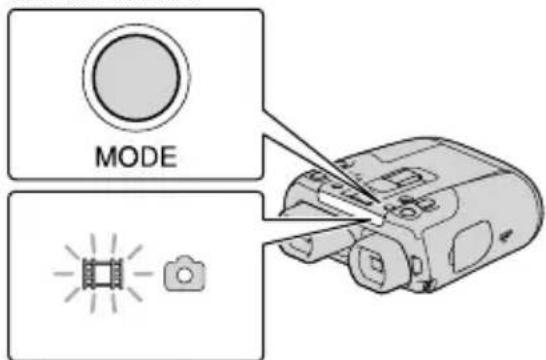
(Movie): When recording a movie (Photo): When recording a photo
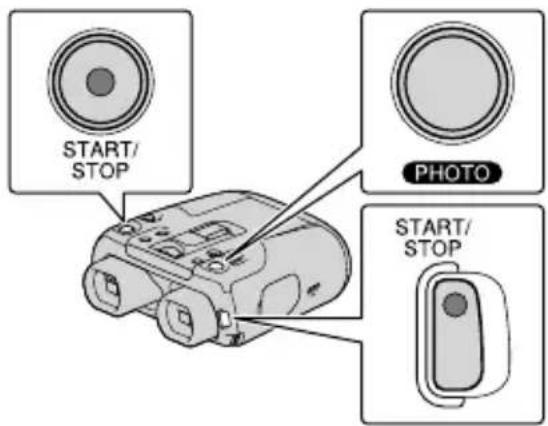
2 Movie recording mode: Press START/STOP to start recording.
To stop recording, press START/STOP again.
Photo shooting mode: Press PHOTO lightly to adjust the focus, then press it fully.

Notes
- The following states will be indicated if data is still being written onto the memory card after recording has finished. During this time, do not apply shock or vibration to this product, or remove the battery or AC Adaptor.
- Access lamp (p. 17) is lit or flashing
-
The media icon in the upper right of the screen is flashing
-
You cannot shoot photos when [2D/3D Mode Select] is set to [3D]. Select MENU (MENU) → [Image Quality/Size] → [2D/3D Mode Select] → [2D].
- You cannot shoot photos in 3D.
To switch the 2D and 3D recording mode
You can select a recording mode of either 2D or 3D.
To switch 2D and 3D, select MENU (MENU) → [Image Quality/Size] → [2D/3D Mode Select].
Recommended distance from the subject and zooming level
The distance at which you can obtain good 3D movies varies depending on the zooming level.
Recommended recording distance (approx.) Zoom
| 2 m to (9 m) [6 ft. to (30 ft.)] | W□□T |
| 6 m to (16 m) [20 ft. to (51 ft.)] | W□□T |
| 24 m to (30 m) [78 ft. to (100 ft.)] | W□□T |
- A subject farther away than the recommended recording distance will lose 3D depth.

Notes
- You should not record a subject closer than the recommended recording distance in 3D because an uncomfortable movie will be recorded. Record the subject in 2D.
- When you record 3D movies, the binocular magnification can be set to up to about 6 × . If you want to view or record a subject at greater magnification, set [2D/3D Mode Select] to [2D].
Using menus directly
By registering a favorite menu to the left part of the viewfinder screen, you can use the assigned menu directly ([My Button], p. 26).
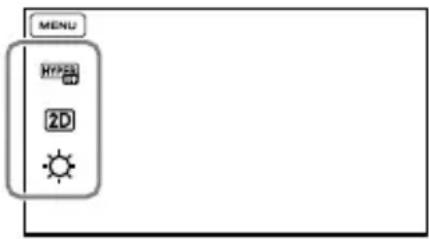
The default settings are [Hyper Gain], [2D/3D Mode Select] and [VF Brightness].
Controlling the image settings manually with the MANUAL dial
It is convenient to assigning a menu item to the MANUAL dial (p. 36).
By pressing the MANUAL button, you can use the assigned menu. Also, by pressing and holding the MANUAL button for a few seconds, you can assign a desired menu item.
Acquiring location information using the GPS (DEV-50V)
Set [GPS Setting] to [On] (p. 27).
Xll appears on the screen, and this product starts acquiring the location information. The acquired location information is recorded on movies and photos.
Playback on this product
You can play back images recorded with this product.

Tips
- If you want to play back 3D images, set [2D/3D Mode Select] to [3D].
1
With the power on, press ▶ (View Images).
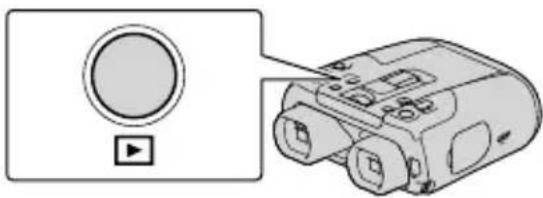
natural_image
Illustration of a play button next to a device with buttons and display (no text or symbols)The Event Index screen appears after some seconds.
2
Select an image you want to view using the multi-selector, then press the center of the selector.
Playback starts.
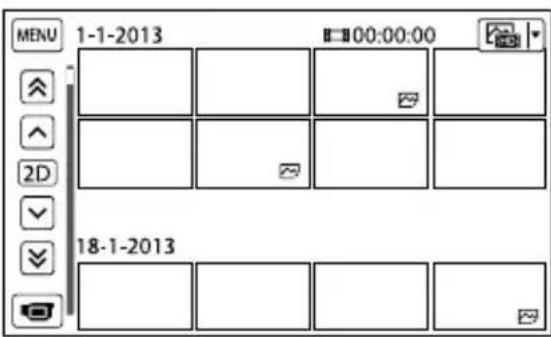

previous image / next image

previous event / next event
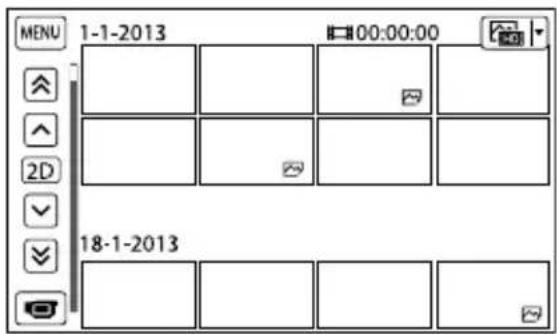
- This product organizes images into a group that is called an event, based on the date and time, and information on how often you record images.
Operations available on the playback display
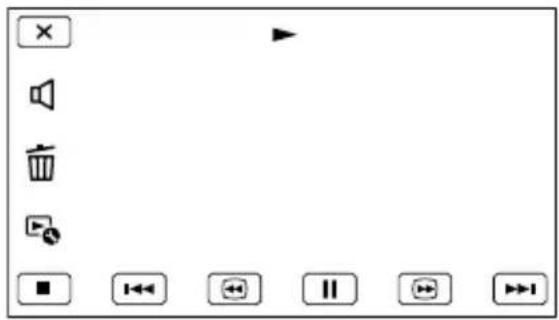
| Pause/Play | |
| Stop | |
| Previous/Next image | |
| Fast-reverse/Fast-forward | |
| Play slide show | |
| Volume | |
| Delete | |
| Context |
- Some buttons may not be displayed depending on the playback image.

Notes
- You may not be able to play back normally images recorded on this product with other devices. Also, you may not be able to play back images recorded on other devices with this product.

Tips
- Select / during pause to play back movies slowly.
- As you repeat pressing Enter after selecting / during playback, movies are played as fast as about 5 times → about 10 times → about 30 times → about 60 times.
Saving movies and photos with a computer
Playing images on a computer
The “PlayMemories Home” software allows you to import movies and still images to your computer to use them in a variety of ways.
What you can do with "PlayMemories Home" software (Windows)
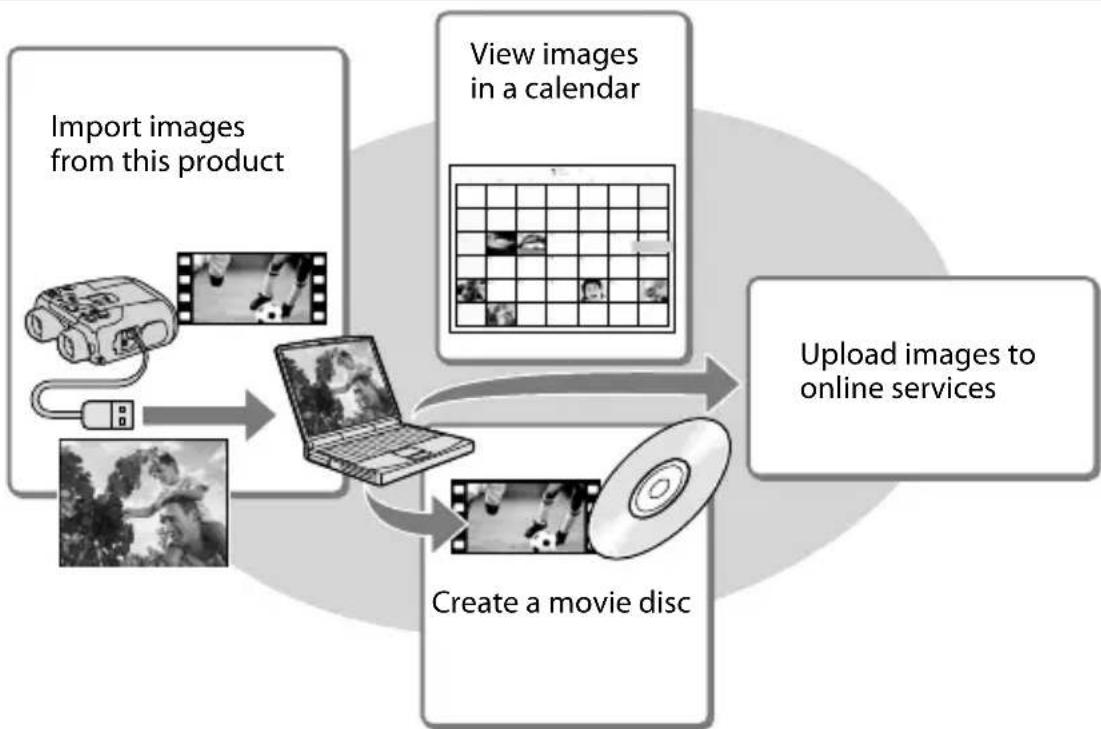
flowchart
graph TD
    A["Import images from this product"] --> B["Laptop"]
    B --> C["Create a movie disc"]
    C --> D["Upload images to online services"]
    D --> E["View images in a calendar"]
    E --> B
"PlayMemories Home" can be downloaded from the following URL. www.sony.net/pm

Notes
- An Internet connection is required to install "PlayMemories Home."
- An Internet connection is required to use online services. The services may not be available in some countries/regions.
Software for Mac
The “PlayMemories Home” software is not supported on Mac computers. To import images from this product to your Mac and play them, use the appropriate software on your Mac. For details, visit the following URL.
Preparing a computer
(Windows)
Installing the "PlayMemories Home" software in your computer
1 Access the following download site using an Internet browser on your computer, then click [Install] → [Run].
www.sony.net/pm
2 Install according to the on-screen instructions.
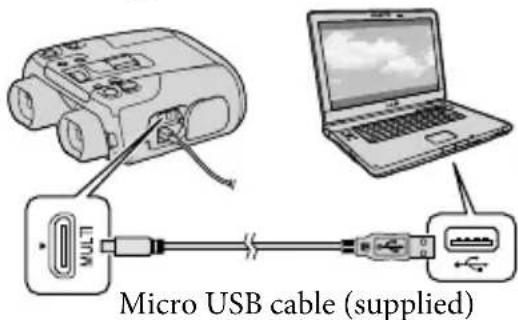
- When the on-screen instructions prompting you to connect this product to a computer appear, connect this product to your computer with the micro USB cable (supplied).
- When the installation completes, "PlayMemories Home" starts up.
Notes on installation
- If the "PlayMemories Home" software is already installed on your computer, connect this product to your computer. Functions that can be used with this product will then be available.
- If the “PMB (Picture Motion Browser)” software is installed on your computer, it will be overwritten by the “PlayMemories Home” software. In this case, you cannot use some functions that were available with “PMB” with this “PlayMemories Home” software.
View the "PlayMemories Home Help Guide"
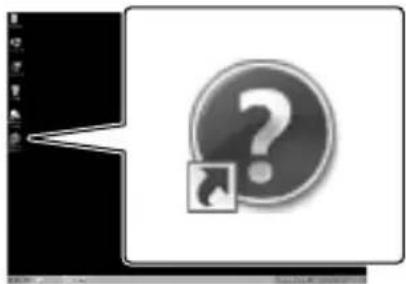
Double-click the "PlayMemories Home Help Guide" short-cut icon on the computer screen.
natural_image
Computer desktop interface with a question mark icon and a small arrow pointing to it (no text or symbols)- When using Windows 8, select [PlayMemories Home Help Guide] from the help menu of "PlayMemories Home."
- If the icon is not displayed on the computer screen, click [Start] → [All Programs] → [PlayMemories Home] → the desired item.
- For details on "PlayMemories Home," select ("PlayMemories Home Help Guide") on the software or visit the PlayMemories Home support page (http://www.sony.co.jp/pmh-se/).
Customizing this product
Using menus
This product has various menu items under each of 6 menu categories.
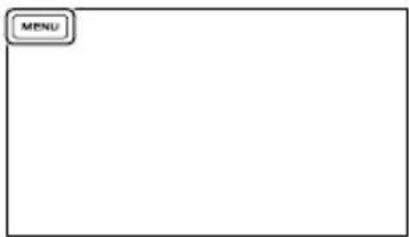
1 Select MENU.
2 Select a category.
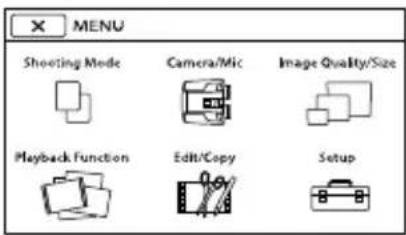
3 Select your desired menu item.
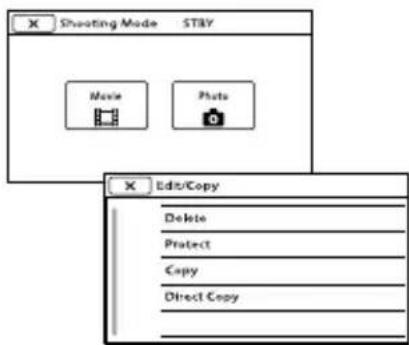
Notes
- Select ✗ to finish setting the menu or to return to the previous menu screen.
To find a menu item quickly
The [Camera/Mic] and [Setup] menus have sub-categories. Select the sub-category icon so that the screen displays the list of menus in the sub-category selected.
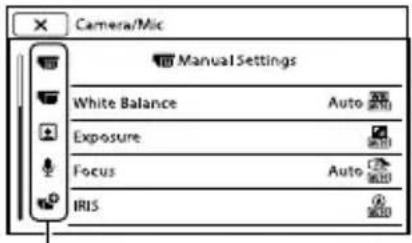
Sub-category icons
When you cannot select a menu item
Grayed out menu items or settings are not available.
When you select the grayed out menu item, this product displays the reason why you cannot select the menu item or the instruction of under which condition you can set the menu item.
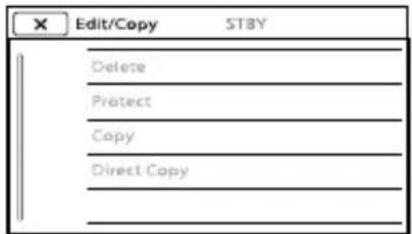
The available menu items differ between the movie mode ( ) and photo mode ()
Shooting Mode
| Movie | Records movies. |
| Photo | Shoots photos. |
Camera/Mic
| Manual Settings | |
| White Balance | Adjusts the color balance to the recording environment. |
| Exposure | Adjusts the brightness of movies and photos. |
| Focus | Focuses manually. |
| IRIS | Adjusts the iris. |
| Shutter Speed | Adjusts the shutter speed. |
| AE Shift | Adjusts the exposure based on the results of the automatic exposure measurement. |
| White Balance Shift | Adjusts the white balance manually. |
| Low Lux | Records bright color images in the dim. |
| Hyper Gain | Records bright images in dark places by increasing the gain. |
Camera Settings
| Auto 3D Lens Adjust | Automatically corrects the vertical position of the right and left movies to record 3D movies that can be viewed comfortably, without blurring. |
| Scene Selection | Selects an appropriate recording setting according to the type of scene, such as night view or beach. |
| Self-Timer | Sets the self-timer when this product is in photo recording mode. |
| Tele Macro | Shoots a subject in focus with the background out of focus. |
| SteadyShot | Sets the SteadyShot function when recording movies. |
| SteadyShot | Sets the SteadyShot function when shooting photos. |
| Digital Zoom | Sets the digital zoom. |
| Auto Back Light | Adjusts the exposure for backlit subjects automatically. |
| Dial Setting | Assigns a function to the MANUAL dial. |
Face
| Face Detection | Adjusts the image quality of the face(s) automatically. |
| Microphone | |
| Closer Voice | Detects human faces and records the associated voice clearly. |
| Auto Wind NR | Recognizes the recording conditions and reduces the wind noise. |
| Micref Level | Sets the microphone reference level. |

Shooting Assist
| My Button | Assigns functions to My Buttons. |
| Grid Line | Displays grid lines as a guide to make sure the subject is horizontal or vertical. |
| Display Setting | Sets the duration that icons or indicators are displayed in the viewfinder. |

Image Quality/Size
| REC Mode | Sets the mode to record movies. When recording fast moving subject, a high image quality is recommended. |
| Frame Rate | Sets the frame rate to record movies. |
| 2D/3D Mode Select | Switches the movie recording type between 2D and 3D. |
| x.v.Color | Records wider range of colors. |
| Image Size | Sets the photo size. |

Playback Function
| Plays back movies or photos. |

Edit/Copy
| Delete | Deletes movies or photos. |
| Protect | Protects movies or photos to avoid deleting. |
| Copy | Copies movies or photos to external media devices. |
| Direct Copy | Copies all movies and photos that have not yet been saved on an external media device. |

Setup
| Media Settings | |
| Media Info | Displays memory card information, such as free space. |
| Format | Deletes all data on the memory card. |
| Repair Img. DB F. | Repairs the image database file on a memory card. |
| File Number | Sets how to assign the file number. |
| Playback Settings | |
| Data Code | Displays the detailed recording data during playback. |
| Volume | Adjusts the volume of playback sound, and the volume of sound output to monitoring headphones during recording. |

Connection
* DEV-50V
| TV Type | Sets the aspect ratio to suit the connected TV. |
| HDMI 3D Setting | Select the output format of the right and left images when you connect this product to a 3D TV with the HDMI cable (supplied). |
| HDMI Resolution | Select the output image resolution when connecting this product to a TV with the HDMI cable (supplied). |
| CTRL FOR HDMI | Sets whether or not the TV's Remote Commander is to be used when this product is connected to a “BRAVIA” Sync compatible TV with the HDMI cable (supplied). |
| USB Connect | Connects this product to an external device via USB. |
| USB LUN Setting | Sets this product to improve the compatibility of a USB connection by restricting some USB functions. |
| General Settings | |
| VF Brightness | Adjusts the brightness of the viewfinder. |
| Viewfinder Adjust | Adjusts the relative vertical position of the right and left viewfinder. |
| GPS Information* | Displays location information. |
| GPS Setting* | Sets the GPS. |
| REC Lamp | Sets the recording lamp to light up or not. |
| Beep | Sets whether this product sounds operation beeps or not. |
| Language Setting | Sets the display language. |
| 60i/50i Sel | Switch 1080/60i (NTSC-system) and 1080/50i (PAL-system). |
| Battery Info | Displays the battery information. |
| Power Save | Sets the power to turn off automatically. |
| Initialize | Initializes all the settings to the default settings. |
| Clock Settings | |
| Date & Time Setting | Sets the [Date & Time Format], [Summer Time], or [Date & Time]. |
| Area Setting | Adjusts for a time difference without stopping the clock. |
| Auto Clock ADJ * | Compensates for time automatically by acquiring location information from the GPS system. |
| Auto Area ADJ* | Compensates for time differences automatically by acquiring location information from the GPS system. |
Additional information
? Troubleshooting
If you run into any problems using this product, follow the steps below.
① Check the list on this page, and inspect this product.

② Remove the power source, attach the power source again after about 1 minute, and turn this product on.

③ Select (MENU) → [Setup] → [ ↘ General Settings] → [Initialize]. If you select [Initialize], all settings, including the clock setting, are reset.

④ Contact your Sony dealer or local authorized Sony service facility if the issue is not resolved.
- See “Digital Recording Binoculars Handbook” (p. 11) for details on the symptoms of this product, and “PlayMemories Home Help Guide” (p. 23) on connecting this product to a computer.
The power does not turn on.
- Attach a charged battery pack to this product (p. 13).
This product does not operate even when the power is set to on.
- Disconnect the AC Adaptor from the wall outlet (wall socket) or remove the battery pack, then reconnect it after about 1 minute.
This product gets warm.
- This product may become warm during operation. This is not a malfunction.
Self-diagnosis display/Warning indicators
If indicators appear on the viewfinder screen, check the following.
If the problem persists even after you have tried to fix a couple of times, contact your Sony dealer or local authorized Sony service facility. In this case, when you contact them, give them all the numbers of the error code beginning with C or E.
C:04:□□
- The battery pack is not an “InfoLITHIUM” battery pack V series. Use an “InfoLITHIUM” battery pack (V series) (p. 13).
- Connect the DC plug of the AC Adaptor to this product securely (p. 13).
C:06:□□
- The battery pack temperature is high. Change the battery pack or place it in a cool place.
C:13:□□ / C:32:□□
- Remove the power source. Reconnect it and operate this product again.
E:□□:□□
- Follow the procedure from ② in “Troubleshooting.”
A[1]
- The battery pack temperature is high. Change the battery pack or place it in a cool place.
Precautions
On use and care
- Do not use or store this product and accessories in the following locations:
– Anywhere extremely hot, cold or humid. Never leave them exposed to temperatures above 60 ^ ( 140 ^ ), such as under direct sunlight, near heaters or in a car parked in the sun. They may malfunction or become deformed.
– Near strong magnetic fields or mechanical vibration. This product may malfunction.
– Near strong radio waves or radiation. This product may not be able to record properly.
– Near AM receivers and video equipment. Noise may occur.
– On a sandy beach or anywhere dusty. If sand or dust gets in this product, it may result in a malfunction. Sometimes this malfunction cannot be repaired. - For DC or AC operation, use the accessories recommended in these operating instructions.
- Do not let this product get wet, for example, from rain or sea water. If this product gets wet, it may malfunction. Sometimes this malfunction cannot be repaired.
- If any solid object or liquid gets inside the casing, unplug this product and have it checked by a Sony dealer before operating it any further.
- Avoid rough handling, disassembling, modifying, physical shock, or impact such as hammering, dropping or stepping on the product. Be particularly careful of the lens.
- Keep this product turning off when you are not using this product.
- Do not wrap this product with a towel, for example, and operate it. Doing so might cause heat to build up inside.
- When disconnecting the power cord (mains lead), pull it by the plug and not the cord (lead).
- Do not damage the power cord (mains lead) such as by placing anything heavy on it.
- Do not use a deformed or damaged battery pack.
- Keep metal contacts clean.
-
If the battery electrolytic liquid has leaked: – Consult your local authorized Sony service facility.
-
Wash off any liquid that may have contacted your skin.
- If any liquid gets in your eyes, wash with plenty of water and consult a doctor.
When not using this product for a long time
- To keep this product in optimum state for a long time, turn it on and let it run by recording and playing back images about once a month.
- Use up the battery pack completely before storing it.
On handling the casing
- If the casing is soiled, clean this product body with a soft cloth lightly moistened with water, and then wipe the casing with a dry soft cloth.
-
Avoid the following to avoid damage to the finish:
-
Using chemicals such as thinner, benzine, alcohol, chemical cloths, repellent, insecticide and sunscreen
- Handling this product with above substances on your hands
- Leaving the casing in contact with rubber or vinyl objects for a long period of time
About care and storage of the lens
- Wipe the surface of the lens clean with a soft cloth in the following instances:
- When there are fingerprints on the lens surface
– In hot or humid locations -
When the lens is exposed to salty air such as at the seaside
-
Store in a well-ventilated location subject to little dirt or dust.
- To prevent mold, periodically clean the lens as described above.
Save all your recorded image data
- To prevent your image data from being lost, save all your recorded images on external media periodically.
Notes on battery pack/AC Adaptor
- Be sure to remove the battery pack or the AC Adaptor after turning off this product.
- Disconnect the AC Adaptor from this product, holding both this product and the DC plug.
Note on the binoculars/battery pack temperature
- When the temperature of this product or battery pack becomes extremely high or extremely low, you may not be able to record or play back on this product, due to the protection features of this product being activated in such situations. In this case, an indicator appears on the screen.
When this product is connected to a computer or accessories
- Do not try to format the memory card of this product using a computer. If you do so, this product may not operate correctly.
- When connecting this product to another device with communication cables, be sure to insert the connector plug in the correct way. Pushing the plug forcibly into the terminal will damage the terminal and may result in a malfunction of this product.
Notes on optional accessories
• We recommend using genuine Sony accessories.
- Genuine Sony accessories may not be available in some countries/regions.
To ensure stable operation of the memory card
It is recommended that you format the memory card with this product before using it the first time. Formatting the memory card will erase all the data stored on it and the data will be irrecoverable. Save your important data on your PC etc.
On charging the pre-installed rechargeable battery
This product has a pre-installed rechargeable battery to retain the date, time, and other settings even when this product is turned off. The pre-installed rechargeable battery is always charged while this product is connected to the wall outlet (wall socket) via the AC Adaptor or while the battery pack is attached. The rechargeable battery will be fully discharged in about 3 months if you do not use this product at all. Use this product after charging the pre-installed rechargeable battery. However, even if the pre-installed rechargeable battery is not charged, this product operation will not be affected as long as you are not recording the date.
Procedures
Connect this product to a wall outlet (wall socket) using the supplied AC Adaptor, and leave it with this product turned off for more than 24 hours.
Specifications
System
Signal format:
HD TV
NTSC color, EIA standards ^*1
PAL color, CCIR standards ^*2
Movie recording format:
AVCHD (AVCHD format Ver.2.0
compatible):
2D Video: MPEG-4 AVC/H.264
3D Video: MPEG-4 MVC/H.264
Audio: Dolby Digital 2ch Dolby Stereo
Creator
Manufactured under license from Dolby
Laboratories.
Photo file format
DCF Ver.2.0 Compatible
Exif Ver.2.3 Compatible
MPF Baseline Compatible
Recording media (Movie/Photo)
"Memory Stick PRO Duo" media
"Memory Stick XC-HG Duo" media
SD card (Class 4 or faster)
Viewfinder: Electronic viewfinder × 2: color
Picture: 1.3 cm (0.5 type)
Total number of pixels: 2 359 296 (1 024 ×
3 [RGB] × 768)
Eye point: 13.9 mm (9/16 in.)
Real field of view ^*3 :
DEV-30:
44.7 ° - 3.6 ° (2D movie)*4*6
44.7^ - 2.4^ (2D movie) ^47
DEV-50/50V:
44.7^-3.0^(2D movie)^46
44.7^ - 1.4^ (2D movie) ^47
Apparent field of view ^*3 : 36.9 ^ (16:9), 29.2 ^
(4:3)
Field of view at 1 000 m/yds ^*3 :
DEV-30:
828 m - 62 m (2 484 ft. - 187 ft.) (2D
movie)*4*6
828 m - 42 m (2 484 ft. - 125 ft.) (2D
movie)*4*7
DEV-50/50V:
828 m - 52 m (2 484 ft. - 156 ft.) (2D
movie)*4*6
828 m - 25 m (2 484 ft. - 75 ft.) (2D
movie)*4*7
Interpupillary distance adjust:
55 mm - 75 mm (2 1/4 in. - 3 in.)
Diopter adjustment: -3.5 to +3.5
Image device:
4.6 mm (1/3.91 type) CMOS sensor × 2
Recording pixels (photo):
Max. 20 400 000 pixels*5 (6 016 × 3 384)
(16:9)
Gross: Approx. 5 430 000 pixels
Lens: G lens
Magnification (approx.):
DEV-30:
0.8× -10× (2Dmovie)^46
0.8 × -15 × (2D movie)^17
0.5 × -6 × (3D movie)^*4
0.5× -15× (photo)
DEV-50/50V:
0.8 × -12 × (2D movie)^46
0.8 × -25 × (2D movie)^47
0.5 × -6 × (3D movie)^*4
0.5× -25× (photo)
Zoom ratio (approx.):
DEV-30:
13× (2Dmovie)^*6
20 × (2D movie)^*7
12× (3D movie)
33× (photo)
DEV-50/50V:
16 × (2D movie)^*6
33 × (2D movie)^*7
12× (3D movie)
55× (photo)
F1.8 - F3.4
When converted to a 35 mm still camera
DEV-30:
f = 49.8 ~mm - 661.6 ~mm (2 in. - 26 1/8 in.)
(2D movie) ^46
f = 49.8 ~mm - 992.3 ~mm (2 in. - 39 1/8 in.)
(2D movie) ^_1 ^_7
f=33.4 mm - 402.0 mm (1 3/8 in. - 15 7/8 in.)
(3D movie) ^*4
f = 29.8 ~mm - 989.4 ~mm (13/16 in. - 39 in.)
(photo, 16:9)
f = 36.3 ~mm - 1205.2 ~mm (17/16 in.
- 47 1/2 in.) (photo, 4:3)
DEV-50/50V:
f = 49.8 ~mm - 791.2 ~mm (2 in. - 31 1/4 in.)
(2D movie) ^46
f = 49.8 ~mm - 1645.7 ~mm (2 in. - 64 7/8 in.)
(2D movie) ^47
f = 33.4 ~mm - 402.0 ~mm (1 3/8 in. - 15 7/8 in.)
(3D movie) ^*4
f = 29.8 ~mm - 1647.9 ~mm (13/16 in. - 65 in.)
(photo, 16:9)
f = 36.3 ~mm - 2007.4 ~mm (17/16 in.
- 79 1/16 in.) (photo, 4:3)
Minimum illumination
11 lx (lux) (in default setting, shutter speed 1/60 second ^1 , 1/50 second ^2 )
Minimum focus distance:
2D movie: 1 cm (13/32 in.) (wide)/
80 cm (31 1/2 in.) (telephoto)
3D movie: 2 m (6 ft.) (wide)/
24 m (78 ft.) (telephoto)
Photo: 1 cm (13/32 in.) (wide)/80 cm
(31 1/2 in.) (telephoto)/38 cm (15 in.) (tele macro)
^1 [60i/50i Sel] is set to [60i (NTSC)].
^2 [60i/50i Sel] is set to [50i (PAL)].
^3 Diagonal dimension
*4 [SteadyShot] is set to [Standard] or [Off].
*5 The unique pixel array of Sony's ClearVid and the image processing system (BIONZ) allow still image resolution equivalent to the sizes described.
^6 [Digital Zoom] is set to [Off].
^*7 [Digital Zoom] is set to [On].
Input/Output connectors
HDMI jack: HDMI micro connector
Headphone jack: Stereo minijack (φ 3.5 mm)
MIC input jack: Stereo minijack (φ 3.5 mm)
Multi/Micro USB Terminal*
* Supports Micro USB compatible devices.
General
Power requirements: DC 6.8 V (battery pack) DC 8.4 V (AC Adaptor)
Average power consumption:
Monitoring*: 2D: 3.7 W, 3D: 4.0 W
Recording: 2D: 4.1 W, 3D: 5.0 W
* In this manual, “monitor” means that the user watches or views a subject without recording.
Operating temperature: 0 ^ to 40 ^ ( 32 ^ to 104 ^ )
Storage temperature: -20 ^ to +60 ^ ( -4 ^ to +140 ^ )
Dimensions (approx.):
148.5 mm × 72.5 mm × 157.5 mm (5 7/8 in.
× 2 7/8 in. × 6 1/4 in.) (w/h/d) including the projecting parts
166 mm × 78.5 mm × 202 mm (6 5/8 in.
× 3 1/8 in. × 8 in.) (w/h/d) (DEV-50/50V)
including the projecting parts, and the supplied large eyecup attached
Mass (approx.):
765 g (1 lb 10 oz) main unit only DEV-30:
860 g (1 lb 14 oz) including the rechargeable battery pack (NP-FV70) and “Memory Stick PRO Duo” media
DEV-50/50V:
890 g (1 lb 15 oz) including the rechargeable battery pack (NP-FV70), “Memory Stick PRO Duo” media, and large eyecup
AC Adaptor AC-L200C/AC-L200D
Power requirements: AC 100 V - 240 V, 50 Hz/60 Hz
Current consumption: 0.35 A - 0.18 A
Power consumption: 18 W
Output voltage: DC 8.4 V*
Operating temperature: 0 ^ to 40 ^ ( 32 ^ to 104 ^ )
Storage temperature: -20^ to +60^ ( -4^ to +140^ )
Dimensions (approx.): 48 mm × 29 mm × 81 mm (1 15/16 in. × 1 3/16 in. × 3 1/4 in.) (w/h/d) excluding the projecting parts
Mass (approx.): 150 g (5.3 oz) excluding the power cord (mains lead)
* See the label on the AC Adaptor for other specifications.
Rechargeable battery pack NP-FV70
Maximum output voltage: DC 8.4 V
Output voltage: DC 6.8 V
Maximum charge voltage: DC 8.4 V
Maximum charge current: 3.0 A
Capacity
Typical: 14.0 Wh (2 060 mAh)
Minimum: 13.0 Wh (1 960 mAh)
Type: Li-ion
Design and specifications of this product and accessories are subject to change without notice.
Charging time
Approximate time (min.) required when you fully charge a fully discharged battery pack.
Battery pack Charging time
NP-FV70 (supplied) 195
- The charging time shown in the table above is measured when charging this product at a temperature of 25^ C ( 77^ F). It is recommended that you charge the battery in a temperature range of 10^ C to 30^ C ( 50^ F to 86^ F).
Available time with the supplied battery pack (NP-FV70)
Approximate time available when recording in 2D mode with fully charged battery pack.
(unit: minute)
Continuous recording time 185
Typical recording time 95
Continuous monitoring time 210
Playing time 315
• Each operating time in the 2D mode is measured with [REC Mode] set to [Standard HQ].
- Typical recording time shows the time when you repeatedly start/stop recording, switch the MODE lamp, and zoom.
- Times measured when using this product at 25^ (77°F). 10^ to 30^ (50°F to 86°F) is recommended.
- The recording, monitoring, and playback time will be shorter, depending on the conditions under which you use this product, such as when using this product in low temperatures.
- The remaining battery indicator (p. 34) shows the expected recording and playing time.
On trademarks
- “AVCHD 3D/Progressive” and “AVCHD 3D/Progressive” logo are trademarks of Sony Corporation and Panasonic Corporation.
- "Memory Stick," "Memory Stick Duo," "Memory Stick PRO Duo," "Memory Stick PRO Duo," "Memory Stick PRO-HG Duo," "Memory Stick PRO-HG Duo," "Memory Stick XC-HG Duo," "Memory Stick XC-HG Duo," "MagicGate," "MAGICGATE," "MagicGate Memory Stick" and "MagicGate Memory Stick Duo" are trademarks or registered trademarks of Sony Corporation.
- "InfoLITHIUM" is a trademark of Sony Corporation.
- “x.v.Color”/“x.v.Colour” is a trademark of Sony Corporation.
- "BRAVIA" is a registered trademark of Sony Corporation.
- Blu-ray Disc™ and Blu-ray™ are trademarks of the Blu-ray Disc Association.
- Dolby and the double-D symbol are trademarks of Dolby Laboratories.
- The terms HDMI and HDMI High-Definition Multimedia Interface, and the HDMI Logo are trademarks or registered trademarks of HDMI Licensing LLC in the United States and other countries.
- Microsoft, Windows, Windows Vista, and DirectX are either registered trademarks or trademarks of Microsoft Corporation in the United States and/or other countries.
• Mac and Mac OS are registered trademarks of Apple Inc. in the U.S. and other countries.
- Intel, Intel Core, and Pentium are trademarks or registered trademarks of Intel Corporation or its subsidiaries in the United States and other countries.
- “+” and “PlayStation” are registered trademarks of Sony Computer Entertainment Inc.
- Adobe, the Adobe logo, and Adobe Acrobat are either registered trademarks or trademarks of Adobe Systems Incorporated in the United States and/or other countries.
• SDXC logo is a trademark of SD-3C, LLC.
All other product names mentioned herein may be the trademarks or registered trademarks of their respective companies. Furthermore, ^TM and ^® are not mentioned in each case in this manual.
Quick reference
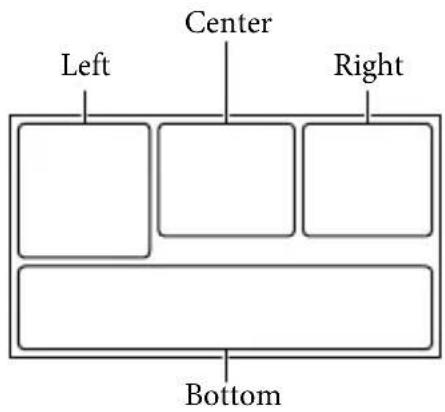
Screen indicators
flowchart
graph TD
    A["Left"] --> B["Center"]
    C["Right"] --> D["Bottom"]
    B --> E["Block 1"]
    B --> F["Block 2"]
    B --> G["Block 3"]
    D --> H["Block 4"]
Left
| Indicator Meaning | |
| MENU | MENU button |
| Self-timer recording | |
| GPS triangulating status | |
| Face Detection | |
| Manual focus | |
| Scene Selection | |
| White Balance | |
| SteadyShot off | |
| WS | White Balance Shift |
| Tele Macro | |
| Destination | |
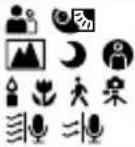 | Intelligent Auto |
Center
| Indicator Meaning | |
| [STBY]/[REC] Recording status | |
| Slide show set | |
| Warning | |
Right
| Indicator Meaning | |
| 60i HQ | Frame rate (60p(50p)/60i (50i)) andrecording mode (PS/FX/FH/HQ/LP) |
| 60min | Remaining battery(expected recording andplaying time) |
| 16:9 20.4 M | Photo size |
| Recording/playback/editing media | |
| 0:00:00 | Counter (hour:minute:second) |
| 00min | Estimated recordingremaining time |
| 9999 | Approximate number ofrecordable photos andphoto size |
| 2D 3D | 2D/3D record orplayback |
Bottom
| Indicator Meaning | |
| View Images button | |
| MODE (Shooting Mode) button | |
| Micref Level low | |
| Closer Voice off | |
| Auto Wind NR off | |
| Low Lux | |
| HYPER | Hyper Gain |
| Exposure | |
| EV AE Shift | |
| 500 | Shutter Speed |
| F1.8 | IRIS |
| i AUTO | Intelligent Auto |
| Protected image | |
| AUTO | Automatic |
| MANUAL | Exposure is set manually. |
- Indicators and their positions are approximate and may differ from what you actually see.
- Some indicators may not appear, depending on the model.
Parts and controls
Figures in ( ) are reference pages.
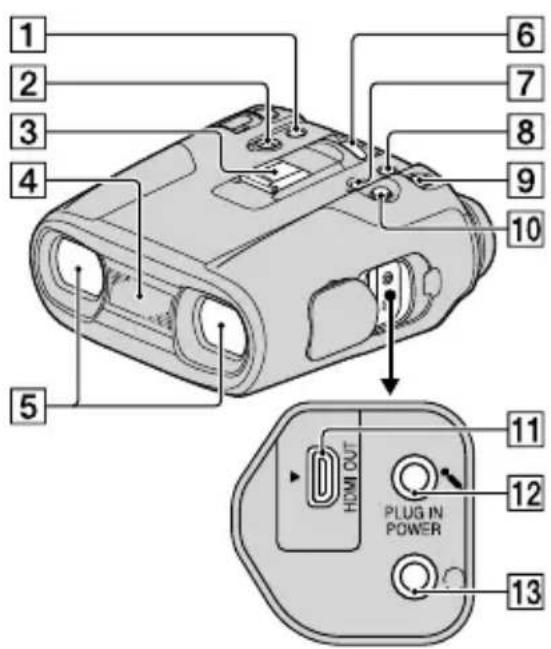
1 MODE button (19)
2 POWER button (14)
3 Accessory shoe
4 Built-in microphone
5 Lens
6 IPD ADJ dial (14)
7 View Images) button (21)
8 FINDER 2D/3D (display) button (19)
9 START/STOP button (19)
10 Multi-selector (15)
11 HDMI OUT jack
12 (microphone) jack (PLUG IN POWER)
13 Ⓝ (headphones) jack
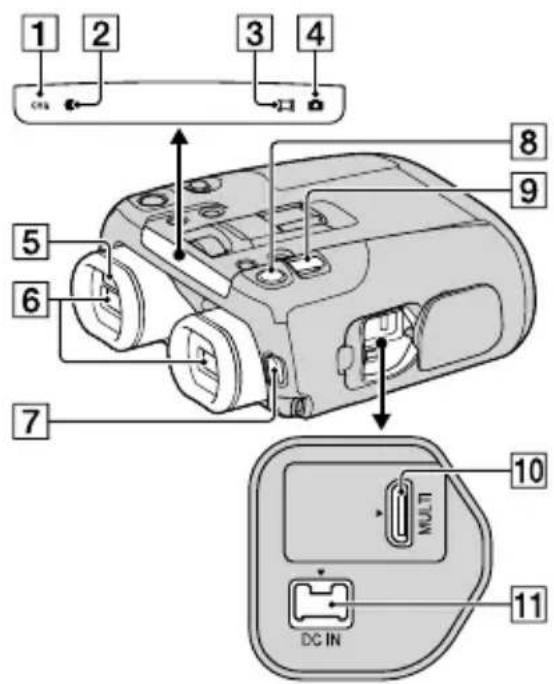
① CHG (charge) lamp (13)
2 Camera recording lamp
The camera recording lamp lights up in red during recording. The lamp flashes when the remaining memory card capacity or battery power is low.
3 (Movie) lamp (19)
4 (Photo) lamp (19)
5 Eye sensor (14)
6 Viewfinder
7 START/STOP button (19)
8 PHOTO button (19)
9 Power zoom lever (18)
10 Multi/Micro USB terminal
Supports Micro USB compatible devices.
11 DC IN jack (13)
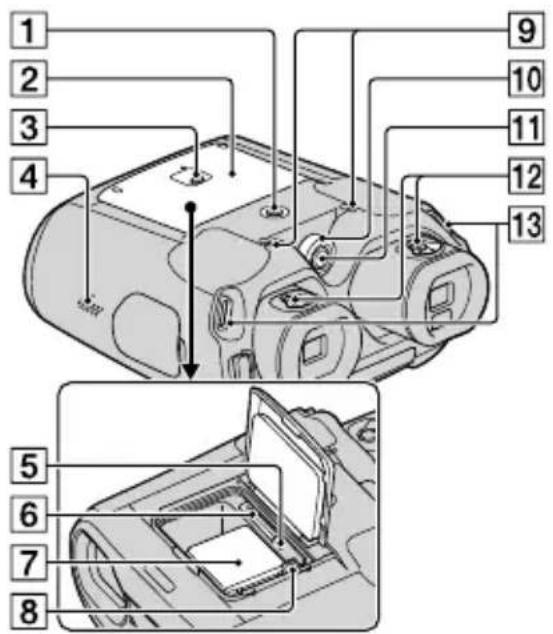
1 Tripod receptacle
Attach a tripod (sold separately) to the tripod receptacle using a tripod screw (sold separately: the length of the screw must be less than 5.5 mm (7/32 in.)).
Depending on the specifications of the tripod, this product may not attach in the proper direction.
2 Battery/memory card cover (13)
3 Battery/memory card cover button (13)
4 Speaker
5 Memory card access lamp (17)
While the lamp is lit or flashing, this product is reading or writing data.
6 Memory card slot (17)
7 Battery pack (13)
8 Battery release lever (14)
9 Drains
10 MANUAL dial (20)
11 MANUAL button (20)
12 Diopter adjustment knobs (14)
13 Strap mount (12)
Additional information on this product and answers to frequently asked questions can be found at our Customer Support Website.
http://www.sony.net/
Printed using VOC (Volatile Organic Compound)-free vegetable oil based ink.
Responsible : Sony Electronics Inc.
Adresse : 16530 Via Esprillo, San Diego, CA 92127 É.-U.
natural_image
Illustration of two electronic devices with no visible text or symbols, connected by wires (no text or symbols present)Bloc-piles rechargeable NP-FV70 (1)
natural_image
Simple line drawing of two baby-shaped objects with no text or symbolsFixation de la sangle
natural_image
Diagram of a mechanical device with attached wires and a close-up inset showing a cable attachment (no text or symbols)natural_image
Technical line drawing of a device with a scroll wheel and directional arrow (no text or symbols)natural_image
Diagram of a car interior showing a door, vent, and internal compartments with an arrow indicating direction (no text or symbols present)natural_image
Technical line drawing of a mechanical component with multiple ports and mounting holes (no text or symbols)natural_image
Technical illustration of two mechanical components with directional arrows indicating movement or assembly (no text or symbols present)natural_image
Illustration of a portable electronic device with a circular button and triangular pointer (no text or symbols)natural_image
Black-and-white photo of a forest with tall trees and a tree trunk, no visible text or symbols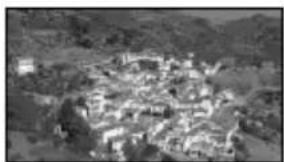
natural_image
Aerial black-and-white photo of a densely built village with hills in the background (no visible text or symbols)natural_image
Technical line drawing of a mechanical component with internal structure and mounting holes (no text or symbols)Témoin d'accès
natural_image
Diagram showing a circular button labeled '播放' next to a device with buttons and a play button (no text or symbols present)La lecture commence.
natural_image
Computer desktop interface with a question mark icon and a pointing arrow (no text or symbols)AVCHD (AVCHD format Ver.2.0
compatible):
Agrandissement (approx.):
DEV-30 :
0,8× -10× (film en 2D)^46
0,8× -15× (film en 2D)^47
0,5× -6× (film en 3D)^*4
0,5× -15× (photo)
DEV-50/50V :
0,8× -12× (film en 2D)^46
0,8× -25× (film en 2D)^47
0,5× -6× (film en 3D)^*4
0,5× -25× (photo)
Bloc-piles rechargeable NP-FV70
Minimum: 13,0 Wh (1 960 mAh)
Type : Li-ion
NP-FV70 (fourni) 195
natural_image
Illustration of two electronic devices with no visible text or symbols on their bodies, connected by wires (no text or symbols present)natural_image
Illustration of two baby feet in different angles (no text or symbols)natural_image
Diagram of a mechanical device with attached wires and a close-up inset showing a cable attachment (no text or symbols)Montaje del ocular grande (DEV-50/50V)
2
natural_image
Technical line drawing of a mechanical device with no visible text or symbolsnatural_image
Diagram of a camera interior showing the main frame and internal components, with an arrow indicating a location or movement (no text or symbols present)natural_image
Technical line drawing of a mechanical component with multiple ports and mounting holes (no text or symbols)natural_image
Technical illustration of two mechanical components with directional arrows indicating movement or assembly (no text or symbols present)natural_image
Illustration of a handheld device with a circular button and triangular pointer, next to a square dial (no text or symbols)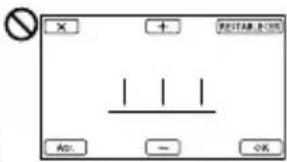
natural_image
Black-and-white photo of a forest scene with trees and a large tree (no visible text or symbols)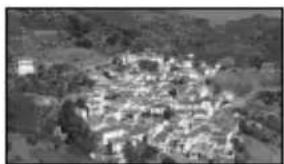
natural_image
Aerial black-and-white photo of a densely built village or town with buildings and surrounding greenery (no visible text or symbols)natural_image
Technical line drawing of a mechanical component with internal structure and mounting holes (no text or symbols)Indicador de acceso
natural_image
Illustration of a play button and a device with buttons (no text or symbols)"Memory Stick XC-HG Duo"
- Owner's Record
- WARNING
- For customers in the USA
- IMPORTANT SAFETY INSTRUCTIONS
- SAVE THESE INSTRUCTIONS.
- DANGER - TO REDUCE THE RISK OF FIRE OR ELECTRIC SHOCK,
- CAREFULLY FOLLOW THESE INSTRUCTIONS.
- CAUTION
- Battery pack
- AC Adaptor
- Note on the power cord (mains lead)
- For customers in the U.S.A. and CANADA
- RECYCLING LITHIUM-ION BATTERIES
- For the customers in the U.S.A.
- Regulatory Information
- Declaration of Conformity
- Note
- FOR CUSTOMERS IN EUROPE
- CE
- Notice for the customers in the countries applying EU Directives
- ATTENTION
- Notice
- Disposal of Old Electrical & Electronic Equipment (Applicable in the European Union and other European countries with separate collection systems)
- Disposal of waste batteries (applicable in the European Union and other European countries with separate collection systems)
- Notice for customers in the United Kingdom
- Using this product
- Menu items, viewfinder, and lens
- About language setting
- On recording
- About this manual, illustrations and on-screen displays
- Viewing 3D video images
- Notes on use
- About dust & rain proof performance of this product
- On use and care
- Table of contents
- About manuals for this product
- Getting started
- Binoculars/Recording/Playback
- Saving movies and photos with a computer
- Customizing this product
- Additional information
- Quick reference
- Step 1: Checking the supplied items
- Notes
- Attaching the neck strap
- Attaching the large eyecup (DEV-50/50V)
- Step 2: Charging the battery pack
- 1
- 2
- 3
- 4
- Tips
- To remove the battery pack
- Step 3: Turning the power on, and setting up this product
- Press the POWER button.
- Set the language, area, summer time, date & time format, and date & time using the multi-selector, then confirm each setting.
- Select [60i (NTSC)] or [50i (PAL)] to suit the TV color system used in your country/region, then select OK
- Adjust the relative vertical position of the right and left viewfinder.
- Select [Run].
- Adjust the 3D lens.
- Type of subjects that should be displayed on the screen for [Auto 3D Lens Adjust]
- Watching the recorded movies on a TV
- Countries/regions where you need to set [60i/50i Sel] to [60i (NTSC)]
- Countries/regions where you need to set [60i/50i Sel] to [50i (PAL)]
- Step 4: Inserting a memory card
- To eject the memory card
- Using this product as binoculars
- Press the POWER button.
- Make sure that the diopter, the width, and the relative vertical position of the right and left viewfinder fit you (p. 14).
- Hold this product with both hands and aim it at the subject.
- About zooming
- To adjust the focus manually
- Recording
- To switch the 2D and 3D recording mode
- Recommended distance from the subject and zooming level
- Using menus directly
- Controlling the image settings manually with the MANUAL dial
- Acquiring location information using the GPS (DEV-50V)
- Playback on this product
- Playing images on a computer
- Software for Mac
- Preparing a computer
- (Windows)
- Notes on installation
- Using menus
- ? Troubleshooting
- The power does not turn on.
- This product does not operate even when the power is set to on.
- This product gets warm.
- Self-diagnosis display/Warning indicators
- C:04:□□
- C:06:□□
- C:13:□□ / C:32:□□
- E:□□:□□
- A[1]
- Precautions
- When not using this product for a long time
- On handling the casing
- About care and storage of the lens
- Save all your recorded image data
- Notes on battery pack/AC Adaptor
- Note on the binoculars/battery pack temperature
- When this product is connected to a computer or accessories
- Notes on optional accessories
- To ensure stable operation of the memory card
- On charging the pre-installed rechargeable battery
- Procedures
- Specifications
- System
- Input/Output connectors
- General
- AC Adaptor AC-L200C/AC-L200D
- Rechargeable battery pack NP-FV70
- Charging time
- Battery pack Charging time
- Available time with the supplied battery pack (NP-FV70)
- On trademarks
- Screen indicators
- Parts and controls
- Fixation de la sangle
- Bloc-piles rechargeable NP-FV70
- Montaje del ocular grande (DEV-50/50V)
Brand : SONY
Model : DEV30
Category : Binoculars