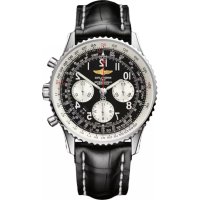
Navitimer 01 - Watch Breitling - Free user manual and instructions
Find the device manual for free Navitimer 01 Breitling in PDF.


Frequently Asked Questions - Navitimer 01 Breitling
User questions about Navitimer 01 Breitling
0 question about this device. Answer the ones you know or ask your own.
Ask a new question about this device
Download the instructions for your Watch in PDF format for free! Find your manual Navitimer 01 - Breitling and take your electronic device back in hand. On this page are published all the documents necessary for the use of your device. Navitimer 01 by Breitling.
USER MANUAL Navitimer 01 Breitling
natural_image
Black and white photo of a Boer's wristwatch with dual dials and leather strap (no visible text or symbols)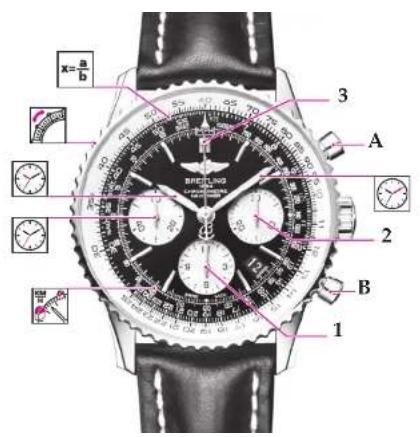
text_image
x=a b 3 A 2 B 1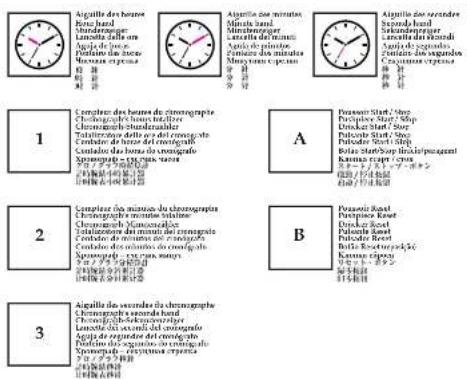
FRANÇAIS
MISE EN SERVICE 5
PARTICULARITÉS 8
ENTRETIEN 11
ENGLISH
PREPARING THE WATCH FOR USE 15
SPECIAL CHARACTERISTICS 18
MAINTENANCE 21
DEUTSCH
INBETRIEBNAHME 25
BESONDERHEITEN 28
WARTUNG 31
ITALIANO
A chronometer is a high-precision instrument that has successfully passed the entire battery of tests imposed by the COSC (Swiss Official Chronometer Testing Institute), a neutral and independent body which individually tests each movement according to the prescriptions in force.
The certification test for wristwatches with sprung balance oscillators, according to the ISO 3159 norm, consists of observing each movement for 15 days and 15 nights, in 5 positions and at 3 different temperatures (8°, 23°C, 38°C). In order to earn the prestigious chronometer label, a movement's performances must meet 7 very strict criteria, including a daily variation in rate ranging between only -4/+6 seconds.
The term "chronometer" should not be confused with that of "chronograph", which is a complicated watch fitted with an additional mechanism enabling the measurement of the duration of an event. A chronograph is not necessarily chronometer-certified, but all BREITLING chronographs carry the much-coveted title of "chronometers".
PREPARING THE WATCH FOR USE
WINDING - TIME-SETTING
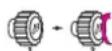
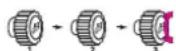
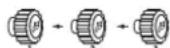
- Wind the watch by 40 clockwise turns of the crown.
- Pull the crown out to position 2, turn it clockwise to adjust the calendar to the day prior to the date when it is set into operation.
- Pull the crown out to position 3. Turn the hands so as to make the calendar jump once when the hands pass through midnight. Then adjust the hour and minute.
- Push the crown back to position 1.

USING THE CHRONOGRAPH
I. MEASURING A SINGLE SHORT TIME
-
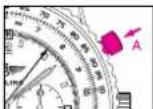
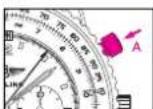
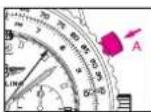
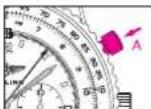
Press pushpiece A to start the chronograph. Hand 3 shows the measurement in seconds.
-
Stop the measurement by pressing pushpiece A once more. The measurement is done in hours (totalizer 1), minutes (totalizer 2), seconds and 1/4ths of a second (hand 3).
-
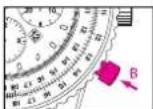
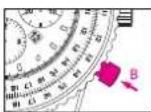
Return the chronograph to zero by pressing push-piece B.
II. MEASURING AN INTERRUPTED SHORT TIME
-
Press pushpiece A to start the chronograph. Hand 3 allows you to follow the measurement in seconds.
-
To interrupt the measurement, press pushpiece A once more. To restart the time measurement, press pushpiece A. This procedure makes it possible to add several short times.
-
The chronograph is reset to zero by pressing push-piece B, once the final measurement has been stopped.
SPECIAL CHARACTERISTICS

USING THE TACHOMETER
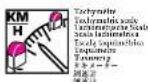
The tachometer is the graduation on the dial or flange of your B REITLING chronograph enabling you to determine average speeds or hourly productivity rate, based on an observation period of less than 60 seconds.
- Average or mean speed
Using the chronograph to measure the time required to cover a kilometre or a mile. If it takes 20 seconds to cover 1 km or 1 mile, the scale respectively indicates an average speed of 180 km/h or 180 miles/h.
- Hourly productivity rate
Measuring the time required to produce 1 unit. If the chronograph is stopped at 40 seconds, the tachometric scale indicates 90, corresponding to an hourly productivity rate of 90 units.
text_image
12 11 10 9 8 7 6 5 4 3 2 1 0 时钟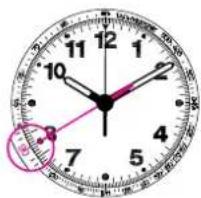
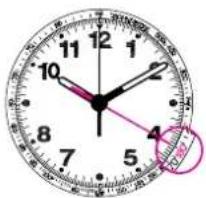
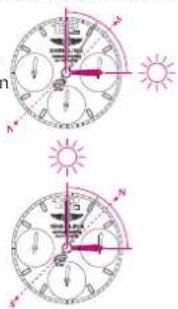
Your BREITLING chronometer may be used as a sun compass, thus enabling you to determine the Northerly-Southerly direction. For regions that have instated daylight saving time, subtract one hour when directing the watch.
In the Northern hemisphere
Point the hour hand precisely towards the sun. In relation to the watch dial, the point located midway between the current time and 12 o'clock indicates the South, the North being exactly opposite.
In the Southern hemisphere
Point the hour-marker located at 12 o'clock on the dial precisely towards the sun. In relation to the watch dial, the point located midway between the current time and 12 o'clock indicates the North, the South being exactly opposite.
text_image
Two analog clocks showing suns and directional arrows, likely illustrating a weather or solar cycle.MAINTENANCE
Your BREITLING chronometer is a sophisticated instrument which is constantly subjected to a wide variety of stresses and strains. Within a very small volume, a large number of components contribute to handling all the functions. Their mechanical action inevitably leads to a certain amount of wear and tear, which may be controlled by maintenance consisting of renewing the lubrication and replacing worn components. Like any precision measurement instrument, your watch must be regularly maintained in order to function at its highest level of potential: we recommend a regular service every two years, while the complete overhaul should be scheduled about every five years. Your authorized BREITLING dealer will be pleased to handle this for you.
WATER-RESISTANCE
The movement of your chronometer is protected by a sophisticated case fitted with water-resistance gaskets. Under the influence of certain external factors such as perspiration, cosmetics, perfumes or dust, these gaskets progressively deteriorate and must be periodically replaced, ideally every two years. Moreover, we recommend an annual water-resistance test, which takes only a few minutes, performed by your authorized B REITLING agent.
The complex construction of the case used for NAVITIMER models, featuring a design faithful to the vintage 1950s models, means they are not suited to aquatic activities. The crown, pushpieces and bezel must under no circumstances be activated when the watch is damp. The water-resistance indication, expressed in bars, must be considered a safety factor, protecting your chronometer from dust and splashing. Only watches that are water-resistant to 5 or more bars should be subjected to repeated immersions.
USEFUL TIPS
BREITLING genuine leather straps are crafted with the most refined materials and represent extremely high-quality products. Like all objects in natural skin (shoes, gloves, etc.), their length of life varies considerably, according to the conditions in which they are worn. In particular, water, cosmetics and perspiration accelerate the aging process.
BREITLING metal cases and bracelets are crafted from the finest alloys and ensure sturdiness and wearer comfort. Regular cleaning with a soft damp brush will keep your watch shiny. For watches fitted with a leather strap, proceed in the same manner, taking care to avoid wetting the strap.
WHAT TO AVOID
Like any valuable objects, B REITLING chronometers deserve special care. It is important to protect them from jarring and knocks by hard objects, and not to expose them to chemical products, solvents, dangerous gases, or magnetic fields. Moreover, your BREITLING chronometer is designed to run smoothly at temperatures ranging between 0°C and 50°C.
IHR BREITLING CHRONOMETER
text_image
Diagram showing two circular clocks with directional arrows and sun icons, illustrating a cycle or rotation process.メンテナンス
Printed in Switzerland 8911.1014