T4.200 - Outboard motor Nanni - Free user manual and instructions
Find the device manual for free T4.200 Nanni in PDF.



| Product type | Outboard motor |
| Brand | Nanni |
| Model | T4.200 |
| Engine type | 4-stroke Diesel with turbo and intercooler |
| Power | 147.2 kW (200 hp) |
| Number of cylinders | 4 in line |
| Displacement | 2982 cm³ |
| Compression ratio | 17.9:1 |
| Max load nominal speed | 3400 ± 50 rpm |
| Theoretical consumption | 34.9 l/h at 3400 rpm |
| Weight (without transmission) | 330 kg |
| Injection system | Direct Common Rail (Denso HP3, up to 1800 bar) |
| Recommended engine oil | API CD-SAE 15W40 |
| Engine oil capacity | 7.1 liters |
| Coolant | 50% water / 50% antifreeze mixture (capacity 15.5 L) |
| Recommended battery | 100-120 Ah |
| Alternator | 12V / 100A |
| Routine maintenance | Check oil, air filter, fuel filter, zinc anode, alternator belt, seawater pump |
| Safety | Engine stop by key, warning lights (oil, temperature, battery charge, water in diesel, etc.) |
| Installation | Max tilt 15°, bilge ventilation, anti-siphon mandatory if engine below waterline |
Frequently Asked Questions - T4.200 Nanni
User questions about T4.200 Nanni
0 question about this device. Answer the ones you know or ask your own.
Ask a new question about this device
Download the instructions for your Outboard motor in PDF format for free! Find your manual T4.200 - Nanni and take your electronic device back in hand. On this page are published all the documents necessary for the use of your device. T4.200 by Nanni.
USER MANUAL T4.200 Nanni
Marine Diesel engine
T4.165
T4.180
T4.200
ENGINE SPECIFICATIONS T4.165 T4.180 T4.200
| Cycle | 4 strokes Diesel | ||
| Max. power - kW (hp)* | 121,5 (165) 132,5 (180) | 147,2 (200) | |
| Number of cylinders / Arrangement | 4 in line | ||
| Displacement (cm³) | 2982 | ||
| Fuel timing before TDC (°) | 11.8° at 3400 rpm, ECM controlled | ||
| Compression rate | 17,9:1 | ||
| Aspiration | Turbo Intercooler | ||
| Bore x stroke (mm) | 96 x 103 | ||
| thum rpm speed at full throttle (rpm)* | 3400 ± 50 rpm | ||
| Idle rpm speed (rpm)* | 750 ± 50 rpm | ||
| No load rpm speed (rpm)* | 4000 ± 50 rpm | ||
| Theoretical fuel consumption (l/h) | 27.1 @ 3400 rpm 29.8 @ | 3400 trpm | 34.9 @ 3400 rpm |
| Weight without gearbox (kg) | 330 | ||
INJECTION SYSTEM T4.165 T4.180 T4.200
| Injection | Direct Common Rail |
| Injection order | 1-3-4-2 |
| Injection pump | Denso HP3 |
| Injection pressure (bar) | up tp 1800 bar, ECM controlled |
LUBRICATION T4.165 T4.180 T4.200
COOLANT T4.165 T4.180 T4.200
| Oil type (temperate climat) | API CD-SAE 15W40 |
| Oil pressure at idle speed (bar) | 0.3 |
| Oil pressure at max speed (bar) | 2.5 to 6.1 |
| Engine oil capacity (litre) | 7.1 |
Coolant (litres) (50% water - 50% antifreeze) 15.5
ELECTRICAL T4.165 T4.180 T4.200
| Battery capacity mini (Ah) | 100-120 |
| Alternator | 12V / 100A |
CONNECTIONS T4.165 T4.180 T4.200
| Exhaust (mm) | 90 |
| Fuel (suction and return) (mm) | 10 |
| Seawater (mm) | 38 |
- At engine flywheel, according to ISO 8665-1.
Certain specifications may vary according to your order
The recommended cruising speed is 200 rpm below the maximum rpm speed at full throttle

Non-binding photographs. The coupled equipment and accessories can vary according to your level of equipment.
- Alternator
- Alternator belt
- Starter
- Air filter
- Injection pump
- Acceleration control
- Fuel filter
- Water injection exhaust elbow
- Oil filler port
- Oil drain port
- Oil gauge
-
Oil filter
-
Heat exchanger
- Coolant filer port
- Sea-water pump
- Exchanger drain plug
- Coolant pump
- Flexible suspensions
- ECU
- Hoisting rings
- Anode
- Turbocompressor
- Fuses box
- Circuit breaker
Inspection and adjustment of the levels
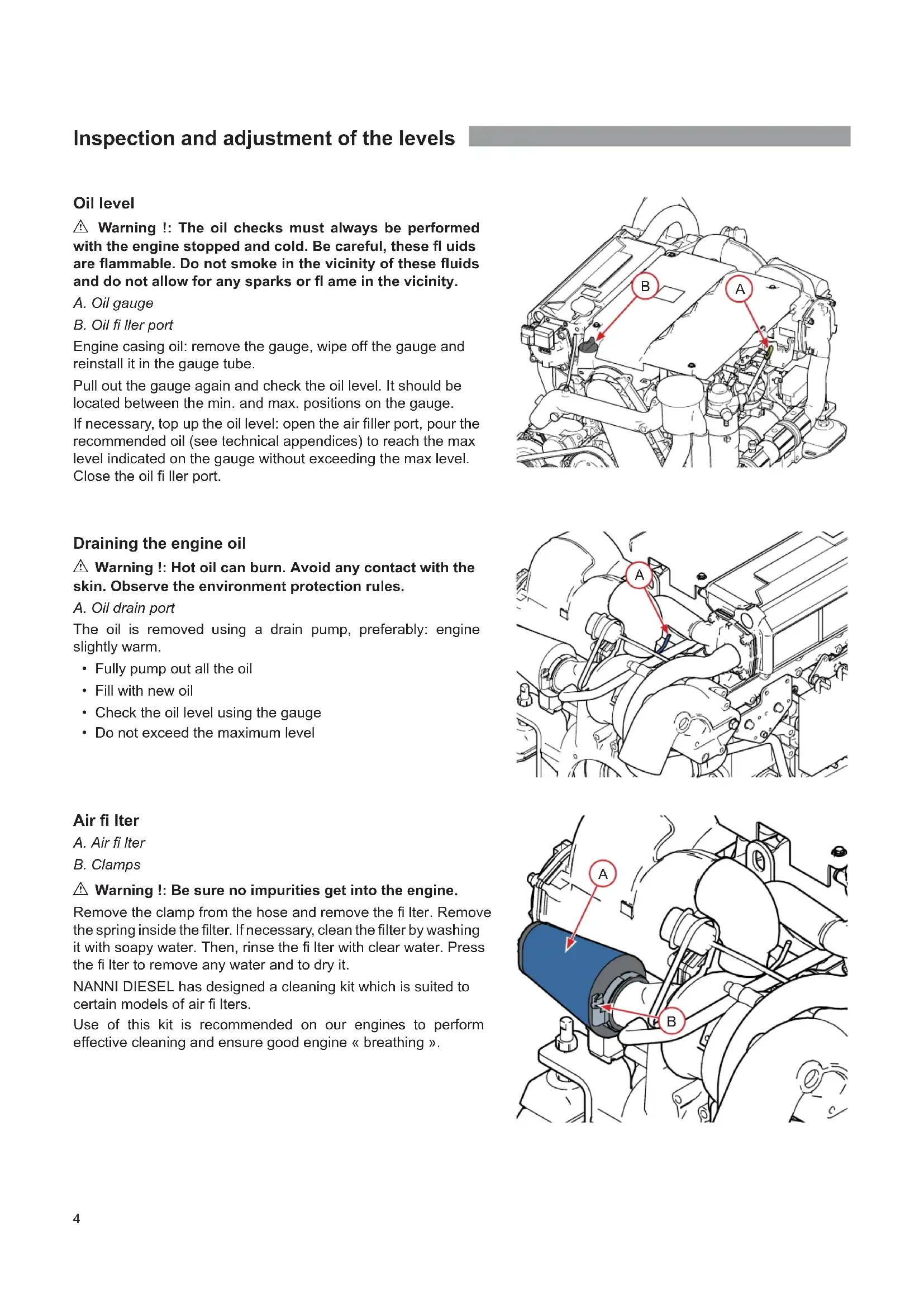
Oil level
Warning !!: The oil checks must always be performed with the engine stopped and cold. Be careful, these fluids are flammable. Do not smoke in the vicinity of these fluids and do not allow for any sparks or flame in the vicinity.
A. Oil gauge
B. Oil filler port
Engine casing oil: remove the gauge, wipe off the gauge and reinstall it in the gauge tube.
Pull out the gauge again and check the oil level. It should be located between the min. and max. positions on the gauge.
If necessary, top up the oil level: open the air filler port, pour the recommended oil (see technical appendices) to reach the max level indicated on the gauge without exceeding the max level. Close the oil filler port.
Draining the engine oil
Warning!: Hot oil can burn. Avoid any contact with the skin. Observe the environment protection rules.
A. Oil drain port
The oil is removed using a drain pump, preferably: engine slightly warm.
Fully pump out all the oil
- Fill with new oil
- Check the oil level using the gauge
- Do not exceed the maximum level
Air fi lter
A. Air fi lter
B. Clamps
Warning!: Be sure no impurities get into the engine.
Remove the clamp from the hose and remove the fi liter. Remove the spring inside the filter. If necessary, clean the filter by washing it with soapy water. Then, rinse the fi liter with clear water. Press the fi liter to remove any water and to dry it.
NANNI DIESEL has designed a cleaning kit which is suited to certain models of air fi Iters.
Use of this kit is recommended on our engines to perform effective cleaning and ensure good engine « breathing ».


Fuel filter
Attention ! : Always sponge up any fuel which may have spilled Observe the environment protection rules.
A. Fuel filter cartridge
The fuel filter is a throw-away type filter. The fireguard envelope and the water probe must be preserved and reinstalled correctly (if equipped). The fire guard must not come into contact with the plastic purge screw.
- Close the fuel valve
- Unscrew the cartridge from the fi Iter head
- Coat the seal of the new cartridge with clean oil
- Screw the new cartridge on the fi liter head, then tighten by hand by 3/4 turn (do not use a tool).
- Reinstall the probe and the purge screw (if equipped). Check the seal
- Open the fuel valve
- Purge the circuit
- Start up the engine and check for any leaks

Zinc anode
Warning!: Perform this operation with the engine stopped and cold.
A zinc anode forms part of the exhaust elbow. It serves as an anticorrosion anode. The anode must be replaced when more than 50% of it has been consumed.
Diameter : 10 mm
Length : 16 mm

Alternator belt
Warning!: Perform this operation with the engine stopped.
A. Alternator
B. Alternator belt
Visually check the belt for excessive wear, frayed cords, etc. If any defect has been found, replace the drive belt. If the belt has chunks missing from the ribs, it should be replaced. Check that it fits properly in the ribbed grooves. Check with your hand to confirm that the belt has not slipped out of the groove on the bottom of the pulley.

Seawater pump
Warning!: Close the seawater intake valve as there is a risk of water penetrating into the engine.
A. Seawater pump
B. Impeller
C. Gasket
- Close the seawater intake valve
- Close the seawater pump cover
- Using a channel lock pliers, remove the worn Impeller
- If the rotor shows any signs of cracks or defects, it should be replaced
Clean the parts preserved - Fit a new rotor by applying a clockwise rotary movement
- Install the seawater pump cover using a new seal
- Open the seawater intake valve
- Start-up the engine and check for any leaks in the circuit

Coolant level
Warning !: When filling the cooling system, the coolant level must be checked after 10 minutes of use since the system purges itself automatically. Top up if necessary.
A. Coolant plug
Turn the filler plug up to its first stop to allow the pressure in the system to escape before removing the plug. Inspect the fluid level.
The level should be between the lower edge of the filler neck and the level pin (if equipped), respectively representing the minimum and maximum level.
Top up if necessary using a fluid comprising 50% water and 50% antifreeze.

Installation inspection
Warning! : Your engine must be installed by an authorised shipyard or a qualified Nanni Industries representative in accordance with the on board assembly instructions.
However, you can check some important points on the installation of the engine. However, your installation can be different than the one that is indicated in this chapter.

1. Engine frame
The engine frame must be solid and able to absorb all the dynamic stress as well as the weight of the engine. It must be connected to the hull by a big a surface area as possible.
The engine must not be at an angle of more than 7^ when the boat is stopped.
2. Propeller shaft
The choice of propulsion system must be made according to the restrictions arising from the engine and the boat.
3. Water exhaust box (waterlock)
The waterlock must be positioned as close to the engine and as low as possible. Its volume must be of 20 litres minimum. The maximum allowable back pressure is 28.7 kPa (4.162 PSI)
4. Hull outlet
The hull outlet must be located 15cm above the water line. The tube between the exhaust box and the hull outlet must form a swan-neck shape to avoid any water getting into the exhaust system through the hull outlet.
5. Anti-siphon valve
This is obligatory on boats whose engine is below the waterline. The anti-siphon valve must be installed at the end of the seawater system before injection in the exhaust elbow and must be positioned above the waterline, between 0.5 and 2 meters.
6. Seawater fi Iter
This must always be positioned at least 15cm above the waterline.
7. Through-hull valve
On yachts and boats that do not go above 12 knots, the water inlet must be turned towards the end of the boat.
On motor boats that go over 12 knots, the water inlet must be turned forwards.
Engine room
The temperature inside the engine compartment must not exceed 50^ with a maximum difference of 20^ with the outside temperature.
Slow boats must have a ventilator fitted. Fresh air from the front is circulated from front to back. The front air intake is located low down at the front of the engine compartment and the outlet high at the back for optimum air circulation (air needed: T4.200: 1520 m³/h, T4.180: 1370 m³/h, T4.165: 1260 m³/h).
The cables and extensions must be securely fastened to the engine and / or on the walls of the engine room (do not let it dangle in the hold or let it exposed to water or moisture).
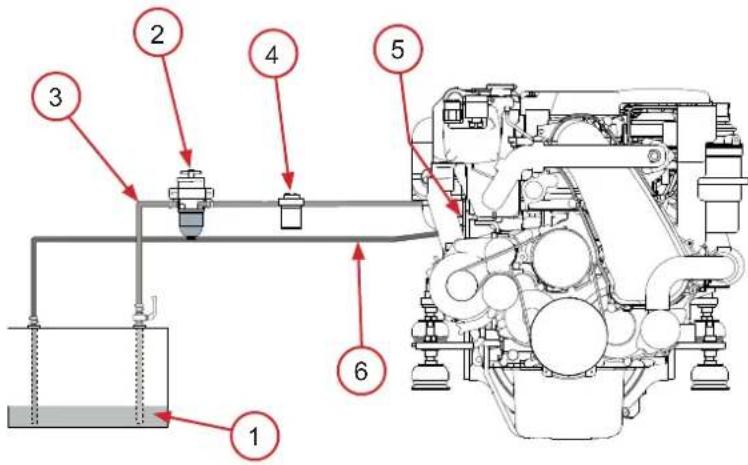
Fuel supply system
The fuel tank of the engine must be placed as possible at the same level or slightly higher than the engine.
The return pipe must be placed under the mini level of the fuel tank.
The fuel pump is capable of sucking the fuel to a height of 0.5m
- Tank
- Prefilter
- Fuel feed pipe 10mm
- Electrical pump (option)
- Engine fuel pump
- Return fuel pipe 010 mm
Electrical installation
An incorrect or faulty electrical installation can cause leakage currents that can affect the galvanic protection of the engine and damage the engine subsequently.
The installer must ensure to take all necessary precautions to protect the engine against corrosion.
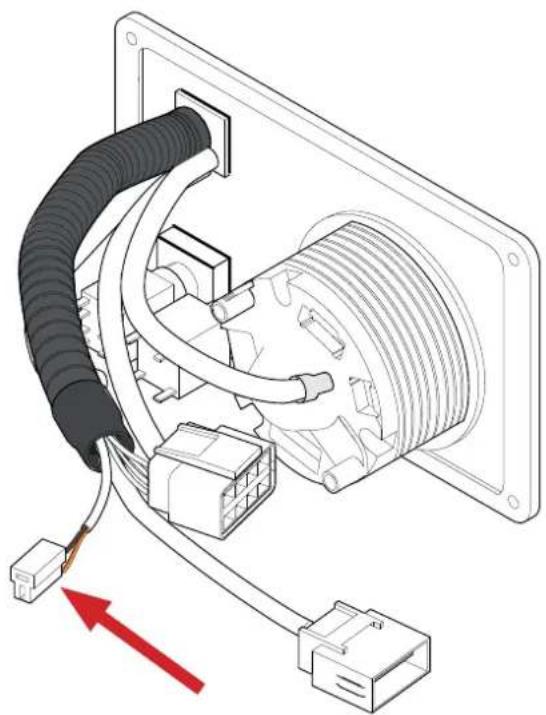
Auxiliary 12V output on instruments panel
The A4, B4 and C4 panels are equipped with an auxiliary output of 12V / 3A.
The interfaces linking the panels to the engine are fitted with a fuse.
Instrument panel
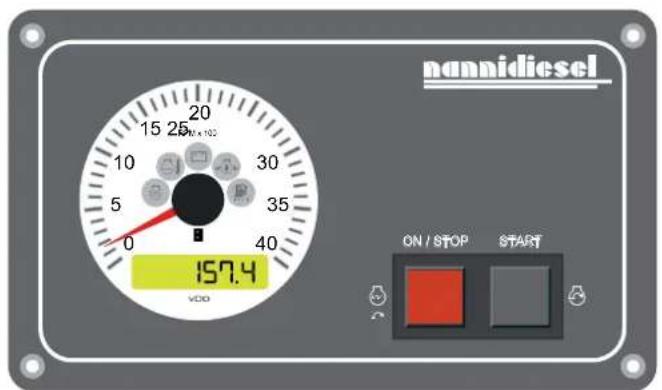
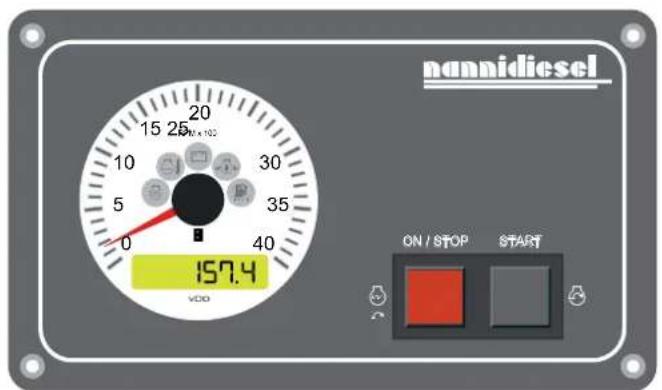
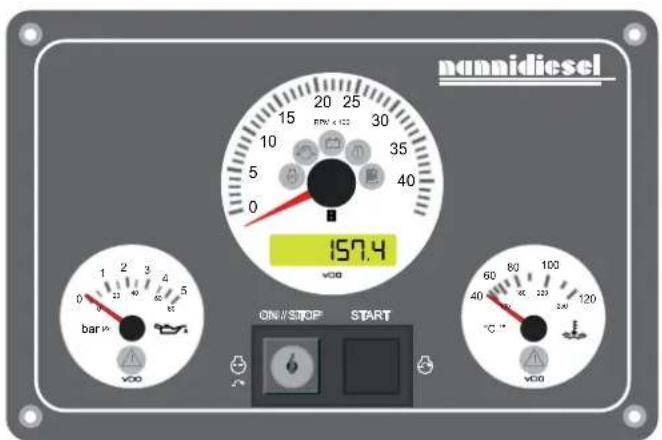
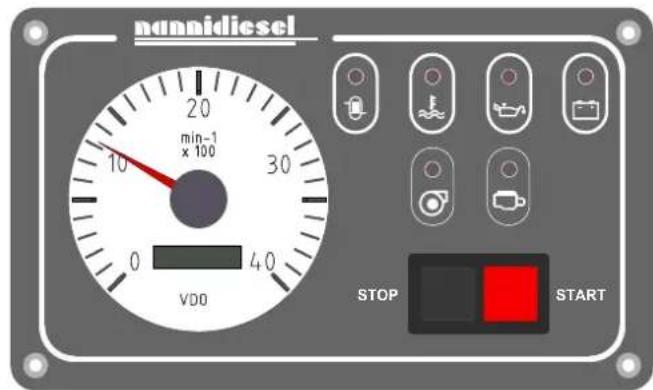
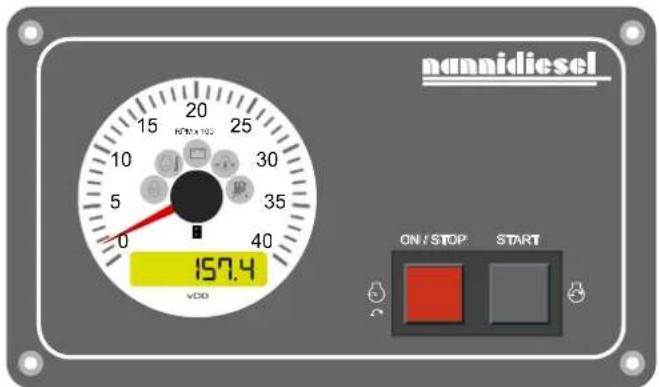
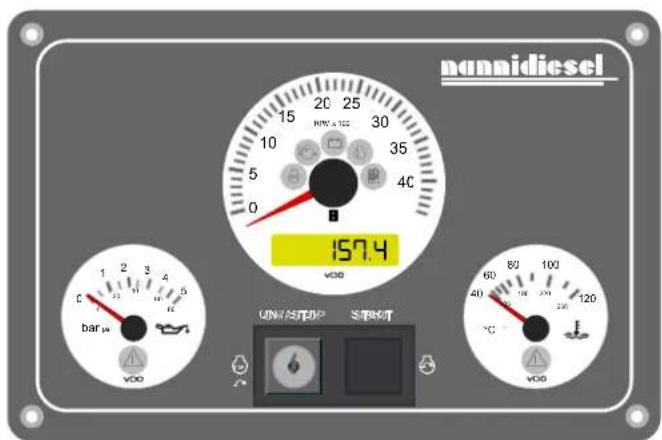
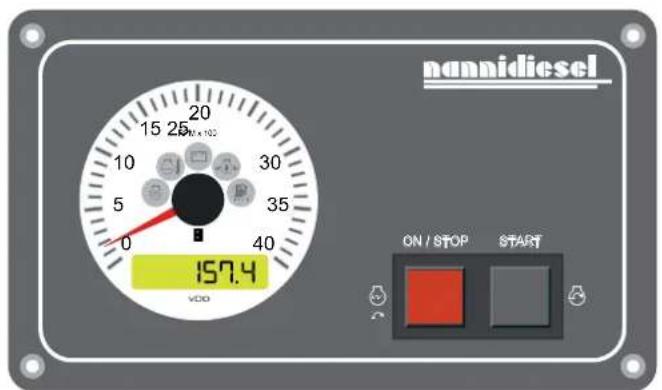
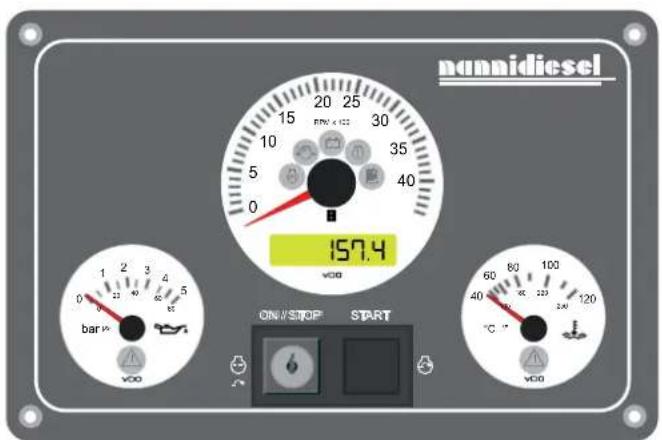
The instrument panel provides you with important information on the engine when it is in operation. Regularly check this information when the engine is running.
2 range of instruments panel are available. Only the position and / or appearance of the instruments and / or the icons vary depending on the type of panel. All panels are not composed of all these elements.
1. Revolution counter
2. Hour-meter/Voltmeter
- Oil pressure indicator and warning light. The light in the dial comes on when the pressure in the lubrication system is too low.
- Coolant temperature indicator and warning light. The light in the dial comes on and an alarm goes off in the event of overheating in the cooling system.


Battery charge. This warning light comes at ignition. If this warning light comes on while the engine is running, this means there is a charging fault in the alternator.

Pre-heating. This light is on when the spark plugs are pre-heating the combustion chambers (if your engine has these).

Water in the diesel filter warning light (optional). This light comes on when there is too much water in the diesel filter.

High pressure turbo. This alert indicator indicates that the air pressure in the turbocharger is too high.

Faulty system. This indicator is lit when there is a failure on the electronic system of the engine. If this indicator comes on, contact an authorised Nanni Diesel dealer.
Operation of an engine equipped with an A4 and / or C4-T panel:
To start the engine :
- Put the throttle in the neutral position.
- Put the key into the ON/STOP ignition.
- Turn the key a quarter turn to the right. All the warning lights will come on and it will make a sound signal. This stage allows you to check that these elements are working properly. After a few moments, only the oil alert and battery charge lights will remain on.
- Press the START button at halfway to start preheating. Hold the button for 5 to 15 seconds, depending on ambient temperature, in order to let the engine preheat. Press fully to start the engine.
Warning! Never press the START button when the engine is running.
Stopping the engine:
Turn the key counter clockwise. The engine switches off and all the warning lights go out.
The operation of the A3 and C3 panel is explained in the user manual reference 970313180 that is also delivered with the engine.

A3 Fly Bridge Common Rail A4 Fly Bridge

C3 Common Rail C4-T

Nanni Industries S.A.S.
11, Avenue Mariott e - Zone Industrielle
BP 107-33260 La Teste France
Tel: +33 (0)5 56 22 30 60
Fax: +33 (0)5 56 22 30 79
E-mail: contact@nannidiesel.com
ISO 9001
BUREAU VERITAS
Certification

© 2009 - Nanni Industries SAS
The images, text and information contained in this document are based on the product's features at the time of publication. Nanni Diesel reserves the right to modify this document without prior notice.
Betriebsanleitung
Dieselmotor
T4.165
T4.180
T4.200
11, Avenue Mariott e - Zone Industrielle
BP 107-33260 La Teste France
Tel: +33 (0)5 56 22 30 60
Fax: +33 (0)5 56 22 30 79
E-mail: contact@nannidiesel.com
ISO 9001
BUREAU VERITAS
Certification

© 2009 - Nanni Industries SAS

A3 Fly Bridge Common Rail A4 Fly Bridge

C3 Common Rail C4-T
Nanni Industries S.A.S.
11, Avenue Mariott e - Zone Industrielle
BP 107-33260 La Teste France
Tel: +33 (0)5 56 22 30 60
Fax: +33 (0)5 56 22 30 79
E-mail: contact@nannidiesel.com
ISO 9001
BUREAU VERITAS
Certification

© 2009 - Nanni Industries SAS
A3 Fly Bridge Common Rail A4 Fly Bridge

C3 Common Rail C4-T
Nanni Industries S.A.S.
11, Avenue Mariotte - Zone Industrielle
BP 107-33260 La Teste France
Tel: +33 (0)5 56 22 30 60
Fax: +33 (0)5 56 22 30 79
E-mail: contact@nannidiesel.com
ISO 9001
BUREAU VERITAS
Certification

© 2009 - Nanni Industries SAS
11, Avenue Mariott e - Zone Industrielle
BP 107-33260 La Teste France
Tel: +33 (0)5 56 22 30 60
Fax: +33 (0)5 56 22 30 79
E-mail: contact@nannidiesel.com
ISO 9001
BUREAU VERITAS
Certification

© 2009 - Nanni Industries SAS
11, Avenue Mariott e - Zone Industrielle
BP 107-33260 La Teste France
Tel: +33 (0)5 56 22 30 60
Fax: +33 (0)5 56 22 30 79
E-mail: contact@nannidiesel.com
ISO 9001
BUREAU VERITAS
Certification

© 2009 - Nanni Industries SAS
A. Smorelie-laensepumper
Motoren skal helst vaere lidt varm

A3 Fly Bridge Common Rail A4 Fly Bridge

C3 Common Rail C4-T
Nanni Industries S.A.S.
11, Avenue Mariott e - Zone Industrielle
BP 107-33260 La Teste France
Tel: +33 (0)5 56 22 30 60
Fax: +33 (0)5 56 22 30 79
E-mail: contact@nannidiesel.com
ISO 9001
BUREAU VERITAS
Certification

© 2009 - Nanni Industries SAS

- Marine Diesel engine
- Inspection and adjustment of the levels
- Oil level
- Draining the engine oil
- Air fi lter
- Fuel filter
- Fuel filter cartridge
- Zinc anode
- Alternator belt
- Seawater pump
- Coolant level
- Coolant plug
- Installation inspection
- Engine frame
- Propeller shaft
- Water exhaust box (waterlock)
- Hull outlet
- Anti-siphon valve
- Seawater fi Iter
- Through-hull valve
- Engine room
- Fuel supply system
- Electrical installation
- Auxiliary 12V output on instruments panel
- Instrument panel
- Revolution counter
- Hour-meter/Voltmeter
- Operation of an engine equipped with an A4 and / or C4-T panel:
- To start the engine :
- Stopping the engine:
- Nanni Industries S.A.S.
- © 2009 - Nanni Industries SAS
- Betriebsanleitung
- Dieselmotor
Brand : Nanni
Model : T4.200
Category : Outboard motor