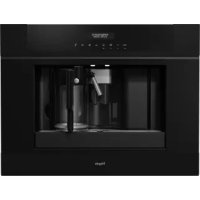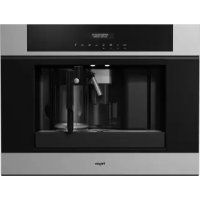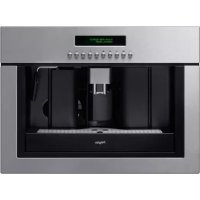
IKM540RVS - Coffee machine Pelgrim - Free user manual and instructions
Find the device manual for free IKM540RVS Pelgrim in PDF.



| Product type | Automatic coffee machine with built-in grinder |
| Brand | Pelgrim |
| Model | IKM540RVS |
| Dimensions (H x W x D) | 45.5 x 59.5 x 36 cm (estimated for built-in) |
| Weight | Approximately 20 kg |
| Power supply | 230 V ~ 50/60 Hz, 1450 W (typical) |
| Pump pressure | 15 bar (estimated) |
| Water tank capacity | 1.8 L (removable) |
| Bean hopper capacity | 250 g |
| Grounds container capacity | 14 doses |
| Main functions | Beans or ground coffee, espresso, long coffee, cappuccino, hot water, steam |
| Grind adjustment | Manual, 7 settings |
| Water quantity adjustment | Programmable per button (short, normal, long) |
| Simultaneous 2 cups function | Yes, for short, normal, and long coffee |
| Control panel | LCD screen, touch buttons |
| Clock programming and automatic start | Yes |
| Adjustable auto shut-off | 1 to 3 hours (adjustable via menu) |
| Programmed descaling | With indicator and automatic cycle |
| Brew unit cleaning | Removable for cleaning with water |
| Steam and cappuccino nozzle | Removable, easy cleaning |
| Cup warming tray | Yes, on top |
| Safety | Auto shut-off, overheat protection |
| Spare parts and repairability | Authorized after-sales service for repairs, original spare parts available |
Frequently Asked Questions - IKM540RVS Pelgrim
User questions about IKM540RVS Pelgrim
0 question about this device. Answer the ones you know or ask your own.
Ask a new question about this device
Download the instructions for your Coffee machine in PDF format for free! Find your manual IKM540RVS - Pelgrim and take your electronic device back in hand. On this page are published all the documents necessary for the use of your device. IKM540RVS by Pelgrim.
USER MANUAL IKM540RVS Pelgrim
Manual coffee machine
Pelgrim
NL
Handleiding 3-36
F
1 Your espresso coffee maker
1.1 Description 106-107
1.2 Control panel 108
1.3 Introduction 109
2 Safety instructions
Important matters 110
3 Use
3.1 Preparation 111-112
3.2 Operation 113-121
4 Maintenance
4.1 Cleaning and maintenance 122 - 124
4.2 Changing and setting the menu parameters 125-129
5 Messages
What to do if... 130-131
6 Faults
Problems that can be resolved before calling the service centre 132 - 134
7 Installation instructions
7.1 Important matters 135
7.2 Building-in 136-137
8 Appendices
8.1 Disposal of appliance and packaging 138
8.2 Technical information
1.1 Description
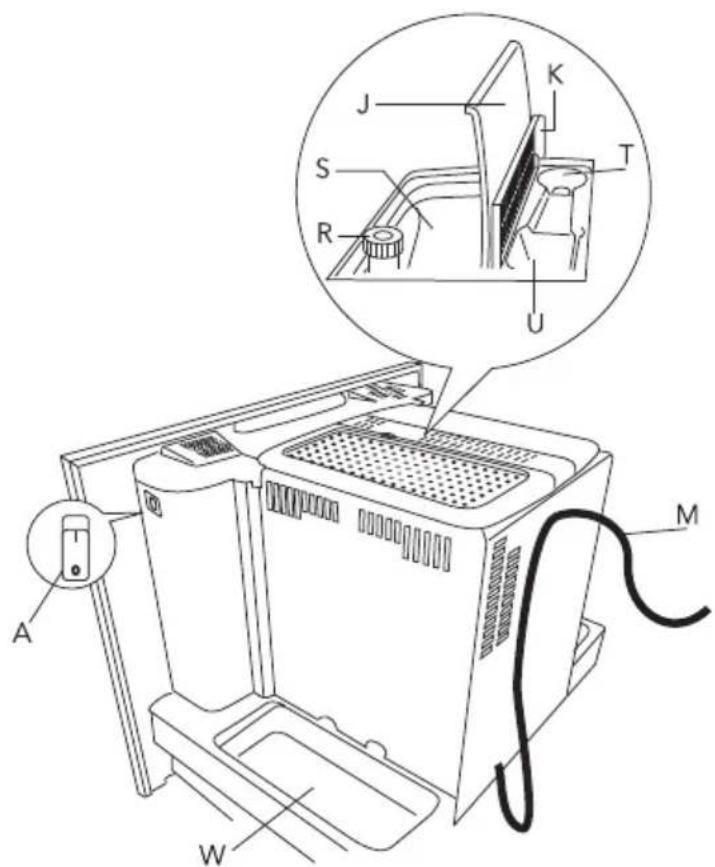
1 Your espresso machine
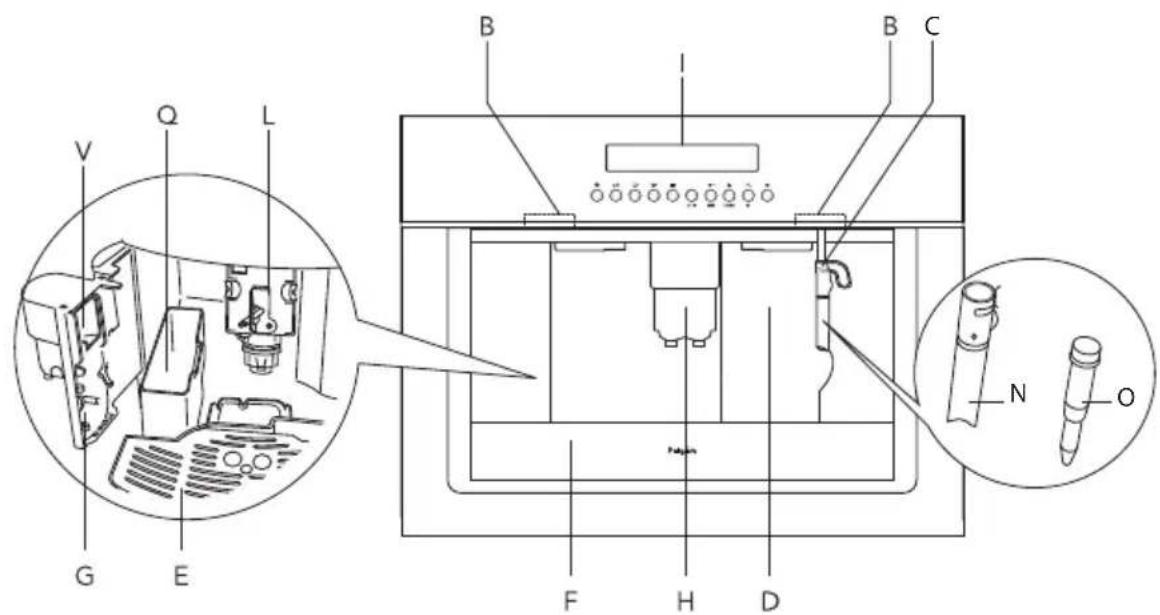
A. Main ON/OFF switch
B. Handles
C. Steam spout
D. Water tank (removable)
E. Cup tray
F. Drip tray (removable)
G. Service door
H. Coffee spout (adjustable in height)
I. Control panel
J. Bean container lid
K. Central ground coffee lid
L. Infuser
M. Power cable
N. Cappuccino maker (removable)
O. Cappuccino maker nozzle (removable)
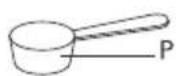
P. Measuring spoon for foreground coffee
Q. Coffee grounds container (removable)
R. Grinding coarseness regulator
S. Coffee beans container
T. Compartment for measuring spoon
U. Filling chute fot foreground coffee
V. Mobile drawer
W. Accessories holder (left and right)
1.2 Control panel
1


234561178910
- Display
- Appliance on/off button
- Coffee taste selection button
- One or two cups short coffee button
- One or two cups standard coffee button
- One or two cups long coffee button
- Button to activate or deactivate menu parameter setting mode
- Button to select ground coffee or to display the next parameter on the menu
- Button to rinse the appliance or to change the menu parameters
- Button to select hot water or OK to confirm
- Steam button
1.3 Introduction
This espresso machine will make delicious cups of coffee, espresso and cappuccino. You can customise the settings of the machine to suit your personal preferences and tastes.
This manual describes how to make optimum use of the espresso machine. Besides information on how to operate the machine, you will also find background information that may come in handy when using this appliance.
Coffee has been used in the factory to test the appliance and it is therefore completely normal that there are traces of coffee in the mill. This appliance is however guaranteed to be new.
Store the user manual in a safe place. This will ensure that any subsequent users also benefit from it.
Enjoy your espresso machine!
Important matters
As with any appliance, there are a number of matters that you should pay attention to.
- This appliance is intended for domestic use only (around 3000 cups a year). Any other use is considered improper and in that case no guarantee will be given.
- This appliance is designed to "make espresso coffee" and "heat drinks". Use it with care to avoid scalds from the water and steam jets or through incorrect use.
- Do not put frozen or caramelised coffee beans into the bean container, only roasted coffee beans! Remove foreign bodies from the coffee beans. Otherwise no guarantee can be given.
- Do not lean or hang on the machine when it has come out of the cabinet and do not place heavy or unstable objects on the machine.
- The manufacturer is not liable for damage caused by improper, incorrect or unreasonable use of the appliance.
- When using the appliance, do not touch the hot surfaces. Use the knobs or handles.
- Persons (including children) with reduced physical, sensory or mental capabilities, or lack of experience and knowledge, should be supervised when they use the appliance.
- Never let children play with the appliance.
- Only ask for original spare parts to be used. Failure to respect the above could reduce the safety of the appliance.
- Do not put objects containing liquids, inflammable or corrosive materials on the machine.
Use the accessories holder to contain coffee accessories (for example coffee beans). - The parts which could come into contact with coffee or milk conform to the provisions of the EEC directive 1935/2004 relating to materials suitable for contact with foodstuffs.
- This appliance is marked according to the European directive 2004/108/EC on Waste Electrical and Electronic Equipment (WEEE).
3.1 Preparation Using for the first time
The first time you switch on the appliance and every time that it is plugged in, the appliance makes a SELF-DIAGNOSIS operation when you press the main ON/OFF switch (see A on page 106). Then the appliance switches off. To turn it on, press the on/off button on the control panel.
-
The first time you use the appliance, select the language. Press the main ON/OFF switch on the right side of the appliance (see A on page 106); the lights on the front side and the display go on. Wait for the appliance to display PRESS OK TO INSTALL ENGLISH. Press the OK button for at least 3 seconds until the appliance displays ENGLISH INSTALLED. The appliance then displays the setting message in English.
-
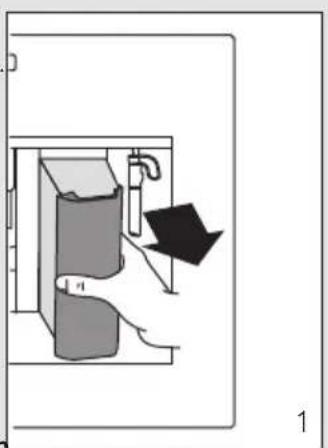
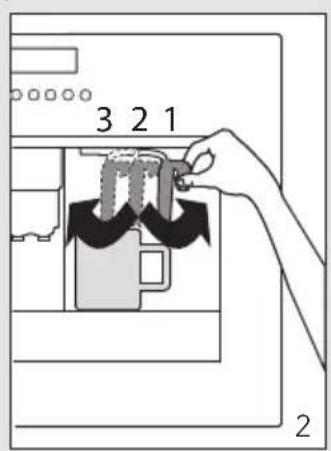
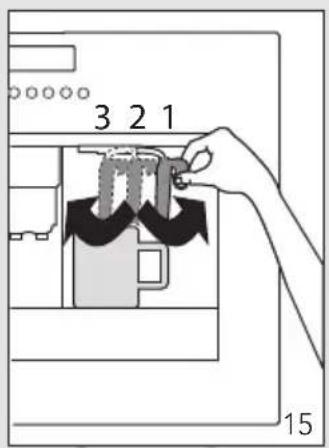
After a few seconds, the appliance displays FILL TANK. To fill, remove the tank (fi g. 1), rinse and fill with fresh water. Never exceed the MAX line. (When removing the tank, the cappuccino maker must always be positioned outwards (fi g. 2, position 1), otherwise the tank cannot be removed). Put the tank back and push as far as it will go. Move the cappuccino maker towards the centre of the appliance and place a cup underneath it (fi g. 2, position 3).
Only fi ll the water tank with cold water. Never fi ll it with other liquids such as mineral water or milk.
To ensure good, aromatic coffee at all times, you should: - change the water in the water tank every day; clean the water tank with normal water for rinsing (not in the dishwasher) at least once a week. Then rinse off with fresh water.


3 Use

- The appliance now displays PRESS OK. Press the OK button. After a few seconds, a little water runs out of the cappuccino maker. When the cup contains about 30cc of water, the water stops delivering.
- The appliance now displays TURNING OFF PLEASE WAIT and it goes off.
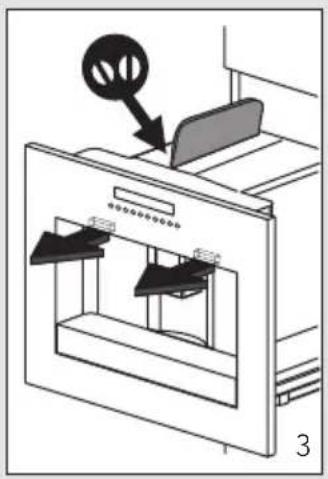
- Extract the appliance by pulling it outwards taking care to use the special handles, open the left lid and fill the container with coffee beans (fi g. 3), then close the lid and push inwards the appliance.

To prevent malfunction, never fi ll with ground coffee, freeze dried coffee, caramelised beans or anything else which could damage the appliance.
-
Press the on/off button ① . The appliance displays HEATING UP PLEASE WAIT... to indicate that preheating is underway.
-
When preheating is complete, the appliance displays: RINSING and performs an automatic rinse cycle (a little hot water runs out of the spouts and is collected in the drip tray beneath).

If you want to make a short coffee (less than 60 cc), to make it hotter, fi ll the cup with this hot rinsing water fi rst. You can also use the button (see paragraph 3.2.2 on page 114, 'Tips to make hotter coffee').
- The appliance now displays the ready message READY STANDARD TASTE.

When using the appliance for the first time, 4-5 cups of coffee need to be made before the appliance starts to give satisfying results.
3.2 Operation
3.2.1 Preparing coffee (using coffeeseans)
-
The appliance is preset to make coffee with a normal taste. You can also choose coffee with an extra-mild mild, strong or extra-strong taste. To choose the required taste, press the button. The selected coffee taste will be displayed.
-
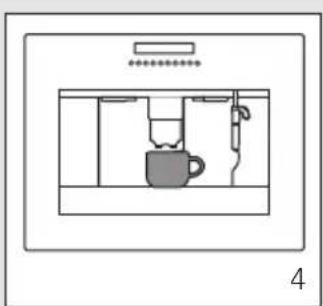
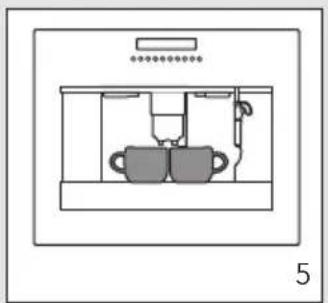
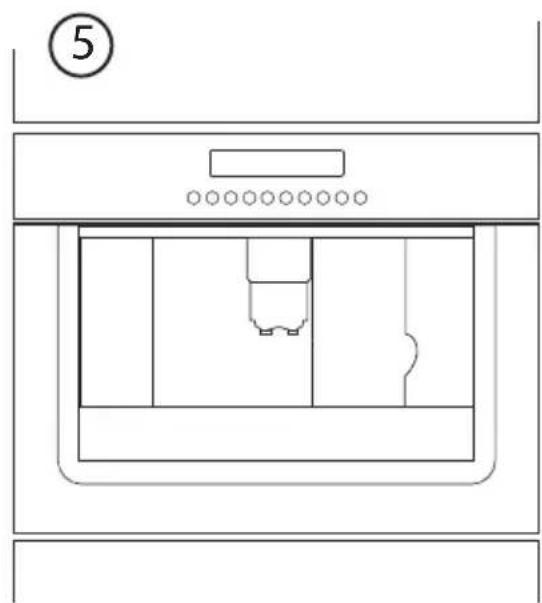
Place 1 cup under the spouts to make 1 coffee (fi g. 4) or 2 cups for 2 coffees (fi g. 5).
By moving the dispenser up or down (fi g. 6), you can adjust the height of the dispenser to suit the height of your cup so as to reduce heat loss and coffee splashes.
For a creamier coffee, lower the spouts to bring them as close to the cups as possible (fi g. 6).
- Press the button to make a short coffee, the button for a standard coffee and the button for a long coffee.

To make 2 coffees, press the button twice (within 3 seconds). To change the quantity of coffee delivered automatically into the cup, follow the instructions at paragraph 3.2.3 on page 116. (The appliance now grinds the beans and starts running off the
3 Use
coffee into the cup. Once the desired quantity has been reached, the appliance automatically stops delivering the coffee and ejects the grounds into the special container).
-
After a few seconds, the message that the machine is ready is displayed again and you can make another coffee.
-
To turn the appliance off, press the on/off button. Before going off, the appliance performs an automatic rinse cycle (a little hot water runs out from the spouts and is collected in the drip tray beneath). Take care to avoid scalds.
Once switched off, the lights don't shut off immediately and the cooling span motor operates to avoid condensation into the housing. After about 10 minutes, the appliance switches completely off.
3.2.2 Notes
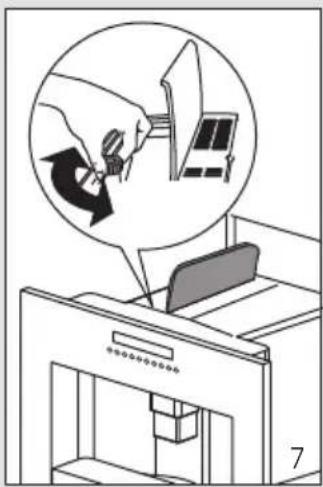
- If the coffee is delivered a drop at a time or not at all, turn the grinding coarseness regulator (fig. 7) one click clockwise (see paragraph 3.2.4 on page 117, 'Regulating the coffee mill') Turn one click at a time until the coffee is delivered satisfactorily.
- If the coffee is delivered too fast and is not creamy enough, turn the grinding coarseness regulator (fi g. 7) one click anticlockwise (see paragraph 3.2.4 on page 117, 'Regulating the coffee mill'). Avoid turning the grinding coarseness regulator excessively, otherwise the coffee may run out in drips when you select 2 cups.
- Tips to make hotter coffee
If 2/3 minutes have passed, since you last made coffee, before making coffee again you must preheat the infuser by pressing the button Run off the water into the underlying drip tray or alternatively use this water to fill (and then empty) the cup to be used for the coffee, so as to preheat it.
3 Use

Unless preheated, do not use cups that are too thick, as they will absorb too much heat.
Use cups that have been preheated by rinsing them with hot water. You can use the button
While the appliance is making the coffee, delivery can be stopped at any time by pressing the button as previously selected.
- As soon as the delivery is complete, to increase the quantity of coffee, simply press and hold the button, or as previously selected, until the desired quantity is reached (this operation must be performed within 3 seconds from when the coffee delivery from the spouts ceases).
- When the appliance displays FILL TANK the water tank must be refilled or the appliance will not make coffee. (It is normal for there to be a little water left in the tank when the message is displayed).
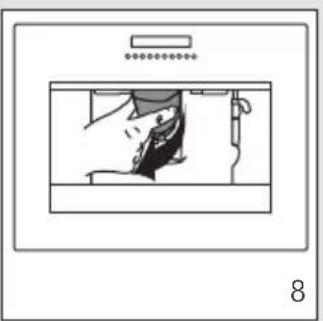
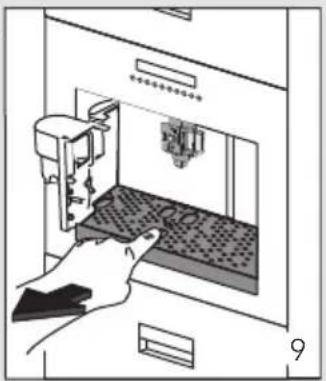
- The appliance counts the number of coffees made. Every 14 single coffees (or 7 doubles) the appliance displays EMPTY GROUNDSC CONTAINER, indicating that the grounds container is full and must be emptied and cleaned. Until the grounds container has been cleaned, the appliance continues to display the message and cannot make coffee. To clean, open the service door at the front by pulling the coffee spout (fi g. 8), remove the drip tray (fi g. 9), empty and clean.
3 Use

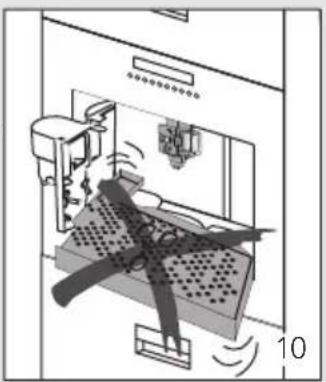
When proceeding, always completely extract the drip tray, to avoid that it falls when removing the grounds container (fi g. 10). Empty the grounds container and clean thoroughly, making sure all residues deposited on the bottom are removed.

When removing the drip tray, the grounds container must be emptied, even if it is not completely full. If this is not done, when next making coffee the grounds in the container may exceed the maximum level and block the appliance.

While the appliance is running off coffee, never remove the water tank. If it is removed, the appliance will not be able to make the coffee. If the appliance malfunctions, do not contact the service centre straight away. The problem can almost always be resolved by following the instructions indicated on pages 130 until 134. If this is not the case, or for further explanations, contact the customer service.
3.2.3 Changing the quantity of coffee in the cup
The appliance is factory preset to automatically deliver the following quantities of coffee:
- Short (when the button pressed);
- Standard (when the button pressed);
- Long (when the button is pressed);
To change these quantities, proceed as follows:
- Press the button corresponding to the quantity you want to change, for at least 8 seconds until the message PROGRAM QUANTITY is displayed.
- When the coffee in the cup reaches the required level, press the same button again to memorise the new amount.

3.2.4 Regulating the coffee mill
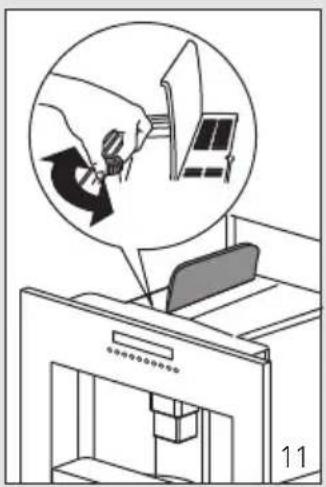
However, after making the first coffees, if you find that the coffee delivery is either too fast or too slow (in drips), the grinding coarseness regulator can be adjusted (fi g. 11).
The grinding coarseness regulator must only be turned when the coffee mill is on.
Turning it 1 click (1 number) clockwise speeds up the coffee delivery (without drips). Turning it 1 click anticlockwise slows down the delivery, giving a creamier appearance to the coffee.
These adjustments will only be evident after at least 2 cups of coffee have been run off.
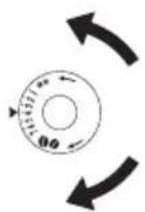
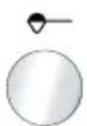
- Turn anticlockwise to obtain finer ground coffee, slower delivery and a creamier appearance.
- Turn clockwise for coarser ground coffee and faster delivery (not a drop at a time).
3.2.5 Preparing espresso coffee using ground coffee (instead of beans)
- Press the button to select the ground coffee function. This disables the coffee mill function. The appliance displays READY PRE-GROUND.
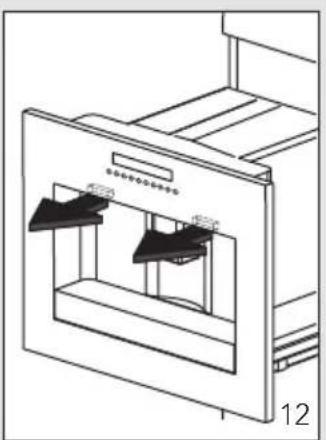
- Extract the appliance by pulling it outwards taking care to use the special handles (fi g. 12).
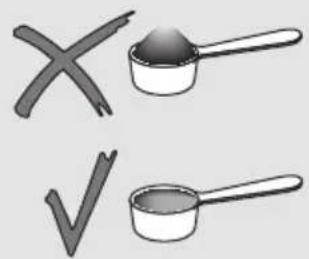
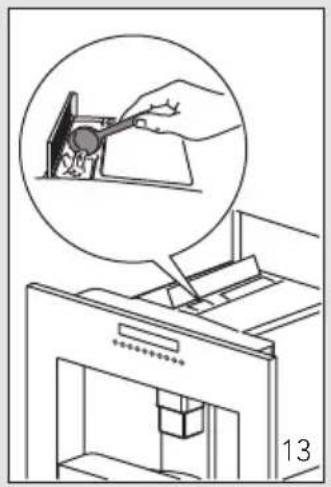
- Lift the central lid and place one or two levels measure of ground coffee in the funnel (see fi g. 13). Close the lid, push the appliance to replace it and proceed as described in paragraph 3.2.1 on page 113 ('Preparing coffee').
3.2.6 Notes

- You can make just one or two coffees at a time by pressing the button , or only once or twice (within 3 seconds).
- Never add the ground coffee when the appliance is off to avoid it being dispersed inside the appliance.
- Never add more than two levels measured scoop, otherwise either the appliance will not make the coffee, the ground coffee will be lost inside the appliance, dirtying it, or the coffee will run off in drips and the message GROUND TOO FINE ADJUST MILL AND PRESS OK will be displayed. A little water comes out from the steam spout.
- When dosing the quantity of coffee to be added, use the measure supplied only.
-
Use ground coffee for espresso coffee makers only. Do not use coffee beans, freeze-dried coffee or other materials that could damage the appliance.
-
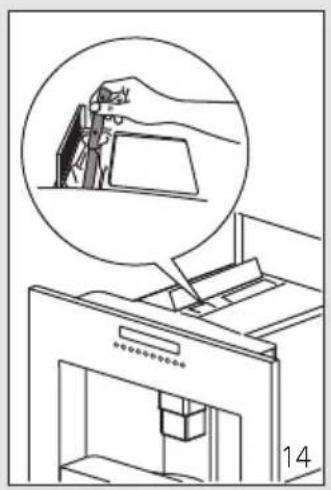
If the funnel blocks due to moisture inside the appliance or if more than two measuring scoops of pre-ground coffee has been used, use a knife to push the coffee down (fig. 14). Then remove and clean the infuser and appliance as described in paragraph 4.1.1 and 4.1.2 on pages 122, 123 and 124.
3 Use
Once the coffee has been delivered, to go back to making coffee using beans, deactivate the ground coffee function by pressing the button again (the coffee mill is enabled for operation again).
3.2.7 Hot water delivery
Always make sure the appliance is ready.
- Move the cappuccino maker towards the centre of the appliance and place a container under it (fi g. 15, position 3).
- Press the button. The appliance displays HOT WATER PRESS OK.
- Press the button (OK) again to confirm.
- Hot water runs off from the cappuccino maker and starts to fill the container underneath. You should not run off hot water for more than 2 minutes at a time.
- To interrupt the hot water delivery, press the button again and place the cappuccino maker in the original position near the centre of the appliance.
3.2.8 Preparing cappucinos (using steam)
- Move the cappuccino maker outwards and place an empty cup under the cappuccino maker (fig. 15, position 2).
- Press the steam button. The appliance displays STEAM PRESS OK.
- Press the OK button. Allow the steam mixed with water to run off for a few seconds until steam only is given off.
- To interrupt the steam delivery, press the steam button again.
- Empty the container. Then fill it with about 100ml of milk for each cappuccino to be prepared. In choosing the size of the container, bear in mind that the milk doubles or triples in volume. You are recommended to use semi-skimmed milk at refrigerator temperature.
3 Use
- Dip the cappuccino maker into the recipient containing the milk, taking care not to immerse the raised line on the cappuccino maker (indicated by the arrow in fig. 16). Press the steam button (beware of burns) and the OK button. Steam is discharged from the cappuccino maker, giving the milk a creamy frothy appearance. To obtain a creamier froth, dip the cappuccino maker into the milk and rotate the container with slow movements from the bottom upwards. (You should not discharge steam for more than two minutes at a time).
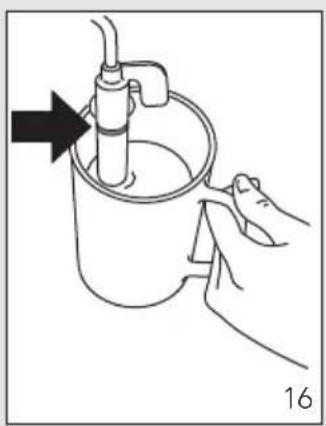
- Once the required amount of frothed milk is reached, interrupt the steam delivery by pressing the steam button
- Prepare the coffee as described above, using large enough cups, then fill with the frothed milk prepared previously. The cappuccino is ready. Sweeten to taste and, if desired, sprinkle the froth with a little cocoa powder.

Always clean the cappuccino maker immediately after use. Proceed as follows:
- Discharge a little steam for a few seconds by pressing the steam button. This empties any milk left inside the steam spout.

To guarantee hygiene, you are recommended to follow this procedure each time you make cappuccino to avoid milk stagnating in the milk circuit.
-
Press the steam button and the OK button.
-
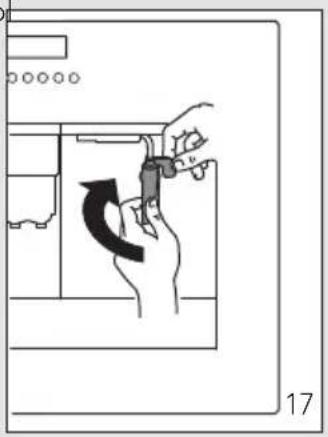
Wait a couple of minutes for the cappuccino maker to cool down. Then, with one hand, hold the cappuccino spout handle fi rm and with the other unscrew the cappuccino maker itself by rotating clockwise and extracting downwards (fi g. 17).
3 Use
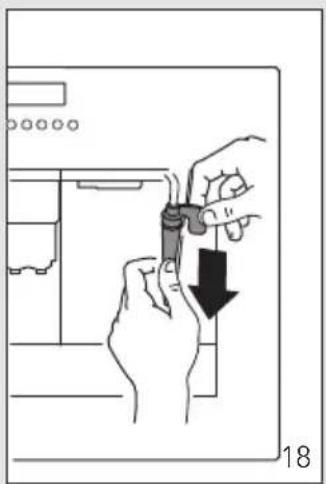
- Remove the nozzle from the steam spout by pulling it downwards (fi g. 18).
- Carefully wash the cappuccino maker and steam nozzle in warm water.
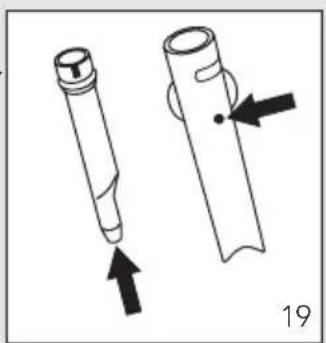
- Make sure the two holes shown in fig. 19 are not blocked. If necessary, clean with a pin.
- Replace the steam nozzle by inserting it and vigorously turning it upwards into the steam spout.
- Replace the cappuccino maker by pushing it upwards and turning it anticlockwise.
4.1 Cleaning and maintenance
Before performing any cleaning operations, turn the appliance off by pressing the on/off button ① on the control panel and leave the appliance to cool down. Never immerse the espresso machine in water. It is an electrical appliance. Do not use solvents or abrasive cleaning products to clean the appliance. A soft damp cloth will suffice. Never wash any of the components of the appliance in a dishwasher.
4.1.1 Cleaning the espresso machine
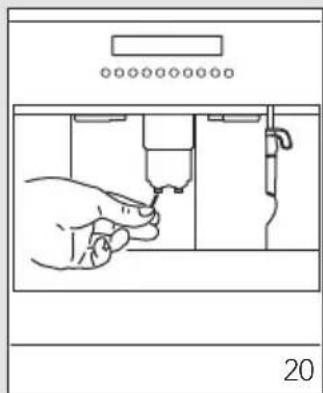
Clean the grounds container (as described on page 115) whenever it requires emptying. The water tank should also be cleaned regularly. The drip tray is fitted with a level indicator (red) showing the level of water it contains. When the indicator starts to become visible (a few millimetres under the drip tray), the drip tray must be emptied and cleaned. Check that the holes in the coffee spout are not blocked. To unblock them, scrape the dry coffee residues away with a needle (fi g. 20).
4.1.2 Cleaning the infuser
The infuser must be cleaned regularly to avoid the build-up of coffee encrustations which could cause malfunction. Proceed as follows:
- Turn the appliance off by pressing the on/off button ① on the control panel (do not switch off the main switch or unplug) and wait for the display to go off).
- O pen the service door (see fi g. 8 on page 115).
- Remove the drip tray and the grounds container (fi g. 9 on page 115) and clean.
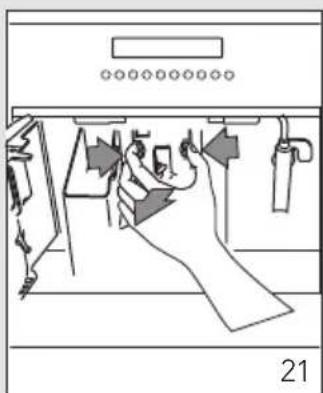
- Press the two red release buttons on the infuser sideways and towards the centre (fig. 21) and pull it out.
4 Maintenance

The infuser can only be removed when the appliance is off (by pressing the on/off button ① Attempting to remove the infuser with the appliance on may cause serious damage.

Wash the infuser under running water, without using detergents. Never wash the infuser in the dishwasher.
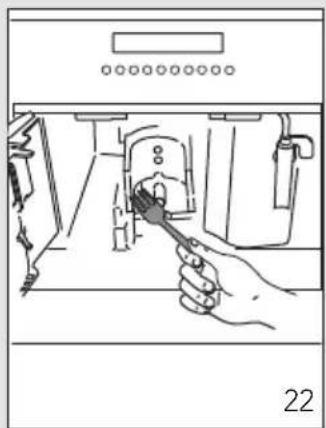
- Clean the inside of the appliance thoroughly. To remove coffee encrustations from the inside of the appliance, scrape with a plastic or wooden fork (fi g. 22).
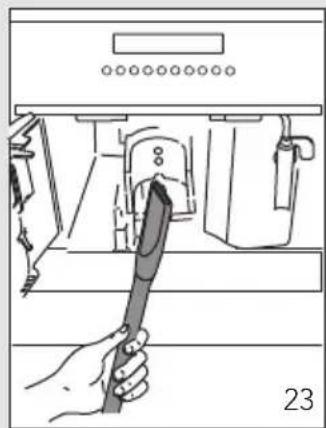
- Vacuum up the residues with a vacuum cleaner (fi g. 23).
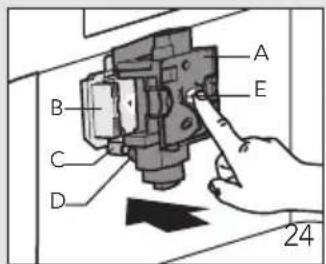
- Replace the infuser (A) by sliding it onto the supports (B) and pin (C) at the bottom (D), then push the PUSH symbol (E) fully in until it clicks into place (fi g. 24).
4 Maintenance
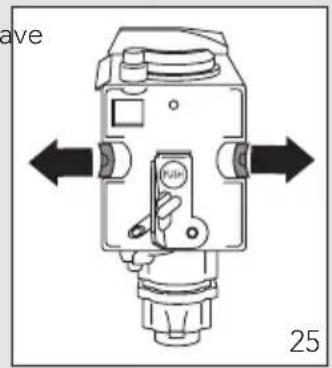
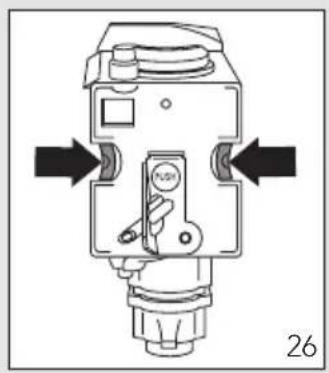
- After having heard the click, check that the red buttons have snapped out, otherwise the door cannot be closed.
The two red buttons have snapped out correctly (CORRECT, fig. 25).
The two red buttons have not snapped out (WRONG, fi g. 26).

Notes
-
If the infuser is not inserted correctly until it clicks into place and the two red buttons have not snapped out, the service door cannot be closed.
-
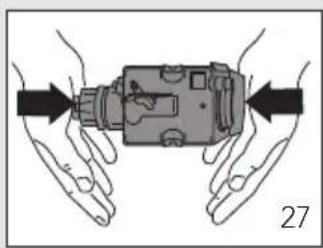
If it is hard to insert the infuser, before inserting it squeeze it to the right size by pressing it forcefully from the top and bottom simultaneously, as shown in fig. 27.
- If it is still hard to insert the infuser:
Leave it out of the appliance, place the drip tray, close the service door, switch the main switch on the back of the appliance to 0 and then to I again.
Wait for all the lights to go off, then open the door, remove the drip tray and replace the infuser.
o Replace the drip tray, complete with the grounds container.
Close the service door.
4.2 Changing and setting the menu parameters.
The following menu parameters and functions can be changed by the user:
Clock;
- Auto-start time;
- Dscaling process;
- Coffee temperature;
Length of time the appliance remains on;
Water hardness;
Factory default values.
4.2.1 Setting the clock
To set the clock, proceed as follows:
- Press the MENU button then press the NEXT button repeatedly until the appliance displays CLOCK.
- Press the CHANGE button to set the clock. (If you hold the CHANGE button down, the time is changed rapidly).
- Press the OK button to confirm the value.
- Press the MENU button to exit the programming mode or NEXT to change other parameters.
- When the appliance is in stand-by, you can see the hour by pressing one of the buttons (except the on/off button).
4.2.2 Setting auto-start time
This enables the time the appliance will come on automatically to be programmed.
- Make sure the clock on the appliance is set as described above.
- Press the MENU button then press the NEXT button repeatedly until the appliance displays START TIME.
- Press the CHANGE button to set the auto-start time. (If you hold the CHANGE button down, the time is changed rapidly).
- Press OK to confirm the value.
- Press NEXT once and the appliance displays the message AUTO-START NO.
- Press the CHANGE button to modify the function (the appliance displays AUTO-START YES).
- Press the OK button to activate auto-start.
- Press the MENU button to exit the programming mode or the NEXT button to change other parameters.
4.2.3 Dscaling
Over time, the continuous heating up of the water used to make the coffee leads to lime scale building up in the inner circuits of the appliance. When the appliance displays the message DESCALE you should perform the descale cycle.
Proceed as follows:
-
Make sure the appliance is ready.
-
Press the MENU button. Then press the NEXT button repeatedly until the appliance displays DESCALE NO.
-
Press the CHANGE button and the appliance displays the message DESCALE YES.
-
Press the OK button to start the descale programme.
-
The appliance displays ADD DESCALER PRESS OK.
-
Empty the water tank and pour in the contents of the bottle of descaler supplied with the machine and fill with fresh water up to the MAX level. For subsequent descending operations, descending solution can be purchased from authorised technical service centres.

Make sure splashes of descaler do not fall onto surfaces sensitive to acid such as marble, limestone and glaze.
- Place a container with a minimum capacity of 1.5 litres under the cappuccino maker (fig. 2 on page 111).
- Press the OK button. The appliance displays APPLIANCE IN DESCALE.
- The descending solution will run out of the cappuccino maker and start to fill the container underneath.
- The descale programme automatically performs a series of run offs and pauses to remove lime scale deposits from inside the coffee maker.
- After about 30 minutes, the appliance displays RINSING FILL TANK. The appliance must now be rinsed through to eliminate residues of descending solution from inside the appliance.
- Remove the water tank, rinse and fill with clean water.
- Reposition the tank: the appliance displays RINSING PRESS OK.
- Empty the collection container (under the cappuccino maker) full of liquid and then put it back under the cappuccino maker.
4 Maintenance
- Press the OK button. Hot water is run off from the cappuccino maker into the container below and the appliance displays RINSING.
- When the water tank is empty, the appliance displays the message RINSING COMPLETE PRESS OK BUTTON.
- Press the OK button and refill the water tank with clean water.
- The descale programme is now terminated and the appliance is ready to make coffee again.
If the descending cycle is interrupted before completion, the appliance continues to display the descale message and the programme must be started again from the beginning.

Failure to descale the appliance regularly invalidates the guarantee.
4.2.4 Changing the coffee temperature
To change the temperature of the coffee, proceed as follows:
- Press the MENU button. Then press the NEXT button repeatedly until the appliance displays TEMPERATURE MEDIUM.
- Press the CHANGE button until the appliance displays the required coffee temperature.
- Press the OK button to confirm the temperature selected.
- Press the MENU button to exit the programming mode or NEXT to change other parameters.
4.2.5 Changing the length of time the appliance remains on
The appliance is factory preset to go off automatically one hour after the last coffee has been made. The number of hours the appliance remains on can be increased as follows:
- Press the MENU button. Then press the NEXT button repeatedly until the appliance displays OFF AFTER 1 HOUR.
- Press the CHANGE button to change the number of hours the appliance remains on.
- Press the OK button to confirm the value.
- Press the MENU button to exit the programming mode or NEXT to change other parameters.
4.2.6 Setting the water hardness
The DESCALE message is displayed after the appliance has been operated for a factory set period of time calculated on the basis of the maximum quantity of lime scale which may be contained in the water used. If necessary, this period of operation can be extended, making descending less frequent, by programming the appliance based on the actual lime content in the water used. Proceed as follows:
- Remove the "Total Hardness Test" strip (in front of your manaul). Then dip it fully in the water for a few seconds. Remove it and wait around 30 seconds (until it changes colour and a number of red dots are formed). For example, if there are 3 red squares on the test strip, you must set the water hardness level to 3.

If you no longer have a water hardness test, you can find the data in the table below.
- Press the MENU button. Then press the NEXT button repeatedly until the appliance displays WATER HARDNESS 4.
- Press the CHANGE button repeatedly until the number coincides with the number of red squares on the test strip.
- Press the OK button to confirm the value. The coffee maker is now programmed to provide the descending warning when necessary, based on the actual hardness of the water.

Information on the hardness of the water in your area can be obtained from the local water board. In the table below you can find the water hardness setting your machine requires.
| German hardness French | ch hardness Water hardness | espresso maker |
| 0 - 6 dH 0 -11 fH 1 | ||
| 7 - 13 dH 12 - 17 fH | 2 | |
| 14 - 20 dH 18 - 36 fH | 3 | |
| > 21 dH > 37 fH 4 |
4.2.7 Resetting factory default settings
If you change the original values, the factory default values can be reset as follows:
- Press the MENU button. Then press the NEXT button repeatedly until the appliance displays RESET TO DEFAULT NO.
- Press the CHANGE button and the appliance displays RESET TO DEFAULT YES.
- Press the OK button to reset the factory default values.
- Press the MENU button to exit the programming mode or NEXT to change other parameters.
4.2.8 Changing the language
To change the language, proceed as follows:
- Press the CHANGE button for at least 5 seconds until the appliance displays: PRESS OK TO INSTALL ENGLISH.
- Then press the OK button for at least 3 seconds to confirm. The appliance then displays the setting message in English.
5 Messages
What to do if...
| MESSAGE MEANING WHAT TO DO | ||
| FILL TANK The water tank is empty or is positioned incorrectly. The tank is dirty or encrusted with lime scale. | Fill the water tank as described on page 111 (fi g. 1) and insert it fully. Rinse or descale the tank. | |
| GROUND TOO FINE ADJUST MILL AND PRESS OK | The coffee runs off too slowly. The appliance cannot make coffee. | Turn the grinding regulator one click clockwise (see 3.2.4 on page 117). Press the OK button. |
| EMPTY GROUNDSC CONTAINER | The grounds container is full. | Empty the grounds container and clean as described on page 115, then replace. |
| INSERT GROUNDSC CONTAINER | After cleaning, the grounds container has not been replaced. | Open the service door and insert the grounds container. |
| ADD PRE-GROUND COFFEE | With the ground coffee function selected, ground coffee has not been poured into the funnel. | Add the ground coffee as described in 3.2.5 on page 117 and 118. |
| FILL BEAN CONTAINER The coffee beans have run out. If the coffee grinder is very noisy, this means a small stone in the coffee beans has blocked the mill. | Fill the bean container. Contact an authorised service centre. | |
| MESSAGE MEANING WHAT TO DO | |
| DESCALE This indicates the presence of lime scale in the appliance. | The descaling procedure, described in 4.2.3 on pages 126 and 127, needs to be performed as soon as possible. |
| PRESS NEXT + CHANGE After cleaning, the infuser has probably been left out of the espresso machine. | Leave the service door closed and the infuser out of the appliance, then follow the instructions displayed. |
| CLOSE DOOR The service door is open. If the service door cannot be closed, check that the infuser is inserted correctly (see 4.1.2 on pages 122, 123 and 124). | |
| INSERT INFUSER ASSEMBLY After cleaning, the infuser has probably been left out of the espresso maker. | Insert the infuser, see 4.1.2. on pages 122, 123 and 124). |
| GENERAL ALARM The inside of the appliance is very dirty. | Thoroughly clean the inside of the appliance, as described in chapter 4.1.1 on page 122. If the message is still displayed after cleaning, contact a service centre. |
Problems that can be resolved before calling the service centre.
If the appliance is not working, the causes of the malfunction can be identified and resolved by referring to chapter 5. If, on the other hand, no message is displayed, run the following checks before calling the service.
| PROBLEM CAUSE SOLUTION | ||
| The coffee is not hot. The cup | ups have not been preheated. | Heat the cups by rinsing them in hot water (see 3.2.2 on pages 114 and 115: 'Tips to make hotter coffee'). |
| The infuser is too cold. | Heat the infuser by pressing before making the coffee (see 3.2.2 on pages 114 and 115: 'Tips to make hotter coffee'). | |
| The coffee is not creamy enough. | The coffee is ground too coarsely. | Turn the grinding regulator one click anticlockwise (see chapter 3.2.4 on page 117). |
| Wrong type of coffee. | Use a type of coffee for espresso coffee machines. | |
| The coffee runs out too slowly. | The coffee is ground too finely. | Turn the grinding regulator one click clockwise (see 3.2.4 on page 117). |
| The coffee runs out too quickly. | The coffee is ground too coarsely. | Turn the grinding regulator one click anticlockwise (see 3.2.4 on page 117). |
| The coffee does not come out of one of the spouts. | The spout holes are blocked. | Scrape off the dry coffee residues with a needle (see 4.1.1 on page 122, fi g. 20). |
| PROBLEM CAUSE SOLUTION | N | |
| When the steam button is pressed, no steam comes out of the cappuccino maker. | The holes in the cappuccino maker and steam nozzle are clogged. | Clean the holes in the cappuccino maker and the steam nozzle (see page 121, fi g. 19). |
| When the button , or pressed, the appliance does not deliver coffee, but only water. | The ground coffee may be blocked in the funnel. | Remove the ground coffee inside the funnel using a knife (see page 118, fi g 14). Then clean the infuser and the inside of the appliance (see description in chapter 4.1.2 on pages 122, 123 and 124). |
| When the on/off button① is pressed, the appliance does not switch on. | The appliance is not plugged in or the main switch on the right side of the appliance is not switched on. | Check that the power cable is plugged into the mains socket and the main switch is in the ON (I) position. |
| The infuser cannot be removed for cleaning. | The appliance is on. The infuser can only be removed if the appliance is off. | Turn the appliance off (with the on/off button ①) and remove the infuser (see 4.1.2 on page 122, fi g. 21). IMPORTANT: the infuser can only be removed if the appliance is off. Attempting to remove the infuser when the appliance is on may cause serious damage. |
| PROBLEM CAUSE SOLUTION | ||
| Ground coffee is being used (not beans) and the appliance does not deliver the coffee. | Too much ground coffee has been added. | Remove the infuser and thoroughly clean the inside of the appliance, as described in 4.1.1 and 4.1.2 on pages 122, 123 and 124. Repeat the operation using a maximum of 2 measures of ground coffee. |
| The button has not been pressed and the appliance has used both the ground coffee added and the coffee ground by the mill. | Thoroughly clean the inside of the appliance, as described in 4.1.1. on page 122. Repeat the operation, first pressing the button as described in chapter 3.2.5 on page 117. | |
| Ground coffee has been added when the appliance is off. | Remove the infuser and thoroughly clean the inside of the appliance, as described in 4.1.1 and 4.1.2 on pages 122, 123 and 124. Repeat the operation, but first switch the appliance on. | |
| The coffee does not run out from the spouts, but from around the service door. | The holes in the spouts are clogged with dry coffee. | Scrape the holes with a needle (see chapter 4.1.1 on page 122, fi g. 20). |
| The mobile container inside the service door is blocked and cannot swing. | Thoroughly clean the mobile container, particularly near the hinges to ensure they are free to swing smoothly. | |
7.1 Important matters
-
After removing the packaging, make sure the product is complete and undamaged. If in doubt, do not use the appliance and contact a qualified professional.
-
Installation must be carried out by a qualified technician and in compliance with current regulations.
-
Packing elements (plastic bags, polystyrene etc) must not be left within reach of children as they may represent a hazard.
-
Never install the appliance in environments where the temperature may reach 0^ or lower (the appliance may be damaged if the water freezes).
-
Make sure the mains voltage corresponds to the voltage indicated on the appliance rating plate. Connect the appliance to an effi cientsly earthed socket with a minimum current rating of 10 A only. The manufacturer may not be considered liable for possible incidents caused by the failure to adequately earth the mains.
-
The power socket have to remain visible after installation.
-
Do not use multiple plug adapters or extension leads.
-
The power cable on this appliance must not be replaced by the user as this operation requires the use of special tools. If the cable is damaged or requires replacing, contact an authorised service centre only to avoid all risks.
-
For the electrical connection use a HO5 W-F type cable as indicated in the table below:
| Conductors Amount x size | |
| 230 V ~+ ↓ ~ 3 x | 1.0 mm2 |
- You should personalise water hardness as soon as possible following the instructions in paragraph 4.2.6 on page 128.
7.2 Electrical connection
Only an authorised service technician may connect the appliance. The connection must comply with national and local requirements.
The appliance must always be earthed.
The appliance comes with a supply cable which must be supplied with a connector. Refer to the table below:
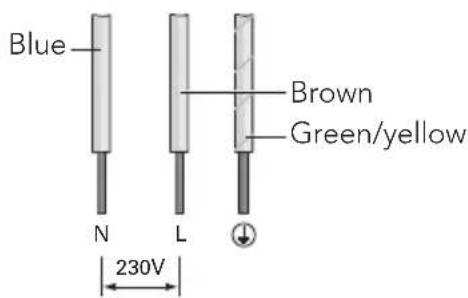
If you want to make a fixed connection, make sure that a multi-polar switch with a contact separation of at least 3mm is fitted in the supply line.
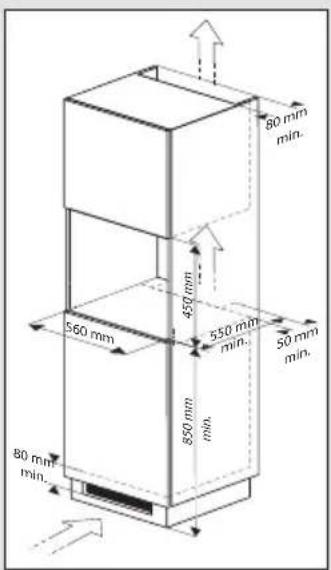
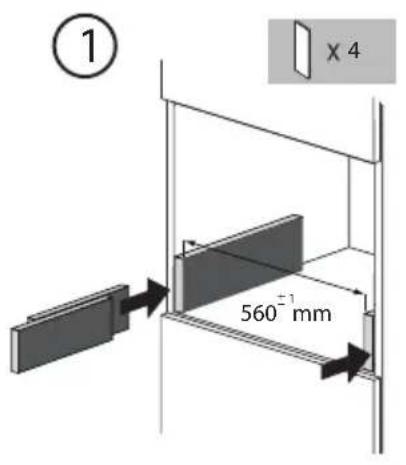
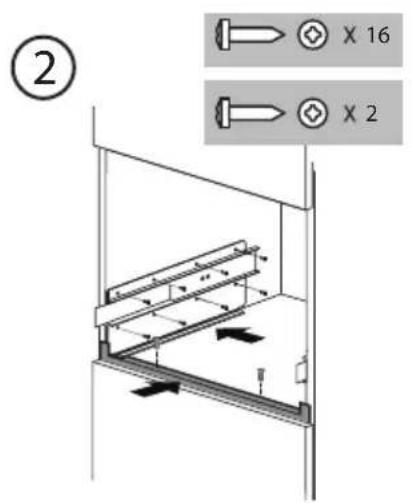
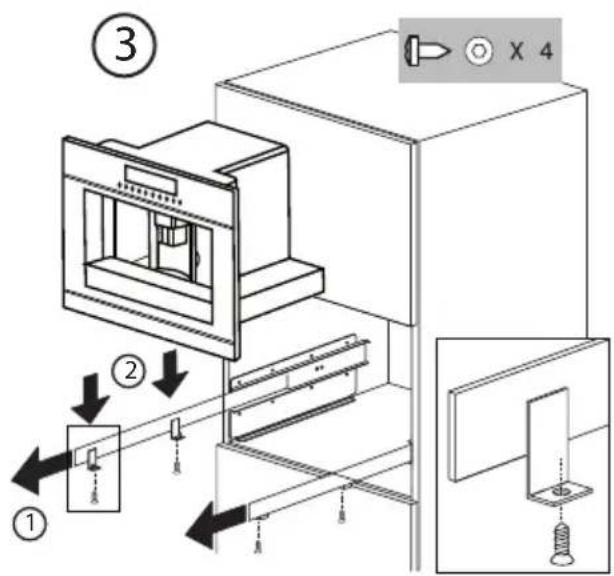
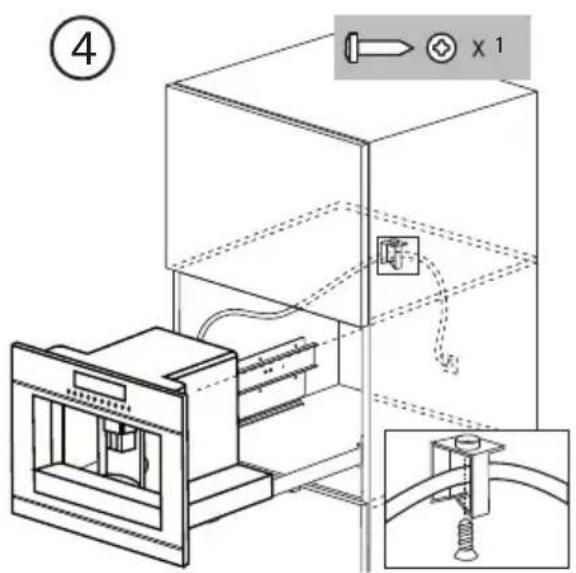
7.3 Building-in
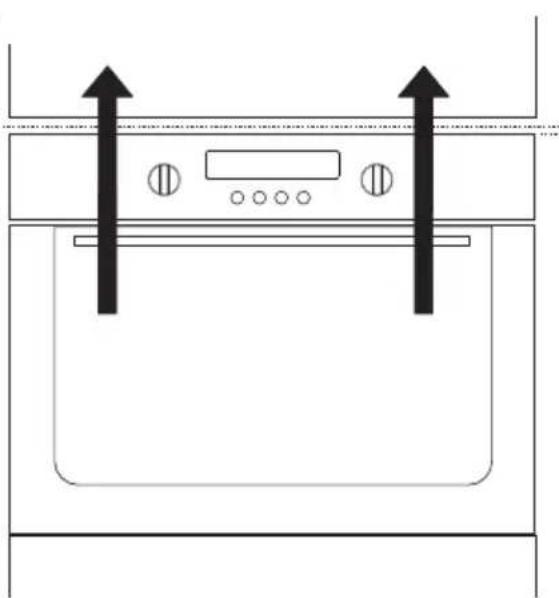
Please check the minimum measures necessary to the proper installation of the appliance. The espresso machine must be installed in a column unit, which must in turn be fixed to the wall.
8.1 Disposal of appliance and packaging
By ensuring this product is disposed of correctly, you will help prevent potential negative consequences for the environment and human health, which could otherwise be caused by inappropriate waste handling of this product. The local authorities can provide you with the relevant information.
The packaging of this appliance is recyclable. It could have been made from:
cardboard;
polythene foil (PE);
CFK-free polystyrene (PS-hard foam).
You need to dispose of these materials responsibly in accordance with offi cial regulations.
To draw attention to the fact that the segregated processing of electric household appliances is compulsory, this appliance carries the symbol of a crossed-out dustbin. This means that at the end of its working life, you may not dispose of the appliance as household refuse. Instead, you should hand it in at a special refuse collection centre run by the local authority or at a dealer's providing this service.
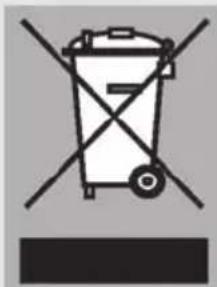
Segregated processing of household appliances such as this espresso maker, avoids any negative effects on the environment and public health that might otherwise occur. It enables the recovery of the materials used in the production of this appliance, thus realising considerable savings in terms of raw materials and energy.
8.2 Technical information
The data plate on the side of the appliance states the total load when connected, the required voltage and frequency.