
STH 10.66 W Crt - Snow blower Kärcher - Free user manual and instructions
Find the device manual for free STH 10.66 W Crt Kärcher in PDF.
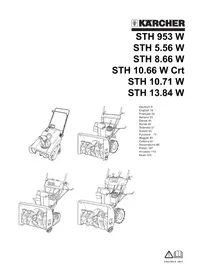


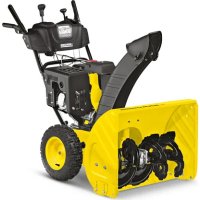
| Product Type | Tracked Snow Blower |
| Brand | Kärcher |
| Model | STH 10.66 W Crt |
| Engine | Briggs & Stratton 4-stroke, 305 cc, 7.5 kW (10.2 hp) |
| Fuel | Unleaded petrol, 3.8 L tank |
| Working Width | 660 mm |
| Max Snow Clearing Capacity | 2000 m²/h |
| Speeds | 6 forward + 2 reverse (R1/R2) |
| Starting | Manual (recoil) + electric (optional) |
| Range and Direction of Throw | Adjustable (crank and lever) |
| Dimensions (L × W × H) | 1257 × 749 × 851 mm |
| Weight | 98 kg |
| Sound Level (power) | 110 dB(A) guaranteed |
| Vibrations (handles) | 5 m/s² (ISO 5349) |
| Safety Devices | Coupling lever, protective grille, ejection flap |
| Engine Maintenance | Oil change every 25 h, check spark plug |
| Recommended Engine Oil | SAE 30 (>0°C), SAE 5W30 (<0°C), SAE 0W30 (<-18°C) |
Frequently Asked Questions - STH 10.66 W Crt Kärcher
User questions about STH 10.66 W Crt Kärcher
0 question about this device. Answer the ones you know or ask your own.
Ask a new question about this device
Download the instructions for your Snow blower in PDF format for free! Find your manual STH 10.66 W Crt - Kärcher and take your electronic device back in hand. On this page are published all the documents necessary for the use of your device. STH 10.66 W Crt by Kärcher.
USER MANUAL STH 10.66 W Crt Kärcher
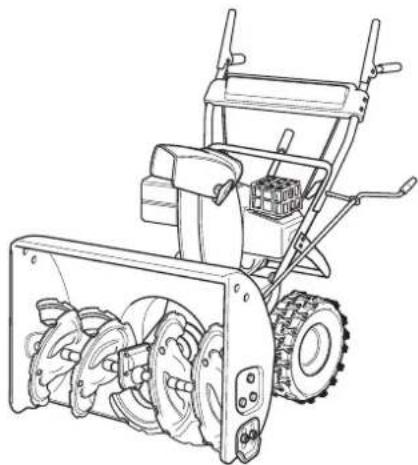
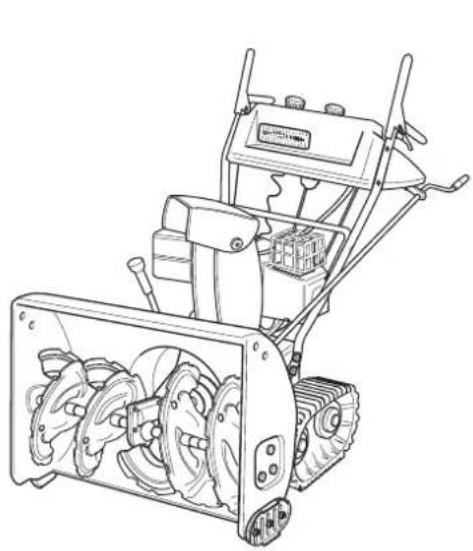
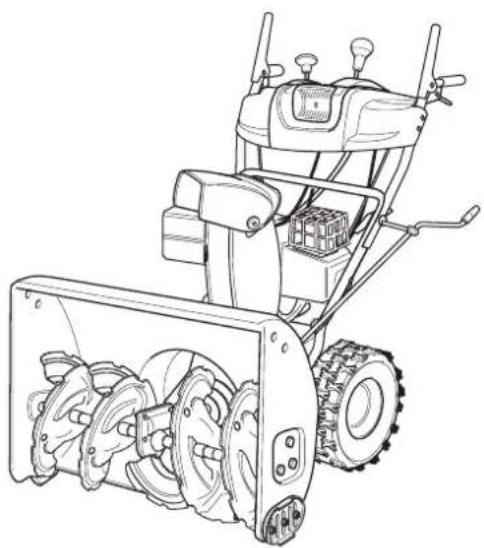
STH 953 W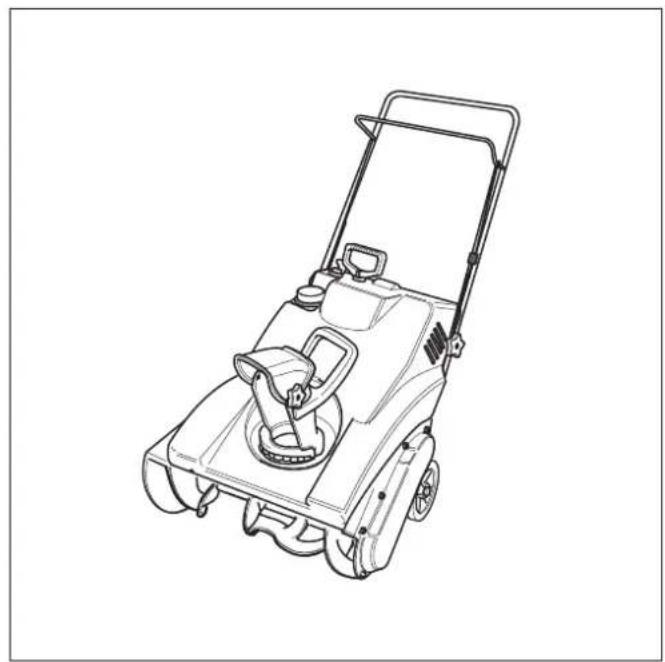
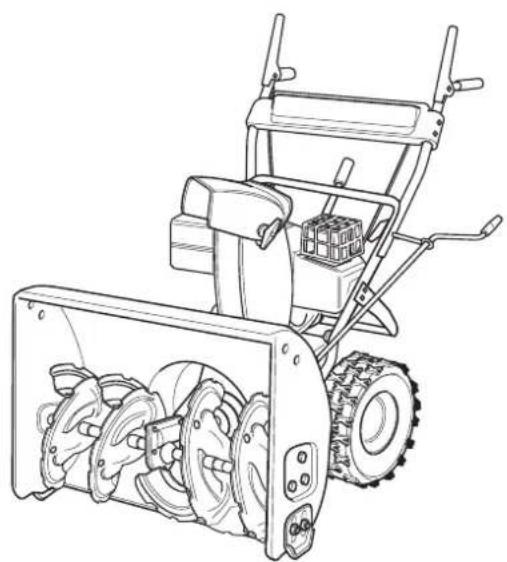
STH 10.66 W Crt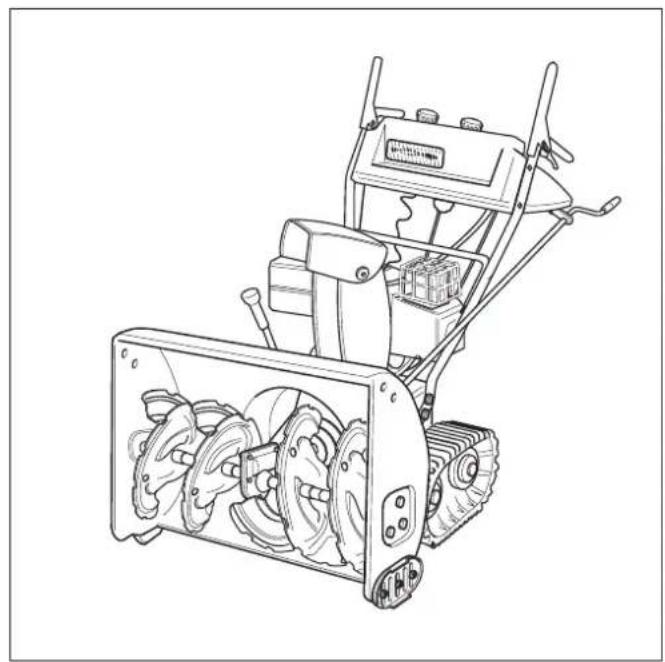
STH 5.56 W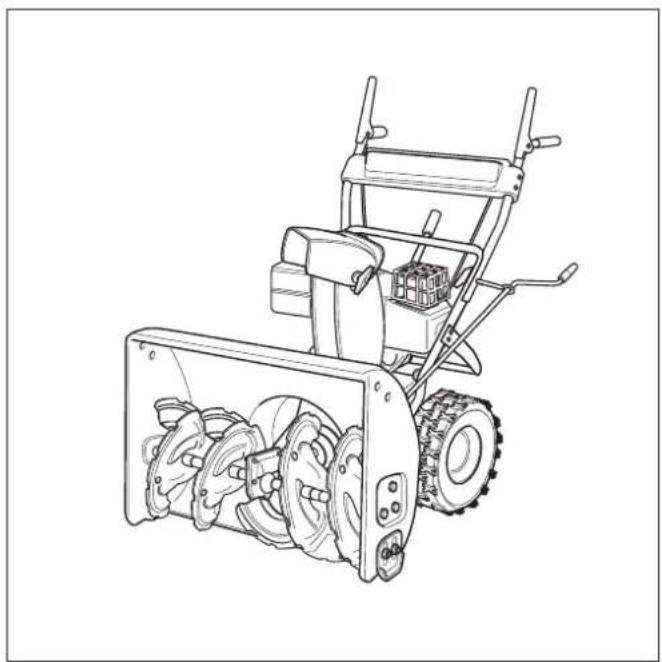
STH 8.66 W / STH 10.71 W / 13.84 W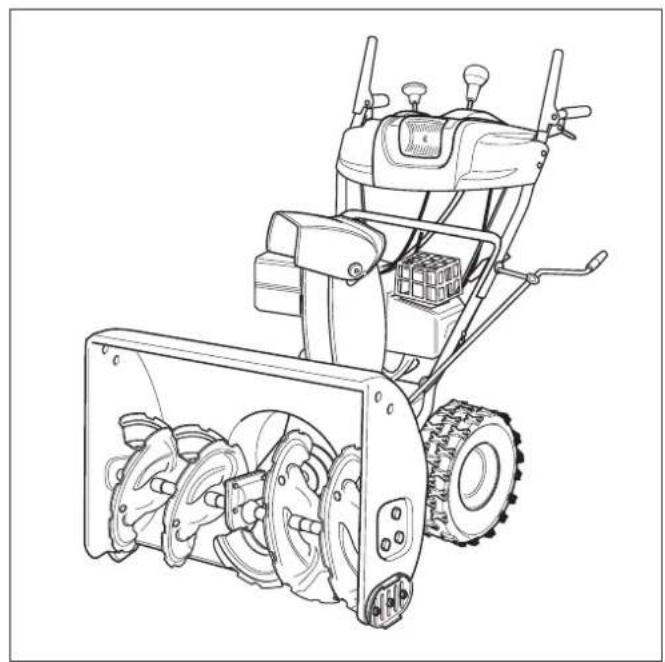
1 STH 953 W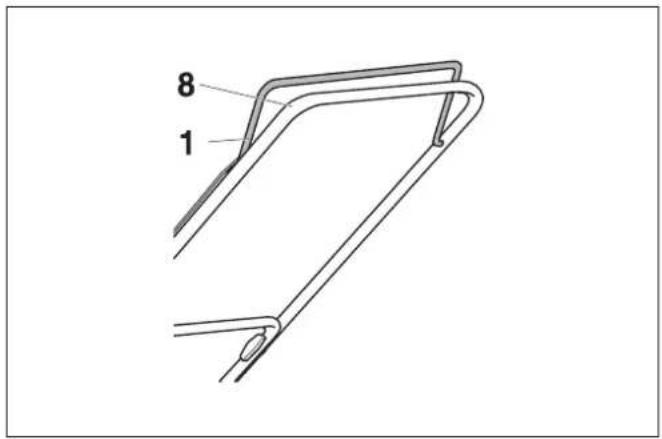
STH 10.66 W Crt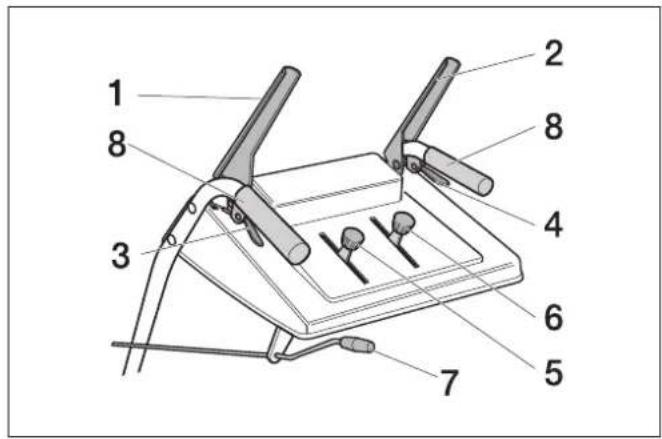
STH 5.56 W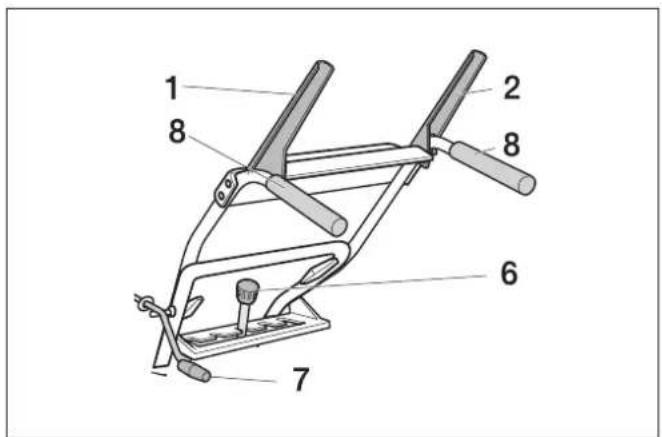
STH 8.66 W / STH 10.71 W / STH 13.84 W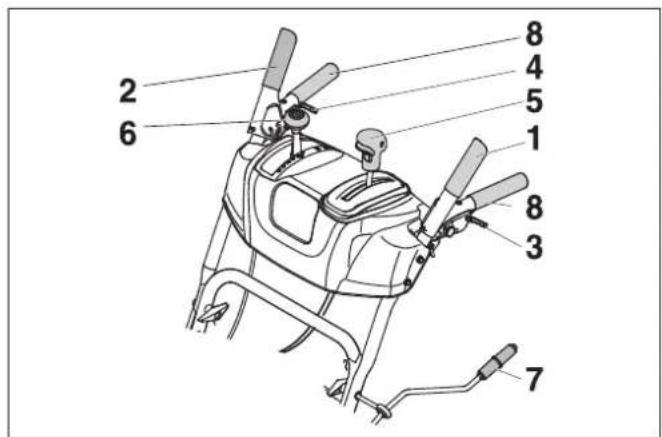
2
3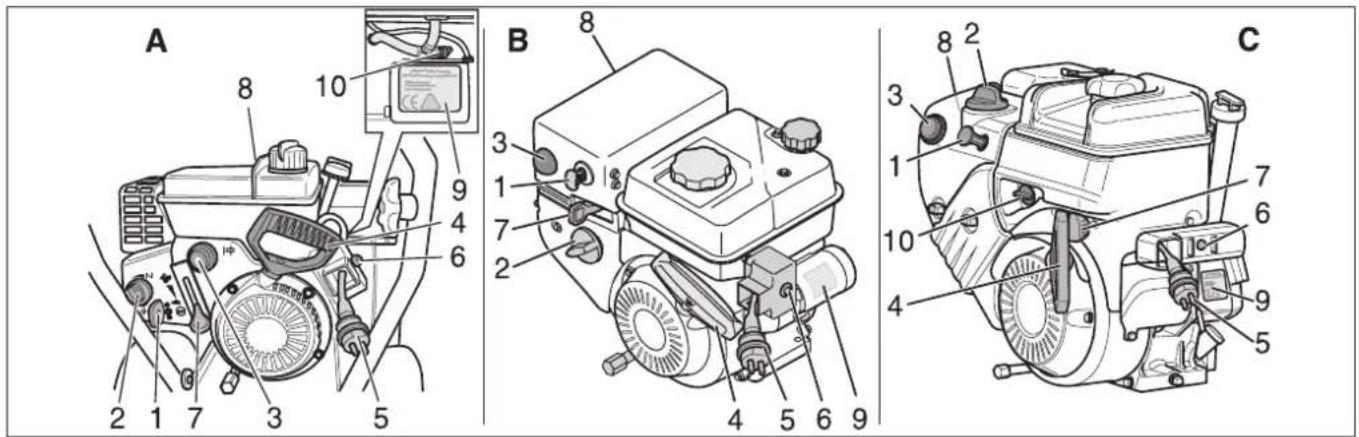

4
6
5
7
8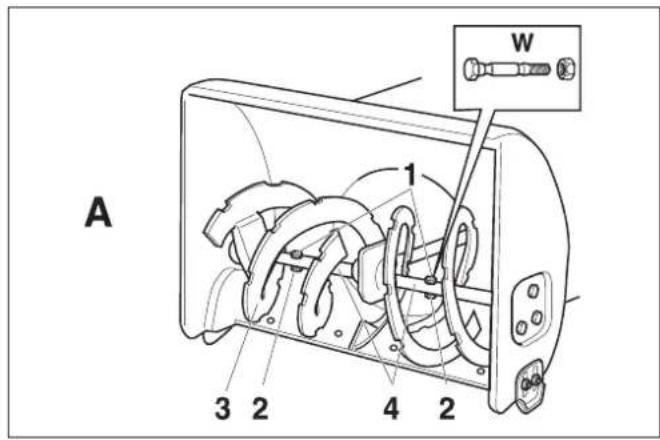
9
10
11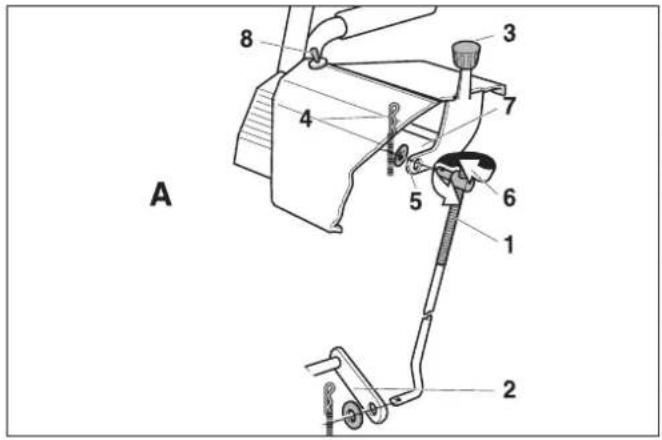
12 13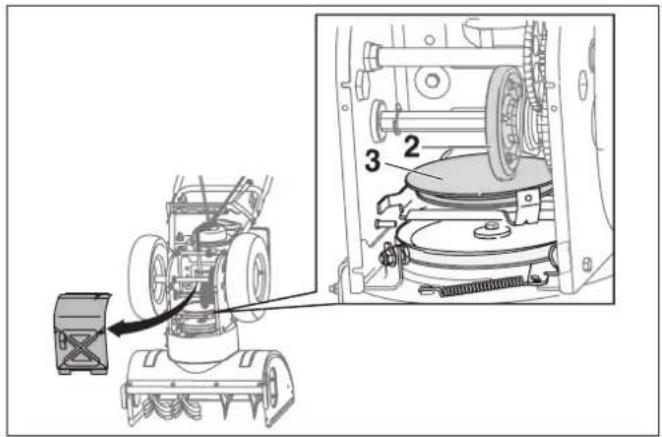

→ Reverse: R1-slow/R2-fast
(STH 8.66 W, STH 10.66 W Crt, STH 10.71 W, STH 13.84 W)
Figure 11 A
89/336/EEC (+91/263/EEC, 92/31/EEC, 93/68/EEC)
2000/14/EC
Please read and comply with these instructions prior to the
initial operation of your appliance. Retain these operating instructions for future reference or for subsequent possessors. In case of transport damage inform vendor immediately
Contents
Environmental protection 16
Overview 16
Symbols on the machine 16
Symbols in the operating instructions 16
Safety instructions 16
Safety Devices 17
Proper use 17
Before Startup 17
Start up 17
Operation 17
Transport 19
Shutdown 19
Maintenance and care 20
Troubleshooting 21
Technical specifications 23
Warranty 23
CE declaration 23
Environmental protection
| The packaging material can be recycled. Please do not throw the packaging material into household waste; please send it for recycling. | |
| Old appliances contain valuable materials that can be recycled; these should be sent for recycling.. Batteries, oil, and similar substances must not enter the environment. Please dispose of your old appliances using appropriate collection systems. | |
| Please dispose off the normal or rechargeable batteries in an environment-friendly manner. Batteries and accumulators contain substances that must not enter the environment. Please dispose them off using appropriate collection systems. |
Please do not release engine oil, fuel oil, diesel, or petrol into the environment. Protect the ground and dispose of used oil in an environmentally-clean manner.
Overview
Device elements
Figure 1
1 Clutch bow/clutch lever for auger drive
2 Clutch lever for driving
3 One-way clutch lever, left
4 One-way clutch lever, right
5 Adjust the throw distance
6 Switching lever
Forward: Gears 1-5 (only STH 5.56), gears 1-6
Reverse: R1 slow/R2 fast
7 Adjust throw direction
8 Spar handle
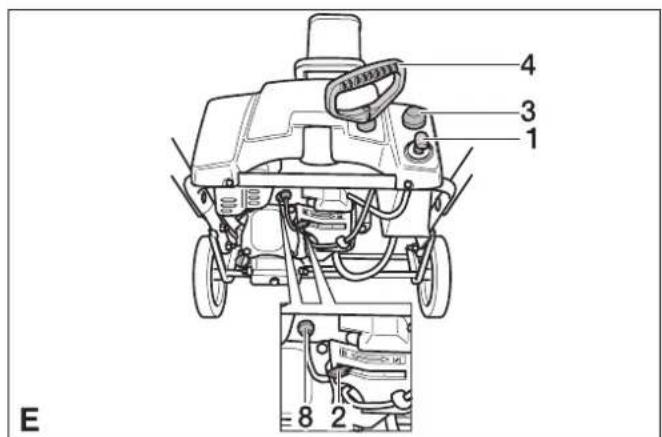
Figure 3
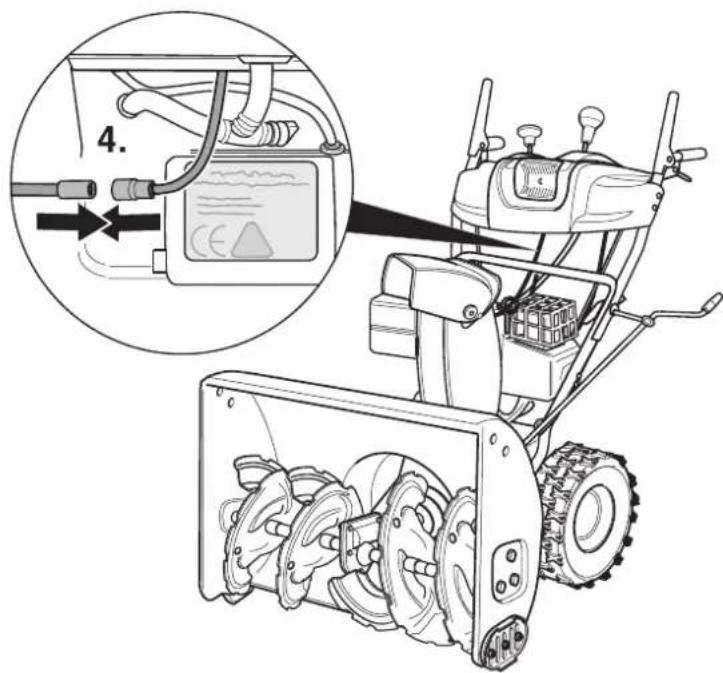
1 Ignition key, 2 Choke, 3 Cold start help (Tupfer), 4 Rope starter, 5 Mains plug for electric starter, 6 Starter knob, 7 Gas lever, 8 Ignition plug, 9 Starter type plate
10 Fuel tap
11 Engine stop switch
Symbols on the machine
| Risk of burns! Keep safe distance from hot parts of the appliance. | |
| Wear eye and ear protection! | |
| Keep others out of the hazardous area! | |
| Risk of injury due to snow being thrown out or solid objects. | |
| Touch the parts of the appliance only when they have completely come to a standstill. | |
| Risk of injury on account of rotating parts. Keep hands and feet away from rotating parts. |
| Only clean the discharge chute with cleaning utensils.. | |
| Risk of explosion! Never exceed the max. tyre pressure of 1.4 bar/20 PSI. | |
| Switch the machine off prior to any work, such as adjustments, cleaning, testing and pull the spark plug. | |
| Gas lever position "fast" | |
| Gas lever position "slow" |
Note
Keep these symbols on the machine legible at all times.
Symbols in the operating instructions
⚠ Danger
indicates an immediate threat of danger. Failure to observe the instruction may result in death or serious injuries.
⚠ Warning
indicates a possibly dangerous situation. Failure to observe the instruction may result in light injuries or damage to property.
Note
indicates useful tips and important information.
Safety instructions
- The appliance should not be operated by persons below the age of 16 years (local conditions can specify the minimum age of the operator).
- Please keep children and pets away from the hazardous zones of the appliance.
- Please follow the national rules and regulations while operating the machine on public streets or paths.
- Do not use the appliance to transport persons.
- Always wear gloves, ear protectors, safety goggles, tight winter clothing and firm shoes with anti-slip soles while working.
- Never use the appliance in closed rooms; do not tank up when the engine is hot or running.
- Do not bring any parts of the body or clothes in the vicinity of rotating or hot parts of the appliance.
- Switch off engine; remove the ignition key and ignition plug if you are not working with the appliance or are leaving the machine. The same is applicable while performing setting, maintenance or repairs.
- Let the engine cool down before storing away the appliance in closed rooms.
- Store the appliance and the fuel at a safe place away from sources of fire (sparks, flame) and out of children's reach.
- Get the appliance repaired only from a specialised workshop.
Safety Devices
Safety devices serve for the protection of the user and must not be put out of operation or bypassed with respect to their function.
Clutch bow
(only STH 953 W)
When the user releases this lever, the auger drive will turn off and the machine will stop moving.
Clutch lever for snail drive
(Not STH 953 W)
The snail drive switches off when the user releases this clutch lever.
This lever can be stopped in a depressed state (not STH 5.56 W) if the user presses the clutch lever for travel drive and keeps it depressed. Both levers jump back as soon as the user releases the clutch lever for the travelling drive. The auger and travel drive are switched off simultaneously.
Clutch lever for driving
(Not STH 953 W)
The travel drive switches off when the user releases this clutch lever.
Safety grid in the discharge shaft
The safety grid prevents intervention in the discharge shaft.
Discharge flap
Figure 9
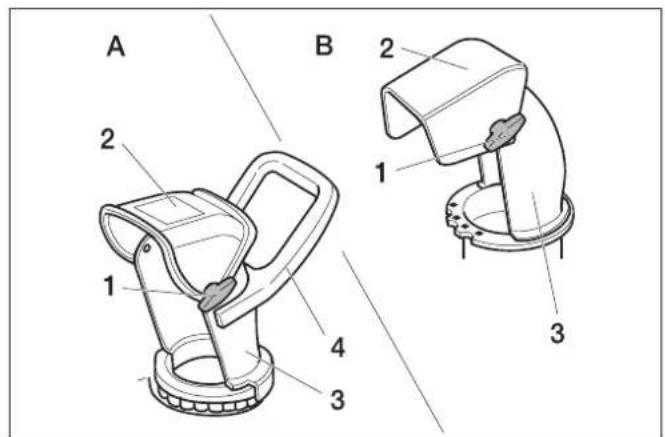
The discharge flap (2) prevents injuries from ejected objects.
Proper use
This appliance is only to be used for clearing snow from roads and other hard surfaces according to the descriptions and safety instructions given in this Instruction Handbook.
– Any other use is in contravention of the rules! - Using the appliance in contravention of the rules or making any high-handed
changes to the machine will absolve the manufacturer from any warranty liability.
- The user is responsible for damages to third parties and their property caused by using the appliance.
Before Startup
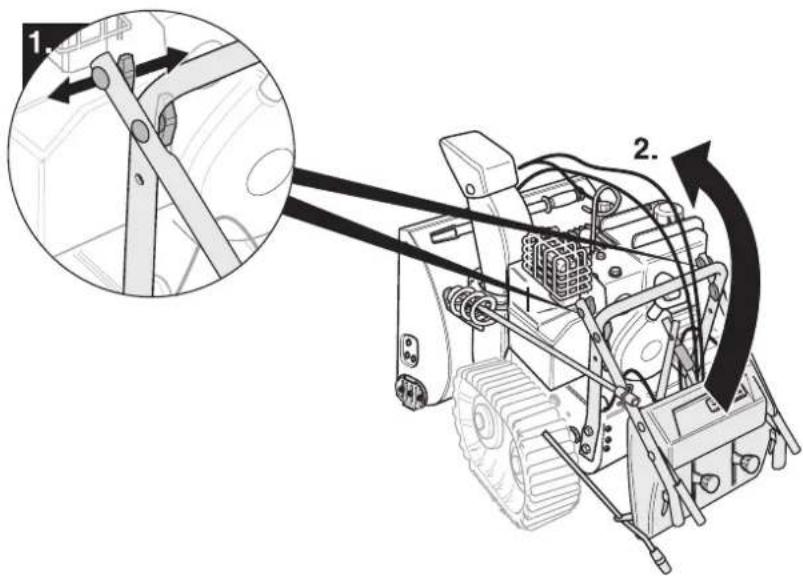
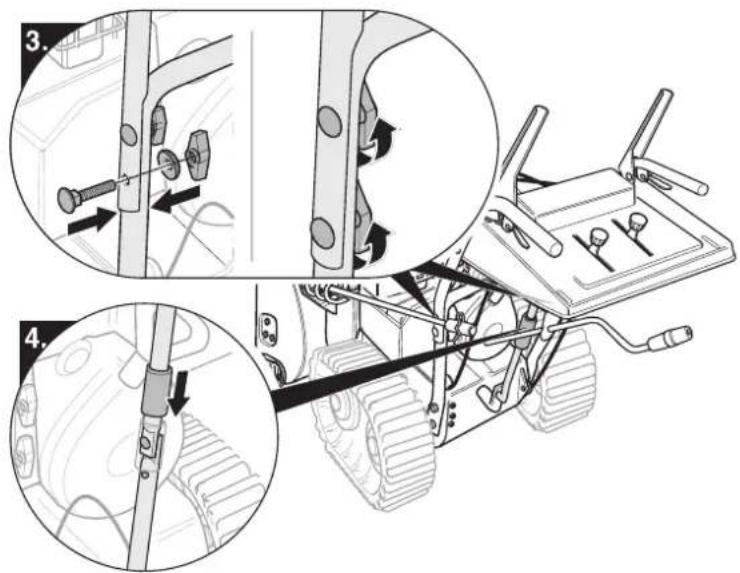
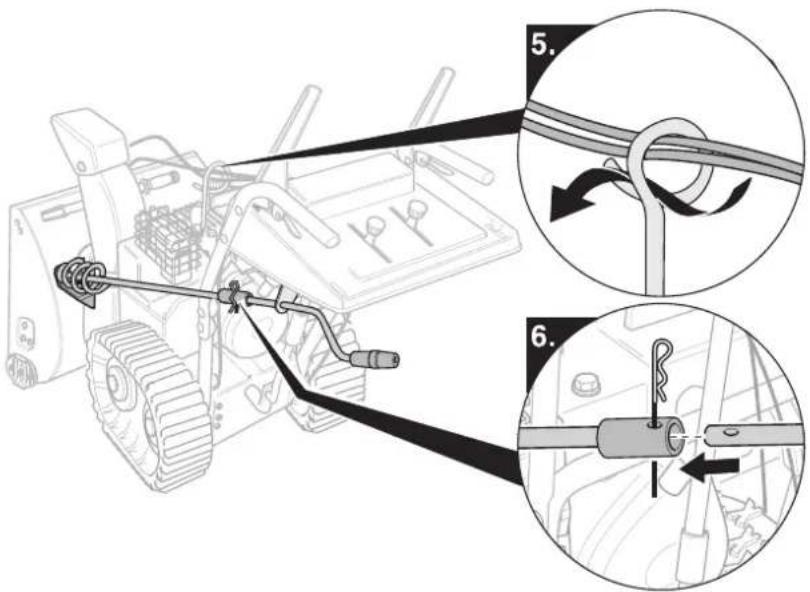
Unpack the appliance and assemble it
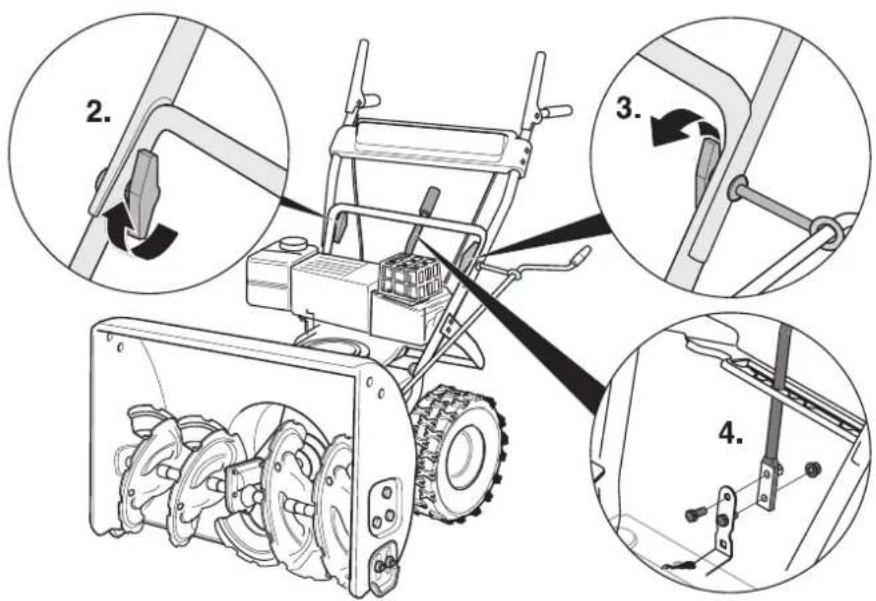
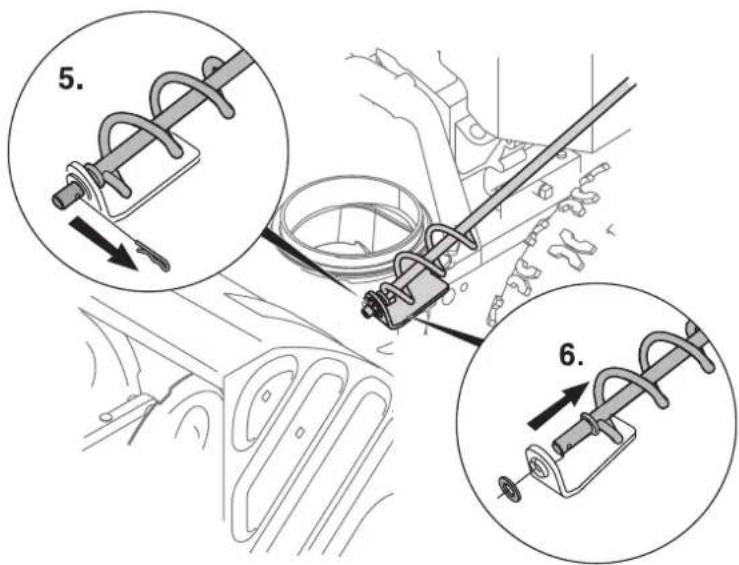
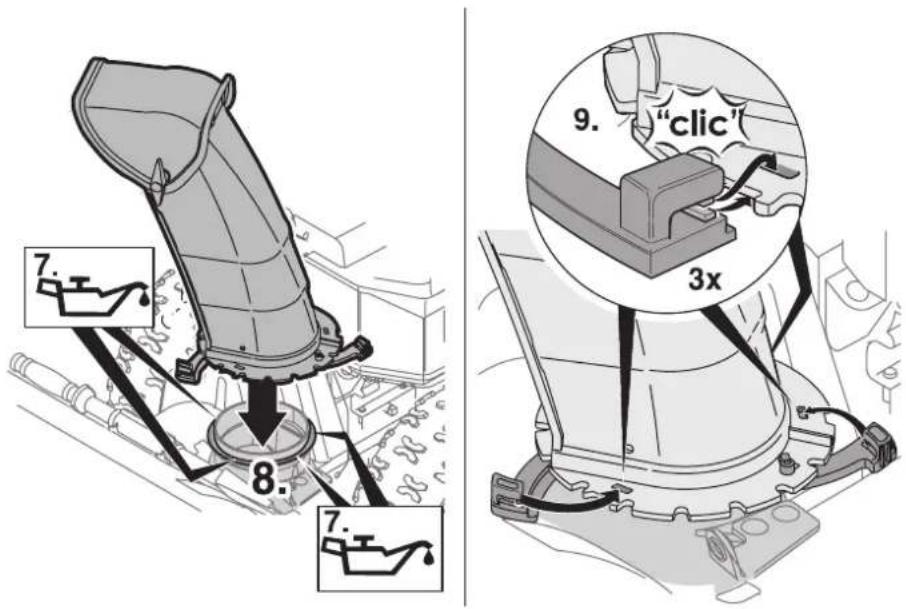
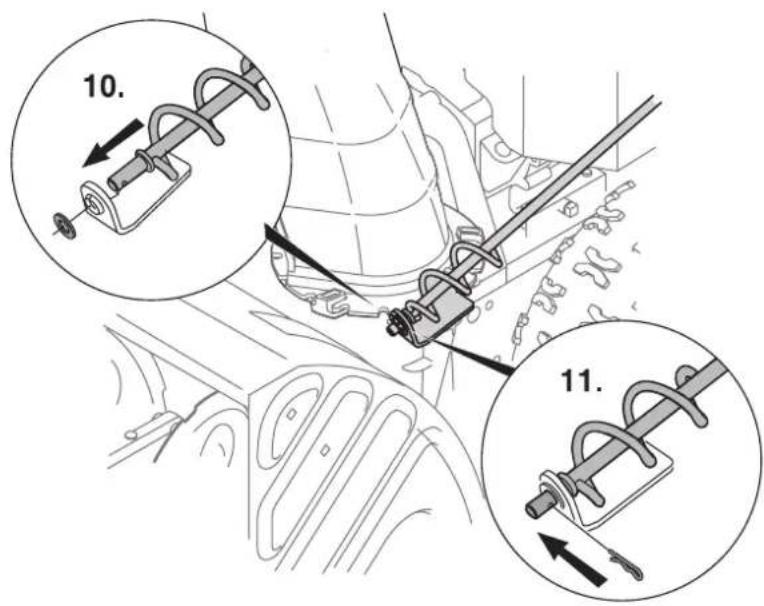
→ Check the contents of the pack before unpacking. → Assemble the appliance according to the instructions given at the end of this Instructions Handbook.
Start up
⚠️ Danger
Risk of injury!
Before doing any work on the machine:
→ Switch off engine. → Pull out the ignition key and the ignition plug. → Allow engine to cool down.
Check the machine
→ Perform a visual inspection before each use. → Check and ensure that all safety equipment, operator control elements and the corresponding clutch tensions/cables and screw fittings are not damaged and are tight. → Replace damaged parts before operations. → Not STH 953 W: Check clutches for snail and travel drive (see "Maintenance tasks"). → STH 8.66 W, STH 10.66 W Crt, STH 10.71 W, STH 13.84 W: Check switching lever (see "Maintenance tasks").
Check oil level
→ Check oil level; refill engine oil if required (see "Engine Instruction Booklet").
Refuelling
⚠️Danger
Risk of explosion and fire!
- Only use the fuels specified in the Operations Manual of the engine manufacturer.
- Do not refuel the machine in enclosed spaces.
- Smoking and naked flames are strictly prohibited.
- Ensure that no fuel reaches the hot open surfaces.
- Fuel up only when the engine is switched off and is cold.
- Never tank up the fuel tank fully. Wipe off spilled fuel.
- Store fuel only in suitable containers. → Fuel up (for type of fuel see "Engine Instruction Booklet"); close the lid of the tank and wipe off fuel residues.
Check the tyre pressure
(Not STH 953 W)
For transportation, the tyres may show a higher level of air pressure.
→ Check air pressure in the tyres; adjust it if required (approx. 1 bar).
Adjust the machine to suit the snow and ground conditions.
Setting the working position
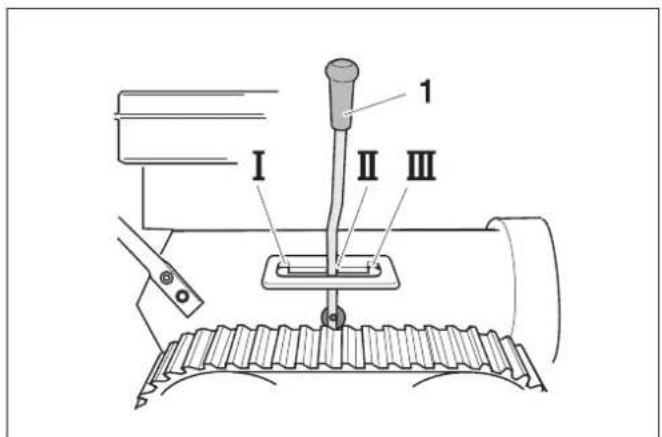
(machines with track drive) Figure 4
→ Choose a suitable position using the adjustment lever (1). - Position I: For heavy and icy snow. The auger is pressed to the ground. – Position II: For normal snow conditions. - Position III: To clear uneven paths or to transport the machine. The auger has a greater distance to the ground.
Adjusting the clearing plate (only STH 953 W)
Figure 10
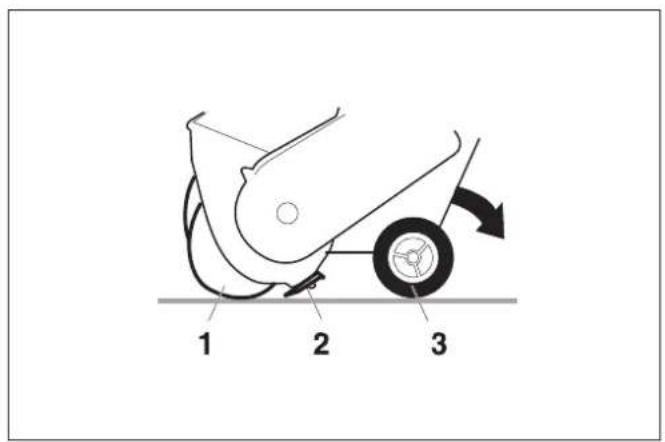
If the machine is sitting on even ground, the auger (1), clearing plate (2) and wheels (3) must touch the ground simultaneously.
– A clearing plate that is adjusted too high will cause the snow to be thrown to the rear. – A clearing plate that is positioned too low will wear faster.
→ Tilt the appliance rearward.
→ Loosen nuts (5).
→ Adjust the clearing plate higher or lower (as required) and reattach.
→ Tilt the machine backwards, check adjustment and repeat if necessary.
Adjusting the skids
(Not STH 953 W)
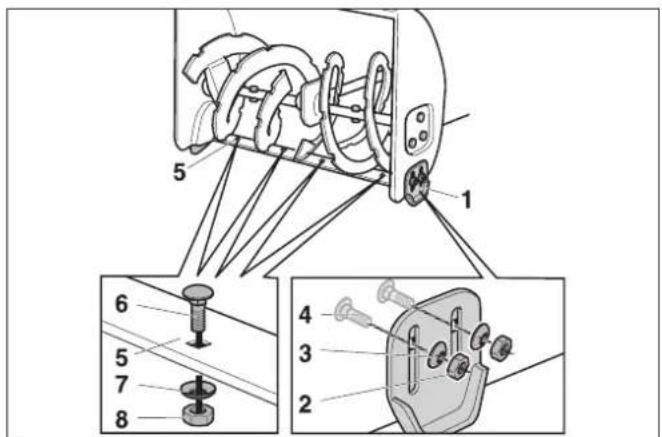
Figure 7
The landing skids (1) can be used to adjust the distance between the ground and the clearing plate (5) in such a way that no parts of the ground (such as soil or stones) are picked up.
→ Machines with track drive: Set the gear lever to position II. → Loosen the nuts (2) on both sides of the appliance. → Adjust the landing skids according to the underground surface: Set them lower for uneven or loose paths; higher for even roads and paths. → Fasten the landing skids with nuts (2) in such a way that they uniformly touch the ground from the bottom.
Operation
Safety instructions
⚠️ Danger
Risk of injury!
- Keep persons, especially children, and pets away from the hazardous zones.
- Operate the machine only in a safe and perfect working condition.
- Check the area where the machine is to be used and remove all objects that can get picked up and thrown out by the machine.
- Work only with adequate lighting. – Only use the machine at walking speed.
- Work slowly and safely especially on uneven or loose paths and while reversing.
- Adjust the distance between the snail casing and the underground floor in such a way that the appliance does not pick up any foreign bodies (such as stones).
⚠️ Danger
Risk of suffocation on account of carbon monoxide! Only operate the combustion engine while out in the open.
Note
Follow the national/local regulations for the usage times (ask the local authorities, if required).
⚠️Danger
Long hours of using the appliance can cause circulation problems in the hands on account of vibrations.
It is not possible to specify a generally valid operation time, since this depends on several factors:
– Proneness to blood circulation deficiencies (cold, numb fingers). – Low ambient temperature. Wear warm gloves to protect hands. – A firm grip impedes blood circulation. - Continuous operation is worse than an operation interrupted by pauses.
In case of regular, long-term operation of the device and in case of repeated occurrence of the symptoms (e.g. cold, numb fingers) please consult a physician.
Tips for clearing the snow
– Clear up immediately after the snowfall; otherwise, the lower layer becomes ice and makes clearing difficult. - If possible, clear the snow in the direction of the wind. – Clear the snow in such a way that the clearing tracks overlap a little.
Working on slopes
⚠️Danger
Risk of injury!
Danger of tipping if gradient is too high.
- Do not use the appliance on slopes with an inclination greater than 20%.
- Work slowly and cautiously, especially when changing direction.
- Drive up and down slopes, never diagonally. Watch for obstacles and do not work near steep inclines.
Setting the direction and distance of throw
Figure 9
⚠️ Danger
Risk of injury! Do not direct the flap (2) of the discharge shaft (3) towards persons, animals, windows, cars, or doors.
Adjust throw direction
■ Not STH 953 W: Turn the crank (figure 1, item 7) to bring the discharge shaft (3) to the desired direction. ■ Only STH 953 W: Move the discharge chute (3) into the desired direction using the handle (4).
Note
Do not use the handle (4) to lift the machine.
Adjust the throw distance
The lower the flap (2), the higher and farther the snow will be discharged.
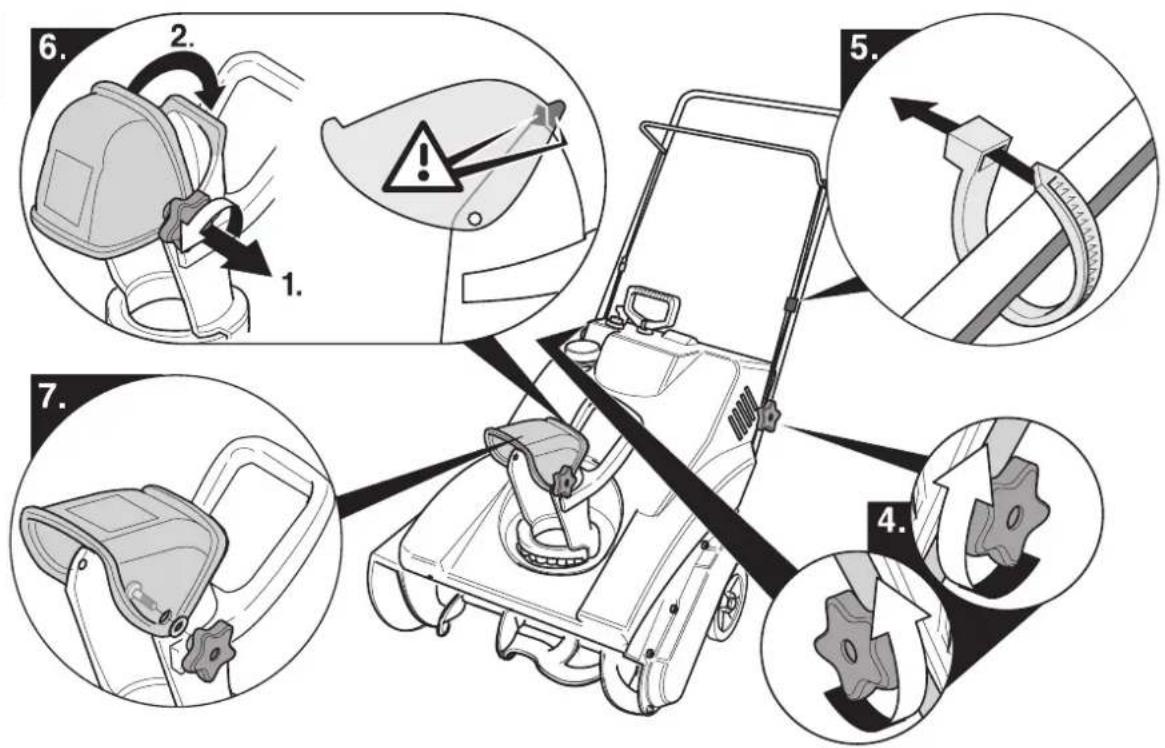
■ Machines with lever: Press the lever (figure 1, item 5) forward to set the flap (2) higher, and pull it back to set it lower. ■ Machines without lever: Loosen the hand knob (1) and adjust the flap (2) higher or lower as required.
Start the engine
Figure 3
Read the operating instructions of the engine manufacturer before start-up and follow the safety instructions carefully. Release the clutch bow/clutch lever for auger and travel drive before starting. Check tank contents and oil level; refill oil and fuel (see "Engine Instructions Booklet").
Note
Some models do not have a gas lever; the speed is adjusted automatically. The engine always runs with optimized speed.
Starting using rope starter
Set the fuel tank tap, if there is one, to "ON/OPEN". Insert the ignition plug into the spark plug. Not STH 953 W:
Turn gas lever, if there is one, to "fast". On machines without gas levers, set the engine stop switch to "ON".
Set the choke for cold start to "ON/CHOKE". Insert the ignition key into the ignition lock. Press cold start help (Tupfer) once; press it twice to seven times during cold weather (depending on the engine type). Pull the rope starter slowly till you feel the resistance and then give it a quick and hard tug. Do not allow the rope starter to recoil immediately - just let it go back slowly.
Reset the choke back to "RUN/OFF" in a step-by-step manner, if the engine is running.
Starting using electrical starter (optional)
(Not STH 953 W)
Danger
Risk of electric shock.
- Do not use the electric starter in the rain.
- Check whether the mains are secured with a leakage current protection switch. If not, get an electrician to install a suitable switch.
To connect the electrical starter to the mains, use only extension cables (not part of standard delivery) that have been approved for use in the open and have a safety conductor.
For example: for a max. length of 50 m:
- H07RN-F 3x1.5 mm² up to -25 °C
- H07BQ-F 3x1.5 mm² up to -40 °C
⚠️ Danger
Risk of electric shock.
– Prior to each engine start, check the extension cables and the cables/connectors on the engine for damage. - Please arrange immediately for the exchange of damaged parts by a skilled electrician. - Never start the machine with damaged parts.
⚠ Warning
Improper connection of the electrical starter can cause damage to the machine or to property in its vicinity. Check whether the mains are being operated according to instructions on the type plate of the starter and is protected with appropriate fuses.
→ Set the fuel tank tap, if there is one, to "ON/OPEN". → Insert the ignition plug into the spark plug. → Turn gas lever, if there is one, to "fast". On machines without gas levers, set the engine stop switch to "ON". → Insert the ignition key into the ignition lock, do not turn it. → First connect the extension cable to the mains and then connect it to the mains socket. → Set the choke for cold start to "ON/CHOKE". → Press cold start help (Tupfer) once; press it twice to seven times during cold weather (depending on the engine type). → Press the starter button (max. 5 seconds) till the engine starts. Wait for at least 30 seconds before making a fresh start. → Reset the choke back to "RUN/OFF" in a step-by-step manner, if the engine is running. → First disconnect the extension cable from the mains and then from the electrical starter.
Putting/ changing gears
(Not STH 953 W)
Figure 1
⚠ Warning
Release the clutch lever for snail and travel drive before putting or changing a gear.
Select the gear using the switch lever:
→ Forward: "1" (slow) to "5/6" (fast)
→ Reverse: R1 slow/R2 fast
Working with the appliance
Figure 1
⚠ Warning
Risk of damage!
- If the machine comes in contact with foreign objects (e.g. stones) or if there are unusual vibrations, switch off the machine and check the damage. Rectify the damage before starting to work again with the appliance.
- Let the engine warm up prior to using the machine.
■ Only STH 953 W:
→ Set the direction and distance of throw.
→ Start the motor.
→ Press the clutch bow and hold it. The auger is driven. The machine will move forward when the auger touches the ground.
→ Increasing the travel speed: Raise the spar handle slightly. The auger will have better ground traction and will drive the machine forward faster. If repeated frequently, this will cause a more rapid wear of the rubber lip on the auger.
→ Decreasing the travel speed: Press the spar handle downward.
■ Not STH 953 W:
→ Set the direction and distance of throw.
→ Start the motor.
→ Select the forward gear after releasing the clutch levers for snail and travel drives.
→ Press the clutch lever for snail drive and keep it depressed. The snail and the throwing turbine will start up.
→ Press the clutch lever for travel drive and keep it depressed. The appliance will move and clear the snow. The clutch lever for auger drive remains locked till this lever remains depressed (not STH 5.56 W) and can now be released.
To change the gears, first release the clutch lever for travel drive and then use the switching lever for changing the gears.
→ Machines with freewheeling levers: The machine can be lowered more easily using the freewheeling levers. To the right: Pull on the right freewheeling lever. To the left: Pull on the left freewheeling lever.
Stopping the engine
Figure 3
To avoid damage to the appliance and prevent starting problems due to humidity, let the engine run for a few minutes before switching it off (so that it gets dried).
→ Not STH 953 W: Turn gas lever, if there is one, to "slow". On machines without gas levers, set the engine stop switch to "OFF".
→ Pull out ignition key.
→ Turn fuel tap, if there is one, to "OFF/CLOSE".
Remove the blockages from the snail or the discharge shaft
⚠️ Danger
Risk of injury!
Before doing any work on the machine:
- Switch off engine.
- Wait till all the moving parts have come to a stand-still.
– Pull out the ignition key and the ignition plug.
Figure 13
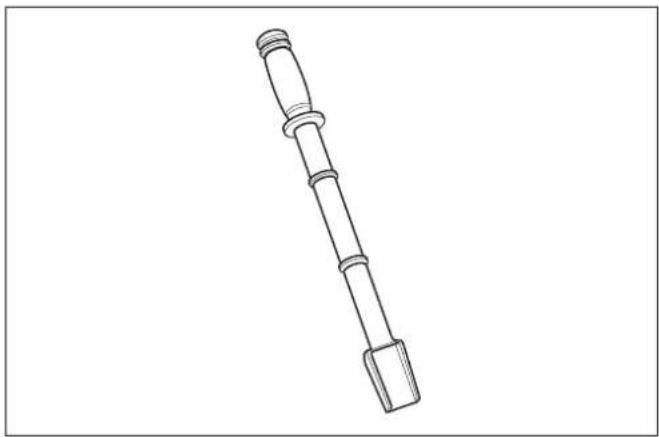
→ Remove the blockages using a plastic plunger or a shovel.
Snow chains (optional)
Snow chains can be purchased and used if the weather conditions are extreme.
Transport
Drive the machine
For maneuvering/ travelling short distances.
→ Start the appliance.
→ Select a forward or reverse gear.
→ Press the clutch lever for travel drive and keep it depressed.
→ Drive the machine carefully.
Transport without self-drive
⚠ Danger
Risk of injury!
Before doing any work on the machine:
→ Switch off engine.
→ Pull out the ignition key and the ignition plug.
→ Allow engine to cool down.
→ Empty fuel tank.
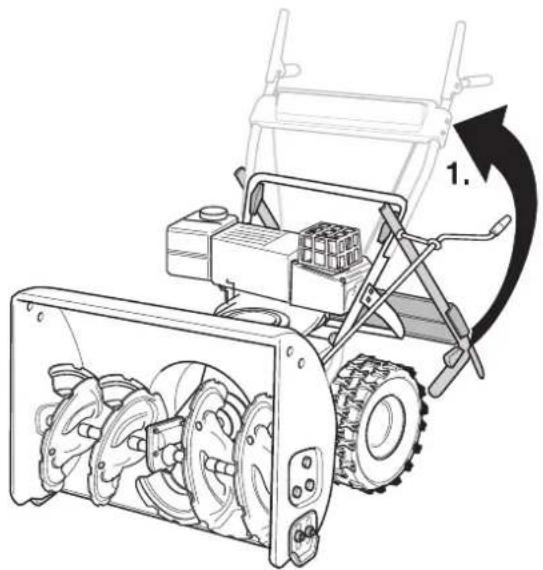
→ Transport the machine on or in a vehicle in the horizontal position.
→ Secure the machine against slippage or from rolling off.
Shutdown
⚠️ Danger
Risk of explosion!
- Smoking and naked flames are strictly prohibited.
- Ensure that no fuel reaches the hot open surfaces.
Please follow these instructions if the machine is not to be used for more than one month:
→ Prepare the engine (see "Engine Instruction Booklet").
→ Empty fuel tank.
→ Clean the device.
→ Wipe all metallic parts with an oily cloth to protect them against rusting or spray some oil on them.
→ Store the machine in a clean and dry room.
Maintenance and care
Maintenance schedule
Once in the season:
- Get the machine checked and serviced in an authorised workshop.
Every time before use:
- Check oil level; refill engine oil if required (see "Engine Instruction Booklet").
- Check whether all screw joints are tight; tighten them, if necessary.
- Check safety equipment.
- For machines without electric starter: Check the cables and connectors on the engine.
| Maintenance tasks After using | for | 25 h 50 h | after the | season | depending on requirements |
| Clean the discharge shaft, snail and snail casing. x | |||||
| Oil change 3) | X4) | ||||
| Lubricate all moving and rotating parts x x | |||||
| Clean the spark plugs 1) | x | ||||
| Get the spark plugs replaced 2) | x | ||||
| Check air pressure in the tyres; increase it, if required x x | |||||
| Clean the exhaust and the air cooling system 1) | x | x | |||
| Check clutch setting; readjust, if required x | |||||
| Get the carburetor settings checked 2) | x | ||||
| Check clearing plate; replace worn out clearing plate x | |||||
| Check landing skids; replace worn out landing skids in pairs x | |||||
| Check track, adjust if necessary, replace defective track if required | x | ||||
| Replace tank lock x | |||||
| Get the exhaust checked 2) | x |
1) See "Engine Instruction Booklet" 2) Get these jobs done only from an authorised workshop 3) First oil change after 5 operating hours (h) 4) Change oil every 25 operating hours (h) if the machine is operated under heavy load or if the ambient temperature is high
Maintenance Works
Danger
Risk of injury!
Before doing any work on the machine: - Switch off engine. – Pull out the ignition key and the ignition plug. - Allow engine to cool down.
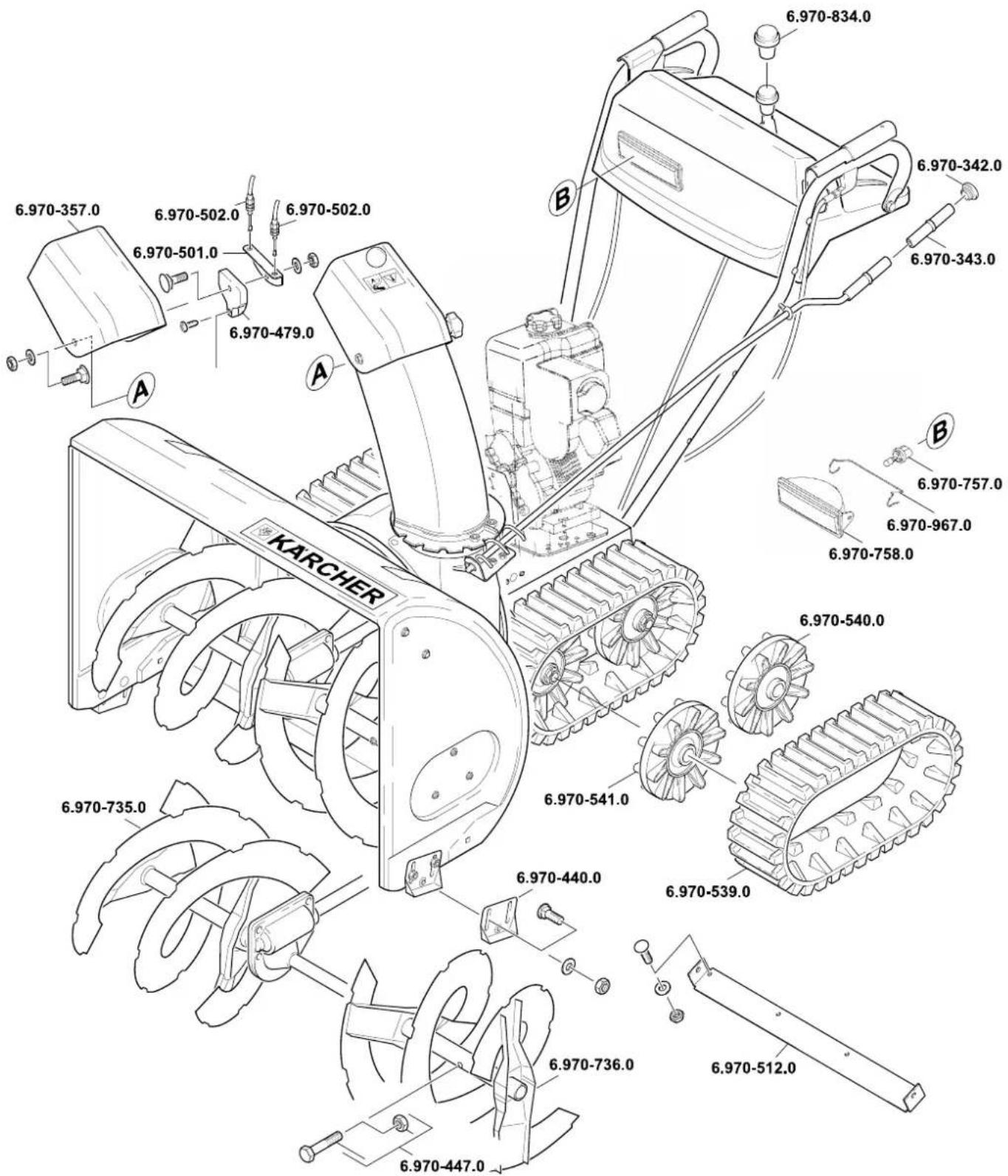
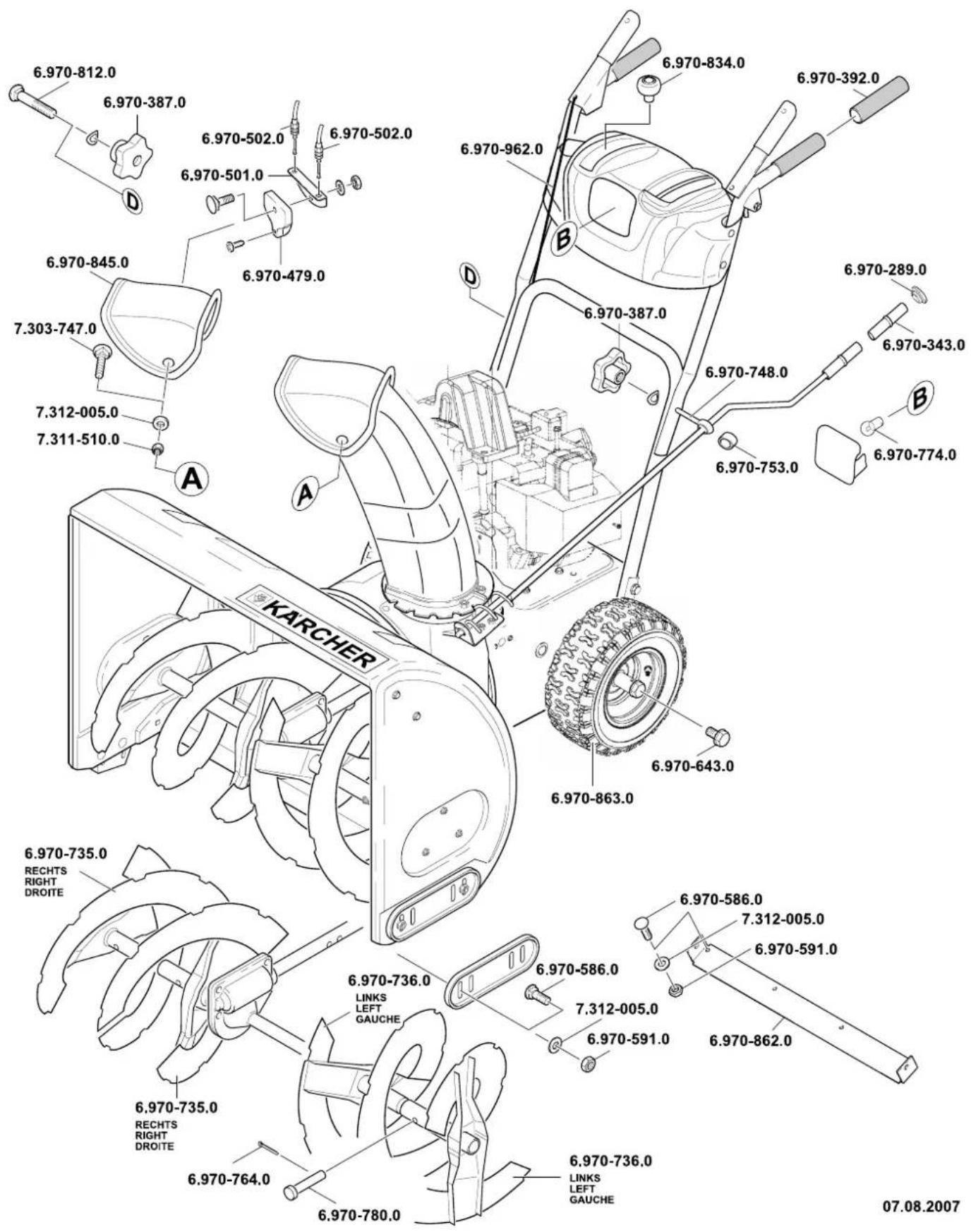
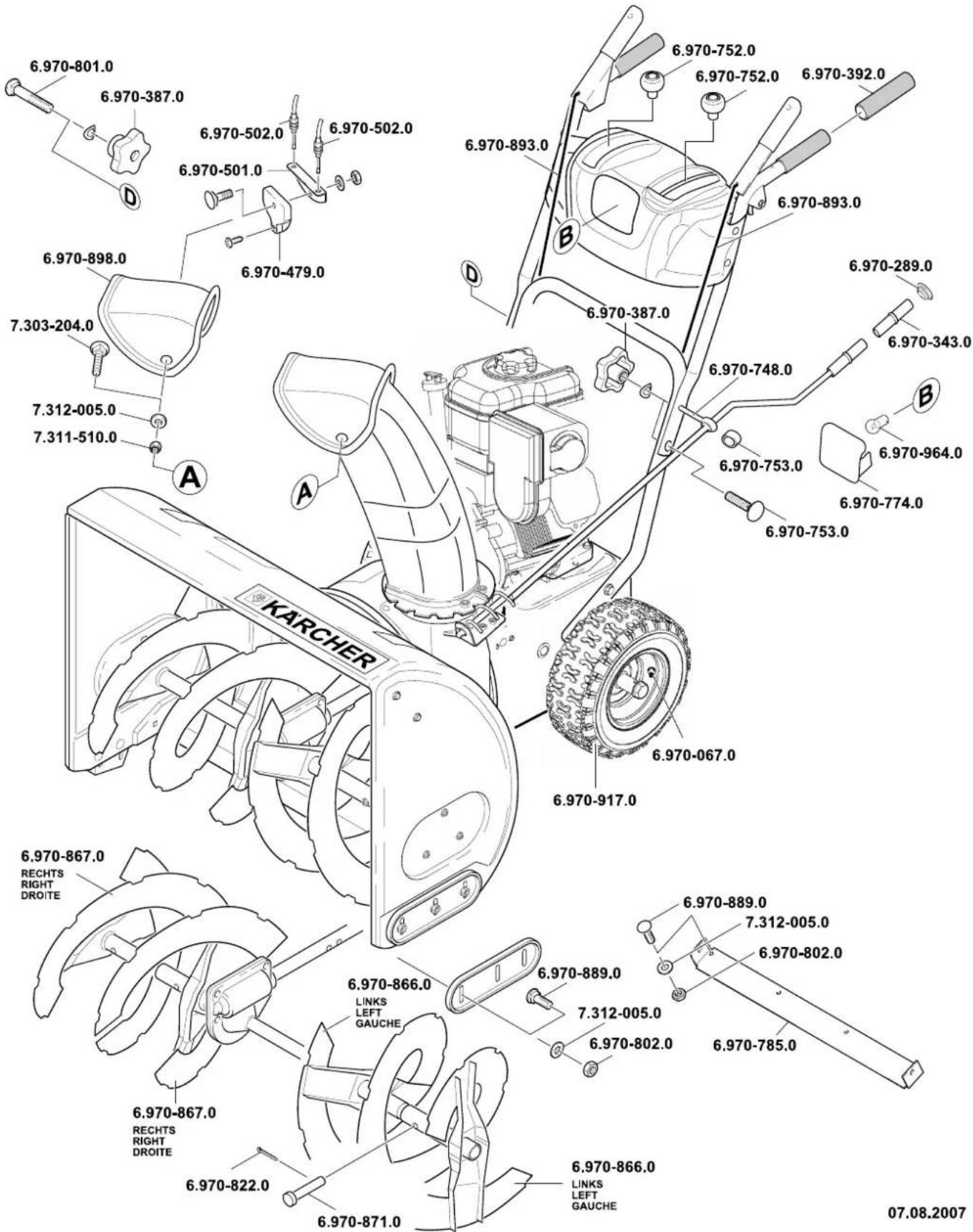
Accessories and Spare Parts
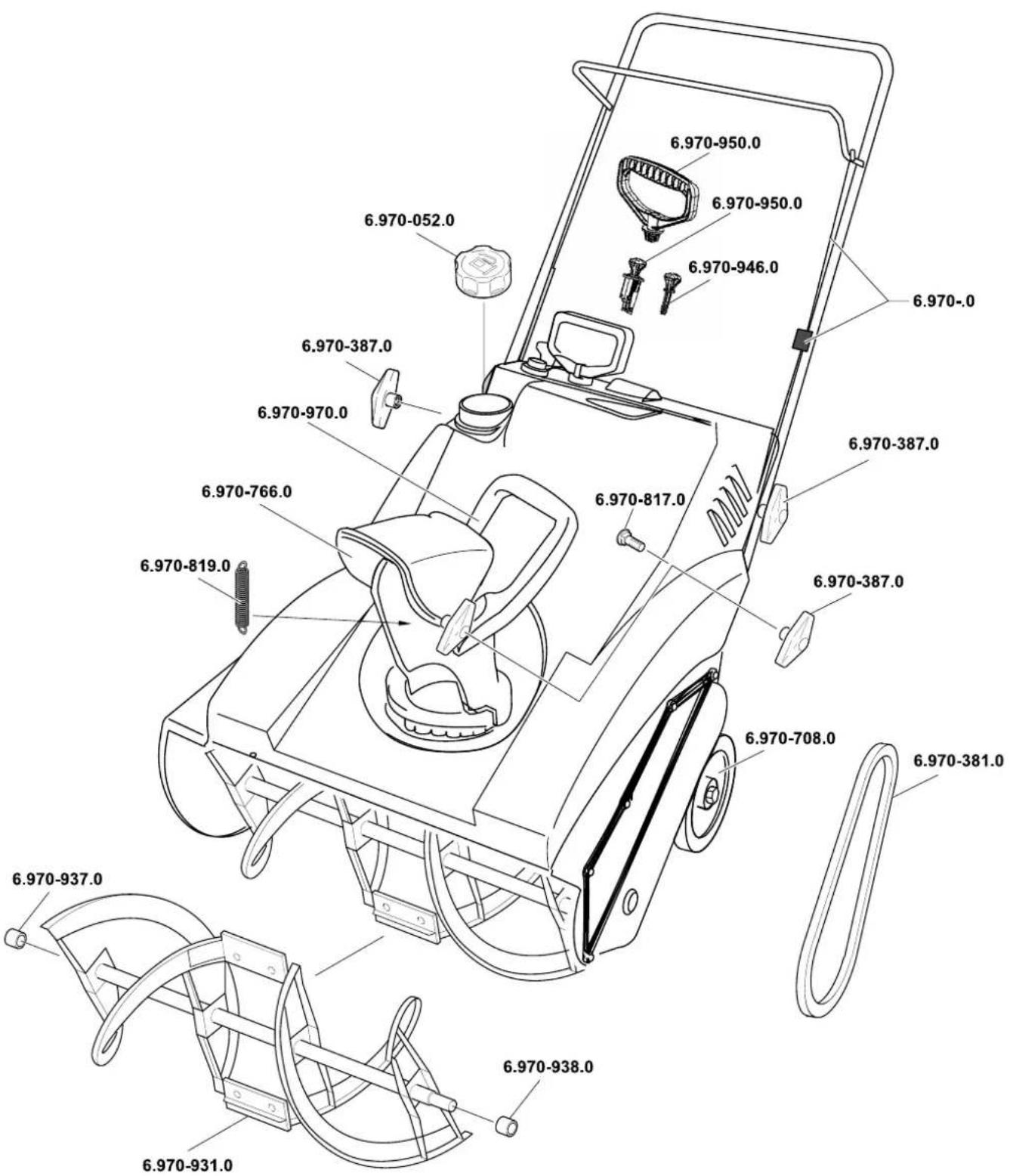
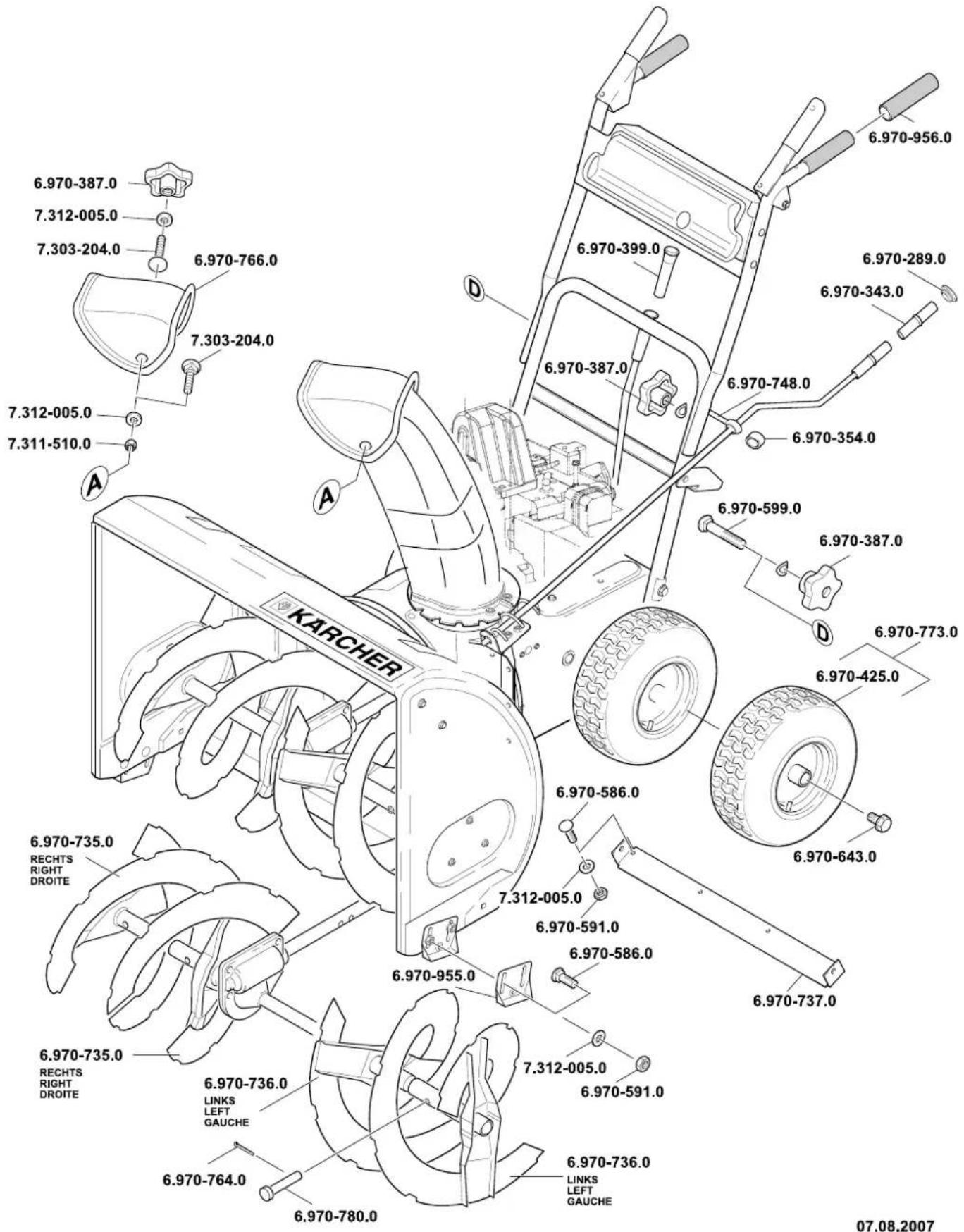
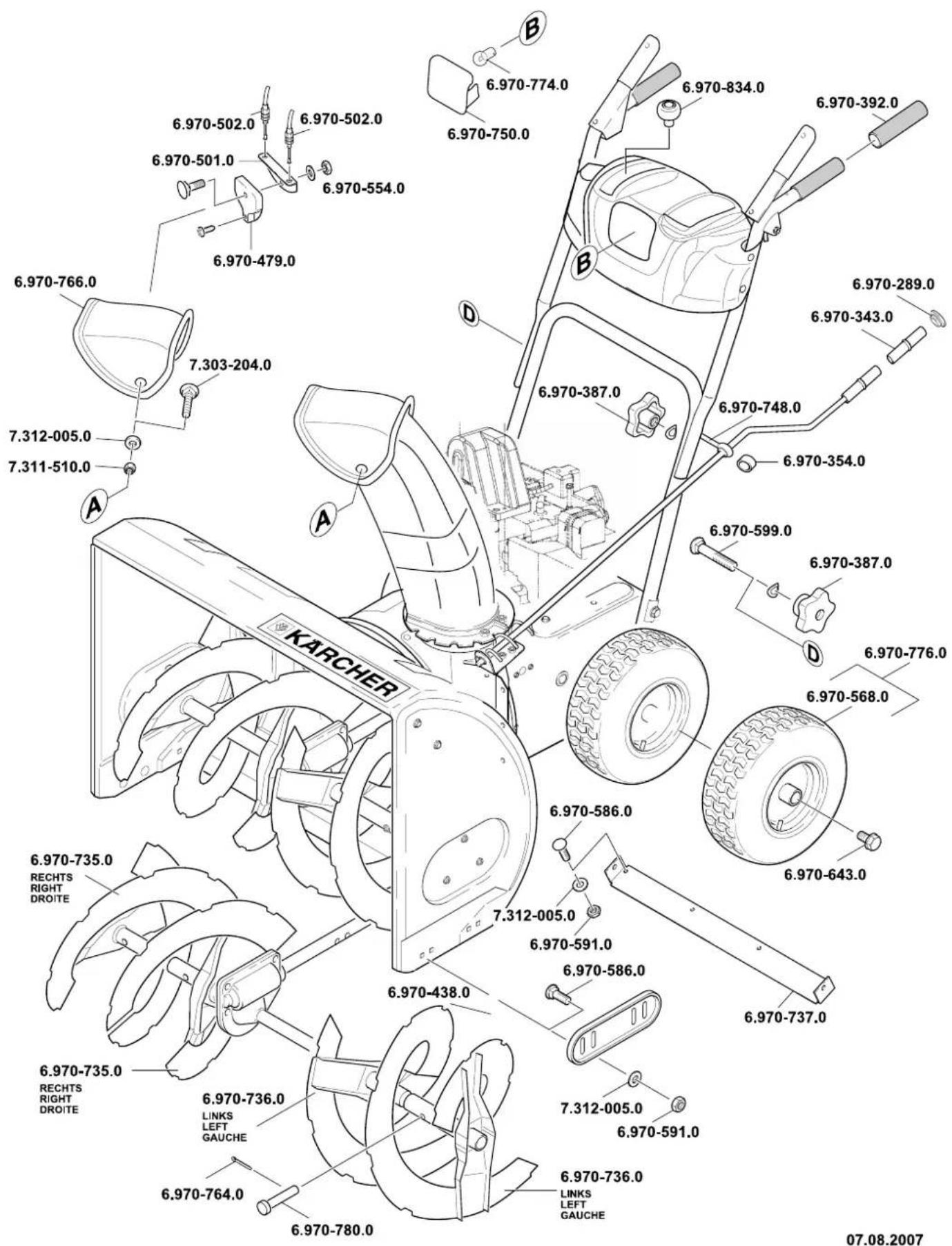
Only use accessories and spare parts which have been approved by the manufacturer. The exclusive use of original accessories and original spare parts ensures that the appliance can be operated safely and troublefree.
Cleaning the device
→ Park the machine on solid, even and horizontal ground. → Remove dirt that is stuck. → Clean the machine by letting in flowing water through the discharge shaft and let it dry. → Clean the engine using cloth and brush.
Lubricate the machine
Lubricate all rotating and moving parts with some light oil.
Adjust the air pressure in the tyres (Not STH 953 W)
Danger
Risk of explosion! Never exceed the max. tyre pressure of 1.4 bar/20 PSI.
Recommended air pressure is approx. 1 bar
Maintenance jobs for the engine
See "Engine Instruction Booklet".
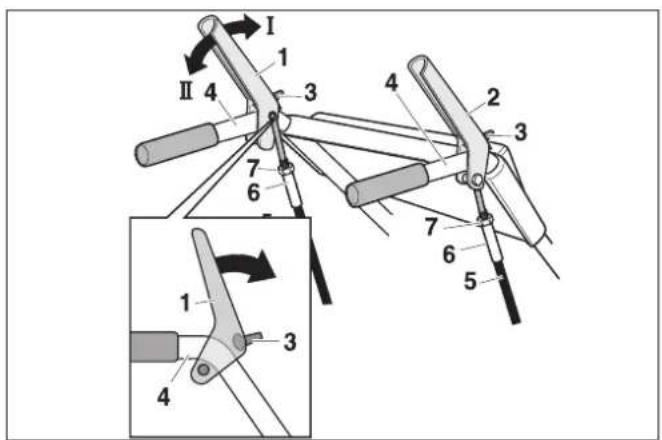
Adjust the clutch for the snail drive (Not STH 953 W)
Figure 2
Check clutch status:
→ Press the left clutch lever (1) forward (direction I); at the same time press the rubber (3) downward. The clutch tension (5) must be reduced. Otherwise loosen it (see "Changing the setting of the clutch tension"). → Release clutch lever (1). Clutch tension (5) must be without tolerance but should also not be too tight. Else change the setting (see "Changing the clutch tension"). → It should be possible to press down the clutch lever (1) completely. Otherwise, the clutch tension is too high and must be reduced (see "Changing the clutch tension").
Addition checks (see "Working with the appliance"):
→ Turn the auger drive on for 10 seconds with the engine running. → Release the clutch lever, the auger must stop rotating.
Adjust the clutch for the travel drive (Not STH 953 W)
Figure 1
→ Machines with track drive: Set the gear lever to position III. → Set the switching lever to the fastest forward gear (highest number). → Push the machine forward after releasing the clutch lever for travel drive. → While pushing, set the switching lever to the fastest reverse gear and then to the fastest forward gear. → If you feel any resistance during pushing or changing the gears, reduce the clutch tension (see "Changing the clutch tension setting"). → While pushing the machine, keep the clutch lever of the travel drive depressed. The wheels/tracks must be locked. Otherwise tighten the clutch tension (see "Changing the setting of the clutch tension"). → If the setting is still not complete or is doubtful, see "Check travel drive".
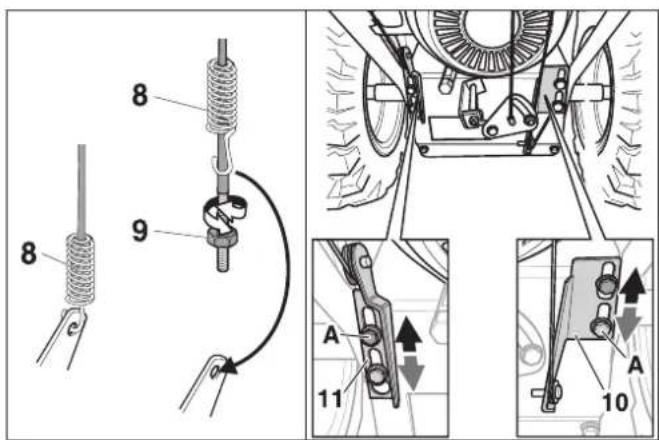
Changing the clutch tension setting (Not STH 953 W)
Figure 2
■ For clutch tensions with adjustable covers (6): → Tightening: Loosen nuts (7) and screw in the adjustable covers (6). → Loosening: Loosen adjusting covers (6) and screw in the nuts (7) in the opposite direction. ■ For clutch tensions with release spring (8): → Before doing the setting, remove the spring and then reinsert it. The clutch tension is correct when the spring expands 2-3 cm while coupling. → Tightening: Screw the safety nut (9) upward. → Loosening: Screw the safety nut (9) downward. ■ For clutch cables with adjustment plates for travel drive (10) or for auger drive (11): → Tightening: Loosen screw (A) depending on the adjustment plate, slide adjustment plate down and reattach the screw (A). → Loosening: Loosen screw (A) depending on the adjustment plate, slide adjustment plate up and reattach the screw (A).
Checking the travel drive
(Not STH 953 W)
Figure 12
⚠ Warning
Risk of damage to the machine! While tilting the machine, ensure that it retains its balance and no fuel or oil in the air filter leaks into the engine compartment or to the outside.
→ Loosen the screws of the frame; tilt the device forward, if required. → Release the clutch lever for travel drive and shift to all gears; while doing so, the friction wheel (2) should not touch the drive disc (3). Otherwise loosen coupling tension (see "Changing the clutch tension setting"). → Press the clutch lever for travel drive in each gear; the friction wheel must always touch the drive disc. Otherwise tighten the clutch tension (see "Changing the clutch tension setting"). → Clean the drive disc and rubber on the friction wheel, if required; they should be grease-free. → Remove ice pieces, if any.
Tensioning the V-belt of the auger (only STH 953 W)
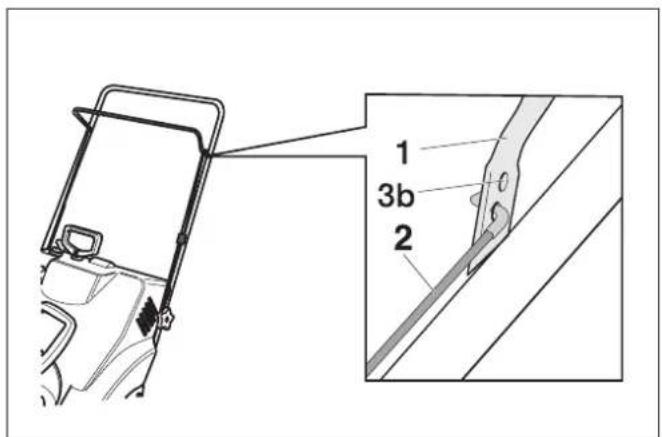
Figure 5
If the auger runs unevenly while the engine speed remains constant, the V-belt (5) must be retensioned.
→ If there is an additional boring (3b) on the clutch lever (1), hook the clutch cable (2) into the upper boring (3b).
→ If there is no additional (upper) boring or if it is already being used, visit an authorized workshop.
Setting the switching lever
(STH 8.66 W, STH 10.66 W Crt, STH 10.71 W, STH 13.84 W)
Figure 11 A
(Machines with switching rod)
→ Remove spring pin (4) and underlying disc (5), remove the spindle nut (6) from the hole (7). → Press the switch arm (2) downward; set the switching lever (3) to gear "6". → Turn the spindle nut (6) in such a way that the pin can be inserted in the same hole (7). → Secure the spindle nut with an underlying disc and spring pin.
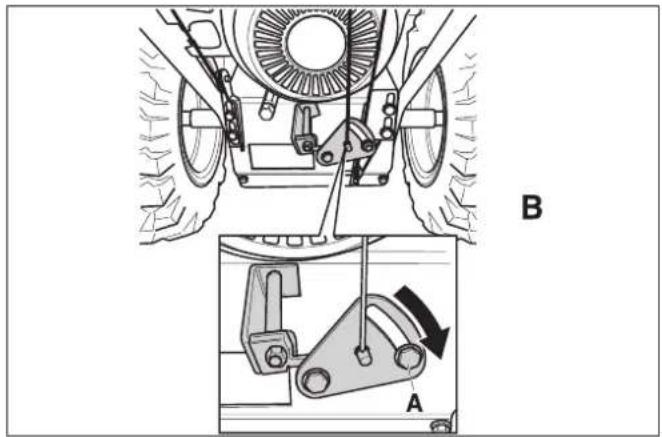
Figure 11 B
(Machines with switching tension)
→ Set the switching lever (3) to the fastest forward gear. → Loosen screw (A) and press the holder downward till the switching tension is tight. → Now tighten screw (A) again. → Check correct setting.
Note
This setting is required only if the fastest gear (forward or reverse) cannot be put.
Adjusting the track belt
(machines with track drive)
Figure 6
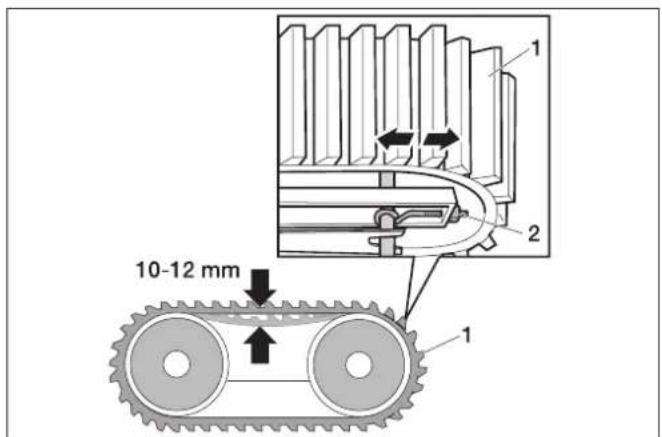
The track belt (1) is adjusted correctly if it can be deflected 10 - 12 mm by hand. Otherwise it has to be readjusted.
→ Position the machine on an even and horizontal surface so that the tracks no longer touch the ground. → Turn the nut (2) until the track belt has the correct tension. In clockwise direction: Tighten. Anticlockwise direction: Loosen.
Replacing the track belt
(machines with track drive)
Figure 6
→ Position the machine on an even and horizontal surface so that the tracks no longer touch the ground. → Turn the nut (2) anticlockwise until the track belt can be removed. → Replacing the track belt: Retension the new track belt using the nut (2) (see "Adjusting the track belt").
Replacing shearing bolts
(Not STH 953 W)
Figure 8
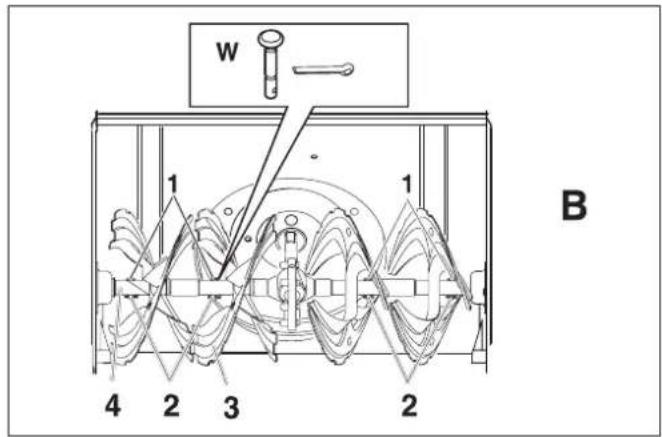
The auger (3) is fastened to the drive shaft (4) using shearing bolts (1) and locknuts or splints (2). The bolts are designed in such a way that they break (shear off) when the snail comes in contact with foreign bodies. This protects the machine against damages. These parts should only be replaced by original spare parts (Spare bolts and lock nuts or splints are included as options in standard delivery, part W).
→ Remove broken bolts (1) and locknut or splint (2); clean and lubricate the fastening point. → Use new shearing bolt and new locknut or splint.
Replacing the clearing plate
■ Only STH 953 W:
Figure 10
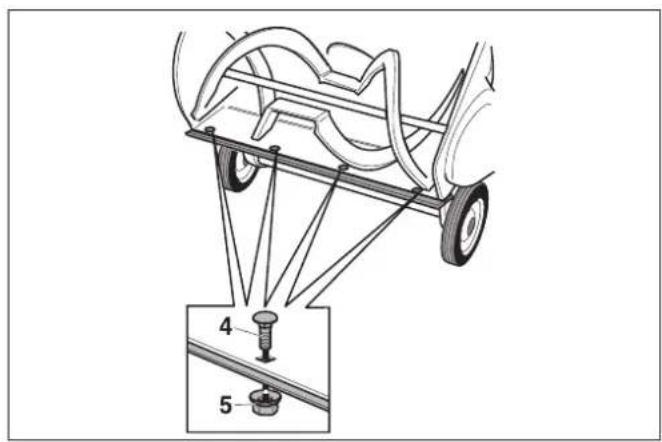
→ Tilt the appliance rearward. → Remove screws (4) and nuts (5). → Replace the clearing plate (2). → Fasten new clearing plate to the casing using screws and nuts. → Tilt the machine backwards, check (see "Adjusting the clearing plate"). ■ Not STH 953 W:
Figure 7
→ Remove screws (6), underlying discs (7) and nuts (8). → Replace the clearing plate (5). → Fasten new clearing plate to the casing using screws, underlying disc and nuts.
Replacing the landing skids
(Not STH 953 W)
Figure 7
→ Remove nuts (2), underlying discs (3) and screws (4). → Loosen the landing skids (1) on both the sides of the casing. → Adjust the new landing skids (see "Adjusting the landing skids").
Troubleshooting
⚠️ Danger
Risk of injury!
Before doing any work on the machine:
- Switch off engine. – Pull out the ignition key and the ignition plug.
- Allow engine to cool down.
Note
Some of the functioning problems have simple causes and you can rectify them easily. Call up an authorised workshop in case of doubt or if mentioned explicitly.
Note
Repairs should only be done by authorised workshops using original spare parts.
Troubleshooting
| Fault Possible cause | Remedy of whom | ||
| Engine does not start | Fuel tank empty. Refill the fuel tank. Operator | ||
| Fuel idling for a long time. Remove the old fuel in a suitable container in the open (See "Engine Instruction Booklet"). Fill up the tank with clean, fresh fuel. | Suitable container in the open (See "Engine Instruction Booklet"). Fill up the tank with clean, fresh fuel. | Operator | |
| Engine in cold state; choke not set to "ON/CHOKE". | Set the choke to "ON/CHOKE". Operator | ||
| Gas lever no set to "fast" (not STH 953 W). | Set the gas lever to "fast". | Operator | |
| Engine stop switch not set to "ON" (machines without gas levers). | Set the engine stop switch to "ON". Operator | ||
| Ignition plug not inserted. Insert the ignition plug into the spark plug. Operator | |||
| Spark plug is dirty. Clean the spark plug (see "Engine Instruction Booklet"). | Customer | Operator | |
| Spark plug is defective. Replace the spark plug. | Customer | Service | |
| Carburetor is overflowing. | Set the choke to "RUN/OFF" and start. | Operator | |
| Engine is running erratically | Choke set to "ON/CHOKE". | Choke set to "RUN/OFF". | Operator |
| Ignition plug is loosely inserted. | Fix the spark-plug connector properly. | Operator | |
| Fuel idling for a long time. Water or dirt in the fuel system. | Remove the old fuel in a suitable container in the open (See "Engine Instruction Booklet"). Fill up the tank with clean, fresh fuel. | Operator | |
| Ventilation hole in tank lid blocked. Clean tank lid and ventilation hole. Operator | |||
| Carburetor out of alignment. | Adjust the carburetor. | Customer Service | |
| Machine does not clear snow | Shearing bolts torn off. | Replace shearing bolts (see "Replacing shear-ing bolts"). | Operator |
| Snail or discharge shaft is blocked. | Stop the engine, pull out the ignition plug. Remove the blockage. | Operator | |
| Clutch tension for snail drive is not set properly. | Set clutch tension (see "Setting clutch for snail drive"). | Operator | |
| V-belt loose. | STH 953 W: Tension the V-belt (see "Tensioning the V-belt of the auger"). | Operator | |
| Not STH 953 W: Tighten V-Belt. | Customer Service | ||
| V-belt torn. | Replace V-belt. | Customer Service | |
| Machinen does not run (not STH 953 W) | Clutch tension for travel drive is not set properly. | Adjust clutch tension (see "Setting the clutch for travel drive"). | Operator |
| V-Belt is loose or torn. | Tighten the loose V-Belt. Replace torn V-Belt. | Customer Service | |
| Travel drive is coated with ice. | Remove the ice (see "Check travel drive"). | Operator | |
| Friction wheel rubber is torn. | Replace friction wheel rubber. | Customer Service | |
| Excessive vibration | Loose parts or damaged snail. | Stop the engine immediately, pull out the ignition plug. Tighten loose screws and nuts. Repair damaged snail. | Customer Service |
| Gears can be switched with great difficulty (not STH 953 W) | Clutch tension for travel drive is not set properly. | Adjust clutch tension (see "Setting the clutch for travel drive"). | Operator |
| Gear lever not adjusted correctly (not STH 5.56 W). | Check switching lever (see "Setting the switch-ing lever"). | Operator | |
| Travel drive is coated with ice. | Remove the ice (see "Check travel drive"). | Operator |
Information about engine
The engine manufacturer assumes liability for all engine-related problems as regards output, output measurement, technical data, warranty and servicing. For further details, please refer the separate holder/operator manual of the engine manufacturer.
Technical specifications
| STH 953 W | STH 5.56 W | STH 8.66 W | STH 10.66 W | Crt | STH 10.71 W | STH 13.84 W | ||
| Part no.: | -- | 1.332-101 | 1.335-101 | 1.335-201 | 1.335-302 | 1.335-203 | 1.335-204 | |
| Type -- Snow clearer | with wheels | Snow clearer with wheels | Snow clearer with wheels | Snow clearer with track belt | Snow clearer with wheels | Snow clearer with wheels | ||
| Motor -- MTD, 4- | stroke | MTD, 4- stroke | B&S, 4- stroke | B&S, 4- stroke | B&S, 4- stroke | B&S, 4- stroke | ||
| Rated power | kW/HP | 2,0/2,7 | 3,5/4,8 | 6,0/8,2 | 7,5/10,2 | 7,5/10,2 | 9,7/13,2 | |
| Cylinder capacity | cm3 | 123 | 179 | 250 | 305 | 305 | 342 | |
| Operating speed | 1/min | 3600 | 3600 | 3550 | 3600 | 3550 | 3400 | |
| Capacity of fuel tank, normal petrol (unleaded) | I | 1,9 | 1,9 | 3,8 | 3,8 | 3,8 | 7,6 | |
| Working width | mm | 530 | 560 | 660 | 660 | 710 | 840 | |
| Working speed | km/h | Step speed | Step speed | Step speed | Step speed | Step speed | Step speed | |
| Surface area, max. | m2/h | 1700 | 1700 | 2000 | 2000 | 2200 | 2500 | |
| Length | mm | 768 | 1111 | 1213 | 1257 | 1213 | 1492 | |
| Width | mm | 578 | 629 | 730 | 749 | 781 | 959 | |
| Height | mm | 645 | 800 | 800 | 851 | 800 | 864 | |
| Weight | kg | 36 | 80 | 100 | 98 | 102 | 135 | |
| Amount of oil | I | approx. 0.6 | approx. 0.6 | approx. 0.83 | approx. 0.83 | approx. 0.83 | approx. 0.83 | |
| Oil types above 0 °C | -- | SAE 30 | SAE 30 | SAE 30 | SAE 30 | SAE 30 | SAE 30 | |
| Oil types below 0 °C | -- | SAE 5W30 | SAE 5W30 | SAE 5W30 | SAE 5W30 | SAE 5W30 | SAE 5W30 | |
| Oil types below -18 °C | -- | SAE 0W30 | SAE 0W30 | SAE 0W30 | SAE 0W30 | SAE 0W30 | SAE 0W30 | |
| Noise emission | ||||||||
| Sound pressure level (EN 60704-1) | dB(A) | 92 | 92 | 98 | 98 | 94 | 98 | |
| Guaranteed sound power level (2000/14/EC) | dB(A) | 104 | 104 | 110 | 110 | 106 | 110 | |
| Machine vibrations | ||||||||
| Vibration total value (ISO 5349) | ||||||||
| Upper limbs | m/s2 | 5 | 5 | 5 | 5 | 5 | 5 | |
Warranty
The warranty terms published by our competent sales company are applicable in each country. We will repair potential failures of your appliance within the warranty period free of charge, provided that such failure is caused by faulty material or defects in fabrication. In the event of a warranty claim please contact your dealer or the nearest authorized Customer Service center. Please submit the proof of purchase.
CE declaration
We hereby declare that the machine described below complies with the relevant basic safety and health requirements of the EU Directives, both in its basic design and construction as well as in the version put into circulation by us. This declaration shall cease to be valid if the machine is modified without our prior approval.
Product: Snow clearer
Type: 1.332-xxx, 1.335-xxx
Relevant EU Directives
98/37/EC
89/336/EEC (+91/263/EEC, 92/31/EEC,
93/68/EEC)
2000/14/EC
Applied harmonized standards
EN ISO 12100-1
EN ISO 12100-2
EN ISO 14982
ISO 8437
Applied conformity evaluation method
Appendix V
Sound power level dB(A)
STH 953 W
Measured: 102
Guaranteed: 104
STH 5.56 W
Measured: 102
Guaranteed: 104
STH 8.66 W
Measured: 108
Guaranteed: 110
STH 10.66 W
Crt
Measured: 108
Guaranteed: 110
STH 10.71 W
Measured: 104
Guaranteed: 106
STH 13.84 W
Measured: 108
Guaranteed: 110
5.957-646
The undersigned act on behalf and under the power of attorney of the company management.
STH 8.66 W, STH 10.71 W, STH 13.84 W:
Figure 11 A
(STH 8.66 W, STH 10.66 W Crt, STH 10.71 W, STH 13.84 W)
Figure 11 A
89/336/EEC (+91/263/EEC, 92/31/EEC, 93/68/EEC)
2000/14/EC
(STH 8.66 W, STH 10.66 W Crt, STH 10.71 W, STH 13.84 W)
Fig. 11 A
(Machine with gear lever)
Type: 1.332-xxx, 1.335-xxx
89/336/EEC (+91/263/EEC, 92/31/EEC, 93/68/EEC)
2000/14/EC
Adjust base plate
(Only STH 953 W)
Fig. 10
Adjust the sliding shoes.
(Not STH 953 W)
Fig. 7
Adjust the drive coupling
(Not STH 953 W)
Fig. 1
(STH 8.66 W, STH 10.66 W Crt, STH
10.71 W, STH 13.84 W)
Fig. 11 A
89/336/EEC (+91/263/EEC, 92/31/EEC,
93/68/EEC)
2000/14/EC
(STH 8.66 W, STH 10.66 W Crt, STH 10.71
W, STH 13.84 W)
Fig. 11 A
(Unit with coupling rod)
(STH 8.66 W, STH 10.66 W Crt, STH 10.71 W, STH 13.84 W)
Fig. 11 A
89/336/EEC (+91/263/EEC, 92/31/EEC, 93/68/EEC)
2000/14/EC
Applied harmonized standards
EN ISO 12100-1
EN ISO 12100-2
EN ISO 14982
ISO 8437
(STH 8.66 W, STH 10.66 W Crt, STH 10.71 W, STH 13.84 W)
Fig. 11 A
Type: 1.332-xxx, 1.335-xxx
89/336/EEC (+91/263/EEC, 92/31/EEC, 93/68/EEC)
2000/14/EC
(STH 8.66 W, STH 10.66 W Crt, STH 10.71 W, STH 13.84 W)
Fig. 11 A
89/336/EEC (+91/263/EEC, 92/31/EEC, 93/68/EEC)
2000/14/EC
(STH 8.66 W, STH 10.66 W Crt, STH 10.71 W, STH 13.84 W)
Fig. 11 A
89/336/EEC (+91/263/EEC, 92/31/EEC, 93/68/EEC)
2000/14/EC
(STH 8.66 W, STH 10.66 W Crt, STH 10.71 W, STH 13.84 W)
Figure 11 A
(machines with gear frame)
→ Remove the spring pin (4) and washer (5), take the spindle nut (6) out of the bore (7).
→ Press the gear arm (2) downwards, switch the gear lever (3) to gear "6". → Turn the spindle nut (6) so that the pin can be inserted into the same bore (7). → Fix the spindle nut with washer and spring pin.
Figure 11 B
(machines with gear pull)
→ Switch the gear lever (3) to the fastest forward gear. → Loosen screw (A) and press the bracket downwards to tension the gear pull. → Retighten screw (A). → Check the correct adjustment.
Warning
98/37/EC 89/336/EEC (+91/263/EEC, 92/31/EEC, 93/68/EEC) 2000/14/EC
(STH 8.66 W, STH 10.66 W Crt, STH 10.71 W, STH 13.84 W)
Fig. 11 A
89/336/EEC (+91/263/EEC, 92/31/
EWG, 93/68/EWG)
2000/14/WE
(STH 8.66 W, STH 10.66 W Crt, STH 10.71 W, STH 13.84 W)
Figure 11 A
(machines with levers)
→ Remove the spring plug (4) and washer (5), and take the spindle nut (6) out of the bore (7). → Press the arm (2) downwards and set the gearbox (3) to speed "6". → Turn the spindle nut (6) so that the extension can be inserted into the same bore (7). → Secure the spindle nut with the washer and spring plug.
Figure 11 B
(machines with rope)
Type: 1.332-xxx, 1.335-xxx
89/336/EEC (+91/263/EEC, 92/31/EEC,
93/68/EEC)
2000/14/EC
Harmonized standards applied:
EN ISO 12100-1
EN ISO 12100-2
EN ISO 14982
ISO 8437
(STH 8.66 W, STH 10.66 W Crt, STH 10.71 W, STH 13.84 W)
Figure 11 A
89/336/EEC (+91/263/EEC, 92/31/EEC, 93/68/EEC)
2000/14/EC

STH 5.56 W






STH 10.66 W Crt








07.08.2007
- FIGURE 11 A
- CONTENTS
- ENVIRONMENTAL PROTECTION
- OVERVIEW
- DEVICE ELEMENTS
- FIGURE
- SYMBOLS ON THE MACHINE
- NOTE
- SYMBOLS IN THE OPERATING INSTRUCTIONS
- ⚠ DANGER
- ⚠ WARNING
- SAFETY INSTRUCTIONS
- SAFETY DEVICES
- CLUTCH BOW
- CLUTCH LEVER FOR SNAIL DRIVE
- CLUTCH LEVER FOR DRIVING
- SAFETY GRID IN THE DISCHARGE SHAFT
- DISCHARGE FLAP
- PROPER USE
- BEFORE STARTUP
- UNPACK THE APPLIANCE AND ASSEMBLE IT
- START UP
- ⚠️ DANGER
- CHECK THE MACHINE
- CHECK OIL LEVEL
- REFUELLING
- ⚠️DANGER
- CHECK THE TYRE PRESSURE
- ADJUST THE MACHINE TO SUIT THE SNOW AND GROUND CONDITIONS
- SETTING THE WORKING POSITION
- ADJUSTING THE CLEARING PLATE (ONLY STH 953 W)
- ADJUSTING THE SKIDS
- OPERATION
- TIPS FOR CLEARING THE SNOW
- WORKING ON SLOPES
- SETTING THE DIRECTION AND DISTANCE OF THROW
- ADJUST THROW DIRECTION
- ADJUST THE THROW DISTANCE
- START THE ENGINE
- STARTING USING ROPE STARTER
- STARTING USING ELECTRICAL STARTER (OPTIONAL)
- DANGER
- PUTTING/ CHANGING GEARS
- WORKING WITH THE APPLIANCE
- STOPPING THE ENGINE
- REMOVE THE BLOCKAGES FROM THE SNAIL OR THE DISCHARGE SHAFT
- SNOW CHAINS (OPTIONAL)
- TRANSPORT
- DRIVE THE MACHINE
- TRANSPORT WITHOUT SELF-DRIVE
- SHUTDOWN
- MAINTENANCE AND CARE
- MAINTENANCE SCHEDULE
- ONCE IN THE SEASON
- MAINTENANCE WORKS
- ACCESSORIES AND SPARE PARTS
- CLEANING THE DEVICE
- LUBRICATE THE MACHINE
- ADJUST THE AIR PRESSURE IN THE TYRES (NOT STH 953 W)
- MAINTENANCE JOBS FOR THE ENGINE
- ADJUST THE CLUTCH FOR THE SNAIL DRIVE (NOT STH 953 W)
- ADJUST THE CLUTCH FOR THE TRAVEL DRIVE (NOT STH 953 W)
- CHANGING THE CLUTCH TENSION SETTING (NOT STH 953 W)
- CHECKING THE TRAVEL DRIVE
- TENSIONING THE V-BELT OF THE AUGER (ONLY STH 953 W)
- SETTING THE SWITCHING LEVER
- FIGURE 11 B
- ADJUSTING THE TRACK BELT
- REPLACING THE TRACK BELT
- REPLACING SHEARING BOLTS
- REPLACING THE CLEARING PLATE
- REPLACING THE LANDING SKIDS
- TROUBLESHOOTING
- INFORMATION ABOUT ENGINE
- WARRANTY
- CE DECLARATION
- RELEVANT EU DIRECTIVES
- APPLIED HARMONIZED STANDARDS
- APPLIED CONFORMITY EVALUATION METHOD
- SOUND POWER LEVEL DB(A)
- STH 953 W
- STH 5.56 W
- STH 8.66 W
- STH 10.66 W
- CRT
- STH 10.71 W
- STH 13.84 W
- STH 8.66 W, STH 10.71 W, STH 13.84 W
- FIG. 11 A
- ADJUST BASE PLATE
- ADJUST THE SLIDING SHOES
- ADJUST THE DRIVE COUPLING
- FIG
- WARNING
- HARMONIZED STANDARDS APPLIED
- STH 10.66 W CRT
Brand : Kärcher
Model : STH 10.66 W Crt
Category : Snow blower