CCH303E - Freezer CORBERO - Free user manual and instructions
Find the device manual for free CCH303E CORBERO in PDF.



Frequently Asked Questions - CCH303E CORBERO
User questions about CCH303E CORBERO
0 question about this device. Answer the ones you know or ask your own.
Ask a new question about this device
Download the instructions for your Freezer in PDF format for free! Find your manual CCH303E - CORBERO and take your electronic device back in hand. On this page are published all the documents necessary for the use of your device. CCH303E by CORBERO.
USER MANUAL CCH303E CORBERO
- Always keep the instruction manual and, if you sell the equipment, hand it over to the new owner.
- This appliance must not be installed outdoors, not even if under a roof; it's extremely dangerous to leave it exposed to rain, storms and bad weather in general.
- Never touch, operate or move the appliance with bare feet or wet hands or feet.
- The equipment must be used exclusively for the domestic preservation and/or freezing of food.
- Packaging materials such as plastic bags, polystyrene and plastic tapes must be kept out of reach of children as they are potential sources of danger.
- Don't allow children to play with the appliance (for example by sitting in the baskets or climbing on the hatch), as this may cause it to tip over or cause objects on top of the freezer to fall off.
- Be careful not to damage the cooling fluid circuit during positioning, installation or cleaning.
- Make sure that no electrical appliances or components (eg. fans, switches, power outlets, etc.) are in stalled near the air vents
- Having installed the equipment, make sure it's not resting on the power cable.
- We advise against using extensions or multiple plugs to connect to the mains supply.
- Before carrying out any cleaning or maintenance operations, disconnect the equipment at the power outlet or switch off your entire power system.
- To disconnect the equipment from the mains supply, remove the plug but don't do this by pulling the cable.
- Each basket can take a distributed load of 15kg
- Don't put bottles or other glass containers in the low temperature compartment and they may crack or break when their contents are frozen.
- Don't eat food whose eat-by date has expired, as this may lead to food poisoning.
- Don't obstruct any of the opening/vents in the appliance.
- Avoid flames or sparks inside the appliance.
- During defrosting, never use metallic objects to accelerate the process. Failure to observe this rule could cause irreparable damage to the cooling fluid circuit.
- Don't use electrical appliances (ice-cream makers, deodorizers, etc.) inside the equipment.
All maintenance operations, including replacement of the power cable, must be carried out by our customer service engineers. Failure to do so may entail the risk of serious danger for the user.

ENVIRONMENTAL INFORMATION
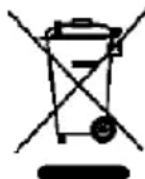
This appliance is marked in compliance with European Directive 2002/96/CE regarding disposal of waste electrical and electronic appliances (WEEA). The icon of a rubbish bin with a cross over it on the appliance means that the appliance must not be treated as ordinary domes.
tic waste on reaching the end of its useful life but must be taken to the appropriate collection centres for electrical and electronic waste or handed over to a retailer when buying a new one of a similar type. Dif
ferented collection of this appliance helps avoid negative impact on the environment and people's health as a result of incorrect treatment of the product.
Disposal must be carried out in compliance with current local environmental regulations.
For more detailed information on treatment, disposal and recycling of this product, contact your local waste disposal service or the retailer where you bought it.
Don't throw the packaging material from your equipment in the rubbish but sort the various materials (eg. polystyrene, cardboard, plastic bags, etc.) as required by local regulations.
This appliance does not contain CFCs (the cooling circuit contains R600a - ISOBUTANE).
Isobutane is a natural gas that doesn't affect the environment, but it is inflammable. Before connecting the equipment to the mains, it is therefore indispensable to check that the cooling circuit tubing is not damaged. For every 8 grams of cooling fluid, there must be a minimum of 1 cubic metre of space in the room where the appliance is installed. In the event of a leakage of cooling fluid, make sure that no flames or other sources of ignition are allowed to get near the leakage point.

INSTALLATION
The equipment must be installed by two people in order to avoid damage to persons and
things. If the equipment has suffered damage
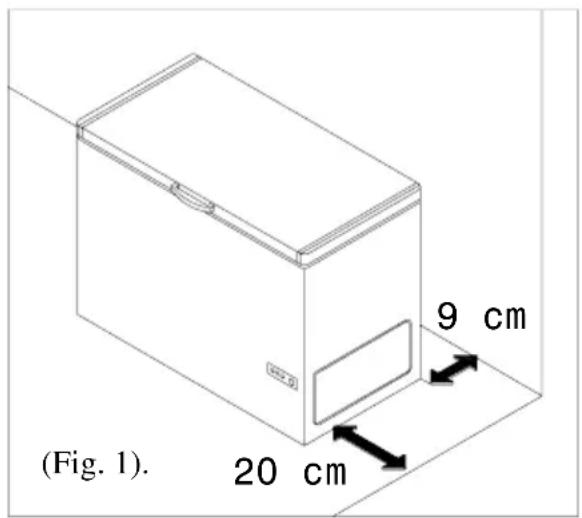
during transport, immediately inform the supplier before connecting up. Wait at least two hours after installation before putting the appliance into operation, to allow the cooling fluid to reach optimum efficiency. The equipment must be put in a dry, well ventilated place. It must be installed on a flat, stable surface. Adjust the levelling feet if necessary. There must be at least 90mm space between the back of the equipment and the wall (Fig. 1). Any shelving or cupboards over the appliance must be at least 800mm from the cover. Ambient temperature considerably affects energy consumption, so the equipment shouldn't be exposed to direct sunlight or placed next to heat sources such as heaters, stoves, cookers, etc. Check the climate classification on technical data plate on the back of the equipment.
"SN" (operates at ambient temperatures between) +10^ and +32^
N (operates at ambient temperatures between) +16^ and +32^
"ST" (operates at ambient temperatures between) +16^ and +38^
N (operates at ambient temperatures between) +16^ and +43^
Important:
Make sure there is easy access to the power outlet so that the plug can be removed when necessary. If this isn't possible, connect the equipment to the mains by means of a bipolar switch, in an accessible position, with a contact opening of at least 3mm .
ELECTRICAL CONNECTION
Connection of the equipment to a power outlet with an earth contact is a legal requirement. For this reason the equipment is fitted with a plug with an earth wire for connection to an outlet of the same type. The manufacturer declines any liability for damage to persons, property or pets due to failure to observe this rule. Check that the voltage indicated on the technical data plate on the back of the equipment is the same as that of your mains supply.
How to replace the lamp (only for appliances with lamp) Unplug the equipment or switch off at the main power switch before replacing the lamp. Only use lamps of the wattage indicated on the lamp shield (eg. max. 15 W).
GETTING TO KNOW YOUR FREEZER
The freezer you've chosen allows you to store frozen food and to freeze fresh food (see the section on freezing). Temperature regulation (Fig. 2) The temperature can be regulated in steps by means of the thermostat. Position "MIN" means equipment operation at minimum. Position "6" means equipment operation at maximum. The "HI" position means continuous operation. Remember that thermostat settings are affected by variations in ambient temperature, the quantity of food stored, the position the equipment is in and how often the door is opened. Experience will tell you which setting is right for your needs.
(A) - thermostat regulates the temperature inside the appliance and the fast freeze position.
(B) - green LED (POWER) indicates that the equipment is powered on by the mains.
(C) - Blue LED (RUN) indicates that compressor is on.
(E) - yellow LED (FROZEN) means that the appliance is working under fast freeze.
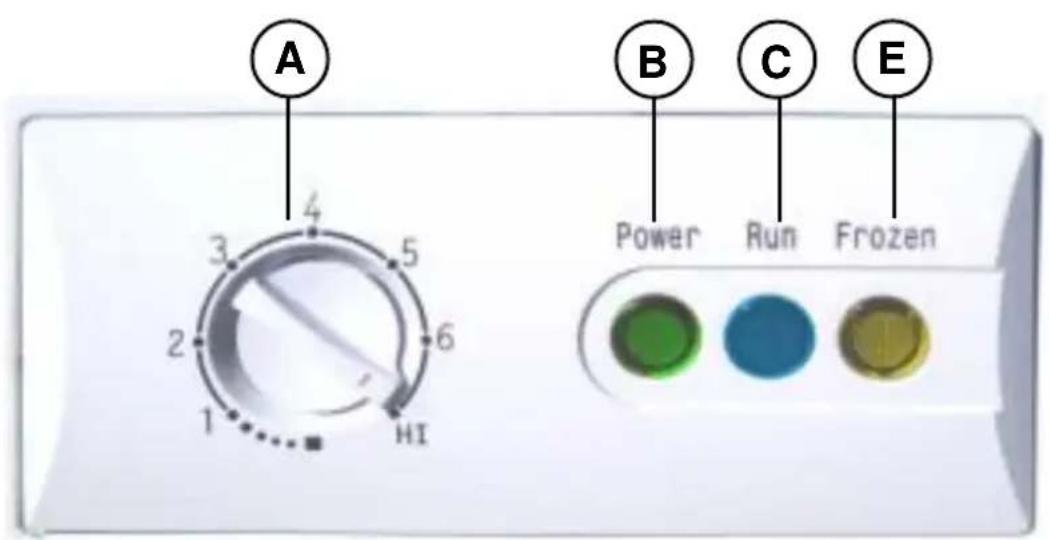
(Fig. 2).
You can keep frozen food for some months in the low temperature compartment (-18^) . We advise a thermostat setting in the middle position. The storage deadline for foods is usually written on the packaging. A product that starts to defrost must under no circumstances be re-frozen and must be consumed as soon as possible. To preserve flavours, consistency and freshness we suggest wrapping food in aluminium or cling foil and placing it in containers with a lid.
Important: do not put glass containers with warm liquid in them in the low temperature compartment.
Important: don't eat ice cubes or lollypops straight out of the freezer, as they make cause ice burns.
TIPS ON FREEZING
Prevent products to be frozen coming into contact with products that are already frozen. Make sure packets are dry, as this will prevent them from freezing together in a solid block.
-
Always prepare food in individual portions, which are quicker to thaw out.
-
To freeze the maximum quantity of food indicated on the technical data plate, proceed as follows:
- Set the thermostat to "HI" (yellow led lit) 24 hours before freezing.
- Never freeze food in the baskets as they are only suitable for storage.
- For fast freezing, arrange the packaged food with the biggest surface areas in contact with the inside walls and then transfer to the storage baskets when freezing is complete. Only open the freezer when necessary and even then as briefly as possible.
- 26 hours after the start of freezing put the thermostat back to the energy saving setting (yellow LED off).
- Small quantities of food (up to 3kg ) may be frozen without the fast freeze function by placing them directly against the walls of the freezer.
DEFROSTING THE FREEZER
To save energy, we recommend routine removal of excess frost (3-4 mm) from the inside of the equipment and the cooling grids. Never use sharp or pointed objects or metal tools, humidifiers or heaters, hairdryers or anti-freeze sprays to do this job. They could irreparably damage the cooling circuit and be a source of danger in equipment with R600a. We advise defrosting when the compartment is empty or only containing a few items of food.
To defrost, proceed as follows:
- turn the thermostat switch to stop;
- take the plug out of the wall outlet or switch off the mains system;
drain off water via the discharge to a basin; - when all the frost has melted, take up the water with a sponge or cloth;
- clean and dry the walls;
- put the plug back in at the wall outlet and set the thermostat as desired (see the "Getting to know _ your freezer" section.
MAINTENANCE AND CLEANING
Remove the plug from the wall outlet before proceeding or disconnect the general power switch. To clean the inside of the equipment and its fittings we suggest using water and vinegar (1 spoon for every 2.5 l water). Never use abrasives, detergent or soap. Clean the door sealings with water and dry carefully. Never use a steam cleaner to defrost or clean the equipment. Steam can damage live parts in the equipment and produce a short-circuit and/or electric shock. Steam also damages plastic parts.
PROLONGED DISUSE
If you go away for long periods, disconnect the equipment from the mains supply, empty, clean the inside and leave the door open (to prevent mould and bad odours forming).
DRAWBACKS AND REMEDIES
The inside temperature isn't low enough.
Check that:
- the door is perfectly closed; the thermostat is in the correct position;
- the freezer is not near a heat source;
- the freezer is not installed against the wall and that there is free circulation of air;
- there isn't excess frost on the cooling grids.
The inside temperature is too low.
Check that:
- the thermostat is in the correct position;
- the super switch is off.
The appliance is too noisy
Check that:
- the equipment is level;
- the rear element isn't touching the back wall;
The equipment isn't working at all.
Check that:
- the thermostat isn't set at "stop";
- the power supply isn't off;
- the plug is properly in the wall outlet;
- the power cable isn't broken (see the section headed IMPORTANT SAFETY WARNINGS). If the freezer still won't work properly after carrying out the procedures described above, call the nearest CUSTOMER SERVICE (indicated on attached slip).
Important: the freezer may produce the following slight noises:
When the freezer is installed in a damp, unheated area, droplets of condensation may form on the external surfaces, especially with relatively low ambient temperatures and high relative humidity. This phenomenon in no way affects the equipment's efficiency or life cycle.
The manufacturer declines any liability for damage that may directly or indirectly be caused to persons, property or domestic animals by failure to observe all the indications in the instruction booklet, and especially the warnings regarding installation, use and maintenance.
The manufacturer also reserves the right to make any modifications deemed technically or commercially appropriate at any time and under no obligation to give prior notice.
This appliance is made for use in contact with foods and complies with EU Directive 1935/2004 (27th October 2004).
This appliance is designed, built and sold in accordance with the following European Community directives:
- EC Directive 2006/95/CE, 12/12/2006 (Low Voltage) and subsequent amendments.
- EC Directive 89/336/CE, 03/05/89 (Electromagnetic Compatibility) and subsequent amendments.