
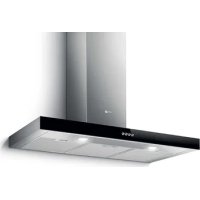
Riva - Range hood TURBOAIR - Free user manual and instructions
Find the device manual for free Riva TURBOAIR in PDF.



| Product type | Kitchen hood |
| Brand | TURBOAIR |
| Model | Riva |
| Use | Household use only |
| Available versions | Ducted (external extraction) or recirculating (internal recirculation) |
| Minimum safety distance (electric cooking) | 65 cm |
| Minimum safety distance (gas or mixed cooking) | 65 cm (or more according to cooking appliance manufacturer's instructions) |
| Duct diameter | Equal to the connection flange (not supplied) |
| Lighting | Halogen candle bulbs, E14 base, 28 W max |
| Number of extraction speeds | Multiple (speed control) |
| Grease filter | Washable or disposable depending on model; clean at least once a month |
| Activated carbon filter (recirculation) | Replace at most every 4 months; not washable or reusable |
| Power supply | 220-240 V ~ 50 Hz (voltage on rating plate) |
| Installation | Wall-mounted or under cabinet suspended |
| Material | Not specified in the manual |
| Dimensions | Not specified |
| Weight | Not specified |
| Protection rating | Not specified |
| Warranty | Not specified |
| Important safety instructions | Disconnect before maintenance; do not use alcohol; do not flambé |
Frequently Asked Questions - Riva TURBOAIR
User questions about Riva TURBOAIR
0 question about this device. Answer the ones you know or ask your own.
Ask a new question about this device
Download the instructions for your Range hood in PDF format for free! Find your manual Riva - TURBOAIR and take your electronic device back in hand. On this page are published all the documents necessary for the use of your device. Riva by TURBOAIR.
USER MANUAL Riva TURBOAIR
natural_image
Isometric diagram of a layered structure with directional arrows indicating movement or force, labeled Fig. 5 (no text or symbols on the diagram itself)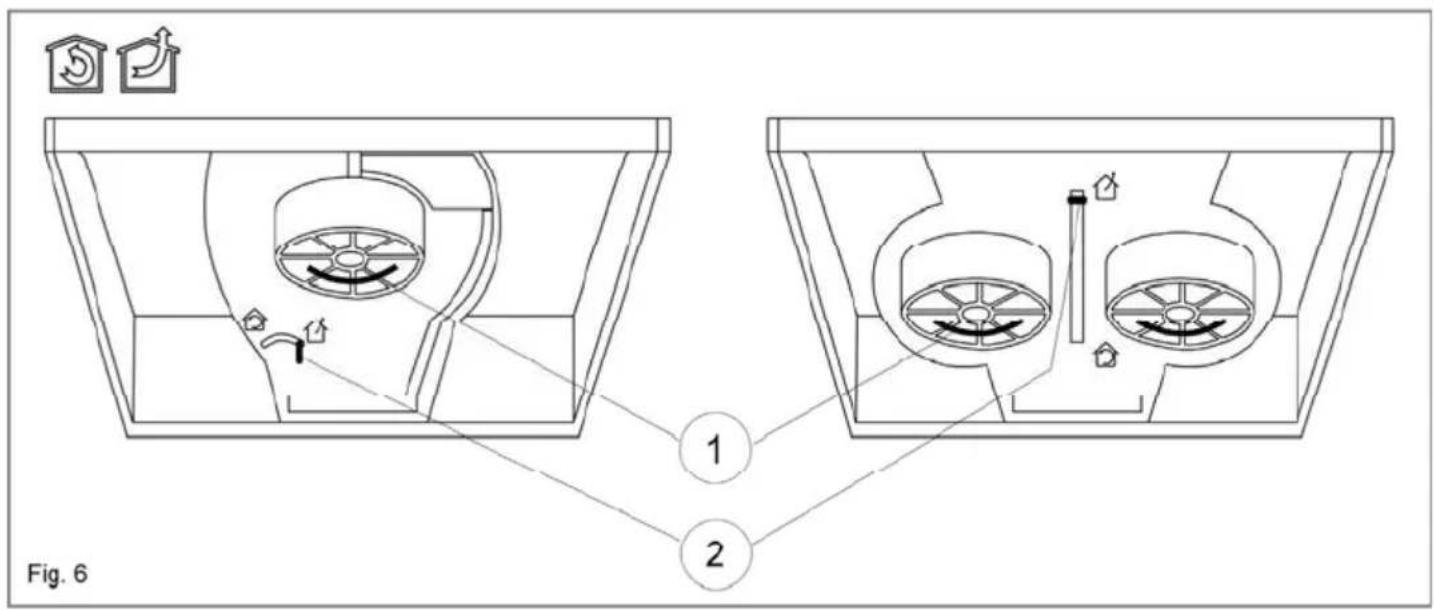

EN - Instruction on mounting and use
Closely follow the instructions set out in this manual. All responsibility, for any eventual inconveniences, damages or fires caused by not complying with the instructions in this manual, is declined. The hood is conceived for the suction of cooking fumes and steam and is destined only for domestic use.
The hood can look different to that illustrated in the drawings in this booklet. The instructions for use, maintenance and installation, however, remain the same.
! It is important to conserve this booklet for consultation at any moment. In the case of sale, cession or move, make sure it is together with the product.
! Read the instructions carefully: there is important information about installation, use and safety.
! Do not carry out electrical or mechanical variations on the product or on the discharge conduits.

Caution
WARNING! Do not connect the appliance to the mains until the installation is fully complete.
Before any cleaning or maintenance operation, disconnect hood from the mains by removing the plug or disconnecting the mains electrical supply.
Always wear work gloves for all installation and maintenance operations.
The appliance is not intended for use by children or persons with impaired physical, sensorial or mental faculties, or if lacking in experience or knowledge, unless they are under supervision or have been trained in the use of the appliance by a person responsible for their safety.
This appliance is designed to be operated by adults, children should be monitored to ensure that they do not play with the appliance.
This appliance is designed to be operated by adults. Children should not be allowed to tamper with the controls or play with the appliance.
Never use the hood without effectively mounted grating!
The hood must NEVER be used as a support surface unless specifically indicated.
The premises where the appliance is installed must be sufficiently ventilated, when the kitchen hood is used together with other gas combustion devices or other fuels.
The ducting system for this appliance must not be connected to any existing ventilation system which is being used for any other purpose such as discharging exhaust fumes from appliances burning gas or other fuels.
The flaming of foods beneath the hood itself is severely prohibited.
The use of exposed flames is detrimental to the filters and may cause a fire risk, and must therefore be avoided in all circumstances.
Any frying must be done with care in order to make sure that the oil does not overheat and ignite.
Accessible parts of the hood may become hot when used with cooking appliance.
With regards to the technical and safety measures to be
adopted for fume discharging it is important to closely follow the regulations provided by the local authorities.
The hood must be regularly cleaned on both the inside and outside (AT LEAST ONCE A MONTH).
This must be completed in accordance with the maintenance instructions provided in this manual). Failure to follow the instructions provided in this user guide regarding the cleaning of the hood and filters will lead to the risk of fires.
Do not use or leave the hood without the lamp correctly mounted due to the possible risk of electric shocks.
We will not accept any responsibility for any faults, damage or fires caused to the appliance as a result of the non-observance of the instructions included in this manual.
This appliance is marked according to the European directive 2002/96/EC on Waste Electrical and Electronic Equipment (WEEE). By ensuring this product is disposed of correctly, you will help prevent potential negative consequences for the environment and human health, which could otherwise be caused by inappropriate waste handling of this product.

The symbol ■ on the product, or on the documents accompanying the product, indicates that this appliance may not be treated as household waste. Instead it should be taken to the appropriate collection point for the recycling of electrical and electronic equipment. Disposal must be carried out in accordance with local environmental regulations for waste disposal.
For further detailed information regarding the process, collection and recycling of this product, please contact the appropriate department of your local authorities or the local department for household waste or the shop where you purchased this product.
Use
The hood is designed to be used either for exhausting or filter version.

Ducting version
In this case the fumes are conveyed outside of the building by means of a special pipe connected with the connection ring located on top of the hood.
Attention! The exhausting pipe is not supplied and must be purchased apart.
Diameter of the exhausting pipe must be equal to that of the connection ring.
In the horizontal runs the exhausting pipe must be slightly slanted (about 10irc ) and directed upwards to vent the air easily from the room to the outside.
Attention! If the hood is supplied with active charcoal filter, then it must be removed.
Connect the hood and discharge holes on the walls with a diameter equivalent to the air outlet (connection flange).
Using the tubes and discharge holes on walls with smaller dimensions will cause a diminution of the suction performance and a drastic increase in noise.
Any responsibility in the matter is therefore declined.
! Use a duct of the minimum indispensable length.
! Use a duct with as few elbows as possible (maximum elbow angle: 90°).
! Avoid drastic changes in the duct cross-section.
! Use a duct as smooth as possible inside.
! The duct must be made of certified material.
Pease make sure that the lever (fig. 6/2) is in the exhaustposition.
N.B. Before installing the cooker hood with air exhaust backwards (Fig.8/1) please take out the air deflector (Fig. 8/2) from the top and closethe upper air exhaust with the supplied cover (Fig. 8/3). Only with outthe air deflector the hood can work correctly.

Filter version
One active charcoal filter is needed for this and can be obtained from your usual retailer.
The filter removes the grease and smells from the extracted air before sending it back into the room through the upper outlet grid.
Preparing the cooker hood for use as a recirculation hood
If the hood is to be used as a recirculation hood (fig.8/4) the opening must be closed with the cover which is provided (fig.8/3). To convert the cooker hood from exhaust to filtering push the lever that is placed under the lamps to the left (only for cooker hoods with one motor) or push the lever backwards (Fig.6/2) (only for cooker hoods with two motors). When installing the hood and when it is in use, it must be ensured that the opening at the top to the front of the hood is always unobstructed.
Installation
The minimum distance between the supporting surface for the cooking equipment on the hob and the lowest part of the range hood must be not less than 65cm from electric cookers and 65cm from gas or mixed cookers.
If the instructions for installation for the gas hob specify a greater distance, this must be adhered to.

Electrical connection
The mains power supply must correspond to the rating indicated on the plate situated inside the hood. If provided with a plug connect the hood to a socket in compliance with current regulations and positioned in an accessible area, after installation. If it not fitted with a plug (direct mains connection) or if the plug is not located in an accessible area, after installation, apply a double pole switch in accordance with standards which assures the complete disconnection of the mains under conditions relating to over-current category III, in accordance with installation instructions.
Warning! Before re-connecting the hood circuit to the mains supply and checking the efficient function, always check that the mains cable is correctly assembled.
Mounting
Expansion wall plugs are provided to secure the hood to most types of walls/ceilings. However, a qualified technician must verify suitability of the materials in accordance with the type of wall/ceiling. The wall/ceiling must be strong enough to take the weight of the hood. Do not tile, grout or silicone this appliance to the wall. Surface mounting only.
Fastening the cooker hood to the wall
- Using the attached template mark the position of the holes. Before drilling make sure that no wiring and tubes will be damaged.
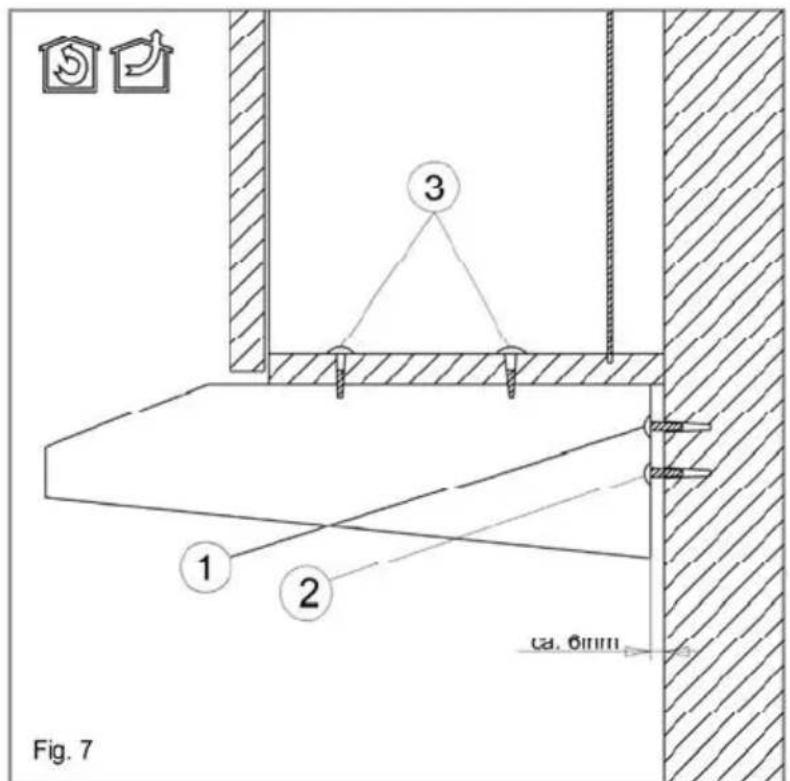
- Drill the two fastening holes, drive in the wall plugs and screw in the screws until their heads are about 6 mm from the wall (fig. 7/1).
- Place the hood to the wall in order to check that it seats properly. Than mark the position of the two holes (fig. 7/2).
Take it off from the wallnow, drill the homes and fit the plugs. - Place the hood once again to the wall, tighten the screws (fig. 7/1) and introduce the screws (fig. 7/2) from the inside of the appliance.
Fastening the cooker hood beneath a wall cupboard (ensure that the cupboard can support the weight of the hood).
- Turn the wall cupboard upside down.
- Using the attached template mark on the wall the positions of the 4 screwsholes and the exhaust opening.
- Using a 4.5 mm bit, drill the four fastening holes in the bottom of the cupboard.
- Only for hoods with an exhaust connection pointing upwards. Cut the exhaust opening for a pipe of (130 mm diameter) and fasten thepipe flange to the hood.
- Turn the cupboard back over and stand it on the top of the cooker hood and fasten the hood to the cupboard by means of four screws screwed through the holes that were drilled in the bottom of the cupboard (fig. 7/3). Additional Installation
Specifications:
Use only the fixing screws supplied with the product for installation.
Use the correct length screws which are identified in the Installation Guide
WARNING! Failure to install the screws or fixing device in accordance with these instructions may result in electrical hazards.
Operation
Use the high suction speed in cases of concentrated kitchen vapours. It is recommended that the cooker hood suction is switched on for 5 minutes prior to cooking and to leave in operation during cooking and for another 15 minutes approximately after terminating cooking.
The hood is fitted with a control panel with aspiration speed selection control and a light switch to control cooking area lights.
Fig. 3/1 - Fig.3/2
Maintenance
ATTENTION! Before performing any maintenance operation, isolate the hood from the electrical supply by switching off at the connector and removing the connector fuse.
Or if the appliance has been connected through a plug and socket, then the plug must be removed from the socket.
Cleaning
The cooker hood should be cleaned regularly (at least with the same frequency with which you carry out maintenance of the fat filters) internally and externally. Clean using the cloth dampened with neutral liquid detergent. Do not use abrasive products. DO NOT USE ALCOHOL!
WARNING: Failure to carry out the basic cleaning recommendations of the cooker hood and replacement of the filters may cause fire risks.
Therefore, we recommend observing these instructions.
The manufacturer declines all responsibility for any damage to the motor or any fire damage linked to inappropriate maintenance or failure to observe the above safety recommendations.
Grease filter
Traps cooking grease particles.
If situated inside the support grill, it may be one of the following types:
Paper filter must be replaced once a month or if colouring appears on upper side, in such cases the colouring is evident through the grill openings.
Metallic filter must be cleaned once a month, with non abrasive detergents, by hand or in dishwasher on low temperature and short cycle.
When washed in a dishwasher, the grease filter may discolour slightly, but this does not affect its filtering capacity.
The acrylic filter should be cleaned at regular intervals depending on the use of the appliance and anyway once every 30 days of hood operation; it should also be hand-washed in warm water and soap (do not wring the filter, just wrap it in a cloth for drying).
Replacing the grease filter
- The hood is isolated from the electric supply by withdrawing the power plug.
- In order to open the grid press the clips (fig. 4/1) at the left and at the rightone towards the other.
- Tilt the filter frame downwards and push the frame forewards on one side of the guide and disengage it from the groove.
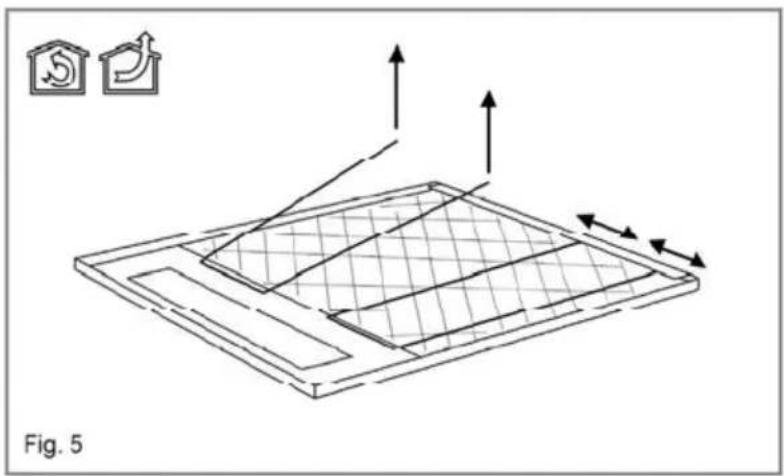
- The two ends of the wire yoke are then pressed outwards and liftedupwards (fig. 5). The filter felt can then be removed.
After cleaning the grease-filter frame, the new grease filter to be inserted orfilter felt is cut to size and fitted in the frame.
Charcoal filter (filter version only)
It absorbs unpleasant odours caused by cooking.
The saturation of the charcoal filter occurs after more or less prolonged use, depending on the type of cooking and the regularity of cleaning of the grease filter.
In any case it is necessary to replace the cartridge at least every four months.
The charcoal filter may NOT be washed or regenerated.
Circular carbon filter
Apply one on each side as cover to both the shield grids of the motor impeller, then turn clockwise.
For the disassembly, turn counter-clockwise.
Replacing lamps
Disconnect the hood from the electricity.
Warning! Prior to touching the light bulbs ensure they are cooled down.
Replace the damaged lamp.
Use ∅35mm E14 28W halogen candle lamps only.
If the lights do not work, make sure that the lamps are fitted properly into their housings before you call for technical assistance.
Joon. 3/1 – Joon. 3/2
Hooldus




- EN - Instruction on mounting and use
- The hood can look different to that illustrated in the drawings in this booklet. The instructions for use, maintenance and installation, however, remain the same.
- Caution
- Use
- Ducting version
- Filter version
- Preparing the cooker hood for use as a recirculation hood
- Installation
- Electrical connection
- Mounting
- Fastening the cooker hood to the wall
- Fastening the cooker hood beneath a wall cupboard (ensure that the cupboard can support the weight of the hood).
- Specifications:
- Operation
- Maintenance
- Cleaning
- Grease filter
- Traps cooking grease particles.
- Replacing the grease filter
- Charcoal filter (filter version only)
- It absorbs unpleasant odours caused by cooking.
- Circular carbon filter
- Replacing lamps
- Hooldus
Brand : TURBOAIR
Model : Riva
Category : Range hood