 ManualGo.com
WFW95HEDU - Machine à laver WHIRLPOOL - Free user manual and instructions
Find the device manual for free WFW95HEDU WHIRLPOOL in PDF.


Download the instructions for your Machine à laver in PDF format for free! Find your manual WFW95HEDU - WHIRLPOOL and take your electronic device back in hand. On this page are published all the documents necessary for the use of your device. WFW95HEDU by WHIRLPOOL.
USER MANUAL WFW95HEDU WHIRLPOOL
8212545RP 5 ft. (1.5 m) Inlet hose, Red and Blue EPDM (2 pack)
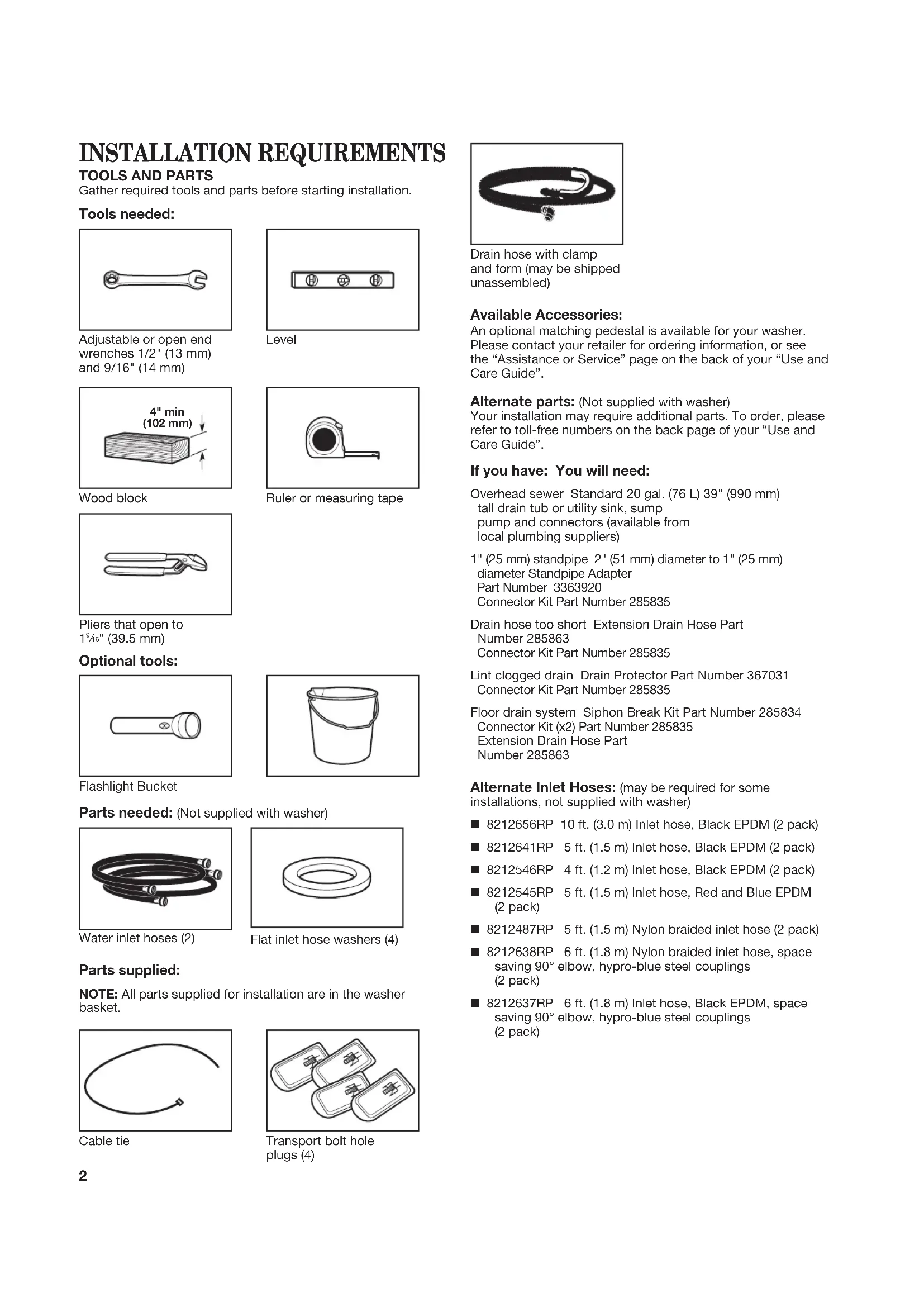
8212637RP 6 ft. (1.8 m) Inlet hose, Black EPDM, space saving 90° elbow, hypro-blue steel couplings (2 pack) Optional tools: Parts supplied: NOTE: All parts supplied for installation are in the washer basket. 4" min (102 mm) Wood block Adjustable or open end wrenches 1/2" (13 mm) and 9/16" (14 mm) Ruler or measuring tape Level Pliers that open to
" (39.5 mm) Flashlight Bucket Cable tie Drain hose with clamp and form (may be shipped unassembled) Tools needed: INSTALLATION REQUIREMENTS
Gather required tools and parts before starting installation. Transport bolt hole plugs (4) Available Accessories: An optional matching pedestal is available for your washer. Please contact your retailer for ordering information, or see the “Assistance or Service” page on the back of your “Use and Care Guide”. Parts needed: (Not supplied with washer) Water inlet hoses (2) Flat inlet hose washers (4)3 LOCATION REQUIREMENTS Proper installation is your responsibility. You will need:
A water heater set to 120° F (49° C).
A grounded electrical outlet located within 6 ft (1.8 m) of power cord on back of washer.
Hot and cold water faucets located within 4 ft (1.2 m) of hot and cold water ll valves on washer, and water pressure of 20-100 psi (137.9-689.6 kPa).
A level oor with maximum slope of 1" (25 mm) under entire washer. Installing on carpet or surfaces with foam backing is not recommended.
Floor must support washer’s total weight (with water and load) of 315 lbs (143 kgs). IMPORTANT: Do not install, store or operate washer where it will be exposed to weather or in temperatures below 32° F (0° C). Water remaining in washer after use may cause damage in low temperatures. See “Washer Care” in your “Use and Care Guide” for winterizing information. Whirlpool Models*
/16" (1345 mm) All dimensions show recommended spacing allowed, except for closet door ventilation openings which are the minimum required. For each arrangement, consider allowing more space for ease of installation and servicing, and spacing for companion appliances and clearances for walls, doors, and oor moldings. Space must be large enough to allow door to fully open. Add spacing of 1" (25 mm) on all sides of washer to reduce noise transfer. If a closet door or louvered door is installed, top and bottom air openings in door are required.
(76 mm) Recessed area or closet installation (stacked washer and dryer): Custom under counter installation:
- For additional details (or information) specic to your model, refer to the Dimension Guide at www.whirlpool.com.
- Add spacing of 1" (25 mm) on all sides of washer/dryer.
(102 mm) Floor drain system requires a Siphon Break Kit (Part Number 285834), 2 Connector Kits (Part Number 285835), and an Extension Drain Hose (Part Number 285863) that may be purchased separately. See “Alternate Parts”. Minimum siphon break height: 28" (710 mm) from bottom of washer. (Additional hoses may be needed.) Minimum diameter for a standpipe drain: 2" (51 mm). Minimum carry-away capacity: 17 gal. (64 L) per minute. A 1/4" (6 mm) diameter to 1" (25 mm) diameter Standpipe Adapter Kit is available (Part Number 3363920). Top of standpipe must be at least 30" (762 mm) high; install no higher than 96" (2.44 m) from bottom of washer. If you have an overhead sewer and need to pump higher than 96" (2.44 m), a sump pump and associated hardware are needed. See “Alternate Parts”. Wall standpipe drain system Laundry tub drain system Minimum capacity: 20 gal. (76 L). Top of laundry tub must be at least 30" (762 mm) above oor; install no higher than 96" (2.44 m) from bottom of washer. 4.5" (114 mm) Floor standpipe drain system 4.5" (114 mm) See requirements for oor standpipe drain system. 30"(762 mm) min. 4.5" (114 mm) Floor drain system DRAIN SYSTEM Drain system can be installed using a oor drain, wall standpipe, oor standpipe, or laundry tub. Select method you need. IMPORTANT: To avoid siphoning, only 4.5" (114 mm) of drain hose should be inside standpipe. Always secure drain hose with cable tie.
- Add spacing of 1" (25 mm) on all sides of washer. ** Recommended 4" (102 mm), minimum 1.5" (38 mm)
It is necessary to remove all shipping materials for proper operation and to avoid excessive noise from washer. Move washer to within 4 ft (1.2 m) of its nal location. It must be in a fully upright position. ELECTRICAL REQUIREMENTS Electrical Shock HazardPlug into a grounded 3 prong outlet.Do not remove ground prong.Do not use an adapter.Do not use an extension cord.Failure to follow these instructions can result in death, re, or electrical shock. WARNING
A 120 volt, 60 Hz., AC only, 15- or 20-amp, fused electrical supply is required. A time-delay fuse or circuit breaker is recommended. It is recommended that a separate circuit breaker serving only this appliance be provided. This washer is equipped with a power supply cord having a 3 prong grounding plug. To minimize possible shock hazard, the cord must be plugged into a mating, 3 prong, grounding-type outlet, grounded in accordance with local codes and ordinances. If a mating outlet is not available, it is the personal responsibility and obligation of the customer to have the properly grounded outlet installed by a qualied electrician. If codes permit and a separate ground wire is used, it is recommended that a qualied electrician determine that the ground path is adequate.
Do not ground to a gas pipe.
Check with a qualied electrician if you are not sure the washer is properly grounded. Do not have a fuse in the neutral or ground circuit.
2. Locate transport bolts
Locate four transport bolts on rear of washer.6 Loosen bolts with a 1/2" (13 mm) wrench. Slide each bolt and spacer to center of hole. Pull bolts and plastic spacers from back of washer. Discard bolts and spacers.
3. Remove transport bolts from
washer Close bolt holes on cabinet back with four transport bolt hole plugs included with washer parts.
4. Cover bolt holes with transport
bolt hole plugs Pull power cord through opening in rear panel and close hole with attached cap. NOTE: If washer is transported at later date, call your local service center to avoid suspension and structural damage, a certied technician must properly set up washer for relocation.
5. Remove power cord
Remove the yellow shipping strap from the cord. Gently place power cord over top of washer to allow free access to back of washer. IMPORTANT: Do not plug washer in until installation has been completed. If clamp is not already in place on elbow end of drain hose, squeeze clamp with pliers and slide it over end of hose, centering it between the ribs, as shown. Squeeze clamp with pliers and slide elbow end of drain hose onto drain port and secure with clamp. For a laundry tub or standpipe drain, go to step 9. For a oor drain, remove the preinstalled drain hose form as shown in Step 8. You may need additional parts with separate directions. See “Alternate Parts”.
7. Attach drain hose to drain port
Ribs7 Run water for a few seconds through hoses into a laundry tub, drainpipe, or bucket to avoid clogs. Water should run until clear.
12. Clear water lines
11. Connect inlet hoses to water
faucets For oor drain installations, you will need to remove the drain hose form from the end of the drain hose. You may need additional parts with separate directions. See “Alternate Parts”.
8. Remove drain hose form
(oor drain installations only) Place hose into standpipe (shown in picture) or over side of laundry tub.IMPORTANT: Only 4.5" (114 mm) of drain hose should be inside standpipe; do not force excess hose into standpipe or lay on bottom of laundry tub. Drain hose form must be used.
9. Place drain hose in standpipe
4.5"(114 mm)Drainhose form
IMPORTANT: To avoid leaks, check that your water inlet hoses have at washers at both ends. Washer must be connected to water faucets with new inlet hoses with at washers (not provided). Do not use old hoses. Do not use hoses without washers.Attach the hose labeled hot to hot water faucet. Screw on coupling by hand until it is seated on washer. Use pliers to tighten couplings an additional two-thirds turn. Repeat this step with the hose labeled cold for the cold water faucet. Both hoses must be connected for washer to work properly.IMPORTANT: Do not overtighten or use tape or sealants on valve when attaching to faucets or washer. Damage can result.HELPFUL TIP: Make note of which hose is connected to hot water to help in attaching hoses to washer correctly. In most standard congurations, hoses will cross over each other when attached correctly. Insert new at washers
A. Coupling B. Washer8 LEVEL WASHER Leveling your washer properly reduces excess noise and vibration. Remove cardboard from beneath washer. Place a level on top edges of washer, checking each side and front. If not level, tip washer and adjust feet up or down as shown in steps 18 and 19, repeating as necessary.
Grip washer from top and rock back and forth, making sure all four feet are rmly on oor. Repeat, rocking washer from side to side. If washer rocks, go to step 18 and adjust leveling feet. If all four feet are in rm contact with oor, go to Step 19.
13. Connect inlet hoses to washer
Not Level LEVEL Not Level Attach hot water hose to hot water inlet valve. Screw coupling by hand until it is snug. Use pliers to tighten couplings an additional two-thirds turn. Repeat with cold water inlet valve. IMPORTANT: Do not overtighten or use tap or sealants on valve when attaching to faucets or washer. Damage can result. NOTE: To reduce risk of hose failure, replace the hoses every 5 years. Record hose installation or replacement dates for future reference.
Periodically inspect and replace hoses if bulges, kinks, cuts, wear, or leaks are found. Slowly turn on water faucets to check for leaks. A small amount of water may enter washer. It will drain later.
Secure drain hose to laundry tub leg, drain standpipe, or inlet hoses for wall standpipe with cable tie.
20. Plug into a grounded 3 prong outlet
Electrical Shock HazardPlug into a grounded 3 prong outlet.Do not remove ground prong.Do not use an adapter.Do not use an extension cord.Failure to follow these instructions can result in death, re, or electrical shock. WARNING COMPLETE INSTALLATION CHECKLIST
Check electrical requirements. Be sure you have correct electrical supply and recommended grounding method. Check that all parts are now installed. If there is an extra part, go back through steps to see what was skipped. Check that you have all of your tools. Check that transport materials were completely removed from back of washer. Check that both hot and cold hoses are attached and water faucets are on. Check for leaks around faucets, valves, and inlet hoses. Remove protective lm from console and any tape remaining on washer. Check that washer is plugged into a grounded 3 prong outlet. Dispose of/recycle all packaging materials. Read “Using Your Washer” in your Washer “Use and Care Guide”. To test and clean your washer, press power and choose the QUICK WASH cycle and run it without clothes. Use only HE detergent. Use 1/2 the manufacturer’s recommended amount for a medium-size load. If washer is not level, use a 9/16" or 14 mm open-end or adjustable wrench to turn jam nuts clockwise on feet until they are about 1/2" (13 mm) from the washer cabinet. Then turn the leveling foot clockwise to lower the washer or counterclockwise to raise the washer. Recheck levelness of washer and that all four feet are rmly in contact with the oor. Repeat as needed.HELPFUL TIP: You may want to prop up front of washer about 4" (102 mm) with a wood block or similar object that will support weight of washer.When washer is level and all four feet are rmly in contact with the oor, use a 9/16" or 14 mm open-end or adjustable wrench to turn jam nuts counterclockwise on leveling feet tightly against washer cabinet. HELPFUL TIP: You may want to prop washer with wooden block.