GVW830RVS - Dishwasher Pelgrim - Free user manual and instructions
Find the device manual for free GVW830RVS Pelgrim in PDF.


| Product Type | Built-in Dishwasher |
| Brand | Pelgrim |
| Model | GVW830RVS |
| Capacity | 12 place settings |
| Dimensions (H x W x D) | 820 - 870 mm x 596 mm x 550 mm |
| Power Supply | 230 V - 50 Hz |
| Connected Load | See rating plate (usually 2.0 - 2.5 kW) |
| Wash Programs | Pre-wash, Intensive 65°C, Normal 60°C, Energy 60°C, Rinse cycle |
| Options | ECO, Super, Half-load, BIO (depending on model) |
| Installation Type | Built-in under worktop |
| Water Softener Adjustment | 3 or 5 positions depending on model |
| Delayed Start | Up to 9 hours in advance |
| Adjustable Upper Basket Height | 2 positions (high and low) |
| Maintenance | Regular cleaning of spray arms and filters |
| Safety | Integrated Aquastop, automatic stop at end of program |
| Spare Parts and Repairability | Removable and replaceable filters and spray arms |
| General Information | Manual available in French, German, English, Dutch |
Frequently Asked Questions - GVW830RVS Pelgrim
User questions about GVW830RVS Pelgrim
0 question about this device. Answer the ones you know or ask your own.
Ask a new question about this device
Download the instructions for your Dishwasher in PDF format for free! Find your manual GVW830RVS - Pelgrim and take your electronic device back in hand. On this page are published all the documents necessary for the use of your device. GVW830RVS by Pelgrim.
USER MANUAL GVW830RVS Pelgrim
Manual Dishwasher integrated
text_image
Pulgrim C H B A panel "A" 6g. 2a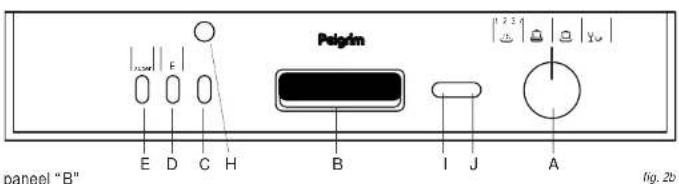
text_image
Panel E D C H B I J A panel "B" fig. 2b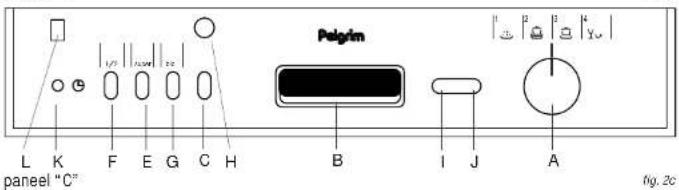
text_image
L K F E G C H panel "C" Palgrim B I J A Fig. 2ctext_image
Palgrim F E 2 3 4 Y| Wasprogramma “B” | ||||||||
| programma keuzeknop toets was- voor- was- koud warm drogen middel was temp. spoelen spoelen | ||||||||
| Voorspoelen 1 | -- - koud -- | |||||||
| Super | 2 super | 10 g. + 55 °C 65 °C 20 g. | °C 65 °C | 2 65 °C | • | |||
| Bio 55 °C* | 2 E | 25 g. | • | 55 °C | • | 65 °C | • | |
| Normaal 65 °C | 2 | 25 g. | • | 65 °C | • | 65 °C | • | |
| Eco 55 °C | 3 | E | 25 g. | — | 55 °C | • | 65 °C | • |
| Dagelijks 3 65 °C | 25 g. | — | 65 °C | • | 65 °C | • | ||
| Delicaat 55 °C | 4 | 25 g. | — | 55 °C | • | 65 °C | • | |
| Delicaat 45 °C | 4 | E | 20 g. | — | 45 °C | • | 65 °C | • |
text_image
Palgrim 1/2 3 4 Y| Wasprogramma “C” | ||||||||
| programma keuzeknop toets was- voor-middel koud waam drogen spoelen spoelen | ||||||||
| Voorspoelen | -- - koud -- | |||||||
| Super | 2 super | 10 g. + 55 (1/2) | °C 65 °C20 g. | 2 65 °C | • | |||
| Bio55 °C* | 2 | bio(1/2) | 25 g. | • | 55 °C | • | 65 °C | • |
| Normaal65 °C | 2 | (1/2) | 25 g. | • | 65 °C | • | 65 °C | • |
| Eco55 °C | 3 | bio(1/2) | 25 g. | — | 55 °C | • | 65 °C | • |
| Dagelijks 365 °C | (1/2) 25 g | — | 65 °C | • | 65 °C | • | ||
| Delicaat55 °C | 4 | (1/2) | 25 g. | — | 55 °C | • | 65 °C | • |
| Delicaat45 °C | 4 | bio(1/2) | 20 g. | — | 45 °C | • | 65 °C | • |
natural_image
Illustration of a hand pouring liquid into a funnel inside a vehicle (no text or symbols)Waterontharder
natural_image
Illustration of a hand using a tool to adjust or install a mechanical component, with no visible text or symbols.Model met 3 standen
| waterhardheid instellingenDuitse Fransegraden graden | ||
| 0 - 9°dH 0 - | 15°dF stand 1 | (geen zout) |
| 10 - 17°dH 16 - | 30°dF stand 1 | |
| 18 - 29°dH 31 - | 50°dF stand 2 | |
| 30 - 40°dH 51 - | 70°dF stand 3 | |
Model met 5 standen
| waterhardheid instellingenDuitse Fransegraden graden | ||
| 0 - 9°dH 0 - | 15°dF stand 1 | (geen zout) |
| 10 - 15°dH 0 | - 25°dF stand 1 | |
| 16 - 23°dH 26 | - 40°dF stand 2 | |
| 24 - 34°dH 41 | - 60°dF stand 3 | |
| 35 - 46 °dH 61 | - 80°dF stand 4 | |
| 47 - 58 °dH 81 | -100°dF stand 5 | |
natural_image
Line drawing of a hand holding a tool interacting with a mechanical structure (no text or symbols)Fig. 7
natural_image
Technical line drawing of a mechanical assembly with wheels and a bracket (no text or symbols)fig. 8
natural_image
Technical line drawing of a mechanical assembly with cylindrical components and internal gear-like structure (no text or symbols)natural_image
Isometric technical diagram of a mechanical assembly with no visible text or symbols0g.10
Bestekmandje
Geen water in de machine
oorzaak remedie
natural_image
Technical line drawing of a mechanical assembly with a bracket and tool (no text or symbols)natural_image
Line drawing of a kitchen sink with faucet and door, showing mechanical components (no text or symbols)fig. 12
text_image
Diagram showing a hand operating a mechanical device with labeled parts 1, 2, and Cfig. 13e
text_image
Diagram showing a hand holding a cylindrical object with labeled component D, likely illustrating a mechanical or electrical assembly.fig 13b
natural_image
Illustration of hands holding a mechanical component with directional arrows indicating movement (no text or symbols)fig. 13c
text_image
Technical diagram showing a mechanical assembly with labeled parts and an inset view of a bolted joint detail.fig. 14
natural_image
Isometric view of a rectangular plate with a central vertical line and small protrusions (no text or symbols)fig. 15
natural_image
Technical line drawing of a mechanical assembly with a bracket and guide pin (no text or symbols)fig. 18
natural_image
Pure technical diagram of a mechanical assembly with no visible text, numbers, or symbolsbig. 17
natural_image
Technical line drawing of a door handle assembly with mounting brackets and control panel (no text or symbols)Let op:
A – upper basket
B – upper spray arm
D - lower basket
C - lower spray arm
D – water-softening salt container
E - filter
F - containers for detergent and rinse-aid
Display (fig. 2a, 2b and 2c)
A – programme selection button
B - handle
C - on/off button
D - ECO button (if applicable)
E - super button (if applicable)
F-half-load button (if applicable)
G - BIO button (if applicable)
H-on/off indicator light
I – salt reservoir level indicator light (if applicable)
J - rinse-aid reservoir level indicator light (if applicable)
K - adjustable starting-time button - up to 9 hours (if applicable)
L - adjustable starting-time display
Introduction
When you have read these instructions for use, you will quickly be aware of all the facilities the appliance can offer you. You can read about safety and how you should look after the appliance. In addition you will find environmental tips and instructions that can help to save energy.
Keep the instructions for use and the installation instructions. Any later user of this appliance could benefit from them.
Table of contents GB
■ Appliance information ..... 22
■ Introduction ...... 23
■ Safety 24 - 26
Before using the appliance ..... 24
Things to watch out for 25
Controls 27-30
Washing programme "A" 27
Explanation of programme "A" .....27
Washing programme "B" 28
Washing programme "C" 29
Explanation of programmes "B" and "C" 30
■ Use 31 - 36
Salt, rinse-aid and detergent .....31
Baskets 34
The first cycle 36
- Faults ...... 37
■ Cleaning 38 - 39
■ Installation 39 - 40
■ Mounting 41 - 42
■ Disposal of packaging and appliance .. 43
Before using the appliance
The appliance should only be connected by a qualified fitter (see electrical connection).
- Do not use the appliance if it has been damaged during transport. Contact your dealer.
- This appliance is designed for household use only.
- Do not use the appliance if you have wet hands or if you are standing on bare feet.
- Keep packaging material, such as plastic bags, polystyrene and wood out of the reach of children.
- Keep detergents out of the reach of children. Keep children away from the appliance: it is not a toy.
- Disconnect the appliance before starting to clean or repair it, preferably, by taking the plug out of the socket or by turning off the mains switch.
- Do not use an extension cable.
- Never clean electrical appliances (mixer, food processor etc.) in the dishwasher.
- Do not place any plastic utensils on the heating element. Plastic objects could melt.
■ Never use detergents containing phosphates or bleaches. - Avoid limescale by regularly refilling the regenerative salts. Use only the special salt intended for dishwashers (do not use iodized salt).
- Never fill the rinse-aid-, detergent- or salt compartments with solvents such as benzine, turpentine or alcohol. This could cause an explosion.
- Regularly check that the sprinklers and the filter element are clean.
■ Never use the dishwasher without the filters. - Do not stand or sit on the open door of your dishwasher. The appliance may topple over.
- Do not touch the heating element, either during or immediately after the end of the washing programme.
Things to watch out for
Before you place kitchenware in the machine
- First remove food remains. You thereby avoid blockages.
- First soak any pots/pans that are very dirty.
Environmental tips
- Save your dirty kitchenware and only use your dishwasher when one (in the case of the half-load option) or both baskets have been filled.
■ Always select the most suitable programme, depending on how dirty your dishes are.
■ Make no use, or as little use as possible, of the pre-rinse programme.
If possible, connect the machine to a hot-water plant with a maximum temperature of 60^ C.
China ware
Not suitable:
All sorts of china ware with an onglaze decoration or edge which you can see and feel. Also consider the shape of the china ware. Bell-shaped cups break more easily than straight-sided cups. Under no circumstances should you put porous earthenware in your dishwasher.
Suitable:
China ware fired at a temperature of 700/800 °C. Do not use too much rinse-aid in this case, to
avoid any damage. Only white or single-colour china ware which is fired at a temperature of 1200/1300 °C is completely dishwasher proof.
Glass
Not suitable:
Crystal or hand-blown glassware; glass on which the decoration has been burnt in; glassware with a gold edging.
Suitable:
All other glass.
Cutlery
Not suitable:
Cutlery with a wooden, earthenware or china-ware handle. There is a big risk of cracks. In fact, there is a big risk of cracks for all wooden objects washed in a dishwasher. Cutlery made of chromium steel is not very suitable for washing in the dishwasher. In the case of this cutlery, there is a risk of corrosion (rust).
Suitable:
Cutlery made of chromium nickel steel 18/10.
This high-quality cutlery is rustproof and acid-resistant. However, the blade of a knife may be made of a different material. Watch out for this. Silver or silver-plated cutlery is also dishwasher proof. But in this case the rinse-aid used must not contain any citric acid, since this damages the silver. Moreover, regular washing in the dishwasher may result in the silver becoming scratched.
Attention:
You will get longer-lasting pleasure from your cutlery and dishwasher if you follow these tips:
■ After using the cutlery – especially knives – rinse it under the tap. You hereby prevent it being damaged by food remains containing salt and acid.
■ Always place knives, forks and spoons in the dishwasher with the handle downwards.
- Do not put chromium nickel steel cutlery and chromium steel cutlery together in the dishwasher. Otherwise, you run the risk of rust contamination.
■ Take the cutlery out of the dishwasher immediately after the rinsing programme and dry it with a cloth. Never leave damp cutlery in the dishwasher.
■ Never put silver and stainless steel cutlery in one basket together.
■ Silver cutlery should never be allowed to come into contact with aluminium, since this can damage the silver.
■ Plastic pan handles can become dull.
Furthermore...
■ Plastic objects must be heat-resistant.
- Aluminium pans, kitchenware and various types of glassware may become discoloured after being washed several times in the dishwasher. Certain sorts of decoration may lose their colour.
- Watch out for the indication "Suitable for the dishwasher" in the case of glazed pottery.
- When you buy new tableware, look for forms which are suitable for the dishwasher: such as straight, smooth sides, large openings, cavities which are not too deep, dishwasher-proof decoration, cutlery and earthenware.
Controls

text_image
Pulgrim| Washing programme “A” | |||||||
| switch programme de- pre- wash- cold warm dryingtergent wash temp. rinse rinse | |||||||
| 1 Pre-rinse -- cold -- -- | |||||||
| 2 | Intensive 65 °C | 25 g. | • | 65 °C | 2x | 65 °C | • |
| 3 | Normal 60 °C | 25 g. | • | 60 °C | 1x | 65 °C | • |
| S | Economy 60 °C | 25 g. | - | 60 °C | 1x | 65 °C | • |
| 4 | Rinse programme | - | - | - | 1x | 65 °C | • |
| Explanation programme “A” | ||
| Symbol Suitable for... | Couse | of programme |
| Pre-rinse | Kitchenware ready for next washing programme. | Short cold rinse to prevent food remains from drying. |
| Intensive 65 °C | Very dirty pans and plates (no glassware). | Cold pre-wash; washing programme at 65 °C;2x cold rinse and warm rinse at 65 °C; drying. |
| Normal 60 °C | Normally dirty pans,plates and glassware. | Cold rinse; washing progr. at 60 °C; 1x cold rinse and warm rinse at 65 °C; drying. |
| Economy 60 °C | Normally dirty pans, Cold rinses,plates and glassware. | e; washing progr. at 60 °C; cold rinse and warm rinse at 65 °C; drying. |
| Rinse Only rinsing. 1x cold progr. Set detergent open. | rinse and warm rinse at 65 °C; drying. | |
text_image
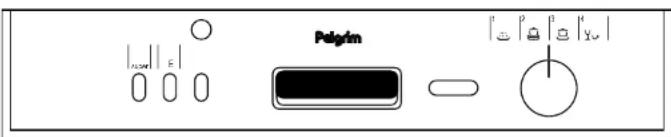
Palgrim| Washing programme “B” | ||||||||
| programme switch button de- pre- wash- cold warm drying | ||||||||
| tergent wash temp. rinse | rinse | |||||||
| Pre-wash 1 - -- cold -- | -- cold -- | -- | ||||||
| Super | 2 | super | 10 g. + 20 g. | 55 °C | 65 °C | 2 | 65 °C | • |
| Bio 55 °C* | 2 E | 25 g. | • | 55 °C | • | 65 °C | • | |
| Normal 65 °C | 2 | 25 g. | • | 65 °C | • | 65 °C | • | |
| Eco 55 °C | 3 E | 25 g. | _ 55 °C | • | 65 °C | • | ||
| Daily 65 °C | 3 | 25 g. | _ 65 °C | • | 65 °C | • | ||
| Delicate 55 °C | 4 | 25 g. | _ 55 °C | • | 65 °C | • | ||
| Delicate 45 °C | 4 E | 20 g. | _ 45 °C | • | 65 °C | • | ||
* Recommended programme when using the new generation of detergents with enzymes.
text_image
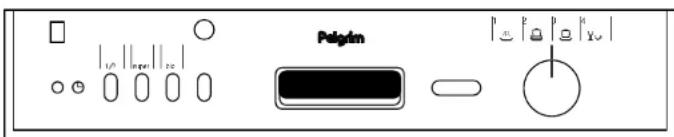
Palgrim| Washing programme “C” | ||||||||
| programme switch button de- pre- wash- cold drying | ||||||||
| tergent | wash temp. rinse | rinse | ||||||
| Pre-wash 1 -- cold -- | - | |||||||
| Super | 2 | super(1/2) 20 | 10 g. +g. | 55 °C | 65 °C | 2 | 65 °C | • |
| Bio55 °C* | 2 | bio 25 g.(1/2) | • | 55 °C | • | 65 °C | • | |
| Normal65 °C | 2 | (1/2) 25 g. | • | 65 °C | • | 65 °C | • | |
| Eco55 °C | 3 | bio 25 g.(1/2) | _ | 55 °C | • | 65 °C | • | |
| Daily65 °C | 3 | (1/2) 25 g. | _ | 65 °C | • | 65 °C | • | |
| Delicate55 °C | 4 | (1/2) 25 g. | _ | 55 °C | • | 65 °C | • | |
| Delicate45 °C | 4 | bio 20 g.(1/2) | _ | 45 °C | • | 65 °C | • | |
(1/2) = half-load, if desired
* Recommended programme when using the new generation of detergents with enzymes.
| Explanation programmes “B” and “C” | ||
| Symbol Suitable for... Course of programme | ||
| Pre-rinse Kitchenware ready for Short cold next washing programme. remains from drying. | rinse to prevent food | |
| Super Very dirty pans and Pre-wash at 55 °C; washing progr. at 65 °C; plates (no glassware) with 2x cold rinse and warm rinse at 65 °C; encrusted food remains. drying. | ||
| Bio 55 °C Normally dirty pans and Cold pre-wash; washing progr. at 55 °C; plates (no glassware) with 1x cold rinse and warm rinse at 65 °C; encrusted food remains. drying. | ||
| Normal Normally dirty pans and Cold rinse; washing progr. at 65 °C; 1x cold 65 °C plates. cold rinse and warm at 65 °C; drying. | ||
| Eco 55 °C | Slightly dirty pans and plates (no glassware) with warm rinse at 65 °C; drying. | Washing programme at 55 °C; cold rinse and warm rinse at 65 °C; drying. |
| Daily 65 °C | Slightly dirty pans and plates used on the day of washing. | Washing programme at 65 °C; cold rinse and warm rinse at 65 °C; drying. |
| Delicate 55 °C | Moderately dirty kitchen-ware, such as glasses. warm | Washing programme at 55 °C; cold rinse and rinse at 65 °C; drying. |
| Delicate 45 °C | Moderately dirty kitchen-ware, such as glasses. and w | Energy-saving programme at 45 °C; cold rinse arm rinse at 65 °C; drying. |
Salt, rinse-aid and detergent
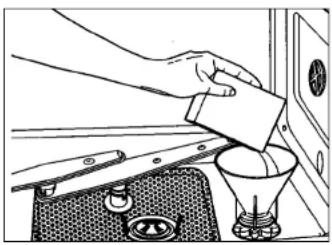
natural_image
Illustration of a hand pouring liquid into a container with a funnel (no text or symbols)fig. 3
Water softener
The dishwasher is equipped with an automatic water softener which, if used with salt which is suitable for dishwashing machines, extracts hard constituents from the water.
Hard water leaves behind white spots on the dry washing-up; moreover, the dishes and utensils will become dull in the course of time, losing their shine. The appliance can be adjusted in accordance with the degree of hardness of the tap water in your home and the related salt consumption.
- At the time of leaving the factory, the machine is adjusted to an average degree of hardness.
■ After you have topped it up with salt, make care that you close the salt reservoir properly again. It is important that neither the detergent nor the washing water can flow over into the reservoir, since that could have a negative influence on the functioning of the regeneration device. The guarantee does not cover such a malfunction.
Topping-up the salt
Use only salt that is suitable for dishwashing machines for household use. If you make use of salt pellets, you must not fill the reservoir completely.
Under no circumstances should you make use of kitchen salt or industrial salt, since these contain non-soluble constituents which, over the course of time, can have a negative influence on the functioning of the water-softening device.
- The salt reservoir is located at the bottom of the dishwashing machine. After having first removed the lower rack, unscrew the reservoir cap in an anti-clockwise direction, and pour in the salt, using the funnel (which is supplied with the dishwashing machine) (fig. 3).
■ Remove any salt residue from the edge of the reservoir opening before you screw the cap closed again. The water-softener can contain approximately 1.7 kg. of salt.
During the first washing programme, also pour 1 litre of water into the reservoir, along with the salt.
The salt reservoir must always be filled immediately before a washing programme. In this way, the overflowing salt solution is always removed simultaneously by the washing-up water. The long-term presence of salt solutions can cause corrosion of the housing.
Adjustment of the water-softener
The dishwashing machine is equipped with a device which can be adjusted to the degree of hardness of the tap water. After having opened the door, you will find the device located in the upper right-hand corner, and it can be adjusted with the aid of a coin (see fig. 4). Depending on the model, it is possible to adjust it to one of either 3 or 5 settings. Before adjusting the water-softener, please consult the tables below and set the number of the chosen level (1, 2, ...) to the reference symbol.
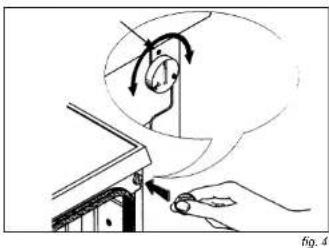
natural_image
Illustration of a hand using a tool to adjust or install a mechanical component, with no visible text or symbols.Model with 3 settings
| water hardness settingsGerman Frenchdegrees degrees | ||
| 0 - 9°dH 0 - | 15°dF setting 1 | (no salt) |
| 10 - 17°dH 16 | -30°dF setting 1 | |
| 18 - 29°dH 31 | -50°dF setting 2 | |
| 30 - 40°dH 51 | -70°dF setting 3 | |
Model with 5 settings
| water hardness settingsGerman Frenchdegrees degrees | ||
| 0 - 9°dH 0 - | 15°dF setting 1 | (no salt) |
| 10 - 15°dH 0 | -25°dF setting 1 | |
| 16 - 23°dH 26 | -40°dF setting 2 | |
| 24 - 34°dH 4 | -60°dF setting 3 | |
| 35 - 46 °dH 61 | -80°dF setting 4 | |
| 47 - 58 °dH 81 | -100°dF setting 5 | |
Contact the Water Company to make enquiries about the hardness of the mains water.
Rinse-aid
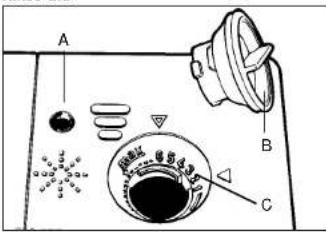
text_image
A B Cfig. 5
- Open the rinsing agent reservoir (see fig. 5) on the inside of the door, next to the detergent reservoir.
The means of operation will depend on the type of dishwasher: the containers all work on the basis of the same principle.
- Unscrew the lid of the rinse-aid reservoir in an anti-clockwise direction.
■ Pour rinse-aid into the container and then close it again.
The container has a capacity of 140 cc.
- Every now and again check the level of the rinse-aid.
The level gauge (A) is located to the upper left of the lid.
Reservoir empty: O. Reservoir full: ●
■ The correct quantity of rinse-aid per washing cycle is adjustable.
Turn the knob (B) in the container to the desired setting (C). The amount of rinse-aid is in proportion to the numbers on the knob.
- Increase the amount (choose a higher number):
Washed kitchenware is dull or flecked as a result of dried drops of water.
- Reduce the amount (choose a lower number):
Washed kitchenware is sticky or has whitish streaks.
Remark:
As standard, the rinse-aid reservoir is set to an average dose.
Detergent
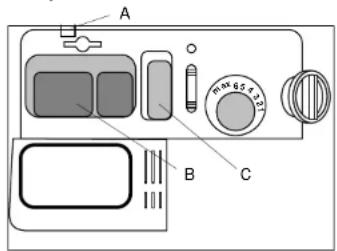
text_image
A B Cfig. 6
In the door, next to the rinsing agent reservoir, there is also a reservoir for the detergent (see fig. 6).
- Open the lid of the reservoir by pressing button (A).
- Fill the reservoir (B) with approx. 25 g detergent. Follow the detergent manufacturer's guidelines.
- If you select the 'super' programme, please take the following steps: Fill the reservoir with approximately 20 grammes of detergent, and fill the pre-wash detergent reservoir (C) with approximately 10 grammes of detergent. Close the lid.
Remark:
The container lid is opened automatically during the washing cycle in order to add the detergent to the water. If washing tablets are used – in a holder attached to the cutlery basket – the container should be closed.
Baskets
The dishwasher has a capacity of twelve covers. The lower rack is intended for washing-up which is extra dirty. The upper rack is intended for small and medium-sized washing-up, such as glasses, small plates, tea- and coffee cups and shallow dishes.
Half load (if this feature is included)
Your dishwasher offers you the option of operating with a half load. Fill the upper basket and press the button. When using this programme there must not be any kitchenware in the lower basket.
- Fill the upper basket and press the - 1/2 button. When using this programme, there may be no washing-up standing in the lower basket.
Adjustment of the height of the upper basket
The top basket can be placed at two different levels depending on the height of the dishes to be washed.
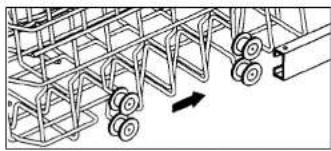
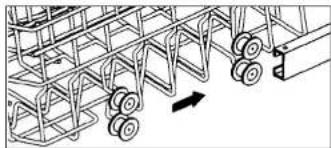
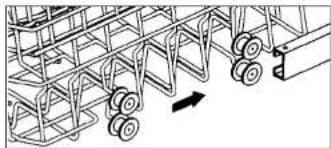
- Pull the basket all the way out (to the front) and remove the guard on the right-hand side (see fig. 7). Remove the basket. Place the other set of wheels in the rails (see fig. 8). Push the basket back into the machine and replace the guard.
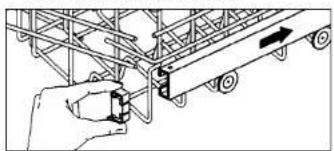
natural_image
Line drawing of a hand holding a tool interacting with a mechanical structure (no text or symbols)Fig. 7
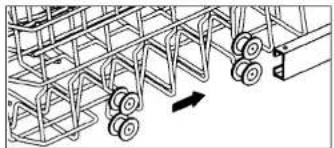
natural_image
Technical line drawing of a mechanical assembly with wheels and a directional arrow (no text or symbols)fig. 8
Upper basket in the high position
- In this setting, the basket is suitable for small and medium kitchenware, such as glasses, small plates, cups, basins and light plastic objects which are heat-resistant.
Upper basket in the low position
- In this setting, the basket is suitable for large plates (which are not too dirty).
Loading the top basket
- Stack the plates with the top side facing forwards.
- Stack cups and bowls or dishes with the opening down.
- On the left-hand side of the basket – at two levels – you can place cups and glasses. You can flip the upper draining racks upwards.
Loading the lower basket (see fig. 9)
- Like the upper basket, the lower basket can be completely pulled out by first fully opening the door.
- Place soup, flat and dessert plates, pans, lids and saucers in the lower basket.
- Place plates with their top side facing forwards, or towards the middle. Make sure that there is always space remaining between the plates, so that the water can flow freely over them.
- Place bowls and pans with the opening down.
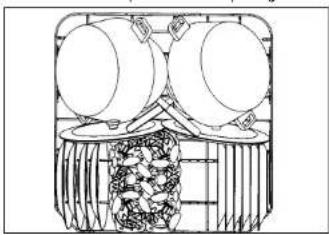
natural_image
Technical line drawing of a mechanical component with cylindrical parts and internal layered structure (no text or symbols)fig. 9
■ The plate racks can be flipped upwards (see fig. 10), depending on the model.
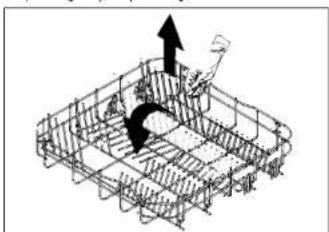
natural_image
Isometric technical diagram of a structural framework with directional arrows indicating movement (no text or symbols)0g.10
Cutlery container
- The cutlery container is suitable for all types of cutlery.
- In the cutlery container, place the knives, forks and spoons with their handles downwards.
Always check whether or not the spray arms can rotate freely.
The first cycle (see fig. 2a/2b/2c)
■ Close the door and turn the tap on fully.
- Turn the programme selection button to the required setting (see the table for programme selection on pages 27 – 30).
- Start the machine by pressing the on/off button (see fig. 2a, 2b and 2c). The on/off indicator will light up.
End of programme
■ The dishwasher will stop automatically once the programme has finished.
■ Switch the appliance off by pressing the on/off button.
- If you have selected a programme with a drying cycle, you can empty the machine after about 30 minutes. Keep the door closed for that period.
■ Unload the dishwasher. Be careful:
– The kitchenware could be hot.
- Unload the lower basket first. If you unload the upper basket first, drops of water could fall on the kitchenware in the lower basket.
Delaying the start time
Dependent on the type of dishwasher, the programme can be set to start at a later time: a minimum of one hour and a maximum of nine hours later.
Models with an adjustable starting time
■ After switching the appliance on, you have approximately one minute in which to set the desired starting time, using the 'M' button.
The time remaining until the start of the programme is indicated on the display "N".
Trouble shooting
If the machine does not work properly, first check if you can solve the problem yourself with the help of the accompanying table. Often the cause of the problem is something very small.
The programme does not start
cause remedy
The plug is not in the Put the plug in the socket. socket.
The door is not closed Close the door. properly.
Defective fuse in Check the fuse-box. the fuse-box.
No water in the appliance
cause remedy
The water tap is not on. Turn the water tap on.
There is a kink in Make sure the water inlet the water inlet hose. is hanging freely.
There is another cap Remove the cap.
located in the discharge
hose, or in the discharge-
hose connection on the siphon.
Programme Interrupted
cause remedy
The water tap is not on Turn the water tap on fully. fully.
The tap filter is dirty. Clean the tap filter.
The trap cap of the siphon Place the trap cap in the is not in place. siphon.
The kitchenware is not clean
cause remedy
Wrong programme. Select the correct washing programme.
Spray arms blocked. Make sure that the spray
arms can rotate freely.
Check that the kitchenware
has been loaded properly.
Clean the filters.
Incorrect amount of Adjust the amount of
detergent. detergent. Check that there
is still some salt in the salt
container. Make sure that
the salt container is
correctly adjusted to the
hardness of the water.
Kitchenware not dry and not gleaming
cause remedy
Wrong detergent used.
Use a good detergent.
Incorrect amount of Use more detergent.
detergent.
Whitish spots or streaks on the kitchenware
cause remedy
Incorrect amount of Use less rinse-aid.
rinse-ald.
Dried drops of water on the kitchenware
cause remedy
Incorrect amount of Use more rinse-aid.
rinse-aid.
Cleaning
First disconnect the appliance from the power supply (see also page 24).
Spray arms
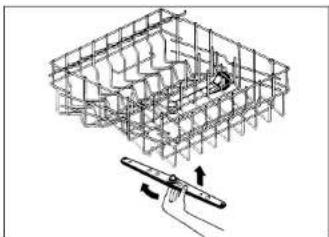
Take out the upper spray arm by pulling it - with a turning movement - vertically downwards (see fig. 11).
natural_image
Technical line drawing of a structural framework with internal components and directional arrows (no text or symbols)Fig. 12
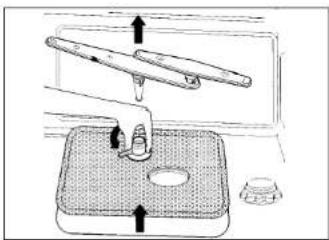
Take out the lower spray arm by pulling it vertically upwards (see fig. 12). Rinse the spray arms clean under the tap.
natural_image
Diagram of a kitchen sink with two kitchen utensils and a drain, showing mechanical components (no text or symbols)fig. 12
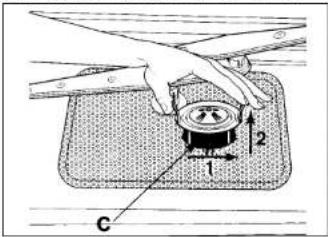
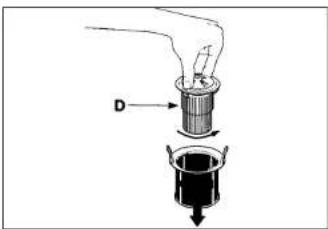
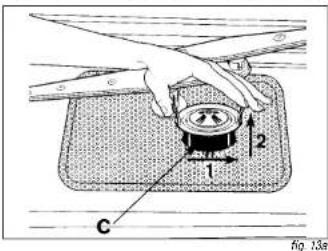
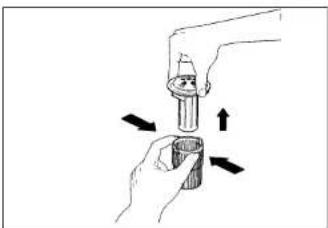
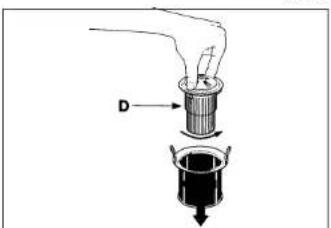
Stainless steel filter (see fig. 13a, 13b, 13c)
text_image
Diagram showing a hand operating a device with labeled parts and directional arrows, including 'C' and '1'.fig. 13a
text_image
Diagram showing a mechanical device with labeled component D and directional arrow indicating motion or forcefig 13b
natural_image
Illustration of a hand holding a mechanical component with directional arrows indicating movement (no text or symbols)fig. 13c
■ Remove the lower spray arm.
■ Remove the filter assembly (C) by turning the lips to the left (1).
Take out the filter assembly by pulling it vertically upwards (2).
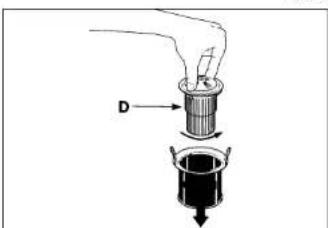
■ Remove the microfilter (D) by unscrewing the bayonet catch.
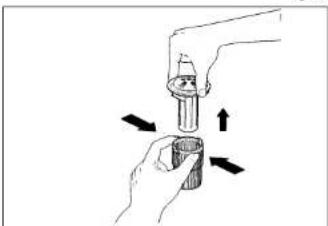
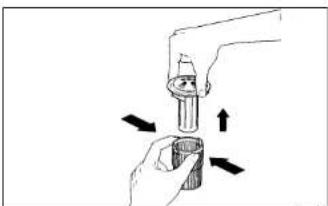
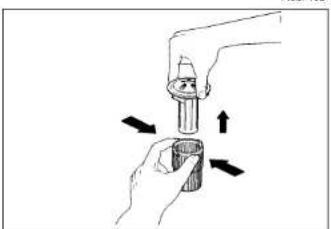
■ Remove the filter mesh by squeezing the filter housing (see fig. 13c). Simultaneously, pull out the filter mesh vertically.
- Clean filter mesh and filter with a brush under running water.
■ Reassemble the filter mesh and filter in reverse order.
Installation
Electrical connection
230 V - 50 Hz
General
If the appliance does not have a connecting cable and plug, then it may only be connected to the mains by an approved installer.
Note:
The power rating and required mains voltage are shown on the rating plate. Connection should take place according to national and local regulations.
If the input of the appliance exceeds 3 kW, the appliance has to be connected to an outlet with a rated current exceeding 13 Amp.
Technical information
Connected load kW see identification plate
Dimensions:
Max. height mm 870
Min. height mm 820
Width mm 596
Depth mm 550
Door panel:
Max. height* mm 600
Min. height mm 500
Depth mm 598
Control panel
Max. height mm 155
Min. height mm 115
Plinth:
Max. height mm 170
Min. height mm 100
* at minimal control panel height
What else you should watch out for
■ Always fit tap, drainage and earthed plug/wall socket within reach.
■ Make sure that the skirting-board can be removed. It must be possible to take the dishwasher out of its recess for maintenance or repair work.
- Connect water inlet hose/aquastop to a self-venting water tap with a 3/4" screw connection. Make sure that no dirt remains in a newly-installed water pipe.
- The dishwasher may be connected either to a cold-water tap or to a hot-water tap (maximum 60 °C).
If you connect the dishwasher to a hot-water tap, the washing time will be reduced by about twenty minutes.
However, the dishwasher will wash less efficiently. The 45 °C programme will therefore be carried out at a slightly higher temperature.
- Do not drill holes in the door or walls. The dishwasher could be damaged beyond repair.
Building-in
Fix the adjustable feet with the lock nuts beneath the side panels of the machine.
Adjusting the height
- The height of the dishwasher may be adjusted from 820 to 870mm by means of the adjustable feet. Before you do this, measure the height of the recess.
- It is advisable to place the appliance on a so-called dishwasher platform.
Ask your kitchen dealer for information.
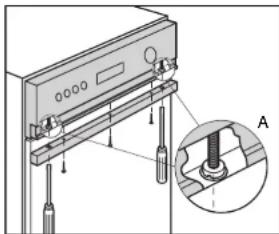
Adjusting the height of the control panel (see fig. 14)
text_image
Technical diagram showing a mechanical assembly with labeled parts and an inset view of a bolt detail labeled Afig. 14
- You can adjust the height of the control panel to the height of the kitchen furniture. This is done with the aid of the screws (A) on the underside of the panel.
- Remove the screws, springs and trim in order to obtain the minimum height setting.
- If the trim is not removed, the height can be adjusted from 125 to 140 millimetres. With the aid of the extra trim, you can adjust the height of the control panel up to a maximum of 155 millimetres.
- You can get a panel height of between 120 and 125 mm by cutting a few millimetres out of the "half moon" in the trim.
Mounting
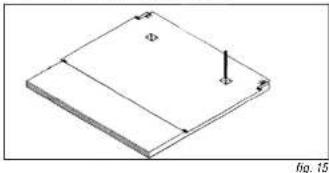
Installing door panel (see fig. 15)
natural_image
Isometric view of a rectangular plate with a central hole and dimension lines (no text or symbols)- First determine the height of the control panel.
- Place the template on the inside of the door panel.
The measuring marks correspond to the measured height of the panel.
Centre the template on the right and left sides with the aid of the measuring marks.
■ Transfer the markings of the drill holes on the template onto the door. - If the door panel is made of solid wood, predrill the holes with a 2 mm drill (12 mm deep).
Note:
Allow for possible differences in the thickness of the panel (milled hollows or bevelled edges).
- Fix the mounting material to the door, as indicated on the template.
natural_image
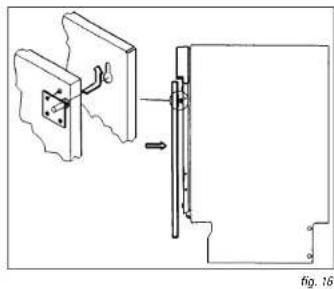
Technical line drawing of a mechanical assembly with a bracket and mounting bracket (no text or symbols)- Attach the panel to the door of the dishwasher by pressing the upper pins into the slots of the plastic section. Slide the panel up a little, and attach the underside as indicated in fig. 16.
Adjusting the spring tension (see fig. 17)
natural_image
Simple line drawing of a mechanical component with a tool and a circular symbol, no text or labels present.fig. 17
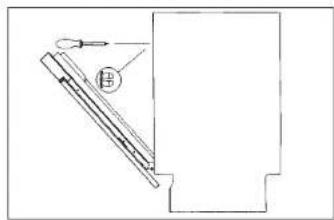
- As standard setting, the door is adjusted to the lowest spring tension.
■ Increase the tension of the spring by turning the two adjusting screws in a clockwise direction with a screwdriver. The tension of the spring is correct if the door is in a state of equilibrium when open.
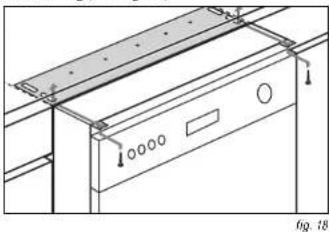
Positioning (see fig. 18)
natural_image
Technical line drawing of a kitchen appliance with mounting brackets and control panel (no text or symbols)- Make the sawn-off piece of skirting-board waterproof – with paint, for example – and replace the skirting-board.
What else you should watch out for
Do not make the free space around the appliance larger than three millimetres. If there is more free space, there is the risk of contact with electrical components of the appliance.
Note:
You should not allow the hoses to develop kinks or get flattened during the installation of the dishwasher in the recess.
- Mount the metal plate provided to the underside of the unit top, moisture could damage the unit top.
- Adjust the dishwasher so that it is level.
- Mount the dishwasher to the unit top.
- Mount the plinth in place.
- Carefully open the dishwasher to check whether or not the door hits the plinth.
- If this is the case, mark the part of the skirting-board to be removed. Leave a free space of three millimetres between the door and the skirting-board so that the door can open and close freely.
Water outlet
- The outlet must be fitted with an odour-trap.
The drainage hose must hang free inside the outlet. The outlet may not be sealed off.
■ The drainage hose should not hang at a height higher than 80 cm. The minimum height is 32 cm.
Aquastop
The aquastop is integrated into the water inlet hose.
- The aquastop does not itself rectify a blocked-off water supply. Turn off the water tap when the indicator window on the water stopper is red.
First find out why the aquastop has blocked off the water supply. Contact the installer or the service department.
Disposal of packaging and appliances
The packaging of the appliance is recyclable.
It consists of:
-cardboard
– polyethylene
– CFC free polystyrene (PS rigid foam)
– polypropylene straps around the box
Please dispose of these materials in a responsible way in accordance with the regulations of your local authority.
Your local authority will also be able to give you information about disposing of used household appliances in a responsible way.
text_image
Pulgrin 1.2 5.4 Y| Programme de lavage “B” | ||||||||
| programme position bouton de pré-temp. rincage à rincage à séchagetergent lavage eau froide eau chaude | ||||||||
| Prérinçage 1 | — — froide | — | — | — | ||||
| Super | 2 | super | 10 g. +20 g. | 55 °C | 65 °C | 2 | 65 °C | • |
| Bio55 °C* | 2 E | 25 g. | • | 55 °C | • | 65 °C | • | |
| Normal 265 °C | 25 g. | • | 65 °C | • | 65 °C | • | ||
| Eco55 °C | 3 E | 25 g. | 55 °C | • | 65 °C | • | ||
| Quotidien65 °C | 3 | 25 g._ | 65 °C | • | 65 °C | • | ||
| Délicat55 °C | 4 | 25 g._ | 55 °C | • | 65 °C | • | ||
| Délicat45 °C | 4 E | 20 g._ | 45 °C | • | 65 °C | • | ||
text_image
Pulgim 1 2 3 4 Y| Programme de lavage “C” | ||||||||
| programme position bouton dé pré- temp. rincage à rincage à séchagetergent lavage eau froide eau chaude | ||||||||
| Prérinçage 1 | — — froide — | — | — | |||||
| Super | 2 | super ( 1/2) 20 | 10 g. +g. | 55 °C | 65 °C | 2 | 65 °C | • |
| Bio55 °C* | 2 bio | 25 g. ( 1/2) | • | 55 °C | • | 65 °C | • | |
| Normal 265 °C | ( 1/2) | 25 g. | • | 65 °C | • | 65 °C | • | |
| Eco55 °C | 3 bio | 25 g. ( 1/2) | 55 °C | • | 65 °C | • | ||
| Quotidien65 °C | 3 | ( 1/2) 25 | g._ | 65 °C | • | 65 °C | • | |
| Délicat55 °C | 4 | ( 1/2) | 25 g._ | 55 °C | • | 65 °C | • | |
| Délicat45 °C | 4 bio | 20 g. ( 1/2) | 45 °C | • | 65 °C | • | ||
natural_image
Illustration of a hand cleaning a car interior with a funnel and valve (no text or symbols)Adoucisseur d'eau
natural_image
Illustration of a hand using a tool to adjust or install a mechanical component, with no visible text or symbols.natural_image
Illustration of a hand using a tool to adjust or install a mechanical component (no text or symbols visible)Fig. 7
natural_image
Technical line drawing of a mechanical frame with wheels and a roller, showing motion direction (no text or symbols)fig. 8
natural_image
Cross-sectional diagram of a mechanical or electrical component with internal structure (no text or symbols)fig. 9
natural_image
Isometric technical diagram of a structural framework with directional arrows indicating movement (no text or labels)fig. 10
Panier à couvert
natural_image
Technical line drawing of a mechanical assembly with a component and directional arrows (no text or symbols)fig. 11
natural_image
Diagram of a kitchen sink with faucet and drain, showing mechanical components (no text or labels)fig. 12
Filtre en acier inoxydable (voir fig. 13a, 13b, 13c)
text_image
C 1 2 Fig. 13a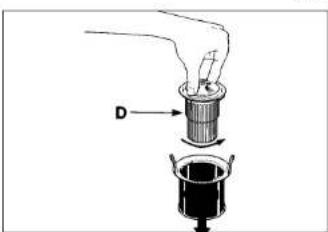
text_image
Diagram showing a hand holding a cylindrical object labeled 'D' inserted into a container, likely illustrating a mechanical or fluid system concept.fig 130
natural_image
Illustration of hands holding a mechanical component with directional arrows indicating movement (no text or symbols)fig. 13c
text_image
Technical diagram showing a mechanical assembly with labeled parts and an inset view of a bolt detail labeled Afig. 14
natural_image
Isometric view of a rectangular plate with a central hole and dimension lines (no text or symbols)natural_image
Technical line drawing of a mechanical assembly with a bracket and mounting bracket (no text or symbols)natural_image
Technical line drawing of a door frame assembly with mounting holes and adjustment knobs (no text or symbols)Note:
text_image
Palgrim 1 2 3 4 Y| Spülgang “B” | ||||||||
| Programm | Knopfstellung | Taste Spül- | Vor-Spül- kalt warm trocknen mittel wasche temp. spülen spülen | |||||
| Vorspülen 1 | -- - kalt | -- | - | |||||
| Super | 2 | super | 10 g. + 20 g. | 55 °C | 65 °C | 2 | 65 °C | • |
| Bio 55 °C* | 2 E | 25 g. | • | 55 °C | • | 65 °C | • | |
| Normal 65 °C | 2 | 25 g. | • | 65 °C | • | 65 °C | • | |
| Öko 55 °C | 3 E | 25 g. _ | 55 °C | • | 65 °C | • | ||
| Täglich 65 °C | 3 | 25 g. _ | 65 °C | • | 65 °C | • | ||
| Empfindlich 55 °C | 4 | 25 g. _ | 55 °C | • | 65 °C | • | ||
| Empfindlich 45 °C | 4 E | 20 g. _ | 45 °C | • | 65 °C | • | ||
text_image
Pulgrim 1234 Y| Spülgang "C" | ||||||||
| Programm Khopfstellung Taste Spül- | Vor-Spül-kalt warm trockhen mittel wasche temp. spülen spülen | |||||||
| Vorspülen 1 | -- - kalt | -- | - | |||||
| Super | 2 | super (1/2) | 10 g. + 20 g. | 55 °C | 65 °C | 2 | 65 °C | • |
| Bio 55 °C* | 2 | bio (1/2) | 25 g. | • | 55 °C | • | 65 °C | • |
| Normal 65 °C | 2 | (1/2) | 25 g. | • | 65 °C | • | 65 °C | • |
| Öko 55 °C | 3 | bio (1/2) | 25 g. | - | 55 °C | • | 65 °C | • |
| Täglich 65 °C | 3 | (1/2) | 25 g. | - | 65 °C | • | 65 °C | • |
| Empfindlich 55 °C | 4 | (1/2) | 25 g. | - | 55 °C | • | 65 °C | • |
| Empfindlich 45 °C | 4 | bio (1/2) | 20 g. | - | 45 °C | • | 65 °C | • |
natural_image
Illustration of a hand pouring liquid into a funnel inside a vehicle cabin (no text or symbols)Wasserenthärter
natural_image
Illustration of a hand using a tool to adjust or install a mechanical component, with no visible text or symbols.natural_image
Technical line drawing of a mechanical assembly with a hand holding a tool (no text or symbols present)Abb. 7
natural_image
Technical line drawing of a mechanical frame with wheels and a roller, showing motion direction (no text or symbols)Abb. 8
natural_image
Technical line drawing of a mechanical assembly with two circular components and internal granular material (no text or symbols)Abb. 9
natural_image
Isometric technical diagram of a structural framework with directional arrows indicating movement (no text or symbols)Abb. 10
Besteckörbchen
natural_image
Technical line drawing of a structural framework with internal components and directional arrows (no text or symbols)natural_image
Diagram of a kitchen sink with two kitchen utensils and a drain, showing mechanical components (no text or symbols)Abb. 12
text_image
Diagram showing a hand operating a mechanical component with labeled parts 1, 2, and C, including directional arrows.Abb. 13a
text_image
Diagram showing a mechanical or electrical component with labeled parts D and an arrow indicating direction.Abb. 13b
natural_image
Illustration of hands using a wrench to adjust a component (no text or symbols present)Abb. 13c
text_image
Technical diagram showing a mechanical assembly with labeled parts and an inset view of a bolted component.Abb. 14