
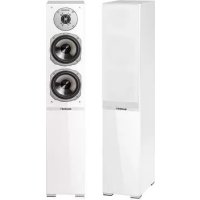
Aluma 2060 - Loudspeaker Quadral - Free user manual and instructions
Find the device manual for free Aluma 2060 Quadral in PDF.



| Product type | Passive loudspeaker |
| Brand | Quadral |
| Model | Aluma 2060 |
| Category | Acoustic speaker |
| Cabinet material | Aluminium |
| Loading type | Bass-reflex |
| Connection terminals | Color-coded screw terminals (red/black) |
| Operating modes | Conventional, bi-wiring, bi-amplification |
| Frequency range | Not specified in the manual |
| Impedance | Not specified in the manual |
| Sensitivity | Not specified in the manual |
| Nominal power | Not specified in the manual |
| Dimensions (H x W x D) | Not specified in the manual |
| Weight | Not specified in the manual |
| Maintenance | Soft dry cloth; avoid solvents; cleaning of membranes not recommended for tweeters |
| Cleaning of front panels | Fabric: tapping, vacuum cleaner, adhesive tape; dry foam for heavy soiling |
| Safety | Do not open the speaker; do not touch live contacts; do not connect to mains; avoid prolonged excessive volumes |
| Wall mounting | Wall brackets available (not included); secure screwing required |
| Included accessories | Spikes (depending on model), foam for bass-reflex tube (depending on model) |
| Spare parts / repairability | Not specified; contact Quadral after-sales service |
Frequently Asked Questions - Aluma 2060 Quadral
User questions about Aluma 2060 Quadral
0 question about this device. Answer the ones you know or ask your own.
Ask a new question about this device
Download the instructions for your Loudspeaker in PDF format for free! Find your manual Aluma 2060 - Quadral and take your electronic device back in hand. On this page are published all the documents necessary for the use of your device. Aluma 2060 by Quadral.
USER MANUAL Aluma 2060 Quadral
Safety notes 3-4
Setting up 5-6
Stands and wall mounts 6
Connecting up your amplifier 6-9
Beware of clipping 10
Tips for better acoustics 10
Care of loudspeakers 11
What to do if your speakers don't sound right? 12
DEUTSCH
First of all, thank you for deciding on quadral loudspeakers.
It is to satisfy the high expectations of music lovers and connoisseurs such as you that we build loudspeakers of a class that is well above average. Even though you may already be familiar with them, we list below a few ground rules that will enable you to make optimal use of your loudspeakers.
Safety advice for passive loudspeakers
Please take time to read through the manual carefully and follow all the steps describing how to set up and operate the loudspeakers. Keep the manual somewhere you can quickly access it should you have any questions later on.
- The stability of loudspeakers (especially large units) depends on the nature of the surface on which they stand. Carpets are often very poor for stability. Even an average bump can cause a loudspeaker to fall over and be a hazard for persons or pets in the vicinity. Stability can be significantly improved by using "spikes", but care should be taken during assembly as the sharp points can cause injury and the spikes can damage the floor. On smooth floors, the loudspeakers can be stabilised with Velcro or double-sided tape. Loudspeakers should never be used as a seat or as a substitute for a ladder!
- Use only wheeled furniture, stands or wall mounting systems and other devices for attaching and installing the products, which are available from the manufacturer and are sold for or with the product. To avoid damage or injury through tipping over, please be careful when moving table devices or stands on which the speakers are mounted. If wall-mounting the product, take special care that all components are securely screwed! Additional securing equipment (chains, etc.) should be fitted.
- The location for the loudspeakers should be dry and not too cold. Constant high humidity or strong sunlight (UV radiation) can cause your loudspeakers to age prematurely and consequently affect their functioning.
- Very high volume levels for long periods of time are not only annoying for your neighbours, but can also be harmful to the health of the user!
- When loudspeakers are overloaded with very high volume levels, there is a risk of individual components in crossover circuits or individual speakers burning out. In particularly bad cases, it is even possible for fire to break out inside a speaker. Speakers operated at these extremes should therefore not be left unattended.
- At high volumes, voltage levels of 30 - 50V can be present at speaker terminals and components. Be very careful not to touch uninsulated terminal contacts of speakers
when in operation. To avoid injury, never put hands or arms into sound outlets (bass reflex tubes). Children and pets, in particular, are at risk from this.
- For safety reasons, we generally forbid the opening of loudspeaker cabinets when in operation or connected since, as explained in the above paragraph, voltages of up to 50 volts can be present inside.
- Improper handling of mains voltage can cause fatal injury
Passive loudspeakers must on no account be connected to the electricity supply!
Speaker terminals may only be connected to the appropriate output terminals of the amplifier. You should never connect these terminals to the electricity supply (230 V/115 V) in any way since that will otherwise also immediately destroy the loudspeaker and all connected products. Avoid fitting plugs to ends of speaker cables that could even remotely be confused with mains supply plugs.
- Loudspeakers that are not magnetically shielded can affect the colour of the TV picture or cause distortion. A distance of 50 cm is generally sufficient to avoid problems of this kind. Avoid placing items such as credit cards, diskettes, audio or video cassettes or other magnetic media on the loudspeaker. This could destroy the information stored on them. Similarly, avoid operating magnetic tape devices in the immediate vicinity.
Setting up
To obtain optimal sound results, it is generally necessary to try out different set-ups. Since the room conditions have a major effect on sound reproduction, we suggest below a few useful approaches for positioning your quadral loudspeakers.
Main speakers (front)
Where the speakers are positioned in the listening space has a decisive effect on their sound. Placing the speakers near the corners of the room will essentially give you loud bass reproduction but with little outline. On the other hand, speakers positioned well away from the walls sound precise, but also very bright and thin. The best solution is to place the speakers with at least 30 cm between their backs and the nearest wall. To avoid
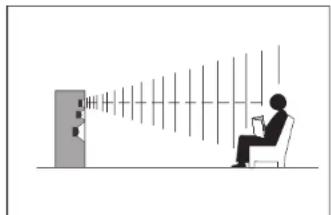
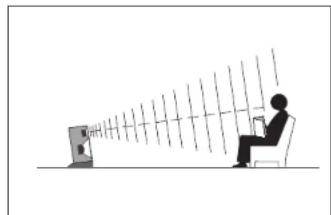
loud wall reflections, the distance from the side walls of the room can even be 50 cm or more. Bookshelf speaker units sound best on a speaker stand or shelf, with the tweeters arranged at ear height. The cases should be angled and slightly tilted to achieve this. Ss far as possible, the speakers should be equidistant from the listening position, while the distance of the speakers from each other can be rather less than the distance from the listener.
Front centre speaker
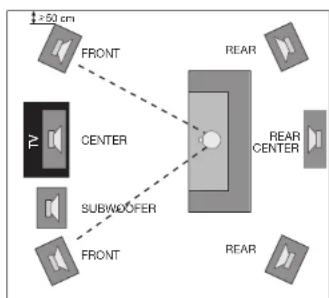
Due to the proliferation of plasma and LCD TVs, these speakers are no longer shielded magnetically. This causes colour and geometrical errors and can occur on older TVs with picture tubes. Since it can't be placed on the TV set, the center speaker can be set lying down underneath it. The speaker should be at least 30 cm from the television, and a minimum of 20 cm from the floor. Apart from the above, we recommend angling the center speaker so that the tweeter is aimed at the listener in order to enjoy its full sound potential.
Rear centre speaker
In contrast to 5.1 surround sets, 6.1 systems have an additional rear centre speaker that should be placed behind and slightly above the typical listening position.
Rear speakers
Whether you direct the rear speakers toward the listening position is a matter of taste. Also, many listeners prefer the rear speakers to be positioned above ear height. This can be achieved by mounting the units on a sturdy wall bracket, a high speaker stand, a sideboard or shelf.
Stands and wall brackets
To obtain optimal positioning of the front and rear speakers, quadral offers suitable stands and wall brackets. Some speaker models also have a keyhole-shaped cut-out in the back of the speaker for wall mounting. Should you have any questions, please contact us on tel.: +49 (0) 511 7904-0, e-mail: ovs@quadral.com
Connecting to the amplifier
Before connecting the speakers to your hi-fi or surround system, make sure the amplifier/ receiver is switched off and its status LED is not lit. To connect the speakers, you will need a two-core speaker cable for each speaker. Make sure these are of sufficient length and don't shorten the cables before checking they are long enough to hide behind furniture or under the carpet. For cables longer than 5 metres, we recommend a cross-sectional area of at least 2.5sqmm per core in order to avoid unnecessary power loss. Strip the insulation of the cores to a length of around 10mm at both ends of the cable so that they are bared for good contact.
Screw terminals
For connection, the speakers are provided with colour-coded screw terminals on the back of the cabinet. Loosen the screw terminals and feed the stripped end of the core into the hole that is now free. The two cores of speaker cables have different colouring or shape for recognition. Connect one core to the red, positive terminal - the remaining core to the black terminal. Tighten the screws hand-tight. To ensure correct polarity, check that the core connected to the red, positive terminal of the speaker is also the core that is connected to the red, positive terminal of the amplifier and that the other core is connected to the black, negative terminals of both the speaker and amplifier.
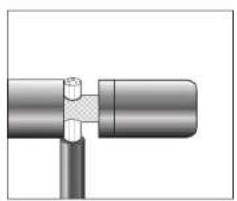
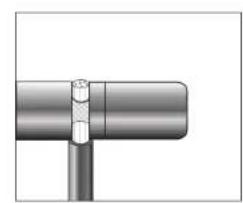
With some quadral loudspeakers, you can choose between three modes of operation.
a) Conventional mode Do not remove the jumpers, connect the speaker cable as shown in the illustration.
b) Biwiring mode Open the jumpers after loosening the four screw terminals on the back of the speaker and connect the cable as shown in the illustration.
c) Biamping mode Open the jumpers and connect the cables as shown in the illustration.
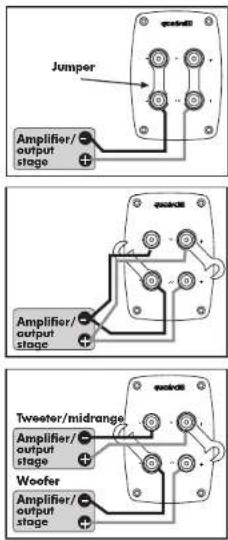
In the biwiring/biamping mode, the bass frequencies are controlled via the two lower terminals - and the midrange/treble frequencies via the two upper terminals.
Make sure you use the correct polarities in these modes and that you remove the jumpers on the speaker terminal to avoid damaging your amplifier.
Operation with a surround amplifier
Once you have positioned and connected your speakers as shown in the illustration, you should perform the necessary settings in the bass management system of your surround amplifier.
Make sure you read the user manual supplied by your amplifier's manufacturer before doing this.
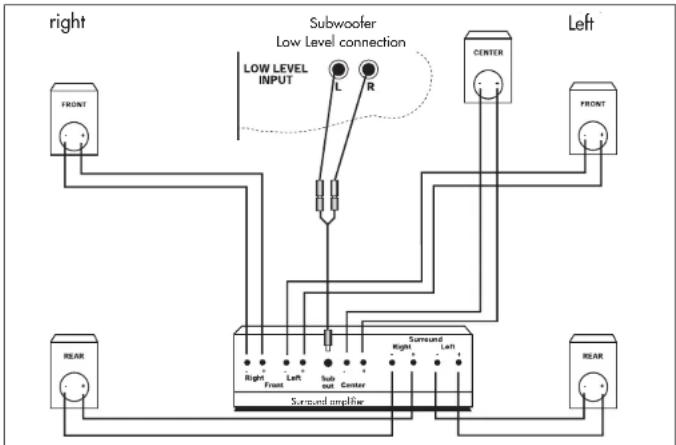
Since bass management primarily depends on the loudspeaker configuration, we give only typical settings below.
a) Small and very small satellite speakers must be operated in "small" mode.
Perform the setting on your amplifier as follows:
Front: small
Centre: small
Rear: small
Subwoofer: yes
b) There is no definitive formula for the settings for compact speakers. In this case, the suitable mode may be "large" or "small". This depends on the volume level you prefer or the sound effect you wish to obtain (refer to the section "Caution, clipping!). The settings on your amplifier can optionally be configured as follows:
Front: large/small
Centre: large/small
Rear: large/small
Subwoofer: yes
c) Floorstanding speakers or large bookshelf speakers that are suitable for powerful bass reproduction should be operated in "large" mode.
Perform the setting on the amplifier as follows:
Front: large
Centre: large
Rear: large
Subwoofer: yes/no
For the special quadral centre speakers, we generally recommend "small" mode.
Subwoofer
If your surround amplifier has a "line subwoofer" output, you can make use of this by using the Y cable shipped with the subwoofer (see illustration). In this case, you connect the front speakers directly to the front speaker terminals of your amplifier. Refer to the connection diagram for wiring your surround system.
Refer to the user manual of the active subwoofer for the necessary settings on your subwoofer!
Caution, clipping
Even if the rated output of an amplifier is significantly less than the load rating of the connected boxes, the speakers can easily be damaged by improper operation. This is because the rated output merely indicates how many watts the amplifier is capable of supplying to the speakers without distortion. When an amplifier is overloaded, it not only delivers a lot more power but also mixes in destructive direct current as well as high-frequency oscillations. This phenomenon is known as clipping and can be heard in the form of harsh distortion during loud passages. If you hear distortion, reduce the volume immediately to avoid damaging the speaker units. Amplifier clipping is a typical overload phenomenon that always occurs when you turn the volume and/or tone controls up too high. Even in the middle setting of the tone control, normal amplifiers reach their limits when loud pulses occur if you move the volume control significantly past the 12 o'clock position.
Tips for better acoustics
- Soft foam to prevent loud basses
Depending on the acoustic properties of the listening room and the positioning of the loudspeakers, bass notes can occasionally appear too loud.
Some quadral speakers are therefore shipped with pre-cut cylindrical pieces of large-pore foam.
If low basses are unpleasantly loud in the listening area, we recommend inserting this foam cylinder into the bass reflex tube of your quadral speaker. But avoid pus problems removing it afterwards. A noticeable be achieved this way.
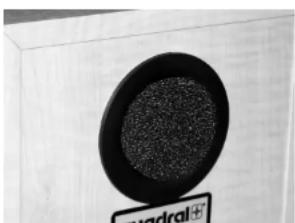
- To achieve better acoustic isolation of the loudspeakers from the floor, some floorstanding speakers are designed to accept spikes. Use of the spikes can be advantageous, depending on the living room / floor.
- To achieve better acoustic isolation of centre or shelf speakers from the surface on which they stand, some of these loudspeakers are shipped with 4 self-adhesive rubber feet.
Care of loudspeakers
Your quadral loudspeakers are best cleaned with a soft, dry cloth. The aluminium housing is best wiped in a longitudinal direction with a damp cloth. Do not use solvents. You should only clean the loudspeaker systems (woofer, midrange units, etc.) when they have become very dirty (small amounts of dust have no effect on the acoustics). Use a soft, dry cloth or a soft brush with very gentle pressure, otherwise there is a risk of damaging the diaphragms.
We generally advise against cleaning the tweeter diaphragms because they are extremely sensitive to pressure!
Light soil on the fabric front frame can be removed by tapping, with a vacuum cleaner, or by using an adhesive tape when the front frame has been removed.
Heavier soil can be removed with a dry foam cleaner (such as Centralin spray). Never use moisture to clean the front frame.
The technical details for your product can be found on the back of the speaker cabinet or on the packaging!
| Fault | Cause | Rectification | |
| Audible distortion even at low volume | a) Fault in the electronics | a) The fault lies in the electronics if the problem affects both speakers.Swap over the left and right speakers if only one speaker is affected. If the problem is still on the same channel, your electronics are faulty.The speaker is faulty if the problem is now on the other channel.b) Fault in the speaker | b) Please contact your dealer or our service (tel. +49 (0) 511-7904-0). |
| No sound | a) Cabling incorrectb) Amplifier switched off | a) Check the cabling.b) Switch on the system. | |
| Slender, bright sound.Sounds distant and unrealistic. | a) Incorrect polarity | a) Check to see if a terminal marked with + on the amplifier has been inadvertently connected to a terminal marked with - on the speaker or vice versa.b) Set up the speaker closer to a wall, but maintain a minimum clearance of 5 cm between the back of the speaker and the wall. | |
| b) Unfavourable setup | |||
| Bass notes too powerful | a) Unfavourable speaker setup [e.g. in the corner of a room]b) Bass control on amplifier set high | a) Move the speaker further away from the adjacent walls.b) Set the bass control on your amplifier to a neutral position. | |
| Lack of treble | a) The tweeters are not properly aligned | a) Position the speakers so that the tweeters are facing directly towards your listening position. |
Central: large/small
Arriere: large/small
Caisson de graves: yes
Attention aux distortions
Altavoz principal (frontal)
Frontal: large/small
Central: large/small
Posterior: large/small
Subwoofer: yes
Frontal: large Central: large Posterior: large Subwoofer: yes/no
HiFi / Surround Speakers
quadral GmbH & Co. KG
- DEUTSCH
- SAFETY ADVICE FOR PASSIVE LOUDSPEAKERS
- IMPROPER HANDLING OF MAINS VOLTAGE CAN CAUSE FATAL INJURY
- SETTING UP
- MAIN SPEAKERS (FRONT)
- FRONT CENTRE SPEAKER
- REAR CENTRE SPEAKER
- REAR SPEAKERS
- STANDS AND WALL BRACKETS
- CONNECTING TO THE AMPLIFIER
- SCREW TERMINALS
- OPERATION WITH A SURROUND AMPLIFIER
- SUBWOOFER
- CAUTION, CLIPPING
- TIPS FOR BETTER ACOUSTICS
- CARE OF LOUDSPEAKERS
- ATTENTION AUX DISTORTIONS
- ALTAVOZ PRINCIPAL (FRONTAL)
Brand : Quadral
Model : Aluma 2060
Category : Loudspeaker