
FFJ6925X - Refrigerator FAGOR - Free user manual and instructions
Find the device manual for free FFJ6925X FAGOR in PDF.
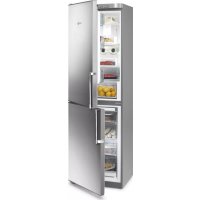



| Product Type | Combined refrigerator with freezer compartment |
| Power Supply | 220-240 V with earth connection |
| Refrigerant | R600A |
| Recommended refrigerator temperature | +5 °C (typical value, not specified in the manual) |
| Recommended freezer temperature | -18 °C to -24 °C for freezing |
| Quick cool function (refrigerator) | Activates the coldest temperature for 6 hours |
| Quick cool function (freezer) | Activates the coldest temperature for 52 hours |
| Holiday function | Keeps the freezer running with low consumption |
| Open door alarm | Sounds after 2 minutes of opening |
| Freezer temperature alarm | Visual and audible signal if temperature too high |
| Light bulb type | E14, 220-240 V, 15/25 W |
| Carbon filter | Absorbs odors, lifespan 6 months |
| S.P.A. accessory (optional) | Water tank to maintain humidity in the vegetable drawer |
| Interior cleaning | With water and baking soda, no steam or abrasives |
| Exterior cleaning | With a damp cloth, no steam cleaner |
| Rear grille cleaning | Vacuum cleaner once a year |
| Door reversibility | Possible, procedure described in the manual |
| Safety | Do not damage the refrigeration circuit; power cable must be replaced by a professional |
| Energy consumption | Reduced by using holiday functions and avoiding prolonged openings |
| Spare parts | Bulb, carbon filter, handles, hinges |
| Repairs | Contact after-sales service |
Frequently Asked Questions - FFJ6925X FAGOR
User questions about FFJ6925X FAGOR
0 question about this device. Answer the ones you know or ask your own.
Ask a new question about this device
Download the instructions for your Refrigerator in PDF format for free! Find your manual FFJ6925X - FAGOR and take your electronic device back in hand. On this page are published all the documents necessary for the use of your device. FFJ6925X by FAGOR.
USER MANUAL FFJ6925X FAGOR
Very important: Read this manual carefully before using your refrigerator.
This manual is designed with texts corresponding to drawings.
Identification

Identify the model of your refrigerator ("a", "b", "c", "d", "e") by comparing the control panel with the illustrations.
1
Installation
1.1 Unpacking. Remove all protective elements. 1.2 Placement. Place the refrigerator away from heat sources and protect it from direct sunlight in order to conserve energy.
Do not install the refrigerator in the open air or where it is exposed to rain.
Air should be able to circulate behind the refrigerator. Leave 25 mm between the rear of the refrigerator and the wall. Do not enclose the space between the refrigerator and the floor or ceiling with any object.
Level the refrigerator to prevent vibration and noise. Remember that if the refrigerator is situated next to a wall or cupboard, it could make some noise.
In addition, make sure that the trays are correctly placed and position the containers with a space between them to prevent vibration.
1.3 Connecting to power. Let the refrigerator sit in an upright position for at least 2 hours before connecting it. Check the information on the specification plate (220-240V with ground wire) (1.3.1, 1.3.2).
Do not use adapters or extension leads.
Prevent the cord from coming in contact with the motor or getting trapped beneath it.
1.4 Changing the side that the door opens from. Disconnect the refrigerator from the power outlet and empty the inside of the door.
Remove the upper hinge cover with a flat blade screwdriver (1.4.1). Loosen the screws and remove the hinge mechanism with the help of a screwdriver (1.4.2). Disconnect by pressing the connector tab (1.4.3). Remove the refrigerator door (1.4.4). Remove the controls with a screwdriver, prying it away using the grooves placed for that purpose (1.4.5). Make a notch for the cable on the opposite side, as marked on the casing (1.4.6). Remount the control panel, passing the cable through the notch you made (1.4.7). Remove the screw cover from the centre hinge, loosen the screws and remove the hinge (1.4.8). Move the freezer door up (1.4.9). Loosen the screws of the lower hinge and remove it. Change the position of the hinge axis and place it on the opposite side. Place the lower freezer handle on the refrigerator door and the lower refrigerator handle on the freezer door, rotated 180°. Place the vertical handles on the opposite side, rotating them 180° (1.4.11). Rotate the self-closures and place the one from the refrigerator on the freezer and vice versa (1.4.12). Position the freezer door (1.4.13) and attach the central hinge (1.4.14). Position the refrigerator door (1.4.15). Place the closure mechanism in the upper hinge space on the opposite side (1.4.16). Put the cable through the upper hinge and rotation mechanism and plug it into the door connector (1.4.17). Screw in the upper hinge (1.4.18) and put the cover in place (1.4.19).

Operation
2.1 Switching on the refrigerator. Press
ON-OFF (2.1.1, 2.1.3) or the plus + or - keys until you see a number in the display (2.1.2). The Mini LCD models lock automatically (2.1.3). To unlock, press any key for 3 seconds.
2.2 Selecting the compartment. In comb
refrigerators, the refrigeration compartment and the freezer compartment operate independently.
2.3 Temperature selection. Turn the control
(2.3.1) or press the +, - keys, first for the freezer compartment and then for the refrigerator compartment (2.3.2, 2.3.3).
Once the temperature is selected, you
can see the current temperature of the compartment with the lighted indicator (2.3.4) or by pressing the + or - keys of the appropriate compartment for 5 seconds. The compartment temperature will blink.
Recommendation: The recommended
temperature for the refrigeration compartment is and the freezer compartment for already frozen food. If you want to freeze, the recommended temperature is -24
Remember that the interior temperature
depends on the temperature of the environment, placement, and frequency with which the door is opened.
2.4 Refrigerator functions.
Rapid cooling mode: This function sets
refrigeration to the coldest temperature for 6 hours. It should be used if you put a large quantity of food in the refrigerator.
To activate and deactivate: Press
SUPER
(2.4.1), press ★ (2.4.2) or 2.4.3).
Holiday mode: The vacation function is very useful when the refrigerator will not be used for a long period of time, but you want to keep food in the freezer. With this function, your refrigerator will use little power and smells won't develop in its interior.
△ Warning: To use this function, the refrigerator door must be closed.
To activate and deactivate: Press
HOLIDAY
(2.4.4) or the +, - keys until you see H on the display (2.4.5) or for 3 seconds (2.4.6). To cancel, repeat this operation. Some models allow the refrigeration compartment to be shut off.
Press ON-OFF (2.4.7), or the +, - (2.4.8, 2.4.9), keys, until no number can be seen.
2.5 Freezer functions.
Rapid cooling mode: This function sets the coldest freezer temperature for 52 hours. The function should be activated 24 hours before putting a large quantity of food in the freezer.
To activate and deactivate: Press
SUPER
(2.5.1), press (2.5.2) or
(2.5.3)
Connecting / disconnecting the freezer:
Press the ON-OFF key (2.5.4), the +, - keys (2.5.5) until no temperature can be seen on the display, or for 3 seconds (2.5.6). Shutting off the freezer also shuts off the refrigeration compartment.
2.6 Usage recommendations.
- Don't leave the door open more time than necessary and don't put hot foods in the refrigerator. This will provide the most efficient use of the refrigerator and avoid increasing power consumption. If your refrigerator is of the NO FROST variety, don't block the ventilation grille and try to leave space between food items so that air circulates around them.
- Don't put carbonated drinks or glass bottles containing liquid in the freezer, they can burst.
- Store food in hermetically sealed containers to prevent drying.
- Do not eat extremely cold ices or food as they can produce burns in the mouth.
3
Maintenance and cleaning
3.1 Interior cleaning. To clean the interior, use a sponge or cloth soaked in water with bicarbonate in order to prevent odours developing. In no case use steam cleaning machines, solvents, or abrasive detergents. 3.2 Exterior cleaning. Do not clean the screens with a steam cleaning machine.
It is advisable to clean the back vent once a year with a vacuum cleaner.
3.3 Cleaning the accessories. Accessories are not suitable for automatic dishwashers. Clean them by hand with a sponge or cloth. 3.4 Changing the lamp. In the case that the lamp goes out: disconnect the refrigerator. Remove the cover by pressing the tab (3.4.1, 3.4.3) and remove the burnt out lamp (3.4.2, 3.4.4). Replace it with another with the same type of thread, E14, 220-240V, 15/25W or according to fixture instructions. 3.5 Changing the carbon filter. The refrigerator may incorporate a carbon filter that absorbs the odours of certain foods and retains microorganisms (fungus and bacteria) circulating in the air.
The filter keeps its properties for 6 months. After that time, it is recommended to replace it. Its location varies based on model.
To activate the filter: Press the tab and remove the cover to access the filter (3.5.1, 3.5.3). Separate the filter from the tab (3.5.2, 3.5.4) and remove the seals (3.5.5).
Press the BIOFILTER viewer until you hear a click (3.5.6) and in a few seconds the duration scale will become colored. Place the new filter in the original location.
Keep the old filters and the replacements out of the reach of children: Ingesting a large quantity could be dangerous.
Do not get the filter wet, as it will lose its properties.
3.6 S.P.A. salus per aquam (optional)
Your refrigerator may incorporate the S.P.A. accessory which maintains a constant level
of humidity in the vegetable compartment, preventing drying.
It is located in the vegetable compartment drawer separator. It consists of a receptacle with a pouring container and a fullness level indicator. When the S.P.A. needs water, the level will become hidden. Take out the container (3.6.2) and use it to refill the receptacle.
The filter should be changed every 2 years (3.6.4).

Diagnostics

4.1 Door open. If the door stays open for more than 2 minutes, an alarm will sound and the refrigerator light will go off. The alarm is disconnected when the door is closed.
4.2 Freezer not cold enough.
If the temperature of the freezer is unusually high, a warning light will appear (4.2.1, 4.2.2) or a blinking icon (4.2.3) as well as a beeping alarm. Press SUPER or the water icon to manually shut off the beeping (4.2.4, 4.2.5, 4.2.6). - The first time the refrigerator is connected, the icon or the warning light will appear, but the alarm won't sound.
4.3 Loss of electrical power
Open the refrigerator doors as little as possible. When the power returns, check if the frozen food has thawed.
4.4 Normal refrigerator noises
It is perfectly normal for your refrigerator to make certain noises while it is running and you should not worry about them.
- The coolant gas can make a bubbling sound as it circulates.
- The compressor may make humming or tapping sounds, especially at start-up.
- The expansion and contraction of material used may make clicking or creaking sounds.
- The air that moves the freezer ventilator may generate a light background sound.
Don't try to repair the refrigerator. Call technical service.

Safety

- Keep the ventilation grille uncovered.
- Be careful not to damage refrigeration circuits.
- Don't use electrical devices in the interior of the refrigerator, unless they are recommended by the manufacturer.
- Don't use mechanical devices or means other than those recommended by the manufacturer to speed up the thawing process.
- This appliance is not intended for use by people (including children) whose physical, sensory, or mental capacities are reduced or who lack experience or knowledge, except under supervision or after receiving instruction regarding use of the appliance from a person responsible for their safety. Use by children should be supervised to prevent them playing with the appliance.
- If the power cable is damaged, it should be replaced by the manufacturer, by their after-sales service, or by similarly qualified personnel in order to prevent dangerous situations.

The environment

This refrigerator was designed with environmental conservation in mind.
The appliance operates with coolant R600A, which does not damage the environment.
Respect the environment. Use the recommended temperatures for each compartment. They will depend on the mode you need for efficient use of your refrigerator.
Disconnect the refrigerator or set it to holiday mode when you will not be using it for a prolonged period. You will reduce power consumption and save energy.
Avoid leaving the doors open more time than necessary. It causes an increase in power use.
Waste management of electrical and electronic appliances.
Do not discard appliances mixing them with general household waste.
Deliver your refrigerator to a special collection centre.
Recycling domestic appliances prevents negative impacts on health and the environment and helps save energy and resources.
For more information, contact your local authorities or the establishment where you purchased your refrigerator.
2.6 Recommendations for operation.
Do not keep the doors open longer than necessary, and do not put hot food in the refrigerator. Thanks to this, the refrigerator will be used more efficiently, and you will avoid increased electricity consumption. - If your refrigerator is equipped with the NO FROST function, do not block the ventilation openings and leave some space between products, allowing air to circulate between them.
Do not place bottles with carbonated drinks and glass bottles with a neck in the freezer, as they may burst. To prevent drying out of products, place them in the refrigerator in airtight containers. Do not place hot food or frozen products in the freezer, as this may cause burns.
3. Cleaning and maintenance
3.1. Cleaning the interior. To clean the interior parts, use a soft cloth or sponge moistened with a weak salt solution to remove stubborn odors. It is strictly forbidden to use steam cleaners, solvents, or abrasive cleaning agents for cleaning. 3.2. Cleaning the exterior. It is forbidden to use steam cleaners for cleaning the appliance. It is recommended to wipe the rear grille with a vacuum cleaner once a year. 3.3. Cleaning the accessories. It is forbidden to clean the accessories in a dishwasher. It is recommended to hand wash with a soft cloth or sponge. 3.4. Replacing the lamps. If the lamp has burned out: disconnect the refrigerator from the power supply. Remove the cover by pressing the "tongue" (3.4.1, 3.4.3) and pull out the faulty lamp (3.4.2, 3.4.4). Replace it with a new one of the same type and size (E14, 220-240 V, 15/25 W) and in accordance with the lighting instructions. 3.5. Replacing the charcoal filter. The refrigerator may have a charcoal filter that absorbs foreign odors produced by some products and traps microorganisms (fungi and bacteria) from the circulating air.
The filter retains its properties for a certain time, about 6 months. After this time, it is recommended to replace the filter. The location of the filter depends on the model.
To remove the filter: press the "tongue" and remove the cover to gain access to the filter (3.5.1, 3.5.3). Separate the filter from the cover (3.5.2,
3.5.4) and remove the seal (3.5.5).
Press the BIOFILTER lightly until it clicks (3.5.6); after a few seconds, the indicator will start to color. Install the filter in its original position.
Used and replacement filters must be stored out of the reach of children. Ingestion of significant amounts of filter material can be dangerous.
Do not allow the filter to become wet, as it may lose its properties.
3.6 S.P.A. function (salus per aquam, "health through water")
Your refrigerator may be equipped with an S.P.A. device that maintains a constant humidity level in the compartment for vegetables and fruits, thereby preventing them from drying out.
It is located on the separating shelf of the vegetable and fruit drawer (3.6.1). The device consists of a reservoir with a siphon and a fill level indicator. If S.P.A. is required, the level drops until it disappears. Remove the siphon (3.6.2) and use it to fill the reservoir (3.6.3).
Every 2 years, it is recommended to replace the filter (3.6.4).

Refrigerator status control functions

4.1 Door open alarm. If the door remains open for more than 2 minutes, the refrigerator emits an audible signal, and the lighting of the refrigerator compartment turns off. After closing the door, the signal stops.
4.2 Alarm for high temperature in the freezer compartment
- If the temperature in the freezer compartment is abnormally high, a visual alarm is given (4.2.1, 4.2.2), the LED flashes symbol A (4.2.3), and (in turn) an intermittent audible alarm is given. To switch off the audible alarm, press the SUPER button (4.2.4, 4.2.5, 4.2.6).
- When the appliance is switched on for the first time, the
symbol for the visual alarm appears, but the audible alarm is not given.
4.3 Power failure
Open the freezer door as rarely as possible and for as short a time as possible. After the power supply has been restored, check that the products have not thawed.
4.4 Normal noises during operation of the refrigerator
During operation of the refrigerator, noises may occur which are a normal phenomenon and should not be a cause for concern.
- The circulation of the refrigerant through the circuits may cause a gurgling noise. - When the compressor is running, a humming and/or clicking sound may be heard, especially when it switches on. - When the materials used expand and contract, cracking or popping noises may be emitted. - The movement of air due to the operation of the fan may produce a slight background noise.

Do not attempt to
repair the appliance yourself. In the event of a malfunction, contact the technical support service by telephone.

Do not dispose of the appliance or its parts together with household waste.
At the end of its service life, the refrigerator must be handed over to a special collection point.
The separate collection and recycling of household electrical appliances helps to prevent negative consequences for health and the environment, and also saves energy and resources.
For further information, please contact the relevant authorities in your country/region or the retailer where you purchased the refrigerator.
Instructions for use
Very important: Before using the refrigerator, read the entire instruction manual.

- OPERATION
- SUPER
- MAINTENANCE AND CLEANING
- DIAGNOSTICS
- SAFETY
- THE ENVIRONMENT
- THIS REFRIGERATOR WAS DESIGNED WITH ENVIRONMENTAL CONSERVATION IN MIND
- WASTE MANAGEMENT OF ELECTRICAL AND ELECTRONIC APPLIANCES
- RECOMMENDATIONS FOR OPERATION
- CLEANING AND MAINTENANCE
- REFRIGERATOR STATUS CONTROL FUNCTIONS
- POWER FAILURE
- NORMAL NOISES DURING OPERATION OF THE REFRIGERATOR
- DO NOT ATTEMPT TO
- INSTRUCTIONS FOR USE
Brand : FAGOR
Model : FFJ6925X
Category : Refrigerator