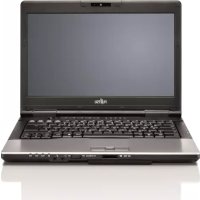
LIFEBOOK S752 - Laptop FUJITSU - Free user manual and instructions
Find the device manual for free LIFEBOOK S752 FUJITSU in PDF.


| Product type | Laptop |
| Brand | Fujitsu |
| Model | LIFEBOOK S752 |
| Processor | Intel Core i5 or i7 (depending on configuration) |
| RAM | Up to 8 GB DDR3 (2 SO-DIMM slots) |
| Storage | SATA hard drive up to 500 GB or SSD (depending on configuration) |
| Screen | 14-inch TFT HD (1366x768) or HD+ (1600x900) with LED backlight |
| Graphics | Integrated Intel HD Graphics |
| Audio | Stereo speakers with DTS Boost technology |
| Network connectivity | Gigabit Ethernet (RJ-45), Wi-Fi 802.11 b/g/n, optional Bluetooth |
| Ports | 1x USB 3.0, 2x USB 2.0 (1 with permanent charge), 1x e-SATA/USB 3.0, 1x VGA, 1x DisplayPort, 1x microphone jack, 1x headphone jack |
| Optical drive | Dual-layer multi-format DVD burner or Blu-ray RW drive (depending on configuration) |
| Card reader | SD, Smart Card, ExpressCard |
| Power supply | 19V DC, 80W or 100W AC adapter |
| Battery | Rechargeable lithium-ion, variable capacity (6 or 9 cells) |
| Dimensions (W x D x H) | Approximately 338 x 237 x 30 mm |
| Weight | Approximately 2.1 kg |
| Security | Security panel with password, fingerprint sensor, Kensington lock slot |
| Operating system | Windows 7 Professional or Windows 8 Pro (depending on version) |
| Warranty | Fujitsu international limited warranty (see notice) |
Frequently Asked Questions - LIFEBOOK S752 FUJITSU
User questions about LIFEBOOK S752 FUJITSU
0 question about this device. Answer the ones you know or ask your own.
Ask a new question about this device
Download the instructions for your Laptop in PDF format for free! Find your manual LIFEBOOK S752 - FUJITSU and take your electronic device back in hand. On this page are published all the documents necessary for the use of your device. LIFEBOOK S752 by FUJITSU.
USER MANUAL LIFEBOOK S752 FUJITSU
Learn how to use your Fujitsu LIFEBOOK S752 notebook

Guide d'utilisation
Learn how to use your Fujitsu LIFEBOOKS752 notebook
FUJITSU
Copyright and Trademark Information
Fujitsu America has made every effort to ensure the accuracy and completeness of this document; however, as ongoing development efforts are continually improving the capabilities of our products, we cannot guarantee the accuracy of the contents of this document. We disclaim liability for errors, omissions, or future changes.
Fujitsu, the Fujitsu logo, and LIFEBOOK are registered trademarks of Fujitsu Limited.
Intel and Intel Core are trademarks or registered trademarks of Intel Corporation or its subsidiaries in the United States and other countries.
Microsoft and Windows are either registered trademarks or trademarks of Microsoft Corporation in the United States and/or other countries.
The ExpressCard word mark and logo are owned by the Personal Computer Memory Card International Association (PCMCIA) and any use of such marks by Fujitsu America, Incorporated is under license.
Bluetooth is a trademark of Bluetooth SIG, Inc., USA.
Adobe, Acrobat and Adobe Reader are registered trademarks or trademarks of Adobe Systems Inc. in the United States and other countries.
Google is a registered trademark of Google Incorporated.
Realtek is a trademark of Realtek Semiconductor Corporation.
MakeDisc, PowerDirector, PowerDVD, and YouCam are trademarks of CyberLink Corp.
OmniPass is a trademark of Softex, Inc.
Roxio is a trademark of Roxio, a division of Sonic Solutions.
Norton and Norton Internet Security are trademarks or registered trademarks of Symantec Corp. in the United States and other countries.

dt
Boost
Manufactured under license from DTS Licensing Limited. DTS, the Symbol, and DTS and the Symbol together are registered trademarks, and DTS Boost is a trademark of DTS (BVI) Limited (in Hong Kong and China) and DTS, Inc. (outside of Hong Kong and China). © DTS, Inc. All Rights Reserved.
The DVD player found in some models of the LIFEBOOK notebook incorporates copyright protection technology that is protected by method claims of certain U.S. patents and other intellectual property rights owned by Macrovision Corporation and other rights users. Use of this copyright protection technology must be authorized by Macrovision Corporation, and is intended for home and other limited viewing uses only unless authorized by Macrovision Corporation. Reverse engineering or disassembly is prohibited.
All other trademarks mentioned herein are the property of their respective owners.

WARNING
HANDLING THE CORD ON THIS PRODUCT WILL EXPOSE YOU TO LEAD, A CHEMICAL KNOWN TO THE STATE OF CALIFORNIA TO CAUSE BIRTH DEFECTS OR OTHER REPRODUCTIVE HARM.
WASH HANDS AFTER HANDLING.
Copyright 2012 Fujitsu America. All rights reserved.
No part of this publication may be copied, reproduced, or translated, without prior written consent of Fujitsu. No part of this publication may be stored or transmitted in any electronic form without the written consent of Fujitsu. B5FK-0821-01ENZ0-00

DECLARATION OF CONFORMITY
according to FCC Part 15
Responsible Party Name: Fujitsu America, Inc.
Address: 1250 E. Arques Avenue
Sunnyvale, CA 94085
Telephone: (408) 746-6000
Declares that product: Base Model Configuration: LIFEBOOK S752 notebook
Complies with Part 15 of the FCC Rules.
This device complies with Part 15 of the FCC rules. Operations are subject to the following two conditions: (1) This device may not cause harmful interference, (2) This device must accept any interference received, including interference that may cause undesired operation.
IMPORTANT SAFETY INSTRUCTIONS
This unit requires an AC adapter to operate. Use only UL Listed I.T.E. Class II Adapters with an output rating of 19 VDC, with a minimum current of 4.22 A (80 W) or 5.27 A (100 W).
AC adapter output polarity:

When using your notebook equipment, basic safety precautions should always be followed to reduce the risk of fire, electric shock and injury to persons, including the following:
Do not use this product near water for example, near a bathtub, washbowl, kitchen sink or laundry tub, in a wet basement or near a swimming pool.
- Use only the power cord and batteries indicated in this manual. Do not dispose of batteries in a fire. They may explode. Check with local codes for possible special disposal instructions.
SAVE THESE INSTRUCTIONS
For Authorized Repair Technicians Only

DANGER OF EXPLOSION IF LITHIUM (CLOCK) BATTERY IS INCORRECTLY REPLACED. REPLACE ONLY WITH THE SAME OR EQUIVALENT TYPE RECOMMENDED BY THE MANUFACTURER. DISPOSE OF USED BATTERIES ACCORDING TO THE MANUFACTURER'S INSTRUCTION.

FOR CONTINUED PROTECTION AGAINST RISK OF FIRE, REPLACE ONLY WITH THE SAME TYPE AND RATING FUSE.
Recycling your battery
Over time, the batteries that run your mobile computer will begin to hold a charge for a shorter amount of time; this is a natural occurrence for all batteries. When this occurs, you may want to replace the battery with a fresh one*. If you replace it, it is important that you dispose of the old battery properly because batteries contain materials that could cause environmental damage if disposed of improperly.
Fujitsu is very concerned with environmental protection, and has enlisted the services of the Rechargeable Battery Recycling Corporation (RBRC)**, a nonprofit public service organization dedicated to protecting our environment by recycling old batteries at no cost to you.
RBRC has drop-off points at tens of thousands of locations throughout the United States and Canada. To find the location nearest you, go to www.RBRC.org or call 1-800-822-8837.
If there are no convenient RBRC locations near you, you can also go to the EIA Consumer Education Initiative website (http://EIAE.org/) and search for a convenient disposal location.
Remember - protecting the environment is a cooperative effort, and you should make every effort to protect it for current and future generations.
- To order a new battery for your Fujitsu mobile computer, go to the Fujitsu shopping site at www.shopfujitsu.com in the US or www.fujitsu.ca/products/notebooks in Canada.
** RBRC is an independent third party to which Fujitsu provides funding for battery recycling; RBRC is in no way affiliated with Fujitsu.
Contents
About This Guide 8
Conventions Used in the Guide 8
Fujitsu Contact Information 9
Chapter 1 Getting to Know Your LIFEBOOK
Overview. 11
Locating the Controls and Connectors. 12
Top Components. 13
Left-Side Panel Components 15
Right-Side Panel Components 17
Back Panel Components. 19
Bottom Components. 20
Status Indicator Panel. 22
Security Indicator 22
Hard Drive/Optical Drive Access Indicator 23
NumLk Indicator 23
CapsLock Indicator 23
Scrlk Indicator 23
Power Indicator. 23
Battery Charge Indicator. 24
Battery Level Indicators 24
Keyboard 25
Using the Keyboard. 25
Touchpad Pointing Device. 28
Clicking 29
Double-Clicking. 29
Dragging 30
Touchpad Control Adjustment 30
Scrolling. 30
Volume Control. 31
Controlling the Volume. 31
Flexible Bay Devices 32
Removing and Installing Modular Devices 32
LIFEBOOK Security/Application Panel 35
Setting up Your LIFEBOOK Security Panel 35
Passwords 35
Operating Your LIFEBOOK Security/Application Panel 37
Precautions 38
Uninstalling the Security Panel Application. 39
Launching Applications with the Security/Application Panel 40
Chapter 2 Getting Started with Your LIFEBOOK
Power Sources 43
Connecting the Power Adapters 44
Display Panel 45
Opening the Display Panel 45
Adjusting Display Panel Brightness 46
Closing the Display Panel 46
Using Multiple Displays Simultaneously 47
Starting Your LIFEBOOK Notebook 48
Power On 48
Boot Sequence 49
Hard Disk Drive Passwords 49
BIOS Setup Utility 49
Booting the System. 50
Starting Windows the First Time. 50
Power Management 52
Power/Suspend/Resume Button 52
Sleep Mode 52
Hibernate Feature. 53
Windows Power Management 54
Restarting the System. 54
Powering Off 54
ENERGY STAR® Compliance. 56
Chapter 3 User-Installable Features
Lithium ion Battery 57
Recharging the Batteries 58
Replacing the Battery 59
Optical Drive. 62
Media Player Software 62
Loading Media on Your Drive 63
Removing Media. 64
Emergency Optical Drive Tray Release 65
Using the Media Player Software 66
Using Media Player on Battery Power 66
Secure Digital Cards. 68
Installing SD Cards 69
Removing an SD Card 69
ExpressCardsTM/Smart Cards 70
Inserting ExpressCards 70
Removing ExpressCards 71
Smart Card Reader 72
Memory Upgrade Module 73
73
Removing a Memory Upgrade Module 74
Checking the Memory Capacity 75
Device Ports 76
Internal LAN (RJ-45) Jack 76
Universal Serial Bus Ports 76
Anytime USB Charge Feature 77
Headphone Jack 77
Microphone Jack 78
External Video Port 78
DisplayPort 78
E-SATA/USB3.0 Port 79
Port Replicator Connector 79
Port Replicator 80
Port Replicator Components 80
Attaching Port Replicator 83
Detaching Port Replicator 83
Chapter 4 Troubleshooting Your LIFEBOOK
Troubleshooting 84
Identifying the Problem 84
Specific Problems 85
Power On Self Test Messages 94
Restoring Your System Image and Software (Windows 7) 95
Saving and Recovering Your Factory and System Images 95
Backing Up a System Image 97
Recovery and Utility tabs 101
Using Windows 7 Recovery DVD on Windows 8 64-bit system .102
Recovering your Factory Image using Recovery and Utility 102
Downloading Driver Updates 104
Restoring Your System Image and Software (Windows 8) 105
Saving and Recovering Your Factory and System Images 105
Backing Up a System Image 107
Recovery and Utility tools. 111
Recovering your Factory Image using Recovery and Utility 113
ChangingBIOS settings between Windows 8 32-bit and 64-bit 114
Downloading Driver Updates 115
Chapter 5 Care and Maintenance
Caring for your LIFEBOOK Notebook 116
Cleaning your LIFEBOOK notebook 117
Cleaning the dust filter 119
Storing your LIFEBOOK notebook 119
Traveling with your LIFEBOOK notebook 120
Batteries 121
Media Care 122
Chapter 6 System Specifications
Specifications 124
Microprocessor 124
Chipset. 124
Memory 124
Video 125
Audio 125
Mass Storage Device Options 125
Modular Bay Devices. 126
Features. 126
Device Ports. 127
Keyboard 128
Power. 128
Dimensions and Weight 129
Environmental Requirements. 129
Popular Accessories. 129
Pre-Installed Software 130
Learning About Your Software 130
Glossary/Regulatory
Glossary. 133
Regulatory Information 146
Appendix A: WLAN User's Guide
Before Using the Optional Wireless LAN 150
Wireless LAN Device Covered by this Document 150
Characteristics of the WLAN Device 150
Wireless LAN Modes Using this Device. 151
Wireless Network Considerations 153
Deactivating/Disconnecting the WLAN Device. 153
Deactivation Using the Wireless On/Off Switch 153
Activating the WLAN Device 154
Configuring the Wireless LAN. 155
Connecting to a Network 155
Troubleshooting the WLAN. 156
Troubleshooting 156
WLAN Specifications 158
Specifications 158
Using the Bluetooth Device 160
Appendix B: Fingerprint Sensor Device
Introducing the Fingerprint Sensor Device 162
Getting Started 163
Installing OmniPass 163
User Enrollment 166
Using OmniPass 169
Configuring OmniPass 174
OmniPass Control Center 176
Troubleshooting 177
Index 179
Preface
About This Guide
The LIFEBOOK S752 notebook from Fujitsu America provides desktop performance with the Intel® Core™ processor. Your notebook has a built-in 14" TFT HD or HD+ color display with an LED backlight. This system brings the computing power of desktop personal computers (PCs) to a portable environment.
Your computer comes with Microsoft Windows® 8 Pro or Microsoft Windows® 7 Professional operating system preinstalled. This manual explains how to operate your LIFEBOOK notebook's hardware and built-in system software.
Conventions Used in the Guide
Keyboard and on-screen keys appear in brackets. Example: [Fn], [F1], [ESC], [ENTER] and [CTRL].
Pages with additional information about a specific topic are cross-referenced within the text.
For example: ("See Installation Procedure on page 43".)
On screen menu items appear in bold. Example: "Click Fujitsu Menu, and select your choice".

THIS INFORMATION ICON HIGHLIGHTS INFORMATION THAT WILL ENHANCE YOUR UNDERSTANDING OF THE SUBJECT MATERIAL.

THIS CAUTION ICON HIGHLIGHTS INFORMATION THAT IS IMPORTANT TO THE SAFE OPERATION OF YOUR COMPUTER, OR TO THE INTEGRITY OF YOUR FILES. PLEASE READ ALL CAUTION INFORMATION CAREFULLY.

THIS WARNING ICON HIGHLIGHTS INFORMATION THAT CAN BE HAZARDOUS TO EITHER YOU, YOUR LIFEBOOK NOTEBOOK, OR YOUR FILES. PLEASE READ ALL WARNING INFORMATION CAREFULLY.
Fujitsu Contact Information
Service and Support
You can contact Fujitsu Service and Support in the following ways:
Toll free: 1-800-8Fujitsu (1-800-838-5487)
Website: http://solutions.us.fujitsu.com/www/content/support/contact/index.php
Before you place the call, you should have the following information ready so that the customer supports representative can provide you with the fastest possible solution:
Product name
Product configuration number
Product serial number
Purchase date
- Conditions under which the problem occurred
- Any error messages that have occurred
- Type of device connected, if any
Fujitsu Shopping Online
You can go directly to the online by going to the website at: www.shopfujitsu.com.

YOU MUST HAVE AN ACTIVE INTERNET CONNECTION TO USE THE ONLINE URL LINKS.
Maintaining Latest Configuration
To ensure that you always have the most current driver updates related to your system, you should occasionally access the Fujitsu Software Download Manager (FSDM) utility. The FSDM utility is available from the Fujitsu Support site. FSDM will allow you to view a list of the most current drivers, utilities, and applications to determine whether you have the latest versions. If you have a Windows 7 operating system, you will need to go to the Support Site to download the FSDM Utility: http://support.fujitsupec.com/CS/Portal/support.do?src=DOWNLOADS.
Limited Warranty
Your LIFEBOOK notebook is backed by a Fujitsu International Limited Warranty. Check the service kit that came with your notebook for the Limited Warranty period and terms and conditions.
Chapter 1
Getting to Know Your LIFEBOOK
Overview
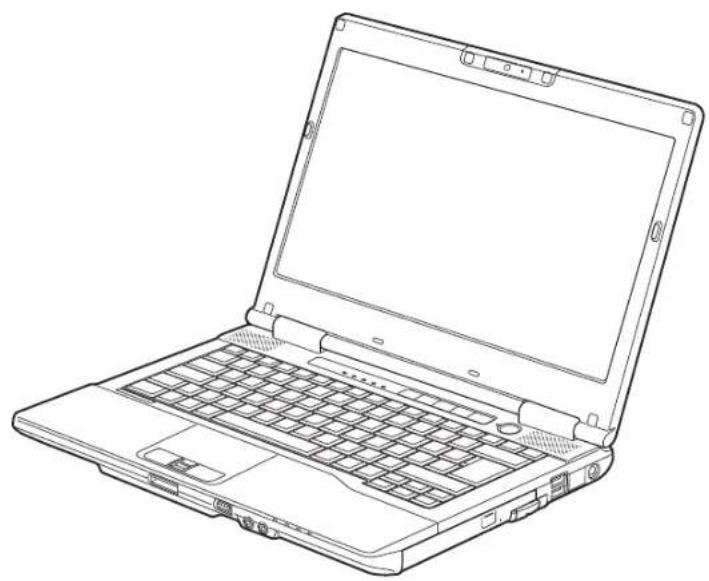
This section describes the components of your Fujitsu LIFEBOOK S752 notebook. We strongly recommend that you read it before using your notebook - even if you are already familiar with notebook computers.
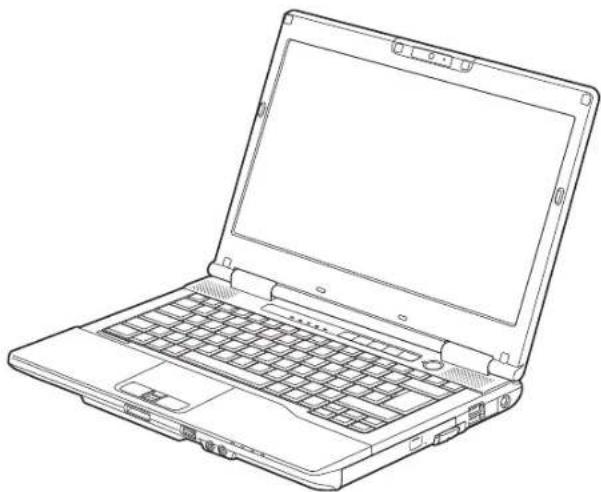
Figure 1. Fujitsu LIFEBOOK S752 notebook
Locating the Controls and Connectors
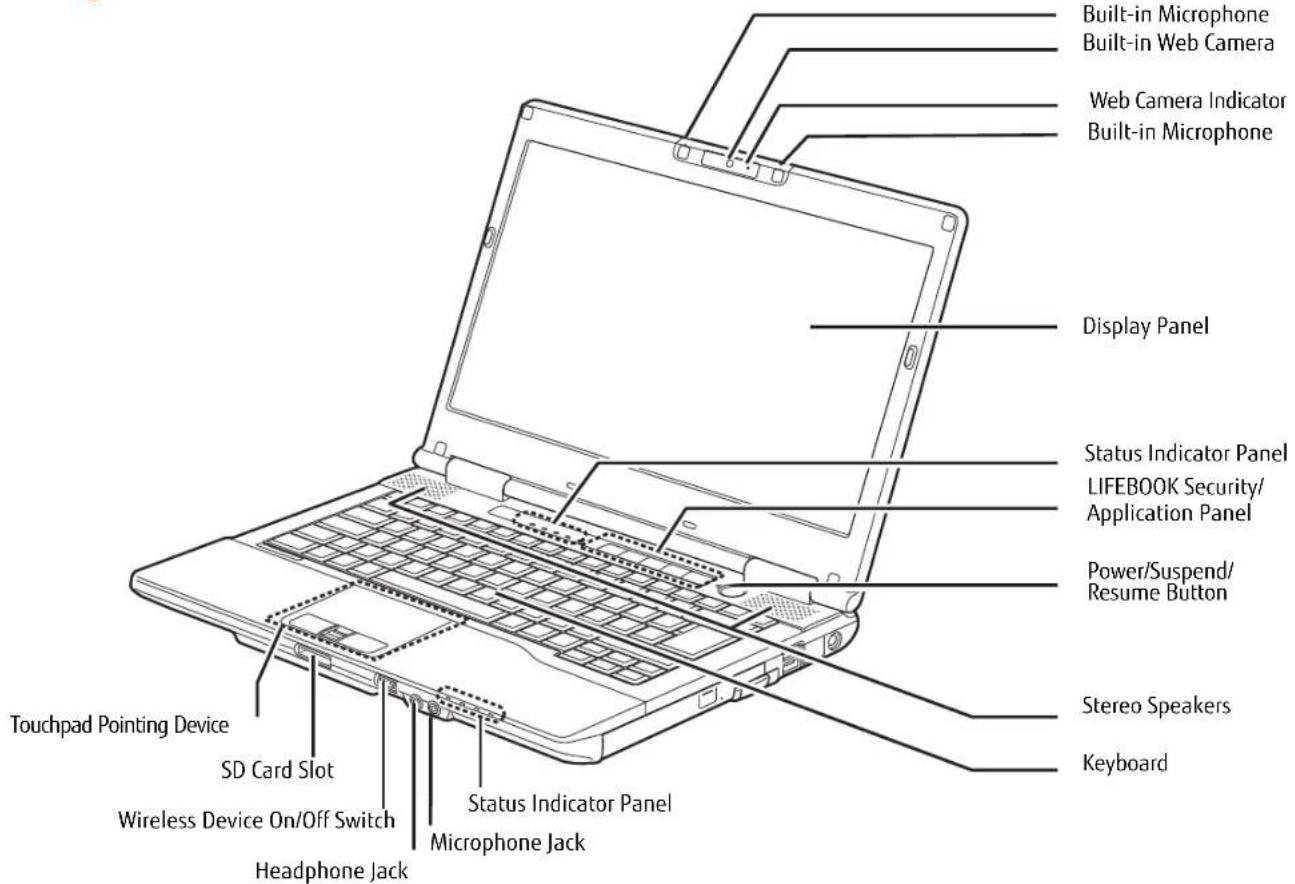
Figure 2. LIFEBOOK notebook with display open
Top Components
The following is a brief description of your LIFEBOOK notebook's top components.
Built-in Web Camera
The optional built-in camera has a resolution of either 1280 × 720 pixels or 1920 × 1080 pixels, depending upon your configuration. For information on using the web camera, see the documentation associated with the CyberLink YouCam application.
Web Camera Indicator
The web camera indicator lights up when the camera is in use.
Dual Digital Built-in Microphones
The two built-in microphones allow you to record stereo sound.
Display Panel
The display panel is a color LCD panel with back lighting for the display of text and graphics.
Status Indicator Panels
The Status Indicator Panels display symbols that correspond with specific components of your LIFEBOOK notebook. There are two status indicator panels on this model: One behind the keyboard and one along the right front edge. See "Status Indicator Panel" on page 22.
LIFEBOOK Security/Application Panel
The LIFEBOOK Security/Application Panel provides hardware security and one-touch application launch capability. See "LIFEBOOK Security/Application Panel" on page 35.
Power/Suspend/Resume Button
The Power/Suspend/Resume button allows you to suspend notebook activity without powering off, resume your notebook from sleep mode, and power on your notebook when it has been shut down from Windows. See "Power/Suspend/Resume Button" on page 48.
Stereo Speakers
The built-in dual speakers allow for stereo sound.
Keyboard
A full-size keyboard with dedicated Windows keys. See "Keyboard" on page 25.
Microphone Jack
The microphone jack allows you to connect an external stereo microphone.
Headphone Jack
The headphone jack allows you to connect stereo headphones to listen to audio files.
Wireless Device On/Off Switch
The wireless device on/off switch is used to turn on and off the optional WLAN and Bluetooth devices. Switching the device off when not in use will help to extend battery life. See "Activating the WLAN Device" on page 154.
SD Card Slot
The SD card slot allows you to install a Secure Digital (SD) card for data storage. This architecture allows you to transfer data from a variety of different digital devices. See "Installing SD Cards" on page 69.
Touchpad Pointing Device
The Touchpad pointing device is a mouse-like cursor control with right and left mouse-like buttons. (See "Touchpad Pointing Device" on page 28.) Additionally, it has a fingerprintScroll sensor between the lower buttons. See "Introducing the Fingerprint Sensor Device" on page 162.
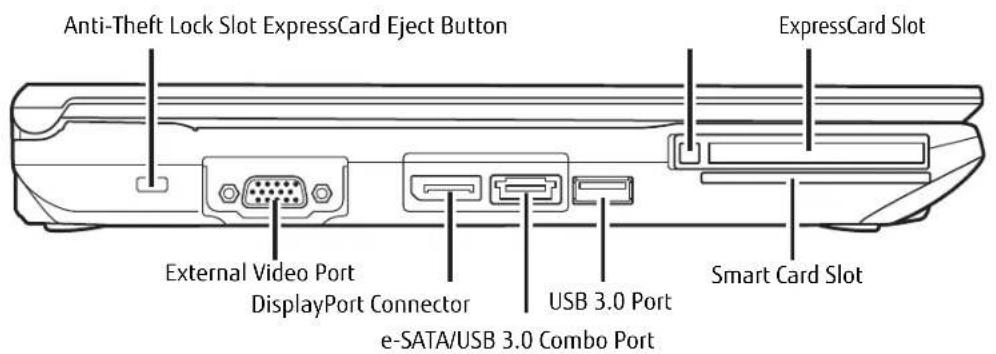
Figure 3. LIFEBOOK notebook left-side panel
Left-Side Panel Components
The following is a brief description of your LIFEBOOK notebook's left-side components.
Anti-theft Lock Slot
The anti-theft lock slot allows you to attach an optional physical lock down device.
ExpressCard Eject Button
The ExpressCard slot allows you to eject an ExpressCard from the slot in order to remove it. See "ExpressCards™/Smart Cards" on page 70.
ExpressCard Slot
The ExpressCard slot allows you to install an ExpressCard. See "ExpressCards™/Smart Cards" on page 70.
Smart Card Slot
A dedicated Smart Card slot is provided on your notebook. Smart Cards are the same size and shape as credit cards, but they contain an integrated microprocessor chip. In order to use the embedded Smart Card Reader, you must purchase optional third-party software for installation.
USB 3.0 Port
USB 3.0 can be distinguished from USB 2.0 by the color of the center tab in the port. The USB 3.0 tab is blue; the USB 2.0 tab is black.
The USB 3.0 port allows you to connect Universal Serial Bus devices. USB 3.0 transfers data at up to 5 Gbps and is backward-compatible with USB 2.0 devices, which transfer data at up to 480 Mbps. See "Universal Serial Bus Ports" on page 76.
e-SATA/USB 3.0 Combo Port
E-SATA (External Serial Advanced Technology Attachment) is an external version of SATA, which connects your computer to the hard drive. SATA is an interface that is much faster than typical IDE interfaces (E-SATA is six times faster than USB 2.0). E-SATA is ideal for backing up large files on an external hard drive. See "E-SATA / USB 3.0 Port" on page 79. This port can also be used as a USB 3.0 port.
DisplayPort Connector
This allows you to attach a DisplayPort cable. DisplayPort cables are primarily used to connect a computer with a monitor or home theater system.
External Video Port
The external monitor port allows you to connect an external monitor or LCD projector. See "External Video Port" on page 78.
Figure 4. LIFEBOOK notebook right-side panel
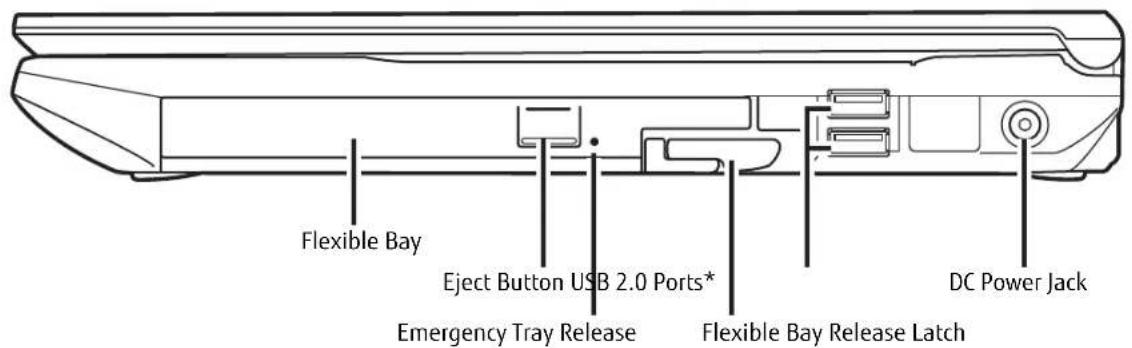
* Bottom USB 2.0 port is also a USB with Anytime Charge port.
Right-Side Panel Components
The following is a brief description of your LIFEBOOK notebook's right-side components.
Flexible Bay
The Flexible Bay can accommodate one of the following devices. See "Flexible Bay Devices" on page 32.
- Modular Dual-Layer Multi-Format DVD Writer
- Modular Blu-ray® RW drive
- Modular Lithium ion battery
- Modular second hard disk drive
Weight Saver
Eject Button
The Eject Button is used with the optical drive Flexible Bay devices to open the media tray.
Emergency Tray Release
Available on optical drive Flexible Bay devices. The emergency tray release is used to release the tray when power is not available to the system.
Flexible Bay Release Latch
The Flexible Bay release latch releases the Flexible Bay device.
USB 2.0 Ports
USB 2.0 ports allow you to connect Universal Serial Bus devices. USB 2.0 transfers data at up to 480 Mbps and is backward-compatible with USB 1.1 devices, which transfer data at up to 12 Mbps. See "Universal Serial Bus Ports" on page 76. Note that the bottom USB 2.0 port also offers Antyime Charge feature. USB Anytime Charge ports allow you to charge an external device even when the system is shut down.
DC Power Jack
The DC power jack allows you to plug in the AC adapter to power your LIFEBOOK notebook and charge the internal Lithium ion battery.
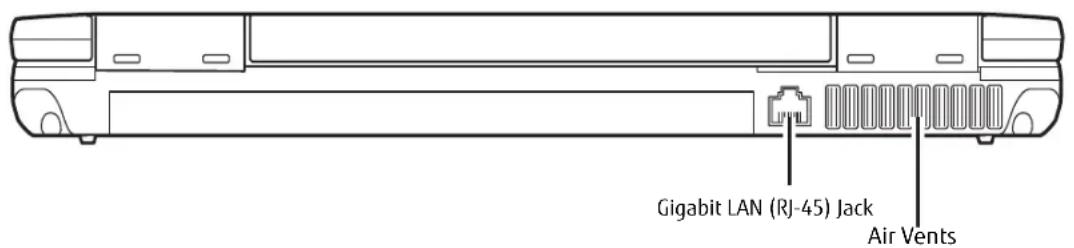
Figure 5. LIFEBOOK notebook back panel
Back Panel Components
Following is a brief description of your LIFEBOOK notebook's back panel components.
Gigabit LAN (RJ-45) Jack
The internal LAN (RJ-45) jack is used for an internal Gigabit (10Base-T/100Base-Tx/1000Base-T) Ethernet LAN connection. See "Internal LAN (RJ-45) Jack" on page 76.
Air Vents
The air vents are used to cool the system to prevent overheating.

TO PROTECT YOUR NOTEBOOK FROM DAMAGE AND TO OPTIMIZE PERFORMANCE, BE SURE TO KEEP ALL AIR VENTS UNOBSTRUCTED, CLEAN, AND CLEAR OF DEBRIS. THIS MAY REQUIRE PERIODIC CLEANING, DEPENDING UPON THE ENVIRONMENT IN WHICH THE SYSTEM IS USED.
DO NOT OPERATE THE NOTEBOOK IN AREAS WHERE THE AIR VENTS CAN BE OBSTRUCTED, SUCH AS IN TIGHT ENCLOSURES OR ON SOFT SURFACES LIKE A BED OR CUSHION.
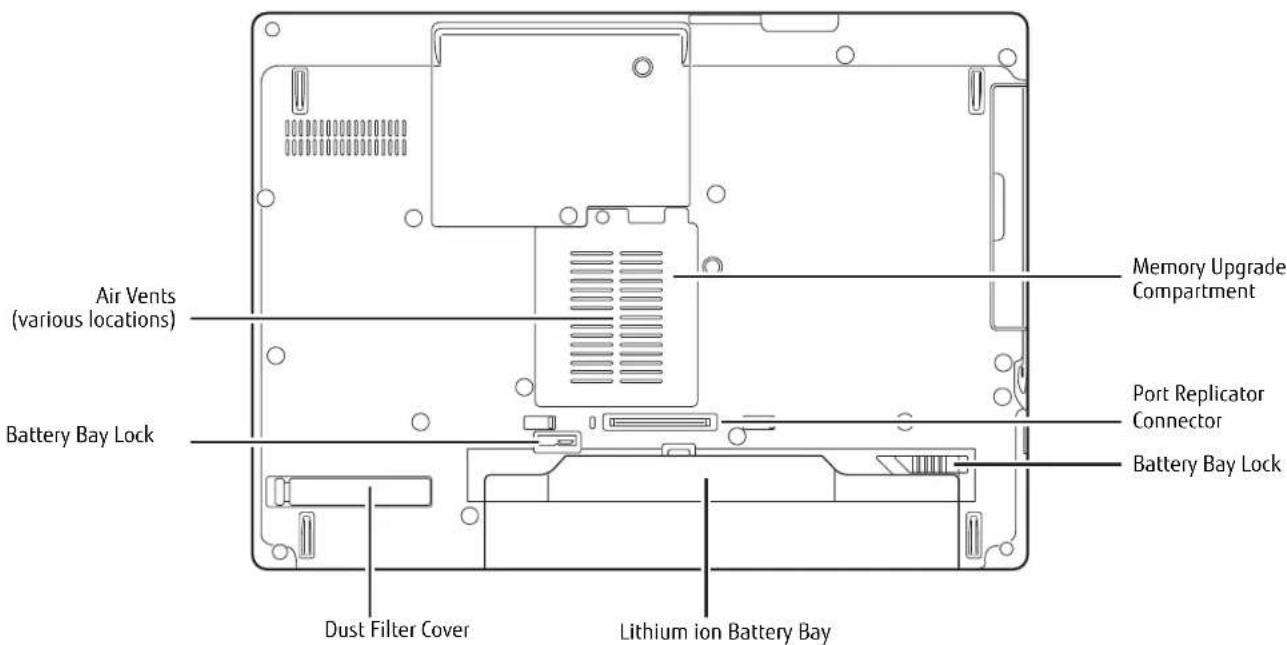
Figure 6. LIFEBOOK notebook bottom panel
Bottom Components
The following is a brief description of your LIFEBOOK notebook's bottom panel components.
Memory Upgrade Compartment
Your notebook comes with high speed Double Data Rate 3 Synchronous Dynamic RAM (DDR3 SDRAM). The memory upgrade compartment allows you to expand the system memory capacity of your notebook, thus improving overall performance. See "Memory Upgrade Module" on page 73. Under normal circumstances, it should not be necessary to open this compartment.
Port Replicator Connector
This connector allows you to connect the optional Port Replicator to your notebook.
Battery Bay Locks
The battery bay locks are used together to secure or remove the Lithium ion battery. See "Replacing the Battery" on page 59.
Lithium ion Battery Bay
The battery bay contains the internal Lithium ion battery. It can be opened for the removal of the battery when stored over a long period of time or for swapping a discharged battery with a charged Lithium ion battery. See "Lithium ion Battery" on page 57.
Dust Filter Cover
The dust filter cover provides access to the embedded dust filter which is used to help prevent dust and dirt from entering your system. See "Cleaning the dust filter" on page 119..
Air Vents
The air vents allow air to circulate through the system to cool down the components.

TO PROTECT YOUR NOTEBOOK FROM DAMAGE AND TO OPTIMIZE SYSTEM PERFORMANCE, BE SURE TO KEEP ALL AIR VENTS UNOBSTRUCTED, CLEAN, AND CLEAR OF DEBRIS. THIS MAY REQUIRE PERIODIC CLEANING, DEPENDING UPON THE ENVIRONMENT IN WHICH THE SYSTEM IS USED.
DO NOT OPERATE THE NOTEBOOK IN AREAS WHERE THE AIR VENT'S CAN BE OBSTRUCTED, SUCH AS IN TIGHT ENCLOSURES OR ON SOFT SURFACES LIKE A BED OR CUSHION.
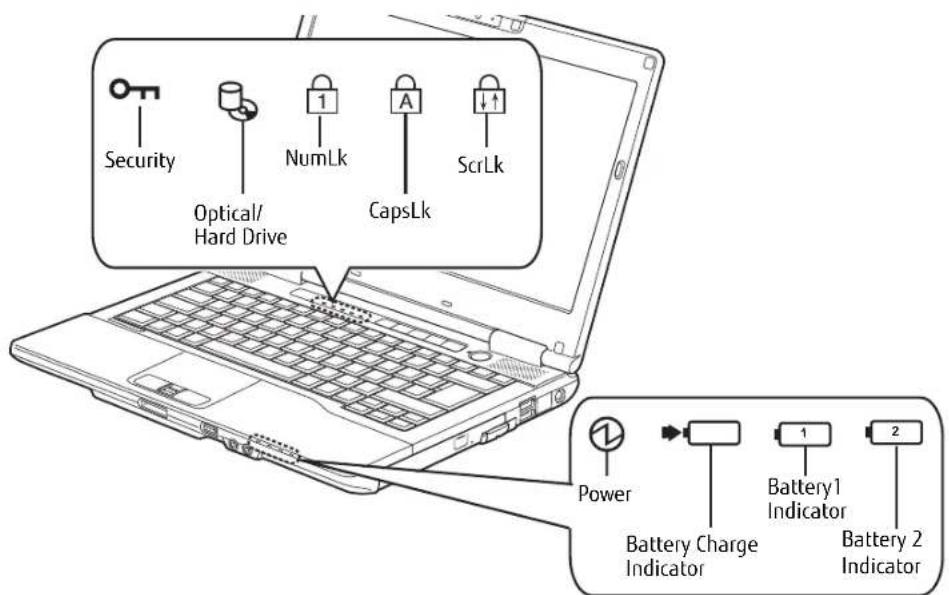
Figure 7. Status Indicator Panel
Status Indicator Panel
The Status Indicator displays symbols that correspond with a specific component of your notebook. These symbols tell you how each of those components are operating.

Security Indicator
The Security Indicator flashes (if a password was set) when the system resumes from Off or Sleep modes. You must enter the password that was set in the Security Panel before your system will resume operation.

Hard Drive/Optical Drive Access Indicator
The Hard Drive/Optical Drive Access indicator glows green when your internal hard drive is being accessed. Note that flickering is normal.

NumLk Indicator
The NumLk indicator shows that the integral keyboard is set in ten-key numeric keypad mode.

CapsLock Indicator
The CapsLock indicator shows that your keyboard is set to type in all capital letters.

ScrLk Indicator
The ScrLk indicator shows that your scroll lock is active.

Power Indicator
The Power indicator symbol states whether your system is operational. It has several different states, each of which tells you the mode your notebook is in.
- Steady On: This means that there is power to your notebook and that it is ready for use.
- Flashing: This means that your notebook is in sleep mode.
- Steady Off: This means that your notebook is either in Hibernate mode, or it has been turned off.

Battery Charge Indicator
The battery charge indicator shows the charging status of the battery(ies).
- Orange, solid: System battery is charging.
- Green, solid: System battery is fully charged.
- Orange, blinking: System is waiting to charge battery (battery is out of thermal range).
- Off: AC adapter is not plugged in.


Battery Level Indicators
Note that there are indicators for the primary battery (Battery 1) and an optional second battery (Battery 2.)
The Battery Level indicators display the charge level of the indicated battery pack, as follows:
Green, solid: Battery is between 50% and 100% charged.
- Orange, solid: Battery is between 13% and 49% charged.
Red, solid: Battery is 12% or less charged.
- Orange, blinking: Blinks during battery status measurement (4 seconds after battery is installed).
- Red, blinking: There is a problem with the battery.
- Off: There is no battery installed.

- If the battery pack is installed while the power is turned off, the battery level indicator will display the charge level for five seconds after it blinks orange.
If the AC adapter is not connected or the battery pack is not fully charged when the computer is switched to standby mode, the indicator will blink. The LED blinks at the rate of one second on/six seconds off.

- Batteries subjected to shock, vibration or extreme temperatures can be permanently damaged.
- A shorted battery is damaged and must be replaced.
Keyboard
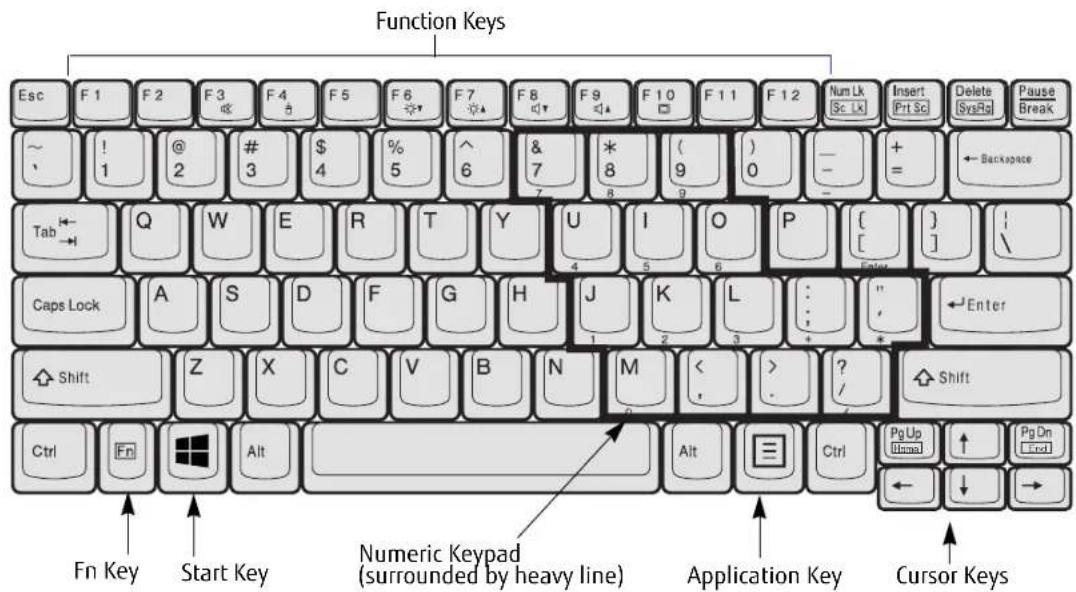
Figure 8. Keyboard
Using the Keyboard
Your Fujitsu LIFEBOOK notebook has an integral 84-key keyboard. The keys perform all the standard functions of a 101-key keyboard, including the Windows keys and other special function keys. This section describes the following keys.
- Numeric keypad: Your notebook allows certain keys to serve dual purposes, both as standard characters and as numeric and mathematical keys. The ability to toggle between the standard character and numerical keys is controlled through the [NumLk] key.
-
Cursor keys: Your keyboard contains four arrow keys for moving the cursor or insertion point to the right, left, up, or down within windows, applications and documents.
-
Function keys: The keys labeled [F1] through [F12], are used in conjunction with the [Fn] key to produce special actions that vary depending on what program is running.
- Windows keys: These keys work with your Windows operating system. These keys switch between desktop and Modern Start screen modes and open the Application bar on the bottom of the screen.
Numeric Keypad
Certain keys on the keyboard perform dual functions as both standard character keys and numeric keypad keys. NumLk can be activated by pressing the [NumLk] keys. Turning off the NumLk feature is done the same way. Once this feature is activated you can enter numerals 0 through 9, perform addition (+) , subtraction (-) , multiplication () , or division (/) , and enter decimal points (.) using the keys designated as ten-key function keys. The keys in the numeric keypad are marked on the front edge of the key to indicate their secondary functions.
Windows Keys
Your LIFEBOOK notebook has two Windows keys, consisting of a Windows key and an Application key. The Windows key switches between the Modern Start screen and the desktop. The Application key opens the Application bar located at the bottom of the screen. (Please refer to your Windows documentation for additional information regarding the Windows keys.)
Cursor Keys
The cursor keys are the four arrow keys on the keyboard which allow you to move the cursor up, down, left and right in applications. In programs such as Windows File/Explorer, it moves the "focus" (selects the next item up, down, left, or right).
Function Keys
Your notebook has 12 function keys, F1 through F12. The functions assigned to these keys differ for each application. You should refer to your software documentation to find out how these keys are used.
The [Fn] key provides extended functions for the notebook and is always used in conjunction with another key.
- [Fn+F3]: Pressing [F3] while holding [Fn] will toggle the Audio Mute on and off.
- [Fn+F4]: Pressing [F4] while holding [Fn] will toggle the Touchpad on and off. Note that the [Fn+F4] combination only works if Manual Setting is selected in the BIOS. (See "BIOS Setup Utility" on page 49)
- [Fn+F6]: Pressing [F6] repeatedly while holding [Fn] will lower the brightness of your display.
- [Fn+F7]: Pressing [F7] repeatedly while holding [Fn] will increase the brightness of the display.
- [Fn+F8]: Pressing [F8] repeatedly while holding [Fn] will decrease the volume of your LIFEBOOK notebook.
- [Fn+F9]: Pressing [F9] repeatedly while holding [Fn] will increase the volume of your LIFEBOOK notebook.
-
[Fn+F10]: Pressing [F10] while holding [Fn] allows you to change your selection of where to send your display video. Each time you press the combination of keys you will step to the next choice. The choices follow in order. (NOTE: The sequence assumes you have a DVI device connected via the optional port replicator)
-
Internal display ->
- External CRT ->
- Simultaneous internal and external CRT ->
- DVI Display ->
- Simultaneous internal display and DVI Display ->
- DisplayPort display ->
- Simultaneous internal display and DisplayPort display ->
- Internal display
Touchpad Pointing Device
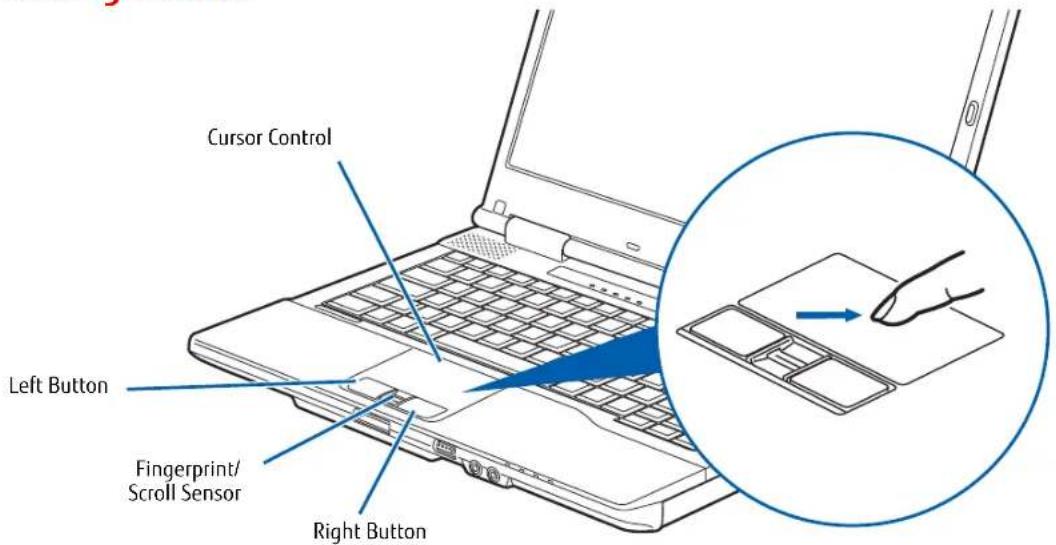
Figure 9. Touchpad pointing device
The Touchpad pointing device built into your Fujitsu LIFEBOOK is used to control the movement of the pointer to select items on your display panel. The Touchpad is composed of a cursor control, left and right buttons, and a fingerprint/scroll sensor.
The cursor control works the same as a mouse, and moves the cursor around the display. It only requires light pressure with the tip of your finger. The left and right buttons function the same as mouse buttons.
The fingerprint/scroll sensor can be used either for fingerprint security or for scrolling through pages, without having to use the scroll bars.

- TO READ ABOUT USING THE FINGERPRINT SENSOR, SEE "INTRODUCING THE FINGERPRINT SENSOR DEVICE" ON PAGE 162.
- AN EXTERNAL MOUSE CAN BE CONNECTED TO USB PORTS ON YOUR LIFEBOOK OR THE OPTIONAL PORT REPLICATOR, AND USED SIMULTANEOUSLY WITH THE TOUCHPAD. NOTE: IF YOU BOOT THE SYSTEM WITH AN EXTERNAL MOUSE CONNECTED THE TOUCHPAD WILL BE DISABLED OR ENABLED DEPENDING ON YOUR BIOS SETTINGS. See "Entering the BIOS Setup Utility" on page 50.
Clicking
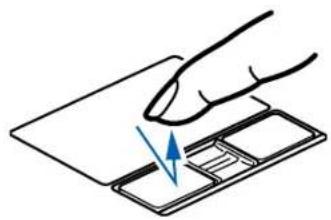
Clicking means pushing and releasing a button. To left-click, move the cursor to the item you wish to select, press the left button once, and then immediately release it. To right-click, move the mouse cursor to the item you wish to select, press the right button once, and then immediately release it. You also have the option to perform the clicking operation by tapping lightly on the Touchpad once.
Double-Clicking
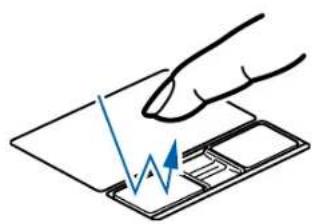
Double-clicking means pushing and releasing the left button twice in rapid succession. This procedure does not function with the right button. To double-click, move the cursor to the item you wish to select, press the left button twice, and immediately release it. You can also perform the double-click operation by tapping lightly on the Touchpad twice.
Dragging
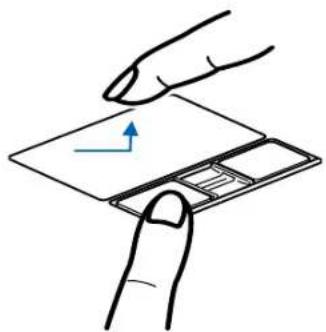
Dragging means pressing and holding the left button, while moving the cursor. To drag, move the cursor to the item you wish to move. Press and hold the left button while moving the item to its new location and then release it. Dragging can also be done using the Touchpad. First, tap the Touchpad twice over the item you wish to move making sure to leave your finger on the pad after the final tap. Next, move the object to its new location by moving your finger across the Touchpad, and then release your finger.
Touchpad Control Adjustment
The Windows Control Panel allows you to customize your Touchpad with selections made from within the Mouse Properties dialog box.
Scrolling
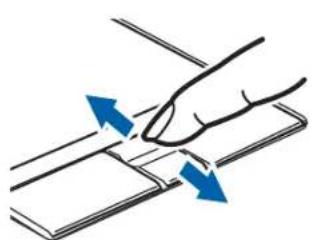
Using the fingerprint/scroll sensor allows you to navigate through a document quickly without using the window's scroll bars. This is particularly useful when you are navigating through on-line pages. To use the scroll sensor, slide your finger up or down on the sensor to scroll up or down a page. When you have reached the desired section of the page, release the sensor.
The sensor can also be used as a fingerprint recognition device. See "Introducing the Fingerprint Sensor Device" on page 162.
Volume Control
Your Fujitsu LIFEBOOK notebook has multiple volume controls which interact with each other.

ANY SOFTWARE THAT CONTAINS AUDIO FILES WILL ALSO CONTAIN A VOLUME CONTROL OF ITS OWN. IF YOU INSTALL AN EXTERNAI AUDIO DEVICE THAT HAS AN INDEPENDENT VOLUME CONTROL, THE HARDWARE VOLUME CONTROL AND THE SOFTWARE VOLUME CONTROL WILL INTERACT WITH EACH OTHER. IT SHOULD BE NOTED THAT IF YOU SET YOUR SOFTWARE VOLUME TO OFF, YOU WILL OVERRIDE THE EXTERNAI VOLUME CONTROL SETTING.
Controlling the Volume
The volume can be controlled in several different ways:
- Volume can be changed or muted from within the Volume Control in the system tray.
- Volume can be controlled with the [F8] and [F9] functions keys. Pressing [F8] repeatedly while holding [Fn] will decrease the volume of your notebook. Pressing [F9] repeatedly while holding [Fn] will increase the volume of your notebook.
- Volume can be muted by pressing the [F3] key while holding down the [Fn] key. To restore audio, repeat the [Fn+F3] procedure.
- Volume can be controlled by many volume controls that are set within individual applications.
Certain external audio devices you might connect to your system may have hardware volume controls.
Each source discussed above puts an upper limit on the volume level that must then be followed by the other sources.
We recommend that you experiment with the various volume controls to discover the optimal sound level.
Figure 10. Flexible Bay

Flexible Bay Flexible Bay Release Latch
Flexible Bay Devices
Your notebook has a Flexible Bay that can house one of several devices. Your Flexible Bay will have one of the following devices installed.
- Modular Dual-Layer Multi-Format DVD Writer: This allows you to access movies, software, and audio DVD/CDs and record to DVD, CD, and DVD-RAM discs.
- Modular Blu-ray® RW drive: This allows you to access movies, software, and audio DVD/CDs and Blu-ray discs as well as to write to Blu-ray discs.
- Modular Lithium ion battery: This is a rechargeable battery that can be used to power your LIFEBOOK notebook when an adapter is not connected.
- Weight Saver: This is used to fill the bay when no device is needed.
Removing and Installing Modular Devices
There are two ways to remove and install modular devices in the Flexible Bay:
Cold-swapping: swapping devices while your LIFEBOOK notebook is powered off.
- Hot-swapping: swapping devices while your system is active using the Safely Remove Hardware icon from your system tray.

- YOU SHOULD NEVER LEAVE YOUR FLEXIBLE BAY EMPTY WHEN THE NOTEBOOK IS IN OPERATION. IF LEFT EMPTY, DUST OR FOREIGN MATTER MAY ACCUMULATE INSIDE THE NOTEBOOK.
BE CAREFUL WHEN SEATING DEVICES IN THE BAY. IF THE FIT IS INCORRECT, YOU MAY DAMAGE THE BAY OR THE DEVICE. IF THE DEVICE DOES NOT MOVE EASILY IN THE BAY, REMOVE IT, AND CHECK FOR DIRT OR FOREIGN OBJECTS. IT WILL REQUIRE A FIRM PUSH TO LATCH THE DEVICE IN PLACE.
Cold-swapping
To cold-swap modular devices in your Flexible Bay follow these easy steps:
1 Close any open files.
2 Shut down your LIFEBOOK notebook.
3 Pull out the Flexible Bay release latch. This will push your device out slightly, allowing you to remove it.
4 Slide your device out until it is clear of the bay. This will require light force.
5 Slide the device you are installing into your notebook until it clicks into place.
6 It is now safe to turn your notebook back on.
7 You can now access and use the device.
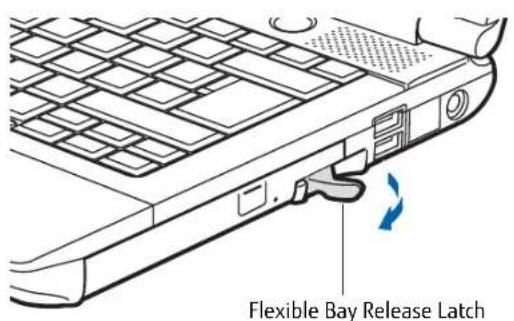
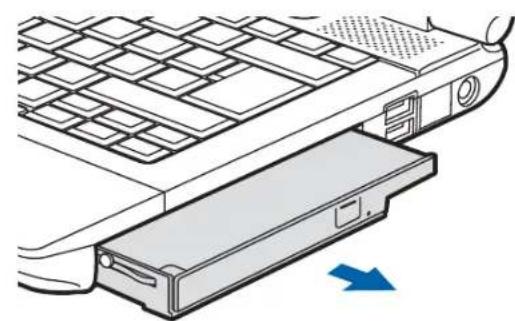
Figure 11. Removing a Device from the Flexible Bay
Your LIFEBOOK notebook will automatically detect the new device and activate it within your system. The drive letters associated with the device will be created and listed under My Computer and Windows File/Explorer.
Hot-swapping
Hot-swapping is provided through the Safely Remove Hardware utility. The icon for the utility appears in the system tray. Click on the icon and follow the on-screen instructions.

Figure 12. LIFEBOOK Security/Application Panel
LIFEBOOK Security/Application Panel
A unique feature of your LIFEBOOK notebook is the Security/Application Panel that allows you to secure your notebook from unauthorized use. The Security/Application Panel also allows you to launch applications with the touch of a button when your system is on.
If the security system is activated, upon starting your notebook or resuming from suspend mode the security system requires you to enter a password code using the buttons on the Security/Application Panel. After entering a correct password, your notebook resumes system operation.
Setting up Your LIFEBOOK Security Panel
When you receive your LIFEBOOK notebook, the security panel application is pre-installed without any passwords. The following sections provide detailed information on your security panel, and how to set, change or remove passwords.
Numbered Buttons
Use these buttons to enter your password.
Enter Button
After entering the button strokes, push this button to enter the password into the LIFEBOOK notebook.
Passwords
User and supervisor passwords may be set on this notebook. A supervisor password is typically the same for all notebooks in a working group, office, or company to allow for system management. Individual notebooks in a group environment should not use a common password. A password consists of one to five button strokes plus the [Enter] button. A valid stroke consists of pushing one or up to four buttons simultaneously. The following are valid strokes:
- Pushing [4] by itself
- Pushing [2] and [3] at the same time
- Pushing [1], [2], and [4] at the same time
- Pushing [1], [2], [3], and [4] at the same time
The following are valid passwords. The numbers within braces are button strokes using more than one button.
[2] + [3] ,[1],[enter]
[4], [enter]
·{[1]+[3]},{[2]+[3]+[4]},[1],[4],[2],[enter]
Setting Passwords
When shipped from the factory, no passwords are set. You have a choice of having no password or setting supervisor and user passwords. You must set the supervisor password before the user password.

THE PURPOSE OF SUPERVISOR PASSWORD IS TO BE ABLE TO BYPASS THE USER PASSWORD IN CASE THE USER PASSWORD IS FORGOTTEN. THE SUPERVISOR PASSWORD ALONE WILL NOT LOCK THE SYSTEM. YOU MUST SET BOTH THE SUPERVISOR AND USER PASSWORDS FOR THE SECURITY PANEL TO WORK.
Setting Supervisor Password
You must have set a supervisor password before setting any user passwords. The supervisor password can bypass the user password. Depending upon your operating system, use the appropriate procedure below.
Windows 7:
1 Go to the Start menu.
2 Select All Programs.
3 Select Accessories, then select Run.
4 Type in: C:\Program Files\Fujitsu\Security Panel Application\Supervisor\FJSECS.EXE, then press [Enter]
5 Follow the on-screen instructions to set the Supervisor password.
Windows 8:
1 Go to start screen
2 Right click on start screen
3 Click "All Apps", then select "Run" from the list
4 Type in: C:\Program Files\Fujitsu\Security Panel Application\Supervisor\FJSECS.EXE, then press [Enter]
5 Follow the on-screen instructions to set the Supervisor password.
Setting User Password
Windows 7:
1 Go to the Start menu and select All Programs.
2 Select Security Panel Application and Set User Password.
3 Follow instructions to set the user password.
Windows 8:
1 Go to start screen
2 Right click on start screen
3 Click "All Apps", then select "Security Panel Application".

YOU MAY CHANGE OR REMOVE THE SUPERVISOR OR USER PASSWORD BY REPEATING THE STEPS DEFINED ABOVE.
Operating Your LIFEBOOK Security/Application Panel
The security lock feature is in effect both when the system resumes from Off or Hibernation state. You will need to enter the user password right after pressing the Suspend/Resume button. Your system will not begin the boot sequence until you enter your supervisor/user password.
From Off State
1 Turn on your system.
2 When the Security Indicator flashes, enter the password and press [Enter] button. For example, if the password is 22222, press button number [2] five times and press [Enter] button. The notebook will boot to normal operation.
From Highbate State
1 Press your Power/Suspend/Resume button.
2 When the Security Indicator flashes, enter the password and press [Enter] button. The notebook should resume normal operation.
Incorrect Password Entry
If an invalid supervisor or user password is entered three times in succession, the system will "beep" for about one minute. If a valid password is entered within a minute (while system beeps), the beeping will stop and the notebook will resume normal operation. If no password (or an invalid one) is entered while the system beeps, the system will return to its previous locked state (suspend or off) and the Security Indicator will go off. To reactivate the notebook after a password failure, you must press the Power/Suspend/Resume button, then enter a correct password.

REMEMBER THE USER PASSWORD YOU SPECIFIED ON THE SECURITY PANEL APPLICATION. IF YOU FORGET THE PASSWORD YOU WILL NOT BE ABLE TO USE YOUR COMPUTER. THE SUPERVISOR PASSWORD CAN OVERRIDE THE USER PASSWORD.
Precautions
Opening and Closing the Cover
Closing the cover automatically places the notebook into suspend mode. Opening the cover does not automatically place the notebook into normal operation. Instead, you must enter the proper security password after pushing the Power/Suspend/Resume button. This setting can be changed in the Power Options Control Panel.
Low Battery Operations
If your notebook has low battery, pushing the Power/Suspend/Resume button only turns on the Security Indicator. Your notebook does not unlock, the Security Indicator turns off after one minute. To resume normal operation, first attach a power supply to the notebook. Then you may unlock the notebook.
Uninstalling the Security Panel Application
You have two options when uninstalling the security panel application:
- Uninstall the security panel application software. This will disable all security features.
- Uninstall security panel application with password still active. This won't allow any password changes.
Uninstalling the Security Panel Software
Remove passwords when the User wants no password protection whatsoever and doesn't want to give anybody the utility to set a password on their computer. In this case, if passwords (supervisor, user, or both) are set, the passwords must first be cleared BEFORE removing the application. To clear passwords, follow same procedure in "Setting Passwords" except this time, select [Remove], enter current password then click [Next]. When asked to confirm, select [Yes].
Removing Security Panel Application with Passwords Still Active
Using this feature will not allow any changes to the password.

REMOVING THE APPLICATIONS DOES NOT REMOVE THE PASSWORD. IT SIMPLY REMOVS THE UTILITY TO CHANGE/ADD/REMOVE PASSWORDS. TO CHANGE A PASSWORD YOU MUST REINSTALL THE APPLICATION.
User:
1 (Windows 8): Go to start screen. Type Control Panel, then click on Control Panel from the search results.
2 (Windows 7) Go to Start Menu, Click on Control Panel.
3 Open Programs and Features in the Control Panel.
4 Select the Security Panel in the list, and click Uninstall/Change.
5 When the Confirm File Deletion box appears, click Yes.
Supervisor:
1 (Windows 8): Go to start screen. Type Control Panel, then click on Control Panel from the search results.
2 (Windows 7) Go to Start Menu, Click on Control Panel.
3 Go to Start Menu, Click on Control Panel.
4 Open Programs and Features in the Control Panel.
5 Select the Security Panel for Supervisor in the list, and click Uninstall/Change.
6 When the Confirm File Deletion box appears, click Yes.
Reinstalling the Security/Application Panel
To reinstall supervisor or user security applications, you will need to download them from the Fujitsu Support site (See "Maintaining Latest Configuration" on page 10.) The Security Panel Application for Supervisor and Security Panel application for User from support website need to be downloaded separately. The setup files for supervisor and user security applications are contained in those folders.
1 Go to the downloaded Security Application Panel for Supervisor folder and double-click the setupS.exe file. The Installing Security Panel Application window will appear. Follow the instructions on the screen.
2 Go to the downloaded Security Application Panel for User folder and double-click the setup.exe file. The Installing Security Panel Application window will appear. Follow the instructions on the screen.
Supervisor and user passwords can be set via Windows software using the FJSECS.exe and FJSECU.exe files, respectively. FJSECU.exe for the user password cannot run without first setting a supervisor password. You need to run FJSECS.exe first to set the supervisor password. Follow instructions under Setting Passwords on page 36.
If you forget both passwords, contact Fujitsu America Service and Support at 1-800-8FUJITSU (1-800-838-5487).
Fujitsu America charges a service fee for unlocking a password-restricted LIFEBOOK. When calling, please have a valid credit card and provide proof of ownership. You will then be given instructions on where to ship your notebook.
Launching Applications with the Security/Application Panel
The security panel also enables you to launch applications with the touch of a button when your system is on. Pressing any of the buttons will launch a pre-defined or user-defined application. Your notebook is pre-installed with software utilities that let you operate and configure your LIFEBOOK Security/Application Panel. To find these utilities go to the Start screen and right-click. Click on "All Apps" -> Control Panel -> Button. The utilities include Support, ECO,
Presentation, and Lock this computer.
Configuring your LIFEBOOK Application Panel
When you start Windows, the LIFEBOOK Application Panel is automatically activated. As an application launcher, the Application Panel is very flexible, giving you a variety of options. To set up the Panel to best suit your needs, we have provided the Application Panel Setup utility that quickly and easily helps you make the most of this valuable feature.
To configure your LIFEBOOK Application Panel with Application Panel Setup:
1 Go to Start screen. Right-click, then click on "All Apps". Select Control Panel.
2 The Button Setting utility will appear. There are tabs that correspond to the application buttons on the Application Panel. When you receive your notebook, these buttons are pre-configured to launch specific programs, as follows:
| Button Label Button Name Default Action | ||
| 1·5 | Button 1 / Support | When pressed, this button opens the Fujitsu Support Center. |
| 2·0 | Button 2 / ECO When pressed, this button allows you to enter the power saving utility. | |
| 3·0 | Button 3 / Presentation | When pressed, this button opens the Fujitsu Display Manager, which lets you switch screen display settings. |
| 4·0 | Button 4 / Lock this computer | When pressed, this button automatically locks your computer. |
To change an application associated with the Application buttons, click on the tab for the button you would like to reconfigure - for example, Support. Click on [Application registration...] from Start Menu, scroll down the list of applications, click on the application you wish to launch with the Support button, and then click [Next]. In the next screen, select whether you want a sound to play when the selected program starts up. Click [Next], then click [Finish]. The button will now launch the new application.
When you have finished with Application Panel Setup click OK, and the new settings will take effect. You can reconfigure your LIFEBOOK Application Panel as often as you like.
Deactivating and Activating the LIFEBOOK Application Panel
To deactivate the LIFEBOOK Application Panel, follow these easy steps.
1 Right click on the start screen and click "All Apps"
2 Click on LIFEBOOK Application Panel.
3 Click on Stop Application Panel.
To reactivate, follow the same procedure, except for step 4. Click on Restart Application Panel instead.

EVERY TIME YOU START WINDOWS THE LIFEBOOK APPLICATION PANEL IS ACTIVATED, EVEN IF YOU DEACTIVATED IT BEFORE YOU SHUT DOWN.
Chapter 2
Getting Started with Your LIFEBOOK
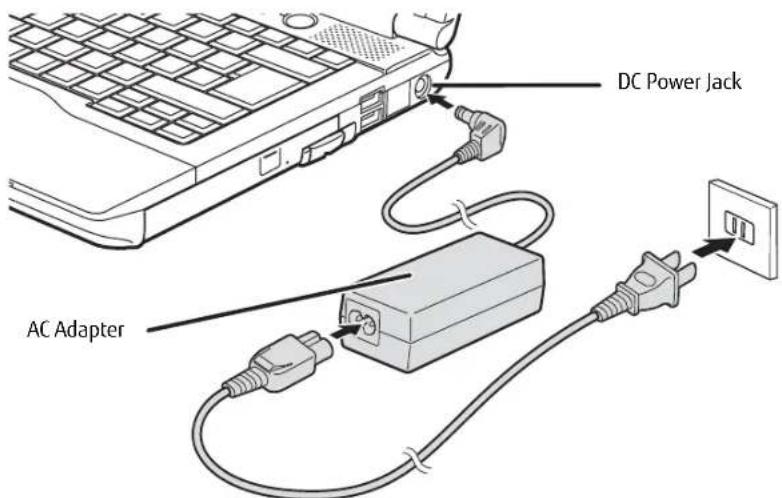
Figure 13. Connecting the AC Adapter
Power Sources
Your LIFEBOOK notebook has three possible power sources: a primary Lithium ion battery, an AC adapter or an optional Auto/Airline adapter.
Connecting the Power Adapters
The AC adapter or optional Auto/Airline adapter provides power for operating your notebook and charging the batteries.
Connecting the AC Adapter
1 Plug the DC output cable into the DC power jack of your LIFEBOOK notebook.
2 Plug the AC adapter into an AC electrical outlet.
Connecting the Optional Auto/Airline Adapter
1 Plug the DC output cable into the DC power jack on your notebook.
2 Plug the Auto/Airline adapter into the cigarette lighter of an automobile with the ignition key in the On or Access OR
3 Plug the Auto/Airline adapter into the DC power jack on an airplane seat.
Switching from AC Adapter Power or the Auto/Airline Adapter to Battery Power
1 Be sure that you have at least one charged battery installed.
2 Remove the AC adapter or the Auto/Airline adapter.

THE LITHIUM ION BATTERY IS NOT CHARGED UPON PURCHASE. INITIALLY, YOU WILL NEED TO CONNECT EITHER THE AC ADAPTER OR THE AUTO/AIRLINE ADAPTER TO USE YOUR NOTEBOOK WHILE THE BATTERY CHARGES.
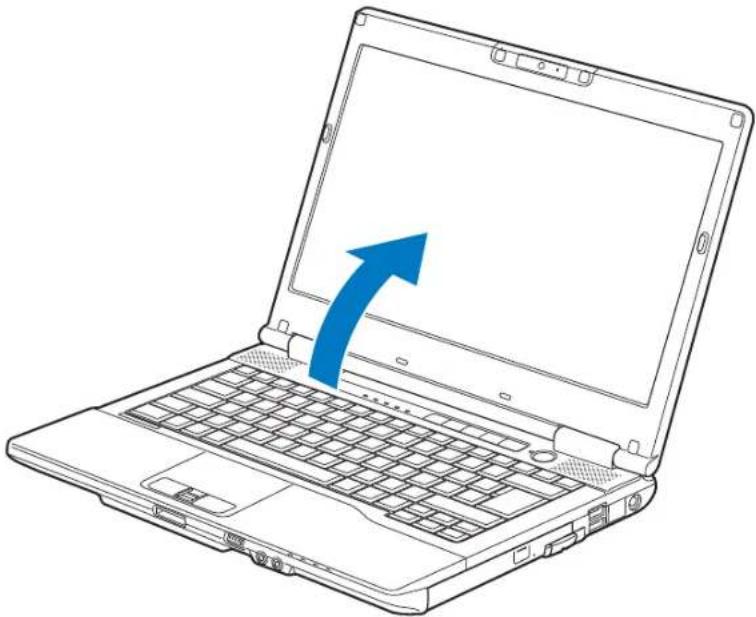
Figure 14. Opening the Display Panel
Display Panel
Your Fujitsu LIFEBOOK notebook contains a display panel that is backlit for easier viewing in bright environments and maintains top resolution through the use of active-matrix technology.
Opening the Display Panel
Lift the display backwards, being careful not to touch the screen, until it is at a comfortable viewing angle.
Adjusting Display Panel Brightness
Once you have turned on your LIFEBOOK notebook, you may want to adjust the brightness level of the screen to a more comfortable viewing level. There are three ways to adjust the brightness, by using the keyboard, the Power Options, or the Windows Mobility Center.
Using the Keyboard
Adjusting the brightness using the keyboard changes the setting only temporarily.
- [Fn+F6]: Pressing repeatedly will lower the brightness of your display.
- [Fn+F7]: Pressing repeatedly will increase the brightness of the display.
Using the Power Options
To change the brightness using the Power Options utility, open the Control Panel and select one of the icon views in the View by: window. Click on the Power Options icon. Drag the brightness bar at the bottom of the screen to the desired level. Note that the settings you make via this utility become permanent until you decide to change them again.
Using the Windows Mobility Center
In the Control Panel, double-click the Windows Mobility Center icon. Drag the Display Brightness bar to the desired level.

- WHEN USING AC POWER YOUR BRIGHTNESS SETTING IS SET TO ITS HIGHEST LEVEL BY DEFAULT. WHEN USING BATTERY POWER YOUR BRIGHTNESS SETTING IS SET TO APPROXIMATELY MID-LEVEL BY DEFAULT.
- THE HIGHER THE BRIGHTNESS LEVEL, THE MORE POWER THE NOTEBOOK WILL CONSUME AND THE FASTER YOUR BATTERIES WILL DISCHARGE. FOR MAXIMUM BATTERY LIFE, MAKE SURE THAT THE BRIGHTNESS IS SET AS LOW AS POSSIBLE.
Closing the Display Panel
To close the display, hold the edge of the display panel and pull it forward until it is flush with the body of your LIFEBOOK notebook.
Using Multiple Displays Simultaneously
With your system, it is possible to use three different displays at the same time. Depending upon your system and optional port replicator configurations, all port types represented in the chart below may not be available. The port types supported by the three-display feature include:
- DisplayPort (on the system)
- DisplayPort (on the port replicator)
VGA port (on the port replicator) - DVI port (on the port replicator)
The available 3-display combinations for this system are shown the chart below:
| System Display/Ports Port Replicator Ports | ||||||
| System LCD | DisplayPort | VGA | DisplayPort | DVI | VGA | |
| 1 | XXXX | |||||
| 2 | XXXX | |||||
| 3 | X | X | X | |||
Once you have connected two external displays to your system/port replicator, the Active Display menu will appear in Graphics property from which you can select three displays.
Starting Your LIFEBOOK Notebook
Power On
Power/Suspend/Resume Button
The Power and Suspend/Resume button is used to power on your LIFEBOOK notebook, to resume from Sleep or Save-to-Disk mode or to place your notebook in Sleep or Save-to-Disk mode. (You can also use the button to power down the system by holding it down for approximately five seconds. This can be useful if the system is "hung up". This shouldn't be used as the normal means of shutdown, however.) You can also turn off your notebook by using the following method: from Modern Start screen, open Charms ([Windows] + C or mouse over [-] in the bottom right corner of the screen), then click [Settings] -> [Power] Select Shutdown from the list.

WHEN YOU TURN ON YOUR LIFEBOOK NOTEBOOK, BE SURE YOU HAVE A POWER SOURCE. THIS MEANS THAT A BATTERY IS INSTALLED AND CHARGED, OR THAT THE AC OR AUTO/AIRLINE ADAPTER IS CONNECTED AND HAS POWER.
To turn on your LIFEBOOK notebook from its off state, press the Power/Suspend/Resume button, located above the keyboard to the right. When you are done working you can either leave your notebook in Suspend mode (see "Sleep Mode" on page 52), or you can turn it off (see "Powering Off" on page 54).

DO NOT CARRY YOUR LIFEBOOK NOTEBOOK AROUND WITH THE POWER ON OR SUBJECT IT TO SHOCKS OR VIBRATION, AS YOU RISK DAMAGING YOUR NOTEBOOK.
When you power on your LIFEBOOK, it will perform a Power On Self Test (POST) to check the internal parts and configuration for correct functionality. If a fault is found, your LIFEBOOK notebook will emit an audio warning and/or an error message will be displayed. See "Power On Self Test Messages" on page 94. Depending on the nature of the problem, you may be able to continue by starting the operating system or by entering the BIOS setup utility and revising the settings. After satisfactory completion of the POST, your notebook will load your operating system.

NEVER TURN OFF YOUR LIFEBOOK NOTEBOOK DURING THE POWER ON SELF TEST (POST) OR IT WILL CAUSE AN ERRORMESSAGE TO BE DISPLAYED WHEN YOU TURN YOUR LIFEBOOK NOTEBOOK ON THE NEXT TIME. See "Power On Self Test Messages" on page 94.
Boot Sequence
The procedure for starting-up your notebook is termed the Bootup sequence and involves your notebook's BIOS. When your notebook is first turned on, the main system memory is empty, and it needs to find instructions to start up your notebook. This information is in the BIOS program. When you power up or restart your notebook, it goes through a boot sequence which displays a Fujitsu logo until your operating system is found. During booting, your notebook perform a standard boot sequence including a Power On Self Test (POST). When the boot sequence completes without a failure and without a request for the BIOS Setup Utility, the system displays the operating system's opening screen.
The boot sequence is executed when:
- You turn on the power to your LIFEBOOK notebook.
- You restart your LIFEBOOK notebook from [Settings] -> [Power] menu.
- The software initiates a system restart. Example: When you install a new application.
Hard Disk Drive Passwords
To provide additional security for your data, you can assign passwords to your hard disk drive(s). This feature is managed in the system BIOS Setup Utility. See BIOS Setup Utility below for information about accessing the utility.

REMEMBER YOUR PASSWORDS. IF YOU SET AND FORGET YOUR USER AND MASTER HARD DISK PASSWORDS, FUJITSU AMERICA WILL NOT BE ABLE TO RESET IT. YOU MAY LOSE DATA AND HAVE TO REPLACE YOUR SYSTEM BOARD OR HARD DISK DRIVE.
BIOS Setup Utility
The BIOS Setup Utility sets up the operating environment for your notebook. Your BIOS is set at the factory for normal operating conditions, therefore there is no need to set or change the BIOS' environment to operate your notebook.
The BIOS Setup Utility also allows you to configure such features as the System Data Security feature parameters, such as passwords.
Entering the BIOS Setup Utility
To enter the BIOS Setup Utility do the following:
1 Turn on or restart your LIFEBOOK notebook.
2 To enter the BIOS Setup Utility, press the [F2] key once the Fujitsu logo appears on the screen. This will open the main menu of the BIOS Setup Utility with the current settings displayed.
Press the right or left arrow keys key to scroll through the other setup menus to review or alter the current settings.
BIOS Guide
A guide to your notebook's BIOS is available online at our service and support Website at: http://solutions.us.fujitsu.com/www/content/support/contact/index.php. Once there, select User's Guides under Online Support. Select your Product, Series, and Model, then click [Go].
Booting the System
We strongly recommend that you not attach any external devices and do not put a DVD/CD in your drive until you have gone through the initial power on sequence.
When you turn on your notebook for the first time, it will display a Fujitsu logo on the screen. If you do nothing the system will load the operating system, and then the Windows Welcome will begin.
Starting Windows the First Time
After you boot up the system the first time and follow the instructions on the screen, you will eventually come to the Welcome window. After sign-in, it takes less than a minute for the computer to boot to Windows; during that time the progress bar and interactive messages are displayed on the screen.
During the course of the first start up, you will need to read and accept the End User License Agreements (EULAs) for Microsoft and Fujitsu.

YOU CANNOT USE YOUR NOTEBOOK UNTIL YOU HAVE ACCEPTED THE LICENSE AGREEMENT. IF YOU STOP THE PROCESS YOUR NOTEBOOK WILL RETURN TO THE BEGINNING OF THE WINDOWS WELCOME PROCESS, EVEN IF YOU SHUT YOUR NOTEBOOK DOWN AND START IT UP AGAIN.
Several additional windows will appear, prompting you to enter a name and description for your computer, an Administrator password, and a domain name. Read the instructions on the screens carefully and fill in the information as directed.
Following first boot, you will arrive at the Modern start screen. Some useful shortcuts for your reference: Press the Windows + D keys to go to traditional Windows desktop or press Windows + M keys to load the traditional Windows desktop and minimize all applications.

Installing Bonus Apps
After you have started your system the first time, you will see a Bonus Apps icon on your desktop. Click on the icon to see which additional applications are available for you to install. You can also access Bonus Apps
by opening the Charms panel from the Modern Start screen and searching for "Fujitsu BonusApps". Applications that are already installed appear in grey; those that are available for installation appear in blue.
- Select the applications you wish to install by selecting the checkbox adjacent to your selection, or click [Select All] if you would like to install all available applications. Once you have made your selections, click [Install].
Note that in some cases (depending upon which application was selected for installation) after installation completes, the system will prompt you to reboot. There are also cases in which if multiple applications are selected to install but one of them needs a reboot, the system will reboot and continue installing the rest of the selected applications.
Registering your LIFEBOOK with Fujitsu
You can register your notebook by going to our website at: http://www.us.fujitsu.com/computers. You will need to be set up with an Internet Service Provider (ISP) to register online.
Power Management
Your notebook has many options and features for conserving battery power. Some of these features are automatic and need no user intervention; however, others depend on the parameters you set to best suit your operating conditions, such as those for the display brightness. Internal power management for your notebook may be controlled from settings made in your operating system, pre-bundled power management application, or from settings made in the BIOS setup utility.
Besides the options available for conserving battery power, there are also some things that you can do to prevent your battery from running down as quickly. For example, you can create an appropriate power saving profile, put your notebook into Sleep mode when it is not performing an operation, and you can limit the use of high power devices. As with all mobile, battery-powered computers, there is a trade-off between performance and power savings.
Power/Suspend/Resume Button
When your notebook is active, the Power/Suspend/Resume button can be used to manually put the notebook into Sleep mode. Push the Power/Suspend/Resume button when the notebook is active, but not actively accessing anything, and immediately release the button. You will hear two short beeps and the system will enter Sleep mode.
If your notebook is suspended, pushing the Power/Suspend/Resume button returns your notebook to active operation. You can tell whether the system is Suspended by looking at the Power indicator. If the indicator is visible and not flashing, your notebook is fully operational. If the indicator is visible and flashing, your notebook is in Sleep mode. If the indicator is not visible, the power is off or your notebook is in Hibernation mode. See "Hibernate Feature" on page 53.
Sleep Mode
Sleep mode saves your notebook's system memory contents during periods of inactivity by maintaining power to critical parts. This mode will turn off the CPU, the display, the hard drive, and all of the other internal components except those necessary to maintain system memory and allow for restarting.
Your LIFEBOOK notebook can be put in Sleep mode by:
- Pressing the Power/Suspend/Resume button when your system is turned on.
- Clicking the power icon on the lock menu.
-
Selecting Sleep from the [Settings]->[Power] menu.
-
Timing out from lack of activity.
- Allowing the battery to reach the Dead Battery Warning condition.
Your notebook's system memory typically stores the files on which you are working, open application information, and any other data required to support the operations in progress. When you resume operation from Sleep mode, your notebook will return to the point where it left off. You must use the Power and Suspend/Resume button to resume operation, and there must be an adequate power source available, or your notebook will not resume'.

IF RUNNING YOUR NOTEBOOK ON BATTERY POWER, BE AWARE THAT THE BATTERY CONTINUES TO DISCHARGE WHILE YOUR NOTEBOOK IS IN SLEEP MODE, THOUGH NOT AS FAST AS WHEN FULLY OPERATIONAL.
- DISABLING THE POWER/SUSPEND/RESUME BUTTON PREVENTS IT FROM BEING USED TO PUT THE NOTEBOOK INTO SLEEP OR HIBERNATION (SAVE-TO-DISK) MODE. THE BUTTON RESUME FUNCTION CANNOT BE DISABLED.
IF YOUR NOTEBOOK IS ACTIVELY ACCESSING INFORMATION WHEN YOU ENTER SLEEP OR HIBERNATION MODE, CHANGES TO OPEN FILES ARE NOT LOST. THE FILES ARE LEFT OPEN AND MEMORY IS KEPT ACTIVE DURING SLEEP MODE OR THE MEMORY IS TRANSFERRED TO THE INTERNAL HARD DRIVE DURING HIBERNATION MODE.
- THE MAIN ADVANTAGE OF USING HIBERNATION (SAVE-TO-DISK) IS THAT POWER IS NOT REQUIRED TO MAINTAIN YOUR DATA. THIS IS PARTICULARLY IMPORTANT IF YOU WILL BE LEAVING YOUR NOTEBOOK IN A SUSPENDED STATE FOR A PROLONGED PERIOD OF TIME. THE DRAWBACK OF USING HIBERNATION MODE IS THAT IT LENGTHENS THE POWER DOWN AND POWER UP SEQUENCES AND RESETS PERIPHERAL DEVICES.
Hibernate Feature
The Hibernation feature saves the contents of your notebook's system memory to the hard drive, then turns all power off. You can enable or disable this feature.
To enable or disable the Hibernation feature follow these steps:
1 From the Modern Start screen, press [Windows] + [X].Select Control Panel from the menu, then select Power Options.
2 Select "Choose what the power button does" or "Choose what closing the lid does", then make your selections (Do Nothing, Sleep, Hibernate, or Shut Down).
Windows Power Management
The Power Options icon located in the Windows Control Panel allows you to configure some of the power management settings. For example, you can use the Power Options to set the timeout values for turning off the display and hard disks whether you are running the notebook on battery power or one of the adapters.
Restarting the System
If your system is on and you need to restart it, be sure that you use the following procedure.
1 From the Modern Start screen, open Charms ([Windows] + C) or mouse over [-] in the bottom right corner of the screen), then click [Settings] -> [Power].
2 Select Restart from the list.

TURNING OFF YOUR LIFEBOOK NOTEBOOK WITHOUT EXITING WINDOWS OR TURNING ON YOUR NOTEBOOK WITHIN 10 SECONDS OF THE NOTEBOOK BEING SHUT OFF MAY CAUSE AN ERROR WHEN YOU START THE NEXT TIME.
Powering Off
Before turning off the power, check that the hard drive/optical drive access indicator is off. If you turn off the power while accessing a disk there is a risk of data loss. To ensure that your notebook shuts down without error, use the Windows shut down procedure.

BE SURE TO CLOSE ALL FILES, EXIT ALL APPLICATIONS, AND SHUT DOWN YOUR OPERATING SYSTEM PRIOR TO TURNING OFF THE POWER. IF FILES ARE OPEN WHEN YOU TURN THE POWER OFF, YOU WILL LOSE ANY CHANGES THAT HAVE NOT BEEN SAVED, AND MAY CAUSE DISK ERRORS.
Using the correct procedure to shut down from Windows allows your notebook to complete its operations and turn off power in the proper sequence to avoid errors. The proper sequence is:
From the Modern Start screen, open Charms ([Windows] + C) or mouse over [-] in the bottom right corner of the
screen), then click [Settings]->[Power]. Select Shut down from the list.
If you are going to store your notebook for a month or more see the Care and Maintenance Section.

- ALWAYS POWER OFF THE COMPUTER BEFORE TRANSPORTING AND/OR PACKAGING IT. AFTER SHUTTING DOWN THE SYSTEM, WAIT UNTIL THE STATUS LED PANEL INDICATES POWER OFF CONDITION (I.E., NO LIGHTS ARE ILLUMINATED).
- IT IS POSSIBLE THAT THE UNIT MAY NOT AUTOMATICALLY GO TO POWER OFF OR HIBERNATE MODE WHEN YOU CLOSE THE LID. THIS SITUATION MAY OCCUR DUE TO PRE-OS BOOT PASSWORD SECURITY SETTINGS OR SOME OTHER APPLICATION RUNNING ON THE COMPUTER.
- ATTEMPTING TO TRANSPORT THE COMPUTER WHILE POWER IS ON MAY DAMAGE THE NOTEBOOK DUE TO SHOCK OR OVERHEATING SINCE THE AIR VENTS MAY BE BLOCKED OR RESTRICTED.

ENERGY STAR® Compliance
Your Fujitsu system is an ENERGY STAR qualified mobile PC. By choosing a computer with the latest energy-saving technology, you're helping to preserve our environment for future generations.
ENERGY STAR is a joint program of the U.S. Environmental Protection Agency, U.S. Department of Energy, Natural Resources Canada, and other governments around the world helping us save money while
protecting the environment through energy efficient products and practices. With energy costs and global warming top-of-mind for consumers, Fujitsu is committed to offering solutions that help consumers conserve energy and improve the quality of our environment.
Sleep Mode:
You will notice that your computer is initially set so that the display turns off after 15 minutes of user inactivity, and the computer goes into Sleep mode after 20 minutes of user inactivity. When going into Sleep mode, the computer also reduces the speed of any active Ethernet network links. To "wake" the computer from Sleep mode, press the Suspend/Resume Button.
Energy saving benefits:
Fujitsu ENERGY STAR qualified mobile PCs use about half as much electricity as standard equipment - saving half in utility costs. But more than that, ENERGY STAR also makes a difference for the environment. Did you know that the average house can be responsible for twice the greenhouse gas emissions as the average car? That's because every time you flip on a light switch, run your dishwasher, or turn on your PC, you use energy, which means more greenhouse gas emissions from power plants. So the more energy we can save through energy efficiency, the more we help to reduce greenhouse gases and the risks of global warming.
To learn more about the important ENERGY STAR program, visit: www.energystar.gov.
To read about how Fujitsu is supporting Sustainable Management along with several other environmental activities, visit the Fujitsu Corporate Citizenship page at:
http://www.computers.us.fujitsu.com/www/content/aboutus/environmental/environment.php
Chapter 3
User-Installable Features
Lithium ion Battery
Your LIFEBOOK notebook has a Lithium ion battery that provides power for operating your notebook when no external power source is available. The battery is durable and long lasting, but should not be exposed to extreme temperatures, high voltages, chemicals or other hazards.
The Lithium ion battery operating time may become shorter if it is used under the following conditions:
- When used at temperatures that exceed a low of 5^ or a high of 35^ . Extreme temperatures not only reduce charging efficiency, but can also cause battery deterioration. The Charging icon on the Status Indicator panel will flash when you try to charge a battery that is outside its operating temperature range. See "Battery Charge Indicator" on page 24.
- When using a high current device such as a Multi-Format DVD Writer or the hard drive, using the AC adapter will conserve your battery life.

DO NOT LEAVE A FAULTY BATTERY IN YOUR NOTEBOOK. IT MAY DAMAGE YOUR AC ADAPTER, OPTIONAL AUTO/AIRLINE ADAPTER, ANOTHER BATTERY OR YOUR NOTEBOOK ITSELF. IT MAY ALSO PREVENT OPERATION OF YOUR NOTEBOOK BY DRAINING ALL AVAILABLE CURRENT INTO THE BAD BATTERY.

BATTERY LIFE WILL VARY BASED ON SCREEN BRIGHTNESS, APPLICATIONS USED, FEATURES, POWER MANAGEMENT SETTINGS, BATTERY CONDITION AND OTHER CUSTOMER PREFERENCES. OPTICAL OR HARD DRIVE USAGE MAY ALSO HAVE A SIGNIFICANT IMPACT ON BATTERY LIFE. THE BATTERY CHARGING CAPACITY IS REDUCED AS A BATTERY AGES. IF YOUR BATTERY IS RUNNING LOW QUICKLY, YOU SHOULD REPLACE IT WITH A NEW ONE.
- UNDER FEDERAL, STATE, OR LOCAL LAW IT MAY BE ILLEGAL TO DISPOSE OF BATTERIES BY PUTTING THEM IN THE TRASH. PLEASE TAKE CARE OF OUR ENVIRONMENT AND DISPOSE OF BATTERIES PROPERLY. REFER TO "RECYCLING YOUR BATTERY" ON PAGE 5 FOR INFORMATION ON PROPER DISPOSAL OF YOUR BATTERY.
Recharging the Batteries
If you want to know the condition of the primary Lithium ion battery, check the Battery Level indicator located on the Status Indicator panel. The indicator changes as the battery level changes. See "Battery Level Indicators" on page 24. The Lithium ion battery is recharged internally using the AC adapter or Auto/Airline adapter. To recharge the battery make sure the battery that needs to be charged is installed in your LIFEBOOK notebook and connect the AC or Auto/Airline adapter.

MAKE SURE THAT THE BATTERY CHARGING INDICATOR AND THE PERCENTAGE CHARGE IS SHOWN INSIDE THE BATTERY LEVEL ICON ON THE STATUS INDICATOR PANEL.
There is no memory effect on the Lithium ion battery, therefore you do not need to discharge the battery completely before recharging. The charge times will be significantly longer if your notebook is in use while the battery is charging. If you want to charge the battery more quickly, put your notebook into Sleep mode, or turn it off while the adapter is charging the battery. (See Power Management on page 52 for more information on Sleep mode and shutdown procedure)
Low Battery State
When the battery is running low, a low battery notification message will appear. If you do not respond to the message, the battery will continue to discharge until it is too low to operate. When this happens, your notebook will go into Sleep mode. There is no guarantee that your data will be saved once the notebook reaches this point.

- ONCE THE LOW BATTERY NOTIFICATIONMESSAGE APPEARS, YOU NEED TO SAVE ALL YOUR ACTIVE DATA AND PUT YOUR LIFEBOOK NOTEBOOK INTO SLEEP MODE UNTIL YOU CAN PROVIDE A NEW POWER SOURCE. YOU SHOULD PROVIDE A CHARGED BATTERY, AN AC POWER ADAPTER, OR AUTO/AIRLINE ADAPTER AS SOON AS POSSIBLE.
- WHEN YOU ARE IN SLEEP MODE THERE MUST ALWAYS BE AT LEAST ONE POWER SOURCE ACTIVE. IF YOU REMOVE ALL POWER SOURCES WHILE YOUR LIFEBOOK NOTEBOOK IS IN SLEEP MODE, ANY DATA THAT HAS NOT BEEN SAVED TO THE HARD DRIVE WILL BE LOST.
Dead Battery Suspend mode shows on the Status indicator just like the normal Sleep mode. Once your notebook goes into Dead Battery Suspend mode you will be unable to resume operation until you provide a source of power either from an adapter or a charged battery. Once you have provided power, you will need to press the Power/Suspend/Resume button to resume operation.
In the Dead Battery Suspend mode, your data can be maintained for some time, but if a power source is not provided promptly, the Power indicator will stop flashing and go out, meaning that you have lost the data that was not stored. Once you provide power, you can continue to use your notebook while an adapter is charging the battery.
Shorted Batteries
The Status Indicator panel uses a symbol inside the battery outline of the Battery Level indicator to display the operating level available in that battery. If this display shows a Shorted Battery, it means the battery is damaged and must be replaced so it does not damage other parts of your LIFEBOOK notebook.
Replacing the Battery
With the purchase of an additional battery, you can have a fully charged spare to swap with one that is not charged. There are two ways to swap batteries, cold-swapping and hot-swapping:
Cold-swapping Batteries
To cold-swap batteries in your battery bay, follow these easy steps:
1 Have a charged battery ready to install.
2 Shut down your notebook and disconnect the AC adapter.
3 With the system oriented as shown in Figure 15, push and hold the battery bay release lock away from the battery pack, and slide the battery release button to the right. This will unlock the battery. At the battery lift point, lift the battery out of the bay.
4 Insert a new battery into the bay. Push and hold the battery bay release lock away from the battery pack, and slide the battery release button to the left. This will lock the battery.
5 Plug in the AC adapter and turn the power on.
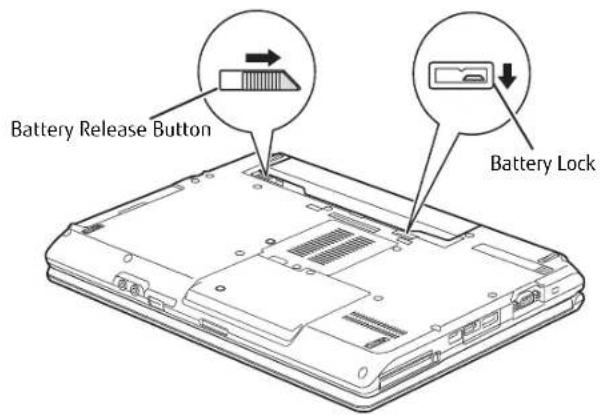
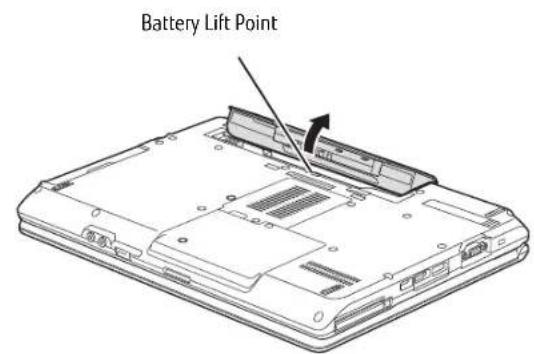
Figure 15. Removing a Battery
Hot-swapping Batteries
To hot-swap batteries in your battery bay, follow these easy steps:

BE SURE TO PLUG IN AN AC ADAPTER PRIOR TO REMOVING THE BATTERY. THERE IS NO BRIDGE BATTERY PRESENT TO SUPPORT THE SYSTEM WHILE THE BATTERY IS BEING REPLACED. IF YOU DO NOT USE AN AC ADAPTER YOU WILL LOSE ANY UNSAVED FILES.
1 Plug an AC Adapter into the system and connect it to a power outlet.
2 Follow steps 3 and 4 in "Cold Swapping Batteries".

IF THE LITHIUM ION BATTERY CONNECTOR IS NOT FULLY SEATED, YOU MAY NOT BE ABLE TO USE YOUR NOTEBOOK OR CHARGE YOUR BATTERY.
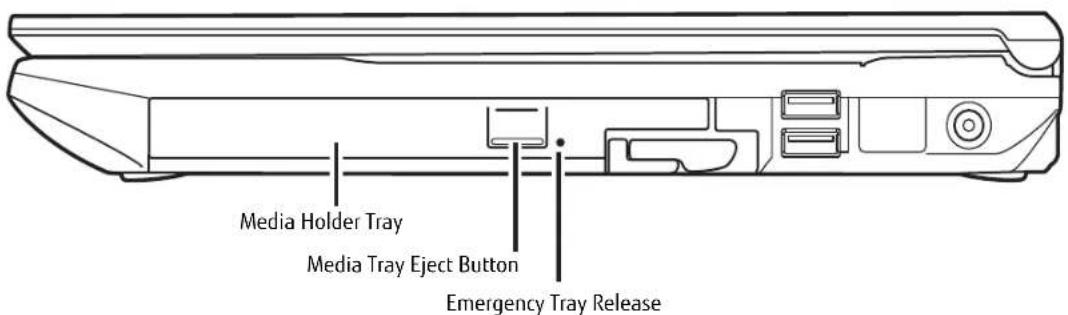
Figure 16. Optical Drive
Optical Drive
There is a variety of media available to use with your system, depending upon the system configuration you have selected. Multi-Format DVD Writers and Blu-ray® RW drives are collectively known as "optical drives".
Depending upon your notebook configuration, you may have one of the following optical drives:
- Dual-Layer Multi-Format DVD Writer: This drive lets you access movies, audio DVD/CDs, and software, and read and write to CD-R, CD-RW, DVD-R, DVD+R, DVD-RW, DVD+RW, and DVD RAM discs. The dual-layer architecture allows you to record up to 8.5 GB of data on DVD+R discs.
Blu-ray® RW Drive: With this drive, you can play Blu-ray Disc movies and burn up to 100 GB of movies or data on a Dual-Layer Blu-ray disc. You can play CD-ROM, CD-R, CD-RW, DVD-ROM, DVD-R, DVD-R DL, DVD-RW, DVD+R, DVD+R DL, DVD+RW, DVD-ROM, BD-R, BD-R DL, BD-RE, BD-RE DL discs, and record CD-R, CD-RW, DVD-R, DVD-R DL, DVD-RW, DVD+R, DVD+R DL, DVD+RW, DVD-RAM, BD-R, BD-R DL, BD-RE, BD-RE DL discs.
Media Player Software
Dual-Layer Multi-Format DVD Writer model only: With the Dual-Layer Multi-Format DVD Writer and media player software you can play DVD movies and music CDs on your LIFEBOOK notebook. The media player includes controls which allow you to take full advantage of the features of a DVD movie, as well as standard features such as fast forward, fast reverse, pause, etc. With this drive you can also burn onto recordable DVD-R/RW, DVD+R/RW, or CD-R/RW discs.
Blu-ray RW model only: The software for the Blu-ray drive is pre-installed, but can also be found on the CyberLink PowerDVD/PowerDirector/MakeDisc DVD in the event it needs to be re-installed. When used in conjunction with the PowerDirector and MakeDisc applications, PowerDVD turns your notebook into a powerful multi-media producer and player.

DO NOT OPERATE YOUR OPTICAL DRIVE UNLESS YOUR LIFEBOOK NOTEBOOK IS SITTING ON A FLAT SURFACE. USING A DRIVE WHEN THE SYSTEM IS NOT LEVEL MAY DAMAGE THE DRIVE OR PREVENT PROPER OPERATION.
PROLONGED USE OF THE OPTICAL DRIVE, SUCH AS WATCHING A DVD MOVIE, WILL SUBSTANTIALLY REDUCE YOUR BATTERY LIFE IF NO EXTERNAL POWER SOURCE IS ATTACHED.
Loading Media on Your Drive
To load a disc into your optical drive:
1 Push and release the eject button on the front of the optical drive to open the holder tray. The tray will come out of the LIFEBOOK notebook a short distance.
2 Gently pull the tray out until a media disc can easily be placed in the tray.
3 Place the media into the tray, label side up, with the hole in the center of the disc. Snap the disc onto the raised circle in the center of the tray.
4 Gently push the holder tray back in until you hear a click. (Figure 17)

IF YOU HAVE DISABLED THE AUTO INSERT NOTIFICATION FUNCTION (VIA THE AUTOPLAY UTILITY IN THE CONTROL PANEL), YOU WILL HAVE TO START THE DRIVE FROM YOUR DESKTOP, SINCE YOUR NOTEBOOK WILL NOT AUTOMATICALLY RECOGNIZE THAT MEDIA HAS BEEN LOADED.
ALL LIFEBOOK DVD PLAYERS ARE SET TO PLAY DVD TITLES WITH REGION CODE NUMBER 1 WHICH IS SPECIFIED FOR THE NORTH AMERICAN MARKET. THE REGION NUMBER IS A REGIONAL RESTRICTION CODE DEFINED BY THE DVD FORUM ACTING ON HOLLYWOOD REQUIREMENTS. DIFFERENT REGION CODES ARE RECORDED ON VIDEO DVD TITLES FOR PUBLICATION IN DIFFERENT AREAS OF THE WORLD. IF THE REGIONAL CODE OF THE DVD PLAYER DOES NOT MATCH THE CODES ON THE TITLES, THEN PLAYBACK IS IMPOSSIBLE.
- YOU CAN CHANGE THE REGION CODE ON THE DVD PLAYER USING THE PROPERTIES MENU OF THE DVD SOFTWARE. NOTE, HOWEVER, THAT YOU CAN ONLY CHANGE THE REGION CODE UP TO FOUR TIMES. AFTER THE FOURTH CHANGE, THE LAST REGION CODE ENTERED BECOMES PERMANENT, AND CANNOT BE CHANGED.
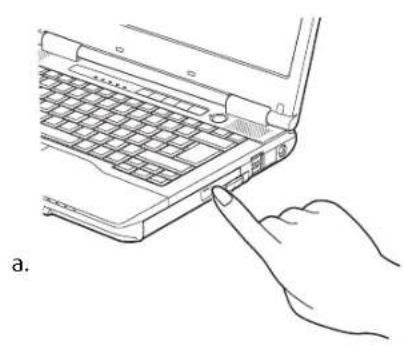

b.
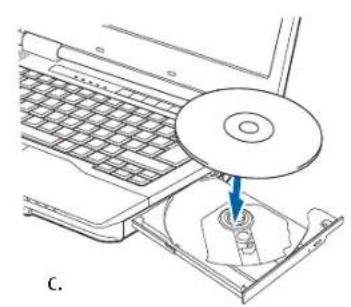
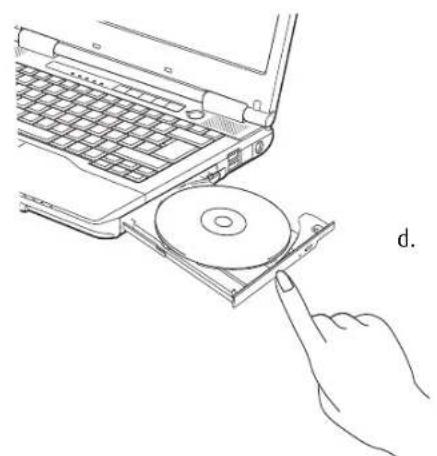
Figure 17. Loading/Ejecting Media
Removing Media
1 Push and release the eject button on the front of the optical drive. This will stop the drive and the holder tray will come out of the LIFEBOOK notebook a short distance.
2 Gently pull the tray out until the disc can easily be removed from the tray.
3 Carefully remove the media disc from the holder tray.
4 Gently push the holder tray back in until you hear a click.
Emergency Optical Drive Tray Release
If for some reason the eject button fails, you can open the media tray with a paper clip or similar tool inserted into the eject hole in the right side of the front of the tray. Straighten one side of a paper clip and push it gently into the hole. The tray will pop out.
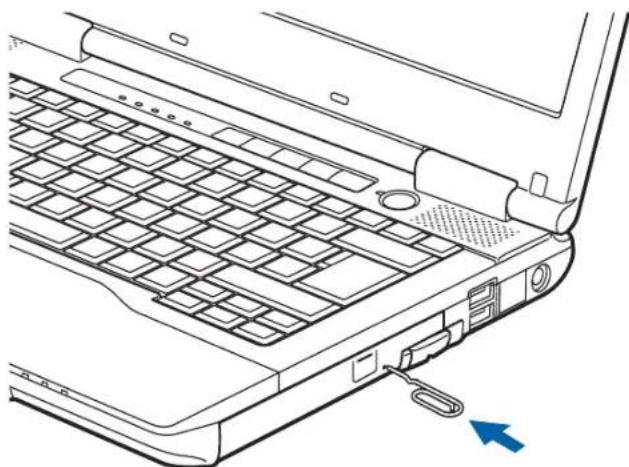
Figure 18. Emergency Tray Release
Using the Media Player Software

DEPENDENT UPON ITS CONFIGURATION, YOUR SYSTEM MAY NOT HAVE THE MEDIA PLAYER SOFTWARE PRE-INSTALLED. IF IT IS NOT INSTALLED, REFERENCE THE DOCUMENTATION THAT ACCOMPANIES THE MEDIA APPLICATION.
Starting a DVD Movie
1 Insert the DVD into the optical drive of the notebook. If the AutoRun feature activates, skip Step 2.
2 The first time you insert a movie into the DVD/CD-RW tray, you may be prompted to select what you want the system to do when discs are inserted (e.g., start automatically or wait for a prompt). Until you make a selection, you will receive the same prompt whenever you insert a disc.
3 Click OK to close the About DVD Player Performance dialog box and the movie will begin.
Using the Media Player Control Panel
The media player software allows you to watch the movie much like a VCR player. You can pause, rewind, fast-forward and stop the movie at any point.
1 To pause the movie, click the on-screen button.
2 To rewind, click the button to rewind to a specific point, or the button to return to the opening screen.
3 To fast-forward the movie, click the button to forward to a specific portion of the movie, or the button to jump to the ending credits.
4 To stop the movie, click the button.
Exiting the Media Player
Click the × located in the upper right corner of the title bar.
Using Media Player on Battery Power
Optical drives consume a lot of power, so your overall battery life will be significantly shorter when operating the optical drive continuously (such as when watching a DVD movie) than during standard operation. Many movie runtimes are longer than your notebook can support on a single charged battery. If you are watching a movie on battery power you may need to swap in an additional charged battery or attach AC power to view the movie in its entirety.

PROLONGED USE OF THE OPTICAL DRIVE, SUCH AS WATCHING A DVD MOVIE, WILL GREATLY REDUCE YOUR NOTEBOOK'S BATTERY LIFE.
- MANY MOVIE RUN-TIMES ARE LONGER THAN YOUR SYSTEM CAN SUPPORT ON A SINGLE BATTERY. IF YOU ARE WATCHING A DVD MOVIE ON BATTERY POWER YOU MAY NEED TO SWAP IN AN ADDITIONAL, CHARGED BATTERY OR ATTACH AC POWER DURING THE MOVIE TO VIEW IT IN ITS ENTIRETY.
- AN ADDITIONAL FULLY-CHARGED BATTERY IS HIGHLY RECOMMENDED IF YOU WILL BE WATCHING DVD MOVIES ON BATTERY POWER. IF YOU DON'T HAVE AN ADDITIONAL BATTERY, YOU MAY PURCHASE ONE EITHER ONLINE AT: HTTP://WWW.COMPUTERS.US.FUJITSU.COM OR BY CALLING 1-800-8FUJITSU.
To Watch a Movie on Battery Power:
1 Have an additional full-charged battery or your AC adapter ready for use.
2 Start watching your DVD movie.
3 When the low battery warning occurs, immediately stop the movie and exit the media player.

IF YOU DO NOT STOP THE MEDIA PLAYER QUICKLY AND THE LIFEBOOK NOTEBOOK ATTEMPTS TO AUTO-SPEND (CRITICAL BATTERY LOW STATE) THE LIFEBOOK NOTEBOOK WILL SHUT DOWN IMPROPERLY. IF THIS OCCURS, YOU MAY NEED TO PERFORM A HARD RESET AND FOLLOW THE INSTRUCTIONS, IF ANY, PRESENTED TO YOU BEFORE THE SYSTEM WILL REBOOT.
4 Power down your notebook and replace the discharged battery with an additional fully-charged battery. If you do not have an additional battery, you may attach AC power as soon as you see the low battery warning.
5 Resume your LIFEBOOK notebook by pressing the Suspend button again. This is not required if you attached AC power without entering sleep mode.
6 Restart your media player, locate and skip to the chapter of the movie you were last watching.
7 Continue watching your DVD movie.

SOME SHORTER DVD MOVIES MAY NOT REQUIRE YOU TO SWAP BATTERIES OR ATTACH AC POWER TO COMPLETE THEM. HOWEVER, IT IS BEST TO BE PREPARED SINCE ACTUAL BATTERY LIFE WHILE OPERATING THE OPTICAL DRIVE CANNOT BE GUARANTEED.
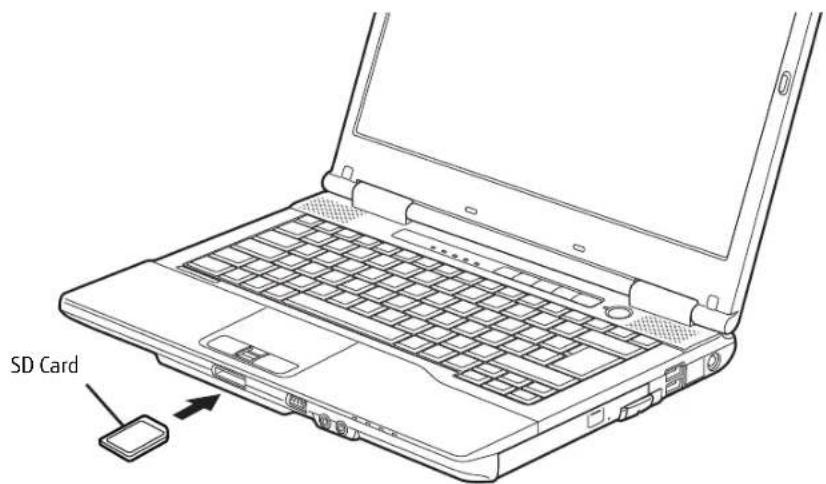
Figure 19. Installing an SD Card
Secure Digital Cards
Your LIFEBOOK notebook supports Secure Digital (SD) cards, on which you can store and transfer data to and from a variety of digital devices. These cards use flash memory architecture, which means they don't need a power source to retain data.
Secure Digital (SD) is a flash memory technology that allows you to record, transfer and share digital content, such as digital pictures, movies, music, voice, and computer data and applications. SD Cards allow portable storage among a variety of devices, such as cell phones, GPS systems, digital cameras, and PDAs.
Installing SD Cards
SD Cards are installed in the SD Card slot. To install an SD Card, follow these steps:

INSTALLING OR REMOVAING AN SD CARD DURING YOUR LIFEBOOK NOTEBOOK'S SHUTDOWN OR BOOTUP PROCESS MAY DAMAGE THE CARD AND/OR YOUR LIFEBOOK NOTEBOOK.
DO NOT INSERT A CARD INTO A SLOT IF THERE IS WATER OR ANY OTHER SUBSTANCE ON THE CARD AS YOU MAY PERMANENTLY DAMAGE THE CARD, YOUR LIFEBOOK NOTEBOOK, OR BOTH.
1 See your specific card manual for instructions on the installation of your card. Some cards may require that your notebook is off while installing them.
2 Make sure there is no card currently in the slot. If there is, see "Removing an SD Card" below.
3 Insert your card into the slot with the product label facing up.
4 Push the card firmly into the slot until it is seated in the connector.
Removing an SD Card
To remove an SD Card, follow these easy steps:

SEE YOUR CARD MANUAL FOR SPECIFIC INSTRUCTIONS ON THE REMOVAL OF YOUR CARD. SOME CARDS MAY REQUIRE YOUR LIFEBOOK NOTEBOOK TO BE IN SLEEP MODE OR OFF WHILE REMOVING THEM.
Gently push the SD Card into the slot, then firmly pull it from the slot.
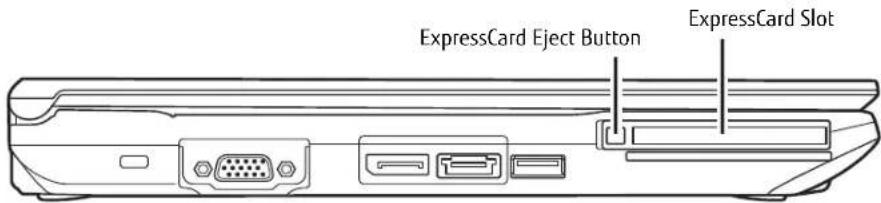
Figure 20. Installing/Removing an ExpressCard
ExpressCards™/Smart Cards
Your LIFEBOOK notebook supports ExpressCards™, which can perform a variety of functions depending on which type of card you insert.
Some available ExpressCards:
- Gigabit Ethernet Local area network (LAN) cards
- IEEE1394 cards
S-ATA II cards
For further information, refer to the instructions supplied with your card(s).
Inserting ExpressCards
There are two different width ExpressCards: 34mm and 54mm . The connector inside the slot is located on the left-hand side of the slot. If you insert a 34mm card, be sure to align it with the left side of the slot when inserting it. Express Cards are inserted in the Express Card slot, as shown on the right.
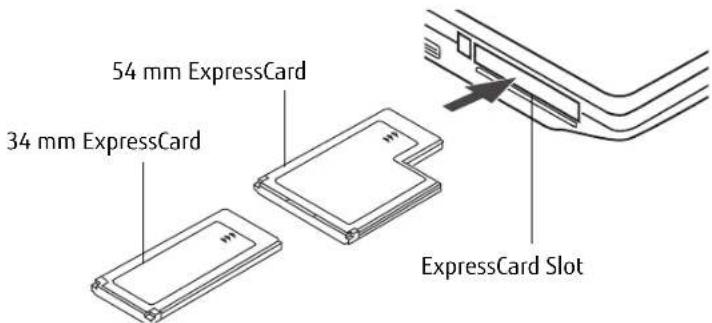
Figure 21. Inserting/Removing ExpressCards

- INSTALLING OR REMOVING AN EXPRESSCARD DURING YOUR LIFEBOOK NOTEBOOK'S SHUTDOWN OR BOOTUP PROCESS MAY DAMAGE THE CARD AND/OR YOUR NOTEBOOK.
DO NOT INSERT AN EXPRESSCARD INTO A SLOT IF THERE IS WATER OR ANY OTHER SUBSTANCE ON THE CARD AS YOU MAY PERMANENTLY DAMAGHTHE CARD, YOUR LIFEBOOK NOTEBOOK, OR BOTH.

YOU MAY BE REQUIRED TO LOG ON AS AN ADMINISTRATOR OR MEMBER OF THE ADMINISTRATOR'S GROUP TO COMPLETE THIS PROCEDURE. IF THE COMPUTER IS CONNECTED TO A NETWORK, NETWORK POLICY SETTINGS MAY ALSO PREVENT YOU FROM COMPLETING THIS PROCEDURE.
1 See your ExpressCard manual for instructions on the installation of your card. Some cards may require that your notebook is off while installing them.
2 Make sure there is no ExpressCard currently in the slot. If there is, see "Removing ExpressCards", below.
3 Insert the card into the slot with the label facing up.
4 Push the card firmly into the slot until it is seated in the connector.
Removing ExpressCards
See your ExpressCard manual for specific instructions on removing your card. Some cards may require that your notebook be in Sleep Mode or Off during removal.

- WINDOWS HAS A SHUTDOWN PROCEDURE FOR EXPRESSCARDS THAT MUST BE FOLLOWED BEFORE REMOING A CARD. (REVIEW YOUR OPERATING SYSTEM MANUAL FOR THE CORRECT PROCEDURE.) IT IS GOOD PRACTICE TO REMOVE DEVICES USING THE SAFELY REMOVE HARDWARE ICON IN THE SYSTEM TRAY.
IF THE DIALOG BOX STATES THAT THE DEVICE CANNOT BE REMOVED, YOU MUST SAVE ALL OF YOUR OPEN FILES, CLOSE ANY OPEN APPLICATIONS AND SHUT DOWN YOUR NOTEBOOK.
To remove an ExpressCard, push the eject button on the left of the ExpressCard slot so that it pops out. After the button pops out, press it again to eject the ExpressCard. To remove the card, pull it straight out.
Smart Card Reader
A dedicated Smart Card Reader is provided on your notebook. Smart Cards are the same size and shape as credit cards, but they contain an integrated microprocessor chip. The chip can hold a variety of information, and provides you with many possible options, such as allowing you to make secure purchases, pay for phone calls, store security information, and provide personal identification and information.
In order to use the Smart Card Reader, you must purchase optional Smart Card third-party software.
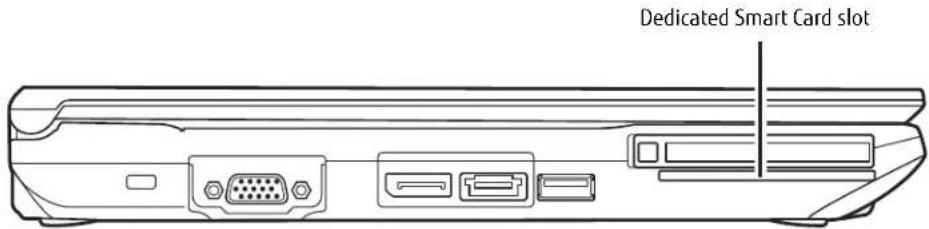
Figure 22. Smart Card Slot
Memory Upgrade Module
Your Fujitsu LIFEBOOK notebook comes with a minimum of 2 GB of high speed Double Data Rate Synchronous Dynamic RAM (DDR3-1600 SDRAM) factory installed. To increase your notebook's memory capacity, you may install an additional memory upgrade module. The memory upgrade must be a dual-in-line (DIMM) SDRAM module. To ensure 100% compatibility, purchase the SDRAM module only from the Fujitsu web store at www.shopfujitsu.com.

DO NOT REMOVE ANY SCREWS FROM THE MEMORY UPGRADE MODULE COMPARTMENT EXCEPT THE ONES SPECIFICALLY SHOWN IN THE DIRECTIONS FOR INSTALLING AND REMOVING THE MEMORY UPGRADE MODULE.
- THE MEMORY UPGRADE MODULE CAN BE SEVERELY DAMAGED BY ELECTROSTATIC DISCHARGE (ESD). TO MINIMIZE RISK TO THE MODULE, OBSERVE THE FOLLOWING PRECAUTIONS:
BEFORE HANDLING A MEMORY MODULE, TOUCH A GROUNDED METAL OBJECT TO DISCHARGE STATIC ELECTRICITY BUILT UP IN YOUR BODY.
- WHEN INSTALLING OR REMOVING A MEMORY MODULE, HOLD IT BY THE EDGE SO AS NOT TO TOUCH ANY CONTACTS OR CHIPS. BE CAREFUL NOT TO TOUCH ANY INTERNAL COMPUTER TERMINALS OR COMPONENTS; THE OIL FROM YOUR FINGERS COULD CAUSE A SHORT TO THE COMPONENTS.
- BE SURE TO POWER DOWN YOUR SYSTEM BEFORE ADDING OR REMOVING MEMORY MODULES. EVEN IF THE SYSTEM IS IN HIBERNATE OR SLEEP STATES, DATA COULD BE LOST OR THE MEMORY COULD BE DAMAGED IF POWER IS STILL AVAILABLE TO THE SYSTEM.
Installing Memory Upgrade Modules
1 Turn off power to your notebook, remove any power adapter (AC or auto/airline). Remove the battery.
2 Make sure that all the connector covers are closed.
3 Turn the notebook bottom side up, remove the screw from the memory upgrade module compartment, and remove the cover. (Figure 23)
4 Remove the new memory upgrade module from the static guarded sleeve.
5 Align the memory upgrade module with the part side up. Align the connector edge of the memory upgrade module with the connector slot in the compartment.(Figure 24)
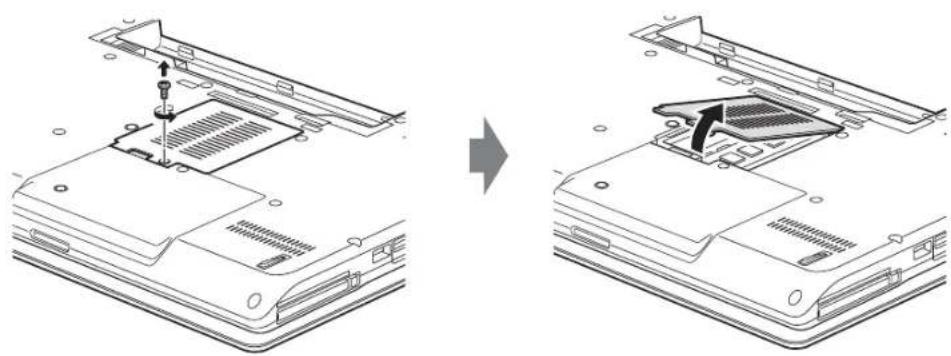
Figure 23. Opening Memory Compartment
6 Insert the memory upgrade module at a 45^ angle. Press the connector edge of the module firmly down and into the connector until it lodges under the retaining clip. You'll hear a click when it is properly in place.
7 Replace the cover and reinstall the screws.

THE MEMORY UPGRADE MODULE IS NOT SOMETHING YOU ROUTINELY REMOVE FROM YOUR NOTEBOOK. ONCE IT IS INSTALLED, YOU CAN LEAVE IT IN PLACE UNLESS YOU WANT TO CHANGE SYSTEM MEMORY CAPACITY.
Removing a Memory Upgrade Module
1 Perform steps 1 through 3 of Installing a Memory Upgrade Module.
2 Pull the clips sideways away from each side of the memory upgrade module at the same time.
3 While holding the clips out, remove the module from the slot by lifting it up and pulling it away from your notebook.(Figure 25)
4 Store the memory upgrade module in a static guarded sleeve.
5 Replace the cover and reinstall the screws.
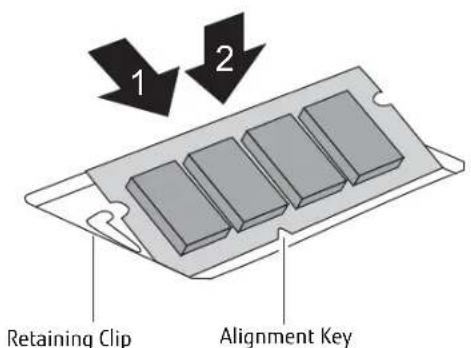
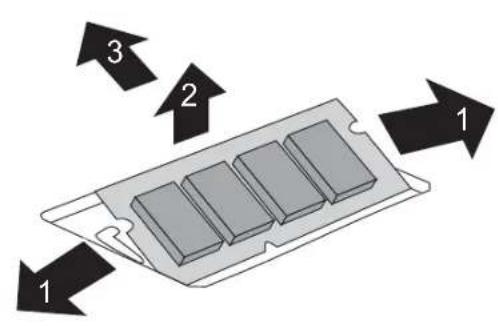
Figure 24. Inserting a Memory Module Figure 25. Removing a Memory Module
Checking the Memory Capacity
Once you have changed the system memory capacity by replacing the installed module with a larger one, be sure to check that your notebook has recognized the change.
Check the memory capacity by doing the following: from Modern Start screen press [Windows] + [X], then select Control Panel > System. The amount of memory is displayed next to Installed Memory (RAM): The amount of memory displayed should be approximately the total of all memory modules installed. There may be a discrepancy which is allocated for fixed video memory.

IF THE TOTAL MEMORY DISPLAYED IS INCORRECT, CHECK THAT YOUR MEMORY UPGRADE MODULE IS PROPERLY INSTALLED. (IF THE MODULE IS PROPERLY INSTALLED AND THE CAPACITY IS STILL NOT CORRECTLY RECOGNIZED, SEE TROUBLESHOOTING ON PAGE 84.)
Device Ports
Your Fujitsu LIFEBOOK notebook and the optional Port Replicator come equipped with multiple ports to which you can connect external devices including disk drives, keyboards, printers, etc.
Internal LAN (RJ-45) Jack
The internal LAN (RJ-45) jack is used for a Gigabit (10Base-T/ 100Base-Tx/1000Base-T) Ethernet LAN connection. You may need to configure your notebook to work with your particular network. (Contact your network administrator for information on your network configuration.) To connect the LAN cable follow these easy steps:
1 Align the connector with the port opening.
2 Push the connector into the port until it is seated.
3 Plug the other end of the cable into a LAN outlet.
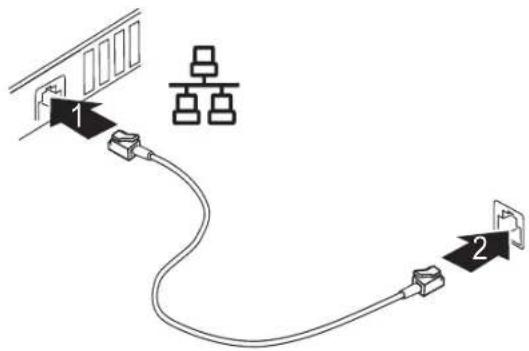
Figure 26. Connecting the LAN

Figure 27. Connecting a USB Device
Universal Serial Bus Ports
The Universal Serial Bus ports (USB) allow you to connect USB devices such as external game pads, pointing devices, keyboards and/or speakers. There are four USB ports on your notebook: two USB 2.0 ports on the right side and two USB 3.0 ports on the left (one of them shares the e-SATA port). Note that the bottom USB 2.0 port is also a USB Anytime Charge port (see section below for more information).
To connect a USB device follow these steps:
1 Align the connector with the port opening.
2 Push the connector into the port until it is seated.
Anytime USB Charge Feature
The Anytime USB Charge feature can be disabled and enabled from the BIOS Setup Utility; the feature is enabled by default. The settings for the Anytime USB Charge feature can be changed by going to Start > All Programs > Anytime USB Charge Utility and clicking on Settings. There are three possible settings for this feature: "Disable Anytime USB Charge function", "Only enable Anytime USB Charge function with AC Adapter", and "Enable Anytime USB Charge function with AC Adapter or battery". Note that if the setting is selected, the function will eventually drain the battery if the AC Adapter is not plugged in.
Certain USB devices may require that a driver be installed in order for this feature to work.
Please check the documentation for your USB device to ensure proper charging with the Anytime USB Charge utility.
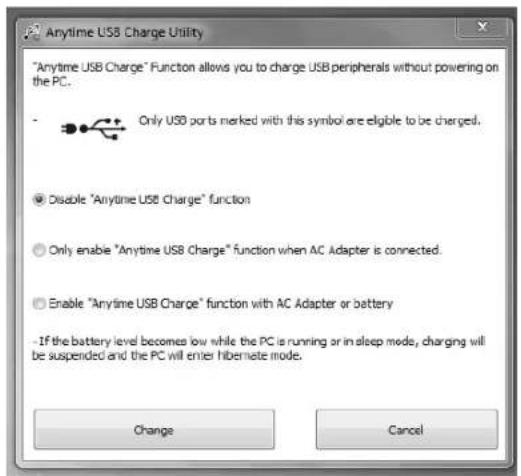
Headphone Jack
The headphone jack allows you to connect headphones or powered external speakers to your notebook. Your headphones or speakers must be equipped with a 1/8'' (3.5 mm) stereo mini-plug. In order to connect headphones or speakers follow these easy steps:
1 Align the connector with the port opening.
2 Push the connector into the port until it is seated.

IF YOU PLUG HEADPHONES INTO THE HEADPHONE JACK, THE BUILT-IN SPEAKERS WILL BE DISABLED.
Microphone Jack
The microphone jack allows you to connect an external mono microphone. Your microphone must be equipped with a 1/8''(3.5 mm) mono mini-plug in order to fit into the microphone jack of your notebook. In order to connect a microphone follow these easy steps:
1 Align the connector with the port opening.
2 Push the connector into the port until it is seated.
External Video Port
The external video port allows you to connect an external monitor or LCD projector. In order to connect an external video device, follow these easy steps:
1 Align the connector with the port opening.
2 Push the connector into the port until it is seated.
3 Tighten the two hold-down screws, located on each end of the connector.

PRESSING THE [FN] + [F10] KEYS ALLOWS YOU TO CHANGE YOUR SELECTION OF WHERE TO SEND YOUR DISPLAY VIDEO. EACH TIME YOU PRESS THE KEY COMBINATION, YOU WILL STEP TO THE NEXT CHOICE, STARTING WITH THE BUILT-IN DISPLAY PANEL ONLY, MOVING TO THE EXTERNAL MONITOR ONLY, FINALLY MOVING TO BOTH THE BUILT-IN DISPLAY PANEL AND AN EXTERNAL MONITOR.
DisplayPort
The DisplayPort connector, located on the left side of the system, allows you to connect DisplayPort devices to your notebook. In order to connect a DisplayPort device, follow these easy steps:
1 Align the connector with the port opening.
2 Push the connector into the port until it is seated.
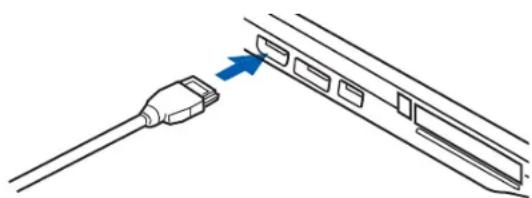
Figure 28. DisplayPort Connection
E-SATA/USB3.0Port
E-SATA (External Serial Advanced Technology Attachment) is an external version of SATA, which connects your computer to the hard drive. E-SATA is ideal for backing up large files on an external hard drive. The port can also be used as a USB 3.0 port.
To connect an E-SATA or USB 3.0 device:
1 Align the connector with the port opening.
2 Push the connector into the port until it is seated.
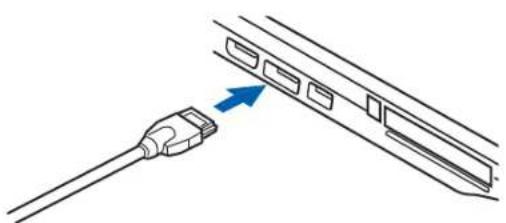
Figure 29. E-SATA Connection
Port Replicator Connector
The port replicator connector is used for the connection of your notebook to an optional port replicator. In order to connect your notebook to this device, follow the instructions in "Port Replicator" on page 80.
Port Replicator
An optional Port Replicator is available from Fujitsu to extend the functionality of your LIFEBOOK® notebook by providing ports to connect an external VGA monitor, a LAN (RJ-45) cable, four USB 2.0 devices, DC Power, and DVI and e-SATA devices.
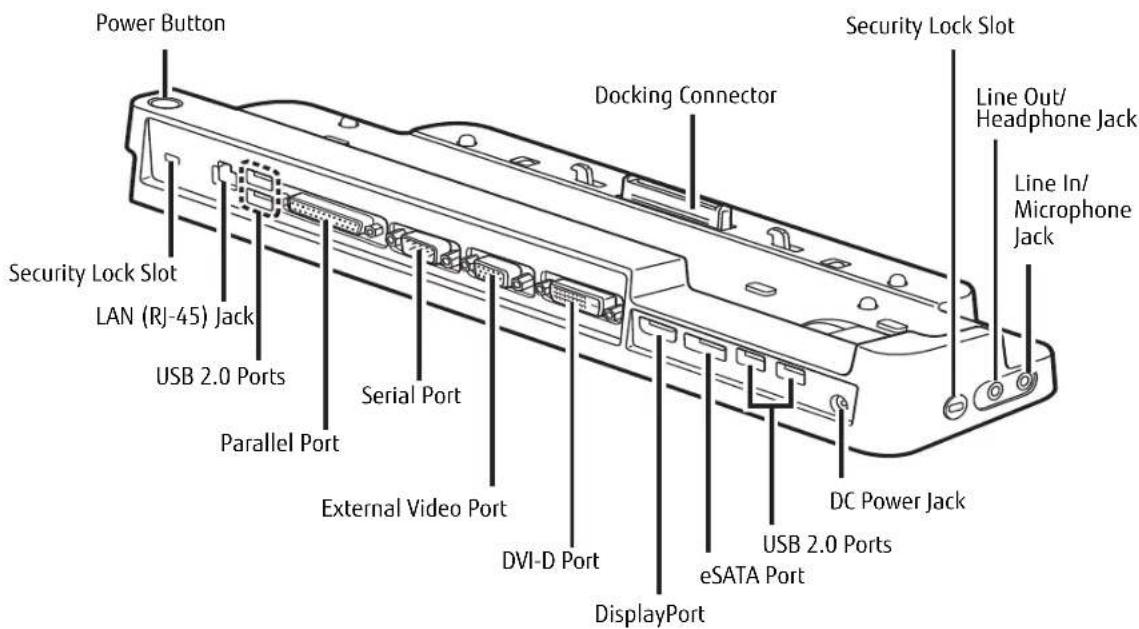
Figure 30. Port Replicator rear panel
Port Replicator Components
Following is a description of the Port Replicator components. (Figure 30)
Power Button
The power button allows you to power the port replicator on and off.
Docking Connector
The docking connector allows you to connect the Port Replicator to your LIFEBOOK notebook.
THE SYSTEM CONTAINS COMPONENTS THAT CAN BE SEVERELY DAMAGED BY ELECTROSTATIC DISCHARGE (ESD). TO MINIMIZE RISK TO THE COMPONENTS, OBSERVE THE FOLLOWING PRECAUTIONS:

BEFORE DOCKING OR UNDOCKING YOUR LIFEBOOK WHEN USING A PORT REPLICATOR, YOU SHOULD TOUCH A GROUNDED METAL OBJECT TO DISCHARGE STATIC ELECTRICITY BUILT UP IN YOUR BODY.
BE SURE TO POWER DOWN YOUR SYSTEM BEFORE ADDING OR REMOVING SYSTEM COMPONENTS. EVEN IF THE SYSTEM IS IN HIBERNATE OR SLEEP STATES, DATA COULD BE LOST OR MEMORY COULD BE DAMAGED IF POWER IS STILL AVAILABLE TO THE SYSTEM.
Security Lock Slot
The security lock slot allows you to attach an optional physical lock down device.
Line Out/Headphone Jack
The line out jack is used for connecting an external speaker or headphones. Note that line out does not provide power, so the speaker must be externally powered.
Line In/Microphone Jack
The microphone jack allows you to connect an external mono microphone.
DC Power Jack
The DC power jack allows you to plug in the AC adapter to power your notebook and charge the internal Lithium ion battery.
USB 2.0 Ports (Qty. 4)
Universal Serial Bus (USB) 2.0 ports allow you to connect USB devices. USB 2.0 ports are backward-compatible with USB 1.1 devices.
eSATA Port
eSATA (external Serial Advanced Technology Attachment) is an external version of SATA, and connects the computer to the hard drive. eSATA is ideal for backing up large files on an external hard drive.
DisplayPort
The DisplayPort lets you to connect DisplayPort-compatible digital display devices such flat panel displays and digital projectors using a DisplayPort cable.
DVI-D Port
The DVI-D port lets you to connect digital display devices such flat panel displays and digital projectors using a DVI-D cable. DVI-D cables are primarily used to connect a computer with a monitor or home theater system.

- ALTHOUGH THERE ARE DISPLAYPORT AND DVI-D PORTS SUPPORTED BY THE PORT REPLICATOR, ONLY ONE CAN BE USED AT ANY TIME. AN INTERNAL SWITCH RECOGNIZES WHICH TYPE OF DEVICE IS CONNECTED. IF BOTH ARE CONNECTED AT THE SAME TIME, THE DISPLAYPORT DEVICE HAS THE HIGHER PRIORITY.
- A DISPLAYPORT OR DVI-D DEVICE CAN BE USED CONCURRENTLY WITH AN EXTERNAL VIDEO DEVICE THAT IS CONNECTED TO THE ANALOG EXTERNAL VIDEO PORT.
- HOT PLUG IS NOT SUPPORTED BY THE DISPLAYPORT OR DVI-D PORTS.
- IF A DISPLAYPORT-TO-HDMI CONVERTER IS CONNECTED TO THE DISPLAYPORT, SOUND WILL NOT BE OUTPUT FROM THE HDMI DEVICE. TO PROPERLY USE AN HDMI DEVICE, PLUG IT INTO THE HDMI PORT ON THE LEFT SIDE OF THE SYSTEM.
External Video Port
The external video port lets you connect an external monitor or projector. Note that if a Port Replicator is attached, you must use the external video port on the Port Replicator, not the one on your system.
Parallel Port
The parallel port allows you to connect parallel devices.
Serial Port
The serial port allows you to connect serial (RS-232C) devices
.LAN (RJ-45) Jack
The LAN jack allows you to connect a LAN to the Port Replicator. Note that when the system is attached to the Port Replicator, the LAN Jack on the Port Replicator should be used, not the one on the system.
Attaching Port Replicator
To attach the Port Replicator, align the Port Replicator connector on the bottom of your notebook with the connector on the Port Replicator and push the corners down simultaneously. (Figure 31)
Detaching Port Replicator
To detach the Port Replicator:
1 Pull the Port Replicator's release latch away from the Port Replicator to release it from your notebook. (Figure 32)
2 Pull the notebook away from the Port Replicator to detach it from your system. (Figure 33)
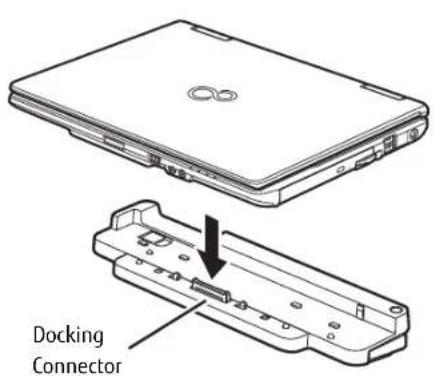
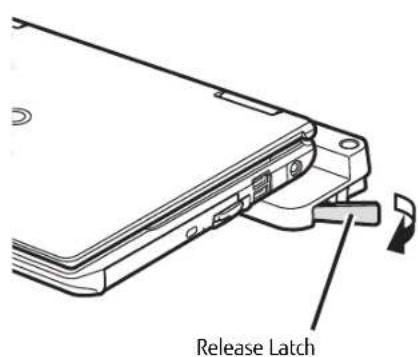
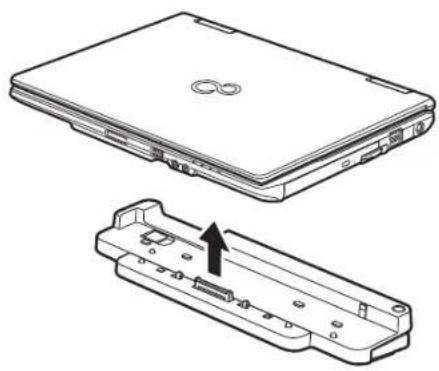
Figure 31. Attaching Figure 32. Unlatching Figure 33. Removing
Chapter 4
Troubleshooting Your LIFEBOOK
Troubleshooting
There may be occasions when you encounter simple setup or operating problems that you can solve on the spot, or problems with peripheral devices that can be solved by replacing the device. The information in this section helps you isolate and resolve some of these straightforward issues and identify failures that require service.
Identifying the Problem
If you encounter a problem, go through the following procedure before pursuing complex troubleshooting:
1 Turn off your LIFEBOOK notebook.
2 Make sure the AC adapter is plugged into your notebook and to an active AC power source.
3 Make sure that any card installed in the ExpressCard slot is seated properly. You can also remove the card from the slot, thus eliminating it as a possible cause of failure.
4 Make sure that any devices connected to the external connectors are plugged in properly. You can also disconnect such devices, thus eliminating them as possible causes of failure.
5 Turn on your notebook. Make sure it has been off at least 10 seconds before you turn it back on.
6 Go through the boot sequence.
7 If the problem has not been resolved, refer to the Troubleshooting Table, that follows, for more detailed troubleshooting information.

IF YOU KEEP NOTES ABOUT WHAT YOU HAVE TRIED, YOUR SUPPORT REPRESENTATIVE MAY BE ABLE TO HELP YOU MORE QUICKLY BY GIVING ADDITIONAL SUGGESTIONS OVER THE PHONE.
8 If you have tried the solutions suggested in the Troubleshooting Table without success, contact your support representative:
Toll free: 1-800-8Fujitsu (1-800-838-5487); E-mail: 8fujitsu@us.fujitsu.com
Website: http://solutions.us.fujitsu.com/www/content/support/contact/index.php.
Before you place the call, you should have the following information ready so that the customer support representative can provide you with the fastest possible solution:
Product name
Product configuration number
Product serial number
Purchase date
- Conditions under which the problem occurred
- Any error messages that have occurred
- Type of device connected, if any
See the Configuration Label on the bottom of your notebook for configuration and serial numbers.
Specific Problems
Using the Troubleshooting Table
When you have problems with your LIFEBOOK, try to find the symptoms under the Problem column of the troubleshooting table for the feature giving you difficulty. You will find a description of common causes for that symptom under the column Possible Cause and what, if anything, you can do to correct the condition under Possible Solutions. All possible causes or solutions may not apply to your notebook.
Troubleshooting Table
Problem Page
Problem Page
Audio Problems page 86
USB Device Problems.. page 88
CD-ROM Drive Problems . page 87
ExpressCard Problems page 89
Port Replicator Problems . page 87
Power Failures. page 89
Hard Drive Problems.. page 88
Shutdown and Startup Problems 91
Keyboard or Mouse Problems . page 88
Video Problems. page 92
Memory Problems . page 88
Miscellaneous Problems page 93
| Problem Possible Cause Possible Solutions | ||
| Audio Problems | ||
| There is no sound coming from the built-in speakers. | The volume is turned too low. | Adjust the volume control on your notebook and operating system. Use the [Fn+F9] key combination on your keyboard. Pressing [F9] repeatedly while holding [Fn] will increase the volume. |
| The software volume control is set too low. | Manually adjusting the volume (i.e. keyboard "hot keys") should dynamically adjust the volume of the operating (see above). If that doesn't work, adjust the sound volume control settings in your software or application. | |
| Headphones are plugged into your notebook. | Plugging in headphones disables the built-in speakers, remove the head-phones. | |
| The speakers have been muted using the Volume icon in the system tray. | Click on the Volume icon in the tool tray on the bottom right of the screen. (It looks like a speaker). If the Mute box is checked, click on it to uncheck it. You can also use the [Fn+F3] key combination to toggle the volume on and off. Pressing [F3] while holding [Fn] will toggle the audio mute. | |
| CD-ROM Drive Problems | ||
| LIFEBOOK notebook fails to recog- size optical discs. | The disc is not pushed down onto raised center circle. | Open optical drive tray and re-install the disc properly. |
| Optical drive tray is not latched shut. | Push on the front of the optical drive tray until it latches. If that doesn't work, pull out the modular drive latch to remove the device from the bay, then re-insert the drive until it latched; this ensures that the drive is properly seated. | |
| Incorrect DVD Player or no DVD Player software is installed. | Install DVD Player software. | |
| Wrong drive designator was used for the disc in the appli-cation. | Verify the drive designator used by the application is the same as the one used by the operating system. When the operating system is booted from a DVD/CD, drive designations are automatically adjusted. Note that the drive designation can be changed with the Disk Management tool located at Administrative Tools > Computer Management. | |
| The disc is dirty or defective. | Wipe the disc with a non-abrasive CD cleaning cloth and reinsert. It if still will not work try another disc in the drive. | |
| Drive access indicator on the Sta- tus Indicator Panel blinks at regu- lar intervals with no disc in the tray or the drive is not installed. | The Windows auto insertion function is active and is checking to see if a disc is ready to run. | This is normal. However, you may disable this feature. |
| Port Replicator Problems | ||
| Note: Be sure to power down your LIFEBOOK notebook before adding a printer to the Port Replicator parallel port. | ||
| Notebook does not turn on when installed in the optional Port Rep- licator | Port Replicator AC adapter isn't plugged in. | Provide power to the Port Replicator. |
| Notebook not properly seated in port replicator. | Remove and re-dock your LIFEBOOK notebook. | |
| You cannot access your hard drive. Security is set so password is required to start OS. | Verify your password and security settings. | |
| Hard Drive Problems | ||
| You cannot access your hard drive.(continued) | The wrong drive designator was used by an application when a bootable disc was used to start the notebook. | Verify drive designator used by application is in use by the operating system. When the operating system is booted from a CD, drive designations are automatically adjusted. |
| Keyboard or Mouse Problems | ||
| The built-in keyboard does not seem to work. | The notebook has gone into Sleep mode. | Push the Power/Suspend/Resume button. |
| An application has locked out the keyboard. | Try to use your integrated pointing device to restart your system. | |
| You have installed an external keyboard or mouse, and it does not seem to work. | Your external device is not properly installed. | Re-install your device. See "Device Ports" on page 76. |
| OS is not set up with correct driver. | Check your device and operating system documentation and activate the proper driver. | |
| An external keyboard or mouse seems to be locking up the system. | OS is not set up with correct driver. | Check your device and operating system documentation and activate the proper driver. |
| The system has crashed. Try to restart your notebook. I | ||
| Memory Problems | ||
| Your System screen does not show the correct amount of installed memory. | Memory upgrade module is not properly installed. | Remove and re-install your memory upgrade module. See "Memory Upgrade Module" on page 73. |
| You have a memory failure. Check for Power On Self Test (POST) messages. See "Power On Self Test Messages" on page 94. | ||
| USB Device Problems | ||
| You installed a USB device, but your notebook does not recog-nize the device, or the device does not seem to work properly. | The device is not properly installed. | Remove and re-install the device. See "Device Ports" on page 76. |
| You installed a USB device, but your notebook does not recog-nize the device, or the device does not seem to work properly.(continued) | The device may have been installed while an application was running. | Close the application and restart your notebook. |
| Device may not have correct software driver active. | See your software documentation and activate the correct driver. | |
| ExpressCard Problems | ||
| Installed ExpressCard does not work or is locking up the system. | The card is not properly installed. | Remove and re-install the card. See "ExpressCardsTM/Smart Cards" on page 70. |
| The card may have been installed while an application was running, so your note-book is not aware of its installation. | Close the application and restart your notebook. | |
| Correct software driver may not be active. | See your software documentation and activate the correct driver. | |
| You may have the wrong I/O address selected for your card device. | See your ExpressCard documentation to determine the required I/O address. Change the settings in the Device Manager. | |
| Power Failures | ||
| You turn on your LIFEBOOK note-book and nothing seems to hap-pen. | The primary battery is installed but is faulty. | Use the Status Indicator panel to verify the presence and condition of the batter-ies. See "Status Indicator Panel" on page 22. If a battery is indicating a short, remove that battery and operate from another power source or replace that bat-tery. |
| The battery or batteries are low. | Check the Status Indicator Panel to determine the presence and condition of the batteries. See "Status Indicator Panel" on page 22. Use a Power adapter to operate until a battery is charged or install a charged battery. | |
| The power adapter (AC or auto/airline) is not plugged in properly. | Verify that your adapter is connected correctly. See "Power Sources" on page 43. | |
| You turn on your LIFEBOOK note-book and nothing seems to happen. (continued) | The installed primary battery is completely discharged, there is no optional second battery installed or there is no power adapter installed. | Check the Status Indicator Panel to determine the presence and condition of the batteries. See "Status Indicator Panel" on page 22. Install a charged battery or a Power adapter. |
| The power adapter has no power from the AC outlet, air-plane seat jack, or cigarette lighter. | Move the AC cord to a different outlet, check for a line switch or tripped circuit breaker for the AC outlet. If you are using an auto/airline adapter in a car make sure the ignition switch is in the On or Accessories position. | |
| The power adapter (AC or auto/airline) is faulty. | Try a different Power adapter or install a charged optional second battery. | |
| Your LIFEBOOK notebook turns off all by itself. | The power management parameters are set for auto timeouts which are too short for your operating needs. | Press any button on the keyboard, or move the mouse to restore operation. If that fails, push the Power/Suspend/Resume button. Check your power manage-ment settings, or close your applications and go to the Power Options Properties located in the Control Panel to adjust the timeout values to better suit your needs. |
| You are operating on battery power and ignored a low battery alarm until the system has gone into Dead Battery Suspend mode. | Install a power adapter and then push the Power/Suspend/Resume button. See "Power Sources" on page 43. | |
| You have a battery failure. Verify | the condition of the batteries using the Status Indicator panel, and replace or remove any batteries that are shorted. See "Status Indicator Panel" on page 22. | |
| Power adapter lost its power source or failed. | Make sure the adapter is plugged in and the outlet has power. | |
| Your LIFEBOOK notebook will not work on battery alone. | The batteries are dead. Replace | the battery with a charged one or install a power adapter. |
| No batteries installed. Install a charged battery. | ||
| Your LIFEBOOK notebook will not work on battery alone. (continued) | The batteries are improperly installed. | Verify that the batteries are properly connected by re-installing them. |
| Your installed batteries are faulty. | Verify the condition of the batteries using the Status Indicator panel and replace or remove any batteries that are shorted. See “Status Indicator Panel” on page 22. | |
| The batteries seem to discharge too quickly. | The power savings features may be disabled. | Check the Power Options menu settings and adjust according to your operating needs. |
| You are running an application that uses a lot of power due to frequent access. | Use both the primary battery and an optional second battery and/or use a power adapter for this application when at all possible. | |
| The brightness is turned all the way up. | Turn down the brightness adjustment. The higher the brightness the more power your display uses. | |
| The batteries are old. Replace the batteries. | ||
| Battery was exposed to high temperatures. | Replace the batteries. | |
| The batteries are too hot or too cold. | Restore the notebook to normal operating temperature. Charging icon on the Status Indicator panel will flash when battery is outside of operating range. | |
| Shutdown and Startup Problems | ||
| The Suspend/Resume button does not work. | There may be a software conflict | Close all applications and try the button again. |
| The system powers up and displays power on information, but fails to load the OS. | You have a secured system requiring a password. | Make sure you have the right password. Enter the setup utility and verify the Security settings and modify them as accordingly. See “BIOS Setup Utility” on page 49. |
| Internal hard drive was not detected. | Use the BIOS setup utility or Primary Master submenu, located within the Main menu, to try to auto detect the internal hard drive. | |
| Your notebook appears to change setup parameters when it starts. | BIOS changes were not saved when you exited the setup utility. | Make sure you select Save Changes And Exit when exiting the BIOS setup utility. |
| Your system display won't turn on when the system is turned on or has resumed. | You have installed the LIFE-BOOK/Security Application panel. | Check the Status Indicator Panel for presence of the Security icon. If it is visible, enter your password See "Status Indicator Panel" on page 22. |
| Error message is displayed on the screen during the notebook (boot) sequence. | Power On Self Test (POST) has detected a problem. | See the POST messages to determine the meaning and severity of the problem. Not all messages are errors; some are simply status indicators. See "Power On Self Test Messages" on page 94. |
| Video Problems | ||
| The built-in display is blank when you turn on your LIFEBOOK note-book. | The notebook is set for an external monitor only. | Pressing [F10] while holding down the [Fn] key allows you to change your selection of where to send your display video. Each time you press the keys you will step to the next choice. |
| The display angle and brightness settings are not adequate for your lighting conditions. | Move the display and the brightness control until you have adequate visibility. Pressing either the [F6] or [F7] keys while holding down the [Fn] key also allows you to change the brightness level of the display. | |
| Power management timeouts are set for short intervals and you failed to notice the display come on and off. | Press a keyboard button or move the mouse to restore operation. If that fails, push the Power/Suspend/Resume button. (The display may be shut off by Sleep mode, Auto Suspend or Video Timeout) | |
| The notebook turned on with a series of beeps and the built-in display is blank. | POST has detected a failure which does not allow display to operate. | Contact your support representative. |
| The display goes blank by itself after you have been using it. | The notebook has gone into Sleep mode or Hibernate mode because you have not used it for a while. | Press any button on the keyboard, or move the mouse to restore operation. If that fails, push the Power/Suspend/Resume button. Check your power management settings, or close your applications and go to the Power Savings menu of the setup utility to adjust the timeout values to better suit your operation needs. |
| The display goes blank by itself after you have been using it. (continued) | Power management timeouts are set for short intervals and you didn't notice the display come on and off. | Press any button on the keyboard, or move the mouse to restore operation. If that fails, push the Power/Suspend/Resume button. (The display may be shut off by Sleep Mode, Auto Suspend or Video Timeout) |
| Display won't turn on when the system is turned on. | The system may be password-protected. | Check the status indicator panel to verify that the Security icon is blinking. If it is blinking, enter your password. |
| The display does not close. A foreign object, such as a paper clip, is stuck between the display and keyboard. | Remove all foreign objects from the keyboard. | |
| The display has bright or dark spots. | If the spots are tiny and few in number, this is normal for a large LCD display. | This is normal; do nothing. |
| If the spots are numerous or large enough to interfere with your operation needs. | Display is faulty; contact your support representative. | |
| The display is dark when on battery power. | Power Management utility default is set on low to conserve power. | Press [Fn] + [F7] to increase brightness or double-click on the battery gauge and adjust Power Control under battery settings. |
| You have connected an external monitor and it does not display any information. | Your external monitor is not properly installed. | Reinstall your device. See "External Video Port" on page 78. |
| Your OS is not setup with the correct software driver. | Check your device and operating system documentation and activate the proper driver. | |
| You have connected an external monitor and it does not come on. | The monitor is not compatible with the notebook. | See your monitor documentation and the External Monitor Support portions of the Specifications section. See "Specifications" on page 124. |
| Miscellaneous Problems | ||
| Error message is displayed on the screen during the operation of an application. | Application software often has its own set of error messages displays. | See your application manual and help displays screens for more information. Not all messages are errors some may simply be status. |
Power On Self Test Messages
The following is a list of error-and-status messages that the Phoenix BIOS and/or your operating system can generate and an explanation of each message. Error messages are marked with an . If an error message is displayed that is not in this list, write it down and check the operating system documentation on screen and in the manual. If you can find no reference to the message, contact a support representative.
*Invalid NVRAM Data
Problem with NVRAM access. In the unlikely case that you see this message you may have a display problem. You can continue operating but should contact your support representative for more information.
*Operating system not found
OS cannot be located on either drive A: or drive C: Enter the setup utility and see if both the fixed disk, and drive A: are properly identified and that the boot sequence is set correctly. Unless you have changed your installation greatly, the operating system should be on drive C.: If the setup utility is correctly set, your hard drive may be corrupted.
*Press
Displayed after any recoverable error message. Press the [F1] key to Continue or the [F2] key to Enter Setup.
*Real Time Clock Error - Check Date and Time Settings
Real-time clock fails BIOS test. May require board repair. Contact your support representative.
*Fan Error, System shutdown in 30s. Contact Fujitsu tech support
Fan error occurred. Please contact your support representative.
*Fan Error occurred during previous boot.
Fan error occurred during previous boot. Please contact your support representative.
Restoring Your System Image and Software (Windows 7)
Equivalent information for Windows 8 configurations can be found at "Restoring Your System Image and Software (Windows 8)" on page 105
It is very important that you create DVD copies of your Factory Image and Bootable Disc (along with other applicable media such as application discs) before beginning to use your system. To do so, follow the instructions in the "Saving Your Factory Image" and "Creating Backup Images of Factory Image and Discs" sections of this chapter.
Saving and Recovering Your Factory and System Images
Along with instructions on saving your Factory Image, this document outlines several other important procedures, such as making a system image, restoring your Factory Image and system images, managing your images, and restoring the partitions on a hard drive.

IN ORDER TO INSTALL APPLICATIONS, MAKE COPIES OF FACTORY AND SYSTEM IMAGES, AND BURN APPLICATION MEDIA AND BOOTABLE DISCS YOU MUST HAVE AN INTERNAL OR EXTRNNALLY CONNECTED WRITABLE DVD DRIVE.
IT IS EXTREMELY IMPORANT THAT YOU COPY YOUR FACTORY IMAGE TO REMOVABLE MEDIA (E.G., DVD DISCS). FAILURE TO DO SO COULD RESULT IN AN INABILITY TO RESTORE THE IMAGE AT A FUTURE DATE.
- WE RECOMMEND THAT YOU USE DVD-R OR DVD+R DISCS FOR YOUR BACKUP, BUT SUPPORTED MEDIA* FOR IMAGE BACKUPS INCLUDE: FOR FACTORY IMAGE, APPLICATION DATA, AND BOOTABLE DISC: DVD-R/+R. FOR USER-CREATED BACKUP IMAGE: DVD-R/+R, DVD-RW/+RW, DVD-DL.
- DEPENDING UPON YOUR OPTICAL DRIVE AND MEDIA FORMAT USED, SOME MEDIA TYPES MAY BE INCOMPATIBLE FOR CREATING IMAGE BACKUPS.

DUE TO CERTAIN LICENSING REQUIREMENTS, SOME THIRD-PARTY APPLICATIONS WILL NEED TO BE INSTALLED SEPARATELY USING THE APPLICATION MEDIA BUNDLED WITH YOUR SYSTEM.
Saving your Factory Image
When you purchased your new system, a copy of the pre-installed Factory Image was loaded into a hidden partition on your hard disk drive. Having a copy of the original Factory Image available to you means that in the event of system failure, you will be able to restore it to its original state.
To make a copy of the Factory Image to DVD discs, you will need several blank discs (DVD-R or DVD+R discs are recommended) to create the copy. After creating the copy, be sure to label the discs and keep them in a safe place to ensure they do not get damaged.
Creating Backup Images of Factory Image and Discs

- SOME CONFIGURATIONS OF CERTAIN STYLISTIC MODELS DO NOT HAVE APPLICATIONS LOADED ON THE HARD DRIVE; RATHER, THEY ARE AVAILABLE AT THE FUJITSU SUPPORT SITE FOR DOWNLOAD. PLEASE TAKE THAT INTO ACCOUNT WHEN READING THE FOLLOWING PROCEDURES.
- ALL USER-CREATED DATA WILL BE DELETED FROM YOUR SYSTEM WHEN THE FACTORY IMAGE IS RESTORED.
Using the [Manage/Change] button, you can create backup images of the Factory Image, Application Disc(s), or Bootable Disc.
1 Launch My Recovery from desktop icon
2 Select [Manage/Create]-> [Manage Backup Images].
The Backup Images menu displays a list from which you can choose which type of disc you want to burn: Bootable, Disc, Application Discs, or Recovery Disc.
3 Select Recovery Disc, then click [Make DVD].
4 Confirm that the # box has "2" (Note that in some cases the box may display a larger number for the factory image, depending upon its size.)
5 The message "Recovery Disc #1 will be created. Enter your comments and the number of media on the DVD". Click [YES] to burn the Factory Image.
6 While the copy is being made, a "Writing to the media screen displays a progress bar. When the copy is complete, a dialog will appear informing you of the successful completion of the backup.
7 Repeat the process for the remaining images on disc (Bootable Disc and Application Discs). The number of images available may vary depending on your system model; some models do not have the applications loaded on the hard drive.
Recovering Your Factory Image
In the event you need to restore your original Factory Image, perform the following steps. Note that there may be some third-party applications that need to be installed from the application media bundled with your system.

ALL USER-CREATED DATA WILL BE DELETED FROM YOUR SYSTEM WHEN THE FACTORY IMAGE IS RESTORED.
In order to recover your Factory Image, perform the steps outlined in "Running Recovery and Utility from hard disk".
Backing Up a System Image
Optional Step: Launch the Fujitsu Bonus Apps utility from your desktop, and select the components you wish to install.
User-Configured System Backups: On your desktop, there is a [MyRecovery] icon that allows you to make backups of your current system image either to another location on your hard drive or on removable media. A system image is the configuration of your C: drive at a particular point of time. You may want to make system image backups occasionally in order to have points to which you can return without having to go all the way back to the Factory Image.
By default, system images are saved in the MyRecovery folder (either on D:\ or external hard drive, depending on your hardware type).
1 Click the [MyRecovery] icon on your desktop. The My Recovery screen will appear (See Figure 34). Note that the screen illustrated may vary, depending upon your system configuration.)
2 Click the [Backup] button on the MyRecovery screen.
3 On the next screen that appears, you can enter up to 200 characters of information about the backup file. This information will help you to identify the image at a later date.
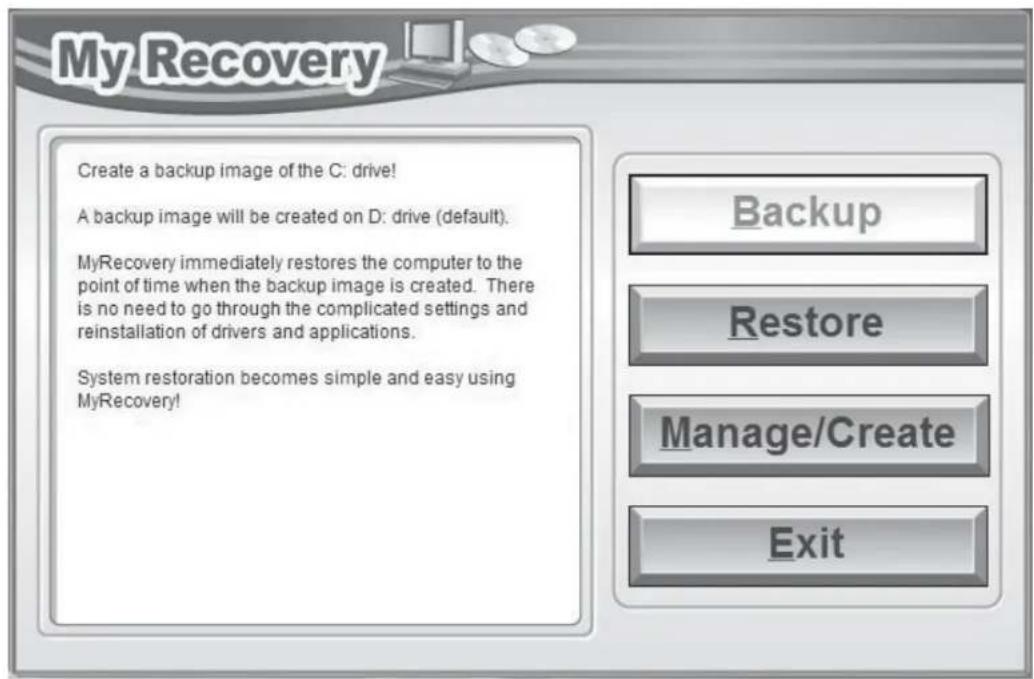
Figure 34. MyRecovery screen
4 Click the [Next] button and the system will reboot.
5 After rebooting, the "Creating of the backup image" window appears, in which you can either click [Create the image on D drive] or [Select the drive] if you want to save to an external hard disk drive. (Note that the [Create the image on D drive may not be available on all configurations.)
6 An image appears showing you graphically how the image will be stored. Click the [Next] button.
7 Click [Execute] to start the backup.
Managing Your Backup Images
With the MyRecovery tool you can also make copies of backup images, archive them on DVD, or delete them from your hard drive.
1 To begin, click the [MyRecovery] icon on your desktop.
2 Click the [Manage/Create] button in the MyRecovery window.
3 When the MyRecovery Manager window appears, click [Manage Backup Images].
4 In the next window, a list of your backup images appears. Below the list are three buttons allowing you to [Make DVD], [Copy], or [Delete] your backup images.
5 Select an image title from the list, then click the action button you would like to perform.
6 Note that you need to have an external disk drive connected for the [Copy] button to be enabled. If you elect to copy the image, you will be prompted to enter the destination. If you are ready to copy, click [OK] to proceed. A progress screen appears while the backup copy is being made.
7 Note that if you copy an image to an external hard drive, both the original and the copy will appear in the [Backup Images] window with identical names, dates, and file sizes, but with the different drive letter to distinguish them. Before you select [Make DVD], make sure you have a recordable DVD drive connected and blank DVDs available.
Using the Recovery and Utility Tools
The Recovery and Utility tools consist of a variety of tools that will help you recover your Factory Image, recover system images, and delete the data from your hard disk.
Methods for accessing the utilities
Recovery and Utility Tools are preinstalled in a hidden partition by the factory, or they can be accessed by using the bootable disc. Please note that you can delete Recovery and Utility tools from your hard disk drive if you modify the partitions. In this case you will not be able to use the hidden partition for booting to Recovery and Utility Tools, but you will still be able to boot from the Bootable Disc.
Determining whether Recovery and Utility is pre-loaded
1 Turn on or reboot your system. When the Fujitsu logo appears, press [F12] key. The Boot Menu will appear.
2 Press the Tab key to select Application menu.
3 Check whether the
Running Recovery and Utility from hard disk
1 Turn on or reboot your system. When the Fujitsu logo appears, press [F12] key. The Boot Menu will appear.
2 Press the Tab key to select Application menu.
3 Cursor down to
4 While the files are being loaded from the disc, a progress bar will appear at the bottom of the screen.
5 When the System Recovery Options dialog opens, select a new keyboard layout, if necessary, then click [Next].
6 When the Operating System dialog appears, select "Use recovery tools...", then click [Next].
7 If necessary, enter your password, then click [OK].
8 When System Recovery Options window appears, click on Recovery and Utility.
9 The Recovery and Utility screen appears on the screen with three tabs: Diagnostics, Recovery and Utility. Please note that Diagnostics tab is not supported on certain LIFEBOOK/STYLISTIC models when running Recovery and Utility from the hard disk. In order to restore the operating system, please use the middle icon "Restoring the Factory Image (only C:\drive)" under the Recovery tab.
Running Recovery and Utility from the Bootable disc
To verify/change the boot-up priority (rather than booting-up from the hard drive or an external floppy disk drive), perform the following steps:
1 Power on your system. When the Fujitsu logo appears on the screen. press the [F12] key to get to the Boot Menu.
2 Highlight the CD/DVD option.
3 Insert the bootable disc into the drive tray.
4 Click [OK]. While the files are being loaded from the disc, a progress bar will appear at the bottom of the screen.
5 When the System Recovery Options dialog opens, select a new keyboard layout, if necessary, then click [Next].
6 When the Operating System dialog appears, click [Next].
7 If necessary, enter your password, then click [OK].
8 When System Recovery Options window appears, click on Recovery and Utility.
9 When the Recovery and Utility screen appears, three tabs will be present: Diagnostics, Recovery, and Utility.
Recovery and Utility tabs
Diagnostics tab: The Diagnostics tool is designed for use by IT professionals. It is not likely you will need to use this tool. When you select devices from the Diagnosis window then click [Execute], several tests are performed on the selected components.
Recovery tab: The Recovery tab contains three tools: Recovering User-Configured System Backups, Restoring the Factory Image (only C: drive), and Restoring the Factory Image (full hard drive recovery). You can use these tools to restore the Factory Image from the hidden partition, restore backup image(s) created by you or images stored on DVD discs, and perform a full hard drive recovery. Please refer to instructions above for details on how to create Factory Image Recovery DVDs, user backup DVDs and system image backup.
Utility tab: The Utility tab contains three tools: Hard Disk Data Delete, Restore Recovery and Utility, and Windows Complete PC Restore.
- The Hard Disk Data Delete utility is used to delete all data on the hard disk and prevent the data from being reused. NOTE: Do not use the Hard Disk Data Delete utility unless you are absolutely certain that you want to erase your entire hard disk, including all partitions.
- Restore Recovery and Utility allows you to restore the first hidden partition.
- Windows Complete PC Restore utility allows you to restore an image created with Windows Backup and Restore Center. Complete PC Restore will overwrite the data on your hard disk drive.
Using Windows 7 Recovery DVD on Windows 8 64-bit system (downgrade option).
When using the Windows 7 Recovery DVD on a system that was supplied with Windows 8 x64 pre-installed, you should first deactivate Secure Boot and activate CSM and Fast Boot using the following procedure:
1 To access the BIOS Setup, press the [F2] key after switching on the system.
2 Use right/left arrow keys to switch to the "Security" page. NOTE: If your system doesn't have Supervisor Password, you cannot change the Secure Boot Configurations. In this case you need to select Set Supervisor Password and set the password.
3 Use up/down arrow keys to select Secure Boot Configurations.
4 Select Secure Boot or Secure Boot Option and using [Enter] key set it to [Disabled], then the use [ESC] key to exit Secure Boot Configurations.
5 Use arrow keys to switch to the "Advanced" page.
6 Select CSM and set it to [Enabled].
7 Select the Fast Boot and set it to [Disabled].
8 Use the arrow keys to switch to the "Exit" page.
9 Exit the BIOS Setup via Exit Saving Changes.
You can then start the system from Windows 7 Recovery DVD and install Windows 7 on the system.
Recovering your Factory Image using Recovery and Utility (for new hard drive or non-bootable hard drive)
If you have installed a new hard drive or your hard drive is not bootable, perform the following steps. Note that first you will need to create new partitions on the hard drive, then restore the Factory Image:
1 Power on your system. When the Fujitsu logo appears on the screen. press the [F12] key.
2 Highlight the CD/DVD option.
3 Insert the bootable disc in your DVD drive, then click [OK].
4 When System Recovery Options window appears, click on
5 When the System Recovery Options dialog opens, select a new keyboard layout, if necessary, then click [Next].
6 When the Operating System dialog appears, click [Next].
7 If necessary, enter your password, then click [OK].
8 When System Recovery Options window appears, click on Recovery and Utility.
9 Click the Recovery tab in the Recovery and Utility window, then click Restoring the Factory Imageicon.
10 Click [Execute].
11 Read the precautions, then select "I Agree".
12 Click [Next], then click [Execute] to start the recovery process.
13 "1. Recovery Disc Check" will be in bold and the rest will be grayed out. Follow the instructions and "Insert the Recovery Disc #1". In some cases, you may prompted to "Insert the Recovery Disc #2", depending upon the size of the Recovery Image
14 Click [Next] to begin the check. Click [Next] again when the check is complete.
15 "2. Initializing hard disk drive" will be in bold with the message "Please insert the Bootable Disc into your optical drive". Insert the bootable disc. Click [Next] to proceed. A dialog box appears, with a checking disc message.
16 "Warning All DATA on the Hard Disk will be completely erased!!!" will appear. Select [OK]. The partition creation process will begin.
17 "3. Restoring Factory Image to hidden partition" will be in bold with the message "Please insert the Recovery Disk#1 into the optical drive". Click [Next] to proceed.
After completion, the tool will automatically go back to "3. Restoring Factory Image to hidden partition" but will include the note "Please insert your Third Party Applications Disc or CyberLink DVD, then click [OK]. After installation of each disc, insert the next and continue until all have been installed. If you don't have your Third Party Applications Disc and/or CyberLink DVD, or you have already inserted these discs, please click [Skip] to continue. NOTE: In some cases (products without an optical drive) you will not have a CyberLink DVD".
At this point, you can either:
- Insert Application Disc(s) to restore back to hidden partition, or,
- Click [Skip] to skip restoring Application disc(s) and continue with restore.
18 If you select to insert Application Disc, after copying of application disc(s) to hidden partition is completed, the message will appear again. Repeat inserting application disc(s) until all discs have been copied, then click [Skip] to continue with Restore.
19 After clicking [Skip], a confirmation message will appear "If you want to skip copying or you have finished copying, click [OK]. Click [Cancel] to go back to Restoring Factory Image to hidden partition."
20 Click [OK] and Restoring Factory Image will begin.
21 When restoration is complete, you will see the message "Restoration has been completed. Click [OK] to reboot the computer." Click [OK].
Downloading Driver Updates
The Fujitsu Software Download Manager (FSDM) utility is available to allow you to download the latest drivers, utilities, and applications from the Fujitsu Support site. If you have a Windows 8 or Windows 7 operating system, you will need to go to the Support Site (http://support.fujitsupec.com/CS/Portal/support.do?src=DOWNLOADS).
Restoring Your System Image and Software (Windows 8)
Equivalent information for Windows 7 configurations can be found at "Restoring Your System Image and Software (Windows 7)" on page 95
It is very important that you create DVD copies of your Factory Image and Bootable Disc before beginning to use your system. To do so, follow the instructions in the "Saving Your Factory Image" and "Creating Backup Images of Factory Image and Discs" sections of this chapter.
Saving and Recovering Your Factory and System Images
Along with instructions on saving your Factory Image, this document outlines several other important procedures, such as making a system image, restoring your Factory Image and system images, managing your images, and restoring the partitions on a hard drive.

IN ORDER TO MAKE COPIES OF FACTORY AND SYSTEM IMAGES AND BURN BOOTABLE DISCS YOU MUST HAVE AN INTERNAL OR EXTERNALLY CONNECTED WRITABLE DVD DRIVE.
IT IS EXTREMELY IMPORTANT THAT YOU COPY YOUR FACTORY IMAGE TO REMOVABLE MEDIA (E.G., DVD DISCS). FAILURE TO DO SO COULD RESULT IN AN INABILITY TO RESTORE THE IMAGE AT A FUTURE DATE.
- WE RECOMMEND THAT YOU USE DVD-R OR DVD+R DISCS FOR YOUR BACKUP, BUT SUPPORTED MEDIA* FOR IMAGE BACKUPS INCLUDE: FOR FACTORY IMAGE, APPLICATION DATA, AND BOOTABLE DISC: DVD-R/+R. FOR USER-CREATED BACKUP IMAGE: DVD-R/+R, DVD-RW/+RW, DVD-DL.
- DEPENDING UPON YOUR OPTICAL DRIVE AND MEDIA FORMAT USED, SOME MEDIA TYPES MAY BE INCOMPATIBLE FOR CREATING IMAGE BACKUPS.

DUE TO CERTAIN LICENSING REQUIREMENTS, SOME THIRD-PARTY APPLICATIONS WILL NEED TO BE INSTALLED SEPARATELY.
Saving your Factory Image
When you purchased your new system, a copy of the pre-installed Factory Image was loaded into a hidden partition on your hard disk drive. Having a copy of the original Factory Image available to you means that in the event of system failure, you will be able to restore it to its original state.
To make a copy of the Factory Image to DVD discs, you will need four or five blank discs (DVD-R or DVD+R discs are recommended) to create the copy. After creating the copy, be sure to label the discs and keep them in a safe place to ensure they do not get damaged.
Creating Backup Images of Factory Image and Bootable Disc
Using the [Manage/Change] button, you can create backup images of the Factory Image and/or Bootable Disc.

ALL USER-CREATED DATA WILL BE DELETED FROM YOUR SYSTEM WHEN THE FACTORY IMAGE IS RESTORED.
1 Launch System Backup and Restore from the desktop icon and click [Yes] on the User Account Control dialog.
2 Click [Next] on the Backup Your Data screen.
3 Select the [Manage/Create] tab, then click [Make Recovery Disc set] to burn your factory image to DVD.
4 On "Step 1: Please select a media type for Recovery Disc" screen select Media Type from the drop down box, then click [Next]. (Note: This screen shows the number of discs required for backup.)
5 On "Step 2: Confirm your Recovery Disc" both the Bootable Disc and Recovery disks are selected by default under "List of Recovery Disks". When the backup is created for the first time, these options should stay selected. Click [Next].
6 Click [OK] on the "Attention about media" confirmation screen.

DURING THE FOLLOWING PROCESS, YOU SHOULD CONNECT AN AC ADAPTER SINCE THE PROCESS MAY TAKE A LONG TIME.
7 Click [Start] on "Step 3: Making Recovery Disc".
8 The process will prompt you to insert your discs.
9 Once the process completes successfully, click [Finish] on "Step 4: Making Recovery Disc process has been completed" screen.
Recovering Your Factory Image.
In the event you need to restore your original Factory Image, perform the following steps.

ALL USER-CREATED DATA WILL BE DELETED FROM YOUR SYSTEM WHEN THE FACTORY IMAGE IS RESTORED.
In order to recover your Factory Image, perform the steps outlined in "Running Recovery and Utility from hard disk".
Backing Up a System Image
Optional Step: Launch the Fujitsu Bonus Apps utility from your desktop, and select the components you wish to install.
User-Configured System Backups: On your desktop, there is a [System Backup and Restore] icon that allows you to make backups of your current system image either to another location on your hard drive or on removable media. A system image is the configuration of your C: drive at a particular point of time.
You may want to make system image backups occasionally in order to have points to which you can return without having to go all the way back to the Factory Image.
By default, system images are saved in the D: drive in the System Backup and Restore folder. You can also elect to save the image to an external hard drive.
1 Launch System Backup and Restore from the desktop icon and click [Yes] on User Account Control dialog
2 Click [Next] on Backup Your Data screen
3 Select the [Backup] tab on System Backup and Restore screen.
4 Click the [Backup User System] button.
5 On the "Step 1: Select a backup destination" screen select your destination drive. By default the Destination is set to D: drive. You can also select the [Other drive] option to back up to an external drive. Select whether you would like the system to [Shutdown] or [Restart] after the process is completed.
6 On the "Step 2: Name your backup images" screen that appears, you can enter up to 300 characters of information about the backup file. This information will help you to identify the image at a later date.
7 On "Step 3: Backup the entire C: drive image" verify your backup settings and click [Next].
8 Click [OK] on "Step 4: Please confirm the following before starting your backup" to restart you computer and begin backup.
9 After backup completes and the system restarts, "Step 5: Backup Completed. Confirm the results" screen should appear on your desktop confirming that backup image has been created successfully. Click [Close] to close System Backup and Restore dialog.
10 Click [OK] to quit the System Backup and Restore utility.
Managing Your Backup Images
With the System Backup and Restore tool you can also make copies of backup images, archive them on DVD, or delete them from your hard drive.
1 Launch System Backup and Restore from the desktop icon and click [Yes] on User Account Control dialog.
2 Click [Next] on the Backup Your Data screen.
3 Select the [Create/Manage] tab and click on [Manage User System Backup].
4 In the next window there are three options allowing you to [Copy], [Delete], or [Add Comment] to your images. Click the action button you would like to perform:
Selecting [Copy] option (Note that you must have an external disk drive connected for the [Copy] button to work, otherwise an attempt to copy will result in an error.)
a. On "Step 1: Select a backup file that you wish to copy", select the location of a backup file. A list of backup files will appear. Select the file you wish to copy from the list and click [Next].
b. On "Step 2: Select a drive to copy a backup file", select the destination drive and click [Next].
c. On "Step 3: Start to copy the following information" confirm the information and click [Start].
d. "Step 4: Processing backup data copying" screen displays the progress bar.
e. Click [Finish] on "Step 5: Copy completed. Confirm the results" screen.
Selecting "Delete" option
a. On "Step 1: Please select your target data" screen select location of a backup file. A list of backup files will appear. Select the file(s) you wish to delete and click [Next].
b. Click [Start] on "Step 2: Delete backup data" screen.
c. Click [OK] to the confirmation message.
d. Click [Finish] on "Step 4: Delete process has been completed" screen.
Selecting "Add Comment" option
a. On the "Step 1: Select target data" screen select location of a backup file. A list of backup files will appear. Select the file you wish to add comments to and click [Next].
b. On the "Step 2: Add comment" screen, type in a maximum of 300 characters in "Comment" text area and click [Add].
c. Click [Finish] on the "Step 3: Adding comment has been completed" screen.
Restoring your backup images
1 Launch System Backup and Restore from the desktop icon and click [Yes] on the User Account Control dialog
2 Click [Next] on the Backup Your Data screen
3 Select the Restore tab and click on "Restore User System Backup"
4 On "Step 1: Please confirm the following before starting restore process", confirm information and click [OK]. The system will restart to begin restoring your backup.
5 After the system restarts, the "Explanation about Restore User System Backup" screen is shown. Once you read the EULA, select [Agree] choice and click [Next].
6 Select an image to restore from the Backup data list and click [Next]
7 Click [Start] on "Confirm before restoration" screen
8 Once restoration finishes, click [Close] in "Finished restoration" screen, the computer will restart to Windows.
Using the Recovery and Utility Tools
The Recovery and Utility tools consist of a variety of tools that will help you recover your Factory Image, recover system images, and delete the data from your hard disk.
Methods for accessing the utilities
Recovery and Utility Tools are preinstalled in a hidden partition by the factory, or they can be accessed by using the bootable disc. Please note that you can delete Recovery and Utility tools from your hard disk drive if you modify the partitions. In this case you will not be able to use the hidden partition for booting to Recovery and Utility Tools, but you will still be able to boot from the Bootable Disc.
Determining whether Recovery and Utility is pre-loaded
1 Turn on or reboot your system. When the Fujitsu logo appears, press [F12] key.
2 From the Boot Menu that appears, check whether the
Running Recovery and Utility from hard disk
1 Turn on or reboot your system. When the Fujitsu logo appears, press the [F12] key.
2 Cursor down to
3 Choose your Language (English or French).
4 Three tool options appear: Diagnostics, Recovery and Utility (Please see Recovery and Utility tools section below for instructions on how to use these tools).
Running Recovery and Utility from the Bootable disc
To verify/change the boot-up priority (rather than booting-up from the hard drive or an external floppy disk drive), perform the following steps:
1 Power on your system. When the Fujitsu logo appears on the screen. press the [F12] key.
2 Highlight the CD/DVD option from the Boot menu, then press [Enter].
3 Insert the bootable disc into the drive tray.
4 Click [OK].
NOTE: In the following step, the Fujitsu logo screen may appear on the display for a couple of minutes before the progress bar appears.
5 Select CD/DVD boot mode: UEFI Mode) and press [Enter]. While the files are being loaded from the disc, the Fujitsu logo screen will appear followed by a progress bar screen at the bottom of the screen.
Recovery and Utility tools
Diagnostics tool: The Diagnostics tool is designed for use by IT professionals. It is not likely you will need to use this tool. If you should need to use this tool, perform the following steps:
1 Press the "Diagnostics Tool" button to start the Diagnostics tool. A progress bar appears while the Diagnostics tool is starting up.
2 Read the note, then click [OK].
3 Choose one or more of the following options for diagnostics on the "Fujitsu Hardware Diagnostics Tool window": CPU, Memory, Display, Hard Disk, CD/DVD/BD, Floppy Disk, Keyboard, and Mouse. Click the [Option] button to specify how many times the tool should run diagnostics on each selected component. Press [Execute] to start the Diagnostics tool.
4 After the execution is completed, the selected components are circled in red to indicated that they have been diagnosed and the result dialog window is opened.
5 Click [End] to close the Diagnostics tool, then click [Yes] to confirm the end of diagnostics session.
Recovery tool: The Recovery tool contains three options. User System Backups: Recovering C: Drive from D: Drive or external storage device), Restore C: Drive: Restore factory image (only C: drive), and Restore Full Hard Drive: Restore factory image (full hard drive). You can use these tools to restore the Factory Image from the hidden partition, restore backup image(s) created by you or images stored on DVD discs, and perform a full hard drive recovery. Please refer to instructions above for details on how to create Factory Image Recovery DVDs, user backup DVDs and system image backup.
To recover from D: drive or external storage device:
1 Click [User System Backups]
2 The progress bar screen is followed by EULA screen. Click [Agree] to accept the EULA.
3 On "Select an image to restore" screen select the image to restore from the list of images and click [Next].
4 Click [Start] on the "Confirm before restoration" screen to begin the restoration process.
5 Once restoration finishes, click [Close] in the "Finished restoration" screen; the computer will restart to Windows.
To restore from the Factory Image (hidden partition):
1 Click [Restore C: drive].
2 The progress bar screen is followed by "Restore Factory Image (only C: drive) screen confirming that the Factory Image will be restored to the C: drive and D: drive data will remain. Click [Next].
3 Read the instruction screen and select [Agree], then [Next].
4 Click [OK] to the warning message to restore factory image to the C: drive.
5 When the progress bar screen, wait for the process to complete.
6 Click [Finish] when the process completes; the computer will restart to Windows.
To restore full hard drive:
Follow the steps in section "Recovering your Factory Image using Recovery and Utility (for new hard drive or non-bootable hard drive)"
Utility tool: The Utility tool contains two options: Hard Disk Data Delete and Partition Creation.
- The Hard Disk Data Delete utility is used to delete all data on the hard disk and prevent the data from being reused. NOTE: Do not use the Hard Disk Data Delete utility unless you are absolutely certain that you want to erase your entire hard disk, including all partitions.
To delete hard disk data:
a. Click the [Hard Disk Data Delete] button
b. The progress bar appears, followed by the EULA screen.
c. Agree to the EULA and click [Next].
d. Choose the hard disk from which the data should be deleted in the list of hard disks and click [Next].
- The Partition Creation utility is used to change the C: and D: drive partition sizes. To run this utility:
a. Click the [Partition Creation] button.
b. A progress bar screen appears, followed by the EULA screen. Agree to the EULA.
c. On the Recovery Tool - Partition Creation screen move the slider to set disk size, then click [OK].
d. Click YES in the Partition Creation confirmation dialog.
Recovering your Factory Image using Recovery and Utility (for new hard drive or non-bootable hard drive)
If you have installed a new hard drive or your hard drive is not bootable, perform the following steps.
1 Power on your system. When the Fujitsu logo appears on the screen, press the [Enter] key.
2 Highlight the CD/DVD option from the Boot Menu and press [Enter].
3 Insert the bootable disc in your DVD drive, then click [OK].
4 Select CD/DVD boot mode: UEFI Mode and press [Enter]. While the files are being loaded from the disc, Fujitsu logo screen will appear followed by a progress bar screen at the bottom of the screen.
5 Choose your language (['English or French].
6 Three tool options appear: Diagnostics, Recovery and Utility. Select [Recovery].
7 Select [Restore full hard drive].
8 Click [Next] to confirm full hard drive restoration. (All data on HDD will be deleted).
9 Agree to EULA by selecting [Agree] option and clicking [Next].
10 Click [Next] on the Recovery Disk Check screen to verify that the bootable disk has been inserted into the optical drive.
11 The Checking for Recovery Disk screen appears followed by the prompt to insert the first disk. Click [OK] to continue. Repeat this step for all disks. After all recovery disks have been checked and the check has been completed, click [Next]
12 Reinsert the first recovery disk and click [Next]
13 Click [OK] when you receive the final warning informing you that all data on drives C: and D: will be lost. This starts the recovery process.
14 Follow the prompts to insert the next recovery disks and click [OK].
15 After the copying of the factory image to the HDD completes and the factory image is restored, follow the prompt to insert bootable disk.
16 After the restore process is complete, click [Finish] to restart the system. The computer will restart automatically and then go through the first boot process.
Changing BIOS settings between Windows 8 32-bit and Windows 8 64-bit
In order to install a 32-bit version of Windows 8 and to be able to boot from 32-bit media, you must disable the Security Boot option in the BIOS settings. Switching back to the 64-bit version of Windows 8 from the 32-bit version of Windows 8 will require you to revert the above change and to re-enable Secure Boot. If you do not re-enable Secure Boot, the following product functionalities will not be enabled as it relies on native EFI (Unified Extensible Firmware Interface) mode boot:
1 Secure Boot
2 Seamless Boot experience
3 Network unlock for Bitlocker for systems with a Trusted Platform Module (TPM)
4 eDrive support
WARNING: Reverting back to UEFI mode will require a hard drive reformat. All data and personal settings will be lost. It is highly recommended that you back up your data before you revert back to UEFI mode.
For further information please refer to our support pages: http://www.fujitsu.com/us/support/
1 To access the BIOS Setup, press the [F2] key after switching the system on.
2 Use the right/left arrow keys to switch to the Security page.
- If your system doesn't have Supervisor Password, you cannot change the Secure Boot Configurations. In this case you need to select Set Supervisor Password and set the password.
3 Use the up/down arrow keys to select Secure Boot Configurations.
4 Select Secure Boot or Secure Boot Option and using the [Enter] key set it to [Disabled] for 32-bit and to [Enabled] for 64-bit, then use the [ESC] key to exit Secure Boot Configurations.
5 Use the arrow keys to switch to the Advanced page.
6 Select CSM and set it to [Enabled] for 32-bit and [Disabled] for 64-bit.
7 Select the Fast Boot and set it to [Enable] for 32-bit and [Disabled] for 64-bit.
8 Use the arrow keys to switch to the Exit page.
9 Exit the BIOS Setup via Exit Saving Changes.
Downloading Driver Updates
The Fujitsu Software Download Manager (FSDM) utility is available to allow you to download the latest drivers, utilities, and applications from the Fujitsu Support site. If you have a Windows 8 or Windows 7 operating system, you will need to go to the Support Site (http://support.fujitsupec.com/CS/Portal/support.do?src=DOWNLOADS).
Chapter 5
Care and Maintenance
Caring for your LIFEBOOK Notebook
If you use your Fujitsu LIFEBOOK notebook carefully, you will increase its life and reliability. This section provides some tips for looking after the notebook and its devices.
- THE SYSTEM CONTAINS COMPONENTS THAT CAN BE SEVERELY DAMAGED BY ELECTROSTATIC DISCHARGE (ESD). TO MINIMIZE RISK TO THE COMPONENTS, OBSERVE THE FOLLOWING PRECAUTIONS:
BEFORE DOCKING OR UNDOCKING YOUR LIFEBOOK NOTEBOOK (WHEN USING A PORT REPLICATOR), IT IS A GOOD PRACTICE TO ALWAYS TOUCH A GROUNDED METAL OBJECT TO DISCHARGE STATIC ELECTRICITY BUILT UP IN YOUR BODY.
BE SURE TO POWER DOWN YOUR SYSTEM BEFORE ADDING OR REMOVING SYSTEM COMPONENTS. EVEN IF THE SYSTEM IS IN HIBERNATE OR SLEEP STATES, DATA COULD BE LOST OR MEMORY COULD BE DAMAGED IF POWER IS STILL AVAILABLE TO THE SYSTEM.
- WHEN INSTALLING OR REMOVING A MEMORY MODULE, HOLD IT BY THE EDGE SO AS NOT TO TOUCH ANY CONTACTS OR CHIPS. BE CAREFUL NOT TO TOUCH ANY INTERNAL TERMINALS OR COMPONENTS; THE OIL FROM YOUR FINGERS COULD CAUSE A SHORT TO THE COMPONENTS.
ELECTRICAL EQUIPMENT MAY BE HAZARDOUS IF MISUSED. OPERATIONS OF THIS PRODUCT OR SIMILAR PRODUCTS, MUST ALWAYS BE SUPERVISED BY AN ADULT. DO NOT ALLOW CHILDREN ACCESS TO THE INTERIOR OF ANY ELECTRICAL PRODUCTS AND DO NOT PERMIT THEM TO HANDLE ANY CABLES.
- Your notebook is a durable but sensitive electronic device. Treat it with respect and care.
- Make a habit of transporting it in a suitable carrying case.
-
Do not attempt to service the computer yourself. Always follow installation instructions closely.
-
Keep it away from food and beverages.
- To protect your notebook from damage and to optimize system performance, be sure to keep all air vents unobstructed, clean, and clear of debris. This may require periodic cleaning, depending upon the environment in which the system is used.
- Do not operate the notebook in areas where the air vents can be obstructed, such as in tight enclosures or on soft surfaces like a bed or cushion.
- If you accidentally spill liquid on your LIFEBOOK notebook:
1 Turn it off.
2 Position it so that the liquid can run out.
3 Let it dry out for 24 hours, or longer if needed.
4 If your notebook will not boot after it has dried out, call your support representative.
- Do not use your Fujitsu LIFEBOOK notebook in a wet environment (near a bathtub, swimming pool).
- Always use the AC adapter and batteries that are approved for your notebook.
- Avoid exposure to sand, dust and other environmental hazards.
- Do not expose your notebook to direct sunlight for long periods of time as temperatures above 140^ ( 60^ ) may damage your notebook.
- Keep the covers closed on the connectors and slots when they are not in use.
- Do not put heavy or sharp objects on the computer.
- If you are carrying your LIFEBOOK notebook in a briefcase, or any other carrying case, make sure that there are no objects in the case pressing on the lid.
- Never position your notebook such that the optical drive is supporting the weight of the notebook.
Cleaning your LIFEBOOK notebook
- Always disconnect the power plug. (Pull the plug, not the cord.)
- Clean your LIFEBOOK notebook with a damp, lint-free cloth. Do not use abrasives or solvents.
- Use a soft cloth to remove dust from the screen. Never use glass cleaners.
- Always shut down the computer, unplug the power adapter, and remove the battery when cleaning or disinfecting the computer exterior, keyboard or LCD display.
Cleaning guidelines using recommended off-the-shelf cleaners
Computer exterior, computer keyboard
To clean the exterior and keyboard, use one of the following off-the-shelf products:
Office Depot#154-616 Notebook Cleaning Kit
- Meridrew Enterprises Klear_Screen® Wipes
- 3M CL563 Cleaner Wipes
Note: After cleaning with one of these products, gently polish with a dry, soft, lint-free cloth until the solution is no longer visible.
LCD display
To clean the LCD display, use one of the following off-the-shelf products:
Office Depot#154-616 Notebook Cleaning Kit
- Meridrew Enterprises Klear_Screen® Wipes
Applies to Tablet PC, convertible PC with LCD shield, and standard notebook LCD displays.
Wipe the LCD surface gently, allowing it to dry before turning on the computer.
Disinfecting LIFEBOOK computers
Wipe the surface with a soft cloth wipe and a 50% ethanol solution or use another ethanol-based germicide which has been registered as a hospital disinfectant by the EPA.

USE OF INCORRECT CLEANERS CAN RESULT IN OPTICAL IMPAIRMENT OF THE LCD AND/OR DAMAGE TO THE COMPUTER. ALWAYS REFER TO THE CLEANER MANUFACTURER'S GUIDELINES AND MATERIAL SAFETY DATA SHEETS FOR PROPER HANDLING AND USE OF THE PRODUCTS.
- NEVER USE AMMONIA, ACIDIC, OR ALKALINE CLEANERS OR ORGANIC CHEMICALS SUCH AS PAINT THINNER, ACETONE, PROPYL OR ISOPROPYL ALCOHOL, OR KEROSENE. IT MAY DAMAGE SURFACE FINISHES AND THE COATING OF THE LCD SCREEN.
- NEVER USE COMPRESSED AIR FOR CLEANING STYLISTIC AND LIFEBOOK PCS.
Cleaning the dust filter
Your LIFEBOOK is equipped with fans to make air flow inside by pulling in outside air to cool the inside of the system. Depending on the environment in which the system is used, dust and dirt may be pulled in along with the air. Accumulated dust and dirt could impair the function of the system.

- REMOVE AC ADAPTER: BEFORE REMOING THE FILTER COVER, TURN OFF THE SYSTEM AND PERIPHERALS AND DISCONNECT THE AC ADAPTER.
- CLEANING THE FILTER:
-DO NOT USE DETERGENT
- AVOID DAMAGING THE FILTER; DAMAGE TO THE FILTER IS NOT COVERED BY WARRANTY.
- USE PLASTIC TOOLS TO CLEAN THE FILTER. METAL OR WOODEN TOOLS COULD DAMAGE THE FILTER.
- ESD: BEFORE CLEANING THE FILTER, TOUCH A METAL OBJECT TO DISCHARGE STATIC ELECTRICITY.
1 Turn off your computer and disconnect the AC adapter.
2 Close the display panel and turn the system upside down.
3 Remove the dust filter cover by pressing the ridged tab inwards and lifting it out (Figure 35).
4 Carefully clean the dust filter and the air-cooling duct.
5 Put back the dust filter cover by inserting the end without the latch first and pushing in the cover until it latches.

ALWAYS BE SURE THE DUST FILTER COVER IS INSTALLED WHEN RUNNING YOUR SYSTEM. NOT USING THE FILTER COVER COULD CAUSE CONTAMINATION AND POSSIBLE DAMAGE TO THE SYSTEM.
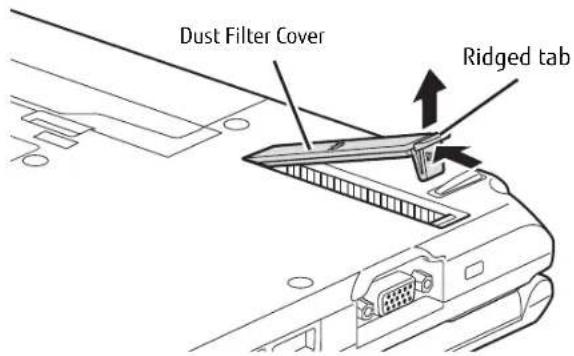
Figure 35. Removing/installing the dust filter
Storing your LIFEBOOK notebook
- If storing your notebook for a month or longer, turn your LIFEBOOK notebook off, fully charge the battery, then remove and store all Lithium ion batteries.
-
Store your LIFEBOOK in a cool, dry location. Temperatures should remain between 5^ (-15^) and 140^ (60^)
-
Store your notebook and batteries separately. If you store your LIFEBOOK with a battery installed, the battery will discharge, and battery life will be reduced. In addition, a faulty battery might damage your LIFEBOOK..

- ALWAYS POWER OFF THE COMPUTER BEFORE TRANSPORTING AND/OR PACKAGING IT. AFTER SHUTTING DOWN THE SYSTEM, WAIT UNTIL THE STATUS LED PANEL INDICATES POWER OFF CONDITION (I.E., NO LIGHTS ARE ILLUMINATED).
- IT IS POSSIBLE THAT THE UNIT MAY NOT AUTOMATICALLY GO TO POWER OFF OR HIBERNATE MODE WHEN YOU CLOSE THE LID. THIS SITUATION MAY OCCUR DUE TO PRE-OS BOOT PASSWORD SECURITY SETTINGS OR SOME OTHER APPLICATION RUNNING ON THE COMPUTER.
- ATTEMPTING TO TRANSPORT THE COMPUTER WHILE POWER IS ON MAY DAMAGE THE NOTEBOOK DUE TO SHOCK OR OVERHEATING SINCE THE AIR VENTIS MAY BE BLOCKED OR RESTRICTED.
Traveling with your LIFEBOOK notebook
- Do not transport your notebook while it is turned on.
It is recommended that you carry your notebook with you while traveling, rather than checking it in as baggage. - Take the necessary plug adapters if you're traveling overseas. Check the following diagram to determine which plug adapter you'll need or ask your travel agent.
| Outlet Type | Location | Outlet Type | Location |
| United States, Canada, parts of Latin America, Mexico, Japan, Korea, the Philippines, Taiwan | United Kingdom, Ireland, Malaysia, Singapore, parts of Africa | ||
| Russia and the Commonwealth of Independent States (CIS), most of Europe, parts of Latin America, the Middle East, parts of Africa, Hong Kong, India, most of South Asia | China, Australia, New Zealand |
- Never put your notebook through a metal detector; have it hand-inspected by security personnel. You can however, put the notebook through a properly tuned X-ray machine. To avoid problems, place your it close to the entrance of the machine and remove it as soon as possible or have it hand-inspected by security personnel. Security officials may require you to turn the notebook on, so make sure you have a charged battery on hand.
Batteries
Caring for your Batteries
- Always handle batteries carefully.
- Do not short-circuit the battery terminals (that is, do not touch both terminals with a metal object). Do not carry loose batteries in a pocket or purse where they may mix with coins, keys, or other metal objects. Doing so may cause an explosion or fire.
- Do not drop, puncture, disassemble, mutilate or incinerate the battery.
- Recharge batteries only as described in this manual and only in ventilated areas.
- Do not leave batteries in hot locations for more than a day or two. Heat can shorten the battery life.
- Do not leave a battery in storage for longer than 6 months without recharging it.
Increasing Battery Life
- Power your notebook through the AC or optional auto/airline adapter whenever possible.
- If your notebook is running on battery power all day, connect it to the AC adapter overnight to recharge the battery.
- Keep brightness to the lowest level comfortable.
- Set the power management for maximum battery life.
- Put your notebook in Sleep mode when it is turned on and you are not actually using it.
- Disable the Media Player auto insert notification function.
- Eject ExpressCards when not in use.
Media Care
Caring for your Media (DVD/CD/CD-R)
Media discs are precision devices and will function reliably if given reasonable care.
- Always store your media disc in its case when it is not in use.
- Always handle discs by the edges and avoid touching the surface.
- Avoid storing any media discs in extreme temperatures.
- Do not bend media discs or set heavy objects on them.
- Do not spill liquids on media discs.
- Do not scratch or get dust on media discs.
- Never write on the label surface with a ballpoint pen or pencil. Always use a felt pen.
- If a media disc is subjected to a sudden change in temperature, cold to warm condensation may form on the surface. Wipe the moisture off with a clean, soft, lint free cloth and let it dry at room temperature. DO NOT use a hair dryer or heater to dry media discs.
- If a disc is dirty, use only a DVD/CD cleaner or wipe it with a clean, soft, lint free cloth starting from the inner edge and wiping to the outer edge.
Caring for your Optical Drive
Your optical drive is durable but you must treat it with care. Please pay attention to the following points:
- The drive rotates the compact disc at a very high speed. Do not carry it around or subject it to shock or vibration with the power on.
- Avoid using or storing the drive in damp or dusty conditions or extreme temperatures.
- Avoid using or storing the drive near magnets or devices that generate strong magnetic fields.
- Avoid using or storing the drive where it will be subjected to shock or vibration.
- Do not disassemble or dismantle the optical drive.
- Use of a commercially available lens cleaner is recommended for regular maintenance of the drive.
Caring for your Cards
ExpressCards are durable, but you must treat them with care. The documentation supplied with your card will provide specific information, but you should pay attention to the following points:
- To keep out dust and dirt, store cards in their protective sleeves when they are not installed in your LIFEBOOK notebook.
- Avoid prolonged exposure to direct sunlight or excessive heat.
- Keep the cards dry.
- Do not flex or bend the cards, and do not place heavy objects on top of them.
- Do not force cards into the slot.
- Avoid dropping cards or subjecting them to excessive vibration.
Chapter 6
System Specifications
Specifications
This section provides the hardware and environmental specifications for your Fujitsu LIFEBOOK notebook. Specifications of particular configurations will vary.
Microprocessor
3rd Generation Intel® Core™ Processor i3, i5, or i7 processor (Refer to the system label to determine the specific model of your processor).
Chipset
Intel QM77 or HM76 Express Chipset (depending upon system configuration)
Memory
System Memory
- DDR3-1600 MHz SDRAM dual-channel memory module.
- Two DIMM slots; upgradeable to 16 GB of total memory (8 GB x 2)
Cache Memory
L1 Cache: 32 KB x 2
L2 Cache: 256 KB on-die
- L3 Cache: Up to 6 MB (depending upon system configuration)
Video
Built-in color flat-panel TFT active matrix LCD display with backlight and simultaneous display capability.
Video Color and Resolution
14" Anti-glare TFT HD/HD+ Display
- Internal Resolution:
HD: 1366 x 768 pixel resolution, 16M colors
HD^+ : 1600× 900 pixel resolution, 16M colors
- External Resolution:
D-SUB / DVI-D: 1920 x 1200 max. pixel resolution, 16M colors
DisplayPort: 2560 × 1600 max. pixel resolution, 16M colors
- Simultaneous Resolution:
HD: 1366 x 768 pixel resolution, 16M colors
HD^+ : 1600× 900 pixel resolution, 16M colors
Graphics Controller
Shared Intel® HD Graphics 4000 controller. Uses Unified Memory Architecture (UMA) built onto motherboard which shares part of main memory for video memory. The amount of shared video memory is determined by the amount of system memory.
Audio
Realtek HD Audio codec ALC269 VB6 with 2-channel High Definition (HD) audio.
- Headphones: Stereo headphone/line-out jack, 3.5mm 1Vrms or less, minimum impedance 32 Ohms
- Microphone: Stereo microphone/line-in jack, 3.5mm , 100mVp - p or less, minimum impedance 10K Ohms
- Two built-in stereo speakers
Mass Storage Device Options
Hard Drive
Serial ATA, 300 Mbps data buffer, 5400 rpm or 7200 rpm. 2.5^ , 9.5 mm.
Depending upon your configuration, one of the following hard drives is installed. The size of your hard drive can be determined by checking the configuration label on the bottom of the system.
- 5400 rpm: 250 GB, 320 GB, 500 GB, or 750 GB
- 7200 rpm: 320 GB, 500 GB, 750 GB, or 320 GB Self-Encrypting Drive (SED)
SSD: 128 GB or 256 GB, or 128 GB SED
Modular Bay Devices
Depending upon the configuration of your system, one of the following may be installed.
- Modular Dual-Layer Multi-Format DVD Writer
- Modular Blu-ray RW Drive
Modular Bay Battery
Weight Saver
Features
Integrated Pointing Device
Touchpad pointing device with left and right buttons, one fingerprint sensor/scroll button
Communications
- Gigabit LAN: Internal wired 10/100/1000 Mbps Gigabit Ethernet LAN
Web camera: High-Definition (HD) 1280x720 pixels or Full High-Definition (FHD) 1920 x 108 pixels.
Wireless LAN:
- Integrated Intel® Centrino® Advanced-N 6205 (802.11 agn 2x2), or, Integrated Intel® Centrino® Wireless-N 2200 (802.11 bgn 2x2)
- Optional Bluetooth V4.0 device for wireless personal area network communication
Trusted Platform Module
The LIFEBOOK S752 may have an optional Trusted Platform Module (TPM) installed for added system security.
LIFEBOOK Security/Application Panel
The Security/Application Panel contains five buttons, labeled [1], [2], [3], [4], and [Enter].
Theft Prevention Lock
Lock slot for use with security restraint systems.
Device Ports
On the LIFEBOOK notebook:
ExpressCard slot
- SD Card slot
One 15-pin D-SUB connector for VGA external monitor (see Display specifications)
- Two USB 3.0 (Universal Serial Bus) connectors for input/output devices
- Two USB 2.0 (Universal Serial Bus) connectors for input/output devices (one with Anytime USB Charge feature).
- E-SATA / USB 3.0 Port (can be used either as e-SATA or USB 3.0 port)
- DisplayPort connector
One DC In connector
One LAN (RJ-45) connector
- Docking port (144-pin, to dock with port replicator)
- One stereo headphone and one stereo microphone jack
- Dedicated Smart Card slot (requires third-party application)
On the Optional Port Replicator:
One 25-pin D-SUB connector for parallel input/output devices; Bi-directional, output only or ECP
- One 15-pin D-SUB connector for VGA external monitor (see Display specifications)
- One 9-pin D-SUB connector for RS-232C serial input/output devices
- Four USB 2.0 connectors for input/output devices
- One DisplayPort port
One DVI port
One e-SATA port
One LAN (RJ-45) connector
One DC-in connector
- One headphone/line-out jack
- One microphone/line-in jack
- One power/suspend/resume button
- Two security lock slots
Keyboard
Built-in keyboard with all functions of 101 key PS/2 compatible keyboards.
Total number of keys: 84
- Function keys: F1 through F12
- Feature extension key: Fn
- Two Windows keys: one Start key, one Application key
Key pitch: 19mm key stroke: 2.7mm
- Built-in Touchpad pointing device with left and right buttons and fingerprint sensor.
Built-in Palm Rest
External Keyboard and/or Mouse Support
USB-compatible
Power
Batteries
- Standard Lithium ion battery, rechargeable, 6-cell, 63 Wh, or,
- Optional Lithium ion battery, rechargeable, 6-cell, 72 Wh
- Optional high-capacity Flexible Bay battery: 6-cell Lithium ion battery, rechargeable, 41 Wh
AC Adapter
- Autosensing 100-240V AC, supplying 19V DC, with a maximum current of 4.22 A (80 W) to the LIFEBOOK notebook, including an AC cable, or,
- Autosensing 100-240V AC, supplying 19V DC, with a maximum current of 5.27 A (100 W) to the LIFEBOOK notebook, including an AC cable
Power Management
Conforms to ACPI (Advanced Configuration and Power Interface).
Dimensions and Weight
Overall Dimensions
13.39" (w) × 9.65" (d) × 1.38"/1.46" (h) (340 mm × 245 mm × 35/37 mm)
Weight
Approximately 5.07 lbs. (2.3 kg) with battery and optical drive
Environmental Requirements
Temperature
Operating: 41^ to 95^ F (5^ to 35^ C); non-operating: 5^ to 140^ F (-15^ to 60^ C)
Humidity
Operating: 20% to 85% , relative, non-condensing; non-operating: 8% to 85% , relative, non-condensing
Altitude
Operating: 10,000 feet (3,048 m) maximum
Popular Accessories
To order or for additional information on accessories, visit our Website at www.shopfujitsu.com or call 1-800-FUJITSU.
Pre-Installed Software
Depending on your pre-installed operating system, your notebook comes with pre-installed software for playing audio and video files of various formats. In addition there is file transfer software, virus protection software and Power Management software. The pre-installed software on your system is listed below.
- Adobe Reader
Norton Internet SecurityTM (60-day free trial) - Symantec Norton Studio
- Skype
- Roxio Easy Media Creator (on select models)
- Cyberlink MakeDisc
- Cyberlink PowerDirector
- Cyberlink PowerDVD
- Cyberlink YouCam
- DTS® Boost™
- OmniPass Fingerprint application
Learning About Your Software
Tutorials
All operating systems and most application software have tutorials built into them upon installation. We highly recommend that you step through the tutorial before you use an application.
Manuals
With your notebook you will find manuals for your operating system and other pre-installed software. We recommend that you review these manuals for general information on the use of these applications.
Adobe Acrobat Reader
Adobe Acrobat Reader allows you to view, navigate, and print PDF files from across all of the major computing platforms.
Norton Internet Security
Your system is preinstalled with a free 60-day trial version of Norton Internet Security™. Internet Security is a suite of tools designed to protect your notebook from computer viruses, hackers, spyware, and spam. It assists in the protection of data currently on your hard disk from destruction or contamination. The trial version is activated upon your acceptance of software license agreement. After 60 days, you will need to purchase a subscription from Symantec to download latest virus, spyware, and spam definitions.
Norton Studio
Easily manage your Norton™ protection for your PCs and other devices right from your Windows® 8 tile interface desktop. Designed and optimized for Windows 8 tile interface, Norton Studio lets you view, control, fix, update, and renew all your Norton protection products from a single screen.
Skype
Skype allows users to communicate with peers by voice, video, and instant messaging over the Internet. Skype can be used to place phone calls on traditional telephone networks. Calls to other users within Skype are free, while calls to landlines and cell phones are charged via a user account system. Skype is also a popular tool for file transfer and teleconferencing.
Roxio Easy Media Creator
Easy Media Creator allows you to easily burn CDs and organize, edit and share digital photos, music, data, and videos.
CyberLink MakeDisc
CyberLink MakeDisc allows you to create movie DVD/VCDs, music VCDs, and other discs containing music or video content. The application allows you to add content, design the disc menu, and burn the disc.
CyberLink PowerDirector
CyberLink PowerDirector allows you to edit videos and slideshows, enhance videos with special effects and styles, and publish videos directly to the web.
CyberLink PowerDVD
CyberLink PowerDVD allows you to play DVDs on your LIFEBOOK notebook.
CyberLink YouCam
CyberLink YouCam allows you to capture photos or movies on the embedded webcam, add special effects to them, and share them in a variety of formats or via social networks.
GDTS® Boost™
DTS Boost maximizes acoustic power beyond the volume limits of PC hardware, allowing users to create an overall louder or fuller master by limiting the dynamic range and boosting the perceived overall level of the mix.
OmniPass Fingerprint application
The fingerprint sensor uses Softex OmniPass which provides password management capabilities to Microsoft Windows operating systems. OmniPass lets you use a "master password" for all Windows, applications, and on-line passwords, and presents a convenient user interface through which you can securely manage passwords, users, and multiple identities for each user.
Operating System Options
Microsoft Windows 8 Pro Edition or Microsoft Windows 7 Professional Edition
Glossary
AC Adapter
Device that converts the AC voltage from an outlet to the DC voltage needed to power your notebook.
Access point
Wireless network device used to bridge wireless and wired network traffic.
ACPI
Advanced Configuration and Power Interface
Active-Matrix Display
A type of technology for making flat-panel displays which has a transistor or similar device for every pixel on the screen.
Ad Hoc Mode
Ad Hoc Mode refers to a wireless network architecture where wireless network connectivity between multiple computers is established without a central wireless network device, typically known as Access Points. Connectivity is accomplished using only client devices in a peer-to-peer fashion. For details, refer to on "Ad Hoc Mode" on page 151
ADSL
Asymmetric Digital Subscriber Line. Technology for transporting high bit-rate services over ordinary phone lines.
Auto/Airline Adapter
A device which converts the DC voltage from an automobile cigarette lighter or aircraft DC power outlet to the DC voltage needed to power your LIFEBOOK notebook.
BIOS
Basic Input-Output System. A program and set of default parameters stored in ROM which tests and operates your notebook when you turn it on until it loads your installed operating system from disk. Information from the BIOS is transferred to the installed operating system to provide it with information on the configuration and status of the hardware.
Bit
An abbreviation for binary digit. A single piece of information which is either a one (1) or a zero (0).
bps
An abbreviation for bits per second. Used to describe data transfer rates.
Boot
To start-up a computer and load its operating system from disk, ROM or other media into RAM.
Bus
An electrical circuit which passes data between the CPU and the sub-assemblies inside your notebook.
Byte
8 bits of parallel binary information.
Cache Memory
A block of memory built into the micro-processor which is much faster to access than your system RAM and used in a specially structured ways to make your overall data handling time faster.
Channel
Range of narrow-band frequencies used by the WLAN device to transmit data. IEEE802.11b/g - 11 channels, 22 MHz wide channels.
CMOS RAM
Complementary metal oxide semiconductor random access memory. This is a technology for manufacturing random access memory which requires very low levels of power to operate.
Command
An instruction which you give your operating system. Example: run a particular application or format a floppy disk.
Configuration
The combination of hardware and software that makes up your system and how it is allocated for use.
CRT
Cathode Ray Tube. A display device which uses a beam of electronic particles striking a luminescent screen. It produces a visual image by varying the position and intensity of the beam.
Data
The information a system stores and processes.
DC
Direct current. A voltage or current that does not fluctuate periodically with time.
Default Value
A pre-programmed value to be used if you fail to set your own.
DHCP
Dynamic Host Configuration Protocol. A protocol used to automatically acquire parameters required for the communication, such as IP address. The sender of IP address is called a DHCP server, and the receiver is called a DHCP client.
DIMM
Dual-in-line memory module.
Disk Drive
The hardware which spins the disk and has the heads and control circuitry for reading and writing the data on the disk.
DMA
Direct Memory Access. Special circuitry for memory to memory transfers of data which do not require CPU action.
DMI
Desktop Management Interface. A standard that provides PC management applications with a common method of locally or remotely querying and configuring PC computer systems, hardware and software components, and peripherals.
DNS
Domain Name System. A function to control the association between the IP address and the name assigned to the computer. If you do not know the IP address but if you know the computer name, you can still communicate to that computer.
DOS
Disk Operating System (MS-DOS is a Microsoft Disk Operating System).
Driver
A computer program that converts application and operating system commands to external devices into the exact form required by a specific brand and model of device in order to produce the desired results from that particular equipment.
DVMT
Dynamic Video Memory Technology. A video memory architecture that increases the efficiency of the motherboard by using innovative memory utilization.
ECP
Extended Capability Port. A set of standards for high speed data communication and interconnection between electronic devices.
Encryption Key (Network Key)
Data encryption key used to encrypt message text and for computing message integrity checks. Data encryption protects data from unauthorized viewing.
This device uses the same encryption key to encode and decode the data, and the identical encryption key is required between the sender and receiver.
ESD
Electro-Static Discharge. The sudden discharge of electricity from a static charge that has built up slowly. Example: the shock you get from a doorknob or sparks you get from brushing hair on a dry day.
FCC
Federal Communication Commission.
GB
Gigabyte. One billion bytes.
Hard drive
A spinning platter of magnetic data storage media where the platter is very stiff.
1/0
Input/Output. Data entering and leaving your notebook in electronic form.
I/O Port
The connector and associated control circuits for data entering and leaving your notebook in electronic form.
IDE
Intelligent Drive Electronics. A type of control interface for a hard drive which is inside the hard drive unit.
IEEE802.11a
Wireless LAN standard that supports a maximum data rate of 54 Mbps. 802.11a devices operate in the 5 GHz lower and middle UNII bands.
IEEE802.11b
Wireless LAN standard that supports a maximum data rate of 11 Mbps. 802.11b devices operate in the 2.4 GHz ISM band.
IEEE802.11g
Wireless LAN standard that supports a maximum data rate of 54 Mbps. 802.11g devices operate in the 2.4 GHz ISM band.
IEEE802.11n
Wireless LAN standard using multiple data streams supporting a maximum data rate of 450 Mbps. 802.11n devices operate in both the 2.4 GHz and 5 GHz UNII bands and are backward compatible with 802.11g and 802.11a.
Infrastructure
A name of a wireless LAN configuration. This type of communication uses an access point. Another type of communication is called Ad Hoc.
IP Address
An identifier for a computer or device on a TCP/IP network. Networks using the TCP/IP protocol route messages based on the IP address of the destination. The format of an IP address is a 32-bit numeric address written as four numbers separated by periods. Each number can be zero to 255. For example, 1.160.10.240 could be an IP address.
In an isolated network, you can assign IP addresses at random as long as each one is unique. However, connecting a private network to the Internet requires using registered IP addresses (called Internet addresses) to avoid duplicates.
The four numbers in an IP address are used in different ways to identify a particular network and a host on that network. Three regional Internet registries -- ARIN, RIPE NCC and APNIC -- assign Internet addresses from the following three classes.
Class A - supports 16 million hosts on each of 126 networks
Class B - supports 65,000 hosts on each of 16,000 networks
Class C - supports 254 hosts on each of 2 million networks
The number of unassigned Internet addresses is running out, so a new classless scheme called CIDR is gradually replacing the system based on classes A, B, and C and is tied to adoption of IPv6.
IRQ
Interrupt Request. An acronym for the hardware signal to the CPU that an external event has occurred which needs to be processed.
KB
Kilobyte. One thousand bytes.
LAN
Local Area Network. An interconnection of computers and peripherals within a single limited geographic location which can pass programs and data amongst themselves.
LCD
Liquid Crystal Display. A type of display which makes images by controlling the orientation of crystals in a crystalline liquid.
Lithium ion Battery
A type of rechargeable battery which has a high power-time life for its size and is not subject to the memory effect as Nickel Cadmium batteries.
MAC Address
Media Access Control Address. A unique physical address of a network card. For Ethernet, the first three bytes are used as the vendor code, controlled and assigned by IEEE. The remaining three bytes are controlled by each vendor (preventing overlap), therefore, every Ethernet card is given a unique physical address in the world, being assigned with a different address from other cards. For Ethernet, frames are sent and received based on this address.
MB
Megabyte. One million bytes.
Megahertz
1,000,000 cycles per second.
Memory
A repository for data and applications which is readily accessible to your LIFEBOOK notebook's CPU.
MHz
Megahertz.
MIDI
Musical Instrument Digital Interface. A standard communication protocol for exchange of information between computers and sound producers such as synthesizers.
Monaural
A system using one channel to process sound from all sources.
MTU
Maximum Transmission Unit
The maximum data size that can be transferred at a time through the Internet or other networks. You can set a smaller MTU size to obtain successful communication, if you have difficulty transferring data due to the fact that the maximum size is too large.
Network key
Data that is used for encrypting data in data communication. The personal computer uses the same network key both for data encryption and decryption, therefore, it is necessary to set the same network key as the other side of communication.
Network name (SSID: Service Set Identifier)
When a wireless LAN network is configured, grouping is performed to avoid interference or data theft. This grouping is performed with "Network name (SSID)". In order to improve security, the network key is set allowing no communication unless "Network name (SSID)" coincides with the network key.
NTSC
National TV Standards Commission. The standard for TV broadcast and reception for the USA.
Open system authentication
Null authentication method specified in the 802.11 standard that performs no authentication checks on a wireless client before allowing it to associate.
Operating System
A group of control programs that convert application commands, including driver programs, into the exact form required by a specific brand and model of microprocessor in order to produce the desired results from that particular equipment.
Partition
A block of space on a hard drive which is set aside and made to appear to the operating system as if it were a separate disk, and addressed by the operating system accordingly.
PCMCIA
PCMCIA is a trademark of the Personal Computer Memory Card International Association. The Personal Computer Memory Card International Association is an organization that sets standards for add-in cards for personal computers.
Peripheral Device
A piece of equipment which performs a specific function associated with but not integral to a computer. Examples: a printer, a modem, a CD-ROM.
Pitch (keyboard)
The distance between the centers of the letter keys of a keyboard.
Pixel
The smallest element of a display, a dot of color on your display screen. The more pixels per area the clearer your image will appear.
POST
Power On Self Test. A program which is part of the BIOS which checks the configuration and operating condition of your hardware whenever power is applied to your notebook. Status and error messages may be displayed before the operating system is loaded. If the self test detects failures that are so serious that operation can not continue, the operating system will not be loaded.
PPPoE
Point to Point Protocol over Ethernet. A protocol for Ethernet, using a Point-to-Point Protocol (PPP), which is used for connection on the phone line.
Program
An integrated set of coded commands to your computers telling your hardware what to do and how and when to do it.
Protocol
Procedures and rules use to send and receive data between computers.
Method of sending and receiving data
- Process used to handle communication errors
Conditions required for communication are organized in procedures for correct transfer of information.
RAM
Random Access Memory. A hardware component of your LIFEBOOK notebook that holds binary information (both program and data) as long as it has the proper power applied to it.
RAM Module
A printed circuit card with memory and associated circuitry which allows the user to add additional memory to the computer without special tools.
Reset
The act of reloading the operating system. A reset erases all information stored in RAM.
Restart
See Reset.
Resume
To proceed after interruption. In your notebook this refers to returning to active operation after having been in one of the suspension states.
ROM
Read Only Memory. A form of memory in which information is stored by physically altering the material. Data stored in this way can not be changed by your notebook and does not require power to maintain it.
SDRAM
Synchronous Dynamic Random Access Memory.
Serial Port
A connection to another device through which data is transferred one bit at a time on a single wire with any other wires only for control of the device not for transfer of data.
Shared key authentication
802.11 network authentication method in which the AP sends the client device a challenge text packet that the client must then encrypt with the correct WEP key and return to the AP. If the client has the wrong key or no key, authentication will fail and the client will not be allowed to associate with the AP. Shared key authentication is not considered secure, because a hacker who detects both the clear-text challenge and the same challenge encrypted with a WEP key can decipher the key.
SSID
Service Set Identifier, a 32-character unique identifier attached to the header of packets sent over a WLAN that acts as a password when a mobile device tries to connect to the BSS. The SSID differentiates one WLAN from another, so all access points and all devices attempting to connect to a specific WLAN must use the same SSID. A device will not be permitted to join the BSS unless it can provide the unique SSID. Because the SSID is broadcast in plain text, it does not supply any security to the network.
Standby
To make inoperative for a period of time. Your LIFEBOOK notebook uses various suspension states to reduce power consumption and prolong the charge of your battery.
Status Indicator
A display which reports the condition of some portion of your hardware. On your LIFEBOOK notebook this is an LED screen just above the keyboard.
Stereo (audio)
A system using two channels to process sound from two different sources.
Subnet mask
TCP-IP network is controlled by being divided into multiple smaller networks (subnets). IP address consists of the subnet address and the address of each computer. Subnet mask defines how many bits of IP address comprise the subnet address. The same value shall be set among computers communicating with each other.
SVGA
Super VGA.
System Clock
An oscillator of fixed precise frequency which synchronizes the operation of the system and is counted to provide time of day and date.
TCP/IP
Transmission Control Protocol/Internet Protocol. A standard Internet protocol that is most widely used.
TFT
Thin Film Transistor - A technology for flat display panels which uses a thin film matrix of transistors to control each pixel of the display screen individually.
UL
Underwriters Laboratories - An independent organization that tests and certifies the electrical safety of devices.
USB
Universal Serial Bus. Standard that allows you to simultaneously connect up to 127 USB devices such as game pads, pointing devices, printers, and keyboards to your computer.
VRAM
Video Random Access Memory. A memory dedicated to video display data and control.
WFM
Wired for Management is Intel's broad-based initiative to reduce the total cost of ownership (TCO) of business computing without sacrificing power and flexibility.
Wi-Fi Compatible
Wi-Fi (Wireless Fidelity) Identifies that the product has passed the interoperability test, supplied by the WECA (Wireless Ethernet Compatibility Alliance), which guarantees the interoperability of wireless IEEE 802.11 LAN products. For more information on the Wi-Fi standard, go to the WECA Web site at: www.wirelessetEthernet.com.
WLAN
Wireless Local Area Network. A wireless interconnection of computers and peripherals within a single limited geographic location which can pass programs and data amongst themselves.
Regulatory Information
Notice
Changes or modifications not expressly approved by Fujitsu could void this user's authority to operate the equipment.
FCCNOTICES
Notice to Users of Radios and Television
This equipment has been tested and found to comply with the limit for class B digital devices, pursuant to parts 15 of the FCC Rules.
These limits are designed to provide reasonable protection against harmful interference in a residential installation. This equipment generates, uses, and can radiate radio frequency energy and, if not installed and used in accordance with the instructions, may cause harmful interference to radio communications. However, there is no guarantee that interference will not occur in a particular installation. If this equipment does cause harmful interference to radio or television reception, which can be determined by turning the equipment off and on, the user is encouraged to try to correct the interference by one or more of the following measures:
- Reorient or relocate the receiving antenna.
- Increase the separation between the equipment and receiver.
- Connect the equipment into an outlet that is on a different circuit than the receiver.
- Consult the dealer or an experienced radio/TV technician for help.
Shielded interconnect cables must be employed with this equipment to ensure compliance with the pertinent RF emission limits governing this device.
DOC (INDUSTRY CANADA) NOTICES
Notice to Users of Radios and Television
This Class B digital apparatus meets all requirements of Canadian Interference-Causing Equipment Regulations.
Appendix A: WLAN User's Guide

FCC Regulatory Information
Please note the following regulatory information related to the optional wireless LAN device.
Regulatory Notes and Statements
Wireless LAN, Health and Authorization for use
Radio frequency electromagnetic energy is emitted from Wireless LAN devices. The energy levels of these emissions, however, are far much less than the electromagnetic energy emissions from wireless devices such as mobile phones. Wireless LAN devices are safe for use by consumers because they operate within the guidelines found in radio frequency safety standards and recommendations. The use of Wireless LAN devices may be restricted in some situations or environments, such as:
- On board an airplane, or
In an explosive environment, or - In situations where the interference risk to other devices or services is perceived or identified as harmful.
In cases in which the policy regarding use of Wireless LAN devices in specific environments is not clear (e.g., airports, hospitals, chemical/oil/gas industrial plants, private buildings), obtain authorization to use these devices prior to operating the equipment.
Regulatory Information/Disclaimers
Installation and use of this Wireless LAN device must be in strict accordance with the instructions included in the user documentation provided with the product. Any changes or modifications made to this device that are not expressly approved by the manufacturer may void the user's authority to operate the equipment. The manufacturer is not responsible for any radio or television interference caused by unauthorized modification of this device, or the substitution or attachment of connecting cables and equipment other than those specified
by the manufacturer. It is the responsibility of the user to correct any interference caused by such unauthorized modification, substitution or attachment. The manufacturer and its authorized resellers or distributors will assume no liability for any damage or violation of government regulations arising from failure to comply with these guidelines.
This device must not be co-located or operated in conjunction with any other antenna or transmitter.
For IEEE 802.11a Wireless LAN: For operation within 5.15 5.25GHz frequency range, it is restricted to indoor environments, and the antenna of this device must be integral.
Federal Communications Commission statement
This device complies with Part 15 of FCC Rules.
Operation is subject to the following two conditions: (1) This device may not cause interference, and, (2) This device must accept any interference, including interference that may cause undesired operation of this device.
FCC Interference Statement
This equipment has been tested and found to comply with the limits for a Class B digital device, pursuant to Part 15 of the FCC Rules. These limits are designed to provide reasonable protection against harmful interference in a residential installation. This equipment generates, uses, and can radiate radio frequency energy. If not installed and used in accordance with the instructions, it may cause harmful interference to radio communications. However, there is no guarantee that interference will not occur in a particular installation.
If this equipment does cause harmful interference to radio or television reception, which can be determined by turning the equipment off and on, the user is encouraged to try and correct the interference by one or more of the following measures:
1 Reorient or relocate the receiving antenna.
2 Increase the distance between the equipment and the receiver.
3 Connect the equipment to an outlet on a circuit different from the one the receiver is connected to.
4 Consult the dealer or an experienced radio/TV technician for help.
FCC Radio Frequency Exposure statement
This equipment complies with FCC radiation exposure limits set forth for an uncontrolled environment. This equipment should be installed and operated with a minimum distance of 20 centimeters between the Wireless LAN antenna (located on the top edge of the LCD screen) and your body. The transmitters in this device must not be co-located or operated in conjunction with any other antenna or transmitter.
Export restrictions
This product or software contains encryption code which may not be exported or transferred from the US or Canada without an approved US Department of Commerce export license. This device complies with Part 15 of FCC Rules., as well as ICES 003 B / NMB 003 B. Operation is subject to the following two conditions: (1) this device may not cause harmful interference, and (2) this device must accept any interference received, including interference that may cause undesirable operation. Modifications not expressly authorized by Fujitsu America, Incorporated may invalidate the user's right to operate this equipment.
Canadian Notice
The device for the 5150 - 5250 MHz band is only for indoor usage to reduce the potential for harmful interference to co-channel mobile satellite systems.
The maximum antenna gain of 6 dBi permitted (for devices in the 5250 - 5350 MHz, 5470 - 5725 MHz and 5725 - 5825 MHz bands) to comply with the e.i.r.p. limit as stated in A9.2 of RSS210.
In addition, users are cautioned to take note that high power radars are allocated as primary users (meaning they have priority) of 5250 - 5350 MHz and 5650 - 5850 MHz and these radars could cause interference and/or damage to LE-LAN devices.
Before Using the Optional Wireless LAN
This manual describes the procedures required to properly set up and configure the optional integrated Wireless LAN Mini-PCI device (referred to as "WLAN device" in the rest of the manual). Before using the WLAN device, read this manual carefully to ensure it's correct operation. Keep this manual in a safe place for future reference.
Wireless LAN Device Covered by this Document
This document is applicable to systems containing one of the following WLAN devices:
- Integrated Intel® Centrino® Advanced-N 6205 (802.11agn 2x2), or,
- Integrated Intel® Centrino® Wireless-N 2200 (802.11 bgn 2x2)
Characteristics of the WLAN Device
- The WLAN device is a Mini-PCI card attached to the main board of the mobile computer.
- The WLAN device operates in license-free RF bands, eliminating the need to procure an FCC operating license. The WLAN operates in the 2.4GHz Industrial, Scientific, and Medical (ISM) RF band and the lower, middle, and upper bands of the 5GHz Unlicensed National Information Infrastructure (UNII) bands.
- The WLAN device is capable of four operating modes, IEEE802.11a, IEEE802.11b, IEEE802.11g, and IEEE802.11n.
- The WLAN device is Wi-Fi certified and operate (as applicable) at a the maximum data rate of 450 Mbps in IEEE802.11n mode (300 Mbps in this configuration); 54 Mbps in IEEE802.11g mode; and 11 Mbps in IEEE802.11b mode.
- The WLAN device supports the following encryption methods - WEP, TKIP, CKIP, and AES encryption.
- The Wireless LAN device is compliant with the following standards: WPA, WPA2, CCX1.0, CCX2.0, CCX3.0, and CCX4.0.
Wireless LAN Modes Using this Device
Ad Hoc Mode
(See Figure A-1) "Ad Hoc Mode" refers to a wireless network architecture where wireless network connectivity between multiple computers is established without a central wireless network device, typically known as Access Point(s). Connectivity is accomplished using only client devices in a peer-to-peer fashion. That is why Ad Hoc networks are also known as peer-to-peer networks. Ad Hoc networks are an easy and inexpensive method for establishing network connectivity between multiple computers.
Ad Hoc mode requires that the SSID, network authentication, and encryption key settings are identically configured on all computers in the Ad Hoc network.
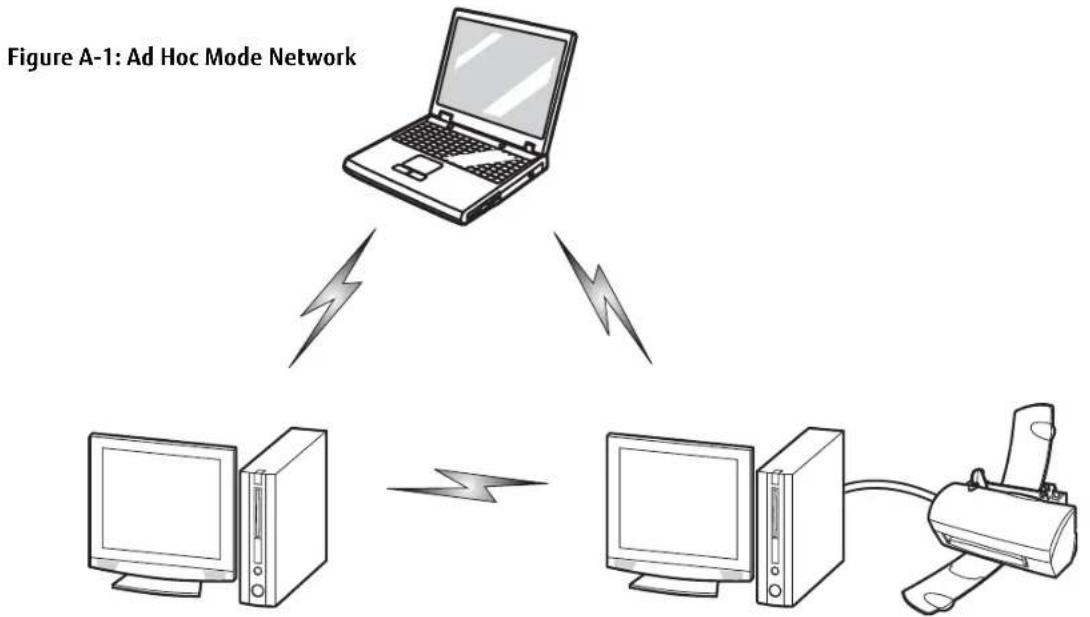
Access Point (Infrastructure) Mode
(See Figure A-2) Infrastructure mode refers to a wireless network architecture in which devices communicate with wireless or wired network devices by communicating through an Access Point. In infrastructure mode, wireless devices can communicate with each other or with a wired network. Corporate wireless networks operate in infrastructure mode because they require access to the WLAN in order to access services, devices, and computers (e.g., file servers, printers, databases).
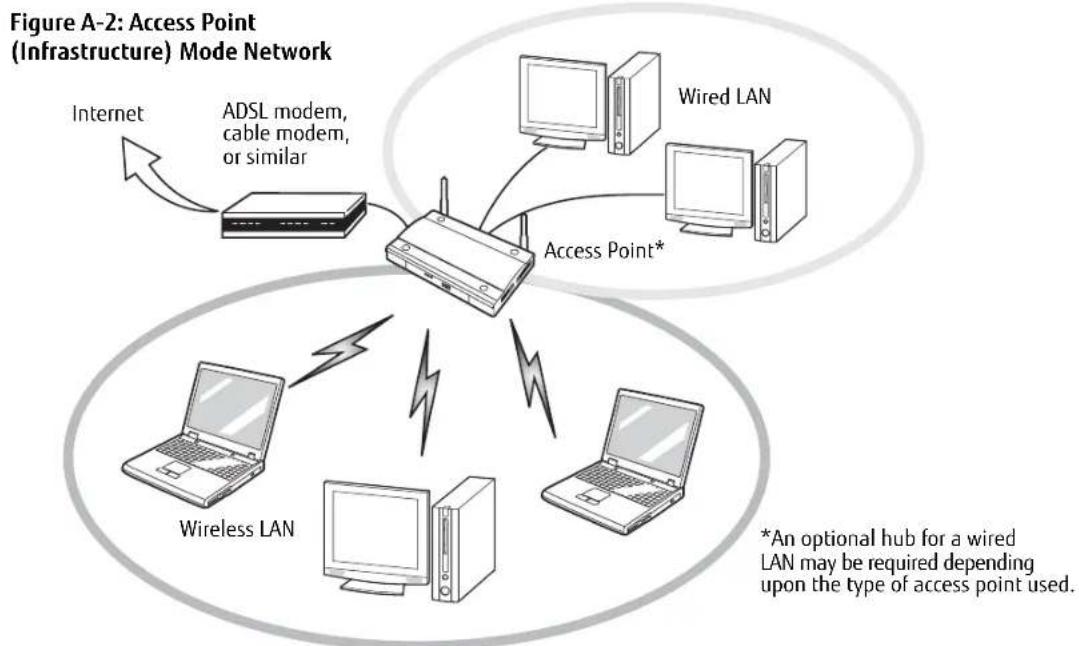
The WLAN device is an optional device that may come pre-installed in your mobile computer. Under normal circumstances, it should not be necessary for you to remove or re-install it. The Operating System that your mobile computer comes with has been pre-configured to support the WLAN device.
Wireless Network Considerations
- The WLAN device supports IEEE802.11a (infrastructure mode only), IEEE802.11b, IEEE802.11g, and IEEE802.11n.
- The WLAN device operates in the 2.4 GHz ISM band and the 5 GHz lower, middle, and upper UNII bands.
- Microwave ovens may interfere with the operation of WLAN devices since they operate in the same 2.4 GHz frequency range as IEEE802.11b/g/n devices. Interference by microwaves does not occur with IEEE802.11a radio which operates in the 5 GHz RF band.
- Wireless devices that transmit in the 2.4 GHz range may interfere with operation of WLAN devices in IEEE802.11b/g/n modes. Symptoms of interference include reduced throughput, intermittent disconnects, and many frame errors. It is HIGHLY recommended that these interfering devices be powered off to ensure proper operation of the WLAN device.
Deactivating/Disconnecting the WLAN Device
Deactivation of the WLAN device may be desired in certain circumstances (to extend battery life) or where certain environments require it (i.e. hospitals, clinics, airplanes, etc.).
Deactivation Using the Wireless On/Off Switch
The WLAN device can be deactivated quickly and efficiently by toggling the Wireless On/Off Switch to the Off position. The Wireless On/Off switch has no effect on non-Wireless LAN models.
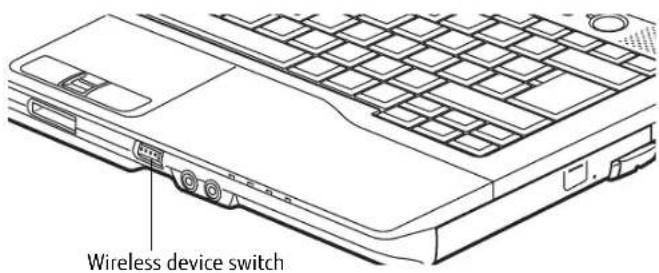
Figure 36. Wireless LAN On/Off Switch

THE WIRELESS LAN/BLUETOOTH ON/OFF SWITCH WILL POWER OFF BOTH THE OPTIONAL WIRELESS LAN AND BLUETOOTH DEVICES AT THE SAME TIME. TO ENABLE OR DISABLE EITHER ONE OF THE DEVICES INDIVIDUALLY, PERFORM THE FOLLOWING STEPS:
1 Slide the Wireless LAN/Bluetooth on/off switch to On position.
2 Right-click on the Bluetooth icon in the system tray to enable/disable the Bluetooth radio.
Activating the WLAN Device
Activation of the WLAN device can be accomplished using the same method as the deactivation process.
Configuring the Wireless LAN
The optional WLAN device can be configured to establish wireless network connectivity using the software that is built into Windows. Support for most industry standard security solutions is contained in this software.
Pre-defined parameters will be required for this procedure. Please consult with your network administrator for these parameters:
The WLAN device can be configured to establish wireless network connectivity using the software that is built into Windows Vista. Support for most industry standard security solutions is contained in this software.
Pre-defined parameters will be required for this procedure. Please consult with your network administrator for these parameters:
1 From the Modern Start screen, press [Windows] + [X], then select Control Panel from the menu.
2 If the Control Panel is not in Classic View, select Classic View from the left panel. Double-click the Network and Sharing Center icon.
3 Select "Setup a new connection or network".
4 Depending upon what type of connection you would like to make, make a selection. For an infrastructure network, select "Manually connect to a wireless network".
5 Enter the required information. It may be necessary to consult with your network administrator for some of the information.
In the event you require assistance, go to the Network and Sharing Center window (Control Panel > Network and Sharing Center), and type in relevant keywords in the Search box.
Connecting to a Network
After you have configured your computer, you can connect to an active network by performing the following steps:
1 Click on the WLAN icon in the system tray.
2 Select "Connect to a network".
Select a network from the list that appears, and click the [Connect] button.
Troubleshooting the WLAN
Troubleshooting
Causes and countermeasures for troubles you may encounter while using your wireless LAN are described in the following table.
| Problem Possible | Cause Possible Solution | |
| Unavailable network connection | Incorrect network name (SSID) or network key | Ad hoc connection: verify that the network names (SSID's) and network keys (WEP) of all computers to be connected have been configured correctly. SSID's and WEP key values must be identical on each machine.Access Point (Infrastructure) connection: set the network name (SSID) and network key to the same values as those of the access point.Set the Network Authentication value identically to that of the Access Point. Please consult your network administrator for this value, if necessary. |
| Weak received signal strength and/or link quality | Ad hoc connection: Retry connection after shortening the distance to the destination computer or removing any obstacles for better sight.Access Point (Infrastructure) connection: Retry connection after shortening the distance to the access point or removing any obstacles for better sight. | |
| The WLAN device has been deactivated or disabled | Check if the wireless switch is turned On. Go to Start -> Control Panel, and double-click on Windows Mobility Center. If the wireless network is off, click the [Turn wireless on] button. | |
| The computer to be connected is turned off | Check if the computer to be connected is turned ON. | |
| Problem Possible Cause Possible Solution | ||
| Unavailable network connection (continued) | RF interference from Access Points or other wireless networks | The use of identical or overlapping RF channels can cause interference with the operation of the WLAN device. Change the channel of your Access Point to a channel that does not overlap with the interfering device. |
| Wireless network authentication has failed | Re-check your Network Authentication, Encryption, and Security settings. Incorrectly configured security settings such as an incorrectly typed WEP key, a mis-configured LEAP username, or an incorrectly chosen authentication method will cause the LAN device to associate but not authenticate to the wireless network. | |
| Incorrectly configured network settings | Recheck the configuration of your network settings. | |
| Incorrect IP address configuration | This only applies to networks using static IP addresses. Please contact your network administrator for the correct settings. | |
WLAN Specifications
Specifications
| Item Specification | |
| Type of network | The Integrated Integrated Intel® Centrino® Advanced-N 6205 (802.11agn 2x2) and Integrated Intel® Centrino® Wireless-N 2200 devices conform to IEEE 802.11a (infrastructure mode only), 802.11b/g, and 802.11n, Wi-Fi based*. |
| Transfer rate | (Automatic switching) IEEE802.11 a and g: 54 Mbps maximum data rate; IEEE802.11n: 300 Mbps maximum data rate |
| Active frequency | • 802.11n: 2.4 GHz or 5 GHz• 802.11b/g: 2400-2473 MHz• 802.11a: 4900 ~ 5850 MHz |
| Typical operating distances** | • 802.11a: 40 ft. (12 m) @ 54 Mbps; 300 ft. (91 m) @ 6 Mbps• 802.11b: 100 ft. (30 m) @ 11 Mbps; 300 ft. (91 m) @ 1 Mbps• 802.11g: 100 ft. (30 m) @ 54 Mbps; 300 ft. (91 m) @ 1 Mbps• 802.11n: Estimated double the operating distance of 802.11g and 802.11a in their respective frequencies. |
| Number of channels | • 802.11a: 8 independent channels• 802.11b/g: 11 channels, 3 non-overlapping channels• 802.11n: Channel bonding takes two of the non-overlapping 20MHz channels and combines it into one 40MHz channel. It is actually 12 non-overlapping channels with channel bonding and 24 without. Also, it is 1 non-overlapping channel in 2.4GHz when channel bonding is used |
| Security Encryption Types - WEP, TK | P, AES***, WPA 1.0 and WPA 2.0 compliantEncryption Key lengths Supported: 64 bits and 128 bits |
| Maximum recommended number of computers to be connected over wireless LAN (during ad hoc connection) | 10 units or less **** |
- "Wi-Fi based" indicates that the interconnectivity test of the organization which guarantees the interconnectivity of wireless LAN (Wi-Fi Alliance) has been passed.
The communication ranges shown above will increase or decrease depending on factors such as number of walls, reflective material, or interference from external RF sources.
* Encryption with network key (WEP) is performed using the above number of bits, however, users can set 40 bits/ 104 bits after subtracting the fixed length of 24 bits.
**** Depending on practical environments, the allowable number of computers to be connected may be decreased.
Using the Bluetooth Device
The integrated Bluetooth V4.0 module is a wireless device installed in selected Fujitsu mobile computers.
What is Bluetooth?
Bluetooth technology is designed as a short-range wireless link between mobile devices, such as laptop computers, phones, printers, and cameras. Bluetooth technology is used to create Personal Area Networks (PANs) between devices in short-range of each other.

CLICKING THE [FN] + F5] KEYS WILL TOGGLE BOTH THE OPTIONAL WIRELESS LAN AND BLUETOOTH DEVICES ON AND OFF AT THE SAME TIME, TO ENABLE OR DISABLE EITHER ONE OF THE DEVICES INDIVIDUALLY, PERFORM THE FOLLOWING STEPS:
- PRESS THE [FN] AND [F5] KEYS AT THE SAME TIME. CHECK THE STATUS INDICATOR PANEL TO VERIFY THAT THE WIRELESS DEVICE IS ON.
- GO TO THE MODERN START SCREEN -> CHARMS-> SETTINGS->CHANGE PC SETTINGS->WIRELESS.
- UNDER WIRELESS->WIRELESS DEVICES CLICK ON "BLUETOOTH" SWITCH TO TURN IT ON.
Where to Find Information About Bluetooth
For additional information about Bluetooth Technology, visit the Bluetooth Web site at: www.bluetooth.com.
FCC Radiation Exposure Statement
This equipment complies with FCC radiation exposure limits set forth for an uncontrolled environment. The Bluetooth antenna is located on the right hinge of the LCD screen and is exempt from minimum distance criteria due to its low power.
The transmitters in this device must not be co-located or operated in conjunction with any other antenna or transmitter.
Canadian Notice
To prevent radio interference to the licensed service, this device is intended to be operated indoors and away from windows to provide maximum shielding. Equipment (or its transmit antenna) that is installed outdoors is subject to licensing.
Warranty
Users are not authorized to modify this product. Any modifications invalidate the warranty.
This equipment may not be modified, altered, or changed in any way without signed written permission from Fujitsu. Unauthorized modification will void the equipment authorization from the FCC and Industry Canada and the warranty.
Appendix B: Fingerprint Sensor Device
Introducing the Fingerprint Sensor Device
Your system may have an optional fingerprint sensor device below the Touchpad, between the left and right buttons. This also serves as a scroll button.
With a fingerprint sensor, you can avoid having to enter a username and password every time you want to:
- Log onto Windows
- Resume from sleep mode
- Cancel a password-protected screen saver
- Log into homepages that require a username and password After you "enroll" - or register - your fingerprint, you can simply swipe your fingertip over the sensor for the system recognize you.
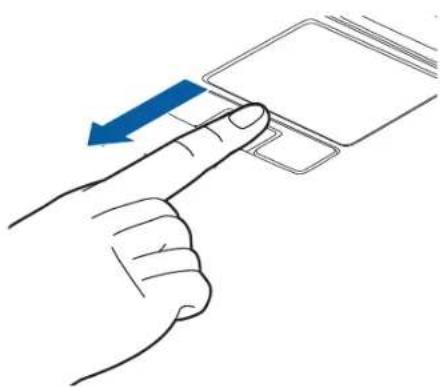
Figure 37. Fingerprint sensor

ALTHOUGH THE SYSTEM MAY HAVE A FINGERPRINT SENSOR IN PLACE OF A SCROLL BUTTON, THE FINGERPRINT SENSOR CAN BE USED FOR SCROLLING. SIMPLY MOVE YOUR FINGERPRINT OVER THE SENSOR THE SAME AS YOU WOULD USE A SCROLL BUTTON.
The fingerprint sensor uses Softex OmniPass which provides password management capabilities to Microsoft Windows operating systems. OmniPass enables you to use a "master password" for all Windows, applications, and online passwords.
OmniPass requires users to authenticate themselves using the fingerprint sensor before granting access to the Windows desktop. This device results in a secure authentication system for restricting access to your computer, applications, web sites, and other password-protected resources.
OmniPass presents a convenient graphical user interface, through which you can securely manage passwords, users and multiple identities for each user.

CERTAIN MODELS SUPPORT PRE-BOOT AUTHENTICATION OR PBA. PBA ALLOWS THE USER TO LOG IN PRIOR TO WINDOWS'OWN AUTHENTICATION MECHANISM. A PBA ENVIRONMENT SERVES AS AN EXTENSION OF THE BIOS OR BOOT FIMWARE AND ALLOWS FOR A MORE SECURE ENVIRONMENT EXTERNAL TO THE OPERATING SYSTEM.
Getting Started
This section guides you through the preparation of your system for the OmniPass fingerprint recognition application. You will be led through the OmniPass installation process. You will also be led through the procedure of enrolling your first user into OmniPass.
Installing OmniPass
If OmniPass has already been installed on your system, skip this section and go directly to "User Enrollment" on page 166. You can determine whether OmniPass has already been installed by checking to see if the following are present:
- The gold key-shaped OmniPass icon in the system tray at the bottom right of the screen.
- The Softex program group in the Programs group of the Start menu
System Requirements
The OmniPass application requires space on your hard drive; it also requires specific Operating Systems (OS's). The minimum requirements are as follows:
- Windows XP Professional or later operating system
- At least 35 MB available hard disk space
Installing the OmniPass Application
If OmniPass is already installed on your system, go to "User Enrollment" on page 166. Otherwise continue with this section on software installation.

FOR INSTALLATION, OMNIPASS REQUIRES THAT THE USER INSTALLING OMNIPASS HAVE ADMINISTRATIVE PRIVILEGES TO THE SYSTEM. IF YOUR CURRENT USER DOES NOT HAVE ADMINISTRATIVE PRIVILEGES, LOG OUT AND THEN LOG IN WITH AN ADMINISTRATOR USER BEFORE PROCEEDING WITH OMNIPASS INSTALLATION.
To install OmniPass on your system you must:
1 Insert the installation media for the OmniPass application into the appropriate drive. If you are installing from CD-ROM or DVD-ROM, you must find and launch the OmniPass installation program (setup.exe) from the media.
2 Follow the directions provided in the OmniPass installation program. Specify a location to which you would like OmniPass installed. It is recommended that you NOT install OmniPass in the root directory (e.g. C:).
3 Once OmniPass has completed installation you will be prompted to restart your system. Once your system has rebooted you will be able to use OmniPass. If you choose not to restart immediately after installation, OmniPass will not be available for use until the next reboot.
The installation program automatically places an icon (Softex OmniPass) in the Windows Control Panel as well as a golden key shaped icon in the taskbar.
Verifying Information about OmniPass
After you have completed installing OmniPass and restarted your system, you may wish to check the version of OmniPass on your system.
To check the version information of OmniPass:
1 From the Windows Desktop, double-click the key-shaped OmniPass icon in the taskbar (usually located in the lower right corner of the screen), or,
Click Start, select Settings, and click Control Panel. Double-click Softex OmniPass in the Control Panel, and the OmniPass Control Center will appear. If it does not appear, then the program is not properly installed, or,
Click the Start button, select Programs, and from the submenu select the Softex program group, from that submenu click OmniPass Control Center.
2 Select the About tab at the top of the OmniPass Control Panel. The About tab window appears with version information about OmniPass.
Uninstalling OmniPass

BEFORE YOU UNINSTALL THE SOFTWARE, DECRYPT ALL OMNIPASS ENCLOSED FILES AND EXPORT ALL OMNIPASS USER PROFILES. FAILURE TO DO SO MAY RESULT IN PERMANENT LOSS OF ENCLOSED FILE DATA, AND PERMANENT LOSS OF ALL REMEMBERED PASSWORDS AND ASSOCIATED INFORMATION (SEE CHAPTER 5 OF THE OMNIPASS HELP DOCUMENT:: EXPORTING AND IMPORTING USERS).

FOR UNINSTALLATION, OMNIPASS REQUIRES THAT THE USER UNINSTALLING OMNIPASS HAVE ADMINISTRATIVE PRIVILEGES TO THE SYSTEM. IF YOUR CURRENT USER DOES NOT HAVE ADMINISTRATIVE PRIVILEGES, LOG OUT AND THEN LOG IN WITH AN ADMINISTRATOR USER BEFORE PROCEEDING WITH OMNIPASS UNINSTALLATION.
To remove the OmniPass application from your system:
1 Click Start -> All Programs -> Control Panel.
2 If you are in Category view, click Programs -> Programs and Features If you are in Icon view, click Programs and Features.
3 Select OmniPass from the list, and then click Uninstall/Change.
4 Follow the directions to uninstall the OmniPass application.
5 Once OmniPass has finished uninstalling, reboot your system when prompted.
User Enrollment
Before you can use any OmniPass features you must first enroll a user into OmniPass.
Master Password Concept
Computer resources are often protected with passwords. Whether you are logging into your computer, accessing your email, e-banking, paying bills, or accessing network resources, you often have to supply credentials to gain access. This can result in dozens of sets of credentials that you have to remember.
During user enrollment a "master password" is created for the enrolled user. This master password "replaces" all other passwords for sites you register with OmniPass.
Example: A user, John, installs OmniPass on his system (his home computer) and enrolls an OmniPass user with username "John_01" and password "freq14". He then goes to his webmail site to log onto his account. He inputs his webmail credentials as usual (username "John_02" and password "lifebook"), but instead of clicking [Submit], he directs OmniPass to Remember Password. Now whenever he returns to that site, OmniPass will prompt him to supply access credentials.
John enters his OmniPass user credentials ("John_01" and "freq14") at the OmniPass authentication prompt, and he is allowed into his webmail account. He can do this with as many web sites or password protected resources he likes, and he will gain access to all those sites with his OmniPass user credentials ("John_01" and "freq14"). This assumes he is accessing those sites with the system onto which he enrolled his OmniPass user. OmniPass does not actually change the credentials of the password protected resource. If John were to go to another computer without he
OmniPass account to access his webmail, he would need to enter his original webmail credentials ("John_02" and "lifebook") to gain access. If he attempts his OmniPass user credentials on a system other than a system he's enrolled on, he will not gain access.

THE ENROLLMENT PROCEDURE ASSUMES YOU HAVE NO HARDWARE AUTHENTICATION DEVICES OR ALTERNATE STORAGE LOCATIONS THAT YOU WISH TO INTEGRATE WITH OMNIPASS. IF YOU DESIRE SUCH FUNCTIONALITY, CONSULT THE APPROPRIATE SECTIONS OF THIS DOCUMENT.
Basic Enrollment
The Enrollment Wizard will guide you through the process of enrolling a user. Unless you specified otherwise, after OmniPass installation the Enrollment Wizard will launch on Windows login. If you do not see the Enrollment Wizard, you can bring it up by clicking Start on the Windows taskbar; select Programs; select Softex; click OmniPass Enrollment Wizard.
1 Click Enroll to proceed to username and password verification. By default, the OmniPass Enrollment Wizard enters the credentials of the currently logged in Windows user.
2 Enter the password you use to log in to Windows. This will become the "master password" for this OmniPass user. In most cases, the Domain: value will be your Windows computer name. In a corporate environment, or when accessing corporate resources, the Domain: may not be your computer name. Click [Next] to continue.
3 In this step OmniPass captures your fingerprint. Refer to "Enrolling a Fingerprint" on page 168 for more details.
4 Next, choose how OmniPass notifies you of various events. We recommend you keep Taskbar Tips on Beginner mode taskbar tips and Audio Tips on at least Prompt with system beeps only until you get accustomed to how OmniPass operates. Click [Next] to proceed with user enrollment. You will then see a Congratulations screen indicating your completion of user enrollment.
5 Click [Done] to exit the OmniPass Enrollment Wizard. You will be asked if you'd like to log in to OmniPass with your newly enrolled user; click [Yes].
Enrolling a Fingerprint
Enrolling a fingerprint increases the security of your system and streamlines the authentication procedure.
You enroll fingerprints in the OmniPass Control Center. With an OmniPass user logged in, double-click the system tray OmniPass icon. Select the User Settings tab and click Enrollment under the User Settings area. Click Enroll Authentication Device and authenticate at the authentication prompt to start device enrollment.
1 During initial user enrollment, you will be prompted to select the finger you wish to enroll. Fingers that have already been enrolled will be marked by a green check. The finger you select to enroll at this time will be marked by a red arrow. OmniPass will allow you re-enroll a finger. If you choose a finger that has already been enrolled and continue enrollment, OmniPass will enroll the fingerprint, overwriting the old fingerprint. Select a finger to enroll and click [Next].
2 It is now time for OmniPass to capture your selected fingerprint. It may take a several capture attempts before OmniPass acquires your fingerprint. Should OmniPass fail to acquire your fingerprint, or if the capture screen times out, click [Back] to restart the fingerprint enrollment process.
Your system has a "stripe" fingerprint sensor. A swipe sensor is small and resembles a skinny elongated rectangle. To capture a fingerprint, gently swipe or pull your fingertip over the sensor (starting at the second knuckle) towards yourself. Swiping too fast or too slow will result in a failed capture. The Choose Finger screen has a [Practice] button; click it to practice capturing your fingerprint. When you are comfortable with how your fingerprint is captured, proceed to enroll a finger.
3 Once OmniPass has successfully acquired the fingerprint, the Verify Fingerprint screen will automatically appear. To verify your enrolled fingerprint, place your fingertip on the sensor and hold it there as if you were having a fingerprint captured. Successful fingerprint verification will show a green fingerprint in the capture window and the text Verification Successful under the capture window.
4 After you finish enrolling and verifying your fingerprints, you will have the option to Enable PBA with enrolled finger. If you enable this option, you must choose two fingers to save in PBA. After you enroll successfully, the Finger Enrollment Status in PBA screen will state Finger saved in PBA successfully.

IF YOU ENABLE PBA ON YOUR SYSTEM, YOU MUST SET THE SUPERVISOR PASSWORD AND PASSWORD ON BOOT SETTINGS.
Using OmniPass
You are now ready to begin using OmniPass. Used regularly, OmniPass will streamline your authentications.
Password Replacement
You will often use the password replacement function. When you go to a restricted access website (e.g., your bank, your web-based email, online auction or payment sites), you are always prompted to enter your login credentials. OmniPass can detect these prompts and you can teach OmniPass your login credentials. The next time you go to that website, you can authenticate with your fingerprint to gain access.
OmniPass Authentication Toolbar
After installing OmniPass and restarting, you will notice a dialog you have not seen before at Windows Logon. This is the OmniPass Authentication Toolbar, and it is displayed whenever the OmniPass authentication system is invoked. The OmniPass authentication system may be invoked frequently: during Windows Logon, during OmniPass Logon, when unlocking your workstation, when resuming from sleep or hibernate, when unlocking a password-enabled screensaver, during password replacement for remembered site or application logins, and more. When you see this toolbar, OmniPass is prompting you to authenticate.
The Logon Authentication window indicates what OmniPass-restricted function you are attempting. The icons in the lower left (fingerprint and key) show what authentication methods are available to you. Selected authentication methods are highlighted while unselected methods are not. When you click the icon for an unselected authentication method, the authentication prompt associated with that method is displayed.
When prompted to authenticate, you must supply the appropriate credentials: an enrolled finger for the fingerprint capture window or your master password for the master password prompt (the key icon).
Remembering a Password
OmniPass can remember any application, GUI, or password protected resource that has password prompt.
Using the following procedure, you can store a set of credentials into OmniPass. These credentials will then be linked to your "master password" or fingerprint.
Go to a site that requires a login (username and password), but do not log in yet. At the site login prompt, enter your username and password in the prompted fields, but do not enter the site (do not hit [Enter], [Submit], [OK], or Login). Right-click the OmniPass system tray icon and select Remember Password from the submenu. The Windows arrow cursor will change to a golden key OmniPass cursor. Click the OmniPass cursor in the login prompt area, but don't click [Login] or [Submit].
Associating a Friendly Name
After clicking the OmniPass key cursor near the login prompt, OmniPass will prompt you to enter a "friendly name" for this site. You should enter something that reminds you of the website, the company, or the service you are logging into. In its secure database, OmniPass associates this friendly name with this website.
Additional Settings for Remembering a Site
When OmniPass prompts you to enter a "friendly name" you also have the opportunity to set how OmniPass authenticates you to this site. There are three effective settings for how OmniPass handles a remembered site.
The default setting is Automatically click the "OK" or "Submit" button for this password protected site once the user is authenticated. With this setting, each time you navigate to this site OmniPass will prompt you for your master password or fingerprint authentication device. Once you have authenticated with OmniPass, you will automatically be logged into the site.
Less secure is the option to Automatically enter this password protected site when it is activated. Do not prompt for authentication. Check the upper box to get this setting, and each time you navigate to this site OmniPass will log you into the site without prompting you to authenticate.

THIS SETTING IS MORE CONVENIENT IN THAT WHENEVER YOU GO TO A REMEMBERED SITE, YOU WILL BYPASS ANY AUTHENTICATION PROCEDURE AND GAIN INSTANT ACCESS TO THE SITE. BUT SHOULD YOU LEAVE YOUR SYSTEM UNATTENDED WITH YOUR OMNIPASS USER LOGGED IN, ANYONE USING YOUR SYSTEM CAN BROWSE TO YOUR PASSWORD PROTECTED SITES AND GAIN AUTOMATIC ACCESS.
If you uncheck both boxes in Settings for this Password Site, OmniPass will prompt you for your master password or fingerprint authentication device. Once you have authenticated with OmniPass your credentials will be filled in to the site login prompt, but you will have to click the website [OK], [Submit], or [Login] button to gain access to the site.
Click Finish to complete the remember password procedure. The site location, the credentials to access the site, and the OmniPass authentication settings for the site are now stored in the OmniPass secure database. The OmniPass authentication settings (Settings for this Password Site) can always be changed in Vault Management.
Logging in to a Remembered Site
Whether or not OmniPass prompts you to authenticate when you return to a remembered site is determined by Settings for this Password Site and can be changed in Vault Management.
The following cases are applicable to using OmniPass to login to: Windows, remembered web sites, and all other password protected resources.
With Master Password
Once you return to a site you have remembered with OmniPass, you may be presented with a master password prompt. Enter your master password and you will be allowed into the site.
Logging into Windows with a Fingerprint Device
When logging into Windows with a fingerprint device, the fingerprint capture window will now appear next to the Windows Login screen. Place your enrolled fingertip on the sensor to authenticate. You will be simultaneously logged into Windows and OmniPass. The capture window will also appear if you have used Ctrl-Alt-Del to lock a system, and the fingerprint device can be used to log back in as stated above.

IF A MACHINE IS LOCKED AND OMNIPASS DETECTS A DIFFERENT USER LOGGING BACK IN WITH A FINGERPRINT, THE FIRST USER WILL BE LOGGED OUT AND THE SECOND USER LOGGED IN.
Password Management
OmniPass provides an interface that lets you manage your passwords. To access this GUI, double-click the OmniPass key in the system tray. Click Vault Management; you will be prompted to authenticate. Once you gain access to Vault Management, click Manage Passwords under Vault Settings. You will see the Manage Passwords interface, with a list of friendly names.
You can view credentials stored for any remembered website by highlighting the desired resource under Password Protected Dialog and clicking Unmask Values. Should a password be reset, or an account expire, you can remove stored credentials from OmniPass. Highlight the desired resource under Password Protected Dialog and click Delete Page. You will be prompted to confirm the password deletion.
The two check boxes in Manage Passwords govern whether OmniPass prompts you to authenticate or directly logs you into the remembered site.
OmniPass will overwrite an old set of credentials for a website if you attempt to use Remember Password on an already remembered site.
The exception to the above rule is when resetting the Windows password. If your password is reset in Windows, the next time you login to Windows, OmniPass will detect the password change and prompt you to "Update" or "Reconfirm" the password with OmniPass. Enter your new Windows password in the prompt and click OK. Your OmniPass "master password" will still be your Windows password.
OmniPass User Identities
Identities allow OmniPass users to have multiple accounts to the same site (e.g., bob@biblomail.com and boballen@biblomail.com). If OmniPass did not provide you identities, you would be limited to remembering one account per site.
To create and manage identities, double-click the OmniPass key in the system tray. Click Vault Management; OmniPass will prompt you to authenticate. Once you gain access to Vault Management, click Manage Identities under Vault Settings. You can only manage the identities of the currently logged in OmniPass user
To add a new identity, click New Identity or double-click Click here to add a new identity. Name the new identity and click [OK], then click [Apply]. You can now switch to the new identity and start remembering passwords.
To delete an identity, highlight the identity you want to delete and click [Delete Identity]. Click [Apply].

WHEN YOU DELETE AN IDENTITY, ALL OF ITS ASSOCIATED REMEMBERED SITES AND PASSWORD PROTECTED DIALOGS ARE LOST.
To set the default identity, highlight the identity you want as default and click [Set as Default]; click [Apply] to ensure the settings are saved. If you log in to OmniPass with a fingerprint device, you will automatically be logged in to the default identity for that OmniPass user. You can choose the identity with which you are logging in if you login using "master password".
Choosing User Identity during Login
To choose your identity during login, type your username in the User Name: field. Press [Tab] and see that the Domain: field self-populates. Click the Password: field to bring the cursor to it, and you will see the pull-down menu in the Identity: field. Select the identity to login as, then click OK.
Switch User Identity
To switch identities at any time, right-click the OmniPass system tray icon and click Switch User Identity from the submenu. The Switch Identity dialog will appear. Select the desired identity and then click OK.
Identities and Password Management
On the Manage Passwords interface of the Vault Management tab of the OmniPass Control Center, there is a pull-down selection box labeled, Identity. This field lets you choose which identity you are managing passwords for. When you select an identity here, only those password protected dialogs that are associated with that identity are shown. You can perform all the functions explained in "Password Management" on page 172.
Configuring OmniPass
This section gives an overview of both the Export/Import function and the OmniPass Control Center.
Exporting and Importing Users

YOU CANNOT IMPORT A USER INTO OMNIPASS IF THERE ALREADY IS A USER WITH THE SAME NAME ENROLLED IN OMNIPASS.
Using OmniPass Control Center, you can export and import users in and out of OmniPass. The export process backs up all remembered sites, credentials, and enrolled fingerprints for an OmniPass user. All OmniPass data for a user is backed up to a single encrypted database file. During the import process, the Windows login of the exported user is required. If the proper credentials cannot be supplied, the user profile will not be imported.

- YOU SHOULD PERIODICALLY EXPORT YOUR USER PROFILE AND STORE IT IN A SAFE PLACE. IF ANYTHING HAPPENS TO YOUR SYSTEM, YOU CAN IMPORT YOUR OMNIPASS PROFILE TO A NEW SYSTEM AND HAVE ALL YOUR REMEMBERED SETTINGS AND FINGERPRINTS INSTANTLY.
- DON'T FORGET THE WINDOWS LOGIN CREDENTIALS WHEN EXPORTING. WHEN YOU EXAMINE THE IMPORTATION, YOU ARE PROMPTED FOR AUTHENTICATION. THE CREDENTIALS THAT WILL ALLOW A USER PROFILE TO BE IMPORTED ARE THE WINDOWS LOGIN CREDENTIALS OF THE EXPORTED USER. THEY ARE THE CREDENTIALS THAT HAD TO BE SUBMITTED WHEN THE USER PROFILE WAS EXPORTED. YOU WILL NEED USER NAME, PASSWORD, AND DOMAIN.
Exporting an OmniPass User Profile
To export a user, open OmniPass Control Center, and click Import/Export User under Manage Users.
Click Exports an OmniPass user profile. OmniPass will prompt you to authenticate. Upon successfully authentication, you must name the OmniPass user profile and decide where to save it. An .opi file is generated, and you should store a copy of it in a safe place.
This .opi file contains all your user specific OmniPass data, and it is both encrypted and password protected. This user profile does NOT contain any of your encrypted data files.
Importing an OmniPass User Profile
To import an OmniPass user open the OmniPass Control Center, and click Import/Export User under Manage Users. Click Imports a new user into OmniPass and then select OmniPass Import/Export File (.otpi) and click Next. OmniPass will then prompt you to browse for the file you had previously exported (.otpi file). When you select the .otpi file for importation, OmniPass will prompt you for authentication. The credentials that will allow a user profile to be imported are the Windows login credentials of the exported user. They are the credentials that had to be submitted when the user profile was exported. You will need User Name, Password, and Domain. If you don't remember the value for Domain, in a PC or SOHO environment Domain should be your computer name.
OmniPass will notify you if the user was successfully imported.
Things to Know Regarding Import/Export
- Assume you export a local Windows User profile from OmniPass. You want to import that profile to another machine that has OmniPass. Before you can import the profile, a Windows user with the same login credentials must be created on the machine importing the profile.
Example: I have a Windows user with the username "Tom" and the password "Sunshine" on my system. I have enrolled Tom into OmniPass and remembered passwords. I want to take my passwords to a new system. I export Tom's OmniPass user profile. I go to my new system and using the Control Panel I create a user with the username "Tom" and password "Sunshine". I can now successfully import the OmniPass user data to the system. - If you export an OmniPass-only user, you can import that user to any computer running OmniPass, provided that a user with that name is not already enrolled in OmniPass.
- If you attempt to import a user profile who has the same name as a user already enrolled in OmniPass, the OmniPass import function will fail.
OmniPass Control Center
This section explains functions within the OmniPass Control Center that were not explained earlier.
You can access the OmniPass Control Center any of three ways:
- Double-click the golden OmniPass key shaped icon in the Windows taskbar (typically in the lower-right corner of the desktop)
- Click the Start button; select the Programs group; select the Softtex program group; and click the OmniPass Control Center selection.
- Open the Windows Control Panel (accessible via Start button -> Settings -> Control Panel) and double-click the Softex OmniPass icon.
User Management
The User Management tab has two major interfaces: Add/Remove User and Import/Export User. Import/Export User functionality is documented in "Exporting and Importing Users" on page 174. Add/Remove User functionality is straightforward.
If you click Add a new user to OmniPass you will start the OmniPass Enrollment Wizard. The Enrollment Wizard is documented in "User Enrollment" on page 166.
If you click Removes a user from OmniPass, OmniPass will prompt you to authenticate. Authenticate with the credentials (or enrolled fingerprint) of the user you wish to remove. OmniPass will prompt you to confirm user removal. Click OK to complete user removal.

REMOVING A USER WILL AUTOMATICALLY DESTROY ALL OMNIPASS DATA ASSOCIATED WITH THAT USER. ALL IDENTITIES AND CREDENTIALS ASSOCIATED WITH THE USER WILL BE LOST.
IF YOU'RE SURE YOU WANT TO REMOVE THE USER, WE RECOMMEND YOU EXPORT THE USER PROFILE.
User Settings
The User Settings tab has three interfaces: Audio Settings, Taskbar Tips, and Enrollment. User settings allow users to customize OmniPass to suit their individual preferences. Under User Settings (Audio Settings and Taskbar Tips) you can set how OmniPass notifies the user of OmniPass events (e.g., successful login, access denied, etc.). The details of each setting under the Audio Settings and Taskbar Tips interfaces are self-explanatory.
The Enrollment interface allows you to enroll fingerprints. For the procedure to enroll and authentication device refer to Chapter 2.3. To enroll additional fingerprints, click Enroll Authentication Device, and authenticate with OmniPass. Select the fingerprint recognition device in the Select Authentication Device screen (it should already be marked by a green check if you have a finger enrolled) and click Next.
System Settings
The OmniPass Startup Options interface can be found in the System Settings tab. With these options you can specify how your OmniPass Logon is tied to your Windows Logon.
The first option, Automatically log on to OmniPass as the current user, will do just as it says; during Windows login, you will be logged on to OmniPass using your Windows login credentials. If the user logging into Windows was never enrolled into OmniPass, upon login no one will be logged on to OmniPass. This setting is appropriate for an office setting or any setting where users must enter a username and password to log into a computer. This is the default setting.
With the second option, Manually log on to OmniPass at startup, OmniPass will prompt you to login once you have logged on to Windows.
With the third option, Do not log on to OmniPass at startup, you will not be prompted to be logged on.
You can manually log on to OmniPass by right-clicking the OmniPass taskbar icon and clicking Log in User from the right-click menu.
Troubleshooting
You cannot use OmniPass to create Windows users. You must first create the Windows user, and you will need administrative privileges to do that. Once the Windows user is created, you can add that user to OmniPass using the same username and password
Cannot add Windows users to OmniPass
If you experience difficulties adding a Windows user to OmniPass, you may need to adjust your local security settings. You can do this by going to Start, Control Panel, Administrative Tools, and Local Security Settings. Expand Local Policies, expand Security Options, and double-click Network Access: Sharing and Security Model for Local Accounts. The correct setting should be Classic - Local Users Authenticate as Themselves.
Cannot add a User with a Blank Password to OmniPas
If you experience difficulties adding a user with a blank password to OmniPass, you may need to adjust your local security settings. First attempt the procedure explained in the Cannot add Windows user to OmniPass section. If the difficulties persist, then try the following procedure.
Click Start, Control Panel, Administrative Tools, and Local Security Settings. Expand Local Policies, expand Security Options, and double-click Accounts: Limit local account use of blank passwords to console login only. This setting should be set to Disabled.
Dialog appears after OmniPass authentication during Windows Logon
After installing OmniPass on your system, you can choose to logon to Windows using OmniPass. You authenticate with OmniPass (via master password, or an enrolled security device) and OmniPass logs you into Windows. You may, during this OmniPass authentication, see a Login Error dialog box.
This dialog box occurs when OmniPass was unable to log you into Windows with the credentials supplied (username and password). This could happen for any of the following reasons:
- Your Windows password has changed
- Your Windows account has been disabled
If you are having difficulties due to the first reason, you will need to update OmniPass with your changed Windows account password. Click Update Password and you will be prompted with a dialog to reconfirm your password.
Enter the new password to your Windows user account and click OK. If the error persists, then it is unlikely the problem is due to your Windows user account password changing.
Index
A
About This Guide 1,8 AC
adapter 44
plug adapters 120
Application Panel 35
Auto/Airline Adapter 44
B
Battery 57 alarm 58 care 121 cold-swapping 59 conserving power 52 dead 90 faulty 91 increasing life 121 level indicator 24 lithium ion battery 57 low 58 problems 90, 91 recharging 58 replacing 59 shorted 59 Sleep mode 58
BIOS 49
Bluetooth 160 Built-in Speakers 86
C
CapsLock 23
Clicking 29
Cold-swapping 33, 59
Controls and Connectors 12
Conventions Used in the Guide 8
Cursor 28
Cursor Keys 26
D
DC Output Cable 44
DC Power Jack 44
DevicePorts76,127
DIMM 73
Display Panel 15, 45
adjusting 46
brightness 46
closing 46
latch 15
opening 45
problems 92, 93
Docking Port 79
Double-Clicking 29
Dragging 30
DVD drive
problems 87
tray release 65
E
Error Messages 94
ExpressCards 70
External Monitor Port 17, 78
F
Fingerprint Sensor Device 162
enrolling a fingerprint 168
getting started 163
installing OmniPass 163
logging into a remembered site 171
OmniPass authentication toolbar 169
password replacement 169
remembering a password 170
uninstalling OmniPass 165
userenrollment166
using OmniPass 169
Flexible Bay 17, 32
cold-swapping 33
devices 32
eject lever 18
installing 32
Modular Multi-Format DVD Writer 62
removing 32
Fujitsu Contact Information 9
Function Key
F1027
F326
F4 26
F6 26
F727
F827,31
F927,31
FN 26
H
Hard Disk Drive
access indicator 23
problems 87, 88
Headphone Jack 77
Hibernation Feature 53
1
Internal LAN Jack 76
K
Keyboard 15, 25
cursor keys 25
function keys 26
numeric keypad 25
problems 88
windows keys 26
L
LIFEBOOK Security Application Panel 13
buttons 40
configuring 41
deactivating 42
deactivating and activating 42
launching applications 40
operating 37
passwords 35
uninstalling 39
M
Media Player
care 122
Control Panel 66
loading 63
removing 64
Software 62, 66
using 66
Memory
capacity 75
compartment 20, 73
installing 73
problems 88
removing 74, 75
upgrade module 73
Microphone Jack 15, 78
Modular Devices 32
N
NumLk 23
0
Optical Drive 62
P
Port Replicator
attaching 83
connector 21
detaching 83
problems 87
Power
AC adapter 43
Auto/Airline adapter 43
failure 90
indicator 23
management 52
off 54
on 48
problems 91
sources 43
Power Management 52
Power On Self Test 48, 94
Power/Suspend/Resume Button 13,48,52
Pre-Installed Software 130
R
Registration 51
Restarting 54
Restoring Pre-installed Software 95, 105
RJ-45 76
S
ScrLk 23
SD Card 69
SDRAM 20, 73
Secure Digital Card 69
Security Panel 35
Sleep Mode 52
Specifications 124
Audio 125
Chipset 124
Dimensions and Weight 129
Environmental Requirements 129
Keyboard 128
Memory 124
Microprocessor 124
Power 128
Video 125
Status Indicator Panel 15, 22
Stereo Speakers 15
T
Touchpad 28
buttons 28
controls 30
Touchpad Pointing Device 15
Troubleshooting 84
U
Universal Serial Bus Ports 76
Unpacking 11
USB 17, 19, 76
problems 88, 89
V
Volume control 31
W
Warranty 10
Windows keys 26
Wireless LAN
Before Using the Wireless LAN 150
connection to the network 156
Specifications 158
Troubleshooting 156
Guide d'utilisation
RecyclerVotebatterie
Service et assistance
Different supports are available for use. Please use the system of choice to select the most appropriate option.
Cartes ExpressCard™/Smart Card
Specifications techniques
Spécifications
Puce Trusted Platform Module (TPM)
ACPI (Advanced Configuration and Power Interface)
ADSL (Asymmetric Digital Subscriber Line)
DHCP (Dynamic Host Configuration Protocol)
DMA (Direct Memory Access)
DMI (Desktop Management Interface)
DVMT (Dynamic Video Memory Technology)
ECP (Extended Capability Port)
FCC (Federal Communication Commission)
IDE (Intelligent Drive Electronics)
IRQ (Interrupt Request)
LAN (Local Area Network)
NTSC (National TV Standards Commission)
PPPoE (Point to Point Protocol over Ethernet)
RAM CMOS (Complementary metal oxide semiconductor random access memory)
ROM (Read Only Memory)
TFT (Thin Film Transistor)
UL (Underwriters Laboratories)
WFM (Wired for Management)
WLAN (Wireless Local Area Network)
Ports USB (Universal Serial Bus) 77
Ports USB 2.0 17, 19
activation/désactivation 53
Verr defil 23
Verr maj 23
Verr num 23
Voyant
- Copyright and Trademark Information
- WARNING
- DECLARATION OF CONFORMITY
- IMPORTANT SAFETY INSTRUCTIONS
- AC adapter output polarity:
- For Authorized Repair Technicians Only
- Recycling your battery
- Contents
- About This Guide 8
- Chapter 1 Getting to Know Your LIFEBOOK
- Overview. 11
- Locating the Controls and Connectors. 12
- Status Indicator Panel. 22
- Chapter 2 Getting Started with Your LIFEBOOK
- Using Multiple Displays Simultaneously 47
- Starting Your LIFEBOOK Notebook 48
- Power Management 52
- Chapter 3 User-Installable Features
- Lithium ion Battery 57
- Optical Drive. 62
- Secure Digital Cards. 68
- ExpressCardsTM/Smart Cards 70
- Memory Upgrade Module 73
- Device Ports 76
- Port Replicator 80
- Chapter 4 Troubleshooting Your LIFEBOOK
- Troubleshooting 84
- Restoring Your System Image and Software (Windows 7) 95
- Restoring Your System Image and Software (Windows 8) 105
- Chapter 5 Care and Maintenance
- Caring for your LIFEBOOK Notebook 116
- Chapter 6 System Specifications
- Specifications 124
- Glossary/Regulatory
- Appendix A: WLAN User's Guide
- Before Using the Optional Wireless LAN 150
- Configuring the Wireless LAN. 155
- Troubleshooting the WLAN. 156
- WLAN Specifications 158
- Using the Bluetooth Device 160
- Appendix B: Fingerprint Sensor Device
- Introducing the Fingerprint Sensor Device 162
- Index 179
- Preface
- About This Guide
- Conventions Used in the Guide
- Fujitsu Contact Information
- Service and Support
- Fujitsu Shopping Online
- Maintaining Latest Configuration
- Limited Warranty
- Chapter 1
- Getting to Know Your LIFEBOOK
- Overview
- Top Components
- Built-in Web Camera
- Web Camera Indicator
- Dual Digital Built-in Microphones
- Display Panel
- Status Indicator Panels
- LIFEBOOK Security/Application Panel
- Power/Suspend/Resume Button
- Stereo Speakers
- Keyboard
- Microphone Jack
- Headphone Jack
- Wireless Device On/Off Switch
- SD Card Slot
- Touchpad Pointing Device
- Left-Side Panel Components
- Anti-theft Lock Slot
- ExpressCard Eject Button
- ExpressCard Slot
- Smart Card Slot
- USB 3.0 Port
- e-SATA/USB 3.0 Combo Port
- DisplayPort Connector
- External Video Port
- Right-Side Panel Components
- Flexible Bay
- Eject Button
- Emergency Tray Release
- Flexible Bay Release Latch
- USB 2.0 Ports
- DC Power Jack
- Back Panel Components
- Gigabit LAN (RJ-45) Jack
- Air Vents
- Bottom Components
- Memory Upgrade Compartment
- Port Replicator Connector
- Battery Bay Locks
- Lithium ion Battery Bay
- Dust Filter Cover
- Status Indicator Panel
- Security Indicator
- Hard Drive/Optical Drive Access Indicator
- NumLk Indicator
- CapsLock Indicator
- ScrLk Indicator
- Power Indicator
- Battery Charge Indicator
- Battery Level Indicators
- Using the Keyboard
- Numeric Keypad
- Windows Keys
- Cursor Keys
- Function Keys
- Clicking
- Double-Clicking
- Dragging
- Touchpad Control Adjustment
- Scrolling
- Volume Control
- Controlling the Volume
- Flexible Bay Devices
- Removing and Installing Modular Devices
- Cold-swapping
- Hot-swapping
- Setting up Your LIFEBOOK Security Panel
- Numbered Buttons
- Enter Button
- Passwords
- Setting Passwords
- Setting Supervisor Password
- Windows 7:
- Windows 8:
- Setting User Password
- Operating Your LIFEBOOK Security/Application Panel
- From Off State
- From Highbate State
- Incorrect Password Entry
- Precautions
- Opening and Closing the Cover
- Low Battery Operations
- Uninstalling the Security Panel Application
- Uninstalling the Security Panel Software
- Removing Security Panel Application with Passwords Still Active
- User:
- Supervisor:
- Reinstalling the Security/Application Panel
- Launching Applications with the Security/Application Panel
- Configuring your LIFEBOOK Application Panel
- To configure your LIFEBOOK Application Panel with Application Panel Setup:
- Deactivating and Activating the LIFEBOOK Application Panel
- Chapter 2
- Getting Started with Your LIFEBOOK
- Power Sources
- Connecting the Power Adapters
- Connecting the AC Adapter
- Connecting the Optional Auto/Airline Adapter
- Switching from AC Adapter Power or the Auto/Airline Adapter to Battery Power
- Opening the Display Panel
- Adjusting Display Panel Brightness
- Using the Power Options
- Using the Windows Mobility Center
- Closing the Display Panel
- Using Multiple Displays Simultaneously
- Starting Your LIFEBOOK Notebook
- Power On
- Boot Sequence
- Hard Disk Drive Passwords
- BIOS Setup Utility
- Entering the BIOS Setup Utility
- BIOS Guide
- Booting the System
- Starting Windows the First Time
- Installing Bonus Apps
- Registering your LIFEBOOK with Fujitsu
- Power Management
- Sleep Mode
- Hibernate Feature
- Windows Power Management
- Restarting the System
- Powering Off
- ENERGY STAR® Compliance
- Sleep Mode:
- Energy saving benefits:
- Chapter 3
- User-Installable Features
- Lithium ion Battery
- Recharging the Batteries
- Low Battery State
- Shorted Batteries
- Replacing the Battery
- Cold-swapping Batteries
- Hot-swapping Batteries
- Optical Drive
- Media Player Software
- Loading Media on Your Drive
- Removing Media
- Emergency Optical Drive Tray Release
- Using the Media Player Software
- Starting a DVD Movie
- Using the Media Player Control Panel
- Exiting the Media Player
- Using Media Player on Battery Power
- To Watch a Movie on Battery Power:
- Secure Digital Cards
- Installing SD Cards
- Removing an SD Card
- ExpressCards™/Smart Cards
- Inserting ExpressCards
- Removing ExpressCards
- Smart Card Reader
- Memory Upgrade Module
- Installing Memory Upgrade Modules
- Removing a Memory Upgrade Module
- Checking the Memory Capacity
- Device Ports
- Internal LAN (RJ-45) Jack
- Universal Serial Bus Ports
- Anytime USB Charge Feature
- DisplayPort
- E-SATA/USB3.0Port
- Port Replicator
- Port Replicator Components
- Power Button
- Docking Connector
- Security Lock Slot
- Line Out/Headphone Jack
- Line In/Microphone Jack
- USB 2.0 Ports (Qty. 4)
- eSATA Port
- DVI-D Port
- Parallel Port
- Serial Port
- .LAN (RJ-45) Jack
- Attaching Port Replicator
- Detaching Port Replicator
- Chapter 4
- Troubleshooting Your LIFEBOOK
- Troubleshooting
- Identifying the Problem
- Specific Problems
- Using the Troubleshooting Table
- Troubleshooting Table
- Problem Page
- Power On Self Test Messages
- *Invalid NVRAM Data
- *Operating system not found
- Restoring Your System Image and Software (Windows 7)
- Saving and Recovering Your Factory and System Images
- Saving your Factory Image
- Creating Backup Images of Factory Image and Discs
- Recovering Your Factory Image
- Backing Up a System Image
- Managing Your Backup Images
- Using the Recovery and Utility Tools
- Methods for accessing the utilities
- Determining whether Recovery and Utility is pre-loaded
- Running Recovery and Utility from hard disk
- Running Recovery and Utility from the Bootable disc
- Recovery and Utility tabs
- Using Windows 7 Recovery DVD on Windows 8 64-bit system (downgrade option).
- Recovering your Factory Image using Recovery and Utility (for new hard drive or non-bootable hard drive)
- Downloading Driver Updates
- Restoring Your System Image and Software (Windows 8)
- Creating Backup Images of Factory Image and Bootable Disc
- Recovering Your Factory Image.
- Selecting "Delete" option
- Selecting "Add Comment" option
- Restoring your backup images
- Recovery and Utility tools
- To recover from D: drive or external storage device:
- To restore from the Factory Image (hidden partition):
- To restore full hard drive:
- Changing BIOS settings between Windows 8 32-bit and Windows 8 64-bit
- Chapter 5
- Care and Maintenance
- Caring for your LIFEBOOK Notebook
- Cleaning your LIFEBOOK notebook
- Cleaning guidelines using recommended off-the-shelf cleaners
- Computer exterior, computer keyboard
- LCD display
- Disinfecting LIFEBOOK computers
- Cleaning the dust filter
- Storing your LIFEBOOK notebook
- Traveling with your LIFEBOOK notebook
- Batteries
- Caring for your Batteries
- Increasing Battery Life
- Media Care
- Caring for your Media (DVD/CD/CD-R)
- Caring for your Optical Drive
- Caring for your Cards
- Chapter 6
- System Specifications
- Specifications
- Microprocessor
- Chipset
- Memory
- System Memory
- Cache Memory
- Video
- Video Color and Resolution
- 14" Anti-glare TFT HD/HD+ Display
- Graphics Controller
- Audio
- Mass Storage Device Options
- Hard Drive
- Modular Bay Devices
- Features
- Integrated Pointing Device
- Communications
- Wireless LAN:
- Trusted Platform Module
- Theft Prevention Lock
- On the LIFEBOOK notebook:
- On the Optional Port Replicator:
- External Keyboard and/or Mouse Support
- Power
- AC Adapter
- Dimensions and Weight
- Overall Dimensions
- Weight
- Environmental Requirements
- Temperature
- Humidity
- Altitude
- Popular Accessories
- Pre-Installed Software
- Learning About Your Software
- Tutorials
- Manuals
- Adobe Acrobat Reader
- Norton Internet Security
- Norton Studio
- Skype
- Roxio Easy Media Creator
- CyberLink MakeDisc
- CyberLink PowerDirector
- CyberLink PowerDVD
- CyberLink YouCam
- GDTS® Boost™
- OmniPass Fingerprint application
- Operating System Options
- Glossary
- Access point
- ACPI
- Active-Matrix Display
- Ad Hoc Mode
- ADSL
- Auto/Airline Adapter
- BIOS
- Bit
- bps
- Boot
- Bus
- Byte
- Channel
- CMOS RAM
- Command
- Configuration
- CRT
- Data
- DC
- Default Value
- DHCP
- DIMM
- Disk Drive
- DMA
- DMI
- DNS
- DOS
- Driver
- DVMT
- ECP
- Encryption Key (Network Key)
- ESD
- FCC
- GB
- 1/0
- I/O Port
- IDE
- IEEE802.11a
- IEEE802.11b
- IEEE802.11g
- IEEE802.11n
- Infrastructure
- IP Address
- IRQ
- KB
- LAN
- LCD
- MAC Address
- MB
- Megahertz
- MHz
- MIDI
- Monaural
- MTU
- Network key
- Network name (SSID: Service Set Identifier)
- NTSC
- Open system authentication
- Operating System
- Partition
- PCMCIA
- Peripheral Device
- Pitch (keyboard)
- Pixel
- POST
- PPPoE
- Program
- Protocol
- RAM
- RAM Module
- Reset
- Restart
- Resume
- ROM
- SDRAM
- Shared key authentication
- SSID
- Standby
- Status Indicator
- Stereo (audio)
- Subnet mask
- SVGA
- System Clock
- TCP/IP
- TFT
- UL
- USB
- VRAM
- WFM
- Wi-Fi Compatible
- WLAN
- Regulatory Information
- Notice
- FCCNOTICES
- Notice to Users of Radios and Television
- DOC (INDUSTRY CANADA) NOTICES
- FCC Regulatory Information
- Regulatory Notes and Statements
- Wireless LAN, Health and Authorization for use
- Regulatory Information/Disclaimers
- Federal Communications Commission statement
- FCC Interference Statement
- FCC Radio Frequency Exposure statement
- Export restrictions
- Canadian Notice
- Before Using the Optional Wireless LAN
- Wireless LAN Device Covered by this Document
- Characteristics of the WLAN Device
- Wireless LAN Modes Using this Device
- Access Point (Infrastructure) Mode
- Wireless Network Considerations
- Deactivating/Disconnecting the WLAN Device
- Deactivation Using the Wireless On/Off Switch
- Activating the WLAN Device
- Configuring the Wireless LAN
- Connecting to a Network
- Troubleshooting the WLAN
- WLAN Specifications
- Using the Bluetooth Device
- What is Bluetooth?
- Where to Find Information About Bluetooth
- FCC Radiation Exposure Statement
- Warranty
- Introducing the Fingerprint Sensor Device
- Getting Started
- Installing OmniPass
- System Requirements
- Installing the OmniPass Application
- Verifying Information about OmniPass
- Uninstalling OmniPass
- User Enrollment
- Master Password Concept
- Basic Enrollment
- Enrolling a Fingerprint
- Using OmniPass
- Password Replacement
- OmniPass Authentication Toolbar
- Remembering a Password
- Associating a Friendly Name
- Additional Settings for Remembering a Site
- Logging in to a Remembered Site
- With Master Password
- Logging into Windows with a Fingerprint Device
- Password Management
- OmniPass User Identities
- Choosing User Identity during Login
- Switch User Identity
- Identities and Password Management
- Configuring OmniPass
- Exporting and Importing Users
- Exporting an OmniPass User Profile
- Importing an OmniPass User Profile
- Things to Know Regarding Import/Export
- OmniPass Control Center
- User Management
- User Settings
- System Settings
- Cannot add Windows users to OmniPass
- Dialog appears after OmniPass authentication during Windows Logon
- Index
- A
- B
- C
- D
- E
- F
- H
- 1
- K
- L
- M
- N
- 0
- P
- R
- S
- T
- U
- V
- W
- Guide d'utilisation
- RecyclerVotebatterie
- Service et assistance
- Cartes ExpressCard™/Smart Card
- Specifications techniques
- Spécifications
- Puce Trusted Platform Module (TPM)
- ACPI (Advanced Configuration and Power Interface)
- ADSL (Asymmetric Digital Subscriber Line)
- DHCP (Dynamic Host Configuration Protocol)
- DMA (Direct Memory Access)
- DMI (Desktop Management Interface)
- DVMT (Dynamic Video Memory Technology)
- ECP (Extended Capability Port)
- FCC (Federal Communication Commission)
- IDE (Intelligent Drive Electronics)
- IRQ (Interrupt Request)
- LAN (Local Area Network)
- NTSC (National TV Standards Commission)
- PPPoE (Point to Point Protocol over Ethernet)
- RAM CMOS (Complementary metal oxide semiconductor random access memory)
- ROM (Read Only Memory)
- TFT (Thin Film Transistor)
- UL (Underwriters Laboratories)
- WFM (Wired for Management)
- WLAN (Wireless Local Area Network)
Brand : FUJITSU
Model : LIFEBOOK S752
Category : Laptop