HSA 30.0, 40.0 - Hedge trimmers STIHL - Free user manual and instructions
Find the device manual for free HSA 30.0, 40.0 STIHL in PDF.



| Product type | Battery-powered hedge trimmer |
| Brand | STIHL |
| Models | HSA 30.0 / HSA 40.0 |
| Weight (without battery) | 2.0 kg (HSA 30.0) / 2.1 kg (HSA 40.0) |
| Cutting length | 450 mm (HSA 30.0) / 500 mm (HSA 40.0) |
| Tooth spacing | 22 mm (HSA 30.0) / 24 mm (HSA 40.0) |
| Sharpening angle | 34° (HSA 30.0) / 31° (HSA 40.0) |
| Battery | STIHL AS, Lithium-ion, 10.8 V |
| Charger | STIHL AL 1 |
| Sound pressure level | 82 dB(A) |
| Sound power level | 90 dB(A) (measured) / 92 dB(A) (guaranteed) |
| Vibrations (control handle) | 1.4 m/s² |
| Vibrations (loop handle) | 1.9 m/s² |
| Operating temperature | -10 °C to +40 °C |
| Charging temperature | +5 °C to +40 °C |
| Storage temperature | -20 °C to +50 °C |
| Main functions | Cutting hedges, bushes and undergrowth; loop handle and control; safety lock; LED charge indicator |
| Maintenance | Regular cleaning; sharpening blades every 25 hours |
| Safety | Trigger lock, control loop, blade guard, hand guard |
| Spare parts | Original STIHL parts; repair by authorized dealer |
Frequently Asked Questions - HSA 30.0, 40.0 STIHL
User questions about HSA 30.0, 40.0 STIHL
0 question about this device. Answer the ones you know or ask your own.
Ask a new question about this device
Download the instructions for your Hedge trimmers in PDF format for free! Find your manual HSA 30.0, 40.0 - STIHL and take your electronic device back in hand. On this page are published all the documents necessary for the use of your device. HSA 30.0, 40.0 by STIHL.
USER MANUAL HSA 30.0, 40.0 STIHL
Robert Olma, Vice President, Regulatory Affairs & Global Governmental Relations
22 Anschriften
1 Introduction 24
2 Guide to Using this Manual. 25
3 Overview. 25
4 Safety Precautions. 26
5 Preparing Hedge Trimmer for Operation.. 33
6 Charging the Battery, LEDs. 33
7 Removing and Fitting the Battery. 34
8 Switching the Hedge Trimmer On/Off.... 35
9 Testing the Hedge Trimmer and Battery...35
10 Operating the Hedge Trimmer. 36
11 After Finishing Work. 36
12 Transporting. 36
13 Storing. 37
14 Cleaning. 37
15 Maintenance. 38
16 Repairing. 38
17 Troubleshooting 38
18 Specifications. 40
19 Spare Parts and Accessories. 41
20 Disposal. 41
21 EC Declaration of Conformity. 41
22 UKCA Declaration of Conformity. 42
23 General Power Tool SafetyWarnings.....42
1 Introduction
Dear Customer,
Thank you for choosing STIHL. We develop and manufacture our quality products to meet our customers' requirements. The products are designed for reliability even under extreme conditions.
STIHL also stands for premium service quality. Our dealers guarantee competent advice and instruction as well as comprehensive service support.
STIHL expressly commit themselves to a sustainable and responsible handling of natural resources. This user manual is intended to help you use your STIHL product safely and in an environmentally friendly manner over a long service life.
We thank you for your confidence in us and hope you will enjoy working with your STIHL product.
N_a
Dr. Nikolas Stihl
IMPORTANT! READ BEFORE USING AND KEEP IN A SAFE PLACE FOR REFERENCE.
2 Guide to Using this Manual
2.1 Applicable Documentation
Local safety regulations apply.
Read, understand and save the following documents in addition to this instruction manual:
- Safety information for STIHL batteries and products with built in batteries: www.stihl.com/safety-data-sheets
2.2 Symbols used with warnings in the text

WARNING
This symbol indicates dangers that can cause serious injuries or death.
The measures indicated can avoid serious injuries or death.
NOTICE
This symbol indicates dangers that can cause damage to property.
The measures indicated can avoid damage to property.
2.3 Symbols in Text

This symbol refers to a chapter in this instruction manual.
3 Overview
3.1 Hedge Trimmer, Battery and Charger
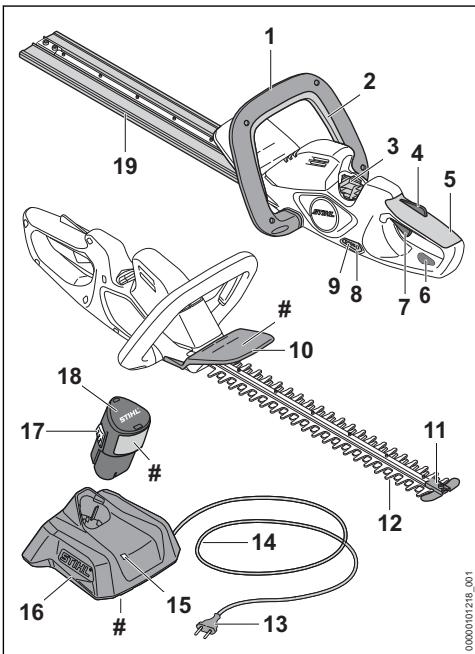
1 Loop handle
The loop handle is used to hold, control and carry the hedge trimmer.
2 Control bar
The control bar switches the hedge trimmer on and off together with the trigger.
3 Battery compartment
The battery compartment holds the battery.
4 Trigger lockout
The trigger lockout unlocks the trigger.
5 Control handle
The control handle is used to control, hold and guide the hedge trimmer.
6 Ring
The ring serves to hang up the hedge trimmer.
7 Trigger
The trigger switches the hedge trimmer on and off together with the control bar.
8 Pushbutton
The pushbutton activates the LEDs on the hedge trimmer.
9 LEDs
The LEDs indicate the state of charge of the battery and any faults.
10 Hand guard
The hand guard protects the hand on the loop handle from contact with the cutting blades.
11 Tip guard
The tip guard protects the tip of the cutting blades from contact with foreign objects.
12 Cutting blades
The cutting blades cut the material to be trimmed.
13 Mains plug
The mains plug connects the connecting cable to a wall socket.
14 Connecting cable
The connecting cable connects the charger to the mains plug.
15 LED
The LED indicates the status of the charger.
16 Charger
The charger charges the battery.
17 Locking hook
Holds the battery in the battery compartment.
18 Battery
The battery supplies power to the hedge trimmer.
19 Blade scabbard
The blade scabbard protects against contact with the cutting blades.
Rating plate with the machine number
3.2 Symbols
Meanings of symbols that may be on the hedge trimmer, battery and charger:

The LED lights up steady or flashes green. The battery is charging.

The LED flashes red. There is no electrical contact between the battery and the charger or there is a fault in the battery or in the charger.

Guaranteed sound power level in accordance with Directive 2000/14/EC in dB(A) for the purpose of comparing the sound emissions of products.

The information next to the symbol indicates the energy content of the battery according to the cell manufacturer's specification. The energy content available in operation is lower.

Operate the electric product in a dry place, indoors only.

Do not dispose of the product with domestic waste.

Read and understand the user manual and keep it in a safe place for reference.
4
Safety Precautions
4.1 Warning symbols
Meanings of warning signs and labels on the hedge trimmer, battery or charger:

Observe safety warnings and take the necessary precautions.

Read and understand the User Manual and keep it in a safe place.

Wear protective glasses.

Do not touch moving cutting blades.

Remove the battery during work interruptions, transport, storage, maintenance or repair.

Protect hedge trimmer and charger from rain and dampness.

Protect battery against heat and fire.

Protect the battery from rain and moisture and do not immerse it in liquids.
4.2 Intended Use
The STIHL HSA 30.0 or HSA 40.0 hedge trimmer is designed for cutting hedges, shrubs, bushes and undergrowth.
The hedge trimmer must not be used in the rain.
The STIHL AS battery supplies power to the hedge trimmer.
The STIHL AL 1 charger recharges the STIHL AS battery.
WARNING
-
Batteries and chargers not explicitly approved for the hedge trimmer by STIHL may cause a fire or explosion. Persons may be seriously or fatally injured, and property may be damaged.
-
Use the hedge trimmer with a STIHL AS battery.
- Recharge the STIHL AS battery with a STIHL AL 1 charger.
Using the hedge trimmer, battery or the charger for purposes for which they were not intended may result in serious or fatal injuries, and damage to property may occur.
- Use the hedge trimmer, battery and the charger as described in this user manual.
4.3 The Operator
WARNING
- Users without adequate training or instruction cannot recognize or assess the risks involved in using the hedge trimmer, battery and charger. The user or other persons may sustain serious or fatal injuries.

Read, understand and save the instruction manual.
- If you pass the hedge trimmer, battery and charger on to another person: Always give them the instruction manual.
-
Make sure the user meets the following requirements:
-
The user must be rested.
-
The user must be in good physical condition and mental health to operate and work with the hedge trimmer, battery and charger. If the user's physical, sensory or mental ability is restricted, he or she may work only under the supervision of or as
instructed by a responsible person.
- The user is able to recognize and assess the risks involved in using the hedge trimmer, battery and charger.
- The user must be of legal age or is being trained in a trade under supervision in accordance with national rules and regulations.
-
The user has received instruction from a STIHL servicing dealer or other experienced user before working with the hedge trimmer for the first time.
-
The user must not be under the influence of alcohol, medication or drugs.
If you have any queries: Contact a STIHL servicing dealer for assistance.
4.4 Clothing and equipment
WARNING
-
Long hair may be pulled into the hedge trimmer while working. This may result in serious injury to the user.
-
Tie up and confine long hair above your shoulders.
-
Objects can be thrown at high speed during operation. This may result in injury to the user.

Wear close-fitting safety glasses. Suitable safety glasses are tested in accordance with EN 166 or national regulations and available commercially with the corresponding marking.
-
Wear a long-sleeved, close-fitting top and long trousers.
-
Dust can be whipped up during operation. Whipped up dust can damage the respiratory passages and cause allergic reactions.
If dust is generated: Wear a dust respirator mask. - Unsuitable clothing can snag on wood or scrub and may become caught in the hedge trimmer. Users not wearing suitable clothing are at risk of serious injury.
Wear close-fitting clothing.
Remove scarves and jewelry.
- The user may come into contact with the moving cutting blades while working. This may result in serious injury to the user.
Wear robust footwear.
- Wear long trousers made from resistant material.
- The user may come into contact with the cutting blades during cleaning or servicing. This may result in injury to the user.
Wear work gloves made from resistant material.
Wearing unsuitable footwear may cause the user to slip. This may result in injury to the user.
Wear sturdy, closed-toed footwear with high-grip soles.
4.5 Work Area and Surroundings
4.5.1 Hedge Trimmer
WARNING
-
Bystanders, children and animals cannot recognize or assess the dangers of the hedge trimmer or flying debris. Innocent bystanders, children and animals may be seriously injured and damage to property may occur.
-
Keep bystanders, children and animals away from the work area.
Do not leave the hedge trimmer unattended.
Make sure that children cannot play with the hedge trimmer. -
The hedge trimmer is not waterproof. Working in the rain or a damp location may result in an electric shock. This can result in injuries to the user and may damage the hedge trimmer.

-
Do not work in the rain or a damp location.
-
Electrical components of the hedge trimmer can produce sparks. Sparks may cause a fire or an explosion in an easily combustible or explosive environment. This can result in serious or fatal injuries and damage to property.
-
Do not work in an easily combustible or explosive environment.
4.5.2 Battery
WARNING
-
Bystanders, children and animals cannot recognize or assess the dangers of the battery. Bystanders, children and animals may be seriously injured.
-
Keep bystanders, children and animals away from the work area.
Do not leave the battery unattended.
Make sure that children cannot play with the battery. -
The battery is not protected against all ambient conditions. If the battery is exposed to certain ambient conditions, the battery may catch fire, explode or be irreparably damaged. This may result in serious injury to people and damage to property.

- Protect battery from heat and fire.
-
Do not throw the battery into a fire
-
Do not charge, use and store the battery outside of the specified temperature limits, 18.6.

Protect the battery from rain and moisture and do not immerse it in liquids.
- Keep battery away from small metal parts.
Do not expose the battery to high pressure.
Do not expose the battery to microwaves. - Protect the battery from chemicals and salts.
4.5.3 Charger
WARNING
-
Bystanders and children are not aware of and cannot assess the dangers of a charger or electric current. Bystanders, children and animals may be seriously or fatally injured.
-
Keep bystanders, children and animals away from the work area.
Make sure that children cannot play with the charger. -
The charger is not waterproof. If you work in the rain or in a damp environment, an electric shock may occur. The user may be injured and the charger may be damaged.

-
Do not operate it in the rain or in a damp environment.
-
The charger is not protected against all ambient conditions. If the charger is exposed to certain ambient conditions, it may catch fire or explode. This may result in serious injury to people and damage to property.
-
Operate the charger in an enclosed, dry room.
-
Do not operate the charger in a flammable environment or in an explosive environment.
-
Do not operate the charger on a readily combustible surface.
Do not use and store the charger outside of the specified temperature limits, 18.6. -
The connecting cable is a trip hazard. People may be injured and the charger may be damaged.
Lay the connecting cable flat on the floor.
4.6 Safe Condition
4.6.1 Hedge trimmer
The hedge trimmer is in a safe condition if the following conditions are fulfilled:
- The hedge trimmer is undamaged.
Hedge trimmer is clean and dry. - The controls function properly and have not been modified.
- The cutting blades are correctly fitted.
- Only an original STIHL accessory for this hedge trimmer has been fitted.
- The accessories are correctly attached.
WARNING
If not in safe condition, components may no longer operate correctly and safety devices may be disabled. This may result in serous or fatal injury to people.
- Never use a damaged hedge trimmer.
If the hedge trimmer is dirty or wet: Clean the hedge trimmer and allow it to dry.
Do not modify the hedge trimmer.
If the controls do not work: Do not operate the hedge trimmer.
Only fit original STIHL accessories for this hedge trimmer. - Attach accessories as described in this User Manual or in the User Manual for the accessories.
- Do not insert objects into the openings in the hedge trimmer.
Replace worn or damaged labels.
If you have any doubts, be sure to consult a STIHL dealer.
4.6.2 Cutting Blades
The cutting blades are in a safe condition if the following points are observed:
- Cutting blades are undamaged.
- Cutting blades are not deformed.
- Cutting blades move freely.
- Cutting blades are properly sharpened.
- Cutting blades have no burrs.
WARNING
If they are in an unsafe condition, parts of the cutting blades may come off and be thrown at high speed. This can result in serious injuries.
Work only with undamaged cutting blades.
Make sure the cutting blades are properly sharpened and debrurred.
If you have any queries: Contact your STIHL servicing dealer.
4.6.3 Battery
The battery is in a safe condition if the following points are observed:
Battery is undamaged.
- The battery is clean and dry.
- Battery functions properly and has not been modified.
WARNING
A battery that is not in a safe condition cannot operate safely. Persons may be seriously injured.
- Never work with a damaged battery.
- Never attempt to charge a damaged or defective battery.
If the battery is dirty: Clean the battery.
If the battery is wet or damp: Allow the battery to dry, 18.7. - Never attempt to modify the battery.
- Never insert objects in the battery's openings.
-
Never bridge the battery's contacts with metallic objects (short circuit).
Do not open the battery.
Replace worn or damaged labels. -
Fluid may leak from a damaged battery. If that liquid comes into contact with the skin or eyes, the skin or eyes may be irritated.
Avoid contact with the liquid.
If skin contact occurs: Wash affected areas of skin with plenty of water and soap.
In the event of contact with eyes: Rinse eyes with plenty of water for at least 15 minutes and consult a doctor.
A damaged or defective battery may smell unusual, emit smoke or burn. Persons may be seriously or fatally injured, and property may be damaged.
If the battery smells unusual or emits smoke: do not use the battery and keep it away from combustible substances.
- If the battery catches fire: Attempt to extinguish the battery with a fire extinguisher or water.
4.6.4 Charger
The charger is in a safe condition if the following points are observed:
- Charger is undamaged.
- Charger is clean and dry.
WARNING
If components do not comply with safety requirements, they will no longer function properly and safety devices may be rendered inoperative. This can result in serious or fatal injuries.
Do not use a damaged charger.
If the charger is dirty or wet: Clean the charger and allow it to dry.
- Never attempt to modify the charger.
- Never insert objects in the charger's openings.
- Never bridge the charger's contacts with metallic objects (short circuit).
Do not open the charger.
4.7 Operation
WARNING
- The user cannot concentrate on the work in certain situations. The user may stumble, fall and be seriously injured.
Work calmly and carefully.
If light and visibility are poor: Do not use your hedge trimmer.
Operate the hedge trimmer alone.
Watch out for obstacles.
- Stand on the ground while working and keep a good balance. If it is necessary to work at heights: Use a lift bucket or a safe platform.
If you begin to feel tired: Take a break.
- Working above shoulder height can cause you to tire quickly. This can result in serious injuries.
Work above shoulder height for short periods only.
Take regular breaks.
If the moving cutting blades make contact with a hard object they can be brought to a sudden stop. The reactive forces that occur can cause the user to lose control of the hedge trimmer and be seriously injured.
- Hold the hedge trimmer firmly with both hands.
Before starting work, check hedge for hard objects and remove any such objects.
The moving cutting blades can cut the user. This can result in serious injuries.

- Do not touch moving cutting blades.
- If the cutting blades are blocked by an object: Switch off the hedge trimmer and remove the battery. Then remove the object causing the block age.
If the behavior of the hedge trimmer changes during operation or feels unusual, it may no longer be in a safe condition. This can result in serious injuries and damage to property.
- Stop work, remove the battery and contact your STIHL servicing dealer for assistance.
Hedge trimmer vibrations may occur during operation.
Wear gloves.
Take regular breaks.
If signs of circulation problems occur: Seek medical advice.
Note that the cutting blades continue to run for about 1 second after you release the trigger. The moving cutting blades can cut the user. This can result in serious injuries.
- Hold the hedge trimmer firmly by the control handle and loop handle and wait until the cutting blades come to a complete stand-still.
DANGER
- Working near live electric cables can result in accidental contact with the cutting blades and damage the cables. This can result in serious or fatal injuries.
Do not work near live electric cables.
4.8 Charging
WARNING
A damaged or defective charger may produce an unusual smell or emit smoke during the charging process. This may result in personal injuries and damage to property.
Disconnect the plug from the wall outlet.
- The charger can overheat and cause a fire if heat dissipation is inadequate. This can result in serious or fatal injuries and damage to property.
Do not cover the charger.
4.9 Connecting to the power supply
Contact with live components may occur for the following reasons:
- The connecting cable or the extension cord is damaged.
- The mains plug of the connecting cable or extension cord is damaged.
- The socket is not properly installed.
DANGER
-
Contact with live parts may result in electric shock. This may result in serious or fatal injury to the user.
-
Make sure that the connecting cable, extension cord and their mains plugs are undamaged.

If the connecting cable or the extension cord is damaged:
Do not touch the damaged area.
- Disconnect the mains plug from the power supply.
Make sure your hands are dry before touching the connecting cable, extension cord or mains plugs.
Plug the mains plug of the connecting cable or extension cord into a properly installed, shockproof socket with the correct fuse rating.
Install the charger with a ground fault circuit interrupter (30 mA, 30 ms).
A damaged or unsuitable extension cable can result in electric shock. There is a risk of serious or fatal injury.
Use an extension cable with the correct cable cross-section, 18.5.
WARNING
- Overvoltage can occur in the charger if the line voltage or frequency are incorrect during charging. The charger may be damaged.
- Make sure that the mains voltage and the mains frequency of the power supply match the data on the rating plate of the charger.
If the charger is connected to a power strip, electrical components may be overloaded during the charging process. The components may overheat and cause a fire. Persons may be seriously or fatally injured, and property may be damaged. - Ensure that the technical specifications for the power strip are not exceeded by the information on the rating plate of the charger and of all electrical devices connected to the power strip.
- An incorrectly routed connecting cable or extension cord may be damaged, and people may trip over it. People may be injured, and the connecting cable or extension cord may be damaged.
-
Route and mark the connecting cable and extension cord so that people will not trip over them.
-
Route the connecting cable and extension cord so that they are not under tension or tangled.
- Route the connecting cable and extension cord so that they will not be damaged, kinked or crushed and will not be chafed.
- Protect the connecting cable and extension cord from heat, oil and chemicals.
- Lay the connecting cable and extension cord on a dry surface.
The extension cable warms up in operation. If that heat cannot escape, it may cause a fire.
If using a cable reel: completely unroll the cable reel.
If wiring and pipes are laid in the wall, they may be damaged if the charger is mounted on the wall. Contact with wiring can result in electric shock. This may result in serious injury to people and damage to property.
- Make sure there is no wiring or pipes in the wall at the proposed mounting site.
If the charger is not mounted on the wall as described in this User Manual, the charger or the battery may fall or the charger may overheat. This may result in injury to people and damage to property.
- Mount the charger on a wall as described in this User Manual.
If the charger is mounted on a wall with the battery inserted, the battery may fall out of the charger. This may result in injury to people and damage to property.
- Mount the charger on the wall first before inserting the battery.
4.10 Transporting
4.10.1 Hedge Trimmer
WARNING
The hedge trimmer may turn over or shift during transport. This may result in injury to people and damage to property.

Remove the battery.
- Fit the blade scabbard so that it completely covers the cutting blades.
- Secure the hedge trimmer with lashing straps or a net to prevent it turning over and moving.
4.10.2 Battery
WARNING
-
The battery is not protected against all ambient conditions. The battery may be damaged if it is exposed to certain ambient conditions, and damage to property may occur.
-
Never transport a damaged battery.
If a bag is supplied: Transport the battery in the bag supplied. -
The battery may turn over or shift during transport. This may result in injury to people and damage to property.
Pack the battery in packaging in such a way that it cannot move.
- Secure the packaging so that it cannot move.
4.10.3 Charger
WARNING
-
The charger can turn over or move while being transported. This may result in personal injuries and damage to property.
-
Disconnect the plug from the wall outlet.
Remove the battery.
Transport the charger in the bag supplied.
If no bag is supplied with the charger: Secure the charger with lashing straps, belts or a net to prevent it turning over and moving. -
The connecting cable must not be used for carrying the charger. The connecting cable and the charger may be damaged.
Wind up the connecting cable and attach it to the charger.
4.11 Storing
4.11.1 Hedge Trimmer
WARNING
Children are not aware of and cannot assess the dangers of a hedge trimmer. Children may be seriously injured.

Remove the battery.
- Fit the blade scabbard so that it completely covers the cutting blades.
- Store the hedge trimmer out of the reach of children.
- Dampness can corrode the electrical contacts on the hedge trimmer and metal components. This can damage the hedge trimmer.

Remove the battery.
- Store the hedge trimmer in a clean and dry condition.
4.11.2 Battery
WARNING
Children are not aware of and cannot assess the dangers of the battery Children may be seriously injured.
- Store the battery out of the reach of children.
- The battery is not protected against all ambient conditions. If the battery is exposed to certain ambient conditions, the battery may be irreparably damaged.
- Store the battery in a clean and dry condition.
- Store the battery in an enclosed space.
- Store the battery separately from the hedge trimmer.
If the battery is stored in the charger, disconnect the mains plug and store the battery at a state of charge between 40% and 60% (2 LEDs light up steady green).
Do not store the battery outside of the specified temperature limits, 18.6.
4.11.3 Charger
WARNING
Children are not aware of and cannot assess the dangers of a charger. Children can be seriously injured or killed.
- Disconnect the plug from the wall outlet.
-
Store the charger out of reach of children.
-
The charger is not protected against all ambient conditions. If the charger is exposed to certain ambient conditions, the charger may be damaged.
Disconnect the plug from the wall outlet.
- If the charger is hot: Allow the charger to cool down.
- Store the charger in a clean, dry place.
- Store the charger in an enclosed room.
Do not store the charger outside of the specified temperature limits, 18.6.
-
The connecting cable should not be used for carrying the charger or hanging up the charger. The connecting cable and the charger may be damaged.
-
Hold the charger by the housing in a secure grip.
-
Hang the charger on the wall mounting.
4.12 Cleaning, maintenance and repair
WARNING
- The hedge trimmer may start unintentionally if the battery is left in place during cleaning, maintenance or repair operations. This may result in serious injury to people and damage to property.

Remove the battery.
-
Sharp cleaning agents, cleaning with a water jet or pointed objects can damage the hedge trimmer, the cutting blades, the battery or the charger. If the hedge trimmer, cutting blades, battery or charger are not cleaned correctly, components may no longer function properly or safety devices may be rendered inoperative. Persons may be seriously injured.
-
Clean the hedge trimmer, cutting blades, battery and charger as described in this instruction manual.
If the hedge trimmer, cutting blades, battery or charger are not serviced correctly, components may no longer function properly or safety devices may be rendered inoperative. There is a risk of serious or fatal injury. - Do not attempt to service or repair the hedge trimmer, battery or charger.
- If the hedge trimmer, battery or the charger require servicing or repairs: Contact your STIHL servicing dealer for assistance.
- Maintain the cutting blades as described in this User Manual.
- The user can be cut by the sharp cutting edges while cleaning or servicing the cutting blades. This may result in injury to the user.
Wear work gloves made of robust material.
5 Preparing Hedge Trimmer for Operation
5.1 Preparing Hedge Trimmer for Operation
The following steps must be performed before commencing work:
- Ensure that the following components are in safe condition:
Hedge trimmer, 4.6.1. -
Cutting blades, 4.6.2.
Battery, 4.6.3. -
Charger, 4.6.4.
Check the battery, 9.2.
Fully charge the battery, 6.2.
Clean the hedge trimmer, 14.1.
Check the controls, 9.1.
If you cannot carry out this work: Do not use your hedge trimmer and contact your STIHL servicing dealer.
6 Charging the Battery, LEDs
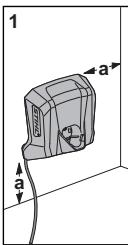
6.1 Mounting the Charger on a Wall
The charger can be mounted on a wall.
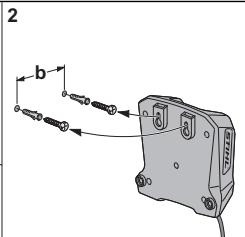
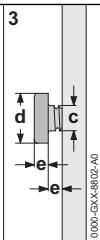
-
Check the following points when mounting the charger on a wall:
-
Suitable fixing materials.
-
The charger is level.
The following dimensions are observed: -
a = at least 100 mm
- b = 54mm
- c = 4.5mm
- d = 9mm
- e = 2.5 mm
6.2 Charging the battery
The charging time depends on various factors, e.g. the battery temperature or the ambient temperature. For optimum performance, observe the recommended temperature ranges, 18.7. The actual charging time may vary from the charging time indicated. The charging time is indicated at www.stihl.com/charging-times.
The charging process starts automatically when the mains plug is plugged into a socket and the battery is inserted into the charger. The charger
switches off automatically when the battery is fully charged.
The battery and the charger warm up during charging.
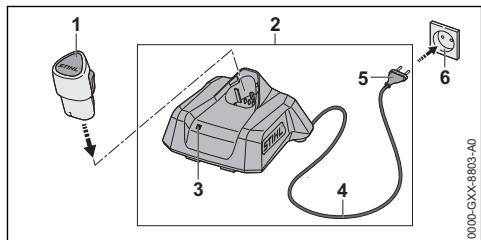
- Insert the mains plug (5) in a convenient wall outlet (6).
The charger (2) runs a self test. The LED (3) glows green for about 1 second and then red for about 1 second.
Fit the connecting cable (4). - Insert the battery (1) in the guides in the charger (2) and press it home as far as stop. The LED (3) glows or flashes green. The battery (2) is being charged.
- When the LED (3) stops glowing: The battery (1) is fully charged and can be taken out of the charger (2).
If the charger (2) is no longer required. Disconnect the mains plug (5) from the wall outlet (6).
6.3 Displaying the State of Charge
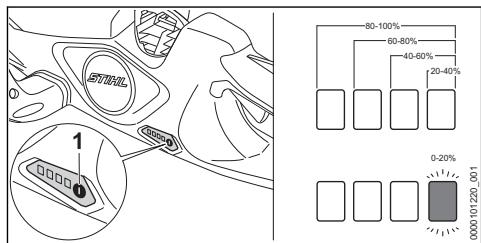
Insert the battery.
Depress the pushbutton (1). The LEDs light up steady green for about 5 seconds and indicate the state of charge.
If the LED on the right flashes green: Charge the battery.
6.4 LEDs on the Hedge Trimmer
The LEDs can indicate the state of charge of the battery or any faults. The LEDs can may light up steady or flash in green or red.
If the LEDs light up steady or flash green, this indicates the state of charge of the battery.
If the LEDs light up steady or flash red: Troubleshooting, 17.1.
Malfunction in the hedge trimmer or battery.
6.5 LED on Charger
The LED indicates the operating status of the charger or faults. The LED can glow or flash green or red.
If the LED glows or flashes green, the battery is being charged.
If the LED glows or flashes red: Troubleshooting, 17.2.
There is a malfunction in charger or battery.
7 Removing and Fitting the Battery
7.1 Inserting the Battery
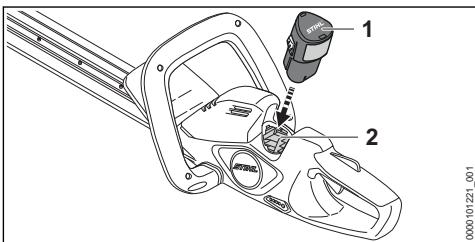
- Push the battery (1) into the battery compartment (2) as far as stop.
The battery (1) engages in position with a click.
7.2 Removing the Battery
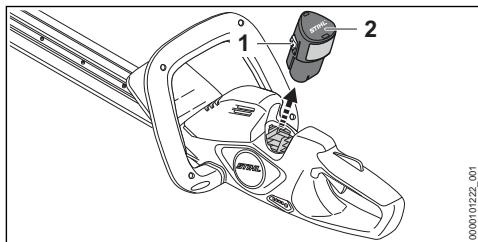
Depress both locking hooks (1).
The battery (2) is now unlocked and can be removed.
8 Switching the Hedge Trimmer On/Off
8.1 Switching on the Hedge Trimmer

WARNING
- The motor accelerates and the cutting blades run regardless of the sequence in which the control bar and trigger are depressed. If you depress the trigger first and then the control bar, you may lose control of the hedge trimmer. This may result in serious injury to the user.
Depress the control bar first and then the trigger.
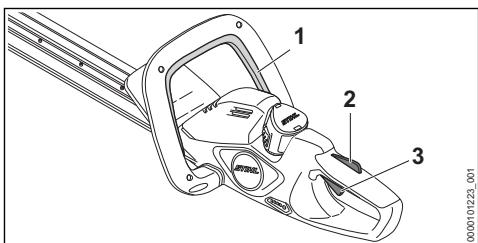
Depress the control bar (1) and hold it in that position.
Depress the trigger lockout (2) with your hand and keep it pressed.
Depress the trigger (3) with your index finger and keep it depressed.
The hedge trimmer accelerates and the cutting blades run.
8.2 Switching off the Hedge Trimmer
- Release the switch lever, trigger and lockout lever.
- Wait for the cutting blades to come to a complete standstill after about 1 second.
If the cutting blades continue to run after about 1 second: Remove the battery and contact your STIHL authorized dealer for assistance. The hedge trimmer is defective.
9 Testing the Hedge Trimmer and Battery
9.1 Checking the Controls
Trigger lockout and trigger
Remove the battery.
Try depressing the trigger without pressing the trigger lockout.
If the trigger can be pressed: Do not use your hedge trimmer and contact your STIHL authorized dealer.
The trigger lockout is defective.
Depress and hold the trigger lockout.
Depress the trigger.
Release the trigger and trigger lockout.
If the trigger or trigger lockout lever is stiff or does not spring back to the idle position: Do not use your hedge trimmer and contact your STIHL authorized dealer.
The trigger or the trigger lockout is defective.
Control bar
Remove the battery.
Depress the control bar and release it again.
- If the control bar is stiff or does not spring back to its idle position: Do not use your hedge trimmer and contact your STIHL authorized dealer.
The control bar is defective.
Switching on the Hedge Trimmer
Insert the battery.
Depress the control bar and release it again.
- If the cutting blades have run or are running: Do not use your hedge trimmer and contact your STIHL authorized dealer. The trigger is defective.
Depress and hold the trigger lockout.
Depress and hold the trigger.
If the cutting blades run: Do not use your hedge trimmer; contact your STIHL authorized dealer.
The control bar is defective.
Depress the control bar and hold it in that position.
The cutting blades run.
If 3 LEDs are flashing red: Remove the battery and consult a STIHL authorized dealer.
There is a malfunction in the hedge trimmer.
Release the control bar.
The cutting blades stop running after about 1 second.
If the cutting blades continue to run after 1 second: Remove the battery and contact your STIHL authorized dealer.
The hedge trimmer is defective.
9.2 Checking the Battery
Insert the battery.
Depress the pushbutton on the hedge trimmer. The LEDs light up steady or flash.
If the LEDs do not light up steady or flash: Do not use your hedge trimmer and battery and contact your STIHL servicing dealer. There is a malfunction in hedge trimmer or battery.
10 Operating the Hedge Trimmer
10.1 Holding and Controlling the Hedge Trimmer
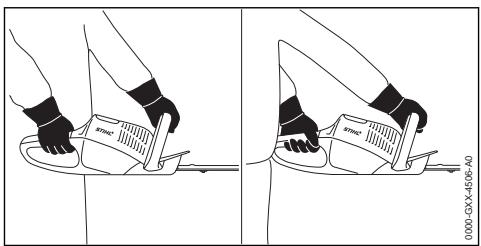
- Hold the hedge trimmer with one hand on the control handle - wrap your thumb around the control handle.
- Hold the hedge trimmer with the other hand on the loop handle - wrap your thumb around the loop handle.
10.2 Cutting
- Use pruning shears or a chainsaw to cut out thick branches first.
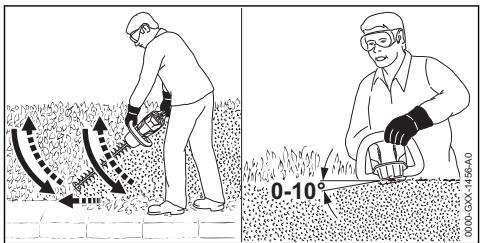
- Swing the hedge trimmer from the bottom upwards in an arc while making the cut.
Lower the nose of the hedge trimmer without cutting. - Walk forward slowly in a controlled manner.
- Swing the hedge trimmer from the bottom upwards in an arc while making the cut.
Cut the other side of the hedge in the same way. - Hold the cutting blades at an angle of 0^ to 10^ to the top of the hedge.
- Swing the hedge trimmer horizontally and in an arc while making the cut.
If cutting performance deteriorates: Sharpen the cutting blades.
For optimum performance, observe the recommended temperature ranges, 18.7.
11 After Finishing Work
11.1 After Finishing Work
- Switch off the hedge trimmer and remove the battery.
If the hedge trimmer is wet: Allow the hedge trimmer to dry.
If the battery is moist or wet: Allow the battery to dry, 18.7.
Clean the hedge trimmer.
Clean the cutting blades. - Fit the blade scabbard so that it completely covers the cutting blades.
Clean the battery.
12 Transporting
12.1 Transporting the Hedge Trimmer
- Switch off the hedge trimmer and remove the battery.
- Fit the blade scabbard so that it completely covers the cutting blades.
Carrying the hedge trimmer
- Carry the hedge trimmer by the loop handle with the cutting blades behind you.
Transporting the Hedge Trimmer in a vehicle
- Secure the hedge trimmer to prevent it tipping over and moving.
12.2 Transporting the battery
- Switch off the hedge trimmer and remove the battery.
- Check that the battery is in a safe condition.
Pack the battery in packaging in such a way that it cannot move inside the packaging. - Secure the packaging so that it cannot move.
The battery is subject to the Carriage of Dangerous Goods regulations. The battery is classified as UN 3480 (lithium ion batteries) and has been tested pursuant to UN Manual Tests and Criteria Part III, Subsection 38.3.
The transport regulations can be found at www.stihl.com/safety-data-sheets.
12.3 Transporting the Charger
Disconnect the plug from the wall outlet.
Remove the battery.
Wind up the connecting cable and attach it to the charger.
Transporting the charger in a vehicle: Secure the charger with lashing straps, belts or a net to prevent it turning over and moving.
13 Storing
13.1 Storing the Hedge Trimmer
- Switch off the hedge trimmer and remove the battery.
-
Fit the blade scabbard so that it completely covers the cutting blades.
Make sure the following conditions are met when storing the hedge trimmer: -
The hedge trimmer cannot turn over or shift.
- The hedge trimmer is out of the reach of children.
- The hedge trimmer is clean and dry.
13.2 Storing the Battery
STIHL recommends keeping the battery in a charging state between 40% and 60% (2 green LEDs lit).
The battery should be stored in such a way that the following conditions are fulfilled:
- The battery is out of the reach of children.
- The battery is clean and dry.
- The battery is in an enclosed space.
- The battery is separated from the hedge trimmer.
- If the battery is stored in the charger, disconnect the mains plug and store the battery at a state of charge between 40% and 60% (2 lit green LEDs).
- Do not store the battery outside of the specified temperature limits, 18.6.
NOTICE
If the battery is not stored as described in this User Manual, the battery may become deeply discharged and irreparably damaged.
Charge a discharged battery before storing it. STIHL recommends keeping the battery state of charge between 40% and 60% (2 lit green LEDs).
- Store the battery separately from the hedge trimmer.
13.3 Storing the Charger
- Disconnect the mains plug from the power supply.
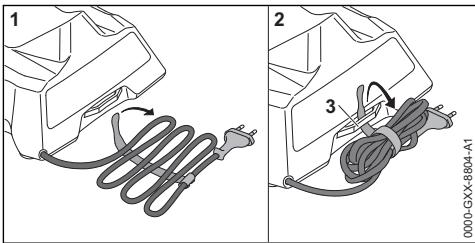
Wind up the connecting cable and attach it to the charger.
- Observe the following points when storing the charger:
- Charger is out of the reach of children.
- The charger is clean and dry.
- Charger is in an enclosed space.
- The charger is not suspended from the connecting cable or the holder (3) for the connecting cable.
- Do not store the charger outside of the specified temperature limits, 18.6.
14 Cleaning
14.1 Cleaning the hedge trimmer
- Switch off the hedge trimmer and remove the battery.
Clean the hedge trimmer with a damp cloth or STIHL resin solvent.
Clean vents with a paintbrush. - Remove foreign objects from the battery compartment and clean the battery compartment with a damp cloth.
- Clean the electrical contacts in the battery compartment with a paintbrush or soft brush.
14.2 Cleaning the cutting blades
- Switch off the hedge trimmer and remove the battery.
- Spray both sides of the cutting blades with STIHL resin solvent.
Insert battery. - Run the hedge trimmer for 5 seconds. The cutting blades run. The STIHL resin solvent is distributed evenly.
14.3 Cleaning the Battery
Clean the battery with a damp cloth.
14.4 Cleaning the Charger
- Disconnect the mains plug from the power supply.
Clean the charger with a damp cloth. - Clean the charger's electrical contacts with a paintbrush or a soft brush.
15 Maintenance
15.1 Maintenance Intervals
The maintenance intervals are dependent on the environmental and operating conditions. STIHL recommends the following maintenance intervals:
After every 25 hours of operation
Clean the cutting blades.
Sharpen the cutting blades.
Every 12 months
Have hedge trimmer checked by a STIHL servicing dealer.
15.2 Sharpening the cutting blades
STIHL recommends you have the cutting blades resharpened by a STIHL dealer.

WARNING
The teeth of the cutting blades are very sharp. There is a risk of cutting oneself.
Wear work gloves made of robust material.
- Switch off the hedge trimmer and remove the battery.
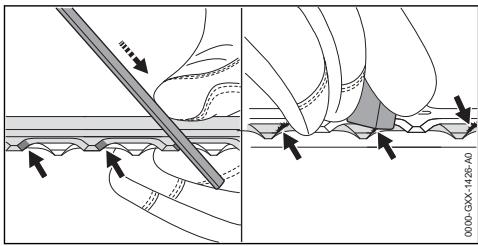
- Use a STIHL flat file to sharpen each cutting edge on the upper blade. The file only sharpens on the forward stroke. Maintain the prescribed sharpening angle, 18.2.
Turn the hedge trimmer over.
Sharpen the remaining cutting edges.
Deburr each cutting edge from below.
Turn the hedge trimmer over.
Deburr the remaining cutting edges. - Use a damp cloth to remove the filing dust.
- Spray both sides of cutting blades with STIHL resin solvent.
- Run the hedge trimmer for 5 seconds. The cutting blades run. The STIHL resin solvent is distributed evenly.
If you are unsure: Consult a STIHL authorized dealer.
16 Repairing
16.1 Repairing Hedge Trimmer, Battery and Charger
The hedge trimmer, cutting blades, battery and charger are not user serviceable.
If the hedge trimmer or cutting blades are damaged: Do not use your hedge trimmer and contact your STIHL servicing dealer.
If the battery has a malfunction or is damaged: Replace the battery.
If the charger has a malfunction or is damaged: Replace the charger.
- If the connecting cable has a malfunction or is damaged: Do not use the charger and have connecting cable replaced by a STIHL servicing dealer.
17 Troubleshooting
17.1 Troubleshooting the Hedge Trimmer or Battery
| Fault | LEDs on hedge trimmer | Cause | Remedy |
| Hedge trimmer does not start when switched on. | 1 LED flashes green. | State of charge of the battery is too low. | Charge the battery. |
| 1 LED lights up steady red. | The battery is too warm or too cold. | Remove the battery. Allow the battery to cool down or warm up. | |
| 3 LEDs flash red. | There is a malfunction in the hedge trimmer. | Remove the battery and reinsert it. Switch on the hedge trimmer. If 3 LEDs continue to flash red: Do not use your hedge trimmer and contact your STIHL authorized dealer for assistance. | |
| The cutting blades do not run freely. | Spray both sides of cutting blades with STIHL resin solvent. | ||
| If 3 LEDs continue to flash red: Do not use your hedge trimmer and contact your STIHL authorized dealer for assistance. | |||
| 3 LEDs light up steady red. | The hedge trimmer is too hot. | Remove the battery. Allow the hedge trimmer to cool down. | |
| 4 LEDs flash red. | There is a fault in the battery. | Remove the battery. Clean electrical contacts in the battery compartment. Insert the battery. Switch on the hedge trimmer. If 4 LEDs continue to flash red: Do not use the battery; contact a STIHL authorized dealer. | |
| No electrical contact between the hedge trimmer and battery. | Remove the battery. Clean electrical contacts in the battery compartment. Insert the battery. | ||
| The hedge trimmer or battery is damp. | Allow the hedge trimmer or battery to dry, 18.7. | ||
| The cutting blades do not run freely. | Spray both sides of cutting blades with STIHL resin solvent. If the hedge trimmer still does not start when switched on: Do not use the hedge trimmer and contact your STIHL dealer for assistance. | ||
| The hedge trimmer cuts out during operation. | 3 LEDs light up steady red. | The hedge trimmer is too hot. | Remove the battery. Allow the hedge trimmer to cool down. |
| There is an electrical fault. | Remove the battery and reinsert it. Switch on the hedge trimmer. | ||
| Hedge trimmer's running time is too short. | The battery is not fully charged. | Fully charge the battery. | |
| The battery service life has been exceeded. | Replace the battery. |
17.2 Troubleshooting the Charger
| Fault | LED on Charger | Cause | Remedy |
| Battery not being charged. | One LED glows red. | The battery is too warm or too cold. | Leave battery inserted in charger. Charging starts automatically as soon as the permitted temperature range is re-ched. |
| The LED flashes red. | No electrical contact between charger and battery. | Remove the battery. Clean contacts on charger. Insert battery. | |
| There is a malfunction in the charger. | Do not use the charger and contact your STIHL dealer for assistance. | ||
| There is a fault in the battery. | Do not use the battery. Consult a STIHL dealer. | ||
| The charger does not run a self test. | The LED glows green for about 1 second and then red | Electrical contact to charger was briefly interrupted. | Disconnect the mains plug from the power supply. Wait for 1 minute. Insert the mains plug in a wall outlet. |
| Fault | LED on Char-ger | Cause | Remedy |
| for about 1 second. |
18 Specifications
18.1 STIHL HSA 30.0, HSA 40.0 Hedge Trimmer
HSA 30.0
Approved battery: STIHL AS
Weight without battery: 2.0kg
HSA 40.0
Approved battery: STIHL AS
Weight without battery: 2.1kg
For runtime, see www.stihl.com/battery-life.
18.2 Cutting blades
HSA 30.0
- Tooth spacing: 22 mm
- Cutting length: 450 mm
- Sharpening angle: 34^
HSA 40.0
- Tooth spacing: 24 mm
- Cutting length: 500mm
- Sharpening angle: 31^
18.3 STIHL AS Battery
- Battery Technology: Lithium-ion
Voltage: 10.8 V
Capacity in Ah: see rating label - Energy content in Wh: see rating label
Weight in kg: see rating label
18.4 STIHL AL 1 Charger
- Rated voltage: see rating pate
Frequency: see rating plate - Rated power: see rating plate
- Charging current: see rating plate
Maximum energy content of approved STIHL AS battery: 12.5 Ah
For charging times see www.stihl.com/chargingtimes.
18.5 Extension Cords
If an extension cord is used, the cross sectional area of its conductors must meet the following minimum requirements - depending on the line voltage and length of the extension cord:
If rated voltage on the rating label is 220V to 240V:
- Cord length up to 20m : AWG 15 / 1.5 mm²
Cord length 20m up to 50m : AWG 13/2.5 mm²
If rated voltage on the rating label is 100V to 127V:
- Cord length up to 10m : AWG 14 / 2.0 mm²
- Cord length 10m up to 30m : AWG 12/ 3.5mm^2
18.6 Temperature limits
WARNING
-
The battery is not protected against all ambient conditions. If the battery is exposed to certain environmental conditions, it may catch fire or explode. This may result in serious injury to people and damage to property.
-
Do not charge the battery below -20^ or above +50^ .
- Do not use the hedge trimmer, battery or charger below -20^ or above +50^ .
- Do not store the hedge trimmer, battery or charger below -20^ or above +70^ .
18.7 Recommended temperature ranges
For optimum performance of the hedge trimmer, battery and charger, observe the following temperature ranges:
- Charging: 5^ to 40^
- Use: - 10 °C to + 40 °C
- Storage: -20 °C to +50 °C
If the battery is charged, used or stored outside the recommended temperature ranges, performance may be reduced.
If the battery is wet or moist, allow the battery to dry for at least 48h between 15^ and 50^ and with less than 70% humidity. Higher humidity may extend the drying time.
18.8 Sound Values and Vibration Values
The K value for the sound pressure level is 2 dB(A). The K value for the sound power level is 2 dB(A). The K value for the vibration level is 2 m/s².
STIHL recommends wearing hearing protection.
HSA 30.0
Sound pressure level L_pA measured according to EN 62841-4-2: 82 dB(A).
Sound power level L_WA measured as specified in EN 62841-4-2: 90 dB(A).
Vibration level a_hv measured as specified in EN 62841-4-2
Control handle: 1.4m / s^2
- Loop handle: 1.9 m/s^2 .
HSA 40.0
Sound pressure level L_pA measured according to EN 62841-4-2: 82 dB(A).
Sound power level L_WA measured as specified in EN 62841-4-2: 90 dB(A).
Vibration level a_hv measured as specified in EN 62841-4-2
Control handle: 1.4m / s^2
- Loop handle: 1.9 m/s^2 .
The vibration levels indicated were measured according to a standardized test method and can be used as a basis for comparing electric power tools. The vibration levels actually occurring may vary from the values indicated, depending on the type of application. The vibration levels indicated can be used for an initial estimate of the vibration stress. The actual vibration stress has to be estimated. The times can be taken into account in the estimate when the electric power tool is switched off and also when it is switched on but running without any load.
For information on compliance with the Physical Agents (Vibration) Directive 2002/44/EC, see www.stihl.com/vib.
18.9 REACH
REACH is an EC regulation and stands for the Registration, Evaluation, Authorisation and Restriction of Chemical substances.
For information on compliance with the REACH regulation see www.stihl.com/reach.
19 Spare Parts and Accessories
19.1 Spare parts and accessories
STIHL These symbols indicate original STIHL spare parts and original STIHL accessories.
STIHL recommends the use of original STIHL spare parts and accessories.
Despite ongoing market observation, STIHL is unable to judge the reliability, safety and suitability of other manufacturers' spare parts and accessories; accordingly, STIHL cannot warrant for the use of those parts.
Original STIHL spare parts and original STIHL accessories are available from STIHL dealers.
20 Disposal
20.1 Disposal of Hedge Trimmer, Battery and Charger
Contact the local authorities or your STIHL dealer for information on disposal.
Improper disposal can be harmful to health and pollute the environment.
Take STIHL products including packaging to a suitable collection point for recycling in accordance with local regulations.
Do not dispose with domestic waste.
21 EC Declaration of Conformity
21.1 STIHL HSA 30.0, HSA 40.0 Hedge Trimmer
declares under our sole responsibility that
Category: Cordless hedge trimmer
- Manufacturer's brand: STIHL
- Model: STIHL HSA 30.0, HSA 40.0
- Serial identification number: HA08
conforms to the relevant provisions of Directives 2011/65/EU, 2006/42/EC, 2014/30/EU and 2000/14/EC and has been developed and manufactured in compliance with the following standards in the versions valid on the date of production: EN 55014-1, EN 55014-2, EN 62841-1 and EN 62841-4-2.
Applied conformity assessment procedure in accordance with Directive 2000/14/EC, Annex V. HSA 30.0
Measured sound power level: 90 dB(A)
- Guaranteed sound power level: 92 dB(A)
HSA 40.0
- Measured sound power level: 90 dB(A)
- Guaranteed sound power level: 92 dB(A)
The technical documents are stored at ANDREAS STIHL AG & Co. KG Produktzulassung.
The year of manufacture, country of manufacture and machine number are shown on the hedge trimmer.
Waiblingen, 09-03-2023
Robert Olma, Vice President, Regulatory Affairs & Global Governmental Relations
22 UKCA Declaration of Conformity
22.1 STIHL HSA 30.0, HSA 40.0 Hedge Trimmers

declares under our sole responsibility that
Category: Cordless hedge trimmer
Manufacturer's brand: STIHL
- Model: HSA 30.0, HSA 40.0
- Serial identification number: HA08
conforms to the relevant provisions of UK regulations The Restriction of the Use of Certain Hazardous Substances in Electrical and Electronic Equipment Regulations 2012, Supply of Machinery (Safety) Regulations 2008, Electromagnetic Compatibility Regulations 2016 and Noise Emission in the Environment by Equipment for use Outdoors Regulations 2001 and has been manufactured in compliance with the following standards in the versions valid on the date of production: EN 55014-1, EN 55014-2, EN 62841-1 and EN 62841-2.
Applied conformity assessment procedure in accordance with UK regulations Noise Emission in the Environment by Equipment for use Outdoors Regulations 2001 Schedule 8.
HSA 30.0
Measured sound power level: 90 dB(A)
Guaranteed sound power level: 92 dB(A) HSA 40.0
Measured sound power level: 90 dB(A)
- Guaranteed sound power level: 92 dB(A)
The technical documentation is stored at ANDREAS STIHL AG & Co. KG.
The year of manufacture, country of manufacture and machine number are shown on the hedge trimmer.
Waiblingen, 09-03-2023
Robert Olma, Vice President, Regulatory Affairs & Global Governmental Relations
23 General Power Tool SafetyWarnings
23.1 Introduction
This chapter reproduces the pre-formulated, general safety precautions specified in the IEC 62841 standard for hand-held motor-operated electric tools.
STIHL is obliged to publish these texts.
The safety precautions and warnings on avoiding an electric shock given under "Electrical Safety" do not apply to STIHL cordless products.
WARNING
- Read all safety warnings, instructions, illustrations and specifications provided with this power tool. Failure to follow all instructions listed below may result in electric shock, fire and/or serious injury. Save all warnings and instructions for future reference.
The term "electric power tool" in the safety warnings refers to mains-operated (corded) power tools or battery-operated (cordless) power tools.
23.2 Work area safety
a) Keep work area clean and well lit. Cluttered or dark areas invite accidents.
b) Do not operate power tools in explosive atmospheres, such as in the presence of flammable liquids, gases or dust. Power tools create sparks which may ignite the dust or fumes.
c) Keep children and bystanders away while operating a power tool. Distractions can cause you to lose control.
23.3 Electrical safety
a) Power tool plugs must match the outlet. Never modify the plug in any way. Do not use any adapter plugs with earthed (grounded) power tools. Unmodified plugs and matching outlets will reduce risk of electric shock.
b) Avoid body contact with earthed or grounded surfaces, such as pipes, radiators, ranges and refrigerators. There is an increased risk of electric shock if your body is earthed or grounded.
c) Do not expose power tools to rain or wet conditions. Water entering a power tool will increase the risk of electric shock.
d) Do not abuse the cord. Never use the cord for carrying, pulling or unplugging the power tool. Keep cord away from heat, oil, sharp edges or moving parts. Damaged or entangled cords increase the risk of electric shock.
e) When operating a power tool outdoors, use an extension cord suitable for outdoor use. Use of a cord suitable for outdoor use reduces the risk of electric shock.
f) If operating a power tool in a damp location is unavoidable, use a residual current device (RCD) protected supply. Use of an RCD reduces the risk of electric shock.
23.4 Personal safety
a) Stay alert, watch what you are doing and use common sense when operating a power tool. Do not use a power tool while you are tired or under the influence of drugs, alcohol or medication. A moment of inattention while operating power tools may result in serious personal injury.
b) Use personal protective equipment. Always wear eye protection. Protective equipment such as a dust mask, non-skid safety shoes, hard hat or hearing protection used for appropriate conditions will reduce personal injuries.
c) Prevent unintentional starting. Ensure the switch is in the off-position before connecting to power source and/or battery pack, picking up or carrying the tool. Carrying power tools with your finger on the switch or energising
power tools that have the switch on invites accidents.
d) Remove any adjusting key or wrench before turning the power tool on. A wrench or a key left attached to a rotating part of the power tool may result in personal injury.
e) Do not overreach. Keep proper footing and balance at all times. This enables better control of the power tool in unexpected situations.
f) Dress properly. Do not wear loose clothing or jewellery. Keep your hair and clothing away from moving parts. Loose clothes, jewellery or long hair can be caught in moving parts.
g) If devices are provided for the connection of dust extraction and collection facilities, ensure these are connected and properly used. Use of dust collection can reduce dust-related hazards.
h) Do not let familiarity gained from frequent use of tools allow you to become complacent and ignore tool safety principles. A careless action can cause severe injury within a fraction of a second.
23.5 Power tool use and care
a) Do not force the power tool. Use the correct power tool for your application. The correct power tool will do the job better and safer at the rate for which it was designed.
b) Do not use the power tool if the switch does not turn it on and off. Any power tool that cannot be controlled with the switch is dangerous and must be repaired.
c) Disconnect the plug from the power source and/or remove the battery pack, if detachable, from the power tool before making any adjustments, changing accessories, or storing power tools. Such preventive safety measures reduce the risk of starting the power tool accidentally.
d) Store idle power tools out of the reach of children and do not allow persons unfamiliar with the power tool or these instructions to operate the power tool. Power tools are dangerous in the hands of untrained users.
e) Maintain power tools and accessories. Check for misalignment or binding of moving parts, breakage of parts and any other condition that may affect the power tool's operation. If damaged, have the power tool repaired before use. Many accidents are caused by poorly maintained power tools.
f) Keep cutting tools sharp and clean. Properly maintained cutting tools with sharp cutting edges are less likely to bind and are easier to control.
g) Use the power tool, accessories and tool bits etc. in accordance with these instructions, taking into account the working conditions and the work to be performed. Use of the power tool for operations different from those intended could result in a hazardous situation.
h) Keep handles and grasping surfaces dry, clean and free from oil and grease. Slippery handles and grasping surfaces do not allow for safe handling and control of the tool in unexpected situations.
23.6 Battery tool use and care
a) Recharge only with the charger specified by the manufacturer. A charger that is suitable for one type of battery pack may create a risk of fire when used with another battery pack.
b) Use power tools only with specifically designated battery packs. Use of any other battery packs may create a risk of injury and fire.
c) When battery pack is not in use, keep it away from other metal objects, like paper clips, coins, keys, nails, screws or other small metal objects, that can make a connection from one terminal to another. Shorting the battery terminals together may cause burns or a fire.
d) Under abusive conditions, liquid may be ejected from the battery; avoid contact. If contact accidentally occurs, flush with water. If liquid contacts eyes, additionally seek medical help. Liquid ejected from the battery may cause irritation or burns.
e) Do not use a battery pack or tool that is damaged or modified. Damaged or modified batteries may exhibit unpredictable behaviour resulting in fire, explosion or risk of injury.
f) Do not expose a battery pack or tool to fire or excessive temperature. Exposure to fire or temperature above 130^ may cause explosion.
g) Follow all charging instructions and do not charge the battery pack or tool outside the temperature range specified in the instructions. Charging improperly or at tempera
tures outside the specified range may damage the battery and increase the risk of fire.
23.7 Service
a) Have your power tool serviced by a qualified repair person using only identical replacement parts. This will ensure that the safety of the power tool is maintained.
b) Never service damaged battery packs. Service of battery packs should only be performed by the manufacturer or authorized service providers.
23.8 Hedge trimmer safety warnings
Safety instructions for hedge trimmers
a) Do not use the hedge trimmer in bad weather conditions, especially when there is a risk of lightning. This decreases the risk of being struck by lightning.
b) Keep all power cords and cables away from cutting area. Power cords or cables may be hidden in hedges or bushes and can be accidentally cut by the blade.
c) Wear ear protection. Adequate protective equipment will reduce the risk of hearing loss.2
d) Hold the hedge trimmer by insulated gripping surfaces only, because the blade may contact hidden wiring or its own cord. Blades contacting a "live" wire may make exposed metal parts of the hedge trimmer "live" and could give the operator an electric shock.
e) Keep all parts of the body away from the blade. Do not remove cut material or hold material to be cut when blades are moving. Blades continue to move after the switch is turned off. A moment of inattention while operating the hedge trimmer may result in serious personal injury.
f) When clearing jammed material or servicing the hedge trimmer, make sure all power switches are off and the battery pack is removed or disconnected. Unexpected actuation of the hedge trimmer while clearing jammed material or servicing may result in serious personal injury.
g) Carry the hedge trimmer by the handle with the blade stopped and taking care not to operate any power switch. Proper carrying of the hedge trimmer will decrease the risk of
inadvertent starting and resultant personal injury from the blades.
h) When transporting or storing the hedge trimmer, always use the blade cover. Proper handling of the hedge trimmer will decrease the risk of personal injury from the blades.
Table des matieres
Chere clientele, cher client,
Robert Olma, Vice President, Regulatory Affairs & Global Governmental Relations
22 Adresses
Robert Olma, Vice President, Regulatory Affairs & Global Governmental Relations
22 Indirizzi
De schakelbeugel is defect.
De schakelhendel is defect.
De schakelbeugel is defect.
De heggenschaar is defect.
9.2 Accu controlleren
Robert Olma, Vice President, Regulatory Affairs & Global Governmental Relations
Robert Olma, Vice President, Regulatory Affairs & Global Governmental Relations
- Anschriften
- Introduction
- Guide to Using this Manual
- Applicable Documentation
- Symbols used with warnings in the text
- WARNING
- NOTICE
- Symbols in Text
- Overview
- Hedge Trimmer, Battery and Charger
- Loop handle
- Control bar
- Battery compartment
- Trigger lockout
- Control handle
- Ring
- Trigger
- Pushbutton
- LEDs
- Hand guard
- Tip guard
- Cutting blades
- Mains plug
- Connecting cable
- LED
- Charger
- Locking hook
- Battery
- Blade scabbard
- Rating plate with the machine number
- Symbols
- 4
- Safety Precautions
- Warning symbols
- Intended Use
- The Operator
- Clothing and equipment
- Work Area and Surroundings
- Hedge Trimmer
- Battery
- Charger
- Safe Condition
- Hedge trimmer
- Cutting Blades
- Battery
- Charger
- Operation
- DANGER
- Charging
- Connecting to the power supply
- Transporting
- Hedge Trimmer
- Battery
- Charger
- Storing
- Hedge Trimmer
- Battery
- Charger
- Cleaning, maintenance and repair
- Preparing Hedge Trimmer for Operation
- Preparing Hedge Trimmer for Operation
- Charging the Battery, LEDs
- Mounting the Charger on a Wall
- Charging the battery
- The charging process starts automatically when the mains plug is plugged into a socket and the battery is inserted into the charger. The charger
- switches off automatically when the battery is fully charged.
- Displaying the State of Charge
- LEDs on the Hedge Trimmer
- LED on Charger
- Removing and Fitting the Battery
- Inserting the Battery
- Removing the Battery
- Switching the Hedge Trimmer On/Off
- Switching on the Hedge Trimmer
- Switching off the Hedge Trimmer
- Testing the Hedge Trimmer and Battery
- Checking the Controls
- Control bar
- Switching on the Hedge Trimmer
- Checking the Battery
- Operating the Hedge Trimmer
- Holding and Controlling the Hedge Trimmer
- Cutting
- After Finishing Work
- After Finishing Work
- Transporting
- Transporting the Hedge Trimmer
- Carrying the hedge trimmer
- Transporting the Hedge Trimmer in a vehicle
- Transporting the battery
- Transporting the Charger
- Storing
- Storing the Hedge Trimmer
- Storing the Battery
- Storing the Charger
- Cleaning
- Cleaning the hedge trimmer
- Cleaning the cutting blades
- Cleaning the Battery
- Cleaning the Charger
- Maintenance
- Maintenance Intervals
- After every 25 hours of operation
- Every 12 months
- Sharpening the cutting blades
- Repairing
- Repairing Hedge Trimmer, Battery and Charger
- Troubleshooting
- Troubleshooting the Hedge Trimmer or Battery
- Troubleshooting the Charger
- Specifications
- STIHL HSA 30.0, HSA 40.0 Hedge Trimmer
- Cutting blades
- STIHL AS Battery
- STIHL AL 1 Charger
- Extension Cords
- If rated voltage on the rating label is 220V to 240V:
- If rated voltage on the rating label is 100V to 127V:
- Temperature limits
- Recommended temperature ranges
- Sound Values and Vibration Values
- HSA 30.0
- HSA 40.0
- REACH
- Spare Parts and Accessories
- Spare parts and accessories
- Disposal
- Disposal of Hedge Trimmer, Battery and Charger
- EC Declaration of Conformity
- STIHL HSA 30.0, HSA 40.0 Hedge Trimmer
- UKCA Declaration of Conformity
- STIHL HSA 30.0, HSA 40.0 Hedge Trimmers
- General Power Tool SafetyWarnings
- Introduction
- Work area safety
- Electrical safety
- Personal safety
- Power tool use and care
- Battery tool use and care
- Service
- Hedge trimmer safety warnings
- Safety instructions for hedge trimmers
- Table des matieres
- Adresses
- Indirizzi
- Accu controlleren
Brand : STIHL
Model : HSA 30.0, 40.0
Category : Hedge trimmers