 ManualGo.com
LaserJet 8150 - Printer HEWLETT-PACKARD - Free user manual and instructions
Find the device manual for free LaserJet 8150 HEWLETT-PACKARD in PDF.



Download the instructions for your Printer in PDF format for free! Find your manual LaserJet 8150 - HEWLETT-PACKARD and take your electronic device back in hand. On this page are published all the documents necessary for the use of your device. LaserJet 8150 by HEWLETT-PACKARD.
USER MANUAL LaserJet 8150 HEWLETT-PACKARD
Getting Started Guide ________ English HP LaserJet 8150, 8150 N, 8150 DN, 8150 HN, and 8150 MFP Printers © Copyright Hewlett-Packard Company 2000 All Rights Reserved. Reproduction, adaptation, or translation without prior written permission is prohibited, except as allowed under the copyright laws. Publication number C4265-90903 First Edition, October 2000 Warranty Trademark Credits The information contained in this document is subject to change without notice. Acrobat is a trademark of Adobe Systems Incorporated. Hewlett-Packard makes no warranty of any kind with respect to this information. HEWLETT-PACKARD SPECIFICALLY DISCLAIMS
Contents iii English Contents
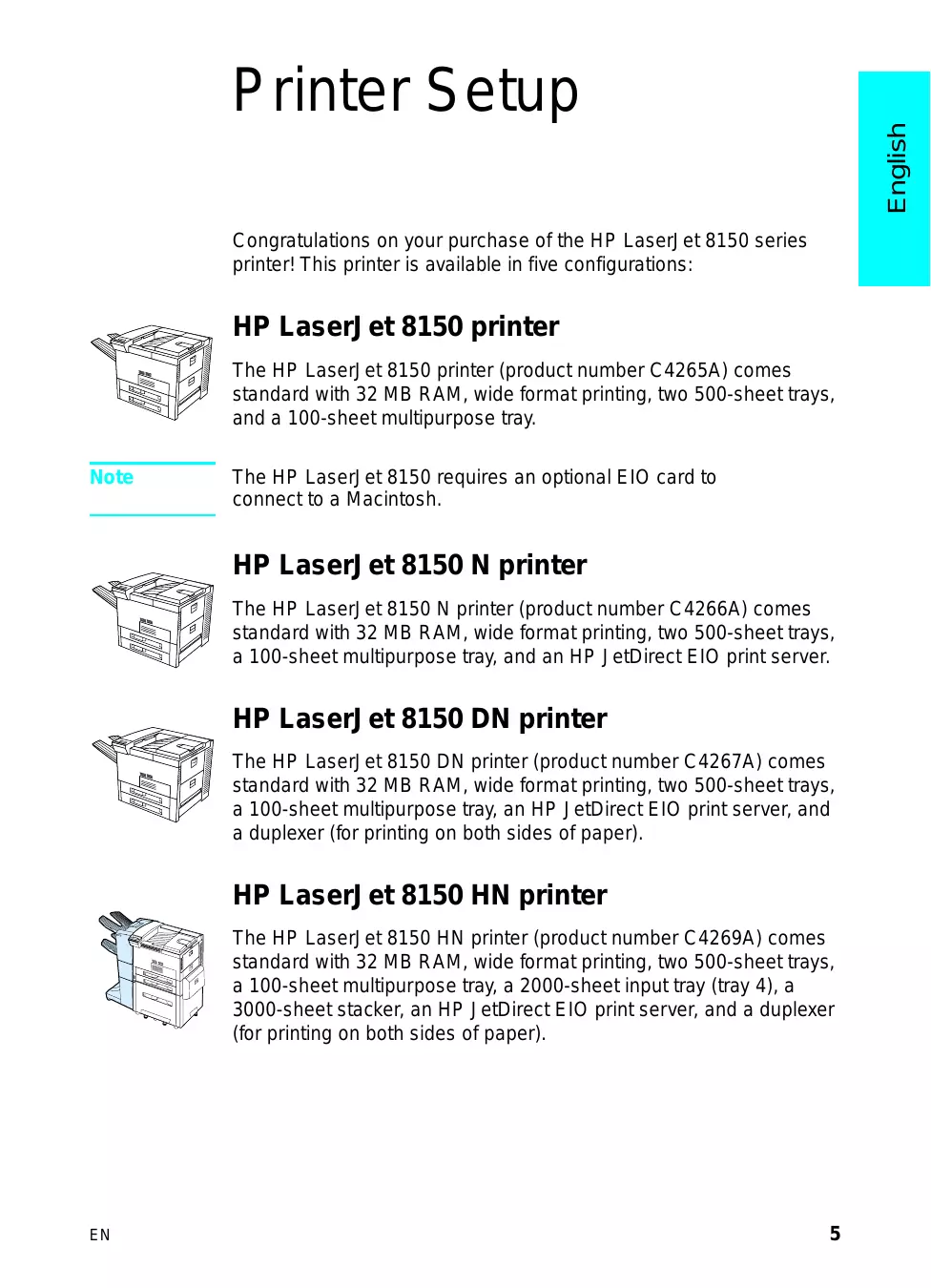
English Printer Setup Congratulations on your purchase of the HP LaserJet 8150 series printer! This printer is available in five configurations: HP LaserJet 8150 printer The HP LaserJet 8150 printer (product number C4265A) comes standard with 32 MB RAM, wide format printing, two 500-sheet trays, and a 100-sheet multipurpose tray. Note The HP LaserJet 8150 requires an optional EIO card to connect to a Macintosh. HP LaserJet 8150 N printer The HP LaserJet 8150 N printer (product number C4266A) comes standard with 32 MB RAM, wide format printing, two 500-sheet trays, a 100-sheet multipurpose tray, and an HP JetDirect EIO print server. HP LaserJet 8150 DN printer The HP LaserJet 8150 DN printer (product number C4267A) comes standard with 32 MB RAM, wide format printing, two 500-sheet trays, a 100-sheet multipurpose tray, an HP JetDirect EIO print server, and a duplexer (for printing on both sides of paper). HP LaserJet 8150 HN printer The HP LaserJet 8150 HN printer (product number C4269A) comes standard with 32 MB RAM, wide format printing, two 500-sheet trays, a 100-sheet multipurpose tray, a 2000-sheet input tray (tray 4), a 3000-sheet stacker, an HP JetDirect EIO print server, and a duplexer (for printing on both sides of paper).
HP LaserJet 8150 MFP printer The HP LaserJet 8150 MFP printer (product number C4268A) comes standard with 64 MB RAM, wide format printing, hard disk, two 500-sheet trays, a 100-sheet multipurpose tray, a 2000-sheet input tray (tray 4), a 3000-sheet Stapler/Stacker, an HP JetDirect EIO print server, a duplexer (for printing on both sides of paper), a copy connect EIO board, and an HP Digital Copy.
This guide will help you set up and install the new printer. For proper installation, please complete each section in order:
Unpack the printer Install the printer Connect the printer cables Install printing software Verify printer setup steps 1-4 steps 5-12 step 13 step 14 step 15 WARNING! The printer is heavy. HP recommends that four people move it. Note To learn about all the features and capabilities of the printer, see the printer user guide and the help menus in the printer drivers (available after you install the printing software and online user guide).
English Installation Checklist Step 1 Prepare Printer Location Printer Size
English Location requirements for the printer
A sturdy, level surface for placement
Adequate power supply
Space allowance around the printer
A well ventilated room
Relative humidity 20% to 80%
No exposure to direct sunlight or chemicals, including ammonia-based cleaning solutions
Room temperature 50° to 91° F (10° to 32.5° C) Printer Weight (without toner cartridge)
HP LaserJet 8150 and 8150 N printers: 51 kg (112 lbs)
HP LaserJet 8150 HN printer: 113 kg (249 lbs)
HP LaserJet 8150 MFP printer: 136 kg (300 lbs) Prepare Printer Location
A printer parallel interface cable is only included with the HP LaserJet 8150 base printer. See the printer user guide for ordering information. Printer Setup
Note Save all packing material. You may need to repack the printer at a later date. WARNING! This printer weighs approximately 51 kg (112 lbs). HP recommends that four people move it.
Remove all external packing tape from the printer.
Remove packing material from standard output bin and protective film from display.
Remove packing material and tape and close top cover.
Open the left-side door and remove the two packing spacers. Close the door.
Remove Internal Packaging
English Step 3 Remove Internal Packaging Step 4 Locate Printer Parts The following illustrations give the location and names of the important printer parts. Printer Parts (front and rear views)
Face-up Bin Control Panel Standard Output Bin (Face-down) Adjustable Paper Stop Top Cover
Install any accessories that you have purchased with the printer. Use the installation instructions that are packaged with the accessories. Multibin Mailbox (5-Bin with Stapler) 3000-sheet Stapler/Stacker or 3000-sheet Stacker 7-bin Tabletop Mailbox Multibin Mailbox (8-Bin) Duplexer Envelope Feeder HP Fast InfraRed Connect 2000-sheet Input Tray Printer Stand 2 x 500-sheet Input Tray HP Digital Copy Stand HP LaserJet MFP Upgrade Kit Custom Paper Tray Optional Accessories
Remove the toner cartridge from its packaging. (Save packaging for possible cartridge storage.) Note To prevent damage to the toner cartridge, do not expose it to light for more than a few minutes.
Rotate the cartridge and gently shake it from side to side to distribute the toner evenly inside the cartridge.
Locate the sealing tape tab on the end of the cartridge. Carefully bend the tab back and forth until it separates from the cartridge. Continued on the next page.
Firmly pull the tab straight out from the cartridge to remove the entire length of tape. Avoid touching any black toner on the tape. Note If the tab separates from the tape, grasp the tape and pull it out of the cartridge.
Note If toner gets on your clothing, wipe it off with a dry cloth and wash clothing in cold water. (Hot water sets toner into fabric.)
Position the cartridge as shown with the arrow pointing into the printer.
Slide the cartridge into the printer as far as it will go.
Close the top cover.
Step 7 Load Trays 2 and 3
Note To avoid a paper jam, never open the tray while it is in use. The paper size setting is set to a default size at the factory. For example, the default for the United States is lettersize, while in Europe it is A4. If you would like to use a different default paper size, reconfigure the paper tray setting.
Open Tray 2 until it stops.
Remove the packing spacer and tape.
If you wish to load paper that is different than the default size, turn the paper guide to the mark that indicates the size of paper you are loading.
Turn the paper guide to the locked position.
Adjust the left paper guide by pushing in, then lifting up and out.
Continued on the next page.
Position the guide over the appropriate lines marked in the tray. Press the guide into the rear slot and then lower down into the front slot. Be sure the guide is not skewed.
Insert up to 500 sheets of paper into the tray. Do not fill the input tray above the paper fill marks on the guide.
a Load Letter or A4 paper with the top of the page toward the rear of the tray and with the side-to-beprinted down for single-sided printing. For two-sided printing, load the top of the page toward the rear of the tray and with the first side-tobe-printed up.
b Load short-edge fed media with the top of the page toward the right side of the tray and with the side-to-be-printed down for singlesided printing. For two-sided printing, load media with the top of the page toward the left side of the tray and with the first side-to-be-printed up.
Make sure the paper size tab is set correctly.
Slide the tray back into the printer. If you wish to select your paper by type rather than tray (source), see your online user guide. If you wish to print on paper sizes larger than letter or A4, adjust the paper stop guide on the Standard Output Bin (Facedown). (See your online user guide for instructions.)
Step 8 Load Tray 1 (Optional) Tray 1 is a multi-purpose tray and holds up to 100 sheets of paper or 10 envelopes. Tray 1 provides a convenient way to print envelopes, transparencies, custom-size paper, labels, or other types of media without having to unload the other trays. CAUTION To avoid a paper jam, never add or remove paper from Tray 1 while the printer is printing. To avoid damaging the printer, print labels, envelopes, and transparencies from Tray 1 only. Send them to the Faceup Bin, do not print them on both sides, and remove them promptly. Note Paper loaded in Tray 1 will be printed first unless the Tray 1 setting is changed from the printer control panel. To change the order in which trays will be printed from, see your online user guide.
Pull out the tray extension, if needed for the paper size you are printing.
Slide the paper width guides to the appropriate size marked on the tray.
Place paper into the tray without stacking it above the paperfill mark. Continued on next page.
Paper loading differs by size: a Load Letter or A4 paper with the top of the page toward the rear of the printer and with the side-to-beprinted up for single-sided printing. For two-sided printing, load paper with the top of the page toward the rear of the printer and with the first side-to-be-printed down. b Load short-edge fed media with the top of the page toward the printer and with the side-to-beprinted up for single-sided printing. For two-sided printing, load media with the top of the page away from the printer and with the first sideto-be-printed down. Note Paper heavier than 28 lb (105 g/m2) should be printed from Tray 1 to the Face-up Bin to avoid curl.
Locate the power switch on the front of the printer. Make sure the printer is turned off.
Connect the power cord to the printer and a grounded power strip or an AC outlet.
Turn the printer on. After the printer warms up, the READY message should appear on the control panel display and the Ready light should remain on. If the READY message does not appear, see the problem solving chapter in the online user guide. READY Printer Setup
English Step 10 Install or Change the Control Panel Overlay (Optional) To change the overlay to a language other than English:
Locate the overlay you wish to install and remove it from its bag. Note Make certain the power switch is off.
Gently lift up on each side of the installed overlay.
Insert your thumbnail or a thin, rigid object in front of the overlay and press toward the back of the printer. Lift to remove.
To install the new overlay, position it over the control panel, rear-side first.
Snap the overlay firmly onto the control panel. Ensure that the overlay is flat.
ENTER LANGUAGE =ENGLISH Use the printer control panel to set the printer to display printer messages and print configuration pages in the language of your choice.
When you turn the printer on for the first time, wait until ENTER LANGUAGE = ENGLISH appears. To change the display language go to step 2, or to choose English go to step 4.
If ENTER LANGUAGE = ENGLISH did not appear, press and hold SELECT while simultaneously pushing the power switch ON. Hold SELECT until SELECT LANGUAGE appears, then release SELECT. Go to step 3. Note Only -VALUE +, SELECT, and GO are active while the display language is being configured. All other keys are ignored. If you press Go without selecting a language, the printer will bring itself online and all subsequent messages will be displayed in English. However, since no display language was selected, the ENTER LANGUAGE = ENGLISH message will reappear (after the power-on self test) every time the printer is turned on until you select a language.
When ENTER LANGUAGE=ENGLISH displays, press - VALUE + repeatedly until the desired setting appears. Continued on next page.
ENTER LANGUAGE =ENGLISH Note For Japanese, Turkish, Czech, Hungarian, and Polish, language selection will change the default symbol set for the specific language. For all other languages, the default symbol set is set to PC-8.
Press SELECT to save the selection. An asterisk (*) appears next to the selection in the display, indicating that it is now the default.
Press GO. The control panel display will indicate the printer is ready to use. Note If the new language does not appear in the display, you may not have pressed SELECT to save your new selection.
READY Print a configuration page to make sure the printer is operating correctly.
Make sure the printer is on and the READY message is displayed.
Press ITEM until the display reads PRINT CONFIGURATION.
The configuration page shows the printer’s current configuration.
PRINT CONFIGURATION Note An HP JetDirect network configuration page will also print for printers with network cards installed.
For printers equipped with an optional HP JetDirect EIO Print Server, a twisted-pair network cable connection is provided through a 10/ 100Base-TX (RJ-45) connector. Connection to an Apple LocalTalk network is available through an optional LocalTalk card. The printer also has a port for HP Fast InfraRed Connect. Parallel Connector RJ-45 Connector Foreign Interface Harness (AUX) (Optional) HP Fast InfraRed Connect (FIR) (Optional) C-Link Connector Location of Interface Ports
Connect Printer Cables
English Step 13 Connect Printer Cables Connecting Parallel Cable To ensure reliability, use an IEEE-1284 bi-directional C-type parallel cable. (These cables are clearly marked with “IEEE-1284.”) Only IEEE-1284 cables support all of the printer’s advanced features.
Make sure the printer and your computer are turned off. Note The cable should install easily. If installation is difficult, check the cable orientation.
Connect the parallel cable to the printer parallel port. Press the locking release levers in while connecting the cable.
Connect the other end of the cable to the proper connector on the computer. Note See your online user guide for information on ordering IEEE-1284 parallel cables.
Use the RJ-45 port to connect the printer to an Ethernet 10/100BaseTX network. CAUTION Make sure the printer power is turned off before connecting to the RJ-45 port. Ethernet 10/100Base-TX Network Interface Cable Connection
Connect the other end of the cable to the network. Connect Printer Cables
English Connecting to Ethernet 10/100Base-TX Network Step 14 Install Printing Software The printer comes with printing software on a CD-ROM. The printer drivers on this CD-ROM must be installed to take full advantage of the printer features. If your computer does not have a CD-ROM drive, but you have access to one, you can copy the printing software from the CD-ROM onto diskettes for installation on your computer. If you do not have access to a CD-ROM drive, go to www.hp.com and download the drivers, or call HP to order diskettes. The most recent drivers are available on the Internet. Depending on the configuration of Windows-driven computers, the installation program for the printer software automatically checks the computer for Internet access to obtain the latest software. Note Printer installation software for UNIX (HP-UX, Sun Solaris) networks is available for download at http://www.hp.com/support/net_printing. For configuration and management using your web browser, use HP Web JetAdmin. For information on HP Web JetAdmin, go to http://www.hp.com/go/webjetadmin. See the HP Customer Care pages at the front of the printer user guide for more information.
Close all running applications.
Insert the CD-ROM into the CD-ROM drive. (Depending on the computer configuration, the installation program may automatically start.)
Type D:\SETUP (or the appropriate drive directory letter) in the command line box and click OK.
Follow the instructions on the computer screen. For Windows 3.1x and Windows 3.11
Close all running applications.
Insert the CD-ROM into the CD-ROM drive.
Type D:\SETUP (or the appropriate drive directory letter) in the command line box and click OK.
Follow the instructions on the computer screen. Installing Network Software Note If the printer is to be used on a network, install and configure the network operating system software on the network administrator’s system before individual users install the printing software. Use HP Web JetAdmin to configure your printer with your web browser. For information on using HP Web JetAdmin, see HP’s web site at http://www.hp.com/go/webjetadmin.
Close all running applications.
Insert the CD-ROM into the CD-ROM drive.
Double-click the Installer icon and follow the instructions on the screen.
Click the LaserWriter 8 icon. If the icon is not there, contact HP Customer Care (see the front pages of your user guide) or contact Apple Computer, Inc.
If you are on a network with multiple zones, select the zone in the AppleTalk Zones box where the printer is located. If this is unknown, ask your network administrator.
Double-click the desired printer. An icon should appear.
Close the Chooser by clicking the Go-Away (Close) box in the upper left corner. Printer Setup
The easiest way to verify that the installation has been completed successfully is to print a document from a software application.
Open a software application of your choice and open or create a simple document.
Make sure the correct printer name appears.
Print the document. If the document prints, installation is complete. If nothing prints or if the document does not print correctly, see the problem solving chapter in the printer’s online user guide. Congratulations, the printer setup is complete!
English Step 15 Verify Printer Setup FCC Regulations This equipment has been tested and found to comply with the limits for a Class B digital device, pursuant to Part 15 of the FCC rules. These limits are designed to provide reasonable protection against harmful interference in a residential installation. This equipment generates, uses, and can radiate radio frequency energy. If this equipment is not installed and used in accordance with the instructions, it may cause harmful interference to radio communications. However, there is no guarantee that interference will not occur in a particular installation. If this equipment does cause harmful interference to radio or television reception, which can be determined by turning the equipment off and on, the user is encouraged to try to correct the interference by one or more of the following measures: Note
Reorient or relocate the receiving antenna.
Increase separation between equipment and receiver.
Connect equipment to an outlet on a circuit different from that to which the receiver is located.
Consult your dealer or an experienced radio/TV technician. Any changes or modifications to the printer that are not expressly approved by HP could void the user’s authority to operate this equipment. Use of a shielded interface cable is required to comply with the Class B limits of Part 15 of FCC rules. Note The HP LaserJet 8150 MFP, or any model of HP LaserJet 8150 printer with an HP Digital Copy attached, complies with Class A limits. For more regulatory information, see the online user guide for this printer.
HP LaserJet 8150 HN printer: 113 kg (249 lbs)