C3320 - Fridge Freezer BRANDT - Free user manual and instructions
Find the device manual for free C3320 BRANDT in PDF.



| Product type | Refrigerator-freezer |
| Brand | BRANDT |
| Model | C3320 |
| Power supply | 230 V ~ 50 Hz, single-phase, fuse 10 or 16 A |
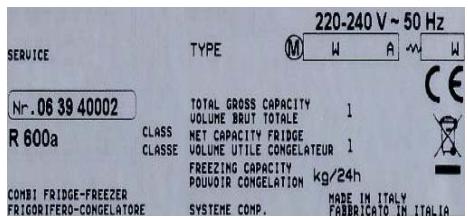
| Refrigerant | R600a (isobutane) |
| Climate class | N, N-ST, N-T, SN, SN-ST, SN-T, ST or T (depending on model) |
| Freezing capacity | Indicated on the rating plate (kg/24h) |
| Refrigerator defrosting | Automatic |
| Freezer defrosting | Manual |
| Cooling system | Forced air cooling or regulated cooling (depending on model) |
| Quick freeze function | Yes, with yellow indicator, automatic stop after 52 h |
| Anti-bacterial walls | BIOCARE (silver ions) – depending on model |
| Maxi-Fresh compartment | Yes (depending on model) |
| Temperature indicator | Yes, cold zone indicated |
| Interior lighting | Bulb 15 W max |
| Door reversal | Possible (left/right) |
| Casters | Yes (for slight movements) |
| Adjustable feet | Yes |
| Maintenance | Clean with baking soda (1 tbsp for 4 L of water) |
| Recyclable materials | Yes, packaging and appliance |
| Certified spare parts | Use exclusively original parts |
Frequently Asked Questions - C3320 BRANDT
User questions about C3320 BRANDT
0 question about this device. Answer the ones you know or ask your own.
Ask a new question about this device
Download the instructions for your Fridge Freezer in PDF format for free! Find your manual C3320 - BRANDT and take your electronic device back in hand. On this page are published all the documents necessary for the use of your device. C3320 by BRANDT.
USER MANUAL C3320 BRANDT
FR GUIDE D'INSTALLATION & D'UTILISATION
EN OPERATING AND INSTALLATION INSTRUCTIONS
PT GUIA DE INSTALLAÇAO & DE UTILIZACAO
1 Safety and the environment
- Safety instructions 29
- Respecting the environment and saving energy 30
BIOCARE - anti-bacterial walls 30
2 Description of your appliance
3 How to carry out your initial installation
- Reversing the direction the doors open 32
- Installing your appliance 34
- Electrical connection 35
4 How to use your refrigerator
- Setting your refrigerator's temperature 36
- Mixed or regulated cold (depending on the model) 37
Preparing food for the refrigerator 38
Arranging food in your refrigerator 38 - Your refrigerator's modular layout 39
The Maxi-Fresh area (depending on the model) 39
Automatic defrosting 39
5 How to use your freezer
- Frozen and deep-frozen food 40
Preparing food for freezing 40
Food freezing guide 41
Arranging food in your freezer 44
Defrosting food 45
Defrosting your freezer 45
6 Ongoing maintenance of your appliance
- Cleaning your appliance. 46
Changing the light bulb 47
·Clearit. 47
7 Noise, inconveniences and minor breakdowns
Normal operating noises 48
Inconveniences or minor breakdowns 48
This guide to installing and using your fridge-freezer is applicable to several models. There may be slight differences between your appliance's details and features and those described here.
As you read through the guide, you will come across the following symbols, to warn you of:
Safety precautions that must be observed
Danger of a gas bursting into flame
An electrical danger
Important information and advice
Dear Customer,
You have just acquired a BRANDT fridge-freezer and we would like to thank you.
We have invested all our dedication and know-how in this appliance so that it would best meet your needs. With innovation and performance, we designed it to be always easy to use.
In the BRANDT product range, you will also find a wide choice of dishwasher, washing machine and dryer, freezers, cooker range and oven, cooking hobs and ventilation hoods, that you can coordinate with your new BRANDT fridge-freezer.
Visit our website www.brandt.com where you will find all of our products, as well as useful and complementary information.
BRANDT
As part of our commitment to constantly improving our products, we reserve the right to make changes to them based on technical advances to their technical and functional features and appearance.

Warning:
Before installing and using your appliance, please carefully read this Guide to Installation and Use, which will allow you to quickly familiarise yourself with its operation.
www.brandt.com

This appliance is intended for domestic use only. It has been designed for preserving and freezing food.
The following instructions are for your own safety and should be observed without fail. We can neither be held responsible, nor uphold the guarantee in case of failure to observe these recommendations, which may lead to material damage or physical injury.
-
This appliance is not intended for use by persons (including children) with reduced physical, sensory or mental capabilities, or lack of experience and knowledge, unless they have been given supervision or instruction concerning use of the appliance by a person responsible for their safety.
-
Children should be supervised to ensure that they do not play with the appliance.
-
Your appliance must be installed, fixed if necessary and used in compliance with the instructions in this operating and installation instructions manual in order to avoid any damage and/or danger due to any lack of stability or faulty installation.

If the appliance has been delivered to your home in a horizontal position, stand it upright and then wait 2 hours before plugging it in. A small amount of oil may have flowed into the refrigeration circuit, and you must allow time for this to flow back towards the motor before connecting the appliance. Failure to do so may damage the appliance.
-
If you appliance is fitted with castors, please remember that they are only designed to assist in small movements. Do not use them for longer journeys.
-
Carry out an initial cleaning operation (see the section on "Installing your appliance") before connecting your appliance to the electrical supply. Disconnect your appliance prior to performing any maintenance operation. Grasp the plug directly, instead of pulling on the power cable.
-
Do not place bottles or jars containing liquids in the freezer unless they are only two-thirds full: freezing causes liquids to expand, which can cause the container to explode.
-
Do not use any other method than those we recommend in this manual for speeding up defrosting.
-
Do not use electrical equipment inside compartments designed for preserving frozen food unless the manufacturer recommends otherwise.
-
Do not let children play with the appliance and keep your pets well away from it.
-
Worn out appliances must be rendered unusable. Unplug and cut the electric cable flush with the appliance. Render the door catch unusable or, better still, remove the door, so as to ensure that no child or animal risks being shut inside whilst playing.
-
If a problem arises that you are unable to resolve using the advice given (see the "Noise, inconveniences, minor breakdowns" section), please contact an official after-sales service or a qualified professional.

Your appliance's refrigeration circuit is filled with isobutane refrigerant (R600a), a natural, nonpolluting gas that is, however, inflammable. Ensure that none of the components in your appliance's refrigeration circuit have been damaged during transport or installation. If you detect any damage, keep your appliance away from flames or any type of source of heat or combustion and ventilate it location.
Respecting the environment and saving energy EN
To reduce your appliance's electrical consumption:
- Install it in a suitable place (see "Installation of your appliance" section).
- Leave the door open as little as possible. Do not place food that is still hot in your refrigerator or freezer, particularly in the case of soups or dishes that release a lot of steam.
- Ensure that you appliance operates optimally by not allowing too much frost to build up in the freezer (de-frost it when the frost is more than 5-6 mm thick) and clean its condenser periodically (See the "Ongoing maintenance of your appliance" section).
- Periodically check the door seals and make sure that the doors close firmly. If they do not, lease contact our After-sales service.
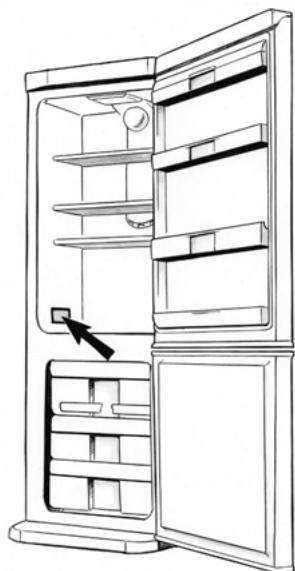
In compliance with the latest legislation concerning environmental protection, your appliance does not contain any CFCs. Instead it uses a gas called R600a. The exact type of refrigerant used in your appliance is also clearly indicated on the identification plate inside your appliance's refrigerator section, low down on the left-hand wall.
R600a is a non-polluting gas that does not harm the ozone layer and whose contribution to the greenhouse effect is virtually zero.
ENVIRONMENTAL PROTECTION
This appliance's packaging material is recyclable. Help recycle it and protect the environment by dropping it off in the municipal receptacles provided for this purpose.
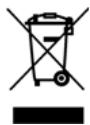
Your appliance also contains a great amount of recyclable material. It is marked with this label to indicate that in countries that are a members of the European Union the used appliances should not be mixed with other waste. This way, the appliance recycling organised by your manufacturer will be done under the best possible conditions, in compliance with European Directive 2002/96/EC on Waste Electrical and Electronic
Equipment. Contact your town hall or your retailer for the used appliance collection points closest to your home.
We thank you doing your part to protect the environment.
BIOCARE - anti-bacterial walls
This is a specific coating on the lining of your refrigerator consisting of silver ions, which prevent bacteria from developing.
The anti-bacterial coating does not require any particular treatment and remains active throughout your appliance's operating life.
However, you must clean your appliance regularly. See the section on "Cleaning your appliance".
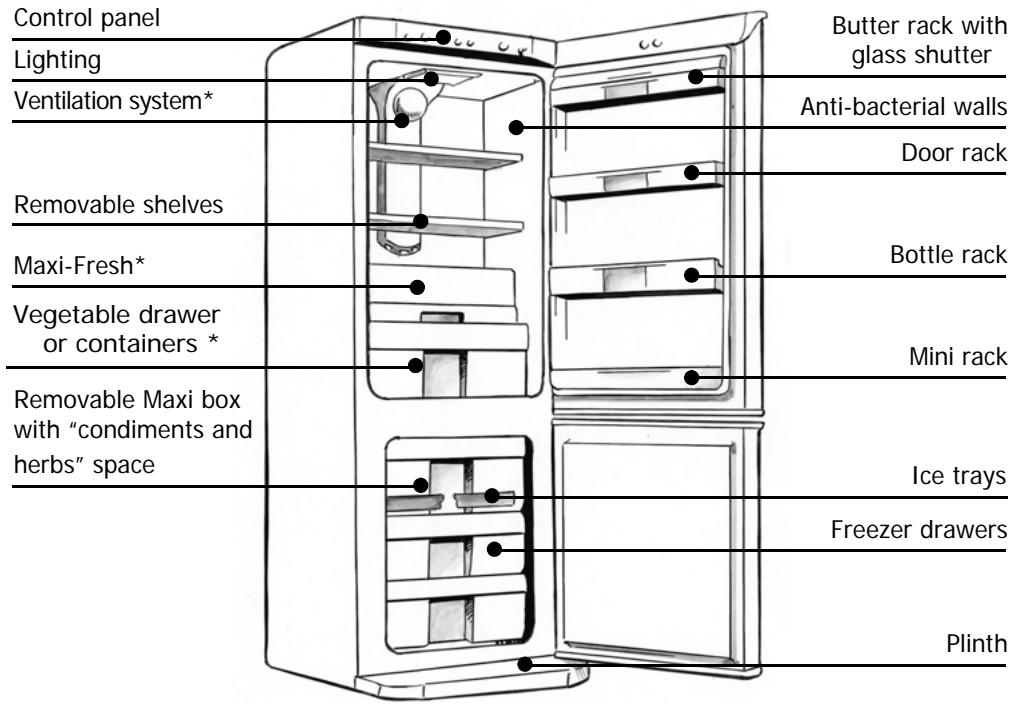
* depending on the model
This guide to installing and using your fridge-freezer is applicable to several models. There may be slight differences between your appliance's details and features and those described here.
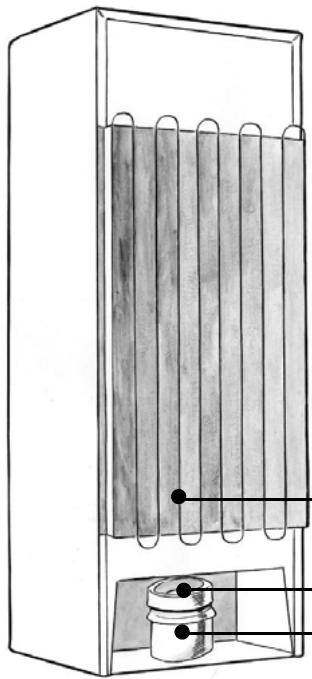
Condenser
Water collection tank
Motor
Reversing the direction the doors open
The doors normally open to the left (hinges on the right); if you wish to open the door to the right, you can modify the direction in which it opens by following the instructions below. To ensure correct installation, please scrupulously follow the directions and the sequence of operations below:
- Gently tilt the appliance backwards (with the doors facing upwards).
- Remove the plinth by pulling the lugs A on the lower part towards you and swivelling the plinth upwards to disengage it (R1). Remove cover B from its housing on the left and insert it in the housing on the right (R2).
- Remove the bottom hinge pin and release it from its housing C; retrieve the plastic distance piece placed between the door and the hinge on the pin; unscrew the bottom hinge D and screw the pin into the left-hand hole in the hinge (R3).
- Remove the freezer's door (R3).
- Unscrew the middle hinge E, taking care not to lose the plastic distance pieces inserted on the pin (R3).
- Remove the covers G on top of the refrigerator door (R4).
- Free the refrigerator's door from the top hinge (R4).
- Remove the screw and the covers F on the left-hand side of the appliance and insert them in the holes on the right-hand side (R3).
- Remove the covers H from the control panel (R5).
- Unscrew and remove the top right-hand hinge I (R5).
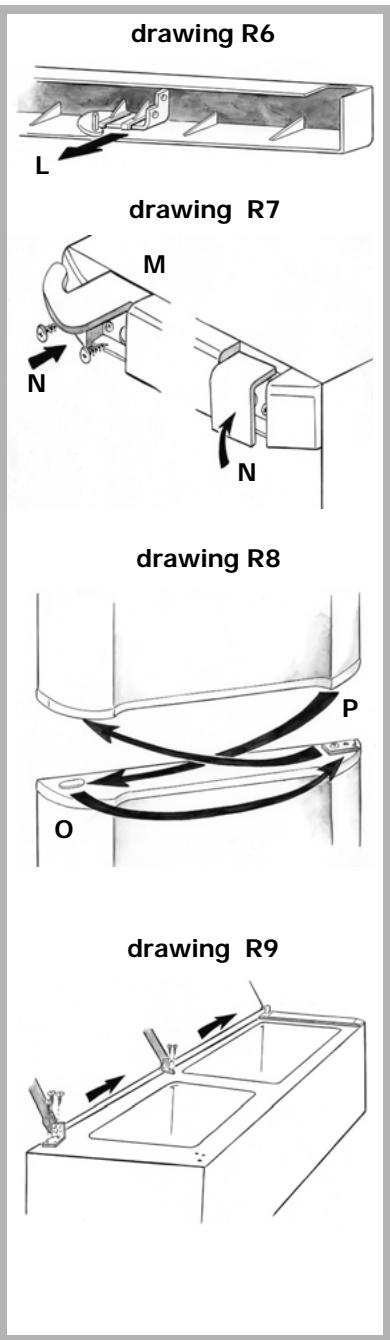
- The upper left-hand hinge L is placed inside the plinth (R6). Remove it and inset it into the housing on the left on the control panel M. Fasten it with the two screws (R7).
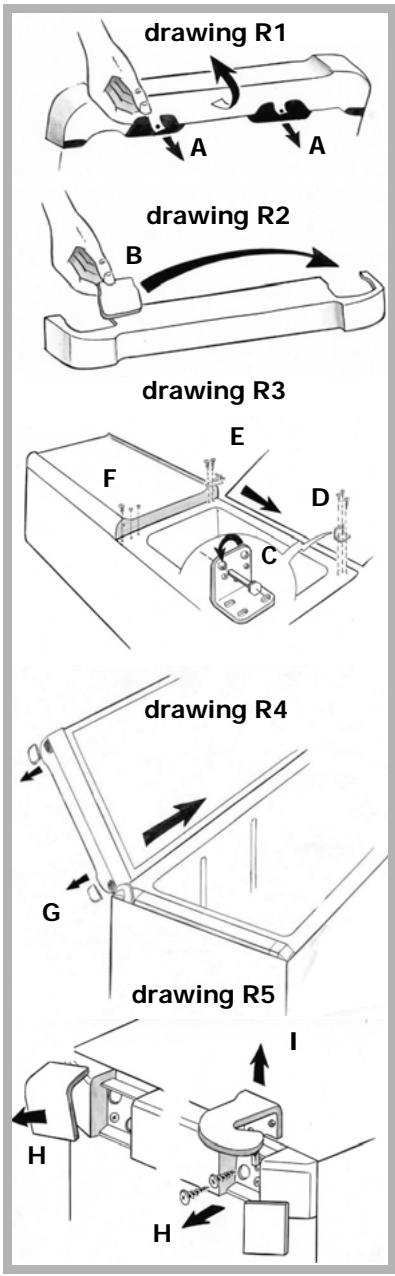
- Insert the covers N and fasten them onto the control panel (R7).
- So as not to lose the top right-hand hinge, which you may need later, store it in the housing in the plinth (R6).
- Remove the hole covers O on the left-hand side of the freezer's door (R8).
- Unscrew the metal door stop P on the right-hand side of the refrigerator's door, turn it over and screw it to the left-hand side of the freezer's door, aligning the hole in the plate with the one in the door (R8). Unscrew the metal door stop P on the right-hand side of the freezer's door, turn it over and screw it to the left-hand side of the refrigerator's door, aligning the hole in the plate with the one in the door (R8).
- Insert the hole cover O, previously placed on the left-hand side of the freezer's door on the right-hand side of the same door (R8).
- Insert the refrigerator's door in the top hinge (R9).
- Insert the middle hinge and screw it in place, checking that the plastic distance pieces are correctly inserted on the pin (R9).
- Insert the freezer's door into the middle hinge (R9).
- Insert the bottom hinge into the freezer's door, checking that the plastic distance piece is correctly inserted on the pin between the hinge and the door. Screw the hinge in place (R9).
- Re-install the plinth.
- Insert the upper covers.
- Return the appliance to vertical position.

Wait two hours before restarting your refrigerator.
Your appliance must be installed in compliance with the instructions given in this "Operating and installation instructions manual" in order to keep your food under optimum conditions and with optimal energy consumption.
- The appliance should be installed in a dry, well-ventilated room.
- Avoid balconies, verandas, and patios: the excessive heat in summer and the cold in winter could prevent your appliance from functioning properly, or may even damage it.
- Do not place your appliance near a heat source such as an oven or radiator.
- Your appliance has been designed for optimum functioning at a certain ambient temperature; it is designed for a particular "climate class". This climate class is clearly indicated on the identification plate situated on the inside of your appliance, low down on the left wall. Outside of this temperature range, the performance of your appliance may be reduced.
| Climate Class | Ambient temperature |
| N | +16°C to +32°C |
| N-ST | +16°C to +38°C |
| N-T | +16°C to +43°C |
| SN | +10°C to +32°C |
| SN-ST | +10°C to +38°C |
| SN-T | +10°C to +43°C |
| ST | +18°C to +38°C |
| T | +18°C to +43°C |
- Maintain a minimum distance between your appliance and the other units: 3 to 5cm at the sides, or 10cm if your appliance is close to a wall, and 10cm above to ensure good circulation of air all around the appliance.
- Position the appliance at a suitable distance from the wall using the spacers provided in the accessories packet. The spacers should be mounted on the back of the appliance (see Drawing).
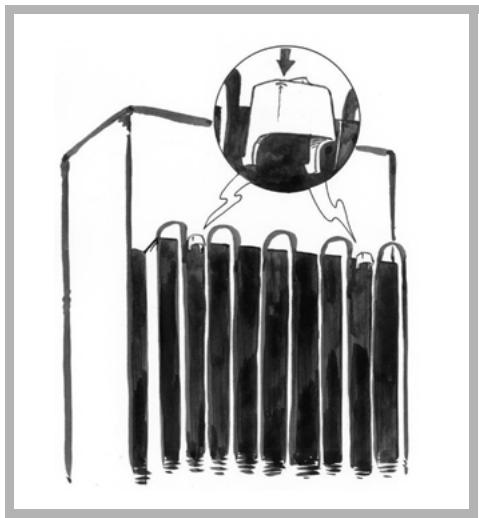
① Once you have installed your appliance, adjust its feet so that it is tilting backwards slightly: this helps the door to close correctly.
Before placing any food in your appliance, clean it inside and out with a bicarbonate of soda solution (1 dessertspoon of bicarbonate to 4 litres of water). Do not use alcohol, scouring powder or detergents, which could damage the surfaces. See the section on "Cleaning your Appliance".
For your own safety, you must comply with the instructions given below.
The electrical installation must comply with Standard NF C *15-100, in particular concerning the Earth.
Three-core flex 3 × 2.5 mm^2 , 230V single-phase connected to:
- A 20A single-phase 230V-50Hz supply
- An ELCB and an individual fuse (10 or 16A depending on the model)
We cannot be held responsible for any incident caused by faulty electrical installation.
Recommendations for the electrical installation of your appliance:
- Do not use extension leads, adaptors, or socket strips.
- Always make sure your circuit is earthed.
- The socket must always remain accessible, yet be out of the reach of children.
If you have any doubts, contact your installer.
Your appliance is compliant with European Directives CEE/73/23 (low voltage directive), CEE/89/336 (electromagnetic compatibility) and CEE/96/57 (energy efficiency) as well as their modifications.
If the appliance has been delivered to your home in a horizontal position, stand it upright and then wait 2 hours before plugging it in. A small amount of oil may have flowed into the refrigeration circuit, and you must allow time for this to flow back towards the motor before connecting the appliance. Failure to do so may damage the appliance.
Carry out an initial cleaning operation (see the section on "Installing your appliance") before connecting your appliance to the electrical supply. Disconnect your appliance prior to performing any maintenance operation. Grasp the plug directly, instead of pulling on the power cable.
In case of damage, the supply cord must be replaced by the technical assistance service or a person with a similar title, in order to prevent any risk."
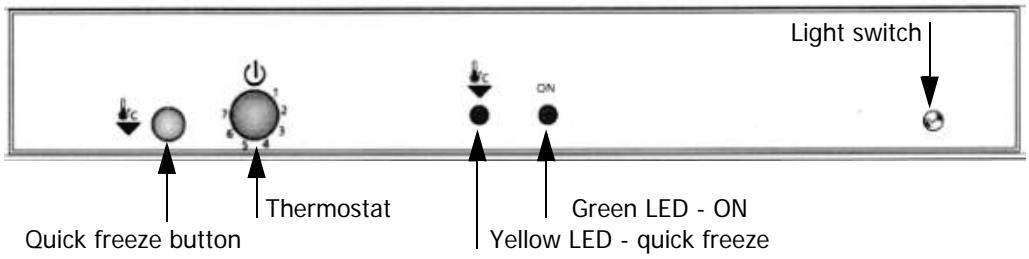
Manipulating the thermostat
To adjust the temperature, set the thermostat knob on one of the surrounding figures (the ON light illuminates). Position 1 corresponds to the least cold setting: the higher the number, the colder the temperature setting. When the thermostat is in position , your refrigerator is off (the ON light is out).

The appliance is always powered.
Temperature indicator and "Cold Zone" symbols

You will find the symbol opposite in your refrigerator. It clearly shows the location of your
appliance's coldest zone: the temperature here is +4^ or less. A temperature indicator here enables you to check that your refrigerator is working correctly.

Temp. to set

Correct temp.
Drawing 1 - Temperature indicator

Prolonged opening of the door will cause the internal temperature to rise. You must therefore read the indicator within 30 seconds of the door being opened for the reading to be correct.
Setting the temperature
When putting your appliance into service, set the thermostat to a medium position.
Check the temperature indicator 4 hours after putting your appliance into service, or after any change in the thermostat setting, observe the temperature light (Drawing 1):
-
If the indicator is still black, lower the temperature gradually by selecting a higher number around the thermostat and checking the temperature indicator again after 4 hours. Repeat this operation as many times as necessary.
-
If the indicator goes green and "OK" is indicated, the temperature in your refrigerator is correctly

Your refrigerator's internal temperature is closely linked to the ambient temperature, how frequently the door is opened and the amount and temperature of the food you have put in your refrigerator. You must therefore check the temperature indicator regularly and adjust the setting if necessary, as explained above.

If the ambient temperature is very low, we recommend that you keep the Quick Freeze button pressed in.
This guide to installing and using your fridge-freezer is applicable to several models. Your appliance is equipped with one or other of these functions. You can check very quickly by comparing your refrigerator to the illustrations on this page.
Your appliance is equipped with a cold air ventilation system:
- Mixed cold (A): the fan mixes the air in the refrigerator section, providing greater temperature homogeneity and avoiding condensation forming on the glass shelves.
- Regulated cold (B): a distribution column directs the air to every level, providing a very homogeneous temperature and avoiding any condensation forming on the shelves.
Apart from these everyday advantages, we recommend that you use the fan:
- When the climatic conditions are extreme (e.g. a heat wave)
- If you have just placed a large amount of food in your appliance's refrigerator section.
To start the fan:
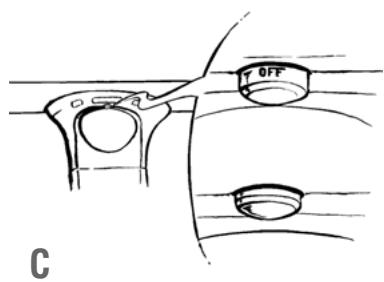
- Press the ON button (Drawing C)
- Appliance with electronics: this function is initiated by electronic system (See the symbols table in the section "Switching on and adjusting the appliance").
The fan does not operate continuously. When it starts up depends on the refrigerator's internal temperature. It is therefore quite normal for the fan not to operate sometimes when the Start button has been correctly pressed.
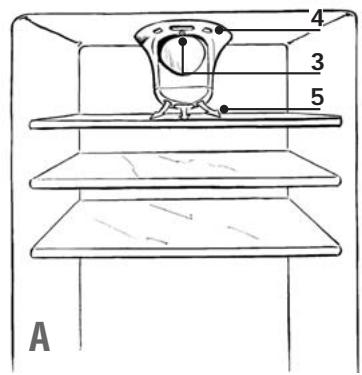
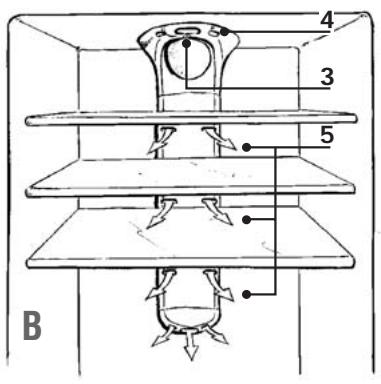
A. Model with mixed cold
B. Model with regulated cold
C. Detail of the Start/Stop button
3. Start/Stop button
4. Air suction
5. Air distribution
Preparing food for the refrigerator
Before placing food in your appliance:
Carefully wrap fresh foods: they will then keep their flavour, colour, humidity content and freshness. You also avoid the taste of some foods contaminating the taste of others. Only vegetables, fruit and salad vegetables can be stored in the vegetable compartment without being packed.
Let hot dishes and drinks cool down outside the appliance.
Remove the cardboard packs from around yoghurt pots.
Check the consume-by dates on the products you have bought. You should not exceed these.
Arranging food in your refrigerator

The temperature inside your refrigerator is not uniform. Some areas are colder than others and you must store your food in the appropriate areas according to their type to ensure that they can be kept safely.
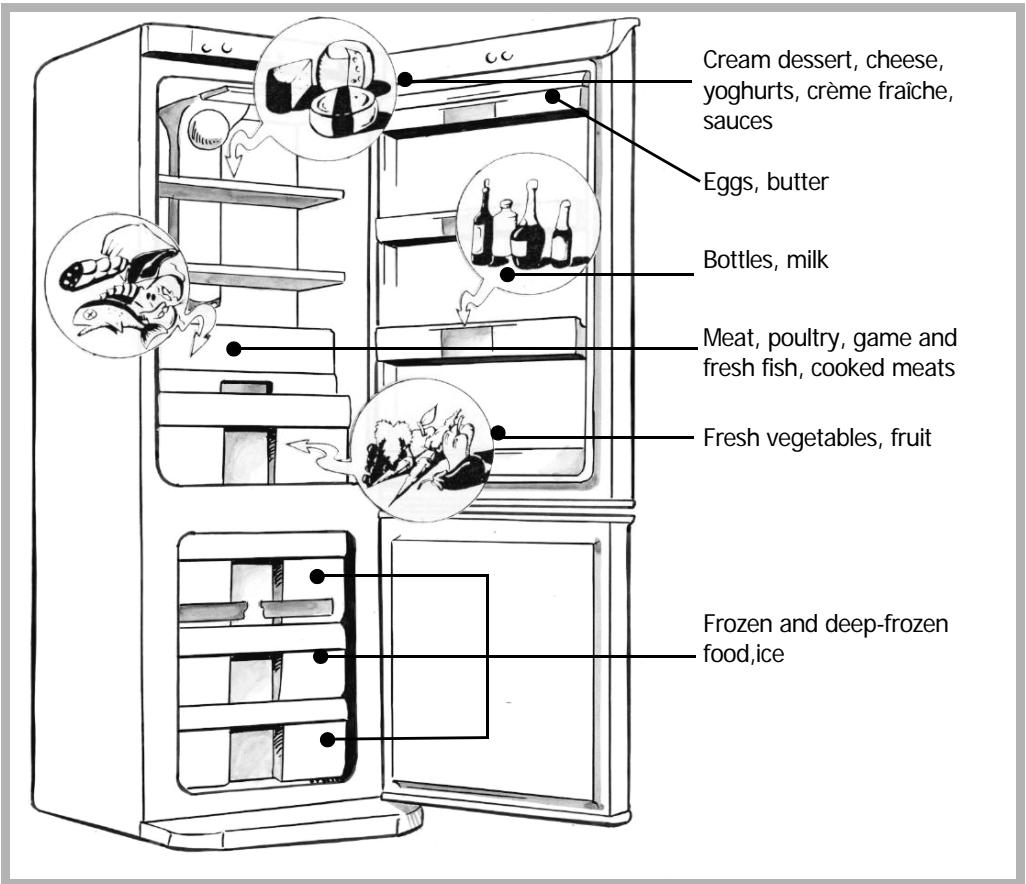
Arranging food in your refrigerator
EN
Leave a space between the food items to allow the air to circulate freely and avoid different products contaminating each other.
Do not put packages and food in contact with the wall at the back of the appliance: this is a particularly cold and damp area of the appliance and water droplets and frost condense there as part of your refrigerator's normal operation.
"Cold Zone" symbols
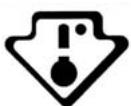
The coldest area, indicated by the logo opposite, is designed for delicate, sensitive and highly perishable food: meat, poultry, fish, cooked meats, prepared dishes, ready-made salads, egg or cream-based dishes and pastries, fresh pasta, pastry, pizza/quiches, fresh produce and raw milk cheese, ready-to-use vegetables sold in
plastic bags and, more generally, any fresh product whose consume-by date is linked to its storage at a temperature of +4^ or below.
Your refrigerator's modular layout
Your refrigerator has been designed to make arranging food in it easy. You can adjust the shelves and the racks to suit your wishes.
The Maxi-Fresh area (depending on the model)
The MAXI-FRESH compartment is recommended for storing fish and meat. It can be moved to different levels inside your refrigerator if the Regulated Cold system is activated (see the section on Mixed or regulated Cold).
Automatic defrosting
The refrigerator section of your appliance defrosts fully automatically. The water created by defrosting flows to a collection tank situated over the motor. The heat the motor releases evaporates the contents of this tank.
It is quite normal for droplets of water or frost to appear on the wall at the back of your refrigerator. This is a particularly cold and damp area in your appliance and water droplets and frost condense out as part of your appliance's normal operation. This frost is removed regularly during your refrigerator's automatic defrosting phases.
Your domestic appliance enables you to freeze food: it lowers its core temperature rapidly and you can therefore keep it longer.
Deep-freezing is an industrial process that is quicker and more intense than domestic freezing.
The products you purchase from the shops are deep-frozen.
Preparing food for freezing

Freezing does not sterilise. It is therefore important to observe some simple hygiene rules when preparing your food for freezing: wash your hands before you touch the food and clean the kitchen tools you have just used before using them again.
Only freeze fresh, good quality food. Refer to the table "Food Freezing Guide" to know which products you can freeze and how long you can keep them.
Blanch fruit and vegetables before freezing them to preserve their colour, smell, taste and vitamins: plunge them in boiling water for a few moments.
Divide the food you wish to freeze into small individual portions corresponding to one meal each. Small portions freeze quicker at their core.
Pack the food hermetically so that they do not lose their flavour or dry up. Use plastic bags, polyethylene film, aluminium foil or special freezer containers for this.
If you are using plastic bags, compress them to eliminate the air before sealing them hermetically.
Do not place bottles or jars containing liquids in the freezer unless they are only two-thirds full: freezing causes liquids to expand, which can cause the container to explode.
Note on each package:
- The freezing date
- The consume-by date
- The type of food contained
- The number of portions contained
If you are purchasing deep-frozen food, pick it up last when you are shopping.
Check that:
- The packaging isn't damaged
- They are not covered in a layer of frost (which means that they have partially defrosted)
Pack them in an isothermic bag or in newspaper. Transport them quickly and store them immediately.
Comply with the maximum storage dates shown on the pack. Your appliance has a **** freezer compartment: this enables you to keep deep-frozen food in an optimal manner.
Fresh meat
| Product | Valid for |
| Lamb,small pieces | 8 months |
| Roast pork | 5 months |
| Pork ribs | 4 months |
| Boiled beef,roast beef | 10 months |
| Beef steak,entrecotes,in sauce,roast veal | 8 months |
| Veal steaks,cutlets | 10 months |
| Minces meat | 4 months |
| Giblets,offal | 3 months |
| Sausages | 2 months |
We recommend that you defrost meat completely before cooking it so as to avoid the exterior cooking quicker than the interior, except in the case of small breadcrumbed items, which can be sautéed directly over a low to medium heat, and boiled meats.
Farmyard animals
Prepare them plucked/skinned, gutted, cut into pieces if necessary, washed and rinsed.
| Product | Valid for |
| Duck | 4 months |
| Rabbit | 6 months |
| Boiling fowl | 7 months |
| Goose | 4 months |
| Chicken | 10 months |
| Turkey | 6 months |
| Giblets,offal | 3 months |
Game
Prepare it plucked/skinned, gutted, cut into pieces if necessary, washed and rinsed.
| Product | Valid for |
| Wild duck,woodcock,pheasant | 8 months |
| Hare | 6 months |
| Partridge,quail | 8 months |
Fish
| Product | Valid for | Preparation |
| Carp | 2 months | Descale, gut and remove the head. Wash, rinse and freeze |
| Pike | ||
| Turbot | ||
| Salmon | ||
| Mackerel | ||
| Tench | ||
| Trout | ||
| Sea bream | 3 months | Desscale, gut, remove the head and place in cold salty water for 30 seconds, rinse and freeze. |
| Sole |
Cooked food
The length of time you can store cooked dishes reduces if you use bacon or smoked ham to season dishes.
| Product | Valid for | Preparatory cooking |
| Sauce with meat juices | 3 months | half-cooked |
| Tomato sauce | just-cooked | |
| Minestrone with vegetables | 2 months | no pasta |
| Lasagne | 4 months | half-cooked |
| Roasts | 2 months | just-cooked |
| Calf's leg | 1 month | half-cooked |
| Meat in sauce | 3 months | |
| Stewed game | 2 months | just-cooked |
| Boiled fish,grilled/baked fish | 2 months | half-cooked |
| Sweet peppers,aubergines,courgettes stuffed with meat | ||
| Sautéed mushrooms with garlic and parsley,ratatouille | ||
| Steamed spinach | ||
| Pizza | 6 months | just-cooked |
Put them directly on the hob or in the oven without defrosting them.
Vegetables
We recommend that you blanch the vegetables with steam so that they do not lose their vitamins and mineral salts in the cooking water. You therefore do not need to wait until they are dry before freezing them, just until they cool down.
| Product | Valid for | Preparation | Blanching time |
| Asparagus | 12 months | Wash and remove the strings | 2 minutes |
| Cabbage, cauliflower | 6 months | Clean an cut into pieces | 2 minutes (1) |
| Artichokes | 12 months | Remove the external leaves | 6 minutes (1) |
| Beans | Shell | 3 minutes | |
| Green beans | Wash and remove the ends | 4 minutes | |
| Mushrooms | Clean | 2 minutes (1) | |
| Aubergines | Wash and slice | 4 minutes (2) | |
| Sweet peppers (3) | Wash slice and remove the seeds | do not blanch | |
| Peas,Tomatoes (3) | Shell and freeze immediately, laying them in a single layer and then wrapping them | ||
| Parsley,basil | 8 months | Wash | |
| Spinach | 12 months | 2 minutes | |
| Mixed vegetables for minestrone (céléri, carrots, chard,leeks, etc.) | Wash, cut into pieces and divide up into portions. Do not add potatoes terre: they go black. | do not blanch |
(1) Add a little vinegar or lemon juice to the cooking water (slightly acid water).
(2) Pickle in brine before cooking.
(3) During defrosting, these vegetables reduce to a mush because they contain enormous amounts of water. We recommend that you defrost them only if you wish to eat them coked.
In general, vegetables are better if they are cooked directly, without being frozen. Reduce the cooking time, taking into account the blanching time before freezing.
Food freezing guide
EN
Fruits
Fruit must be covered with sugar or syrup, as appropriate. The amount of sugar to use is around 250g for 1 kilo of fruit. Syrups are used in varying percentages; these are prepared by boiling sugared water. The various concentrations are as follows:
- 30% solution, 450g of sugar per litre of water
- 40% solution, 650g of sugar per litre of water
- 50% solution, 800g of sugar per litre of water
So that the fruit's colour does not change, place it in lemon juice before covering it with sugar or pour lemon juice into the syrup. The receptacles for the fruit to be frozen must remain in the refrigerator for one hour before being re-inserted into the freezer. The fruit must be completely covered in syrup.
| Product | Valid for | Preparation |
| Apricots | 8 months | Wash, pit and cover with 30% syrup |
| Pineapple | 10 months | Peel, slice and cover with 50% syrup |
| Oranges | Peel, slice and cover with 30% syrup | |
| Cherries | Wash, pit and cover with sugar or 30% syrup | |
| Strawberries | 12 months | Wash, remove the stalk and cover with sugar |
| Melon | Peel, slice, de-seed and cover with 30% syrup | |
| Peaches | 8 months | Peel, pit, slice and cover in 50% syrup |
| Grapefruit | 12 months | Peel, slice and cover in 30% syrup |
| Juice from citrus fruits | 10 months | Press, remove the pips and sweeten to taste |
| Plums | 12 months | Wash, pit and cover in sugar or 50% syrup |
| Grapes | De-seed, wash and cover in sugar or 30% syrup | |
| Bilberries, blackberries,blackcurrants,raspberries red currants | 10 months | Wash, remove the stalk and cover with sugar |
Bread
This can be kept for 2 months. Defrost in an oven set to 50^ , switching it on after inserting the bread.
Butter and cheese
Freeze butter and cheese by dividing them up into pieces for weekly consumption.
Butter and hard cheese (e.g. Parmesan) can be kept for 8 months, other cheese 4 months. They must be defrosted in the refrigerator, keeping an eye on the condensation that forms on these products.
Arranging food in your freezer
Do not put fresh food next to food that has already been frozen to avoid causing the frozen food to warm up.
The maximum weight of food that you can freeze over 24 hours is shown on the information plate (inside your appliance's refrigerator section near the bottom of the left-hand wall) under the heading: "CAPACITE DE CONGELATION/FREEZING CAPACITY (kg / 24h) ".
Quick freeze
The "Quick Freeze" button enables you to prepare your freezer to receive a large amount of fresh food. This enables the food to be thoroughly frozen more quickly and hygienically.
Press the "Quick Freeze" button 24 hours before putting the food in your freezer (the yellow light illuminates).
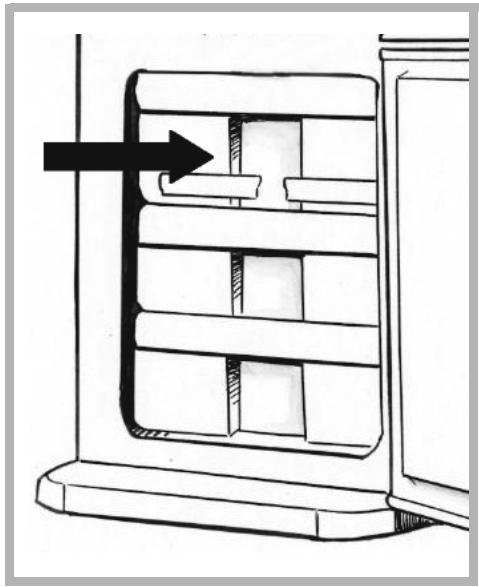
You can place the food to be frozen in the compartments of your freezer but for quicker thorough freezing we recommend that you place them in the "Quick Freeze" area, i.e. in the first drawer from the top (see Drawing).
Quick Freeze stops automatically after 52 hours or you can stop it manually by pressing the "Quick Freeze" button again (the yellow light goes out).
The food must be frozen right through as quickly as possible in order to preserve its vitamins, its nutritional value, its appearance and its taste.
You can defrost food in five different ways:
- By putting them in your appliance's refrigerator section for several hours
- By leaving them to defrost gently at ambient temperature
- In a conventional oven at a very low temperature (40 / 50^)
- In a microwave oven
- By cooking them immediately
Defrosting them in the refrigerator is the slowest but safest method.
Never refreeze food once it has defrosted, even partially, without cooking it first.
We would advise you not to place any items you have just taken out of the freezer straight into your mouth (ice cream, ice cubes, etc.): they will be at a very low temperature and you risk frostbite. Avoid touching frozen or deep-frozen food with wet hands; you may stick to the food. We recommend that you only defrost food for immediate use.
Defrosting your freezer
Defrost your freezer when a layer of frost and ice 5-6mm thick has formed inside your freezer. This thickness of ice prevents your freezer from operating correctly, reduces its efficiency and causes it to consume more energy.
Remove all the food from the freezer. Place it in isothermic bags or wrap it in newspaper and store it in a cool place.
Switch off your appliance by setting the thermostat to 山 . Keep the door to the freezer section open.
Place a pan of hot water on a small plank of wood or a placemat to isolate it and place them both inside your freezer to speed up the defrosting process.
Place the drain and a receptacle at the bottom as shown in the Drawing.
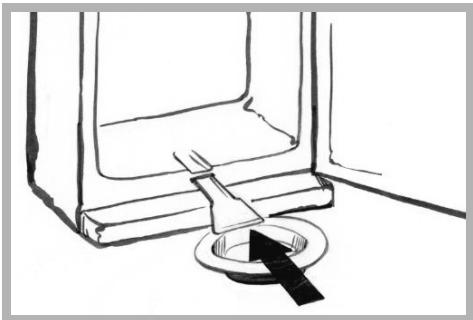
Never use a heater, hairdryer or any other electrical appliance nor any knives or other metal objects to speed up defrosting: you could damage your appliance irremediably.
Clean your freezer before resetting the thermostat as shown in the section on ""Setting your refrigerator's temperature" and replacing the food (see the section on "Cleaning your appliance").
Ongoing maintenance of your appliance
EN
Disconnect your appliance prior to performing any maintenance operation. Grasp the plug directly, instead of pulling on the power cable.
Cleaning your appliance
We recommend that you clean and disinfect your appliance regularly for improved hygiene and to keep your food completely safe: the refrigerator section should be cleaned once a month and the freezer after each time you defrost it.
Remove all the food from the freezer. Place it in isothermic bags or wrap it in newspaper and store it in a cool place.
Clean your appliance inside and out with a bicarbonate of soda solution (1 dessertspoon of bicarbonate to 4 litres of water). Do not use alcohol, scouring powder or detergents, which could damage the surfaces.
Do not use a high-pressure steam cleaner. The very hot steam could damage the surfaces and the electrical circuits; you would expose yourself to a risk of electrocution.
Rinse with water, dry with a cloth.
Periodically check that the drain hole for the defrosting water is not blocked and clean it with a stick as shown in the Drawing.
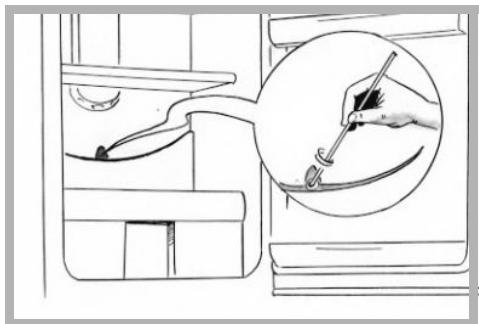
Don't forget to clean the condenser from time to time: this is at the back of the appliance (see the section on "Description of your appliance"). Use a dry paintbrush to do this or, better yet, your vacuum cleaner.
Reconnect your appliance, and adjust the refrigerator's thermostat if necessary, as shown in the section on "Adjusting your refrigerator's temperature", and press the "Quick Freeze" button.
Wait 3 or 4 hours before placing the food back in your appliance.
After 24 hours, release the "Quick Freeze" button to stop this operation.
Ongoing maintenance of your appliance
The sliding compartment for fruit and vegetables is fitted with a filter that controls the humidity by adapting it for optimum preservation of these foodstuffs.
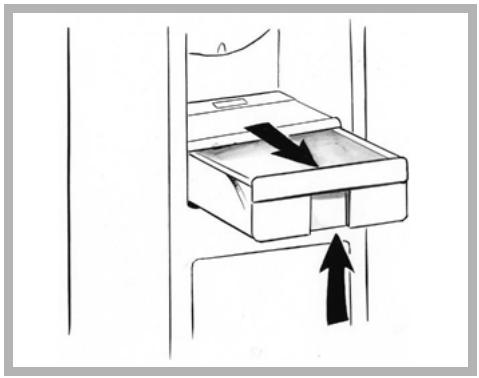
To clean this filter: remove the top of the compartment, remove the lid and then remove the "K" filter and wash it under running water. The sliding basket can be removed as follows: pull the basket out to the stop, lift the front of the basket and then pull it towards you.
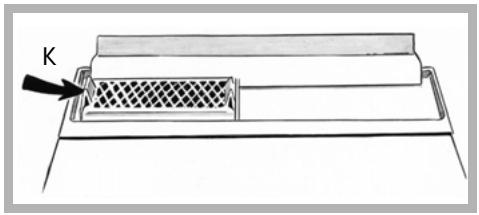
Changing the light bulb
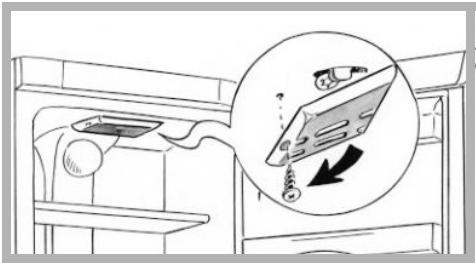
Disconnect your appliance
- Unscrew the screw holding the interior light in place
- Remove the interior light and replace the bulb with another of the same type (15 WATTS max.). Refit the interior light and screw it in place.
Clearit
To keep your appliance in good working order, we recommend that you use Clearit household products.

Professional expertise for the general public
Clearit offers you professional products and adapted solutions for the daily upkeep of your household and kitchen appliances.
You may find them in conventional retail outlets, along with a complete line of by-products and consumables.
Noises, inconveniences or minor breakdowns
EN
Normal operating noises
So that the selected temperature remains constant, your appliance regularly switches off its motor. The resultant noises are quite normal operating noises. They reduce automatically as soon as your refrigerator reaches the desired temperature. These noises are as follows:
| NOISE | CAUSE |
| Buzzing | Coming from the motor. This buzzing may briefly be louder when the motor starts. |
| Gargling or slight buzzing | Coming from circulation of the refrigerant in your refrigerator's pipes. |
| Clicks | These can always be heard when the thermostat turns the motor on or off. |
| Slight background noise | If your appliance is fitted with a fan (depending on the model), the air circulating inside your appliance makes a slight background noise. |
Inconveniences or minor breakdowns
Certain problems may appear when you are using your appliance. Before calling the after-sales service, use the guide below to see if you can resolve the problem yourself:
| PROBLEM | ADVICE |
| Unusual noises | - check the adjustment of the feet of your appliance and its stability. - check that it is not touching a wall. - check that all the movable parts(trays,racks,etc.)are securely in place. -check that the bottles or containers you have placed in your appliance are not touching each other. |
| The refrigerator does not get cold enough | - check that the thermostat is correctly set as indicated in the section on "Adjusting your refrigerator's temperature". - if you have put a large amount of food in your refrigerator at one time,ensure that you readjust the thermostat as shown in the section on "Adjusting your refrigerator's temperature". - be careful not to open your appliance's door too often,and not to leave it open. |
| Your appliance does not get cold at all | - check that the thermostat is not in the position. - check that your appliance is connected to the electrical supply. - check that the circuit-breaker for your house has not cut out and that the fuse has not blown or been unscrewed. |
| Frost forms inside your appliance | - be careful not to open your appliance's door too often, and not to leave it open. |
| The external walls are warm | - this is quite normal. It stops condensation forming on the outside of your appliance. |
| Drops of water appear on your appliance's external wall | -When your home's heating is not on (for example in spring and autumn) and the ambient air is humid, some condensation may form on your appliance's outside walls. This is not dangerous at all and your appliance continues to operate quite correctly. |
| Droplets of water or ice forms on the appliance's rear wall | - this is quite normal. This is a particularly cold and damp area of the appliance and droplets of water and frost can form here when your appliance is operating normally. This frost is regularly eliminated during your refrigerators automatic defrosting cycles. |
| Certsains foods do not freeze completely | - this is quite normal for food that contains a lot of sugar, fat or alcohol not to freeze completely and to remain partially soft (ice cream, fruit juice, etc.). |
| Droplets stagnate at the back of the appliance | - check that the drain hole is not blocked. If it is, release it with a stick or a metal wire as shown in the section in "Ongoing maintenance of your appliance". |
| Frozen meat has white streaks | - check that your machine's thermostat is correctly set and is not at too low a temperature (see the section on "Setting your refrigerator's temperature".- check that you haven't kept this meat too long in the freezer using the table you will find in the "Food Freezing Guide" section. |
| The door is difficult to open | - it is normal for the door to offer some resistance to being opened, particularly when you have just shut it: a slight underpressure forms in your appliance to ensure the door seals perfectly. All you have to do is wait a few seconds before re-opening. |
| The light inside the refrigerator is out | - check that the thermostat is not in the position.- check that your appliance is connected to the electrical supply.- check that the circuit-breaker for your house has not cut out and that the fuse has not blown or been unscrewed.- check that the bulb has not burnt out, and refer to the section "changing the light bulb". |
Any maintenance on your equipment should be undertaken by:
- either your dealer,
- or another qualified mechanic who is an authorized agent for the brand appliances.
When making an appointment, state the full reference of your equipment (model, type and serial number). This information appears on the manufacturer's nameplate attached to your equipment.