
HW90-B14636N - Washing machine HAIER - Free user manual and instructions
Find the device manual for free HW90-B14636N HAIER in PDF.


User questions about HW90-B14636N HAIER
0 question about this device. Answer the ones you know or ask your own.
Ask a new question about this device
Download the instructions for your Washing machine in PDF format for free! Find your manual HW90-B14636N - HAIER and take your electronic device back in hand. On this page are published all the documents necessary for the use of your device. HW90-B14636N by HAIER.
USER MANUAL HW90-B14636N HAIER
User manual Washing machine
HW100-B14636N
HW100-B12636NE
HW90-B14636N
HW80-B14636N
HW70-B12636N
HW70-B12FCFN
Thank you for purchasing a Haier Product.
Please read these instructions carefully before using this appliance. The instructions contain important information which will help you get the best out of the appliance and ensure safe and proper installation, use and maintenance.
Keep this manual in a convenient place so you can always refer to it for the safe and proper use of the appliance.
If you sell the appliance, give it away, or leave it behind when you move house, make sure you also pass this manual so that the new owner can become familiar with the appliance and safety warnings.

Legend
Warning - Important Safety information

General information and tips

Environmental information
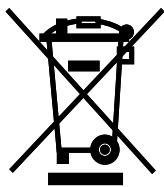
Disposal
Help protect the environment and human health. Put the packaging in applicable containers to recycle it. Help to recycle waste of electrical and electronic appliances. Do not dispose appliances marked with this symbol with the household waste. Return the product to your local recycling facility or contact your municipal office.

WARNING!
Risk of injury or suffocation!
Disconnect the appliance from the mains supply. Cut off the mains cable and dispose of it. Remove the door catch to prevent children and pets to get closed in the appliance.
1-Safety information. 4
2-Product description 7
3-Control panel 8
4-Programmes 11
5-Consumption 12
6-Daily use 13
7-Eco-friendly washing 18
8-Care and cleaning 19
9-Troubleshooting 22
10-Installation 25
11-Technical data 29
12-Customer service 30
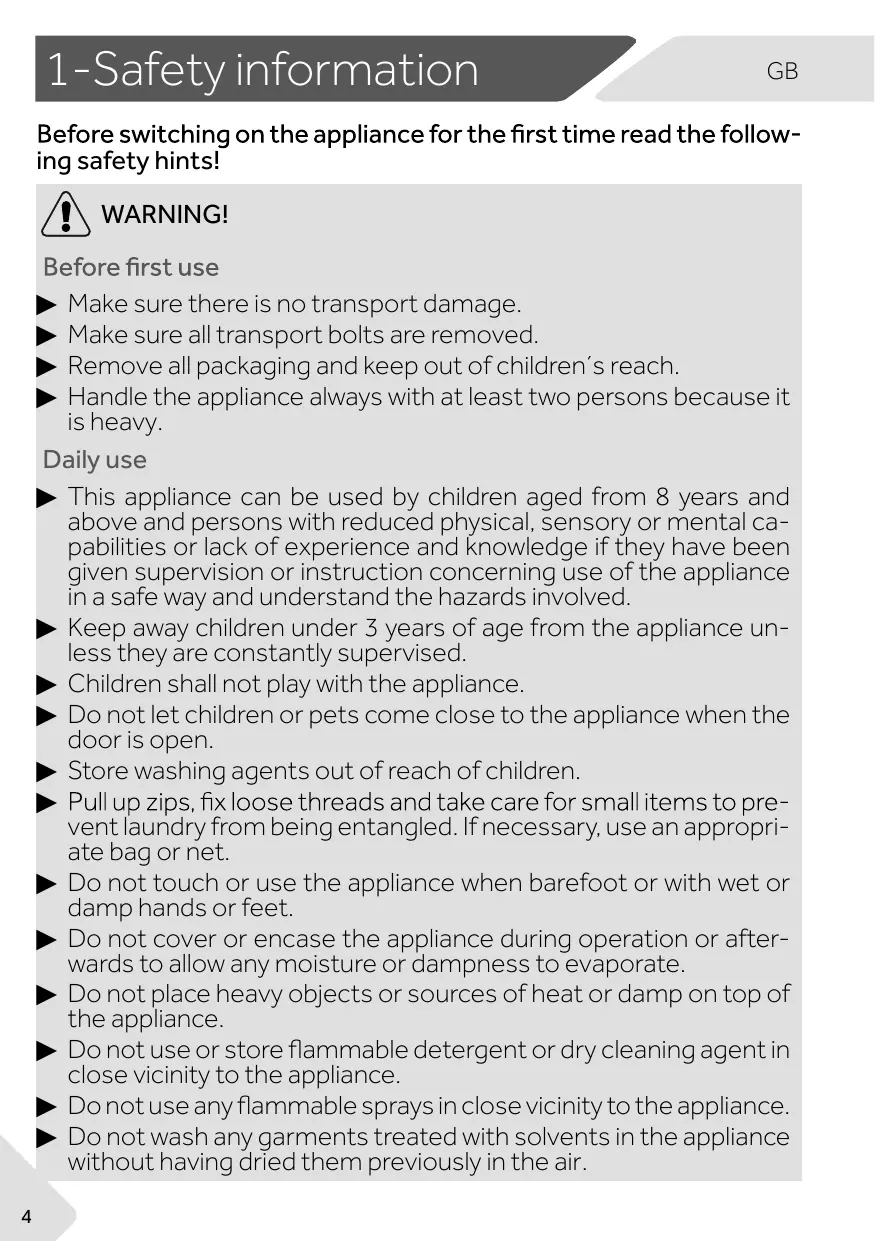
1-Safety information
Before switching on the appliance for the first time read the following safety hints!

WARNING!
Before first use
Make sure there is no transport damage.
Make sure all transport bolts are removed.
Remove all packaging and keep out of children's reach.
Handle the appliance always with at least two persons because it is heavy.
Daily use
This appliance can be used by children aged from 8 years and above and persons with reduced physical, sensory or mental capabilities or lack of experience and knowledge if they have been given supervision or instruction concerning use of the appliance in a safe way and understand the hazards involved.
Keep away children under 3 years of age from the appliance unless they are constantly supervised.
Children shall not play with the appliance.
Do not let children or pets come close to the appliance when the door is open.
Store washing agents out of reach of children.
Pull up zips, fix loose threads and take care for small items to prevent laundry from being entangled. If necessary, use an appropriate bag or net.
Do not touch or use the appliance when barefoot or with wet or damp hands or feet.
Do not cover or encase the appliance during operation or afterwards to allow any moisture or dampness to evaporate.
Do not place heavy objects or sources of heat or damp on top of the appliance.
Do not use or store flammable detergent or dry cleaning agent in close vicinity to the appliance.
Do not use any flammable sprays in close vicinity to the appliance.
Do not wash any garments treated with solvents in the appliance without having dried them previously in the air.

WARNING!
Daily use
Do not remove or insert the plug in the presence of flammable gas.
Do not hot wash foam rubber or sponge-like materials.
Do not wash any laundry which is polluted with flour.
Do not open detergent drawer during any wash cycle.
Do not touch the door during the washing process, it gets hot.
Do not open the door if the water level is visibly over the porthole.
Do not force the door to open. The door is fitted with a self-lock device and will open shortly after the washing procedure is ended.
Switch off the appliance after each wash programme and before undertaking any routine maintenance and disconnect the appliance from the electrical supply to save electricity and for safety.
Hold the plug, not the cable, when unplugging the appliance.
Maintenance / cleaning
Make sure children are supervised if they carry out cleaning and maintenance.
Disconnect the appliance from the electrical supply before undertaking any routine maintenance.
Keep the lower part of the porthole clean and open door and detergent drawer if appliance is not in use to prevent odours.
Do not use water spray or steam to clean the appliance.
Replace a damaged supply cord only by the manufacturer, its service agent or similarly qualified persons in order to avoid a hazard.
Do not try to repair the appliance by yourself. In case of repair please contact our customer service.
Installation
The appliance should be placed in a well-ventilated place. Ensure a location which allows opening the door fully.
Never install the appliance outdoors in a damp place, or in an area which may be prone to water leaks such as under or near a sink unit. In the event of a water leak cut power supply and allow the machine to dry naturally.

WARNING!
Installation
Install or use the appliance only where the temperature is above 5^ C .
- Do not place the appliance directly on a carpet, or close to a wall or furniture.
- Do not install the appliance in direct sunlight or in the near of heat sources (e.g. stoves, heaters).
Make sure that the electrical information on the rating plate agrees with the power supply. If it does not, contact an electrician.
Do not use multi-adapter and extension cables.
Make sure only the delivered electric cable and hose set are used.
- Make sure not to damage the electric cable and the plug. If damaged have it replaced by an electrician.
- Use a separate earthed socket for the power supply which is easy accessible after installation. The appliance must be earthed.
Only for UK: The appliance's power cable is fitted with 3-cord (grounding) plug that fits a standard 3-cord (grounded) socket. Never cut off or dismount the third pin (grounding). After the appliance is installed, the plug should be accessible.
- Make sure the hose joints and connections are firm and there is no leakage.
Intended use
This appliance is intended for washing machine-washable laundry only. Anytime follow the instructions given on the label of each garment label. It is designed exclusively for domestic use inside the house. It is not intended for commercial or industrial use.
Changes or modifications to the device are not allowed. Unintended use may cause hazards and loss of all warranty and liability claims.
i Note:
Due to technical changes and different models, the illustrations in the following chapters may differ from your model.
2.1 Picture of appliance
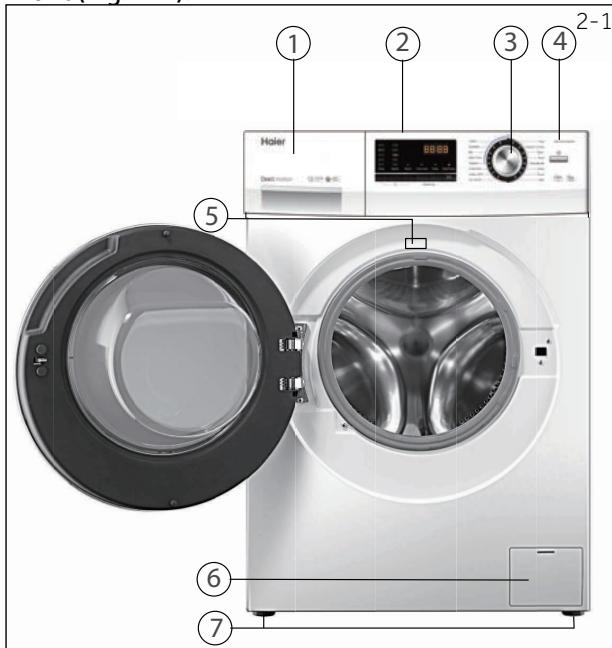
Front (Fig. 2-1):
Rear side (Fig. 2-2):
1 Detergent/Softener drawer
5 Rating plate
2 Worktop
6 Service flap
3 Programme selector
7 Adjustable feet
4 Panel
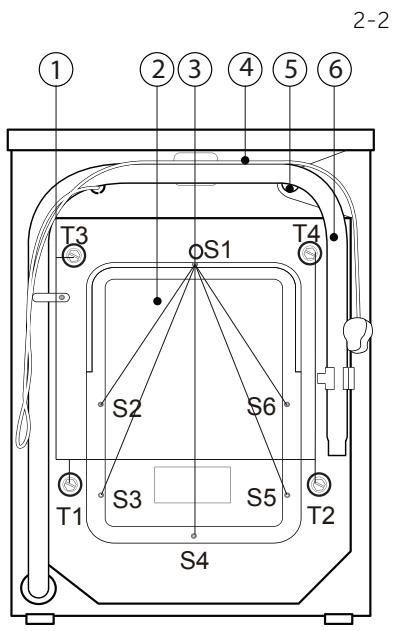
1 Transportation bolts (T1-T4)
2 Back cover
3 Back cover screws (S1-S6)
4 Power cord
5 Water inlet valve
6 Drain hose
2.2 Accessories
Check the accessories and literature in accordance with this list (Fig.2-3):
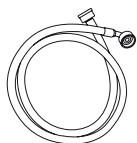
Inlet hose-assembly

5 Blanking plugs
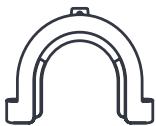
Drain hose bracket
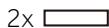
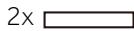
Noise
reduction pads

Warranty-card
User manual
3-Control panel
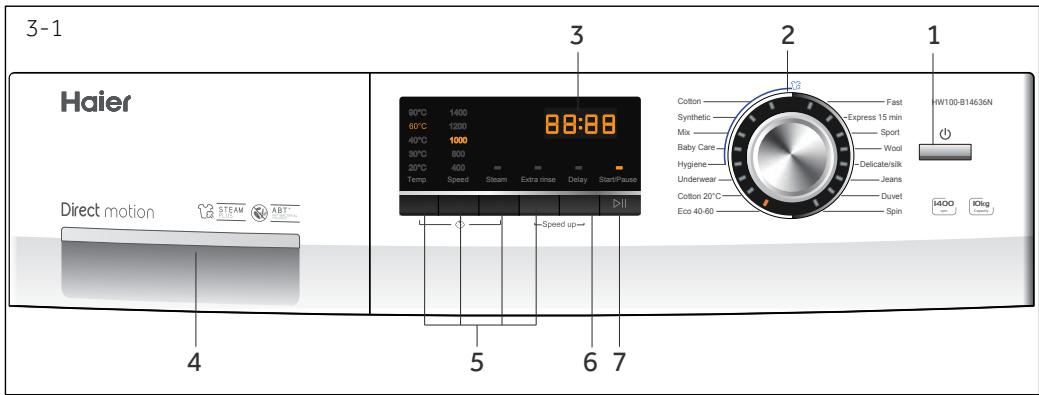
1 "On/Off" button
2 Programme selector
3 Display
4 Detergent/Softener drawer
5 Function buttons
6 "Delay" button
7 "Start/Pause" button

Note : Acoustic signal
In following cases, an acoustic signal is no sounds by default:
when pressing a button
at the end of programme
when turning the programme selector
The acoustic signal can be selected if necessary ; see DAILY USE.
3-2


3-3
3-4
3.1 "On/Off" button
Press this button (Fig. 3-2) gently to switch on, the display is shining, the indicator of the "Start/Pause" button is flashing. Press it again for about 2 seconds to switch off. If no panel element or programme is activated after a while machine will shut down automatically.
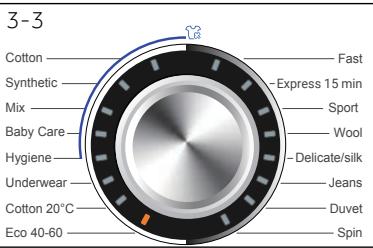
3.2 Programme selector
By turning the knob (Fig. 3-3) one of 16 programmes can be selected, related LED will light up, its default settings will be displayed.
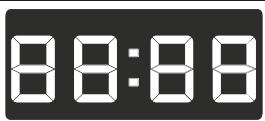
3.3 Display
The display (Fig. 3-4) shows following information:
Washing time
End time delay
Error codes and service information
3.4 Detergent drawer
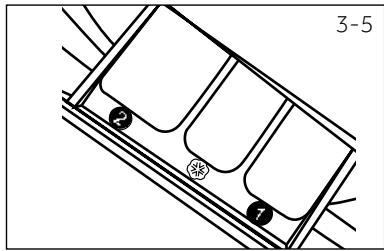
Open the drawer, three compartments can be seen (Fig. 3-5):
Compartment 1 : Water inlet only, no detergent
Compartment 2 : Detergent for programme
Compartment : Softener, Conditioning agent etc.
The recommendation on the type of detergents is suitable for the various washing temperatures, please refer to the manual of detergent.
3.5 Function buttons
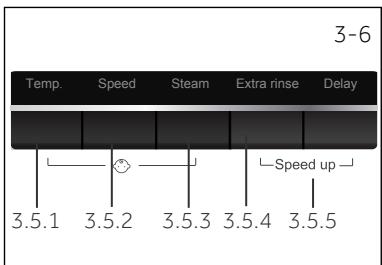
The function buttons (Fig. 3-6) enable additional options in the selected programme before programme starts. The related indicators are displayed.
By switching off the appliance or setting a new programme, all options are disabled.
If a button has multiple options, the desired option can be selected by pressing the button sequentially.
To delete the setting or to cancel the setting process, press the function button until the desired LED lights or -in case of only one option- the LED switches off.

Note: Factory settings
To get best results in each programme Haier has well defined specific default settings. If there is no special requirement default settings are recommended.
3.5.1-Function button "Temp."
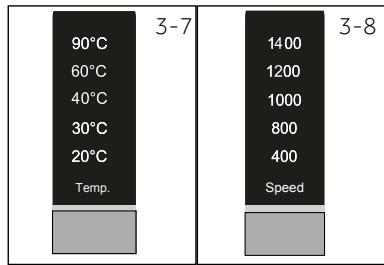
Press this button (Fig. 3-7) to change the washing temperature of the programme. If no value is illuminated the water will not be heated.
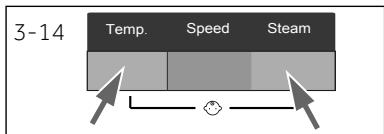
In conjunction with the "Steam" button, the child lock function can be switch on/off (see CHILD LOCK).
3.5.2-Function button "Speed"
Press this button (Fig. 3-8) to change or deselect the spin of the programme. If no value is illuminated the laundry will not spun.
3.5.3-Function button "Steam"
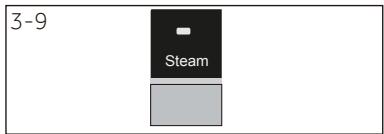
Press this button (Fig. 3-9) to activate the steam function. When this function is activated the default temperature is the maximum temperature of the programme selected. This function can be activated only with the following programmes: Cotton, Synthetic, Mix, Baby Care, Hygiene. When the function is activated the led above the button will light up. Pushing again this button the function can be deactivated and the led above the button will turn off. When the function is activated the temperature of the programme cannot be changed.
3-Control panel

Note: Liquid detergent
If using liquid detergent, it is not recommended to activate the end time delay.
If "Temp." button is pushed the "Steam" function will be deactivated. You can activate "Steam" function only before to start any programme. You cannot activate "Steam" function while the appliance is already executing a programme.
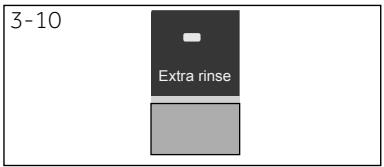
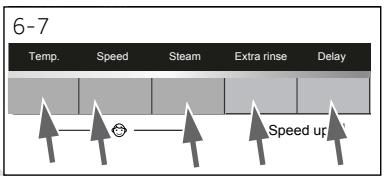
3.5.4 Function button"Extra rinse"
Press this button (Fig. 3-10) to rinse the laundry more intense with fresh water. This is recommended for people with sensitive skin.
By pressing the button several times one to three additional cycles can be selected. They appear in the display with P - - 1 / P - - 2 / P - - 3 .
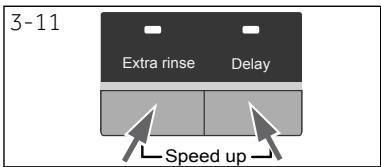
3.5.5 Function "Speed up"
This function saves time and energy. Preferable if laundry is slightly soiled. Press simultaneously button "Extra rinse" and "Delay" (Fig. 3-11) for about 3 seconds to activate the "Speed up" function; SPEEDUp is displayed. This function is not available in all programmes (see PROGRAMMES).
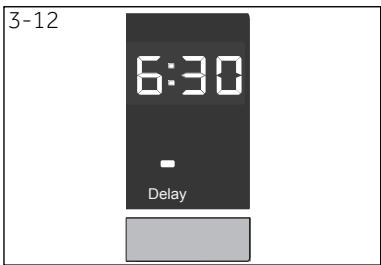
3.6 Function button "Delay"
Press this button (Fig. 3-12) to start the programme with a delay. End time delay could be increased in steps of 30 minutes from 0.5-24h.(add time to the original programme time). For example display off 6:30 means end of programme cycle will be in 6 hours and 30 minutes. Press "Start/Pause" button to activate delay. It is not applicable to programme Spin,Eco 40-60.
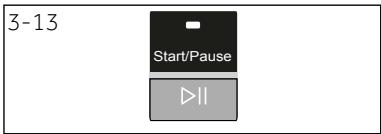
3.7 "Start/Pause" button
Press this button (Fig. 3-13) gently to start or interrupt the currently displayed programme. During programme setting and during programme run the LED above the button is shining, or if interrupted blinking.
3.8 Child lock
Press button "Temp." and "Steam" (Fig. 3-14) for 3 seconds simultaneously to block all panel elements against activation. For unlocking please press again the two buttons.
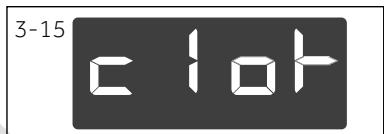
The display shows cLof- (Fig. 3-15) if a button will be pressed, when the child lock is activated. The change is not running.
- Yes, o Optional, /No
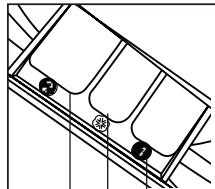
Detergent compartment for :
Water inlet only, no detergent
Detergent
Softener or care product
| Programme | Max. load1) in kg HW100/90/80/70 | Temperature | ↓2 | ↓1 | Fabrics type | Preset spin speed in rpm HW...-B14/12... | Function | |||
| in °C selectable range | Preset | Steam | Extra rinse | Speed up | ||||||
| Cotton | 10/9/8/7 | * to 902) | 40 | ● | ○ | / | Cotton | 1400/1200 | ● | ● |
| Synthetic | 5/4.5/4/3.5 | * to 60 | 40 | ● | ○ | / | Synthetics or mixed fabric | 1200 | ● | ● |
| Mix | 10/9/8/7 | * to 60 | 30 | ● | ○ | / | Lightly soiled mixed-laundry of cotton and synthetics | 1000 | ● | ● |
| Baby Care | 5/4.5/4/3.5 | * to 902) | 40 | ● | ○ | / | Cotton/Synthetics | 1000 | ● | ● |
| Hygiene | 5/4.5/4/3.5 | 90 | 90 | ● | ○ | / | Cotton/Synthetic | 1000 | ● | ● |
| Underwear | 5/4.5/4/3.5 | * to 60 | 40 | ● | ○ | / | Cotton/Synthetic | 1000 | / | ● |
| Cotton 20°C | 10/9/8/7 | 20 | 20 | ● | ○ | / | Cotton | 1400/1200 | / | ● |
| Eco 40-60 | 10/9/8/7 | / | / | ● | ○ | / | Cotton | / | / | / |
| Fast3) | 5/4.5/4/3.5 | * to 40 | 40 | ● | ○ | / | Cotton/Synthetic | 1000 | / | ● |
| Express3)15 min | 2.5/2/2/1 | * to 40 | * | ● | ○ | / | Cotton/Synthetics | 1000 | / | ● |
| Sport | 2.5/2/2/1 | * to 40 | 20 | ● | ○ | / | Sports wear | 800 | / | ● |
| Wool | 2.5/2/2/1 | * to 40 | * | ● | / | / | Machinewasha-ble fabric made of wool or with wool content | 800 | / | ● |
| Delicate/silk | 2.5/2/2/1 | * to 30 | 30 | ● | / | / | Delicate laundry and silk | 800 | / | ● |
| Jeans | 10/9/8/7 | * to 60 | 30 | ● | ○ | / | Cotton | 1000 | / | ● |
| Duvet | 2.5/2/2/1.5 | * to 40 | 40 | ● | / | / | Duvet | 800 | / | ● |
| Spin | 10/9/8/7 | / | / | / | / | / | All fabrics | 1000 | / | / |
1) Relating to dry laundry.
2) Choose 90^ wash temperature only for special hygienic requirements. *:water will not heated (no value is illuminated).
3) Reduce detergent amount because programme duration is short.
Scan QR code on energy label for energy consumption information.
The actual energy consumption may differ from the declared one according to local conditions.
EU1015/2010 program
Select Eco 40-60, press "speed" 10s, then adjust to 60^ / 40^ with max. spin speed. The standard 60^ and 40^ cotton programmes are suitable to clean normally soiled cotton laundry. They are the most efficient programmes in terms of combined energy and water consumption for cotton laundry. Actual water temperature may differ from declared cycle temperature.

Note: Auto Weight
The appliance is equipped with a loading recognition. At low loading, energy, water and washing time will be reduced automatically in some programs. The display shows RUE0.
6.1 Power supply
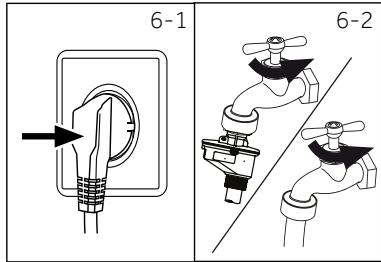
Connect the washing machine to a power supply (220V to 240V~/50Hz; Fig. 6-1). Please refer also to section INSTALLATION.
6.2 Water connection
Before connecting check the cleanliness and clarity of the water inlet.
Turn on the tap (Fig.6-2).

Note: Tightness
Before use check for leakage in the joints between the tap and the inlet hose by turning on the tap.
6.3 Preparing laundry
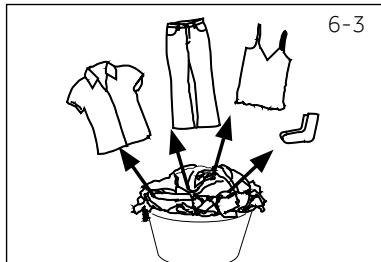
Sort out clothes according to fabric (cotton, synthetics, wool or silk etc.) and to how dirty they are (Fig. 6-3). Pay attention to the care labelling of washing labels.
Separate white clothes from coloured ones. Wash coloured textiles first by hand to check if they fade or run.
Empty pockets (keys, coins, etc.) and remove harder decorative objects (e.g. brooches).
Garments without hems, delicates and finely woven textile such as fine curtains are to be put into a wash bag to care for this delicate laundry (hand or dry cleaning would be better).
Close zippers, velco fastener and hooks, make sure the buttons are sewn on tightly.
Place sensitive items like laundry without firm hem, delicate underwear (Dessous) and small items such as socks, belts, bras, etc. in a wash bag.
Unfold large pieces of fabric such as bed sheets, bedspreads etc.
Turn jeans and printed, decorated or color-intensive textiles inside out; possibly wash separately.

CAUTION!
Non-textile, as well as small, loose or sharp-edged items may cause malfunctions and damage of clothes and appliance.
Care chart
Washing
| 95 | Washable up to 95°C normal process | 60 | Washable up to 60°C normal process | 60 | Washable up to 60°C mild process |
| 40 | Washable up to 40°C normal process | 40 | Washable up to 40°C mild process | 40 | Washable up to 40°C very mild process |
| 30 | Washable up to 30°C normal process | 30 | Washable up to 30°C mild process | 30 | Washable up to 30°C very mild process |
| Wash by hand max. 40°C | Do not wash | ||||
| Bleaching | |||||
| Any bleaching allowed | Only oxygen/ non -chlorine | Do not bleach | |||
| Drying | |||||
| Tumble drying possible normal temperature | Tumble drying possible lower temperature | Do not tumble dry | |||
| Line drying | Flat drying | ||||
| Ironing | |||||
| Iron at a maximum temperature up to 200°C | Iron at a medial tem- perature up to 150°C | Iron at a low temper- ature up to 110 °C; without steam (steam ironing may cause irre- versible damage) | |||
| Do not iron | |||||
| Professional Textile Care | |||||
| Dry cleaning in tetra- chloroethene | Dry cleaning in hy- drocarbons | Do not dry clean | |||
| Professional wet clean | Do not professional wet clean | ||||
6.4 Loading the appliance
Put in the laundry piece by piece.
Don't overload. Note the different maximum load according to programmes! Rule of thumb for maximum load: Keep six inches between load and drum top.
Close the door carefully. Make sure that no pieces of laundry are pinched.
6.5 Selecting detergent
Washing efficiency and performance is determined by used detergent quality.
Use only machine wash approved detergent.
If needed use specific detergents, e.g. for synthetic and woolen fabric.
Mind always detergent manufacturer recommendations.
Do not use dry cleaning agents such as trichloroethylene and similar products.
Choose the best detergent
| Programme | Kind of detergent | ||||
| Universal | Colour | Delicate | Special | Softener | |
| Cotton | L/P | L/P | - | - | 0 |
| Synthetic | - | - | L/P | - | 0 |
| Mix | L/P | L/P | - | - | 0 |
| Baby Care | L/P | L/P | - | - | 0 |
| Hygiene | L/P | L/P | L | - | 0 |
| Underwear | L/P | L/P | - | - | 0 |
| Cotton 20°C | L/P | L/P | - | - | 0 |
| Eco 40-60 | L/P | L/P | - | - | 0 |
| Fast | L/P | L/P | - | - | 0 |
| Express 15 min | L | L | - | - | 0 |
| Sport | - | - | L/P | L/P | 0 |
| Wool | - | - | L/P | L/P | - |
| Delicate/silk | - | - | - | L/P | - |
| Jeans | L/P | L/P | L | - | 0 |
| Duvet | - | - | L | L/P | - |
| Spin | - | - | - | - | - |
L = gel-/liquid detergent P = powder detergent O = optional -- = no If using liquid detergent, it is not recommended to activate the time delay.
We recommend by using:
Laundry powder: 20^ C to 90^ C^* (best use: 40 - 60^ C )
Color detergent: 20^ C to 60^ C (best use: 30 - 60^ C )
Wool/delicate detergent: 20^ to 30^ (best use: 20 - 30^ )
- Choose 90^ wash temperature only for special hygienic requirements.
6.6 Adding detergent
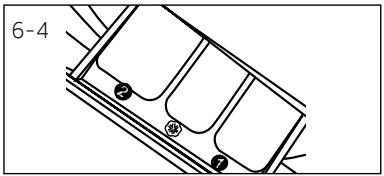
- Slide out the detergent drawer.
- Put the required chemicals into corresponding compartments (Fig. 6-4).
- Push back the drawer gently.

Note:
Remove detergent residues before next wash cycle from the detergent drawer.
Do not overuse detergent or softener.
Please follow the instruction on the detergent package.
Always fill the detergent just before the beginning of the wash cycle.
Concentrated liquid detergent should be diluted before adding into compartment 2.
The best use of liquid detergent is by using a dosing ball, which is given with the laundry into the washing machine.
Do not use liquid detergent if "end time delay" is selected.
Carefully choose the programme settings according to the care symbols on all laundry labels and according to the programme table.
6.7 Switch on the appliance
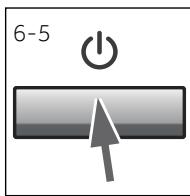
Press the "on/off" button to switch on the appliance (Fig. 6-5). The LED of the "Start/Pause" button is flashing.
6.8 Select a programme
To get the best washing results, select a programme which fits the degree of soiling and sort of laundry type.
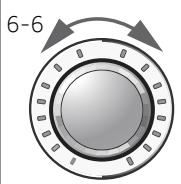
Turn the programme knob (Fig. 6-6) to select the right programme. Related programme LED lights up and the default settings are displayed.

Note: Odour removal
Before first use we recommended to run programme HYGIENE with no load and small amount of detergent in washing agent compartment (2) or special machine cleaner to remove possibly corruptive residues.
6.9 Add individual selections
Select required options and settings (Fig. 6-7); refer to CONTROL PANEL.
6.10 Start wash programme
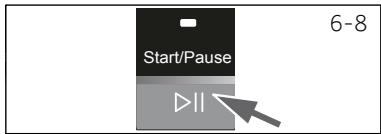
Press "Start/Pause" button (Fig. 6-8) to start. The LED of the "Start/Pause" button stops flashing and lights up continuously.
Appliance operates according to present settings.
Changes are only possible by cancelling the programme.
6.11 Interrupt / cancel wash programme
To interrupt a running programme press gently "Start/Pause". The LED above the button is flashing. Press it again to resume operation.
To cancel a running programme and all its individual settings:
- Press "Start/Pause" button to interrupt the running programme.
- Press "On/Off" button for about 2 seconds to switch the appliance off.
- Press "On/Off" button to turn on the appliance,select programme Spin and then select "no Speed"(speed lights are off),start the machine to drain the water.
- After closing the program to restart the appliance,select a new programme and start it.
6.12 After washing

Note: Door lock
For safety reasons the door is locked partially during the washing cycle. It is only possible to open the door at the end of the programme or after the programme was cancelled correctly (see description above).
In case of high water level, high water temperature and during spinning it is not possible to open the door; Locf- is displayed.
- At programme cycle end End is displayed.
- The appliance switches off automatically.
- Remove laundry as soon as possible to go easy on it and to prevent more wrinkling.
- Turn off the water supply.
- Unplug the power cord.
- Open the door to prevent formation of moisture and odours. Let it open while not used.

Note: Standby mode / energy-saving mode
The switched on appliance will go into standby mode if it will not be activated within 2 minutes before starting the program or at the end of program. The display switches off. This saves energy. To interrupt the standby mode push "Start/Pause" button.
6.13 Activate or deactivate the buzzer
The acoustic signal can be selected if necessary:
- Switch on the appliance.
- Select the SPIN programme.
- Press the "Delay" button and "Extra rinse" button at the same time for about 3 seconds. "BEEP OFF" will be displayed and the buzzer will be deactivated.
For activating the buzzer press these two buttons at the same time again. "bEEP On" will be displayed.

Environmentally responsible use
To achieve best use of energy, water, detergent and time you should use the recommended maximum load size.
Do not overload (hand width clearance above laundry).
For slightly soiled laundry select the Express 15min programme.
Apply exact dosages of each washing agent.
Choose the lowest adequate washing temperature - modern detergents are efficiently cleaning below 60^ .
Raise default settings only due to heavy staining.
Select maximum spinning speed if a domestic dryer is used.
8.1 Cleaning the detergent drawer
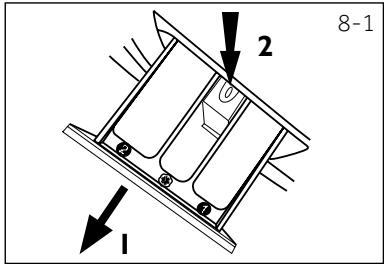
Take always care there are no detergent residues. Clean the drawer regularly (Fig. 8-1):
- Pull out the drawer until it stops.
- Press the release button and remove the drawer.
- Flush the drawer with water until it is clean and insert the drawer back in the appliance.
8.2 Cleaning the machine
Unplug the machine during cleaning and maintenance.
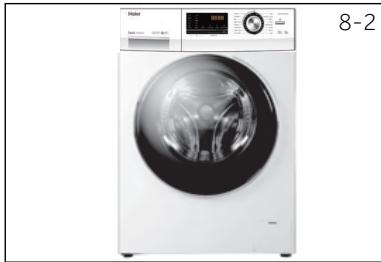
Use a soft cloth with soap liquid to clean the machine case (Fig. 8-2) and rubber components.
Do not use organic chemicals or corrosive solvents.
8.3 Water inlet valve and inlet valve filter
To prevent blockage of water supply by solid substances like lime clean regularly the inlet valve filter.
Unplug the power cord and turn off the water supply.
Unscrew the water inlet hose at the back (Fig. 8-3) of the appliance as well as on the tap.
Flush the filters with water and a brush (Fig. 8-4).
Insert the filter and install the inlet hose.

8.4 Cleaning the drum
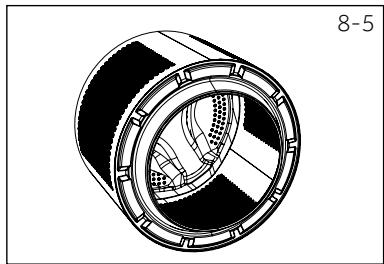
Remove accidentally washed metal parts such as pins, coins, etc. from the drum (Fig. 8-5) because they cause rust stains and damage.
Use a non-chloride cleaner for removing rust stains. Observe the warning hints of the cleaning agent manufacturer.
Do not use any hard objects or steel wool for cleaning.

Note: Hygiene
For regular maintenance we recommend to run programme HYGIENE with no load in order to remove possible corruptive residues quarterly. Add a small amount of detergent in washing agent compartment (2) or use a special machine cleaner.
8-Care and cleaning
8.5 Long periods of disuse
If the appliance is left idle for a longer period:
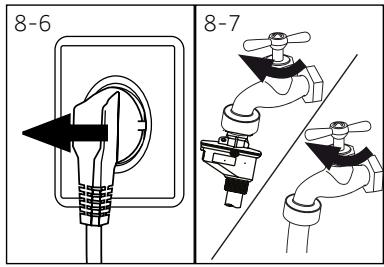
- Pull out the electrical plug (Fig. 8-6).
- Turn off water supply (Fig. 8-7).
- Open the door to prevent formation of moisture and odours. Let door open while not used.
Before next usage check carefully power cord, water inlet and drain hose. Make sure everything is properly installed and without leakage.

Note: Hygiene
After long periods of disuse we recommended to run programme HYGIENE with no load and small amount of detergent in washing agent compartment (2) or special machine cleaner to remove possibly corruptive residues.
8.6 Pump filter
Clean the filter once a month and check the pump filter for instance if the appliance:
Doesn't drain the water.
Doesn't spin.
Cause unusual noise while running.

WARNING!
Scalding Risk! Water in the pump filter can be very hot! Before any action please ensure water has cooled down.
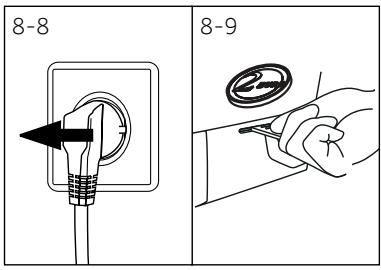
- Turn off and unplug the machine (Fig. 8-8).
- Open service flap. You can either use a coin or a screwdriver (Fig. 8-9).
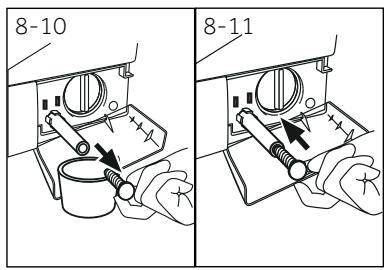
- Provide a flat container to catch leach water (Fig. 8-10). There could be bigger amounts!
- Pull the drainhose out and hold its end above the container (Fig. 8-10).
- Take the sealing plug out of the drainhose (Fig. 8-10).
- After complete drainage close drainhose and push it back into the machine (Fig. 8-11).
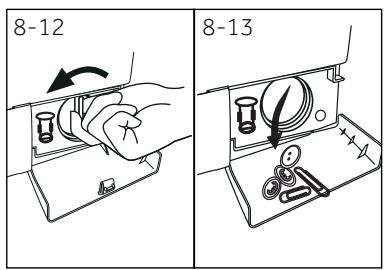
- Unscrew and remove counter clockwise the pump filter (Fig. 8-12).
- Remove contaminants and dirt (Fig. 8-13).
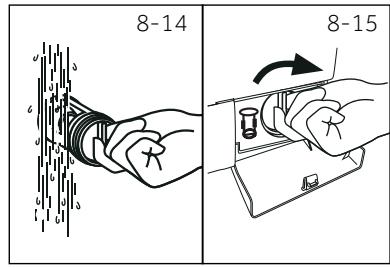
- Clean carefully pump filter, e.g. using running water (Fig. 8-14).
- Reflex it thoroughly (Fig. 8-15).
11.Close service flap.

CAUTION!
- Pump filter sealing has to be clean and unhurt. If the lid is not full tightened, water can escape.
The filter must be in place, or it may lead to leakage.
9-Troubleshooting
Many occurring problems could be solved by yourself without specific expertise. In case of a problem please check all shown possibilities and follow below instructions before you contact an after sales service. See CUSTOMER SERVICE.

WARNING!
Before maintenance, deactivate the appliance and disconnect the mains plug from the mains socket.
Electrical equipment should be serviced only by qualified electrical experts, because improper repairs can cause considerable consequential damages.
A damaged power cable should only be replaced by the manufacturer, its service agent or similarly qualified persons in order to avoid a hazard.
9.1 Information codes
Following codes are displayed only for information referring to the washing cycle. No measures must be performed.
| Code | Message |
| i:25 | The remaining wash cycle time will be 1 hour and 25 minutes. |
| 6:30 | The remaining wash cycle time including chosen end-time delay will be 6 hours and 30 min-utes. |
| P-- 1/2/3 | 1/2/3 additional rinses are choosen (see FUNCTION BUTTONS "Extra rinse"). |
| End | The washing cycle is finished. The appliance shuts off automatically. |
| c:ot | Function child lock is activated. |
| Lock | Door is closed because of high water level, high water temperature or spinning cycle. |
| bEEP OFF | The buzzer is deactivated. |
| bEEP ON | The buzzer is activated. |
| SPEED UP | Function "Speed up" is activated. |
9.2 Troubleshooting with display code
| Problem | Cause | Solution |
| CLr FLtr | • Drainage error. | • Clean pump filter. • Check drain hose installation. |
| E2 | • Lock error. | • Shut the door properly. |
| E4 | • Water level not reached. • Drain hose is self-syphoning. | • Make sure that tap is fully opened and water pressure is normal. • Check drain hose installation. |
| E8 | • Water protective level error. | • Contact the After sales service. |
Program Cause
Solution
| FR | • Water level sensor error. | • Contact the After sales service. |
| F3 | • Temperature sensor error. | • Contact the After sales service. |
| F4 | • Heating error. | • Contact the After sales service. |
| F7 | • Motor error. | • Contact the After sales service. |
| FC0、FC1 or FC2 | • Abnormal communication error. | • Contact the After sales service. |
| Unb | • Unbalanced load error. | • Check and balance laundry load in the drum. Reduce the load. |
9.3 Troubleshooting without display code
| Problem | Cause | Solution |
| Washing machine fails to operate. | Programme is not yet started. Door is not properly closed. Machine has not been switched on. Power failure. Child lock is activated. | Check programme and start it. Close the door properly. Switch the machine on. Check power supply. Deactivate child lock. |
| Washing machine will not be filled with water. | No water. Inlet hose is kinked. Inlet hose filter is blocked. Water pressure is less than 0.03 MPa. Door is not properly closed. Water supply failure. | Check water tap. Check inlet hose. Unblock inlet hose filter. Check water pressure. Close the door properly. Ensure the water supply. |
| Machine is draining while being filled. | Height of drain hose is below 80 cm. Drain hose end could reach into water. | Make sure that drain hose is properly installed. Make sure the drain hose is not in water. |
| Drainage failure. | Drain hose is blocked. Pump filter is blocked. Drain hose end is higher than 100 cm above floor level. | Unblock drain hose. Clean pump filter. Make sure that drain hose is properly installed. |
| Strong vibration while spinning. | Not all transportation bolts have been removed. Appliance has no solid position. Machine load is not correct. | Remove all transportation bolts. Ensure solid ground and a levelled position. Check load weight and balance. |
| Operation stops before completing wash cycle. | Water or electric failure. | Check power and water supply. |
| Operation stops for a period of time. | Appliance displays error code. Problem due to load pattern. Programme performs soaking cycle. | Consider display codes. Reduce or adjust load. Cancel programme and restart. |
| Excessive foam floats drum and/or detergent drawer. | Detergent is not a appropriate. Excessive use of detergent. | Check detergent recommendations. Reduce amount of detergent. |
| Automatic adjust-ment of washing time. | Washing programme duration will be adjusted. | This is normal and doesn't affect functionality. |
| Spinning fails. | Unbalance of laundry. | Check machine load and laun-dry and run a spinning pro- gramme again. |
| Unsatisfactory wash-ing result. | Degree of pollution does not agree with selected programme. Detergent quantity was not suf-ficient. Maximum load has been exceeded. Laundry was unevenly distributed in the drum. | Select an other programme. Choose the detergent accord-ing to the degree of pollution and according to manufacturer specifications. Reduce loading. Loose the laundry. |
| Washing powder residues are on the laundry. | Insoluble particles of detergent can remain as white spots on the laun-dry. | Perform extra rinse. Try to brush the points from the dry laundry. Choose an other detergent. |
| Laundry has grey patches. | Caused by fats such as oils, creams or ointments. | Pretreat the laundry with a spe-cial cleaner. |

Note: Foam formation
If too much foam is inspected during spin cycle, motor stops and drain pump will be activated for 90 seconds. If that elimination of foam fails up to 3 times, programme ends without spinning.
Should the error messages reappear even after the taken measures, switch off the appliance, disconnect the power supply and contact the customer service.
9.4 In case of power failure
The current programme and its setting will be saved. When power supply is restored operation will be resumed.
In case of power failure during programme run door opening is mechanically blocked. If the laundry is to be removed, the water level must not be visible in the glass door. Danger of scalding!
Lower the water level according to step 1 to 6 of chapter CARE AN CLEANING (PUMP FILTER).
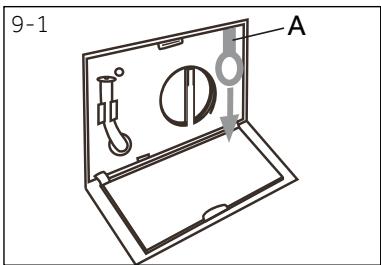
Pull lever (A) beneath service flap (Fig. 9-1) until door is unlocked by a gentle click.
Fix all parts and close the service flap.
10.1 Preparation
Take the appliance out of the packaging.
Remove all packaging material including polystyrene base, keep them out of childrens reach. While opening the package, water drops may be seen on plastic bag and port-hole. This normal phenomenon results from water tests in the factory.

Note: Packaging disposal
Keep all packaging materials out of children's reach and dispose them in an environmentally friendly manner.
10.2 Noise resumption pads installation instructions
- When opening the shrink package, you will find noise reduction pads.
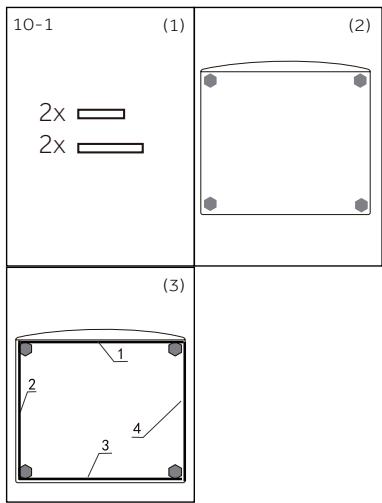
These are used for reducing noise. (Fig. 10-1) - Lay the washing machine down to its side, porthole pointing upwards, bottom side towards operator.
- Take out the noise reduction pads and remove the double-sided adhesive protective film; the noise reduction pads under the washing machine cabinet as shown in Figure 10.1(3), two longer pads in position 1 and 3, two shorter pads in position 2 and 4. Finally set the machine upright again.
Warm tip:
Noise reduction pad is optional, could help to reduce noise, please assemble it or not according to your own demand.
10.3 Dismantle the transportation bolts
The transportation bolts are designed for clamping anti-vibration components inside the appliance during transportation to prevent inner damage.
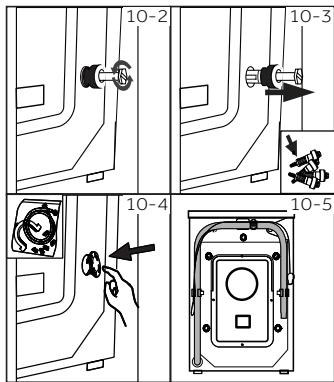
- Remove all 4 bolts on the rear side and take out plastic spacers (Fig. 10-2)(Fig. 10-3).
- Fill left holes with blanking plugs (Fig. 10-4)(Fig. 10-5).

Note: Keep in safe place
Keep the transportation bolts in a safe place for later use. Whenever the appliance is to be moved at first reinstall the bolts.
10.4 Moving the appliance
If the machine is to be moved to a distant location, replace the transportation bolts removed before installation to prevent damage:
- Remove the blanking plugs.
- Remove the back cover.
- Insert the plastic spacers and the transportation bolts.
- Tighten the bolts with a spanner.
- Replace the back cover.
10.5 Aligning the appliance
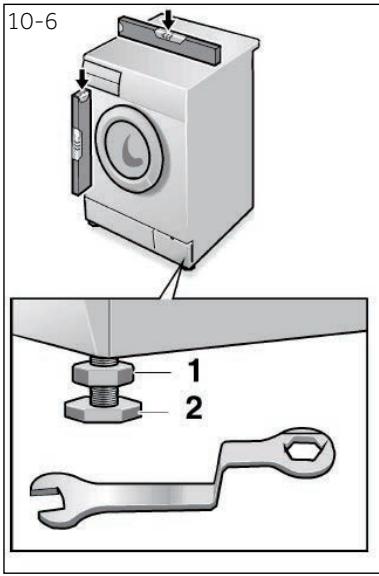
Adjust all feet (Fig. 10-6) to achieve a complete level position. This will minimize vibrations and thus noise during use. It will also reduce wear and tear. We recommend to use a spirit level for adjustment. Floor should be as stable and flat as possible.
- Loose the locknut (1) by using a wrench.
- Adjust the high by turning the foot (2).
- Tighten locknut (1) against the housing.
10.6 Drain water connection
Fix the water drain hose properly to the piping. The hose has to reach at one point a height between 80 and 100cm above the appliance bottom line! If possible keep always drain hose fixed to the clip at the appliance back.

WARNING!
Use only the supplied hose set for the connection.
Never reuse old hose sets!
Only connect to cold water supply.
Before connection, check whether the water is clean and clear.
Following connections are possible:
10.6.1 Drain hose to sink
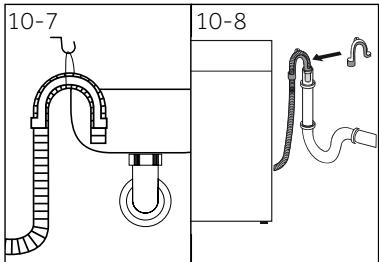
Hang the drain hose with the U-support over the edge of a sink with adequate size (Fig. 10-7).
Protect the U-support sufficiently against slipping.
10.6.2 Drain hose to waste water connection
The internal diameter of the stand pipe with vent-hole must be minimum 40 mm.
Put the drain hose for approx. 80~mm in the wastewater pipe.
Attach the U-support and secure it sufficiently (Fig. 10-8).
10.6.3 Drain hose to sink connection
The junction must lie above the siphon.
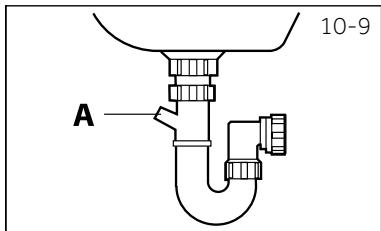
A spigot connection is usually closed by a pad (A).
That must be removed to prevent any disfunction (Fig. 10-9).
Secure the drain hose with a clamp.

CAUTION!
The drain hose should not be submerged in water and should be securely fixed and leak-free. If the drain hose is placed on the ground or if the pipe is at a height of less than 80~cm , the washing machine will continuously drain while being filled (self-siphoning).
Drain hose is not to be extended. If necessary contact after sales service.
10.7 Fresh water connection
Make sure that the gaskets are inserted.
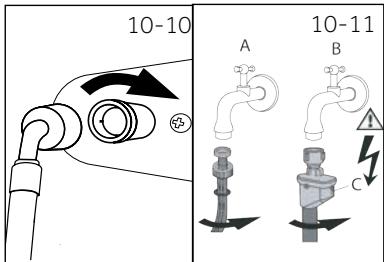
- Connect the water inlet hose with the angled end to the appliance (Fig. 10-10). Tighten the screw joint by hand.
- The other end connect to a water tap with a 3/4'' thread (Fig. 10-11).

Note: Aqua-stop system:
Some models are equipped with an aqua-stop inlet hose (B). The aqua-stop system protects against water damage by automatically cutting the fresh water supply in case of a leaking hose. This is indicated by a red marker (C). The hose must be replaced.
10.8 Electrical connection
Before each connection check if:
Power supply, socket and fusing are appropriate to the rating plate.
The power socket is earthed and no multi-plug or extension are used.
The power plug and socket are strictly according.
Only UK: The UK plug meets BS1363A standard.
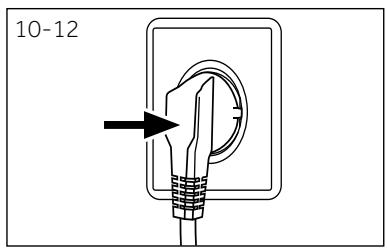
Put the plug into the socket (Fig. 10-12).

WARNING!
Ensure always that all connections (power supply, drain and fresh water hose) are firm, dry and leak free!
Take care these parts are never to be crushed, kinked, or twisted.
If the supply cord is damaged, it must be replaced by the service agent (see warranty card) in order to avoid a hazard.

Note: Hygiene
After each installation or long periods of disuse, before first use and for regular maintenance run programme HYGIENE with no load and small amount of detergent in washing agent compartment (2) or with special machine cleaner to remove possibly corruptive residues.
11.1 Additional technical data
| HW100 | HW90 | HW80 | HW70 | |
| Voltage in V | 220-240 V~/50Hz | |||
| Current in A | 10 | |||
| Max power in W | 2000 | |||
| Water pressure in MPa | 0.03≤P≤1 | |||
| Netto weight in kg | 74 | 74 | 72 | 64 |
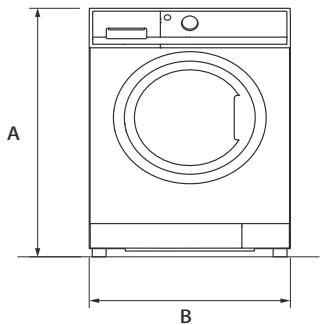
11.2 Product dimensions
FRONT VIEW
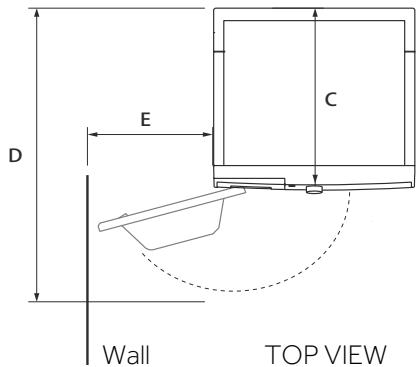
| PRODUCT DIMENSIONS | HW100 | HW90 | HW80 | HW70 |
| A Overall height of product mm | 850 | 850 | 850 | 850 |
| B Overall width of product mm | 595 | 595 | 595 | 595 |
| C Overall depth of product (To main control board size) mm | 600 | 600 | 550 | 460 |
| D Depth of door open mm | 1100 | 1100 | 1050 | 960 |
| E Minimum door clearance to adjacent wall mm | 400 | 400 | 400 | 400 |
Note: The exact height of your washer is dependent on how far the feet are extended from the base of the machine. The space where you install your washer needs to be at least 40mm wider and 20mm deeper than its dimensions.
11.3 Standards and Directives
This product meets the requirements of all applicable EC directives with the corresponding harmonised standards, which provide for CE marking.
12-Customer service
We recommend our Haier Customer Service and the use of original spare parts.
If you have a problem with your appliance, please first check section TROUBLESHOOTING.
If you cannot find a solution there, please contact:
your local dealer.
the Service & Support area at www.haier.com where you can find telephone numbers and FAQs and where you can activate the service claim.
To contact our Service, ensure that you have the following data available.
The information can be found on the rating plate.
Model
Serial No.
Also check the Warranty Card supplied with the product in case of warranty.
For general business enquiries please find below our addresses in Europe:
| European Haier addresses | |||
| Country* | Postal address | Country* | Postal address |
| Italy | Haier Europe Trading SRL Via De Cristoforis, 12 21100 Verese ITALY | France | Haier France SAS53 Boulevard Ornano – Pleyad 393200 Saint Denis France |
| Spain Portugal | Haier Iberia SL Pg. Garcia Faria, 49-51 08019 Barcelona SPAIN | Belgium-FR Belgium-NL Netherlands Luxembourg | Haier Benelux SA Anderlecht Route de Lennik 451 BELGIUM |
| Germany Austria | Haier Deutschland GmbH Konrad-Zuse-Platz 6 81829 München GERMANY | Poland Czechia Hungary Greece Romania Russia | Haier Poland Sp. zo.o. Al. Jerozolimskie 181B 02-222 Warszawa POLAND |
| United Kingdom | Haier Appliances UK Co.Ltd. One Crown Square Church Street East Woking, Surrey, GU21 6HR UK | ||
*For more information please refer to www.haier.com

HW100-B14636N
HW100-B12636NE
HW90-B14636N
HW80-B14636N
HW70-B12636N
HW70-B12FCFN