
DVD-HR757 - DVD Recorder SAMSUNG - Free user manual and instructions
Find the device manual for free DVD-HR757 SAMSUNG in PDF.
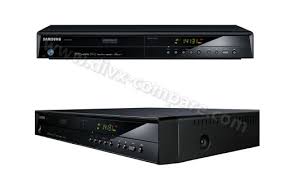



| Product type | DVD recorder with hard drive |
| Brand | Samsung |
| Model | DVD-HR757 |
| Hard disk capacity | 320 GB |
| Maximum recording time on HDD | Approximately 534 hours (EP mode) |
| Supported disc formats | DVD-RAM, DVD±RW, DVD±R, CD-R/RW, Audio CD |
| Recording modes | XP, SP, LP, EP, FR (variable quality) |
| HDMI output resolutions | 576p, 720p, 1080i |
| Video outputs | Composite, S-Video, Component (Y/Pb/Pr), HDMI, SCART (AV1) |
| Audio outputs | Analog stereo, digital optical and coaxial |
| Inputs | RF antenna, SCART (AV2), DV (IEEE 1394), AV3 (composite/audio), USB host |
| Special features | Simultaneous recording and playback, Time Shift, Anynet+ (HDMI-CEC), EZ Recording, HDD↔DVD Copy |
| Playable file formats | DivX, MP3, JPEG (via USB or disc) |
| Dimensions (W x D x H) | 430 x 300 x 59 mm |
| Weight | 3.9 kg |
| Power supply | 220-240 V AC, 50 Hz |
| Power consumption | 32 W (operation), 2.9 W (standby) |
| Laser safety | Class 1 – invisible radiation |
| Copy protection | Macrovision (playback of protected DVDs) |
| Operating temperature | +5°C to +35°C |
| Operating humidity | Less than 75% |
| Included accessories | Remote control, batteries, audio/video cable, RF cable, instruction manual |
Frequently Asked Questions - DVD-HR757 SAMSUNG
User questions about DVD-HR757 SAMSUNG
0 question about this device. Answer the ones you know or ask your own.
Ask a new question about this device
Download the instructions for your DVD Recorder in PDF format for free! Find your manual DVD-HR757 - SAMSUNG and take your electronic device back in hand. On this page are published all the documents necessary for the use of your device. DVD-HR757 by SAMSUNG.
USER MANUAL DVD-HR757 SAMSUNG
This symbol indicates "dangerous voltage" inside the product that presents a risk of electric shock or personal injury.

This symbol indicates important instructions accompanying the product.
Do not install this equipment in a confined space such as a bookcase or similar unit.
WARNING: To prevent damage which may result in fire or electric shock hazard, do not expose this appliance to rain or moisture.
CAUTION: HDD & DVD RECORDER USES AN INVISIBLE LASER BEAM WHICH CAN CAUSE HAZARDOUS RADIATION EXPOSURE IF DIRECTED. BE SURE TO OPERATE HDD & DVD RECORDER CORRECTLY AS INSTRUCTED.
CAUTION
THIS PRODUCT UTILIZES A LASER. USE OF CONTROLS OR ADJUSTMENTS OR PERFORMANCE OF PROCEDURES OTHER THAN THOSE SPECIFIED HEREIN MAY RESULT IN HAZARDOUS RADIATION EXPOSURE. DO NOT OPEN COVERS AND DO NOT REPAIR YOURSELF. REFER SERVICING TO QUALIFIED PERSONNEL.
This product satisfies CE regulations when shielded cables and connectors are used to connect the unit to other equipment. To prevent electromagnetic interference with electric appliances, such as radios and televisions, use shielded cables and connectors for connections.
IMPORTANT NOTE
The mains lead on this equipment is supplied with a moulded plug incorporating a fuse. The value of the fuse is indicated on the pin face of the plug. If it requires replacing, a fuse approved to BS1362 of the same rating must be used.
Never use the plug with the fuse cover omitted if the cover is detachable. If a replacement fuse cover is required, it must be of the same colour as the pin face of the plug. Replacement covers are available from your dealer.
If the fitted plug is not suitable for the power points in your house or the cable is not long enough to reach a power point, you should obtain a suitable safety approved extension lead or consult your dealer for assistance.
However, if there is no alternative to cutting off the plug, remove the fuse and then safely dispose of the plug. Do not connect the plug to a mains jack, as there is a risk of shock hazard from the bared flexible cord.
To disconnect the apparatus from the mains, the plug must be pulled out from the mains socket, therefore the mains plug shall be readily operable.
The product unit accompanying this user manual is licenced under certain intellectual property rights of certain third parties. This licence is limited to private non-commercial use by end-user consumers for licenced contents.
No rights are granted for commercial use.
The licence does not cover any product unit other than this product unit and the licence does not extend to any unlicensed product unit or process conforming to ISO/IEC 11172-3 or ISO/IEC 13818-3 used or sold in combination with this product unit. The licence only covers the use of this product unit to encode and/or decode audio files conforming to the ISO/IEC 11172-3 or ISO/IEC 13818-3. No rights are granted under this licence for product features or functions that do not conform to the ISO/IEC 11172-3 or ISO/IEC 13818-3.
Precaution
Important Safety Instructions
Read these operating instructions carefully before using the unit. Follow all the safety instructions listed below. Keep these operating instructions handy for future reference.
1) Read these instructions. 2) Keep these instructions. 3) Heed all warnings. 4) Follow all instructions. 5) Do not use this apparatus near water. 6) Clean only with dry cloth. 7) Do not block any ventilation openings. Install in accordance with the manufacturer's instructions. 8) Do not install near any heat sources such as radiators, heat registers, stoves, or other apparatus (including amplifiers) that produce heat. 9) Do not defeat the safety purpose of the polarized or grounding-type plug. A polarized plug has two blades with one wider than the other. A grounding-type plug has two blades and a third grounding prong. The wide blade or the third prong are provided for your safety. If the provided plug does not fit into your outlet, consult an electrician for replacement of the obsolete outlet. 10) Protect the power cord from being walked on or pinched particularly at plugs, convenience receptacles, and the point where they exit from the apparatus. 11) Only use attachments/accessories specified by the manufacturer. 12) Use only with the cart, stand, tripod, bracket, or table specified by the manufacturer, or sold with the apparatus. When a cart is used, use caution when moving the cart/apparatus combination to avoid injury from tip-over. 13) Unplug this apparatus during lightning storms or when unused for long periods of time. 14) Refer all servicing to qualified service personnel. Servicing is required when the apparatus has been damaged in any way, such as power-supply cord or plug is damaged, liquid has been spilled or objects have fallen into the apparatus, the apparatus has been exposed to rain or moisture, does not operate normally, or has been dropped.
Handling Cautions
- Before connecting other components to this HDD & DVD REORDER, be sure to turn them all off.
- Do not move the HDD & DVD REORDER while a disc is being played, or the disc may be scratched or broken, the HDD & DVD REORDER internal parts may be damaged.
- Do not put a flower vase filled with water or any small metal objects on the HDD & DVD REORDER.
- Be careful not to put your hand into the disc tray.
- Do not place anything other than the disc in the disc tray.
- Exterior interference such as lightning and static electricity can affect normal operation of this HDD & DVD RECORDER. If this occurs, turn the HDD & DVD RECORDER off and on again with the STANDBY/ON button, or disconnect and then reconnect the AC power cord to the AC power outlet. The HDD & DVD RECORDER will operate normally.
- Be sure to remove the disc and turn off the HDD & DVD RECORDER after use.
- Disconnect the AC power cord from the AC outlet when you don't intend to use the HDD & DVD RECORDER for long periods of time.
- Clean the disc by wiping in a straight line from the inside to the outside of the disc.
- Apparatus shall not be exposed to dripping or splashing and no objects filled with liquids, such as vases, shall be placed on the apparatus.
- The Mains plug is used as a disconnect device and shall stay readily operable at any time.
Maintenance of Cabinet
For safety reasons, be sure to disconnect the AC power cord from the AC outlet.
- Do not use benzene, thinner, or other solvents for cleaning.
- Wipe the cabinet with a soft cloth.
HDD (Hard Disk Drive)
The hard disk has a high storage density, which enables long recording durations and quick access to written data. However, it can easily be damaged by shock, vibration or dust and should be kept away from magnets. To avoid losing important data, observe the following precautions.
- Do not use the HDD & DVD RECORDER in a place subject to extreme changes in temperature.
- Do not apply a strong shock to the HDD & DVD RECORDER.
- Do not place the HDD & DVD RECORDER in a location subject to mechanical vibrations or in an unstable location.
- Do not place the HDD & DVD RECORDER on top of a heat source.
- Do not disconnect the AC power cord while the power is on.
- Do not attempt to change the hard disk. This may result in a malfunction.
Should the hard disk be damaged, you cannot recover lost data. The hard disk is only a temporary storage space.
Disc Handling
- Use discs with regular shapes. If an irregular disc (a disc with a special shape) is used, this HDD & DVD RECORDER may be damaged.

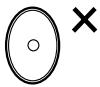
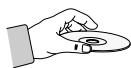
Holding discs
- Avoid touching the surface of a disc where recording is performed.
DVD-RAM, DVD±RW and DVD±R
- Clean with an optional DVD-RAM/PD disc cleaner (LF-K200DCA1 where available). Do not use cleaners or cloths for CDs to clean DVD-RAM/±RW/±R discs.
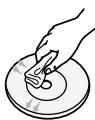
DVD-Video, Audio-CD
- Wipe off dirt or contamination on the disc with a soft cloth.
Cautions on handling discs
- Do not write on the printed side with a ball-point pen or pencil.
- Do not use record cleaning sprays or antistatic agents. Also, do not use volatile chemicals, such as benzene or thinner.
- Do not apply labels or stickers to discs. (Do not use discs with exposed tape adhesive or leftover peeled-off stickers.)
- Do not use scratch-proof protectors or covers.
- Do not use discs printed with label printers available on the market.
- Do not load warped or cracked discs.
Disc Storage
Be careful not to harm the disc because the data on these discs is highly vulnerable to the environment.
- Do not keep under direct sunlight.
- Keep in a cool, ventilated area.
- Store vertically.
- Keep in a clean protection jacket.
- If you move your HDD & DVD RECORDER suddenly from a cold place to a warm place, condensation may generate on the operating parts and lens and cause abnormal disc playback. If this occurs, do not connect the plug to the power outlet and wait for two hours. Then insert the disc and try to play back again.
Disc Specifications
DVD-HR757
This unit allows you to record and playback high quality digital video on DVD-RAM/±RW/±R discs or on the HDD.
You can also edit digital images on DVD-RAM/±RW discs or HDD.
Disc Type
DVD-Video
- A digital versatile disc (DVD) can contain up to 135-minutes of images, 8 audio languages and 32 subtitle languages. It is equipped with MPEG-2 picture compression and Dolby digital surrounding, allowing you to enjoy vivid and clear theatre quality images in the comfort of your own home.
- When switching from the first layer to the second layer of a dual-layered DVD Video disc, there may be momentary distortion in the image and sound. This is not a malfunction of the unit.
- Once a DVD-RW/±R recorded in Video Mode is finalised, it becomes DVD-Video.
Audio CD
- An audio disc on which 44.1 kHz PCM Audio is recorded.
- Plays CD-DA format audio CD-R and CD-RW discs.
- The unit may not be able to play some CD-R or CD-RW discs due to the condition of the recording.
CD-R/RW
- Use a 700MB (80 minutes) CD-R/-RW disc. If possible, do not use a 800MB (90 minutes) or above disc, as the disc may not play back.
- If the CD-R/-RW disc was not recorded as a closed session, you may experience a delay in the early playback time, all recorded files may not play.
- Some CD-R/-RW discs may not be playable with this unit, depending on the device which was used to burn them. For contents recorded on CD-R/-RW media from CDs for your personal use, playability may vary depending on contents and discs.
DVD±R Disc Playback and Recording
- Once a DVD±R recorded in Video Mode is finalised, it becomes DVD-Video.
- You can record onto the available space on the disc and perform editing functions such as giving titles to discs and programmes and erasing programmes before finalising.
- When programming is erased from a DVD±R, that space does not become available. Once an area on a DVD±R is recorded on, that area is no longer available for recording, whether the recording is erased or not.
- It takes about 30 seconds for the unit to complete recording management information after recording finishes.
- This product optimizes the DVD±R for each recording. Optimizing is carried out when you start recording after inserting the disc or turning on the unit. Recording onto the disc may become impossible if optimizing is carried out too many times.
- Playback may be impossible in some cases due to the condition of recording.
- This unit can play back DVD±R discs recorded and finalised with a Samsung DVD video recorder. It may not be able to play some DVD±R discs depending on the disc and the condition of the recording.
DVD-RW Disc Playback and Recording
- Recording and playback can be performed on DVD-RW discs in both the Video and VR Modes.
- Once a DVD-RW recorded in both the Video and VR Modes is finalised, you cannot perform additional recording.
- Once a DVD-RW recorded in Video Mode is finalised, it becomes DVD-Video.
- In both modes, playback can be performed before and after finalisation, but additional recording, deleting and editing can not be performed after finalisation.
- If you want to record the disc in VR Mode and then record in V Mode, be sure to execute Format. Be careful when executing Format because all the recorded data may be lost.
- A DVD-RW blank disc is initialized to VR Mode when first initialized.
DVD+RW Disc Playback and Recording
- With DVD+RW discs, there is no difference between DVD-Video format (Video mode) and DVD-Video Recording format (VR mode).
- Finalising is generally unnecessary when using a DVD+RW disc.
DVD-RAM Disc Playback and Recording
- Ensure that the recording mode is set to VR mode. Otherwise, this product will not be able to play the recording.
- You cannot play a DVD-RAM in most DVD components due to compatibility issues.
- Only DVD-RAM standard Version 2.0 discs can be played in this unit.
- DVD-RAM recorded on this unit may not work with other DVD components. To determine compatibility with these DVD-RAM discs, refer to the user's manual for the player.
- For cartridge type DVD-RAM discs, remove the cartridge and use the disc only.
Contents Copy Specifications
| Contents | HDD → DVD | DVD → HDD |
| Recorded Video Title | Supported | Supported |
| Copy Protected Title | Not supported | Not supported |
| Copy Once Title | Move (Deletes the Title in the HDD after copying) | Not supported |
Once "Copy Once programme" has been recorded on the DVD disc, this title cannot be copied to HDD anymore.
But "Copy Once programme" has been recorded on the HDD, this title can be copied to DVD-RW (VR mode) or DVD-RAM.
When you copy MP3/JPEG/DivX files from HDD to DVD, only DVD-RW(V)/-R discs are available.
Contents Copy Specifications
| Contents | HDD → DVD or USB | DVD → HDD or USB | USB → HDD or DVD |
| MP3 | Supported | Supported | Supported |
| JPEGphoto) | Supported | Supported | Supported |
| DivX | Supported | Supported | Supported |
- Disc (CD-R/ CD-RW/DVD-RAM, DVD±R (Finalise)/DVD+RW/DVD-RW (Finalise)) → HDD or USB
- HDD→DVD-R, DVD-RW(V) or USB
- USB→HDD or DVD-R, DVD-RW(V)
- The disc that has Video recording or has title dubbing from HDD can't be copied.
- PTP USB is not available when you copy to USB.
- If the disc is finalised through Disc Manager, it can be compatible with PC as a disc with a UDF file system.
COPY PROTECTION
- Many DVD discs are encoded with copy protection. Because of this, you should only connect your HDD & DVD REORDER directly to your TV, not to a VCR. Connecting to a VCR results in a distorted picture from copy-protected DVD discs.
- This product incorporates copyright protection technology that is protected by methods claims of certain U.S. patents and other intellectual property rights owned by Macrovision Corporation and other rights owners. Use of this copyright protection technology must be authorised by Macrovision Corporation, is intended for home and other limited viewing uses only unless otherwise authorised by Macrovision Corporation. Reverse engineering or disassembly is prohibited.
Protection
This HDD & DVD REORDER can allow you to protect the contents of your discs, as described below.
Programme-protected: See page 78 "Locking (Protecting) a Title" - Disc-protected: See page 95 "Disc Protection"
- DVD-RAM/±RW/±R discs that are incompatible with the DVD-VIDEO format cannot be played with this product.
- For more information on DVD recording compatibility, consult your DVD-RAM/±RW/±R manufacturer.
- Use of poor quality DVD-RAM/±RW/±R discs may cause following unexpected problems including, without limitation, recording failure, loss of recorded or edited materials or damage to the HDD & DVD REORDER.
Disc Format
Using MP3 disc
- CD-R/-RW, DVD-RAM/±RW/±R, HDD, USB with MP3 files recorded with UDF, ISO9660 or JOLIET format can be played back.
- Only MP3 files with the ".mp3" or ".MP3" extension can be played.
- For MP3 files recorded with a VBR (Variable Bit Rates), from 32 Kbps to 320 Kbps, the sound may cut in and out.
- Playable bit-rate range is from 56 Kbps to 320 Kbps. Each folder can have up to 500 items including files and subfolders.
Using JPEG disc
- CD-R/-RW, DVD-RAM/±RW/±R, HDD, USB recorded with UDF, ISO9660 or JOLIET format can be played back.
- Only JPEG files with the ".jpg" or ".JPG" extension can be displayed. Each folder can have up to 500 items including files and subfolders.
- MOTION JPEG and progressive JPEG are not supported.
Using DivX disc
Disc: CD-R/-RW, DVD-RAM/±RW/±R, HDD, USB. Video files with the following extensions can be played: .avi, .divx, .AVI, .DIVX. DivX Video (Codec) Format: DivX 3.11, DivX 4.x, DivX 5.x (without QPEL and GMC). DivX Audio (Codec) Format: MP3, MPEG1 Audio Layer 2, LPCM, AC3. Supported subtitle file formats: .smi, .srt, .sub, .psb, .txt, .ass
Each folder can have up to 500 items including files and subfolders. You cannot play back the disc that is larger than a 720 × 576 pixel resolution.
Do not use the following discs!
- LD, CD-G, CD-I, CD-ROM and DVD-ROM discs should not be used in this product.
[Note]
Disc types that can be played: CD, CD-R/-RW/MP3, JPEG, DVD-Video, DVD-RAM/±RW/±R. For a DVD-RW/-R disc that has been recorded in Video Mode on another component, it can only be played when finalised.
- Some commercial discs and DVD discs purchased outside your region may not be playable with this product. When these discs are played, either "No disc." or "Please check the regional code of the disc." will be displayed.
- If your DVD-RAM/±RW/±R discs are illegal copies or are not in DVD video format, they may also not be playable.
Disc compatibility
- High Speed Recording discs can be used in this unit.
- Not all brands of discs will be compatible with this unit.
Compatible USB Devices at host port
- The USB host port acts as the one of desktop or laptop computer.
- This product is compatible with mass storage devices (removable storage devices) and PTP devices (such as digital still cameras).
- The USB host port provides USB2.0 connectivity and also backward compatibility with USB1.1 (USB1.0) devices.
- Supported devices at host port
- Mass Storage Devices
- Digital Still Camera
- MP3 Player
- Memory stick
- Card Reader (One or Multi-slot Card Reader)
- External Hard Disk Drive
- Other removable storage devices.
- PTP (Picture Transfer Protocol) devices
- Digital Still Camera (in PTP mode among USB connection modes)
- This product supports FAT16/32 file systems
- This product supports up to a maximum of 4 partitions
- Notice (Caution)
- If you happen to use a bad quality USB cable, the USB device might not be recognized.
- The compatibility with MP3 players is somewhat restricted.
- This product can playback only mp3 format contents.
- This product does not support the audio contents encrypted by DRM (Digital Rights Management).
- Either USB hub device or hub extension connectivity is not supported.
- There are awfully lots of kinds of USB devices. Some of the USB devices mentioned above might not be compatible with this product. In other words, the USB host function of this product does not guarantee the compatibility with all of USB devices.
- This product supports both the high and full speed USB devices. (Does not support Low speed device)
- TPL (Target Peripheral List)
Since this product is not a Windows XP but an embedded USB host system, naturally the supported USB devices cannot help being limited. The USB host functionality and compatibility of this product have been proved with following items. (Except these items, we expect lots of other USB devices will work well with this product)
- DSC (Digital Still Camera)
| Vendor | Brand |
| Samsung | VP-MS11, S800, Pro815, V20, V10, #1, UCA5, Alpha 5 |
| Sony | DSC-W50, DSC-R1, DSC-P150, DSC-P10 |
| Canon | IXUS 60, IXUS 600, PowerShot A700, IXUS 700, A620, S80 |
| Panasonic | DMC LX1S, DMC-FZ5 |
| Nikon | Coolpix 7900, Coolpix-p3, Coolpix S2 |
| Olympus | C-70 zoom, SP-700, FE5500, C-470Z |
| Fuji | Finepix-F700 |
- MP3 Player
| Vendor | Brand |
| Samsung | YP-T8N, YP-F2, YP-U1 |
| iriver | H10, N11, T30 |
- Others
| Product | Vendor | Brand |
| Card Reader | Unicon | UC-601R |
| PMP | Cowon | A2 |
| External HDD | DATAgram | DHC-350 |

- This product does not support external HDD devices without a self-powered adapter. This product does not support some USB devices that consume over 500 mA without a self-powered adapter.
Getting Started
Warning 2, Precaution 3
Important Safety Instructions 3
Handling Cautions 3, Maintenance of Cabinet 3, HDD (Hard Disk Drive) 3, Disc Handling 4, Disc Storage 4, Disc Specifications 4, Disc Copy 6
General Features 10, Before reading the user's manual 11, How to use the HDD & DVD RECORDER 11, Unpacking 13, Description 15
Front Panel 15, Rear Panel 16, Front Panel Display 16, Tour of the Remote Control 17
Connecting & Setting Up
- Connecting the HDD & DVD RECORDER 18, Additional connections 18, Antenna + HDD & DVD RECORDER + External decoder box + TV 19, Other type of connecting the Video output cable 19
Case 1: Connecting to a Video (Composite) output jack 20, Case 2: Connecting to an S-Video output jack 20, Case 3: Component Video output jacks 21
Other type of connecting the Audio output cable 21
Case 1: Connecting to your TV 21, Case 2: Connecting to a stereo amplifier with AV output jacks 22, Case 3: Connecting to an AV amplifier with a digital output jack 22
Connecting HDMI/DVI to a TV 23
Case 1: Connecting to a TV with HDMI Jack 23, Case 2: Connecting to a TV with DVI Jack 23
Connecting to AV 3 IN, DV input jack 24
Case 1: Connecting a VCR, Set-Top Box (STB), DVD player or Camcorder to the AV 3 IN jacks 24 Case 2: Connecting a Camcorder to the DV IN jack ....... 25
Connecting to USB Devices 25
System Setup
On-Screen Menu Navigation 26 Plug & Auto Setup 26 Setting the Clock. 27 ■ Channel Set 28 Auto Setup 28 Manual Setup 28 Setting up the Language Options. 29 Setting up the System Options 30 Auto Power Off Setting 30 Automatic Chapter Creator 30 EP Mode Time Setting 31 Anynet+ (HDMI CEC) 31 EZ Record 32 DivX(R) Registration 33 Setting up the Audio Options. 33 Setting up the Video Options. 35 Setting up the Parental Lock 39 If you forgot your password 39 Setting the Rating Level 39 Changing the Password 39
Playback
Region code (DVD-Video only) 40 Logos of Discs that can be played 40 Disc types that can be played 40
Playing a Disc 41 Using the Disc Menu & Title Menu. 42 Using the playback related buttons. 43 Using the INFO button. 45 ■ Selecting the Subtitle Language. 45 ■ Selecting the Soundtracks & Audio Channels 46 Changing the Camera Angle. 46 Repeat Play. 47 Zooming-In 48 Using Markers 49 Using the Bookmarks. 50 Playing an Audio CD/MP3 51 Viewing a Picture 56 Playing a DivX. 58
Recording
Recordable Discs. 60 Recording Formats 61 ■ Recording Mode. 62 Unrecordable pictures. 63 Recording immediately 64 ■ Copying from a Camcorder 66 Making a One Touch Recording (OTR) 67 Simultaneous Recording and Playback 68 Time Shift function as a live signal. 69 Making a Timer Recording 70
Editing the Scheduled List. 72
Adding a Scheduled List. 72
Deleting a Scheduled List. 73
Using the ShowView Feature. 74 ShowView Extended. 75 Go To Recorded List. 75
Editing
Basic Editing (Title List) 77 Playing the Title 77 Renaming (Labeling) a Title 77 Locking (Protecting) a Title 78 Deleting a Title 79 Splitting a Section of a Title (Split) 80 Deleting a Section of a Title (Partial Delete) 81 Using the Sort function (Title List) 82 Navigation Menu 82 ■ Select Contents. 83 ■ Advanced Editing (Playlist) 84 Creating a Playlist 84 Playing Entries in the Playlist 85 Renaming a Playlist Entry 85 Editing a Scene for the Playlist. 86 Deleting a Playlist Entry from the Playlist. 88 Using the Sort (Playlist) 89 - Copying from HDD to DVD. 89 - Copying from DVD to HDD. 91 - Copying MP3, JPEG or DivX. 92 File Copy 92 Folder Copy. 92 Changing the name of Music/Photo/DivX file.... 94 Disc Manager. 95 Editing the Disc Name 95 Disc Protection. 95 Delete All Title Lists 96 Delete All Title Lists/DivX Lists /Music Lists/ Photo Lists 96 Formatting a Disc. 97 Finalising a Disc 98 Unfinalising a Disc (V/VR mode) 99
Reference
Troubleshooting 100 Specifications. 103
General Features
DVD-HR757
This unit allows you to record and playback high quality digital video on DVD-RAM/±RW/±R discs or on the HDD. You can also edit digital images on DVD-RAM/±RW discs or HDD.
HDD Recording
DVD-HR757
You can record up to Approx. 534 hours of video (in EP mode) on the internal 320GB (gigabyte) hard disk (HDD).
With both recordable DVD and a high-capacity HDD in the same recorder, you have the flexibility to keep recordings on the HDD for quick access anytime, or record to DVD for archiving or playing on other DVD players.
Copy between HDD and DVD
You can copy recordings from the HDD to recordable DVD, or from DVD to the HDD.
You can only copy in the same record mode as source title.
Simultaneous Recording and Playback
Playback and recording for both the DVD and the built-in hard disk drive (HDD) are completely independent. For example you can record a broadcast programme to either a recordable DVD or the HDD, while watching another recording you already made on the same DVD or on the HDD.
High quality digital audio and video recording and playback
You can record up to approximately 16 hours of video on a double-sided 9.4GB DVD-RAM disc, up to 15 hours on a dual-layer 8.5GB DVD±R disc, and up to 8 hours on a 4.7GB DVD-RAM/±RW/±R disc, depending on the recording mode.
Selectable Recording Mode
You can set your HDD & DVD REORDER to one of four different recording speeds, each varying in recording quality and length. EP (6Hr or 8Hr) mode yields the most recording time, LP & SP modes provide less recording time with higher quality recording, XP mode gives you the highest quality recording.
The dual layer DVD±Rs have approximately double the capacity of single layer DVD±Rs. (See page 40)
Automated Quality Adjustment for Timer Recording
If FR mode is selected, the video quality is adjusted automatically so that all video for the scheduled time can be recorded onto the free disc space. (See page 70)
Creating a DVD video title using DVD±RW/±R disc
With the HDD & DVD REORDER, you can create your own DVD Video titles on 4.7 GB DVD±RW/±R discs.
Copying data from a digital camcorder using a DV input jack
Record DV Device video onto HDD and DVD-RAM/±RW/±R discs using the DV input jack (IEEE 1394-4pin/4pin). (See page 66)
High quality progressive scan
Progressive scanning provides high resolution and flicker free video. The 10-bit 54-MHz DAC and 2D Y/C Separating Circuitry provides the highest image playback and recording quality. (See pages 37~38)
DivX Certification
DivX, DivX Certified, and associated logos are trademarks of DivX Networks, Inc and are used under licence.

HDMI (High Definition Multimedia Interface)
HDMI reduces picture noise by allowing a pure digital video/audio signal path from the HDD & DVD RECORDER to your TV.

This HDD & DVD RECORDER supports 576P, 720P and 1080i.
Anynet+ (HDMI-CEC)
Anynet+ is a function that can be used to operate the recorder using a Samsung TV remote control, by connecting the HDD & DVD RECORDER to a SAMSUNG TV using an HDMI Cable. (This is only available with SAMSUNG TVs that support Anynet+.)
EZ Record Mode
This function allows you to initialise and finalise a disc automatically. (See page 32)
USB Interface for Data Transfer
You can transfer JPEG, MP3 and DivX files from an MP3 player, USB memory or digital camera to the HDD & DVD RECORDER using the USB interface. You can also copy JPEG, MP3 and DivX files from the HDD & DVD RECORDER to an MP3 player, USB memory or digital camera using the USB interface.
Before reading the user's manual
Make sure to check the following terms before reading the user manual.
Icons that will be used in manual
| Icon | Term | Definition |
| HDD | HDD | This involves a function available on the HDD. |
| DVD | DVD | This involves a function available on DVD or DVD±R/-RW(V) discs that have been finalised. |
| DVD-RAM | RAM | This involves a function available on DVD-RAM. |
| DVD-RW | -RW | This involves a function available on DVD-RW. |
| DVD-R | -R | This involves a function available on DVD-R. |
| DVD-RW | +RW | This involves a function available on DVD+RW. |
| DVD-R | +R | This involves a function available on DVD+R. |
| CD | CD | This involves a function available on a data CD (CD-R or CD-RW). |
| JPEG | JPEG | This involves a function available on CD-R/-RW, DVD±R/±RW/-RAM discs or HDD. |
| MP3 | MP3 | This involves a function available on CD-R/-RW, DVD±R/±RW/-RAM discs or HDD. |
| DivX | DivX | This involves a function available on CD-R/-RW, DVD±R/±RW/-RAM discs or HDD. |
| ! | Caution | This involves a case where a function does not operate or settings may be cancelled. |
| NOTE | NOTE | This involves tips or instructions on the page that help each function operate. |
| One-Touch button | A function that can be operated by using only one button. | |
| USB | USB | This involves a function available on USB |
About the use of this user's manual
1) Be sure to be familiar with Safety Instructions before using this product. (See pages 2-7) 2) If a problem occurs, check the Troubleshooting. (See pages 100~102)
Copyright
©2007 Samsung Electronics Co.
All rights reserved; No part or whole of this user's manual may be reproduced or copied without the prior written permission of Samsung Electronics Co.
How to use the HDD & DVD RECORDER
Step 1: Select the disc type or HDD
Please check available disc type before recording.
DVD-HR757


If you want to repeatedly record on the same disc or you want to edit the disc after recording, select a rewritable DVD±RW or DVD-RAM type disc. If you want to save a recording without any changes, choose a non-rewritable DVD±R. You can record files directly to the built-in HDD or edit a recorded file.
Step 2: Format the disc to start recording
Unlike a VCR, the HDD & DVD RECORDER automatically starts formatting when an unused disc is inserted. This is required for the preparation of recording on a disc.
Using the HDD
Formatting unnecessary.
Using a DVD-RAM
This type of disc can be formatted in DVD-Video Recording format (VR mode). You can edit recorded images and create a playlist in a specific sequence according to your requirements.
Using a DVD-RW
This type of disc can be formatted in either DVD-Video format (V mode) or DVD-Video Recording format (VR mode). For an unused disc, a message that asks whether to initialize a disc or not. If you select "DVD-VR" or "DVD-V", initialising will be started. You can play a Video mode disc on various DVD components. A VR mode disc allows more varied editing.
Using a DVD-R
Formatting disc is unnecessary and only V Mode Recording is supported. You can play these type of discs on various DVD components only when they have been finalised.
Using a DVD+RW
- For an unused DVD+RW disc, a message that asks whether to format a disc or not. If you select "DVD+RW", formatting will be started.
- With DVD+RW discs, there is no difference between DVD-Video format (Video mode) and DVD-Video Recording format (VR mode).
Using a DVD+R
This type of disc will be formatted automatically.

- You can only use either the VR or Video mode on a DVD-RW, but not both at the same time.
- You can format a DVD-RW to V or VR mode using Disc Manager. It should be noted that the disc's data will be lost when changing formats.
Step 3: Recording
There are two different recording methods, Direct Recording and Timer Recording. Timer recording is classified as follows:
Recording mode : XP (high quality mode), SP (standard quality mode), LP (long recording mode), and EP (extended mode) according to the recording mode. When recording is set in the FR mode, the best quality picture is recorded with regards to the remaining time on the disc.
Step 4: Playing
You can select the title you want to play in a displayed menu and then immediately start playback.
A DVD consists of sections, called titles, and subsections, called chapters.
During recording, a title is created between two points where you start and stop recording.
Chapters will be created automatically when you finalise recording on DVD-RW/-R discs in Video mode. The chapter's length (interval between chapters) varies according to the recording mode.
Step 5: Editing a recorded disc
Editing on discs is easier than conventional video tapes. The HDD & DVD REORDER supports many different edit functions, possible only with DVDs and HDD.
With a simple and easy edit menu, you can operate various edit functions, such as delete, copy, rename, lock, etc., on a recorded title.
Creating a playlist (DVD-RAM/-RW in VR mode, HDD)
With this HDD & DVD REORDER, you can create a new playlist on a disc and edit it without the original, pre-existing recording.
Step 6: Finalising & Playing on other DVD components
To play your DVD on other DVD components, finalising may be necessary. First, finish all editing and recording operations, then finalise the disc.
When using a DVD-RW disc in VR Mode
DVD discs recorded in VR mode can only be played back in DVD recorders, not players.
When using a DVD-RW disc in Video Mode
The disc should be finalised first to enable playback on anything other than this HDD & DVD REORDER. No more editing or recording can be made on the disc once it has been finalised.
To enable recording on the disc again, the disc must be unfinalised.
When using a DVD±R disc
You should finalise the disc to play it on a component other than this HDD & DVD REORDER. You cannot edit or record on the disc once it has been finalised.

- You can finalise the disc automatically using EZ Record function. (See page 32)
Unpacking
Accessories
Check for the supplied accessories below.
Video/Audio Cable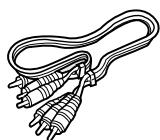
RF Cable for TV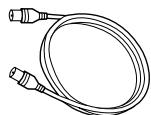
Remote Control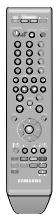
Batteries for Remote Control (AAA Size)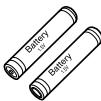
Instruction Manual
Quick Guide
Preparing the Remote Control
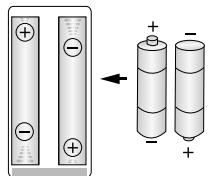
Install Batteries in the Remote Control
- Open the battery cover on the back of the remote control.
- Insert two AAA batteries. Make sure that the polarities (+ and -) are aligned correctly.
- Replace the battery cover.
If the remote does not operate properly:
- Check the polarity (+/-) of the batteries (dry-cell).
- Check if the batteries are drained.
- Check if the remote sensor is blocked by obstacles.
- Check if there is any fluorescent lighting nearby.
Dispose of batteries according to local environmental regulations. Do not put them in the household trash.
To determine whether your television is compatible, follow the instructions below.
- Switch your television on.
- Point the remote control towards the television.
- Press and hold the TV STANDBY/ON button and enter the two-figure code corresponding to the brand of your television, by pressing the appropriate number buttons.
Controllable TV Codes
| BRAND | BUTTON |
| SAMSUNG | 01, 02, 03, 04, 05, 06, 07, 08, 09 |
| AIWA | 82 |
| ANAM | 10, 11, 12, 13, 14, 15, 16, 17, 18 |
| BANG & OLUFSEN | 57 |
| BLAUPUNKT | 71 |
| BRANDT | 73 |
| BRIONVEGA | 57 |
| CGE | 52 |
| CONTINENTAL EDISON | 75 |
| DAEWOO | 19, 20, 23, 24, 25, 26, 27, 28, 29, 30, 31, 32, 33, 34 |
| EMERSON | 64 |
| FERGUSON | 73 |
| FINLUX | 06, 49, 57 |
| FORMENTI | 57 |
| FUJITSU | 84 |
| GRADIENTE | 70 |
| GRUNDIG | 49, 52, 71 |
| HITACHI | 60, 72, 73, 75 |
| IMPERIAL | 52 |
| JVC | 61, 79 |
| LG | 06, 19, 20, 21, 22, 78 |
| LOEWE | 06, 69 |
| LOEWE OPTA | 06, 57 |
| MAGNAVOX | 40 |
| METZ | 57 |
| MITSUBISHI | 06, 48, 62, 65 |
| MIVAR | 52, 77 |
| NEC | 83 |
| NEWSAN | 68 |
| NOBLEX | 66 |
| NOKIA | 74 |
| NORDMENDE | 72, 73, 75 |
| PANASONIC | 53, 54, 74, 75 |
| PHILIPS | 06, 55, 56, 57 |
| PHONOLA | 06, 56, 57 |
| PIONEER | 58, 59, 73, 74 |
| RADIOLA | 06, 56 |
| RADIOMARELLI | 57 |
| RCA | 45, 46 |
| REX | 74 |
| SABA | 57, 72, 73, 74, 75 |
| SALORA | 74 |
| BRAND | BUTTON |
| SANYO | 41, 42, 43, 44, 48 |
| SCHNEIDER | 6 |
| SELECO | 74 |
| SHARP | 36, 37, 38, 39, 48 |
| SIEMENS | 71 |
| SINGER | 57 |
| SINUDYNE | 57 |
| SONY | 35, 48 |
| TELEAVA | 73 |
| TELEFUNKEN | 67, 73, 75, 76 |
| THOMSON | 72, 73, 75 |
| THOMSON ASIA | 80, 81 |
| TOSHIBA | 47, 48, 49, 50, 51, 52 |
| WEGA | 57 |
| YOKO | 6 |
| ZENITH | 63 |
Result: If your television is compatible with the remote control, it will switch off.
It is now programmed to operate with the remote control.

If several codes are indicated for your television brand, try each one in turn until you find one that works. - If you replace the remote control's batteries, you must set the brand code again.
Then you can control the television using the following buttons after pressing the TV button.
| Button | Function |
| TV STANDBY/ON | Used to switch the television on and off. |
| INPUT SEL. | Used to select an external source. |
| TV VOL (+−) | Used to adjust the volume of the television. |
| PROG (ʌ∼) | Used to select the desired channel. |
| TV MUTE | Used to toggle the sound on and off. |
| Number | Used to input number directly. |

- The functions listed above will not necessarily work on all televisions. If you encounter problems, operate the television directly.
Front Panel
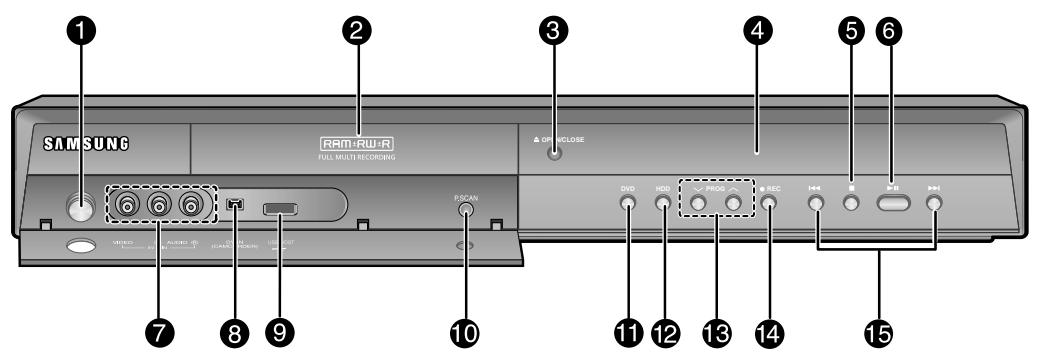
- STANDBY/ON button
Turns the HDD & DVD REORDER on and off.
- DISC TRAY
Opens to accept a disc.
- OPEN/CLOSE button
Opens and closes the disc tray.
- DISPLAY
Displays the playing status, time, etc.
- STOP BUTTON
Stops disc playback.
- PLAY/PAUSE BUTTON
Plays a disc or pauses playback.
- AV3 INPUT
Connect external equipment.
- DV-INPUT
Connect external digital equipment with a DV jack (such as a camcorder).
- USB HOST
Connect digital still camera, MP3 player, memory stick, card reader, external HDD, or other removable storage devices.
- P.SCAN BUTTON
Selects the progressive scan mode.
DVD BUTTON
Select DVD mode.
- HDD BUTTON
Select HDD mode.
PROG BUTTONS
Select TV preset channels. Same as PROG button on the remote control.
- REC BUTTON
Starts recording.
- SEARCH/SKIP BUTTONS
Goes to the next title/chapter/track or goes back to the previous title/chapter/track.
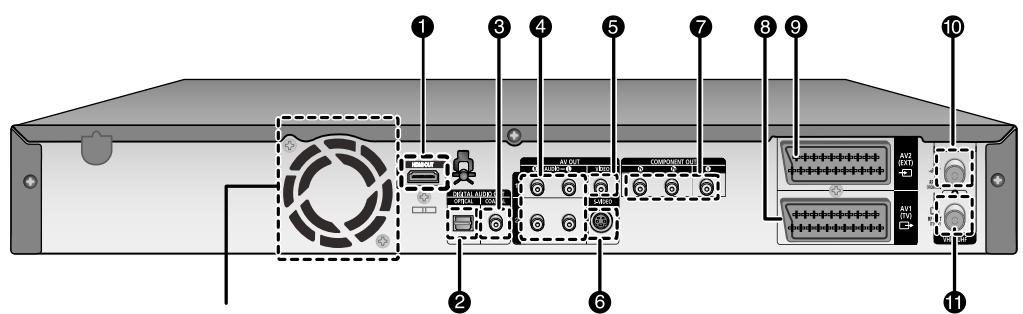
Fan
The fan always revolves when the power is on.
Ensure a minimum of 10cm clear space on all sides of
the fan when installing the product.
1. HDMI OUT
2. DIGITAL AUDIO OUT(OPTICAL)
Connects to an amplifier having a digital optical audio input jack.
3. DIGITAL AUDIO OUT(COAXIAL)
Connects to an amplifier having a digital coaxial audio input jack.
4. AUDIO OUT
Connects to the audio input of external equipment using audio cables.
5. VIDEO OUT
Connects the input of external equipment using a Video cable.
6. S-VIDEO OUT
Connects the input of external equipment using an S-Video cable.
7. COMPONENT VIDEO OUT
Connects to equipment having Component video input.
8. AV1(TV) OUTPUT SCART connector
9. AV2(EXT) INPUT SCART connector
10. In from aerial connector
11. Out to TV connector

- The Antenna connection does not pass the output signal of the DVD. To watch DVD/HDD playback on your TV, you must connect audio/video or Scart cables.
Front Panel Display
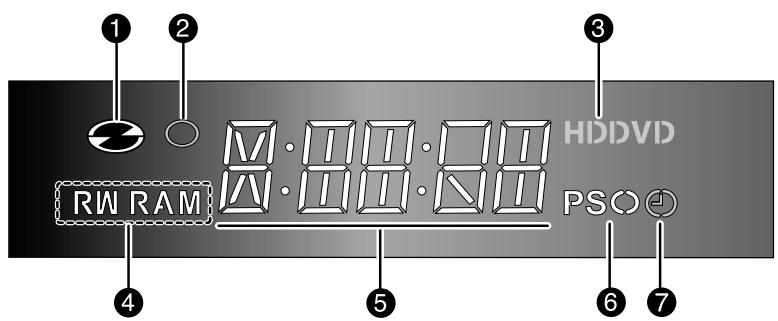
- Lights when a disc is loaded.
- Lights in the record mode.
- Lights when a HDD/DVD is selected.
- Lights when a DVD-RAM/±RW/±R disc is loaded.
- Playing time/clock/current status indicator.
- Lights in the progressive scan mode.
- Lights to indicate the timer record mode.
Your HDD & DVD REORDER remote control will work with Samsung televisions and compatible brands.
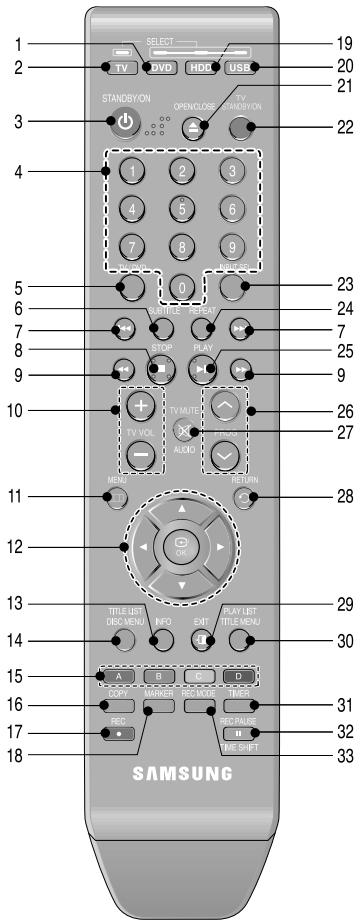
- DVD button
Press this to operate DVD.
- TV button
Press this to operate TV.
- STANDBY/ON button
- NUMBER buttons
- TV/DVD button
- SUBTITLE button
Press this to switch the DVD's subtitle language.
- REVERSE/FORWARD SKIP buttons
Press to skip backwards or forwards.
- STOP button
Press to stop a disc.
- REVERSE/FORWARD SEARCH buttons
Press to search a disc backwards or forwards.
- TV VOL button
TV volume adjustment.
- MENU button
Brings up the HDD & DVD REORDER's setup menu.
- OK/DIRECTION buttons (▲▼▲▶ buttons)
- INFO button
This will display current setting or disc status.
- TITLE LIST/DISC MENU button
Use this to enter the View Recording list/disc menu.
Allows access to common function of HDD & DVD RECORDER.
- COPY button
Press this when you copy DVD to HDD and vice-versa.
You can also copy files from HDD or DVD to the USB storage devices and vice-versa.
- REC button
Use to make a recording on HDD/DVD-RAM/±RW/ ±R discs.
- MARKER button
Use this to bookmark a position while playing a disc.
19.HDD button
Press this to operate HDD.
- USB Button
Press this to operate USB.
- OPEN/CLOSE button
To open and close the disc tray.
- TV STANDBY/ON button
- INPUT SEL.
Button Select input signal in external input mode (PROG,AV1,AV2, AV3 or DV input)
- REPEAT button
Allows you to repeat a title, chapter, track or disc.
- PLAY/PAUSE button
Press to play/pause a disc.
26.PROG button
Use this to select a TV programme.
- TV MUTE/AUDIO button
In TV mode, this operates as sound mute.
Use this to access various audio functions on a disc (DVD mode).
- RETURN button
- EXIT button
- PLAY LIST/TITLE MENU button
Use this to return to the Title menu, or to view the recorded files list.
- TIMER button
Press to directly enter the Timer Recording Mode menu.
- REPCAUSE/TIMESHIFT button
Use this to pause during recording.
In HDD mode, use this to operate the Time Shift function.
- REC MODE button
Use this to set the desired recording time and picture quality (XP/SP/LP/EP).
Connecting the HDD & DVD Recorder
This section covers various methods of connecting the HDD & DVD Recorder to other external components and the required initial setting modes.
You can connect your HDD & DVD Recorder to the television using a SCART cable if the appropriate input is available on the television.
- Connect the RF cable as shown.
- Connect one end of the SCART cable to the AV1 socket on the rear of the HDD & DVD Recorder.
- Plug the other end into the appropriate connector on the television.
- Plug in the HDD & DVD Recorder and TV.
- Turn on the HDD & DVD Recorder and TV.
- Press the INPUT SEL. button on your TV remote control until the video signal from the HDD & DVD Recorder appears on the TV screen.
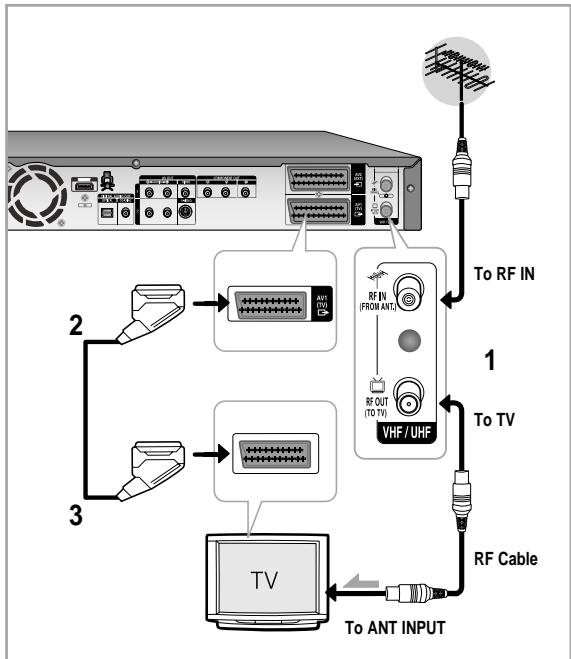

- The RF cable connection of this product sends only TV signals. You must connect a SCART cable or Audio/Video cables to watch a DVD from your HDD & DVD Recorder.
- TV mode: Press the TV/DVD button on the remote control, then "TV" appears on the front LED display (or turn off the HDD & DVD Recorder). Then you can watch programmes received through the TV.
Additional connections
You can connect your HDD & DVD RECORDER to a satellite or digital tuner.
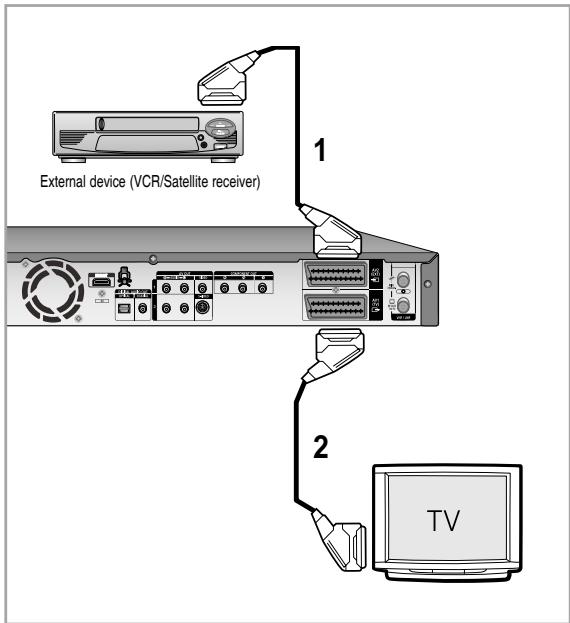
DVD mode
- Connect the AV2 connector of HDD & DVD RECORDER and VCR/Satellite receiver or digital tuner using a SCART cable.
- Connect the AV1 connector to the SCART AV connector on TV.
- Turn on the HDD & DVD RECORDER, VCR/ Satellite receiver or digital tuner and TV.
- Set Input mode on AV2.
- TV mode
- Press the TV/DVD button on remote control, then "TV" appear on Front LED display. (or turn off HDD & DVD RECORDER.)
- You can watch programmes from a satellite or digital tuner connected to this HDD & DVD RECORDER, even when the HDD & DVD RECORDER is turned off.
Antenna + HDD & DVD RECORDER + External decoder box + TV
If you connect external decoder box to HDD & DVD RECORDER, you can record scrambled channels (CANAL+or Premiere broadcasts) received through the built-in TV tuner in HDD & DVD RECORDER.
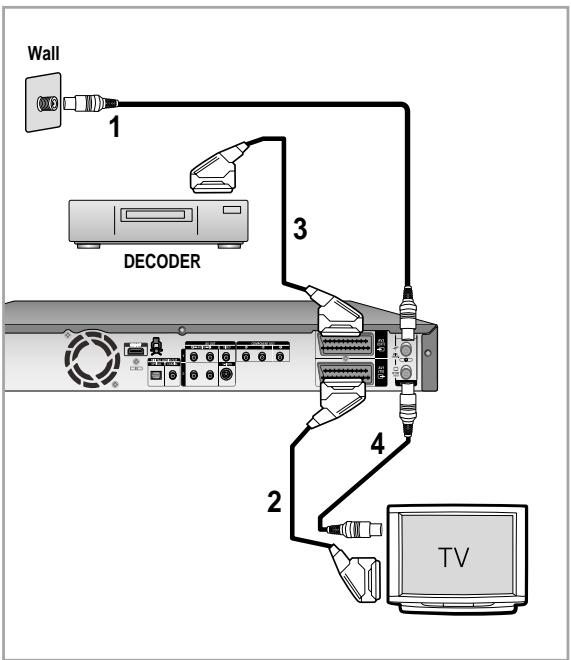
- Connect RF antenna cables as shown.
- Connect the AV1 connector on this recorder to the SCART AV connector on TV using a SCART cable.
- Connect the AV2 connector to a SCART AV connector on decoder box.
- To watch or record PAY-TV Canal Plus programmes, set your HDD & DVD RECORDER to receive the channels using the on-screen display. (Refer to pages 28~29)
Other types of connecting the Video output cable
There are several ways to output video signal not using scart cables. Select one of the following video connecting that best suits you below.
- Case 1: Connecting to a Video (Composite) output jack
- Case 2: Connecting to an S-Video output jack
- Case 3: Component Video output jacks
S-Video, Component video and Progressive Output Modes
- S-Video and Component video output are available only if your TV supports S-Video input or Component video input, respectively. If S-Video or Component video output does not work, check the TV connections and the TV input selection settings.
- Compared to standard interlaced video, progressive scan doubles the amount of video lines fed to your TV, resulting in a more stable, flicker-free, clear image than interlaced video. This is only available with TVs that support progressive scan.
- Progressive Scan Output (576P) Consumers should note that not all high definition television sets are fully compatible with this product and may cause artifacts to be displayed in the picture, in case of 576 progressive scan picture problems. It is recommended that the user switch the connection to the 'standard definition' output. If there are questions regarding our TV set compatibility with this model 576P HDD & DVD REORDER, please contact our customer service centre.
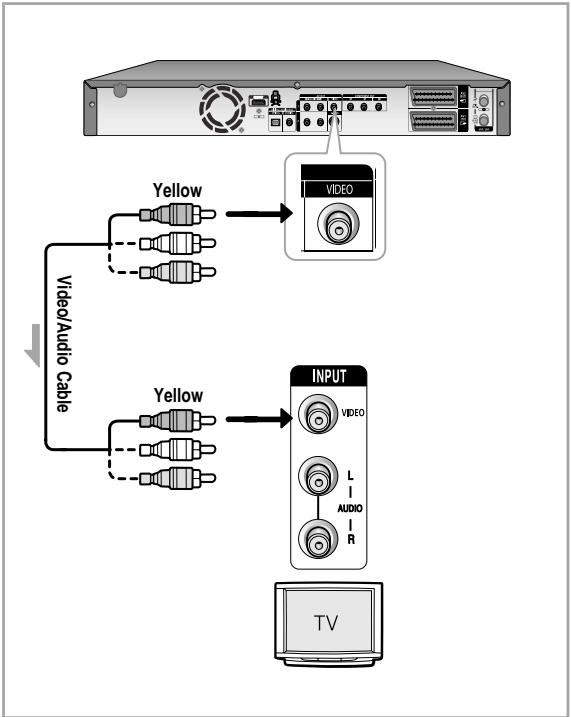
Case 1: Connecting to a Video (Composite) output jack
- Connect a video (Yellow) cable between the VIDEO (yellow) OUT jack on HDD & DVD RECORDER and VIDEO (yellow) INPUT jack on your TV (or AV amplifier).
- You will enjoy regular quality images.
- Connect audio cables (white and red) between the AUDIO OUT jacks on the HDD & DVD REORDER and AUDIO IN jacks on TV (or AV amplifier). (See pages 21~22)
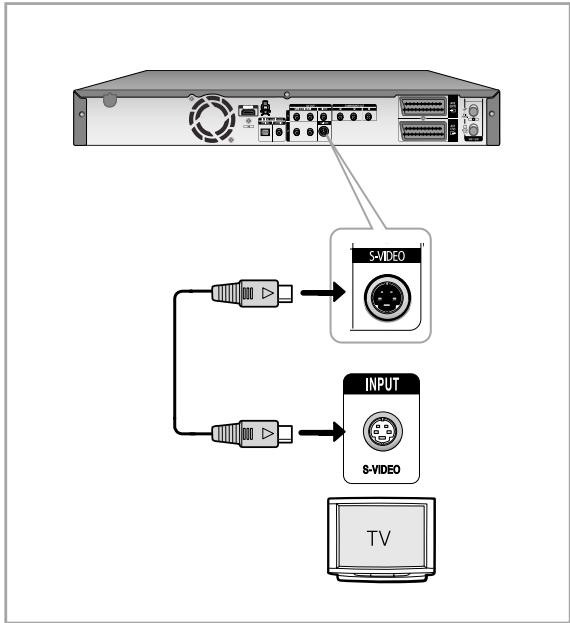
Case 2: Connecting to an S-Video output jack
- Connect an S-Video cable (not included) between the S-VIDEO OUT jack on HDD & DVD RECORDER and S-VIDEO INPUT jack on your TV (or AV amplifier).
- You will enjoy high quality images.
- Connect audio cables (white and red) between the AUDIO OUT jacks on HDD & DVD RECORDER and AUDIO IN jacks on TV (or AV amplifier). (See pages 21-22)
Case 3 : Component Video output jacks
- Connect Component video cables (not supplied) between the COMPONENT OUT (Y, PB, PR) jacks on HDD & DVD RECORDER and COMPONENT IN (Y, PB, PR) jacks on your TV.
- You will enjoy high quality and accurate colour reproduction images.
- Connect audio cables (white and red) between the AUDIO OUT jacks on the HDD & DVD RECORDER and AUDIO IN jacks on TV (or AV amplifier). (See pages 21~22).
- After connecting, refer to the pages 37~38.
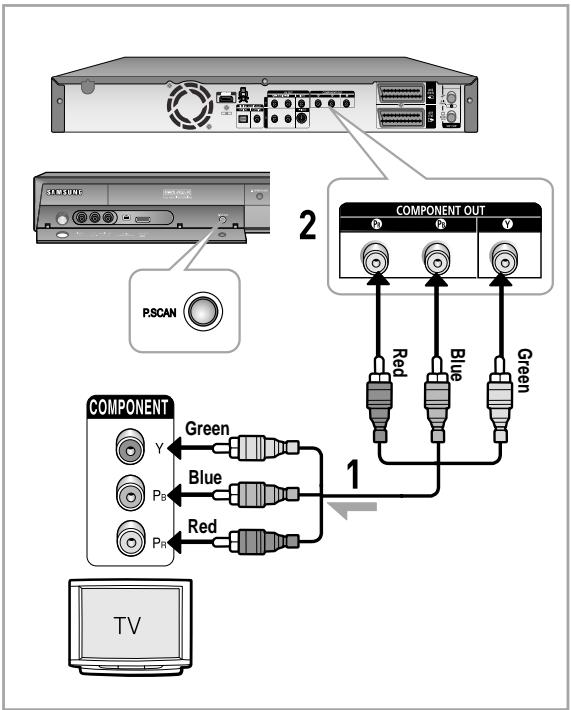

- Make sure that the colour coded connections match. The Y, PB, PR component output jacks of your HDD & DVD RECORDER must be connected to the exact corresponding component input jacks on your TV.
- Progressive setting is only available when the Video Out is set to Component. (See pages 37~38)
Other type of connecting the Audio output cable
There are several ways to output audio signal not using scart cables. Select the audio connection that best suits you below.
- Case 1: Connecting to your TV
- Case 2: Connecting to a stereo amplifier with AV output jacks
- Case 3: Connecting to an AV amplifier with a digital output jack
Manufactured under licence from Dolby Laboratories. "Dolby" and the double-D symbol are trademarks of Dolby Laboratories.
"DTS" and "DTS Digital Out" are trademarks of DTS, Inc.
Case 1: Connecting to your TV
If your TV has audio input jacks, use this connection.
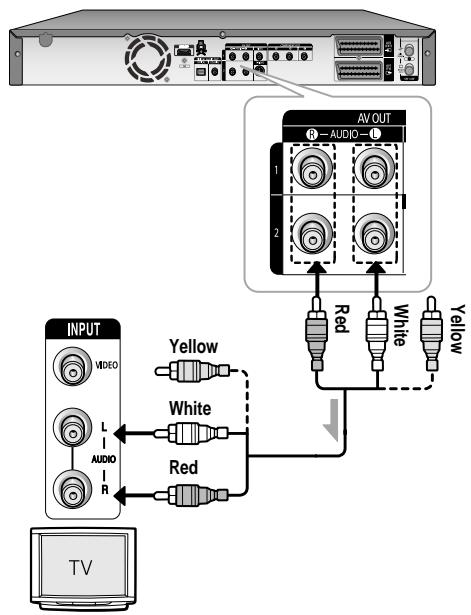
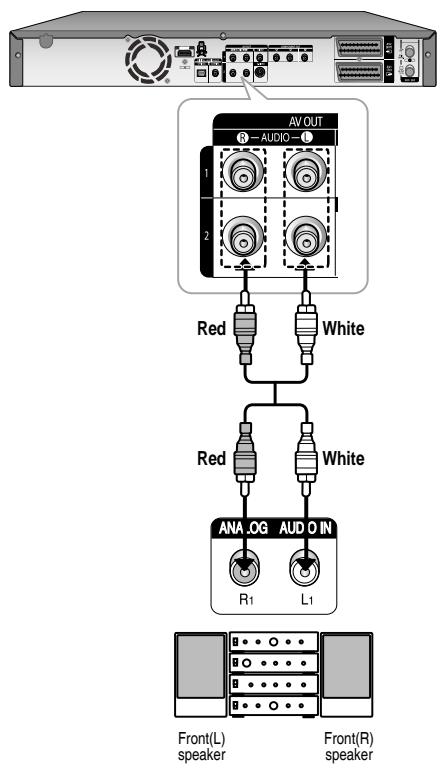
Case 2: Connecting to a stereo amplifier with AV output jacks
If your stereo amplifier only has AUDIO INPUT jacks (L and R), use the AUDIO OUT jacks
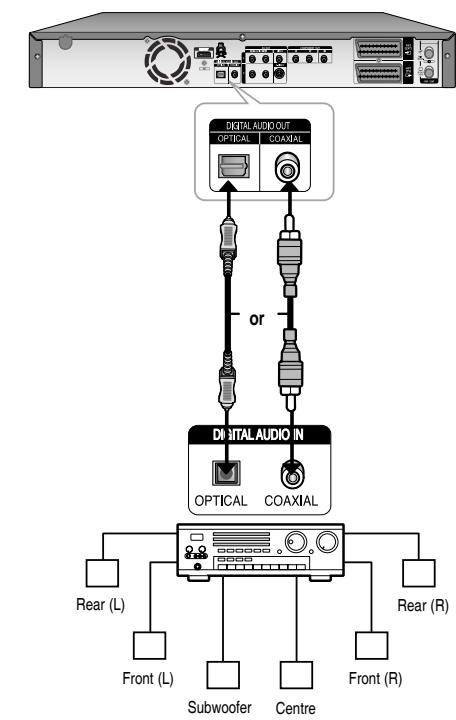
Case 3: Connecting to an AV amplifier with a digital output jack
If your AV amplifier has a Dolby Digital, MPEG2 or DTS decoder and a digital input jack, use this connection. To enjoy Dolby Digital, MPEG2 or DTS sound, you will need to set up the audio settings. According to your amplifier, connect to an optical cable or a coaxial cable. (See pages 33~34)
Connecting HDMI/DVI to a TV
If your TV has a HDMI/DVI input, connect HDMI/DVI Adapter cable to a TV. You will enjoy the best quality images and sounds.
- Case 1: Connecting to a TV with HDMI Jack
- Case 2: Connecting to a TV with DVI Jack
Case 1: Connecting to a TV with HDMI Jack
- Using the HDMI cable (not supplied) connect the HDMI OUT jack on the rear of the HDD & DVD RECORDER to the HDMI IN jack of your TV.
- Press the input selector on your TV remote control until the HDMI signal from the HDD & DVD RECORDER appears on your TV screen.
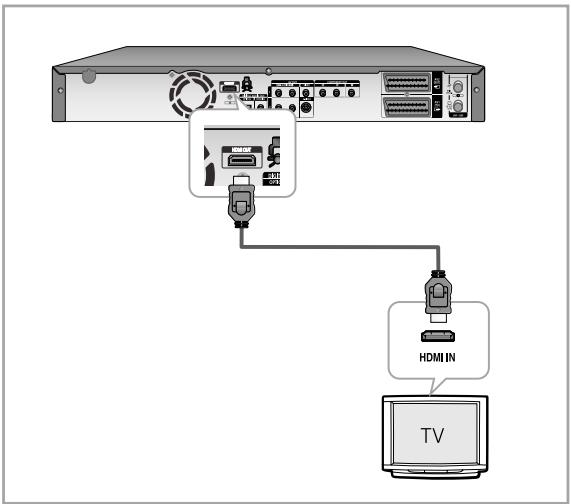
Case 2: Connecting to a TV with DVI Jack
- Using the DVI Adapter cable (not supplied), connect the HDMI OUT jack on the rear of the HDD & DVD RECORDER to the DVI IN jack of your TV.
- Using the audio cables, connect the AUDIO (red and white) OUT jacks on the rear of the HDD & DVD RECORDER to the AUDIO (red and white) IN jacks of your TV. Turn on the HDD & DVD RECORDER and TV.
- Press the input selector on your TV remote control until the DVI signal from the HDD & DVD RECORDER appears on your TV screen.
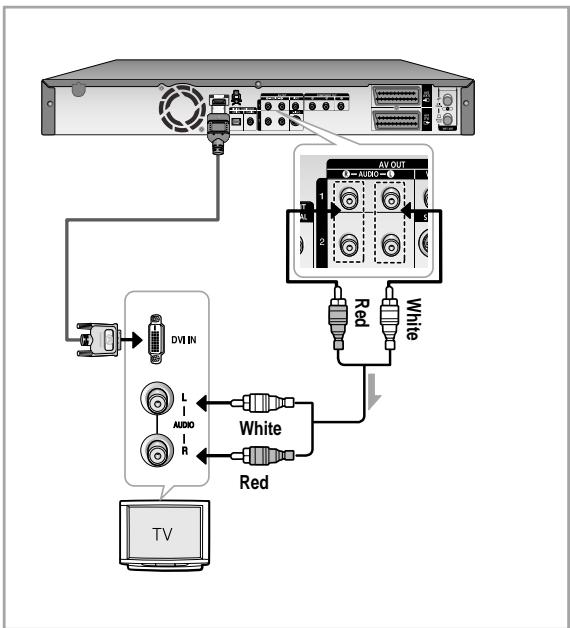

- To use HDMI cable (not supplied), make the Audio/Video connection before plugging in the power cord or after finishing the "Plug & Auto Setup." Do not connect the HDMI cable while the "Plug & Auto Setup" is progressing.
- Progressive scan automatically activates when HDMI is connected. If your TV does not have Bitstream decoder, you must set the digital audio output to PCM in order to watch through the HDMI output. (See pages 33~34) Depending on the HDMI device (TV/HDMI Receiver) you use, audio may not be supported. If TV/HDMI Receiver does not support Dolby digital, Audio output is not available when you set Digital output as 'Bitstream' in Audio setup menu. In this case, set the digital audio output to PCM. If TV/HDMI Receiver does not support DTS, Audio output is not available when you play disc in DTS format.
- You can switch from the HDMI output to other output only in stop mode. If you use an HDMI cable to connect a Samsung TV to the HDD & DVD RECORDER, you can operate the recorder using the TV remote control. (This is only available with SAMSUNG TVs that support Anynet+(HDMI-CEC).) (See page 31)
- Please check the Anynet+ logo (If your TV has an Anynet+ logo, then it supports Anynet+ function.)

- HDMI (High Definition Multimedia Interface) HDMI is an interface to enable the digital transmission of video and audio data with just a single connector. Since HDMI is based on DVI, it is completely compatible with DVI. The only difference between HDMI and DVI is that HDMI supports multi-channel audio. Using HDMI, the HDD & DVD RECORDER transmits a digital video and audio signal and displays a vivid picture on a TV having an HDMI input jack.
HDMI connection description
HDMI connector - Both uncompressed video data and digital audio data (LPCM or Bit Stream data).
- Though the HDD & DVD RECORDER uses a HDMI cable (not supplied), the HDD & DVD RECORDER outputs only a pure digital signal to the TV.
- If TV does not support HDCP (High - bandwidth Digital Content Protection), snow noise appears on the screen.
Why does Samsung use HDMI?
Analog TVs require an analog video/audio signal. However, when playing a DVD, the data transmitted to a TV is digital. Therefore either a digital-to-analog converter (in the HDD & DVD RECORDER) or an analog-to-digital converter (in the TV) is required. During this conversion, the picture quality is degraded due to noise and signal loss. HDMI technology is superior because it requires no D/A conversion and is a pure digital signal from the HDD & DVD RECORDER to your TV.
What is HDCP?
HDCP (High-bandwidth Digital Content Protection) is a system for protecting DVD content output via HDMI from being copied. It provides a secure digital link between a video source (PC, DVD, etc.) and a display device (TV, projector, etc.). Content is encrypted at the source device to prevent unauthorized copies from being made.
Connecting to AV 3 IN, DV input jack
This allows you to connect your HDD & DVD RECORDER to other external devices and view or record their outputs.
- Case 1: Connecting a VCR, Set-Top Box (STB), DVD player, or camcorder to the AV 3 IN jacks
- Case 2: Connecting a DV device to the DV IN jack
Case 1: Connecting a VCR, Set-Top Box (STB), DVD player, or camcorder to the AV 3 IN jacks
Connecting a VCR or external device to the AV 3 IN jacks of the HDD & DVD RECORDER. You can record from connected equipment (VCR, STB, DVD player, or camcorder).
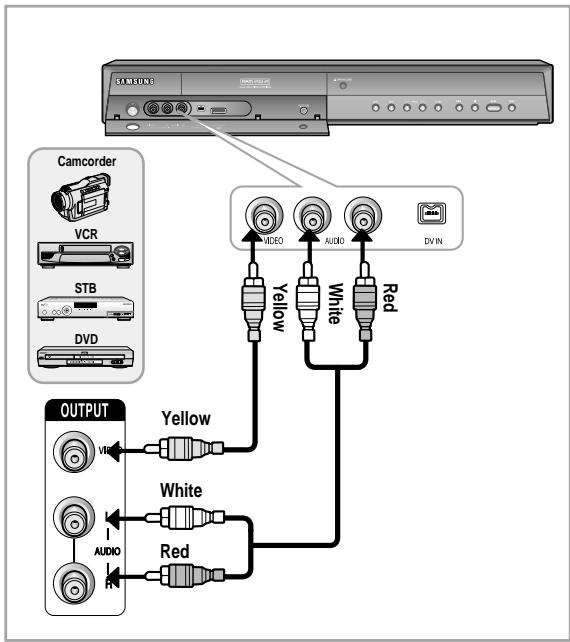

AV 3 input selection will be done automatically. If the input is not selected automatically, use the INPUT SEL. button to select the proper input. - Copy-protected content cannot be recorded.
Case 2: Connecting a camcorder to the DV IN jack
If your digital camcorder has a DV output jack, connect it to the DV input jack of your HDD & DVD RECORDER.
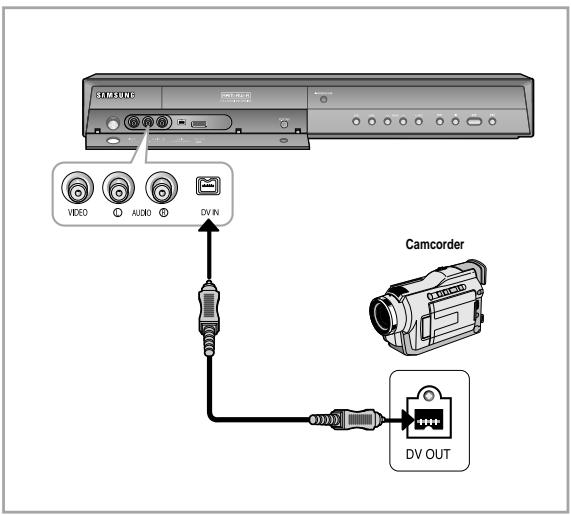

- If the input is not selected automatically, use the INPUT SEL. button to select the proper input.
Connecting to USB devices
This allows you to connect your HDD & DVD RECORDER to USB devices.
Connecting a USB memory, MP3 player, Digital Camera to the USB HOST.
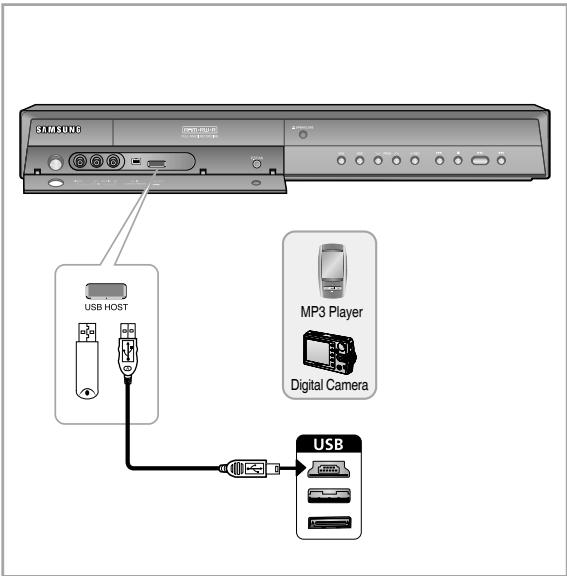

- Disconnecting the USB cable during the data transfer will stop the communication and may damage data stored in the memory.
- When data communication is disrupted due to static electricity, magnetic field or other reason, restart the programme or try to disconnect / connect the USB Cable again.
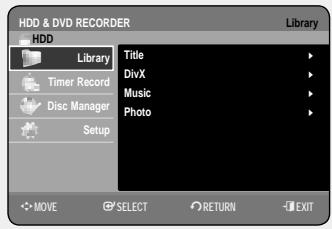
On-Screen Menu Navigation
The on-screen menus allow you to enable or disable various functions on your HDD & DVD REORDER.
Press the MENU button to open the on-screen menu and then use the following buttons to navigate through the on screen menus.
- ▲▼, △▶ buttons
Press these buttons on the remote control to move the selection bar , to cycle through the menu options.
- OK button
Press this button on the remote control to confirm any new settings.
- RETURN button
Press this button on the remote control to return to the Previous menu screen displayed or to exit the on-screen menu.
- EXIT button
Press this button to exit the on-screen MENU.
Plug & Auto Setup
Your HDD & DVD RECORDER will automatically set itself up when it is plugged in for the first time. TV stations and clock will be stored in memory. The process takes a few minutes. Your HDD & DVD RECORDER will then be ready for use.
- Connect the RF cable as indicated on page 18.
(Connecting Your HDD & DVD RECORDER to the TV Using the RF Cable and SCART cable.)
To use HDMI cable (not supplied), make the Audio/Video connection before plugging in the power cord or after finishing the "Plug & Auto Setup." Do not connect the HDMI cable while the "Plug & Auto Setup" is progressing.
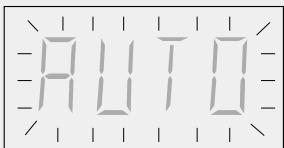
- Plug the HDD & DVD RECORDER into the mains. "AUTO" in the front panel display flickers.
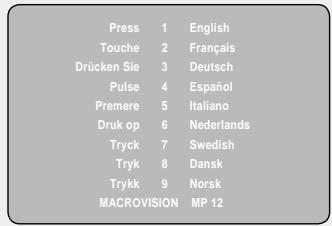
- Press a number button to select the language.
- Press the OK button to start the auto setup.
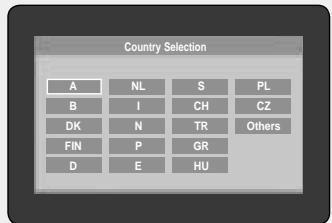
- Select "Country" using the left and right buttons to select your country.
Refer to the following abbreviation table when selecting "Country".
| A(Austria) | NL(Netherlands) | S(Sweden) | PL(Poland) |
| B(Belgium) | I(Italy) | CH(Swiss) | CZ (Czech) |
| DK(Denmark) | N(Norway) | TR(Turkey) | Others |
| FIN(Finland) | P(Portugal) | GR(Greece) | |
| D(Deutschland) | E(Spain) | HU(Hungary) |
- The HDD & DVD RECORDER searches for the stations according to a preset preference list corresponding to the country that you have selected.
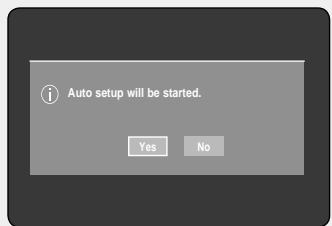
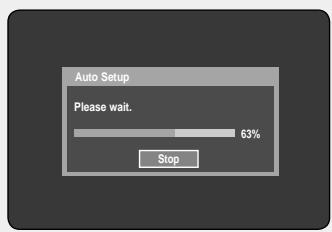
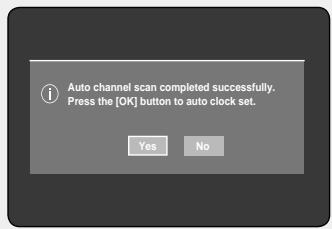
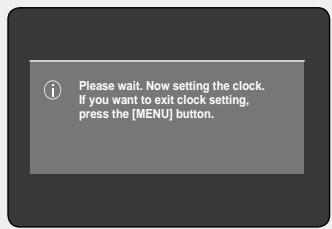
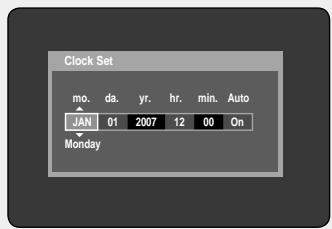
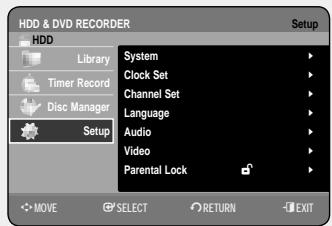
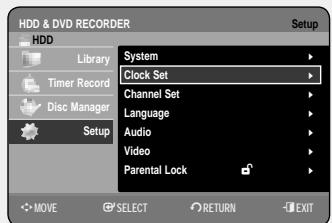
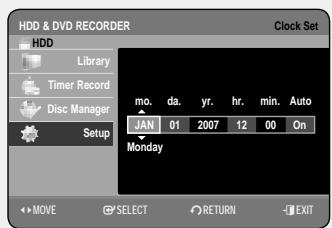
- Auto channel scan will be started.
- The number of stations automatically stored by the HDD & DVD RECORDER depends on the number of stations that it has found.
- After auto channel scan is completed, auto clock setting will be started automatically in 10 seconds. If you want to start auto clock setting immediately, press OK button. If you do not want to do auto clock setting, select No using the buttons, then press the OK button.
- Wait until current date and time are displayed automatically. If you want to exit auto clock setting, press MENU button.

- Now, HDD & DVD RECORDER is ready for use. Function for "Plug & Auto Setup" is fixed already. So if you want to change this fixed one, you can change it by Presetting the Stations in OSD "Channel Set - Manual Setup" menu. (See pages 28~29)
- Auto setup function can be performed by pressing STOP (⊙) on the unit continuously for 5 seconds or more during power off with no disc inserted.
- Check the date and time.
- If it is: Correct, press OK button then the date and time will be saved. If you don't press the OK button, the date and time will be saved automatically after 5 seconds.
- If it is: Incorrect, input correct Month, Day, Year, Hour or Minute using , buttons or number buttons. Press OK button then the date and time will be saved. When you need to change clock setting, you can set up it manually.
Setting the Clock
This menu is used to set the current time.
You need to set the time to use timer recording.
- With the unit in Stop mode, press the MENU button.
- Press the ▲▼ buttons to select Setup, then press the OK or button.
- Press the ▲▼ buttons to select Clock Set, then press the OK or ▶ button.
Press the ▲▼◀ buttons to input Month, Day, Year, Hour or Minute. Press the number buttons to input clock data directly.
The day of the week is displayed automatically.
- Press the OK button, then the date and time will be saved. If you don't press the OK button, it will not be saved.

- You must have the RF cable connected to set the Auto Clock. (See page 18)
- The HDD & DVD RECORDER automatically sets the clock according to the time signal broadcast between the channels PR1 to PR5. If you do not need the Auto Clock Set function, select Off.
Channel Set
Auto Setup
This feature allows you to manually set the HDD & DVD RECORDER tuner band to Antenna or Cable, whichever you connected to the Antenna In jack during initial setup.
- With the unit in Stop mode, press the MENU button.
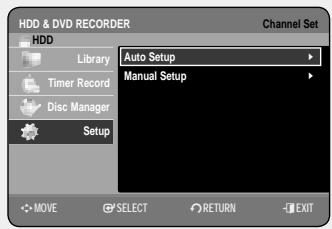
- Press the ▲▼ buttons to select Setup, then press the OK or button.
- Press the ▲▼ buttons to select Channel Set, then press the OK or ▶ button.
- Press the ▲▼ buttons to select Auto Setup, then press the OK or ▶ button.
The message "Your data will be lost. Press [OK] to continue, [RETURN] to exit." is displayed.
- Press the OK button, then press the triangle, nabla, and triangle-left buttons to select your country.
- The HDD & DVD recorder searches for the stations according to a preset preference list corresponding to the country that you have selected.
Refer to the following table when selecting your country.
| A(Austria) | NL(Netherlands) | S(Sweden) | PL(Poland) |
| B(Belgium) | I(Italy) | CH(Swiss) | CZ (Czech) |
| DK(Denmark) | N(Norway) | TR(Turkey) | Others |
| FIN(Finland) | P(Portugal) | GR(Greece) | |
| D(Deutschland) | E(Spain) | HU(Hungary) |
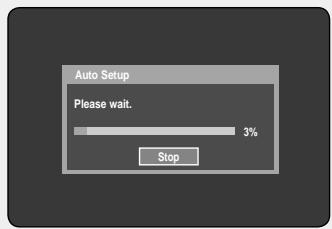
- Press the OK button. Channel scan will be started.
- The first frequency band is scanned and the first station found is displayed and stored. Then the HDD & DVD recorder searches for the second station and so on.
- The number of stations automatically stored by the HDD & DVD recorder depends on the number of stations that it has found.

- Press the OK button to stop the Auto Setup.
Manual Setup
You can add preset channels that Auto Channel Search missed. You can also delete a channel you wish to remove. You can program the order of channels.
- With the unit in Stop mode, press the MENU button.
- Press the triangle and nabla buttons to select Setup, then press the OK or button.
- Press the ▲/▼ buttons to select Channel Set, then press the OK or ▶ button.
- Press the ▲/▼ buttons to select Manual Setup, then press the OK or ▶ button.
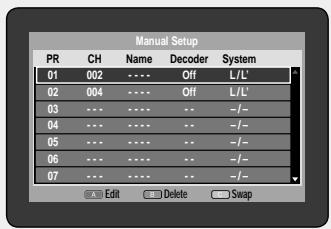
- Press the ▲/▼ buttons to select a PR (programme) you wish to edit, delete, or swap, then press the COLOUR button.
Select Edit, Delete or Swap.
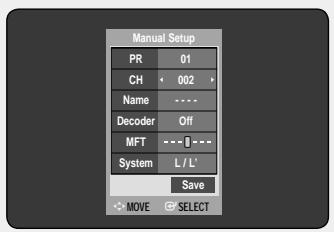
- In case of Edit (RED (A) button): You can add or edit PR (programme) information. After changing PR information (CH., Name, Decoder, MFT, System), select Save, then press the OK button.
- CH: Tune the channel using ◀/▶ buttons.
- Name: Display station name automatically detected in broadcasting signal. If not detected, you can edit name by using ▲/▼/◀/▶ buttons.
- Decoder: If you set on, you can record scrambled channels using external decoder box. Before setting on, refer to connecting external decoder box on page 19.
- MFT (Manual Frequency Tuning): You can tune up the channel frequency better using ◀/▶ buttons.
- System: You can select broadcasting system of the receivable channel (B/G or L/L').
- In case of Delete (GREEN (B) button): the channel information of selected PR (programme) will be removed.
- In case of Swap (YELLOW (C) button): You can swap the channel information of two PR (programme). For example, if you wish to swap PR2 and PR5, select swap at PR2, then press the OK button at PR5.
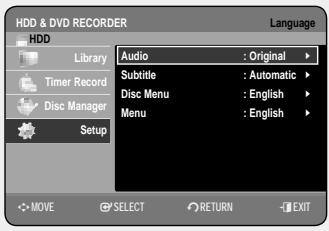
Setting up the Language Options
If you set the language options in advance, they will come up automatically every time you watch a movie.
- With the unit in Stop mode, press the MENU button.
- Press the ▲▼ buttons to select Setup, then press the OK or ▶ button.
- Press the ▲▼ buttons to select Language, then press the OK or ▶ button. The Language setup menu will be displayed.
- Press the ▲▼ buttons to select the desired language option, then press the OK or ▶ button.
Audio: For the disc audio language. - Subtitle: For the disc subtitles. - Disc Menu: For the disc menu contained on the disc. - Menu: For the on-screen menu of your HDD & DVD RECORDER.
- Press the ▲▼ buttons to select the desired language, then press the OK or ▶ button.

- If the selected language is not recorded on the disc, the original pre-recorded language is selected.
- The selected language will only appear if it is supported on the disc.
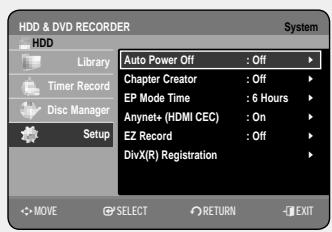
Setting up the System Options
This function allows you to set up the system settings.
- With the unit in Stop mode, press the MENU button.
- Press the ▲▼ buttons to select Setup, then press the OK or ▶ button.
- Press the ▲▼ buttons to select System, then press the OK or ▶ button.
- Press the ▲▼ buttons to select the desired system option, then press the OK or ▶ button.
- Press the ▲▼ buttons to select the desired item, then press the OK or ▶ button.
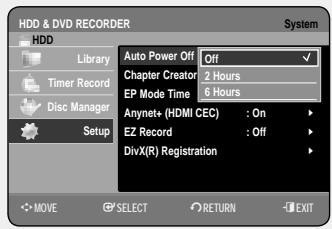
Auto Power Off Setting
This feature automatically turns off your HDD & DVD recorder if you do not press any button for the selected time.
- Press the ▲▼ buttons to select Auto Power Off, then press the OK or ▶ button.
- Press the ▲▼ buttons to select the desired item, then press the OK or ▶ button.
- Off: Auto power off is disabled.
- 2 Hours: HDD & DVD recorder will automatically turn off 2 hours after the last button is pressed.
- 6 Hours: HDD & DVD recorder will automatically turn off 6 hours after the last button is pressed.
- If the turn-off time set with the Auto Power Off function is reached during playback or recording, the device will operate until the playback or recording is finished.
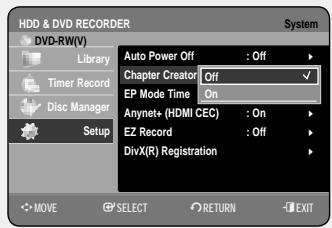
Automatic Chapter Creator


(V-mode)
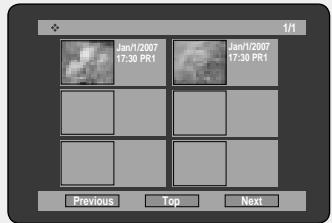
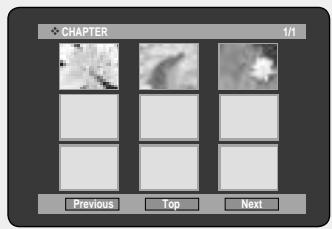
A DVD-Video consists of 'Titles' and 'Chapters'. When you record one programme, it makes one Title. If you use this function, the Title will be divided into Chapters.
- Press the ▲▼ buttons to select Chapter Creator, then press the OK or ▶ button.
- Press the ▲▼ buttons to select Off or On, then press the OK or ▶ button.
- Off: Select if you do not want to use Automatic Chapter Creator.
- On: Select this option to use the Automatic Chapter Creator feature. Press the EXIT (①) button to exit the menu.
- Press the REC button to start recording.
TV Menu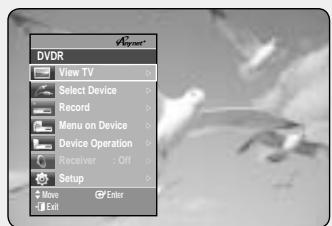
(See page 62 about how to set recording speed)
The message "Do you want to create the chapter menu after this recording?" is displayed.
- Press the ◀ buttons to select OK, then press the OK button.
- A new chapter is created according to the selected recording mode. A chapter will be about 5 minutes long in XP and SP, and about 15 minutes long in LP and EP mode.
- Press the STOP button to stop recording.
- To display the created titles, finalise the disc (See page 98) and then press the TITLE MENU button. The title menu will be displayed.
- Finalising is generally unnecessary when using a DVD+RW disc.
- To display the created chapters, select the desired Title and then press the DISC MENU button. The chapter menu for the selected Title will be displayed.
The Automatic Chapter Creator function does not work during Timer Recording or when you turn the power off.
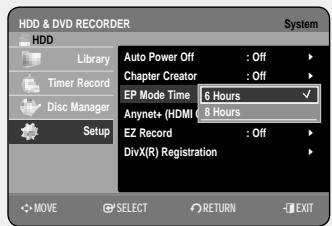
EP Mode Time Setting
You can select one of four recording modes by pressing the REC MODE button repeatedly.
EP mode is one of four REC Mode (XP, SP, LP, EP).
In EP (Extended Play) mode, you can set recording time to 6 or 8 hours with this setting.
- 6 Hours 8 Hours
Anynet+ (HDMI CEC)
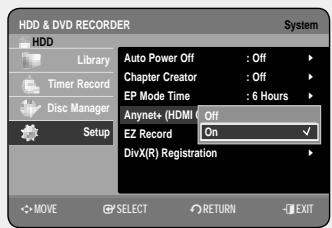
Anynet+ is a function that can be used to operate the recorder using a Samsung TV remote control, by connecting the HDD & DVD RECORDER to a SAMSUNG TV using an HDMI Cable. (See pages 23~24) (This is only available with SAMSUNG TVs that support Anynet+.)
- Press the ▲▼ buttons to select Anynet+ (HDMI CEC), then press the OK or button. Anynet+ (HDMI CEC) items will be displayed.
- Press the ▲▼ buttons to select On, then press the OK or ▶ button.
For using Anynet+ (HDMI CEC)
- Connect the HDD & DVD RECORDER to a Samsung TV with an HDMI cable. (See pages 23~24)
- Set the Anynet+ (HDMI CEC) to "On" on your HDD & DVD RECORDER. (see above)
- Set the Anynet+ function on your TV.
(See the TV instruction manual for more information.)
- You can operate the HDD & DVD RECORDER by using the TV remote control.
(TV buttons that can be used to control the HDD & DVD RECORDER:
and (buttons, 9 button)
- When you press the Anynet+ button on the TV remote control, the OSD to the left will appear.
- Select Device: Use this option to select a device.
- Record: Use this option to start or stop recording.
- Menu on Device: Same as the MENU button (m) on the HDD & DVD RECORDER remote control.
- Device Operation: Same as the INFO button (INFO) on the HDD & DVD RECORDER remote control.

- By pressing the PLAY button of the recorder while watching TV, the TV screen will change to the play screen. If you play a DVD when the TV power is off, the TV will power on.
- If you turn the TV off, the HDD & DVD RECORDER will power off automatically. (When the HDD & DVD RECORDER is recording, it can't be powered off.)
- If you change the HDMI to other sources (Composite, Component, RF, etc.) on the TV while playing a DVD disc, the HDD & DVD RECORDER will stop playing. However, the HDD & DVD RECORDER may keep playing certain discs based on their content.
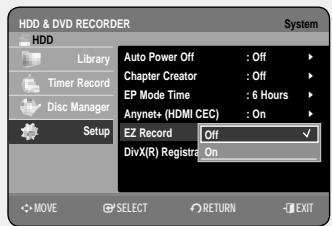
EZ Record


(V-mode)
This function allows you to initialise and finalise a disc automatically.
- Press the ▲▼ buttons to select EZ Record, then press the OK or button.
- Press the ▲▼ buttons to select On, then press the OK or button. Press the EXIT button to exit the menu.
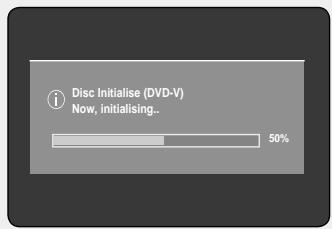
- Insert a disc. If the disc is new, it will initialise automatically.
- Press the REC button.
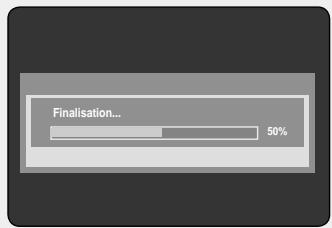
- EZ Record function will automatically finalise the disc under the following conditions.
- When you press the OPEN/CLOSE button on your HDD & DVD RECORDER after recording on at least 70% of the disc. The tray will open after the disc has been finalised.
- The above feature is available only when a DVD-RW(V), DVD+R or DVD-R disc is inserted.

- If you insert a new DVD-RW disc, it will be formatted in V mode after auto initialising. If you insert a new DVD+RW disc, it will be formatted automatically. If you select off, you must initialise (see page 61) and finalise the disc manually in the Disc Manager menu (see page 98). The length of recording is different according to recording mode (see page 40).
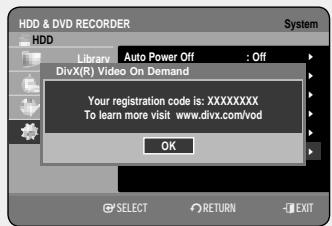
DivX(R) Registration
Please use the Registration code to register this HDD & DVD RECORDER with the DivX(R) Video On Demand format. For more information, visit www.divx.com/vod
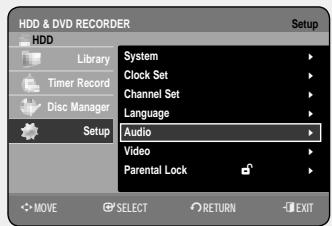
Setting up the Audio Options
You can connect the HDD & DVD recorder to an external amp or home theatre.
Allows you to set up the audio device and sound status depending on the audio system in use.
You can also set NICAM mode.
- With the unit in Stop mode, press the MENU button.
- Press the ▲▼ buttons to select Setup, then press the OK or ► button.
- Press the ▲▼ buttons to select Audio, then press the OK or ► button.
- Press the ▲▼ buttons to select the desired audio option, then press the OK or ► button.
- Press the ▲▼ buttons to select the desired item, then press the OK or ► button.

- Press the RETURN or ◄ button to return to the previous menu.
Press the EXIT (④) button to exit the menu.
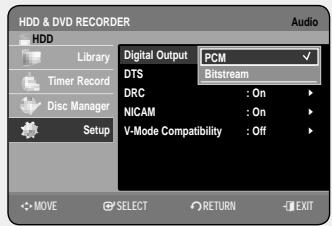
Digital Output
- PCM: Select this when your equipment is not compatible with Dolby Digital decoding.
- Bitstream: Outputs Dolby Digital (or MPEG-2) audio as bitstream. Select this when your AV receiver or AV amplifier has a Dolby Digital (or MPEG-2) decoder.

- The digital output setting is equally applied to both Dolby Digital and MPEG-2 audio. LPCM soundtracks are always output as PCM. This has no relation to the Digital Output setting.
- Be sure to select the correct Digital Output, or you will hear no sound or a loud noise.
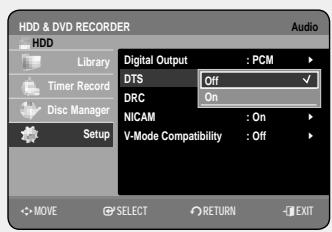
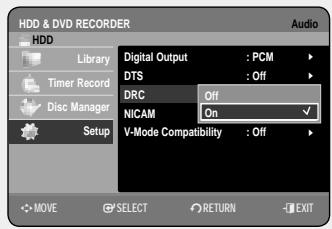
DTS
- Off: Doesn't output DTS signal. Select this when your AV receiver (or AV amplifier) does not have a DTS decoder.
- On: Outputs DTS Bitstream via digital output when you play a DTS track. Select this only when your AV receiver (or AV amplifier) has a DTS decoder.

- When a DTS soundtrack is played, sound does not output from AV Audio Output.
DRC
This is only active when a Dolby Digital signal is detected.
- On: When movie soundtracks are played at low volume or from smaller speakers, the system can apply appropriate compression to make low-level content more intelligible and prevent dramatic passages from getting too loud.
- Off: You can enjoy the movie with the standard Dynamic Range.
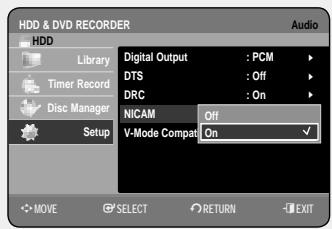
NICAM
NICAM programmes are divided into 3 types: NICAM Stereo, NICAM Mono, and Bilingual (transmission in another language). NICAM programmes are always accompanied by a standard mono sound broadcast, and you can select the desired sound by setting NICAM on or off.
- On: NICAM mode
- Off: Only set at this position to record the standard mono sound during a NICAM broadcast if the stereo sound is distorted due to inferior reception conditions.
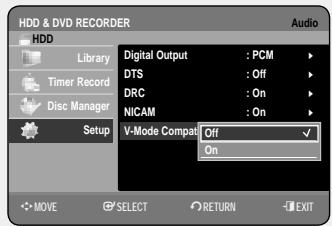
V-Mode Compatibility
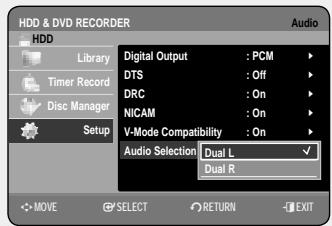
This feature is about the setup for selecting audios when recording the NICAM STEREO (Multi-audio) broadcasting on HDD. It does not affect the direct DVD recording of a programme.
- Off: Both "Dual L" and "Dual R" of the multi-audio broadcasting are recorded on HDD. Titles recorded on HDD under such setup status cannot be copied to DVD+RW/±R or DVD-RW (V mode).
- On: Either "Dual L" or "Dual R" of the multi-audio broadcasting is recorded on HDD. Titles recorded on HDD under such setup status can be copied to DVD+RW/±R or DVD-RW (V mode). "Dual L" and "Dual R" options can be selected from "Audio Selection."
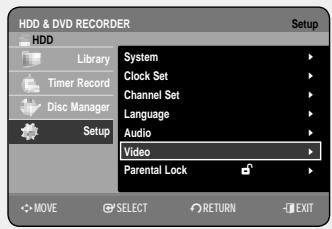
Setting up the Video Options
This function allows you to set up the video settings.
This function depends on disc type. It may not work for some disc types.
- With the unit in Stop mode, press the MENU button.
- Press the ▲▼ buttons to select Setup, then press the OK or button.
- Press the ▲▼ buttons to select Video, then press the OK or button. The Video setup menu will be displayed.
- Press the ▲▼ buttons to select the desired video option, then press the OK or ▶ button.
- Press the ▲▼ buttons to select the desired item, then press the OK or ▶ button.

- Press the RETURN or ◀ button to return to the previous menu.
Press the EXIT (④) button to exit the menu.
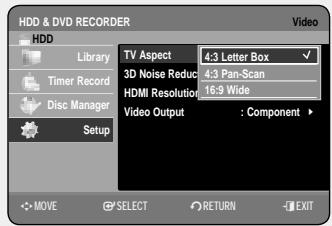
TV Aspect
Depending on the type of television you have, you may want to adjust the screen setting (aspect ratio).
- 4:3 Letter Box: Select this when you want to see the total 16:9 ratio screen that DVD supplies, even though you have a TV with a 4:3 ratio screen. Black bars will appear at the top and bottom of the screen.
- 4:3 Pan-Scan: Select this for conventional size TV when you want to see the central portion of the 16:9 screen. (Extreme left and right sides of the movie picture will be cut off.)
- 16:9 Wide: You can view the full 16:9 picture on your wide screen TV.
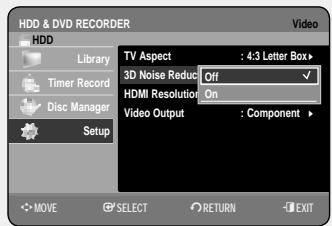
3D Noise Reduction (motion adaptive noise reduction)
- Off: Normal
- On: Provides a clear picture through noise reduction (for recording).
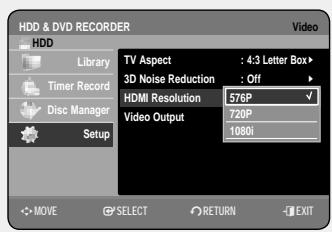
HDMI Resolution
This setting is used when the unit is connected by HDMI with display devices (TV, projector, etc.).
- 576P: 720 x 576
- 720P: 1280x720, 1080i: 1920x1080
Output selection
- Connect the HDD & DVD recorder to your TV via HDMI. Set your TV's input to HDMI.
- Press the P.SCAN button while the unit is in Stop mode to select the output resolution.
- If your TV is connected via the HDMI cable, the output resolution mode changes in the following sequence each time you press the P.SCAN button:

- If your TV is connected via the AV or component cables (without HDMI cable), the output resolution mode toggles 576P/576i in turn.
- HDMI cable does not support 576i. Video with 576i resolution can only be viewed through the analog outputs (Composite/S-Video/Component).

- Even if HDMI cable is connected to your TV, the AV connection outputs only 576i and the component connection outputs only 576P irrespective of the on-screen display.
- Progressive scan automatically activates when HDMI is connected. (Please make sure PS is indicated on the front panel of the HDD & DVD RECORDER.)
- There will be no HDMI video and audio outputs unless progressive scan function is activated.
- Consult your TV User's Manual to find out if your TV supports Progressive Scan. If Progressive Scan is supported, follow the TV User's Manual regarding Progressive Scan settings in the TV's menu system. If Video Output is set incorrectly, the screen may be blocked.
- The resolutions available for HDMI output depend on the connected TV or projector. For details, see the user's manual of your TV or projector.
- When the resolution is changed it may take a few seconds for a normal image to appear.
- If you set the HDMI output resolution 720P or 1080i, HDMI output provides better picture quality.
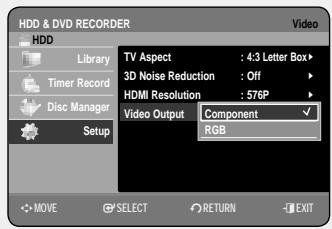
Video Output
You can enjoy high quality image through RGB or Component video connections. RGB video output is available connecting scart jack(AV1) and component video output is available connecting component(Y, PB, PR) jack. Only one of these signals can be selected at one time.
- Component RGB
In Component mode, you can set video output to Progressive (P.SCAN) or Interlace, see pages 37 to 38.
When the HDMI cable (not supplied) is not connected, available video output jacks are as follow.
Available Video Output Jack
| Setting mode Output jack | Component mode | RGB Mode | ||
| P.SCAN off mode (Interlace mode) | P.SCAN on mode | |||
| Component Output (Y, PB, PR) | O | O (TV in progressive mode) | × | |
| AV1 Scart | R, G, B | × | × | O |
| Composite | O | × | × | |
| Composite Video out | O | × | O | |
| S-Video out | O | × | O | |

- When the HDMI cable(not supplied) is connected, RGB output does not operate. Video output is set to Component.
Progressive scan
If your TV supports Progressive Scan, press the P.SCAN button on the front of the HDD & DVD RECORDER. To view 'Progressive scan mode', first connect the component cable. (See page 21) Be sure the Component cables are connected properly.
Setting up the Progressive scan
- With the unit in Stop mode, press the P.SCAN button on the front of the HDD & DVD RECORDER. The message "Press [Yes] to confirm Progressive scan mode. Otherwise, press [No]." will appear.
- Press the left/right buttons to select Yes, and then press the OK button.
- Set your TV to Progressive input (using the TV remote control.)
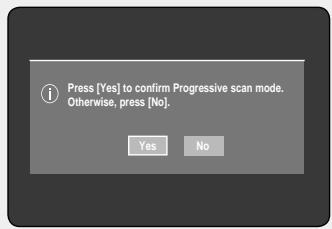
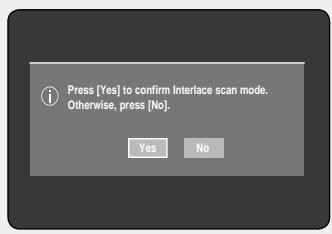

- When the HDMI cable (not supplied) is connected, this screen is not displayed.
- If the P.SCAN button on the HDD & DVD RECORDER's front panel is pressed during playback, the message "This function is possible only on stop mode" appears on the screen.
- Progressive setting is only available when the HDD & DVD RECORDER is in stop mode.
Canceling the Progressive scan
- With the unit in Stop mode, press the P.SCAN button on the front of the HDD & DVD RECORDER.
The message "Press [Yes] to confirm Interlace scan mode. Otherwise, press [No]." will appear.
- Press the left/right buttons to select Yes, and then press the OK button.
- Set your TV to Interlace input (using the TV remote control.)

- Do not press the P.SCAN button if you are using a TV that does not support Progressive mode as nothing will be displayed on the screen.
- If you press the P.SCAN button by mistake when your TV does not support Progressive mode, the mode will then need to be released. To release the Progressive mode, press the P.SCAN button on the front panel 3 times. The screen will recover after the PS indicator on the front panel display turns off.
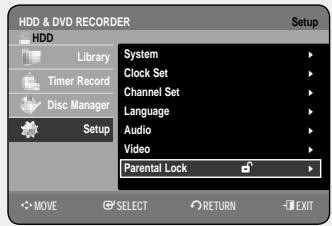
Setting up the Parental Lock

The Parental Lock function works in conjunction with DVDs that have been assigned a rating which helps you control the types of DVDs that your family watches. There are up to 8 rating levels on a disc.
- With the unit in Stop mode, press the MENU button.
- Press the arrow buttons to select Setup, then press the OK or button.
- Press the arrow buttons to select Parental Lock, then press the OK or right arrow button.
When you operate your HDD & DVD RECORDER for the first time, the "Create the Password" message will be displayed.
- Enter the 4-digit password using the number buttons on the remote control.
The "Confirm the password" message will be displayed. Enter your password again.

- Press the RETURN or left arrow button to return to the previous menu. Press the EXIT button to exit the menu.
If you forgot your password
- Remove the disc.
- Press and hold the PROG button on the front panel for 5 seconds or more.
Setting the Rating Level
- Press the arrow buttons to select Rating Level, then press the OK or button.
- Press the ▲▼ buttons to select the rating level you want, then press the OK or ▶ button.
For example, if you select up to Level 6, discs that contain Level 7, 8 will not play. A larger number indicates that the programme is intended for adult use only.
Changing the Password
- Press the ▲▼ buttons to select Change Password, then press the OK or ▶ button.
- Enter the 4-digit password using the number buttons on the remote control. The "Confirm the password" message will be displayed.
- Enter your password again using the number buttons on the remote control.

After Rating Level has been set, you can change the password.
This section introduces basic functions of playback and playback by disc type. Read the following information before playing a disc.
Region code (DVD-Video only)

Both the HDD & DVD REORDER and the discs are coded by region. These regional codes must match in order for the disc to play. If the codes do not match, the disc will not play. The Region Number for this HDD & DVD REORDER is described on the rear panel of the HDD & DVD REORDER.
Logos of Discs that can be played

DOLBY
GITAL

dtsm
Digital Out
DIGITAL SUGSES
Digital Audio
Dolby Digital

Stereo

PAL broadcast
system in U.K, France
Germany, etc.

DivX

MP3
Disc types that can be played
| Disc Types | Disc Logo content | Recorded content | Disc Shape | Max. Playing Time | |
| DVD-VIDEO | VIDEO VIDEO | AUDIO VIDEO | Single sided(12cm) | 240 min. | |
| Double sided(12cm) | 480 min. | ||||
| Single sided(8cm) | 80 min. | ||||
| Double sided(8cm) | 160 min. | ||||
| AUDIO-CD | COMPACT DISG DIGITAL AUDIO | AUDIO | Single sided(12cm) | 74 min. | |
| Single sided(8cm) | 20 min. | ||||
| JPEG | JPEG Image | Single sided(12cm) | - | ||
| Single sided(8cm) | - | ||||
| MP3 | MP3 Audio | Single sided(12cm) | - | ||
| Single sided(8cm) | - | ||||
| DivX | DIVX | DivX Movie | Single sided(12cm) | - | |
| Single sided(8cm) | - | ||||
| DVD-RAM | RAM | AUDIO VIDEO | Single sided(12cm) (4.7GB) | 1 hr. (XP: Excellent Quality) | |
| 2 hrs. (SP: Standard Quality) | |||||
| 4 hrs. (LP: Long Playback) | |||||
| 6 or 8 hrs. (EP: Extended) | |||||
| Double sided(12cm) (9.4GB) | 2 hrs. (XP: Excellent Quality) | ||||
| 4 hrs. (SP: Standard Quality) | |||||
| 8 hrs. (LP: Long Playback) | |||||
| 12 or 16 hrs. (EP: Extended) | |||||
| DVD-RW | RW | AUDIO VIDEO | 12cm (4.7GB) | 1 hr. (XP: Excellent Quality) | |
| 2 hrs. (SP: Standard Quality) | |||||
| 4 hrs. (LP: Long Playback) | |||||
| 6 or 8 hrs. (EP: Extended) | |||||
| DVD-R | R | AUDIO VIDEO | Single Layer(12cm) (4.7GB) | 1 hr. (XP: Excellent Quality) | |
| 2 hrs. (SP: Standard Quality) | |||||
| 4 hrs. (LP: Long Playback) | |||||
| 6 or 8 hrs. (EP: Extended) | |||||
| Dual Layer(12cm) (8.5GB) | 1 hr. 50min (XP: Excellent Quality) | ||||
| 3 hrs. 40min (SP: Standard Quality) | |||||
| 7 hrs. 20min (LP: Long Playback) | |||||
| 11 or 14 hrs. 40min (EP: Extended) | |||||
| DVD+RW | RW | AUDIO VIDEO | 12cm (4.7GB) | 1 hr. (XP: Excellent Quality) | |
| 2 hrs. (SP: Standard Quality) | |||||
| 4 hrs. (LP: Long Playback) | |||||
| 6 or 8 hrs. (EP: Extended) | |||||
| DVD+R | RW | AUDIO VIDEO | Single Layer(12cm) (4.7GB) | 1 hr. (XP: Excellent Quality) | |
| 2 hrs. (SP: Standard Quality) | |||||
| 4 hrs. (LP: Long Playback) | |||||
| 6 or 8 hrs. (EP: Extended) | |||||
| DVD+R | AUDIO VIDEO | Dual Layer(12cm) (8.5GB) | 1 hr. 50min (XP: Excellent Quality) | ||
| 3 hrs. 40min (SP: Standard Quality) | |||||
| 7 hrs. 20min (LP: Long Playback) | |||||
| 11 or 14 hrs. 40min (EP: Extended) | |||||
| CD-R/RW DVD-RAM/RW-R | JPEG MP3 DivX | - | - | ||
| HDD | DVD-HR757 | HD | AUDIO VIDEO | Approx. 83 (XP: Excellent Quality) Approx. 137 (SP: Standard Quality) Approx. 274 (LP: Long Playback) Approx. 411 or Approx. 534 (EP: Extended) | |
Discs that cannot be played
DVD-Video with a region number other than "2" or "ALL" 3.9 GB DVD-R Disc for Authoring. DVD-RAM/-RW(VR mode) not recorded following the Video Recording Standard - A DVD±R/DVD-RW(V) disc which has been recorded and not finalised in a different manufacturer's recorder. DVD-ROM/PD/MV-Disc, etc CVD/CD-ROM/CDV/CD-G/CD-I

- This HDD & DVD REORDER can only operate with discs that are compatible with DVD-RAM Standard Version 2.0.
- Playback and/or recording may not work for some types of discs, or when specific operations, such as angle change and aspect ratio adjustment, are being performed. Information about the discs is written in detail on the box. Please refer to this if necessary.
- Do not allow the disc to become dirty or scratched, finger prints, dirt, dust, scratches or deposits of cigarette smoke on the recording surface may make it impossible to use the disc for recording. DVD-RAM/±RW/±R discs may not be able to play on some DVD players, depending on the player, disc and the condition of the recording.
- Discs with NTSC programmes recorded on them cannot be played and recorded using this product.
Playing a Disc
- Press the OPEN/CLOSE button.
- Place a disc gently into the tray with the disc's label facing up.
- Press the OPEN/CLOSE button to close the disc tray.
- Your HDD & DVD REORDER closes the disc tray and plays the disc automatically.
- The HDD & DVD REORDER does not play discs automatically after being powered on initially.
- When the HDD & DVD REORDER is powered on and a disc is in the tray, the unit will be activated and wait in stop status.
- Press the PLAY button to start playback.
- If you want the unit to play automatically when it is powered on with a disc in the unit, power on with the PLAY button.
- Press the STOP button to stop playback.

- When you stop playing back a disc, the HDD & DVD RECORDER remembers where you stopped, so when you press PLAY (⊙) button again, it will pick up where you left off. (Unless the disc is removed or the HDD & DVD RECORDER is unplugged, or if you press the STOP (⊙) button twice.)
- Do not move your HDD & DVD RECORDER while playing, as this may cause damage to the disc.
- Make sure to press the OPEN/CLOSE button to open or close the disc tray.
- Do not push the disc tray while it is being opened or closed, as this may cause a product malfunction.
- Do not place foreign materials on or in the disc tray.
- Some functions may perform differently or be disabled depending on the disc type. If this occurs, refer to the instructions written on the disc case.
- Be especially careful that children's fingers are not caught between the disc tray and the tray chassis when it closes.
- You must only insert one DVD disc at a time. Inserting two or more discs will not allow playback and may cause damage to the HDD & DVD RECORDER.
Using the Disc Menu & Title Menu
Some types of discs contain a dedicated menu system that allows you to select special functions for title, chapter, audio track, subtitle, film preview, information on characters, etc.
For DVD-VIDEO Disc
- Disc Menu: Press the DISC MENU button to enter the disc menu of the disc.
- Move to the setup menu related to playback operation.
- You can select audio language and subtitle etc. provided by the disc.
- Title Menu: Press the TITLE MENU button to move to the title menu of the disc.
- Press this button if the disc contains more than one title. Some discs may not support the title menu functionality.
For HDD/DVD-RAM/±RW/±R Disc


- Title List
Press the TITLE LIST button. Title List is a list of previously recorded programmes. If a title is deleted, that title cannot be played again.
- Play List (DVD-RAM/-RW(VR))
Press the PLAY LIST button. This refers to a list of user-selected titles. When one playlist is played, only the scene selected by the user will play and then stop. Since only the information necessary for playing a desired scene is included in a playlist, even if that playlist is deleted, the original recording will not be deleted. (only VR mode)
Using the playback related buttons
Searching through a Chapter or Track


During play, press the SEARCH (⊙) buttons on the remote control.
| HDD/DVD-VIDEO/DVD-RAM/±RW/±R | ▷ X 2 → ▷ X 4 → ▷ X 8 → ▷ X 16 → ▷ X 32 → ▷ X 128 |
| DivX | ▷ X 2 → ▷ X 4 → ▷ X 8 |
| AUDIO CD(CD-DA) | ▷ X 2 → ▷ X 4 → ▷ X 8 |
- You can scan the programme in reverse.
- When you press and hold the SEARCH (▶) buttons, playback is done at the default speed of X 4.
If you release the SEARCH (⊙) buttons, playback is performed at a normal speed.
- To return to normal speed playback, press the PLAY (▶) button.

- No sound is heard during Scan (Search) mode, except with CDs (CD-DA).
(You can hear sound during forward search (X 2) in disc.)
- The speed marked in this function may be different from the actual playback speed.
Skipping Chapters, Titles or Markers


During play, press the SKIP (▶) buttons on the remote control.
- If you press the SKIP (←) button,
it moves to the beginning of the chapter or Title or marker (HDD/DVD-RAM/-RW(VR mode)).
Pressing the button once again within 3 seconds returns to the beginning of the previous chapter or Title or marker (HDD/DVD-RAM/-RW(VR mode)).
- If you press the SKIP (⊙) button,
it moves to the next chapter or track or marker (HDD/DVD-RAM/-RW(VR mode)).

In pause mode, press the SEARCH (▶) buttons on the remote control.
- If you press the SEARCH (⊙) button, 1/2 → 1/4 → 1/8
- If you press the SEARCH (⊙) button, 1/2 → 1/4 → 1/8
- To return to normal speed playback, press the PLAY (▶) button. Press and hold the SEARCH (▶▶) buttons during pause, the disc will play slowly at 1/4 speed. If the button is released, the pause operation will resume.

- The speed marked in this function may be different from the actual playback speed.
- Slow motion operates only in the forward direction on DivX discs.
Step Motion Play

Press the SKIP (,) buttons on the remote control in the pause mode.
- Each time the button is pressed, a new frame will appear. When the SKIP (◀) button is pressed, the previous frame will be activated. When the SKIP (▶) button is pressed, the next frame will be activated.
- To return to normal speed playback, press the PLAY (▶) button.

- Step motion operates only in the forward direction on DivX discs.
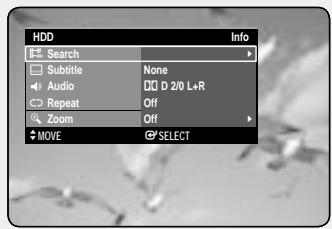
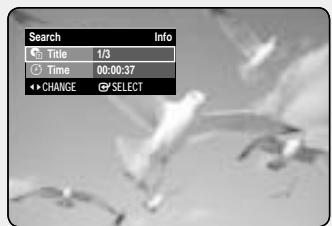
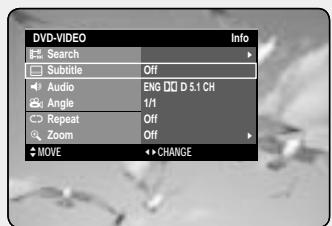
Using the INFO button
The INFO function allows you to easily search for a desired scene by accessing title, chapter, time.
You can also change the subtitle and audio settings and set some features including Angle, Repeat, Zoom.
Moving to a scene directly using the INFO

If you want to move to a certain title, chapter or time, use this function.
- Press the INFO button during playback.
- Press the ▲▼ buttons to select Search, then press the OK button or ▶ button.
- Press the ▲▼ buttons to select Title, Chapter or Time.
- Press the ◀▶ buttons or number buttons to select the desired scene, then press the OK button. In case of searching a time, enter the time in the sequence of hours, minutes, and seconds using the number buttons. Then press the OK button.

This may not work for some discs.
When an audio CD (CD-DA) or an MP3/JPEG disc is inserted, depending on the disc type, the information display may not appear.
The Time Search function does not operate on some discs. - To make the screen disappear, press the RETURN button.
Selecting the Subtitle Language

Selects one of the subtitle languages recorded on the disc. You can also operate this function by pressing the SUBTITLE button on the remote control.
- Press the INFO button during playback.
- Press the ▲▼ buttons to select Subtitle.
- Press the ◀▶ buttons to select the desired subtitle language.

- The subtitle display may be different depending on the disc type.
- Some discs allow you to select the language for the disc menu only.
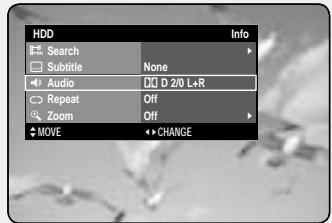
Selecting the Soundtracks & Audio Channels


Selects one of the soundtracks recorded on the disc. Also selects the audio channels from recorded TV programmes.
You can also operate this function by pressing the AUDIO button on the remote control.
- Press the INFO button during playback.
- Press the ▲▼ buttons to select Audio.
- Press the ◀▶ buttons to select the desired soundtracks or audio channel.

Soundtracks or audio channels may be different because they are disc-specific. Some discs allow you to select the audio language for the disc menu only.
Changing the Camera Angle

When a DVD VIDEO contains multiple angles of a particular scene, you can select the Angle function.
- Press the INFO button during playback.
- Press the ▲▼ buttons to select Angle.
- Press the ◀▶ buttons to select the desired angle.

This function is disc-dependent, and may not work on all DVDs. This function does not work when a DVD has not been recorded with a multi-camera angle system. Displays the current angle and total angle number.
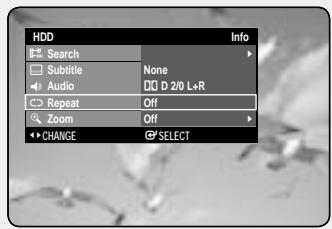
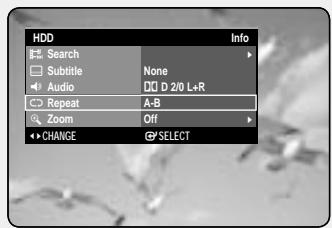
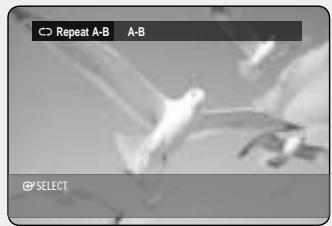
Repeat Play
Playing Repeatedly (Repeat Playback)


You can also operate this function by pressing the REPEAT button on the remote control.
- Press the INFO button during playback.
- Press the △/▽ buttons to select Repeat.
- Press the ◀/▶ buttons to select Off, A-B, or Title or Chapter you want to play repeatedly, then press the OK button.

- HDD/DVD-RAM/-RW(VR mode), unfinalised DVD±R and unfinalised DVD-RW (V mode) discs will not repeat a chapter.
- You can also activate Normal Playback by pressing the EXIT(1) button.
Repeat A-B


- Press the INFO button during playback.
- Press the △/▽ buttons to select Repeat.
- Press the ◀/▶ buttons to select A-B, then press the OK button.
- Press the OK button at the point where you want the repeat play to start (A) and press it again at the point where you want the repeat play to stop (B). Repeat playback of the A-B section starts.

If you set point (B) before five seconds of playback has lapsed, the prohibition mark (∅) will appear. - You can also activate Normal Playback by pressing the EXIT(4) button. Audio CDs (CD-DA), MP3 discs, and DivX discs do not support the Repeat A-B function.
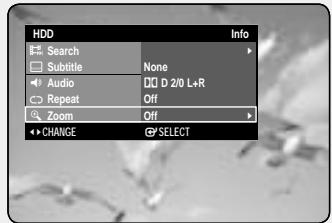
Zooming-In


- Press the INFO button during playback.
- Press the △/▽ buttons to select Zoom, then press the OK or ▶ button. (⊙) will be displayed.
- Press the triangle buttons to move to the area you want to enlarge.
- Press the OK button.
The screen will be enlarged to twice the normal size. The screen size will be enlarged to four times the normal size.
| HDD/DVD-VIDEO/DVD-RAM/±RW/±R | normal size → X2 → X4 → X2 → normal size |

- When the recording is done in EP mode, the zoom function is not supported except when the recording has been in V mode.
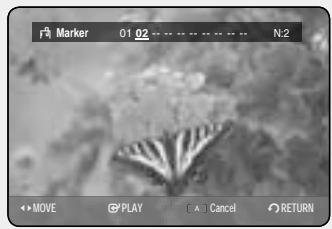
Using Markers


(VR mode)
Set marks at scenes you want to see again so that you can start playback from the marked position.
Setting Markers
- Press the MARKER button during playback.
- Press the OK button when the desired scene appears.
- The number 01 is displayed and the scene is memorized.
- Press the right buttons to move to the next position.
- Press the OK button again when the desired scene appears.
- The number 02 is displayed and the scene is memorized.
- HDD, DVD-RAM or DVD-RW (VR Mode) discs have the Marker function instead of the Bookmark function. Since the scenes may be displayed as many different pages, numbering is necessary. If a disc in use is encoded with Disc Protection, Markers cannot be set or deleted, only playback is available.
Playing back a marker
- Press the MARKER button during playback.
- Press the buttons to select a marked scene.
- Press the OK or PLAY (▶) button to start playing from the selected scene.
- If you press the SKIP (▶) button, it moves to the beginning of the marker. Pressing the button once again within 3 seconds returns to the beginning of the previous marker.
- If you press the SKIP (▶) button, it moves to the next marker.
Clearing a marker
- Press the MARKER button during playback.
- Press the ◀ buttons to select a marked scene.
- Press the RED(A) button to delete the selected mark.
- When a marker is cleared while HDD/DVD-RAM/-RW (VR mode) is playing, marker numbers will change. For example, if the 7th marker is cleared after ten markers are registered, the marker numbers after the eighth will automatically move ahead by one and the 8th marker becomes the 7th.
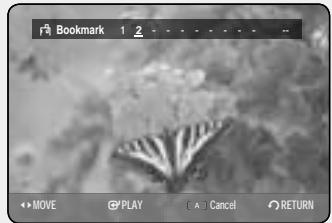
Using the Bookmarks


(V mode)
Setting Bookmarks
- Press the MARKER button during playback.
- Press the OK button when the desired scene appears.
- The number 1 is displayed and the scene is memorized.
- Press the ▶ buttons to move to the next position.
- Press the OK button again when the desired scene appears. The number 2 is displayed and the scene is memorized.
- Repeat the above steps to bookmark other positions.
- You can bookmark up to 10 scenes.

- When the disc tray is opened and then closed, bookmarks will disappear.
Playing back a bookmark
- Press the MARKER button during playback.
- Press the ◀ buttons to select a bookmarked scene.
- Press the OK or PLAY (▶) button to start playing from the selected scene.
Clearing a bookmark
- Press the MARKER button during playback.
- Press the ◀ buttons to select a bookmarked scene.
- Press the RED (A) button to delete the selected bookmark.
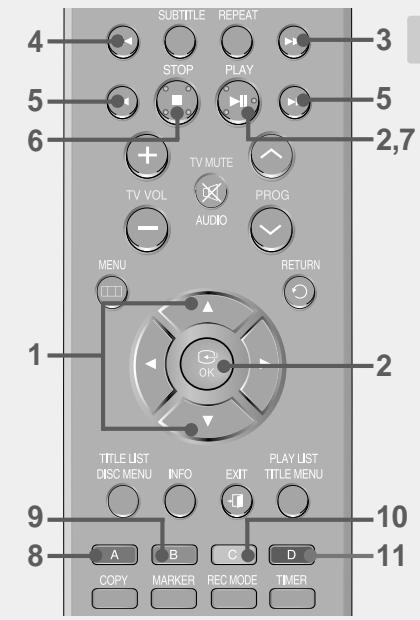
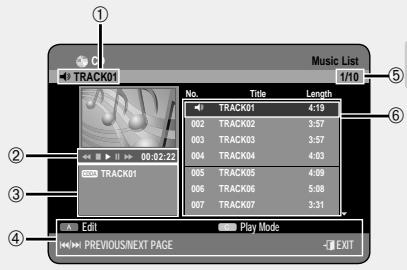
Playing an Audio CD/MP3
Buttons on the Remote Control used for Audio CD (CD-DA)/MP3 playback
- TRIANGLE/Nabla: Selects a track (song).
- OK button, Play (●) button: Plays the selected track (song).
- SKIP (⊙) button: Moves to the next page.
- SKIP (⊙) button: Moves to the previous page.
- Press the SEARCH (▶) buttons: Fast Play (X 2, X 4, X 8) (Audio CD only)
- STOP (⊙) button: Stops a track (song).
- PLAY (●+) button: Plays a track (song) or pauses playback.
- RED (A) button: Creates a playlist or go to playlist.
- Select Copy and Select All button. (MP3 disc only)
- GREEN (B) button: Selects the sort order. (MP3 disc only)
- YELLOW (C) button: Selects the play mode. (REPEAT)
- BLUE (D) button: Selects a contents. (MP3 disc only)
Playing an Audio CD (CD-DA)
- Insert an audio CD (CD-DA) into the disc tray.
- The audio CD menu appears and the tracks (songs) are played automatically.
- Press the buttons to select the track (song) you want to hear, and then press the OK button.
Audio CD (CD-DA) Screen Elements
- Current track (song): Displays the number of the track currently being played.
- Displays available buttons and a playback time corresponding to a portion that is currently played.
- Displays the current file type and file name.
- Display available buttons.
- Displays the current play index, total track number.
- Displays the track list (song list).
Playing an MP3 Disc
- Insert an MP3 disc into the disc tray.
- The menu is displayed
- Press the ▲▼ buttons to select Library, then press the OK or ▶ button.
- Press the ▲▼ buttons to select Music, then press the OK or ▶ button.
- Press the ▲▼ buttons to select the track you want to hear, and then press the OK button.
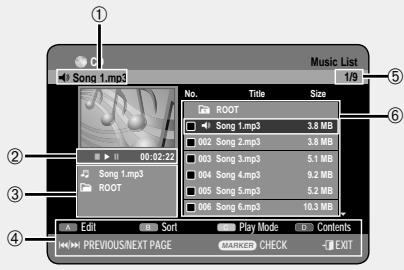
MP3 Screen Elements
- Current track (song): Displays the name of the track being played.
- Displays available buttons and a playback time corresponding to a portion that is currently played.
- Displays the current file type, file name and folder name.
- Displays available buttons.
- Displays the current play index, total track number.
- Displays the track list (song list).
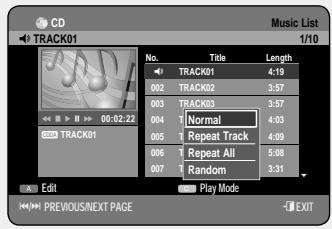
Repeat CD (CD-DA) & MP3
You can also operate this function by pressing the REPEAT button on the remote control. During playback, press the REPEAT button repeatedly to select the repeat mode you want.
- Press the YELLOW(C) button during the Music List playback.
- Press the ▲▼ buttons to select desired play mode, then press the OK or ▶ button.
- Normal (CD (CD-DA)/MP3): Tracks on a disc are played in the order in which they were recorded on the disc. Repeat Track (CD (CD-DA)/MP3) Repeat Folder (MP3) Repeat All (CD (CD-DA)/MP3)
- Random (CD (CD-DA)/MP3): The random option plays a disc's tracks in random order.
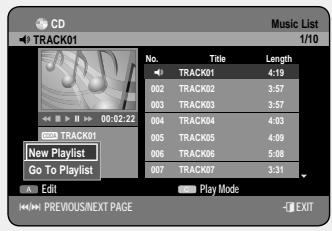
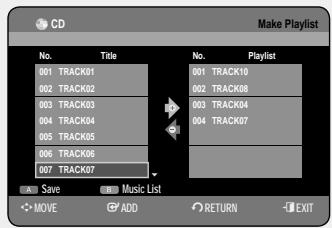
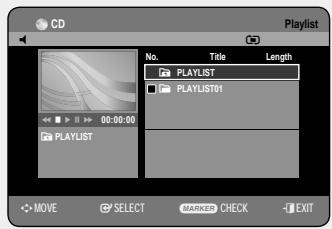
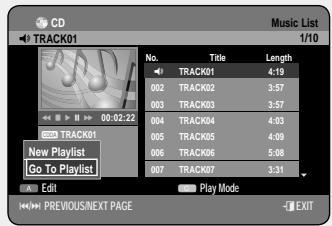
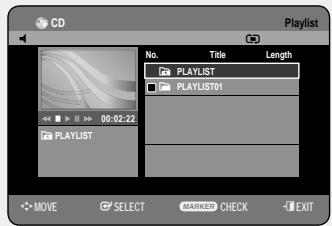
New Playlist
You can register a maximum of 30 tracks in the playlist.
- Press the RED(A) button during the Music List playback.
- Press the ▲▼ buttons to select New Playlist, then press the OK or ▶ button.
- Press the ▲▼ buttons to select tracks in the order in which you want them to play, then press the OK button.
- If you playlisted a wrong track, press the ▶▲▼ buttons to select the wrong track, then press the OK button.
- To store the Playlist, press the RED(A) button. A new Playlist will be created.
Go To Playlist
- Press the RED(A) button during the Music List playback.
- Press the up/down buttons to select Go To Playlist, then press the OK or right button.
- Press the up/down buttons to select the desired playlist folder, then press the OK button. The selected tracks are played automatically.
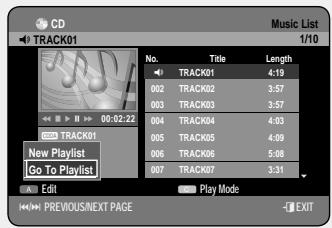
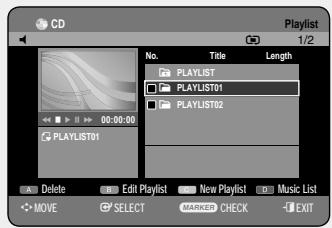
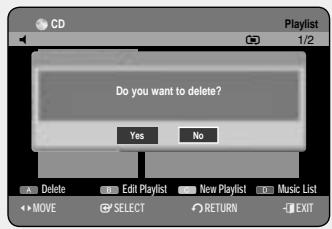
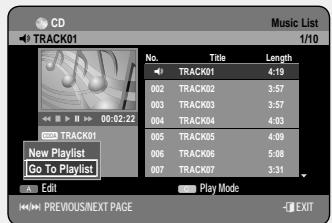
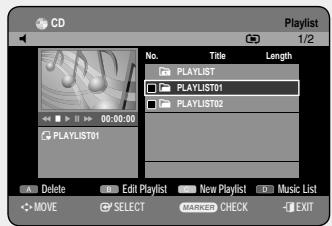
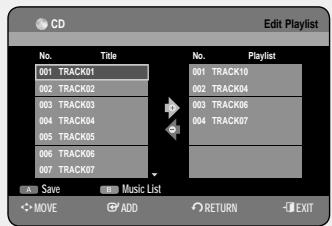
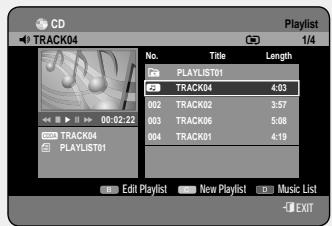
Delete the Playlist
- Press the RED(A) button during the Music List playback.
- Press the up/down buttons to select Go To Playlist, then press the OK or right button.
- Press the up/down buttons to select the Playlist you want to delete.
- Press the RED(A) button.
- Press the left buttons to select Yes, then press the OK button. The selected Playlist is deleted.
Go To Edit Playlist
- Press the RED(A) button during the Music List playback.
- Press the up/down buttons to select Go To Playlist, then press the OK or button.
- Press the up/down buttons to select the Playlist you want to edit.
- Press the GREEN(B) button in playlist mode.
- Press the up/down buttons to select tracks in the order in which you want them to play, then press the OK button.
- If you playlisted a wrong track, press the right/up/down buttons to select the wrong track, then press the OK button.
- To store the Playlist, press the RED(A) button. Playlist will be edited.
Go To Music List
- Press the BLUE(D) button during the Playlist playback. The Music List will be displayed.
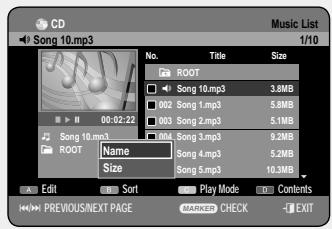
Using the Sort
When you need to change the Sort order of Music List, you can change it simply.
- While the list menu is displayed, press the GREEN(B) button to select Sort.
- Press the up/down buttons to select the desired item, then press the OK or right button.
- Name: In alphabetical order
- Size: In order of audio file size.

Audio CD (CD-DA) is not available. - You can sort by Name, Length. The sorted list will be resorted in copied order upon reentering Music List.
Select Contents
- Press the BLUE (D) button to select Contents.
- Press the ▲▼ buttons to select the contents you want to move, then press the OK or ▶ button.

- This function is possible only when the disc contains the selected contents. Audio CD (CD-DA) is not available.
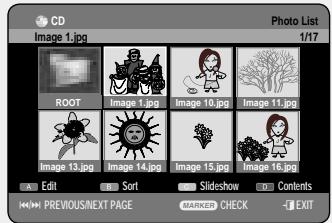
Viewing a Picture

- Insert a JPEG disc into the disc tray.
- The menu is displayed.
- Press the ▲▼ buttons to select Library, then press the OK or ▶ button.
- Press the ▲▼ buttons to select Photo, then press the OK or ▶ button.
- To see the next 8 pictures, press the SKIP (▶) button.
- To see the previous 8 pictures, press the SKIP (▶) button.
- Press the ▲▼◀▶ buttons to select a desired picture, then press the OK button.
Slide Show
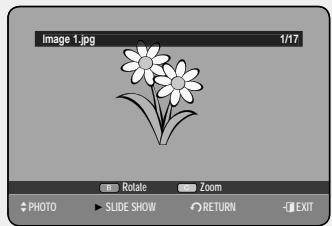
- Press the PLAY (▶) button.
- Once in the Photo List, you can also operate slideshow by pressing the YELLOW (C) button.
- Press the RED (A) button to select Speed.
- Press the ▲▼ buttons to select the slideshow speed, then press the OK or ▶ button.
The slideshow starts and plays at the selected speed.
- You can go to Photo List by pressing YELLOW(C) button.
To stop the Slide Show
Press the GREEN(B), STOP(⊙) or RETURN button.
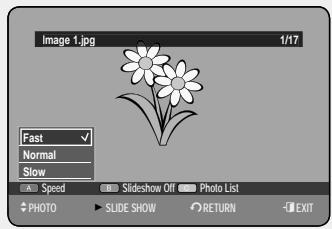
Rotate
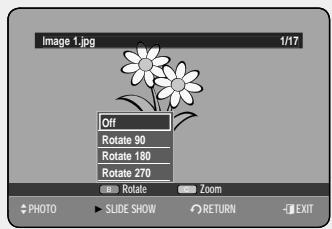
To setup, follow steps 1 to 4.
- Press the GREEN(B) button to select Rotate.
- Press the ▲▼ buttons to select the rotate angle, then press the OK or ▶ button.
- Once you select a rotate angle, you can change it by pressing the RED(A) button.
- You can go to Photo List by pressing YELLOW(C) button.
To stop the Rotate
Press the GREEN(B), STOP(⊙) or RETURN button.
Zoom
To setup, follow steps 1 to 4 on page 56.
- Press the YELLOW (C) button to select Zoom.
- Each time the OK button is pressed, the picture is enlarged up to 4x (four times the normal size).

- You can go to Photo List by pressing the YELLOW (C) button.
To stop the Zoom
Press the GREEN (B), STOP (⊙), or RETURN button.
Go To Photo List
To setup, follow steps 1 to 4 on page 56.
- Press the RETURN button to go to Photo List.
Using the Sort
When you need to change the Sort order of Photo List, you can change it simply.
- While the list menu is displayed, press the GREEN (B) button to select Sort.
- Press the ▲▼ buttons to select the desired item, then press the OK or button.
- Name: In alphabetical order
- Size: In order of photo file size.

- You can sort by Name or Size. The sorted list will be resorted in the copied order upon reentering the Photo List.
Select Contents
To set up, follow steps 1 to 3 on page 56.
- Press the BLUE (D) button to select Contents.
- Press the ▲▼ buttons to select the contents you want to move, then press the OK or ▶ button.

This function is possible only when the disc contains the selected contents.
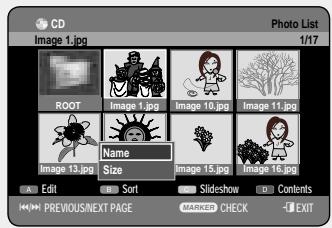
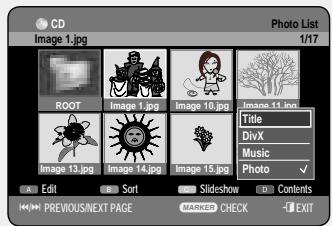
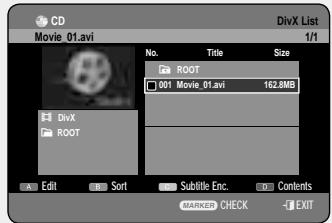
Playing a DivX

Using the MENU button
- Insert a DivX disc into the disc tray.
- The menu is displayed.
- Press the ▲▼ buttons to select Library, then press the OK or ▶ button.
- Press the ▲▼ buttons to select DivX, then press the OK or ▶ button.
- Press the ▲▼ buttons to select the avi file (DivX), then press the OK or PLAY (►) button.
- When a DivX file is played, you can use the following functions. Pressing the STOP (●) button once during playback will display the file list; pressing the button again will exit the menu screen.
DivX Function Description
| Function | Description |
| Skip | During play, press the SKIP (▶) buttons, it moves forward or backward 5 minutes. |
| Search | During play, press the SEARCH (▶) buttons and press again to search at a faster speed. (X 2, X 4, X 8) |
| Slow Motion Play | In pause mode(II Pause), press the SEARCH (▶) button on the remote control. (1/2, 1/4, 1/8) Reverse Slow Motion Play is not available. |
| Step Motion Play | In pause mode(II Pause), press the SKIP (▶) button on the remote control in the still mode. Reverse Step Motion Play is not available. |

This unit can play the following video compression formats:
- DivX Video (Codec) Format: DivX 3.11, DivX 4.x, DivX 5.x (without QPEL and GMC)
- DivX Audio (Codec) Format: MP3, MPEG1 Audio Layer 2, LPCM, AC3
Supported subtitle file formats: .smi, .srt, .sub, .psb, .txt, .ass (The subtitle file should have exactly the same name as the corresponding DivX file name). Some DivX files created on a personal computer may not play back. This is because codec type, version, and higher resolution over specification are not supported. You cannot play back a disc that is larger than 720 × 576 pixel resolution.
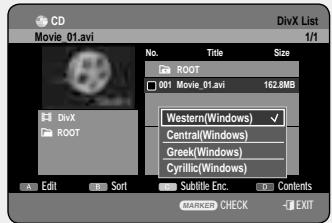
DivX Subtitle Encoding
- Press the YELLOW (C) button in the file list.
- Press the ▲▼ buttons to select a supported DivX subtitle language by region, then press the OK button.
| Western | Afrikaans, Basque, Catalan, Danish, Dutch, English, Faeroese, Finnish, French, German, Icelandic, Indonesian, Italian, Malay, Norwegian, Portuguese, Spanish, Swahili, Swedish |
| Central | English, Albanian, Croatian, Czech, Hungarian, Polish, Romanian, Serbian(Latin), Slovak, Slovenian |
| Greek | English, Greek |
| Cyrillic | English, Azeri, Belarusian, Bulgarian, Kazakh, Macedonian, Russian, Serbian, Tatar, Ukrainian, Uzbek |

- If the subtitle language is displayed in broken fonts, change DivX Subtitle to the appropriate region. If it still does not work, the format is not supported.
Using the Sort
When you need to change the sort order of the DivX list, you can change it simply.
- While the list menu is displayed, press the GREEN (B) button to select Sort.
- Press the ▲▼ buttons to select the desired item, then press the OK or ▶ button.
- Name: In alphabetical order
- Size: In order of DivX file size.

- You can sort by Name, Size. The sorted list will be resorted in copied order upon reentering DivX List.
Select Contents
- Press the BLUE(D) button to select Contents.
- Press the ▲▼ buttons to select the contents you want to move, then press the OK or ▶ button.

This function is possible only when the disc contains the selected contents.
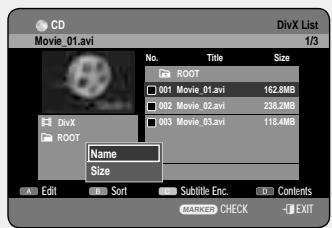
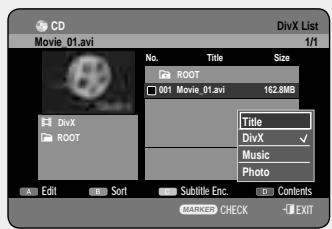
This section shows various HDD & DVD recording methods.
This unit can record on various types of discs. Before recording, read the following instructions and select the disc type according to your preference.
Recordable Discs
This HDD & DVD recorder can record on the following discs.
DVD-HR757
| HDD | DVD-RAM | DVD-RW | DVD-R | DVD+RW | DVD+R |
| HD | DRAM | R W | R | DVD-RwWriteback | DVD-R |
DVD-RAMs and DVD±RWs are rewritable. - DVD±Rs are non-rewritable.
Compatibility between Samsung and Other Company's Recorder
| Disc Types | Recording format | Recording Device | Finalising | Additional Recording in Samsung Recorder |
| DVD-RAM | VR Mode | Samsung | X | Recordable |
| Other Company | X | Recordable | ||
| DVD-RW | VR Mode | Samsung | finalised | Not recordable |
| not finalised | Recordable | |||
| Other Company | finalised | Not recordable | ||
| not finalised | Recordable | |||
| V Mode | Samsung | finalised | Not recordable | |
| not finalised | Recordable | |||
| Other Company | finalised | Not recordable | ||
| not finalised | Not recordable | |||
| DVD-R | V Mode | Samsung | finalised | Not recordable |
| not finalised | Recordable | |||
| Other Company | finalised | Not recordable | ||
| not finalised | Not recordable | |||
| DVD+RW | - | Samsung | X | Not recordable in some cases |
| Other Company | X | Not recordable in some cases | ||
| DVD+R | - | Samsung | finalised | Not recordable |
| not finalised | Not recordable in some cases | |||
| Other Company | finalised | Not recordable | ||
| not finalised | Not recordable in some cases |

Finalise
- This closes the DVD-RW/±R so no additional recording can be done.
Unfinalise
- This allows additional recording on a DVD-RW disc originally recorded on the HDD & DVD REORDER.
- A DVD-RW disc that has been recorded by DAO (Disc At Once) in a PC cannot be unfinalised.
- A DVD-RW disc that has been recorded in Video Mode of a different maker's recorder cannot be unfinalised.
- A DVD±R disc cannot be unfinalised.
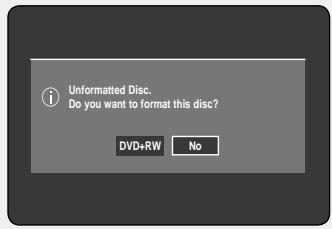
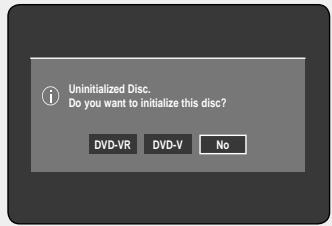
Recording Formats
When you insert an unused disc, the following message appears. Since available functions differ depending on the disc type, select a disc that best fits your preferences.
DVD-RAM/DVD+R: Formatting will be started automatically.
DVD+RW: Use after formatting the disc.
DVD-RW: Use after initializing the disc. If you want to change the VR or V mode, refer to Formatting a Disc on page 97.
DVD-R: Formatting disc is unnecessary and only V Mode Recording is supported.
DVD-RAM/-RW (VR mode)
- This mode allows multiple editing functions (such as deletion of the whole title, partial deletion of a title, etc.).
- Various editing options using a created Playlist.
DVD-RW(V mode)/-R
- Chapters will be created automatically when you finalise recording on DVD-RW/-R discs in V mode. The chapter's length (interval between chapters) varies according to the recording mode.
- Simple editing (erasing titles/changing title name).
DVD+RW
- With DVD+RW discs, there is no difference between DVD-Video format (Video mode) or DVD-Video Recording format (VR mode).
Recording Mode
Select one of four recording modes by pressing the REC MODE button repeatedly while the unit is in Stop mode for the desired recording time and picture quality. In general, picture quality improves as the recording time decreases. In FR mode, the most suitable record mode is adjusted automatically, according to remaining time on the disc and length of the timer recording. This function is selected only one mode in XP, SP, LP and EP modes and you can use this mode for timer recording.
DVD-HR757
| Recording Mode | Recording Times | |
| HDD (320GB) | DVD-RAM/±RW/±R | |
| XP (high quality mode) | Approx. 83 hours | Approx. 1 hour about 8.5 Mbps |
| SP (standard quality mode) | Approx. 137 hours | Approx. 2 hours about 4.5 Mbps |
| LP (long recording mode) | Approx. 274 hours | Approx. 4 hours about 2 Mbps |
| EP (extended mode) | Approx. 411 hours | Approx. 6 hours/ about 1.6 Mbps |
| Approx. 434 hours | Approx. 8 hours/ about 1.2 Mbps | |

- Recording time may vary according to specific conditions.
- 1GB = 1,000,000,000 bytes; actual formatted capacity may be less as the internal firmware uses a portion of the memory.
- The dual layer DVD±Rs have approximately double the capacity of single layer DVD±Rs. (See page 40)
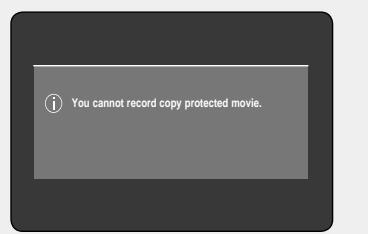
Unrecordable pictures
Video with copy protection cannot be recorded on this HDD & DVD REORDER.
When the HDD & DVD REORDER receives a copy-guard signal while recording, recording stops and the following message appears on the screen.
Concerning Copy Control Signals
TV broadcasts that contain copy control signals may have one of the following three signal types: Copy-Free, Copy-Once, and Copy-Never. If you want to record a Copy-Once type programme, use DVD-RW with CPRM in VR Mode and DVD-RAM.
| Signal type Media | Copy-Free | Copy-One | Copy-Never |
| DVD-RW(Ver.1.1) | O | - | - |
| DVD-RW(Ver.1.1) with CPRM | |||
| VR mode | O | O* | - |
| V mode | O | - | |
| DVD-R | O | - | |
| DVD-RAM(Ver. 2.0) | O | O* | - |
| DVD+RW | O | - | - |
| DVD+R | O | - | - |
Once "Copy Once" has been recorded, recording cannot be done anymore.
Content Protection for Recordable Media (CPRM)
CPRM is a mechanism that ties a recording to the media on which it is recorded. It is supported by some HDD & DVD recorders, but not by many DVD players. Each blank recordable DVD has a unique 64-bit media ID etched in the BCA. When protected content is recorded onto the disc, it can be encrypted with a 56-bit C2 (Cryptomeria) cipher derived from the media ID.
During playback, the ID is read from the BCA and used to generate a key to decrypt the contents of the disc. If the contents of the disc are copied to other media, the ID will be absent or wrong and the data will not be decryptable.
Recording immediately

Before you start
- Check that the disc has enough available space for the recording.
- Press the HDD or DVD button.
If you select DVD, press the OPEN/CLOSE button and place a recordable disc on the disc tray.
Press the OPEN/CLOSE button to close the disc tray.
Wait until LOAD disappears from the front panel display.
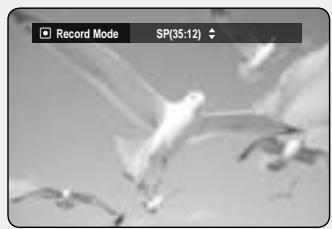
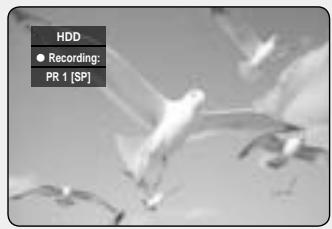
Recording the current TV programme you are watching
- Press the PROG (or number buttons) to select the current programme you want to record.
- Press the REC MODE button repeatedly (or press the REC MODE button and then press the triangle/nabla buttons) to select the recording speed (quality).
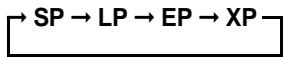
- Press the REC button.
Information concerning the channel is displayed on the screen, then recording begins.
Icon() is displayed on the front panel.
Recording from external equipment you are watching
- Press the INPUT SEL. button to select the input source according to the connection you made.
The front panel display changes in the following sequence:

If you connect a digital camcorder, press the INPUT SEL. button to select DV. (See page 66)
- Press the REC MODE button repeatedly (or press the REC MODE button, then press the triangle/nabla buttons) to select the recording speed (quality).

3. Press the REC button.
Information concerning the external input mode is displayed on the screen, then recording begins. Icon() is displayed on the front panel.
To pause recording
- Press the REC PAUSE button to pause a recording in progress.
- Press the REC PAUSE button again during pause to resume recording.
- You can switch channels by pressing the PROG (O) buttons while recording pauses.
To stop recording
Press the STOP (▶) button to stop or finish a recording in progress.
- When using DVD-RAM/±RW/±R discs, the message "Updating the information of disc. Please wait for a moment" is displayed.

- You cannot change the recording mode while recording.
- Recording will stop automatically if there is no free space left for recording.
- Up to 99 titles can be recorded onto a DVD-RAM/-RW/-R disc, and up to 48 titles onto a DVD+RW/+R disc. Up to 999 titles can be registered on the HDD.
- HDD recording is available for up to 24 hours, and when recording for 24 hours, 3 titles will be recorded with each being 8 hours in length.
- Recording will stop automatically if a copy protected image is selected. DVD-RAM/±RW discs must be formatted before starting to record. Most new discs are sold unformatted.
- Do not use DVD-R authoring discs with this unit.
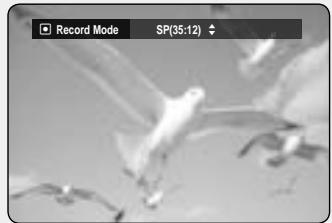
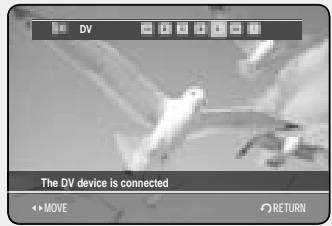
Copying from a Camcorder

You may control the Camcorder using the IEEE1394 (DV) interface.
- Connect the DV output jack of your camcorder to the DV input jack on the front of your HDD & DVD REORDER using a DV cable.
- Press the HDD or DVD button. If you select DVD, press the OPEN/CLOSE button and place a recordable disc on the disc tray. Press the OPEN/CLOSE button to close the disc tray. Wait until LOAD disappears from the front panel display.
- Press the REC MODE button repeatedly to select the recording speed (quality).
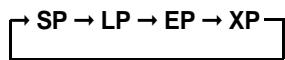
- Press the INPUT SEL. button to select DV. If the input is set to DV, a playback/record menu that enables camcorder control appears on the top of the screen.
- Select the Play (▶) icon on the upper part of the screen to playback the camcorder and find the starting position to copy.
- To start recording, use the ◀ ▶ buttons to select the Record (●) icon in the top side of the screen, then press the OK button. You can press the REC button of the remote control to start recording.
To stop recording
Press the STOP (■) button to stop or finish a recording in progress.
- When using DVD-RAM/±RW/±R discs, the message "Updating the information of disc. Please wait for a moment" is displayed.

- To display playback related icons on the screen, press any direction button on the remote control.
Making a One Touch Recording (OTR)

You can set the HDD & DVD REORDER to record in 30-minute increments up to 8 hours by pressing the REC button.
- Press the HDD or DVD button. If you select DVD, press the OPEN/CLOSE button and place a recordable disc on the disc tray. Press the OPEN/CLOSE button to close the disc tray. Wait until LOAD disappears from the front panel display.
- Press the PROG (⊙) or number buttons to select the programme to record. If you want to record through a connected external component, press the INPUT SEL. button to select an appropriate external input (AV1, AV2, AV3, DV or PR01).
- Press the REC button to start recording.
- Press the REC button repeatedly to adjust the desired recording time.


- The timer counter decreases by the minute from 8:00 to 0:00, then the HDD & DVD REORDER stops recording.
To stop recording
Press the STOP (■) button. The message "Do you want to stop recording?" is displayed.
- Press the left/right buttons to select Yes, then press the OK button.
- Or press the STOP (●) button again.
Simultaneous Recording and Playback

You can play back from the beginning of the programme you are currently recording. You can watch the previous title list while recording a programme.
Using the PLAY (▶) button
- With the unit in recording mode, press the PLAY (▶) button. It plays back the title that you are currently recording from the beginning. Playback is not available for 10 seconds from the start of recording. You can use the SKIP (▶▶) and other playback-related buttons to view the previous recorded list.
Stopping Playback / Recording
- Press the STOP (●) button. Playback screen disappears and the recording in progress screen appears.
- Pressing the STOP (●) button once more will stop the recording.
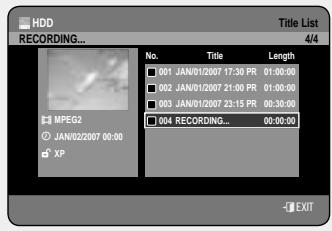
Using the TITLE LIST button
- With the unit in recording mode, press the TITLE LIST button. The above operation is possible from approx. 10 seconds or more after recording starts. Press the up/down or SKIP (◀◀/▶▶) buttons to select the recording title list.
- Press the OK or PLAY (▶) button. It plays back the title that you are currently recording from the beginning.
Using the MENU button
- With the unit in recording mode, press the MENU button.
- Press the up/down buttons to select Title, then press the OK button. Title List screen is displayed.
- Press the ▲▼/SKIP(◀▶) buttons to select the recording title list, then press the OK or button. It plays back the title that you are currently recording from the beginning.
Stopping Playback / Recording
- Press the STOP(■) button once, playback screen disappears and the Title List screen appears.
- Pressing the MENU(MENU) button again, the recording in progress screen appears.
- Pressing the STOP(■) button once more will stop the recording.
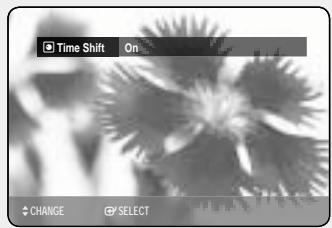
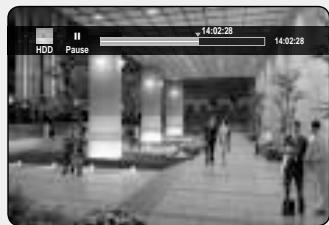
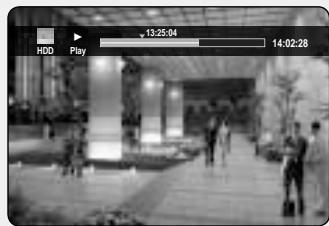
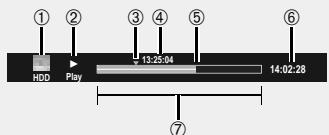

No sound is heard during search mode. DVD disc or HDD playback is available during HDD recording. However, JPEG, MP3, and DivX files in the disc cannot be played back. - HDD playback is available during DVD recording. However, JPEG and MP3 files in the HDD cannot be played back.
Time Shift function as a live signal

This function replays recordings as a live signal. If you are interrupted while watching a TV programme, simply press the TIME SHIFT button, and the HDD & DVD RECORDER immediately starts recording the programme.
- Press the TIME SHIFT button on the remote control.
The Time Shift menu is displayed.
- Press the ▲▼ button to select On, then press the OK button.
Using the Time Shift function
- While watching the currently broadcasting programme, press the PLAY/PAUSE (▶||) button.
The programme on TV is set in pause mode and the Time Shift Bar is displayed.
- Press the PLAY/PAUSE (▶) button again to resume watching the programme.
Time Shift Screen Elements
- Displays the current media.
- Displays the current status.
- Watching Point.
- Current play time.
- Live Point.
- Live Time.
- Time Shift Time Bar
Buttons on the Remote Control used for Time Shift function
- PLAY/PAUSE (▶) button: Pause live TV and resumes playback. 2. SEARCH (● ●) buttons: Fast play (X2, X4, X8, X16, X32, X128)
- SKIP (▶) button, STOP (▶) button: Switches to live TV.
- SKIP (←) button: Returns to the point where Time Shift begins.

The Time Shift is available only when HDD mode is selected. - You can use this function for up to maximum two hours. - You can only play the contents by using the menu when the Time Shift is set to On.
Making a Timer Recording

- Check the antenna cable is connected.
- Check the remaining time of the disc.
- Check the date and time are correct.
Make sure the Clock (Setup-Clock Set) must be set before you proceed with a timer recording. (See page 27)
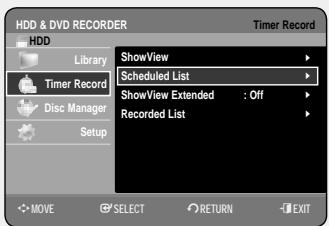
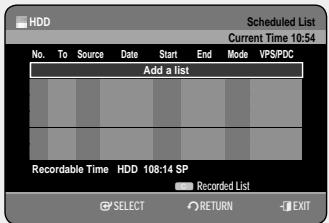
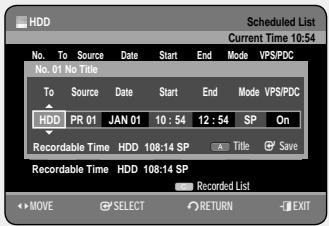
Using the TIMER button
- With the unit in Stop mode/Playback mode, press the TIMER button.
- Press the OK or ▶ button to select Scheduled List.
- Press the OK button to select Add a list.
- Set timer recording option.
- Fill the input items using the ▲▼◀▶ buttons and number buttons.
:Moves to the previous/next item.
▲▼, 0~9: Sets a value.
To: Select the media to record HDD or DVD. - Source: The video input source (AV1, AV2 or AV3), or the broadcasting channel you want to make a timer recording from. - Date: Timer Recording allows setting the recording time within one month period. Set the recording day. (month/day)
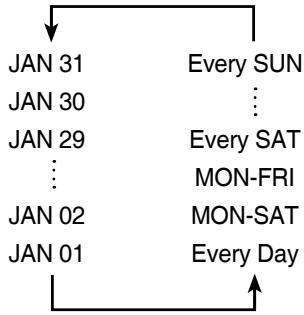
- Start/End Time: Start and end time of the timer recording. Mode (Recording Mode):
- FR (Flexible Recording): Select when you want to set video quality automatically. In FR mode, the most suitable record mode is adjusted automatically, according to remaining time on the disc and length of the timer recording. This function is selected only one mode in XP, SP, LP and EP modes.
- XP (high quality): Select when video quality is important.
- SP (standard quality): Select to record in standard quality.
- LP (low quality): Select when a long recording time is required.
- EP (extended): Select when a longer recording time is required.
- The dual layer DVD±Rs have approximately double the capacity of single layer DVD±Rs. (See page 40)

- When you are recording at EP mode on a DVD-RW(V mode)/R disc, it may not record the full 6 or 8 hours because the unit uses the VBR(Variable Bit Rate) ENCODING system. For example, if you record a programme with a lot of action, it uses a higher bit rate which in turn consumes more disc memory.
- VPS/PDC: VPS(Video Programme System) or PDC(Programme Delivery Control) function.
- If you set this function on, you can control the starting and ending time of recording by special signal included in the broadcasting signal. If a TV programme is shortened or starts earlier or later than scheduled, this function synchronizes the starting and ending time of recording with the actual broadcasting time automatically.
- Set up the start-time EXACTLY according to the published TV schedule. Otherwise the timer recording will not operate.
- Do not select PDC or VPS unless you are sure the programme you wish to record is broadcast with PDC or VPS.
- TITLE: To label the title name, press the RED(A) button.
Title renaming screen appears.
Follow steps 4 and 5 of "Renaming (Labeling) a Title" on page 77.
- After selecting the set up value for each mode, press the OK button to select Save.
- The symbol will appear on the front panel. It means that a timer recording is registered.
If the timer settings overlap:
The programmes are recorded in order of priority. After recording of the first programme is complete, the second programme starts being recorded.
To exit without saving the current setting
Press the EXIT (①) button.
To return to the previous menu
Press the RETURN button if you don't want to set a timer recording.
- When you want to record on DVD-RAM/±RW/±R, you must insert the disc.
- Turn the power off to finish the Timer Recording setting.
Timer Recording will not work when the power is on.

- The timer recording time may differ from the set time depending on disc status and overall timer recording status (for example, recording times overlapping, or when the previous recording ends within 2 minutes before the start time of the next recording.)
- You can make the Timer Recording up to 12 programmes.
- If HDD disk has no available recording space, blinks. It means that HDD disk has no space to record.
- If you have set the Timer Recording using VPS/PDC, the fan can still operate and make a noise when the power is off.
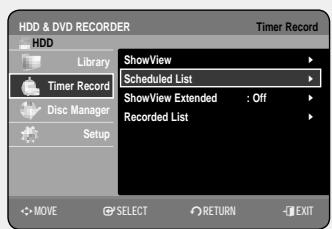
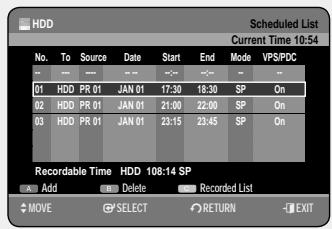
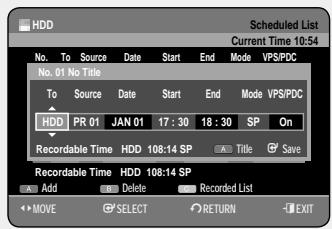
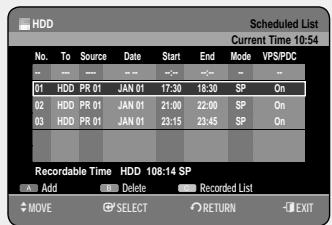
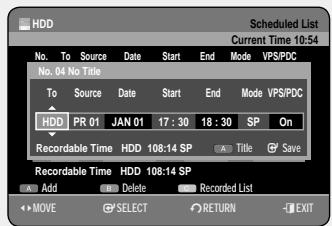
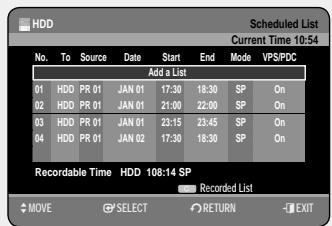
Editing the Scheduled List
Follow these directions to edit the Scheduled List.

Using the TIMER button
- With the unit in Stop mode/Playback mode, press the TIMER button.
- Press the OK or button to select Scheduled List.
- Press the buttons to select the number of the Scheduled List you want to edit, then press the OK button.
- Edit the items you want to modify. See the "Making a Timer Recording" section for more information on Timer Recording Input items. (See pages 70-71)
- Press the OK button to confirm the edited setting.
- Press the EXIT (①) button after finishing the operation. The Scheduled List screen will disappear.
Adding a Scheduled List
Follow these directions to add an entry from the Scheduled List.

Using the TIMER button
- With the unit in Stop mode/Playback mode, press the TIMER button.
- Press the OK or ▶ button to select Scheduled List.
- Press the ▲▼ buttons to select the number of the Scheduled List, then press the RED(A) button.
- Set the items you want to add. See the "Making a Timer Recording" section for more information on Timer Recording Input items. (See pages 70-71)
- Press the OK button to confirm the added setting.
- Press the EXIT (①) button after finishing the operation. The Scheduled List screen will disappear.
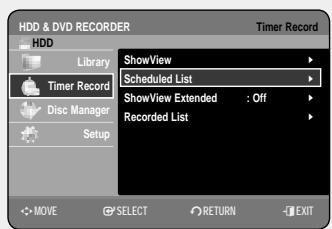
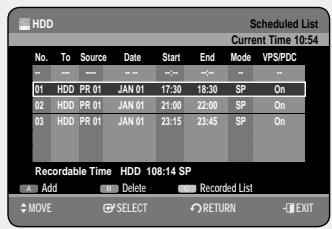
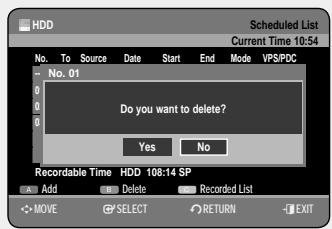
Deleting a Scheduled List


Follow these directions to delete an entry from the Scheduled List.

Using the TIMER button
- With the unit in Stop mode/Playback mode, press the TIMER button.
- Press the OK or ▶ button to select Scheduled List.
- Press the ▲▼ buttons to select the number of the Scheduled List you want to delete, and then press the GREEN(B) button.
- You will be prompted with the delete confirm message such as "Do you want to delete?".
- Press the ◀▶ buttons to select Yes, then press the OK button.
- The selected entry will be deleted from the list.
- Press the EXIT (①) button after finishing the operation. The Scheduled List screen will disappear.
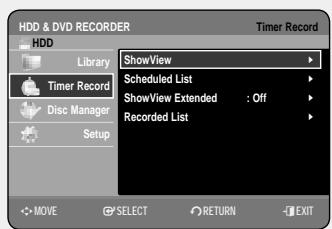
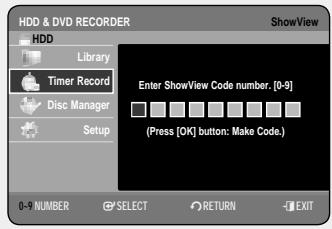
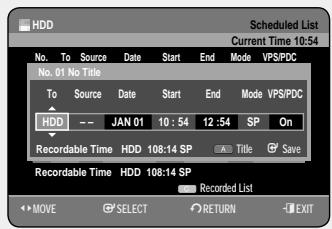
Using the ShowView Feature

Before presetting your HDD & DVD REORDER.
- Switch on both the television and your HDD & DVD REORDER.
- Check that the date and time are correct.
Up to twelve programmes can be preset.
- With the unit in Stop mode, press the MENU button.
- Press the ▲▼ buttons to select Timer Record, then press the OK or ▶ button.
- Press the ▲▼ buttons to select ShowView, then press the OK or ▶ button.
- A message is displayed to allow you to enter the ShowView code.
- Press the number buttons to enter the code of the programme that you want to record in your television magazine.
- If you want to correct the ShowView code that you are entering:
- Press the left button until the digit to be corrected is cleared.
- Enter the correct digit.
- Press the OK button.
- The information concerning the programme is displayed.
- When using the ShowView function for the first time with stored stations, the programme number flashes. This one time, you must enter the PR number manually by pressing the up/down buttons.
- Press the RED(A) button if you do not want to use the default title name.
The rename screen is displayed.
Follow steps 4 and 5 of "Renaming (Labeling) a Title" on page 77.
- If the programme and times are correct, press the OK button.
- Turn the power off by pressing the STANDBY/ON button to activate the timer recording setting.
Refer to pages 73, 75 if you want to: check whether the timer recording has been set correctly, or cancel a preset recording.

- The numbers next to each TV programme listing in the magazines or newspapers are ShowView code numbers, which allow you to programme your HDD & DVD RECORDER instantly with the remote control. Enter the ShowView code for the programme you wish to record. ShowView is a trademark of Gemstar Development Corporation. The ShowView system is manufactured under licence from Gemstar Development Corporation.
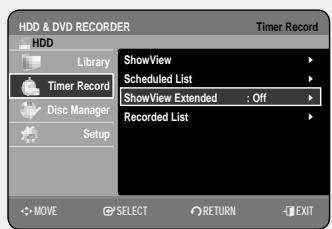
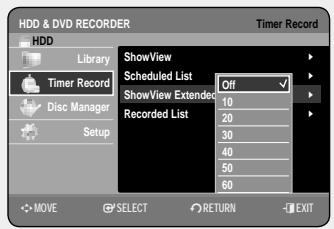
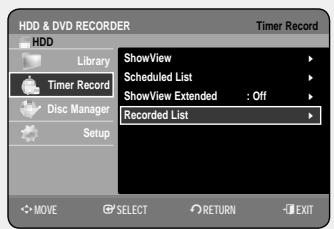
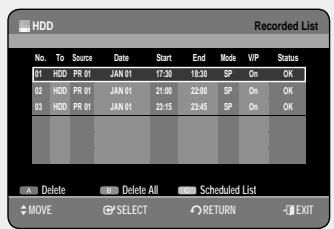
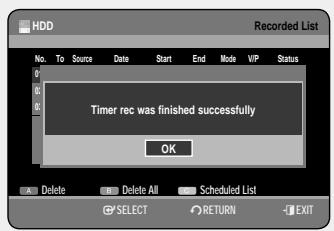
ShowView Extended
To prevent delays or overruns, the HDD & DVD RECORDER has a function called ShowView Extended, allowing you to extend the recording time by up to 60 minutes.
- Only use if PDC is not available or set to OFF.
- With the unit in Stop mode, press the MENU button.
- Press the ▲▼ buttons to select Timer Record, then press the OK or ▶ button.
- Press the ▲▼ buttons to select ShowView Extended, then press the OK or ▶ button.
- Press the ▲▼ buttons to select the ShowView Extended time, then press the OK or ▶ button.
- Press the EXIT (⑨) button to exit the menu.
Go To Recorded List


You can confirm the performance results of title lists that have passed the reserved recording time.

Using the TIMER button
- With the unit in Stop mode/Playback mode, press the TIMER button.
- Press the button to select Recorded List, then press the OK or button.
- Press the EXIT (1) button after finishing the operation. The Recorded List screen will disappear.
Information about Recorded List
Informs whether the selected Recorded List performed a Timer Recording successfully.
3-1. Press the buttons to select the number of the Recorded List, then press the OK button.
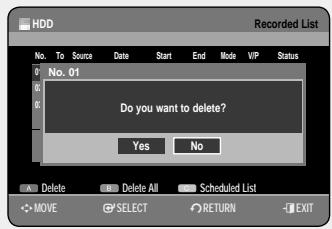
Delete Recorded List
Deletes a Recorded List individually.
3-1. Press the buttons to select the number of the Recorded List you want to delete, and then press the RED(A) button. 4. Press the buttons to select Yes, then press the OK button.
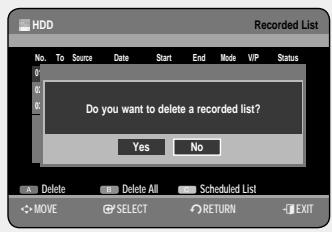
Clear Recorded List
Cleared all Recorded List at once.
- Press the GREEN(B) button.
- Press the ◀ ▶ buttons to select Yes, then press the OK button.
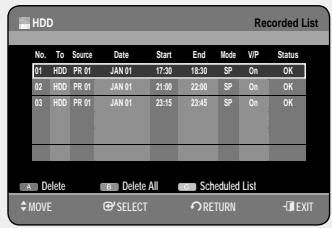
Go to Scheduled List
Switches directly from the Recorded List to the Scheduled List.
3-1. Press the YELLOW(C) button.
This section introduces basic functions of editing and explains both edit functions for the recording on a disc and edit functions for the entire disc.
Recording or editing might not be completed if an error, such as a sudden power failure occurs. Please be aware that a material that has been damaged is unable to be retrieved to its original content.

Basic Editing (Title List)
Playing the Title


Follow these instructions to play back a scene from the Title List.

Using the TITLE LIST button
- With the unit in Stop mode/Playback mode, press the TITLE LIST button.
- Press the ▲▼ buttons to select an entry you want to play from Title List, then press the OK or PLAY (▶) button. The selected entry (title) will be played back.
- To stop title play, press the STOP(■) button. The screen returns to the Title List screen.
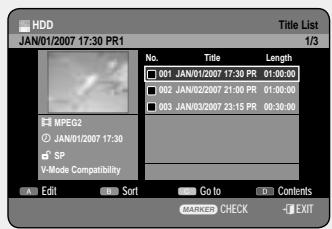
Renaming (Labeling) a Title


Follow these instructions to rename a title list entry, i.e., to edit the title of a recorded programme.

Using the TITLE LIST button
- With the unit in Stop mode/Playback mode, press the TITLE LIST button.
- Press the ▲▼ buttons to select an entry you want to rename from the Title List, then press the RED(A) button.
- Press the ▲▼ buttons to select Rename, then press the OK or button. The Rename screen is displayed.
- Select the desired characters using the ▲▼◀▶ buttons, press the OK button.
- Back Space (RED(A) button): Deletes and moves the cursor backwards by one position.
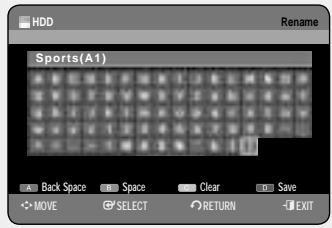
- Space (GREEN(B) button): Enters a blank and moves the cursor one forward (to the right).
- Clear (YELLOW(C) button): Deletes all the character inputs.
- Save (BLUE(D) button): Registers the character inputs.
- Press the BLUE(D) button to select Save.
The changed title name is displayed on the title item of the selected entry.
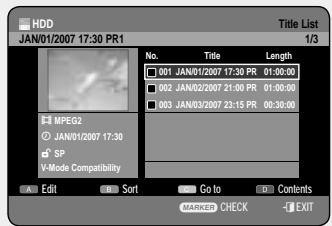
Locking (Protecting) a Title


Follow these instructions to lock an entry to protect it from accidental deletion.

Using the TITLE LIST button
- With the unit in Stop mode/Playback mode, press the TITLE LIST button.
- Press the ▲▼ buttons to select an entry you want to protect from the Title List, then press the MARKER button until a checkmark appears. Repeat this step to select an additional title you want to protect.
- If you don't want to protect a certain one of the checked entries, simply select that entry and press the MARKER to deselect it until a checkmark disappears.
- Press the RED(A) button to select Edit.
Edit menu is displayed.
- Press the ▲▼ buttons to select Protection, then press the OK or ▶ button.
- Press the ◀▶ buttons to select On, then press the OK button. The key icon on the information window for the selected entry changes to the locked status. (A→B)
- If you want to cancel the Protection, select Off in step 5 and press the OK button. The key icon changes to the unlocked status.
(→)

If you select "Select All" in the Edit menu, all titles will be checked.
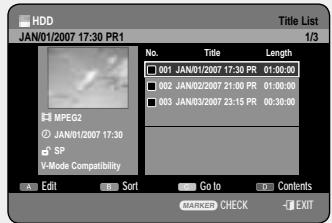
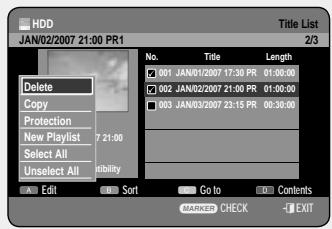
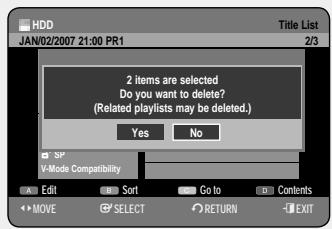
Deleting a Title


Follow these instructions to delete an entry from the Title List.

Using the TITLE LIST button
- With the unit in Stop mode/Playback mode, press the TITLE LIST button.
- Press the ▲▼ buttons to select an entry you want to delete in the Title List, then press the MARKER button until a checkmark appears. Repeat this step to select an additional title you want to delete.
- If you don't want to delete a certain one of the checked entries, simply select that entry and press the MARKER to deselect it until a checkmark disappears.
- Press the RED(A) button to select Edit.
Edit menu is displayed.
- Press the ▲▼ buttons to select Delete, then press the OK or button.
- The message may be different depending on the type of disc. You will be prompted with the confirmation message.
HDD, DVD-RAM (VR mode), DVD-RW (VR mode): If a Playlist is present, the message "Do you want to delete? (Related playlists may be deleted.)" is displayed.
DVD-RW (V mode)/+RW/±R: If a Playlist is not present, the message "Do you want to delete?" is displayed.
- Press the ◀▶ buttons to select Yes, then press the OK button.

- You cannot delete a protected entry. If you want to delete a protected entry, select "Off" in the Title Protection menu. (See page 78)
- When the Disc Protection has been set to Protected, you cannot delete titles. (See page 95)
- Once an entry is deleted from the Title List it cannot be recovered. Once DVD-RW/±R is finalised, it cannot be deleted.
- With DVD±R, titles are only deleted from the menu, however, the Title remains physically on the disc. If you select "Select All" in the Edit menu, all titles will be checked.
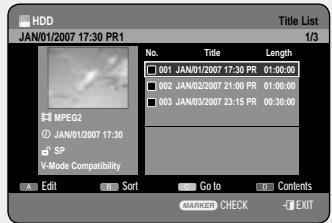
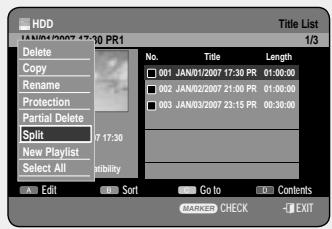
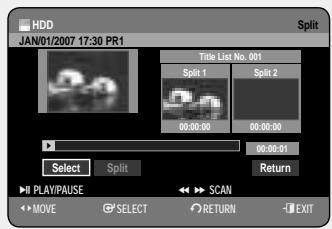
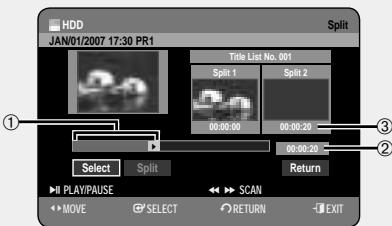
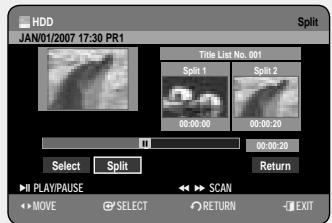
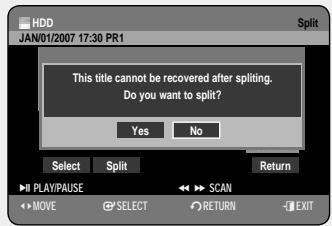
Splitting a Section of a Title (Split)


Follow these instructions to split a section of a Title List entry into two titles.

Using the TITLE LIST button
- With the unit in Stop mode/Playback mode, press the TITLE LIST button.
- Press the ▲▼ buttons to select an entry you want to Split from the Title List, then press the RED (A) button. The Edit menu is displayed.
- Press the ▲▼ buttons to select Split, then press the OK or button.
- Using the playback-related buttons (PLAY (▶), SEARCH (▶▶)), move to a point for splitting and press the OK button. If it is not the point where you want to split, press the RETURN button to cancel the selection. Using the playback-related buttons, move to a point to split and press the OK button.
① First split interval ② Current playtime ③ Start time of the second split and its screen
- Press the OK button to select Split.
- Press the ◀ buttons to select Yes, then press the OK button. The split title is divided into two, and the following titles will be shifted down by one.
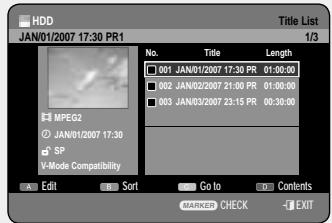
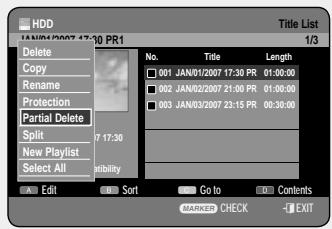
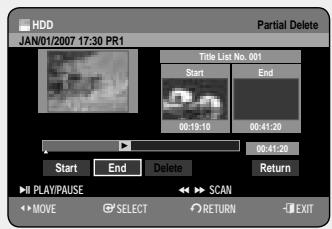
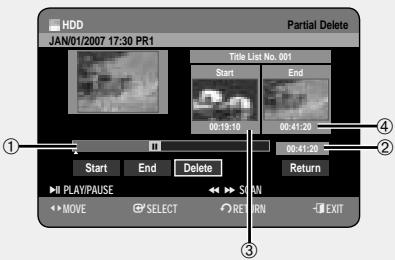
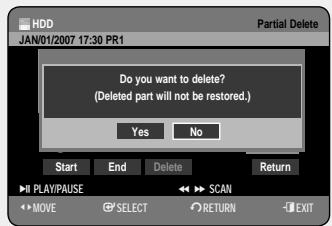
Deleting a Section of a Title (Partial Delete)


(VR mode)
Follow these instructions to delete a section of a Title List entry.

Using the TITLE LIST button
- With the unit in Stop mode/Playback mode, press the TITLE LIST button.
- Press the ▲▼ buttons to select an entry you want to edit from the Title List, then press the RED(A) button.
The Edit menu is displayed.
- Press the ▲▼ buttons to select Partial Delete, then press the OK or ▶ button.
- Press the OK button at the starting point.
The image and starting point time is displayed in the section deletion starting point window.
Partial Delete List Screen Elements
① Playback bar ② Playtime ③ Section deletion starting point window and time ④ Section deletion end point window and time
- Select the start and end points of the section you want to delete using the playback related buttons.
- Playback related buttons: (PLAY (⊙), SEARCH (⊙⊙)).
- Press the OK button at the end point.
The image and end point time is displayed in the Section deletion ending point window.
- Press the ◀ or ▶ buttons to select Delete, then press the OK button.
- Press the ◀ or ▶ buttons to select Yes, then press the OK button.
The selected section has been deleted.
- Press the ◀ or ▶ buttons to select Return, then press the OK button to finish the operation.

- The length of the section to be deleted must be at least 5 seconds long. End point cannot be marked earlier than start point. The section cannot be deleted when it includes a still picture.
- Press the EXIT (①) button after the operation has finished. The Title List screen will disappear.
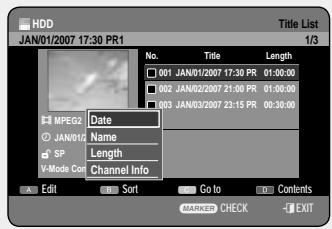
Using the Sort function (Title List)

When you need to change the Sort order of Title List, you can change it simply.
- While the list menu is displayed, press the GREEN(B) button to select Sort.
- Press the ▲▼ buttons to select the desired item, then press the OK or ▶ button.
- Date: In order of when the titles were recorded.
- Name: In alphabetical order. Length: In order of recorded title length.
- Channel Info: In order of channel information.

- You can sort by Date, Name, Length, or Channel info. The sorted list will be resorted in copied order upon re-entering the Title List.
Navigation Menu
Time Navigation

(VR mode)
Using this function, you can search scene by minute from the recorded title list.

Using the TITLE LIST button
- With the unit in Stop mode or Playback mode, press the TITLE LIST button.
- Press the ▲▼ buttons to select an entry you want to play from the Title List, then press the YELLOW (C) button.
- Press the ▲▼ buttons to select Time Navigation, then press the OK or ▶ button.
- Press the ◀ or ▶ buttons to skip one minute at a time and search the desired scene, then press the OK or PLAY (▶) button.

- Cursor does not move if the selected recorded title is shorter than 1 minute.
- The Navigation function may not work on a disc that has not been recorded by this device. An edited title may not display the exact search time.
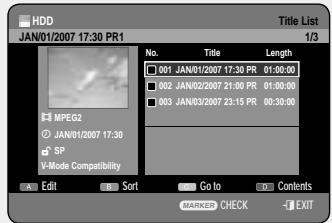
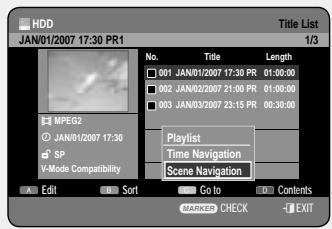
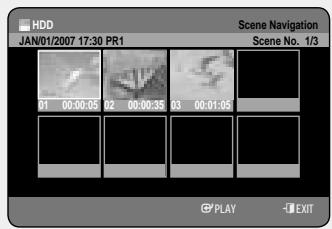
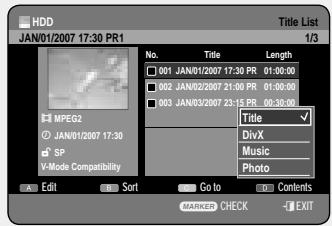
Scene Navigation
If there is a title composed of markers (See page 49), you can search the desired scene using the Scene Navigation.
Using the TITLE LIST button
- With the unit in Stop mode/Playback mode, press the TITLE LIST button.
- Press the ▲▼ buttons to select an entry you want to play from Title List, then press the YELLOW(C) button.
- Press the ▲▼ buttons to select Scene Navigation, then press the OK or ▶ button.
- Press the ▲▼◀▶ buttons to select desired scene, then press the OK or PLAY (▶) button.
- Scene Navigation will not operate if a selected title does not have Markers.
Select Contents


- Press the BLUE(D) button to select Contents.
- Press the up/down buttons to select the contents you want to move, then press OK or the right button.

This function is possible only when the disc contains the selected contents.
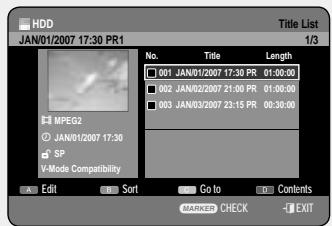
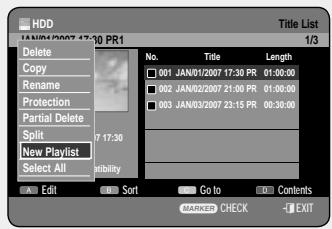
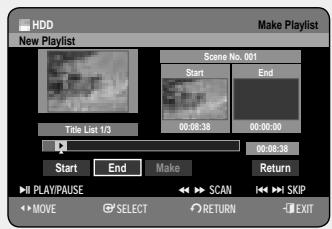
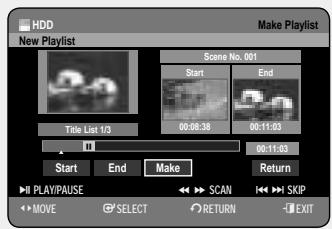
Advanced Editing (Playlist)
Creating a Playlist


(VR mode)
Follow these instructions to create a new playlist entry from a recorded title.

Using the TITLE LIST button
- With the unit in Stop mode/Playback mode, press the TITLE LIST button.
- Press the RED(A) button.
The Edit menu is displayed.
- Press the up/down buttons to select New Playlist, then press OK or the right button.
The Make Playlist screen is displayed.
- Press the OK button at the start point.
- The image and time at the start point is displayed on the Start window.
- The yellow-coloured selection bar moves to the End item.
- Select the starting point of the section from which you want to create a new scene using the playback related buttons (PLAY () , SEARCH ( ) , SKIP ( ) ).
- Press the OK button at the end point.
- The image and end point time is displayed in the End window.
- The yellow-coloured selection bar moves to the Make item.
- Press the buttons to select Make, then press the OK button.
- To make a scene for the playlist.
A new Make scene screen is displayed. Repeat steps 4~6 to make a new scene for the playlist.
A new scene will be added to the current playlist.
You can check and see all the scenes on the Edit playlist screen. (See page 86)
- To make a new playlist.
Repeat steps 1~6 if you want to make a new playlist.
- Press the ◀ button to select Return, then press the OK button to finish the operation.

- You can create up to 99 playlist entries. Depending on the kind of disc, the displayed screen may have a slight difference.
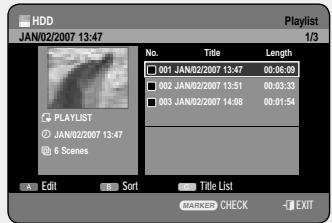
Playing Entries in the Playlist


(VR mode)
Follow these instructions to play the playlist entries.

Using the PLAY LIST button
- With the unit in Stop mode/Playback mode, press the PLAY LIST button.
- Press the ▲▼ buttons to select the playlist you want to play, then press the OK or PLAY (▶) button.
- Press the STOP (■) button to stop playing. The screen returns to the Playlist screen.
Renaming a Playlist Entry
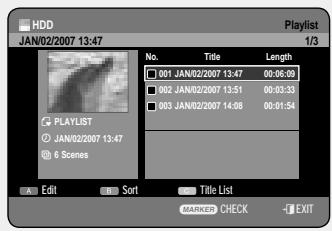
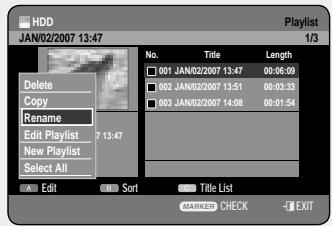
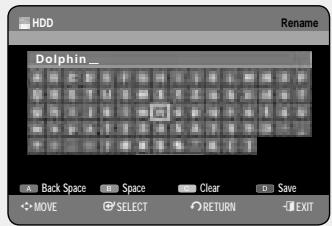


(VR mode)
Follow these instructions to rename a playlist entry, i.e., to edit the title of a playlist entry.

Using the PLAY LIST button
- With the unit in Stop mode/Playback mode, press the PLAY LIST button.
- Press the buttons to select the title you want to rename from the playlist, then press the RED(A) button. The Edit menu is displayed.
- Press the buttons to select Rename, then press the OK or button. The Rename screen is displayed.
- Select the desired characters using the buttons, then press the OK button.
- Back Space (RED(A) button): Deletes and moves the cursor backwards by one position.
- Space (GREEN(B) button): Enters a blank and moves the cursor one forward (to the right).
- Clear (YELLOW(C) button): Deletes all the character inputs.
- Save (BLUE(D) button): Registers the character inputs.
- Press the BLUE(D) button to select Save.
The changed title is displayed in the title field of the selected playlist entry.
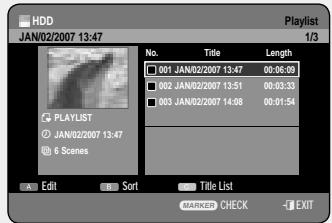
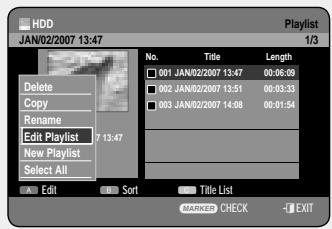
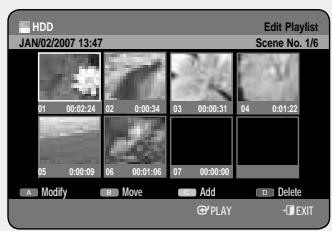
Editing a Scene for the Playlist


(VR mode)
Follow these instructions to edit scenes for a playlist.

Using the PLAY LIST button
- With the unit in Stop mode/Playback mode, press the PLAY LIST button.
- Press the triangle/nabla buttons to select the title you want to edit from the Playlist, then press the RED(A) button.
The Edit menu is displayed.
- Press the triangle/nabla buttons to select Edit Playlist, then press the OK or button.
The Edit Playlist screen is displayed.
Playing a Selected Scene
- Press the triangle/nabla/triangleleft buttons to select the scene you want to play, then press the OK or PLAY ( ) button. The selected scene is played.
- To stop scene play, press the STOP (●) button.
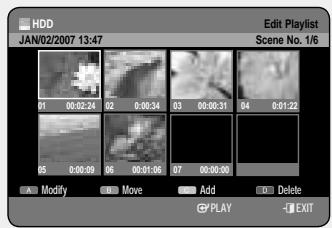
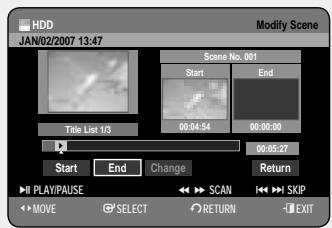
Modifying a Scene (Replacing a Scene)
To set up, follow steps 1 to 3.
4.1. Press the ▲▼◀▶ buttons to select the scene you want to modify, then press the RED (A) button.
The Modify Scene screen is displayed.
- Press the OK button at the start point of the scene.
- The image and starting point time are displayed in the Start window.
- Select the starting or ending point of the section you want to modify using the playback-related buttons (PLAY (▶), SEARCH (◀), SKIP (▶|)).
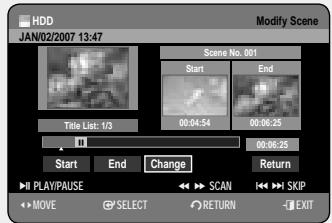
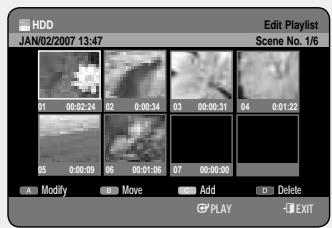
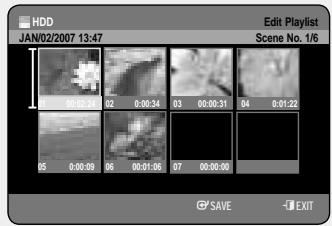
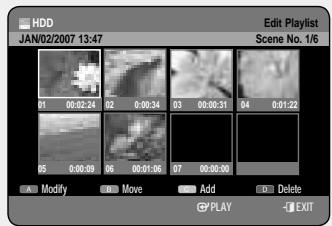
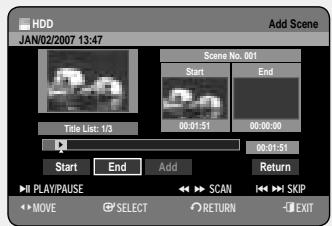
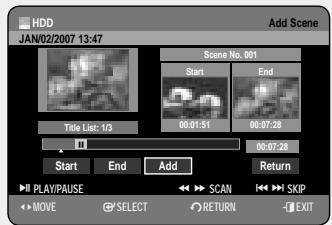
- Press the OK button at the end point of the scene.
- The image and ending point time are displayed in the End window.
- Press the ◀▶ buttons to select Change, then press the OK button.
- The scene you want to modify is changed with the selected section.
Moving a Scene (Changing the Position of a Scene)
To set up, follow steps 1 to 3 on page 86.
4-1. Press the ▲▼◀▶ buttons to select the scene you want to move (change the position), then press the GREEN (B) button. A yellow selection window is displayed on the scene to be moved. 5. Press the ▲▼◀▶ buttons to select the position to which you want to move the selected scene, then select the OK button.

- You cannot move the selected scene to the position of the next scene, because the selected scene should be inserted before that position, which requires no action. Depending on the kind of disc, the displayed screen may have a slight difference.
Adding a Scene
To set up, follow steps 1 to 3 on page 86.
4-1. Press the ▲▼◀▶ buttons to select the scene that will have a new scene inserted before it, then press the YELLOW (C) button. The Add Scene screen is displayed. 5. Press the OK button at the starting point of the scene.
- The image and starting point time are displayed on the Start window.
- Select the starting or ending point of the section you want to modify using the playback related buttons (PLAY (▶), SEARCH (⏮⏭), SKIP (⏮⏭)).
- Press the OK button at the end point of the scene.
- The image and end point time are displayed in the End window.
- To cancel, press the ◀ buttons to select Return, then press the OK button.
- Press the ◀▶ buttons to select Add, then press the OK button.
- The section you want to add is inserted prior to the scene selected in step 4-1 of Adding a Scene.
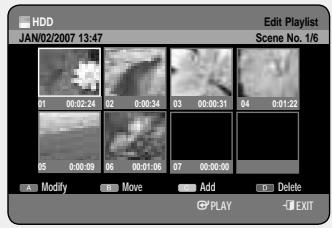
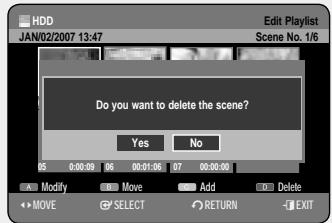
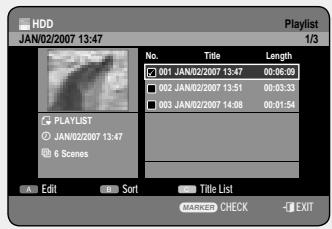
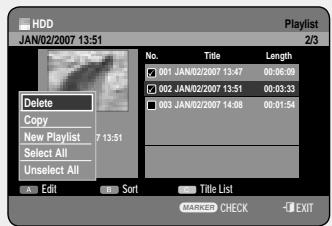
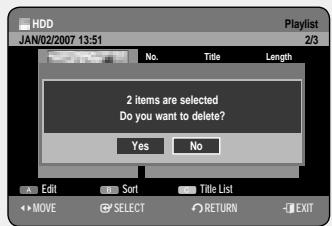
Deleting a Scene
To setup, follow steps 1 to 3 on page 86.
4-1. Press the ▲▼◀▶ buttons to select the scene you want to delete, then press the BLUE(D) button.
- The message "Do you want to delete the scene?" is displayed.
- Press the ◀▶ buttons to select Yes, then press OK to delete the selected scene.
Deleting a Playlist Entry from the Playlist

Using the PLAY LIST button
- With the unit in Stop mode/Playback mode, press the PLAY LIST button.
- Press the up/down buttons to select an entry you want to delete in the Playlist, then press the MARKER button until a checkmark appears. Repeat this step to select an additional title you want to delete.
- If you don't want to delete a certain one of the checked entries, simply select that entry and press the MARKER button to deselect it until a checkmark disappears.
- Press the RED(A) button to select Edit.
Edit menu is displayed.
- Press the up/down buttons to select Delete, then press the OK or right button.
- You will be prompted with the delete confirmation message "Do you want to delete?".
- Press the left/right buttons to select Yes, then press the OK button. You will be automatically returned to the Playlist screen after the delete operation has finished.

- If you select "Select All" in the Edit menu, all titles will be checked.
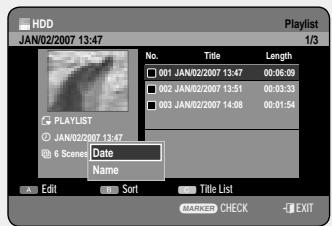
Using the Sort (Playlist)
When you need to change the Sort order of Playlist, you can change it simply.
- While the list menu is displayed, press the GREEN(B) button to select Sort.
- Press the up/down buttons to select the desired item, then press the OK or right button.
- Date: In order of when the playlists were created
- Name: In alphabetical order

- You can sort by Date, Name. Sorted list will be resorted in copied order upon reentering Playlist.
Copying from HDD to DVD
About the Copy Screen
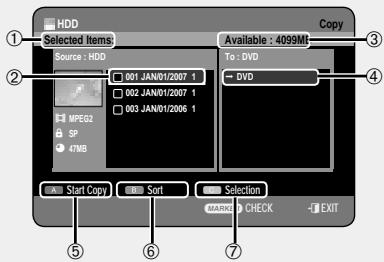
① Total size and number of selected titles for copying ② Title to be copied ③ This shows available disc space ④ The location where the copied files are stored ⑤ Copy start button ⑥ Sort button (Date, Name, Length, Channel Info) ⑦ Selection button
- Select All : All entries in the current folder will be checked.
- Unselect All : All checked entries will be unchecked.
Contents Copy Specifications
| Contents | HDD → DVD |
| Recorded Video Title | Supported |
| Copy Protected Title | Not supported |
| Copy Once Title | Move (Deletes the Title in the HDD after copying) |
The Copy is possible only with CPRM-Compatible disc.
Once "Copy Once programme" has been recorded on the DVD disc, this title cannot be copied to HDD anymore.
But "Copy Once programme" has been recorded on the HDD, this title can be copied to DVD-RW(VR mode) or DVD-RAM.

Using the TITLE LIST button
- Press the OPEN/CLOSE button and place a recordable disc on the disc tray.
- Press the OPEN/CLOSE button to close the disc tray. Wait until LOAD disappears from the front panel display. Check that the disc has enough available space for the recording.
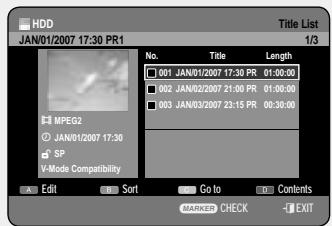
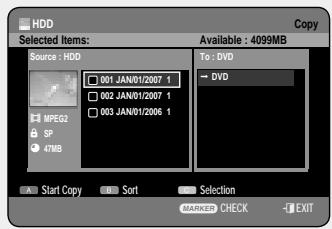
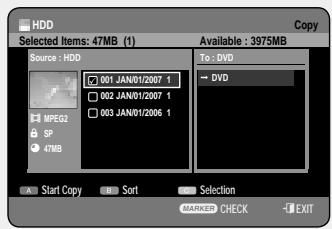
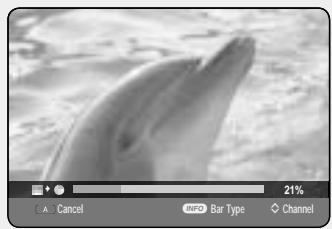
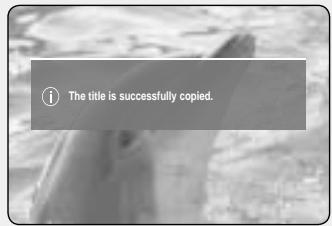
- Select the HDD by pressing the HDD button on the front panel of the HDD & DVD REORDER or on the remote control.
- With the unit in Stop mode/Playback mode, press the TITLE LIST button.
- Press the COPY button. Copy screen is displayed.
- During Playback, you can also copy the title by pressing the COPY button.
- Press the buttons to select the title you want to copy, then press the MARKER button until a checkmark appears.
Repeat this step to select an additional title you want to copy.
- If you don't want to copy a certain one of the checked entries, simply select that entry and press MARKER button to deselect it until a checkmark disappears.
- Press the RED(A) button to select Start Copy.
- The title to be copied is not displayed on the screen, and copying begins while the currently broadcasting programme is displayed on the screen.
- Press the INFO button to change the copy processing bar. If you press INFO button again, copy processing bar will be appeared.
- To cancel the copying in progress, press the RED(A) button.
- After a successful copy, "The title is successfully copied" message is displayed.
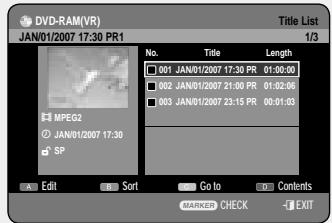
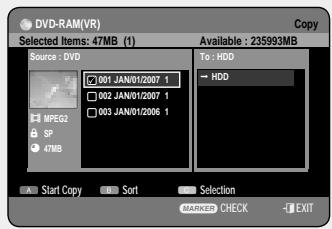
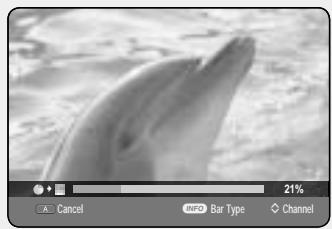
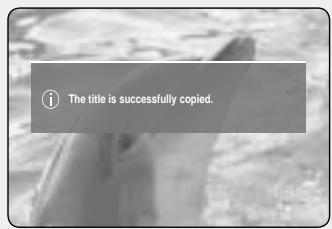
Copying from DVD to HDD

Using the TITLE LIST button
- Press the OPEN/CLOSE button and place a recorded disc on the disc tray.
- Press the OPEN/CLOSE button to close the disc tray.
- With the unit in Stop mode/Playback mode, press the TITLE LIST button.
- Press the COPY button. Copy screen is displayed.
- During playback, you can also copy the title by pressing the COPY button.
- Press the triangle/nabla buttons to select the title you want to copy, then press the MARKER button until a checkmark appears. Repeat this step to select an additional title you want to copy.
- If you don't want to copy a certain one of the checked entries, simply select that entry and press the MARKER button to deselect it until the checkmark disappears.
- Press the RED(A) button to select Start Copy.
- Press the INFO button to change the copy processing bar. If you press the INFO button again, the copy processing bar will appear.
- To cancel the copying in progress, press the RED(A) button.
- After a successful copy, the message "The title is successfully copied." is displayed.

- You cannot copy anything else on finalised DVD±R and DVD-RW(V mode) mode.
- You cannot copy a DVD-VIDEO to HDD.
Contents Copy Specifications
| Contents | DVD → HDD |
| Recorded Video Title | Supported |
| Copy Protected Title | Not supported |
| Copy Once Title | Not supported |
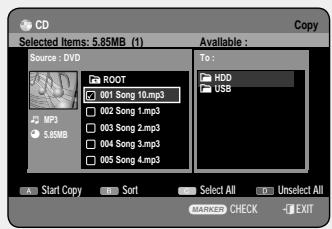
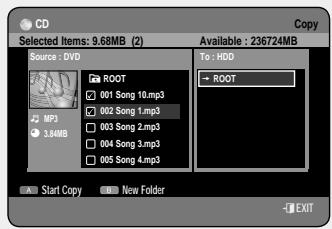
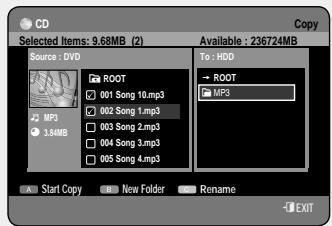
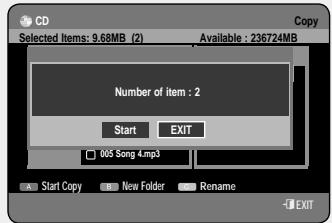
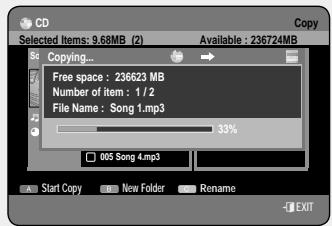
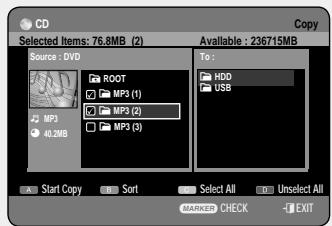
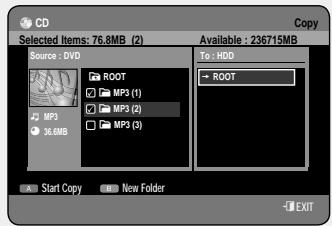
Copying MP3, JPEG or DivX
When you copy MP3/JPEG/DivX files from HDD to DVD, only DVD-RW(V)/-R discs are available.
File Copy
- Insert a JPEG disc, MP3 disc or DivX disc into the disc tray.
- Press the OPEN/CLOSE button to close the disc tray. Wait until LOAD disappears from the front panel display. Check that the disc has enough available space for the recording.
- Press the triangle and nabla buttons to select Library, then press the OK or button.
- Press the triangle and nabla buttons to select Music, Photo or DivX, then press the OK or right-pointing triangle button.
- Press the COPY button. Copy screen is displayed.
- Press the triangle and nabla buttons to select the MP3, Photo or DivX file you want to copy, then press the MARKER button until a checkmark appears.
- If you don't want to copy a certain one of the checked entries, simply select that entry and press MARKER button to deselect it until a checkmark disappears.
- Press the ▶ △ ▽ buttons to select the target media, then press the OK or ▶ button.
- You can create a new folder by pressing the GREEN(B) button.
- Press the RED(A) button to select Start Copy.
The message "Number of item : x" is displayed.
- Press the ◀ buttons to select Start, then press the OK button. File copy begins.
- To cancel the copying in progress, press the EXIT (▶) button.
Folder Copy
- Insert a Disc (JPEG, MP3 or DivX) into the tray.
- Press the △ ▽ buttons to select Library, then press the OK or ▶ button.
- Press the △ ▽ buttons to select Music, Photo or DivX then press the OK or ▶ button.
MP3, JPEG or DivX folder is displayed.
- Press the COPY button. Copy screen is displayed.
- Press the ▲▼ buttons to select the folder you want to copy, then press the MARKER button until a checkmark appears.
- If you don't want to copy a certain one of the checked folders, simply select that entry and press MARKER button to deselect it until a checkmark disappears.
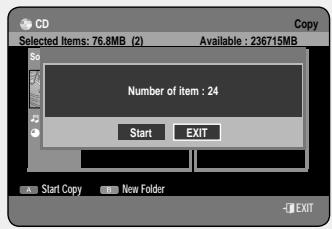
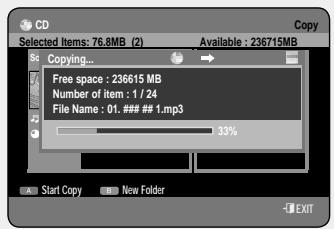
- Press the ▶▲▼ buttons to select the target media, then press the OK or button.
- You can create a new folder by pressing the GREEN(B) button.
- Press the RED(A) button to select Start Copy.
The message "Number of item : x" is displayed.
- Press the ◀ buttons to select Start, then press the OK button.
Folder copy begins.
Subfolders and files in the selected folder are copied.
- To cancel the copying in progress, press the EXIT (▶) button.

- Pressing the EXIT (④) button during folder copying will cancel the folder copying after the current file is copied.
- You can copy up to 500 including files and subfolders to one folder. [MP3, JPEG, DivX]
- If you want to file copy, you should create a new folder before starting a copy.
You cannot copy to top-level (ROOT) folder directly without creating a new folder.
- If the top-level (ROOT) folder has already 500 including folders, you should delete one or more items before you can create a new folder.
- Files having an existing name of ***.mp3/**.jpg, are automatically renamed to ***01.mp3/**01.jpg and copied.
- It allows up to 999 copies to have the same name.
- You cannot copy an Audio CD.
- File size on a disc and the copied file in the HDD may be slightly different due to the file system.
- If you check some entries in the current folder and move to open a different folder, those entries are automatically unchecked and excluded from the selection list.
Contents Copy Specifications
| Contents | HDD→DVD or USB | DVD → HDD or USB | USB → HDD or DVD |
| MP3 | Supported | Supported | Supported |
| JPEGphoto) | Supported | Supported | Supported |
| DivX | Supported | Supported | Supported |
- Disc (CD-R/CD-RW/DVD-RAM/DVD±R (Finalised)/DVD+RW/DVD-RW (Finalised)) → HDD or USB
- HDD → DVD-R, DVD-RW (V) or USB
- USB → HDD or DVD-R, DVD-RW (V)
- The disc that has Video recording or has title dubbing from HDD cannot be copied.
- PTP USB is not available when you copy to USB.
- If the disc is finalised through Disc Manager, it can be compatible with PC as a disc with a UDF file system.
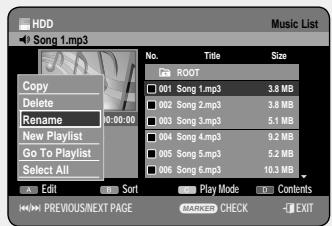
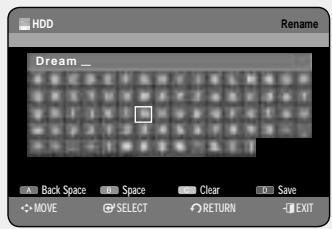
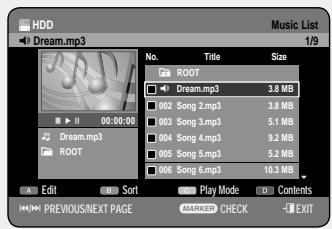
Changing the name of Music/Photo/DivX file

You can rename a Music, Photo or DivX file copied to HDD.
- Press the ▲▼ buttons to select the entry you want to rename, then press the RED (A) button.
- Press the ▲▼ buttons to select Rename, then press the OK or button.
Rename Screen is displayed.
- Select the desired characters using the ▲▼◀▶ buttons, then press the OK button.
Back Space (RED (A) button): Deletes and moves the cursor backwards by one position.
Space (GREEN (B) button): Enters a blank and moves the cursor one forward (to the right).
Clear (YELLOW(C) button): deletes all the character inputs.
Save (BLUE(D) button): Registers the character inputs.
- Press the BLUE(D) button to select Save.
The changed file name is displayed on the selected entry.
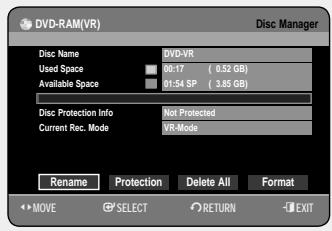
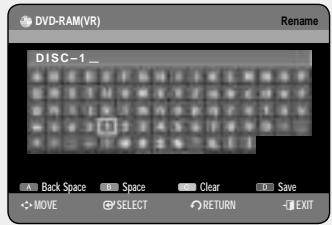
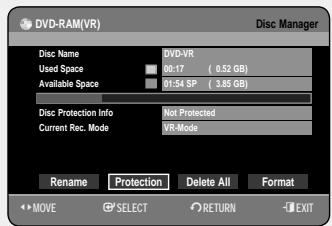
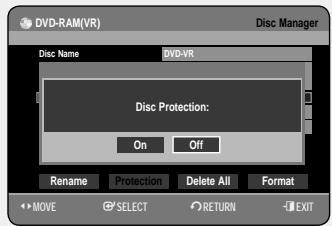
Disc Manager
Editing the Disc Name


Follow these instructions to give a name to a disc.
- With the unit in Stop mode, press the MENU button.
- Press the triangle/nabla buttons to select Disc Manager, then press the OK or right arrow button.
- Press the left arrow buttons to select Rename, then press the OK button. The Rename screen is displayed.
- Select the desired characters using the triangle/nabla/left arrow buttons, then press the OK button.
- Press the BLUE(D) button to select Save. A disc name is given to the disc.

- You may need to clear Disc Protection before beginning editing. Depending on the kind of disc, the displayed screen may be different.
Disc Protection


Disc Protection allows you to protect your discs from being formatted or deleted due to unintended operations.
- With the unit in Stop mode, press the MENU button.
- Press the △ ▽ buttons to select Disc Manager, then press the OK or ▸ button.
- Press the ◀ buttons to select Protection, then press the OK button.
- Press the ◀ buttons to select On, then press the OK button.
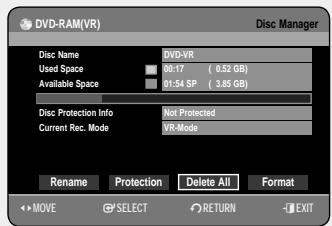
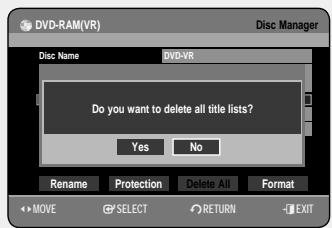
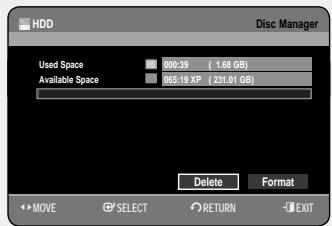
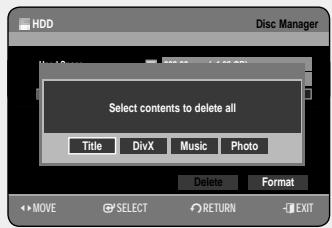
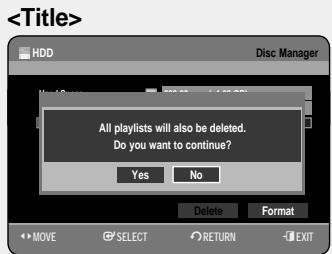


- With the unit in Stop mode, press the MENU button.
- Press the △ ▽ buttons to select Disc Manager, then press the OK or ▸ button.
- Press the △ ▽ ◀ buttons to select Delete All, then press the OK button.
- You will be prompted with the confirmation message "Do you want to delete all title lists?"
- When Protected Entry exists: The Delete All Title List function will not operate. If there is a title containing a still picture, however, that function will not operate.
- If you want to delete a protected entry, disable Protect for it on the Lock item.
- When protected a DVD-RAM/-RW is used, data cannot be deleted from a disc.
- If you select Yes, you will be prompted with the confirmation message "All playlists will also be deleted. Do you want to continue?"
- Press the left/right buttons to select Yes, then press the OK button. All title lists are deleted.
Delete All Title Lists/DivX Lists/Music Lists/Photo Lists

- With the unit in Stop mode, press the MENU button.
- Press the up/down buttons to select Disc Manager, then press the OK or right button.
- Press the left/right buttons to select Delete, then press the OK button.
- When Protected Entry exists: The Delete All Title List function will not operate. If there is a title containing a still picture, however, that function will not operate. If you want to delete a protected entry, disable Protect for it on the Lock item.
- Press the left/right buttons to select the Title, DivX, Music or Photo, then press the OK button.
- Press the left/right buttons to select Yes, then press the OK button. All title lists, DivX lists, music lists or photo lists are deleted.

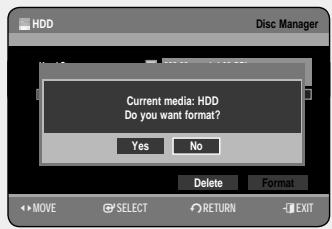
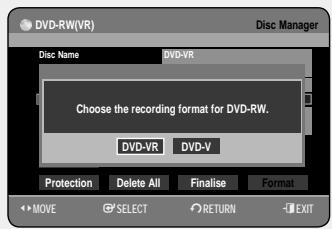
Formatting a Disc


Use these instructions to format a disc.
The disc protect should also be cleared.
- With the unit in Stop mode, press the MENU button.
- Press the △ ▽ buttons to select Disc Manager, then press the OK or ▸ button.
- Press the ◁ buttons to select Format, then press the OK button.
HDD/DVD-RAM/+RW
- You will be prompted with the confirmation message "Current media:*** Do you want to format?"
- If you select Yes, you will be prompted with the confirmation message "All data will be deleted. Do you want to continue?"
DVD-RW
- You will be prompted with the confirmation message "Choose the recording format for DVD-RW."
- If you select the desired format type, you will be prompted with the confirmation message "All data will be deleted. Do you want to continue?"
- Press the ◁ buttons to select Yes, then press the OK button. The disc is formatted.
DVD-VR and DVD-V are defined according to their recording format.
| DVD-VR | DVD-V | |
| DISC | DVD-RAM/-RW | DVD-RW/DVD-R |
- With DVD+RW discs, there is no difference between DVD-Video format (Video mode) and DVD-Video Recording format (VR mode).
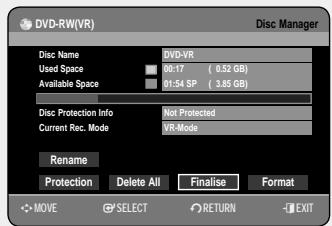
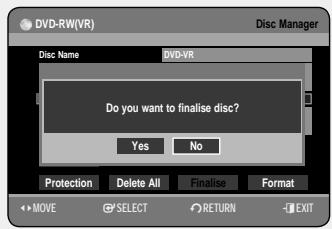
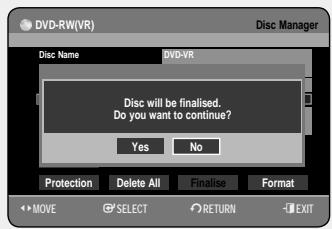
After you record titles onto a DVD-RW/±R disc with your HDD & DVD REORDER, it needs to be finalised before it can be played back on external devices.
- With the unit in Stop mode, press the MENU button.
- Press the ▲▼ buttons to select Disc Manager, then press the OK or ▶ button.
- Press the ▲▼◀ buttons to select Finalise, then press the OK button.
You will be prompted with the message "Do you want to finalise disc?"
- Press the ◀ buttons to select Yes, then press the OK button.
You will be prompted again with the message "Disc will be finalised. Do you want to continue?"
- Press the ◀ buttons to select Yes, then press the OK button.
The disc is finalised.

- Once a disc is finalised, you cannot delete entries from the record list.
- After being finalised, the DVD±R/-RW (video mode) operates in the same manner as a DVD-Video. Depending on the disc type, the displayed screen may be different.
- Finalising time may be different depending on the amount of data recorded on the disc.
- Data on the disc will be damaged if the recorder is powered off during finalisation process.
- You can finalise the disc automatically using EZ Record. (See page 32)
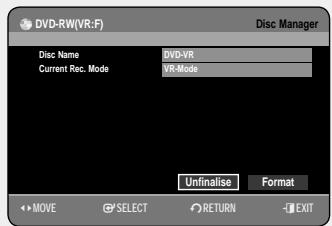
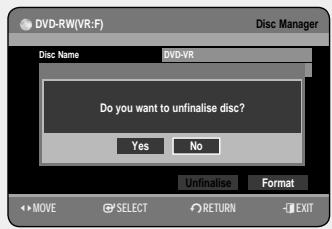
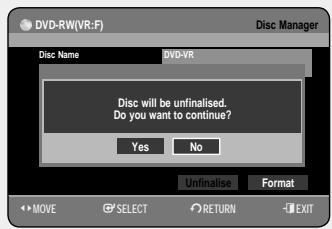
- With the unit in Stop mode, press the MENU button.
- Press the ▲▼ buttons to select Disc Manager, then press the OK or ▶ button.
- Press the ◀ ▶ buttons to select Unfinalise, then press the OK button.
You will be prompted with the message "Do you want to unfinalise disc?"
- Press the ◀ ▶ buttons to select Yes, then press the OK button. You will be prompted again with the message "Disc will be unfinalised. Do you want to continue?"
- Press the ◀ ▶ buttons to select Yes, then press the OK button. The disc is unfinalised.

A DVD-RW can be finalised or unfinalised in Video mode.
| Finalise | Unfinalise | |
| Mark | DVD-Video(RW) | DVD-RW(V) |
| Operation | Same as DVD-Video | Additional recording, protection and deletion are possible. |
A DVD-RW can be finalised or unfinalised in VR mode.
| Finalise | Unfinalise | |
| Mark | DVD-RW(VR:F) | DVD-RW(VR) |
| Operation | Additional recording, deletion, editing, and protection are impossible. | Additional recording, deletion, editing, and protection are possible. |
Troubleshooting
If your product malfunctions, go through the checkpoints below before contacting a Samsung authorised service centre.
Power
The input is displayed for a while when the power is turned on.
Checkpoint 1
The HDD & DVD REORDER requires some time to initialize and the input will be displayed for approx. 10 seconds after it is turned on.
Recording
Cannot record TV programmes.
Checkpoint 1
Check whether the power cord is securely plugged into the power outlet.
Did you set the HDD & DVD RECORDER channel settings correctly?
Check the free space on your HDD/DVD-RAM/±RW/±R discs.
I pressed the REC button but there is no response.
Check available disc type. (See page 60) If a programme is copy protected, it cannot be recorded.
Playback
Cannot play the disc.
Check whether the disc is inserted correctly with the label facing up.
Check the regional code of the DVD disc.
This HDD & DVD recorder cannot play some types of discs. (See pages 7, 40)
The icon appears on the screen.
Checkpoint 1
You cannot use this operation or function due to one of the following reasons:
(1) Your DVD disc restricts it. (2) Your DVD disc does not support this feature (for example: angles). (3) The feature is not available at the moment. (4) You've requested a title, chapter, or scan time that is out of range.
Play mode settings are different from the settings configured in the Settings menu.
Checkpoint 1
The disc does not support all selected functions. In this case, some settings configured in the settings menu may not work properly.
Cannot change the aspect ratio.
Checkpoint 1
The aspect ratio is fixed for DVD discs. (See page 35)
The angle operation does not work while playing a DVD disc.
Checkpoint 1
The angle operation is available only when the disc contains images captured from different angles.
The selected audio and/or subtitle language is not played.
Audio and subtitle languages are disc-specific. Only the sound and subtitle languages contained on the DVD disc are available and displayed in the disc menu.
Cannot copy title or file to the other mode.
DVD discs encoded with copy protection cannot be copied to HDD.
Refer to "Contents Copy Specifications" on page 6 to check if copying is supported.
Refer to "V-Mode Compatibility" on page 34 to check if copying is supported.
Video
The disc revolves, but no image or bad quality images are displayed.
Be sure that the Video Setting is properly set. (See pages 35~38)
Check whether there is damage to or any foreign material on your disc.
Some low quality discs may not play properly.
Checkpoint 4
If scenes change from dark to bright suddenly, the screen may shake vertically temporarily, but this is not a fault.
Sound
No sound.
Checkpoint 1
Are you watching a programme in slow or skip mode?
If you are playing a programme at a speed other than normal speed, sound will not be heard. (Except for forward search (X 2) in disc.)
Checkpoint 2
Check the connections and settings. (See pages 21-22, 33-34)
Checkpoint 3
Check whether the disc is damaged. Clean the disc, if necessary.
Checkpoint 4
Check whether the disc is inserted correctly with the label facing up.
No audio output.
Check whether you have selected the correct digital output options in the Audio Output Options menu.
(See pages 33~34)
Timer Recording
Timer lamp flickers.
Check there is enough space in the disc or HDD for recording.
Check whether the current disc is recordable or not.
Make sure to check before the start time of recording.
Timer recording does not work properly.
Re-check the recording time and the end time settings again.
Recording will be cancelled if the power is interrupted due to a power failure or another similar reason while recording.
USB
Cannot copy MP3, JPEG, or DivX files.
Checkpoint 1
Check the connections and settings. (See page 25)
Checkpoint 2
Check the USB connection. Disconnect and try to connect again.
Checkpoint 3
Refer to "Compatible USB devices at host port" on page 7.
HDMI
No HDMI output.
Checkpoint 1
Check whether the mode is stop mode or not. You can switch HDMI mode in stop mode.
Checkpoint 2
Check that the Video output is HDMI enabled.
Checkpoint 3
Check the connection between the TV and the HDMI jack of the HDD & DVD RECORDER.
Checkpoint 4
See if your TV supports HDMI.
Abnormal HDMI output screen.
Checkpoint 1
If snow noise appears on the screen, it means that TV does not support HDCP (High-bandwidth Digital Content Protection).
HDMI output Jitter.
Checkpoint 1
Check your TV system setup correctly.
Checkpoint 2
Please refer to the user's manual of your TV.
Remote Control Unit
The remote control doesn't work.
Checkpoint 1
Point the remote control at the remote control sensor on your HDD & DVD RECORDER. Allow for proper distance. Remove obstacles between your HDD & DVD RECORDER and the remote control.
Checkpoint 2
Check whether the batteries are drained.
Checkpoint 3
Check the TV/DVD selection button setting.
Checkpoint 4
Check whether TV control button is selected or not.
Other
I forgot my password for parental supervision.
Checkpoint 1
Press and hold the PROG (⊙) buttons on the front panel of the Recorder for more than 5 seconds with no disc in the unit. All settings including the password will revert to the factory settings. Do not use this unless absolutely necessary. (Note that this function is possible only when no disc is inserted.)
Is it possible to change a subtitle and an audio signal on a recorded disc?
Checkpoint 1
A recorded disc is played with only the subtitle and the audio signal which were selected during recording.
Other problems.
Checkpoint 1
Read the table of contents and then find and read the section describing your problem, follow the instructions given.
Checkpoint 2
Plug your HDD & DVD recorder off and on.
Checkpoint 3
If the problem still persists, contact a nearby Samsung service centre.
Specifications
Audio Output
| General | Power requirements | 220-240 V AC, 50 Hz | |
| Power consumption | 32 Watts / 2,9 Watts (Power off) | ||
| Weight | 3,9 Kg | ||
| Dimensions | 430 mm(W) x 300 mm(D) x 59 mm(H) | ||
| Operating temp. | +5 °C to +35 °C | ||
| Other conditions | Keep level when operating. Less than 75% operating humidity | ||
| Input | Video | Composite Video : 1.0 V p-p at 75Ω load, sync negative | |
| Audio | Max.Audio Input Level : 2 Vrms | ||
| DV Input | IEEE 1394(4p) compatible jack | ||
| Receivable Channels | PAL-B/G, SECAM-L/L' | ||
| Scart Jack | AV2 (Scart Ext) | Video : Composite, RGB Audio: analogue | |
| Output | Audio | Analogue output jacks x 2 | |
| Optical/Coaxial digital audio output | |||
| Video | Composite Video : Video output jack x 1 | ||
| S-Video output x 1 (Y:1,0Vp-p, C:0,286Vp-p at 75Ω load) | |||
| Component output x 1 (Y: 1,0Vp-p, Pb: 0,70Vp-p, Pr: 0,70Vp-p at 75Ω load) | |||
| HDMI/DVI (576P, 720P,1080i) | |||
| Scart Jack | AV1 (Scart TV) | Video : Composite, RGB Audio: analogue | |
| Recording | Picture Compression format | MPEG-II | |
| Audio Compression format | Dolby Digital 2ch/256Kbps, MPEG-II | ||
| Recording Quality | XP (about 8,5 Mbps), SP (about 4,5 Mbps), LP (about 2,5 Mbps), | ||
| EP (about 1,6 Mbps or about 1,2 Mbps) | |||
| Audio Frequency Response | 20 Hz~20 kHz | ||
| HDD Capacity | DVD-HR757 | 320 GB | |
| USB | USB 2.0 H/S | Host x 1 | |
For DVD discs, audio signals recorded at 96 kHz sampling frequency are converted into and output at 48 kHz.
| Disc Type | DVD | AUDIO CD(CD-DA) |
| Analog Audio Output | 48 / 96 kHz | 44,1 kHz |
| Digital Audio Output | 48 kHz | 44,1 kHz |
This Samsung product is warranted for the period of twelve (12) months from the original date of purchase, against defective materials and
workmanship. In the event that warranty service is required, you should return the product to the retailer from whom it was purchased.
However, Samsung Authorised Dealers and Authorised Service Centres in other EC Countries will comply with the warranty on the terms issued to purchasers in the country concerned. In case of difficulty, details of our Authorised Service Centres are available from:
Samsung Electronics U.K. Ltd.
Customer Care Centre
PO Box 17243
Edinburgh, EH11 4YB
United Kingdom
Fax: +44 (0)870 7221127 (Republic of Ireland)
Web: www.samsung.com/uk
WARRANTY CONDITIONS
- The warranty is only valid if, when warranty service is required, the warranty card is fully and properly completed and is presented with the original invoice or sales slip or confirmation, and the serial number on the product has not been defaced.
- Samsung's obligations are limited to the repair or, at its discretion, replacement of the product or the defective part.
- Warranty repairs must be carried out by Authorised Samsung Dealers or Authorised Service Centres. No re-imbursement will be made for repairs carried out by non Samsung Dealers and, any such repair work and damage to the products caused by such repair work will not be covered by this warranty.
- This product is not considered to be defective in materials nor workmanship by reason that it requires adaptation in order to conform to national or local technical or safety standards in force in any Country other than the one for which the product was originally designed and manufactured. This warranty will not cover, and no re-imbursement will be made for such adaptation nor any damage which may result.
- This warranty covers none of the following:
a) Periodic check ups, maintenance and repair or replacement of parts due to normal wear and tear. b) Cost relating to transport, removal or installation of the product. c) Misuse, including the failure to use this product for its normal purposes or incorrect installation. d) Damage caused by Lightning, Water, Fire, Acts of God, War, Public Disturbances, incorrect mains voltage, improper ventilation or any other cause beyond the control of Samsung.
- This warranty is valid for any person who legally acquired possession of the product during the warranty period.
- The consumers statutory rights in any applicable national legislation whether against the retailer arising from the purchase contract or otherwise are not affected by this warranty. Unless there is national legislation to the contrary, the rights under this warranty are the consumers sole rights and Samsung, its subsidiaries and distributors shall not be liable for indirect or consequential loss or any damage to records, compact discs, videos or audio taper or any other related equipment or material.
SAMSUNG ELECTRONICS (U.K.) LTD.
Contact SAMSUNG WORLD WIDE
If you have any questions or comments relating to Samsung products, please contact the SAMSUNG customer care centre.
| Region | Country | Customer Care Centre | Web Site |
| North America | CANADA | 1-800-SAMSUNG (7267864) | www.samsung.com/ca |
| MEXICO | 01-800-SAMSUNG (7267864) | www.samsung.com/mx | |
| U.S.A | 1-800-SAMSUNG (7267864) | www.samsung.com | |
| Latin America | ARGENTINE | 0800-333-3733 | www.samsung.com/ar |
| BRAZIL | 0800-124-421 4004-0000 | www.samsung.com/br | |
| CHILE | 800-726-7864 (SAMSUNG) | www.samsung.com/cl | |
| COSTA RICA | 0-800-507-7267 | www.samsung.com/latin | |
| ECUADOR | 1-800-10-7267 | www.samsung.com/latin | |
| EL SALVADOR | 800-6225 | www.samsung.com/latin | |
| GUATEMALA | 1-800-299-0013 | www.samsung.com/latin | |
| JAMAICA | 1-800-234-7267 | www.samsung.com/latin | |
| PANAMA | 800-7267 | www.samsung.com/latin | |
| PUERTO RICO | 1-800-682-3180 | www.samsung.com/latin | |
| REP. DOMINICA | 1-800-751-2676 | www.samsung.com/latin | |
| TRINIDAD & TOBAGO | 1-800-7267-864 | www.samsung.com/latin | |
| VENEZUELA | 0-800-100-5303 | www.samsung.com/latin | |
| COLOMBIA | 01-8000112112 | www.samsung.com.co | |
| Europe | BELGIUM | 02 201 2418 | www.samsung.com/be |
| CZECH REPUBLIC | 844 000 844 Distributor pro Českou republiku : Samsung Zrt., Česka organizačné složka Vyskočilova 4, 14000 Praha 4 | www.samsung.com/cz | |
| DENMARK | 70 70 19 70 | www.samsung.com/dk | |
| FINLAND | 030-6227 515 | www.samsung.com/fi | |
| FRANCE | 3260 SAMSUNG or 08 25 08 65 65 (€ 0,15/Min) | www.samsung.com/fr | |
| GERMANY | 01805 - 121213 (€ 0,14/Min) | www.samsung.de | |
| HUNGARY | 06-80-SAMSUNG (7267864) | www.samsung.com/hu | |
| ITALIA | 800-SAMSUNG (7267864) | www.samsung.com/it | |
| LUXEMBURG | 0032 (0)2 201 24 18 | www.samsung.lu | |
| NETHERLANDS | 0900 20 200 88 (€ 0,10/Min) | www.samsung.com/nl | |
| NORWAY | 815-56 480 | www.samsung.com/no | |
| POLAND | 0 801 801 881 | www.samsung.com/pl | |
| PORTUGAL | 80 8 200 128 | www.samsung.com/pt | |
| SLOVAKIA | 0800-SAMSUNG (726786) | www.samsung.com/sk | |
| SPAIN | 902 10 11 30 | www.samsung.com/es | |
| SWEDEN | 0771-400 200 | www.samsung.com/se | |
| U.K | 0870 SAMSUNG (7267864) | www.samsung.com/uk | |
| Republic of Ireland | 0818 717 100 | www.samsung.com/uk | |
| Switzerland | 0800-7267864 | www.samsung.com/ch | |
| CIS | RUSSIA | 8-800-200-0400 | www.samsung.ru |
| KAZAHSTAN | 8-800-080-1188 | www.samsung.kz | |
| UZBEKISTAN | 8-800-120-0400 | www.samsung.uz | |
| UKRAINE | 8-800-502-0000 | www.samsung.com/ur | |
| LITHUANIA | 8-800-77777 | www.samsung lt | |
| LATVIA | 800-7267 | www.samsung.com/lv/index.htm | |
| ESTONIA | 800-7267 | www.samsung.ee | |
| Asia Pacific | AUSTRALIA | 1300 362 603 | www.samsung.com/au |
| CHINA | 800-810-5858, 010-6475 1880 | www.samsung.com.cn | |
| HONG KONG | 3698 - 4698 | www.samsung.com/hk | |
| INDIA | 3030 8282 1800 110011 | www.samsung.com/in | |
| INDONESIA | 0800-112-8888 | www.samsung.com/id | |
| JAPAN | 0120-327-527 | www.samsung.com/jp | |
| MALAYSIA | 1800-88-9999 | www.samsung.com/my | |
| PHILIPPINES | 1800-10-SAMSUNG (7267864) | www.samsung.com/ph | |
| SINGAPORE | 1800-SAMSUNG (7267864) | www.samsung.com/sq | |
| THAILAND | 1800-29-3232 02-689-3232 | www.samsung.com/th | |
| TAIWAN | 0800-329-999 | www.samsung.com/tw | |
| VIETNAM | 1 800 588 889 | www.samsung.com/vn | |
| Middle East & Africa | SOUTH AFRICA | 0860 7267864 (SAMSUNG) | www.samsung.com/za |
| U.A.E | 800SAMSUNG (7267864) 8000-4726 | www.samsung.com/mea |
SAMSUNG
Correct Disposal of This Product
(Waste Electrical & Electronic Equipment)

(Applicable in the European Union and other European countries with separate collection systems)
This marking shown on the product or its literature, indicates that it should not be disposed with other household wastes at the end of its working life. To prevent possible harm to the environment or human health from uncontrolled waste disposal, please separate this from other types of wastes and recycle it responsibly to promote the sustainable reuse of material resources.
Household users should contact either the retailer where they purchased this product, or their local government office, for details of where and how they can take this item for environmentally safe recycling.
Business users should contact their supplier and check the terms and conditions of the purchase contract. This product should not be mixed with other commercial wastes for disposal.
User Manual
DVD-HR757

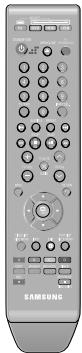
Warning
TO REDUCE THE RISK OF ELECTRIC SHOCK, DO NOT REMOVE THE COVER (OR BACK). NO USER-SERVICEABLE PARTS INSIDE. REFER SERVICING TO QUALIFIED SERVICE PERSONNEL.

CAUTION
DANGER OF ELECTRIC SHOCK DO NOT OPEN


- TPL (Target Peripheral List)
© 2007 Samsung Electronics Co.
WARRANTY CONDITIONS
| Distributor | Marque |
| Samsung | YP-T8N, YP-F2, YP-U1 |
| iriver | H10, N11, T30 |
*Others
©2007 Samsung Electronics Co.
3. OPEN/CLOSE BUTTON
2. DIGITAL AUDIO OUT (OPTICAL)
| A(Austria) | NL(Netherlands) | S(Sweden) | PL(Poland) |
| B(Belgium) | I(Italy) | CH(Swiss) | CZ (Czech) |
| DK(Denmark) | N(Norway) | TR(Turkey) | Others |
| FIN(Finland) | P(Portugal) | GR(Greece) | |
| D(Deutschland) | E(Spain) | HU(Hungary) |
| A(Austria) | NL(Netherlands) | S(Sweden) | PL(Poland) |
| B(Belgium) | I(Italy) | CH(Swiss) | CZ (Czech) |
| DK(Denmark) | N(Norway) | TR(Turkey) | Others |
| FIN(Finland) | P(Portugal) | GR(Greece) | |
| D(Deutschland) | E(Spain) | HU(Hungary) |
Available Video Output Jack


- CAUTION
- IMPORTANT NOTE
- PRECAUTION
- IMPORTANT SAFETY INSTRUCTIONS
- HANDLING CAUTIONS
- MAINTENANCE OF CABINET
- HDD (HARD DISK DRIVE)
- DISC HANDLING
- HOLDING DISCS
- DVD-RAM, DVD±RW AND DVD±R
- DVD-VIDEO, AUDIO-CD
- CAUTIONS ON HANDLING DISCS
- DISC STORAGE
- DISC SPECIFICATIONS
- DVD-HR
- DISC TYPE
- DVD-VIDEO
- AUDIO CD
- CD-R/RW
- DVD±R DISC PLAYBACK AND RECORDING
- DVD-RW DISC PLAYBACK AND RECORDING
- DVD+RW DISC PLAYBACK AND RECORDING
- DVD-RAM DISC PLAYBACK AND RECORDING
- COPY PROTECTION
- PROTECTION
- DISC FORMAT
- USING MP3 DISC
- USING JPEG DISC
- USING DIVX DISC
- DO NOT USE THE FOLLOWING DISCS
- DISC COMPATIBILITY
- COMPATIBLE USB DEVICES AT HOST PORT
- GETTING STARTED
- CONNECTING & SETTING UP
- SYSTEM SETUP
- PLAYBACK
- RECORDING
- EDITING
- REFERENCE
- GENERAL FEATURES
- HDD RECORDING
- COPY BETWEEN HDD AND DVD
- SIMULTANEOUS RECORDING AND PLAYBACK
- HIGH QUALITY DIGITAL AUDIO AND VIDEO RECORDING AND PLAYBACK
- SELECTABLE RECORDING MODE
- AUTOMATED QUALITY ADJUSTMENT FOR TIMER RECORDING
- CREATING A DVD VIDEO TITLE USING DVD±RW/±R DISC
- COPYING DATA FROM A DIGITAL CAMCORDER USING A DV INPUT JACK
- HIGH QUALITY PROGRESSIVE SCAN
- DIVX CERTIFICATION
- HDMI (HIGH DEFINITION MULTIMEDIA INTERFACE)
- ANYNET+ (HDMI-CEC)
- EZ RECORD MODE
- USB INTERFACE FOR DATA TRANSFER
- BEFORE READING THE USER'S MANUAL
- ABOUT THE USE OF THIS USER'S MANUAL
- COPYRIGHT
- HOW TO USE THE HDD & DVD RECORDER
- STEP 1: SELECT THE DISC TYPE OR HDD
- STEP 2: FORMAT THE DISC TO START RECORDING
- USING THE HDD
- USING A DVD-RAM
- USING A DVD-RW
- USING A DVD-R
- USING A DVD+RW
- USING A DVD+R
- STEP 3: RECORDING
- STEP 4: PLAYING
- STEP 5: EDITING A RECORDED DISC
- STEP 6: FINALISING & PLAYING ON OTHER DVD COMPONENTS
- UNPACKING
- ACCESSORIES
- PREPARING THE REMOTE CONTROL
- INSTALL BATTERIES IN THE REMOTE CONTROL
- IF THE REMOTE DOES NOT OPERATE PROPERLY
- DISPOSE OF BATTERIES ACCORDING TO LOCAL ENVIRONMENTAL REGULATIONS. DO NOT PUT THEM IN THE HOUSEHOLD TRASH
- TO DETERMINE WHETHER YOUR TELEVISION IS COMPATIBLE, FOLLOW THE INSTRUCTIONS BELOW
- FRONT PANEL
- FAN
- HDMI OUT
- DIGITAL AUDIO OUT(OPTICAL)
- DIGITAL AUDIO OUT(COAXIAL)
- AUDIO OUT
- VIDEO OUT
- S-VIDEO OUT
- COMPONENT VIDEO OUT
- AV1(TV) OUTPUT SCART CONNECTOR
- AV2(EXT) INPUT SCART CONNECTOR
- IN FROM AERIAL CONNECTOR
- OUT TO TV CONNECTOR
- FRONT PANEL DISPLAY
- CONNECTING THE HDD & DVD RECORDER
- ADDITIONAL CONNECTIONS
- DVD MODE
- TV MODE
- ANTENNA + HDD & DVD RECORDER + EXTERNAL DECODER BOX + TV
- OTHER TYPES OF CONNECTING THE VIDEO OUTPUT CABLE
- S-VIDEO, COMPONENT VIDEO AND PROGRESSIVE OUTPUT MODES
- CASE 1: CONNECTING TO A VIDEO (COMPOSITE) OUTPUT JACK
- CASE 2: CONNECTING TO AN S-VIDEO OUTPUT JACK
- CASE 3 : COMPONENT VIDEO OUTPUT JACKS
- OTHER TYPE OF CONNECTING THE AUDIO OUTPUT CABLE
- CASE 1: CONNECTING TO YOUR TV
- CASE 2: CONNECTING TO A STEREO AMPLIFIER WITH AV OUTPUT JACKS
- CASE 3: CONNECTING TO AN AV AMPLIFIER WITH A DIGITAL OUTPUT JACK
- CONNECTING HDMI/DVI TO A TV
- CASE 1: CONNECTING TO A TV WITH HDMI JACK
- CASE 2: CONNECTING TO A TV WITH DVI JACK
- HDMI CONNECTION DESCRIPTION
- WHY DOES SAMSUNG USE HDMI
- WHAT IS HDCP
- CONNECTING TO AV 3 IN, DV INPUT JACK
- CASE 1: CONNECTING A VCR, SET-TOP BOX (STB), DVD PLAYER, OR CAMCORDER TO THE AV 3 IN JACKS
- CASE 2: CONNECTING A CAMCORDER TO THE DV IN JACK
- CONNECTING TO USB DEVICES
- ON-SCREEN MENU NAVIGATION
- PLUG & AUTO SETUP
- SETTING THE CLOCK
- THIS MENU IS USED TO SET THE CURRENT TIME
- CHANNEL SET
- AUTO SETUP
- MANUAL SETUP
- SETTING UP THE LANGUAGE OPTIONS
- SETTING UP THE SYSTEM OPTIONS
- AUTO POWER OFF SETTING
- AUTOMATIC CHAPTER CREATOR
- EP MODE TIME SETTING
- ANYNET+ (HDMI CEC)
- FOR USING ANYNET+ (HDMI CEC)
- EZ RECORD
- THIS FUNCTION ALLOWS YOU TO INITIALISE AND FINALISE A DISC AUTOMATICALLY
- DIVX(R) REGISTRATION
- SETTING UP THE AUDIO OPTIONS
- DIGITAL OUTPUT
- DTS
- DRC
- NICAM
- V-MODE COMPATIBILITY
- SETTING UP THE VIDEO OPTIONS
- THIS FUNCTION ALLOWS YOU TO SET UP THE VIDEO SETTINGS
- TV ASPECT
- DEPENDING ON THE TYPE OF TELEVISION YOU HAVE, YOU MAY WANT TO ADJUST THE SCREEN SETTING (ASPECT RATIO)
- D NOISE REDUCTION (MOTION ADAPTIVE NOISE REDUCTION)
- HDMI RESOLUTION
- OUTPUT SELECTION
- VIDEO OUTPUT
- PROGRESSIVE SCAN
- SETTING UP THE PROGRESSIVE SCAN
- CANCELING THE PROGRESSIVE SCAN
- SETTING UP THE PARENTAL LOCK
- IF YOU FORGOT YOUR PASSWORD
- SETTING THE RATING LEVEL
- CHANGING THE PASSWORD
- REGION CODE (DVD-VIDEO ONLY)
- LOGOS OF DISCS THAT CAN BE PLAYED
- DISCS THAT CANNOT BE PLAYED
- PLAYING A DISC
- USING THE DISC MENU & TITLE MENU
- FOR DVD-VIDEO DISC
- FOR HDD/DVD-RAM/±RW/±R DISC
- USING THE PLAYBACK RELATED BUTTONS
- SEARCHING THROUGH A CHAPTER OR TRACK
- SKIPPING CHAPTERS, TITLES OR MARKERS
- STEP MOTION PLAY
- USING THE INFO BUTTON
- MOVING TO A SCENE DIRECTLY USING THE INFO
- SELECTING THE SUBTITLE LANGUAGE
- SELECTING THE SOUNDTRACKS & AUDIO CHANNELS
- CHANGING THE CAMERA ANGLE
- REPEAT PLAY
- PLAYING REPEATEDLY (REPEAT PLAYBACK)
- YOU CAN ALSO OPERATE THIS FUNCTION BY PRESSING THE REPEAT BUTTON ON THE REMOTE CONTROL
- REPEAT A-B
- ZOOMING-IN
- USING MARKERS
- SETTING MARKERS
- PLAYING BACK A MARKER
- CLEARING A MARKER
- USING THE BOOKMARKS
- SETTING BOOKMARKS
- PLAYING BACK A BOOKMARK
- CLEARING A BOOKMARK
- PLAYING AN AUDIO CD/MP
- BUTTONS ON THE REMOTE CONTROL USED FOR AUDIO CD (CD-DA)/MP3 PLAYBACK
- PLAYING AN AUDIO CD (CD-DA)
- AUDIO CD (CD-DA) SCREEN ELEMENTS
- PLAYING AN MP3 DISC
- MP3 SCREEN ELEMENTS
- REPEAT CD (CD-DA) & MP
- NEW PLAYLIST
- YOU CAN REGISTER A MAXIMUM OF 30 TRACKS IN THE PLAYLIST
- GO TO PLAYLIST
- DELETE THE PLAYLIST
- GO TO EDIT PLAYLIST
- GO TO MUSIC LIST
- USING THE SORT
- SELECT CONTENTS
- VIEWING A PICTURE
- SLIDE SHOW
- ROTATE
- ZOOM
- GO TO PHOTO LIST
- PLAYING A DIVX
- USING THE MENU BUTTON
- DIVX SUBTITLE ENCODING
- RECORDABLE DISCS
- RECORDING FORMATS
- DVD-RAM/-RW (VR MODE)
- DVD-RW(V MODE)/-R
- DVD+RW
- RECORDING MODE
- UNRECORDABLE PICTURES
- CONCERNING COPY CONTROL SIGNALS
- CONTENT PROTECTION FOR RECORDABLE MEDIA (CPRM)
- RECORDING IMMEDIATELY
- BEFORE YOU START
- RECORDING THE CURRENT TV PROGRAMME YOU ARE WATCHING
- RECORDING FROM EXTERNAL EQUIPMENT YOU ARE WATCHING
- PRESS THE REC BUTTON
- TO PAUSE RECORDING
- TO STOP RECORDING
- COPYING FROM A CAMCORDER
- YOU MAY CONTROL THE CAMCORDER USING THE IEEE1394 (DV) INTERFACE
- MAKING A ONE TOUCH RECORDING (OTR)
- YOU CAN SET THE HDD & DVD REORDER TO RECORD IN 30-MINUTE INCREMENTS UP TO 8 HOURS BY PRESSING THE REC BUTTON
- USING THE PLAY (▶) BUTTON
- STOPPING PLAYBACK / RECORDING
- USING THE TITLE LIST BUTTON
- TIME SHIFT FUNCTION AS A LIVE SIGNAL
- USING THE TIME SHIFT FUNCTION
- TIME SHIFT SCREEN ELEMENTS
- BUTTONS ON THE REMOTE CONTROL USED FOR TIME SHIFT FUNCTION
- MAKING A TIMER RECORDING
- USING THE TIMER BUTTON
- IF THE TIMER SETTINGS OVERLAP
- TO EXIT WITHOUT SAVING THE CURRENT SETTING
- TO RETURN TO THE PREVIOUS MENU
- EDITING THE SCHEDULED LIST
- ADDING A SCHEDULED LIST
- DELETING A SCHEDULED LIST
- USING THE SHOWVIEW FEATURE
- BEFORE PRESETTING YOUR HDD & DVD REORDER
- UP TO TWELVE PROGRAMMES CAN BE PRESET
- SHOWVIEW EXTENDED
- GO TO RECORDED LIST
- INFORMATION ABOUT RECORDED LIST
- DELETE RECORDED LIST
- DELETES A RECORDED LIST INDIVIDUALLY
- CLEAR RECORDED LIST
- GO TO SCHEDULED LIST
- BASIC EDITING (TITLE LIST)
- PLAYING THE TITLE
- RENAMING (LABELING) A TITLE
- LOCKING (PROTECTING) A TITLE
- DELETING A TITLE
- FOLLOW THESE INSTRUCTIONS TO DELETE AN ENTRY FROM THE TITLE LIST
- SPLITTING A SECTION OF A TITLE (SPLIT)
- DELETING A SECTION OF A TITLE (PARTIAL DELETE)
- USING THE SORT FUNCTION (TITLE LIST)
- NAVIGATION MENU
- TIME NAVIGATION
- SCENE NAVIGATION
- ADVANCED EDITING (PLAYLIST)
- CREATING A PLAYLIST
- PLAYING ENTRIES IN THE PLAYLIST
- USING THE PLAY LIST BUTTON
- RENAMING A PLAYLIST ENTRY
- EDITING A SCENE FOR THE PLAYLIST
- PLAYING A SELECTED SCENE
- MODIFYING A SCENE (REPLACING A SCENE)
- MOVING A SCENE (CHANGING THE POSITION OF A SCENE)
- TO SET UP, FOLLOW STEPS 1 TO 3 ON PAGE
- ADDING A SCENE
- DELETING A SCENE
- DELETING A PLAYLIST ENTRY FROM THE PLAYLIST
- USING THE SORT (PLAYLIST)
- WHEN YOU NEED TO CHANGE THE SORT ORDER OF PLAYLIST, YOU CAN CHANGE IT SIMPLY
- COPYING FROM HDD TO DVD
- ABOUT THE COPY SCREEN
- COPYING FROM DVD TO HDD
- COPYING MP3, JPEG OR DIVX
- FILE COPY
- FOLDER COPY
- CHANGING THE NAME OF MUSIC/PHOTO/DIVX FILE
- YOU CAN RENAME A MUSIC, PHOTO OR DIVX FILE COPIED TO HDD
- DISC MANAGER
- EDITING THE DISC NAME
- FOLLOW THESE INSTRUCTIONS TO GIVE A NAME TO A DISC
- DISC PROTECTION
- DISC PROTECTION ALLOWS YOU TO PROTECT YOUR DISCS FROM BEING FORMATTED OR DELETED DUE TO UNINTENDED OPERATIONS
- DELETE ALL TITLE LISTS/DIVX LISTS/MUSIC LISTS/PHOTO LISTS
- FORMATTING A DISC
- USE THESE INSTRUCTIONS TO FORMAT A DISC
- THE DISC PROTECT SHOULD ALSO BE CLEARED
- HDD/DVD-RAM/+RW
- DVD-RW
- TROUBLESHOOTING
- POWER
- CHECKPOINT
- VIDEO
- THE DISC REVOLVES, BUT NO IMAGE OR BAD QUALITY IMAGES ARE DISPLAYED
- SOUND
- NO SOUND
- NO AUDIO OUTPUT
- TIMER RECORDING
- TIMER LAMP FLICKERS
- TIMER RECORDING DOES NOT WORK PROPERLY
- USB
- CANNOT COPY MP3, JPEG, OR DIVX FILES
- HDMI
- NO HDMI OUTPUT
- ABNORMAL HDMI OUTPUT SCREEN
- HDMI OUTPUT JITTER
- REMOTE CONTROL UNIT
- THE REMOTE CONTROL DOESN'T WORK
- OTHER
- I FORGOT MY PASSWORD FOR PARENTAL SUPERVISION
- IS IT POSSIBLE TO CHANGE A SUBTITLE AND AN AUDIO SIGNAL ON A RECORDED DISC
- OTHER PROBLEMS
- SPECIFICATIONS
- WARRANTY CONDITIONS
- CONTACT SAMSUNG WORLD WIDE
- SAMSUNG
- CORRECT DISPOSAL OF THIS PRODUCT
- (WASTE ELECTRICAL & ELECTRONIC EQUIPMENT)
- USER MANUAL
- WARNING
- TPL (TARGET PERIPHERAL LIST)
- OPEN/CLOSE BUTTON
- DIGITAL AUDIO OUT (OPTICAL)
Brand : SAMSUNG
Model : DVD-HR757
Category : DVD Recorder