
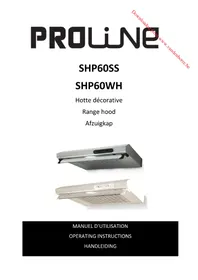
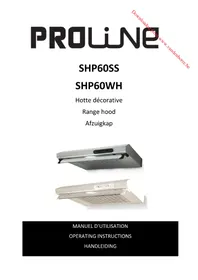
VHP62SS - Range hood PROLINE - Free user manual and instructions
Find the device manual for free VHP62SS PROLINE in PDF.



| Brand | PROLINE |
| Model | VHP62SS |
| Product type | Cooker hood |
| Width | 60 cm |
| Power supply | 230 V, 50 Hz |
| Lighting power | LED 3 W max (E14) |
| Number of speeds | 3 |
| Maximum air flow | 205 m³/h |
| Minimum air flow | 110 m³/h |
| Maximum noise level | 68 dB |
| Minimum noise level | 52 dB |
| Energy efficiency class | C |
| Annual energy consumption | 34.5 kWh/year |
| Grease filtration efficiency | 55.1 % (class E) |
| Evacuation modes | External evacuation (extracting) or recirculation (filtering) |
| Minimum distance above an electric hob | 50 cm |
| Minimum distance above a gas hob | 65 cm |
| Grease filter | Replaceable, not washable |
| Charcoal filter | Included, replaceable |
| Installation type | Wall-mounted or under cabinet |
Frequently Asked Questions - VHP62SS PROLINE
User questions about VHP62SS PROLINE
0 question about this device. Answer the ones you know or ask your own.
Ask a new question about this device
Download the instructions for your Range hood in PDF format for free! Find your manual VHP62SS - PROLINE and take your electronic device back in hand. On this page are published all the documents necessary for the use of your device. VHP62SS by PROLINE.
USER MANUAL VHP62SS PROLINE
Hotline Darty France
This appliance is intended for domestic household use only and should not be used for any other purpose or in any other application, such as for non-domestic use or in a commercial environment.
This appliance can be used by children aged from 8 years and above and persons with reduced physical, sensory or mental capabilities or lack of experience and knowledge if they have been given supervision or instruction concerning use of the appliance in a safe way and understand the hazards involved. Children shall not play with the appliance. Cleaning and user maintenance shall not be made by children without supervision.
If the supply cord is damaged, it must be replaced by the manufacturer, its service agent or similarly qualified persons in order to avoid a hazard.
There shall be adequate ventilation of the room when the range hood is used at the same time as appliances burning gas or other fuels.
There is a fire risk if cleaning is not carried out in accordance with the instructions.
Do not flambé under the range hood.
CAUTION: Accessible parts may become hot when used with cooking appliances.
The air must not be discharged into a flue that is used for exhausting fumes from appliances burning gas or other fuels.
Regulations concerning the discharge of air have to be fulfilled.
When the range hood is located above a gas appliance, the minimum distance between the supporting surface for the cooking vessels on the hob and the lowest part of the range hood shall be at least 65~cm .
For details concerning the method and frequency of cleaning, please see section "Cleaning and maintenance" on pages 6-7.
IMPORTANT SAFETY INSTRUCTIONS
- Carefully read this instruction book and keep it in a safe place for future reference. In the case of sale, cession or move, make sure it is kept together with the product.
- The manufacturer declines all responsibility, for any eventual inconveniences, damages or fires caused by not complying with the instructions in this manual.
Always wear work gloves for all installation and maintenance operations. - Do not connect the appliance to the mains until the installation is fully complete.
- Do not carry out electrical or mechanical variations on the product or on the discharge conduit.
- Do not check the status of the filters while the range hood is operating.
- Any frying must be done with care in order to make sure that the oil does not overheat and ignite.
- Do not use the hood without the lamp correctly mounted due to the possible risk of electric shocks.
- Never use the hood without effectively mounted grease filter.
The hood must NEVER be used as a support surface. - The presence of exposed flames is detrimental to the filters and may cause a fire risk, and must therefore be avoided in all circumstances.
- Do not touch the light bulbs after operating the appliance, you might get burnt.
- Before any cleaning or maintenance operation, disconnect hood from the mains by removing the plug or disconnecting the mains electrical supply.
DESCRIPTION
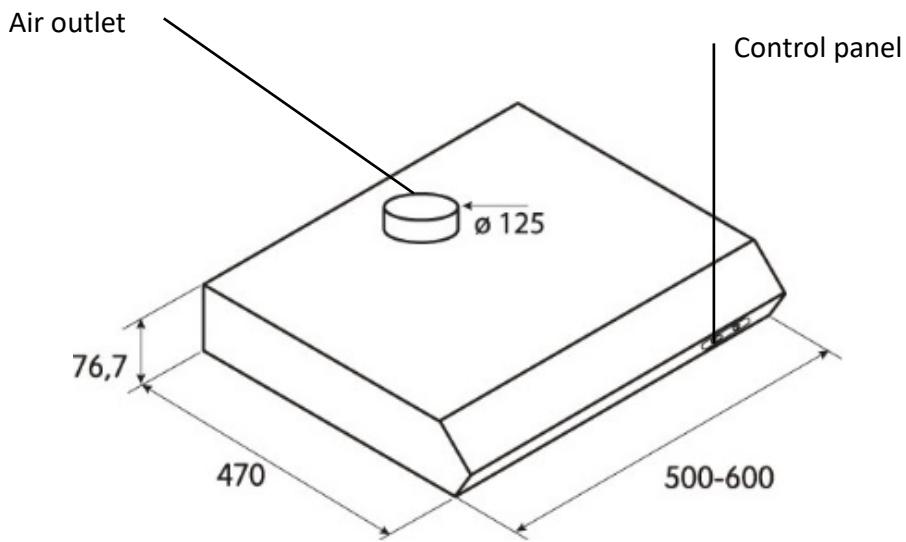
The hood is designed to be used either for ducting or filter version.
BEFORE INSTALLATION
Before proceeding with the installation of your appliance, check that it is not damaged. Otherwise, do not proceed with the installation and contact your dealer.
You should also make sure that the dimensions of the appliance and its conduit are compatible with your kitchen and ceiling height.
INSTALLATION
This appliance has to be installed by 2 people.
Expansion wall plugs are provided to secure the hood to most types of walls/ceilings. However, a qualified technician must verify suitability of the materials in accordance with the type of wall/ceiling. The wall/ceiling must be strong enough to take the weight of the hood.
WARNING! Failure to follow the instructions in this manual may result in electrical hazards.
In case of doubt, consult an authorised service assistance centre or similar qualified person.
Detailed installation procedure
The hood can be fixed directly on the wall above your cooker or under a furniture. Either way, the installation procedure will be the same.
- Take the dimensions of your cooker in order to have the range hood centred above it. Stick the installation and drilling template on the wall above your cooker, taking care to comply with the required minimum distance.
Note: The minimum distance between the supporting surface for the cooking equipment on the hob and the lowest part of the range hood must be not less than 50cm from electric cookers and 65cm from gas or mixed cookers. If the instructions for installation for the gas hob specify a greater distance, this must be adhered to.
Beware: the pattern is designed for 2 different range hood dimensions, therefore you must make sure to conform to the dimensions of your appliance (60cm).
- On the wall, mark the position of 3 of the 4 holes showed on the template (2 upper + 1 lower), and drill the holes by using a drill bit with an 8mm diameter. In the upper holes, insert the supplied wall plugs (8mm diameter, 40mm depth) and screws (5mm diameter, 45mm depth).
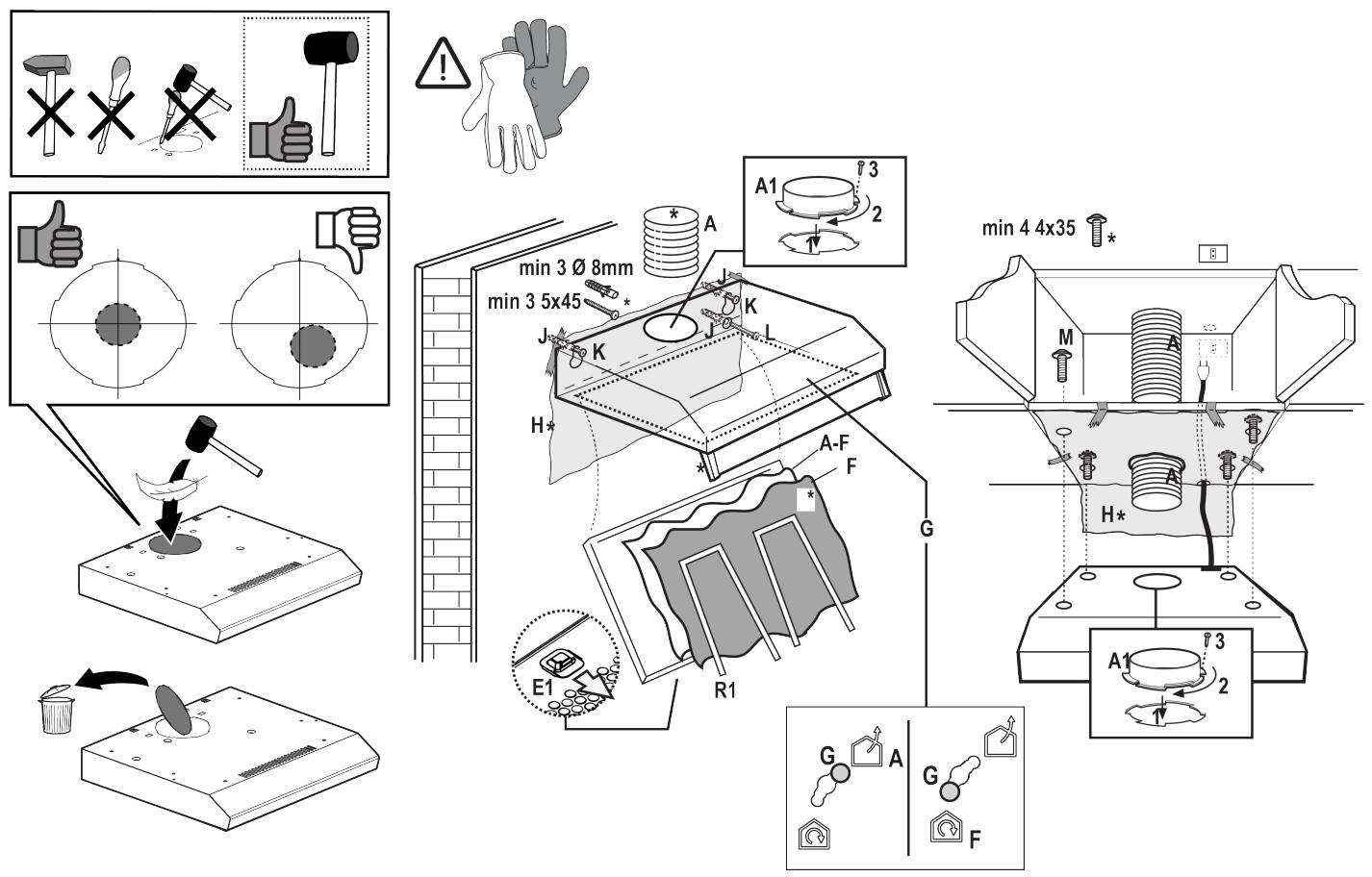
- Position the hood on the upper screws that you inserted. Remove the grease filter to access the lower screw, and insert the wall plug and screw.
- Make sure the appliance is level by using a spirit level, and tighten the screws.
- The selector [G] located inside the hood, next to the conduit, enables to choose the desired evacuation mode: suction [position A] or filtering [position F].
To use the hood in suction mode, remove the circular pre-mounted metal wall and install the supplied upper air outlet [A1: bayonet mount + screws], as well as exhaust pipe of the same dimension (not supplied). Check that the selector [G] is in suction position [A].
To use the hood in filtering mode, do not remove the circular pre-mounted metal wall. Install a charcoal filter (supplied): the fumes and steam will be recycled into the kitchen through the grill located above the control panel. Check that the selector [G] is in filtering position [F].
Electrical connection
For your safety, ask a qualified technician to perform the electrical installation of the hood.
The mains power supply must correspond to the rating indicated on the plate situated inside the hood. If provided with a plug connect the hood to a socket in compliance with current regulations and positioned in an accessible area, after installation. If it not fitted with a plug (direct mains connection) or if the plug is not located in an accessible area, after installation, apply a double pole switch in accordance with standards which assures the complete disconnection of the mains under conditions relating to over-current category III, in accordance with installation instructions.
Warning! Before re-connecting the hood circuit to the mains supply and checking the efficient function, always check that the mains cable is correctly assembled.
USING YOUR APPLIANCE

Ducting version
In this case the fumes are conveyed outside of the building by means of a special pipe connected with the air outlet located on top of the hood.
Beware! The exhaust pipe and ring are not supplied and must be purchased apart.
In the horizontal runs the exhausting pipe must be slightly slanted (about 10^ ) and directed upwards to vent the air easily from the room to the outside.
Beware! If the hood is supplied with active charcoal filter, then it must be removed.
Connect the hood and discharge holes on the walls with a diameter equivalent to the exhaust pipe (flange and ring). Using tubes and discharge holes on walls with smaller dimensions will affect the suction performance and drastically increase the noise.
- Use a duct of the minimum necessary length.
- Use a duct with as few elbows as possible (maximum elbow angle: 90^ ).
- Avoid drastic changes in the duct cross-section.
- Use a duct as smooth as possible inside.
The duct must be made of certified material.
In the case of not being able to discharge the fumes and the steam of cooking outside, the hood can be used in the filter version: the aspirated air will be degreased and deodorised before being fed back into the room.
In order to use the hood in this version, you have to install a charcoal filter (supplied).
Operation
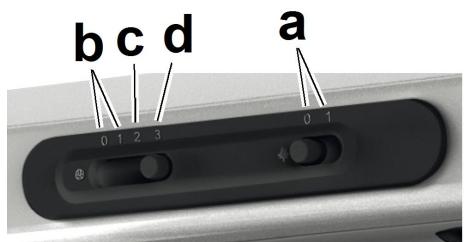
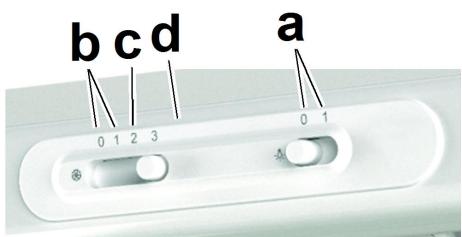
The hood is fitted with a control panel with aspiration speed selection control and a light switch to control cooking area lights. Use the high suction speed in cases of concentrated kitchen vapours.
a. ON/OFF light switch
b. Speed 1/OFF switch
c. 2-speed selection
d. 3-speed selection
Tips on saving energy
Here are some suggestions to help you reduce the environmental impact of your appliance:
Switch on the hood at minimum speed when you start cooking and keep it running for a few minutes after cooking is finished. Increase the speed only in case of a large amount of smoke and vapour and use higher speed only in extreme situations.
Replace the charcoal filter when necessary to maintain a good odour reduction efficiency. Replace the grease filter when necessary to maintain a good grease filter efficiency.
CLEANING AND MAINTENANCE
Beware! Before performing any cleaning or maintenance operation, isolate the hood from the electrical supply by switching off at the connector and removing the connector fuse. Or if the appliance has been connected through a plug and socket, then the plug must be removed from the socket.
The cooker hood should be cleaned regularly internally and externally (about once a month). Clean using the cloth dampened with neutral liquid detergent. Do not use abrasive products. DO NOT USE ALCOHOL!
WARNING: Failure to carry out the basic cleaning recommendations of the cooker hood and replacement of the filters may cause fire risks.
Cleaning the external surface
- To protect the external surface of the hood from corrosion over a long period of time, it should be cleaned with hot water plus non corrosive detergent every two months.
- Keep the motor and other parts free from water, as this will cause damage to the appliance.
- The charcoal filter shall not be exposed to heat.
Replacing the grease and charcoal filters
The grease filter and the charcoal filter supplied on this hood cannot be washed or regenerated; they need to be replaced regularly (depending on the frequency of use, between once a month and 2-3 times a year).
Replacing lamps
Disconnect the appliance from the mains.
Warning! Prior to touching the light bulbs, ensure they are cooled down.
Replace the old light bulb with the one of the same type:
Use E14 3W max LED lamps only. For more details, check enclosed leaflet "ILCOS D" (alfanumeric position "1d").
If the lights do not work, make sure that the lamps are fitted properly into their housings before you call for technical assistance.
SPECIFICATIONS
Below is the sheet of range hood according to EU regulations No 65/2014.
| Brand | Proline | |
| Model number | VHP61SS, VHP61WH | |
| Annual energy consumption (AEC hood) | 34.5 kWh/year | |
| Energy efficiency class * | C | |
| Energy Efficiency Index (EEI Hood): | 75.7 | |
| Fluid dynamic efficiency (FDE hood) | 8.5 % | |
| Fluid dynamic efficiency class * | E | |
| Lighting efficiency (LE hood) | 20,1 lux/W | |
| Lighting efficiency class * | B | |
| Grease filtering efficiency | 55.1 % | |
| Grease filtering efficiency class * | E | |
| Air flow | At minimum speed | 110 m³/h |
| At maximum speed | 205 m³/h | |
| Acoustic level | At minimum speed | 52 dB |
| At maximum speed | 68 dB | |
| Power consumption in off mode (P0) | N/A | |
| Power consumption in standby mode (PS) | N/A | |
- A (most efficient) to G (least efficient)
DISPOSAL
As a responsible retailer we care about the environment.
As such we urge you to follow the correct disposal procedure for the appliance and packaging materials. This will help conserve natural resources and ensure that it is recycled in a manner that protects health and the environment.
You must dispose of this appliance and its packaging according to local laws and regulations. Because this appliance contains electronic components, the appliance and its accessories must be disposed of separately from household waste when the appliance reaches its end of life.
Contact your local authority to learn about disposal and recycling.
The appliance should be taken to your local collection point for recycling. Same collection points accept appliance free of charge.
We apologise for any inconvenience caused by minor inconsistencies in these instructions, which may occur as a result of product improvement and development.
C E
ETABLISSEMENTS DARTY ET FILS ©
129 AVENUE GALLIENI 93140 BONDY FRANCE
15/04/2019
- Hotline Darty France
- IMPORTANT SAFETY INSTRUCTIONS
- DESCRIPTION
- BEFORE INSTALLATION
- INSTALLATION
- Detailed installation procedure
- Electrical connection
- USING YOUR APPLIANCE
- Ducting version
- Operation
- Tips on saving energy
- CLEANING AND MAINTENANCE
- Cleaning the external surface
- Replacing the grease and charcoal filters
- Replacing lamps
- SPECIFICATIONS
- DISPOSAL
- C E
Brand : PROLINE
Model : VHP62SS
Category : Range hood