
SAMEDI - Electric bike MOUSTACHE - Free user manual and instructions
Find the device manual for free SAMEDI MOUSTACHE in PDF.



User questions about SAMEDI MOUSTACHE
0 question about this device. Answer the ones you know or ask your own.
Ask a new question about this device
Download the instructions for your Electric bike in PDF format for free! Find your manual SAMEDI - MOUSTACHE and take your electronic device back in hand. On this page are published all the documents necessary for the use of your device. SAMEDI by MOUSTACHE.
USER MANUAL SAMEDI MOUSTACHE
4.10 RECOMMANDATIONS DIVERSES
LA GARANTIE NE S'APPLIQUE PAS :
WEAR THE MOUSTACHE WELL AND EVERYTHING YOU NEED TO KNOW ABOUT LOOKING AFTER IT!
If you are holding this notice between your hands, it's because you have just acquired a new Moustache bike and we thank you!
We hope you will take as much pleasure from riding with it, as we have taken from developing it.
We have dedicated all our energy and know-how into your bike, but we are open to your comments. Don't hesitate to send us your remarks on contact@moustachebikes.com, your feedback will help us further improve our products.
We imagine that you're keen to get on your new bike, but ask you for a little more patience... you will need to read this notice before using your Moustache for the first time.
The information concerning the Bosch system that equips the entire range is provided in specific notices.
You will also find the virtual version of this manual by scanning the "Manual" QR-Code, and the Bosch components manuals by scanning the Bosch manuals QR-Code.
Bosch notice
Moustache User Manual
WARNING!
Always wear appropriate clothing, and make yourself visible to motorists. It is mandatory to keep the lighting, signaling and warning devices that are already installed on your bike.
Wearing a helmet is strongly recommended for adults and mandatory in France for children under 12. Check the regulations in your country.
In the case of a fall, carry out a full service on your bike.
If you detect a problem, do not use your bike before repair.
Check your bike before each use.
Read this manual carefully before using your bike for the first time and keep it for future reference.
To adjust and maintain certain components, please refer to the instructions on the Moustache website or ask your dealer for advice.
TABLE OF CONTENTS
1 BEFORE STARTING 54
1.1 THE BIKE AND ITS COMPONENTS 54
1.2 IS YOUR BIKE ADAPTED TO YOUR NEEDS? 56
1.3 SIZE GUIDE 57
1.4 TOTAL WEIGHT AUTHORIZATION ON THE BIKE 58
1.5 ELECTRIC ASSIST 59
1.6 EPAC 60
2 | TO RIDE IN SAFETY... 61
3 | RIDING POSITION 63
3.1 HAUTEUR DE SELLE 63
3.2 SETTING THE SADDLE 64
3.3 BRAKE LEVERS POSITION 66
3.4 HEADSET 66
4 | SETTINGS AND VARIOUS RECOMMENDATIONS 68
4.1 PEDALS 68
4.2 WHEEL AXLES 68
4.3 DERAILLEUR 70
4.4 SUSPENSIONS 71
4.5WHEELS 77
4.6 KICK-STAND 78
4.7 Luggage RACKS AND MUD GUARD 79
4.8 CHAIN TENSION 81
4.9 TIGHTENING TORQUE VALUES 82
4.10 OTHER RECOMMENDATIONS 83
5 MAINTENANCE 84
5.1 BATTERY 84
5.2 USING ORIGINAL PARTS 85
5.3 CLEANING AND LUBRICATION 85
5.4 WEAR PARTS AND INSPECTION FREQUENCIES 86
6 | WARRANTY & AFTER SALES SERVICE 88
7 | SERVICE RECORD 90
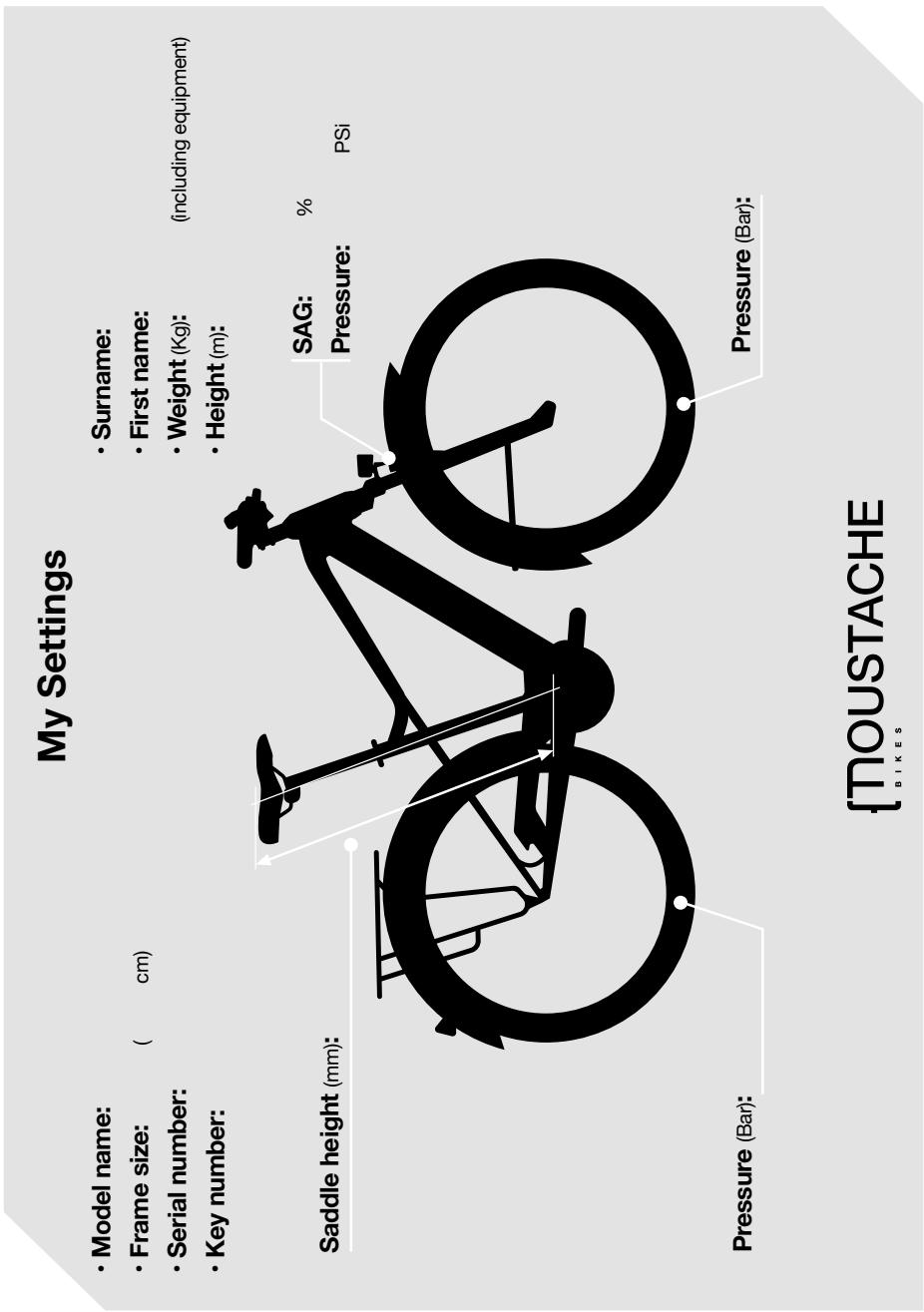
8 | MY SETTINGS 92
1 | BEFORE STARTING
1.1 THE BIKE AND ITS COMPONENTS
Before anything else, it's a good idea to learn some bike vocabulary in order to fully understand this manual. The following figures use numbers and a table to describe the different components that equip your Moustache bike.
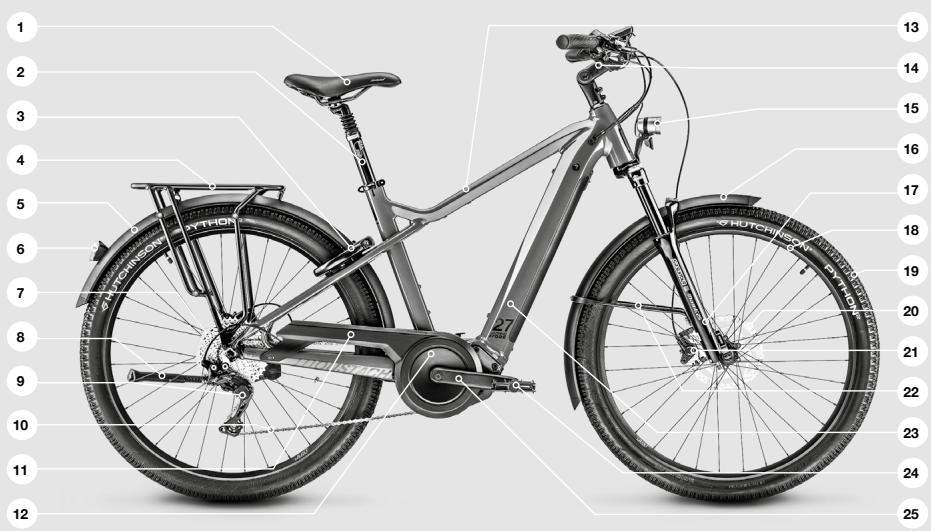
1 Saddle
2 Seat post
3 Lock
4 Luggage racks
5 Rear mud guard
6 Rear lighting
7 Cassette
8 Kickstand
9 Derailleur
10 Chain
11 Chain guard
12 Motor
13 Frame
14 Cockpit (Stem & Handlebar)
15 Front lighting
16 Front mud guard
17 Fork
18 Rim
19 Tire
20 Brake disc
21 Brake caliper
Fix for front mudguard
23 Integrated Battery
24 Pedal
25Crank
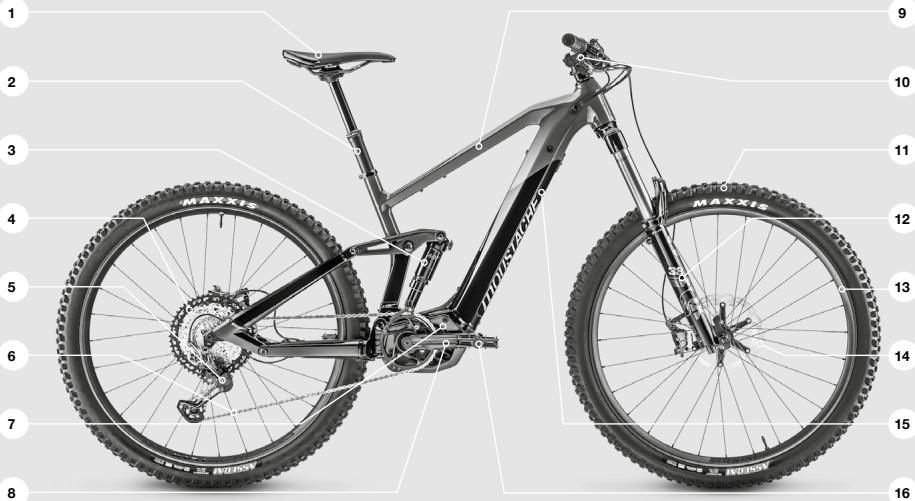
1 Selle
2 Seat post
3 Rear shock
4 Cassette
5 Derailleur
6 Chain
7 Motor
8 Crank
9 Frame
10 Cockpit (Stem & Handlebar)
11 Tire
12 Fork
13 Rim
14 Brake disc
15 Integrated Battery
16 Pedal
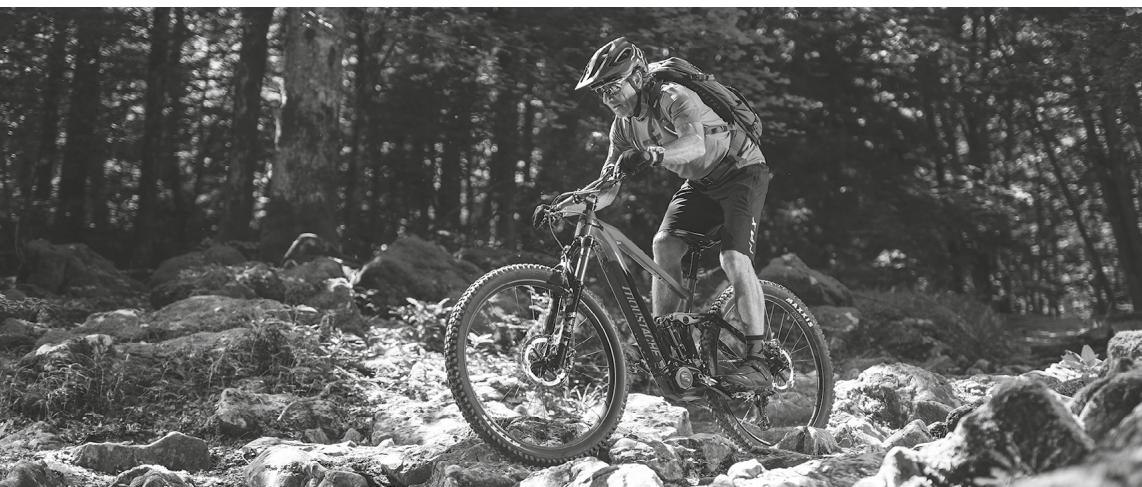
The next step is to check that the bike that you have just acquired corresponds to the usage that you wish.
We have developed Moustache bikes for different riding styles. We have adapted them to different conditions of use in order to use them in full safety. You will find usage criteria for the model you have purchased in the following table.
CAUTION!
Failure to comply with the conditions of use described below may result in hazards to the user (risk of falling which may lead to serious injury) and a restriction in the warranty conditions.
| Category | Type of use | Models |
| 1 | Bikes in this category are destined for an urban use, on paved roads or cycle paths. These bikes can also be used on gravel roads or non paved roads in a good condition. They are not, however, conceived for jumps or an off-road usage, rough terrain or in competition. These bikes conform to the EN 14764 standard "Bicycles intended for use on public roads" and EN 15194 "Bicycles with electric assistance". The "Dimanche 28" is the only bike that conforms to the EN 14781 standard. | Lundi 20 Lundi 27 Dimanche 28 Dimanche 28 open |
| 2 | The bikes in this category are designed for the same usages as in category 1, but are also destined for a mixed usage, on light gravel and fire roads suitable for motor vehicles. They are not, however, conceived for jumps or off-road usage, rough terrain or in competition. These bikes conform to the standard EN 14764 "Bicycles intended for use on public roads" and EN 15194 "Bicycles with electric assistance". | Friday 27 FS Friday 28 Friday 28 Open Samedi 28 Samedi 28 Open Dimanche 29 |
| 3 | The bikes in this category are designed for the same usages as in category 1 and 2 but are also conceived for off-road usage, but are not intended for "Enduro" and "Downhill" riding styles. These bikes conform to the standard EN 14766 "Mountain bicycles" and EN 15194 "Bicycles with electric assistance". | Samedi 27 Xroad Samedi 27 Xroad Open Samedi 27 Xroad FS Samedi 27 X2 Samedi 26 OFF Samedi 27 OFF Samedi 27 OFF Open Samedi 27 Wide |
| 4 | The bikes in this category are designed for the same usages as in categories 1 to 3 but are also conceived for MTB use of "All-Mountain" or "Enduro" style riding. However, they are not intended for "Downhill" riding styles. These bikes conform to the standard EN 14766 "Mountain bicycles" and EN 15194 "Bicycles with electric assistance". | Samedi 26 Fat 4 Samedi 27 Weekend Samedi 29 Trail Samedi 29 Game |
This chapter includes a table with details of the advised bike size for different rider heights. (See below). This information is simply a guideline; your local bike retailer will be able to advise you on the best choice for your intended use. Each Moustache (except the Lundi 20 and Lundi 27) has a sticker at the back of the seat tube with the bike size, as well as the recommended height range for the bike. The Figure 1 shows an example of this sticker.
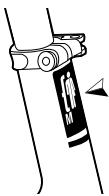
Figure 1. Size sticker
| Models | Available sizes | Rider height (in m) |
| Lundi 27 | One size | 1.57 > 1.90 |
| Lundi 20 | ||
| S | 1.53 > 1.68 | |
| Dimanche 28 | M | 1.66 > 1.81 |
| Dimanche 29 | L | 1.79 > 1.94 |
| XL | 1.92 > 2.07 | |
| Friday 27 FS | S | 1.54 > 1.69 |
| Samedi 27 Xroad FS | M | 1.66 > 1.81 |
| Samedi 27 Wide | L | 1.78 > 1.93 |
| XL | 1.90 > 2.05 | |
| Samedi 28 | S | 1.55 > 1.70 |
| Samedi 27 Xroad | M | 1.68 > 1.83 |
| Samedi 27 OFF 2, OFF 4 | L | 1.80 > 1.95 |
| XL | 1.90 > 2.05 | |
| Samedi 28 Open | S | 1.49 > 1.61 |
| Samedi 27 Xroad Open | M | 1.59 > 1.76 |
| Samedi 27 OFF 2 Open, OFF 4 Open | L | 1.74 > 1.90 |
| S | 1.50 > 1.65 | |
| Friday 28 Open | M | 1.63 > 1.78 |
| Dimanche 28 Open | L | 1.76 > 1.90 |
| S | 1.56 > 1.72 | |
| Samedi 26 Fat 4 | M | 1.69 > 1.85 |
| Samedi 27 Weekend | L | 1.82 > 1.98 |
| Samedi 29 Trail | XL | 1.95 > 2.11 |
| Samedi 29 Game | XS | 1.33 > 1.50 |
| Samedi 26 OFF | One size | FRONT 1.72 > 1.95 |
| REAR 1.50 > 1.85 |
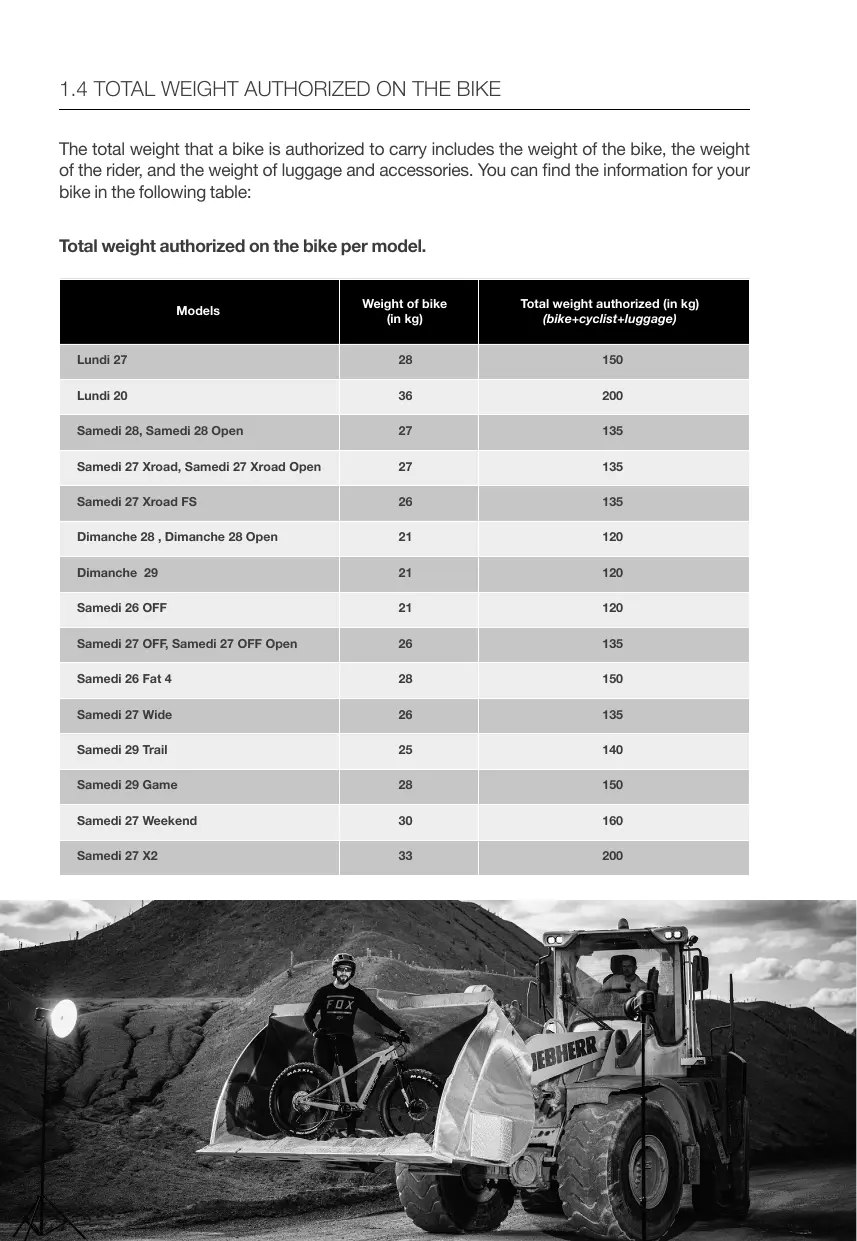
The total weight that a bike is authorized to carry includes the weight of the bike, the weight of the rider, and the weight of luggage and accessories. You can find the information for your bike in the following table:
Total weight authorized on the bike per model.
| Models | Weight of bike (in kg) | Total weight authorized (in kg) (bike+cyclist+luggage) |
| Lundi 27 | 28 | 150 |
| Lundi 20 | 36 | 200 |
| Samedi 28, Samedi 28 Open | 27 | 135 |
| Samedi 27 Xroad, Samedi 27 Xroad Open | 27 | 135 |
| Samedi 27 Xroad FS | 26 | 135 |
| Dimanche 28, Dimanche 28 Open | 21 | 120 |
| Dimanche 29 | 21 | 120 |
| Samedi 26 OFF | 21 | 120 |
| Samedi 27 OFF, Samedi 27 OFF Open | 26 | 135 |
| Samedi 26 Fat 4 | 28 | 150 |
| Samedi 27 Wide | 26 | 135 |
| Samedi 29 Trail | 25 | 140 |
| Samedi 29 Game | 28 | 150 |
| Samedi 27 Weekend | 30 | 160 |
| Samedi 27 X2 | 33 | 200 |
1.5 ELECTRIC ASSIST
Electric assistance helps you move forward as long as you keep pedaling. No pedaling, no assistance. The power developed by the motor always depends on the effort exerted on the pedals.
The harder you push on the pedals, the greater the electric assist. This is independent of the assistance level.
Electric assist stops automatically at speeds above 25km / h . The eBike system reactivates automatically as soon as the speed drops below 25km / h . An exception is the push assist function, which helps you push the electric bike at low speeds without having to pedal. When using push assist, the pedals can be driven and start turning.
You can use the electric bike at any time as a normal bike without assistance. To do this, simply deactivate the eBike system or select the assistance level OFF. The same applies if the battery is empty.
Your Moustache's electric assist is provided by the following elements:
. the on-board computer, which may or may not have a remote control unit depending on the model;
. the motor located in the lower central position (by the crankset) and equipped with a torque sensor;
. the battery and its charger;
. a speed sensor located at the rear wheel.
For more information on the technical characteristics of the components of your electric assistance and to read the warnings and safety tips, refer to the special instructions on the Moustache website by scanning the QR code page 51.
You can select the desired level of electric assist with the control unit while pedaling. The level of assistance can be changed at any time, even while riding.
Note: On some versions, the level of assistance is preset and cannot be changed. On others, there may be fewer levels of assistance than indicated here. The following assistance levels are available:
OFF: the electric assist is deactivated. Push Assist cannot be activated.
ECO: efficient assistance with maximum output, for maximum freedom.
TOUR: regular assistance, for long routes and long rides.
TOUR +: progressive assistance for a natural pedaling behavior for sporty cyclists.
SPORT: powerful assistance for sports rides on mountain paths as well as for urban traffic.
eMTB: Optimal all-terrain assistance, sporty start, improved dynamics, maximum performance. (only available in combination with certain motors).
TURBO: maximum assistance up to high pedaling frequencies for sport riding.
The battery charge level is shown by the five state-of-charge indicator LEDs, when it is on. Each LED corresponds to approximately 20% of the charge level. When the battery is fully charged, all five LEDs are lit.
The LEDs on the state-of-charge indicator may also give other information related to the battery or charger, such as the battery being too hot, too cold or defective, or a charger that is not charging. Refer to the Bosch notice for more information.
The battery charge level is also displayed on the on-board computer screen when the screen is on. Other easy-to-understand control indicators are also displayed on the on-board computer, such as assist level, lighting, error codes, etc. For more information, refer to the control unit and the on-board computer manuals.
You can access the manuals for your Bosch parts by scanning the QR code on page 51.
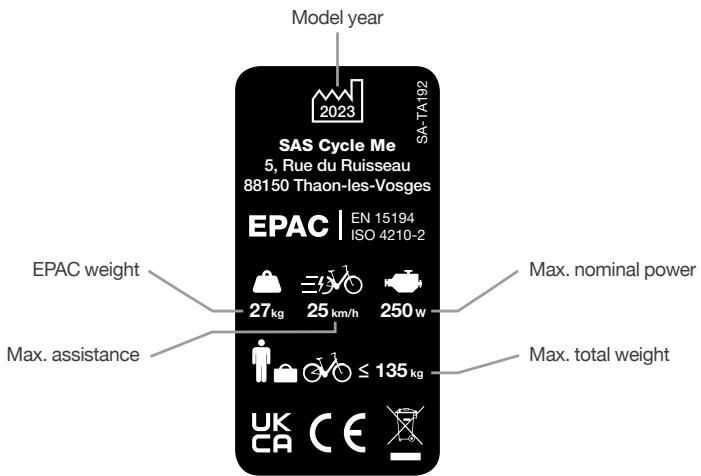
1.6 EPAC
The following symbols are present on your Moustache bike. Here is their meaning:
2 | TO RIDE IN SAFETY...
... and have as much fun as possible!
If you have this notice in front of your eyes and your Moustache in your hands, that means it has been prepared, checked and set up for your safety and pleasure by an approved retailer. This is essential as your Moustache retailer has specific tools and the necessary training to carry out set up and repairs.
Before getting on the saddle, we suggest that you read this notice and take into account the advice contained in it. This will enable you to ride safely and to profit as much as possible from your Moustache bike:
Always wear an accredited helmet as well as appropriate equipment. Wearing a helmet in France is a legal requirement for all children under 12 years of age whether they are the rider or the passenger.
Always carry out a complete check on your bike before riding (tightness of the handlebar, the stem, the saddle, the wheels, the brakes.)
- Always respect the highway code in the country in which you are riding in order to not put yourself in danger. Some countries have specific safety or equipment rules. Always ensure you respect local laws.
- On the road, make sure you are visible to motorists. In France, it is mandatory to have lights, signaling devices and a horn on your bike. When driving on public roads at night, outside built-up areas or when visibility is insufficient, wearing a certified reflective vest is mandatory.
WARNING!
Rainy weather and wet roads reduce the grip of tyres on the ground. Expect greater braking distances, reduce your speed and brake carefully.
When using your bike, or when handling it (e.g. during maintenance), be careful of moving parts such as wheels, transmission, brake discs etc. There's a danger of being caught and drawn in, which can lead to serious injury.
Please note that your braking action may be delayed in certain positions if your bike is fitted with an aero extension, handlebar ends or a multi-position handlebar. This is because your hands cannot easily access the brake levers in all positions.
Exposure to high temperature, linked to thermal radiation, in a confined environment or elsewhere, can have harmful consequences on components made of composite materials (for example, the rims, which are at the height of the car's exhaust pipe when your bike is on a bike rack).
The sound pressure level expressed in dB A at the rider's ear is less than 70 dB (A).
- An electric bike enables you to ride consistently at 25km/h even when climbing. Be careful, from experience we know that other users, drivers, cyclists, and walkers, are not used to bikes going at such speeds. You should anticipate their reactions as far as possible and slow as necessary.
-
Take the time to get used to your new bike. The powerful disc brakes do not need a strong pull on the lever to slow you down, get used to their behavior.
-
An electric bike behaves slightly differently to a normal bike, notably it has faster acceleration. A progressive usage and appropriate training will help you become used to it.
- On some bikes, especially on small sizes, the wheel base is short and the front wheel is close to the pedals. Therefore there is a risk of touching the wheel or mud guard with your foot when you turn, especially at low speed (Figure 2). Do not pedal when you turn the handlebar at low speed. The level of risk depends on the size of your foot, the size of the cranks, the pedals and even the tire. Any modification of components can change this distance and cause contact and a fall. It is therefore best to get advice from your retailer if you wish to replace any parts.
- You should also know that after the first bedding in rides, the cable tension, the brakes and the steering can need adjustment. We advise that you go to your local Moustache retailer to carry this out. If something does not seem right during this period, or for any other question on the usage of your bike, do not hesitate to contact your local retailer.
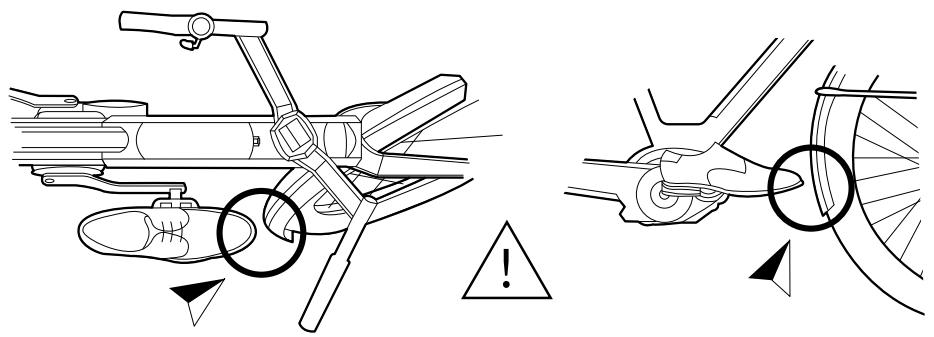
Figure 2. Risk of contact between the foot and the front wheel
For your safety and to guarantee optimal long term functioning of your Moustache bike, you can establish a regular maintenance calendar with your retailer.
This will be determined based on how frequently you ride, the distance you ride, your riding style, as well as the terrain you ride on (see the sections 5.4 WEAR PARTS AND INSPECTION FREQUENCIES and 7 | SERVICE RECORD).
Your Moustache retailer is the best placed to advise you and carry out all maintenance operations, but if you prefer to do some yourself, you will find some advice in the following pages.
3 | RIDING POSITION
Each Moustache is unique, and you are too! It is therefore essential to adapt your Moustache to your morphology for optimal comfort.
The first set up to carry out on your Moustache is the saddle height. Once again, your local retailer can help you do this. You must not hesitate to adjust this if you do not find the correct height immediately.
We have a good tip to help you find the correct setting quickly: position the crank in line with the seat tube, without being lopsided on the saddle and place your heel on the pedal with your leg almost straight. (Figure 3).
N.B.: On the Lundi 27 model, the position is a little lowe, the leg can stay slightly bent.
To adjust the height you need to open the seat clamp's quick release or unscrew the screw on the seat clamp with a 4 or 5 mm allen key.
Once the height is adjusted, close the quick release lever.
If necessary adjust the tightness level on the opposite nut so that the lever tightens around midway through closing.
In the case of a seat clamp with screw, tighten the screw to the recommended torque level that you will find in the section 4.9 TIGHTENING TORQUE VALUES or marked next to the screw.
WARNING!
For seat clamps with screws, you should never go over the recommended torque level, this could damage your frame.
Never go over the maximum height level on your seat post marked by the engraving « INSERT MINI » OR « STOP ». This is for your safety, as well as the reliability of your bike. (See Figure 4).
If you cannot obtain the right saddle height without going past this limit, contact your local retailer.
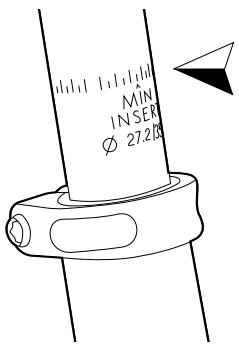
Figure 4. Maximum seat post output
We have equipped our bikes with ergonomic saddles, but a careful set up is required to ensure optimal comfort. In this section you will find advice for an angle and set back of your saddle, that's adjusted to the type of riding you do. Then, you will find the process to follow to correctly set up your saddle depending on the type of seat post your Moustache has. Finally, at the end of this section, you will find advice and settings for suspension and telescopic seat posts.
3.2.1 ADVICE
It is generally advised to position the saddle horizontally for a mixed usage. On the Lundi 27 models, the torso position is straighter and the pelvis lightly tilted backwards. We advise you to set the saddle slightly inclined towards the back, in order to optimize your comfort and the riding position. For an all-terrain use, it is advised to set the saddle slightly inclined towards the front (Figure 5).
The saddle set back should be adjusted for the length of the femur. This is a more complex setting which may require the help of your retailer. In general an intermediate setback is adequate. Its setting should be carried out during the setting of saddle angle. Respect the level of torque advised for the screw of the saddle chassis. This will be indicated on it and varies from one model to another.
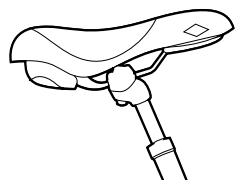
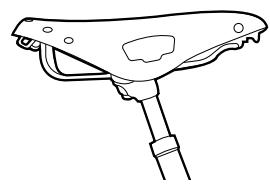
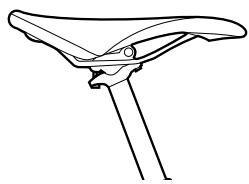
Figure 5. Saddle angle settings for Monday 26 (left), mixed use (middle) and MTB use (right)
A new saddle can cause slight discomfort that will diminish with time. If you do not find the right position, ask your retailer for advice.
3.2.2 SETTING THE ANGLE AND SETBACK OF YOUR SADDLE
Firstly, you need to check the seat post that is on your Moustache. This is very easy: you simply need to check the number of screws that attach your saddle chassis to the seat post.
There are two possibilities: there is only one screw as in Figure 6, in this case go to the section Only one fitting block. If you see that there are two screws, go to the section Two fitting
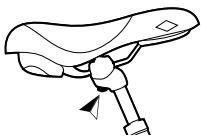
Figure 6. Saddle with one fitting block
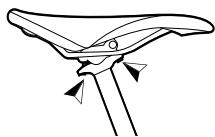
Figure 7. Saddle with two fitting blocks
blocks as in Figure 7.
ONLY ONE FITTING BOLT:
If you have only found one fitting block, you are in the right section. To adjust the angle of your saddle you need to carry out the following process:
- Loosen the screw that holds the saddle and seat post using a 6mm allen key as in Figure 8 to obtain enough play to easily move the saddle.
- Adjust the angle and setback of the saddle as suits you.
- Tighten the screw, ensuring that it does not surpass the maximum torque level indicated next to the screw.
- Contrôlez si la selle est bien maintainue et ne présente pas de jeu.
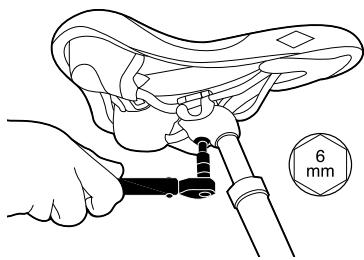
Figure 8. Tightening/loosening the fitting block
TWO FITTING BOLTS:
If you have found two fitting blocks, you are in the right section. To adjust the angle of your saddle you need to carry out the following process:
- Loosen the two screws that hold the saddle and seat post using a 5mm allen key (Figure 9) until the saddle can move easily.
- Adjust the angle and setback of the saddle as suits you.
- Tighten each screw a half-turn, alternating between the two, without going over the maximum torque level that is indicated next to them.
- Check that the saddle is correctly in place and that there is no play.
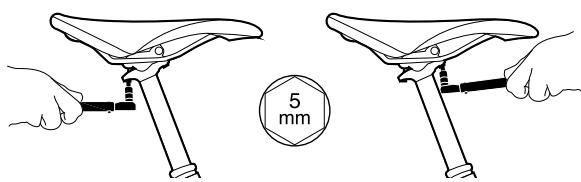
Figure 9. Steps for tightening/loosening the fitting blocks
3.2.3 SPECIAL CASES
You can't find the right explanation for your bike? You can check the Moustache technical notice available on our website www.moustachebikes.com/en/manuals, to obtain detailed information on your model.
Our bikes are already set up to offer you optimal ergonomics.
However, if you wish to adjust your cockpit, we advise you to proceed as follows:
- To ensure a good lever position, loosen the screw(s) holding the lever onto the brake attachment, then adjust the angle so that it is in line with your forearms when you are in riding position (Figure 10).
- Adjust the distance of the brake lever from the grip in order to easily use the brake lever with two fingers (Figure 11).
- Retighten the screws on the brake attachments to 6 Nm.
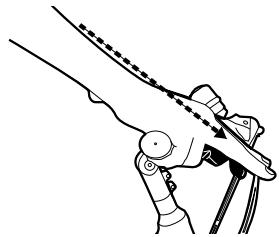
Figure 10. Brake lever aligned with the forearm
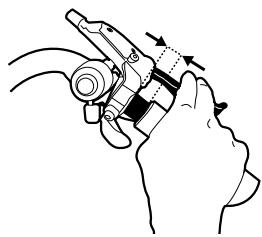
Figure 11. Distance between the brake lever and the grip
Safety Reminder:
To avoid locking the wheels while braking, it is recommended that you pull the brake levers gradually.
The left brake lever acts on the front brake and the right brake lever acts on the rear brake. (bikes sold in the UK, Australia, New-Zealand and Japan have inverted brakes). Being a major safety device, the brakes must be adjusted by a professional bike mechanic.
3.4 HEADSET
The headset is made up of two bearings and cups placed at each end of head tube. All Moustache bikes have an « A-head » head set: this is adjusted using the round hood which is found above the stem (as in Figure 12).
During more intense rides, the headset is put under incredible stress. It is therefore possible that play will develop. Be careful, riding with any play in your head set can deteriorate your head set and even your frame.
In order to check if your head set is in good shape, there are two simple tests that should be carried out before you ride:
TEST 1: With the front brake on, try to move your bike forward and back. You will immediately notice if there is a high level of play or not.
TEST 2: Make the front wheel of your bike bounce. You will hear a sharp loud noise only if there is significant play in the head set.
Pay attention to other noises, such as those of the cables hitting against the frame, or even the spokes. Do not take these into account.
If you have found play in the head set, follow these steps:
- Loosen the screw(s) on the stem as in stage 1 of Figure 12.
- Then progressively tighten, without forcing, the screw in the hood until play disappears as in stage 2 of Figure 12.
- Check that play in the fork is no longer present. The fork should turn easily and you should not feel any friction or resistance when it turns.
- Retighten the screw(s) on the stem following the recommended torques as in stage 3 of Figure 12.
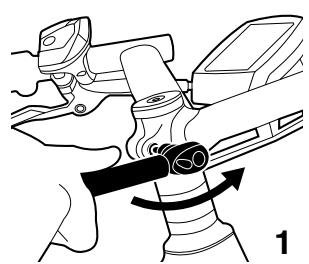
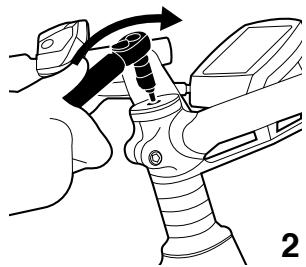
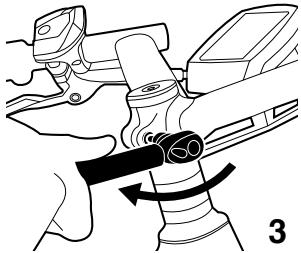
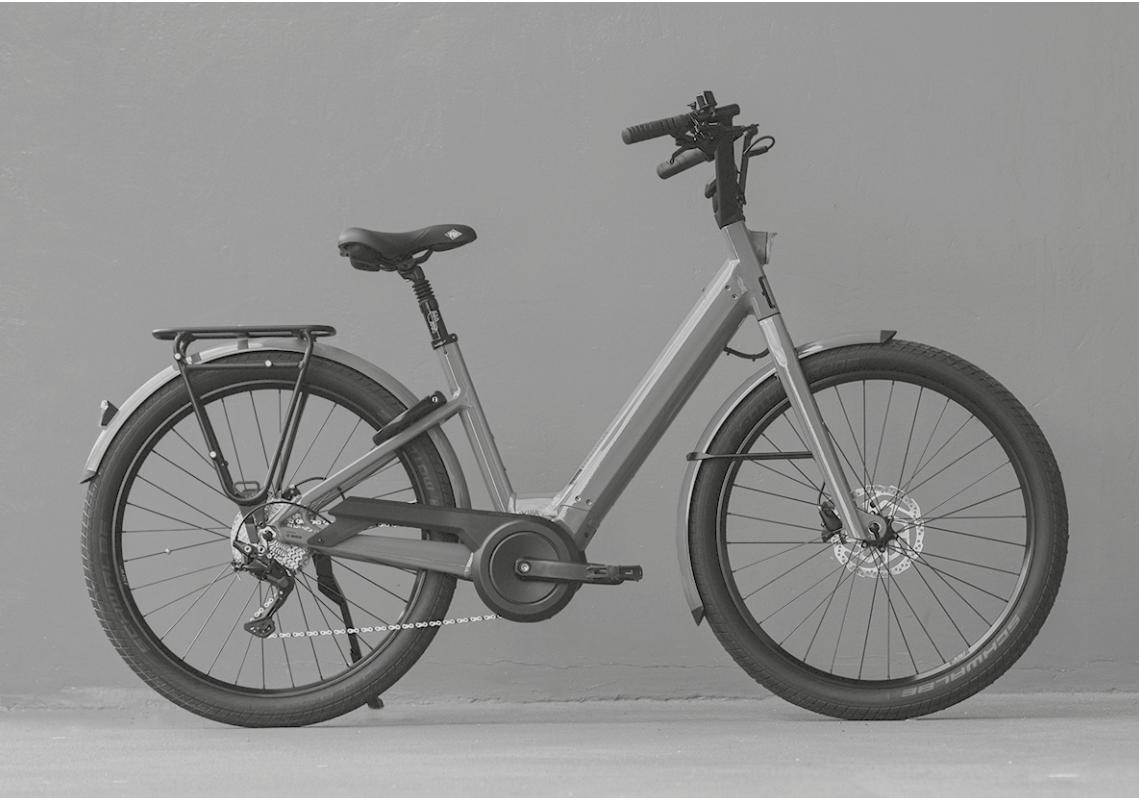
Figure 12. Stages for the headset settings
4 | SETTINGS AND VARIOUS RECOMMENDATIONS
4.1 PEDALS
To install your pedals, you simply need to follow these steps:
- Put a small amount of mounting grease (you can find this at your local bike retailer) on the thread of each pedal.
- Tighten the right pedal (marked "R" on the pedal, see Figure 13) in a clockwise direction on the crank on the drive side.
- Screw the left pedal (with marked "L" on it and with grooves see Figure 13) counterclockwise onto the left crank.
- The recommended torque rate is 30Nm
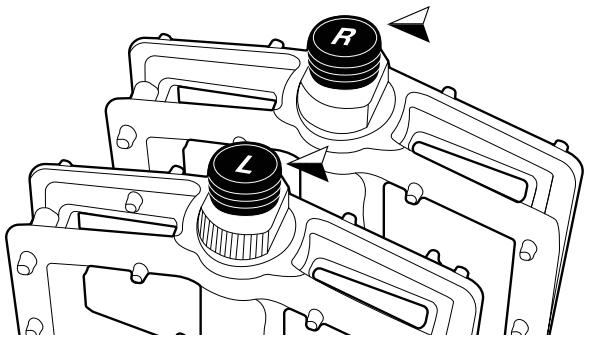
Figure 13. Marked "R" (Right) and "L" (Left)
4.2 WHEEL AXLES
This chapter includes explanations and information only for rapid release axles. Information about other axle systems can be found in the Moustache technical notice available on our website www.moustachebikes.com/en/manuals.
Important : if you wish to take the rear wheel off your bike, it is easier if you place the chain on the smallest cog and the deraillleur in disengaged/clutch position (if this is possible). To disengage your deraillleur, ask your retailer for advice or consult the notice on your deraillleur.
WARNING!
Wheel axles are essential safety elements on your bike. Please respect the information below, otherwise you risk losing parts and falling. Never tighten the lever by pushing against the brake disc!
A wheel badly tightened or badly centered can cause accidents and serious injury to the user.
4.2.1 QUICK RELEASE WHEEL AXLE
A quick release has been designed to be easily adjusted with your hand. Never use a tool to block or release the mechanism in order not to damage it.
To fully understand the steps below, you need to know the names of the parts making up this quick release axle:
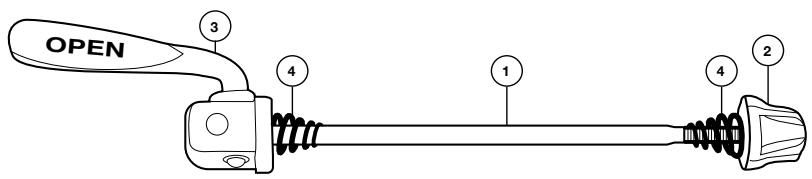
Figure 14. Quick release wheel axle: ① Shaft ② Nut ③ Lever ④ Conical spring
4.2.2 OPENING THE QUICK RELEASE AXLE
If you want to remove the wheel of your Moustache, please follow this process:
- Open the axle's lever. You should now be able to read the engraved "OPEN" on the lever as in Figure 15.
- Loosen the nut on the other side of the axle by hand until there is sufficient play that you are able to remove the wheel (It is not necessary to remove the axle from the wheel hub).
- Take off the wheel.
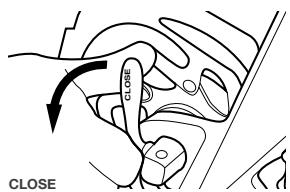
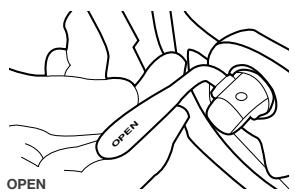
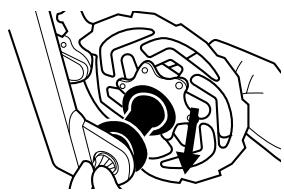
Figure 15. Opening the quick release axle
4.2.3 PROCESS TO FOLLOW FOR RELIABLE TIGHTENING OF THE WHEEL WITH QUICK RELEASE AXLES
If you want to reassemble your Moustache's wheel, please follow this procedure:
- Check that the lever is in the open position (You should be able to read "OPEN" that is engraved on the lever).
- Check that the conical springs are on each side of the hub and that the smallest circumference of these is oriented towards the center of the wheel as in Figure 14.
- Place the wheel on the fork or the frame, checking that the axle is fully placed into the dropouts of the frame or fork. The wheel should be centered, as should the disc in the caliper.
- Hand tighten the tightening nut until it touches the fork or frame dropouts.
- Reclose the quick release lever with the palm of your hand parallel to the fork or the frame dropout ensuring you have the recommended level of tightness. The engraving "CLOSE" is now visible. The recommended tightness is obtained when the lever hardens midway through the course, that's to say from the moment when the lever finds itself in line with the axle. If the lever is too hard to close, you can loosen the nut on the axle. If the lever is not tight enough, you can retighten the nut until the correct level is attained.
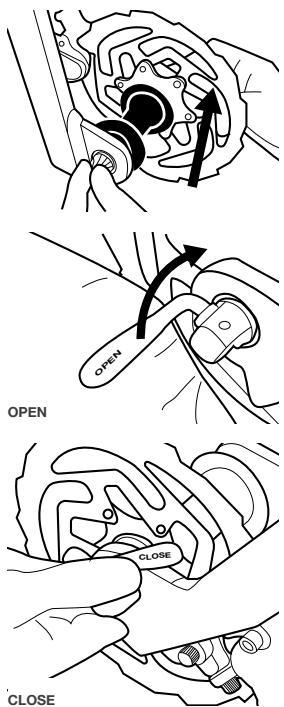
Figure 16.
Stages of tightening the axle
4.3 DERAILLEUR
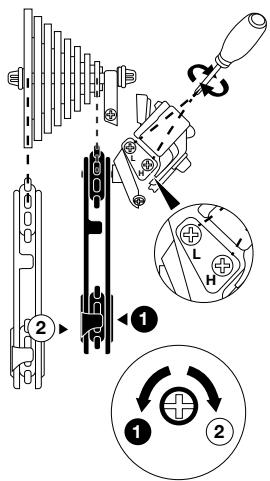
Figure 17. Derailleur stop screws setting
The adjustment of your derailleur was carried out before delivery of your bike and therefore, you should not need to do it yourself.
If however, you feel you need to intervene with its settings, perhaps because of cable stretch, we advise you to consult your local approved retailer. With a little bit of experience, you can also follow the stages below:
- In order to adjust the low and high speed stop screws, it can be easiest to unscrew the cable tightener at the level of the derailleur so that it is free. You can then push against the high speed stop screw with your hand.
- The upper tensioner should be aligned with the high or low cog when the deraillur is in high or low speed setting. If the tensioner is not aligned, you must tighten or untighten the stop screw to obtain the correct setting (Figure 17).
- Then you must adjust the indexing. Ensure that the gear
WARNING!
If despite these recommendations you are not able to correctly index your gears, see your local retailer so they can carry out the different steps of adjustment as well as checking the derailleur hanger.
changing lever is set to the highest gear, which corresponds to the smallest cog. Then tighten the cable by pulling on it and immobilize it by using the cable tightener on the derailleur.
To perfect the cable tension, use the dial on the deraillieur or on the lever.
When pressing on the lever to change up the gears, the derailleur should climb without delay onto the next cog without making any noise.
If the derailleur does not pull the chain onto the
next cog, or if it makes noise from rubbing onto the lower cog, you need to tighten the cable by unscrewing the dial.
Inversely if the derailleur takes the chain too far, climbing up two cogs or rubbing on the upper cog, you need to loosen the cable by tightening the dial.
The final adjustment to cut out all noise should be precise and the dial adjusted by a quarter turn between each check.
4.4 SUSPENSIONS
For optimal durability and functioning, check the specific notices of each manufacturer delivered with this manual in order to correctly carry out the settings and maintenance of components. Also ensure you adapt the settings to your size and your type of riding.
4.4.1 FORK LOCKOUT SYSTEM
Some forks are equipped with a system to lockout the suspension. Each brand has its own type of lockout but the principle remains very similar from one brand to another. When the system is locked, the fork movements are blocked in order to guarantee better pedaling efficiency. However, the fork is not
WARNING!
A badly carried out setting can make you lose control of your Moustache or damage components. Ask your local retailer for advice. He/she has the necessary experience to help you find the correct settings. You can also refer to the manufacturer's notice.
100% blocked in order not to damage the suspension if the fork stays locked out on rough ground. The levers are on the right leg of the fork. The following figure presents different models of lockout systems.
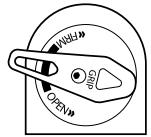
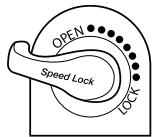
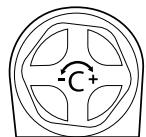
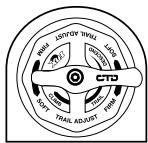
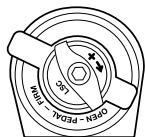
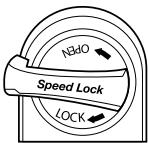
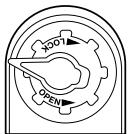
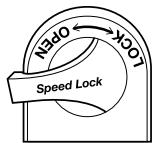
Figure 18. Different systems of fork lockouts
- To unlock a suspension fork turn the locking lever in the direction indicated by the arrow with the description "OPEN" until it stops. (See the example on Figure 19).
- To lock a suspension fork, turn the locking lever in the direction indicated by the arrow with the description "lock" or "firm" until it stops. (See the example on Figure 20).
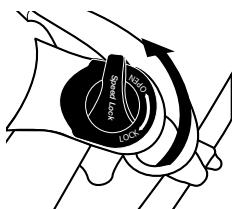
Figure 19. Locking lever in open position
WARNING!
Do not forget to unlock the system when the terrain becomes rougher in order not to damage the fork!
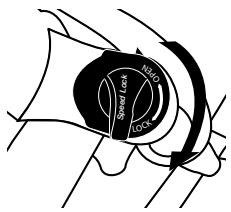
Figure 20. Locking lever in close position
As with telescopic forks, shocks are equipped with a lockout system for suspension. When the system is locked, the movements of the shock are blocked in order to guarantee better pedaling efficiency. However, the shock is not 100% blocked in order not to damage the suspension if the shock stays locked out on rough ground.
To lock or unlock your shock you simply need to follow these steps:
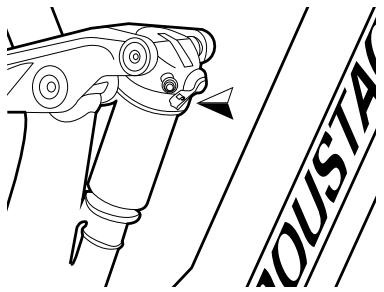
- Find the blue lever on the shock. You will see a padlock logo in open or closed position on the lever.
- If the padlock is open, it means that your shock is in open position (Figure 21).
- If the padlock is closed, it means that your shock is locked out (Figure 21)
- To move from one position to the other, you simply need to move the blue lever with your index figure in the direction indicated by the arrows in Figure 21.
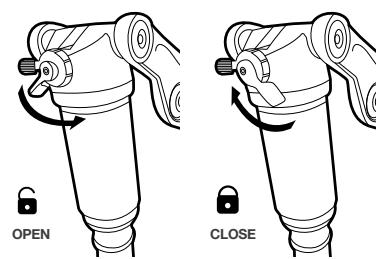
Figure 21. Open position (left) and closed (right) of the shock
WARNING!
The pressure exerted by your finger to move the lever should be very light; you do not need to force the mechanism. In case of a problem, contact your retailer. You can also refer to the manufacturer's notice.
4.4.3 SETTING THE PRE-STRESS OF THE FORK (SAG)
In order to fully profit from your bike's potential, the suspension should be set up for your weight. This is a technical procedure that can be carried out by your local retailer if you do not have the necessary knowledge or material.
This setting is commonly called "SAG", which corresponds to the compression of the suspension under the weight of the cyclist. The level of SAG varies according to the type of fork and the type of usage of the bike. These values can be found in the technical notice available on the website https://www.moustachebikes.com/en/manuals. The SAG is a value expresses as a percentage, and defines the length of displacement of the stanchions in relation to the fork or shock body, caused by your body weight when you are sat on the bike.
Let's take an example:
My fork has 140mm of travel (which means the stanchions are 140mm long). The recommended SAG is 25% . To convert this SAG value into millimeters you just need to use the following formula:
$$ \mathrm {S A G} [ \text {in mm} ] = \mathrm {S A G} [ \text {en} \% ] \times \text {Travel} [ \text {in mm} ] $$
Which in this example case gives us: SAG [in mm] = 25% (0.25) x 140 mm = 35 mm
So, my body weight pushes the stanchions into the legs by 35 mm.
The SAG is calibrated by setting the pre-stress of the shock or the air pressure in the pneumatic cartridge depending on the type of fork. To set up fork SAG carry out the following steps:
For Coil spring with oil damping:
- Sit on the bike in a normal position and wearing your usual riding kit (helmet, bag and accessories...). You can lean against a wall in order to avoid any brusque movements on the bike.
- Step off your bike gently to avoid a harsh movement and measure the "SAG". A SAG that is too weak indicates that the pre-stress of the spring is too high. You should therefore turn the adjustment lever towards the «←». Inversely, a too high level of SAG indicates that the spring's pre
stress is too weak, and you should therefore turn the adjustment lever towards "+"
- Repeat these steps until you find the right level.

Hint: If your fork is not equipped with a rubber O-ring that you can use to see the SAG position, you can place a plastic zip tie on the fork stanchion which will carry out the same function.
Other settings can be carried out so you profit as much as possible from your suspension system. Refer to the dedicated notice or to your local bike retailer.
For suspension models with Air/Oil cartridge system
Before starting, ensure you have a high pressure pump and your usual riding gear.
- Place the rubber O-ring against the fork leg.
- Sit on the bike in a normal position and wearing your usual riding kit (helmet, bag and accessories...). You can lean against a wall in order to avoid any brusque movements on the bike.
- Step off your bike gently to avoid a harsh movement and measure the "SAG" (Figure 22). A SAG that is too weak indicates that there is too much pressure in your fork. You should therefore take out air from your suspension. Inversely, a too high SAG indicates that there is not enough, you should therefore, add air. To do this:
- Unscrew the valve cap to access the fork valve that enables you to adjust the air pressure as in the following figure:
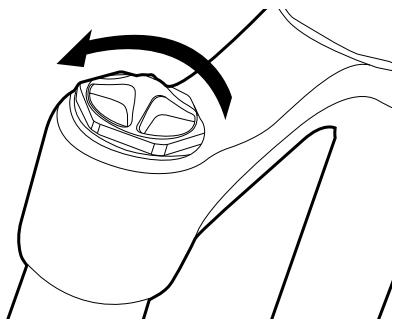
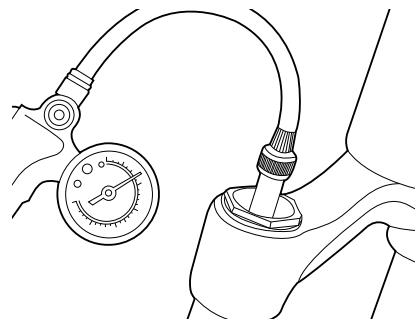
- Using a high pressure pump, adjust the fork's air pressure in order to get the desired SAG as in the figure above. Be careful to not pass the maximum air pressure that your fork can handle! This value can be found in the manufacturer's notice.
- Sit on the bike as described previously and check the SAG. Repeat these steps until you find the right level.
Other settings can be carried out so you profit as much as possible from your suspension system. Refer to the dedicated notice or go to your local bike retailer.

Hint: If your fork is not equipped with a rubber O-ring that you can use the SAG position, you can place a plastic zip tie on the fork stanchion and will carry out the same function.
4.4.4 SETTING THE PRE-TENSIONING OF THE REAR SHOCK (SAG)
Before starting, ensure you have a high pressure pump and your usual riding gear.
The process to set the SAG on your shock is very similar to that of your fork. You simply need to follow these steps:
- Place the rubber O-ring against the shock's body.
- Sit on the bike in a normal position and wearing your usual riding kit (helmet, bag and accessories...). You can lean against a wall in order to avoid any brusque movements on the bike.
- Step off your bike gently to avoid a harsh movement.
Your Moustache is equipped either with a sticker indicating the level of SAG with a red sliding scale. The ideal SAG has been reached when the O-ring is aligned with the red scale as in Figure 22. If the O-ring has gone further than this mark your shock needs
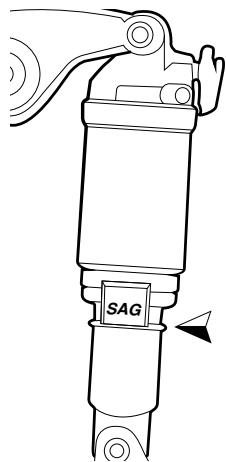
Figure 22. SAG Adjuster
more air. Inversely, if the ring has not reached the mark, there is too much air in your shock.
To adjust the level of air in your shock:
Shocks, pneumatic forks and some hydraulic forks are equipped with a dial that enables easy adjustment of the rebound level. On the shock, this dial is situated in the same position as the lockout lever (Figure 25). On the forks, this dial is usually placed under the right fork leg and can be found thanks to the sticker marked "rebound" (Figure 25). This is usually in the color red.
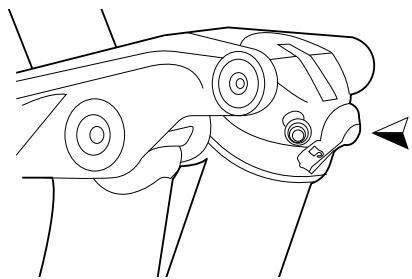
The rebound of your suspension controls the speed at which the stroke returns to neutral after a shock. The perfect setting is therefore not always easy to find and can depend on several different factors: your riding ability, the terrain on which you are riding, as well as your riding style. Don't hesitate to go to your local Moustache retailer to help you set this up.
N.B.: This setting should be carried out after you have adjusted your SAG (see preceding paragraphs).
If you would like your suspension to be more lively (to be closer to that of a spring), you should turn the dial in the direction that is indicated with a "+" or an image of a rabbit " 🙪". You should be able to feel that your suspension is more reactive and comes back quickly to its initial position.
Conversely, if you would like your suspension to be less lively, then you should turn the dial in the direction that is indicated with a " - " or an image of a tortoise "
N.B.: The images used may have a different signification depending on the brand. Do not hesitate to consult the notice provided by the manufacturer of your fork.
Here is a more advice to help you set up your fork:
- The symptoms of a too slow rebound: during a passage of numerous big shocks one after the other, as in a rocky descent or steps, your suspension will push down without having the time to come back to its original position. You will need to increase the rebound of your suspension.
- The symptoms of a too fast rebound: the behavior of your suspension will resemble that of a spring, your bike will lose contact with the ground during a rough part of trail. Your bike will lose grip and therefore will underperform. You will need to decrease the rebound of your suspension.
4.4.6 CLEANING
- Make sure you clean the stanchions after each usage, with a little soapy water and a soft sponge.
- Then wipe all the surfaces with a soft cloth.
- Carefully inspect all the seals, these guarantee the correct functioning of your forks and above all their reliability.
Some of the maintenance of your fork, such as lubrication and purging should be carried out following the specific recommendations of the manufacturer (for this you need to refer to the notice produced by the manufacturer). These operations should be entrusted to a specialist who has the correct tools and the knowledge necessary to effectively accomplish this.
4.5 WHEELS
4.5.1 THE TIRES
We have equipped your Moustache bike with high performance tires made by well-known brands. We advise you to take into account their individual characteristics, in order to be able to benefit from them for as long as possible.
> Regularly check the wheel is not buckled or damaged.
The good maintenance of tires needs:
Sound rims and a rim base in good condition.
- Putting talcum powder from time to time on the inner tube and inside the tire.
- A correct level of pressure. For this, check the span of pressures that is written on the tire's flank. You do not need to inflate the tire up to the maximum level indicated, but rather to the level that suits you for the amount of comfort and grip that you wish to have. You can find the levels that we advise in the technical Moustache notice that is available on our
website www.moustachebikes.com/en/manuals. Do not go over the maximum pressure indicated on the tire's flank, or you risk exploding the tire. Leaving the pressure too low increases your risk of a pinch flat.
- Check the tire frequently for any element that might attach itself to the tire or knobbles, and remove them.
Some models of tires have a specific design that means there is a sense of rotation that must be respected. Always follow this sense of direction, as indicated by the arrows on the flank of these tires.
Mounting a tire or an inner tube:
If you wish to change an inner tube or a tire, for example after a flat, first check the condition of the rim and rim base, the inner tube and the tire. Always use the same size of tire and of inner tube as those originally provided with the bike, or go to your local bike retailer to know which other sizes may be compatible.
Disassembly
- Remove air from the inner tube and move the tire bead to the center and base of the rim (Figure 26).
- Remove one side of the tire bead from the inside of the rim. This can be made easier by using a tire lever. Be careful not to damage the rim or pinch the inner tube whilst doing this.
- Replace the inner tube and/or the tire.
Assembly :
- Add a little air to the inner tube so that it takes the form of a circle.
- Place the inner tube in the tire then the valve in the hole in the rim.
- Place the first side of the tire bead into the base of the rim starting at the valve (Figure 28).
- Place the inner tube into the rim (Figure 29).
- Then push the second side of the tire bead into the rim, taking care not to pinch the inner tube between the tire and the rim (Figure 27).
- Pump up the inner tube to the advised pressure level (Figure 30).
- Check the tire is correctly centered on the rim. If it is not correct, let air out of the inner tube then re-inflate it. To make this easier, you can use a little soapy water to wet the side of the rim and tire when the inner tube is deflated.
Make sure you check the air pressure of your tires before and after each ride.
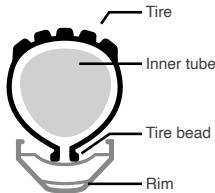
Figure 26. Tire bead into the base of rim
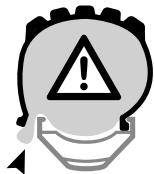
Figure 27. A pinched inner tube between tire and rim
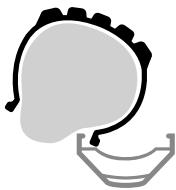
Figure 28. First bead in position ^+ inner tube out of the rim
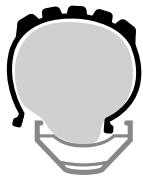
Figure 29. Inner tube in the rim
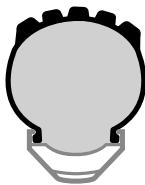
Figure 30. Tire beads in rim hooks + inner tube inflated
4.6 KICK-STAND
The kick-stand is made of aluminum. It is placed as close as possible to the rear wheel for the greatest stability and to avoid it coming into contact with the cranks when the bike is immobile. Its length can easily be modified. It is therefore easy to adjust it as needed, for example when your bike is parked on a slope.
For best stability, your bike should not be positioned too vertical or too leaned over. The Figure 31 shows the Ideal angle for parking your bike on flat ground.
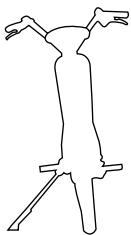
Figure 31. Ideal angle on flat ground
4.6.1 IN THE CASE OF A PLETSCHER KICK-STAND
You can easily adjust the length of the kick-stand using a 2.5mm allen key. To do this, unscrew the pressure screw; adjust it to the desired length, then retighten the pressure screw to 3-5 Nm.
4.6.2 IN THE CASE OF A MOUSTACHE KICK-STAND
You can adjust the length of your Moustache kick-stand. You simply need to pull the little plastic clip as in the Figure 33a, then, whilst holding the clip, adjust it to the desired length. Finally let
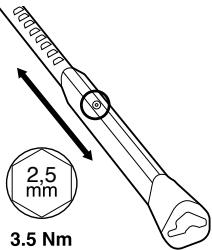
Figure 32.
Pletscher kick-stand settings.
go of the clip. If the displacement of the little plastic clip is not sufficient to allow the lower part of the kick-stand to move as required, you can loosen the cross-head screw by a quarter turn using a cross-head screwdriver until you have enough movement to slide the lower part of the
kick-stand as in Figure 33b.
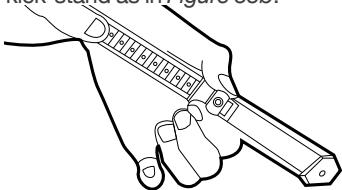
Figure 33a.
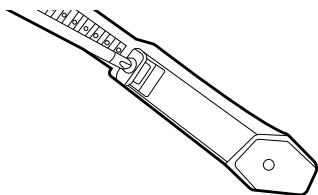
Figure 33b.
4.7 Luggage RACKS AND MUD GUARD
4.7.1 MUD GUARD
All our urban models are equipped with tubular mud guards ensuring a high level of stiffness. Always respect a minimum gap of 6mm at all points between the tire and the mud guard (Figure 34). This should be checked regularly and at each time that you change the tires on your bike. Keep to the size of tire equipped on your bike at sale in order to keep the right size gap. If the gap is less than 6mm contact your retailer so that he/she can adjust as necessary. Regularly check that the fixation points on your mud guard are tight. (Table 2 Recommended torque values)
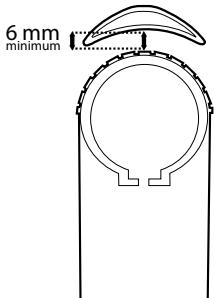
Figure 34. Minimum gap tire/mud guard.
4.7.2 Luggage RACKS
We have fitted some of our models with specific rear racks. These racks are designed for a maximum load of 25kg (including battery if your frame has a rack-mounted battery). Our Lundi 20 has a rear rack designed for a maximum load of 70kg . Under no circumstances should you attempt to modify your carrier, its mounting points or exceed the maximum load value as this may damage your bike and result in a fall and injury. In these cases, your bike or rack will not be covered by the warranty either.
When your luggage rack is loaded, the behavior of your bike will be affected. Weight is added to the rear of the bike, and this will modify the handling and braking of your bike. In order to keep a good level of balance on the bike, divide the load as evenly as possible on both sides of the bike.
Take time to get used to how your bike behaves when loaded and adapt to this different feeling. Also think to check the gap between the tire and mud guard when the bike is loaded. It should always be a minimum of 6mm.
If you wish to mount a child carrier or a trailer on your luggage rack, ask your retailer for advice. He/she will be able to inform you which will be compatible with your racks. When you attach paniers to your rack, ensure it is solidly fixed and don't leave any straps loose as these risk getting trapped in the wheels and causing a fall.
Note that any paniers fixed to the rack should not conceal lights and reflectors.
Regularly check that the screws holding your luggage racks are tight in order to avoid any unwanted incidents. Hold the rack and try to move it forward and back in order to check that all fixation points are tightly attached.
Fixation points for luggage racks :
- Models equipped with batteries fixed in the frame or on the frame: These luggage racks have 2 screws attaching them to the frame and 2 attaching them to the rear mud guard (Figure 35).
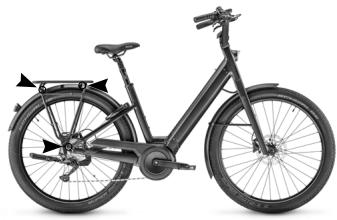
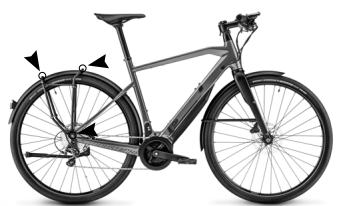
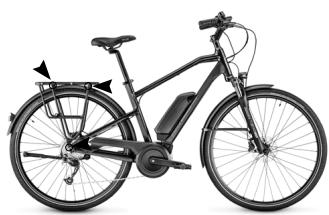
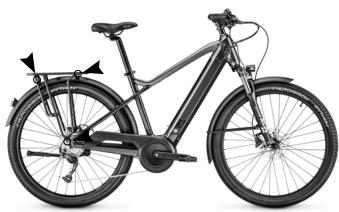
Figure 35. Luggage's fixing points represented by the black arrows
Note: Certain racks also come with the MIK HD mounting system, which means you can attach a compatible child seat.
4.7.3 TRANSPORTING CHILDREN OR A LOAD
Before riding on your Moustache when it is loaded or carrying a child in a child seat, you should always check several points:
- The pannier or child seat should be correctly installed.
- The child should be correctly strapped in according to the recommendations by the manufacturer of the seat, and wearing a helmet.
- The load should be shared evenly across the bike.
- The bags and load should not be able to slide or move.
- The load should not be greater than the total authorized weight.
- Nothing should be able to become trapped between the spokes in the wheel, nor obscure the lights and the reflectors.
WARNING!
When you are transporting a child on a child seat, always ensure that the child is not able to trap his/her fingers or feet in any moving parts of the bike (wheel, suspension seat post, spring on the saddle). There is risk of serious injury!
Do not leave the child in the child seat when you put the bike on its kick-stand.
Your approved Moustache retailer will be able to advise you for the purchase of an accredited child carrier that is compatible with your Moustache bike.
4.8 CHAIN TENSION
The chain on your Moustache is kept taut thanks to a chain tensioner situated by your rear derailleur. This should be checked regularly to ensure it is functioning correctly.
To do this:
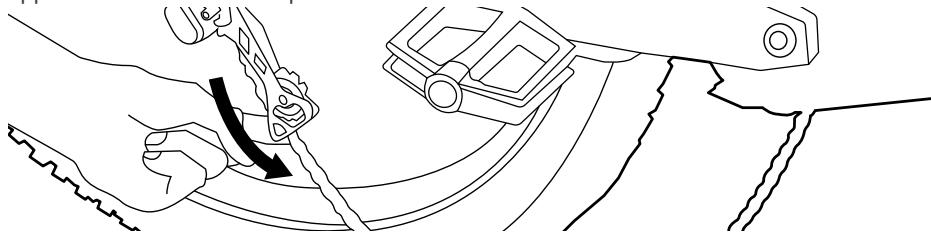
- Use your index finger to push the tensioner several centimeters towards the front of the bike.
- Remove your finger and check that it comes back to its initial position.
If the chain is loose and/or the tensioner does not go back to its initial position, go to your local approved retailer to have it repaired.
To guarantee the reliability of your bike, it is imperative that you tighten the screws of all components carefully and regularly check them. Use a torque wrench in order to check these values. Always tighten in a progressive manner in order not to apply a torque higher than the recommended values.
Never go over the recommended maximum torque value in any case.
On some parts, the recommended torque values are indicated on the part itself. Always respect these recommended levels.
If you cannot find the correct torque rate for your component, check the specific notice that was provided with your bike, or ask your retailer for advice.
Table 2 Recommended torque values
| Composant | Screws and bolts | Torque value | ||
| Transmission | ||||
| Rear derailleur | Fixation screw | 8-10 Nm | ||
| Cable screw | 5-7 Nm | |||
| Tension screw | 3-4 Nm | |||
| Gear lever | Fixation screw | 5 Nm | ||
| Cassette | Tightening screw | 40 Nm | ||
| Crank | Fixation screw on motor axle | 45-50 Nm | ||
| Pedal | Pedal axle | 25 -30 Nm | ||
| Chain guide | Fixation screw | 5 Nm | ||
| Cockpit | ||||
| Saddle on seat post | Seat post with 1 fitting block | 22 Nm | ||
| Seat post with 2 fitting blocks | 12 Nm | |||
| Seat post | Seat post clamp | 5 Nm | ||
| Stem | Screw on the handlebar | 5 Nm | ||
| Screw on the pivot | 6-8 Nm | |||
| Screw on the stem cover | 3 Nm | |||
| Grips | Fixation screw | 2-3 Nm | ||
| Accessories | ||||
| Luggage rack (battery) | Fixation screw on M5 seat stays | 4-5 Nm | ||
| Fixation screw on M6 seat stays | 5 Nm | |||
| Classic luggage rack | Fixation screw on the frame | 5 Nm | ||
| Mud guard | Fixation screw on the fork | 5 Nm | ||
| Fixation screw on the support | 3 Nm | |||
| Fixation screw on luggage rack/frame | 5 Nm | |||
| Kick-stand | Fixation screw | 6-8 Nm | ||
| Brakes | Formula | Shimano | Magura | |
| Brake caliper | Fixation screw on the frame/fork | 9 Nm | 6 Nm | 6-8 Nm |
| Brake lever on handlebar | Fixation screw on the brake lever | 3 Nm | 4-5 Nm | 4 Nm |
| Disc brake | Fixation screw on the hub | 6 Nm | 4 Nm | 4 Nm |
| Shimano Center lock bolt | 40 Nm | |||
WARNING!
The non-respect of the different recommended torque levels can cause the breakage or premature wear of certain components on your Moustache. This can also cause serious injury to the user.
4.10 OTHER RECOMMENDATIONS
Hitching a trailer to your Moustache bike
You can use trailers only if their total weight, including the rider's weight, the weight of luggage and accessories is less than the total approved weight (page 10).
Trailers are prohibited on:
- full-suspension bikes (FS)
speed bikes (45 km/h)
children's bikes
You cannot use trailers, child seats or luggage racks on category 3 and 4 bikes (full-suspension models and mountain bikes, see page 8). Please note that Moustache Bikes shall accept no responsibility or warranty claims if a trailer, child seat or luggage carrier is used on one of these bikes.
WARNING!
Be careful not to overload your trailer. This could cause the frame, fork, or other components to break, causing a risk of accident and injury!
Approved trailers must have two wheels side by side and the trailer must be attached to the left mounting bracket of the rear wheel of the bike (other mounting systems are prohibited).
WARNING!
Using a trailer changes how the bike rides and brakes. Also make sure that you do not exceed the maximum approved speed for the trailer (this information is available in the instructions provided by the equipment manufacturer).
When using a trailer:
- Be careful when loading; attach all loads securely to the trailer. Always secure your children and pets inside the trailer.
- Store heavy items as low and as close to the centre of the trailer as possible. When distributing the load, be sure to load the trailer as evenly as possible.
Always make sure that your child is wearing a suitable helmet that is the right size for them. - Make sure you remain visible to other road users. Check if your rear lights are not hidden by the trailer and install lights on it, as well as a flag.
- Adjust the tire pressure according to the additional load. The maximum inflation pressure is printed on the sidewall of the tire.
Caution: Under extreme circumstances, especially when riding for long periods of time at low speeds with a high load (e.g. uphill), parts of the drive system can heat up to temperatures above 60^ . This is also the case when you use your brakes intensively (especially on very steep downhill stretches). At the end of a ride, do not touch the drive unit housing or brake disks with your hands or bare legs.
5 | MAINTENANCE
Servicing and repairs can be tricky and complex. Careless or unprofessional servicing can lead to the failure of certain bike components. Danger of accident! Only carry out work for which you have the necessary knowledge and the appropriate tools. Otherwise, it is best to have these tasks carried out by your authorised dealer.
CAUTION!
Remove the battery before undertaking any work (repair, assembly, maintenance, work on the chain, etc.) on your electric bike, transporting it by car or plane, or before storing it for an extended period. Unintentional activation of the eBike system may result in injury.
5.1 BATTERY
The battery is the most important element on your Moustache. By following a few simple rules, you can maximize its life. Please refer to the Bosch manual that came with your Moustache by scanning the QR code on page 51, but here are some tips:
- Only charge a Bosch EAB battery with an original Bosch EAB charger. To charge the battery, read and follow the charger's manual. It is recommended to charge your battery indoors.
- The recommended temperature range for charging the battery is 0^ to +40^ . The battery should be stored in a dry and well-ventilated place, away from humidity at a temperature ranging from +10^ to +40^ .
- The battery charger is suitable for your geographical area. Refer to the label on the charger and the instructions for your battery and charger for more information.
- We encourage you to carefully follow Bosch's instructions.
- Do not store your battery when discharged; it could go into deep discharge which will shorten its life.
- Get into the habit of recharging it when you return, so your bike is always ready to go.
- Bosch batteries can be stored for up to 1 year without a charge, but it must first be charged to 50 / 60% (3 LEDs), (ask your local Moustache retailer for advice).
- Respect the temperature conditions for usage which are -5°C to 40°C.
- Never leave your battery exposed to high temperatures or in direct sunlight for a long period (for example in the back of a car in full sunlight).
- Ensure that the contact points are always clean and do not insert metallic objects.
-
The Bosch batteries are specifically conceived in order to be recyclable.
-
Do not throw them away in normal rubbish or the tip. There is a specific treatment (ask your local Moustache retailer for advice).
- Be careful, the transport of Lithium-ion batteries is subject to strict rules.
If you have any questions, please consult your local retailer.
5.2 USING ORIGINAL PARTS
It is strongly recommended to use the original parts for all components that are critical for safety.
The use of parts that are non-compliant with your bike, as well as any modification to the frame or parts can cause risks for the user of the bike as well as a restriction of the guarantee.
5.3 CLEANING AND LUBRICATION
After each ride, you should clean your bike with soapy water (washing up liquid is advised for its powerful degreasing qualities, without being corrosive). However, do not use a high-pressure hose, as far as possible.
If you cannot clean it otherwise, never direct the jet directly at the bearings and seals, nor at the motor and the battery.
You can leave the battery and the meter/HMI in place during washing to protect the electrical contacts. But once done, remove them from the bike and dry them with a soft cloth to remove water drops and moisture residue to avoid the risk of corrosion. This operation also allows you to do a visual check
Before storing your bike away, lubricate the transmission with a product specially designed for this. Also check the wear on your brakes, any possible buckling of the wheels and for any play.
Beware of the potential risks of being pinched, trapped, or caught and drawn in during maintenance work.
Warning 1 - Like any mechanical component, your Moustache bike is subject to high stress and wear. Different materials and components may react differently to wear or fatigue. If the life expectancy of a component has been exceeded, it may suddenly break, risking injury to the rider. Cracks, scratches and discoloration in high stress areas indicate that the component has exceeded its service life and should be replaced.
Warning 2 - For composite components, impact damage may be invisible to the user. Manufacturers have to explain the consequences of impact damage and recommend that, in the event of impact, composite components be returned to the manufacturer for inspection or be destroyed and replaced.
Regularly check all wear parts, especially parts for the brakes and the transmission in order to not take risks. If you have any doubt about the level of wear on any part, please check the manufacturer's notice or check with your retailer. Prevention is better than cure, so don't wait till the last moment!
List of the different wear parts:
- Elements of the brakes (pads, discs).
- Tires, inner tubes, rims.
- Cables and cable hoses.
- Elements of the transmission (chain, chain ring, cassette, derailleur tensioner, chain guide).
Grips. - Bearings.
Freehub body
Your e-bike's drivetrain is stressed, especially if you use high assistance modes. Check its wear regularly and replace it when needed. Ask your retailer for advice if you are unsure.
Take the time to regularly check that none of the chain links are deformed or open, as they could break while riding and cause you to fall.
In order to prolong the life of your bike and its components, we recommend that you follow these maintenance intervals:
1. Before and after each ride
- Check the brakes.
- Check the tire pressures and for any possible damage.
- Check wheels are tight.
- Check the stem and handlebar are tight.
- Check the suspension fork is functioning correctly.
WARNING!
Never spray oil on the chain without having first protected the brake discs. Without protection, small drops can pollute the disc and the pads and strongly reduce the braking performance. If brake pads are polluted they must be replaced immediately.
- Check that the battery is correctly attached to the frame or the luggage rack.
- Carefully store your bike in a clean dry area.
- Recharge your battery.
2. Every month
- Inspect for any possible play in the stem and the handlebar.
- Check the cassette as well as the chain as these are subject to a higher amount of strain on an eBike with central motor.
- Check the cables, hoses, levers.
- Check the derailleurs, and lubricate if necessary.
- Check the wear on brake pads, and replace if necessary.
- Check the wheel for any buckles and the spoke tension.
3. Every six months (depending on the frequency and the type of usage)
- Inspect the frame and check for the appearance of any cracks.
- Check and grease the wheel hubs, headset, and any parts that have friction.
For a more in depth diagnostic, we advise you to visit your Moustache retailer, in order to carry out a more detailed check.
4. Every two years
- Replace the handlebar and stem.
6 | WARRANTY & AFTER SALES SERVICE
In the case of any problem, take your bike with the purchase receipt to your local moustache retailer. he/she will carry out a first diagnostic of the problem. Only an approved retailer can send the bike to us and request the guarantee is taken into account. it's the moustache afer sales service who will decide on the validity of the warranty.
The guarantee is issued in accordance with European Directive no. 2019/771 of 20 May 2019. This directive defines a minimum period of legal guarantee of conformity of two years. This period may, however, be modified by local legislation. Ask your dealer for more information.
However, Moustache frames, excluding paint as well as rigid forks, are guaranteed against manufacturing or material defects for a period of 5 years.
For professional use, please contact us.
SPECIFIC POINTS
The Bosch battery is guaranteed to have a residual capacity of a minimum of 70% after 2 years or 500 cycles of full charge.
The finishings (paint and stickers) are guaranteed against fabrication defaults for a period of 1 year from the purchase date.
In the case of a warranty request, you should go to your local approved Moustache retailer with your purchase receipt.
The Moustache retailer will carry out a first diagnostic and contact us with the different elements.
According to these elements and a complementary analysis of your bike or the parts by our technicians, the Moustache After Sales Service will decide if the problem is covered by the warranty or not.
If the warranty is accepted, the component will be repaired or replaced with a new part that is identical or corresponding to the original.
If the warranty request is refused, your retailer will establish a quote for the repair. The work will start when you accept the quote.
THE WARRANTY ONLY APPLIES:
- On bikes purchased from an approved Moustache retailer.
- For the first owner of the bike (the warranty cannot be transferred to future purchasers in the case of a resale),
- In the case of normal usage of the bike.
THE WARRANTY DOES NOT APPLY:
- If the complaints are following the use of the bike in competition, for a professional usage, or outside of the conditions of use detailed in this manual (table page 48).
- If either insufficient maintenance or negligence on the part of the owner has been noted.
- In the case of accidents or other abnormal or excessive conditions of use.
- In the event of a major modification made to the bike (resulting in stresses not taken into account in its design) without prior written authorization from Moustache.
- In the case of exterior elements or agents (natural catastrophe, fire, humidity.
- In the case of use in a manner that is non-compliant with the technical and safety norms.
The warranty does not apply to wear parts of which you will find the list in the paragraph 5.4 WEAR PARTS AND INSPECTION FREQUENCIES
No seller or distributor can modify the terms of the warranty, unless the seller or distributor replaces the Moustache warranty with his/her own conditions of guarantee headed by his/ her company.

According to European Directive 2012/19/EU, end-of-life electrical and electronic equipment, and according to European Directive 2006/66/EC, used or defective batteries must be disposed of separately and recycled in an environmentally-friendly way.
Return unserviceable components of Bosch eBike systems to an authorized dealer.
7 | SERVICE RECORD
| 1stService | |
| At the latest after 400 km or 3 months after purchase date | Parts replaced / repaired, comment(s): |
| Date : | |
| Kilometers : | |
| Stamp & signature of the retailer: | |
| 2ndservice | |
| At the latest after 2.000 km or 6 months after purchase date | Parts replaced / repaired, comment(s): |
| Date : | |
| Kilometers : | |
| Stamp & signature of the retailer: | |
| 3rdService | |
| At the latest after 4.000 km or 2 years after purchase date | Parts replaced / repaired, comment(s): |
| Date : | |
| Kilometers : | |
| Stamp & signature of the retailer: | |
| 4thService | |
| At the latest after 6,000 km or 3 years after purchase date | Parts replaced / repaired, comment(s): |
| Date : | |
| Kilometers : | |
| Stamp & signature of the retailer: | |
| 5thService | |
| At the latest after 8,000 km or 4 years after purchase date | Parts replaced / repaired, comment(s): |
| Date : | |
| Kilometers : | |
| Stamp & signature of the retailer: | |
| 6thService | |
| At the latest after 10.000 km or 5 years after purchase date | Parts replaced / repaired, comment(s): |
| Date : | |
| Kilometers : | |
| Stamp & signature of the retailer: | |
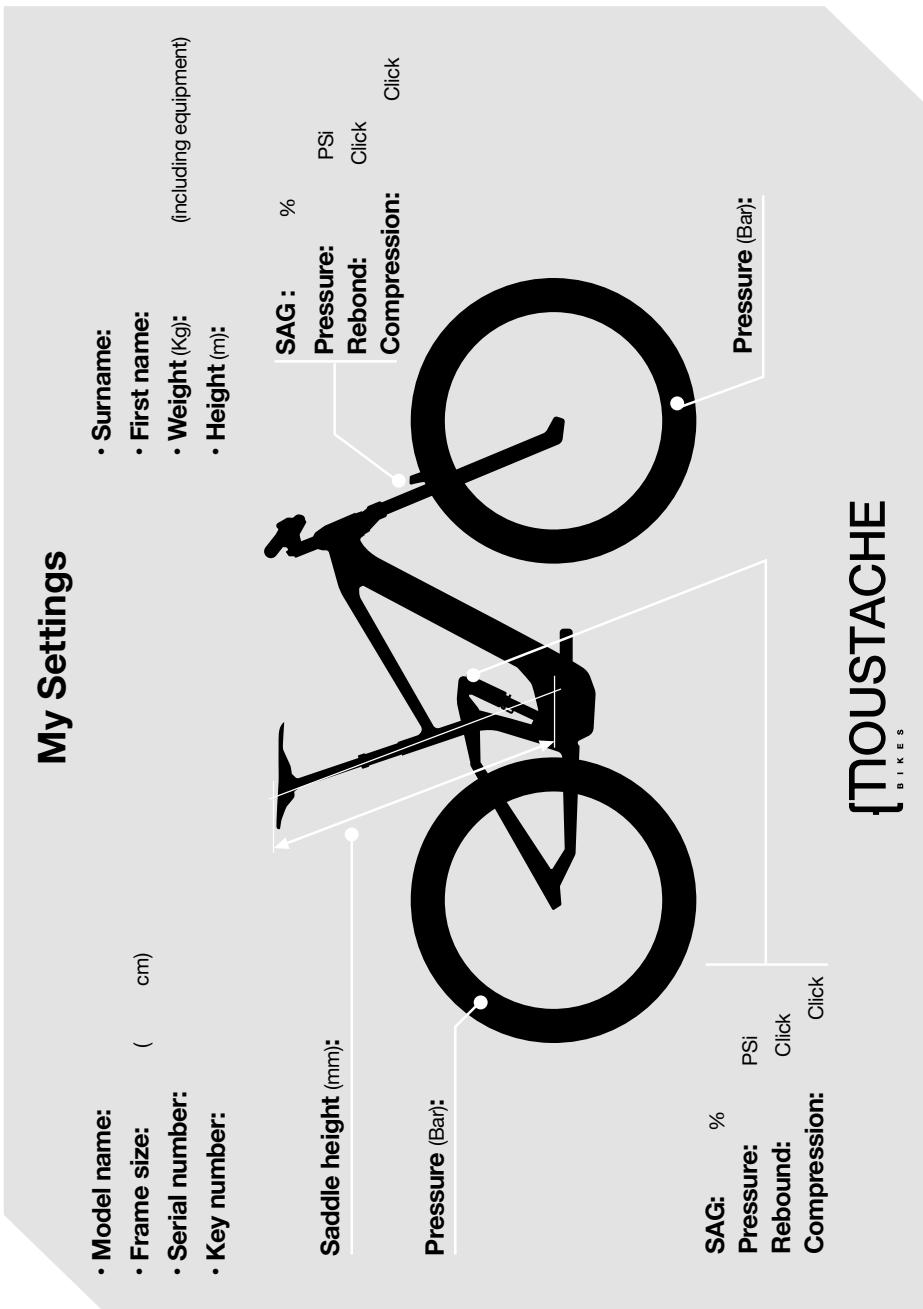
EC DECLARATION OF CONFORMITY
The manufacturer, Moustache Bikes, declares that the bikes drive by an electric engine, construction years 2023, and below mentioned:
| Commercial designation | Technical designation | Commercial designation | Technical designation |
| Lundi 20.3 | Lundi 20.3 | Samedi 28.5 Open | Samedi 28.5 Open |
| Lundi 20.5 | Lundi 20.5 | Samedi 28.7 Open | Samedi 28.7 Open |
| Lundi 20.3 Dual | Lundi 20.3 Dual | Samedi 27 Xroad FS 3 | Xroad FS 3 |
| Lundi 20.5 Dual | Lundi 20.5 Dual | Samedi 27 Xroad FS 6 | Xroad FS 6 |
| Lundi 27.1 | Lundi 27.1 | Samedi 27 Xroad 1 | Xroad 1 |
| Lundi 27.3 | Lundi 27.3 | Samedi 27 Xroad 2 | Xroad 2 |
| Lundi 27.5 | Lundi 27.5 | Samedi 27 Xroad 2 Nexus | Xroad 2 Nexus |
| Samedi 28.1 | Samedi 28.1 | Samedi 27 Xroad 3 | Xroad 3 |
| Samedi 28.2 | Samedi 28.2 | Samedi 27 Xroad 6 | Xroad 6 |
| Samedi 28.3 | Samedi 28.3 | Samedi 27 Xroad 1 Open | Xroad 1 Open |
| Samedi 28.5 | Samedi 28.5 | Samedi 27 Xroad 2 Open | Xroad 2 Open |
| Samedi 28.7 | Samedi 28.7 | Samedi 27 Xroad 2 Open Nexus | Xroad 2 Open Nexus |
| Samedi 28.1 Open | Samedi 28.1 Open | Samedi 27 Xroad 3 Open | Xroad 3 Open |
| Samedi 28.2 Open | Samedi 28.2 Open | Samedi 27 Xroad 6 Open | Xroad 6 Open |
| Samedi 28.3 Open | Samedi 28.3 Open |
fulfill all the relevant provisions of the Machinery - Directive 2006/42/EC and provisions of the Electromagnetic Compatibility - Directive 2014/30/EU.
The standard EN 15194:2017 Cycles - Electrically power assisted cycles - EPAC Bicycles was used.
M. Grégory Bary, in charge of Regulatory Compliance of S.A.S. Cycle Me company located in Thaon-Les-Vosges (France), is authorised to compile the technical file.
Thaon-Les-Vosges, 23^rd February 2023.
Romain Berthet
Operations Manager
EC DECLARATION OF CONFORMITY
The manufacturer, Moustache Bikes, declares that the bikes drive by an electric engine, construction years 2023, and below mentioned:
| Commercial designation | Technical designation | Commercial designation | Technical designation |
| Samedi 26 Off | 26 Off | Samedi 29 Trail 5 | Trail 5 |
| Samedi 27 Off 2 | Off 2 | Samedi 29 Trail 7 | Trail 7 |
| Samedi 27 Off 2 Open | Off 2 Open | Samedi 29 Trail 9 | Trail 9 |
| Samedi 27 Off 4 | Off 4 | Samedi 29 Trail 11 | Trail 11 |
| Samedi 27 Off 4 Open | Off 4 Open | Samedi 29 Trail 11 LTD | Trail 11 LTD |
| Samedi 26 FAT4 | Samedi 26 FAT4 | Samedi 29 Game 3 | Game 3 |
| Samedi 27 Wide 3 | Wide 3 | Samedi 29 Game 5 | Game 5 |
| Samedi 27 Wide 5 | Wide 5 | Samedi 29 Game 7 | Game 7 |
| Samedi 27 X2 VTT | Samedi 27x2 | Samedi 29 Game 9 | Game 9 |
| Samedi 27 X2 TPK | Samedi 27x2 Trekking | Samedi 29 Game 11 | Game 11 |
| Samedi 27 Weekend FS Dual | Weekend FS Dual | Samedi 29 Game 11 LTD | Game 11 LTD |
| Samedi 27 Weekend FS Dual EQ | Weekend FS Dual EQ | Dimanche 29.2 Gravel | Dimanche 29.2 Gravel |
| Samedi 27 Petit Weekend FS EQ | Petit Weekend FS EQ | Dimanche 29.2 Gravel Open | Dimanche 29.2 Gravel Open |
| Samedi 29 Trail 3 | Trail 3 | Dimanche 29.6 Gravel | Dimanche 29.6 Gravel |
fulfill all the relevant provisions of the Machinery - Directive 2006/42/EC and provisions of the Electromagnetic Compatibility - Directive 2014/30/EU.
The standards EN 15194:2017 Cycles - Electrically power assisted cycles - EPAC Bicycles and EN/ISO 4210-2:2018 - Cycles - Safety requirements for bicycles were used.
M. Grégory Bary, in charge of Regulatory Compliance of S.A.S. Cycle Me company located in Thaon-Les-Vosges (France), is authorised to compile the technical file.
Thaon-Les-Vosges, 23^rd February 2023.
Romain Berthet
Operations Manager
DEUTSCH

NUR EINE KLEMMSCHRAUBE :
1.1 LA BICICLETTA E I SUOI COMPONENTI
4.7 PORTAPACCHIE PARAFANGHI
4.7.1 Parafanghi
SAG [in mm] = SAG [in %] x veerweg [in mm]
In dit geval: SAG [in mm] = 25% (0,25) × 140 mm = 35 mm.