
PDS-6000F - To scan BROTHER - Free user manual and instructions
Find the device manual for free PDS-6000F BROTHER in PDF.


| Product Type | Professional flatbed scanner with automatic document feeder (ADF) |
| Brand | Brother |
| Model | PDS-6000F |
| Dimensions (L x D x H) | 530 x 470 x 300 mm |
| Weight | 18 kg |
| Power Supply | 100-240 V AC, 50/60 Hz, 1.5 A |
| Main Functions | Color and black-and-white scanning, automatic duplex, output PDF/JPEG/TIFF, built-in OCR, send to email/folder/printer, Brother ControlCenter software |
| Maintenance and Cleaning | Clean the scanner glass and ADF rollers with a lint-free cloth moistened with isopropyl alcohol. Use the cleaning kit recommended by Brother. |
| Safety | Automatic shutdown in case of paper jams, detection of improperly inserted documents, programmable sleep mode |
| Spare Parts and Repairability | Spare parts available from Brother after-sales service (rollers, glass, cables). Repairability index of 7.1/10. Maintenance manual available. |
| General Information | Professional office scanner, A3 format, scanning speed up to 40 pages per minute (single-sided) and 80 images per minute (duplex). Connectivity: USB 3.0 and Ethernet. |
Frequently Asked Questions - PDS-6000F BROTHER
User questions about PDS-6000F BROTHER
0 question about this device. Answer the ones you know or ask your own.
Ask a new question about this device
Download the instructions for your To scan in PDF format for free! Find your manual PDS-6000F - BROTHER and take your electronic device back in hand. On this page are published all the documents necessary for the use of your device. PDS-6000F by BROTHER.
USER MANUAL PDS-6000F BROTHER
Thank you for buying a Brother machine! Reading the documentation will help you make the most of your machine.
Symbols and conventions used in this guide
The following symbols and conventions are used throughout this guide:

CAUTION
CAUTION indicates a potentially hazardous situation which, if not avoided, may result in minor or moderate injuries.
IMPORTANT
IMPORTANT indicates a potentially hazardous situation which, if not avoided, may result in damage to property or loss of product functionality.
NOTE
Notes tell you how you should respond to a situation that may arise or give tips about other scanning features.
Bold
Bold style identifies keys on the machine or computer screen.
Italics
Italicised style emphasises an important point or refers you to a related topic.
Courier New
Text in Courier New font identifies messages on the LCD screen of the machine.
NOTE
- For PDS-5000F users: This guide uses PDS-6000F screen images, unless otherwise indicated.
- If you use a tablet running Windows®, you can make your selections either by tapping the screen or by clicking with your mouse.
Table of Contents
1 Scanning Software 1
Choose your scanning software 1
2 General Information 2
Scanner overview 2
Control panel 3
Control panel overview 3
LED indications 4
Machine status messages 4
3 Document Information 5
Acceptable documents 5
Unacceptable documents 6
Documents recommended for use with the Carrier Sheet (for ADF Scan) 7
4 Scan Preparation 8
Set up your machine for Automatic Document Feeder (ADF) use 8
Set up your machine for Flatbed use 9
Load documents 10
Loading documents in the ADF 10
Loading documents on the Flatbed's scanner glass 13
Loading multiple different-size documents in the ADF 14
Loading documents using the Carrier Sheet in the ADF 16
Loading documents wider than Letter/A4 size 18
5 Scan (Windows®) 20
Assign a scanning application to the Scan button 20
Scan a document 24
Scan using the control panel 20
Scan using your computer 25
Scan with DS Capture 25
Change scan settings using the TWAIN driver 27
Functional overview 27
DS Capture home screen 28
Scanner Properties dialog box 30
Image tab 31
Compression tab 37
Color Dropout tab 38
Paper tab 40
Multi-Feed Detection tab 45
Preview tab 47
Rotation tab 50
Enhancement tab 52
More Settings tab 56
Digital Imprimer tab 58
Information tab 62
Scan using the ISIS driver 63
6 Scan (Macintosh) 64
Scan using your computer 64
Scan with DS Capture 64
Change scan settings using the TWAIN driver 65
Functional overview 65
DS Capture screen overview 66
Image tab 67
File tab 73
Color Dropout tab 75
Paper tab 77
Rotation tab 82
Enhancement tab 84
Setting tab 88
Imprimer tab 89
Information tab 93
7 Maintenance 94
Clean the outside of your machine 94
Clean the Scanner Glass 95
Clean the inside of your machine 96
Replace parts 102
Supply information 102
Check replacement cycle 104
Replace the Rollers 104
Reset the usage counters 109
Packing and shipping the machine 110
8 Troubleshooting 113
Error and maintenance messages 113
Document jam 116
Multi-feed 118
Troubleshooting 120
A Appendix A 124
Specifications 124
General 124
Scanner 127
Interfaces 128
Supported languages 128
Computer requirements 129
B Appendix B
130
Contact Brother 130
Register your product online at 130
Frequently Asked Questions (FAQs) 130
For customer service 131
For Brother accessories & supplies 131
Technical support (for PageManager) 132
1 Scanning Software
Choose your scanning software
After installing Brother's scanner drivers, select a scanning application to save scanned images to your computer. Brother has supplied several options for you on Brother's installation DVD; use this table to determine which of the included scanning applications will work best for you:
| Software | Description | Where is it? | For more information |
| DS Capture (Windows®/Mac) | Brother's scanning application: it allows you to scan, browse and file your scanned documents. DS Capture is installed automatically when you install the scanner driver. | Windows®: DVD/Brother Solutions Center 1 Mac: Brother Solutions Center 1 | For Windows®: See Scan using your computer on page 25. For Macintosh: See Scan using your computer on page 64. |
| Button Manager V2 (Windows®) | Use this application to extend the DS Capture scanning functionality, and to create multiple types of scan buttons to perform one-touch scanning. If scanning with your computer, click the button to which the required scan settings have been assigned with the application. If scanning with your machine, select the menu to which the required scan settings have been assigned on the LCD screen, and then press the machine's Scan button. The following scan functions are supported: Scan to File/Scan to File (OCR)/ Scan to App/E-mail/Printer/ Shared Folder/FTP/SharePoint See the Button Manager Help menu for more information about using Button Manager V2. | DVD/Brother Solutions Center 1 | See the Button Manager V2 User's Guide. To scan using the Scan button on your machine's control panel, customize the Scan button in advance (see Scan using the control panel on page 20). |
| OmniPage SE 18 (Windows®) | OmniPage SE 18 is an OCR scanning application from Nuance. | DVD | See the software's user instructions. |
| PageManager 9 (Mac) | PageManager 9 is a scanning application from NewSoft. | DVD | See the software's user instructions. |
1 Visit support.brother.com
NOTE
In addition to the above, you can also use your TWAIN (Windows®/Mac), WIA (Windows®), ISIS (Windows®) and ICA (Mac) compatible applications for scanning.
2 General Information
Scanner overview
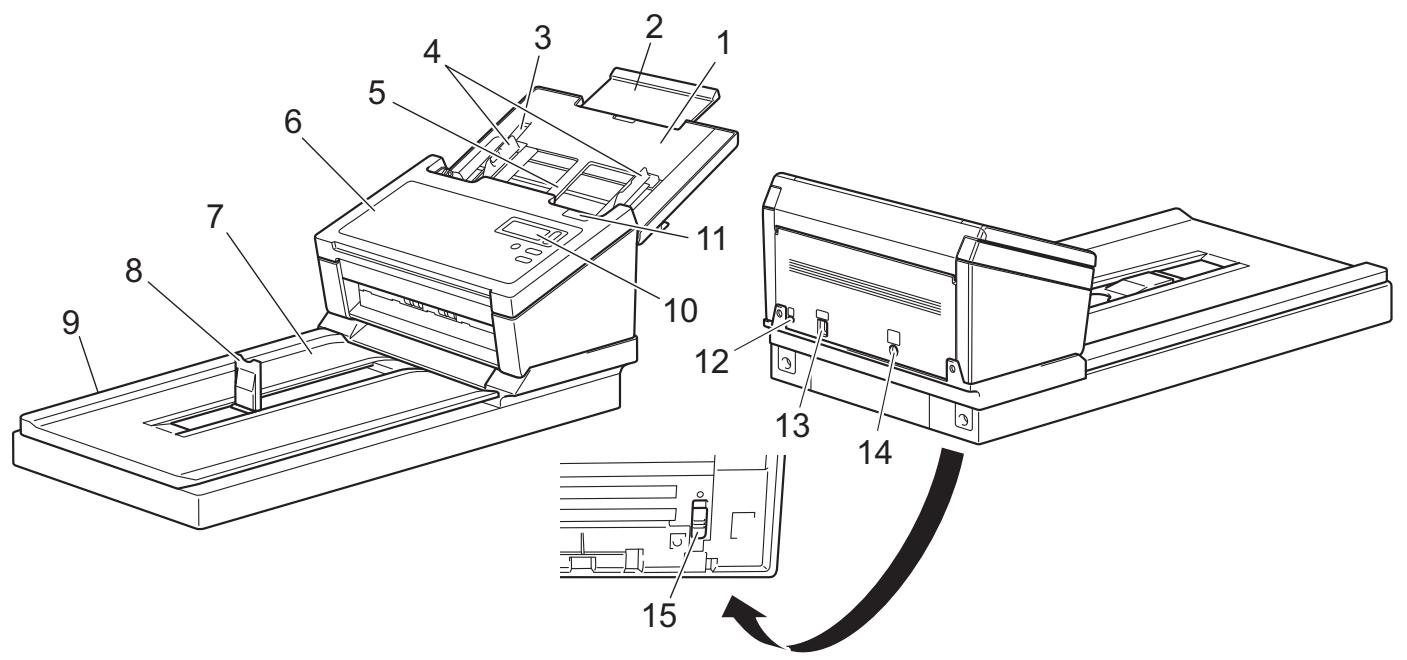
1 Top Cover
2 Cover Extension
3 Document Guide Stopper
4 Document Guides
5 Automatic Document Feeder (ADF)
6 ADF Cover
7 Document Cover
8 Document Stopper
9 Flatbed
10 Control Panel
11 Cover Release Lever
12 Security Slot
13 USB 3.0 SuperSpeed Port
14 AC Power Port
15 Transport Lock
Control panel
Your Brother machine has one Liquid Crystal Display (LCD), five buttons and one Light Emitting Diode (LED) on the control panel. The LCD is a 16 character, two-line display.
Control panel overview
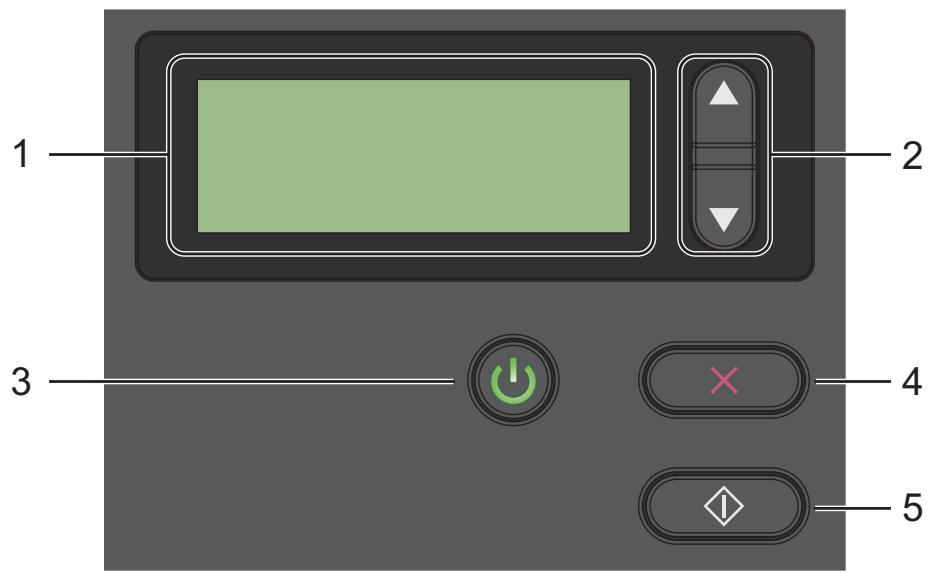
1 Liquid Crystal Display (LCD)
Displays messages to help you set up and use your machine.
2 Function Selector (▲ or▼)
Press to scroll through the function numbers.
For more information about the function numbers, see Scan using the control panel on page 20, step 4 and 5.
3 Power button (LED)
- Press to turn the machine ON when the machine is off or in Power Saving Mode.
- Press to enter Power Saving Mode when the machine is ON.
- Press and hold down to turn the machine OFF.
For more information about Power Saving Mode, see Energy Saving Control on page 57.
4 X Cancel button
Press to stop scanning.
5 Scan button
Press to start scanning or to launch a scanning application.
LED indications
The LED indicates your Brother machine's status.
| LED Indication | Meaning |
| No light | The machine is OFF. |
| Green | The machine is ON. |
| Blinking green | The machine is initializing or in Power Saving Mode. |
| Blinking red | There is a problem with the machine. |
Machine status messages
The following table explains the machine's status messages during normal operation:
| Machine Status Message | Meaning |
| Function X | This shows the currently selected function number. |
| PageCountXXXX | The machine is ready to scan. Where xxxx is the document scan count. |
| ScanningXXXX | The machine is scanning. Where xxxx is the current document scan count. |
| Canceling | The machine is cancelling the current scan job. |
NOTE
When Button Manager is running on your computer, Function X changes to a Button Manager function number and name.
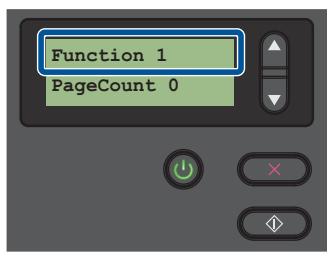
LCD
(When Button Manager V2 is not running)
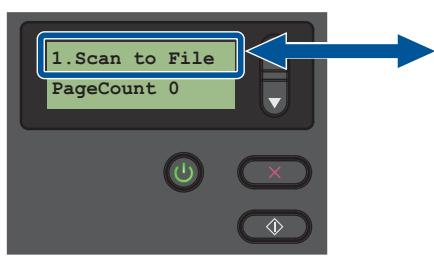
LCD
(When Button Manager V2 is running)
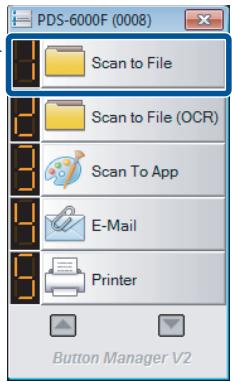
Button Manager V2
Button Panel
For more information, see the Button Manager V2 User's Guide. Go to your model's page on the Brother Solutions Center at support.brother.com/manuals to download the Button Manager V2 User's Guide.
Acceptable documents
| Standard Paper | Length | ADF | 2.13 in. to 14.0 in. (54 mm to 356 mm) |
| Scanner Glass | 14.0 in. Maximum: (356 mm) | ||
| Width | ADF | 2.0 in. to 8.58 in. (51 mm to 218 mm) | |
| Scanner Glass | 8.5 in. Maximum: (216 mm) | ||
| Weight | ADF | 7.5 lb to 106 lb (28 g/m2to 400 g/m2)To scan thinner documents, use the Carrier Sheet (see Loading documents using the Carrier Sheet in the ADF on page 16). | |
| Maximum Number of PagesADF (Automatic DocumentFeeder) | 100 sheets (with 28 to 80 g/m2paper)70 sheets (with 105 g/m2paper)60 sheets (with 127 g/m2paper)50 sheets (with 200 g/m2paper)15 sheets (with 400 g/m2paper)15 sheets (Business Card) | ||
| Standard Paper Size | A4 | 8.3 in. × 11.7 in. (210 mm × 297 mm) | |
| A5 | 5.8 in. × 8.3 in. (148 mm × 210 mm) | ||
| A6 | 4.1 in. × 5.8 in. (105 mm × 148 mm) | ||
| A7 | 2.9 in. × 4.1 in. (74 mm × 105 mm) | ||
| B5 | 7.2 in. × 10.1 in. (182 mm × 257 mm) | ||
| B6 | 5.0 in. × 7.2 in. (128 mm × 182 mm) | ||
| B7 | 3.6 in. × 5.0 in. (91 mm × 128 mm) | ||
| Legal | 8.5 in. × 14 in. (215.9 mm × 355.6 mm) | ||
| Letter | 8.5 in. × 11 in. (215.9 mm × 279.4 mm) | ||
| Long Paper ADF (Automatic Document Feeder) | Maximum Length | 236.0 in. (5,994 mm) 1 |
| Width | 2.0 in. to 8.58 in. (51 mm to 218 mm) | |
| Weight | 7.5 lb to 106 lb (28 g/m2 to 400 g/m2) To scan thinner documents, use the Carrier Sheet (see Loading documents using the Carrier Sheet in the ADF on page 16). | |
| Maximum Number of Pages | 1 page (1 sheet) |
1 If scanning at 200 dpi
| Plastic Cards | Length | ADF | 2.76 in. to 3.74 in. (70 mm to 95 mm) |
| Scanner Glass | 14.0 in. Maximum: (356 mm) | ||
| Width | ADF | 2.0 in. to 2.17 in. (51 mm to 55 mm) | |
| Scanner Glass | 8.50 in. Maximum: (216 mm) | ||
| Standard Size (ISO) | 3.37 × 2.13 × 0.03 in. (85.6 × 54.0 × 0.76 mm) | ||
| Material | Plastic (PET) | ||
| Type | Plastic card, such as a driver's license or an insurance card | ||
| Thickness (ISO) | Less than 30 mil (0.76 mm) Up to 49 mil (1.25 mm) (with Embossed) | ||
| Maximum Number of Pages | 1 page (1 sheet) |
Unacceptable documents
Documents with paper clips or staples
Documents with wet ink
■ Fabrics, metallic sheets, overhead projector sheets
Glossy or mirrored media
Documents that exceed recommended thicknesses
IMPORTANT
The damage caused by using any unacceptable document with your Brother machine may not be covered under warranty.
Documents recommended for use with the Carrier Sheet (for ADF Scan)
NOTE
- You cannot place a Carrier Sheet onto the Flatbed's scanner glass.
- To purchase a Carrier Sheet, find contact information for your local Brother office at www.brother.com U.S. users: find contact information for your local Authorized Service Center at www.brother-usa.com/service
Use the optional Carrier Sheet when you scan the following:
Plastic cards
Documents with a carbon sheet attached
Documents written in pencil
Documents narrower than 2.0 in. (50 mm) wide
Documents shorter than 2.13 in. (54 mm) long
Documents of uneven thickness, such as envelopes
Documents with large wrinkles or curls
Bent or damaged documents
Documents that use tracing paper
Documents that use coated paper
Photographs (photographic paper)
Documents printed on perforated paper
Documents printed on unusually-shaped paper (not square or rectangular)
Documents with photos, notes, or stickers affixed to them
Documents that use carbonless paper
Documents that use loose-leaf paper or any paper with holes in it
Photographic negatives
Receipes
For more information about using the Carrier Sheet, see Loading documents using the Carrier Sheet in the ADF on page 16.
CAUTION
To avoid cutting yourself, do not slide or scrape your hand or fingers along the edges of the Carrier Sheet.
4 Scan Preparation
Set up your machine for Automatic Document Feeder (ADF) use
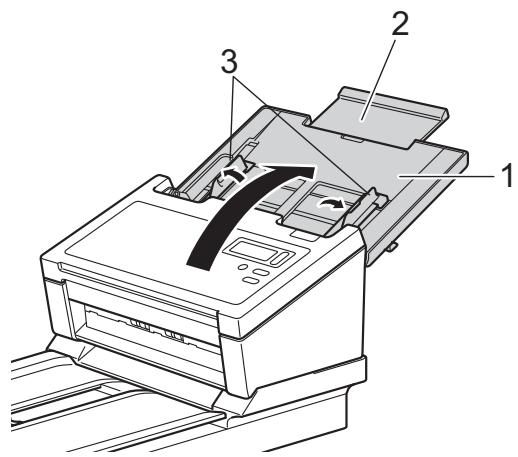
1 Open the Top Cover (1), pull the Cover Extension (2) out, and then unfold the Document Guides (3).
2 Lift the Document Stopper (1) and slide it to fit the size of your paper.
Set up your machine for Flatbed use
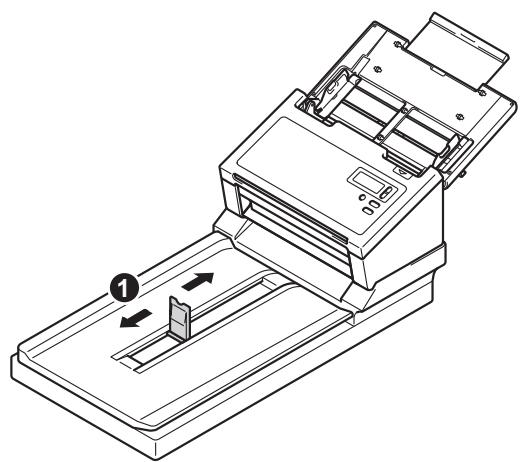
1 Lift the document cover (1).
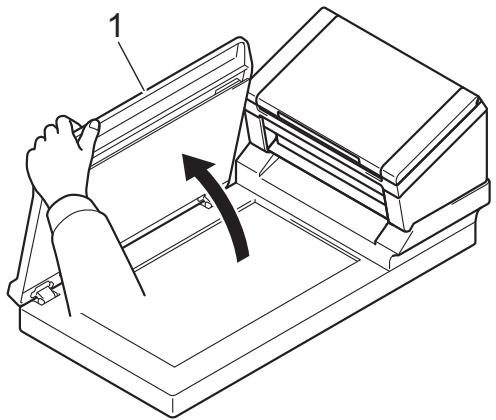
2 Make sure the scanner glass is empty.
Load documents
IMPORTANT
- The ADF can hold up to 100 pages and feeds each sheet individually. Use 20 lb (80g / m^2) paper and always fan the pages before placing them in the ADF.
- DO NOT pull on the document while it is feeding.
DO NOT use paper that is curled, wrinkled, folded, ripped, stapled, paper-clipped, pasted, or taped. - DO NOT try to scan cardboard or fabric.
NOTE
- Make sure the documents that have ink or correction fluid on them are completely dry.
- Certain types of plastic cards may be scratched when scanned. To prevent damage to the card, we recommend using the Carrier Sheet or scanner glass.
- If misfeeds frequently occur when you scan thin sheets, reduce the number of documents held in the ADF, and then start scanning again.
Loading documents in the ADF
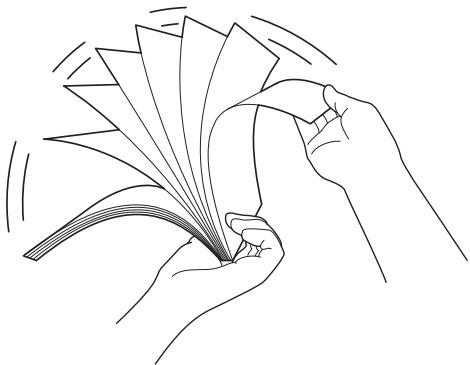
Fan the pages several times along both the long edge and the short edge.
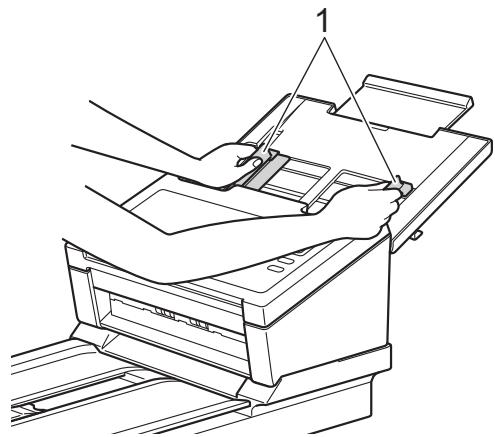
Adjust the Document Guides (1) to fit the width of your document.
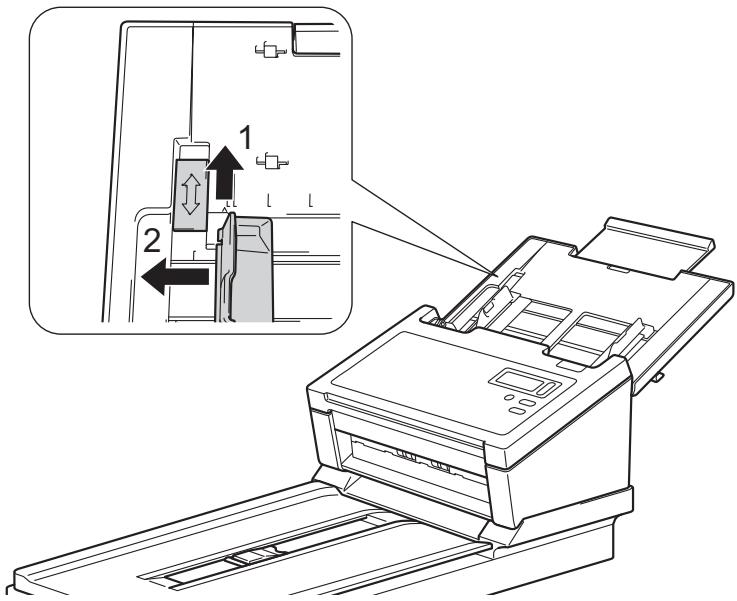
NOTE
When scanning documents with punch holes, such as continuous form paper, slide the Document Guide Stopper (1) up, and then extend the Document Guide (2).
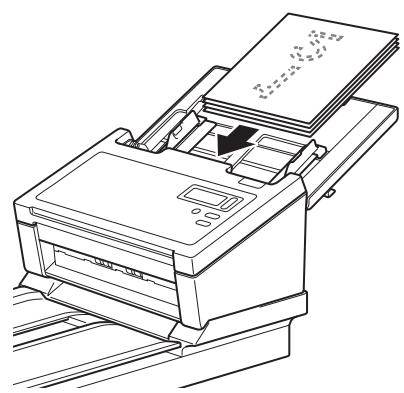
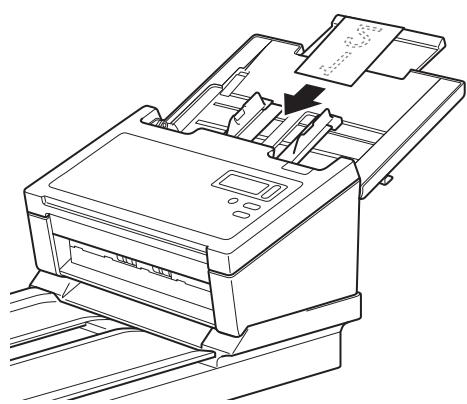
Place the pages, face down, top edge first in the ADF between the Guides until you feel them touch the inside of the machine.
■ For plastic cards: Place your card, face down and short side first in the ADF between the Guides until you feel it touch the inside of the machine. Load only one plastic card at a time.
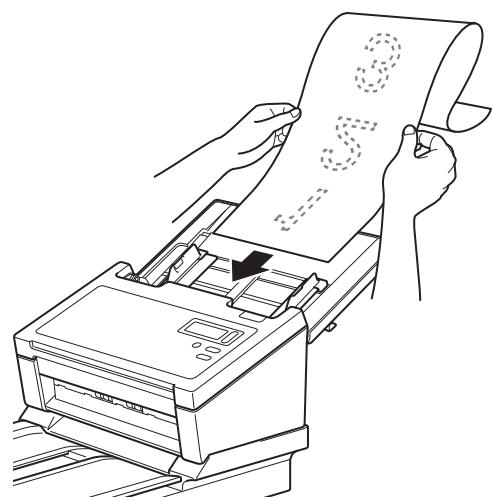
- For documents longer than Letter/A4 size: If the document is longer than the Top Cover, support the document with your hand. Load only one document at a time. See Acceptable documents on page 5.
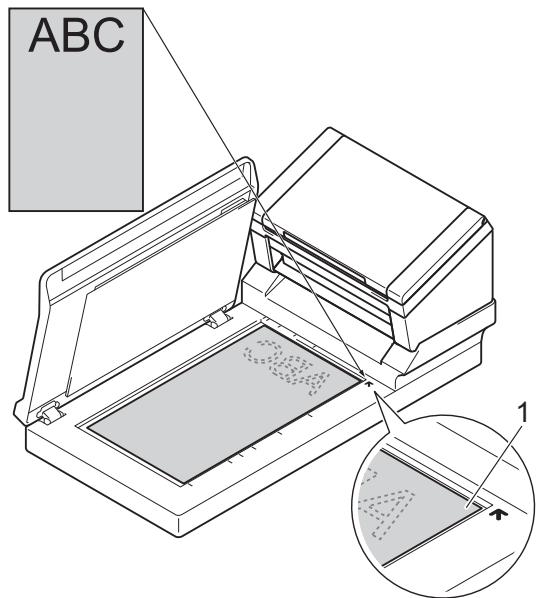
Loading documents on the Flatbed's scanner glass
1 Lift the document cover (1).
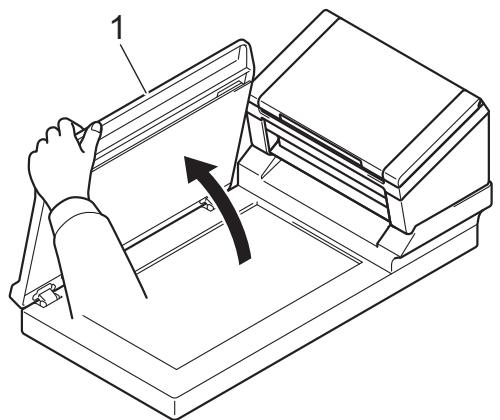
Place the document face down in the right corner of the scanner glass (1), as shown.
3 Close the document cover.
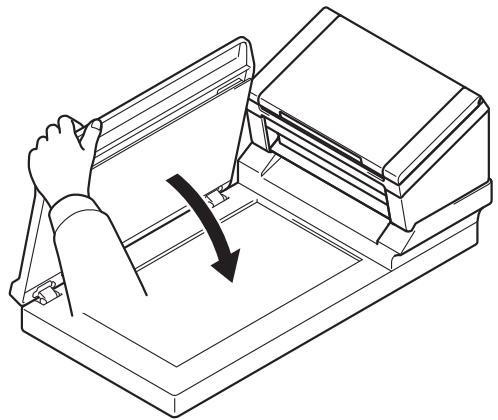
Loading multiple different-size documents in the ADF
NOTE
Make sure that the narrowest document is wide enough to touch the ADF's feed rollers, or it may cause a document jam.

Stack the documents on top of each other, making sure that the top edge and the left side of each document are aligned.
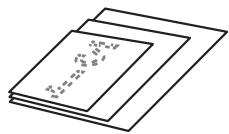

Adjust the Document Guides (1) to fit the width of the largest document.
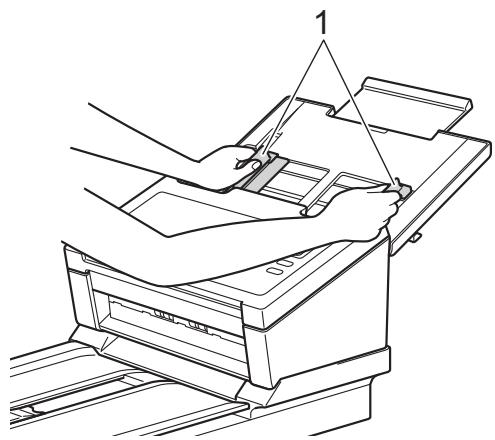

Place the documents, face down, top edge first in the ADF between the Guides until you feel them touch the inside of the machine.
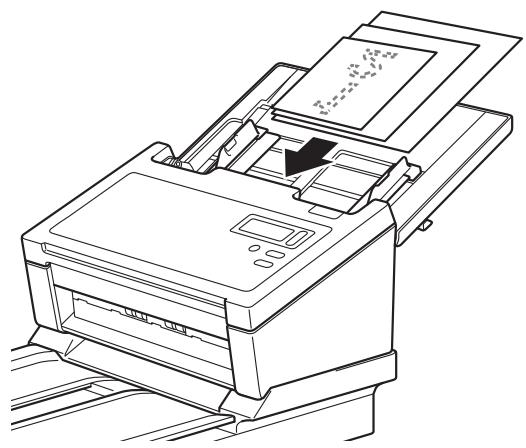
Combinations of multiple different-sized documents
| Maximum size | LTR (P)Carrier Sheet | A4 (P)A5 (L) | B5 (P)B6 (L) | A5 (P)A6 (L) | B6 (P)B7 (L) | A6 (P)A7 (L) | B7 (P)B8 (L) | A7 (P)A8 (L) | B8 (P) | A8 (P) | ||
| Width (mm) (*1) | 216 | 210 | 182 | 149 | 129 | 105 | 91 | 74.3 | 64.3 | 52.5 | ||
| Minimum size | LTR (P)Carrier Sheet | 216 | ||||||||||
| A4 (P)A5 (L)B5 (P)B6 (L) | 210182 | |||||||||||
| Available range | ||||||||||||
| A5 (P)A6 (L) | 149 | |||||||||||
| B6 (P)B7 (L) | 129 | |||||||||||
| A6 (P)A7 (L)B7 (P)B8 (L) | 10591 | |||||||||||
| A7 (P)A8 (L) | 74.3 | |||||||||||
| B8 (P) | 64.3 | |||||||||||
| A8 (P) | 52.5 | |||||||||||
LTR: Letter size
(P): Portrait
(L): Landscape
Loading documents using the Carrier Sheet in the ADF
To purchase a Carrier Sheet, find contact information for your local Brother office at www.brother.com
IMPORTANT
- Do not write on the Carrier Sheet, as the writing may be seen in scanned documents. If the Carrier Sheet becomes dirty, wipe it with a dry cloth.
- Do not leave documents in the Carrier Sheet for extended periods of time, as the printing on the documents may bleed through onto the Carrier Sheet.
- Do not place the Carrier Sheet in direct sunlight or in an area subject to high temperatures and high humidity, as the Carrier Sheet may warp.
- Do not place large or heavy objects on the Carrier Sheet when it is lying flat.
- Do not bend or pull the Carrier Sheet. If it becomes damaged, it may not be acceptable for scanning - do not use it.
- Do not scan multiple Carrier Sheets in a row.

Insert the document into the Carrier Sheet.
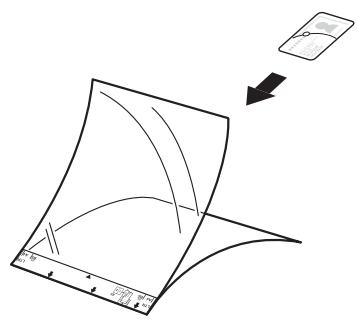
NOTE
- Place the document in the center of the Carrier Sheet and align the top of the document with the top of the Carrier Sheet.
- To avoid document jams, do not put several small documents into the Carrier Sheet at the same time. Insert only one document into the Carrier Sheet at a time.
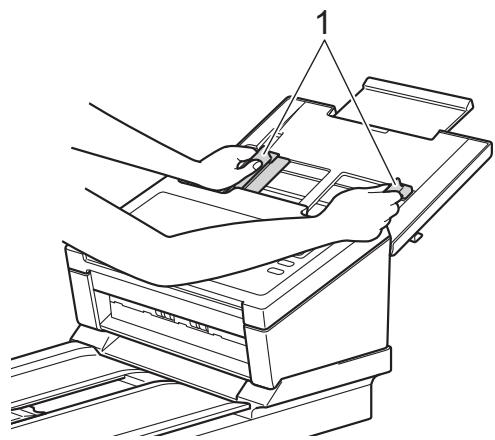
Adjust the Document Guides (1) to fit the width of the Carrier Sheet.
Place the Carrier Sheet in the ADF between the Guides until you feel it touch the inside of the machine.
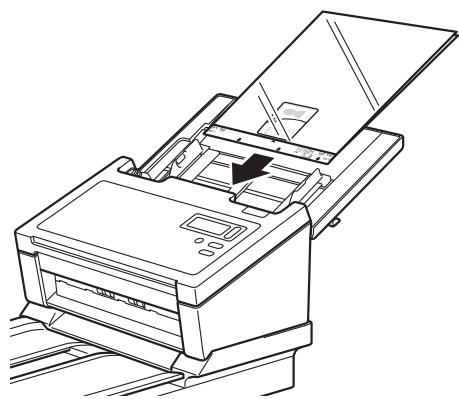
NOTE
To avoid document jams, do not load the Carrier Sheet upside down.
Loading documents wider than Letter/A4 size
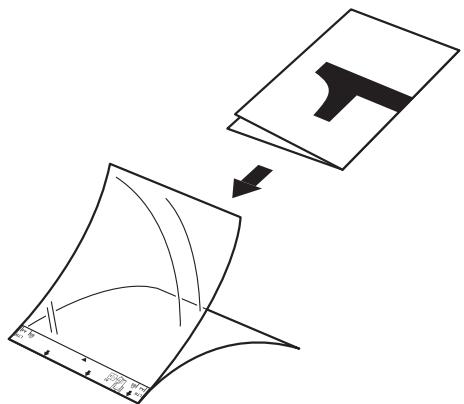
You can scan documents that are wider than Letter/A4 size using the Carrier Sheet.
Before scanning, see Loading documents using the Carrier Sheet in the ADF on page 16 for basic usage instructions and notes about the Carrier Sheet.

For best results, carefully fold your document in half, making sure all the corners are even, and then insert the document into the Carrier Sheet.
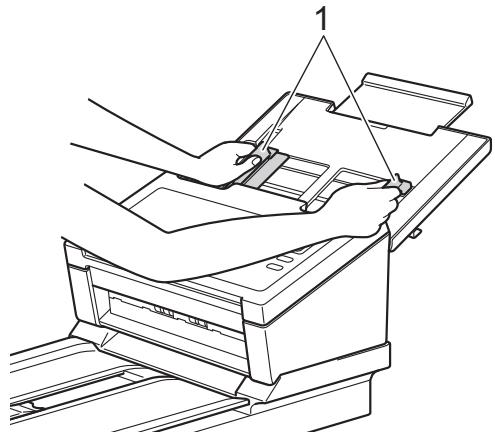
Adjust the Document Guides (1) to fit the width of the Carrier Sheet.
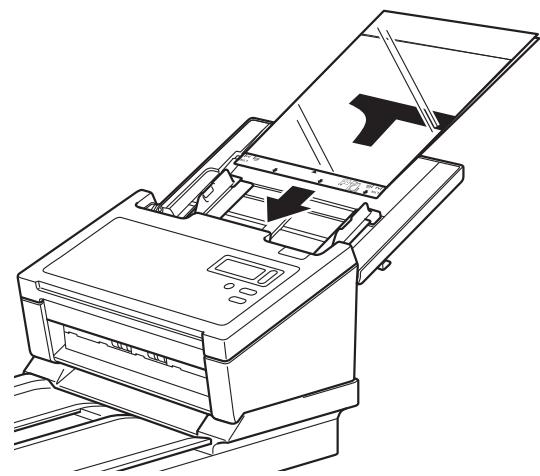
Place the Carrier Sheet in the ADF between the Guides until you feel it touch the inside of the machine.
NOTE
To reduce the white space in the center of a scanned page, be sure to position the folded edge of the original document closer to the right edge of the Carrier Sheet.
5 Scan (Windows®)
Scan using the control panel
Customize the Scan button on your Brother machine's control panel to scan using your preferred scanning software.
Assign a scanning application to the Scan button
1 Confirm that the machine is connected to your computer via a USB cable.
2 Access the machine from your computer using one of the following:
- For Windows® 10
Click (Start) > Settings > Devices > Printers&Scanners > Devices&Printers.
- For Windows® 8/8.1
Move your mouse to the lower right corner of your desktop. When the menu bar appears,
click > Control Panel. In the Hardware and Sound group, click View devices and printers.
- For Windows® 7
Click (Start) > Devices and Printers.
- For Windows Vista®
Click (Start) > Control Panel > Scanners and Cameras > Printers.
- For Windows® XP
Click (Start) > Control Panel > Scanners and Cameras.
3 Right-click the scanner icon, and select Scan properties from the menu.
For Windows Vista®, select the machine and click Properties.

Click the Events tab, and then select an event number from the Select an event drop-down list. The Button # you select from this list directly corresponds with the function numbers (Function X) displayed on the machine's LCD.
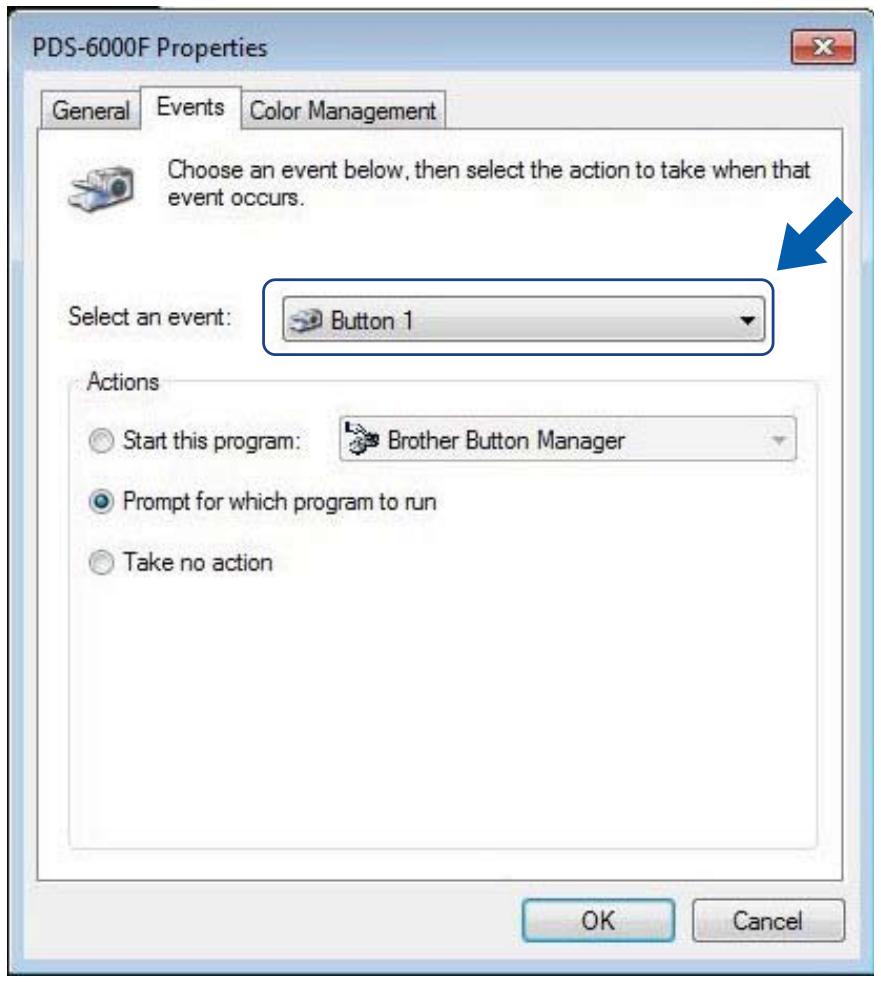
5 Select Start this program from Actions, and then select the scanning application you want to launch when you press the (Scan) button on your machine's control panel.
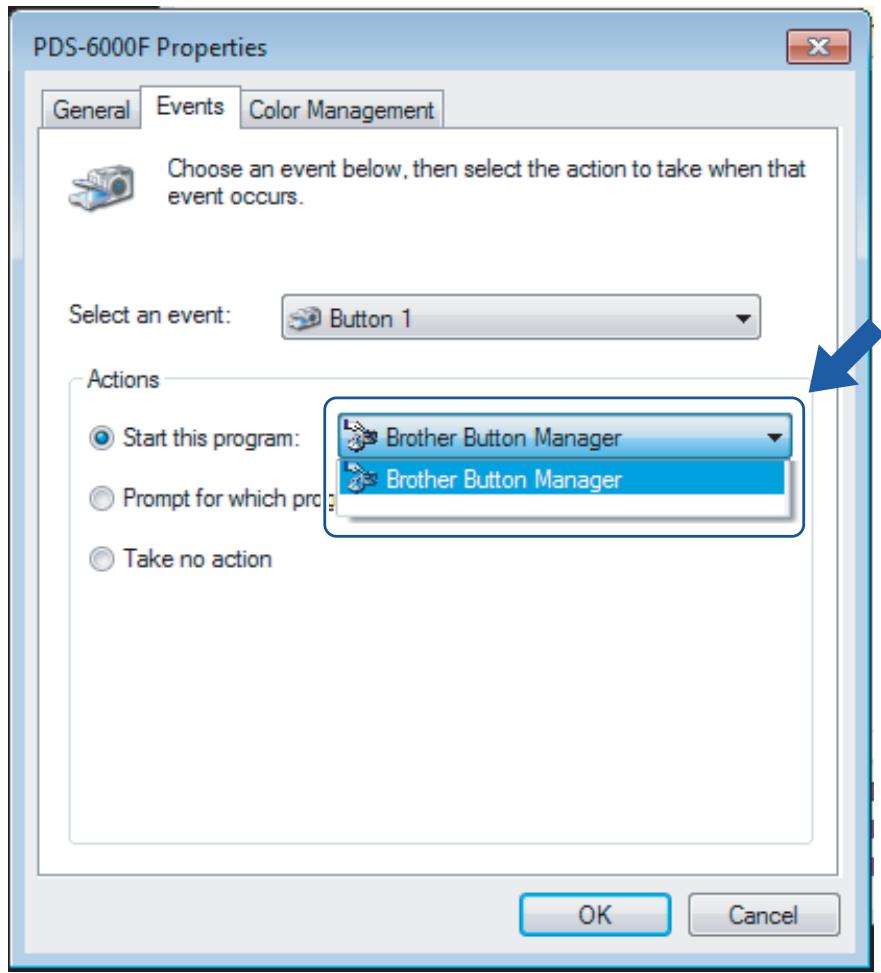
6 Click OK.

Select the function number that you assigned to the scanning application on the machine's LCD, and then push the (Scan) button on your machine to launch the assigned application.
NOTE
When you use Button Manager V2 application, you can synchronize the machine's LCD and application's function names by assigning Brother Button Manager to all the Button # in the Select an event drop-down list. For more information, see the Button Manager V2 User's Guide.
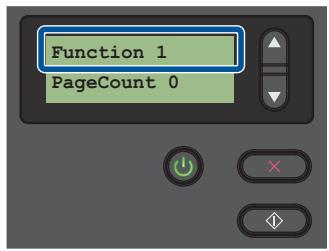
LCD (When Button Manager V2 is not running)
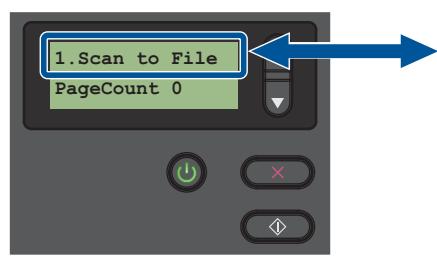
LCD (When Button Manager V2 is running)
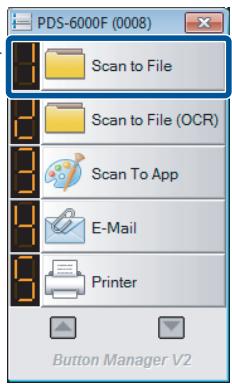
Button Manager V2
Button Panel
Scan a document
1 Confirm that the machine is connected to your computer via a USB cable.
Place your document either in the ADF, or on the scanner glass.
Press or to select a Function.
NOTE
When Brother's Button Manager is running on your computer, the machine's LCD displays a Button Manager function number and name. For more information, see the Button Manager V2 User's Guide.
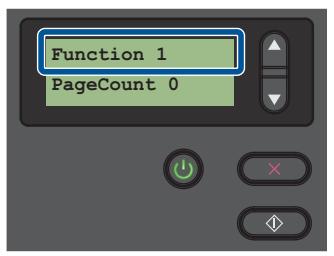
LCD (When Button Manager V2 is not running)
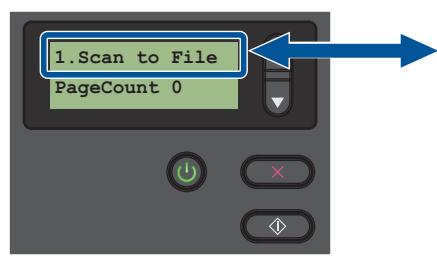
LCD (When Button Manager V2 is running)
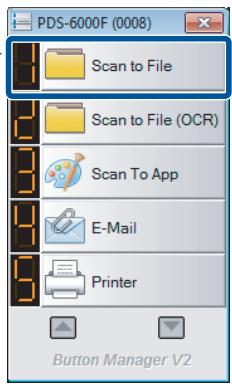
Button Manager V2
Button Panel
4 Press to launch the scanning application.
Press again to begin scanning.
Scan using your computer
To scan using your computer, launch a TWAIN-compatible application on your computer, such as DS Capture or Adobe® PhotoShop®. This guide uses DS Capture as an example.
Scan with DS Capture
1 Confirm that the machine is connected to your computer via a USB cable.
Double-click the DS Capture icon on your desktop.
NOTE
If the DS Capture icon

is not visible on your desktop, click Start > All Programs >
Brother PDS-XXXX Scanner (where XXXX is your model name) > DS Capture.
3 The Select Scanner Model dialog box appears.
Select your Brother machine's model from the Scanner Model list, and then click OK.
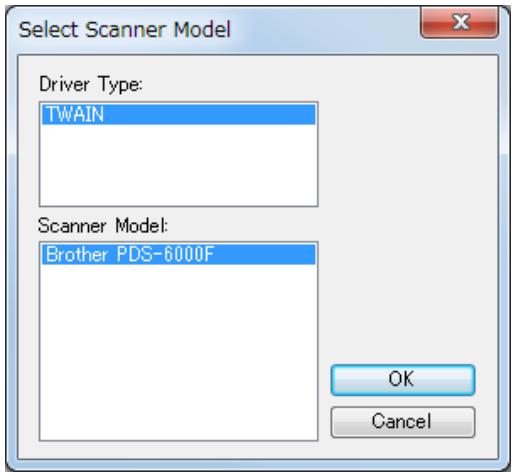
4 DS Capture launches.
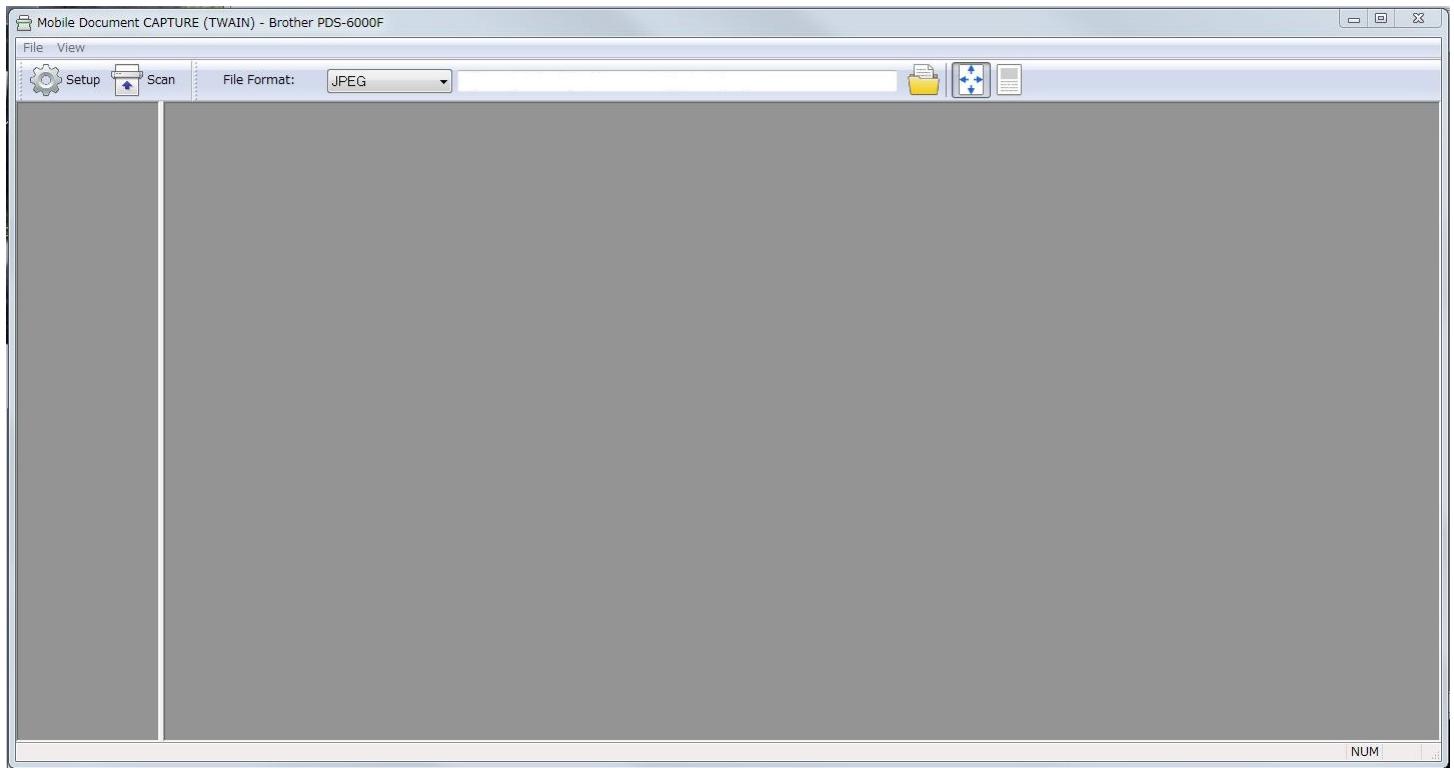
5 Click Setup to change the scan settings, if needed.
For more information on changing settings, see Change scan settings using the TWAIN driver on page 27.
Place your document either in the ADF, or on the scanner glass.
7 Click Scan. Your machine starts scanning.
A thumbnail of the scanned image appears in the DS Capture window and the scanned image is saved in the directory you specified in the Path field. For more information, see DS Capture home screen on page 28.
Check the scan result to confirm that all settings are correct.
Change scan settings using the TWAIN driver
The TWAIN driver provides various settings and useful functions, which you can use when scanning, as listed in the overview table below.
In this guide, we use the DS Capture application in our examples. Instructions for other scanning software should be similar.
Functional overview
| Category | Function | Reference |
| Basic settings | Specify the image type (color) and scan | Image tab on page 31 |
| Automatically identify the document color and scan | Image tab on page 31 | |
| Specify the document size and scan | Paper tab on page 40 | |
| Automatically identify the document size and scan | Paper tab on page 40 | |
| Specify the resolution and scan | Image tab on page 31 | |
| Image processing | Remove the specified color and scan | Color Dropout tab on page 38 |
| Rotate the document | Rotation tab on page 50 | |
| Detect and remove blank pages | Enhancement tab on page 52 | |
| Remove punch holes of scanned documents | Enhancement tab on page 52 | |
| Automatically compensate the document tilt | Paper tab on page 40 | |
| Remove the document base color | Enhancement tab on page 52 | |
| Add a white or black edge around the border | Enhancement tab on page 52 | |
| Remove small dots or specks from the background | Enhancement tab on page 52 | |
| Efficient scanning | See preview and check scan settings | Preview tab on page 47 |
| Save your scanner properties | Image tab on page 31 | |
| Acquire multiple color type scan results with a single scan | Image tab on page 31 | |
| Specify the computer memory used when scanning | More Settings tab on page 56 | |
| Perform consecutive document scanning | Paper tab on page 40 | |
| Advanced functions | Scan a barcode to read information | Enhancement tab on page 52 |
| Add a character string to the scan result | Digital Imprimer tab on page 58 | |
| Divide a 1 page document into 2 pages | Rotation tab on page 50 | |
| Scan a document larger than Letter/A4 size | Image tab on page 31 | |
| Machine settings | Specify multifeed detection settings | Multi-Feed Detection tab on page 45 |
| Check and reset the scan count | Information tab on page 62 | |
| Change the Power Saving Mode and Power Off time settings | More Settings tab on page 56 | |
| System information | Check the scanner and computer system information | Information tab on page 62 |
DS Capture home screen
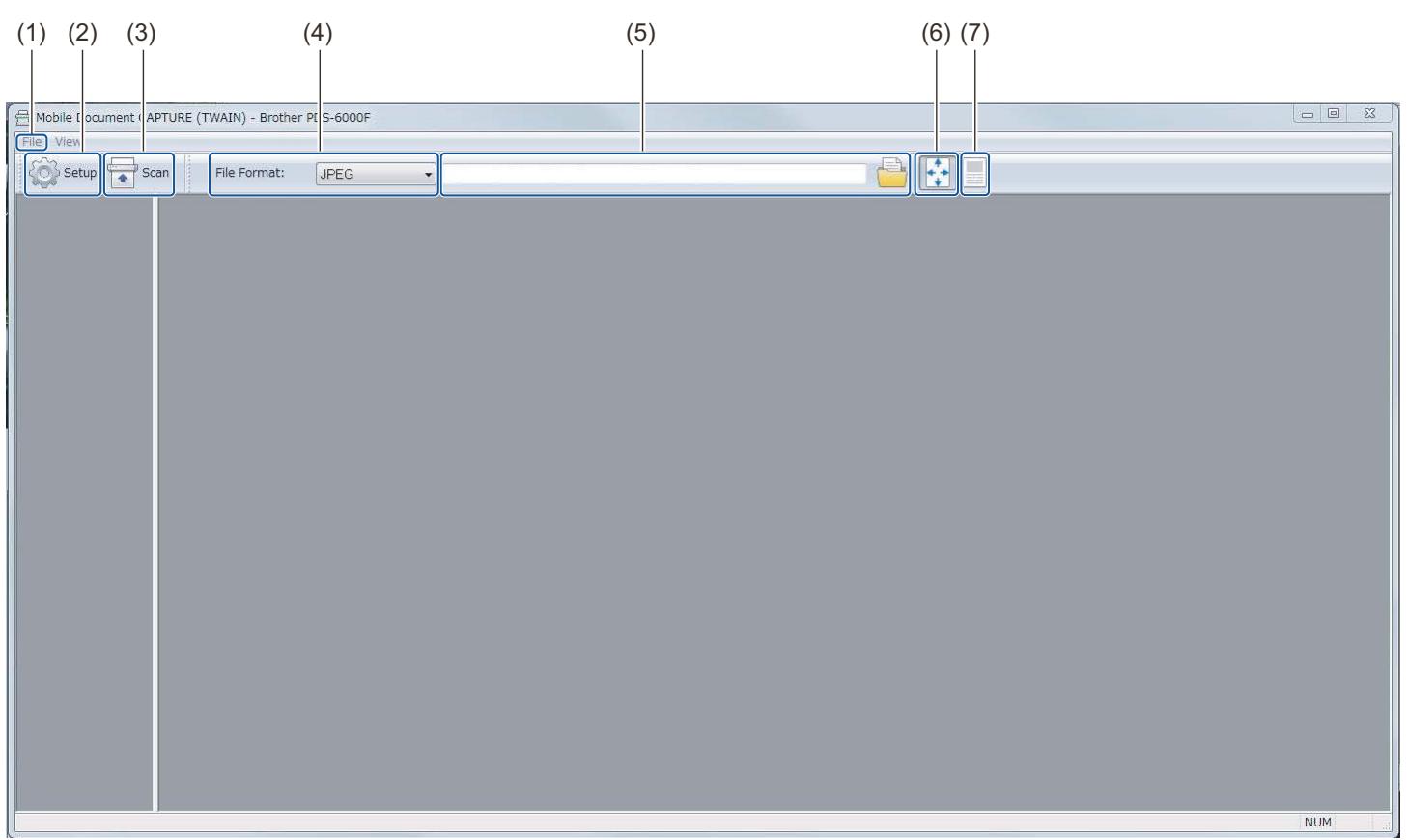
| No. | Name | Description | Default |
| (1) | Fast scan mode / Fast display mode (select from the File menu) | Switch the scan mode if needed. ■ Fast scan mode Fast scan mode gives priority to scanning speed. Thumbsils are displayed after scanning is complete. ■ Fast display mode In Fast display mode, thumbnails are displayed in real-time. NOTE When you select Fast display mode, scanning speed may be slower, depending on your computer. | Fast scan mode |
| Debug (select from the File menu) | Set the debug value between 0 and 9. NOTE Debug is a developer's function. Users should not need to change this setting. | 0 | |
| (2) | Setup | Change scanner properties. For more information, see Scanner Properties dialog box on page 30. | - |
| (3) | Scan | Click this button to scan. | - |
| (4) | File Format | Change the file format. Select the format you want from the drop-down list. NOTE To save multiple documents as one file, select Multi-page PDF (MPDF) or Multi-page TIFF (MTIFF) from the drop-down list. | JPEG |
| (5) | Path | Specify the directory where you want to save scanned images. | \My Documents\My Scan\ |
| (6) | Fit Page | View and resize the scanned image. You cannot use Fit Page when PDF or Multi-page PDF is selected in File Format. | (select) |
| (7) | Actual Size (100%) | View the scanned image in Actual Size (100%). You cannot use Actual Size (100%) when PDF or Multi-page PDF is selected in File Format. | (not selected) |
Scanner Properties dialog box
Click Setup on the DS Capture home screen to display the Scanner Properties dialog box. Use the Scanner Properties tabs to configure your Brother machine's settings.
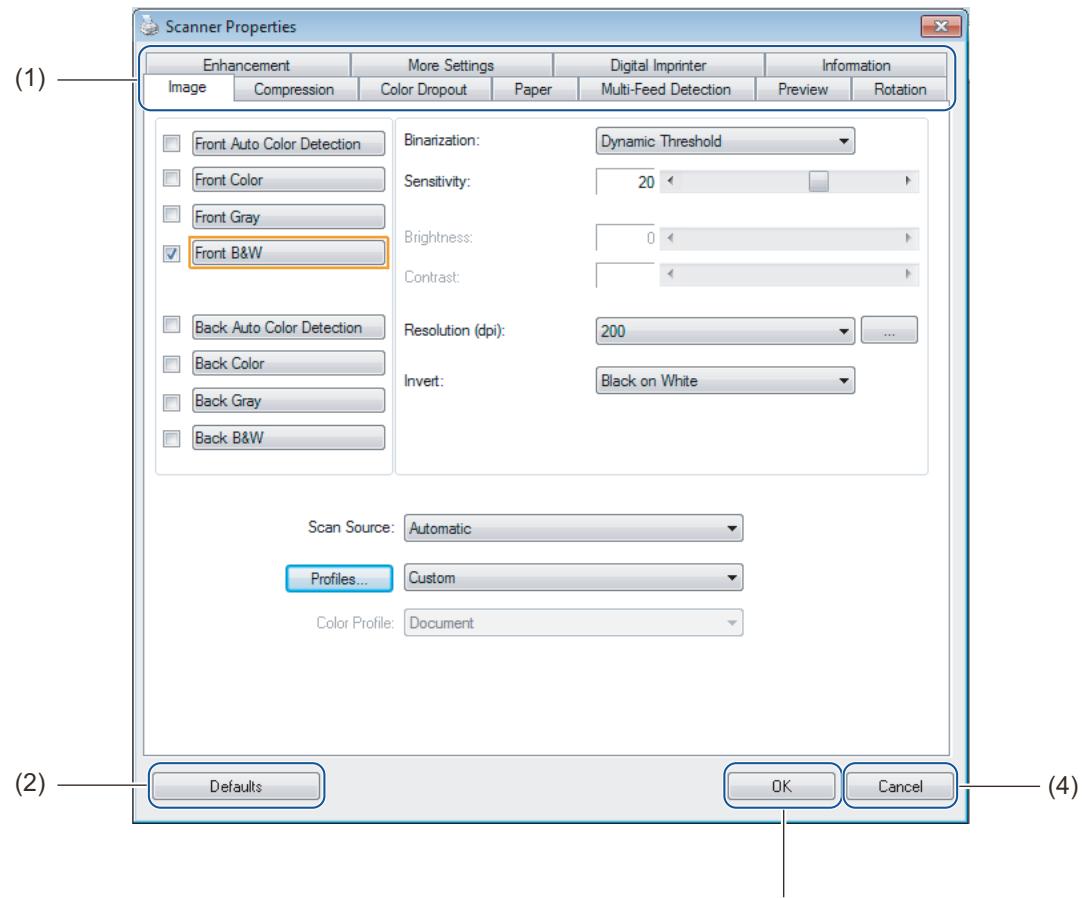
(3)
| No. | Name | Description |
| (1) | Tabs | Image, Compression, Color Dropout, Paper, Multi-Feed Detection, Preview, Rotation, Enhancement, More Settings, Digital Imprimer, Information |
| (2) | Defaults | Click Defaults to reset all settings in all tabs to factory settings. |
| (3) | Scan/OK | Click the Scan button to start a scan. Click OK to save the settings and close the Scanner Properties dialog box. |
| (4) | Cancel | Click Cancel to close the Scanner Properties dialog box without saving changes. |
NOTE
All settings in the Image tab (except for the Resolution), the Compression tab, the Color Dropout tab, and the Preview tabs can be set individually for the front and back of any double-sided document you scan.
Image tab
Click the Image tab to set basic scan settings, to assign values for the front or back of your document and to specify the image type.
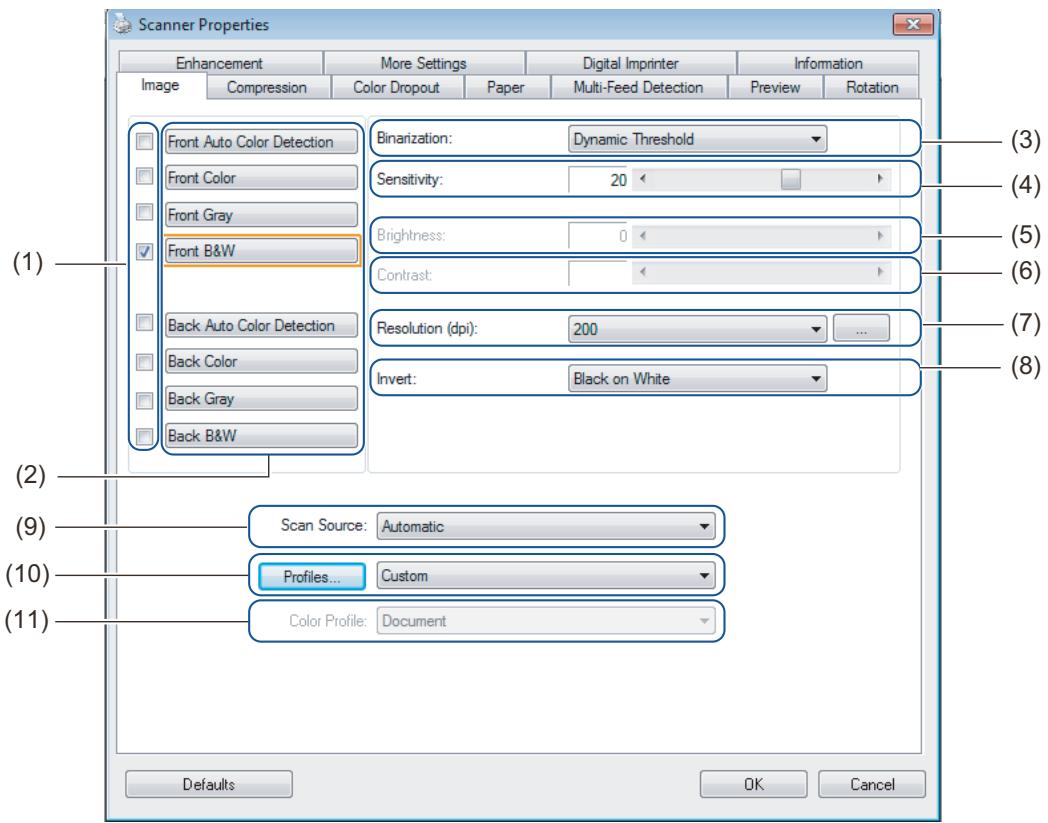
| No. | Name | Description | Default |
| (1) | Image Selection check boxes | Select the check boxes to specify the type of scan for the front (and back) of your document. | Front B&W |
| (2) | Image Selection group | Customize the settings for the front and back of your document. | Front B&W |
| (3) | Binarization / Document Type / Non-Color Selection | Select an appropriate image processing mode. This field name changes based on your choice in the Image Selection group. | Dynamic Threshold / Document / Black and White |
| (4) | Sensitivity / Threshold | Change sensitivity/threshold value. | - |
| (5) | Brightness | Change brightness. | 0 |
| (6) | Contrast | Change contrast. | 0 |
| (7) | Resolution (dpi) | Select resolution. | 200 |
| (8) | Invert | Reverse the brightness and the colors in the image. | Black on White |
| (9) | Scan Source options | Select a scan source. | Automatic |
| (10) | Profiles | Create or change scan profiles for frequently used scan settings. | Custom |
| (11) | Color Profile | Ensure accurate colors when scanning. | Document |
Image Selection check boxes
Select the check boxes to set the color mode for both the front and the back of your document. For example, to scan both the front and back of a color document page in color, select the Front Color and Back Color check boxes. For a black and white scan of the front and a color scan of the back, select Front B&W and Back Color.
NOTE
- Select more than one image type check box to generate multiple scan results from a single scan. For example, if you select Front Color and Front Gray, and then scan your document, scan data in both color and gray is saved.
- If you select Front Auto Color Detection, you must select Back Auto Color Detection as a back image type (and the other way round). These two options work only with each other.
- Back Auto Color Detection, Back Color, Back Gray and Back B&W is not available when using the scanner glass.
Image Selection group
The Image Selection group lets you configure detailed settings used when scanning in each color mode. Select an image type and customize detailed settings. You can apply different settings to each image type.
| Image Type | Description |
| Color | Select Color if your original is in color and you want an exact copy. |
| Gray | Select Gray if your original contains shades of gray. |
| B&W | Select B&W if your original is typed, written in pencil, or written in pen. |
| Auto Color Detection | Select Auto Color Detection to automatically detect and scan the front or back of your color document. If your document is in color, the machine automatically scans the document as a color image. If your document is not in color, select either Black and White or Gray from the Non-Color Selection drop-down list. Use this option if your document is multi-page and includes both color and black and white. |
Binarization / Document Type / Non-Color Selection
This field name changes based on your choice in the Image Selection group.
Binarization (B&W mode only)
Binarization is the process of converting a grayscale or color image into a black and white image. There are several methods of performing this conversion.
| Conversion Methods | Description |
| Dynamic Threshold | Select Dynamic Threshold to allow the machine to dynamically evaluate each document to produce the highest quality image. Select this option to scan documents containing faint text, shaded background, or color background. If you select Dynamic Threshold: Threshold, Brightness, and Contrast are not available. |
| Fixed Processing | Select Fixed Processing for black and white and other high-contrast documents. A single level is set to determine the black and white transition. The threshold is programmable over the entire density range. If you select Fixed Processing, Contrast is not available. |
| Halftone 1-5 | Select Halftone to view a gray image composed of different-sized dots. In other machines, this is sometimes called “Grayscale”. |
| Error Diffusion | Select Error Diffusion for a type of Halftone. Error Diffusion results in good image texture and makes text in images more legible than Halftone 1-5 above. |
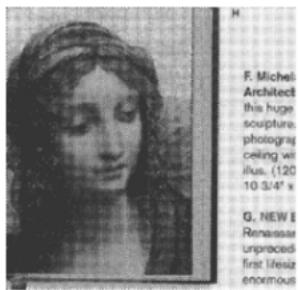
Halftone
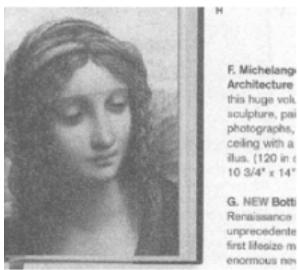
Diffusion
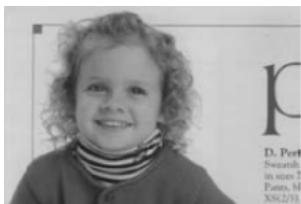
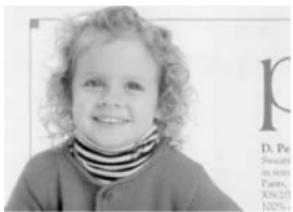
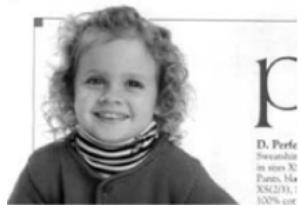
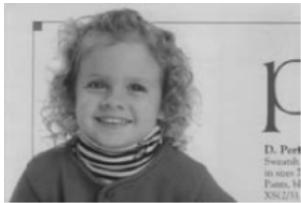
■ Document Type (Gray mode only)
When you select Gray as the image type for your scanned document, you can choose from three document types:
| Document Type | Description |
| Document | Select Document if your original contains only text or a mixture of text and graphics. This is the optimal setting for regular business documents. |
| Photo | Select Photo if your original contains a photograph, to reproduce it in a vivid grayscale image. |
| Normal | Select Normal to adjust Brightness and Contrast manually. |
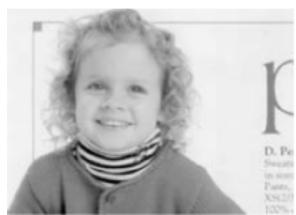
Document
(Threshold: 230)
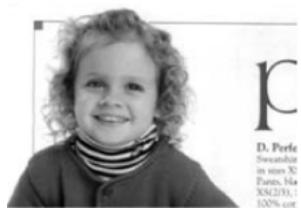
Photo
Normal
Non-Color Selection (Auto Color Detection mode only)
If your document is non-color, you can choose the output to be either Black and White or Gray. This option is useful when you scan a combination of color and non-color documents.
Sensitivity / Threshold
■ Sensitivity (available when you select Dynamic Threshold or Auto Color Detection)
Sensitivity of Dynamic Threshold:
If your document contains small dots or speckles and you want to remove them, increase the sensitivity value by moving the bar to the right.
Sensitivity of Auto Color Detection:
If your document contains primarily black and white text with a small amount of light or pale color that you do not want to be recognized as color, reduce the sensitivity value by moving the bar to the left.
- Threshold (available when you select Fixed Processing or Document)
A low threshold value produces a lighter image, and can be used to subdue backgrounds and unneeded information. A high threshold value produces darker images, and can be used to help faint images stand out.
Brightness
Use the Brightness bar to lighten or darken an image. The greater the value, the clearer the image.
Contrast
Use the Contrast bar to adjust the range between the darkest and the lightest shades in the image. The greater the value, the greater the difference between light and dark.
Resolution (dpi)
Select a resolution value from the drop-down list. The greater the value, the higher the resolution, and larger the file size.
You can set a custom resolution value by clicking the button to the right of the drop-down list.
Invert
Use Invert to reverse the brightness and the colors in the image. The default setting is Black on White background. To reverse this, select White on Black.

Black on White

White on Black
Scan Source
Automatic
The machine uses the paper from the ADF first. If there is no paper in the ADF, the machine switches to Flatbed scanning.
Automatic Document Feeder (ADF)
Use the ADF to scan multiple pages.
Flatbed
Use the scanner glass to scan.
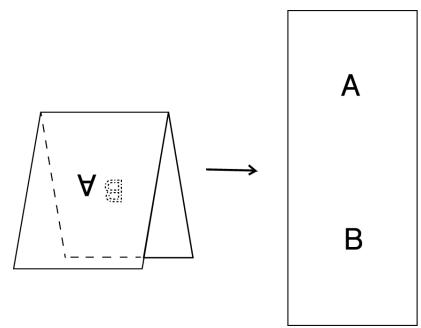
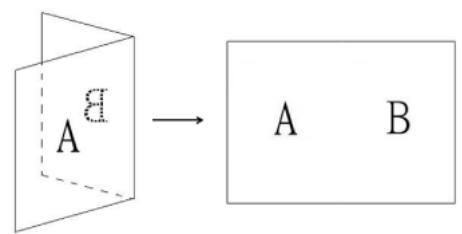
2 in 1 for Automatic Document Feeder
Use 2 in 1 to scan documents wider than Letter/A4 size. The machine scans both sides of the folded document, and merges the images onto a single page.
- Merge Vertically check box
Select this check box to align both sides vertically.
Clear this check box to align both sides horizontally.
Select Merge Vertically
Clear Merge Vertically
Profiles
Click Profiles to save your frequently-used scan settings.
To create a scan profile:
1 Select your scan settings in the Scanner Properties dialog box, using any of the tabs.
When finished, click the Image tab, and then click Profiles.
The Edit Your Profile dialog box appears.
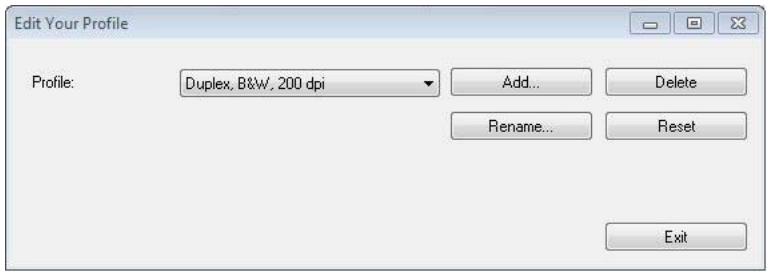
3 Click Add..., and then type the name of the profile you want to save.
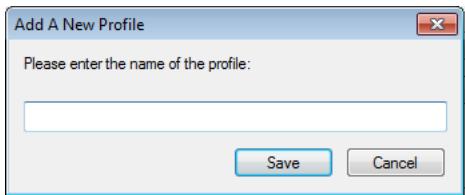
4 Click Save.
The new profile is added to the Profiles drop-down list.
NOTE
You can Delete, Rename, or Reset profile names in the Edit Your Profile dialog box.
Color Profile
Use the Color Profile settings to achieve accurate color reproduction for scans. This option uses the default ICC profile parameters to adjust the image colors. ICC profiles are used with color mapping, mainly in digital photography and printing.
Document
Select Document if your original contains only text or a mixture of text and graphics. This is an optimal setting for regular business documents.
None
Select None to disable the Color Profile option.
Photo
Select Photo if your document contains photos, and you want to reproduce your photos in vivid color.
Mix
Select Mix if your document contains a combination of text and graphics. The Mix option offers mid-range scan quality between Document and Photo.
Compression tab
Click the Compression tab to reduce the scanned image size but maintain image quality.
NOTE
The Compression options available may differ depending on the scanning application you use.
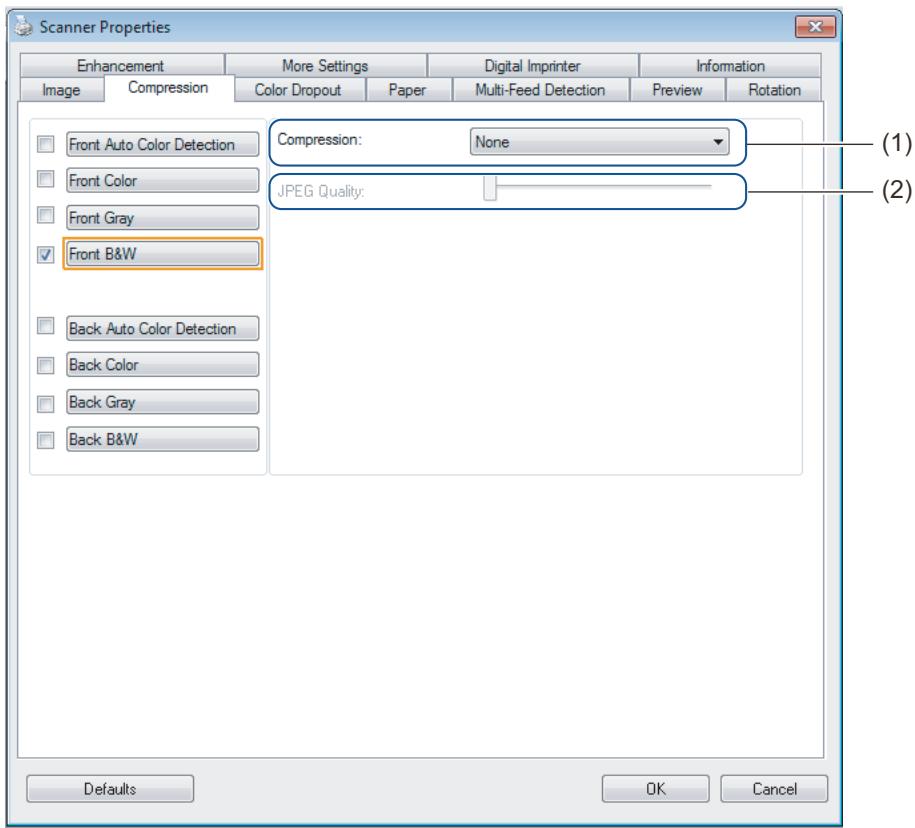
| No. | Name | Description | Default |
| (1) | Compression | Select a Compression mode. | None |
| (2) | JPEG Quality | Change the JPEG quality. | 50 |
Compression
To following compression types are available:
| Available Compression Types | |
| Color or Gray Images | Black and White Images |
| None | None |
| JPEG | G4 |
JPEG Quality
Move the JPEG Quality slider to the right or left to increase or decrease the level of compression.
The greater the JPEG Quality percentage value, the larger the file size.
Color Dropout tab
Click the Color Dropout tab to remove the red, blue, or green color from your scanned image resulting in a gray or black and white document.
NOTE
Color Dropout is available only when you select Gray or B&W from the Image Selection group.
If your image contains a red watermark or background, select the Red channel to remove any red watermark or background color. This feature is useful for sharpening text when using Optical Character Recognition (OCR) software.
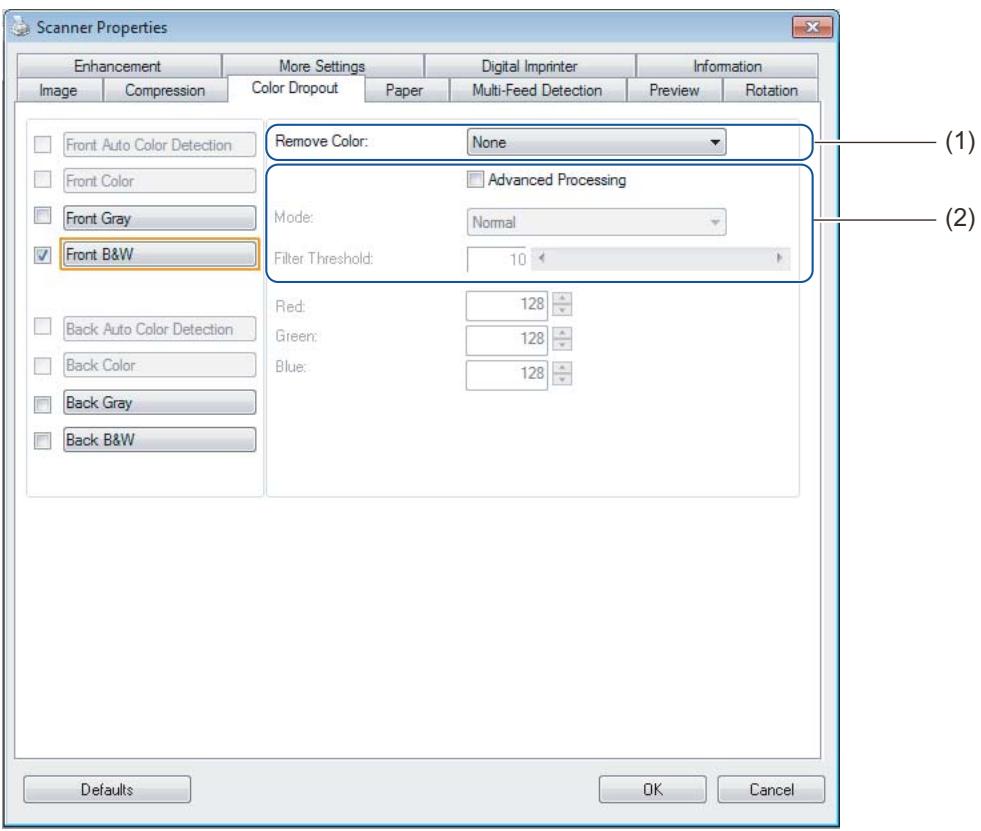
| No. | Name | Description | Default |
| (1) | Remove Color | Select the color you want to remove from your scan. | None |
| (2) | Advanced Processing | Configure the advanced settings when removing a color. | (not selected) |
When you select Custom from the Remove Color drop-down menu, the Color Dropout tab changes as follows:
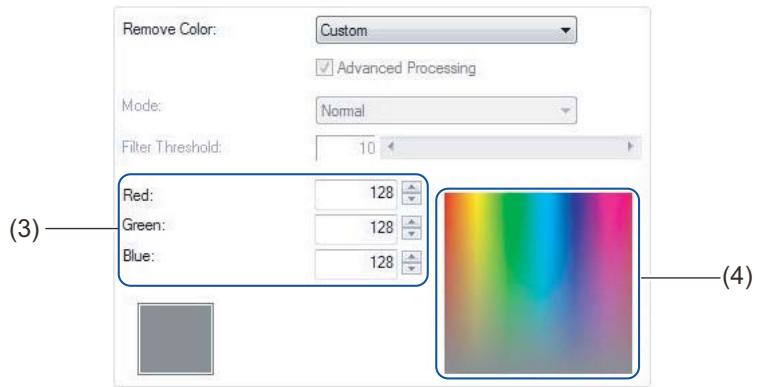
| No. | Name | Description | Default |
| (3) | RGB values | Display the RGB value for the color selected. | - |
| (4) | Color palette | Select the color you want to remove from the color pickerr. | - |
Remove Color
Select one of the following from the Remove Color drop-down list:
None
No color is removed.
■ Remove Red / Remove Green / Remove Blue
Removes red, green, or blue from the scan.
Custom
See Custom settings on page 39.
Advanced Processing
Select the Advanced Processing check box to adjust the details that can optimize your scan result.
Mode
Select Quality to configure detailed settings for the Filter Threshold value. Mode is available only when Remove Red, Remove Green, Remove Blue, or Automatic is selected in the Remove Color drop-down list.
Filter Threshold
This value determines how much color to remove. A lower value removes more of the selected color, while a higher value keeps more of the selected color. Filter Threshold is available only when Quality is selected in the Mode drop-down list.
Custom settings
Select Custom in the Remove Color drop-down list to specify the exact color you want to remove by entering its RGB (Red, Green, and Blue) value or by selecting it in the Color palette.
RGB values
Displays the RGB value for the color selected in the Color palette. Adjust RGB values manually, if needed.
Color palette
To manually specify the color you want to remove, click that color in the palette. The RGB value of the selected color appears in RGB values.
Paper tab
Click the Paper tab to define values relating to image output and auto scan.
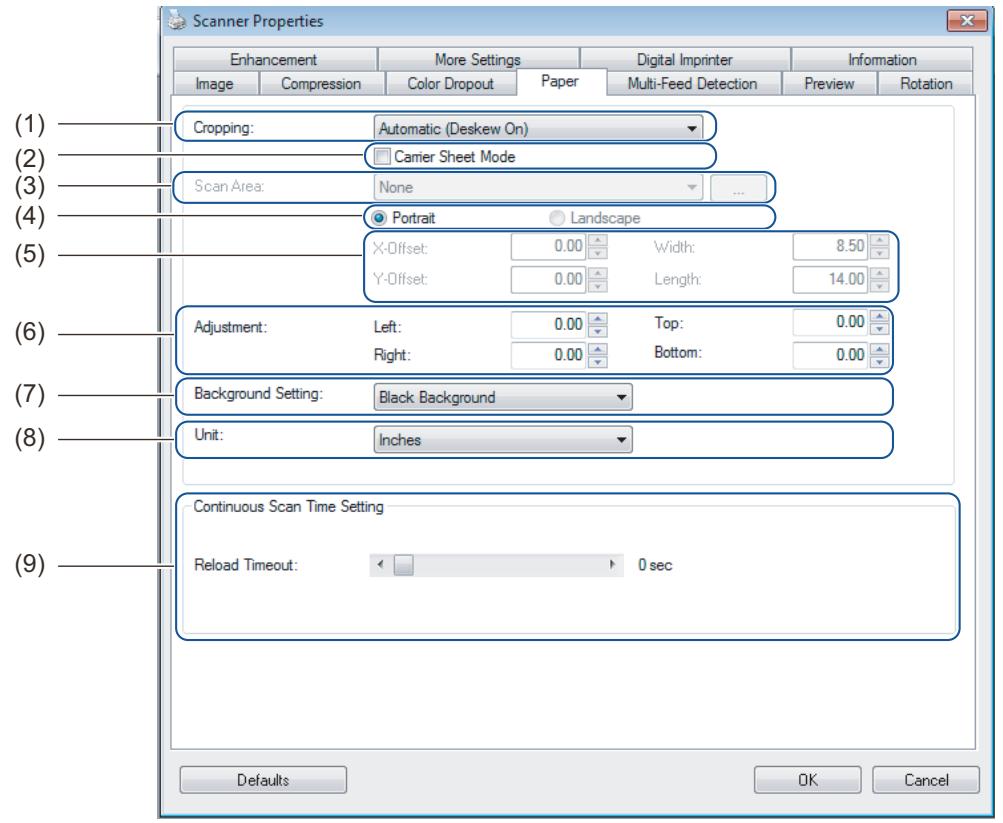
| No. | Name | Description | Default |
| (1) | Cropping | Capture a portion of the document being scanned. | Automatic (Deskew ON) |
| (2) | Carrier Sheet Mode | Select this check box if using the Carrier Sheet. | (not selected) |
| (3) | Scan Area / Page Size | Select the paper size. | ISO A4 - 210 mm x 297 mm |
| (4) | Portrait / Landscape | Select your scanned document's layout. | Portrait |
| (5) | X-Offset / Y-Offset / Width / Length / Center | Adjust the scanning area manually. | - |
| (6) | OverScan / Adjustment | Add a specific margin at the top and bottom of the edge of the image. | 0.00 |
| (7) | Background Settings | Select a background color. | White Background |
| (8) | Unit | Select the unit of measurement displayed in the Scanner Properties window. | (based on language) |
| (9) | Reload Timeout | Set the amount of time the machine has to wait before starting an auto scan after the first scan job is completed. | 0 |
Cropping
Cropping allows you to capture a portion of the document being scanned. Options include:
Automatic (Deskew ON)
This option automatically adjusts the cropping window according to document size. Use this option for batches of mixed-sized documents.
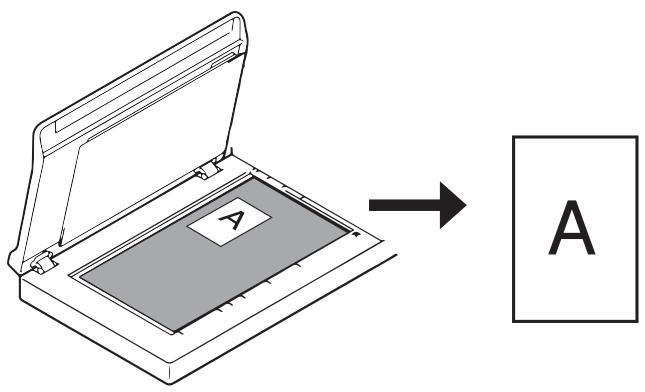
NOTE
- When you select Automatic (Deskew ON), scanned images are automatically deskewed if the images are crooked.
- Punch Hole Removal is not available when Automatic Cropping is disabled.
Fixed Area (Deskew OFF)
This option allows you to define the area or zone to be captured. Use it when scanning batches of same-sized documents. If you select this option, type numerical values, or use the up or down arrow keys to define the x and y offset values, width and length of your scan area.
EOP (End of Page) Detection (Deskew OFF)
This option allows you to define the area or zone to be captured. Use it when scanning batches of same-width but different-length documents. If you select this option, type numerical values, or use the up or down arrow keys ( ) to define the x and y offset values, width, and length of your scan area.
Relative to Document (Deskew OFF)
This option allows you to crop different areas of your documents and deliver these images in black and white, gray, or color separately. Use it if you are working with an application that requires you to store the entire document in black and white and a part of the document in color to save storage space. This is useful for documents where a photograph or signature appears in the same area on each document.
Auto Crop (Flatbed Only): multi image output
This option allows you to automatically scan to the multiple files when you place multiple documents on the scanner glass at the same time.
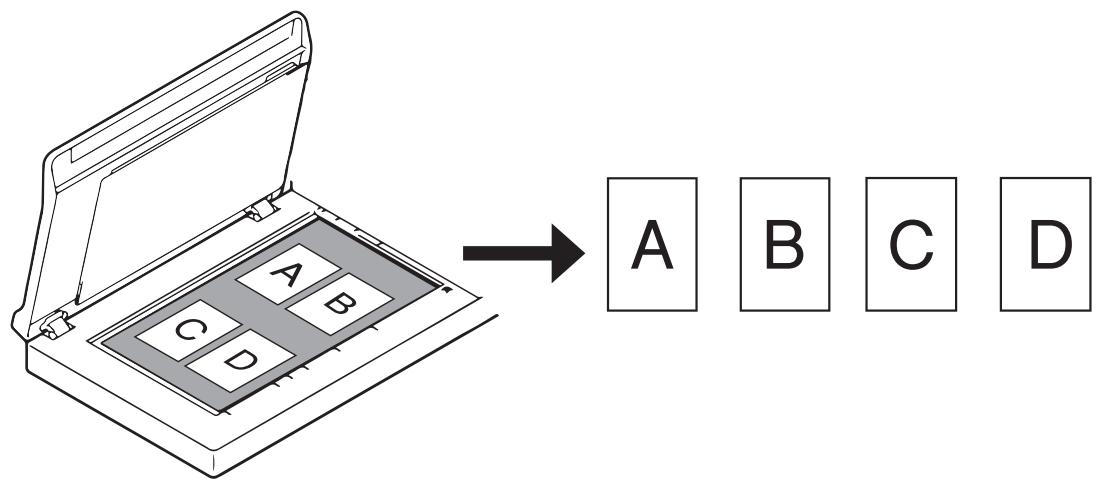
NOTE
Only available when Scan Source is set to Flatbed.
Limitation of Auto Crop (Flatbed Only): multi image output
- A minimum distance between objects is 0.5 in.
- Objects must be at least 1 inch in size.
- If you set Automatic (Deskew ON), it will be scanned as shown in the illustration.
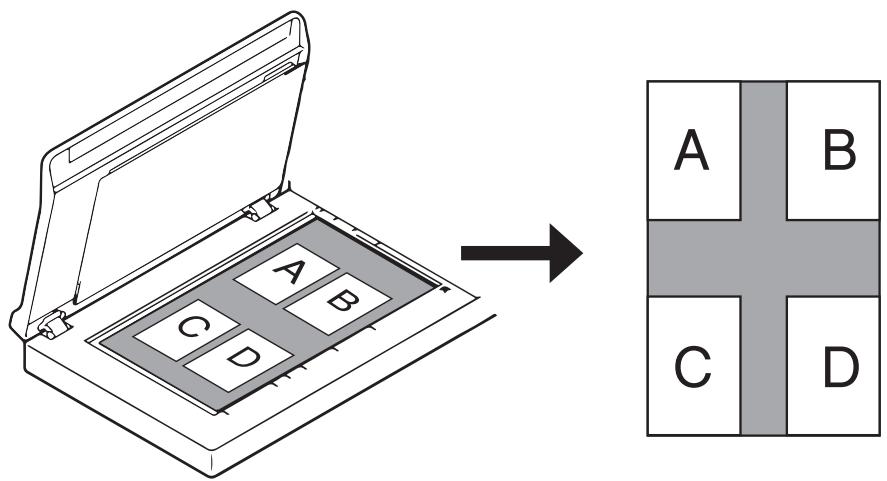
Carrier Sheet Mode
Select this check box if using the Carrier Sheet.
NOTE
- Carrier Sheet Mode is available only when Automatic (Deskew ON) is selected from the Cropping drop-down list.
- Carrier Sheet Mode is not available when using the scanner glass.
Scan Area / Page Size
This field name changes based on your selection in the Cropping drop-down list.
Select the paper size you want from the drop-down list:
None
US Legal - 8.5 in. × 14 in.
US Letter - 8.5 in. × 11 in.
Photo - 6 in. × 4 in.
Photo - 5 in. × 3 in.
ISO A4 - 210 mm × 297 mm
ISO A5 - 148 mm × 210 mm
ISO A6 - 105 mm × 148 mm
ISO A7 - 74 mm × 105 mm
ISO B5 - 176 mm × 250 mm
ISO B6 - 125 mm × 176 mm
ISO B7 - 88 mm × 125 mm
■ JIS B5 - 182 mm × 257 mm
■ JIS B6 - 128 mm × 182 mm
■ JIS B7 - 91 mm × 128 mm
Maximum Scan Length
Long Page (< 236 in. [5,994 mm] 2)
Custom 1
Custom
Click the button to add or change a custom paper size. To apply the custom settings, select Custom from the Scan Area / Page Size drop-down list.
NOTE
Long Page in the Scan Area drop-down list is not available when using the scanner glass.
Portrait / Landscape
NOTE
- Landscape cannot be selected when US Legal, US Letter, A4, B5, Maximum Scan Length, or Long Page is selected.
X-Offset / Y-Offset / Width / Length / Center
When you select Fixed Area (Deskew OFF) from the Cropping drop-down list, you can adjust the scan area manually using the following values:
X-Offset
Adjusts the distance from the left edge of the scanner to the left edge of the area in your document.
Y-Offset
Adjusts the distance from the top edge of the document to the top edge of the area in your document.
Width
Adjusts the width of the area in your document.
Length
Adjusts the length of the area in your document.
Center
Allows the software to automatically center the scanned image based on the selected paper size.
OverScan / Adjustment
Allows you to add a specific margin at the top and bottom of the edge of the image. This is used to reduce possible corner clipping on skewed images and is often applied to a batch of skewed documents. Select a value between 0 in. and 0.18 in. (4.5 mm).
Background Setting
Select White Background or Black Background from the drop-down list to set the background color for your scanned images.
NOTE
This option is available only when you select Automatic (Deskew ON) in the Cropping drop-down list.
Unit
Select Millimeters, Inches, or Pixels from the drop-down list. The default setting is based on your OS language.
Reload Timeout
Set the amount of time the machine has to wait before auto-scanning the next document after a scan job is completed. Use this feature if you load many separate documents, which must be scanned using the same scan settings, in the ADF.
Multi-Feed Detection tab
Click the Multi-Feed Detection tab to detect pages that overlap when fed through the ADF. A multifeed usually occurs due to stapled documents, adhesives on documents, or electrostatically charged documents.
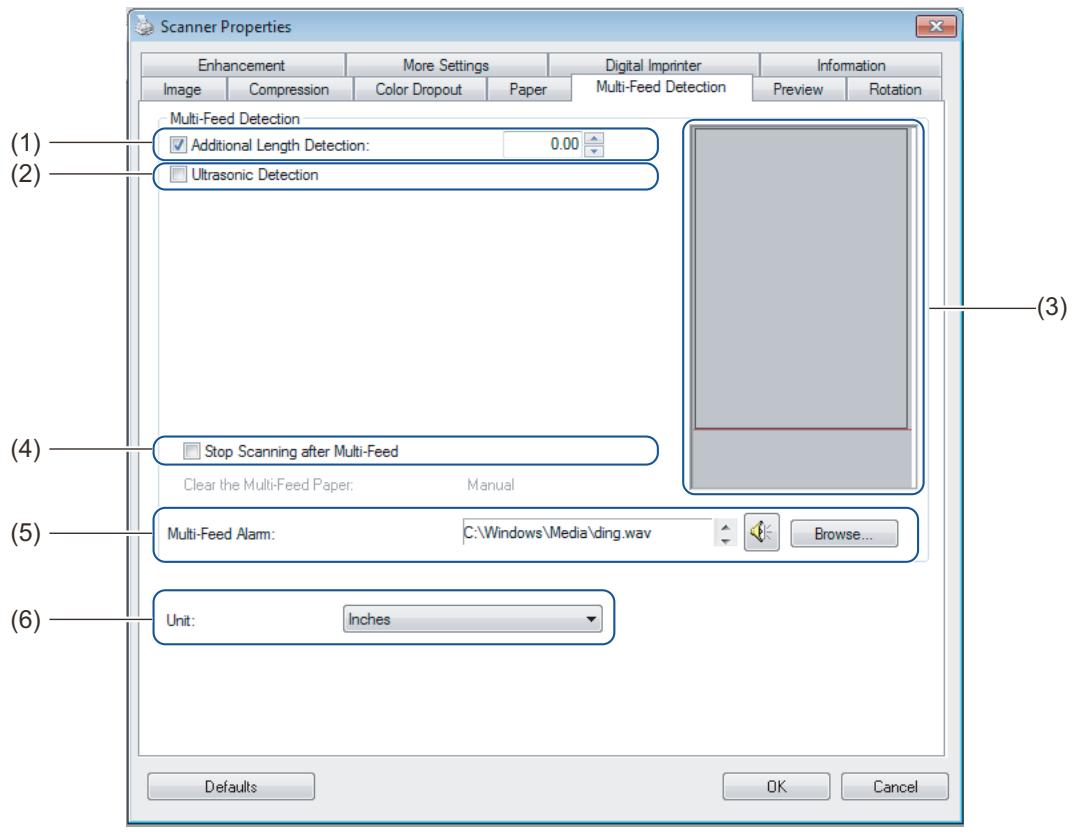
| No. | Name | Description | Default |
| (1) | Additional Length Detection | Define the page length if it exceeds the scan area. | (not selected) |
| (2) | Ultrasonic Detection | Detect overlapped pages by measuring paper thickness. | (not selected) |
| (3) | Display window | Display a preview of Additional Length Detection. | - |
| (4) | Stop Scanning after Multi-Feed | Stop the ADF and display a warning when a multifeed is detected. | (not selected) |
| (5) | Multi-Feed Alarm | Customize an alarm sound if a multifeed occurs. | C:\Windows\Media\ding.wav |
| (6) | Unit | Select the unit of measurement displayed in the Scanner Properties window. | (based on language) |
NOTE
Multi-Feed Detection tab is not available when using the scanner glass.
Additional Length Detection
Allows you to define the length of document being scanned by specifying the additional length exceeding scan area. The Display window displays the size of the page as you change the value. A value of "0" indicates no additional length detection. Use the Additional Length Detection feature when scanning multiple same-sized documents from the ADF.
If you select this detection method, scanning does not stop even if a multifeed is detected.
Ultrasonic Detection
Detects overlapping pages by measuring paper thickness.
When this feature is selected, and your machine detects a multifeed, scanning stops immediately and a warning message appears on your computer monitor.
Display window
Displays a preview of the Additional Length Detection value.
When this feature is selected, and your machine detects a multifeed, scanning stops immediately and a warning message appears on your computer monitor.
Stop Scanning after Multi-Feed
Select this check box to stop the feeder and display the warning dialog box when a multifeed is detected.
NOTE
This option is available only when you select Additional Length Detection.
Multi-Feed Alarm
Use this feature to set an audible alarm emitted when a multifeed occurs.
To change the alarm sound, click Browse... and select a wave file from your computer.
NOTE
- This feature is available when either Additional Length Detection or Ultrasonic Detection is selected.
- The alarm field supports the .wav file format only.
Unit
Select Millimeters, Inches, or Pixels from the drop-down list. The default setting is based on your OS language.
Preview tab
Click the Preview tab to display a low-resolution preview of your image before the final scan. The preview image helps to determine your scan area and check your color processing results.
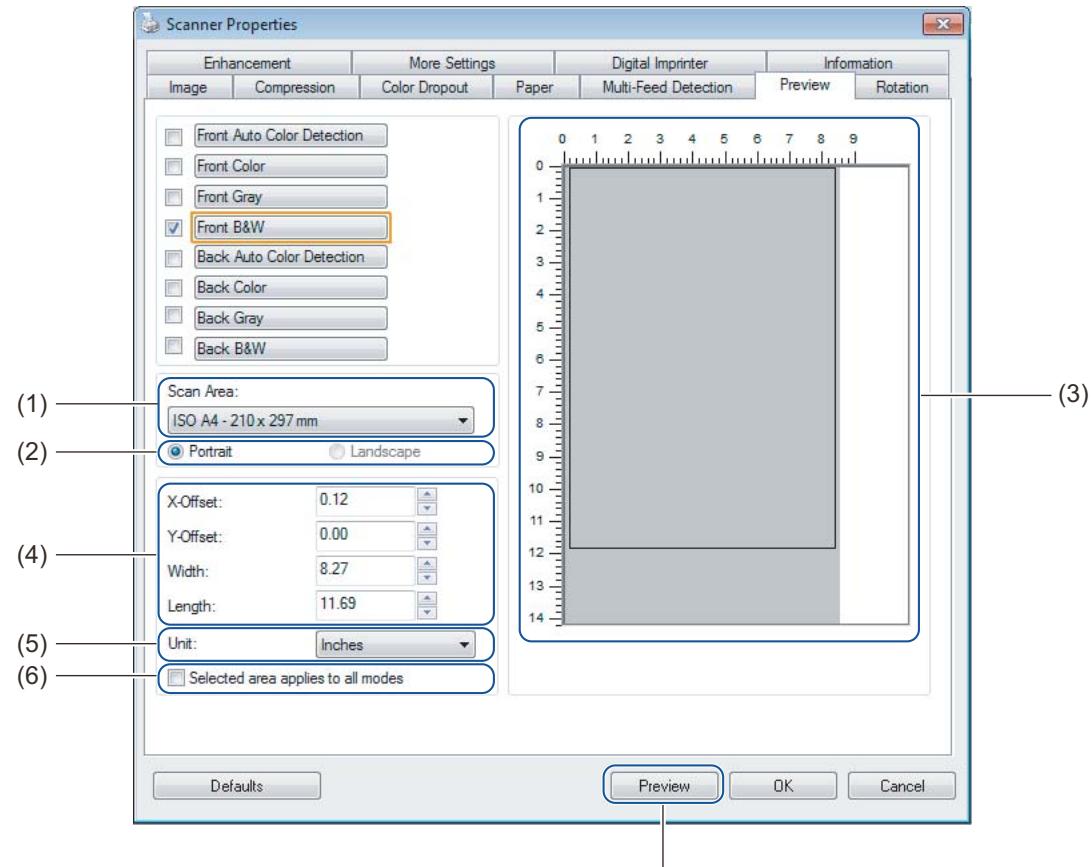
(7)
| No. | Name | Description | Default |
| (1) | Scan Area | Select the paper size. | ISO A4 - 210 mm x 297 mm |
| (2) | Portrait / Landscape | Select the scanned document's layout. | Portrait |
| (3) | Display window | Display a preview of your scanned image or set your scan area manually. | - |
| (4) | X-Offset / Y-Offset / Width / Length | Adjust your scan area manually. | - |
| (5) | Unit | Select the unit of measurement displayed in the Scanner Properties window. | (based on language) |
| (6) | Selected area applies to all modes | Apply the same scan area settings to all documents. | (not selected) |
| (7) | Preview | Preview your scan. | - |
NOTE
Scan Area, Portrait / Landscape, Display window, X-Offset / Y-Offset / Width / Length and Unit are disabled under the following settings:
- When Cropping is set to Automatic (Deskew ON) in the Paper tab (see Paper tab on page 40).
- When Cropping is set to Fixed Area (Deskew OFF) and Scan Area is set to Long Page in the Paper tab (see Paper tab on page 40).
Scan Area
Select the paper size you want from the drop-down list:
None
US Legal - 8.5 in. × 14 in.
US Letter - 8.5 in. × 11 in.
Photo - 6 in. × 4 in.
Photo - 5 in. × 3 in.
ISO A4 - 210 mm × 297 mm
ISO A5 - 148 mm × 210 mm
ISO A6 - 105 mm × 148 mm
ISO A7 - 74 mm × 105 mm
ISO B5 - 176 mm × 250 mm
ISO B6 - 125 mm × 176 mm
ISO B7 - 88 mm × 125 mm
■ JIS B5 - 182 mm × 257 mm
■ JIS B6 - 128 mm × 182 mm
■ JIS B7 - 91 mm × 128 mm
Maximum Scan Length
Portrait / Landscape
NOTE
- Landscape cannot be selected when US Legal, US Letter, A4, B5, Maximum Scan Length, or Long Page is selected.
Display window
Displays a preview of your scanned image.
You can set your scan area by placing your cursor in the Display window and dragging it diagonally to resize the outline.
X-Offset / Y-Offset / Width / Length
You can adjust the scan area manually using the following values:
X-Offset
Adjust the distance from the left edge of the scanner to the left edge of the area in the document that you want to scan.
Y-Offset
Adjust the distance from the top edge of the document to the top edge of the area in the document that you want to scan.
Width
Adjust the width of the area in the document that you want to scan.
Length
Adjust the length of the area in the document that you want to scan.
Unit
Select Millimeters, Inches, or Pixels from the drop-down list. The default setting is based on your OS language.
Selected area applies to all modes
Select the Selected area applies to all modes check box to use the same scan area settings for all documents.
Preview
Click Preview to display a low-resolution preview in the Display window.
Rotation tab
Click the Rotation tab to change values related to image rotation.
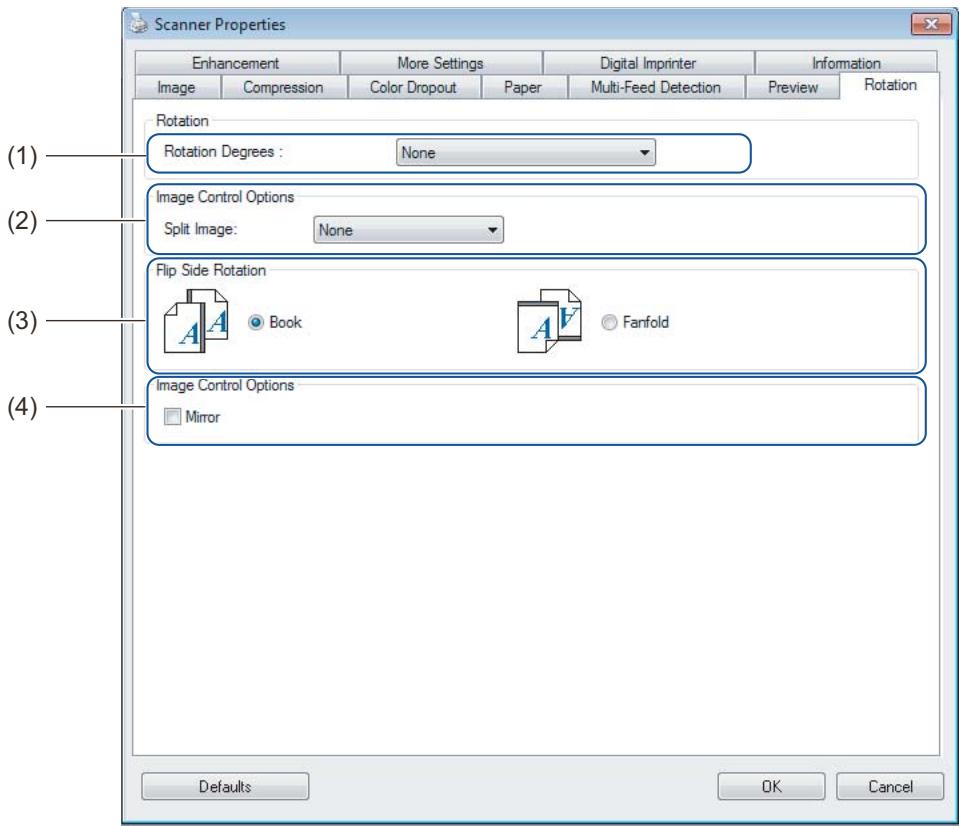
| No. | Name | Description | Default |
| (1) | Rotation Degrees | Rotate the scanned image. | None |
| (2) | Split Image | Split the scanned image horizontally or vertically. | None |
| (3) | Flip Side Rotation | Change the orientation of the reverse side of the output page. | Book |
| (4) | Mirror | Reverse the right and left sides of your image. | (not selected) |
Rotation Degrees
To rotate the scanned image, select the rotation angle from the drop-down list:
None
90 degrees CW (Clockwise)
90 degrees CCW (Counter-clockwise)
180 degrees
Auto Orientation
If you select Auto Orientation, the machine automatically rotates your document based on its contents.
Split Image
When you split an image, the machine creates two separate images aligned either horizontally or vertically. This is useful for documents containing an image that spans two pages, because you can save both images as a single image on a single page.
None
Horizontal
Divide a single image in half horizontally.
Vertical
Divide a single image in half vertically.
Flip Side Rotation
■ Book
Maintain the same image orientation on the reverse side of the output page.
Fanfold
Rotate the image orientation 180 degrees on the reverse side of the output page.
NOTE
- Flip Side Rotation is available only when you set Image Selection options to scan both front and back of your document in the Image tab.
- Flip Slide Rotation is not available when using the scanner glass.
Mirror
Select the Mirror check box to reverse the right and left sides of your image.
Enhancement tab
Click the Enhancement tab to improve the appearance of your scanned image.
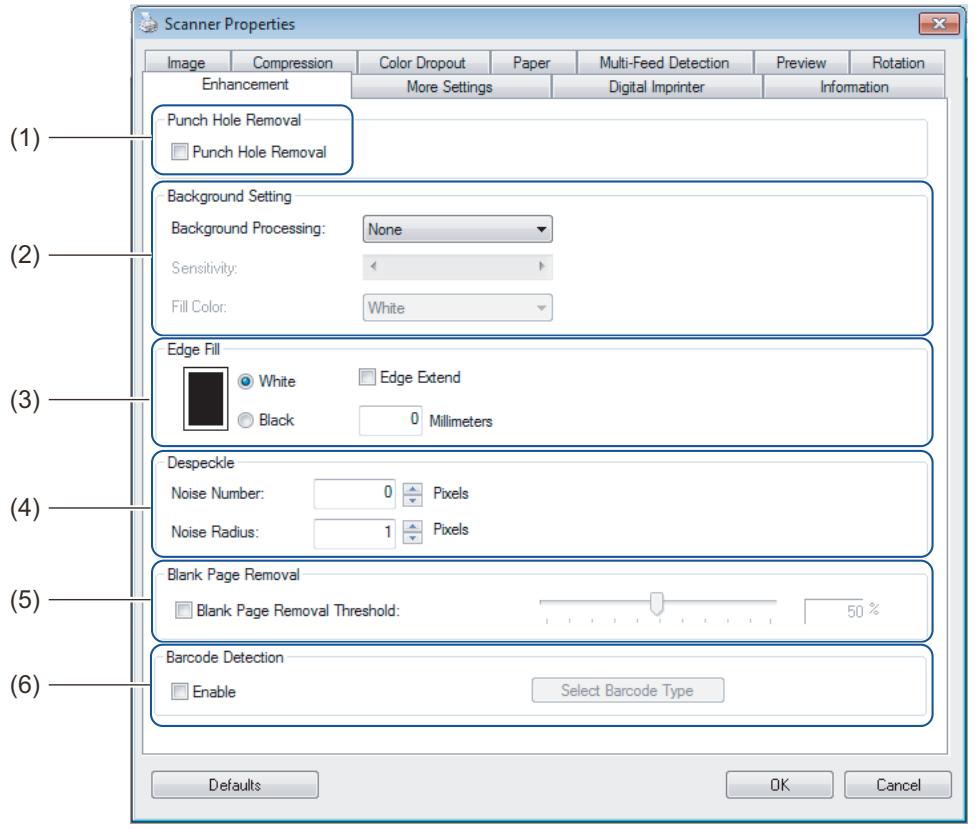
| No. | Name | Description | Default |
| (1) | Punch Hole Removal | Remove punch hole markings. | (not selected) |
| (2) | Background Setting | Remove or smoothen the background color. | None |
| (3) | Edge Fill | Add a white or black edge around the border. | White Millimeters: 0 |
| (4) | Despeckle | Remove small dots or specks from the background. | Noise Number: 0 Noise Radius: 1 |
| (5) | Blank Page Removal | Remove any blank pages from the original document. | (not selected) |
| (6) | Barcode Detection | Detect and recognize barcodes. | (not selected) |
Punch Hole Removal
Select the Punch Hole Removal check box to remove punch hole markings on scanned images. This feature removes the punch hole markings by filling hole marks with the surrounding color.
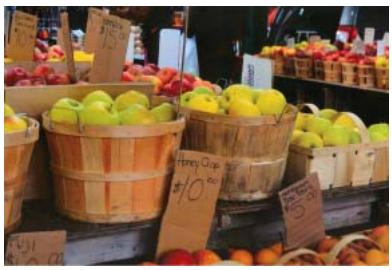
Original
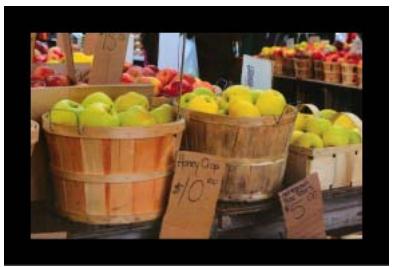
Punch Hole Removal
NOTE
Punch Hole Removal is not available when Automatic Cropping is disabled.
Background Setting
Specifying the Background Setting allows you to remove or smoothen the base color of scanned documents.
Background Processing
Select None, Smooth or Removal from the drop-down list. Smooth makes the background smooth, and Removal removes the background color.
Sensitivity
Move the Sensitivity slider to the left or right to adjust the sensitivity to base color or background. The greater the sensitivity value, the better the scan results, the slower the scanning speed.
Mode
This option is available only if you select Smooth under Background Processing above. Select Auto to allow the software to process the image automatically. Select Moire to reduce moire.
Fill Color
This option is available only if you select Removal under Background Processing above. Select White to make the background white. Select Auto to allow the software to detect the background color automatically and fill it in with the color.
Edge Fill
Select White or Black and set a value (in Millimeters) to add a white or black edge around the border of your scanned image.
Select the Edge Extend check box to add a white or black edge outside the border of your scanned image.
NOTE
- The maximum edge fill value equals half the length of the shorter side of a selected scan area. For example, if you select Letter size, which is 8.5 × 11 in., the maximum value for the white edge or black edge is 4.25 in. (or half of 8.5 in.). If you select an A4 size, which is 210 × 297 mm, the maximum value for the white edge or black edge is 105 mm (half of 210 mm).
- If you set a value greater than the maximum allowed, the value automatically defaults to the maximum.
- To disable this feature, set the value to "0".
Original
Edge Fill: 20 mm (Black)
This function allows you to remove small dots or speckles called "noise," from the background of scanned images. Removing unwanted speckles provides a clear image for OCR processing, and helps to reduce compressed file sizes.
Define the noise you want to remove by specifying Noise Number (size) and Noise Radius (range).

Before Despeckle
(Noise Number: 0, Noise Radius: 1)

After Despeckle
(Noise Number: 22, Noise Radius: 10)
NOTE
Despeckle is available for black and white images only.
Blank Page Removal
Select the Blank Page Removal check box to remove blank pages from your scanned image. Move the slider to change the threshold, or level of pixels, that determines a blank page.
Barcode Detection
Select the Barcode Detection check box to split multi-page scanned files whenever a barcode is detected. An avbarcode.ini file containing the barcodes types is created and stored on your system drive, for example, C:\ProgramData\PDS-XXXX\avbarcode.ini (where XXXX is your model name).
Select Barcode Type
Click Select Barcode Type and select the barcode types to specify the barcode you want the scanning software to recognize.
More Settings tab
Click the More Settings tab to configure additional scanning options.
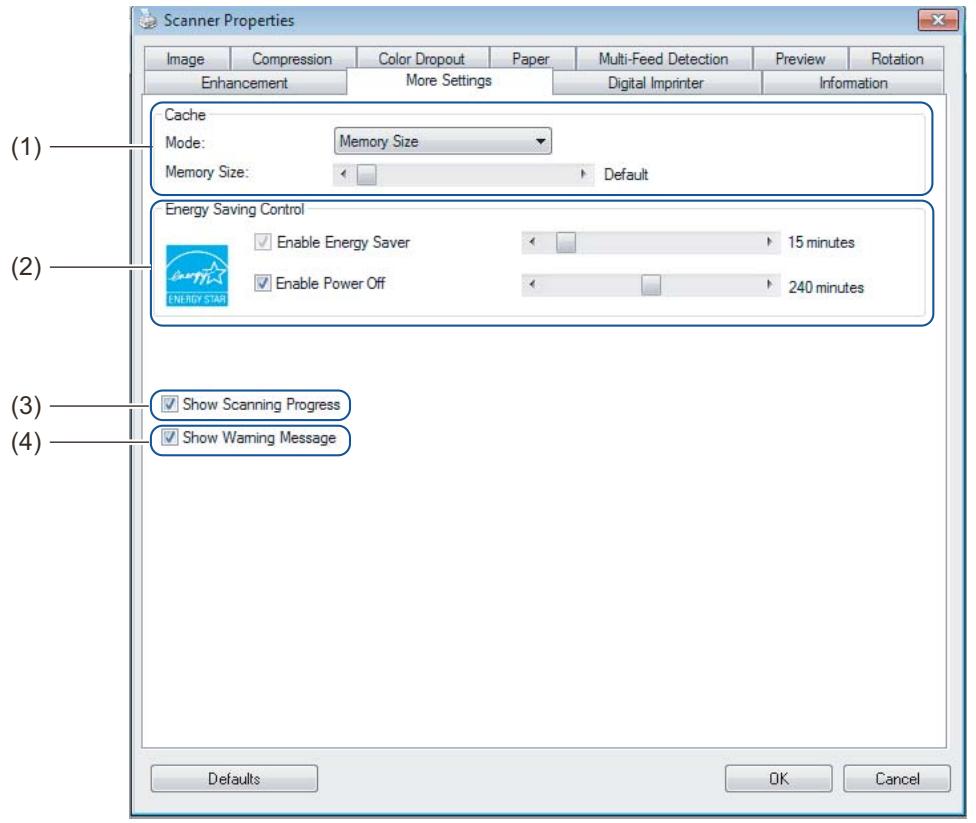
| No. | Name | Description | Default |
| (1) | Cache | Assign a specified amount of memory from the available RAM to process the image data. | Memory Size |
| (2) | Energy Saving Control | Change settings related to energy saving. | Energy Saver: 15 minutes Power Off: 240 minutes |
| (3) | Show Scanning Progress | Select to display the scanning progress bar during scanning. | (selected) |
| (4) | Show Warning Message | Select to display warning messages. | (selected) |
| (5) | Save Settings after Closing | Select to save all settings when you close the Scanner Properties dialog box. NOTE This item is displayed only when using a TWAIN-compliant application, such as OmniPage. | (selected) |
Cache
This option allows you to assign a specified amount of memory from the available RAM to process the image data. By specifying a smaller memory size, you free more memory for other applications you are running. By specifying a larger memory size, you have more memory to process the image data, which is useful especially when you have a large number of documents to scan.
None
Select None from the Mode drop-down list to specify the number of pages to scan. For example, to scan only the first two pages of a document, move the page slider to 2.
Page Number
Select Page Number to limit your cache size by the number of scanned pages it contains. For reference, a Letter/A4 color document scanning at 300 dpi consumes approximately 24 MB.
Memory Size
Select Memory Size to limit your cache size by memory size. The amount of available memory depends on your computer.
NOTE
Cache is not available when using the scanner glass.
Energy Saving Control
■ Enable Energy Saver (Power Saving Mode)
Move the slider to set the amount of idle time before the machine enters Power Saving Mode.
Enable Power Off
Select the Enable Power Off check box and move the slider to set the amount of idle time before the machine automatically powers off.
NOTE
- You cannot disable Enable Energy Saver.
- If you clear the Enable Power Off check box, your machine will not power off automatically.
- Power Off time must be greater than or equal to Energy Saver time.
Show Scanning Progress
Select the Show Scanning Progress check box to display the scanning progress bar during scanning.
Show Warning Message
Select the Show Warning Message check box to display warning messages. If the rollers are near their end-of-life period, a warning message appears once per day until you reset the Reverse Roller Count and Pick-up and Separation Roller Count.
Save Settings after Closing
Select the Save Settings after Closing check box to save your settings when you close the Scanner Properties dialog box. The next time you open the Scanner Properties dialog box, the previous settings will appear.
NOTE
This item is displayed only when using a TWAIN-compliant application, such as OmniPage.
Digital Imprimer tab
Click the Digital Imprimer tab to print the date, time, document count, or custom messages on your scanned image.
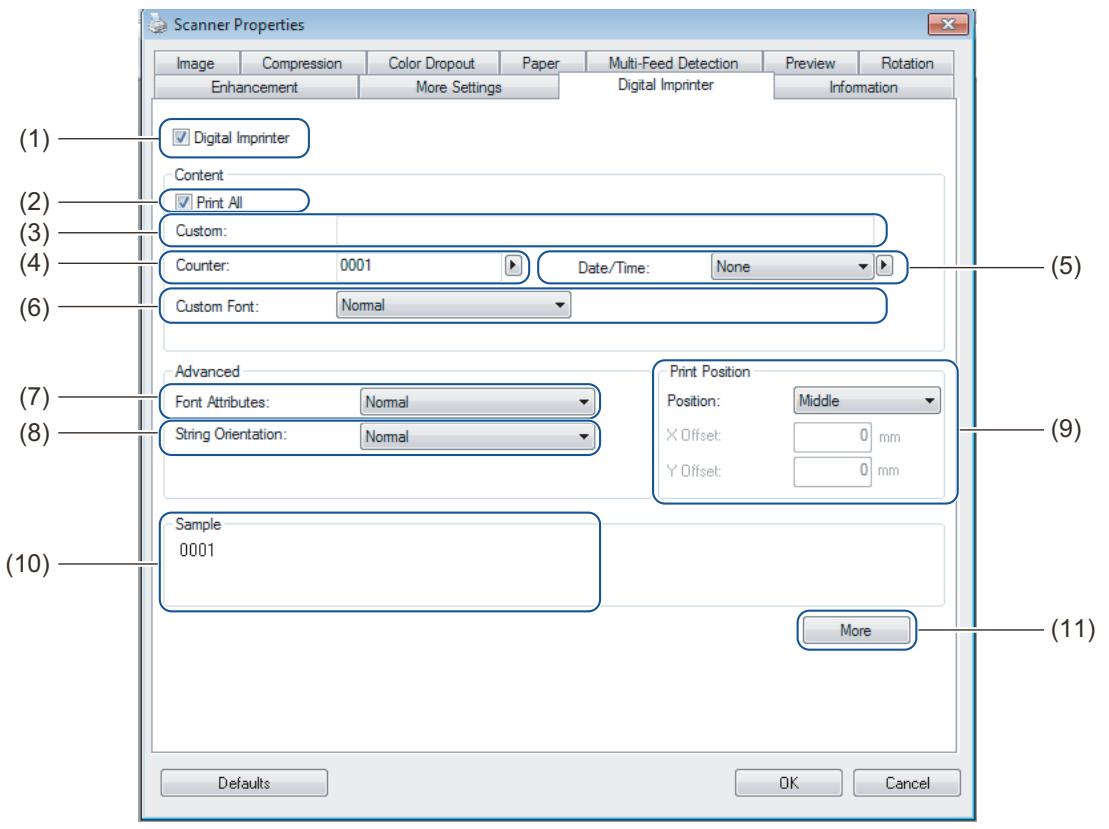
| No. | Name | Description | Default |
| (1) | Digital Imprimer | Select to activate this feature. | (not selected) |
| (2) | Print All | Print on every page of the scanned image. | (select) |
| (3) | Custom | Type the custom text to print on your scanned image. | (none) |
| (4) | Counter | Change the scan counter. | Number (such as 1234) |
| (5) | Date/Time | Change the date/time. | None |
| (6) | Custom Font | Select a font. | Normal |
| (7) | Font Attributes | Select a font attribute. | Normal |
| (8) | String Orientation | Select the print direction. | Normal |
| (9) | Print Position | Select a print position. | Middle |
| (10) | Sample | Preview your custom text. | (none) |
| (11) | More | Set advanced font settings. | Size: 5 Density: 0 Transparency: 0 |
Digital Imprimer
Select the Digital Imprimer check box to use the digital imprinter to print custom text on your scanned image.
Print All
Select the Print All check box to print the text on every page of the scanned image. Clear the check box to print the text only on the first page of the scanned image.
Custom
Type the text you want in your print string (up to 31 characters).
Counter
Click to increase the scan counter.
The number of digits specified here is displayed on the scanned image. For example, selecting Number (123456) causes "000001" to be shown on the first page of the scanned image, "000002" on the second, "000003" on the third, and so forth.
Date/Time
Select Date, Time, or Date+Time to include the date or time in your print string.
Click to select a date or time separator from the drop-down list.
Custom Font
Select Normal or Fixed Width from the Custom Font drop-down list.
Fixed Width (monospace) fonts use fixed character spacing, so each character occupies the same width.
Font Attributes
Select Normal, Underline, Double, or Bold from the Font Attributes drop-down list.
String Orientation
Select Normal, Rotated, Vertical, Vertical Inversion, 90 Degrees CW (clockwise), or 90 Degrees CCW (counter-clockwise) from the String Orientation drop-down list to specify the text's print direction.
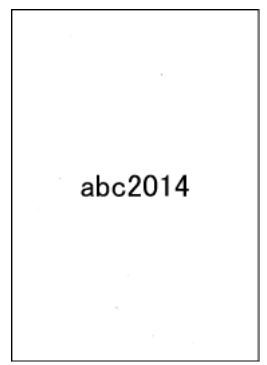
Normal
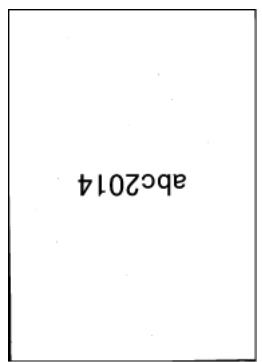
Rotated
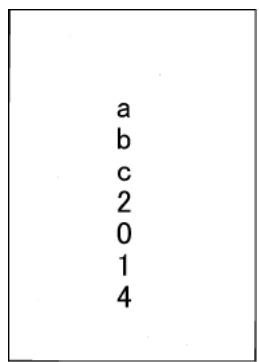
Vertical
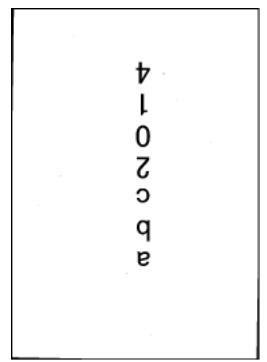
Vertical Inversion
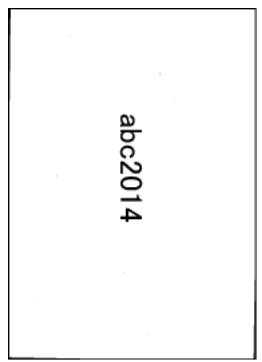
90 Degrees CW
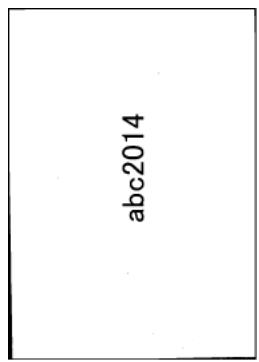
90 Degrees CCW
Print Position
Select Top, Middle, Bottom, or Custom from the Position drop-down list. If you select Custom, enter the X Offset and Y Offset value to specify the text's start position.
Sample
Preview your text here.
More
Click the More button to select additional font properties.
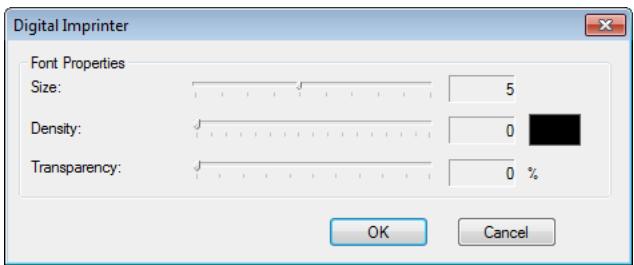
Size
Move the slider to select font size (Default: 5).
Density
Move the slider to select font density (Default: 0).
Transparency
Move the slider to select a transparency value from 0% (not transparent) to 100% (completely transparent). This is useful when creating a partially transparent watermark.
Information tab
Click the Information tab to display system and machine information, such as scanner driver version and firmware version. You can also view the roller count and reset the count in this window.
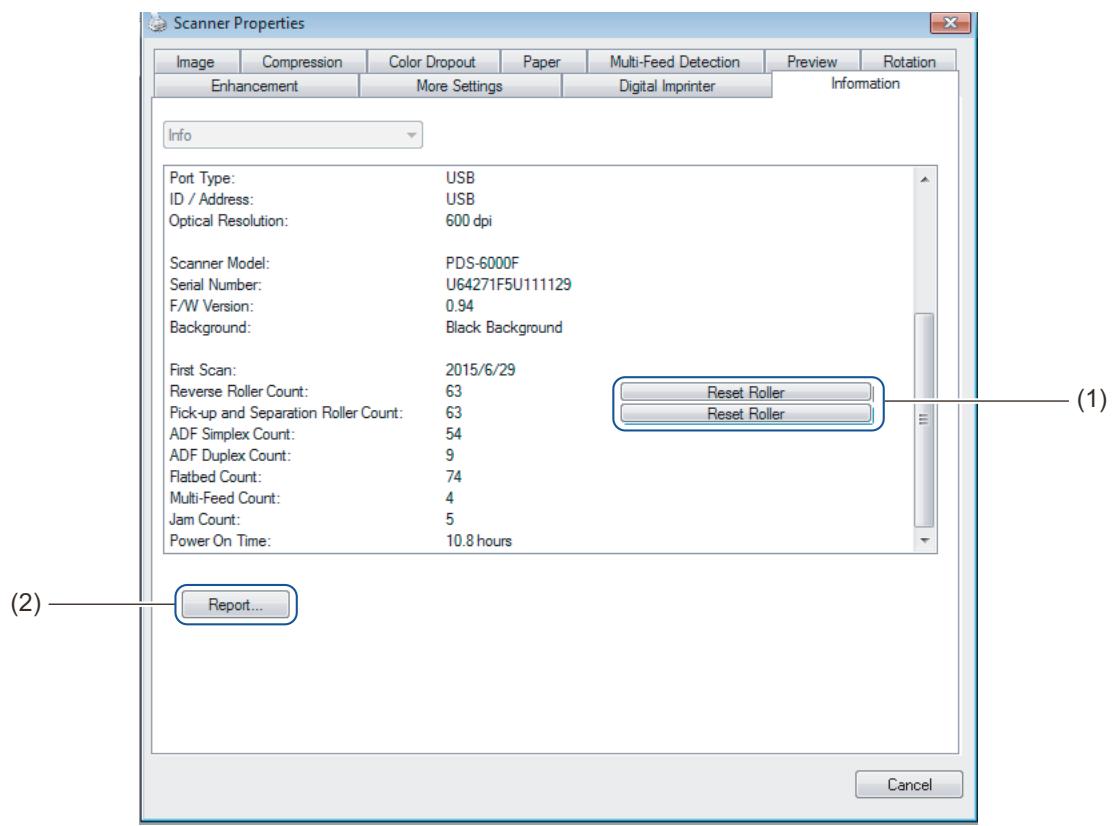
| No. | Name | Description | Default |
| (1) | Reset Roller | Reset the roller count. | - |
| (2) | Report | Generate a report.txt file. | - |
Reset Roller
After replacing the scanner rollers, click the Reset Roller button to reset the roller count.
NOTE
Do not reset the counter unless you have replaced the rollers.
Report
Click the Report button to generate a report.txt file that is stored on the system drive (for example, C:\XXXX
Scan using the ISIS driver
Applications compatible with the ISIS driver allow you to set the scan settings.
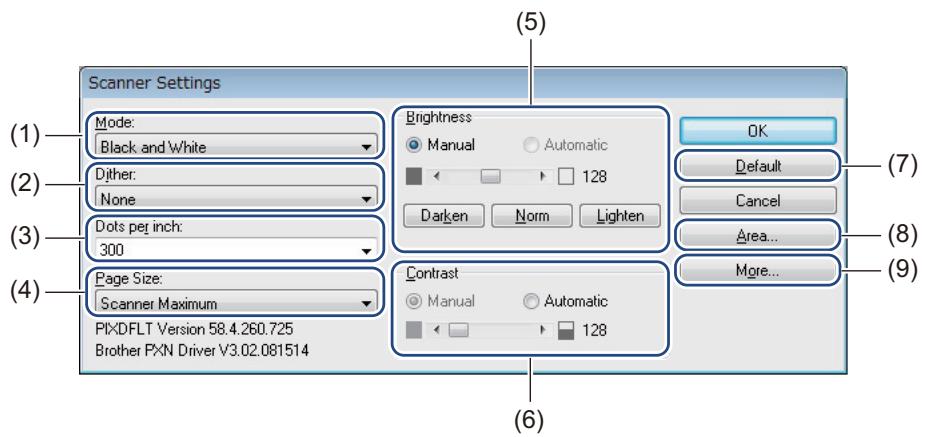
| No. | Name | Description |
| (1) | Mode | Select a scan type, such as black and white, gray, or color. |
| (2) | Dither | Select one of five halftone levels. |
| (3) | Dots per inch | Select the resolution you want. |
| (4) | Page Size | Select the page size you want. |
| (5) | Brightness | Adjust the brightness of your scanned image. |
| (6) | Contrast | Adjust the range between the darkest and the lightest shades in the image. |
| (7) | Default | Click to reset all settings to the factory settings. |
| (8) | Area | Select the scan area or position you want. |
| (9) | More | Click to reverse image, set multifeed detection and specify color drop-out. |
6
Scan (Macintosh)
Scan using your computer
To scan using your computer, launch a TWAIN-compatible application on your computer, such as DS Capture or Adobe® PhotoShop®. This guide uses DS Capture as an example.
Scan with DS Capture
1 Confirm that the machine is connected to your computer via a USB cable.
Double-click the (DS Capture) icon on your desktop.
3 DS Capture launches.
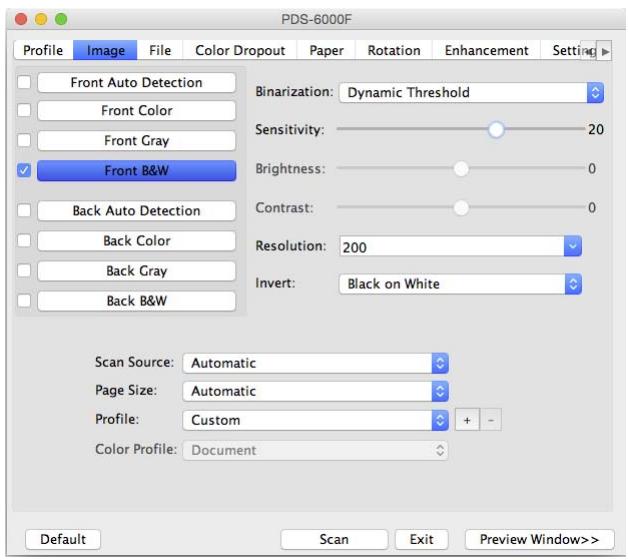
4 Change the scanning settings, if needed.
For more information on changing settings, see Change scan settings using the TWAIN driver on page 65.
Place your document either in the ADF, or on the scanner glass.
6 Click Scan in the DS Capture screen.
Your machine starts scanning. The scanned image is saved in the directory you specified in the File tab. For more information, see File tab on page 73. Check the scan result to confirm that all settings are correct.
Change scan settings using the TWAIN driver
The TWAIN driver provides various settings and useful functions, which you can use when scanning, as listed in the overview table below.
In this guide, we use the DS Capture application in our examples. Instructions for other scanning software should be similar.
Functional overview
| Category | Function | Reference |
| Basic settings | Specify the image type (color) and scan | Image tab on page 67 |
| Automatically identify the document color and scan | Image tab on page 67 | |
| Specify the document size and scan | Paper tab on page 77 | |
| Automatically identify the document size and scan | Paper tab on page 77 | |
| Specify the resolution and scan | Image tab on page 67 | |
| Image processing | Remove the specified color and scan | Color Dropout tab on page 75 |
| Rotate the document | Rotation tab on page 82 | |
| Detect and remove blank pages | Enhancement tab on page 84 | |
| Remove punch holes of scanned documents | Enhancement tab on page 84 | |
| Automatically compensate the document tilt | Paper tab on page 77 | |
| Remove the document base color | Enhancement tab on page 84 | |
| Add a white or black edge around the border | Enhancement tab on page 84 | |
| Remove small defects, due to dust or scratches, from a scanned image | Enhancement tab on page 84 | |
| Efficient scanning | See preview and check scan settings | DS Capture screen overview on page 66 |
| Save your scanner properties | Image tab on page 67 | |
| Acquire multiple color type scan results with a single scan | Image tab on page 67 | |
| Specify the computer memory used when scanning | Setting tab on page 88 | |
| Perform consecutive document scanning | Paper tab on page 77 | |
| Advanced functions | Add a character string to the scan result | Imprimer tab on page 89 |
| Divide a 1 page document into 2 pages | Rotation tab on page 82 | |
| Scan a document larger than Letter/A4 size | Image tab on page 67 | |
| Machine settings | Specify multifeed detection settings | Paper tab on page 77 |
| Check and reset the scan count | Information tab on page 93 | |
| Change the Power Saving Mode and Power Off time settings | Setting tab on page 88 | |
| System information | Check the scanner and computer system information | Information tab on page 93 |
DS Capture screen overview
Launch the TWAIN user interface using your scanning software. This guide uses the DS Capture user interface to explain the TWAIN user interface.
Click the tab menus to configure your Brother machine's settings.
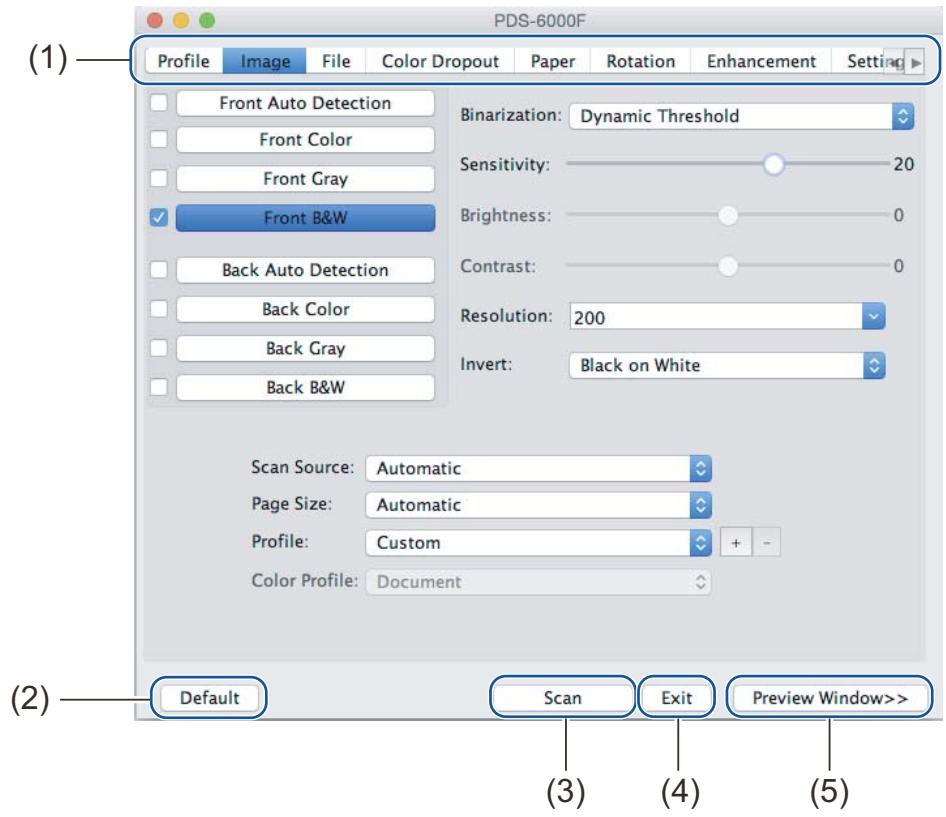
| No. | Name | Description |
| (1) | Tabs | Profile, Image, File, Color Dropout, Paper, Rotation, Enhancement, Setting, Imprimer, Information |
| (2) | Default | Click Default to reset all settings in all tabs to factory settings. |
| (3) | Scan | Click Scan to start scanning. |
| (4) | Exit | Click Exit to close the window. |
| (5) | Preview Window | Click to show or hide the image preview window, containing a low-resolution preview of your image, before your final scan. |
NOTE
All settings in the Image tab (except for the Resolution), and the Color Dropout tab can be set individually for the front and back of any double-sided document you scan.
Image tab
Click the Image tab to set basic scan settings, to assign values for the front or back of your document and to specify the image type.
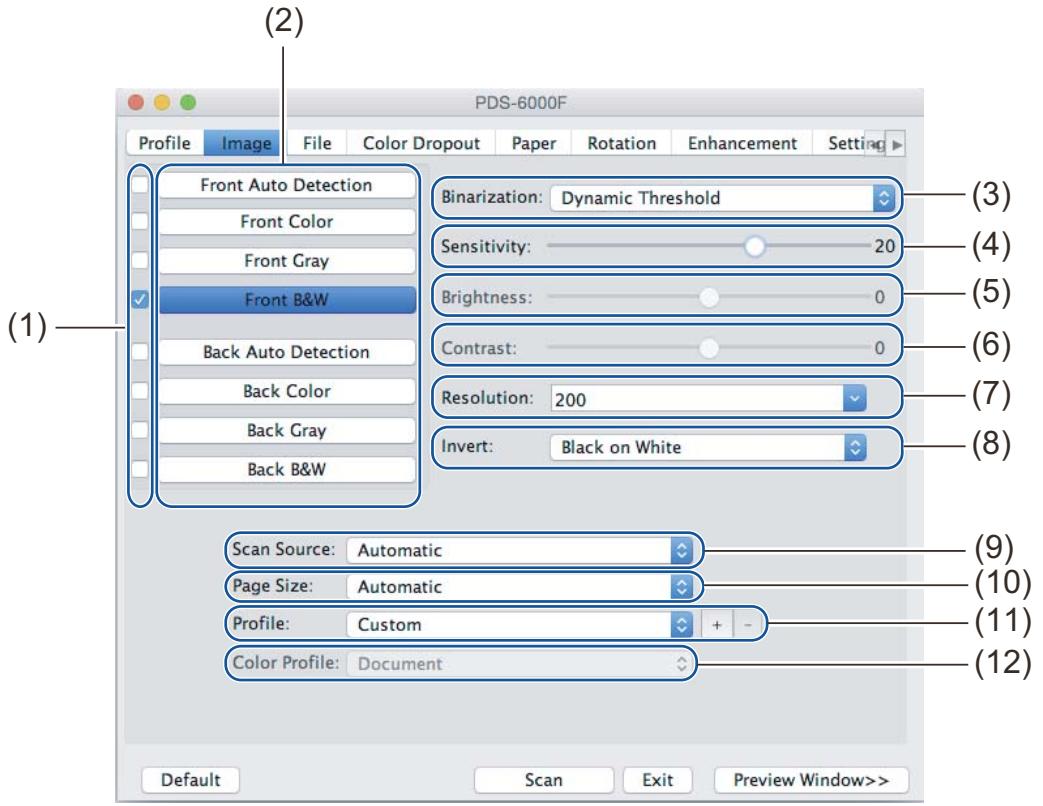
| No. | Name | Description | Default |
| (1) | Image Selection check boxes | Select the check boxes to specify the type of scan for the front (and back) of your document. | Front B&W |
| (2) | Image Selection group | Customize the settings for the front and back of your document. | Front B&W |
| (3) | Binarization / Document Type | Select an appropriate image processing mode. This field name changes based on your choice in the Image Selection group. | Dynamic Threshold / Document |
| (4) | Sensitivity / Threshold | Change sensitivity/threshold value. | (none) |
| (5) | Brightness | Change brightness. | 0 |
| (6) | Contrast | Change contrast. | 0 |
| (7) | Resolution | Select resolution. | 200 |
| (8) | Invert | Reverse the brightness and the colors in the image. | Black on White |
| (9) | Scan Source | Select a scan source. | Automatic |
| (10) | Page Size | Capture a portion of the document being scanned. | Automatic |
| (11) | Profile | Create or change scan profiles for frequently used scan settings. | Custom |
| (12) | Color Profile | Ensure accurate colors when scanning. | Document |
Image Selection check boxes
Select the check boxes to set the color mode for both the front and the back of your document. For example, to scan both the front and back of a color document page in color, select the Front Color and Back Color check boxes. For a black and white scan of the front and a color scan of the back, select Front B&W and Back Color.
NOTE
- Select more than one image type check box to generate multiple scan results from a single scan. For example, if you select Front Color and Front Gray, and then scan your document, scan data in both color and gray is saved.
- If you select Front Auto Detection, you must select Back Auto Detection as a back image type (and the other way round). These two options work only with each other.
- Back Auto Detection, Back Color, Back Gray and Back B&W is not available when using the scanner glass.
Image Selection group
The Image Selection group lets you configure detailed settings used when scanning in each color mode. Select an image type and customize detailed settings. You can apply different settings to each image type.
| Image Type | Description |
| Color | Select Color if your original is in color and you want an exact copy. |
| Gray | Select Gray if your original contains shades of gray. |
| B&W | Select B&W if your original is typed, written in pencil, or written in pen. |
| Auto Detection | Select Auto Detection to automatically detect and scan the front or back of your color document. If your document is in color, the machine automatically scans the document as a color image. If your document is not in color, select either Black and White or Gray from the Non-Color Selection pop-up list. Use this option if your document is multi-page and includes both color and black and white. |
Binarization / Document Type
This field name changes based on your choice in the Image Selection group.
Binarization (B&W mode only)
Binarization is the process of converting a grayscale or color image to a black and white image. There are several methods of performing this conversion.
| Conversion Methods | Description |
| Dynamic Threshold | Select Dynamic Threshold to allow the machine to dynamically evaluate each document to produce the highest quality image. Select this option to scan documents containing faint text, shaded background, or color background. If you select Dynamic Threshold: Threshold, Brightness, and Contrast are not available. |
| Fixed Processing | Select Fixed Processing for black and white and other high-contrast documents. A single level is set to determine the black and white transition. The threshold is programmable over the entire density range. If you select Fixed Processing, Contrast is not available. |
| Halftone 1-5 | Select Halftone to view a gray image composed of different-sized dots. In other machines, this is sometimes called “Grayscale”. |
| Error Diffusion | Select Error Diffusion for a type of Halftone. Error Diffusion results in good image texture and makes text in images more legible than Halftone 1-5 above. |
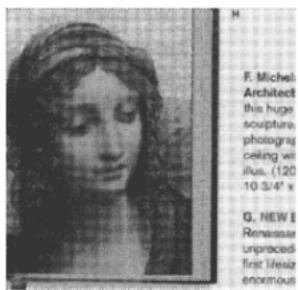
Halftone
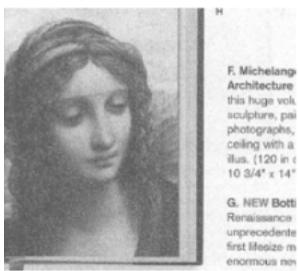
Diffusion
Document Type (Gray mode only)
When you select Gray as the image type for your scanned document, you can choose from three document types:
| Document Type | Description |
| Document | Select Document if your original contains only text or a mixture of text and graphics. This is the optimal setting for regular business documents. |
| Photo | Select Photo if your original contains a photograph, to reproduce it in a vivid grayscale image. |
| Normal | Select Normal to adjust Brightness and Contrast manually. |
Document
(Threshold: 230)
Photo
Normal
Sensitivity / Threshold
■ Sensitivity (available when you select Dynamic Threshold)
If your document contains small dots or speckles and you want to remove them, increase the sensitivity value by moving the bar to the right.
■ Threshold (available when you select Fixed Processing or Document)
A low threshold value produces a lighter image, and can be used to subdue backgrounds and unneeded information. A high threshold value produces darker images, and can be used to help faint images stand out.
Brightness
Use the Brightness bar to lighten or darken an image. The greater the value, the clearer the image.
Contrast
Use the Contrast bar to adjust the range between the darkest and the lightest shades in the image. The greater the value, the greater the difference between light and dark.
Resolution
Select a resolution value from the pop-up list. The greater the value, the higher the resolution, and larger the file size.
You can type a custom resolution value in the Resolution field.
Invert
Use Invert to reverse the brightness and the colors in the image. The default setting is Black on White background. To reverse this, select White on Black.

Black on White

White on Black
Scan Source
Automatic
The machine uses the paper from the ADF first. If there is no paper in the ADF, the machine switches to Flatbed scanning.
Automatic Document Feeder (ADF)
Use the ADF to scan multiple pages.
Flatbed
Use the scanner glass to scan.
2 in 1 for Automatic Document Feeder
Use 2 in 1 to scan documents wider than Letter/A4 size. The machine scans both sides of the folded document, and merges the images onto a single page.
- Merge Vertically check box
Select this check box to align both sides vertically. Clear this check box to align both sides horizontally.
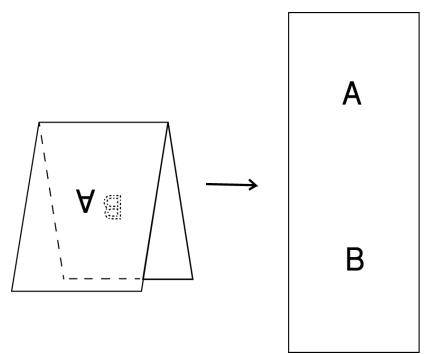
Select Merge Vertically
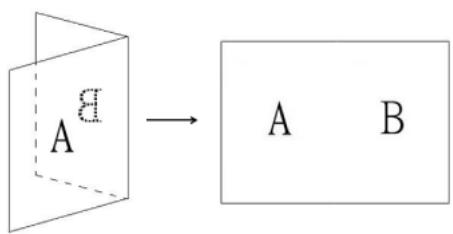
Clear Merge Vertically
Page Size
Select the paper size you want from the pop-up list:
Automatic
Auto Crop(Flatbed Only): multi image output
US Legal - 8.5 in. × 14 in.
US Letter - 8.5 in. × 11 in.
Photo - 6 in. × 4 in.
Photo - 5 in. × 3 in.
ISO A4 - 210 mm × 297 mm
ISO A5 - 148 mm × 210 mm
ISO A6 - 105 mm × 148 mm
ISO A7 - 74 mm × 105 mm
ISO B5 - 176 mm × 250 mm
ISO B6 - 125 mm × 176 mm
ISO B7 - 88 mm × 125 mm
■ JIS B5 - 182 mm × 257 mm
■ JIS B6 - 128 mm × 182 mm
■ JIS B7 - 91 mm × 128 mm
Maximum Scan Length
Long Page (< 236 in. [5,994 mm] 1)
Custom
1 If scanning at 200 dpi, the document length that can be scanned may vary with the resolution.
NOTE
Auto Crop(Flatbed Only): multi image output is only available when Scan Source is set to Automatic or Flatbed.
Profile
Click Profile to save your frequently used scan settings.
To create a scan profile:
1 Select your scan settings using any of the tabs.
When finished, click the Image tab, and then click the + button on the right of the Profile field. The Add A New Profile dialog box appears.
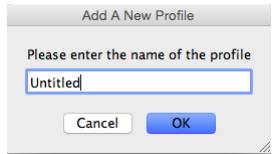
3 Type the name of the profile you want to save.
4 Click OK.
The new profile appears in the Profile field and in the Profile pop-up list.
NOTE
- To delete a profile, select the profile from the pop-up list, click the - button, and click OK.
- To edit a profile, enter the name of the profile you want to edit in the Add a New Profile dialog box and click OK.
Color Profile
Use the Color Profile settings to achieve accurate color reproduction for scans. This option uses the default ICC profile parameters to adjust the image colors. ICC profiles are used with color mapping, mainly in digital photography and printing.
Document
Select Document if your original contains only text or a mixture of text and graphics. This is an optimal setting for regular business documents.
None
Select None to disable the Color Profile option.
Photo
Select Photo if your document contains photos, and you want to reproduce your photos in vivid color.
Mix
Select Mix if your document contains a combination of text and graphics. The Mix option offers mid-range scan quality between Document and Photo.
File tab
Click the File tab to set the directory path, file name and file format of your scanned images.
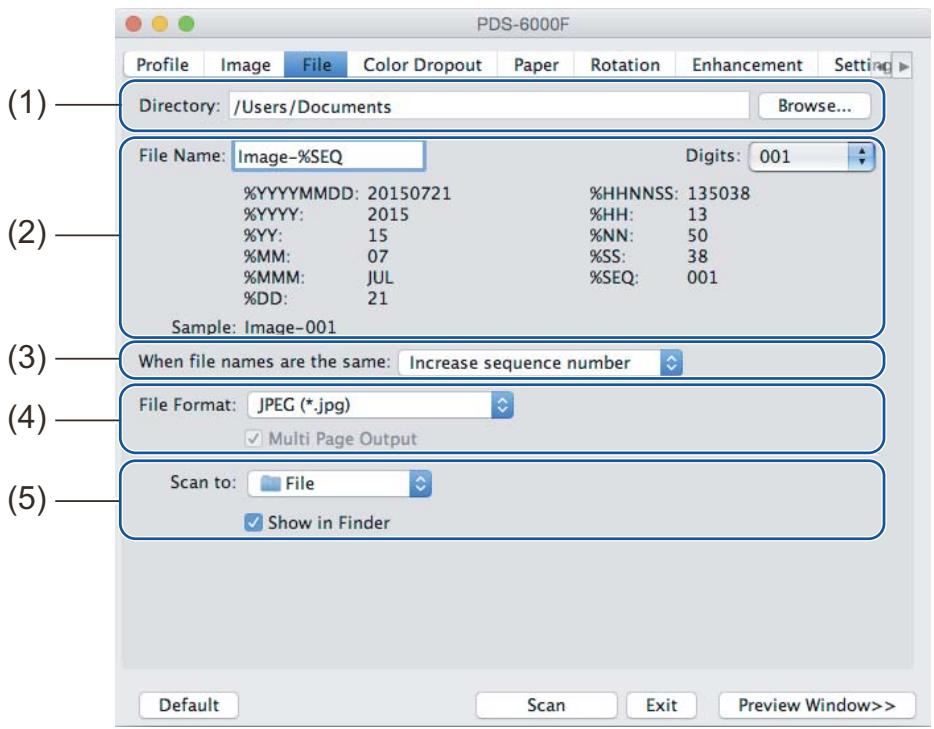
| No. | Name | Description | Default |
| (1) | Directory | Specify where you want to save scanned images. | /Users/xxx/Documents(where xxx is your user name) |
| (2) | File Name options | Specify the default file name of scanned images. | Image-%SEQ |
| (3) | When file names are the same | Select an operation to execute if the same file name exists in the directory. | Increase sequence number |
| (4) | File Format | Select the file format you want. | JPEG (.jpg) |
| (5) | Scan to | Select where to automatically send the scanned image. | File |
Directory
Click the Browse button to navigate to the directory where you want to save scanned images, or type a file location in the Directory field.
File Name options
You can customize the default file name using text and special symbols.
File Name
Type a file name using any text and any of the codes shown. For example, to name all scans "User1" with the month and year (that is, "User1-December, 2014"), type User1-%MM%YYYY in the File Name field.
Digits
Select the number of digits. This setting is available when %SEQ is set.
Sample
Displays an example of your file name.
When file names are identical
Choose an automatic action for the scanning software to execute if file names are duplicated in your default directory:
Increase sequence number
Increase the sequence number of the new scanned image file, and save both new and old files.
Overwrite always
Save only the new scanned image and overwrite the old one.
■ Ask User
Display a dialog box that prompts you to either increase the sequence number of the new file or overwrite the old file.
File Format
Select the file format you want from the pop-up list.
To save multiple documents as one file, select the Multi Page Output check box.
Scan to
Select File, Application, E-mail, or Printer from the pop-up list to specify where to send the scanned image file. Select the Show in Finder check box to open the Finder and display the directory where the image is saved.
Color Dropout tab
Click the Color Dropout tab to remove the red, blue, or green color from your scanned image resulting in a gray or black and white document. If your image contains a red watermark or background, select the Red channel to remove any red watermark or background color. This feature is useful for sharpening text when using Optical Character Recognition (OCR) software.
NOTE
This function supports only black and white or gray documents.
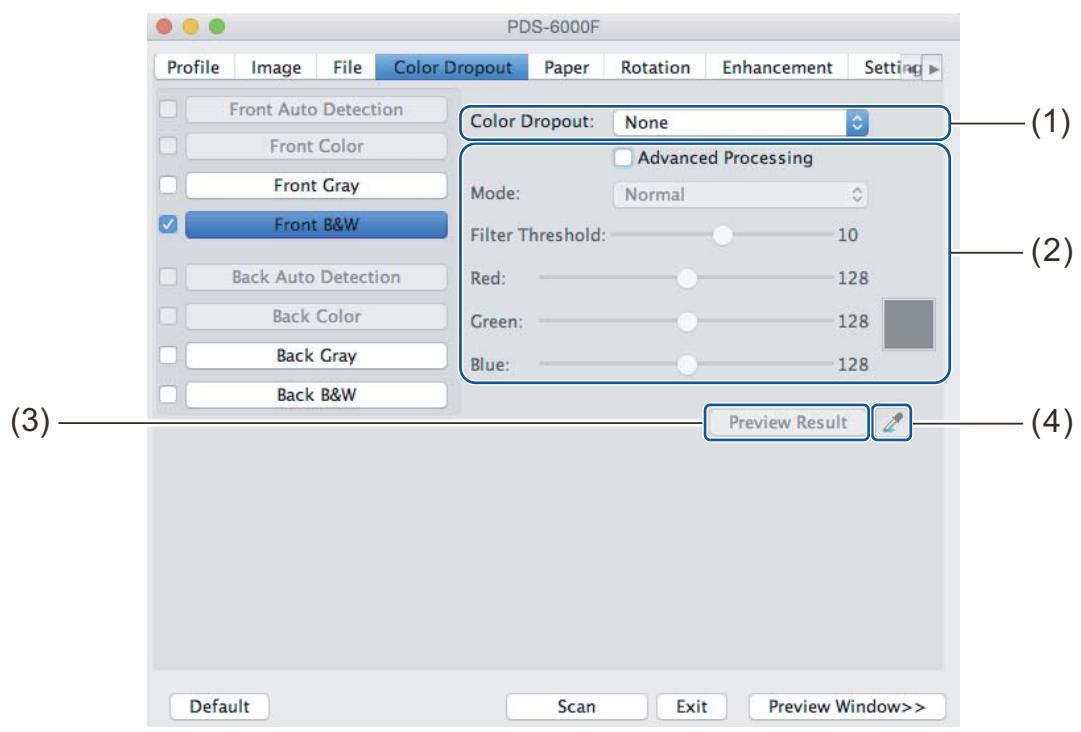
| No. | Name | Description | Default |
| (1) | Color Dropout | Select the color you want to remove from your scan. | None |
| (2) | Advanced Processing | Configure the advanced settings when removing a color. | (not selected) |
| (3) | Preview Result | Preview the result of current color dropout settings in the image preview window. | - |
| (4) | Color Picker | Select the dropout color from the preview image. | - |
Color Dropout
Select one of the following from the Color Dropout pop-up list:
None
No color is removed.
Remove Red / Remove Green / Remove Blue
Removes red, green, or blue from the scan.
Custom
Manually adjust the RGB value of the color you want to remove, or select the dropout color from the preview image using Color Picker
Advanced Processing
Select the Advanced Processing check box to adjust the details that can optimize your scan result.
Mode
Select Quality to configure detailed settings for the filter threshold value. Mode is available only when Remove Red, Remove Green, Remove Blue, or Automatic is selected in the Remove Color pop-up list.
Filter Threshold (available when you select None, Remove Red, Remove Green, or Remove Blue)
This value determines how much color to remove. A lower value removes more of the selected color, while a higher value keeps more of the selected color. Filter Threshold is available only when Quality is selected in the Mode pop-up list.
RGB values (available when you select Custom)
Displays the RGB value for the color selected in the image preview window. Adjust RGB values manually, if needed.
Preview Result
Click this button to preview your color dropout settings. Before using this feature you must preview your image by clicking the Preview Window button.
Color Picker
The Color Picker option is available only if you select Custom under Color Dropout, and only after you preview your image by clicking the Preview Window button. Select the dropout color from the preview image.
Click the button, move the mouse over the preview image, and click the color you want to remove. The RGB values for the selected color automatically populate the Red, Green and Blue fields.
Paper tab
Click the Paper tab to define values relating to image output, overlapping pages, and auto scan.
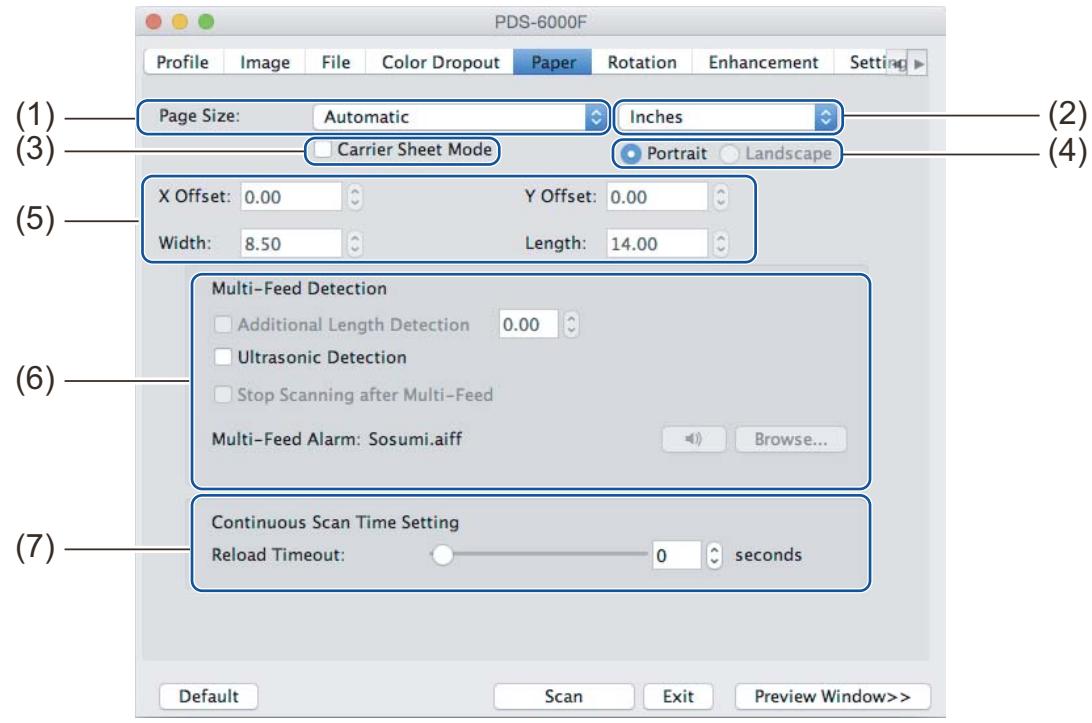
| No. | Name | Description | Default |
| (1) | Page Size | Capture a portion of the document being scanned. If you select Automatic, scanned images are automatically deskewed if they are crooked. | Automatic |
| (2) | Unit | Select the unit of measurement displayed from the available options. | (based on language) |
| (3) | Carrier Sheet Mode | Select this check box if using the Carrier Sheet. | (not selected) |
| (4) | Portrait / Landscape | Select your scanned document's layout. | Portrait |
| (5) | X-Offset / Y-Offset / Width / Length | Adjust the scanning area manually. | - |
| (6) | Multi-Feed Detection options | Configure the options to detect documents that overlap when fed through the ADF. | OFF |
| (7) | Reload Timeout | Set the amount of time the machine has to wait before starting an auto scan after the first scan job is completed. | 0 |
Page Size
Select the paper size you want from the pop-up list:
Automatic
Auto Crop(Flatbed Only): multi image output
US Legal - 8.5 in. × 14 in.
US Letter - 8.5 in. × 11 in.
Photo - 6 in. × 4 in.
Photo - 5 in. × 3 in.
ISO A4 - 210 mm × 297 mm
ISO A5 - 148 mm × 210 mm
ISO A6 - 105 mm × 148 mm
ISO A7 - 74 mm × 105 mm
ISO B5 - 176 mm × 250 mm
ISO B6 - 125 mm × 176 mm
ISO B7 - 88 mm × 125 mm
■ JIS B5 - 182 mm × 257 mm
■ JIS B6 - 128 mm × 182 mm
■ JIS B7 - 91 mm × 128 mm
Maximum Scan Length
Long Page (< 236 in. [5,994 mm] 1)
Custom
1 If scanning at 200 dpi, the document length that can be scanned may vary with the resolution.
Automatic
This option automatically adjusts the cropping window according to document size. Use this option for batches of mixed-sized documents.
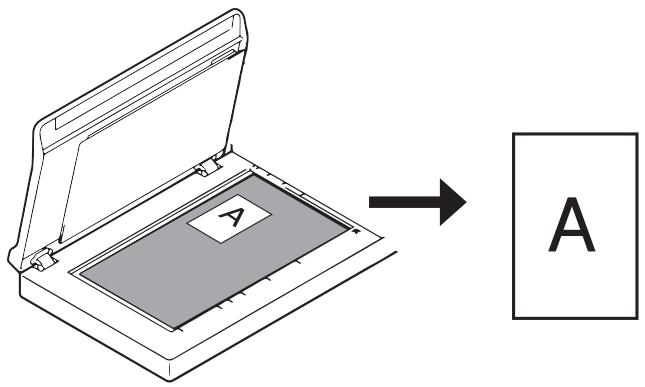
NOTE
- When you select Automatic, scanned images are automatically deskewed if the images are crooked.
- Punch Hole Removal is not available when Automatic Cropping is disabled.
Auto Crop (Flatbed Only): multi image output
This option allows you to automatically scan to the multiple files when you place multiple documents on the scanner glass at the same time.
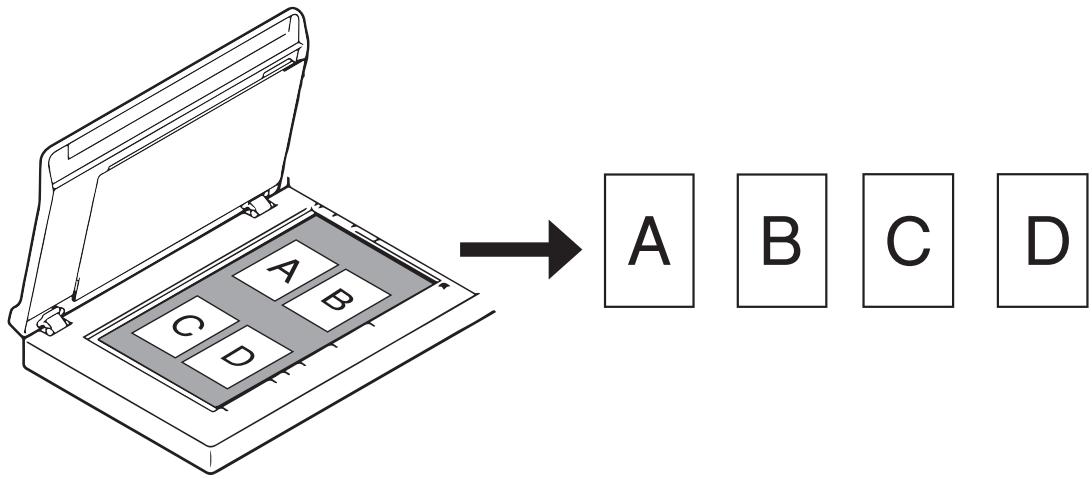
NOTE
Only available when Scan Source is set to Flatbed.
Limitation of Auto Crop (Flatbed Only): multi image output
- A minimum distance between objects is 0.5 in.
- Objects must be at least 1 inch in size.
- If you set Automatic, it will be scanned as shown in the illustration.
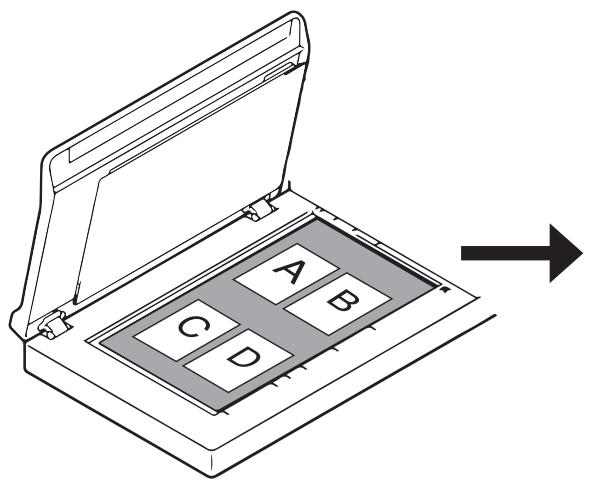
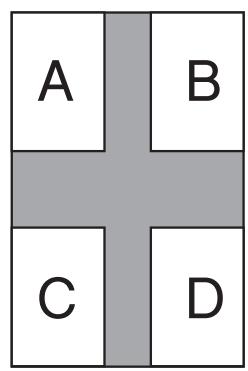
Unit
Select Millimeters, Inches, or Pixels from the pop-up list. The default setting is based on your OS language.
Carrier Sheet Mode
Select this check box if using the Carrier Sheet.
NOTE
- This option is available only when Automatic is selected in the Page Size pop-up list.
- Carrier Sheet Mode is not available when using the scanner glass.
Portrait / Landscape
NOTE
Landscape cannot be selected when US Legal, US Letter, A4, B5, Maximum Scan Length, or Long Page is selected.
X-Offset / Y-Offset / Width / Length
You can adjust the scan area manually using the following values:
X-Offset
Adjusts the distance from the left edge of the scanner to the left edge of the area in the document that you want to scan.
Y-Offset
Adjusts the distance from the top edge of the document to the top edge of the area in the document that you want to scan.
Width
Adjusts the width of the area in the document that you want to scan.
Length
Adjusts the length of the area in the document that you want to scan.
Multi-Feed Detection options
Configure the Multi-Feed Detection options to detect documents that overlap when fed through the ADF. A multifeed usually occurs due to stapled documents, adhesives on documents, or electrostatically charged documents.
Additional Length Detection
Allows you to define the length of document being scanned by specifying the additional length exceeding scan area. A value of "0" indicates no additional length detection. Use the Additional Length Detection feature when scanning multiple same-sized documents from the ADF.
If you select this detection method, scanning does not stop even if a multifeed is detected.
Ultrasonic Detection
Detects overlapping pages by measuring paper thickness.
When this feature is selected, and your machine detects a multifeed, scanning stops immediately and a warning message appears on your computer monitor.
Stop Scanning after Multi-Feed
Select this check box to stop the feeder and display the warning dialog box when a multifeed is detected.
NOTE
- This option is available when you select Additional Length Detection.
- To stop scanning immediately when a multifeed is detected, select the Stop Scanning after Multi-Feed check box.
Multi-Feed Alarm
Use this feature to set an audible alarm emitted when a multifeed is detected.
To change the alarm sound, click Browse... and select a wave file from your computer.
NOTE
This feature is available when either Additional Length Detection or Ultrasonic Detection is selected.
Reload Timeout
Set the amount of time the machine has to wait before auto-scanning the next document after the scan job is completed. Use this feature if you load many separate documents, which must be scanned using the same scan settings, in the ADF.
Rotation tab
Click the Rotation tab to set specifications related to image rotation.
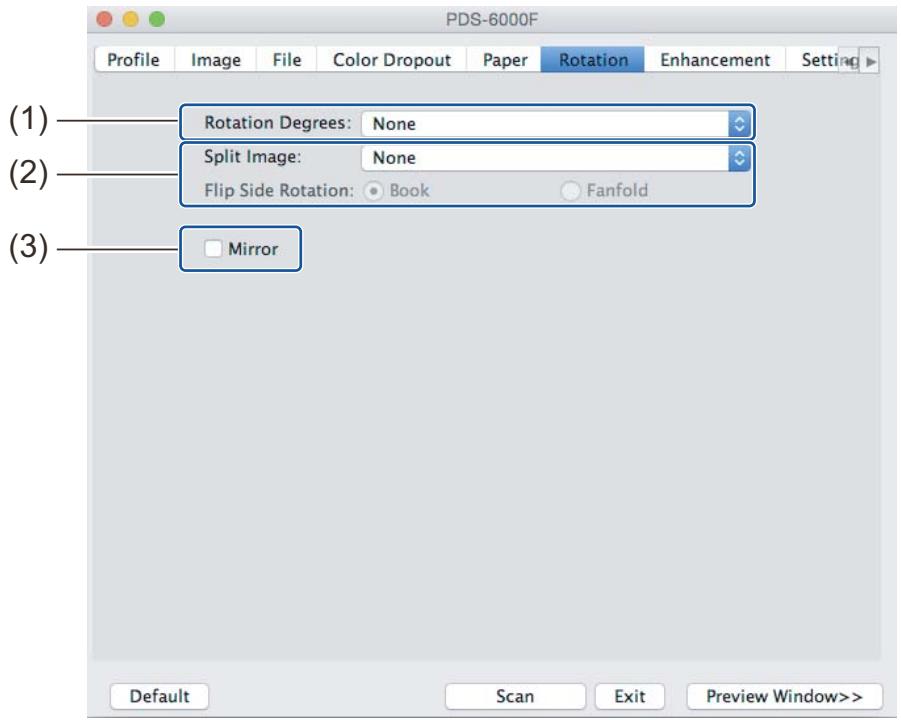
| No. | Name | Description | Default |
| (1) | Rotation Degrees | Rotate the scanned image. | None |
| (2) | Split Image | Split the scanned image horizontally or vertically. | None |
| (3) | Mirror | Reverse the right and left sides of your image. | (not selected) |
Rotation Degrees
To rotate the scanned image, select the rotation angle from the pop-up list:
None
90 degrees CW (Clockwise)
180 degrees
90 degrees CCW (Counter-clockwise)
Auto based on contents
If you select Auto based on contents, the machine automatically rotates your document based on its contents.
Scan (Macintosh)
Split Image
When you split an image, the machine creates two separate images aligned either horizontally or vertically. This is useful for documents containing an image that spans two pages, because you can save both images as a single image on a single page.
None
Horizontal
Divide a single image in half horizontally.
Vertical
Divide a single image in half vertically.
Mirror
Select the Mirror check box to reverse the right and left sides of your image.
Enhancement tab
Click the Enhancement tab to improve the appearance of your scanned image.
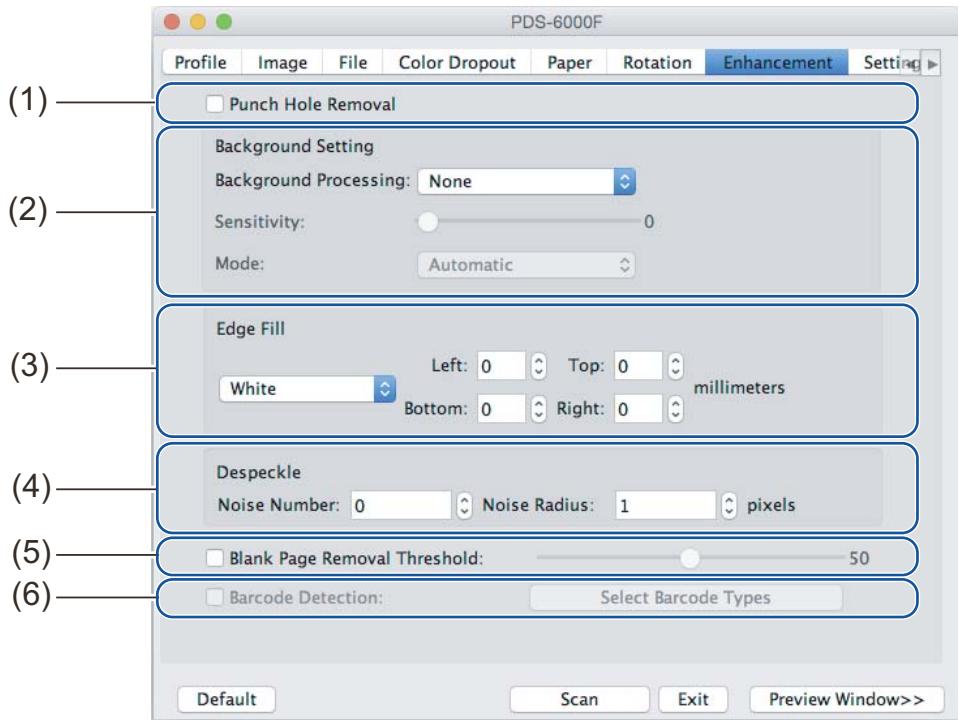
| No. | Name | Description | Default |
| (1) | Punch Hole Removal | Remove punch hole markings. | (not selected) |
| (2) | Background Setting | Remove or smoothen the background color. | None |
| (3) | Edge Fill | Add a white or black edge around the border. | White Millimeters: 0 |
| (4) | Despeckle | Remove small dots or speckles from the background. | Noise Number: 0 Noise Radius: 1 |
| (5) | Blank Page Removal Threshold | Remove any blank pages from the original document. | (not selected) |
| (6) | Barcode Detection | Detect and recognize barcodes; separates your multi-page document whenever a barcode is detected. | (not selected) |
Punch Hole Removal
Select the Punch Hole Removal check box to remove punch hole markings on scanned images. This feature removes the punch hole markings by filling hole marks with the surrounding color.
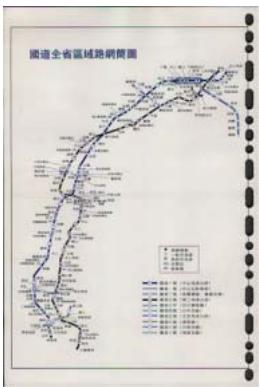
Original
Punch Hole Removal
NOTE
Punch Hole Removal is available when the paper size is set to Automatic.
Background Setting
Specifying the Background Setting allows you to remove or smoothen the base color of scanned documents.
Background Processing
Select None, Smooth or Removal from the pop-up list. Smooth makes the background smooth, and Removal removes the background color.
Sensitivity
Move the Sensitivity slider to the left or right to adjust the sensitivity to base color or background. The greater the sensitivity value, the better the scan results, the slower the scanning speed.
Mode
This option is available only if you select Smooth under Background Processing above. Select Automatic to allow the software to process the image automatically. Select Moire to reduce moire.
Fill Color
This option is available only if you select Removal under Background Processing above. Select White to make the background white. Select Automatic to allow the software to detect the background color automatically and fill it in with the color.
Edge Fill
Select White or Black and set a value (in millimeters) to add a white or black edge around the border of your scanned image.
NOTE
- The maximum edge fill value equals half the length of the shorter side of a selected paper size. For example, if you select a Letter size, which is 8.5 × 11 in., the maximum value for the white edge or black edge is 4.25 in. (or half of 8.5 in.). If you select an A4 size, which is 210 × 297 mm, the maximum value for the white edge or black edge is 105 mm (half of 210 mm).
- If you set a value greater than the maximum allowed, the value automatically defaults to the maximum.
- To disable this feature, set the each value to "0".
Original
Edge Fill: 20 mm (Black)
Despeckle
This function allows you to remove small dots or speckles called "noise," from the background of scanned images. Removing unwanted speckles provides a clear image for OCR processing, and helps to reduce compressed file size.
Define the noise you want to remove by specifying Noise Number (size) and Noise Radius (range).

Before Despeckle
(Noise Number: 0, Noise Radius: 1)

After Despeckle
(Noise Number: 22, Noise Radius: 10)
NOTE
Despeckle is available for black and white images only.
Blank Page Removal Threshold
Select the Blank Page Removal check box to remove blank pages from your scanned image.
Move the slider to change the threshold, or level of pixels, that determines a blank page.
Barcode Detection
Select the Barcode Detection check box to split multi-page scanned files whenever a barcode is detected.
Select Barcode Types
Click Select Barcode Type and select the barcode types to specify the barcode you want the scanning software to recognize.
NOTE
- This function is available only when the File Format setting on the File tab is set to PDF or TIFF, and Multi Page Output is selected.
- When you use Barcode Detection to split documents, pages that contain barcodes do not appear in your scan results.
Setting tab
Click the Setting tab to configure additional scanning options.
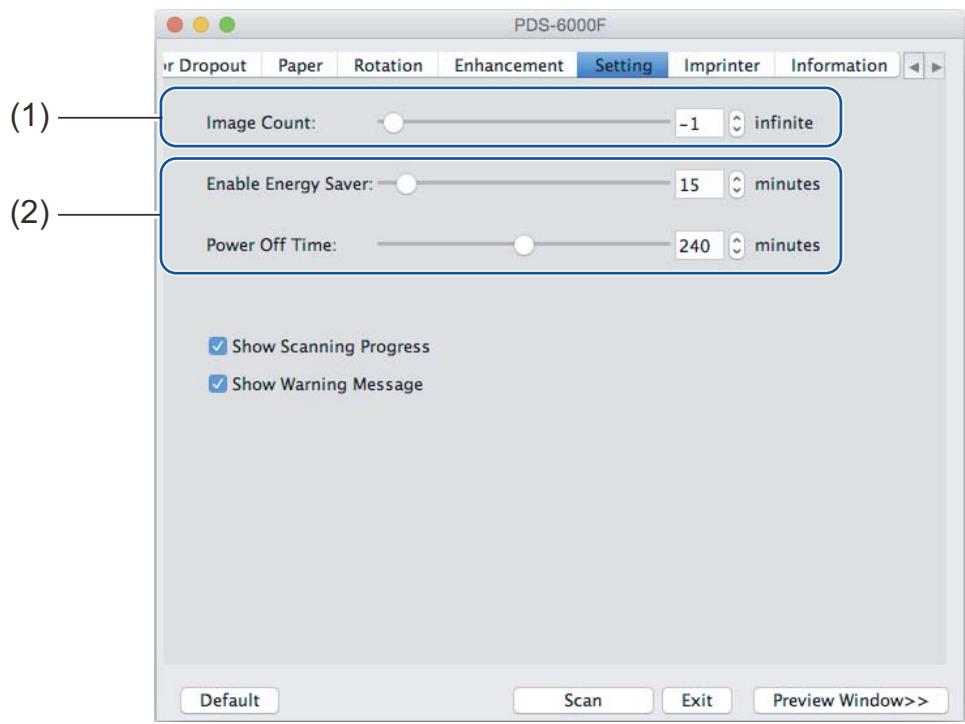
| No. | Name | Description | Default |
| (1) | Image Count | Specify the number of pages to scan. | Infinite |
| (2) | Energy Saver controls | Change settings related to saving energy. | Enable Energy Saver: 15 minutes Power Off Time: 240 minutes |
Image Count
This option allows you to specify the number of pages to scan. For example, to scan only the first two pages of a document, move the page slider to "2".
NOTE
Image Count is not available when using the scanner glass.
Energy Saver controls
■ Enable Energy Saver (Power Saving Mode)
Move the slider to set the amount of idle time before the machine enters Power Saving Mode.
Power Off Time
Move the slider to set the amount of idle time before the machine automatically powers off.
NOTE
- You cannot disable Enable Energy Saver.
- Power Off Time must be greater than or equal to Energy Saver time.
Imprimer tab
Click the Imprimer tab to print the date, time, document count, or custom messages on your scanned image.
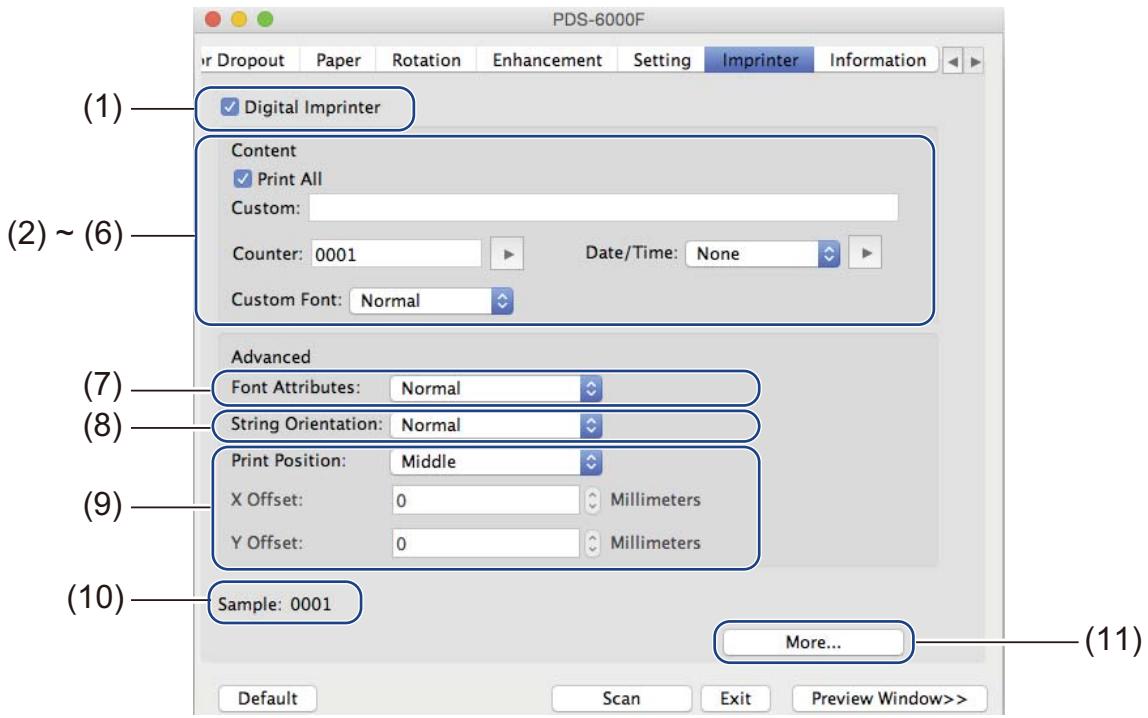
| No. | Name | Description | Default |
| (1) | Digital Imprimer | Select to activate this feature. | (not selected) |
| (2) | Print All | Print on every page of the scanned image. | (select) |
| (3) | Custom | Type the custom text to print on your scanned image. | (none) |
| (4) | Counter | Change the scan counter. | Number (such as 1234) |
| (5) | Date/Time | Change the date/time. | None |
| (6) | Custom Font | Select a font. | Normal |
| (7) | Font Attributes | Select a font attribute. | Normal |
| (8) | String Orientation | Select the print direction. | Normal |
| (9) | Print Position | Select a print position. | Middle |
| (10) | Sample | Preview your custom text. | (none) |
| (11) | More | Set advanced font settings. | Size: 5 Density: 0 Transparency: 0 |
Scan (Macintosh)
Digital Imprimer
Select the Digital Imprimer check box to use the digital imprinter to print custom text on your scanned image.
Print All
Select the Print All check box to print the text on every page of the scanned image. Clear the check box to print the text only on the first page of the scanned image.
Custom
Type the text you want in your print string (up to 31 characters).
Counter
Click to increase the scan counter.
The number of digits specified here is displayed on the scanned image. For example, selecting Number (123456) causes "000001" to be shown on the first page of the scanned image, "000002" on the second, "000003" on the third, and so forth.
Date/Time
Select Date, Time, or Date+Time to include the date or time in your print string. Click to select a date or time separator from the pop-up list.
Custom Font
Select Normal or Fixed Width from the Custom Font pop-up list.
Fixed Width (monospace) fonts use a fixed character spacing, so each character occupies the same width.
Font Attributes
Select Normal, Underline, Double, or Bold from the Font Attributes pop-up list.
String Orientation
Select Normal, Rotated, Vertical, Vertical Inversion, 90 Degrees CW (clockwise), or 90 Degrees CCW (counter-clockwise), from the String Orientation pop-up list to specify the text's print direction.
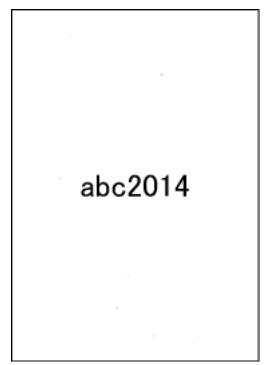
Normal
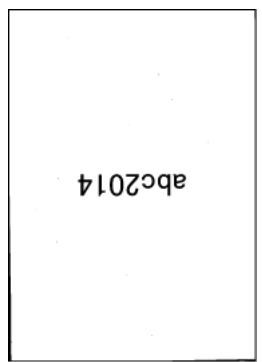
Rotated
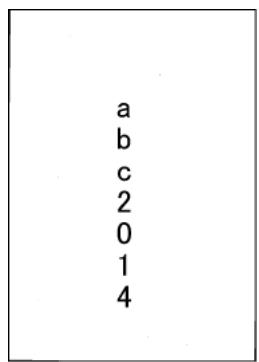
Vertical
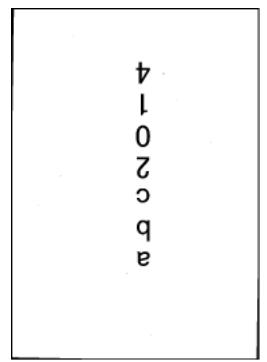
Vertical Inversion
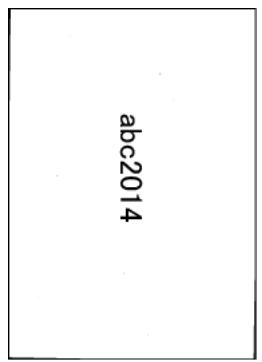
90 Degrees CW
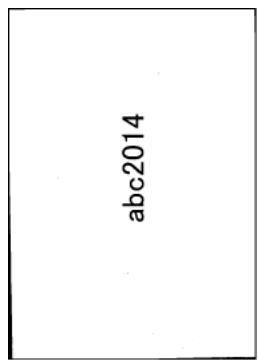
90 Degrees CCW
Print Position
Select Top, Middle, Bottom, or Custom from the Print Position pop-up list.
If you select Custom, enter the X Offset and Y Offset value to specify the text's start position.
Sample
Preview your text here.
More
Click the More button to select additional font properties.
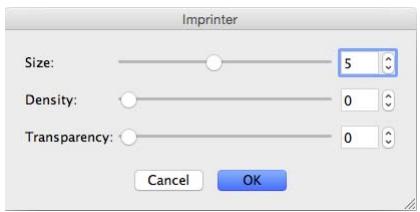
Size
Move the slider to select font size (Default: 5).
Density
Move the slider to select font density (Default: 0).
Transparency
Move the slider to select a transparency value from 0% (not transparent) to 100% (completely transparent). This is useful when creating a partially transparent watermark.
Information tab
Click the Information tab to display system and machine information, such as scanner driver version and firmware version. You can also view the roller count and reset the count in this window.
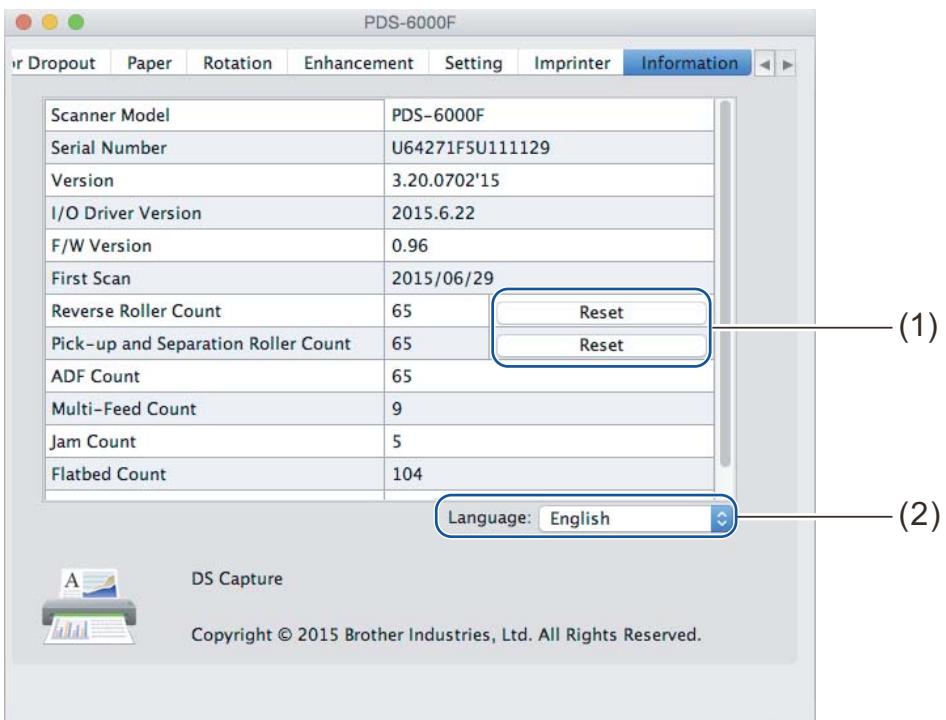
| No. | Name | Description | Default |
| (1) | Reset Roller Count | Reset the roller count. | - |
| (2) | Language | Change the language of the DS Capture user interface. | (based on OS language) |
Reset Roller Count
After replacing the scanner rollers, click the Reset button to reset the roller count.
NOTE
Do not reset the counter unless you have replaced the rollers.
Language
Change the language of the DS Capture user interface, if needed.
7 Maintenance
IMPORTANT
Do not use any solvents or corrosive liquids, such as alcohol or kerosene, to clean any part of your Brother machine, or the plastic may be permanently damaged.
Clean the outside of your machine
To prevent dust accumulation, we recommend cleaning the exterior of your Brother machine periodically. Wipe the outside of the machine with a dry, soft, lint-free cloth.
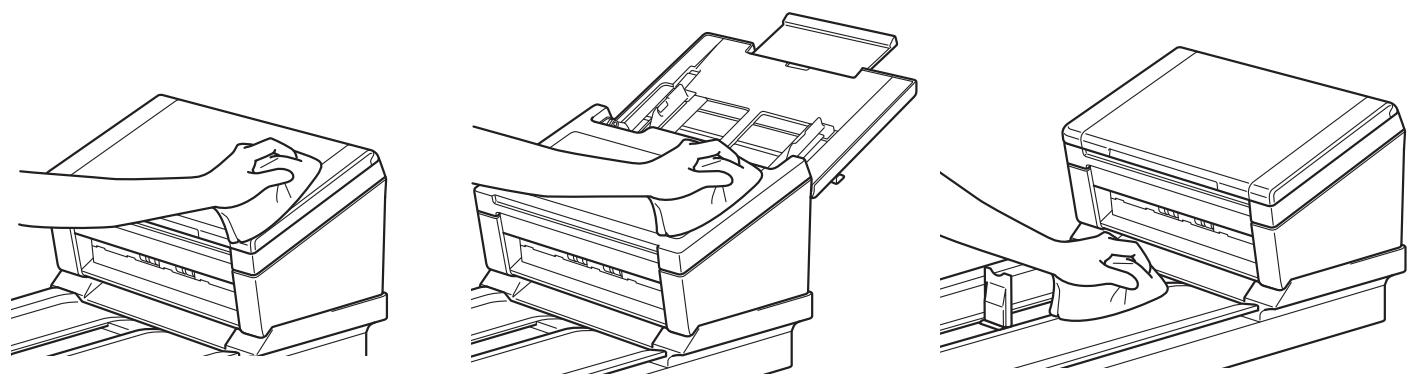
Clean the Scanner Glass
Press and hold down

to turn the machine off.
Lift the document cover.
Clean the scanner glass under the document cover with a soft, lint-free cloth moistened with water.
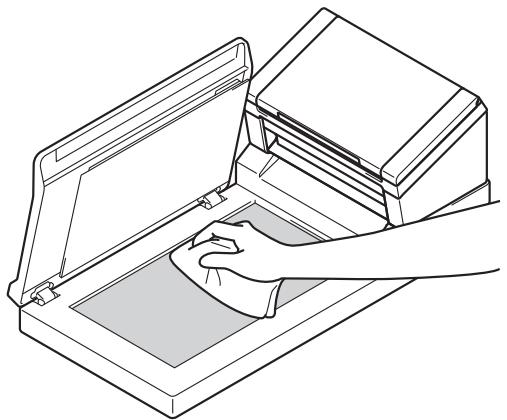
NOTE
In addition to cleaning the scanner glass and glass strip with a soft, lint-free cloth moistened with water, run your finger tip over the glass to see if you can feel anything on it. If you feel dirt or debris, clean the glass again, concentrating on that area. You may have to repeat the cleaning process three or four times. To test, scan after each cleaning.
Close the document cover.
Clean the inside of your machine
A spot of dirt or correction fluid on the glass strip may cause poor-quality scans. If a vertical line appears in the scanned data or if parts of the document are missing, you must clean the inside of the machine.
IMPORTANT
After 5,000 scans, you will need to clean the rollers. You can check the number of scans using the DS Capture application by going to Scanner Properties > Information.
For Windows®: see Information tab on page 62.
For Macintosh: see Information tab on page 93.
Unplug the machine from the AC power outlet.
2 Open the Top Cover (1) and the ADF Cover (2).
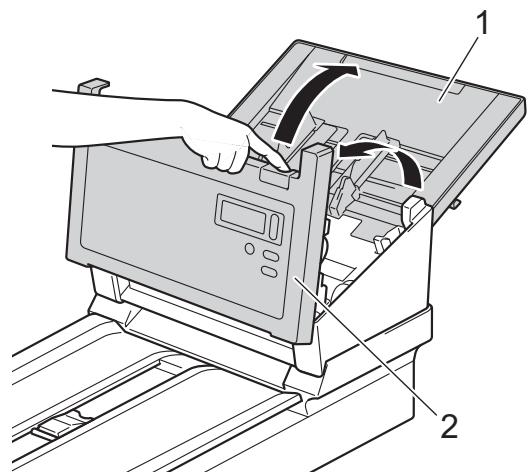
In the ADF unit, clean the glass strips (1) and feed rollers (2) with a soft, lint-free cloth moistened with water.
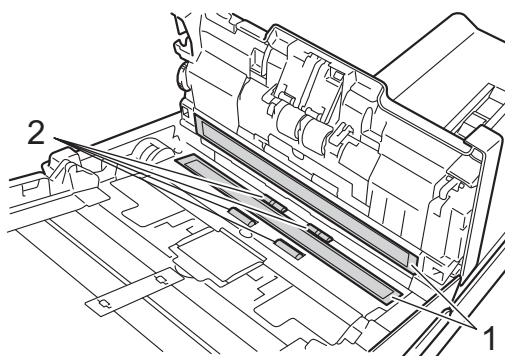
Press and hold the buttons (1) on the inside of the ADF Cover, and then pull the Reverse Roller Cover (2) down.
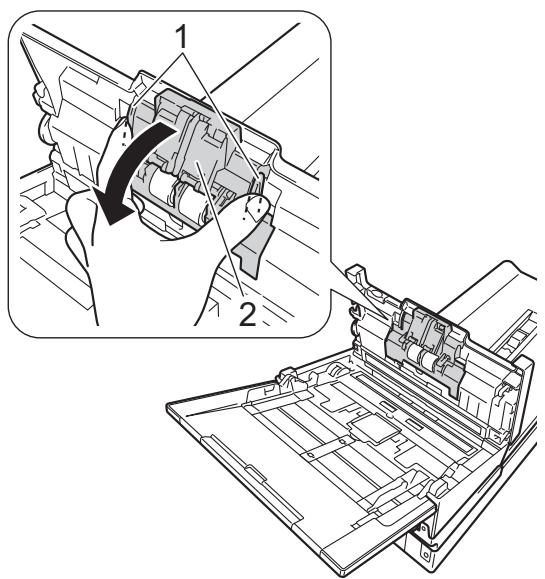
5 Pinch the Reverse Roller (1) and pull it out of the machine.
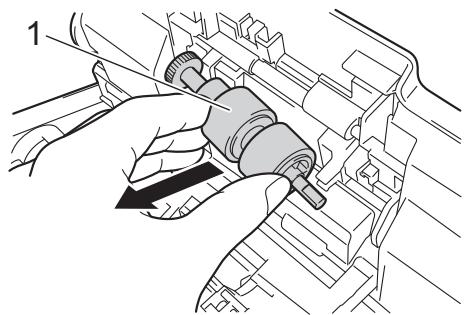
6 Clean the Reverse Roller with a soft, lint-free cloth moistened with water.
Pinch the Reverse Roller and reinstall it in the machine.
8 Securely close the Reverse Roller Cover (1) until the hooks snap into the ADF Cover.
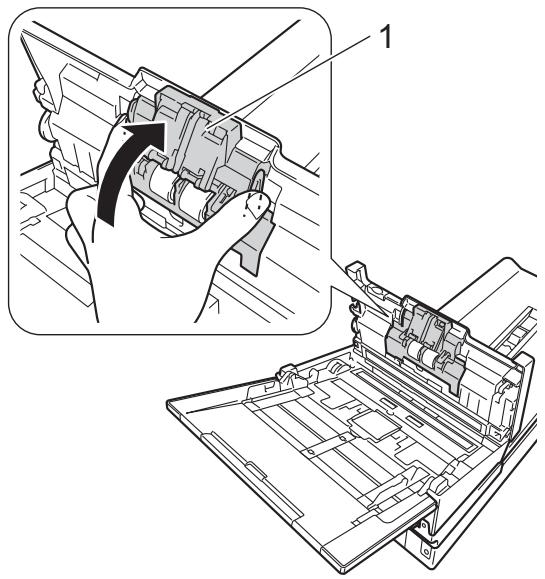
9 Slide the document guides (1) as far apart as possible and pull the Roller Cover (2) down.
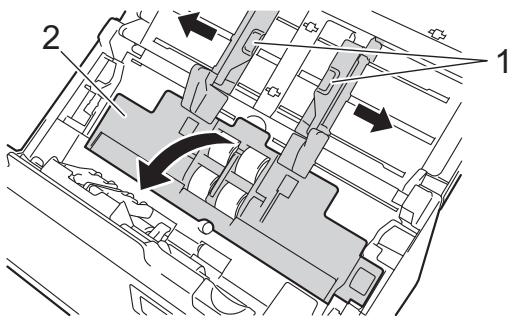
Pinch the Pick-up Roller and pull it out of the machine.
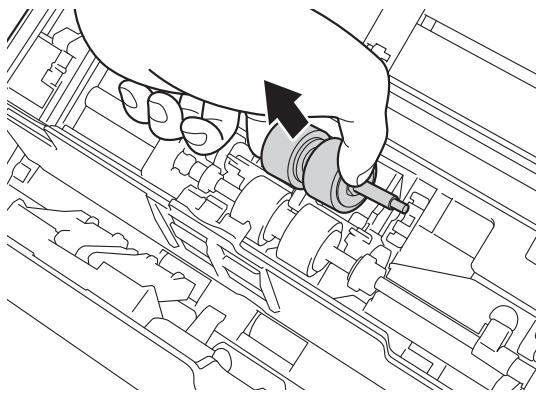
Pull the blue hook on the Separation Roller down.
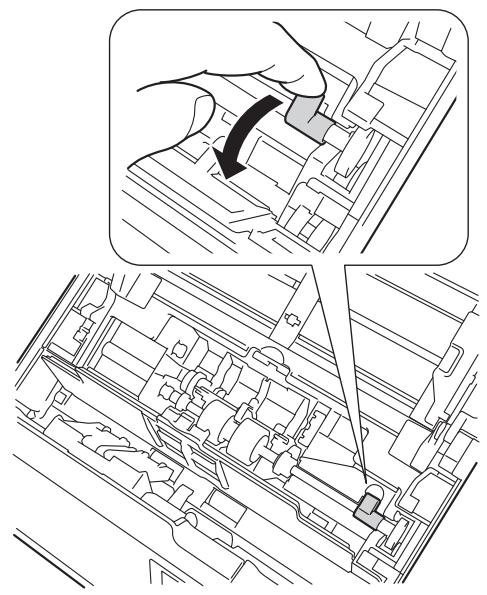
Pinch the Separation Roller and pull it out of the machine.
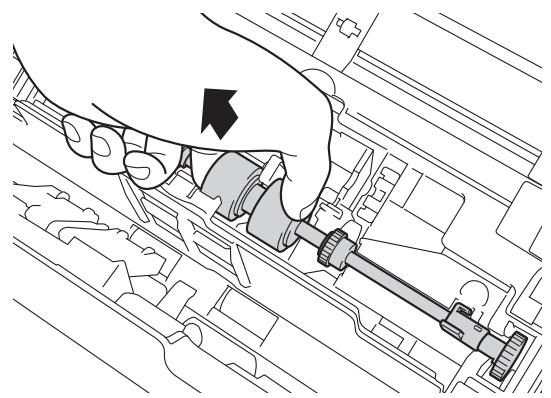
13 Clean the Pick-up Roller and the Separation Roller with a soft, lint-free cloth moistened with water.
Pinch the Separation Roller and reinstall it in the machine.
15 Lift the blue hook that you pulled down in step 11.
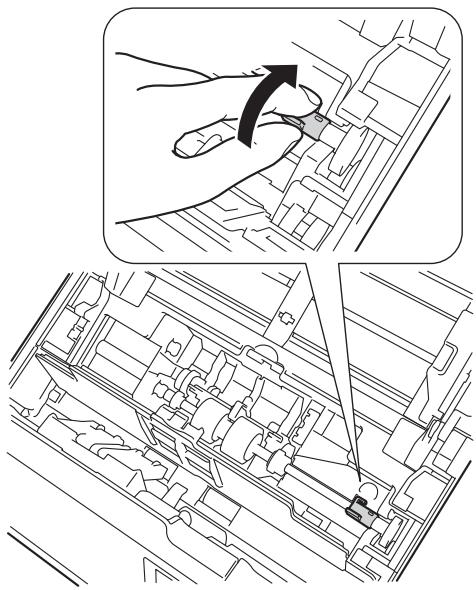
Pinch the Pick-up Roller and reinstall it in the machine.
17 Close the Roller Cover (1).
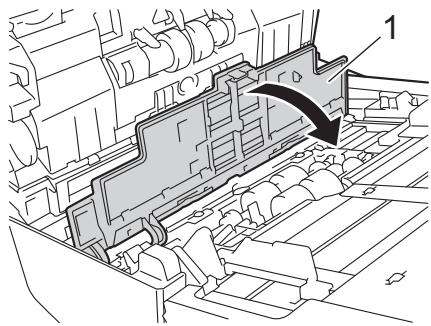
18 Close the ADF Cover and the Top Cover.
NOTE
In addition to cleaning the glass strips with a non-flammable glass cleaner, run your fingertip over the glass to see if you can feel anything on it. If you feel dirt or debris, clean the glass again concentrating on that area. You may need to repeat the cleaning process three or four times. To test, scan a document after each cleaning attempt.
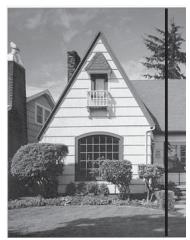
When there is a spot of dirt or correction fluid on the glass strip, the scanned sample shows a vertical line.

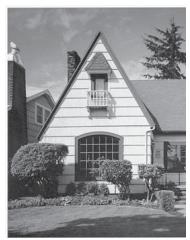
After the glass strip is cleaned the vertical line is gone.
Replace parts
When your Brother machine detects that scanner parts are nearing their end-of-life period, a warning message appears on your computer monitor.
If the warning message warns you to replace the Pick-up Roller, the Separation Roller, or the Reverse Roller, order new parts, and then replace the used parts with the new ones.
Supply information
The following table lists part names and contains recommendations about usage and replacement:
| Part Name | Standard Replacement Cycle |
| Pick-up Roller | |
| Separation Roller | 200,000 sheets or 5 years |
| Reverse Roller |
NOTE
- Your replacement cycles may vary depending on the usage environment, types of documents, and scanning frequency.
We recommend replacing all three rollers at the same time, or the roller count value will be incorrect.
These parts are available at most Brother retailers. If you cannot find the part you need, you can order parts directly from Brother. Visit us online for a complete selection of the Brother parts and supplies.
In USA: 1-877-552-MALL (1-877-552-6255)
1-800-947-1445 (fax)
www.brothermall.com
In Canada:
www.brother.ca
Other Countries:
www.brother.com
Check replacement cycle
Your Brother machine is equipped with a scan counter, which automatically counts how many pages the machine scans.
To check the scan count, follow these steps:
For Windows®:
Launch DS Capture.
2 Click (Setup), and then click the Information tab.
3 Scroll down in the information window until you see ADF Roller Count, ADF Simplex Count or ADF Duplex Count.
For Macintosh:
Launch DS Capture.
2 Click the Information tab.
3 Check ADF Roller Count, ADF Simplex Count or ADF Duplex Count.
Replace the Rollers
When the machine has scanned 200,000 sheets, the machine displays a message "Please replace the roller and reset the roller count." on your computer to remind you to replace the Rollers.
NOTE
We recommend replacing all three rollers at the same time, or the roller count value will be incorrect.
1 Open the Top Cover (1) and the ADF Cover (2).
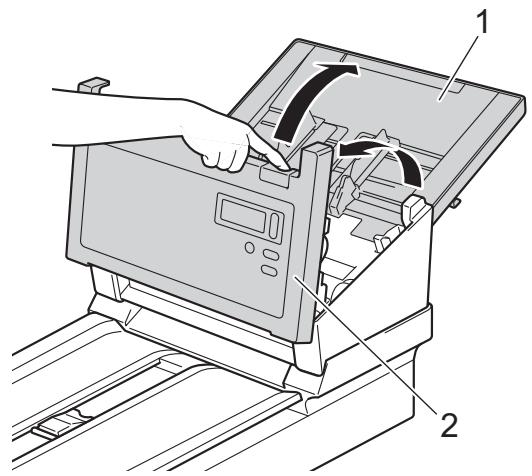
Press and hold the buttons (1) on the inside of the ADF Cover, and then pull the Reverse Roller Cover (2) down.
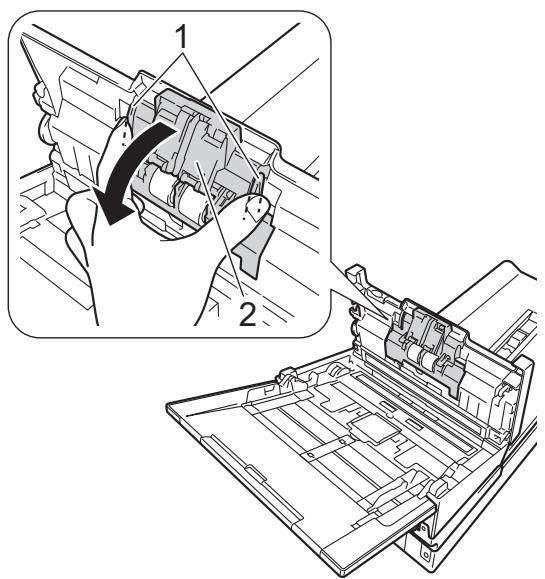
3 Pinch the Reverse Roller (1) and pull it out of the machine.
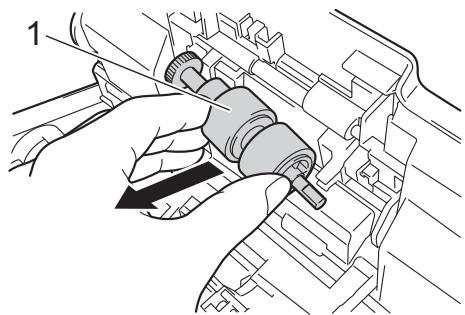
4 Remove the old Reverse Roller from the shaft and insert the new Reverse Roller completely onto the shaft.
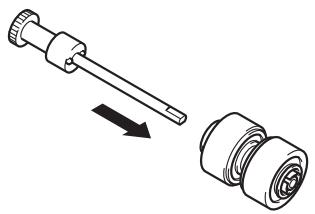
5 Pinch the new Reverse Roller and reinstall it in the machine.
6 Securely close the Reverse Roller Cover (1) until the hooks snap into the ADF Cover.
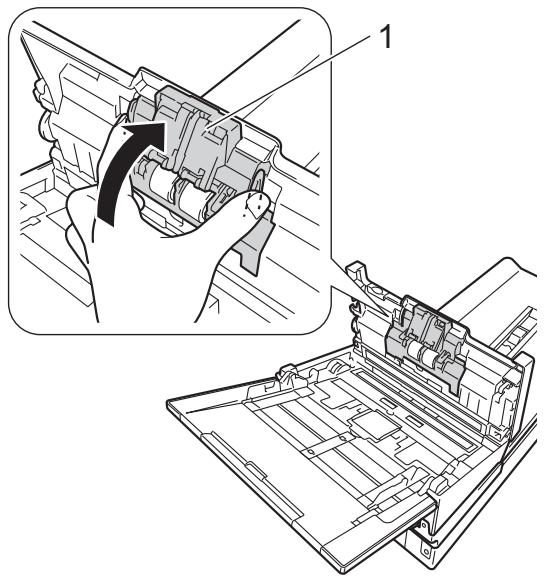
7 Slide the document guides (1) as far as possible and pull the Roller Cover (2) down.
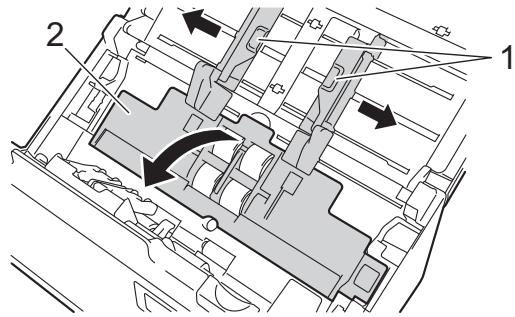
8 Pinch the Pick-up Roller and pull it out of the machine.
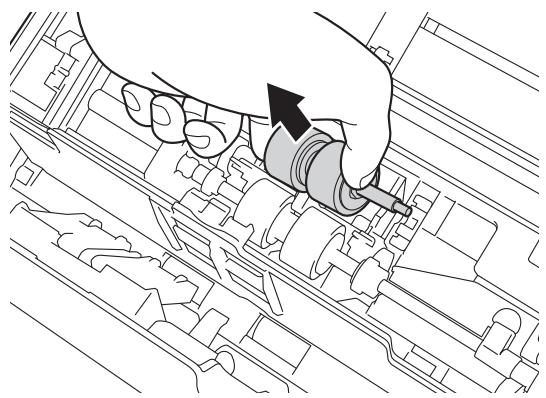
Pull the blue hook on the Separation Roller down.
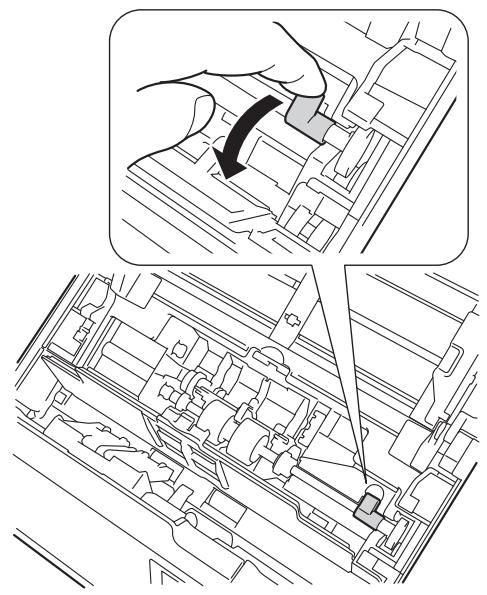
Pinch the Separation Roller and pull it out of the machine.
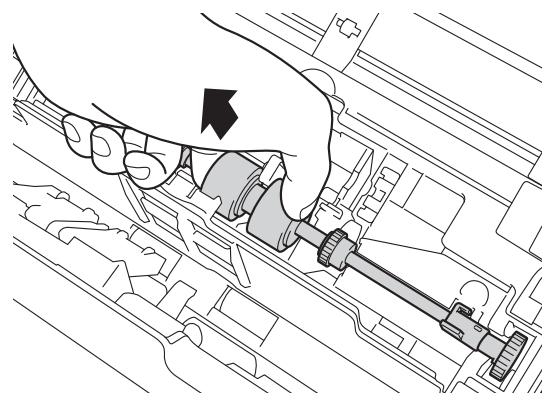
11 Pinch a new Separation Roller and reinstall it in the machine.
12 Lift the blue hook that you pulled down in the step 9.
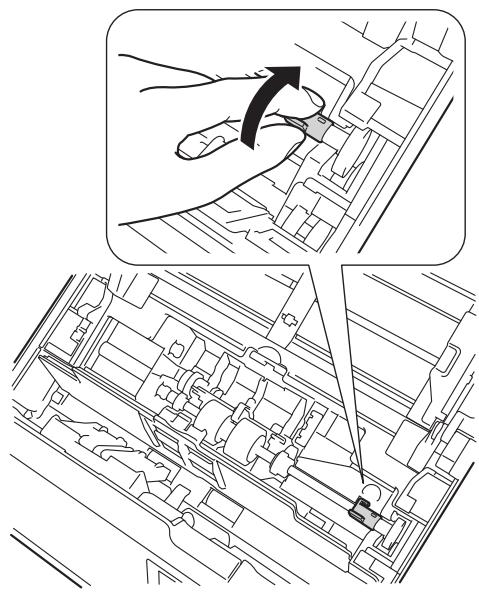
Pinch a new Pick-up Roller and reinstall it in the machine.
14 Close the Roller Cover (1).
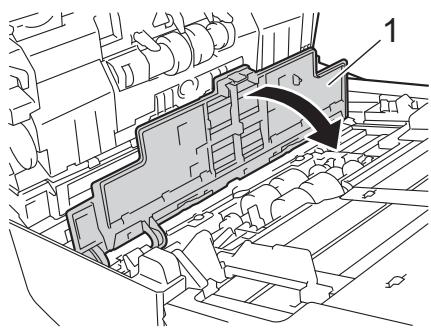
15 Close the ADF Cover and the Top Cover.
Reset the counter (see Reset the usage counters on page 109).
Reset the usage counters
After you have replaced scanner parts, reset the usage counter.
For Windows®:
Launch DS Capture.
2 Click (Setup), and then click the Information tab.
3 Scroll down in the information window until you see Reset Roller button.
4 Click Reset Roller Count to reset the usage counter.
For Macintosh:
Launch DS Capture.
2 Click the Information tab.
3 Click Reset to reset the usage counter.
Packing and shipping the machine
When you transport the machine, use the packing materials that came with your machine. If you do not pack the machine correctly, any damage that may occur in transit may not be covered by your warranty. The machine should be adequately insured with the carrier.
1 Close the Top Cover gently.
2 Carefully turn the machine over. Slide the transport lock switch on the reverse side to the Locked position, as shown in the illustration.
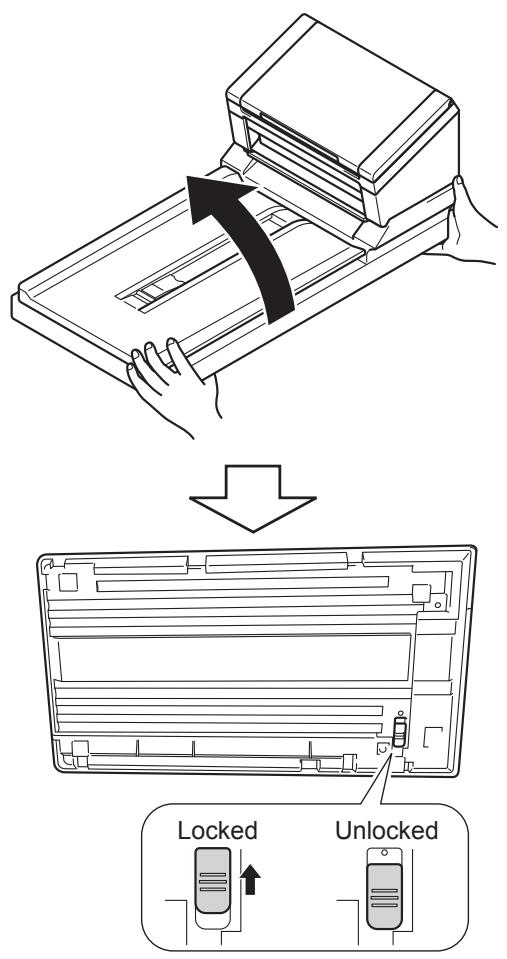
Maintenance
3 Wrap the machine in the bag it originally came in.
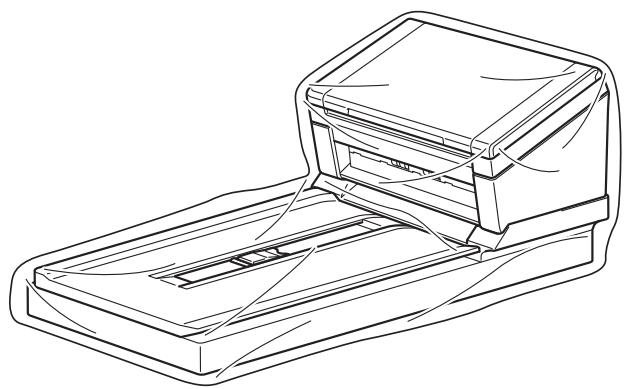
Pack the machine and the printed materials in the original carton with the original packing material as shown below.
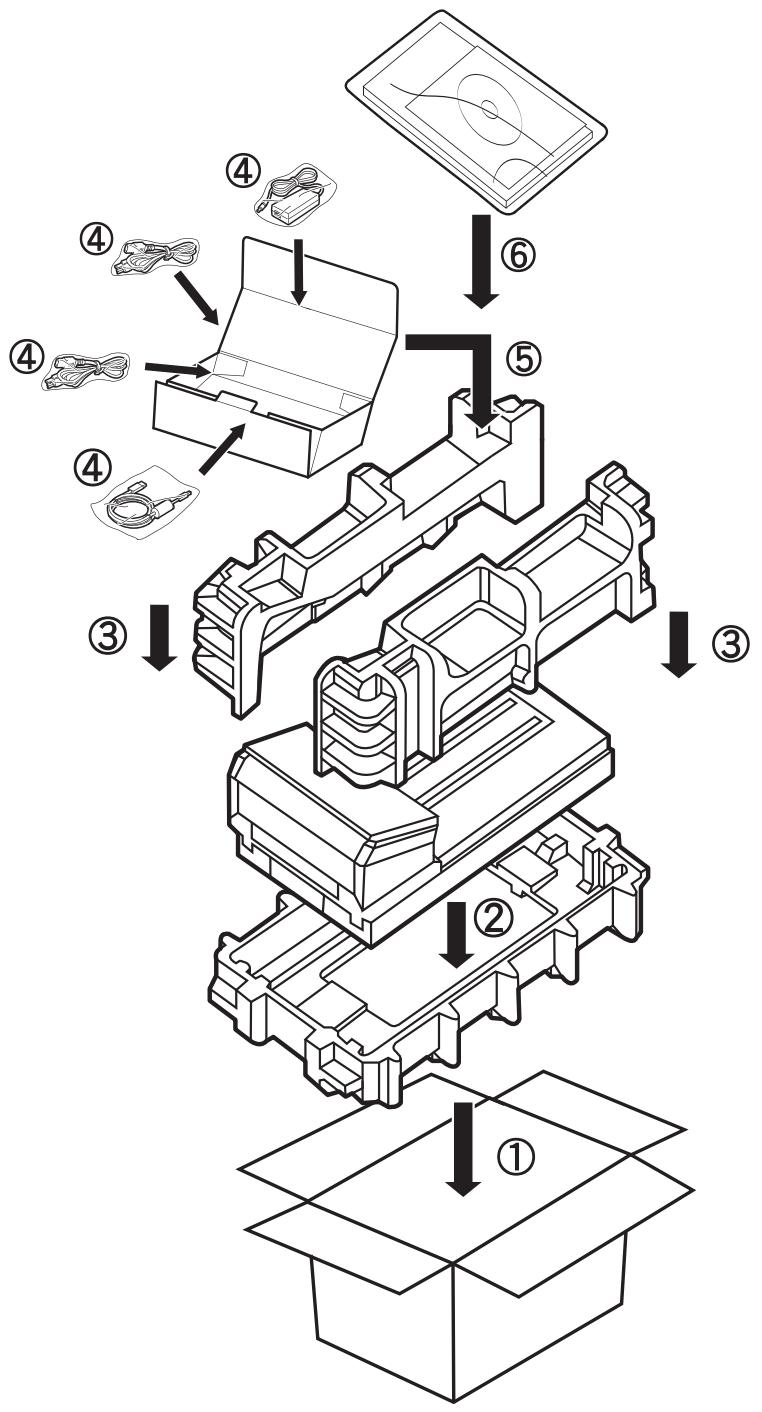
NOTE
USA and Canada only. If you are returning your machine to Brother as part of the Exchange Service, pack only the machine. Keep all separate parts (power cord and USB cable) and printed materials to use with your "Exchange" machine.

Close the carton and tape it shut.
8
Troubleshooting
If you think there is a problem with your Brother machine, check the chart below and follow the suggestions.
You can correct most problems yourself. If you need additional help, visit the Brother Solutions Center at support.brother.com and click FAQs & Troubleshooting.
Using non-Brother supplies may affect scan quality, hardware performance and product reliability.
Error and maintenance messages
Messages displayed on your machine's LCD
| Error message | Cause | Action |
| ADF Cover open | ADF Cover is open. | Close the ADF Cover. |
| Document misfeed | Multiple sheets were fed at the same time. | Align the edges of the pages and place your document correctly, and then try again. |
| Document Jam/too Long | ■ The Document Guides are not set to the correct document size. ■ The settings are not suitable for your document. ■ Paper dust has accumulated on the surface of the Pick-up Roller or Feed Roller. | Clear the document jam (see Document jam on page 116), and then do the following: ■ Adjust the Document Guides to fit the width of the document. When Scan Size is set to Auto and you are scanning a document that contains multiple page sizes, insert narrow pages straight and as close to the center of the machine as possible. If the document is cannot be fed straight, use Continuous Scanning. ■ Confirm the settings. See the IMPORTANT section on page 117. ■ Clean the rollers every 5,000 scans. See Clean the inside of your machine on page 96. |
| Multifeed error | Multiple pages were fed at the same time. | Remove the pages.See Multi-feed on page 118.Reload your documents in the ADF.See Load documents on page 10 |
| Using a Carrier Sheet. | Enable Carrier Sheet Mode, and then try again. See Carrier Sheet Mode on page 43. | |
| Your document is not acceptable for the machine. | Make sure your document is suitable for the machine (see Document Information on page 5). | |
| DRAM R/W test error | A hardware error has occurred. | Contact Brother customer service.For more information, see For customer service on page 131. |
| AFE R/W test error | ||
| NVRAM R/W test error | ||
| ADF front lamp error | ||
| Ultrasonic error | ||
| ADF AFE R/W test error | ||
| USB R/W test error | ||
| FlashROM R/W test error | ||
| AFE LVDS test error | ||
| ADF AFE LVDS test error | ||
| ADF rear lamp error | ||
| Flatbed home position error | ||
| Flatbed lamp error | ||
| Lock error | The transport lock is locked. | Unlock the transport lock and turn off and on the scanner. |
Messages displayed on your computer
| Error message | Cause | Action |
| A document is jammed in the ADF. | A jammed document stops the scanning process. | Open the top cover and remove the document by pulling it backwards, and then close the top cover. |
| Do not open the ADF Cover when scanning. | Your machine's top cover is open when scanning starts. | Close the top cover and start scanning again. |
| No document in ADF. | No document is placed in the ADF. | Place your document in the ADF and start scanning again. |
| Cannot find the scanner. | Your machine is not connected to your computer. | Confirm that the USB cable connecting the machine to the computer is connected correctly. The machine may power off automatically if its automatic power off function is on. Press the Power button to turn the machine ON. |
| Document misfeeds. | The document is not feeding correctly. | Remove the document, align the pages, place it carefully in the ADF, and then start scanning again. |
| Multifeed is detected. | Documents are multifed. | Remove the remaining document from the ADF, place it carefully in the ADF, and then start scanning again. |
| Unknown error. | - | Contact Brother customer service or your local Brother dealer. See For customer service on page 131. |
Document jam
Pages can jam in the ADF if they are not inserted or fed correctly, or if they are too long. Follow the steps below to clear a document jam.
1 Remove any paper that is not jammed from the ADF.
2 Open the ADF Cover pulling the Cover Release Lever (1) towards you.
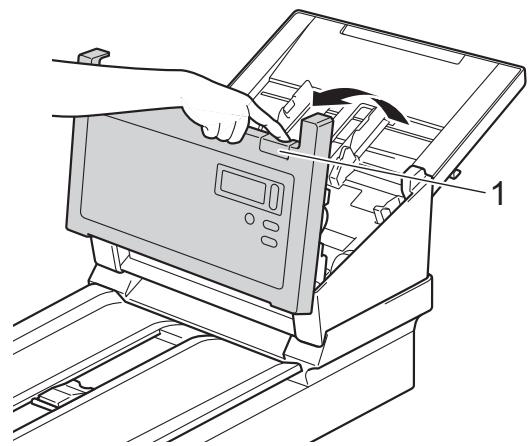
Pull the jammed document out of the machine.
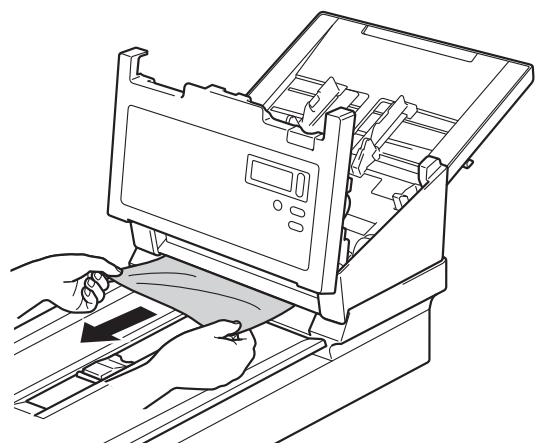
NOTE
Check for ripped paper inside the machine. Remove any ripped paper you find.
4 Close the ADF Cover.
5 Confirm that the pages scanned before the jam occurred are saved in the designated folder, and then start scanning again at the next page (or at the beginning of the document, if necessary).
IMPORTANT
- To avoid damage to the jammed document, DO NOT pull the document out before opening the ADF Cover.
- Remove any paper from the ADF before closing the ADF Cover.
-
To avoid future document jams, do the following:
-
Close the ADF Cover completely by pushing it gently in the middle.
- Configure the settings for your document correctly.
- Clean the rollers every 5,000 scans. See Clean the inside of your machine on page 96
- Stagger the pages, and then load your document.
- Make sure your document is acceptable for the machine. See Acceptable documents on page 5.
- Load the card vertically when scanning cards.
- Select Long Page from the Scan Area / Page Size or Page Size drop-down list, under the Paper tab when scanning a long document.
Multi-feed
A multifeed error means that multiple pages were fed at the same time. To clear the multifeed:
1 Remove any paper from the ADF.
2 Open the ADF Cover pulling the Cover Release Lever (1) towards you.
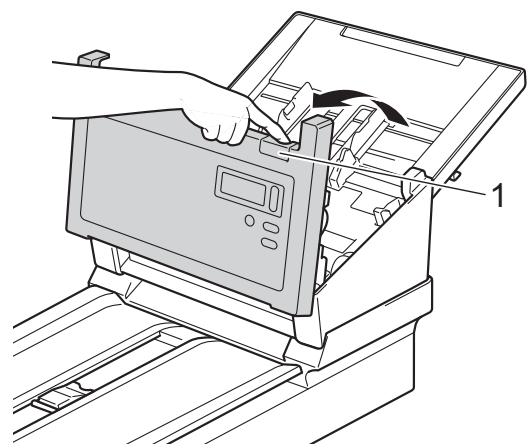
Pull the multifed pages out of the machine.
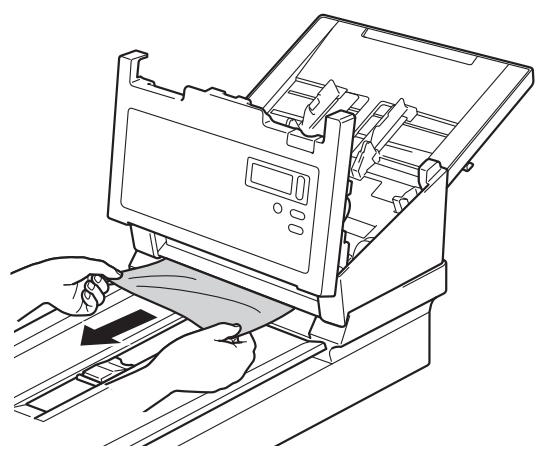
4 Close the ADF Cover.
Confirm that the pages scanned before the multifeed error occurred are saved in the designated folder, and then start scanning again at the next page (or at the beginning of the document, if necessary).
IMPORTANT
- Remove any paper from the ADF before closing the ADF Cover.
-
To avoid future multi-feeds, do the following:
-
Disable the multifeed detection when scanning business cards.
- Select the Carrier Sheet Mode check box in the Paper tab when scanning using the Carrier Sheet.
Troubleshooting
Scanning difficulties
| Difficulty | Cause | Suggestions |
| TWAIN or WIA errors appear when starting to scan. (Windows®) | The TWAIN or WIA driver has not been selected as the primary source in your scanning application. | Make sure the Brother TWAIN or WIA driver is selected as the primary source in your scanning application. For example, in OmniPage SE 18, click Scan Settings, and then click Select to select the Brother TWAIN/WIA driver. |
| TWAIN errors appear when starting to scan. (Macintosh) | TWAIN driver has not been selected as the primary source in your scanning application. | Make sure the Brother TWAIN driver is selected as the primary source. In PageManager 9, click File, Select Source, and then select the Brother TWAIN driver. OS X v10.8.x, 10.9.x, 10.10.x or later users can also scan documents using the ICA Scanner Driver. |
| My scanned images have black lines running through them, blank spaces, or are of overall bad quality. | This problem occurs if a foreign object, such as a paper clip or ripped paper, is stuck in the machine. | Check the ADF slot and make sure that the slot is clear. If you find foreign objects, remove them from your machine. |
| My scanned image is missing. | The Document Guides are not adjusted to fit the width of the document. | Adjust the Document Guide to fit the width of the document. When Cropping is set to Automatic (Deskew ON) and you are scanning a document that contains multiple page sizes, insert narrow pages straight and as close to the center of the machine as possible. If the document does not stay straight while feeding, use Continuous Scanning. |
| The settings are not suitable for your document. For example, an A4 document is fed when “Letter” was selected as the document size. | Make sure the document size settings are suitable for your document. For Windows®: see Paper tab on page 40. For Macintosh: see Paper tab on page 77. | |
| The scan speed is too slow. | The resolution is not suitable for your document. | Decrease the machine resolution. For Windows®: see Image tab on page 31. For Macintosh: see Image tab on page 67. |
| Unusual noise occurs when the power is ON. | Check the transport lock is unlocked. | |
| My machine is connected but it does not feed my document or do anything else. | Your document is placed incorrectly. | Insert your document until you feel the top edge of the document touch the inside of your machine. |
| Your document is too thin or too thick. | Check that your document is acceptable (see Document Information on page 5).If your document is acceptable:1. Confirm that the USB cable connecting your machine to your computer is connected correctly.2. Reinstall the scanner driver from the Brother installation DVD. | |
| Paper dust has accumulated on the surface of the rollers. | Clean the rollers every 5,000 scans.See Clean the inside of your machine on page 96. | |
| Too many documents are loaded in the ADF at a time. | Make sure your document is acceptable for the machine. See Document Information on page 5. | |
| There are foreign objects in the ADF. | Remove any foreign objects or ripped paper from the ADF. | |
| A multifeed occurs. | Paper dust has accumulated on the surface of the rollers. | Clean the rollers every 5,000 scans.See Clean the inside of your machine on page 96. |
| Too many documents are loaded in the ADF at a time. | Load no more than 100 pages at a time.See Document Information on page 5. | |
| The document is sticky or has a sticky note on it, which caused a multi-feed. | Use the Carrier Sheet to scan the multifed document. | |
| The document is jammed. | Causes may vary. | Open the machine's top cover and gently pull out the document. Make sure no paper remains in the machine. |
| Your document is not acceptable for the machine (for example, if the paper is too long). | ■ Make sure your document is suitable for the machine (see Document Information on page 5).■ Use the Carrier Sheet (see Loading documents using the Carrier Sheet in the ADF on page 16). | |
| Paper dust has accumulated on the surface of the rollers. | Clean the rollers every 5,000 scans. See Clean the inside of your machine on page 96. | |
| There are foreign objects in the ADF. | Remove any foreign objects or ripped paper from the ADF. | |
| My machine gets warm. | It is normal for your machine to emit a small amount of heat after prolonged use. | If there is a strange smell coming from the machine or the machine feels hot to the touch, immediately remove the power cord and USB cable from your machine. Contact Brother customer service or your local Brother dealer. See For customer service on page 131. |
| The scan quality is poor. | Paper dust has accumulated inside your machine. | Clean your machine (see Maintenance on page 94). |
| The machine resolution is too low. | Increase the machine resolution.For Windows®: see Image tab on page 31.For Macintosh: see Image tab on page 67. | |
| Colors in the scanned image are dark. | The settings are not appropriate for the type of document being scanned. | Adjust the scan settings. For Windows®: see Image tab on page 31. For Macintosh: see Image tab on page 67. |
| A page that is not a blank page was skipped. | The document's contents are too light, or Blank Page Removal is set to On. | Set Blank Page Removal to Off. For Windows®: see Paper tab on page 40. For Macintosh: see Paper tab on page 77. |
| The scanned image is skewed (crooked). | The machine's Document Guides are not adjusted to fit the width of the document. | Adjust the Document Guides to fit the width of the document. When Cropping is set to Automatic (Deskew ON) and you are scanning a document that contains multiple page sizes, insert narrow pages straight and as close to the center of the machine as possible. If the document does not stay straight while feeding, use Continuous Scanning. |
| The Auto Deskew feature was set to Off when the document was scanned. | Set Cropping to Automatic (Deskew ON). For Windows®: see Enhancement tab on page 52. For Macintosh: see Enhancement tab on page 84. | |
| White vertical lines or white stripes appear on the scanned image. | The machine is under direct sunlight. | Move the machine out of direct sunlight. |
| A light source is near the machine. | Move the machine far away from the light source. | |
| Bleed-through is seen in the scanned image. | Your document is too thin. | Check that your document is acceptable (see Document Information on page 5). |
| The contrast setting is incorrect. | Increase the contrast level. For Windows®: see Image tab on page 31. For Macintosh: see Image tab on page 67. | |
| The Background Processing feature is set to Off. | Set Background Processing to On (see Background setting on Enhancement tab on page 52). |
Software difficulties
| Difficulty | Cause | Suggestions |
| When I click Scan in my scanning software, an error message appears: Cannot find the scanner or Operation system error. | This error message appears if your machine is not recognized by your computer. | 1. Make sure your machine is connected correctly. 2. Confirm that the USB cable is working and that it is not frayed or damaged in any way. If the error still appears after verifying that the USB cable is connected correctly, reinstall the scanner driver from Brother installation DVD. |
| I cannot install the scanner drivers. (Windows®) | You may not have been given administrator privileges. | Log into Windows® with administrator rights. |
| I cannot install the scanner drivers. (Macintosh) | You may not have been given administrator privileges. | From the Apple menu, select System Preferences > System > Users & Groups. The left pane of the window lists the current accounts, one of which should be your name with the word “Admin” below. If this is not the case, contact your system administrator. |
| The file size is too large. | The physical size of the document and the amount of text / graphics on each page affect the resulting file size and cannot be changed. | To produce the smallest scan file for a given document, use the lowest resolution and Black and White mode, and scan the smallest area possible. Using the opposite settings (scanned in the highest resolution, in the Color mode, and scanning the largest area possible) produces the largest-sized file. For Windows®: see Change scan settings using the TWAIN driver on page 27. For Macintosh: see Change scan settings using the TWAIN driver on page 65. |
Other difficulties
| Difficulty | Cause | Suggestions |
| I want to use a USB hub. | - | Use your machine without connecting to a USB hub. |
| The rollers are worn. | Paper dust has accumulated on the surface of the rollers. | Clean the rollers every 5,000 scans. See Clean the inside of your machine on page 96 |
Specifications
General
| PDS-5000F | PDS-6000F | ||
| Memory Capacity | Standard | 512 MB | |
| Power Source | 100 - 240 V AC 50/60 Hz24 V DC 2 A | ||
| LCD (Liquid Crystal Display) | 16 characters × 2 lines | ||
| Power Consumption1 | Scanning | 53 W | |
| Ready | 17.6 W | ||
| Power Saving | 2.0 W | ||
| Power OFF | 0.3 W | ||
| Dimensions | 318 mm(12.52 in.)613 mm(24.13 in.) | 323 mm(12.72 in.) | |
| 613 mm(24.13 in.) | 332 mm(13.07 in.) | ||
| 613 mm(24.13 in.) | 476 mm(18.74 in.) | ||
| Weight | Approx. 20.3 lbs (9.20 kg) | ||
| Temperature | Operating | 41 to 95 °F (5 to 35 °C) | |
| Humidity | Operating | 20 to 80% | |
| Storage | 10 to 90% | ||
| ADF (Automatic Document Feeder) | Up to 100 pages (Paper: 20 lb (80 g/m2)) | ||
Appendix A
| PDS-5000F | PDS-6000F | |||
| Document Size | Multiple Paper | Width | 2.0 in. to 8.58 in. (51 mm to 218 mm) | |
| Length | 2.13 in. to 14.0 in. (54 mm to 356 mm) | |||
| Single Paper | Width | 2.0 in. to 8.58 in. (51 mm to 218 mm) | ||
| Length | 1-sided scan 2.13 in. to 236.0 in. (54 mm to 5,994 mm)² 2-sided scan 2.13 in. to 14.0 in. (54 mm to 356 mm) | |||
| Flatbed | Width | Maximum: 8.5 in. (216 mm) | ||
| Length | Maximum: 14.0 in. (356 mm) | |||
1 Measured when the machine is connected to your computer.
2 For a 200 dpi scan.
Scanner
| PDS-5000F | PDS-6000F | ||
| Color / Black | Yes / Yes | ||
| Duplex Scan | Yes | ||
| TWAIN Compliant | Windows® | Windows® XP (SP3) / Windows Vista® / Windows® 7, 8, 8.1, 10 | |
| Macintosh | OS X v10.8.x, 10.9.x, 10.10.x or later1 | ||
| WIA Compliant | Windows® | Windows® XP (SP3) / Windows Vista® / Windows® 7, 8, 8.1, 10 | |
| ICA Compliant | Macintosh | OS X v10.8.x, 10.9.x, 10.10.x or later1 | |
| ISISTM Compliant | Windows® | Windows® XP (SP3) / Windows Vista® / Windows® 7, 8, 8.1, 10 | |
| Color Depth | Input | 48 bit color processing | |
| Output | 24 bit color processing | ||
| Resolution | Optical | Up to 600 × 600 dpi | |
| Interpolated | Up to 600 × 600 dpi | ||
| Scanning Width | Up to 216 mm | ||
| Gray Scale | 8 bit | ||
| Scanning Max. Speed2 | Mono | 60 ppm (200 / 300 dpi) | 80 ppm (200 / 300 dpi) |
| 15 ppm (600 dpi) | 20 ppm (600 dpi) | ||
| Color | 60 ppm (200 / 300 dpi) | 80 ppm (200 / 300 dpi) | |
| 15 ppm (600 dpi) | 20 ppm (600 dpi) | ||
| Duplex Scanning Max. Speed2 | Mono | 60 ppm / 120 ipm (200 / 300 dpi) | 80 ppm / 160 ipm (200 / 300 dpi) |
| 15 ppm / 30 ipm (600 dpi) | 20 ppm / 40 ipm (600 dpi) | ||
| Color | 60 ppm / 120 ipm (200 / 300 dpi) | 80 ppm / 160 ipm (200 / 300 dpi) | |
| 15 ppm / 30 ipm (600 dpi) | 20 ppm / 40 ipm (600 dpi) | ||
| Flatbed Scanning Speed | 1.5 s (200/300 dpi, Color/Gray, A4) | 1.5 s (200/300 dpi, Color/Gray, A4) | |
| 5 s (600 dpi, Color/Gray, A4) | 5 s (600 dpi, Color/Gray, A4) | ||
1 For the latest driver updates for the Mac OS X version you are using, visit us at support.brother.com
2 The actual speed may be slower, depending on your computer specifications and scan settings.
Interfaces
| USB | SuperSpeed USB 3.0 1,2 Use a USB 3.0 cable (Type B) that is no more than 1.8 meters long. |
1 Your Brother machine has a Hi-Speed USB 3.0/USB 2.0/USB 1.1/USB 1.0 interface. The machine can also be connected to a computer that has a USB 2.0/USB 1.1/USB 1.0 interface.
2 Third party USB ports are not supported.
Supported languages
| Display Languages | English, French, German, Italian, Spanish, Portuguese, Dutch, Norwegian, Swedish, Danish, Russian, Czech, Hungarian, Polish, Bulgarian, Romanian, Slovakian, Finnish |
The default setting displayed on your Brother machine's LCD is based on the connected computer's OS language. If the OS language is not one of the supported languages as listed in the table above, the LCD displays English.
Computer requirements
| SUPPORTED OPERATING SYSTEMS AND SOFTWARE FUNCTIONS | |||||||
| Computer Platform and Operating System Version | Minimum Processor Speed | Minimum RAM | Recommended RAM | Hard Disk Space to Install | Supported Computer Interface | ||
| For Drivers | For Applications | ||||||
| Windows®Operating System | Windows®XP Home Windows®XP Professional (SP3) | Intel®Core™ 2 Duo or equivalent | 1 GB | 2 GB | 50 MB | 1.5 GB | USB |
| Windows®XP Professional x64 Edition (SP3) | 64-bit (Intel®64 or AMD64) supported CPU | 1 GB | 2 GB | ||||
| Windows Vista® | Intel®Core™ 2 Duo or equivalent 64-bit (Intel®64 or AMD64) supported CPU | 1 GB | 2 GB | ||||
| Windows®7 | Intel®Core™ 2 Duo or equivalent 64-bit (Intel®64 or AMD64) supported CPU | 1 GB (32-bit) | 2 GB (32-bit) | ||||
| 2 GB (64-bit) | 4 GB (64-bit) | ||||||
| Windows®8/8.1 | Intel®Core™ i3 or equivalent 64-bit (Intel®64 or AMD64) supported CPU | 1 GB (32-bit) | 2 GB (32-bit) | ||||
| 2 GB (64-bit) | 4 GB (64-bit) | ||||||
| Windows®10 | Intel®Core™ i3 or equivalent 64-bit (Intel®64 or AMD64) supported CPU | 1 GB (32-bit) | 2 GB (32-bit) | ||||
| 2 GB (64-bit) | 4 GB (64-bit) | ||||||
| Macintosh Operating System | OS X 10.8.x | Intel®Processor | 2 GB | 4 GB | 50 MB | 400 MB | USB |
| OS X 10.9.x | |||||||
| OS X 10.10.x | |||||||
| OS X 10.11.x | |||||||
For the latest driver updates, visit support.brother.com
All trademarks, brand and product names are property of their respective companies.
B Appendix B
Contact Brother
Register your product online at
www.brother.com/registration
By registering your product with Brother, you will be recorded as the original owner of the product. Your registration with Brother:
- may serve as confirmation of the purchase date of your product should you lose your receipt;
- may support an insurance claim by you in the event of product loss covered by insurance; and,
- will help us notify you of enhancements to your product and special offers.
The most convenient and efficient way to register your new product is online at: www.brother.com/registration
Frequently Asked Questions (FAQs)
The Brother Solutions Center is our one-stop resource for all your Brother machine needs. You can download the latest software documents and utilities, read FAQs and troubleshooting tips, and learn how to get the most from your Brother product.
support.brother.com
- Check here for Brother driver updates.
- To keep your machine's performance up to date, check here for the latest firmware upgrade.
For customer service
Visit support.brother.com for technical support and contact information of your local Brother office.
In USA: www.brother-usa.com
1-877-BROTHER (1-877-276-8437)
1-901-379-1215 (fax)
In Canada: www.brother.ca/support
(Self-Service, Videos, Email, Chat, Facebook and Twitter Help)
Service Center Locator (USA only)
For the location of a Brother authorized service center, call 1-877-BROTHER
(1-877-276-8437) or visit www.brother-usa.com/service
Service Center Locations (Canada only)
For the location of a Brother authorized service center, visit www.brother.ca/support
If you have comments or suggestions, please write us at:
In USA: Printer Customer Support
Brother International Corporation
7905 North Brother Boulevard
Bartlett, TN 38133
In Canada: Brother International Corporation (Canada), Ltd.
- Marketing Dept.
Countries: Visit www.brother.com for contact information for your local Brother office.
For Brother accessories & supplies
In USA: www.brothermall.com
1-877-552-MALL (1-877-552-6255)
1-800-947-1445 (assistance via fax)
In Canada: www.brother.ca
In UK: www.brother.co.uk
Other
Countries: Visit www.brother.com for contact information for your local Brother office.
Technical support (for PageManager)
For USA
Company name: NewSoft America Inc.
Postal Address: 47102 Mission Falls Court, Suite 202 Fremont CA 94539
Telephone: 510-770-8900
Fax: 510-770-8980
E-mail Address: contactus@newsoftinc.com
URL: www.newsoftinc.com
For Canada
E-mail Address: contactus@newsoftinc.com
Other countries
E-mail Address: tech@newsoft.eu.com
NOTE
For all other issues, see For customer service on page 131.