
EOZ5700AOX - Built-in oven ELECTROLUX - Free user manual and instructions
Find the device manual for free EOZ5700AOX ELECTROLUX in PDF.


| Product type | Built-in oven |
| Brand | ELECTROLUX |
| Model | EOZ5700AOX |
| Dimensions (W x H x D) | 594 x 589 x 548 mm |
| Built-in dimensions (W x H x D) | 560 x 590 x 550 mm |
| Approximate weight | 35 kg |
| Power supply | 230 V / 50 Hz, max power 3680 W |
| Connection type | Power cable, section suitable for power |
| Cooking functions | Hot air, Bottom heat, Natural convection, Low-temperature cooking, Bottom heat, Moist hot air, Defrost, Keep warm, Eco Turbo grill, Grill, Strong grill, Turbo grill |
| Automatic programs | 9 programs (roast beef, pork, poultry, pizza, madeleines, quiche, bread, gratin, lasagna) |
| Cleaning | Pyrolysis (3 levels: 1h, 1h30, 2h30) |
| Child safety | Yes (key lock and door lock) |
| Automatic shutdown | Yes (depending on temperature: 3 to 12.5 h) |
| Interior lighting | Halogen bulb 300°C |
| Accessories supplied | Wire rack, roasting/grill pan |
| Number of shelf levels | 5 |
| Display | Electronic programmer with LCD screen |
| Timer | Yes (max 2h30) |
| Delayed start | Yes (via Duration and End functions) |
| Cooling fan | Yes (automatic) |
| Energy class | Not specified |
Frequently Asked Questions - EOZ5700AOX ELECTROLUX
User questions about EOZ5700AOX ELECTROLUX
0 question about this device. Answer the ones you know or ask your own.
Ask a new question about this device
Download the instructions for your Built-in oven in PDF format for free! Find your manual EOZ5700AOX - ELECTROLUX and take your electronic device back in hand. On this page are published all the documents necessary for the use of your device. EOZ5700AOX by ELECTROLUX.
USER MANUAL EOZ5700AOX ELECTROLUX
CONTENTS
- SAFETY INFORMATION 3
- SAFETY INSTRUCTIONS 4
- PRODUCT DESCRIPTION 7
- BEFORE FIRST USE 7
- CONTROL PANEL 8
- DAILY USE 9
- CLOCK FUNCTIONS 12
- AUTOMATIC PROGRAMMES 13
- ADDITIONAL FUNCTIONS 14
- HELPFUL HINTS AND TIPS 16
- CARE AND CLEANING 24
- WHAT TO DO IF.... 27
- INSTALLATION 28
WE'RE THINKING OF YOU
Thank you for purchasing an Electrolux appliance. You've chosen a product that brings with it decades of professional experience and innovation. Ingenious and stylish, it has been designed with you in mind. So whenever you use it, you can be safe in the knowledge that you'll get great results every time.
Welcome to Electrolux.
Visit our website for:

Get usage advice, brochures, trouble shooter, service information: www.electrolux.com

Register your product for better service: www.electrolux.com/productregistration

Buy Accessories, Consumables and Original spare parts for your appliance: www.electrolux.com/shop
CUSTOMER CARE AND SERVICE
We recommend the use of original spare parts.
When contacting Service, ensure that you have the following data available. The information can be found on the rating plate. Model, PNC, Serial Number.

Warning / Caution-Safety information
General information and tips
Environmental information
Subject to change without notice.
1. SAFETY INFORMATION
Before the installation and use of the appliance, carefully read the supplied instructions. The manufacturer is not responsible if an incorrect installation and use causes injuries and damages. Always keep the instructions with the appliance for future reference.
1.1 Children and vulnerable people safety

WARNING!
Risk of suffocation, injury or permanent disability.
- This appliance can be used by children aged from 8 years and above and persons with reduced physical, sensory or mental capabilities or lack of experience and knowledge if they are supervised by an adult or a person who is responsible for their safety.
- Do not let children play with the appliance.
- Keep all packaging away from children.
- Keep children and pets away from the appliance when it operates or when it cools down. Accessible parts are hot.
- If the appliance has a child safety device, we recommend that you activate it.
- Cleaning and user maintenance shall not be made by children without supervision.
1.2 General Safety
- Only a qualified person must install this appliance and replace the cable.
- Internally the appliance becomes hot when in operation. Do not touch the heating elements that are in the appliance. Always use oven gloves to remove or put in accessories or ovenware.
- Do not use a steam cleaner to clean the appliance.
- Before maintenance cut the power supply.
- Do not use harsh abrasive cleaners or sharp metal scrapers to clean the glass door since they can scratch the surface, which may result in shattering of the glass.
- Excess spillage must be removed before the pyrolytic cleaning. Remove all parts from the oven.
- If the supply cord is damaged, it must be replaced by the manufacturer, an authorized Service or similarly qualified persons in order to avoid a hazard.
- Ensure that the appliance is switched off before replacing the lamp to avoid the possibility of electric shock.
2. ⚠️ SAFETY INSTRUCTIONS
2.1 Installation

WARNING!
Only a qualified person must install this appliance.
- Remove all the packaging.
- Do not install or use a damaged appliance.
- Obey the installation instruction supplied with the appliance.
- Always be careful when you move the appliance because it is heavy. Always wear safety gloves.
- Do not pull the appliance by the handle.
- Keep the minimum distance from the other appliances and units.
- Make sure that the appliance is installed below and adjacent to safe structures.
- The sides of the appliance must stay adjacent to appliances or to units with the same height.
Electrical connection

WARNING!
Risk of fire and electrical shock.
- All electrical connections should be made by a qualified electrician.
- The appliance must be earthed.
- Make sure that the electrical information on the rating plate agrees with the power supply. If not, contact an electrician.
- Always use a correctly installed shock-proof socket.
- Do not use multi-plug adapters and extension cables.
- Make sure not to cause damage to the mains plug and to the mains cable. Contact the Service or an electrician to change a damaged mains cable.
- Do not let mains cables come in touch with the appliance door, especially when the door is hot.
- The shock protection of live and insulated parts must be fastened in such a way that it cannot be removed without tools.
- Connect the mains plug to the mains socket only at the end of the installation. Make sure that there is access to the mains plug after the installation.
- If the mains socket is loose, do not connect the mains plug.
- Do not pull the mains cable to disconnect the appliance. Always pull the mains plug.
- Use only correct isolation devices: line protecting cut-outs, fuses (screw type fuses removed from the holder), earth leakage trips and contactors.
- The electrical installation must have an isolation device which lets you disconnect the appliance from the mains at all poles. The isolation device must have a contact opening width of minimum 3 mm.
The electrical installation must have an isolation device which lets you disconnect the appliance from the mains at all poles. The isolation device must have a contact opening width of minimum 3 mm.
Fully close the appliance door, before you connect the mains plug to the mains socket.
2.2 Use

WARNING!
Risk of injury, burns or electric shock or explosion.
- Use this appliance in a household environment.
- Do not change the specification of this appliance.
- Make sure that the ventilation openings are not blocked.
- Do not let the appliance stay unattended during operation.
- Deactivate the appliance after each use.
- Be careful when you open the appliance door while the appliance is in operation. Hot air can release.
- Do not operate the appliance with wet hands or when it has contact with water.
- Do not apply pressure on the open door.
- Do not use the appliance as a work surface or as a storage surface.
- Always keep the appliance door closed when the appliance is in operation.
- Open the appliance door carefully. The use of ingredients with alcohol can cause a mixture of alcohol and air.
- Do not let sparks or open flames to come in contact with the appliance when you open the door.
- Do not put flammable products or items that are wet with flammable products in, near or on the appliance.

WARNING!
Risk of damage to the appliance.
- To prevent damage or discoloration to the enamel:
– do not put ovenware or other objects in the appliance directly on the bottom.
– do not put aluminium foil directly on the bottom of the appliance. – do not put water directly into the hot appliance. – do not keep moist dishes and food in the appliance after you finish the cooking. – be careful when you remove or install the accessories.
- Discoloration of the enamel has no effect on the performance of the appliance. It is not a defect in the sense of the warranty law.
- Use a deep pan for moist cakes. Fruit juices cause stains that can be permanent.
2.3 Care and Cleaning

WARNING!
Risk of injury, fire or damage to the appliance.
- Before maintenance, deactivate the appliance and disconnect the mains plug from the mains socket.
- Make sure the appliance is cold. There is the risk that the glass panels can break.
- Replace immediately the door glass panels when they are damaged. Contact the Service.
- Be careful when you remove the door from the appliance. The door is heavy!
- Clean regularly the appliance to prevent the deterioration of the surface material.
- Remaining fat or food in the appliance can cause fire.
- Clean the appliance with a moist soft cloth. Only use neutral detergents. Do not use abrasive products, abrasive cleaning pads, solvents or metal objects.
- If you use an oven spray, obey the safety instructions on the packaging.
- Do not clean the catalytic enamel (if applicable) with any kind of detergent.
Pyrolytic cleaning

WARNING!
Risk of fire and burns.
- Before carrying out a Pyrolytic self-cleaning function or the First Use function, please remove from the oven cavity:
- Any excess food residues, oil or grease spills / deposits.
- Any removable objects (including shelves, side rails etc., provided with the product) particularly any non-stick pots, pans, trays, utensils etc.
- Read carefully all the instructions for Pyrolytic cleaning.
- Keep children away from the appliance while the Pyrolytic cleaning is in operation. The appliance becomes very hot.
- Pyrolytic cleaning is a high temperature operation that can release fumes from cooking residues and construction materials, as such consumers are strongly advised to:
- Provide good ventilation during and after each Pyrolytic cleaning.
- Provide good ventilation during and after the first use at maximum temperature operation.
- Remove any pets (especially birds) from the vicinity of the appliance location during and after the Pyrolytic cleaning and first use maximum temperature operation to a well ventilated area.
- Unlike all humans, some birds and reptiles can be extremely sensitive to potential fumes emitted during the cleaning process of all Pyrolytic Ovens.
- Small pets can also be highly sensitive to the localized temperature changes in the vicinity of all Pyrolytic Ovens when the Pyrolytic self cleaning program is in operation.
- Non-stick surfaces on pots, pans, trays, utensils etc., can be damaged by the high temperature Pyrolytic cleaning operation of all Pyrolytic Ovens and can be also a source for low level harmful fumes.
- Fumes released from all Pyrolytic Ovens / Cooking Residues as described are not harmful to humans, including infants or persons with medical conditions.
2.4 Internal light
The type of light bulb or halogen lamp used for this appliance is only for household appliances. Do not use it for house lighting.

WARNING!
Risk of electrical shock.
- Before replacing the lamp, disconnect the appliance from the power supply.
- Only use lamps with the same specifications.
2.5 Disposal

WARNING!
Risk of injury or suffocation.
- Disconnect the appliance from the mains supply.
- Cut off the mains cable and discard it.
- Remove the door catch to prevent children and pets from getting closed in the appliance.
3. PRODUCT DESCRIPTION
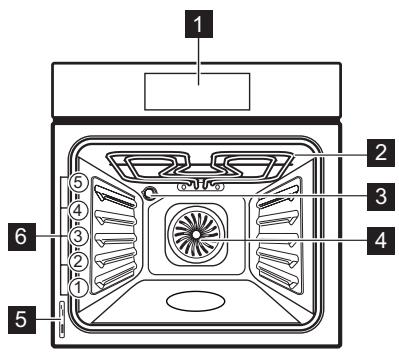
1 Electronic programmer
2 Grill 3 Oven lamp 4 Fan 5 Rating plate 6 Shelf positions
3.1 Oven accessories
- Wire shelf
For cookware, cake tins, roasts.
- Grill- / Roasting pan
To bake and roast or as pan to collect fat.
4. BEFORE FIRST USE

WARNING!
Refer to the Safety chapters.
4.1 Initial cleaning
- Remove all accessories and removable shelf supports (if applicable).
- Clean the appliance before first use.

Refer to the chapter "Care and cleaning".
4.2 Setting and changing the time
After the first connection to the mains, all symbols in the display are on for some seconds. For the subsequent few seconds the display shows the software version.
After the software version goes off, the display shows h and 12:00 flashes.
Setting the time of day:
- Touch ∧ or ∨ to set the hours.
- Touch OK.
- Touch ∧ or ∨ to set the minutes.
- Touch OK or ⏻.
The Temperature / Time display shows the new time.
Changing the time of day
You can change the time of day only when the appliance is off. Touch ⏻. ⏻ flashes in the display. To set the new time of day, use the above procedure.
4.3 Preheating
Preheat the empty appliance to burn off the remaining grease.
- Set the function □ and the maximum temperature.
- Let the appliance operate for 45 minutes.
- Set the function 📋 and the maximum temperature.
- Let the appliance operate for 15 minutes.
Accessories can become hotter than usual. The appliance can emit an odour and smoke. This is normal. Make sure that the airflow is sufficient.
5. CONTROL PANEL
5.1 Electronic programmer
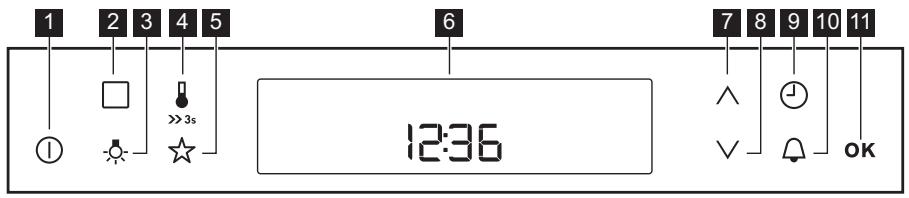
Use the sensor fields to operate the appliance.
| Sensor Field | Function | Description | |
| 1 |  | ON / OFF | To activate and deactivate the appliance. |
| 2 |  | OPTIONS | To set an oven function, an automatic programme or a cleaning function. |
| 3 |  | OVEN LIGHT | To activate or deactivate the oven lamp. |
| 4 |  | TEMPERATURE / FAST HEAT UP | To set and examine the cavity temperature or the core temperature sensor temperature (if present). If you press it and hold for three seconds, it turns the Fast heat up function ON or OFF. |
| 5 |  | MY FAVOURITE PROGRAMME | To store your favourite programme. Use it to access your favourite programme directly, also when the appliance is off. |
| 6 | - | DISPLAY | Shows the current settings of the appliance. |
| 7 |  | UP | To move up in the menu. |
| 8 |  | DOWN | To move down in the menu. |
| 9 |  | CLOCK | To set the clock functions. |
| 10 |  | MINUTE MINDER | To set the Minute Minder. |
| 11 |  | OK | To confirm the selection or setting. To move down in the menu. |
5.2 Display
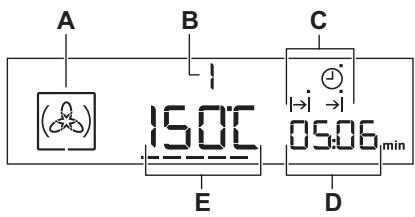
A) Oven function symbol B) Number of the oven function / programme C) Indicators for the clock functions (refer to the table "Clock functions") D) Clock / residual heat display (also Minute Minder and Time of Day) E) Temperature / time display
5.3 Other indicators in the display
| Symbols | Name | Description |
| Automatic pro-gramme | You can choose an automatic programme. | |
| My favourite pro-gramme | The favourite programme operates. | |
| kg / g | kg / g | An automatic programme with weight input operates. |
| h / min | h / min | A clock function operates. |
| --- | Heat-up / residual heat indicator | Shows the temperature level in the appli-ance. |
| Temperature / fast heat up | The function operates. | |
| Temperature | You can examine or change the tempera-ture. | |
| Door lock | The door lock function operates. | |
| Minute minder | The minute minder function operates. |
5.4 Heat up indicator
If you activate an oven function, the bars ____ come on in the display. The bars
show that the temperature in the appliance increases or decreases. When the appliance is at the set temperature, the bars go off the display.
6. DAILY USE

WARNING!
Refer to the Safety chapters.
To operate the appliance you can use:
- The manual mode - to set a heating function, the temperature and the cooking time manually.
- automatic programmes - to prepare a dish when you do not have knowledge or experience in cooking.
| Oven function | Application | ||
| 1 |  | True Fan Cooking | To bake maximum on 3 shelf positions at the same time. When you use this function, decrease the oven temperature by 20 - 40 °C from the standard temperatures you use for Conventional Cooking. Also to dry food. |
| 2 |  | Pizza Setting | To bake food on one oven level for a more intensive browning and a crispy bottom. When you use this function, decrease the oven temperature by 20 - 40 °C from the standard temperatures you use for Conventional Cooking. |
| 3 |  | Conventional Cooking | To bake and roast food on one shelf position. |
| 4 |  LTC LTC | Slow Cook | To prepare very lean and tender roasted food. |
| 5 |  | Bottom Heat | To bake cakes with crispy bottoms and to preserve food. |
| 6 |  | Moist Fan Baking | To save energy when you bake and cook dry baked goods. Also to bake baked goods in tins on one shelf position. |
| 7 |  | Defrost | To defrost frozen food. |
| 8 | [2BYW] | Keep Warm | To keep cooked food warm. |
| 9 |  | ECO Roasting | The ECO functions let you optimize the energy consumption during cooking. It is necessary to set the cooking time first. To get more information about the recommended settings, refer to the cooking tables with the equivalent oven function. |
| 10 |  | Grilling | To grill flat food in the middle of the grill. To toast bread. |
| 11 |  | Fast Grilling | To grill flat food in large quantities. To toast bread. |
| 12 |  | Turbo Grilling | To roast larger meat joints or poultry with bones on one shelf position. Also to brown food, for example gratin. |
6.1 Setting the oven function
- Activate the appliance with Ⓐ. The display shows the set temperature,
the symbol and the number of the oven function.
- Touch ∧ or ∨ to set an oven function.
- Touch OK or the appliance starts automatically after five seconds.

If you activate the appliance and do not set an oven function or programme, the appliance deactivates automatically after 20 seconds.
6.2 Changing the temperature
Touch / to change the temperature in steps of 5°C .
When the appliance is at the set temperature, an acoustic signal sounds and the Heat up indicator goes out.
6.3 Checking the temperature
You can see the temperature in the appliance when the function or programme operates.
- Touch »s. The Temperature / Time display shows the temperature in the appliance. If you want to change the oven temperature, touch »s one more time and use ∨ or ∧.
- Touch OK to go back to the set temperature or the display shows it automatically after five seconds.
6.4 Fast heat up function
The Fast heat up function decreases the heat up time.
Activating the Fast heat up function:
Touch and hold 3s for more than three seconds.
If you activate the Fast heat up function, horizontal bars on the display flash to show that the function operates.
Additional information:
- Do not put food in the oven when the Fast heat up function operates.
- The Fast heat up is not available with every oven function. An acoustic signal sounds if the Fast heat up is not available for the set function if Faulty tone is activated in the “Settings menu”.
6.5 Energy saving

The appliance contains features which help you save energy during everyday cooking:
- Residual heat:
- When the heating function or programme operates, the heating elements are deactivated 10% earlier (the lamp and fan continue to operate). For this feature to operate, the cooking time must be longer than 30 minutes or you must use the clock functions (Duration, End, Time delay). This feature does not operate with grill functions. - When the appliance is off, you can use the heat to keep the food warm. The clock / residual heat display shows the remaining temperature, and the bars show the temperature as it decreases.
- Cooking with the lamp off - Touch - to deactivate the lamp during cooking.
- When you use the Moist Fan Baking function, the lamp deactivates after 30 seconds. The lamp activates again when you touch 🙏️.
When you use the Eco functions the lamp deactivates. The lamp activates again when you touch 🔍.
- Deactivating the display - If necessary, you can fully deactivate the display when the oven is off. Touch ⏻ and ∧ at the same time until the display goes out. This step also activates the display.
- Eco functions - refer to "Oven functions".
7. CLOCK FUNCTIONS
| SYMBOL | FUNCTION | DESCRIPTION |
 | TIME OF DAY | To examine the time of day. For changing the time of day refer to 'Setting and changing the time'. |
 | DURATION | To set how long the appliance operates. |
 | END | To set when the appliance deactivates. You can use the Duration and End functions at the same time (Time delay), if the appliance is to be activated and deactivated automatically later. |
7.1 Count Up Timer
Use the Count Up Timer to monitor how long the appliance operates. It is on immediately when the appliance starts to heat.
Reset the Count Up Timer: touch ∧ and ∨ at the same time until the display shows "00:00" and the Count Up Timer starts to count up again.

You cannot use the Count Up Timer when Duration or End is set.
7.2 Setting the DURATION
- Activate the appliance and set an oven function and temperature.
- Touch ⏻ again and again until the display shows | . | flashes in the display.
- Use ∧ or ∨ to set the minutes for DURATION.
- Touch OK to confirm.
- Use or to set the hours for DURATION.

If you touch ⏻ while you set the DURATION, the appliance switches to the setting of the END function.
- When the set time ends, an acoustic signal sounds for two minutes.
and time setting flash in the display. The appliance deactivates.
Touch a sensor field to stop the acoustic signal.
- Deactivate the appliance.
7.3 Setting the END
- Activate the appliance and set an oven function and temperature.
- Touch ⏻ again and again until the display shows →| . →| flashes in the display.
- Use ∧ or ∨ to set the END and OK to confirm (first you set the minutes, confirm with OK and then set the hours).
- When the set time ends, an acoustic signal sounds for two minutes. →|symbol and the time setting flash in the display. The appliance deactivates.
- Touch a sensor field to stop the acoustic signal.
- Deactivate the appliance.
7.4 Check result (selected models only)
If you set the END or DURATION function, two minutes before the end of cooking an acoustic signal sounds and the lamp activates. The appliance goes to the setting of the END or DURATION function. During these two minutes you can examine the results of the cooking, and, if necessary, add the END or DURATION time.
7.5 Setting the MINUTE MINDER
Use the MINUTE MINDER to set a count-down (maximum 2 h 30 min). This function has no effect on the operation of the oven. You can set the MINUTE MINDER
at any time and also when the appliance is off.
- Touch 🔊 . 🔊 and "00" flash in the display.
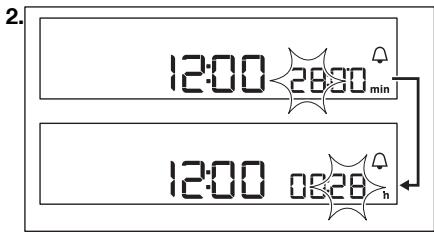
- Use ∧ or ∨ to set the MINUTE MINDER. First you set the seconds, then the minutes and the hours.
- Touch OK or the MINUTE MINDER starts automatically after five seconds.
- When the set time ends, an acoustic signal sounds for two minutes and 00:00 and ⏻ flash in the display.
- Touch a sensor field to stop the acoustic signal.
7.6 Setting the Time delay function
The DURATION ↦ I and END → I functions can be used at the same time, if the oven is to be activated and deactivated automatically later. In this case, first set the DURATION ↦ I and then the END → I function (refer to "Setting the DURATION" and "Setting the END").
When the Time delay function is activated, the display shows a static symbol of the oven function, ↦ I with a dot and → I . The dot shows which clock function is on in the Clock / residual heat display.
8. AUTOMATIC PROGRAMMES

WARNING!
Refer to the Safety chapters.

There are 9 automatic programmes and recipes. Use an automatic programme or recipe when you do not have the knowledge or experience on how to prepare a dish.
There are two types of automatic programmes:
- Automatic recipes • Automatic programmes with weight input
8.1 Automatic programmes
| Programme number | Programme name |
| 1 | ROAST BEEF |
| 2 | ROAST PORK |
| 3 | CHICKEN, WHOLE |
| 4 | PIZZA |
| 5 | MUFFINS |
| 6 | QUICHE LORRAINE |
| 7 | WHITE BREAD |
| 8 | POTATO GRATIN |
| 9 | LASAGNE |
8.2 Automatic recipes
Setting an automatic recipe:
- Activate the appliance.
- Touch □. The display shows the number of the automatic programme (P1 – P9).
- Touch ∧ or ∨ to choose the automatic recipe.
- Touch OK or the automatic recipe activates automatically after five seconds.
- When the set time ends, an acoustic signal sounds for two minutes. The symbol I flashes. The appliance deactivates.
- Touch a sensor field to stop the acoustic signal.
8.3 Automatic programmes with weight input
If you set the weight of the meat, the appliance calculates the roasting time.
- Activate the appliance.
- Touch □.
- Touch ∧ or ∨ to set the weight programme. The display shows: the cooking time, the duration symbol ↦ l, a default weight, a unit of measurement (kg, g).
- Touch OK or the settings save automatically after five seconds.
- The appliance activates.
- You can change the default weight value with ∧ or ∨. Touch OK.
- When the set time ends, an acoustic signal sounds for two minutes. → flashes. The appliance deactivates.
- Touch a sensor field to stop the acoustic signal.
9. ADDITIONAL FUNCTIONS
9.1 My Favourite Programme function
Use this function to save your favourite temperature and time settings for an oven function or programme.
- Set the temperature and time for an oven function or programme.
- Touch and hold ☆ for more than three seconds. An acoustic signal sounds.
- Deactivate the appliance.
Using My Favourite Programme function:
• To activate the function, touch ☆. The appliance activates your favourite programme. - To deactivate the function, touch ①. The appliance deactivates your favourite programme.

When the function operates, you can change the time and temperature.
9.2 Child Lock
The Child Lock prevents an accidental operation of the appliance.
Activating and deactivating the Child Lock function:
- Deactivate the appliance with Ⓐ. Do not set an oven function.
- Touch and hold ⏻ and ∨ at the same time for 2 seconds. An acoustic signal sounds. SAFE comes on or goes out in the display.

If the appliance has the Pyrolytic cleaning function, the door is locked. 🔒 and SAFE come on in the display when you touch a sensor field.
- Touch and hold ⏻ and ∨ at the same time for 2 seconds to deactivate the Child Lock.
9.3 Function Lock
You can activate the function only when the appliance operates. The Function Lock prevents an accidental change of the oven function.
Activating / deactivating the Function Lock function:
- Activate the appliance.
- Activate an oven function or setting.
- Touch and hold ⏻ and ∨ at the same time for 2 seconds. An acoustic signal sounds. Loc comes on or goes out in the display. Useful information: You can deactivate the appliance when the Function Lock is on. When
you deactivate the appliance, the Function Lock deactivates.
If the appliance has the Pyrolytic cleaning function, the door is locked and ☐ comes on in the display.
- Touch and hold ⏻ and ∨ at the same time for 2 seconds to deactivate the Function Lock
9.4 Settings menu
The settings menu lets you add or remove functions from the main menu (for example: you can activate or deactivate the Residual heat indicator). The settings menu has a maximum of six settings (from SET1 to SET6). Refer to the table below to see the possible value of each setting.
Settings menu
| Indicator of the setting menu | Description | Value to set |
| SET1 | RESIDUAL HEAT INDICATOR | ON / OFF |
| SET2 | CLEANING REMINDER | ON / OFF |
| SET31) | KEY TONE | CLICK / BEEP / OFF |
| SET4 | FAULTY TONE | ON / OFF |
| SET5 | SERVICE | --- |
| SET6 | RESTORE SETTINGS | YES / NO |
1) It is not possible to deactivate the tone of the ON / OFF sensor field.

You can set the settings menu only when the appliance is deactivated.
- Touch / to change the value of the setting.
- Touch OK.
Activate the Settings menu:
- Deactivate the appliance with Ⓐ.
- Touch and hold □ for three seconds. The display shows "SET1" and "1" flashes.
- Touch / to select the setting.
- Touch OK.
9.5 Automatic switch-off
For safety reasons the appliance deactivates automatically after some time:
- if an oven function operates.
- if you do not change the oven temperature.
| Temperature | Switch-off time |
| 30 °C - 115 °C | 12.5 h |
| 120 °C - 195 °C | 8.5 h |
| 200 °C - 245 °C | 5.5 h |
| 250 °C - maximum °C | 3.0 h |
After the Automatic switch-off, touch a sensor field to operate the appliance again.

The Automatic switch-off works with all oven functions, apart from Light, Slow Cook, Duration, End, Time delay.
9.6 Brightness of the display
There are two modes of display brightness:
- Night brightness - when the appliance is deactivated, the brightness of the display is lower between 10 PM and 6 AM.
- Day brightness:
- When the appliance is activated.
- If you touch a sensor field during the night brightness (apart from ON / OFF), the display goes back to the day brightness mode for the next 10 seconds.
- If the appliance is deactivated and you set the Minute Minder. When the Minute Minder function ends, the display goes back to the night brightness.
9.7 Cooling fan
When the appliance operates, the cooling fan activates automatically to keep the surfaces of the appliance cool. If you deactivate the appliance, the cooling fan continues to operate until the temperature in the appliance cools down.
9.8 Safety thermostat
Incorrect operation of the appliance or defective components can cause dangerous overheating. To prevent this, the oven has a safety thermostat which interrupts the power supply. The oven activates again automatically when the temperature drops.
10. HELPFUL HINTS AND TIPS
- The appliance has five shelf levels. Count the shelf levels from the bottom of the appliance floor.
- The appliance has a special system which circulates the air and constantly recycles the steam. With this system you can cook in a steamy environment and keep the food soft inside and crusty outside. It decreases the cooking time and energy consumption to a minimum.
- Moisture can condense in the appliance or on the door glass panels. This is normal. Always stand back from the appliance when you open the appliance door while cooking. To decrease the condensation, operate the appliance for 10 minutes before cooking.
- Clean the moisture after each use of the appliance.
- Do not put the objects directly on the appliance floor and do not put aluminium foil on the components when you
cook. This can change the baking results and cause damage to the enamel.
10.1 Baking cakes
- Do not open the oven door before 3/4 of the set cooking time is up.
- If you use two baking trays at the same time, keep one empty level between them.
- The Conventional Cooking function at the default temperature is ideal for bread baking.
10.2 Cooking meat and fish
- Use a deep pan for very fatty food to prevent the oven from stains that can be permanent.
- Leave the meat for approximately 15 minutes before carving so that the juice does not seep out.
- To prevent too much smoke in the oven during roasting, add some water into the deep pan. To prevent the smoke condensation, add water each time after it dries up.
Initially, monitor the performance when you cook. Find the best settings (heat setting, cooking time, etc.) for your cookware, recipes and quantities when you use this appliance.
10.3 Cooking times
Cooking times depend on the type of food, its consistency, and volume.
10.4 Baking and roasting table
1) Preheat for 10 minutes. CAKES
| TYPE OF DISH | Conventional Cooking | True Fan Cook-ing | Cooking time [min] | Notes | ||
| Shelf position | Temp [°C] | Shelf position | Temp [°C] | |||
| Whisked recipes | 2 | 170 | 3 (1 and 4) | 160 | 45 - 60 | In a cake mould |
| Shortbread dough | 2 | 170 | 3 (1 and 4) | 160 | 20 - 30 | In a cake mould |
| Buttermilk cheesecake | 1 | 170 | 2 | 165 | 60 - 80 | In a 26 cm cake mould |
| Apple cake (Apple pie) | 2 | 170 | 1 (left and right) | 160 | 80 - 100 | In two 20 cm cake moulds on a wire shelf 1) |
| Strudel | 3 | 175 | 2 | 150 | 60 - 80 | In a baking tray |
| Jam-tart | 2 | 170 | 2 (left and right) | 165 | 30 - 40 | In a 26 cm cake mould |
| Sponge cake | 2 | 170 | 2 | 160 | 50 - 60 | In a 26 cm cake mould |
| Christmas cake / Rich fruit cake | 2 | 160 | 1 or 2 | 140 – 150 | 90 - 120 | In a 20 cm cake mould 1) |
| Plum cake | 1 | 175 | 2 | 160 | 50 - 60 | In a bread tin 1) |
| Small cakes - one level | 3 | 170 | 3 | 150 - 160 | 20 - 30 | In a baking tray |
| Small cakes - two levels | - | - | 2 and 4 | 150 - 160 | 25 - 35 | In a baking tray |
| Small cakes - three levels | - | - | 1, 3 and 5 | 150 - 160 | 30 - 45 | In a baking tray |
| Biscuits / pastry stripes - one level | 3 | 140 | 3 | 140 - 150 | 30 - 35 | In a baking tray |
| Biscuits / pastry stripes - two levels | - | - | 2 and 4 | 140 - 150 | 35 - 40 | In a baking tray |
| Biscuits / pastry stripes - three levels | - | - | 1, 3 and 5 | 140 - 150 | 35 - 45 | In a baking tray |
| Meringues - one level | 3 | 120 | 3 | 120 | 80 - 100 | In a baking tray |
| Meringues-two levels | - | - | 2 and 4 | 120 | 80 - 100 | In a baking tray 1) |
| Buns | 3 | 190 | 3 | 170 - 190 | 12 - 20 | In a baking tray 1) |
| Eclairs - one level | 3 | 190 | 3 | 170 | 25 - 35 | In a baking tray |
| Eclairs - two levels | - | - | 2 and 4 | 170 | 35 - 45 | In a baking tray |
| Plate tarts | 2 | 180 | 2 | 170 | 45 - 70 | In a 20 cm cake mould |
| Rich fruit cake | 1 | 160 | 2 | 150 | 110 - 120 | In a 24 cm cake mould |
| Victoria sandwich | 1 | 170 | 2 | 160 | 50 - 60 | In a 20 cm cake mould |
1) Preheat for 10 minutes. BREAD AND PIZZA
| TYPE OF DISH | Conventional Cooking | True Fan Cook-ing | Cooking time [min] | Notes | ||
| Shelf position | Temp [°C] | Shelf position | Temp [°C] | |||
| White bread | 1 | 190 | 1 | 190 | 60 - 70 | 1 - 2 pieces,500 gr per piece 1) |
| Rye bread | 1 | 190 | 1 | 180 | 30 - 45 | In a bread tin |
| Bread rolls | 2 | 190 | 2 (2 and 4) | 180 | 25 - 40 | 6 - 8 rolls in a baking tray 1) |
| Pizza | 1 | 200 - 210 | 1 | 200 - 210 | 10 - 20 | In a baking tray or a deep pan 1) |
| Scones | 3 | 200 | 3 | 190 | 10 - 20 | In a baking tray 1) |
FLANS
| TYPE OF DISH | Conventional Cooking | True Fan Cook-ing | Cooking time [min] | Notes | ||
| Shelf position | Tem p [°C] | Shelf position | Tem p [°C] | |||
| Pasta flan | 2 | 200 | 2 | 180 | 40 - 50 | In a mould |
| Vegetable flan | 2 | 200 | 2 | 175 | 45 - 60 | In a mould |
| Quiches | 1 | 180 | 1 | 180 | 50 - 60 | In a mould 1) |
| Lasagne | 2 | 180 - 190 | 2 | 180 - 190 | 25 - 40 | In a mould 1) |
| Cannelloni | 2 | 180 - 190 | 2 | 180 - 190 | 25 - 40 | In a mould 1) |
1) Preheat for 10 minutes.
MEAT
| TYPE OF DISH | Conventional Cooking | True Fan Cook-ing | Cooking time [min] | Notes | ||
| Shelf position | Temp [°C] | Shelf position | Temp [°C] | |||
| Beef | 2 | 200 | 2 | 190 | 50 - 70 | On a wire shelf |
| Pork | 2 | 180 | 2 | 180 | 90 - 120 | On a wire shelf |
| Veal | 2 | 190 | 2 | 175 | 90 - 120 | On a wire shelf |
| English roast beef, rare | 2 | 210 | 2 | 200 | 50 - 60 | On a wire shelf |
| English roast beef, medium | 2 | 210 | 2 | 200 | 60 - 70 | On a wire shelf |
| English roast beef, well done | 2 | 210 | 2 | 200 | 70 - 75 | On a wire shelf |
| Shoulder of pork | 2 | 180 | 2 | 170 | 120 - 150 | With rind |
| Shin of pork | 2 | 180 | 2 | 160 | 100 - 120 | 2 pieces |
| Lamb | 2 | 190 | 2 | 175 | 110 - 130 | Leg |
| Chicken | 2 | 220 | 2 | 200 | 70 - 85 | Whole |
| Turkey | 2 | 180 | 2 | 160 | 210 - 240 | Whole |
| Duck | 2 | 175 | 2 | 220 | 120 - 150 | Whole |
| Goose | 2 | 175 | 1 | 160 | 150 - 200 | Whole |
| Rabbit | 2 | 190 | 2 | 175 | 60 - 80 | Cut in pieces |
| Hare | 2 | 190 | 2 | 175 | 150 - 200 | Cut in pieces |
| Pheasant | 2 | 190 | 2 | 175 | 90 - 120 | Whole |
FISH
| TYPE OF DISH | Conventional Cooking | True Fan Cook-ing | Cooking time [min] | Notes | ||
| Shelf position | Temp [°C] | Shelf position | Temp [°C] | |||
| Trout / Sea bream | 2 | 190 | 2 | 175 | 40 - 55 | 3 - 4 fish |
| Tuna fish / Salmon | 2 | 190 | 2 | 175 | 35 - 60 | 4 - 6 fillets |
10.5 Grilling

Preheat the empty oven for 3 minutes, before cooking.
| Quantity | Grilling | Cooking time [min] | ||||
| TYPE OF DISH | Pieces | [g] | Shelf position | Temp [°C] | 1st side | 2nd side |
| Fillet steaks | 4 | 800 | 4 | max. | 12 - 15 | 12 - 14 |
| Beef steaks | 4 | 600 | 4 | max. | 10 - 12 | 6 - 8 |
| Sausages | 8 | - | 4 | max. | 12 - 15 | 10 - 12 |
| Pork chops | 4 | 600 | 4 | max. | 12 - 16 | 12 - 14 |
| Chicken (cut in 2) | 2 | 1000 | 4 | max. | 30 - 35 | 25 - 30 |
| Kebabs | 4 | - | 4 | max. | 10 - 15 | 10 - 12 |
| Breast of chick-en | 4 | 400 | 4 | max. | 12 - 15 | 12 - 14 |
| Hamburger | 6 | 600 | 4 | max. | 20 - 30 | - |
| Fish fillet | 4 | 400 | 4 | max. | 12 - 14 | 10 - 12 |
| Toasted sand-wiches | 4 - 6 | - | 4 | max. | 5 - 7 | - |
| Toast | 4 - 6 | - | 4 | max. | 2 - 4 | 2 - 3 |
10.6 Turbo Grilling
Beef
| TYPE OF DISH | Quantity | Shelf position | Temperature [°C] | Time [min] |
| Roast beef or fil-let, rare | per cm of thickness | 1 or 2 | 190 - 200 1) | 5 - 6 |
| Roast beef or fil-let, medium | per cm of thickness | 1 or 2 | 180 - 190 1) | 6 - 8 |
| Roast beef or fil-let, well done | per cm of thickness | 1 or 2 | 170 - 180 1) | 8 - 10 |
1) Preheat the oven.
Pork
| TYPE OF DISH | Quantity | Shelf position | Temperature [°C] | Time [min] |
| Shoulder, neck, ham joint | 1 - 1.5 kg | 1 or 2 | 160 - 180 | 90 - 120 |
| Chop, spare rib | 1 - 1.5 kg | 1 or 2 | 170 - 180 | 60 - 90 |
| Meat loaf | 750 g - 1 kg | 1 or 2 | 160 - 170 | 50 - 60 |
| Pork knuckle (precooked) | 750 g - 1 kg | 1 or 2 | 150 - 170 | 90 - 120 |
Veal
| TYPE OF DISH | Quantity | Shelf position | Temperature [°C] | Time [min] |
| Roast veal | 1 kg | 1 or 2 | 160 - 180 | 90 - 120 |
| Knuckle of veal | 1.5 - 2 kg | 1 or 2 | 160 - 180 | 120 - 150 |
Lamb
| TYPE OF DISH | Quantity | Shelf position | Temperature [°C] | Time [min] |
| Leg of lamb, roast lamb | 1 - 1.5 kg | 1 or 2 | 150 - 170 | 100 - 120 |
| Saddle of lamb | 1 - 1.5 kg | 1 or 2 | 160 - 180 | 40 - 60 |
Poultry
| TYPE OF DISH | Quantity | Shelf position | Temperature [°C] | Time [min] |
| Poultry portions | 200 - 250 g each | 1 or 2 | 200 - 220 | 30 - 50 |
| Chicken, half | 400 - 500 g each | 1 or 2 | 190 - 210 | 35 - 50 |
| Chicken, pou-lard | 1 - 1.5 kg | 1 or 2 | 190 - 210 | 50 - 70 |
| Duck | 1.5 - 2 kg | 1 or 2 | 180 - 200 | 80 - 100 |
| Goose | 3.5 - 5 kg | 1 or 2 | 160 - 180 | 120 - 180 |
| Turkey | 2.5 - 3.5 kg | 1 or 2 | 160 - 180 | 120 - 150 |
| Turkey | 4 - 6 kg | 1 or 2 | 140 - 160 | 150 - 240 |
Fish (steamed)
| TYPE OF DISH | Quantity | Shelf position | Temperature [°C] | Time [min] |
| Whole fish | 1 - 1.5 kg | 1 or 2 | 210 - 220 | 40 - 60 |
Moist Fan Baking
| Type of food | Shelf position | Temperature (°C) | Time (min.) |
| Pasta bake | 2 | 180 - 200 | 45 - 60 |
| Lasagne | 2 | 180 - 200 | 45 - 60 |
| Potato gratin | 2 | 190 - 210 | 55 - 80 |
| Sweet dishes | 2 | 180 - 200 | 45 - 60 |
| Ring cake or brioche | 1 | 160 - 170 | 50 - 70 |
| Plaited bread / bread crown | 2 | 170 - 190 | 40 - 50 |
| Cake with crumble topping (dry) | 3 | 160 - 170 | 20 - 40 |
| Biscuits made with yeast dough | 2 | 160 - 170 | 20 - 40 |
During cooking, open the appliance door only when necessary.
cook at 80 °C. Do not use the automatic slow cook function for poultry.
10.7 Slow Cook
Use this function to prepare lean, tender pieces of meat and fish. Slow Cook is not applicable to such recipes as pot roast or fatty roast pork.
In the first 10 minutes you can set an oven temperature between 80 °C and 150 °C. The default is 90 °C. After the temperature is set, the oven continues to

When you use this function, always cook dishes without a cover.
- Sear the meat in a pan on the hob on a very high setting for 1 - 2 minutes on each side.
- Put the meat together with the hot roasting pan into the oven on the wire shelf.
- Select the Slow Cook function.
| Food to be cooked | Weight (g) | Shelf position | Temperature °C | Time in min. |
| Roast beef | 1000 - 1500 | 1 | 120 | 120 - 150 |
| Fillet of beef | 1000 - 1500 | 3 | 120 | 90 - 150 |
| Roast veal | 1000 - 1500 | 1 | 120 | 120 - 150 |
| Steaks | 200 - 300 | 3 | 120 | 20 - 40 |
10.8 Defrosting
| TYPE OF DISH | [g] | Defrosting time [min] | Further de-frosting time [min] | Notes |
| Chicken | 1000 | 100 - 140 | 20 - 30 | Place the chicken on an upturned saucer placed on a large plate. Turn halfway through. |
| Meat | 1000 | 100 - 140 | 20 - 30 | Turn halfway through. |
| Meat | 500 | 90 - 120 | 20 - 30 | Turn halfway through. |
| Trout | 150 | 25 - 35 | 10 - 15 | - |
| Strawberries | 300 | 30 - 40 | 10 - 20 | - |
| Butter | 250 | 30 - 40 | 10 - 15 | - |
| Cream | 2 x 200 | 80 - 100 | 10 - 15 | Cream can also be whipped when still slightly frozen in places. |
| Gateau | 1400 | 60 | 60 | - |
10.9 Drying - True Fan Cooking
Cover the oven shelves with baking parchment.
VEGETABLES
| TYPE OF DISH | Shelf position | Temperature [°C] | Time [hr] | |
| 1 level | 2 levels | |||
| Beans | 3 | 1/4 | 60 - 70 | 6 - 8 |
| Peppers | 3 | 1/4 | 60 - 70 | 5 - 6 |
| Vegetables for soup | 3 | 1/4 | 60 - 70 | 5 - 6 |
| Mushrooms | 3 | 1/4 | 50 - 60 | 6 - 8 |
| Herbs | 3 | 1/4 | 40 - 50 | 2 - 3 |
FRUIT
| TYPE OF DISH | Shelf position | Temperature [°C] | Time [hr] | |
| 1 level | 2 levels | |||
| Plums | 3 | 1/4 | 60 - 70 | 8 - 10 |
| Apricots | 3 | 1/4 | 60 - 70 | 8 - 10 |
| Apple slices | 3 | 1/4 | 60 - 70 | 6 - 8 |
| Pears | 3 | 1/4 | 60 - 70 | 6 - 9 |
11. CARE AND CLEANING

WARNING!
Refer to the Safety chapters.
- Clean the front of the appliance with a soft cloth with warm water and a cleaning agent.
- To clean metal surfaces use a usual cleaning agent.
- Clean the oven interior after each use. Then you can remove dirt more easily and it does not burn on.
- Clean stubborn dirt with a special oven cleaner.
- Clean all oven accessories after each use and let them dry. Use a soft cloth with warm water and a cleaning agent.
- If you have nonstick accessories, do not clean them using aggressive agents, sharp-edged objects or a dish-washer. It can destroy nonstick coating.

Stainless steel or aluminium appliances:
Clean the oven door with a wet sponge only. Dry it with a soft cloth.
Do not use steel wool, acids or abrasive materials, as they can cause damage to the oven surface. Clean the oven control panel with the same precautions.
11.1 Pyrolysis
- Remove all accessories and removable shelf supports.

Do not start the Pyrolysis if:
- You did not remove the core temperature sensor plug from the socket (if supplied). In some models, the display shows "C2" when this error occurs. - You did not fully close the oven door. In some models, the display shows "C3" when this error occurs.
- Remove the worst dirt manually.
- Touch □ again and again until the display shows "Pyro" and the number of the cleaning mode.
- Touch ∧ or ∨ to set the duration of the cleaning procedure:
- 1 - 1:00 for a low degree of dirt - 2 - 1:30 for a usual degree of dirt - 3 - 2:30 for a high degree of dirt.
Touch OK to activate the Pyrolysis function.
Useful information:
You can use the End function to delay the start of the cleaning procedure.
During the Pyrolysis the door is locked.
The symbol ☐ and the bars of the heat indicator come up, until the door unlocks. The door unlocks when the temperature inside the oven is under safety conditions and the Pyrolysis finishes.
During the cleaning procedure the lamp is deactivated.
Cleaning reminder
To remind you that the Pyrolysis is necessary the cleaning reminder symbol ■■■ flashes in the display after each deactivation of the appliance for the next 10 seconds.

The cleaning reminder goes out:
• After the end of the Pyrolysis function - When you deactivate it in the Basic settings (refer to "Basic settings")
11.2 Oven lamp

WARNING!
Be careful when you change the oven lamp. There is a risk of electrical shock.
Before you change the oven lamp:
- Deactivate the oven.
- Remove the fuses in the fuse box or deactivate the circuit breaker.

Put a cloth on the bottom of the oven to prevent damage to the oven light and glass cover. Always hold the halogen lamp with a cloth to prevent grease residue from burning on the lamp.
- Turn the glass cover counterclockwise to remove it.
- Clean the glass cover.
- Replace the oven light bulb with an applicable 300 °C heat-resistant oven light bulb. Use the same oven lamp type.
- Install the glass cover.
11.3 Cleaning the oven door
The oven door has four panels of glass installed one behind the other. You can remove the internal glass panels to clean them.

CAUTION!
Do not use the appliance without the glass panels.

The direction in which you open the door depends on your oven model. You open the door from the right side in some models and from the left side in others.
Removing the glass panels
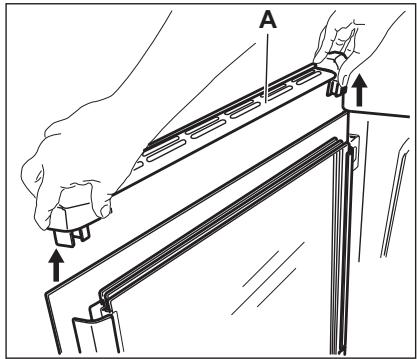
- Press the buttons at the sides of the door trim (A) on the upper cover and pull it upwards to remove it.
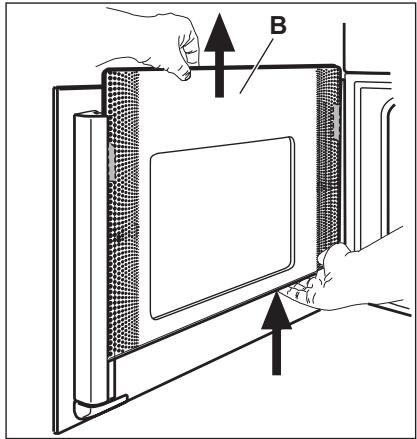
- Hold the inner glass B tightly with both hands and slide it upwards to remove it from its initial position. Do the same with the other glass panels.

CAUTION!
Make sure that you tightly hold the glasses to prevent them from falling.
Clean the door with a wet sponge and rub it dry with a soft cloth. Do not use steel wool, acids or abrasive cleaning agents because they can damage the surface.
Installing the glass panels
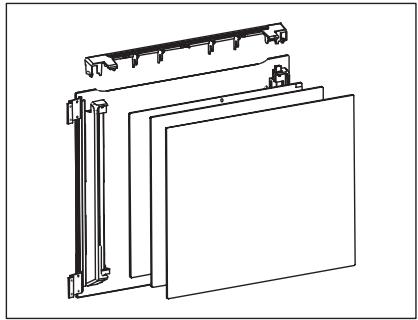
When the oven door is clean, install the glass panels in the opposite sequence. Make sure that you put the glass panels back in the correct order.
The middle glass panels have a graphic located on the top. The third glass panel has screen printings. In others, it is transparent.
The screen-printing zone must face the inner side of the door. Make sure that af-
ter the installation the surface of the glass panel frame is not rough when you touch it.
12. WHAT TO DO IF...

WARNING!
Refer to the Safety chapters.
| Problem | Possible cause | Remedy |
| The appliance does not heat up. | The appliance is deactivated. | Activate the appliance. |
| The appliance does not heat up. | The clock is not set. | Set the clock. Refer to "Setting and changing the time". |
| The appliance does not heat up. | The necessary settings are not set. | Make sure that the settings are correct. |
| The appliance does not heat up. | The automatic switch-off is activated. | Refer to „Automatic switch-off“. |
| The appliance does not heat up. | The fuse is released. | Make sure that the fuse is the cause of the malfunction. If the fuse releases again and again, contact a qualified electrician. |
| The lamp does not operate. | The lamp is defective. | Replace the lamp. |
| The display shows C3. | You want to start the pyrolytic cleaning but you did not fully close the door. | Fully close the door. |
| The display shows F102. | The door lock is defective. | Fully close the door.Deactivate the appliance with the house fuse or the safety switch in the fuse box and activate it again.If the display shows F102 again, contact the Customer Care Department. |
| The display shows an error code that is not in this list. | There is an electrical fault. | Deactivate the appliance with the house fuse or the safety switch in the fuse box and activate it again.If the display shows the error code again, contact the Customer Care Department. |
| The display does not show the time during the off status. | The display is deactivated. | Touch ➊ and ∧ at the same time to activate the display again. |
| The display shows “Demo”. The appliance does not heat up. The fan does not operate. | The test mode is activated. | 1. Deactivate the appliance.2. Touch and hold ➊ until the appliance activates and deactivates. The sensor field is illuminated.3. Touch and hold ➌ and ➍ at the same time until an acoustic signal sounds and the sensor field is off. “Demo” goes out. |
13. INSTALLATION

WARNING!
Refer to the Safety chapters.
13.1 Building In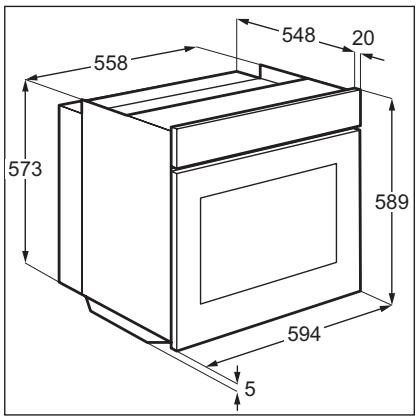
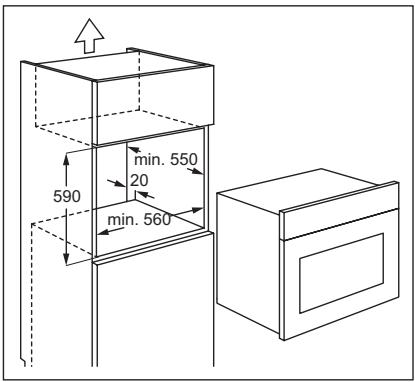
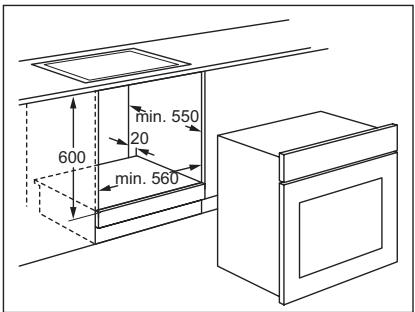
13.2 Securing the appliance to the cabinet
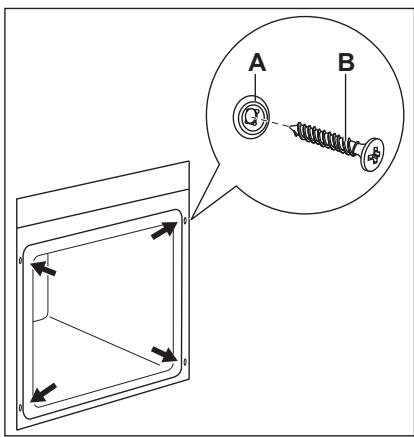
- Open the appliance door.
- Fasten the appliance to the cabinet. Insert the four distance holders (A) into
the holes in the frame, then tighten the four screws (B) supplied with the appliance.
13.3 Electrical installation

WARNING!
Only a qualified person must perform the electrical installation.

The manufacturer is not responsible if you do not follow the safety precautions from the chapter "Safety Information".
This appliance is supplied only with a main cable.
13.4 Cable
Cable types applicable for installation or replacement: H07 RN-F, H05 RN-F, H05 RRF, H05 VV-F, H05 V2V2-F (T90), H05 BB-F.
For the cable cross-section, refer to the total power (on the rating plate) and to the table:
| Total power | Section of the cable |
| maximum 1380 W | 3 × 0.75 mm2 |
| maximum 2300 W | 3 × 1 mm2 |
| maximum 3680 W | 3 × 1.5 mm2 |
The earth cord (green/yellow cable) must be 2 cm longer than the phase and neutral cables (blue and brown cables).
14. ENVIRONMENT CONCERNS
Recycle materials with the symbol

. Put the packaging in applicable
containers to recycle it.
Help protect the environment and human health and to recycle waste of electrical
and electronic appliances. Do not dispose appliances marked with the symbol 📋
with the household waste. Return the product to your local recycling facility or contact your municipal office.
- MAINTENANCE AND CLEANING 55
- IN CASE OF MALFUNCTION 58
- INSTALLATION 59
WE THINK OF YOU
12. IN CASE OF MALFUNCTION

WARNING


- CONTENTS
- WE'RE THINKING OF YOU
- VISIT OUR WEBSITE FOR
- CUSTOMER CARE AND SERVICE
- SAFETY INFORMATION
- CHILDREN AND VULNERABLE PEOPLE SAFETY
- WARNING
- GENERAL SAFETY
- ⚠️ SAFETY INSTRUCTIONS
- INSTALLATION
- ELECTRICAL CONNECTION
- USE
- CARE AND CLEANING
- PYROLYTIC CLEANING
- INTERNAL LIGHT
- DISPOSAL
- PRODUCT DESCRIPTION
- OVEN ACCESSORIES
- BEFORE FIRST USE
- INITIAL CLEANING
- SETTING AND CHANGING THE TIME
- SETTING THE TIME OF DAY
- CHANGING THE TIME OF DAY
- PREHEATING
- CONTROL PANEL
- ELECTRONIC PROGRAMMER
- DISPLAY
- OTHER INDICATORS IN THE DISPLAY
- HEAT UP INDICATOR
- DAILY USE
- SETTING THE OVEN FUNCTION
- CHANGING THE TEMPERATURE
- CHECKING THE TEMPERATURE
- FAST HEAT UP FUNCTION
- ACTIVATING THE FAST HEAT UP FUNCTION
- ENERGY SAVING
- THE APPLIANCE CONTAINS FEATURES WHICH HELP YOU SAVE ENERGY DURING EVERYDAY COOKING
- RESIDUAL HEAT
- CLOCK FUNCTIONS
- COUNT UP TIMER
- SETTING THE DURATION
- SETTING THE END
- CHECK RESULT (SELECTED MODELS ONLY)
- SETTING THE MINUTE MINDER
- SETTING THE TIME DELAY FUNCTION
- AUTOMATIC PROGRAMMES
- THERE ARE TWO TYPES OF AUTOMATIC PROGRAMMES
- AUTOMATIC RECIPES
- SETTING AN AUTOMATIC RECIPE
- AUTOMATIC PROGRAMMES WITH WEIGHT INPUT
- ADDITIONAL FUNCTIONS
- MY FAVOURITE PROGRAMME FUNCTION
- USING MY FAVOURITE PROGRAMME FUNCTION
- CHILD LOCK
- ACTIVATING AND DEACTIVATING THE CHILD LOCK FUNCTION
- FUNCTION LOCK
- ACTIVATING / DEACTIVATING THE FUNCTION LOCK FUNCTION
- SETTINGS MENU
- ACTIVATE THE SETTINGS MENU
- AUTOMATIC SWITCH-OFF
- BRIGHTNESS OF THE DISPLAY
- THERE ARE TWO MODES OF DISPLAY BRIGHTNESS
- COOLING FAN
- SAFETY THERMOSTAT
- HELPFUL HINTS AND TIPS
- BAKING CAKES
- COOKING MEAT AND FISH
- COOKING TIMES
- BAKING AND ROASTING TABLE
- GRILLING
- TURBO GRILLING
- SLOW COOK
- DEFROSTING
- DRYING - TRUE FAN COOKING
- STAINLESS STEEL OR ALUMINIUM APPLIANCES
- PYROLYSIS
- DO NOT START THE PYROLYSIS IF
- CLEANING REMINDER
- THE CLEANING REMINDER GOES OUT
- OVEN LAMP
- BEFORE YOU CHANGE THE OVEN LAMP
- CLEANING THE OVEN DOOR
- CAUTION
- REMOVING THE GLASS PANELS
- INSTALLING THE GLASS PANELS
- WHAT TO DO IF
- SECURING THE APPLIANCE TO THE CABINET
- ELECTRICAL INSTALLATION
- CABLE
- ENVIRONMENT CONCERNS
- WE THINK OF YOU
- IN CASE OF MALFUNCTION
Brand : ELECTROLUX
Model : EOZ5700AOX
Category : Built-in oven