
WA 5719 - WA 5720 - Washing machine BOMANN - Free user manual and instructions
Find the device manual for free WA 5719 - WA 5720 BOMANN in PDF.


| Product Type | Washing Machine |
| Brand | BOMANN |
| Model | WA 5719 / WA 5720 |
| Dimensions (H x W x D) | 85.0 x 59.5 x 47.0 cm |
| Net Weight | 54.0 kg |
| Washing Capacity | 6 kg |
| Power Supply | 220-240 V / 50 Hz |
| Connected Load | 1950 W |
| Fuse Protection | 10 A |
| Water Pressure | 0.05 – 1.0 MPa |
| Maximum Spin Speed | 1000 rpm |
| Energy Class | A++ |
| Annual Energy Consumption | 173 kWh |
| Annual Water Consumption | 9240 L |
| Noise Level Washing / Spinning | 59 dB(A) / 74 dB(A) |
| Washing Programs | 10 programs (Cotton, Synthetics, Delicates, etc.) |
| Special Functions | Pre-wash, Extra rinse, No spin, Delayed start |
| Child Safety | Key lock (activation by simultaneous 3-second press) |
| Hydraulic Safety System | Double-walled inlet hose with automatic shut-off in case of leakage |
| Maintenance | Regular cleaning of pump filter, detergent drawer, and inlet filters |
| Spare Parts | Inlet hose safety kit (ref. 8900 400) |
| Repairability | Call an authorized technician; do not repair yourself |
Frequently Asked Questions - WA 5719 - WA 5720 BOMANN
User questions about WA 5719 - WA 5720 BOMANN
0 question about this device. Answer the ones you know or ask your own.
Ask a new question about this device
Download the instructions for your Washing machine in PDF format for free! Find your manual WA 5719 - WA 5720 - BOMANN and take your electronic device back in hand. On this page are published all the documents necessary for the use of your device. WA 5719 - WA 5720 by BOMANN.
USER MANUAL WA 5719 - WA 5720 BOMANN
HOUSEHOLD-WASHING MACHINE WA 5719
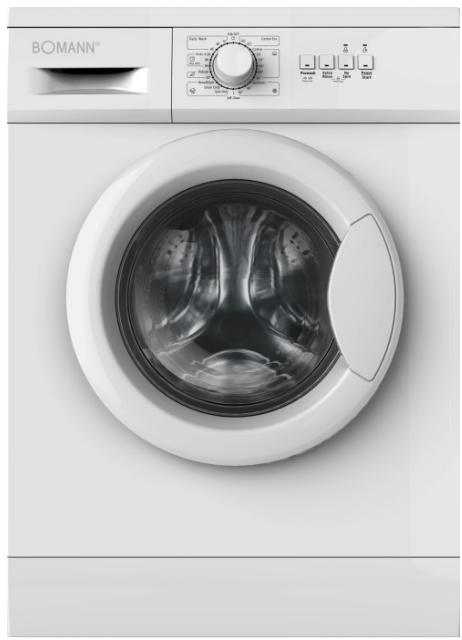
Instruction Manual
Contents
Introduction.
General Notes.
Special safety Information for this Unit.
Unpacking the Appliance.. Page 6
Appliance Equipment.. Page 6
Installation. Page 7
Startup / Operation.. Page 10
Starting a Wash Program.. Page 14
Cleaning and Maintenance.. Page 17
Troubleshooting.. Page 20
Technical Data.. Page 21
Disposal.
Introduction
Thank you for choosing our product. We hope you will enjoy using the appliance.
Symbols in these Instructions for Use
Important information for your safety is specially marked. It is essential to comply with these instructions in order to avoid accidents and prevent damage to the machine:

WARNING:
This warns you of dangers to your health and indicates possible injury risks.

CAUTION:
This refers to possible hazards to the machine or other objects.

NOTE: This highlights tips and information.
General Notes
Read the operating instructions carefully before putting the appliance into operation and keep the instructions including the warranty and the receipt. If you give this device to other people, please also pass on the operating instructions.
I NOTE:
The illustrations in this instruction manual can deviate from the original appliance.
- The appliance is designed exclusively for private use and for the envisaged purpose. This appliance is not fit for commercial use.
- The appliance is only to be used as described in the user manual. Do not use the appliance for any other purpose. Any other use is not intended and can result in damages or personal injuries.
- Do not use it outdoors. Keep it away from sources of heat, direct sunlight, humidity.
- Do not operate the appliance without supervision.
-
When not in use, for cleaning, user maintenance works or with disruption, switch off the appliance and disconnect the plug (pull the plug itself, not the lead) or turn off the fuse.
-
The appliance and if possible the mains lead have to be checked regularly for signs of damage. If damage is found the appliance must not be used.
- For safety reasons, alterations or modifications of the appliance are prohibited.
- In order to ensure your children's safety, please keep all packaging (plastic bags, boxes, polystyrene etc.) out of their reach.

WARNING:
Do not allow small children to play with the foil. There is a danger of suffocation!
Special safety Information for this Unit

WARNING: Hot surface! Danger of burns!
During operation the temperature of the bull's-eye may be very hot.
- Before using the transportation locking screws must be removed, otherwise it may cause serious damages.
- The dry weight of laundry must not exceed the max. loading capacity.
- The unit must be connected with a new set of hoses to the water supply; old hose sets should not be reused.
- The maximum / lowest permitted water inlet pressure is 1MPa / 0.05MPa .
-
Do not use any flammable/explosive cleaning agents such as benzene in the appliance.
-
In the appliance bottom are located ventilation openings (depending on model). These may not be blocked e.g. by carpet. Pay attention to free circulation of air.
- If the unit is used in the bathroom, unplug the power cord after using as the proximity of water presents a danger. This even applies when the unit is switched off.
- This appliance can be used by children aged from 8 years and above and persons with reduced physical, sensory or mental capabilities or lack of experience and knowledge if they have been given supervision or instruction concerning use of the appliance in a safe way and understand the hazards involved.
- Children shall not play with the appliance.
- Children younger than 3 years should be kept away, unless they are constantly supervised.
- Cleaning and user maintenance shall not be made by children unless they are older 8 years and supervised.
- The appliance must be cleaned regularly. Follow the instructions in the chapter "Cleaning and Maintenance".
- Do not try to repair the appliance on your own. Always contact an authorized technician. To avoid the expo
sure to danger, always have faulty cable be replaced only by the manufacturer, by our customer service or by qualified person and with a cable of the same type. Do not use the device if the device or plug is damaged.
Unpacking the Appliance
- Remove the appliance from its packaging.
- Remove all packaging material, such as foils, filler and cardboard packaging.
- To prevent hazards, check the appliance for any transport damage.
- In case of damage, do not put the appliance into operation. Contact your distributor.
NOTE:
Production residue or dust may have collected on the appliance. We recommend cleaning the appliance according to chapter "Cleaning and Maintenance".
Appliance Equipment
Overview of the appliance
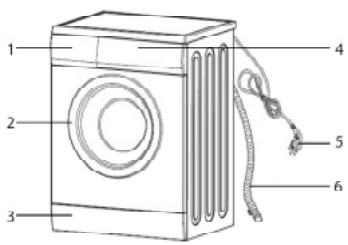
| 1 | Detergent drawer |
| 2 | Appliance door |
| 3 | Cover panel of drain pump |
| 4 | Control panel |
| 5 | Power plug |
| 6 | Water drain hose |
Delivery scope (depending on model)
Inlet hose, transport locking screw covers
Installation

WARNING:
The unit must not be connected to the mains during installing. Otherwise there is danger to life or electric shock hazard!

CAUTION:
For a correct operation the appliance must be connected properly. The specifications for water supply and drain as well as the electrical connection must fulfill the required criteria.
Remove the transport locking screws

CAUTION:
- Before using, all transport locking screws must be removed from the appliance back. Otherwise it may cause serious damages.
- Keep the transport locking screws for later use / transport. Never transport the appliance without properly attached transportation safety!
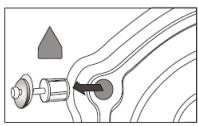
- Loosen the screws from the appliance back with a wrench and remove them.
- Plug the holes of transport locking screws with the supplied covers.
Installation location
- The site should be located near the water inlet and outlet, as well as near a properly grounded power socket.
- Good ventilation around the appliance is required, in order to dissipate the heat properly. Sufficient clearance must be created for this purpose.
- The clearance to the front must be created so, that the appliance door can open without being impeded.
-
Make sure that the floor on which the appliance is installed, is even, heat-resistant and clean.
-
Take care of a solid and horizontal position of the appliance. If the appliance is not horizontally leveled, adjust the feet accordingly (see "Adjust the feet").
Power cord and water hoses may not kinked or squashed. - The wall socket must be freely accessible.
- Avoid the installation:
- near heaters, next to a stove, direct sunlight or any other heat sources;
- at locations with high humidity (e.g. outdoors), as metal parts would be susceptible to corrosion under such circumstances;
- in rooms where the temperature could drop below freezing. Do not expose the appliance any weather.
- near volatile or flammable materials (e.g. gas, fuel, alcohol, paint, etc.).
Adjust the feet
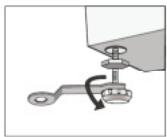
Loosen the locknuts with a wrench.
Turn to the right to let down the unit; turn to the left to lift up the unit.
Tighten the lock nuts with the wrench when the appliance is properly leveled. The feet must have solid ground contact.
Check with a spirit level if the appliance is leveled horizontally. If the appliance is not in balance, the feet must be adjusted again.

CAUTION:
- Looseness locknuts can cause vibration and noise.
- The feet must never be removed. Do not restrict the floor clearance through carpets, strips of wood or similar. Danger of heat accumulation!
Water connection

CAUTION:
- The Installation of the water supply must conform to the local laws and regulations.
The appliance is not suitable for hot water supply. - Use the new supplied hose set to connect the appliance to the water supply. Do not reuse old or used connection sets.

CAUTION:
- If the water pipe is new or long time not used, ensure before connecting to the water system, that the water is clear and free from contamination.
Notes on inlet hose safety system (delivery scope depending on model)
The safety system consists of a double-walled inlet hose. It guarantees to cut off the water supply when leakage of the inner hose. Switching off the water supply leads over an electronic contact.
If necessary, you can order an inlet hose safety system from your dealer or in our online accessories shop, www.bomann.de. To order, use the reference number found under "Technical Data".
Connect the water inlet hose (cold water connection)
i NOTE:
The water pressure must be between 0.05 MPa and 1 MPa. With higher pressure: use a pressure regulator.
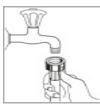
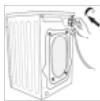
- Connect the water inlet hose to a water thread with 3/4" . Screw the hose firmly in the direction of the screw thread; pay attention for a tight fit.
- Connect the other end of the inlet hose to the inlet valve on the appliance back; pay attention for a tight fit too.
Connect the water drain hose
i NOTE:
The drain hose has a length of approx. 1.5m and can extend with a suitable hose and connecting piece to a length of max. 4m .
CAUTION:
In order to prevent backflow of contaminated water, the free end of the hose must not come under the water level of the drain.
- Connect the drain hose to a drain pipe with a minimum diameter of 40~mm ; alternatively the drain hose can be fixed to a sink or directly to the drainage.
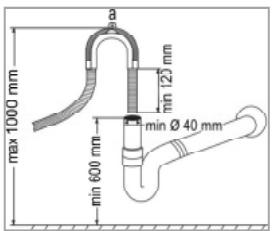
Always make sure that the hose is not bent or squeezed. Use e.g. a hose holding bow (a) (not supplied).
- The hose must be installed at a height of min. 600 mm and max. 1000 mm above the floor.
- Secure the hose securely in order to avoid a
change in position and with it a water leakage.
Electrical connection

WARNING:
- The installation to the mains supply must conform to the local standards and regulations.
- Improper connection may cause to an electric shock!
- Do not use multiple sockets or extension cords.
- It is not allowed to modify the plug provided with the appliance. If the plug does not fit properly to the outlet, let install a proper outlet by an authorized specialist.
- The accessibility of the power plug must always be ensured in order to disconnect the device from the power supply in case of an emergency.
- Ensure that your mains power corresponds with the specifications of the appliance. The specifications are printed on the rating label.
- Connect the mains cable to a properly installed and earthed wall outlet.
Startup / Operation
Prior using for the first time
- Make sure that all transport securing devices has been removed.
- Remove the accessories and any material from the drum.
- Allow the appliance to wash the first time without any laundry, with the addition of some washing agent in the program "Cotton 60^ C " (see "Starting a wash program").
Preparation of clothes

CAUTION
- Do not wash any items that are declared as non-washable. Follow always the instructions on the care label of your laundry.
- Do not wash clothes soaked in petrol, thinners, alcohol or solvents.
-
Foreign objects (e.g. nails, coins) can cause damage to garments and components.
-
Check the pockets of all garments on content and empty them completely.
- Sort your fabrics by color and the symbols contained on the care label. Separate white and colored laundry. All new colored clothes should be washed separately.
- Turn buttons and embroidery inside.
- Close zippers, buttons and hooks before washing. Tie any loose straps and loops.
- Wash bras e.g. in a pillowcase to prevent leakage of the steel bracket.
- Particularly delicate fabrics such as curtains, crochet or small items (socks, handkerchiefs, neckties, etc.) should be washed in a closed bag.
- Remove always all the hooks from curtains.
- Washing large and heavy parts such as bath towels, jeans, lined jackets and the like can cause the drum to run unbalanced. We recommend adding one or two smaller parts; this especially helps with the spinning cycle.
- The clothes which easily get fuzzed shall be washed separately; otherwise the other articles can be stained with dust and thrum etc. Preferably, black clothes and cotton clothes shall be washed separately because they can easily get stained with the thrums of other colors when being washed together.
- Clean away dusts, stains and pet hairs from the clothes.
- For spot removing heavy soiling the laundry can be treated with a special prewash spray. Follow the operating instructions of the product packaging.
Select proper detergent

CAUTION:
Always consider the dosage and storage recommendations on the sales packaging.

WARNING:
Keep detergent and additives out of reach for children!
- Use only "slightly foaming" detergent for washing machines according to type of fabric (cotton, synthetics, lined or woolen products), color, washing temperature and degree of soiling. Otherwise foaming can cause overflowing.
- Bleach is alkaline and can damage your clothing, preferably does not use bleach.
- Detergents often leave residue in the clothes, which can cause bad odor if not rinsed properly.
- Detergent cannot easily get dissolved completely if there is too much detergent or water temperature is rather low. It can remain in clothes, pipes and washing machines to pollute the clothes.
- Washing shall follow the weight of clothes, dirty degrees, local water hardness as well as the recommendations from the detergent manufacturers. Consult the water company if you are not clear of water hardness.
Detergent drawer

CAUTION:
The dispenser is designed exclusively for the use of detergents for washing machines!

NOTE:
- Always add the detergent just before starting the wash cycle, otherwise it could get damp and will not dissolve properly.
- At the end of the wash cycle the detergent dispenser must be empty.
Pull out the drawer and add the detergent.
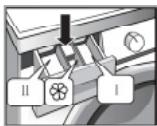
I Chamber of detergent for the pre-wash.
II Chamber of detergent for the main wash.
Chamber for washing additives (fabric softener). Do not exceed the MAX marking.
- Close the drawer.
Foam detection
Excessive foaming occurs by using too much detergent. This affects the wash and rinse cycle. The function automatically checks the foaming; excessive foam will be removed.
Fill in the laundry
Unravel the clothes before putting them into the machine.
- Each load should correspond to the nominal capacity of the appliance. Do not overload the appliance. Different strengths, sizes and types of laundry can affect the actual loading capacity. It is advisable to load the appliance just that a normal circulation during washing is possible.
- Close the door. Make sure that no laundries are caught between the door and seal.
Control panel
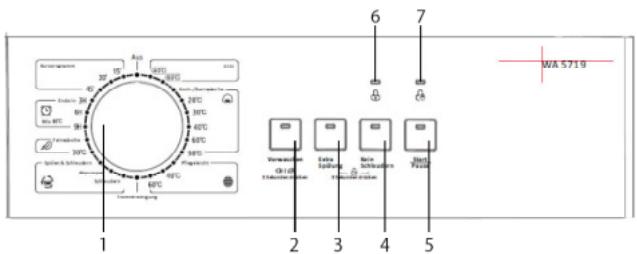
1 Program selector switch
By turning the switch clockwise or counterclockwise, you select a wash program. You will find the program details in the „Wash program table“ or under „Selecting a wash program“.
2 Vorwaschen
The Prewash function can get an extra wash before main wash.
Suppressing the acoustic signal
Press the Vorwaschen-button for 3 seconds to stop the beep upon button presses. A beep sounds. Press the button to reactivate the beep upon button presses. You will hear a beep again.
3 Extra Spülung
Extra rinse means to add another rinse cycle after standard 2 time rinse (suitable for baby clothes).
4 Kein Schleudem
The machine will not spin if you choose this function.
Activation of safety child lock
Press the buttons Extra Spülung and Kein Schleudern at the same time for 3 seconds. A beep sounds. All buttons, except the Aus-button are locked. Press the buttons again for 3 seconds to deactivate the safety child lock. A beep sounds again.
5 Start/Pause
Button to start/pause the selected or running program.
6 Door lock-Indication
Once a program is started and the door lock is activated, the indication lights. When the wash cycle is completed, the door will be unlocked and the indication goes off.
7 Child lock-Indication
The indication lights, when the child lock is activated.
Starting a Wash Program
Wash program table
i NOTE:
The shown values are approximate and recommendations under standard conditions and therefore not binding. The consumption data can vary depending on water pressure, water hardness, water inlet temperature, ambient temperature, type and quantity, as well as power supply and selected additional options from the specified values.
| Program | Temperature °C | Loading kg | TIme | Rpm |
| Cotton ECO | 40/60 | 6 | 3:35/3:52 | 1.000 |
| Cotton | cold/20/30/40/60/90 | 6 | 1:35/1:19/1:20/1:40/1:45/2:40 | 1.000 |
| Synthetic | cold/40/60 | 3 | 1:18/1:33/1:43 | 1.000 |
| Drum Clean | 90 | - | 1:21 | 400 |
| Spin Only | - | 6 | 0:12 | 1.000 |
| Drain Only | - | - | 0:01 | - |
| Rinse & Spin | - | 6 | 0:31 | 1.000 |
| Delicate | cold/30 | 2,5 | 0:55/1:00 | 600 |
| Ends in 3/6/9h | 40 | 6 | 3/6/9h (1:13) | 1.000 |
| Daily Wash 15'/30'/45' | cold/20/30 | 2 | 0:15/0:30/0:45 | 800 |
* Standard program: Cotton 60^ / Cotton 40^
With full and partial load, these are the standard wash programs to identify the information on the energy label. These programs are suitable to clean normally soiled laundry and of combined energy and water consumption most efficiently.
Wash program selection
CAUTION:
Choose the right wash cycle according to the type, quantity and pollution. Always consider the instructions on the care label of your laundry.
Select the temperature corresponding to the textiles and pollution. Basically: the higher the temperature, the higher the power consumption.
| Temperature | Explanation |
| 90°C | Heavily soiled pure white cotton or linen (e.g. tablecloths, sheets and towels). |
| 60°C | Moderately soiled colored cotton, linen and synthetic (e.g. shirts or underwear). Slightly soiled whites (e.g. underwear). |
| 40°C, 30°C, 20°C, cold | Normally soiled laundry (including synthetic and wool). |
Capacity
Do not overload the appliance otherwise the laundry is not getting clean. Refer to the information in the "Wash program table".
Starting a wash program
- Connect the appliance to the power supply.
- The water supply must be opened up to the maximum pressure.
-
Load your laundry and fill in the detergent.
-
Close the appliance door.
- Select the required wash program, the temperature and the spin speed.
- Set the available options, if required.
- Press the START/PAUSE button to stat the operation.
Door lock

WARNING:
Never try to open the appliance door by force during the operation.
Once a wash program has started, the door cannot be opened. With pausing operation the door also did not open when the water temperature or the water fill level goes beyond a certain level.
Program change
- Press the EIN/AUS button to cancel the program and to switch off the power.
- Switch on the power by pressing the EIN/AUS button again.
- Select the desired program and start the new operation via the START/PAUSE button.
I NOTE:
If water has already taken, this will not drained off first.
End of program
At the end of the wash cycle will sound a series of beeps; then the unit goes into standby mode. The door is unlocked and the door lock symbol in the display goes off. [END] is displayed.
Switch off
- Switch off the appliance by pressing the EIN/AUS button.
- Close the water supply!
- Leave the appliance door slightly open until the next wash cycle to avoid odors.
- If the appliance is not in use for an extended period, disconnect the mains plug or switch off or turn out the fuse.
Energy saving tips
- If possible avoid the selection of high wash temperatures. Modern detergents achieve good washing results even at low temperatures.
- Select the wash program depending on the type of laundry and the required degree of washing.
Take advantage of the maximum capacity of each wash program. - Clean the filter regularly to avoid excessive washing and high energy consumption.
- Ventilate the room well. The room temperature should not rise above +35^ C .
Cleaning and Maintenance

WARNING:
- Always switch off the appliance and disconnect the plug or turn off / unscrew the fuse before cleaning and user maintenance.
- Allow the appliance to cool down sufficient before cleaning. Scalding!
- Do not use steam cleaners for cleaning the appliance; moisture could enter electrical components. Risk of electric shock! Hot steam could damage the plastic parts. The appliance must be dry before restarting operation.

CAUTION:
- Do not use a wire brush or other sharp, abrasive items.
- Do not use any acidic or abrasive detergents.
i NOTE:
Dirty or clogged filter degrades the washing result. Regularly check the filter and clean them if necessary.
Maintenance of the washing machine

CAUTION:
- Never use spray cleaners to clean the door panel, this may damage the door lock and electrical components.
- Check after each wash the door seal and remove fiber residues, other materials and foreign objects, otherwise it can lead to water leakage.
- Clean the appliance outer surfaces and the door sealing thoroughly with a soft, damp cloth. Use only mild cleaning agent.
- Use a dampened cloth with a little white vinegar or a special detergent for washing machines to clean the appliance drum.
- Recommendation: allow the appliance to run regularly (about every three months) without loading in e.g. the program "Cotton 60^ ".
- Dry the outer surfaces thoroughly before taking in operation again.
Cleaning the detergent drawer
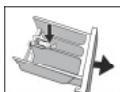
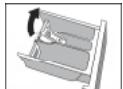
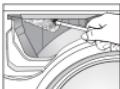
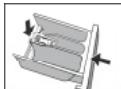
Pull the drawer out until it stops.
- Gently press down the lever in the chamber for the fabric softener and pull out the drawer at the same time completely.
- Wash the guide grooves and the chambers with water.
Use a soft brush to clean the housing.
- Insert the detergent drawer back again.
Cleaning the inlet filter

CAUTION:
- Close the water supply before cleaning!
Always check if the water hoses are properly reinstalled and no water leaks.
Inlet filter at the tap
Clean the filter when not sufficient water is supplied with opened water valve.
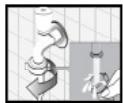
- Unscrew the inlet hose from the water valve.
- Wash the inlet filter under running water.
- Reconnect the inlet hose firmly.
Inlet filter at the appliance
Clean the filter regularly, about every one to three months.
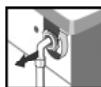
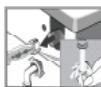
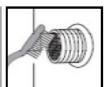
- Unscrew the inlet hose from the appliance back.
Pull out the filter at the appliance with a flat-tong.
Clean the filter with a small brush.
- Reconnect the inlet hose firmly.
Cleaning the filter of drain pump

CAUTION:
The appliance must never be used without the filter.
The foreign body trap in the drain pump prevents rinsed parts close the drainage system. Clean the pump regularly, about once a month; depending on use.
Check the foreign body trap if the water in the wash cycle will not drained or with increased noise during the drainage. If the pump is clogged, water may be in the appliance (max. 25 l).
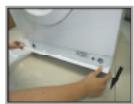
- First, let drain off the water and switch off the power supply.
- Open the lower cover panel.
- Place a drip tray under to catch possible water leakage.
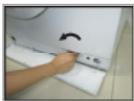
-
Turn the cap counterclockwise. Look for leaking water! Turn the filter not completely out!
-
Interrupt the water flow by turning the filter clockwise again.
If the draining process is completed, turn out the filter completely.
Take off the filter and remove any dirt and foreign objects. - Insert the cap again and make sure it is tightened well and no
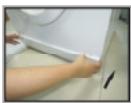
water can escape.
- Close the lower cover panel.
Antifreeze protection
If the appliance is out of operation and exposed to temperatures below zero, observe the following precautions:
- Disconnect the mains plug.
- Close the water supply and remove the inlet hose from the water valve.
- Drain the water from the inlet hose and the water valve.
- Reconnect the inlet hose to the water valve.
Troubleshooting
Before you contact an authorized specialist
| Problem | Solution |
| The appliance does not work or start. | - Check the power supply. - Check the water supply. - Is the door closed? - Is the appliance switched on or a program selected? - Did you pressed the START/PAUSE button? |
| Water drains continuously. | Check the drain hose connection. The hose must be attached at a height of min. 600 mm and max. 1000 mm above the floor. |
| The door does not open. | - The door safety lock is activated. Is the wash cycle completed? - Unplug the power cord, if necessary. |
| Water on the floor, water leaks. | Check the water inlet and drain hose for leaks and proper connec-tion. |
| Water is taken in continuously. | Check the inlet water pressure and reduce it, if necessary. |
| Unusual noises and vibrations. | - Are the transport locking screws removed? - The appliance must be leveled on a firmly surface. - Are the feet adjusted? - Check the drum and the drain filter to foreign objects. - Adjust the spin speed to the loading capacity. |
i NOTE:
If a problem still persists after following the steps above, contact your distributor or an authorized technician.
Technical Data
| Measures / Weights | ||
| Height x Width x Depth | cm | 85.0 x 59.5 x 47.0 |
| Net weight | kg | 54.0 |
| Electrical connection / Water supply | ||
| Connection power | W | 1950 |
| Connection voltage | V~ / Hz | 220-240 / 50 |
| Fuse protection | A | 10 |
| Water pressure | Mpa (bar) | 0.05 – 1.0 (0.5-10) |
| Accessory | ||
| Inlet hose safety system (not included) | Art.-No. | 8900 400 |
The right to make technical and design modifications in the course of continuous product development remains reserved.
Data sheet for household washing machines according regulation (EU) No. 1061/2010
| Brand | Bomann |
| Model | WA 5719 |
| Rated capacity kg | 6.0 |
| Energy efficiency class1) | A++ |
| Annual energy consumption2) kWh | 173.0 |
| Energy consumption of standard program | |
| - Cotton 60°C at full load kWh | 0.85 |
| - Cotton 60°C at partial load kWh | 0.82 |
| - Cotton 40°C at partial load kWh | 0.52 |
| Weighted power consumption: off mode W | 0.5 |
| Weighted power consumption: left-on mode W | 1.0 |
| Annual water consumption3) I | 9240 |
| Spin-drying efficiency class4) | C |
| Maximum spin speed rpm | 1000 |
| Remaining moisture | |
| - Cotton 60°C at full load % | 59.0 |
| - Cotton 60°C at partial load % | 63.0 |
| - Cotton 40°C at partial load % | 63.0 |
| Standard program5) | Cotton 60°C / 40°C |
| Program time of standard program | |
| - Cotton 60°C at full load Min. | 232 |
| - Cotton 60°C at partial load Min. | 210 |
| - Cotton 40°C at partial load Min. | 204 |
| Duration of the left-on mode Min. | 30 |
| Airborne acoustical noise: washing dB(A) re1pW | 59 |
| Airborne acoustical noise: spinning dB(A) re1pW | 74 |
| Built-in appliance | - |
1) A+++ (highest efficiency) to D (lowest efficiency).
2) Weighted annual energy consumption in kWh per year based on 220 standard washing cycles for cotton programs at 60^ and 40^ at full and partial load, and the consumption of the low-power modes. Actual energy consumption will depend on how the appliance is used.
3) Weighted annual water consumption in liters per year based on 220 standard washing cycles for cotton programs at 60^ and 40^ at full and partial load. Actual water consumption will depend on how the appliance is used.
4) G (lowest efficiency) to A (highest efficiency).
5) The standard 60^ cotton and the standard 40^ cotton program are the standard washing program. These programs are suitable to clean normally soiled cotton laundry and that they are the most efficient programs in terms of combined energy and water consumption.
This appliance has been tested according to all relevant current CE guidelines, such as electromagnetic compatibility and low voltage directives, and has been constructed in accordance with the latest safety regulations.

Disposal
Meaning of the "Dustbin" Symbol
Protect our environment; do not dispose of electrical equipment in the domestic waste.
Please return any electrical equipment that you will no longer use to the collection points provided for their disposal.
This helps avoid the potential effects of incorrect disposal on the environment and human health.
This will contribute to the recycling and other forms of reutilization of electrical and electronic equipment.
Information concerning where the equipment can be disposed of can be obtained from your local authority.

WARNING:
Remove or disable any existing snap and bolt locks, if you take the appliance out of operation or dispose it.
BOMANN®
C. Bomann GmbH
www.bomann.de
This file was downloaded from the site mans.io
Instruction manuals and user guides
Samsung
Pioneer
Alpine
LG
Dell
Sharp
Sony
Philips
Epson
Netgear
- HOUSEHOLD-WASHING MACHINE WA 5719
- Contents
- Introduction
- Symbols in these Instructions for Use
- WARNING:
- CAUTION:
- General Notes
- I NOTE:
- Special safety Information for this Unit
- WARNING: Hot surface! Danger of burns!
- Unpacking the Appliance
- NOTE:
- Appliance Equipment
- Overview of the appliance
- Delivery scope (depending on model)
- Installation
- Remove the transport locking screws
- Installation location
- - Avoid the installation:
- Adjust the feet
- Water connection
- Notes on inlet hose safety system (delivery scope depending on model)
- Connect the water inlet hose (cold water connection)
- Connect the water drain hose
- Electrical connection
- Startup / Operation
- Prior using for the first time
- Preparation of clothes
- CAUTION
- Select proper detergent
- Detergent drawer
- Foam detection
- Fill in the laundry
- Control panel
- Program selector switch
- Vorwaschen
- Suppressing the acoustic signal
- Extra Spülung
- Kein Schleudem
- Activation of safety child lock
- Start/Pause
- Door lock-Indication
- Child lock-Indication
- Starting a Wash Program
- Wash program table
- * Standard program: Cotton 60°C / Cotton 40°C
- Wash program selection
- Capacity
- Door lock
- Program change
- End of program
- Switch off
- Energy saving tips
- Cleaning and Maintenance
- Maintenance of the washing machine
- Cleaning the detergent drawer
- Cleaning the inlet filter
- Inlet filter at the tap
- Inlet filter at the appliance
- Cleaning the filter of drain pump
- Antifreeze protection
- Troubleshooting
- Disposal
- Meaning of the "Dustbin" Symbol
- BOMANN®
- Bomann GmbH
- www.bomann.de
- This file was downloaded from the site mans.io
- Instruction manuals and user guides
Brand : BOMANN
Model : WA 5719 - WA 5720
Category : Washing machine