WAA 9351 - Washing machine BOMANN - Free user manual and instructions
Find the device manual for free WAA 9351 BOMANN in PDF.


| Product type | Washing machine |
| Brand | Bomann |
| Model | WAA 9351 |
| Dimensions (H x W x D) | 85 x 60 x 55 cm |
| Washing capacity (cotton) | 5.5 kg |
| Washing capacity (synthetics) | 2.75 kg |
| Washing capacity (wool) | 1 kg |
| Maximum spin speed | 1400 rpm |
| Supply voltage | 220-230 V ~ 50 Hz |
| Maximum washing power | 2200 W |
| Energy consumption (cotton cycle 60°C) | 1.03 kWh/cycle |
| Water consumption (cotton cycle 60°C) | 49 L/cycle |
| Wash programs | Cotton, synthetics, wool |
| Options | Stop full tank, no spin, ECO 60°, super rinse |
| Safety | Door lock, motor thermal protection, heating safety, child safety |
| Maintenance | Cleaning solenoid filter, cleaning detergent drawer, self-cleaning pump |
| Water connection | 3/4 threaded tap, pressure 4-98 N/cm² |
| Electrical connection | Earthed socket, fuse 10 A 250 V |
| Energy class | Not specified |
Frequently Asked Questions - WAA 9351 BOMANN
User questions about WAA 9351 BOMANN
0 question about this device. Answer the ones you know or ask your own.
Ask a new question about this device
Download the instructions for your Washing machine in PDF format for free! Find your manual WAA 9351 - BOMANN and take your electronic device back in hand. On this page are published all the documents necessary for the use of your device. WAA 9351 by BOMANN.
USER MANUAL WAA 9351 BOMANN
Read and hold onto this handbook
This appliance complies with the provisions of the 89/336/EEC Directive regarding electromagnetic compatibility and the 73/23/EEC directive regarding electrical safety and the 93/68/EEC Directive for CE marking.
1-Specific characteristics
2- Installation
3-Handling
4- Maintenance
5- Cautions and advice
6-Safety features
7-Controls
8- Wash programme table
TABLE DES MATIERES
8- TABELLE DER WASCHPROGRAMME
| I | I | |||||||||||||||||
| SCHWUNG SCS | 9 | 20'0 | ● | ● | KWNZEN PEPEN | 21 | ||||||||||||
| SCHWUNG SCS + ● + uHdN S E | 0E | 20'0 | ● | ● | ● | ● | * | uHdN S | 91 | |||||||||
| SCHWUNG SCS + ● + uHdN S E + 0C S W | 0S | 20'0 | ● | ● | ● | ● | ● | 0E | uHdN S | 51 | ||||||||
| SCHWUNG SCS | 9 | 20'0 | ● | ● | S'27 | KWNZEN PEPEN | 41 | SYNTHETIK | ||||||||||
| SCHWUNG SCS + ● + uHdN S I | 01 | 20'0 | ● | ● | ● | ● | * | uHdN S | 31 | |||||||||
| SCHWUNG SCS + ● + uHdN S E + 0C S W | 09 | 20'0 | ● | ● | ● | ● | ● | 04 | uHdN S | 21 | ||||||||
| SCHWUNG SCS + ● + uHdN S E + 0C S W | 0L | 20'0 | ● | ● | ● | ● | ● | 0S | uHdN S | 11 | ||||||||
| SCHWUNG SCS + ● + uHdN S E + 0C S W | 08 | 20'0 | ● | ● | ● | ● | ● | 09 | uHdN S | 01 | ||||||||
| SCHWUNG SCS + ● + dS E + 0C S W + 0F W | 011 | 20'0 | ● | ● | ● | ● | ● | ● | 09 | uHdN S | 6 | |||||||
| SCHWUNG SCS | 21 | 20'0 | ● | ● | S'28 | uHdN S | 8 | BAUMWOLLE | ||||||||||
| SCHWUNG SCS + uHdN S I | 02 | 20'0 | ● | ● | ● | * | uHdN S | L | ||||||||||
| SCHWUNG SCS + uHdN S t/ε | 0S | 20'0 | ● | ● | ● | ● | ● | * | uHdN S | 9 | ||||||||
| SCHWUNG SCS + uHdN S t/ε + 0C S W | SZ1 | 20'0 | ● | ● | ● | ● | ● | 04 | uHdN S | S | ||||||||
| SCHWUNG SCS + uHdN S t/ε + 0C S W | 0E1 | 20'0 | ● | ● | ● | ● | ● | ● | 09 | uHdN S | T | |||||||
| SCHWUNG SCS + uHdN S t/ε + 0C S W | 0+1 | 20'0 | ● | ● | ● | ● | ● | ● | 09 | uHdN S | E | |||||||
| SCHWUNG SCS + uHdN S t/ε + 0C S W | 0S1 | 20'0 | ● | ● | ● | ● | ● | ● | ● | 06 | uHdN S | Z | ||||||
| SCHWUNG SCS + dS t/ε + 0C S W + 0F W | 091 | 20'0 | ● | ● | ● | ● | ● | ● | ● | ● | 06 | uHdN S | I | |||||
| WASCHEN min. | WASCHEN | VERBRAUCH XV | EXTRA SPULEN | EIN/AUS | ECO 60°C | SCHLEUDERN | FULLUNG kg. | WEICHS | BLEICH | WASCHE | VORWASCHE | C.WAHL | C.WAHL | PROEKION | PROEKION | PROEKION | PROEKION | |
| T | E | Z | I | |||||||||||||||
| D | E | Z | I | |||||||||||||||
| EEL | EEL | EEL | EEL | |||||||||||||||
1 - SPECIFIC CHARACTERISTICS
1.1 - Technical data
- Dimensions....Height. 85 cm
Width. 60 cm
Depth. 55 cm
Wash.Cotton. 5,5 kg
Synthetics. 2,75kg
Wool. 1 kg
- Power supply voltage (s.ph.): 220-230 V ~ 50 Hz
Maximum power consumption washing. 2.200 W - Spin speed WAA 934-1. 1.200 rpm
- Spin speed WAA 935-1. 1.400 rpm
- Energy consumption,cotton wash at 60^ (without pre-wash) 1 cycle.1,03 kWh
- Energy consumption,cotton wash at 60^ (without pre-wash) 200 cycles.....206 kWh
Water consumption,cotton wash at 60^ (without pre-wash)1 cycle. 49
Water consumption,cotton wash at 60^ (without pre-wash) 200 cycles.9.8001
1.2 -Description of the washing machine
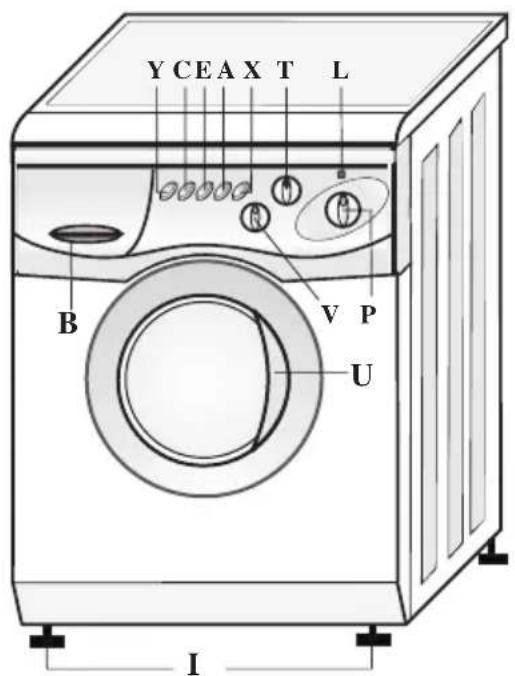
A Rinse and hold push-button
B Detergent drawer
C No spin push-button
E ECO 60^ push-button
I Adjustable feet
L Pilot lamp
PProgramme selector
T Temperature selector
U Door opening handle
V Variable speed selector
ON/OFF push-button
Y Super rinse push-button
2- INSTALLATION
2.1 - Un-blocking the drum
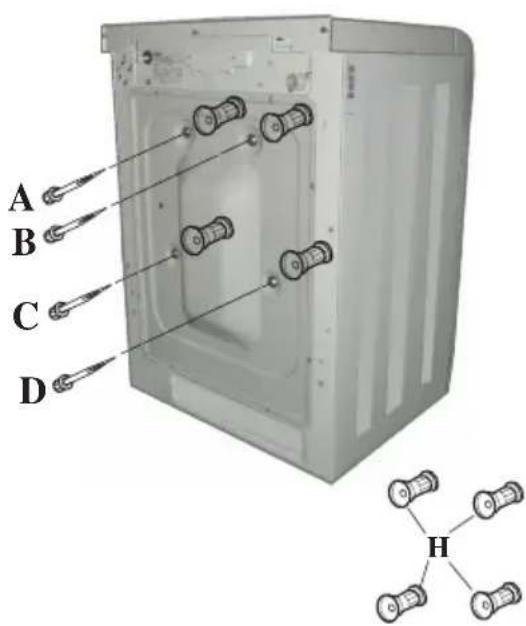
After removing the external packing the drum must be un-blocked before the machine is used.
This is done in the following manner:
1.) Unscrew and remove the four screws A-B-C-D.
2.) Push with a screwdriver at an angle in the screw holes until the four spacers (H) fall. These must be recovered and kept.
3.) It is very important to recover these four spacers (H) because they could cause damage if they remain inside the machine and also because they will be required to move the machine in the case of moving house.
2.2 -Plumbing connection
The user will require a tap with a 3/4'' gas screwthread outlet and a drain situated between 50 and 80 cms. above floor level. The watermain pressure must be between 4 and 98~N/cm^2 inclusively.
Proceed as follows:
- Let the water run for a while before connecting the hose.
-Connect the water inlet hose applying the rubber joint provided in the fittings equipment bag.
-Position the drainage hose inside a hose of a larger diameter, or rest it well fastened against any kind of drain at the height indicated.
-Neither of the hoses should be twisted or kinked.
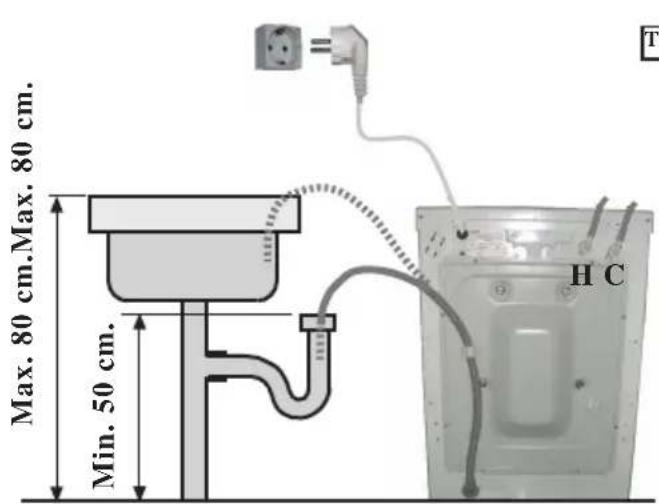
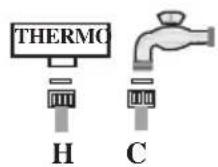
C- Cold water connection.
H- Hot water connection.
The "H" connection can only be applied in those machines fitted for this (Bithermical).
2.3 - Levelling
For the appliance to work under optimum conditions, it needs to be levelled perfectly, i.e. horizontal and stable.
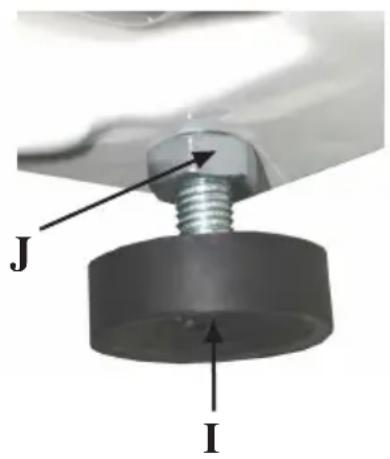
- Once the machine has been positioned in 1st place, work the adjustable feet "I" at the front of the washing machine, until it is horizontal and the four feet are resting firmly on the floor.
- Once the levelling is done, block the adjustable feet by tightening the nut "J".
- In order to prevent noise and vibration, ensure that the machine is not touching any nearby walls or furniture.
- Make periodic checks that the machine is levelled by repeating these operations if necessary.
2.4 -Electrical connection
Before connecting the washing machine to the power supply, the following points should be checked through:
- That the power supply, is single-phase 230V (230 - 240 for UK).
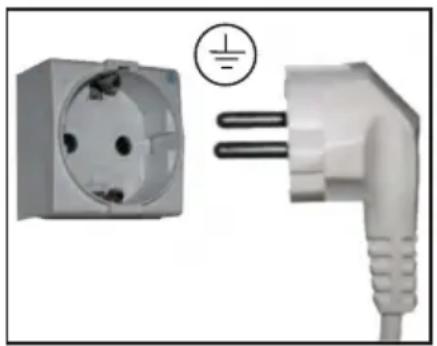
- That the user's meter, limiter, fuses, power socket and installation are of an adequate output for the power indicated on the characteristics plate of this washing machine.
- 10A250V fuse (13 A 250 V for UK).
- Use a wall socket with an earth connection.
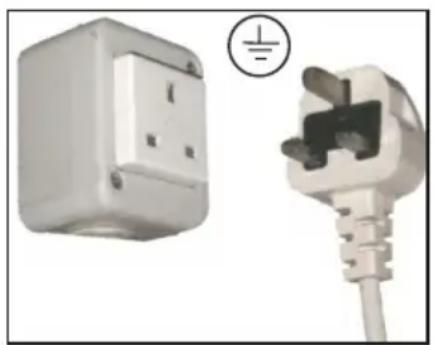
The wasing machine's plug guarantees the machine's earthing.
If the wall socket does not have an earth connection, you must connect the central earth connection of the washing machine to good ARTIFICIAL EARTH (consult your dealer).
THE WASHING MACHINE MUST BE WELL EARTHED.
The manufacturer declines all responsibility for any accidents on occurrences caused by a defective earth connection or lack thereof.
NOTE: If the power supply cable is damaged, it should be substituted by a specially prepared replacement cable, to be supplied by the manufacturer, or by the official after sales Technical Service Organisation.
3- HANDLING
3.1 - Loading door-Opening
Once the washing programme has finished, push the programme button (or ON/OFF push-button) and wait 2 minutes before trying to open the door.
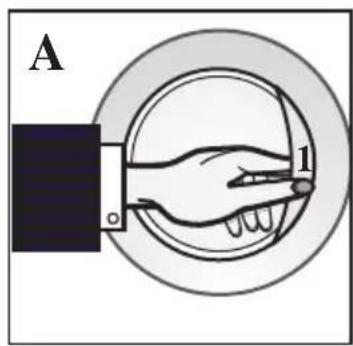
CASE A: 1. Press the hidden lever with the index and middle fingers [1]
2.Pulloutwards.
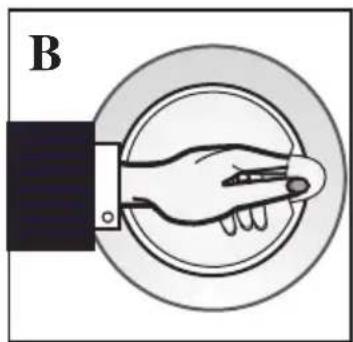
CASE B: Pull the door lever outwards.
WARNING: When the door is open, the power supply is cut and the machine will not operate.
3.2 - Detergent drawer. Distribution of the washing products.
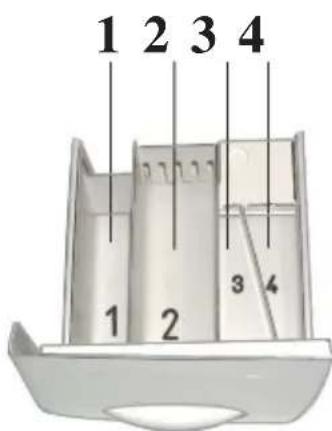
- To open the drawer, put your and in the lower part of the soap drawer and pull it outwards.
SECTION 1 - Pre-wash soap (50 gr.Max.).
SECTION 2 - Main wash soap (125 gr.Max.).
SECTION 3 - Bleach (80 ml. Not concentrated).
SECTION 4 - Softener (80 ml.Max.).
-
Never put more than indicated by the lever in the soap drawer.
-
The ideal dose of detergent depends on the hardness of the water, how dirty the clothes are and the load. (Consult the soap manufacturer's instructions).
-
Make sure that the material can support the treatment with bleach if it is used.
3.3 - Selecting the clothes load
Before putting the clothes into the machine, you should:
- Separate the clothes into three lots (cotton, synthetics and wool).
- Within each group, separate the coloureds from the whites.
- Once the clothes have been sorted, put them into the drum of the machine, separately according to colour and group, loose piece by piece, as per the following proportions:
Cotton maximum 5,5kg
Synthetics maximum 2,75kg
Wool maximum 1kg
3.4 - Selecting the right program
Once the clothes have been sorted into fabric types and colours, you need to select the right program and temperature. SEE PROGRAM TABLE (Section 8).
3.5 - Starting operation
With the machine now loaded, the door closed, the soap drawer compartments filled and the right program chosen, to start the machine, you just need to PULL OUT THE PROGRAMMER CONTROL BUTTON (P), OR ON THE PUSH-BUTTONT (X).
The machine automatically goes through all the operations included in the wash cycle until it ends.
The wash is now ready to be hung out dry (or to be ironed in the case of washer - dryers).
3.6 - How to get the best performance
3.6-1 - Maximise the load (Section 8)
You obtain the most efficient use of energy, water, detergent and time by using the maximum recommended load.
You save 50% energy by washing one full load instead of two half loads.
3.6-2 - Do you need a pre-wash?
Only for deeply stained laundry!.
You save detergent, water, time and between 5 to 15% of energy through not using the pre-wash for light and anormally soiled clothes.
3.6-3 - Do you need hot water?
Soak or treat stains before the wash, in order to reduce to need to use the hot programme.
You save 50% energy by using the 60^ programme.
3.6-4 - For washer-dryers: before using the dryer
Select high (≥ 850~rpm) for the spin before drying, in order to save energy, water hand time during the drying period.
4- MAINTENANCE
4.1 - Cleaning the drain-pump
This machine is fitted with a high-performance SELF-CLEANING motorized pump.
This pump has the capacity to pull along and to wash away with the water any fibres, buttons or objects of a small size. Because of this, the machine does not require a water filter.
Under normal circumstances, this motorized pump cannot become blocked. If it should become blocked in any case, call the Technical Assistance Service to have this malfunction put right.
N.B.: Before placing clothes in the washing machine, make sure there are no coins, buttons, clips, etc. in any pockets.
4.2 - Cleaning the electrovalve filter.
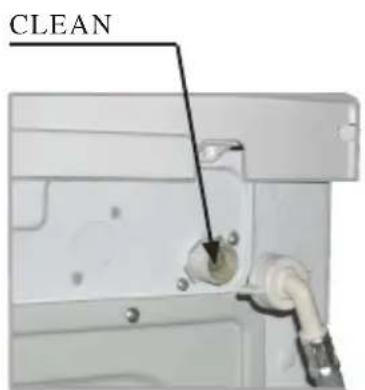
Any impurities in the water supply are deposited in the filter at the inlet to the electrovalve.
To clean this filter:
a) Turn off the water tap.
b) Unscrew the water inlet hose at the washing machine end.
c) Remove the filter using pointed pliers and clean it.
d) Reverse the procedure to re-attach the hose.
4.3 - Cleaning remains of detergent.
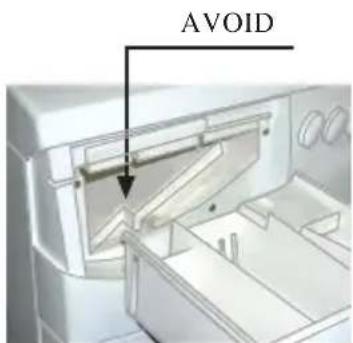
Overfilling the prewash and main wash compartments with too must detergent causes remains to be deposited inside the collector, and could, over time, cause water to leak through the entrance of the detergent drawer.
To eliminate these remains, remove the soap drawer by pulling it outwards, and clean it thoroughly.
5- CAUTIONS AND ADVICE
In order to get maximum satisfaction and performance from this appliance, it is important to follow the instructions indicated below:
Select the clothes load correctly (section 3.3) and choose the appropriate programme (section 8).
Before starting to operate the machine, it must be released from its blocking (section 2.1).
Before opening the door, check that there is no water in the machine and the pilot light is off.
Plug the power supply plug into a socket with an EARTH CONNECTION and at the correct voltage.
Put in the washing products in the right proportion and the right compartment (section 3.2).
Small garments, such as socks, belts, etc. are best put inside a bag to avoid them being lost.
Before putting clothes into the washing machine, make sure that there is nothing in the pockets (coins, buttons, clips, etc.) and that zips are undone.
If your machine has a filter, you should periodically check it is clean (sec. 4.1).
The interior of the washing machine should be handled by specialist only.
After each wash,leave the door ajar to prevent the rubber seal from becoming misshapen.
When the clothes to be washed are heavily soiled or splattered with mud, it is advisable to run a program with prewash.
Always put the machine on full, to save energy.
When the machine is installed, or after a long time without it being used, it is advisable to run a wash program with the machine empty, to eliminate any rusty water in the tubes.
For washer-dryers, do not use the dryer function if the clothes have been treated with any non-aqueous solution.
Also for washer-dryers,do not use the dryer function for items containing spongey rubber or similar elastomer materials.
The dryer must be installed in a well-ventilated place, away from the influence of gases from other appliances and from defective installations.
The lower ventilation, between the floor and the base of the machine, must not be obstructed (by carpet, cloths, etc.).
If the event any doubts or anomalies which arise, ring the TECHNICAL ASSISTANCE SERVICE, but first, make the following checks:
a) The machine is not working. Check that:
- The door is properly closed.
- The fuses are not brown and the automatic cutout has not been triped.
- The programmer control button P (or the push-button X) is not in the STOP position.
b) The machine is not filling with water. Check that:
- The tap is open and the pressure is sufficient.
- The electrovalve filter is not clogged (Section 4.2).
- The filling hose is not kinked.
c) The machine will not drain or spin. Check that:
- The drainage hose is not kinked.
- The drainage pump filter is not clogged.
d) The machine is filling with water and draining at the same time. Check that:
-
The drainage hose is positioned at the right height (Section 2.2) and that it is not syphoning because the diameters of this hose and the drain where it is resting are very tight.
e) The machine is vibrating or making a lot of noise. Check that: -
The block release operation has been carried out (Section 2.1).
- The washing machine is properly levelled (Section 2.3).
- The washing machine is not vibrating due to contact with furniture or a wall.
f) The machine is leaking water. Check that:
- The filter cap is tightly closed and with the trim in 1st place.
- The inlet hose is tightened on both sides and with the trim in 1st place.
- The detergent used is loose powder and is not forming lumps which clog the soap drawer.
- The washing machine is well levelled and not leaning forwards.
g) The machine is not washing to your satisfaction. Check that:
- You have chosen the right temperature an program.
- You are using the right dose of detergent.
- The filter is not clogged and so the rinses are not working properly.
h) If the loading door will not open, remember that:
- The pilot lamp (if there is one) must be off. If it is not, press the button to the STOP position and wait about 2 minutes before trying to open it.
If after making these checks, the doubts or abnormalities continue, then call our Technical Assistance Service who will attend to you as soon as possible.
The telephone number can be found in the control list of Technical Assistance Services, or on the own machine customer attention and Technical Service DIRECT LINE label.
6- SAFETY FEATURES
An electro-mechanical safety device prevents the loading door from opening whilst the appliance is operating, thus preventing access to the inside of the machine and the consequent danger of injuries to the hands from coming into contact with high temperatures or from the movement of the drum.
6.2 - In the wash motor
In the event of mechanical underload or overload, a thermal safety device automatically protects the motor.
6.3 - Heating
Heating of the wash water cannot start until the required water level is reached. If there is not enough water or the tap is off, the machine stops (the program does not move forward).
A safety thermostat prevents excess temperatures.
6.4 - Plumbing.Water inlet
In the event the filter clogs.the machine will never overflow,and in the event the pump motor suffers an electrical malfunction,the filling valve will not work.
6.5 - Child safety
The accesses to the loading door and to the pump motor filter are protected against any accidental handling by children.
7- CONTROLS
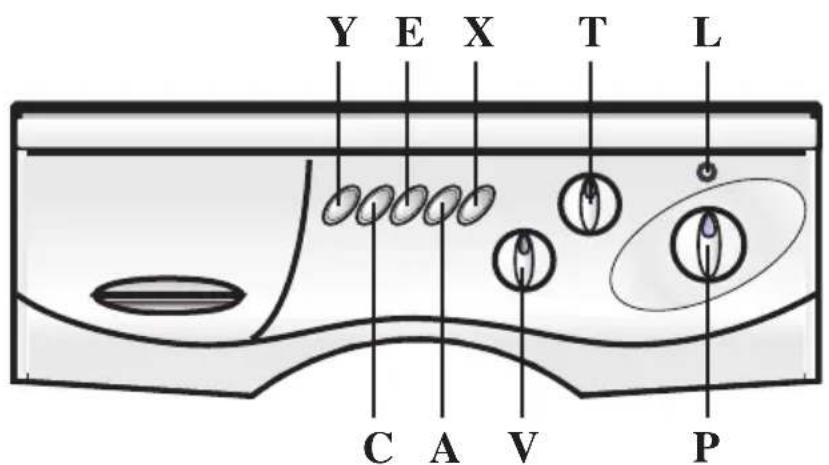
P
PROGRAMME SELECTOR
This control button is used to select the programme which is adequate according to the nature and degree of dirtiness of the clothes to be washed. To set the programme, operate the ON/OFF button (position out) and turn the control in a clockwise direction until the indicating mark coincides with the chosen programme.
Starting the washing machine. Once the adequate programme has been chosen, press the ON/OFF button again (position in). The machine will start and automatically carry out all the wash functions until the end of the cycle. The programme control will turn as the different functions are carried out, until it reaches the Stop position. At this point, pres the ON/OFF button once more (position out) to disconnect the machine from the power supply and to be able to open the door.
T
TEMPERATURE SELECTOR
This control button enables the temperature to be chosen for the wash, most suitable for the type of fabrics of which the load of clothes to be washed consists. A temperature equal to or lower than that indicated in the program table can be chosen (even cold). To fix the temperature, just turn the button until it is lined up with the corresponding marker.
V
SPIN SPEED SELECTOR
this control button allows us to vary the spin speed of the last minutes of each one of the cotton programmes between 550 and maximum rpm as correspond. In this way, the machine user can choose the most convenient spin speed for the clothes. To set this speed, it is only necessary to turn the control button until the corresponding mark coincides with the desired rpm.
A
RINSE HAND HOLD PUSH-BUTION
When activated (button IN), it makes the wash cycle of the synthetic and wool programs stop during the last rinse with the drum full of water. This operation is advisable to prevent creasing in certain fabric which need to be drip dried. To end the cycle, press the button again (button OUT).
C
NO SPIN PUSH-BUTION
When activated (button IN), the spin is eliminated from all the programs of the machine. This operation is necessary for certain types of delicate fabrics.
E
ECO 60°C PUSH-B BUTTON
When this control button is in the machine will automatically carry out the programme with a considerable saving in energy and at a temperature of 60^ .
X
ON/OFF PUSH-BUTION
Once the adequate programme has been selected, the washing machine can be started by pressing this button "IN" and it will automatically carry out all the chosen functions until the end of the programme. (Stop position). When the push-button is pressed "OUT", the machine will not work.
Y
When it is not operated (button OUT) the machine will automatically carry out the programmes for cotton with a considerable saving of water. It is only advisable when the load is equal to or less than 3kg . With bigger loads it is advisable to operate this button (button IN) so that greater rinse efficiency is obtained.
L
PILOT LAMP
When it is lit, indicates that the machine is switched on and that the door blocking system is activated.
In normal washing machines it goes out at the end of each programme and door lock not activated.
PRACTICAL ADVICE
a) Correctly select the load of clothes and adequate programme (sec. 3.3 & 8).
b) The temperature indicated in the programme table is the maximum which can be reached.
c) One can choose the desired temperature with the temperature selector, but always lower than that indicated in the programme table (section 8).
e")The programmes for resistant materials cotton finish with a long spin.
The programmes for synthetic materials finish a short spin. They could also finish with the drum full of water (according to rinse and hold push button). To finish the cycle in this case, move the programme button one position.
The wool programmes finish with a gentle spin. They could also finish with the drum full of water (according to rinse and hold push button). To finish the cycle in this case, move the programme button one position.
f) All articles of clothing that bear a label with the wool symbol can be washed with complete safety with the wool programme of this washing machine.
g) The ECO 60^ button allows us to carry out a wash with a considerable saving in energy. It only woks in the energetic cotton programmes.
h) Bleach must only be used with white cotton materials. It must be non-concentrated bleach for use in washing machines and it must be put in the corresponding section of the soap drawer.
i) The super rinse button permits an extra rinse when the user thinks it necessary.
j) The Rinse & Hold button only operates in the synthetic and wool programmes. It mustnot be used when a synthetic programme has been selected with drying.
8-WASH PROGRAMME TABLE
| u,d1 0SS | 9 | 20'0 | ● | ● | I | Ud1 u,d1 d1 d1 d1 d1 d1 d1 d1 d1 d1 d1 d1 d1 d1 d1 d1 d1 d1 d1 d1 d1 d1 d1 d1 d1 d1 d1 d1 d1 d1 d1 d1 d1 d1 d1 d1 d1 d1 d1 d1 d1 d1 d1 d1 d1 d1 d1 d1 d1 d1 d1 | |||||||||||
| u,d2 + ● + eSsE | 0ε | 20'0 | ● | ● | ● | ● | * | COW | 9I | ||||||||
| u,d3 + ● + eSsE + 0ε yEA | 05 | 05'0 | ● | ● | ● | ● | ● | 0ε | COW | SI | |||||||
| u,d4 0SS | 9 | 20'0 | ● | ● | S'Z' | Ud4 u,d4 u,d4 u,d4 u,d4 u,d4 u,d4 u,d4 u,d4 u,d4 u,d4 u,d4 u,d4 u,d4 u,d4 u,d4 u,d4 u,d4 u,d4 u,d4 u,d4 u,d4 u,d4 u,d4 u,d4 u,d4 u,d4 u,d4 u,d4 u,d4 u,d4 u,d4 u,d4 u,d4 u,d | T1 T1 T1 T1 T1 T1 T1 T1 T1 T1 T1 T1 T1 T1 T1 T1 T1 T1 T1 T1 T1 T1 T1 T1 T1 T1 T1 T1 T1 T1 T1 T1 T1 T1 T1 T1 T1 T1 T1 T1 T1 T1 T1 T1 T1 T1 T1 T1 T1 T1 T1 D1 D1 D1 D1 D1 D1 D1 D1 D1 D1 D1 D1 D1 D1 D1 D1 D1 D1 D1 D1 D1 D1 D1 D1 D1 D1 D1 D1 D1 D1 D1 D1 D1 D1 D1 D1 D1 D1 D1 D1 D1 D1 D1 D1 D1 D1 D1 D1 D1 D1 | T1 T1 T1 T1 T1 T1 T1 T1 T1 T1 T1 T1 T1 T1 T1 T1 T1 T1 T1 T1 T1 T1 T1 T1 T1 T1 T1 T1 T1 T1 T1 T1 T1 T1 T1 T1 T1 T1 T1 T1 T1 T1 T1 T1 T1 T1 T1 T1 T1 D1 T1 D1 D1 D1 D1 D1 D1 D1 D1 D1 D1 D1 D1 D1 D1 D1 D1 D1 D1 D1 D1 D1 D1 D1 D1 D1 D1 D1 D1 D1 D1 D1 D1 D1 D1 D1 D1 D1 D1 D1 D1 D1 D1 D1 D1 D1 D1 D1 D1 | SYNTHETICS | ||||||||
| u,d5 0SS | 9 | 20'0 | ● | ● | S'Z' | Ud5 u,d5 u,d5 u,d5 u,d5 u,d5 u,d5 u,d5 u,d5 u,d5 u,d5 u,d5 u,d5 u,d5 u,d5 u,d5 u,d5 u,d5 u,d5 u,d5 u,d5 u,d5 u,d5 u,d5 u,d5 u,d5 u,d5 u,d5 u,d5 u,d5 u,d5 u,d5 u,d5 u,d5 u,d4 u,d4 u,d4 u,d4 u,d4 u,d4 u,d4 u,d4 u,d4 u,d4 u,d4 u,d4 u,d4 u,d4 u,d4 u,d4 u,d4 u,d4 u,d4 u,d4 u,d4 u,d4 u,d4 u,d4 u,d4 u,d4 u,d4 u,d4 u,d4 u,d4 u,d4 u,d4 u,d4 U | T1 T1 T1 T1 T1 T1 T1 T1 T1 T1 T1 T1 T1 T1 T1 T1 T1 T1 T1 T1 T1 T1 T1 T1 T1 T1 T1 T1 T1 T1 T1 T1 T1 T1 T1 T1 T1 T1 T1 T1 T1 T1 T1 T1 T1 T1 T1 T1 T1 U | COTTON | |||||||||
| u,d6 + ● + eSsU | 01 | 20'0 | ● | ● | ● | ● | * | S'Z' | εI | ||||||||
| u,d7 + ● + eSsU + 0ε yEA | 09 | 09'0 | ● | ● | ● | ● | ● | 0þ | S'Z' | εI | |||||||
| u,d8 + ● + eSsU + 0ε yEA | 0L | 0L'0 | ● | ● | ● | ● | ● | 0S | S'Z' | εI | |||||||
| u,d9 + ● + eSsU + 0ε yEA | 08 | 06'0 | ● | ● | ● | ● | ● | 09 | S'Z' | εI | |||||||
| u,d10 + ● + eSsU + 0ε yEA + 0þ Cn | 01 I | 05'1 | ● | ● | ● | ● | ● | ● | 09 | S'Z' | εI | ||||||
| u,d11 0SS 1-002/1/0SS | 2I | 20'0 | ● | ● | S'Z' | Ud11 u,d11 u,d11 u,d11 u,d11 u,d11 u,d11 u,d11 u,d11 u,d11 u,d11 u,d11 u,d11 u,d11 u,d11 u,d11 u,d11 u,d11 u,d11 u,d11 u,d11 u,d11 u,d11 u,d11 u,d11 u,d11 u,D11 u,D11 u,D11 u,D11 u,D11 u,D11 u,D11 u,D11 u,D11 u,D11 u,D11 u,D11 u,D11 u,D11 u,D11 u,D11 u,D11 u,D11 u,D11 u,D11 u,D11 u,D11 u,D11 u,D11 u,D11 u/D11 u/D11 u/D11 u/D11 u/D11 u/D11 u/D11 u/D11 u/D11 u/D11 u/D11 u/D11 u/D11 u/D11 u/D11 u/D11 u/D11 u/D11 u/D11 u/D11 u/D11 u/D11 u/D11 u/D11 u/D11 u/202 | T1 T1 T1 T1 T1 T1 T1 T1 T1 T1 T1 T1 T1 T1 T1 T1 T1 T1 T1 T1 T1 T1 T1 T1 T1 T1 T1 T1 T1 T1 T1 T1 T1 T1 T1 T1 T1 T1 T1 T1 T1 T1 T1 T1 T1 T1 T1 T1 T1T1 T1 T1 T1 T1 T1 T1 T1 T1 T1 T1 T1 T1 T1 T1 T1 T1 T1 T1 T1 T1 T1 T1 T1 T1 T1 T1 T1 T1 T1 T1 T1 T1 T1 T1 T1 T1 T1 T1 T1 T1 T1 T1 T1 T1 T1 T1 T1 T1 T2 | COTTON | |||||||||
| u,d2 + eSsU | 02 | 20'0 | ● | ● | ● | * | S'Z' | εI | |||||||||
| u,d3 + eSsU + 0ε yEA | 05 | 60'0 | ● | ● | ● (●) | * | S'Z' | εI | |||||||||
| u,d4 + eSsU + 0ε yEA | 2ZI | 20'0 | ● | ● | ● | ● | 0þ | S'Z' | εI | ||||||||
| u,d5 + eSsU + 0ε yEA + 0þ Cn | 0ε I | 20'0 | ● | ● | ● | ● | ● | 09 | S'Z' | εI | |||||||
| u,d6 + eSsU + 0ε yEA + 0þ Cn | 0þ I | 20'0 | ● | ● | ● | ● | ● | 09 | S'Z' | εI | |||||||
| u,d7 + eSsU + 0ε yEA + 0þ Cn | 0S I | 20'0 | ● | ● | ● | ● | ● | 06 | S'Z' | εI | |||||||
| u,d8 + eSsU + 0ε yEA + 0þ Cn | 09 I | 20'0 | ● | ● | ● | ● | ● | ● | 06 | S'Z' | εI | ||||||
| u,d9 + eSsU + 0ε yEA + 0þ Cn | 09 I | 20'0 | ● | ● | ● | ● | ● | ● | 06 | S'Z' | εI | ||||||
| NOILIN DEWCRYNE DEWCRYNE DEWCRYNE DEWCRYNE DEWCRYNE DEWCRYNE DEWCRYNE DEWCRYNE DEWCRYNE DEWCRYNE DEWCRYNE DEWCRYNE DEWCRYNE DEWCRYNE DEWCRYNE DEWCRYNE DEWCRYNE DEWCRYNE DEWCRYNE DEWCRYNE DEWCRYNC DEWCRYNC DEWCRYNC DEWCRYNC DEWCRYNC DEWCRYNC DEWCRYNC DEWCRYNC DEWCRYNC DEWCRYNC DEWCRYNC DEWCRYNC DEWCRYNC DEWCRYNC DEWCRYNC DEWCRYNC DEWCRYNC DEWCRYNC DEWCRYNC DEWCRYNC DEWCRY NC DEWCRY NC DEWCRY NC DEWCRY NC DEWCRY NC DEWCRY NC DEWCRY NC DEWCRY NC DEWCRY NC DEWCRY NC DEWCRY NC DEWCRY NC DEWCRY NC DEWCRY NC DEWCRY NC DEWCRY NC DEWCRY NC DEWCRY NC DEWCRY NC DEWCRY NC DEWCRYNC DEWCRY NC DEWCRY NC DEWCRY NC DEWCRY NC DEWCRY NC DEWCRY NC DEWCRY NC DEWCRY NC DEWCRY NC DEWCRY NC DEWCRY NC DEWCRY NC DEWCRY NC DEWCRY NC DEWCRY NC DEWCRY NC DEWCRY NC DEWCRY NC DEWCRY N DEWCRY N DEWCRY N DEWCRY N DEWCRY N DEWCRY N DEWCRY N DEWCRY N DEWCRY N DEWCRY N DEWCRY N DEWCRY N DEWCRY N DEWCRY N DEWCRY N DEWCRY N DEWCRY N DEWCRY N DEWCRY N DEWCRY N DEWCRYN DEWCRY N DEWCRY N DEWCRY N DEWCRY N DEWCRY N DEWCRY N DEWCRY N DEWCRY N DEWCRY N DEWCRY N DEWCRY N DEWCRY N DEWCRY N DEWCRY N DEWCRY N DEWCRY N DEWCRY N DEWCRY N DEWCRY N DEWCRY | |||||||||||||||||
1 - CHARACTERISTIQUES SPECIFIQUES
- TABLE DES MATIERES
- 8- TABELLE DER WASCHPROGRAMME
- - SPECIFIC CHARACTERISTICS
- - Technical data
- -Description of the washing machine
- 2- INSTALLATION
- - Un-blocking the drum
- -Plumbing connection
- - Levelling
- -Electrical connection
- 3- HANDLING
- - Loading door-Opening
- - Detergent drawer. Distribution of the washing products.
- - Selecting the clothes load
- - Selecting the right program
- - Starting operation
- - How to get the best performance
- 3.6-1 - Maximise the load (Section 8)
- 4- MAINTENANCE
- - Cleaning the drain-pump
- - Cleaning the electrovalve filter.
- To clean this filter:
- - Cleaning remains of detergent.
- 5- CAUTIONS AND ADVICE
- In order to get maximum satisfaction and performance from this appliance, it is important to follow the instructions indicated below:
- 6- SAFETY FEATURES
- - In the wash motor
- - Heating
- - Plumbing.Water inlet
- - Child safety
- 7- CONTROLS
- P
- PROGRAMME SELECTOR
- T
- TEMPERATURE SELECTOR
- V
- SPIN SPEED SELECTOR
- A
- RINSE HAND HOLD PUSH-BUTION
- C
- NO SPIN PUSH-BUTION
- E
- ECO 60°C PUSH-B BUTTON
- X
- ON/OFF PUSH-BUTION
- Y
- L
- PILOT LAMP
- PRACTICAL ADVICE
- 8-WASH PROGRAMME TABLE
- - CHARACTERISTIQUES SPECIFIQUES
Brand : BOMANN
Model : WAA 9351
Category : Washing machine