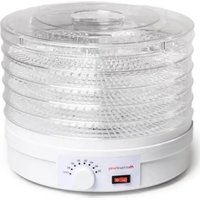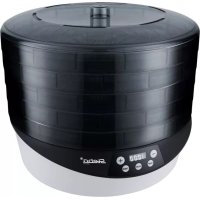
DF200 - Food Dehydrator STEBA - Free user manual and instructions
Find the device manual for free DF200 STEBA in PDF.



| Product type | Electric deep fryer |
| Model | DF200 |
| Brand | Steba |
| Power supply | 230 V ~ 50 Hz |
| Power | 1800 W |
| Tank capacity | 2.5 L (max) |
| Temperature range | 150 °C – 190 °C |
| Adjustable thermostat | Yes, with indicator light |
| Overheat protection | Yes, with reset button |
| Safety switch | Yes, prevents operation if heating element is not properly inserted |
| Tank material | Stainless steel |
| Basket type | Long basket and small baskets included |
| Lid | With odor filter and viewing window |
| Maintenance | Tank and basket dishwasher safe; electrical parts wiped with a damp cloth |
| Child safety | Supervision required; keep away from children under 8 years |
| Weight | Approx. 3.5 kg |
| Dimensions (W × D × H) | Approx. 35 × 25 × 30 cm |
| Color | White / Stainless steel |
| Included accessories | Long basket, 2 small baskets, lid with filter |
| Warranty | 2 years (subject to manufacturer conditions) |
Frequently Asked Questions - DF200 STEBA
User questions about DF200 STEBA
0 question about this device. Answer the ones you know or ask your own.
Ask a new question about this device
Download the instructions for your Food Dehydrator in PDF format for free! Find your manual DF200 - STEBA and take your electronic device back in hand. On this page are published all the documents necessary for the use of your device. DF200 by STEBA.
USER MANUAL DF200 STEBA
natural_image
White Sieba® kitchen appliance with two black grilles and control knobs (no visible text or symbols)220-240V, 50/60Hz, 2200Watt
Fritteuse DF 200
Instructions for use 12
Mode d'emploi 21
Manuale d'uso 32
Brugsanvisning 40
Allgemein
natural_image
Top-down view of a transparent plastic container with a black handle and white handle, no visible text or symbols.2)
natural_image
Close-up of a hand holding two metal tools with arrows pointing to a transparent mechanical component (no text or symbols visible)3)
natural_image
Close-up of a hand holding a wire mesh with a coiled wire, partially enclosed by a mesh fence (no text or symbols visible)4)
natural_image
Close-up of a metal tool interacting with a mesh grid, showing a curved surface and a black arrow indicating direction (no text or symbols)5)
natural_image
Close-up of a metal tool interacting with a meshed surface (no text or symbols visible)This appliance is for private use only and must not be used commercially. Please read the instruction manual carefully and keep it at a safe place. When the appliance is given to another person the instruction manual should be passed to that person, too.
Only use the appliance as described in the instruction manual and pay attention to the safety information. No liability for damages or accidents will be accepted, which are caused by not paying attention to the instruction manual.
Safety information
- Connect the appliance to an earded wall socket and operate it only in accordance with the specifications on the rating plate.
- Do not use if the cord or appliance is damaged. Always check before using the appliance!
- Do not touch the power plug with wet hands.
- After using the appliance or if the appliance malfunctions, always pull out the plug.
- To unplug the power plug, always pull the plug – not the cable.
The appliance must not be used by children aged 0 to 8. The appliance can be used by children aged 8 and above and persons with a limited physical, sensory or mental capacity or lack of experience/knowledge, provided that they are supervised or have understood the resulting dangers. Keep the appliance and its electric wiring away from children aged 8 or younger. Cleaning and user maintenance must not be carried out by children. - Devices for cooking should be placed in a stable position by using the handles in order to avoid the spillage of hot liquids.
- The appliance must not be operated using a timer or a separate remote system!
- After using the appliance or if the appliance malfunctions, always pull out the plug.
-
Never pull at the cord set. Do not chafe it over edges or squeeze it.
-
Keep the power supply cord away from hot parts.
- Never leave the appliance unattended when operating.
- Do not put anything on the appliance.
- Do not leave the appliance outdoors or in a damp area.
- Never immerse the appliance in water.
- Do not operate the appliance if it is damaged (for example if it felt down).
- The manufacturer is not liable for damage occurred by using the appliance in another way than described or if a mistake in operating has been made.
- To prevent injury, repairs such as replacing a damaged cord, should only be carried out by customer service.
Attention! Housing and glass get hot. Danger of burns! The appliance becomes very hot. Do not move the appliance until it has cooled down! The sides of the appliance become hot. Do not touch during the usage. - Watch out for steam during cooking and when you open the lid.
- In order to avoid a hazard due to inadvertent resetting of the thermal cutout, this appliance must not be supplied through an external switching device, such as a timer, or connected to a circuit that is regularly switched on and off by the utility.
- Working area - Important: Never place the appliance on or next to a hot surface (e.g. stove). Always use it on a stable, flat and temperature resisting surface. Please ensure that there are no flammable objects in the vicinity of the deep fat fryer. Do not place directly under a kitchen hood.
Cleaning and care
- Each time you change the frying fat, the appliance should be cleaned thoroughly.
- Before cleaning always pull the power plug.
- Make the appliance cool down to room temperature.
- Do not plunge the electrical part into water.
-
Remove the fryer basket.
-
Lift the fryer pot from the appliance with caution and decant the fat into a pot. (see "Cleaning the fryer fat")
- The fryer pot, the lid and the fryer basket can be washed in warm water with usual dishwashing detergents. Dry the parts well afterwards and make sure that there isn't any water in the lid.
- Do not use aggressive or abrasive cleaning agents.
- Warning: Keep away the heating element from water! Do not deform or damage the temperature sensors which are installed at the heating element. Wipe the heating element and the surface of the housing with a damp cloth.
- Put together the appliance after cleaning and make sure that the heating element is thoroughly clipped; otherwise the appliance does not work.
Before the first use:
The appliance should be wiped inside and outside with a damp cloth and dried. The frying basket should be cleaned carefully with some hot water and some mild detergent. Attention: Never immerse the appliance in any water! Only wipe the inside of the lid with a damp cloth and dry off.
Fat and oil:
Important: Deep frying fat must be heatable to a high temperature. The smoking point must be at about 220^ C.
The food must be put in at a temperature of between 170°C and 190°C.
Deep frying oil is suitable. Never switch deep fat fryer on when empty.
Pour oil into the unheated container.
Cold-pressed and non-hardened oil or fat such as olive oil, wheat oil, linseed oil, pork fat and butter are unsuitable.
Important: Never mix oil and fat because the deep fat fryer may foam over.
It is also dangerous to mix different kinds of oil or fat!
The filling level indicator is inside the container. The MAX filling level may not be exceeded, and the minimum filling level must not be undershot.
Risk of scalding!
Be extremely careful with hot fat, and keep children away.
Preparing for deep fat frying
Insert the heating element into both guide rails on the outer casing. Otherwise the deep fat fryer will be prevented from starting up by the safety switch.
Place deep fat fryer on table, not against the wall, in a corner or beneath an extractor hood.
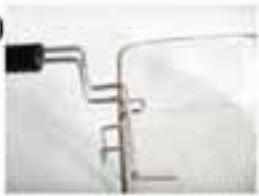
Place oil that is suitable for deep fat frying into the deep fat fryer. If hard vegetable fat is being used, proceed as follows: Place the pieces onto the heating element. set the control knob to ⏻ (heat) and melt the fat. Close lid to speed up melting process. You can also place the hard fat in the inner pot and liquefy this fat on the stove at a low temperature. Then put the pan back into the deep fat fryer housing (caution: hot) and suspend the heating element properly. This will prevent the overheating protection from being activated. However if this is activated anyway,
switch off, press the "Restart" button on the back of the electrical part with a 5mm diameter pen (e.g. tip of a ballpoint pen). Then allow the heating element to cool for a while and remove it from the guide rail on the outer casing. The overheating protection activates if the amount of fat in the device is below the minimum or the fat has become contaminated with too much food (e.g. breadcrumbs).
Connect power cable to the power supply. Check filling level.
The MAX mark must not be exceeded, and filling level must not drop below the Min mark. The heating element on the bottom of the container must always be covered with oil or liquid fat.
Never operate the device without fat or with an insufficient amount of fat.
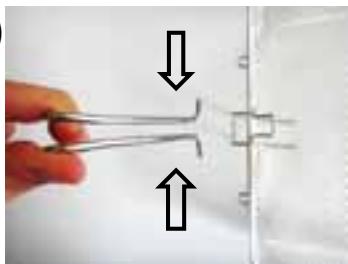
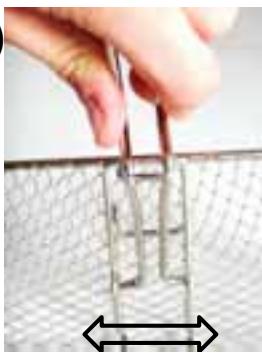
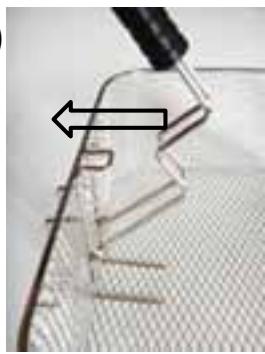
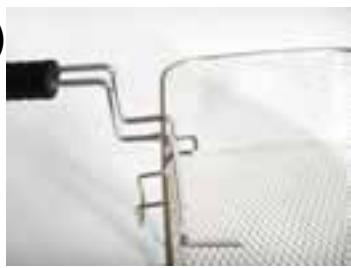
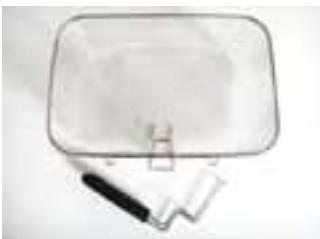
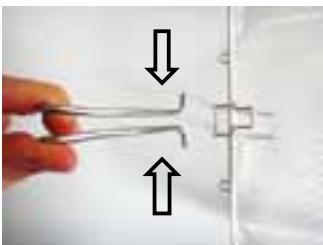
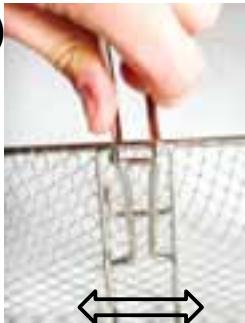
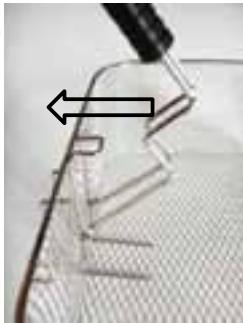
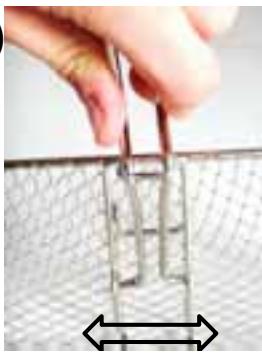
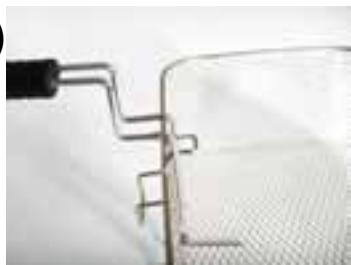
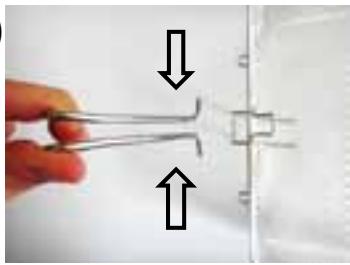
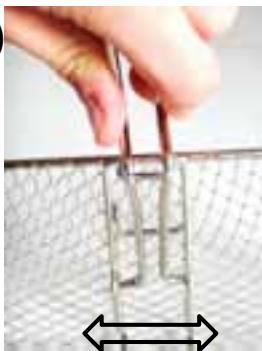
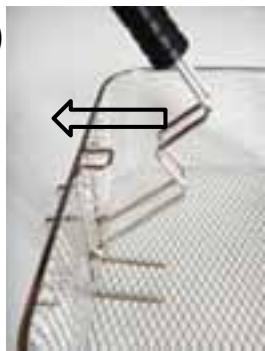
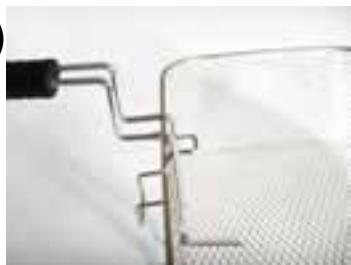
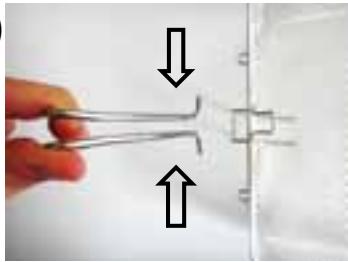
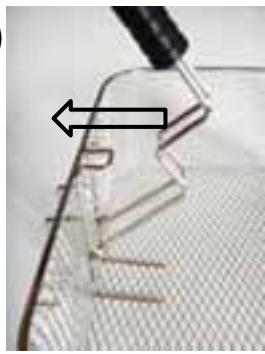
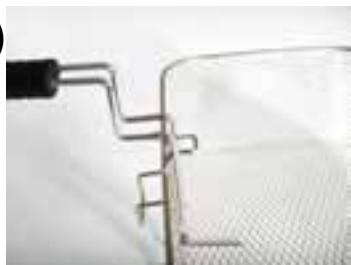
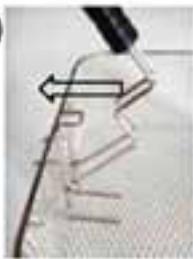
Assembly of the handle on the frying basket
1)
natural_image
Simple illustration of a transparent rectangular object with a small black tool and a white handle, no text or symbols present.2)
natural_image
Hand holding a tool with two arrows pointing to a mechanical component (no text or symbols visible)3)
natural_image
Close-up of a hand holding a small metal object over a mesh wire, with a double-headed arrow indicating measurement direction (no text or symbols)4)
natural_image
Close-up of a metal tool interacting with a mesh grid, showing a curved surface and a black arrow indicating direction (no text or symbols)5)

natural_image
Close-up of a metallic pipe or tube with a mesh pattern, no visible text or symbolsHeating up hardened fat in the deep fat fryer.
Risk of scalding!!!
Always proceed exactly as described in the following. Set control knob to ⚙ (heat) and melt slowly. The fat that has melted at the heating element is otherwise unable to penetrate the solid layer above it. If the overheating protection switches the device off, press the "Restart" button as described above.
Carefully make several holes in the fat using an object made from wood or plastic. Take care not to damage the heating element when doing this! Close the lid. Keep lid closed during the melting procedure in order to avoid spatter. No warranty will be given in the event of erroneous operation!

Make sure that there is enough fat in the appliance! Attention! Do not allow water to get into the oil!
Deep fat frying
Always use the basket for deep fat frying!
Switch in the device. The red light comes on. Set regulator to required temperature depending on what is being fried. The fryer starts to heat up. The light illuminates in green until the set temperature is reached. When the set frying temperature is reached, the green light goes off.
Place the prepared food into the frying basket and distribute over the entire surface. Do not place too much food in the fryer. Then slowly immerse the food in the fat. Close the filter lid again. The filter lid provides protection from fat spatter and reduces the smell of fat.
Observe the procedure through the inspection window. If the fat foams up excessively, open lid and raise and lower the basket several times by raising and lowering the handle until the foaming subsides. Keep the fryer closed during frying, which will prevent spatter and the frying fumes that are generated can be absorbed by the filter in the lid.
Baskets
The long basket is for fish or schnitzels and larger quantities. The smaller position baskets can be used for various food items.
Monitoring the deep fat frying procedure
The frying procedure can be monitored through the inspection window in the lid. Lifting the basket a little may give you a better view.
When the food is cooked
- Open lid.
- Caution - lid may be hot!
- Lift frying basket and hook onto edge of pan.
- Once the fat has drained, remove frying basket and empty. Do not season the food over the fryer - this will protect the fat and the fryer.
- If no more frying is being carried out, turn down the temperature and disconnect plug from power supply.
Deep fat frying table:
| Temperature setting | Food | Deep fat frying time in minutes * |
| Approx. 160°C - 170°C | Party pastries | 2-4 |
| Potato crisps | 2-4 | |
| Shellfish | 2-4 | |
| Poultry | 5-10 | |
| Potato dishes | 3-5 | |
| French fries | 5-8 | |
| Beef | 5-10 | |
| Schnitzels | 5-10 | |
| Fish | 5-7 | |
| Approx. 180°C - 190°C | Steaks | 1-3 |
| Kebabs | 2-3 | |
| Deep frozen food | in accordance with the information on the packing | |
| * This information is approximate and depends on the size, the weight and the temperature of the food. | ||
Danger of splashes!
To avoid splashes or foaming of the fat only use food which is not too wet (dry the food with cloth, remove ice from the food etc.). Insert the food slowly into the fryer. If the fat is foaming excessively, lift the basket several times. Never carry the fryer when there is hot oil inside. Danger of burns! Always cool down the fryer before moving it. Parts of the appliance, e.g. the upper edge of the oil tank or the steam escaping from the fryer can be very hot. Take care that nobody can rip at the power cord and pull the appliance from the table (especially children). To avoid this attach the power cord, e.g. to the leg of the table.
Important Tips:
According to the latest knowledge of researchers, following max. temperatures should be obeyed and all foods should be fried max to a gold colour:
170°C for all potatoes, breaded food and all other starch containing products
190°C for meat and poultry with no breading
150 - 160°C for breaded fish
In opposite to the tips on the packaging of frozen food we advise to defrost the food short before frying to avoid any ice inside the fryer.
After frying:
Remaining of breading or other food should be removed from the oil regularly.
- The fat should be cooled down after frying. Them the fat should be poured into a bowl. After that the fryer and the basket should be cleaned. Put a coffee filter paper into the basket and put the basket into the fryer and pour the fat slowly into the filter.
- At fish or meat the oil can be used 5-10 times. When potatoes are used the fat can be used longer.
Attention: Old or dirty fat can be inflamed when it is overheated, therefore it must be exchanged on time. In case of fire, pull the plug out of the socket and extinguish the fire by closing the lid. Never use water to extinguish the fire!
Always exchange the oil when it smells strange, is dark brown or starts smoking at low temperatures.
After deep fat frying:
Clean the fat
Residue from the coating or the food should be removed from the frying fat or oil at regular intervals. Any contamination or water is deposited in the "Cool Zone" beneath the heating elements and will not combust.
- First allow the fat to cool after frying, then carefully pour the fat into a metal pan with handles.
- Coating residue and water in the oil must be removed.
- Clean the frying basket and the pan (see paragraph "Cleaning and care").
- Hook frying basket onto fryer (draining position, place kitchen paper in basket as a filter).
- Slowly pour the fat back into the fryer through the filter paper.
- Only use the paper fat filter once.
If the fat has taken on a little taste, this can be improved by setting the temperature to just below 150^ C and putting a handful of spinach leaves, parsley, lettuce leaves or 2 potatoes that have been peeled, sliced and well dried into the hot fat and leaving them to brown. Remove and throw away the vegetables.
Storing oil or fat
If the fryer is used at regular intervals, the fat can be kept in the fryer with the lid closed. If the fryer is stored in a cool, dry location, the fat can be kept in the fryer for some weeks.
If you do not fry frequently, the filtered fat can be kept in a sealed container that is protected from the light.
The frying fat can be used for food such as fish or meat 5-10 times without problems. The fat is not as contaminated by potato dishes such as French fries or pastries, and can be therefore used more frequently.

Caution! Used or contaminated fat or oil can self-ignite if overheated, which is why the oil should be replaced in good time. In the event of a fire, disconnect the plug form the power supply and extinguish burning fat by covering with the lid. Never extinguish using water!
Replace the frying fat if:
- It has turned brown
• It has an unpleasant smell - Starts to smoke sooner than expected
Remove control panel with heater, remove container and pour the liquid oil that has not yet fully cooled down into a container with a closure. Used fat and oil should not be poured onto compost or down the drain. If large quantities are being produced, ask your local authority for the location of a collection point.
Practical tips for frying
Dry the food carefully before putting it into the fat, tap superfluous flour, press the breading firmly. Food containing much protein such as fish, poultry, meat and seafood can be fried in the raw if they are well dried. Food containing little protein such as vegetables and fruit should be coated with breadcrumbs or with batter, hereby the pores close quickly. The crust is also ideal for frying meat, poultry, fish and seafood.
Disposal:
Packaging disposal:
Do not throw away the package materials. Please put it in the recycling bin.


Gift box: Paper, should be put to the old paper collection point. Plastic packaging material and foils should be collected in the special collection containers.
Correct Disposal of this product
This marking indicates that this product should not be disposed with other household wastes throughout the EU. To prevent possible harm to the environment or human health from uncontrolled waste disposal, recycle it responsibly to promote the sustainable reuse of material resources. To return your used device, please use the return and collection systems or contact the retailer where the product was purchased. They can take this product for environmental safe recycling.
Service and Repair:
If the appliance must be repaired, plaese get in touch with your trader or with the manufacturer:
natural_image
Top-down view of a transparent plastic container with a black handle and a white handle, placed on a plain surface (no text or symbols visible)2)

natural_image
Close-up of a hand holding a tool with two arrows pointing to a mechanical component (no text or symbols visible)3)
natural_image
Close-up of a hand holding a metal wire mesh with a coiled wire, partially enclosed by a grid pattern (no text or symbols visible)4)

natural_image
Close-up of a metal tool interacting with a mesh surface, showing a curved edge and a black arrow indicating direction (no text or symbols)5)
natural_image
Close-up of a metal pipe or tube with a black handle, partially enclosed by a mesh grid (no text or symbols visible)natural_image
Top-down view of a transparent plastic container with a black handle and a small white handle attached (no text or symbols visible)2)
natural_image
Close-up of a hand holding two metal tools with arrows pointing to a mechanical component (no text or symbols visible)3)
natural_image
Close-up of a hand holding a small metal object over a mesh wire, with no visible text or symbols.4)
natural_image
Close-up of a metal tool interacting with a mesh surface, showing a curved edge and a black arrow indicating direction (no text or symbols)5)
natural_image
Close-up of a metal pipe or tube with a black handle, partially enclosed by a mesh grid (no text or symbols visible)RISCALDARE GRASSO SOLIDIFICATO NELLA FRIGGITRICE
natural_image
Top-down view of a transparent plastic container with a black handle and white handle, no text or symbols visible.2)
natural_image
Close-up of a hand holding a tool with two arrows pointing to a mechanical component (no text or symbols visible)3)

natural_image
Close-up of a hand holding a wire mesh with a coiled wire, partially enclosed by a mesh fence (no text or symbols visible)4)
natural_image
Close-up of a metal tool interacting with a mesh grid, showing a curved surface and an arrow indicating direction (no text or symbols)5)
natural_image
Close-up of a metal pipe or tube with a black handle, partially enclosed by a mesh grid (no text or symbols visible)Opvarmning af hårdt fedt i frituren
Risiko for skoldning!
natural_image
Simple line drawing of a rectangular object with a black handle and a small black object attached (no text or symbols)2)

natural_image
Hand holding a tool interacting with a mechanical component, no visible text or symbols3)

natural_image
Hand holding a wire or tool over a mesh grid, with no visible text or symbols4)
natural_image
Close-up of a mechanical component with a curved arrow indicating direction (no visible text or symbols)5)