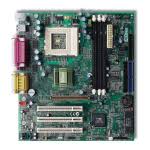
P5TCAQ - Motherboard AOPEN - Free user manual and instructions
Find the device manual for free P5TCAQ AOPEN in PDF.


| Product Type | Motherboard |
| Brand | AOPEN |
| Model | P5TCAQ |
| Chipset | Intel 430TX |
| Supported Processors | Intel Pentium (P54C/P55C) up to 200 MHz |
| Memory Type | SDRAM (3.3 V) or EDO (5 V) via DIMM/SIMM |
| L2 Cache | 512 KB onboard PBSRAM |
| IDE Connectors | Bus Master IDE (DMA) and Ultra DMA/33 |
| Expansion Slot | PCI, ISA (depending on version) |
| Required Power Supply | ATX with 3.3 V overcurrent protection |
| CPU Thermal Protection | Yes, throttling and warning at 55 °C |
| Overcurrent Protection | Yes, for 3.3 V and 2.8 V rails |
| Power Management | APM (Advanced Power Management) compatible with Windows 95 |
| Software Features | ADM (Advanced Desktop Manager) for system monitoring |
| Board Form Factor | ATX (estimated) |
| Maintenance | Regular dusting with compressed air, avoid humidity |
| BIOS | AOpen with DMI support |
| Included Utilities | AOchip.exe for USB and Ultra DMA/33 drivers |
Frequently Asked Questions - P5TCAQ AOPEN
User questions about P5TCAQ AOPEN
0 question about this device. Answer the ones you know or ask your own.
Ask a new question about this device
Download the instructions for your Motherboard in PDF format for free! Find your manual P5TCAQ - AOPEN and take your electronic device back in hand. On this page are published all the documents necessary for the use of your device. P5TCAQ by AOPEN.
USER MANUAL P5TCAQ AOPEN
Frequently Asked Question

Note: FAQ may be updated without notice. If you cannot find the information that you need in this appendix, visit our WWW home page, (address: http://www.aopen.com.tw) and check the FAQ area and other new information.
Q: How can I identify the mainboard BIOS version?
A: The AOpen mainboard BIOS version appears on the upper-left corner of the POST (Power-On Self Test) screen. Normally, it starts with R and is found in between the model name and the date. For example:

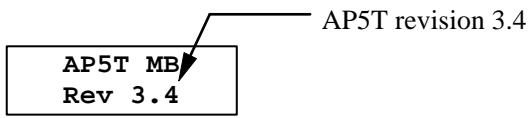
Q: How can I identify version of the mainboard?
A: The AOpen mainboard revision appears as Rev x.x on the PCB, near the PCI slot. For example, for AP5T revision 3.4, the revision number appears on the PCB as follows:
Q: Why the AOpen mainboards (MB) do not have cache module expansion slot?
A: Faster CPU speed requires more difficult and complex MB timing design. Every trace and components delay must be taken into consideration. The expansion cache slot design will cause 2 or 3ns delay in PBSRAM timing, and the extended trace length to the cache module through the golden finger will further delay the timing by 1 or 2ns. This may result in unreliable system once the cache module and slot becomes worn. All AOpen MBs support 512KB PBSRAM onboard. For better performance (around 3% higher than 256KB), we strongly recommend you to use 512KB onboard. Otherwise, reliable 256KB is better than unreliable 512KB with cache module. AOpen is the first company to promote this concept since the fourth quarter of 1995.
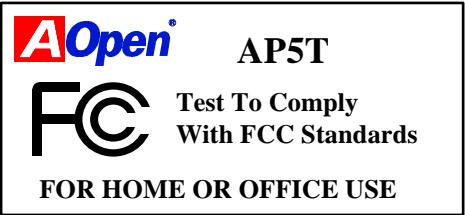
Q: What is FCC DoC (Declaration of Conformity)?
A: The DoC is new certification standard of FCC regulations. This new standard allows DIY component (such as mainboard) to apply DoC label separately without a shielding of housing. The rule to test mainboard for DoC is to remove housing and test it with regulation 47 CFR 15.31. The DoC test of mainboard is more difficult than traditional FCC test. If the mainboard passes DoC test, that means it has very low EMI radiation and you can use any kind of housing (even paper housing). Following is an example of DoC label.
Q: Can SDRAM DIMM work together with FPM/EDO SIMM?
A: The FPM/EDO operate at 5V while SDRAM operates at 3.3V . The current MB design provides different power to DIMM and SIMM but connects the data bus together. If you combine SIMM and DIMM, the system will still work fine; however, only temporarily. After a few months, the SDRAM 3.3V data input will be damaged by 5V FPM/EDO data output line. Therefore, we strongly NOT recommend DIMM and SIMM combined together. There is one exception, if your SDRAM supports 5V tolerance (such as TI or Samsung), which accepts 5V signal at 3.3V operating power, you can combine them.
| Manufacturer | Model | Suggested CAS Latency Time | 5V Tolerance |
| Samsung | KM416511220AT-G12 | 2 | Yes |
| NEC | D4S16162G5-A12-7JF | 2 | No |
| Hitachi | HM5216805TT10 | 2 | No |
| Fujitsu | 81117822A-100FN | 2 | No |
| TI | TMX626812DGE-12 | 2 | Yes |
| TI | TMS626812DGE-15 | 3 | Yes |
| TI | TMS626162DGE-15 | 3 | Yes |
| TI | TMS626162DGE-M67 | 3 | Yes |
Q: What is Bus Master IDE (DMA mode)?
A: The traditional PIO (Programmable I/O) IDE requires the CPU to involve in all the activities of the IDE access including waiting for the mechanical events. To reduce the workload of the CPU, the bus master IDE device transfers data from/to memory without interrupting CPU, and releases CPU to operate concurrently while data is transferring between memory and IDE device. You need the bus master IDE driver and the bus master IDE HDD to support bus master IDE mode. Note that it is different with master/slave mode of the IDE device connection. For more details, refer to section 2.3 "Connectors".
Q: What is 3.3V Over-current Protection?
A: The Over-current Protection was very popular implemented on the Baby AT or ATX +5V/+12V switching power supply. It is very useful to prevent accident short circuit when you install the mainboard, HDD, add-on cards into housing. But unfortunately, the new generation CPU and chipset use 3.3V or 2.8V voltage which has regulator to transfer 5V to 3.3V/2.8V, and makes 5V over-current protection useless. AOpen TX mainboard AP5T/AX5T with switching regulator onboard support 3.3V (Vcpuio, chipset, PBSRAM, SDRAM) and 2.8V (CPU Vcore) over-current protection, in conjunction with 5V/12V power supply provide the full line over-current protection.
Q: What is CPU Thermal Protection?
A: The higher speed of CPU, the more heat dissipation need to be taking into consideration. If user does not use correct fan for the CPU cooling, it is highly possible the CPU can over heat and causing system unstable. AOpen AP5T/AX5T/AX6F has special thermal detection circuit under the
CPU, and slow down the CPU speed as well as warning when temperature is high then a predefined temperature. (Normally, 55 degree C.)
Q: What is the Ultra DMA/33?
A: This is the new specification to improve IDE HDD data transfer rate. Unlike traditional PIO mode, which only uses the rising edge of IDE command signal to transfer data, the DMA/33 uses both rising edge and falling edge. Hence, the data transfer rate is double of the PIO mode 4 or DMA mode 2. (16.6MB/s x2 = 33MB/s).
The following table lists the transfer rate of IDE PIO and DMA modes. The IDE bus is 16-bit, which means every transfer is two bytes.
| Mode | Clock per 33MHz PCI | Clock count | Cycle time | Data Transfer rate |
| PIO mode 0 | 30ns | 20 | 600ns | (1/600ns) x 2byte = 3.3MB/s |
| PIO mode 1 | 30ns | 13 | 383ns | (1/383ns) x 2byte = 5.2MB/s |
| PIO mode 2 | 30ns | 8 | 240ns | (1/240ns) x 2byte = 8.3MB/s |
| PIO mode 3 | 30ns | 6 | 180ns | (1/180ns) x 2byte = 11.1MB/s |
| PIO mode 4 | 30ns | 4 | 120ns | (1/120ns) x 2byte = 16.6MB/s |
| DMA mode 0 | 30ns | 16 | 480ns | (1/480ns) x 2byte = 4.16MB/s |
| DMA mode 1 | 30ns | 5 | 150ns | (1/150ns) x 2byte = 13.3MB/s |
| DMA mode 2 | 30ns | 4 | 120ns | (1/120ns) x 2byte = 16.6MB/s |
| DMA/33 | 30ns | 4 | 120ns | (1/120ns) x 2byte x2 = 33MB/s |
Q: What is the performance of Ultra DMA/33? Do we need special driver?
A: You need driver to activate DMA/33, there are now driver from INTEL or you can use driver in the Windows 95 Memphis, which can recognize South Bridge PIIX4.
We got the mass production sample Quantum Fireball ST1.6A, following are the test result.
MB : AOpen AP5T
CPU : P54C-200 Mhz
DRAM : 16MB*2 (FP-7)
VGA : AOpen PV60
CDROM : AOpen CD-920E (20X)
OS : Win95 OSR2
| Model | OS/Driver | Mode | Winbench97 Disk Winmark (Business) | Winbench97 Disk Winmark (High End) |
| Quantum Fireball 1.2G | Windows 95 OSR2 | PIO mode 4 | 717 | 2150 |
| Quantum Fireball 1.2G | Windows 95 OSR2 + INTEL PIIX4 driver | DMA mode 2 | 822 | 3050 |
| Quantum ST1.6A | Windows 95 OSR2 | PIO mode 4 | 853 | 2630 |
| Quantum ST1.6A | Windows 95 OSR2 + INTEL PIIX4 driver | DMA/33 | 1040 | 4020 |
Q: What is the memory performance improvement of TX chipset?
A: Following is the compare table of TX+SDRAM, VX+SDRAM, TX+EDO, HX+EDO and VX+EDO.
CPU : Pentium PP/MT (P55C) 200MHz
DRAM :16MB EDO or SDRAM
HDD : Quantum Fireball 1280AT
VGA : AOpen PV60 S3 Trio64V+ 800x600x256 Small font
OS :Windows95OSR2
| Chipset | Model | DRAM | Timing | Winstone9 6 |
| Intel 430VX | AP5VM | EDO | 6-2-2-2 | 86.1 |
| Intel 430HX | AP53/AP5K | EDO | 5-2-2-2 | 86.8 |
| Intel 430TX | AP5T/AX5T | EDO | 5-2-2-2 | 87.3 |
| Intel 430VX | AP5VM/AP5V | SDRAM | 6-1-1-1 | 86.6 |
| Intel 430TX | AP5T/AX5T | SDRAM | 5-1-1-1 | 87.7 |
Q: Power Management Icon does not appear in the Windows 95 Control Panel even though the APM under BIOS Setup is enabled.
A: This problem occurs if you did not enable the APM function before you install Windows 95. If you have already installed Windows 95, re-install it after the BIOS APM function is enabled.
Q: Why does the system fail to go into suspend mode under Win95?
A: This problem may be caused by your CDROM settings. The CDROM Auto Insert Notification of Win95 is default enabled, the system will continue to monitor your CDROM, auto-execute application when a CD diskette is loaded, and prevents the system from entering into suspend mode. To resolve this, go into Control Panel System Device Manager CDROM Setting, and disable the "Auto Insert Notification" function.
Q: How can I eliminate the "?" marks presented under Device Manager after installing Win'95 on TX or LX based system?
A: Although your system will still work fine with this "?" exist. We received many requests about how to eliminate it. AOpen software team spends few weeks to develop an utility AOchip.exe for convenience of Win95 users. It is very user friendly and can be used on any TX or LX motherboard, not limited to Aopen's products. You are welcome to distribute it, if you like it, simply say thanks to our software team. Note that you need USB driver for USB devices to work properly, which is expected to be implemented on Windows'98.
Q: Why are there question marks or "standard IDE controller" presented under Device Manager after installing Win'95 on TX or LX based system?
A: Intel has introduced 430TX or 440LX chipset with latest feature of "ACPI", "USB" & "Ultra DMA/33". Since these devices are so new that Win'95 did not anticipate to support them on Aug. of '95 which Win'95 initially is being released. To eliminate, you may run AOchip.exe developed by AOpen software team. Drivers for above new features are expected to be implemented in Windows'98.
Q: How to install Windows 95 USB driver?
A: If you are Win'95 OSR 2.0 user (.950B, shows "PCI Universal Serial Devices"), you may obtain USBSUPP.EXE from Microsoft or your OEM system provider for installing Microsoft USB supplement which will create "USB Supplement to OSR2" in the list of Add/Remove program tool under Control Panel. After above installation, please run AOchip.exe provided by AOpen to create USB Controller under Device Manager.
If you are Win'95 OSR 2.1 user, only AOchip.exe installation is necessary.
If you are Win'95 retail user (.950 or .950A), there is no direct upgrade path available from Microsoft at this moment. It is expected to be implemented under Windows'98.
Q: Which version of the Windows '95 that I am using?
A: You may determine the version of Windows '95 by following steps.
- Double click "System" in "Control Panel".
- Click "General".
- Look for "System" heading & refer to following,
4.00.950 Windows 95
4.00.950A Windows 95 + Service Pack or OEM Service Release 1
4.00.950B OEM Service Release 2 or OEM Service Release 2.1
If you are running OSR 2.1, you may tell it from by checking "USB Supplement to OSR2" in the list of installed program of Add/Remove program tool under Control Panel, and checking for version 4.03.1212 of the Ntkern.vxd file in the Windows\System\Vmm32 folder.
Q: What is LDCM (LAN Desktop Client Manager)?
A: This is a software of Intel. The major goal is to provide an easy way for corporate network administrator to monitor the status of all the clients (workstation). You need at least DMI BIOS for LDCM. AOpen BIOS is also DMI ready but unfortunately, Intel LDCM needs Intel network card to work properly. It is obviously not suitable for home user to pay LDCM extra cost.
Q: What is ADM (Advanced Desktop Manager)?
A: This is a desktop client and server management software developed by AOpen. It is similar as Intel LDCM with some improvement. ADM is not only for corporate network management, it can also be used as system status monitoring utility, for example, CPU fan, thermal and system voltage monitoring.
| Features | ADM 2.0 | LDCM 3.0 |
| VGA card | No limitation | Only ATI |
| Network card | No limitation | Only Intel |
| Support DMI BIOS 2.0 | Yes | Yes |
| Support Win95 | Yes | Yes |
| Support Win NT | No (will be supported on ADM 2.1) | Yes |
| Real-Time CPU/Memory Utilization Monitoring | Yes | No |
| Multi-Machine Monitoring on One Screen | Yes | No |
| Remote Management Protocol | Standard SNMP protocol | Intel proprietary RAP protocol |
| Standard SNMP Trap | Yes (so that can work with standard software such as HP Open View) | No |
| Remote File Transfer | No | Yes |

- Frequently Asked Question
- Q: How can I identify the mainboard BIOS version?
- Q: How can I identify version of the mainboard?
- Q: What is Bus Master IDE (DMA mode)?
- Q: What is 3.3V Over-current Protection?
- Q: What is CPU Thermal Protection?
- Q: What is the Ultra DMA/33?
- Q: What is the performance of Ultra DMA/33? Do we need special driver?
- Q: What is the memory performance improvement of TX chipset?
- Q: Power Management Icon does not appear in the Windows 95 Control Panel even though the APM under BIOS Setup is enabled.
- Q: Why does the system fail to go into suspend mode under Win95?
- Q: How can I eliminate the "?" marks presented under Device Manager after installing Win'95 on TX or LX based system?
- Q: Why are there question marks or "standard IDE controller" presented under Device Manager after installing Win'95 on TX or LX based system?
- Q: How to install Windows 95 USB driver?
- Q: Which version of the Windows '95 that I am using?
- Q: What is LDCM (LAN Desktop Client Manager)?
- Q: What is ADM (Advanced Desktop Manager)?
Brand : AOPEN
Model : P5TCAQ
Category : Motherboard