
CI 66 MI - Cooker SCHOLTES - Free user manual and instructions
Find the device manual for free CI 66 MI SCHOLTES in PDF.



| Product type | Cooker |
| Brand | SCHOLTES |
| Model | CI 66 MI |
| Oven dimensions (H x W x D) | 32 x 43.5 x 40 cm |
| Oven volume | 157 L |
| Useful dimensions of the warming drawer | Width 42 cm, Depth 44 cm, Height 8.5 cm |
| Burner type | Gas adaptable to all types (LPG and natural) |
| Cooking hob | Gas burners + electric hotplate (depending on model) |
| Oven functions | Traditional, Multi-level, Rotisserie, Spit roaster, Low temperature, Automatic programs (Pizza, Bread, Cakes) |
| Automatic cleaning | Pyrolysis (3 levels: Eco, Normal, Intensive) |
| Oven lighting | 15 W bulb, E14 base |
| Safety | Flame safety device, door lock during pyrolysis, automatic cut-off |
| Electrical supply | 230 V - 50 Hz (see rating plate) |
| Gas supply | Connection possible to natural gas or LPG |
| Installation | Free-standing or built-in between two cabinets (class 1 or 2 subclass 1) |
| Maintenance | Manual cleaning of burners and grills, pyrolysis for the oven, check seals |
| Spare parts | Injectors, bulbs, seals, accessories available through approved after-sales service |
| Repairability | Service reserved for an approved technician |
| General information | Downloadable user manual free of charge, FAQs available online |
Frequently Asked Questions - CI 66 MI SCHOLTES
User questions about CI 66 MI SCHOLTES
0 question about this device. Answer the ones you know or ask your own.
Ask a new question about this device
Download the instructions for your Cooker in PDF format for free! Find your manual CI 66 MI - SCHOLTES and take your electronic device back in hand. On this page are published all the documents necessary for the use of your device. CI 66 MI by SCHOLTES.
USER MANUAL CI 66 MI SCHOLTES
Operating Instructions
COOKER AND OVEN
Contents
Operating Instructions,1
Warning,1
Description of the appliance-Overall view,7
Description of the appliance-Control Panel,8
Assistance,10
Installation,24
Start-up and use,28
Cooking modes,30
Using the hob,31
Precautions and tips,34
Care and maintenance,35
NL
Nederland
Gebruiksaanwijzing
FORNUIS EN OVEN
Inhoud
WARNING: The appliance and its accessible parts become hot during use.
Care should be taken to avoid touching heating elements.
Children less than 8 years of age shall be kept away unless continuously supervised.
This appliance can be used by children aged from 8 years and above and persons with reduced physical, sensory or mental capabilities or lack of experience and knowledge if they have been given supervision or instruction concerning use of the appliance in a safe way and understand the hazards involved. Children shall not play with the appliance. Cleaning and user maintenance shall not be made by children without supervision.
WARNING: Unattended cooking on a hob with fat or oil can be dangerous and may result in fire.
NEVER try to extinguish a fire with water, but switch off the appliance and then cover flame e.g. with a lid or a fire blanket.
WARNING: Danger of fire: do not store items on the cooking surfaces.
WARNING: If the surface in glass-ceramic is cracked, switch off the appliance to avoid the possibility of electric shock.
Do not use harsh abrasive cleaners or sharp metal scrapers to clean the oven door glass since they can scratch the surface, which may result in shattering of the glass.
The internal surfaces of the
compartment (where present) may
become hot.
Never use steam cleaners or pressure
cleaners on the appliance.
Remove any liquid from
the lid before opening it.
Do not close the glass cover (if present) when the gas burners or electric hotplates are still hot.
WARNING: Ensure that the appliance is switched off before replacing the lamp to avoid the possibility of electric shock.
CAUTION: the use of inappropriate hob guards can cause accidents.
Description of the appliance
Overall view
- Hob burner
2.Hob Grid - Control panel
4.Sliding grill rack
5.DRIPPING pan - Adjustable foot
7.ELECTRIC HOTPLATE
8.Containment surface for spills
9.GUIDE RAILS for the sliding racks
10.position 5
11.position 4
12.position 3
13.position 2
14.position 1
15.Glass Cover *(Available only on certain models)
FR
Description of the appliance Control panel
- SELECTOR knob
- THERMOSTAT/TIMER knob
- PYROLITIC CYCLE button
- DISPLAY
- INDICATOR LIGHT for ELECTRIC HOTPLATE
- THERMOSTAT indicator light
- HOB BURNER and ELECTRIC HOTPLATE control cnobs

The appliance is fitted with an automatic diagnostic system which detects any malfunctions.
Malfunctions are displayed by messages of the following type: “F” followed by numbers.
Call for technical assistance in the event of a malfunction.
! Never use the services of an unauthorised technician.
Please have the following information to hand:
- The type of problem encountered.
- The appliance model (Mod.).
- The serial number (S/N).
The latter two pieces of information can be found on the data plate located on the appliance.
FR
Assistance
Attention :
CI 66 MWS
CI 66 M A S
CI66MIS
! Please keep this instruction booklet in a safe place for future reference.. Make sure the booklet remains with the appliance if it is sold, given away or moved.
! Please read this manual carefully: it contains important information on installation, operation and safety.
! The appliance must be installed by a qualified professional in accordance with the instructions provided.
! Any necessary adjustment or maintenance must be performed after the cooker has been disconnected from the electricity supply.
Room ventilation
The appliance may only be installed in permanentlyventilated rooms, according to current national legislation and any subsequent amendments in force. The room in which the appliance is installed must be ventilated adequately in order to provide as much air as is needed by the normal gas combustion process (the flow of air must not be lower than 2m^3 /h per kW of installed power).
The air inlets, protected by grilles, should have a duct with an inner cross section of at least 100~cm^2 and should be positioned so that they are not liable to even partial obstruction (see figure A). These inlets should be enlarged by 100% - with a minimum of 200~cm^2 - whenever the surface of the hob is not equipped with a flame failure safety device. When the flow of air is provided in an indirect manner from adjacent rooms (see figure B), provided that these are not communal parts of a building, areas with increased fire hazards or bedrooms, the inlets should be fitted with a ventilation duct leading outside as described above.
Adjacent room Room requiring ventilation
A
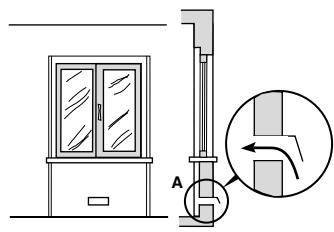
Ventilation opening for comburent air
B
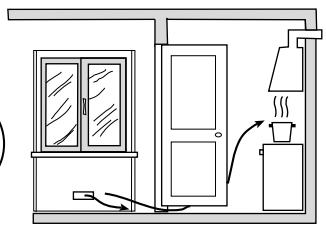
Increase in the gap between the door and the flooring
! After prolonged use of the appliance, it is advisable to open a window or increase the speed of any fans used.
Disposing of combustion fumes
The efficient removal of combustion fumes should be guaranteed using a hood which is connected to a safe and efficient natural suction chimney, or using an electric fan which begins to operate automatically every time the appliance is switched on (see figure).
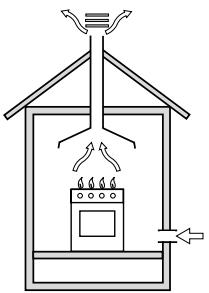
Fumes channelled straight outside
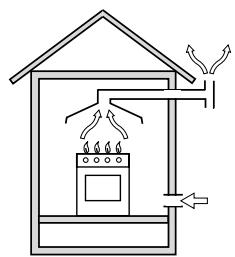
Fumes channelled through a chimney or a branched flue system (reserved for cooking appliances)
! The liquefied petroleum gases are heavier than air and collect by the floor, therefore all rooms containing LPG cylinders must have openings leading outside so that any leaked gas can escape easily.
LPG cylinders, therefore, whether partially or completely full, must not be installed or stored in rooms or storage areas which are below ground level (cellars, etc.). Only the cylinder currently in use should be stored in the room; this should also be kept well away from sources of heat (ovens, chimneys, stoves) which may cause the temperature of the cylinder to rise above 50^ .
Positioning and levelling
! The appliance may be installed alongside any cupboards whose height does not exceed that of the hob surface.
! Make sure that the wall which is in contact with the back of the appliance is made from a nonflammable, heat-resistant material (T 90^ ).
To install the appliance correctly:
- Place it in the kitchen, the dining room or the studio flat (not in the bathroom).
- If the top of the hob is higher than the cupboards, the appliance must be installed at least 600 ~mm away from them.
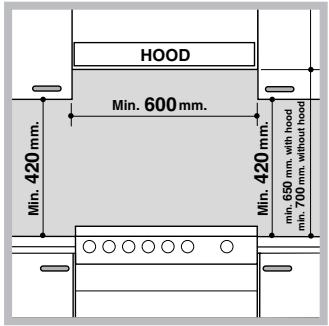
- If the cooker is installed underneath a wall cabinet, there must be a minimum distance of 420~mm between this cabinet and the top of the hob.
This distance should be increased to 700 mm if the wall cabinets are flammable (see figure).
- Do not position blinds behind the cooker or less than 200 ~mm away from its sides.
- Any hoods must be installed in accordance with the instructions listed in the relevant operating manual.
Levelling
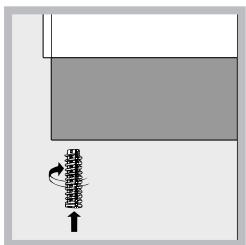
If it is necessary to level the appliance, screw the adjustable feet into the positions provided on each corner of the base of the cooker (see figure).
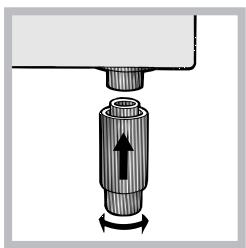
The legs* fit into the slots on the underside of the base of the cooker.
Electrical connection
Install a standardised plug corresponding to the load indicated on the appliance data plate (see Technical data table).
The appliance must be directly connected to the mains using an omnipolar switch with a minimum contact opening of 3 ~mm installed between the appliance and the mains. The switch must be suitable for the charge indicated and must comply with current electrical regulations (the earthing wire must not be interrupted by the switch). The supply cable must be positioned so that it does not come into contact with temperatures higher than 50^ C at any point.
- Only available in certain models.
Before connecting the appliance to the power supply, make sure that:
- The appliance is earthed and the plug is compliant with the law.
- The socket can withstand the maximum power of the appliance, which is indicated by the data plate.
- The voltage falls between the values indicated on the data plate.
- The socket is compatible with the plug of the appliance. If the socket is incompatible with the plug, ask an authorised technician to replace it. Do not use extension cords or multiple sockets.
! Once the appliance has been installed, the power supply cable and the electrical socket must be easily accessible.
! The cable must not be bent or compressed.
! The cable must be checked regularly and replaced by authorised technicians only.
! The manufacturer declines any liability should these safety measures not be observed.
Gas connection
Connection to the gas network or to the gas cylinder may be carried out using a flexible rubber or steel hose, in accordance with current national legislation and any subsequent amendments in force, after making sure that the appliance is suited to the type of gas with which it will be supplied (see the rating sticker on the cover: if this is not the case see below). When using liquid gas from a cylinder, install a pressure regulator which complies with current national regulations and any subsequent amendments in force. To make connection easier, the gas supply may be turned sideways*: reverse the position of the hose holder with that of the cap and replace the gasket supplied with the appliance.
! Make sure that the gas supply pressure is consistent with the values indicated in the Table of burner and nozzle specifications (see below). This will ensure the safe operation and durability of your appliance while maintaining efficient energy consumption.
Gas connection using a flexible rubber hose
Make sure that the hose complies with current national legislation. The internal diameter of the hose must measure: 8 mm for a liquid gas supply; 13 mm for a methane gas supply.
GB
Once the connection has been performed, make sure that the hose:
- Does not come into contact with any parts which reach temperatures of over 50^ .
- Is not subject to any pulling or twisting forces and that it is not kinked or bent.
- Does not come into contact with blades, sharp corners or moving parts and is not compressed.
- Is easy to inspect along its whole length so that its condition may be checked.
Is shorter than 1500 mm. - Fits firmly into place at both ends, where it will be fixed using clamps which comply with current national regulations.
! If one or more of these conditions is not fulfilled or if the cooker must be installed in accordance with the conditions listed for class 2 - subclass 1 appliances (installed between two cupboards), the flexible steel hose must be used instead (see below).
Connecting a flexible jointless stainless steel pipe to a threaded attachment
Make sure that the hose complies with current national regulations and that the aluminium gaskets comply with UNI 9001-2, or the rubber gaskets comply with current national regulations.
To begin using the hose, remove the hose holder on the appliance (the gas supply inlet on the appliance is a cylindrical threaded 1/2 gas male attachment).
! Perform the connection in such a way that the hose length does not exceed a maximum of 2 metres, making sure that the hose is not compressed and does not come into contact with moving parts.
Checking the connection for leaks
When the installation process is complete, check the hose fittings for leaks using a soapy solution. Never use a flame.
Adapting to different types of gas
It is possible to adapt the appliance to a type of gas other than the default type (this is indicated on the rating label on the cover).
Adapting the hob
Replacing the nozzles for the hob burners:
- Remove the hob grids and slide the burners off their seats.
-
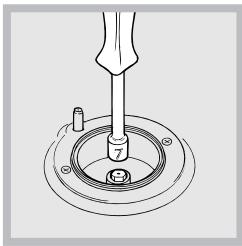
Unscrew the nozzles using a 7 mm socket spanner (see figure), and replace them with nozzles suited to the new type of gas (see Table of burner and nozzle specifications).
-
Replace all the components by following the above
instructions in reverse.
Adjusting the hob burners' minimum setting:
- Turn the tap to the minimum position.
- Remove the knob and adjust the regulatory screw, which is positioned inside or next to the tap pin, until the flame is small but steady.
! If the appliance is connected to a liquid gas supply, the regulatory screw must be fastened as tightly as possible.
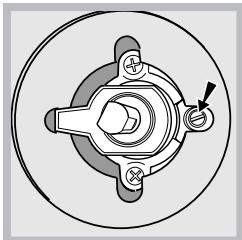
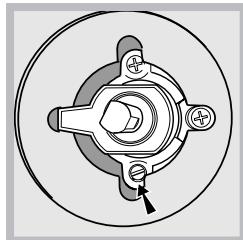
- While the burner is lit, quickly change the position of the knob from minimum to maximum and vice versa several times, checking that the flame is not extinguished.
! The hob burners do not require primary air adjustment.
! After adjusting the appliance so it may be used with a different type of gas, replace the old rating label with a new one which corresponds to the new type of gas (these labels are available from Authorised Technical Assistance Centres).
! Should the gas pressure used be different (or vary slightly) from the recommended pressure, a suitable pressure regulator must be fitted to the inlet hose in accordance with current standards EN 88-1 and EN 88-2 relating to "regulators for channelled gas".
Table of burner and nozzle specifications
GB
| Table 1 | Liquid gas | Natural gas | |||||||
| Burner | Diameter (mm) | Heating power kW (p.c.s.*) Nomin. | Red. | Bypass 1/100 (mm) | Nozzle 1/100 (mm) | Flow rate* g/h *** | *** | Nozzle 1/100 (mm) | Flow rate* l/h |
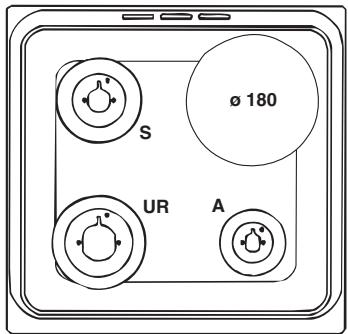
| Ultra rapid (Large) (UR) | 100 | 3.30 | 0.7 | 41 | 91 | 240 | 236 | 123 | 314 |
| Semi-rapid (Medium) (S) | 75 | 1.90 | 0.4 | 30 | 70 | 138 | 136 | 106 | 181 |
| Auxiliary (Small) (A) | 55 | 1.00 | 0.4 | 30 | 50 | 73 | 71 | 79 | 95 |
| Supply pressure | Nominal (mbar) | 28-30 | 37 | 20 | |||||
| Minimum (mbar) | 20 | 25 | 17 | ||||||
| Maximum (mbar) | 35 | 45 | 25 | ||||||
- At 15^ and 1013 mbar- dry gas
** Propane P.C.S. = 50.37 MJ/kg
**
Butane
P.C.S. = 49.47 MJ/kg
Natural
P.C.S. = 37.78 MJ/m³
CI 66 MWS
CI 66 M A S
CI66MIS
| TABLE OF CHARACTERISTICS | |
| Oven dimensions (HxWxD) | 32x43.5x40 cm |
| Volume | 57 l |
| Useful measurements relating to the oven compartment | width 42 cm depth 44 cm height 8.5 cm |
| Burners | may be adapted for use with any type of gas shown on the data plate |
| Voltage and frequency | see data plate |
| ENERGY LABEL | Directive 2002/40/EC on the label of electric ovens. Standard EN 50304 Energy consumption for Natural convection – heating mode: Convection mode Declared energy consumption for Forced convection Class – heating mode: Roasting |
| CE | EC Directives: 2006/95/CE dated 12.12.06 (Low Voltage) and subsequent amendments - 2004/108/CE dated 15/12/04 (Electromagnetic Compatibility) and subsequent amendments - 2009/142/EC dated 30/11/09 (Gas) and subsequent amendments - 93/68/EEC dated 22/07/93 and subsequent amendments - 2002/96/EC. 1275/2008 (Stand-by/Off mode) |
Data plate, is located inside the flap or, after the oven compartment has been opened, on the left-hand wall inside the oven.
GB
Using the hob
Lighting the burners
For each BURNER knob there is a complete ring showing the strength of the flame for the relevant burner.
To light one of the burners on the hob:
- Bring a flame or gas lighter close to the burner.
- Press the BURNER knob and turn it in an anticlockwise direction so that it is pointing to the maximum flame setting .
- Adjust the intensity of the flame to the desired level by turning the BURNER knob in an anticlockwise direction. This may be the minimum setting , the maximum setting or any position in between the two.
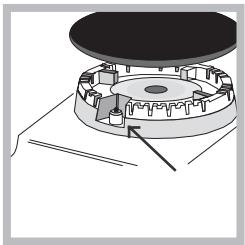
If the appliance is fitted with an electronic lighting device* (see figure), press the BURNER knob and turn it in an anticlockwise direction, towards the minimum flame setting, until the burner is lit. The burner might be
extinguished when the knob is released. If this occurs, repeat the process, holding the knob down for a longer period of time.
! If the flame is accidentally extinguished, switch off the burner and wait for at least 1 minute before attempting to relight it.
If the appliance is equipped with a flame failure safety device*, press and hold the BURNER knob for approximately 2-3 seconds to keep the flame alight and to activate the device.
To switch the burner off, turn the knob until it reaches the stop position.
Advice when using burners
For the burners to work in the most efficient way possible and to save on the amount of gas consumed, it is recommended that only pans which have a lid and a flat base are used. They should also be suited to the size of the burner.
| Burner | Ø Cookware Diameter (cm) |
| Ultra rapid (UR) | 24 – 26 |
| Semi-rapid (S) | 16 – 20 |
| Auxiliary (A) | 10 – 14 |
To identify the type of burner, please refer to the diagrams contained in the paragraph "Burner and nozzle specifications."
! For models equipped with a reducer grid, the latter must be used only for the auxiliary burner, when pans with a diameter of less than 12cm are used.
Electric hotplates*
The corresponding knob may be turned clockwise or anti-clockwise and set to six different positions:
| Setting | Normal or Fast Plate |
| 0 | Off |
| 1 | Low |
| 2 - 5 | Medium |
| 6 | High |
When the selector knob is in any position other than the off position, the 'on' light comes on.
Setting the clock
! The clock may be set when the oven is switched off or when it is switched on, provided that the end time of a cooking cycle has not been programmed previously.
- Press the button several times until the icon and the first two numerical digits on the display start to flash.
- Turn the TIMER KNOB towards “+” and “-” to adjust the hour value.
- Press the button again until the other two digits on the DISPLAY begin to flash.
- Turn the TIMER KNOB towards “+” and “-” to adjust the minute value.
- Press the button again to confirm.
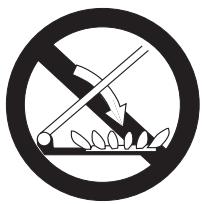
WARNING! The glass lid can break in if it is heated up. Turn off all the burners and the electric plates before closing the lid. *Applies to the models with glass cover only.
- Only available in certain models.
Setting the timer
! This function does not interrupt cooking and does not affect the oven; it is simply used to activate the buzzer when the set amount of time has elapsed.
- Press the button several times until the icon and the three numerical digits on the DISPLAY begin to flash.
- Turn the TIMER KNOB towards “+” and “-” to adjust the minute value.
- Press the button again to confirm. The display will then show the time as it counts down. When this period of time has elapsed the buzzer will be activated.
Using the oven
! Before operating the product, remove all plastic film from the sides of the appliance.
! The first time you use your appliance, heat the empty oven with its door closed at its maximum temperature for at least half an hour. Make sure that the room is well ventilated before switching the oven off and opening the oven door. The appliance may emit a slightly unpleasant odour caused by protective substances used during the manufacturing process burning away.
- Select the desired cooking mode by turning the SELECTOR knob.
- The oven begins its preheating stage and the preheating indicator lights up. The temperature may be changed by turning the THERMOSTAT knob
- When the preheating indicator . switches off and a buzzer sounds the preheating process is complete: you may now place the food in the oven.
- During cooking it is always possible to:
- Change the cooking mode by turning the SELECTOR knob.
- Change the temperature by turning the THERMOSTAT knob.
- Set the cooking duration and the cooking end time (see Cooking modes).
-
Stop cooking by turning the SELECTOR knob to the "0" position.
-
The cooking time may be modified (see Cooking Modes).
- If a blackout occurs while the oven is already in operation, an automatic system within the appliance will reactivate the cooking mode from the point at which it was interrupted, provided that the temperature has not dropped below a certain level. Programmed cooking modes which have not started will not be restored and must be reprogrammed.
! There is no preheating stage for the ROASTING and BARBECUE modes.
! Never put objects directly on the bottom of the oven; this will prevent the enamel coating from being damaged.
! Always place cookware on the rack(s) provided.
Cooling ventilation
In order to cool down the external temperature of the oven, a cooling fan blows a stream of air between the control panel and the oven door. At the beginning of the PYROLYTIC cycle, the cooling fan operates at low speed.
! Once cooking has been completed, the cooling fan remains on until the oven has cooled down sufficiently.
Oven light
When the oven is not in operation, the lamp can be switched on at any time by opening the oven door.
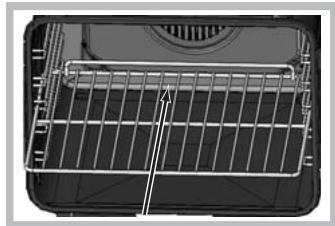
! When inserting the shelf make sure the backstop is at the rear of the cavity (see image).
GB
Manual cooking modes
! All cooking modes have a default cooking temperature which may be adjusted manually to a value between 40^ and 250^ as desired. In the SPIT ROAST mode, the default power level value is 270^ .

TRADITIONAL OVEN mode
When using this traditional cooking mode, it is best to use one cooking rack only.

MULTILEVEL mode
Since the heat remains constant throughout the oven, the air cooks and browns food in a uniform manner. A maximum of two racks may be used at the same time.

ROASTING mode
This combination of features increases the effectiveness of the unidirectional thermal radiation provided by the heating elements through the forced circulation of the air throughout the oven. This helps prevent food from burning on the surface and allows the heat to penetrate right into the food. Always cook in this mode with the oven door closed.

SPIT ROAST mode
The function is ideal for rotisserie spit cooking. Always cook in this mode with the oven door closed.

LOW TEMPERATURE modes
This type of cooking can be used for proving, defrosting, preparing yoghurt, heating dishes at the required speed and slow cooking at low temperatures. The temperature options are: 40, 65, 90^ .
Spit roast
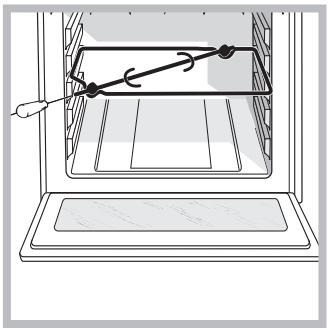
To operate the spit roast function (see diagram) proceed as follows:
- Place the dripping pan in position 1.
- Place the rotisserie support in position 3 and insert the spit in the hole provided on the back panel of the
oven.
- Start the spit roast function by selecting the symbols.

! When this mode is enabled, the rotisserie spit will stop if the door is opened.
Automatic cooking modes
! The temperature and cooking duration are pre-set values, guaranteeing a perfect result every time - automatically. These values are set using the C.O.P.®
(Programmed Optimal Cooking) system. The cooking cycle stops automatically and the oven indicates when the dish is cooked. The cooking duration may be modified by a period of several minutes, as specified in the description of the individual functions below.

PIZZA mode
Use this function to make pizza. Please see the following chapter for further details. It will only be possible to adjust the duration by -5 / + 5 minutes.
To achieve the best possible results, we recommend that you carefully observe the instructions below:
- Follow the recipe.
- The weight of the dough should be between 500g and 700g .
- Lightly grease the dripping pan and the baking trays. Place the food inside the oven while it is still cold. If you wish to place the food in the oven after it has been preheated, immediately following a high-temperature cooking programme, the text "Hot" will appear on the display until the temperature of the oven has fallen to 120^ . At this point it will be possible to place the pizza in the oven.
Recipe for PIZZA:
1 Dripping pan on a low shelf level, hot or cold oven. Recipe for 3 pizzas weighing approximately 550 g: 1000 g flour, 500 ml water, 20 g salt, 20 g sugar, 100 ml olive oil, 20 g fresh yeast (or 2 sachets of powder yeast)
- Leavening at room temperature: 1 hour, or LOW TEMPERATURE manual function set to 40^ . Leave to rise for approximately 30-45 minutes.
- Place the food inside the oven while it is still cold.
- Start the PIZZA cooking mode.

BREAD mode
To obtain the best results, we recommend that you carefully observe the instructions below:
- Follow the recipe.
- Do not exceed the maximum weight of the dripping pan.
- Remember to pour 100ml of cold water into the baking tray in position 5.
Place the food inside the oven while it is still cold. If you wish to place the food in the oven after it has been preheated, immediately following a high-temperature cooking programme, the text "Hot" will appear on the display until the temperature of the oven has fallen to 40^ .
At this point it will be possible to place the bread in the oven.
Recipe for BREAD:
1 Dripping pan weighing 1000 ~g max placed on a low shelf level
Recipe for 1000 g of dough: 600 g flour, 360 g water, 11g salt, 25 g fresh yeast (or 2 sachets of powder yeast) Method:
-
Mix flour and salt in a large bowl.
-
Dilute yeast in lukewarm water (approximately 35 degrees).
-
Make a small well in the mound of flour.
-
Pour in water and yeast mixture.
-
Knead dough by stretching and folding it over itself with the palm of your hand for 10 minutes until it has a uniform consistency and is not too sticky.
-
Form the dough into a ball shape, place it in a large bowl and cover it with transparent plastic wrap to prevent the surface of the dough from drying out. Select the manual LOW TEMPERATURE function on the oven and set the temperature to 40^ . Place the bowl inside and leave the dough to rise for approximately 1 hour (the dough should double in volume).
-
Cut the dough into equal sized loaves.
-
Place them in the dripping pan on oven paper.
-
Cover the loaves with flour.
-
Make incisions on the loaves.
-
Remember to pour 100 ml of cold water into the baking tray in position 5. For cleaning purposes, we recommend the use of water and vinegar.
-
Place the loaves inside the oven while it is still cold.
-
Start the BREAD cooking mode.
-
Once baked, leave the loaves on one of the grill racks until they have cooled completely.
BAKED CAKES mode
This function is ideal for baking cakes. Place the food inside the oven while it is still cold. The dish may also be placed in a preheated oven. It will only be possible to adjust the duration by -10/+10 minutes.
Programming cooking
! A cooking mode must be selected before programming can take place.
Programming the cooking duration
-
Press the button several times until the icon and the three digits on the DISPLAY begin to flash.
-
Turn the TIMER KNOB towards “+” and “-” to adjust the duration.
- Press the button again to confirm;
- When the set time has elapsed, the text END appears on the DISPLAY, the oven will stop cooking and a buzzer sounds.
- For example: it is 9:00 a.m. and a time of 1 hour and 15 minutes is programmed. The programme will stop automatically at 10:15 a.m.
Setting the end time for a cooking mode
! A cooking duration must be set before the cooking end time can be scheduled.
- Follow steps 1 to 3 to set the duration as detailed above.
- Next, press the button until the icon and the two digits on the DISPLAY begin to flash.
- Turn the TIMER KNOB towards “+” and “-” to adjust the hour value.
- Press the button again until the other two digits on the DISPLAY begin to flash.
- Turn the TIMER KNOB towards “+” and “-” to adjust the minute value.
- Press the button again to confirm.
- When the set time has elapsed, the text END appears on the DISPLAY, the oven will stop cooking and a buzzer sounds.
- For example: it is 9:00 a.m. and a time of 1 hour and 15 minutes is programmed, while the end time is set to 12:30. The programme will start automatically at 11:15 a.m.
Programming has been set when the and buttons are illuminated. The DISPLAY shows the cooking end time and the cooking duration alternately.
To cancel programming, turn the SELECTOR knob to the "0" position.
Practical cooking advice
! Do not place racks in position 1 and 5 during fan-assisted cooking. This is because excessive direct heat can burn temperature sensitive foods.
! In the SPIT ROAST, BARBECUE and ROASTING cooking modes, place the dripping pan in position 1 to collect cooking residues (fat and/or grease).
MULTILEVEL
- Use positions 2 and 4, placing the food which requires more heat on 2.
- Place the dripping pan on the bottom and the rack on top.
GB
Practical advice on using the electric hotplates
To avoid heat loss and damage to the hotplates, use pans with a flat base, whose diameter is no less than that of the hotplate itself.
! Before using the hotplates for the first time, you should heat them at maximum temperature for approximately 4 minutes, without placing any pans on them. During this initial stage, their protective coating hardens and reaches its maximum resistance.
| Setting | Normal or Fast Plate |
| 0 | Off |
| 1 | Cooking vegetables, fish |
| 2 | Cooking potatoes (using steam) soups, chickpeas, beans. |
| 3 | Continuing the cooking of large quantities of food, minestrone |
| 4 | For roasting (average) |
| 5 | For roasting (above average) |
| 6 | For browning and reaching a boil in a short time. |
Oven cooking advice table
| CANAPES AND STARTERS | DISHES | EXAMPLES | FUNCTION | TEMPERATURE | SUPPORT |
| Savoury sponge cake made with yoghurt | savoury sponge cake with olives, tuna, etc. | Baked cakes or Multilevel | 160 °C | cake tin on dripping pan | |
| Country-style pie | cheese country-style pie, salmon pastry, ... | Baked cakes or Multilevel | 200 °C | on dripping pan | |
| Terrines | fish, meat, vegetable, foie gras terrines, etc. | Traditional oven | 160 °C | terrine mould on dripping pan (bain-marie filled with hot water) | |
| "En cocotte" dishes | poultry liver pie, salmon mousse, eggs en cocotte, etc. | Traditional oven | 160 °C | baking dish on dripping pan (bain-marie filled with hot water) | |
| Soufflé | cheese soufflé, vegetable soufflé, fish soufflé, etc. | Multilevel | 200 °C | cake tin on dripping pan | |
| LEGUMI | Gratin dishes | potato gratin, parmentier, lasagne, etc. | Gratin (or Roasting) | 200-210 °C | tray on dripping pan |
| Stuffed vegetables | potatoes, tomatoes, courgettes, cabbages, etc. | Multilevel | 200 °C | on dripping pan or cake tin on dripping pan | |
| Braised vegetables en cocotte | lettuce, saffron carrots, salsify, etc. | Traditional oven | 200 °C | baking dish on dripping pan | |
| Flan | mushroom flan, vegetable pancake, etc. | Traditional oven | 160 °C | baking dish or cake tin on dripping pan (bain-marie filled with hot water) | |
| Terrines | vegetable terrines | Traditional oven | 160 °C | cake tin on dripping pan (bain-marie filled with hot water) | |
| Soufflé | asparagus soufflé , tomato soufflé, etc. | Multilevel | 200 °C | cake tin on dripping pan | |
| Dishes with a crust | vegetable pie, etc. | Multilevel | 200 °C | on dripping pan | |
| Baking in foil ("en papillote") | truffles, etc. | Multilevel | 200 °C | foil pouch on dripping pan | |
| Rice | Pilaff | Traditional oven | 180 °C | tray on plate |
| MEAT | DISHES | EXAMPLES | COOKING MODE | TEMPERATURE | SUPPORTS |
| Roast poultry | chicken, duck, cockerel, capon. | Roasting | 200 °C | poultry on the grid | |
| Poultry on the spit | chicken, cockerel | Turnspit | 250 °C | turnspit support | |
| Roasts | roast pork, veal, turkey, beef, leg of lamb, haunch of venison, stuffed veal breast, etc. | Roasting | 200 °C | meat directly on the grid | |
| large pieces of braised meat | whole ham on the bone, large capon or turkey, etc. | Multi-level | 180 °C (one third into cooking, lower the temperature to 160°C) | meat on the oven tray baste regularly with the juice | |
| Meat casseroles and traditional dishes | beef bourguignon, rabbit chasseur, veal Marengo, lamb stew, Basquaise chicken, etc. hotpots, cassoulet, etc. | Convection mode | 190 °C | casserole dish on the oven tray | |
| Grilled meat | ribs, cutlets, sausages, kebabs, chicken thighs, etc. | Multi-level | 270 °C | on the grid (the rack depends on the size) | |
| Meat pies | Beef Wellington, steak and kidney pie, etc. | Multi-level | 200 °C | on the tray (for large pieces of meat, lower the temperature to 160°C when the pastry crust is baked) | |
| Salt-baking | salt-baked poultry, etc. | Multi-level | 240 °C | meat on the oven tray or in a dish on the oven tray | |
| FISH | Grilled fish and fish kebabs | bass, mackerel, sardines, mullet, tuna, etc. | Multi-level | 250 °C | on the grid (the rack depends on the size) |
| Whole fish (stuffed) | sea bream, carp, etc. | Multi-level | 200 °C | on the oven tray | |
| Fish fillets (with basting) | salmon, scorpion fish, cod, bass, etc. | Convection mode | 200 °C | on the oven tray | |
| Foil parcels | sole, dab, scallops, etc. | Multi-level | 200 °C | on the oven tray | |
| Fish pies (flaky or shortcrust pastry) | salmon, pike, etc. | Multi-level | 200 °C | on the oven tray | |
| Fish au gratin | brandade gratin, etc. | gratin (or roasting) | 200-210 °C 260 °C | dish on the oven tray | |
| Soufflés | scallop soufflé, etc. | Multi-level | 200 °C | soufflé dish on the oven tray | |
| Salt-baked fish | bass, carp, etc. | Multi-level | 240 °C | fish on the oven tray or in a dish on the oven tray |
Oven cooking advice table
GB
| BAKED DESSERTS | DISHES | EXAMPLES | FUNCTION | TEMPERATURE | SUPPORT |
| Biscuit cakes (without yeast) | sponge cake, sponge fingers, swirled biscuits, brownies, etc. | Baked cakes or Multilevel | 200 °C | cake tin on dripping pan | |
| White cheese tart | 200 °C | cake tin on dripping pan | |||
| Tarts made using leavened dough | sugar pie, fruit brioche loaf, etc. | 180 °C | cake tin on dripping pan | ||
| Tart cases (crumbly sweet pastry) | fresh fruit tarts (strawberry, raspberry, etc.) | 180 °C | cake tin on dripping pan (with baking beans weighing the pastry down ) | ||
| Pies (shortcrust or puff pastry) | pear pie, etc. | 220 °C | cake tin on dripping pan | ||
| Cream puffs | profiteroles, mini cream puffs, cream puffs, Paris-Brest pastry dessert, Saint Honoré cake, etc. | 190 °C | on dripping pan | ||
| Mini sweet pastries (natural yeast) | croissants, sugar pie, plain brioche (no filling), mini savarin cakes, etc. | 180 °C | on dripping pan | ||
| Large sweet pastries (natural yeast) | Kugelhopf, brioche, panettone, sweet bread, etc. | 160 °C | on dripping pan or cake tin on dripping pan | ||
| PASTRIES | Biscuit dough | biscuits in paper trays, scooping biscuits, etc. | Baked cakes or Multilevel | 180 °C | on dripping pan |
| Crumbly sweet pastry | shortbread, spritz cookies, plain biscuits, etc. | 200 °C | on dripping pan | ||
| Puff pastry | various types of puff pastry dessert, etc. | 200 °C | on dripping pan | ||
| Amaretti, coconut balls | coconut or almond amaretti | 180 °C | on dripping pan | ||
| Leavened dough | mini-brioches, mini-croissants, etc. | 180 °C | on dripping pan | ||
| White meringues | 70 °C | on dripping pan | |||
| Golden meringues | 110 °C | on dripping pan | |||
| DESSERTS | Pudding | pudding made with bread or brioche, rice pudding | Baked cakes or Multilevel | 190 °C | cake tin on dripping pan |
| Cream desserts and flans, semolina | creme caramel, crème brûlée, chocolate flan, etc. | 160 °C | moulds or baking dish on dripping pan (bain-marie on dripping pan) | ||
| Rice desserts | riz condé rice pudding, Imperial rice pudding, etc. | 180 °C | cake tin on dripping pan | ||
| Souffle | liqueur soufflé, fruit soufflé, etc. | 200 °C | cake tin on dripping pan | ||
| FRUIT | Stuffed or foil-baked fruit | baked apples, etc. | Multilevel | 200 °C | cake tin or foil pouch on dripping pan |
| VARIOUS | DISHES | EXAMPLES | FUNCTION | TEMPERATURE | SUPPORT |
| Yoghurt | Low temperature | 40 °C | baking dish on dripping pan | ||
| Dried foods | mushrooms, herbs, sliced fruit or vegetables, etc. | Low temperature | 65 °C | on grille |
Automatic cooking modes
| Mode | Cooking programme recommended for ... | EXAMPLES | SUPPORT | Dripping pan level | Cooking time (minutes) | Oven at start | |
| Baked cakes | Sponge cake with yoghurt and pound cake (with baking powder) | fruit cake, marble cake, pound cake, etc. | cake tin on dripping pan | 2 | 45** | Cold | |
| Fruit tarts (short crust pastry or puff pastry, with or without flan filling) | apple tart, Mirabelle plum tart, pear tart, etc. | cake tin on dripping pan | 2 | ||||
| Puff pastry | apple puffs, country-style tarts, pastries, etc. | on dripping pan | 2 | ||||
| Desserts without yeast (clafoutis, almond pithivier, country-style cake, etc.) | on dripping pan | 2 | |||||
| Pizzas | Deep-pan pizza, focaccia (bread dough) | 2 | 28** | Hot or cold | |||
| Bread | *** | 2 | 55 | Cold |
The cooking times listed above are intended as guidelines only and may be modified to suit personal tastes. Oven preheating times are set by default and cannot be modified manually. ** The duration of the automatic cooking functions are set by default. The values in the table refer to the minimum and maximum duration, which may be modified by the user, taking the default value as a starting point.
*** As stated in the recipe, pour 100 g water into the dripping pan.
GB
! This appliance has been designed and manufactured in compliance with international safety standards.
The following warnings are provided for safety reasons and must be read carefully.
General safety
- The appliance was designed for domestic use inside the home and is not intended for commercial or industrial use.
- The appliance must not be installed outdoors, even in covered areas. It is extremely dangerous to leave the appliance exposed to rain and storms.
- Do not touch the appliance while barefoot, or with wet or damp hands and feet.
- The appliance must be used by adults only for the preparation of food, in accordance with the instructions provided in this booklet.
- The instruction booklet accompanies a class 1 (insulated) or class 2 - subclass 1 (recessed between 2 cupboards) appliance.
- Do not touch the heating elements or certain parts of the oven door when the appliance is in use; these parts become extremely hot. Keep children well away from the appliance.
- Make sure that the power supply cables of other electrical appliances do not come into contact with the hot parts of the oven.
- The openings used for ventilation and heat dispersal must never be covered.
Always use oven gloves when placing cookware in the oven or when removing it. - Do not use flammable liquids (alcohol, petrol, etc...) near the appliance while it is in use.
- Do not place flammable material in the lower storage compartment or in the oven itself. If the appliance is switched on accidentally, the materials could catch fire.
- The internal surfaces of the compartment (where present) may become hot.
- Always make sure the knobs are in the position when the appliance is not in use.
- When unplugging the appliance, always pull the plug from the mains socket; do not pull on the cable.
- Never perform any cleaning or maintenance work without having disconnected the appliance from the electricity mains.
- If the appliance breaks down, under no circumstances should you attempt to perform the repairs yourself. Repairs carried out by inexperienced individuals may cause injury or further malfunctioning of the appliance. Contact Assistance.
- Do not rest heavy objects on the open oven door.
- The appliance should not be operated by people (including children) with reduced physical, sensory or mental capacities, by inexperienced individuals or by anyone who is not familiar with the product. These
individuals should, at the very least, be supervised by someone who assumes responsibility for their safety or receive preliminary instructions relating to the operation of the appliance.
- Do not let children play with the appliance.
- If the cooker is placed on a pedestal, take all necessary precautions to ensure that the appliance does not slide off this pedestal.
Disposal
- When disposing of packaging material: observe local legislation so that the packaging may be reused.
- The European Directive 2002/96/EC relating to Waste Electrical and Electronic Equipment (WEEE) states that household appliances should not be disposed of using the normal solid urban waste cycle. Exhausted appliances should be collected separately in order to optimise the cost of re-using and recycling the materials inside the machine, while preventing potential damage to the atmosphere and to public health. The crossed-out dustbin is marked on all products to remind the owner of their obligations regarding separated waste collection.
For further information relating to the correct disposal of exhausted household appliances, owners may contact the relevant public service or their local dealer.
Respecting and conserving the environment
- You can help to reduce the peak load of the electricity supply network companies by using the oven in the hours between late afternoon and the early hours of the morning. The cooking mode programming options, and particularly the "delayed cooking" mode (see Cooking modes), make this possible.
- Always keep the oven door closed when using the SPIT ROAST, BARBECUE and ROASTING modes. this will achieve improved results while saving energy (approximately 10% ).
- Check the door seals regularly and wipe them clean to ensure they are free of debris so that they adhere properly to the door, thus avoiding the dispersal of heat.
- This product complies with the requirements of the latest European Directive on the limitation of power consumption of the standby mode. If no operations are carried out for a period of 2 minutes, the appliance automatically switches to the standby mode. The standby mode is visualised by the high luminosity "Watch Icon".
As soon as interaction with the machine resumes, the system's operating mode is restored.
Switching the appliance off
Disconnect your appliance from the electricity supply before carrying out any work on it.
Cleaning the appliance
! Never use steam cleaners or pressure cleaners on the appliance.
- The stainless steel or enamel-coated external parts and the rubber seals may be cleaned using a sponge which has been soaked in lukewarm water and neutral soap. Use specialised products for the removal of stubborn stains. After cleaning, rinse well and dry thoroughly. Do not use abrasive powders or corrosive substances.
- The hob grids, burner caps, flame spreader rings and burners may be removed to make cleaning easier; wash them in hot water and non-abrasive detergent, making sure all burnt-on residue is removed before drying them thoroughly.
- Clean the terminal part of the flame failure safety devices* frequently.
- The inside of the oven should ideally be cleaned after each use, while it is still lukewarm. Use hot water and detergent, then rinse well and dry with a soft cloth. Do not use abrasive products.
- Clean the glass part of the oven door using a sponge and a non-abrasive cleaning product, then dry thoroughly with a soft cloth. Do not use rough abrasive material or sharp metal scrapers as these could scratch the surface and cause the glass to crack.
- The accessories can be washed like everyday crockery, and are even dishwasher safe.
-
Do not close the cover when the burners are alight or when they are still hot.
-
Only available in certain models.
Inspecting the oven seals
Check the door seals around the oven regularly. If the seals are damaged, please contact your nearest Authorised After-sales Service Centre. We recommend that the oven is not used until the seals have been replaced.
Replacing the oven light bulb
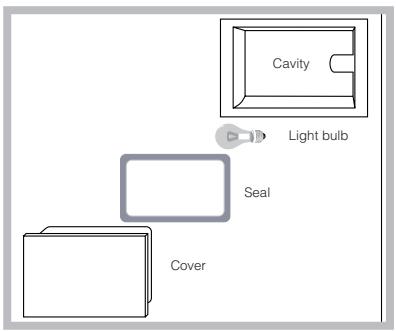
To replace the oven light bulb:
- Remove the glass cover using a screwdriver.
- Unscrew the light bulb and replace it with a similar one: Wattage 15 W, cap E 14.
Replace the glass cover, making sure the seal is positioned correctly (see diagram).
! Do not use the oven lamp as/for ambient lighting.
Gas tap maintenance
Over time, the valves may become jammed or difficult to turn. If this occurs, the valve must be replaced.
! This procedure must be performed by a qualified technician who has been authorised by the manufacturer.
GB
Automatic cleaning using the PYROLYTIC cycle
During the PYROLYTIC cycle, the internal temperature of the oven reaches 500^ . The pyrolytic cycle is activated and burns away food and grime residues. Dirt is literally incinerated. Keep children away from the appliance during the automatic cleaning cycle as surfaces may become very hot. Particles may ignite inside the oven as a result of the combustion process. There is no cause for concern: this process is both normal and hazard-free.
Before initiating the PYROLYTIC CYCLE:
- Remove large or coarse food residues from the inside of the oven using a damp sponge. Do not use detergents.
- Remove all accessories.
- Do not place tea towels or pot holders over the oven handle.
- Turn the SELECTOR knob to the "0" position.
! If the oven is too hot, the pyrolytic cycle may not start. Wait for the oven to cool down.
! The programme may only be started once the oven door has been closed.
To activate the PYROLITIC CYCLE cleaning
procedure, press and hold the button for approximately 4 seconds. The TIMER KNOB may be used to select the desired cleaning level; there are three default time settings which cannot be modified.
- Economy (ECO): turn the knob towards “-”. Duration 1 hour.
- Normal (NOR): initial level. Duration 1 hour and 30 minutes.
- Intensive (INT): turn the knob towards "+". Duration 2 hours.
- Press the button to confirm.
An end time for the PYROLITIC CYCLE (as for a normal cooking cycle) may be programmed (see Programming the automatic cleaning end time).
Safety devices
- The icon on the display, when lit, indicates that the oven door was automatically locked as soon as the temperature reached a high value.
- The STOP icon indicates that the cleaning cycle may be cancelled at any time by pressing the button.
- If a malfunction occurs, the heating elements will be switched off.
- Once the oven door has been locked, you cannot change the duration and cycle end time settings.
Programming the automatic cleaning end time
- Press the button until the icon and the two digits on the DISPLAY begin to flash.
- Turn the TIMER KNOB towards “+” and “-” to adjust the hour value.
- Press the button again until the other two digits on the DISPLAY begin to flash.
- Turn the TIMER KNOB towards “+” and “-” to adjust the minute value.
- Press the button again to confirm;
- When the set time has elapsed, the text END appears on the display and a buzzer sounds.
- For example: it is 9:00 a.m. and the Economy PYROLYTIC cycle has been selected: default set time 1 hour. 12:30 is scheduled as the end time. The programme will start automatically at 11:30 a.m.
Programming has been set when the and buttons are illuminated. The DISPLAY shows the PYROLITIC CYCLE end time and duration alternately.
Once the automatic cleaning cycle is over
You will have to wait until the temperature inside the oven has cooled down sufficiently before you can open the oven door. You will notice some white dust deposits on the bottom and the sides of your oven; remove these deposits with a damp sponge once the oven has cooled down completely. Alternatively, you can make use of the already heated oven, in which case it is not necessary to remove the deposits, they are completely harmless and will not affect your food in any way.

- Operating Instructions
- COOKER AND OVEN
- Contents
- Gebruiksaanwijzing
- FORNUIS EN OVEN
- Inhoud
- Description of the appliance
- Overall view
- FR
- Description of the appliance Control panel
- Please have the following information to hand:
- Assistance
- Attention :
- Room ventilation
- A
- B
- Disposing of combustion fumes
- Positioning and levelling
- Levelling
- Electrical connection
- Gas connection
- Gas connection using a flexible rubber hose
- GB
- Connecting a flexible jointless stainless steel pipe to a threaded attachment
- Checking the connection for leaks
- Adapting to different types of gas
- Adapting the hob
- Table of burner and nozzle specifications
- Using the hob
- Lighting the burners
- Advice when using burners
- Electric hotplates*
- Setting the clock
- Setting the timer
- Using the oven
- Cooling ventilation
- Oven light
- Manual cooking modes
- TRADITIONAL OVEN mode
- MULTILEVEL mode
- ROASTING mode
- SPIT ROAST mode
- LOW TEMPERATURE modes
- Spit roast
- Automatic cooking modes
- PIZZA mode
- Recipe for PIZZA:
- BREAD mode
- Recipe for BREAD:
- Programming cooking
- Programming the cooking duration
- Setting the end time for a cooking mode
- Practical cooking advice
- MULTILEVEL
- Practical advice on using the electric hotplates
- Oven cooking advice table
- General safety
- Disposal
- Respecting and conserving the environment
- Switching the appliance off
- Cleaning the appliance
- Inspecting the oven seals
- Replacing the oven light bulb
- Gas tap maintenance
- Automatic cleaning using the PYROLYTIC cycle
- Safety devices
- Programming the automatic cleaning end time
- Once the automatic cleaning cycle is over
Brand : SCHOLTES
Model : CI 66 MI
Category : Cooker